
Home » Uncategorized (Page 123)
Category Archives: Uncategorized
 DRUG APPROVALS BY DR ANTHONY MELVIN CRASTO
.....FOR BLOG HOME CLICK HERE
DRUG APPROVALS BY DR ANTHONY MELVIN CRASTO
.....FOR BLOG HOME CLICK HEREFlag and hits
ORGANIC SPECTROSCOPY

SUBSCRIBE

 Subscribe in a reader
Enter your email address:
Delivered by FeedBurner
Subscribe to New Drug Approvals by Email


Recent Comments
 | shivkr2 on SPSR Excellence Award 2025 – S… |
 | Bonkasaurus on Infigratinib phosphate |
 | PALOVAROTENE | ORGAN… on Palovarotene |
| Pfizer just purchase… on Temanogrel | |
| Pfizer To Cash In On… on Temanogrel |
A new twist on neuro disease: Discovery could aid people with dystonia, Parkinson’s and more

Twist and hold your neck to the left. Now down, and over to the right, until it hurts. Now imagine your neck – or arms or legs – randomly doing that on their own, without you controlling it.
That’s a taste of what children and adults with a neurological condition called dystonia live with every day – uncontrollable twisting and stiffening of neck and limb muscles.
The mystery of why this happens, and what can prevent or treat it, has long puzzled doctors, who have struggled to help their suffering dystonia patients. Now, new re-search from a University of Michigan Medical School team may finally open the door to answering those questions and developing new options for patients.
In a new paper in the Journal of Clinical Investigation, the researchers describe new strains of mice they’ve developed that almost perfectly mimic a human form of the disease. They also…
View original post 688 more words
Parasitic worms of pigs could provide new treatments of human diseases
New treatments for inflammatory bowel disease, rheumatoid arthritis, multiple sclerosis, diabetes and autism could be on the horizon, after a global University of Melbourne – lead study successfully mapped the genes of a parasitic worm in pigs.
Lead researcher, Dr Aaron Jex, Faculty of Veterinary Science, said, “We know that humans infected with the harmless, ‘pig whipworm’ can have significantly reduced symptoms linked to autoimmune diseases. And now we have the genetic sequence of the worm, it opens the door to future human drug designs and treatment.”
Although the ‘pig whipworm’ causes disease and losses in livestock, it does not cause disease in humans.
In contrast, the ‘human whipworm’ infects around 1 billion people, mainly children in developing nations, and causes dysentery, malnourishment and impairment of physical and mental development.
Coauthor, Prof Robin Gasser, Faculty of Veterinary Science, said, “The genes tells us about the proteins that this worm uses…
View original post 56 more words
Alternative solid-state forms of a potent antimalarial aminopyridine: X-ray crystallographic, thermal and solubility aspects
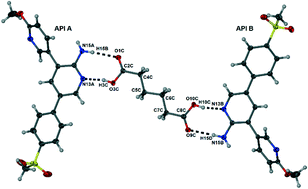
Graphical abstract: Alternative solid-state forms of a potent antimalarial aminopyridine: X-ray crystallographic, thermal and solubility aspects
Alternative solid-state forms of a potent antimalarial aminopyridine: X-ray crystallographic, thermal and solubility aspects
Dyanne L. Cruickshank, Yassir Younis, Nicholas M. Njuguna, Dennis S. B. Ongarora, Kelly Chibale and Mino R. Caira
CrystEngComm, 2014, 16, 5781 DOI:10.1039/C3CE41798K
3-(6-Methoxypyridin-3-yl)-5-(4-methylsulfonyl phenyl)-pyridin-2-amine (MMP) is a member of a novel class of orally active antimalarial drugs. This aminopyridine molecule has shown potent in vitro antiplasmodial activity and in vivo antimalarial activity in Plasmodium berghei-infected mice. The aqueous solubility of this molecule is, however, limited.
Thus investigations aimed at improving the physicochemical properties, including solubility, of MMP were accordingly conducted. Five salts of MMP were formed with co-former molecules saccharin, salicylic acid, fumaric acid, oxalic acid and suberic acid, but a cocrystal was obtained when the co-former adipic acid was employed.
All these new multi-component systems have been fully characterised using X-ray diffraction and thermal methods. Semi-quantitative, turbidimetric solubility tests in a phosphate-buffered saline solution at a pH of 7.4 were performed on the salts and the cocrystal of MMP. The saccharinate salt, fumarate salt and the cocrystal of MMP proved to have greater solubility than MMP itself. This work illustrates the importance of screening and modifying candidate drug compounds in their preliminary stages of development.
Alternative solid-state forms of a potent antimalarial aminopyridine: X-ray crystallographic, thermal and solubility aspects
Dyanne L. Cruickshank,a Yassir Younis,a Nicholas M. Njuguna,a Dennis S. B. Ongarora,a Kelly Chibalea and Mino R. Caira*a
*corresponding authors
aDepartment of Chemistry, University of Cape Town, Rondebosch 7701, South Africa
E-mail: mino.caira@uct.ac.za;
Fax: +27 21 650 5195 ;
Tel: +27 21 650 3071
CrystEngComm, 2014,16, 5781-5792
DOI: 10.1039/C3CE41798K
Scientists take totally tubular journey through brain cells

NIH scientists watched the inside of brain cell tubes, called microtubules, get tagged by a protein called TAT. Tagging is a critical process in the health and development of nerve cells. Credit: Roll-Mecak lab, NINDS, Bethesda, MD
In a new study, scientists at the National Institutes of Health took a molecular-level journey into microtubules, the hollow cylinders inside brain cells that act as skeletons and internal highways. They watched how a protein called tubulin acetyltransferase (TAT) labels the inside of microtubules. The results, published in Cell, answer long-standing questions about how TAT tagging works and offer clues as to why it is important for brain health.
Microtubules are constantly tagged by proteins in the cell to designate them for specialized functions, in the same way that roads are labeled for fast or slow traffic or for maintenance. TAT coats specific locations inside the microtubules with a chemical called an…
View original post 560 more words
Researchers investigate stress as a potential cause of periodontal disease

A section of a mast cell. The cytoplasm, in yellow, releases granules, in green, in response to inflammation. Credit: CNRI/Science Source
We all know what contributes to gum disease—poor brushing, forgetting to floss, avoiding checkups, smoking. But what about a tough day at the office or dire financial straits? Surprisingly, the stress brought on by emotional struggles might have just as much to do with the disease, according to a review of the literature by three Tufts researchers.
“It’s been shown there is a significant association between emotional stress and periodontal disease,” says Evangelos Papathanasiou, DG11, an assistant professor of periodontology at Tufts School of Dental Medicine. “It definitely needs to be explored further.”
Before he came to Tufts, Papathanasiou was a dentist in the Greek air force and saw a number of soldiers under high stress who developed mouth ulcers and bleeding gums. Closer to home, he recently…
View original post 759 more words
Parasitic worms of pigs could provide new treatments of human diseases
New treatments for inflammatory bowel disease, rheumatoid arthritis, multiple sclerosis, diabetes and autism could be on the horizon, after a global University of Melbourne – lead study successfully mapped the genes of a parasitic worm in pigs.
Lead researcher, Dr Aaron Jex, Faculty of Veterinary Science, said, “We know that humans infected with the harmless, ‘pig whipworm’ can have significantly reduced symptoms linked to autoimmune diseases. And now we have the genetic sequence of the worm, it opens the door to future human drug designs and treatment.”
Although the ‘pig whipworm’ causes disease and losses in livestock, it does not cause disease in humans.
In contrast, the ‘human whipworm’ infects around 1 billion people, mainly children in developing nations, and causes dysentery, malnourishment and impairment of physical and mental development.
Coauthor, Prof Robin Gasser, Faculty of Veterinary Science, said, “The genes tells us about the proteins that this worm uses…
View original post 56 more words

How leptin, the ‘satiety hormone,’ reverses diabetes
Treatment with leptin, the hormone associated with fullness or satiety, reverses hyperglycemia in animals models of poorly controlled type 1 (T1D) and type 2 (T2D) diabetes by suppressing the neuroendocrine pathways that cause blood glucose levels to soar, a Yale-led team of researchers has found. The study appears in the Advance Online Publication of Nature Medicine.
The leptin hormone regulates metabolism, appetite, and body weight. The researchers discovered that, in a fasting state, rats with poorly controlled T1D and T2D diabetes had lower plasma insulin and leptin concentrations and large increases in concentrations of plasma corticosterone—a stress hormone made in the adrenal glands that raises levels of blood glucose.
The researchers then found that normalizing plasma leptin concentrations in the T1D rats with a leptin infusion resulted in marked reductions in plasma glucose concentrations, which could mostly be attributed to reduction in rates of liver conversion of…
View original post 180 more words
New discoveries could help neutralize chemical weapons

In this image, the nerve agent sarin is bound to a bioscavenger enzyme. Credit: Jeremy Smith
Researchers at the University of Tennessee, Knoxville, are a step closer to creating a prophylactic drug that would neutralize the deadly effects of the chemical weapons used in Syria and elsewhere.
Jeremy Smith, UT-ORNL Governor’s Chair and an expert in computational biology, is part of the team that is trying to engineer enzymes—called bioscavengers—so they work more efficiently against chemical weapons. The work is a joint effort between scientists at UT, Oak Ridge National Laboratory and a French national laboratory in Grenoble. Their study was published recently in the Journal of Physical Chemistry.
Nerve agents, such as sarin, are among the most highly toxic chemical weapons. The study focuses on engineering enzymes that catalyze the hydrolysis of nerve agents as a prophylactic approach to diminishing their toxic effects.
“Enzymes exist that can…
View original post 311 more words
‘Onion’ vesicles for drug delivery developed

Black and white CryoTEM images of the vesicles were turned into colorized 3-D models to better show their layers. Credit: University of Pennsylvania
One of the defining features of cells is their membranes. Each cell’s repository of DNA and protein-making machinery must be kept stable and secure from invaders and toxins. Scientists have attempted to replicate these properties, but, despite decades of research, even the most basic membrane structures, known as vesicles, still face many problems when made in the lab. They are difficult to make at consistent sizes and lack the stability of their biological counterparts.
Now, University of Pennsylvania researchers have shown that a certain kind of dendrimer, a molecule that features tree-like branches, offers a simple way of creating vesicles and tailoring their diameter and thickness. Moreover, these dendrimer-based vesicles self-assemble with concentric layers of membranes, much like an onion.
By altering the concentration of the dendrimers…
View original post 974 more words


 New Drug Approvals