
Home » PATENTS (Page 4)
Category Archives: PATENTS
 DRUG APPROVALS BY DR ANTHONY MELVIN CRASTO
.....FOR BLOG HOME CLICK HERE
DRUG APPROVALS BY DR ANTHONY MELVIN CRASTO
.....FOR BLOG HOME CLICK HEREFlag and hits
ORGANIC SPECTROSCOPY

SUBSCRIBE

 Subscribe in a reader
Enter your email address:
Delivered by FeedBurner
Subscribe to New Drug Approvals by Email


Recent Comments
 | shivkr2 on SPSR Excellence Award 2025 – S… |
 | Bonkasaurus on Infigratinib phosphate |
 | PALOVAROTENE | ORGAN… on Palovarotene |
| Pfizer just purchase… on Temanogrel | |
| Pfizer To Cash In On… on Temanogrel |
NEW PATENT, WOCKHARDT LIMITED, WO 2016055918, ISAVUCONAZOLE

WO2016055918) NOVEL STABLE POLYMORPHS OF ISAVUCONAZOLE OR ITS SALT THEREOF
WOCKHARDT LIMITED [IN/IN]; D-4, MIDC Area, Chikalthana, Aurangabad 431006 (IN)
KHUNT, Rupesh Chhaganbhai; (IN).
RAFEEQ, Mohammad; (IN).
MERWADE, Arvind Yekanathsa; (IN).
DEO, Keshav; (IN)
The present invention relates to novel stable novel stable polymorphs of Isavuconazole or its salt thereof, having purity more than 90 % when measured by HPLC. In particular the present invention directs process for the preparation of solid amorphous and crystalline form of Isavuconazole base. In a further embodiment present invention directs to crystalline form Isavuconazole Hydrobromide salt and oxalate salt of 2-(2,5-difluoro- phenyl)-1-[1,2,4]triazol-1-yl-butane-2,3-diol.
Isavuconazole, Isavuconazonium, Voriconazole, and Ravuconazole are azole derivatives and known as antifungal drugs for treatment of systemic mycoses as reported in US 5,648,372, US 5,792,781, US 6,300,353 and US 6,812,238.
The US patent No. 6,300,353 discloses Isavuconazole and its process. It has chemical name [(2R,3R)-3-[4-(4-cyanophenyl)thiazol-2-yl)]-l -(lH-l,2,4-triazol-l-yl)-2-(2,5-difluorophenyl)43utan-2-ol; and has the structural formula I:

Formula I
The ‘353 described the process for the preparation Isavuconazole, involve the use of 2-(2,5-difluoro-phenyl)-l-[l ,2,4]triazol-l-yl-butane-2,3-diol (referred herein after “diol base”) in an oil form, which is difficult to isolate and purify. The use of 2-(2,5-difluoro-phenyl)-l-[l ,2,4]triazol-l-yl-butane-2,3-diol base, without purification, reflects the purity of Isavuconazole and Isavuconazonium sulfate. However, the reported process not feasible industrially.
Thus, an object of the present invention is to provide simple, cost effective and industrially feasible processes for preparation of Isavuconazole or its salt thereof in enhanced yield as well as purity. In a particular present invention directs to novel stable polymorphs of Isavuconazole or its salt thereof.

Examples
Example-1: Preparation of Amorphous Isavuconazole
In a round bottomed flask charged ethanol (250 ml), thioamide compound (25.0 gm) and 4-cyano phenacyl bromide (18.4 gm) under stirring. The reaction mixture were heated to 70 °C. After completion of reaction the solvent was removed under vacuum distillation and water (250 ml) and Ethyl acetate (350 ml) were added to reaction mass. The reaction mixture was stirred and its pH was adjusted between 7 to 7.5 by 10 % solution of sodium bicarbonate. The layer aqueous layer was discarded and organic layer was washed with saturated sodium chloride solution (100 ml) and concentrated under vacuum to get residue. The residue was suspended in methyl tert-butyl ether (250 ml) and the reaction mixture was heated to at 40°C to make crystals uniform and finally reaction mass is cooled to room temperature filtered and washed with the methyl tert-butyl ether. The product was isolated dried to get pale yellowish solid product.
Yield: 26.5 gm
HPLC purity: 92.7%
Example-2: Preparation of crystalline Isavuconazole Base
Charged methylene dichloride (250 ml) and 25.0 gm Isavuconazole Hydrobromide compound of formula-II into 1.0 L flask and stirred. Added aqueous solution of sodium bi carbonate in to the reaction mass to obtained clear solution. The layers were separated and organic layer was washed with dilute hydrochloric acid solution followed by saturated solution of sodium chloride. Finally, Organic layer was concentrated under vacuum to get titled product.
Yield: 18.5 gm
HPLC Purity: 97%
Example-3: Preparation of crystalline Isavuconazole Hydrobromide
Charged isopropanol alcohol (250 ml) followed by thioamide compound (25.0 gm) and 4-cyano phenacyl bromide (18.4 gm) into 1.0 L flask. The reaction mixture was stirred and heated to 50 C, after completion of reaction the precipitated material was filtered and washed with isopropanol alcohol (25 ml). The wet cake is dried under vacuum for 4-5 hrs at 40 C to obtain off-white solid product.
Yield: 26.5 gm
HPLC Purity: 97.3%
Exaniple-4: Synthesis of 2-(2,5-difluoro-phenyl)-l -[l,2,4]triazol-l-yl-butane-2,3-diol oxalate
Dissolved crude 50 gm 2-(2,5-difluoro-phenyl)-l-[l ,2,4]triazol-l -yl-butane-2,3-diol base compound in 150 ml of ethyl acetate. Oxalic acid dihydrate 25 gm was added into the reaction mixture and stirred. Heat the reaction mixture for 1 hour at 50-55 °C. The reaction mixture was cooled to 25°C to 35°C. Toluene 300 ml was added into the reaction mixture to precipitate the solid. The precipitate was washed with toluene and dried under vacuum to obtain the solid crystalline form of titled compound.
Yield: 58 g
HPLC Purity: 76%
Exaniple-5: Synthesis of 2-(2,5-difluoro-phenyl)-l -[l,2,4]triazol-l-yl-butane-2,3-diol oxalate salt
Exemplified procedure in example 1 with the replacement ethyl acetate solvent with tetrahydrofuran and antisolvent toluene with petroleum ether were used to get the title compound.
Exaniple-6: Synthesis of 2-(2,5-difluoro-phenyl)-l -[l,2,4]triazol-l-yl-butane-2,3-diol oxalate
Exemplified procedure in example 1 with the replacement ethyl acetate solvent with isopropyl acetate and antisolvent toluene with diisopropyl ether were used to get the title compound.
Exaniple-7: Synthesis of 2-(2,5-difluoro-phenyl)-l -[l,2,4]triazol-l-yl-butane-2,3-diol oxalate
Exemplified procedure in example 1 wherein diethyl ether is used in place of ethyl acetate and toluene or heptane was used as antisolvent to get the title compound.
Example-8: Synthesis of 2-(2,5-difluoro-phenyl)-l -[l,2,4]triazol-l-yl-butane-2,3-diol oxalate
Exemplified procedure in example 1 wherein diethyl ether is used in place of ethyl acetate and isolation of the product were done by means of partial removal of the solvent under vacuum.
Example-9: Synthesis of 2-(2,5-difluoro-phenyl)-l -[l,2,4]triazol-l-yl-butane-2,3-diol oxalate
Exemplified procedure in example 1 wherein ethyl acetate is replaced with isopropyl acetate and further, the reaction mass was stirred at lower temperatures to about 10°C to about 15°C for 3-5 hours and subsequently precipitated product was isolated and dried.
Example-10: Synthesis of 2-(2,5-difluoro-phenyl)-l-[l ,2,4]triazol-l-yl-butane-2,3-diol base
Stirring the suspension of 260 ml water and 65 gm 2-(2,5-difluoro-phenyl)-l-[l,2,4] triazol-l-yl-butane-2,3-diol oxalate salt were added. The reaction mixture pH was adjusted by addition of 10 % aqueous sodium carbonate solution. The pH was maintained to about pH 7 to about 8, 300 ml dichloro methane was added into the reaction mixture with stirring. The layers were separated and dichloromethane layer was collected. Aqueous layer was extracted with 150 ml dichloromethane. Dichloromethane layer was combined and washed with water. Dichloromethane was distilled out to get titled compound.
Yield: 35 gm
Purity: 87%

Wockhardt Ltd chairman Habil Khorakiwala.

/////////NEW PATENT, WOCKHARDT LIMITED, WO 2016055918, ISAVUCONAZOLE
WO 2016042441, Mankind Research Centre, Silodosin, New patent

WO 2016042441, Mankind Research Centre, Silodosin, New patent



Mankind Research Centre
MANKIND RESEARCH CENTRE [IN/IN]; 191-E, Sector 4-II, IMT-Manesar, Haryana 122050 (IN)
A novel process for the preparation of considerably pure silodosin
GANGWAR, Kuldeep Singh; (IN).
KUMAR, Anil; (IN).
BHASHKAR, Bhuwan; (IN)
The present invention relates to a novel, improved, commercially viable and industrially advantageous process for the preparation of Silodosin of Formula (I), its pharmaceutically acceptable salts or solvates thereof. The invention relates to the preparation of considerably pure Silodosin with high yield.
Silodosin, l-(3-hydroxypropyl)-5-[(2R)-2-({2-[2-(2,2,2-trifluoroethoxy)phenoxy] ethyl} amino)propyl]-2,3-dihydro-lH-indole-7-carboxamide of Formula (I) is an indoline antidysuric which has a selectively inhibitory effect against urethra smooth muscle constriction, and decreases urethra internal pressure without great influence on blood pressure. Silodosin is available under trade names RAPAFLO® or UROREC®. Silodosin was first disclosed in EP 0600675 as a therapeutic agent for the treatment of dysuria associated with benign prostatic hyperplasia, where a process for producing the compound is also disclosed.

Formula (I)
Since, Silodosin is an optically active compound having a complex chemical structure; its synthesis is relatively complex and requires a sequence of multiple steps.
US patent no. 6,310,086, discloses a process for preparing Silodosin analogue compound from reaction of (R)-3-{5-(2-aminopropyl)-7-cyano-2,3-dihydro-lH-indol-l-yl} propylbenzoate with 2-(2-ethoxyphenoxy)ethyl methanesulfonate and finally isolated as a crude compound which is purified by column chromatography. The said process has a major disadvantage of using column chromatography which is not feasible at plant scale production.
PCT application no. WO 2012147019, discloses the preparation of Silodosin as shown in scheme- 1, wherein the Ν,Ν-dialkyl impurity of Formula (Ila) formed during condensation of 3-{7-cyano-5-[(2R)-2-aminopropyl]-2,3-dihydro-lH-indol-l-yl}propyl benzoate of Formula (III) with 2-(2-(2,2,2-trifluoroethoxy)phenoxy)ethyl methanesulfonate of Formula (IV); is removed through preparation of monotartarate salt to give compound of Formula (VI). The compound of Formula (VI) is base hydrolyzed followed by cyano hydrolysis to give crude Silodosin of Formula (VIII) which is then further purified by crystallization to get desired pure Silodosin.
Scheme- 1:

Major drawback of above said reaction process is that multiple isolations and crystallizations are required to get pure Silodosin.
Similarly, US 7,834,193 discloses monooxalate salt represented by Formula Via having 0.9% of dialkyl impurity represented by Formula Ila. The oxalate salt so obtained is subjected to alkaline hydrolysis followed by transformation of the nitrile to an amide.

Formula (Ila)
Similarly, PCT application no. WO 2012147107, discloses the method wherein Silodosin is prepared by condensation of 3-{7-cyano-5-[(2R)-2-aminopropyl]-2,3-dihydro-lH-indol-l-yl} propyl benzoate with 2-[2-(2,2,2-trifluoroethoxy)phenoxy]ethyl methanesulfonate in solvent using base and phase transfer catalyst wherein, dialkyl impurity is formed up to 11%, followed by hydroxyl deprotection in protic solvent using base and phase transfer catalyst which is then subjected to purification to remove N,N-dialkyl impurity represented by Formula (lib) up to 0.6% through the preparation of acetate salt. This process suffers from a serious drawback i.e., accountable formation of dialkyl impurity and even after purification the impurity is reduced to only up to 0.6%. Secondly, the process requires multiple isolations and purifications ensuing into time engulfing workups and purifications and hence incurring solvent wastage. This makes process lengthy, uneconomical and tedious to be performed at plant scale.
Another PCT application no. WO 2012131710, discloses the preparation of Silodosin in which the chiral compound (3-(5-((R)-2-aminopropyl)-7-cyanoindolin-l-yl)propyl benzoate) is reacted with 2-[2-(2,2,2-trifluoroethoxy)phenoxy]ethyl methane sulfonate in isopropyl alcohol using sodium carbonate as base. The reaction is completed in 40-50h and about 9-11% of dimer is formed during condensation. After completion of reaction, it is subjected to hydroxyl deprotection and the crude compound so obtained is purified to remove the Ν,Ν-dialkyl impurity of Formula (lib). The pure compound is then reacted with hydrogen peroxide in dimethyl sulfoxide to give Silodosin. The major drawback of this process is that the process is a multistep process wherein the condensation reaction is long-drawn-out resulting into countable amount of dimer formation during the process.
Thus, the prior art methods of preparing Silodosin require multiple and repeated purifications to synthesize DMF (Drug Master File) grade Silodosin. None of the prior art produces compound of Formula (VI) or (VII) with Ν,Ν-dialkyl impurity of Formula (Ila) or (lib) in an amount less than 0.6% to 0.5% even after purification. Therefore to prepare highly pure Silodosin, there is a need to explore new synthetic schemes that could be more economical and scalable. The present invention provides a novel, improved, commercially viable and industrially advantageous process for the synthesis of Silodosin and its pharmaceutically acceptable salts or solvates thereof. The present invention focus on preparation of highly pure Silodosin in appreciable yields with minimal use of solvents wherein the Silodosin is isolated with purity >99.5% having Ν,Ν-dialkyl impurity less than 0.03% and other individual impurities below 0.1%.

Ramesh Juneja (seated), founder of Mankind Pharma, with brother Rajeev, who is senior director (marketing & sales)
Mankind Pharma Chairman and Founder RC Juneja
In accordance to one embodiment of the present invention, the process of the preparation of Silodosin represented by Formula (I)

comprises the steps of:
a) condensing chiral compound represented by Formula (III)

Formula (III)
wherein, Bz represents to Benzoyl group with compound represented by Formula (IV)

Formula (IV)
wherein, Ms represents to Methanesulfonyl group in presence of base and phase transfer catalyst in an organic solvent to give intermediate represented by Formula (V)

Formula (V)
wherein, n is an integer of 1 and 2 and Bz is as defined above, wherein the compound having n=2 is formed in an amount of less than 5%;
b) optionally isolating compound of Formula (V),
c) without purification converting it to de-protected compound represented by Formula (IX) in an organic solvent;

Formula (IX)
wherein, n is as defined above;
d) optionally isolating compound of Formula (IX), and
e) without purification converting it to compound represented by Formula (X)

Formula (X)
wherein n is as defined above;
f) subjecting compound of Formula (X) to purification by converting to acid salt for removal of Ν,Ν-dialkyl impurity represented by Formula (lie);

Formula (He)
g) hydrolysis of the said acid salt to get Silodosin of Formula (I) with purity >99.5%.
Examples
The invention is explained in detail in the following examples which are given solely for the purpose of illustration only and therefore should not be construed to limit the scope of the invention.
Example 1
Preparation of Crude Silodosin:
Method A:
To the solution of lOg (0.0275 mol) of (3-(5-((R)-2-aminopropyl)-7-cyanoindolin-l-yl)propyl benzoate) in 100ml of toluene was added 14.3g (0.0826 mol) of dipotassium hydrogen phosphate and 8.20g (0.0261 mol) of 2-[2-(2,2,2-trifluoroethoxy)phenoxy]ethyl methane sulfonate followed by addition of 2.0g (0.0055 mol) of tetrabutyl ammonium iodide and stirred the reaction mass at 85-90°C for 10-12h. Cooled the reaction mass, added de-mineralized water and separated the toluene layer followed by distillation to get crude viscous mass. Added 110ml of dimethyl sulfoxide and a solution of 1.51g (0.0415 mol) of sodium hydroxide dissolved in 8.52ml of water followed by addition of 6.42g (0.0567 mol) of 30% w/w of hydrogen peroxide. Stirred the reaction mass at 20-25°C till completion and added sodium sulfite solution. Extracted the compound in ethylacetate, washed the organic layer with brine solution and concentrated to get 10.2g of crude Silodosin.
Ν,Ν-dialkyl impurity is 3.2% as per HPLC.
Method B:
To the solution of lOg (0.0275 mol) of (3-(5-((R)-2-aminopropyl)-7-cyanoindolin-l-yl)propyl benzoate) in 100ml of toluene was added 14.3g (0.0826 mol) of dipotassium hydrogen phosphate and 8.20g (0.0261 mol) of 2-[2-(2,2,2-trifluoroethoxy)phenoxy]ethyl methane sulfonate followed by addition of 2.0g (0.0055 mol) of tetrabutyl ammonium iodide and stirred the reaction mass at 85-90°C for 10-12h. Added solution of 4.4g of sodium hydroxide dissolved in 10ml of water and stirred the reaction at ambient temperature till completion. Quenched the reaction mass with water and separated the layers. Washed the toluene layer with brine and concentrated under reduced pressure to get crude mass. Dissolved the crude mass so obtained in 110ml of dimethyl sulfoxide and added a solution of 1.95g (0.0488 mol) of sodium hydroxide dissolved in 7.95ml of water followed by addition of 7.5g (0.066 mol) of 30% w/w of hydrogen peroxide. Stirred the reaction mass at room temperature followed by addition of 210ml of aqueous solution of sodium sulfite and extracted the compound in ethyl acetate. Washed the organic layer with brine and concentrated under reduced pressure to get 10. lg of crude Silodosin.
Ν,Ν-dialkyl impurity is 3.0% as per HPLC
Method C:
To the solution of lOg (0.0275 mol) of (3-(5-((R)-2-aminopropyl)-7-cyanoindolin-l-yl)propyl benzoate) in 100ml of dimethyl sulfoxide was added 14.3g (0.0826 mol) of dipotassium hydrogen phosphate and 8.20g (0.0261 mol) of 2-[2-(2,2,2-trifluoroethoxy)phenoxy] ethyl methane sulfonate followed by addition of 2.0g (0.0055 mol) of tetrabutyl ammonium iodide and stirred the reaction mass at 85-90°C for 2-3h. Added 100ml of water and 50ml of toluene and stirred the reaction mass at room temperature for half an hour. Separated the toluene layer and concentrated under reduced pressure. To the crude mass so obtained was added 110ml of dimethyl sulfoxide and a solution of 4.4g of sodium hydroxide dissolved in 10ml of water followed by addition of 7.5g (0.066 mol) of 30% w/w of hydrogen peroxide. Stirred the reaction mass at room temperature followed by addition of 210ml of aqueous solution of sodium sulfite and extracted the compound in ethyl acetate. Washed the organic layer with brine and concentrated under reduced pressure to get 9.8 g of crude Silodosin.
Ν,Ν-dialkyl impurity is 2.1% as per HPLC
Method D:
To the solution of 20g (0.055 mol) of (3-(5-((R)-2-aminopropyl)-7-cyanoindolin-l-yl)propyl benzoate) in 200ml of toluene was added 28.6g (0.165 mol) of dipotassium hydrogen phosphate and 16.4g (0.0522 mol) of 2-[2-(2,2,2-trifluoroethoxy)phenoxy]ethyl methane sulfonate followed by addition of 4.0g (0.11 mol) of tetrabutyl ammonium iodide and stirred the reaction mass at 85-90°C for 10-12h. Added de-mineralized water and stirred at room temperature for half an hour. Separated the toluene layer to which was added a solution of 8.8g of sodium hydroxide dissolved in 20ml of water and stirred the reaction at ambient temperature till completion. Quenched the reaction mass with water and separated the layers. Washed the toluene layer with brine and concentrated under reduced pressure to get crude mass. Dissolved the crude mass so obtained in 200ml of dimethyl sulfoxide and added a solution of 3.9g (0.0976 mol) of sodium hydroxide dissolved in 16ml of water followed by addition of 15g (0.132 mol) of 30% w/w of hydrogen peroxide. Stirred the reaction mass at room temperature followed by addition of 400ml of aqueous solution of sodium sulfite and extracted the compound in ethyl acetate. Washed the organic layer with brine and concentrated under reduced pressure to get 21. Og of crude Silodosin.
Ν,Ν-dialkyl impurity is 2.8% as per HPLC
Method E:
To the solution of 2g (0.0055 mol) of (3-(5-((R)-2-aminopropyl)-7-cyanoindolin-l-yl)propyl benzoate) in 20ml of was dimethyl sulfoxide was added 2.87g (0.0165 mol) of dipotassium hydrogen phosphate and 1.64g (0.0052 mol) of 2-[2-(2,2,2-trifluoroethoxy)phenoxy] ethyl methane sulfonate followed by addition of 0.29g (0.0011 mol) of 16-crown ether and stirred the reaction mass at 85-90°C for 10-12h. Added a solution of 0.88g of sodium hydroxide dissolved in 2ml of water and stirred the reaction at ambient temperature till completion. Added de-mineralized water and toluene and stirred at room temperature for half an hour. Separated the toluene layer and concentrated under reduced pressure and to the solid mass so obtained were added 20ml of dimethyl sulfoxide and a solution of 0.38g (0.0231 mol) of sodium hydroxide dissolved in 1.6ml of water followed by addition of 1.5g (0.0132 mol) of 30% w/w of hydrogen peroxide. Stirred the reaction mass at room temperature followed by addition of aqueous solution of sodium sulfite and extracted the compound in ethyl acetate. Washed the organic layer with brine and concentrated under reduced pressure to get 2.1g of crude Silodosin.
Ν,Ν-dialkyl impurity is 2.2% as per HPLC
Method F:
To the solution of lOg (0.0275 mol) of (3-(5-((R)-2-aminopropyl)-7-cyanoindolin-l-yl)propyl benzoate) in 100ml of was acetonitrile was added 14.3g (0.0826 mol) of dipotassium hydrogen phosphate and 8.20g (0.0261 mol) of 2-[2-(2,2,2-trifluoroethoxy)phenoxy] ethyl methane sulfonate followed by addition of 2.0g (0.0055 mol) of tetra butyl ammonium iodide and stirred the reaction mass at 85-90°C for 10-12h. Added a solution of 4.4g of sodium hydroxide dissolved in 10ml of water and stirred the reaction at ambient temperature till completion. Added de-mineralized water and toluene and stirred at room temperature for half an hour. Separated the toluene layer and concentrated under reduced pressure and to the solid mass so obtained were added 110ml of dimethyl sulfoxide and a solution of 1.95g (0.0488 mol) of sodium hydroxide dissolved in 7.95ml of water followed by addition of 7.5g (0.066 mol) of 30% w/w of hydrogen peroxide. Stirred the reaction mass at room temperature followed by addition of 210ml of aqueous solution of sodium sulfite and extracted the compound in ethyl acetate. Washed the organic layer with brine and concentrated under reduced pressure to get 9.5g of crude Silodosin.
Ν,Ν-dialkyl impurity is 3.1% as per HPLC
Method G:
To the solution of lOg (0.0275 mol) of (3-(5-((R)-2-aminopropyl)-7-cyanoindolin-l-yl)propyl benzoate) in 100ml of was Dimethyl sulfoxide was added 14.3g (0.0826 mol) of dipotassium hydrogen phosphate and 8.20g (0.0261 mol) of 2-[2-(2,2,2-trifluoroethoxy)phenoxy] ethyl methane sulfonate followed by addition of 4.0g (0.0055 mol) of tetra butyl ammonium iodide and stirred the reaction mass at 85-90°C for 10-12h. Added a solution of 4.4g of sodium hydroxide dissolved in 10ml of water and stirred the reaction at ambient temperature till completion. Added de-mineralized water and toluene and stirred at room temperature for half an hour. Separated the toluene layer and concentrated under reduced pressure and to the solid mass so obtained were added 110ml of dimethyl sulfoxide and a solution of 1.95g (0.0488 mol) of sodium hydroxide dissolved in 7.95ml of water followed by addition of 7.5g (0.066 mol) of 30% w/w of hydrogen peroxide. Stirred the reaction mass at room temperature followed by addition of 210ml of aqueous solution of sodium sulfite and extracted the compound in ethyl acetate. Washed the organic layer with brine and concentrated under reduced pressure to get 10.4g of crude Silodosin.
Ν,Ν-dialkyl impurity is 1.83% as per HPLC
Example 2
Purification of Crude Silodosin:
To the lOg (0.0080 mol) of crude mass of Silodosin was added 110ml of isopropyl alcohol followed by addition of 1.75g of oxalic acid at ambient temperature. Stirred the solution 6-8h and filtered the precipitates. Added ethyl acetate and water in the ratio of 1: 1 to the above solid followed by addition of 5ml of liquor ammonia. Stirred the reaction mass at ambient temperature for 15 min and separated the layers. Concentrated the organic layer to ¼ of its volume and left undisturbed overnight. Filtered the precipitates and recrystallized with ethyl acetate followed by drying under reduced pressure to get 5.1g of pure Silodosin. The amount of impurities and the percent impurity of the Silodosin obtained was as follows:
Ν,Ν-dialkyl impurity: undetectable amount
Other impurities: 0.03 to 0.09%
Silodosin purity: 99.65% (HPLC)
////WO 2016042441, Mankind Research Centre, Silodosin, New patent
New patent, WO 2016042573, Acitretin, Emcure Pharmaceuticals Ltd

Acitretin
PDT PATENT US4105681

Process for preparation of acitretin
Emcure Pharmaceuticals Ltd
EMCURE PHARMACEUTICALS LIMITED [IN/IN]; an Indian company at EMCURE HOUSE, T-184, MIDC., Bhosari, Pune – 411 026 Maharashtra (IN)
GURJAR MUKUND KESHAV; (IN).
JOSHI SHASHIKANT GANGARAM; (IN).
BADHE SACHIN ARVIND; (IN).
KAMBLE MANGESH GORAKHANATH; (IN).
MEHTA SAMIT SATISH; (IN)
The present invention Provides a process for preparation of {(2E, 4E, 6E, 8E) -9- (4-methoxy-2,3,6-trimethyl) phenyl-3,7-dimethyl-nona-2,4,6 , 8} tetraenoate, acitretin year intermediate of formula (VI) with trans isomer ≥97%, comprenant of Reacting 3-formyl-Crotonic acid butyl ester of formula (V) Substantially free of impurities, with 5- (4-methoxy- 2,3,6-trimethylphenyl) -3-methyl-penta-2,4-diene-l-triphenyl phosphonium bromide of formula (IV) and isolating resulting compound of formula (VI) Treating the filtrate with iodine for isomerization of the Undesired cis intermediate and finally Obtaining acitretin (I), with trans isomer Desired ≥97%.


Samit Satish Mehta holds the position of the President – Research & Development
Acitretin of formula (I), chemically known as (2E,4E,6E,8E)-9-(4-methoxy-2,3,6- trimethyl)phenyl-3,7-dimethyl-nona-2,4,6,8-tetraenoic acid, is a second generation retinoid a roved by USFDA in 1996, for the treatment of psoriasis.

Acitretin (I)
The process for preparation of acitretin (I) was first disclosed in US 4,105,681 wherein the intermediate, 5-(4-methoxy-2,3,6-trimethylphenyl)-3-methyl-penta-2,4-diene-l-triphenyl phosphonium bromide was reacted with 3-formyl-crotonic acid butyl ester in presence of sodium hydride as base and dimethylformamide as solvent. The resultant ester derivative was obtained with a trans is (E/Z) ratio of around 55:45 which was subjected to hydrolysis in presence of potassium hydroxide and ethyl alcohol to obtain acitretin.
Use of hazardous, highly pyrophoric and moisture sensitive reagent like sodium hydride, along with cumbersome work-up and successive crystallizations to obtain the desired isomer rendered the process unviable for commercial scale.
Indian patent application 729/MUM/2012 discloses use of organic bases such as triethyl amine or pyridine for the reaction of 3-formyl-crotonic acid butyl ester and 5-(4-methoxy-2,3,6-trimethylphenyl)-3-methyl-penta-2,4-diene-l -triphenyl phosphonium bromide for the synthesis of acitretin. The process utilizes a large excess of the organic base (2.85:1.0) with respect to the reactant phosphonium bromide derivative. Further, there is no mention of the ratio of cis and trans geometric isomers of the product thus obtained either at the intermediate or final stage. The trans: cis (E/Z) ratio of the intermediate significantly impacts the final yield and purity of the product as several purifications and crystallizations are required to obtain the desired trans isomer.
The present inventors have experimentally observed that use of organic base in such large quantities severely hampers the removal of the undesired side product triphenyl phosphonium oxide formed in significant amounts. Also, the intermediate is obtained with a very modest trans: cis (E/Z) ratio.
WO2012/155796 discloses another method wherein alkali metal alkoxides are used as bases in the reaction of 5-(4-methoxy-2,3,6-trimethylphenyl)-3 -methyl -penta-2,4-diene-l -triphenyl phosphonium bromide with 3-formyl-crotonic acid. The obtained reaction mass, after adjusting pH to 7-8 with acid, is directly subjected to catalytic isomerization using catalysts such as Pd(OAc)2 or Pd(NH3)2Cl2. The reaction mixture so obtained is quenched with water, neutralized and filtered to get the desired product, which is further recrystallized from ethyl acetate. Although this procedure avoids the hydrolysis step and attempts in-situ isomerization, however the use of expensive, soluble palladium catalyst which cannot be recycled from the reaction mass coupled with lengthy reaction time of 25-30 hours and large solvent volumes make the process unviable.
It may be noted that in the synthesis of acitretin, the key reaction of 5-(4-methoxy-2,3,6-trimethylphenyl)-3 -methyl-penta-2 ,4-diene- 1 -triphenylphosphoniumbromide with 3 -formyl crotonic acid or its ester in presence of either strong inorganic bases such as sodium hydride, alkali metal alkoxides or organic bases like triethylamine is common to almost all synthetic routes disclosed in the prior art. Hence, all these routes suffer from the inherent problems of formation of undesired impurities including cis-isomeric compounds and their separation from the desired all-trans product which necessitates various purification methods ranging from column chromatography, multiple crystallizations etc.
Thus, there still exists a need for a convenient, easy-to-scale up process for synthesis of acitretin (I) which avoids use of pyrophoric strong bases and provides a robust method which affords acitretin having desired isomeric purity in high yield.

5-(4-methoxy,2,3,6 trimethylphenyl)- 3-formyl crotonic acid butyl glyoxalate L(+) tartaric acid
3-methyl-penta-2,4-dien-1-triphenyl butyl ester (V) dibutyl ester
phosphonium bromide (IV)

Acitretin (I)


Satish Mehta,CEO, Above and here Inspiring the participants
EXAMPLES
Example 1: Preparation of 4-(4-methoxy-2,3,6-trimethylphenyl)-but-3-en-2-one (II)
Acetone (6000 ml) was added to 4-methoxy-2,3,6 trimethyl benzaldehyde (500.3 g) and the mixture was stirred at 20-30°C. Aqueous solution of sodium hydroxide (134.8 g in 500 ml water) was gradually added to it and the resulting mixture was heated to 45-50°C with continued stirring. After completion of the reaction, as monitored by HPLC, the reaction mass was cooled and acetic acid was added till pH 4.5 to 5.5. Distillation of acetone, followed by addition of cyclohexane to the residue, followed by washing with water, separation and concentration of the organic layer gave 4-(4-methoxy-2,3,6 trimethylphenyl)-but-3-en-2-one of formula (II).
Yield: 80-84%
Example 2: Preparation of 5-(4-methoxy-2,3,6-trimethylphenyl)-3-methyl-penta-2,4-diene- 1-triphenyl phosphonium bromide (IV)
4-(4-Methoxy-2,3,6-trimethylphenyl)-but-3-en-2-one (II; 500 g) dissolved in toluene (2000 ml) was gradually added to a mixture of vinyl magnesium bromide (3500 ml; 1 molar solution in THF) and lithium chloride (4.8 g) and stirred at 20-30 C till completion of the reaction as monitored by HPLC. The reaction mixture was quenched with water and concentrated hydrochloric acid was added till the pH was between 3 and 4. The organic layer was separated and concentrated to give residue containing 5-(4-methoxy-2,3,6 trimethylphenyl)-3 -methyl -penta l,4-dien-3-ol (III). Methyl isobutyl ketone (3500 ml) was added to the residue, followed by gradual addition of triphenyl phosphine hydrobromide (745.3 g) at room temperature. The reaction mixture was heated to 50-60°C till completion of the reaction. The reaction mixture was cooled and filtered to give 5-(4-methoxy-2,3,6-trimethylphenyl)-3-methyl-penta-2,4-diene-l-triphenyl phosphonium bromide of formula (IV).
Yield: 1000 g (76%)
Example 3: Preparation of 3-formyl crotonic acid butyl ester (V)
Dibutyl-L- tartrate (500 g) was dissolved in isopropanol (3500 ml) at room temperature, and water (750 ml) was added to it. The reaction mixture was cooled to 15-25°C and sodium metaperiodate (448.5 g) was gradually added to it with stirring. The reaction was continued at 20-30°C till completion of the reaction based on GC analysis. The reaction mixture was filtered and the filtrate was concentrated. The resulting residue was dissolved in toluene (1000 ml), stirred and filtered to obtain the filtrate containing butyl glyoxylate. Propionaldehyde (221.0 g) was added to the filtrate and heated to around 60°C, followed by gradual addition of piperidine (26.4 g, dissolved in toluene). The reaction mixture was further heated and stirred at 110-120°C till completion of the reaction, as monitored by GC. After completion, the reaction mass was cooled, washed with aqueous sulfuric acid, water and finally with aqueous sodium bicarbonate solution. The organic layer was concentrated and the residue was distilled to give 3-formyl crotonic acid butyl ester (V)
Yield: 230-280 g (35-43%)
Example 4. Preparation of butyI{(2E,4E,6E,8E)-9-(4-methoxy-2,3,6-trimethyl) phenyl-3,7-dimethyl-nona-2,4,6,8}tetraenoate (VI)
Sodium carbonate (297. lg), was added to the mixture of 5-(4-Methoxy-2,3,6-trimethylphenyl)-3-methyl-penta-2,4-diene-l-triphenyl-phosphoniumbromide (IV; 1000 g) in toluene (5000 ml) followed by gradual addition of 3-formyl crotonic acid butyl ester (330 g) at room temperature. The stirred reaction mixture was heated to 60-70°C till completion of the reaction as monitored by HPLC. The reaction mass was cooled, quenched with water. The organic layer was separated, concentrated and n-heptane was added to the residue. The mass was stirred, filtered and 40% aqueous methanol (2000 ml) was added to it with stirring. Layer separation, concentration of the organic layer, and crystallization of the resulting residue from isopropyl alcohol, optionally with seeding followed by filtration gave crop I of butyl {{(2E,4E,6E,8E)— 9-(4-methoxy-2,3,6 trimethyl)phenyl-3,7 dimethyl -nona-2,4,6,8} tetraenoate (VI),.
Yield: 45-50%;
Cis: Trans isomer ratio (2.0:98.0)
The filtrate was concentrated, the residue was dissolved in toluene (2000 ml) and treated with iodine (4.5 g) at room temperature. After completion of the reaction, as monitored by HPLC, the reaction mixture was stirred with aqueous sodium thiosulfate solution. Separation and concentration of the organic layer and crystallization of the resulting residue from isopropyl alcohol, optionally with seeding, gave crop II of butyl {{(2E,4E,6E,8E)-9-(4-methoxy-2,3,6-trimethyl)phenyl-3,7-dimethyl-nona-2,4,6,8} tetraenoate (VI).
Yield (crop II): 15 to 20%.
Cis: Trans isomer ratio (2.0:98.0)
Total yield (crop I+II): 60-70%.
Example 5: Preparation of acitretin (I)
Aqueous solution of potassium hydroxide (155.2 g in 600 ml water) was added to a solution of butyl {(2E,4E,6E,8E)-9-(4-methoxy-2,3 ,6-trimethyl) phenyl-3 ,7-dimethyl-nona- 2,4,6,8}tetraenoate, VI (300.0 g) in ethanol (1800 ml) at 25-30°C and the reaction mixture was stirred at reflux temperature till completion of the reaction. After completion, as monitored by HPLC, the reaction mixture was quenched with water, and hydrochloric acid was added till pH was between 2.5 and 3.5. The mass was heated at 70°C, stirred, cooled to 40-50°C and filtered. Recrystallization of the resulting solid from tetrahydrofuran gave acitretin (I).
Yield: 154.0 g (60%)
Desired trans isomer: > 98%

India’s hockey stars Sardara Singh and Sandeep Singh with Emcure Pharmaceuticals COO, Arun Khanna

HE Dr. Kenneth Kaunda, First President of Zambia interacting with Mr. A. K. Khanna, COO & ED, Emcure at Emcure booth at AIDS 2012 conference, Washington
 Mr. Sunil Mehta is an Executive Director and Senior Director (Projects)

Arun Khanna is the Chief Operating Officer and Executive Director on the Board of Emcure Pharmaceuticals Limited.
//////New patent, WO 2016042573, Acitretin, Emcure Pharmaceuticals Ltd
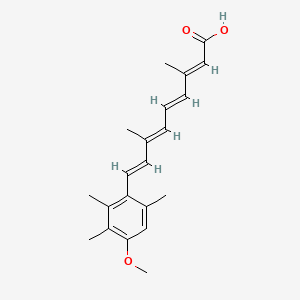
(2E,4E,6E,8E)-9-(4-methoxy-2,3,6-trimethylphenyl)-3,7-dimethylnona-2,4,6,8-tetraenoic acid
Acitretin is an oral retinoid effective in the treatment of psoriasis. It is the major metabolite of ETRETINATE with the advantage of a much shorter half-life when compared with etretinate.
| Molecular Formula: | C21H26O3 |
|---|---|
| Molecular Weight: | 326.42934 g/mol |
Acitretin (trade names Soriatane and Neotigason) is a second-generation retinoid. It is taken orally, and is typically used for psoriasis.
It is a metabolite of etretinate, which was used prior to the introduction of acitretin. Etretinate was discontinued because it had a narrow therapeutic index as well as a long elimination half-life (t1/2=120 days), making dosing difficult. In contrast, acitretin’s half-life is approximately 2 days. However, because acitretin can be reverse metabolised into etretinate which has an extremely long half-life, women must avoid becoming pregnant for at least 3 years[1] after discontinuing acitretin. Therefore, acitretin is generally not recommended for women of child-bearing age with a risk of becoming pregnant.
Acitretin is an oral retinoid used in the treatment of severe resistant psoriasis. Because of the potential for problems and severe side effects it is generally used in only very severe cases of psoriasis that have been unresponsive to other treatments. It binds to nuclear receptors that regulates gene transcription. They induce keratinocyte differentiation and reduce epidermal hyperplasia, leading to the slowing of cell reproduction. Acitretin is readily absorbed and widely distributed after oral administration. A therapeutic effect occurs after 2 to 4 weeks or longer.
Patients that have received the medication are advised against giving blood for at least 3 years due to the risk of birth defects.[2]
- 1 “Important Safety Information for SORIATANE”. soriatane.com. Retrieved 31 October 2015.
- 2
- AABB Technical Manual, American Association of Blood Banks
- 3
- “Soriatane”. WebMD. Retrieved 15 August 2015.
- 4
- “Soriatane Side Effects”. Drugs.com. Retrieved 15 August 2015.
- 5
“Soriatane (Acitretin) Drug Information: Description, User Reviews, Drug Side Effects, Interactions – Prescribing Information at RxList”. RxList. Retrieved 15 August 2015.
Literature References:
Synthetic retinoid; free acid form and major metabolite of etretinate, q.v. Prepn: W. Bollag et al., DE 2414619; eidem, US 4105681 (1974, 1978 both to Hoffmann-La Roche).
Teratogenicity study: A. Kistler, H. Hummler, Arch. Toxicol. 58, 50 (1985).
HPLC determn in plasma: N. R. Al-Mallah et al., Anal. Lett. 21, 1603 (1988).
Pharmacokinetics in humans: F. G. Larsen et al., Pharmacol. Toxicol. 62, 159 (1988).
Clinical evaluation in cutaneous lupus erythematosus: T. Ruzicka et al., Arch. Dermatol. 124, 897 (1988).
Review of clinical pharmacology: A. Vahlquist, O. Rollman, Dermatologica 175, Suppl. 1, 20-27 (1987).
Review of clinical studies in psoriatic and nonpsoriatic dermatoses: J.-M. Geiger, B. M. Czarnetzki, ibid. 176, 182-190 (1988).
SORIATANE (acitretin), a retinoid, is available in 10-mg, 17.5-mg, and 25-mg gelatin capsules for oral administration. Chemically, acitretin is all-trans-9-(4-methoxy-2,3,6trimethylphenyl)-3,7-dimethyl-2,4,6,8-nonatetraenoic acid. It is a metabolite of etretinate and is related to both retinoic acid and retinol (vitamin A). It is a yellow to greenish-yellow powder with a molecular weight of 326.44. The structural formula is:
so
 |
Each capsule contains acitretin, black monogramming ink, gelatin, maltodextrin (a mixture of polysaccharides), microcrystalline cellulose, and sodium ascorbate.
Gelatin capsule shells contain gelatin, iron oxide (yellow, black, and red), and titanium dioxide. They may also contain benzyl alcohol, carboxymethylcellulose sodium, edetate calcium disodium.
SYNTHESIS

Synthetic retinoid; free acid form and major metabolite of etretinate, q.v. Prepn: W. Bollag et al., DE 2414619; eidem, US 4105681 (1974, 1978 both to Hoffmann-La Roche).
NMR, IR SEE………….https://www.iarc.fr/en/publications/pdfs-online/prev/handbook4/Handbook4_Retinoids-6.pdf
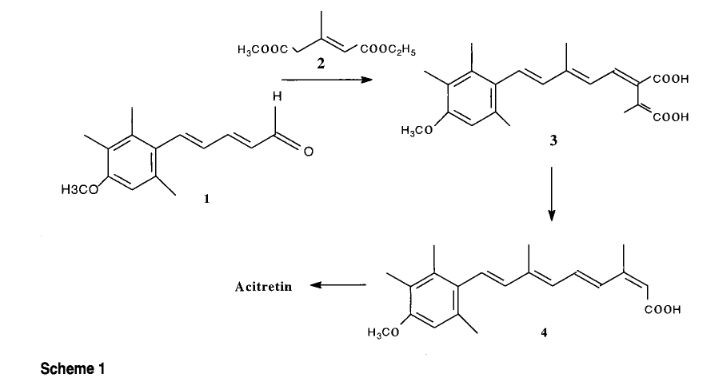
https://www.iarc.fr/en/publications/pdfs-online/prev/handbook4/Handbook4_Retinoids-6.pdf
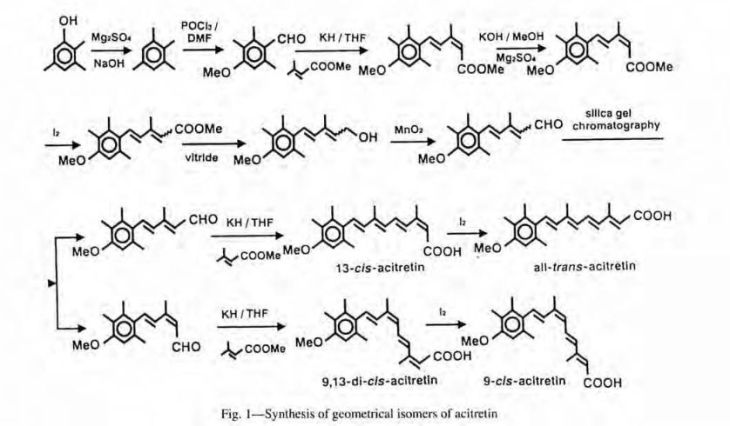
http://nopr.niscair.res.in/bitstream/123456789/19745/1/IJBB%2039%281%29%2022-27.pdf

 |
|
| Systematic (IUPAC) name | |
|---|---|
|
(2E,4E,6E,8E)-9-(4-methoxy-2,3,6-trimethylphenyl)-3,7-dimethylnona-2,4,6,8-tetraenoic acid
|
|
| Clinical data | |
| Trade names | Soriatane, Neotigason |
| AHFS/Drugs.com | monograph |
| MedlinePlus | a601010 |
| Pregnancy category |
|
| Routes of administration |
Oral |
| Legal status | |
| Legal status | |
| Pharmacokinetic data | |
| Bioavailability | 60% |
| Protein binding | >99.9% |
| Metabolism | Hepatic |
| Biological half-life | 49 hours |
| Excretion | Faeces & urine |
| Identifiers | |
| CAS Number | 55079-83-9  |
| ATC code | D05BB02 (WHO) |
| PubChem | CID 5284513 |
| IUPHAR/BPS | 7598 |
| DrugBank | DB00459 |
| ChemSpider | 4447573 |
| UNII | LCH760E9T7 |
| KEGG | D02754 |
| ChEBI | CHEBI:50173 |
| ChEMBL | CHEMBL1131 |
| Chemical data | |
| Formula | C21H26O3 |
| Molar mass | 326.429 g/mol |
////////////CC1=CC(=C(C(=C1C=CC(=CC=CC(=CC(=O)O)C)C)C)C)OC
New patent, Lomitapide mesylate , Zydus Cadila Healthcare Ltd, US 20160083345,


Was developed and launched by Aegerion, under license from the University of Pennsylvania (which acquired rights from BMS).

Sanjay Jagdish DESAI
Brij KHERA
Jagdish Maganlal PATEL
Harshita Bharatkumar SHAH
Arunkumar Shyam Narayan UPADHYAY
Sureshkumar Narbheram AGRAVAT
Polymorphic forms of lomitapide and its salts and processes for their preparation
Zydus Cadila Healthcare Ltd
The present invention relates to various polymorphic forms of lomitapide or its salts and processes for preparation thereof. The present invention provides Lomitapide mesylate in solid amorphous form and process for preparation thereof. The invention also provides an amorphous solid dispersion of lomitapide mesylate. Further, various crystalline forms of lomitapide mesylate like A, B and C and process for preparation thereof are provided. The invention also provides crystalline forms of lomitapide free base, in particular Form I and Form-II and their preparation. The invention further provides compositions comprising various forms of lomitapide and its salts.
A novel amorphous form of lomitapide mesylate (having >98% of purity and 0.5% of residual solvent and particles size D90 of >250 µm, D50 of >100 µm and D10 of >50 µm), a process for it preparation and a composition comprising it is claimed. Also claimed is an amorphous solid dispersion of lomitapide mesylate and a carrier (eg hydroxypropylmethyl cellulose acetate succinate). Further claimed are crystalline forms of lomitapide mesylate (designated ad Forms A, B, C, I, II and free base of lomitapide in amorphous form), processes for their preparation and compositions comprising them. Lomitapide is known to act as a microsomal triglyceride transfer protein inhibitor, useful for treating familial hypercholesterolemia.
Lomitapide is a synthetic lipid-lowering agent for oral administration. It is a microsomal triglyceride transfer protein inhibitor approved as Juxtapid® in US and as Lojuxta® in Europe as an adjunct to a low-fat diet and other lipid-lowering treatments, including LDL apheresis where available, to reduce low-density lipoprotein cholesterol (LDL-C), total cholesterol (TC), apolipoprotein B (apo B), and non-highdensity lipoprotein cholesterol (non-HDL-C) in patients with homozygous familial hypercholesterolemia (HoFH). The approved drug product is a mesylate salt of lomitapide, chemically known as N-(2,2,2-trifluoroethyl)-9-[4-[4-[[[4′(trifluoromethyl)[1,1′-biphenyl]-2-yl]carbonyl]amino]-1-piperidinyl]butyl]-9H-fluorene-9carboxamide methanesulfonate [“lomitapide mesylate” herein after] and has the structural formula

As per the approved label for Juxtapid® (US) “Lomitapide mesylate is a white to off-white powder that is slightly soluble in aqueous solutions of pH 2 to 5. Lomitapide mesylate is freely soluble in acetone, ethanol, and methanol; soluble in 2-butanol, methylene chloride, and acetonitrile; sparingly soluble in 1-octanol and 2-propanol; slightly soluble in ethyl acetate; and insoluble in heptane”.
As per Public Assessment Report for Lojuxta® (Europe) “Polymorphism has been observed for lomitapide mesylate. Of the different solid-state forms, hydrates, and solvates identified in the polymorph studies, only 2 desolvated solid-state forms, Form I and Form II, were identified in batches after drying to final drug substance.” The report further states, under the heading Manufacture, that “The final particle size distribution is controlled during the crystallisation step” (emphasis added) suggesting that the approved drug product lomitapide mesylate is a crystalline compound
U.S. Pat. No. 5,712,279 A discloses the lomitapide compound and a process for its preparation. It also discloses a process for preparation of lomitapide monohydrochloride.
U.S. Pat. No. 5,883,109 A discloses lomitapide mesylate specifically but no solid form was disclosed.
The reference article Synthesis and Applications of Isotopically Labelled Compounds, Vol. 8, Pg. 227-230 (2004) discloses the preparation of Deuterium labelled [d4]BMS-201038, [3H]BMS-201038, [14C]BMS-201038 wherein BMS-201038 is lomitapide mesylate.
International (PCT) Publication No. WO 2015/121877 A2 discloses lomitapide crystalline Form I and Form II as well as amorphous form of Lomitapide mesylate and processes for their preparation.
There is still a need to provide a novel polymorph of lomitapide or its salts which is suitable for pharmaceutical preparations. Therefore, the present invention provides new crystalline forms of lomitapide free base and lomitapide mesylate. The present invention also provides amorphous form of lomitapide free base and lomitapide mesylate, which is stable and useful for pharmaceutical preparations.
EXAMPLES
Example-1
Preparation of Lomitapide Mesylate
In a 250 mL round bottom flask, equipped with a mechanical stirrer, thermometer and an addition funnel, 10 g lomitapide and 20 mL methanol were added and stirred to obtain a solution. 1.5 g methane sulfonic acid dissolved in 20 mL water was added slowly to the above solution under stirring. The reaction mixture was stirred till maximum salt formation was achieved. 50 mL water was added to the mixture, stirred for 15-20 min, filtered and washed with water. The product was dried further to obtain lomitapide mesylate.
EXAMPLE 2
Preparation of Amorphous Form of Lomitapide Mesylate
10 g lomitapide mesylate, 50 mL acetone and 150 mL ethyl acetate were heated in a 500 mL round bottom flask, equipped with a mechanical stirrer, thermometer and an addition funnel at 50-55° C. and stirred to obtain clear solution. The solution was subjected to spray drying in JISL Mini spray drier LSD-48 with feed pump running at 30-35 rpm, inlet temperature 50-55° C., out let temperature 45-50° C., aspiration rate 1200-1300 rpm, hot air supply 1.8-2.2 Kg/cm2 and vacuum for conveying the dry product 80 mmHg. The product was collected from cyclone and characterized to an amorphous form by x-ray powder diffraction. The product was further dried to obtain the amorphous form of lomitapide mesylate
/////////////New patent, Lomitapide mesylate , Zydus Cadila Healthcare Ltd, US 20160083345, Amorphous
Glaxo……..Will help the world’s poorest people access copycat versions of its medicines at affordable prices.
Glaxo to Stop Seeking Drug Patents in Low-Income Countries
Drugmaker says move could help poor nations access cheaper copycat versions of its medicines


LONDON— GlaxoSmithKline PLC said it would stop seeking patents for its drugs in low-income countries, a move the drugmaker said could help the world’s poorest people access copycat versions of its medicines at affordable prices.
The U.K.-based company said it would take this approach in low-income and least-developed countries, a group totaling around 85 nations. In so-called lower-middle-income countries, a group of 51 nations that includes Vietnam, Cameroon and Sri Lanka, it said it would file patents but aim to grant licenses to generic manufacturers to supply low-cost versions of its drugs in those markets in return for a small royalty.
Glaxo previously filed patents in most lower-middle-income countries, and in low-income nations where a patent office exists. But that “patchwork” approach meant that generic drugmakers held back from manufacturing copycat medicines for these markets owing to the risk of being sued by pharmaceutical companies, according to Glaxo Chief Executive Andrew Witty.,,,,,,,,,continue reading
/////////Glaxo Chief Executive, Andrew Witty, filed patents, low income,poor nations, cheaper, copycat versions, medicines, GlaxoSmithKline
Mehta Api Pvt Ltd, Cinacalcet hydrochloride, New patent, WO 2016027211


Mehta Api Pvt Ltd, Cinacalcet hydrochloride, New patent, WO 2016027211
Mehta Api had cinacalcet hydrochloride under development and holds US DMF and European DMF as listed on the company’s website. Amgen and Kyowa Hakko Kirin, under license from NPS Pharmaceuticals, have developed and launched cinacalcet.
The present filing represents the first PCT filing from the assignee, which focuses on developing (using green chemistry) manufacturing and marketing of API’s- multi step, highly complex, potent, chiral and semi-synthetic, advance intermediates, specialty chemicals and building blocks.
PROCESS FOR THE PREPARATION OF CINACALCET AND ITS PHARMACEUTICALLY ACCEPTABLE SALTS
MEHTA API PVT. LTD. [IN/IN]; 203, Centre Point, 2nd Floor, Near Hotel Kohinoor, J.B. Nagar, Andheri-Kurla Road, Andheri (East), Maharashtra, Mumbai 400 059 (IN)
KHAN, Rao, Uwais, Ahmad; (IN).
PATHAK, Rajesh, Harshnath; (IN).
PATIL, Chetan, Vinesh; (IN).
GAIKWAD, Sanjay, Ramrao; (IN).
APAR, Shrikrishna, Motiram; (IN).
LINGE, Govind, Udhavrao; (IN).
SHAIKH, Mohammad, Umar; (IN)
Cinacalcet (N-[l-(R)-(-)-(l-naphthyl) ethyl]-3-[3-(trifluoromethyl) phenyl]-l-aminopropane) of Formula II, belongs to a category of calcimimetics class of compounds. It is useful for the treatment of hyperparathyroidism and the preservation of bone density in patients with kidney failure or hypercalcemia due to cancer. It is marketed under the trade name of Senipar in United States and under the trade name of Mimpara in Europe.
US6211244 and Drugs of the future (2002) 27 (9): 831, discloses a synthesis of Cinacalcet by reductive amination which implies the reaction of (R)-(l-naphthyl) ethylamine of formula (IV) with 3 -[3- (trifluoromethyl) phenyl] propionaldehyde of formula (V) in the presence of titaniumisopropoxide to afford the corresponding cinacalcet imine of formula (III), which is reduced to cinacalcet of formula (II) with NaBH4CN in ethanol.
WO2012007954 A 1 discloses process for Cinacalcet by reductive amination in presence of titanium Isopropoxide using NaBH4CN, wherein an ether solvent is used instead of ethanol. Indian patent applications 2268/DEL/2008 and 87/MUM/2011 disclose preparation of Cinacalcet wherein reaction of (R)-(I-naphthyl)ethylamine of formula (IV) with 3-[3-(trifluoromethyl)phenyl] propionaldehyde of formula (V) is carried out in the presence of titaniumisopropoxide to afford the corresponding cinacalcet imine, which is further reduced to cinacalcet with NaBH4.
The above disclosed processes require the use of reagents such as NaBH4CN, titanium isopropoxide, which are extremely toxic and flammable as well as not being environmentally sound. These reagents therefore make the industrial application of the process difficult.
US20110124917A1 and WO2008068625A2 both disclose preparation of Cinacalcet by reductive amination wherein reduction is performed by using sodiumtriacetoxyborohydride as a selective reducing agent for imines.
Sodiumtriacetoxyborohydride is hygroscopic in nature hence demands anhydrous conditions to be maintained rendering it not suitable for use on industrial scale.
WO2012007954 A 1 discloses reaction and work-up in THF followed by salt formation in Di-isopropyl ether and further purification in two solvent system consisting of Water and Methanol or Water and Acetonitrile. US20110124917 discloses reaction in Methanol, Workup in toluene, Salt formation in Ethyl Acetate and purification in Isopropanol. WO2008068625A2 discloses reaction, salt formation and Purification in two solvent system consisting of isobutyl Acetate and n-Heptane. 2268/DEL/2008 discloses reaction in MDC, Salt formation in Ethyl Acetate and Purification in Ethyl Acetate and Di-isopropyl ether. 87/MUM/2011 discloses reaction in THF, work-up in toluene. Salt formation in two solvent system consisting of cyclohexane and MTBE.
All the above prior-art process employs use of different solvents for each unit operation or a two-solvent system for purification, thereby rendering the processes not easily scalable on industrial scale.
1367/MUM/2009 discloses reductive amination using sodium borohydride with 67.6% yield reported. 3068/MUM/2012 discloses reductive amination using sodium borohydride with 86% yield but with less purity. Further 3068/MUM/2012 requires the usage of sulphuric acid for the reaction of (R)-(I-naphthyl)ethylamine of formula (II) with 3-[3-(trifluoromethyl)phenyl] propionaldehyde of formula (III).
Thus the processes disclosed above have one or other drawbacks, ranging from poor yield, purity, use of difficult to handle and toxic reagents or use of different solvents for each unit operation.
In view of the problems occurred in above methods, there remains a need for more economical and efficient industrially scalable process for the preparation of Cinacalcet and its pharmaceutically acceptable salts, which overcomes the drawbacks as disclosed in the prior art.
The present inventors have surprisingly found that when the condensation of [3-(trifluoromethyl)phenyl]propionaldehyde of formula – (V) with (R)-(l- naphthyl)ethylamine formula – (IV) is carried out in the absence of any reagent and water is removed under vacuum by azeotropic distillation at low temperatures in the optional presence of water scavengers, than Cinacalcet.hydrochloride with high purity and yield is obtained. Further the process is also industrially feasible due to the non-usage of hazardous reagents as also due to the reduction in isolation and purification steps.

Example I:
Preparation of Cinacalcet Hydrochloride, Formula (la)
To (1000 ml) toluene in a 4Neck Round Bottom flask along with dean-stark apparatus coupled to a condenser, charge (80gms) (R)-(l- naphthyl) ethylamine of formula – (IV). Cool to 10-15°C. Charge (lOOgms) 3-[(3-Trifluoromethyl)phenyl] propionaldehyde of formula (V). Apply vacuum to the reaction mass through condenser and maintain for 8 hrs simultaneously azeotroping out water generated in the reaction till the reaction complies by thin layer chromatography to give Cinacalcet imine of formula (III) in-situ. Release vacuum after the reaction complies. Water collected after Azeotropic distillation: 7-7.5 ml. Cool the reaction mass to 5-10°C. Charge (35 gms) sodium borohydride in two lots to the reaction mass and raise the temperature to 25-30°C. Maintain the reaction mass for 8 hrs to give Cinacalcet of formula (II) in-situ. After the reaction complies by thin layer chromatography adjust the pH of the reaction mass to about pH 6 using acetic acid. Charge (200 ml) water to the reaction mass and stir for 30 mins. Separate Layers the organic layer and treat with 15% HC1 (150 ml). Stirr the Reaction mass at 40 – 50°C for one hour and separate the layer. Heat the toluene at same temperature. Adjust pH of toluene layer to below pH-2 by treating with 15% HC1 (150 ml) at 40-45 °C. Distill out 500 ml toluene under vacuum below 45 °C. Gradually charge 500 ml water to the reaction mass along with simultaneously distilling out 500 ml toluene approximately. Filter the reaction mass to give crude Cinacalcet Hydrochloride. Dry at 45-50°C for 8 hrs.
Weight: 182 gms
% Yield on theoretical basis: 98.9%
Purity: 97.54%
To (182 gms) of Crude cinacalcet Hydrochloride charge (800 ml) Methyl tert butyl ether and stirr for 60°C for 3 hrs. Cool gradually at 25-30°C and further chill the reaction mass to 0°C -5°C. Maintain the reaction mass at 0-5°C for 2 hrs and filter under vacuum followed by washing to the wet-cake with (100 ml) chilled Methyl tert butyl ether.
Wet cake is dried under vacuum at 40°C.
Weight: 163 gms
Yield on theoretical basis: 88.58%
Purity: 99.54%
To (163 gms) of MTBE pure Cinacalcet Hydrochloride is charged (400 ml) Isopropanol and heated to 70-75°C to get a clear solution which is then gradually cooled to 25-30°C and further chilled to 0-5 °C. The reaction mass is maintained for 2 hrs at same temperature and filtered under vacuum followed by washing with chilled isopropanol. Wet cake is dried under vacuum at 40°C.
Weight: 157 gms
Yield on theoretical basis: 85.32%
Purity: 99.91%
Example II:
Preparation of Crude Cinacalcet Hydrochloride, Formula (la)
To (1000 ml) toluene in a 4Neck Round Bottom flask, is charged (80gms) (R)-(l-naphthyl)ethylamine of formula (IV). Cooled to 10-15°C. Charged (lOOgms) 3-[(3-Trifluoromethyl)phenyl] propionaldehyde of formula (V) slowly. Charged (1 gm) Calcium Chloride and maintained for 8 hrs till the reaction complies by thin layer chromatography to give Cinacalcet imine of formula (III) in-situ. After the reaction complies, the reaction mass is cooled to 5-10°C. Charged (35 gms) sodium borohydride in two lots to the reaction mass and raised the temperature to 25-30°C.The reaction mass is maintained for 8 hrs to give Cinacalcet Free base of formula (II) in-situ. After the reaction complies by thin layer chromatography pH of the reaction mass is adjusted to about pH 6 using acetic acid. Charged (200 ml) water to the reaction mass and stirred for 30 mins. Layers separated and the organic layer is treated with 15% HC1 (150 ml). Reaction mass is stirred at 40 – 50°C for one hour and layer separated. Toluene layer is water washed at same temperature. pH of toluene layer adjusted to below pH-2 by treating with 15% HC1 (150 ml) at 40-45°C. Distill out 500 ml toluene under vacuum below 45 °C. Gradually charge 500 ml water to the reaction mass along with simultaneously distilling out 500 ml toluene approximately. Filter the reaction mass to give crude Cinacalcet Hydrochloride. Dry at 45-50°C for 8 hrs
Weight: 178 gms
Yield on theoretical basis: 96.73%
Purity: 94.88%
To (178 gms) of Crude cinacalcet Hydrochloride charged (800 ml) Methyl tert butyl ether and stirr for 60°C for 3 hrs. Allowed to cool gradually at 25-30°C and further chilled the reaction mass to 0-5°C. Maintained the reaction mass at 0-5°C for 2 hrs and filtered under vacuum followed by washing to the wet-cake with (100 ml) chilled Methyl tert butyl ether. Wet cake is dried under vacuum at 40°C.
Weight: 159 gms,
% Yield on theoretical basis: 86.40%
Purity: 99.77%
To (159 gms) of MTBE pure Cinacalcet Hydrochloride is charged (400 ml) Isopropanol and heated to 70-75°C to get a clear solution. Gradually cool to 25-30°C and further chill to 0-5 °C. Maintain the reaction mass is for 2 hrs at same temperature and filte under vacuum followed by washing with chilled isopropanol. Wet cake is dried under vacuum at 40°C. Weight: 150 gms
% Yield on theoretical basis: 81.51 %
Purity: 99.91 %
Example III:
Preparation of Cinacalcet Hydrochloride, Formula (la)
To (1000 ml) toluene in a 4Neck Round Bottom flask, charge (80gms) (R)-(l-naphthyl)ethylamine of formula (IV). Cool to 10-15°C. Charge (lOOgms) 3-[(3-Trifluoromethyl)phenyl] propionaldehyde of formula (V). Charge ( 1 gm) Molecular Sieves and maintain the reaction mass for 8 hrs till the reaction complies by thin layer chromatography to give Cinacalcet imine of formula (III) in-situ. After the reaction complies, cool the reaction mass to 5-10°C. Charge (35 gms) sodium borohydride in two lots to the reaction mass and raise the temperature to 25-30°C. Maintain the reaction mass for 8 hrs to give Cinacalcet of formula (II) in-situ. After the reaction complies by thin layer chromatography adjust the pH of the reaction mass to about pH 6 using acetic acid. Charge (200 ml) water to the reaction mass and stir for 30 mins. Separate the layers and treat organic layer with 15% HC1 (150 ml).Stirr Reaction mass is at 40 – 50°C for one hour and separate layers. Water wash toluene layer at same temperature. Adjust pH of toluene layer pH-2 by treating with 15% HC1 (150 ml) at 40-45 °C. Distill and degasse under vacuum below 70°C to give Cinacalcet Hydrochloride
Weight: 172 gms
Yield on theoretical basis: 93.47%
Purity: 97.29%
To (172 gms) of Crude cinacalcet Hydrochloride charge (800 ml) Methyl tert butyl ether and stirr for 60°C for 3 hrs. Cool gradually at 25-30°C and further chill the reaction mass to 0-5 °C. Maintain the reaction mass at 0-5 °C for 2 hrs and filter under vacuum followed by washing to the wet-cake with (100 ml) chilled Methyl tert butyl ether.
Wet cake is dried under vacuum at 40°C.
Weight: 155 gms
% Yield on theoretical basis: 84.23%
Purity: 99.57%
To (155 gms) of MTBE pure Cinacalcet Hydrochloride charge (400 ml) Isopropanol and heat to 70-75°C to get a clear solution which is then gradually cooled to 25-30°C and further chill to 0-5 °C. Maintain the reaction mass i for 2 hrs at same temperature and filter under vacuum followed by washing with chilled isopropanol. Wet cake is dried under vacuum at 40°C.
Weight: 146 gms
% Yield on theoretical basis: 79.34%
Purity: 99.83%
Mehta API Pvt. Ltd.

MR HARSHADRAI P MEHTA
Chairman & Managing Director

Devendra Mehta
Chief Executive Officer at MEHTA API PVT LTD
////////Mehta Api Pvt Ltd, Cinacalcet hydrochloride, New patent, WO-2016027211, WO 2016027211
Afatinib dimaleate, Dr Reddy’s, New patent, WO 2016027243

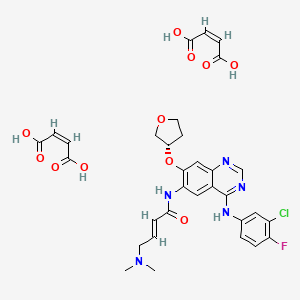
Afatinib dimaleate, Dr Reddy’s, New patent, WO-2016027243,
DR. REDDY’S LABORATORIES LIMITED [IN/IN]; 8-2-337, Road No. 3, Banjara Hills, Hyderabad, Telangana, India – 500034. Hyderabad 500034 (IN)
RAMAKRISHNAN, Srividya; (IN).
PEDDY, Vishweshwar; (IN).
MAHAPATRA, Sudarshan; (IN).
KANNIAH, Sundara Lakshmi; (IN).
CHENNURU, Ramanaiah; (IN).
JOSE, Jithin; (IN).
DHAGE, Yogesh Mohanrao; (IN).
PEDDIREDDY, Subba Reddy; (IN).
YARRAGUNTLA, Sesha Reddy; (IN).
RAGHUVEER, Sherial; (IN).
KOLLA, Srinivasa Rao; (IN).
ANIL KSHIRSAGAR, Shivani; (IN).
JAFAR SHAIKH, Latif; (IN).
BANDARU, Srinivasulu; (IN)
The drug compound having the adopted name afatinib dimaleate, has a chemical name N-[4-[(3-chloro-4-fluorophenyl)amino]-7-[[(3S)-tetrahydro-3-furanyl]oxy]-6-quinazolinyl]-4-(dimethylamino)-,(2E)-, (2Z)-2-butenedioate (1 :2), and is represented by structure of formula I

Formula I
Afatinib dimaleate is an anticancer protein kinase inhibitor indicated for treatment of non-small-cell lung cancer. Process for preparation of afatinib, afatinib dimaleate and intermediates useful in preparation of afatinib dimaleate are described in US Patent Nos. 7,019,012; 8,426,586 and 7,960,546.
US Patent No. 8,426,586 discloses crystalline Form A of afatinib dimaleate salt and processes for preparation thereof. US Patent Application Publication No. 20140051713 discloses crystalline Form B of afatinib dimaleate salt and processes for preparation thereof. PCT Application Publication No. 2013052157 discloses crystalline Form C, Form D and Form E of afatinib dimaleate salt and processes for preparation thereof. The PCT publication also discloses crystalline Form A, B, C and Form D of afatinib base.
Polymorphism, the occurrence of different crystal forms, is a phenomenon of some molecules and molecular complexes. A single molecule may give rise to a variety of polymorphs having distinct crystal structures and physical properties. Polymorphs in general will have different melting points, thermal behaviors (e.g. measured by thermogravimetric analysis – “TGA”, or differential scanning calorimetry – “DSC”), X-ray powder diffraction (XRPD or powder XRD) pattern, infrared absorption fingerprint, and solid state nuclear magnetic resonance (NMR) spectrum. One or more of these techniques may be used to distinguish different polymorphic forms of a compound.
Discovering new polymorphic forms, hydrates and solvates of a pharmaceutical product can provide materials having desirable processing properties, such as ease of handling, ease of processing, storage stability, and ease of purification or as desirable intermediate crystal forms that facilitate conversion to other polymorphic forms. New polymorphic forms and solvates of a pharmaceutically useful compound or salts thereof can also provide an opportunity to improve the performance characteristics of a pharmaceutical product. It enlarges the repertoire of materials that a formulation scientist has available for formulation optimization, for example by providing a product with different properties, e.g., better processing or handling characteristics, improved dissolution profile, or improved shelf-life. For at least these reasons, there is a need for additional solid state forms of Afatinib di-maleate.
SUMMARY
The present application provides novel solid state forms of Afatinib di-maleate, processes for preparing them, and pharmaceutical compositions containing them.
The present application also encompasses the use of novel solid state forms of Afatinib di-maleate provided herein, for the preparation of other afatinib salts, other solid state forms of afatinib dimaleate, and formulations thereof.
The present application also encompasses the use of any one of the novel solid state forms of Afatinib di-maleate disclosed herein for the preparation of a medicament, preferably for the treatment of cancer, particularly for the treatment of cancers mediated by epidermal growth factor receptor (EGFR) and human epidermal receptor 2 (HER2) tyrosine kinases, e.g., solid tumors including NSCLC, breast, head and neck cancer, and a variety of other cancers mediated by EGFR or HER2 tyrosine kinases. The present invention further provides a pharmaceutical composition comprising any one of the Afatinib di-maleate crystalline forms of the present invention and at least one pharmaceutically acceptable excipient.
The present application also provides a method of treating cancer, comprising administering a therapeutically effective amount of at least one of the Afatinib di-
maleate novel solid state forms of the present application, or at least one of the above pharmaceutical compositions to a person suffering from cancer, particularly a person suffering from a cancer mediated by epidermal growth factor receptor (EGFR) and human epidermal receptor 2 (HER2) tyrosine kinases, e.g., solid tumors including but not limited to NSCLC, breast, head and neck cancer, and a variety of other cancers mediated by EGFR or HER2 tyrosine kinases.
Example 1 : Preparation of amorphous form of afatinib dimaleate.
2.0 g of afatinib dimaleate was dissolved in 80 mL of a mixture of methanol and acetone (3:1 ) at 26°C and stirred for 15 min. The solution was filtered to remove the undissolved particles and the filtrate was distilled under reduced pressure at 50°C. After distillation the solid was dried under vacuum at 45°C to get 1 .29 g of amorphous afatinib dimaleate. PXRD pattern: Fig. 1 .
///////Afatinib dimaleate, Dr Reddy’s, New patent, WO-2016027243, WO 2016027243
WO 2016027283, New patent, Indacaterol, Reddy-Cheminor Inc

Beta 2 adrenoceptor agonist
Chronic obstructive pulmonary disease
WO 2016027283, New patent, Indacaterol, Reddy-Cheminor Inc
A process for preparing indacaterol and salts thereof
REDDY, G Pratap; (IN).
SUNKU, Venkataiah; (IN).
BABU, Sunkaraneni Suresh; (IN)
The present invention relates to a process for preparing indacaterol or salts thereof. The process comprises of forming compound of Formula 1 by reacting compound of Formula 2 and compound of Formula 3 in the presence of a solvent to Form compound of Formula 4, 5 which on removal of the protecting groups forms compound of Formula 1.
Indacaterol maleate is a beta-selective adrenoceptor agonist with potent bronchodilator activity. Indacaterol is chemically known as 5-[(R)-2-(5, 6-diethyl-indan-2- yl amino)-l-hydroxy-ethyl ]-8-hydroxy-(lH)-quinolin-2-one.
US7534890 claims a process to prepare 5-[(R)-2-(5,6-diethyl-indan-2-ylamino)- 1 -hydroxy-ethyl] -8-hydroxy-(l H)-quinolin-2-one salt. One of the key steps in the process is reacting an epoxide, such as 8-substituted oxy-5-(R)- oxiranyl-(lH)-quinoline-2-one [Formula (I)] with an amine, such as 2-amino-(5,6-diethyl)-indan to form an intermediate 5-[(R)-2-(5,6-diethyl-indan-2-ylamino)-l -hydroxy-ethyl]-8- substituted oxy-(lH)-quinolin-2-one [Formula (Ha)].

The drawback of this process is opening of epoxide ring is not regioselective and thereby resulting, in formation of substantial quantities of impurities as by products, Formula (lib) and Formula (lie) resulting in overall lower yields. The quantity of 2- amino-(5,6-diethyl)-indan used in this step is also large excess than theoretical amounts. Subsequent improvements also did not address this problem effectively.
WO 2013/132514 discloses a process to prepare Indacaterol involving the steps of treating a compound of Formula (III), wherein L is a leaving group, with the amine, 2-amino-(5,6-diethyl)-indan or its acid addition salts to obtain a compound of Formula (IV) or its acid addition salts.

Though higher yields have been claimed, the process has not overcome completely all the problems mentioned earlier.
There is a need for developing a more efficient process for preparing Indacaterol or salts thereof especially for large scale production with higher yields.
The reaction scheme of synthesis of compound of Formula 3 is represented below.

Formula 3 Formula 13 Formula 12
xample 1
Process to prepare 5-[ (R)-2-(5, 6-diethyl-indan-2-ylamino)-l-hydroxy-ethyl]-8-hydroxy-( lH)-quinolin-2-one
2-Chloro-5,6-diethylindan (4.2g) was added to a solution of 5-[(R)-(2-amino-l-hydroxy-ethyl)-8-phenylmethoxy-(lH)-quinolin-2-one (6g) in dimethylformamide (20ml) followed by addition of N,N-diisopropyl-N-ethylamine (3.6 g) and sodium iodide (lg) at room temperature and stirred for 10 minutes. The reaction mixture was heated to 90° C and the temperature was maintained at 90 °C till the completion of reaction. The reaction mass was cooled to room temperature and diluted with dichloromethane (100ml) and water (100 ml) and stirred for 30 minutes. The organic phase was separated and the aqueous layer was extracted with dichloromethane. Combined organic layer was washed with water, dried and concentrated. The resulting residue was dissolved in isopropyl alcohol under reflux and cooled slowly to obtain 5-[(R)-2-(5,6-diethyl-indan-2-ylamino)-l-hydroxy-ethyl]-8-phenylmethoxy -(lH)-quinolin-2-one, which was isolated by filtration and dried under vacuum (7.4 g). Yield: 79.3 %. Purity of the product is >95 % (HPLC).
Example 2
Process to prepare 5-[(R)-2-(5, 6-diethyl-indan-2-ylamino)-l-hydroxy-ethyl]-8-hydroxy-( lH)-quinolin-2-one
Solution of 5-[(R)-2-(5,6-diethyl-indan-2-ylamino)-l-hydroxy-ethyl]-8-phenylmethoxy-(lH)-quinolin-2-one (lOg) in methanol (100ml) and acetic acid (20ml) was hydrogenated using palladium on charcoal 5% (1.5g) until completion of the reaction. The mixture was filtered over celite and the filtrate was concentrated at 55°C under vacuum. The residue obtained was dissolved in hot methanol to precipitate 5-[(R)-2-(5,6-diethyl-indan-2-ylamino)-! -hydroxy-ethyl]-8-hydroxy-(lH)-quinolin-2-one.
Example 3
Process to prepare 5-[(R)-2-(5, 6-diethyl-indan-2-ylamino)-l-hydroxy-ethyl]-8-hydroxy-(lH)-quinolin-2-one maleate
Crude 5-[(R)-2-(5,6-diethyl-indan-2-ylamino)-l -hydroxy-ethyl]-8-hydroxy-(lH)-quinolin-2-one prepared by the process of Example 2 was added to a solution of maleic acid (2.6g) in methanol and the resulting clear solution was slowly cooled to 5° C and stirred for 2 hours at the same temperature. The slurry was filtered, washed with cold methanol and dried to obtain 5-[(R)-2-(5, 6-diethyl-indan-2-ylamino)-l-hydroxy-ethyl]-8-hydroxy-(lH)-quinolin-2-one maleate (8.8g). Yield: 83.5 %. Purity of the product is >99%. E.e. >99 %.
Example 4
Process for preparing 5-[(R)-(2-phthalimido-l-hydroxy-ethyl)-8-phenylmethoxy-(lH)-quinolin-2-one
Diisopropylethylamine (6g) was added to a solution of phthalimide (6g) in dimethylformamide (30 ml) at room temperature. To this solution, 8-(phenylmethoxy)-5-[(R)-2-bromo-l-hydroxy-ethyl]-(lH)-quinoline-2-one (11 gm) was added slowly followed by sodium iodide (1 g). The resulting mass was heated to 90°C and stirred till the completion of reaction as monitored by TLC. The reaction mass was diluted with water (200 ml) and the crude product was isolated by filtration. The wet filter cake was suspended in water (60 ml), stirred for 1 hour, filtered, washed with water to obtain 5-[(R)-(2-phthalimido-l-hydroxy-ethyl)-8-phenylmethoxy-(lH)-quinolin-2-one (10.4 gm) after drying. Yield: 80.7 %.
Method A- Process for preparing 5-[(R)-(2-amino-l-hydroxy-ethyl)-8-phenylmethoxy-(lH)-quinolin-2-one
To a solution of 5-[(R)-(2-phthalimido-l-hydroxy-ethyl)-8-phenylmethoxy-(lH)-quinolin-2-one ( 13.2 g) in a mixture of isopropanol (86 ml) and water (14 ml) sodium borohydride (4.6 g) was added slowly at room temperature and stirred overnight. Thereafter, the pH of the reaction mass was lowered to 5.5 with acetic acid, and then the reaction mass was heated to reflux for two hours. Isopropanol was distilled out under reduced pressure. The residue was diluted with ethyl acetate (120 ml) and concentrated hydrochloric acid (8 ml) was added and stirred for 15 minutes for the salts to precipitate out. The reaction mass was filtered and the salt was washed with ethyl acetate. To the clear filtrate concentrated hydrochloric acid (10 ml) was added and stirred at 5° C for 30 minutes for 5-[(R)-(2-amino-l-hydroxy-ethyl)-8-phenylmethoxy-(lH)-quinolin-2-one to separate out as hydrochloride salt. The product was isolated by filtration and dried under vacuum (8.2 g). The hydrochloride salt was dissolved in minimum amount of water and basified with sodium hydroxide solution. The product was isolated as free amine by concentrating the solution under reduced pressure and extracting the residue with isopropyl alcohol and distilling out the solvent (7.45 g). Yield 80 %.
1H-NMR (CDC13) ppm: 2.56-2.70 (m, 2H), 3.35 (s, br, 2H, exchangeable), 4.89 (m, 1H), 5.29 (s, 2H), 5.76 (s, 1H, exchangeable), 6.53 (d, 1H), 7.11-7.19 (dd, 2H), 7.29-7.36 (dd, 1H), 7.39 (d, 2H), 7.57 (d, 2H), 8.21 (d, 1H), 10.7 (s, br, 1H, exchangeable).
Method B- Process for preparing 5-[(R)-(2-amino-l-hydroxy-ethyl)-8-phenylmethoxy-( lH)-quinolin-2-one
To a solution of 5-[(R)-(2-phthalimido-l-hydroxy-ethyl)-8-phenylmethoxy-(lH)-quinolin-2-one ( 10 g) in ethanol (60 ml) hydrazine hydrate (4.8 g) was added and refluxed the mixture for about 6 hours. The solvent was distilled out under reduced pressure. To the residue, concentrated hydrochloric acid (16 ml) was added and heated to about 80°C and maintained till the completion of the reaction. The reaction mass was cooled to room temperature and filtered. The clear filtrate was basified and concentrated under reduced pressure. The product was isolated as free amine (5.8 g) by extracting with isopropyl alcohol and distilling out the solvent. Yield: 83%.
Method C
Preparation of 5-(2-benzylamino-l-hydroxy-ethyl)-8-phenylmethoxy-( lH)-quinolin-2-one 5-Acetyl-8-phenylmethoxy-(lH)-quinolin-2-one (30 g) was refluxed with selenium dioxide
(11.5 g) in a mixture of dioxane (350 ml) and water (30 ml) for 16 hours. The reaction mixture was diluted with dioxane (150 ml) and precipitated inorganic salts were removed by filtration. Clear filtrate was concentrated to about 60 ml under vacuum and diluted with methanol (100 ml). The reaction mass was cooled to 15° C and benzylamine (7.5 g) was added slowly over a period of 45 minutes and stirred at the same temperature for two hours.
The reaction mass was further cooled to 0°C and sodium borohydride (2.8 g) was added slowly over a period of one hour. Thereafter, the reaction mass was stirred at room temperature for 12 hours. The reaction mixture was concentrated under vacuum and diluted with 300 ml water and stirred at 20° C for three hours. The precipitated product was collected by filtration, washed with water followed by isopropyl ether and then dried (28.2 g) to obtain 5-(2-benzylamino-l-hydroxy-ethyl)-8-phenylmethoxy-(lH)-quinolin-2-one.
Example 5
Preparation of 5-acetyl-8-phenylmethoxy-(lH)-quinolin-2-one
To a solution of 5-acetyl-8-hydroxy-(lH)-quinolin-2-one (35 g) in dimethylformamide (175 ml) potassium carbonate (35 g) was added at room temperature and stirred for 10 minutes. To the suspension, benzylbromide (32 g) was slowly added over a period of 30 minutes and stirred for 2 hours at the same temperature for completion of reaction (monitored by TLC). The reaction mass was diluted with water (800 ml) and stirred for 20 minutes for the product to precipitate out. The product was filtered, washed with water and dried under vacuum to get the title product (48 g).
Example 6
Preparation of 5-(2-bromoacetyl)-8-phenylmethoxy-( lH)-quinolin-2-one
Boron trifluoride-diethyletherate (29 ml) was slowly added to a solution of 5-acetyl-8-phenylmethoxy-(lH)-quinolin-2-one (50 g) in dichloromethane (500 ml) at 0° C and stirred for 10 minutes at the same temperature to get a thick precipitate. The reaction mass was heated to reflux temperature and bromine solution was added (29 g in 190 ml dichloromethane) slowly over a period of 2 hours under reflux (the HBr fumes coming from the condenser was scrubbed). Thereafter, the reaction mass was refluxed for further 45 minutes. The solvent was distilled out completely under vacuum and the mass was triturated with 10% aqueous sodium carbonate solution (100 ml). The suspension was filtered, washed with water and the crude product was taken for the next stage reaction.
Example 7
Preparation of 5-(2-phthalimido-l-oxo-ethyl)-8-phenylmethoxy-(lH)-quinolin-2-one
Potassium carbonate (33.4 g) was added to a solution of phthalimide (21.73 g) in dimethylformamide (80 ml) at room temperature and stirred for 10 minutes. To this suspension, crude 5-(2-bromoacetyl)-8-phenylmethoxy-(lH)-quinolin-2-one of example 6, dissolved in dimethylformamide (120 ml), was added slowly over a period of 20 minutes. The resulting suspension was stirred at 50° C for about 1 hour for the completion of reaction as monitored by TLC. The mixture was diluted with water (800 ml) and the crude product was isolated by filtration. The wet filter cake was suspended in water (600 ml), stirred for 1 hour, filtered, washed with water and dried under vacuum to get 5-(2- phthalimido-l-oxo-ethyl)-8-phenylmethoxy-(lH)-quinolin-2-one (67.4 g). Over all yield
(after two steps): 90%.
Example 8
Preparation of 5-[(R)-(2-phthalimido-l-hydroxy-ethyl)-8-phenylmethoxy-(lH)-q inolin-2-one
To a solution of (R)-2-methyl-CBS-oxazaborolidine (1M in toluene, 4.2 ml) in dry
tetrahydrofuran (THF, 50 ml) Borane-diethylaniline (19 ml) was added slowly at – 10° C
and the contents were stirred at the same temperature for 15 minutes. A solution of 5-(2-
Phthalimido-l-oxo-ethyl)-8-phenylmethoxy-(lH)-quinolin-2-one ( 8.3 g), of example 7, in
a mixture of dry THF (50 ml) and dichloromethane (50 ml), was added slowly to the
reaction mass at – 10° C. The reaction mass was further stirred for 2 hours and then
methanol was added and the temperature was slowly raised to room temperature. Dilute
sulfuric acid (6N, 10 ml) was added to the reaction mixture and stirred for 15 minutes. The
reaction mixture was concentrated under vacuum and the crude mass was extracted with
ethyl acetate. The organic phase was washed with dilute sulfuric acid and then water. The
solvent was distilled out completely under vacuum and triturated with hexane. The
compound was isolated by filtration and dried (7.6 g). Yield: 91.1%. e.e.. >97%.
Example 9
Process of preparing 2-chloroindan
2-hydroxy indan (lOOg) was dissolved in 1, 2-dichloroethane (400 ml) and added to thionyl
chloride (125 g) slowly over a period of an hour. Temperature was maintained at less than
10° C. Thereafter, the reaction mass was slowly heated and refluxed till the completion of the reaction. The reaction was monitored by TLC. The reaction mass was cooled to room temperature and poured in to ice water, stirred for 1 hour and organic layer was separated. The aqueous layer was extracted with dichloroethane. Organic layers were combined and washed with water, sodium bicarbonate solution and dried over anhydrous sodium sulphate. Solvent was distilled out completely and the crude product was distilled under vacuum to obtain 2-chloroindan as a colorless liquid (118 g).
Example 10
Process for preparing 5-acetyl-2-chloroindan
Aluminium chloride (146 g) was added in small lots to nitromethane (500 ml) and the solution was cooled to 5° C under inert atmosphere while stirring. Acetyl chloride (84 g) was slowly added keeping the temperature at 5° C. Solution of 2-chloroindan (118 g) was slowly added in acetyl chloride (84 g) keeping temperature at 5° C. After completion of reaction, monitored by TLC, the reaction mass was poured into cold IN HC1 (2000 ml) solution and stirred for 30 minutes. The product was extracted into di-isopropyl ether. The combined organic layer was washed with water, bicarbonate solution, brine and dried over anhydrous sodium sulphate. The solvent was completely distilled out to obtain 5-acetyl-2-chloroindan as yellow waxy solid (130 g).
Example 11
Process for preparing 2-chloro-5-ethylindan
1 Liter hydrogenation vessel was charged with 50 grams of 5-acetyl-2-chloroindan, 400 ml of methanol and 10 ml of acetic acid. Palladium on charcoal 5% (5 g) was added and the reaction mass was hydrogenated until complete conversion to 2-chloro-5-ethylindan. The mixture was filtered over a bed of celite. The filtrate was concentrated under reduced pressure to obtain 2-chloro-5-ethylindan as an oily mass (42 g).
Example 12
Process for preparing 5-acetyl-2-chloro-6-ethylindan
5-acetyl-2-chloro-6-ethylindan was prepared from 2-chloro-5-ethylindan (20 g) in accordance with the procedure followed in Example 10.
Example 13
Process for preparing 2-chloro-5, 6-diethylindan
Hydrogenation of 5-acetyl-2-chloro-6-ethylindan using Palladium on charcoal adopting the procedure as reported in Example 11, gave 2-chloro-5, 6-diethylindan as a liquid. The crude product was distilled under vacuum to get colorless liquid.
1H-NMR (CDC13) ppm: 1.19-1.29 (t, 6H), 2.61-2.66 (q, 4H), 3.13-3.18 (dd, 2H), 3.36-3.41 (dd, 2H), 4.66-4.72 (m, 1H), 7.05 (s, 2H).
////////////WO 2016027283, New patent, Indacaterol, Reddy-Cheminor Inc
WO 2016027077, Cipla Ltd, New patent, Dabigatran

(WO2016027077) PROCESSES FOR THE PREPARATION OF DABIGATRAN ETEXILATE AND INTERMEDIATES THEREOF
WO 2016027077, Cipla Ltd, New patent, Dabigatran
CIPLA LIMITED [IN/IN]; Cipla House Peninsula Business Park Ganpatrao Kadam Marg Lower Parel Mumbai 400 013 (IN).
RAO, Dharmaraj Ramachandra; (IN).
MALHOTRA, Geena; (IN).
PULLELA, Venkata Srinivas; (IN).
ACHARYA, Vinod Parameshwaran; (IN).
SINARE, Sudam Nanabhau; (IN)

Dabigatran etexilate (a compound of Formula I) is the international commonly accepted nonproprietary name for ethyl 3-{[(2-{[(4-{(hexyloxy)carbonyl]carbamimidoyl}phenyl)amino]methyl}-1 -methyl-1 H- benzimidazol-5-yl)carbonyl](pyridin-2-yl)amino}propanoate,

(I)
Dabigatran etexilate is the pro-drug of the active substance, dabigatran. The mesylate salt (1 : 1 ) of dabigatran etexilate is known to be therapeutically useful as an oral anticoagulant from the class of the direct thrombin inhibitors and is commercially marketed as oral hard capsules as Pradaxa™ in Australia, Europe and in the United States; as Pradax™ in Canada and as Prazaxa™ in Japan. Additionally, it is also marketed in Europe under the same trade mark for the primary prevention of venous thromboembolic events in adult patients who have undergone elective total hip replacement surgery or total knee replacement surgery.
Dabigatran etexilate was first described in U.S. Patent No. 6,087,380, according to which the synthesis of dabigatran etexilate was carried out in three synthetic steps as depicted in Scheme 1.
Scheme 1

1. HCL , EtOH
2. (NH4)2C03, EtOH

Dabigatran etexilate
II. HCI
The process involves the condensation between ethyl 3-{[3-amino-4-(methylamino)benzoyl] (pyridin-2-yl)amino}propanoate (compound VI) and N-(4-cyanophenyl)glycine (compound VIII) in the presence of Ν,Ν’-carbonyldiimidazole (CDI) in tetrahydrofuran (THF) to give the hydrochloride salt of ethyl 3-{[(2-{[(4-cyanophenyl)amino]methyl}-1-methyl-1 H-benzimidazol-5-yl)carbonyl](pyridin-2-yl)amino} propanoate (compound IV), which is subsequently reacted with ethanolic hydrochloric acid, ethanol and ammonium carbonate to give the hydrochloride salt of ethyl 3-{[(2-[{(4-carbamimidoylphenyl)amino]methyl}-1-methyl-1 H-benzimidazol-5-yl)carbonyl](pyridin-2-yl)amino} propanoate (compound II). Finally, the reaction between compound II and n-hexyl chloroformate (compound IX), in the presence of potassium carbonate, in a mixture of THF and water, affords dabigatran etexilate of Formula (I) after work- up and chromatographic purification. However, no information is given about the purity of the isolated dabigatran etexilate (I) product. Further, the process is not viable industrially as it requires chromatographic purification in several of its steps, thus making it very difficult and costly to implement on an industrial scale.
In order to simplify the process for obtaining dabigatran etexilate described in U.S. Patent No. 6,087,380, several alternative processes have been developed and reported in the art.
EP2118090B discloses a process for the preparation of the intermediate compound of Formula (II) by crystallization from a salt with p-toluenesulfonic acid. The amidine salt (ll-pTsOH) is obtained from a compound of formula (IV), which is also isolated in the form of a hydrobromide salt, (IV-HBr).
EP2262771A discloses a process for the preparation of the intermediate compound of Formula (IV), which is obtained in the form of a salt with oxalic acid. This document indicates that the oxalate intermediate of the compound (IV) crystallizes easily and is a good synthesis intermediate to obtain the amidine hydrochloride salt (ll-HCI) with high purity on an industrial scale. The compound (IV) in oxalate salt form is transformed in dabigatran following the process disclosed in WO 98/37075.
WO 2006/000353 describes an alternative process for the synthesis of dabigatran etexilate as depicted in Scheme 2.

Dabigatran etexilate
The process involves condensation between ethyl 3-{[3-amino-4-(methylamino)benzoyl](pyridin-2-yl)amino}propanoate (compound VI) and 2-[4-(1 ,2,4-oxadiazol-5-on-3-yl)phenylamino]acetic acid (compound Villa) in the presence of a coupling agent such as CDI, propanephosphonic anhydride (PPA), or pivaloyl chloride, to give ethyl 3-{[(2-{[(4-{1 ,2,4-oxadiazol-5-on-3-yl}phenyl)amino]methyl}-1 -methyl-1 H-benzimidazol-5-yl)carbonyl](pyridin-2-yl)amino}propanoate (compound IVa), which is subsequently hydrogenated in the presence of a palladium catalyst to give ethyl 3-{[(2-{[(4-carbamimidoylphenyl)amino]methyl}-1-methyl-1 H-benzimidazol-5-yl)carbonyl](pyridin-2-yl)amino} propanoate (compound II). The compound II is acylated with n-hexyl chloroformate (compound I) to give dabigatran etexilate. Finally, dabigatran etexilate is converted into its mesylate salt. Although the patent describes the HPLC purities of intermediate compounds II, IVa, Villa and VI, no information is given concerning the purity of the isolated dabigatran etexilate or the mesylate salt thereof.
WO 2010/045900 discloses a process to prepare the intermediate amidine hydrochloride compound (ll-HCI) from the oxalate salt of the compound (IV) by reacting with hydrogen chloride in ethanol, followed by reaction with ammonium carbonate to avoid chromatography which is not feasible on an industrial scale.
WO 2014/012880 discloses a process to prepare an intermediate of dabigatran etexilate (compound IV) by reacting carboxylic acid (compound VIII) with diamaine (compound VI) in the presence of the coupling agent CDI, followed by reaction with 6 equivalents of acetic acid at 130°C to obtain compound IV in acetate salt form, having a purity of 94%. The isolated solid is further recrystallized from ethanol to obtain a purity of 99%. The purified (compound IV. acetate) is reacted with hydrogen chloride in the presence of an alcohol, and then with ammonia in an aqueous medium to form the amidine hydrochloride salt (compound ll-HCI) in the presence of water.
The synthesis of intermediate compound II has been reported in the patent literature and known methods require either chromatographic purification or a lengthy purification procedure, such as converting the compound into the HCI salt followed by recrystallization, to obtain 97% pure intermediate compound II. In previously reported methods, the product yield is undesirably less than 50 %.
Similarly, the intermediate compound IV prepared by CDI mediated coupling with glycine derivatives followed by acetic acid mediated cyclization according to known methods results in the formation of highly impure products, which require purification by either column chromatography or by converting the crude reaction mixture to suitable salts. Previously reported methods afford low product yields and purity, which mean that such processes are not suitable for the commercial scale production of dabigatran.
In view of the foregoing, it is of great interest to continue investigating and develop other alternative simplified processes for the large scale industrial production of the active pharmaceutical ingredient dabigatran etexilate or salts thereof, which avoid complicated and costly purification steps in the synthesis of intermediates, while maintaining a high quality of synthesis intermediates and improving the yields of each step of reaction.


SCHEME 3


SCHEME4
Examples:
Example 1. Preparation of DAB Glycin-CDI complex of Formula (VII)
71.02 g (0.438 mol) of CDI was dissolved in 700 ml dichloromethane under nitrogen atmosphere. Added 66.89 g (0.379 mol) of 2-(4-cyanophenylamino)acetic acid of Formula (VIII), under stirring at 20-25°C and stirred for 90-100 minutes. Solid was isolated by filtration under nitrogen atmosphere and washed with 100 ml dichloromethane to yield DAB Glycin-CDI complex.
Example 2. Preparation of ethyl 3-(2-((4-cyanophenylamino)methyl)- l-methyl-N- (pyridin-2-yl)-IH-benzo[d]- imidazole-5-carboxamido) propanoate of Formula (IV)
DAB Glycin-CDI Complex obtained in Example 1 was stirred in 650 ml toluene. Added 100 g (0.292 mol) of ethyl 3-(3-amino-4-(methyl amino)-N-(pyridin-2-yl)benzamido)propanoate of Formula (VI) to the reaction mass and stirred for 3 hours at -45-50°C. The reaction mass was further refluxed for 3 hours. The reaction mass was cooled to 75-80°C, added 50 ml ethanol, further cooled to 20-25°C and stirred for 6 hours. The solid was isolated by filtration and washed with 100 ml toluene.
The wet cake was stirred in 500 ml water at 20-25°C for about 1 hour. The solid was isolated by filtration, washed with 100 ml water and dried in vacuum below 60 °C.
Yield: 120 g
Efficiency: 85%
Example 3. Preparation of ethyl 3-(2-((4-carbamimidoylphenylamino)methyl)-l-methyl-N-(pyridin-2-yl)-IH-benzo[d]imidazole-5-carboxamido) propanoate of Formula (II)
100 g (0.207 mol) of ethyl 3-(2-((4-cyanophenylamino)methyl)- l-methyl-N- (pyridin-2-yl)-IH-benzo[d]- imidazole-5-carboxamido) propanoate of Formula (IV) was added to 1000 ml EtOH.HCI (32-35%w/w) at 5-10°C under nitrogen atmosphere and stirred for 24 hours at 15-20°C. The solvent was distilled off in vacuum below 40°C. Added 500 ml ethanol and cooled to 0-5°C. The pH of the reaction mass was adjusted to 9.5-10.0 by addition of 400 ml EtOH.NH3 (10-13%w/w). The temperature of the reaction mass was raised to 20-25°C and stirred for 12 hours. The reaction mass was filtered and the clear filtrate was partially distilled to the half volume below 40°C. The temperature of the reaction mass was raised to 55-60°C. Added 600 ml ethyl acetate at reflux. The reaction mass was cooled to 20-25°C and stirred further for 5 hours. The solid was isolated by filtration and washed with 100 ml-ethyl acetate. The solid was dried in vacuum below 45 °C.
Yield: 72.5 g
Efficiency: 70%
Example 4. Preparation of DAB etexilate of Formula (I)
120 ml acetone, 60 ml water, 16.6 g (0.120 mol) potassium carbonate and 20g (0.040 mol) of ethyl 3-(2-((4-carbamimidoylphenylamino)methyl)-l-methyl-N-(pyridin-2-yl)-IH-benzo[d]imidazole-5-carboxamido) propanoate of Formula (II) were stirred at 20-25°C. A solution of 9.88 g (0.060 mol) of hexyl chloroformate of Formula (IX) in 50 ml acetone was added to the reaction mass at 15-20°C in 1 .5 hours. The reaction mass was further stirred for 2 hours at 15-20°C. The precipitated solid was filtered and washed with 40 ml water.
The wet cake was dissolved in 160 ml acetone at 20-25°C. The insoluble were removed by filtration. Added 160 ml water to the clear filtrate at 20-25°C in 2 hours and the reaction mass was further stirred for 2 hours. The solid was isolated by filtration, washed with mixture of acetone : water (1 : 1), and dried under vacuum below 45°C to obtain dabigatran etexilate.
Yield: 18.85 g
Efficiency: 75%
Purification:
18 g of Dabigatran etaxilate was stirred in mixture of acetone: ethanol: ethyl acetate (1.5:0.5:6 volumes) at 50-55°C and stirred for 20 minutes. The reaction mass was cooled to 20-25°C and further chilled to 15-20 °C for 3 hours. The solid was isolated by filtration, washed with ethyl acetate and dried under vacuum below 45°C to obtain dabigatran etexilate.
Yield: 13.5 g
Efficiency: 75%
Example 5. Preparation of DAB etexilate mesylate
10 g (0.02 mol) of dabigatran etexilate was dissolved in 200 ml acetone under nitrogen atmosphere. The temperature of the reaction mass was raised to 50-55°C and treated with a solution of 1.86 g (0.0193 mol) of methane sulfonic acid in 50 ml acetone. The reaction mixture was stirred for 45 minutes, then cooled to 20-25 °C and further stirred for 45 minutes. The solid was isolated by filtration, washed with acetone and dried under vacuum below 45°C to obtain dabigatran etexilate mesylate.
Yield: 10 g
Efficiency: 86%
Example 6. Preparation of ethyl 3-(2-((4-carbamimidoylphenylamino)methyl)-l-methyl-N-(pyridin-2-yl)-IH-benzo[d]imidazole-5-carboxamido) propanoate of Formula (ll)using N-acetyl cysteine
10 g (0.020 mol) of ethyl 3-(2-((4-cyanophenylamino)methyl)- l-methyl-N- (pyridin-2-yl)-IH-benzo[d]- imidazole-5-carboxamido) propanoate of Formula (IV) was dissolved in 600 ml EtOH.NH3 (15-18%w/w) and stirred at 25°C. Added 3.38 g (0.020 mol) of N-acetyl cysteine to the reaction mass and stirred for 24 hours at 70-75°C under 2.0-2.3 kg of pressure. The ethanol was distilled under vacuum and residue was purified by column.
Yield: 5.5 g
Efficiency: 53%
Example 7. Preparation of DAB Amidine of Formula (II) using N-acetyl cysteine
10 g (0.020 mol) of ethyl 3-(2-((4-cyanophenylamino)methyl)- l-methyl-N- (pyridin-2-yl)-IH-benzo[d]- imidazole-5-carboxamido) propanoate of Formula (IV) with 3.5 g (0.021 mol) of N-acetyl-(S)cysteine were initially charged in 10 ml of ethanol. The reaction mixture was heated to 60-65°C, and saturated with ammonia. After 4 hours, ethanol was distilled under vacuum to obtain titled compound as a solid.
Yield: 7.0 g
Efficiency: 67%
Example 8. Preparation of 2-pyridyl impurity B
Part I: 12.0g (0.016 mol) of dabigatran etexilate was added to the solution of 2.8 g (0.07 mol) sodium hydroxide (in 300 ml water and 150 ml ethanol. The reaction mass was stirred for 5 hours. The solution was concentrated under vacuum and neutralized with aq. solution of citric acid (10%v/v). The solid was separated by filtration and washed with cold water and dried under vacuum to afford the acid as a white crystal.
Yield: 8.50 g
Part 11:10 g ( 0.0166 mol) of DAB-Acid obtained in part I was stirred with 25 ml thionyl chloride under nitrogen The temperature of the reaction mass was raised to 40-45°C and maintained for 1 hour. Thionyl chloride was distilled under vacuum completely The residue was stirred in solution of 100 ml toluene and 10 ml triethyl amine at 5-10°C. Added 3.1 g (0.0329 mol) 2-amino pyridine to the reaction mass at 5-10°C under nitrogen atmosphere. Temperature of the reaction mass was raised to 50-55°C and stirred. Toluene was distilled under vacuum and the residue was dissolved in 150 ml DCM. The organic layer was washed with water, dried on sodium sulfate. The organic layer was distilled under vacuum to obtain t crude 2-Pyridyl impurity which was purified by column chromatography.
Yield: 4.0 g
Example 9. Preparation of ethyl 3-(2-((4-cyanophenylamino)methyl)- l-methyl-N- (pyridin-2-yl)-IH-benzo[d]- imidazole-5-carboxamido) propanoate of Formula (IV)
To a solution of N, N-Carbonyldiimidazole (1.17kg, 7.21 mol) and dichloromethane (1 1.25 L), added 2-(4-cyanophenylamino)acetic acid of Formula (VIII), (1.15Kg,6.52 mol) at 30°C under nitrogen atmosphere. The reaction mixture was stirred for 90-100 min and the resulting solid was filtered under nitrogen atmosphere to obtain form Dab glycine CDI complex of Formula (VII).
Dab glycine CDI complex of Formula (VII) was stirred in toluene (9.0L). Added ethyl 3-(3-amino-4-(methyl amino)-N-(pyridin-2-yl)benzamido)propanoate of Formula (VI) (1.5Kg, 4.38 mol) and maintained the reaction at 45-55°C for 3.0 hrs to form DAB coupling intermediate of Formula (V), which further heated to 90-100°C for 3.0 hrs. The reaction mixture was cooled to 25-30°C and the solid precipitated out was isolated by filtration. The wet cake was stirred in water (9.0L), filtered and dried in vacuum below 60 °C to obtain titled compound.
Yield: 1.80kg
Efficiency: 85 %
Example 10. Preparation of ethyl 3-(2-((4-carbamimidoylphenylamino)methyl)-l-methyl-N-(pyridin-2-yl)-IH-benzo[d]imidazole-5-carboxamido) propanoate of Formula (II)
A mixture of ethyl 3-(2-((4-cyanophenylamino)methyl)-l-methyl-N-(pyridin-2-yl)-IH-benzo[d]-imidazole-5-carboxamido) propanoate of Formula (IV) (1.73 kg,3.58mol) was stirred in ethanol denatured with toluene HCI (32-35 % w/w) (20.76 L) at 15- 20°C for 24 hrs. Reaction mass was distilled out completely and the residue was treated with ethanol denatured with toluene. NH3 (at 10-15% w/w) was added to get the pH 9.0-9.5. The reaction mixture was stirred further for 12.0 hrs. The inorganic was separated by filtration and the filtrate was distilled out and the residue was stirred in ethyl acetate (10 L) . The solid was isolated by filtration and washed with ethyl acetate. The solid was dried in vacuum below 45°C to obtain titled compound.
Yield: 1.70kg
Efficiency: 95 %
Example 11. Preparation of DAB etexilate of Formula (I)
To a solution of ethyl 3-(2-((4-carbamimidoylphenylamino)methyl)-l-methyl-N-(pyridin-2-yl)-IH-benzo[d]imidazole-5-carboxamido) propanoate of Formula (II) (1.61 kg, 3.22mol ), acetone (19.32 L), water( 9.66 L) and potassium carbonate (1.34Kg, 9.69moles ) was added hexyl chloroformate (0.795 kg, 83 moles) slowly at 20-25°C in 2-3 hrs. The reaction mixture was stirred further for 90 min. The solid was filtered and stirred in 7.5 volumes of acetone at 35-40°C. To the clear solution was added dropwise, 7.5 volumes of purified water. The reaction mixture was stirred further for 2 hours at 20-25°C, solid was isolated by filtration and dried at 45°C. The solid was stirred in a mixture of ethanol: ethyl acetate (1 : 10 volume) at 35-40°C to get clear solution, then gradually cooled to 10-15°C and further stirred for 6.0 hours. The solid was isolated by filtration, washed with ethyl acetate and dried under vacuum below 45°C to obtain dabigatran etexilate.
Yield: 1.10 kg
Efficiency: 65%
Example 12. Preparation of DAB etexilate mesylate
Dabigatran etexilate (1.0Kg, 1.59mol) was dissolved in acetone (20.0L) at 50-55°C under nitrogen atmosphere and treated with a solution of methane sulfonic acid (0.15Kg, 1 .56mol) in acetone (1 .5L). The reaction mixture was stirred for 45 minutes, then cooled to 20-25 °C and further stirred for 45 minutes. The solid was isolated by filtration, washed with acetone and dried under vacuum below 45°C to obtain dabigatran etexilate mesylate.
Yield: 1.10kg Efficiency: 95 %
//////////WO-2016027077, WO 2016027077, Cipla Ltd, New patent, Dabigatran
WO 2016025720, New Patent, by Assia Chemicals and Teva on Ibrutinib



WO 2016025720, New Patent, by Assia Chemicals and Teva on Ibrutinib
ASSIA CHEMICAL INDUSTRIES LTD. [IL/IL]; 2 Denmark Street 49517 Petach Tikva (IL)
TEVA PHARMACEUTICALS USA, INC. [US/US]; 1090 Horsham Road P.O. Box 1090 North Wales, PA 19454 (US)
COHEN, Meital; (IL).
COHEN, Yuval; (IL).
MITTELMAN, Ariel; (IL).
MOHA-LERMAN, Elana, Ben; (IL).
TZANANI, Idit; (IL).
LEVENFELD, Leonid; (IL)
The present invention encompasses solid state forms of Ibrutinib, including forms G, J and K, and pharmaceutical compositions thereof.
Ibrutinib, l-{(3R)-3- [4-amino-3-(4-phenoxyphenyl)-lH-pyrazolo [3,4-d] pyrimidin-l-yl] piperidin-l-yl] prop-2-en-l-one, having the following formula,

is a kinase inhibitor indicated for the treatment of patients with B-cell lymphoma.
Ibrutinib is described in US 7,514,444 and in US 8,008,309. Solid state forms, including forms A-F and amorphous form of Ibrutinib, are described in WO 2013/184572.
Polymorphism, the occurrence of different crystalline forms, is a property of some molecules and molecular complexes. A single molecule may give rise to a variety of polymorphs having distinct crystal structures and physical properties like melting point, thermal behaviors (e.g. measured by thermogravimetric analysis – “TGA”, or differential scanning calorimetry – “DSC”), X-ray diffraction pattern, infrared absorption fingerprint, and solid state (13C-) NMR spectrum. One or more of these techniques may be used to distinguish different polymorphic forms of a compound.
Different salts and solid state forms (including solvated forms) of an active pharmaceutical ingredient may possess different properties. Such variations in the properties of different salts and solid state forms and solvates may provide a basis for improving formulation, for example, by facilitating better processing or handling characteristics, changing the dissolution profile in a favorable direction, or improving stability (polymorph as well as chemical stability) and shelf-life. These variations in the properties of different salts and solid state forms may also offer improvements to the final dosage form, for instance, if they serve to improve bioavailability. Different salts and solid state forms and solvates of an active pharmaceutical ingredient may also give rise to a variety of polymorphs or crystalline forms, which may in turn provide additional opportunities to assess variations in the properties and characteristics of a solid active pharmaceutical ingredient.
Discovering new solid state forms and solvates of a pharmaceutical product may yield materials having desirable processing properties, such as ease of handling, ease of processing, storage stability, and ease of purification, or may serve as desirable intermediate crystal forms that facilitate purification or conversion to other polymorphic forms. New solid state forms of a pharmaceutically useful compound can also provide an opportunity to improve the performance characteristics of a pharmaceutical product. It enlarges the repertoire of materials that a formulation scientist has available for formulation optimization, for example by providing a product with different properties, e.g., a different crystal habit, higher crystallinity or polymorphic stability which may offer better processing or handling characteristics, improved dissolution profile, or improved shelf-life (chemical/physical stability). For at least these reasons, there is a need for additional solid state forms (including solvated forms) of ibrutinib.
Example 1: Preparation of Crystalline Form G of Ibrutinib
[0057] Ibrutinib (0.3 gr, amorphous form) was dissolved in acetic acid (1.2 ml) and the obtained solution was stirred at room temperature overnight followed by the addition of water (2.4 ml). A gum was obtained which was turned into cloudy solution upon stirring. The obtained cloudy solution was stirred for 9 days at room temperature and the obtained precipitate was collected by suction filtration. The obtained solid was dried in an oven at 40°C under vacuum for 16h to obtain form G of Ibrutinib (0.12g), as confirmed by XRPD.
Example 2: Preparation of Crystalline Form J of Ibrutinib
Ibrutinib (5.2 g) was dissolved in Anisole (15 ml), the solution was stirred at room temperature until precipitation was occurred. The slurry was stirred over night at room temperature and the precipitate was collected by suction filtration. The cake was dried in a vacuum oven at 50°C overnight. The obtained product was analyzed by XRPD and found to be form J.
Example 3: Preparation of Crystalline Form J of Ibrutinib
Ibrutinib (10.5 g) was dissolved in Anisole (21 ml) and MTBE (32 ml), the solution was stirred at room temperature until precipitation was occurred . The slurry was heated to reflux and was gradually cooled to room temperature. After 3 hours the precipitate was collected by suction filtration. The obtained product was analyzed by XRPD and found to be form J.
Example 4: Preparation of Crystalline Form G of Ibrutinib
A I L reactor was charged with Ibrutinib (100 g), acetonitrile (417.5 ml_), water (417.5 ml_) and acetic acid (27.15 g). The mixture was heated to 90°C until dissolution; the solution was gradually cooled to 0°C, then heated to 25°C and stirred over 48 hours at 25°C. The obtained slurry was filtered and washed with water (100 ml_). The product was dried overnight in a vacuum oven at 40°C to obtain Ibrutinib form G (72.9 g), as confirmed by XRPD.
Example 5: Preparation of Crystalline Form G of Ibrutinib
A 250 mL round flask was charged with isopropanol (10 ml_) and water (120 ml_), and a solution of Ibrutinib (10 g) in Acetic acid (40 mL) was added dropwise. The mixture was stirred at 25°C for 48 hours. The obtained slurry was filtered and the wet product was slurried in water (50 mL) for 5 min and filtered again. The obtained product was dried under vacuum at room temp in the presence of a N2 atmosphere and found to be form G, as confirmed by XRPD.
Example 6: Preparation of Crystalline Form K of Ibrutinib
Ibrutinib (10 g) was dissolved in toluene (50 mL) and dimethylformamide (DMA) (30 mL) at room temperature, the solution was heated to 50 °C and water (30 mL) was added. The phases were separated and methyl tert-butyl ether (MTBE) (30 mL) was added to the organic phase. The solution was cooled in an ice bath and seeded with amorphous Ibrutinib. After further stirring at the same temperature the obtained slurry was filtered under vacuum. The obtained solid was analyzed by XRPD and found to be Form K (Figure 5).

//////////////WO 2016025720, WO-2016025720, New Patent, Assia Chemicals, Teva, Ibrutinib


 New Drug Approvals