
New Drug Approvals

Home » FDA 2018 (Page 3)

Category Archives: FDA 2018

DRUG APPROVALS BY DR ANTHONY MELVIN CRASTO .....FOR BLOG HOME CLICK HERE

Blog Stats

  • 4,805,343 hits

Flag and hits

Flag Counter

Enter your email address to follow this blog and receive notifications of new posts by email.

Join 37.9K other subscribers
Follow New Drug Approvals on WordPress.com

Archives

Categories

Recent Posts

Flag Counter

ORGANIC SPECTROSCOPY

Read all about Organic Spectroscopy on ORGANIC SPECTROSCOPY INTERNATIONAL 

Enter your email address to follow this blog and receive notifications of new posts by email.

Join 37.9K other subscribers
DR ANTHONY MELVIN CRASTO Ph.D

DR ANTHONY MELVIN CRASTO Ph.D

DR ANTHONY MELVIN CRASTO, Born in Mumbai in 1964 and graduated from Mumbai University, Completed his Ph.D from ICT, 1991,Matunga, Mumbai, India, in Organic Chemistry, The thesis topic was Synthesis of Novel Pyrethroid Analogues, Currently he is working with AFRICURE PHARMA, ROW2TECH, NIPER-G, Department of Pharmaceuticals, Ministry of Chemicals and Fertilizers, Govt. of India as ADVISOR, earlier assignment was with GLENMARK LIFE SCIENCES LTD, as CONSUlTANT, Retired from GLENMARK in Jan2022 Research Centre as Principal Scientist, Process Research (bulk actives) at Mahape, Navi Mumbai, India. Total Industry exp 32 plus yrs, Prior to joining Glenmark, he has worked with major multinationals like Hoechst Marion Roussel, now Sanofi, Searle India Ltd, now RPG lifesciences, etc. He has worked with notable scientists like Dr K Nagarajan, Dr Ralph Stapel, Prof S Seshadri, etc, He did custom synthesis for major multinationals in his career like BASF, Novartis, Sanofi, etc., He has worked in Discovery, Natural products, Bulk drugs, Generics, Intermediates, Fine chemicals, Neutraceuticals, GMP, Scaleups, etc, he is now helping millions, has 9 million plus hits on Google on all Organic chemistry websites. His friends call him Open superstar worlddrugtracker. His New Drug Approvals, Green Chemistry International, All about drugs, Eurekamoments, Organic spectroscopy international, etc in organic chemistry are some most read blogs He has hands on experience in initiation and developing novel routes for drug molecules and implementation them on commercial scale over a 32 PLUS year tenure till date Feb 2023, Around 35 plus products in his career. He has good knowledge of IPM, GMP, Regulatory aspects, he has several International patents published worldwide . He has good proficiency in Technology transfer, Spectroscopy, Stereochemistry, Synthesis, Polymorphism etc., He suffered a paralytic stroke/ Acute Transverse mylitis in Dec 2007 and is 90 %Paralysed, He is bound to a wheelchair, this seems to have injected feul in him to help chemists all around the world, he is more active than before and is pushing boundaries, He has 100 million plus hits on Google, 2.5 lakh plus connections on all networking sites, 100 Lakh plus views on dozen plus blogs, 227 countries, 7 continents, He makes himself available to all, contact him on +91 9323115463, email amcrasto@gmail.com, Twitter, @amcrasto , He lives and will die for his family, 90% paralysis cannot kill his soul., Notably he has 38 lakh plus views on New Drug Approvals Blog in 227 countries......https://newdrugapprovals.wordpress.com/ , He appreciates the help he gets from one and all, Friends, Family, Glenmark, Readers, Wellwishers, Doctors, Drug authorities, His Contacts, Physiotherapist, etc He has total of 32 International and Indian awards

Verified Services

View Full Profile →

Archives

Categories

Flag Counter

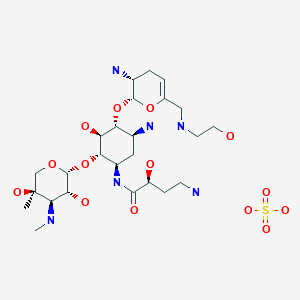
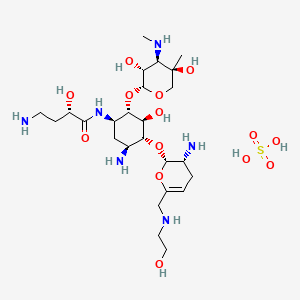
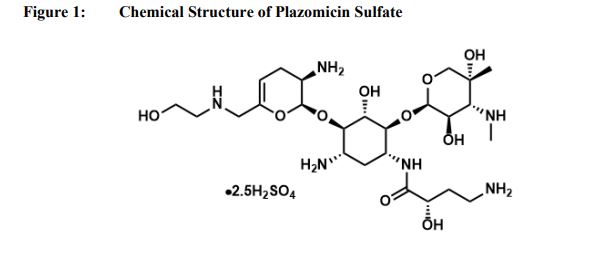
Plazomicin sulfate, プラゾマイシン硫酸塩 ,


File:Plazomicin flat.svgPlazomicin structure.svgChemSpider 2D Image | Plazomicin | C25H48N6O10

Plazomicin

  • Molecular FormulaC25H48N6O10
  • Average mass592.683 Da
(2S)-4-Amino-N-[(1R,2S,3S,4R,5S)-5-amino-4-{[(2S,3R)-3-amino-6-{[(2-hydroxyéthyl)amino]méthyl}-3,4-dihydro-2H-pyran-2-yl]oxy}-2-{[3-désoxy-4-C-méthyl-3-(méthylamino)-β-L-arabinopyranosyl]oxy}-3-hyd roxycyclohexyl]-2-hydroxybutanamide [French][ACD/IUPAC Name]
1154757-24-0 [RN]
9522
ACHN-490

1380078-95-4.pngPlazomicin sulfate.png

Image result for Plazomicin sulfateImage result for Plazomicin sulfateImage result for Plazomicin sulfate

Plazomicin Sulfate

Molecular Formula: C25H50N6O14S
Molecular Weight: 690.763 g/mol
Plazomicin Sulfate; UNII-A78L6MT746; Plazomicin Sulfate [USAN]; A78L6MT746; 1380078-95-4; Plazomicin sulfate (USAN),

  • ACHN 490 sulfate

6′-(hydroxylethyl)-1-(haba)-sisomicin

Plazomicin is a neoglycoside antibiotic with activity against a broad range of Gram-positive and Gram-negive pathogens. Plazomicin showed potent in vitro activity against multidrug-resistant Klebsiella pneumoniae and Escherichia coli.

  • Mechanism of ActionProtein synthesis inhibitors
  • Orphan Drug StatusNo
  • New Molecular EntityYes

Highest Development Phases

  • MarketedUrinary tract infections
  • RegisteredPyelonephritis
  • PreregistrationBacteraemia; Nosocomial pneumonia
  • PreclinicalGram-negative infections
  • No development reportedRespiratory tract infections; Tularaemia; Yersinia infections

Most Recent Events

  • 27 Jun 2018Registered for Pyelonephritis (Treatment-resistant) in USA (IV)- First Global Approval
  • 27 Jun 2018Registered for Urinary tract infections (Treatment-resistant) in USA (IV)- First Global Approval
  • 26 Jun 2018Achaogen receives complete response letter from the FDA for Plazomicin in Bloodstream infection
Synonyms:   O-2-Amino-2,3,4,6-tetradeoxy-6-[(2-hydroxyethyl)amino]-α-D-glycero-hex-4-enopyranosyl-(1→4)-O-[3-deoxy-4-C-methyl-3-(methylamino)-β-L-arabinopyranosyl-(1→6)]-N1-[(2S)-4-amino-2-hydroxy-1-oxobutyl]-2-deoxy-D-streptamine; ACHN 490;
CAS Number:   1154757-24-0

Sulfate 1380078-95-4, プラゾマイシン硫酸塩;

Achaogen (USA)Phase II completed
Mol. Formula:   C25H48N6O10
Aminoglycosides, Broad-spectrum,
Mol. Weight:   592.68

FDA

Click to access 210303Orig1s000lbl.pdf

str1

Developed by Achaogen biopharmaceuticals, plazomicin is a next-generation aminoglycoside synthetically derived from [DB12604]. The structure of plazomicin was established via appending hydroxylaminobutyric acid to [DB12604] at position 1 and 2-hydroxyethyl group at position 6′ [A33942]. It was designed to evade all clinically relevant aminoglycoside-modifying enzymes, which contribute to the main resistance mechanism for aminoglycoside therapy [A33942]. However, acquired resistance of aminoglycosides may arise through over expression of efflux pumps and ribosomal modification by bacteria, which results from amino acid or rRNA sequence mutations [A33942]. Like other aminoglycosides, plazomicin is ineffective against bacterial isolates that produce 16S rRNA methyltransferases [FDA Label]. Plazomicin mediates the antibacterial activity against pathogens including carbapenem-resistant (CRE) and extended-spectrum beta-lactamase (ESBL) producing _Enterobacteriaceae_. It mediates the antibacterial activity by binding to bacterial 30S ribosomal subunit and inhibiting protein synthesis [FDA Label]. On June 28th, 2018, plazomicin sulfate was approved by the FDA for use in adult patients for the treatment of complicated urinary tract infections (cUTI) including Pyelonephritis. It is marketed as Zemdri and is administered via once-daily intravenous infusion.

Developed by Achaogen biopharmaceuticals, plazomicin is a next-generation aminoglycoside synthetically derived from Sisomicin. The structure of plazomicin was established via appending hydroxylaminobutyric acid to Sisomicin at position 1 and 2-hydroxyethyl group at position 6′ [1]. It was designed to evade all clinically relevant aminoglycoside-modifying enzymes, which contribute to the main resistance mechanism for aminoglycoside therapy [1]. However, acquired resistance of aminoglycosides may arise through over expression of efflux pumps and ribosomal modification by bacteria, which results from amino acid or rRNA sequence mutations [1]. Like other aminoglycosides, plazomicin is ineffective against bacterial isolates that produce 16S rRNA methyltransferases [Label]. Plazomicin mediates the antibacterial activity against pathogens including carbapenem-resistant (CRE) and extended-spectrum beta-lactamase (ESBL) producing Enterobacteriaceae. It mediates the antibacterial activity by binding to bacterial 30S ribosomal subunit and inhibiting protein synthesis [Label]. On June 28th, 2018, plazomicin sulfate was approved by the FDA for use in adult patients for the treatment of complicated urinary tract infections (cUTI) including Pyelonephritis. It is marketed as Zemdri and is administered via once-daily intravenous infusion.

Plazomicin (INN,[1] ZEMDRI) is a next-generation aminoglycoside (“neoglycoside”) antibacterial derived from sisomicin by appending a hydroxy-aminobutyric acid (HABA) substituent at position 1 and a hydroxyethyl substituent at position 6′.[2][3]

Plazomicin has been reported to demonstrate in vitro synergistic activity when combined with daptomycin or ceftobiprole versus methicillin-resistant Staphylococcus aureus (MRSA), vancomycin-resistant S. aureus (VRSA) and against Pseudomonas aeruginosawhen combined with cefepimedoripenemimipenem or piperacillin/tazobactam.[3] It also demonstrates potent in vitro activity versus carbapenem-resistant Acinetobacter baumannii.[4]

In 2012, U.S. Food and Drug Administration granted fast track designation for the development and regulatory review of plazomicin.[5]

It is being developed by Achaogen, Inc. to treat serious bacterial infections due to multidrug-resistant Enterobacteriaceae, including carbapenem-resistant Enterobacteriaceae (CRE)[6] and was in Phase III clinical trials as of April 7, 2016.[7]

In June 2018 the FDA approved plazomicin (ZEMDRI) for adults with complicated urinary tract infections (cUTI), including pyelonephritis, caused by Escherichia coliKlebsiella pneumoniaeProteus mirabilis, or Enterobacter cloacae, in patients who have limited or no alternative treatment options. Zemdri is an intravenous infusion, administered once daily.[8][9] The FDA declined approval for treating bloodstream infections due to lack of effectiveness.[10]

To continue the development of plazomicin, the company has received a contract option of US$ 60M from the Biomedical Advanced Research and Development Authority (BARDA) to support a global Phase III clinical study. The study will evaluate plazomicin in treating patients with serious Gram-negative bacterial infections due to carbapenem-resistant Enterobacteriaceae. The study is expected to start in the fourth quarter of 2013 [4].

PATENT

WO 2009067692

WO 2010132770

PAPER

Synthesis and spectrum of the neoglycoside ACHN-490
Antimicrobial Agents and Chemotherapy (2010), 54, (11), 4636-4642

https://aac.asm.org/content/54/11/4636

FIG. 1.

FIG. 2.

FIG. 3.

PAPER

Plazomicin Retains Antibiotic Activity against Most Aminoglycoside Modifying Enzymes
ACS Infectious Diseases (2018), 4, (6), 980-987.

https://pubs.acs.org/doi/abs/10.1021/acsinfecdis.8b00001

PAPER

Effects of the 1-N-(4-Amino-2S-hydroxybutyryl) and 6′-N-(2-Hydroxyethyl) Substituents on Ribosomal Selectivity, Cochleotoxicity, and Antibacterial Activity in the Sisomicin Class of Aminoglycoside Antibiotics
ACS Infectious Diseases (2018), 4, (7), 1114-1120.

https://pubs.acs.org/doi/abs/10.1021/acsinfecdis.8b00052

Abstract Image

Syntheses of the 6′-N-(2-hydroxyethyl) and 1-N-(4-amino-2S-hydroxybutyryl) derivatives of the 4,6-aminoglycoside sisomicin and that of the doubly modified 1-N-(4-amino-2S-hydroxybutyryl)-6′-N-(2-hydroxyethyl) derivative known as plazomicin are reported together with their antibacterial and antiribosomal activities and selectivities. The 6′-N-(2-hydroxyethyl) modification results in a moderate increase in prokaryotic/eukaryotic ribosomal selectivity, whereas the 1-N-(4-amino-2S-hydroxybutyryl) modification has the opposite effect. When combined in plazomicin, the effects of the two groups on ribosomal selectivity cancel each other out, leading to the prediction that plazomicin will exhibit ototoxicity comparable to those of the parent and the current clinical aminoglycoside antibiotics gentamicin and tobramycin, as borne out by ex vivo studies with mouse cochlear explants. The 6′-N-(2-hydroxyethyl) modification restores antibacterial activity in the presence of the AAC(6′) aminoglycoside-modifying enzymes, while the 1-N-(4-amino-2S-hydroxybutyryl) modification overcomes resistance to the AAC(2′) class but is still affected to some extent by the AAC(3) class. Neither modification is able to circumvent the ArmA ribosomal methyltransferase-induced aminoglycoside resistance. The use of phenyltriazenyl protection for the secondary amino group of sisomicin facilitates the synthesis of each derivative and their characterization through the provision of sharp NMR spectra for all intermediates.

https://pubs.acs.org/doi/suppl/10.1021/acsinfecdis.8b00052/suppl_file/id8b00052_si_001.pdf

4 (19 mg, 40%). [α]D 25 = +46.5 (c = 0.01, H2O);

1 H NMR (600 MHz, D2O): δ 5.51 ( s, 1H, H-1ʹ), 5.16 (t, J = 3.5 Hz, H, H-4ʹ), 4.99 (d , J = 4.0 Hz, 1H, H-1ʹʹ), 4.11 (dd , J =9.4 Hz, 3.9 Hz, 1H, CH(OH)CH2CH2), 4.00 (d , J = 12.8 Hz, 1H, H-5ʹʹ), 3.99-3.93 (m, 1H, H-1), 3.84 (dd, J = 11.0 Hz, 4.0 Hz, 1H, H-2ʹʹ), 3.81 (t, J = 9.9 Hz, 1H, H-4), 3.77 (t, J = 5.3 Hz, 1H, H-2ʹ), 3.71 (t, J = 5.1 Hz, 2H, NHCH2CH2O), 3.69 – 3.65 (m, 2H, H-6, H-6ʹ), 3.64 – 3.44 (m , 2H, H-5, H-6ʹ), 3.35 – 3.26 (m , 1H, H-3), 3.24 (d, J = 12.8 Hz, 1H, H-5ʹʹ), 3.15 (d, J = 11.0 Hz, 1H, H-3ʹʹ), 3.09 – 3.06 (m, 2H, NHCH2CH2O), 3.01 (t, J = 7.2 Hz, 2H, CH(OH)CH2CH2), 2.74 (s, 3H, NCH3), 2.58 – 2.52 (m, 1H, H-3ʹ), 2.29 – 2.24 (m, 1H, H-3ʹ), 2.07 (dt, J = 13.2 Hz, 4.4 Hz, 1H, H-2), 2.04 – 1.98 (m, 1H, CH(OH)CH2CH2), 1.84 – 1.79 (m, 1H, CH(OH)CH2CH2), 1.64 (q, 1H, J = 12.5 Hz, H-2), 1.17 (s, 3H, 4ʹʹ-CH3);

13C NMR (151 MHz, D2O): δ 181.2 (s, CH3COOH), 175.4 (s, NHCO), 141.7 (s, C-5ʹ), 102.5 (s, C-4ʹ), 98.0 (s, C-1ʹʹ), 96.9 (s, C-1ʹ), 79.8 (s, C-4), 78.8 (s, C-6), 73.8 (s, C-5), 69.8 (s, C-4ʹʹ), 69.4 (s, CH(OH)CH2CH2), 66.8 (s, C-5ʹʹ), 65.9 (s, C-2ʹʹ), 64.2 (s, C-3ʹʹ), 56.4 (s, NHCH2CH2O), 48.8 (s, C-1), 48.31 (s, NHCH2CH2O), 48.26 (s, C-3), 47.9 (s, C-6ʹ), 45.9 (s, C2ʹ), 36.8 (s, CH(OH)CH2CH2), 34.9 (s, NCH3), 30.7 (s, CH(OH)CH2CH2), 30.4 (s, C-2), 23.1 (s, CH3COOH), 23.0 (s, C-3ʹ), 20.8 (s, 4ʹʹ-CH3).

ESI-HRMS: m/z calcd. for C25H49N6O10 [M+H]+ 593.3510, found: 593.3481.

PATENT

http://www.google.com/patents/US20100099661

Common Intermediates Sisomicin

Figure US20100099661A1-20100422-C00031

Amberlite IRA-400 (OH form) (200 g) was washed with MeOH (3×200 m1). To a stirring suspension of the washed resin in MeOH (150 mL) was added sisomicin sulfate (20.0 g, 0.029 mol) and the mixture was stirred overnight. The resin was then filtered and washed with MeOH (100 mL) and the combined organic layers were concentrated to dryness to yield the desired sisomicin (11.57 g, 0.026 mol, 89.6% yield): MS m/e [M+H]+ calcd 448.3, found 448.1.

Example 1 6′-(2-Hydroxy-ethyl)-1-(4-amino-2(S)-hydroxy-butyryl)-sisomicin

Figure US20100099661A1-20100422-C00074

6′-(2-tert-Butyldimethylsililoxy-ethyl)-2′,3,3″-triBoc-1-(N-Boc-4-amino-2(S)-hydroxy-butyryl)-sisomicin

2′,3,3″-triBoc-1-(N-Boc-4-amino-2(S)-hydroxy-butyryl)-sisomicin (0.10 g, 0.105 mmol) was treated with tert-butyldimethylsilyloxy acetaldehyde following Procedure 1-Method A to yield the desired 6′-(2-tert-butyldimethylsilyloxy-ethyl)-2′,3,3″-triBoc-1-(N-Boc-4-amino-2(S)-hydroxy-butyryl)-sisomicin (MS m/e [M+H]+ calcd 1107.6, found 1107.4), which was carried through to the next step without further purification.

Figure US20100099661A1-20100422-C00075

6′-(2-Hydroxy-ethyl)-1-(4-amino-2(S)-hydroxy-butyryl)-sisomicin

6′ -(2-tert-butyldimethylsililoxy-ethyl)-2′,3,3″-triBoc-1-(N-Boc-4-amino-2(S)-hydroxy-butyryl)-sisomicin (0.105 mmol) was submitted to Procedure 3-Method B for Boc removal to yield a crude, which was purified by RP HPLC Method 1-Column A to yield 6′-(2-hydroxy-ethyl)-1-(4-amino-2(S)-hydroxy-butyryl)-sisomicin: MS m/e [M+H]+ calcd 593.3, found 593.2, [M+Na]+615.3 ; CLND 97.5% purity.

  1. Achaogen. Study for the treatment of complicated urinary tract infection and acute pyelonephritis.Available online: http://www.clinicaltrials.gov/ct2/show/NCT01096849 (accessed on 11 April 2013).
  2. Zhanel, G.G.; Lawson, C.D.; Zelenitsky, S.; Findlay, B.; Schweizer, F.; Adam, H.; Walkty, A.; Rubinstein, E.; Gin, A.S.; Hoban, D.J.; et al. Comparison of the next-generation aminoglycoside plazomicin to gentamicin, tobramycin and amikacin. Expert Rev. Anti-Infect. Ther. 201210, 459–473, doi:10.1586/eri.12.25.
  3. Endimiani, A.; Hujer, K.M.; Hujer, A.M.; Armstrong, E.S.; Choudhary, Y.; Aggen, J.B.; Bonomo, R.A. ACHN-490, a neoglycoside with potent in vitro activity against multidrug-resistant Klebsiella pneumoniae isolates. Antimicrob. Agents Chemother. 200953, 4504–4507.
  4. Achaogen. Achaogen pipeline. Available online: http://www.achaogen.com (accessed on 30 August 2012).
  5. Achaogen. Achaogen Awarded $60M Contract Option by BARDA for the Clinical Development of Plazomicin. Available online: http://www.achaogen.com/news/151/15 (accessed on 19 June 2013).
  6. Achaogen. Achaogen announces all objectives met in Phase 2 Plazomicin complicated urinary tract infections study and start of first-in-human study with ACHN-975. Available online: http://www.achaogen.com/uploads/news/id148/Achaogen_PressRelease_2012–05–15.pdf (accessed on 10 April 2013).
  7. Achaogen. Achaogen Announces Agreement with FDA on a Special Protocol Assessment for a Phase 3 Clinical Trial of Plazomicin to Treat Infections Caused by Carbapenem-Resistant Enterobacteriaceae (CRE); Achaogen: San Francisco, CA, USA, 2013.
  8. Comparison of the next-generation aminoglycoside plazomicin to gentamicin, tobramycin and amikacin
  9. 4-23-2010
    ANTIBACTERIAL AMINOGLYCOSIDE ANALOGS

Patent ID

Title

Submitted Date

Granted Date

US9688711 ANTIBACTERIAL AMINOGLYCOSIDE ANALOGS
2016-01-20
US9266919 ANTIBACTERIAL AMINOGLYCOSIDE ANALOGS
2014-07-17
2015-02-12
Patent ID

Title

Submitted Date

Granted Date

US8383596 ANTIBACTERIAL AMINOGLYCOSIDE ANALOGS
2010-04-22
US8822424 Antibacterial aminoglycoside analogs
2013-01-04
2014-09-02
US2012208781 AMINOGLYCOSIDE DOSING REGIMENS
2011-11-11
2012-08-16
US2012214759 TREATMENT OF KLEBSIELLA PNEUMONIAE INFECTIONS WITH ANTIBACTERIAL AMINOGLYCOSIDE COMPOUNDS
2011-11-11
2012-08-23
US2012214760 TREATMENT OF URINARY TRACT INFECTIONS WITH ANTIBACTERIAL AMINOGLYCOSIDE COMPOUNDS
2011-11-11
2012-08-23
US8318685 Nov 14, 2011 Nov 27, 2012 Achaogen, Inc. Antibacterial aminoglycoside analogs
US8367625 Apr 7, 2011 Feb 5, 2013 Achaogen, Inc. Antibacterial aminoglycoside analogs
US8372813 Apr 7, 2011 Feb 12, 2013 Achaogen, Inc. Antibacterial aminoglycoside analogs
US8377896 Mar 9, 2011 Feb 19, 2013 Isis Pharmaceuticals, Inc Antibacterial 4,6-substituted 6′, 6″ and 1 modified aminoglycoside analogs
US8399419 Mar 9, 2011 Mar 19, 2013 Achaogen, Inc. Antibacterial aminoglycoside analogs
US8481502 Apr 6, 2012 Jul 9, 2013 Achaogen, Inc. Antibacterial aminoglycoside analogs
US8492354 Nov 14, 2011 Jul 23, 2013 Achaogen, Inc. Antibacterial aminoglycoside analogs
US8524675 Nov 14, 2011 Sep 3, 2013 Achaogen, Inc. Antibacterial aminoglycoside analogs
US8524689 Nov 14, 2011 Sep 3, 2013 Achaogen, Inc. Antibacterial aminoglycoside analogs
US8569264 Jan 5, 2012 Oct 29, 2013 Isis Pharmaceuticals, Inc. Antibacterial 4,5-substituted aminoglycoside analogs having multiple substituents
US8653041 Oct 15, 2012 Feb 18, 2014 Achaogen, Inc. Antibacterial aminoglycoside analogs
US8653042 Nov 14, 2011 Feb 18, 2014 Achaogen, Inc. Antibacterial aminoglycoside analogs
US8658606 Nov 14, 2011 Feb 25, 2014 Achaogen, Inc. Antibacterial aminoglycoside analogs

References

  1. Jump up^ “WHO Drug Information, Vol. 26, No. 3, 2012. International Nonproprietary Names for Pharmaceutical Substances (INN). Recommended International Nonproprietary Names: List 68”(PDF). World Health Organization. p. 314. Retrieved 27 April 2016.
  2. Jump up^ Aggen, JB; Armstrong, ES; Goldblum, AA; Dozzo, P; Linsell, MS; Gliedt, MJ; Hildebrandt, DJ; Feeney, LA; Kubo, A; Matias, RD; Lopez, S; Gomez, M; Wlasichuk, KB; Diokno, R; Miller, GH; Moser, HE (30 August 2010). “Synthesis and Spectrum of the Neoglycoside ACHN-490” (PDF). Antimicrobial Agents and Chemotherapy54 (11): 4636–4642. doi:10.1128/AAC.00572-10PMC 2976124Freely accessiblePMID 20805391. Retrieved 27 April2016.
  3. Jump up to:a b Zhanel, GG; Lawson, CD; Zelenitsky, S; Findlay, B; Schweizer, F; Adam, H; Walkty, A; Rubinstein, E; Gin, AS; Hoban, DJ; Lynch, JP; Karlowsky, JA (10 January 2014). “Comparison of the Next-Generation Aminoglycoside Plazomicin to Gentamicin, Tobramycin and Amikacin”. Expert Review of Anti-infective Therapy10 (4): 459–73. doi:10.1586/eri.12.25PMID 22512755.
  4. Jump up^ García-Salguero, C; Rodríguez-Avial, I; Picazo, JJ; Culebras, E (October 2015). “Can Plazomicin Alone or in Combination Be a Therapeutic Option against Carbapenem-Resistant Acinetobacter baumannii?” (PDF). Antimicrobial Agents and Chemotherapy59 (10): 5959–66. doi:10.1128/AAC.00873-15PMC 4576036Freely accessible. Retrieved 27 April 2016.
  5. Jump up^ “Achaogen Announces Plazomicin Granted QIDP Designation by FDA”. GlobeNewswire, Inc. Retrieved 27 April 2016.
  6. Jump up^ “Achaogen — Plazomicin”. Achaogen, Inc. Retrieved 27 April2016.
  7. Jump up^ “Plazomicin — AdisInsight”. Springer International Publishing AG. Retrieved 27 April 2016.
  8. Jump up^ “Medscape Log In”http://www.medscape.com. Retrieved 2018-07-03.
  9. Jump up^ “BioCentury – FDA approves plazomicin for cUTI, but not blood infections”http://www.biocentury.com. Retrieved 2018-06-28.
  10. Jump up^ “Drugs@FDA: FDA Approved Drug Products”http://www.accessdata.fda.gov. Retrieved 2018-06-28.
Plazomicin
Plazomicin structure.svg
Names
IUPAC name

(2S)-4-Amino-N-[(1R,2S,3S,4R,5S)-5-amino-4-[[(2S,3R)-3-amino-6-[(2-hydroxyethylamino)methyl]-3,4-dihydro-2H-pyran-2-yl]oxy]-2-[(2R,3R,4R,5R)-3,5-dihydroxy-5-methyl-4-(methylamino)oxan-2-yl]oxy-3-hydroxycyclohexyl]-2-hydroxybutanamide
Other names

6′-(hydroxylethyl)-1-(HABA)-sisomicin
Identifiers
3D model (JSmol)
ChEMBL
ChemSpider
KEGG
PubChem CID
UNII
Properties
C25H48N6O
Molar mass 592.683 g/mol
Except where otherwise noted, data are given for materials in their standard state (at 25 °C [77 °F],

Achaogen is a clinical-stage biopharmaceutical company passionately committed to the discovery, development, and commercialization of novel antibacterials to treat multi-drug resistant, or MDR, gram-negative infections.

Achaogen Inc.jpg

Achaogen (a-KAY-o-jen) is developing plazomicin, its lead product candidate, for the treatment of serious bacterial infections due to MDR Enterobacteriaceae, including carbapenem-resistant Enterobacteriaceae, or CRE. In 2013, the Centers for Disease Control and Prevention identified CRE as a “nightmare bacteria” and an immediate public health threat that requires “urgent and aggressive action.” We expect to initiate a Phase 3 superiority trial of plazomicin in the first quarter of 2014.

CRE are one of many types of MDR gram-negative pathogens threatening patients. Bacteria such as Pseudomonas aeruginosaAcinetobacter baumannii, and extended-spectrum beta-lactamase producing Enterobacteriaceae each pose “serious” resistance threats, according to the CDC, and also drive a great need for new, safe, and effective antibiotics. We have assembled the chemistry and microbiology expertise and capabilities required to develop new agents for the treatment of gram-negative infections. Plazomicin was the first clinical candidate from our gram-negative antibiotic discovery engine. In addition, our research and development pipeline includes two antipseudomonal programs targeting P. aeruginosa—a program to discover and develop small molecule inhibitors of LpxC, which is an enzyme essential for the synthesis of the outer membrane of gram-negative bacteria, and a therapeutic antibody program. We are also pursuing small molecule research programs targeting other essential gram-negative enzymes.

Achaogen has built an exceptional research and development team with deep expertise in the discovery and development of new drugs from research through commercialization. Our executive team has over 60 years of combined industry experience, and a proven track record of leadership, global registration, and lifecycle management for over 20 products. Our facility is located on the shores of the San Francisco Bay, ten minutes from the San Francisco International Airport, and only fifteen minutes from downtown San Francisco.

Image result for Plazomicin sulfate

ZEMDRITM (plazomicin) Approved by FDA for the Treatment of Adults with Complicated Urinary Tract Infections (cUTI)

https://globenewswire.com/news-release/2018/06/26/1529573/0/en/ZEMDRITM-plazomicin-Approved-by-FDA-for-the-Treatment-of-Adults-with-Complicated-Urinary-Tract-Infections-cUTI.html

― ZEMDRI is a new treatment for patients with cUTI, including pyelonephritis, due to certain Enterobacteriaceae ―

― ZEMDRI is the only once-daily aminoglycoside therapy approved for use in cUTI ―


― ZEMDRI has microbiological activity against pathogens designated by the CDC as urgent and serious public health threats, including carbapenem-resistant (CRE) and extended spectrum beta-lactamase (ESBL)- producing Enterobacteriaceae ―

SOUTH SAN FRANCISCO, Calif., June 26, 2018 (GLOBE NEWSWIRE) — Achaogen, Inc. (NASDAQ:AKAO), a biopharmaceutical company developing and commercializing innovative antibacterial agents to address multidrug resistant (MDR) gram-negative infections, today announced that the U.S. Food and Drug Administration (FDA) has approved ZEMDRI™ (plazomicin) for adults with complicated urinary tract infections (cUTI), including pyelonephritis, caused by certain Enterobacteriaceae in patients who have limited or no alternative treatment options. ZEMDRI is an intravenous infusion, administered once daily.

“The approval of ZEMDRI marks a significant milestone for Achaogen and we are excited to offer healthcare practitioners a new treatment option for patients with certain serious bacterial infections. ZEMDRI is designed to retain its potent activity in the face of certain difficult-to-treat MDR infections, including CRE and ESBL- producing Enterobacteriaceae,” said Blake Wise, Achaogen’s Chief Executive Officer. “Today’s milestone was made possible by our employees, by patients and investigators involved in our clinical trials, and by BARDA, who contributed significant funding for the development of ZEMDRI. This marks an important step in our commitment to fighting MDR bacteria and we are excited to launch ZEMDRI, a much needed once-daily antibiotic.”

“Bacteria continue to circumvent existing antibiotics, making certain infections notoriously hard to treat and putting some patients at high risk for mortality,” said James A. McKinnell, Assistant Professor of Medicine at the David Geffen School of Medicine and LA Biomed at Harbor-UCLA. “Aminoglycosides are a familiar and very effective class of antibiotics. I look forward to adding plazomicin to my short list of available treatment options and to its potential impact on patient outcomes.”

Regarding the potential indication for plazomicin for the treatment of bloodstream infection (BSI), the FDA issued a Complete Response Letter (CRL) stating that the CARE study does not provide substantial evidence of effectiveness of plazomicin for the treatment of BSIThe Company intends to meet with the FDA to determine whether there is a feasible resolution to address the CRL.

Achaogen will work with hospitals, providers, and insurers to ensure patients are able to receive this treatment. Patients, physicians, pharmacists, or other healthcare professionals with questions about ZEMDRI should contact 1.833.252.6400 or visit www.ZEMDRI.com.

ZEMDRI Phase 3 Clinical Results
The approval of ZEMDRI is supported in part by data from the EPIC (Evaluating Plazomicin In cUTI) clinical trial, which was the first randomized controlled study of once-daily aminoglycoside therapy for the treatment of cUTI, including pyelonephritis.

In the Phase 3 EPIC cUTI trial, ZEMDRI demonstrated non-inferiority to meropenem for the co-primary efficacy endpoints of composite cure (clinical cure and microbiological eradication) in the microbiological modified intent-to-treat (mMITT; N=388) population at Day 5 and test-of-cure (TOC) visit (Day 17 + 2). Composite cure rates at Day 5 were 88.0% (168/191) for ZEMDRI vs 91.4% (180/197) for meropenem (difference -3.4%, 95% CI, -10.0 to 3.1). Composite cure rates at TOC were 81.7% (156/191) for ZEMDRI vs 70.1% (138/197) for meropenem (difference 11.6%, 95% CI, 2.7 to 20.3). Composite cure at the TOC visit in patients with concomitant bacteremia at baseline was achieved in 72.0% (18/25) of patients in the ZEMDRI group and 56.5% (13/23) of patients in the meropenem group. The most common side effects (≥1% of patients treated with ZEMDRI) were decreased kidney function, diarrhea, hypertension, headache, nausea, vomiting, and hypotension.1

The FDA approved a breakpoint of <= 2 mcg/mL; greater than 99% of Escherichia coliKlebsiella pneumoniae and Enterobacter cloacae in U.S. surveillance are susceptible to Zemdri when applying this breakpoint.2

About cUTI
cUTI is defined as a UTI occurring in a patient with an underlying complicating factor of the genitourinary tract, such as a structural or functional abnormality.3 Patients with pyelonephritis, regardless of underlying abnormalities of the urinary tract, are considered a subset of patients with cUTI.4 An estimated 3 million cases of cUTI are treated in the hospital setting in the US each year.5 Enterobacteriaceae are the most common pathogens causing cUTIs6, and resistance within this family is a global concern. High rates of resistance to previous mainstays of therapy necessitate alternative treatment options. Ineffectively managed cUTI can lead to increased treatment failure rates, recurrence of infection, increased re-hospitalization, and increased morbidity and mortality. cUTI infections place an economic burden on hospitals and payers.6,7

About ZEMDRI
ZEMDRI is an aminoglycoside with once-daily dosing that has activity against certain Enterobacteriaceae, including CRE and ESBL- producing Enterobacteriaceae. Achaogen’s EPIC clinical trial successfully evaluated the safety and efficacy of ZEMDRI in adult patients with cUTI, including pyelonephritis. ZEMDRI was engineered to overcome aminoglycoside-modifying enzymes, the most common aminoglycoside-resistance mechanism in Enterobacteriaceae, and has in vitro activity against ESBL- producing, aminoglycoside- resistant, and carbapenem- resistant isolates. The Centers for Disease Control and Prevention (CDC) has characterized ESBL- producing Enterobacteriaceae as a “serious threat” and CRE as “nightmare bacteria”, which is an immediate public health threat that requires urgent and aggressive action.

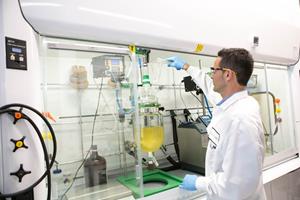
Working in the Lab
Working in the Lab
Working in the Lab
Achaogen, Inc.
Blake Wise, Chief Executive Officer at Achaogen
Achaogen, Inc.
High-Resolution Achaogen company logo
Achaogen, Inc.

/////////Plazomicin, ZEMDRI, FDA 2018, fast track designation, Plazomicin SULFATE, ACHN 490 sulfate, cUTI, Achaogen

CC1(COC(C(C1NC)O)OC2C(CC(C(C2O)OC3C(CC=C(O3)CNCCO)N)N)NC(=O)C(CCN)O)O

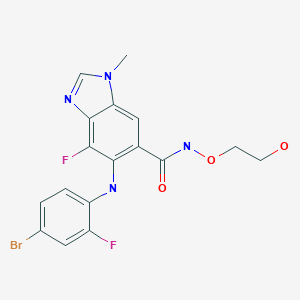
CN[C@@H]1[C@@H](O)[C@@H](O[C@H]2[C@@H](C[C@H](N)[C@@H](O[C@H]3OC(CNCCO)=CC[C@H]3N)[C@@H]2O)NC(=O)[C@@H](O)CCN)OC[C@]1(C)O

BINIMETINIB, биниметиниб , بينيميتينيب , 美替尼 , ビニメチニブ


Figure imgf000024_0001ChemSpider 2D Image | Binimetinib | C17H15BrF2N4O3

Binimetinib.svgBinimetinib.png

Binimetinib

MEK-162
биниметиниб [Russian] [INN]
بينيميتينيب [Arabic] [INN]
贝美替尼 [Chinese] [INN]
ビニメチニブ
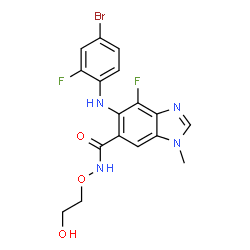
5-[(4-bromo-2-fluorophenyl)amino]-4-fluoro-N-(2-hydroxyethoxy)-1-methyl-1H-benzimidazole-6-carboxamide
5-(4-Bromo-2-fluorophenylamino)-4-fluoro-1-methyl-1H-benzimidazole-6-carbohydroxamic acid 2-hydroxyethyl ester
6-(4-Bromo-2-fluorophenylamino)-7-fluoro-3-methyl-3H-benzoimidazole-5-carboxylic acid (2-hydroxyethyoxy)-amide
606143-89-9  CAS
C17H15BrF2N4O3, 441.227
UNII-181R97MR71
181R97MR71
1H-Benzimidazole-6-carboxamide, 5-[(4-bromo-2-fluorophenyl)amino]-4-fluoro-N-(2-hydroxyethoxy)-1-methyl-
tyrosine kinase inhibitor, antineoplastic

Array BioPharma Inc;PHASE 3 Cancer, ovary (serous)

Novartis PHASE 3 Melanoma

CAS 606143-89-9 [RN]
9764
ARRY-162
ARRY-438162, NVP-MEK162

MEK-1 protein kinase inhibitor; MEK-2 protein kinase inhibitor

Liver injury; Melanoma; Noonan syndrome; Ovary tumor; Solid tumor

On June 27, 2018, the Food and Drug Administration approved encorafenib and binimetinib in combination patients with unresectable or metastatic melanoma with a BRAF V600E or V600K mutation, as detected by an FDA-approved test

Binimetinib, also known as Mektovi and ARRY-162, is an anti-cancer small molecule that was developed by Array Biopharma to treat various cancers.[1] Binimetinib is a selective inhibitor of MEK, a central kinase in the tumor-promoting MAPK pathway.[2] Inappropriate activation of the pathway has been shown to occur in many cancers.[2] In June 2018 it was approved by the FDA in combination with encorafenib for the treatment of patients with unresectable or metastatic BRAF V600E or V600K mutation-positive melanoma.[3]

Binimetinib, also known as Mektovi, is a potent is a potent and selective oral mitogen-activated protein kinase 1/2 (MEK 1/2) inhibitor which is combined with Encorafenib [4],[8].

On June 27, 2018, the Food and Drug Administration approved the combination of Encorafeniband binimetinib (BRAFTOVI and MEKTOVI, from Array BioPharma Inc.) in combination for patients with unresectable or metastatic melanoma with the BRAF V600E or V600K mutations, as detected by an FDA-approved test [8].

Binimetinib was originally developed by Array BioPharma, then licensed to Novartis for worldwide development in 2010. But Array Biopharma regained full worldwide rights of the product in 2015. And in 2015, Pierre Fabre acquired exclusive rights to commercialize the product.

Mechanism of action

Binimetinib is an orally available inhibitor of mitogen-activated protein kinase kinase (MEK), or more specifically, a MAP2K inhibitor.[4]MEK is part of the RAS pathway, which is involved in cell proliferation and survival. MEK is upregulated in many forms of cancer.[5]Binimetinib, uncompetitive with ATP, binds to and inhibits the activity of MEK1/2 kinase, which has been shown to regulate several key cellular activities including proliferation, survival, and angiogenesis.[6] MEK1/2 are dual-specificity threonine/tyrosine kinases that play key roles in the activation of the RAS/RAF/MEK/ERK pathway and are often upregulated in a variety of tumor cell types.[7] Inhibition of MEK1/2 prevents the activation of MEK1/2 dependent effector proteins and transcription factors, which may result in the inhibition of growth factor-mediated cell signaling.[8] As demonstrated in preclinical studies, this may eventually lead to an inhibition of tumor cell proliferation and an inhibition in production of various inflammatory cytokines including interleukin-1, -6 and tumor necrosis factor.[8]

Development

In 2015, it was in phase III clinical trials for ovarian cancer,[9] BRAF mutant melanoma,[10] and NRAS Q61 mutant melanoma.[11]

In December 2015, the company announced that the mutant-NRAS melanoma trial was successful.[12] In the trial, those receiving binimetinib had a median progression-free survival of 2.8 months versus 1.5 months for those on the standard dacarbazinetreatment.[13] NDA submitted Jun 2016,[14] and the FDA should decide by 30 June 2017.[15]

In April 2016, it was reported that the phase III trial for low-grade ovarian cancer was terminated due to lack of efficacy.[16]

Binimetinib was studied for treatment of rheumatoid arthritis, but a phase II trial did not show benefit.

In 2017, the FDA informed Array Biopharma that the phase III trial data was not sufficient and the New Drug Application was withdrawn.[17]

In June 2018 it was approved for the treatment of certain melanomas by the FDA in combination with encorafenib.[3]

Growth factor-mediated proliferative signals are transmitted from the extracellular environment to the nucleus through several pathways, including the RAS/RAF/ MEK pathway. The RAS/RAF/MEK kinase signal transduction pathway is activated through initial extracellular binding and stimulation of tyrosine receptor kinases (RTKs) by their respective cognate ligands. Upon autophosphorylation of specific tyrosine residues in the cytosolic domain of RTKs, the Grb2-Sos complex translocates to the plasma membrane, and converts the inactive RAS’GDP to active RAS’GTP. The interaction between the Grb2 docking protein and the activated kinases or the phosphorylated receptor associated proteins is mediated by the Src Homology (SH2) domain of the signaling protein that recognizes specific phosphotyrosine sequences. RAS undergoes a conformational change upon guanosine 5 ‘-triphosphate (GTP) binding and causes the recruitment of RAF- 1 to the cytoplasmic membrane where it is phosphorylated by several kinases and simultaneous disphosphorylated at key residues by protein phosphatase-2B. Activated RAF phosphorylates the mitogen- activated protein kinase kinase (MEK) on two serine residues in the activation loop, which results in the activation of this protein kinase. MEK then phosphorylates and activates extracellular signal-regulated kinase (ERK), allowing its translocation to the nucleus where it phosphorylates transcriptional factors permitting the expression of a variety of genes.

The RAS/RAF/MEK signal transduction pathway is deregulated, often through mutations that result in ectopic protein activation, in roughly 1/3 of human cancers. This deregulation in turn results in a wide array of cellular changes that are integral to the etiology and maintenance of a cancerous phenotype including, but not limited to, the promotion of proliferation and evasion of apoptosis (Dhillon et al., Oncogene, 2007, 26: 3279-3290).

Accordingly, the development of small molecule inhibitors of key members of the RAS/ RAF/ MEK signal transduction pathway has been the subject of intense effort within the pharmaceutical industry and oncology community.

MEK is a major protein in the RAS/ RAF/ MEK pathway, which signals toward cell proliferation and survival, and frequently activated in tumors that have mutations in the RAS or RAF oncogenes or in growth receptor tyrosine kinases. MEK is a key player in the RAS/RAF/MEK pathway as it is downstream of RAS and RAF. Despite being only rarely mutated in cancer (Murugan et al., Cell Cycle, 2009, 8: 2122-2124; Sasaki et al., J. Thorac. Oncol., 2010, 5: 597-600), inhibitors of the MEK1 and MEK2 proteins have also been targeted for small molecule inhibition owing to their central position within the RAS/ RAF/ MEK signal transduction pathway signaling cascade (Fremin and Meloche, J. Hematol.

Oncol., 2010, 3:8). Recently a potent MEK inhibitor failed to demonstrate efficacy in clinical trials in patients with advanced non-small cell lung cancer (Haura et al., Clin. Cancer Res., 2010, 16: 2450-2457). The reason for failure in this trial is not clear.

6-(4-Bromo-2-fluorophenylamino)-7-fluoro-3-methyl-3H-benzoimidazole-5-carboxylic acid (2-hydroxyethyoxy)-amide (hereinafter, “Compound A”) is a benzimidazole compound that is a known potent and selective inhibitor of the MEK1 and MEK2 proteins, and useful in the treatment of hyperproliferative diseases, particularly cancer, in mammals. For example, in a recently published Phase I study of 28 patients suffering from unresectable, locally advanced or metastatic biliary cancer and who had received < 1 prior systemic therapy, oral Compound A treatment (60 mg twice daily) resulted in 1 complete regression, 1 partial regression and 11 stable disease diagnoses after at least 6 weeks of treatment (Finn et al., J. Clin. Oncol. 30, 2012 (Supplement 4, 2012 Gastrointestinal Cancers Symposium, Abstract No. 220). Compound A has also been demonstrated to be effective in the treatment of patients with either BRAFV600 or NRAS-mutant melanoma (Ascierto et al., J. Clin. Oncol. 30, 2012 (Supplement, 2012 ASCO Annual Meeting, Abstract No. 8511).

The compound, as well as a process for its preparation, is disclosed in PCT Pub. No. WO 03/077914

MEK-162, a potent, orally active MEK1/2 inhibitor, is in phase III clinical trials at Array BioPharma and licensee Novartis for the treatment of metastatic or unresectable cutaneous melanoma with NRAS mutations and in combination with LGX-818 in adult patients with BRAF V600. Phase III studies are also under way at Array BioPharma for the treatment of low grade serous carcinomas of the ovary, fallopian tube or primary peritoneum following at least one prior platinum-based chemotherapy regimen and no more than three lines of prior chemotherapy regimens. Novartis and Array BioPharma are also conducting phase II clinical studies for the treatment of locally advanced and unresectable or metastatic malignant cutaneous melanoma, harboring BRAFV600E mutations; in BRAF mutated melanoma in combination with AMG-479 and for the treatment of Noonan’s syndrome, and in non-small cell lung cancer harboring KRAS or EGFR mutation and in combination with erlotinib. MEK-162 is being evaluated in phase I/II as first line treatment of advanced biliary tract carcinoma and for the treatment of adult patients with mutant or wild-type RAS metastatic colorectal cancer. The product is in early clinical trials at Array Biopharma for the treatment of biliary cancer.

According to Array, MEK-162 may also provide broad therapeutic benefits in the treatment of chronic degenerative diseases. However, a phase II trial for the treatment of stable rheumatoid arthritis (RA) did not meet its primary endpoint. Based on these data, the company focused development of MEK-162 solely in oncology.

In 2010, MEK-162 was licensed to Novartis by Array BioPharma for worldwide development. In 2013, orphan drug designation was assigned in Japan for the treatment of malignant melanoma with NRAS or BRAF V600 mutation.

WO-2014063024 DEALS WITH Preparation, crystalline forms, and formulations comprising binimetinib. Binimetinib is a MEK-1/2 inhibitor originally claimed in WO03077914, which Array and Novartis are developing for the treatment of cancer, including melanoma, low-grade serous ovarian cancer, and other solid tumors, as well as Noonan syndrome hypertrophic cardiomyopathy and hepatic impairment. See also WO2014018725 for the most recent filing on the agent

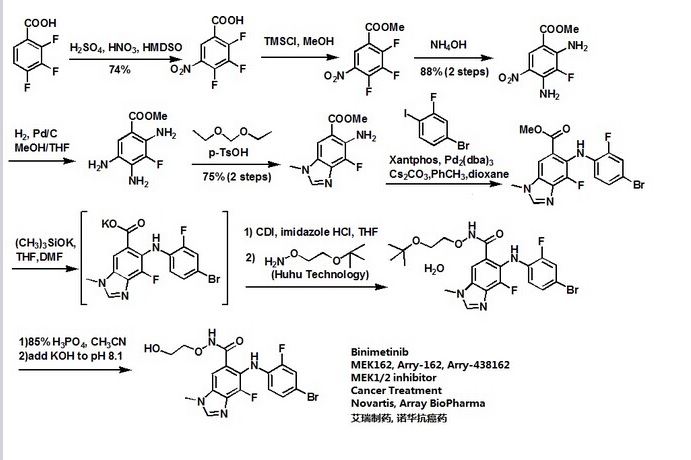
SYNTHESIS

PATENT

WO 03/077914

http://www.google.com/patents/WO2003077914A1?cl=en

Schemes 1-4.

Scheme 1

Figure imgf000029_0001
Figure imgf000029_0002

Scheme la

Figure imgf000030_0001

Scheme 2

Figure imgf000031_0001

Scheme 3

Figure imgf000032_0001

17 18

Scheme 4

Figure imgf000033_0001

25

Scheme 5

Figure imgf000034_0001
Figure imgf000034_0002

General synthetic methods which may be referred to for preparing some of the compounds of the present invention are provided in PCT published application number WO 00/42022 (published July 20, 2000). The foregoing patent application is incorporated herein by reference in its entirety.

 similar ie chloro instead of fluoro

Example 52

Figure imgf000112_0001

6-(4-Bromo-2-chloro-phenylamino)-7-chloro-3-methyl-3H-benzoimidazole-5- carboxylic acid (2-hydroxy-ethoxy)-amide (lOcc) Step A: 3-Chloro-2,4-difluoro-5-nitro-benzoic acid 2a

3-Chloro-2,4-difluoro-benzoic acid la (3.00 g, 15.6 mmol) is added to a stirred solution of concentrated H2SO4 (16 mL) and fuming nitric acid (0.85 mL, 20.3 mmol). After 3 hours a precipitate forms. The yellow slurry is poured onto ice water (100 mL). The aqueous mixture is extracted with diethyl ether (3x). The organic extracts are dried (Na2SO4) and concentrated under reduced pressure to give 3.50 g (95%) of clean desired product as a pale yellow solid.

Step B: 4-Amino-3-chloro-2-fluoro-5-nitro-benzoic acid 3a

Ammonium hydroxide solution (6.88 g, -30% in water, 58.9 mmol) is added to a solution of 3-chloro-2,4-difluoro-5-nitro-benzoic acid 2a (3.5 g, 14.7 mmol) in water (16 mL) at 0 °C with stirring. Upon completion of the ammonium hydroxide addition the reaction mixture is warmed to room temperature. After 5 hours the reaction mixture is cooled to 0 °C and concentrated HCl is carefully added until the pH of the reaction mixture is near zero. The solid is collected by filtration and washed with water and diethyl ether. The solids are transferred to a round bottom flask as a solution in MeOH and EtOAc and concentrated under reduced pressure to give 2.96 g of a yellow solid. The filtrate is partitioned between diethyl ether and water and the organic layer is washed with brine. The combined organic extracts are dried (Na2SO ) and concentrated under reduced pressure to give 0.65 g of product. Recovered a total of 3.61 g (104%) of pure desired product, that is carried forward without further purification.

Step C: 4~Amino-3-chloro-2-fluoro-5-nitro-benzoic acid methyl ester 4a

To a stirred solution of 4-amino-3-chloro-2-fluoro-5-nitro-benzoic acid 3a (3.61 g, 15.4 mmol) in THF (30 mL) and MeOH (10 mL), TMS diazomethane (9.23 mL, 2.0 M solution in hexanes, 18.5 mmol) is added. After completion of reaction, the reaction mixture is concentrated via rotary evaporation with acetic acid in the trap. The recovered oily solid is triturated with diethyl ether to provide 1.51 g of a yellow solid. The filtrate is concentrated and triturated with diethyl ether to give an additional 0.69 g of yellow solid. A total of 2.20 g (57%) of pure desired product is recovered.

Step D: 4-Amino-3-chloro-5-nitro-2-phenylamino-benzoic acid methyl ester 5c

4-Amino-3-chloro-2-fluoro-5-nitro-benzoic acid methyl ester 4a (2.20 g, 8.84 mmol) is suspended in MeOH (9.4 mL) and aniline (3.22 mL, 35.4 mmol) is added. The reaction mixture is heated to reflux with stirring under a nitrogen atmosphere. After 19 hours, the reaction is complete. Distilled water (3.22 mL) is added to the reaction mixture and refluxing is continued for one hour. The reaction mixture is cooled to 0 °C in an ice bath for 20 minutes. The reaction mixture is filtered and washed with 3:10 distilled water/MeOH (65 mL total) and then with MeOH. The solid is dissolved with CH2C12 and concentrated under reduced pressure to give 2.40 g (84%) of pure desired product. MS APCI (-) m/z 320.3 (M-l) detected.

Step E: 4, 5-Diamino-3-chloro-2-phenylamino-benzoic acid methyl ester 6b

4-Amino-3-chloro-5-nitro-2-phenylamino-benzoic acid methyl ester 5c (0.50 g, 1.55 mmol) is dissolved into 2:1 EtOH/MeOH (15.5 mL). Saturated aqueous NH4C1 (15 mL), Zn powder (1.02 g, 15.6 mmol), and THF (10 mL) are added. After stirring for 20 hours, the reaction mixture is diluted with CH C12/THF and water. The organic layer is washed with water (3x). The combined organic extracts are dried (Na2SO4) and concentrated under reduced pressure. The solids are triturated with ether to give 0.32 g (70%) clean desired product. Step F: 7-Chloro-6-phenylamino-3H-benzoimidazole-5-carboxylic acid methyl ester 7c

4,5-Diamino-3-chloro-2-phenylamino-benzoic acid methyl ester 6b (0.32 g, 1.09 mmol) and formamidine acetate (72 mg, 1.64 mmol) in EtOH (36 mL) are heated, with stirring, to 80 °C. After 44 hours, the reaction mixture is cooled to room temperature and diluted with EtOAc and washed with water (3x), saturated NaHCO3, and brine. The combined organic extracts are dried (Na2SO4) and concentrated under reduced pressure to give 0.33 g (99%) clean desired product as a solid. MS APCI (+) m/z 302.3 (M+l) detected.

Step G: 6-(4-Bromo-phenylamino)-7-chloro-3H-benzoimidazole-5-carboxylic acid methyl ester 8g

7-Chloro-6-phenylamino-3H-benzoimidazole-5-carboxylic acid methyl ester 7c (0.327 g, 1.08 mmol) is dissolved into DMF (16 mL) and NBS (0.193 g, 1.08 mmol) is added. After one hour, the reaction mixture is quenched by the addition of saturated aqueous NaHSO3. The reaction mixture is then partitioned between EtOAc/THF and water. The organic layer is washed with water and brine. The combined organic extracts are dried (Na2SO ) and concentrated under reduced pressure. The recovered solid is triturated with ether to give 0.225 g (54%) pure desired product. MS ESI (+) m/z 382, 384 (M+, Br pattern) detected.

Step H: 6-(4-Bromo-2-chloro-phenylamino)- 7 -chloro-3H-benzoimidazole-5 -carboxylic acid methyl ester lOdd 6-(4-Bromo-phenylamino)-7-chloro-3H-benzoimidazole-5-carboxylic acid methyl ester 8g (0.225 g, 0.591 mmol) is dissolved in DMF (2 mL) and NCS (79 mg, 0.591 mmol) is added. After the NCS is in solution concentrated HCl (0.005 mL, 0.059 mmol) is added. After 2 hours, sodium bicarbonate, water and NaHSO3 are added to the reaction mixture. Solids are filtered and washed with water and ether to give 0.141 g (57%) of clean desired product as a tan solid. MS APCI (-) m/z 414, 416 (M-, Br pattern) detected.

Step I: 6-(4-Bromo-2-chloro-phenylamino)-7-chloro-3-methyl-3H-benzoimidazole-5- carboxylic acid methyl ester lOee

6-(4-Bromo-2-chloro-phenylamino)-7-chloro-3H-benzoimidazole-5-carboxylic acid methyl ester lOdd (0.141 g, 0.34 mmol), potassium carbonate (0.141 g, 1.02 mmol), and iodomethane (0.063 mL, 1.02 mmol) are dissolved in dimethylformamide (3 mL). After 20 hours, the reaction mixture is diluted with EtOAc and washed with water (3x), potassium carbonate, and brine. The organic layer is dried (Na2SO4) and concentrated to a brown oil. The N3 and Nl alkylated regioisomers are separated by flash chromatography (EtOAc). The recovery of the N3 alkylated regioisomer is 20.4 mg (28%). MS ESI (+) m/z 428, 430 (M+, Br pattern) detected.

Step J: 6-(4-Bromo-2-chloro-phenylamino)-7-chloro-3-methyl-3H-benzoimidazole-5- carboxylic acid 10 ff

6-(4-Bromo-2-chloro-phenylamino)-7-chloro-3-methyl-3H-benzoimidazole-5- carboxylic acid methyl ester lOee (21 mg, 0.048 mmol) is dissolved into 2:1 THF/water (1.2 mL) and NaOH (0.190 mL, 1.0 M aqueous solution, 0.190 mmol) is added. After stirring for 4 hours the reaction is diluted with water and acidified to pH 2 by addition of 1.0 M HCl. The mixture is then extracted with 3:1 EtOAc/THF (3x), dried (Na2SO ) and concentrated to give quantitative yield of desired prodcut as a white solid. MS APCI (+) m/z 414, 416 (M+, Br pattern) detected.

Step K: 6-(4-Bromo-2’chloro-phenylamino)- 7-chloro-3-methyl-3H-benzoimidazole-5- carboxylic acid (2-vinyloxy-ethoxy) -amide lOgg

6-(4-Bromo-2-chloro-phenylamino)-7-chloro-3-methyl-3H-benzoimidazole-5- carboxylic acid lOff (32 mg, 0.077 mmol), O-(2-vinyloxy-ethyl)-hydroxylamine (0.010 mL, 0.092 mmol), HOBt (13 mg, 0.093 mmol), triethylamine (0.011 mL, 0.077 mmol), and EDCI (19 mg, 0.10 mmol) are dissolved into dimethylformamide (1.0 mL) and allowed to stir under a nitrogen atmosphere at room temperature for 24 hours. The reaction mixture is diluted with EtOAc, washed with water (3x), 10% potassium carbonate (2x), saturated ammonium chloride, brine, dried (Na2SO4), and concentrated under reduced pressure to give 39 mg of 85% pure material. MS APCI (-) m/z 497, 501 (M-, Br pattern) detected.

Step L: 6-(4-Bromo-2-chloro-phenylamino)-7-chloro-3-methyl-3H-benzoimidazole-5- carboxylic acid (2-hydroxy-ethoxy)-amide lOcc

Hydrochloric acid (0.78 mL, 1.0 M aqueous solution, 0.78 mmol) is added to a suspension of 6-(4-bromo-2-chloro-phenylamino)-7-chloro-3-methyl-3H- benzoimidazole-5-carboxylic acid lOgg (2-vinyloxy-ethoxy)-amide (39 mg, 0.078 mmol) in MeOH (1 mL). After one hour, the reaction mixture is neutralized to pH 7 and concentrated under reduced pressure. The solids are dissolved in EtOAc, washed with brine, dried (Na SO4), and concentrated under reduced pressure. Flash chromatography (20:1 CH2Cl2/MeOH) provides 9 mg (23%) of pure product: MS APCI (+) m/z 473, 475 (M+, Br pattern) detected; 1H NMR (400 MHz, CDC13) δ 8.30 (s, IH), 8.08 (s, IH), 7.57

(d, IH), 7.15 (dd, IH), 6.21 (d, IH), 3.97 (s, 3H) 3.86 (m, 2H), 3.57 (m, 2H).

actual is below

Example 18

The following compounds are prepared by methods similar to those described in

Example 10 by using methyl ester 8d and the appropriate alkylating agent (Step A) and

the appropriate hydroxylamine (Step C):

Figure imgf000071_0002

PATENT

WO2014063024

http://patentscope.wipo.int/search/en/detail.jsf;jsessionid=E10680BCA177F821C7FEFA1AFC44A438.wapp2nA?docId=WO2014063024&recNum=6&maxRec=53841&office=&prevFilter=%26fq%3DICF_M%3A%22C07D%22&sortOption=Pub+Date+Desc&queryString=&tab=PCTDescription

COMPD A

Example 1. Preparation of 6-(4-Bromo-2-fluorophenylamino)-7-fluoro-3-methyl-3H-

In an inertized (N2) reaction vessel at internal temperature 20°C and under exclusion of humidity and air, Compound 1 (1.0 eq.) and Compound 2 (1.2 eq.) are reacted in the presence of cesium carbonate (2.4 eq.), tris(dibenzylidenaceton) dipalladium(O) (0.035 eq.) and Xantphos (0.07 eq.) in a mixture of toluene and 1 ,4-dioxane at internal temperature of 99°C. After 8 hours, the mixture is cooled to internal temperature of 60°C.

Subsequently, dimethylformamide (DMF), filter aid (CEFOK) and activated charcoal (EKNS) are added, and the mixture is stirred and cooled to internal temperature of 35 °C. The solids are filtered off and washed with a mixture of dimethylformamide and toluene. To the filtrate, which contains the product Compound 3, is introduced at internal temperature of

25 °C hydrogen chloride gas (CLC) whereupon the HQ salt of Compound 3 crystallizes. The palladium residue mainly remains in solution. After warming to 60 °C and cooling to 0°C, the solids are filtered using a centrifuge and are washed with a mixture of toluene and dimethylformamide.

The damp Compound 3 HC1 salt is charged to a reactor (equipped with pH probe) together with dimethylformamide and is heated to 60°C. By adding a 4 wt% of aqueous tripotassium phosphate solution, the pH is adjusted to a pH range of 6.8-7.6 (with a target of pH 7.2) while Compound 3 crystallizes as free base. After cooling to 22°C and stirring, the solids are filtered using a centrifuge and are washed with drinking water. The moist solids are dried at 50 °C under vacuum to give dry, crude Compound 3.

In order to remove residual palladium, dry, crude Compound 3 is dissolved in dimethylformamide at internal temperature of 60°C and stirred together with Smopex-234 (commercially available from Johnson Matthey) and activated charcoal for 90 minutes. The solids are filtered off at internal temperature of 60°C and are washed with

dimethylformamide. To the filtrate are added drinking water and Compound 3 seed crystals. More drinking water is added while Compound 3 crystallizes. After cooling to internal temperature of 20 °C, the solids are filtered using a centrifuge and are washed with a mixture of deionized water and dimethylformamide and with deionized water. The moist solids are dried at 50°C under vacuum, providing 6-(4-Bromo-2-fluorophenylamino)-7-fluoro-3-methyl-3H-benzoimidazole-5-carboxylic acid methyl ester (Compound 3).

Example 2. Preparation of 6-(4-Bromo-2-fluorophenylamino)-7-fluoro-3-methyl-3H-benzoimidazole-5-carboxylic acid-(2-tert-butoxyethoxy)-amide

A. “One-pot” Synthesis


In an inertized reaction vessel at internal temperature 20-25 °C under nitrogen, 6-(4-Bromo-2-fluorophenylamino)-7-fluoro-3-methyl-3H-benzoimidazole-5-carboxylic acid methyl ester (Compound 3, 1.0 eq.) is added to a mixture of DMF and THF. To this slurry, a solution of potassium trimethylsilanolate (1.05 eq.) in THF is added to the mixture at internal temperature of 25 °C over a period of about 40 minutes, and the resulting mixture is stirred for about 1 hour, providing a potassium salt solution of Intermediate 1. A THF/methanol mixture is then sequentially distilled off from the mixture at 85-120°C during about 2 hours.

The potassium salt solution is then added to a suspension of CDI (1.25 eq.) and imidazole hydrochloride (1.40 eq.) in THF at internal temperature of 25 °C over a period of about 1 hour. The resulting mixture is then stirred for approximately 1 hour at 50°C, and the following imidazolide intermediate

The imidazolide intermediate is not further isolated.

Subsequently, 1.2 eq. of 0-(2-tert-butoxyethyl)hydroxylamine (Compound 4, CAS No. 1023742-13-3, available from suppliers such as Huhu Technology, Inc.®) is added over a period of about 30 minutes at 50°C and stirred for 1.5 hours. Demineralized water is then added at 50°C, producing a precipitate. After cooling to 20°C and stirring for about 3-16 hours, the slurry is filtered off, washed with THF/ demineralized water (1 :2) in 2 portions and with demineralized water in three portions, and dried at 50°C / <70 mbar for about 17 hours, providing 6-(4-bromo-2-fluorophenylamino)-7-fluoro-3-methyl-3H-benzoimidazole-5-carboxylic acid-(2-tert-butoxyethoxy)-amide (Compound 5) as monohydrate.

B. A synthesis method with isolation of the intermediate of step a) from the reaction mixture of step a) prior to the reaction of step b)

Alternatively, 6-(4-bromo-2-fluorophenylamino)-7-fluoro-3-methyl-3H-benzoimidazole-5 -carboxylic acid-(2-tert-butoxyethoxy)-amide (Compound 5) can be made by the synthesis method as shown below. Compound 3, which is a methyl ester, is first converted to a carboxylic acid, which is then isolated by a crystallization to form Compound

6. Compound 6 is then coupled with Compound 4 to form Compound 5 as monohydrate.

The crystallization step in this method removes starting materials such as Compound 1, process impurities, and the dba ligand from the prior catalyst before the coupling reaction with Compound 4, and at the same time maintains the overall yield of the synthesis.

6-(4-Bromo-2-fluorophenylamino)-7-fluoro-3-memy acid In an inertized (N2) reaction vessel at internal temperature of 60°C, Compound 3 (1.0 eq.) is dissolved in DMF and stirred with a fiber, which is sold under the trademark

SMOPEX 234, and activated charcoal for the removal of palladium to not more than 100 ppm. The fiber and activated charcoal are removed by filtration at 60°C and washed with DMF.

The filtrate (containing Compound 3) is transferred to a second inertized (N2) reaction vessel and cooled to an internal temperature of 30°C. A thin suspension can form at this point of time. 30% sodium hydroxide (1.1 eq.) and water (for rinsing) are added, and the resulting reaction mixture is vigorously stirred for 3 hours at an internal temperature of 30 °C. The methyl ester is saponified. Conversion is checked by an IPC (HPLC). As soon as the IPC criterion is met, a filter aid, which is sold under the trademark HYFLO, is added. The mixture is stirred for 15 minutes and then filtered at 30°C via a plate filter and polish filter to a third reaction inertized (N2) vessel.

An aqueous HC1 solution 7.5 % is added to the clear filtrate in the third vessel at an internal temperature of 30 °C until a pH value of 8 is reached. Then the solution is seeded at an internal temperature of 30°C with Compound 6, and an aqueous HC1 solution 7.5 % is added under vigorous stirring until a pH value of pH 2.8 is reached. The product gradually crystalizes. The suspension is cooled over 60 min to an internal temperature of 25 °C and

water is added. The suspension is stirred for at least 4 hours at an internal temperature of 25°C.

The resulting solid is collected by centrifugation or filtration. The filter cake is first washed with DMF/water 1 :1 (w/w) and then with water, discharged and dried in a vacuum at 50°C. The water content is controlled by IPC. The crystalline product Compound 6 is discharged as soon as the IPC criterion is met.

6-(4-Bromo-2-fluorophenylamino)-7-fluoro-3-methyl-3H-benzoimidazole-5-carboxylic acid- (2-tert-butoxyethoxy) – amide

An inertized (N2) reaction vessel is charged with Compound 6 (1.0 eq.), DMF, and

THF at room temperature. The suspension is heated to 25 °C under stirring with flow of nitrogen. After CDI (1.13 eq.) is added, the suspension can get thinner and slight evolution of gases can be observed. After the suspension finally becomes a solution, it is then monitored by IPC (HPLC).

As soon as the IPC (HPLC) criterion is met, the reaction mixture is heated to 50°C over 20 minutes and imidazole hydrochloride (0.3 eq.) is added, forming a solution of

Intermediate 2.

To the solution of Intermediate 2, Compound 4 (1.3 eq.) is added over 60 minutes at internal temperature of 50°C under stirring at a speed of 300 rpm with flow of nitrogen. As soon as the IPC (HPLC) criterion is met, the mixture is cooled to 20-25 °C over 30 minutes. The mixture is then stored at ambient temperature overnight under nitrogen without stirring. DMF is added to the mixture followed by heating it to 50 °C over 30 minutes. Complete conversion of Intermediate 2 to Compound 5 is confirmed by IPC (HPLC).

Water is added to the mixture at internal temperature of 50 °C over 20 minutes. Then the solution is seeded with Compound 5. After stirring at 50 °C for 60 minutes, more water is added to the suspension at 50 °C over 90 minutes. After vigorous stirring, the suspension is cooled to 20 °C over 2 hours and filtered. The filter cake is washed twice with THF/water (v/v: 1 :2) at 20 °C, and twice with water at 20 °C. Finally, the filter cake is dried at 50 °C under vacuum to provide 6-(4-bromo-2-fluorophenylamino)-7-fluoro-3-methyl-3H-benzoimidazole-5-carboxylic acid-(2-tert-butoxyethoxy)-amide (Compound 5) as monohydrate.

Example 3. Preparation of 6-(4-Bromo-2-fluorophenylamino)-7-fluoro-3-methyl-3H-benzoimidazole-5-carboxylic acid (2-hydroxyethyoxy)-amide (Compound A)

Compound 5 Compound A

6-(4-Bromo-2-fluorophenylamino)-7-fluoro-3-methyl-3H-benzoimidazole-5-carboxylic acid-(2-tert-butoxyethoxy)-amide (Compound 5) monohydrate is added in 3 portions to a premixed solution of Acetonitrile and excess Phosphoric acid (85 % aqueous solution) at internal temperature 20-25 °C. After stirring for about 15 minutes, the suspension is heated to internal temperature 50-53 °C. The suspension is maintained at this temperature for 6 hours, cooled to internal temperature 20-25 °C. The mixture is then heated to internal temperature 35-37°C and diluted with Ethanol- Water (3 :1 v/v). EKNS and CEFOK are added, the reaction mixture is stirred approximately 15 minutes and filtered over a funnel coated with CEFOK. The filtrate is cooled to approximately 30°C. 3 N aqueous potassium hydroxide (ΚΟΗ) is added to the cooled filtrate over a period of 90 minutes until a pH- value of about 8.1 is reached. The suspension is heated to internal temperature 60-63 °C, stirred at this temperature for a period of about 2 hours, cooled to 20-23 °C over a period of about 45 minutes, filtered over a funnel, and dried at 50°C pressure <100 mbar over a period of about 17 hours, providing 6-(4-bromo-2-fluorophenylamino)-7-fluoro-3-methyl-3H-benzoimidazole-5-carboxylic acid (2-hydroxyethyoxy)-amide (Compound A) as a white powder.

Example 4. Preparation of Crystallized 6-(4-bromo-2-fluorophenylamino)-7-fluoro-3-methyl-3H-benzoimidazole-5-carboxylic acid (2-hydroxyethyoxy)-amide (Compound A) In a dry vessel at room temperature, Compound A is added to a premixed solvent solution of methanol/THF/water (35/35/30 w/w). The suspension is heated to internal temperature 53-55°C, and the resulting solution is hot filtered by deep and membrane filtration (via a paper filter and PTFE membrane) at internal temperature 53-56°C. The clear solution is stirred and cooled to 47-48°C, and the seed crystals suspension (i.e., seed crystals of crystallized Compound A in water, 10% m/m) is added (0.2 to 0.5% of crystallized Compound A expected yield mass). After about 20 minutes, water is slowly added within 25 hours (33.3% within 15 hours and 66.6% within 10 hours with at least 10 minute stirring after addition of water) to obtain a final ratio of methanol THF/water (20/20/60 w/w). After the water is added, the suspension is cooled down to internal temperature 3-5 °C within 10 hours and stirred for 0.5 hours. The white suspension is filtered over a sinter glass nutsche (75 ml, diameter = 6 cm, pore 3) suction filter and washed once with ice cold methanol/THF/water (15/15/70 w/w at 2-4 °C), and two times with ice cold water (2-4 °C). Drying takes place in a vacuum oven dryer at 20°C for 10 hours, and then at 40°C for 10 hours, and then at 60°C for at least 12 hours with pressure < lOmbar, providing crystallized Compound A.

CLIP

str1

http://blog.sina.com.cn/s/blog_de171b9b0101dvov.html

CLIP

https://www.pharmacodia.com/yaodu/html/v1/chemicals/675f9820626f5bc0afb47b57890b466e.html

References

  1. Jump up^ “Binimetinib”. Array Biopharma.
  2. Jump up to:a b Koelblinger P, Dornbierer J, Dummer R (August 2017). “A review of binimetinib for the treatment of mutant cutaneous melanoma”. Future Oncology13 (20): 1755–1766. doi:10.2217/fon-2017-0170PMID 28587477.
  3. Jump up to:a b Research, Center for Drug Evaluation and. “Approved Drugs – FDA approves encorafenib and binimetinib in combination for unresectable or metastatic melanoma with BRAF mutations”http://www.fda.gov. Retrieved 2018-07-17.
  4. Jump up^ Wu PK, Park JI (December 2015). “MEK1/2 Inhibitors: Molecular Activity and Resistance Mechanisms”Seminars in Oncology42 (6): 849–62. doi:10.1053/j.seminoncol.2015.09.023PMC 4663016Freely accessiblePMID 26615130.
  5. Jump up^ “Binimetinib”PubChem.
  6. Jump up^ Ascierto PA, Schadendorf D, Berking C, Agarwala SS, van Herpen CM, Queirolo P, Blank CU, Hauschild A, Beck JT, St-Pierre A, Niazi F, Wandel S, Peters M, Zubel A, Dummer R (March 2013). “MEK162 for patients with advanced melanoma harbouring NRAS or Val600 BRAF mutations: a non-randomised, open-label phase 2 study”. The Lancet. Oncology14(3): 249–56. doi:10.1016/S1470-2045(13)70024-XPMID 23414587.
  7. Jump up^ Mehdizadeh A, Somi MH, Darabi M, Jabbarpour-Bonyadi M (February 2016). “Extracellular signal-regulated kinase 1 and 2 in cancer therapy: a focus on hepatocellular carcinoma”. Molecular Biology Reports43 (2): 107–16. doi:10.1007/s11033-016-3943-9PMID 26767647.
  8. Jump up to:a b Woodfield SE, Zhang L, Scorsone KA, Liu Y, Zage PE (March 2016). “Binimetinib inhibits MEK and is effective against neuroblastoma tumor cells with low NF1 expression”BMC Cancer16: 172. doi:10.1186/s12885-016-2199-zPMC 4772351Freely accessiblePMID 26925841.
  9. Jump up^ Clinical trial number NCT01849874 for “A Study of MEK162 vs. Physician’s Choice Chemotherapy in Patients With Low-grade Serous Ovarian, Fallopian Tube or Peritoneal Cancer” at ClinicalTrials.gov
  10. Jump up^ Clinical trial number NCT01909453 for “Study Comparing Combination of LGX818 Plus MEK162 Versus Vemurafenib and LGX818 Monotherapy in BRAF Mutant Melanoma (COLUMBUS)” at ClinicalTrials.gov
  11. Jump up^ Clinical trial number NCT01763164 for “Study Comparing the Efficacy of MEK162 Versus Dacarbazine in Unresectable or Metastatic NRAS Mutation-positive Melanoma” at ClinicalTrials.gov
  12. Jump up^ Hufford A (December 2015). “Array BioPharma Has Successful Trial for Cancer Drug Binimetinib”Wall Street Journal.
  13. Jump up^ “Array BioPharma announces Phase 3 binimetinib trial meets primary endpoint for NRAS-mutant melanoma”Metro Denver. December 2015.
  14. Jump up^ Array Bio submits marketing application in U.S. for lead product candidate in certain type of melanoma. June 2016
  15. Jump up^ House DW (1 September 2016). “FDA accepts Array Bio’s NDA for binimetinib, action date June 30”Seeking Alpha.
  16. Jump up^ House DW (1 April 2016). “Array bags Phase 3 study of binimetinib in ovarian cancer; shares down 4%”Seeking Alpha.
  17. Jump up^ Adams B (20 March 2017). “Losing Nemo: Array pulls skin cancer NDA for binimetinib”Fierce Biotech.
Binimetinib
Binimetinib.svg
Clinical data
ATC code
Legal status
Legal status
  • Investigational
Identifiers
CAS Number
PubChem CID
DrugBank
ChemSpider
KEGG
ChEMBL
Chemical and physical data
Formula C17H15BrF2N4O3
Molar mass 441.23 g/mol
3D model (JSmol)
  1. Koelblinger P, Dornbierer J, Dummer R: A review of binimetinib for the treatment of mutant cutaneous melanoma. Future Oncol. 2017 Aug;13(20):1755-1766. doi: 10.2217/fon-2017-0170. Epub 2017 Jun 7. [PubMed:28587477]
  2. Queirolo P, Spagnolo F: Binimetinib for the treatment of NRAS-mutant melanoma. Expert Rev Anticancer Ther. 2017 Nov;17(11):985-990. doi: 10.1080/14737140.2017.1374177. Epub 2017 Sep 8. [PubMed:28851243]
  3. Dummer R, Schadendorf D, Ascierto PA, Arance A, Dutriaux C, Di Giacomo AM, Rutkowski P, Del Vecchio M, Gutzmer R, Mandala M, Thomas L, Demidov L, Garbe C, Hogg D, Liszkay G, Queirolo P, Wasserman E, Ford J, Weill M, Sirulnik LA, Jehl V, Bozon V, Long GV, Flaherty K: Binimetinib versus dacarbazine in patients with advanced NRAS-mutant melanoma (NEMO): a multicentre, open-label, randomised, phase 3 trial. Lancet Oncol. 2017 Apr;18(4):435-445. doi: 10.1016/S1470-2045(17)30180-8. Epub 2017 Mar 9. [PubMed:28284557]
  4. Bendell JC, Javle M, Bekaii-Saab TS, Finn RS, Wainberg ZA, Laheru DA, Weekes CD, Tan BR, Khan GN, Zalupski MM, Infante JR, Jones S, Papadopoulos KP, Tolcher AW, Chavira RE, Christy-Bittel JL, Barrett E, Patnaik A: A phase 1 dose-escalation and expansion study of binimetinib (MEK162), a potent and selective oral MEK1/2 inhibitor. Br J Cancer. 2017 Feb 28;116(5):575-583. doi: 10.1038/bjc.2017.10. Epub 2017 Feb 2. [PubMed:28152546]
  5. Gardner AM, Vaillancourt RR, Lange-Carter CA, Johnson GL: MEK-1 phosphorylation by MEK kinase, Raf, and mitogen-activated protein kinase: analysis of phosphopeptides and regulation of activity. Mol Biol Cell. 1994 Feb;5(2):193-201. [PubMed:8019005]
  6. Wang ZQ, Wu DC, Huang FP, Yang GY: Inhibition of MEK/ERK 1/2 pathway reduces pro-inflammatory cytokine interleukin-1 expression in focal cerebral ischemia. Brain Res. 2004 Jan 16;996(1):55-66. [PubMed:14670631]
  7. Cancer.gov link [Link]
  8. FDA approves encorafenib and binimetinib in combination for unresectable or metastatic melanoma with BRAF mutations [Link]
  9. A phase 1 dose-escalation and expansion study of binimetinib (MEK162), a potent and selective oral MEK1/2 inhibitor [Link]
  10. Binimetinib inhibits MEK and is effective against neuroblastoma tumor cells with low NF1 expression [Link]
  11. Binimetinib [File]
  12. EMA assessment [File]

/////////////BINIMETINIB, FDA 2018, MEK-162, биниметиниб بينيميتينيب , 美替尼 , ビニメチニブ , 606143-89-9 , 9764, ARRY-162, ARRY-438162, NVP-MEK162

CN1C=NC2=C(F)C(NC3=CC=C(Br)C=C3F)=C(C=C12)C(=O)NOCCO

https://cen.acs.org/articles/95/i23/Array-licenses-cancer-compounds-Ono.html

The structure of binimetinib.

Array BioPharma has licensed Japan’s Ono Pharmaceutical the right to develop two late-stage oncology compounds, binimetinib and encorafenib, in Japan and South Korea. Array will get $32 million up front and up to $156 million in milestone payments. The compounds are in Phase III studies of patients with BRAF-mutant cancers. Array recently struck a deal to assess binimetinib with two Bristol-Myers Squibb immuno-oncology agents.

Cenegermin


Image result for cenegermin
Active Substance General information The active substance in Oxervate, cenegermin, is a recombinant human Nerve Growth factor (rhNGF) produced in E. coli strain HMS174. The molecule is identical to human Nerve Growth factor (NGF), a naturally occurring human protein. In humans, NGF is naturally produced as pre-pro-peptide, secreted into the endoplasmic reticulum and cleaved by furin protease. The pro-sequence is further cleaved during the production process by enzymatic hydrolysis. Therefore these two amino acid changes have no influence on the final active ingredient (rhNGF), which is identical to the naturally secreted human protein. The 3D structure of rhNGF is a non-covalent dimer with three intra-molecular disulphide bridges. Cenegermin contains 118 amino acids and has a relative molecular mass of 13,266 Daltons and the following molecular formula: C583H908N166O173S8. Figure 1 shows the protein sequence of recombinant human ProNGFrh ProNGF (Figure 1A), and a map of the disulphide bridges (Figure IB):
Cenegermin sequence:
SSSHPIFHRGEFSVCDSVSVWVGDKTTATDIKGKEVMVLGEVNIN
NSVFKQYFFETKCRDPNPVDSGCRGIDSKHWNSYCTTTHTFVKAL
TMDGKQAAWRFIRIDTACVCVLSRKAVR
CAS 1772578-74-1
rhNGF, Nerve growth factor – Anabasis/Dompe; Oxervate; Sentinel
  • OriginatorAnabasis Pharma
  • DeveloperDompe Farmaceutici; Ospedale San Raffaele
  • ClassEye disorder therapies; Nerve growth factors; Neuroprotectants; Proteins
  • Mechanism of ActionNerve growth factor receptor agonists; Neuron stimulants
  • Orphan Drug StatusYes – Keratitis; Retinitis pigmentosa
  • Highest Development Phases
  • RegisteredKeratitis
  • Phase II Dry eyes; Glaucoma; Retinitis pigmentosa
  • APPROVED FDA AUG  2018

Most Recent Events

  • 28 Jul 2018No recent reports of development identified for phase-I development in Glaucoma in Italy (Ophthalmic, Drops)
  • 29 May 2018Phase-II clinical trials in Glaucoma (Ophthalmic) (http://www.dompe.com/RnD-Pipeline/)
  • 01 May 2018Dompé Farmaceutici completes a phase I trial in Glaucoma in USA (Ophthalmic) (NCT02855450)
  • Image result for cenegermin
Cenegermin (planned brand names OxervateSentinel), also known as recombinant human nerve growth factor (rhNGF), is a recombinant form of human nerve growth factor (NGF). It was approved in the European Union as an eye drop formulation for the treatment of moderate or severe neurotrophic keratitis in adults on 6 July 2017.[2][3][1] As a recombinant form of NGF, cenegermin is a peripherally selective agonist of the TrkA and LNGFR (p75NTR) which must be administered parenterally.[3] In addition to neurotrophic keratitis, cenegermin is also under development for the treatment of dry eyesretinitis pigmentosa, and glaucoma.[3] It was developed by Anabasis Pharma, Dompé Farmaceutici, and Ospedale San Raffaele.[3]
Cenegermin is a human beta-nerve growth factor (beta-ngf)-(1-118)- peptide (non-covalent dimer) produced in escherichia coli. It received European Union Approval in July, 2017 for the treatment of moderate to severe neurotrophic keratitis.
In 2013, orphan drug designations in the E.U. and in the U.S. were assigned to the candidate for the treatment of retinitis pigmentosa. The product was granted additional orphan drug designation for the treatment of neurotrophic keratitis in the U.S. and the E.U. in 2014 and 2015, respectively.
Cenegermin, a recombinant human nerve growth factor developed by Dompé was first approved in July 2017 in the E.U. for the treatment of moderate to severe neurotrophic keratitis (NK) in adults
Clip
The U.S. Food and Drug Administration today approved the first drug, Oxervate (cenegermin), for the treatment of neurotrophic keratitis, a rare disease affecting the cornea (the clear layer that covers the colored portion of the front of the eye).
“While the prevalence of neurotrophic keratitis is low, the impact of this serious condition on an individual patient can be devastating,” said Wiley Chambers, M.D., an ophthalmologist in the FDA’s Center for Drug Evaluation and Research. “In the past, it has often been necessary to turn to surgical interventions; these treatments are usually only palliative in this disease. Today’s approval provides a novel topical treatment and a major advance that offers complete corneal healing for many of these patients.”

August 22, 2018

Release

The U.S. Food and Drug Administration today approved the first drug, Oxervate (cenegermin), for the treatment of neurotrophic keratitis, a rare disease affecting the cornea (the clear layer that covers the colored portion of the front of the eye).

“While the prevalence of neurotrophic keratitis is low, the impact of this serious condition on an individual patient can be devastating,” said Wiley Chambers, M.D., an ophthalmologist in the FDA’s Center for Drug Evaluation and Research. “In the past, it has often been necessary to turn to surgical interventions; these treatments are usually only palliative in this disease. Today’s approval provides a novel topical treatment and a major advance that offers complete corneal healing for many of these patients.”

Neurotrophic keratitis is a degenerative disease resulting from a loss of corneal sensation. The loss of corneal sensation impairs corneal health causing progressive damage to the top layer of the cornea, including corneal thinning, ulceration, and perforation in severe cases. The prevalence of neurotrophic keratitis has been estimated to be less than five in 10,000 individuals.

The safety and efficacy of Oxervate, a topical eye drop containing cenegermin, was studied in a total of 151 patients with neurotrophic keratitis in two, eight-week, randomized controlled multi-center, double-masked studies. In the first study, patients were randomized into three different groups. One group received Oxervate, a second group received an eye drop with a different concentration of cenegermin, and the third group received an eye drop without cenegermin. In the second study, patients were randomized into two groups. One group was treated with Oxervate eye drops and the other group was treated with an eye drop without cenegermin. All eye drops in both studies were given six times daily in the affected eye(s) for eight weeks. In the first study, only patients with the disease in one eye were enrolled, while in the second study, patients with the disease in both eyes were treated in both eyes (bilaterally). Across both studies, complete corneal healing in eight weeks was demonstrated in 70 percent of patients treated with Oxervate compared to 28 percent of patients treated without cenegermin (the active ingredient in Oxervate).

The most common adverse reactions in patients taking Oxervate are eye pain, ocular hyperemia (enlarged blood vessels in the white of the eyes), eye inflammation and increased lacrimation (watery eyes).

Oxervate was granted Priority Review designation, under which the FDA’s goal is to take action on an application within six months of application filing where the agency determines that the drug, if approved, would provide a significant improvement in the safety or effectiveness of the treatment, diagnosis or prevention of a serious condition. Oxervate also received Orphan Drug designation, which provides incentives to assist and encourage the development of drugs for rare diseases.

The FDA granted approval of Oxervate to Dompé farmaceutici SpA.

Cenegermin
Clinical data
Trade names Oxervate, Sentinel
Synonyms Recombinant human nerve growth factor; rhNGF; human beta-nerve growth factor (beta-NGF)-(1-118) peptide (non-covalent dimer) produced in Escherichia coli[1]
Routes of
administration
Eye drops
ATC code
Identifiers
CAS Number
DrugBank
ChemSpider
  • None
UNII
KEGG
Chemical and physical data
Formula C583H908N166O173S8
Molar mass 13266.94 g/mol

References

External links

////////////fda 2018, Oxervate, cenegermin, orphan drug, priority review, EU 2017, DOMPE, neurotrophic keratitis

FDA approves first drug Oxervate (cenegermin) for neurotrophic keratitis, a rare eye disease


The U.S. Food and Drug Administration today approved the first drug, Oxervate (cenegermin), for the treatment of neurotrophic keratitis, a rare disease affecting the cornea (the clear layer that covers the colored portion of the front of the eye).
“While the prevalence of neurotrophic keratitis is low, the impact of this serious condition on an individual patient can be devastating,” said Wiley Chambers, M.D., an ophthalmologist in the FDA’s Center for Drug Evaluation and Research. “In the past, it has often been necessary to turn to surgical interventions; these treatments are usually only palliative in this disease. Today’s approval provides a novel topical treatment and a major advance that offers complete corneal healing for many of these patients.”

August 22, 2018

Release

The U.S. Food and Drug Administration today approved the first drug, Oxervate (cenegermin), for the treatment of neurotrophic keratitis, a rare disease affecting the cornea (the clear layer that covers the colored portion of the front of the eye).

“While the prevalence of neurotrophic keratitis is low, the impact of this serious condition on an individual patient can be devastating,” said Wiley Chambers, M.D., an ophthalmologist in the FDA’s Center for Drug Evaluation and Research. “In the past, it has often been necessary to turn to surgical interventions; these treatments are usually only palliative in this disease. Today’s approval provides a novel topical treatment and a major advance that offers complete corneal healing for many of these patients.”

Neurotrophic keratitis is a degenerative disease resulting from a loss of corneal sensation. The loss of corneal sensation impairs corneal health causing progressive damage to the top layer of the cornea, including corneal thinning, ulceration, and perforation in severe cases. The prevalence of neurotrophic keratitis has been estimated to be less than five in 10,000 individuals.

The safety and efficacy of Oxervate, a topical eye drop containing cenegermin, was studied in a total of 151 patients with neurotrophic keratitis in two, eight-week, randomized controlled multi-center, double-masked studies. In the first study, patients were randomized into three different groups. One group received Oxervate, a second group received an eye drop with a different concentration of cenegermin, and the third group received an eye drop without cenegermin. In the second study, patients were randomized into two groups. One group was treated with Oxervate eye drops and the other group was treated with an eye drop without cenegermin. All eye drops in both studies were given six times daily in the affected eye(s) for eight weeks. In the first study, only patients with the disease in one eye were enrolled, while in the second study, patients with the disease in both eyes were treated in both eyes (bilaterally). Across both studies, complete corneal healing in eight weeks was demonstrated in 70 percent of patients treated with Oxervate compared to 28 percent of patients treated without cenegermin (the active ingredient in Oxervate).

The most common adverse reactions in patients taking Oxervate are eye pain, ocular hyperemia (enlarged blood vessels in the white of the eyes), eye inflammation and increased lacrimation (watery eyes).

Oxervate was granted Priority Review designation, under which the FDA’s goal is to take action on an application within six months of application filing where the agency determines that the drug, if approved, would provide a significant improvement in the safety or effectiveness of the treatment, diagnosis or prevention of a serious condition. Oxervate also received Orphan Drug designation, which provides incentives to assist and encourage the development of drugs for rare diseases.

The FDA granted approval of Oxervate to Dompé farmaceutici SpA.

/////////////fda 2018, Oxervate, cenegermin, orphan drug, priority review

Patisiran


Patisiran

Sense strand:
GUAACCAAGAGUAUUCCAUdTdT
Anti-sense strand:
AUGGAAUACUCUUGGUUACdTdT
RNA, (A-U-G-G-A-A-Um-A-C-U-C-U-U-G-G-U-Um-A-C-dT-dT), complex with RNA (G-Um-A-A-Cm-Cm-A-A-G-A-G-Um-A-Um-Um-Cm-Cm-A-Um-dT-dT) (1:1),
ALN-18328, 6024128  , ALN-TTR02  , GENZ-438027  , SAR-438037  , 50FKX8CB2Y (UNII code)

 for RNA, (A-U-G-G-A-A-Um-A-C-U-C-U-U-G-G-U-Um-A-C-dT-dT), complex with RNA(G-Um-A-A-Cm-Cm-A-A-G-A-G-Um-A-Um-Um-Cm-Cm-A-Um-dT-dT) (1:1)

Nucleic Acid Sequence

Sequence Length: 42, 21, 2112 a 7 c 7 g 4 t 12 umultistranded (2); modified

CAS 1420706-45-1

Treatment of Amyloidosis,

SEE…..https://endpts.com/gung-ho-alnylam-lands-historic-fda-ok-on-patisiran-revving-up-the-first-global-rollout-for-an-rnai-breakthrough/

Lipid-nanoparticle-encapsulated double-stranded siRNA targeting a 3 untranslated region of mutant and wild-type transthyretin mRNA

Patisiran (trade name Onpattro®) is a medication for the treatment of polyneuropathy in people with hereditary transthyretin-mediated amyloidosis. It is the first small interfering RNA-based drug approved by the FDA. Through this mechanism, it is a gene silencing drug that interferes with the production of an abnormal form of transthyretin.

Chemical structure of Patisiran.

During its development, patisiran was granted orphan drug statusfast track designationpriority review and breakthrough therapy designation due to its novel mechanism and the rarity of the condition it is designed to treat.[1][2] It was approved by the FDA in August 2018 and is expected to cost around $345,000 to $450,000 per year.[3]

Patisiran was granted orphan drug designation in the U.S. and Japan for the treatment of familial amyloid polyneuropathy. Fast track designation was also granted in the U.S. for this indication. In the E.U., orphan drug designation was assigned to the compound for the treatment of transthyretin-mediated amyloidosis (initially for the treatment of familial amyloid polyneuropathy)

Hereditary transthyretin-mediated amyloidosis is a fatal rare disease that is estimated to affect 50,000 people worldwide. Patisiran is the first drug approved by the FDA to treat this condition.[4]

Patisiran is a second-generation siRNA therapy targeting mutant transthyretin (TTR) developed by Alnylam for the treatment of familial amyloid polyneuropathy. The product is delivered by means of Arbutus Biopharma’s (formerly Tekmira Pharmaceuticals) lipid nanoparticle technology

“A lot of peo­ple think it’s win­ter out there for RNAi. But I think it’s spring­time.” — Al­ny­lam CEO John Maraganore, NYT, Feb­ru­ary 7, 2011.

Patisiran — designed to silence messenger RNA and block the production of TTR protein before it is made — is number 6 on Clarivate’s list of blockbusters set to launch this year, with a 2022 sales forecast of $1.22 billion. Some of the peak sales estimates range significantly higher as analysts crunch the numbers on a disease that afflicts only about 30,000 people worldwide.

PATENT

WO 2016033326

https://patents.google.com/patent/WO2016033326A2

Transthyretin (TTR) is a tetrameric protein produced primarily in the liver.

Mutations in the TTR gene destabilize the protein tetramer, leading to misfolding of monomers and aggregation into TTR amyloid fibrils (ATTR). Tissue deposition results in systemic ATTR amyloidosis (Coutinho et al, Forty years of experience with type I amyloid neuropathy. Review of 483 cases. In: Glenner et al, Amyloid and Amyloidosis, Amsterdam: Excerpta Media, 1980 pg. 88-93; Hou et al., Transthyretin and familial amyloidotic polyneuropathy. Recent progress in understanding the molecular mechanism of

neurodegeneration. FEBS J 2007, 274: 1637-1650; Westermark et al, Fibril in senile systemic amyloidosis is derived from normal transthyretin. Proc Natl Acad Sci USA 1990, 87: 2843-2845). Over 100 reported TTR mutations exhibit a spectrum of disease symptoms.

[0004] TTR amyloidosis manifests in various forms. When the peripheral nervous system is affected more prominently, the disease is termed familial amyloidotic

polyneuropathy (FAP). When the heart is primarily involved but the nervous system is not, the disease is called familial amyloidotic cardiomyopathy (FAC). A third major type of TTR amyloidosis is called leptomeningeal/CNS (Central Nervous System) amyloidosis.

[0005] The most common mutations associated with familial amyloid polyneuropathy

(FAP) and ATTR-associated cardiomyopathy, respectively, are Val30Met (Coelho et al, Tafamidis for transthyretin familial amyloid polyneuropathy: a randomized, controlled trial. Neurology 2012, 79: 785-792) and Vall22Ile (Connors et al, Cardiac amyloidosis in African Americans: comparison of clinical and laboratory features of transthyretin VI 221 amyloidosis and immunoglobulin light chain amyloidosis. Am Heart J 2009, 158: 607-614). [0006] Current treatment options for FAP focus on stabilizing or decreasing the amount of circulating amyloidogenic protein. Orthotopic liver transplantation reduces mutant TTR levels (Holmgren et al, Biochemical effect of liver transplantation in two Swedish patients with familial amyloidotic polyneuropathy (FAP-met30). Clin Genet 1991, 40: 242-246), with improved survival reported in patients with early-stage FAP, although deposition of wild-type TTR may continue (Yazaki et al, Progressive wild-type transthyretin deposition after liver transplantation preferentially occurs into myocardium in FAP patients. Am J Transplant 2007, 7:235-242; Adams et al, Rapid progression of familial amyloid polyneuropathy: a multinational natural history study Neurology 2015 Aug 25; 85(8) 675-82; Yamashita et al, Long-term survival after liver transplantation in patients with familial amyloid polyneuropathy. Neurology 2012, 78: 637-643; Okamoto et al., Liver

transplantation for familial amyloidotic polyneuropathy: impact on Swedish patients’ survival. Liver Transpl 2009, 15: 1229-1235; Stangou et al, Progressive cardiac amyloidosis following liver transplantation for familial amyloid polyneuropathy: implications for amyloid fibrillogenesis. Transplantation 1998, 66:229-233; Fosby et al, Liver transplantation in the Nordic countries – An intention to treat and post-transplant analysis from The Nordic Liver Transplant Registry 1982-2013. Scand J Gastroenterol. 2015 Jun; 50(6):797-808.

Transplantation, in press).

[0007] Tafamidis and diflunisal stabilize circulating TTR tetramers, which can slow the rate of disease progression (Berk et al, Repurposing diflunisal for familial amyloid polyneuropathy: a randomized clinical trial. JAMA 2013, 310: 2658-2667; Coelho et al., 2012; Coelho et al, Long-term effects of tafamidis for the treatment of transthyretin familial amyloid polyneuropathy. J Neurol 2013, 260: 2802-2814; Lozeron et al, Effect on disability and safety of Tafamidis in late onset of Met30 transthyretin familial amyloid polyneuropathy. Eur J Neurol 2013, 20: 1539-1545). However, symptoms continue to worsen on treatment in a large proportion of patients, highlighting the need for new, disease-modifying treatment options for FAP.

[0008] Description of dsRNA targeting TTR can be found in, for example,

International patent application no. PCT/US2009/061381 (WO2010/048228) and

International patent application no. PCT/US2010/05531 1 (WO201 1/056883). Summary

[0009] Described herein are methods for reducing or arresting an increase in a

Neuropathy Impairment Score (NIS) or a modified NIS (mNIS+7) in a human subject by administering an effective amount of a transthyretin (TTR)-inhibiting composition, wherein the effective amount reduces a concentration of TTR protein in serum of the human subject to below 50 μg/ml or by at least 80%. Also described herein are methods for adjusting a dosage of a TTR- inhibiting composition for treatment of increasing NIS or Familial Amyloidotic Polyneuropathy (FAP) by administering the TTR- inhibiting composition to a subject having the increasing NIS or FAP, and determining a level of TTR protein in the subject having the increasing NIS or FAP. In some embodiments, the amount of the TTR- inhibiting composition subsequently administered to the subject is increased if the level of TTR protein is greater than 50 μg/ml, and the amount of the TTR- inhibiting composition subsequently administered to the subject is decreased if the level of TTR protein is below 50 μg/ml. Also described herein are formulated versions of a TTR inhibiting siRNA.

Image result for Alnylam

PATENT

WO 2016203402

PAPERS

Annals of Medicine (Abingdon, United Kingdom) (2015), 47(8), 625-638.

Pharmaceutical Research (2017), 34(7), 1339-1363

Annual Review of Pharmacology and Toxicology (2017), 57, 81-105

CLIP

Image result for Alnylam

Alnylam Announces First-Ever FDA Approval of an RNAi Therapeutic, ONPATTRO™ (patisiran) for the Treatment of the Polyneuropathy of Hereditary Transthyretin-Mediated Amyloidosis in Adults
Aug 10,2018

− First and Only FDA-approved Treatment Available in the United States for this Indication –

− ONPATTRO Shown to Improve Polyneuropathy Relative to Placebo, with Reversal of Neuropathy Impairment Compared to Baseline in Majority of Patients –

− Improvement in Specified Measures of Quality of Life and Disease Burden Demonstrated Across Diverse, Global Patient Population –

− Alnylam to Host Conference Call Today at 3:00 p.m. ET. −

CAMBRIDGE, Mass.–(BUSINESS WIRE)–Aug. 10, 2018– Alnylam Pharmaceuticals, Inc. (Nasdaq: ALNY), the leading RNAi therapeutics company, announced today that the United States Food and Drug Administration (FDA) approved ONPATTRO™ (patisiran) lipid complex injection, a first-of-its-kind RNA interference (RNAi) therapeutic, for the treatment of the polyneuropathy of hereditary transthyretin-mediated (hATTR) amyloidosis in adults. ONPATTRO is the first and onlyFDA-approved treatment for this indication. hATTR amyloidosis is a rare, inherited, rapidly progressive and life-threatening disease with a constellation of manifestations. In addition to polyneuropathy, hATTR amyloidosis can lead to other significant disabilities including decreased ambulation with the loss of the ability to walk unaided, a reduced quality of life, and a decline in cardiac functioning. In the largest controlled study of hATTR amyloidosis, ONPATTRO was shown to improve polyneuropathy – with reversal of neuropathy impairment in a majority of patients – and to improve a composite quality of life measure, reduce autonomic symptoms, and improve activities of daily living.

Image result for Alnylam

This press release features multimedia. View the full release here:https://www.businesswire.com/news/home/20180810005398/en/

ONPATTRO™ (patisiran) packaging and product vial (Photo: Business Wire)ONPATTRO™ (patisiran) packaging and product vial (Photo: Business Wire)

“Alnylam was founded on the vision of harnessing the potential of RNAi therapeutics to treat human disease, and this approval heralds the arrival of an entirely new class of medicines. We believe today draws us ever-closer to achieving our Alnylam 2020 goals of becoming a fully integrated, multi-product biopharmaceutical company with a sustainable pipeline,” said John Maraganore, Ph.D., Chief Executive Officer of Alnylam. “With the potential for the sequential launches of several new medicines in the coming years, we believe we have the opportunity to meaningfully impact the lives of people around the world in need of new approaches to address serious diseases with significant unmet medical needs.”

“Today’s historic approval marks the arrival of a first-of-its kind treatment option for a rare and devastating condition with limited treatment options,” said Akshay Vaishnaw, M.D., Ph.D., President of R&D at Alnylam. “We extend our deepest gratitude to the patients who participated in the ONPATTRO clinical trials and their families and caregivers who supported them. We are also grateful for the tireless efforts of the investigators and study staff, without whom this important milestone would not have been possible. We also look forward to working with the FDA to potentially expand the ONPATTRO indication in the future.”

The FDA approval of ONPATTRO was based on positive results from the randomized, double-blind, placebo-controlled, global Phase 3 APOLLO study, the largest-ever study in hATTR amyloidosis patients with polyneuropathy. Results from the APOLLO study were published in the July 5, 2018, issue of The New England Journal of Medicine.

In APOLLO, the safety and efficacy of ONPATTRO were evaluated in a diverse, global population of hATTR amyloidosis patients in 19 countries, with a total of 39 TTR mutations. Patients were randomized in a 2:1 ratio to receive intravenous ONPATTRO (0.3 mg per kg of body weight) or placebo once every 3 weeks for 18 months. The study showed that ONPATTRO improved measures of polyneuropathy, quality of life, activities of daily living, ambulation, nutritional status and autonomic symptoms relative to placebo in adult patients with hATTR amyloidosis with polyneuropathy. The primary endpoint of the APOLLO study was the modified Neuropathy Impairment Score +7 (mNIS+7), which assesses motor strength, reflexes, sensation, nerve conduction and postural blood pressure.

  • Patients treated with ONPATTRO had a mean 6.0-point decrease (improvement) in mNIS+7 score from baseline compared to a mean 28.0-point increase (worsening) for patients in the placebo group, resulting in a mean 34.0-point difference relative to placebo, after 18 months of treatment.
  • While nearly all ONPATTRO-treated patients experienced a treatment benefit relative to placebo, 56 percent of ONPATTRO-treated patients at 18 months of treatment experienced reversal of neuropathy impairment (as assessed by mNIS+7 score) relative to their own baseline, compared to four percent of patients who received placebo.
  • Patients treated with ONPATTRO had a mean 6.7-point decrease (improvement) in Norfolk Quality of Life Diabetic Neuropathy (QoL-DN) score from baseline compared to a mean 14.4-point increase (worsening) for patients in the placebo group, resulting in a mean 21.1-point difference relative to placebo, after 18 months of treatment.
  • As measured by Norfolk QoL-DN, 51 percent of patients treated with ONPATTRO experienced improvement in quality of life at 18 months relative to their own baseline, compared to 10 percent of the placebo-treated patients.
  • Over 18 months of treatment, patients treated with ONPATTRO experienced significant benefit vs. placebo for all other secondary efficacy endpoints, including measures of activities of daily living, walking ability, nutritional status, and autonomic symptoms.
  • The most common adverse events that occurred more frequently with ONPATTRO than with placebo were upper respiratory tract infections and infusion-related reactions. To reduce the risk of infusion-related reactions, patients received premedications prior to infusion.

“FDA approval of ONPATTRO represents an entirely new approach to treating patients with polyneuropathy in hATTR amyloidosis and shows promise as a new era in patient care,” said John Berk, M.D., Associate Professor of Medicine at Boston University School of Medicine and assistant director of the Amyloidosis Center at Boston University School of Medicine. “Given the strength of the APOLLO data, including data showing the possibility of halting or improving disease progression in many patients, ONPATTRO holds tremendous promise for people living with this disease.”

“For years I have witnessed the tragic impact of hATTR amyloidosis on generations of families. Today, we celebrate the FDA approval of ONPATTRO,” said Muriel Finkel, President of Amyloidosis Support Groups. “It’s extremely gratifying to see promising science translate into a treatment option that will allow patients to potentially experience an improvement in their disease and an improvement in their overall quality of life.”

“Today’s approval is significant in so many respects. It means the hATTR amyloidosis community of patients, families, caregivers and healthcare professionals in the United States now has a treatment option that offers renewed hope,” said Isabelle Lousada, Founder and Chief Executive Officer of the Amyloidosis Research Consortium. “With an FDA-approved treatment now available, I am more optimistic than ever that we can increase awareness of this rare disease and encourage more people to get tested and receive the proper diagnosis.”

ONPATTRO is expected to be available for shipment to healthcare providers in the U.S. within 48 hours.

Alnylam is committed to helping people access the medicines they are prescribed and will be offering comprehensive support services for people prescribed ONPATTRO through Alnylam Assist™. Visit AlnylamAssist.com for more information or call 1-833-256-2748.

ONPATTRO was reviewed by the FDA under Priority Review and had previously been granted Breakthrough Therapy and Orphan Drug Designations. On July 27, patisiran received a positive opinion from the Committee for Medicinal Products for Human Use (CHMP) for the treatment of hereditary transthyretin-mediated amyloidosis in adults with stage 1 or stage 2 polyneuropathy under accelerated assessment by the European Medicines Agency. The recommended Summary of Product Characteristics (SmPC) for the European Union (EU) includes data on secondary and exploratory endpoints. Expected in September, the European Commission will review the CHMP recommendation to make a final decision on marketing authorization, applicable to all 28 EU member states, plus Iceland, Liechtenstein and Norway. Regulatory filings in other markets, including Japan, are planned beginning in mid-2018.

Visit ONPATTRO.com for more information,

About ONPATTRO™ (patisiran) lipid complex injection
ONPATTRO was approved by the U.S. Food and Drug Administration (FDA) for the treatment of the polyneuropathy of hereditary transthyretin-mediated (hATTR) amyloidosis in adults. ONPATTRO is the first and only RNA interference (RNAi) therapeutic approved by the FDA for this indication. ONPATTRO utilizes a novel approach to target and reduce production of the TTR protein in the liver via the RNAi pathway. Reducing the TTR protein leads to a reduction in the amyloid deposits that accumulate in tissues. ONPATTRO is administered through intravenous (IV) infusion once every 3 weeks following required premedication and the dose is based on actual body weight. Home infusion may be an option for some patients after an evaluation and recommendation by the treating physician, and may not be covered by all insurance plans. Regardless of the setting, ONPATTRO infusions should be performed by a healthcare professional. For more information about ONPATTRO, visit ONPATTRO.com.

About hATTR Amyloidosis
Hereditary transthyretin (TTR)-mediated amyloidosis (hATTR) is an inherited, progressively debilitating, and often fatal disease caused by mutations in the TTR gene. TTR protein is primarily produced in the liver and is normally a carrier of vitamin A. Mutations in the TTR gene cause abnormal amyloid proteins to accumulate and damage body organs and tissue, such as the peripheral nerves and heart, resulting in intractable peripheral sensory neuropathy, autonomic neuropathy, and/or cardiomyopathy, as well as other disease manifestations. hATTR amyloidosis represents a major unmet medical need with significant morbidity and mortality. The median survival is 4.7 years following diagnosis. Until now, people living with hATTR amyloidosis in the U.S. had no FDA-approved treatment options.

Alnylam Assist™
As part of Alnylam’s commitment to making therapies available to those who may benefit from them, Alnylam Assist will offer a wide range of services to guide patients through treatment with ONPATTRO, including financial assistance options for eligible patients, benefit verification and claims support, and ordering assistance and facilitation of delivery via specialty distributor or specialty pharmacy. Patients will have access to dedicated Case Managers who can provide personalized support throughout the treatment process and Patient Education Liaisons to help patients gain a better understanding of the disease. Visit AlnylamAssist.com for more information.

About RNAi
RNAi (RNA interference) is a natural cellular process of gene silencing that represents one of the most promising and rapidly advancing frontiers in biology and drug development today. Its discovery has been heralded as “a major scientific breakthrough that happens once every decade or so,” and was recognized with the award of the 2006 Nobel Prize for Physiology or Medicine. RNAi therapeutics are a new class of medicines that harness the natural biological process of RNAi. Small interfering RNA (siRNA), the molecules that mediate RNAi and comprise Alnylam’s RNAi therapeutic platform, function upstream of today’s medicines by potently silencing messenger RNA (mRNA) – the genetic precursors – that encode for disease-causing proteins, thus preventing them from being made. This is a revolutionary approach in developing medicines to improve the care of patients with genetic and other diseases.

About Alnylam
Alnylam (Nasdaq: ALNY) is leading the translation of RNA interference (RNAi) into a whole new class of innovative medicines with the potential to improve the lives of people afflicted with rare genetic, cardio-metabolic, and hepatic infectious diseases. Based on Nobel Prize-winning science, RNAi therapeutics represent a powerful, clinically validated approach for the treatment of a wide range of severe and debilitating diseases. Founded in 2002, Alnylam is delivering on a bold vision to turn scientific possibility into reality, with a robust discovery platform. ONPATTRO, available in the U.S. for the treatment of the polyneuropathy of hereditary transthyretin-mediated (hATTR) amyloidosis in adults, is Alnylam’s first U.S. FDA-approved RNAi therapeutic. Alnylam has a deep pipeline of investigational medicines, including three product candidates that are in late-stage development. Looking forward, Alnylam will continue to execute on its “Alnylam 2020” strategy of building a multi-product, commercial-stage biopharmaceutical company with a sustainable pipeline of RNAi-based medicines to address the needs of patients who have limited or inadequate treatment options. Alnylam employs over 800 people worldwide and is headquartered in Cambridge, MA. For more information about our people, science and pipeline, please visit www.alnylam.com and engage with us on Twitter at @Alnylam or on LinkedIn.

Image result for patisiran

FDA approves first-of-its kind targeted RNA-based therapy to treat a rare disease

First treatment for the polyneuropathy of hereditary transthyretin-mediated amyloidosis in adult patients

The U.S. Food and Drug Administration today approved Onpattro (patisiran) infusion for the treatment of peripheral nerve disease (polyneuropathy) caused by hereditary transthyretin-mediated amyloidosis (hATTR) in adult patients. This is the first FDA-approved treatment for patients with polyneuropathy caused by hATTR, a rare, debilitating and often fatal genetic disease characterized by the buildup of abnormal amyloid protein in peripheral nerves, the heart and other organs. It is also the first FDA approval of a new class of drugs called small interfering ribonucleic acid (siRNA) treatment

Continue reading…

https://www.fda.gov/NewsEvents/Newsroom/PressAnnouncements/UCM616518.htm?utm_campaign=08102018_PR_FDA%20approves%20new%20drug%20for%20rare%20disease%2C%20hATTR&utm_medium=email&utm_source=Eloqua

August 10, 2018

Release

The U.S. Food and Drug Administration today approved Onpattro (patisiran) infusion for the treatment of peripheral nerve disease (polyneuropathy) caused by hereditary transthyretin-mediated amyloidosis (hATTR) in adult patients. This is the first FDA-approved treatment for patients with polyneuropathy caused by hATTR, a rare, debilitating and often fatal genetic disease characterized by the buildup of abnormal amyloid protein in peripheral nerves, the heart and other organs. It is also the first FDA approval of a new class of drugs called small interfering ribonucleic acid (siRNA) treatment.

“This approval is part of a broader wave of advances that allow us to treat disease by actually targeting the root cause, enabling us to arrest or reverse a condition, rather than only being able to slow its progression or treat its symptoms. In this case, the effects of the disease cause a degeneration of the nerves, which can manifest in pain, weakness and loss of mobility,” said FDA Commissioner Scott Gottlieb, M.D. “New technologies like RNA inhibitors, that alter the genetic drivers of a disease, have the potential to transform medicine, so we can better confront and even cure debilitating illnesses. We’re committed to advancing scientific principles that enable the efficient development and review of safe, effective and groundbreaking treatments that have the potential to change patients’ lives.”

RNA acts as a messenger within the body’s cells, carrying instructions from DNA for controlling the synthesis of proteins. RNA interference is a process that occurs naturally within our cells to block how certain genes are expressed. Since its discovery in 1998, scientists have used RNA interference as a tool to investigate gene function and its involvement in health and disease. Researchers at the National Institutes of Health, for example, have used robotic technologies to introduce siRNAs into human cells to individually turn off nearly 22,000 genes.

This new class of drugs, called siRNAs, work by silencing a portion of RNA involved in causing the disease. More specifically, Onpattro encases the siRNA into a lipid nanoparticle to deliver the drug directly into the liver, in an infusion treatment, to alter or halt the production of disease-causing proteins.

Affecting about 50,000 people worldwide, hATTR is a rare condition. It is characterized by the buildup of abnormal deposits of protein fibers called amyloid in the body’s organs and tissues, interfering with their normal functioning. These protein deposits most frequently occur in the peripheral nervous system, which can result in a loss of sensation, pain, or immobility in the arms, legs, hands and feet. Amyloid deposits can also affect the functioning of the heart, kidneys, eyes and gastrointestinal tract. Treatment options have generally focused on symptom management.

Onpattro is designed to interfere with RNA production of an abnormal form of the protein transthyretin (TTR). By preventing the production of TTR, the drug can help reduce the accumulation of amyloid deposits in peripheral nerves, improving symptoms and helping patients better manage the condition.

“There has been a long-standing need for a treatment for hereditary transthyretin-mediated amyloidosis polyneuropathy. This unique targeted therapy offers these patients an innovative treatment for their symptoms that directly affects the underlying basis of this disease,” said Billy Dunn, M.D., director of the Division of Neurology Products in the FDA’s Center for Drug Evaluation and Research.

The efficacy of Onpattro was shown in a clinical trial involving 225 patients, 148 of whom were randomly assigned to receive an Onpattro infusion once every three weeks for 18 months, and 77 of whom were randomly assigned to receive a placebo infusion at the same frequency. The patients who received Onpattro had better outcomes on measures of polyneuropathy including muscle strength, sensation (pain, temperature, numbness), reflexes and autonomic symptoms (blood pressure, heart rate, digestion) compared to those receiving the placebo infusions. Onpattro-treated patients also scored better on assessments of walking, nutritional status and the ability to perform activities of daily living.

The most common adverse reactions reported by patients treated with Onpattro are infusion-related reactions including flushing, back pain, nausea, abdominal pain, dyspnea (difficulty breathing) and headache. All patients who participated in the clinical trials received premedication with a corticosteroid, acetaminophen, and antihistamines (H1 and H2 blockers) to reduce the occurrence of infusion-related reactions. Patients may also experience vision problems including dry eyes, blurred vision and eye floaters (vitreous floaters). Onpattro leads to a decrease in serum vitamin A levels, so patients should take a daily Vitamin A supplement at the recommended daily allowance.

The FDA granted this application Fast TrackPriority Review and Breakthrough Therapy designations. Onpattro also received Orphan Drug designation, which provides incentives to assist and encourage the development of drugs for rare diseases.

Approval of Onpattro was granted to Alnylam Pharmaceuticals, Inc.

References

  1. Jump up^ “FDA approves first-of-its kind targeted RNA-based therapy to treat a rare disease” (Press release). U.S. Food and Drug Administration. 10 August 2018. Retrieved 11 August 2018.
  2. Jump up^ Brooks, Megan (10 August 2018). “FDA OKs Patisiran (Onpattro) for Polyneuropathy in hAATR”Medscape. WebMD. Retrieved 10 August 2018.
  3. Jump up^ Lipschultz, Bailey; Cortez, Michelle (10 August 2018). “Rare-Disease Treatment From Alnylam to Cost $450,000 a Year”Bloomberg. Retrieved 11 August 2018.
  4. Jump up^ Loftus, Peter (10 August 2018). “New Kind of Drug, Silencing Genes, Gets FDA Approval”Wall Street Journal. Retrieved 10 August 2018.

////////////// Onpattro, patisiran, fda 2018, Fast TrackPriority Review, Breakthrough Therapy,  Orphan Drug designation, Alnylam Pharmaceuticals, ALN-18328,  6024128  , ALN-TTR02  , GENZ-438027  , SAR-438037  , 50FKX8CB2Y

CC1=CN(C2OC(COP(=O)(O)OC3C(O)C(OC3COP(=O)(O)OC4C(O)C(OC4COP(=O)(O)OC5C(O)C(OC5COP(=O)(O)OC6C(O)C(OC6COP(=O)(O)OC7C(O)C(OC7COP(=O)(O)OC8C(O)C(OC8COP(=O)(O)OC9C(O)C(OC9COP(=O)(O)OC%10C(O)C(OC%10COP(=O)(O)OC%11C(O)C(OC%11COP(=O)(O)OC%12C(O)C(OC%12COP(=O)(O)OC%13C(O)C(OC%13COP(=O)(O)OC%14C(O)C(OC%14COP(=O)(O)OC%15C(O)C(OC%15COP(=O)(O)OC%16C(O)C(OC%16COP(=O)(O)OC%17C(O)C(OC%17CO)n%18cnc%19C(=O)NC(=Nc%18%19)N)N%20C=C(C)C(=O)NC%20=O)n%21cnc%22c(N)ncnc%21%22)n%23cnc%24c(N)ncnc%23%24)N%25C=C(C)C(=NC%25=O)N)N%26C=C(C)C(=NC%26=O)N)n%27cnc%28c(N)ncnc%27%28)n%29cnc%30c(N)ncnc%29%30)n%31cnc%32C(=O)NC(=Nc%31%32)N)n%33cnc%34c(N)ncnc%33%34)n%35cnc%36C(=O)NC(=Nc%35%36)N)N%37C=C(C)C(=O)NC%37=O)n%38cnc%39c(N)ncnc%38%39)N%40C=C(C)C(=O)NC%40=O)N%41C=C(C)C(=O)NC%41=O)C(OP(=O)(O)OCC%42OC(C(O)C%42OP(=O)(O)OCC%43OC(C(O)C%43OP(=O)(O)OCC%44OC(C(O)C%44OP(=O)(O)OCC%45OC(CC%45OP(=O)(O)OCC%46OC(CC%46O)N%47C=C(C)C(=O)NC%47=O)N%48C=C(C)C(=O)NC%48=O)N%49C=C(C)C(=O)NC%49=O)n%50cnc%51c(N)ncnc%50%51)N%52C=C(C)C(=NC%52=O)N)C2O)C(=O)N=C1N.CC%53=CN(C%54CC(O)C(COP(=O)(O)OC%55CC(OC%55COP(=O)(O)OC%56C(O)C(OC%56COP(=O)(O)OC%57C(O)C(OC%57COP(=O)(O)OC%58C(O)C(OC%58COP(=O)(O)OC%59C(O)C(OC%59COP(=O)(O)OC%60C(O)C(OC%60COP(=O)(O)OC%61C(O)C(OC%61COP(=O)(O)OC%62C(O)C(OC%62COP(=O)(O)OC%63C(O)C(OC%63COP(=O)(O)OC%64C(O)C(OC%64COP(=O)(O)OC%65C(O)C(OC%65COP(=O)(O)OC%66C(O)C(OC%66COP(=O)(O)OC%67C(O)C(OC%67COP(=O)(O)OC%68C(O)C(OC%68COP(=O)(O)OC%69C(O)C(OC%69COP(=O)(O)OC%70C(O)C(OC%70COP(=O)(O)OC%71C(O)C(OC%71COP(=O)(O)OC%72C(O)C(OC%72COP(=O)(O)OC%73C(O)C(OC%73COP(=O)(O)OC%74C(O)C(OC%74CO)n%75cnc%76c(N)ncnc%75%76)N%77C=CC(=O)NC%77=O)n%78cnc%79C(=O)NC(=Nc%78%79)N)n%80cnc%81C(=O)NC(=Nc%80%81)N)n%82cnc%83c(N)ncnc%82%83)n%84cnc%85c(N)ncnc%84%85)N%86C=C(C)C(=O)NC%86=O)n%87cnc%88c(N)ncnc%87%88)N%89C=CC(=NC%89=O)N)N%90C=CC(=O)NC%90=O)N%91C=CC(=NC%91=O)N)N%92C=CC(=O)NC%92=O)N%93C=CC(=O)NC%93=O)n%94cnc%95C(=O)NC(=Nc%94%95)N)n%96cnc%97C(=O)NC(=Nc%96%97)N)N%98C=CC(=O)NC%98=O)N%99C=C(C)C(=O)NC%99=O)n1cnc2c(N)ncnc12)N3C=CC(=NC3=O)N)N4C=C(C)C(=O)NC4=O)O%54)C(=O)NC%53=O

FDA approves new vaginal ring for one year of birth control


FDA approves new vaginal ring for one year of birth control

The U.S. Food and Drug Administration today approved Annovera (segesterone acetate and ethinyl estradiol vaginal system), which is a combined hormonal contraceptive for women of reproductive age used to prevent pregnancy and is the first vaginal ring contraceptive that can be used for an entire year. Annovera is a reusable donut-shaped (ring), non-biodegradable, flexible vaginal system that is placed in the vagina for three weeks followed by one week out of the vagina, at which time women may experience a period (a withdrawal bleed). This schedule is repeated every four weeks for one year (thirteen 28-day menstrual cycles).

August 10, 2018

Release

The U.S. Food and Drug Administration today approved Annovera (segesterone acetate and ethinyl estradiol vaginal system), which is a combined hormonal contraceptive for women of reproductive age used to prevent pregnancy and is the first vaginal ring contraceptive that can be used for an entire year. Annovera is a reusable donut-shaped (ring), non-biodegradable, flexible vaginal system that is placed in the vagina for three weeks followed by one week out of the vagina, at which time women may experience a period (a withdrawal bleed). This schedule is repeated every four weeks for one year (thirteen 28-day menstrual cycles).

“The FDA is committed to supporting innovation in women’s health and today’s approval builds on available birth control options,” states Victor Crentsil, M.D., acting deputy director of the Office of Drug Evaluation III in FDA’s Center for Drug Evaluation and Research.

Annovera is washed and stored in a compact case for the seven days not in use. Annovera does not require refrigeration prior to dispensing and can withstand storage temperatures up to 30°C (86°F).

The efficacy and safety of Annovera were studied in three, open label clinical trials with healthy women ranging from 18 to 40 years of age. Based on the results, about two to four women out of 100 women may get pregnant during the first year they use Annovera.

All hormonal contraception carries serious risks. Annovera carries a boxed warning relating to cigarette smoking and serious cardiovascular events. Women over 35 who smoke should not use Annovera. Cigarette smoking increases the risk of serious cardiovascular events from combination hormonal contraceptive use.

Annovera is contraindicated and should not be used in women with:

  • A high risk of arterial or venous thrombotic diseases;
  • Current or history of breast cancer or other estrogen- or progestin-sensitive cancer;
  • Liver tumors, acute hepatitis, or severe (decompensated) cirrhosis;
  • Undiagnosed abnormal uterine bleeding;
  • Hypersensitivity to any of the components of Annovera; and
  • Use of Hepatitis C drug combinations containing ombitasvir/paritaprevir/ritonavir, with or without dasabuvir.

The most common side effects in women using Annovera are similar to those of other combined hormonal contraceptive products and include headache/migraine, nausea/vomiting, yeast infections, abdominal pain, dysmenorrhea (painful menstruation), breast tenderness, irregular bleeding, diarrhea and genital itching.

The FDA is requiring postmarketing studies to further evaluate the risks of venous thromboembolism, and the effects of CYP3A modulating drugs and tampon use on the pharmacokinetics of Annovera.

The FDA granted approval of Annovera to The Population Council, Inc.

/////////////fda 2018, Annovera, segesterone acetate, ethinyl estradiol, vaginal system

FDA approves first-of-its kind targeted RNA-based therapy Onpattro (patisiran) to treat a rare disease


Image result for patisiran

FDA approves first-of-its kind targeted RNA-based therapy to treat a rare disease

First treatment for the polyneuropathy of hereditary transthyretin-mediated amyloidosis in adult patients

The U.S. Food and Drug Administration today approved Onpattro (patisiran) infusion for the treatment of peripheral nerve disease (polyneuropathy) caused by hereditary transthyretin-mediated amyloidosis (hATTR) in adult patients. This is the first FDA-approved treatment for patients with polyneuropathy caused by hATTR, a rare, debilitating and often fatal genetic disease characterized by the buildup of abnormal amyloid protein in peripheral nerves, the heart and other organs. It is also the first FDA approval of a new class of drugs called small interfering ribonucleic acid (siRNA) treatment

Continue reading…

https://www.fda.gov/NewsEvents/Newsroom/PressAnnouncements/UCM616518.htm?utm_campaign=08102018_PR_FDA%20approves%20new%20drug%20for%20rare%20disease%2C%20hATTR&utm_medium=email&utm_source=Eloqua

August 10, 2018

Release

The U.S. Food and Drug Administration today approved Onpattro (patisiran) infusion for the treatment of peripheral nerve disease (polyneuropathy) caused by hereditary transthyretin-mediated amyloidosis (hATTR) in adult patients. This is the first FDA-approved treatment for patients with polyneuropathy caused by hATTR, a rare, debilitating and often fatal genetic disease characterized by the buildup of abnormal amyloid protein in peripheral nerves, the heart and other organs. It is also the first FDA approval of a new class of drugs called small interfering ribonucleic acid (siRNA) treatment.

“This approval is part of a broader wave of advances that allow us to treat disease by actually targeting the root cause, enabling us to arrest or reverse a condition, rather than only being able to slow its progression or treat its symptoms. In this case, the effects of the disease cause a degeneration of the nerves, which can manifest in pain, weakness and loss of mobility,” said FDA Commissioner Scott Gottlieb, M.D. “New technologies like RNA inhibitors, that alter the genetic drivers of a disease, have the potential to transform medicine, so we can better confront and even cure debilitating illnesses. We’re committed to advancing scientific principles that enable the efficient development and review of safe, effective and groundbreaking treatments that have the potential to change patients’ lives.”

RNA acts as a messenger within the body’s cells, carrying instructions from DNA for controlling the synthesis of proteins. RNA interference is a process that occurs naturally within our cells to block how certain genes are expressed. Since its discovery in 1998, scientists have used RNA interference as a tool to investigate gene function and its involvement in health and disease. Researchers at the National Institutes of Health, for example, have used robotic technologies to introduce siRNAs into human cells to individually turn off nearly 22,000 genes.

This new class of drugs, called siRNAs, work by silencing a portion of RNA involved in causing the disease. More specifically, Onpattro encases the siRNA into a lipid nanoparticle to deliver the drug directly into the liver, in an infusion treatment, to alter or halt the production of disease-causing proteins.

Affecting about 50,000 people worldwide, hATTR is a rare condition. It is characterized by the buildup of abnormal deposits of protein fibers called amyloid in the body’s organs and tissues, interfering with their normal functioning. These protein deposits most frequently occur in the peripheral nervous system, which can result in a loss of sensation, pain, or immobility in the arms, legs, hands and feet. Amyloid deposits can also affect the functioning of the heart, kidneys, eyes and gastrointestinal tract. Treatment options have generally focused on symptom management.

Onpattro is designed to interfere with RNA production of an abnormal form of the protein transthyretin (TTR). By preventing the production of TTR, the drug can help reduce the accumulation of amyloid deposits in peripheral nerves, improving symptoms and helping patients better manage the condition.

“There has been a long-standing need for a treatment for hereditary transthyretin-mediated amyloidosis polyneuropathy. This unique targeted therapy offers these patients an innovative treatment for their symptoms that directly affects the underlying basis of this disease,” said Billy Dunn, M.D., director of the Division of Neurology Products in the FDA’s Center for Drug Evaluation and Research.

The efficacy of Onpattro was shown in a clinical trial involving 225 patients, 148 of whom were randomly assigned to receive an Onpattro infusion once every three weeks for 18 months, and 77 of whom were randomly assigned to receive a placebo infusion at the same frequency. The patients who received Onpattro had better outcomes on measures of polyneuropathy including muscle strength, sensation (pain, temperature, numbness), reflexes and autonomic symptoms (blood pressure, heart rate, digestion) compared to those receiving the placebo infusions. Onpattro-treated patients also scored better on assessments of walking, nutritional status and the ability to perform activities of daily living.

The most common adverse reactions reported by patients treated with Onpattro are infusion-related reactions including flushing, back pain, nausea, abdominal pain, dyspnea (difficulty breathing) and headache. All patients who participated in the clinical trials received premedication with a corticosteroid, acetaminophen, and antihistamines (H1 and H2 blockers) to reduce the occurrence of infusion-related reactions. Patients may also experience vision problems including dry eyes, blurred vision and eye floaters (vitreous floaters). Onpattro leads to a decrease in serum vitamin A levels, so patients should take a daily Vitamin A supplement at the recommended daily allowance.

The FDA granted this application Fast TrackPriority Review and Breakthrough Therapy designations. Onpattro also received Orphan Drug designation, which provides incentives to assist and encourage the development of drugs for rare diseases.

Approval of Onpattro was granted to Alnylam Pharmaceuticals, Inc.

////////////// Onpattro, patisiran, fda 2018, Fast TrackPriority Review, Breakthrough Therapy,  Orphan Drug designation

FDA approves new treatment Galafold (migalastat) for a rare genetic disorder, Fabry disease


FDA approves new treatment for a rare genetic disorder, Fabry disease

The U.S. Food and Drug Administration today approved Galafold (migalastat), the first oral medication for the treatment of adults with Fabry disease. The drug is indicated for adults with Fabry disease who have a genetic mutation determined to be responsive (“amenable”) to treatment with Galafold based on laboratory data. Fabry disease is a rare and serious genetic disease that results from buildup of a type of fat called globotriaosylceramide (GL-3) in blood vessels, the kidneys, the heart, the nerves and other organs.

August 10, 2018

Release

The U.S. Food and Drug Administration today approved Galafold (migalastat), the first oral medication for the treatment of adults with Fabry disease. The drug is indicated for adults with Fabry disease who have a genetic mutation determined to be responsive (“amenable”) to treatment with Galafold based on laboratory data. Fabry disease is a rare and serious genetic disease that results from buildup of a type of fat called globotriaosylceramide (GL-3) in blood vessels, the kidneys, the heart, the nerves and other organs.

“Thus far, treatment of Fabry disease has involved replacing the missing enzyme that causes the particular type of fat buildup in this disease. Galafold differs from enzyme replacement in that it increases the activity of the body’s deficient enzyme,” said Julie Beitz, M.D., director of the Office of Drug Evaluation III in FDA’s Center for Drug Evaluation and Research.

Fabry disease is an inherited disorder caused by mutations (alterations) in the alpha-galactosidase A (GLA) gene located on the X-chromosome. Fabry disease is rare and affects both males and females. It is estimated that classic Fabry disease (the most severe type) affects approximately one in 40,000 males. The later-onset type is more frequent, and in some populations, may occur in one in 1,500 to 4,000 males. Patients with Fabry disease develop slowly progressive kidney disease, cardiac hypertrophy (enlargement of the heart), arrhythmias (abnormal heart rhythm), stroke and early death.

The efficacy of Galafold was demonstrated in a six-month, placebo-controlled clinical trial in 45 adults with Fabry disease. In this trial, patients treated with Galafold over six months had a greater reduction in globotriaosylceramide (GL-3) in blood vessels of the kidneys (as measured in kidney biopsy samples) as compared to patients on placebo.The safety of Galafold was studied in four clinical trials which included a total of 139 patients with Fabry disease.

The most common adverse drug reactions in patients taking Galafold in clinical trials were headache, nasal and throat irritation (nasopharyngitis), urinary tract infection, nausea, and fever (pyrexia).

Galafold was approved using the Accelerated Approval pathway, under which the FDA may approve drugs for serious conditions where there is an unmet medical need and where a drug is shown to have certain effects that are reasonably likely to predict a clinical benefit to patients. A further study is required to verify and describe the clinical benefits of Galafold, and the sponsor will be conducting a confirmatory clinical trial of Galafold in adults with Fabry disease.

Galafold  was granted Priority Review designation, under which the FDA’s goal is to take action on an application within six months of application filing where the agency determines that the drug, if approved, would provide a significant improvement in treating, diagnosing or preventing a serious condition over available therapies. Galafold also received Orphan Drug designation, which provides incentives to assist and encourage the development of drugs for rare diseases.
The FDA granted approval of Galafold to Amicus Therapeutics U.S., Inc.

///////////////fda 2018, Galafold, migalastat, Fabry disease, Amicus Therapeutics

FDA approves treatment Poteligeo (mogamulizumab-kpkc) for two rare types of non-Hodgkin lymphoma


FDA approves treatment for two rare types of non-Hodgkin lymphoma

The U.S. Food and Drug Administration today approved Poteligeo (mogamulizumab-kpkc) injection for intravenous use for the treatment of adult patients with relapsed or refractory mycosis fungoides (MF) or Sézary syndrome (SS) after at least one prior systemic therapy. This approval provides a new treatment option for patients with MF and is the first FDA approval of a drug specifically for SS.

August 8, 2018

Release

The U.S. Food and Drug Administration today approved Poteligeo (mogamulizumab-kpkc) injection for intravenous use for the treatment of adult patients with relapsed or refractory mycosis fungoides (MF) or Sézary syndrome (SS) after at least one prior systemic therapy. This approval provides a new treatment option for patients with MF and is the first FDA approval of a drug specifically for SS.

“Mycosis fungoides and Sézary syndrome are rare, hard-to-treat types of non-Hodgkin lymphoma and this approval fills an unmet medical need for these patients,” said Richard Pazdur, M.D., director of the FDA’s Oncology Center of Excellence and acting director of the Office of Hematology and Oncology Products in the FDA’s Center for Drug Evaluation and Research. “We are committed to continuing to expedite the development and review of this type of targeted therapy that offers meaningful treatments for patients.”

Non-Hodgkin lymphoma is a cancer that starts in white blood cells called lymphocytes, which are part of the body’s immune system. MF and SS are types of non-Hodgkin lymphoma in which lymphocytes become cancerous and affect the skin. MF accounts for about half of all lymphomas arising from the skin. It causes itchy red rashes and skin lesions and can spread to other parts of the body. SS is a rare form of skin lymphoma that affects the blood and lymph nodes.

Poteligeo is a monoclonal antibody that binds to a protein (called CC chemokine receptor type 4 or CCR4) found on some cancer cells.

The approval was based on a clinical trial of 372 patients with relapsed MF or SS who received either Poteligeo or a type of chemotherapy called vorinostat. Progression-free survival (the amount of time a patient stays alive without the cancer growing) was longer for patients taking Poteligeo (median 7.6 months) compared to patients taking vorinostat (median 3.1 months).

The most common side effects of treatment with Poteligeo included rash, infusion-related reactions, fatigue, diarrhea, musculoskeletal pain and upper respiratory tract infection.

Serious warnings of treatment with Poteligeo include the risk of dermatologic toxicity, infusion reactions, infections, autoimmune problems (a condition where the immune cells in the body attack other cells or organs in the body), and complications of stem cell transplantation that uses donor stem cells (allogeneic) after treatment with the drug.

The FDA granted this application Priority Review and Breakthrough Therapydesignation. Poteligeo also received Orphan Drug designation, which provides incentives to assist and encourage the development of drugs for rare diseases.

The FDA granted this approval to Kyowa Kirin, Inc.

///////////////// Poteligeo, mogamulizumab-kpkc, fda 2018, Kyowa Kirin, Priority Review, Breakthrough Therapy designation,  Orphan Drug designation

FDA approves lusutrombopag for thrombocytopenia in adults with chronic liver disease


FDA approves lusutrombopag for thrombocytopenia in adults with chronic liver disease

https://www.fda.gov/Drugs/InformationOnDrugs/ApprovedDrugs/ucm615348.htm

synthesis………..https://newdrugapprovals.org/2015/08/20/lusutrombopag-oral-thrombopoietin-tpo-mimetic/

On July 31, 2018, the Food and Drug Administration approved lusutrombopag (Mulpleta, Shionogi Inc.) for thrombocytopenia in adults with chronic liver disease who are scheduled to undergo a medical or dental procedure.

Approval was based on two randomized, double-blind, placebo-controlled trials (L-PLUS 1 and L-PLUS 2, NCT02389621) involving 312 patients with chronic liver disease and severe thrombocytopenia who were undergoing an invasive procedure and had a platelet count less than 50 x 109/L. Patients were randomized 1:1 to receive 3 mg of lusutrombopag or placebo once daily for up to 7 days.

In L-PLUS 1, 78% of patients (38/49) receiving lusutrombopag required no platelet transfusion prior to the primary invasive procedure, compared with 13% (6/48) who received placebo (95% CI for treatment difference: 49%, 79%; p<0.0001). In L-PLUS 2, 65% (70/108) of patients who received lusutrombopag required no platelet transfusion prior to the primary invasive procedure or rescue therapy for bleeding from randomization through 7 days after the procedure, compared with 29% (31/107) receiving placebo (95% CI for treatment difference: 25%, 49%; p<0.0001).

The most common adverse reaction in ≥ 3% of patients was headache.

The recommended lusutrombopag dosage is 3 mg orally once daily with or without food for 7 days.

View full prescribing information for Mulpleta.

FDA granted this application priority review and fast track designation. A description of FDA expedited programs is in the Guidance for Industry: Expedited Programs for Serious Conditions-Drugs and Biologics.

Healthcare professionals should report all serious adverse events suspected to be associated with the use of any medicine and device to FDA’s MedWatch Reporting System or by calling 1-800-FDA-1088.

Follow the Oncology Center of Excellence on Twitter @FDAOncology.

Check out recent approvals at the OCE’s podcast, Drug Information Soundcast in Clinical Oncology.