New Drug Approvals

Home » 2016 » April (Page 2)

Monthly Archives: April 2016

DRUG APPROVALS BY DR ANTHONY MELVIN CRASTO .....FOR BLOG HOME CLICK HERE

Blog Stats

  • 4,809,070 hits

Flag and hits

Flag Counter

Enter your email address to follow this blog and receive notifications of new posts by email.

Join 37.9K other subscribers
Follow New Drug Approvals on WordPress.com

Archives

Categories

Recent Posts

Flag Counter

ORGANIC SPECTROSCOPY

Read all about Organic Spectroscopy on ORGANIC SPECTROSCOPY INTERNATIONAL 

Enter your email address to follow this blog and receive notifications of new posts by email.

Join 37.9K other subscribers
DR ANTHONY MELVIN CRASTO Ph.D

DR ANTHONY MELVIN CRASTO Ph.D

DR ANTHONY MELVIN CRASTO, Born in Mumbai in 1964 and graduated from Mumbai University, Completed his Ph.D from ICT, 1991,Matunga, Mumbai, India, in Organic Chemistry, The thesis topic was Synthesis of Novel Pyrethroid Analogues, Currently he is working with AFRICURE PHARMA, ROW2TECH, NIPER-G, Department of Pharmaceuticals, Ministry of Chemicals and Fertilizers, Govt. of India as ADVISOR, earlier assignment was with GLENMARK LIFE SCIENCES LTD, as CONSUlTANT, Retired from GLENMARK in Jan2022 Research Centre as Principal Scientist, Process Research (bulk actives) at Mahape, Navi Mumbai, India. Total Industry exp 32 plus yrs, Prior to joining Glenmark, he has worked with major multinationals like Hoechst Marion Roussel, now Sanofi, Searle India Ltd, now RPG lifesciences, etc. He has worked with notable scientists like Dr K Nagarajan, Dr Ralph Stapel, Prof S Seshadri, etc, He did custom synthesis for major multinationals in his career like BASF, Novartis, Sanofi, etc., He has worked in Discovery, Natural products, Bulk drugs, Generics, Intermediates, Fine chemicals, Neutraceuticals, GMP, Scaleups, etc, he is now helping millions, has 9 million plus hits on Google on all Organic chemistry websites. His friends call him Open superstar worlddrugtracker. His New Drug Approvals, Green Chemistry International, All about drugs, Eurekamoments, Organic spectroscopy international, etc in organic chemistry are some most read blogs He has hands on experience in initiation and developing novel routes for drug molecules and implementation them on commercial scale over a 32 PLUS year tenure till date Feb 2023, Around 35 plus products in his career. He has good knowledge of IPM, GMP, Regulatory aspects, he has several International patents published worldwide . He has good proficiency in Technology transfer, Spectroscopy, Stereochemistry, Synthesis, Polymorphism etc., He suffered a paralytic stroke/ Acute Transverse mylitis in Dec 2007 and is 90 %Paralysed, He is bound to a wheelchair, this seems to have injected feul in him to help chemists all around the world, he is more active than before and is pushing boundaries, He has 100 million plus hits on Google, 2.5 lakh plus connections on all networking sites, 100 Lakh plus views on dozen plus blogs, 227 countries, 7 continents, He makes himself available to all, contact him on +91 9323115463, email amcrasto@gmail.com, Twitter, @amcrasto , He lives and will die for his family, 90% paralysis cannot kill his soul., Notably he has 38 lakh plus views on New Drug Approvals Blog in 227 countries......https://newdrugapprovals.wordpress.com/ , He appreciates the help he gets from one and all, Friends, Family, Glenmark, Readers, Wellwishers, Doctors, Drug authorities, His Contacts, Physiotherapist, etc He has total of 32 International and Indian awards

Verified Services

View Full Profile →

Archives

Categories

Flag Counter

Daratumumab


Daratumumab

(Darzalex®)Approved

An anti-CD38 monoclonal antibody used to treat multiple myeloma.

Research Code HuMax-CD-38; HuMaxCD-38

CAS No.

Daratumumab (HuMax®-CD38)

Daratumumab (Darzalex) is an anti-cancer drug. It binds to CD38.[1] Daratumumab was originally developed by Genmab, but it is now being jointly developed by Genmab along with the Johnson & Johnson subsidiary Janssen Biotech, which acquired worldwide commercialization rights to the drug from Genmab.[2]

Clinical trials

Encouraging preliminary results were reported in June 2012 from a Phase 1/2 clinical trial in relapsed multiple myeloma patients.[3]Updated trial results presented in December 2012 indicate daratumumab is continuing to show promising single-agent anti-myeloma activity.[4] A 2015 study compared monotherapy 8 and 16mg/kg at monthly to weekly intervals.[5]

In November 2015, the U.S. Food and Drug Administration approved daratumumab for treatement of multiple myeloma.[6]

Interference with blood compatibility testing

Daratumumab can also bind to CD38 present on red blood cells and interfere with antibody testing. Patients will show a panreactive antibody panel, including a positive auto-control. Treatment of the antibody panel cells with dithiothreitol (DTT) and repeating testing will effectively negate the binding of daratumumab to CD38 on the RBC surface; however, DTT also inactivates/destroys many antigens on the RBC surface by disrupting disulfide bonds. Fortunately, the only antigen system affected that is associated with common, clinically significant antibodies is Kell, making K-negative RBCs a reasonable alternative when urgent transfusion is indicated.[7]

Daratumumab is a human IgG1k monoclonal antibody (mAb) that binds with high affinity to the CD38 molecule, which is highly expressed on the surface of multiple myeloma cells. It is believed to induce rapid tumor cell death through programmed cell death, or apoptosis, and multiple immune-mediated mechanisms, including complement-dependent cytotoxicity, antibody-dependent cellular phagocytosis and antibody-dependent cellular cytotoxicity.

Daratumumab is approved in the United States for the treatment of patients with multiple myeloma who have received at least three prior lines of therapy, including a proteasome inhibitor (PI) and an immunomodulatory agent, or who are double-refractory to a PI and an immunomodulatory agent.

In May 2013, daratumumab received Fast Track Designation and Breakthrough Therapy Designation from the US FDA for the treatment of patients with multiple myeloma who have received at least three prior lines of therapy including a PI and an immunomodulatory agent or who are double refractory to a PI and an immunomodulatory agent.  Breakthrough Therapy Designation is a program intended to expedite the development and review of drugs to treat serious or life-threatening diseases in cases where preliminary clinical evidence shows that the drug may provide substantial improvements over available therapy. Daratumumab has also received Orphan Drug Designation from the US FDA and the EMA for the treatment of multiple myeloma.

Five Phase III clinical studies with daratumumab in relapsed and frontline settings are currently ongoing. Additional studies are ongoing or planned to assess its potential in other malignant and pre-malignant diseases on which CD38 is expressed, such as smoldering myeloma and non-Hodgkin’s lymphoma.

Genmab announced a global license and development agreement for daratumumab with Janssen Biotech, Inc. in August 2012.  The agreement became effective in September 2012.

DARZALEX® (daratumumab) Approved by U.S. FDA: First Human Anti-CD38 Monoclonal Antibody Available for the Treatment of Multiple Myeloma

First-in-class immunotherapy approved for multiple myeloma patients who have received three or more prior lines of therapy, including a proteasome inhibitor (PI) and an immunomodulatory agent or who are double refractory to a PI and immunomodulatory agent
HORSHAM, PA, November 16, 2015 – Janssen Biotech, Inc., a Janssen Pharmaceutical Company of Johnson & Johnson, announced today the U.S. Food and Drug Administration (FDA) has approved DARZALEX® (daratumumab) injection for intravenous infusion for the treatment of patients with multiple myeloma who have received at least three prior lines of therapy, including a proteasome inhibitor (PI) and an immunomodulatory agent, or who are double-refractory to a PI and an immunomodulatory agent.1 This indication is approved under accelerated approval based on response rate. Continued approval for this indication may be contingent upon verification and description of clinical benefit in confirmatory trials. Multiple myeloma is an incurable blood cancer that occurs when malignant plasma cells grow uncontrollably in the bone marrow.2,3 Refractory cancer occurs when a patient’s disease is resistant to treatment or in the case of multiple myeloma, the disease progresses within 60 days of their last therapy.4,5 Relapsed cancer means the disease has returned after a period of initial, partial or complete remission.6

DARZALEX is the first human anti-CD38 monoclonal antibody (mAb) approved anywhere in the world. CD38 is a surface protein that is expressed by most, if not all, multiple myeloma cells.7 DARZALEX is believed to induce tumor cell death through multiple immune-mediated mechanisms of action,8,9 in addition to apoptosis, in which a series of molecular steps in a cell lead to its death.10 Its approval comes just two months after the Biologics License Application (BLA) was accepted for Priority Review by the FDA in September 2015.11 DARZALEX received Breakthrough Therapy Designation from the FDA for this indication in May 2013.12

“Multiple myeloma is a highly complex disease and remains incurable, with almost all patients relapsing or becoming resistant to therapy,” said DARZALEX clinical trial investigator Paul G. Richardson, M.D., Clinical Program Leader and Director of Clinical Research, Jerome Lipper Multiple Myeloma Center, Dana-Farber Cancer Institute. “With DARZALEX, we have a promising new immunotherapy, which has shown pronounced efficacy as a single agent with an acceptable adverse event profile. This is especially important for treating these heavily pre-treated patients in whom all of the major classes of currently available medicines have failed.”

The pivotal open-label Phase 2 MMY2002 (SIRIUS) study showed treatment with single-agent DARZALEX resulted in an overall response rate (ORR) of 29.2 percent (95% CI; 20.8, 38.9) in patients who received a median of five prior lines of therapy, including a PI and an immunomodulatory agent.1

Stringent complete response (sCR) was reported in 2.8 percent of patients, very good partial response (VGPR) was reported in 9.4 percent of patients, and partial response (PR) was reported in 17 percent of patients.1 These efficacy results were based on ORR as determined by the Independent Review Committee assessment using IMWG (International Myeloma Working Group) criteria and the range for median duration of response.

For responders, the median duration of response was 7.4 months (range 1.2-13.1+ months).1 At baseline, 97 percent of patients were refractory to their last line of therapy, 95 percent were refractory to both a PI and an immunomodulatory agent, and 77 percent were refractory to alkylating agents.1 Additional efficacy data from the Phase 1/2 GEN501 monotherapy study – published in The New England Journal of Medicine in August 2015also support this approval.1

“The responses we saw in clinical trials that led to today’s approval were striking, especially considering that these patients received a median of five prior lines of therapy,” said MMY2002 investigator Sagar Lonial, M.D., Chief Medical Officer, Winship Cancer Institute of Emory University and Professor and Executive Vice Chair, Department of Hematology and Medical Oncology, Emory University School of Medicine. “It appears the mechanism of action for daratumumab (DARZALEX) may play an important role in its single-agent activity among this group of advanced-stage multiple myeloma patients.”

“Living with multiple myeloma is challenging, both physically and emotionally, especially as the disease progresses and treatment options become more limited,” said Debby Graff, a patient enrolled in a clinical trial at Dana-Farber Cancer Institute. “I am encouraged by emerging treatments for multiple myeloma, and I have a new outlook on my path forward.”

“While there have been considerable improvements over the past decade in the treatment of people living with multiple myeloma, these patients face a long, hard road – especially those whose disease has relapsed or is no longer responding to current therapies,” said Walter M. Capone, President and Chief Executive Officer of the Multiple Myeloma Research Foundation (MMRF). “With the approval of daratumumab, a new antibody option targeting CD38, along with ongoing work to advance the development of novel classes of therapies by both Janssen and MMRF, we are ushering in a new era of myeloma therapy focused on individualized treatment approaches for patients with significant unmet needs.”

“Our focus is developing transformational medicines for people living with hard-to-treat cancers, such as multiple myeloma,” said Peter F. Lebowitz, M.D., Ph.D., Global Oncology Head, Janssen. “The rapid development and approval of DARZALEX – the first human anti-CD38 monoclonal antibody – is a great example of this commitment and our ongoing work in developing immunotherapies. We will continue to study this compound as both a mono- and a combination therapy to understand its full clinical benefit for patients across the treatment continuum in multiple myeloma and other tumor types.”

The warnings and precautions for DARZALEX include infusion reactions, interference with serological testing and interference with determination of complete response (see Important Safety Information).1 The most frequently reported adverse reactions (incidence ≥20%) were: fatigue, nausea, back pain, pyrexia, cough and upper respiratory tract infection.1

In data from three pooled clinical studies including a total of 156 patients, four percent of patients discontinued treatment due to adverse reactions.1 Infusion reactions were reported in approximately half of all patients treated with DARZALEX.1 Common (≥5 percent) symptoms of infusion reactions included nasal congestion, chills, cough, allergic rhinitis, throat irritation, dyspnea (shortness of breath) and nausea.1 Severe infusion reactions, including bronchospasm, dyspnea, hypoxia and hypertension (<2 percent each).1

The recommended dose of DARZALEX is 16 mg/kg body weight administered as an intravenous infusion.1 The dosing schedule begins with weekly administration (weeks 1-8) and reduces in frequency over time to every two weeks (weeks 9-24) and ultimately every four weeks (week 25 onwards until disease progression).1

In August 2012, Janssen Biotech, Inc. and Genmab A/S entered a worldwide agreement, which granted Janssen an exclusive license to develop, manufacture and commercialize DARZALEX.13 Janssen is currently the global sponsor of all but one clinical study. DARZALEX will be commercialized in the U.S. by Janssen Biotech, Inc.

About Multiple Myeloma
Multiple myeloma is an incurable blood cancer that occurs when malignant plasma cells grow uncontrollably in the bone marrow.2,3 Multiple myeloma is the third most common blood cancer in the U.S., following only leukemia and lymphoma.14 Approximately 26,850 new patients will be diagnosed with multiple myeloma, and approximately 11,240 people will die from the disease in the U.S. in 2015.15 Globally, it is estimated that 124,225 people will be diagnosed, and 87,084 will die from the disease in 2015.16,17 While some patients with multiple myeloma have no symptoms at all, most patients are diagnosed due to symptoms which can include bone problems, low blood counts, calcium elevation, kidney problems or infections.18 Patients who relapse after treatment with standard therapies (including PIs or immunomodulatory agents) typically have poor prognoses and few remaining options.3

Access to DARZALEX® (daratumumab) Injection, for Intravenous Infusion
DARZALEX (daratumumab) injection for intravenous infusion will be available for distribution in the U.S. within two weeks following FDA approval. Janssen Biotech offers comprehensive access and support information, resources and services to assist U.S. patients in gaining access to DARZALEX through the Janssen CarePath Program. For more information, health care providers or patients can contact: 1-844-55DARZA (1-844-553-2792). Information will also be available at www.DARZALEX.com. Dedicated case coordinators are available to work with both healthcare providers and patients.

Patients with private or commercial insurance may be eligible for the Janssen CarePath Savings Program for DARZALEX. Information on the enrollment process will be available online at www.darzalex.com/access-and-cost-support#affordability.

About DARZALEX® (daratumumab) Injection, for Intravenous Infusion
DARZALEX® (daratumumab) injection for intravenous infusion is indicated for the treatment of patients with multiple myeloma who have received at least three prior lines of therapy, including a proteasome inhibitor (PI) and an immunomodulatory agent, or who are double-refractory to a PI and an immunomodulatory agent.1 This indication is approved under accelerated approval based on response rate. Continued approval for this indication may be contingent upon verification and description of clinical benefit in confirmatory trials. DARZALEX is the first human anti-CD38 monoclonal antibody (mAb) to receive U.S. Food and Drug Administration (FDA) approval to treat multiple myeloma. DARZALEX is believed to induce tumor cell death through apoptosis, in which a series of molecular steps in a cell lead to its death1,10 and multiple immune-mediated mechanisms of action, including complement-dependent cytotoxicity (CDC), antibody-dependent cellular cytotoxicity (ADCC) and antibody-dependent cellular phagocytosis (ADCP).1,8 More information will be available atwww.DARZALEX.com.

References

  1.  World Health Organization (2009). “International Nonproprietary Names for Pharmaceutical Substances (INN). Proposed INN: List 101” (PDF). WHO Drug Information 23 (2).
  2.  “‘Janssen Biotech Announces Global License and Development Agreement for Investigational Anti-Cancer Agent Daratumumab'”. Janssen Biotech. Retrieved 2013-01-31.
  3.  “ASCO: Drug Shows Promise in Myeloma”. MedPage Today.
  4.  “‘Daratumumab Continues To Show Promise For Relapsed/Refractory Myeloma Patients (ASH 2012)'”. The Myeloma Beacon. Retrieved 2013-01-31.
  5.  Lokhorst, Henk M.; Plesner, Torben; Laubach, Jacob P.; Nahi, Hareth; Gimsing, Peter; Hansson, Markus; Minnema, Monique C.; Lassen, Ulrik; Krejcik, Jakub (2015-09-24). “Targeting CD38 with Daratumumab Monotherapy in Multiple Myeloma”. The New England Journal of Medicine 373 (13): 1207–1219. doi:10.1056/NEJMoa1506348. ISSN 1533-4406. PMID 26308596.
  6.  http://www.medscape.com/viewarticle/854548?nlid=91686_3663&src=wnl_edit_newsal&uac=78316PX&impID=890536&faf=1
  7.  Chapuy, CI; Nicholson, RT; Aguad, MD; Chapuy, B; Laubach, JP; Richardson, PG; Doshi, P; Kaufman, RM (June 2015). “Resolving the daratumumab interference with blood compatibility testing.”. Transfusion 55 (6 Pt 2): 1545–54. PMID 25764134.
Daratumumab
Monoclonal antibody
Type Whole antibody
Source Human
Target CD38
Legal status
Legal status
Identifiers
CAS Number 945721-28-8 
ATC code none
ChemSpider none
UNII 4Z63YK6E0E Yes
Chemical data
Formula C6466H9996N1724O2010S42
Molar mass 145,391.67 g·mol−1

////Daratumumab

Reslizumab


Reslizumab

(Cinqair®) Approved Active, FDA 2016-03-23

An interleukin-5 (IL-5) antagonist used to treat severe asthma.

CAS  241473-69-8

Research Code CDP-835; CEP-38072; CTx-55700; SCH-5570; SCH-55700; TRFK-5,

Anti-interleukin-5 monoclonal antibody – Celltech/Schering-Plough

Reslizumab was approved by the U.S. Food and Drug Administration (FDA) on March 23, 2016. It was developed and marketed as Cinqair® by Teva.

Reslizumab is an interleukin-5 antagonist, which binds to human IL-5 and prevents it from binding to the IL-5 receptor, thereby reducing eosinophilic inflammation. It is indicated for the maintenance treatment of patients with severe asthma in patients aged 18 years and older.

Cinqair® is available as injection for intravenous infusion, containing 100 mg of reslizumab in 10 mL solution in single-use vials. The recommended dose is 3 mg/kg once every four weeks.

  • Originator Celltech R&D; Schering-Plough
  • Developer Celltech R&D; Teva Pharmaceutical Industries
  • Class Antiasthmatics; Monoclonal antibodies
  • Mechanism of Action Interleukin 5 receptor antagonists
  • Orphan Drug Status Yes – Oesophagitis
  • 23 Mar 2016 Registered for Asthma in USA (IV) – First global approval
  • 04 Mar 2016 Pooled efficacy data from two phase III trials in Asthma presented at the 2016 Annual Meeting of the American Academy of Allergy, Asthma and Immunology (AAAAI-2016)
  • 10 Dec 2015 Preregistration for Asthma in Canada (IV)

Reslizumab (trade name Cinqair) is a humanized monoclonal antibody intended for the treatment of eosinophil-meditated inflammations of the airways, skin and gastrointestinal tract.[1] The FDA approved reslizumab for use with other asthma medicines for the maintenance treatment of severe asthma in patients aged 18 years and older on March 23, 2016. Cinqair is approved for patients who have a history of severe asthma attacks (exacerbations) despite receiving their current asthma medicines.[2]

Teva Announces FDA Acceptance of the Biologics License Application for Reslizumab

Investigational Biologic for the Treatment of Inadequately Controlled Asthma in Patients with Elevated Blood Eosinophils Accepted for Review

JERUSALEM–(BUSINESS WIRE)–Jun. 15, 2015– Teva Pharmaceutical Industries Ltd., (NYSE: TEVA) announced today that the U.S. Food and Drug Administration (FDA) has accepted for review the Biologics License Application (BLA) for reslizumab, the company’s investigational humanized monoclonal antibody (mAb) which targets interleukin-5 (IL-5), for the treatment of inadequately controlled asthma in adult and adolescent patients with elevated blood eosinophils, despite an inhaled corticosteroid (ICS)-based regimen.

“Despite currently available medicines, uncontrolled asthma remains a serious problem for patients, physicians and healthcare systems, highlighting the need for targeted new treatment options,” said Dr. Michael Hayden, President of Global R&D and Chief Scientific Officer at Teva Pharmaceutical Industries Ltd. “The reslizumab BLA filing acceptance represents a significant milestone for Teva as we work toward serving a specific asthma patient population that is defined by elevated blood eosinophil levels and inadequately controlled symptoms despite standard of care therapy. In clinical trials, patients treated with reslizumab showed significant reductions in the rate of asthma exacerbations and significant improvement in lung function. If approved, we believe reslizumab will serve as an important new targeted treatment option to achieve better asthma control for patients with eosinophil-mediated disease.”

The BLA for reslizumab includes data from Teva’s Phase III BREATH clinical trial program. The program consisted of four separate placebo-controlled Phase III trials involving more than 1,700 adult and adolescent asthma patients with elevated blood eosinophils, whose symptoms were inadequately controlled with inhaled corticosteroid-based therapies. Results from these studies demonstrated that reslizumab, in comparison to placebo, reduced asthma exacerbation rates by at least half and provided significant improvement in lung function and other secondary measures of asthma control when added to an existing ICS-based therapy. Common adverse events in the reslizumab treatment group were comparable to placebo and included worsening of asthma, nasopharyngitis, upper respiratory infections, sinusitis, influenza and headache. Two anaphylactic reactions were reported and resolved following medical treatment at the study site.

Results from the reslizumab BREATH program were recently presented at the American Thoracic Society 2015 Annual Meeting and the American Academy of Allergy, Asthma and Immunology 2015 Annual Meeting, in addition to being published in The Lancet Respiratory Medicine. The BLA for reslizumab has been accepted for filing by the FDA for standard review, with FDA Regulatory Action expected in March 2016.

About Reslizumab

Reslizumab is an investigational humanized monoclonal antibody which targets interleukin-5 (IL-5). IL-5 is a key cytokine involved in the maturation, recruitment, and activation of eosinophils, which are inflammatory white blood cells implicated in a number of diseases, such as asthma. Elevated levels of blood eosinophils are a risk factor for future asthma exacerbations. Reslizumab binds circulating IL-5 thereby preventing IL-5 from binding to its receptor.

About Asthma

Asthma is a chronic (long term) disease usually characterized by airway inflammation and narrowing of the airways, which can vary over time. Asthma may cause recurring periods of wheezing (a whistling sound when you breathe), chest tightness, shortness of breath and coughing that often occurs at night or early in the morning. Without appropriate treatment, asthma symptoms may become more severe and result in an asthma attack, which can lead to hospitalization and even death.

About Eosinophils

Eosinophils are a type of white blood cell that are present at elevated levels in the lungs and blood of many asthmatics. Evidence shows that eosinophils play an active role in the pathogenesis of the disease. IL-5 has been shown to play a crucial role in maturation, growth and activation of eosinophils. Increased levels of eosinophils in the sputum and blood have been shown to correlate with severity and frequency of asthma exacerbations.

About Teva

Teva Pharmaceutical Industries Ltd. (NYSE and TASE: TEVA) is a leading global pharmaceutical company that delivers high-quality, patient-centric healthcare solutions to millions of patients every day. Headquartered in Israel, Teva is the world’s largest generic medicines producer, leveraging its portfolio of more than 1,000 molecules to produce a wide range of generic products in nearly every therapeutic area. In specialty medicines, Teva has a world-leading position in innovative treatments for disorders of the central nervous system, including pain, as well as a strong portfolio of respiratory products. Teva integrates its generics and specialty capabilities in its global research and development division to create new ways of addressing unmet patient needs by combining drug development capabilities with devices, services and technologies. Teva’s net revenues in 2014 amounted to $20.3 billion. For more information, visit www.tevapharm.com.

USFDA

The U.S. Food and Drug Administration today approved Cinqair (reslizumab) for use with other asthma medicines for the maintenance treatment of severe asthma in patients aged 18 years and older. Cinqair is approved for patients who have a history of severe asthma attacks (exacerbations) despite receiving their current asthma medicines.

Asthma is a chronic disease that causes inflammation in the airways of the lungs. During an asthma attack, airways become narrow making it hard to breathe. Severe asthma attacks can lead to asthma-related hospitalizations because these attacks can be serious and even life-threatening. According to the Centers for Disease Control and Prevention, as of 2013, more than 22 million people in the U.S. have asthma, and there are more than 400,000 asthma-related hospitalizations each year.

“Health care providers and their patients with severe asthma now have another treatment option to consider when the disease is not well controlled by their current asthma therapies,” said Badrul Chowdhury, M.D., Ph.D., director of the Division of Pulmonary, Allergy, and Rheumatology Products in the FDA’s Center for Drug Evaluation and Research.

Cinqair is administered once every four weeks via intravenous infusion by a health care professional in a clinical setting prepared to manage anaphylaxis. Cinqair is a humanized interleukin-5 antagonist monoclonal antibody produced by recombinant DNA technology in murine myeloma non-secreting 0 (NS0) cells. Cinqair reduces severe asthma attacks by reducing the levels of blood eosinophils, a type of white blood cell that contributes to the development of asthma.

The safety and efficacy of Cinqair were established in four double-blind, randomized, placebo‑controlled trials in patients with severe asthma on currently available therapies. Cinqair or a placebo was administered to patients every four weeks as an add-on asthma treatment. Compared with placebo, patients with severe asthma receiving Cinqair had fewer asthma attacks, and a longer time to the first attack. In addition, treatment with Cinqair resulted in a significant improvement in lung function, as measured by the volume of air exhaled by patients in one second.

Cinqair can cause serious side effects including allergic (hypersensitivity) reactions. These reactions can be life-threatening. The most common side effects in clinical trials for Cinqair included anaphylaxis, cancer, and muscle pain.

Cinqair is made by Teva Pharmaceuticals in Frazer, Pennsylvania.

References

Reslizumab
Monoclonal antibody
Type Whole antibody
Source Humanized (from rat)
Target IL-5
Clinical data
Trade names Cinquil
Identifiers
ATC code R03DX08 (WHO)
ChemSpider none

/////////CDP-835,  CEP-38072,  CTx-55700,  SCH-5570,  SCH-55700,  TRFK-5, Reslizumab, Cinqair®, teva, interleukin-5 (IL-5) antagonist, severe asthma, FDA 2016, Orphan Drug StatuS

Istradefylline


Istradefylline.svg

Istradefylline, KW-6002

(Nouriast®) Approved

A selective adenosine A2A receptor antagonist used to treat Parkinson’s disease.

KW-6002

CAS No. 155270-99-8

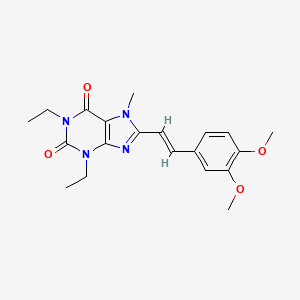
Istradefylline; 155270-99-8; KW-6002; KW 6002; 8-[(E)-2-(3,4-Dimethoxyphenyl)ethenyl]-1,3-diethyl-7-methyl-purine-2,6 -dione; (E)-8-(3,4-Dimethoxystyryl)-1,3-diethyl-7-methyl-1H-purine-2,6(3H,7H)-dione;

Molecular Formula: C20H24N4O4
Molecular Weight: 384.42896 g/mol

Istradefylline (KW-6002) is a selective antagonist at the A2A receptor. It has been found to be useful in the treatment of Parkinson’s disease.[1] Istradefylline reduces dyskinesia resulting from long-term treatment with classical antiparkinson drugs such as levodopa. Istradefylline is an analog of caffeine.

Istradefylline.png

Kyowa Hakko Kirin is developing istradefylline, a selective adenosine A2A receptor antagonist, for the once-daily oral treatment of Parkinson’s disease (PD). Adenosine A2A receptors are considered to be present particularly in the basal ganglia of the brain; the degeneration or abnormality observed in PD is believed to occur in the basal ganglia, which is recognized to play a significant role in motor control.

Commercially available dopamine replacement therapies effectively treat the early motor symptoms of PD; however, these agents are associated with development of motor complications, limiting usefulness in late stages of the disease. Istradefylline is proposed to possess a clearly distinct action site from existing agents which act on dopamine metabolism or dopamine receptors. Kyowa Hakko Kirin has received approval for istradefylline in the adjunctive treatment of PD in Japan. A New Drug Application was filed in the USA, but the FDA issued a non-approvable letter in February 2008.

PATENT

US5484920A

http://www.google.co.in/patents/US5484920

PAPER

http://www.sciencedirect.com/science/article/pii/S0960894X13003983

Synthesis of KW 6002 (2). Reagents and conditions: (i) acetic anhydride, 80°C, ...

Scheme 1.

Synthesis of KW 6002 (2). Reagents and conditions: (i) acetic anhydride, 80 °C, 2 h, 83%; (ii) sodium nitrite, 50% acetic acid, 60 °C, 15 min, 86%; (iii) sodium dithionite, NH4OH solution (12.5% (w/v)), 60 °C, 30 min, 98%; (iv) SOCl2, toluene, 75 °C, 2 h, 97%; (v) pyridine, DCM, rt, 16 h, 66%; (vi) HMDS, cat. (NH4)2SO4, CH3CN, 160 °C, microwave, 5 h, 100% followed by (vii) MeI, K2CO3, DMF, rt, 2 h, 75%.

Chemical structures of some important adenosine receptor antagonists and their ...

Synthesis

(E)-8-(3,4-Dimethoxystyryl)-1,3-diethyl-7-methyl-1H-purine-2,6(3H,7H)-dione (2)3

  1. J. Hockemeyer; J. C. Burbiel; C. E. Müller, J. Org. Chem. 2004, 69, 3308.

(E)-8-(3,4-Dimethoxystyryl)-1,3-diethyl-1H-purine-2,6(3H,7H)-dione (1.11 g, 3.00 mmol) was taken up in dimethylformamide (15 mL) and potassium carbonate (828 mg, 6.00 mmol). To the milky white mixture was added iodomethane (468 µL, 7.50 mmol) and it was allowed to stir at room temperature for 2 h. The mixture was then filtered and washed with water (100 mL), leaving the title compound 2 as a pale yellow solid which was dried in the oven at 110 °C (863 mg, 75%), mp: 192 °C (lit.3 191 °C). 1H NMR (400 MHz, CDCl3) δ 7.73 (d, J = 15.7 Hz, 1H), 7.18 (dd, J = 8.4, 1.9 Hz, 1H), 7.09 (d, J = 1.9 Hz, 1H), 6.90 (d, J = 8.4 Hz, 1H), 6.76 (d, J = 15.7 Hz, 1H), 4.21 (q, J = 7.1 Hz, 2H), 4.12 – 4.04 (m, 5H), 3.95 (s, 3H), 3.93 (s, 3H), 1.39 (t, J = 7.1 Hz, 3H), 1.26 (t, J = 7.0 Hz, 3H). 13C NMR (101 MHz, CDCl3) δ 155.0 (C), 150.8 (C), 150.4 (C), 150.3 (C), 149.2 (C), 148.2 (C), 138.1 (CH), 128.6 (C), 121.2 (CH), 111.2 (CH), 109.5 (CH), 109.3 (CH), 108.0 (C), 55.98 (CH3), 55.97 (CH3), 38.4 (CH2), 36.3 (CH2), 31.5 (CH3), 13.43 (CH3), 13.39 (CH3). LCMS: m/z (ESI 20 V) 385.2 (MH+, 100).

PATENT

http://www.google.com/patents/CN103254194A?cl=en

Specific synthetic route is as follows:

Figure CN103254194AD00071

the above reaction is a synthetic Parkinson’s disease clinical drug KW-6002 against a yield of 83%.

Example 26 (a new synthetic method for anti-Parkinson’s disease in clinical drug KW-6002):

In addition to use in place of 3,4-dimethoxy-styryl boronic acid (0.4mmol, i.e., in formula IV, R5 is 3,4_-dimethoxy-styryl) benzene boronic acid in Example 23 and 1,3 – two-ethyl-8-phenylthio-9-methyl-xanthine (0.4mmol, i.e., Formula I, R1 is methyl, R2 and R3 are ethyl, R4 is a phenyl group) in place of Example 23 in 1 , 3,9-trimethyl xanthine -8- phenylthio, the remaining steps in Example 23 to give a white solid, yield 83%, mp = 101~103 ° C I1H NMR (⑶CI3, 600MHz): δ 7.71 (d, J = 15.6Hz, 1H), 7.17 (dd, J = 8.2,1.9Hz, 1H), 7.07 (d, J = L 9Hz, 1H), 6

• 88 (d, J = 8.2Hz, 1H), 6.74 (d, J = 15.8Hz, 1H), 4.19 (q, J = 7Hz, 2H), 4.07 (q, J = 7Hz, 2H), 4.03 (s , 3H), 3.93 (s, 3H), 3.90 (s, 3H), 1.36 (t, J = 7Hz, 3H), 1.23 (t, J = 7Hz, 3H); 13C NMR (150MHz, CDCl3): 155.1, 150.8,150.4,150.2,149.2,148.2,138.2,128.6,121.2, 111.2,109.5,109.3,108.0,56.0,55.9,38.4,36.3,31.5,13.4,13.4; HRMS: calcd for C20H25N4O4 (M + H) +385.187

6, Found385.1879. It indicates that the white solid was 8- (3,4-dimethoxy-styryl) structural formula shown KW-6002 (E) -1,3_ diethyl-7-methylxanthine.

Figure CN103254194AD00162

 In contrast, KW-6002 is a new drug to treat Parkinson’s disease developed by Kyowa Hakko in Japan, Japan and the United States is currently the second phase of clinical trials. Literature (. J.Hockemeyer, JCBurbiel andC.E.Muller, J.0rg.Chem, 2004,69,3308) through the following synthetic route:

Figure CN103254194AD00171

The synthetic route requires five steps, with a total yield of 33%, and there is the use of environmentally unfriendly halogenated solvent methylene chloride, the reaction requires high pressure high temperature (170~180 ° C) and other shortcomings. By comparison, the present invention starting from 8- phenylthio xanthine coupling reaction catalyzed by palladium simple, a yield of 83% was synthesized KW6002, it is currently the most efficient synthesis route KW-6002’s. In particular, the multi-step synthesis route to avoid the complex operation of the reactor, but under relatively mild conditions (60 ° C) conduct, simple operation, suitable for scale synthesis.

PATENT

http://www.google.com/patents/CN104744464A?cl=en

itraconazole theophylline (Istradefylline, KW6002), the chemical name 8 – [(E) -2- (3, 4- dimethoxyphenyl) ethenyl] -1,3-diethyl -7 – methyl-purine-2,6-dione, CAS number: 155270-99-8, structural formula shown below.

Figure CN104744464AD00031

 itraconazole Theophylline is a selective adenosine A2a receptor antagonist, by changing the activity of neurons in Parkinson’s disease patients to improve motor function, for the treatment of Parkinson’s disease and Parkinson’s disease improve early dyskinesia.

The invention and JPH0940652A European Patent 0,590,919 discloses a method for preparing itraconazole and theophylline. WO 2004/099207 published good solubility stability of a particle size of less than 50 micrometers 8 – [(E) -2- (3, 4- dimethoxyphenyl) ethenyl] -1,3- diethyl-7-methyl-purine-2,6-dione crystallites.

Example 1 Preparation of theophylline itraconazole  Example

Figure CN104744464AD00051

ships equipped with a mechanical stirrer, a thermometer, a 2L 4-neck flask was added 30g8 – [(E) -2- (3, 4- dimethoxyphenyl) ethenyl] -1,3-diethyl- -7- hydrogen – purine-2,6-dione (Intermediate A), 400mL N, N- dimethylformamide and 15g of potassium carbonate, and 25g of methyl iodide and heated to 80 ° C after the reaction was stirred 8h, added 200mL water, cooled to room temperature, and stirring was continued crystallization 2h. The resulting suspension was suction filtered, washed with water after the cake was 800mL sash, 50 ° C under blast drying 24h, 32g give a pale yellow solid, for each polymorph of itraconazole theophylline preparation example the following examples.

References

  1.  Peter A. LeWitt, MD, M. Guttman, James W. Tetrud, MD, Paul J. Tuite, MD, Akihisa Mori, PhD, Philip Chaikin, PharmD, MD, Neil M. Sussman, MD (2008). “Adenosine A2A receptor antagonist istradefylline (KW-6002) reduces off time in Parkinson’s disease: A double-blind, randomized, multicenter clinical trial (6002-US-005)”. Annals of Neurology 63 (3): 295–302. doi:10.1002/ana.21315. PMID 18306243.

Reference:1. EP0590919A1.

2. US5484920A.

3. US5543415A.

4. J. Org. Chem. 2004, 69, 3308-3318.

5. Bioorg. Med. Chem. Lett. 1997, 7, 2349-2352.

6. Bioorgan. Med. Chem. 2003, 11, 1299-1310.

7. Bioorg. Med. Chem. Lett. 2013, 23, 3427-3433.

8. Chinese Journal of Pharmaceuticals 2010, 41, 241-243.

9. JP0940652A.

10. Org. Biomo. Chem. 2010, 8, 4155-4157.

1. Chem. Commun. 2012, 48, 2864-2866.

2. CN103254194A.

CN104744464A * Nov 15, 2013 Jul 1, 2015 南京华威医药科技开发有限公司 Istradefylline crystal forms
  1. Istradefylline
    Istradefylline.svg
    Systematic (IUPAC) name
    8-[(E)-2-(3,4-dimethoxyphenyl)vinyl]-1,3-diethyl-7-methyl-3,7-dihydro-1H-purine-2,6-dione
    Identifiers
    CAS Number 155270-99-8 Yes
    ATC code none
    PubChem CID 5311037
    IUPHAR/BPS 5608
    ChemSpider 4470574 Yes
    UNII 2GZ0LIK7T4 Yes
    KEGG D04641 Yes
    ChEMBL CHEMBL431770 Yes
    Chemical data
    Formula C20H24N4O4
    Molar mass 384.429 g/mol

//////Istradefylline, KW-6002, Nouriast®, Approved, A selective adenosine A2A receptor antagonist, Parkinson’s disease,

O=C2N(c1nc(n(c1C(=O)N2CC)C)\C=C\c3ccc(OC)c(OC)c3)CC

Blinatumomab


Blinatumomab, AMG-103,  MEDI-538,  MT-103,

(Blincyto®) Approved

A bispecific CD19-directed CD3 T-cell engager used to treat philadelphia chromosome-negative relapsed or refractory B-cell precursor acute lymphoblastic leukemia (ALL).

Immunoglobulin, anti-(human CD19 (antigen)) (single-chain) fusion protein with immunoglobulin, anti-(human CD3 (antigen)) (clone 1 single-chain) (9CI)

Other Names

1: PN: WO2005052004 SEQID: 1 claimed protein

cas 853426-35-4

 BLINCYTO (blinatumomab) for injectionBlinatumomab (trade name Blincyto, previously known as AMG103) is a biopharmaceutical drug used as a second-line treatmentfor Philadelphia chromosome-negative relapsed or refractory acute lymphoblastic leukemia. It belongs to a class of constructedmonoclonal antibodies, bi-specific T-cell engagers (BiTEs), that exert action selectively and direct the human immune system to act against tumor cells. Blinatumomab specifically targets the CD19 antigen present on B cells.[1] In December 2014 it was approved by the US Food and Drug Administration under the accelerated approval program; marketing authorization depended on the outcome of clinical trials that were ongoing at the time of approval.[2][3] When it launched, blinatumomab was priced at $178,000 per year in the United States; only about 1,000 people were eligible to take the drug, based on its label.[4]

Medical use

Blinatumomab is used as a second-line treatment for Philadelphia chromosome-negative relapsed or refractory Bcell precursor acute lymphoblastic leukemia.[2]

Mechanism of action

Blinatumomab linking a T cell to a malignant B cell.

Blinatumomab enables a patient’s T cells to recognize malignant B cells. A molecule of blinatumomab combines two binding sites: aCD3 site for T cells and a CD19 site for the target B cells. CD3 is part of the T cell receptor. The drug works by linking these two cell types and activating the T cell to exert cytotoxic activity on the target cell.[5] CD3 and CD19 are expressed in both pediatric and adult patients, making blinatumomab a potential therapeutic option for both pediatric and adult populations.[6]

History

The drug was developed by a German-American company Micromet, Inc. in cooperation with Lonza; Micromet was later purchased byAmgen, which has furthered the drug’s clinical trials. In July 2014, the FDA granted breakthrough therapy status to blinatumomab for the treatment of acute lymphoblastic leukemia (ALL).[7] In October 2014, Amgen’s Biologics License Application for blinatumomab was granted priority review designation by the FDA, thus establishing a deadline of May 19, 2015 for completion of the FDA review process.[8]

On December 3, 2014, the drug was approved for use in the United States to treat Philadelphia chromosome-negative relapsed or refractory acute lymphoblastic leukemia under the FDA‘s accelerated approval program; marketing authorization depended on the outcome of clinical trials that were ongoing at the time of approval.[2][9]

Cost

When blinatumomab was approved, Amgen announced that the price for the drug would be $178,000 per year, which made it the most expensive cancer drug on the market. Merck’s pembrolizumab was priced at $150,000 per year when it launched; unlike that drug and others, only about 1,000 people can be given the drug, based on its label.[4]

Peter Bach, director of the Center for Health Policy and Outcomes at Memorial Sloan-Kettering Cancer Center, has calculated that according to “value-based pricing,” assuming that the value of a year of life is $120,000 with a 15% “toxicity discount,” the market price of blinaumomab should be $12,612 a month, compared to the market price of $64,260 a month. A representative of Amgen said, “The price of Blincyto reflects the significant clinical, economic and humanistic value of the product to patients and the health-care system. The price also reflects the complexity of developing, manufacturing and reliably supplying innovative biologic medicines.”[10]

Patent

WO 2010052013

http://www.google.co.in/patents/WO2010052013A1?cl=en

Examples:

1. CD19xCD3 bispecific single chain antibody

The generation, expression and cytotoxic activity of the CD19xCD3 bispecific single chain antibody has been described in WO 99/54440. The corresponding amino and nucleic acid sequences of the CD19xCD3 bispecific single chain antibody are shown in SEQ ID NOs. 1 and 2, respectively. The VH and VL regions of the CD3 binding domain of the CD19xCD3 bispecific single chain antibody are shown in SEQ ID NOs. 7 to 10, respectively, whereas the VH and VL regions of the CD19 binding domain of the CD19xCD3 bispecific single chain antibody are shown in SEQ ID NOs 3 to 6, respectively.

PATENT

http://www.google.com.ar/patents/WO2010052014A1?cl=en

PATENT

WO 2015006749

http://www.google.com/patents/WO2015006749A2?cl=un

PATENT

CN 104861067

http://www.google.com/patents/CN104861067A?cl=zh

WO1998008875A1 * 18 Aug 1997 5 Mar 1998 Viva Diagnostika Diagnostische Produkte Gmbh Novel combination preparations and their use in immunodiagnosis and immunotherapy
WO1999054440A1 21 Apr 1999 28 Oct 1999 Micromet Gesellschaft Für Biomedizinische Forschung Mbh CD19xCD3 SPECIFIC POLYPEPTIDES AND USES THEREOF
WO2004106381A1 26 May 2004 9 Dec 2004 Micromet Ag Pharmaceutical compositions comprising bispecific anti-cd3, anti-cd19 antibody constructs for the treatment of b-cell related disorders
WO2007068354A1 29 Nov 2006 21 Jun 2007 Micromet Ag Means and methods for the treatment of tumorous diseases

References

  1.  “blinatumomab” (PDF). United States Adopted Names Council » Adopted Names.American Medical Association. 2008. N08/16.(registration required)
  2.  Blinatumomab label Updated 12/2014
  3.  Food and Drug Administration December 3, 2014 FDA Press release: Blinatumomab
  4.  Tracy Staton for FiercePharmaMarketing. December 18, 2014 Amgen slaps record-breaking $178K price on rare leukemia drug Blincyto
  5.  Mølhøj, M; Crommer, S; Brischwein, K; Rau, D; Sriskandarajah, M; Hoffmann, P; Kufer, P; Hofmeister, R; Baeuerle, PA (March 2007). “CD19-/CD3-bispecific antibody of the BiTE class is far superior to tandem diabody with respect to redirected tumor cell lysis”.Molecular Immunology 44 (8): 1935–43. doi:10.1016/j.molimm.2006.09.032.PMID 17083975.Closed access
  6.  Amgen (30 October 2012). Background Information for the Pediatric Subcommittee of the Oncologic Drugs Advisory Committee Meeting 04 December 2012 (PDF) (PDF). Food and Drug Administration. Blinatumomab (AMG 103).
  7.  “Amgen Receives FDA Breakthrough Therapy Designation For Investigational BiTE® Antibody Blinatumomab In Acute Lymphoblastic Leukemia” (Press release). Amgen. 1 July 2014.
  8.  “Amgen’s BiTE® Immunotherapy Blinatumomab Receives FDA Priority Review Designation In Acute Lymphoblastic Leukemia” (Press release). Amgen. 9 October 2014.
  9. “Business: Antibody advance”. Seven Days. Nature (paper) 516 (7530): 149. 11 December 2014. doi:10.1038/516148a.open access publication - free to read
  10.  Peter Loftus (June 18, 2015). “How Much Should Cancer Drugs Cost? Memorial Sloan Kettering doctors create pricing calculator that weighs factors such as side effects, extra years of life”. The Wall Street Journal. Retrieved 22 June 2015.
Blinatumomab
Monoclonal antibody
Type Bi-specific T-cell engager
Source Mouse
Target CD19, CD3
Clinical data
Trade names Blincyto
Pregnancy
category
  • US: C (Risk not ruled out)
Routes of
administration
intravenous
Legal status
Legal status
Pharmacokinetic data
Bioavailability 100% (IV)
Metabolism degradation into small peptides and amino acids
Biological half-life 2.11 hours
Excretion urine (negligible)
Identifiers
CAS Number 853426-35-4 
ATC code L01XC19 (WHO)
ChemSpider none
UNII 4FR53SIF3A Yes
Chemical data
Formula C2367H3577N649O772S19
Molar mass 54.1 kDa

///////

Lobeglitazone Sulfate


Lobeglitazone.svg

Lobeglitazone Sulfate, CKD-501

(Duvie®) Approved

Chong Kun Dang (Originator)

A dual PPARα and PPARγ agonist used to treat type 2 diabetes.

Trade Name:Duvie®MOA:Dual PPARα and PPARγ agonistIndication:Type 2 diabetes

CAS No. 607723-33-1(FREE)

763108-62-9(Lobeglitazone Sulfate)

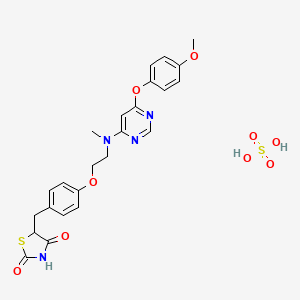
2,4-Thiazolidinedione, 5-((4-(2-((6-(4-methoxyphenoxy)-4- pyrimidinyl)methylamino)ethoxy)phenyl)methyl)-, sulfate (1:1);

Lobeglitazone sulfate.png

Lobeglitazone (trade name Duvie, Chong Kun Dang) is an antidiabetic drug in the thiazolidinedione class of drugs. As an agonistfor both PPARα and PPARγ, it works as an insulin sensitizer by binding to the PPAR receptors in fat cells and making the cells more responsive to insulin.[3]

Lobeglitazone sulfate was approved by the Ministry of Food and Drug Safety (Korea) on July 4, 2013. It was developed and marketed as Duvie® by Chong Kun Dang Corporation.

Lobeglitazone is an agonist for both PPARα and PPARγ, and it works as an insulin sensitizer by binding to the PPAR receptors in fat cells and making the cells more responsive to insulin. It is indicated as an adjunct to diet and exercise to improve glycemic control in adults with type 2 diabetes.

Duvie® is available as tablet for oral use, containing 0.5 mg of free Lobeglitazone. The recommended dose is 0.5 mg once daily.

Lobeglitazone which was reported in our previous works belongs to the class of potent PPARα/γ dual agonists (PPARα EC50:  0.02 μM, PPARγ EC50:  0.018 μM, rosiglitazone; PPARα EC50:  >10 μM, PPARγ EC50:  0.02 μM, pioglitazone PPARα EC50:  >10 μM, PPARγ EC50:  0.30 μM). Lobeglitazone has excellent pharmacokinetic properties and was shown to have more efficacious in vivo effects in KKAy mice than rosiglitazone and pioglitazone.17 Due to its outstanding pharmacokinetic profile, lobeglitazone was chosen as a promising antidiabetes drug candidate.

Medical uses

Lobeglitazone is used to assist regulation of blood glucose level of diabetes mellitus type 2 patients. It can be used alone or in combination with metformin.[4]

Lobeglitazone was approved by the Ministry of Food and Drug Safety (Korea) in 2013, and the postmarketing surveillance is on progress until 2019.[4][5]

SYNTHESIS

STR1

PAPER

Org. Process Res. Dev. 2007, 11, 190-199.

Process Development and Scale-Up of PPAR α/γ Dual Agonist Lobeglitazone Sulfate (CKD-501)

Process Research and Development Laboratory, Chemical Research Group, Chong Kun Dang Pharmaceutical Cooperation, Cheonan P. O. Box 74, Cheonan 330-831, South Korea, and Department of Chemistry, Korea University, 5-1-2, Anam-Dong, Seoul 136-701, Korea
Org. Process Res. Dev., 2007, 11 (2), pp 190–199
DOI: 10.1021/op060087u

http://pubs.acs.org/doi/abs/10.1021/op060087u

Abstract Image

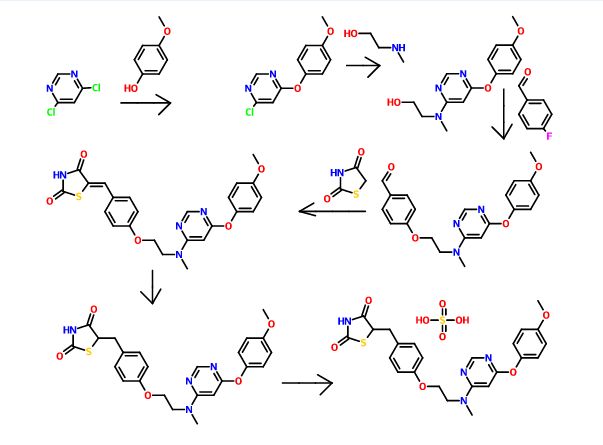
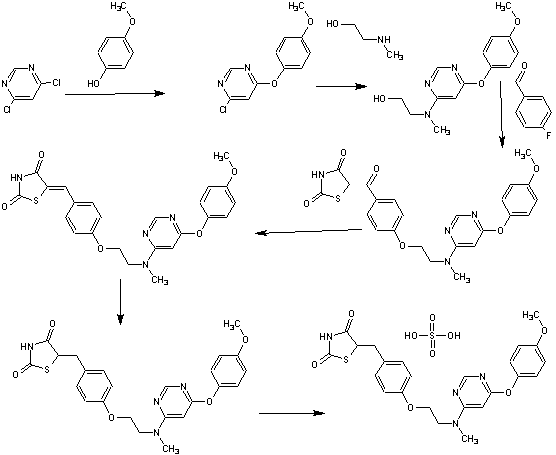
A scaleable synthetic route to the potent PPARα/γ dual agonistic agent, lobeglitazone (1), used for the treatment of type-2 diabetes was developed. The synthetic pathway comprises an effective five-step synthesis. This process involves a consecutive synthesis of the intermediate, pyrimidinyl aminoalcohol (6), from the commercially available 4,6-dichloropyrimidine (3) without the isolation of pyrimidinyl phenoxy ether (4). Significant improvements were also made in the regioselective 1,4-reduction of the intermediate, benzylidene-2,4-thiazolidinedione (10), using Hantzsch dihydropyridine ester (HEH) with silica gel as an acid catalyst. The sulfate salt form of lobeglitazone was selected as a candidate compound for further preclinical and clinical study. More than 2 kg of lobeglitazone sulfate (CKD-501, 2) was prepared in 98.5% purity after the GMP batch. Overall yield of 2 was improved to 52% from 17% of the original medicinal chemistry route.

Silica gel TLC Rf = 0.35 (detection:  iodine char chamber, ninhydrin solution, developing solvents:  CH2Cl2/MeOH, 20:1); mp 111.4 °C; IR (KBr) ν 3437, 3037, 2937, 2775, 1751, 1698, 1648, 1610, 1503, 1439, 1301, 1246, 1215, 1183 cm-1; 1H NMR (400 MHz, CDCl3) δ 3.09 (m, 4H), 3.29 (m, 1H), 3.76 (s, 3H), 3.97 (m, 2H), 4.14 (m, 2H), 4.86 (m, 1H), 6.06 (bs, 1H), 6.86 (m, 2H), 7.00 (m, 2H), 7.13 (m, 4H), 8.30 (s, 1H), 11.99 (s, NH); 13C NMR (100 MHz, CDCl3) δ 37.1, 38.2, 53.7, 53.8, 56.3, 62.2, 65.8, 86.0, 115.1, 116.0, 123.0, 129.8, 131.2, 145.7, 153.4, 157.9, 158.1, 161.1, 166.5, 172.4, 172.5, 176.3, 176.5; MS (ESI)m/z (M + 1) 481.5; Anal. Calcd for C24H26N4O9S2:  C, 49.82; H, 4.53; N, 9.68; S, 11.08. Found:  C, 49.85; H, 4.57; N, 9.75; S, 11.15.

PATENT

WO03080605A1.

References

  1. Lee JH, Noh CK, Yim CS, Jeong YS, Ahn SH, Lee W, Kim DD, Chung SJ. (2015). “Kinetics of the Absorption, Distribution, Metabolism, and Excretion of Lobeglitazone, a Novel Activator of Peroxisome Proliferator-Activated Receptor Gamma in Rats.”.Journal of Pharmaceutical sciences 104 (9): 3049–3059.doi:10.1002/jps.24378. PMID 25648999.
  2.  Kim JW, Kim JR, Yi S, Shin KH, Shin HS, Yoon SH, Cho JY, Kim DH, Shin SG, Jang IJ, Yu KS. (2011). “Tolerability and pharmacokinetics of lobeglitazone (CKD-501), a peroxisome proliferator-activated receptor-γ agonist: a single- and multiple-dose, double-blind, randomized control study in healthy male Korean subjects.”. Clinical therapeutics 33 (11): 1819–1830.doi:10.1016/j.clinthera.2011.09.023. PMID 22047812.
  3.  Lee JH, Woo YA, Hwang IC, Kim CY, Kim DD, Shim CK, Chung SJ. (2009). “Quantification of CKD-501, lobeglitazone, in rat plasma using a liquid-chromatography/tandem mass spectrometry method and its applications to pharmacokinetic studies.”. Journal of Pharmaceutical and Biomedical Analysis 50 (5): 872–877.doi:10.1016/j.jpba.2009.06.003. PMID 19577404.
  4.  “MFDS permission information of Duvie Tablet 0.5mg”(Release of Information). Ministry of Food and Drug Safety. Retrieved2014-10-23.
  5.  “국내개발 20번째 신약‘듀비에정’허가(20th new drug developed in Korea ‘Duvie Tablet’ was approved)”. Chong Kun Dang press release. 2013-07-04. Retrieved 2014-10-23.
Lobeglitazone
Lobeglitazone.svg
Systematic (IUPAC) name
5-[(4-[2-([6-(4-Methoxyphenoxy)pyrimidin-4-yl]-methylamino)ethoxy]phenyl)methyl]-1,3-thiazolidine-2,4-dione
Clinical data
Trade names Duvie
Routes of
administration
Oral
Legal status
Legal status
Pharmacokinetic data
Protein binding >99%[1]
Metabolism liver (CYP2C9, 2C19, and 1A2)[1]
Biological half-life 7.8–9.8 hours[2]
Identifiers
CAS Number 607723-33-1
PubChem CID 9826451
DrugBank DB09198 Yes
ChemSpider 8002194
Synonyms CKD-501
Chemical data
Formula C24H24N4O5S
Molar mass 480.53616 g/mol

///Lobeglitazone Sulfate, CKD-501, Duvie®,  Approved KOREA, Chong Kun Dang, A dual PPARα and PPARγ agonist , type 2 diabetes.

CN(CCOC1=CC=C(C=C1)CC2C(=O)NC(=O)S2)C3=CC(=NC=N3)OC4=CC=C(C=C4)OC.OS(=O)(=O)O


Kiran Mazumdar Shaw Conferred with ‘The Global Leadership in Engineering 2016’ Award by USC


KMS-ON-USC-VITERBI-AWARD.png.


http://societyofwomenengineers.swe.org/awards/individual-awards/4153-global-leadership

Society of Women Engineers

The Global Leadership Award honors a person with at least fifteen (15) years professional experience who has worked in and led an internationally based engineering, scientific or technology-based business or organization, and in doing so, serves as a role model to women engineers and technologists worldwide. A maximum of three (3) awards may be presented annually.


Biocon

“This award is a recognition of Biocon’s significant role in harnessing the potential of Biotechnology to provide affordable access to highly complex bio-pharmaceuticals like Insulins and monoclonal antibodies for the benefit of patients the world over.” – Kiran Mazumdar-Shaw

Kiran Mazumdar-Shaw


//////Kiran Mazumdar Shaw,  ‘The Global Leadership in Engineering 2016’ , Award by USC

Pemafibrate, Пемафибрат , بيرمافيبرات , 佩玛贝特 , ペマフィブラート ,


img

Pemafibrate

NDA Filing Japan, Phase 2 in EU, US

A PPAR-α agonist potentially for the treatment of dyslipidemia.

K-877, K-13675, (R)-

CAS No. 848259-27-8,

Molecular Formula,C28-H30-N2-O6,Molecular Weight,490.553

(2R)-2-[3-({(1,3-benzoxazol-2-yl)[3-(4-methoxyphenoxy)propyl]amino}methyl)phenoxy]butanoic acid
(R)-2-{3-[N-(benzoxazole-2-yl)-N-(3-(4-methoxyphenoxy)propyl)aminomethyl]phenyloxy}butyric acid
  • Originator Kowa Pharmaceutical
  • Class Antihyperlipidaemics
  • Mechanism of Action Peroxisome proliferator-activated receptor alpha agonists
  • Preregistration Dyslipidaemias

Most Recent Events

  • 01 Feb 2016 Kowa Research Institute completes a phase I drug-interaction trial in Healthy volunteers in USA (PO) (NCT02719431)
  • 12 Jan 2016 Kowa Research Institute plans the phase III PROMINENT trial for Dyslipidaemia (In patients with diabetes mellitus) in countries worldwide
  • 01 Jan 2016 Kowa Research Institute initiates a phase I drug-interaction trial in Healthy volunteers in USA (PO) (NCT02719431)

UPDATE ADDED  ON MARCH 2017

Pemafibrate.svg

ChemSpider 2D Image | pemafibrate | C28H30N2O6

Pemafibrate

  • Molecular FormulaC28H30N2O6
  • Average mass490.548 Da
Пемафибрат [Russian] [INN]
بيرمافيبرات [Arabic] [INN]
佩玛贝特 [Chinese] [INN]
ペマフィブラート
(2R)-2-[3-[[1,3-benzoxazol-2-yl-[3-(4-methoxyphenoxy)propyl]amino]methyl]phenoxy]butyric acid
(R)-2-(3-((benzo[d]oxazol-2-yl(3-(4-methoxyphenoxy)propyl)amino)methyl)phenoxy)butanoic acid
848259-27-8 [RN]
CHEMBL247951
K-13675, (R)-
UNII:17VGG92R23
(2R)-2-[3-({1,3-Benzoxazol-2-yl[3-(4-methoxyphenoxy)propyl]amino}methyl)phenoxy]butanoic acid
Butanoic acid, 2-[3-[[2-benzoxazolyl[3-(4-methoxyphenoxy)propyl]amino]methyl]phenoxy]-, (2R)-
Parmodia (TN)
Antihyperlipidemic, Triglyceride synthesis inhibitor, Peroxisome proliferator-activated receptor (PPAR) alpha agonist

Pemafibrate, marketed as Parmodia, is a peroxisome proliferator-activated receptor alpha (PPARα) agonist. It is developed and marketed by Kowa Pharmaceuticals.

In 3 July 2017, Pharmaceuticals and Medical Devices Agency approved it in Japan. It is available in 0.1 mg tablets.[1]

References

  1.  Pemafibrate, pharmacodia.com
ペマフィブラート
Pemafibrate

C28H30N2O6 : 490.55
[848259-27-8]
Pemafibrate
Pemafibrate.svg
Clinical data
Trade names Parmodia
Synonyms K-13675
Routes of
administration
Oral
Identifiers
CAS Number
ChemSpider
UNII
KEGG
ChEMBL
Chemical and physical data
Formula C28H30N2O6
Molar mass 490.56 g·mol−1
3D model (JSmol)

////////////Pemafibrate, Пемафибрат بيرمافيبرات 佩玛贝特 ,  ペマフィブラート , 


Pemafibrate, also known as K-877 and (R)-K 13675, is a PPAR alpha agonist. (R)-K-13675 decreases the secretion of inflammatory markers without affecting cell proliferation or tube formation. Peroxisome proliferator-activated receptor-alpha (PPAR-alpha) is a key regulator of lipid and glucose metabolism and has been implicated in inflammation. (R)-K-13675 was associated with the inhibition of inflammatory responses without affecting cell proliferation or angiogenesis, and subsequently may induce an anti-atherosclerotic effect.

Pemafibrate had been filed NDA by Kowa for the treatment of dyslipidemia in the Japan in 2015.

Pemafibrate is in phase II clinical trials for the treatment of dyslipidemia in the US and EU.


Route 1
str6

Reference:1. US2009023944A1.

Route 2
str6

Reference:1. US2009076280A1.

http://www.google.com/patents/US20090076280

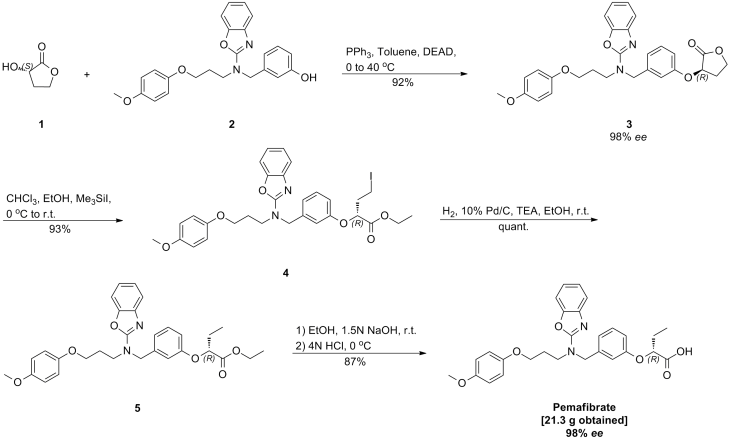
Example 5 Synthesis of (R)-2-{3-[N-(benzoxazole-2-yl)-N-(3-(4-methoxyphenoxy)propyl)aminomethyl]phenyloxy}butyric acid (Compound (6))

  • Ethyl (R)-2-{3-[N-(benzoxazole-2-yl)-N-(3-(4-methoxyphenoxy)propyl)aminomethyl]phenyloxy}butylate (26.0 g) was dissolved in ethanol (200 mL), and 1.5N NaOH (50 mL) was added to the solution, followed by stirring for 1 hour at room temperature. The reaction mixture was washed with diethyl ether, and the formed aqueous layer was acidified with 4N HCl under ice cooling. The thus-treated aqueous layer was extracted with ethyl acetate, and the extract was washed sequentially with water and saturated brine. The washed extract was dried over sodium sulfate anhydrate and concentrated under reduced pressure. The residue was purified through silica gel column chromatography (chloroform/methanol=10/1), to thereby yield the target product (21.3 g, 87%, 98% ee).

Optical Purity:

  • Measurement conditions: HPLC
  • Column: CHIRALPAK AD
  • Solvent: n-hexane/IPA/TFA=100/30/0.1
  • Flow rate: 2 mL/min
  • Retention time: 4.19 min (S-form; 3.68 min)
  • 1H-NMR (400 MHz, CD3OD) δ ppm: 0.94 (t, J=7 Hz, 3H), 1.81 (m, 2H), 1.99 (quintet, J=6 Hz, 2H), 3.60 (t, J=7 Hz, 2H), 3.61 (s, 3H), 3.85 (t, J=6 Hz, 2H), 4.40 (t, J=6 Hz, 1H), 4.65 (s, 2H), 6.69-6.80 (m, 7H), 6.91 (dt, J=7, 1 Hz, 1H), 7.05 (dt, J=7, 1 Hz, 1H), 7.12-7.18 (m, 4H).


Route 3
str6

Reference:1. Bioorg. Med. Chem. Lett. 200717, 4689-4693.


Landmark Trial Entitled “PROMINENT” To Explore The Prevention Of Heart Disease In Diabetic Patients With High Triglycerides And Low HDL-C

Trial will evaluate if lowering triglycerides and increasing functional HDL with Kowa’s potent selective peroxisome proliferator activator receptor-alpha (PPAR-alpha) modulator, K-877 (pemafibrate) can reduce the elevated risk of cardiovascular disease in high-risk diabetic patients who are already taking statins

Jan 12, 2016, 09:00 ET from Kowa Research Institute, Inc.

RESEARCH TRIANGLE PARK, N.C., Jan. 12, 2016 /PRNewswire/ — Kowa Research Institute, Inc., announced plans to conduct an international, multi-center cardiovascular outcomes trial evaluating triglyceride reduction and increasing functional HDL with K-877 (pemafibrate), in high-risk diabetic patients with high triglyceride and low HDL-C levels who are already taking statins.  K-877 is a highly potent and selective peroxisome proliferator activator receptor-alpha (PPAR-alpha) modulator (SPPARMalpha), a promising category of metabolic therapy.

Paul Ridker, MD, director of the Center for Cardiovascular Disease Prevention (CCVDP) at Brigham and Women’s Hospital (BWH), a teaching affiliate of Harvard Medical School, and Aruna Pradhan, MD, a cardiologist at BWH, will be co-Principal Investigators of the planned trial.

“This trial is unprecedented,” said Gary Gordon, MD, President, Kowa Research Institute, Inc. “Statins are effective in lowering cardiovascular risk among patients with high cholesterol, but residual risk remains, particularly in patients with high triglyceride levels and low HDL-C levels.  Kowa will be the first company to run a major, randomized clinical trial investigating whether modulating PPAR-alpha to lower triglycerides and increase functional HDL in diabetic patients can reduce cardiovascular risk when added to statin therapy.”

Evidence supports a role for triglyceride-rich lipoproteins and low HDL-C as important contributors to atherosclerosis.  Kowa specifically set out to create the most potent and selective PPAR-alpha modulator ever developed, and succeeded with K-877, which is at least 1,000 times as potent and selective as other drugs.  Kowa has completed clinical development of K-877 for hyperlipidemia in Japan, and has submitted it to the PMDA for approval as a new drug.  Kowa’s clinical studies have shown K-877 significantly reduces triglycerides, ApoC3, and remnant cholesterol and increases functional HDL and FGF21.

The Pemafibrate to Reduce cardiovascular OutcoMes by reducing triglycerides IN diabetic patiENTs (PROMINENT) Phase 3 K-877 cardiovascular outcomes trial will recruit an estimated 10,000 high-risk diabetic patients worldwide.  All participants will receive aggressive, standard of care management of cardiovascular risk factors including treatment with high-intensity statins.  In addition, patients will receive either K-877 or placebo.  The trial will include diabetic patients with and without established cardiovascular disease and will test whether K-877 reduces the occurrence of heart attacks, hospitalizations for unstable angina requiring unplanned revascularization, stroke, or death from cardiovascular causes.

“Cardiovascular disease remains the number one cause of death worldwide,” said Dr. Gordon.  “Reducing residual cardiovascular risk with K-877 would be valuable to physicians managing patients’ cardiovascular disease.”

About Kowa Company, Ltd. and Kowa Research Institute, Inc.
Kowa Company, Ltd. (Kowa) is a privately held multinational company headquartered in Nagoya, Japan. Established in 1894, Kowa is actively engaged in various manufacturing and trading activities in the fields of pharmaceuticals, life science, information technology, textiles, machinery and various consumer products. Kowa’s pharmaceutical division is focused on research and development for cardiovascular therapeutics (dyslipidemia, type 2 diabetes and atherosclerosis), ophthalmology and anti-inflammatory agents. The company’s flagship product, LIVALO® (pitavastatin), is approved in 45 countries around the world.

Kowa Research Institute, Inc., headquartered in Research Triangle Park, NC, is the division of Kowa responsible for the clinical development of Kowa’s new drugs in the United States. Kowa Research Institute was established in 1997 in California and began operations at the current location in 2003.  For more information about Kowa Research Institute, visit www.kowaus.com.

1 NCT00610441 Dose Finding Study in Adults With Attention-Deficit/Hyperactivity Disorder (ADHD)(174007/P05805/MK-8777-003) Completed Drug: MK-8777|Drug: Placebo Phase 2 Merck Sharp & Dohme Corp.
2 NCT00610649 Trial to Determine the Maximum Tolerated Dose (MTD) Based on Safety and Tolerability, of Org 26576 in Participants With Major Depressive Disorder (174001/P05704/MK-8777-001) Completed Drug: MK-8777|Drug: Placebo Phase 2 Merck Sharp & Dohme Corp.
3 NCT02073084 A Thorough Corrected QT Interval Trial Completed Drug: K-877 Low Dose|Drug: Moxifloxacin|Other: Placebo|Drug: K-877 High Dose Phase 1 Kowa Research Institute, Inc.
4 NCT02273986 Drug-Drug Interaction Study in Health Adult Volunteers Completed Drug: Digoxin|Drug: K-877 Phase 1 Kowa Research Institute, Inc.
5 NCT02275962 Drug-Drug Interaction Study in Healthy Adult Volunteers Active, not recruiting Drug: K-877|Drug: Rifampin Phase 1 Kowa Research Institute, Inc.
6 NCT02275975 Drug-Drug Interaction Study in Healthy Adult Volunteers Completed Drug: K-877|Drug: Fluconazole Phase 1 Kowa Research Institute, Inc.
7 NCT02275988 Drug-Drug Interaction Study in Healthy Adult Volunteers Completed Drug: K-877|Drug: Clarithromycin Phase 1 Kowa Research Institute, Inc.
8 NCT02276001 Drug-Drug Interaction Study in Healthy Adult Volunteers Completed Drug: K-877|Drug: Cyclosporine Phase 1 Kowa Research Institute, Inc.

2D chemical structure of 848259-27-8

US6653334 * Dec 27, 2002 Nov 25, 2003 Kowa Co., Ltd. Benzoxazole compound and pharmaceutical composition containing the same
US7109226 * Sep 3, 2004 Sep 19, 2006 Kowa Co., Ltd. PPAR-activating compound and pharmaceutical composition comprising the compound
US7183295 * Apr 20, 2006 Feb 27, 2007 Kowa Co., Ltd. PPAR-activating compound and pharmaceutical composition comprising the compound

///////Pemafibrate, NDA,  Kowa, dyslipidemia,  Japan, 2015, phase II clinical trials,  US and EU, K-877, K-13675, (R)-

CC[C@H](C(=O)O)Oc1cccc(c1)CN(CCCOc2ccc(cc2)OC)c3nc4ccccc4o3

CC[C@@H](OC1=CC=CC(CN(C2=NC3=CC=CC=C3O2)CCCOC4=CC=C(OC)C=C4)=C1)C(O)=O


Vonoprazan Fumarate


img

1-(5-(2-fluorophenyl)-1-(pyridin-3-ylsulfonyl)-1H-pyrrol-3-yl)-N-methylmethanamine fumarate


Vonoprazan Fumarate

(Takecab®) Approved

Vonoprazan Fumarate
CAS#: 1260141-27-2 (fumarate); 881681-00-1 (free base).
Chemical Formula: C21H20FN3O6S
Molecular Weight: 461.46

A potassium-competitive acid blocker (P-CAB) used to treat gastric ulcer, duodenal ulcer and reflux esophagitis.

Research Code TAK-438

CAS No. 881681-00-1

 Cas 1260141-27-2(Vonoprazan Fumarate)

1-(5-(2-fluorophenyl)-1-(pyridin-3-ylsulfonyl)-1H-pyrrol-3-yl)-N-methylmethanamine fumarate

Molecular Weight 461.46
Formula C17H16FN3O2S ● C4H4O4
Drug Name:Vonoprazan FumarateResearch
Code:TAK-438Trade Name:Takecab®MOA:Potassium-competitive acid blocker (P-CAB)Indication:Gastric ulcer; Duodenal ulcer; Reflux esophagitisStatus:ApprovedCompany:Takeda (Originator) , Otsuka
Company Takeda Pharmaceutical Co. Ltd.
Description Small molecule potassium-competitive acid blocker
Molecular Target H+/K ATPase pump

Vonoprazan (Takecab(®)) is an orally bioavailable potassium-competitive acid blocker (P-CAB) being developed by Takeda for the treatment and prevention of acid-related diseases. The drug is approved in Japan for the treatment of acid-related diseases, including erosive oesophagitis, gastric ulcer, duodenal ulcer, peptic ulcer, gastro-oesophageal reflux, reflux oesophagitis and Helicobacter pylori eradication. Phase III development is underway for the prevention of recurrence of duodenal and gastric ulcer in patients receiving aspirin or NSAID therapy. Phase I development was conducted in the UK for gastro-oesophageal reflux; however, no further development has been reported. This article summarizes the milestones in the development of vonoprazan leading to this first approval for acid-related diseases.

Vonoprazan Fumarate was approved by Pharmaceuticals and Medical Devices Agency of Japan (PMDA) on December 26, 2014. It was co-developed and marketed as Takecab® by Takeda & Otsuka.
Vonoprazan has a novel mechanism of action called potassium-competitive acid blockers (P-CABs) which competitively inhibits the binding the potassium ions to H+, K+-ATPase (also known as the proton pump) in the final step of gastric acid secretion in gastric parietal cells. Vonoprazan provides a strong and sustained acid section inhibitory effect. It is indicated for the treatment of gastric ulcer, duodenal ulcer and reflux esophagitis.
Cometriq® is available as tablet for oral use, containing 10 or 20 mg of free Vonoprazan, and the recommended dose is 20 mg orally once daily for adluts.

Vonoprazan fumarate (Takecab(®)) is a first-in-class potassium-competitive acid blocker that has been available in the market in Japan since February 2015. Vonoprazan is administered orally at 20 mg once daily for the treatment of gastroduodenal ulcer, at 20 and 10 mg once daily for the treatment and secondary prevention of reflux esophagitis, respectively, at 10 mg once daily for the secondary prevention of low-dose aspirin- or non-steroidal anti-inflammatory drug-induced peptic ulcer, and at 20 mg twice daily in combination with clarithromycin and amoxicillin for the eradication of Helicobacter pylori. It inhibits H(+),K(+)-ATPase activities in a reversible and potassium-competitive manner with a potency of inhibition approximately 350 times higher than the proton pump inhibitor, lansoprazole. Vonoprazan is absorbed rapidly and reaches maximum plasma concentration at 1.5-2.0 h after oral administration. Food has minimal effect on its intestinal absorption. Oral bioavailability in humans remains unknown. The plasma protein binding of vonoprazan is 80 % in healthy subjects. It distributes extensively into tissues with a mean apparent volume of distribution of 1050 L. Being a base with pKa of 9.6 and with acid-resistant properties, vonoprazan is highly concentrated in the acidic canaliculi of the gastric parietal cells and elicited an acid suppression effect for longer than 24 h after the administration of 20 mg. The mean apparent terminal half-life of the drug is approximately 7.7 h in healthy adults. Vonoprazan is metabolized to inactive metabolites mainly by cytochrome P450 (CYP)3A4 and to some extent by CYP2B6, CYP2C19, CYP2D6, and SULT2A1. A mass balance study showed that 59 and 8 % of the orally administered radioactivity was recovered in urine as metabolites and in an unchanged form, respectively, indicating extensive metabolism. Genetic polymorphism of CYP2C19 may influence drug exposure but only to a clinically insignificant extent (15-29 %), according to the population pharmacokinetic study performed in Japanese patients. When vonoprazan was co-administered with clarithromycin, the mean AUC from time 0 to time of the next dose (dosing interval) of vonoprazan and clarithromycin were increased by 1.8 and 1.5 times, respectively, compared with the corresponding control values, indicating mutual metabolic inhibition. The mean area under the curve from time zero to infinity obtained from patients with severe liver and renal dysfunction were elevated by 2.6 and 2.4 times, respectively, compared with healthy subjects, with no significant changes in plasma protein binding. Vonoprazan increases intragastric pH above 4.0 as early as 4 h after an oral dose of 20 mg, and the extensive anti-secretory effect is maintained up to 24 h post-dose. During repeated dosing of 20 mg once daily, the 24-h intragastric pH >4 holding time ratios were 63 and 83 % on days 1 and 7, respectively. Because vonoprazan elicited a more extensive gastric acid suppression than the proton pump inhibitor, lansoprazole, it also gave rise to two to three times greater serum gastrin concentrations as compared with lansoprazole. In pre-approval clinical studies for the treatment of acid-related disorders, mild to moderate adverse drug reactions (mostly constipation or diarrhea) occurred at frequencies of 8-17 %. Neither severe liver toxicity nor neuroendocrine tumor has been reported in patients receiving vonoprazan.


Vonoprazan fumarate is a first-in-class potassium-competitive acid blocker. It was approved in the Japanese market in February, 2015.[1]

Vonoprazan can be used for the treatment of gastroduodenal ulcer, reflux esophagitis, and for some drug-induced peptic ulcers. It can be combined with other antibiotics for the eradication of Helicobacter pylori.[2]

PATENT

CN102421753B

Figure CN102421753BD00401

Figure CN102421753BD00421


Route 1

Reference:1. WO2006036024A1 / US8048909B2.

2. WO2007026916A1 / US7498337B2.

3. CN104327051A.

1- [5- (2-fluorophenyl) -1- (pyridin-3-ylsulfonyl) -IH- pyrrol-3-yl] -N- methylmethanamine fumarate Takeda single An R & D for the gastric acid secretion inhibitors (codename: TAK-438, generic name: vonoprazan fumarate), the drug belongs to the potassium ion (K +) competitive acid blocker (P-CAB) for a new inhibitors, with a strong, long-lasting inhibition of gastric acid secretion, while the gastric parietal cells in the final stage of gastric acid secretion by inhibiting K + for H +, K + -ATP enzyme (proton pump) binding effect on gastric acid secretion also advance termination action.

Its molecular formula is: C17H16FN3O2S · C4H4O4, MW: 461.46, the chemical structure of formula I as shown.


Figure CN104327051AD00031

CN101300229A discloses 1- [5- (2_-fluorophenyl) -1- (pyridin-3-ylsulfonyl) -1Η- pyrrol -3-yl] -N- methylmethanamine fumarate alone, but not related to its crystalline form.

The present invention discloses a I- [5- (2- fluorophenyl) -I- (pyridin-3-ylsulfonyl) -IH- pyrrol-3-yl] -N- methylmethanamine single rich fumarate A method for preparing a crystalline form. 1- [5- (2_-fluorophenyl) -1- (Batch-3-ylsulfonyl) -IH- pyrrol-3-yl] -N- methylmethanamine fumarate single crystalline form A, according to prepared by the following routes:

Figure CN104327051AD00051

Example 1

  A method of preparing polymorph having pyrrole derivatives maleate described in detail below.

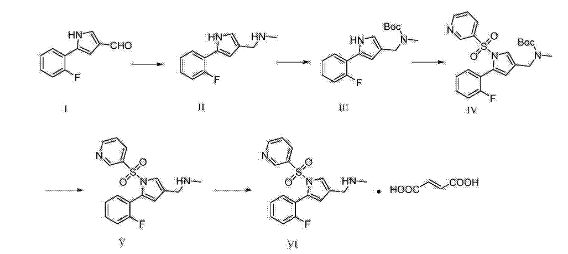
Step I: 5- (2- fluorophenyl) -1- (pyridin-3-ylsulfonyl) -IH- pyrrole-3-carbaldehyde Synthesis of

Compound II (260mg) was dissolved in tetrahydrofuran (50ml) was added 60% NaH, the reaction was stirred for 30 minutes at room temperature. Was added 15-crown–5 (I. 5g), the reaction mixture was stirred at room temperature for 1 hour and then pyridine-3-sulfonyl chloride was added, stirred at room temperature for 2 hours until complete reaction was followed by thin layer chromatography, and then was added to the reaction system 20mL saturated brine with ethyl acetate (IOOmLX2) and the combined organic phase was washed with saturated brine 50ml organic phase, an appropriate amount of anhydrous sodium sulfate, filtered, and the filtrate was concentrated under reduced pressure to give the crude compound IV (200mg) administered directly in the next reaction.

Synthesis 1_ [5- (2-fluorophenyl) -1- (piperidin-3-sulfonyl batch) -IH- pyrrol-3-yl] -N- methylmethanamine of: Step 2

The brown residue obtained in the previous step IV compound (200mg) was dissolved in 30mL methanol was added 27% -33% methyl amine solution, the reaction was stirred for 1.5 hours. Sodium borohydride (68mg), the reaction was stirred for 20 minutes, was added lmol / LHCl to an acidic aqueous solution, and stirred until complete reaction was followed by thin layer chromatography. To the reaction mixture was added saturated sodium bicarbonate solution until weakly basic system was extracted with ethyl acetate (IOOmLX2), the combined organic phases with saturated brine (50mL), dried over anhydrous Na2SO4, filtered and concentrated to give the crude product ( 208mg, yellow oil). Yield: 100%.

  Step 3: 1_ [5- (2-fluorophenyl) -1- (pyridin-3-ylsulfonyl) -IH- pyrrol-3-yl] -N- methylmethanamine fumarate single synthesis

Compound V obtained in the previous step was dissolved in 20mL of ethyl acetate, taking the mass fraction of equivalents of fumaric acid was dissolved in 2ml of methanol. Added dropwise with stirring to a solution of compound V in ethyl acetate, stirred for 30 minutes at room temperature. Then warmed to 55-65 degrees reflux one hour, cooled to room temperature and filtered to give an off-white solid was washed with cold ethyl acetate IOml and dried in vacuo to give 170mg of crystalline Compound I, about 20% overall yield. X- ray diffraction spectrum of the crystalline sample is shown in Figure 1. DSC spectrum shown in Figure 2, this polymorph is defined as A crystalline form.

Route 2

Reference:1. CN105085484A.

http://www.google.com/patents/CN105085484A?cl=en

Fumaric Wonuo La Like (TAK-438, Vonoprazan fumarate) is Takeda Pharmaceuticals and Otsuka Pharmaceutical to launch a new type of oral anti-acid drugs. As a potassium ion (K +) competitive acid blocker (P-CAB), Wonuo La Like gastric acid secretion in the gastric parietal cells play a role in the final step, by inhibiting K + for H +, K + -ATP enzyme (proton chestnut) combine to inhibit gastric acid secretion and early termination. Compared to the current power of the proton chestnut inhibitors (PPIs), due to the absence of praise Wonuo La CYP2C19 metabolism, so the performance in clinical trials showing good effect: the treatment of gastric ulcer / duodenal ulcer, reflux esophagitis eradication of H. pylori and other effects are better than lansoprazole, while having a similar security.

  fumarate Wonuo La Like chemical name: I- [5_ (2_ gas) -1- (pyridin _3_ cross-acyl group) -IH- P ratio slightly 3-yl] – N- methylmethanamine fumarate, structured as follows:


Figure CN105085484AD00051

  Preparation of fumaric Wonuo La Like synthetic route mainly follows:

  Takeda patent CN200680040789 original study discloses a 5- (2-fluorophenyl) -lH- pyrrole-3-carbaldehyde as a starting material, the solvent is tetrahydrofuran, sodium hydride doing acid binding agent, crown ethers do a phase transfer catalyst, with 3-pyridine sulfonyl chloride to give the intermediate 5- (2-fluorophenyl) -1- (pyridin-3-ylsulfonyl) -IH- pyrrole-3-carbaldehyde, then to form a Schiff base with methylamine boron sodium hydride reduction to give Wonuo La Like the free base and then fumaric acid salt formation, generate fumaric Wonuo La Chan, the reaction equation is as follows:


Figure CN105085484AD00061

  Takeda company disclosed in 2010 it 0 01,080,018,114 in improved synthetic route: Intermediate 5- (2-fluorophenyl) -I- (pyridine-3-ylsulfonyl) -IH–3 formaldehyde synthesis, instead of acetonitrile as solvent, DIEA do acid-binding agent, DMAP as catalyst, but side reactions, tedious post-processing operation, the lower the yield, the overall yield of less than 40%.

CN201080018114 improved synthetic route to 5- (2-fluorophenyl) -IH- pyrrole-3-carbonitrile as a starting material of the synthesis route, but this route is converted to the cyano aldehyde used Raney catalytic hydrogenation, industrial scale there is a big security risk, its reaction equation is as follows:

Figure CN105085484AD00062

  Y. Arikawa et J. Med Chem 2012, 55, 4446-4456 reported the following synthetic route.:

In phenyl pyrrole-3-carbaldehyde and methylamine alcohol imine by metal borohydride reduction, to give further protection to give Boc ((5-phenyl -IH- pyrrol-3-yl) -N -) methyl carbamate; the above product with an arylsulfonyl chloride, and then de-Boc protection to give 1- (5-phenyl-1 aromatic sulfonyl -IH- pyrrol-3-yl) – N- methyl methylamine;

Figure CN105085484AD00063

Y. Arikawa et al reported that the above process step is prolonged, the probability g [J reacting a corresponding increase in the above reaction scheme conditional optimization, control side reactions is one of the present invention is to solve the problem. On the other hand the above literature after the synthesis process used in chromatography, is not conducive to fumaric Wonuo La Like industrial production. Therefore, the development of fumaric acid Wonuo La Like New synthesis process, simplify the synthesis operations, reduce costs, improve productivity, it has important implications for fumaric Wonuo La Like this one which attract anti-acid drugs.

str1

PAPER

J. Med Chem 2012, 55, 4446-4456

http://pubs.acs.org/doi/abs/10.1021/jm300318t

Discovery of a Novel Pyrrole Derivative 1-[5-(2-Fluorophenyl)-1-(pyridin-3-ylsulfonyl)-1H-pyrrol-3-yl]-N-methylmethanamine Fumarate (TAK-438) as a Potassium-Competitive Acid Blocker (P-CAB)

Pharmaceutical Research Division, Takeda Pharmaceutical Company Ltd., 26-1, Muraokahigashi-2-chome, Fujisawa, Kanagawa 251-8555, Japan
CMC Research Center, Takeda Pharmaceutical Company Ltd., 17-85, Jusohonmachi-2-chome, Yodogawa-ku, Osaka 532-8686, Japan
J. Med. Chem., 2012, 55 (9), pp 4446–4456
DOI: 10.1021/jm300318t


Abstract Image

In our pursuit of developing a novel and potent potassium-competitive acid blocker (P-CAB), we synthesized pyrrole derivatives focusing on compounds with low log D and high ligand-lipophilicity efficiency (LLE) values. Among the compounds synthesized, the compound 13e exhibited potent H+,K+-ATPase inhibitory activity and potent gastric acid secretion inhibitory action in vivo. Its maximum efficacy was more potent and its duration of action was much longer than those of proton pump inhibitors (PPIs). Therefore, compound 13e (1-[5-(2-fluorophenyl)-1-(pyridin-3-ylsulfonyl)-1H-pyrrol-3-yl]-N-methylmethanamine fumarate, TAK-438) was selected as a drug candidate for the treatment of gastroesophageal reflux disease (GERD), peptic ulcer, and other acid-related diseases.


SYNTHESIS

Presentation of Highlight Results from recent Phase 3 Trials of Vonoprazan Fumarate for the Treatment of Acid-related Diseases at the DDW 2014 Meeting

Osaka, Japan, May 7, 2014 — Takeda Pharmaceutical Company Limited (“Takeda”) announced today that the results of five Phase 3 trials for Vonoprazan Fumarate (development code:TAK-438) were presented at the poster session of Digestive Disease Week (DDW) being held May 3-6, 2014 in Chicago, Illinois.

Vonoprazan Fumarate, discovered by Takeda, belongs to a new class of acid secretion inhibitors called potassium-competitive acid blockers (P-CAB). It competitively inhibits the binding of potassium ion to H+, K+-ATPase (proton pump) in the final step of gastric acid secretion in gastric parietal cells. Vonoprazan Fumarate has strong and sustained acid secretion inhibitory effects and shows efficacy from the early stages of dosing. Takeda submitted a New Drug Application in Japan in February 2014. These highlight results presented at DDW include the Phase 3 results that were submitted with the New Drug Application.

Takeda aims to achieve better treatment outcomes in the field of gastrointestinal diseases and is striving to meet the medical needs of more patients.

# # #

<A Phase 3, Randomized, Double-Blind, Multicenter Study to Evaluate the Efficacy and Safety of TAK-438 (20 mg Once-Daily) Compared to AG-1749 (Lansoprazole; LPZ) (30 mg Once-Daily) in Patients With Erosive Esophagitis (EE) (Abstract #Tu1059)>
Objective To evaluate the efficacy and safety of TAK-438 (20 mg Once-Daily) compared to LPZ (30 mg Once-Daily) in Japanese patients with EE
Study Design Multicenter, randomized, double-blind, active-controlled, Phase 3 trial
Population Patients with EE of Los Angeles Classification Grade (LA Grade) A to D
Patients 409
Description This study consisted of 2 periods; an observation period of 3 to 7 days and a double-blind treatment period of 8 weeks.
The subjects were stratified by the baseline LA Grades (A/B or C/D) and randomized in a ratio of 1:1 to receive TAK-438 20 mg or LPZ 30 mg, once daily. The subjects with endoscopically confirmed healing of EE at Week 2, 4, or 8 were regarded as having completed the study.
Primary endpoint Proportion of healed patients at Week 8
* EE healing was defined as endoscopically confirmed Grade O (i.e. no mucosal breaks) by investigators.
Results Efficacy
Ÿ・   For the primary endpoint, the proportion of healed patients at Week 8, the non-inferiority of TAK-438 to LPZ was verified (99.0% vs. 95.5%, p<0.0001).
・Ÿ   The superiority of TAK-438 to LPZ was also verified for the proportion of healed patients at Week 8 based on the post-hoc analysis results (p=0.0337).
Ÿ・   The difference in the proportion of healed patients between the 4-week treatment of TAK-438 and the 8-week treatment of LPZ (TAK-438 group – LPZ group) was 1.1% (96.6% vs. 95.5%). The lower limit of the 95% CI of the difference was above -10% (=the lower limit of the non-inferiority margin for the primary analysis), which indicated the non-inferiority of TAK-438 4W to LPZ 8W.
Ÿ・   Notably, the differences in the proportion of healed patients between TAK-438 group and LPZ group were large in the subgroups of CYP2C19-EM (98.9% vs. 94.5%) and LA Grade C/D (98.7% vs. 87.5%) .
Safety
・Ÿ   The incidences of AEs, drug-related AEs, AEs leading to study drug discontinuation, and serious AEs were comparable between the groups.
Ÿ・   Nasopharyngitis was most commonly reported TEAE in both groups (TAK-438, LPZ: 3.4%, 4.0%). The incidences of other TEAEs by PT were ≦ 2%.
<A Phase 3, Randomized, Double-Blind, Multicenter Study to Evaluate the Efficacy and Safety of TAK-438 (10 mg or 20 mg Once-Daily) Compared to AG-1749 (Lansoprazole; LPZ) (15 mg Once-Daily) in a 24-week Maintenance Treatment in Patients With Healed Erosive Esophagitis (EE) (Abstract #Tu1052)>
Objective To evaluate the efficacy and safety of TAK-438 (10 mg or 20 mg Once-Daily) compared to LPZ (15 mg Once-Daily) in a 24-week maintenance treatment for healed EE
Study Design Multicenter, randomized, double-blind, active-controlled, phase 3 trial
Population Patients with EE of Los Angeles Classification Grade (LA Grade) A to D
Patients 607
Description Subjects with EE of LA Grade A to D received TAK-438 20 mg once daily for 2, 4, or 8 weeks during the treatment period. If EE healing was confirmed, the subject was stratified by the baseline LA grade (A/B or C/D) and randomized in a ratio of 1:1:1 to receive TAK-438 in doses of 10 mg, 20 mg, or LPZ 15mg, once daily, in a 24-week maintenance period. Once EE recurrence was endoscopically confirmed, the subject discontinued the study.
Primary endpoint Proportion with recurrence at Week 24 *EE recurrence was defined as endoscopically confirmed LA Grade A to D by investigators.
Results Efficacy
Ÿ・   For the primary endpoint, the proportion with recurrence at Week 24, the non-inferiority to LPZ was verified for both TAK-438 groups. The proportion was 16.8%, 5.1%, 2.0% in the LPZ 15 mg, TAK-438 10 mg and TAK-438 20 mg, respectively (p<0.0001).
・Ÿ   The superiority to LPZ was also verified for both TAK-438 groups for the proportion with recurrence at Week 24 based on the post-hoc analysis results. (LPZ 15 mg vs. TAK-438 10 mg: p=0.0002, LPZ 15 mg vs. TAK-438 20 mg: p<0.0001).
Ÿ・   Notably, the differences in the proportion with recurrence between each TAK-438 group and LPZ group were large in the subgroups of CYP2C19-EM (LPZ 15 mg, TAK-438 10 mg, TAK-438 20 mg: 19.6%, 5.4%, 1.8%) and LA Grade C/D (LPZ 15 mg, TAK-438 10 mg, TAK-438 20 mg: 39.0%, 13.2%, 4.7%).
Safety
Ÿ・   The incidences of AEs, drug-related AEs, AEs leading to study drug discontinuation, and serious AEs in the maintenance period were comparable among the groups.
Ÿ・   Nasopharyngitis was the most commonly reported TEAE in all groups (LPZ 15 mg, TAK-438 10 mg, TAK-438 20 mg: 13.9%, 16.8%, 13.2%).
Ÿ・   Serum gastrin increased to the greatest degree in TAK-438 20 mg group, followed by TAK-438 10 mg group, and LPZ group. On the other hand, no obvious difference among the groups in gastric mucosa histopathologic tests were observed during the study. The increase in serum gastrin observed during the study did not cause any adverse effects on the gastric mucosa as evidenced by histopathological testing.
<A Phase 3, Multicenter, Randomized, Double-blind, AG-1749 (Lansoprazole; LPZ) -controlled, Parallel-group, Comparison Study to Evaluate the Efficacy and Safety of TAK-438 (10 mg or 20 mg, Orally, Once Daily) for the Prevention of Recurrent Gastric or Duodenal Ulcers During Long-term Therapy of Non-steroidal Anti-inflammatory Drug (NSAID) (Abstract #Tu1054)>
Objective To evaluate the efficacy and safety of TAK-438 (10 mg or 20 mg Once-Daily) compared to LPZ (15 mg Once-Daily) for secondary prevention of peptic ulcers associated with NSAID therapy
Study Design Multicenter, randomized, double-blind, double-dummy, non-inferiority, active-controlled Phase 3 trial
Population Patients with a history of gastric ulcers (GU) or duodenal ulcers (DU) who require long-term NSAID therapy
Patients 642
Description Patients receive NSAID with TAK-438 in doses of 10 mg, 20 mg, or LPZ 15 mg, once daily.
Primary Endpoint The proportion of patients with recurrent GU or DU confirmed with endoscopy at Week 24.
Secondary Endpoints The proportion of patients with the development of hemorrhagic lesion confirmed with endoscopy in stomach or duodenum
Exploratory Analysis Time to event of ulcer recurrence or hemorrhagic lesion occurrence in stomach or duodenum
Results Efficacy
Ÿ・   At Week 24, non-inferiority of TAK-438 10 mg and 20 mg to LPZ 15 mg was verified for the proportion of patients with recurrent peptic ulcers (LPZ 15 mg, TAK-438 10 mg, TAK-438 20 mg: 5.5%, 3.3%, 3.4% : p<0.0001 vs.  LPZ 15 mg). The proportion of patients with recurrent peptic ulcers in the TAK-438 10 mg and 20 mg through week 24 was slightly lower than in the LPZ 15 mg, although no statistically significant differences were observed.
Ÿ・   The proportion of patients with the development of hemorrhagic lesion in stomach or duodenum was slightly lower in each TAK-438 group than in LPZ 15 mg through 24 weeks, but no statistically significant differences were observed (LPZ 15 mg, TAK-438 10 mg, TAK-438 20 mg at Week 24 : 2.0%, 1.4%, 1.0%). Ÿ   The proportion of cumulative incidences of GU/DU or hemorrhagic lesion was lower in each TAK-438 group than in LPZ 15 mg group.
Safety
・Ÿ   The incidence of treatment emergent adverse events (TEAEs) was almost similar across the treatment groups.
Ÿ・   The most commonly reported TEAE was nasopharyngitis in all the treatment groups (LPZ 15 mg, TAK-438 10 mg, TAK-438 20 mg: 18.6%, 22.9%, 18.4%).
Ÿ・   Serum gastrin of patients in each TAK-438 group was higher compared to that in LPZ 15 mg group, and degree of increase was dose-dependent. Serum gastrin increased at Week 4 in all treatment groups, no obvious increasing tendency was observed thereafter, and it was almost stable until Week 24.
<A Phase 3, Multicenter, Randomized, Double-blind, AG-1749 (Lansoprazole; LPZ) -controlled, Parallel-group, Comparison Study to Evaluate the Efficacy and Safety of TAK-438 (10 mg or 20 mg, Orally, Once Daily) for the Prevention of Recurrent Gastric or Duodenal Ulcers During Long-term Therapy of Low-dose Aspirin (LDA) (Abstract #Tu1055)>
Objective To evaluate the efficacy and safety of TAK-438 (10 mg or 20 mg Once-Daily) compared to Lansoprazole (LPZ) (15 mg Once-Daily) for secondary prevention of peptic ulcers associated with LDA therapy
Study Design Multicenter, randomized, double-blind, double-dummy, non-inferiority, active-controlled phase 3 trial
Population Patients with a history of gastric ulcers (GU) or duodenal ulcers (DU) who require long-term LDA therapy
Patients 621
Description Patients receive LDA with TAK-438 in doses of 10 mg, 20 mg, or Lansoprazol (LPZ) 15 mg, once daily.
Primary Endpoint The proportion of patients with recurrent GU or DU confirmed with endoscopy at Week 24
Secondary Endpoints The proportion of patients with the development of hemorrhagic lesion confirmed with endoscopy in stomach or duodenum
Exploratory Analysis Time to event of ulcer recurrence or hemorrhagic lesion occurrence in stomach or duodenum
Results Efficacy
Ÿ・   At Week 24, non-inferiority of TAK-438 10 mg and 20 mg to LPZ 15 mg was verified for the proportion of patients with recurrent peptic ulcers (LPZ 15 mg, TAK-438 10 mg, TAK-438 20 mg: 2.8%, 0.5%, 1.5% : p<0.0001 vs. LPZ 15 mg). The proportion of patients with recurrent peptic ulcers in the TAK-438 10 mg and 20 mg through 24 weeks was slightly lower than in the LPZ 15 mg, although no statistically significant differences were observed.
Ÿ・   The proportion of patients with the development of hemorrhagic lesion in stomach or duodenum was significantly lower in each TAK-438 groups than in LPZ 15 mg through 24 weeks, and higher prevention effect on hemorrhagic lesion was observed (LPZ 15 mg, TAK-438 10 mg, TAK-438 20 mg at Week 24 : 2.9%, 0.0%, 0.0% : p=0.0129 vs. LPZ 15 mg).
Ÿ・   The proportion of cumulative incidences of GU/DU or hemorrhagic lesion at Week 24 was lower in each TAK-438 group than in LPZ 15 mg group, and statistically significant differences were observed (p=0.0066: TAK-438 10 mg vs. LPZ 15 mg, p=0.0471: TAK-438 20 mg vs. LPZ 15 mg).
Safety
Ÿ・   The incidence of treatment emergent adverse events (TEAEs) was almost similar across the treatment groups.
Ÿ・   The mostly commonly reported TEAE was nasopharyngitis in all the treatment groups (LPZ 15 mg, TAK-438 10 mg, TAK-438 20 mg: 17.1%, 14.9%, 20.3%).
Ÿ・   Serum gastrin of patients in each TAK-438 group was higher compared to that in LPZ 15 mg group, and degree of increase was dose-dependent. Serum gastrin increased at Week 4 in all treatment groups, no obvious increasing tendency was observed thereafter, and it was almost stable until Week 24.
<A Phase 3, Randomized, Double-Blind, Double Dummy, Multicenter, Parallel Group Comparison Study to Evaluate Efficacy and Safety of a Triple Therapy With TAK-438, Amoxicillin (AMPC) and Clarithromycin (CAM) by Comparison With a Triple Therapy With AG-1749 (Lansoprazole; LPZ), AMPC and CAM for the First Line Eradication of H.Pylori (Abstract#Tu1056)>
Objective To evaluate the efficacy and safety of a Triple Therapy with TAK-438, AMPC, and CAM as First Line Eradication of H. pylori and a Triple Therapy with TAK-438, AMPC, and Metronidazole (MNDZ) as Second Line Eradication of H. pylori
Study Design Multicenter, randomized, double-blind, active-controlled, phase 3 trial
Population H. pylori-positive patients with cicatrized gastric or duodenal ulcer
Patients 650
Description 650 eligible subjects were randomly allocated at a 1:1:1:1 ratio to receive one of four 7-day courses as the first line therapy; TAK-438 (20 mg b.i.d.), AMPC (750 mg b.i.d.) and CAM (200 mg b.i.d. or 400 mg b.i.d.), or LPZ (30 mg b.i.d.), AMPC (750 mg b.i.d.) and CAM (200 mg b.i.d. or 400 mg b.i.d.). 50 of 101 subjects for whom the first line eradication had failed in this study received additional 7-day course of TAK-438 (20 mg b.i.d.), AMPC (750 mg b.i.d.) and MNDZ (250 mg b.i.d.) as the second line therapy. More than 4 weeks after the treatment, eradication was evaluated by using 13C urea breath test.
Primary Endpoint H. pylori eradication rate with the first line therapy
Secondary Endpoint H. pylori eradication rate with the second line therapy
Results Efficacy
・   In the analysis of primary endpoint, H. pylori eradication rate, the non-inferiority of the first line therapy with TAK-438 to that with LPZ was verified using the Farrington and Manning test with a non-inferiority margin of 10% (Eradication rate: with TAK-438: 92.6% [300/324], with LPZ: 75.9% [243/320], p < 0.0001). Based on the additional analysis, the superiority of the first line therapy with TAK-438 to that with LPZ was confirmed (p < 0.0001). In the subjects who were treated by the second line therapy with TAK-438, the H. pylori eradication rate was also high (98.0% [49/50]).
Ÿ・   The H. pylori eradication rates were significantly higher in the first line therapy with TAK-438 than that with LPZ in the subjects with EMs for CYP2C19 (with TAK-438: 92.9% [250/269], with LPZ: 75.0% [204/272]) and the subjects with a CAM MIC of ≥ 1 μg/mL, CAM resistance (with TAK-438: 82.0% [82/100], with LPZ: 40.0% [46/115]). The doses of CAM did not affect the H. pylori eradication rate with the first line therapy (200 mg b.i.d: with TAK-438: 93.3% [152/163], with LPZ: 78.7% [129/164], 400 mg b.i.d : with TAK-438: 91.9% [148/161], with LPZ: 73.1% [114/156]).
Safety
Ÿ・   In the first line therapies, the overall incidences of Treatment-Emergent Adverse Events (TEAEs), drug-related TEAEs, TEAEs leading to study drug discontinuation and serious TEAEs were comparable between both therapies. In the second line therapy, those were similar to those of the first line therapies.
Ÿ・   The TEAEs with ≥ 2% incidence were diarrhoea, nasopharyngitis, and dysgeusia in both of the first line therapies (LPZ 15 mg,: 15.3%, 4.7%, 3.1%, TAK-438:  12.5%, 5.5%, 4.0%). No remarkable differences between both therapies were observed in the incidences of TEAEs by Preferred Term. The incidence of dysgeusia seemed to be related to daily CAM dose. The TEAEs reported in 2 subjects treated by the second line therapy with TAK-438 were diarrhoea (4.0%), flatulence (4.0%), nasopharyngitis (4.0%), ALT increased (4.0%), and AST increased (4.0%)
Ÿ・   Serious TEAEs were reported from 6 subjects in the first line therapies and 1 subject in the second line therapy. In the first line therapy with TAK-438, 1 serious TEAE, acute myocardial infarction, was assessed as related to the study drug. All the other serious TEAEs in the first line therapies and all the serious TEAEs in the second line therapy were assessed as not related to the study drug by the investigators.

References

References

1: Arikawa Y, Nishida H, Kurasawa O, Hasuoka A, Hirase K, Inatomi N, Hori Y, Matsukawa J, Imanishi A, Kondo M, Tarui N, Hamada T, Takagi T, Takeuchi T, Kajino M. Discovery of a novel pyrrole derivative 1-[5-(2-fluorophenyl)-1-(pyridin-3-ylsulfonyl)-1H-pyrrol-3-yl]-N-methylmethanamin e fumarate (TAK-438) as a potassium-competitive acid blocker (P-CAB). J Med Chem. 2012 May 10;55(9):4446-56. doi: 10.1021/jm300318t. Epub 2012 Apr 30. PubMed PMID: 22512618.

2: Kondo M, Kawamoto M, Hasuoka A, Kajino M, Inatomi N, Tarui N. High-throughput screening of potassium-competitive acid blockers. J Biomol Screen. 2012 Feb;17(2):177-82. doi: 10.1177/1087057111421004. Epub 2011 Sep 22. PubMed PMID: 21940711.

3: Shin JM, Inatomi N, Munson K, Strugatsky D, Tokhtaeva E, Vagin O, Sachs G. Characterization of a novel potassium-competitive acid blocker of the gastric H,K-ATPase, 1-[5-(2-fluorophenyl)-1-(pyridin-3-ylsulfonyl)-1H-pyrrol-3-yl]-N-methylmethanamin e monofumarate (TAK-438). J Pharmacol Exp Ther. 2011 Nov;339(2):412-20. doi: 10.1124/jpet.111.185314. Epub 2011 Aug 9. PubMed PMID: 21828261; PubMed Central PMCID: PMC3199995.

4: Hori Y, Matsukawa J, Takeuchi T, Nishida H, Kajino M, Inatomi N. A study comparing the antisecretory effect of TAK-438, a novel potassium-competitive acid blocker, with lansoprazole in animals. J Pharmacol Exp Ther. 2011 Jun;337(3):797-804. doi: 10.1124/jpet.111.179556. Epub 2011 Mar 16. PubMed PMID: 21411494.

5: Matsukawa J, Hori Y, Nishida H, Kajino M, Inatomi N. A comparative study on the modes of action of TAK-438, a novel potassium-competitive acid blocker, and lansoprazole in primary cultured rabbit gastric glands. Biochem Pharmacol. 2011 May 1;81(9):1145-51. doi: 10.1016/j.bcp.2011.02.009. Epub 2011 Mar 1. PubMed PMID: 21371447.

6: Hori Y, Imanishi A, Matsukawa J, Tsukimi Y, Nishida H, Arikawa Y, Hirase K, Kajino M, Inatomi N. 1-[5-(2-Fluorophenyl)-1-(pyridin-3-ylsulfonyl)-1H-pyrrol-3-yl]-N-methylmethanamin e monofumarate (TAK-438), a novel and potent potassium-competitive acid blocker for the treatment of acid-related diseases. J Pharmacol Exp Ther. 2010 Oct;335(1):231-8. doi: 10.1124/jpet.110.170274. Epub 2010 Jul 12. PubMed PMID: 20624992.


“The First-in-Class Potassium-Competitive Acid Blocker, Vonoprazan Fumarate: Pharmacokinetic and Pharmacodynamic Considerations. – PubMed – NCBI”. Ncbi.nlm.nih.gov. 2015-09-28. Retrieved 2016-03-30.


/////

NEW PATENT, WOCKHARDT LIMITED, WO 2016055918, ISAVUCONAZOLE


WO2016055918) NOVEL STABLE POLYMORPHS OF ISAVUCONAZOLE OR ITS SALT THEREOF

WOCKHARDT LIMITED [IN/IN]; D-4, MIDC Area, Chikalthana, Aurangabad 431006 (IN)

KHUNT, Rupesh Chhaganbhai; (IN).
RAFEEQ, Mohammad; (IN).
MERWADE, Arvind Yekanathsa; (IN).
DEO, Keshav; (IN)

The present invention relates to novel stable novel stable polymorphs of Isavuconazole or its salt thereof, having purity more than 90 % when measured by HPLC. In particular the present invention directs process for the preparation of solid amorphous and crystalline form of Isavuconazole base. In a further embodiment present invention directs to crystalline form Isavuconazole Hydrobromide salt and oxalate salt of 2-(2,5-difluoro- phenyl)-1-[1,2,4]triazol-1-yl-butane-2,3-diol.

Isavuconazole, Isavuconazonium, Voriconazole, and Ravuconazole are azole derivatives and known as antifungal drugs for treatment of systemic mycoses as reported in US 5,648,372, US 5,792,781, US 6,300,353 and US 6,812,238.

The US patent No. 6,300,353 discloses Isavuconazole and its process. It has chemical name [(2R,3R)-3-[4-(4-cyanophenyl)thiazol-2-yl)]-l -(lH-l,2,4-triazol-l-yl)-2-(2,5-difluorophenyl)43utan-2-ol; and has the structural formula I:

Formula I

The ‘353 described the process for the preparation Isavuconazole, involve the use of 2-(2,5-difluoro-phenyl)-l-[l ,2,4]triazol-l-yl-butane-2,3-diol (referred herein after “diol base”) in an oil form, which is difficult to isolate and purify. The use of 2-(2,5-difluoro-phenyl)-l-[l ,2,4]triazol-l-yl-butane-2,3-diol base, without purification, reflects the purity of Isavuconazole and Isavuconazonium sulfate. However, the reported process not feasible industrially.

Thus, an object of the present invention is to provide simple, cost effective and industrially feasible processes for preparation of Isavuconazole or its salt thereof in enhanced yield as well as purity. In a particular present invention directs to novel stable polymorphs of Isavuconazole or its salt thereof.

Examples

Example-1: Preparation of Amorphous Isavuconazole

In a round bottomed flask charged ethanol (250 ml), thioamide compound (25.0 gm) and 4-cyano phenacyl bromide (18.4 gm) under stirring. The reaction mixture were heated to 70 °C. After completion of reaction the solvent was removed under vacuum distillation and water (250 ml) and Ethyl acetate (350 ml) were added to reaction mass. The reaction mixture was stirred and its pH was adjusted between 7 to 7.5 by 10 % solution of sodium bicarbonate. The layer aqueous layer was discarded and organic layer was washed with saturated sodium chloride solution (100 ml) and concentrated under vacuum to get residue. The residue was suspended in methyl tert-butyl ether (250 ml) and the reaction mixture was heated to at 40°C to make crystals uniform and finally reaction mass is cooled to room temperature filtered and washed with the methyl tert-butyl ether. The product was isolated dried to get pale yellowish solid product.

Yield: 26.5 gm

HPLC purity: 92.7%

Example-2: Preparation of crystalline Isavuconazole Base

Charged methylene dichloride (250 ml) and 25.0 gm Isavuconazole Hydrobromide compound of formula-II into 1.0 L flask and stirred. Added aqueous solution of sodium bi carbonate in to the reaction mass to obtained clear solution. The layers were separated and organic layer was washed with dilute hydrochloric acid solution followed by saturated solution of sodium chloride. Finally, Organic layer was concentrated under vacuum to get titled product.

Yield: 18.5 gm

HPLC Purity: 97%

Example-3: Preparation of crystalline Isavuconazole Hydrobromide

Charged isopropanol alcohol (250 ml) followed by thioamide compound (25.0 gm) and 4-cyano phenacyl bromide (18.4 gm) into 1.0 L flask. The reaction mixture was stirred and heated to 50 C, after completion of reaction the precipitated material was filtered and washed with isopropanol alcohol (25 ml). The wet cake is dried under vacuum for 4-5 hrs at 40 C to obtain off-white solid product.

Yield: 26.5 gm

HPLC Purity: 97.3%

Exaniple-4: Synthesis of 2-(2,5-difluoro-phenyl)-l -[l,2,4]triazol-l-yl-butane-2,3-diol oxalate

Dissolved crude 50 gm 2-(2,5-difluoro-phenyl)-l-[l ,2,4]triazol-l -yl-butane-2,3-diol base compound in 150 ml of ethyl acetate. Oxalic acid dihydrate 25 gm was added into the reaction mixture and stirred. Heat the reaction mixture for 1 hour at 50-55 °C. The reaction mixture was cooled to 25°C to 35°C. Toluene 300 ml was added into the reaction mixture to precipitate the solid. The precipitate was washed with toluene and dried under vacuum to obtain the solid crystalline form of titled compound.

Yield: 58 g

HPLC Purity: 76%

Exaniple-5: Synthesis of 2-(2,5-difluoro-phenyl)-l -[l,2,4]triazol-l-yl-butane-2,3-diol oxalate salt

Exemplified procedure in example 1 with the replacement ethyl acetate solvent with tetrahydrofuran and antisolvent toluene with petroleum ether were used to get the title compound.

Exaniple-6: Synthesis of 2-(2,5-difluoro-phenyl)-l -[l,2,4]triazol-l-yl-butane-2,3-diol oxalate

Exemplified procedure in example 1 with the replacement ethyl acetate solvent with isopropyl acetate and antisolvent toluene with diisopropyl ether were used to get the title compound.

Exaniple-7: Synthesis of 2-(2,5-difluoro-phenyl)-l -[l,2,4]triazol-l-yl-butane-2,3-diol oxalate

Exemplified procedure in example 1 wherein diethyl ether is used in place of ethyl acetate and toluene or heptane was used as antisolvent to get the title compound.

Example-8: Synthesis of 2-(2,5-difluoro-phenyl)-l -[l,2,4]triazol-l-yl-butane-2,3-diol oxalate

Exemplified procedure in example 1 wherein diethyl ether is used in place of ethyl acetate and isolation of the product were done by means of partial removal of the solvent under vacuum.

Example-9: Synthesis of 2-(2,5-difluoro-phenyl)-l -[l,2,4]triazol-l-yl-butane-2,3-diol oxalate

Exemplified procedure in example 1 wherein ethyl acetate is replaced with isopropyl acetate and further, the reaction mass was stirred at lower temperatures to about 10°C to about 15°C for 3-5 hours and subsequently precipitated product was isolated and dried.

Example-10: Synthesis of 2-(2,5-difluoro-phenyl)-l-[l ,2,4]triazol-l-yl-butane-2,3-diol base

Stirring the suspension of 260 ml water and 65 gm 2-(2,5-difluoro-phenyl)-l-[l,2,4] triazol-l-yl-butane-2,3-diol oxalate salt were added. The reaction mixture pH was adjusted by addition of 10 % aqueous sodium carbonate solution. The pH was maintained to about pH 7 to about 8, 300 ml dichloro methane was added into the reaction mixture with stirring. The layers were separated and dichloromethane layer was collected. Aqueous layer was extracted with 150 ml dichloromethane. Dichloromethane layer was combined and washed with water. Dichloromethane was distilled out to get titled compound.

Yield: 35 gm

Purity: 87%

Wockhardt Ltd chairman Habil Khorakiwala.

/////////NEW PATENT, WOCKHARDT LIMITED, WO 2016055918, ISAVUCONAZOLE

Polmacoxib, CG-100649


Polmacoxib.svg

Polmacoxib, CG-100649

(Acelex®)Approved

A COX-2 inhibitor used to treat osteoarthritis.

  • OriginatorCrystalGenomics
  • ClassAntirheumatics; Benzene derivatives; Fluorobenzenes; Furans; Nonsteroidal anti-inflammatories; Small molecules; Sulfonamides
  • Mechanism of ActionCarbonic anhydrase inhibitors; Cyclo-oxygenase 2 inhibitors
  • 12 Jan 2016Polmacoxib licensed to TR-Pharm for commercialisation in Turkey and Middle East and North Africa region
  • 01 Sep 2015Launched for Osteoarthritis in South Korea (PO)
  • 12 Aug 2015Polmacoxib licensed to Dong-A ST for commercialisation in South Korea
Molecular Formula: C18H16FNO4S
Molecular Weight: 361.387343 g/mol

CAS No.301692-76-2

Polmacoxib.png

4-[3-(3-fluorophenyl)-5,5-dimethyl-4-oxofuran-2-yl]benzenesulfonamide

STR1

Polmacoxib (Acelex) is a nonsteroidal anti-inflammatory drug (NSAID) used to treat osteoarthritis. It was developed as CG100649 and approved for use in South Korea in February 2015.[1] It inhibits the enzymes carbonic anhydrase and COX-2. A study in healthy volunteers showed drug effects on urinary prostaglandin metabolites for both CG100649 and celecoxib that suggest a similar cardiovascular risk profile.[2] Further work by this group developed dose-exposure relationsships of CG100649 to guide clinical development strategies. [3]

Dual-acting cyclooxygenase-2 (COX-2) and carbonic anhydrase inhibitor
Molecular Target Cyclooxygenase-2 (COX-2) ; Carbonic anhydrase l (CAI)
Mechanism of Action Cyclooxygenase-2 (COX-2) inhibitor; NSAID

KOREA FDA APPROVED ACELEX ® (POLMACOXIB) FOR THE TREATMENT OF OSTEOARTHRITIS

01 FEB

KOREA FDA APPROVED ACELEX ® (POLMACOXIB) FOR THE TREATMENT OF OSTEOARTHRITIS

CrystalGenomics, announced today that it has received approval for Acelex® (polmacoxib) from the Korean Ministry of Food and Drug Safety (MFDS) for the treatment of osteoarthritis.

The company said that “Pre-commercialization will commence immediately and a commercial launch partner for the Korean market will be announced very shortly.”

Acelex® (polmacoxib) is the first, tissue-specific once-a-day osteoarthritis drug with a novel mode of action that specifically targets affected joints to relieve pain and restore mobility, while simultaneously preserving the integrity and safety of the gastrointestinal and cardiovascular systems. The results from the Phase 3 study suggest that Acelex 2mg once-a-day provides more rapid onset of relief from the signs and symptoms of osteoarthritis in comparison to celecoxib 200mg once-a-day, without added safety risk.

Polmacoxib is a first-in-class NSAID drug candidate that is a dual inhibitor of COX-2 and carbonic anhydrase (CA). Polmacoxib’s interaction with CA in red blood cells provides it with a novel ’tissue-specific’ transport mechanism that is designed to deliver sustained levels of drug to inflamed tissues, while maintaining low systemic exposure. Its unique dual COX-2 and CA binding properties are designed to provide potentially superior safety to cardiovascular, renal, and gastrointestinal tissues compared to traditional NSAIDs or COX-2 inhibitor drugs.

Acelex® is expected to rapidly capture at least 10% of the arthritis market in Korea that is estimated to be worth more than KRW 500 billion per year as of 2013. Osteoarthritis is quite common in Korea, as it affects about 50% of the population aged 65 years or older. Moreover, the overall number of patients is growing rapidly due to an aging population coupled with an increasing prevalence of obesity.

Nonsteroidal antiinflammatory drugs (NSAIDs) have been widely used over 100 years to alleviate symptoms of arthritis, arthritis-associated disorders, fever, post-operative pain, migraine, and so on. Despite their widespread use and desirable therapeutic efficacy for the treatment of inflammation and inflammation-associated disorders, NSAIDs are generally regarded to have life-threatening toxicity in the gastrointestinal (GI) tract. Severity of the GI toxicity is well illustrated by a report that 16 500 patients on NSAIDs therapy died due to the GI toxicity in the year of 1994 alone in the US. Frequently, the gastric toxicity of perforation, ulceration, and bleeding (PUB) is not noticed by patients before hospitalization, leading to such a high mortality rate upon chronic use of NSAIDs.
Despite the huge amount of efforts directed to reduce the GI toxicity of NSAIDs, it was only about a decade ago that the origin of the GI toxicity began to be understood through the discovery of an inducible isoform of cyclooxygenases. There are at least two kinds of cyclooxygenases, cyclooxygenase-1 (COX-1) and cyclooxygenase-2 (COX-2). COX-1 is constitutively expressed in various tissues including the GI tract, the kidneys, and the platelets. COX-1 is known to be responsible for bodily homeostasis such as the gastrointestinal integrity, vascular dilatation, renal functions, and so on. Overt inhibition of COX-1 can, therefore, elicit undesirable side effects such as gastric PUB and blood thinning. In the meantime, COX-2 is induced upon inflammatory stimuli and is known to be responsible for progression of inflammation. Traditional NSAIDs, such as aspirin, naproxen, piroxicam, ibuprofen, diclofenac, etc., inhibit both COX-1 and COX-2, which accounts for NSAIDs’ antiinflammatory effects as well as their notorious side effects of GI toxicity and blood thinning. Thus, selective inhibition of COX-2 over COX-1 should be useful for treatment of inflammation without incurring the side effects associated with inhibition of COX-1.
A study with COX-2 knockout mice suggests that complete inhibition of COX-2 could lead to peritonitis secondary to intestinal toxicity. Animal safety data for COX-2 inhibitors indicated that the intestinal toxicity was the dose-limiting toxicity in the dog and the rat. However, primates seem to possess robust intestinal tolerance to selective inhibition of COX-2. Indeed, COX-2 inhibitors are regarded to have better gastrointestinal safety profiles than traditional NSAIDs.
Long term use of traditional NSAIDs has been known to elicit cardiorenal toxicity such as edema and worsening blood pressure. There have been some attempts to assess cardiorenal safety of COX-2 inhibitors; however, more clinical data are needed to estimate the cardiorenal safety of COX-2 inhibitors. Considering that COX-2 inhibitors are supposed to be chronically taken mostlyby elderly arthritis patients, the importance of the long-term cardiorenal safety can never be overemphasized. COX-2 is constitutively expressed in the glomerular region and the small blood vessels of the kidneys in primates including the human, suggesting that the smaller inhibition of renal COX-2 could lead to smaller renal and consequently cardiovascular adverse effects. Given that only protein-unbound drug molecules are subject to glomerular filtration, a drug with higher plasma protein binding is expected to exert a smaller renal effect for a given lipophilicity or hydrophilicity of drug.
There are already several COX-2 inhibitors being prescribed for chronic indications, and they mostly maintain a tricyclic structure as in rofecoxib, celecoxib, valdecoxib, and etoricoxib.

Prostaglandins are known to play an important role in the inflammation.

Since prostaglandins are produced from arachidonic acid by cyclooxygenases, inhibition of prostagalndin synthesis by cyclooxygenases, especially synthesis of PGE2, PGG2, and PGH2, leads to the treatment of inflammation.

There are at least two kinds of cyclooxygenases, cyclooxygenase-1

(abbreviated as COX-1) and cyclooxygenase-2 (abbreviated as COX-2). COX-1 is constitutively present in the gastrointestinal tract and the kidney, and is implicated to be responsible for the maintenance of the physiological homeostasis, such as gastrointestinal integrity and renal function. Interruption of COX-1 activity can lead to life-threatening toxicities to the gastrointestinal tract, such as ulceration and bleeding. In the meantime, COX-2 is induced upon inflammatory stimuli and known to be responsible for progression of inflammation. Thus, selective inhibition of COX-2 over COX-1 is useful for the treatment of inflammation and inflammation-associated disorders without incurring gastrointestinal toxicities.

Conventional non-steroidal anti-inflammatory drugs (NSAIDs), such as indomethacin, naproxen, ketoprofen, ibuprofen, piroxicam, diclofenac etc, inhibit both COX-1 and COX-2, which would demonstrate their gastrointestinal toxicities as well as anti-inflammatory potency. However, they possess serious life-threatening gastrointestinal toxicities of bleeding and ulceration arising from their inhibition of COX-1, which limit their clinical use. Thus, a selective inhibitor of COX-2 can be useful as an anti-inflammatory therapeutic agent without the gastrointestinal toxicities, frequently occurring upon chronic use of conventional NSAIDs.

COX-2 inhibitors are implicated to possess a broad therapeutic spectrum besides anti-inflammatory, analgesic, and antipyretic activity. For example inhibition of COX-2 can prevent growth of certain types of cancer, especially colon cancer [J. Clin. Invest. 100. 1 (1997)]. Another application of a COX-2 inhibitor can be found in the treatment of degenerative chronic neurological disorders, such as Alzheimer’s disease [Neurology 4£, 626 (1997)]. COX-2 inhibition would be useful in reducing the infarct volume accompanying the stroke [J. Neuroscience 17, 2746 (1997)].

Recently two of COX-2 selective antiinflammatory drugs, celecoxib and rofecoxib, were introduced into the clinic for arthritic indications. Celecoxib and rofecoxib show anti-inflammatory potency comparable to conventional NSAIDs without COX-2 selectivity. In the meantime, these drugs show appreciably lower gastrointestinal toxicities than conventional NSAIDs without COX-2 selectivity over COX-1. Thus, COX-2 selective inhibition itself can be enough for anti-arthritic potency and the inhibition of COX-1 is largely responsible for the gastro-intestinal toxicities associated with conventional NSAIDs without COX-2 selectivity.

.s-l,2-Diaryl-alkenes or its structural-equivalents are known to be a pharmacophore for achieving selective COX-2 inhibition over COX-1 [Ann. Rep. Med. Chem. 22, 211 (1997)]. In case of celecoxib and rofecoxib, pyrazole and 2(JH)-furanone correspond to the scaffold, respectively.

Celecoxib Rofecoxib By adopting an appropriate scaffold for the c/s-alkene pharmacophore, it would be possible to modulate both in vitro and in vivo characteristics of such inhibitors, such as dosing regimen, daily dose, clinical indications arising from tissue distribution characteristics, safety profile, and so on.

In this invention, 3(2H)-furanone is adopted as a scaffold for COX-2 inhibitors.

3(2H)-furanone derivatives were prepared for use in the treatment of glaucoma [EP 0

737 476 A2]. However, there is no precedent case that 3(2H)-furanone derivatives have been ever used as COX-2 inhibitors. There is no reported case of 4,5-diaryl-3(2H)-furanone derivatives, either.

The 4,5-diaryl-3(2H)-furanone derivatives disclosed herein selectively inhibit COX-2 over COX-1 and relieve the effects of inflammation. 4,5-Diaryl-3(2H)-furanone derivatives of this invention do not show substantial inhibition of COX-1 and consequently show reduced gastrointestinal side effects. Thus, 4,5-diaryl-3(2H)-furanone derivatives of this invention are found useful as anti -inflammatory agents with significantly reduced gastrointestinal side effects, when compared with conventional NSAIDs.

Paper

Shin, Song Seok; Journal of Medicinal Chemistry 2004, V47(4), P792-804

In Vitro Structure−Activity Relationship and in Vivo Studies for a Novel Class of Cyclooxygenase-2 Inhibitors:  5-Aryl-2,2-dialkyl-4-phenyl-3(2H)furanone Derivatives

Drug Discovery, AmorePacific R&D Center, 314-1 Bora-ri, Kiheung-eup, Yongin-si, Kyounggi-do 449-729, South Korea
J. Med. Chem., 2004, 47 (4), pp 792–804
DOI: 10.1021/jm020545z
Abstract Image

5-Aryl-2,2-dialkyl-4-phenyl-3(2H)furanone derivatives were studied as a novel class of selective cyclooxygenase-2 inhibitors with regard to synthesis, in vitro SAR, antiinflammatory activities, pharmacokinetic considerations, and gastric safety. 1f, a representative compound for methyl sulfone derivatives, showed a COX-2 IC50 comparable to that of rofecoxib. In case of 20b, a representative compound for sulfonamide derivatives, a potent antiinflammatory ED50 of 0.1 mg kg-1 day-1 was observed against adjuvant-induced arthritis by a preventive model, positioning20b as one of the most potent COX-2 inhibitors ever reported. Furthermore, 20b showed strong analgesic activity as indicated by its ED50 of 0.25 mg/kg against carrageenan-induced thermal hyperalgesia in the Sprague−Dawley rat. 3(2H)Furanone derivatives showed due gastric safety profiles as selective COX-2 inhibitors upon 7-day repeat dosing. A highly potent COX-2 inhibitor of the 3(2H)furanone scaffold could be considered suitable for a future generation COX-2 selective arthritis medication with improved safety profiles.

STR1

PATENT

WO 2015080435 

non-steroidal anti-inflammatory drugs (nonsteroidal ant i- inf lammatory drug, NSAID) has a problem that causes serious side effects such as renal toxicity or distress Gastrointestinal. NSAID is to inhibit the activity of the enzyme cyclo-oxy-related prostaglandin G / H synthesis to tyrosinase (cyclooxygenase, COX) inhibits the biosynthesis of prostaglandins in the stomach and kidney, as well as inflammation. C0X is present in the two types of C0X C0X-1 and-2.

C0X-1 is induced by the other hand to adjust the height of the above features and is expressed in normal cells, it is C0X-2 mitogen or inflammation occurred in inflammation and other immune banung cytokines. To avoid the toxicity of the NSAID due to the inhibitory action of coexisting C0X-1 which, has been the selective inhibitors of the study C0X-2.

To 4- (3- (3-fluoro-phenyl) -5, 5-dimethyl-4-oxo-4, 5-dihydro-furan-2-yl) benzenesulfonamide represented by the general formula (1), such as 4, 5- diaryl-3- (0-furanones and derivatives thereof are compounds, wherein the by-1 do not inhibit the C0X standing substantially inhibit only C0X-2 selectively – represents a reduced gastrointestinal side effects while showing the inflammatory effect.

In addition, the compound of Formula 1 has C0X-2, as well as CA carbonic anhydrase) in inhibitory effect shown, in the CA-rich than C0X-2 tissues such as the gastrointestinal tract is to neutralize the inhibitory activity of C0X-2 gastrointestinal bleeding, such as side effects and more while the reduction, the less the distribution of the CA, such as joint tissue has a characteristic showing the effect to inhibit only C0X eu 2. Thus, 4, 5-diaryl-3- (0-furanones derivatives compared to conventional NSAIDs significantly reduced gastrointestinal side effects having an anti-inflammatory substance is useful as a.

Compounds and their derivatives of the formula (1) are of various inflammatory diseases; Pain accompanying diseases; viral infection; It is useful in the relief of inflammation, pain and fever, and the like accompanying surgery; diseases such as diabetes. Sikimyeo compounds and their derivatives of the formula (1) and they also inhibit the growth of cancer, including colorectal cancer C0X- parameter, reducing the infarction area of reperfusion injuries to (reperfusion injury) caused by the stroke, treatment of neurodegenerative diseases, including Alzheimer’s disease it is useful. Diabetes accompanying retinopathy (retinopathy) in the treatment of useful and eu C0X-mediated vascularization (angiogenesis) to engage it (Mart in SG et al., Oral surgery oral medicine oral pathology, 92 (4), 2001, 399; James RH et al., oral surgery oral medicine oral pathology, 97 (2), 2004, 139; RE Harris et al., Inflammopharmacology, 12,2009, 55;

K. Oshima et al. , J. Invest. Surg. , 22 (4), 2009, 239; The Journal of

Pharmacology and Experimenral Therapeutics, 318 (3), 2006, 1248; JM. SL et al. , Int. J. Geriatr. Psychiatry, 2011; Jennifer L. et al. , Invest.

Ophthalmol. Vis. Sci. March, 44 (3), 2003, 974; K. M. Leahy et al. , Current Medicinal Chemistry, 7, 2000, 1163).

Method for producing a compound of formula I is disclosed in the International Patent Publication W0 00/615 sign, are incorporated herein by reference in their entirety.However, using the -78-butyllithium, which discloses in the above production method ° banung in C is not a m- chloroperoxybenzoic acid not suitable for commercial use it is difficult to practically carried out, as well as the yield for each step to be low, there are also overall yield is very low, so that problems 2.22%. ”

Therefore, the way to mass production of a compound of formula 1 without problems, such as the high yield and a low cost has been desired still.

o provide the production method ol compound represented by Formula 1:

[Formula 4]

[Formula 5]

[Formula 8]

[Formula 9]

4- (3- (3-fluorophenyl) -5,5-dimethyl-4-oxo-4, 5-dihydro-furan-2-yl) -benzenesulfonamide The total yield by the method represented by Reaction Scheme 1 It is very easy to about 46% of the high yield and can be economically mass-produced:

Or less, on the basis of the example embodiments The invention will be described in more detail. The following examples are not be the only, and the scope of the invention to illustrate the present invention be limited to these.

Example 1: 2- (3-fluorophenyl) Preparation of the acetyl chloride

2- (3-fluorophenyl) acetic acid (305.5 g, 1.98 mol), thionyl chloride (500 mL, 6.85 mol) to dissolve by stirring the solution in a catalytic amount of dimethylformamide (2.1 mL, 25.83让ol) to the It was. This solution banung 110 ° and heated to sikimyeo C was stirred under reflux for 3 hours. After nyaenggak banung the solution to room temperature, the excess thionyl chloride under reduced pressure using a concentrator was removed by distillation. The stage was distilled off under reduced pressure to about 5mm¾ burgundy red oily objective compound (323 g, 94.4%) was obtained.

Example 2: 2- (3-fluorophenyl) -1- [4- (methylthio) phenyl] ethanone discussed prepared

Aluminum chloride (225 g, 1.91 mol) in dichloromethane (2500 mL), and then the suspension to 5 ° C a solution banung 2- (3-fluorophenyl) acetyl chloride (305 g in cooling,

It was added 1.77 mol). The reaction was stirred for about 5 minutes after the common compounds, the liquid Ndo of banung

5 ° while keeping the C was added dropwise the thio Enigma sol (237 g, 1.91 mol). After stirring for 3 hours banung common compounds at room temperature, it was slowly poured into cold aqueous hydrochloric acid solution. After separation the organic layer was washed with saturated aqueous sodium bicarbonate solution and brine and dried over anhydrous magnesium sulfate. After removing the anhydrous magnesium sulfate by filtration chest and diluted to a concentration under reduced pressure to concentrate the nucleic acid (1,000 mL). The diluted solution was 10 ° after the nyaenggak C to crystallize, it was stirred for 1 hour and then filtered and washed with a nucleic acid (1,000 mL). The filtered solid 50 ° and vacuum-dried for 2 hours in the target compound C (406 g, 88.3%) was obtained.

mp: 94.5 – 95.5 ° C

¾-NMR (CDCls, 300 MHz): δ 2.52 (s, 3H), 4.23 (s, 2H), 6.95-7.05 On, 3H), 7.25-7.30 (m, 3H), 7.92 (d, J = 8.7 Hz , 2H)

Example 3: 2,2-dimethyl-eu 4- (3-phenyl pool Luo) -5- [4- (methylthio) phenyl] -3 () – furanyl discussed prepared

Eu 2 (3-fluorophenyl) – 1- [4- (methylthio) phenyl] was cooled 30 minutes with stirring at ice-water was dissolved ethanone (512 g, 1.97 mol) in tetrahydrofuran (3,900 mL) . Sodium hydride in the reaction solution (60%, 180 g, 7.5 mol) was added to the subdivision for at least 15 minutes, the common banung compounds was stirred for 30 minutes at room temperature. The reaction common compounds 5 ° after nyaenggak in C, the 2-bromo butyryl cattle feeders cyanide (403 g, 2.29 mol) was added dropwise while maintaining the temperature. After the addition the solution was slowly stirred for 5 hours banung to room temperature. Banung ^ the compounds 5 ° and cooled to C, and then slowly added to de-ionized water and neutralized with acetic acid (122 g). After concentration under reduced pressure the banung solution was extracted with dichloromethane (2, 500 mL) and deionized water (2, 000 mL). The organic layer was washed with brine and then dried over anhydrous magnesium sulfate and filtered.

Filtered and concentrated under reduced pressure then gave a precipitate is dissolved with stirring in methanol (700 mL). After filtering the precipitate is washed with acid and methane. The filtered solid 50 ° and vacuum-dried for 2 hours at C, to give the desired compound (534.7 g, 82.8%). mp: 106 ° C

NMR-¾ (CDCI 3 , 300 MHz): δ 1.55 (s, 6H), 2.50 (s, 3H), 6.97-7.11 (m, 3H), 7.18 (d, J = 9.0 Hz, 2H), 7.26-7.36 (m, 1H), 7.55 ( d, J = 9.0 Hz, 2H)

Example 4: [4- (3- (3-fluoro-phenyl) -5, 5-dimethyl-4-oxo-4, 5-dihydro-furan-2-yl) phenylsulfonyl] Preparation of methyl acetate

2,2-dimethyl-eu eu eu 4 (3_ fluorophenyl) _5- [4- (methylthio) phenyl] -3 (0 furanones (5.5 Kg) and acetonitrile (27.2 Kg) and dichloromethane (45.43 Kg) after heunhap dissolved in a solvent, the compounds banung common -5 ° was cooled to C. to binary dissolved in acetic acid solution to the other reaction by injecting a peracetic acid (18%) and injection of dichloromethane and 23.4 Kg 13.9 Kg acetonitrile a common hapaek was prepared. hapaek prepared common to -5 ° keeping the C and slowly 0-5 was added to the reaction common compounds for 2 h ° and stirred for 30 to 90 minutes in the C. and the reaction common compounds with purified water 109.2 L separating the washed organic layer was then washed with aqueous sodium thiosulfate and aqueous sodium bicarbonate solution. the organic layer is concentrated 4- (3-fluorophenyl eu) eu 2,2-dimethyl-5- (4-eu

(Methyl sulfinyl) phenyl) furan -3 (2H) – one to give the as an oil form.

NiP: 143-144 ° C

¾-NMR (CDCls, 300 腿 ζ): δ 1.58 (s, 6Η), 2.76 (s, 3H), 7.26-7.08 (m, 3H), 7.30-7.38 (111, 1H), 7.65 (d, J = 8.2 Hz, 2H), 7.80 (d, J = 8.2 Hz, 2H)

After the thus obtained compound was dissolved in acetic anhydride (42.3 Kg) was added anhydrous sodium acetate (5.1 Kg). A liquid banung 130 ° under reflux for 12 hours at C and then cooled to room temperature after stirring. By filtration, washed with acetic anhydride solution banung the filtrate was 55 ° and concentrated in C. 63.5 Kg of purified water to the acid concentrate and 20.7

Injecting L and 10 ° after a nyaenggak C, it was added oxone 32.3 Kg followed by stirring for 3 hours. A liquid banung 50 ° and then concentrated in C until the residual liquid was added ½ and purified water (89.5 L) was stirred for 3 hours. The precipitated compound was filtered and then, washed with purified water and heptane and 50 °followed by drying for 12 hours at C, to give the desired compound (6.4 Kg, 91.3%).

¾ -赚(DMS0-d 6 (300 MHz): δ 8.01 (d, 2H), 7.83 (d, 2H), 7.43 (q, 1H), 7.20 (t, 1H), 7.07 (q, 1H), 5.47 (s, 2H), 2.06 ( s, 3H), 1.52 (s, 6H)

Example 5: Preparation of sodium 4- (3- (3-fluorophenyl) -5,5-dimethyl-4-oxo-4,5-dihydro-2-yl) Preparation of benzene sulfinate

[4- (3- (3-fluoro-phenyl) -5, 5-dimethyl-4-oxo-eu 4, 5-dihydro-furan-2-yl) phenylsulfonyl] methyl acetate (6.4 Kg) in tetrahydrofuran was dissolved in (34.3 Kg) and ethanol (15.3 Kg), the liquid temperature banung 0 ° was cooled to C. It was dissolved in sodium hydroxide (0.7 Kg) in purified water (16.1 L) to the other reaction section was prepared the solution cooled to C. It was added slowly for 5 hours, the prepared aqueous sodium hydroxide solution to the reaction solution, further stirring the reaction solution after about 1 hour and concentrated at 45 ° C. After concentration is completed, when added to absolute ethanol (10.0 Kg) and the toluene (11.0 Kg) was dissolved in concentrated 5C C. When concentration is complete, and then the absolute ethanol (10.0 Kg) was dissolved was added to toluene (10.1 Kg) and concentrated in 5C C. When the concentration is completed with absolute ethanol (7.7 Kg) was dissolved in 50 was added to toluene (8.4 Kg) ° was repeated in the course of concentration C twice. After re-concentrated solution of absolute ethanol (4.6 Kg) and the dissolution was added to toluene (5.1 Kg) to 50 ° and concentrated in C. Rouen (20.7 When the concentrate is completed,

Kg) was added and the resultant mixture was stirred for 2 hours, filtered and the washed with toluene (12.5 Kg). Was added to 20.7 Kg of toluene to the obtained solid was filtered after stirring for one to two hours. The filtered solid to a toluene (11.9 Kg) and washed with heptane (11.9 Kg) and then 45 ° was obtained in a quantitative and dried for 12 hours in C.

¾- 赚 (DMSO-de, 300 MHz): δ 7.52 (s, 4H), 7.40 (m, 1H), 7. 19-7.02

(M, 3H), 1.49 (s, 6H) .

Example 6: 4- (3- (3-fluoro-phenyl) -5, 5-dimethyl-4-oxo-4, 5-dihydro-furan-2-yl) Preparation of benzenesulfonamide

Sodium 4- (3 eu (3_-fluorophenyl) -5, 5-dimethyl-4-oxo-4, 5-dihydro-furan-2-yl eudi) after the benzene sulfinate (6.0 Kg) was dissolved in dichloromethane – 5 ° and cooled to C. After stirring for another part banung ^ the combined dichloromethane (6.0 Kg) and sulfonic sulfuryl chloride (2. 1 Kg), 0 to the reaction solution obtained in the above ° was added slowly for 1 hour under C. A common banung hapaek eu 5 ° and after stirring for 4 hours at C and the organic layer was separated and washed with brine. After filtering the organic layer was dried over sodium sulfate (4.2 Kg), the filtrate was 40 ° and concentrated in C or less to give the intermediates of sulfonyl chloride compounds.

Tetrahydrofuran (36.3 Kg) and aqueous ammonia (16.9K the other part banung g were combined for common) was nyaenggak to 0 ° C. By dissolving the obtained sulfonic ponal chloride compound in 8.9 Kg of tetrahydrofuran 5 ° , while maintaining the below C was added slowly to the prepared aqueous ammonia solution for 1 hour.This solution banung -5 ° was concentrated after stirring for 30 to 120 minutes in the C. Once completed, the concentrated, purified water 40.2 L

It was added and stirred for 1 to 2 hours. Filtered and the resulting solid was then washed with purified water (16.9 L) and heptane (11.4 Kg). The filtered solid 45 °followed by drying for 12 hours at C, to give the desired compound (4.3 Kg, 73%).

mp: 204-205 ° C

¾-NMR (CDCls, 300 MHz): δ 1.57 (s, 6H), 4.96 (br s, 2H), 6.78 (m,

1H), 6.82 (m, 2H), 7.78 (d, J = 8.7 Hz, 2H), 7.96 (d, J = 8.7 Hz, 2H) IR (cm- 1 ): 3267, 1686, 1218, 1160

Example 7: Preparation of 2-bromo butyryl cattle feeders cyanide

Was added trimethylsilyl cyanide (283.4 g, 2.86 mol) in 2-bromo cattle feeders butyryl bromide (557 g, 2.24 mol). This solution banung 90 ° After stirring at C for 3 hours to nyaenggak to room temperature. Banung completed under reduced pressure (79画¾), 66 to 75 ° to fractional distillation under a C, to give the desired compound (384 g, 90.04%).

-醒(CDC1 3) 300 MHz): δ 1.97 (s, 6H)

PATENT

WO 2000061571

STR1

Patent ID Date Patent Title
US2010069483 2010-03-18 DUAL INHIBITION OF CYCLOOXYGENASE-2 AND CARBONIC ANHYDRASE
US2008306146 2008-12-11 Dosing Regimens for Cox-2 Inhibitor
US2005222251 2005-10-06 Dual inhibition of cyclooxygenase-2 and carbonic anhydrase
US6492416 2002-12-10 4,5-diaryl-3(2H)-furanone derivatives as cyclooxygenase-2 inhibitors
WO0061571 2000-10-19 4,5-DIARYL-3(2H)-FURANONE DERIVATIVES AS CYCLOOXYGENASE-2 INHIBITORS

References

  1.  “CrystalGenomics Receives MFDS Approval for Acelex® (Polmacoxib)”. PR Newswire.
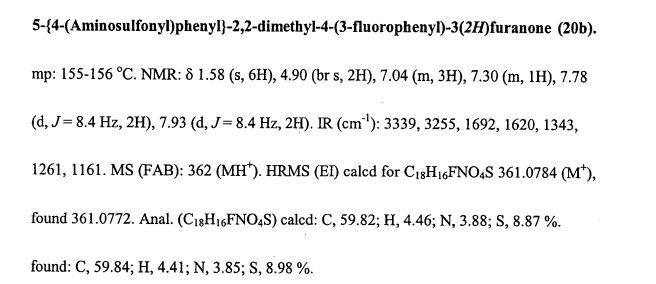
  2.  Skarke, C.; Alamuddin, N.; Lawson, J. A.; Cen, L.; Propert, K. J.; Fitzgerald, G. A. (2012). “Comparative impact on prostanoid biosynthesis of celecoxib and the novel nonsteroidal anti-inflammatory drug CG100649”. Clinical Pharmacology & Therapeutics 91 (6): 986–93. doi:10.1038/clpt.2012.3.PMC: 3740579. PMID 22278334.
  3.  Hirankarn, S.; Barrett, J.S.; Alamuddin, N.; Fitzgerald, G. A.; Skarke, C. (2013). “GCG100649, A Novel Cyclooxygenase-2 Inhibitor, Exhibits a Drug Disposition Profile in Healthy Volunteers Compatible With High Affinity to Carbonic Anhydrase-I/II: Preliminary Dose–Exposure Relationships to Define Clinical Development Strategies”. Clinical Pharmacology in Drug Development 2 (4): 379–386. doi:10.1002/cpdd.47.
Polmacoxib
Polmacoxib.svg
Systematic (IUPAC) name
4-(3-(3-Fluorophenyl)-5,5-dimethyl-4-oxo-4,5-dihydrofuran-2-yl)-benzenesulfonamide
Clinical data
Trade names Acelex
Identifiers
CAS Number 301692-76-2
PubChem CID 9841854
ChemSpider 8017569
UNII IJ34D6YPAO
ChEMBL CHEMBL166863
Synonyms CG100649
Chemical data
Formula C12H16FNO4S
Molar mass 361.3914 g/mol

///////Polmacoxib, CG-100649, 301692-76-2

CC1(C(=O)C(=C(O1)C2=CC=C(C=C2)S(=O)(=O)N)C3=CC(=CC=C3)F)C