New Drug Approvals

Home » 2015 (Page 31)

Yearly Archives: 2015

DRUG APPROVALS BY DR ANTHONY MELVIN CRASTO .....FOR BLOG HOME CLICK HERE

Blog Stats

  • 4,829,785 hits

Flag and hits

Flag Counter

Enter your email address to follow this blog and receive notifications of new posts by email.

Join 37.9K other subscribers
Follow New Drug Approvals on WordPress.com

Archives

Categories

Recent Posts

Flag Counter

ORGANIC SPECTROSCOPY

Read all about Organic Spectroscopy on ORGANIC SPECTROSCOPY INTERNATIONAL 

Enter your email address to follow this blog and receive notifications of new posts by email.

Join 37.9K other subscribers
DR ANTHONY MELVIN CRASTO Ph.D

DR ANTHONY MELVIN CRASTO Ph.D

DR ANTHONY MELVIN CRASTO, Born in Mumbai in 1964 and graduated from Mumbai University, Completed his Ph.D from ICT, 1991,Matunga, Mumbai, India, in Organic Chemistry, The thesis topic was Synthesis of Novel Pyrethroid Analogues, Currently he is working with AFRICURE PHARMA, ROW2TECH, NIPER-G, Department of Pharmaceuticals, Ministry of Chemicals and Fertilizers, Govt. of India as ADVISOR, earlier assignment was with GLENMARK LIFE SCIENCES LTD, as CONSUlTANT, Retired from GLENMARK in Jan2022 Research Centre as Principal Scientist, Process Research (bulk actives) at Mahape, Navi Mumbai, India. Total Industry exp 32 plus yrs, Prior to joining Glenmark, he has worked with major multinationals like Hoechst Marion Roussel, now Sanofi, Searle India Ltd, now RPG lifesciences, etc. He has worked with notable scientists like Dr K Nagarajan, Dr Ralph Stapel, Prof S Seshadri, etc, He did custom synthesis for major multinationals in his career like BASF, Novartis, Sanofi, etc., He has worked in Discovery, Natural products, Bulk drugs, Generics, Intermediates, Fine chemicals, Neutraceuticals, GMP, Scaleups, etc, he is now helping millions, has 9 million plus hits on Google on all Organic chemistry websites. His friends call him Open superstar worlddrugtracker. His New Drug Approvals, Green Chemistry International, All about drugs, Eurekamoments, Organic spectroscopy international, etc in organic chemistry are some most read blogs He has hands on experience in initiation and developing novel routes for drug molecules and implementation them on commercial scale over a 32 PLUS year tenure till date Feb 2023, Around 35 plus products in his career. He has good knowledge of IPM, GMP, Regulatory aspects, he has several International patents published worldwide . He has good proficiency in Technology transfer, Spectroscopy, Stereochemistry, Synthesis, Polymorphism etc., He suffered a paralytic stroke/ Acute Transverse mylitis in Dec 2007 and is 90 %Paralysed, He is bound to a wheelchair, this seems to have injected feul in him to help chemists all around the world, he is more active than before and is pushing boundaries, He has 100 million plus hits on Google, 2.5 lakh plus connections on all networking sites, 100 Lakh plus views on dozen plus blogs, 227 countries, 7 continents, He makes himself available to all, contact him on +91 9323115463, email amcrasto@gmail.com, Twitter, @amcrasto , He lives and will die for his family, 90% paralysis cannot kill his soul., Notably he has 38 lakh plus views on New Drug Approvals Blog in 227 countries......https://newdrugapprovals.wordpress.com/ , He appreciates the help he gets from one and all, Friends, Family, Glenmark, Readers, Wellwishers, Doctors, Drug authorities, His Contacts, Physiotherapist, etc He has total of 32 International and Indian awards

Verified Services

View Full Profile →

Archives

Categories

Flag Counter

The 10-Hydroxy-2-Decenoic Acid (10-2-HDA) content in Royal Jelly, is said to possess strong inhibition of malignant cell growth, namely transferable AKR leukemia, TA3 breast malignancy


 Developing queen larvae surrounded by royal jelly

Royal jelly is a honey bee secretion that is used in the nutrition of larvae, as well as adult queens.[1] It is secreted from the glands in the hypopharynx of worker bees, and fed to all larvae in the colony, regardless of sex or caste.[2]

When worker bees decide to make a new queen, because the old one is either weakening or dead, they choose several small larvae and feed them with copious amounts of royal jelly in specially constructed queen cells. This type of feeding triggers the development of queen morphology, including the fully developed ovaries needed to lay eggs.[3]

Other Common Names:  Apilak, Gelée Royale, Queen Bee Jelly

Royal Jelly has been called the “Crown Jewel” of the beehive that has become extremely popular since the 1950s as a wonderful source of energy and natural way to increase stamina; perhaps that is the reason why the Queen Bee is so strong and enduring.  It is also thought to be a great nutritional source of enzymes, proteins, sugars and amino acids, but there is no scientific proof to verify the supplement’s efficacy for its use as an overall health tonic.  You’ll have to decide.

History:
Royal Jelly is a thick, milky material that is secreted from the hypopharyngea- salivary glands in the heads of the young nurse bees between the sixth and twelfth days of life, and when honey and pollen are combined and refined within the nurse bee, Royal Jelly is naturally created.  While all larvæ in a colony are fed Royal Jelly, it is the only food that is fed to the Queen Bee throughout her life; other adult bees do not consume it at all.  All female eggs may produce a Queen Bee, but this occurs only when – during the whole development of the larvæ – she is cared for and fed by this material – in large quantities.  As a result of this special nutrition, the Queen develops reproductive organs (while the worker bee develops traits that relate only to work, i.e., stronger mandibles, brood food, wax glands and pollen baskets).  The Queen develops in about fifteen days, while the workers require twenty-one; and finally, the Queen endures for several years, while workers survive only a few months. “10-2 HDA,” thought to be the principle active substance in Royal Jelly, makes the Queen Bee fifty percent larger than the other female worker bees and gives her incredible stamina, ovulation ability and longevity, living four to five years longer than worker bees who only live forty or more days.  Perhaps this is the reason why so many positive qualities have been attributed to Royal Jelly as a truly rare gift of nature, but it should be noted that there is no clinical evidence to support the claims.  There is even great controversy as to the constituents included in the supplement.  Most researchers claim that it includes all the B-vitamins and vitamins A, C, D and E; some disagree.  It does contain proteins, sugars, lipids (essential fatty acids), many essential amino acids, collagen, lecithin, enzymes and minerals, in addition to the very valuable

10-2-HDA (10-Hydroxy-2-Decenoic Acid).  It is said that Royal Jelly may be most effective when combined with honey.  You can decide whether any improvements you derive from Royal Jelly’s use are purely coincidental, but if  (and when) you feel better when using it, just enjoy the benefits.

10-2-HDA (10-Hydroxy-2-Decenoic Acid)

Beneficial Uses:
Many fans claim that Royal Jelly is a great way to increase energy, as well as a remarkable stamina booster.  In addition, it is also considered a means to enhance the immune system and maintain overall health.

Royal Jelly is said to alleviate a variety of problems, such as exhaustion, anxiety, mild depression, insomnia and lack of energy and stamina.   Royal Jelly is also believed to have a calming effect on the nervous system.

Some people maintain that Royal Jelly has helped to improve skin disorders and has slowed down the ageing process.  Royal Jelly’s collagen, lecithin and vitamins A, C, D and E all benefit the skin, helping to moisturize dry skin and soothe dermatitis.

In 1977, scientists at the Beijing Medical University reported that when Royal Jelly was administered to male and female neurasthenia patients, all patients reported very effective (86%) or effective (14%) improvement.  Insomnia was eliminated, quality of sleeping increased and headache and dizziness were alleviated.  It was also said that physical and mental abilities, appetite and working efficiency were improved.

The 10-Hydroxy-2-Decenoic Acid (10-2-HDA) content in Royal Jelly, is said to possess strong inhibition of malignant cell growth, namely transferable AKR leukemia, TA3 breast malignancy, etc., and recent studies indicated immuno-regulation and anti-malignancy activities.  It can promote the growth of T-lymphocyte subsets, Interleukin-2 and the generation of tumor necrosis factor.  Much research is being conducted on this valuable active constituent, which has exhibited positive physiological and pharmacological effects including vasodilative and hypotensive activities, antihypercholesterolemic activity and anti-inflammatory functions.  In addition to these activities, the 10-HDA in Royal Jelly has been suggested to improve menopausal symptoms.

Other benefits attributed to the qualities of Royal Jelly include relief of bronchial asthma, liver, pancreatic and kidney ailments, stomach ulcers and bone fractures.

Contraindications:
Royal Jelly Nutritional Supplement is a natural bee product and may induce allergic reactions in some people and should, therefore, be tested in very small amounts before continued use.  Symptoms of allergy include breathing problems or tightness in your throat or chest, chest pain, skin hives, rash or itchy or swollen skin.

Cultivation

Royal jelly is secreted from the glands in the heads of worker bees, and is fed to all bee larvae, whether they are destined to become drones (males), workers (sterile females), or queens (fertile females). After three days, the drone and worker larvae are no longer fed with royal jelly, but queen larvae continue to be fed this special substance throughout their development. It is harvested by humans by stimulating colonies with movable frame hives to produce queen bees. Royal jelly is collected from each individual queen cell (honey comb) when the queen larvae are about four days old. It is collected from queen cells because these are the only cells in which large amounts are deposited; when royal jelly is fed to worker larvae, it is fed directly to them, and they consume it as it is produced, while the cells of queen larvae are “stocked” with royal jelly much faster than the larvae can consume it. Therefore, only in queen cells is the harvest of royal jelly practical. A well-managed hive during a season of 5–6 months can produce approximately 500 g of royal jelly. Since the product is perishable, producers must have immediate access to proper cold storage (e.g., a household refrigerator or freezer) in which the royal jelly is stored until it is sold or conveyed to a collection center. Sometimes honey or beeswax are added to the royal jelly, which is thought to aid its preservation.

Composition

The overall composition of royal jelly is 67% water, 12.5% crude protein, including small amounts of many different amino acids, and 11% simple sugars (monosaccharides), also including a relatively high amount (5%) of fatty acids. The main acid is the 10-hydroxy-2-decenoic acid or 10-HDA (about 2 – 3%).It also contains many trace minerals, some enzymes, antibacterial and antibiotic components, pantothenic acid (vitamin B5), vitamin B6 (pyridoxine) and trace amounts of vitamin C,[2] but none of the fat-soluble vitamins, A, D, E and K.[4]

Royalactin

The component of royal jelly that causes a bee to develop into a queen appears to be a single protein that has been called royalactin. Jelly which had been rendered inactive by prolonged storage had a fresh addition of each of the components subject to decay and was fed to bees; only jelly laced with royalactin caused the larvae to become queens.[5] Royalactin also induces similar phenotypical change in the fruitfly (Drosophila melanogaster), marked by increased body size and ovary development.

Epigenetic effects

The honey bee queens and workers represent one of the most striking examples of environmentally controlled phenotypic polymorphism. In spite of their identical clonal nature at the DNA level, they are strongly differentiated across a wide range of characteristics including anatomical and physiological differences, longevity of the queen, and reproductive capacity.[6] Queens constitute the sexual caste and have large active ovaries, whereas workers have only rudimentary, inactive ovaries and are functionally sterile. The queen/worker developmental divide is controlled epigenetically by differential feeding with royal jelly; this appears to be due specifically to the protein royalactin. A female larva destined to become a queen is fed large quantities of royal jelly; this triggers a cascade of molecular events resulting in development of a queen.[3] It has been shown that this phenomenon is mediated by an epigenetic modification of DNA known as CpG methylation.[7] Silencing the expression of an enzyme that methylates DNA in newly hatched larvae led to a royal jelly-like effect on the larval developmental trajectory; the majority of individuals with reduced DNA methylation levels emerged as queens with fully developed ovaries. This finding suggests that DNA methylation in honey bees allows the expression of epigenetic information to be differentially altered by nutritional input.

Uses

Citing various potential health benefits seen in lab studies, royal jelly is collected and sold as a dietary supplement for humans, but the European Food Safety Authority has rejected these claims stating that the current evidence does not support consuming royal jelly will give health benefits in humans.[8] In the United States, both the Federal Trade Commission and the Food and Drug Administration have taken legal action against companies that have used unfounded claims of health benefits to market royal jelly products.[9][10][11][12]

Adverse effects

Royal jelly may cause allergic reactions in humans ranging from hives, asthma, to even fatal anaphylaxis.[13][14][15][16][17][18] The incidence of allergic side effect in people who consume royal jelly is unknown. The risk of having an allergy to royal jelly is higher in people who have other allergies.[13]

The benefits of Royal Jelly are truly extensive. The list of benefits is so extensive that it may actually appear to be ‘too good to be true’ to many of us, myself included. I’m still amazed every time I scan the many studies done on this amazing substance.Royal Jelly is one of the naturally occurring miraculous super foods on the planet that gets very little press!  It packs a powerful health punch and here’s why:Royal Jelly is a substance produced by worker honey bees.  Bee colonies function on a hierarchical system:  Bees all start out as unisex larvae, blank slate bee babies if you will.  Then they break off into 1 of 3 roles within their colony.  The worker bees (females), the drones (males used for reproduction) and The Queen Bee.The workers and drones have a typical life span of 3-4 months, whereas The Queen Been can live for up to 7 years!

What differentiates the role of The Queen Bee from the workers and the drones is quite simply what she is fed!  Keep in mind, she starts off the same as the rest of colony but her diet transforms her into The Queen Bee.  Workers and drones are fed royal jelly when they hatch, followed by pollen and honey for the following 6 days.  The Queen Bee on the other hand, is exclusively fed royal jelly for the entirety of her life- Jelly is one of the naturally occurring miraculous super foods on the planet that gets very little press!  It packs a powerful health punch and here’s why:Royal Jelly is a substance produced by worker honey bees.  Bee colonies function on a hierarchical system:  Bees all start out as unisex larvae, blank slate bee babies if you will.  Then they break off into 1 of 3 roles within their colony.  The worker bees (females), the drones (males used for reproduction) and The Queen Bee.The workers and drones have a typical life span of 3-4 months, whereas The Queen Been can live for up to 7 years!  What differentiates the role of The Queen Bee from the workers and the drones is quite simply what she is fed!  Keep in mind, she starts off the same as the rest of colony but her diet transforms her into The Queen Bee.
 Workers and drones are fed royal jelly when they hatch, followed by pollen and honey for the following 6 days.  The Queen Bee on the other hand, is exclusively fed royal jelly for the entirety of her life- See more at: http://www.collective-evolution.com/2013/06/06/the-royal-benefits-of-royal-jelly/#sthash.DPhCubyY.dpufRoyal Jelly is one of the naturally occurring miraculous super foods on the planet that gets very little press!  It packs a powerful health punch and here’s why:Royal Jelly is a substance produced by worker honey bees.  Bee colonies function on a hierarchical system:  Bees all start out as unisex larvae, blank slate bee babies if you will.  Then they break off into 1 of 3 roles within their colony.  The worker bees (females), the drones (males used for reproduction) and The Queen Bee.The workers and drones have a typical life span of 3-4 months, whereas The Queen Been can live for up to 7 years!  What differentiates the role of The Queen Bee from the workers and the drones is quite simply what she is fed!  Keep in mind, she starts off the same as the rest of colony but her diet transforms her into The Queen Bee.
 Workers and drones are fed royal jelly when they hatch, followed by pollen and honey for the following 6 days.  The Queen Bee on the other hand, is exclusively fed royal jelly for the entirety of her life- See more at: http://www.collective-evolution.com/2013/06/06/the-royal-benefits-of-royal-jelly/#sthash.DPhCubyY.dpufRoyal jelly is a substance that is secreted from the glands of worker bees to feed their larvae and queens. It is thick in texture, milky-white in color, and has been harvested by humans for centuries for its rejuvenating properties. Indeed, it is a fact that queen bees – which are fed royal jelly their entire lives – live approximately 40 times longer than drone or worker bees, largely due to the jelly’s nutritiousness.

Cancer-fighting properties – According to a study published in a 2009 edition of the BMC Complementary and Alternative Medicine, royal jelly fights cancer by suppressing the blood supply to tumors. When the Japanese researchers tested various royal jelly types on umbilical vein tissue cultures, all of them inhibited the formation of blood vessels, especially those richest in caffeic acid, a compound responsible for the greatest suppressive levels. Moreover, since the fatty components of royal jelly contain estrogenic effects – as proved by a study published in the December 2010 edition of PLoS One – it is possible that royal jelly can treat breast and cervical cancer.
Improves blood health – A study published in the November 2008 edition of the Biological and Pharmaceutical Bulletin showed that royal jelly can improve insulin resistance and blood pressure. The researchers fed the jelly to rats suffering from high blood pressure and insulin resistance due to a high-fructose diet. After two months, the rats demonstrated noticeably fewer instances of blood vessel constriction, which resulted in lower triglyceride and insulin levels.

Skincare properties – Although Royal jelly is best-known as a health supplement, it is often used in skincare products because it contains DNA and gelatin, two ingredients that aid collagen production (and thus anti-aging activity). For this reason, many people like to apply royal jelly topically and allow it to nourish and invigorate their skin.

Antibacterial components – According to a study published in the July 1990 edition of the Journal of Biological Chemistry, a protein found in royal jelly – unofficially named royalisin – provides numerous antibacterial and antimicrobial properties, and is effective at dealing with certain bacterial cultures at lower levels.

Rich in nutrients – As with other bee products such as bee pollen and propolis, royal jelly’s biggest attraction is probably its impressive concentration of vitamins and minerals. Indeed, an average serving of royal jelly contains seventeen different amino acids (including all eight essential amino acids, making it a complete protein), most of the B-vitamins (which are used for the production and synthesis of energy), and respectable levels of iron and calcium, which are essential for superior blood and bone Health. Royal jelly also contains vitamins A, C, and E, which are important antioxidants that can neutralize free radical activity, thus guarding us from degenerative diseases.

Infertility treatment – It is not a coincidence that worker bees are infertile, while queen bees can lay up to 2,000 eggs per day throughout their extensive 4 to 6 year lifespan. This is because royal jelly stimulates estrogen production, thereby stabilizing menstrual cycles in women, improving sperm morphology in men, and increasing the libido of both sexes.

Notes

  1. ^ Jung-Hoffmann L: Die Determination von Königin und Arbeiterin der Honigbiene. Z Bienenforsch 1966, 8:296-322.
  2. ^ a b Graham, J. (ed.) (1992) The Hive and the Honey Bee (Revised Edition). Dadant & Sons.
  3. ^ a b Maleszka, R, Epigenetic integration of environmental and genomic signals in honey bees: the critical interplay of nutritional, brain and reproductive networks. Epigenetics. 2008, 3, 188-192.
  4. ^ “Value-added products from beekeeping. Chapter 6.”.
  5. ^ Kamakura, M. (2011). “Royalactin induces queen differentiation in honeybees”. Nature 473 (7348): 478–483. doi:10.1038/nature10093. PMID 21516106. edit
  6. ^ Winston, M, The Biology of the Honey Bee, 1987, Harvard University Press
  7. ^ Kucharski R, Maleszka, J, Foret, S, Maleszka, R (2008). “Nutritional Control of Reproductive Status in Honeybees via DNA Methylation”. Science 319 (5871): 1827–1833. doi:10.1126/science.1153069.
  8. ^ “Scientific Opinion”. EFSA Journal 9 (4): 2083. 2011.
  9. ^ “QVC to Pay $7.5 Million to Settle Charges that It Aired Deceptive Claims”. Federal Trade Commission. March 19, 2009.
  10. ^ “Complaint in the Matter of CC Pollen Company et al.”. Federal Trade Commission. March 16, 1993.
  11. ^ “Federal Government Seizes Dozens of Misbranded Drug Products: FDA warned company about making medical claims for bee-derived products”. Food and Drug Administration. Apr 5, 2010.
  12. ^ “Inspections, Compliance, Enforcement, and Criminal Investigations: Beehive Botanicals, Inc”. Food and Drug Administration. March 2, 2007.
  13. ^ a b Leung, R; Ho, A; Chan, J; Choy, D; Lai, CK (March 1997). “Royal jelly consumption and hypersensitivity in the community”. Clin. Exp. Allergy 27 (3): 333–6. doi:10.1111/j.1365-2222.1997.tb00712.x. PMID 9088660.
  14. ^ Takahama H, Shimazu T (2006). “Food-induced anaphylaxis caused by ingestion of royal jelly”. J Dermatol. 33 (6): 424–426. doi:10.1111/j.1346-8138.2006.00100.x. PMID 16700835.
  15. ^ Lombardi C, Senna GE, Gatti B, Feligioni M, Riva G, Bonadonna P, Dama AR, Canonica GW, Passalacqua G (1998). “Allergic reactions to honey and royal jelly and their relationship with sensitization to compositae”. Allergol Immunopathol (Madr). 26 (6): 288–290.
  16. ^ Thien FC, Leung R, Baldo BA, Weiner JA, Plomley R, Czarny D (1996). “Asthma and anaphylaxis induced by royal jelly”. Clin Exp Allergy 26 (2): 216–222. doi:10.1111/j.1365-2222.1996.tb00082.x. PMID 8835130.
  17. ^ >Leung R, Thien FC, Baldo B, Czarny D (1995). “Royal jelly-induced asthma and anaphylaxis: clinical characteristics and immunologic correlations”. J Allergy Clin Immunol 96 (6 Pt 1): 1004–1007. doi:10.1016/S0091-6749(95)70242-3. PMID 8543734.
  18. ^ Bullock RJ, Rohan A, Straatmans JA (1994). “Fatal royal jelly-induced asthma”. Med J Aust 160 (1): 44.

References

  • Balch, Phyllis A.; Balch, James F. (2000). Prescription for Nutritional Healing, Third Edition. New York: Avery. ISBN 1-58333-077-1.
  • Ammon, R. and Zoch, E. (1957) Zur Biochemie des Futtersaftes der Bienenkoenigin. Arzneimittel Forschung 7: 699-702
  • Blum, M.S., Novak A.F. and Taber III, 5. (1959). 10-Hydroxy-decenoic acid, an antibiotic found in royal jelly. Science, 130 : 452-453
  • Bonomi, A. (1983) Acquisizioni in tema di composizione chimica e di attivita’ biologica della pappa reale. Apitalia, 10 (15): 7-13.
  • Braines, L.N. (1959). Royal jelly I. Inform. Bull. Inst. Pchelovodstva, 31 pp (with various articles)
  • Braines, L.N. (1960). Royal jelly II. Inform. Bull. Inst. Pchelovodstva, 40 pp.
  • Braines, L.N. (1962). Royal jelly III. Inform. Bull. Inst. Pchelovodstva, 40
  • Chauvin, R. and Louveaux, 1. (1956) Etdue macroscopique et microscopique de lagelee royale. L’apiculteur.
  • Cho, Y.T. (1977). Studies on royal jelly and abnormal cholesterol and triglycerides. Amer. Bee 1., 117 : 36-38
  • De Belfever, B. (1958) La gelee royale des abeilles. Maloine, Paris.
  • Destrem, H. (1956) Experimentation de la gelee royale d’abeille en pratique geriatrique (134 cas). Rev. Franc. Geront, 3.
  • Giordani, G. (1961). [Effect of royal jelly on chickens.] Avicoltura 30 (6): 114-120
  • Hattori N, Nomoto H, Fukumitsu H, Mishima S, Furukawa S. [Royal jelly and its unique fatty acid, 10-hydroxy-trans-2-decenoic acid, promote neurogenesis by neural stem/progenitor cells in vitro.] Biomed Res. 2007 Oct;28(5):261-6.
  • Hashimoto M, Kanda M, Ikeno K, Hayashi Y, Nakamura T, Ogawa Y, Fukumitsu H, Nomoto H, Furukawa S. (2005) Oral administration of royal jelly facilitates mRNA expression of glial cell line-derived neurotrophic factor and neurofilament H in the hippocampus of the adult mouse brain. Biosci Biotechnol Biochem. 2005 Apr;69(4):800-5.
  • Inoue, T. (1986). The use and utilization of royal jelly and the evaluation of the medical efficacy of royal jelly in Japan. Proceeding sof the XXXth International Congress of Apiculture, Nagoya, 1985, Apimondia, 444-447
  • Jean, E. (1956). A process of royal jelly absorption for its incorporation into assimilable substances. Fr. Pat., 1,118,123
  • Jacoli, G. (1956) Ricerche sperimentali su alcune proprieta’ biologiche della gelatina reale. Apicoltore d’Italia, 23 (9-10): 211-214.
  • Jung-Hoffmann L: Die Determination von Königin und Arbeiterin der Honigbiene. Z Bienenforsch 1966, 8:296-322.
  • Karaali, A., Meydanoglu, F. and Eke, D. (1988) Studies on composition, freeze drying and storage of Turkish royal jelly. J. Apic. Res., 27 (3): 182-185.
  • Kucharski R, Maleszka, J, Foret, S, Maleszka, R, Nutritional Control of Reproductive Status in Honeybees via DNA Methylation. Science. 2008 Mar 28;319(5871):1827-3
  • Lercker, G., Capella, P., Conte, L.S., Ruini, F. and Giordani, G. (1982) Components of royal jelly: II. The lipid fraction, hydrocarbons and sterolds. J. Apic. Res. 21(3):178-184.
  • Lercker, G., Vecchi, M.A., Sabatini, A.G. and Nanetti, A. 1984. Controllo chimicoanalitico della gelatina reale. Riv. Merceol. 23 (1): 83-94.
  • Lercker, G., Savioli, S., Vecchi, M.A., Sabatini, A.G., Nanetti, A. and Piana, L. (1986) Carbohydrate Determination of Royal Jelly by High Resolution Gas Chromatography (HRGC). Food Chemistry, 19: 255-264.
  • Lercker, G., Caboni, M.F., Vecchi, M.A., Sabatini, A.G. and Nanetti, A. (1992) Caratterizzazione dei principali costituenti della gelatina reale. Apicoltura 8:11-21.
  • Maleszka, R, Epigenetic integration of environmental and genomic signals in honey bees: the critical interplay of nutritional, brain and reproductive networks. Epigenetics. 2008, 3, 188-192.
  • Nakamura, T. (1986) Quality standards of royal jelly for medical use. proceedings of the XXXth International Congress of Apiculture, Nagoya, 1985 Apimondia (1986) 462-464.
  • Rembold, H. (1965) Biologically active substances in royal jelly. Vitamins and hormones 23:359-382.
  • Salama, A., Mogawer, H.H. and El-Tohamy, M. 1977 Royal jelly a revelation or a fable. Egyptian Journal of Veterinary Science 14 (2): 95-102.
  • Takenaka, T. Nitrogen components and carboxylic acids of royal jelly. In Chemistry and biology of social insects (edited by Eder, J., Rembold, H.). Munich, German Federal Republic, Verlag J. Papemy (1987): 162-163.
  • Wagner, H., Dobler, I., Thiem, I. Effect of royal jelly on the peirpheral blood and survival rate of mice after irradiation of the entire body with X-rays. Radiobiologia Radiotherapia (1970) 11(3): 323-328.
  • Winston, M, The Biology of the Honey Bee, 1987, Harvard University Press
    Disclaimer:
    The information presented herein by this post is intended for educational purposes only. These statements have not been evaluated by the FDA and are not intended to diagnose, cure, treat or prevent disease. Individual results may vary, and before using any supplements, it is always advisable to consult with your own health care provider.

Rosa canina for osteoarthritis


Rosiflex contains a unique natural supplement that is good for joint health. If you are looking forward to a natural way to minimize your joint pain and stiffness, then Rosiflex is the ideal choice for you. Rosiflex is for anyone who wants healthy, flexible and mobile joints for a better quality of life. The unique natural ingredient in Rosiflex has been clinically proven to soothe the inflamed joints and improve joint comfort and flexibility.
What is Rosiflex?
Rosiflex is a Unique Dietary Supplement containing 100% Rosehip powder, made from a species of wild rose, Rosa canina. Rosiflex is available in capsule form with each capsule containing 750 mg (of imported) rosehip powder. Rosehip powder has been shown to decrease joint pain, improve joint health and increase mobility and flexibility in arthritic patients, particularly osteoarthritic patients.

The speciality of Rosiflex is as given below:
  • European supplement now brought to Indian arthritic patients
  • Huge success internationally
  • Effective within 3 weeks
  • Good pain relief
  • Reduces the need for regular pain killers
  • Very Safe, being a herbal supplement
  • Dosage: 2 capsules thrice daily for the initial 3 weeks followed by maintenance dose of 2 capsules twice daily
  • Rosa canina
    Divlja ruza cvijet 270508.jpg
    Photograph showing Rosa canina flowers.
    Scientific classification
    Kingdom: Plantae
    (unranked): Angiosperms
    (unranked): Eudicots
    (unranked): Rosids
    Order: Rosales
    Family: Rosaceae
    Genus: Rosa
    Species: R. canina
    Binomial name
    Rosa canina
    L.
    Synonyms
    See text


History:

Click here for a larger image. ROSE HIPS
Rose Hips (also called rose haws) are the pomaceous fruit of the rose plant.  Roses are a group of herbaceous shrubs found in temperate regions throughout both hemispheres and grown in sunny areas or light shade and thrive in well-drained, slightly acid soil.  Probably cultivated first in ancient Persia and carried to Greece and Rome, there are now hundreds of species of this beautiful flower cultivated throughout the world that occupy a vital place in medicine, as well as cosmetics, perfumes, soaps and foods.  The leaves of Rosa canina were once even used as a substitute for tea.  The botanical genus, Rosa, is derived from the Greek, roden, meaning “red” and the Latin, ruber, also meaning “ruby” or “red,” as apparently, the Roses of the ancient Mediterranean region were deep crimson, giving birth to the legend that the flowers sprang from the blood of Adonis.

Roses have a long tradition of medicinal use.  The ancient Romans used Rosa canina (or Dog Rose) for the bites of rabid dogs, and in the first century A.D., the Roman, Pliny, recorded thirty-two different disorders that responded well to Rose preparations.  An oriental species (Rosa laevigata) was mentioned in Chinese medical literature about A.D. 470, and in China, Rose Hips are still used for chronic diarrhea with stomach weakness.

It is typically red to orange but may be dark purple to black in some species.  In Ayurvedic medicine, Roses have long been considered “cooling” to the body and a tonic for the mind, and Native Americans used Rose Hips to treat muscle cramps.  In 1652, the esteemed British herbalist, Nicholas Culpeper, prescribed them for “consumptive persons,” for “tickling rheums,” to “break the stone” (kidneys) and to help digestion.

Long used for medicinal purposes in Great Britain, Rose Hips remained listed in the official British Pharmacopœia well into the 1930s, and were considered an overall cooling tonic, an astringent, a great help for sore throats and a source of the essential vitamin C.  During World War II, there was a shortage of citrus fruit in England, and the British government organized the harvesting of all the Rose Hips in England as a substitute for vitamin C.  This illuminated the importance of Rose Hips as a superior source of the vitamin and began its worldwide popularity.  Rose Hips have a reported sixty times the amount of vitamin C than citrus fruit, and we now know how absolutely essential vitamin C is to the maintenance of good health and the prevention of many diseases.

Rose Hips contain one of the highest measures of vitamin C (about 1700-2000 mgs. per 100 g. in the dried product) than is known in other herbs.  Rose Hips are the fruits of the Rose, the ripe seed receptacles that remain after the petals are removed, and they contain many vitamins and other beneficial supplements, including lycopene, essential fatty acids, beta-carotene, bioflavonoids, pectin, sugar, resin, wax, malates, citrates and other salts, tannin, malic and citrus acids, magnesium, calcium, iron, manganese, sulfur, phosphorus, potassium, selenium, zinc and vitamins A, B-1, B-2, B-3, B-5, C, D, E and K.

Beneficial Uses:
Probably the greatest known use of Rose Hips is as an extraordinary and powerful source of vitamin C, which is most beneficial for the prevention and treatment of infection and a great many common diseases, including the common cold, flu and pneumonia.  It is said to prevent ailments before they happen by using a prophylactic dosage on a daily basis.  Vitamin C is necessary for every cell in our bodies and without it, we would not be able to sustain life.

Natural vitamin C and bioflavonoids are combined in nature, and for efficacy, it is vital that they be used together. Rose Hips are rich in both, and together they help to strengthen body tissues and build and maintain a healthy vascular system and are said to heal and prevent damage to fragile capillaries.  The combination is also thought to enhance the body’s ability to absorb vitamin C in those who have difficulty absorbing it.

Rose Hips, with its abundance of vitamin C, are useful in treating infections of all kinds and have been used for centuries for the relief of diarrhea and dysentery.  It is considered to be a cleansing agent and may be helpful for temporary bladder problems, gallbladder dysfunction, kidney health, general debility and exhaustion.

Current research indicates that large doses of vitamin C in Rose Hips could be helpful in enhancing our immune systems, which may be valuable in warding off infectious invaders and serious malignant disease.

Rose Hips are said to have mild laxative and diuretic properties.

Rosa canina, commonly known as the dog-rose,[1] is a variable climbing wild rose species native to Europe, northwest Africa and western Asia.

It is a deciduous shrub normally ranging in height from 1–5 m, though sometimes it can scramble higher into the crowns of taller trees. Its stems are covered with small, sharp, hooked prickles, which aid it in climbing. The leaves are pinnate, with 5-7 leaflets. The flowers are usually pale pink, but can vary between a deep pink and white. They are 4–6 cm diameter with five petals, and mature into an oval 1.5–2 cm red-orange fruit, or hip.

dried-rose-hipsIt’s that time of year again and the hedgerows are heaving with fruit. But with most people intent on collecting juicy blackberries, the vibrantly coloured and perhaps mystifying rose-hip is often overlooked. Maybe it’s because they are a suspicious red colour or maybe it’s because they’re a fruit that’s never seen in supermarkets. Whatever the reason, the conclusion is the same: there’s more to collect for yourself!

Rose-hips are the fruit of the rose bush and in the summer are found as a swollen green part of the stem just underneath the flower. Every rose left uncut will eventually produce a hip but some will appear in the summer and others later in the autumn depending on species. To my knowledge all rose hips are edible, though some varieties have better flavour than others.

Blessed with a delicate fruity taste and rich in vitamins A, B and C, Rose-hips can be used to make an assortment of products including jellies, syrups, teas, wine and even cosmetics. Both the fruit and the seeds are edible but you should not eat rose-hips whole due to irritating hairs which are found inside the berries. These hairs must be removed either by filtering during the cooking process.

The best variety for making edible products is the hip of the common wild rose, also known as the Dog Rose, Latin name Rosa Canina. It produces small, firm, deep-red hips that are rich in flavour and easy to find and harvest. They are available in the autumn but it’s said the best time to harvest them is directly after a frost. Being that birds favour other foods over these hard seed-laden hips, you can often find them hanging onto bare branches in the darkest days of winter. If you choose to use them to make edible products please know that it’s not necessary to separate the seeds from the red fruit as both have their own nutritious values. But of course beware the hairs mentioned previously and make sure they are excluded from your end product.

Dog-Rose-Hips

Synonyms

From DNA analysis using amplified fragment length polymorphisms of wild-rose samples from a transect across Europe (900 samples from section Caninae, and 200 from other sections), it has been suggested that the following named species are best considered as part of a single Rosa canina species complex, and are therefore synonyms of R. canina:[2]

  • R. balsamica Besser
  • R. caesia Sm.
  • R. corymbifera Borkh.
  • R. dumalis Bechst.
  • R. montana Chaix
  • R. stylosa Desv.
  • R. subcanina (Christ) Vuk.
  • R. subcollina (Christ) Vuk.
  • R. × irregularis Déségl. & Guillon

Cultivation and uses

A botanical illustration showing the various stages of growth by Otto Wilhelm Thomé

The plant is high in certain antioxidants. The fruit is noted for its high vitamin C level and is used to make syrup, tea and marmalade. It has been grown or encouraged in the wild for the production of vitamin C, from its fruit (often as rose-hip syrup), especially during conditions of scarcity or during wartime. The species has also been introduced to other temperate latitudes. During World War II in the United States Rosa canina was planted in victory gardens, and can still be found growing throughout the United States, including roadsides, and in wet, sandy areas up and down coastlines. In Bulgaria, where it grows in abundance, the hips are used to make a sweet wine, as well as tea. In the traditional Austrian medicine Rosa canina fruits have been used internally as tea for treatment of viral infections and disorders of the kidneys and urinary tract.[3]

Forms of this plant are sometimes used as stocks for the grafting or budding of cultivated varieties. The wild plant is planted as a nurse or cover crop, or stabilising plant in land reclamation and specialised landscaping schemes.

Numerous cultivars have been named, though few are common in cultivation. The cultivar Rosa canina ‘Assisiensis’ is the only dog rose without prickles. The hips are used as a flavouring in Cockta, a soft drink made in Slovenia.

Canina meiosis

A tall, climbing Rosa canina shrub

Rose hips

Rose bedeguar gall on a dog rose

The dog roses, the Canina section of the genus Rosa (20-30 species and subspecies, which occur mostly in Northern and Central Europe), have an unusual kind of meiosis that is sometimes called permanent odd polyploidy, although it can occur with even polyploidy (e.g. in tetraploids or hexaploids). Regardless of ploidy level, only seven bivalents are formed leaving the other chromosomes as univalents. Univalents are included in egg cells, but not in pollen.[4][5] Similar processes occur in some other organisms.[6] Dogroses are most commonly pentaploid, i.e. five times the base number of seven chromosomes for the genus Rosa, but may be tetraploid or hexaploid as well.

Names and etymology

The botanical name is derived from the common names ‘dog rose’ or similar in several European languages, including classical Latin and ancient (Hellenistic period) Greek.

It is sometimes considered that the word ‘dog’ has a disparaging meaning in this context, indicating ‘worthless’ (by comparison with cultivated garden roses) (Vedel & Lange 1960). However it also known that it was used in the eighteenth and nineteenth centuries to treat the bite of rabid dogs, hence the name “dog rose” may result from this[7] (though it seems just as plausible that the name gave rise to the treatment).

Other old folk names include dogberry and witches’ briar.[citation needed]

Invasive species

Dog rose is an invasive species in the high country of New Zealand. It was recognised as displacing native vegetation as early as 1895[8] although the Department of Conservation does not consider it to be a conservation threat.[9]

Dog rose in culture

The dog rose was the stylized rose of medieval European heraldry, and is still used today.[citation needed] It is also the county flower of Hampshire.[10] Legend states the Thousand-year Rose or Hildesheim Rose, that climbs against a wall of Hildesheim Cathedral dates back to the establishment of the diocese in 815.[11]


Rose hip, rose hip and seed and rose hip seed, all were negatively monographed by the German Commission E due to insufficient evidence of effects and effectiveness. Therefore a comprehensive review of the literature was conducted to summarize the pharmacological and clinical effects of Rosa canina L. to reevaluate its usefulness in traditional medicine. For various preparations of rose hip and rose hip and seed, antioxidative and antiinflammatory effects have been demonstrated. Lipophilic constituents are involved in those mechanisms of action. The proprietary rose hip and seed powder Litozin has been employed successfully in a number of exploratory studies in patients suffering from osteoarthritis, rheumatoid arthritis and low back pain. However, the sizes of the clinical effects for the different indications need to be determined to assure clinical significance. There is also a rationale behind the use of Litozin as part of a hypocaloric diet based on the rose hip probiotic, stool regulating and smooth muscle-relaxing actions, as well as the rose hip seed lipid-lowering, antiobese and antiulcerogenic effects. Further research is needed to clarify the importance of the reported promising experimental effects in clinical use and to characterize the optimum rose hip seed oil preparation for topical use in the treatment of skin diseases.

Rosiflex Discovery

Rosiflex Discovery

The Rosiflex™ story began in the early 1990s, when Erik Hansen, a farmer from Langeland, Denmark, discovered, quite by chance that rosehips from the Rosa Canina plant appeared to help soothe his aching joints.

Encouraged by this realisation, he developed the first of his rosehip powders. Made from rosehips grown on his own farm, he sold the powder to friends and neighbours after telling them of his own positive experiences.

The response from these early customers was so positive that Erik, and his son Torbjorn, decided to seek scientific verification of what they had found. They contacted scientists at the local hospital to see if they could find what it was in the rosehip that was producing the positive joint-health benefits being reported.

At first, the scientists were sceptical about the claimed benefits of the rosehip fruit – more commonly associated with teas and marmalades than with potential joint-health benefits. They did however agree to begin some scientific studies.

As the results of the testing began to emerge, the researchers became more and more convinced about the Langeland rosehip powder. Since then, several well designed scientific studies involving a couple of hundred people have been undertaken and published in recognised scientific journals.


Anti-inflammatory action of Rose hip

Rose hip is a typical daily food supplement traditionally used for its vitamin C content and other active principles to treat several discomforts: respiratory disorders, infectious diseases, gastrointestinal and urinary system illnesses and prophylaxis of vitamin C deficiencies. Rose hips have been eaten as jam or drunken as fruit tea for centuries. Therefore the separated Rose hip peels have always been regarded as everyday food.

In the last ten years it was scientifically documented, that the daily use of food containing rose hip fruits was positive to treat inflammatory joint diseases, in particular osteoarthritis. Several human studies with rose hip powder showed pain reducing properties and could also reduce symptoms such stiffness or even the need for additional medication.
However, the daily amount of 5 g over a period of 12 weeks showed moderate beneficial effects and low compliance demonstrating what the limits of a treatment with rose hip powder are.

Rose hip fruit skin powder contains remarkable active principles able to inhibit pro-inflammatory mediators and oxidative substances as well as enzymes responsible for the degradation of the organic matrix of joints and bones. A marked action on the inhibition of different cytokines has been observed as the interleukin 1β (IL-1β), the interleukin 6 (IL-6) and the alpha tumoral necrosis factor (TNF- α).

However herbal drug powders are usually not as stable and uniform as extracts. Using purification techniques and water as extraction solvent Finzelberg get a new extract, which compared with the rose hip drug powder is 7 fold stronger in their anti-inflammatory activity.

References

  1. ^ “BSBI List 2007” (xls). Botanical Society of Britain and Ireland. Retrieved 2014-10-17.
  2. ^ De Riek, Jan; De Cock, Katrien; Smulders, Marinus J.M.; Nybom, Hilde (2013). “AFLP-based population structure analysis as a means to validate the complex taxonomy of dogroses (Rosa section Caninae)”. Molecular Phylogenetics and Evolution 67 (3): 547–59. doi:10.1016/j.ympev.2013.02.024. PMID 23499615.
  3. ^ Vogl, Sylvia; Picker, Paolo; Mihaly-Bison, Judit; Fakhrudin, Nanang; Atanasov, Atanas G.; Heiss, Elke H.; Wawrosch, Christoph; Reznicek, Gottfried; Dirsch, Verena M.; Saukel, Johannes; Kopp, Brigitte (2013). “Ethnopharmacological in vitro studies on Austria’s folk medicine—An unexplored lore in vitro anti-inflammatory activities of 71 Austrian traditional herbal drugs”. Journal of Ethnopharmacology 149 (3): 750–71. doi:10.1016/j.jep.2013.06.007. PMC 3791396. PMID 23770053.
  4. ^ Täckholm, Gunnar (1922) Zytologische Studien über die Gattung Rosa. Acta Horti Bergiani 7, 97-381.
  5. ^ Lim, K Y; Werlemark, G; Matyasek, R; Bringloe, J B; Sieber, V; El Mokadem, H; Meynet, J; Hemming, J; Leitch, A R; Roberts, A V (2005). “Evolutionary implications of permanent odd polyploidy in the stable sexual, pentaploid of Rosa canina L”. Heredity 94 (5): 501–6. doi:10.1038/sj.hdy.6800648. PMID 15770234.
  6. ^ Stock, M.; Ustinova, J.; Betto-Colliard, C.; Schartl, M.; Moritz, C.; Perrin, N. (2011). “Simultaneous Mendelian and clonal genome transmission in a sexually reproducing, all-triploid vertebrate”. Proceedings of the Royal Society B: Biological Sciences 279 (1732): 1293. doi:10.1098/rspb.2011.1738.
  7. ^ Howard, Michael. Traditional Folk Remedies (Century, 1987); p133
  8. ^ Kirk, T (1895). “The Displacement of Species in New Zealand”. Transactions of the New Zealand Institute 1895 (Wellington: Royal Society of New Zealand) 28. Retrieved 2009-04-17.
  9. ^ Owen, S. J. (1997). Ecological weeds on conservation land in New Zealand: a database. Wellington: Department of Conservation.
  10. ^ “County Flowers | Wild plants”. Plantlife. Retrieved 2012-02-04.
  11. ^ Lucy Gordan. “Hildesheim’s Medieval Church Treasures at the Met”. Inside the Vatican. Archived from the original on 30 April 2014. Retrieved 30 April 2014.

Further reading

  • Flora Europaea: Rosa canina
  • Blamey, M. & Grey-Wilson, C. (1989). Flora of Britain and Northern Europe. Hodder & Stoughton. ISBN 0-340-40170-2.
  • Vedel, H. & Lange, J. (1960). Trees and bushes. Metheun, London.
  • Graham G.S. & Primavesi A.L. (1993). Roses of Great Britain and Ireland. B.S.B.I. Handbook No. 7. Botanical Society of the British Isles, London.

External links

………….

Contraindications:
As a natural diuretic, Rose Hips Herbal Supplement may increase the efficacy of prescription diuretics and should not be used at the same time.   Make sure your doctor knows if you are taking a blood thinner, such as Coumadin®.

Disclaimer:
The information presented herein by this post is intended for educational purposes only. These statements have not been evaluated by the FDA and are not intended to diagnose, cure, treat or prevent disease. Individual results may vary, and before using any supplements, it is always advisable to consult with your own health care provider.

Simple and effective method for two-step synthesis of 2-(1,3-dithian-2-ylidene)-acetonitrile


Simple and effective method for two-step synthesis of 2-(1,3-dithian-2-ylidene)-acetonitrile (75% overall yield) and molecular modeling calculation of the mechanism by B3LYP and the 6-311++G(2df,2p) basis set.

http://dx.doi.org/10.5935/0100-4042.20140308

Publicado online: dezembro 12, 2014

Método alternativo para a síntese e mecanismo de 2-(1,3-ditiano-2-ilideno)-acetonitrila

Marcelle S. Ferreira; José D. Figueroa-Villar*

Quim. Nova, Vol. 38, No. 2, 233-236, 2015

Artigo http://dx.doi.org/10.5935/0100-4042.20140308

*e-mail: jdfv2009@gmail.com

MÉTODO ALTERNATIVO PARA A SÍNTESE E MECANISMO DE 2-(1,3-DITIANO-2-ILIDENO)-ACETONITRILA

Marcelle S. Ferreira e José D. Figueroa-Villar* Departamento de Química, Instituto Militar de Engenharia, Praça General Tiburcio 80, 22290-270

Rio de Janeiro – RJ, Brasil

Recebido em 18/08/2014; aceito em 15/10/2014; publicado na web em 12/12/2014

ALTERNATIVE METHOD FOR SYNTHESIS AND MECHANISM OF 2-(1,3-DITHIAN-2-YLIDENE)-ACETONITRILE. We report an alternative method for the synthesis of 2-(1,3-dithian-2-ylidene)-acetonitrile using 3-(4-chlorophenyl)-3-oxopropanenitrile and carbon disulfide as starting materials. The methanolysis of the intermediate 3-(4-chlorophenyl)-2-(1,3-dithian-2-ylidene)-3- oxopropanenitrile occurs via three possible intermediates, leading to the formation of the product at a 75% overall yield. Molecular modeling simulation of the reaction pathway using B3LYP 6-311G++(2df,2p) justified the proposed reaction mechanism. Keywords: 2-(1,3-dithian-2-ylidene)-acetonitrile; reaction mechanism; methanolysis; molecular modeling.

3-(4-clorofenil)-2-(1,3-ditiano-2-ilideno)-3-oxopropanonitrila (3): Cristal amarelo. Rendimento: 95%, 2,80 g, pf 158-160 °C, lit.21 159-160 °C;

IV (KBr, cm-1): 2198 (CN), 1612 (C=O), 1585, 1560 (aromático), 678 cm -1 (C-S);

1H RMN (300 MHz, CDCl3) δ 2,38 (m, J 6,9, 2H, CH2); 3,01 (t, J 6,6, 2H, SCH2); 3,17 (t, J 7,2 , 2H, SCH2); 7,43 (d, J 8,5, 2H); 7,83 (d, J 8,5, 2H);

13C RMN (75 MHz, CDCl3) δ 23,9 (CH2), 30,4 (SCH2), 104,2 (CCO), 117,5 (CN), 128,9, 130,5, 135,6, 139,2 (aromático), 185,2 (C=CS), 185,4 (CO).

21…….Rudorf, W. D.; Augustin, M.; Phosphorus Sulfur Relat. Elem. 1981, 9, 329.

…………………………………….

Síntese da 2-(1,3-ditiano-2-ilideno)-acetonitrila (1) Em um balão de fundo redondo de 100 mL foram adicionados 0,400 g (1,4 mmol) de 3-(4-clorofenil)-2-(1,3-ditiano-2-ilideno)-3- -oxopropanonitrila (2) dissolvidos em 15 mL de THF seco, 0,140 g (20 mmol) de sódio e 15 mL de metanol seco sob atmosfera de nitrogênio. A mistura reacional foi mantida sob agitação à 25 °C por 48 h. Em seguida, a mistura reacional foi dissolvida em 30 mL de água destilada e extraída com acetato de etila (3 x 20 mL). A fase orgânica foi seca em sulfato de sódio anidro, filtrada e concentrada a vácuo para se obter o produto bruto, que foi purificado por cromatografia em coluna (silica gel e hexano:acetato de etila 7:3).

2-(1,3-ditiano-2-ilideno)-acetonitrila (1): Cristal branco. Rendimento: 75%, 165 mg, pf. 60-63 °C, lit1 60-62 °C;

1 H RMN (300 MHz, CDCl3) δ 2,23 (m, J 6,8, 2H, CH2); 3,01 (t, J 7,5, 2H, SCH2); 3,06 (t, J 6,9, 2H, SCH2), 5,39 (s, 1H, CH);

13C RMN (75 MHz, CDCl3) δ 22,9 (CH2), 28,7 (SCH2), 28,8 (SCH2), 90,4 (CHCN), 116,3 (CN), 163,8 (C=CS).

1………Yin, Y.; Zangh, Q.; Liu, Q.; Liu, Y.; Sun, S.; Synth. Commun. 2007, 37, 703.

 Acetonitrile, 1,3-dithian-2-ylidene-

CAS 113998-04-2

  • C6 H7 N S2
  • Acetonitrile, 2-​(1,​3-​dithian-​2-​ylidene)​-
  • 157.26
Melting Point 60-62 °C

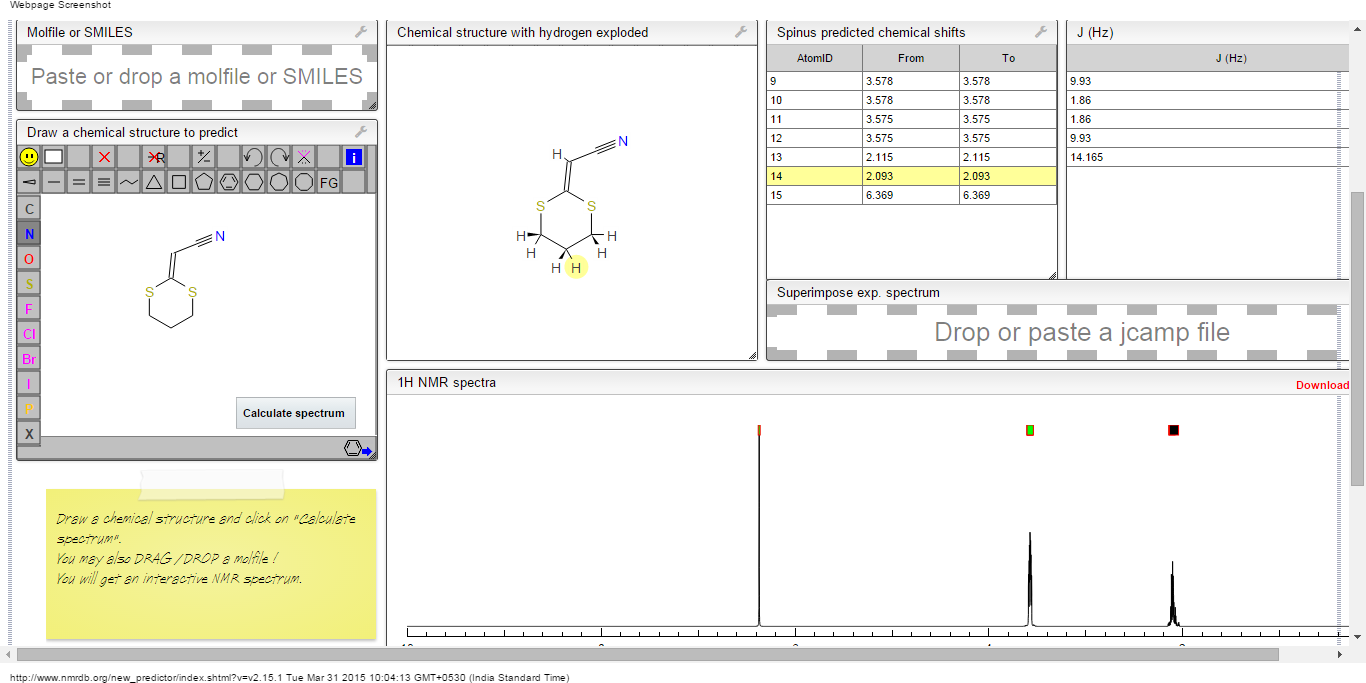
1H  NMR  predict

2-(1,3-dithian-2-ylidene)-acetonitrile

BR 1H

BR 1H 1

ACTUAL 1H NMR VALUES

1 H RMN (300 MHz, CDCl3)

δ 2,23 (m, J 6,8, 2H, CH2);

3,01 (t, J 7,5, 2H, SCH2);

3,06 (t, J 6,9, 2H, SCH2),

5,39 (s, 1H, CH);

……………………..

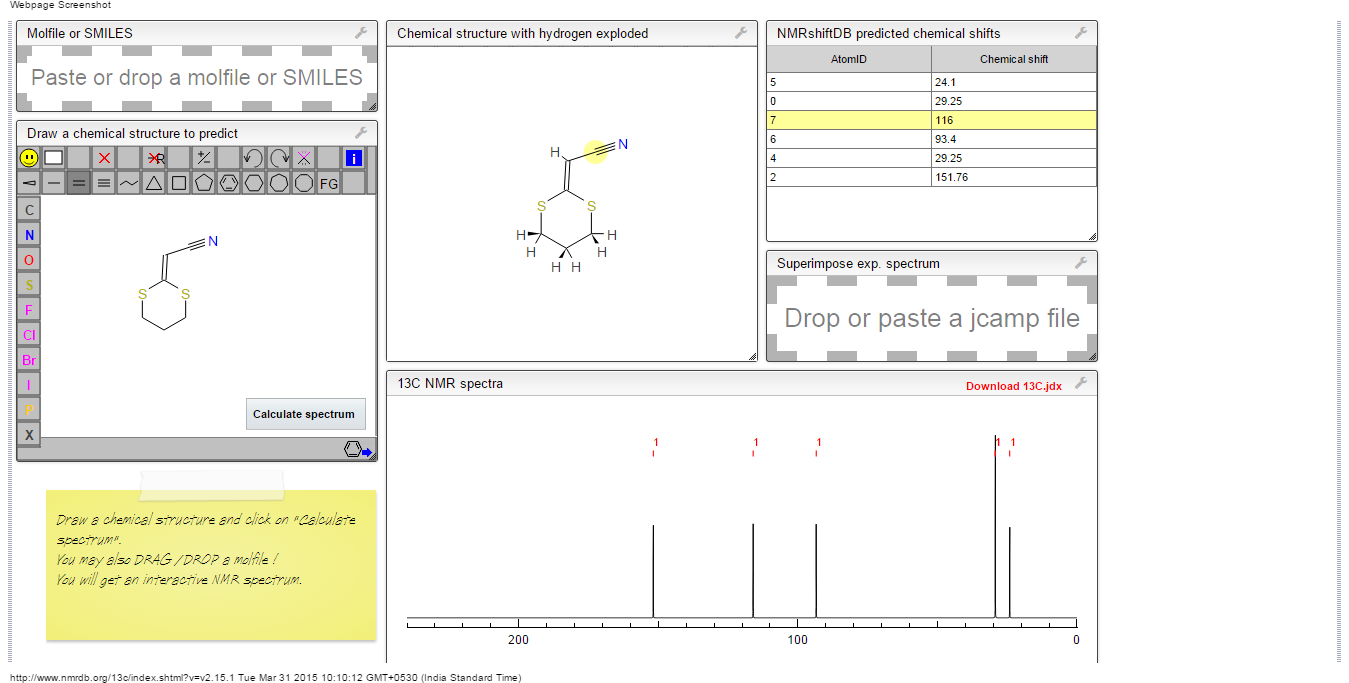
13C NMR PREDICT

BR 13C

BR 13C 1

ACTUAL 13C NMR VALUE

13C RMN (75 MHz, CDCl3)

δ 22,9 (CH2),

28,7 (SCH2),

28,8 (SCH2),

90,4 (CHCN),

116,3 (CN),

163,8 (C=CS)

COSY NMR PREDICT

COSY NMR prediction (6)

SYNTHESIS

  Displaying image020.png

Displaying image016.png

Displaying image018.png

Displaying image019.png

Displaying image021.png

2-(1,3-ditiano-2-ilideno)-acetonitrila (1): Cristal branco. Rendimento: 75%, 165 mg, pf. 60-63 °C, lit1 60-62 °C;

1 H RMN (300 MHz, CDCl3) δ 2,23 (m, J 6,8, 2H, CH2); 3,01 (t, J 7,5, 2H, SCH2); 3,06 (t, J 6,9, 2H, SCH2), 5,39 (s, 1H, CH);

13C RMN (75 MHz, CDCl3) δ 22,9 (CH2), 28,7 (SCH2), 28,8 (SCH2), 90,4 (CHCN), 116,3 (CN), 163,8 (C=CS).

WILL BE UPDATED WATCH OUT…………………

Departamento de Química, Instituto Militar de Engenharia, Praça General Tiburcio

Instituto Militar de Engenharia, Rio de Janeiro. BELOW

Entrada do antigo Instituto de Química da UFRGS, um prédio histórico

Equipe – Os módulos foram fabricados na Unisanta sob a supervisão do professor Luiz Renato Lia, coordenador do Curso de Engenharia Química, …

Instituto de Florestas da Universidade Federal Rural do Rio de Janeiro

Praça General Tibúrcio

Praça General Tibúrcio com o Morro da Urca ao fundo

P.S. : The views expressed are my personal and in no-way suggest the views of the professional body or the company that I represent.

P.S. : The views expressed are my personal and in no-way suggest the views of the professional body or the company that I represent.

P.S. : The views expressed are my personal and in no-way suggest the views of the professional body or the company that I represent.

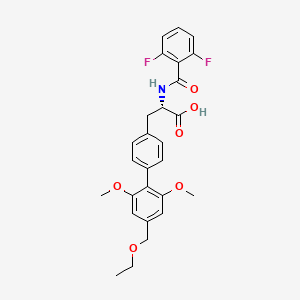
Firategrast, T-0047


Japan

Firategrast.png

Firategrast, 402567-16-2;

Firategrast, MS, Alpha4beta1 integrin

PHASE 2 GSK

Mitsubishi Tanabe Pharma INNOVATOR

Tanabe Seiyaku Co

Glaxo Group Limited, Mitsubishi Tanabe Pharma Corporation

SB 683699, SB-683699, UNII-OJY3SK9H5F
Firategrast; UNII-OJY3SK9H5F; SB-683699; Firategrast (USAN); 402567-16-2; SB683699; T-0047  
Molecular Formula: C27H27F2NO6
Molecular Weight: 499.503186 g/mol
SYSTEMATIC NAME:
1,1′-Biphenyl)-4-propanoic acid, alpha-((2,6-difluorobenzoyl)amino)-4′-(ethoxymethyl)-2′,6′-dimethoxy-, (alphaS)-
N-(2,6-Difluorobenzoyl)-4-[4-(ethoxymethyl)-2,6-dimethoxyphenyl]-L-phenylalanine
N- (2 , 6-Difluorobenzoyl) -4- (2 , 6-dimethoxy-4- ethoxymethylphenyl) -L-phenylalanine .
2S)-2-((2,6-Difluorobenzoyl)amino)-3-(4′-(ethoxymethyl)-2′,6′-dimethoxybiphenyl-4- yl)propanoic acid
(2S)-2-{[(2,6- difluorophenyl)carbonyl]amino}-3-[4′-[(ethyloxy)methyl]-2′,6′-bis(methyloxy)-4- biphenylyl]propanoic acid
(2S)-2-[[2,6-bis(fluoranyl)phenyl]carbonylamino]-3-[4-[4-(ethoxymethyl)-2,6-dimethoxy-phenyl]phenyl]propanoic acid

Pharmacological half-life is 2.5 – 4.5 hours, compared to 11 days for natalizumab, a drug in the same class

Orally bioavailable small molecule α4-integrin antagonist
see

http://www.msdiscovery.org/node/1377#node-biblio-1338

http://multiple-sclerosis-research.blogspot.com/2012/01/research-oral-tysabri-analogue.html

SB683699 is an alpha4 integrin antagonist that had been studied in phase II trials at GlaxoSmithKline under a license from Mitsubishi Tanabe Pharma for the oral treatment of multiple sclerosis (MS) in Europe. GlaxoSmithKline and Tanabe Seiyaku (now Mitsubishi Tanabe Pharma) had been studying the drug candidate for the treatment of asthma, rheumatoid arthritis (RA) and Crohn’s disease

MECHANISMS/EFFECTS

HUMAN:

Similar mechanism of action to natalizumab (α4-integrin blocker), but its faster elimination could improve safety profile

 Firategrast
Firategrast
SYNTHESIS
………………….
PATENT

Scheme 1

Figure imgf000010_0001

Scheme 2

Figure imgf000012_0001

In a further aspect the present invention provides for a process for the preparation of compound of formula (II) which comprises coupling the compound of formula (V)

Figure imgf000012_0002

Suitable coupling conditions for the compound of formula (V) and the compound of formula (VI) include those shown in Scheme 2. In a further aspect of the invention there is provided the compound of formula (V):

Figure imgf000013_0001

1H NMR characterisation data for the compound of formula (V) were generated on an isolated and purified batch. 1H-NMR spectra were recorded on a Bruker Avance 400 at 400MHz, using TMS as an internal reference.1H NMR (400 MHz, DMSO-D6) δ ppm 1.17 (t, J=7.09 Hz, 3 H) 2.96 (dd, J=13.82, 9.90 Hz, 1 H) 3.1 1 (dd, J=13.82, 5.26 Hz, 1 H) 4.12 (q, J=7.09 Hz, 2 H) 4.63 (ddd, J=9.78, 7.82, 5.38 Hz, 1 H) 7.15 (t, J=7.95 Hz, 2 H) 7.25 (d, J=8.31 Hz, 2 H) 7.47 – 7.55 (m, 3 H) 9.23 (d, J=7.83 Hz, 1 H).

The present invention provides a process for the preparation of the compound of formula

Figure imgf000003_0001

which process comprises the steps: a) hydrolysis of an ester of formula (I la):

Figure imgf000004_0001

Recrvstallisation of (2S)-2-{r(2,6-difluorophenyl)carbonyllamino)-3-r4′-r(ethyloxy)methyll- 2′,6′-bis(methyloxy)-4-biphenylyllpropanoic acid

(2S)-2-{[(2,6-difluorophenyl)carbonyl]amino}-3-[4′-[(ethyloxy)methyl]-2′,6′-bis(methyloxy)- 4-biphenylyl]propanoic acid (9.38Kg) was charged into a clean reactor, followed by ethyl acetate (46.9L). The solution was heated to 50°C and filtered into the pre-warmed (35°C) crystallizing vessel. A line-wash with ethyl acetate (9.4L) was carried out. The combined ethyl acetate solutions were heated to 50°C, stirred to ensure complete dissolution. Filtered heptane (9.4L) was added maintaining the temperature at 50°C then the solution cooled to 30°C and seeded with (2S)-2-{[(2,6-difluorophenyl)carbonyl]amino}-3-[4 – [(ethyloxy)methyl]-2′,6′-bis(methyloxy)-4-biphenylyl]propanoic acid (47g) slurried in 1 :9 ethyl acetate:heptane (0.47L). The slurry was aged for 2 hours at 30°C. Filtered heptane (75L) was added over 3 hours. The slurry was then cooled to 0°C over 1 hour. The mixture was aged at 0°C for 1 hour then the solid was filtered off, washed with isopropyl ether (29.6L and dried under vacuum at 50±3°C to give the product (8.55Kg, 91 %). Characterised by having an infrared absorption spectrum with significant absorption bands at about 754, 768, 800, 820, 849, 866, 1006, 1 100, 1 122, 1 157, 1 188, 1225, 1242, 1268, 1292, 1317, 1352, 1417, 1466, 1530, 1580, 1624, 1650, 1662, 171 1 , 1728, 2938, 3302cm

…………………………………..
PATENT

Example 10: N- (2 , 6-Difluorobenzoyl) -4- (2 , 6-dimethoxy-4- ethoxymethylphenyl) -L-phenylalanine ethyl ester.

(1) The product obtained in Example l-(4) (2.1 g) was acylated with 2 , 6-difluorobenzoyl chloride in a similar manner as described in Example 1 -(5) to give N- (2, 6-difluorobenzoyl) – 4- (2 , 6-dimethoxy-4-hydroxymethylphenyl) -L-phenylalanine ethyl ester (2.75 g) . mp . 70-72 °C; IR (Nujol) 3400, 3263, 1735, 1654, 1624 cm“1; MS (APCI) m/z 500 (M+H) . (2) To a solution of the product obtained above (1.72 g) in DMSO (20 ml) were added Et3N (4.8 ml) and S03«pyridine (5.6 g) successively at room temperature. The whole mixture was stirred at room temperature for 25 minutes. The reaction mixture was poured into ice-water, and then the mixture was extracted with EtOAc. The organic layer was sequentially washed with 5% aqueous HCl, H20 and brine, dried (Na2S04) and then evaporated. The residue was purified by column chromatography (silica gel; eluent: n-hexane/EtOAc 5:1 to 1:1) to yield N-(2,6- difluorobenzoyl) -4- (2 , 6-dimethoxy-4-formylphenyl) -L- phenylalanine ethyl ester (1.54 g) . mp. 114-116°C; IR (Nujol)

3332, 1735, 1695, 1657, 1644, 1623 cm“1; MS (APCI) m/z 498 (M+H) .

(3) The product obtained above (716 mg) was converted into the title compound (428 mg) in a similar manner as described in Example 1- (7) . mp . 87-89°C; IR (Neat+CHC13) 3300, 1739, 1668 cm 1; MS (APCI) m/z 528 (M+H) .

Example 11: N- (2 , 6-Difluorobenzoyl) -4- (2 , 6-dimethoxy-4- ethoxymethylphenyl ) -L-phenylalanine methyl ester.

(1) The product obtained in Example 2- (4) (1.00 g) was acylated with 2 , 6-difluorobenzoyl chloride to give N-(2,6- difluorobenzoyl) -4- (2 , 6-dimethoxy-4-hydroxymethylphenyl) -L- phenylalanine methyl ester (873 mg) in a similar manner as described in Example l-(5). IR (Nujol) 3257, 1743, 1655, 1624 cm 1; MS (APCI +Q1MS) m/z 503 (M+NH4) , 486 (M+H) . (2) The product obtained above (860 mg) was converted into the title compound (220 mg) in a similar manner as described in Example 2- (6) and (7).

Example 12: N- (2 , 6-Difluorobenzoyl) -4- (2 , 6-dimethoxy-4- ethoxymethylphenyl) -L-phenylalanine .

The product obtained in Example 10 (200 mg) was hydrolyzed in a similar manner as described in Example 3 to give the title compound (160 mg) . The product obtained in Example 11 (220 mg) was also hydrolyzed in a similar manner as described in Example 3 to give the title compound (167 mg) . mp. 156-158°C; IR (Nujol) 1735, 1655 cm“1; MS (ESI) m/z 498 (M-H) .

…………………….

PATENT

 https://www.google.com/patents/WO2003072536A1?cl=en

OUT LINE

phenylalanine derivative of the formula (I) :

Figure imgf000003_0001

wherein X1 is a halogen atom, X2 is a halogen atom, Q is a group of the formula -CH2– or -(CH2)2– and Y is a lower alkyl group, or a pharmaceutically acceptable salt thereof, which has excellent inhibitory activity against α4 integrin-mediated cell adhesion.

Thus, the present invention relates to a process for preparing a compound of the formula (I) :

Figure imgf000004_0001

wherein the symbols are the same as defined above, or a pharmaceutically acceptable salt thereof, comprising : (1) coupling a compound of the formula (VI) :

Figure imgf000004_0002

wherein Z is a leaving group, R1NH is a protected amino group and C02R is a protected carboxyl group with a compound of the formula (V) :

Figure imgf000004_0003

wherein the symbols are the same as defined above, removing the protecting group from the protected amino group, and if necessary, converting the resulting compound into a salt, to yield a compound of the formula (IV) :

Figure imgf000005_0001

wherein the symbols are the same as defined above, or a salt thereof,

(2) condensing the compound (IV) or a salt thereof with a compound of the formula (III) :

Figure imgf000005_0002

wherein the symbols are the same as defined above, a salt or a reactive derivative thereof to yield a compound of the formula (II) :

Figure imgf000005_0003

Ethyl (ocS) – – [ [ (1, 1-dimethylethoxy) carbonyl] amino] -4- hydroxybenzene propionate and ethyl (otS) -α- [ [ (1, 1- dimethylethoxy) carbonyl] amino] -4-

(trifluoromethanesulfonyloxy) benzene propionate are described in J. Med. Chem. , 33: 1620 (1990) and JP-A-7- 157472, respectively. 4-Bromo-3, 5-dimethoxybenzyl alcohol is described in, for example, J. Med. Chem. , 20: 299 (1977), and can also be prepared according to the following process.

Figure imgf000019_0001

Firstly, 4-bromo-3, 5-dihydroxybenzoic acid is methylated to give methyl 4-bromo-3, 5-dimethoxybenzoate, which is then reduced to yield 4-bromo-3, 5-dimethoxy benzyl alcohol. The methylation can be carried out by reacting with dimethyl sulfate in the presence of a base in a suitable solvent (e.g., ethyl acetate). The reduction can be carried out by reacting with an reducing agent (e.g., lithium alminium hydride, sodium borohydride and calcium borohydride) in a suitable solvent (e.g., tetrahydrofuran) .

EXAMPLES

The following Examples are provided to further illustrate the process of preparation according to the present invention. In the following examples, some compounds may be referred to by different compound name depending on the nomenclature, as illustrated below.

Ethyl (αS) -α-amino-4′ -ethoxymethyl-2′ , 6′ – dimethoxy (1, 1′ -biphenyl) -4-propionate

Another name: ethyl (2S) -2-amino-3- [4- (4-ethoxymethyl- 2, 6-dimethoxyphenyl) phenyl]propanoate

Ethyl (αS) – [ [1, 1-dimethylethoxy] carbonyl] amino] -4′ – ethoxymethyl-2′ , 6′ -dimethoxy (1,1′ -biphenyl) -4-propionate

Another name 1: ethyl (2S) -2- [ (t-butoxycarbonyl) – amino] -3- [4- (4-ethoxymethyl-2, 6-dimethoxyphenyl) – phenyl]propanoate

Another name 2: Ethyl N- (t-butoxycarbonyl) -4- (4- ethoxymethyl-2, 6-dimethoxyphenyl) -L-phenylalanine

Ethyl (αS) – – [ (2, 6-difluorobenzoyl) amino] -4′ – ethoxymethyl-2′ , 6′ -dimethoxy (1, 1′ -biphenyl) -4-propionate Another name 1: Ethyl (2S) -2- [ (2, 6- difluorobenzoyl) amino] -3- [4- (4-ethoxymethyl-2, 6- di ethoxyphenyl) phenyl] propanoate

Another name 2: Ethyl N- [2 , 6-difluorobenzoyl) -4- (4- ethoxymethyl-2, 6-dimethoxyphenyl) -L-phenylalanine

(ocS) – – [ (2, 6-Difluorobenzoyl) amino] -4′ -ethoxymethyl- 2′ , 6′ -dimethox (1,1′ -biphenyl) -4-propionic acid

Another name 1: (2S) -2- [ (2, 6-difluorobenzoyl) amino] -3- [4- (4-ethoxymethyl-2, 6-dimethoxyphenyl) phenyl]propanoic acid

Another name 2: N- [ 2 , 6-difluorobenzoyl) -4- (4- ethoxymethyl-2, 6-dimethoxyphenyl) -L-phenylalanine

EXAMPLE 1 (1) Under nitrogen atmosphere, pyridine (130.3 g) and trifluoromethanesulfonic anhydride (170.4 g) were added dropwise to a solution of ethyl (αS) -α- [ [ (1, 1- dimethylethoxy) carbonyl] amino] -4-hydroxybenzenepropionate

(170.0 g) in dichloromethane (1.7 L) at 10 ° C or below. After stirring for 1 hour at the same temperature, water

(850 ml) was added dropwise to the mixture and the mixture was stirred for 2 hours at the same temperature. The organic layer was washed with 10 % aqueous citric acid solution and aqueous saturated sodium hydrogen carbonate solution, and dried over magnesium sulfate. The solvent was removed in vacuo to yield ethyl (αS) -α- [ [ (1, 1- dimethylethoxy) carbonyl] amino] -4-

(trifluoromethanesulfonyloxy)benzenepropionate (242.5 g) as oil . MS (m/z) : 441 (M+) (2) Under nitrogen atmosphere, to a mixture of ethyl (αS)- – [ [ (1, 1-dimethylethoxy) carbonyl] amino] -4-

(trifluoromethanesulfonyloxy) benzenepropionate (66.2g), 4- ethoxymethyl-2, 6-dimethoxyphenylboric acid (54.0 g) , triphenylphosphine (9.83 g) and N-methylpyrrolidone (330 ml) were added palladium acetate (1.68 g) and diisopropylamine (24.9 g ), and the mixture was heated at 90 °C. After stirring for 1 hour at the same temperature, the mixture was cooled and toluene and water were added. The organic layers were washed with 10% aqueous citric acid solution and saturated aqueous NaCl solution and dried over magnesium sulfate. The solvent was removed in vacuo to yield ethyl (αS) -α- [[ (1, 1-dimethylethoxy) carbonyl] amino] – 4′ -ethoxymethyl-2′ , 6′ -dimethox (1,1′ -biphenyl) -4-propionate (90.1 g) as oil.

The product was dissolved in ethanol (330 ml) , and after addition of p-toluenesulfonic acid monohydrate (28.5 g) , the mixture was stirred for 2 hours at 75 °C. After cooling to room temperature, the mixture was filtrated over charcoal and the filtrate was concentrated under reduced pressure. The residue was dissolved in ethyl acetate with heating. After cooling, the crystalline precipitates were collected by filtration and dried to yield ethyl (αS)-α- amino-4′ -ethoxymethyl-2′ , 6′ -dimethoxy (1, 1′ -biphenyl) -4- propionate p-toluenesulfonate (63.4 g) .

MS (m/z) : 387 (M+-p-toluenesulfonic acid), M.p. 127-129°C

(3) To a mixture of ethyl (αS) -α-amino-4′ -ethoxymethyl- 2′ , 6′ -dimethox (1, 1′ -biphenyl) -4-propionate p- toluenesulfonate (29.0 g) , sodium hydrogen carbonate (15. 2 g) , water (290 ml) and ethyl acetate (290 ml) was added dropwise 2, 6-difluorobenzoyl chloride (9. 6 g) at 15 °C or below and the mixture was stirred for 30 minutes at the same temperature. The ethyl acetate layer was washed with saturated aqueous NaCl solution and dried over magnesium sulfate. The solvent was removed in vacuo. The residue was recrystallized from isopropanol-water to yield ethyl (αS) -oi- [ (2, 6-difluorobenzoyl) amino] -4′ -ethoxymethyl-2′ , 6′ – dimethox (1, 1′ -biphenyl) -4-propionate (26.4 g) . MS (m/z) : 527 (M+) , M.p. 87-89°C (4) To a solution of sodium hydroxide (2.9 g) in water- tetrahydrofuran (317 ml-159 ml) was added ethyl (oιS)-α- [ (2, 6-difluorobenzoyl) amino] -4′ -ethoxymethyl-2′ , 6′ – dimethoxy (1, 1′ -biphenyl) -4-propionate (31.7 g) at 15°C and the mixture was stirred for 4 hours at the same temperature. After neutralizing with IN HC1, the organic solvent was removed in vacuo. The aqueous layer was cooled, the crystalline precipitates were collected by filtration and recrystallized from ethanol-water to yield (αS) -a- [ (2, 6- difluorobenzoyl) amino] -4′ -ethoxymethyl-2′ , 6′ – dimethoxy (1, 1′ -biphenyl) -4-propionic acid (28.8 g) . MS (m/z): 499 (M+) , M.p. 154-155°C

EXAMPLE 2 (1) Under nitrogen atmosphere, a mixture of ethyl (oιS)-o:- [[ (1, 1-dimethylethoxy) carbonyl] amino] -4-bromobenzene propanoate (11.17 g) , 4-ethoxymethyl-2, 6- dimethoxyphenylboronic acid (10.80 g ), palladium acetate (0.34 g), triphenylphosphine (1.57 g) , anhydrous potassium carbonate (12.44 g) , iV-methylpyrrolidone (56 ml) and water (11 ml) was stirred for 50 minutes at 80 °C. After completion of the reaction, the mixture was cooled to room temperature and extracted with ethyl acetate and water. The organic layer was washed with 10% aqueous citric acid solution and saturated aqueous NaCl solution, dried over magnesium sulfate and filtrated. The filtrate was concentrated under reduced pressure to yield ethyl (αS)-α- [ [ (1, 1-dimethylethoxy) carbonyl] amino] -4′ -ethoxymethyl- 2′ , 6′ -dimethox (1, 1′ -biphenyl) -4-propionate (20.4 g) as oil. The product was dissolved in ethanol (100 ml) , and after addition of p-toluenesulfonic acid monohydrate (5.7 g) , the mixture was stirred for 1.5 hours at 75 °C. After cooling, the mixture was filtrated over charcoal and the filtrate was concentrated under reduced pressure. The residue was suspended in toluene with heating. After cooling, the crystalline precipitates were collected by filtration and dried to yield ethyl (αS) – -amino-4′ – ethoxymethyl-2′ , 6′ -dimethoxy (1,1′ -biphenyl) -4-propionate p- toluenesulfonate (13.80 g) . (2) The compound obtained in the above step (1) was treated in the same manner as described in Example 1 (2) to (4) to yield (αS) -a- [ [2 , 6-difluorobenzoyl) amino] -4′ – ethoxymethyl-2′ , 6′ -dimethoxy (1, 1′ -biphenyl) -4-propionic acid. The physicochemical data were the same as that obtained in Example 1.

EXAMPLE 3

To a solution of ethyl (αS) -α- [ (2, 6- difluorobenzoyl) amino] -4′ -ethoxymethyl-2′ , 6′ – dimethox (1, 1′ -biphenyl) -4-propionate (500 g ) in water (12.6 ml) and dioxane (50 ml) was added hydrochloric acid (12.4 g) and the mixture was stirred for 60 hours at 60 “C. The organic solvent was removed in vacuo and the aqueous layer was cooled. The crystalline precipitates were collected by filtration and recrystallized from ethanol- water to yield (αS) – – [ (2, 6-difluorobenzoyl) amino] -4′ – ethoxymethyl-2′ , 6′ -dimethoxy (1,1′ -biphenyl) -4-propionic acid (426 mg) . The physicochemical data were the same as that obtained in Example 1.

REFERENCE EXAMPLE 1

(1) To a mixture of 4-bromo-3, 5-dimethoxybenzylalcohol (44.5 g) , triethylammonium benzyl chloride (2.05 g) and 20% aqueous sodium hydroxide solution (288 g) was added diethyl sulfate (41.7 g) under ice-cooling, and the mixture was stirred overnight at 25-30 °C. After stirring for 1 hour at 70 °C, the mixture was cooled and extracted with toluene. The toluene layer was washed with water and saturated aqueous NaCl solution and dried over magnesium sulfate. The solvent was removed in vacuo to yield 4-bromo-3, 5- dimethoxybenzyl ethyl ether (49.5 g) as colorless oil. MS (m/z): 276 (M++2) , 274 (M+)

(2) Under nitrogen atmosphere, to a solution of 4-bromo- 3, 5-dimethoxybenzyl ethyl ether (440.0 g) in tetrahydrofuran (4.0 L) was added dropwise n-butyl lithium (1.6 M n-hexane solution, 1.1 L) at -60°C. After stirring for 15 minutes at the same temperature, trimethyl borate (249.3 g) was added. The temperature of the mixture was gradually elevated, followed by stirring for 1 hour under ice-cooling. To the mixture was added dropwise 10% aqueous sulfuric acid solution (835 g ) . The mixture was extracted with ethyl acetate and the organic layer was washed with water and saturated aqueous NaCl solution. After drying over magnesium sulfate, the solvent was removed in vacuo. The residue was dissolved in isopropyl ether with heating and cooled. The crystalline precipitates were collected by filtration and dried to yield 4-ethyoxymethyl-2, 6- dimetoxyphenylboronic acid (312.9 g) . M.p. 59-61°C

REFERENCE EXAMPLE 2

(1) To a suspension of 4-bromo-3, 5-dihydroxybenzoic acid (95.0 kg) in ethyl acetate (950 L) were added anhydrous potassium carbonate (270.8 kg) and dimethyl sulfate (174.7 kg) . The mixture was heated at 50-80 ‘C for about 4 hours and partitioned by adding water. The organic layer was washed with water and saturated aqueous NaCl solution and concentrated under reduced pressure. The residue was suspended into methanol, stirred under heating and cooled. The crystalline precipitates were collected by filtration and dried to yield methyl 4-bromo-3, 5-dimethoxybenzoate (98.8 kg) as pale yellow crystals. MS (m/z): 277 (M++2) , 275 (M+) , M.p. 120-122°C

(2) To a solution of calcium chloride (46.5 kg) in ethanol (336 L) were added tetrahydrofuran (672 L) and methyl 4- bromo-3, 5-dimethoxybenzoate (96.0 kg) to obtain a suspension. To the suspension was added sodium borohydride

(31.7 kg) by portions at room temperature, and the mixture was stirred for about 9 hours at temperature of room temperature to 45 °C. The reaction mixture was added dropwise to aqueous HC1 solution and stirred for about 16 hours at room temperature. Organic solvent was removed in vacuo, and water (1440 L) was added to the residue and stirred for 1 hour at 50 °C. After cooling, the crystalline precipitates were collected by filtration and dried to yield 4-bromo-3, 5-dimethoxybenzyl alcohol (83.3 kg) as colorless crystals. MS (m/z): 249 (M++2), 247 (M+) , M.p. 100-102°C.

INDUSTRIAL APPLICABILITY The process for preparation of the present invention makes it possible to afford a compound of the formula (I) or a pharmaceutically acceptable salt thereof with high- purity, in a high yield and inexpensively, and, therefore, the process of the present invention is industrially very useful.

References

GlaxoSmithKline website
US8822527 16 Out 2012 2 Set 2014 Biotheryx, Inc. Substituted biaryl alkyl amides
WO2002018320A2 27 Ago 2001 7 Mar 2002 Tanabe Seiyaku Co INHIBITORS OF α4 MEDIATED CELL ADHESION
WO2003072536A1 27 Fev 2003 4 Set 2003 Tanabe Seiyaku Co A process for preparing a phenylalanine derivative and intermediates thereof
WO2003072537A2 6 Fev 2003 4 Set 2003 Abbott Lab Selective protein tyrosine phosphatatase inhibitors

Mitsubishi Tanabe Pharma Corporation

Mitsubishi Tanabe Pharma Corporation
Pharmacological research building

Mitsubishi Tanabe Pharma Corporation
■Mitsubishi Tanabe Pharma Corporation
Pharmacological research building


P.S. : The views expressed are my personal and in no-way suggest the views of the professional body or the company that I represent.

P.S. : The views expressed are my personal and in no-way suggest the views of the professional body or the company that I represent.

P.S. : The views expressed are my personal and in no-way suggest the views of the professional body or the company that I represent.


P.S. : The views expressed are my personal and in no-way suggest the views of the professional body or the company that I represent.

P.S. : The views expressed are my personal and in no-way suggest the views of the professional body or the company that I represent.

P.S. : The views expressed are my personal and in no-way suggest the views of the professional body or the company that I represent.

Masitinib


Masitinib

Masitinib; 790299-79-5; Masivet; AB1010; AB-1010;

CLASS:Immunomodulator
TARGET:KIT (a stem cell factor, also called c-KIT) receptor as well as select other tyrosine kinases
STATUS FOR MS:Phase III
COMMERCIAL:Under development by AB Science..Ab Science
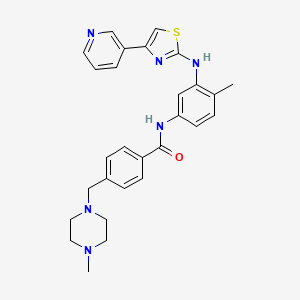
4-((4-Methylpiperazin-1-yl)methyl)-N-(4-methyl-3-((4-(pyridin-3-yl)-1,3-thiazol-2-yl)amino)phenyl)benzamide
AB 1010
UNII-M59NC4E26P

4-((4-Methylpiperazin-1-yl)methyl)-N-(4-methyl-3-((4-(pyridin-3-yl)-1,3-thiazol-2-yl)amino)phenyl)benzamide

Regulatory and Commercial Status

STATUS FOR MS:Phase III
HIGHEST STATUS ACHIEVED (FOR ANY CONDITION):
Marketing Authorization Application for the treatment of pancreatic cancer has been filed with the European Medicines Agency (16 October 2012)
Marketing Authorization Application for the conditional approval in the treatment of pancreatic cancer has been accepted by the European Medicines Agency (30 October 2012)

Masitinib.png

Masitinib is a tyrosine-kinase inhibitor used in the treatment of mast cell tumors in animals, specifically dogs.[1][2] Since its introduction in November 2008 it has been distributed under the commercial name Masivet. It has been available in Europe since the second part of 2009. In the USA it is distributed under the name Kinavet and has been available for veterinaries since 2011.

Masitinib is being studied for several human conditions including cancers. It is used in Europe to fight orphan diseases.[3]

Mechanism of action

Masitinib inhibits the receptor tyrosine kinase c-Kit which is displayed by various types of tumour.[2] It also inhibits the platelet derived growth factor receptor (PDGFR) and fibroblast growth factor receptor (FGFR).


http://www.google.com/patents/WO2012136732A1?cl=en

In a preferred embodiment of the above-depicted treatment, the active ingredient masitinib is administered in the form of masitinib mesilate; which is the orally bioavailable mesylate salt of masitinib – CAS 1048007-93-7 (MsOH); C28H30N6OS.CH3SO3H; MW 594.76:

Figure imgf000031_0001


http://www.google.com/patents/WO2004014903A1?cl=en

Figure imgf000021_0001

003 : 4-(4-Methyl-piperazin-l-ylmethyl)-N-[3-(4-pyridin-3-yl-thiazol-2-ylamino)- phenyl] -benzamide

4-(4-Methyl-piperazin-l-yl)-N-[4-methyl-3-(4-pyridin-3-yl-thiazol-2-ylmethyl)- phenyl] -benzamide

Figure imgf000053_0001

beige brown powder mp : 128-130°C

1H RMN (DMSO-d6) δ = 2.15 (s, 3H) ; 2.18 (s, 3H) ; 2.35-2.41 (m, 4H) ; 3.18-3.3.24 (m, 4H) ; 6.94 (d, J = 8.9 Hz, 2H) ; 7.09 (d, J = 8.4 Hz, IH) ; 7.28-7.38 (m, 3H) ; 7.81 (d, J = 8.9 Hz, 2H) ; 8.20-8.25 (m, IH) ; 8.40 (dd, J = 1.6 Hz, J = 4.7 , IH) ; 8.48 (d, J = 1.9 Hz, IH) ; 9.07 (d, J = 1.5 Hz, IH) ; 9.35 (s, IH) ; 9.84 (s, IH)

……………

http://www.google.com/patents/WO2008098949A2?cl=en

EXAMPLE 4 N- [4-Methyl-3 -(4-pyridin-3 -yl-thiazol-2-ylamino)-phenyl] -benzamide derivatives

Method A In a reactor and under low nitrogen pressure, add 4-Methyl-N3-(4-pyridin-3-yl-thiazol- 2-yl)-benzene-l,3-diamine (95 g, 336.45 mmol), dichloromethane (2 L). To this suspension cooled to temperature of 5°C was added dropwise 2M/n-hexane solution of trimethylaluminium (588 mL). The reaction mixture was brought progressively to 15°C, and maintained for 2 h under stirring. 4-(4-Methyl-piperazin-l-ylmethyl)-benzoic acid methyl ester (100 g, 402.71 mmol) in dichloromethane (200 mL) was added for 10 minutes. After 1 h stirring at room temperature, the reaction mixture was heated to reflux for 20 h and cooled to room temperature. This solution was transferred dropwise via a cannula to a reactor containing 2N NaOH (2.1 L) cooled to 5°C. After stirring for 3 h at room temperature, the precipitate was filtered through Celite. The solution was extracted with dichloromethane and the organic layer was washed with water and saturated sodium chloride solution, dried over MgSO4 and concentrated under vacuum. The brown solid obtained was recrystallized from /-Pr2O to give 130.7 g (78%) of a beige powder.

Method B Preparation of the acid chloride

To a mixture of 4-(4-Methyl-piperazin-l-ylmethyl)-benzoic acid dihydrochloride (1.0 eq), dichloromethane (7 vol) and triethylamine (2.15 eq), thionyl chloride (1.2 eq) was added at 18-28°C . The reaction mixture was stirred at 28-32°C for 1 hour. Coupling of acid chloride with amino thiazole To a chilled (0-50C) suspension of 4-Methyl-N3-(4-pyridin-3-yl-thiazol-2-yl)-benzene- 1,3-diamine (0.8 eq) and thiethylamine (2.2 eq) in dichloromethane (3 vol), the acid chloride solution (prepared above) was maintaining the temperature below 5°C. The reaction mixture was warmed to 25-300C and stirred at the same temperature for 1O h. Methanol (2 vol) and water (5 vol) were added to the reaction mixture and stirred. After separating the layers, methanol (2 vol), dihloromethane (5 vol) and sodium hydroxide solution (aqueous, 10%, till pH was 9.5-10.0) were added to the aqueous layer and stirred for 10 minutes. The layers were separated. The organic layer was a washed with water and saturated sodium chloride solution. The organic layer was concentrated and ethanol (2 vol) was added and stirred. The mixture was concentrated. Ethanol was added to the residue and stirred. The product was filtered and dried at 50-550C in a vaccum tray drier. Yield = 65-75%.

Method C

To a solution of 4-methyl-N3-(4-pyridin-3-yl-thiazol-2-yl)-benzene-l,3-diamine (1.0 eq) in DMF (20 vol) were added successively triethylamine (5 eq), 2-chloro-l- methylpyridinium iodide (2 eq) and 4-(4-methyl-piperazin-l-ylmethyl)-benzoic acid (2 eq). The reaction mixture was stirred for 7 h at room temperature. Then, the mixture was diluted in diethyl ether and washed with water and saturated aqueous NaHCO3, dried over Na2SO4 and concentrated. The crude product was purified by column chromatography using an elution of 100% EtOAc to give a yellow solid.

Yield = 51%.

1H NMR (CDCl3) : δ = 9.09 (IH, s, NH); 8.52 (IH, br s); 8.27 (IH, s); 8.13 (IH, s);

8.03 (IH, s); 7.85 (2H, d, J= 8.3Hz); 7.45 (2H, m); 7.21-7.38 (4H, m); 6.89 (IH, s);

3.56 (2H, s); 2.50 (8H, br s); 2.31 (6H, br s).

MS (CI) m/z = 499 (M+H)+.

An additional aspect of the present invention relates to a particular polymorph of the methanesulfonic acid salt of N-[4-Methyl-3-(4-pyridin-3-yl-thiazol-2-ylamino)-phenyl]- benzamide of formula (IX).

Figure imgf000023_0001

(VI)

Hereinafter is described the polymorph form of (IX) which has the most advantageous properties concerning processability, storage and formulation. For example, this form remains, dry at 80% relative humidity and thermodynamically stable at temperatures below 2000C.

The polymorph of this form is characterized by an X-ray diffraction pattern illustrated in FIG.I, comprising characteristic peaks approximately 7.269, 9.120, 11.038, 13.704, 14.481, 15.483, 15.870, 16.718, 17.087, 17.473, 18.224, 19.248, 19.441, 19.940, 20.441, 21.469, 21.750, 22.111, 23.319, 23.763, 24.120, 24.681, 25.754, 26.777, 28.975, 29.609, 30.073 degrees θ, and is also characterized by differential scanning calorimetry (DSC) illustrated in FIG.II, which exhibit a single maximum value at approximately 237.49 ± 0.3 0C. X-ray diffraction pattern is measured using a Bruker AXS (D8 advance). Differential scanning calorimetry (DSC) is measured using a Perking Elmer Precisely (Diamond DSC).

This polymorph form can be obtained by treatement of 4-(4-Methyl-piperazin-l- ylmethyl)-N-[4-methyl-3-(4-pyridin-3-yl-thiazol-2-ylamino)-phenyl]-benzamide with 1.0 to 1.2 equivalent of methanesulfonic acid, at a suitable temperature, preferably between 20-800C.

The reaction is performed in a suitable solvent especially polar solvent such as methanol or ethanol, or ketone such as acetone, or ether such as diethylether or dioxane, or a mixture therof. This invention is explained in example given below which is provided by way of illustration only and therefore should not be construed to limit the scope of the invention. Preparation of the above-mentioned polymorph form of 4-(4-Methyl-piperazin-l- ylmethyl)-N- [4-methyl-3 -(4-pyridin-3 -yl-thiazol-2-ylamino)-phenyl] -benzamide methanesulfonate .

4-(4-Methyl-piperazin- 1 -ylmethyl)-N- [4-methyl-3 -(4-pyridin-3 -yl-thiazol-2-ylamino) phenyl] -benzamide (1.0 eq) was dissolved in ethanol (4.5 vol) at 65-700C. Methanesulfonic acid (1.0 eq) was added slowly at the same temperature. The mixture was cooled to 25-300C and maintained for 6 h. The product was filtered and dried in a vacuum tray drier at 55-600C. Yield = 85-90%. Starting melting point Smp = 236°C.

References

  1. Hahn, K.A.; Oglivie, G.; Rusk, T.; Devauchelle, P.; Leblanc, A.; Legendre, A.; Powers, B.; Leventhal, P.S.; Kinet, J.-P.; Palmerini, F.; Dubreuil, P.; Moussy, A.; Hermine, O. (2008). “Masitinib is Safe and Effective for the Treatment of Canine Mast Cell Tumors”. Journal of Veterinary Internal Medicine 22 (6): 1301–1309. doi:10.1111/j.1939-1676.2008.0190.x. ISSN 0891-6640.
  2.  Information about Masivet at the European pharmacy agency website
  3.  Orphan designation for Masitinib at the European pharmacy agency website
WO2004014903A1 Jul 31, 2003 Feb 19, 2004 Ab Science 2-(3-aminoaryl)amino-4-aryl-thiazoles and their use as c-kit inhibitors
WO2008098949A2 Feb 13, 2008 Aug 21, 2008 Ab Science Process for the synthesis of 2-aminothiazole compounds as kinase inhibitors
EP1525200B1 Jul 31, 2003 Oct 10, 2007 AB Science 2-(3-aminoaryl)amino-4-aryl-thiazoles and their use as c-kit inhibitors
US7423055 Aug 1, 2003 Sep 9, 2008 Ab Science 2-(3-Aminoaryl)amino-4-aryl-thiazoles for the treatment of diseases
US20080207572 * Jul 13, 2006 Aug 28, 2008 Ab Science Use of Dual C-Kit/Fgfr3 Inhibitors for Treating Multiple Myeloma
Masitinib.svg
Systematic (IUPAC) name
4-[(4-Methylpiperazin-1-yl)methyl]-N-(4-methyl-3-{[4-(pyridin-3-yl)-1,3-thiazol-2-yl]amino}phenyl)benzamide
Clinical data
Trade names Masivet, Kinavet
AHFS/Drugs.com International Drug Names
Identifiers
790299-79-5
L01XE22
PubChem CID 10074640
ChemSpider 8250179
ChEMBL CHEMBL1908391
Chemical data
Formula C28H30N6OS
498.64 g/mol
Patent Submitted Granted
2-(3-Aminoaryl)amino-4-aryl-thiazoles for the treatment of diseases [US7423055] 2004-06-10 2008-09-09
2-(3-aminoaryl)amino-4-aryl-thiazoles and their use as c-kit inhibitors [US2005239852] 2005-10-27
Use of C-Kit Inhibitors for Treating Fibrosis [US2007225293] 2007-09-27
Use of Mast Cells Inhibitors for Treating Patients Exposed to Chemical or Biological Weapons [US2007249628] 2007-10-25
Use of c-kit inhibitors for treating type II diabetes [US2007032521] 2007-02-08
Use of tyrosine kinase inhibitors for treating cerebral ischemia [US2007191267] 2007-08-16
Use of C-Kit Inhibitors for Treating Plasmodium Related Diseases [US2008004279] 2008-01-03
Tailored Treatment Suitable for Different Forms of Mastocytosis [US2008025916] 2008-01-31
2-(3-AMINOARYL) AMINO-4-ARYL-THIAZOLES AND THEIR USE AS C-KIT INHIBITORS [US2008255141] 2008-10-16
Use Of C-Kit Inhibitors For Treating Inflammatory Muscle Disorders Including Myositis And Muscular Dystrophy [US2008146585] 2008-06-19
Patent Submitted Granted
Aminothiazole compounds as kinase inhibitors and methods of using the same [US8940894] 2013-05-10 2015-01-27
Aminothiazole compounds as kinase inhibitors and methods of using the same [US8492545] 2012-03-08 2013-07-23
Patent Submitted Granted
Use of Dual C-Kit/Fgfr3 Inhibitors for Treating Multiple Myeloma [US2008207572] 2008-08-28
PROCESS FOR THE SYNTHESIS OF 2-AMINOTHIAZOLE COMPOUNDS AS KINASE INHIBITORS [US8153792] 2010-05-13 2012-04-10
COMBINATION TREATMENT OF SOLID CANCERS WITH ANTIMETABOLITES AND TYROSINE KINASE INHIBITORS [US8227470] 2010-04-15 2012-07-24
Anti-IGF antibodies [US8580254] 2008-06-19 2013-11-12
COMBINATIONS FOR THE TREATMENT OF B-CELL PROLIFERATIVE DISORDERS [US2009047243] 2008-07-17 2009-02-19
TREATMENTS OF B-CELL PROLIFERATIVE DISORDERS [US2009053168] 2008-07-17 2009-02-26
Anti-IGF antibodies [US8318159] 2009-12-11 2012-11-27
SURFACE TOPOGRAPHIES FOR NON-TOXIC BIOADHESION CONTROL [US2010226943] 2009-08-31 2010-09-09
EGFR/NEDD9/TGF-BETA INTERACTOME AND METHODS OF USE THEREOF FOR THE IDENTIFICATION OF AGENTS HAVING EFFICACY IN THE TREATMENT OF HYPERPROLIFERATIVE DISORDERS [US2010239656] 2010-05-10 2010-09-23
ANTI CD37 ANTIBODIES [US2010189722] 2008-08-08 2010-07-29
United States National Library of Medicine

Note: Compound name must be entered under “Substance Identification” and then “Names and Synonyms” selected to view synonyms.

Kocic I, Kowianski P, Rusiecka I, Lietzau G, Mansfield C, Moussy A, Hermine O, Dubreuil P
Naunyn Schmiedebergs Arch Pharmacol. 2014 Oct 26. Epub 2014 Oct 26. PMID: 25344204.Abstract
 AB SCIENCE HEADQUARTER
3, Avenue George V
75008 PARIS – FRANCE
Tel. : +33 (0)1 47 20 00 14
Fax. : +33 (0)1 47 20 24 11

P.S. : The views expressed are my personal and in no-way suggest the views of the professional body or the company that I represent.

P.S. : The views expressed are my personal and in no-way suggest the views of the professional body or the company that I represent.

P.S. : The views expressed are my personal and in no-way suggest the views of the professional body or the company that I represent.

Flupirtine Revisited


Flupirtine3Dan.gif

Flupirtine, D 9998

2-amino-6-(4-fluoro-benzylamino)- pyridin-3-yl)-carbamic acid ethyl ester, is unique as a non-opioid, non-NSAID, non-steroidal analgesic with a favorable tolerability. It first became available in Europe in 1984, and was sold mainly under the names Katadolon, Trancolong, Awegal, Efiret, Trancopal Dolo, and Metanor

PHASE 2

MS

  • Neuronal potassium channels (7)
  • Membrane resting potential (6)
  • NMDA receptor channels (indirectly)(14)
  • Originally developed by Asta Medica (1) (4)
  • Being developed and commercialized to treat fibromyalgia by Synthetic Biologics (1)

Flupirtine

Flupirtine.svg

75507-68-5 maleate
56995-20-1 (free base)
LAUNCHED 1986 NEUROPATHIC PAIN

Flupirtine maleate is the INN for 2-amino-3-ethylcarbamato-6- (4-fluoro-benzylamino) maleate, CAS: 75507-68-5, molar mass 420.40 g / mol, molecular formula C1 5 H17FN4O2 • C4H4O4, and corresponds to the structure of formula I.

Figure imgf000002_0001

Flupirtine maleate is used, for example, under the trade name Katadolon® as an analgesic.

56995-20-1
CAS Name: [2-Amino-6-[[(4-fluorophenyl)methyl]amino]-3-pyridinyl]carbamic acid ethyl ester
Additional Names: 2-amino-6-[(p-fluorobenzyl)amino]-3-pyridinecarbamic acid ethyl ester
Trademarks: D-9998
Molecular Formula: C15H17FN4O2
Molecular Weight: 304.32
Percent Composition: C 59.20%, H 5.63%, F 6.24%, N 18.41%, O 10.51%
Properties: Crystals from isopropanol, mp 115-116°. 5% ethanol soln is colorless, turns green on exposure to air for 20 hours. LD50 orally in mice, rats: 617, 1660 mg/kg (Jakovlev).
Melting point: mp 115-116°
Toxicity data: LD50 orally in mice, rats: 617, 1660 mg/kg (Jakovlev)
Derivative Type: Hydrochloride
Molecular Formula: C15H17FN4O2.HCl
Molecular Weight: 340.78
Percent Composition: C 52.87%, H 5.32%, F 5.57%, N 16.44%, O 9.39%, Cl 10.40%
Properties: Crystals from water, mp 214-215°. When prepd industrially contains intensely blue by-product.
Melting point: mp 214-215°
Derivative Type: Maleate
CAS Registry Number: 75507-68-5
Trademarks: Katadolon (AWD)
Molecular Formula: C15H17FN4O2.C4H4O4
Molecular Weight: 420.39
Percent Composition: C 54.28%, H 5.04%, F 4.52%, N 13.33%, O 22.84%
Properties: Colorless crystals from isopropanol, mp 175.5-176°. Formed as mixture of two crystalline forms A and B; mixtures containing 60-90% A are preferred.
Melting point: mp 175.5-176°
Therap-Cat: Analgesic.

TARGET:

Neuronal potassium channels
Membrane resting potential

NMDA receptor channels (indirectly)

STATUS FOR MS:
Phase II
COMMERCIAL:
Originally developed by Asta Medica
Being developed and commercialized to treat fibromyalgia by Synthetic Biologics
Marketed for pain indications in various European countries by Meda
TRADE NAME:
Effirma (US)

Katadolon (Brazil, Germany, Latvia, Estonia, Slovakia, Lithiania, Russian Federation)

SYNONYMS:
EINECS 260-503-8,UNII-MOH3ET196H, Effirma (US), Katadolon (Brazil, Germany, Latvia, Estonia, Slovakia, Lithiania, Russian Federation)
SYSTEMATIC NAME:
Carbamic acid, (2-amino-6-(((4-fluorophenyl)methyl)amino)-3-pyridinyl)-, ethyl ester
PROPERTIES:
Molecular weight: 304

MECHANISMS/EFFECTS

HUMAN:

Stabilizes membrane resting potential by activating neuronal Kv7 potassium channels

Indirectly antagonizes NMDA receptors

Reduces muscle spasticity in humans

Prevents apoptosis and reduced formation of reactive oxygen species by in cultured human retinal pigment epithelial cells

 Scheme 1.
Structures of flupirtine, D13223, and retigabine.

Regulatory and Commercial Status

STATUS FOR MS:

Phase II

HIGHEST STATUS ACHIEVED (FOR ANY CONDITION):
Approved in Europe
ADMINISTRATION:
Oral
COMMERCIAL:
Originally developed by Asta Medica
Being developed and commercialized to treat fibromyalgia by Synthetic Biologics

Marketed for pain indications in various European countries by Meda

Flupirtine is an aminopyridine that functions as a centrally acting non-opioid analgesic. It first became available in Europe in 1984, and is sold mainly under the names Katadolon, Trancolong, Awegal, Efiret, Trancopal Dolo, and Metanor.[5] Flupirtine is sold by Intas Pharma under the brand name Pruf in India. Like nefopam, it is unique among analgesics in that it is a non-opioid, non-NSAID, non-steroidal centrally acting analgesic. In 2010 the chemically related drug (the difference being that the pyridine group in flupirtine is replaced with a phenyl group) retigabine (INN; ezogabine [USAN]) was approved by the FDA as an anticonvulsant for the treatment of refractory partial-onset seizures in treatment-experienced patients.[6] Retigabine also works by opening the neuronal KCNQ/Kv7 potassium channel, just like flupirtine.

History

Flupirtine was originally developed by Asta Medica, with the synthesis of the compound and the development of the drug described in patents from the 1970s to the 2000s.[7][8][9][10][11][12]

It was approved for the treatment of pain in 1984 in Europe. However, it has never been introduced to the United States market for any indication. In 2008, Adeona Pharmaceuticals, Inc. (now called Synthetic Biologics, Inc.) obtained an option to license issued and patent pending applications relating to flupirtine’s use in the treatment of ophthalmic indications, particularly retinitis pigmentosa.[13]

Mechanism of Action

Flupirtine is a selective neuronal potassium channel opener that also has NMDA receptor antagonist and GABAA receptor modulatory properties.[14]

Uses

Flupirtine is used as an analgesic for acute and chronic pain, in moderate-to-severe cases.[15] Its muscle relaxant properties make it popular for back pain and other orthopedic uses, but it is also used for migraines, in oncology, postoperative care, and gynecology.

Flupirtine has been noted for its neuroprotective properties, and it is being investigated for possible use in Creutzfeldt–Jakob disease, Alzheimer’s disease, and multiple sclerosis.[16][17] It has also been proposed as a possible treatment for Batten disease.[18]

Flupirtine underwent a clinical trial as a treatment for multiple sclerosis[19] and fibromyalgia.[20] Flupirtine showed promise for fibromyalgia due to its different action than the three approved by U.S. FDA drugs: Lyrica (pregabalin), Savella (milnacipran), and Cymbalta (duloxetine).[21] Additionally, there are case reports regarding flupirtine as a treatment for fibromyalgia.[22] Adeona Pharmaceuticals (now called Synthetic Biologics) sub-licensed its patents for using flupirtine for fibromyalgia to Meda AB in May 2010.[21]

Side Effects

The most serious side effect is frequent hepatotoxicity which prompted regulatory agencies to issue several warnings and restrictions.[23][24]

Flupirtine is devoid of negative psychological or motor function effects, or effects on reproductive function.[25][26]

Abuse and Dependence

Although some studies have reported flupirtine has no addictive properties,[27][28] there was suggestion that it may possess some abuse potential and liability.[29] There were at least two registered cases of flupirtine abuse.[30] Drug tolerance does not develop in most cases; however, tolerance may develop in single cases.[30]

Flupirtine is 2-amino-3-carbethoxyamino-6-(p-fluorobenzylamino) pyridine; CAS No: 56995-20-1 , an aminopyridine that functions as a centrally acting non-opioid analgesic. It first became available in Europe in 1984, and is sold mainly under the names atadolon, Trancolong, Awegal, Efiret, Trancopal Dolo, and Metanor. It is unique as a non- opioid, non-NSAID, non-steroidal analgesic. Flupirtine is used as an analgesic for acute and chronic pain, in moderate to severe cases. Its muscle relaxant properties make it popular for back pain and other orthopaedic uses, but it is also used for migraines, in oncology, postoperative care, and gynaecology. Flupirtine has been noted for its neuro-protective properties, as well as its possible uses for Creutzfeld- Jakob disease, Alzheimer’s disease, and multiple sclerosis are being investigated. It has also been proposed as a possible treatment for Batten disease. Flupirtine also acts as an antioxidant and prevent free radical- mediated structural damage.

US3481943 (hereinafter referred as ‘943) discloses the process for the preparation of flupirtine hydrochloride of formula (T) wherein p- fluorobenzylamine (formula R) is reacted with 2-amino-3-nitro-6- chloropyridine (Q) in n-propanol using potassium carbonate to prepare 2-amino-3-nitro-6-p-fluorobenzylamino-pyridine of formula (S) which is hydrogenated in dioxane using raney nickel at 50 C under a gauge pressure of 30 atmospheres. Solution is filtered off to remove the catalyst and then reacted with chloroformic acid ethyl ester (ethyl chloroformate) while stirring. The product is filtered off and recrystallized from water to give flupirtine hydrochloride salt of formula (T). The process disclosed therein in ‘943 is depicted as given below

Drawbacks associated with the process disclosed in ‘943 are:

1) The yield of 2-amino-3-nitro-6-p-fluorobenzylamino-pyridine of formula S obtained is around 40% only. ‘943 does not disclose the preparation of maleate salt of flupirtine.

2) During the preparation hydrochloride salt of flupirtine on an industrial scale, intensely blue colored by products are formed which are either difficult to remove or can not be removed completely.

3) Use of n-propanol as reaction solvent is expensive. reaction mass thereby hindering the progress of the reaction. Another most probable reason attributed for getting poor yield of 40% in the said process could be masking of hydrochlorides of both the reactants of formulae (Q’) and (R’) (as both reactants are amino compounds and form hydrochlorides) over potassium carbonate making it unavailable for further reaction posing problem towards the completion of reaction thereby adversely affecting the yield.

DE3133519 (US4481205) discloses the preparation of flupirtine maleate of formula (IA), wherein 2-amino-3-nitro-6-chloro-pyridine of formula (S) is prepared by taking 2,6-dichloro-3-nitropyridine of formula (P) (90%, water wet) in isopropanol at 20°-30°C and purging ammonia gas (or dropping liquid ammonia) into the said reaction mixture and then resulting 2-amino-3-nitro-6-chloro-pyridine of formula (Q) is reacted with p-fluorobenzylamine (R) in isopropanol using triethyl amine as a base ; the reaction mixture is refluxed for 6 hours. Thereupon after addition of a large volume of water the compound 2-amino-3-nitro-6-(p- fluorobenzylamino)-pyridine of formula (S) precipitates.

2-amino-3-nitro-6-(4-fluorobenzylamino) pyridine of formula (S) is then hydrogenated in the presence of raney nickel at 5 bar at 60°C to give 2,3- diamino-6-(4-fluorobenzylamino) pyridine using 2-methoxy ethanol as hydrogenating solvent. This is followed by acylation with ethyl chloroformate using triethylamine as a base under inert gas atmosphere to obtain flupirtine base of formula (I). The catalyst is filtered off and filtrate containing dissolved triethyi amine hydrochloride is directly added to solution of maleic acid in isopropanol resulting into formation of crude flupirtine maleate (IA). It also discloses the importance of the exclusion of atmospheric oxygen by an intensive supply of inert gas and closed reactor system to avoid development of troublesome coloured complexes.

The purification of crude flupirtine maleate is carried out by converting crude flupirtine maleate into crude flupirtine base by contacting with ammonia or sodium hydroxide solution. Then the crude flupirtine base is recrystallized from isopropanol and, after contacting with activated carbon/kieselguh’r, it is reacted with a solution of maleic acid in isopropanol to give flupirtine maleate of formula (IA). The reaction scheme of DE3133519 is depicted herein below.

Drawbacks associated with the process disclosed in DE3133519 (US4481205) are:

1) Use of gaseous ammonia or liquid ammonia for the preparation of 2-amino-3-nitro-6-chloro-pyridine of formula (Q) starting from 2, 6- dichloro-3-nitropyridine of formula (P) contributes towards increased level of impurities of formulae X and Y as the gaseous ammonia and liquid ammonia as sources of ammonia are in concentrated forms and it is not easy to control the purging or addition in appropriate quantities and as a consequence it results in the formation of higher amounts of impurities and poor yield of the desired compound.

Another disadvantage of using ammonia gas is that it is classified as a hazardous material and is subject to strict regulations and risk management procedures for transport, storage, and handling. These requirements result in additional costs and may generate local community concerns over transporting and storing hazardous materials. While aqueous ammonia used by the inventors requires minimal special handling, social and regulatory requirements.

2) Preparation of 2-amino-3-nitro-6-(p-fluorobenzylamino)-pyridine of formula (S comprises reaction between 2-amino-3-nitro-6-chloro- pyridine of formula (Q) and p-fluorobenzylamine of formula (R) using isopropanol as solvent and triethyl amine as base. To induce separation of 2-amino-3-nitro-6-(p-fluorobenzylamino)-pyridine of formula (S from the reaction mixture in IP A a large volume of water is required which makes reaction mass highly voluminous therefore, not preferred at industrial scale. 3) Basification of crude flupirtine maleate comprising the process of liberating free flupirtine base using ammonia or sodium hydroxide produces an ammonium or sodium salt which pollutes the water.

4) Use of activated charcoal and kieselgulir during the purification of flupirtine base (that contains three amino groups known for their light and colour sensitive nature) takes prolonged time for filtration through filtering bed thereby exposing to environment producing high coloration.

5) The crude flupirtine maleate remains trapped with triethyl amine hydrochloride.

US59591 15A (hereinafter referred as Ί 15) discloses a process for the preparation of flupirtine maleate (IA) as discussed under DE3133519 (US4481205). It also discloses crystalline form “A” of flupirtine maleate by the use of water soluble alcohols (such as ethanol or isopropanol) during synthesis and/or purification. There are three proposed variants in Ί 15 as shown below: process variant:

A: ANFP (S)→hydrogenation→acylation→crude flupirtine base.

B: crude flupirtine base→maleic acid→crude flupirtine maleate

C-E (as shown in scheme-II): not applicable F: crude maleate→pure maleate.

1 s process variant comprises synthesis of oxygen sensitive crude base in situ in process step A and it was converted by a “very rapid” suction filtration process into an aqueous maleic acid solution from which coloured crude flupirtine maleate (IA) is obtained, which is to be purified by recrystallization from isopropanol-water.

2″ process variant:

A: ANFP (S)→hydrogenation→acylation→crude flupirtine base.

B: flupirtine base→maleic acid→crude flupirtine maleate.

C-F (as shown in scheme-II): Not applicable.

G: without isolation of the crude maleate→pure maleate.

As compared to the process step F in 1st variant, process step G in 2nd variant represents substantially shorter alternative process in which the precipitation of crude flupirtine maleate from the flupirtine base formed in situ in isopropanol is effected by Alteration with suction into an aqueous maleic acid solution at 50-60°C and, after that without isolation of the crude maleate, colourless pure material is obtained.

3rd process variant:

A: ANFP (S)→hydrogenation→acylation→cmde flupirtine base (isolated)

B: pure flupirtine base→maleic acid→pure flupirtine maleate.

Herein, after acylation, the flupirtine base (I) is precipitated preferably in ethanol or water and is purified by recrystallization and than treated with maleic acid to prepare pure flupirtine maleate (IA).

Ί 15 disclose hydrogenation of ANFP (S), acylation and precipitation in water-soluble alcohols, such as ethanol or isopropanol.

1) In 1st process variant “very rapid” suction filtration process is a great limitation at plant scale.

2) 2nd process variant also does not produce colorless pure maleate.

3) In 3 process variant, after acylation, the flupirtine base is precipitated preferably in ethanol or water and is purified by recrystallization and than treated with maleic acid to prepare pure flupirtine maleate salt (IA).

It also discloses that although the treatment of final product with activated carbon and recrystallization is known as a reasonably successful procedure to remove impurities. This approach is reluctantly accepted because of the losses in overall yield as it is applied in the last production step of a drug and particularly in the case of flupirtine, it is not a preferred/desirable procedure as it may result into the formation of colored impurities.

US47851 10A discloses a process for the preparation of 2-amino-3-nitro- 6-fluorobenzylamino pyridine of formula (S) comprising reaction of 2- amino-3-nitro-6-methoxypyridine of formula (T) (1 mole) with 4-fluoro- benzylamine of formula R (2-4 mole) optionally as a mineral acid salt in water at a temperature between 70°C and 150°C; preferably between 90° and 120°C. The said condensation is also performed in autoclave as the temperature is above 100°C.It also discloses the necessity of using basic material suitably as an aqueous solution in case when acid addition salts of 4-fluoro-benzylamine of formula (R) is used to liberate the free base for the reaction. It also discloses subsequent reduction of nitro group of 2-amino-3-nitro-6-methoxypyridine by various modes with preference to catalytic hydrogenation optionally in the presence of carriers selected from barium sulphate, calcium sulphate, magnesium sulphate, sodium sulphate etc.

The drawbacks associated with the process described in US47851 10A are: 1) As per the experimental section of the said process of condensation for the preparation of 2-amino-3-nitro-6-fluorobenzylamino pyridine of formula (S) discloses heating at boiling for ten hours. The temperature would be around 100°C as water is used as solvent. However, inventors of the subject invention disclose herein the same process comprising using 6-chlorpyridine instead of 6-methoxy pyridine and water as solvent’, wherein the reaction is carried out at temperature much below boiling point of water and reaction gets completed in 3 hrs compare to 10 hrs at temperature of boiling water as in’ 1 10. Furthermore, the said reaction disclosed herein in the present invention does not require autoclave. There is no teaching or anticipation on this aspect from Ί 10.

2) Excessive use of 2-4 moles of 4-fluoro-benzylamine of formula ( ) for the preparation of 2-amino-3-nitro-6-fluorobenzylamino pyridine of the formula (S) comprising the reaction of 2-amino-3-nitro-6- methoxypyridine of formula (T)with 4-fluoro-benzylamine of formula (R).Unreacted 4-fluoro-benzylamine is then removed by steam distillation which is not only time and energy consuming but also increase in an extra unit operation.

3) In case when acid addition salts of 4-fluoro-benzylamine are used that requires another additional operation of basification to liberate free base to enable 4-fluoro-benzylamine to be available to react further with 2- amino-3-nitro-6-methoxypyridine forming 2-amino-3-nitro-6- fluorobenzylamino pyridine of the formula (S)

DE 31 33 519 describes a process for the preparation of flupirtine maleate as a mixture of polymorphic forms A and B, wherein A is present in a proportion> 60%. The key reaction steps are the hydrogenation of 2-amino-6- (4-fluorobenzylamino) -3-nitropyridine (Formula II) shown in Figure 1, hereinafter also referred to as ANFP, by means of Ra-Nickel for 2,3-diamino- 6- (4-fluoro-benzylamino) -pyridine (Formula III) and subsequent regioselective acylation with chloroformate for free flupirtine base. By precipitation as maleate to blue contaminants that are incurred in the production of HCl salt, are eliminated. Purification of flupirtine maleate is obtained as maleate by releasing the base from the maleate, treatment with activated carbon and reprecipitation. Despite this lengthy and economically expensive purification strategy traces of colored impurities can be difficult to remove.

In WO 98/47872 a process for the preparation of flupirtine maleate is described, in which, in water-soluble alcohols (IPA) is carried out. There are three proposed variants. Option 1 includes an implementation of ANFP to Ra-nickel in the IPA is directly attached to the acylation and the precipitation of a product by Rohmaleat called “very fast” extraction process in an aqueous solution of maleic acid. It falls on a colored Rohmaleat which is to be purified by recrystallization from isopropanol / water. However, the enactment of this variant in the laboratory showed a colored product. In variant 2 should already be colorless an image obtained by aspiration in 50 to 60 0 C warm maleic Rohmaleat. This also could not be confirmed. According to the third variant, the Flupirtinbase formed after acylation is not converted in situ but precipitated in ethanol or water and recrystallized before further reaction with maleic acid. Even with the procedure referred to in this document is a pure white flupirtine maleate is not readily available.

………………….

PATENT

http://www.google.com.tr/patents/WO2010136113A1?cl=en&hl=tr

Example 3 Preparation of flupirtine maleate

50 g of 2-amino-6- (4-fluorobenzylamino) -3-nitropyridine, 2.5 g of palladium on activated carbon and 267 g of isopropanol were hydrogenated with hydrogen at 4.5 bar and 70 0 C. After completion of the reaction was additionally hydrogenated for 8 hours at 70 0 C. Then 20.2 g of ethyl chloroformate, 24.8 g of triethylamine and 4.96 g of ethyl chloroformate at 20 0 C was added. Thereafter, the reaction mixture was stirred for 1.5 h at 55 0 C. It was then filtered at room temperature. The filtrate was then added to a solution of 35.6 g of maleic acid in 1000 g of water at room temperature slowly. The resulting suspension was stirred for 1 h at room temperature. The precipitate was filtered off and washed with water and isopropanol. Dried filter cake (HPLC purity 91.5%) was dissolved in 828 g of isopropanol / water mixture (mass ratio 5.3: 1), and heated to 70 0 C. The resulting clear solution was cooled to room temperature and stirred at room temperature. The precipitate was filtered off and washed with isopropanol / water mixture. The filter cake was dried at 50 0 C. 43 g flupirtine maleate (HPLC purity 97.8%) was obtained as a white-gray solid. The yield was 55%.

………………

PATENT

http://www.google.com/patents/WO2013080215A1?cl=en

The invention relates to an improved process for the preparation of flupirtine of formula (I) and its pharmaceutically acceptable salts, particularly flupirtine maleate of formula (IA) preferably pure crystal modification A of flupirtine maleate.

A process for the preparation of the compound of formula (I)
and pharmaceutically acceptable acid addition salts thereof comprising the steps of:
(a) contacting 2, 6-dichloro-3-nitro pyridine of formula (P) with aqueous ammonia solution in a compatible solvent to produce 2-amino-3-nitro-6- chloro-pyridine of formula (Q);
(b) contacting said compound of formula (Q) with p-fluorobenzylamine taking water as a solvent in presence of a base to produce 2-amino-3- nitro-6-p-fluorobenzylamino-pyridine of formula (S);

(c) reducing nitro group of 2-amino-3-nitro-6-p-fluorobenzylamino- pyridine of formula (S) in a solvent base combination as solvent system in the presence of a catalyst;

(d) contacting 2,3-diamino-6-p-fluorobenzyl amino pyridine produced in step c with an ethyl chloroformate in presence of a base optionally insitu without isolation to produce flupritine base of formula (I);
(e) contacting the said flupritine base of formula (I) with acid solution to produce corresponding acid addition salt.

Scheme (I):

EXAMPLE 1 : Preparation of 2-amino-3-nitro-6-chloro-pyridine.

A solution of 100 gm. 2, 6-dichloro-3-nitro-pyridine in 800 ml isopropyl alcohol is taken in round bottom flask. 300 ml of aqueous ammonia solution (20-25%) is added at 20-25°C. The reaction mass is stirred for 20-24 hours at 20-25°C. After completion of the reaction

The solid is filtered and washed with 100 ml isopropyl alcohol then dried to obtain 70-75 gm 2-amino-3-nitro-6-chloro-pyridine.

EXAMPLE 2: Preparation of 2-amino-3-nitro-6-p-fluorobenzylamino- pyridine.

100 gm of 2-amino-3-nitro-6-chloro-pyridine is taken in 800 ml of water. 90 gm of p-fluorobenzylamine is added dropwise into the reaction mixture at 20-25°C. Then 87 gm triethylamine is also added dropwise into the reaction mixture at 20-25°C. After complete addition, the reaction mass is stirred at 40-45°C for half an hour again the reaction mass is heated to 80-85°C and stirred at this temperature for 3-4 hours. After completion of the reaction, the reaction mass is cooled to 20-25°C and stirred at this temperature for 2-3 hours and then stirred at 15-20°C for 3-4 hours. The solid mass is filtered and then washed with 200 ml of water and 100 ml isopropyl alcohol and then dried in air oven till constant weight to get 140-150 gm. of 2-amino-3-nitro-6-p- fluorobenzylamino-py ridine .

EXAMPLE 3: Preparation of flupirtine maleate.

In an autoclave, 100 gm. 2-amino-3-nitro-6-p-fluorobenzylamino- pyridine is taken in 500 ml. 1, 4-dioxane and 20 ml aqueous ammonia solution. 10 gm of raney nickel is added under nitrogen atmosphere and hydrogenated at 75-80°C for 2-3 hours under 4-5 kg pressure. After completion of the reaction, the reaction mass is cooled and filtered at 40- 45°Cthen in filtrate 45 ml of ethyl chloroformate is added slowly at 5- 10°C. The temperature is raised to 25-30°C and 80 ml triethyl amine is added under nitrogen atmosphere. The reaction mass, is heated at 55- 60°C under stirring for 3-4 hours. After completion of the reaction, the reaction mass is distilled up to 70-80% under vacuum. This concentrated reaction mass is added into aqueous solution of maleic acid (72 gm in 2000 ml DM water at 65-70°C and maintained at 65-70°C for 2 hours under nitrogen to get crude Flupirtine Maleate as a solid. The reaction mass is cooled to 25-30°C in 5-6 hours and maintained at this temperature for next 2-3 hours then filtered. The wet cake is washed with 200 ml water and dried to get 145 gm of flupirtine maleate.

EXAMPLE 4: Preparation of pure flupirtine maleate crystalline modification A.

1 15 gm crude Flupirtine maleate obtained in example 3 is taken in 1 150 ml methanol and 58 ml water. This mixture is heated to reflux and 58 ml water is added slowly to get a clear solution and refluxed for about half an hour. The reaction mixture is cooled slowly to 60°C and seeded with crystals of modification A. Then it is cooled slowly to 20-25°C and maintained at this temperature for 2 hours. The crystalline mass is filtered and washed with 100 ml chilled methanol and dried to give 92 gm. flupirtine maleate crystalline modification A.

………………….

PATENT

http://www.google.com.tr/patents/WO1998047872A1?cl=en

1. Example

Preparation of flupirtine maleate

75 g (0.286 mol) ANFP be in a suspension of 12.5 g of Raney nickel in 400 ml of isopropanol was hydrogenated at 65 ° C and 5 bar hydrogen pressure. After hydrogenation, the solution is then mixed with 26.4 ml of ethyl chloroformate and 50.6 ml of triethylamine. After adding a further 6.3 ml of ethyl chloroformate the reaction solution is stirred at 60 ° C. for 1 hour. Then sucks the hot solution with stirring in a 50 – 60 ° C heated solution of 53.3 g of maleic acid in 1, 5 IH 2 O and washed the catalyst with little isopropanol.

The flupirtine maleate is precipitated in colorless crystal suspension is cooled with further stirring at 20 ° C and maintained at this temperature for 20 minutes. It is suctioned off, washed with 500 ml of water and dried flupirtine maleate in vacuo at 35 ° C.

Yield: 107.55 g (89.6% of theory, based on ANFP.) Example 2

Preparation of flupirtine maleate

18.5 g (0.07 mol) ANFP be analogous to Example 1 in a suspension of 2.0 g of Raney nickel in 140 ml of ethanol 60 – 70 ° C and 5 bar hydrogen pressure After hydrogenation, the further reaction takes place at 40 – 50 ° C with 9.3 g of ethyl chloroformate (0.86 mol) of triethylamine and 9.2 g (0.91 mol) The separated from the catalyst reaction solution is added with stirring to 540 ml of water After 2 hours of stirring at room temperature suctioned the failed base off and washed with water and isopropanol and crystallized in the 3.7-fold amount of isopropanol to yield 18.4 g (86.0% of theory)

The precipitation and modification of pure flupirtine maleate is carried out according to the Examples 7 and 8

………………….

PATENT

CN104086481 (A)  –  Synthesis method of flupirtine maleate

http://worldwide.espacenet.com/publicationDetails/biblio?CC=CN&NR=104086481A&KC=A&FT=D

The invention provides a synthesis method of flupirtine maleate. Recrystallization by use of methanol is carried out in the refining step of the crude product of the flupirtine maleate so that the product is white in appearance and high in purity, and the crystal form of the product is pure A crystal and same as the crystal form of the commercial products. The optimal reaction solvent, reaction time and reaction temperature are explored and found out by use of a simplified process flow, and a method for preparing the flupirtine maleate in the pure A crystal form, which is high in yield, low in cost and simple to operate, uses easily available raw materials and is applicable to the industrial production is found.

………………

PATENT

http://www.google.com/patents/CN103333103A?cl=en

The preparation of a comprehensive literature about the ratio of maleic acid fluoride Jie Ting to 2_-amino-3-nitro-6-chloro-Jie ratio 唳 as a starting material, by condensation, reduction, acylation, salt and other processes for The most common route, however, due to the reduction, acylation, salt formation method of a three-step operation is different, not only the yield of the synthesis varies widely, and also on the flupirtine maleate product quality. This is mainly because of the intermediate 2,3-diamino-6-fluoro-benzyl amino pyridine and flupirtine multi-aminopyridine derivative, is easy to oxidative deterioration. So the use of continuous operation, not only simple steps, and can improve product quality and yield.

  Chinese patent CN102241626 reported to 2,6_ dichloro _3_ nitropyridine as raw material by selective ammonia solution to give 2-amino-3-nitro-6-chloro-approved Li, then with amine fluoride Festival to afford a yellow solid 2-amino-3-nitro-6-p-fluoro-benzylamino-pyridine. After vacuum drying, the use of hydrogenation, and then under nitrogen and ethyl chloroformate acylation catalyst is filtered off and then a salt with maleic acid to give a pale green crude product yield was about 37% (2-amino-3-nitro-6-chloro-pyridin-meter).

Patent No. CN102838534 reported 2-amino-3-nitro-6-chloro-pyridine as starting material, the use of sub-step processing method, in a first reactor, and a condensation-fluorobenzyl amine, and dried in vacuo to give the intermediate 2-amino-3-nitro-6-p-fluorobenzyl-aminopyridine, in a second reactor to Raney nickel as the catalyst, the catalytic hydrogenation of hydrazine hydrate, after filtration the solvent was evaporated to give the intermediate 2,3-solid – diamino-6-p-fluorobenzyl-aminopyridine, in a third reactor with ethyl chloroformate acylated intermediate distillation under reduced pressure to give solid form of flupirtine with an aqueous solution of a salt of maleic acid, after purification, the total Yield 25% ~ 30%.

Patent W02012004391 discloses a method for preparing a high yield of flupirtine maleate method. In 2_-amino-3-nitro-6-chloro-fluoro-section batch Li and amines as raw material for condensation to give 2-amino-3-nitro-6-fluoro-section based on the amino pyridine granted, then using high-pressure hydrogenation the reduction, acylation step in a high pressure hydrogenation reactor concentrated completed, after the catalyst was filtered off and then the salt, the crude yield of greater than 70%. The preparation method using high-pressure hydrogenation apparatus, there are security risks, and takes too long, is not suitable for industrial production.

  Patent No. CN102260209 discloses a 2_ amino _3_ _6_ fluorobenzyl nitro-pyridine as starting material, the reduction, acylation and salt-forming step of the continuous operation, the synthetic yield was improved to 58% so, no mention of product purity. Since the acylation step taken ethyl chloroformate, while an organic base is added, so that an increase in a side reaction, the product yield decreases; the same time, 2-amino-3-nitro-6-p-fluoro-benzylamino-pyridine as the raw material, the production cost high.

  In the present invention, we consider the key intermediate 2,3-diamino-6-p-fluorobenzyl-aminopyridine and chemical properties of flupirtine, condensation, reduction, acylation, salt formation reaction is concentrated to the same conventional the reactor is completed, each step without intermediate separation, simplifying the process route and operations, improve efficiency, reduce costs, improve the overall yield of the crude by 40 percent following the step by step operation for more than 70% crude purity of more than 99% suitable for industrial scale production.

Figure CN103333103AD00041

Example 4:

The 4Kg2_ amino-3-nitro-6-chloropyridine, 4.5Kg triethylamine, 40L of isopropanol into the reactor, stirred and heated to reflux for turn; the 4.4Kg of benzylamine was added to the fluorine reactor, the reaction under reflux conditions for 3 hours. After heating was stopped, the reaction solution was added to 40L of purified water, a lot of yellow solid was precipitated was filtered and the resulting wet product remains in the reaction vessel. To the reaction kettle was added 1.8Kg Raney nickel, 40L of isopropanol, stirred and heated to reflux for open, 7Kg80% hydrazine hydrate was added dropwise, the reaction was refluxed for 3 hours, after completion of the reaction down to room temperature in a nitrogen atmosphere, was added rapidly 3.6Kg chloro carboxylic acid ethyl ester, the reaction at room temperature for 3 hours. 3Kg of triethylamine was added, free 2 hours, filtered and the filtrate was added to 5Kg / 100L of maleic acid in isopropanol, cooling crystallization to give an off-white solid, 50 ° C blast drying, weight 7.8Kg, the yield was 80.5 %, purity 99.6%.

A sub-step treatment process research and data [0034] Comparative Example

The method according to Chinese patent CN102838534 disclosed flupirtine maleate was prepared, and a number of specific steps

………….

PATENT

FIG. 1 is flupirtine maleate 1H NMR.

[0021] FIG. 2 is flupirtine maleate A crystal X-ray diffraction pattern

Inline image 1

Inline image 2

Inline image 3

Figure CN103086963AD00061


Figure CN103086963AD00062


Figure CN103086963AD00071

Example 3

2-Amino-3-nitro-6-chloropyridine 246g, and 254g of triethylamine were added to 800ml of ethanol-necked flask and stirred under heating to reflux, fluorine was slowly added dropwise benzylamine 80g, reaction of 6 hours, the reaction was completed After the dropwise addition of purified water 500ml, cooled slowly with stirring to room temperature, filtered, dried to give 2-amino-3-nitro-6-p-fluoro-benzylamino-pyridine.

[0033] The ferric chloride hexahydrate was dissolved in purified water 41g 200ml, adding activated charcoal 20g, heated to 50 ° C, a saturated solution of sodium hydroxide was added 45g (24g of sodium hydroxide dissolved in 21ml water), 60 ° C with stirring I hours, cooled to room temperature, filtered, and dried to give ferric hydroxide / activated carbon catalyst.

[0034] A mixture of 2-amino-3-nitro-6-p-fluorobenzyl-aminopyridine 104.Sg, ferric hydroxide / activated carbon catalyst was added to 20g 2L reaction flask was added 95% ethanol 1200ml, heated with stirring to 90 ° C. Insulation 60% hydrazine hydrate was added dropwise 250g. Drops Bi insulation response to 3h. Completion of the reaction, the reaction solution is filtered hot with concentrated hydrochloric acid to 240ml and 95% ethanol IOOOml reaction flask. (TlO ° C crystallization I h, filtered, dried to give 2,3-amino-6-fluoro-benzyl-aminopyridine on

Hydrochloride.

[0035] A mixture of 2,3-diamino-6-p-fluoro-benzylamino-pyridine hydrochloride 132g, 800ml of isopropanol was added to a 2L reaction flask, the temperature control to 28 至 30 ° C, was slowly added dropwise acetic acid ester 39g. Stirred for 0.5 hours, was slowly added dropwise triethylamine 70g, after stirring for 0.5 hours, complement ethyl chloroformate 5g, stirred for 15 minutes, additional triethylamine remaining 10g. Continue stirring for I hour. The reaction solution was concentrated under reduced pressure to about 800ml of distillate was distilled out. The remaining reaction solution was poured into an aqueous solution of maleic acid with a good (39g of maleic acid was dissolved in purified water IlOOml), stirred for 30 minutes at room temperature, (T5 ° C was stirred for 5 ~ 8 hours, filtered, dried to give the maleic acid flupirtine crude.

[0036] The crude flupirtine maleate product 100g, 2000ml of ethanol into the reaction flask and heated to 70~80 ° C, was added 5g of activated carbon and dissolved, and incubated I hour, filtered hot, O~5 ° C CRYSTALLIZATION 3 hours, filtered and dried to give crude I. The crude product I 90g, 450ml of ethanol into the reaction flask and heated 20h, and then slowly cooled to room temperature, O~5 ° C for 2 hours, filtered, and dried to give crystal form A of flupirtine maleate product.

…………………..

PATENT

http://www.google.com/patents/CN102838534A?cl=en

flupirtine maleate is a non-opioid analgesic effects on the central nervous system drugs, which is a selective neuronal potassium channel opener (Selective Neuronal Potassium Channel Opener, SNEPCO), has analgesic, muscle relaxant and neuroprotective triple effect. Acute pain treatment is mainly used for various types of moderate, such as surgery, trauma-induced pain and headache / migraine and abdominal spasms.

  flupirtine maleate English name: Flupirtine Maleate, chemical name: 2_ amino-6 – [((4-fluorophenyl) methyl) amino] pyridine-3-carboxylic acid ethyl ester maleic salt; Chemical Abstracts (CAS) number = 75507-68-5; formula = C15H17FN4O2 · C4H4O4; molecular weight: 420.39; its structural formula is:

Figure CN102838534AD00041

  From a structural perspective, flupirtine maleate molecular compounds, the derivatives of benzene and pyridine derivatives synthetically produced flupirtine, flupirtine and then forming an organic salt with maleic acid. Comprehensive literature, synthetic routes flupirtine maleate there are two major, now its main synthetic steps described below.

  Route 1 (W0 98 / 47872Α1): The route to 2,6_ dichloro _3_ nitropyridine as raw material substitution, ammoniated, high-pressure hydrogenation, acylation, a process salt, refined and so on. The reaction formula is as follows:

Figure CN102838534AD00051

  Route 2 (US5959115A) to 2_ amino _3_ nitro _6_ methoxypyrido as the starting material, and on fluorobenzylamine substitution reaction to produce 2-amino-3-nitro–6 – fluorobenzyl amine of pyridine, the yield was 95.2%, and the high-pressure hydrogenation, the catalyst was filtered off, and then the occurrence of an acylation reaction with ethyl chloroformate to give the hydrochloride salt of flupirtine, three-step total yield of 53.3%. The reaction formula is as follows:

Figure CN102838534AD00061

Route 1 starting material is different, but relatively speaking, the route I easily controlled reaction conditions, and 2-amino-3-nitro-6-chloro-pyridine is a common chemical raw materials, easy to buy on the market, This can shorten the reaction route. Route 2 two-step reaction process route is short, but the starting 2-amino-3-nitro-6-methoxy-approved Li expensive, hydrogenation, acidification two steps yield only 56.0%.

Chinese Patent Application Publication No. CN102241626A are disclosed and CN102260209A flupirtine maleate preparation method, but the application of these two methods for the preparation of a laboratory scale, for the industrial mass production were not optimized.

The method for purifying of flupirtine maleate in the final product are as follows:

650C ± 5 ° C under the flupirtine maleate crude and ethanol mass ratio of 1: 30-40 mixed, crude completely dissolved, then add 680g of activated carbon and stirred for 15–30 minutes, and hot filtration, the filtrate, stirring down to room temperature, and then cooled to 0 ° C crystallization 5–10 hours, filtered and the filter cake to take the filter cake can be dried.

BELOW AS FREE BASE

Ethyl N-[2-amino-6-[(4-fluorophenyl)methylamino]pyridin-3-yl]carbamate
CAS No.: 56995-20-1
Synonyms:
  • Flupirtine;
  • Effirma;
Formula: C15H17FN4O2
Exact Mass: 304.13400

1H NMR INTERPRETATIONS/PREDICTIONS

ethyl N-[2-amino-6-[(4-fluorophenyl)methylamino]pyridin-3-yl]carbamate NMR spectra analysis, Chemical CAS NO. 56995-20-1 NMR spectral analysis, ethyl N-[2-amino-6-[(4-fluorophenyl)methylamino]pyridin-3-yl]carbamate H-NMR spectrum

13C  NMR INTERPRETATIONS/PREDICTIONS

ethyl N-[2-amino-6-[(4-fluorophenyl)methylamino]pyridin-3-yl]carbamate NMR spectra analysis, Chemical CAS NO. 56995-20-1 NMR spectral analysis, ethyl N-[2-amino-6-[(4-fluorophenyl)methylamino]pyridin-3-yl]carbamate C-NMR spectrum

…….

PAPER

Helvetica Chimica Acta, , vol. 77, # 8 p. 2175 – 2190

AND GIVES PRODUCT

ALSO AN INTHelvetica Chimica Acta, , vol. 77, # 8 p. 2175 – 2190

…………..

HPLC

Instrumentation An HPLC system (Agilent HPLC Model-1200) equipped with a C18 (Agilent BDS, 250 mm x 4.6 mm, 5µ) column, binary pump, rheodyne loop injector with 20 μL, and a photodiode array detector was used. The software used for HPLC data acquisition was EZChrome Elite. A flash chromatograph equipped with silica gel as the column material, and VWD-UV detection (using the software Analogix IF 280 V 5.10) was used for the isolation and purification of degradation products. 1 H-NMR was recorded on the Varian Unity Inova at 400 MHz (using TMS as internal standard and DMSO-d6 as solvent), 13C-NMR (Mercury Plus at (abundance 100 MHz), using DMSO-d6 as solvent), and mass spectral studies were performed on the API 3000 ABPCIES instrument.

Method Development and Optimization of the Chromatographic Conditions In preliminary experiments, the drug was subjected to the reversed-phase mode using a C18 column (Agilent, 250 x 4.6 mm, 5µ) and mobile phases consisting of water (pH 3.0 adjusted with orthophosphoric acid) and methanol by varying the % aqueous phase from 10% to 30%. The drug was retained on the column, but the peak shape was not good. It was noted that increasing the % aqueous phase in the mobile phase composition increases the retention time of flupiritine maleate. Based on the suitable retention time for SIAM, the 20% aqueous phase was optimized. To reduce the tailing effect, 0.2% triethylamine (TEA) was added and the pH was adjusted to 3.0 with orthophosphoric acid and the corresponding retention of FLU was 10.3 ± 0.3 min. Finally, the mobile phase of 0.2% v/v TEA (pH-adjusted to 3.0 with OPA) and methanol in the ratio of 20:80% v/v was optimized. The flow rate was 1.0 mLmin−1. The injection volume was 20 µL and the PDA detection wavelength was at 254 nm. The chromatogram obtained in the optimized condition is shown in Fig. 2. It was observed that eight degradation products were formed with retention times 3.9 ± 0.2 min (D1), 4.8 ± 0.2 min (D2), 6.4 ± 0.1 min (D3), 6.8 ± 0.2 min (D4), 8.2 ± 0.2 min(D5), 12.0 ± 0.2 min (D6), 14.1 ± 0.1 min (D7), and 15.0 ± 0.1 min (D8), respectively. The chromatographic resolution among all of the peaks was more than 2. The % degradation was about 5–30% depending on stress conditions.

………………..

paper

J Pharm Biomed Anal. 2014 Mar;90:27-34. doi: 10.1016/j.jpba.2013.11.015. Epub 2013 Nov 27.

Flupirtine maleate is a centrally acting, non-opioid, nonsteroidal antiinflammatory analgesic. During the manufacturing of flupirtine maleate, two unknown impurities present in the laboratory batches in the range of 0.05-1.0% along with the known impurities in HPLC analysis. These unknown impurities were obtained from the enriched mother liquor by column chromatography. Based on the complete spectral analysis (MS, (1)H, (13)C, 2D NMR and IR) and knowledge of the synthetic scheme of flupirtine maleate, these two new impurities were designated as diethyl 5-((4-fluorobenzyl)amino)-2-oxo-1H-imidazo[4,5-b]pyridine-1,3(2H)-dicarboxylate (impurity-I) and diethyl(6-((4-fluorobenzyl)amino)pyridine-2,3-diyl)dicarbamate (impurity-II). Impurity isolation, identification, structure elucidation and the formation of impurities were also discussed. Preparation and structure elucidation of impurity-III were also first reported in this paper.

…………………

journal of pharmaceutical and biomedical analysis, 90, 2014, 27-34

References: Substituted pyridine with central analgesic properties. Prepn: K. Thiele, W. von Bebenburg, ZA 6902364(1970 to Degussa); W. von Bebenburg et al., Chem. Ztg. 103, 387 (1979); eidem, ibid. 105, 217 (1981).

Prepn of maleate: W. von Bebenburg, S. Pauluhn, BE 890331; eidem, US 4481205 (1980, 1984 both to Degussa).

Comparison of pharmacology with other analgesics: V. Jakovlev et al., Arzneim.-Forsch. 35, 30 (1985).

Pharmacokinetic studies: K. Obermeier et al., ibid. 60.

Effect on driving ability: B. Biehl, ibid. 77.

Clinical trials in treatment of cancer pain: W. Scheef, D. Wolf-Gruber, ibid. 75.

Efficacy in treatment of pain after hysterectomy: R. A. Moore et al., Br. J. Anaesth. 55, 429 (1983).

Symposium on pharmacology and clinical efficacy: Postgrad. Med. J. 63, Suppl. 3, 1-113 (1987).

References

 1

Stoessel, C; Heberlein, A; Hillemacher, T; Bleich, S; Kornhuber, J (Aug 16, 2010). “Positive Reinforcing Effects of Flupirtine—Two Case Reports”. Progress in Neuro-psychopharmacology & Biological Psychiatry 34 (6): 1120–1121. doi:10.1016/j.pnpbp.2010.03.031. PMID 20362025. Retrieved 2 June 2014.

References

Fleckenstein J, Sittl R, Averbeck B, Lang PM, Irnich D, Carr RW
J Transl Med. 2013; 11:34. Epub 2013 Feb 08. PMID: 23394517. Abstract
WO2008110357A1 * 12 Mar 2008 18 Eyl 2008 Elbion Gmbh Method for preparing a flupirtine maleate of a crystal modification b
WO2010136113A1 * 5 May 2010 2 Ara 2010 Corden Pharmachem Gmbh Method for producing flupirtine
DE102009023162A1 29 May 2009 13 Oca 2011 Corden Pharmachem Gmbh Verfahren zur Herstellung von Flupirtin
DE102009023162B4 * 29 May 2009 7 Tem 2011 Corden PharmaChem GmbH, 68305 Verfahren zur Herstellung von Flupirtin
SEE
S SCHWOCH ET AL.: “2,3-Dihydrospiro[1H-4- and 5-azabenzimidazole-2,1′-cyclohexaneÜ: Reactions with nucleophiles” HELVETICA CHIMICA ACTA., Bd. 77, Nr. 8, 1994, Seiten 2175-2190, XP002073789 BASEL CH
WO1998047872A1 * 11 Nis 1998 29 Eki 1998 Asta Medica Ag Process for preparing pure flupirtin maleate and its modification a
EP0199951A2 * 15 Mar 1986 10 Ara 1986 ASTA Pharma Aktiengesellschaft Process for the preparation of 2-amino-3-nitro-6-(4-fluorobenzylamino) pyridine and of 2-amino-3-carbethoxyamino-6-(4-fluorobenzylamino) pyridine
DE3133519A1 Aug 25, 1981 Jun 9, 1982 Degussa 2-Amino-3-carbethoxyamino-6-(p-fluorobenzylamino)pyridine maleate
US3481943 May 10, 1967 Dec 2, 1969 Degussa Benzyl and pyridylmethyl substituted amido amino pyridines
US4481205 Sep 2, 1981 Nov 6, 1984 Degussa Aktiengesellschaft Antiphlogistic, analgesic
US4785110 Mar 24, 1986 Nov 15, 1988 Degussa Aktiengesellschaft 4-fluorobenzylamine with 2-amino-3-nitro-6-(4-fluorobenzylamino) pyridine
US5959115 Apr 23, 1998 Sep 28, 1999 Asta Medica Aktiengesellschaft Multistage reaction of catalytic hydrogenation, acylation and salt formation
US20060080790 * Aug 3, 2005 Apr 20, 2006 Jubilant Organosys Limited Process for producing 2,3-diamino-6-methoxypyridine

Quantitative HPLC Analysis. The quantitative analyses of flupirtine maleate and D13223 were done with an Dionex HPLC system consisting of a P580 pump, an ASI-100 automated sample injector, a UVD170S UV/visible detector, and a STH585 column oven. Analysis of the chromatograms was done with the Chromeleon software package. For the analysis of flupirtine and D13223, a 250 × 4 mm Nucleosil 100–5 C18 AB column (Macherey-Nagel GmbH & Co KG, Düren, Germany) preceded by a precolumn of the same material was used. The column was heated to 35°C. Samples were diluted 1:1 into phosphate buffer, and 100 μl of the sample was injected. Mobile phases were 30% acetonitrile-phosphate buffer (50 mM, pH 2.8) for flupirtine and 20% acetonitrile-phosphate buffer (50 mM, pH 2.8) for D13223. The flow rate was 0.7 ml/min. The retention times for flupirtine and D13223 were 6.67 ± 0.13 and 7.41 ± 0.30 min, respectively, with their respective eluents. Detection was done at λ = 345 and 344 nm for flupirtine and D13223, respectively. Peak height, which was more sensitive than peak area, was used to calculate the percentage decrease in the amount of substrate in the incubations. The molar concentrations were calculated with a calibration curve by using five external standards of either flupirtine or D13223. The relative precision of the analysis with microsomal incubations was <1% for both flupirtine and D13223. The methods were linear (r > 0.999) between 10 and 23.3 μM for flupirtine and D13223.

HPLC/HRMS Analysis. All chromatographic separations for HRMS measurements and the isolation of metabolites were done with an Agilent 1100 HPLC system consisting of a quaternary gradient pump, an autosampler, and a solvent degasser. The column was connected to the BNMI-HP unit for beam splitting (20:1) followed by the Bruker diode array UV detector (Bruker BioSpin GmbH, Rheinstetten, Germany) in parallel with the micrOTOF mass spectrometer (Bruker Daltonics, Bremen, Germany). The micrOTOF mass spectrometer was equipped with an electrospray ion source (temperature 180°C). Mass spectra were acquired with a scan range from 50 to 1500 m/z. All measurements were done in the positive mode. For all separations, a 125 × 4 mm LiChrospher 100 RP-18e (5 μm) column (Merck, Darmstadt, Germany) preceded by a precolumn of the same material was used. The flow rate was 0.5 ml/min. The chromatography was performed at 23 ± 2°C. Detection was done at λ = 204, 247, and 319 nm (maxima of absorption) and 362 nm (minimum of absorption) for analytes. Metabolite fractions for MS/MS analysis with an API 4000 mass spectrometer were collected manually. Eluents used in the gradients were acetonitrile (solvent B) and 50 mM ammonium acetate adjusted to pH 7.5 with 2.5% ammonia (solvent D). Solvent gradients for all chromatographic separations ran from 10 to 100% solvent B in 25 min, with the shapes of the gradients optimized for separations. These methods were used in the analysis of incubations of flupirtine or D13223 in the presence of microsomes with UDP-GA or in the presence of HRP and H2O2 with GSH.

HPLC/MS/MS Analysis. The MS/MS analysis of the two glucuronides of flupirtine and partly of metabolites from incubations of flupirtine with HRP were done in cooperation with Dr. Marcus Mickel from Applied Biosystems (Applera Deutschland GmbH, Darmstadt, Germany). The equipment consisted of an Agilent gradient pump 1100, a column oven, an autosampler, and a linear ion trap quadrupole mass spectrometer 3200 Q TRAP (Applied Biosystems/MDS Sciex, Foster City, CA). The source type was Turbo Spray with a source temperature of 450°C. For all measurements the positive mode was used. A Phenomenex Synergi Hydro RP column, 150 × 2 mm (4 μm), was used for the chromatography with a flow rate of 0.3 ml/min. Separations were performed using 95% A and 5% B for 30 s as a gradient, followed by a linear increase to 100% B over 15.5 min and then by 2 min of 100% B. Afterward the column was reconstituted to the starting conditions over 7 min. Solvent A used in the gradient was 5 mM ammonium acetate and solvent B was methanol containing 5 mM ammonium acetate. The column was heated to 30°C.

MS/MS Analysis. MS/MS analyses of all other metabolites of flupirtine and D13223, respectively, were done with an API 4000 mass spectrometer (AB/MDS Sciex). Purified metabolite fractions were analyzed by flow injection analysis by using a solvent flow of acetonitrile-50 mM ammonium acetate buffer (pH = 7.5) (solvent ratios resulting from the further separations) at flow rates of 10 and 20 μl/min, respectively. The mass spectrometer was equipped with an electrospray ion source (temperature 300°C). Collision-induced dissociation (CID) spectra were acquired for all metabolites with nitrogen as the collision gas. Collision energies used were in a range between 20 and 65 eV.

Flupirtine3Dan.gif
Systematic (IUPAC) name
ethyl {2-amino-6-[(4-fluorobenzyl)amino]pyridin-3-yl}carbamate
Clinical data
AHFS/Drugs.com International Drug Names
Pharmacokinetic data
Bioavailability 90% (oral), 70% (rectal)[1]
Metabolism Hepatic to 2-amino-3-acetylamino-6-(para-fluorobenzylamino) pyridine (which has 20-30% the analgesic potential of its parent compound), para-fluorohippuric acid[2] and a mercapturic acid metabolite, presumably formed from a glutathione adduct[3]
Half-life 6.5 hrs (average), 11.2-16.8 hrs (average 14 hrs) (elderly), 8.7-10.9 hrs (average 9.8 hrs) (in those with moderate-level renal impairment)[1]
Excretion 72% of flupirtine and its metabolites appear in urine and 18% appear in feces[4]
Identifiers
56995-20-1 
N02BG07
PubChem CID 53276
IUPHAR ligand 2598
ChemSpider 48119 
UNII MOH3ET196H Yes
KEGG D07978 Yes
ChEMBL CHEMBL255044 
Chemical data
Formula C15H17FN4O2
304.32 g/mol

K 912, NC 6300, Epirubicin nano


Epirubicin.png

PHASE 1 JAPAN SOLID TUMOURS

DNA/RNA Synthesis Inhibitor

WITH Nano Carrier Co.,Ltdhttp://pdf.irpocket.com/C4571/qnwX/eFou/vG1J.pdf

KOWA COMPANY LTD

CAS FREE FORM. 56420-45-2

Smiles

NC-6300, an epirubicin-incorporating micelle, extends the antitumor effect and reduces the cardiotoxicity of epirubicin.

Epirubicin is widely used to treat various human tumors. However, it is difficult to achieve a sufficient antitumor effect because of dosage limitation to prevent cardiotoxicity. We hypothesized that epirubicin-incorporating micelle would reduce cardiotoxicity and improve the antitumor effect. NC-6300 comprises epirubicin covalently bound to PEG polyaspartate block copolymer through an acid-labile hydrazone bond. The conjugate forms a micellar structure of 40-80 nm in diameter in an aqueous milieu. NC-6300 (10, 15 mg/kg) and epirubicin (10 mg/kg) were given i.v. three times to mice bearing s.c. or liver xenograft of human hepatocellular carcinoma Hep3B cells. Cardiotoxicity was evaluated by echocardiography in C57BL/6 mice that were given NC-6300 (10 mg/kg) or epirubicin (10 mg/kg) in nine doses over 12 weeks. NC-6300 showed a significantly potent antitumor effect against Hep3B s.c. tumors compared with epirubicin. Moreover, NC-6300 also produced a significantly longer survival rate than epirubicin against the liver orthotopic tumor of Hep3B. With respect to cardiotoxicity, epirubicin-treated mice showed significant deteriorations in fractional shortening and ejection fraction. In contrast, cardiac functions of NC-6300 treated mice were no less well maintained than in control mice. This study warrants a clinical evaluation of NC-6300 in patients with hepatocellular carcinoma or other cancers.

K-912(NC-6300)の概要 K-912(NC-6300)は、世界的に幅広く使用されているアントラサイクリン系の抗が ん剤の一つであるエピルビシンを内包したミセル化ナノ粒子製剤で、その特性により、 エピルビシンの有する心毒性の軽減が期待できます。さらに、pH 応答性システムを採 用することで、腫瘍細胞内でのエピルビシンの放出量を高め、既存のエピルビシンに比 べより強力な抗腫瘍効果が期待できます。

Epirubicin is an anthracycline drug used for chemotherapy. It can be used in combination with other medications to treat breast cancer in patients who have had surgery to remove the tumor. It is marketed by Pfizer under the trade name Ellence in the US andPharmorubicin or Epirubicin Ebewe elsewhere.

Similarly to other anthracyclines, epirubicin acts by intercalating DNA strands. Intercalation results in complex formation which inhibits DNA and RNA synthesis. It also triggers DNA cleavage by topoisomerase II, resulting in mechanisms that lead to cell death. Binding to cell membranes and plasma proteins may be involved in the compound’s cytotoxic effects. Epirubicin also generates free radicalsthat cause cell and DNA damage.

Epirubicin is favoured over doxorubicin, the most popular anthracycline, in some chemotherapy regimens as it appears to cause fewer side-effects. Epirubicin has a different spatial orientation of the hydroxyl group at the 4′ carbon of the sugar – it has the opposite chirality – which may account for its faster elimination and reduced toxicity. Epirubicin is primarily used against breast and ovarian cancer, gastric cancer, lung cancer and lymphomas.

Development history

The first trial of epirubicin in humans was published in 1980.[1] Upjohn applied for approval by the U.S. Food and Drug Administration(FDA) in node-positive breast cancer in 1984, but was turned down because of lack of data.[2] It appears to have been licensed for use in Europe from around this time however.[3] In 1999 Pharmacia (who had by then merged with Upjohn) received FDA approval for the use of epirubicin as a component of adjuvant therapy in node-positive patients.

Patent protection for epirubicin expired in August 2007.

References

  1.  Bonfante, V; Bonadonna, G; Villani, F; Martini, A (1980). “Preliminary clinical experience with 4-epidoxorubicin in advanced human neoplasia”. Recent results in cancer research 74: 192–9. PMID 6934564. PM6934564.
  2.  “On Target”.
  3.  According to the proprietary database iddb.com

External links

1H NMR PREDICT

Epirubicin NMR spectra analysis, Chemical CAS NO. 56420-45-2 NMR spectral analysis, Epirubicin H-NMR spectrum


13C NMR PREDICT

Epirubicin NMR spectra analysis, Chemical CAS NO. 56420-45-2 NMR spectral analysis, Epirubicin C-NMR spectrum


COSY


COSY NMR prediction EPI


1H NMR


1H  NMR prediction EPI


1H  NMR prediction EPI 2


Epirubicin
Epirubicin.png
Epirubicin ball-and-stick.png
Systematic (IUPAC) name
(8R,10S)-10-((2S,4S,5R,6S)-4-amino-5-hydroxy-6-methyltetrahydro-2H-pyran-2-yl)-6,8,11-trihydroxy-8-(2-hydroxyacetyl)-1-methoxy-7,8,9,10-tetrahydrotetracene-5,12-dione
Clinical data
Trade names Ellence
AHFS/Drugs.com monograph
MedlinePlus a603003
  • ℞-only (U.S.), POM (UK)
Intravenous
Pharmacokinetic data
Bioavailability NA
Protein binding 77%
Metabolism Hepatic glucuronidationand oxidation
Excretion Biliary and renal
Identifiers
56420-45-2 Yes
L01DB03
PubChem CID 41867
DrugBank DB00445 Yes
ChemSpider 38201 Yes
UNII 3Z8479ZZ5X Yes
KEGG D07901 Yes
ChEBI CHEBI:47898 Yes
ChEMBL CHEMBL417 Yes
Chemical data
Formula C27H29NO11
543.519 g/mol


KOWA COMPANY LTD

Nano Carrier Co

P.S. : The views expressed are my personal and in no-way suggest the views of the professional body or the company that I represent.

P.S. : The views expressed are my personal and in no-way suggest the views of the professional body or the company that I represent.

P.S. : The views expressed are my personal and in no-way suggest the views of the professional body or the company that I represent.

S-flurbiprofen (TT-063)


(S)-flurbiprofen.png

cas 51543-39-6, 244.26,

C15 H13 F O2
[1,​1′-​Biphenyl]​-​4-​acetic acid, 2-​fluoro-​α-​methyl-​, (αS)​-
  • [1,1′-Biphenyl]-4-acetic acid, 2-fluoro-α-methyl-, (S)-
  • (+)-(S)-Flurbiprofen
  • (+)-Flurbiprofen
  • (2S)-2-(2-Fluoro-1,1′-biphenyl-4-yl)propanoic acid
  • (2S)-2-(2-Fluoro-4-biphenyl)propanoic acid
  • (S)-Flurbiprofen
  • Dexflurbiprofen
  • Esflurbiprofen
  • S-(+)-Flurbiprofen
  • d-Flurbiprofen


On October 20, 2014, Taisho filed for manufacturing and marketing approval for TT-063 from the Ministry of Health, Labour and Welfare as a new drug candidate that will follow the Type 2 diabetes treatment Lusefi®, which was launched in May 2014. TT-063 is a patch formulation that has been co-developed by Taisho and TOKUHON Corporation with the aim of obtaining an indication for osteoarthritis. In Phase 3 clinical trials comparing TT-063 with therapeutic drugs already on the market, TT-063 has been found to be more effective than the control drugs in patients with osteoarthritis of the knee joint (January 16, 2014 announcement ).

Furthermore, Taisho is also preparing to file for approval from the Ministry of Health, Labour and Welfare for CT-064, an oral formulation of the osteoporosis treatment agent Bonviva launched in August 2013. Taisho has confirmed the effectiveness of CT-064 for osteoporosis patients through Phase 3 clinical trials (September 22, 2014 announcement).
In the central nervous system field, TS-091 transitioned from Phase 1 to Phase 2 in Japan in May 2014. Clinical trials of TS-091 have commenced to confirm the effectiveness of this drug in patients with central disorders of hypersomnolence. In addition, Phase 1 clinical trials of TS-091 have commenced overseas. TS-111 and TS-121 are undergoing Phase 1 clinical trials overseas with the aim of obtaining an indication for depression.
Faced with intensifying competition in new drug discovery, we will jointly implement R&D activities with research institutions outside the Taisho Group, and with companies in Japan and overseas, as we work to enhance our drug development pipeline (lineup of drugs in development). Our goal is to discover many more new drugs, primarily in our priority fields.

Company Taisho Pharmaceutical Holdings Co. Ltd.
Description Topical anti-inflammatory analgesic patch containing S-flurbiprofen
Molecular Target
Mechanism of Action
Therapeutic Modality Small molecule
Latest Stage of Development Phase III
Standard Indication Osteoarthritis
Indication Details Treat osteoarthritis (OA) and scapulohumeral periarthritis
Regulatory Designation
Partner


Full-size image (93 K)

Scheme 2.

Reagents and conditions: (a) THF, EDC, Et3N; (b) TFA; (c) 0.5 equiv 2,5-dimethoxybenzoquinone, EtOH, 50–80 °C for 3–5 h; (d) 1 equiv naphthoquinone, MeOH, rt, overnight.

http://www.sciencedirect.com/science/article/pii/S0960894X13011773

……………………………………………

 http://www.google.com/patents/CN104478703A?cl=en

Preparation of R – (+) _ flurbiprofen:

[0027] The racemic flurbiprofen as a starting material, to obtain an intermediate product of formula I as shown and then the ester prepared as shown in Formula II with 5-isosorbide monobenzyl ether, ester hydrolysis after obtained R – (+) – flurbiprofen;

[0028]

Figure CN104478703AD00061

[0029] wherein, in formula I, X is Cl or Br;

[0030] (2) by the R – (+) _ flurbiprofen obtained (RS) – flurbiprofen:

[0031] The R _ (+) _ flurbiprofen 200mg, potassium hydroxide 150mg, 0. 5mL water into IOmL reaction flask and heated to 120 ° C and held for 2h, then water was added 15mL, cooled to room temperature, the resulting stirring the mixed solution with 10% hydrochloric acid to pH = 0. 5, extracted with ethyl acetate, combined several layers, washed with water until neutral, the organic solvent is recovered, the resulting residue was added at 60~90 ° C under an appropriate amount of petroleum ether by recrystallization, obtained (RS) – flurbiprofen 100mg, 50% yield.

[0032] (3) Preparation of (S) -⑴- flurbiprofen:

[0033] In 25mL single-necked flask, followed by adding (RS) – flurbiprofen 123mg, Portugal TOA 29. 8mg, isopropanol lmL, the mixture was stirred at reflux until clear, half the amount of the solvent evaporated under reduced pressure except , set the refrigerator overnight. The precipitate was collected by suction filtration as white crystals, after washing a small amount of isopropanol, which was dissolved in water, washed with 10% aqueous sodium hydroxide (10% NaOH mean mass fraction) adjusted pH = 13, the sheet-like precipitate was filtered off Portuguese octylamine white crystals. The resulting filtrate was added dropwise with stirring 10% hydrochloric acid to pH = 1, extracted with ethyl acetate, the organic layer was washed with water to recover the solvent, the resulting residue was purified by an appropriate amount of petroleum ether and recrystallized at 60~90 ° C. The product was collected by filtration, and dried in vacuo to give a white (S) – (+) _ flurbiprofen needle crystal 45. 3mg, 65% yield, mp 102~103 ° C, [α] = + 44 ° (C = 1, methanol), ee value of 92.6% (ee value measurement method: (S) – (+) – flurbiprofen after chiral amine derivatization reagents, by HPLC analysis).

[0034] wherein in step (3) is a byproduct eleven R _ (+) _ flurbiprofen, its follow step (1) of racemic reused.

[0035] Step (1) of the specific operation is as follows:

[0036] (la) 1:. Synthesis of 2,6-sorbitol dehydration -D- -5- benzyl ether: 4: 3

[0037] 250ml volumetric flask isosorbide 18. 25g (125mmol), lithium hydroxide monohydrate 5. 25g (125mmol) and 60ml of dimethyl sulfoxide (DMSO), heated to 90 ° C, stirred for 30min, constant pressure equalizing dropping funnel was added dropwise benzyl chloride 14. 4ml (125mmol), 90 ° C the reaction 19-20h, reaction mixture was adjusted to pH 1 with 2M hydrochloric acid, extracted with ethyl acetate (50ml * 3), the organic layers combined, washed with water ( 30ml * 2), dried over anhydrous sodium sulfate overnight, filtered and concentrated residue Cheng baby gel column chromatography (petroleum ether: ethyl acetate = 5: 1) to give a cream solid, that is 1: 4: 3: 2,6 Dehydration -D- sorbitol -5- benzyl ether 24. 5g, m.p. 59 ~61 ° C.

[0038] (Ib) · 2- (2- fluoro-4-biphenylyl) propionyl chloride Synthesis

[0039] 50ml vial before racemic flurbiprofen was added 2. 44g (IOmmol), anhydrous toluene 20ml, freshly distilled thionyl chloride was added dropwise 0. 8ml (Ilmmol), N, N- dimethylformamide amide (DMF) 2 dropwise, stirred at room temperature 2h, the solvent was distilled off under reduced pressure to give a pale yellow gum, i.e., 2- (2-fluoro-4-biphenylyl) propionyl chloride, it was used directly in the reaction without isolation.

[0040] (lc). R-2- (2- fluoro-4-biphenylyl) propionic acid 5- isosorbide monobenzyl ether ester synthesis

[0041] The (Ib) resulting acid chloride was dissolved in 20ml of dry toluene was added dropwise at room temperature, dimethyl amine 3. 5ml, solid precipitation, stirred for about Ih, ice salt bath, a bath temperature of minus 10-15Ό, stirred at this temperature IOmin so, and then the constant pressure dropping funnel (Ia) 5 isosorbide monobenzyl ether (2. 83g, 12mmol) in toluene, keeping the reaction temperature, stirring 8h. The ice bath was removed and the reaction mixture under reduced pressure to remove the solvent, the residue was extracted with ethyl acetate. The extract was washed with water, dried over anhydrous sodium sulfate overnight, ethyl acetate was removed under reduced pressure, the residue was a white gel, recrystallized from petroleum ether to give a white solid that R-2- (2- fluoro-4-biphenylyl) propionic acid 5- isosorbide monobenzyl ether ester 3. 65g (7. 88mmol), in order to put the racemic flurbiprofen yield based on 78.8%.

[0042] (ld) R – Synthesis of flurbiprofen – (+)

[0043] Under ice bath (Ic) obtained R-2- (2- fluoro-4-biphenylyl) propionic acid monobenzyl ether isosorbide 5- ester 2. 3Ig (5mmol) was dissolved in 20ml of acetone / water (1/1) was added Iml hydrochloric acid to adjust pH to 3, stirred for 3-4h, the reaction solution was extracted with ethyl acetate (20ml * 2), sash organic layer was washed with ice (10ml * 2), dried over anhydrous sodium sulfate overnight , filtration, and the filtrate was concentrated, the residue was recrystallized from ether to give white crystals, i.e. L-flurbiprofen 1.02g (4 18mmol.), yield 83.5%, optical purity 93% (HPLC method); input-racemic flurbiprofen dollars, the total yield of 78.8% * 83.5% = 65.8%.

[0044] Step (1) reaction of the formula:

[0045]

Figure CN104478703AD00071


P.S. : The views expressed are my personal and in no-way suggest the views of the professional body or the company that I represent.

P.S. : The views expressed are my personal and in no-way suggest the views of the professional body or the company that I represent.

P.S. : The views expressed are my personal and in no-way suggest the views of the professional body or the company that I represent.

Roseroot herb shows promise as potential depression treatment option


Lyranara.me's avatarLyra Nara Blog

Rhodiola rosea (R. rosea), or roseroot, may be a beneficial treatment option for major depressive disorder (MDD), according to results of a study in the journal Phytomedicine led by Jun J. Mao, MD, MSCE, associate professor of Family Medicine, Community Health and Epidemiology and colleagues at the Perelman School of Medicine of University of Pennsylvania.

The proof of concept trial study is the first randomized, double-blind, placebo-controlled, comparison trial of oralR. rosea extract versus the conventional antidepressant therapy sertraline for mild to moderate major depressive disorder.

Depression is one of the most common and debilitating psychiatric conditions, afflicting more than 19 million Americans each year, 70 percent of whom do not fully respond to initial therapy. Costs of conventional antidepressants and their sometimes substantial side effects often result in a patient discontinuing use prematurely. Others opt to try natural products or supplements instead.

All of the study’s…

View original post 293 more words

PRI-724, ICG 001, What is correct structure?


PRI 724 AND ICG001  do confuse us, my efforts to unlock this confusion

STR 4

STRUCTURE 4

4-(((6S,9S,9aS)-l-(benzylcarbamoyl)-2,9-dimethyl-4,7-dioxo-8-(quinolin-8-ylmethyl)octahydro- 1 H-pyrazino[2, 1 -c] [ 1 ,2,4]triazin-6-yl)methyl)phenyl dihydrogen phosphate……………seems most likely PRI 724
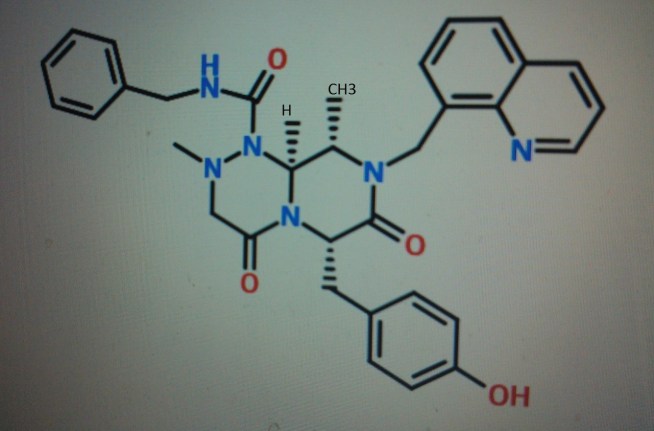
STR 5

STRUCTURE 5

Cas 1422253-37-9

(6S,9S,9aS)-N-benzyl-6-(4-hydroxybenzyl)-2,9-dimethyl-4,7-dioxo-8-(quinolin-8-yImethyl)octahydro- 1 H-pyrazino[2, 1 -c] [ 1 ,2,4]triazine- 1 -carboxamide.
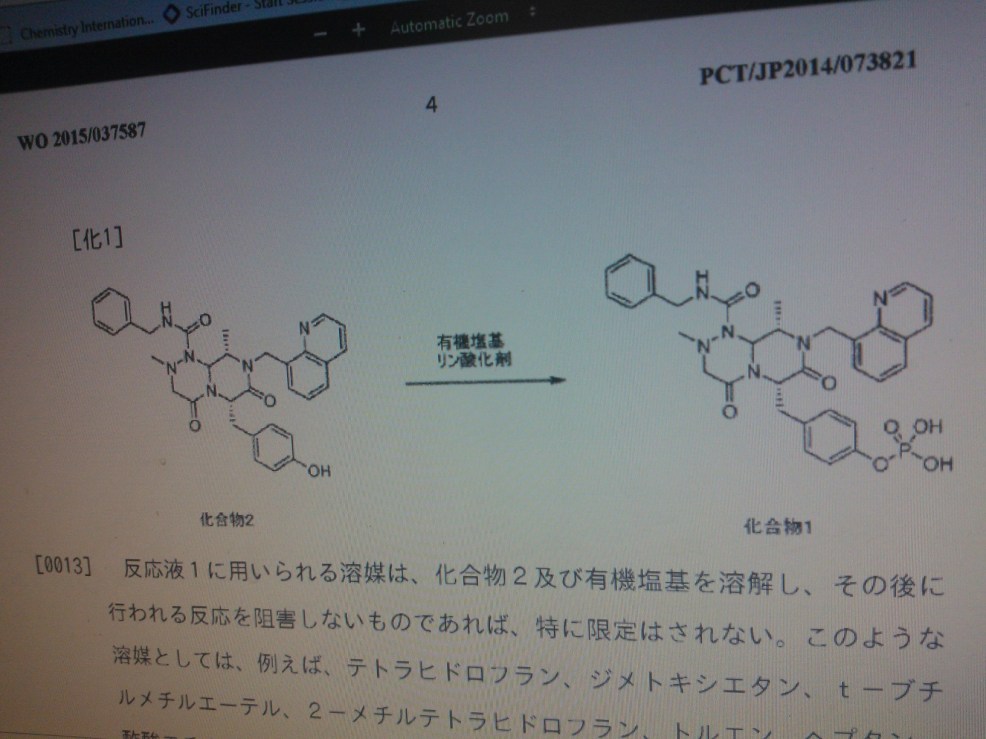
pri 724 2

compd 2 and 1

OR

COMPD 3

http://www.medkoo.com/Anticancer-trials/PRI-724.htm and similar/Same

http://www.nature.com/nrc/journal/v14/n4/fig_tab/nrc3690_T1.html

compd 3.both above str are same

One of compd 1,2, 3, 4, 5 see at the end as an update ,  CAN BE ICG001,  PRI-724,

Prism Biolab Corporation

Beta-catenin (CTNNB1) inhibitor

ICG001, also known as PRI-724, is a potent, specific inhibitor of the canonical Wnt signaling pathway in cancer stem cells with potential antineoplastic activity. Wnt signaling pathway inhibitor PRI-724 specifically inhibits the recruiting of beta-catenin with its coactivator CBP (the binding protein of the cAMP response element-binding protein CREB); together with other transcription factors beta-catenin/CBP binds to WRE (Wnt-responsive element) and activates transcription of a wide range of target genes of Wnt/beta-catenin signaling. Blocking the interaction of CBP and beta-catenin by this agent prevents gene expression of many proteins necessary for growth, thereby potentially suppressing cancer cell growth. The Wnt/beta-catenin signaling pathway regulates cell morphology, motility, and proliferation; aberrant regulation of this pathway leads to neoplastic proliferation.

JAPAN

4-(((6S,9S)-l-(benzylcarbamoyl)-2,9-dimethyl-4,7-dioxo-8-(quinoline-8-ylmethyl) octahy- dro-1H-pyrazino[2,1-c][1,2,4]triazine-6-yl)methyl) phenyl dihydrogen phosphate

(6S,9S)-N-benzyl-6-(4-hydroxybenzyl)-2,9-dimethyl-4,7-dioxo-8-(quinoline-8-ylmethyl) octahydro-1H-pyrazino[2,1-c] [I,z,4]triazine-1-carboxamide,

4-(((6S,9S,9aS)-l-(benzylcarbamoyl)-2,9-dimethyl-4,7-dioxo-8-(quinolin-8-ylmethyl)octahydro- 1 H-pyrazino[2, 1 -c] [ 1 ,2,4]triazin-6-yl)methyl)phenyl dihydrogen phosphate

(6S,9S,9aS)-N-benzyl-6-(4-hydroxybenzyl)-2,9-dimethyl-4,7-dioxo-8-(quinolin-8-yImethyl)octahydro- 1 H-pyrazino[2, 1 -c] [ 1 ,2,4]triazine- 1 -carboxamide.

Compound A  as in wo 2014061827……..4-(((6S,9S,9aS)-l-(benzylcarbamoyl)-2,9-dimethyl-4,7-dioxo-8-(quinolin-8-ylmethyl)octahydro- 1 H-pyrazino[2, 1 -c] [ 1 ,2,4]triazin-6-yl)methyl)phenyI dihydrogen phosphate in     WO2014061827

4-(((6S,9S)-1-(benzylcarbamoyl)-2,9-dimethyl-4,7-dioxo-8-(quinoline-8-ylmethyl)octahydro-1H-pyrazino[2,1-c][1,2,4]triazine-6-yl)methyl)phenyl dihydrogen phosphate (presumed to be PRI-724; first disclosed in WO2009148192), useful for treating cancer, neurodegenerative diseases, glaucoma and idiopathic pulmonary fibrosis.

Eisai, under license from PRISM Pharma, is developing PRI-724, an inhibitor of CREB binding protein or beta-catenin complex formation, for treating cancer (phase 1, as of March 2015) and HCV-induced cirrhosis (preclinical trial).

Follows on from WO2014061827, claiming the use of PRI-724 for treating pulmonary fibrosis.

IS IT

PRI-724 structure

cas 847591-62-2…………http://www.medkoo.com/Anticancer-trials/PRI-724.htm

(6S,9aS)-N-Benzyl-6-(4-hydroxybenzyl)-8-(naphthalen-1-ylmethyl)-4,7-dioxoperhydropyrazino[1,2-a]pyrimidine-1-carboxamide

 COMPD 3

OR
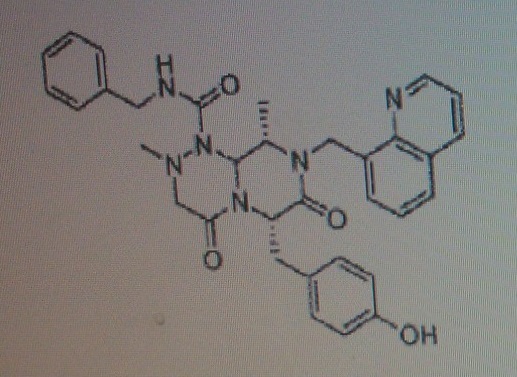
pri 724 5

COMPD 2

PRI724

1198780-43-6, 578.66, C33 H34 N6 O4

(6S,9S)-N-benzyl-6-(4-hydroxybenzyl)-2,9-dimethyl-4,7-dioxo-8-(quinoline-8-ylmethyl) octahydro-1H-pyrazino[2,1-c] [I,z,4]triazine-1-carboxamide,
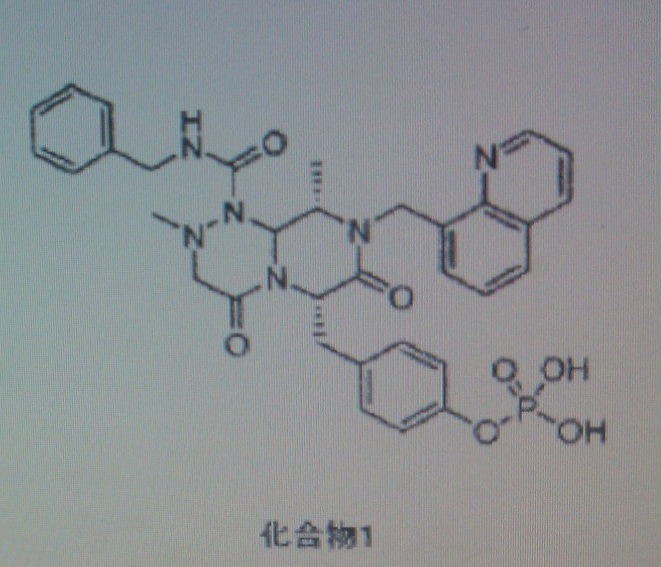
pri 724 6

COMPD1

PRI 724

4-(((6S,9S)-l-(benzylcarbamoyl)-2,9-dimethyl-4,7-dioxo-8-(quinoline-8-ylmethyl) octahy- dro-1H-pyrazino[2,1-c][1,2,4]triazine-6-yl)methyl) phenyl dihydrogen phosphate

COMPD 1

SEE

 http://www.google.co.in/patents/WO2009148192A1?cl=en

About PRI-724
PRI-724 is an antiproliferative small molecule that selectively inhibits the CBP/beta-catenin complex, which modulates the beta-catenin dependent pathway of Wnt signaling. Activation of the Wnt/beta-catenin signaling pathway is observed in various tumor cells and results in proliferation and metastasis. PRI-724 exhibits a selective antiproliferative effect, inhibiting various cancer cell lines in vitroand substantially inhibiting tumor growth in animal studies. PRI-724 is currently in clinical trials in oncology indications, partnered with Eisai Co., Ltd. PRI-724 also has potential to provide therapeutic benefit in non-oncology areas such as fibrosis and clinical trials in that indication are targeted to start in the second half of 2013.

About PRISM Pharma Co., Ltd.
PRISM Pharma Co., Ltd. has developed its platform technology to modulate inter-cellular protein-protein interactions using peptide mimetic small molecules and found various hit compounds including PRI-724.

SEE

WO 2015037587

Eisai Research Institute; PRISM Pharma Co Ltd

出願人:エ_ ザイ■ ア_ ル■ アンド■ ディ_ ■
マネジメン卜株式会社(EISAI R&D MANAGEMENT
CO., LTD.) [JP /JP ];亍1128088 東京都文京区
小石川四丁目6 番1 O 号Tokyo (JP).株式会社P
R I S M P h a r m a (PRISM PHARMA CO.,
LTD.) [JP /JP ];亍2268510神奈川県横浜市緑区長津
田町 4 2 5 9 — 3 Kanagawa (JP)

(IO) 国際公開番号
2 0 1 5 ^ ® S 3 .2 0 1 5 )

WO 2015/037587 Al

This method of producing 4-(((6S,9S)-l-(benzylcarbamoyl)-2,9-dimethyl-4,7-dioxo-8-(quinoline-8-ylmethyl) octahy- dro-1H-pyrazino[2,1-c][1,2,4]triazine-6-yl)methyl) phenyl dihydrogen phosphate involves a step for adding a reaction solution (I) comprising (6S,9S)-N-benzyl-6-(4-hydroxybenzyl)-2,9-dimethyl-4,7-dioxo-8-(quinoline-8-ylmethyl) octahydro-1H-pyrazino[2,1-c] [I,z,4]triazine-1-carboxamide, triethylamine and a solvent to a reaction solution (2) comprising a phosphorylating agent and a solvent.

1

1H-NMR (600MHz, METHAN0L-d4) δ (ppm):1.15 (d, J=6 Hz, 3H), 2.65 (s, 3H), 3.12 (d, J=18 Hz, 1H), 3.35 (d, J=7 Hz, 2H), 3.48 (d, J=18 Hz,1H), 4.15 (m,1H), 4.32 (d, J=15 Hz, 1H), 4.40 (d, J=15 Hz, 1H), 5.33(d, J=16 Hz, 1H), 5.41(d, J=16 Hz, 1H), 5.44 (d, J=7 Hz, 1H), 5.64 (d, J=10 Hz, 1H), 7.07 (dd, J=9,1 Hz, 2H), 7.15 (d, J=9 Hz, 2H), 7.24 (t, J=7 Hz, 1H), 7.27 (d, J=7 Hz, 2H), 7.34 (t, J=8 Hz, 2H), 7.55 (d d, J=8, 4 Hz, 1H), 7.60 (brd, J=6 Hz, 1H), 7.62 (dd, J=8, 7 Hz, 1H), 7.88 (dd, J=8,1 Hz, 1H), 8.38 (dd, J=8, 2 Hz, 1H), 8.90 (dd, J =4, 2 Hz, 1H).

…………………………………………………………………….

SEE

 http://www.google.co.in/patents/WO2009148192A1?cl=en

SYNTHESIS OF COMPD 2

PART A

PRI 724 A

Synthesis  Part A

step A

(S)-benzyl 1-(methoxy(methyl)amino)-1-oxopropan-2-ylcarbamate

Reaction   of the foll……………….N-methoxy-N-methylamine hydrochloride,   1N sodium hydroxide , (S)-2-(benzyloxycarbonylamino)propanoic acidand 4-(4,6-dimethoxy-1,3,5-triazin-2-yl)-4-methylmorpholinium chloride to obtain
(S)-benzyl 1-(methoxy(methyl)amino)-1-oxopropan-2-ylcarbamate.

STEP B

(S)-benzyl 1,1-diethoxypropan-2-ylcarbamate

Reaction   of the foll……………….(S)-benzyl 1-(methoxy(methyl)amino)-1-oxopropan-2-ylcarbamate, 2M lithium aluminium hydride in tetrahydrofuran solution to obtain (S)-benzyl 1,1-diethoxypropan-2-ylcarbamate

STEP C

(S)-1,1-diethoxypropan-2-amine

Reaction   of the foll……………….(S)-benzyl 1,1-diethoxypropan-2-ylcarbamate,  5% palladium on carbon title compound . (S)-1,1-diethoxypropan-2-amine,

STEP D

 (S)-1,1-diethoxy-N-(quinolin-8-ylmethyl)propan-2-amine,
Reaction   of the foll……………….(S)-1,1-diethoxypropan-2-amine,was reacted with 8-Quinolinecarboaldehyde  to obtain the title
compound (S)-1,1-diethoxy-N-(quinolin-8-ylmethyl)propan-2-amine

 PART B
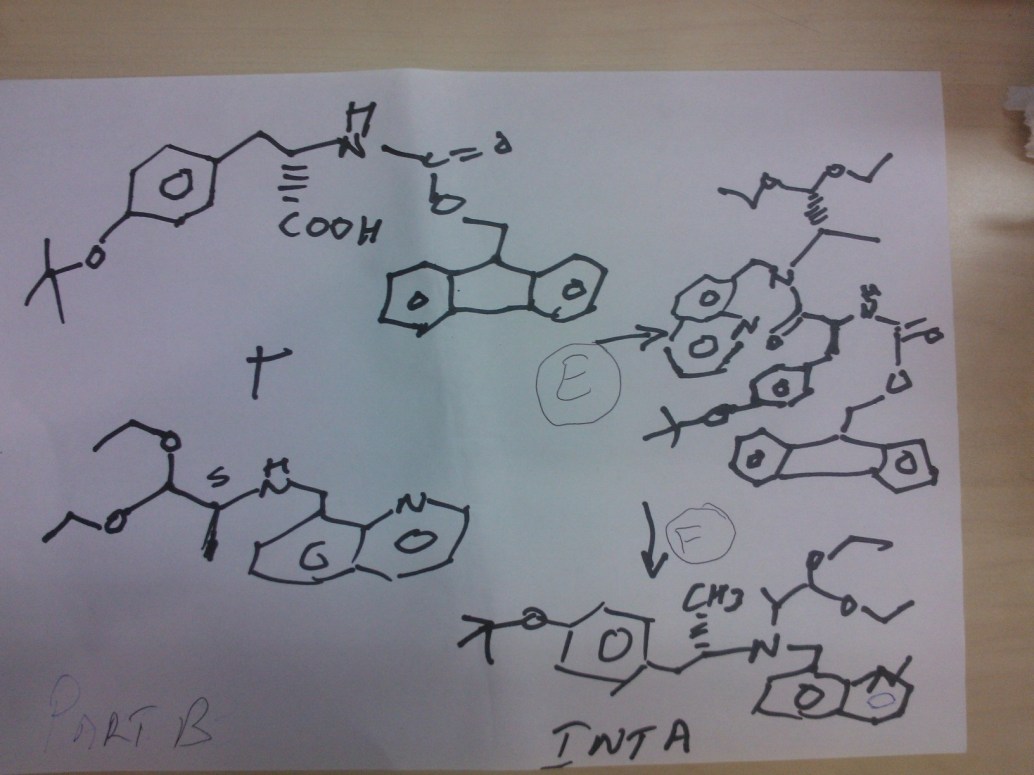
PRI 724 B

STEP E

 (9H-fluoren-9-yl)methyl (S)-3-(4-tert-butoxyphenyl)-1-(((S)-1,1-diethoxypropan-2-yl)(quinolin-8-ylmethyl)amino)-1-oxopropan-2-ylcarbamate

Reaction   of the foll………………. (S)-1,1-diethoxy-N-(quinolin-8-ylmethyl)propan-2-amine,  (S)-2-(((9H-fluoren-9-yl)methoxy)carbonylamino)-3-(4-tertbutoxyphenyl)propanoic acid  to obtain the title compound (9H-fluoren-9-yl)methyl (S)-3-(4-tert-butoxyphenyl)-1-(((S)-1,1-diethoxypropan-2-yl)(quinolin-8-ylmethyl)amino)-1-oxopropan-2-ylcarbamate

STEP f

 (S)-2-amino-3-(4-tertbutoxyphenyl)-N-((S)-1,1-diethoxypropan-2-yl)-N-(quinolin-8-ylmethyl)propanamide        INT A

Reaction   of the foll……………….  (9H-fluoren-9-yl)methyl (S)-3-(4-tert-butoxyphenyl)-1-(((S)-1,1-diethoxypropan-2-yl)(quinolin-8-ylmethyl)amino)-1-oxopropan-2-ylcarbamate and  piperidine  to
obtain the title compound (S)-2-amino-3-(4-tertbutoxyphenyl)-N-((S)-1,1-diethoxypropan-2-yl)-N-(quinolin-8-ylmethyl)propanamide INT A

PART C

PRI 724 C

STEP g

 ethyl 2-(1-methylhydrazinyl)acetate

Reaction   of the foll……………….methylhydrazine 7 was reacted with ethyl 2-bromoacetate 1to obtain the title compound

STEP h
ethyl 2-(1-Methyl-2-(benzylcarbamoyl)hydrazinyl)acetate

Reaction   of the foll………………. ethyl 2-(1-methylhydrazinyl)acetateand  benzyl isocyanate  to obtain the title
compound ethyl 2-(1-Methyl-2-(benzylcarbamoyl)hydrazinyl)acetate

STEP i
2-(2-(benzylcarbamoyl)-1-methylhydrazinyl)acetic acid

Reaction   of the foll………………. ethyl 2-(1-allyl-2-
(benzylcarbamoyl)hydrazinyl)acetate and lithium hydroxide monohydrate to obtain the title compound 2-(2-(benzylcarbamoyl)-1-methylhydrazinyl)acetic acid

STEP j
N-benzyl-2-(2-((S)-3-(4-tert-butoxyphenyl)-1-(((S)-1,1-
diethoxypropan-2-yl)(quinolin-8-ylmethyl)amino)-1-oxopropan-2-ylamino)-2-oxoethyl)-2-
methylhydrazinecarboxamide……… precursor

Reaction   of the foll………………. 2-(2-(benzylcarbamoyl)-1-methylhydrazinyl)acetic acid and  (S)-2-amino-3-(4-tert-butoxyphenyl)-N-((S)-1,1-diethoxypropan-2-yl)-N-(quinolin-8-ylmethyl)propanamide ( INT A )yielded the title compound ie the precursor

PART D

THIS PRECURSOR GIVES FINAL PRODUCT
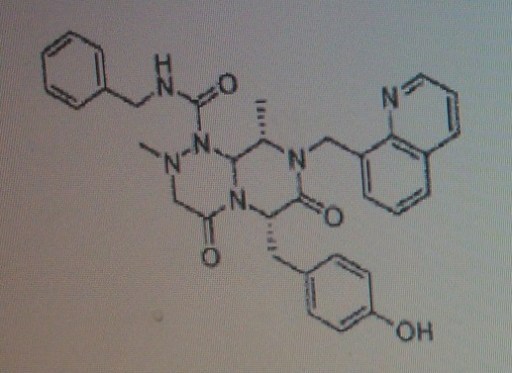
pri 724 5

Synthesis of (6S,9S)-N-benzyl-6-(4-hydroxybenzyl)-2,9-
dimethyl-8-(naphthalen-1-ylmethyl)-4,7-dioxooctahydro-1H-pyrazino[2,1-c][1,2,4]triazine-1-
carboxamide ……….final

fOLL reactants……….. N-benzyl-2-(2-((S)-3-(4-tert-butoxyphenyl)-1-(((S)-1,1-diethoxypropan-2-yl)(naphthalen-1-ylmethyl)amino)-1-oxopropan-2-ylamino)-2-oxoethyl)-2-methylhydrazinecarboxamide, ie the precursor  and 10%-water/HCOOH gave (6S,9S)-N-benzyl-6-(4-hydroxybenzyl)-2,9-dimethyl-4,7-dioxo-8-(quinolin-8-ylmethyl)octahydro-1Hpyrazino[2,1-c][1,2,4]triazine-1-carboxamide

RT 4.22; Mass 578.9

COMPD 3

(6S,9aS)-N-Benzyl-6-(4-hydroxybenzyl)-8-(naphthalen-1-ylmethyl)-4,7-dioxoperhydropyrazino[1,2-a]pyrimidine-1-carboxamide

SEE

US 6762185

……………………………..

SEE

http://www.google.com/patents/WO2012141038A1?cl=en

novel compounds, agent for inducing differentiation into hepatocytes of mesenchymal stem cells, Wnt / β- catenin signaling pathway inhibitor, method for producing hepatocytes with them on hepatocytes such as by their production.

Liver disease is said to be Japan’s national disease, a large number of patients suffering from liver disease. In addition, the annual number of deaths from hepatocellular carcinoma amounts to about 30 004 thousand people. Recently, hepatocellular cancer outcome is improved by advances in treatment, but the increase of advanced cancer, with hepatic dysfunction cirrhosis to merge, so-called hepatic failure death has increased. Liver failure therapy, although liver transplantation is ideal, it is difficult in Japan to obtain sufficient donors, it is necessary to develop a liver regeneration therapy with stem cells.

As stem cells that have the potential to differentiate into liver cells, bone marrow cells, tissue stem cells, such as umbilical cord blood cells can be expected.Therefore, a number of research institutions, for the realization of by regenerative medicine liver cell transplantation treatment of chronic liver failure patient, to differentiate human tissue stem cells into functional hepatocytes, truly clinically applicable efficient differentiation induction technology you are conducting research and development with the goal of developing a.

For example, in the laboratory of Shioda Professor of Tottori University Graduate School of Medicine, reported that the Wnt / β- catenin signaling pathway were differentiated into hepatocytes showed that suppressed by RNA interference at the time of induction of differentiation from human mesenchymal stem cells into hepatocytes you are (Non-Patent Document 1 and Non-Patent Documents 3-5).Furthermore, studies to induce differentiation of hepatocytes in other institutions have been conducted (Non-Patent Document 2, Patent Documents 1 and 2).

On the other hand, recently, from 4,000 or more screening of large compound libraries, Wnt / β- catenin signaling pathway inhibitory low molecular compound 5 types have been identified (Non-Patent Documents 6-9).

Kohyo 2009-535035 JP Patent Publication No. 2010-75631

Atsushi Yanagitani et al., ” retinoic Acid Receptor Dominant Level Negative Form Causes steatohepatitis and Liver Tumors in Transgenic Mice “, Hepatology, Vol. 40, No. 2, 2004, P. 366-375 Seoyoung Park et al.,”Hexachlorophene Inhibits Wnt / beta-catenin Pathway by Promoting Siah-Mediated beta-catenin Degradation “, Mol Pharmacol Vol. 70, No. 3, 960-966, 2006 Yoko Yoshida et al.,” A role of Wnt / beta-catenin Signals in hepatic fate Specification of human umbilical cord blood-derived mesenchymal stem cells “, Am J Physiol Gastrointest Liver Physiol 293:. G1089-G1098, 2007 Shimomura T et al,” Hepatic differentiation of human bone marrow-derived UE7T-13 cells: Effects of cytokines and CCN family Gene expression “, Hepatol Res., 37, 1068-79, 2007 Ishii K et al.,” Hepatic differentiation of human bone marrow-derived mesenchymal stem cells by tetracycline-regulated Hepatocyte Nuclear factor 3Beta “Hepatology, 48, 597- 606, 2008 Maina Lepourcelet et al., ” Small-molecule Antagonists of the oncogenic Tcf / beta-catenin protein complex “, CANCER CELL, JANUARY 2004, VOL. 5, 91-102 Emami KH et al.,” A Small molecule inhibitor of beta-catenin / CREB-binding protein Transcription “, Proc Natl Acad Sci US A. 2004 Aug 24; 101 (34):.. 12682-7 Jufang Shan et al,”Identification of a Specific Inhibitor of the Dishevelled PDZ Domain ” , Biochemistry 2005 Nov 29; 44 (47):.. 15495-503 Trosset JY et al, ” Inhibition of protein-protein Interactions: the discovery of beta-catenin Druglike Inhibitors by combining virtual and Biophysical Screening . “, Proteins 2006 Jul 1 ; 64 (1): 60-7

However, the conventional techniques described above literature, had a room for improvement in the following points.
Patent Documents 1 and 2, it has been described for proteins to induce stem cells from Hikimomiki cells, due to the use of the protein formulation as a differentiation inducing agent, a room for further improvement in terms of stability and safety and there was.

Non-Patent Document 1 and Non-Patent Document 3 to 5, and have reported that induced differentiated hepatocytes from human mesenchymal stem cells, the use of siRNA as a differentiation inducing agent, such as stability and safety there is room for further improvement in the surface. Non-Patent Document 2, 6 to 9, is not described with respect to method of inducing differentiation into hepatocytes.

The present invention has been made in view of the above circumstances, and an object thereof is to provide an effective low-molecular compounds that induce differentiation into hepatocytes from mesenchymal stem cells. Or, it is intended that the low-molecular compound was used to provide a secure differentiation inducing method is excellent from the mesenchymal stem cell differentiation efficiency of liver cells.

According to the present invention, there is provided formula (1) and one or more compounds selected from the group of compounds represented by the formula (2), a salt thereof or a solvate thereof.

Figure JPOXMLDOC01-appb-C000010


<Example 1> synthetic ICG-001 of synthesis (1) ICG-001 of the IC-2 is an oligopeptide having two rings of β- turn mimic structure in central skeleton, and transcription by β-catenin / Tcf complex can function as a potent antagonist for activation has been reported (Drug Discov. Today 2005, 10, 1467-1474). Synthesis of ICG-001 in accordance with the literature (Tetrahedron 2007, 63, 12912-12916), was subjected to examination.

Figure JPOXMLDOC01-appb-C000019

(1-1) of Compound 1 Synthesis 1-naphtaldehyde (Wako Pure Chemical) (1.56 g, 10 mmol) and 2,2-diethoxyethanamine (Tokyo Kasei Kogyo) (1.33 g, 10 mmol) were mixed 100 I was stirred 20 min at o C. After cooling to room temperature, diluted with EtOH (20 mL), was added portionwise NaBH 4 (0.38 g, 10 mmol), at room temperature, and stirred for 16 h. After completion of the reaction, was distilled off by concentration under reduced pressure EtOH, the product was extracted with AcOEt. The resulting product was purified by silica gel column chromatography (hexane / AcOEt = 5/1) to give the to give compound 1 (2.29 g, 8.5 mmol, 85%).

Figure JPOXMLDOC01-appb-C000020

(1-2) Synthesis of Compound 3 Fmoc-L-Tyr (t-Bu) -OH (0.87 g, 1.9 mmol) in DMF (7 mL) solution of a condensing agent HATU (0.76 g, 2.0 mmol) and diisopropylethylamine (DIEA) (0.35 mL, 2.0 mmol) was added and after stirring for 20 min, compound 1 (0.54 g, a 2.0 mmol) was added, at room temperature, 16 h the mixture was stirred. After the reaction, DMF was distilled off by concentration under reduced pressure, and the resulting product was purified by column chromatography (hexane / AcOEt = 10/1), compound 2 was obtained (1.33 g, 1.9 mmol, 93%). The resulting compound 2 (1.33 g, 1.9 mmol) was dissolved in CH 2 Cl 2 (20 mL), was added diethylamine (DEA) (10 ml, excess), at room temperature, was 2 h stirring.After confirming the completion of the reaction by TLC, vacuum was distilled off CH 2 Cl 2 by concentration, the resulting product was purified by silica gel column chromatography (AcOEt), to give compound 3 (0.92 g, 1. 8 mmol, 92%).

Figure JPOXMLDOC01-appb-C000021

(1-3) Synthesis Fmoc-β-Ala-OH (0.53 g, 1.7 mmol) of compound 5 in DMF (8 mL) solution of a condensing agent HATU (0.70 g, 1.8 mmol) and diisopropylethylamine (DIEA) (0.32 mL, 1.8 mmol) was added and after stirring for 20 min, compound 3 (0.92 g, 1.8 mmol) was added, at room temperature, and stirred for 14 h. After the reaction, DMF was distilled off by concentration under reduced pressure, the resulting product was purified by column chromatography (hexane / AcOEt = 1/1), compound 4 was obtained (1.2 g, 1.5 mmol, 82%). Obtained compound 4 (1.2 g, 1.5 mmol) was dissolved in CH 2 Cl 2 (20 mL), was added diethylamine (DEA) (9 mL, excess), at room temperature, and stirred for 1 h. After confirming the completion of the reaction by TLC, was distilled off CH 2 Cl 2 by concentration under reduced pressure, and the resulting product was purified by silica gel column chromatography (AcOEt / EtOH = 1/1), to give compound 5 (0 .66 g, 1.2 mmol, 80%).

Figure JPOXMLDOC01-appb-C000022

(1-4) synthetic compounds 5 (0.66 g, 1.2 mmol) of compound 7 CH 2 Cl 2 of solution (8 mL) to benzylisocyanate (0.16 g, 1.2 mmol) of CH 2 Cl 2 solution (8 mL) was added, at room temperature, and stirred for 12 h. After confirming the completion of the reaction by TLC, was distilled off CH 2 Cl 2 by concentration under reduced pressure, and the resulting product was purified by column chromatography (AcOEt / EtOH = 1/1), to give compound 6 (0. 59 g, 0.85 mmol, 73%). The obtained compound 6 (0.59 g, 0.85 mmol) at room temperature in the formic acid (9 ml), I was stirred 20 h. Was evaporated formic acid by concentration under reduced pressure, the resulting product was purified by column chromatography (AcOEt), Compound 7a to (ICG-001) was obtained as a white solid (0.26 g, 0.48 mmol, 57 %).
The resulting product, MS spectra and were identified from the 1 H NMR spectrum (with the literature value) (Fig. 1).

Figure JPOXMLDOC01-appb-C000023
WO2006101858A1 * Mar 15, 2006 Sep 28, 2006 Inst Chemical Genomics Alpha-helix mimetics and methods relating to the treatment of fibrosis
WO2009148192A1 * Jun 5, 2009 Dec 10, 2009 Prism Biolab Corporation Alpha helix mimetics and methods relating thereto
WO2012068299A2 * Nov 16, 2011 May 24, 2012 University Of Southern California Cbp/catenin antagonists for enhancing asymmetric division of somatic stem cells

SEE      https://www.google.com/patents/WO2014061827A1?cl=en

one more compd
compd 4
Compound A  as in wo 2014061827……..4-(((6S,9S,9aS)-l-(benzylcarbamoyl)-2,9-dimethyl-4,7-dioxo-8-(quinolin-8-ylmethyl)octahydro- 1 H-pyrazino[2, 1 -c] [ 1 ,2,4]triazin-6-yl)methyl)phenyI dihydrogen phosphate in     WO2014061827

 STR 4

STRUCTURE 4

4-(((6S,9S,9aS)-l-(benzylcarbamoyl)-2,9-dimethyl-4,7-dioxo-8-(quinolin-8-ylmethyl)octahydro- 1 H-pyrazino[2, 1 -c] [ 1 ,2,4]triazin-6-yl)methyl)phenyl dihydrogen phosphate

STRUCTURE  5

STR 5

STRUCTURE 5

(6S,9S,9aS)-N-benzyl-6-(4-hydroxybenzyl)-2,9-dimethyl-4,7-dioxo-8-(quinolin-8-yImethyl)octahydro- 1 H-pyrazino[2, 1 -c] [ 1 ,2,4]triazine- 1 -carboxamide.

Cas 1422253-37-9

2H-​Pyrazino[2,​1-​c]​[1,​2,​4]​triazine-​1(6H)​-​carboxamide, hexahydro-​6-​[(4-​hydroxyphenyl)​methyl]​-​2,​9-​dimethyl-​4,​7-​dioxo-​N-​(phenylmethyl)​-​8-​(8-​quinolinylmethyl)​-​, (6S,​9S,​9aS)​-

Structure can represented as

PRI 724 CAAS


coming
coming
coming
 CONCLUSION ………………….SEEMS TO ME THAT COMPD 4 IS PRI 724  NAD COMPD 3 IS ICG 001……ERROR EMAIL ME  amcrasto@gmail.com, call +919323115463 india

P.S. : The views expressed are my personal and in no-way suggest the views of the professional body or the company that I represent.


P.S. : The views expressed are my personal and in no-way suggest the views of the professional body or the company that I represent.

P.S. : The views expressed are my personal and in no-way suggest the views of the professional body or the company that I represent.