New Drug Approvals

Home » 2014 (Page 39)

Yearly Archives: 2014

DRUG APPROVALS BY DR ANTHONY MELVIN CRASTO .....FOR BLOG HOME CLICK HERE

Blog Stats

  • 4,816,925 hits

Flag and hits

Flag Counter

Enter your email address to follow this blog and receive notifications of new posts by email.

Join 37.9K other subscribers
Follow New Drug Approvals on WordPress.com

Archives

Categories

Recent Posts

Flag Counter

ORGANIC SPECTROSCOPY

Read all about Organic Spectroscopy on ORGANIC SPECTROSCOPY INTERNATIONAL 

Enter your email address to follow this blog and receive notifications of new posts by email.

Join 37.9K other subscribers
DR ANTHONY MELVIN CRASTO Ph.D

DR ANTHONY MELVIN CRASTO Ph.D

DR ANTHONY MELVIN CRASTO, Born in Mumbai in 1964 and graduated from Mumbai University, Completed his Ph.D from ICT, 1991,Matunga, Mumbai, India, in Organic Chemistry, The thesis topic was Synthesis of Novel Pyrethroid Analogues, Currently he is working with AFRICURE PHARMA, ROW2TECH, NIPER-G, Department of Pharmaceuticals, Ministry of Chemicals and Fertilizers, Govt. of India as ADVISOR, earlier assignment was with GLENMARK LIFE SCIENCES LTD, as CONSUlTANT, Retired from GLENMARK in Jan2022 Research Centre as Principal Scientist, Process Research (bulk actives) at Mahape, Navi Mumbai, India. Total Industry exp 32 plus yrs, Prior to joining Glenmark, he has worked with major multinationals like Hoechst Marion Roussel, now Sanofi, Searle India Ltd, now RPG lifesciences, etc. He has worked with notable scientists like Dr K Nagarajan, Dr Ralph Stapel, Prof S Seshadri, etc, He did custom synthesis for major multinationals in his career like BASF, Novartis, Sanofi, etc., He has worked in Discovery, Natural products, Bulk drugs, Generics, Intermediates, Fine chemicals, Neutraceuticals, GMP, Scaleups, etc, he is now helping millions, has 9 million plus hits on Google on all Organic chemistry websites. His friends call him Open superstar worlddrugtracker. His New Drug Approvals, Green Chemistry International, All about drugs, Eurekamoments, Organic spectroscopy international, etc in organic chemistry are some most read blogs He has hands on experience in initiation and developing novel routes for drug molecules and implementation them on commercial scale over a 32 PLUS year tenure till date Feb 2023, Around 35 plus products in his career. He has good knowledge of IPM, GMP, Regulatory aspects, he has several International patents published worldwide . He has good proficiency in Technology transfer, Spectroscopy, Stereochemistry, Synthesis, Polymorphism etc., He suffered a paralytic stroke/ Acute Transverse mylitis in Dec 2007 and is 90 %Paralysed, He is bound to a wheelchair, this seems to have injected feul in him to help chemists all around the world, he is more active than before and is pushing boundaries, He has 100 million plus hits on Google, 2.5 lakh plus connections on all networking sites, 100 Lakh plus views on dozen plus blogs, 227 countries, 7 continents, He makes himself available to all, contact him on +91 9323115463, email amcrasto@gmail.com, Twitter, @amcrasto , He lives and will die for his family, 90% paralysis cannot kill his soul., Notably he has 38 lakh plus views on New Drug Approvals Blog in 227 countries......https://newdrugapprovals.wordpress.com/ , He appreciates the help he gets from one and all, Friends, Family, Glenmark, Readers, Wellwishers, Doctors, Drug authorities, His Contacts, Physiotherapist, etc He has total of 32 International and Indian awards

Verified Services

View Full Profile →

Archives

Categories

Flag Counter

Laser Used to Deliver Dopamine in Hope for Parkinson’s Treatment


Lyranara.me's avatarLyra Nara Blog

laser for drug delivery Laser Used to Deliver Dopamine in Hope for Parkinsons Treatment

In people suffering from Parkinson’s, errors of metabolism in dopaminergic neurons of substantia nigra play an important role in pathophysiology of the disease. One of the functions of dopamine is in helping control muscle movement. Unfortunately, simply injecting Parkinson’s patients with dopamine does not cure the disease, since the chemical needs to be delivered in precise quantities over extended time period just where it’s needed. To help with that, researchers at Okinawa Institute of Science and Technology, Japan and University of Otago, New Zealand have developed a method of encapsulating dopamine within liposomes that can then be released using a femtosecond laser.

These liposomes are spherical structures made of fat cells that are very stable when inside the human body. They are able to ferry their cargo throughout the body, which will only interact with cells and tissues when the liposomes are ruptured by some external force. The researchers utilized…

View original post 160 more words

Oregon State University Researchers Build Novel Sepsis Filter


Lyranara.me's avatarLyra Nara Blog

sepsis device Oregon State University Researchers Build Novel Sepsis Filter

Researchers at Oregon State University have engineered a special filter that may be capable of clearing blood of endotoxins that play important role in sepsis. The National Science Foundation just awarded $200,000 to the team to further develop the device for clinical use.

Unlike antibiotics, the filter actually removes bacteria and endotoxins instead of just killing the bacteria and leaving particulates and vasoactive substances to circulate in the body. It’s about the size of a mug and has a bunch of microchannels about the diameter of human hair that are coated on the inside with so-called “pendant polymer brushes.” These are chains of carbon and oxygen that are attached to the filter like microscopic hairs that prevent coagulation and have peptides on their tips to grab onto the endotoxins. The researchers plan to make the device cheap to manufacture by moving to low-cost polymers as the main material, and then pressing toward clinical…

View original post 26 more words

The effect of catch-up growth by various diets and resveratrol intervention on bone status


Ralph Turchiano's avatarCLINICALNEWS.ORG

09 Mar 2012

Although many current studies focused on catch up growth (CUG) have described its high susceptibility to insulin resistance-related diseases very few have focused on the effect of CUG on bone metabolism, especially in adulthood. As diet is a controllable factor, the influence of re-feeding with different dietary patterns on bone parameters is important to study. Resveratrol has been attributed a number of beneficial effects in mammals including osteotrophic properties. In the March 2012 issue of Experimental Biology and Medicine Wang and colleagues describe the first study to describe the effects of CUG, with different diets, on bone status and the role of resveratrol in CUG models.

View original post 516 more words

GSK 2263167 a S1P1 receptor agonist


Abstract Image

gsk 2262167

CAS,  1165924-28-6 FREE FORM

1165923-54-5 NA SALT

1458576-13-0  MONOHYDRATE

Glaxo Group Ltd,


C25 H26 N4 O4


3-[6-(5-{3-cyano-4-[(1-methylethyl)oxy]phenyl}-1,2,4-oxadiazol-3-yl)-5-methyl-3,4-dihydro-2(1H)-isoquinolinyl]propanoate

2(1H)​-​ Isoquinolinepropanoi​c acid, 6-​[5-​[3-​cyano-​4-​(1-​methylethoxy)​phenyl]​-​1,​2,​4-​oxadiazol-​3-​ yl]​-​3,​4-​dihydro-​5-​methyl-

3-[6-(5-{3-Cyano-4-[(1 -methylethyl)oxy]phenyl}-1,2,4-oxadiazol-3-yl)-5-methyl- 3,4-dihydro-2(1H)-isoquinolinyl]propanoic acid


Sphingosine 1 -phosphate (S1 P) is a bioactive lipid mediator formed by the phosphorylation of sphingosine by sphingosine kinases and is found in high levels in the blood. It is produced and secreted by a number of cell types, including those of hematopoietic origin such as platelets and mast cells (Okamoto et al 1998 J Biol Chem 273(42):27104; Sanchez and HIa 2004, J Cell Biochem 92:913). It has a wide range of biological actions, including regulation of cell proliferation, differentiation, motility, vascularisation, and activation of inflammatory cells and platelets (Pyne and Pyne 2000, Biochem J. 349: 385). Five subtypes of S1 P responsive receptor have been described, S1 P1 (Edg-1 ), S1 P2 (Edg-5), S1 P3 (Edg-3), S1 P4 (Edg-6), and S1 P5 (Edg-8), forming part of the G-protein coupled endothelial differentiation gene family of receptors (Chun et al 2002 Pharmacological Reviews 54:265, Sanchez and HIa 2004 J Cellular Biochemistry, 92:913). These 5 receptors show differential mRNA expression, with S1 P1-3 being widely expressed, S1 P4 expressed on lymphoid and hematopoietic tissues and S1 P5 primarily in brain and to a lower degree in spleen. They signal via different subsets of G proteins to promote a variety of biological responses (Kluk and HIa 2002 Biochem et Biophysica Acta 1582:72, Sanchez and HIa 2004, J Cellular Biochem 92:913).

Proposed roles for the S1 P1 receptor include lymphocyte trafficking, cytokine induction/suppression and effects on endothelial cells (Rosen and Goetzl 2005 Nat Rev Immunol. 5:560). Agonists of the S1 P1 receptor have been used in a number of autoimmune and transplantation animal models, including Experimental Autoimmune Encephalomelitis (EAE) models of MS, to reduce the severity of the induced disease (Brinkman et al 2003 JBC 277:21453; Fujino et al 2003 J Pharmacol Exp Ther 305:70; Webb et al 2004 J Neuroimmunol 153:108; Rausch et al 2004 J Magn Reson Imaging 20:16). This activity is reported to be mediated by the effect of S1 P1 agonists on lymphocyte circulation through the lymph system. Treatment with S1 P1 agonists results in the sequestration of lymphocytes within secondary lymphoid organs such as the lymph nodes, inducing a reversible peripheral lymphopoenia in animal models (Chiba et al 1998, J Immunology 160:5037, Forrest et al 2004 J Pharmacol Exp Ther 309:758; Sanna et al 2004 JBC 279:13839). Published data on agonists suggests that compound treatment induces loss of the S1 P1 receptor from the cell surface via internalisation (Graler and Goetzl 2004 FASEB J 18:551 ; Matloubian et al 2004 Nature 427:355; Jo et al 2005 Chem Biol 12:703) and it is this reduction of S1 P1 receptor on immune cells which contributes to the reduction of movement of T cells from the lymph nodes back into the blood stream.

S1 P1 gene deletion causes embryonic lethality. Experiments to examine the role of the S1 P1 receptor in lymphocyte migration and trafficking have included the adoptive transfer of labelled S1 P1 deficient T cells into irradiated wild type mice. These cells showed a reduced egress from secondary lymphoid organs (Matloubian et al 2004 Nature 427:355).

S1 P1 has also been ascribed a role in endothelial cell junction modulation (Allende et al 2003 102:3665, Blood Singelton et al 2005 FASEB J 19:1646). With respect to this endothelial action, S1 P1 agonists have been reported to have an effect on isolated lymph nodes which may be contributing to a role in modulating immune disorders. S1 P1 agonists caused a closing of the endothelial stromal ‘gates’ of lymphatic sinuses which drain the lymph nodes and prevent lymphocyte egress (Wei wt al 2005, Nat. Immunology 6:1228).

The immunosuppressive compound FTY720 (JP1 1080026-A) has been shown to reduce circulating lymphocytes in animals and man, have disease modulating activity in animal models of immune disorders and reduce remission rates in relapsing remitting Multiple Sclerosis (Brinkman et al 2002 JBC 277:21453, Mandala et al 2002 Science 296:346, Fujino et al 2003 J Pharmacology and Experimental Therapeutics 305:45658, Brinkman et al 2004 American J Transplantation 4:1019, Webb et al

2004 J Neuroimmunology 153:108, Morris et al 2005 EurJ Immunol 35:3570, Chiba

2005 Pharmacology and Therapeutics 108:308, Kahan et al 2003, Transplantation 76:1079, Kappos et al 2006 New Eng J Medicine 335:1124). This compound is a prodrug that is phosphorylated in vivo by sphingosine kinases to give a molecule that has agonist activity at the S1 P1 , S1 P3, S1 P4 and S1 P5 receptors. Clinical studies have demonstrated that treatment with FTY720 results in bradycardia in the first 24 hours of treatment (Kappos et al 2006 New Eng J Medicine 335:1124). The bradycardia is thought to be due to agonism at the S1 P3 receptor, based on a number of cell based and animal experiments. These include the use of S1 P3 knock- out animals which, unlike wild type mice, do not demonstrate bradycardia following FTY720 administration and the use of S1 P1 selective compounds (Hale et al 2004 Bioorganic & Medicinal Chemistry Letters 14:3501 , Sanna et al 2004 JBC 279:13839, Koyrakh et al 2005 American J Transplantation 5:529).

Hence, there is a need for S1 P1 receptor agonist compounds with selectivity over S1 P3 which might be expected to show a reduced tendency to induce bradycardia.

The following patent applications describe oxadiazole derivatives as S1 P1 agonists: WO03/105771 , WO05/058848, WO06/047195, WO06/100633, WO06/115188, WO06/131336, WO07/024922 and WO07/1 16866.

The following patent applications describe tetrahydroisoquinolinyl-oxadiazole derivatives as S1 P receptor agonists: WO06/064757, WO06/001463, WO04/1 13330.


Figure CN103251950AC00031

Figure CN103251950AC00041

Figure CN103251950AC00051


………………………

paper


Abstract Image

Organic Process Research & Development (2013), 17(10), 1239-1246.

Chemical Development, GlaxoSmithKline Research and Development Ltd., Gunnels Wood Road, Stevenage, Hertfordshire SG1 2NY, U.K.
Org. Process Res. Dev.201317 (10), pp 1239–1246
DOI: 10.1021/op400162p

A fit for purpose approach has been adopted in order to develop a robust, scalable route to the S1P1 receptor agonist, GSK2263167. The key steps include a Robinson ring annulation followed by a Saegusa oxidation, providing rapid access to an advanced phenol intermediate. Despite the use of stoichiometric palladium acetate for the Saegusa oxidation, near complete recovery of the palladium has been demonstrated. The remaining steps have been optimised including the removal of all chromatography. An alternative to the Saegusa oxidation is described as well as the development of a flow process to facilitate further scale-up of the amidoxime preparation using hydroxylamine at elevated temperature.

http://pubs.acs.org/doi/abs/10.1021/op400162p?tokenDomain=campaign&tokenAccess=noteworthy&forwardService=showFullText&journalCode=oprdfk

AND

http://pubs.acs.org/doi/suppl/10.1021/op400162p/suppl_file/op400162p_si_001.pdf

………………………….

Will watson

http://www.allfordrugs.com/scientific-update/

WILL WATSON in  ACS noteworthy chemistry wrote

http://www.acs.org/content/acs/en/noteworthy-chemistry/2014-archive/june-23.html

Researchers make a profit from a pilot plant reaction. R. H. Harris and co-workers at GlaxoSmithKline Research and Development (Stevenage, UK) developed a “fit-for-purpose” method for scaling up the synthesis of a sphingosine 1-phosphate receptor agonist. They shortened the route to the 5-hydroxytetrahydroisoquinoline intermediate from eight to two steps by carrying out a Robinson annulation on N-Boc-4-piperidone followed by aromatization of the cyclohexane ring. (Boc is tert-butoxycarbonyl.)

The authors found, however, that only a Saegusa oxidation that uses stoichiometric quantities of Pd(OAc)2 catalyst gives good conversion in the aromatization. Optimizing the workup by adding HCO2K at the end of the reaction to reduce the Pd(II) and precipitate the palladium as Pd(0) made it possible to recover 10.3 kg of the 10.5kg of palladium used in the pilot plant.

The price of palladium doubled during the campaign, so GlaxoSmithKline sold the palladium back to supplier Johnson Matthey at a profit of UK£62,500. Subsequently, the authors developed a more economical CuBr2-mediated aromatization reaction. (Org. Process Res. Dev. 2013, 17, 1239–1246Will Watson)

………………………

ACS Medicinal Chemistry Letters (2011), 2(6), 444-449.

paper

Abstract Image


Gilenya (fingolimod, FTY720) was recently approved by the U.S. FDA for the treatment of patients with remitting relapsing multiple sclerosis (RRMS). It is a potent agonist of four of the five sphingosine 1-phosphate (S1P) G-protein-coupled receptors (S1P1 and S1P3−5). It has been postulated that fingolimod’s efficacy is due to S1P1 agonism, while its cardiovascular side effects (transient bradycardia and hypertension) are due to S1P3 agonism. We have discovered a series of selective S1P1 agonists, which includes 3-[6-(5-{3-cyano-4-[(1-methylethyl)oxy]phenyl}-1,2,4-oxadiazol-3-yl)-5-methyl-3,4-dihydro-2(1H)-isoquinolinyl]propanoate, 20, a potent, S1P3-sparing, orally active S1P1 agonist. Compound20 is as efficacious as fingolimod in a collagen-induced arthritis model and shows excellent pharmacokinetic properties preclinically. Importantly, the selectivity of 20 against S1P3 is responsible for an absence of cardiovascular signal in telemetered rats, even at high dose levels.

http://pubs.acs.org/doi/abs/10.1021/ml2000214

Discovery of a Selective S1P1 Receptor Agonist Efficacious at Low Oral Dose and Devoid of Effects on Heart Rate

Immuno Inflammation Center of Excellence for Drug Discovery and Platform Technology and Science,GlaxoSmithKline, Gunnels Wood Road, Stevenage, SG1 2NY, United Kingdom
ACS Med. Chem. Lett.20112 (6), pp 444–449
DOI: 10.1021/ml2000214


Journal of Medicinal Chemistry (2011), 54(19), 6724-6733

 http://pubs.acs.org/doi/abs/10.1021/jm200609t

Discovery of a Brain-Penetrant S1P3-Sparing Direct Agonist of the S1P1 and S1P5 Receptors Efficacious at Low Oral Dose

Immuno Inflammation Center of Excellence for Drug Discovery, Platform Technology and Science, GlaxoSmithKline, Gunnels Wood Road, Stevenage SG1 2NY, United Kingdom
Neurology Center of Excellence for Drug Discovery, GlaxoSmithKline, New Frontiers Science Park, Third Avenue, Harlow, Essex CM19 5AW, United Kingdom
J. Med. Chem., 2011, 54 (19), pp 6724–6733
DOI: 10.1021/jm200609t
Publication Date (Web): August 15, 2011
Copyright © 2011 American Chemical Society
Telephone: + 44 1438 764319. Fax: + 44 1438 768302. E-mail: emmanuel.h.demont@gsk.com.

Abstract

Abstract Image

Introduction


2-Amino-2-(4-octylphenethyl)propane-1,3-diol 1 (Fingolimod, FTY720, Figure 1)(1) has been recently marketed in the United States for the treatment of patients with remitting relapsing multiple sclerosis (RRMS). Administration of 1 leads to the sequestration of lymphocytes in secondary lymphoid organs and consequently to a reduction of lymphocyte count in the peripheral blood. 1 is phosphorylated in vivo by sphingosine kinase-2(2, 3) to form FTY720-P 2, a potent agonist of four of the five G-protein-coupled receptors (S1P1, S1P3–5) associated with the lysolipid sphingosine 1-phosphate (S1P) 3. Agonism of the S1P1 receptor by S1P is required to induce egress of T cells from lymphoid organs and 2 acts as a functional antagonist by internalizing the receptor.(4, 5) The cardiovascular side effects observed in treated patients (bradycardia and hypertension) have been linked to partial agonism of the S1P3 receptor,(6, 7) although more recent findings from human studies indicate that S1P1 may mediate the transient effects on heart rate.(8) Owing to its lipophilic nature, 1 is able to cross the blood-brain barrier (BBB)(9) where 2 interacts with S1P receptors present on astrocytes (S1P1) and on oligodendrocytes (S1P5). Recent publications suggest this may play a role in fingolimod’s efficacy in the treatment of patients with RRMS.(10, 11)
Excellent (>1000 fold) selectivity over S1P3 can be achieved with agonists such as AMG 369(15)6 or PF-991(16)7, but these molecules, as our own S1P3-sparing agonist 8(17) (Table 1), are zwitterions and are therefore likely to have poor CNS penetration. (18) Typically, in our hands, 8 proved to be a P-gp substrate (with an efflux ratio in a human MDR1 transfected MDCK type 2 cell line of 0.5 and 6.0 in the presence and absence of a P-gp inhibitor, respectively). Interestingly, 8 shows no activity at S1P2 and S1P4, and is a partial agonist of the S1P5 receptor with similar potency to that at S1P1.(19)
Table 1. Activity of 2 and 8 at S1P1-5 Receptors

pEC50 (maximum activation %)
human receptor (assay)a 2b 8
S1P1 (β-arrestin) 7.7 (99), n = 44 8.25 (94), n = 13
S1P2 (yeast) <4.5, n = 5 <4.48 (01), n = 6
S1P3 (GTPγS) 8.3 (62), n = 38 <4.5 (35), n = 6
S1P4 (aequorin) 6.7 (48), n = 2 <4.38 (03), n = 4
S1P5 (aequorin) 7.2 (62), n = 2 6.79 (77), n = 6
a

See the Supporting Information for details.

b

For comparative published values, see ref 35.

……………

WO 2009080724

http://www.google.com/patents/WO2009080724A1?cl=en

Example 11

2-[(1 -Methylethyl)oxy]-5-[3-(5-methyl-1 ,2,3,4-tetrahydro-6-isoquinolinyl)-1 ,2,4- oxadiazol-5-yl]benzonitrile trifluoroacetic acid salt


Trifluoroacetic acid (3ml) was added to an ice cooled solution of 1 ,1-dimethylethyl 6- (5-{3-cyano-4-[(1-methylethyl)oxy]phenyl}-1 ,2,4-oxadiazol-3-yl)-5-methyl-3,4-dihydro- 2(1 H)-isoquinolinecarboxylate (Preparation 22; 486mg, 1.02mmol) in dichloromethane (3ml). The reaction mixture was stirred at O0C for 30 minutes. The solvent was evaporated and the residue co-evaporated from toluene (x2). Trituration of the residue with diethyl ether gave the title compound as a colourless solid which was filtered off and dried (485mg). 1H NMR (400 MHz, CDCI3) δ: 1.48 (6H, d), 2.54 (3H, s), 3.09 (2H, m), 3.5 (2H, obscured by residual solvent), 4.36 (2H, s), 4.80 (1 H, m), 7.08-7.15 (2H, m), 7.85 (1 H, d), 8.33 (1 H, d), 8.42 (1 H, s), 10.20 (2H, br s). MS m/z 375 [MH]+.


Example 13 3-[6-(5-{3-Cyano-4-[(1 -methylethyl)oxy]phenyl}-1 ,2,4-oxadiazol-3-yl)-5-methyl- 3,4-dihydro-2(1H)-isoquinolinyl]propanoic acid sodium salt


2M sodium hydroxide (2ml) was added to a solution of ethyl 3-[6-(5-{3-cyano-4-[(1- methylethyl)oxy]phenyl}-1 ,2,4-oxadiazol-3-yl)-5-methyl-3,4-dihydro-2(1 H)- isoquinolinyl]propanoate (Preparation 24; 80mg, 0.17mmol) in ethanol (2ml) at 6O0C. The reaction mixture was stirred at 6O0C for 2 hours, cooled to room temperature and diluted with water (2ml). The solid was filtered off, washed with a small amount of water and dried to give the title compound as a colourless solid (55mg). 1H NMR (400 MHz, deDMSO) δ: 1.39 (6H, d), 2.08 (2H, t), 2.44 (3H, s), 2.59-2.78 (6H, m), 3.56 (2H, s), 4.98 (1 H, m), 7.09 (1 H, d), 7.55 (1 H, d), 7.65 (1 H, d), 8.40 (1 H, dd), 8.50 (1 H, s). MS m/z 447 [MH]+.


……….

SEE

CN 103251950

http://www.google.com/patents/CN103251950A?cl=en


……..

WO 2010146105

http://www.google.com/patents/WO2010146105A1?cl=en

Preparation 12

6-(5-{3-chloro-4-[(1-methylethyl)oxy]phenyl}-1,2,4-oxadiazol-3-yl)-5-methyl- 1,2,3,4-tetrahydroisoquinoline hydrochloride


CIH

To a solution of 1 ,1-dimethylethyl 6-(5-{3-chloro-4-[(1-methylethyl)oxy]phenyl}-1 ,2,4- oxadiazol-3-yl)-5-methyl-3,4-dihydro-2(1 H)-isoquinolinecarboxylate (1.85g, 3.8 mmol, WO 2009080724) in 1 ,4-dioxane (10ml) at room temperature under nitrogen was added slowly hydrogen chloride in 1 ,4-dioxane (4N, 30ml, 120 mmol) and the resulting mixture was stirred at room temperature for 3.5h. Removal of the solvent and co-evaporation of the residue with diethyl ether gave 6-(5-{3-chloro-4-[(1- methylethyl)oxy]phenyl}-1 ,2,4-oxadiazol-3-yl)-5-methyl-1 ,2,3,4-tetrahydroisoquinoline hydrochloride (1.65g, 103%) as a white solid. LCMS (Method HpH): Retention time 1.43min, MH+ = 384

Preparation 25

2-[(1 -Methylethyl)oxy]-5-[3-(5-methyl-1 ,2,3,4-tetrahydro-6-isoquinolinyl)-1 ,2,4- oxadiazol-5-yl]benzonitrile hydrochloride

To a solution of 1 ,1-dimethylethyl 6-(5-{3-cyano-4-[(1-methylethyl)oxy]phenyl}-1 ,2,4- oxadiazol-3-yl)-5-methyl-3,4-dihydro-2(1 H)-isoquinolinecarboxylate (Preparation 24) (3.4g, 7.2 mmol) in 1 ,4-dioxane (20ml) at room temperature under nitrogen was added a hydrogen chloride in 1 ,4-dioxane (4M, 17.9ml, 72 mmol) and the resulting mixture was stirred at this temperature for 5.5h, stored in a freezer overnight and then concentrated. The residue was co-evaporated with diethyl ether to give 2-[(1- methylethyl)oxy]-5-[3-(5-methyl-1 ,2,3,4-tetrahydro-6-isoquinolinyl)-1 ,2,4-oxadiazol-5- yl]benzonitrile hydrochloride (2.88g, 98%) as a white solid. LCMS (Method HpH): Retention time 1.21 min, MH+ = 375


Preparation 25: alternative procedure

2-[(1 -Methylethyl)oxy]-5-[3-(5-methyl-1 ,2,3,4-tetrahydro-6-isoquinolinyl)-1 ,2,4- oxadiazol-5-yl]benzonitrile trifluoroacetate


Trifluoroacetic acid (15ml) was added to an ice cooled solution of 1 ,1-dimethylethyl 6-(5-{3-cyano-4-[(1-methylethyl)oxy]phenyl}-1 ,2,4-oxadiazol-3-yl)-5-methyl-3,4- dihydro-2(1 H)-isoquinolinecarboxylate (Preparation 24) (2.9g, 6.1 mmol) in DCM (20ml). The reaction mixture was stirred at 00C for 1 h and the solvent evaporated. The residue was co-evaporated with toluene (x2) and triturated with diethyl ether. The solid was isolated by filtration and washed with diethyl ether to give 2-[(1- methylethyl)oxy]-5-[3-(5-methyl-1 ,2,3,4-tetrahydro-6-isoquinolinyl)-1 ,2,4-oxadiazol-5- yl]benzonitrile trifluoroacetate (2.7g, 90%) as a colourless solid. LCMS (Method formate): Retention time 0.90min, MH+ = 375

1 H NMR (D6-DMSO): δH 9.16(2H, bs), 8.51 ,(1 H, d), 8.40(1 H, dd), 7.78(1 H, d), 7.57(1 H, d), 7.29(1 H, d), 4.98(1 H, m), 4.38(2H, s), 3.49(2H, partially obscured by water), 2.99(2H, t), 2.47(3H, s), 1.39(6H, d).

Preparation 25: alternative procedure

2-[(1 -methylethyl)oxy]-5-[3-(5-methyl-1 ,2,3,4-tetrahydro-6-isoquinolinyl)-1 ,2,4- oxadiazol-5-yl]benzonitrile hydrochloride


1 ,1-Dimethylethyl 6-(5-{3-cyano-4-[(1-methylethyl)oxy]phenyl}-1 ,2,4-oxadiazol-3-yl)- 5-methyl-3,4-dihydro-2(1 H)-isoquinolinecarboxylate (Preparation 24) (50.Og, 1 10 mmol) in DCM (150ml) was added drop-wise to hydrogen chloride in 1 ,4-dioxane (4M, 263ml, 1 100 mmol) and the mixture was stirred for 2h at room temperature, giving a pale yellow suspension. The mixture was diluted with diethyl ether (500ml), stirred for 20min. Then solid was isolated by filtration, washed with diethyl ether (3x 100ml) and dried in vacuo at 55°C overnight to give 2-[(1-methylethyl)oxy]-5-[3-(5- methyl-1 ,2,3,4-tetrahydro-6-isoquinolinyl)-1 ,2,4-oxadiazol-5-yl]benzonitrile hydrochloride (39.8g, 92%) as white solid.

LCMS (Method HpH): Retention time 1.22min, MH+ = 375

1 H NMR (D6-DMSO) includes: δH 9.49(2H, bs), 8.51 (1 H, d), 8.40(1 H, dd), 7.77(1 H, d), 7.56(1 H, d), 7.29(1 H, d), 4.98(1 H, m), 4.35(2H, m), 3.44-3.36(2H, largely obscured by water), 3.00(2H, t), 2.47(3H, s), 1.39(6H, d).


Preparation 27

3-[6-(5-{3-Cyano-4-[(1 -methylethyl)oxy]phenyl}-1,2,4-oxadiazol-3-yl)-5-methyl- 3,4-dihydro-2(1H)-isoquinolinyl]propanoic acid sodium salt


Sodium hydroxide (2M, 1 ml) was added to a stirred solution of ethyl 3-[6-(5-{3-cyano- 4-[(1-methylethyl)oxy]phenyl}-1 !2,4-oxadiazol-3-yl)-5-methyl-3,4-dihydro-2(1 H)- isoquinolinyl]propanoate (Preparation 26) (200mg, 0.42 mmol) in ethanol (1 ml). The reaction mixture was stirred at 500C for 1 h then cooled and the ethanol evaporated. The residue was diluted with water (2ml) and stirred for 15min. The precipitate was isolated by filtration, washed with water and dried under vacuum to give 3-[6-(5-{3- cyano-4-[(1-methylethyl)oxy]phenyl}-1 ,2,4-oxadiazol-3-yl)-5-methyl-3,4-dihydro- 2(1 H)-isoquinolinyl]propanoic acid sodium salt (150mg, 76%) as a colourless solid. LCMS (Method formate): Retention time 0.92min, MH+ = 447

……….

SEE

Xenobiotica (2012), 42(7), 671-686

………
  • Martini, S.; Peters, H.; Böhler, T.; Budde, K.Current Perspectives on FTY720 Expert Opin. Invest. Drugs 2007, 16, 505518

  • 2.

    Billich, A.; Bornancin, F.; Dévay, P.; Mechtcheriakova, D.; Urtz, N.; Baumruker, T.Phosphorylation of the Immunomodulatory Drug FTY720 by Sphingosine Kinases J. Biol. Chem. 2003, 278, 4740847415

  • 3.

    Albert, R.; Hinterding, K.; Brinkmann, V.; Guerini, D.; Müller-Hartwieg, C.; Knecht, H.; Simeon, C.; Streiff, M.; Wagner, T.; Welzenbach, K.; Zécri, F.; Zollinger, M.; Cooke, N.; Francotte, E.Novel Immunomodulator FTY720 Is Phosphorylated in Rats and Humans to Form a Single Stereoisomer. Identification, Chemical Proof, and Biological Characterisation of the Biologically Active Species and Its Enantiomer J. Med. Chem. 2005, 48, 53735377

  • 4.

    Matloubian, M.; Lo, C. G.; Cinamon, G.; Lesneski, M. J.; Xu, Y.; Brinkmann, V.; Allende, M. L.; Proia, R. L.; Cyster, J. G.Lymphocyte egress from thymus and peripheral lymphoid organs is dependent on S1P receptor 1 Nature 2004, 427, 355360

  • 5.

    Wei, S. H.; Rosen, H.; Matheu, M. P.; Sanna, M. G.; Wang, S.-K.; Jo, E.; Wong, C.-H.; Parker, I.; Cahalan, M. D.Sphingosine 1-Phosphate Type 1 receptor Agonism Inhibits Transendothelial Migration of Medullary T Cells to Lymphatic Sinuses Nat. Immunol. 2005, 6, 12281235

  • 6.

    Forrest, M.; Sun, S.-Y.; Hajdu, R.; Bergstrom, J.; Card, D.; Doherty, G.; Hale, J.; Keohane, C.; Meyers, C.; Milligan, J.; Mills, S.; Nomura, N.; Rosen, H.; Rosenbach, M.; Shei, G.-J.; Singer, I. I.; Tian, M.; West, S.; White, V.; Xie, J.; Proia, R. L.; Mandala, S.Immune Cell Regulation and Cardiovascular Effects of Sphingosine 1-Phosphate Receptor Agonists in Rodents Are Mediated via Distinct Receptor Subtypes J. Pharmacol. Exp. Ther. 2004, 309, 758768

  • 7.

    Sanna, M. G.; Liao, J.; Jo, E.; Alfonso, C.; Ahn, M.-Y.; Peterson, M. S.; Webb, B.; Lefebvre, S.; Chun, J.; Gray, N.; Rosen, H.Sphingosine 1-Phosphate (S1P) Receptor Subtypes S1P1 and S1P3, Respectively, Regulate Lymphocyte Recirculation and Heart Rate J. Biol. Chem. 2004, 279, 1383913848

  • 8.

    Gergely, P.; Wallström, E.; Nuesslein-Hildesheim, B.; Bruns, C.; Zécri, F.; Cooke, N.; Traebert, M.; Tuntland, T.; Rosenberg, M.; Saltzman, M.Phase I study with selective S1P1/S1P5 receptor modulator BAF312 indicates that S1P1 rather than S1P3 mediates transient heart rate reduction in humans Mult. Scler. 2009, 15, S31S150

  • 9.

    Meno-Tetang, G. M. L.; Li, H.; Mis, S.; Pyszczynski, N.; Heining, P.; Lowe, P.; Jusko, W. J.Physiologically based pharmacokinetic modeling of FTY720 (2-amino-2[2-(-4-octylphenyl)ethyl]propane-1,3-diol hydrochloride) in rats after oral and intravenous doses Drug Metab. Dispos. 2006, 34, 14801487

  • 10.

    Brinkmann, V.FTY720 (fingolimod) in Multiple Sclerosis: therapeutic effects in the immune and the central nervous system Br. J. Pharmacol. 2009, 158, 11731182

  • 11.

    Noguchi, K.; Chun, J.Roles for lysophospholipid S1P receptors in multiple sclerosis Crit. Rev. Biochem. Mol. Biol. 2011, 46, 210

2010146105A1 Jun 17, 2010 Dec 23, 2010 Glaxo Group Limited S1p1 agonists comprising a bicyclic n-containing ring
US8222245 Dec 19, 2008 Jul 17, 2012 Glaxo Group Limited Oxadiazole derivatives active on sphingosine-1-phosphate (S1P)
US8263620 Dec 19, 2008 Sep 11, 2012 Glaxo Group Limited Oxadiazole derivatives active on sphingosine-1-phosphate (SIP)
US8329730 Apr 29, 2009 Dec 11, 2012 Glaxo Group Limited Compounds
ANTHONY MELVIN CRASTO

THANKS AND REGARD’S
DR ANTHONY MELVIN CRASTO Ph.D

amcrasto@gmail.com

MOBILE-+91 9323115463
GLENMARK SCIENTIST ,  INDIA
web link
http://anthonycrasto.jimdo.com/

Congratulations! Your presentation titled “Anthony Crasto Glenmark scientist, helping millions with websites” has just crossed MILLION views.
アンソニー     安东尼   Энтони    안토니     أنتوني
join my process development group on google
you can post articles and will be administered by me on the google group which is very popular across the world
LinkedIn group
 
blogs are
 
shark

========================


(S)-Sitagliptin……….Synfacts by Thieme


For description see at synfacts

https://www.thieme-connect.com/products/ejournals/html/10.1055/s-0033-1340505

Contributor: Philip Kocienski

Philip Kocienski, Professor of Organic Chemistry.

https://www.thieme-connect.com/products/ejournals/html/10.1055/s-0033-1340505


Bao H, Bayeh L, Tambar UK * The University of Texas Southwestern Medical Center at Dallas, USA
Catalytic Enantioselective Allylic Amination of Olefins for the Synthesis of ent-Sitagliptin.

Synlett 2013;
24: 2459-2463


P. J. Kocienski
School of Chemistry
University of Leeds
Leeds LS2 9JT, UK
p.kocienski@chem.leeds.ac.uk
http://www.chem.leeds.ac.uk

Philip J. Kocienski was born in Troy, New York, in 1946. His love for organic chemsitry, amply stimulated by Alfred Viola whilst an undergraduate at Northeastern University, was further developed at Brown University, where he obtained his PhD degree in 1971 under Joseph Ciabattoni. Postdoctoral study with George Büchi at MIT and later with Basil Lythgoe at Leeds University, England, confirmed his interest in the synthesis of natural products. He was appointed Brotherton Research lecturer at Leeds in 1979 and Professor of Chemistry at Southampton University in 1985. In 1990 he was appointed Glaxo Professor of Chemistry at Southampton University. He moved to the University of Glasgow in 1997, where he was Regius Professor of Chemistry and now he is a Professor of Chemistry at Leeds University.

In addition to Prof. Kocienski’s work as an author he is also a member of the SYNTHESIS Editorial Board and contributes greatly to the development of Thieme Chemistry’s journals

Furthermore, Prof. Kocienski has also contributed to the Science of Synthesis project where he was an author for Volume 4, Compounds of Group 15 (As, Sb, Bi) and Silicon Compounds.

Prof. Kocienski is also responsible for compiling a database called Synthesis Reviews. This resource is free and contains 16,257 English review articles (from journals and books) of interest to synthetic organic chemists. It covers literature from 1970 to 2002.

////////////////////////////////////////

SITAGLIPTIN……………..

ситаглиптин [Russian]
سيتاغليبتين [Arabic]
西格列汀 [Chinese]


GREENING UP DRUGS Merck process chemists redesigned and significantly shortened the original synthesis of type 2 diabetes drug candidate sitagliptin (Januvia) to include an unprecedented efficient hydrogenation of an unprotected enamine.

MERCK was selected for the award in the greener synthetic pathways category for revising the synthesis for sitagliptin, a chiral β-amino acid derivative that is the active ingredient in Januvia, the company’s pending new treatment for type 2 diabetes. The breakthrough leading to the new synthesis was the discovery that the amino group of the key enamine intermediate doesn’t need to be protected prior to enantioselective catalytic hydrogenation of the double bond.

This development has solved a long-standing problem in the synthesis of β-amino acid derivatives, which are known for their pharmacological properties and are commonly used as chiral building blocks, noted Karl B. Hansen, a Merck process chemist involved with the synthetic effort. The outcome has been to slash the number of reaction steps in the sitagliptin synthesis from eight to three, leading to an equally dramatic reduction in the amount of chemicals and solvent needed and the amount of waste generated.

Merck’s first-generation synthesis of sitagliptin involved preparing a β-hydroxy carboxylic acid, which was converted to a protected β-lactam and then coupled to a triazole building block. Deprotecting the resulting intermediate provided the β-amino acid moiety, and sitagliptin was isolated as a phosphoric acid salt.

This synthesis involved a roundabout route involving four steps to introduce the pivotal chiral amino group of sitagliptin. The synthesis worked well to prepare more than 100 kg of the compound for clinical trials, and with modifications it was deemed to be a viable though not very green manufacturing process, Hansen pointed out. For example, the original synthesis required a number of distillations and aqueous extractions to isolate intermediates, leading to a large volume of waste to treat.

“Being environmentally friendly and economically savvy can, and does, go hand-in-hand.”

Merck process chemists recognized that a much more efficient process was possible by synthesizing the β-amino acid portion of the molecule directly from an enamine. But the protection-deprotection of the amine nitrogen with an acyl group during the hydrogenation is difficult on a large scale, and unprotected reactions generally result in lower yields and lower enantiomeric excesses, Hansen said.

Undaunted, the Merck scientists working on the revised synthesis discovered that the amino group could be efficiently introduced by an unprotected hydrogenation using a rhodium catalyst with a ferrocenyl phosphine ligand named Josiphos (C&EN, Sept. 5, 2005, page 40). Merck turned to Solvias, a Swiss company with experience in asymmetric hydrogenations that manufactures Josiphos, as a partner to help speed up the process development.

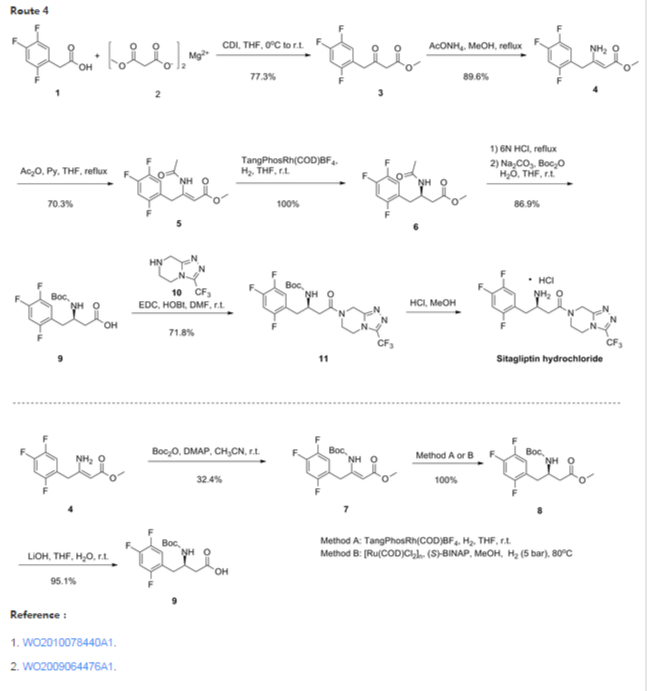
The new synthesis involves first coupling trifluorophenyl acetic acid and triazole building blocks to form a diketoamide, which in turn is converted to the enamine. This sequence is carried out without isolating intermediates. The enamine is then hydrogenated, sitagliptin is isolated and recrystallized as the phosphoric acid salt, and the rhodium Josiphos catalyst is recovered.

In sum, the revised synthesis increases the overall yield of sitagliptin by nearly 50% and reduces the amount of waste by more than 80%. A key difference is that the original synthesis produced more than 60 L of aqueous waste per kg of product, while the new synthesis completely eliminates aqueous waste. When tallied up, Merck expects these savings will prevent formation of 150,000 metric tons of solid and aqueous process waste over the lifetime of Januvia. Industry analysts speculate that regulatory approval of the drug will come by early next year and that it’s destined to become a top-selling drug.

The novel enamine hydrogenation “is arguably the most efficient means to prepare β-amino acid derivatives,” noted R. P. (Skip) Volante, Merck’s vice president of process research. The company currently is using the procedure to make several other exploratory drug candidates, he added. Overall, the redesigned synthesis of sitagliptin “is a green chemistry solution to the preparation of a challenging synthetic target and is an excellent example of a scientific innovation resulting in benefits to the environment,” Volante said.


First generation route to sitagliptin. BINAP = 2,2′-bis(diphenylphosphino)-1,1′-binaphthyl; EDC = N-(3-dimethylaminopropyl)-N’-ethylcarbodiimide hydrochloride; DIAD = di-isopropyl azodicarboxylate; NMM = N-methylmorpholine……..http://www.technology.matthey.com/article/55/2/135-139/


http://pubs.rsc.org/en/content/articlelanding/2011/cc/c1cc11592h#!divAbstract


http://www.nature.com/nature/journal/v485/n7397/fig_tab/nature11117_F4.html

PAPER

First Generation Process for the Preparation of the DPP-IV Inhibitor Sitagliptin

Department of Process Research, Merck Research Laboratories, Rahway, New Jersey 07065, U.S.A.
Org. Process Res. Dev., 2005, 9 (5), pp 634–639
DOI: 10.1021/op0500786
Abstract Image

A new synthesis of sitagliptin (MK-0431), a DPP-IV inhibitor and potential new treatment for type II diabetes, suitable for the preparation of multi-kilogram quantities is presented. The triazolopyrazine fragment of sitagliptin was prepared in 26% yield over four chemical steps using a synthetic strategy similar to the medicinal chemistry synthesis. Key process developments were made in the first step of this sequence, the addition of hydrazine to chloropyrazine, to ensure its safe operation on a large scale. The beta-amino acid fragment of sitagliptin was prepared by asymmetric reduction of the corresponding beta-ketoester followed by a two-step elaboration to an N-benzyloxy beta-lactam. Hydrolysis of the lactam followed by direct coupling to the triazolopiperazine afforded sitagliptin after cleavage of the N-benzyloxy group and salt formation. The overall yield was 52% over eight steps.

Figure

Figure

Figure

The synthesis of 1 was completed using a four-step through-process (Scheme 4). Lactam 5 or ester 13 was hydrolyzed to amino acid 2b with LiOH18 in THF/water by either stirring at room temperature or, in the case of 13, heating to 40 °C. While the benzyloxy group of 2b could be cleaved by hydrogenation and then protected with Boc2O to prevent side reactions during the coupling to triazole 3, the benzyloxy group of 2b was found to sufficiently protect the amino group to allow the desired amide to be formed. Thus, triazole 3 was coupled to2b at 0 °C using EDC−HCl and N-methylmorpholine (NMM) as base to afford 14in >99% assay yield. Following an aqueous workup, the organic extracts were distilled into ethanol and the solution was subjected to hydrogenation with 10% Pd on carbon. The presence of water in the hydrogenation was found to be crucial to the reaction success; anhydrous solutions of 14 hydrogenated with dry Pd on carbon proceeded only to low levels of conversion to 1, and addition of water to these reductions resulted in restored performance of the catalyst. Following hydrogenation, the catalyst was removed by filtration to provide an ethanol solution of 1. Sitagliptin was isolated in >99.5% purity as its anhydrous phosphoric acid salt by crystallizing from aqueous ethanol.

PATENT

http://www.google.co.in/patents/WO2003004498A1?cl=en

Scott D Edmondson, Michael H Fisher,Dooseop Kim, Malcolm Maccoss, Emma R Parmee, Ann E Weber, Jinyou Xu

MORE INFO………

Sitagliptin phosphate monohydrate, a dipeptidyl-peptidase IV inhibitor, is marketed by Merck & Co. for the once-daily oral treatment of type 2 diabetes. The product was first launched in Mexico followed by commercialization in the U.S. The compound has also been filed for approval in the U.S. as adjunct to diet and exercise and in combination with other therapies to improve glycemic control in the treatment of diabetes. In 2007, the product was approved by the European Medicines Evaluation Agency (EMEA) and is currently available in the U.K., Germany and Spain. In 2009, sitagliptin phosphate monohydrate was approved and launched in Japan. The product is also available in Japan for the treatment of type 2 diabetes in combination with alpha-glucosidase inhibitors and in combination therapy with insulin. In 2012, the company filed for approval in Japan for the treatment of type 2 diabetes in patients with severe renal dysfunction, and in 2013 obtained the approval.

Sitagliptin phosphate monohydrate boasts a much lower risk of hypoglycemia than currently available insulin-inducing products due to its novel mechanism of action. MSD KK (formed in 2010 following the merger of Banyu and Schering-Plough KK) and Ono are developing the drug candidate in Japan. In 2008, the compound was licensed to Almirall by Merck Sharp & Dohme for comarketing in Spain for the treatment of type 2 diabetes. In 2010, FAES obtained a comarketing and commercialization license from Merck Sharp & Dohme in Spain for the treatment of type 2 diabetes.

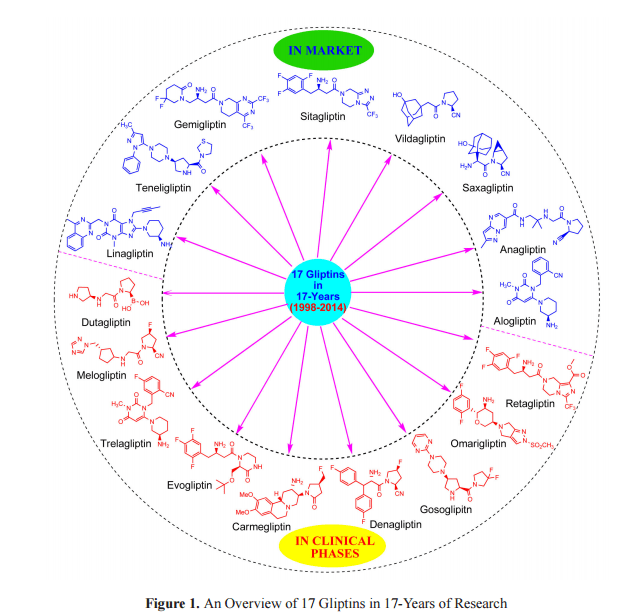
Januvia (sitagliptin phosphate) is an antihyperglycaemic drug containing an orally active inhibitor of the dipeptidyl peptidase-IV (DPP-IV) enzyme. Developed by Merck Sharp & Dohme (MSD), a UK subsidiary of Merck & Co, sitagliptin is used for treating type 2 diabetes mellitus. The drug has proved effective in lowering blood sugar levels of diabetes patients when taken alone or in combination with other oral diabetes medications such as metformin and thiazolidinedione.

Sitagliptin was approved by the US Food and Drug Administration (FDA) in October 2006 and is marketed under the brand name Januvia in the US. Sitagliptin in combination with metformin was approved by the FDA in March 2007 and is marketed as Janumet in the US. In the EU, Januvia was approved in April 2007 and Janumet was approved in July 2008.

Sitagliptin is a triazolopiperazine based inhibitor of DPP-IV, which was discovered by
Merck. It is a potent (IC50= 18 nM) and highly selective over DPP-8 (48000 nM), DPP-9
(>100000 nM) and other isozymes.[16] It enhances the pancreatic β-cell functions, fasting and
post-prandial glycemic control in type 2 diabetic patients. In the crystal structure with DPP-IV,
unlike other substrate-based DPP-IV inhibitors, the binding orientation of the amide carbonyl of
sitagliptin is reversed, i.e. the aromatic trifluorophenyl moiety occupies S1 pocket and the β-
amino amide moiety fits into S2 pockets. The amino group forms a salt bridge and hydrogen
bonding interactions with Glu205 and Glu206, and Tyr662, respectively.The triazolopiperazinemoiety occupies the S2 extended pocket and stacks against Phe357. The exhibited binding
interactions of the trifluoromethyl group with the Arg358 and Ser209 are responsible for its high
selectivity profile. The presence of the trifluoromethyl group in the triazole ring also improves
the oral bioavailability in animal models. Sitagliptin inhibited the plasma DPP-IV up to 80% and
47% at 2 and 24 h, respectively, after a single dose of 25.0 mg in a dose-dependent manner. In a
24-week study, sitagliptin significantly decreased fasting glucose levels and HbA1c levels
(0.8%) at doses of 100 mg q.d. Thus, sitagliptin is well tolerated and body weight neutral. It is
the first DPP-IV inhibitor in the class approved by USFDA in 2006 and is used as either a
monotherapy or in combination with metformin

S2


S1

S3


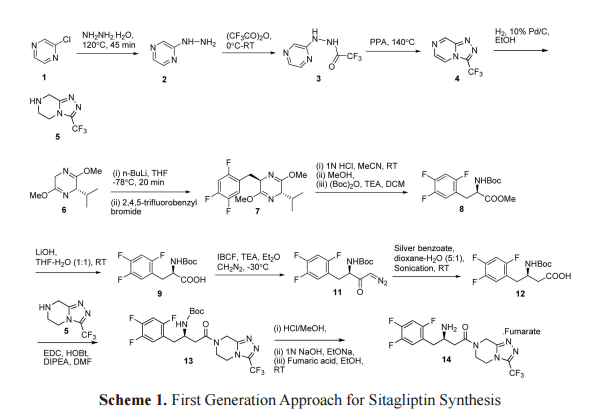
In the first synthetic approach, the synthesis of sitagliptin was started with the reaction of a Schollkopf reagent 6 with 2,4,5-trifluorobenzyl bromide to afford the compound 7, which was converted to compound 9 via hydrolysis of ester 8. The resulting Boc-protected amino acid 9 was converted to diazoketone 11 through mix anhydride protocol by using diazomethane. The intermediate 11 was converted to desired β-amino acid 12 by sonication in the presence of silver benzoate.[21] The sitagliptin (14) was synthesized by coupling of β-amino acid 12 with triazolopiperazine intermediate 5 followed by Boc deprotection of amino group of 13, and its corresponding hemi fumarate salt was then prepared (Scheme 1).[16]

SYN1


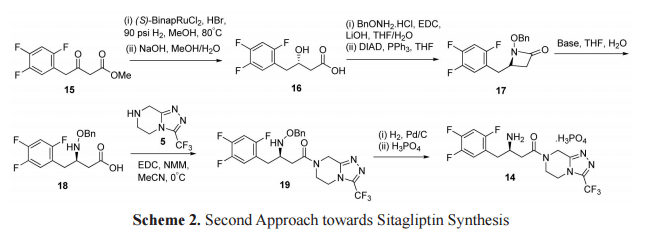
The second approach for synthesis of sitagliptinwas started from asymmetric reduction of β-ketoester 15 using the (S)-BinapRuCl2 complex with a catalytic amount of HBr in methanol followed by hydrolysis afforded the β-hydroxy acid 16. Lactam 17 was synthesized by coupling of 16 with BnONH2 •HCl using N-(3- dimethylaminopropyl)-N-ethylcarbodiimide hydrochloride (EDC), followed by cyclization reaction with diisopropyl azodicarboxylate (DIAD) and PPh3 . [22] Treatment of a catalytic amount of 0.1% NaOH with lactam 17 hydrolyzed and directly afforded the β-amino acid 18. This wascoupled withtriazolopiperazine 5 using EDC•HCl and N-methylmorpholine to provide the N-benzyloxy protected compound 19, which after hydrogenation using Pd/C and by consequent treatment with phosphoric acid provided the phosphate salt of sitagliptin (14) (Scheme 2).


SYN2

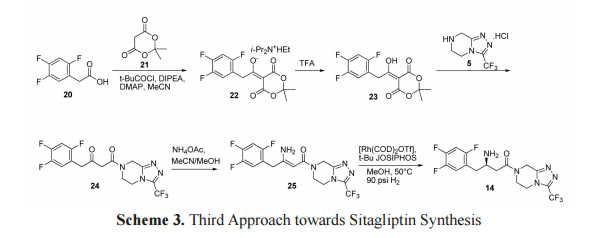
The third approach towards the synthesis of sitagliptin is outlined in scheme 3. Meldrum adduct 22 (Hunig’s base salt) was synthesized from trifluorophenylacetic acid 20 by the formation of a mixed anhydride with pivaloyl chloride in the presence of Meldrum’s acid 21, DIPEA and catalytic amount of dimethylamino pyridine (DMAP) in acetonitrile. Treatment of 22 with TFA resulted compound 23. β-keto amide 24 was formed on reaction of 23 with triazolopiperazine 5. β-keto amide 24 on treatment with ammonium acetate in methanol formed a key intermediate, dehydrositagliptin 25 (enamine amide). This intermediate contains the entire structure of sitagliptin 14 except two hydrogen atoms. Thus, sitagliptin 14 was synthesized by enantioselective hydrogenation of dehydrositagliptin 25 in the presence of [Rh(COD)2 OTf] 12,13 and t Bu JOSIPHOS in excellent yield with 95% ee.[23,24]

SYN3

http://www.cbijournal.com/paper-archive/may-june-2014-vol-3/Review-Paper-1.pdf

P.S. : The views expressed are my personal and in no-way suggest the views of the professional body or the company that I represent.


 REF


http://www.apiindia.org/medicine_update_2013/chap88.pdf

http://www.cbijournal.com/paper-archive/may-june-2014-vol-3/Review-Paper-1.pdf


////////////


Vapourtec…..Continuous Flow-Processing of Organometallic Reagents Using an Advanced Peristaltic Pumping System and the Telescoped Flow Synthesis of (E/Z)-Tamoxifen


www.vapourtec.co.ukA VAPOURTEC POST

http://www.vapourtec.co.uk/products/eseriessystem/pumping/organometallic

Philip R D Murray 1
Duncan L Browne 1
Julio C Pastre 1,2
Chris Butters 3
Duncan Guthrie 3
Steven V Ley 1

1 Department of Chemistry, University of Cambridge, UK
2 Instituto de Quí­mica, University of Campinas, Brazil
3 Vapourtec Ltd, UK

http://www.vapourtec.co.uk/products/eseriessystem/pumping/organometallic

A new enabling-technology for the pumping of organometallic reagents such as n-butyllithium, Grignard reagents and DIBAL-H is reported, which utilizes a newly developed chemically-resistant peristaltic pumping system. Several representative examples of its use in common transformations using these reagents, including metal-halogen exchange, addition, addition-elimination, conjugate addition and partial reduction are reported, along with examples of telescoping of the anionic reaction products. This platform allows for truly continuous pumping of these highly reactive substances and examples are demonstrated over periods of several hours, to generate multi-gram quantities of products. This work culminates in an approach to the telescoped synthesis of (E/Z)-Tamoxifen using continuous-flow organometallic reagent mediated transformations………..http://www.vapourtec.co.uk/products/eseriessystem/pumping/organometallic.


Cooking in one pot – Adding Multiple Component Reactions (MCR) to your Synthesis


developingtheprocess's avatarDeveloping the Process

Wouldn’t it be great to just perform all your reactions in one reactor, flask, vessel, etc ?  I remember when I was working on developing processes how I got some satisfaction out of telescoping reactions, taking the product from one reaction into the next without a preparative workup, crystallization or some sort of purification.  I think my record was 3 consecutive reactions in one flask using one reagent after another.   That could be some savings in the solvent used, the amount of work taken.  At bench-scale, this is really trivial, but it could really be helpful on pilot-plant and manufacturing scale.

I found this review in Green Chemistry, namely, “Multicomponent reactions: advanced tools for sustainable organic synthesis”, Răzvan C. Cioc, Eelco Ruijter* and Romano V. A. Orru, Green Chem., 2014, 16, 2958.  It seems appropriate to talk about “greener” chemical synthesis after introducing the topic covered a few weeks ago, about…

View original post 366 more words

Strong scientific evidence that eating berries benefits the brain


Ralph Turchiano's avatarCLINICALNEWS.ORG

09 MAR 2012

Strong scientific evidence exists that eating blueberries, blackberries, strawberries and other berry fruits has beneficial effects on the brain and may help prevent age-related memory loss and other changes, scientists report. Their new article on the value of eating berry fruits appears in ACS’ Journal of Agricultural and Food Chemistry.

In the article, Barbara Shukitt-Hale, Ph.D., and Marshall G. Miller point out that longer lifespans are raising concerns about the human toll and health care costs of treating Alzheimer’s disease and other forms of mental decline. They explain that recent research increasingly shows that eating berry fruits can benefit the aging brain. To analyze the strength of the evidence about berry fruits, they extensively reviewed cellular, animal and human studies on the topic.

View original post 159 more words

Scientists identify new pathogenic and protective microbes associated with severe diarrhea


Lyranara.me's avatarLyra Nara Blog

In a finding that may one day help control a major cause of death among children in developing countries, a team of researchers led by faculty from the University of Maryland, College Park and the University of Maryland School of Medicine has identified microorganisms that may trigger diarrheal disease and others that may protect against it. These microbes were not widely linked to the condition previously.

“We were able to identify interactions between microbiota that were not previously observed, and we think that some of those interactions may actually help prevent the onset of severe diarrhea,” says O. Colin Stine, a professor of epidemiology and public health at the University of Maryland School of Medicine.

A much better understanding of these interactions is important, Stine adds, as they could lead to possible dietary interventions. Moderate to severe diarrhea (MSD) is a major cause of childhood mortality in developing countries and…

View original post 430 more words

XenoPort begins phase II trial of XP-23829 in patients with psoriasis


XP 23829  from Xenoport is an interesting molecule and as on 27 July 2014, I did not find conclusive evidence

See some structures below

Not sure about the structure of XP 23829


OR

Figure US08148414-20120403-C00019Best fit

OR


Figure US08148414-20120403-C00027Not sure?

(N,N-dimethylcarbamoyl)methyl methyl(2E)but-2-ene-1,4-dioate.

OR

Figure imgf000032_0002

I AM NOT SURE ABOUT THIS ONE ALSO????????

As Football worldcup2014 goes on in Brazil

A thought for it is due…………

……………………………………………………

Best fit is probably is as shown below, and there are reasons

(N,N- Diethylcarbamoyl)methyl methyl (2E)but-2-ene-l,4-dioate 

Introduction

(N,​N-​Diethylcarbamoyl)​methyl methyl (2E)​-​but-​2-​ene-​1,​4-​dioate

C11 H17 N O5, mw 243.13

M.p.: 53-56 °C.

1 H NMR (CDCI3, 400 MHz): δ 6.99-6.90 (m, 2H), 4.83 (s, 2H), 3.80 (s, 3H), 3.39 (q, J = 1.1 Hz, 2H), 3.26 (q, J = 7.2 Hz, 2H), 1 .24 (t, J = 7.2 Hz, 3H), 1 .14 (t, J = 7.2 Hz, 3H). MS (ESI): m/z 244.13 (M+H)+.

Cas…….1208229-58-6

XP-23829 PROBABLE

For the treatment of moderate-to-severe chronic plaque-type psoriasis.

XP-H-093

US8148414Links Basic patent


Xenoport, Inc.  Innovator

XenoPort has initiated a phase II trial of XP-23829, a proprietary investigational next-generation fumaric acid product candidate (ClinicalTrials.gov Identifier NCT02173301). The multicenter, randomized, double-blind, placebo-controlled study is designed to assess the efficacy and safety of XP-23829 as a potential treatment of patients with moderate to severe chronic plaque-type psoriasis. XenoPort expects to enroll approximately 200 subjects in this trial, which is being conducted in the U.S. The study will include a screening and washout phase of up to 4 weeks, a 12-week treatment phase and a 4-week post-treatment phase. Eligible study subjects will be randomized to placebo or one of three treatment arms of XP-23829: 400 or 800 mg once daily or 400 mg twice daily. The primary endpoint will examine the percent change in Psoriasis Area and Severity Index (PASI) score from baseline at the end of week 12. Secondary endpoints will include the proportion of subjects who achieve a reduction of 75% or greater from baseline in PASI (PASI75) score and subjects who achieve a Static Physicians Global Assessment score of “clear” or “almost clear.” Topline results are expected in the third quarter of 2015 (XenoPort News Release).

XP23829 — A Prodrug of Monomethyl Fumarate

Our third product candidate, XP23829, is in Phase 1 clinical development. Provided we are able to demonstrate the safety and desired pharmacokinetic, or PK, profile of XP23829 in our Phase 1 trials, we believe that XP23829 could be a potential treatment of patients with RRMS, psoriasis and/or certain other disorders where the mechanism of action of XP23829 may be relevant. For example, we are exploring the potential of XP23829 to protect against neurodegeneration in experimental preclinical models of Parkinson’s disease through a grant from The Michael J. Fox Foundation. We hold a composition-of-matter patent and a formulation patent in the United States on XP23829 and hold patents or pending patent applications directed to the XP23829 methods of synthesis and use in the United States. We have also filed applications directed to the XP23829 composition of matter and methods of synthesis and use in other jurisdictions.

Prodrug Background

XP23829 is a fumaric acid ester compound and a patented prodrug of MMF. Fumaric acid ester compounds have shown immuno-modulatory and neuroprotective effects in cell-based systems and preclinical models of disease. A product containing a combination of fumaric acid ester compounds, known as Fumaderm, is approved in Germany for the treatment of psoriasis. Tecfidera (a formulation of DMF, also known as BG-12) from Biogen Idec Inc. is another fumaric acid ester prodrug that converts to MMF in the body. Phase 3 clinical trials of Tecfidera as a potential treatment for RRMS showed statistically significant benefits of Tecfidera versus placebo. Tecfidera is currently under U.S. regulatory review as a potential treatment for RRMS.

Our Prodrug

XP23829 is a novel prodrug of MMF that we believe may provide improved tolerability and efficacy compared to DMF. In preclinical studies that compared molar equivalent doses of XP23829 to DMF, XP23829 provided higher blood levels of the biologically active molecule MMF and a similar or greater degree of efficacy in MS and psoriasis animal models. Toxicology studies conducted in two species showed that XP23829 caused less stomach irritation when compared to DMF.

Phase 1 Clinical Trial in Healthy Volunteers

In October 2012, we reported favorable preliminary results from our first Phase 1 clinical trial in healthy adults designed to assess the pharmacokinetics, safety and tolerability of single doses of four different formulations of XP23829. The trial was a randomized, double-blind, two-period crossover, food effect comparison clinical trial of XP23829. Sixty subjects were assigned to five cohorts of 12, with each cohort receiving one of four different formulations of XP23829 or placebo. The trial demonstrated that administration of XP23829 resulted in the expected levels of MMF in the blood. As anticipated, the four formulations produced

April 4, 2012

http://investor.xenoport.com/releasedetail.cfm?ReleaseID=708145Links
XenoPort Awarded U.S. Patent Directed to Composition and Formulations of XP23829, a Novel Fumarate Analog for the Potential Treatment of Relapsing-Remitting Multiple Sclerosis and Psoriasis
SANTA CLARA, Calif.–(BUSINESS WIRE)–Apr. 4, 2012– XenoPort, Inc. (Nasdaq: XNPT) announced today that it was awarded U.S. Patent 8,148,414 for “Prodrugs of Methyl Hydrogen Fumarate, Pharmaceutical Compositions Thereof, and Methods of Use.” The term of the patent extends until 2029, subject to potential Hatch-Waxman patent term extensions.


The patent is directed to the XP23829 compound, analogs thereof and formulations thereof. A related U.S. patent application directed to therapeutic uses of XP23829 is now pending.


XP23829 is a prodrug of methyl hydrogen fumarate, also known as monomethyl fumarate (MMF). In cell- and animal-based models, MMF has been shown to exhibit immuno-modulatory properties and inhibit damage from oxidative stress.


In XenoPort’s preclinical animal studies that compared molar equivalent doses of XP23829 to dimethyl fumarate (DMF), another prodrug of MMF, XP23829 demonstrated a greater degree of efficacy in animal models of both multiple sclerosis (MS) and psoriasis. Toxicology studies conducted in two species showed that XP23829 caused less stomach irritation compared to DMF.

XenoPort intends to file an Investigational New Drug Application (IND) for XP23829 for the treatment of relapsing remitting MS with the U.S. Food and Drug Administration (FDA) in the second quarter of 2012 and expects to initiate human clinical trials later this year.

XenoPort owns all rights to XP23829.

About XenoPort

XenoPort is a biopharmaceutical company focused on developing and commercializing a portfolio of internally discovered product candidates for the potential treatment of neurological disorders. Horizant® (gabapentin enacarbil) Extended-Release Tablets is XenoPort’s first FDA-approved product. GlaxoSmithKline holds commercialization rights and certain development rights for Horizant in the United States. Regnite® (gabapentin enacarbil) is approved for the treatment of moderate-to-severe primary restless legs syndrome in Japan. Astellas Pharma Inc. holds all development and commercialization rights for Regnite in Japan and five Asian countries. XenoPort holds all other world-wide rights and has co-promotion and certain development rights to gabapentin enacarbil in the United States. XenoPort’s pipeline of product candidates includes potential treatments for patients with postherpetic neuralgia, spasticity and Parkinson’s disease.

To learn more about XenoPort, please visit the company Website at http://www.XenoPort.com.Links

More info about this drug


SEE a patent

WO 2010022177

……………………………………….

WO 2013181451

http://www.google.com/patents/WO2013181451A1?cl=enLinks


Scheme 5:


ONE OUT OF THESE

Example 6: (/V,/V-Diethylcarbamoyl)methyl methyl (2£)but-2-ene-1 ,4-dioate


[0138] Following general procedure A, methyl hydrogen fumarate (MHF) (0.39 g, 3.00 mmol) dissolved in NMP was reacted at about 55 °C with 2-chloro-/V,/V-diethylacetamide (0.44 g, 3.00 mmol) in the presence of CsHC03 (0.69 g, 3.60 mmol) to afford 0.37 g (51 % yield) of the title compound after purification by silica gel column chromatography (Biotage) using a mixture of ethyl acetate (EtOAc) and hexanes (1 :1 ) as eluent. M.p.: 53-56 °C. 1 H NMR (CDCI3, 400 MHz): δ 6.99-6.90 (m, 2H), 4.83 (s, 2H), 3.80 (s, 3H), 3.39 (q, J = 1.1 Hz, 2H), 3.26 (q, J = 7.2 Hz, 2H), 1 .24 (t, J = 7.2 Hz, 3H), 1 .14 (t, J = 7.2 Hz, 3H). MS (ESI): m/z 244.13 (M+H)+.

Example 7: Methyl 2-morpholin-4-yl-2-oxoethyl (2 £)but-2-ene-1 ,4-dioate


[0139] Following general procedure A, methyl hydrogen fumarate (MHF) (0.50 g, 3.84 mmol) dissolved in NMP was reacted at about 55 °C with 4-(chloroacetyl) morpholine (0.75 g, 4.61 mmol) in the presence of CsHC03 (0.89 g, 4.61 mmol) to afford 0.34 g (35% yield) of the title compound as a white solid after purification by mass-guided preparative HPLC and lyophilization. M.p.: 124 to 126°C; 1 H NMR (CDCI3, 400 MHz): δ 6.97-6.91 (m, 2H), 4.84 (s, 2H), 3.82 (s, 3H), 3.72-3.70 (m, 4H), 3.64-3.62 (m, 2H), 3.46-3.41 (m, 2H). MS (ESI): m/z 258.04 (M+H)+. Example 8: A/,A/-Dimethylcarbamoyl)methyl methyl (2E)but-2-ene-1 ,4-dioate

[0140] Following general procedure A, methyl hydrogen fumarate (MHF) (0.50 g, 3.84 mmol) dissolved in NMP was reacted at about 55 °C with /V,/V-dimethyl chloroacetamide (0.56 g, 4.61 mmol) in the presence of CsHC03 (0.89 g, 4.61 mmol). The crude material was precipitated out from a mixture of ethyl acetate (EtOAc) and hexanes (Hxn) (1 :1 ) to provide a white solid. This solid was further dissolved in dichloromethane (DCM) and the organic layer washed with water. After removal of the solvents 0.55 g (67% yield) of the title compound was obtained as a white solid. 1 H NMR (CDCI3, 400 MHz): δ 6.98- 6.90 (m, 2H), 4.84 (s, 2H), 3.80 (s, 3H), 2.99-2.97 (2s, 6H). MS (ESI): m/z 216 (M+H)+.

Example 9: Methyl (2-morpholino-4-ylethyl) fumarate


[0141] Following general Procedure A, methyl hydrogen fumarate (MHF) dissolved in NMP is reacted at about 55 °C with 4-(chloroethyl) morpholine (0.75 g, 4.61 mmol) in the presence of CsHC03 to afford the title compound after purification by mass-guided preparative HPLC and lyophilization. Example 10: Methyl (3-mor holino-4-ylpropyl) fumarate


[0142] Following the procedure of Methyl (2-morpholino-4-ylethyl) fumarate, and replacing 4-(chloroethyl) morpholine with 4-(chloropropyl) morpholine provides the title compound.

Example 11 : Methyl (4-morpholino-4-ylbutyl) fumarate

[0143] Following the procedure of Methyl (2-morpholino-4-ylethyl) fumarate, and replacing 4-(chloroethyl) morpholine with 4-(chlorobutyl) morpholine provides the title compound. Example 12: Methyl 5-morpholino-4-ylpentyl) fumarate


[0144] Following the procedure of Methyl (2-morpholino-4-ylethyl) fumarate, and replacing 4-(chloroethyl) morpholine with 4-(chloropentyl) morpholine provides the title compound. Example 13: (A/-cyclopropyl-W-ethylcarbamoyl)methyl methyl 2(E)but-2-ene-1 ,4-dioate


[0145] Following the general procedure A, methyl hydrogen fumarate (MHF) (38.7 g, 0.297 mol) suspended in toluene (100 mL) was reacted at about 80 °C with 2-chloro-/V-cyclopropyl- N-ethylacetamide (48 g, 0.297 mol) in the presence of W,/V-diisopropylethylamine (DIEA; 42.3 g, 57 mL, 0.327 mol) to afford 50 g (63.3%) of the title compound after recrystallization using methyl ferf-butyl ether. The crystalline compound had a melting point of 92.1 °C. 1 H NMR (CDCI3, 400 MHz): δ 7.01 -6.92 (m, 2H), 4.99 (s, 2H), 3.81 (s, 3H), 3.44 (q, J = 7.2 Hz, 2H), 2.69-2.66 (m, 1 H), 1 .14 (t, J = 7.2 Hz, 3H), 0.94-0.91 (m, 2H), 0.83-0.81 (m, 2H). MS (ESI): m/z 256.2 (M+H)+.

Example 14: (/V-cyclopropyl-/V-methylcarbamoyl)methyl methyl 2(E)but-2-ene-1 , 4- dioate

[0146] Following general procedure A, methyl hydrogen fumarate (MHF) (38.7 g, 0.40 mol) suspended in toluene (100 mL) was reacted at about 80 °C with 2-chloro-/V-cyclopropyl-/V- methylacetamide (60 g, 0.40 mol) in the presence of Ν,Ν-diisopropylethylamine (DIEA; 57.8 g, 78 mL, 0.44 mol) to afford 50 g (50.86%) of the title compound after recrystallization using methyl fe/t-butyl ether. The crystalline compound had a melting point of 93.6 °C. 1 H NMR (CDCI3, 400 MHz): δ 7.01 -6.91 (m, 2H), 5.01 (s, 2H), 3.82 (s, 3H), 2.94 (s, 3H), 2.73-2.68 (m, 1 H), 0.94-0.86 (m, 2H), 0.83-0.78 (m, 2H). MS (ESI): m/z 242.2 (M+H)+.

Example 15: Methyl 2-oxo-2-pyrrolidinylethyl 2(E)but-2-ene-1 ,4-dioate


[0147] Following general procedure A, methyl hydrogen fumarate (MHF) (20.78 g, 0.159 mol) suspended in toluene (60 mL) was reacted at about 80 °C with 2-chloro-1 -pyrrolidin-1 -yl- ethanone (23.5 g, 0.159 mol) in the presence of N,N-diisopropylethylamine (DIEA; 22.69 g, 31 .5 mL, 0.175 mol) to afford 24 g (62.3%) of the title compound after recrystallization using methyl fe/t-butyl ether. The crystalline compound had a melting point of 102.1 °C. 1 H NMR (CDCI3, 400 MHz): δ 7.00-6.92 (m, 2H), 4.75 (s, 2H), 3.81 (s, 3H), 3.53-3.49 (t, J = 6.8 Hz, 2H), 3.42-3.39 (t, J = 6.8 Hz, 2H), 2.20-1 .97 (m, 2H), 1 .91 -1 .82 (m, 2H). MS (ESI): m/z 242 (M+H)+.


………………………………

Patent

 http://www.google.co.in/patents/US8148414

(I):Links


Example 1(N,N-Diethylcarbamoyl)methyl methyl(2E)but-2-ene-1,4-dioate (1)…………. best fit


Following general procedure A, methyl hydrogen fumarate (MHF) (0.39 g, 3.00 mmol) dissolved in NMP was reacted at ca. 55° C. with 2-chloro-N,N-diethylacetamide (0.44 g, 3.00 mmol) in the presence of CsHCO3 (0.69 g, 3.60 mmol) to afford 0.37 g (51% yield) of the title compound (1) after purification by silica gel column chromatography (Biotage) using a mixture of ethyl acetate (EtOAc) and hexanes (1:1) as eluent. M.p.: 53-56° C. 1H NMR (CDCl3, 400 MHz): δ 6.99-6.90 (m, 2H), 4.83 (s, 2H), 3.80 (s, 3H), 3.39 (q, J=7.2 Hz, 2H), 3.26 (q, J=7.2 Hz, 2H), 1.24 (t, J=7.2 Hz, 3H), 1.14 (t, J=7.2 Hz, 3H). MS (ESI): m/z 244.13 (M+H)+.

Example 162-(4-Acetylpiperazinyl)-2oxoethyl methyl(2E)but-2ene-1,4-dioate (16)


Methyl 2-oxo-2-piperazinylethyl(2E)but-2-ene-1,4-dioate hydrochloride (14) (0.20 g, 0.68 mmol) was reacted with acetyl chloride (AcCl) (0.60 mL, 0.66 g, 0.84 mmol) and diisopropylethylamine (0.70 mL, 0.52 g, 4.0 mmol) in dichloromethane (DCM). Following aqueous work-up, the crude product was purified by silica gel flash chromatography to afford 0.12 g (54% yield) of the title compound (16) as a white solid. 1H NMR (CDCl3, 400 MHz): δ 6.98-6.93 (m, 2H), 4.86 (s, 2H), 3.83 (s, 3H), 3.66 3.63 (m, 4H), 3.50-3.40 (m, 4H), 2.14 (s, 3H). MS (ESI): m/z 299.12 (M+H)+.

Example 9N,N-Dimethylcarbamoyl)methyl methyl(2E)but-2-ene-1,4-dioate (9)


Following general procedure A, methyl hydrogen fumarate (MHF) (0.50 g, 3.84 mmol) dissolved in NMP was reacted at ca. 55° C. with N,N-dimethyl chloroacetamide (0.56 g, 4.61 mmol) in the presence of CsHCO3 (0.89 g, 4.61 mmol). The crude material was precipitated out from a mixture of ethyl acetate (EtOAc) and hexanes (Hxn) (1:1) to provide a white solid. This solid was further dissolved in dichloromethane (DCM) and the organic layer washed with water. After removal of the solvents 0.55 g (67% yield) of the title compound (9) was obtained as a white solid. 1H NMR (CDCl3, 400 MHz): δ 6.98-6.90 (m, 2H), 4.84 (s, 2H), 3.80 (s, 3H), 2.99-2.97 (2s, 6H). MS (ESI): m/z 216 (M+H)+.


………………………..

http://www.google.com/patents/WO2014031844A1?cl=enLinks

Figure imgf000024_0002

Compound (1).


Table 1 : Flushing Incidence as a Function of MMF Cmax


*Formulation 2 is the dosage form described in Example 10; Formulation 3 is the dosage form described in Example 3 ; Formulation 4 is the dosage form described in Example 5 ;

** maximum average Concentration; ***average Cmax; Poster (see above); Compound (1) referred to in the above table is an MMF prodrug of Formula (II); (N,N- Diethylcarbamoyl)methyl methyl (2£)but-2-ene-l,4-dioate having the following chemical structure:


Compound (1).


The maximum slope values ( dose and ng) for different dosage treatments are given in Table 2. The Figures 15-16 show plots of maximum MMF slope vs flushing incidence. The curves in the figures were fitted using a Hill Emax model. Table 2


Compound, Flushing

Table 3: Composition of Enteric Coated Sustained Release Tablet (15% HPMC in Core)


Quantity Quantity

Component Manufacturer Role

(mg tablet) (%w/w)

Vertellus (Greensboro,

Triethyl Citrate Plasticizer 1.25 0.42

NC)

Emerson Resources Anti- tacking

PlasAC YL™ T20 2.41 0.80

(Norristown, PA) agent

Total Enteric

27.87 9.30 Coating

Total Tablet 334.69 111.68

[00191] The tablets were made according to the following steps. The core tablets were prepared using a wet granulation process. The granulation was performed in two batches at 456 g per batch. Compound (1) and hydroxypropyl cellulose were passed through a conical mill with a 610 micron round holed screen. Compound (1) and hydroxypropyl cellulose were then combined in a Key KG- 5 granulator bowl and mixed with water addition for approximately 7 minutes. The wet granules were dried in a Glatt GPCG-1 fluid bed dryer at 40 °C. The two portions of dried granules were sized by passing through a conical mill with an approximately 1300 micron grater type screen. The milled granules were blended with the hypromellose 2208, silicon dioxide, and lactose monohydrate for 10 minutes in an 8 quart (7.6 1) V-blender. This blend was passed through an 850 micron mesh screen. The magnesium stearate was passed through a 600 micron mesh screen and blended with the additional core materials in the V-blender for 5 minutes. Core tablets (299.69 mg) were compressed using a GlobePharma Minipress II rotary tablet press with 8.6 mm round concave tooling. The core tablets had a final mean hardness of approximately 12 kp. For the coating, an aqueous suspension was prepared by mixing with an impeller 63.8 g Opadry 03019184 with 770.7 g of purified water. The water contained in the suspension is removed during the film coating process and therefore not included in the final formulation in Table 3. The tablets were coated with the aqueous suspension in an O’ Hara Technologies Labcoat M coater with a 12″ (30.5 cm) diameter perforated pan until the desired weight gain of barrier coat was achieved. The coating process occurred at an inlet temperature of approximately 52 °C and an outlet temperature of 36 °C. After coating, the tablets were dried for 2 hours at 40 °C. An aqueous suspension was prepared by mixing with an impeller 405.1 g methacrylic acid copolymer dispersion, 6.3 g triethyl citrate, 60.6 g PlasACRYL™ T20 with 228.1 g water. The water contained in the methacrylic acid copolymer dispersion and the

PlasACRYL™ T20 is removed during the film coating process and therefore not included in the final formulation in Table 3. The tablets were coated with the aqueous suspension in the O’ Hara Technologies Labcoat M coater until the desired weight gain of enteric film was achieved. The coating process occurred at an inlet temperature of approximately 40 °C and an outlet temperature of 30 °C. After coating, the tablets were dried for 2 hours at 40 °C.

Example 2

In Vitro Dissolution Profile of Example 1 Dosage Form

[00192] A two-stage dissolution method was used to determine the in vitro dissolution profile of dosage forms prepared according to Example 1. The 2-stage dissolution test was used to better approximate the pH conditions experienced by a dosage form after swallowing by a patient, i.e., low pH of the stomach followed by near neutral pH of the intestines. The dosage forms were first placed into a dissolution vessel (USP, Type I, basket) containing 750 mL of 0.1 N hydrochloric acid (pH 1.2). After 2 hours, 250 mL of 200 mM tribasic sodium phosphate was added to the vessel resulting in a pH adjustment from 1.2 to 6.8. The dissolution medium was kept at 37 °C and was agitated at 100 rpm.

[00193] For the Example 1 dosage forms, samples of the dissolution medium were withdrawn after 1 and 2 hours in the low pH stage, and at 0.5, 2, 4, 7, 10, and 14 hours following buffer addition. The released amount of the MMF prodrug in the samples was determined by reverse phase HPLC using a C18 column and a 7 minute gradient method according to Table 4 where Mobile Phase A is water/0.1 ]¾Ρθ4 and Mobile Phase B is water/acetonitrile/H3PC>4 (10/90/0.1 by volume) with UV detection at 210 nm.

Table 4: HPLC Gradient Conditions


[00194] As shown in FIG. 1, for dosage forms prepared according to Example 1, drug release is delayed for approximately 2 hours, followed by sustained release reaching >90 at 12 hours.

Example 3

Preparation of Delayed Sustained Release Dosage Form (Enteric Coated, 15% HPMC in Core, without Barrier Layer) [00195] Delayed sustained release tablets containing compound (1) were made having the ingredients shown in Table 5:

Table 5: Composition of Enteric Coated Sustained Release Tablet (15% HPMC in Core, without Barrier Layer)


[00196] The tablets were made according to the following steps. The core tablets were prepared using a wet granulation process. The granulation was performed in two batches at 463.9 g per batch. Compound (1) and hydroxypropyl cellulose were passed through a conical mill with a 610 micron round holed screen. Compound (1) and hydroxypropyl cellulose were then combined in a Key KG- 5 granulator bowl and mixed with water addition for approximately 10 minutes. The wet granules were dried in a Glatt GPCG-1 fluid bed dryer at 40 °C. The two portions of dried granules were blended with silicon dioxide and sized by passing through a conical mill with an approximately 1300 micron grater type screen. The milled granules were blended with the hypromellose 2208 and lactose monohydrate for 10 minutes in an 8 quart (7.6 1) V-blender. This blend was passed through an 850 micron mesh screen. The magnesium stearate was passed through a 600 micron mesh screen and blended with the additional core materials in the V-blender for 5 minutes. Core tablets (299.68 mg) were compressed using a GlobePharma Minipress II rotary tablet press with 11/32″ round concave tooling. The core tablets had a final mean hardness of approximately 11 kp. For the coating, an aqueous suspension was prepared by mixing with an impeller 578.7 g methacrylic acid copolymer dispersion, 9.0 g triethyl citrate, 86.5 g PlasACRYL™ T20 with 325.8 g water. The water contained in the methacrylic acid copolymer dispersion and the

PlasACRYL™ T20 is removed during the film coating process and therefore not included in the final formulation in Table 4. The tablets were coated with the aqueous suspension in the O’ Hara Technologies Labcoat M coater until the desired weight gain of enteric film was achieved. The coating process occurred at an inlet temperature of approximately 41 °C and an outlet temperature of 31 °C. After coating, the tablets were dried for 2 hours at 40 °C.

…………………………

WO 2014071371

http://www.google.com/patents/WO2014071371A1?cl=enLinks

(N,N-Diethylcarbamoyl)methyl methyl (2E)but-2-ene-1 ,4-dioate has the following chemical structure:


This compound was synthesized in Example 1 of Gangakhedkar et al., U.S. Patent No. 8,148,414. The compound is a prodrug of methyl hydrogen fumarate (MHF) and has a disclosed melting point of between 53 °C and 56 °C.

Cocrystals are crystals that contain two or more non-identical molecules that form a crystalline structure. The intermolecular interactions between the non-identical molecules in the resulting crystal structures can result in physical and chemical properties that differ from the properties of the individual components. Such properties can include, for example, melting point, solubility, chemical stability, mechanical properties and others. Examples of cocrystals may be found in the Cambridge Structural Database and in Etter, et al.,

“The use of cocrystallization as a method of studying hydrogen bond preferences of 2-aminopyridine” J. Chem. Soc, Chem. Commun. (1990), 589-591 ; Etter, et al., “Graph-set analysis of hydrogen-bond patterns in organic crystals” Acta Crystallogr., Sect. B, Struct. Sci. (1990), B46: 256-262; and Etter, et al., “Hydrogen bond directed cocrystallization and molecular recognition properties of diarylureas” J. Am. Chem. Soc. (1990), 1 12: 8415-8426. Additional information relating to cocrystals can be found in: Carl Henrik Gorbotz and Hans-Petter Hersleth,

“On the inclusion of solvent molecules in the crystal structures of organic compounds”; Acta Cryst. (2000), B56: 625-534; and Senthil Kumar, et al., “Molecular Complexes of Some Mono- and Dicarboxylic Acids with trans-1 ,4,-Dithiane-1 ,4-dioxide” American Chemical Society, Crystal Growth & Design (2002) , 2(4) : 313-318.


(N,N-Diethylcarbamoyl)methyl methyl (2E)but-2-ene-1 ,4-dioate is a prodrug of methyl hydrogen fumarate. Once administered, the compound is metabolized in vivo into an active metabolite, namely, methyl hydrogen fumarate (MHF) which is also referred to herein as monomethyl fumarate (MMF). The in vivo metabolism of (N,N-Diethylcarbamoyl)methyl


(N,N-Diethylcarbamoyl)methyl methyl Methyl hydrogen fumarate N ^ diethyl glycolamide

(2E)but-2-ene-1 ,4-dioate

Table 1


As can be seen from the data in Table 1 , the six cocrystals disclosed herein each exhibit a higher melting point than crystalline (N,N-Diethylcarbamoyl)methyl methyl (2E)but-2-ene-1 ,4- dioate.


Links

…………………………….

Steady state pharmacokinetics of formulations of XP23829, a novel prodrug of monomethyl fumarate (MMF), in healthy subjects
66th Annu Meet Am Acad Neurol (AAN) (April 26-May 3, Philadelphia) 2014, Abst P1.188

………………………………….


Lymphocyte and eosinophil responses in healthy subjects dosed with Tecfidera and XP23829, a novel fumaric acid ester (FAE)
66th Annu Meet Am Acad Neurol (AAN) (April 26-May 3, Philadelphia) 2014, Abst P1.201

………………………..

A comparison of XP23829 with DMF, the active ingredient of BG-12
4th Cooperative Meet Consorti Mult Scler Cent (CMSC) Am Comm Treat Res Mult Scler (ACTRIMS) (May 30-June 2, San Diego) 2012, Abst SC03

 http://annualmeeting.mscare.org/index.php?option=com_content&view=article&id=174&Itemid=101

Links

…………………………..

Favorable metabolism and pharmacokinetics of formulations of XP23829, a novel fumaric acid ester, in healthy subjects
65th Annu Meet Am Acad Neurol (AAN) (March 16-23, San Diego) 2013, Abst P05.189

…………………………………..

Comparison of the efficacy and tolerability of a novel methyl hydrogenfumarate prodrug with dimethyl fumarate in rodent EAE and GI irritation models
Neurology 2011, 76(9): Abst P05.040

Links

WO2013119791A1 * Feb 7, 2013 Aug 15, 2013 Xenoport, Inc. Morpholinoalkyl fumarate compounds, pharmaceutical compositions, and methods of use
US20120034303 * Jan 8, 2010 Feb 9, 2012 Forward Pharma A/S Pharmaceutical formulation comprising one or more fumaric acid esters in an erosion matrix
US20120095003 * Oct 14, 2011 Apr 19, 2012 Xenoport, Inc. Methods of using prodrugs of methyl hydrogen fumarate and pharmaceutical compositions thereof
US20120157523 * Oct 14, 2011 Jun 21, 2012 Xenoport, Inc. Prodrugs of methyl hydrogen fumarate, pharmaceutical compositions thereof, and methods of use
K Gogas ET AL: “Comparison of the efficacy and tolerability of a novel methylhydrogenfumarate prodrug with dimethylfumarate in rodent experimental autoimmune encephalomyelitis and GI irritation models“, 26th Congress of the European Committee for Treatment and Research in Multiple Sclerosis (ECTRIMS) & 15th Annual Conference of Rehabilitation in MS (RIMS), 15 October 2010 (2010-10-15), XP055076728, Retrieved from the Internet: URL:http://registration.akm.ch/einsicht.php?XNABSTRACT_ID=115706&XNSPRACHE_ID=2&XNKONGRESS_ID=126&XNMASKEN_ID=900 [retrieved on 2013-08-27]

WO2013119791A1 * Feb 7, 2013 Aug 15, 2013 Xenoport, Inc. Morpholinoalkyl fumarate compounds, pharmaceutical compositions, and methods of use
US20100048651 * Aug 19, 2009 Feb 25, 2010 Xenoport, Inc. Prodrugs of methyl hydrogen fumarate, pharmaceutical compositions thereof, and methods of use
US8669281 20 Sep 2013 11 Mar 2014 Alkermes Pharma Ireland Limited Prodrugs of fumarates and their use in treating various diseases
WO2014031894A1 22 Aug 2013 27 Feb 2014 Xenoport, Inc. Oral dosage forms of methyl hydrogen fumarate and prodrugs thereof
WO2014071371A1 5 Nov 2013 8 May 2014 Xenoport, Inc. Cocrystals of (n,n-diethylcarbamoyl)methyl methyl (2e)but-2-ene-1,4-dioate