
Home » Posts tagged 'tolterodine'
Tag Archives: tolterodine
 DRUG APPROVALS BY DR ANTHONY MELVIN CRASTO
.....FOR BLOG HOME CLICK HERE
DRUG APPROVALS BY DR ANTHONY MELVIN CRASTO
.....FOR BLOG HOME CLICK HEREFlag and hits
ORGANIC SPECTROSCOPY

SUBSCRIBE

 Subscribe in a reader
Enter your email address:
Delivered by FeedBurner
Subscribe to New Drug Approvals by Email


Recent Comments
 | shivkr2 on SPSR Excellence Award 2025 – S… |
 | Bonkasaurus on Infigratinib phosphate |
 | PALOVAROTENE | ORGAN… on Palovarotene |
| Pfizer just purchase… on Temanogrel | |
| Pfizer To Cash In On… on Temanogrel |
Improved one-pot synthesis of N, N-diisopropyl-3-(2-Hydroxy-5-methylphenyl)-3-phenyl propanamide; a key intermediate for the preparation of racemic Tolterodine

Tolterodine is chemically known as (R)-N,N-disiopropyl-3-(2-hydroxy-5-methyl phenyl)-3-phenyl propyl amine. Tolterodine acts as a muscarinic receptor antagonist. It is useful in the treatment of urinary incontinence [1]. Tolterodine tartrate acts by relaxing the smooth muscle tissues in the walls of the bladder by blocking cholinergic receptors[2]. Tolterodine tartrate [3] is marketed by Pharmacia & Upjohn in the brand name of Destrol®.
The present invention relates to a novel process for the preparation of N,N-diisopropyl-3-(2-hydroxy-5-methylphenyl)-3-phenylpropanamide (4); a key intermediate for the preparation of Tolterodine (1). Some different approaches have been published [4–8] for the preparation of N,N-diisopropyl-3-(2-hydroxy-5-methylphenyl)-3-phenylpropanamide (4). These methods involve multistep synthesis using hazardous, expensive reagents and some of the methods [6] involve activators like Grignard reagents, LDA, n-butyl lithium, Lewis acids. Hence there is a need to develop an alternative, plant friendly procedure for the preparation of N,N-diisopropyl-3-(2-hydroxy-5-methylphenyl)-3-phenylpropanamide (4) from 3,4-dihydro-6-methyl-4-phenylcoumarin (2) (Fig1).


Ring opening reactions of dihydrocoumarins are well known in literature[9–11]. But in the present invention, we have described a new methodology (Scheme 1 & Scheme2) for the preparation ofN,N-diisopropyl-3-(2-hydroxy-5-methylphenyl)-3-phenylpropanamide (4) by using inexpensive and commercially vailable starting materials like 3, 4-dihydro-6-methyl 4-phenylcoumarin (2), which was synthesized from p-cresol and trans-cinnamic acid [12].

Scheme 1
N,N-diisopropyl-3-(2-hydroxy-5-methylphenyl)-3-phenylpropanamide 4.

Scheme 2
N-Isopropyl-3-(2-hydroxy-5-methylphenyl)-3-phenylpropanamide 5.
3,4-Dihyhydro-6-methyl 4-phenylcoumarin (2) reacts with diisopropylamine (6) in presence of acetic acid gives N,N-diisopropyl-3-(2-hydroxy-5-methylphenyl)-3-phenylpropanamide (4) at room temperature. This process of compound 4 is very useful for commercialization of Tolterodine 1 in plant.
General procedure for the synthesis of compounds 4-4c & 5-5c
To a solution of 3,4-dihyhydro-6-methyl 4-phenylcoumarin 2 (10 g, 42 mmol) in diisopropylether (200 mL), N,N-diisopropylamine (33.95 g, 336 mmol) and acetic acid (10 g, 168 mmol) were added at room temperature. The suspension was stirred for 16 h at room temperature. The reaction mass was concentrated, the resulting residue was crystallized with D.M.Water (50 mL) and diisopropyl ether (50 mL) mixture to gave N,N-diisopropyl-3-(2-hydroxy-5-methylphenyl)-3-phenylpropanamide 4 (10.6 g, 75% yield).
N,N-diisopropyl-3-(2-hydroxy-5-methylphenyl)-3-phenylpropanamide 4
IR (KBr) cm-1: 3024 (Aromatic C-H, str.), 2949, 2904, 2869 (Aliphatic C-H, str.), 1630 (C═O, str.), 1609, 1555, 1510 (C═C, str.), 1469, 1459 (CH2 bending), 1270 (C-N, str.), 1072 (C-O, str.), 788, 769 (Aromatic CH Out-of-plane bend). 1H NMR (300 MHz, DMSO-d6) δ 1.04 (d, 12H), 2.089 (s, 3H), 2.79 (m, 2H), 3.037 (m, 2H), 4.702 (t, 1H), 6.6 (d, 1H), 6.75 (d, 2H), 7.127-7.246 (m, 5H). 13C NMR (125 MHz, DMSO-d6) δ 19.39, 20.36, 45.69, 115.33, 125.70, 127.20, 128.15, 130.60, 144.43, 152.23, 173.37. MS m/z: 340 [(M + H)+].
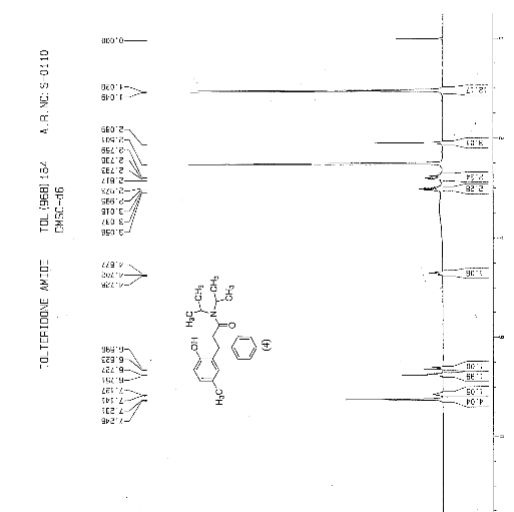
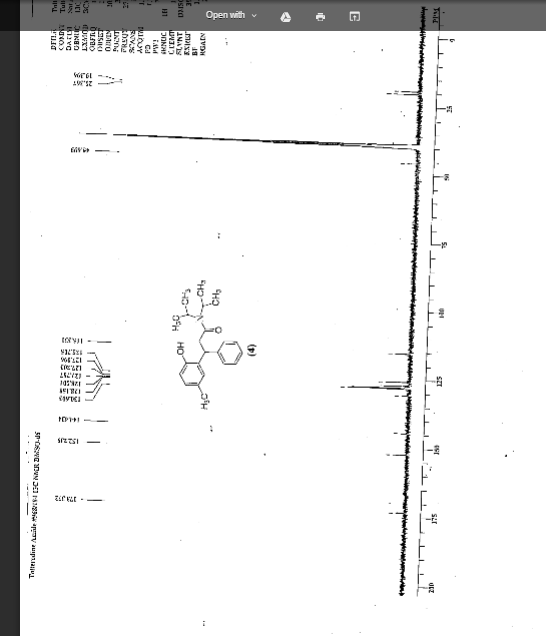
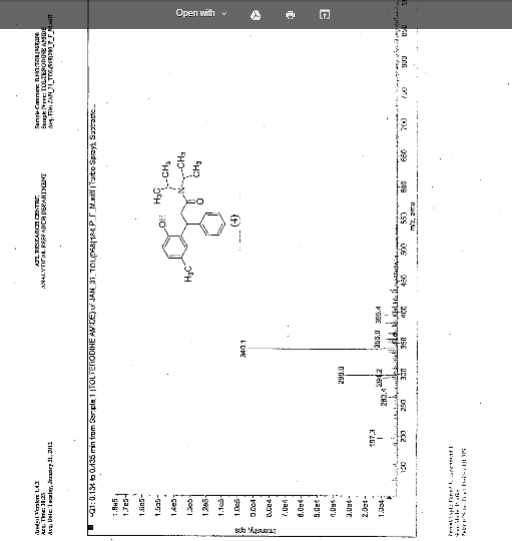
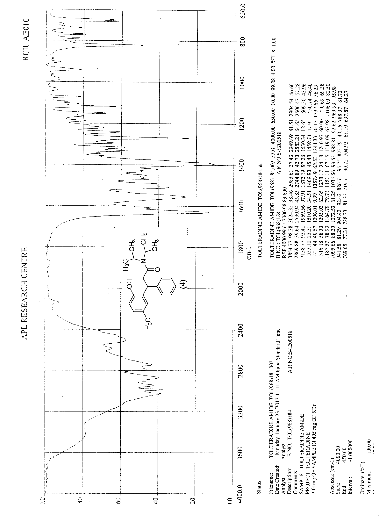
Improved one-pot synthesis of N, N-diisopropyl-3-(2-Hydroxy-5-methylphenyl)-3-phenyl propanamide; a key intermediate for the preparation of racemic Tolterodine
2Engineering Chemistry Department, AU college of Engineering, Andhra University, Visakhapatnam 530003, Andhra Pradesh, India
The electronic version of this article is the complete one and can be found online at:http://www.sustainablechemicalprocesses.com/content/2/1/2
http://www.sustainablechemicalprocesses.com/content/2/1/2/additional

Srinivas garaga
scientist at Aurobindo Pharma
Chemical Research and Development Department, Aurobindo Pharma Ltd

/////
TheraVida Presents Positive Phase 2 Data for Tolenix (THVD-201) in Patients with Overactive Bladder
mar18, 2013
TheraVida, Inc., a clinical-stage biopharmaceutical company developing novel combination drug products, presented positive results from a Phase 2 clinical trial of its lead product candidate, Tolenix ™ (THVD-201), for the treatment of overactive bladder (OAB) and urge urinary incontinence (UUI) at the 28 th Annual Congress of the European Urological Association (EAU) in Milan, Italy.
Tolenix ™ is a twice-daily (BID) proprietary combination of tolterodine, to treat OAB and UUI, and pilocarpine, to reduce the significant dry mouth (xerostomia) caused by muscarinic antagonist medications such as tolterodine.

tolterodine

pilocarpine
The objectives of the randomized, double-blinded, multiple-crossover Phase 2 trial were to assess the safety and efficacy of Tolenix ™ in reducing the frequency of micturition (urination) and incontinence episodes per day, as compared to both placebo control and active control Detrol ® (tolterodine). In addition, common side effects of muscarinic antagonist therapies, such as dry mouth, were carefully assessed in the 138 patients enrolled in the trial. This international Phase 2 clinical trial was conducted in South Korea, Australia, and New Zealand.
Patients receiving Tolenix ™ (2mg tolterodine plus 9mg pilocarpine, administered BID) experienced statistically significant improvements in their OAB and UUI symptoms over placebo, with a reduction in daily micturitions of 0.88 (p<0.0001) and a reduction in daily incontinence episodes of 0.47 (p<0.0001). This efficacy was similar in magnitude to the maximum dose of active control Detrol ® (2mg tolterodine, administered BID).


 New Drug Approvals