
Home » Posts tagged 'Sun'
Tag Archives: Sun
 DRUG APPROVALS BY DR ANTHONY MELVIN CRASTO
.....FOR BLOG HOME CLICK HERE
DRUG APPROVALS BY DR ANTHONY MELVIN CRASTO
.....FOR BLOG HOME CLICK HEREFlag and hits
ORGANIC SPECTROSCOPY

SUBSCRIBE

 Subscribe in a reader
Enter your email address:
Delivered by FeedBurner
Subscribe to New Drug Approvals by Email


Recent Comments
 | shivkr2 on SPSR Excellence Award 2025 – S… |
 | Bonkasaurus on Infigratinib phosphate |
 | PALOVAROTENE | ORGAN… on Palovarotene |
| Pfizer just purchase… on Temanogrel | |
| Pfizer To Cash In On… on Temanogrel |
WO 2016024289, NILOTINIB, New Patent by SUN PHARMA
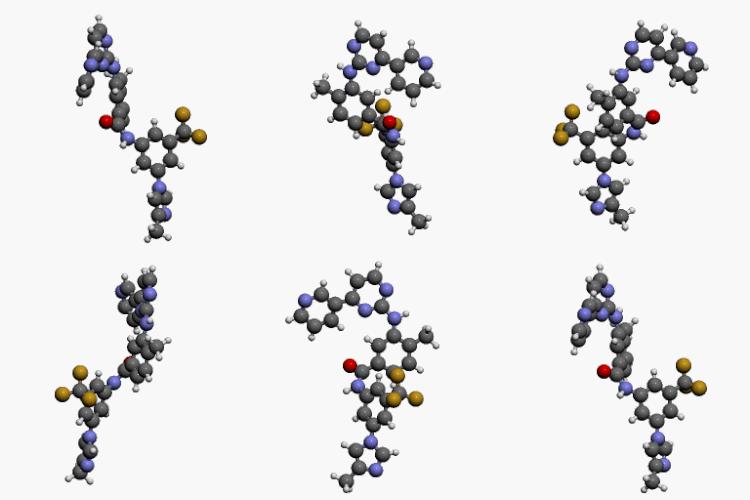

NILOTINIB

WO 2016024289, NILOTINIB, New Patent by SUN
SUN PHARMACEUTICAL INDUSTRIES LTD [IN/IN]; 17/B, Mahal Industrial Estate, Off Mahakali Caves Road, Andheri (east), Mumbai 400093 (IN)
THENNATI, Rajamannar; (IN).
KILARU, Srinivasu; (IN).
VALANCE SURENDRAKUMAR, Macwan; (IN).
SHRIPRAKASH DHAR, Dwivedi; (IN)
The present invention provides novel salts of nilotinib and polymorphs thereof. The acid addition salts of nilotinib with benzenesulfonic acid, butanedisulfonic acid, 1-5- naphthalenedisulfonic acid, naphthalene-1-sulfonic acid and 1-hydroxynaphthoic acid; hydrates and anhydrates thereof.
Nilotinib, 4-methyl-N-[3-(4-methyl-lH-imidazol-l-yl)-5-(trifluoromethyl)phenyl]-3-[[4-(3-pyridinyl)-2-pyrimidinyl] amino] -benzamide, having the following formula

is marketed under the name Tasigna® in US and Europe. Tasigna contains nilotinib monohydrate monohydrochloride salt and is available as capsules for the treatment of adult patients with newly diagnosed Philadelphia chromosome positive chronic myeloid leukemia (Ph+ CML) in chronic phase. Tasigna is also indicated for the treatment of chronic phase and accelerated phase Philadelphia chromosome positive chronic myelogenous leukemia (Ph+ CML) in adult patients resistant or intolerant to prior therapy that included imatinib.
Nilotinib is considered a low solubility/low permeability (class IV) compound in the Biopharmaceutics Classification System (BCS). Therefore, dissolution of nilotinib can potentially be rate limiting step for in-vivo absorption. It is soluble in acidic media; being practically insoluble in buffer solutions of pH 4.5 and higher.
WIPO publication 2014059518A1 discloses crystalline forms of nilotinib hydrochloride and methods of the preparation of various crystalline solvates of nilotinib hydrochloride including benzyl alcohol, acetic acid and propylene glycol.
WIPO publication 2011033307A1 discloses nilotinib dihydrochloride and its hydrates and method for their preparation.
WIPO publication 2011163222A1 discloses the preparation of nilotinib salts and crystalline forms thereof. The salts of nilotinib disclosed are hydrochloride, fumarate, 2-chloromandelate, succinate, adipate, L-tartrate, glutarate, p-toluenesulfonate, camphorsulfonate, glutamate, palmitate, quinate, citrate, maleate, acetate, L-malate, L-aspartate, formate, hydrobromide, oxalate and malonate.
WIPO publication number 2011086541A1 discloses a nilotinib monohydrochloride monohydrate salt and methods for preparing.
WIPO publication number 2010054056A2 describes several crystalline forms of nilotinib hydrochloride.
WIPO publication number 2007/015871A1 discloses the preparation of nilotinib salts and crystalline forms thereof. The salts are mixtures of nilotinib and one acid wherein the acids are selected from the group consisting of hydrochloric acid, phosphoric acid, sulfuric acid, sulfonic acid, methane sulfonic acid, ethane sulfonic acid, benzene sulfonic acid, p-toluene sul- fonic acid, citric acid, fumaric acid, gentisic acid, malonic acid, maleic acid, and tartaric acid.
WIPO publication number 2007015870A2 discloses several nilotinib salts including amorphous and crystalline forms of nilotinib free base, nilotinib HC1 and nilotinib sulfate along with their hydrate and solvates.

EXAMPLES:
Example 1: Preparation of nilotinib benzenesulfonate crystalline Form I
Nilotinib base (1 g) was suspended in water (20 ml). A solution of benzenesulfonic acid (0.4 g) in water (3ml) was added and the content was heated at 60 °C for 2-3 h. The mixture was cooled to 25-30 °C, filtered, washed with water (3 x 5 ml) and dried under vacuum for 2 h at 50-55 °C.
1H NMR (500 MHz, DMSO-d6) δ 2.40 (s,3H), 2.42 (s,3H), 7.35-7.37 (m,3H), 7.51-7.66 (m,5H),7.83 (d,lH), 7.96 (s,lH),8.08 (s,lH),8.30 (s,lH) 8.39 (s,lH),8.54 (d,lH), 8.61 (d,lH), 8.64 (s,lH), 8.75 (d,lH), 9.25 (s,lH), 9.34 (d,lH), 9.61 (s,lH), 10.84 (s,lH).
The salt provides an XRPD pattern substantially same as set forth in FIG. 1.
Example 2: Preparation of nilotinib butanedisulfonate (2: 1) crystalline Form II
Nilotinib base (100 g) was dissolved in 20 % water in THF solution (2000 ml) at 60-65 °C and insoluble matter was filtered. The filtrate was concentrated under vacuum below 60 °C. Filtered water (1000 ml) was added to the reaction mixture and it was heated at 50-55 °C, followed by addition of 1,4-butanedisulfonic acid -60% aqueous solution (28.6 ml) at same temperature. The content was stirred at 50-55 °C for 2-3h. Reaction mixture as cooled to 25-30 °C and product was filtered, washed with water (200 ml x 2) and dried in air oven at 50-55 °C (yield: 115 g).

Sun Pharma managing director Dilip Shanghvi.
Purity (by HPLC):99.76%
1H NMR (400 MHz,DMSO-d6) δ 1.63-1.66(m,2H), 2.40(d,3H),2.42(s,3H),2.43-2.47(m,2H), 7.51-7.62(m,3H),7.85(dd,lH),7.96(s,lH),8.08(s,lH),8.34(s,lH),8.38(d,lH),8.52-8.55(m,lH), 8.60-8.62 (m,2H), 8.75(d,lH), 9.25(S,1H),9.34(S,1H),9.59(S,1H),10.86(S,1H)
Water content: 7.95 %.
The salt has a XRPD pattern substantially same as set forth in FIG. 2.
Example 3: Preparation of nilotinib butanedisulfonate (2: 1) crystalline Form II
Nilotinib base (300 g) was suspended in methanol (3000 ml) and aqueous hydrochloric acid was added to get pH less than 2. Reaction contents were heated at reflux and was filtered and washed with methanol (100 ml). 5% (w/w) NaOH (1200 ml) solution was added at 40-45 °C within 15 min, reaction mixture was stirred for 2h. Product was filtered, washed with water
(300 ml x 3) and dried for lh. Wet material was suspended in water (3000 ml), heated at 50- 55 °C followed by addition of 1,4-butanedisulfonic acid -60% aqueous solution. The reaction mixture was stirred at 50-55°C for 2hrs. Product was filtered at room temperature, washed with water (500 ml x 2) and dried in air oven at 50-55 °C (yield: 293 g).
Purity (by HPLC): 99.88 %
1H NMR (400 MHz,DMSO-d6+TFA-dl) δ 1.75-1.78(m,2H), 2.36(d,3H),2.38(s,3H),2.69- 2.72(m,2H),7.45(d,lH),7.68(d,lH),7.83(s,lH),7.88(dd,lH),7.97(s,lH),8.16-8.19(m,lH), 8.35
(s,2H), 8.63(d,lH),8.68(d,lH),9.04(d,lH),9.21(d,lH),9.53(br s,lH),9.69(d,lH)10.80 (s,lH)
Water content: 6.44 %
Example 4: Preparation of nilotinib butanedisulfonate (2: 1) crystalline Form III
Nilotinib butanedisulfonate (210g) was dissolved in acetic acid water mixture (50:50) (2520 ml) at 75-80 °C and was filtered to remove insoluble matter and washed with acetic acid water mixture (50:50) (210 ml). Water (3150ml) was added to the filtrate and stirred first at room temperature and then at 0-5 °C. Product was filtered and washed with water. Material was dried in air oven at 70-75 °C. Dried material was leached with methanol (3438 ml) at reflux temperature, filtered and dried in air oven 70-75°C (yield: 152.6 g)
Purity (by HPLC): 99.89 %
1H NMR (400 MHz,DMSO-d6+TFA-dl) δ 1.73-1.77(m,2H), 2.40(s,6H),2.67-2.70(m,2H), 7.50 (d,lH), 7.70(d,lH), 7.88-7.92(m,2H), 8.07(s,lH),8.23 (dd,lH), 8.34(s,2H), 8.67 (d,lH), 8.72 (d,lH), 9.09(d,lH), 9.23 (s,lH), 9.54(d,lH), 9.74(d,lH), 10.86(s,lH).
Water content: 0.61 %
The salt provides an XRPD pattern substantially same as set forth in FIG. 3.
Example 5: Preparation of crystalline form of nilotinib butanedisulfonate (2: 1)
Crystalline Nilotinib butanedisulfonate (1 g) of Example 2 was suspended in methanol (20 ml) and was stirred at reflux for 60 min. The mixture was cooled to room temperature. Solid was filtered, washed with methanol (2 ml x 3) and dried in air oven at 70-75°C (yield: 0.8 g)
Example 6: Preparation of nilotinib butanedisulfonate (1: 1) crystalline Form IV
Nilotinib base (20 g) was suspended in methanol (800 ml) and 1,4-butanedisulfonic acid -60
% aqueous solution (6 ml) was added at 50-55 °C, and was filtered to remove insoluble matter. Filtrate was stirred at room temperature for 2-3 h. Product formed was filtered, washed with methanol (20 ml x 2) and dried the product in air oven at 70-75 °C (yield: 18.4 g).
Purity (by HPLC):99.86 %
1H NMR (400 MHz,DMSO-d6) δ 1.64-1.68(m,4H), 2.47-2.5 l(m,4H), 2.41(s,3H), 2.42(d,3H), 7.52(d,lH), 7.83-7.89(m,2H), 7.99(s,lH), 8.15(s,lH), 8.36 (d,lH), 8.39(s,lH), 8.65-8.66(m,2H), 8.79(d,lH), 8.89(br s,lH), 9.36(s,lH), 9.41(br s,lH), 9.74(d,lH), 10.91(s,lH).
The salt has XRPD pattern substantially same as set forth in FIG. 4.
Example 7: Preparation of nilotinib 1,5-napthalenedisulfonic acid salt (2: 1) crystalline Form V
Nilotinib base (1 g) was suspended in water (20 ml). A solution of 1,5-napthalenedisulfonic acid (0.4 g; 0.6 eq.) in water (5ml) was added and the content was heated at 50-55 °C for lh. The mixture was cooled to 25-30 °C, filtered and washed with water (10 ml). The product was dried in air oven at 50-55°C (yield: 1.2 g).
1H NMR (400 MHz,DMSO-d6) δ 2.39 (s,3H), 2.42 (s,3H), 7.45-7.61 (m,4H),7.84 (d,lH), 7.97(s,2H),8.08 (m,lH),8.31 (s,lH) 8.38 (s,lH),8.55 (d,lH), 8.63 (s,2H), 8.75 (s,lH), 8.92 (d,lH), 9.26 (s, 1H), 9.34 (s,lH),9.62 (s,lH), 10.85 (s,lH).
The salt has a XRPD pattern substantially same as set forth in FIG. 5.
Example 8: Preparation of nilotinib 1,5-napthalenedisulfonic acid salt (1: 1) crystalline Form VI
Nilotinib base (1 g) was suspended in water (20 ml). A solution of 1,5-napthalenedisulfonic acid (0.8 g; 1.2eq) in water (5 ml) was added and the content was heated at 50-55 °C for 1 h. The mixture was cooled to 25-30 °C, filtered, washed with water (10 ml) and dried in air oven at 50-55 °C (yield: 1.4g).
1H NMR(400 MHz,DMSO-d6) δ 2.40 (s,3H),2.41 (s,3H), 7.43-7.52 (m,3H),7.61 (d,lH), 7.85-7.99(m,5H),8.11 (s,lH),8.34 (s,2H), 8.64-8.67 (m,2H), 8.89-8.92 (m,4H),9.40(d,2H), 9.72 (s,lH), 10.87 (s,lH).
The salt has a XRPD pattern substantially same as set forth in FIG. 6.
Example 9: Preparation of nilotinib napthalene-1- sulfonic acid salt crystalline Form VII Nilotinib base (1 g) was suspended in water (10 ml) and heated to 50-55 °C. A solution of napthelene-1 -sulfonic acid and methanol (10 ml) was added to it and heated at 70-75 °C for 30 min. The mixture was cooled to 25-30 °C and stirred for 10 min. The product was filtered, washed with water (2 x 2 ml) and dried under vacuum for 1-2 h at 50-55 °C.
1H NMR (400 MHz,DMSO-d6) δ 2.41 (s,3H),2.42 (s,3H), 7.46-7.58 (m,5H), 7.70-8.00 (m,7H)8.11(s,lH)8.31(s,lH),8.37(s,lH),8.63-8.66 (m,3H), 8.81-8.89 (m,2H), 9.31 (s,lH), 9.37 (d,lH), 9.71 (d,lH), 10.86 (s,lH)
The salt has a XRPD pattern substantially same as set forth in FIG. 7.
Example 10: Preparation of nilotinib l-hydroxy-2-napthoic acid salt crystalline Form VIII Nilotinib base (1 g) was suspended in water (20 ml) and heated to 50-55 °C. l-Hydroxy-2-napthoic acid was added to it and the content was heated at 50-55 °C for 1 h. Methanol (5 ml) was added to the mixture and stirred for 30 min. The content was filtered, washed with water (2 x 2 ml) and dried under vacuum for 1 h at 50-55 °C.
1H NMR (400 MHz, DMSO-d6) δ 2.25 (s,3H), 2.41 (s,3H), 7.40-7.92 (m,l lH), 8.23-8.73 (m,8H), 9.24 (s,lH), 9.34(s,lH), 10.70 (s,lH).
The salt has a XRPD pattern substantially same as set forth in FIG. 8.
 |
|
 |
|
| Systematic (IUPAC) name | |
|---|---|
|
4-methyl-N-[3-(4-methyl-1H-imidazol-1-yl)- 5-(trifluoromethyl)phenyl]-3- [(4-pyridin-3-ylpyrimidin-2-yl) amino]benzamide
|
|
| Clinical data | |
| Trade names | Tasigna |
| AHFS/Drugs.com | monograph |
| MedlinePlus | a608002 |
| Licence data | EMA:Link, US FDA:link |
| Pregnancy category |
|
| Legal status | |
| Routes of administration |
Oral |
| Pharmacokinetic data | |
| Bioavailability | 30%[1] |
| Protein binding | 98%[1] |
| Metabolism | Hepatic (mostly CYP3A4-mediated)[1] |
| Biological half-life | 15-17 hours[1] |
| Excretion | Faeces (93%)[1] |
| Identifiers | |
| CAS Number | 641571-10-0(base)  |
| ATC code | L01XE08 |
| PubChem | CID 644241 |
| IUPHAR/BPS | 5697 |
| DrugBank | DB04868  |
| ChemSpider | 559260 |
| UNII | F41401512X |
| KEGG | D08953 |
| ChEBI | CHEBI:52172 |
| ChEMBL | CHEMBL255863 |
| PDB ligand ID | NIL (PDBe, RCSB PDB) |
| Chemical data | |
| Formula | C28H22F3N7O |
| Molar mass | 529.5245 g/mol |
//////////////WO 2016024289, WO-2016024289, NILOTINIB, New Patent, SUN
Cc1ccc(cc1Nc2nccc(n2)c3cccnc3)C(=O)Nc4cc(cc(c4)n5cc(nc5)C)C(F)(F)F
Sun Pharma to acquire GSK’s Australian opiates business

Sun Pharma to acquire GSK’s Australian opiates business
India-based Sun Pharmaceutical Industries has agreed to acquire GlaxoSmithKline’s (GSK) opiates business in Australia.
The agreement has been signed by wholly-owned subsidiaries of both firms, with the financial terms not disclosed.
Sun Pharma API business executive vice-president Iftach Seri said: “The global opiates market holds good potential and the addition of GSK’s Opiates business will strengthen our positioning further.”
Sun Pharmaceutical Industries Ltd(SUN.NS), India’s largest drugmaker by sales, said on Tuesday it has agreed to buy GlaxoSmithKline’s(GSK.L) opiates business in Australia to strengthen its pain management portfolio.
The business consists of analgesics made from raw materials found in opium poppy plants, and includes two manufacturing sites in the states of Tasmania and Victoria.
Financial details of the deal were not disclosed. A Sun Pharma spokesman declined to comment. Glaxo did not immediately respond to a request seeking comment.
Glaxo supplies a quarter of the world’s medicinal opiate needs from poppies grown by farmers in Tasmania, according to the company website. The company’s Australian opiates business brought in revenue of A$89 million ($69.63 million) in 2013.
Australia’s poppy industry is the world’s largest legal supplier of pharmaceutical grade opiates for painkillers, and Glaxo is one of three firms that control the crop and production in Tasmania.
The other two are Johnson & Johnson’s (JNJ.N) unit Tasmanian Alkaloids, and privately-held TPI Enterprises.
Glaxo’s decision to part with the opiates business comes as Tasmania’s poppy industry is facing a tough crop and the United Nations is expected to cut the state’s poppy crop area this week.
Glaxo said the deal would allow it to “focus on delivering its innovative product portfolio” in Australia.
“The opiates business has been an important part of our Australian business for many years, but as our portfolio transitions, we believe now is the right time to hand this business over to someone else,” Steve Morris, general manager of GSK Opiates, said in a statement.
The business employs 185 staff, including 155 in Victoria state and 30 in Tasmania state. Sun Pharma said it would hire all employees from both sites.
“The acquisition is a part of our strategy towards building our portfolio of opiates and accessing strong capabilities in this segment,” said Iftach Seri, executive vice president of the active pharmaceuticals ingredients business at Sun Pharma.
Both companies said they expect to close the deal by August.
Sun Pharma shares closed 1.93 percent higher on Tuesday, while the broader Nifty rose 0.44 percent.
($1 = 1.2781 Australian dollars)
Sun Pharma has bought Ranbaxy for $4 billion to create the world’s fifth-biggest generic drugmaker.
 Dilip sanghvi, sun pharma promoter
The move will make the company the largest pharma firm in India, while Daiichi Sankyo – majority owner of Ranbaxy – will become the second largest shareholder in Sun Pharma with a 9% stake and the right to nominate one director to Sun Pharma’s Board of Directors. http://www.pharmatimes.com/Article/14-04-07/Sun_buys_Ranbaxy_for_4_billion.aspx
Read more at: http://www.pharmatimes.com/Article/14-04-07/Sun_buys_Ranbaxy_for_4_billion.aspx#ixzz2yGIjkMob


Dilip Shanghvi, Managing Director of Sun Pharma said in a release, “Ranbaxy has a significant presence in the Indian pharma market and in the US where it offers a broad portfolio of ANDAs and first-to-file opportunities. In high-growth emerging markets, it provides a strong platform which is highly complementary to Sun Pharma’s strengths,”
Under the agreement, Ranbaxy shareholders will get 0.8 shares of Sun Pharma for each Ranbaxy share.
Arun Sahwney, managing director and chief executive officer of Ranbaxy said in a statement, “Sun Pharma has a proven track record of creating significant long-term shareholder value and successfully integrating acquisitions into its growing portfolio of assets,”
Who Will Benefit?
Daiichi Sankyo Co. Ltd is the parent company of Ranbaxy as they acquired it from previous promoters and investors. As soon as Ranbaxy was acquired, their plants came under a scanner from US Food and Drug Administration (FDA), which troubled Daiichi as their own reputation was under stake.
Now, they will be the most relived entity as Sun Pharma will manage all such cases pertaining to Ranbaxy. Daiichi will now control 9% of Sun Pharma as a result of the current acquisition.
Insiders are claiming that Daiichi will sell this 9% stake as well and come out of the business all together.
Ranbaxy shareholders have cheered this latest development as their shares have gained since the announcement of this deal.
Sun, Reddys, Bharat Biotech, 3 Indian Companies among Best Company in an Emerging market–Scrip Awards 2013

Shortlist for the SCRIP Awards 2013.
http://www.scripintelligence.com/awards/categories/
Deciding on a shortlist from so many deserving entries was never going to be an easy process for our independent judging panel, but they rose to the challenge and this list represents the best of the best.
Best Company in an Emerging Market – Sponsored by Clinigen Group
- Bharat Biotech – India
- Dr Reddy’s Laboratories – India
- Sphaera Pharma – Singapore
- Sun Pharmaceutical Industries – India
- WuXi AppTec – China
Best Technological Development in Clinical Trials
- ArisGlobal’s Total Clinical
- Covance’s Xcellerate
- ICON’s ICONIK Monitoring for Patient Safety
- INC Research’s Trusted Process
- PPD’s real-time data offering
- Quintiles’ Infosario Safety
Best Partnership Alliance
- AstraZeneca with Bristol-Myers Squibb and Amylin in diabetes
- AstraZeneca and LegoChem to develop two compounds as a combination antibacterial
- Drugdev.org for The Investigator Databank with Janssen R&D, Eli Lilly, Merck & Co and Pfizer
- Roche with Isis Pharmaceuticals for antisense drugs in Huntington’s disease
- Vaxxas with Merck & Co for the Nanopatch vaccine platform
- WuXi AppTec with MedImmune for autoimmune and inflammatory diseases
Financing Deal of the Year
- Clinigen’s Initial Public Offering on AIM
- Elcelyx Therapeutics’ $20 million series C financing
- e-Therapeutics’ fundraising of £40 million on AIM
- Karolinska Development financing through option deal with Rosetta Capital Partners
- Mesoblast’s equity financing of Aus$170m
Best Advance in an Emerging Market
- Bharat Biotech’s development of low-cost rotavirus vaccine Rotavac for emerging markets
- Janssen’s TB treatment program for Sirtuto (bedaquiline) in emerging markets
- Novartis’s Jian Kang Kuai Che healthcare project in China
- Roche’s collaboration with Ascletis for hepatitis C treatments in China
Clinical Advance of the Year – Sponsored by Quintiles
- Galapagos’s Phase IIa study of the JAK1 inhibitor GLPG0634 in rheumatoid arthritis
- Genmab and Janssen Biotech’s Phase I/II study of daratumumab in multiple myeloma
- Janssen Research & Development/Merck’s PURSUIT clinical program of Simponi (golimumab) in ulcerative colitis
- Mundipharma’s (ReSearch Pharmaceutical Services) RELOXYN-Study of oxycodone/naloxone FDC for restless legs syndrome
- Novartis’s Gilenya’s effect on brain volume loss in TRANSFORMS, FREEDOMS and FREEDOMS II
- Regeneron Pharmaceuticals and Sanofi’s Phase IIa study dupilumab in in asthma
Licensing Deal of the Year
- Allergan and Molecular Partners for the development and commercialization of DARPin products for ophthalmic diseases
- AstraZeneca and Horizon Discovery for the development and commercialization of the HD-001 kinase target program for multiple cancer types
- Clinigen and Theravance for commercialization of Vibativ (telavancin) in Europe
- Genentech and AC Immune and for the development and commercialization of anti-Tau antibodies for Alzheimer’s disease
- Janssen Biotech and Genmab for the development and commercialization of daratumumab
- Pfizer and AstraZeneca for the over-the-counter marketing of Nexium (esomeprazole)
Executive of the Year
- Harvey Berger, chairman and chief executive officer of ARIAD Pharmaceuticals
- Joe Jimenez, chief executive officer of Novartis
- Josef von Rickenbach, chairman and chief executive officer of PAREXEL
- Patrik de Haes, chief executive officer of ThromboGenics
- Phil Lee, president and chief executive officer of PHT
- Roch Doliveux, chairman and chief executive officer of UCB
Biotech Company of the Year
- Ablynx
- ARIAD Pharmaceuticals
- Galapagos
- Genmab
- Prosensa
- ThromboGenics
Best Contract Research Organization
- ClinTec International
- Covance
- ICON
- INC Research
- PPD
- Quintiles
Management Team of the Year
- Beximco Pharmaceuticals’ management team
- Prosensa’s management team
- Regeneron Pharmaceuticals’ CEO Leonard S Schleifer and CSO George D Yancopoulos
Best New Drug – Sponsored by INC Research
- Algeta and Bayer’s Xofigo (radium Ra223 dichloride)
- ARIAD Pharmaceuticals’ Iclusig (ponatinib)
- Novartis’ Bexsero (meningococcal group B vaccine)
- ThromboGenics/Alcon’s Jetrea (ocriplasmin)
- Zealand Pharma’s Lyxumia (lixisenatide)
Pharma Company of the Year – Sponsored by ICON
- Amgen
- Astellas
- Dr Reddy’s Laboratories
- Sun Pharmaceutical Industries
- Vifor Pharma (Galenica)


 New Drug Approvals