
Home » Posts tagged 'SILICO LINEZOLID'
Tag Archives: SILICO LINEZOLID
 DRUG APPROVALS BY DR ANTHONY MELVIN CRASTO
.....FOR BLOG HOME CLICK HERE
DRUG APPROVALS BY DR ANTHONY MELVIN CRASTO
.....FOR BLOG HOME CLICK HEREFlag and hits
ORGANIC SPECTROSCOPY

SUBSCRIBE

 Subscribe in a reader
Enter your email address:
Delivered by FeedBurner
Subscribe to New Drug Approvals by Email


Recent Comments
 | shivkr2 on SPSR Excellence Award 2025 – S… |
 | Bonkasaurus on Infigratinib phosphate |
 | PALOVAROTENE | ORGAN… on Palovarotene |
| Pfizer just purchase… on Temanogrel | |
| Pfizer To Cash In On… on Temanogrel |
SILICO LINEZOLID, SILINEZOLID, NDS 10024

Therapeutic options for brain infections caused by pathogens with a reduced sensitivity to drugs are limited. Recent reports on the potential use of linezolid in treating brain infections prompted us to design novel compounds around this scaffold. Herein, we describe the design and synthesis of various oxazolidinone antibiotics with the incorporation of silicon.
Our findings in preclinical species suggest that silicon incorporation is highly useful in improving brain exposures. Interestingly, three compounds from this series demonstrated up to a 30-fold higher brain/plasma ratio when compared to linezolid thereby indicating their therapeutic potential in brain associated disorders
Design, Synthesis, and Identification of Silicon Incorporated Oxazolidinone Antibiotics with Improved Brain Exposure
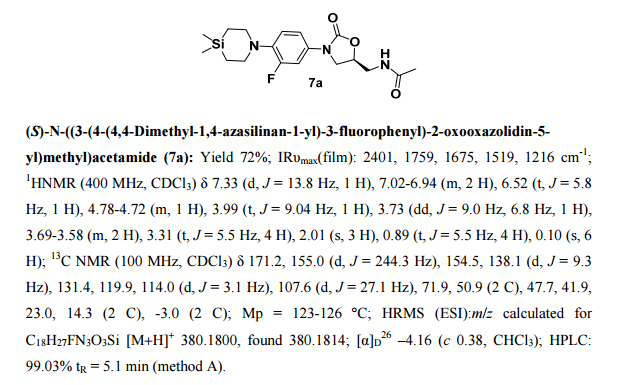
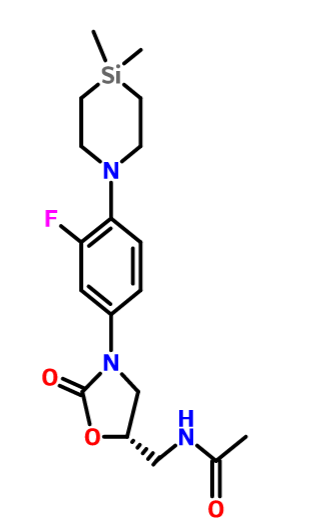

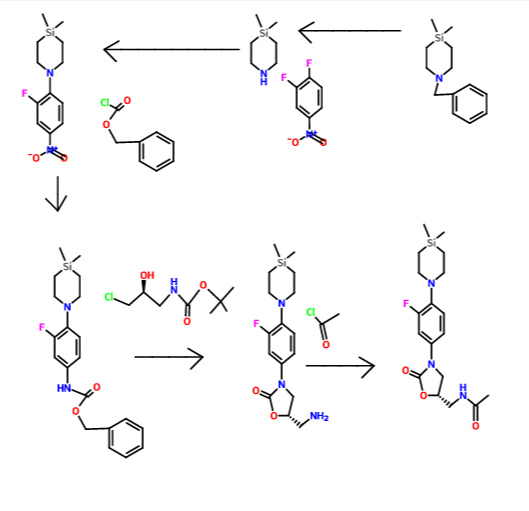
Examples from patent

- (S)—N((3-(4-(4,4-dimethyl-1,4-azasilinan-1-yl)-3-fluorophenyl)-2 oxooxazolidin-5-yl)methyl)acetamide
- NDS 10024
- Preparation of (S)—N((3-(4-(4,4-dimethyl-1,4-azasilinan-1-yl)-3-fluorophenyl)-2 oxooxazolidin-5-yl)methyl)acetamide (12)
-
-
To a solution of 8 (50 mg, 0.135 mmol) in dimethylformamide (DMF), lithium-t-butoxide (LiOtBu) (32.3 mg, 0.4 mmol) is added. The mixture is stirred at 25° C. for 15 min, followed by the addition of MeOH (0.01 mL, 0.27 mmol). 6 (52 mg, 0.27 mmol) is then added and the reaction mixture is allowed to stir at 25° C. for 24 h. Glacial acetic acid is then added and the organic phase is extracted with EtOAc and washed with brine solution. The crude material is purified by column chromatography on silica gel using hexane-EtOAC mixtures to furnish the pure product 12. The analogous procedure for the corresponding morpholine analogue was adapted from Lu, C. V.; Chen, J. J.; Perrault, W. R.; Conway, B. G.; Maloney, M. T.; Wang, Y. Org. Pro. Res. and Development. 2006, 10, 272-277.
-
1H NMR (200 MHz, CDCl3): δ 7.33 (d, J=13.8 Hz, 1H), 7.02-6.94 (m, 2H), 6.52 (t, J=5.8 Hz, 1H), 4.77-4.73 (m, 1H), 3.99 (t, J=9.04 Hz, 1H), 3.72 (dd, J=9.0 Hz, 6.8 Hz, 1H), 3.69-3.58 (m, 2H), 3.31 (t, J=5.5 Hz, 4H), 2.01 (s, 3H), 0.89 (t, J=5.5 Hz, 4H), 0.10 (s, 6H). 13C NMR (100 MHz, CDCl3): δ171.2, 155.0 (d, J=244.3 Hz), 154.5, 138.2 (d, J=9.3 Hz), 131.5, 119.9, 114.0 (d, J=3.4 Hz), 107.6 (d, J=27.1 Hz), 71.9, 50.9, 47.7, 41.9, 23.0, 14.3, −2.9.
- Preparation of Bis(bromomethyl)dimethylsilane (2) (as per scheme 2)
-

-
HBr gas is bubbled to a solution of dimethyl divinylsilane 1 (10.0 g, 89.28 mmols), and dibenzoylperoxide (DBP, 100 mg), in heptane (100 mL) at 0° C. for 30 min. The Reaction mixture (RM) is allowed to stir at room temperature (25° C.) for 18 h, water (200 mL) is added to the reaction mixture and the organic layer is separated. The heptane layer is washed with 2N NaOH (2 100 mL), dried and concentrated to obtain the product 2 as a colourless liquid (24.5 g) in 100% yield.
-
1H NMR (200 MHz, CDCl3): δ 3.58-3.49 (m, 4H), 1.45-1.40 (m, 4H), 0.09 (s, 6H).
-

-
Benzylamine (20 mL, 182 mmol) and Et3N (15.2 mL, 109 mmol) are added to a solution of bis-(bromomethyl) dimethylsilane 2 (10 g, 36.5 mmol) in chloroform (100 mL). The mixture is then refluxed for 16 h. 5% sodiumhydroxide solution (150 mL) is then added and the aqueous layer is extracted with dichloromethane (DCM, 2×100 mL). It is then washed with brine (200 mL), dried and concentrated. The product is purified by column chromatography on silica gel using hexane-EtOAc mixtures to obtain the product 3 as a light yellow liquid (4.3 g) in 54% yield.
-
1H NMR (200 MHz, CDCl3): δ 7.23-7.35 (m, 5H), 3.66 (s, 2H), 2.68 (t, J=6.3 Hz, 4H), 0.75 (t, J=6.3 Hz, 4H), 0.04 (s, 6H).
- Preparation of 1-benzyl-4,4-dimethyl-1,4-azasilinane (3)
Preparation of 4,4-dimethyl-1,4-azasilinane hydrochloride (4)
-

-
To a solution of 4,4-dimethyl-1,4-azasilinane 3 (2.3 g, 10.5 mmol) in EtOH (20 mL), 6N hydrochloricacid (1.75 mL, 10.5 mmol) is added and the solvent is removed under reduced pressure. The reaction mixture is co-evaporated with EtOH (2×10 mL) and recrystallized from EtOH-diethyl ether. To a slurry of Pd/C (50 mg) in EtOH (15 mL) an ethanolic solution of above prepared HCl salt is added drop wise and stirred at 25° C. under hydrogen atmosphere for 20 h. The reaction mixture is filtered through celite and washed with 2×20 mL of MeOH. The filtrate is then concentrated under reduced pressure to give viscous oil which was triturated with diethyl ether to obtain the product 4 as a white solid (950 mg) in 70% yield.
Preparation of 1-(2-fluoro-4-nitrophenyl)-4,4-dimethyl-1,4-azasilinane (9)
-

-
To a solution of 4,4-dimethyl-1,4-azasilinane hydrochloride 4 (500 mg, 3.85 mmol) in EtOAc (15 mL), triethylamine (1.3 mL, 9.63 mmol) is added and stirred at 25° C. for 10 min. The reaction mixture is cooled to 0° C. and 3,4-difluoronitrobenzene (612 mg, 3.85 mmol) is added drop wise and allowed to stir at 25° C. for 6 h. Water is then added and the organic layer is separated. The aqueous layer is extracted with EtOAc (2×10 mL) and the solvent is removed under reduced pressure. The product is purified by column chromatography using hexane-EtOAc mixtures and a crystalline yellow solid 9 (721 mg) is obtained in 70% yield.
-
1H NMR (200 MHz, CDCl3): δ 7.93-7.84 (m, 2H), 6.86 (t, J=4 Hz, 1H), 3.70-3.67 (m, 4H), 0.91-0.85 (m, 4H), 0.12 (s, 6H). 13C NMR (50 MHz, CDCl3): δ 151.1 (d, J=246.71 Hz), 144.4 (d, J=7.13 Hz), 137.8 (d, J=8.59 Hz), 121.4, 115.9 (d, J=4.61 Hz), 113.2 (J=27.78 Hz), 49.4, 13.8, −2.8. IR (CHCl3): ν 2948, 2894, 1603, 1523, 1492, 1400, 1342, 1223, 983, 832, 742 cm−1′. M.P: 70-72° C.
Preparation of benzyl 4-(4,4-dimethyl-1,4-azasilinan-1-yl)-3-fluorophenylcarbamate (10)
-

-
To a solution of compound 9 (610 mg, 2.28 mmol) in THF (25 mL), Pd/C (30 mg) is added and hydrogenated under a pressure of 35 psi in a par hydrogenator for 8 h. The reaction mixture is filtered through celite. Celite pad is washed with THF (2×20 mL). To the filtrate, saturated NaHCO3 (420 mg, 5.01 mmol) and CBzCl (427 mg, 2.5 mmol) are added at 0° C. and stirred at 25° C. for 5 h. 10 mL water is added to reaction mixture and the aqueous layer is extracted with EtOAc (2×20 mL). The crude mixture is then subjected to column chromatography on silica gel using hexane-EtOAc mixtures to afford the product as a viscous liquid 10 (690 mg) in 82% yield.
-
1H NMR (200 MHz, CDCl3): δ 7.41-7.37 (m, 5H), 6.94-6.93 (m, 2H), 6.68 (s, 1H), 5.21 (s, 1H), 3.3 (t, J=6.38 Hz, 4H), 0.93 (t, J=6.08 Hz, 4H), −0.13 (s, 6H). 13C NMR (50 MHz, CDCl3): 155.4 (d, 244.4 Hz), 153.6, 136.1, 135.9, 128.6, 128.5, 128.3, 120.4, 117.2 (d, 18.7 Hz), 114.7, 108.3 (20.5 Hz), 67.1, 51.4, 14.4, −3.0. IR (CHCl3): ν 3317, 2953, 2803, 1706, 1594, 1521, 1271, 1221, 1058, 869, 759 cm−1. M.P: 80-82° C.
Preparation of (S)-5-(aminomethyl)-3-(4-(4,4-dimethyl-1,4-azasilinan-1-yl)-3-fluorophenyl)oxazolidin-2-one (11) (NDS-10057)
-

-
To a solution of 10 (1.20 g, 3.23 mmol) and (S)-tert-butyl 3-chloro-2-hydroxypropylcarbamate (1.35 g, 6.47 mmol) in DMF (10 mL), LiOtBu (1.03 g, 12.94 mmol) is added at 0° C. The mixture is stirred at 25° C. for 45 h. The starting material 10 is not consumed completely. Saturated NH4Cl is then added; the organic phase is extracted with EtOAc (2×20 mL), washed with brine solution, dried and concentrated. The crude residue is dissolved in 20 mL of DCM-TFA mixture (8:2) and stirred at 25° C. for 3 h. RM is concentrated and dissolved in water (10 mL), the aqueous layer is washed with diethyl ether (2×50 mL), basified with saturated NaHCO3 and extracted with DCM (2×50 mL). The DCM layer is dried and concentrated. The crude is purified by column chromatography on silica gel using hexane-EtOAc mixtures to obtain the product as an off-white solid (500 mg) in 45% (based on recovery of starting material) over 2 steps.
-
1H NMR (400 MHz, CDCl3): δ 7.36 (dd, J=14.2 Hz, 2.3 Hz, 1H), 7.09 (dd, J=8.8 Hz, 1.7 Hz, 1H), 6.96 (t, J=9.5 Hz, 1H), 4.72-4.59 (m, 1H), 4.00 (t, J=8.3 Hz, 1H), 3.79 (dd, J=8.7 Hz, 6.8 Hz, 1H), 3.30 (t, J=6.2 Hz, 4H), 3.03 (dq, J=13.6 Hz, 4.2 Hz, 2H), 0.90 (t, J=6.2 Hz, 4H), 0.10 (s, 6H). 13C NMR (100 MHz, CDCl3): δ 155.1 (d, J=244.3 Hz), 154.7, 137.9 (d, J=9.0 Hz), 132.1 (d, J=10.3 Hz), 112.0 (d, J=4.3 Hz), 113.8 (d, J=3.2 Hz), 107.4 (d, J=26.9 Hz), 73.8, 51.0, 47.8, 45.01, 14.4, −2.9. IR (CHCl3): ν 3685, 3021, 2955, 2809, 2401, 1747, 1515, 1416, 1219, 1029, 991, 870, 771, 667 cm−1. M.P: 94-96° C. ESI-MS: 360.11 (M+Na).
Preparation of (S)—N-((3-(4-(4,4-dimethyl-1,4-azasilinan-1-yl)-3-fluorophenyl)-2-oxooxazolidin-5-yl)methy)acetamide (12) (NDS 10024)
-

-
To solution of amine 11 (300 mg, 0.9 mmol) and DIPEA (0.3 mL, 1.78 mmol) in dry THF (4.0 mL), acetylchloride (0.08 mL, 1.07 mmol) is added at 0° C., and stirred at 25° C. for 3 h. Further, saturated NaHCO3 (5.0 mL) is added to the reaction mixture and extracted with EtOAc (2×5 mL). The organic layer is washed with brine, dried and concentrated. The product is purified by column chromatography on silica gel using hexane-EtOAc mixtures to obtain the product as an off-white solid (170 mg) in 50% yield.
-
1HNMR (400 MHz, CDCl3): δ 7.33 (d, J=13.8 Hz, 1H), 7.02-6.94 (m, 2H), 6.52 (t, J=5.8 Hz, 1H), 4.77-4.73 (m, 1H), 3.99 (t, J=9.04 Hz, 1H), 3.72 (dd, J=9.0 Hz, 6.8 Hz, 1H), 3.69-3.58 (m, 2H), 3.31 (t, J=5.5 Hz, 4H), 2.01 (s, 3H), 0.89 (t, J=5.5 Hz, 4H), 0.10 (s, 6H). 13C NMR (100 MHz, CDCl3): δ171.2, 155.0 (d, J=244.3 Hz), 154.5, 138.2 (d, J=9.3 Hz), 131.5, 119.9, 114.0 (d, J=3.4 Hz), 107.6 (d, J=27.1 Hz), 71.9, 50.9, 47.7, 41.9, 23.0, 14.3, −2.9. IR (CHCl3): ν 2401, 1759, 1675, 1519, 1216, 759, 669 cm−1 M.P: 123-126° C. ESI-MS: 380.10 (M+H).


SCHEME2


SCHEME 3

SCHEME 4


Dr. D. Srinivasa Reddy of NCL winner Shanti Swarup Bhatnagar Award 2015
see
http://oneorganichemistoneday.blogspot.in/2015/02/dr-d-srinivasa-reddy.html
Dr. Srinivasa Reddy of CSIR-NCL bags the
prestigious Shanti Swarup Bhatnagar Prize

AN INTRODUCTION
Ph.D., University of Hyderabad, 2000 (Advisor: Professor Goverdhan Mehta).
Post-doctoral with Profs. Sergey A. Kozmin(University of Chicago, USA) and Prof.
Jeffrey Aubé (University of Kansas, USA)
Experienced in leading drug discovery programs (Dr. Reddy’s & TATA Advinus – 7
years of pharma experience)
Acquired skills in designing novel small molecules and lead optimization
Experienced in planning and execution of total synthesis of biologically active
molecules with moderate complexity
One of the molecules is currently in human clinical trials.
MYSELF WITH HIM
OTHER AUTHORS




////////
C[Si]1(C)CCN(CC1)c2ccc(cc2F)N3C[C@H](CNC(C)=O)OC3=O


 New Drug Approvals