
Home » Posts tagged 'organic chemistry' (Page 35)
Tag Archives: organic chemistry
 DRUG APPROVALS BY DR ANTHONY MELVIN CRASTO
.....FOR BLOG HOME CLICK HERE
DRUG APPROVALS BY DR ANTHONY MELVIN CRASTO
.....FOR BLOG HOME CLICK HEREFlag and hits
ORGANIC SPECTROSCOPY

SUBSCRIBE

 Subscribe in a reader
Enter your email address:
Delivered by FeedBurner
Subscribe to New Drug Approvals by Email


Recent Comments
 | shivkr2 on SPSR Excellence Award 2025 – S… |
 | Bonkasaurus on Infigratinib phosphate |
 | PALOVAROTENE | ORGAN… on Palovarotene |
| Pfizer just purchase… on Temanogrel | |
| Pfizer To Cash In On… on Temanogrel |
Date rape drug sensor


The first fluorescent sensor for known date rape drug gamma-butyrolactone (GBL) has been developed in Singapore. It emits orange fluorescence in alcoholic drinks containing GBL when irradiated with a green laser.
Gamma-butyrolactone (GBL) is a readily available industrial solvent that is often used as a date rape drug. There are several detection kits that can show if a drink has been spiked with drugs like gamma-hydroxybutyric acid (GHB) and ketamine but there are no commercially available sensors to detect GBL.
http://www.rsc.org/chemistryworld/2013/06/date-rape-drug-sensor-gamma-butyrolactone

read also
Fernando Patolsky and Michael Ioffe of Tel Aviv University developed a sensor that, when dipped into a drink, will instantly detect the presence of a drug such as GHB, ketamine, or Rohypnol.
more info on other drug

Predatory drugs or date rape drugs are responsible for the creation of the most dangerous and pathologic environment that exists around drug use and drug abuse. Predatory drugs are a general class of drug that are primarily used to “render the victim incapable of resisting sexual advances”. (U.S. DEA)
This statement does not imply that the drug makes a person desire sexual activity, but quite the opposite. Predatory drugs leave the victim helpless, possibly unconscious, but certainly without any memory of a crime being committed against him/her. It can not be emphasized enough that giving someone a predatory drug is not only morally reprehensible it is also a serious criminal act. Illicit use of date rape drugs involve some of the most pathologic criminals who are involved with our justice system.
Misspellings: Ketamene, Ketimane, Rohipnol, Rophinol
What is Date Rape Drug Addiction?
So called date rape drugs are also found at rave parties, clubs, college parties, and even in high school social environments. They are potent drugs that can cause serious health problems, developmental problems, overdose and death. To further complicate the effects of these drugs, many are produced in illegal labs. Illicit production of drugs means there is no quality control standards. The lack of quality control standards can greatly diminish the purity of the drugs and leaves the user vulnerable to harsh chemicals and possibly overdose. Most of the chemicals found in date rape drugs are not intended for human consumption.
The number of drugs that are considered predatory drugs is increasing. To date, the most commonly used are:
- GHB – GBH’s chemical name is gama hydroxybutyrate and is currently a
DEA
schedule 1 drug that has central nervous system depressant effects.
- GBL/1 – GBL is a pro-drug of GHB and produces the same effects.
- 4-BD – The chemical name of 4-BD is 1,4-Butanediol and is used industrially as a solvent. When taken recreationally, it produces the same effects as GHB.
- Ketamine – Ketamine, or special K, as it is known on the streets, is a type of anesthetic known as a dissociative anesthetic and is approved for human and veterinarian use. When taken recreationally, it produces euphoria and hallucinations.
- Rohypnol – The generic name of Rohypnol is flunitrazepam and it is marketed as a potent hypnotic, sedative, and it produces amnesia. It is in the class of drugs known as benzodiazepines.
Some of these drugs are made from industrial strength floor cleansers, lye, and Dranno and can cause brain damage.
Signs and Symptoms Date Rape Drugs Addiction
The regular use of drugs such as GHB/GBL used to lower inhibitions can create significant side effects. The most common side effects produced by the recreational use of date rape drugs are:
- Psychosis and severe agitation requiring self-protection procedures and sedation
- Mild tachycardia (increased heart rate) and hypertension
- Neurologic effects, including prolonged delirium
- Hallucinations
- Diaphoresis (profuse sweating), nausea, and vomiting
- Overdose, coma, and death
Because of the memory loss associated with these drugs, the user can be prone to use again and again without memory of severe side effects. Once used regularly, date rate drugs could also lead to serious withdrawal symptoms. These withdrawal symptoms will require medical attention and medication.
Beyond the physical dependence an emotional dependence can quickly develop. Once regular use begins an addict can experience personality changes which may result in aggressive behavior, a disregard for authority, a disregard for personal safety, risky sexual behavior, a loss of boundaries, financial difficulties, problems at school or work, a change in friends, and the loss of interest in normal activities.
No one plans on becoming an addict but the power of drugs on the brain’s functioning, accompanied by the alterations in the neuroreceptors, drives the addiction process. It is not about choice or desire once the body’s systems have been affected. Date rape drugs or predatory drugs are extraordinarily powerful both in their addictive qualities and the serious, negative, health consequences that accompany regular use.
TOSEDOSTAT CLINICAL TRIALS
Tosedostat
Benzeneacetic acid, α-[[(2R)-2-[(1S)-1-hydroxy-2-(hydroxyamino)-2-oxoethyl]-4-methyl-1-oxopentyl]amino]-, cyclopentyl ester, (αS)-
Cyclopentyl (2S)-({(2R)-2-[(1S)-1-hydroxy-2-(hydroxyamino)-2-oxoethyl]-4-methylpentanoyl}amino)(phenyl)acetate
[238750-77-1]
Cell Therapeutics, Inc. (CTI) (NASDAQ and MTA: CTIC) today issued the following statement regarding the notification of the U.S. Food and Drug Administration (the “FDA”) partial clinical hold on tosedostat (IND 075503), the Company’s aminopeptidase inhibitor under development for the treatment of blood-related cancers, that is being studied in an investigator-sponsored trial and not by CTI. CTI’s primary development programs are the ongoing Phase 3 trial of pacritinib, the Company’s JAK2/FLT3 inhibitor being evaluated for patients with myelofibrosis, and the post-approval commitment study of PIXUVRI®(pixantrone).
http://www.heraldonline.com/2013/06/25/4972677/cti-issues-statement-regarding.html
VIVUS Announces SPEDRA (avanafil) Approval in Europe

AVANAFIL
June 26, 2013
VIVUS, Inc. today announced that the European Commission (EC) has adopted the implementing decision granting marketing authorization for SPEDRA(TM) (avanafil) for the treatment of erectile dysfunction (ED) in the European Union (EU). The approval of the marketing authorization application (MAA) by the EC follows the positive recommendation by the European Medicines Agency’s (EMA) Committee for Medicinal Products for Human Use (CHMP) in April 2013.
SPEDRA, a PDE5 inhibitor, is the first new chemical entity (NCE) approved for ED in over a decade. The global market for ED therapies was approximately $5.5 billion in 2012.
About Avanafil
STENDRA, or avanafil, is approved by the FDA for the treatment of erectile dysfunction, or ED, in the U.S. VIVUS, through collaboration arrangements with third parties, intends to market and sell STENDRA in the U.S. and under the trade name SPEDRA in the EU and other territories outside the U.S. Avanafil is licensed from Mitsubishi Tanabe Pharma Corporation (MTPC). VIVUS owns worldwide development and commercial rights to avanafil for the treatment of sexual dysfunction, with the exception of certain Asian Pacific Rim countries.
VIVUS is currently in discussions with potential partners to commercialize STENDRA in the United States and other territories throughout the world.
It is recommended that STENDRA should be taken approximately 30 minutes before sexual activity. STENDRA should not be taken more than once per day. For more information about STENDRA, please visit www.Stendra.com.
EU OKs Nuedexta for PBA
Avanir Pharmaceuticals, Inc. today announced that the European Commission has approved NUEDEXTA® (dextromethorphan hydrobromide/quinidine sulfate) in the European Union for the treatment of pseudobulbar affect (PBA), irrespective of underlying neurologic disease or injury.
http://www.pharmalive.com/avanir-pharmaceuticals-announces-european-approval-of-nuedexta
NUEDEXTA is an oral formulation of dextromethorphan hydrobromide USP and quinidine sulfate USP in a fixed dose combination.
Dextromethorphan hydrobromide is the pharmacologically active ingredient of NUEDEXTA that acts on the central nervous system (CNS). The chemical name is dextromethorphan hydrobromide: morphinan, 3-methoxy-17-methyl-, (9α, 13α, 14α)- hydrobromide monohydrate. Dextromethorphan hydrobromide has the empirical formula C18H25NO•HBr•H2O with a molecular weight of 370.33. The structural formula is:

Quinidine sulfate is a specific inhibitor of CYP2D6-dependent oxidative metabolism used in NUEDEXTA to increase the systemic bioavailability of dextromethorphan. The chemical name is quinidine sulfate: cinchonan-9-ol, 6’-methoxy- (9S) sulfate (2:1), (salt), dihydrate. Quinidine sulfate dihydrate has the empirical formula of (C20H24N2O2)2•H2SO4•2H2O with a molecular weight of 782.96. The structural formula is:

The combination product, NUEDEXTA, is a white to off-white powder. NUEDEXTA is available for oral use as NUEDEXTA which contains 20 mg dextromethorphan hydrobromide and 10 mg quinidine sulfate. The active ingredients are dextromethorphan hydrobromide monohydrate USP and quinidine sulfate dihydrate USP.Inactive ingredients in the capsule are croscarmellose sodium NF, microcrystalline cellulose NF, colloidal silicon dioxide NF, lactose monohydrate NF, and magnesium stearate NF.
Sanofi’s new insulin U300 superior to Lantus: study

Sanofi’s investigational diabetes drug U300, cas no 160337-95-1, insuline glargine, new formulation is better at controlling dangerous low blood sugar events at night than its blockbuster Lantus, according to data from a phase III clinical programme.

insulin glargine
Lantus, developed in the 1990s, is currently Sanofi’s top-selling product, generating $6.6bn last year. But the drug is expected to lose its patent in 2015.
http://www.medscape.com/viewarticle/805067 says no cancer risk
http://clinicaltrials.gov/ct2/show/NCT01689142 reports clinical trials
To compare the efficacy of a new formulation of insulin glargine and Lantus in terms of change of HbA1c from baseline to endpoint (scheduled at month 6 [week 26]) in patients with type 2 diabetes mellitus.
Secondary Objectives:
- To compare a new formulation of insulin glargine and Lantus in terms of change in fasting plasma glucose, pre-injection plasma glucose, 8-point self-measured plasma glucose profile.
- To compare a new formulation of insulin glargine and Lantus in terms of occurrence of hypoglycemia
Insulin glargine is produced by recombinant DNA technology using a non-pathogenic laboratory strain of Escherichia coli (K12) as the production organism. It is an analogue of human insulin made by replacing the asparagine residue at position A21 of the A-chain with glycine and adding two arginines to the C-terminus (positions B31 and 32) of the B-chain. The resulting protein is soluble at pH 4 and forms microprecipitates at physiological pH 7.4. Small amounts of insulin glargine are slowly released from microprecipitates giving the drug a long duration of action (up to 24 hours) and no pronounced peak concentration.

GRAVIOLA TREE “10000 TIMES STRONGER KILLER OF CANCER THAN CHEMO” – FACTS ANALYSIS

“10000 times stronger killer of Cancer than Chemo”.. do share it.. can save many lives, fill up hopes and build confidence in the patients…
The Sour Sop or the fruit from the graviola tree is a miraculous natural cancer cell killer 10,000 times stronger than Chemo. Why are we not aware of this?
read all at
http://www.hoaxorfact.com/Health/graviola-tree-10000-times-stronger-killer-of-cancer-than-chemo.html
Astellas’ Xtandi approved in EU for prostate cancer

enzalutamide
XTANDI
Regulators in European have given the green light to Astellas Pharma and Medivation’s oral prostate cancer drug Xtandi.
Specifically, the European Commission has approved Xtandi (enzalutamide) capsules for the treatment of men with metastatic castration-resistant prostate cancer whose disease has progressed on or after docetaxel therapy. The thumbs-up comes a couple of months after the European Medicines Agency’s Committee for Human Medicinal Productsissued a positive recommendation on the treatment….. READ ALL AT
http://www.pharmatimes.com/Article/13-06-24/Astellas_Xtandi_approved_in_EU_for_prostate_cancer.aspx
Enzalutamide (marketed as Xtandi and formerly known as MDV3100) is an androgen receptor antagonist drug developed by the pharmaceutical company Medivation for the treatment of metastatic castration-resistant prostate cancer. Medivation has reported up to an 89% decrease in prostate specific antigen serum levels after a month of taking the medicine. Early preclinical studies also suggest that enzalutamide inhibits breast cancer cell growth. In August of 2012, the U.S. Food and Drug Administrationapproved enzalutamide for the treatment of castration-resistant prostate cancer.
Enzalutamide was discovered by Charles Sawyers who is now at Memorial Sloan–Kettering Cancer Center and Michael Jung at UCLA.

A model of the interaction between the prostate cancer drug enzalutamide and the androgen receptor
The antibiotic Vibativ (telavancin) has been approved by the U.S. Food and Drug Administration to treat pneumonia caused by Staphylococcus aureus bacteria
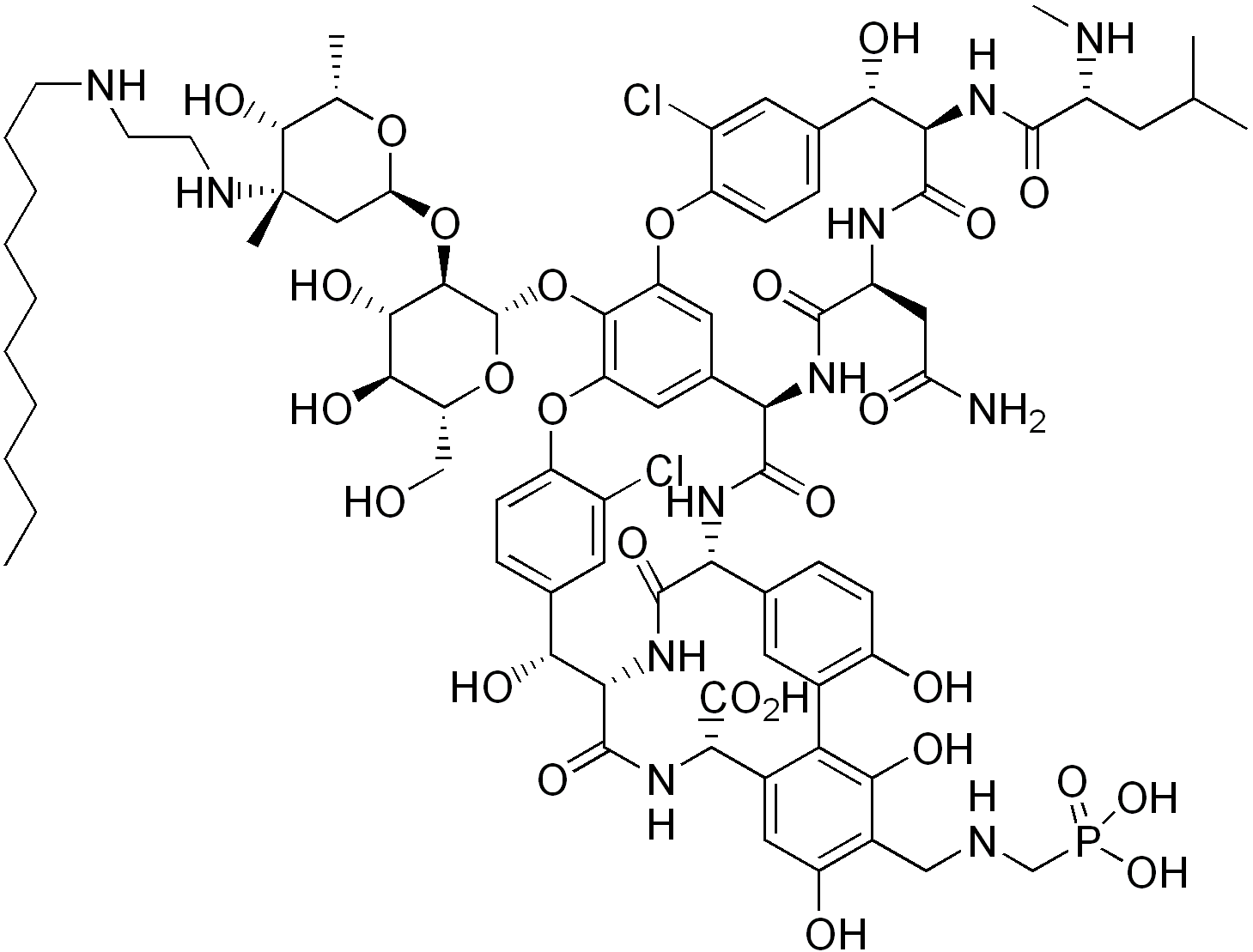
telavancin
The antibiotic Vibativ (telavancin) has been approved by the U.S. Food and Drug Administration to treat pneumonia caused by Staphylococcus aureus bacteria when other treatments aren’t suitable.
Pneumonia, a lung infection, can be caused by different bacteria and viruses. S. aureus infection often affects people in hospitals, notably those on ventilators. Such infections can be serious, since people on a ventilator often have a weakened immune system and are unable to fight an infection, the FDA said in a news release.http://www.drugs.com/news/vibativ-approved-certain-bacterial-pneumonia-45418.html

Telavancin (trade name Vibativ) is a bactericidal lipoglycopeptide for use in MRSA or other Gram-positive infections. Telavancin is a semi-synthetic derivative of vancomycin.
The FDA approved the drug in September 2009 for complicated skin and skin structure infections (cSSSI)
On 19 October 2007, the US Food and Drug Administration (FDA) issued an approvable letter for telavancin. Its developer, Theravance, submitted a complete response to the letter, and the FDA has assigned a Prescription Drug User Fee Act (PDUFA) target date of 21 July 2008.
On 19 November 2008, an FDA antiinfective drug advisory committee concluded that they would recommend telavancin be approved by the FDA.
The FDA approved the drug on 11 September 2009 for complicated skin and skin structure infections (cSSSI).
Theravance has also submitted telavancin to the FDA in a second indication, nosocomial pneumonia, sometimes referred to as hospital-acquired pneumonia, or HAP. On 30 November 2012, an FDA advisory panel endorsed approval of a once-daily formulation of telavancin for nosocomial pneumonia when other alternatives are not suitable. However, telavancin did not win the advisory committee’s recommendation as first-line therapy for this indication. The committe indicated that the trial data did not prove “substantial evidence” of telavancin’s safety and efficacy in hospital-acquired pneumonia, including ventilator-associated pneumonia caused by Gram-positive organisms Staphylococcus aureus and Streptococcus pneumoniae. On 21 June 2013 FDA gave approval for telavancin to treat patients with hospital-acquired pneumonia, but indicated it should be used only when alternative treatments are not suitable. FDA staff had indicated telavancin has a “substantially higher risk for death” for patients with kidney problems or diabetes compared to vancomycin.


FDA Approves Pediatric Indication for Astellas’ Mycamine (micafungin sodium) for Injection

micafungin sodium
-
C56-H70-N9-O23-S.Na1292.265Fujisawa (Originator), Merck & Co. (Codevelopment)
 Antifungal Agents, ANTIINFECTIVE THERAPY, 1,3-beta-Glucan Synthase Inhibitors, EchinocandinsLaunched-2002
{5-[(1S,2S)-2-[(3S,6S,9S,11R,15S,18S,20R,21R,24S,25S,26S)-3-[(1R)-2-carbamoyl-1-hydroxyethyl]-11,20,21,25-tetrahydroxy-15-[(1R)-1-hydroxyethyl]-26-methyl-2,5,8,14,17,23-hexaoxo-18-[(4-{5-[4-(pentyloxy)phenyl]-1,2-oxazol-3-yl}benzene)amido]-1,4,7,13,16,22-hexaazatricyclo[22.3.0.09,13]heptacosan-6-yl]-1,2-dihydroxyethyl]-2-hydroxyphenyl}oxidanesulfonic acid

June 24, 2013 , Astellas Pharma US, Inc. (“Astellas”), a U.S. subsidiary of Tokyo-based Astellas Pharma Inc. (Tokyo: 4503), announced that the U.S. Food and Drug Administration (FDA) has approved its Supplemental New Drug Application (sNDA) for the use of MYCAMINE® (micafungin sodium) for injection by intravenous infusion for the treatment of pediatric patients four months and older with candidemia, acute disseminated candidiasis, Candida peritonitis and abscesses, esophageal candidiasis, and prophylaxis of Candida infections in patients undergoing hematopoietic stem cell transplants (HSCT).
Micafungin (trade name Mycamine) is an echinocandin antifungal drug developed by Astellas Pharma. It inhibits the production of beta-1,3-glucan, an essential component of fungal cell walls. Micafungin is administered intravenously. It received final approval from the U.S. Food and Drug Administration on March 16, 2005, and gained approval in the European Union on April 25, 2008.
Micafungin is indicated for the treatment of candidemia, acute disseminated candidiasis, Candida peritonitis, abscesses and esophageal candidiasis. Since January 23, 2008, micafungin has been approved for the prophylaxis of Candida infections in patients undergoing hematopoietic stem cell transplantation (HSCT).
Micafungin works by way of concentration-dependent inhibition of 1,3-beta-D-glucan synthase resulting in reduced formation of 1,3-beta-D-glucan, which is an essential polysaccharide comprising one-third of the majority of Candida spp. cell walls. This decreased glucan production leads to osmotic instability and thus cellular lysis
- Micafungin sodium, FK-463, Mycamine, Funguard,208538-73-2

-
The synthesis of FK-463 can be performed as follows: The enzymatic deacylation of FR-901379 with Streptomyces anulatas No. 4811, S. anulatas No. 8703, Streptomyces strain No. 6907 or A. utahensis IFO13244 gives the deacylated lipopeptide FR-179642 (1), which is then reacylated with 1-[4-[5-(4-pentyloxyphenyl)isoxazol-3-yl]benzoyl]benzotriazole 3-oxide (VI) by means of dimethylaminopyridine (DMAP) in DMF. The acylating compound (VI) can be obtained as follows: The cyclization of 4-pentyloxyphenylacetylene (I) with 4-(hydroxyiminomethyl)benzoic acid methyl ester (II) by means of triethylamine in hot THF gives 4-[5-(4-pentyloxyphenyl)isoxazol-3-yl]benzoic acid methyl ester (III), which is hydrolyzed with NaOH in hot THF/water yielding the corresponding free acid (IV). Finally, this compound is condensed with 1-hydroxybenzotriazole (V) by means of 1-ethyl-3-[3-(dimethylamino)propyl]carbodiimide (EDMCA) in dichloromethane.Fromtling, R.A.; Castr, Drugs Fut 1998, 23, 12, 1273The synthesis of FK-463 can be performed as follows: The enzymatic deacylation of FR-901379 with Streptomyces anulatas No. 4811, S. anulatas No. 8703, Streptomyces strain No. 6907 or A. utahensis IFO13244 gives the deacylated lipopeptide FR-179642 (1), which is then reacylated with 1-[4-[5-(4-pentyloxyphenyl)isoxazol-3-yl]benzoyl]benzotriazole 3-oxide (VI) by means of dimethylaminopyridine (DMAP) in DMF. The acylating compound (VI) can be obtained as follows: The cyclization of 4-pentyloxyphenylacetylene (I) with 4-(hydroxyiminomethyl)benzoic acid methyl ester (II) by means of triethylamine in hot THF gives 4-[5-(4-pentyloxyphenyl)isoxazol-3-yl]benzoic acid methyl ester (III), which is hydrolyzed with NaOH in hot THF/water yielding the corresponding free acid (IV). Finally, this compound is condensed with 1-hydroxybenzotriazole (V) by means of 1-ethyl-3-[3-(dimethylamino)propyl]carbodiimide (EDMCD) in dichloromethane.
- 38th Intersci Conf Antimicrob Agents Chemother (Sept 24 1998, San Diego)1998,:Abst F-145
QUINAPRIL

QUINAPRIL HYDROCHLORIDE
Quinapril (marketed under the brand name Accupril by Pfizer) is an angiotensin-converting enzyme inhibitor (ACE inhibitor) used in the treatment of hypertension andcongestive heart failure.
Quinapril inhibits angiotensin converting enzyme, an enzyme which catalyses the formation of angiotensin II from its precursor, angiotensin I. Angiotensin II is a powerfulvasoconstrictor and increases blood pressure through a variety of mechanisms. Due to reduced angiotensin production, plasma concentrations of aldosterone are also reduced, resulting in increased excretion of sodium in the urine and increased concentrations ofpotassium in the blood.
-
 The condensation of alanine tert-butyl ester (I) with ethyl 2-bromo-4-phenylbutanoate (II) by means of triethylamine in hot DMF gives ethyl 2-[[1-(tert-butoxycarbonyl)ethyl]amino]-4-phenylbutanoate (III), which is partially hydrolyzed with trifluoroacetic acid yielding ethyl 2-[[1-carboxyethyl]amino]-4-phenylbutanoate (IV). The condensation of (IV) with tert-butyl-1,2,3,4-tetrahydroisoquinoline-3-carboxylate (VIII) [prepared from the corresponding acid (VI) and isobutylene (B) by means of H2SO4] as before gives tert-butyl-2-[2-[[1-(ethoxycarbonyl)-3-phenylpropyl]amino]-1-oxopropyl]-1,2,3,4-tetrahydroisoquinoline-3-carboxylate (IX), which is finally hydrolyzed partially by treatment with trifluoroacetic acid.Hoefle, M.L.; Klutchko, S. (Pfizer Inc.); Substituted acyl derivatives of 1,2,3,4-tetrahydroisoquinoline-3-carboxylic acids. DD 201787; EP 0049605; EP 0096157; US 4344949


 New Drug Approvals