New Drug Approvals

Home » Posts tagged 'NMR'

Tag Archives: NMR

DRUG APPROVALS BY DR ANTHONY MELVIN CRASTO .....FOR BLOG HOME CLICK HERE

Blog Stats

  • 4,798,913 hits

Flag and hits

Flag Counter

Enter your email address to follow this blog and receive notifications of new posts by email.

Join 37.9K other subscribers
Follow New Drug Approvals on WordPress.com

Archives

Categories

Recent Posts

Flag Counter

ORGANIC SPECTROSCOPY

Read all about Organic Spectroscopy on ORGANIC SPECTROSCOPY INTERNATIONAL 

Enter your email address to follow this blog and receive notifications of new posts by email.

Join 37.9K other subscribers
DR ANTHONY MELVIN CRASTO Ph.D

DR ANTHONY MELVIN CRASTO Ph.D

DR ANTHONY MELVIN CRASTO, Born in Mumbai in 1964 and graduated from Mumbai University, Completed his Ph.D from ICT, 1991,Matunga, Mumbai, India, in Organic Chemistry, The thesis topic was Synthesis of Novel Pyrethroid Analogues, Currently he is working with AFRICURE PHARMA, ROW2TECH, NIPER-G, Department of Pharmaceuticals, Ministry of Chemicals and Fertilizers, Govt. of India as ADVISOR, earlier assignment was with GLENMARK LIFE SCIENCES LTD, as CONSUlTANT, Retired from GLENMARK in Jan2022 Research Centre as Principal Scientist, Process Research (bulk actives) at Mahape, Navi Mumbai, India. Total Industry exp 32 plus yrs, Prior to joining Glenmark, he has worked with major multinationals like Hoechst Marion Roussel, now Sanofi, Searle India Ltd, now RPG lifesciences, etc. He has worked with notable scientists like Dr K Nagarajan, Dr Ralph Stapel, Prof S Seshadri, etc, He did custom synthesis for major multinationals in his career like BASF, Novartis, Sanofi, etc., He has worked in Discovery, Natural products, Bulk drugs, Generics, Intermediates, Fine chemicals, Neutraceuticals, GMP, Scaleups, etc, he is now helping millions, has 9 million plus hits on Google on all Organic chemistry websites. His friends call him Open superstar worlddrugtracker. His New Drug Approvals, Green Chemistry International, All about drugs, Eurekamoments, Organic spectroscopy international, etc in organic chemistry are some most read blogs He has hands on experience in initiation and developing novel routes for drug molecules and implementation them on commercial scale over a 32 PLUS year tenure till date Feb 2023, Around 35 plus products in his career. He has good knowledge of IPM, GMP, Regulatory aspects, he has several International patents published worldwide . He has good proficiency in Technology transfer, Spectroscopy, Stereochemistry, Synthesis, Polymorphism etc., He suffered a paralytic stroke/ Acute Transverse mylitis in Dec 2007 and is 90 %Paralysed, He is bound to a wheelchair, this seems to have injected feul in him to help chemists all around the world, he is more active than before and is pushing boundaries, He has 100 million plus hits on Google, 2.5 lakh plus connections on all networking sites, 100 Lakh plus views on dozen plus blogs, 227 countries, 7 continents, He makes himself available to all, contact him on +91 9323115463, email amcrasto@gmail.com, Twitter, @amcrasto , He lives and will die for his family, 90% paralysis cannot kill his soul., Notably he has 38 lakh plus views on New Drug Approvals Blog in 227 countries......https://newdrugapprovals.wordpress.com/ , He appreciates the help he gets from one and all, Friends, Family, Glenmark, Readers, Wellwishers, Doctors, Drug authorities, His Contacts, Physiotherapist, etc He has total of 32 International and Indian awards

Verified Services

View Full Profile →

Archives

Categories

Flag Counter

Ezetimibe NMR


syn2

Ezetimibe


Institute of Organic Chemistry, Polish Academy of Sciences, Kasprzaka 44/52, 01-224 Warsaw, Poland
J. Org. Chem., 2013, 78 (14), pp 7048–7057
Figure

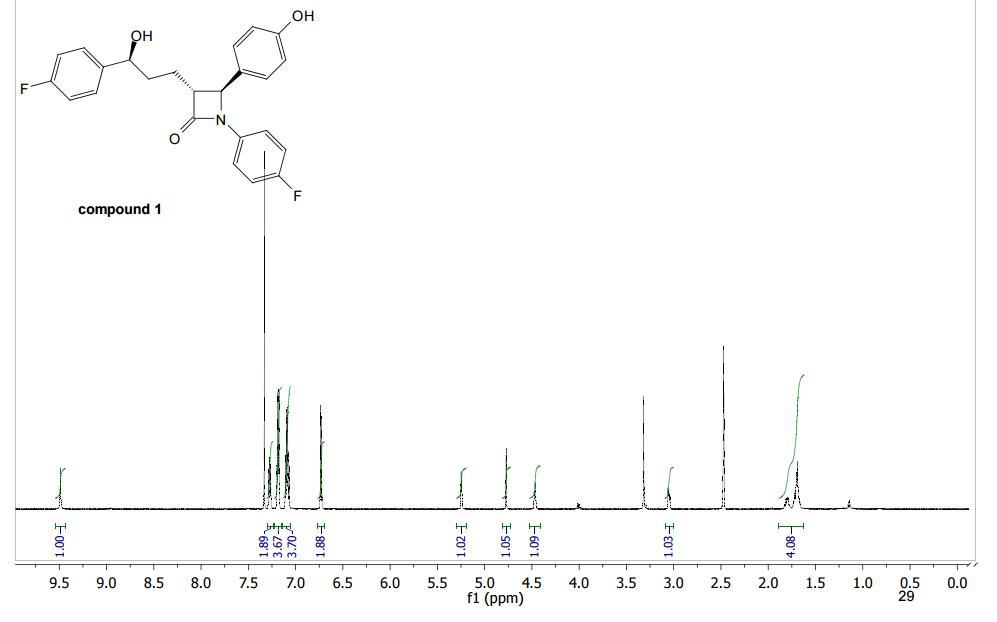
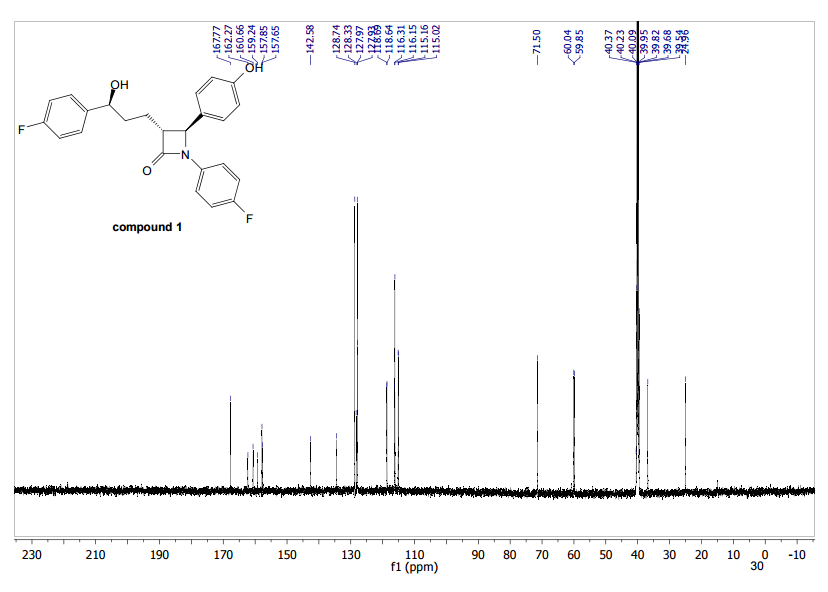
Ezetimibe (1)

 ezetimibe 1 (1.08 g, 80%) as a white solid.
Mp 164–166 °C [lit.(11) 155–157 °C];
99% ee;
[α]20D −28.1 (c 0.15, MeOH) [lit.(11) −32.6 (c 0.34, MeOH)];
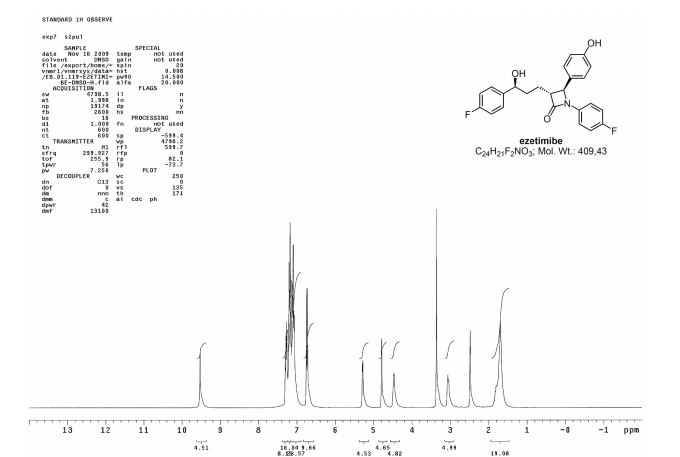
1H NMR (600 MHz, DMSO-d6) δ 9.49 (1H, s), 7.28–7.24 (2H, m), 7.19–7.16 (4H, m), 7.11–7.07 (4H, m), 6.75–6.71 (2H, m), 5.25 (1H, d, J 4.3 Hz), 4.77 (1H, d, J 2.2 Hz), 4.49–4.59 (1H, m), 3.07–3.04 (1H, m) 1.84–1.66 (4H, m);
13C NMR (150 MHz, CDCl3) δ 167.8, 162.3, and 160.7 (d, JC–F 240.3 Hz), 159.3, 157.9, 157.7, 142.5, 134.4, 128.7, 128.3, 128.0, 127.9, 118.7, and 118.6 (d, JC–F 8.1 Hz), 116.3, 116.2, 115.2, and 115.0 (d, JC–F 20.7 Hz), 71.5, 60.0, 59.9, 36.8, 24.9;
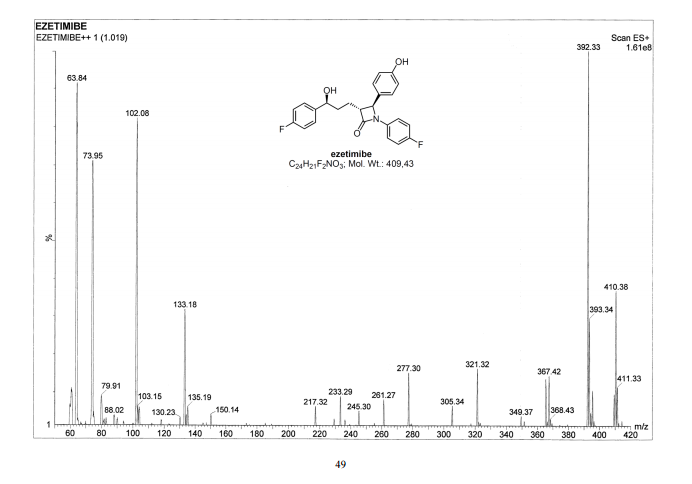
HRMS (EI, TOF) m/z calcd for C24H21F2NO3 [M] 409.1489 found 409.1478. Anal. Calcd for C24H21F2NO3: C 70.41, H 5.17, F 9.28, N 3.42. Found: C 70.46, H 5.23, F 9.24, N 3.34.

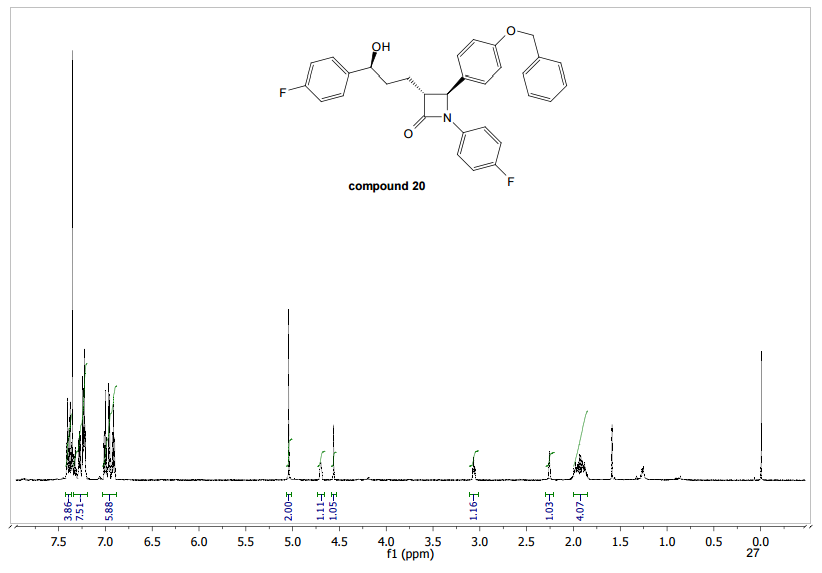
(3S,4S)-4-(4-(Benzyloxy)phenyl)-1-(4-fluorophenyl)-3-((S)-3-(4-fluorophenyl)-3′-hydroxypropyl)azetidin-2-one (20)

Method 1

To a cooled (0 °C) solution of lactone 19 (2.0 g, 4 mmol) in 160 mL of dry diethyl ether was added 12 mL of 1 M solution of t-BuMgCl in diethyl ether. After 2 h, 30 mL of aq NH4Cl was added. The aqueous layer was extracted with ether (160 mL), the organic layer was washed with satd NaHCO3 (50 mL) and dried (MgSO4), and the solvent was removed under reduced pressure. Crude product 20 (1.64 g, 82%) obtained as a yellowish solid was used in the next step without further purification. An analytic sample was obtained by chromatography on silica gel (hexanes/ethyl acetate 7:3). Mp 130–133 °C [lit.(11) 132–134 °C]; [α]20D −42.2 (c 1.2, CHCl3); 1H NMR (600 MHz, CDCl3) δ 7.42–7.20 (11H, m), 7.02–6.90 (6H, m), 5,04 (2H, s), 4.72–4.68 (1H, m), 4.55 (1H, d J 2.2 Hz), 3.07 (1H, dt J 7.1, 2.2 Hz), 2.05–1.93 (3H, m) 1.89–1.82 (2H, m); 13C NMR (150 MHz, CDCl3) δ 167.6, 163.0, and 161.4 (d, JC–F 244.2 Hz), 159.8 and 158.1 (d, JC–F 241.8 Hz), 159.0, 140.0, 139.9, 136.6, 133.9, and 133.8 (d, JC–F 2.9 Hz), 129.6, 128.6, 128.1, 127.5, 127.4 and 127.4, (d, JC–F 8.0 Hz), 127.2, 118.4, 118.3, 115.8, 115.8, and 115.7 (d, JC–F 22.0 Hz), 115.5, 115.4, and 115.3 (d, JC–F 21.3 Hz), 73.3, 70.1, 61.1, 60.3, 36.5, 25.0; HRMS (ESI, TOF) m/z calcd for C31H27F2NO3Na [M + Na]+ 522.1851, found 522.1862; IR (KBr) v 3441, 1743, 1609, 1510 cm–1. Anal. Calcd for C31H27F2NO3: C 74.53, H 5.45, N 2.80, F 7.61. Found: C 74.40, H 5.53, N 2.74, F 7.56.
Abstract Image
Org. Process Res. Dev., 2009, 13 (5), pp 907–910
DOI: 10.1021/op900039z
Figure

Preparation of 1-(4-Fluorophenyl)-3-(R)-[3-(4-fluorophenyl)-3(S)-hydroxypropyl]-4(S)-(4-hydroxyphenyl)-2-azetidinone 1 (Ezetimibe)

 of compound 1. 1H NMR (300 MHz, DMSO-d6, δ) 1.72−1.84 (m, 4H), 3.08 (m, 1H), 4.45 (m, 1H), 4.8 (d, 1H, J = 2.0 Hz), 5.25 (d, 1H, J = 4.8), 6.75 (d, 2H, J = 8.4 Hz), 7.05−7.4 (m, 10H, Ar), 9.48 (s, 1H); IR: 3270.0, 2918, 1862, 1718.4, 1510 cm−1. MS: m/z 409.2 (M+). Anal. Calcd for C15H17NO5: C, 70.41; H, 5.17; N, 3.42. Found: C, 70.38; H, 5.27; N, 3.34.

Preparation of (3R,4S)-1-(4-Fluorophenyl)-3-[3-(4-fluorophenyl)-3(S)-hydroxypropyl]-4-(4-benzyloxyphenyl)-2-azetidinone 10

compound 9 as a white solid. 1H NMR (200 MHz, DMSO-d6, δ) 1.6−1.9 (m, 4H), 2.0−2.2 (bs, 1H), 3.0−3.2 (m, 1H), 4.4−4.6 (m, 1H), 4.74 (m, 1H), 5.05 (s, 2H), 6.95−7.9 (m, 17H, Ar); IR: 3492, 2922, 2852, 1719 cm−1; MS: m/z 499.3 (M+).
 ….

Synthesis of ezetimibe and desfluoro ezetimibe impurity.

Scheme 1.

Synthesis of ezetimibe and desfluoro ezetimibe impurity.

Comparison of 1H, 13C and 19F NMRs of ezetimibe and desfluoro ezetimibe ...

Fig. 4.Structures of ezetimibe, desfluoro impurity and intermediates.

Fig. 2.

Structures of ezetimibe, desfluoro impurity and intermediates.


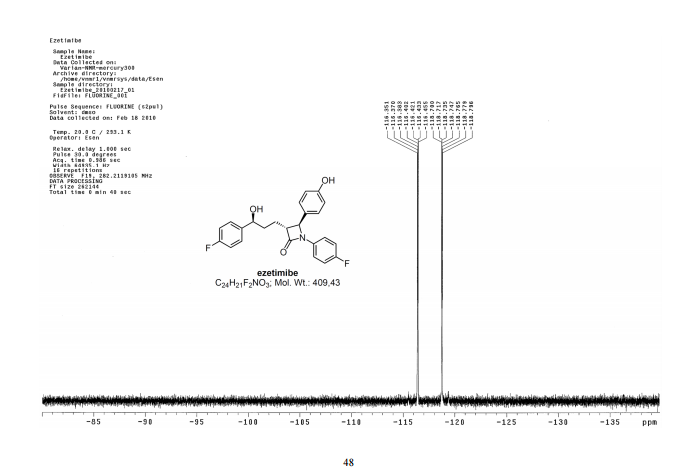
Comparison of 1H, 13C and 19F NMRs of ezetimibe and desfluoro ezetimibe impurity.

Table 2.1H and 13C NMR assignments for Eze-1 and desfluoro Eze-1.

Positiona 1H–δ ppm


13C–δ ppm (DEPT)


Eze-1b Desfluoro Eze-1b Eze-1b Desfluoro Eze-1b
1 10.15 (br, OH) 10.13 (br, OH)
2 161.3 (C) 161.3 (C)
3 6.87 (d, J=8.5 Hz, 2H) 6.87 (dd, J=8.4, 1.8 Hz, 2H) 116.3 (2CH) 116.3 (2CH)
4 7.74 (d, J=8.5 Hz, 2H) 7.75 (dd, J=8.4, 1.8 Hz, 2H) 131.4 (2CH) 131.4 (2CH)
5 128.1 (C) 128.2 (C)
6 8.43 (s, 1H) 8.43 (s, 1H) 160.8 (CH) 160.8 (CH)
7 149.0 (d, 4J=2.6 Hz, C) 152.7 (C)
8 7.15–7.26 (m, 4H) 7.36 (dd, J=8.1, 7.5 Hz, 2H) 123.3 (d, 3J=8.4 Hz, 2CH) 121.6 (2CH)
9 7.17 (d, J=7.8 Hz, 2H) 116.5 (d, 2J=22 Hz, 2CH) 129.8 (2CH)
10 7.18 (t, J=6.3 Hz, 1H) 160.8 (d, 1J=242 Hz, C) 126.0 (CH)
Assignments: s: singlet; d: doublet; t: triplet; m: multiplet; br: broad singlet. Mean values used for coupled signals.

aNumbering of all compounds shown in Fig. 2 and copies of NMR spectra are presented in Appendix A.
bSolvent is DMSO-d6.


R-Enantiomer in Ezetimibe

R-Enantiomer in Ezetimibe

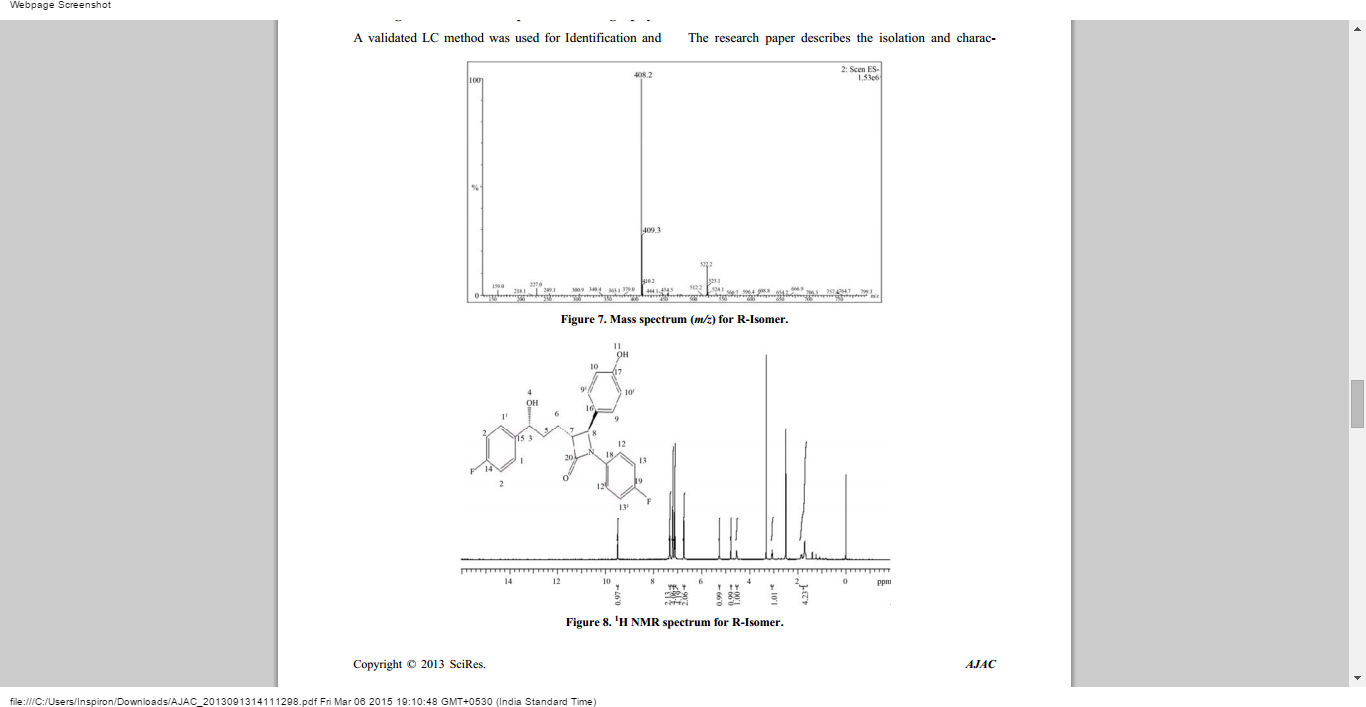
ABOVE 1H NMR OF R ENANTIOMER

Isolation and Characterization of R-Enantiomer in Ezetimibe

by K Chimalakonda – ‎2013 – ‎Related articles
HPLC1H and 13C NMR. The purity of isolated R-Isomer is about 98%. Keywords: Isolation; Characterization; (R)-Isomer; Ezetimibe; Supercritical Fluid  …
 

http://file.scirp.org/Html/10-2200417_36901.htm

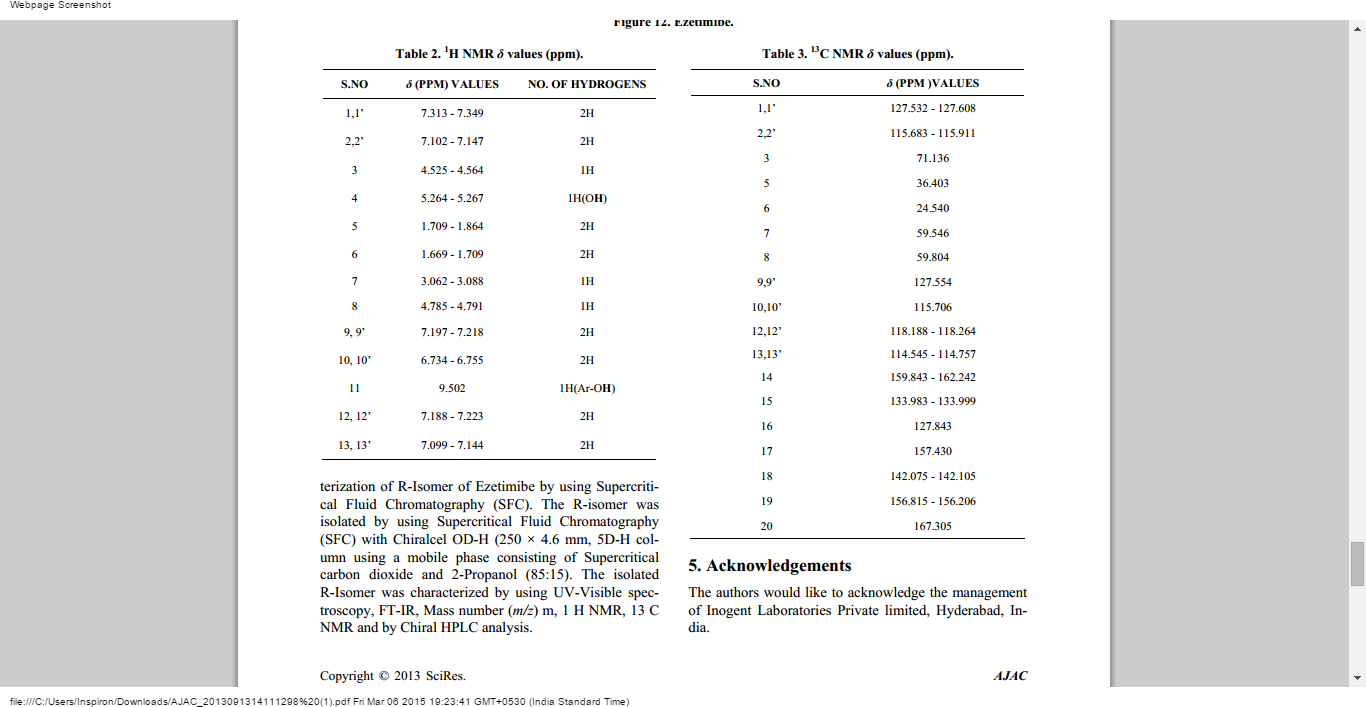
1H NMR VALUES FOR R ENANTIOMER

 
13C NMR OF R ENANTIOMER


13C NMR VALUES OF R ENANTIOMER


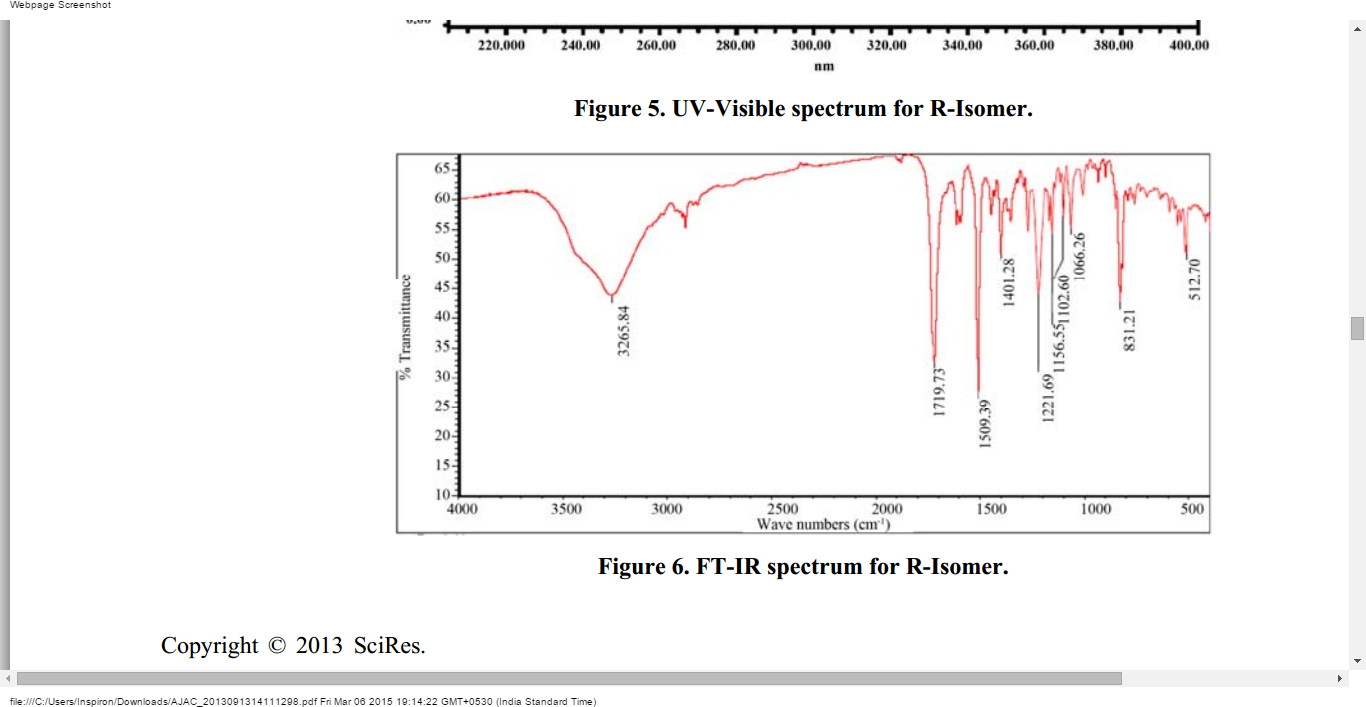
IR OF R ENANTIOMER
Ezetimibe for reference
Ezetimibe
Ezetimibe
Ezetimibe.svg
Systematic (IUPAC) name
(3R,4S)-1-(4-fluorophenyl)-3-[(3S)-3-(4-fluorophenyl)-3-hydroxypropyl]-4-(4-hydroxyphenyl)azetidin-2-one
Clinical data
Trade names Zetia
AHFS/Drugs.com monograph
MedlinePlus a603015
Legal status
Routes Oral
Pharmacokinetic data
Bioavailability 35–65%
Protein binding >90%
Metabolism Intestinal wall, hepatic
Half-life 19–30 hours
Excretion Renal 11%, faecal 78%
Identifiers
CAS number 163222-33-1 Yes
ATC code C10AX09
PubChem CID 150311
DrugBank DB00973
ChemSpider 132493 Yes
UNII EOR26LQQ24 Yes
KEGG D01966 Yes
ChEBI CHEBI:49040 Yes
ChEMBL CHEMBL1138 Yes
Chemical data
Formula C24H21F2NO3 
Molecular mass 409.4 g·mol−1
Physical data
Melting point 164 to 166 °C (327 to 331 °F)
 Yes (what is this?)  (verify)

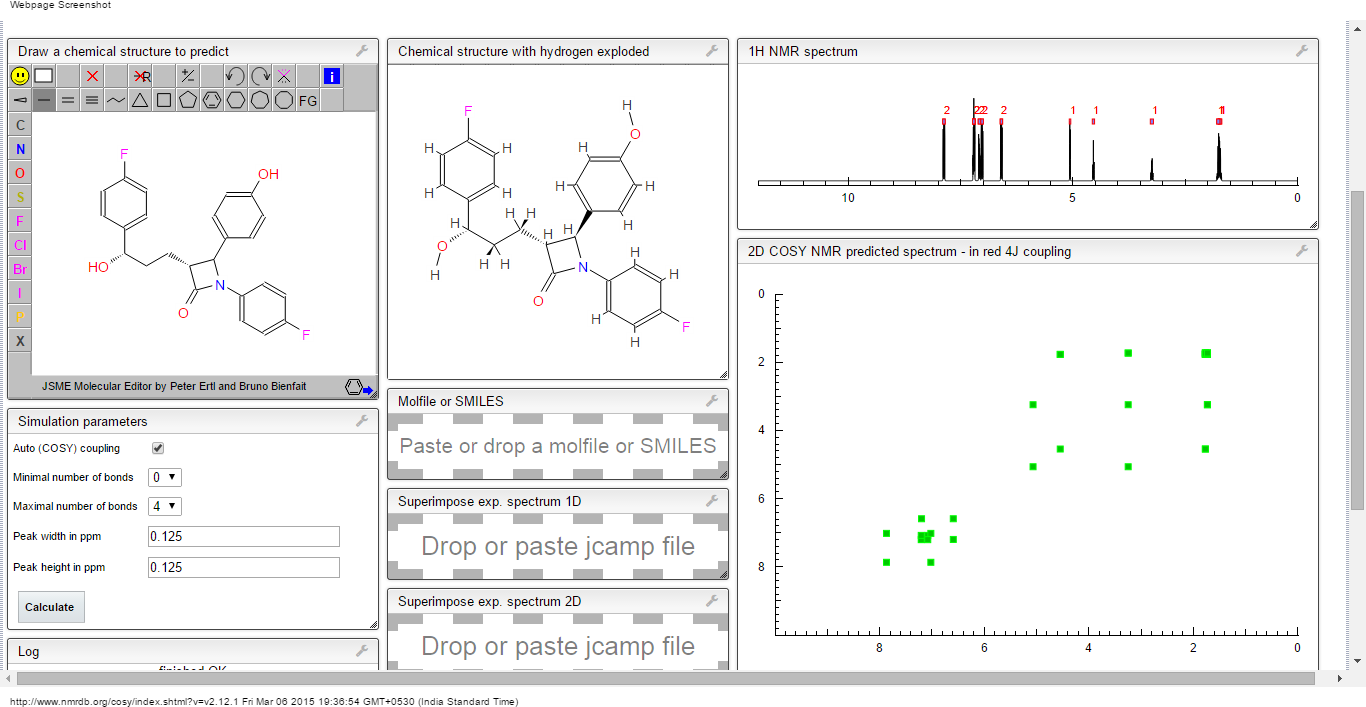
1H NMR OF R ENANTIOMER PREDICTED

Ezetimibe NMR spectra analysis, Chemical CAS NO. 163222-33-1 NMR spectral analysis, Ezetimibe H-NMR spectrum

13C NMR OF R ENANTIOMER PREDICTED

Ezetimibe NMR spectra analysis, Chemical CAS NO. 163222-33-1 NMR spectral analysis, Ezetimibe C-NMR spectrum
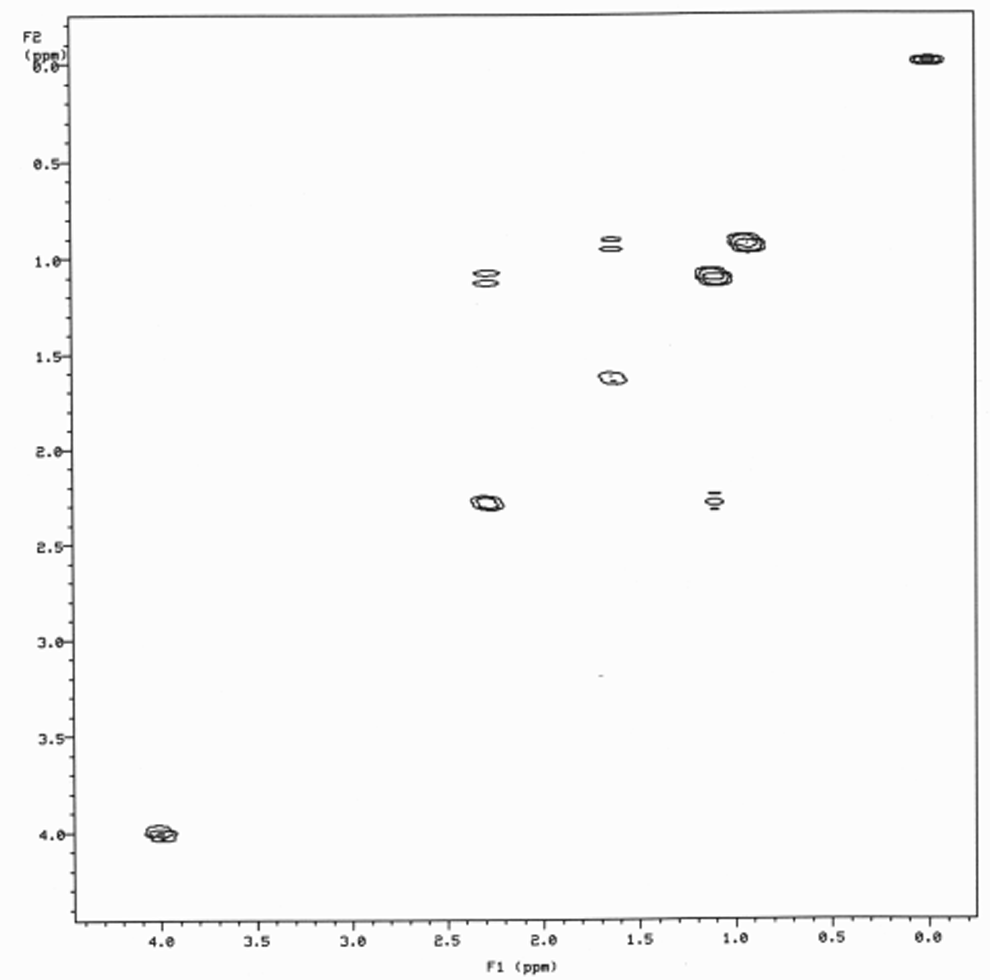
cosy

.

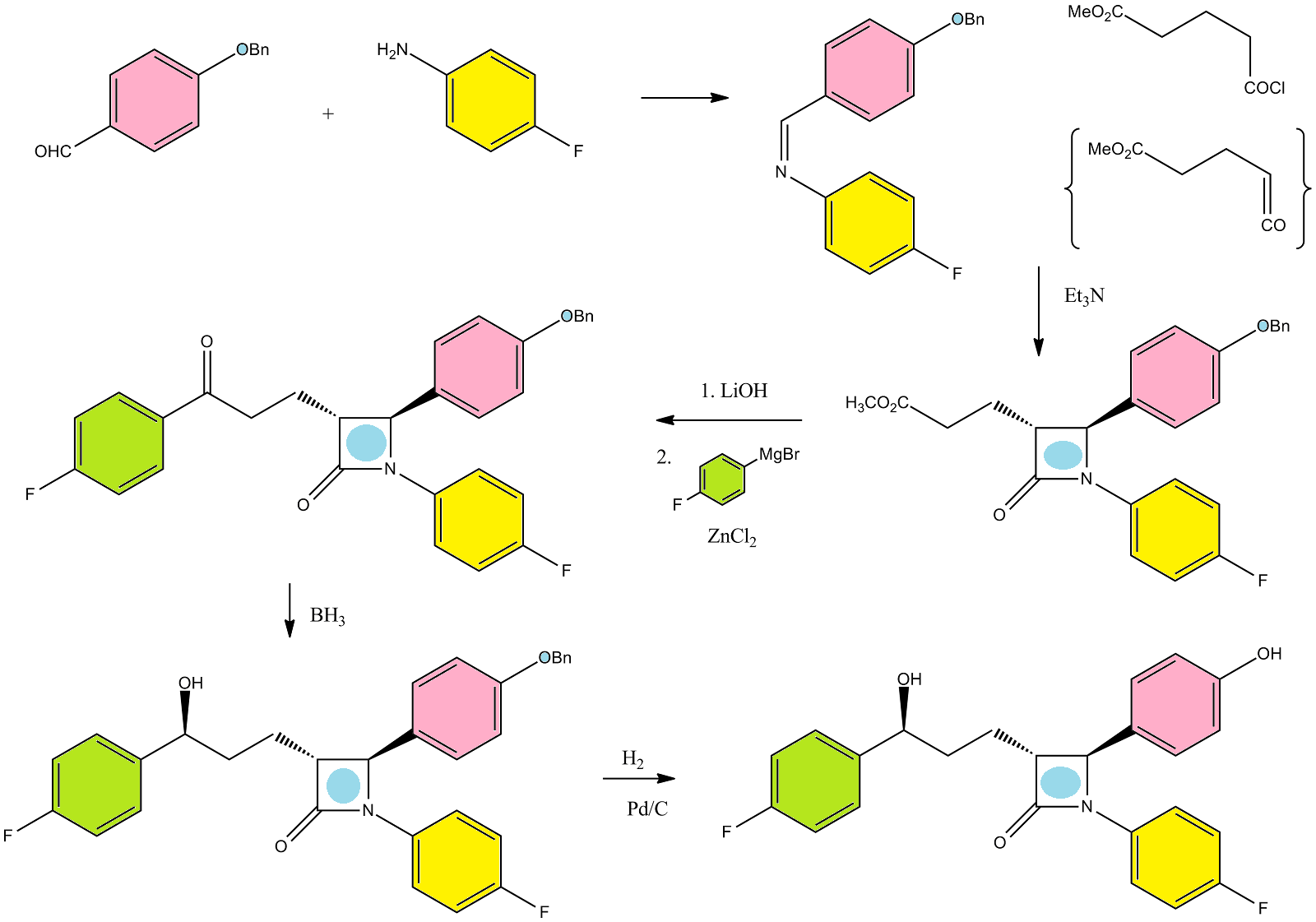
Ezetimibe has the chemical name 1-(4-fluorophenyl)-3(R)-[3-(4-fluorophenyl)-3(S)-hydroxypropyl]-4(S)-(4-hydroxyphenyl)-2-azetidinone (hereinafter referred to by its adopted name “ezetimibe”) and is structurally represented by Formula I.
Figure US20070049748A1-20070301-C00001
Ezetimibe is in a class of lipid lowering compounds that selectively inhibit the intestinal absorption of cholesterol and related phytosterols. It is commercially available in products sold using the trademark ZETIA as a tablet for oral administration containing 10 mg of ezetimibe, and in combination products with simvastatin using the trademark VYTORIN.
U.S. Pat. No. 6,096,883 discloses generically and specifically ezetimibe and its related compounds along with their pharmaceutical compositions. The patent also describes a process for the preparation of ezetimibe.
The process described in the patent involves the use of methyl-4-(chloroformyl) butyrate and also involves isolation of the compound (3R,4S)-1-(4-fluorophenyl)-3-[3-(chloroformyl)-3-oxo-propyl]-4-(4-benzyloxyphenyl)-2-azetidinone as an intermediate. Chlorinated compounds are unstable and difficult to handle in large scale productions. The process described in the patent also involves the purification of intermediates using column chromatography, thus making the process difficult to be scaled up.
Processes for preparation of ezetimibe and its intermediates have also been described in U.S. Pat. Nos. 6,207,822, 5,856,473, 5,739,321, and 5,886,171, International Application Publication No. WO 2006/050634, and in Journal of Medicinal Chemistry 1998, 41, 973-980, Journal of Organic Chemistry 1999, 64, 3714-3718, and Tetrahedron Letters, 44(4), 801-804.

http://www.google.com/patents/US20070049748

EXAMPLE 10 PREPARATION OF 1-(4-FLUOROPHENYL)-3(R)-[3-(4-FLUOROPHENYL)-3(S)-HYDROXYPROPYL]-4(S)-(4-HYDROXYPHENYL)-2-AZETIDINONE (FORMULA I)

50 g of (3R,4S)-1-(4-fluorophenyl)-3-[3-(4-fluorophenyl)-3(s)-hydroxypropyl]-4-(4-benzyloxyphenyl)-2-azetidinone and 475 ml of methanol were taken into a round bottom flask. A mixture of 15 g of 5% palladium on carbon and 25 ml of water was added to it. The reaction mass was flushed with hydrogen gas and a hydrogen pressure of 3 to 5 kg/cm2 was applied. The reaction mass was stirred for 3 hours. Reaction completion was checked using thin layer chromatography. After the reaction was completed, the pressure was released and the reaction mass was filtered through perlite. The filter bed was washed with 100 ml of methanol. The filtrate was distilled completely at 70° C., and 400 ml of isopropanol was added to it. The reaction mass was heated to 45° C. and maintained for 10 minutes. The reaction mass was then allowed to cool to 28° C. 400 ml of water was added to the reaction mass and stirred for 1 hour, 20 minutes. The separated compound was filtered and washed with 100 ml of water. The wet cake was taken into another round bottom flask and 500 ml of chlorobenzene and 40 ml of methanol were added to it. The reaction mass was heated to 65° C. and maintained for 15 minutes. 25 ml of water was added to the reaction mass and stirred for 2 hours. The separated compound was filtered and washed with 100 ml of chlorobenzene. The wet cake was taken into another round bottom flask and 375 ml of chlorobenzene, and 30 ml of methanol were added to it. The reaction mass was heated to 62° C. and maintained for 10 minutes. The reaction mass was then cooled to 28° C. and 20 ml of water was added to it. The reaction mass was stirred for 20 minutes and then filtered and washed with 100 ml of chlorobenzene. The wet cake was taken into another round bottom flask and 400 ml of isopropanol was added to it. The reaction mass was heated to 46° C. and maintained for 15 minutes. 800 ml of water was added to the reaction mass at 45 to 46° C. and stirred for one hour. The separated solid was filtered and washed with water. The process of recrystallization in a combination of isopropanol and water was repeated and the obtained compound was dried at 70° C. for 5 hours to get 19.8 g of the title compound. (Yield 49.2%)
Purity by HPLC: 99.68%.

EXAMPLE 11 PURIFICATION OF 1-(4-FLUOROPHENYL)-3(R)-[3-(4-FLUOROPHENYL)-3(S)-HYDROXYPROPYL]-4(S)-(4-HYDROXYPHENYL)-2-AZETIDINONE (FORMULA I)

15.0 g of ezetimibe obtained above and 120 ml of isopropanol were taken into a round bottom flask and the reaction mass was heated to 48° C. The reaction mass was filtered through a perlite bed in the hot condition to make the solution particle free. The filtrate was taken into another round bottom flask and heated to 47° C. 240 ml of water was added at 47° C. After completion of the addition, the reaction mass was maintained at 47° C. for 1 hour. The separated solid was filtered and washed with 30 ml of water. The wet compound was dried at 70° C. for 8 hours to get 13.4 g of the title compound. (Yield 89%)
Purity by HPLC: 99.92.
benzyl ezetimibe impurity: less than 0.0003 area-%,
benzyl ezetimibe diol impurity: 0.004 area-%,
lactam cleaved alcohol impurity: 0.003 area-%,
lactam cleaved acid impurity: 0.01 area-%,
ezetimibe diol impurity: less than 0.0007 area-%.
Residual solvent content by gas chromatography:
Isopropyl alcohol: 1454 ppm
All other solvents: Less than 100 ppm.
WO1997045406A1 * May 28, 1997 Dec 4, 1997 Schering Corp 3-hydroxy gamma-lactone based enantioselective synthesis of azetidinones
WO2004099132A2 May 5, 2004 Nov 18, 2004 Ram Chander Aryan Process for the preparation of trans-isomers of diphenylazetidinone derivatives
WO2008032338A2 * Sep 10, 2007 Mar 20, 2008 Reddy Maramreddy Sahadeva Improved process for the preparation of ezetimibe and its intermediates
EP0720599A1 Sep 14, 1994 Jul 10, 1996 Schering Corporation Hydroxy-substituted azetidinone compounds useful as hypocholesterolemic agents
US20070049748 Aug 25, 2006 Mar 1, 2007 Uppala Venkata Bhaskara R Preparation of ezetim
Citing Patent Filing date Publication date Applicant Title
US7470678 Jul 1, 2003 Dec 30, 2008 Astrazeneca Ab Diphenylazetidinone derivatives for treating disorders of the lipid metabolism
US7842684 Apr 25, 2007 Nov 30, 2010 Astrazeneca Ab Diphenylazetidinone derivatives possessing cholesterol absorption inhibitor activity
US7863265 Jun 19, 2006 Jan 4, 2011 Astrazeneca Ab N-{[4-((2R,3R)-1-(4-fluorophenyl)-3-{[(2R or S)-2-(4-fluorophenyl)-2-hydroxyethyl]thio}-4-oxoazetidin-2-yl)phenoxy]acetyl}glycyl-D-lysine, used as anticholesterol agents
US7871998 Dec 21, 2004 Jan 18, 2011 Astrazeneca Ab Diphenylazetidinone derivatives possessing cholesterol absorption inhibitory activity
US7893048 Jun 21, 2006 Feb 22, 2011 Astrazeneca Ab 2-azetidinone derivatives as cholesterol absorption inhibitors for the treatment of hyperlipidaemic conditions
US7906502 Jun 21, 2006 Mar 15, 2011 Astrazeneca Ab 2-azetidinone derivatives as cholesterol absorption inhibitors for the treatment of hyperlipidaemic conditions
US8013150 * Feb 17, 2006 Sep 6, 2011 Msn Laboratories Ltd. Process for the preparation of ezetimibe
US8383810 Dec 12, 2011 Feb 26, 2013 Merck Sharp & Dohme Corp. Process for the synthesis of azetidinones
US20110130378 * May 26, 2009 Jun 2, 2011 Lek Pharmaceuticals D.D. Ezetimibe process and composition
US20110183956 * Jul 29, 2009 Jul 28, 2011 Janez Mravljak Process for the synthesis of ezetimibe and intermediates useful therefor
EP2128133A1 May 26, 2008 Dec 2, 2009 Lek Pharmaceuticals D.D. Ezetimibe process and composition
WO2008096372A2 * Feb 6, 2008 Aug 14, 2008 Pranav Gupta Process for preparing highly pure ezetimibe using novel intermediates
WO2009150038A1 May 26, 2009 Dec 17, 2009 Lek Pharmaceuticals D.D. Process for the preparation of ezetimibe and composition containing it
WO2009157019A2 * Jun 23, 2009 Dec 30, 2009 Ind-Swift Laboratories Limited Process for preparing ezetimibe using novel allyl intermediates
WO2005021497A2 * Aug 27, 2004 Mar 10, 2005 Eduardo J Martinez Tethered dimers and trimers of 1,4-diphenylazetidn-2-ones
WO2006127893A2 * May 25, 2006 Nov 30, 2006 Microbia Inc Processes for production of 4-(biphenylyl)azetidin-2-one phosphonic acids
WO2008096372A2 * Feb 6, 2008 Aug 14, 2008 Pranav Gupta Process for preparing highly pure ezetimibe using novel intermediates
US20070049748 * Aug 25, 2006 Mar 1, 2007 Uppala Venkata Bhaskara R Preparation of ezetimibe
/////

Your Aunt can teach you Organic Opectroscopy


Organic spectroscopy should be brushed up and you get confidence

read my blog


Organic chemists from Industry and academics to interact on Spectroscopy techniques for Organic compounds ie NMR, MASS, IR, UV Etc. email me ……….. amcrasto@gmail.com

http://orgspectroscopyint.blogspot.in/  is the link

feder-0005.gif from 123gifs.euamcrasto@gmail.com

Oleanolic acid spectral data and interpretation

 http://orgspectroscopyint.blogspot.in/2014/08/oleanolic-acid-spectral-data-and.html
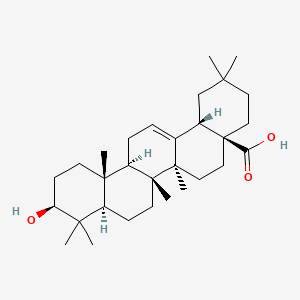
Chemical structure for Oleanolic AcidOleanolic acidOleanolic acid
(4aS,6aR,6aS,6bR,8aR,10S,12aR,14bS)-10-hydroxy-2,2,6a,6b,9,9,12a-heptamethyl-1,3,4,5,6,6a,7,8,8a,10,11,12,13,14b-tetradecahydropicene-4a-carboxylic acid

Oleanic acid, Caryophyllin, Astrantiagenin C, Giganteumgenin C, Virgaureagenin B, 3beta-Hydroxyolean-12-en-28-oic acid, OLEANOLIC_ACID
Molecular Formula: C30H48O3
Molecular Weight: 456.70032

http://orgspectroscopyint.blogspot.in/2014/08/oleanolic-acid-spectral-data-and.html

Ursolic acid [(3b)-3-Hydroxyurs-12-en-28-oic acid] rarely occurs without its isomer oleanolic acid [(3b)-3-Hydroxyolean-12-en-28-oic acid] They may occur in their free acid form, as shown in Figure 1, or as aglycones for triterpenoid saponins which are comprised of a triterpenoid aglycone linked to one or more sugar moieties. Ursolic and oleanolic acids are similar in pharmacological activity

A pentacyclic triterpene that occurs widely in many PLANTS as the free acid or the aglycone for many SAPONINS. It is biosynthesized from lupane. It can rearrange to the isomer, ursolic acid, or be oxidized to taraxasterol and amyrin.

MS
EIMS m/z (rel. int.) 456 [M]+ (5), 412 (3), 248 (100), 203 (50), 167 (25), 44 (51)

IR KBR
(KBr) 3500, 2950, 2850, 1715; 1H-NMR (250 MHz, pyridine-d5) δ: 5.49 (1H, s, H-12), 3.47 (1H, t, J = 8.0 Hz, H-3), 3.30 (1H, m, H-18), 1.12 (3H, s, CH3-27), 0.96 (3H, s, CH3-30), 0.91 (3H, s, CH3-25), 0.89 (3H, s, CH3-23), 0.87 (3H, s, CH3-24), 0.75 (3H, s, CH3-26)

http://orgspectroscopyint.blogspot.in/2014/08/oleanolic-acid-spectral-data-and.html

1H NMR

(250 MHz, pyridine-d5)δ: 5.49 (1H, s, H-12), 3.47 (1H, t, J = 8.0 Hz, H-3), 3.30 (1H, m, H-18), 1.12 (3H, s, CH3-27), 0.96 (3H, s, CH3-30), 0.91 (3H, s, CH3-25), 0.89 (3H, s, CH3-23), 0.87 (3H, s, CH3-24), 0.75 (3H, s, CH3-26)

13 C NMR

(63 MHz, pyridine-d5) δ: 180.2 (C-28), 144.8 (C-13), 122.5 (C-12), 78.0 (C-3), 55.7 (C-5), 48.0 (C-9), 46.6 (C-8, 17), 42.1 (C-14), 39.7 (C-4), 39.4 (C-1), 37.3 (C-10), 33.2 (C-7), 32.9 (C-29), 32.4 (C-21), 30.9 (C-20), 28.7 (C-23), 27.2 (C-2), 26.9 (C-15), 26.1 (C-30), 23.7 (C-11), 23.6 (C-16), 18.7 (C-6), 17.4 (C-26), 16.5 (C-24), 15.5 (C-25)

http://orgspectroscopyint.blogspot.in/2014/08/oleanolic-acid-spectral-data-and.html

http://www.google.com/patents/US20120237629

FIG. 4 shows the 1H NMR spectrum of oleanolic acid;
FIG. 5 shows the 13C NMR spectrum of oleanolic acid;
FIG. 6 shows the 13C DEPT NMR spectrum of oleanolic acid;
FIG. 7 shows the 113C HSQC NMR spectrum of oleanolic acid;
see below

http://orgspectroscopyint.blogspot.in/2014/08/oleanolic-acid-spectral-data-and.html

EXAMPLE 2 Extraction and Isolation of Oleanolic Acid (9) and Maslinic Acid (10) from Cloves

Syzygium aromaticum dried buds or whole cloves were obtained commercially. The cloves (1.5 kg, whole) of Syzygium aromaticum were sequentially and exhaustively extracted with hexane and ethyl acetate to give, after solvent removal in vacuo, a hexane extract (68.8 g, 4.9%) and an ethyl acetate extract (34.1 g, 2.3%). A portion of the ethyl acetate extract (10.0 g), was subjected to chromatographic separation on silica gel (60-120 mesh) column (40×5.0 cm). Elution with hexane/ethyl acetate solvent mixtures (8:2→6:4) afforded pure oleanolic acid (9) (4.7 g, 1.06%), a mixture of oleanolic acid (9) and maslinic acid (10) (0.5 g), and pure maslinic acid (10) (0.25 g). The structures of oleanolic acid (9) and maslinic acid (10) (as 2,3-diacetoxyoleanolic acid) were confirmed by spectroscopic data analysis (1D and 2D 1H NMR and 13C NMR experiments) (FIGS. 4-7 and FIGS. 8-10, respectively).
ANTHONY MELVIN CRASTO

THANKS AND REGARD’S
DR ANTHONY MELVIN CRASTO Ph.D

amcrasto@gmail.com

MOBILE-+91 9323115463
GLENMARK SCIENTIST ,  INDIA
web link
アンソニー     安东尼   Энтони    안토니     أنتوني
blogs are
 

 MY CHINA, VIETNAM  AND JAPAN BLOGS

http://me.zing.vn/u/amcrasto

ICELAND, RUSSIA, ARAB

BOBRDOBRBLAND ICELAND100zakladokadfty

GROUPS

you can post articles and will be administered by me on the google group which is very popular across the world

OPD GROUPSPACESSCOOP OCIorganic-process-development GOOGLE, TVINX, MENDELEY WDT,SCIPEOPLE OPD, EPERNICUS OPDSYNTHETIC ORGANIC CHEMISTRYLinkedIn group, DIIGO OPD,LINKEDIN OPD, WDT LINKEDIN, WDTI ZING

shark


Mom will teach you NMR


Dedicated to all moms in the world
C=O group is dad
O atom is mom
Carbonyl is dad and oxygen mom hence c labelled methyl has higher chemical shift  and gets a little more attention
SEE BELOW
NMR IS EASY
A chemical has Formula: C5H10O2
C5H10O2
Rule 2, omit O, gives C5H10
5 – 10/2 + 1 = 1 degree of unsaturation.
Look for 1 pi bond or aliphatic ring.
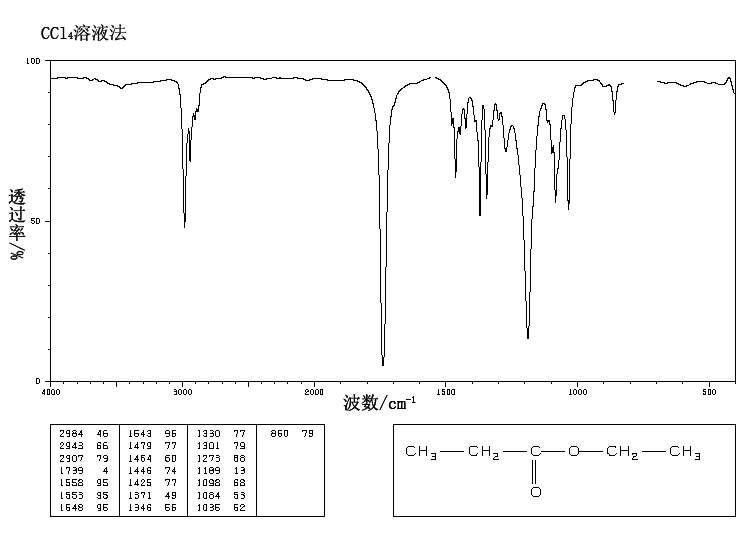
IR
IR spectrum
The band at 1740 indicates a carbonyl, probably a saturated aliphatic ester. The bands at 3000-2850 indicate C-H alkane stretches. The bands in the region 1320-1000 could be due to C-O stretch, consistent with an ester.
NMR spectrum
Structure answerThis is the structure. See if you can assign the peaks on your own.
NMR answerC has a higher chemical shift than D because it’s closer to a more electron-withdrawing functional group.
Carbonyl is dad and oxygen mom,  hence c has higher chemical shift  and gets a little more attention in proton nmr
13 C NMR
Mass spectrum
RAMAN
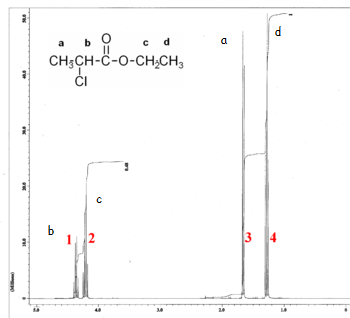
WHAT HAPPENS WHEN A CHLORO IS INTRODUCED
THE INTERPRETATION IS BELOW

remember “a” labelled  CH3 appears as a doublet

WHEN THERE IS ONE METHYL
WHEN THERE ONE CH2 SHORT 
WHEN MOM HAS ONE MORE CH2
PROPYL PROPIONATE, try this on your own
Propyl propanoate.png
1H NMR
image of Propyl proprionatesee interpretation

 BIGGER ONE THAN OBOVE
image of Propyl proprionate
13C NMR
image of Propyl proprionate
APT
image of Propyl proprionate
COSY
image of Propyl proprionate
WILL PASTE INTERPRETATION AFTER ONE WEEK……………….

13C NMR OF SIMPLE MOLECULES…………..Brush up….???


ما هو هذا، لماذا أنت قلق، فرشاة مع الأشياء البسيطة، وسوف يخرج عبقري، وتعلم معي، قطرات صغيرة من الماء جعلالمحيطات، وسوف يكون خبيرا في هذا

what is this, why are you worried, brush up with simple things, you will come out genius, learn with me, small drops of water make an ocean, you will be an expert in this

あなたが心配している理由は、これは簡単なことでブラッシュアップ、、何か、あなたは、天才が出てくる私と一緒に学ぶことが、水の小さな滴が海を作るには、この専門家になる


structure

Name: 1,2-dimethoxymethane

C4H10O2

From the molecular formula, the compound has “0 degrees of unsaturation” (no double bonds or rings).

C13 Spectrum

The 13C NMR has two peaks, a quartet at  54 (a CH3) and a triplet at  80 (a CH2). Since the molecule has four carbons and only two 13C NMR peaks, there must be symmetry. Both peaks are in the regions where carbons next to electronegative atoms occur (oxygen).


τι είναι αυτό, γιατί είσαι ανήσυχος, βούρτσα με απλά πράγματα, θα βγει ιδιοφυΐα, να μάθουν μαζί μου, μικρές σταγόνες του νερού κάνει έναν ωκεανό, θα είστε ένας εμπειρογνώμονας σε αυτό

আপনি চিন্তিত কেন এই সহজ জিনিস নিয়ে ব্রাশ,, কি, আপনি, প্রতিভা বাইরে আসতে আমার সাথে শিখতে হবে, জলের ছোট ঝরিয়া একটি মহাসাগর না, আপনি এই একজন বিশেষজ্ঞ হতে হবে


C5H7O2N

From the molecular formula, the compound has “3 degrees of unsaturation” (3 double bonds or rings).


structure

: ethyl cyanoacetate

C13 Spectrum

The 13C NMR has 5 peaks, a quartet at  14 (a CH3), a triplet at  59 (a CH2), another triplet at  22 (another CH2), and two singlets, one at  118 and one at  172. Since the molecule has five carbons and five 13C NMR peaks, there must be no symmetry. The singlet at  172 is in the carbonyl region, most likely an acid or an ester. The CH2 at  59 is in the region where carbons next to electronegative atoms occur (i.e., oxygen) and the CH3 at  14 is a simple terminal methyl, suggesting an -O-CH2CH3 residue. The singlet at  118 would be consistent with a nitrile carbon and the shielded CH2 at  22 suggests that it may be adjacent to the sp-carbon of the nitrile


מה זה, למה אתה מודאגלרענן עם דברים פשוטיםאתה תצא גאון, ללמוד איתי, טיפות קטנות של מיםיגרמו לים, אתה תהיה מומחה בזה
C6H10OFrom the molecular formula, the compound has “2 degrees of unsaturation” (2 double bonds or rings).

C13 Spectrum

structure

2-butanon-4-ene

The 13C NMR has 6 peaks, a quartet at  25 (a CH3), a triplet at  49 (a CH2), another quartet at  17 (another CH3), two doublets (a CH) , one at  124 and one at  131, and one singlet at  207. Since the molecule has six carbons and six 13C NMR peaks, there must be no symmetry. The singlet at  207 is in the carbonyl region, most likely an aldehyde or ketone. The CH3 groups at  17 and 25 are consistent with simple terminal methyl groups, with one slightly shifted by an mildly electronegative group (a carbonyl?). The doublets at  124 and 131 are in the alkene region, suggesting a -CHCH- group. The remaining CH2 group at  49 is probably deshielded by two electronegative groups.


o que é isso, por que você está preocupado, retocar com coisas simples, você vai sair gênio, aprender comigo, pequenas gotas de água fazem um oceano, você vai ser um especialista neste

C8H8O

From the molecular formula, the compound has “5 degrees of unsaturation” (5 double bonds or rings).

structure

acetophenone


C13 Spectrum

The 13C NMR has 6 peaks, a quartet at  27 (a CH3), three doublets (CH groups), at  129, 128 and 133, and two singlets, one at  137 and one at  197. Since the molecule has eight carbons and six 13C NMR peaks, there must some degree of symmetry. The singlet at  197 is in the carbonyl region, most likely an aldehyde or ketone. The CH3 groups at  27 is consistent with a simple terminal methyl group, slightly shifted by an mildly electronegative group (a carbonyl?). The doublets at  129, 128 and 133 and the singlet at 137 are in the aromatic region, suggesting a monosubstituted aromatic group, with symmetry in four of the six carbons.


நீங்கள் கவலை ஏன் இந்த எளிய பொருட்களை கொண்டு துலக்க, என்ன, நீங்கள், மேதை வெளியே வர எனக்கு கற்று, நீர் சிறு துளிகள் ஒரு கடல் செய்ய, நீங்கள் இந்த ஒரு நிபுணர் இருக்கும்

के तपाईं चिंतित हो किन यो सरल कुरा संग ब्रश,, के हो, तपाईं, प्रतिभा बाहिर आउन मलाई संग सिक्न हुनेछ, पानी सानो थोपा एक महासागर बनाउन, तपाईं यस मा एक विशेषज्ञ हुनेछ\

તમને ચિંતા થતી હોય કે શા માટે આ સરળ બાબતો સાથે બ્રશ, શું છે, તમે પ્રતિભા બહાર આવે મારી સાથે શીખશે, પાણી નાના ટીપાં સમુદ્ર કરો, તો તમે આ એક નિષ્ણાત હશે

kas tas ir, kāpēc jūs uztraucaties, suka ar vienkāršām lietām, jūs iznākt ģēnijs, mācīties kopā ar mani, nelieli ūdens pilieni veikt okeānu, jums būs eksperts šajā

что это такое, почему ты беспокоишься, освежить с простых вещей, вы будете выходить гений, узнать со мной, маленькие капли воды сделать океан, вы будете экспертом в этом

 hvað er þetta, af hverju ert þú áhyggjur, bursta upp með einföldum hlutum, verður þú að koma út snillingur, læra með mér, litla dropa af vatni gera haf, verður þú að vera sérfræðingur í þessu
C6H8OFrom the molecular formula, the compound has “3 degrees of unsaturation” (3 double bonds or rings). 

structure

cyclohexanon-2-ene

C13 Spectrum
The 13C NMR has 6 peaks, three triplets (CH2 groups) at  46, 30 and 41, two doublets (CH groups), at  129 and 145, and one singlet at  198. Since the molecule has six carbons and six 13C NMR peaks, there must be no symmetry. The singlet at  198 is in the carbonyl region, most likely an aldehyde or ketone. Two of the three CH2 groups are shifted by electronegative groups, suggesting a X-CH2-CH2-CH2-Y unit. The doublets at  129 and 145 are in the alkene region, suggesting a -CHCH- group. The three degrees of unsaturation suggests that the molecule also has a ring.

这是什么,你为什么担心,刷了简单的事情,你会出来的天才,学我,小水珠做出的海洋,你将在这方面的专家

 당신이 걱정하는 이유는 간단한 것들로 브러시, 무엇인가, 당신은 천재 나올 나와 함께 배울 것, 물 작은 방울은 바다를 만들어,이 분야의 전문가가 될 것입니다
 

  • Electronegative groups are “deshielding” and tend to move NMR signals from attached carbons further “downfield” (to higher ppm values). 
  • The -system of alkenes, aromatic compounds and carbonyls strongly deshield C nuclei and move them “downfield” to higher ppm values. 
  • Carbonyl carbons are strongly deshielded and occur at very high ppm values. Within this group, carboxylic acids and esters tend to have the smaller  values, while ketones and aldehydes have values  200.
The 13C chemical shift is dependent both on the presence of electronegative groups and on the steric environment. This is best demonstrated by examining a variety of hexane isomers:


Simple interior (primary and secondary) carbons tend to be in the range  25 – 45. Methyl groups which terminate unbranched alkyl chains, however, are significantly shielded (moved to lower  values), as shown by the examples above ( 14, 14.3 and 8.7). The origin of this effect is thought to be steric compression in the gamma () position due to gauche interactions. This is shown schematically below and the gamma position is marked above in the example for hexane.


The presence of an electronegative atom such as oxygen tends to move the chemical shift of the Œ-carbon down into the region  65 – 90, as shown in the examples below:


Halogens, however, have effects which are difficult to predict and carbons adjacent to halogens tend to have chemical shifts in the  30 – 50 region, as shown below. The effects are not simply additive, however, and multiple substitution can often be shielding (move the signal to lower  values). The nitrile carbon is significantly shielding and adjacent carbons tend to occur in the  20 – 25 region.


Alkene carbons tend to have chemical shifts in the range  110 – 140, as shown in the examples below. Conjugation between alkene centers has little effect, as demonstrated by the two middle structures shown below. Conjugation with an oxygen, however, has a dramatic shielding effect, which is attributed to contributions from the resonance forms shown below.


Alkyne carbons occur in the region  65 -85, and are significantly shielding to the carbons which are immediately adjacent ( 1.5 for the terminal methyl of 2-pentyne).


Carbonyls are the most highly deshielded carbons which are typically encountered. Their intensity is usually weak, since there are no attached hydrogens to contribute to the Nuclear Overhauser Effect enhancement (with the exception of aldehydes). Typical chemical shifts occur in the region  170 – 210 with esters, carboxylic acids and amides at the low end, and simple ketones and aldehydes at the high end of the range.


Aromatic carbons have chemical shifts in the range  120 – 140 and are shifted within this range by the nature of the attached substituent. The multiplicity of aromatic peaks in the non-decoupled spectrum is useful for identifying aromatic substitution patterns.

آپ پریشان کیوں ہیں اس سادہ چیزوں کے ساتھ برش،، کیا ہے، آپ، ہوشیار باہر آ میرے ساتھ سیکھ جائے گی، پانی کے چھوٹے چھوٹے قطرے ایک سمندر بنانے کے لئے، آپ کو اس میں ایک ماہر ہو جائے گا

ANTHONY MELVIN CRASTO

THANKS AND REGARD’S
DR ANTHONY MELVIN CRASTO Ph.D

amcrasto@gmail.com

MOBILE-+91 9323115463
GLENMARK SCIENTIST ,  INDIA
web link
http://anthonycrasto.jimdo.com/

Congratulations! Your presentation titled “Anthony Crasto Glenmark scientist, helping millions with websites” has just crossed MILLION views.
アンソニー     安东尼   Энтони    안토니     أنتوني
join my process development group on google
you can post articles and will be administered by me on the google group which is very popular across the world
LinkedIn group
 
blogs are
 
shark


1H NMR OF SIMPLE MOLECULES.. Brush up


ما هو هذا، لماذا أنت قلق، فرشاة مع الأشياء البسيطة، وسوف يخرج عبقري، وتعلم معي، قطرات صغيرة من الماء جعلالمحيطات، وسوف يكون خبيرا في هذا

what is this, why are you worried, brush up with simple things, you will come out genius, learn with me, small drops of water make an ocean, you will be an expert in this

あなたが心配している理由は、これは簡単なことでブラッシュアップ、、何か、あなたは、天才が出てくる私と一緒に学ぶことが、水の小さな滴が海を作るには、この専門家になる


 structure

4-methylbenzaldehyde

NMR Spectrum

The proton NMR has three peaks; a singlet at  2.2 (3H), and a singlet at  10 (1H) and two doublets centered around  7.6. The doublets centered at  7.6 are in the aromatic region; the fact that two doublets are observed (2H each) suggests a 1,4-disubstituted aromatic compound.

The peak at  2.2 is in the region for a methyl group adjacent a mildly electronegative group. The singlet at  10 is in the region observed for aldehydic protons. The presence of two doublets in the aromatic region is highly characteristic of 1,4-disubstitution.

τι είναι αυτό, γιατί είσαι ανήσυχος, βούρτσα με απλά πράγματα, θα βγει ιδιοφυΐα, να μάθουν μαζί μου, μικρές σταγόνες του νερού κάνει έναν ωκεανό, θα είστε ένας εμπειρογνώμονας σε αυτό

 structure

methyl acetate (methyl ethanoate)

NMR Spectrum

The proton NMR has two singlets of equal area. The fact that the molecule has 6 hydrogens means that there must be two non-identical CH3 groups in the molecule and that they are non-adjacent. The peak at  1.95 is in the area generally observed for methyl groups adjacent to carbonyls; the peak at  3.85 is in the region for methyl groups adjacent to electronegative atoms, i.e., oxygen.

আপনি চিন্তিত কেন এই সহজ জিনিস নিয়ে ব্রাশ,, কি, আপনি, প্রতিভা বাইরে আসতে আমার সাথে শিখতে হবে, জলের ছোট ঝরিয়া একটি মহাসাগর না, আপনি এই একজন বিশেষজ্ঞ হতে হবে

 structure
diethyl ketone (3-pentanone)

NMR Spectrum

The proton NMR has a quartet and a triplet, indicating a CH2 adjacent to a CH3. The peak at  2.5 is in the area generally observed for methyl groups adjacent to mildly electronegative groups; the peak at  1.2 is in the region for simple methyl groups adjacent to carbons (CH3CH2). The molecule contains oxygen, but the peak at  2.5 is not shifted enough for this to represent an -O- linkage, so it must represent a carbonyl.


מה זה, למה אתה מודאג, לרענן עם דברים פשוטים, אתה תצא גאון, ללמוד איתי, טיפות קטנות של מיםיגרמו לים, אתה תהיה מומחה בזה


 structure

acetaldehyde (ethanal)

NMR Spectrum

The proton NMR has two peaks; at high resolution, fine coupling is evident between them (J 1 Hz) with the peak at  9.7 being a quartet and the peak at  2.1 being a doublet, indicating a CH coupled to a CH3. The peak at  9.7 is in the area generally observed for aldehydic protons; the peak at  2.1 is in the region for a methyl group adjacent a carbonyl. The molecule contains oxygen, but the peak at  2.1 is not shifted enough for this to represent an -O- linkage, so it must represent a carbonyl. The very small coupling constant suggests that the proton and the CH3 group are not immediately adjacent, but that this represents an example of cross-space coupling.

o que é isso, por que você está preocupado, retocar com coisas simples, você vai sair gênio, aprender comigo, pequenas gotas de água fazem um oceano, você vai ser um especialista neste

 structure

Name: ethyl acetate (ethyl ethanoate)

NMR Spectrum

The proton NMR has three peaks; a quartet at  4.1 (2H), a triplet at  1.2 (3H) and a singlet at  1.97 (3H). The quartet and triplet suggest a CH2 coupled to a CH3 in an ethyl group. The peak at  4.1 is in the area generally observed for CH groups adjacent to electronegative groups, i.e., oxygen. The peak at  2 is in the region for a methyl group adjacent a carbonyl.


நீங்கள் கவலை ஏன் இந்த எளிய பொருட்களை கொண்டு துலக்க, என்ன, நீங்கள், மேதை வெளியே வர எனக்கு கற்று, நீர் சிறு துளிகள் ஒரு கடல் செய்ய, நீங்கள் இந்த ஒரு நிபுணர் இருக்கும்

के तपाईं चिंतित हो किन यो सरल कुरा संग ब्रश,, के हो, तपाईं, प्रतिभा बाहिर आउन मलाई संग सिक्न हुनेछ, पानी सानो थोपा एक महासागर बनाउन, तपाईं यस मा एक विशेषज्ञ हुनेछ\

તમને ચિંતા થતી હોય કે શા માટે આ સરળ બાબતો સાથે બ્રશ, શું છે, તમે પ્રતિભા બહાર આવે મારી સાથે શીખશે, પાણી નાના ટીપાં સમુદ્ર કરો, તો તમે આ એક નિષ્ણાત હશે

kas tas ir, kāpēc jūs uztraucaties, suka ar vienkāršām lietām, jūs iznākt ģēnijs, mācīties kopā ar mani, nelieli ūdens pilieni veikt okeānu, jums būs eksperts šajā

что это такое, почему ты беспокоишься, освежить с простых вещей, вы будете выходить гений, узнать со мной, маленькие капли воды сделать океан, вы будете экспертом в этом

 hvað er þetta, af hverju ert þú áhyggjur, bursta upp með einföldum hlutum, verður þú að koma út snillingur, læra með mér, litla dropa af vatni gera haf, verður þú að vera sérfræðingur í þessu
 structuremethyl vinyl ether (methyl ethenyl ether)

NMR Spectrum
The proton NMR has four groups of peaks; the singlet at  3.6 (3H) is consistent with an isolated CH3 group adjacent to an electronegative center, such as oxygen. The sets of highly split doublets centered at  6.5, 4.2 and 4.0 (there is overlap of these at  4.1) span the region where alkene hydrogens are observed. The complex splitting pattern observed resembles an ABC pattern for a terminal alkene.

这是什么,你为什么担心,刷了简单的事情,你会出来的天才,学我,小水珠做出的海洋,你将在这方面的专家

 당신이 걱정하는 이유는 간단한 것들로 브러시, 무엇인가, 당신은 천재 나올 나와 함께 배울 것, 물 작은 방울은 바다를 만들어,이 분야의 전문가가 될 것입니다
 structureName: 1,2-dimethoxyethane

NMR Spectrum
The proton NMR has two peaks; both singlets are consistent with isolated groups adjacent to an electronegative center, such as oxygen. The fact that the molecule contains ten hydrogens, but only shows singlets for two and three hydrogens requires a great deal of symmetry in the molecule, i.e., both CH3 groups must be identical, as must both CH2 groups.
structure4-isopropyl-1-methoxybenzene (4-(1-methylethyl)-1-methoxybenzene)

NMR Spectrum
The proton NMR has four sets of peaks; a singlet at  3.6 (3H), two sets of doublets centered around  6.9 (4H), a septet at  2.7 (1H) and a doublet at  1.6. The singlet at  3.6 is consistent with an isolated CH3adjacent to an electronegative center, such as an oxygen. The septet and doublet strongly suggest an isopropyl group CH(CH32 in which the carbon is bonded to something mildly electronegative and the two doublets centered at  6.9 strongly suggest a 1,4-disubstituted aromatic compound.
structure 3-bromomethyltoluene (3-bromomethyl-1-methylbenzene)

NMR Spectrum
The proton NMR has three sets of peaks; a singlet at  4.3 (2H), a messy singlet around  7.1 (4H), and a singlet at  2.3 (3H). The singlet at  2.3 is consistent with an isolated CH3 adjacent to a mildly electronegative center. The singlet at 4.3 is consistent with a CH2 group adjacent to two mildly electronegative centers (X-CH2-Y), and the singlet at  7.1 is consistent with a disubstituted aromatic compound. The substitution pattern is not what is normally seen in 1,4-disubstitution (two doublets), suggesting 1,2 or 1,3-disubstitution.
آپ پریشان کیوں ہیں اس سادہ چیزوں کے ساتھ برش،، کیا ہے، آپ، ہوشیار باہر آ میرے ساتھ سیکھ جائے گی، پانی کے چھوٹے چھوٹے قطرے ایک سمندر بنانے کے لئے، آپ کو اس میں ایک ماہر ہو جائے گا

ANTHONY MELVIN CRASTO

THANKS AND REGARD’S
DR ANTHONY MELVIN CRASTO Ph.D

amcrasto@gmail.com

MOBILE-+91 9323115463
GLENMARK SCIENTIST ,  INDIA
web link
http://anthonycrasto.jimdo.com/

Congratulations! Your presentation titled “Anthony Crasto Glenmark scientist, helping millions with websites” has just crossed MILLION views.
アンソニー     安东尼   Энтони    안토니     أنتوني
join my process development group on google
you can post articles and will be administered by me on the google group which is very popular across the world
LinkedIn group
 
blogs are
 
shark


Diethyl benzylmalonate, IR, NMR, Mass


structure

The mass spectrum displays a molecular ion, an m-45 and a peak at m/e = 91, all of which are consistent with a molecule containing benzyl and ethoxy groups.

The 13C spectrum contains six peaks, indicating that the molecule has some elements of symmetry. The quartet at  56 and the triplet at  71 represent a CH3 and a CH2 group which are deshielded by electronegative atoms (most likely oxygen); the peaks at  161 – 128 are in the aromatic region; the fact that three doublets and one singlet are observed strongly suggests monosubstitution.

The proton NMR also shows evidence for two ethyl groups, a CH-CH2– group, and a monosubstituted aromatic group; the chemical shift suggests that the carbons of the CH-CH2– adjacent to one or more electronegative groups.

The IR is consistent with an aromatic compound containing a carbonyl group.

The simplest structure which is consistent with all of these data would be an aromatic compound linked via a -CH2CH group to a diethyl ester.


Structure: structure

IUPAC Name: ethyl ethyl benzylpropanedioate (diethyl benzylmalonate)

607-81-8

C14H18O4; MW = 250.29


1H NMR

The proton NMR has a coupled quartet and a triplet, consistent with an ethyl group in which the CH2 (at  4.1) is adjacent to an electronegative atom (most likely oxygen). The presence of a coupled triplet and doublet suggests the presence of a CH-CH2– group in which both carbons are adjacent to one or more electronegative atoms. The singlet at  7.1 is consistent with a monosubstituted aromatic compound.


NMR Spectrum

13C NMR

The 13C spectrum contains nine peaks, indicating that the molecule has some elements of symmetry. The quartet at  14 and the triplet at  60 represent a simple CH3 and a CH2 which is deshielded by an electronegative atom (most likely oxygen); the doublet at  58 and the triplet at  36 are CH and CH2 groups which are adjacent to one or more electronegative groups. The peaks at  141 – 125 are in the aromatic region; the fact that three doublets and one singlet are observed strongly suggests monosubstitution.


13C NMR Assignments: C-13 assignments


MASS

The mass spectrum consists of a molecular ion at 250, a base peak at 91 (a benzyl group), an m-45 peak at 205, indicating the presence of an ethoxy group; other significant peaks at 131 and 176 must be consistent with the proposed structure. The spectrum is consistent with a molecule containing ethoxy and benzyl groups.

Mass Spectrum

Mass Spectrum Fragments: C-13 assignments


IR

3400-3200 cm1: no OH peak 3100 cm1: small peak, suggesting unsaturated CH 2900 cm1: strong peak suggesting saturated CH 2200 cm1: no unsymmetrical triple bonds 1730 cm1: strong carbonyl 1610 and 1500 cm1: weak peaks, vaguely consistent with aromatic carbon-carbon double bonds


ADDITIONAL INFO FOR READER ON SPECTROSCOPY

SEE THE FUN WHEN A CARBONYL IS INTRODUCED

BENZOYLMALONIC ACID DIETHYL ESTER Structure

1H NMR


13 C NMR

IR


MASS


RAMAN


4-methoxyphenyl methanol, (4-メトキシフェニル)メタノール NMR, IR , MASS


(4-methoxyphenyl)methanol

Structure: structure

IUPAC Name: 4-methoxyphenyl methanol

C6H10O3; MW = 138.17

The molecule contains two oxygens, and from the analysis, contains four double bonds, carbonyls or rings. The large number of degrees of unsaturation strongly suggests an aromatic compound (DU = 4).

The mass spectrum displays a molecular ion, which is the base peak, an m-1 and an m-17, all of which are consistent with a simple alcohol.

The 13C spectrum contains six peaks, indicating that the molecule has some elements of symmetry. The quartet at  56 and the triplet at  71 represent a CH3 and a CH2 group which are deshielded by electronegative atoms (most likely oxygen); the peaks at  161 – 128 are in the aromatic region; the fact that two doublets and two singlets are observed strongly suggests 1,4-disubstitution.

The proton NMR also shows evidence for aromatic 1,4-disubstitution and suggests that the methyl and methylene are isolated and adjacent to electronegative groups. A peak consistent with an alcoholic OH can also be seen.

The IR is consistent with an aromatic alcohol containing no carbonyl group, suggesting that the second oxygen is involved in an ether linkage.

The simplest structure which is consistent with all of these data would be an aromatic compound containing an alcohol group and a methyl ether, situated 1,4 relative to each other.


IH NMR

The proton NMR has two doublets at  6.9, consistent with aromatic 1,4-disubstitution, and three singlets, areas 3, 2 and 1. The singlets at  3.6 and 4.7 are highly shifted and suggest isolated CH3 and CH2 groups adjacent to one or more electronegative atoms or groups. The singlet, area 1, would be consistent with an alcohol.


NMR Spectrum

Predict NMR spectrum


13C NMR

The 13C spectrum contains six peaks, indicating that the molecule has some elements of symmetry. The quartet at  56 and the triplet at  71 represent a CH3 and a CH2 group which are deshielded by electronegative atoms (most likely oxygen); the peaks at  161 – 128 are in the aromatic region; the fact that two doublets and two singlets are observed strongly suggests 1,4-disubstitution.

13C NMR Data: q-56.0; t-71.0; d-114.3; d-128.3; s-160.9; s-133.2

13C NMR Assignments: C-13 assignments


MASS

The mass spectrum consists of a molecular ion at 138, which is also the base peak, an m-1 peak at 137, indicating the presence of a labile hydrogen (OH or CHO), and an m-17 peak (loss of HO-). The spectrum is consistent with an alcohol which cannot readily break down to form other stable radical cations.

Mass Spectrum


Mass Spectrum Fragments: C-13 assignments


IR


3400-3200 cm1: strong OH peak 3100 cm1: small peak, suggesting possible unsaturated CH 2900 cm1: strong peak suggesting saturated CH 2200 cm1: no unsymmetrical triple bonds 1710 cm1: no carbonyl 1610 and 1500 cm1: sharp peaks, consistent with aromatic carbon-carbon double bonds

Synthetic Communications, 18, p. 613, 1988 DOI: 10.1080/00397918808064019
Synthesis, p. 1081, 1984
Tetrahedron Letters, 32, p. 3243, 1991


DRUG SYNTHESIS ESSENTIALS…ORGANIC SPECTROSCOPY


BRUSH UP

AT

http://orgspectroscopyint.blogspot.in/


2D NMR spectroscopy for the structural elucidation of 4.