New Drug Approvals

Home » Posts tagged 'FDA 2014' (Page 3)

Tag Archives: FDA 2014

DRUG APPROVALS BY DR ANTHONY MELVIN CRASTO .....FOR BLOG HOME CLICK HERE

Blog Stats

  • 4,814,173 hits

Flag and hits

Flag Counter

Enter your email address to follow this blog and receive notifications of new posts by email.

Join 37.9K other subscribers
Follow New Drug Approvals on WordPress.com

Archives

Categories

Recent Posts

Flag Counter

ORGANIC SPECTROSCOPY

Read all about Organic Spectroscopy on ORGANIC SPECTROSCOPY INTERNATIONAL 

Enter your email address to follow this blog and receive notifications of new posts by email.

Join 37.9K other subscribers
DR ANTHONY MELVIN CRASTO Ph.D

DR ANTHONY MELVIN CRASTO Ph.D

DR ANTHONY MELVIN CRASTO, Born in Mumbai in 1964 and graduated from Mumbai University, Completed his Ph.D from ICT, 1991,Matunga, Mumbai, India, in Organic Chemistry, The thesis topic was Synthesis of Novel Pyrethroid Analogues, Currently he is working with AFRICURE PHARMA, ROW2TECH, NIPER-G, Department of Pharmaceuticals, Ministry of Chemicals and Fertilizers, Govt. of India as ADVISOR, earlier assignment was with GLENMARK LIFE SCIENCES LTD, as CONSUlTANT, Retired from GLENMARK in Jan2022 Research Centre as Principal Scientist, Process Research (bulk actives) at Mahape, Navi Mumbai, India. Total Industry exp 32 plus yrs, Prior to joining Glenmark, he has worked with major multinationals like Hoechst Marion Roussel, now Sanofi, Searle India Ltd, now RPG lifesciences, etc. He has worked with notable scientists like Dr K Nagarajan, Dr Ralph Stapel, Prof S Seshadri, etc, He did custom synthesis for major multinationals in his career like BASF, Novartis, Sanofi, etc., He has worked in Discovery, Natural products, Bulk drugs, Generics, Intermediates, Fine chemicals, Neutraceuticals, GMP, Scaleups, etc, he is now helping millions, has 9 million plus hits on Google on all Organic chemistry websites. His friends call him Open superstar worlddrugtracker. His New Drug Approvals, Green Chemistry International, All about drugs, Eurekamoments, Organic spectroscopy international, etc in organic chemistry are some most read blogs He has hands on experience in initiation and developing novel routes for drug molecules and implementation them on commercial scale over a 32 PLUS year tenure till date Feb 2023, Around 35 plus products in his career. He has good knowledge of IPM, GMP, Regulatory aspects, he has several International patents published worldwide . He has good proficiency in Technology transfer, Spectroscopy, Stereochemistry, Synthesis, Polymorphism etc., He suffered a paralytic stroke/ Acute Transverse mylitis in Dec 2007 and is 90 %Paralysed, He is bound to a wheelchair, this seems to have injected feul in him to help chemists all around the world, he is more active than before and is pushing boundaries, He has 100 million plus hits on Google, 2.5 lakh plus connections on all networking sites, 100 Lakh plus views on dozen plus blogs, 227 countries, 7 continents, He makes himself available to all, contact him on +91 9323115463, email amcrasto@gmail.com, Twitter, @amcrasto , He lives and will die for his family, 90% paralysis cannot kill his soul., Notably he has 38 lakh plus views on New Drug Approvals Blog in 227 countries......https://newdrugapprovals.wordpress.com/ , He appreciates the help he gets from one and all, Friends, Family, Glenmark, Readers, Wellwishers, Doctors, Drug authorities, His Contacts, Physiotherapist, etc He has total of 32 International and Indian awards

Verified Services

View Full Profile →

Archives

Categories

Flag Counter

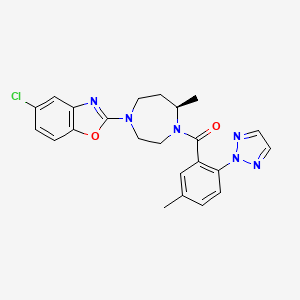
FDA approves new type of sleep drug, Belsomra, MK 4305, SUVOREXANT


Suvorexant.svg

MK 4305, SUVOREXANT

[(R)-4-(5-Chlorobenzoxazol-2-yl)-7-methyl-[1,4]diazepan-1-yl]-(5-methyl-2-[1,2,3]triazol-2-yl-phenyl)methanone

The FDA has approved a new type of sleep drug. This new drug is an orexin receptor antagonist and is the first approved drug of this type. Orexins are chemicals that are involved in regulating the sleep-wake cycle and play a role in keeping people awake. Learn more here:http://go.usa.gov/EcEz

MK4305 structure.pngSuvorexant ball-and-stick model.png

Suvorexant

MK-4305; 1030377-33-3; UNII-081L192FO9; MK4305; MK 4305; DORA-analogue
Molecular Formula: C23H23ClN6O2   Molecular Weight: 450.92072
“5-chloro-2- {(5R)-5-methyl-4-[5-methyl-2-(2H-l,2,3-triazol- 2-yl)benzoyl]-l,4-diazepan-l-yl}-l,3-benzoxazole,” “[(R)-4-(5-chloro-benzooxazol-2-yl)-7- methyl-[l,4]diazepan-l-yl]-(5-methyl-2-[l,2,3]triazol-2-yl-phenyl)-methanone” or “[(7R)-4-(5- chloro- 1 ,3 -benzoxazol-2-yl)-7-methyl- 1 ,4-diazepan- 1 -yl] [5 -methyl-2-(2H- 1 ,2,3 -triazol-2- yl)phenyl]methanone. “

Merck Sharp & Dohme Corp. innovator

Suvorexant (INN, USAN) (trade name Belsomra) is a selective, dual orexin receptor antagonist marketed by Merck & Co. for the treatment of insomnia.[1] It is effective for insomnia, at least for four weeks and as compared to a placebo.[2]

Suvorexant was approved for sale by the U.S. Food and Drug Administration (FDA) on August 13, 2014.[3] The U.S. Drug Enforcement Administration (DEA) has placed it on the list of schedule IV controlled substances.[4] The drug became available inJapan in November 2014[5] and in the United States in February 2015.[6]

NMR

NMR SUVOREXANT

For Immediate Release

August 13, 2014

The U.S. Food and Drug Administration today approved Belsomra (suvorexant) tablets for use as needed to treat difficulty in falling and staying asleep (insomnia).

Belsomra is an orexin receptor antagonist and is the first approved drug of this type. Orexins are chemicals that are involved in regulating the sleep-wake cycle and play a role in keeping people awake. Belsomra alters the signaling (action) of orexin in the brain.

Insomnia is a common condition in which a person has trouble falling or staying asleep. It can range from mild to severe, depending on how often it occurs and for how long. Insomnia can cause daytime sleepiness and lack of energy. It also can make a person feel anxious, depressed, or irritable. People with insomnia may have trouble with attentiveness, learning, and memory.

“To assist health care professionals and patients in finding the best dose to treat each individual patient’s sleeplessness, the FDA has approved Belsomra in four different strengths – 5, 10, 15, and 20 milligrams,” said Ellis Unger, M.D., director of the Office of Drug Evaluation I in the FDA’s Center for Drug Evaluation and Research. “Using the lowest effective dose can reduce the risk of side effects, such as next-morning drowsiness.”

Belsomra should be taken no more than once per night, within 30 minutes of going to bed, with at least seven hours remaining before the planned time of waking. The total dose should not exceed 20 mg once daily.

The most commonly reported adverse reaction reported by clinical trial participants taking Belsomra was drowsiness. Medications that treat insomnia can cause next-day drowsiness and impair driving and other activities that require alertness. People can be impaired even when they feel fully awake.

The FDA asked the drug manufacturer, Merck, Sharpe & Dohme Corp., to study next-day driving performance in people who had taken Belsomra. The testing showed impaired driving performance in both male and female participants when the 20 mg strength was taken.  Patients using the 20 mg strength should be cautioned against next-day driving or activities requiring full mental alertness. Patients taking lower doses should also be made aware of the potential for next-day driving impairment, because there is individual variation in sensitivity to the drug.

The effectiveness of Belsomra was studied in three clinical trials involving more than 500 participants. In the studies, patients taking the drug fell asleep faster and spent less time awake during the remainder of the night compared to people taking an inactive pill (placebo). Belsomra was not compared to other drugs approved to treat insomnia, so it is not known if there are differences in safety or effectiveness between Belsomra and other insomnia medications.

Like other sleep medicines, there is a risk from Belsomra of sleep-driving and other complex behaviors while not being fully awake, such as preparing and eating food, making phone calls, or having sex. Chances of such activity increase if a person has consumed alcohol or taken other medicines that make them sleepy. Patients or their families should call the prescribing health care professional if this type of activity occurs.

Belsomra will be dispensed with an FDA-approved patient Medication Guide that provides instructions for its use and important safety information. Belsomra is a controlled substance (Schedule-IV) because it can be abused or lead to dependence.

Belsomra is made by Merck, Sharpe & Dohme Corp. of Whitehouse Station, N.J.

Old article CUT PASTE

[(7R)-4-(5-chloro-1,3-benzoxazol-2-yl)-7-methyl-1,4-diazepan-1-yl][5-methyl-2-(2H-1,2,3-triazol-2-yl)phenyl]methanone

Chemical structure for Suvorexant

Suvorexant

may23,2013

A panel of experts at the US Food and Drug Administration has recommended Merck & Co’s insomnia drug suvorexant when given in lower dosages but rejected the higher dose that the company was seeking.———read more at

http://www.pharmatimes.com/Article/13-05-23/FDA_panel_backs_Merck_Co_sleep_drug_but_at_low_doses.aspx

MAIN PART

Suvorexant (MK-4305) is a dual orexin receptor antagonist in development by Merck & Co.[1][2][3] Suvorexant works by turning off wakefulness rather than by inducing sleep.[4] It is not currently approved for commercial use, but it has completed three Phase III trials.[5]The recent FDA review showed that the drug is associated with increased somnolence the next day and users of higher doses had an increased rate of suicidal ideation. [6] It is one of two such compounds currently in development, the other being GlaxoSmithKline‘s SB-649,868.


Ref:Org.Process Res.Dev-2011-15-367.

SYN1SYN 3SYN 2

Figure

PAPER

Mangion IK, * Sherry BD, Yin J, Fleitz FJ. Merck & Co., Rahway, USA
Enantioselective Synthesis of a Dual Orexin Receptor Antagonist.Org. Lett. 2012; 14: 3458-3461

OREXINS A AND B ARE EXCITATORY NEUROPEPTIDES THAT STIMULATE WAKEFULNESS. SUVOREXANT IS A DUAL OREXIN RECEPTOR ANTAGONIST THAT IS IN PHASE III CLINICAL TRIALS FOR THE TREATMENT OF INSOMNIA. THE KEY STEP IN THE ASYMMETRIC SYNTHESIS ­DEPICTED IS A TANDEM ENZYMATIC TRANSAMINATION–ANNULATION SEQUENCE (F → G → H).

A previous synthesis of suvorexant (N. A. Strotman et al. J. Am. Chem. Soc. 2011, 133, 8362) involved an asymmetric Ru-catalyzed reductive amination in the construction of the diazepane ring. The present route benefits from the circumvention of transition-metal catalysis and dichloromethane as solvent.

PATENT

http://www.google.co.in/patents/US7951797

Figure US07951797-20110531-C00013

benzyl (5R)-5-methyl-4-[5-methyl-2-(2H-1,2,3-triazol-2-yl)benzoyl]-1,4-diazepane-1-carboxylate (G-1)

To a solution of 22.3 g (78 mmol) of the hydrochloride salt of F-1, 15.9 g (78 mmol) A-2, 12.8 g (94 mmol) 1-hydroxy-7-azabenzotriazole, and 43.1 mL (392 mmol) N-methylmorpholine in 300 mL of DMF was added 22.5 g (118 mmol) EDC and the reaction was stirred overnight at room temperature. The reaction was partitioned between EtOAc and saturated aqueous NaHCO3, washed with water, brine, dried over MgSO4, and concentrated by rotary evaporation. The residue was purified by column chromatography on silica gel (EtOAc/hexanes) to provide G-1 as a colorless gum. Data for G-1: LC/MS: rt=2.22 min; m/z (M+H)=434.2 found; 434.2 required.

(7R)-7-methyl-1-[5-methyl-2-(2H-1,2,3-triazol-2-yl)benzoyl]-1,4-diazepane (G-2)

A round bottom flask containing a solution of 29.6 g (68.3 mmol) G-1 in 300 mL EtOAc and 200 ml MeOH was evacuated under reduced pressure and purged three times with an atmosphere of N2. To the flask was then added 2.4 g of 20% Pd(OH)2on carbon. The flask was again evacuated under reduced pressure and purged three times with an atmosphere of N2, and then three times with H2. The reaction was stirred under an atmosphere of H2 for three days, then filtered through a pad of celite, rinsing with EtOAc followed by MeOH. The filtrate was concentrated to provide G-2 as a white foam. Data for G-2: LC/MS: rt=0.96 & 1.13 min (see two conformers under these conditions); m/z (M+H)=300.0 found; 300.2 required.

5-chloro-2-{(5R)-5-methyl-4-[5-methyl-2-(2H-1,2,3-triazol-2-yl)benzoyl]-1,4-diazepan-1-yl}-1,3-benzoxazole (G-3)

To 21.0 g (70.1 mmol) G-2 in 250 mL DMF was added 29.3 mL (210 mmol) triethylamine and 13.2 g (70.1 mmol) D-1 and the mixture was heated in an oil bath at 75° C. for 2 h. After cooling to room temperature, the reaction was diluted with EtOAc, washed with saturated aqueous NaHCO3, water, brine and dried over MgSO4. Following concentration by rotary evaporation, the residue was purified by flash column chromatography (hexanes/EtOAc) to provide a gum. The gum was stirred in a mixture of 150 ml EtOAc and 300 ml hexanes overnight. Filtration provided G-3 as a white solid. Data for G-3: LC/MS: rt=2.29 min; m/z (M+H)=451.1 found; 451.2 required; HRMS (APCI) m/z (M+H) 451.1631 found; 451.1644 required.

PATENT

http://www.google.com/patents/CN103923068A?cl=en

Scheme (1) US2008 / 132490 reported as follows:

Figure CN103923068AD00061

 (2) Org.Process Res.Dev.2011,15,367 – 375 reported a synthetic route is as follows:

Figure CN103923068AD00062

 the two lines above has the following disadvantages: starting materials using highly toxic compound methyl vinyl ketone, methyl vinyl ketone to the eyes, skin, mucous membranes and upper respiratory tract irritation strong, easy to operate when used; and finally to preparation suvorexant, the need to chiral separation, is not conducive to industrial production, but low yield.

 (3) W02012148553 and J.Am.Chem.Soc.2011,133,8362 – Scheme 8371 report as follows:

Figure CN103923068AD00071

 The route disadvantages: starting materials using highly toxic compound methyl vinyl ketone, methyl vinyl ketone to the eyes, skin, mucous membranes and upper respiratory tract irritation strong, easy to operate when used; also use a heavy metal catalyst, high cost, and environmentally unfriendly.

 (4) Org.Lett, synthetic route Vol.14, N0.13,2012,3458-3461 reported as follows:

Figure CN103923068AD00072

 The disadvantage of this route: starting materials using highly toxic compound methyl vinyl ketone, methyl vinyl ketone pairs of eyes, skin, mucous membranes and upper respiratory tract irritation strong. ; Additional use of biocatalysis, high cost.

 (5) Angew.Chem.1nt.Ed.2011,50,11511 – 11515 reported synthetic route is as follows:

Figure CN103923068AD00081

Figure CN103923068AD00091

Figure CN103923068AD00092

Figure CN103923068AD00093

Figure CN103923068AD00101

Figure CN103923068AD00102

Figure CN103923068AD00103

Figure CN103923068AD00111

Example 1:

Synthesis – (((tert-butoxycarbonyl) amino) butanamide N- benzyl-3-yl) acetate – [0064] (R) methyl-2-

Figure CN103923068AD00121

 The methyl-2- (benzylamino) ethyl ester (20mmol), (R) _3_ ((tert-butoxycarbonyl) amino) butyric acid (21mmol), 1- hydroxybenzotriazole (25mmol), dried triethylamine (30mmol) added to the flask, anhydrous DMF25ml, stirring was added EDC (24mmOl), 10 ° C the reaction 5h. Was added 10% citric acid solution, extracted with ethyl acetate, 5% Na2CO3 solution The organic layer was washed with saturated brine, MgSO4 dried, filtered and evaporated to dryness, the product obtained from ethyl acetate and petroleum ether (1: 2, volume ratio ) recrystallized to obtain (yield 98%, mp: 107 ° C, [a] 26D = 21.97 (103.76mg / 20ml, MeOH)). IHNMR (600MHz, DMS0_d6) δ ppm7.38-7.23 (m, 5H), 6.73-6

• 72 (d, I Η), 4.75-4.4 (m, 2H), 4.31-3.95 (m, 2H), 3.89-3.87 (t, I Η), 3.64-3.62 (d, 3Η), 2.64-2.50 ( m, 1Η), 2.37-2.23 (m, 1Η), 1.38-1.37 (d, 9Η), 1.08-1.06 (m, 3Η); (FIG. 1) MS (ESI) m / ζ365.20 ([Μ + Η ] +).

Example 2:

Synthesis – (((tert-butoxycarbonyl) amino) butanamide N- benzyl-3-yl) acetate – [0068] (R) methyl-2-

 The methyl-2- (benzylamino) ethyl ester (20mmol), (R) _3_ ((tert-butoxycarbonyl) amino) butyric acid (21mmol), 1_ hydroxybenzotriazole (25mmol), potassium carbonate (60mmol) added to the flask, anhydrous dichloromethane 50ml, was added under stirring ⑶I (22mmOl), 20 ° C reaction 6h. Was added 10% citric acid solution, extracted with ethyl acetate, 5% Na2CO3 solution The organic layer was washed with saturated brine, MgSO4 dried, filtered and evaporated to dryness, the product obtained from ethyl acetate and petroleum ether (1: 2, volume ratio ) recrystallization, that was (yield 97.5%, mp: 107 ° C, [a] 26D = 21.97 (103.76mg / 20ml, MeOH)).

 Example 3:

Synthesis – (((tert-butoxycarbonyl) amino) butanamide N- benzyl-3-yl) acetate – [0071] (R) methyl-2-

 The methyl-2- (benzylamino) ethyl ester (20mmol), (R) _3_ ((tert-butoxycarbonyl) amino) butyric acid (21mmol), 1- hydroxybenzotriazole (25mmol), Sodium hydride (24mmol) added to the flask, anhydrous acetone 50ml, was added with stirring 1 (Shu ^ (25 dirty 01), 301:! 411. The reaction was added 10% citric acid solution, extracted with ethyl acetate, 5% Na2CO3 The organic layer was washed with a solution, and saturated brine, MgSO4 dried, filtered and evaporated to dryness, the product obtained from ethyl acetate and petroleum ether (1: 2, volume ratio) was recrystallized to obtain (yield 97%, mp: 107 ° C, [a] 26D =

21.97 (103.76mg / 20ml, MeOH)).

Example 4: [0074] (R) -4- benzyl-7-methyl-1,4-diaza Synthesis heptane-2,5-dione

Figure CN103923068AD00131

 The 3g (8.2mmol) (R) – methyl _2_ (N- benzyl _3_ ((tert-butoxycarbonyl) amino) butanamide yl) acetate were added to the flask, and dissolved in ethyl acetate was added IOml added 30ml45% of acetate hydrochloride gas, 25 ° C reaction 4h.Evaporated to dryness, and saturated NaHC03 solution, methylene chloride and ethanol (2: 1, volume ratio) was extracted, MgSO4 organic layer was dried and evaporated to dryness to give a pale yellow oil. It was dissolved in 30ml MeOH and dried added 0.487g (9.02mmol) NaOMe, under nitrogen, 10 ° C reaction 4h. Quenched with saturated NH4Cl solution was added 5 ^ Na2CO3 solution, methylene chloride and ethanol (2: 1, volume ratio) was extracted organic layers were combined, MgSO4 dried, rotary evaporated to give a white solid (yield 98.93%, mp: 122_123 ° C , [a] 26D = 33.49 (112.87mg / 20ml, MeOH)). IH NMR (600MHz, DMS0_d6) δ ppm7.77-7.76 (bd, 1H), 7.33-7.25 (m, 5H), 4.59-4.53 (m, 2H), 4.10-4.02 (m, 2H), 3.65-3.62 ( m, 1H), 2.93-2.90 (m, 1H),

2.76-2.72 (m, 1H), 1.14-1.13 (d, 3H); (FIG. 2) MS (ESI) m / z233.10 ([M + H] +) ..

 Example 5:

(R) -4- benzyl-7-methyl-1,4-diaza Synthesis heptane-2,5-dione

The 3g (8.2mmol) (R) – methyl _2_ (N_ _ _3 benzyl ((tert-butoxycarbonyl) amino) butanamide yl) acetate were added to the flask, dissolved in dichloromethane was added IOml adding 30ml methylene chloride solution containing 10% of CF3COOH of, 25 ° C reaction 4h. Evaporated to dryness and saturated NaHCO3 solution, methylene chloride and ethanol (2: 1, volume ratio) was extracted, MgSO4 organic layer was dried and evaporated to dryness to give a yellow oil. This was dissolved in 50ml of dry toluene, was added 0.156g (6.5mmol) of sodium hydride, 110 ° C reaction 4h. After cooling to room temperature, quenched with saturated NH4Cl solution, 5% Na2CO3 solution is added, methylene chloride and ethanol (2: 1, volume ratio) was extracted organic layers were combined, MgSO4 dried, rotary evaporated to give a white solid 1.83g (yield 90.34 %, mp: 122-123 ° C, [a J26D = 33.49 (112.87mg / 20ml, MeOH)).

Example 6:

 (R) -4- benzyl-7-methyl-1,4-diaza Synthesis heptane-2,5-dione

The 3g (8.2mmol) (R) – methyl _2_ (N_ _ _3 benzyl ((tert-butoxycarbonyl) amino) butanamide yl) acetate were added to the flask, methanol was added IOml dissolved, 30ml36% methanol solution of hydrochloric acid gas, 25 ° C reaction 4h.Evaporated to dryness, and saturated NaHC03 solution, methylene chloride and ethanol (2: 1, volume ratio) was extracted, MgSO4 organic layer was dried and evaporated to dryness to give a yellow oil. This was dissolved in 50ml of dry toluene, was added 1.7g (12.3mmol) of potassium carbonate, 110 ° C reaction 8h. After cooling to room temperature, quenched with saturated NH4Cl solution, 5% Na2CO3 solution is added, methylene chloride and ethanol (2: 1, volume ratio) was extracted organic layers were combined, MgSO4 dried, rotary evaporated to give a white solid (yield 95.78%, mp: 122_123 ° C, [a] 26D = 33.49 (112.87mg / 20ml, MeOH)).

Example 7:

 (R) -4- benzyl-7-methyl-1,4-diaza Synthesis heptane-dione _2,5_

 The 3g (8.2mmol) (R) – methyl _2_ (N_ _ _3 benzyl ((tert-butoxycarbonyl) amino) butanamide yl) acetate were added to the flask, methanol was added IOml dissolved, 30ml of 36% methanol containing hydrochloric acid gas solution, 25 ° C reaction 4h. Evaporated to dryness and saturated NaHCO3 solution, methylene chloride and ethanol (2: 1, volume ratio) was extracted, MgSO4 organic layer was dried and evaporated to dryness to give a yellow oil. Which was dissolved in 30ml of ethyl acetate and dried, was added 0.88g (16.4mmOl) sodium alkoxide, 10 ° C the reaction 6h. Quenched with saturated NH4Cl solution was added 5 ^ Na2CO3 solution, methylene chloride and ethanol (2: 1, volume ratio) was extracted organic layers were combined, MgSO4 dried, rotary evaporated to give a white solid (yield 93%, mp: 122_123 ° C , [a] 26D = 33.49 (112.87mg / 20ml, Me0H)) ο Example 8:

 (R) -4- benzyl-7-methyl-1,4-diaza Synthesis heptane-2,5-dione

 The 3g (8.2mmol) (R) – methyl _2_ (N- benzyl _3_ ((tert-butoxycarbonyl) amino) butanamide yl) acetate were added to the flask, methanol was added IOml dissolved, 30ml hydrochloric acid gas containing 36% methanol solution, 25 ° C reaction 4h. Evaporated to dryness, and saturated NaHC03 solution, methylene chloride and ethanol (2: 1, by volume) to extract, MgS04 organic layer was dried and evaporated to dryness to give a yellow oil. Which was dissolved in 30ml of dry methanol was added 2.07g (20.5mmol) of triethylamine, 60 ° C the reaction 8h. After cooling to room temperature, quenched with saturated NH4Cl solution, 5% Na2CO3 solution is added, methylene chloride and ethanol (2: 1, volume ratio) was extracted organic layers were combined, MgSO4 dried, rotary evaporated to give a white solid (yield 92.68%, mp: 122_123 ° C, [a] 26D = 33.49 (112.87mg / 20ml, MeOH)).

 Example 9:

(R) -4- benzyl-7-methyl-1,4-diaza Synthesis heptane-2,5-dione

The 3g (8.2mmol) (R) – methyl _2_ (N_ _ _3 benzyl ((tert-butoxycarbonyl) amino) butanamide yl) acetate were added to the flask, methanol was added IOml dissolved, 30ml hydrochloric acid gas containing 36% methanol solution, 25 ° C reaction 4h. Evaporated to dryness, and saturated NaHC03 solution, methylene chloride and ethanol (2: 1, by volume) to extract, MgSO4 organic layer was dried and evaporated to dryness to give a yellow oil. Which was dissolved in 30ml of dry acetonitrile was added 1.38g (12.3mmol) of potassium t-butoxide, 30 ° C the reaction 8h. Quenched with saturated NH4Cl solution was added 5 ^ Na2CO3 solution, methylene chloride and ethanol (2: 1, volume ratio) was extracted organic layers were combined, MgSO4 dried, rotary evaporated to give a white solid (yield 89.86%, mp: 122_123 ° C , [a] 26D = 33.49 (112.87mg / 20ml, MeOH)).

Example 10:

 (R) -1- benzyl-5-methyl-1,4-Synthesis diazepan the

Figure CN103923068AD00141

 A 1.4g (R) -4- benzyl-7-methyl-diaza heptane _2,5_ _1,4_ dione (6mmol) was dissolved in 60ml dry THF, was added portionwise under ice- 1.35g LiAlH4 (36mmol), 25 ° C was stirred for 4h. Cooled to -10 ° C, was added 1.5mlH2O quenched and then 1.5mll5% NaOH, 4.5ml H20, part MgSO4, stirring lh, filtration, spin dried to give 1.2g oil (yield 97.56%, [a] 29D = -5.87 (200.86mg / 20ml, CHCl 3)). ee> 99%, Chrom Techchiral-AGP150 * 4mm Mobile phase: Ammonium dihydrogen sulfate (IM): acetonitrile = 99: 1, column temperature: 30 ° C, flow rate: 0.5ml / Hiin0 IH NMR (600MHz, DMS0_d6) δ ppm7.32-7.20 (m, 5Η), 3.57 (s, 2Η), 3.48 (bs, 1Η), 2.99-2.95 (m, 1Η), 2.86-2.82 (m, 1Η), 2.72-2.68 (m, 1Η ), 2.65-2.61 (m, 1Η), 2.58-2.49 (m, 3Η), 1.75-1.70 (m, 1Η), 1.46-1.41 (m, 1Η), 1.01-1.00 (d, 3Η); (Figure 3 .) MS (ESI) m / z205.10 ([M + H] +) [0095] Example 11:

(R) -1- benzyl-5-methyl-1,4-Synthesis diazepan the

A 1.4g (R) -4- benzyl-7-methyl-diaza heptane _2,5_ _1,4_ dione (6mmol) was dissolved in 60mlTHF TEMPERATURE dropwise 2 equivalents of borane ( 12mm0l), reflux 8h. Cooled to _10 ° C, quenched by addition of methanol, adjusted pH = 3, stirred for 2h, sodium carbonate adjusted to pH = 10, extracted with methylene chloride three times, the combined organic layer, MgSO4 drying, rotary evaporation. (Yield 95.32%, [a] 29D = -5.87 (200.86mg / 20ml, CHCl 3)). [0098] Example 12:

 (R) -1- benzyl-5-methyl-1,4-Synthesis diazepan the

 The (R) -4- benzyl-7-methyl-1,4-diaza heptane-2,5-dione (5mmol) was dissolved in 15ml dry THF, was added under ice-cooling to a solution of Ig sodium boron (27mmol) in 15ml dry THF hydride was added dropwise a solution of iodine in 20ml THF 12mmol dried under nitrogen, at reflux for 6h. Cooled to (TC, quenched 5ml3N HCl was added, followed by addition of 8ml3NNaOH, liquid separation, the aqueous layer was extracted three times with ether, the combined organic layer was washed with saturated brine, MgSO4 drying, filtration, spin dry (yield 90.34%, [a ] 29D = -5.87 (200.86mg / 20ml, CHC13)).

 Example 13:

(R) – (4_-Benzyl-7-methyl-1,4-diazepan-1-yl) (5-methyl _2_ (2H-1,2,3_ three

Synthesis of 2-yl) phenyl) methyl ketone

Figure CN103923068AD00151

 The 3g (R) -1- benzyl-5-methyl-1,4-diazepane (14.7mmol), 3.66g5_ methyl -2- (2Η-1, 2,3- triazol-2-yl) benzoic acid (18.03mmol) was dissolved in DMF, 2.43gHOBt (18.55mmol), 6ml TEA (42.75mmol), 3.45g EDC (17.99mmol), warmed to 50 ° C, the reaction 2h. Was added a saturated NaHCO3 solution and EA, the aqueous layer was washed three times with EA, the combined organic layers. The organic layer was washed with citric acid solution, the product salified fully into the aqueous phase, the aqueous phase was washed with EA after the addition of sodium carbonate to adjust the pH> 9, EA and washed three times, the organic layers combined, washed with water and saturated brine, MgSO4 dried, rotary dried, PE and EA (4: 1) and recrystallized (yield 98.36%, mp: 108-109 ° C, [α] 31D = -58.37 (202.5mg / 20ml, MeOH)). IH NMR (600MHz, DMS0_d6) δ ppm8.00-7.76 (m, 3H), 7.37-7.17 (m, 7H), 4.40-4.09 (m, 1H), 3.63-3.48 (m, 2H), 3.44-3.02 ( m, 3H), 2.82-2.75 (m, 1H), 2.63-2.47 (m, 1H), 2.63-2.14 (m, 5H), 2.02-1.63 (m, 2H), 1.17-0.99 (m, 3H); (Figure 4) MS (ESI) m / z390.30 ([M + H] +) [0105] Example 14:

(R) – (4_-Benzyl-7-methyl-1,4-diazepan-1-yl) (methyl 5_ _2- (2Η_1,2,3_ triazol-2 Synthesis-yl) phenyl) methyl ketone

The 3g (R) -1- benzyl-5-methyl-1,4-diazepane (14.7mmol), 2.98g5_ methyl -2- (2H-1, 2,3- triazol-2-yl) benzoic acid (14.7mmol) was dissolved in methylene chloride, was added 18.55mmolHOAt, 6ml TEA (42.75mmol), 2.86g CDI (17.64mmol), 30 ° C reaction 4h. Was added a saturated NaHC03 solution and EA, the aqueous layer was washed three times with EA, the combined organic layers. The organic layer was washed with citric acid solution, the product salified fully into the aqueous phase, the aqueous phase was washed with EA after the addition of sodium carbonate to adjust the pH> 9, EA and washed three times, the combined organic layer was washed with saturated brine paint, MgS04 drying, spin dry, PE and EA (4: 1) and recrystallized (yield 96.45%, mp = 108-109 ° C, [a J31D = -58.37 (202.5mg / 20ml, MeOH)).

 Example 15:

(R) – (4_-Benzyl-7-methyl-1,4-diazepan-1-yl) (5-methyl _2_ (2H-1,2,3_ triazol – 2- yl) phenyl) -methanone [0110] The 3g (R) -1- benzyl-5-methyl-1,4-diazepane (14.7mmol), 3.28g5_ methyl – 2- (2Η-1,2,3- triazol-2-yl) benzoic acid (16.17mmol) was dissolved in acetone was added 2.43gHOBt (18.55mmol), 6ml TEA (42.75mmol), 3.33gDCC (16.17mmol) After the addition of sodium carbonate, 3 (TC reaction 4h. Saturated NaHCO3 solution was added and EA, the aqueous layer was washed three times with EA, the combined organic layers. The organic layer was washed with citric acid solution, the product salified fully into the aqueous phase, the aqueous phase was washed with EA adjust pH> 9, EA and washed three times, the organic layers combined, washed with water and saturated brine, MgSO4 dried, rotary dried, PE and EA (4: 1) and recrystallized (yield 92.43%, m.ρ .: 108-109 .. , [a J31D = -58.37 (202.5mg / 20ml, MeOH)).

 Example 16:

 (R) – (7- methyl-1,4-diazepan-1-yl) (5-methyl _2_ (2H-1,2,3_ _2_ triazol-yl)

Phenyl) methyl ketone

Figure CN103923068AD00161

A 2.08g (R) – (4_ benzyl _7_ methyl _1,4_ two diazepan _1_ yl) (5_-methyl -2- (2Η-1, 2, 3- triazol-2-yl) phenyl) methanone (7.2mmol) was dissolved in 20ml MeOH was added 10% Pd (OH) 2 / C, 25 ° C H2 passed into the reaction 4h.Filtration, rotary evaporation to give the product (yield 98.39%, [a] 26D = -14.36 (199.12mg / 20ml, MeOH)). IH NMR (600MHz, DMS0_d6) δppm8.24-8.02 (m, 2H), 7.88-7.29 (m, 3H), 4.42-2.50 (m, 7H), 2.41 (s, 3H), 2.24-1.98 (m, 2H .), 1.17-0.99 (m, 3H); (FIG. 5) MS (ESI) m / z300.20 ([M + H] +) [0115] Example 17:

 (R) – (7- methyl-1,4-diazepan-1-yl) (5-methyl _2_ (2H-1,2,3_ _2_ triazol-yl) benzene Synthesis yl) methyl ketone

 A 2.08g (R) – (4_ _1,4_ Benzyl-7-methyl-diazepan-1-yl) (5_-methyl -2- (2Η-1, 2, 3- triazol-2-yl) phenyl) methyl ketone (7.2mmol) was dissolved in 20ml THF, 10% of the PdC12,50 ° C through the H2 reaction 2h. Filtration, rotary evaporation to give the product (yield 93.24%, [a] 26D = -14.36 (199.12mg / 20ml, MeOH)).

Example 18:

 (R) – (7- methyl-1,4-diazepan-1-yl) (5-methyl _2_ (2H-1,2,3_ _2_ triazol-yl) benzene Synthesis yl) methyl ketone

 A 2.08g (R) – (4_ _1,4_ Benzyl-7-methyl-diazepan-1-yl) (5_-methyl -2- (2H-1, 2, 3- triazol-2-yl) phenyl) methanone (7.2mmol) was dissolved in 20ml of methanol was added 10% Pd / C, was added ammonium formate (21.6_ο1), the reaction was refluxed for 6h. Filtration, rotary evaporation to give the product (yield 92.68%, [a] 26D = -14.36 (199.12mg / 20ml, MeOH)).

 Example 19

Synthesis Suvorexant of

Figure CN103923068AD00171

 To 0.9g (R) – (7- methyl-1,4-diazepan-1-yl) (methyl 5_ _2_ (2H-1,2,3_ triazol-2 yl) phenyl) methanone (3.0lmmol) of IOml DMF was added 0.57g2, 5- dichlorobenzene and oxazole (3.03mmol), 0.91g TEA (9mmol), heated to 75 ° C, the reaction 2h. Cooled to room temperature, EA dispersion, washed with a saturated NaHCO3 solution, saturated brine, MgSO4 dried, rotary evaporated to give a white solid (yield 93.02%, mp: 128-129 ° C, [a] 3C1.9D = -11.7 (199.99 mg / 20ml, MeOH)). IH NMR (600MHz, DMS0_d6) δ ρρm8.05-7.88 (m, 2Η), 7.82-7.78 (m, 1Η), 7.42-7.25 (m, 2Η), ζ, 06-7.00 (m, IH), 4.29- 4.06 (m, 1Η), 4.01-3.72 (m, 2Η), 3.66-3.49 (m, 2Η), 2.10 (s, 3Η), 2.06-2.01 (m, IH), 1.50 (m, 1Η), 1.78- 1.50 (m, 1Η), 1.14-1.13 (d, 3Η); (FIG. 6) MS (ESI) m / z451.20 ([Μ + Η] +).

PATENT

http://www.google.com/patents/WO2013169610A1?cl=en

The compound of the formula I is disclosed as an antagonist of orexin receptors in US Patent 7,951,797, US Patent Application Publication US 2008/0132490, PCT PatentPublication WO 2008/069997, Cox et al, J. Med. Chem. 2010, 53, 5320-5332, Strotman et al, JACS, 2011, 133(21), 8362-8371, and Baxter et al, Org. Process Res. & Dev., 201 1, 15(2) 367- 375.

This compound is disclosed as having activity in antagonizing the human orexin-1 (OX1) receptor with a Ki of 0.55 nM and in antagonizing the human orexin-2 (0X2) receptor with a Ki of 0.35 nM. The processes disclosed in US Patent 7,951,797, US Patent Application Publication US 2008/0132490, PCT Patent Publication WO 2008/069997, Cox et al, J. Med. Chem. 2010, 53, 5320-5332, Strotman et al, JACS, 201 1, 133(21), 8362-8371, and Baxter et al, Org. Process Res. & Dev., 2011, 15(2) 367-375 are lengthy, suffer from low yields, necessitate multiple protecting groups, rely on chiral chromatography to prepare a single isomer and require microwave technology to prepare the acid intermediate. Relative to the processes disclosed in US Patent 7,951,797, US Patent Application Publication US 2008/0132490, PCT Patent Publication WO 2008/069997, Cox et al, J. Med. Chem. 2010, 53, 5320-5332, Strotman et al, JACS, 2011, 133(21), 8362-8371, and Baxter et al, Org. Process Res. & Dev., 201 1, 15(2) 367- 375, the present invention may provide improved processes for the efficient, scalable, chromatography-free and cost-effective preparation of the formula I, to give higher isolated yield of the subject compound.

EXAMPLE 1

Figure imgf000012_0001

2. DMF

Figure imgf000012_0002

5-Chloro-l,3-benzoxazole-2-thiol (9a)

2-Amino-4-chlorophenol (2.50 kg, 17.4 mol) was charged to a vessel and suspended in water (52 L) and methanol (10.4 L). High dilution was required to prevent slow and difficult filtration of the product. The mixture was stirred, cooled to 0 °C, then thiophosgene (2.00 kg, 17.4 mol) was added to the suspension ensuring that the internal temperature remained at 5 °C throughout the addition. Water (8 L) and methanol (2 L) were added to aid stirring and the slurry was warmed to 13 °C for 1 h, followed by aging at 20 °C for a further 1 h. The slurry was then filtered and the solid washed with water (5 L). The batch was repeated and combined to dry in a vacuum oven (T = 40 °C) for 15 h to give 9-a (5.81 kg, 31.3 mol). The data corresponds to the commercially available material. XH NMR (400 MHz, d6-DMSO): δ 7.51 (d, 1 H, J = 9.2 Hz), 7.307.26 (m, 2 H). 13C NMR (100.6 MHz, d6-DMSO): δ 181.2, 147.4, 133.1, 129.7, 123.9, 1 11.6, 110.8. HRMS (ESI): m/z [M+ + H] calcd for C7H4CINOS: 185.9780; found: 185.9785.

{2-[(5-Chloro-benzooxazol-2-yl)-(3-oxo-butyl)-amino]-ethyl}-carbamic acid tert-butyl ester (10)

Thiol 9a (10.5 kg, 54.6 mol) was added to a vessel and suspended in DCM (141 kg). Oxalyl chloride (10.4 kg, 82.3 mol) was added (slightly endothermic) followed by DMF (40.0 kg, 547 mol) over 1.25 h, such that the batch temperature was≤ 25 °C. The batch was aged at 20 °C for approximately 30 min, HPLC analysis showed reaction to be complete. The batch was cooled to 10 °C then triethylamine (16.64 kg, 164.4 mol) was added via a sub-surface sample line at such a rate as to maintain a batch temperature of≤ 10 °C. A sub-surface addition protocol was required to prevent build up of triethylamine hydrochloride solid on the walls of the vessel. The batch was cooled to 0 °C, then a solution of N-Boc-ethylenediamine (10.5 kg, 61.2 mol) in DCM (10 kg) was added such that the batch temperature was≤ 10 °C. The reaction was warmed to 20 °C and stirred for 2.5 h, HPLC analysis showed the reaction to be complete. Water (63.6 kg) was charged to the batch and the mixture stirred for 5 min. The layers were separated and the aqueous phase re-extracted with DCM (42.2 kg). The organic solutions were then combined and approximately half of the total DCM volume was distilled from the batch under vacuum whilst maintaining a temperature of≤ 40 °C. MeCN (83.3 kg) was then added and the remaining DCM removed by distillation (0.5 mol % DCM left by XH NMR wrt MeCN). MVK (4.61 kg, 65.8 mol) was added to the batch followed by DBU (4.17 kg, 27.4 mol) such that the temperature was≤ 20 °C. The batch was aged for 10 h at 20 °C then analyzed by HPLC. The reaction was then diluted with water (42.4 kg) and aged for a further 30 min. The mixture was filtered and the slurry washed with MeCN (33.3 kg). The solid was washed with MeCN (-10 L) then dried in a vacuum oven (T = 60 °C) for 22 h. MVK adduct 10 (15.5 kg) was isolated as an off-white solid, mp 145-148 °C. ¾ NMR (400 MHz, CDC13): δ 7.24 (d, 1 H, J = 2.3 Hz), 7.09 (d, 1 H, J = 8.5 Hz), 6.91 (dd, 1 H, J = 8.5, 2.3 Hz), 5.06 (s, 1 H, br), 3.73 (t, 2 H, J = 6.7 Hz), 3.63 (t, 2 H, J = 6.1 Hz), 3.37 (d, 2 H, br), 2.89 (t, 2 H, J = 6.7 Hz), 2.14 (s, 3H), 1.33 (s, 9 H). 13C NMR (100.6 MHz, CDC13): 8 206.7, 163.0, 156.0, 147.4, 144.6, 129.2, 120.3, 116.6, 109.2, 79.4, 49.3, 44.3, 41.9, 39.1, 30.2, 28.3. HRMS (ESI): m/z [M+ + H] calcd for

Figure imgf000013_0001

382.1534; found: 382.1544.

EXAMPLE 2

Figure imgf000014_0001

□ HMDS, THF/hexane (3.6:1.0), -25 to -15 °C; NBS

Figure imgf000014_0002

5-Chlorobenzoxazole (3-2)

To a 250 mL 3-neck round bottom flask equipped with a distillation head, glass stopper, septum, thermocouple and magnetic stir bar was charged 2-amino-4-chlorophenol (20.00 g, 0.139 mol). The solid was dissolved in THF (60 mL) and p-TsOH (0.265 g, 1.39 mmol) was added. The brown solution was warmed to 60 °C over 10 min and aged for 90 min. HPLC assay of the reaction mixture showed 1 LCAP unreacted starting material. The temperature was increased from 60 °C to 74 °C, and at 63 °C solvent distillation began. A total of 58 mL was collected during the first distillation. The mixture was diluted with THF (60 mL) and a total of 67 mL of solvent was removed between 71 and 84 °C. The mixture was again diluted with THF (60 mL) and 61 mL of solvent was removed between 74 and 1 14 °C. The dark brown solution was cooled to room temperature. The final mass of the solution was 27.96 g. Analysis of the crude stream by XH NMR showed 0.1 wt% MeOH present in the sample. XH NMR (500 MHz, CDC13): δ = 8.10 (s, 1H), 7.76 (d, J= 1.5 Hz, 1H), 7.50 (d, J= 8.7 Hz, 1H), 7.36 ppm (dd, J= 8.7, 1.7 Hz, 1H).

2-[(5-Chloro-l,3-benzoxazol-2-yl)amino]ethanol (3-3)

A 500 mL 3-neck round bottom flask equipped with a septum, thermocouple, 125 mL addition funnel, inert gas inlet and magnetic stir bar was purged with nitrogen for 10 min. Hexamethyldisilazane (42 mL, 0.20 mol) and THF (78 mL) were charged against positive nitrogen pressure. The addition funnel was charged with a hexane solution of n-butyllithium (78.0 mL, 195 mmol). The amine solution was cooled to -52 °C and n-butyllithium was added over 84 min, resulting in a temperature increase to 12.5 °C over the course of the addition. The resulting lithium hexamethyldisilazide solution was removed from the cooling bath and aged for 30 minutes. To a 500 mL 3 -neck round bottom flask equipped with a septum, thermocouple, inert gas inlet and magnetic stir bar was charged 5-chlorobenzoxazole (20.00 g, 130 mmol). The gray solid was dissolved in THF (100 mL) and the resulting colorless solution was cooled to -25 °C. The freshly prepared lithium hexamethyldisilazide solution was added via cannula over 80 minutes. The temperature of the anion solution was maintained between -25 and -15 °C during the addition. The resulting dark brown solution was aged for 90 minutes between -25 and -15 °C. To a 1000 mL 3-neck round bottom flask equipped with a Claisen adapter, septum,

thermocouple, inert gas inlet, stir rod bearing, and blade was charged THF (100 mL) and N- bromosuccinimide (34.8 g, 195 mmol). The resulting slurry was cooled to -20 °C and the anion solution was added via cannula over 150 minutes. During the addition the anion solution and reaction mixture were maintained between -25 and -15 °C. The resulting brown slurry was removed from the cooling bath and aged for 50 minutes while warming to room temperature. To the resulting bromide slurry was added a solution of ethanolamine (12.6 mL, 208 mmol) in MeCN (38 mL) via syringe pump over 5 hours. During the addition the reaction temperature was maintained between 20 and 27 °C. The resulting brown slurry was aged at room temperature overnight. The reaction mixture was cooled in an ice water bath and the septum replaced with a 50 mL addition funnel charged with concentrated HC1 (32 mL, 390 mmol). The acid solution was added over 10 min, during which time the addition the temperature increased from 10 to 20 °C. The reaction mixture was removed from the ice water bath and aged for 5 min. A 20% (w/w) solution of K2HPO4 in water (170 mL) was added and the resulting biphasic mixture was transferred to a seperatory funnel. The flask was washed with THF (3x, 10 mL) and the washings were added. The aqueous phase was cut; the organic phase was washed with 20% (w/w) K2HPO4 in water (200 mL), separated and analyzed. The crude reaction stream had a total mass of 396.47 g. By quantitative HPLC assayed 25.81 g of 3-3 in the organic phase. XH NMR (500 MHz, DMSO-i¾): δ = 8.17 (t, J= 5.6 Hz, 1H), 7.34 (d, J= 8.4 Hz, 1H), 7.25 (d, J= 1.8 Hz, 1H), 6.97 (dd, J= 8.4, 1.8 Hz, 1H), 4.81 (t, J= 5.4 Hz, 1H), 3.56 (q, J= 5.7 Hz, 2H), 3.35 pm (q, J= 5.8 Hz, 2H).

Methanesulfonic acid 2-[(5-chloro-benzooxazol-2-yl)-(3-oxo-butyl)-amino]-ethyl ester (3-4)

To a 1000 mL 3-neck round bottom flask equipped with a septum, thermocouple, inert gas inlet and magnetic stir bar was charged 3-3 (25.2 g, 119 mmol). To this flask was added 126 mL DMF, 12.2 mL methyl vinyl ketone (148 mmol) and 0.119 mL 10M NaOH (1.19 mmol). The reaction was then aged for 6 hours, at which time conversion was judged to be complete by HPLC. The solution was diluted with 252 mL iPAc and cooled to 0 °C, then 23.1 mL Et3 (166 mmol) followed by dropwise addition of 12.0 mL methanesulfonyl chloride (154 mmol) over 45 minutes, maintaining internal temperature less than 10 °C. After a further 30 minutes, conversion was judged to be complete by HPLC. The solution was washed with 3x 63 mL 5 w/w% aqueous aHC03 solution, then 66 mL water. After cutting the aqueous layer, the organics were reduced to approximately two volumes or 50 mL iPAc. The organics were then agitated by an overhead stirrer during slow addition of 151 mL n-Heptane over 4 hours. Over this time a crystalline white precipitate developed, and was allowed to stir overnight. At this time there was a thick slurry, which was filtered and washed with 2x 50 mL 90: 10 n- HeptaneTPAc, and after drying with a nitrogen stream over the filter pad, 3-4 was obtained as a white crystalline solid (34.6 g., 96 mmol). ‘H NMR (500 MHz, CDC13): δ = 7.29 (s, 1H), 7.16 (d, J= 8.2 Hz, 1H), 6.97 (d, J= 7.8 Hz, 1H), 4.46 (s, 2H), 3.92 (s, 2H), 3.81 (t, J= 5.9 Hz, 2H), 2.98-2.92 (m, 5H), 2.16 (s, 3H).

EXAMPLE 3

Figure imgf000016_0001

5-Chloro-2-((R)-5-methyl-[l,4]diazepan-l-yl)-benzooxazole hydrochloride (R-11) To a 1000 mL 3 -necked flask was charged isopropylamine hydrochloride (25.8 g., 270 mmol) and 525 mL 0.1 M aqueous triethanolamine solution. To this was added 750 mg pyridoxal 5′-phosphate hydrate (PLP) and 3.0 g of the transaminase polypeptide having the amino acid sequence SEQ ID NO: l and the suspension was stirred until all components dissolved. The transaminase polypeptide having the amino acid sequence SEQ ID NO: 1 was obtained as disclosed in US Patent Publication US 2010/0285541 for the identical sequence “SEQ ID NO: 1 10” therein. The solution was heated to 40 °C and the pH of the solution was adjusted to pH 8.5 with an aqueous 4M solution of isopropylamine. Mesylate 3-4 was added as a 225 mL DMSO solution via syringe over 6 hours, and the resulting mixture stirred for a further 5 hours. At this time, the solution was poured into a 3L separatory funnel and extracted with 1.5 L of 1 : 1 iPAc:IPA. The aqueous layer was cut then extracted again with 750 mL 4: 1 iPAc:IPA. The organics were combined, then washed with 750 mL brine. Then the organics were concentrated with IPA flushing to establish a 45 mL solution in IPA which was then treated with 4.6M HC1 in IPA (9.94 mL, 45.7 mmol) via dropwise addition. The resulting solution was stirred vigorously while 52 mL IP Ac was added slowly over 5 hours, creating a slurry of HQ salt 6. The slurry was then slowly cooled to 0 °C and allowed to stir overnight. At this time the slurry was filtered and dried with a nitrogen stream over the filter pad, providing R-11 as a white crystalline solid (7.80 g., 25.8 mmol). ¾ NMR (500 MHz, CD3OD): δ = 7.13-7.10 (m, 2H), 6.97 (dd, J= 8.2, 1.8 Hz, 1H), 3.99-3.79 (m, 3H), 3.67-3.57 (m, 3H), 3.39-3.33 (m, 1H), 2.24 (s,

1H), 2.12-2.07 (m, 1H), 1.42 (d, J= 6.7 Hz, 3H).

EXAMPLE 4

Figure imgf000017_0001

19 5

5-Methyl-2-[l,2,3]triazol-2-yl-benzoic acid (5) The iodide 19 (6.04 kg, 23.0 mol), THF (45 L) and DMF (9.0 L) were charged to a vessel. Copper iodide (218 g, 1.15 mol) and potassium carbonate (7.94 kg, 57.4 mol) were added and the mixture heated to an internal temperature of 40 °C. 1,2,3-Triazole (3.16 kg, 46.0 mol) was added as a solution in THF (6.0 L) over half an hour (no exotherm) and heating continued to 65 °C (again no exotherm observed) and the reaction monitored by HPLC. Once complete N,N-dimethylethylenediamine (244 mL, 2.30 mol) was added and mixture cooled to RT. Aqueous 3.6 M HC1 (36 L) was added (exotherm) and the mixture extracted twice with ethyl acetate (2 x 30 L). The combined organics were washed with LiCl solution (2 x 20 L). The acid solution assayed for 3.79 kg of 5 (81%) and 4.64 kg of 5 and 20 combined (99%). A solution of acids 5 and 20 (approx. 4.64 kg, 22.9 mol) in THF and EtOAc (approx. 1 10 L) was concentrated to low volume. THF (90 L) was added and the solvent composition checked by XH NMR to ensure most ethyl acetate had been removed. Sodium tert-butoxide (2.42 kg, 25.2 mol) was added slowly as a solid over 1-2 h (slight exotherm), allowing the sodium salt to form and stirred overnight at RT. The liquors showed a 45:55 ratio of product: starting material and the solid was collected by filtration, washed with THF (2 x 20 L) and dried in a vacuum oven (T = 40 °C) for 15 h to afford 4.22 kg of crude sodium salt. The crude sodium salt (4.22 kg, 14.9 mol) was charged to a 50 L vessel and 3.6 M HC1 (21.2 L) was added with cooling. The slurry was then stirred at room temperature for 16 h and the off-white solid isolated by filtration. The cake was washed with water (11 L) and iP Ac/Heptane (2 x 5L), then dried in a vacuum oven (T = 35 °C) for 15 h to give 3.10 kg of crude acid 5 (97.9 LCAP, 92 wt%, corrected weight 2.85 kg, 61% yield from 19). The acid 5 (2.85 kg corrected, 14.0 mol) was charged to a 50 L vessel and EtOAc (28 L) and dilute 0.22 M HC1 (14 L) were added and the mixture stirred until two clear phases resulted. The aqueous layer was removed and the organic layer filtered to remove any particulate matter. The ethyl acetate was reduced to about 8 L and then heptane (15.6 L) was added over 1 h and the liquors sampled to check for appropriate losses. The solid was isolated by filtration, washed with heptane:ethyl acetate (3 : 1 , 4 L) and dried on the filter under nitrogen to give 2.81 kg of acid 5. m.p. 167.5 °C. XH NMR (400 MHz, d6-DMSO): δ 12.09 (br s, 1H), 8.04 (s, 1H), 7.62 (d, 1H, J = 8.4 Hz), 7.58 (d, 1H, J = 1.2 Hz), 7.49 (dd, 1H, J = 8.4, 1.2 Hz), 2.41 (s, 3H). 13C NMR (100.6 MHz, d6-DMSO): δ 168.0, 139.2, 136.4, 135.8, 132.5, 130.3, 128.7, 124.8, 20.9. HRMS (ESI): m/z [M+ + H] calcd for C10H9N3O2: 204.0773; found: 204.0781. EXAMPLE 5

Figure imgf000019_0001

[(R)-4-(5-Chloro-benzooxazol-2-yl)-7-methyl-[l,4]diazepan-l-yl]-(5-methyl-2-[l,2,3]triazol- 2-yl-phenyl)-methanone (1)

A round bottom flask was charged 6.86 g of 5-methyl-2-[l,2,3]triazol-2-yl- benzoic acid (5) along with 7.0 vol or 70 mis of dry iPAc (KF < 200 ppm) forming a slurry. To this was charged 0.73 g of DMF then the system was purged thoroughly with nitrogen and temperature was set at 20°C-25°C. 5.04 g of oxalyl chloride was added while maintaining 20°C- 25°C and controlling off-gassing since it is extremely vigorous. With the feed of oxalyl chloride the previous slurry dissolved. The batch was aged for 1 hr, sampled for acid chloride formation (< 1 LCAP) and allowed to proceed to amidation. In a separate vessel a solution of potassium carbonate was prepared in 5.0 vol or 50 mL water (note: exotherm). The solution was cooled to 0 °C. When acid chloride (above) was prepared, added 2.5 vol or 25 mL iPAc to the aqueous solution with overhead stirring, then added 10.0 g. amine hydrochloride salt (R-ll) to solution, and stirred for 15 minutes. Then using a cannula, the acid chloride solution was transferred over from separate vessel over the course of 1 hour, maintaining less than 5°C internal temperature. The vessel was flushed with 2.5 vol or 25 mL iPAc and sampled to determine completion. The slurry was heated to 40 °C. Upon reaching 40 °C, 1.5 vol or 15 mL Acetonitrile was and agitated for 5 minutes, and all material went into solution (98% AY observed). Agitation was stopped. After phase separation, the aqueous layer was cut, the organics were stirred with DARCO (10 wt% 6 basis) at 40°C for 3 hours, then filtered hot and taken through to

crystallization. Additional product was recovered from the carbon with an iPAc flush.

The batch was concentrated in iPAc and flushed to 7.5 vol (L/Kg of 1) and heated to 80-85C until complete dissolution. The solution was cooled to 65 °C linearly over 2 hrs, and the agitation speed was adjusted to high. At 65 °C, the solution was charged with 0.3 wt% seed in n-Heptane and aged for 1 hour. After the age and confirmation of the seed bed, the batch was cooled to 45 °C over 2.5 hrs. At this time a solvent switch was conducted at constant volume to a ratio of 90: 10 n-Heptane: iP Ac. The material was filtered hot at 45 °C, the cake was washed with 3 vol (L/Kg of 1) of 90: 10 n-Heptane :iP Ac twice, followed by 3 vol (L/Kg of 1) of n- Heptane twice. The cake was dried at 70 °C under vacuum to give 14.4 g. 1 (31.8 mmol,) as a crystalline white powder.

EXAMPLE 6

Figure imgf000020_0001

5. Carbon Treatment

6. Seed

7. Solvent switch to IPAcn-Hepatne

8. IKA Milling

[(R)-4-(5-Chloro-benzooxazol-2-yl)-7-methyl-[l,4]diazepan-l-yl]-(5-methyl-2-[l,2,3]triazol- 2-yl-phenyl)-methanone (1)

A reaction vessel was charged with 213.4 g of triazole acid (5) along with 7.4 vol or 2236 mis of dry iPAc (KF < 200 ppm) forming a slurry. To this charge was added 21.93 g of DMF then the system was purged thoroughly with nitrogen and temperature was maintained at 20- 25C. Charged 152.3 g of oxalyl chloride while maintaining 20-25C and control of off-gassing since it is extremely vigorous. With the feed of oxalyl chloride the previous slurry all dissolved. The batch was aged for 1 hr. The reaction was sampled for Acid Chloride formation (< 1 LCAP) and proceeded to distillation. Distillation was conducted down to 11 18 ml or constant volume distillation using 7.4 vol of fresh iPAc under vacuum maintaining less than 30°C.

In a separate vessel prepared a solution of 302.2 g of amine hydrochloride salt (R-ll) in 15.3 vol or 4624 mis of dry iPAc (KF < 200 ppm) to form a slurry. Then transferred the acid chloride solution using a cannula over from a separate vessel followed by flushing the vessel with 6.9 vol or 2085 mis of iPAc. With the amine and acid chloride in the same vessel began addition of 404.8 g of triethylamine. This charge was made over 1 to 4 hrs at a temperature between 20-40C with a desired control of the temperature between 20-30C. Once feed of the TEA was complete, the batch was aged for lhr and then sampled to determine completion.

Once the batch was complete, charged 7.4 vol of water or 2236 mis and then heated the solution to 40C. Once at 40C, the mixture was aged 5 minutes then agitation was stopped. The phases separated but there was an appreciable rag layer so it was allowed to settle and the rag was cut along with the aqueous layer. The aqueous rag was filtered then the aqueous layer was back extracted with 3.5 vol or 1058 ml of iPAc and all iPAc layers were combined.

The batch was recycled in iPAc (~60 g per kg of iPAc) via a Cuno filter (1 bundle per 39 Kg Amine HC1 Salt) for several hours at 40°C. The batch was drummed off through a sparkler filter and additional material was recovered from the carbon with an iPAc flush.

The batch was concentrated in iPAc and flushed to 7.5 vol (L/Kg of product) and heated to 80-85°C until complete dissolution. The mixture was cooled to 65°C linearly over 2 hrs, and agitation speed was adjusted to high from this point forward. At 65°C, the mixture was charged with 0.3 wt% of [(R)-4-(5-chloro-benzooxazol-2-yl)-7-methyl-[l,4]diazepan-l-yl]-(5- methyl-2-[l,2,3]triazol-2-yl-phenyl)-methanone seed in n-Heptane and aged for 1-3 hour. After the age and confirmation of the seed bed, the batch was cooled to 45°C over 2.5 hrs. A solvent switch was conducted at constant volume to a ratio of 90: 10 n-Heptane :iP Ac.

The batch was wet milled to a uniform particle size and filter hot at 45C. The cake was washed with 3 vol (L/Kg of product) of 90: 10 n-Heptane :iP Ac twice, followed by 3 vol (L/Kg of product) of n-heptane twice. The cake was dried at 70°C under vacuum.

PAPER

Suvorexant (MK-4305)

Neil A. Strotman*, Carl A. Baxter, Karel M. J. Brands, Ed Cleator, Shane W. Krska, Robert A. Reamer, Debra J. Wallace, and Timothy J. Wright   
J. Am. Chem. Soc. 2011133, 8362–8371

Suvorexant (MK-4305) is a potent dual Orexin antagonist under development for the treatment of sleep disorders at Merck. The key transformation is an asymmetric Ru-catalyzed transfer hydrogenation (using a modified Noyori RuCl(p-cymene)(DPEN) complex) of an in-situ generated cyclic imine resulting in the formation of the desired chiral diazepane in 97% yield and 94.5% ee. Mechanistic studies have revealed that CO2 (derived from the formic acid) has pronounced effect on reaction outcome.  Studies have determined that the efficiency of the Ru-catalyst, the composition of the resulting amine (via carbamate formation), and the reaction kinetics are mediated by the amount of CO2 generated during the reaction. The efficiency of the reductive-amination can be enhanced by either purging the CO2 or by trapping the newly formed nucleophilic secondary amine.

DOI: 10.1021ja202358f

References:

1) Org. Process Res. Dev., 2011, 15, 367–375  (DOI: 10.1021/op1002853)

2) http://www.kanto.co.jp/english/siyaku/pdf/fuseishokubai_02.pdf

PAPER

Org. Process Res. Dev., 2011, 15 (2), pp 367–375
DOI: 10.1021/op1002853
Abstract Image

A new synthetic route to drug candidate 1, a potent and selective dual orexin antagonist for the treatment of sleep disorders, has been developed. The key acyclic precursor 10 was prepared in a one-step process in 75% isolated yield from commercially available starting materials using novel chemistry to synthesize 2-substituted benzoxazoles. A reductive amination was followed by a classical resolution to afford chiral diazepane (R)-11. Finally, coupling of (R)-11 with acid 5 furnished the desired drug candidate 1.

[(R)-4-(5-Chlorobenzoxazol-2-yl)-7-methyl-[1,4]diazepan-1-yl]-(5-methyl-2-[1,2,3]triazol-2-yl-phenyl)methanone (1)

The amine DBT salt 16 (5.67 kg, 9.09 mol) was charged to a vessel and inerted. DCM (28 L) was added, followed by 4 N sodium hydroxide solution (prepared from 10 N NaOH [22.4 L] and water [36 L]). The slurry was then stirred at ambient temperature for 1 h until a solution was obtained. The layers were separated, and the aqueous phase was treated with sodium chloride solution (10.1 kg in 20 L water). DCM (5 L) was then added and the biphasic mixture stirred for 10 min before separating the layers. The combined organic layers were then concentrated under reduced pressure to a 10 L volume. The solution of the free amine was used directly in the next reaction
The triazole acid 5 (13.25 kg, 65.2 mol), DCM (88 L), and DMF (1.35 L, 17.4 mol) were charged to a vessel, and the resulting suspension was cooled to 0 °C. Oxalyl chloride (8.28 kg, 65.2 mol) was added portionwise, keeping the internal temperature between 5 and 10 °C (the anhydride formed above 10 °C), and then the reaction was aged for 30 min at this temperature. HPLC analysis showed acid 5 remained; an additional charge of oxalyl chloride (160 g, 1.26 mol) was made, and the solution stirred at 5 °C for 30 min. A solution of the amine (R)-11 (16.5 kg, 62.1 mol) and triethylamine (13.19 kg, 130.0 mol) in DCM (∼8 L) was added to the acid chloride over 30 min, keeping the internal temperature less than 15 °C. The resulting slurry was aged for 30 min and then quenched by the addition of water (167 L) over 10 min, keeping the internal temperature <15 °C. The lower organic layer was removed and then concentrated under atmospheric pressure to a volume of 100 L. Assay at this stage showed 27.3 kg 1, 98%. The solution was solvent switched to MeCN (∼560 L, 20 mL/g) by distillation under reduced pressure at <50 °C. The MeCN solution was treated with Ecosorb C-941 (2.8 kg) slurried in MeCN (10 L). The resulting slurry was aged for 30 min and then filtered through a Solka Flok pad and a 0.1 um cartridge filter, washing with MeCN (2 × 30 L). The MeCN filtrate was concentrated under reduced pressure at <50 °C to a final volume of ∼112 L. The slurry was cooled to 25 °C and water (280 L) added over 40 min. The resulting slurry was aged at 20 °C for 1 h and then filtered, washing the cake with 5:1 water/MeCN (60 L) followed by water (40 L). The solid was dried in the vacuum oven with nitrogen purge overnight at 50 °C. The final target 1 was isolated as a white solid, 26.72 kg, 95%, 98.5% ee, 99.6 LCAP, mp 153.1 °C.
The 1H NMR data for this compound was extremely complicated due to its existence as four rotamers. These rotamers did not coalesce during high-temperature experiments.(4)
[α]25D −11.8 (c 1.0, MeOH) for a sample of 97.8% ee. HRMS (ESI): m/z [M+ + H] calcd for C23H23ClN6O2: 451.1649; found: 451.1640.

PAPER

Org. Biomol. Chem., 2013,11, 7830-7833

DOI: 10.1039/C3OB41558A

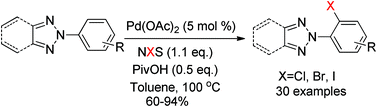
A highly regioselective halogenation of 2-substituted-1,2,3-triazoles was developed via sp2 C–H activation. This method is compatible with halogen atoms, as well as electron-donating and electron-withdrawing groups. Meanwhile, the strategy is also efficient for the synthesis of a key intermediate of Suvorexant.

Graphical abstract: Regioselective halogenation of 2-substituted-1,2,3-triazoles via sp2 C–H activation

PAPER

2.1. Synthesis of (R)-methyl 2-(N-benzyl-3-((tert-butoxycarbonyl)amino)butanamido)acetate (3)

To a solution of methyl 2-(benzylamino)acetate (compound 10, 50.14 g,0.28 mol),(R)-3-((tert-butoxycarbonyl)amino)butanoic acid (50.75 g,0.25 mol),1-hydroxy-1H-benzotriazole (41.88 g, 0.31 mol),and dry triethylamine (37.95 g,0.38 mol) in 320 mL of DMF was added EDC hydrochloride (57.51 g,0.30 mol),and the reaction was stirred for 5 h at room temperature. The reaction was partitioned between EtOAc and 10% aqueous citric acid,the layers were separated and the organic was washed with 5% aqueous Na2CO3,then with brine,dried over MgSO4 and concentrated by rotary evaporation. The residue was recrystallized from a mixture solvent (PE:EtOAc = 2:1) to provide compound 3 as a white solid, 83.01 g in 91% yield. Mp: 107 ℃,[α]D 25 22.0 (c0.52,MeOH). 1H NMR (600 MHz,DMSO-d6): δ 7.38-7.23 (m,5H),6.73-6.72 (d,1H, J = 6 Hz),4.75-4.43 (m,2H),4.31-3.95 (m,2H),3.89-3.87 (t,1H, J = 12 Hz),3.64-3.62 (d,3H,J = 12 Hz),2.64-2.50 (m,1H),2.37- 2.23 (m,1H),1.38-1.37 (d,9H,J = 6 Hz),1.08-1.06 (m,3H); MS (ESI) m/z: 365.20 [M+H]+. HR-MS(ESI): m/z [M+H] calcd. for C19H28N2O5: 365.2071; found: 365.2066.

2.2. Synthesis of (R)-4-benzyl-7-methyl-1,4-diazepane-2,5-dione (4)

A solution of compound 3 (15.93 g,43.74 mmol) in 10 mL EtOAc was added 150 mL 45% HCl/EtOAc and the reaction was stirred for 4 h. The solvents were removed by rotary evaporation,and the residue was basified with saturated aqueous NaHCO3,and extracted with CH2Cl2. The organic extracts were concentrated. The residue was dissolved in 150 mL of dehydrated MeOH, treated with CH3ONa (2.84 g,52.49 mmol),and stirred at room temperature overnight (N2 protected,slightly exothermic). The reaction was cooled to room temperature and quenched with aqueous NH4Cl. Most of the solvent was removed and the reaction was then dumped into a separatory funnel containing 5% aqueous Na2CO3 and extracted with CH2Cl2 three times. The organic layers were combined,dried over MgSO4,and concentrated to provide compound 4 as a white solid 9.50 g in 94% yield. Analytical HPLC analysis carried out on Chiralpak AD column (4.6 mm × 250 mm) with 60% EtOH in hexanes (containing 0.1% diethylamine as a modifier),flow rate of 1 mL/min,indicated that intermediate (R)-4 was of >99% ee. Mp: 122-123 ℃. [α]D2533.5 (c 0.56,MeOH). 1H NMR (600 MHz,DMSO-d6): δ 7.77-7.76 (bd,1H,J = 6 Hz),7.33-7.25 (m,5H),4.59-4.53 (m,2H),4.10- 4.02 (m,2H),3.65-3.62 (m,1H),2.93-2.90 (m,1H),2.76-2.72 (m,1H), 1.14-1.13 (d,3H,J = 6 Hz); 13C NMR (150 MHz,DMSO-d6): δ 171.1, 168.4,138.1,128.9,128.0,127.7,53.1,50.6,46.5,40.5,23.3. MS (ESI) m/z: 233.10 [M+H]+. HR-MS(ESI): m/z [M+H] calcd. for C13H16N2O2: 233.1285; found: 233.1289.

2.3. Synthesis of (R)-1-benzyl-5-methyl-1,4-diazepane (6)

A solution of compound 4 (1.40 g,6.0 mmol) in 60 mL THF at 0 ℃ was treated with LiAlH4 (1.36 g,36.0 mmol) in batches. The reaction was slowly warmed to room temperature and stirred for another 4 h. The reaction was then cooled to -10 ℃ and was carefully quenched with 1.5 mL water,then NaOH (1.5 mL,15%) followed by an additional 4.5 mL of water. A portion of MgSO4was added and the mixture was stirred for 1 h before filtered. The filtrate was concentrated to provide light yellow oil 1.10 g in 88% yield. [α]D25 -5.9 (c 1.00,CHCl3),ee >99%,Analytical analysis was performed on Chrom Tech chiral-AGP column (150 mm × 4 mm) with 99% 1 mol/L ammonium dihydrogen phosphate and 1% acetonitrile,at flow rate of 0.5 mL/min with column temperature of 40 ℃. 1H NMR (600 MHz,DMSO-d6): δ 7.32-7.20 (m,5H),3.57 (s, 2H),3.48 (bs,1H),2.99-2.95 (m,1H),2.86-2.82 (m,1H),2.72-2.68 (m,1H),2.65-2.61 (m,1H),2.58-2.49 (m,3H),1.75-1.70 (m,1H), 1.46-1.41 (m,1H),1.01-1.00 (d,3H,J = 6 Hz); 13C NMR (150 MHz, DMSO-d6): δ 140.1,128.9,128.5,127.1,62.5,58.8,52.7,52.6,47.0, 37.5,23.9. MS (ESI) m/z: 205.10 [M+H]+. HR-MS(ESI): m/z [M+H] calcd. for C13H20N2: 205.1699; found: 205.1692.

2.4. Synthesis of (R)-(4-benzyl-7-methyl-1,4-diazepan-1-yl)(5-methyl-2-(2H-1,2,3-triazol-2-yl)phenyl)methanone (7)

To a solution of compound 6 (2.40 g,11.76 mmol),compound 5 (2.86 g,14.11 mmol),1-hydroxy-1H-benzotriazole (1.90 g, 14.11 mmol),and dry triethylamine (3.56 g,35.28 mmol) in 18 mL of dry DMF was added EDC hydrochloride (2.70 g, 14.11 mmol),and the reaction was stirred 2 h at room temperature. The reaction was partitioned between EtOAc and saturated aqueous NaHCO3,the layers were separated and the organic was added to aqueous citric acid stirring for 1 h. Water was added and the mixture was partitioned. Combined the water layers and added saturated aqueous Na2CO3 to regulate pH > 9,then extracted with three portions of EtOAc. The organic layers were combined,dried over MgSO4 and concentrated by rotary evaporation to provide compound 7 as a white power 4.30 g in 93% yield. Mp: 108-109 ℃, [α]D25-58.4 (c 1.01,MeOH). 1HNMR(600 MHz,DMSO-d6): δ 8.00- 7.76 (m,3H),7.37-7.17 (m,7H),4.40-4.09 (m,1H),3.63-3.48 (m, 2H),3.44-3.02 (m,3H),2.82-2.75 (m,1H),2.63-2.47 (m,1H), 2.63-2.14 (m,5H),2.02- 1.63 (m,2H),1.17-0.99 (m,3H); MS (ESI) m/z: 390.30 [M+H]+. HR-MS(ESI): m/z [M+H] calcd. for C23H27N5O: 390.2288; found: 390.2281.

2.5. Synthesis of (R)-(7-methyl-1,4-diazepan-1-yl)(5-methyl-2-(2H-1,2,3-triazol-2-yl)phenyl)methanone (9)

Compound 7 (5.86 g,15.05 mmol) was dissolved in 58 mL MeOH. After a portion of 10% Pd/C was added,the reaction was stirred for 4 h under H2 atmosphere at room temperature. The reaction was filtered through a pad of celite and the filtrate was concentrated to provide compound 9 as a white solid 4.01 g in 89% yield. Mp: 119-121 ℃,[a]D 26 -14.4 (c 1.00,MeOH)). 1H NMR (600 MHz,DMSO-d6): δ 8.24-8.02 (m,2H),7.88-7.29 (m,3H), 4.42-2.50 (m,7H),2.41 (s,3H),2.24-1.98 (m,2H),1.17-0.99 (m, 3H); 13C NMR (150 MHz,DMSO-d6): δ 168.6,138.3,136.9,134.1, 131.1,129.2,128.3,122.5,52.6,49.1,44.4,43.1,37.8,20.8,20.6. MS (ESI)m/z: 300.20 [M+H]+. HR-MS(ESI): m/z [M+H] calcd. for C16H21N5O: 300.1819; found: 300.1812.

2.6. Synthesis of suvorexant

To compound 8 (0.56 g,3 mmol) in 10 mL dry DMF was added TEA (0.91 g,9 mmol) and compound 9 (0.89 g,3 mmol),the mixture was stirred at 75 ℃ for 2 h. After cooling to room temperature,the reaction was diluted with EtOAc,washed with saturated aqueous NaHCO3,water,brine and dried over MgSO4. The residue was recrystallized from i-PrOH/EtOAc to provide a white solid 1.20 g in 90% yield. Mp: 149-150 ℃,[α]D25 -11.6 (c 1.00,MeOH). Analytical HPLC analysis carried out on a Chiralpak AD column (4.6 mm × 250 mm) with 60% EtOH in hexanes (containing 0.1% diethylamine as a modifier) at a flow rate of 1 mL/min,indicated that intermediate (R)-4 was of >99% ee. Mp: 153 ℃,[α]D25 -11.7 (c 1.00,MeOH) [    OPRD REF ],

1H NMR (600 MHz, DMSO-d6): δ 8.05-7.88 (m,2H),7.82-7.78 (m,1H),7.42-7.25 (m, 2H),7.06-7.00 (m,1H),4.29-4.06 (m,1H),4.01-3.72 (m,2H), 3.66-3.49 (m,2H),2.10 (s,3H),2.06-2.01 (m,1H),1.50 (m,1H), 1.78-1.50 (m,1H),1.14-1.13 (d,3H,J = 6 Hz);

13C NMR (150 MHz, DMSO-d6): δ 168.5,163.4,147.8,145.2,138.4,136.6,136.5,134.1, 130.8,129.8,128.6,122.8,120.1,115.6,110.2,52.3,48.3,45.1,43.7, 35.6,20.9,17.2. MS (ESI) m/z: 451.20 [M+H]+. HR-MS(ESI): m/z [M+H] calcd. for C23H23ClN6O2: 451.1644; found: 451.1639.

References

  1. Baxter, C. A.; Cleator, E.; Brands, K. M. J.; Edwards, J. S.; Reamer, R. A.; Sheen, F. J.; Stewart, G. W.; Strotman, N. A.; Wallace, D. J. (2011). “The First Large-Scale Synthesis of MK-4305: A Dual Orexin Receptor Antagonist for the Treatment of Sleep Disorder”.Organic Process Research & Development 15 (2): 367–375. doi:10.1021/op1002853.
  2. “Suvorexant: A Dual Orexin Receptor Antagonist for the Treatment of Sleep Onset and Sleep Maintenance Insomnia.”. Ann Pharmacother 49: 477–483. Feb 9, 2015.doi:10.1177/1060028015570467. PMID 25667197.
  3. http://www.fda.gov/NewsEvents/Newsroom/PressAnnouncements/ucm409950.htm
  4. https://www.federalregister.gov/articles/2014/02/13/2014-03124/schedules-of-controlled-substances-placement-of-suvorexant-into-schedule-iv
  5. “New hypnotic drug without addiction to be released in Japan first”.
  6. “Merck’s Insomnia Medicine Belsomra C-IV Now Available in US”.http://www.sleepreviewmag.com. Sleep Review. Retrieved 9 September 2015.
  7. “Highlights of prescribing information” (PDF).
  8. Label: BELSOMRA- Suvorexant Tablet, Film Coated”Label: BELSOMRA- Suvorexant Tablet, Film Coated.” DailyMed. Merck Sharp & Dohme Corp. & the U.S. National Library of Medicine, 01 Aug. 2014. Web. 29 Oct. 2014.
  9. Product Information: BELSOMRA(R) oral tablets, suvorexant oral tablets. Merck Sharp & Dohme Corp. (per manufacturer), Whitehouse Station, NJ, 2014.
  10. Jacobson, LH; Callander, GE; Hoyer, D (Nov 2014). “Suvorexant for the treatment of insomnia.”. Expert review of clinical pharmacology 7 (6): 711–30.doi:10.1586/17512433.2014.966813. PMID 25318834.
  11. “Belsomra”. drugs.com. Retrieved 20 February 2015.
  12. “U.S. Food and Drug Administration.” Drug Development and Drug Interactions: Table of Substrates, Inhibitors and Inducers. U.S. Food and Drug Administration, 27 Oct. 2014. Web. 30 Oct. 2014.
  13. “Suvorexant Advisory Committee Meeting Briefing Document” (PDF). May 22, 2013. Retrieved Feb 7, 2015.
  14. “Schedules of controlled substances: placement of suvorexant into Schedule IV. Final rule” (PDF). Fed Regist 79 (167): 51243–7. 2014. PMID 25167596.
8-12-2011
SUBSTITUTED DIAZEPAN OREXIN RECEPTOR ANTAGONISTS
5-32-2011
Substituted diazepan orexin receptor antagonists
WO2007126935A2 * Mar 27, 2007 Nov 8, 2007 Merck & Co Inc Diazepan orexin receptor antagonists
WO2012148553A1 * Feb 27, 2012 Nov 1, 2012 Merck Sharp & Dohme Corp. Process for the preparation of an orexin receptor antagonist
Reference
1 * BAXTER ET AL.: ‘The First Large-Scale Synthesis of MK-4305: A Dual Orexin Receptor Antagonist for the Treatment of Sleep Disorder‘ ORG. PROCESS RES. DEV. vol. 15, 04 March 2011, pages 367 – 375, XP055127210
2 * STROTMAN ET AL.: ‘Reaction Development and Mechanistic Study of a Ruthenium Catalyzed Intramolecular Asymmetric Reductive Amination en Route to the Dual Orexin Inhibitor Suvorexant (MK-4305)‘ J. AM. CHEM. SOC. vol. 133, 02 May 2011, pages 8362 – 8371, XP055127239
Cai, et al., Expert Opn.Ther. Patents, (2006) 16(5), 631-646.
2 Coleman et al., “Discovery of a Novel Orexin Receptor Antagonist for the Treatment of Sleep Disorders“, Presentation at 21st Int’l Symposium on Medicinal Chemistry, Brussels, Belgium Sep. 5-9, 2010.
3 Coleman et al., “Discovery of MK-4305: A Novel Orexin Receptor Antagonist for the Treatment of Insomnia“, Presentation at American Chemical Society 239th National Meeting and Exposition, San Francisco, CA Mar. 12-25, 2010.
4 Coleman et al., Bioorg. Med. Chem. Lett., (2010) 20, 2311-2315.
5 Coleman et al., Expert Opn. Ther. Patents, (2010) 20(3), 307-324.
6 Cox et al., “Discovery of potent, CNS-penetrant dual orexin receptor antagonists containing a 1,4-diazepan central constraint that promotes sleep in rats“, Presentation at the 228th National ACS Meeting, Washington, DC Aug. 20, 2009.
7 Cox, et al., J. Med. Chem., (2010) 53, 5320-5332.
8 EP 07862400, Communication from EPO, Aug. 24, 2009.
9 EP 07862400, Response submitted to EPO, Mar. 1, 2010.
10 Herring, et al., “MK-4305 Dual Orexin Receptor Antagonist (DORA) Phase IIB Study in Primary Insomnia“, Ass’n of Professional Sleep Societies 24th Annual Meeting, San Antonio, Texas Jun. 5-10, 2010.
11 Roecker et al., “Discovery of Potent, Diazepan-containing Dual Orexin Receptor Antagonists for the Treatment of Insomnia“, Presentation at the 28th Camerino-Cyprus-Noordwijkerhout Symposium, Camerino Italy, May 19, 2010.
12 Roecker, et al., Current Topics in Med. Chem., (2008), 8, 977-987.
13 Sun, et al., “Effects of MK-4305, a Dual Orexin Receptor Antagonist, on Sleep Parameters as Measured by PSG in Healthy Male Subjects“, Ass’n of Professional Sleep Societies 24th Annual Meeting, San Antonio, Texas Jun. 5-10, 2010.
14 Whitman, et al., ChemMedChem (2009), 4, 1069-1074.
15 WO 2008/069997, International Preliminary Report on Patentability, Jun. 3, 2009.
Suvorexant
Suvorexant.svg
Suvorexant ball-and-stick model.png
Systematic (IUPAC) name
[(7R)-4-(5-chloro-1,3-benzoxazol-2-yl)-7-methyl-1,4-diazepan-1-yl][5-methyl-2-(2H-1,2,3-triazol-2-yl)phenyl]methanone
Clinical data
Trade names Belsomra
AHFS/Drugs.com entry
MedlinePlus a614046
Pregnancy
category
  • US:C (Risk not ruled out)
Legal status
Routes of
administration
By mouth
Pharmacokinetic data
Bioavailability 82% (at 10 mg)
Protein binding >99%
Metabolism hepatic, CYP3A,CYP2C19
Biological half-life ~12 hours
Excretion Feces (66%), urine (23%)
Identifiers
CAS Registry Number 1030377-33-3 Yes
ATC code None
PubChem CID: 24965990
IUPHAR/BPS 2890
ChemSpider 4589156 Yes
UNII 081L192FO9 Yes
ChEMBL CHEMBL1083659 Yes
Synonyms MK-4305
Chemical data
Formula C23H23ClN6O2
Molecular mass 450.92 g/mol

UPDATED

Suvorexant synthesis There are several ways, the following is a scaled-up process (OPRD, 2011, 15, 367). A compound with sulfur phosgene in ring closure to give 2,2 thiol group with oxalyl chloride to chlorine after conversion to give the intermediate 4 with a primary amine 3 attack, followed by Michael addition occurred with 5 6.6 mesylate de Boc protected After the reductive amination get 7, this is the racemic product. 7 8 after two crystallization with tartaric acid split to give 9 (> 97% ee).Triazole carboxylic acid 10 with 11 to give 12, 12 coupled after conversion to the acid chloride under basic conditions with pH 9 condensation Suvorexant.

/////////

FDA approves first non-invasive DNA screening test for colorectal cancer


Cologuard.jpg

August 11, 2014

The U.S. Food and Drug Administration today approved Cologuard, the first stool-based colorectal screening test that detects the presence of red blood cells and DNA mutations that may indicate the presence of certain kinds of abnormal growths that may be cancers such as colon cancer or precursors to cancer.

Colorectal cancer primarily affects people age 50 and older, and among cancers that affect both men and women, it is the third most common cancer and the second leading cause of cancer-related death in the United States, according to the Centers for Disease Control and Prevention (CDC). Colorectal cancer screening is effective at reducing illness and death related to colon cancer. The CDC estimates that if everyone age 50 or older had regular screening tests as recommended, at least 60 percent of colorectal cancer deaths could be avoided.

Colorectal cancer occurs in the colon (large intestine) or rectum (the passageway that connects the colon to the anus). Most colorectal cancers start as abnormal raised or flat tissue growths on the wall of the large intestine or rectum (polyps). Some very large polyps are called advanced adenomas and are more likely than smaller polyps to progress to cancer.

Using a stool sample, Cologuard detects hemoglobin, a protein molecule that is a component of blood. Cologuard also detects certain mutations associated with colorectal cancer in the DNA of cells shed by advanced adenomas as stool moves through the large intestine and rectum. Patients with positive test results are advised to undergo a diagnostic colonoscopy.

“This approval offers patients and physicians another option to screen for colorectal cancer,” said Alberto Gutierrez, Ph.D., director of the Office of In Vitro Diagnostics and Radiological Health at the FDA’s Center for Devices and Radiological Health. “Fecal blood testing is a well-established screening tool and the clinical data showed that the test detected more cancers than a commonly used fecal occult test.”

Today’s approval of the Cologuard does not change current practice guidelines for colorectal cancer screening. Stool DNA testing (also called “fecal DNA testing”) is not currently recommended as a method to screen for colorectal cancer by the United States Preventive Services Task Force (USPSTF). Among other guidelines, the USPSTF recommends adults age 50 to 75, at average risk for colon cancer, be screened using fecal occult blood testing, sigmoidoscopy, or colonoscopy.

The safety and effectiveness of Cologuard was established in a clinical trial that screened 10,023 subjects. The trial compared the performance of Cologuard to the fecal immunochemical test (FIT), a commonly used non-invasive screening test that detects blood in the stool. Cologuard accurately detected cancers and advanced adenomas more often than the FIT test. Cologuard detected 92 percent of colorectal cancers and 42 percent of advanced adenomas in the study population, while the FIT screening test detected 74 percent of cancers and 24 percent of advanced adenomas. Cologuard was less accurate than FIT at correctly identifying subjects negative for colorectal cancer or advanced adenomas. Cologuard correctly gave a negative screening result for 87 percent of the study subjects, while FIT provided accurate negative screening results for 95 percent of the study population.

Today the Centers for Medicare & Medicaid Services (CMS) issued a proposed national coverage determination for Cologuard. Cologuard is the first product reviewed through a joint FDA-CMS pilot program known as parallel review where the agencies concurrently review medical devices to help reduce the time between the FDA’s approval of a device and Medicare coverage. This voluntary pilot program is open to certain premarket approval applications for devices with new technologies and to medical devices that fall within the scope of a Part A or Part B Medicare benefit category and have not been subject to a national coverage determination.

“Parallel review allows the last part of the FDA process to run at the same time as the CMS process, cutting as many as six months from the time from study initiation to coverage,” said Nancy Stade, CDRH’s deputy director for policy. “The pilot program is ongoing, but we will apply what we have learned to improve the efficiency of the medical device approval pathway for devices that address an important public health need.”

“This is the first time in history that FDA has approved a technology and CMS has proposed national coverage on the same day,” said Patrick Conway, chief medical officer and deputy administrator for innovation and quality for CMS. “This parallel review represents unprecedented collaboration between the two agencies and industry and most importantly will provide timely access for Medicare beneficiaries to an innovative screening test to help in the early detection of colorectal cancer.”

CMS proposes to cover the Cologuard test once every three years for Medicare beneficiaries who meet all of the following criteria:

  • age 50 to 85 years,
  • asymptomatic (no signs or symptoms of colorectal disease including but not limited to lower gastrointestinal pain, blood in stool, positive guaiac fecal occult blood test or fecal immunochemical test), and
  • average risk of developing colorectal cancer (no personal history of adenomatous polyps, of colorectal cancer, or inflammatory bowel disease, including Crohn’s Disease and ulcerative colitis; no family history of colorectal cancers or an adenomatous polyp, familial adenomatous polyposis, or hereditary nonpolyposis colorectal cancer).

Cologuard is manufactured by Exact Sciences in Madison, Wisconsin.

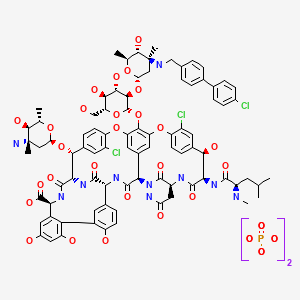
FDA approves Orbactiv to treat skin infections ….Third new antibacterial drug approved for this use this year


File:Oritavancin.svg

ORITAVANCIN


August 6, 2014

The U.S. Food and Drug Administration today approved Orbactiv (oritavancin), a new antibacterial drug to treat adults with skin infections.

Orbactiv is approved to treat patients with acute bacterial skin and skin structure infections (ABSSSI) caused by certain susceptible bacteria, includingStaphylococcus aureus (including methicillin-susceptible and methicillin-resistant strains), various Streptococcus species and Enterococcus faecalis. Orbactiv is administered intravenously.

Orbactiv is the third new antibacterial drug approved by the FDA this year to treat ABSSSI. The agency approved Dalvance (dalbavancin) in May 2014 and Sivextro (tedizolid) in June 2014.

“The approval of several new antibacterial drugs this year demonstrates that we are making progress in increasing the availability of treatment options for patients and physicians,” said Edward Cox, M.D., M.P.H, director of the Office of Antimicrobial Products in the FDA’s Center for Drug Evaluation and Research. “However, more work is needed in this area, and the FDA remains a committed partner to help promote the development of antibacterial drugs.”

Orbactiv is also the third new drug designated as a Qualified Infectious Disease Product (QIDP) to receive FDA approval. Under the Generating Antibiotic Incentives Now (GAIN) title of the FDA Safety and Innovation Act, Orbactiv was granted QIDP designation because it is an antibacterial or antifungal human drug intended to treat a serious or life-threatening infection.

As part of its QIDP designation, Orbactiv was given priority review, which provides an expedited review of the drug’s application. Orbactiv’s QIDP designation also qualifies it for an additional five years of marketing exclusivity to be added to certain exclusivity periods already provided by the Food, Drug, and Cosmetic Act.

Orbactiv’s safety and efficacy were evaluated in two clinical trials with a total of 1,987 adults with ABSSSI. Participants were randomly assigned to receive Orbactiv or vancomycin. Results showed Orbactiv was as effective as vancomycin for the treatment of ABSSSI.

The most common side effects identified in the clinical trials were headache, nausea, vomiting, the formation of skin and soft tissue abscesses on arms and legs and diarrhea. Orbactiv’s label also includes a warning regarding interference with coagulation tests and interaction with warfarin, a drug used to prevent blood clots.

Orbactiv is marketed by The Medicines Company, based in Parsippany, N.J.

The FDA, an agency within the U.S. Department of Health and Human Services, protects the public health by assuring the safety, effectiveness, and security of human and veterinary drugs, vaccines and other biological products for human use, and medical devices. The agency also is responsible for the safety and security of our nation’s food supply, cosmetics, dietary supplements, products that give off electronic radiation, and for regulating tobacco products.

Read more at: http://www.pharmatimes.com/Article/14-08-07/FDA_clears_third_antibacterial_for_skin_infections_this_year.aspx#ixzz39hKIT6nP

OLD ARTICLE CUT PASTE

https://newdrugapprovals.org/2014/02/21/fda-accepts-filing-of-nda-for-iv-antibiotic-oritavancin-with-priority-review/

File:Oritavancin.svg

Oritavancin
(4R)-22-O-(3-Amino-2,3,6-trideoxy-3-C-methyl-alpha-L-arabinohexopyranosyl)-N3-(p-(p-chlorophenyl)benzyl)vancomycin

(3S, 6R, 7R, 22R, 23S, 26S, 36R, 38aR) -22 – (3-Amino-2 ,3,6-trideoxy-3-C-methyl-alpha-L-mannopyranosyloxy) -3 – (carbamoylmethyl ) -10,19-dichloro-44-[2-O-[3 – (4′-chlorobiphenyl-4-ylmethylamino) -2,3,6-trideoxy-3-C-methyl-alpha-L-mannopyranosyl] – beta-D-glucopyranosyloxy] –

CAS No. 171099-57-3
CBNumber: CB92451283
Molecular Formula: C86H97Cl3N10O26
Formula Weight: 1793.12

Also known as NDISACC-(4-(4-chlorophenyl)benzyl)A82846B and LY333328,N-(4-(4-chlorophenyl)benzyl)A82846B

Abbott (Supplier), Lilly (Originator), InterMune (Licensee)

The medicines company—

  1. the Oritavancin Program Results.pdf

    phx.corporate-ir.net/External.File?item…t=1

    Jul 2, 2013 – Inhibits two key steps of cell wall synthesis: – Transglycosylation. – Transpeptidation. • Disrupts bacterial membrane integrity. Differentiated from  


FDA Accepts Filing of NDA for IV Antibiotic Oritavancin with Priority Review

PARSIPPANY, NJ — (Marketwired) — 02/19/14 — The Medicines Company (NASDAQ: MDCO) today announced that the U.S. Food and Drug Administration (FDA) has accepted the filing of a new drug application (NDA) for oritavancin, an investigational intravenous antibiotic, with priority review. The Medicines Company is seeking approval of oritavancin for the treatment of acute bacterial skin and skin structure infections (ABSSSI) caused by susceptible gram-positive bacteria, including methicillin-resistant Staphylococcus aureus (MRSA), administered as a single dose.

In December 2013, the FDA designated oritavancin as a Qualified Infectious Disease Product (QIDP). The QIDP designation provides oritavancin priority review, and an additional five years of exclusivity upon approval of the product for the treatment of ABSSSI. Priority review means the FDA’s goal is to take action on the application within six months, compared to 10 months under standard review. The FDA action date (PDUFA date) for oritavancin is August 6, 2014.
Oritavancin (INN, also known as LY333328) is a novel semi-synthetic glycopeptide antibiotic being developed for the treatment of serious Gram-positive infections. Originally discovered and developed by Eli Lilly, oritavancin was acquired by InterMune in 2001 and then by Targanta Therapeuticsin late 2005.[1]

In Dec 2008 the FDA declined to approve it, and an EU application was withdrawn.

In 2009 the development rights were acquired by The Medicine Co. who are running clinical trials for a possible new FDA application in 2013.[2]

Its structure is similar to vancomycin[3] It is a lipoglycopeptide

About Oritavancin

Oritavancin is an investigational intravenous antibiotic for which The Medicines Company is seeking approval in the treatment of ABSSSI caused by susceptible gram-positive bacteria, including MRSA. In clinical trials, the most frequently reported adverse events associated with oritavancin were nausea, headache, vomiting and diarrhea. Hypersensitivity reactions have been reported with the use of antibacterial agents including oritavancin.


Oritavancin shares certain properties with other members of the glycopeptide class of antibiotics, which includes vancomycin, the current standard of care for serious Gram-positive infections in the United States and Europe.[4] Data presented at the 47th Annual Interscience Conference on Antimicrobial Agents and Chemotherapy (ICAAC) in September 2007 demonstrated that oritavancin possesses potent and rapid bactericidal activity in vitro against a broad spectrum of both resistant and susceptible Gram positive bacteria, including Staphylococcus aureusmethicillin-resistant Staphylococcus aureusEnterococci, and Streptococci.[5] Two posters presented at the meeting also demonstrated that oritavancin was more active than either metronidazole or vancomycin against strains of Clostridium difficile tested.[6]

Anthrax : Research presented at the American Society for Microbiology (ASM) 107th Annual General Meeting in May 2007, suggested oritavancin’s potential utility as a therapy for exposure to Bacillus anthracis, the gram-positive bacterium that causes anthrax, having demonstrated efficacy in a mouse model both pre- and post-exposure to the bacterium[7]

oritavancin

The 4′-chlorobiphenylmethyl group disrupts the cell membrane of gram positive bacteria.[8] It also acts by inhibition of transglycosylation and inhibition of transpeptidation.[9]

Results have been presented (in 2003) but possibly not yet published from two pivotal Phase 3 clinical trials testing the efficacy of daily intravenous oritavancin for the treatment of complicated skin and skin-structure infections (cSSSI) caused by Gram-positive bacteria. The primary endpoints of both studies were successfully met, with oritavancin achieving efficacy with fewer days of therapy than the comparator agents (vancomycin followed by cephalexin). In addition, oritavancin showed a significantly improved safety profile with a 19.2 percent relative reduction in the overall incidence of adverse events versus vancomycin/cephalexin (p<0.001) in the second and larger pivotal trial.[10]

A Phase 2 clinical study was planned to run until May 2008 entitled “Single or Infrequent Doses for the Treatment of Complicated Skin and Skin Structure Infections (SIMPLIFI),” evaluating the efficacy and safety of either a single dose of oritavancin or an infrequent dose of oritavancin compared to the previously studied dosing regimen of 200 mg oritavancin given once daily for 3 to 7 days.[11] Results published May 2011.[12]

Regulatory submissions

USA

On February 11, 2008, Targanta submitted a New Drug Application (NDA) to the US FDA seeking approval of oritavancin;[13] in April 2008, the FDA accepted the NDA submission for standard review.[14] On 9 Dec 2008 the FDA said insufficient data for approval of oritavancin had been provided and they requested a further phase 3 clinical study to include more patients with MRSA.[15]

Europe

June 2008, Targanta’s Marketing Authorization Application (MAA) for oritavancin was submitted and accepted for review by the European Medicines Agency (EMEA),[16] but the company later withdrew the application in Aug 2009.[17]

About The Medicines Company

The Medicines Company’s purpose is to save lives, alleviate suffering, and contribute to the economics of healthcare by focusing on 3,000 leading acute/intensive care hospitals worldwide. Its vision is to be a leading provider of solutions in three areas: acute cardiovascular care, surgery and perioperative care, and serious infectious disease care. The company operates in the Americas, Europe and the Middle East, and Asia Pacific regions with global centers today in Parsippany, NJ, USA and Zurich, Switzerland.

“We look forward to working with the FDA during the review process, and sharing the knowledge we have gained in our studies of oritavancin,” said Matthew Wikler, MD, Vice President and Medical Director, Infectious Disease Care for The Medicines Company. “We believe that upon approval, oritavancin, administered as a single dose for the treatment of ABSSSI, will offer new options for both physicians and their patients for the treatment of these infections.”

The oritavancin NDA is based on data from two Phase 3 clinical trials, SOLO I and SOLO II, which were conducted under a Special Protocol Assessment (SPA) agreement with the FDA. These Phase 3 trials evaluated the efficacy and safety of a single 1200mg dose of oritavancin compared to 7 to 10 days of twice-daily vancomycin in adults with ABSSSI, including infections caused by MRSA. The combined SOLO studies were conducted in 1,959 patients (modified intent-to -treat population, or mITT), with 405 of the patients suffering from an ABSSSI with a documented MRSA infection.

Figure US20130172237A1-20130704-C00001oritavancin

Drug substance

Oritavancin diphosphate

CLINICAL TRIALS..http://clinicaltrials.gov/search/intervention=oritavancinLinks

  • LY 333328 diphosphate
  • LY333328 diphosphate
  • Oritavancin diphosphate
  • UNII-VL1P93MKZN
  • 192564-14-0 CAS NO

INTRODUCTION

Oritavancin

Oritavancin inhibits cell wall synthesis by complexing with the terminal D-Ala-D-Ala of a nascent peptidoglycan chain and also to the pentaglycine bridge, thus inhibiting transglyco- sylation and transpeptidation. Unlike other glycopeptides, oritavancin is able to bind to depsipeptides including D-Ala-D-Lac, which fa- cilitates its inhibition of cell wall synthesis even in organisms exhibiting VanA-type resistance. Oritavancin forms homodimers prior to binding to D-Ala-D-Ala or D-Ala-D-Lac, which increases its binding affinity for the target site.The p-chloro-phenylbenzyl side chain of oritavancin interacts with the cell membrane, exerting two beneficial effects. This binding acts to main- tain the antibacterial in a prime position for peptidoglycan interactions and it also imparts oritavancin with the ability to disrupt the bac- terial membrane potential and thus increase membrane permeability.[22,23] Oritavancin has been shown to dissipate membrane potential in both stationary and exponential phase growing bacteria, which is rare and may carry clinical implications in terms of its activity against slowly growing organisms and biofilms. The dual mechanism of action could also theoretically increase effectiveness and reduce the risk of resist- ance selection. In addition to the aforemen- tioned mechanisms, it has also been hypothesized that oritavancin inhibits RNA synthesis.

vancomycin, desmethylvancomycin, eremomycin, teicoplanin (complex of five compounds), dalbavancin, oritavancin, telavancin, and A82846B (LY264826) having structures A, B, C, D, E, F, G and H:

Figure imgf000002_0001

R = B-2-Acetylamido-glucopyraπosyl- Attorney Docket No 33746-704 602

Figure imgf000003_0001
Figure imgf000003_0002

Dalbavancin, oritavancin and telavancin are semisynthetic lipoglycopeptides that demonstrate promise for the treatment of patients with infections caused by multi-drug-resistant Gram-positive pathogens. Each of these agents contains a heptapeptide core, common to all glycopeptides, which enables them to inhibit transglycosylation and transpeptidation (cell wall synthesis). Modifications to the heptapeptide core result in different in vitro activities for the three semisynthetic lipoglycopeptides. All three lipoglycopeptides contain lipophilic side chains, which prolong their half-life, help to anchor the agents to the cell membrane and increase their activity against Gram-positive cocci. In addition to inhibiting cell wall synthesis, telavancin and oritavancin are also able to disrupt bacterial membrane integrity and increase membrane permeability; oritavancin also inhibits RNA synthesis. Enterococci exhibiting the VanA phenotype (resistance to both vancomycin and teicoplanin) are resistant to both dalbavancin and telavancin, whileoritavancin retains activity. Dalbavancin, oritavancin and telavancin exhibit activity against VanB vancomycin-resistant enterococci.

All three lipoglycopeptides demonstrate potent in vitro activity against Staphylococcus aureus and Staphylococcus epidermidis regardless of their susceptibility to meticillin, as well as Streptococcus spp. Both dalbavancin and telavancin are active against vancomycin-intermediate S. aureus (VISA), but display poor activity versus vancomycin-resistant S. aureus (VRSA). Oritavancin is active against both VISA and VRSA. Telavancin displays greater activity against Clostridium spp. than dalbavancin, oritavancin or vancomycin. The half-life of dalbavancin ranges from 147 to 258 hours, which allows for once-weekly dosing, the half-life of oritavancin of 393 hours may allow for one dose per treatment course, while telavancin requires daily administration. Dalbavancin and telavancin exhibit concentration-dependent activity and AUC/MIC (area under the concentration-time curve to minimum inhibitory concentration ratio) is the pharmacodynamic parameter that best describes their activities.Links

Oritavancin’s activity is also considered concentration-dependent in vitro, while in vivo its activity has been described by both concentration and time-dependent models; however, AUC/MIC is the pharmacodynamic parameter that best describes its activity. Clinical trials involving patients with complicated skin and skin structure infections (cSSSIs) have demonstrated that all three agents are as efficacious as comparators. The most common adverse effects reported with dalbavancin use included nausea, diarrhoea and constipation, while injection site reactions, fever and diarrhoea were commonly observed withoritavancin therapy. Patients administered telavancin frequently reported nausea, taste disturbance and insomnia. To date, no drug-drug interactions have been identified for dalbavancin, oritavancin or telavancin. All three of these agents are promising alternatives for the treatment of cSSSIs in cases where more economical options such as vancomycin have been ineffective, in cases of reduced vancomycin susceptibility or resistance, or where vancomycin use has been associated with adverse events.

Oritavancin diphosphate (oritavancin) is a semi-synthetic lipoglycopeptide derivative of a naturally occurring glycopeptide. Its structure confers potent antibacterial activity against gram-positive bacteria, including vancomycin-resistant enterococci (VRE), methicillin- and vancomycin-resistant staphylococci, and penicillin-resistant streptococci. The rapidity of its bactericidal activity against exponentially-growing S. aureus (≧3-log reduction within 15 minutes to 2 hours against MSSA, MRSA, and VRSA) is one of the features that distinguishes it from the prototypic glycopeptide vancomycin (McKay et al., J Antimicrob Chemother. 63(6):1191-9 (2009), Epub 2009 Apr. 15).

Oritavancin inhibits the synthesis of peptidoglycan, the major structural component of the bacterial cell wall by a mechanism that is shared with glycopeptides, such as vancomycin (Allen et al., Antimicrob Agents Chemother 41(1):66-71 (1997); Cegelski et al., J Mol Biol 357:1253-1262 (2006); Arhin et al., Poster C1-1471: Mechanisms of action of oritavancin in Staphylococcus aureus [poster]. 47th Intersci Conf Antimicro Agents Chemo, Sep. 17-20, 2007; Chicago, Ill.). Oritavancin, like vancomycin, binds to the Acyl-D-Alanyl-D-Alanine terminus of the peptidoglycan precursor, lipid-bound N-acetyl-glucosamine-N-acetyl-muramic acid-pentapeptide (Reynolds, Eur J Clin Microbiol Infect Dis 8(11):943-950 (1989); Nicas and Allen, Resistance and mechanism of action.

In: Nagarajan R, editor. Glycopeptide antibiotics. New York: Marcel Dekker 195-215 (1994); Allen et al., Antimicrob Agents Chemother 40(10):2356-2362 (1996); Allen and Nicas, FEMS Microbiology Reviews 26:511-532 (2003); Kim et al., Biochemistry 45:5235-5250 (2006)). However, oritavancin inhibits cell wall biosynthesis even when the substrate is the altered peptidoglycan precursor that is present in VRE and vancomycin-resistant S. aureus (VRSA). Thus, the spectrum of oritavancin antibacterial activity extends beyond that of vancomycin to include glycopeptide-resistant enterococci and staphylococci (Ward et al., Expert Opin Investig Drugs 15:417-429 (2006); Scheinfeld, J Drugs Dermatol 6:97-103 (2007)). Oritavancin may inhibit resistant bacteria by interacting directly with bacterial proteins in the transglycosylation step of cell wall biosynthesis (Goldman and Gange, Curr Med Chem 7(8):801-820 (2000); Halliday et al., Biochem Pharmacol 71(7):957-967 (2006); Wang et al., Poster C1-1474: Probing the mechanism of inhibition of bacterial peptidoglycan glycotransferases by glycopeptide analogs. 47th Intersci Conf Antimicro Agents Chemo, Sep. 17-20, 2007). Oritavancin also collapses transmembrane potential in gram positive bacteria, leading to rapid killing (McKay et al., Poster C1-682: Oritavancin disrupts transmembrane potential and membrane integrity concomitantly with cell killing in Staphylococcus aureus and vancomycin-resistant Enterococci. 46th Intersci Conf Antimicro Agents Chemo, San Francisco, Calif., Sep. 27-30, 2006). These multiple effects contribute to the rapid bactericidal activity of oritavancin.

Vancomycin (U.S. Patent 3,067,099); A82846A, A82846B, and A82846C (U.S. Patent 5,312,738, European Patent Publication 256,071 A1); PA-42867 factors A, C, and D (U.S. Patent4,946,941 and European Patent Publication 231,111 A2); A83850 (U.S. Patent No. 5,187,082); avoparcm (U.S. Patent 3,338,786 and U.S. Patent 4,322,343); actmoidin, also known as K288 (J. Antibiotics Series A 14:141 (1961); helevecardin (Chem. Abstracts 110:17188 (1989) and Japanese Patent Application 86/157,397); galacardin (Chem. Abstracts 110:17188 (1989) and Japanese Patent Application 89/221,320); and M47767 (European Patent Publication 339,982).

Oritavancin is in clinical development against serious gram-positive infections, where administration of the drug is via intravenous infusion using several dosages administered over a series of days. The development of alternative dosing regimens for the drug could expand treatment options available to physicians. The present invention is directed to novel dosing regimens.

Means for the preparation of the glycopeptide antibiotics, including oritavancin and analogs thereof, may be found, for example, in U.S. Pat. No. 5,840,684,

ORITAVANCIN DIPHOSPHATE

LinksSYNTHESIS

LY-333328 was synthesized by reductocondensation of the glycopeptide antibiotic A82846B (I) with 4′-chlorobiphenyl-4-carboxaldehyde (II) by means of sodium cyanoborohydride in refluxing methanol.

J Antibiot1996, 49, (6) :575-81

(3S,6R,7R,22R,23S,26S,36R,38aR)-3-(Carbamoylmethyl)-10,19-dichloro-7,28,30,32-tetrahydroxy-6-(N-methyl-D-leucylamido)-2,5,24,38,39-pentaoxo-22-(L-vancosaminyloxy)-44-[2-O-(L-vancosaminyl)-beta-D-glucopyranosyloxy]-2,3,4,5,6,7,23,24,25,26,36,37,38,38a-tetradecahydro-1H,22H-8,11:18,21-dietheno-23,36-(iminomethano)-13,16:31,36-dimetheno-[1,6,9]oxadiazacyclohexadecino[4,5-m][10,2,16]benzoxadiazacyclotetracosine-26-carboxylic acid; A82846B (I)
4′-chloro[1,1′-biphenyl]-4-carbaldehyde (II)

LY-333328 was synthesized by reductocondensation of the glycopeptide antibiotic A82846B (I) with 4′-chlorobiphenyl-4-carboxaldehyde (II) by means of sodium cyanoborohydride in refluxing methanol.

…………………..Links

WO1996030401A1

EXAMPLE 4

Preparation of Compound 229

A three liter 3-necked flask was fitted with a

condenser, nitrogen inlet and overhead mechanical stirring apparatus. The flask was charged with pulverized A82846B acetate salt (20.0 g, 1.21 × 10⁻³ mol) and methanol (1000 mL) under a nitrogen atmosphere. 4′-chlorobiphenylcarboxaldehyde (2.88 g, 1.33 × 10⁻² mol, 1.1 eq.) was added to this stirred mixture, followed by methanol (500 mL). Finally, sodium cyanoborohydride (0.84 g, 1.33 × 10⁻² mol, 1.1 eq.) was added followed by methanol (500 mL). The resulting mixture was heated to reflux (about 65°C).

After 1 hour at reflux, the reaction mixture attained homogeneity. After 25 hours ac reflux, the heat source was removed and the clear reaction mixture was measured with a pH meter (6.97 at 58.0°C). 1 N NaOH (22.8 mL) was added

dropwise to adjust the pH to 9.0 (at 54.7°C). The flask was equipped with a distillation head and the mixture was concentrated under partial vacuum to a weight of 322.3 grams while maintaining the pot temperature between 40-45°C.

The distillation head was replaced with an addition funnel containing 500 mL of isopropanol (IPA). The IPA was added dropwise to the room temperature solution over 1 hour. After approximately 1/3 of the IPA was added, a granular precipitate formed. The remaining IPA was added at a faster rate after precipitation had commenced. The flask was weighed and found to hold 714.4 grams of the IPA/methanol slurry.

The flask was re-equipped with a still-head and

distilled under partial vacuum to remove the remaining methanol. The resulting slurry (377.8 g) was allowed to chill in the freezer overnight. The crude product was filtered through a polypropylene pad and rinsed twice with 25 mL of cold IPA. After pulling dry on the funnel for 5 minutes, the material was placed in the vacuum oven to dry at 40°C. A light pink solid (22.87 g (theory = 22.43 g) ) was recovered. HPLC analysis versus a standard indicated 68.0% weight percent of Compound 229 (4- [4-chlorophenyl] benzyl-A82846B] in the crude solid, which translated into a

corrected crude yield of 69.3%.

The products of the reaction were analyzed by reverse-phase HPLC utilizing a Zorbax SB-C18 column with ultraviolet light (UV; 230 nm) detection. A 20 minute gradient solvent system consisting of 95% aqueous buffer/5% CH3CN at time=0 minutes to 40% aqueous buffer/60% CH3CN at time=20 minutes was used, where the aqueous buffer was TEAP (5 ml CH3CN, 3 ml phosphoric acid in 1000 ml water).

………………….

WO2008097364A2

Oritavancin (also termed N-(4-(4-chlorophenyl)benzyl)A82846B and LY333328) has the following Formula III:

Figure imgf000029_0001

ReferencesLinks

  1.  Targanta Revives Oritavancin: Next Weapon Against cSSSI? BioWorld Today, November 26, 2007
  2.  “Biotechs pick up slack in antibiotics development”. 17 May 2011.
  3.  http://www.farm.ucl.ac.be/Full-texts-FARM/Domenech-2009-1.pdf “Interactions of oritavancin, a new lipoglycopeptide derived from vancomycin, with phospholipid bilayers: Effect on membrane permeability and nanoscale lipid membrane organization” 2009
  4.  Scheinfeld, N (2007). “A comparison of available and investigational antibiotics for complicated skin infections and treatment-resistant Staphylococcus aureus and enterococcus“.J Drugs Dermatol. 6 (4): 97–103. PMID 17373167.
  5.  2007 ICAAC Posters: E-1612 “In Vitro Activity Profile of Oritavancin against a Broad Spectrum of Aerobic and Anaerobic Bacterial Pathogens”/E -1613 “In Vitro Activity Profile of Oritavancin (ORI) Against Organisms Demonstrating Key Resistance Profiles to Other Antimicrobial Agents”/E-1614 “In vitro Time Kill Studies of Oritavancin against Drug-resistant Isolates ofStaphylococcus aureus and Enterococci”/E-1615 “Anti-Enterococcal Activity Profile of Oritavancin, a Potent Lipoglycopeptide under Development for Use Against Gram-Positive Infections”/E-1616 “Anti-Streptococcal Activity Profile of Oritavancin, a Potent Lipoglycopeptide under Development for Use Against Gram-Positive Infections”/E-1617 “In Vitro Activity Profile of Oritavancin (ORI) Against Resistant Staphylococcal Populations From a Recent Surveillance Initiative”/E-1620 “Pharmacokinetic Concentrations of Oritavancin Kill Stationary-Phase and Biofilm Staphylococcus aureus In Vitro.” / Targanta Press Release September 19, 2007
  6.  ICAAC 2007 Posters: “In Vitro Susceptibility of Genotypically Distinct Clostridium difficileStrains to Oritavancin” and “Activity of Metronidazole, Vancomycin and Oritavancin Against Epidemic Clostridium difficile Spores” / Targanta Press Release September 19, 2007
  7.  ASM 2007 Poster: “Efficacy of Oritavancin in a Murine Model of Bacillus anthracis Spore Inhalation Anthrax” / Targanta Press Release May 24, 2007
  8.  Belley; McKay, GA; Arhin, FF; Sarmiento, I; Beaulieu, S; Fadhil, I; Parr Jr, TR; Moeck, G (2010).“Oritavancin Disrupts Membrane Integrity of Staphylococcus aureus and Vancomycin-Resistant Enterococci To Effect Rapid Bacterial Killing”Antimicrobial agents and chemotherapy 54(12): 5369–71. doi:10.1128/AAC.00760-10PMC 2981232PMID 20876372.
  9.  Zhanel et al. (2012). “Oritavancin: Mechanism of Action”Clin Infect Dis.doi:10.1093/cid/cir920.
  10. ICAAC 2003 Late-breaker poster: “Phase III Trial Comparing 3-7 days of Oritavancin vs. 10-14 days of Vancomycin/Cephalexin in the Treatment of Patients with Complicated Skin and Skin Structure Infections (cSSSI)” / InterMune Press Release September 15, 2003
  11.  ClinicalTrials.gov NCT00514527
  12.  Comparison of the Efficacy and Safety of Oritavancin Front-Loaded Dosing Regimens to Daily Dosing: An Analysis of the SIMPLIFI Trial. May 2011. doi:10.1128/AAC.00029-11.
  13.  “Drugs.com, Targanta Submits Oritavancin New Drug Application”. Retrieved 2008-02-12.
  14.  “FDA News, Targanta to Get FDA Decision by December”. Retrieved 2008-04-10.
  15.  http://www.fiercebiotech.com/press-releases/fda-issues-complete-response-letter-oritavancin Dec 2008.
  16.  “Pharmaceutical Business Review, EMEA accepts Targanta’s oritavancin MAA for review”. Retrieved 2008-06-26.
  17.  http://www.nelm.nhs.uk/en/NeLM-Area/News/2009—August/24/European-application-for-investigational-antibiotic-oritavancin-withdrawn-/
  18. http://onlinelibrary.wiley.com/doi/10.1111/j.1574-6976.2003.tb00628.x/pdf
  19. http://www.pjps.pk/wp-content/uploads/pdfs/26/5/Paper-30.pdf
  20. Antimicrobial Agents and Chemotherapy, 2003 ,  vol. 47,   5  p. 1700 – 1706
  21. Antimicrobial Agents and Chemotherapy, 1999 ,  vol. 43,   1  p. 115 – 120
  22. Antimicrobial Agents and Chemotherapy, 1997 ,  vol. 41,   10  p. 2165 – 2172
  23. Tetrahedron, 2004 ,  vol. 60,   47  p. 10611 – 10618………… NMRhttp://www.sciencedirect.com/science/article/pii/S0040402004015108

LinksCooper, R.D.G.; Snyder, N.J.; Zweifel, M.J.; et al.; Reductive alkylation of glycopeptide antibiotics: Synthesis and antibacterial activity. J Antibiot 1996, 49, 6, 575-81.

 Fromtling, R.A.; Castaer, J.; LY-333328. Drugs Fut 1998, 23, 1, 17.
Cooper, R.D.G.; Huff, B.E.; Nicas, T.I.; Quatroche, J.T.; Rodriguez, M.J.; Snyder, N.J.; Staszak, M.A.; Thompson, R.C.; Wilkie, S.C.; Zweifel, M.J. (Eli Lilly and Company); Glycopeptide antibiotic derivs. EP 0817797; JP 1999502534; WO 9630401 .

Cooper, R.D.G.; Huff, B.E.; Nicas, T.I.; Quatroche, J.T.; Rodriguez, M.J.; Snyder, N.J.; Staszak, M.A.; Thompson, R.C.; Wilkie, S.C.; Zweifel, M.J. (Eli Lilly and Company); Glycopeptide antibiotic derivs. EP 0667353; EP 1016670; EP 1031576 .

EP0435503A1 * Dec 11, 1990 Jul 3, 1991 Eli Lilly And Company Improvements in or relating to gylcopeptide derivatives
US4639433 * Aug 14, 1985 Jan 27, 1987 Eli Lilly And Company Glycopeptide derivatives
US4698327 * Apr 18, 1986 Oct 6, 1987 Eli Lilly And Company Novel glycopeptide derivatives
US20040106590 * Aug 29, 2003 Jun 3, 2004 Barry Eisenstein Methods and reagents for treating infections of clostridium difficile and diseases associated therewith
US20050197333 Dec 22, 2004 Sep 8, 2005 Van Duzer John H. Rifamycin analogs and uses thereof
US20070014849 Sep 20, 2006 Jan 18, 2007 Daniela Jabes Use of ramoplanin to treat diseases associated with the use of antibiotics
US20030176327 * Oct 18, 2002 Sep 18, 2003 Cassell Gail Houston Antibiotics for treating biohazardous bacterial agents
US20040147441 Aug 25, 2003 Jul 29, 2004 Leach Timothy S. Methods and reagents for preventing bacteremias
WO1999010006A1 Aug 18, 1998 Mar 4, 1999 Lilly Co Eli Therapy for staphylococcus aureus
WO2000066144A2 Apr 19, 2000 Nov 9, 2000 Lilly Co Eli Monthly doses of glycopeptide antibiotics for treatment of streptococcus pneumoniae infections
WO2008097364A2 Sep 24, 2007 Aug 14, 2008 Targanta Therapeutics Corp Use of oritavancin for prevention and treatment of anthrax
WO1998052592A1 * May 5, 1998 Nov 26, 1998 Lilly Co Eli Urea and thiourea derivatives of glycopeptides
WO2002036612A1 * Nov 2, 2001 May 10, 2002 Univ Cambridge Tech Antibacterial agents comprising conjugates of glycopeptides and peptidic membrane-associating elements
WO2007138999A1 May 25, 2007 Dec 6, 2007 Shionogi & Co Glycopeptide antibiotic derivative
WO2009081958A1 Dec 25, 2008 Jul 2, 2009 Shionogi & Co Glycosylated glycopeptide antibiotic derivative
EP2314599A1 Nov 24, 2005 Apr 27, 2011 National University Corporation Nagoya University Glycopeptide antibiotic monomer derivatives
US5919756 * May 1, 1997 Jul 6, 1999 Eli Lilly And Company Amides
US5919771 * Apr 30, 1998 Jul 6, 1999 Eli Lilly And Company Urea and thiourea derivatives of glycopeptides
US7078380 Nov 2, 2001 Jul 18, 2006 Cambridge University Technical Services Limited Antibacterial agents comprising conjugates of glycopeptides and peptidic membrane associating elements
US8481696 Dec 25, 2008 Jul 9, 2013 Shionogi & Co., Ltd. Glycosylated glycopeptide antibiotic derivatives

Links

FDA expands approval of drug to treat Pompe disease to patients of all ages; removes risk mitigation strategy requirements


Human glucosidase, prepro-α-[199-arginine,223-histidine] [1]

Alglucosidase alfa

C4435H6739N1175O1279S32

105270.8020

August 1, 2014

The U.S. Food and Drug Administration today announced the approval of Lumizyme (alglucosidase alfa) for treatment of patients with infantile-onset Pompe disease, including patients who are less than 8 years of age. In addition, the Risk Evaluation and Mitigation Strategy (REMS) known as the Lumizyme ACE (Alglucosidase Alfa Control and Education) Program is being eliminated.

Pompe disease is a rare genetic disorder and occurs in an estimated 1 in every 40,000 to 300,000 births. Its primary symptom is heart and skeletal muscle weakness, progressing to respiratory weakness and death from respiratory failure.

The disease causes gene mutations to prevent the body from making enough of the functional form of an enzyme called acid alpha-glucosidase (GAA). This enzyme is necessary for proper muscle functioning. GAA is used by the heart and muscle cells to convert a form of sugar called glycogen into energy. Without the enzyme action, glycogen builds up in the cells and, ultimately, weakens the heart and muscles. Lumizyme is believed to work by replacing the deficient GAA, thereby reducing the accumulated glycogen in heart and skeletal muscle cells.

Lumizyme, a lysosomal glycogen-specific enzyme, was approved by the FDA in 2010 with a REMS to restrict its use to treatment of patients with late (non-infantile) onset Pompe disease who are 8 years of age and older. The REMS was required to mitigate the potential risk of rapid disease progression in the infantile-onset Pompe disease patients and patients with late  onset disease less than 8 years of age, and to communicate the risks of anaphylaxis, severe allergic reactions and severe skin and systemic immune mediated reactions to prescribers and patients.

At the time of Lumizyme’s approval, there were insufficient data to support the safety and efficacy of Lumizyme in the infantile-onset Pompe population, so Lumizyme was approved for use only in late onset Pompe disease patients who are at least 8 years of age. Pompe patients with infantile-onset disease and patients younger than 8 years of age continued treatment with Myozyme, which was already approved. Myozyme and Lumizyme, both manufactured by Genzyme Corporation, are produced from the same cell line at different production scales.

This approval provides access to Lumizyme for all Pompe disease patients, regardless of their age.

The FDA reviewed newly available information and determined that Lumizyme and Myozyme are chemically and biochemically comparable. Consequently, the safety and effectiveness of Lumizyme and Myozyme are expected to be comparable. In addition, a single-center clinical study of 18 infantile-onset Pompe disease patients, aged 0.2 to 5.8 months at the time of first infusion, provides further support that infantile-onset patients treated with Lumizyme will have a similar improvement in ventilator-free survival as those treated with Myozyme.

Because data were submitted supporting approval of Lumizyme for all Pompe patients, a REMS restricting its use to a specific age group is no longer necessary. While the risk of anaphylaxis, severe allergic reactions, and severe cutaneous and immune mediated reactions for Lumizyme still exist, these risks are comparable to Myozyme and are communicated in labeling through the Warnings and Precautions, and a Boxed Warning.

“REMS continue to be vital tools for the agency to employ as we work with companies to address the serious risks associated with drugs and monitor their appropriate and safe use in various health care settings,” said Janet Woodcock, M.D., director of the FDA’s Center for Drug Evaluation and Research. “The agency remains committed to exercising a flexible and responsible regulatory approach that ensures REMS programs are being effectively and efficiently used and not resulting in an unnecessary burden on health care professionals and patients.”

Health care professionals and patients should also be aware:

  • The Warnings and Precautions section of the Lumizyme product label and the Clinical Studies section of the Lumizyme label have been updated to include the safety information of the drug in infantile-onset Pompe disease patients. This includes information from the currently approved Myozyme label and information from a new, uncontrolled study in which patients with infantile onset disease were treated with Lumizyme.
  • Lumizyme is approved with a Boxed Warning because of the risk of anaphylaxis, severe allergic reactions, immune-mediated reactions and cardiorespiratory failure.
  • Health care professionals should continue to refer to the drug prescribing information for the latest recommendations on prescribing Lumizyme and report adverse events to the FDA’s MedWatch program (http://www.fda.gov/Safety/MedWatch/default.htm).
  • Distribution of Lumizyme will no longer be restricted. Health care professionals, healthcare facilities, and patients will no longer be required to enroll in the Lumizyme REMS program (Lumizyme ACE Program) to be able to prescribe, dispense, or receive Lumizyme.

The most commonly reported side effects for Lumizyme were infusion-related reactions and included severe allergic reactions, hives, diarrhea, vomiting, shortness of breath, itchy skin, skin rash, neck pain, partial hearing loss, flushing, pain in extremities, and chest discomfort.

Myozyme and Lumizyme are marketed by Cambridge, Massachusetts-based Genzyme.

The FDA, an agency within the U.S. Department of Health and Human Services, protects the public health by assuring the safety, effectiveness, and security of human and veterinary drugs, vaccines and other biological products for human use, and medical devices. The agency also is responsible for the safety and security of our nation’s food supply, cosmetics, dietary supplements, products that give off electronic radiation, and for regulating tobacco products.


>Alglucosidase alfa
AHPGRPRAVPTQCDVPPNSRFDCAPDKAITQEQCEARGCCYIPAKQGLQGAQMGQPWCFF
PPSYPSYKLENLSSSEMGYTATLTRTTPTFFPKDILTLRLDVMMETENRLHFTIKDPANR
RYEVPLETPHVHSRAPSPLYSVEFSEEPFGVIVRRQLDGRVLLNTTVAPLFFADQFLQLS
TSLPSQYITGLAEHLSPLMLSTSWTRITLWNRDLAPTPGANLYGSHPFYLALEDGGSAHG
VFLLNSNAMDVVLQPSPALSWRSTGGILDVYIFLGPEPKSVVQQYLDVVGYPFMPPYWGL
GFHLCRWGYSSTAITRQVVENMTRAHFPLDVQWNDLDYMDSRRDFTFNKDGFRDFPAMVQ
ELHQGGRRYMMIVDPAISSSGPAGSYRPYDEGLRRGVFITNETGQPLIGKVWPGSTAFPD
FTNPTALAWWEDMVAEFHDQVPFDGMWIDMNEPSNFIRGSEDGCPNNELENPPYVPGVVG
GTLQAATICASSHQFLSTHYNLHNLYGLTEAIASHRALVKARGTRPFVISRSTFAGHGRY
AGHWTGDVWSSWEQLASSVPEILQFNLLGVPLVGADVCGFLGNTSEELCVRWTQLGAFYP
FMRNHNSLLSLPQEPYSFSEPAQQAMRKALTLRYALLPHLYTLFHQAHVAGETVARPLFL
EFPKDSSTWTVDHQLLWGEALLITPVLQAGKAEVTGYFPLGTWYDLQTVPVEALGSLPPP
PAAPREPAIHSEGQWVTLPAPLDTINVHLRAGYIIPLQGPGLTTTESRQQPMALAVALTK
GGEARGELFWDDGESLEVLERGAYTQVIFLARNNTIVNELVRVTSEGAGLQLQKVTVLGV
ATAPQQVLSNGVPVSNFTYSPDTKVLDICVSLLMGEQFLVSWC


Systematic (IUPAC) name
Human glucosidase, prepro-α-[199-arginine,223-histidine] [1]
Clinical data
AHFS/Drugs.com monograph
Legal status FDA approved for children[2]
Routes Intravenous[2]
Identifiers
CAS number 420794-05-0 
ATC code A16AB07
DrugBank DB01272
UNII DTI67O9503 
KEGG D03207 
Chemical data
Formula C4758H7262N1274O1369S35[1] 
Mol. mass 105338 [1]


Alglucosidase alfa (Lumizyme, Myozyme, Genzyme) is an enzyme replacement therapy (ERT) orphan drug for treatment of Pompe disease (Glycogen storage disease type II), a rare lysosomal storage disorder (LSD).[3] Chemically speaking, the drug is ananalog of the enzyme that is deficient in patients affected by Pompe disease, alpha-glucosidase. It is the first drug available to treat this disease.[2]

Status

Orphan drug pharmaceutical company, Genzyme, markets alglucosidase alfa as “Myozyme”. In 2006, the U.S. Food and Drug Administration (FDA) approved Myozyme as a suitable ERT treatment for children.[2] Some health plans have refused to subsidize Myozyme for adult patients because it lacks approval for treatment in adults, as well as its high cost (US$300,000/yr for life).[4]

On August 1, 2014 the U.S. Food and Drug Administration announced the approval of Lumizyme (alglucosidase alfa) for treatment of patients with infantile-onset Pompe disease, including patients who are less than 8 years of age. In addition, the Risk Evaluation and Mitigation Strategy (REMS) known as the Lumizyme ACE (Alglucosidase Alfa Control and Education) Program is being eliminated. [5]

Side effects

Common observed adverse reactions to alglucosidase alfa treatment are pneumonia, respiratory complications, infections and fever. More serious reactions reported includeheart and lung failure and allergic shock. Myozyme boxes carry warnings regarding the possibility of life-threatening allergic response.[2]

References

  1. ^ Jump up to:a b c American Medical Association (USAN). “Alglucosidase alfa” (Microsoft Word). STATEMENT ON A NONPROPRIETARY NAME ADOPTED BY THE USAN COUNCIL. Retrieved 18 December 2007.
  2. ^ Jump up to:a b c d e “FDA Approves First Treatment for Pompe Disease” (Press release). FDA. 2006-04-28. Retrieved 2008-07-07.
  3. Jump up^ Kishnani PS, Corzo D, Nicolino M et al. (2007). “Recombinant human acid [alpha]-glucosidase: major clinical benefits in infantile-onset Pompe disease”. Neurology 68 (2): 99–109.doi:10.1212/01.wnl.0000251268.41188.04. PMID 17151339.
  4. Jump up^ Geeta Anand (2007-09-18). “As Costs Rise, New Medicines Face Pushback”. Wall Street Journal (Dow Jones & Company). Retrieved 2008-07-07.
  5. Jump up^ cite press release |title=FDA expands approval of drug to treat Pompe disease to patients of all ages; removes risk mitigation strategy requirements |publisher=FDA |date=2014-08-14 |url=http://www.fda.gov/NewsEvents/Newsroom/PressAnnouncements/ucm407563.htm

External links


MYOZYME (alglucosidase alfa), a lysosomal glycogen-specific enzyme, consists of the human enzyme acid α-glucosidase (GAA), encoded by the most predominant of nine observed haplotypes of this gene. MYOZYME is produced by recombinant DNA technology in a Chinese hamster ovary cell line. The MYOZYME manufacturing process differs from that for LUMIZYME®, resulting in differences in some product attributes. Alglucosidase alfa degrades glycogen by catalyzing the hydrolysis of α-1,4- and α-1,6- glycosidic linkages of lysosomal glycogen.

Alglucosidase alfa is a glycoprotein with a calculated mass of 99,377 daltons for the polypeptide chain, and a total mass of approximately 110 kilo Daltons, including carbohydrates. Alglucosidase alfa has a specific activity of 3 to 5 U/mg (one unit is defined as that amount of activity that results in the hydrolysis of 1 μmole of synthetic substrate per minute under the specified assay conditions). MYOZYME is intended for intravenous infusion. It is supplied as a sterile, nonpyrogenic, white to off-white, lyophilized cake or powder for reconstitution with 10.3 mL

Sterile Water for Injection, USP. Each 50 mg vial contains 52.5 mg alglucosidase alfa, 210 mg mannitol, 0.5 mg polysorbate 80, 9.9 mg sodium phosphate dibasic heptahydrate, 31.2 mg sodium phosphate monobasic monohydrate. Following reconstitution as directed, each vial contains 10.5 mL reconstituted solution and a total extractable volume of 10 mL at 5.0 mg/mL alglucosidase alfa. MYOZYME does not contain preservatives; each vial is for single use only.

FDA approves Jardiance to treat type 2 diabetes


Empagliflozin.svg

Empagliflozin

For synthesis see https://newdrugapprovals.org/2013/12/19/empagliflozin/

August 1, 2014

The U.S. Food and Drug Administration today approved Jardiance (empagliflozin) tablets as an addition to diet and exercise to improve glycemic control in adults with type 2 diabetes.

Type 2 diabetes affects approximately 26 million people and accounts for more than 90 percent of diabetes cases diagnosed in the United States. Over time, high blood sugar levels can increase the risk for serious complications, including heart disease, blindness, and nerve and kidney damage.

“Jardiance provides an additional treatment option for the care of patients with type 2 diabetes,” said Curtis J. Rosebraugh, M.D., M.P.H., director of the Office of Drug Evaluation II in the FDA’s Center for Drug Evaluation and Research. “It can be used alone or added to existing treatment regimens to control blood sugar levels in the overall management of diabetes.”

Jardiance is a sodium glucose co-transporter 2 (SGLT2) inhibitor. It works by blocking the reabsorption of glucose (blood sugar) by the kidney, increasing glucose excretion, and lowering blood glucose levels in diabetics who have elevated blood glucose levels. The drug’s safety and effectiveness were evaluated in seven clinical trials with 4,480 patients with type 2 diabetes receiving Jardiance. The pivotal trials showed that Jardiance improved hemoglobin A1c levels (a measure of blood sugar control) compared to placebo.

Jardiance has been studied as a stand-alone therapy and in combination with other type 2 diabetes therapies including metformin, sulfonylureas, pioglitazone, and insulin. Jardiance should not be used: to treat people with type 1 diabetes; in those who have increased ketones in their blood or urine (diabetic ketoacidosis); and in those with severe renal impairment, end stage renal disease, or in patients on dialysis.

The FDA is requiring four postmarketing studies for Jardiance:

  • Completion of an ongoing cardiovascular outcomes trial.
  • A pediatric pharmacokinetic/pharmacodynamic study.
  • A pediatric safety and efficacy study. As part of the safety and efficacy study, the effect on bone health and development will be evaluated.
  • A nonclinical (animal) juvenile toxicity study with a particular focus on renal development, bone development, and growth.

Jardiance can cause dehydration, leading to a drop in blood pressure (hypotension) that can result in dizziness and/or fainting and a decline in renal function. The elderly, patients with impaired renal function, and patients on diuretics to treat other conditions appeared to be more susceptible to this risk.

The most common side effects of Jardiance are urinary tract infections and female genital infections.

Jardiance is distributed by Boehringer Ingelheim Pharmaceuticals, Inc., Ridgefield, Connecticut.

The FDA, an agency within the U.S. Department of Health and Human Services, protects the public health by assuring the safety, effectiveness, and security of human and veterinary drugs, vaccines and other biological products for human use, and medical devices. The agency also is responsible for the safety and security of our nation’s food supply, cosmetics, dietary supplements, products that give off electronic radiation, and for regulating tobacco products.


synthesis see https://newdrugapprovals.org/2013/12/19/empagliflozin/

FDA Approves Striverdi Respimat, Olodaterol to Treat Chronic Obstructive Pulmonary Disease


FDA Approves Striverdi Respimat to Treat Chronic Obstructive Pulmonary Disease


July 31, 2014 — Today, the U.S. Food and Drug Administration approved

Striverdi Respimat (olodaterol) inhalation spray to treat patients with chronic

obstructive pulmonary disease (COPD), including chronic bronchitis and/or emphysema

that are experiencing airflow obstruction. Striverdi Respimat can be used once daily

over a long period of time.

read at

http://www.fda.gov/NewsEvents/Newsroom/PressAnnouncements/ucm407465.htm


See my old post cut paste here

BI launches COPD drug Striverdi, olodaterol in UK and Ireland

DB09080.png

Olodaterol

オロダテロール

BI-1744
BI-1744-CL (hydrochloride) marketed as drug

Boehringer Ingelheim Pharma  innovator

synthesis…..http://wendang.baidu.com/view/d4f95541e518964bcf847c22.html

Olodaterol (trade name Striverdi) is a long acting beta-adrenoceptor agonist used as an inhalation for treating patients with chronic obstructive pulmonary disease (COPD), manufactured by Boehringer-Ingelheim.[1]

see……….https://www.thieme-connect.de/DOI/DOI?10.1055/s-0029-1219649           ……… synfacts

Olodaterol is a potent agonist of the human β2-adrenoceptor with a high β12 selectivity. Its crystalline hydrochloride salt is suitable for inhalation and is currently undergoing clinical trials in man for the treatment of asthma. Oloda­terol has a duration of action that exceeds 24 hours in two preclinical animal models of bronchoprotection and it has a better safety margin compared with formoterol.

Olodaterol hydrochloride [USAN]

Bi 1744 cl
Bi-1744-cl
Olodaterol hydrochloride
Olodaterol hydrochloride [usan]
UNII-65R445W3V9

868049-49-4 [RN] FREE FORM

CAS 869477-96-3 HCL SALT

R ENANTIOMER

2H-1,4-Benzoxazin-3(4H)-one, 6-hydroxy-8-((1R)-1-hydroxy-2-((2-(4-methoxyphenyl)- 1,1-dimethylethyl)amino)ethyl)-, hydrochloride (1:1)

2H-1,4-benzoxazin-3(4H)-one, 6-hydroxy-8-((1R)-1-hydroxy-2-((2-(4-methoxyphenyl)- 1,1-dimethylethyl)amino)ethyl)-, hydrochloride (1:1)

6-Hydroxy-8-((1R)-1-hydroxy-2-((2-(4-methoxyphenyl)-1,1-dimethylethyl)amino)ethyl)- 2H-1,4-benzoxazin-3(4H)-one hydrochloride

clinical trialshttp://clinicaltrials.gov/search/intervention=Olodaterol+OR+BI+1744

Boehringer Ingelheim has launched a new chronic obstructive pulmonary disease drug, Striverdi in the UK and Ireland.
Striverdi (olodaterol) is the second molecule to be licenced for delivery via the company’s Respimat Soft Mist inhaler, following the COPD blockbuster Spiriva (tiotropium). The drug was approved in Europe in November based on results from a Phase III programme that included more than 3,000 patients with moderate to very severe disease.http://www.pharmatimes.com/Article/14-07-01/BI_launches_COPD_drug_Striverdi_in_UK_and_Ireland.aspx

Olodaterol hydrochloride is a drug candidate originated by Boehringer Ingelheim. The product, delivered once-daily by the Respimat Soft Mist Inhaler, was first launched in Denmark and the Netherlands in March 2014 for the use as maintenance treatment of chronic obstructive pulmonary disease (COPD), including chronic bronchitis and/or emphysema. In 2013, approval was obtained in Russia and Canada for the same indication, and in the U.S, the product was recommended for approval. Phase III clinical trials for the treatment of COPD are ongoing in Japan.

ChemSpider 2D Image | Olodaterol | C21H26N2O5
Systematic (IUPAC) name
6-hydroxy-8-{(1R)-1-hydroxy-2-{[1-(4-methoxyphenyl)-2-methylpropan-2-yl]amino}ethyl}-4H-1,4-benzoxazin-3-one
Clinical data
Trade names Striverdi
AHFS/Drugs.com UK Drug Information
Pregnancy cat. No experience
Legal status POM (UK)
Routes Inhalation
Identifiers
CAS number 868049-49-4; 869477-96-3 (hydrochloride)
ATC code R03AC19
PubChem CID 11504295
ChemSpider 9679097
UNII VD2YSN1AFD
ChEMBL CHEMBL605846
Synonyms BI 1744 CL
Chemical data
Formula C21H26N2O5 free form
C21 H26 N2 O5 . Cl H; of hcl salt
Mol. mass 386.44 g/mol free form; 422.902 as hyd salt

BI launches COPD drug Striverdi in UK and Ireland

Medical uses

Olodaterol is a once-daily maintenance bronchodilator treatment of airflow obstruction in patients with COPD including chronic bronchitis and/or emphysema, and is administered in an inhaler called Respimat Soft Mist Inhaler.[2][3][4][5][6][7]

As of December 2013, olodaterol is not approved for the treatment of asthma. Olodaterol monotherapy was previously evaluated in four Phase 2 studies in asthma patients. However, currently there are no Phase 3 studies planned for olodaterol monotherapy in patients with asthma.

In late January 2013, Olodaterol CAS# 868049-49-4 was the focus of an FDA committee reviewing data for the drug’s approval as a once-daily maintenance bronchodilator to treat chronic obstructive pulmonary disease (COPD), as well as chronic bronchitis and emphysema. The FDA Pulmonary-Allergy Drugs Advisory Committee recommended that the clinical data from the Boehringer Ingelheim Phase III studies be included in their NDA.

Also known as the trade name Striverdi Respimat, Olodaterol is efficacious as a long-acting beta-agonist, which patients self-administer via an easy to use metered dose inhaler. While early statistics from clinical trials of Olodaterol were encouraging, a new set of data was released earlier this week, which only further solidified the effectual and tolerable benefits of this COPD drug.

On September 10, 2013 results from two Phase 3 studies of Olodaterol revealed additional positive results from this formidable COPD treatment. The conclusion from these two 48 week studies, which included over 3,000 patients, showed sizable and significant improvements in the lung function of patients who were dosed with Olodaterol. Patients in the aforementioned studies were administered either a once a day dosage of Olodaterol via the appropriate metered-dose inhaler or “usual care”. The “usual care” included a variety of treatment options, such as inhaled corticosteroids (not Olodaterol), short and long acting anticholinergics, xanthines and beta agonists, which were short acting. The clinical trial participants who were dosed with Olodaterol displayed a rapid onset of action from this drug, oftentimes within the first five minutes after taking this medication. Additionally, patients dispensed the Olodaterol inhaler were successfully able to maintain optimum lung function for longer than a full 24 hour period. The participants who were given Olodaterol experienced such an obvious clinical improvement in their COPD symptoms, and it quickly became apparent that the “usual care” protocol was lacking in efficacy and reliability.

A staggering 24 million patients in the United States suffer from chronic obstructive pulmonary disease, and this patient population is in need of an effectual, safe and tolerable solution. Olodaterol is shaping up to be that much needed solution. Not only have the results from studies of Olodaterol been encouraging, the studies themselves have actually been forward thinking and wellness centered. Boehringer Ingelheim is the first company to included studies to evaluate exercise tolerance in  patients with COPD, and compare the data to those patients who were dosed with Olodaterol. By including exercise tolerance as an important benchmark in pertinent data for Olodaterol, Boehringer Ingelheim has created a standard for COPD treatment expectations. The impaired lung function for patients with COPD contributes greatly to their inability to exercise and stay healthy. Patients who find treatments and management techniques to combat the lung hyperinflation that develops during exercise have a distinct advantage to attaining overall good health.

– See more at: http://www.lgmpharma.com/blog/olodaterol-offers-encouraging-results-patients-copd/#sthash.DOjcrGxc.dpuf

Data has demonstrated that Striverdi, a once-daily long-acting beta2 agonist, significantly improved lung function versus placebo and is comparable to improvements shown with the older LABA formoterol. The NHS price for the drug is £26.35 for a 30-day supply.

Boehringer cited Richard Russell at Wexham Park Hospital as saying that the licensing of Stirverdi will be welcomed by clinicians as it provides another option. He added that the trial results showing improvements in lung function “are particularly impressive considering the study design, which allowed participants to continue their usual treatment regimen. This reflects more closely the real-world patient population”.

Significantly, the company is also developing olodaterol in combination with Spiriva, a long-acting muscarinic antagonist. LAMA/LABA combinations provide the convenience of delivering the two major bronchodilator classes.

Olodaterol is a novel, long-acting beta2-adrenergic agonist (LABA) that exerts its pharmacological effect by binding and activating beta2-adrenergic receptors located primarily in the lungs. Beta2-adrenergic receptors are membrane-bound receptors that are normally activated by endogenous epinephrine whose signalling, via a downstream L-type calcium channel interaction, mediates smooth muscle relaxation and bronchodilation. Activation of the receptor stimulates an associated G protein which then activates adenylate cyclase, catalyzing the formation of cyclic adenosine monophosphate (cAMP) and protein kinase A (PKA). Elevation of these two molecules induces bronchodilation by relaxation of airway smooth muscles. It is by this mechanism that olodaterol is used for the treatment of chronic obstructive pulmonary disease (COPD) and the progressive airflow obstruction that is characteristic of it. Treatment with bronchodilators helps to mitigate associated symptoms such as shortness of breath, cough, and sputum production. Single doses of olodaterol have been shown to improve forced expiratory volume in 1 sec (FEV1) for 24 h in patients with COPD, allowing once daily dosing. A once-a-day treatment with a LABA has several advantages over short-acting bronchodilators and twice-daily LABAs including improved convenience and compliance and improved airflow over a 24-hour period. Despite similarities in symptoms, olodaterol is not indicated for the treatment of acute exacerbations of COPD or for the treatment of asthma.

Adverse effects

Adverse effects generally were rare and mild in clinical studies. Most common, but still affecting no more than 1% of patients, were nasopharyngitis (running nose), dizziness and rash. To judge from the drug’s mechanism of action and from experiences with related drugs, hypertension (high blood pressure), tachycardia (fast heartbeat), hypokalaemia (low blood levels of potassium), shaking, etc., might occur in some patients, but these effects have rarely, if at all, been observed in studies.[1]

Interactions

Based on theoretical considerations, co-application of other beta-adrenoceptor agonists, potassium lowering drugs (e. g. corticoids, many diuretics, and theophylline), tricyclic antidepressants, and monoamine oxidase inhibitors could increase the likelihood of adverse effects to occur. Beta blockers, a group of drugs for the treatment of hypertension (high blood pressure) and various conditions of the heart, could reduce the efficacy of olodaterol.[1] Clinical data on the relevance of such interactions are very limited.

Pharmacology

Mechanism of action

Like all beta-adrenoceptor agonists, olodaterol mimics the effect of epinephrine at beta-2 receptors (β₂-receptors) in the lung, which causes the bronchi to relax and reduces their resistance to airflow.[3]

Olodaterol is a nearly full β₂-agonist, having 88% intrinsic activity compared to the gold standard isoprenaline. Its half maximal effective concentration (EC50) is 0.1 nM. It has a higher in vitro selectivity for β₂-receptors than the related drugs formoterol and salmeterol: 241-fold versus β₁- and 2299-fold versus β₃-receptors.[2] The high β₂/β₁ selectivity may account for the apparent lack of tachycardia in clinical trials, which is mediated by β₁-receptors on the heart.

Pharmacokinetics

Once bound to a β₂-receptor, an olodaterol molecule stays there for hours – its dissociation half-life is 17.8 hours –, which allows for once-a-day application of the drug[3] like with indacaterol. Other related compounds generally have a shorter duration of action and have to be applied twice daily (e.g. formoterol, salmeterol). Still others (e. g. salbutamol, fenoterol) have to be applied three or four times a day for continuous action, which can also be an advantage for patients who need to apply β₂-agonists only occasionally, for example in an asthma attack.[8]


History

On 29 January 2013 the U.S. Food and Drug Administration (FDA) Pulmonary-Allergy Drugs Advisory Committee (PADAC) recommended that the clinical data included in the new drug application (NDA) for olodaterol provide substantial evidence of safety and efficacy to support the approval of olodaterol as a once-daily maintenance bronchodilator treatment for airflow obstruction in patients with COPD.[9]

On 18 October 2013 approval of olodaterol in the first three European countries – the United Kingdom, Denmark and Iceland – was announced by the manufacturer.[10]


Figure  Chemical structures of salmeterol, formoterol, inda- caterol, and emerging once-daily long-acting β2-agonists


CLIP

Synthetic approaches to the 2013 new drugs – ScienceDirect

Science Direct

Synthesis of olodaterol hydrochloride (XVI).

Image result for OLODATEROL DRUG FUTURE

Olodaterol hydrochloride was approved for long-term, once-daily maintenance treatment of chronic
obstructive pulmonary disease (COPD) in 2013 in the following countries: Canada, Russia, United
Kingdom, Denmark, and Iceland.142, 143 The drug has been recommended by a federal advisory panel for
approval by the FDA.142, 143 Developed and marketed by Boehringer Ingelheim, olodaterol is a longacting
β2-adrenergic receptor agonist with high selectivity over the β1- and β3-receptors (219- and 1622-fold, respectively).144 Upon binding to and activating the β2-adrenergic receptor in the airway, olodaterol
stimulates adenyl cyclase to synthesize cAMP, leading to the relaxation of smooth muscle cells in the
airway. Administered by inhalation using the Respimat®
Soft Mist inhaler, it delivers significant
bronchodilator effects within five minutes of the first dose and provides sustained improvement in
forced expiratory volume (FEV1) for over 24 hours.143 While several routes have been reported in the
patent and published literature,144-146 the manufacturing route for olodaterol hydrochloride disclosed in
2011 is summarized in Scheme 19 below.147
Commercial 2’,5’-dihydroxyacetophenone (122) was treated with one equivalent of benzyl bromide
and potassium carbonate in methylisobutylketone (MIBK) to give the 5’-monobenzylated product in
76% yield. Subsequent nitration occurred at the 4’-position to provide nitrophenol 123 in 87% yield.
Reduction of the nitro group followed by subjection to chloroacetyl chloride resulted in the construction
of benzoxazine 124 in 82% yield. Next, monobromination through the use of tetrabutylammonium
tribromide occurred at the acetophenone carbon to provide bromoketone 125, and this was followed by
asymmetric reduction of the ketone employing (−)-DIP chloride to afford an intermediate bromohydrin,
which underwent conversion to the corresponding epoxide 126 in situ upon treatment with aqueous
NaOH. This epoxide was efficiently formed in 85% yield and 98.3% enantiomeric excess. Epoxide
126 underwent ring-opening upon subjection to amine 127 to provide amino-alcohol 128 in in 84-90%
yield and 89.5-99.5% enantiomeric purity following salt formation with HCl. Tertiary amine 127 was
itself prepared in three steps by reaction of ketone 129 with methylmagnesium chloride, Ritter reaction
of the tertiary alcohol with acetonitrile, and hydrolysis of the resultant acetamide with ethanolic
potassium hydroxide. Hydrogenative removal of the benzyl ether within 128 followed by
recrystallization with methanolic isopropanol furnished olodaterol hydrochloride (XVI) in 63-70%
yield. Overall, the synthesis of olodaterol hydrochloride required 10 total steps (7 linear) from
commercially available acetophenone 122.

142. Gibb, A.; Yang, L. P. H. Drugs 2013, 73, 1841.
143. http://www.boehringeringelheim.com/news/news_releases/press_releases/2013/18_october_2013_olodaterol.html.

144. Bouyssou, T.; Hoenke, C.; Rudolf, K.; Lustenberger, P.; Pestel, S.; Sieger, P.; Lotz, R.; Heine,
C.; Buettner, F. H.; Schnapp, A.; Konetzki, I. Bioorg. Med. Chem. Lett. 2010, 20, 1410.
145. Trunk, M. J. F.; Schiewe, J. US Patent 20050255050A1, 2005.
146. Lustenberger, P.; Konetzki, I.; Sieger, P. US Patent 20090137578A1, 2009.
147. Krueger, T.; Ries, U.; Schnaubelt, J.; Rall, W.; Leuter, Z. A.; Duran, A.; Soyka, R. US Patent
20110124859A1, 2011.


PATENT

WO 2004045618 or

http://www.google.com/patents/EP1562603B1?cl=en

Example


Figure imgb0006

a)

To a solution of 3.6 g 1,1-dimethyl-2-(4-methoxyphenyl)-ethylamine in 100 mL of ethanol at 70 ° C. 7.5 g of (6-benzyloxy-4H-benzo [1,4] oxazin-3-one )-glyoxal added and allowed to stir for 15 minutes. Then within 30 minutes at 10 to 20 ° C. 1 g of sodium borohydride added. It is stirred for one hour, with 10 mL of acetone and stirred for another 30 minutes. The reaction mixture is diluted with 150 mL ethyl acetate, washed with water, dried with sodium sulfate and concentrated. The residue is dissolved in 50 mL of methanol and 100 mL ethyl acetate and acidified with conc. Hydrochloric acid. After addition of 100 mL of diethyl ether, the product precipitates. The crystals are filtered, washed and recrystallized from 50 mL of ethanol. Yield: 7 g (68%; hydrochloride), mp = 232-234 ° C.

b)

6.8 g of the above obtained benzyl compound in 125 mL of methanol with the addition of 1 g of palladium on carbon (5%) was hydrogenated at room temperature and normal pressure. The catalyst is filtered and the filtrate was freed from solvent. Recrystallization of the residue in 50 mL of acetone and a little water, a solid is obtained, which is filtered and washed.
Yield: 5.0 g (89%; hydrochloride), mp = 155-160 ° C.

The (R) – and (S)-enantiomers of Example 3 can be obtained from the racemate, for example, by chiral HPLC (for example, column: Chirobiotic T, 250 x 1.22 mm from the company Astec). As the mobile phase, methanol with 0.05% triethylamine and 0.05% acetic acid. Silica gel with a grain size of 5 microns, to which is covalently bound the glycoprotein teicoplanin can reach as column material used. Retention time (R enantiomer) = 40.1 min, retention time (S-enantiomer) = 45.9 min. The two enantiomers can be obtained by this method in the form of free bases. According to the invention of paramount importance is the R enantiomer of Example 3


PATENT

WO 2005111005

http://www.google.fm/patents/WO2005111005A1?cl=en

Scheme 1.


Figure imgf000013_0001


Figure imgf000013_0003
Figure imgf000013_0002


Figure imgf000013_0004

Scheme 1:

Example 1 6-Hydroxy-8-{(1-hydroxy-2-r2-(4-methoxy-phenyl) – 1, 1-dimethyl-ethylamino]-ethyl)-4H-benzor 41oxazin-3-one – Hvdrochlorid


Figure imgf000017_0001

a) l-(5-benzyloxy-2-hydroxy-3-nitro-phenyl)-ethanone

To a solution of 81.5 g (0.34 mol) l-(5-benzyloxy-2-hydroxy-phenyl)-ethanone in 700 ml of acetic acid are added dropwise under cooling with ice bath, 18 mL of fuming nitric acid, the temperature does not exceed 20 ° C. increases. The reaction mixture is stirred for two hours at room temperature, poured onto ice water and filtered. The product is recrystallized from isopropanol, filtered off and washed with isopropanol and diisopropyl ether. Yield: 69.6 g (72%), mass spectroscopy [M + H] + = 288

b) l-(3-Amino-5-benzyloxy-2-hydroxy-phenyl)-ethanone

69.5 g (242 mmol) of l-(5-benzyloxy-2-hydroxy-3-nitro-phenyl)-ethanone are dissolved in 1.4 L of methanol and in the presence of 14 g of rhodium on carbon (10%) as catalyst at 3 bar room temperature and hydrogenated. Then the catalyst is filtered off and the filtrate concentrated. The residue is reacted further without additional purification. Yield: 60.0 g (96%), R f value = 0.45 (silica gel, dichloromethane).

c) 8-acetyl-6-benzyloxy-4H-benzoπ .4] oxazin-3-one

To 60.0 g (233 mmol) of l-(3-Amino-5-benzyloxy-2-hydroxy-phenyl)-ethanone and 70.0 g (506 mmol) of potassium carbonate while cooling with ice bath, 21.0 ml (258 mmol) of chloroacetyl chloride added dropwise. Then stirred overnight at room temperature and then for 6 hours under reflux. The hot reaction mixture is filtered and then concentrated to about 400 mL and treated with ice water. The precipitate is filtered off, dried and purified by chromatography on a short silica gel column (dichloromethane: methanol = 99:1). The product-containing fractions are concentrated, suspended in isopropanol, diisopropyl ether, and extracted with

Diisopropyl ether. Yield: 34.6 g (50%), mass spectroscopy [M + H] + = 298

d) 6-Benzyloxy-8-(2-chloro-acetyl)-4H-benzoFl, 4] oxazin-3-one 13.8 g (46.0 mmol) of 8-benzyloxy-6-Acetyl-4H-benzo [l, 4] oxazin -3-one and 35.3 g (101.5 mmol) of benzyltrimethylammonium dichloriodat are stirred in 250 mL dichloroethane, 84 mL glacial acetic acid and 14 mL water for 5 hours at 65 ° C. After cooling to room temperature, treated with 5% aqueous sodium hydrogen sulfite solution and stirred for 30 minutes. The precipitated solid is filtered off, washed with water and diethyl ether and dried. Yield: 13.2 g (86%), mass spectroscopy [M + H] + = 330/32.

e) 6-Benzyloxy-8-((R-2-chloro-l-hydroxy-ethyl)-4H-benzori ,41-oxazin-3-one The procedure is analogous to a procedure described in the literature (Org. Lett ., 2002, 4, 4373-4376).

To 13:15 g (39.6 mmol) of 6-benzyloxy-8-(2-chloro-acetyl)-4H-benzo [l, 4] oxazin-3-one and 25.5 mg (0:04 mmol) Cρ * RhCl [(S, S) -TsDPEN] (Cp * = pentamethylcyclopentadienyl and TsDPEN = (lS, 2S)-Np-toluenesulfonyl-l ,2-diphenylethylenediamine) in 40 mL of dimethylformamide at -15 ° C and 8 mL of a mixture of formic acid and triethylamine (molar ratio = 5: 2) dropwise. It is allowed for 5 hours at this temperature, stirring, then 25 mg of catalyst and stirred overnight at -15 ° C. The reaction mixture is mixed with ice water and filtered. The filter residue is dissolved in dichloromethane, dried with sodium sulfate and the solvent evaporated. The residue is recrystallized gel (dichloromethane / methanol gradient) and the product in diethyl ether / diisopropyl ether. Yield: 10.08 g (76%), R f value = 00:28 (on silica gel, dichloromethane ethanol = 50:1).

f) 6-Benzyloxy-8-(R-oxiranyl-4H-benzo [“L4] oxazin-3-one 6.10 g (30.1 mmol) of 6-benzyloxy-8-((R)-2-chloro-l-hydroxy- ethyl)-4H-benzo [l, 4] oxazin-3-one are dissolved in 200 mL of dimethylformamide. added to the solution at 0 ° C with 40 mL of a 2 molar sodium hydroxide solution and stirred at this temperature for 4 hours. the reaction mixture is poured onto ice water, stirred for 15 minutes, and then filtered The solid is washed with water and dried to give 8.60 g (96%), mass spectroscopy [M + H] + = 298..

g) 6-Benyloxy-8-{(R-l-hydroxy-2-r2-(4-methoxy-phenyl)-dimethyl-ll-ethvIaminol-ethyl)-4H-benzo-3-Tl A1oxazin

5.25 g (17.7 mmol) of 6-benzyloxy-8-(R)-oxiranyl-4H-benzo [l, 4] oxazin-3-one and 6.30 g (35.1 mmol) of 2 – (4-methoxy-phenyl 1, 1 – dimethyl-ethyl to be with 21 mL

Of isopropanol and stirred at 135 ° C for 30 minutes under microwave irradiation in a sealed reaction vessel. The solvent is distilled off and the residue chromatographed (alumina, ethyl acetate / methanol gradient). The product thus obtained is purified by recrystallization from a mixture further Diethylether/Diisopropylether-. Yield: 5:33 g (63%), mass spectroscopy [M + H] + = 477 h) 6-Hydroxy-8-{(R)-l-hydroxy-2-[2 – (4-methoxy-phenyl)-l, l-dimethyl-ethylamino] – ethyl}-4H-benzo [1, 4, 1 oxazin-3-one hydrochloride

A suspension of 5:33 g (11.2 mmol) of 6-Benyloxy-8-{(R)-l-hydroxy-2-[2 – (4-methoxy-phenyl)-l, l-dimethyl-ethylamino]-ethyl}-4H -benzo [l, 4] oxazin-3-one in 120 mL of methanol with 0.8 g of palladium on carbon (10%), heated to 50 ° C and hydrogenated at 3 bar hydrogen pressure. Then the catalyst is filtered off and the filtrate concentrated. The residue is dissolved in 20 mL of isopropanol, and 2.5 mL of 5 molar hydrochloric acid in isopropanol. The product is precipitated with 200 mL of diethyl ether, filtered off and dried. Yield: 4.50 g (95%, hydrochloride), mass spectroscopy [M + H] + = 387


PATENT

WO 2007020227

http://www.google.com.ar/patents/WO2007020227A1?cl=en


PATENT

WO 2008090193

or

http://www.google.com/patents/EP2125759B1?cl=en


PAPER

Discovery of olodaterol, a novel inhaled beta(2)-adrenoceptor agonist with a 24h bronchodilatory efficacy
Bioorg Med Chem Lett 2010, 20(4): 1410

 http://www.sciencedirect.com/science/article/pii/S0960894X09018101

The discovery of the β2-adrenoceptor agonist (R)-4p designated olodaterol is described. The preclinical profile of the compound suggests a bronchoprotective effect over 24 h in humans.

Full-size image (4 K)

CLIP


Australia

http://www.tga.gov.au/pdf/auspar/auspar-olodaterol-140327-pi.pdf


CLIP

DUTCH

http://mri.medagencies.org/download/NL_H_2498_001_PAR.pdf

FDA

Click to access 203108Orig1s000ChemR.pdf

NDA 203108
Striverdi® Respimat® (olodaterol) Inhalation Spray
Boehringer Ingelheim Pharmaceuticals, Inc.

References

  1. Striverdi UK Drug Information
  2. Bouyssou, T.; Casarosa, P.; Naline, E.; Pestel, S.; Konetzki, I.; Devillier, P.; Schnapp, A. (2010). “Pharmacological Characterization of Olodaterol, a Novel Inhaled  2-Adrenoceptor Agonist Exerting a 24-Hour-Long Duration of Action in Preclinical Models”. Journal of Pharmacology and Experimental Therapeutics334 (1): 53–62. doi:10.1124/jpet.110.167007. PMID20371707.edit
  3. Casarosa, P.; Kollak, I.; Kiechle, T.; Ostermann, A.; Schnapp, A.; Kiesling, R.; Pieper, M.; Sieger, P.; Gantner, F. (2011). “Functional and Biochemical Rationales for the 24-Hour-Long Duration of Action of Olodaterol”. Journal of Pharmacology and Experimental Therapeutics337 (3): 600–609. doi:10.1124/jpet.111.179259. PMID21357659.edit
  4. Bouyssou, T.; Hoenke, C.; Rudolf, K.; Lustenberger, P.; Pestel, S.; Sieger, P.; Lotz, R.; Heine, C.; Büttner, F. H.; Schnapp, A.; Konetzki, I. (2010). “Discovery of olodaterol, a novel inhaled β2-adrenoceptor agonist with a 24h bronchodilatory efficacy”. Bioorganic & Medicinal Chemistry Letters20 (4): 1410–1414. doi:10.1016/j.bmcl.2009.12.087. PMID20096576.edit
  5. Joos G, Aumann JL, Coeck C, et al. ATS 2012 Abstract: Comparison of 24-Hour FEV1 Profile for Once-Daily versus Twice-Daily Treatment with Olodaterol, A Novel Long-Acting ß2-Agonist, in Patients with COPD[dead link]
  6. Van Noord, J. A.; Smeets, J. J.; Drenth, B. M.; Rascher, J.; Pivovarova, A.; Hamilton, A. L.; Cornelissen, P. J. G. (2011). “24-hour Bronchodilation following a single dose of the novel β2-agonist olodaterol in COPD”. Pulmonary Pharmacology & Therapeutics24 (6): 666–672. doi:10.1016/j.pupt.2011.07.006. PMID21839850.edit
  7. van Noord JA, Korducki L, Hamilton AL and Koker P. Four Weeks Once Daily Treatment with BI 1744 CL, a Novel Long-Acting ß2-Agonist, is Effective in COPD Patients. Am. J. Respir. Crit. Care Med. 2009; 179: A6183[dead link]
  8. Haberfeld, H, ed. (2009). Austria-Codex (in German) (2009/2010 ed.). Vienna: Österreichischer Apothekerverlag. ISBN3-85200-196-X.
  9. Hollis A (31 January 2013). “Panel Overwhelmingly Supports Boehringer COPD Drug Striverdi”. FDA News/Drug Industry Daily.
  10. “New once-daily Striverdi (olodaterol) Respimat gains approval in first EU countries”. Boehringer-Ingelheim. 18 October 2013.

External links

The active moiety olodaterol is a selective beta2-adrenergic bronchodilator. The drug substance, olodaterol hydrochloride, is chemically described as 2H-1,4- Benzoxazin-3H(4H)-one, 6-hydroxy-8-[(1R)-1-hydroxy-2-[[2-(4-methoxyphenyl)-1,1-dimethylethyl]-amino]ethyl]-, monohydrochloride. Olodaterol hydrochloride is a white to off-white powder that is sparingly-slightly soluble in water and slightly soluble in ethanol. The molecular weight is 422.9 g/mole (salt): 386.5 g/mole (base), and the molecular formula is C21H26N2O5 x HCl as a hydrochloride. The conversion factor from salt to free base is 1.094.

The structural formula is:

STRIVERDI® RESPIMAT® (olodaterol) Structural Formula Illustration

The drug product, STRIVERDI RESPIMAT, is composed of a sterile, aqueous solution of olodaterol hydrochloride filled into a 4.5 mL plastic container crimped into an aluminum cylinder (STRIVERDI RESPIMAT cartridge) for use with the STRIVERDI RESPIMAT inhaler.

Excipients include water for injection, benzalkonium chloride, edetate disodium, and anhydrous citric acid. The STRIVERDI RESPIMAT cartridge is only intended for use with the STRIVERDI RESPIMAT inhaler. The STRIVERDI RESPIMAT inhaler is a hand held, pocket sized oral inhalation device that uses mechanical energy to generate a slow-moving aerosol cloud of medication from a metered volume of the drug solution. The STRIVERDI RESPIMAT inhaler has a yellow-colored cap.

When used with the STRIVERDI RESPIMAT inhaler, each cartridge containing a minimum of 4 grams of a sterile aqueous solution delivers the labeled number of metered actuations after preparation for use. Each dose (1 dose equals 2 actuations) from the STRIVERDI RESPIMAT inhaler delivers 5 mcg olodaterol in 22.1 mcL of solution from the mouthpiece. As with all inhaled drugs, the actual amount of drug delivered to the lung may depend on patient factors, such as the coordination between the actuation of the inhaler and inspiration through the delivery system. The duration of inspiration should be at least as long as the spray duration (1.5 seconds).


WO2002030928A1 28 Sep 2001 11 Apr 2003 Boehringer Ingelheim Pharma Crystalline monohydrate, method for producing the same and the use thereof in the production of a medicament
WO2003000265A1 8 Jun 2002 3 Jan 2003 Boehringer Ingelheim Pharma Crystalline anticholinergic, method for its production, and use thereof in the production of a drug
WO2004045618A2 * 11 Nov 2003 3 Jun 2004 Boehringer Ingelheim Pharma Novel medicaments for the treatment of chronic obstructive pulmonary diseases
EP0073505A1 * 28 Aug 1982 9 Mar 1983 Boehringer Ingelheim Kg Benzo-heterocycles
EP0321864A2 * 15 Dec 1988 28 Jun 1989 Boehringer Ingelheim Kg Ammonium compounds, their preparation and use
US4460581 12 Oct 1982 17 Jul 1984 Boehringer Ingelheim Kg Antispasmodic agents, antiallergens
US4656168 * 13 Oct 1983 7 Apr 1987 Merck & Co., Inc. Vision defects; adrenergic blocking and hypotensive agents


Organic spectroscopy should be brushed up and you get confidence

read my blog


Organic chemists from Industry and academics to interact on Spectroscopy techniques for Organic compounds ie NMR, MASS, IR, UV Etc. email me ……….. amcrasto@gmail.com

http://orgspectroscopyint.blogspot.in/  is the link

feder-0005.gif from 123gifs.euamcrasto@gmail.com

FDA Approves Beleodaq (belinostat) for Peripheral T-Cell Lymphoma


File:Belinostat.svg

Belinostat (PXD101)

 FAST TRACK FDA , ORPHAN STATUS

Approved by FDA……http://www.drugs.com/newdrugs/fda-approves-beleodaq-belinostat-peripheral-t-cell-lymphoma-4052.html?utm_source=ddc&utm_medium=email&utm_campaign=Today%27s+news+summary+-+July+3%2C+2014

July 3, 2014 — The U.S. Food and Drug Administration today approved Beleodaq (belinostat) for the treatment of patients with peripheral T-cell lymphoma (PTCL), a rare and fast-growing type of non-Hodgkin lymphoma (NHL). The action was taken under the agency’s accelerated approval program.

  • PDX101
  • PX 105684
  • PXD-101
  • PXD101
  • UNII-F4H96P17NZ

Belinostat (PXD101) is a novel HDAC inhibitor with IC50 of 27 nM, with activity demonstrated in cisplatin-resistant tumors.

CLINICAL TRIALS…http://clinicaltrials.gov/search/intervention=Belinostat+OR+PXD101


Chemical structure for belinostat


Identifiers
CAS 414864-00-9
PubChem 6918638
ChemSpider 5293831 Yes
UNII F4H96P17NZ Yes
ChEBI CHEBI:61076 Yes
ChEMBL CHEMBL408513 Yes
Jmol-3D images Image 1
Properties
Molecular formula C15H14N2O4S
Molar mass 318.35 g mol−1


Belinostat inhibits the growth of tumor cells (A2780, HCT116, HT29, WIL, CALU-3, MCF7, PC3 and HS852) with IC50 from 0.2-0.66 μM. PD101 shows low activity in A2780/cp70 and 2780AD cells. Belinostat inhibits bladder cancer cell growth, especially in 5637 cells, which shows accumulation of G0-G1 phase, decrease in S phase, and increase in G2-M phase. Belinostat also shows enhanced tubulin acetylation in ovarian cancer cell lines. A recent study shows that Belinostat activates protein kinase A in a TGF-β signaling-dependent mechanism and decreases survivin mRNA.

PTCL comprises a diverse group of rare diseases in which lymph nodes become cancerous. In 2014, the National Cancer Institute estimates that 70,800 Americans will be diagnosed with NHL and 18,990 will die. PTCL represents about 10 to 15 percent of NHLs in North America.

Beleodaq works by stopping enzymes that contribute to T-cells, a type of immune cell, becoming cancerous. It is intended for patients whose disease returned after treatment (relapsed) or did not respond to previous treatment (refractory).

“This is the third drug that has been approved since 2009 for the treatment of peripheral T-cell lymphoma,” said Richard Pazdur, M.D., director of the Office of Hematology and Oncology Products in the FDA’s Center for Drug Evaluation and Research. “Today’s approval expands the number of treatment options available to patients with serious and life-threatening diseases.”

The FDA granted accelerated approval to Folotyn (pralatrexate) in 2009 for use in patients with relapsed or refractory PTCL and Istodax (romidepsin) in 2011 for the treatment of PTCL in patients who received at least one prior therapy.

The safety and effectiveness of Beleodaq was evaluated in a clinical study involving 129 participants with relapsed or refractory PTCL. All participants were treated with Beleodaq until their disease progressed or side effects became unacceptable. Results showed 25.8 percent of participants had their cancer disappear (complete response) or shrink (partial response) after treatment.

The most common side effects seen in Beleodaq-treated participants were nausea, fatigue, fever (pyrexia), low red blood cells (anemia), and vomiting.

The FDA’s accelerated approval program allows for approval of a drug based on surrogate or intermediate endpoints reasonably likely to predict clinical benefit for patients with serious conditions with unmet medical needs. Drugs receiving accelerated approval are subject to confirmatory trials verifying clinical benefit. Beleodaq also received orphan product designation by the FDA because it is intended to treat a rare disease or condition.

Beleodaq and Folotyn are marketed by Spectrum Pharmaceuticals, Inc., based in Henderson, Nevada. Istodax is marketed by Celgene Corporation based in Summit, New Jersey.

MW 318.07
MF C15H14N2O4S

414864-00-9  cas no

866323-14-0

(2E)-N-hydroxy-3-[3-(phenylsulfamoyl)phenyl]acrylamide

A novel HDAC inhibitor

…………………………

BELINOSTAT

Belinostat (PXD101) is experimental drug candidate under development byTopoTarget for the treatment of hematological malignancies and solid tumors. It is a histone deacetylase inhibitor.[1]

A hydroxamate-type inhibitor of histone deacetylase.

NCI: A novel hydroxamic acid-type histone deacetylase (HDAC) inhibitor with antineoplastic activity. Belinostat targets HDAC enzymes, thereby inhibiting tumor cell proliferation, inducing apoptosis, promoting cellular differentiation, and inhibiting angiogenesis. This agent may sensitize drug-resistant tumor cells to other antineoplastic agents, possibly through a mechanism involving the down-regulation of thymidylate synthase

In 2007 preliminary results were released from the Phase II clinical trial of intravenous belinostat in combination with carboplatin and paclitaxel for relapsedovarian cancer.[2] Final results in late 2009 of a phase II trial for T cell lymphomawere encouraging.[3] Belinostat has been granted orphan drug and fast trackdesignation by the FDA.[4]


The study of inhibitors of histone deacetylases indicates that these enzymes play an important role in cell proliferation and differentiation. The inhibitor Trichostatin A (TSA) (Yoshida et al., 1990a) causes cell cycle arrest at both G1 and G2 phases (Yoshida and Beppu, 1988), reverts the transformed phenotype of different cell lines, and induces differentiation of Friend leukaemia cells and others (Yoshida et al., 1990b). TSA (and SAHA) have been reported to inhibit cell growth, induce terminal differentiation, and prevent the formation of tumours in mice (Finnin et al., 1999).

Trichostatin A (TSA)

Figure imgf000005_0001

Suberoylanilide Hydroxamic Acid (SAHA)

Figure imgf000005_0002

Cell cycle arrest by TSA correlates with an increased expression of gelsolin (Hoshikawa et al., 1994), an actin regulatory protein that is down regulated in malignant breast cancer (Mielnicki et al., 1999). Similar effects on cell cycle and differentiation have been observed with a number of deacetylase inhibitors (Kim et al., 1999). Trichostatin A has also been reported to be useful in the treatment of fibrosis, e.g., liver fibrosis and liver cirrhosis. See, e.g., Geerts et al., 1998.

Recently, certain compounds that induce differentiation have been reported to inhibit histone deacetylases. Several experimental antitumour compounds, such as trichostatin A (TSA), trapoxin, suberoylanilide hydroxamic acid (SAHA), and phenylbutyrate have been reported to act, at least in part, by inhibiting histone deacetylase (see, e.g., Yoshida et al., 1990; Richon et al., 1998; Kijima et al., 1993). Additionally, diallyl sulfide and related molecules (see, e.g., Lea et al., 1999), oxamflatin (see, e.g., Kim et al., 1999), MS-27-275, a synthetic benzamide derivative (see, e.g., Saito et al., 1999; Suzuki et al., 1999; note that MS-27-275 was later re-named as MS-275), butyrate derivatives (see, e.g., Lea and Tulsyan, 1995), FR901228 (see, e.g., Nokajima et al., 1998), depudecin (see, e.g., Kwon et al., 1998), and m-carboxycinnamic acid bishydroxamide (see, e.g., Richon et al., 1998) have been reported to inhibit histone deacetylases. In vitro, some of these compounds are reported to inhibit the growth of fibroblast cells by causing cell cycle arrest in the G1 and G2 phases, and can lead to the terminal differentiation and loss of transforming potential of a variety of transformed cell lines (see, e.g., Richon et al, 1996; Kim et al., 1999; Yoshida et al., 1995; Yoshida & Beppu, 1988). In vivo, phenybutyrate is reported to be effective in the treatment of acute promyelocytic leukemia in conjunction with retinoic acid (see, e.g., Warrell et al., 1998). SAHA is reported to be effective in preventing the formation of mammary tumours in rats, and lung tumours in mice (see, e.g., Desai et al., 1999).

The clear involvement of HDACs in the control of cell proliferation and differentiation suggest that aberrant HDAC activity may play a role in cancer. The most direct demonstration that deacetylases contribute to cancer development comes from the analysis of different acute promyelocytic leukaemias (APL). In most APL patients, a translocation of chromosomes 15 and 17 (t(15;17)) results in the expression of a fusion protein containing the N-terminal portion of PML gene product linked to most of RARσ (retinoic acid receptor). In some cases, a different translocation (t(11 ;17)) causes the fusion between the zinc finger protein PLZF and RARα. In the absence of ligand, the wild type RARα represses target genes by tethering HDAC repressor complexes to the promoter DNA. During normal hematopoiesis, retinoic acid (RA) binds RARα and displaces the repressor complex, allowing expression of genes implicated in myeloid differentiation. The RARα fusion proteins occurring in APL patients are no longer responsive to physiological levels of RA and they interfere with the expression of the RA- inducible genes that promote myeloid differentiation. This results in a clonal expansion of promyelocytic cells and development of leukaemia. In vitro experiments have shown that TSA is capable of restoring RA-responsiveness to the fusion RARα proteins and of allowing myeloid differentiation. These results establish a link between HDACs and oncogenesis and suggest that HDACs are potential targets for pharmaceutical intervention in APL patients. (See, for example, Kitamura et al., 2000; David et al., 1998; Lin et al., 1998).

BELINOSTAT

Furthermore, different lines of evidence suggest that HDACs may be important therapeutic targets in other types of cancer. Cell lines derived from many different cancers (prostate, coloreetal, breast, neuronal, hepatic) are induced to differentiate by HDAC inhibitors (Yoshida and Horinouchi, 1999). A number of HDAC inhibitors have been studied in animal models of cancer. They reduce tumour growth and prolong the lifespan of mice bearing different types of transplanted tumours, including melanoma, leukaemia, colon, lung and gastric carcinomas, etc. (Ueda et al., 1994; Kim et al., 1999).

Psoriasis is a common chronic disfiguring skin disease which is characterised by well-demarcated, red, hardened scaly plaques: these may be limited or widespread. The prevalence rate of psoriasis is approximately 2%, i.e., 12.5 million sufferers in the triad countries (US/Europe/Japan). While the disease is rarely fatal, it clearly has serious detrimental effects upon the quality of life of the patient: this is further compounded by the lack of effective therapies. Present treatments are either ineffective, cosmetically unacceptable, or possess undesired side effects. There is therefore a large unmet clinical need for effective and safe drugs for this condition. Psoriasis is a disease of complex etiology. Whilst there is clearly a genetic component, with a number of gene loci being involved, there are also undefined environmental triggers. Whatever the ultimate cause of psoriasis, at the cellular level, it is characterised by local T-cell mediated inflammation, by keratinocyte hyperproliferation, and by localised angiogenesis. These are all processes in which histone deacetylases have been implicated (see, e.g., Saunders et al., 1999; Bernhard et al, 1999; Takahashi et al, 1996; Kim et al , 2001 ). Therefore HDAC inhibitors may be of use in therapy for psoriasis. Candidate drugs may be screened, for example, using proliferation assays with T-cells and/or keratinocytes.

 ………………………………………………………………………..

PXD101/Belinostat®

(E)-N-hydroxy-3-(3-phenylsulfamoyl-phenyl)-acrylamide, also known as PXD101 and Belinostat®, shown below, is a well known histone deacetylate (HDAC) inhibitor. It is being developed for treatment of a range of disorders mediated by HDAC, including proliferative conditions (such as cancer and psoriasis), malaria, etc.

Figure US20100286279A1-20101111-C00001

PXD101 was first described in WO 02/30879 A2. That document describes a multi-step method of synthesis which may conveniently be illustrated by the following scheme.

Figure US20100286279A1-20101111-C00002
Figure US20100286279A1-20101111-C00003

…………………………………..

GENERAL SYNTHESIS

WO2002030879A2

IGNORE 10

Figure imgf000060_0002

ENTRY 45 IS BELINOSTAT

Scheme 1

Figure imgf000101_0001

By using amines instead of aniline, the corresponding products may be obtained. The use of aniline, 4-methoxyaniline, 4-methylaniline, 4-bromoaniline, 4-chloroaniline, 4-benzylamine, and 4-phenethyamine, among others, is described in the Examples below.

In another method, a suitable amino acid (e.g., ω-amino acid) having a protected carboxylic acid (e.g., as an ester) and an unprotected amino group is reacted with a sulfonyl chloride compound (e.g., RSO2CI) to give the corresponding sulfonamide having a protected carboxylic acid. The protected carboxylic acid is then deprotected using base to give the free carboxylic acid, which is then reacted with, for example, hydroxylamine 2-chlorotrityl resin followed by acid (e.g., trifluoroacetic acid), to give the desired carbamic acid.

One example of this approach is illustrated below, in Scheme 2, wherein the reaction conditions are as follows: (i) RSO2CI, pyridine, DCM, room temperature, 12 hours; (ii) 1 M LiOH or 1 M NaOH, dioxane, room temperature, 3-48 hours; (iii) hydroxylamine 2-chlorotrityl resin, HOAt, HATU, DIPEA, DCM, room temperature, 16 hours; and (iv) TFA/DCM (5:95, v/v), room temperature, 1.5 hours.

Scheme 2

Figure imgf000102_0001

Additional methods for the synthesis of compounds of the present invention are illustrated below and are exemplified in the examples below.

Scheme 3A

Figure imgf000102_0002

Scheme 3B

Figure imgf000103_0001

Scheme 4

Figure imgf000104_0001
Figure imgf000105_0001

Scheme 8

Figure imgf000108_0002

Scheme 9

Figure imgf000109_0001

……………………………………………………………………..

SYNTHESIS

WO2002030879A2

Example 1

3-Formylbenzenesulfonic acid, sodium salt (1)

Figure imgf000123_0001

Oleum (5 ml) was placed in a reaction vessel and benzaldehyde (2.00 g, 18.84 mmol) was slowly added not exceeding the temperature of the reaction mixture more than 30°C. The obtained solution was stirred at 40°C for ten hours and at ambient temperature overnight. The reaction mixture was poured into ice and extracted with ethyl acetate. The aqueous phase was treated with CaC03 until the evolution of C02 ceased (pH~6-7), then the precipitated CaSO4was filtered off and washed with water. The filtrate was treated with Na2CO3 until the pH of the reaction medium increased to pH 8, obtained CaCO3 was filtered off and water solution was evaporated in vacuum. The residue was washed with methanol, the washings were evaporated and the residue was dried in desiccator over P2Oβ affording the title compound (2.00 g, 51%). 1H NMR (D20), δ: 7.56-8.40 (4H, m); 10.04 ppm (1 H, s).

Example 2 3-(3-Sulfophenyl)acrylic acid methyl ester, sodium salt (2)

Figure imgf000124_0001

Sodium salt of 3-formylbenzenesulfonic acid (1) (1.00 g, 4.80 mmol), potassium carbonate (1.32 g, 9.56 mmol), trimethyl phosphonoacetate (1.05 g, 5.77 mmol) and water (2 ml) were stirred at ambient temperature for 30 min., precipitated solid was filtered and washed with methanol. The filtrate was evaporated and the title compound (2) was obtained as a white solid (0.70 g, 55%). 1H NMR (DMSO- dβl HMDSO), δ: 3.68 (3H, s); 6.51 (1 H, d, J=16.0 Hz); 7.30-7.88 (5H, m).

Example 3 3-(3-Chlorosulfonylphenyl)acrylic acid methyl ester (3)

Figure imgf000124_0002

To the sodium salt of 3-(3-sulfophenyl)acrylic acid methyl ester (2) (0.670 g, 2.53 mmol) benzene (2 ml), thionyl chloride (1.508 g, 0.9 ml, 12.67 mmol) and 3 drops of dimethylformamide were added and the resultant suspension was stirred at reflux for one hour. The reaction mixture was evaporated, the residue was dissolved in benzene (3 ml), filtered and the filtrate was evaporated to give the title compound (0.6’40 g, 97%).

Example 4 3-(3-Phenylsulfamoylphenyl)acrylic acid methyl ester (4a)

Figure imgf000125_0001

A solution of 3-(3-chlorosulfonylphenyl)acrylic acid methyl ester (3) (0.640 g, 2.45 mmol) in dichloromethane (2 ml) was added to a mixture of aniline (0.465 g, 4.99 mmol) and pyridine (1 ml), and the resultant solution was stirred at 50°C for one hour. The reaction mixture was evaporated and the residue was partitioned between ethyl acetate and 10% HCI. The organic layer was washed successively with water, saturated NaCl, and dried (Na2S0 ). The solvent was removed and the residue was chromatographed on silica gel with chloroform-ethyl acetate (7:1 , v/v) as eluent. The obtained product was washed with diethyl ether to give the title compound (0.226 g, 29%). 1H NMR (CDCI3, HMDSO), δ: 3.72 (3H, s); 6.34 (1H, d, J=16.0 Hz); 6.68 (1 H, br s); 6.92-7.89 (10H, m).

Example 5 3-(3-Phenylsulfamoylphenyl)acrylic acid (5a)

Figure imgf000125_0002

3-(3-Phenylsulfamoylphenyl)acrylic acid methyl ester (4a) (0.220 g, 0.69 mmol) was dissolved in methanol (3 ml), 1N NaOH (2.08 ml, 2.08 mmol) was added and the resultant solution was stirred at ambient temperature overnight. The reaction mixture was partitioned between ethyl acetate and water. The aqueous layer was acidified with 10% HCI and stirred for 30 min. The precipitated solid was filtered, washed with water and dried in desiccator over P2Os to give the title compound as a white solid (0.173 g, 82%). Example 6 3-(3-Phenylsulfamoylphenyl)acryloyl chloride (6a)

Figure imgf000126_0001

To a suspension of 3-(3-phenylsulfamoylphenyl)acrylic acid (5a) (0.173 g, 0.57 mmol) in dichloromethane (2.3 ml) oxalyl chloride (0.17 ml, 1.95 mmol) and one drop of dimethylformamide were added. The reaction mixture was stirred at 40°C for one hour and concentrated under reduced pressure to give crude title compound (0.185 g).

Example 7

N-Hydroxy-3-(3-phenylsulfamoylphenyl)acrylamide (7a) (PX105684) BELINOSTAT

Figure imgf000126_0002

To a suspension of hydroxylamine hydrochloride (0.200 g, 2.87 mmol) in tetrahydrofuran (3.5 ml) a saturated NaHCOβ solution (2.5 ml) was added and the resultant mixture was stirred at ambient temperature for 10 min. To the reaction mixture a 3-(3-phenylsulfamoylphenyl)acryloyl chloride (6a) (0.185 g) solution in tetrahydrofuran (2.3 ml) was added and stirred at ambient temperature for one hour. The reaction mixture was partitioned between ethyl acetate and 2N HCI. The organic layer was washed successively with water and saturated NaCl, the solvent was removed and the residue was washed with acetonitrile and diethyl ether.

The title compound was obtained as a white solid (0.066 g, 36%), m.p. 172°C. BELINOSTAT

1H NMR (DMSO-d6, HMDSO), δ: 6.49 (1 H, d, J=16.0 Hz); 7.18-8.05 (10H, m); 9.16 (1 H, br s); 10.34 (1 H, s); 10.85 ppm (1 H, br s).

HPLC analysis on Symmetry C18column: impurities 4% (column size 3.9×150 mm; mobile phase acetonitrile – 0.1 M phosphate buffer (pH 2.5), 40:60; sample concentration 1 mg/ml; flow rate 0.8 ml/ min; detector UV 220 nm).

Anal. Calcd for C154N204S, %: C 56.59, H 4.43, N 8.80. Found, %: C 56.28, H 4.44, N 8.56.

……………………………………………………………………….

SYNTHESIS

US20100286279

Figure US20100286279A1-20101111-C00034

…………………………………………………….

SYNTHESIS AND SPECTRAL DATA

Journal of Medicinal Chemistry, 2011 ,  vol. 54,  13  pg. 4694 – 4720

(E)-N-Hydroxy-3-(3-phenylsulfamoyl-phenyl)-acrylamide (28, belinostat, PXD101).

http://pubs.acs.org/doi/full/10.1021/jm2003552

 http://pubs.acs.org/doi/suppl/10.1021/jm2003552/suppl_file/jm2003552_si_001.pdf

The methyl ester (27) (8.0 g) was prepared according to reported synthetic route,

(Watkins, C. J.; Romero-Martin, M.-R.; Moore, K. G.; Ritchie, J.; Finn, P. W.; Kalvinsh, I.;
Loza, E.; Dikvoska, K.; Gailite, V.; Vorona, M.; Piskunova, I.; Starchenkov, I.; Harris, C. J.;
Duffy, J. E. S. Carbamic acid compounds comprising a sulfonamide linkage as HDAC
inhibitors. PCT Int. Appl. WO200230879A2, April 18, 2002.)
but using procedure D (Experimental Section) or method described for 26 to convert the methyl ester to crude
hydroxamic acid which was further purified by chromatography (silica, MeOH/DCM = 1:10) to
afford 28 (PXD101) as off-white or pale yellow powder (2.5 g, 31%).

LC–MS m/z 319.0 ([M +H]+).

1H NMR (DMSO-d6)  12–9 (very broad, 2H), 7.90 (s, 1H), 7.76 (d, J = 7.7 Hz, 1H), 7.70 (d, J

= 7.8 Hz, 1H), 7.56 (t, J = 7.8 Hz, 1H), 7.44 (d, J = 15.8 Hz, 1H), 7.22 (t, J = 7.8 Hz, 2H), 7.08 (d,
J = 7.8 Hz, 2H), 7.01 (t, J = 7.3 Hz, 1H), 6.50 (d, J = 15.8 Hz, 1H);

13C NMR (DMSO-d6)  162.1,
140.6, 138.0, 136.5, 135.9, 131.8, 130.0, 129.2, 127.1, 124.8, 124.1, 121.3, 120.4.

Anal.
(C15H14N2O4S) C, H, N

………………………………………………..

SYNTHESIS

WO2009040517A2

PXDIOI / Belinostat®

(E)-N-hydroxy-3-(3-phenylsulfamoyl-phenyl)-acrylamide, also known as PXD101 and Belinostat®, shown below, is a well known histone deacetylate (HDAC) inhibitor. It is being developed for treatment of a range of disorders mediated by HDAC, including proliferative conditions (such as cancer and psoriasis), malaria, etc.

Figure imgf000003_0001

PXD101 was first described in WO 02/30879 A2. That document describes a multi-step method of synthesis which may conveniently be illustrated by the following scheme.

Scheme 1

Not isolated

Figure imgf000003_0002

ed on (A)

on (D)

Figure imgf000003_0003

d on (H)

Figure imgf000004_0001

There is a need for alternative methods for the synthesis of PXD101 and related compounds for example, methods which are simpler and/or employ fewer steps and/or permit higher yields and/or higher purity product.

Scheme 5

Figure imgf000052_0001

DMAP, toluene

Figure imgf000052_0003
Figure imgf000052_0002
Figure imgf000052_0004

Synthesis 1 3-Bromo-N-phenyl-benzenesulfonamide (3)

Figure imgf000052_0005

To a 30 gallon (-136 L) reactor was charged aniline (2) (4.01 kg; 93.13 g/mol; 43 mol), toluene (25 L), and 4-(dimethylamino)pyridine (DMAP) (12 g), and the mixture was heated to 50-600C. 3-Bromobenzenesulfonyl chloride (1) (5 kg; 255.52 g/mol; 19.6 mol) was charged into the reactor over 30 minutes at 50-600C and progress of the reaction was monitored by HPLC. After 19 hours, toluene (5 L) was added due to losses overnight through the vent line and the reaction was deemed to be complete with no compound (1) being detected by HPLC. The reaction mixture was diluted with toluene (10 L) and then quenched with 2 M aqueous hydrochloric acid (20 L). The organic and aqueous layers were separated, the aqueous layer was discarded, and the organic layer was washed with water (20 L), and then 5% (w/w) sodium bicarbonate solution (20 L), while maintaining the batch temperature at 45-55°C. The batch was then used in the next synthesis.

Synthesis 2 (E)-3-(3-Phenylsulfamoyl-phenyl)-acrylic acid ethyl ester (5)

Figure imgf000053_0001

To the batch containing 3-bromo-N-phenyl-benzenesulfonamide (3) (the treated organic layer obtained in the previous synthesis) was added triethylamine (2.97 kg; 101.19 g/mol; 29.4 mol), tri(o-tolyl)phosphine (119 g; 304.37 g/mol; 0.4 mol), and palladium (II) acetate (44 g; 224.51 g/mol; 0.2 mol), and the resulting mixture was degassed four times with a vacuum/nitrogen purge at 45-55°C. Catalytic palladium (0) was formed in situ. The batch was then heated to 80-900C and ethyl acrylate (4) (2.16 kg; 100.12 g/mol; 21.6 mol) was slowly added over 2.75 hours. The batch was sampled after a further 2 hours and was deemed to be complete with no compound (3) being detected by HPLC. The batch was cooled to 45-55°C and for convenience was left at this temperature overnight.

The batch was then reduced in volume under vacuum to 20-25 L, at a batch temperature of 45-55°C, and ethyl acetate (20 L) was added. The batch was filtered and the residue washed with ethyl acetate (3.5 L). The residue was discarded and the filtrates were sent to a 100 gallon (-454 L) reactor, which had been pre-heated to 600C. The 30 gallon (-136 L) reactor was then cleaned to remove any residual Pd, while the batch in the 100 gallon (-454 L) reactor was washed with 2 M aqueous hydrochloric acid and water at 45-55°C. Once the washes were complete and the 30 gallon (-136 L) reactor was clean, the batch was transferred from the 100 gallon (-454 L) reactor back to the 30 gallon (-136 L) reactor and the solvent was swapped under vacuum from ethyl acetate/toluene to toluene while maintaining a batch temperature of 45-55°C (the volume was reduced to 20-25 L). At this point, the batch had precipitated and heptanes (10 L) were added to re-dissolve it. The batch was then cooled to 0-100C and held at this temperature over the weekend in order to precipitate the product. The batch was filtered and the residue was washed with heptanes (5 L). A sample of the wet-cake was taken for Pd analysis. The Pd content of the crude product (5) was determined to be 12.9 ppm.

The wet-cake was then charged back into the 30 gallon (-136 L) reactor along with ethyl acetate (50 L) and heated to 40-500C in order to obtain a solution. A sparkler filter loaded with 12 impregnated Darco G60® carbon pads was then connected to the reactor and the solution was pumped around in a loop through the sparkler filter. After 1 hour, a sample was taken and evaporated to dryness and analysed for Pd content. The amount of Pd was found to be 1.4 ppm. A second sample was taken after 2 hours and evaporated to dryness and analysed for Pd content. The amount of Pd had been reduced to 0.6 ppm. The batch was blown back into the reactor and held at 40-500C overnight before the solvent was swapped under vacuum from ethyl acetate to toluene while maintaining a batch temperature of 45-55°C (the volume was reduced to 20-25 L). At this point, the batch had precipitated and heptanes (10 L) were added to re-dissolve it and the batch was cooled to 0-100C and held at this temperature overnight in order to precipitate the product. The batch was filtered and the residue was washed with heptanes (5 L). The filtrate was discarded and the residue was dried at 45-55°C under vacuum for 25 hours. A first lot of the title compound (5) was obtained as an off-white solid (4.48 kg, 69% overall yield from 3-bromobenzenesulfonyl chloride (1)) with a Pd content of 0.4 ppm and a purity of 99.22% (AUC) by HPLC.

Synthesis 3 (E)-3-(3-Phenylsulfamoyl-phenyl)-acrvlic acid (6)

Figure imgf000054_0001

To the 30 gallon (-136 L) reactor was charged the (E)-3-(3-phenylsulfamoyl-phenyl)- acrylic acid ethyl ester (5) (4.48 kg; 331.39 g/mol; 13.5 mol) along with 2 M aqueous sodium hydroxide (17.76 L; -35 mol). The mixture was heated to 40-50°C and held at this temperature for 2 hours before sampling, at which point the reaction was deemed to be complete with no compound (5) being detected by HPLC. The batch was adjusted to pH 2.2 using 1 M aqueous hydrochloric acid while maintaining the batch temperature between 40-500C. The product had precipitated and the batch was cooled to 20-300C and held at this temperature for 1 hour before filtering and washing the cake with water (8.9 L). The filtrate was discarded. The batch was allowed to condition on the filter overnight before being charged back into the reactor and slurried in water (44.4 L) at 40-500C for 2 hours. The batch was cooled to 15-20°C, held for 1 hour, and then filtered and the residue washed with water (8.9 L). The filtrate was discarded. The crude title compound (6) was transferred to an oven for drying at 45-55°C under vacuum with a slight nitrogen bleed for 5 days (this was done for convenience) to give a white solid (3.93 kg, 97% yield). The moisture content of the crude material was measured using Karl Fischer (KF) titration and found to be <0.1% (w/w). To the 30 gallon (-136 L) reactor was charged the crude compound (6) along with acetonitrile (47.2 L). The batch was heated to reflux (about 80°C) and held at reflux for 2 hours before cooling to 0-10°C and holding at this temperature overnight in order to precipitate the product. The batch was filtered and the residue was washed with cold acetonitrile (7.9 L). The filtrate was discarded and the residue was dried under vacuum at 45-55°C for 21.5 hours. The title compound (6) was obtained as a fluffy white solid (3.37 kg, 84% yield with respect to compound (5)) with a purity of 99.89% (AUC) by HPLC.

Synthesis 4 (E)-N-Hvdroxy-3-(3-phenylsulfamoyl-phenyl)-acrylamide (PXD101) BELINOSTAT

Figure imgf000055_0001

To the 30 gallon (-136 L) reactor was charged (E)-3-(3-phenylsulfamoyl-phenyl)-acrylic acid (6) (3.37 kg; 303.34 g/mol; 11.1 mol) and a pre-mixed solution of 1 ,8-diazabicyclo[5.4.0]undec-7-ene (DBU) in isopropyl acetate (IPAc) (27 g in 30 L; 152.24 g/mol; 0.18 mol). The slurry was stirred and thionyl chloride (SOCI2) (960 mL; density ~1.631 g/mL; 118.97 g/mol; -13 mol) was added to the reaction mixture and the batch was stirred at 20-300C overnight. After 18.5 hours, the batch was sampled and deemed to be complete with no compound (6) being detected by HPLC. The resulting solution was transferred to a 100 L Schott reactor for temporary storage while the

30 gallon (-136 L) reactor was rinsed with isopropyl acetate (IPAc) and water. Deionized water (28.9 L) was then added to the 30 gallon (-136 L) reactor followed by 50% (w/w) hydroxylamine (6.57 L; -1.078 g/mL; 33.03 g/mol; -214 mol) and another charge of deionized water (1.66 L) to rinse the lines free of hydroxylamine to make a 10% (w/w) hydroxylamine solution. Tetrahydrofuran (THF) (6.64 L) was then charged to the

30 gallon (-136 L) reactor and the mixture was stirred and cooled to 0-100C. The acid chloride solution (from the 100 L Schott reactor) was then slowly charged into the hydroxylamine solution over 1 hour maintaining a batch temperature of 0-10°C during the addition. The batch was then allowed to warm to 20-300C. The aqueous layer was separated and discarded. The organic layer was then reduced in volume under vacuum while maintaining a batch temperature of less than 300C. The intention was to distill out 10-13 L of solvent, but this level was overshot. A larger volume of isopropyl acetate (IPAc) (16.6 L) was added and about 6 L of solvent was distilled out. The batch had precipitated and heptanes (24.9 L) were added and the batch was held at 20-30°C overnight. The batch was filtered and the residue was washed with heptanes (6.64 L). The filtrate was discarded and the residue was dried at 45-55°C under vacuum with a slight nitrogen bleed over the weekend. The title compound (PXD101) was obtained as a light orange solid (3.11 kg, 89% yield with respect to compound (6)) with a purity of 99.25% (AUC) by HPLC.

The title compound (PXD101) (1.2 kg, 3.77 mol) was dissolved in 8 volumes of 1:1 (EtOH/water) at 600C. Sodium bicarbonate (15.8 g, 5 mol%) was added to the solution. Water (HPLC grade) was then added at a rate of 65 mL/min while keeping the internal temperature >57°C. After water (6.6 L) had been added, crystals started to form and the water addition was stopped. The reaction mixture was then cooled at a rate of 10°C/90 min to a temperature of 0-10cC and then stirred at ambient temperature overnight. The crystals were then filtered and collected. The filter cake was washed by slurrying in water (2 x 1.2 L) and then dried in an oven at 45°C for 60 hours with a slight nitrogen bleed. 1.048 kg (87% recovery) of a light orange solid was recovered. Microscopy and XRPD data showed a conglomerate of irregularly shaped birefringant crystalline particles. The compound was found to contain 0.02% water.

As discussed above: the yield of compound (5) with respect to compound (1) was 69%. the yield of compound (6) with respect to compound (5) was 84%. the yield of PXD101 with respect to compound (6) was 89%.

……………….

FORMULATION

WO2006120456A1

Formulation Studies

These studies demonstrate a substantial enhancement of HDACi solubility (on the order of a 500-fold increase for PXD-101) using one or more of: cyclodextrin, arginine, and meglumine. The resulting compositions are stable and can be diluted to the desired target concentration without the risk of precipitation. Furthermore, the compositions have a pH that, while higher than ideal, is acceptable for use.

Figure imgf000047_0001

UV Absorbance

The ultraviolet (UV absorbance E\ value for PXD-101 was determined by plotting a calibration curve of PXD-101 concentration in 50:50 methanol/water at the λmax for the material, 269 nm. Using this method, the E1i value was determined as 715.7.

Methanol/water was selected as the subsequent diluting medium for solubility studies rather than neat methanol (or other organic solvent) to reduce the risk of precipitation of the cyclodextrin.

Solubility in Demineralised Water

The solubility of PXD-101 was determined to be 0.14 mg/mL for demineralised water. Solubility Enhancement with Cvclodextrins

Saturated samples of PXD-101 were prepared in aqueous solutions of two natural cyclodextrins (α-CD and γ-CD) and hydroxypropyl derivatives of the α, β and Y cyclodextrins (HP-α-CD, HP-β-CD and HP-γ-CD). All experiments were completed with cyclodextrin concentrations of 250 mg/mL, except for α-CD, where the solubility of the cyclodextrin was not sufficient to achieve this concentration. The data are summarised in the following table. HP-β-CD offers the best solubility enhancement for PXD-101.

Figure imgf000048_0001

Phase Solubility Determination of HP-β-CD

The phase solubility diagram for HP-β-CD was prepared for concentrations of cyclodextrin between 50 and 500 mg/mL (5-50% w/v). The calculated saturated solubilities of the complexed HDACi were plotted against the concentration of cyclodextrin. See Figure 1.

………………………..

Links

  1.  Plumb, Jane A.; Finn, Paul W.; Williams, Robert J.; Bandara, Morwenna J.; Romero, M. Rosario; Watkins, Claire J.; La Thangue, Nicholas B.; Brown, Robert (2003). “Pharmacodynamic Response and Inhibition of Growth of Human Tumor Xenografts by the Novel Histone Deacetylase Inhibitor PXD101”. Molecular Cancer Therapeutics 2 (8): 721–728. PMID 12939461.
  2.  “CuraGen Corporation (CRGN) and TopoTarget A/S Announce Presentation of Belinostat Clinical Trial Results at AACR-NCI-EORTC International Conference”. October 2007.
  3. Final Results of a Phase II Trial of Belinostat (PXD101) in Patients with Recurrent or Refractory Peripheral or Cutaneous T-Cell Lymphoma, December 2009
  4.  “Spectrum adds to cancer pipeline with $350M deal.”. February 2010.
  5. Helvetica Chimica Acta, 2005 ,  vol. 88,  7  PG. 1630 – 1657, MP 172
  6. WO2009/40517 A2, ….
  7. WO2006/120456 A1, …..
  8. Synthetic Communications, 2010 ,  vol. 40,  17  PG. 2520 – 2524, MP 172
  9. Journal of Medicinal Chemistry, 2011 ,  vol. 54,   13  PG. 4694 – 4720, NMR IN SUP INFO
US2008274120 11-7-2008 Histone Deacetylase (Hdac) Inhibitors (Pxd101) for the Treatment of Cancer Alone or in Combination With Chemotherapeutic Agent
US2008227845 9-19-2008 CYCLOOXYGENASE-2 INHIBITOR/HISTONE DEACETYLASE INHIBITOR COMBINATION
US2008213399 9-5-2008 Combination Therapies Using Hdac Inhibitors
US2008194690 8-15-2008 Pharmaceutical Formulations Of Hdac Inhibitors
US7407988 8-6-2008 Carbamic acid compounds comprising a sulfonamide linkage as HDAC inhibitors
US7402603 7-23-2008 Cyclooxygenase-2 inhibitor/histone deacetylase inhibitor combination
US7183298 2-28-2007 Carbamic acid compounds comprising a sulfonamide linkage as HDAC inhibitors
US2005107445 5-20-2005 Carbamic acid compounds comprising a sulfonamide linkage as HDAC inhibitors
US6888027 5-4-2005 Carbamic acid compounds comprising a sulfonamide linkage as hdac inhibitors
WO2002030879A2 Sep 27, 2001 Apr 18, 2002 Prolifix Ltd Carbamic acid compounds comprising asulfonamide linkage as hdac inhibitors
US7973181 7-6-2011 HYDROXAMIC ACID DERIVATIVES AS INHIBITORS OF HDAC ENZYMATIC ACTIVITY
US7928081 4-20-2011 Combined Use of Prame Inhibitors and Hdac Inhibitors
US2011077305 3-32-2011 5-LIPOXYGENASE INHIBITORS
US2011003777 1-7-2011 Methods of Treatment Employing Prolonged Continuous Infusion of Belinostat
US2010286279 11-12-2010 Methods of Synthesis of Certain Hydroxamic Acid Compounds
US2010190694 7-30-2010 Methods for identifying patients who will respond well to cancer treatment
US2010010010 1-15-2010 HDAC INHIBITORS
US2009312311 12-18-2009 COMBINATION OF ORGANIC COMPOUNDS
US2009192211 7-31-2009 CYCLOOXYGENASE-2 INHIBITOR/HISTONE DEACETYLASE INHIBITOR COMBINATION
US7557140 7-8-2009 CARBAMIC ACID COMPOUNDS COMPRISING A SULFONAMIDE LINKAGE AS HDAC INHIBITORS
WO1998038859A1 * Mar 4, 1998 Sep 11, 1998 Thomas E Barta Sulfonyl divalent aryl or heteroaryl hydroxamic acid compounds
WO1999024399A1 * Nov 12, 1998 May 20, 1999 Darwin Discovery Ltd Hydroxamic and carboxylic acid derivatives having mmp and tnf inhibitory activity
WO2000056704A1 * Mar 22, 2000 Sep 28, 2000 Duncan Batty Hydroxamic and carboxylic acid derivatives
WO2000069819A1 * May 12, 2000 Nov 23, 2000 Thomas E Barta Hydroxamic acid derivatives as matrix metalloprotease inhibitors
WO2001038322A1 * Nov 22, 2000 May 31, 2001 Methylgene Inc Inhibitors of histone deacetylase
EP0570594A1 * Dec 7, 1992 Nov 24, 1993 SHIONOGI &amp; CO., LTD. Hydroxamic acid derivative based on aromatic sulfonamide
EP0931788A2 * Dec 16, 1998 Jul 28, 1999 Pfizer Inc. Metalloprotease inhibitors
GB2312674A * Title not available
WO2002030879A2 Sep 27, 2001 Apr 18, 2002 Prolifix Ltd Carbamic acid compounds comprising a sulfonamide linkage as hdac inhibitors
WO2005063806A1 Dec 30, 2003 Jul 14, 2005 Council Scient Ind Res Arginine hydrochloride enhances chaperone-like activity of alpha crystallin
US4642316 May 20, 1985 Feb 10, 1987 Warner-Lambert Company Parenteral phenytoin preparations
WO2008090585A2 * Jan 25, 2008 Jul 31, 2008 Univ Roma Soluble forms of inclusion complexes of histone deacetylase inhibitors and cyclodextrins, their preparation processes and uses in the pharmaceutical field
WO2009109861A1 * Mar 6, 2009 Sep 11, 2009 Topotarget A/S Methods of treatment employing prolonged continuous infusion of belinostat
WO2010048332A2 * Oct 21, 2009 Apr 29, 2010 Acucela, Inc. Compounds for treating ophthalmic diseases and disorders
WO2011064663A1 Nov 24, 2010 Jun 3, 2011 Festuccia, Claudio Combination treatment employing belinostat and bicalutamide
US20110003777 * Mar 6, 2009 Jan 6, 2011 Topotarget A/S Methods of Treatment Employing Prolonged Continuous Infusion of Belinostat

………………………..

SPECTRUM

Tiny Biotech With Three Cancer Drugs Is More Alluring Takeover Bet Now
Forbes
The drug is one of Spectrum’s two drugs undergoing phase 3 clinical trials. Allergan paid Spectrum $41.5 million and will make additional payments of up to $304 million based on achieving certain milestones. So far, Raj Shrotriya, Spectrum’s chairman, 

http://www.forbes.com/sites/genemarcial/2013/07/14/tiny-biotech-with-three-cancer-drugs-is-more-alluring-takeover-bet-now/

……………………………..

Copenhagen, December 10, 2013
Topotarget announces the submission of a New Drug Application (NDA) for belinostat for the treatment of relapsed or refractory (R/R) peripheral T-cell lymphoma (PTCL) to the US Food and Drug Administration (FDA). The NDA has been filed for Accelerated Approval with a request for Priority Review. Response from the FDA regarding acceptance to file is expected within 60 days from the FDA receipt date.
read all this here
…………………….
 SEE COMPILATION ON SIMILAR COMPOUNDS AT …………..http://drugsynthesisint.blogspot.in/p/nostat-series.html

DASABUVIR, ABT 333 for the chronic Hepatitis C treatment.


1132935-63-7 ABT-333

DASABUVIR, ABT 333,

CAS 1132935-63-7,

N-[6-[3-tert-butyl-5-(2,4-dioxopyrimidin-1-yl)-2-methoxyphenyl]naphthalen-2-yl]methanesulfonamide; Dasabuvir; N-(6-(3-tert-butyl-5-(2,4-dioxo-3,4-dihydropyrimidin-1(2H)-yl)-2-methoxyphenyl)naphthalen-2-yl)methanesulfonamide

Non-nucleoside NS5B polymerase inhibitor

  • Methanesulfonamide, N-(6-(5-(3,4-dihydro-2,4-dioxo-1(2H)-pyrimidinyl)-3-(1,1-dimethylethyl)-2-methoxyphenyl)-2-naphthalenyl)-
  • N-(6-(3-tert-Butyl-5-(2,4-dioxo-3,4-dihydropyrimidin-1(2H)-yl)-2-methoxyphenyl)naphthalen-2-yl)methanesulfonamide
  • Methanesulfonamide, N-(6-(5-(3,4-dihydro-2,4-dioxo-1(2H)-pyrimidinyl)-3-(1,1-dimethylethyl)-2-methoxyphenyl)-2-naphthalenyl)-

  • N-(6-(3-tert-Butyl-5-(2,4-dioxo-3,4-dihydropyrimidin-1(2H)-yl)-2-methoxyphenyl)naphthalen-2-yl)methanesulfonamide
  • C26-H27-N3-O5-S
  • 493.5813
  • UNII-DE54EQW8T1,

ChemSpider 2D Image | Sodium {6-[5-(2,4-dioxo-3,4-dihydro-1(2H)-pyrimidinyl)-2-methoxy-3-(2-methyl-2-propanyl)phenyl]-2-naphthyl}(methylsulfonyl)azanide | C26H26N3NaO5S

Dasabuvir sodium anhydrous
RN: 1132940-11-4
UNII: R2M8F5TK9T

http://chem.sis.nlm.nih.gov/chemidplus/rn/1132940-11-4

Sodium {6-[5-(2,4-dioxo-3,4-dihydro-1(2H)-pyrimidinyl)-2-methoxy-3-(2-methyl-2-propanyl)phenyl]-2-naphthyl}(methylsulfonyl)azanide

Methanesulfonamide, N-(6-(5-(3,4-dihydro-2,4-dioxo-1(2H)-pyrimidinyl)-3-(1,1-dimethylethyl)-2-methoxyphenyl)-2-naphthalenyl)-, sodium salt (1:1)

Sodium {6-[5-(2,4-dioxo-3,4-dihydro-1(2H)-pyrimidinyl)-2-methoxy-3-(2-methyl-2-propanyl)phenyl]-2-naphthyl}(methylsulfonyl)azanide
ABT-333 sodium
dasabuvir sodium
DASABUVIR SODIUM ANHYDROUS
sodium {6-[3-tert-butyl-5-(2,4-dioxo-3,4-dihydropyrimidin-1(2H)-yl)-2-methoxyphenyl]naphthalen-2-yl}(methanesulfonyl)azanide
  • Molecular FormulaC26H26N3NaO5S
  • Average mass515.557

Dasabuvir (ABT-333), an oral non-nucleoside NS5B polymerase inhibitor, is a component of an all-oral hepatitis C treatment regimen under FDA review for the chronic Hepatitis C treatment.
On April 22, 2014, AbbVie submitted a New Drug Application (NDA) to the U.S. Food and Drug Administration (FDA) seeking approval for its investigational, all-oral, interferon-free regimen for the treatment of adult patients with chronic genotype 1 (GT1) hepatitis C virus (HCV) infection.

Dasabuvir (trade name Exviera in Europe) is an antiviral drug for the treatment of hepatitis C virus (HCV) infection. In the United States, it is approved by the Food and Drug Administration for use in combination with ombitasvir, paritaprevir, and ritonavir in the product Viekira Pak.[1]

Dasabuvir acts as a NS5B (an RNA-directed RNA polymerase) inhibitor.[2]
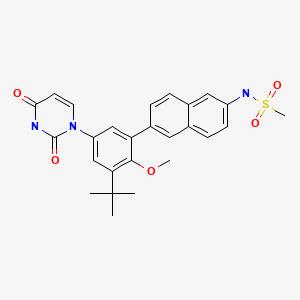
Patent

WO2009039127

http://www.google.com/patents/WO2009039127A1?cl=en


 Example 4A. Preparation of N-(6-(3-tert-butyl-5-(2,4-dioxo-3,4-dihydropyrimidin-l(2H)-yl)-2- methoxyphenyl)naphthalen-2-yl)methanesulfonamide (compound IB-LO-2.3).

Figure imgf000178_0001

[00768] Part A. Preparation of N-(6-bromonaphthalen-2-yl)methanesulfonamide. [00769] A solution of the product from Example 3, Part B (4.48g, 20.17mmol) in pyridine (10OmL) was treated drop wise with methanesulfonyl chloride (1.97mL, 2.89 g, 25.2mmol) followed by stirring at room temperature for Ih. Diluted with toluene and concentrated under vacuum twice. The residue was extracted with EtOAc and washed with water, IM citric acid and brine. Treated with Darco G-60, dried over Na2SO4, filtered through celite and concentrated under vacuum. Solid was triturated with ether- hexane, collected by filtration and dried under vacuum to give the title compound as a faint pink solid (3.32g, 55 %).

[00770] Part B. Preparation of N-(6-(4,4,5,5-tetramethyl-l,3,2-dioxaborolan-2-yl)naphthalen-2-yl) methanesulfonamide .

[00771] A mixture of the product from Part A (1.0Og, 3.33mmol), bis(pincolato)diboron (1.27g,

5.00mmol), potassium acetate (0.98 g, 9.99mmol) and Combiphos Pd6 (84mg, 0.17mmol) in toluene

(22mL) was heated at reflux for 3h. Cooled and diluted with ethyl acetate and water. The mixture was treated with Darco G-60 and filtered through celite. The filtrate was washed with water and brine. Dried over Na2SO4, filtered and concentrated under vacuum. Oil was dissolved in ether and precipitated by addition of hexanes. The product was collected by filtration and washed with hexanes. Evaporation of the filtrate and purification by silica gel column chromatography eluting with EtOAc/hexanes. The title compound from crystallization and chromatography was obtained as a white solid (927mg, 80%).

 Part C. Preparation of tert-butyl 3-tert-butyl-4-methoxy-5-(6-(methylsulfonamido) naphthalen-

2-yl)phenylcarbamate.

 Combined the product from Example 3, Part H (87mg, 0.243mmol), the product from Part B

(169mg, 0.486mmol), toluene (1.0ml), ethanol (1.0ml) and sodium carbonate (0.243ml, 0.243mmol) in a sealed tube and de-gassed with N2 gas for 20min. Tetrakis(triphenylphosphine)palladium(0) (5.61mg,

4.86μmol) was added and de-gassing was continued another 5-10 min. Heated at 90-950C for 16h.

Cooled and concentrated under vacuum. Purification by silica gel column chromatography eluting with

EtOAc/hexanes gave the title compound (92.2mg, 76 %).

[00774] Part D. Preparation of N-(6-(3-tert-butyl-5-(2,4-dioxo-3,4-dihydropyrimidin-l(2H)-yl)-2- methoxyphenyl)naphthalen-2-yl)methanesulfonamide.

[00775] A solution of the product from Part C (90mg, 0.180mmol) in CH2Cl2 (2.0ml) was treated with trifluoroacetic acid (1.0ml, 12.98mmol) at room temperature for Ih. Concentrated under vacuum, dissolved residue in EtOAc, washed with 10% NaHCO3, and brine. Dried over Na2SO4, filtered and concentrated under vacuum. Dissolved in DMF (1.4ml) and cooled to -250C and added (E)-3-methoxy- acryloyl isocyanate (0.633ml, 0.361mmol) drop wise while maintaining the temperature below -1O0C. Warmed to room temperature and stirred for 2h. Poured into ether, washed with water, and brine. Dried over Na2SO4, filtered and concentrated under vacuum. Added a mixture OfH2SO4 (0.1ml, 1.876mmol), water (1.0ml) and EtOH (1.0ml) and stirred at 1000C 16h. Cooled and concentrated under vacuum. Poured into water, extracted with EtOAc, combined extracts and washed with brine. Dried over Na2SO4, filtered and concentrated under vacuum. Purification by silica gel column chromatography eluting with MeOH/CHCl3 gave the title compound (53mg, 59%). 1H NMR (300 MHz DMSO-J6) δ 1.42 (s, 9 H) 3.08 (s, 3 H) 3.25 (s, 3 H) 5.65 (d, J=7.72 Hz, 1 H) 7.34 (dd, J=15.81, 2.57 Hz, 2 H) 7.42 (dd, J=8.82, 1.84 Hz, 1 H) 7.65 – 7.76 (m, 2 H) 7.80 (d, J=8.09 Hz, 1 H) 7.96 (t, J= 8.27 Hz, 2 H) 8.02 (s, 1 H) 10.04 (s, 1 H) 11.41 (s, 1 H); MS (ESI+) m/z 494 (M+H)+; (ESI-) m/z 492 (M-H).

Example 4B. Preparation of N-(6-(3-tert-butyl-5-(2,4-dioxo-3,4-dihydropyrimidin-l(2H)-yl)-2- methoxyphenyl)naphthalen-2-yl)methanesulfonamide (compound IB-LO-2.3).

Figure imgf000180_0001

 Part A. Preparation of 2-tert-butyl-6-iodo-4-nitrophenol.

To the product from Example 3, Part E (4.5g, 23.05mmol) dissolved in MeOH (120ml) and water (3OmL) was added iodine monochloride (1.155ml, 23.05mmol) drop wise over a period of lOmin.

The mixture was stirred for 2h and diluted into IL of water and allowed to stand overnight. The solid material was collected by filtration and washed 3 x 5OmL with water and dried under vacuum overnight to give a tan solid (7.14g, 96%).

 Part B. Preparation of l-tert-butyl-3-iodo-2-methoxy-5-nitrobenzene.

To an ice bath cooled solution of the product from Part A (5.5g, 17.13mmol) in MTBE (15ml) in a 5OmL pressure vessel was added 2.0M trimethylsilyl diazomethane (12.85ml, 25.7mmol) followed by drop-wise addition of methanol (1.OmL) resulting in calm bubbling. The vessel was sealed and stirred at room temperature for 16h, cooled and the pressure was released. The solution was partitioned between

EtOAc and water. The organic layer was washed with 1.0M HCl, saturated potassium carbonate solution, and saturated NaCl. The organic layer was dried over sodium sulfate, filtered and concentrated to give a red oil that was used without purification (5.4g, 84%).

 Part C. Preparation of 3-tert-butyl-5-iodo-4-methoxyaniline.

[00782] A mixture of the product from Part B (5.80g, 17.31mmol), ammonium chloride (1.389g,

26.0mmol), and iron (4.83g, 87mmol) in THF/MeOH/water (20OmL total, 2/2/1) was refluxed for 2h, cooled and filtered through Celite. The filtrate was evaporated and the residue was partitioned between water and EtOAc. The organic layer was washed with saturated brine, dried with sodium sulfate, filtered and evaporated to give a brown oil (5.28g, 100% yield).

[00783] Part D. Preparation of (E)-N-(3-tert-butyl-5-iodo-4-methoxyphenylcarbamoyl)-3-methoxy acrylamide.

[00784] To a solution of the product from Part C (3.05g, lOmmol) in DMF (50ml) at -20 0C under N2 was added at a fast drip a 0.4M solution in benzene of (E)-3-methoxyacryloyl isocyanate (50.0ml,

20.00mmol, prepared by the method of Santana et al., J. Heterocyclic. Chem. 36:293 (1999). The solution was stirred for 15min at -20 0C, warmed to room temperature for 45min and diluted with EtOAc. The organic was washed with water and brine. Dried over Na2SO4, filtered and concentrated to a brown solid. The residue was triturated in Et2θ/hexane to give a fine powder that was collected by filtration and dried under vacuum to give the title compound as a tan powder (2.46g, 57%).

[00785] Part E. Preparation of l-(3-tert-butyl-5-iodo-4-methoxyphenyl)dihydropyrimidine-2,4(lH,3H)- dione.

[00786] To a suspension of the product from Part D (2.46g, 5.69mmol) in ethanol (50ml) was added a solution of 5.5mL OfH2SO4 in 5OmL water and the mixture was heated at 1100C for 2.5h to give a clear solution. Cooled and diluted with 5OmL of water while stirring to give an off-white solid that was collected by filtration, washed with water and dried under vacuum to give the title compound (2.06g,

90%).

[00787]Part F. Preparation of N-(6-(3-tert-butyl-5-(2,4-dioxo-3,4-dihydropyrimidin-l(2H)-yl)-2- methoxyphenyl)naphthalen-2-yl)methanesulfonamide.

[00788] In a microwave tube, the product from Part E (104mg, 0.26mmol), the product from Example

4A, Part B (108mg, 0.31mmol), and 1.0M sodium carbonate solution (312μL, 0.31mmol) in 1: 1 ethanol- toluene (1.7mL) was degassed by nitrogen sparge for 15min. l,l’-Bis(diphenylphosphino) ferrocene palladium (II) chloride dichloromethane complex (9mg, 0.01 lmmol) was added, and degassing was continued for another 5min. The tube was sealed and heated in the microwave at 1000C for Ih. Diluted with dichloromethane and washed with IM citric acid solution and brine. The organic layer was then stirred with (3-mercaptopropyl) silica gel for Ih. Filtered through celite and concentrated under vacuum.

Triturated with ether, methanol, and then again with ether to give the title compound as a nearly white solid (32mg, 25 %). 1H NMR (300 MHz, DMSO-J6): δ 11.41 (d, J=I.84 Hz, 1 H) 10.04 (s, 1 H) 8.03 (s,

1 H) 7.96 (t, J=8.09 Hz, 2 H) 7.80 (d, J=8.09 Hz, 1 H) 7.63 – 7.79 (m, 2 H) 7.35 – 7.45 (m, 1 H) 7.37 (d,

J=2.57 Hz, 1 H) 7.32 (d, J=2.57 Hz, 1 H) 5.65 (dd, J=8.09, 2.21 Hz, 1 H) 3.25 (s, 3 H) 3.09 (s, 3 H) 1.43

(s, 9 H). MS (+ESI)m/z (rel abundance): 494 (100,M+H), 511 (90, M+NH4), 987 (20, 2M+H), 1009

(8, 2M+Na).

PATENT

http://www.google.com/patents/WO2009039134A1?cl=en

Example 2A. Preparation of N-(6-(3-tert-butyl-5-(2,4-dioxo-3,4-dihydropyrimidin-l(2H)-yl)-2- methoxyphenyl)naphthalen-2-yl)methanesulfonamide (compound IB-LO-2.3).

Figure imgf000107_0001

[00511] Part A. Preparation of N-(6-bromonaphthalen-2-yl)methanesulfonamide. [00512] A solution of the product from Example 1, Part B (4.48g, 20.17mmol) in pyridine (10OmL) was treated drop wise with methanesulfonyl chloride (1.97mL, 2.89 g, 25.2mmol) followed by stirring at room temperature for Ih. Diluted with toluene and concentrated under vacuum twice. The residue was extracted with EtOAc and washed with water, IM citric acid and brine. Treated with Darco G-60, dried over Na2SO4, filtered through celite and concentrated under vacuum. Solid was triturated with ether- hexane, collected by filtration and dried under vacuum to give the title compound as a faint pink solid (3.32g, 55 %).

Part B. Preparation of N-(6-(4,4,5,5-tetramethyl-l,3,2-dioxaborolan-2-yl)naphthalen-2-yl) methanesulfonamide .

[00514] A mixture of the product from Part A (1.0Og, 3.33mmol), bis(pincolato)diboron (1.27g,

5.00mmol), potassium acetate (0.98 g, 9.99mmol) and Combiphos Pd6 (84mg, 0.17mmol) in toluene

(22mL) was heated at reflux for 3h. Cooled and diluted with ethyl acetate and water. The mixture was treated with Darco G-60 and filtered through celite. The filtrate was washed with water and brine. Dried over Na2SO4, filtered and concentrated under vacuum. Oil was dissolved in ether and precipitated by addition of hexanes. The product was collected by filtration and washed with hexanes. Evaporation of the filtrate and purification by silica gel column chromatography eluting with EtOAc/hexanes. The title compound from crystallization and chromatography was obtained as a white solid (927mg, 80%).

[00515] Part C. Preparation of tert-butyl 3-tert-butyl-4-methoxy-5-(6-(methylsulfonamido) naphthalen-

2-yl)phenylcarbamate.

[00516] Combined the product from Example 1, Part H (87mg, 0.243mmol), the product from Part B

(169mg, 0.486mmol), toluene (1.0ml), ethanol (1.0ml) and sodium carbonate (0.243ml, 0.243mmol) in a sealed tube and de-gassed with N2 gas for 20min. Tetrakis(triphenylphosphine)palladium(0) (5.61mg,

4.86μmol) was added and de-gassing was continued another 5-10 min. Heated at 90-950C for 16h.

Cooled and concentrated under vacuum. Purification by silica gel column chromatography eluting with

EtOAc/hexanes gave the title compound (92.2mg, 76 %).

[00517]Part D. Preparation of N-(6-(3-tert-butyl-5-(2,4-dioxo-3,4-dihydropyrimidin-l(2H)-yl)-2- methoxyphenyl)naphthalen-2-yl)methanesulfonamide.

[00518] A solution of the product from Part C (90mg, 0.180mmol) in CH2Cl2 (2.0ml) was treated with trifluoroacetic acid (1.0ml, 12.98mmol) at room temperature for Ih. Concentrated under vacuum, dissolved residue in EtOAc, washed with 10% NaHCO3, and brine. Dried over Na2SO4, filtered and concentrated under vacuum. Dissolved in DMF (1.4ml) and cooled to -250C and added (E)-3-methoxy- acryloyl isocyanate (0.633ml, 0.361mmol) drop wise while maintaining the temperature below -1O0C. Warmed to room temperature and stirred for 2h. Poured into ether, washed with water, and brine. Dried over Na2SO4, filtered and concentrated under vacuum. Added a mixture Of H2SO4 (0.1ml, 1.876mmol), water (1.0ml) and EtOH (1.0ml) and stirred at 1000C 16h. Cooled and concentrated under vacuum. Poured into water, extracted with EtOAc, combined extracts and washed with brine. Dried over Na2SO4, filtered and concentrated under vacuum. Purification by silica gel column chromatography eluting with MeOH/CHCl3 gave the title compound (53mg, 59%). 1H NMR (300 MHz OMSO-d6) δ 1.42 (s, 9 H) 3.08 (s, 3 H) 3.25 (s, 3 H) 5.65 (d, J=7.72 Hz, 1 H) 7.34 (dd, J=15.81, 2.57 Hz, 2 H) 7.42 (dd, J=8.82, 1.84 Hz, 1 H) 7.65 – 7.76 (m, 2 H) 7.80 (d, J=8.09 Hz, 1 H) 7.96 (t, J= 8.27 Hz, 2 H) 8.02 (s, 1 H) 10.04 (s, 1 H) 11.41 (s, 1 H); MS (ESI+) m/z 494 (M+H)+; (ESI-) m/z 492 (M-H).

[00519] Example 2B. Preparation of N-(6-(3-tert-butyl-5-(2,4-dioxo-3,4-dihydropyrimidin-l(2H)-yl)-2- methoxyphenyl)naphthalen-2-yl)methanesulfonamide (compound IB-LO-2.3).

Figure imgf000109_0001

[00520] Part A. Preparation of 2-tert-butyl-6-iodo-4-nitrophenol.

[00521] To the product from Example 1, Part E (4.5g, 23.05mmol) dissolved in MeOH (120ml) and water (3OmL) was added iodine monochloride (1.155ml, 23.05mmol) drop wise over a period of lOmin.

The mixture was stirred for 2h and diluted into IL of water and allowed to stand overnight. The solid material was collected by filtration and washed 3 x 5OmL with water and dried under vacuum overnight to give a tan solid (7.14g, 96%).

[00522]Part B. Preparation of l-tert-butyl-3-iodo-2-methoxy-5-nitrobenzene.

[00523] To an ice bath cooled solution of the product from Part A (5.5g, 17.13mmol) in MTBE (15ml) in a 5OmL pressure vessel was added 2.0M trimethylsilyl diazomethane (12.85ml, 25.7mmol) followed by drop-wise addition of methanol (1.OmL) resulting in calm bubbling. The vessel was sealed and stirred at room temperature for 16h, cooled and the pressure was released. The solution was partitioned between

EtOAc and water. The organic layer was washed with 1.0M HCl, saturated potassium carbonate solution, and saturated NaCl. The organic layer was dried over sodium sulfate, filtered and concentrated to give a red oil that was used without purification (5.4g, 84%).

[00524] Part C. Preparation of 3-tert-butyl-5-iodo-4-methoxyaniline.

[00525] A mixture of the product from Part B (5.8Og, 17.31mmol), ammonium chloride (1.389g,

26.0mmol), and iron (4.83g, 87mmol) in THF/MeOH/water (20OmL total, 2/2/1) was refluxed for 2h, cooled and filtered through Celite. The filtrate was evaporated and the residue was partitioned between water and EtOAc. The organic layer was washed with saturated brine, dried with sodium sulfate, filtered and evaporated to give a brown oil (5.28g, 100% yield).

[00526] Part D. Preparation of (E)-N-(3-tert-butyl-5-iodo-4-methoxyphenylcarbamoyl)-3-methoxy acrylamide.

[00527] To a solution of the product from Part C (3.05g, lOmmol) in DMF (50ml) at -20 0C under N2 was added at a fast drip a 0.4M solution in benzene of (E)-3-methoxyacryloyl isocyanate (50.0ml,

20.00mmol, prepared by the method of Santana et al., J. Heterocyclic. Chem. 36:293 (1999). The solution was stirred for 15min at -20 0C, warmed to room temperature for 45min and diluted with EtOAc. The organic was washed with water and brine. Dried over Na2SO4, filtered and concentrated to a brown solid. The residue was triturated in Et2O/hexane to give a fine powder that was collected by filtration and dried under vacuum to give the title compound as a tan powder (2.46g, 57%).

[00528] Part E. Preparation of l-(3-tert-butyl-5-iodo-4-methoxyphenyl)dihydropyrimidine-2,4(lH,3H)- dione.

[00529] To a suspension of the product from Part D (2.46g, 5.69mmol) in ethanol (50ml) was added a solution of 5.5mL OfH2SO4 in 5OmL water and the mixture was heated at 110°C for 2.5h to give a clear solution. Cooled and diluted with 5OmL of water while stirring to give an off-white solid that was collected by filtration, washed with water and dried under vacuum to give the title compound (2.06g,

[00530] Part F. Preparation of N-(6-(3-tert-butyl-5-(2,4-dioxo-3,4-dihydropyrimidin-l(2H)-yl)-2- methoxyphenyl)naphthalen-2-yl)methanesulfonamide.

[0053I]In a microwave tube, the product from Part E (104mg, 0.26mmol), the product from Example 2A, Part B (108mg, OJ lmmol), and 1.0M sodium carbonate solution (312μL, 0.31mmol) in 1:1 ethanol- toluene ( 1.7mL) was degassed by nitrogen sparge for 15min. 1 , 1 ‘-Bis(diphenylphosphino) ferrocene palladium (II) chloride dichloromethane complex (9mg, O.Ol lmmol) was added, and degassing was continued for another 5min. The tube was sealed and heated in the microwave at 1000C for Ih. Diluted with dichloromethane and washed with IM citric acid solution and brine. The organic layer was then stirred with (3-mercaptopropyl) silica gel for Ih. Filtered through celite and concentrated under vacuum. Triturated with ether, methanol, and then again with ether to give the title compound as a nearly white solid (32mg, 25 %). 1H NMR (300 MHz, OMSO-d6): δ 11.41 (d, J=1.84 Hz, 1 H) 10.04 (s, 1 H) 8.03 (s, 1 H) 7.96 (t, J=8.09 Hz, 2 H) 7.80 (d, J=8.09 Hz, 1 H) 7.63 – 7.79 (m, 2 H) 7.35 – 7.45 (m, 1 H) 7.37 (d, J=2.57 Hz, 1 H) 7.32 (d, J=2.57 Hz, 1 H) 5.65 (dd, J=8.09, 2.21 Hz, 1 H) 3.25 (s, 3 H) 3.09 (s, 3 H) 1.43 (s, 9 H). MS (+ESI) m/z (rel abundance): 494 (100, M+H), 511 (90, M+NH4), 987 (20, 2M+H), 1009 (8, 2M+Na).
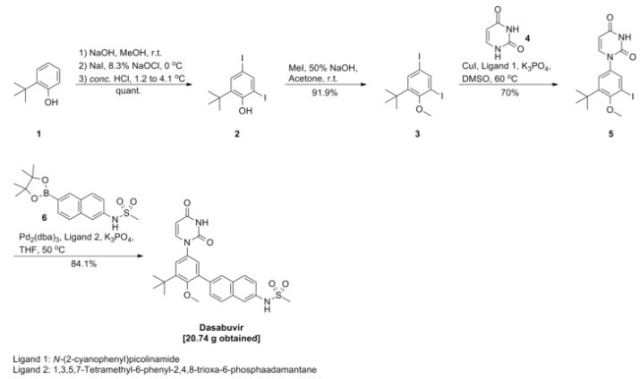
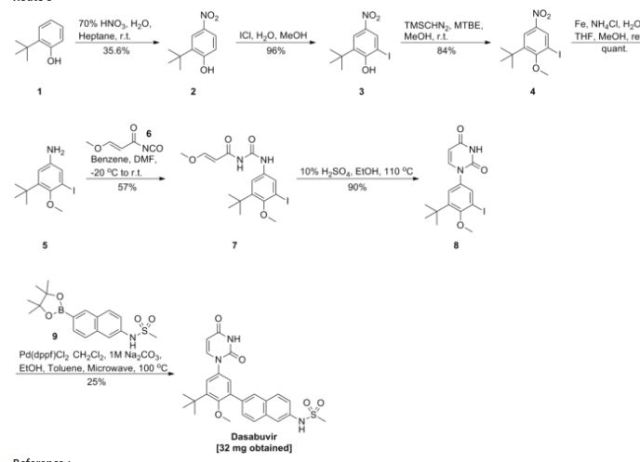


PATENT

WO 2014031791

https://www.google.com/patents/WO2014031791A1?cl=en

Example 4. Preparation of ^-(6-(3-?eri-butyl-5-(2,4-dioxo-3,4-dihydropyrimidin-l(2H)-yl)-2- methoxyphenyl)naphthalen-2-yl)methanesulfonamide (compound (A-l)).

Figure imgf000066_0001

[00254] A 3-L, 3 -neck, round-bottom flask was equipped with an overhead stirrer, a thermocouple, a Claisen condenser and a reflux condenser. Tris(dibenzylideneacetone)dipalladium(0) (0.330 g, 0.360 mmol), di-?er?-butyl(2′,4′,6′-triisopropyl-3,4,5,6-tetramethylbiphenyl-2-yl)phosphine (0.416 g, 0.864 mmol) and milled potassium phosphate tribasic (21.0 g, 99.0 mmol) were charged to the 3-L flask. The flask was purged with argon for not less than 90 minutes with constant stirring of the solids. i-Amyl alcohol (250 ml) was charged to a separate 500-mL round-bottom flask and was purged with argon for not less than 30 minutes and was transferred to the 3-L flask using a cannula under argon atmosphere. The contents of the 3-L flask were heated to 80 °C and stirred at this temperature for 30 minutes. A 1-L round-bottom flask equipped with a magnetic stir bar was charged with 6-(3-teri-butyl-5-(2,4-dioxo-3,4- dihydropyrimidin- 1 (2H)-yl)-2-methoxyphenyl)naphthalen-2-yl 1 , 1 ,2,2,3,3,4,4,4-nonafluorobutane- 1 – sulfonate (62.9 g, 90 mmol), methanesulfonamide (12.85 g, 135 mmol) and i-amyl alcohol (505 mL), purged with argon and heated to 60 °C. The reagent mixture was stirred under argon for not less than 30 minutes. A clear yellow solution was observed. This solution was transferred to the 3-L flask using a cannula under argon atmosphere. The temperature of the 3-L flask was raised to 85 °C and the contents were stirred for 14 hours under a positive pressure of argon. The temperature was then raised to 95 °C and the contents were stirred for an additional 4 hours under a positive pressure of argon. The reaction mixture was allowed to cool down to room temperature, diluted with tetrahydrofuran (2200 mL) and water (800 mL) and was transferred to a 6-L separatory funnel. The organic layer was washed thrice with water (2000 mL) containing L-cysteine (17.3 g) and NaCl (235 g). The organic layer was collected, filtered through a pad of diatomaceous earth and was concentrated in vacuo to approximately 250 mL. Ethyl acetate (775 mL) was added over 7 hours with stirring, and the mixture was allowed to stir for an additional 14 hours. White solid was isolated by filtration, and the solid was washed with ethyl acetate (1000 mL). The solid was then dissolved in tetrahydrofuran (1500 mL) and filtered through a pad of diatomaceous earth to obtain a clear solution. The diatomaceous earth was washed with tetrahydrofuran (300 mL). The combined tetrahydrofuran solution was concentrated in vacuo to approximately 250 mL, and then ethyl acetate (775 mL) was added over 7 hours with stirring. The product solution was allowed to stir for an additional 14 hours. White solid was isolated by filtration. The solid was washed with ethyl acetate (1000 mL) and dried in a vacuum oven at 60 °C for 24 hours. The solid was slurried in 308 mL of 200 proof ethanol for 1.5 hours, then isolated by filtration. The solid was washed with 132 mL of 200 proof ethanol and dried in a vacuum oven at 50 °C for 18 hours. The title compound was isolated as a white solid (32.6 g, 100% potency vs. standard, 73% yield). !H NMR (400 MHz, DMSO-i¾) δ ppm 1 1.41 (d, J= 2.1 Hz, 1H), 10.04 (s, 1H), 8.02 (d, J= 0.9 Hz, 1H), 7.98 – 7.91 (m, 2H), 7.79 (d, J = 7.9 Hz, 1H), 7.72 (d, J= 2.0 Hz, 1H), 7.69 (dd, J = 8.5, 1.7 Hz, 1H), 7.41 (dd, J = 8.8, 2.2 Hz, 1H), 7.36 (d, J= 2.7 Hz, 1H), 7.31 (d, J= 2.7 Hz, 1H), 5.65 (dd, J = 7.9, 2.2 Hz, 1H), 3.24 (s, 3H), 3.08 (s, 3H), 1.42 (s, 9H). 13C NMR (101 MHz, DMSO-i¾) δ ppm 163.1 (C), 156.0 (C), 150.0 (C), 145.3 (CH), 142.9 (C), 136.0 (C), 134.3 (C), 134.2 C(), 133.5 (C), 132.2 (C), 129.5 (C), 129.0 (CH), 127.6 (CH), 127.1 (CH), 127.0 (CH), 126.5 (CH), 124.3 (CH), 120.2 (CH), 1 14.5 (CH), 101.1 (CH), 60.3 (CH3), 39.4 (CH3), 35.1(C), 30.5 (CH3).
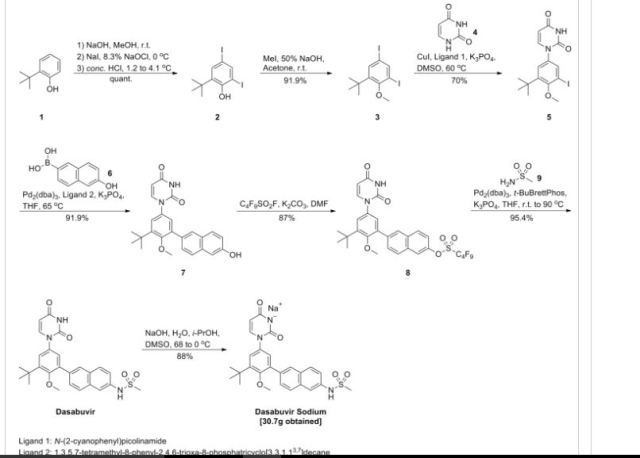
Example 5. Preparation of the sodium salt of /V-(6-(3-teri-butyl-5-(2,4-dioxo-3,4- dihydropyrimidin- 1 (2H)-yl)-2-methoxyphenyl)naphthalen-2-yl)methanesulfonamide (compound (A-sl)).

Figure imgf000078_0001

[00286] A solution of 2-propanol and water was prepared by combining 18.5 g of water and 512 g of 2- propanol. Hereafter, this solution is referred to as the “antisolvent solution.”

[00287] A solution of 2-propanol and water was prepared by combining 23.94 g of water and 564 g of 2- propanol. This solution was cooled in a refrigerator prior to use. Hereafter, this solution is referred to as the “chilled wash solution.”

[00288] A jacketed reactor was equipped with an overhead stirrer and charged with 32.0 g (64.8 mmol) of A^-(6-(3-?er^butyl-5-(2,4-dioxo-3,4-dihydropyrimidin-l(2H)-yl)-2-methoxyphenyl)naphthalen-2- yl)methanesulfonamide and 105.9 g of dimethyl sulfoxide. With stirring the mixture was heated to an internal temperature of 68 °C. A solution of 2.66 g of sodium hydroxide (66.5 mmol, 1.026 equiv) in 16 g of water was added to the reactor over several minutes, followed by 12.4 g of 2-propanol while maintaining the internal temperature at 68 °C. Antisolvent solution (24.5 g) was added to the reactor while maintaining the internal temperature at 68 °C. A slurry of 0.32 g of seed crystals of the final product in 22.8 g of antisolvent solution was added to the reactor, followed by a 2.6 g rinse of the flask with antisolvent solution. The reaction mixture was stirred for 1.5 hours while maintaining the internal temperature at 68 °C. Antisolvent solution (354 g) was added to the reactor over 7 hours while maintaining the internal temperature at 68 °C. The contents of the reactor were cooled to an internal temperature of 0 °C over 7 hours and then mixed at 0 °C for 7 hours. The solids were isolated by filtration and washed with 252 g of the chilled wash solution. The isolated solids were dried in a vacuum oven at 50 °C for 19 hours. The title compound was isolated as a white solid (30.7 g, 92% potency vs. free acid standard, 57.2 mmol free acid equivalent, 88% yield). !H NMR (400 MHz, DMSO-i¾) δ ppm 7.75 (s, 1H), 7.72 (d, J= 7.8 Hz, 1H), 7.59 (dd, J = 8.8, 2.2 Hz, 2H), 7.45 (dd, J = 8.5, 1.8 Hz, 1H), 7.27 (d, J = 2.6 Hz, 2H), 7.21 (d, J = 2.7 Hz, 1H), 7.06 (dd, J = 8.8, 2.2 Hz, 1H), 5.62 (d, J = 7.8 Hz, 1H), 3.24 (s, 3H), 2.68 (s, 3H), 1.40 (s, 9H).

PATENT

http://www.google.com/patents/EP2593439A2?cl=en

 Example 2. Preparation of l -(3-teri-butyl-5-(6-hydroxynaphthalen-2-yl)-4- methoxyphenyl)pyrimidine-2,4(l f,3H)-dione (compound (4)).

Figure imgf000041_0001

[00165] This reaction is sensitive to oxygen, and so all vessels were sealed with rubber septa. All solution transfers were accomplished by cannula technique using nitrogen as the inert gas. Anhydrous tetrahydrofuran was sparged with nitrogen gas for 2 hours prior to use to render it anaerobic. Hereafter this is referred to as degassed tetrahydrofuran. [00166] A 100-mL round-bottom flask was charged with 12.9 g of potassium phosphate tribasic (60.8 mmol, 2.0 equivalents), a magnetic stir bar, and 60 mL of water. The mixture was stirred to dissolve the solids, and the aqueous solution was sparged with nitrogen gas for 2 hours prior to use. Hereafter this is referred to as the phosphate solution.

[00167] A 100-mL round-bottom flask was purged with nitrogen gas and charged with 282 mg of tris(dibenzylideneacetone)dipalladium(0) (0.31 mmol, 0.02 equivalents Pd), 413 mg ofphosphine ligand, l ,3,5,7-tetramethyl-8-phenyl-2,4,6-trioxa-8-phosphatricyclo[3.3.1.1 ‘7]decane (1.4 mmol, 2.3 equivalents relative to Pd) and a magnetic stir bar. The flask was sealed with a septum and the atmosphere above the solids was purged with nitrogen gas. Sixty mL of degassed tetrahydrofuran was added to the flask and the mixture was stirred under a nitrogen atmosphere. This solution was sparged for 15 minutes prior to use and is hereafter referred to as the catalyst solution.

[00168] A 500-mL jacketed reactor was equipped with an overhead stirrer and reflux condenser and the atmosphere was purged with nitrogen gas. The reactor was charged with 12.1 g of l -(3-?er?-butyl-5-iodo- 4-methoxyphenyl)pyrimidine-2,4(l f,3 /)-dione, (30.3 mmol, 1.0 equivalent) and 5.98 g of 6- hydroxynaphthalen-2-ylboronic acid (31.8 mmol, 1.05 equivalents). The atmosphere was purged with nitrogen gas with stirring of the solid reagents for 20 minutes. The reactor was charged with 120 mL of degassed tetrahydrofuran, and the mixture was stirred to dissolve the solids. The solution was sparged with nitrogen gas for 10 minutes. The phosphate solution was added to the reactor by cannula, followed by the catalyst solution. The resulting biphasic mixture was stirred aggressively to ensure adequate phase mixing, and the jacket was warmed to 65 °C. The reaction jacket was cooled to room temperature prior to quench.

[00169] After 2.5 hours, the reaction jacket was cooled to room temperature prior to quench.

[00170] The workup of the reaction was also conducted under anaerobic conditions. Fifty-seven grams of sodium chloride and 4.2 g of cysteine (15 weight equivalents relative to palladium catalyst) were dissolved in 300 mL of water, and the resulting solution was sparged for 2 hours prior to use. To quench the reaction, approximately 1/3 of this solution was transferred to the reaction mixture by cannula under nitrogen gas and the resulting biphasic mixture was stirred vigorously for 2 hours. The mechanical agitation was halted, the two solutions were allowed to separate, and the aqueous solution was drained out of the reactor through the bottom valve. Approximately 1/3 of the quench solution was transferred to the reaction mixture by cannula under nitrogen gas and the resulting biphasic mixture was stirred vigorously for 45 minutes. The mechanical agitation was halted, the two solutions were allowed to separate, and the aqueous solution was drained out of the reactor through the bottom valve. The final portion of the quench solution was transferred to the reaction mixture by cannula, the resulting biphasic mixture was stirred vigorously for 45 minutes and the aqueous solution was drained out of the reactor through the bottom valve. [00171] The remainder of the workup was not conducted under anaerobic conditions. The pale yellow organic solution was drained from the reactor through the bottom valve and filtered over a pad of grade 4 Filtrol® (1 cm deep by 4.5 cm diameter). The reactor and filter cake were rinsed with 70 mL of tetrahydrofuran. The bulk of the solvent was distilled in vacuo (ca 90-130 torr) at ca 40 °C with good agitation from an overhead stirrer. The solution was concentrated to approximately 50 mL volume, during which time the product began to precipitate out. Ethyl acetate (100 mL, 8 volume/weight relative to product) was added to the mixture, and the resultant slurry was stirred overnight at room temperature. The crystalline material was isolated by filtration and the filter cake was washed twice with 20 mL portions of ethyl acetate. The wet-cake was air-dried on the filter and dried in a vacuum oven at 50 °C at approximately 250 torr with a gentle nitrogen sweep overnight.

[00172] The desired product was isolated as a white solid (11.6 g, 96.4% potency vs. standard, 88% potency-adjusted yield).!H NMR (400 MHz, DMSO-4) δ ppm δ 1 1.39 (d, J = 2.1 Hz, 1H), 9.82 (s, 1H), 7.91 (d, J = 0.8 Hz, 1H), 7.80 (d, J= 8.9 Hz, 1H), 7.77 – 7.74 (m, 2H), 7.58 (dd, J = 8.5, 1.7 Hz, 1H), 7.32 (d, J = 2.7 Hz, 1H), 7.27 (d, J= 2.7 Hz, 1H), 7.16 (d, J = 2.3 Hz, 1H), 7.10 (dd, J = 8.8, 2.4 Hz, 1H), 5.64 (dd, J = 7.9, 2.2 Hz, 1H), 3.23 (s, 3H), 1.41 (s, 9H).

Example 3. Preparation of 6-(3-?eri-butyl-5-(2,4-dioxo-3,4-dihydropyrimidin-l (2H)-yl)-2- methoxyphenyl)naphthalen-2-yl 1 ,1 ,2,2,3,3,4,4,4-nonafluorobutane-l -sulfonate (compound (5a)).

Figure imgf000043_0001

[00174] A reactor was equipped with an overhead stirrer in the central neck and charged with 45.0 g of 1- (3-?eri-butyl-5-(6-hydroxynaphthalen-2-yl)-4-methoxyphenyl)pyrimidine-2,4(l f,3H)-dione (97.8 weight%>, 106 mmol, 1.0 equivalent) and 21.9 g of 325 mesh potassium carbonate (159 mmol, 1.5 equivalents). The atmosphere was purged with nitrogen gas while the solids were stirred. The flask was charged with 445 mL of Λ^Λ^-dimethylformamide, and the slurry was stirred to dissolve the l-(3-?eri- butyl-5-(6-hydroxynaphthalen-2-yl)-4-methoxyphenyl)pyrimidine-2,4(l f,3H)-dione. The purge was stopped and the reaction was conducted under a slight positive pressure of nitrogen gas.

Perfluorobutanesulfonyl fluoride (35.2 g, 117 mmol, 1.1 equivalents) was added in one portion, and the mixture was stirred vigorously to mix the immiscible liquids overnight.

[00175] The inorganic solids were separated by filtration, and the flask and filter cake were rinsed with approximately 30 mL of Λ^,Λ^-dimethylformamide. The Λ^,Λ^-dimethylformamide solution was filtered directly into a second flask with an overhead stirrer. With stirring, 1 12 g of water (25 weight% of total Λ^,Λ^-dimethylformamide employed) was added to the Λ^,Λ^-dimethylformamide solution of product over approximately 0.5 hour to induce precipitation of the desired product, and the mixture was allowed to stir for 5 hours. The wet-cake was isolated by filtration with recirculation of the liquors to recover all the solids. The wet-cake was washed with 60 mL of 25% (v/v) water yV-dimethylformamide, then 85 mL water.

[00176] The solids were dissolved in 760 mL of isopropyl acetate. The resultant organic solution was washed once with 200 mL of water, twice with 270 mL portions of water and once with 200 mL of water to remove residual AyV-dimethylformamide. Solvent was removed by distillation at approximately 130 torr with heating to 55 °C until the total volume was approximately 200 mL. With efficient stirring, heptane (450 mL) was added to the warm (55 °C) slurry. The slurry was allowed to cool to room temperature overnight with stirring. The desired product was isolated by filtration, with recycling of the liquors to isolate all of the solids material. The wet-cake was washed twice with 100 mL portions of 20% (v/v) isopropyl acetate/heptane. The wet-cake was air-dried on the filter and dried in a vacuum oven at 50 °C at approximately 250 torr with a gentle nitrogen sweep overnight. The title compound was isolated as a white solid (64.0 g, 100% potency vs. standard, 87% yield). !H NMR (600 MHz, DMSO- d6) δ ppm 1 1.42 (s, 1H), 8.21 – 8.15 (m, 4H), 7.84 (dd, J = 8.6, 1.7 Hz, 1H), 7.77 (d, J = 7.9 Hz, 1H), 7.60 (dd, J = 9.0, 2.5 Hz, 1H), 7.39 (d, J = 2.7 Hz, 1H), 7.35 (d, J = 2.7 Hz, 1H), 5.66 (d, J = 7.9 Hz, 1H), 3.21 (s, 3H), 1.41 (s, 9H).

[00177] Example 3-1. Alternative Preparation of 6-(3-teri-butyl-5-(2,4-dioxo-3,4-dihydropyrimidin- 1 (2//)-yl)-2-methoxyphenyl)naphthalen-2-yl 1 , 1 ,2,2,3 ,3 ,4,4,4-nonafluorobutane- 1 -sulfonate (compound (5a)).

[00178] A 250-L, 3-neck round-bottom flask equipped with an overhead stirrer was charged with 10 g of 1 -(3-ier?-butyl-5-(6-hydroxynaphthalen-2-yl)-4-methoxyphenyl)pyrimidine-2,4( l//,3//)-dione (98 wt%>, 23.5 mmol, 1.0 equiv) and 6.5 g of milled potassium carbonate (325 mesh, 47.1 mmol, 2.0 equiv). Acetonitrile (MeCN, 60 mL, 6 volumes with respect to naphthol) and dimethylformamide (dimethylformide, 40 mL, 4 volumes with respect to naphthol) was charged to the reactor and the slurry was stirred. Perfluorobutanesulfonyl fluoride (96 wt%>, 8.3 g, 26 mmol, 1.1 equiv) was charged to the well-stirred mixture over 60 minutes by syringe pump. A trace (<0.1 area%) of starting material was detected by HPLC analysis of an aliquot at 20 minutes reaction time. The

acetonitrile/dimethylformamide solution was filtered over a coarse fritted funnel to separate the inorganic solids, and the flask and filter was rinsed with 15 mL of 3 :2 (v/v)

acetonitrile/dimethylformamide. The total mass of solvents employed was approximately 92 g.

[00179] First crystallization: The acetonitrile/dimethylformamide solution was transferred to a 3- neck flask equipped with an overhead stirrer. Water (50 g, 54 wt%> with respect to total solution charged) was added to the well-stirred solution over 100 minutes. This adjusts the solvent

composition to 35 wt% water. During the addition of water the mixture self-seeded, and the solution was held for approximately 1 hour after complete addition of water. The solids were isolated by filtration, and the wetcake was washed with two 30 mL portions of a rinse solution of 40 wt%

water/27 wt% dimethylformamide/33 wt% acetonitrile and then once with 40 mL of water.

[00180] Aqueous washing: A 500-L jacketed cylindrical reactor equipped with an overhead stirrer and Teflon baffle to aid in vertical mixing was charged with the wetcake and 133 g of ethyl acetate (8X theoretical mass of product, 150 mL). The mixture was stirred to dissolve the substrate and the solution was washed twice with 40 mL portions of water.

[00181] Concentration and crystallization: A constant-volume distillation was conducted with heptanes, in vacuo (ca 100 mmHg, jacket temperature of 50 °C), to adjust the solvent composition to approximately 12 wt% ethyl acetate/88 wt% heptanes. During the distillation, solids begin to crystallize out of the solution. Once the distillation was complete, the solution was cooled to ambient temperature (23 °C). The solids were isolated by filtration and the wet cake was washed with a 50-mL portions heptane. The wet cake was dried to give the final product (14.0 g). The solids were 98.1% pure by HPLC analysis and 100% potent vs. reference standard, for an isolated yield of 85%o.

[00182] Example 4. Preparation of ^-(6-(3-ier?-butyl-5-(2,4-dioxo-3,4-dihydropyrimidin-l(2H)-yl)-2- methoxyphenyl)naphthalen-2-yl)methanesulfonamide (compound (A)).

Figure imgf000045_0001

[00183] A 3-L, 3-neck, round-bottom flask was equipped with an overhead stirrer, a thermocouple, a Claisen condenser and a reflux condenser. Tris(dibenzylideneacetone)dipalladium(0) (0.330 g, 0.360 mmol), di-ier?-butyl(2′,4′,6′-triisopropyl-3,4,5,6-tetramethylbiphenyl-2-yl)phosphine (0.416 g, 0.864 mmol) and milled potassium phosphate tribasic (21.0 g, 99.0 mmol) were charged to the 3-L flask. The flask was purged with argon for not less than 90 minutes with constant stirring of the solids. i-Amyl alcohol (250 ml) was purged with argon for not less than 30 minutes and was transferred to the 3-L flask using a cannula under argon atmosphere. The contents of the 3-L flask were heated to 80 °C and stirred at this temperature for 30 minutes. A 1-L round bottom flask equipped with a magnetic stir bar was charged with 6-(3-ier?-butyl-5-(2,4-dioxo-3,4-dihydropyrimidin-l(2H)-yl)-2-methoxyphenyl)naphthalen-2-yl 1,1,2,2,3,3,4,4,4-nonafluorobutane-l-sulfonate (62.9 g, 90 mmol), methanesulfonamide (12.85 g, 135 mmol) and i-amyl alcohol (505 mL), purged with argon and heated to 60 °C. The reaction mixture was stirred under argon for not less than 30 minutes. A clear yellow solution was observed. This solution was transferred to the 3-L flask using a cannula under argon atmosphere. The temperature of the 3-L flask was raised to 85 °C and the contents were stirred for 14 hours under a positive pressure of argon. The temperature was then raised to 95 °C and the contents were stirred for an additional 4 hours under a positive pressure of argon. The reaction mixture was allowed to cool down to room temperature, diluted with tetrahydrofuran (2200 mL) and water (800 mL) and was transferred to a 6-L separatory funnel. The organic layer was washed thrice with water (2000 mL) containing L-cysteine (17.3 g) and NaCl (235 g). The organic layer was collected, filtered through a pad of diatomaceous earth and was concentrated in vacuo to approximately 250 mL. Ethyl acetate (775 mL) was added over 7 hours with stirring, and the mixture was allowed to stir for an additional 14 hours. White solid was isolated by filtration, and the solid was washed with ethyl acetate (1000 mL). The solid was dissolved in tetrahydrofuran (1500 mL) and filtered through a pad of diatomaceous earth to obtain a clear solution. The diatomaceous earth was washed with tetrahydrofuran (300 mL). The combined tetrahydrofuran solution was concentrated in vacuo to approximately 250 mL, and then ethyl acetate (775 mL) was added over 7 hours with stirring. The product solution was allowed to stir for an additional 14 hours. White solid was isolated by filtration. The solid was washed with ethyl acetate (1000 mL) and dried in a vacuum oven at 60 °C for 24 hours. The solid was slurried in 308 mL of 200 proof ethanol for 1.5 hours, then isolated by filtration. The solid was washed with 132 mL of 200 proof ethanol and dried in a vacuum oven at 50 °C for 18 hours. The title compound was isolated as a white solid (32.6 g, 100% potency vs. standard, 73% yield). !H NMR (400 MHz, DMSO-i/6) δ ppm 11.41 (d, J = 2.1 Hz, 1H), 10.04 (s, 1H), 8.02 (d, J = 0.9 Hz, 1H), 7.98 – 7.91 (m, 2H), 7.79 (d, J = 7.9 Hz, 1H), 7.72 (d, J = 2.0 Hz, 1H), 7.69 (dd, J = 8.5, 1.7 Hz, 1H), 7.41 (dd, J = 8.8, 2.2 Hz, 1H), 7.36 (d, J = 2.7 Hz, 1H), 7.31 (d, J = 2.7 Hz, 1H), 5.65 (dd, J = 7.9, 2.2 Hz, 1H), 3.24 (s, 3H), 3.08 (s, 3H), 1.42 (s, 9H).

[00184] Other ligands such as 2,2,7,7-tetramethyl-l-(2′,4′,6′-triisopropylbiphenyl-2-yl)phosphepane; 7,7,9,9-tetramethyl-8-(2′,4′,6′-triisopropyl-3,6-dimethoxybiphenyl-2-yl)-l,4-dioxa-8- phosphaspiro[4.5]decane; and 8-(2-(2-methoxynaphthalen- 1 -yl)phenyl)-7,7,9,9-tetramethyl- 1 ,4-dioxa-8- phosphaspiro[4.5]decane were tested under the conditions described above and produced favorable yields of greater than 50% of the sulfonamidated product.

PREPN OF SODIUM SALT

Example 5. Preparation of the sodium salt of V-(6-(3-teri-butyl-5-(2,4-dioxo-3,4- dihydropyrimidin- 1 (2H)-yl)-2-methoxyphenyl)naphthalen-2-yl)methanesulfonamide (compound (As)).

Figure imgf000049_0001

[00192] A solution of 2-propanol and water was prepared by combining 18.5 g of water and 512 g of 2- propanol. Hereafter, this solution is referred to as the “antisolvent solution.”

[00193] A solution of 2-propanol and water was prepared by combining 23.94 g of water and 564 g of 2- propanol. This solution was cooled in a refrigerator prior to use. Hereafter, this solution is referred to as the “chilled wash solution.”

[00194] A jacketed reactor was equipped with an overhead stirrer and charged with 32.0 g (64.8 mmol) of A^-(6-(3-?er^butyl-5-(2,4-dioxo-3,4-dihydropyrimidin-l(2H)-yl)-2-methoxyphenyl)naphthalen-2- yl)methanesulfonamide and 105.9 g of dimethyl sulfoxide. With stirring the mixture was heated to an internal temperature of 68 °C. A solution of 2.66 g of sodium hydroxide (66.5 mmol, 1.026 equiv) in 16 g of water was added to the reactor over several minutes, followed by 12.4 g of 2-propanol while maintaining the internal temperature at 68 °C. Antisolvent solution (24.5 g) was added to the reactor while maintaining the internal temperature at 68 °C. A slurry of 0.32 g of seed crystals of the final product in 22.8 g of antisolvent solution was added to the reactor, followed by a 2.6 g rinse of the flask with antisolvent solution. The reaction mixture was stirred for 1.5 hours while maintaining the internal temperature at 68 °C. Antisolvent solution (354 g) was added to the reactor over 7 hours while maintaining the internal temperature at 68 °C. The contents of the reactor were cooled to an internal temperature of 0 °C over 7 hours and then mixed at 0 °C for 7 hours. The solids were isolated by filtration and washed with 252 g of the chilled wash solution. The isolated solids were dried in a vacuum oven at 50 °C for 19 hours. The title compound was isolated as a white solid (30.7 g, 92% potency vs. free acid standard, 57.2 mmol free acid equivalent, 88% yield). !H NMR (400 MHz, DMSO-i¾) δ ppm 7.75 (s, 1H), 7.72 (d, J= 7.8 Hz, 1H), 7.59 (dd, J= 8.8, 2.2 Hz, 2H), 7.45 (dd, J= 8.5, 1.8 Hz, 1H), 7.27 (d, J = 2.6 Hz, 2H), 7.21 (d, J= 2.7 Hz, 1H), 7.06 (dd, J= 8.8, 2.2 Hz, 1H), 5.62 (d, J= 7.8 Hz, 1H), 3.24 (s, 3H), 2.68 (s, 3H), 1.40 (s, 9H).

CLIP

DASABUVIR, ABT 333,
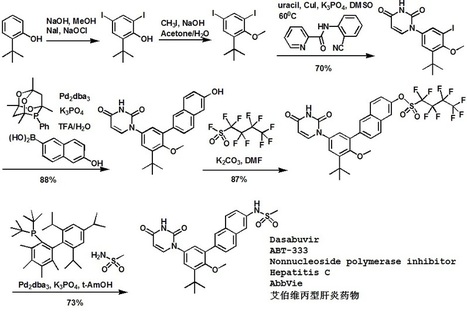
str1

CLIP

Dasabuvir sodium (Exviera) Dasabuvir sodium (Exviera), an oral non-nucleoside NS5B polymerase inhibitor discovered and developed by Abbvie, is a component of an all-oral hepatitis C treatment regimen Viekira Pak approved by the US FDA in December 2014 for the treatment of adult patients with chronic genotype 1 (GT1) hepatitis C virus (HCV) infection.84 The investigational regimen consists of the fixed-dose combination of paritaprevir (XXVII) (veruprevir, ABT- 450, vide infra) with ritonavir booster (150/100 mg) co-formulated with the NS5A inhibitor ombitasvir (XXV) (ABT-267, vide infra)25 mg, dosed once daily, and nonnucleoside NS5B polymerase inhibitor dasabuvir (X) (ABT-333) 250 mg with or without ribavirin (weight-based), dosed twice daily.85,86 The drug was granted breakthrough therapy designation by the US FDA in May 2013. AbbVie’s application is supported by the data from six Phase III studies covering over 2300 patients in 25 countries representing one of the largest clinical programs in hepatitis C research and development.87 Across six studies, the 12-week therapeutic regimen achieved impressive cure rates, notching a 99% sustained virologic response mark in some populations.88 Although several syntheses of dasabuvir sodium (X) have been disclosed,89–91 the most likely scale approach is outlined in Scheme 12.91 Commercially available 2-tert-butyl phenol (65) was polyiodinated to furnish diiodophenol 66 in 93% yield. Thiswas followed by methylation of the phenol to provide methyl phenyl ether 67 in 99% yield. Next, sequential couplings were employed to install the periphery about the central phenyl core. First, Goldberg coupling of 67 with pyrimidine-2,4-(1H,3H)-dione 68 in presence of CuI (10 mol %) and 69 provided compound 70 in 70% yield. Subsequently, the remaining iodide underwent Suzuki coupling with boronic acid 71 in the presence of Pd2(dba)3 and 72 to yield the naphthol 73 in high yield. Naphthol 73 was then converted to the corresponding polyfluorinated naphthol sulfonate 75, which was subsequently converted to dasabuvir through a palladium- mediated installation of methyl sulfonamide 76. Dasabuvir sodium (X) was then crystallized upon treatment with aq NaOHin i-PrOH and DMSO in 88% yield.

84. http://www.fda.gov/NewsEvents/Newsroom/PressAnnouncements/ucm427530.htm.

85. Poordad, F.; Lawitz, E.; Kowdley, K. V.; Cohen, D. E.; Podsadecki, T.; Siggelkow,S.; Heckaman, M.; Larsen, L.; Menon, R.; Koev, G.; Tripathi, R.; Pilot-Matias, T.;

Bernstein, B. N. Engl. J. Med. 2013, 368, 45.

86. Kowdley, K. V.; Lawitz, E.; Poordad, F.; Cohen, D. E.; Nelson, D. R.; Zeuzem, S.;Everson, G. T.; Kwo, P.; Foster, G. R.; Sulkowski, M. S.; Xie, W.; Pilot-Matias, T.;Liossis, G.; Larsen, L.; Khatri, A.; Podsadecki, T.; Bernstein, B. N. Engl. J. Med.2014, 370, 222.

87. http://www.marketwatch.com/story/abbvie-submits-new-drug-applicationto-us-fda-for-its-investigational-all-oral-interferon-free-therapy-for-thetreatment-of-hepatitis-c-2014-04-22.

88. Feld, J. J.; Kowdley, K. V.; Coakley, E.; Sigal, S.; Nelson, D. R.; Crawford, D.;Weiland, O.; Aguilar, H.; Xiong, J.; Pilot-Matias, T.; DaSilva-Tillmann, B.;Larsen, L.; Podsadecki, T.; Bernstein, B. N. Engl. J. Med. 2014, 370, 1594.

89. Flentge, C., A.;; Hutchinson, D. K.; Betebenner, D. A.; Degoey, D. A.; Donner, P.L.; Kati, W. M.; Krueger, A. C.; Liu, D. C.; Liu, Y.; Longenecker, K. L.; Maring, C.J.; Motter, C. E.; Pratt, J. K.;

PATENT

http://www.google.com/patents/US20130224149

Example 2 Preparation of 1-(3-tert-butyl-5-(6-hydroxynaphthalen-2-yl)-4-methoxyphenyl)pyrimidine-2,4(1H,3H)-dione (compound (4a))

Figure US20130224149A1-20130829-C00035

This reaction is sensitive to oxygen, and care was taken to establish and maintain an inert atmosphere in the handling and use of air-sensitive materials or mixtures. All solution transfers were accomplished by cannula technique using nitrogen as the inert gas. Anhydrous tetrahydrofuran was sparged with nitrogen gas for 2 hours prior to use to render it anaerobic. Hereafter this is referred to as degassed tetrahydrofuran.

A 100-mL round-bottom flask was charged with 12.9 g of potassium phosphate tribasic (60.8 mmol, 2.0 equivalents), a magnetic stir bar, and 60 mL of water. The mixture was stirred to dissolve the solids, and the aqueous solution was sparged with nitrogen gas for 2 hours prior to use. Hereafter this is referred to as the phosphate solution.

A 100-mL round-bottom flask was purged with nitrogen gas and charged with 282 mg of tris(dibenzylideneacetone)dipalladium(0) (0.31 mmol, 0.02 equivalents Pd), 413 mg of phosphine ligand, 1,3,5,7-tetramethyl-8-phenyl-2,4,6-trioxa-8-phosphatricyclo[3.3.1.13,7]decane (1.4 mmol, 2.3 equivalents relative to Pd) and a magnetic stir bar. The flask was sealed with a septum and the atmosphere above the solids was purged with nitrogen gas. Sixty mL of degassed tetrahydrofuran was added to the flask and the mixture was stirred under a nitrogen atmosphere. This solution was sparged with nitrogen for 15 minutes prior to use and is hereafter referred to as the catalyst solution.

A 500-mL jacketed reactor was equipped with an overhead stirrer and reflux condenser and the atmosphere was purged with nitrogen gas. The reactor was charged with 12.1 g of 1-(3-tert-butyl-5-iodo-4-methoxyphenyl)pyrimidine-2,4(1H,3H)-dione, (30.3 mmol, 1.0 equivalent) and 5.98 g of 6-hydroxynaphthalen-2-ylboronic acid (31.8 mmol, 1.05 equivalents). The atmosphere was purged with nitrogen gas with stirring of the solid reagents for 20 minutes. The reactor was charged with 120 mL of degassed tetrahydrofuran, and the mixture was stirred to dissolve the solids. The solution was sparged with nitrogen gas for 10 minutes. The phosphate solution was added to the reactor by cannula, followed by the catalyst solution. The resulting biphasic mixture was stirred aggressively to ensure adequate phase mixing, and the jacket was warmed to 65° C. The reaction jacket was cooled to room temperature prior to quench.

After 2.5 hours, the reaction jacket was cooled to room temperature prior to quench.

The workup of the reaction was also conducted under anaerobic conditions. Fifty-seven grams of sodium chloride and 4.2 g of cysteine (15 weight equivalents relative to palladium catalyst) were dissolved in 300 mL of water, and the resulting solution was sparged with inert gas for 2 hours prior to use. To quench the reaction, approximately ⅓ of this solution was transferred to the reaction mixture by cannula under nitrogen gas and the resulting biphasic mixture was stirred vigorously for 2 hours. The mechanical agitation was halted, the two solutions were allowed to separate, and the aqueous solution was drained out of the reactor through the bottom valve. Approximately ⅓ of the quench solution was transferred to the reaction mixture by cannula under nitrogen gas and the resulting biphasic mixture was stirred vigorously for 45 minutes. The mechanical agitation was halted, the two solutions were allowed to separate, and the aqueous solution was drained out of the reactor through the bottom valve. The final portion of the quench solution was transferred to the reaction mixture by cannula, the resulting biphasic mixture was stirred vigorously for 45 minutes and the aqueous solution was drained out of the reactor through the bottom valve.

The remainder of the workup was not conducted under anaerobic conditions. The pale yellow organic solution was drained from the reactor through the bottom valve and filtered over a pad of grade 4 Filtrol® (1 cm deep by 4.5 cm diameter). The reactor and filter cake were rinsed with 70 mL of tetrahydrofuran. The bulk of the solvent was distilled in vacuo (ca 90-130 torr) at ca 40° C. with good agitation from an overhead stirrer. The solution was concentrated to approximately 50 mL volume, during which time the product began to precipitate out. Ethyl acetate (100 mL, about 8 mL of solvent per gram of the product) was added to the mixture, and the resultant slurry was stirred overnight at room temperature. The crystalline material was isolated by filtration and the filter cake was washed twice with 20 mL portions of ethyl acetate. The wet cake was air-dried on the filter and dried in a vacuum oven at 50° C. at approximately 250 torr with a gentle nitrogen sweep overnight.

The desired product was isolated as a white solid (11.6 g, 96.4% potency vs. standard, 88% potency-adjusted yield). 1H NMR (400 MHz, DMSO-d6) δ ppm 11.39 (d, J=2.1 Hz, 1H), 9.82 (s, 1H), 7.91 (d, J=0.8 Hz, 1H), 7.80 (d, J=8.9 Hz, 1H), 7.77-7.74 (m, 2H), 7.58 (dd, J=8.5, 1.7 Hz, 1H), 7.32 (d, J=2.7 Hz, 1H), 7.27 (d, J=2.7 Hz, 1H), 7.16 (d, J=2.3 Hz, 1H), 7.10 (dd, J=8.8, 2.4 Hz, 1H), 5.64 (dd, J=7.9, 2.2 Hz, 1H), 3.23 (s, 3H), 1.41 (s, 9H).

Example 2-1 Alternative preparation of 1-(3-tert-butyl-5-(6-hydroxynaphthalen-2-yl)-4-methoxyphenyl)pyrimidine-2,4(1H,3H)-dione (compound (4a))

This reaction is air-sensitive and the reaction was conducted under anaerobic conditions. A 100-mL round-bottom flask was purged with nitrogen gas and charged with 229 mg of tris(dibenzylideneacetone)dipalladium(0) (0.25 mmol, 0.02 equivalents Pd), 323 mg of 1,3,5,7-tetramethyl-8-phenyl-2,4,6-trioxa-8-phosphatricyclo[3.3.1.13,7]decane (1.13 mmol, 0.045 equivalents) and a magnetic stir bar. The flask was sealed with a septum and the atmosphere above the solids was purged with nitrogen gas. Sixty mL of degassed tetrahydrofuran was added to the flask and the mixture was stirred under a nitrogen atmosphere for 20 minutes. This solution is hereafter referred to as the catalyst solution.

A 500-mL jacketed reactor was equipped with an overhead stirrer and reflux condenser and the atmosphere was purged with nitrogen gas. The reactor was charged with 10.0 g of 1-(3-tert-butyl-5-iodo-4-methoxyphenyl)pyrimidine-2,4(1H,3H)-dione, (25.1 mmol, 1.0 equivalent), 4.98 g of 6-hydroxynaphthalen-2-ylboronic acid (26.6 mmol, 1.06 equivalents) and 10.3 g of potassium phosphate tribasic (48.7 mmol, 2.0 equivalents). The atmosphere was purged with nitrogen gas with stirring of the solid reagents for 20 minutes. The reactor was charged with 100 mL of tetrahydrofuran, 50 mL of water, and the mixture was stirred to dissolve the solids. The biphasic mixture was sparged with nitrogen gas for 30 minutes. The catalyst solution was transferred to the main reactor by positive nitrogen pressure through a cannula. The resulting biphasic mixture was stirred aggressively and warmed to an internal temperature between 60 and 65° C. under nitrogen for 2 hours. The reaction mixture was cooled to an internal temperature between 50 and 55° C. before quench.

The workup of the reaction was conducted under anaerobic conditions at an internal temperature between 50 and 55° C. Fifteen grams of sodium chloride and 1.0 g of cysteine were dissolved in 80 mL of water, and the resulting solution was sparged for 1 hour. This solution was transferred to the reaction mixture by cannula with nitrogen gas pressure and the resulting biphasic mixture was stirred vigorously for 45 minutes. The mechanical agitation was halted, the two solutions were allowed to separate, and the aqueous solution was drained out of the reactor through the bottom valve. Fifteen grams of sodium chloride and 1.0 g of cysteine were dissolved in 80 mL of water, and the resulting solution was sparged for 1 hour. This solution was transferred to the reaction mixture by cannula with nitrogen gas pressure and the resulting biphasic mixture was stirred vigorously for 45 minutes. The mechanical agitation was halted, the two solutions were allowed to separate, and the aqueous solution was drained out of the reactor through the bottom valve.

The pale yellow organic solution was drained from the reactor through the bottom valve and filtered over a polypropylene filter to remove palladium black. The reactor and filter cake were rinsed with 22 mL of tetrahydrofuran and 50 mL of ethyl acetate was added to the organic solution. The solution was distilled at atmospheric pressure (approximately 66° C. internal temperature) with continuous addition of 110 mL of ethyl acetate, keeping the volume of the solution roughly constant during the distillation. During the constant-volume distillation, solids began to precipitate in the reactor. After the ethyl acetate was charged, the distillation was continued at atmospheric pressure, concentrating the slurry to approximately 60 mL total volume. The solution was cooled to an internal temperature of approximately 30° C. and held for 3 hours with stirring. The crystalline material was isolated by filtration and the filter cake was washed twice with 20 mL portions of ethyl acetate. The wet cake was dried in a vacuum oven at 50° C. with a gentle nitrogen sweep overnight. The desired product was isolated as an off-white solid (8.33 g, 80% yield). 1H NMR (400 MHz, DMSO-d6) δ ppm δ 11.39 (d, J=2.1 Hz, 1H), 9.82 (s, 1H), 7.91 (d, J=0.8 Hz, 1H), 7.80 (d, J=8.9 Hz, 1H), 7.77-7.74 (m, 2H), 7.58 (dd, J=8.5, 1.7 Hz, 1H), 7.32 (d, J=2.7 Hz, 1H), 7.27 (d, J=2.7 Hz, 1H), 7.16 (d, J=2.3 Hz, 1H), 7.10 (dd, J=8.8, 2.4 Hz, 1H), 5.64 (dd, J=7.9, 2.2 Hz, 1H), 3.23 (s, 3H), 1.41 (s, 9H).

Example 2-2 Alternative preparation of 1-(3-tert-butyl-5-(6-hydroxynaphthalen-2-yl)-4-methoxyphenyl)pyrimidine-2,4(1H,3H)-dione (compound (4a))

This reaction is air-sensitive and the reaction was conducted under nitrogen atmosphere. A 100-mL round-bottom flask was purged with nitrogen gas and charged with 303 mg of tris(dibenzylideneacetone)dipalladium(0) (0.33 mmol, 0.02 equivalents Pd), 411 mg of 1,3,5,7-tetramethyl-8-phenyl-2,4,6-trioxa-8-phosphatricyclo[3.3.1.13,7]decane (1.40 mmol, 0.045 equivalents) and a magnetic stir bar. The flask was sealed with a septum and the atmosphere above the solids was purged with nitrogen gas. Seventy-five (75) mL of degassed tetrahydrofuran was added to the flask and the mixture was stirred under a nitrogen atmosphere for 25 minutes. This solution is hereafter referred to as the catalyst solution.

A 500-mL jacketed reactor was equipped with an overhead stirrer and reflux condenser and the atmosphere was purged with nitrogen gas. The reactor was charged with 12.5 g of 1-(3-tert-butyl-5-iodo-4-methoxyphenyl)pyrimidine-2,4(1H,3H)-dione, (31.2 mmol, 1.0 equivalent), 6.20 g of 6-hydroxynaphthalen-2-ylboronic acid (33.0 mmol, 1.06 equivalents) and 13.0 g of potassium phosphate tribasic (61.2 mmol, 2.0 equivalents). The reactor was charged with 130 mL of tetrahydrofuran, 65 mL of water, and the mixture was stirred to dissolve the solids. The biphasic mixture was sparged with nitrogen gas for 30 minutes. The catalyst solution was transferred to the main reactor by positive nitrogen pressure through a cannula. The resulting biphasic mixture was stirred aggressively and warmed to an internal temperature between 60 and 65° C. under nitrogen for 2.5 hours. The reaction mixture was cooled to an internal temperature between 50 and 55° C. before quench.

The workup of the reaction was conducted under anaerobic conditions at an internal temperature between 50 and 55° C. Sodium chloride (18.8 g) and cysteine (1.25 g) were dissolved in 100 mL of water, and the resulting solution was sparged with nitrogen for 40 minutes. This solution was transferred to the reaction mixture by cannula with nitrogen gas pressure and the resulting biphasic mixture was stirred vigorously for 45 minutes. The mechanical agitation was halted, the two solutions were allowed to separate, and the aqueous solution was drained out of the reactor through the bottom valve. Sixty-three (63) mL of degassed tetrahydrofuran were added to the reactor by cannula with positive nitrogen pressure. Sodium chloride (18.9 g) and cysteine (1.333 g) were dissolved in 100 mL of water, and the resulting solution was sparged with nitrogen for 40 minutes. This solution was transferred to the reaction mixture by cannula with nitrogen gas pressure and the resulting biphasic mixture was stirred vigorously for 45 minutes. The mechanical agitation was halted, the two solutions were allowed to separate, and the aqueous solution was drained out of the reactor through the bottom valve.

The pale yellow organic solution was drained from the reactor through the bottom valve and filtered through a thin pad of filter aid on a polyethylene filter while warm. The reactor and filter cake were rinsed with 32 mL of tetrahydrofuran, and 65 mL of ethyl acetate was added to the organic solution. The solution was distilled at atmospheric pressure (approximately 66° C. internal temperature) with continuous addition of 190 mL of ethyl acetate, keeping the volume of the solution roughly constant during the distillation. During the constant-volume distillation, solids began to precipitate in the reactor. After the ethyl acetate was charged, the distillation was continued at atmospheric pressure, concentrating the slurry to approximately 90 mL total volume. The slurry was cooled to an internal temperature of approximately 40° C. and was concentrated further in vacuo to a total volume of approximately 50 mL. The slurry was cooled to an internal temperature of 30° C. and held for 16 hours with stirring. The crystalline material was isolated by filtration, and the filter cake was washed twice with 25 mL portions of ethyl acetate. The wet cake was dried in a vacuum oven at 50° C. with a gentle nitrogen sweep overnight. The desired product was isolated as an off-white solid (11.4 g, 99.5% potent vs. standard, 87% potency-adjusted yield).

Example 4 Preparation of N-(6-(3-tert-butyl-5-(2,4-dioxo-3,4-dihydropyrimidin-1(2H)-yl)-2-methoxyphenyl)naphthalen-2-yl)methanesulfonamide (compound (A-1))

Figure US20130224149A1-20130829-C00045

A 3-L, 3-neck, round-bottom flask was equipped with an overhead stirrer, a thermocouple, a Claisen condenser and a reflux condenser. Tris(dibenzylideneacetone)dipalladium(0) (0.330 g, 0.360 mmol), di-tert-butyl(2′,4′,6′-triisopropyl-3,4,5,6-tetramethylbiphenyl-2-yl)phosphine (0.416 g, 0.864 mmol) and milled potassium phosphate tribasic (21.0 g, 99.0 mmol) were charged to the 3-L flask. The flask was purged with argon for not less than 90 minutes with constant stirring of the solids. t-Amyl alcohol (250 ml) was charged to a separate 500-mL round-bottom flask and was purged with argon for not less than 30 minutes and was transferred to the 3-L flask using a cannula under argon atmosphere. The contents of the 3-L flask were heated to 80° C. and stirred at this temperature for 30 minutes. A 1-L round-bottom flask equipped with a magnetic stir bar was charged with 6-(3-tert-butyl-5-(2,4-dioxo-3,4-dihydropyrimidin-1(2H)-yl)-2-methoxyphenyl)naphthalen-2-yl-1,1,2,2,3,3,4,4,4-nonafluorobutane-1-sulfonate (62.9 g, 90 mmol), methanesulfonamide (12.85 g, 135 mmol) and t-amyl alcohol (505 mL), purged with argon and heated to 60° C. The reagent mixture was stirred under argon for not less than 30 minutes. A clear yellow solution was observed. This solution was transferred to the 3-L flask using a cannula under argon atmosphere. The temperature of the 3-L flask was raised to 85° C. and the contents were stirred for 14 hours under a positive pressure of argon. The temperature was then raised to 95° C. and the contents were stirred for an additional 4 hours under a positive pressure of argon. The reaction mixture was allowed to cool down to room temperature, diluted with tetrahydrofuran (2200 mL) and water (800 mL) and was transferred to a 6-L separatory funnel. The organic layer was washed thrice with water (2000 mL) containing L-cysteine (17.3 g) and NaCl (235 g). The organic layer was collected, filtered through a pad of diatomaceous earth and was concentrated in vacuo to approximately 250 mL. Ethyl acetate (775 mL) was added over 7 hours with stirring, and the mixture was allowed to stir for an additional 14 hours. White solid was isolated by filtration, and the solid was washed with ethyl acetate (1000 mL). The solid was then dissolved in tetrahydrofuran (1500 mL) and filtered through a pad of diatomaceous earth to obtain a clear solution. The diatomaceous earth was washed with tetrahydrofuran (300 mL). The combined tetrahydrofuran solution was concentrated in vacuo to approximately 250 mL, and then ethyl acetate (775 mL) was added over 7 hours with stirring. The product solution was allowed to stir for an additional 14 hours. White solid was isolated by filtration. The solid was washed with ethyl acetate (1000 mL) and dried in a vacuum oven at 60° C. for 24 hours. The solid was slurried in 308 mL of 200 proof ethanol for 1.5 hours, then isolated by filtration. The solid was washed with 132 mL of 200 proof ethanol and dried in a vacuum oven at 50° C. for 18 hours. The title compound was isolated as a white solid (32.6 g, 100% potency vs. standard, 73% yield). 1H NMR (400 MHz, DMSO-d6) δ ppm 11.41 (d, J=2.1 Hz, 1H), 10.04 (s, 1H), 8.02 (d, J=0.9 Hz, 1H), 7.98-7.91 (m, 2H), 7.79 (d, J=7.9 Hz, 1H), 7.72 (d, J=2.0 Hz, 1H), 7.69 (dd, J=8.5, 1.7 Hz, 1H), 7.41 (dd, J=8.8, 2.2 Hz, 1H), 7.36 (d, J=2.7 Hz, 1H), 7.31 (d, J=2.7 Hz, 1H), 5.65 (dd, J=7.9, 2.2 Hz, 1H), 3.24 (s, 3H), 3.08 (s, 3H), 1.42 (s, 9H). 13C NMR (101 MHz, DMSO-d6) δ ppm 163.1 (C), 156.0 (C), 150.0 (C), 145.3 (CH), 142.9 (C), 136.0 (C), 134.3 (C), 134.2 CO, 133.5 (C), 132.2 (C), 129.5 (C), 129.0 (CH), 127.6 (CH), 127.1 (CH), 127.0 (CH), 126.5 (CH), 124.3 (CH), 120.2 (CH), 114.5 (CH), 101.1 (CH), 60.3 (CH3), 39.4 (CH3), 35.1 (C), 30.5 (CH3).

Other ligands such as 2,2,7,7-tetramethyl-1-(2′,4′,6′-triisopropylbiphenyl-2-yl)phosphepane; 7,7,9,9-tetramethyl-8-(2′,4′,6′-triisopropyl-3,6-dimethoxybiphenyl-2-yl)-1,4-dioxa-8-phosphaspiro[4.5]decane; and 8-(2-(2-methoxynaphthalen-1-yl)phenyl)-7,7,9,9-tetramethyl-1,4-dioxa-8-phosphaspiro[4.5]decane were tested under the conditions described above and produced favorable yields of greater than 50% of the sulfonamidated product.

Example 4-1 Alternative Preparation of N-(6-(3-tert-butyl-5-(2,4-dioxo-3,4-dihydropyrimidin-1(2H)-yl)-2-methoxyphenyl)naphthalen-2-yl)methanesulfonamide (compound (A-1))

A 450-mL, stainless steel Parr® pressure reactor equipped with an overhead stirrer was charged with tris(dibenzylideneacetone)dipalladium(0) (0.131 g, 0.143 mmol), di-tert-butyl(2′,4′,6′-triisopropyl-3,6-dimethoxybiphenyl-2-yl)phosphine (0.167 g, 0.344 mmol) and milled potassium phosphate tribasic (6.69 g, 31.5 mmol). The flask was purged with argon for not less than 90 minutes. Tetrahydrofuran (90 mL) was taken in a 100-mL round bottom flask, purged with argon for not less than 30 minutes and was transferred to the 450-mL reactor using a cannula under argon atmosphere. The contents of the 450-mL reactor were heated to 80° C. and stirred at this temperature for 30 minutes. A 250-mL, round-bottom flask equipped with a magnetic stir bar was charged with 6-(3-tert-butyl-5-(2,4-dioxo-3,4-dihydropyrimidin-1(2H)-yl)-2-methoxyphenyl)naphthalen-2-yl-1,1,2,2,3,3,4,4,4-nonafluorobutane-1-sulfonate (20.0 g, 28.6 mmol), methanesulfonamide (3.27 g, 34.4 mmol) and tetrahydrofuran (160 mL), purged with argon for not less than 45 minutes. A clear yellow solution was observed. This solution was transferred to the 450-mL reactor that has been cooled to the room temperature using a cannula under argon atmosphere. The temperature of the 450-mL reactor was raised to 90° C. and the contents were stirred for 20 hours. The reaction mixture was allowed to cool down to 50° C., diluted with tetrahydrofuran (70 mL) and water (70 mL) containing L-cysteine (0.875 g) and sodium chloride (7.7 g). The contents were stirred for 2 hours at 50° C. The aqueous layer was discarded and the organic layer was filtered through an approximately 2-inch pad of diatomaceous earth and rinsed with tetrahydrofuran (45 mL) to obtain a clear, light yellow solution. The total weight of reaction mixture was 363.43 g. HPLC analysis of the reaction mixture revealed 13.71 g (97%) of the title compound was present in the reaction mixture. A portion of the reaction mixture (50 g) was concentrated to a final volume of 12-14 mL under vacuum. Ethyl acetate (45 mL) was added slowly and the reaction mixture was stirred over night at room temperature to obtain white slurry. Product was collected by filtration, washed with ethyl acetate (7 mL) and dried overnight in a vacuum oven at 50-60° C. to obtain 2.02 g of white solid. Ethanol (14 mL) was added to the solid and stirred overnight at the room temperature. The product was collected by filtration, washed with ethanol (4 mL) and dried overnight in a vacuum oven at 50-60° C. to obtain the title compound (1.79 g, 95.4%).

Example 4-2 Alternative preparation of N-(6-(3-tert-butyl-5-(2,4-dioxo-3,4-dihydropyrimidin-1(2H)-yl)-2-methoxyphenyl)naphthalen-2-yl)methanesulfonamide (compound (A-1))

A 450-mL, stainless steel Parr® pressure reactor equipped with an overhead stirrer was charged with tris(dibenzylideneacetone)dipalladium(0) (0.105 g, 0.115 mmol), di-tert-butyl(2′,4′,6′-triisopropyl-3,6-dimethoxybiphenyl-2-yl)phosphine (0.133 g, 0.275 mmol) and milled potassium phosphate tribasic (5.35 g, 25.2 mmol). The flask was purged with argon for not less than 90 minutes. 2-Methyltetrahydrofuran (70 mL) was taken in a 100-mL round bottom flask, purged with argon for not less than 30 minutes and was transferred to the 450-mL reactor using a cannula under argon atmosphere. The contents of the 450-mL reactor were heated to 80° C. and stirred at this temperature for 30 minutes. A 250-mL, round bottom flask equipped with a magnetic stir bar was charged with 6-(3-tert-butyl-5-(2,4-dioxo-3,4-dihydropyrimidin-1(2H)-yl)-2-methoxyphenyl)naphthalen-2-yl-1,1,2,2,3,3,4,4,4-nonafluorobutane-1-sulfonate (16.0 g, 22.9 mmol), methanesulfonamide (2.61 g, 27.5 mmol) and 2-methyltetrahydrofuran (155 mL), purged with argon for not less than 60 minutes. This solution was transferred to the 450-mL reactor that has been cooled to the room temperature using a cannula under argon atmosphere. The temperature of the 450-mL flask was raised to 90° C. and the contents were stirred for 14 hours. The reaction mixture was allowed to cool down to 70° C., diluted with ethyl acetate (190 mL) and stirred for 3 hours at 70° C., cooled to the room temperature, stirred for an additional 4 hours, filtered through a fine frit filter funnel and rinsed with ethyl acetate (90 mL) to obtain 29.4 g of light brown solid. A portion of this solid (13.04 g) was transferred to a 500-mL, 3-neck round bottom flask equipped with an overhead stirrer and a thermocouple. Tetrahydrofuran (175 mL) was added, followed by the addition of water 50 mL containing L-cysteine (0.63 g) and sodium chloride (5.5 g). The reaction mixture was stirred for 2 hours at 50° C. under a slight positive pressure of argon. The reaction mixture was transferred to a 500-mL separatory funnel and the aqueous layer was discarded. The organic layer was filtered through an approximately 2-inch pad of diatomaceous earth and rinsed with tetrahydrofuran (45 mL) to obtain a clear, light yellow solution. The organic layer was concentrated to a total weight of 45.59 g. A portion of this organic solution (41.58 g) was charged to a 250-mL, 3-neck round bottom flask fitted with an overhead stirrer. Ethyl acetate (80 mL) was added over 6 hours by a pump with constant stirring at room temperature. The product was collected by filtration, rinsed with ethyl acetate (20 mL) and dried in a vacuum oven for 2 hours to obtain 3.17 g of the title compound (>99.8 pure and 94.6% potent vs. standard).

Example 4-3 Alternative preparation of N-(6-(3-tert-butyl-5-(2,4-dioxo-3,4-dihydropyrimidin-1(2H)-yl)-2-methoxyphenyl)naphthalen-2-yl)methanesulfonamide (compound (A-1))

A 600-mL, stainless steel Parr® pressure reactor equipped with an overhead stirrer was charged with tris(dibenzylideneacetone)dipalladium(0) (0.229 g, 0.251 mmol), di-tert-butyl(2′,4′,6′-triisopropyl-3,6-dimethoxybiphenyl-2-yl)phosphine (0.291 g, 0.601 mmol) and milled potassium phosphate tribasic (11.70 g, 55.1 mmol). The flask was purged with argon for not less than 90 minutes. Ethyl acetate (140 mL) was taken in a 250-mL, round bottom flask, purged with argon for not less than 30 minutes and was transferred to the 600-mL reactor using a cannula under argon atmosphere. The contents of the 600-mL reactor were heated to 80° C. and stirred at this temperature for 30 minutes. A 500-mL round bottom flask equipped with a magnetic stir bar was charged with 6-(3-tert-butyl-5-(2,4-dioxo-3,4-dihydropyrimidin-1(2H)-yl)-2-methoxyphenyl)naphthalen-2-yl-1,1,2,2,3,3,4,4,4-nonafluorobutane-1-sulfonate (35.0 g, 50.1 mmol), methanesulfonamide (5.72 g, 60.1 mmol) and ethyl acetate (280 mL), purged with argon for not less than 60 minutes while stirring at 50° C. This solution was transferred to the 600-mL reactor that had been cooled to room temperature using a cannula under argon atmosphere. The temperature of the 600-mL flask was raised to 90° C., and the contents were stirred for 18 hours. The reaction mixture was allowed to cool down to 40° C., filtered and rinsed with ethyl acetate (140 mL). Solid (41.50 g) was obtained after drying for 2 hours on high vacuum. This solid contained the titled product (23.06 g, 93%).

Example 4-4 Alternative preparation of N-(6-(3-tert-butyl-5-(2,4-dioxo-3,4-dihydropyrimidin-1(2H)-yl)-2-methoxyphenyl)naphthalen-2-yl)methanesulfonamide (compound (A-1))

Tris(dibenzylideneacetone)dipalladium(0) (0.0066 g, 7.16 μmol), di-tert-butyl(2′,4′,6′-triisopropyl-3,6-dimethoxybiphenyl-2-yl)phosphine (0.0083 g, 17 μmol) and milled potassium phosphate tribasic (0.334 g, 1.58 mmol) were charged to a 40-mL reaction vial inside an inert atmosphere glove box. t-Amyl alcohol (4 mL) was added, the vial was capped, and the contents were heated to 80° C. and stirred at this temperature for 30 minutes. The reaction mixture was cooled down to the room temperature. 6-(3-tert-Butyl-5-(2,4-dioxo-3,4-dihydropyrimidin-1(2H)-yl)-2-methoxyphenyl)naphthalen-2-yl-1,1,2,2,3,3,4,4,4-nonafluorobutane-1-sulfonate (1.0 g, 1.43 mmol), methanesulfonamide (0.163 g, 1.72 mmol) and t-amyl alcohol (8 mL) were added to the 40-mL reaction vial, and the vial was capped. The reaction temperature was raised to 90° C. and the contents were stirred for 5 hours. HPLC analysis of the reaction mixture showed that the product was formed in 94 area % at 210 nm.

Example 4-5 Alternative preparation of N-(6-(3-tert-butyl-5-(2,4-dioxo-3,4-dihydropyrimidin-1(2H)-yl)-2-methoxyphenyl)naphthalen-2-yl)methanesulfonamide (compound (A-1))

A 600-mL, stainless steel, Parr® reactor was equipped with an overhead stirrer, thermocouple and a heating mantle. Tris(dibenzylideneacetone)dipalladium(0) (0.164 g, 0.179 mmol), di-tert-butyl(2′,4′,6′-triisopropyl-3,6-dimethoxybiphenyl-2-yl)phosphine (0.208 g, 0.429 mmol) and milled potassium phosphate tribasic (8.36 g, 39.4 mmol) were charged to the 600-mL reactor. The reactor was purged with argon for not less than 90 minutes. 2-Methyltetrahydrofuran (100 mL) was purged with argon for not less than 30 minutes and was transferred to the 600-mL reactor using a cannula under argon atmosphere. The reactor was tightly sealed, the contents were heated to 80° C. and stirred at this temperature for 30 minutes. A 500-mL round bottom flask equipped with a magnetic stir bar was charged with 6-(3-tert-butyl-5-(2,4-dioxo-3,4-dihydropyrimidin-1(2H)-yl)-2-methoxyphenyl)naphthalen-2-yl 1,1,2,2,3,3,4,4,4-nonafluorobutane-1-sulfonate (25 g, 35.8 mmol), methanesulfonamide (4.09 g, 42.9 mmol) and ethyl acetate (200 mL), purged with argon for not less than 30 minutes with stirring and heated to 60° C. A clear solution was observed. This solution was transferred to the 600-mL reactor using a cannula under argon atmosphere. The reactor was tightly sealed, the contents were heated to 90° C. and stirred at this temperature for 14 hours. The reaction mixture was cooled to 35° C., solids were collected by filtration, washed with ethyl acetate (300 mL) and dried under high vacuum for 2-4 hours. The solids were then transferred to a 1-L, three-neck, round-bottom flask equipped with an overhead stirrer and a thermocouple. N-Acetyl-L-cysteine (0.58 g, 3.5 mmol), dimethylformamide (DMF) (100 mL) and glacial acetic acid (0.85 g) were charged to the 1-L flask; the contents were heated to 60° C. and mixed for 1 hour. The mixture was filtered through approximately 2-inch pad of diatomaceous earth and washed with DMF (50 mL). The dark-brown/black-colored solid collected on diatomaceous earth was discarded and the light yellow/clear filtrate was charged to a separate 1-L, three-neck, round-bottom flask equipped with an overhead stirrer, a thermocouple and a syringe pump. The DMF solution was mixed and methanol (300 mL) was added over 8 hours, while maintaining the internal temperature at 25±5° C. The white solid was collected by filtration washed with methanol (150 mL) and dried in a vacuum oven at 50° C. for not less than 8 hours. The title compound was isolated as a white solid (15.8 g, 89% yield).

Example 4-6 Alternative preparation of N-(6-(3-tert-butyl-5-(2,4-dioxo-3,4-dihydropyrimidin-1(2H)-yl)-2-methoxyphenyl)naphthalen-2-yl)methanesulfonamide (compound (A-1))

A 600-mL, stainless steel, Parr® reactor was equipped with an overhead stirrer, thermocouple and a heating mantle. Tris(dibenzylideneacetone)dipalladium(0) (0.164 g, 0.179 mmol), 7,7,9,9-tetramethyl-8-(2′,4′,6′-triisopropyl-3,6-dimethoxybiphenyl-2-yl)-1,4-dioxa-8-phosphaspiro[4.5]decane (0.238 g, 0.429 mmol) and milled potassium phosphate tribasic (8.36 g, 39.4 mmol) were charged to the 600-mL reactor. The reactor was purged with argon for not less than 90 minutes. 2-Methyltetrahydrofuran (100 mL) was purged with argon for not less than 30 minutes and was transferred to the 600-mL reactor using a cannula under argon atmosphere. The reactor was tightly sealed, the contents were heated to 80° C. and stirred at this temperature for 30 minutes. A 500-mL round bottom flask equipped with a magnetic stir bar was charged with 6-(3-tert-butyl-5-(2,4-dioxo-3,4-dihydropyrimidin-1(2H)-yl)-2-methoxyphenyl)naphthalen-2-yl 1,1,2,2,3,3,4,4,4-nonafluorobutane-1-sulfonate (25 g, 35.8 mmol), methanesulfonamide (4.09 g, 42.9 mmol) and ethyl acetate (200 mL), purged with argon for not less than 30 minutes with stirring and heated to 60° C. A clear solution was observed. This solution was transferred to the 600-mL reactor using a cannula under argon atmosphere. The reactor was tightly sealed, the contents were heated to 90° C. and stirred at this temperature for 14 hours. The reaction mixture was cooled to 35° C., 5% aqueous N-acetyl-L-cysteine solution (100 mL) was added and the contents were mixed for 1 hour at 35° C. Solids were collected by filtration, washed with water (2×25 mL) and ethyl acetate (3×80 mL) and were dried under high vacuum for 2-4 hours. The solids were then transferred to a 1-L, three-neck, round-bottom flask equipped with an overhead stirrer and a thermocouple. N-Acetyl-L-cysteine (0.58 g, 3.5 mmol), dimethylformamide (DMF) (100 mL) and glacial acetic acid (0.85 g) were charged to the 1-L flask; the contents were heated to 60° C. and mixed for 1 hour. The mixture was filtered through an approximately 2-inch pad of diatomaceous earth and washed with DMF (50 mL). The dark-brown/black-colored solid collected on the diatomaceous earth was discarded and the light yellow/clear filtrate was charged to a separate 1-L, three-neck, round-bottom flask equipped with an overhead stirrer, a thermocouple and a syringe pump. The DMF solution was mixed and methanol (300 mL) was added over 8 hours, while maintaining the internal temperature at 25±5° C. The white solid was collected by filtration washed with methanol (150 mL) and dried in a vacuum oven at 50° C. for not less than 8 hours. The title compound was isolated as a white solid (15.6 g, 88% yield).

Example 4-7 Alternative preparation of N-(6-(3-tert-butyl-5-(2,4-dioxo-3,4-dihydropyrimidin-1(2H)-yl)-2-methoxyphenyl)naphthalen-2-yl)methanesulfonamide (compound (A-1))

Figure US20130224149A1-20130829-C00046

Tris(dibenzylideneacetone)dipalladium(0) (0.0026 g, 2.80 μmol), di-tert-butyl(2′,4′,6′-triisopropyl-3,6-dimethoxybiphenyl-2-yl)phosphine (0.0033 g, 6.72 μmol) and milled potassium phosphate tribasic (0.131 g, 0.616 mmol) were charged to a 40-mL reaction vial inside an inert atmosphere glove box. 2-Methyltetrahydrofuran (1.5 mL) was added, the vial was capped, and the contents were heated to 80° C. and stirred at this temperature for 30 minutes. The reaction mixture was cooled down to room temperature. 6-(3-tert-Butyl-5-(2,4-dioxo-3,4-dihydropyrimidin-1(2H)-yl)-2-methoxyphenyl)naphthalen-2-yl 1,1,2,2-tetrafluoro-2-(perfluoroethoxy)ethanesulfonate (0.4 g, 0.560 mmol, Example 3-7, compound (5f)), methanesulfonamide (0.064 g, 0.672 mmol) and ethyl acetate (3 mL) were added to the 40-mL reaction vial. The temperature of the closed vial was raised to 90° C. and the contents were magnetically stirred for 16 hours. HPLC analysis of the reaction mixture showed that the product was formed in 97 area % at 210 nm.

Example 4-8 Alternative preparation of N-(6-(3-tert-butyl-5-(2,4-dioxo-3,4-dihydropyrimidin-1(2H)-yl)-2-methoxyphenyl)naphthalen-2-yl)methanesulfonamide (compound (A-1))

Figure US20130224149A1-20130829-C00047

Tris(dibenzylideneacetone)dipalladium(0) (0.0071 g, 7.71 μmol), di-tert-butyl(2′,4′,6′-triisopropyl-3,6-dimethoxybiphenyl-2-yl)phosphine (0.0089 g, 19.0 μmol) and milled potassium phosphate tribasic (0.360 g, 1.696 mmol) were charged to a 40-mL reaction vial inside an inert atmosphere glove box. 2-Methyltetrahydrofuran (4 mL) was added, and the closed vial and its contents were heated to 80° C. with magnetic stirring for 30 minutes. The reaction mixture was cooled down to room temperature. 6-(3-tert-Butyl-5-(2,4-dioxo-3,4-dihydropyrimidin-1(2H)-yl)-2-methoxyphenyl)naphthalen-2-yl 1,1,1,2,3,3,3-heptafluoropropane-2-sulfonate (1.0 g, 1.542 mmol, Example 3-4, compound (5c)), methanesulfonamide (0.176 g, 1.850 mmol) and ethyl acetate (8 mL) were added to the 40-mL reaction vial. The temperature of the closed vial and its contents was raised to 90° C. and stirred for 20 hours. HPLC analysis of the reaction mixture showed that the product was formed in 95 area % at 210 nm.

Example 4-9 Alternative preparation of N-(6-(3-tert-butyl-5-(2,4-dioxo-3,4-dihydropyrimidin-1(2H)-yl)-2-methoxyphenyl)naphthalen-2-yl)methanesulfonamide (compound (A-1))

Figure US20130224149A1-20130829-C00048

Tris(dibenzylideneacetone)dipalladium(0) (0.0055 g, 6.02 μmol), di-tert-butyl(2′,4′,6′-triisopropyl-3,6-dimethoxybiphenyl-2-yl)phosphine (0.0070 g, 14.0 μmol) and milled potassium phosphate tribasic (0.281 g, 1.324 mmol) were charged to a 40-mL reaction vial inside an inert atmosphere glove box. 2-Methyltetrahydrofuran (3.4 mL) was added, and the closed vial and its contents were heated to 80° C. with magnetic stirring for 30 minutes. The reaction mixture was cooled down to room temperature. 6-(3-tert-Butyl-5-(2,4-dioxo-3,4-dihydropyrimidin-1(2H)-yl)-2-methoxyphenyl)naphthalen-2-yl sulfofluoridate (0.6 g, 1.204 mmol, Example 3-8, compound (5g)), methanesulfonamide (0.137 g, 1.444 mmol) and ethyl acetate (6.7 mL) were added to the 40-mL reaction vial. The temperature of the closed reaction vial and its contents was raised to 90° C. and the contents were stirred for 20 hours. HPLC analysis of the reaction mixture showed that the product was formed in 79 area % at 210 nm.

Example 4-10 Alternative preparation of N-(6-(3-tert-butyl-5-(2,4-dioxo-3,4-dihydropyrimidin-1(2H)-yl)-2-methoxyphenyl)naphthalen-2-yl)methanesulfonamide (compound (A-1))

Figure US20130224149A1-20130829-C00049

Tris(dibenzylideneacetone)dipalladium(0) (0.0042 g, 4.56 μmol), di-tert-butyl(2′,4′,6′-triisopropyl-3,6-dimethoxybiphenyl-2-yl)phosphine (0.0053 g, 12.0 μmol) and milled potassium phosphate tribasic (0.213 g, 1.003 mmol) were charged to a 40-mL reaction vial inside an inert atmosphere glove box. 2-Methyltetrahydrofuran (1.9 mL) was added, and the closed vial and its contents were heated to 80° C. with magnetic stirring for 30 minutes. The reaction mixture was cooled down to room temperature. 6-(3-tert-Butyl-5-(2,4-dioxo-3,4-dihydropyrimidin-1(2H)-yl)-2-methoxyphenyl)naphthalen-2-yl trifluoromethanesulfonate (0.5 g, 0.912 mmol, Example 3-6, compound (5e)), methanesulfonamide (0.104 g, 1.094 mmol) and ethyl acetate (5.7 mL) were added to the 40-mL reaction vial. The temperature of the closed vial and its contents was raised to 90° C. and stirred for 14 hours. HPLC analysis of the reaction mixture showed that the product was formed in 91 area % at 210 nm.

Example 4-11 Alternative preparation of N-(6-(3-tert-butyl-5-(2,4-dioxo-3,4-dihydropyrimidin-1(2H)-yl)-2-methoxyphenyl)naphthalen-2-yl)methanesulfonamide (compound (A-1))

Figure US20130224149A1-20130829-C00050

Tris(dibenzylideneacetone)dipalladium(0) (0.0037 g, 4.04 μmol), di-tert-butyl(2′,4′,6′-triisopropyl-3,6-dimethoxybiphenyl-2-yl)phosphine (0.0047 g, 9.7 μmol) and milled potassium phosphate tribasic (0.094 g, 0.445 mmol) were charged to a 40-mL reaction vial inside an inert atmosphere glove box. tert-Amyl alcohol (1.0 mL) was added, the contents were heated to 80° C. and stirred at this temperature for 30 minutes. The reaction mixture was cooled down to room temperature. 6-(3-tert-Butyl-5-(2,4-dioxo-3,4-dihydropyrimidin-1(2H)-yl)-2-methoxyphenyl)naphthalen-2-yl methanesulfonate (0.2 g, 0.404 mmol), methanesulfonamide (0.046 g, 0.485 mmol) and tert-amyl alcohol (1.5 mL) were added to a 40-mL reaction vial. The reaction temperature was raised to 110° C., and the contents were stirred for 14 hours. HPLC analysis of the reaction mixture showed that the titled compound was formed in 7 area % at 210 nm.

Example 4-12 Alternative preparation of N-(6-(3-tert-butyl-5-(2,4-dioxo-3,4-dihydropyrimidin-1(2H)-yl)-2-methoxyphenyl)naphthalen-2-yl)methanesulfonamide (compound (A-1))

Figure US20130224149A1-20130829-C00051

Palladium acetate (0.0018 g, 8.09 μmol), di-tert-butyl(2′,4′,6′-triisopropyl-3,6-dimethoxybiphenyl-2-yl)phosphine (0.0086 g, 0.018 mmol) and water (0.6 μL, 0.032 mmol) were charged to a 40-mL reaction vial inside an inert atmosphere glove box. tert-Amyl alcohol (1.0 mL) was added, and the contents were heated to 80° C. and stirred at this temperature for 15 minutes. The reaction mixture was cooled down to room temperature. Potassium phosphate tribasic (0.094 g, 0.445 mmol), 6-(3-tert-butyl-5-(2,4-dioxo-3,4-dihydropyrimidin-1(2H)-yl)-2-methoxyphenyl)naphthalen-2-yl methanesulfonate (0.2 g, 0.404 mmol), methanesulfonamide (0.046 g, 0.485 mmol) and tert-amyl alcohol (1.5 mL) were added to the 40-mL reaction vial. The reaction temperature was raised to 110° C., and the contents were stirred for 14 hours. HPLC analysis of the reaction mixture showed that the titled compound was formed in 5 area % at 210 nm.

REF…

Wagner, Rolf et al, Uracil or thymine derivative for treating hepatitis C and their preparation, PCT Int. Appl., WO2009039127, 26 Mar 2009

Flentge, Charles A. et al, Preparation of anti-infective pyrimidines for treating hepatitis C,PCT Int. Appl., WO2009039134, 26 Mar 2009

Shekhar, Shashank et al,N-(6-(3-tert-Butyl-5-(2,4-dioxo-3,4-dihydropyrimidin-1(2H)-yl)-2-methoxyphenyl)naphthalen-2-yl)methanesulfonamide as HCV polymerase inhibitor and its preparation, pharmaceutical compositions and use in the treatment of hepatitis C,PCT Int. Appl., WO2012009699, 19 Jan 2012

Shekhar, Shashank et al,Process for preparing antiviral pyrimidinylphenylnaphthalenyl sulfonamide compounds,PCT Int. Appl.,US20130224149, 29 Aug 2013

Shekhar, Shashank et al,Preparation and use of phosphine ligands for catalytic reactions,U.S. Pat. Appl. Publ., US20130217876, 22 Aug 2013

Want to know everything on vir series

click

http://drugsynthesisint.blogspot.in/p/vir-series-hep-c-virus-22.html

AND

http://medcheminternational.blogspot.in/p/vir-series-hep-c-virus.html

Reference

  1. ^ “FDA approves Viekira Pak to treat hepatitis C”. Food and Drug Administration. December 19, 2014.
  2.  Gentile I, Buonomo AR, Borgia G (2014). “Dasabuvir: A Non-Nucleoside Inhibitor of NS5B for the Treatment of Hepatitis C Virus Infection”. Rev Recent Clin Trials. PMID 24882169.
  3. https://uu.diva-portal.org/smash/get/diva2:787019/FULLTEXT01.pdf
Dasabuvir
Dasabuvir.svg
Systematic (IUPAC) name
N-{6-[5-(2,4-Dioxo-3,4-dihydro-1(2H)-pyrimidinyl)-2-methoxy-3-(2-methyl-2-propanyl)phenyl]-2-naphthyl}methanesulfonamide
Clinical data
Trade names Viekira Pak (withombitasvir/paritaprevir/ritonavirtablets), Exviera
AHFS/Drugs.com viekira-pak
Pregnancy
category
  • US: B (No risk in non-human studies)
Legal status
Legal status
Identifiers
CAS Number 1132935-63-7
ATC code J05AX16 (WHO)
ChemSpider 29776744
ChEBI CHEBI:85182 Yes
ChEMBL CHEMBL3137312
Synonyms ABT-333
Chemical data
Formula C26H27N3O5S
Molar mass 493.58 g/mol

///////////////////Dasabuvir sodium, Exviera, FDA 2014, Hepatitis C treatment, Dasabuvir

[Na+].COc1c(cc(cc1C(C)(C)C)N2C=CC(=O)[N-]C2=O)c3ccc4cc(NS(=O)(=O)C)ccc4c3

Molfile Download MolFile
Canonical SMILES COc1c(cc(cc1C(C)(C)C)N2C=CC(=O)NC2=O)c3ccc4cc(NS(=O)(=O)C)cc …
Download SMILES

FDA Approves Cyramza, ramucirumab (IMC-1121B) for Stomach Cancer


April 21, 2014 — The U.S. Food and Drug Administration today approved Cyramza (ramucirumab) to treat patients with advanced stomach cancer or gastroesophageal junction adenocarcinoma, a form of cancer located in the region where the esophagus joins the stomach.

Stomach cancer forms in the tissues lining the stomach and mostly affects older adults. According to the National Cancer Institute, an estimated 22,220 Americans will be diagnosed with stomach cancer and 10,990 will die from the disease, this year.

Cyramza is an angiogenesis inhibitor that blocks the blood supply to tumors. It is intended for patients whose cancer cannot be surgically removed (unresectable) or has spread (metastatic) after being treated with a fluoropyrimidine- or platinum-containing therapy.

“Although the rates of stomach cancer in the United States have decreased over the past 40 years, patients require new treatment options, particularly when they no longer respond to other therapies,” said Richard Pazdur, M.D., director of the Office of Hematology and Oncology Products in the FDA’s Center for Drug Evaluation and Research. “Cyramza is new treatment option that has demonstrated an ability to extend patients’ lives and slow tumor growth.”

Cyramza’s safety and effectiveness were evaluated in a clinical trial of 355 participants with unresectable or metastatic stomach or gastroesophageal junction cancer. Two-thirds of trial participants received Cyramza while the remaining participants received a placebo. The trial was designed to measure the length of time participants lived before death (overall survival).

Results showed participants treated with Cyramza experienced a median overall survival of 5.2 months compared to 3.8 months in participants receiving placebo. Additionally, participants who took Cyramza experienced a delay in tumor growth (progression-free survival) compared to participants who were given placebo. Results from a second clinical trial that evaluated the efficacy of Cyramza plus paclitaxel (another cancer drug) versus paclitaxel alone also showed an improvement in overall survival.

Common side effects experienced by Cyramza-treated participants during clinical testing include diarrhea and high blood pressure.

The FDA reviewed Cyramza under its priority review program, which provides an expedited review for drugs that have the potential, at the time the application was submitted, to be a significant improvement in safety or effectiveness in the treatment of a serious condition. Cyramza was also granted orphan product designation because it is intended to treat a rare disease or condition.

Cyramza is marketed by Indianapolis-based Eli Lilly.

Source: FDA

http://www.drugs.com/newdrugs/fda-approves-cyramza-stomach-cancer-4033.html?utm_source=ddc&utm_medium=email&utm_campaign=Today%27s+news+summary+-+April+21%2C+2014


old article

Eli Lilly’s third-quarter earnings fell 9 percent compared with last year, when the maker of Cymbalta and Cialis booked a sizeable revenue-sharing payment from a former drug developer partner.

The Indianapolis company beat Wall Street expectations for the quarter and narrowed its earnings forecast for the year.

Lilly also said Wednesday that the U.S. Food and Drug Administration will give its stomach cancer treatment ramucirumab a priority review, which means the drugmaker will learn about its fate inside of eight months rather than a year, which is the norm.

read at

http://www.dddmag.com/news/2013/10/eli-lillys-profit-slides-gets-priority-review

cut paste old article

Eli Lilly and Co. announced that results from the Phase 3 REGARD trial of ramucirumab (IMC-1121B) as a single agent in patients with advanced gastric cancer who have had disease progression after initial chemotherapy were published today in The Lancet. REGARD is the first Phase 3 study with either a single-agent biologic or an anti-angiogenic therapy to show improved overall survival and progression-free survival in advanced gastric cancer patients.

READ ALL AT

http://www.dddmag.com/news/2013/10/ramucirumab-trial-shows-improved-os-gastric-cancer?et_cid=3516952&et_rid=523035093&type=cta

Ramucirumab (IMC-1121B)[1] is a fully human monoclonal antibody (IgG1) being developed for the treatment of solid tumors. It is directed against the vascular endothelial growth factor receptor 2 (VEGFR2). By binding to VEGFR2 it works as a receptor antagonist blocking the binding of vascular endothelial growth factor (VEGF) to VEGFR2. VEGFR2 is known to mediate the majority of the downstream effects of VEGF inangiogenesis.

Ramucirumab is being tested in several phase III clinical trials for the treatment of metastatic gastric adenocarcinoma,[2] non-small cell lung cancer,[3] among other types of cancer. On September 26, 2013 Eli Lilly announced that its Phase III study for ramucirumab failed to hit its primary endpoint on progression-free survival among women with metastatic breast cancer.[4][5]

This drug was developed by ImClone Systems Inc. It was isolated from a native phage display library from Dyax.

  1.  Statement On A Nonproprietary Name Adopted By The USAN Council – RamucirumabAmerican Medical Association.
  2.  ClinicalTrials.gov NCT01170663 A Study of Paclitaxel With or Without Ramucirumab in Metastatic Gastric Adenocarcinoma (RAINBOW)
  3.  ClinicalTrials.gov NCT01168973 A Study in Second Line Non Small Cell Lung Cancer
  4. ClinicalTrials.gov NCT00703326 Phase III Study of Docetaxel + Ramucirumab or Placebo in Breast Cancer
  5.  Fierce Biotech. “In another stinging setback, Eli Lilly’s ramucirumab fails PhIII breast cancer study”. Retrieved 27 September 2013.


IBRUTINIB 依鲁替尼 A Btk protein inhibitor.


Ibrutinib.svg

IBRUTINIB 依鲁替尼

A Btk protein inhibitor.

1-[(3R)-3-[4-Amino-3-(4-phenoxyphenyl)-1H-pyrazolo[3,4-d]pyrimidin-1-yl]piperidin-1-yl]prop-2-en-1-one

1-((R)-3-(4-amino-3-(4-phenoxyphenyl)-1H-pyrazolo[3,4-d]pyrimidin-1-yl)piperidin-1-yl)prop-2-en-1-one

CAS number 936563-96-1
Ibrutinib, PCI 32765, PCI32765,  ibrutinibum,  IMBRUVICA,
  • CRA-032765
  • Ibrutinib
  • Imbruvica
  • Pc-32765
  • PCI 32765
  • PCI32765
  • UNII-1X70OSD4VX
Molecular Formula: C25H24N6O2
Molecular Weight: 440.49706

Company: Pharmacyclics
Approval Status: Approved February 2014US FDA:link
Treatment Area: chronic lymphocytic leukemia

Bruton’s tyrosine kinase (Btk) inhibitor

U.S. Patent No: 7,514,444 , 7,718,662
patent validity: December 2026

An orally bioavailable small-molecule inhibitor of Bruton’s tyrosine kinase (BTK) with potential antineoplastic activity. Ibrutinib binds to and inhibits BTK activity, preventing B-cell activation and B-cell-mediated signaling and inhibiting the growth of malignant B cells that overexpress BTK. BTK, a member of the src-related BTK/Tec family of cytoplasmic tyrosine kinases, is required for B cell receptor (BCR) signaling, plays a key role in B-cell maturation, and is overexpressed in a number of B-cell malignancies.

Imbruvica (ibrutinib) is an orally available, selective inhibitor of Bruton’s tyrosine kinase (Btk), a gene that is disrupted in the human disease X-linked agammaglobulenemia (XLA). BTK is a signaling molecule of the B-cell antigen receptor (BCR) and cytokine receptor pathways.

Imbruvica is specifically approved for chronic lymphocytic leukemia in patients who have received at least one prior therapy.

Imbruvica (Ibrutinib, previously known as PCI-32765) was approved as a “breakthrough therapy” on November 13, 2013 by the US Food and Drug Administration (FDA) for the treatment of mantle cell lymphoma (MCL), a rare and deadly form of blood cancer.

IBRUTINIB

Ibrutinib, a first in class oral Bruton’s tyrosine kinase (Btk) inhibitor, was launched in the U.S. for the treatment of patients with mantle cell lymphoma in 2013, and for the treatment of chronic lymphocytic leukemia in 2014. In the E.U., the product candidate is awaiting registration for both indications. Additional phase III clinical trials are ongoing for the treatment of these indications in combination with bendamustine and rituximab and for the treatment of relapsed or refractory marginal zone lymphoma (MZL). Janssen and Pharmacyclics are conducting phase II clinical trials for the treatment of refractory follicular lymphoma. Early clinical development is also under way at Pharmacyclics for the treatment of recurrent B-cell lymphoma, relapsed/refractory MCL, and relapsed or relapsed and refractory multiple myeloma. The company filed an IND seeking approval to commence clinical evaluation of ibrutinib for the treatment of autoimmune disease. Preclinical studies had been under way for rheumatoid arthritis; however, no recent development has been reported. Ibrutinib is also active against Lyn and LCK tyrosine kinases.

In 2011, a codevelopment agreement was signed between the National Cancer Institute (NCI) and Pharmacyclics for the treatment of hematologic/blood cancer. Also in 2011, a worldwide codevelopment and comarketing agreement was signed by Janssen and Pharmacyclics for the treatment of cancer. In 2012, orphan drug designation was assigned in the U.S. and the E.U. for the treatment of CLL. This designation was also assigned by the FDA in 2012 for the treatment of mantle cell lymphoma. In 2013, several orphan drug designations were assigned in the U.S.; for the treatment of small lymphocytic lymphoma, for the treatment of Waldenstrom’s macroglobulinemia and for the treatment of diffuse large B-cell lymphoma. For this indication, orphan drug designation was assigned also in the E.U. the same year. In 2012, fast track designation was assigned by the FDA for the treatment of CLL. In 2013, breakthrough therapy designations were assigned to the compound in the U.S.: for the treatment (as monotherapy) of patients with chronic lymphocytic leukemia or small lymphocytic lymphoma, for the treatment of relapsed or refractory mantle cell lymphoma who have received prior therapy and for the treatment of Waldenstrom’s macroglobulinemia.

Imbruvica is supplied as a capsule for oral administration. The recommended dose is 420 mg taken orally once daily (three 140 mg capsules once daily). Capsules should be taken orally with a glass of water. Do not open, break, or chew the capsules.

The FDA approval of Imbruvica for chronic lymphocytic leukemia was based on an open-label, multi-center trial of 48 previously treated patients. Imbruvica was administered orally at 420 mg once daily until disease progression or unacceptable toxicity. The overall response rate (ORR) and duration of response (DOR) were assessed using a modified version of the International Workshop on CLL Criteria by an Independent Review Committee. The ORR was 58.3%, all partial responses. None of the patients achieved a complete response. The DOR ranged from 5.6 to 24.2+ months. The median DOR was not reached.

Imbruvica (ibrutinib) is an orally available, selective inhibitor of Bruton’s tyrosine kinase (Btk). Ibrutinib forms a covalent bond with a cysteine residue in the BTK active site, leading to inhibition of BTK enzymatic activity. BTK is a signaling molecule of the B-cell antigen receptor (BCR) and cytokine receptor pathways. BTK’s crole in signaling through the B-cell surface receptors results in activation of pathways necessary for B-cell trafficking, chemotaxis, and adhesion.

Ibrutinib (USAN,[1] also known as PCI-32765 and marketed in the U.S. under the name Imbruvica) is an anticancer drug targeting B-cell malignancies. It was approved by the US FDA in November 2013 for the treatment of mantle cell lymphoma[2] and in February 2014 for the treatment ofchronic lymphocytic leukemia.[3] It is an orally-administered, selective and covalent inhibitor of the enzyme Bruton’s tyrosine kinase (BTK).[4][5][6]Ibrutinib is currently under development by Pharmacyclics, Inc and Johnson & Johnson‘s Janssen Pharmaceutical division for additional B-cell malignancies including diffuse large B-cell lymphoma and multiple myeloma.[7][8][9]

Mechanism

In preclinical studies on chronic lymphocytic leukemia (CLL) cells, ibrutinib has been reported to promote apoptosis, inhibit proliferation, and also prevent CLL cells from responding to survival stimuli provided by the microenvironment.[12] In this study, treatment of activated CLL cells with ibrutinib resulted in inhibition of Btk tyrosine phosphorylation and also effectively abrogated downstream survival pathways activated by this kinase including ERK1/2, PI3K, and NF-κB. Additionally, ibrutinib inhibited proliferation of CLL cells in vitro, effectively blocking survival signals provided externally to CLL cells from the microenvironment including soluble factors (CD40L, BAFF, IL-6, IL-4, and TNF-α), fibronectin engagement and stromal cell contact.

In early clinical studies, the activity of ibrutinib has been described to include a rapid reduction in lymphadenopathy accompanied by a transient lymphocytosis, suggesting that the drug might have direct effects on cell homing or migration to factors in tissue microenvironments.[13]

Ibrutinib has been reported to reduce CLL cell chemotaxis towards the chemokines CXCL12 and CXCL13, and inhibit cellular adhesion following stimulation at the B cell receptor.[14][15] Together, these data are consistent with a mechanistic model whereby ibrutinib blocks BCR signaling, which drives cells into apoptosis and/or disrupts cell migration and adherence to protective tumour microenvironments.

History

Ibrutinib was first designed and synthesized at Celera Genomics which reported in 2007 a structure-based approach for creating a series of small molecules that inactivate BTK through covalent binding to cysteine-481 near the ATP binding domain of BTK.[4] These small molecules irreversibly inhibited BTK by using a Michael acceptor for binding to the target cysteine. In April 2006, Pharmacyclics acquired Celera’s small molecule BTK inhibitor discovery program, which included a compound, PCI-32765 that was subsequently chosen for further preclinical development based on the discovery of anti-lymphoma properties in vivo.[16] Since 2006, Pharmacyclics’ scientists have advanced the molecule into clinical trials and identified specific clinical indications for the drug. It also has potential effects against autoimmune arthritis.[17] It was approved by the US FDA on November 13, 2013 for the treatment of mantle cell lymphoma.[2] On Feb. 12, 2014, the U.S. Food and Drug Administration expanded the approved use​ of the drug ibrutinib to chronic lymphocytic leukemia (CLL). [18]

Ibrutinib is an inhibitor of Bruton’s tyrosine kinase (BTK). It is a white to off-white solid with the empirical formula C25H24N6O2 and a molecular weight 440.50. Ibrutinib is freely soluble in dimethyl sulfoxide, soluble in methanol and practically insoluble in water.

The chemical name for ibrutinib is 1-[(3R)-3-[4-amino-3-(4-phenoxyphenyl)-1Hpyrazolo[ 3,4-d]pyrimidin-1-yl]-1-piperidinyl]-2-propen-1-one and has the following structure:

IMBRUVICATM (ibrutinib) Structural Formula Illustration

IMBRUVICA (ibrutinib) capsules for oral administration are supplied as white opaque capsules that contain 140 mg ibrutinib as the active ingredient. Each capsule also contains the following inactive ingredients: croscarmellose sodium, magnesium stearate, microcrystalline cellulose, sodium lauryl sulfate. The capsule shell contains gelatin, titanium dioxide and black ink. Each white opaque capsule is marked with “ibr 140 mg” in black ink.

PCI-32765 (ibrutinib) is disclose d in U.S. Patent No. 7,514,444, issued on April 7, 2009, and has the following structur

Figure imgf000002_0001

Ibrutinib is an orally available drug that targets Bruton’s tyrosine kinase (BTK).

Ibrutinib is an irreversible small molecule BTK inhibitor that is in Ph Ib/II of clinical trials in a variety of B-cell malignancies including chronic lymphocytic leukemia (CLL), small lymphocytic lymphoma (SLL), mantle cell lymphoma (MCL), diffuse large B-cell lymphoma (DLBCL) and multiple myeloma (cancer of plasma cells, a type of white blood cell present in bone marrow). At present ibrutinib is administered orally in clinical trials, via the gastrointestinal tract, at high clinical doses (420 mg/day or 840 mg/day) to patients with CLL and SLL to obtain the desired thereapeutic effect. The need for such high doses of ibrutinib may be due to low bioavailability (the oral bioavailability of ibrutinib is reported to be 22.8% in rats) and may be responsible for the adverse side effects associated with the use of ibrutinib such as nausea or emesis, dizziness and diarrhea. Moreover, low bioavailability results in more variable absorption and potential variability of the desired therapeutic response.

As stated above, at present ibrutinib is administered orally, via the gastrointestinal tract, at high clinical doses (420 mg/day or 840 mg/day) to patients to obtain the desired clinical benefit. It is presently disclosed that when ibrutinib is administered intraduodenally versus via the gastrointestinal tract in rats, the oral bioavailability of ibrutinib unexpectedly increased from 21 % to 100% as determined by AUC.

This unexpected increase in oral bioavailability of ibrutinib can translate into a number of desirable practical benefits. The increase in oral bioavailability should enable administration of ibrutinib at a significantly lower therapeutically effective dose than is currently being used. The lower variability associated with this greater bioavailability should lead to a more reliable therapeutic response as well as more predictable drug absorption.

And avoidance of exposure of Ibtrutinib to the stomach and/or use of lower therapeutically effective dose of ibrutinib can reduce or altogether eliminate potential adverse side effects of this drug such as diahrrea, nausea or emesis, and dizziness. U.S. Patent No. 7,514,444, mentioned above, discloses administration of 0.02-5000 mg/kg andl-1500 mg of ibrutinib/per day and in clinical trials 420 or 840 mg/day of ibrutinib is being administered to the patients with CLL and SLL.

There is no reasonable expectation in the art that ibrutinib can be adminstered orally at lower efficacious doses to the patients with CLL and SLL, particularly as evidenced by the 420 or 840 mg/day of ibrutinib being administered in clinical trials to those patients. Moreover, other than for active agents that are unstable in the stomach or at acidic pH delivery of any active agent with low bioavailability further along in the gastrointestinal tract reduces the path length for drug absorption and would be expected to reduce bioavailability. Therefore, it was unexpected to achieve delivery of ibruntinib directly to the small intestine with greater bioavailability.

PC1-32765 (Ibrutinib), chemical name: 1_ [(3R) _3-[4_-3 – (4 – phenoxy-phenyl)-1H-pyrazolo [3,4-d] pyrimidine – 1 – yl] – 1-piperidinyl]-2 – propen-1 – one, and its structural formula is as follows:

Figure CN103121999AD00031

PC1-32765 is an oral medication that inhibits B cell as the main receptor tyrosine kinase signaling and promote cell death process, preventing cell migration and adhesion in malignant B cells.

US20080108636 basic patent has been disclosed a synthetic route:

This synthetic route with 4 – phenoxy-benzoic acid as raw material, after eight-step reaction the final product, the following reaction steps:

Figure CN103121999AD00032

The above method has the following disadvantages:

1, eight single-step reaction, long route, the economy is bad; i1, to use synthetic intermediates 4:00 trimethylsilyl diazomethane (TMSCHN2), this material easy to blow up, the risk coefficient is large, so large-scale production greatly reduces the possibility;

ii1, synthetic intermediates 7:00, set out to use polymer-supported triphenylphosphine, non-industrial raw materials used, the price is expensive, the cost of smell;

iv, the final step of acylation, the selectivity is poor, a large amount of negative product, purification is difficult, amplification reaction is difficult.

In summary, the route material is not common, expensive step, high costs, the reaction dangerous side reactions, purification difficult, limiting the possibility of industrial production of the route.

………………………

WO2013184572A1

Polymorphs

EXAMPLES

[00438] The following ingredients, formulations, processes and procedures for practicing the methods disclosed herein correspond to that described above. Example 1; Preparation of Crystalline Forms of l-((R)-3-(4-amino-3-(4-phenoxyphenyl)- lH-pyrazolo[3,4-dlpyrimidin-l-yl)piperidin-l-yl)prop-2-en-l-one (Compound 1)

Form A – Route 1:

[00439] Amorphous Compound 1 (ca. 15 mg) was measured into a vial. Ten volumes (150 μΐ) of solvent [methyl tert-butyl ether (MTBE), diisopropyl ether (DIPE), ethyl acetate, isopropyl acetate, isopropyl alcohol, methyl isobutyl ketone (MIBK), methyl ethyl ketone (MEK), acetone, methanol, nitromethane, 10% aqueous acetone, or 10% aqueous isopropyl alcohol] were added to the vial. The vial was sealed and placed in a shaker at 50 °C for one hour. If a slurry was obtained, an additional thirty volumes (total of 600 μΐ) of solvent was added, then the slurry was returned to 50 °C for another hour. If the sample remained as a slurry at this point, no further solvent was added. The solution/slurry was stirred at 50 °C for one hour, then cooled to 0 °C at 0.1 °C/min, then held at 0 °C overnight. If a slurry was obtained, the solids were filtered under vacuum to provide Compound 1 , Form A; the solution was returned to ambient temperature for slow evaporation through a pin-hole to furnish Compound 1, Form A.


“Compound 1” or “l-((R)-3-(4-amino-3-(4-phenoxyphenyl)-lH-pyrazolo[3,4- d]pyrimidin- 1 -yl)piperidin- 1 -yl)prop-2-en- 1 -one” or “1 – {(3i?)-3-[4-amino-3-(4-phenoxyphenyl)- lH-pyrazolo[3,4-JJpyrimidin-l-yl]piperidin-l-yl}prop-2-en-l-one” or “2-Propen- 1 -one, 1- [(3R)-3-[4-amino-3-(4-phenoxyphenyl)- lH-pyrazolo[3,4-<f]pyrimidin- 1 -yl] – 1 -piperidinyl-” or ibrutinib or any other suitable name refers to the compound with the following structure:

Figure imgf000037_0001

………….

Synthesis

US20080214501

Synthesis of Compound 3—Btk Activity Probe

4-Amino-3-(4-phenoxyphenyl)-1H-pyrazolo[3,4-d]pyrimidine (Intermediate 2) is prepared. Briefly, 4-phenoxybenzoic acid (48 g) is added to thionyl chloride (100 mL) and heated under gentle reflux for 1 hour. Thionyl chloride was removed by distillation, the residual oil was dissolved in toluene and volatile material removed at 80° C./20 mbar. The resulting acid chloride was dissolved in toluene (200 mL) and tetrahydrofuran (35 mL). Malononitrile (14.8 g) was added and the solution and stirred at −10° C. while adding diisopropylethylethylamine (57.9 g) in toluene (150 mL), while maintaining the temperature below 0° C. After 1 hour at 0° C., the mixture was stirred at 20° C. overnight. Amine hydrochloride is removed by filtration and the filtrate evaporated in vacuo. The residue was taken up in ethyl acetate and washed with 1.25 M sulphuric acid, then with brine and dried over sodium sulfate. Evaporation of the solvents gave a semisolid residue which was treated with a portion of ethyl acetate to give 4.1 g of 1,1-dicyano-2-hydroxy-2-(4-phenoxyphenyl)ethene as a white solid (m.p. 160-162° C.). The filtrate on evaporation gave 56.58 (96%) of 1,1-dicyano-2-hydroxy-2-(4-phenoxyphenyl)ethene as a grey-brown solid, which was sufficiently pure for further use.

1,1-Dicyano-2-hydroxy-2-(4-phenoxyphenyl)ethene (56.5 g) in acetonitrile (780 mL) and methanol (85 mL) is stirred under nitrogen at 0° C. while adding diisopropylethylamine (52.5 mL) followed by 2M trimethylsilyldiazomethane (150 mL) in THF. The reaction is stirred for 2 days at 20° C., and then 2 g of silica is added (for chromatography). The brown-red solution is evaporated in vacuo, the residue dissolved in ethyl acetate and washed well with water then brine, dried and evaporated. The residue is extracted with diethyl ether (3×250 mL), decanting from insoluble oil. Evaporation of the ether extracts gives 22.5 g of 1,1-dicyano-2-methoxy-2-(4-phenoxyphenyl)ethene as a pale orange solid. The insoluble oil is purified by flash chromatography to give 15.0 g of a red-orange oil.

1,1-Dicyano-2-methoxy-2-(4-phenoxyphenyl)ethene (22.5 g) and 1,1-dicyano-2-methoxy-2-(4-phenoxyphenyl)ethene oil (15 g) are treated with a solution of hydrazine hydrate (18 mL) in ethanol (25 mL) and heated on the steambath for 1 hour. Ethanol (15 mL) is added followed by water (10 mL). The precipitated solid is collected and washed with ethanol:water (4:1) and then dried in air to give 3-amino-4-cyano-5-(4-phenoxyphenyl)pyrazole as a pale orange solid.

3-Amino-4-cyano-5-(4-phenoxyphenyl)pyrazole (29.5 g) is suspended in formamide (300 mL) and heated under nitrogen at 180° C. for 4 hours. The reaction mixture is cooled to 30° C. and water (300 mL) is added. The solid is collected, washed well with water, then with methanol and dried in air to give of 4-amino-3-(4-phenoxyphenyl)-1H-pyrazolo[3,4-d]pyrimidine (Intermediate 2).

Synthesis of 1-(3-(4-amino-3-(4-phenoxyphenyl)-1H-pyrazolo[3,4-d]pyrimidin-1-yl)piperidin-1-yl (Intermediate 4); a) triphenylphosphine (TPP), diisopropyl diazodicarboxylate (DIAD), tetrahydrofuran (THF); b) TFA/CH2Cl2.

Figure US20080214501A1-20080904-C00011

To a solution of 1-boc-3-(S)-hydroxypiperidine (3.98 g, 19.8 mmol) and triphenylphosphine (5.19 g, 19.8 mmol) in THF (150 ml) was added DIAD (3.9 ml, 19.8 mmol). The yellow solution was stirred 1 minute then Intermediate 2 (4.0 g, 13.2 mmol) was added and the reaction was heated with a heat gun (3-5 minutes) until the solid had dissolved. After stirring for 1 hour at room temperature, the solvent was removed and the resulting brown oil was subjected to flash chromatography (30% then 50% THF/hexanes) to provide 4.45 g (69%) of Intermediate 3 (trace of triphenylphosphine oxide is present) as a light brown foam.

To a solution of Intermediate 3 (4.4 g, 9.0 mmol) in CH2Cl(20 ml) was added TFA (2.8 ml, 36.2 mmol). After stirring 2 hrs at room temperature, the solvent was removed and the residue was partitioned between ethyl acetate (250 ml) and dilute aq. K2CO3. The organic layer was dried (MgSO4), filtered and concentrated to 70 ml. The resulting solution was stirred and 4.0M HCl in dioxane (4 ml) was added to provide a thick light orange precipitate. The precipitate was collected by filtration and washed with ethyl acetate (50 ml). The material was then partitioned between ethyl acetate (300 ml) and dilute aq. K2CO3. The organic layer was dried (MgSO4), filtered and concentrated to provide 2.78 g (80%) of Intermediate 4 as a light yellow foam.

……………………

SYNTHESIS

US7514444

Compounds described herein may be prepared using the synthetic methods described herein as a single isomer or a mixture of isomers.

A non-limiting example of a synthetic approach towards the preparation of compounds of any of Formula (A), (B), (C) or (D) is shown in Scheme I.

Figure US07514444-20090407-C00033

Halogenation of commercially available 1H-pyrazolo[3,4-d]pyrimidin-4-amine provides an entry into the synthesis of compounds of Formula (A), (B), (C) and/or (D). In one embodiment, 1H-pyrazolo[3,4-d]pyrimidin-4-amine is treated with N-iodosuccinamide to give 3-iodo-1H-pyrazolo[3,4-d]pyrimidin-4-amine. Metal catalyzed cross coupling reactions are then carried out on 3-iodo-1H-pyrazolo[3,4-d]pyrimidin-4-amine. In one embodiment, palladium mediated cross-coupling of a suitably substituted phenyl boronic acid under basic conditions constructs intermediate 2. Intermediate 2 is coupled with N-Boc-3-hydroxypiperidine (as non-limiting example) via Mitsunobu reaction to give the Boc (tert-butyloxycarbonyl) protected intermediate 3. After deprotection with acid, coupling with, but not limited to, an acid chloride, such as, but not limited to, acryloyl chloride, completes the synthesis to give compound 4.

Example 1 Synthesis of Compounds Preparation of 4-Amino-3-(4-phenoxyphenyl)-1H-pyrazolo[3,4-d]pyrimidine (Intermediate 2)

4-Amino-3-(4-phenoxyphenyl)-1H-pyrazolo[3,4-d]pyrimidine (Intermediate 2) is prepared as disclosed in International Patent Publication No. WO 01/019829. Briefly, 4-phenoxybenzoic acid (48 g) is added to thionyl chloride (100 mL) and heated under gentle reflux for 1 hour. Thionyl chloride is removed by distillation, the residual oil dissolved in toluene and volatile material removed at 80° C./20 mbar. The resulting acid chloride is dissolved in toluene (200 mL) and tetrahydrofuran (35 mL). Malononitrile (14.8 g) is added and the solution and stirred at −10° C. while adding diisopropylethylethylamine (57.9 g) in toluene (150 mL), while maintaining the temperature below 0° C. After 1 hour at 0° C., the mixture is stirred at 20° C. overnight. Amine hydrochloride is removed by filtration and the filtrate evaporated in vacuo. The residue is taken up in ethyl acetate and washed with 1.25 M sulphuric acid, then with brine and dried over sodium sulfate. Evaporation of the solvents gives a semisolid residue which is treated with a little ethyl acetate to give 4.1 g of 1,1-dicyano-2-hydroxy-2-(4-phenoxyphenyl)ethene as a white solid (m.p. 160-162° C.). The filtrate on evaporation gives 56.58 (96%) of 1,1-dicyano-2-hydroxy-2-(4-phenoxyphenyl)ethene as a grey-brown solid, which is sufficiently pure for further use.

1,1-Dicyano-2-hydroxy-2-(4-phenoxyphenyl)ethene (56.5 g) in acetonitrile (780 mL) and methanol (85 mL) is stirred under nitrogen at 0° C. while adding diisopropylethylamine (52.5 mL) followed by 2M trimethylsilyldiazomethane (150 mL) in THF. The reaction is stirred for 2 days at 20° C., and then 2 g of silica is added (for chromatography). The brown-red solution is evaporated in vacuo, the residue dissolved in ethyl acetate and washed well with water then brine, dried and evaporated. The residue is extracted with diethyl ether (3×250 mL), decanting from insoluble oil. Evaporation of the ether extracts gives 22.5 g of 1,1-dicyano-2-methoxy-2-(4-phenoxyphenyl)ethene as a pale orange solid. The insoluble oil is purified by flash chromatography to give 15.0 g of a red-orange oil.

1,1-Dicyano-2-methoxy-2-(4-phenoxyphenyl)ethene (22.5 g) and 1,1-dicyano-2-methoxy-2-(4-phenoxyphenyl)ethene oil (15 g) are treated with a solution of hydrazine hydrate (18 mL) in ethanol (25 mL) and heated on the steambath for 1 hour. Ethanol (15 mL) is added followed by water (10 mL). The precipitated solid is collected and washed with ethanol:water (4:1) and then dried in air to give 3-amino-4-cyano-5-(4-phenoxyphenyl)pyrazole as a pale orange solid.

3-Amino-4-cyano-5-(4-phenoxyphenyl)pyrazole (29.5 g) is suspended in formamide (300 mL) and heated under nitrogen at 180° C. for 4 hours. The reaction mixture is cooled to 30° C. and water (300 mL) is added. The solid is collected, washed well with water, then with methanol and dried in air to give of 4-amino-3-(4-phenoxyphenyl)-1H-pyrazolo[3,4-d]pyrimidine.

Example 1a Synthesis of 1-(3-(4-amino-3-(4-phenoxyphenyl)-1H-pyrazolo[3,4-d]pyrimidin-1-yl)piperidin-1-yl)prop-2-en-1-one (Compound 4)

Figure US07514444-20090407-C00034
    • Synthesis of compound 4; a) polymer-bound triphenylphosphine (TPP), diisopropyl diazodicarboxylate (DIAD), tetrahydrofuran (THF); b) HCl/dioxane; then acryloyl chloride, triethylamine (TEA).

Compounds described herein were synthesized by following the steps outlined in Scheme 1. A detailed illustrative example of the reaction conditions shown in Scheme 1 is described for the synthesis of 1-(3-(4-amino-3-(4-phenoxyphenyl)-1H-pyrazolo[3,4-d]pyrimidin-1-yl)piperidin-1-yl)prop-2-en-1-one (Compound 4).

101 mg of 4-amino-3-(4-phenoxyphenyl)-1H-pyrazolo[3,4-d]pyrimidine and 330 mg of polymer-bound triphenylphosphine(TPP) (polymerlab) were mixed together with 5 mL of tetrahydrofuran (THF). tert-Butyl 3-hydroxypiperidine-1-carboxylate (200 mg; 2.0 equivalents) was added to the mixture followed by the addition of diisopropyl diazodicarboxylate (0.099 mL). The reaction mixture was stirred at room temperature overnight. The reaction mixture was filtered to remove the resins and the reaction mixture was concentrated and purified by flash chromatography (pentane/ethyl acetate=1/1) to give intermediate 3 (55 mg).

Intermediate 3 (48.3 mg) was treated with 1 mL of 4N HCl in dioxane for 1 hour and then concentrated to dryness. The residue was dissolved in dichloromethane and triethylamine (0.042 mL) was added followed by acryl chloride (0.010 mL). The reaction was stopped after 2 hours. The reaction mixture washed with 5% by weight aqueous citric acid and then with brine. The organic layer was dried with MgSO4, and concentrated. Flash chromatography (with CH2Cl2/MeOH=25/1) gave 22 mg of compound 4 as a white solid. MS (M+1): 441.2; 1H-NMR (400 MHz): 8.26, s, 1H, 7.65, m, 2H, 7.42, m, 2H, 7.1-7.2, m, 5H, 6.7-6.9, m, 1H, 6.1, m, 1H, 5.5-5.7, m, 1H, 4.7, m, 1H, 4.54, m, 0.5H, 4.2, m, 1H, 4.1, m, 0.5H, 3.7, m, 0.5H, 3.2, 1,1H, 3.0, m, 0.5H, 2.3, m, 1H, 2.1, m, 1H, 1.9, m, 1H, 1.6, m, 1H.

Example 1b Synthesis of 1-((R)-3-(4-amino-3-(4-phenoxyphenyl)-1H-pyrazolo[3,4-d]pyrimidin-1-yl)piperidin-1-yl)prop-2-en-1-one (Compound 13)

Figure US07514444-20090407-C00035

The synthesis of compound 13 was accomplished using a procedure analogous to that described in Example 1a. EM (calc.): 440.2; MS (ESI) m/e (M+1H)+: 441.1, (M−1H): 439.2.

Example 1c Synthesis of 1-((S)-3-(4-amino-3-(4-phenoxyphenyl)-1H-pyrazolo[3,4-d]pyrimidin-1-yl)piperidin-1-yl)prop-2-en-1-one (Compound 14)

Figure US07514444-20090407-C00036

The synthesis of compound 14 was accomplished using a procedure analogous to that described for Example 1a. EM (calc.): 440.2; MS (ESI) m/e (M+1H)+: 441.5, (M−1H)−: 439.2.

……………….

US7718662

Synthesis of Compounds Example 1 Preparation of 4-Amino-3-(4-phenoxyphenyl)-1H-pyrazolo[3,4-d]pyrimidine (2a)

4-Amino-3-(4-phenoxyphenyl)-1H-pyrazolo[3,4-d]pyrimidine (Intermediate 2) is prepared as disclosed in International Patent Publication No. WO 01/019829. Briefly, 4-phenoxybenzoic acid (48 g) is added to thionyl chloride (100 mL) and heated under gentle reflux for 1 hour. Thionyl chloride is removed by distillation, the residual oil dissolved in toluene and volatile material removed at 80° C./20 mbar. The resulting acid chloride is dissolved in toluene (200 mL) and tetrahydrofuran (35 mL). Malononitrile (14.8 g) is added and the solution and stirred at −10° C. while adding diisopropylethylethylamine (57.9 g) in toluene (150 mL), while maintaining the temperature below 0° C. After 1 hour at 0° C., the mixture is stirred at 20° C. overnight. Amine hydrochloride is removed by filtration and the filtrate evaporated in vacuo. The residue is taken up in ethyl acetate and washed with 1.25 M sulphuric acid, then with brine and dried over sodium sulfate. Evaporation of the solvents gives a semisolid residue which is treated with a little ethyl acetate to give 4.1 g of 1,1-dicyano-2-hydroxy-2-(4-phenoxyphenyl)ethene as a white solid (m.p. 160-162° C.). The filtrate on evaporation gives 56.58 (96%) of 1,1-dicyano-2-hydroxy-2-(4-phenoxyphenyl)ethene as a grey-brown solid, which is sufficiently pure for further use.

1,1-Dicyano-2-hydroxy-2-(4-phenoxyphenyl)ethene (56.5 g) in acetonitrile (780 mL) and methanol (85 mL) is stirred under nitrogen at 0° C. while adding diisopropylethylamine (52.5 mL) followed by 2M trimethylsilyldiazomethane (150 mL) in THF. The reaction is stirred for 2 days at 20° C., and then 2 g of silica is added (for chromatography). The brown-red solution is evaporated in vacuo, the residue dissolved in ethyl acetate and washed well with water then brine, dried and evaporated. The residue is extracted with diethyl ether (3×250 mL), decanting from insoluble oil. Evaporation of the ether extracts gives 22.5 g of 1,1-dicyano-2-methoxy-2-(4-phenoxyphenyl)ethene as a pale orange solid. The insoluble oil is purified by flash chromatography to give 15.0 g of a red-orange oil.

1,1-Dicyano-2-methoxy-2-(4-phenoxyphenyl)ethene (22.5 g) and 1,1-dicyano-2-methoxy-2-(4-phenoxyphenyl)ethene oil (15 g) are treated with a solution of hydrazine hydrate (18 mL) in ethanol (25 mL) and heated on the steambath for 1 hour. Ethanol (15 mL) is added followed by water (10 mL). The precipitated solid is collected and washed with ethanol:water (4:1) and then dried in air to give 3-amino-4-cyano-5-(4-phenoxyphenyl)pyrazole as a pale orange solid.

3-Amino-4-cyano-5-(4-phenoxyphenyl)pyrazole (29.5 g) is suspended in formamide (300 mL) and heated under nitrogen at 180° C. for 4 hours. The reaction mixture is cooled to 30° C. and water (300 mL) is added. The solid is collected, washed well with water, then with methanol and dried in air to give of 4-amino-3-(4-phenoxyphenyl)-1H-pyrazolo[3,4-d]pyrimidine.

Example 1a Synthesis of 1-(3-(4-amino-3-(4-phenoxyphenyl)-1H-pyrazolo[3,4-d]pyrimidin-1-yl)piperidin-1-yl)prop-2-en-1-one (4)

Figure US07718662-20100518-C00010

Synthesis of compound 4; a) polymer-bound triphenylphosphine (TPP), diisopropyl diazodicarboxylate (DIAD), tetrahydrofuran (THF); b) HCl/dioxane; then acryloyl chloride, triethylamine (TEA)

Compounds described herein were synthesized by following the steps outlined in Scheme III. A detailed illustrative example of the reaction conditions shown in Scheme II is described for the synthesis of 1-(3-(4-amino-3-(4-phenoxyphenyl)-1H-pyrazolo[3,4-d]pyrimidin-1-yl)piperidin-1-yl)prop-2-en-1-one (Compound 4).

101 mg of 4-amino-3-(4-phenoxyphenyl)-1H-pyrazolo[3,4-d]pyrimidine and 330 mg of polymer-bound triphenylphosphine (TPP) (polymerlab) were mixed together with 5 mL of tetrahydrofuran (THF). tert-Butyl 3-hydroxypiperidine-1-carboxylate (200 mg; 2.0 equivalents) was added to the mixture followed by the addition of diisopropyl diazodicarboxylate (0.099 mL). The reaction mixture was stirred at room temperature overnight. The reaction mixture was filtered to remove the resins and the reaction mixture was concentrated and purified by flash chromatography (pentane/ethyl acetate=1/1) to give intermediate 3a (55 mg).

Intermediate 3a (48.3 mg) was treated with 1 mL of 4N HCl in dioxane for 1 hour and then concentrated to dryness. The residue was dissolved in dichloromethane and triethylamine (0.042 mL) was added followed by acryl chloride (0.010 mL). The reaction was stopped after 2 hours. The reaction mixture was washed with 5% by weight aqueous citric acid and then with brine. The organic layer was dried with MgSO4, and concentrated. Flash chromatography (with CH2Cl2/MeOH=25/1) gave 22 mg of compound 4 as a white solid. MS (M+1): 441.2; 1H-NMR (400 MHz): 8.26, s, 1H, 7.65, m, 2H, 7.42, m, 2H, 7.1-7.2, m, 5H, 6.7-6.9, m, 1H, 6.1, m, 1H, 5.5-5.7, m, 1H, 4.7, m, 1H, 4.54, m, 0.5H, 4.2, m, 1H, 4.1, m, 0.5H, 3.7, m, 0.5H, 3.2, m, 1H, 3.0, m, 0.5H, 2.3, m, 1H, 2.1, m, 1H, 1.9, m, 1H, 1.6, m, 1H.

…………………….

SYNTHESIS

CN 103121999

To solve the above problems, the present invention adopts a technical solution is: to provide a tyrosine kinase inhibitor PC1-32765 synthesis method, the reaction steps are as follows:

Figure CN103121999AD00041

The beneficial effect of the present invention: The invention relates to a tyrosine kinase inhibitor synthesis of PC1-32765, as the B cell to inhibit the tyrosine kinase receptor signaling key, not only can inhibit the formation of blood cells and less side effects and mild reaction conditions, simple operation, easy purification, low cost, environmentally friendly, suitable for large-scale production.

A tyrosine kinase inhibitor PC1-32765 synthesis method comprising the steps of:

1, the compound 10 and the coupling reaction of compound 15 to give compound 6;

2, the compound 6 obtained by reacting compound 16 with compound 11 in the process, we have chosen a more perfect catalyst;

3, compound 11 to give compound 12 by protecting;

4, selective deprotection of Compound 12 Compound 13; 5, Compound 13 for Compound 17 only attack only remaining position to obtain a very pure compound 14;

6, take off the protecting group to obtain PC1-32765

Figure CN103121999AD00051

Wherein the compound can 10,15,16,17 agent or industrial grade reagent compound or the use of methods and techniques related to synthesis.

Example 1 Preparation of Compound 6

Under nitrogen and the 0.1moL 1.5 equivalents of compound 10 Compound 15 and 800mL of dioxane was added to 2L reaction flask, and then 1.5 equivalents of sodium acetate was added and the catalyst PdC12 (PPh3) 2 0.2 equivalents, 50_60 ° C for 5 hours , filtered hot and the filter residue was washed three times with ethanol, the combined filtrate was concentrated to give a solid, rinsed with ethanol to give the pure product 16.2 g, yield 60%

Example 2 Preparation of Compound 6

Under nitrogen and the 0.1moL 1.5 equivalents of compound 10 Compound 15 and 2L 800mL DMF was added to the reaction flask, and then 1.5 equivalents of sodium acetate was added and the catalyst PdCl2 (PhCN) 2 0.2 equivalents, 50_60 ° C for 5 hours, hot filtered, the filter residue was washed three times with ethanol, the combined filtrate was concentrated to give a solid, which was rinsed with ethanol to give pure product 21.5 g, yield 71%.

Example 3 Preparation of Compound 11

The compound 0.1moL 1.2 equivalent of compound 6 and 16, and 2L IOOOmL THF was added to the reaction flask, 1.5 equivalents of cesium carbonate was added, refluxed for 24 hours, after the reaction, most of the solvent was concentrated and the remaining water was poured into a large, precipitated solid was filtered, washed with water to afford compound 36.9 g compound 11, yield 76%, used without further purification.

Example 4 Preparation of Compound 12

The compound will be to 0.1moL 11 and 1.2 equivalent of compound IOOOmL THF trifluoroacetyl chloride and the reaction was added to 2L flask, then triethylamine was added 2.5 ,30-40 0C for 24 hours, after the reaction, the solvent was concentrated, diluted with water, extracted with ethyl acetate, washed with water, saturated sodium chloride each time, and concentrated to obtain the product 50.1 g of ethyl acrylate, 86% yield, used directly in the next reaction.

Example 5 Preparation of Compound 13

The compound 0.1moL 12 and 500mL of methanol and 50mL 6N hydrochloric acid was added to IL reaction flask, stirred at room temperature for 3 hours to complete the reaction quickly, and a solid precipitates, filtered and the solid was washed several times with ethyl acetate, obtain 38.5 g of pure compound 13 in 80% yield.

Example 6 Preparation of Compound 14 ‘

The 0.1moL compound 13 and 1.2 equivalents of acrylic acid chloride was added to 2L of methylene chloride IL reaction flask ,20-40 ° C was added dropwise 1.2 equivalents of triethylamine was added dropwise, at room temperature for 3 hours after the reaction with two chloride extraction and concentrated to give the product 47.7 g, yield 89%. Without further purification.

Example 7 PC1-32765 Preparation

Compound 14 with the 0.1moL 160mL 800mL of methanol and a saturated solution of sodium carbonate small, 50_60 ° C for 5 hours,

After completion of the reaction was diluted with water, concentrated and then extracted with methylene chloride, concentrated to obtain crude product was recrystallized from toluene to give the final product 28.6 g, yield 65%. HPLC purity 98.6%, ee%> 98%.

The present invention relates to a tyrosine kinase inhibitor of the synthesis of PC1-32765, as the B cell to inhibit the tyrosine kinase receptor signaling key, not only can inhibit the formation of blood cells and less side effects, and the reaction conditions gentle, simple operation, easy purification, low cost, environmentally friendly, suitable for large-scale production.

Discovery of selective irreversible inhibitors for Bruton’s tyrosine kinase

ChemMedChem

Volume 2, Issue 1, pages 58–61, January 15, 2007

http://onlinelibrary.wiley.com/doi/10.1002/cmdc.200600221/full

http://www.wiley-vch.de/contents/jc_2452/2007/z600221_s.pdf

SYN OF COMPD 4

To 101 mg of a known intermediate 2 [WO 2001019829] and 330 mg polymer-bound Triphenylphosphine (polymerlab) in 5 ml THF, 200 mg (2.0 eq.) of 3-OH N-Boc piperidine was added followed by 0.099 ml diisopropyl diazodicarboxylate. The reaction mixture stirred at room temperature overnight. After filtered off resins, the reaction mixture was concentrated and purified with flash chromatography (pentane/ethyl acetate = 1/1) to give 55 mg of intermediate 3. This compound (48.3 mg) was treated with 1 ml of 4N HCl in dioxane for 1 hour and concentrated to dryness, which was dissolved in dichloromethane and 0.042 ml of triethylamine, followed by 0.010 ml of acryl chloride. The reaction was stopped after 2 hours. The reaction mixture was washed with 5wt% citric acid (aq.) and brine, dried with MgSO4, and concentrated. Flash chromatography with (CH2Cl2/MeOH = 25/1) gave 22 mg of compound 4 as white solids. MS (M+1): 441.2; 1H-NMR (400MHz): 8.26, s, 1H; 7.65, m, 2H; 7.42, m, 2H; 7.1-7.2, m, 5H; 6.7-6.9, m, 1H; 6.1, m, 1H; 5.5-5.7, m, 1H; 4.7, m, 1H; 4.54, m, 0.5H; 4.2, m, 1H; 4.1, m, 0.5H; 3.7, m, 0.5H; 3.2, m, 1H; 3.0, m, 0.5H; 2.3, m, 1H; 2.1, m, 1H; 1.9, m, 1H; 1.6, m, 1H

……………..

References

  1. Statement on a Nonproprietary Name Adopted by the USAN Council
  2. FDA Press Release
  3.  Azvolinsky, PhD, Anna. “FDA Approves Ibrutinib for Chronic Lymphocytic Leukemia”. Cancer Network. Retrieved 14 February 2014.
  4. Pan, Z; Scheerens, H; Li, SJ; Schultz, BE; Sprengeler, PA; Burrill, LC; Mendonca, RV; Sweeney, MD; Scott, KC; Grothaus, Paul G.; Jeffery, Douglas A.; Spoerke, Jill M.; Honigberg, Lee A.; Young, Peter R.; Dalrymple, Stacie A.; Palmer, James T. (2007). “Discovery of selective irreversible inhibitors for Bruton’s tyrosine kinase”. ChemMedChem 2 (1): 58–61.doi:10.1002/cmdc.200600221PMID 17154430.
  5.  Celera Genomics Announces Sale of Therapeutic Programs to Pharmacyclics
  6.  United States patent 7514444
  7.  Janssen Biotech, Inc. Announces Collaborative Development and Worldwide License Agreement for Investigational Anti-Cancer Drug, PCI-32765
  8.  Clinical trials involve PCI-32765
  9.  Clinical trials involve ibrutinib
  10.  “Imbruvica (Ibrutinib)”Medscape Reference. WebMD. Retrieved 13 January 2014.
  11.  “IMBRUVICA (ibrutinib) capsule [Pharmacyclics, Inc]”DailyMed. Pharmacyclics, Inc. November 2013. Retrieved 13 January 2013.
  12.  Herman SE, Gordon AL, Hertlein E, Ramanunni A, Zhang X, Jaglowski S, Flynn J, Jones J, Blum KA, Buggy J.J., Hamdy A, Johnson AJ, Byrd JC, SE (2011). “Bruton’s tyrosine kinase represents a promising therapeutic target for treatment of chronic lymphocytic leukemia and is effectively targeted by PCI-32765”Blood 117 (23): 6287–6296. doi:10.1182/blood-2011-01-328484PMC 3122947PMID 21422473.
  13.  The Bruton’s tyrosine kinase (BTK) inhibitor PCI-32765 (P) in treatment-naive (TN) chronic lymphocytic leukemia (CLL) patients (pts): Interim results of a phase Ib/II study” J Clin Oncol 30, 2012 (suppl; abstr 6507)
  14.  Ponader S, Chen SS, Buggy JJ, Balakrishnan K, Gandhi V, Wierda WG, Keating MJ, O’Brien S, Chiorazzi N, Burger JA (2012). The Bruton tyrosine kinase inhibitor PCI-32765 thwarts chronic lymphocytic leukemia cell survival and tissue homing in vitro and in vivo 119. Blood. pp. 1182–1189.
  15.  de Rooij MF, Kuil A, Geest CR, Eldering E, Chang BY, Buggy JJ, Pals ST, Spaargaren M (2012). “The clinically active BTK inhibitor PCI-32765 targets B-cell receptor (BCR)- and chemokine-controlled adhesion and migration in chronic lymphocytic leukemia”. Blood 2012: 2590–2594.
  16.  Honigberg, LA; Smith, AM; Sirisawad, M; Verner, E; Loury, D; Chang, B; Li, S; Pan, Z; Thamm, DH; Miller, RA; Buggy, JJ (2010). “The Bruton tyrosine kinase inhibitor PCI-32765 blocks B-cell activation and is efficacious in models of autoimmune disease and B-cell malignancy”.Proceedings of the National Academy of Sciences of the United States of America 107 (29): 13075–80. doi:10.1073/pnas.1004594107PMC 2919935PMID 20615965.
  17.  Chang, BY; Huang, MM; Francesco, M; Chen, J; Sokolove, J; Magadala, P; Robinson, WH; Buggy, JJ (2011). “The Bruton tyrosine kinase inhibitor PCI-32765 ameliorates autoimmune arthritis by inhibition of multiple effector cells”Arthritis Research & Therapy 13 (4): R115.doi:10.1186/ar3400PMC 3239353PMID 21752263.
  18.  http://cancer.osu.edu/mediaroom/releases/Pages/Ohio-State-Cancer-Research-Played-a-Significant-Role-in-FDA-Approval-of-Important-New-CLL-Drug.aspx#sthash.3o9uyt78.dpuf

MORE
1) E · Werner, L · Honeywell Berg, Z · Pan; Bruton tyrosine kinase inhibitor; drugs circulating Company; filing date: 2006.12.28, open) No. (Notice: CN101610676A  CN101610676B, CN101805341A, CN101805341B, CN102746305A, CN102887900A

2) Pan, Z ; Scheerens, H; Li, SJ; Schultz, BE; Sprengeler, PA; Burrill, LC; Mendonca, RV; Sweeney, MD; Scott, KC; Grothaus, Paul G.; Jeffery, Douglas A.; Spoerke, Jill M. ..; Honigberg, Lee A.; Young, Peter R.; Dalrymple, Stacie A.; Palmer, James T. (2007) “Discovery of selective irreversible inhibitors for Bruton’s tyrosine kinase” ChemMedChem 2 (1): 58-61 ( article link )
3) Celera Genomics Announces Sale of Therapeutic Programs to Pharmacyclics , April 10, 2006
4) Honigberg; Lee, Verner; Erik, Pan; Zhengying; Inhibitors of Bruton’s tyrosine kinase, U.S. Patent 7,514,444 ; US 20080108636 A1; CA2663116A1, CN101610676B, CN101805341A, CN101805341B, CN102746305A, CN102887900A, EP2081435A2, EP2081435A4, EP2201840A1, EP2201840B1, EP2443929A1, EP2526771A1, EP2526933A2, EP2526933A3, EP2526934A2, EP2526934A3, EP2529621A1, EP2529622A1, EP2530083A1, EP2532234A1, EP2532235A1, US7514444, US7732454, US7825118, US7960396, US8008309, US8088781, US8158786, US8232280, US8236812, US8399470, US8476284, US8497277, US8501751, US8552010, US20080076921, US20080108636, US20080139582, US20090181987, US20100004270, US20100022561, US20100041677, US20100324050, US20100331350, US20110008257, US20110039868, US20110184001, US20110257203, US20110281322, US20120088912, US20120095026, US20120108612, US20120115889, US20120122894, US20120129821, US20120129873, US20120135944, US20120214826, US20120252821, US20120252822, US20120277254, US20120283276, US20120283277, US20130005745, WO2008039218A2, WO2008039218A3
5) Buggy, Joseph J. Chang, Betty Y.; Methods and Compositions . for inhibition of Bone resorption, PCT Int Appl, WO2013003629, 03 Jan 2013.
6) Wei Chen, David J. Loury, Tarak D. Mody; Preparation of pyrazolo-pyrimidine Compounds as Inhibitors of Bruton’s tyrosine kinase; U.S. Patent Number 7,718,662 , 18 May 2010; Also published as CA2776543A1, CN102656173A, EP2393816A2, EP2393816A4, EP2650294A1, US7741330, US20110086866, WO2011046964A2, WO2011046964A3
7) Wei Chen, David J. Loury, Tarak D. Mody; Inhibitors of Bruton’s tyrosine kinase; WO2013010136 A3
8) John C. Byrd, et al;. Targeting BTK with Relapsed Ibrutinib in Chronic Lymphocytic Leukemia; N Engl J Med 2013; 369:32-42
9) Michael L. Wang, MD, et al, Targeting with BTK. Ibrutinib in Refractory or Relapsed Mantle-Cell Lymphoma; N Engl J Med 2013; 369:507-516

8-8-2012
INHIBITORS OF BRUTON’S TYROSINE KINASE
7-32-2012
INHIBITORS OF BRUTON’S TYROSINE KINASE
4-18-2012
INHIBITORS OF BRUTON’S TYROSINE KINASE
1-4-2012
INHIBITORS OF BRUTONS TYROSINE KINASE
11-18-2011
INHIBITORS OF BRUTON’S TYROSINE KINASE
9-16-2011
INHIBITORS OF BRUTON’S TYROSINE KINASE FOR THE TREATMENT OF SOLID TUMORS
8-31-2011
INHIBITORS OF BRUTON’S TYROSINE KINASE
6-15-2011
INHIBITORS OF BRUTON’S TYROSINE KINASE
4-15-2011
INHIBITORS OF BRUTON’S TYROSINE KINASE
2-18-2011
INHIBITORS OF BRUTON’S TYROSINE KINASE
12-24-2010
INHIBITORS OF BRUTON’S TYROSINE KINASE
11-3-2010
INHIBITORS OF BRUTON’S TYROSINE KINASE
10-8-2010
INHIBITORS OF BRUTON’S TYROSINE KINASE
6-9-2010
INHIBITORS OF BRUTON’S TYROSINE KINASE
2-19-2010
INHIBITORS OF BRUTON’S TYROSINE KINASE
1-29-2010
INHIBITORS OF BRUTON’S TYROSINE KINASE
4-8-2009
INHIBITORS OF BRUTON’S TYROSINE KINASE
9-5-2008
BRUTON’S TYROSINE KINASE ACTIVITY PROBE AND METHOD OF USING
US7718662 16 Oct 2009 18 May 2010 Pharmacyclics, Inc. Pyrazolo-pyrimidine inhibitors of bruton’s tyrosine kinase
US7741330 16 Oct 2009 22 Jun 2010 Pharmacyclics, Inc. Pyrazolo-pyrimidine inhibitors of Bruton’s tyrosine kinase
US7982036 17 Oct 2008 19 Jul 2011 Avila Therapeutics, Inc. 4,6-disubstitued pyrimidines useful as kinase inhibitors
US7989465 20 Apr 2009 2 Aug 2011 Avila Therapeutics, Inc. 4,6-disubstituted pyrimidines useful as kinase inhibitors
US8008309 * 7 Jul 2009 30 Aug 2011 Pharmacyclics, Inc. Inhibitors of bruton’s tyrosine kinase
US8088781 20 Jan 2009 3 Jan 2012 Pharmacyclics, Inc. Inhibitors of brutons tyrosine kinase
US8158786 15 Jun 2011 17 Apr 2012 Pharmacyclics, Inc. Inhibitors of Bruton’s tyrosine kinase
US8232280 * 21 Jan 2011 31 Jul 2012 Pharmacyclics, Inc. Inhibitors of bruton’S tyrosine kinase
US8236812 21 Sep 2010 7 Aug 2012 Pharmacyclics, Inc. Inhibitors of bruton’s tyrosine kinase
US8329901 1 Feb 2011 11 Dec 2012 Celgene Avilomics Research, Inc. 4,6-disubstitued pyrimidines useful as kinase inhibitors
US8338439 29 Dec 2009 25 Dec 2012 Celgene Avilomics Research, Inc. 2,4-disubstituted pyrimidines useful as kinase inhibitors
US8377946 21 Jun 2012 19 Feb 2013 Pharmacyclics, Inc. Pyrazolo[3,4-d]pyrimidine and pyrrolo[2,3-d]pyrimidine compounds as kinase inhibitors
US8399470 30 Jan 2012 19 Mar 2013 Pharmacyclics, Inc. Inhibitors of bruton’s tyrosine kinase
US8445498 1 Feb 2011 21 May 2013 Celgene Avilomics Research, Inc. 4,6-disubstituted pyrimidines useful as kinase inhibitors
US8450335 26 Jun 2009 28 May 2013 Celgene Avilomics Research, Inc. 2,4-disubstituted pyrimidines useful as kinase inhibitors
US8476284 16 Dec 2011 2 Jul 2013 Pharmacyclics, Inc. Inhibitors of Bruton’s tyrosine kinase
US8481733 * 19 May 2009 9 Jul 2013 OSI Pharmaceuticals, LLC Substituted imidazopyr- and imidazotri-azines
US8497277 6 Dec 2011 30 Jul 2013 Pharmacyclics, Inc. Inhibitors of Bruton’s tyrosine kinase
US8501724 30 Apr 2012 6 Aug 2013 Pharmacyclics, Inc. Purinone compounds as kinase inhibitors
US8501751 7 Jul 2009 6 Aug 2013 Pharmacyclics, Inc. Inhibitors of Bruton’s tyrosine kinase
US8552010 18 Jun 2012 8 Oct 2013 Pharmacyclics, Inc. Inhibitors of Bruton’S tyrosine kinase
US8563563 30 Jan 2012 22 Oct 2013 Pharmacyclics, Inc. Inhibitors of bruton’s tyrosine kinase
US8563568 8 Aug 2011 22 Oct 2013 Celgene Avilomics Research, Inc. Besylate salt of a BTK inhibitor
US8609679 7 Nov 2012 17 Dec 2013 Celgene Avilomics Research, Inc. 2,4-diaminopyrimidines useful as kinase inhibitors
US20090286768 * 19 May 2009 19 Nov 2009 Osi Pharmaceuticals, Inc. Substituted imidazopyr- and imidazotri-azines
US20110184001 * 21 Jan 2011 28 Jul 2011 Pharmacyclics, Inc. Inhibitors of bruton’s tyrosine kinase
US20120088912 * 29 Sep 2011 12 Apr 2012 Pharmacyclics, Inc. Inhibitors of bruton’s tyrosine kinase
US20120252822 * 23 May 2012 4 Oct 2012 Pharmacyclics, Inc. Inhibitors of bruton’s tyrosine kinase
US20120277254 * 5 Jul 2012 1 Nov 2012 Pharmacyclics, Inc. Inhibitors of bruton’s tyrosine kinase
WO2010123870A1 * 20 Apr 2010 28 Oct 2010 Avila Therapeutics, Inc. Heteroaryl compounds and uses thereof
WO2011031979A1 * 10 Sep 2010 17 Mar 2011 Cylene Pharmaceuticals Inc. Pharmaceutically useful heterocycle-substituted lactams
WO2013155347A1 11 Apr 2013 17 Oct 2013 Izumi Raquel Bruton’s tyrosine kinase inhibitors for hematopoietic mobilization
WO2014004707A1 26 Jun 2013 3 Jan 2014 Principia Biopharma Inc. Formulations comprising ibrutinib