New Drug Approvals
Follow New Drug Approvals on WordPress.com

FLAGS AND HITS

Flag Counter
DRUG APPROVALS BY DR ANTHONY MELVIN CRASTO

Archives

Categories

Join me on Linkedin

View Anthony Melvin Crasto Ph.D's profile on LinkedIn

Join me on Researchgate

Anthony Melvin Crasto Dr.

  Join me on Facebook FACEBOOK   ...................................................................Join me on twitter Follow amcrasto on Twitter     ..................................................................Join me on google plus Googleplus

MYSELF

DR ANTHONY MELVIN CRASTO Ph.D ( ICT, Mumbai) , INDIA 36Yrs Exp. in the feld of Organic Chemistry,Working for AFRICURE PHARMA as ADVISOR earlier with GLENMARK PHARMA at Navi Mumbai, INDIA. Serving chemists around the world. Helping them with websites on Chemistry.Million hits on google, NO ADVERTISEMENTS , ACADEMIC , NON COMMERCIAL SITE, world acclamation from industry, academia, drug authorities for websites, blogs and educational contribution, ........amcrasto@gmail.com..........+91 9323115463, Skype amcrasto64 View Anthony Melvin Crasto Ph.D's profile on LinkedIn Anthony Melvin Crasto Dr.

Enter your email address to follow this blog and receive notifications of new posts by email.

Join 37.9K other subscribers
DR ANTHONY MELVIN CRASTO Ph.D

DR ANTHONY MELVIN CRASTO Ph.D

DR ANTHONY MELVIN CRASTO, Born in Mumbai in 1964 and graduated from Mumbai University, Completed his Ph.D from ICT, 1991,Matunga, Mumbai, India, in Organic Chemistry, The thesis topic was Synthesis of Novel Pyrethroid Analogues, Currently he is working with AFRICURE PHARMA, ROW2TECH, NIPER-G, Department of Pharmaceuticals, Ministry of Chemicals and Fertilizers, Govt. of India as ADVISOR, earlier assignment was with GLENMARK LIFE SCIENCES LTD, as CONSUlTANT, Retired from GLENMARK in Jan2022 Research Centre as Principal Scientist, Process Research (bulk actives) at Mahape, Navi Mumbai, India. Total Industry exp 32 plus yrs, Prior to joining Glenmark, he has worked with major multinationals like Hoechst Marion Roussel, now Sanofi, Searle India Ltd, now RPG lifesciences, etc. He has worked with notable scientists like Dr K Nagarajan, Dr Ralph Stapel, Prof S Seshadri, etc, He did custom synthesis for major multinationals in his career like BASF, Novartis, Sanofi, etc., He has worked in Discovery, Natural products, Bulk drugs, Generics, Intermediates, Fine chemicals, Neutraceuticals, GMP, Scaleups, etc, he is now helping millions, has 9 million plus hits on Google on all Organic chemistry websites. His friends call him Open superstar worlddrugtracker. His New Drug Approvals, Green Chemistry International, All about drugs, Eurekamoments, Organic spectroscopy international, etc in organic chemistry are some most read blogs He has hands on experience in initiation and developing novel routes for drug molecules and implementation them on commercial scale over a 32 PLUS year tenure till date Feb 2023, Around 35 plus products in his career. He has good knowledge of IPM, GMP, Regulatory aspects, he has several International patents published worldwide . He has good proficiency in Technology transfer, Spectroscopy, Stereochemistry, Synthesis, Polymorphism etc., He suffered a paralytic stroke/ Acute Transverse mylitis in Dec 2007 and is 90 %Paralysed, He is bound to a wheelchair, this seems to have injected feul in him to help chemists all around the world, he is more active than before and is pushing boundaries, He has 100 million plus hits on Google, 2.5 lakh plus connections on all networking sites, 100 Lakh plus views on dozen plus blogs, 227 countries, 7 continents, He makes himself available to all, contact him on +91 9323115463, email amcrasto@gmail.com, Twitter, @amcrasto , He lives and will die for his family, 90% paralysis cannot kill his soul., Notably he has 38 lakh plus views on New Drug Approvals Blog in 227 countries......https://newdrugapprovals.wordpress.com/ , He appreciates the help he gets from one and all, Friends, Family, Glenmark, Readers, Wellwishers, Doctors, Drug authorities, His Contacts, Physiotherapist, etc He has total of 32 International and Indian awards

Verified Services

View Full Profile →

Recent Posts

BMS-852927


str1

str1

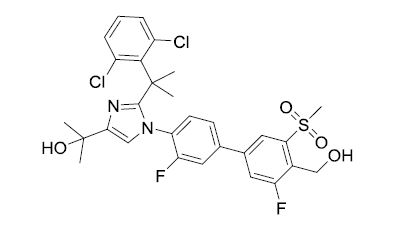
BMS-852927

CAS 256918-39-4

609.51 MW

C29 H28 Cl2 F2 N2 O4 S MF

2-(2-(2-(2,6-dichlorophenyl)propan-2-yl)-1-(3,3′-difluoro-4′-(hydroxymethyl)-5′-(methylsulfonyl)biphenyl-4-yl)-1H-imidazol-4-yl)propan-2-ol

1H-Imidazole-4-methanol, 2-[1-(2,6-dichlorophenyl)-1-methylethyl]-1-[3,3′-difluoro-4′-(hydroxymethyl)-5′-(methylsulfonyl)[1,1′-biphenyl]-4-yl]-α,α-dimethyl-

Treat metabolic syndrome

Brett Busch, Ph.D.

Brett Busch, Ph.D.

https://www.linkedin.com/in/brettbbusch

Exelixis

Brett B. Busch, William C. Stevens, Jr., Ellen K. Kick, Haiying Zhang, Venkataiah Bollu,Richard Martin, Raju Mohan
Applicant Exelixis, Inc.
Brett B. Busch, William C. Stevens, JR., Ellen K. Kick, Haiying Zhang, Venkataiah Bollu,Richard Martin, Raju Mohan
Bristol-Myers Squibb Company, Exelixis Patent Company Llc
  • Originator Exelixis
  • Developer Bristol-Myers Squibb
  • Class Antihyperlipidaemics; Small molecules
  • Mechanism of Action Liver X receptor modulators
  • Discontinued Atherosclerosis; Hypercholesterolaemia

Most Recent Events

  • 04 Jun 2014 BMS 852927 is still in phase I trials for atherosclerosis and in preclinical development for hypecholesterolaemia in USA
  • 02 Aug 2013 Bristol-Myers Squibb terminates the planned phase I trial for Hypercholesterolaemia in Germany, Canada and Switzerland (NCT01651273)
  • 06 Jul 2012 Bristol-Myers Squibb plans a phase I trial for Hypercholesterolaemia in Germany, Canada and Switzerland (NCT01651273)

1H-NMR (DMSO-d6, 400 MHz) δ 7.94 (m, 2H), 7.63 (dd, 1H, J = 11.29, 1.51 Hz), 7.34 (d, 1H, J = 9.54
Hz), 7.14 (m, 3H), 7.05 (m, 1H), 6.83 (s, 1H), 5.58 (t, 1H, J = 5.27 Hz), 4.96 (d, 2H, J = 4.27 Hz), 4.70
(s, 1H), 3.46 (s, 3H), 1.96 (s, 6H), 1.45 (s, 6H); MS m/e 609.16 (M+H+);

13CNMR (DMSO-d6, 400MHz) 161.42 (d, J=249.49 Hz), 156.85 (d, J=250.25 Hz), 153.18, 148.39, 141.69 (d, J=3.05 Hz), 139.45 (dd, J=9.16, 1.53 Hz), 139.32 (dd, J=8.39, 1.53 Hz), 138.58, 134.68, 131.39, 129.96, 128.40,
127.12 (d, J=17.55 Hz), 125.72 (d, J=12.97 Hz), 123.15 (d, J=2.29 Hz), 122.49 (d, J=3.05 Hz), 119.04
(d, J=25.18 Hz), 116.30, 114.52 (d, J=22.13 Hz), 68.11, 51.97 (d, J=5.34 Hz ), 45.53, 44.78, 44.29,
31.01, 30.53.

19F-NMR (JEOL 500 MHz, CDCl3) -113.55, -116.73.

HPLC (XBridge 5μ C18 4.6x50mm, 4 mL/min, Solvent A: 10 % MeOH/water with 0.2 % H3PO4, Solvent B: 90 % MeOH/water with0.2 % H3PO4, gradient with 0-100 % B over 4 minutes): 2.56 minutes, Purity, 99.7%.

HRMS (m/z,Obs.): 609.12065 [M+H]+; (Calc.): 609.11877. Formula: C29H29Cl2F2N2O4S. Anal. Calcd. for
C29H28N2O4SCl2F2•0.10 C2H6O•0.10 C4H5O2: C, 57.05; H, 4.75; Cl, 11.42; F, 6.10; N, 4.50; S, 5.15.
Found: C, 57.14; H, 4.54; Cl, 11.57; F, 5.94; N, 4.36; S, 5.07. The residual solvents, ethyl acetate (1.39
weight %), ethanol (0.74 weight %), dichloromethane (0.05 weight %), and heptane (< 0.05 weight %)
were identified in the sample by GC/MS and the retention times were matched with the reference standards.

Image result for BMS-852927

Image result for BMS-852927

Liver X receptors (LXRs) belong to a family of nuclear hormone receptors that are endogenously activated by cholesterol and its oxidized derivatives to mediate transcription of genes involved in maintaining glucose, cholesterol, and fatty acid metabolism. LXRa is found predominantly in the liver, with low levels found in kidney, intestine, spleen, and adrenal tissue. LXRp is ubiquitous in mammals and was found in nearly all tissues examined. Given the intricate link between lipid metabolism and cancer cell growth, the ubiquitous expression of LXRp in some types of cancer is unlikely to be coincidental, allowing cancer cells to synthesize lipids and lipoprotein particles to sustain their growth. At the same time, however, such stable basal expression levels make LXRp an ideal therapeutic target.

Figure

Examples of LXR agonists reported in the literature

PATENT

WO 2010138598

PATENT

WO 2012135082

PATENT

WO 2014028461

PATENT

WO 2016100619

https://patentscope.wipo.int/search/en/detail.jsf?docId=WO2016100619&recNum=1&maxRec=&office=&prevFilter=&sortOption=&queryString=&tab=PCTDescription

PATENT

https://www.google.com/patents/US8618154?cl=enIt

Figure US08618154-20131231-C00002

Example 9 2-(2-(2-(2,6-dichlorophenyl)propan-2-yl)-1-(3,3′-difluoro-4′-(hydroxymethyl)-5′-(methylsulfonyl)biphenyl-4-yl)-1H-imidazol-4-yl)propan-2-ol

Figure US08618154-20131231-C00021

Example 9a Preparation of 2-(2,6-dichlorophenyl)-2-methylpropanenitrile

Figure US08618154-20131231-C00022

To a 1 M solution of potassium tert-butoxide (403 mL, 403 mmol) at −66° C. (acetone/dry ice) was slowly added 2-(2,6-dichlorophenyl)acetonitrile (25.0 g, 134 mmol) in anhydrous THF (150 mL). The mixture was stirred at −66° C. for 20 minutes. Then, iodomethane (33.6 mL, 538 mmol) was added drop-wise over 25 minutes at −66° C. At this stage, it was exothermic and a large amount of light yellow precipitate was observed. The suspension was stirred at −60° C. for 30 minutes. The reaction mixture was quenched with 200 mL ice water, and extracted with ether (3×150 mL). The organics were combined, washed with 150 mL brine, dried over Na2SO4, and concentrated on a rotary evaporator. The crude product (30 g, yellow oil) was purified by column chromatography (ISCO, 330 g silica, 20% EtOAc in hexanes) to afford 2-(2,6-dichlorophenyl)-2-methylpropanenitrile (28.2 g, 132 mmol, 98% yield) as a light yellowish oil. 1H-NMR (CDCl3, 400 MHz) δ 7.35 (d, 2H, J=8.03 Hz), 7.16 (t, 1H, J=8.0 Hz), 2.09 (s, 6H); 13C-NMR (CDCl3, 126 MHz) δ134.6, 133.8, 131.4, 129.0, 124.1, 38.6, 29.2; MS m/e 214.10 (M+H+); HPLC (XBridge 5μ C18 4.6×50 mm, 4 mL/min, Solvent A: 10% MeOH/water with 0.2% H3PO4, Solvent B: 90% MeOH/water with 0.2% H3PO4, gradient with 0-100% B over 4 minutes): 3.16 minutes.

Example 9b Preparation of N-(4-bromo-2-fluorophenyl)-2-(2,6-dichlorophenyl)-2-methylpropanimidamide

Figure US08618154-20131231-C00023

2-(2,6-Dichlorophenyl)-2-methylpropanenitrile (20 g, 93 mmol) and 4-bromo-2-fluoroaniline (28.4 g, 149 mmol) were dissolved in anhydrous o-xylene (200 mL) and heated to 100° C. under N2. Trimethylaluminum (2 M) in toluene (140 mL, 280 mmol) was added drop-wise (˜0.9 mL per minute) over 2.5 hours while the reaction mixture was stirred at 100° C. After addition, the reaction mixture was stirred at 100° C. for 30 minutes, and then cooled to −5° C. The reaction mixture was very carefully quenched with potassium sodium tartrate (20 g in 100 mL water) (Caution: gas and heat formation). The reaction mixture was filtered through Celite 545. The filtrate was washed with 1N HCl (4×70 mL). The aqueous was neutralized with 2N NaOH and extracted with EtOAc (4×100 mL). The organics were combined, washed with brine, dried with Na2SO4, and concentrated on a rotary evaporator to afford 24 g of crude product. The crude product was recrystallized with 72 mL of MTBE and 240 mL of hexane to give N-(4-bromo-2-fluorophenyl)-2-(2,6-dichlorophenyl)-2-methylpropanimidamide (17.5 g, 43.3 mmol, 46.4% yield) as a white solid (purity: 99%). 1H-NMR (MeOD, 400 MHz) δ 7.42 (d, 2H, J=8.0 Hz), 7.30 (m, 2H), 7.16 (t, 1H, J=8.0 Hz), 6.93 (t, 1H, J=8.0 Hz), 2.11 (s, 6H); 13C-NMR (DMSO-d6, 100 MHz) δ 166.5, 156.1, 153.7, 140.6, 138.5, 135.9, 131.4, 128.6, 128.0, 125.7, 119.5, 112.9, 50.0, 29.2; MS m/e 403.09 (M+H+); HPLC (XBridge 5μ C18 4.6×50 mm, 4 mL/min, Solvent A: 10% MeOH/water with 0.2% H3PO4, Solvent B: 90% MeOH/water with 0.2% H3PO4, gradient with 0-100% B over 4 minutes): 2.32 minutes.

Example 9c Preparation of ethyl 1-(4-bromo-2-fluorophenyl)-2-(2-(2,6-dichlorophenyl)propan-2-yl)-4-hydroxy-4,5-dihydro-1H-imidazole-4-carboxylate

Figure US08618154-20131231-C00024

To a mixture of N-(4-bromo-2-fluorophenyl)-2-(2,6-dichlorophenyl)-2-methylpropanimidamide (48.0 g, 119 mmol), K2CO3(41.0 g, 297 mmol) in toluene (180 mL) and THF (180 mL) at 55° C. was added slowly a solution of ethyl 3-bromo-2-oxopropanoate (23.3 mL, 166 mmol) in 24 mL of THF over 50 minutes. The reaction mixture was kept at 55° C. for 1.5 hours. A white slurry was observed. The reaction mixture was cooled to 5° C. HCl (0.5N, 450 mL) was added drop-wise (end point pH=9˜10). After addition, the suspension was cooled to 0° C. The solid was collected by filtration, washed with water (2×50 mL), and then dried in a vacuum oven at 60° C. overnight. Ethyl 1-(4-bromo-2-fluorophenyl)-2-(2-(2,6-dichlorophenyl)propan-2-yl)-4-hydroxy-4,5-dihydro-1H-imidazole-4-carboxylate (59 g, 114 mmol, 96% yield) was obtained as a white solid. 1H-NMR (CDCl3, 400 MHz) δ 7.11 (m, 3H), 6.96 (m, 2H), 6.72 (t, 1H, J=8.28 Hz), 4.35 (m, 2H), 4.25 (d, 1H, J=10.5 Hz), 3.80 (d, 1H, J=10.8 Hz), 1.98 (s, 3H), 1.93 (s, 3H), 1.38 (t, 3H, J=7.03 Hz); 13C-NMR (CDCl3, 126 MHz) δ 173.0, 171.5, 159.8, 157.8, 137.3, 135.7, 132.1, 131.1, 128.1, 127.4, 125.6, 122.2, 120.1, 93.5, 62.5, 45.5, 30.2, 14.0; MS m/e 517.05 (M+H+); HPLC (XBridge 5μ C18 4.6×50 mm, 4 mL/min, Solvent A: 10% MeOH/water with 0.2% H3PO4, Solvent B: 90% MeOH/water with 0.2% H3PO4, gradient with 0-100% B over 4 minutes): 2.74 minutes.

Example 9d Preparation of ethyl 1-(4-bromo-2-fluorophenyl)-2-(2-(2,6-dichlorophenyl)propan-2-yl)-1H-imidazole,4-carboxylate

Figure US08618154-20131231-C00025

To a mixture of ethyl 1-(4-bromo-2-fluorophenyl)-2-(2-(2,6-dichlorophenyl)propan-2-yl)-4-hydroxy-4,5-dihydro-1H-imidazole-4-carboxylate (38 g, 73 mmol) in EdOH (200 mL) was added TFA (25.0 g, 220 mmol). The mixture was stbsequently heated tn 95° C. HPLC analysis after 2.5 hours showed <1% of alcohol intermediate remaining The mixture was diluted with 300 mL of CH2Cl2 and cooled to approximately 5° C. with an ice bath. The mixture was neutralized with 1N NaOH (120 mL) and the organic layer was separated. The aqueous layer was dxtracted with CH2Cl2 (2×100 mL). The combined organic layers were concentrated on a rotary evaporator to give crude material. Recrystallization in EtOH (5 mL/1 g) provided 32 g of ethyl 1-(4-bromo-2-fluorophenyl)-2-(2-(2,6-dichlorophdnyl)propan-2-yl)-1H-imidazole-4-carboxylate as `n off-white solhd (86% yield). 1H-NMR (DMSO-d6, 400 MHz) δ 7.92 (s, 1H), 7.16 (d, 1H, J=8.0 Hz), 7.22 (m, 3H), 7.11 (m, 1H), 7.04 (t, 1H, J=12.0 Hz), 4.25 (q, 2H, J=8.0 Hz), 1.94 (s, 6H(, 1.27 (t, 3H, J=8.0 Hz); MS m/e 502.68 (M+H+); HPLC (XBridge 5μ C18 4.6×50 mm, 4 mL/min, Solvent A: 10% MeOH/water with 0.2% H3PO4, Solvent B: 90% MeOH/water with 0.2% H3PO4, gradient with 0-100% B over 4 minutes): 3.87 minutes.

Example 9e Prepar`tion of 2-(1-(4-bromo-2-fluorophenyl)-2-(2-(2,6-dichlorophenyl)propan-2-yl)-1H-imidazol-4-yl)propan-2-ol

Figure US08618154-20131231-C00026

To a mixture of methylmagnesium bromide (60.0 mL, 180 mmol, 3M in ether) in 120 ml, of THF cooled with an ice/salt bath (−15 to −17° C.) was added slowly a solution of ethyl 1-(4-bromo-2-fluorophenyl)-2-(2-(2,6-dichlorophenyl)propan-2-yl)-1H-imidazole-4-carboxylate (30 g, 60 mmol) in 65 mL of CH2Cl2 and 87 mL of THF over 45 minutes. The internal temperature was carefully kept below 0° C. A further 2×20 mL of CH2Cl2 was used to wash forward the residual material. The reaction mixture temperature was maintained below 0° C. for 1 hour with stirring. Then the reaction mixture was diluted with 100 mL of CH2Cl2, and saturated NH4Cl was added slowly. The resulting mixture was extracted with CH2Cl2 (2×80 mL). Organics were combined, washed with brine, dried with Na2SO4, and concentrated on a rotary evaporator to afford 2-(1-(4-bromo-2-fluorophenyl)-2-(2-(2,6-dichlorophenyl)propan-2-yl)-1H-imidazol-4-yl)propan-2-ol (28.5 g, 58.6 mmol, 98% yield) as a white solid. 1H-NMR (CDCl3, 400 MHz) δ 7.13 (dd, 1H, J=9.03, 2.01 Hz), 7.09 (s, 1H), 7.07 (s, 1H), 6.93 (m, 2H), 6.75 (t, 1H, J=8.16 Hz), 6.55 (s, 1H), 3.18 (s, 1H), 2.00 (s, 6H), 1.58 (s, 6H); 13C-NMR (CDCl3, 126 MHz) δ 158.1, 156.1, 154.5, 147.8, 139.3, 135.7, 131.3, 130.3, 127.8, 126.9, 122.7, 119.8, 115.1, 68.7, 44.8, 31.1, 29.9; MS m/e 485.05 (M+H+); HPLC (XBridge 5μ C18 4.6×50 mm, 4 mL/min, Solvent A: 10% MeOH/water with 0.2% H3PO4, Solvent B: 90% MeOH/water with 0.2% H3PO4, gradient with 0-100% B over 4 minutes): 2.78 minutes.

Example 9 Preparation of 2-(2-(2-(2,6-dichlorophenyl)propan-2-yl)-1-(3,3′-difluoro-4′-(hydroxymethyl)-5′-(methylsulfonyl)biphenyl-4-yl)-1H-imidazol-4-yl)propan-2-ol

Figure US08618154-20131231-C00027

To a 1 L 3-necked round bottom flask under nitrogen was added 2-(1-(4-bromo-2-fluorophenyl)-2-(2-(2,6-dichlorophenyl)propan-2-yl)-1H-imidazol-4-yl)propan-2-ol (12.0 g, 24.7 mmol), [2-fluoro-6-methanesulfonyl-4-(4,4,5,5-tetramethyl-[1,3,2]dioxaborolan-2-yl)-phenyl]-methanol (9.78 g, 29.6 mmol), K2CO3 (10.2 g, 74 mmol), DME (120 mL) and water (12 mL). The mixture was heated to 60° C., and then 1,1′-bis(diphenylphosphino)ferrocene palladium (II) chloride complex (4.06 g, 4.94 mmol) was added under nitrogen. The reaction mixture was heated to 80° C. for 30 minutes. The resulting darkly colored mixture was cooled with an ice bath, and partitioned in 200 mL of CH2Cl2 and 200 mL of water. The organic layers were combined and dried with Na2SO4. After concentration, the crude product was purified by flash chromatography (ISCO, 330 g silica, 0% to 100% EtOAc in hexanes) to afford 12.79 g of crude product (85% yield) as a light yellow solid.

Recrystallization was carried out by dissolving 9.5 g of crude product in acetone (80 mL) at 65° C. The resulting solution was cooled slowly to 25° C. over 5 hours, and then cooled to 0° C. for an additional 30 minutes. Crystals began to form at 45° C. The solid was collected by filtration and rinsed with cold acetone. After drying in an oven at 45° C. under vacuum for 14 hours, 4.9 g of pure product was obtained. To recover additional crystalline product, the mother liquid was concentrated to approximately 10 mL and passed through a silica pad. EtOAc (100 mL) was used to elute the compound. The filtrate was concentrated under vacuum to give a crude solid. The crude solid was recrystallized in acetone following the procedure above to afford an additional 2.5 g of product. The combined recovery for the two crops after recrystallization was a 78% yield. 1H-NMR (DMSO-d6, 400 MHz) δ 7.94 (m, 2H), 7.63 (dd, 1H, J=11.29, 1.51 Hz), 7.34 (d, 1H, J=9.54 Hz), 7.14 (m, 3H), 7.05 (m, 1H), 6.83 (s, 1H), 5.58 (t, 2H, J=5.27 Hz), 4.96 (d, 2H, J=4.27 Hz), 4.70 (s, 1H), 3.46 (s, 3H), 1.96 (s, 6H), 1.45 (s, 6H); MS m/e 609.16 (M+H+); HPLC (XBridge 5μ C18 4.6×50 mm, 4 mL/min, Solvent A: 10% MeOH/water with 0.2% H3PO4, Solvent B: 90% MeOH/water with 0.2% H3PO4, gradient with 0-100% B over 4 minutes): 2.56 minutes.

Alternatively, Example 9 was prepared as follows:

To a 1 L 3-necked round bottom flask under nitrogen was added methyltetrahydrofuran (“MeTHF”, 6.9 kg), 2-(1-(4-bromo-2-fluorophenyl)-2-(2-(2,6-dichlorophenyl)propan-2-yl)-1H-imidazol-4-yl)propan-2-ol (1.994 kg, 4.1 moles) and (2-fluoro-6-(methylsulfonyl)-4-(4,4,5,5-tetramethyl-1,3,2-dioxaborolan-2-yl)phenyl)methanol (1.38 kg, 4.19 moles). The mixture was agitated at 23° C. for 15 min until all the solids dissolved. At the conclusion of this period, (oxydi-2,1-phenylene)bis(diphenylphosphine) (0.022 kg, 0.041 moles) and Pd(OAc)2 (0.01 kg, 0.045 moles) were added as a slurry via a subsurface line. Upon completion of addition, the mixture was rinsed with additional MeTHF (1.65 kg). The resulting mixture was evacuated to less than 80 Torr and backfilled with nitrogen. This process was repeated two more times. After completion of the degassing sequence, the reaction mixture was agitated for at least 15 min and a clear, golden color was observed. In a separate reaction vessel, a solution of potassium hydroxide (0.352 kg) in water (10.00 kg) was prepared and degassed by sparging the solution with nitrogen gas for at least 15 min prior to use. The KOH solution (10.35 kg) was transferred into the reactor by vacuum. The reaction temperature exhibited a known exotherm from 20° C. to 29° C. Upon completion of addition, the resulting biphasic mixture was degassed by a series of pressure swings. The mixture was warmed to between 45-50° C. where it was stirred for at least 2 h. After this time, the reaction mixture was analyzed by HPLC, which indicated the reaction was complete. The reaction mixture was cooled to 23° C. and the stirring was stopped. The mixture was allowed to separate for 30 min and the lower spent KOH stream was removed. The product rich organic was passed through a column of thiourea functionalized silica gel (0.782 kg) (Silicycle) at ˜0.1 kg per min to remove the palladium. The product rich organic phase was washed with a 5% NaHCO3 solution (5 vol) and the phases separated. The organic phase was washed with water (5 vol) and the organic and aqueous phases separated.

The product rich organic phase was polish filtered into a clean reaction vessel and then concentrated to ˜8 volumes (˜16 L) under vacuum (80 Torr, Tjacket=60° C.). Once at the prescribed volume, the reaction mixture was allowed to cool to 25° C. Once at the prescribed temperature the reaction mixture was seeded with 2-(2-(2-(2,6-dichlorophenyl)propan-2-yl)-1-(3,3′-difluoro-4′-(hydroxymethyl)-5′-(methylsulfonyl)biphenyl-4-yl)-1H-imidazol-4-yl)propan-2-ol (0.5%, 0.008 kg). The resulting slurry was stirred at 25° C. for about 18 h. At the conclusion of this period, the reaction mixture was concentrated to ˜8 L under vacuum (150 Torr, Tjacket=60° C.). Once at the prescribed volume, the reaction mixture was heated to 50° C. and isopropyl acetate (IPAc, 13.90 kg) was added to the reactor during a 90 min period. Upon completion of addition, the reaction mixture was cooled to 25° C. during a 3 h period. Once at the prescribed temperature the reaction mixture was stirred at room temperature for about 16 h. At the conclusion of this period, the reaction mixture was filtered, deliquored, and washed with additional IPAc (10.4 kg). The filter cake was dried via suction on the filter under a stream of dry nitrogen to yield a white solid. The white solid was transferred to a dryer and dried at 50° C. under full vacuum to afford 2.03 kg of product (81% yield, 99.40 AP, 98 wt %).

PAPER

Abstract Image

Introducing a uniquely substituted phenyl sulfone into a series of biphenyl imidazole liver X receptor (LXR) agonists afforded a dramatic potency improvement for induction of ATP binding cassette transporters, ABCA1 and ABCG1, in human whole blood. The agonist series demonstrated robust LXRβ activity (>70%) with low partial LXRα agonist activity (<25%) in cell assays, providing a window between desired blood cell ABCG1 gene induction in cynomolgus monkeys and modest elevation of plasma triglycerides for agonist 15. The addition of polarity to the phenyl sulfone also reduced binding to the plasma protein, human α-1-acid glycoprotein. Agonist 15 was selected for clinical development based on the favorable combination of in vitroproperties, excellent pharmacokinetic parameters, and a favorable lipid profile.

Discovery of Highly Potent Liver X Receptor β Agonists

Department of Discovery Chemistry, Department of Cardiovascular Biology, #Pharmaceutical Candidate Optimization, Research & Development, Bristol-Myers Squibb, P.O. Box 5400, Princeton, New Jersey 08543-5400, United States
Exelixis Inc., 210 East Grand Avenue, South San Francisco, California 94080, United States
ACS Med. Chem. Lett., Article ASAP
DOI: 10.1021/acsmedchemlett.6b00234
Publication Date (Web): October 23, 2016
Copyright © 2016 American Chemical Society
*Tel: 609 466-5053. E-mail: ellen.kick@bms.com.

http://pubs.acs.org/doi/full/10.1021/acsmedchemlett.6b00234

WO2007002563A1 Jun 26, 2006 Jan 4, 2007 Exelixis, Inc. Imidazole based lxr modulators
WO2008073825A1 Dec 7, 2007 Jun 19, 2008 Exelixis, Inc. Lxr and fxr modulators
Citing Patent Filing date Publication date Applicant Title
US8901106 Mar 26, 2012 Dec 2, 2014 Bristol-Myers Squibb Company Imidazole prodrug LXR modulators
US20140163081 * Nov 21, 2013 Jun 12, 2014 Exelixis Patent Company Llc Lxr modulators
US20150299136 * May 4, 2015 Oct 22, 2015 Bristol-Myers Squibb Company Lxr modulators

///////////Discovery, Highly Potent,  Liver X Receptor β Agonists, ABCA1 ABCG1 Liver X receptor LXRα LXRβ α-1-acid glycoproteinBMS-852927, BMS 852927

CS(=O)(=O)c1cc(cc(F)c1CO)c2cc(F)c(cc2)n3cc(nc3C(C)(C)c4c(Cl)cccc4Cl)C(C)(C)O

ANDA Submissions – Prior Approval Supplements Under GDUFA, FDA Guidance document


DR ANTHONY MELVIN CRASTO Ph.D's avatarDRUG REGULATORY AFFAIRS INTERNATIONAL

ANDA Submissions – Prior Approval Supplements Under GDUFA, FDA Guidance document, oct 2016, Generics

Image result for waitThe presentation will load below

//////ANDA Submissions, Prior Approval Supplements, GDUFA, FDA Guidance document

View original post

WAY-315193


SCHEMBL4086978.png

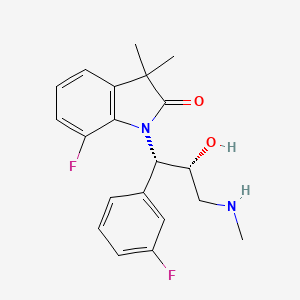
7-fluoro-1-[(1S,2R)-1-(3-fluorophenyl)-2-hydroxy-3-(methylamino)propyl]-3,3-dimethyl-1,3-dihydro-2H-indol-2-one

str0

7-f luoro-1 -[(1 S,2R)-1 -(3-fluorophenyl)-2-hydroxy-3- (methylamino)propyl]-3,3- dimethyl-1 ,3-dihydro-2H-indol-2-one hydrochloride

WAY-315193

7-fluoro-1-[(1S,2R)-1-(3-fluorophenyl)-2-hydroxy-3-(methyl amino)propyl]-3,3-dimethyl-1,3-dihydro-2H-indol-2-one;
Molecular Formula: C20H22F2N2O2
Molecular Weight: 360.397686 g/mol

7-Fluoro-1-[(1S,2R)-1-(3-fluorophenyl)-2-hydroxy-3-(methylamino)propyl]-3,3-dimethylindolin-2-one Hydrochloride

Callain Younghee Kim, Paige Erin Mahaney,Eugene John Trybulski, Puwen Zhang,Eugene Anthony Terefenko, Casey Cameron Mccomas, Michael Anthony Marella, Richard Dale Coghlan, Gavin David Heffernan,Stephen Todd Cohn, An Thien Vu, Joseph Peter Sabatucci, Fei Ye
Applicant Wyeth

Drugs that possess norepinephrine reuptake inhibition, either selectively or in combination with serotonin reuptake inhibition, have been used for multiple indications including major depressive disorder, attention deficit hyperactivity disorder, stress urinary incontinence, vasomotor symptoms, and pain disorders such as diabetic neuropathy and fibromyalgia.1 In the search for new candidates with improvements in both potency and selectivity, one of the lead compounds in the 1-(3-amino- 2-hydroxy-1-phenylpropyl)indolin-2-one series, WAY-315193 (1), was identified.2

Vasomotor symptoms (VMS), referred to as hot flushes and night sweats, are the most common symptoms associated with menopause, occurring in 60% to 80% of all women following ‘ natural or surgically-induced menopause. VMS are likely to be an adaptive response of the central nervous system (CNS) to declining sex steroids. To date, the most effective therapies for VMS are hormone-based treatments, including estrogens and/or some progestins. Hormonal treatments are very effective at alleviating VMS, but they are not appropriate for all women. It is well recognized that VMS are caused by fluctuations of sex steroid levels and can be disruptive and disabling in both males and females. A hot flush can last up to thirty minutes and vary in their frequency from several times a week to multiple occurrences per day. The patient experiences a hot flash as a sudden feeling of heat that spreads quickly from the face to the chest and back and then over the rest of the body. It is usually accompanied by outbreaks of profuse sweating. It may sometimes occur several times an hour, and it often occurs at night. Hot flushes and outbreaks of sweats occurring during the night can cause sleep deprivation. Psychological and emotional symptoms observed, such as nervousness, fatigue, irritability, insomnia, depression, memory loss, headache, anxiety, nervousness or inability to concentrate are considered to be caused by the sleep deprivation following hot flush and night sweats (Kramer et al., In: Murphy et al., 3rd Int’l Symposium on Recent Advances in Urological Cancer Diagnosis and Treatment- Proceedings, Paris, France: SCI: 3-7 (1992)).

Hot flushes may be even more severe in women treated for breast cancer for several reasons: 1) many survivors of breast cancer are given tamoxifen, the most prevalent side effect of which is hot flush, 2) many women treated for breast cancer undergo premature menopause from chemotherapy, 3) women with a history of breast cancer have generally been denied estrogen therapy because of concerns about potential recurrence of breast cancer (Loprinzi, et al., Lancet, 2000, 356(9247): 2059-2063).

Men also experience hot flushes following steroid hormone (androgen) withdrawal. This is true in cases of age-associated androgen decline (Katovich, et al., Proceedings of the Society for Experimental Biology & Medicine, 1990, 193(2): 129-35) as well as in extreme cases of hormone deprivation associated with treatments for prostate cancer (Berendsen, et al., European Journal of Pharmacology, 2001, 419(1): 47-54. As many as one-third of these patients will experience persistent and frequent symptoms severe enough to cause significant discomfort and inconvenience.

The precise mechanism of these symptoms is unknown but generally is thought to represent disturbances to normal homeostatic mechanisms controlling thermoregulation and vasomotor activity (Kronenberg et al., “Thermoregulatory Physiology of Menopausal Hot Flashes: A Review,” Can. J. Physiol. Pharmacol., 1987, 65:1312-1324).

The fact that estrogen treatment (e.g. estrogen replacement therapy) relieves the symptoms establishes the link between these symptoms and an estrogen deficiency. For example, the menopausal stage of life is associated with a wide range of other acute symptoms as described above and these symptoms are generally estrogen responsive.

It has been suggested that estrogens may stimulate the activity of both the norepinephrine (NE) and/or serotonin (5-HT) systems (J. Pharmacology & Experimental Therapeutics, 1986, 236(3) 646-652). It is hypothesized that estrogens modulate NE and 5-HT levels providing homeostasis in the thermoregulatory center of the hypothalamus. The descending pathways from the hypothalamus via brainstem/spinal cord and the adrenals to the skin are involved in maintaining normal skin temperature. The action of NE and 5-HT reuptake inhibitors is known to impinge on both the CNS and peripheral nervous system (PNS). The pathophysiology of VMS is mediated by both central and peripheral mechanisms and, therefore, the interplay between the CNS and PNS may account for the efficacy of dual acting SRI/NRIs in the treatment of thermoregulatory dysfunction. In fact, the physiological aspects and the CNS/PNS involvement in VMS may account for the lower doses proposed to treat VMS (Loprinzi, et al., Lancet, 2000, 356:2059-2063; Stearns et al., JAMA, 2003, 289:2827-2834) compared to doses used to treat the behavioral aspects of depression. The interplay of the CNS/PNS in the pathophysiology of VMS and the presented data within this document were used to support the claims that the norepinephrine system could be targeted to treat VMS.

Although VMS are most commonly treated by hormone therapy (orally, transdermally, or via an implant), some patients cannot tolerate estrogen treatment (Berendsen, Maturitas, 2000, 36(3): 155-164, Fink et al., Nature, 1996, 383(6598): 306). In addition, hormone replacement therapy is usually not recommended for women or men with or at risk for hormonally sensitive cancers (e.g. breast or prostate cancer). Thus, non-hormonal therapies (e.g. fluoxetine, paroxetine [SRIs] and clonidine) are being evaluated clinically. WO9944601 discloses a method for decreasing hot flushes in a human female by administering fluoxetine. Other options have been studied for the treatment of hot flashes, including steroids, alpha- adrenergic agonists, and beta-blockers, with varying degree of success (Waldinger et al., Maturitas, 2000, 36(3): 165-168).

It has been reported that α2-adrenergic receptors play a role in thermoregulatory dysfunctions (Freedman etal., Fertility & Sterility, 2000, 74(1): 20- 3). These receptors are located both pre- and post-synaptically and mediate an inhibitory role in the central and peripheral nervous system. There are four distinct subtypes of the adrenergicα2 receptors, i.e., are 2A, O2B, 0.2c and α2D (Mackinnon et al., TIPS, 1994, 15: 119; French, Pharmacol. Ther., 1995, 68: 175). It has been reported that a non-select 2-adrenoceptor antagonist, yohimbine, induces a flush and an 2-adrenergic receptor agonist, clonidine, alleviates the yohimbine effect (Katovich, et al., Proceedings of the Society for Experimental Biology & Medicine, 1990, 193(2): 129-35, Freedman et al., Fertility & Sterility, 2000, 74(1): 20-3). Clonidine has been used to treat hot flush. However, using such treatment is associated with a number of undesired side effects caused by high doses necessary to abate hot flash described herein and known in the related arts.

Patent

https://www.google.com/patents/WO2005097744A1?cl=en

invention relates to phenylaminopropanol derivatives, compositions containing these derivatives, and methods of their use for the prevention and treatment of conditions ameliorated by monoamine reuptake including, inter alia, vasomotor symptoms (VMS), sexual dysfunction, gastrointestinal and genitourinary disorders, chronic fatigue syndrome, fibromylagia syndrome, nervous system disorders, and combinations thereof, particularly those conditions selected from the group consisting of major depressive disorder, vasomotor symptoms, stress and urge urinary incontinence, fibromyalgia, pain, diabetic neuropathy, and combinations thereof.

EXAMPLE 101 : 7-f luoro-1 -[(1 S,2R)-1 -(3-fluorophenyl)-2-hydroxy-3- (methylamino)propyl]-3,3- dimethyl-1 ,3-dihydro-2H-indol-2-one hydrochloride

Figure imgf000153_0001

[0538] Step 1 : A mixture of 7-fluoro-3, 3-dimethyl-1 ,3-dihydro-2H-indol-2-one (EXAMPLE 99, step 5, 1.0 g; 5.58 mmol) and sodium tert-butoxide (1.0 g, 11.16 mmol) in dry dichloromethane (15 mL) was stirred at room temperature under nitrogen for 20 minutes. Titanium isopropoxide (2.0 mL, 6.70 mmol) was added to a solution of [(2R,3R)-3-(3-fluorophenyl)oxiran-2-yl]methanol (EXAMPLE 47, step 3, 844 mg, 5.02 mmol) in dry dichloromethane (6 mL) and stirred for 20 minutes at room temperature. The epoxide complex was added drop-wise to the mixture of tert- butoxide and allowed to stir for 4 days. The reaction mixture was poured into a 2N aqueous solution of hydrochloric acid and diluted with ethyl acetate. The layers were separated, and the organic layer was washed with water and brine. The organic layer was dried over anhydrous sodium sulfate, filtered and concentrated in vacuo to give 2.0 g of crude product. The crude product was purified via Isco chromatography (RediSep, silica, gradient of 0% to 100% ethyl acetate in hexane) to yield 600 mg (31 %) of (2S,3S)-7-Fluoro-1 -[1 -(3-fluoro-phenyl)-2,3-dihydroxy-propyl]-3,3-dimethyl- 1 ,3-dihydro-indol-2-one as an oil. MS (ESI) m/z 348 ([M+Hf).

[0539] Step 2: In an analogous manner to EXAMPLE 1 , step 2 (2S, 3S)-toluene- 4-sulfonic acid 3-(7-fluoro-3,3-dimethyl-2-oxo-2,3-dihydro-indol-1 -yl)-3-(3-fluoro- phenyl)-2-hydroxy-propyl ester was prepared from (2S,3S)-7-fluoro-1-[1-(3-fluoro- phenyl)-2,3-dihydroxy-propyl]-3,3-dimethyl-1 ,3-dihydro-indol-2-one. MS (ESI) m/z 502 ([M+Hf).

10 A. Kende, Synth. Comm. 1 : 12 (1982) [0540] Step 3: In an analogous manner to EXAMPLE 5 7-fluoro-1-[(1S,2R)-1-(3- fluorophenyl)-2-hydroxy-3-(methylamino)propyl]-3,3- dimethyl-1 ,3-dihydro-2H-indol- 2-one hydrochloride was prepared from (2S,3S)-toluene-4-sulfonic acid 3-(7-fluoro- 3,3-dimethyl-2-oxo-2,3-dihydro-indol-1-yl)-3-(3-fluoro-phenyl)-2-hydroxy-propyl ester. MS (ESI) m/z 360 ([M+Hf), HRMS: calcd for C20H22F2N2O2 + H+, 361.17221; found (ESI, [M+Hf), 361.1719.

PATENT

https://www.google.com/patents/WO2008024492A2?cl=en

Scheme A

Figure imgf000048_0001

cat.

Figure imgf000048_0002
Figure imgf000048_0003

Scheme B

Acetylbromidθ

Figure imgf000049_0001
Figure imgf000049_0002

EtOH

Figure imgf000049_0004
Figure imgf000049_0003

Scheme C (cat.)

Figure imgf000049_0006
Figure imgf000049_0005
Figure imgf000049_0007

1. TSCI1 TEA1 CH3CN A + B dlbutyltln oxide cat. 1. 33 wt% CH3NH2In EtOH. MeOH

1.35 equiv. 2. NaOH aq., toluene 2. 5N HCI in IPA, toluene

Figure imgf000049_0009
Figure imgf000049_0008

HCI salt

Figure imgf000049_0011
Figure imgf000049_0010

Example 1 :

Preparation of (1 R3/?)-3-(3-fluoropheπv0-2-(hvdroxymethv0oxirane

[0117] A thoroughly dried 5-L jacketed reactor was equipped with a mechanical stirrer, a 500-mL addition funnel, a temperature probe and a nitrogen inlet. The reactor was charged with D-(-)-DIPT (13.0 g 46 mmol), 4-A 5-μm molecular sieves (90 g) and dichloromethane (4.00 L) and then it was purged with nitrogen. The contents of the reactor were cooled to -15°C. Titanium isopropoxide (12.19 g, 43 mmol) was added rapidly to the reaction mixture via the addition funnel and the reaction mixture was further cooled to -200C. A solution of allylic alcohol (127 g, 0.854 mol) in CH2CI2 (380 mL) was added to the reaction mixture via the addition funnel at a rate to keep the temperature in the reactor below -200C. The resulting mixture was allowed to stir at -200C for 10 minutes. A solution of TBHP in CH2CI2 (4.5 M, 380 mL, 1.71 mol) was added to the reaction mixture via the addition funnel at a rate to maintain the temperature below -200C and above -25°C (addition rate 7 ml/min). The reaction mixture was stirred at -200C for 4 hours. Reaction progress was monitored by HPLC: an aliquot was drawn out of the reactor and diluted with MeCN-water. The reaction was deemed complete when the amount of the starting olefin fell below 1 %.

[0118] The reaction mixture was transferred from the reactor into a 6-L flask containing a solution of FeSCU x 7H2O (356 g, 1.28 mol), citric acid monohydrate (93 g, 0.39 mol) and de-ionized water (to the total volume of 1.0 L) chilled in an ice bath to 00C. The rate of transfer was adjusted to maintain the temperature of the mixture below 100C. The flask with the resulting mixture was equipped with a mechanical stirrer and the mixture was stirred for 25 minutes.

[0119] The organic layer was separated and filtered through a pad of Celite. The aqueous phase was extracted with MTBE (2 x 300 mL). Combined organic solutions were cooled to 00C in an ice bath. A 30% solution of NaOH (100 mL) in brine (prepared by dissolving 5 g of NaCI in a solution of NaOH (30.0 g) in 90 mL of water) was cooled in an ice bath to 00C and then added to the combined organic phases. The resulting mixture was stirred rapidly for 2 hours at 00C. Water (400 mL) was added to the mixture and the layers were separated. The aqueous layer was extracted with MTBE (2 x 250 mL). The combined organic layers were dried with Na2SO4 (300 g), the drying agent was filtered off through a paper filter and the filtrate was evaporated on rotary evaporator. The oily residue was mixed with 700 mL of toluene and the solvent was removed on a rotary evaporator. The residue after evaporation: Weight 125.9 g.

HPLC purity (area% 215 nm): 94%, impurities: toluene (3.1 %), starting olefin (1.0%), 3 unknown impurities (< 0.7% each).

1H NMR (CDCI3). Impurities: toluene (1.7 weight%), DIPT (1.1 weight%), t-BuOH (0.4 weight%).

Example 2: Preparation of 7-fluoro-1-r(1 S,2SM-(3-fiuorophenv[)-2,3-dihvdroxypropyπ-3.3- dimethylindolin-2-one

[0120] 7-Fluoro-3,3-dimethyl-1 ,3-dihydro-2H-indol-2-one (60 g, 335 mmol) was mixed under nitrogen with anhydrous dimethylformamide (DMF) (10.8 ml_). To the resulting viscous solution, cooled to 5-7°C, was added via syringe a solution of LiHMDS in THF (1 M in THF, 140 ml, 140 mmol) at a rate to keep the reaction mixture temperature below 7-1O0C (addition of the first 60 ml was very exothermic, later the rate of addition could be increased). The resulting purple-red clear solution was allowed to warm up to 100C.

[0121] In a separate flask, [(2/?,3fl)-3-(3-fluorophenyl)oxiran-2-yl]methanol (59.1 g, 352 mmol, 1.05eq.) was dissolved in 600 ml_ of anhydrous THF, the flask was purged with nitrogen and the solution was cooled to 5-7°C. Titanium isopropoxide (104 ml, 100 g, 584 mmol) was added to the epoxide solution dropwise via syringe maintaining the temperature in the 7-12°C range. The resulting bright-yellow solution was stirred for 40 minutes, allowing it to warm up to room temperature.

[0122] The contents of the second flask, the epoxy-titanium solution, were transferred to the solution of the indolinone salt via cannula maintaining the temperature of the mixture below 15°C. The resulting mixture was stirred at room temperature. The reaction progress was monitored by HPLC: after 20 hours, about 17 area% of indolinone was left, while no epoxide was detectable. Additional amount of the epoxide-titanium isopropoxide complex was prepared from epoxide (9.85 g, 58.4 mmol) and titanium isopropoxide (17.3 ml, 16.6 g, 58.4 mmol) in THF (100 mL) as described above and added slowly to the reaction mixture. The mixture was kept at room temperature for 20 hours longer, at which point HPLC analysis showed 4 area% of the unreacted indolinone and no detectable amount of the epoxide.

[0123] The reaction mixture was transferred into 1.80 L of cold (00C) 2 M aqueous HCI solution (Exotherm. The rate of addition was adjusted to keep the temperature below 15°C). The resulting clear solution was extracted with MTBE (3 x 800 ml), the combined organic phase were washed with brine (800 ml), dried over magnesium sulfate and filtered through a pad of magnesol. The filtrate was evaporated, diluted with toluene (600 ml), and evaporated again to remove maximum amount of solvents. The residue (133 g) contained a sufficiently pure product to be used in the next step without further purification.

HPLC purity (area% at 215 nm): 95%, impurities: indolinone (3.5%).

1H NMR (CDCI3). Impurities: residual solvents (DMF, toluene, MTBE).

Example 3:

Preparation of 7-fluoro-1 -f(SH3-f luorophenylUf S)-oxiran-2-yl)methv0-3.3- dimethylindolin-2-one

[0124] A 2-L round bottom flask, equipped with a mechanical stirrer, a 100-mL addition funnel, a temperature probe and a nitrogen inlet, was charged with a solution of 7-fluoro-1 -[(1 S,2S)-1 -(3-fluorophenyl)-2,3-dihydroxypropyl]-3,3- dimethylindolin-2-one (50.0 g, 144 mmol) in CH2CI2 (500 mL), triethylamine (62 mL, 0.433 mol), solid dibutyltin oxide (716 mg, 2.9 mmol) and DMAP (1.74 g, 14.4 mmol). Tosyl chloride (28.23 g, 148 mmol) was dissolved in CH2CI2 (60 mL) and the solution was added slowly to the reaction mixture (addition rate 5.6 mL/min). Temperature range 200C to 23°C. The reaction flask was cooled in an ice water bath during the addition to keep the temperature below 25°C. After the addition was finished, the bath was removed and the reaction mixture was stirred at room temperature. The reaction progress was monitored by HPLC.

[0125] After about one hour, the amount of the diol fell below 10%. A solution of NaOH, prepared by diluting 72 mL of 10 M aqueous NaOH with 360 mL of deionized water, was added rapidly to the reaction mixture. Solid Bu4N+ CP hydrate (2.05 g, 7.2 mmol) was added and the reaction mixture was stirred rapidly at room temperature. The progress of the epoxide closure was monitored by HPLC. After 2 hour, all fosylate was consumed.

[0126] The layers were separated. The aqueous layer was extracted with 100 mL of CH2CI2. Combined organic solutions were washed with 100 mL portions of 0.5 M aqueous HCI until pH of the washes fell below 5, then with 50 mL of 0.5 M aqueous NaOH, then it was dried with Na2SO-I. The solution was gravity-filtered through a pad of Silica gel (150 g, thickness of the pad 5 cm) prepared in a glass filter funnel. The drying agent and the pad were washed with dichloromethane. The washing continued until no more epoxide was detectable in the eluent (by HPLC). The filtrate was evaporated to dryness on rotary evaporator (room temp. bath).

[0127] The residue after evaporation: weight 42.6 g. HPLC purity 82%, impurities: bis-tosylate (12%), diol (2.5%), indolinone (2.4%). The crude intermediate was used in the next step without further purification.

Example 4:

Preparation of 7-fluoro-1-iY1 S.2fl)-1-(3-fluorophenyl)-2-hvdroxy-3-(methyl amino)propyπ-3,3-dimethylindolin-2-one hydrochloride

[0128] The residue from the previous step (42.6 g) was dissolved in ethanol (160 mL) and the solution was placed into a 1-L round bottom flask equipped with a mechanical stirrer and a temperature probe. Aqueous methylamine (40 weight%, 240 mL, 2.74 mol) was added to the solution and the resulting suspension was stirred at room temperature. The reaction was monitored by HPLC. After 15 hours, the amount of the epoxide fell below 1%. Ethanol was removed on rotary evaporator (bath temperature 27°C). The residue was mixed with MTBE (250 mL) and water (100 mL). The layers were separated. The aqueous layer was extracted with 50 mL of MTBE. Combined organic solutions were washed with 100 mL of water. Small amount of brine was added to speed up the phase separation. The resulting organic solution was extracted with aqueous HCI (200 m L of 2 M solution, then 50 mL of 1 M solution). Combined acidic extracts were washed with 50 mL of MTBE.

[0129] MTBE (200 mL) was added to the aqueous solution. Aqueous NaOH (10 M solution^ 50 mL, 500 mmol) was added to the bi-phasic mixture. The mixture was shaken and the layers were separated. The aqueous layer was extracted with MTBE (100 mL). Combined organic solutions were dried with Na2SO4 (75 g). The drying agent was filtered off and the filtrate was evaporated in vacuum. [0130] The residue (38.0 g) was mixed with 70 ml_ of ethanol and the solvent was removed on rotary evaporator. The residue was re-dissolved in 100 ml_ of ethanol. With magnetic stirring, 2 M HCI in Et2O (57 mL, 114 mmol) was added to the solution. The acidity of the solution was checked by placing a drop of the solution on a wet pH paper to ensure the solution is strongly acidic. The resulting solution was seeded with crystals of 7-fluoro-1-[(1 S,2R)-1-(3-fluorophenyl)-2-hydroxy-3-(methyl amino) propyl]-3,3-dimethyl-1 ,3-dihydro-2H-indol-2-one hydrochloride salt which caused slow crystallization of the salt in about 30 minutes. The slurry was stirred at room temperature for 1 hour.

[0131] The reaction flask was placed into a 0°C bath (equipped with thermostat) and the slurry was stirred magnetically for 21 hours. The cold slurry was filtered through a paper filter. The solid was washed with a 1 :1 mixture of EtOH-Et2O (70 mL) and then was dried on the filter in a stream of air for 2 hours.

[0132] Weight of the crystals 29.7 g (54% from theoretical yield calculated from the diol).

HPLC purity (area% at 215 nm): 98.2%, impurities (relative retention time): 1.05

(0.46%), 0.98 (0.42%), 1.07 (0.15%), 2.05 (0.14%).

Enantiomeric purity 99.4% ee. m.p. 209.5-211.20C.

[a)? = -,10.7°.

1H NMR (D2O, 400 MHz), δ: 7.45-7.30 (m, 3H), 7.16-6.97 (m, 4H), 5.53-5.30 (2H1 broad m), 3.35-3.24 (2H, broad m), 2.82 (s, 3H), 1.41 (s, 3H), 1.27 (broad s, 3H).

Impurities: ethanol (0.3 weight%).

ES+ MS, m/z 361 (MH+).

Anal, calc’d for C20H23CIF2N2O2 (396.9): C, 60.53; H, 5.84; N, 7.06. Found: C, 60.43;

H, 5.69; N, 6.84.

Sn content: 3 ppm.

Example 5:

Preparation of 7-fluoro-3. 3-dimethyl-oxindole via selective C-methylation of 7- fluoro-oxindole [0133] To a stirred slurry of potassium tert-butoxide (185 g, 1.65 mol) in tθtrahydrofuran (1350 mL) was added 7-fluoro-oxindole (50 g, 0.33 mol) and copper (I) bromide-dimethyl sulfide complex (7 g, 0.033 mol). Methyl iodide (150 g, 1.06 mol.) was added to the mixture at 5-100C. The reaction mixture was stirred at 20- 25°C for 1 hour. 10% NH4CI (1000 mL) was added to the reaction mixture. The two layers were separated. The organic layer was concentrated via vacuum distillation at 25-400C to reach a volume of 250 mL. The aqueous layer is extracted with tert- butyl methyl ether (2 x 500 mL). The concentrated organic layer and tert-butyl methyl ether extraction layers were combined and washed with 15% NaCI (250 mL). The organic solution was filtered through silica gel (100 g). Heptane (1250 mL) was added to the filtrate. The mixture was concentrated under atmosphere at 60-950C to reach a volume of 700 mL. The concentrate was cooled to 0-50C from 85-95°C over 2 hours to crystallize. Solid was filtered, washed with heptane (100 mL), and oven- dried to give 41 g (69.4%) of a beige solid 7-fluoro-3, 3-dimethyl-oxindole, 92% w/w purity by HPLC.

Example 6:

Preparation of 3-(3-fluoro-phenyl)-prop-2-en-1-ol

[0134] A 5-L reactor equipped with a mechanical stirrer, thermocouple, and nitrogen inlet was charged with MeOH (1.40 L) and 3-fluorocinnamic acid (0.20 kg, 1.20 mol). To the slurry charged p-TSA (0.023 kg, 0.120 mol) at 200C to 25°C. The suspension was refluxed at 65°C to 68°C for 3-5 hours. The mixture was concentrated via atmospheric distillation to reach a volume of 700 mL. Methanol was then chased off by adding toluene (1.8 L) and was further concentrated to a solution (about 1.5 L). The reaction mixture then washed successively with 5% aqueous NaHCU3 (1.5) and water (1.5 L). The organic mixture was concentrate via atmospheric distillation to a minimum volume of 500 mL. HPLC analysis indicates that the solution strength 53.5% KF 0.17%, 98.8% area HPLC purity of the product. [0135] A 3-L reactor equipped with a mechanical stirrer, thermocouple, and nitrogen inlet was charged with diisobutylaluminum hydride 25% w/w in Toluene (1.56 kg, 1 ,85 L12.75 mol). The solution was cooled to -25°C. To the reactor was then added using FMI pump a solution of 3-(3-Fluoro-phenyl)-acrylic acid methyl ester (0.41 kg, 0.40 L, 1.20 mol) in toluene while maintaining the internal temperature between -15°C to -8°C. The reaction mixture was stirred at -15 to -8°C for 60 minutes. The reaction mixture was then quenched in a 5-L reactor into a solution of concentrated HCI (0.40 L, 0.48 kg; 4.87 mol) in water (0.75 kg) maintaining internal temperature at 400C to 45°C. The biphasic mixture was separated. The lower aqueous layer was washed with Toluene (0.34 kg, 0.40 L). The combined organic phase was successively washed with a 5% aqueous solution of sodium bicarbonate (0.7 L) and 10% brine (0.7 L). The*organic solution was concentrated via atmospheric distillation to reach a volume of 500 mL. HPLC analysis indicates that the solution strength is 53%, 169 g (93% Y), Al: 9 ppm, KF: 0.04%, 99% area HPLC purity of the allylic alcohol.

Example 7:

Preparation of r3-(3-fluoro-phenyl)-oxiranyπ-methanol

[0136] A 3-L reactor equipped with a mechanical stirrer, thermocouple, and nitrogen inlet was charged with toluene (200 mL) and pre-activated molecular sieves powder (4A, 70 g). The resultant slurry was cooled to — 35°C. To the reactor was then added a solution of D-(-)-diisopropyl tartrate (21.6 g, 92.0 mmol) in toluene (25 mL), followed by addition of titanium (IV) isopropoxide (18.7 g, 65.7 mmol). The temperature of the reaction mixture was maintained between -300C to -400C during the addition. To the reactor was then charged with a solution of 3-(3-fluoro-phenyl)- prop-2-en-1-ol (100 g, 657 mmol) in toluene (490 mL) while maintaining the temperature of the reaction mixture between -300C to -400C. The reaction mixture was stirred at -35°C for 30 minutes. To the reactor was then added a solution of 5.5 M tert-butyl hydroperoxide in decane (240 mL, 1310 mmol) while maintaining the temperature of the reaction mixture between -300C to -400C. The reaction mixture was stirred at -35°C for 6 hours, followed by 8 hours at -200C. The reaction mixture was warmed to room temperature and filtered through a thin layer of celite. The filter cake was washed with toluene (2 x 100 ml_). The combined filtrate and washes were cooled to 00C and a solution of 30% sodium hydroxide saturated with sodium chloride (100 mL) was then added. The reaction mixture is stirred at 0°C for 2 hours. To the reaction mixture was then added a solution of sodium metabisulfite (69 g) and citric acid (50 g) in water (600 mL). The biphasic mixture was stirred at room temperature for 1 hour and the phases were separated. The organic phase was successively washed with a 5% sodium bicarbonate (500 mL) and 10% brine (500 mL). The organic solution was then concentrated under vacuum to reach a volume of 500 mL. HPLC analysis indicates that the solution contains 90.3 g (81.7%) of the epoxy alcohol product.

Example 8:

Preparation of r3-(3-fluoro-pheny[)-oxiranyll-methanol

[0137] A 1-L reactor equipped with a mechanical stirrer, thermocouple, and nitrogen inlet is charged with toluene (140 mL) and pre-activated molecular sieves powder (4A, 14 g). The resultant slurry was cooled to -35°C. To the reactor is then added a solution of D-(-)-diisopropyl tartrate (4.31 g, 18.4 mmol) in toluene (20 mL), followed by addition of titanium (IV) isopropoxide (3.74, 13.1 mmol). The temperature of the reaction mixture was maintained between -300C to -400C during the addition. To the reactor is then charged with a solution of 3-(3-fluoro-phenyl)- prop-2-en-1 -ol (20 g, 131 mmol) in toluene (80 mL) while maintaining the temperature of the reaction mixture between — 300C to — 400C. The reaction mixture is stirred at -35°C for 30 minutes. To the reactor is then added a solution of cumene hydroperoxide (88% purity, 45.5 g, 263 mmol) while maintaining the temperature of the reaction mixture between -300C to -400C. The reaction mixture is stirred at – 35°C for 16 hours. A solution of 30% sodium hydroxide saturated with sodium chloride (20 mL) is charged while maintaining temperature of the reaction mixture below -200C. To the reaction mixture is then added a solution of sodium metabisulfite (13.7 g) in water (60 mL) while maintaining the reaction mixture temperature below 25°C. The biphasic mixture is stirred at room temperature for 1 hour. To the reaction mixture is added Celite (70 g) and the mixture is filtered. The filter cake is washed with toluene (2 x 50 mL). The filtrate is successively washed with 5% sodium bicarbonate (100 mL) and 10% brine (100 mL). The organic solution is then concentrated under vacuum to reach a volume of 100 mL.

Example 9:

Preparation of r3-(3-fluoro-phenyl)-oxiranvn-methanol

[0138] A 5-L jacketed reactor equipped with a mechanical stirrer, addition funnel, temperature probe, and nitrogen inlet. All equipment must be rigorously dry. The reactor was charged with D-(-)-DIPT (10.0 mL, 11.0 g, 46 mmol), 4-A, 5-um molecular sieves (49.3 g), dichloromethane (3 L). The flask was purged with nitrogen. The contents of the flask were cooled to 00C. Titanium isopropoxide (9.34 g, 9.73 mL was added rapidly to the flask via an addition funnel. The reaction mixture was cooled to -200C. A solution of allylic alcohol (100 g, 0.657 mol) in CH2CI2 (300 mL) was added to the reaction mixture via an addition funnel while keeping the temperature below -200C.

[0139] The reaction mixture was stirred at -200C for 10 minutes. A solution of TBHP in CH2CI2 (188 mL, 5.7 M) was added to the reaction mixture via an addition funnel while maintaining the temperature between -200C to -25°C. The reaction mixture was stirred at -200C for 4 hours. Reaction progress was monitored by HPLC. A solution prepared from FeSO4 x 6H2O (217 g, 0.79 mol), citric acid monohydrate (72 g, 0.39 mol) and de-ionized water to the total volume of 660 mL, was chilled in an ice bath to 00C.

[0140] The reaction mixture was quenched into the chilled solution of FeSO4 and citric acid in water. The mixture was stirred for 30-60 minutes. The organic layer was checked for the presence of organic peroxides. The layers were separated. The aqueous phase was extracted with MTBE (2 x 200 mL). Combined organic solutions were cooled to 00C in an ice bath. [0141] A 30% solution of NaOH (60 ml_) in brine (prepared by dissolving 5 g of NaCI in a solution of NaOH (30.0 g) in 90 mL of water) was cooled in an ice bath to 00C and then added to the combined organic phases. The resulting mixture was stirred rapidly for 1-2 hours at 00C. Water (300 mL) was added to the mixture. The two layers were separated. The aqueous layer was extracted with MTBE (2 x 250 mL). The combined organic layers were evaporated on. rotary evaporator. HPLC analysis indicates that the solution contains 90.5 g (81.5%) of the epoxy alcohol product with chiral purity 95.6/4.4 and chemical purity 96.5 area %.

Example 10:

Preparation of 7-fluoro-1- f(1S, 2S)-1-(3-fluorophenv0-2,3-dihvdroxypropyl1-3,3- dimethvM . 3- dihvdro-2H-indol-2-one

[0142] To a suspension of 7-fluoro-3, 3-dimethyl-oxindole (35 g, 0.195 mol) in N, N dimethylformamide (36 g, 0.49 mol) and toluene (200 mL) was added (1 M / toluene) lithium bis (trimethylsilyl) amide (585 mL, 0.585 mol). To the resulting mixture was added a solution of (20% / toluene) [3-(3-fluoro-phenyl)-oxiranyl]-methanol (210 g, 0.253 mol) and titanium (IV) isopropoxϊde (72g, 0.253 mol) in toluene (300 mL) at 5- 100C. The reaction mixture was stirred for 3-4 hours at 40-45°C. To the reaction mixture was added 37% HCI (460 g, 2.34 mol) and water (500 mL) at 20-250C to give a bi-phasic mixture. The organic layer was separated. The aqueous layer was extracted with toluene (1000 mL). The combined organic layers were washed with 1N NaOH (200 g), and then with 10% NaCI (200 g). The organic layer was concentrated via atmospheric distillation at 100-1100C to a volume of (1800 mL). The concentrated solution was filtered through silica gel (150 g). The silica gel plug was rinsed with ethyl acetate (850 mL). The filtrate was concentrated via atmospheric distillation at 80-1100C to reach a volume of (250 mL). The concentrate was cooled to 0-50C from 100-1 100C over 4 hours to crystallize. Solid was filtered, washed with heptane (150 mL), and oven-dried to give 50.6 g (74.7%) of a beige solid, 97.4% w/w purity by HPLC.

Example 11 : Preparation of 7-fluoro-1-rf1S.2R)-1-(3-ftuorophenyl)-2-hvdroxy-3-fmethyl amino) propyl1-3.3-dirnethyl-1.3-dihvdro-2H-indol-2-one:

[0143] To the solution of the diol (52 g, 0.144 mol) in MeCN (500 mL) was added Bu2SnO (0.39 g, 1.44 mmol) and TsCI (28.8 g, 0.151 mol). To the resulting solution was added Et3N (29 g, 0.288 mol) dropwise at 0-50C. The reaction was stirred for 1 hour at 0-50C until the tosylation was complete by HPLC. To the reaction containing the mono-tosylate was added a solution of NaOH (58 g, 0.72 mol) in water (400 mL) at 00C. At the end of the epoxide formation, toluene (800 mL) and NaCI (25 g) in water (150 mL) were added to form a bi-phasic reaction mixture. The two layers were separated. The organic layer was washed with 37% w/w HCI (56 g) in water (256 mL) followed by NaCI (50 g) in water (300 mL). The organic layer was diluted with toluene (700 mL) and concentrated to a volume of about 900 mL. The resulting concentrated solution was filtered through a silica gel (200 g) plug. The silica gel plug was eluted with toluene (1.5 L). The combined filtrate was concentrated under vacuum to about 300 mL. Methylamine in EtOH (33 weight %, 245 mL, 2.0 mol) and Ca(OTf)2 (15 g, 43 mmol) were added to the toluene solution. The reaction mixture was stirred at 20-250C for 12 hours then concentrated via vacuum distillation to about 200 mL. MTBE (500 mL) and water (500 mL) were added. The two layers were separated. 37% w/w HCI (160 g,) in water (340 g) was added to the organic layer. Stirred and the two layers were separated. The aqueous organic layer was washed with MTBE (500 mL). To the acidic aqueous layer was charged MTBE (500 mL) then the mixture was cooled to 0-50C and basified with NaOH (50% w/w, 150 g, 100 mL). Reaction mixture was stirred for 20 minutes then the two layers were separated. The organic layer was washed with 15% NaCI (170 mL) then concentrated to about 250 mL via atmospheric distillation. To the MTBE concentrate was added EtOH (2B) (150 mL) followed by HCI (5.7 N in EtOH, 45 mL, 0.26 mol). The mixture was stirred at 20 to 25°C for a minimum of 2 hours and then cooled to 0 to 5°C over 1 hour. The suspension was filtered and washed with MTBE (50 mL) to give 26 g (45%) of an off-white solid.

Example 12:

Preparation of (2EKH3,5-difluorophenvQprop-2-en-1-ol [0144] A 5-L reactor equipped with a mechanical stirrer, thermocouple, and nitrogen inlet was charged with MeOH (1.40 L), 3, 5-difluorocinnamic acid (0.20 kg, 1.09 mol) and p-TSA (0.0207 kg, 0.109 mol) at 200C to 25°C. The suspension was refluxed at 65°C to 68°C for 4-6 hours. The mixture was concentrated via atmospheric distillation to reach a volume of about 700 mL. Methanol was then chased off by adding toluene (1.8 L) and was further concentrated to a solution (about 1.5 L). The reaction was cooled to 500C to 55°C then washed successively with 5% aqueous NaHCO3 (1.5 L) and water (1.5 L). The organic mixture was concentrated via atmospheric distillation to a minimum volume of about 1.5 L. KF 0.17%.

[0145] A 3-L reactor equipped with a mechanical stirrer, thermocouple, and nitrogen inlet was charged with diisobutylaluminum hydride 25% w/w in toluene (1.42 kg, 1.68 L, 2.31 mol). The solution was cooled to -25°C. To the reactor was then added using FMI pump a solution of 3-(3, 5-difluoro-phenyl)-acrylic acid methyl ester (1.4 L, 1.09 mol) in toluene while maintaining the internal temperature between -15°C to -8°C. The reaction mixture was stirred at that temperature for 60 minutes then quenched into a 5-L reactor with a solution of concentrated HCI (0.40 L, 0.48 kg; 4.87 mol) in water (0.70 kg) while maintaining the internal temperature at 400C to 45°C. The biphasic mixture was separated. The lower aqueous layer was washed with toluene (0.34 kg, 0.40 L). The combined organic phase was successively washed with a 5% aqueous solution of sodium bicarbonate (0.70 L) and 10% brine (0.70 L). The organic solution was concentrated via atmospheric distillation to reach a volume of 0.386 Kg, about 500 mL. HPLC analysis indicates that the solution contains 170 g, 91% yield of (2E)-3-(3,5-difluorophenyl)prop-2-en-1-ol. Al: 1 ppm, KF: 0.12%, 99.8% area HPLC purity.

Example 13:

Preparation of r(2ff,3/?)-3-(3.5-difluorophenyl)oxiran-2-vH-methanol [0146] A 3-L reactor equipped with a mechanical stirrer, thermocouple, and nitrogen inlet was charged with toluene (100 mL) and pre-activated molecular sieves powder (4A, 70 g). The resultant slurry was cooled to -35°C. To the reactor was then added a solution of D-(-)-diisopropyl tartrate (19.3 g, 0.082 mol) in toluene (25 mL), followed by addition of titanium (IV) isopropoxide (16.7 g, 0.059 mol). The temperature of the reaction mixture was maintained between -300C to -400C during the addition. To the reactor was then added a solution of 3-(3,5-difluoro-phenyl)- prop-2-en-1-ol (100 g, 0.588 mol) in toluene (250 mL) while maintaining the temperature of the reaction mixture between -300C to -400C. The reaction mixture was stirred at -35°C for 30 min. To the reactor was then added a solution of 5.5 M tert-butyl hydroperoxide in decane (173 g, 1.18 mol) while maintaining the temperature of the reaction mixture between -300C to -400C. The reaction mixture was stirred at -35°C for 6 hours, followed by 8 hours at -25°C. The reaction mixture was warmed to room temperature and filtered through a thin bed of celite (25 g). The filter cake was washed with toluene (2 x 200 mL). The combined filtrate and washes were cooled to 00C and a solution of 30% sodium hydroxide saturated with sodium chloride (100 mL) was then added. The reaction mixture is stirred at 00C for 3 h. To the reaction mixture was then added a solution of sodium metabisulfite (61.5 g) and citric acid (44.5 g) in water (600 mL). The biphasic mixture was stirred at room temperature for 1 hour and the phases were separated. The organic phase was successively washed with a 5% sodium bicarbonate (500 mL) and 10% brine (500 mL). The organic solution was then concentrated under vacuum to reach a volume of about 400 mL. A small portion of the concentrate was taken out for seed generation at 25-300C. To the suspension was then charged 3 volume parts of heptane (300-400 mL). The mixture was cooled to 5-100C then filtered to give 71.3 g, 65% yield of [(2R,3R)-3-(3,5-difluorophenyl)oxiran-2-yl]-methanol as an off-white solid with chiral purity 94 %ee, mp: 48-50°C.

Example 14:

Preparation of 1-r(7S,2S>-1-(3,5-difluorophenyl)-2,3-dihvdroxypropyH-7-fluoro- 3,3-dimethyl-1,3-dihvdro-2H-indol-2-one [0147] To a suspension of dimethyl oxidole (68 g of 74 % strength crude, 280 mmol) in DMF (51 g, 700 mmol.) and toluene (200 rriL), a toluene solution of (Me3Si)2NLi (840 ml_, 1 M, 840 mmol) was added dropwise while keeping the mixture below 100C to give a dark solution. A solution of epoxy alcohol (76 g of 85% strength, 350 mmol) and Ti(OiPr)4 (103 g, 360 mmol) in toluene (400 ml_) was added to the above dark solution at below 100C. The reaction mixture was stirred for 20 hours at 200C before cooling to 00C. A solution of HCI (660 g, 37% in water) in water (750 g) was added at below 200C to give a bi-phasic mixture. The two layers were separated. The organic layer was washed with NaOH (400 ml_, 0.7 N in water, 280 mmol), and brine (230 g). The organic layer was filtered through a silica gel (150 g) plug. The silica gel plug was rinsed with. EtOAc (1100 ml_). The filtrate was concentrated in vacuo at 50°C to a volume of 240 ml_. This concentrate was diluted with CH3CN (300 ml_) to give 1-[(1S,2S)-1-(3,5-difluorophenyl)-2,3-dihydroxypropyl]- 7-fluoro-3,3-dimethyl-1 ,3-dihydro-2H-indol-2-one as a CH3CN solution, 431 g of a 20.8% strength solution, yield: 88%.

Example 15:

Preparation of 1-r(7S..g/?)-1-(3,5-d.fluorophenvπ-2-hvdroxy-3-(methylamϊno) propyπ-7-fluoro-3,3-dimethyl-1,3-dihvdro-2H-indol-2-one

[0148] To the solution of 1-[( 7S,2S)-1 -(3,5-difluorophenyl)-2,3-dihydroxypropyl]-7- fluoro-3,3-dimethyl-1 ,3-dihydro-2H-indol-2-one in acetonitrile (394 g of 20.8% strength solution, 224 mmol) at 200C, tosyl chloride (56g, 269 mmol) and Bu2SnO (1.4 g 5.6 mmol) were added. The reaction mixture was cooled to 5°C, and then Et3N (45 g, 448 mmol) was added dropwise. The reaction mixture was stirred for about 1 hour at 200C until tosylation is complete.

[0149] A solution of NaOH (90 g of 50% w/w solution in water, 1120 mmol) in water (492 g) was added at 5°C. The reaction mixture was stirred for 1 hour. Toluene (1312 ml_) was added to the reaction mixture to give a bi-phasic mixture. The organic layer was separated and washed with HCI (44 g of 37% solution in water, 448 mmol) in water (32OmL) then with brine (400 mL). The organic layer was then concentrated to a volume of (400 mL) under vacuum keeping the temperature below 500C. The concentrate was diluted with toluene (1120 mL). The resulting solution was filtered through a silica gel (320 g) plug. The silica gel plug was eluted with toluene (2400 ml_). The filtrate was concentrated to a volume of 400 ml_ in vacuo keeping the temperature below 500C.

[0150] Methanol (1200 mL) was charged to the mixture then concentrated down to about 400 mL in vacuo while keeping temperature below 500C. To the concentrate was added methanol (1600 mL) and methylamine (252 g of 33 wt % solution in ethanol, 2688 mmol.). The reaction mixture was stirred for 20 hours at 400C until the aminolysis is complete. The mixture was concentrated down to about 400 mL in vacuo. Toluene (960 mL) was added to the concentrate. The mixture was concentrated in vacuo down to about 400 mL.

[0151] HCI (40 g of 5N solution in isopropanol, 224 mmol.) in IPA was added to the mixture. Stirred at 200C for 2 hours. The resulting slurry was filtered then dissolved in acetone (1230 mL) at 400C. Heptane (1640 mL) was added. The resulting solution was concentrated at 700C to a volume of (1230 mL). The resulting slurry was filtered and dried for 18 hours at 55°C to give 46.5 g, 50% overall yield of 1- [(1 S,2R)-1-(3,5-difluorophenyl)-2-hydroxy-3-(methylamino)propyl]-7-fluoro-3,3- dimethyl-1 ,3-dihydro-2H-indol-2-one as a white solid.

Example 16:

Preparation of 7-fluoro-1-fπSH3-fluorophenvθr(2S)-oxiran-2-vπmethyl}-3.3- dimethyl-1.3-dihvdro-2H-indol-2-one

[0152] Diethyl-azodicarboxylate (100 g, 572 mmol) was added dropwise to a solution of 1-[(1S, 2S)-1-(3,5-difluorophenyl)-2,3-dihydroxypropyl]-7-fluoro-3,3- dimethyl-1 ,3-dihydro-2H-indol-2-one (90 g, 260 mmol) and Ph3P (129g, 520 mmol) in toluene (1042 mL) at 250C. The mixture was stirred for 1 hour at 800C. Ph3P (7 g, 26 mmol) was added to the mixture at 800C. The mixture was stirred for 8 hours at 😯0C. Diethyl-azodicarboxylate (9 g, 52 mmol) was added to the mixture at 800C. The mixture was stirred for about 2 hours at 800C until the reaction is complete. Heptane (3120 mL) was added to the reaction mixture at 800C. The mixture was cooled to 100C and then filtered through a silica gel (720 g) plug. The filtrate was discarded. The silica gel plug was rinsed with a solution of ethyl acetate (1100 mL) in heptane (3300 mL). The filtrate was concentrated to dryness at 500C to give 56 g, 80% purity, 52% yield of 7-fluoro-1-{(1 S)-(3-fluorophenyl)[(2S)-oxiran-2-yl]methyl}- 3,3-dimethyl-1 ,3-dihydro-2H-indol-2-one.

Example 17:

Preparation of 7-fluoro-1-rf1S.2R)-1-f3-fluorophenvπ-2-hydroxy-3-(methyl amino) propyll-3,3-dimethyl-1 ,3-dihydro-2H-indol-2-one:

[0153] In a flask with 7-fluoro-1-[(1 S,2S)-1-(3-fluorophenyl)-2,3-dihydroxypropyl]- 3,3-dimethylindolin-2-one (10 g, 0.0288 mol) and para-toluenesulfonic acid (pTSA) (0.0438 g, 0.023 mol) in THF (50 mL), trimethyl orthoacetate (4.15 g, 4.3 mL, 0.0346 moles) was added dropwise. The amber color solution was stirred at room temperature for 1 hour. The reaction mixture was concentrated to oil then THF (50 mL) was added. Cooled to 00C to 5°C then acetyl bromide (8.50 g, 0.0692 mol) was added. The resulting mixture was stirred at room temperature for 3 to 4 hours then concentrated to oil and charged with THF (25 mL) and EtOH 2B (25 mL) followed by K2CO3 -325 (39.8 g, 0.288 mol). The mixture was stirred at room temperature then the mixture was concentrated in vacuo to oil. MTBE (100 mL) and H2O (170 mL) were added to dissolve the oil. The two layers were separated. The aqueous layer was extracted with MTBE (2 x 100 mL). The combined organic layer was concentrated to oil then 33% solution of methylamine in ethanol (15 eq.) was added and stirred at room temperature. At the completion of the reaction, the mixture was concentrated to oil. MTBE 100 mL) and H2O (100 mL) were added. The two layers were separated. The organic layer was extracted with 37% concentrated HCI (30.7g) in H2O (65 g). The lower aqueous layer was extracted with MTBE (100 mL) then cooled to 0-50C. MTBE (100 mL) and a solution of 50% NaOH (30 g) in H2O (30 g) were added to the aqueous layer. The mixture was stirred for 20 minutes at room temperature and the layers were separated. The aqueous layer was back extracted with MTBE (50 mL). The combined organic layer was washed with a 15% NaCI (23 mL) solution. The organic layer was concentrated to give as oil (8.4 g, about 90% by LC/MS, 60% yield). [0154] When ranges are used herein for physical properties, such as molecular weight, or chemical properties, such as chemical formulae, all combinations and subcombinations of ranges specific embodiments therein are intended to be included.

Paper

Organic Process Research & Development 2009, 13, 880–887

Large-Scale Synthesis of a Selective Inhibitor of the Norepinephrine Transporter:
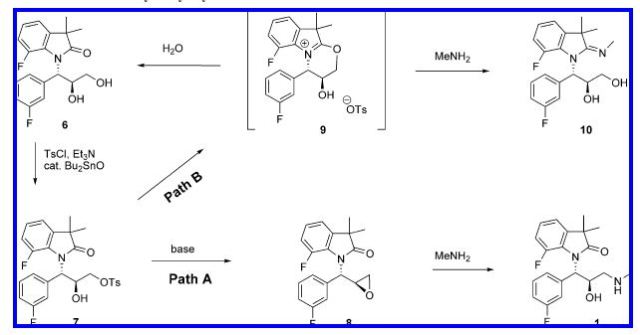
Mechanistic Aspects of Conversion of Indolinone Diol to Indolinone Aminoalcohol
and Process Implications
Asaf Alimardanov,* Alexander Gontcharov, Antonia Nikitenko, Anita W. Chan, Zhixian Ding, Mousumi Ghosh,
Mahmut Levent, Panolil Raveendranath,† Jianxin Ren, Maotang Zhou, Paige E. Mahaney,‡ Casey C. McComas,‡
Joseph Ashcroft, and John R. Potoski
Wyeth Research, 401 North Middletown Road, Pearl RiVer, New York 10965, U.S.A., and Wyeth Research, 500 Arcola Road,
CollegeVille, PennsylVania 19426, U.S.A.

TREATMENT OF GYNECOLOGICAL DISORDERS
WAY-315193 (Wyeth Pharmaceuticals)

Development of a scalable synthesis of WAY-315193 is described.
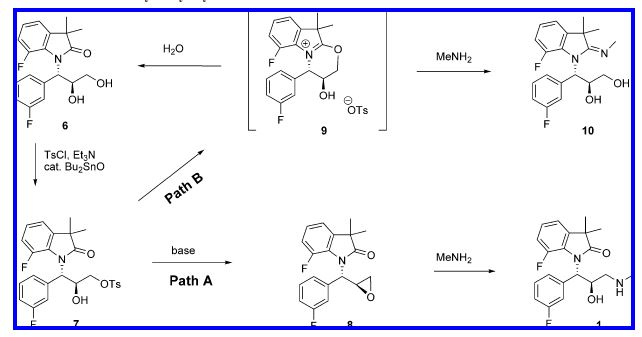
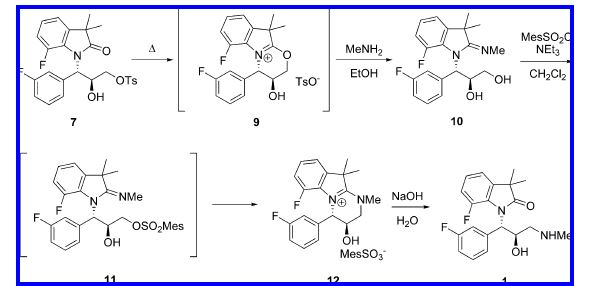
Use of LiHMDS as a base and Ti(O-i-Pr)4 as a Lewis acid was optimal for efficient and reproducible addition of indolinone anion to epoxyalcohol. Conversion of indolinone diol to indolinone aminoalcohol was achieved via monotosylationmethylamination.
The possibility of selective formation of the amidine side product, as well as its utilization for alternative selective preparation of the target aminoalcohol, was demonstrated.
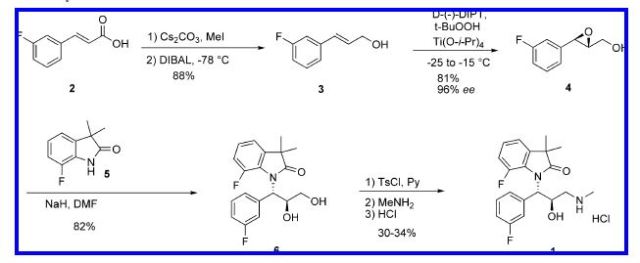
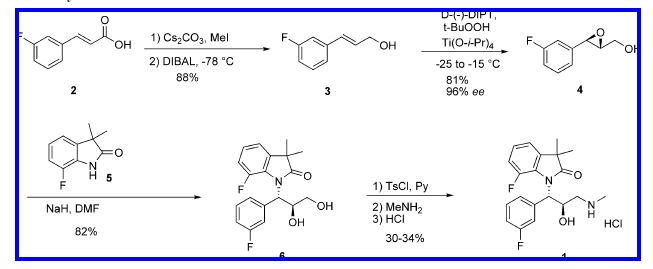
The synthetic route used initially for preparation of 1 is shown in Scheme 1. The key step of the synthesis was the
Sharpless epoxidation of fluorocinnamic alcohol 3 which selectively introduced both relative and absolute configurations at the C-2 and C-3 positions. At the early stages of the project, allylic alcohol 3 was prepared in two steps from commercially available fluorocinnamic acid 2 by treatment with MeI in the presence of Cs2CO3 in acetone, followed by DIBAL reduction at -78 °C. The epoxide 4 was opened with the sodium salt of dimethylfluoroindolinone in DMF to afford the diol. The diol 6 was further elaborated into the final aminoalcohol hydrochloride 1 in 30-34% yield via tosylation with p-toluenesulfonyl chloride (TsCl) in pyridine, isolation of the intermediate monotosylate, treatment with MeNH2, and conversion to HCl salt. Dimethylfluoroindolinone was prepared by reduction and bis-methylation of 7-fluoroisatin by a process developed earlier as described in a prior publication.3
white solid (58% yield). Mp 209-212 °C.
[R]D25°)+10.7°.

1H NMR (D2O, 400 MHz) δ: 7.40-7.25 (m,3H), 7.16-6.97 (m, 4H), 5.47-5.25 (2H, broad m), 3.27-3.20
(2H, broad m), 2.76 (s, 3H), 1.37 (s, 3H), 1.24 (broad s, 3H).
ES+ MS, m/z 361 (MH+). Anal. Calc’d for C20H23ClF2N2O2:C, 60.53; H, 5.84; N, 7.06. Found: C, 60.43; H, 5.69; N, 6.84.
Sn content: <1 ppm. Enantiomeric purity: 99.1% ee. Chiral SFCanalysis conditions: column: Chiralcel OF 250 mm × 4.6 mm;mobile phase: 30% ethanol, 0.4% diethylamine in CO2; detection wavelength: 254 nm; 2 mL/min, 40 °C.

* Corresponding author. E-mail: alimara@wyeth.com.
† Deceased.
‡ Wyeth Research, Collegeville, PA.
(1) (a) For a review on norepinephrine reuptake inhibitors, see: Babu,R. P. K.; Maiti, S. N. Heterocycles 2006, 69, 539. (b) Krell, H. V.;Leuchter, A. F.; Cook, I. A.; Abrams, M. Psychosomatics 2005, 46,379. (c) Hajos, M.; Fleishaker, J. C.; Filipiak-Reisner, J. K.; Brown,M. T.; Wong, E. H. W. CNS Drug ReV. 2004, 10, 23. (d) McCormack,
P. L.; Keating, G. M. Drugs 2004, 64, 2567.
(2) Kim, C. Y.; Mahaney, P. E.; Trybulski, E. J.; Zhang, P.; Terefenko,E. A.; McComas, C. C.; Marella, M. A.; Coghlan, R. D.; Heffernan,G. D.; Cohn, S. T.; Vu, A. T.; Sabatucci, J. P.; Ye, F. Phenylaminopropanol
Derivatives and Methods of Their Use. U.S. Patent 7,517,899,2009.

(3) Wu, Y.; Wilk, B. K.; Ding, Z.; Shi, X.; Wu, C. C.; RaveendranathP.; Durutlic, H. Process for the Synthesis of Progesterone ReceptorModulators. U.S. Patent Publ. Appl. US 2007/027327, 2007.
(4) (a) Gao, Y.; Hanson, R. M.; Klunder, J. M.; Ko, S. Y.; Masamune,H.; Sharpless, K. B. J. Am. Chem. Soc. 1987, 109, 5765. (b) For a recent example of large-scale asymmetric epoxidation, see: Henegar,
K. E.; Cebula, M. Org. Process Res. DeV. 2007, 11, 354.

(5) (a) For indolinone deprotonation for epoxide opening, see: Proudfoot,J. R.; Regan, J. R.; Thomson, D. S.; Kuzmich, D.; Lee, T. W.;Hammach, A.; Ralph, M. S.; Zindell, R.; Bekkali, Y. Preparation ofPropanol and Propylamine Derivatives and Their Use as Glucocorticoid Ligands. WO 2004/063163, 2004. (b) Gillman, K.; Bocchino, D. M.
Preparation of Monosaccharides Prodrugs of Fluorooxindoles Useful in Treatment of Disorders Which are Responsive to the Opening of Potassium Channels. U.S. Patent Publ. Appl. US 2004/0152646, 2004.
(c) For amide deprotonation for epoxide opening, see: Albanese, D.; Landini, D.; Penso, M. Tetrahedron 1997, 53, 4787. (d) Chan, W. N.; Evans, J. M.; Hadley, M. S.; Herdon, H. J.; Jerman, J. C.; Morgan,H. K. A.; Stean, T. O.; Thompson, M.; Upton, N.; Vong, A. K. J. Med.Chem. 1996, 39, 4537.
(6) Bordwell, F. G.; Fried, H. E. J. Org. Chem. 1991, 56, 4218.
(7) (a) Smith, J. G. Synthesis 1984, 629. (b) Parker, R. E.; Isaacs, N. S.Chem. ReV. 1959, 59, 737.

Patent ID Date Patent Title
US7595338 2009-09-29 Process for preparing 3, 3-disubstituted oxindoles and thio-oxindoles
US2009099164 2009-04-16 Phenylaminopropanol Derivatives and Methods of Their Use
US7517899 2009-04-14 Phenylaminopropanol derivatives and methods of their use
US2009093469 2009-04-09 Phenylaminopropanol Derivatives and Methods of Their Use
US2008146645 2008-06-19 Process for Preparing Indolinone Phenylaminopropanol Derivatives
Citing Patent Filing date Publication date Applicant Title
WO2006118955A2 * Apr 27, 2006 Nov 9, 2006 Wyeth Process for preparing 3,3-disubstituted oxindoles and thio-oxindoles
WO2006118955A3 * Apr 27, 2006 Jan 11, 2007 Bogdan Kazimierz Wilk Process for preparing 3,3-disubstituted oxindoles and thio-oxindoles
WO2007041023A1 * Sep 27, 2006 Apr 12, 2007 Wyeth 1- (1h- indol- 1-yl) -3- (methylamino) -1- phenylpropan-2-ol derivatives and related compounds as modulators of the monoamine reuptake for the treatment of vasomotor symptoms (vms)
WO2008024492A2 * Aug 22, 2007 Feb 28, 2008 Wyeth Indolinone phenylaminopropanol derivatives and process for the preparation thereof
WO2008024492A3 * Aug 22, 2007 May 15, 2008 Wyeth Corp Indolinone phenylaminopropanol derivatives and process for the preparation thereof
US9403807 Dec 2, 2014 Aug 2, 2016 Merck Sharp & Dohme Corp. Mineralocorticoid receptor antagonists
WO2005097744A1 * Mar 29, 2005 Oct 20, 2005 Wyeth 1-(1h-indol-1-yl)-3-(4-methylpiperazin-1-yl)-1-phenyl propan-2-ol derivatives and related compounds as modulators of the norepinephrine (ne) and the serotonine (5-ht) activity and the monoamine reuptake for the treatment of vasomotor symptoms (vms)
WO2005097761A1 * Mar 29, 2005 Oct 20, 2005 Wyeth Heterocyclic phenylaminopropanol derivatives as modulators of the monoamine reuptake for the treatment of vasomotor symptoms (vms)
WO2007041023A1 * Sep 27, 2006 Apr 12, 2007 Wyeth 1- (1h- indol- 1-yl) -3- (methylamino) -1- phenylpropan-2-ol derivatives and related compounds as modulators of the monoamine reuptake for the treatment of vasomotor symptoms (vms)
US20070072897 * Sep 27, 2006 Mar 29, 2007 Wyeth Phenylaminopropanol derivatives and methods of their use


//////////WAY-315193

c1c2c(c(cc1)F)N(C(C2(C)C)=O)[C@@H](c3cc(ccc3)F)[C@@H](CNC)O

How does a company demonstrate the implementation of PQS in accordance with ICH?


DR ANTHONY MELVIN CRASTO Ph.D's avatarDRUG REGULATORY AFFAIRS INTERNATIONAL
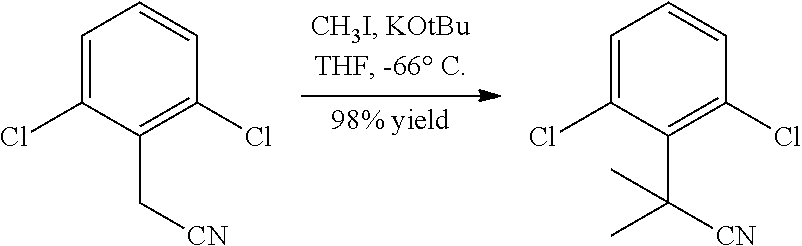
Image result for Pharmaceutical Quality System

ICH Q10 was published in its final version already in 2008. However, today many companies still have problems to understand how to implement ICH Q10 “Pharmaceutical Quality System” into practice. Quality Assurance and GMP are basic requirements which have been implemented for many years in the pharmaceutical industry (including the API industry). So what is needed to demonstrate that a Pharmaceutical Quality System has been implemented? Please read more about the GMP Questions and Answers.

http://www.gmp-compliance.org/enews_05578_How-does-a-company-demonstrate-the-implementation-of-PQS-in-accordance-with-ICH_15515,S-QSB_n.html

ICH Q10 was published in its final version already in 2008. However, today many companies still have problems to understand how to implement ICH Q10 “Pharmaceutical Quality System” in practice. Quality Assurance and GMP are basic requirements which have been implemented for many years in the pharmaceutical industry (including the API industry). So what is needed to demonstrate that a Pharmaceutical Quality System has been implemented?

ICH offers a set of questions and answers which provide more…

View original post 416 more words

What are the GMP Responsibilities of the Marketing Authorisation Holders?


DR ANTHONY MELVIN CRASTO Ph.D's avatarDRUG REGULATORY AFFAIRS INTERNATIONAL

str1

The European Medicines Agency (EMA) has published a concept paper to summarise the GMP responsibilities of the Marketing Authorisation Holders (MAH).

http://www.gmp-compliance.org/enews_05618_What-are-the-GMP-Responsibilities-of-the-Marketing-Authorisation-Holders_15367,15360,15355,15618,Z-QAMPP_n.html

The GMP/GDP Inspectors Working Group of the European Medicines Agency (EMA) has published a concept paper to summarise the GMP responsibilities of the Marketing Authorisation Holders (MAH). It is not intended to introduce any new responsibilities on MAHs but to document existing requirements in a better way.

The current EU GMP-Guidelines define in several chapters and annexes GMP tasks and responsibilities of the MAH. However, there seems to be a lack of clarity and understanding as to what these responsibilities actually are in their totality, and what they mean for MAHs at a practical level. All these tasks and responsibilities have now been summarised in this concept paper:

  • Chapter 1: responsibility to evaluate the results of the PQR review
  • Chapter 7: responsibility to put contracts in place
  • Chapter 8: responsibilities…

View original post 284 more words

Ranitidine


Ranitidine.svg

Ranitidine

Ranitidine, sold under the trade name Zantac among others, is a medication that decreases stomach acid production.[1] It is commonly used in treatment of peptic ulcer disease, gastroesophageal reflux disease, and Zollinger–Ellison syndrome.[1] There is also tentative evidence of benefit for hives.[2] It can be taken by mouth, by injection into a muscle, or into a vein.[1]

Common side effects include headaches and pain or burning if given by injection. Serious side effects may include liver problems, a slow heart rate, pneumonia, and the potential of masking stomach cancer.[1] It is also linked to an increased risk ofClostridium difficile colitis.[3] It is generally safe in pregnancy. Ranitidine is an H2 histamine receptor antagonist that works by blocking histamine and thus decreasing the amount of acid released by cells of the stomach.[1]

Ranitidine was discovered in 1976 at Glaxo Pharmaceuticals, now a part of GlaxoSmithKline.[4][5] It is on the World Health Organization’s List of Essential Medicines, the most important medications needed in a basic health system.[6] It is available as a generic medication.[1] The wholesale price in the developing world is about 0.01 to 0.05 USD per pill.[7] In the United States it is about 0.05 USD per dose.[1]

Image result for SYNTHESIS ranitidine.

Image result for SYNTHESIS ranitidine.

Image result for SYNTHESIS ranitidine.

Laboratory Synthesis Of Ranitidine

Synthesis Of Ranitidine
—————————————————————————————

Ranitidine Synthetic procedure/method of synthesis

The reaction of 5-dimethylaminomethyl-2-furanylmethanol (I) with 2-mercaptoethylamine (II) by means of aqueous HCl gives 2-[[(5-dimethylamino-methyl-2-furanyl)methylthio]ethaneamine (III), which is then condensed with N-methyl-1-methylthio-2-nitrotheneamine (IV) by heating at 120 C. Compound (IV) is obtained by reaction of 1,1-bis(methylthio)-2-nitroethene (V) with methylamine in refluxing ethanol
Ranitidine reference
  1. Serradell, M.N.; Blancafort, P.; Casta馿r, J.; Hillier, K.; Ranitidine. Drugs Fut 1979, 4, 9, 663
  2.  Price, B.J. et al. (Allen and Hanburys, Ltd.); US 4128658.
  3. Price, B.J.; Bradshaw, J.; Clitherow, J.W. (Allen & Hansburys Ltd.); Aminoalkyl furan derivatives.. DE 2734070; FR 2360587; US 4128658 ,DE 2734070; FR 2360587; US 4128658.

PAPER

Synthesis of ranitidine (Zantac) from cellulose-derived 5-(chloromethyl)furfural

Mark Mascal*a and   Saikat Duttaa  
*Corresponding authors
aDepartment of Chemistry, University of California Davis, 1 Shields Avenue, Davis, US
E-mail: mascal@chem.ucdavis.edu
Fax: 530-752-8995
Tel: 530-754-5373
Green Chem., 2011,13, 3101-3102

DOI: 10.1039/C1GC15537G

The biomass-derived platform chemical 5-(chloromethyl)furfural is converted into the blockbuster antiulcer drug ranitidine (Zantac) in four steps with an overall 68% isolated yield.

Graphical abstract: Synthesis of ranitidine (Zantac) from cellulose-derived 5-(chloromethyl)furfural

Image result for A new method for the synthesis of ranitidine.

Image result for A new method for the synthesis of ranitidine.

PROCESS

Image result for A new method for the synthesis of ranitidine.

2. Experimental Procedures

5-[[(2-Acetamidoethyl)thio]methyl]furfural 14

Sodium hydride (95%) (103 mg, 4.08 mmol) was added to a solution of Nacetylcysteamine (0.4051 g, 3.40 mmol) in dry THF (20 mL) under argon. The resulting suspension was stirred at RT for 30 min and a solution of CMF 12 (0.4912 g, 3.40 mmol) in dry THF (10 mL) was added dropwise over a 10 min period. The resulting light yellow solution was allowed to stir overnight at RT. The solvent was evaporated and saturated brine (50 mL) was added. The mixture was extracted with CH2Cl2 (2 × 50 mL) and the organic layers were combined and washed with saturated brine (100 mL). The organic layer was dried over Na2SO4. Charcoal (100 mg) was added and the mixture was stirred for 20 min and filtered. The solvent was evaporated to give 14 as a yellow liquid (0.7042 g, 91 %). 1H NMR (CDCl3, 300 MHz) 9.58 (1H, s), 7.21 (1H, d, J = 3.6 Hz), 6.48 (1H, s, br), 5.95 (1H, d, J = 3.6 Hz), 3.79 (2H, s), 3.45 (2H, q, J = 6.3 Hz), 2.72 (2H, t, J = 6.6 Hz), 2.00 (3H, s); 13C NMR (CDCl3, 75 MHz) 23.1, 27.8, 31.7, 38.4, 110.7, 121.9, 152.2, 158.9, 170.7, 177.4; IR (neat) 3298, 3101, 1663, 1548, 1512, 1287, 1022, 772 cm-1; HRMS (ESI): calculated for C10H14O3NS: [M+H]+ 228.0694: found 228.0690.

5-[[(2-Acetamidoethyl)thio]methyl]-N,N-dimethyl-2-furanmethanamine 15

Me2NH (1.0 mL) was added to a solution of 14 (0.2105 g, 0.926 mmol) in dry methanol (20 mL) and the mixture was stirred at RT for 1 h. The resulting red solution was cooled to 0 °C and NaBH4 (98 %) (55 mg, 1.42 mmol) was added over a 5 min period. The mixture was allowed to come to RT and stirred for 30 min. The solvent was evaporated while keeping the bath temperature below 45 °C. The residue was dissolved in CH2Cl(50 mL) and filtered to remove inorganic impurities. The solvent was evaporated to give 15 (0.2145 g, 90 %) as a pale yellow oil. 1H NMR (CDCl3, 300 MHz) 6.42 (1H, s, br), 6.09 (1H, s), 3.67 (2H, s), 3.37 (2H, s), 3.26 (2H, q, J = 6.0 Hz), 2.62 (2H, t, J = 6.4 Hz) 2.21 (6H, s), 1.93 (3H, s); 13C NMR (CDCl3, 75 MHz) 23.5, 28.4, 31.9, 38.7, 45.4, 56.2, 108.4, 109.9, 151.4, 152.1, 170.5; IR (neat) 3273, 2944, 1656, 1545, 1291, 1019, 729 cm- 1 ; HRMS (ESI): calculated for C12H21O2N2S: [M+H]+ 257.1322: found 257.1323.

5-[[(2-aminoethyl)thio]methyl]-N,N-dimethyl-2-furanmethanamine 5

A solution of 15 (0.2473 g, 0.965 mmol) in freshly prepared 2N aq NaOH (10 mL) was heated at reflux for 2 h. The mixture was cooled to RT and extracted with CH2Cl2 (3×30 mL). The organic layers were combined and washed with saturated brine, dried over Na2SO4, and evaporated to give 5 (0.1934 g, 94 %) as a pale yellow oil. 1H NMR (CDCl3, 300 MHz) 6.02 (2H, s), 3.61 (2H, s), 3.33 (2H, s), 2.74 (2H, t, J = 6.3 Hz), 2.52 (2H, t, J = 6.6 Hz), 2.16 (6H, s); 13C NMR (CDCl3, 75 MHz) 28.2, 35.9, 40.9, 45.1, 55.9, 108.1, 109.5, 151.4, 152.1; IR (neat) 3359 cm-1, 2947, 2769, 1559, 1459, 1015, 797 cm-1; HRMS (ESI): calculated for C10H19ON2S: [M+H]+ 215.1212: found 215.1218.

N-[2-[[[5-[(dimethylamino)methyl]-2-furanyl]methyl]thio]ethyl]-N’-methyl-2-nitro- 1-Ethenediamine (Ranitidine) 1 The experimental procedure is modified from existing literature:2 A solution of 5 (0.1501 g, 0.700 mmol ) in distilled water (10 mL) was added dropwise over a period of 10 min to a suspension of 1-methylthio-1-methylamino-2-nitroethylene 7 (0.1041 g, 0.703 mmol) in distilled water (5 mL) with stirring. The resulting light yellow solution was placed in an oil bath at 55 °C and the mixture was stirred at that temperature overnight. Saturated brine (30 mL) was added and the mixture was extracted with CHCl3 (3×20 mL). The combined organic layer was dried over Na2SO4. Evaporation of the solvent gave 1 as a pale yellow oil (0.1935 g, 88 %). 1H NMR (CDCl3, 300 MHz, 56 oC) 10.23-10.15 (1H, br, NH), 6.57 (1H, s), 6.13 (2H, d, 6.0 Hz), 5.04 (1H, br, NH), 3.73 (2H, s), 3.41 (4H, s), 2.92 (2H, s), 2.76 (2H, t, 6.0 Hz), 2.24 (6H, s); 13C NMR (CDCl3, 75 MHz, 56 °C) 28.2, 30.6, 40.7, 44.6, 55.6, 97.9, 108.1, 109.1, 150.4, 152.1, 156.6; IR (neat) 3209, 2944, 2815, 2776, 1620, 1574, 1384, 1230, 1019, 761 cm-1; HRMS (ESI): calculated for C13H23O3N4S: [M+H]+ 315.1491: found 315.1497.

SEE NMR AT http://www.rsc.org/suppdata/gc/c1/c1gc15537g/c1gc15537g.pdf

Zantac (ranitidine) 300-mg tablet
Image result for RANITIDINE NMR

PATENT

Image result for A new method for the synthesis of ranitidine.

Patent EP0796256B1 – Process for preparing ranitidine – Google Patents

Google

Figure 00060001

HPLC

Image result for A new method for the synthesis of ranitidine.

An Improved HPLC Method for the Determination of Ranitidine …

Separation Science

An Improved HPLC Method for the Determination of Ranitidine Suitable for All Dosage Forms
PATENT
Image result for SYNTHESIS ranitidine.
CLIP
Image result for SYNTHESIS ranitidine.

CLIP

Image result for SYNTHESIS ranitidine.

The paper was found in Green Chemistry,“Synthesis of ranitidine (Zantac) from cellulose-derived 5-(chloromethyl)furfural” by Mark Mescal et al, Green Chemistry,  2011,13, 3101-3102, DOI: 10.1039/c1gc15537g.  Once again, I am beating the press before they print so I supplied the Digital Object Identifier.  I am sure the sales for Ranitidine are quite large; who doesn’t get heartburn at one time or another.  I think it is very fortunate the author shows you can use a starting material that can be derived from just about any source of cellulose.  I find it interesting how renewable feedstocks can be utilized in industry and become part of important commodities, such as plastics, pharmaceuticals, etc.  This paper refers to another discussing where the starting material was derived from.  Starting material can be sugars, cellulose or raw cellulosic biomass and the reaction can produce yields of 80-90 %. M.Mascal and E. B. Nikitin, Angew. Chem., Int. Ed., 2008, 47, 7924;furansOn with the show, though.  The original synthetic route was provided in the paper and I will provide it to you.

originalsynranit

Furfural 1 was reduced to give the furfuryl alcohol 2.  The furfuryl alcohol is methylaminated to give 3, which is reacted with cysteamine in concentrated HCl to give 4.  This is condensed with 1-methylthio-1-methylamino-2-nitroethylene to give the final product.  The patent literature has the yield < 50 % for the aminomethylation and subsequent reaction with cysteamine, but recently, these steps have been reported to have higher conversions.

newsynranit

This new synthesis, apart from using a renewable feedstock as a starting material, has synthetic steps with an average yield of 91 %, and requires no chromatography.  Note that N-acetylcysteamine was used as opposed to cysteamine in the first step, in high yield.  A reductive amination with methylamine gives 8 again in high yield.  Treatment with KOH provides the free amine 9 and  the final step is the condensation with the nitroethylene used in the previous synthesis

Got heartburn ? Here is a synthesis to satisfy that appetite for good chemistry

Paper
Critical influence of 5-hydroxymethylfurfural aging and decomposition on the utility of biomass conversion in organic synthesis
Angewandte Chemie, International Edition (2016), 55, (29), 8338-8342
str1 str2
str1
5-HMF. 1H NMR (400 MHz, DMSO-d6) δ = 9.54 (s, 1H, C(O)H), 7.49 (d, J = 3.5 Hz, 1H, CHfuran), 6.60 (d, J = 3.5 Hz, 1H, CH-furan), 5.57 (t, J = 5.9 Hz, 1H, OH), 4.51 (d, J = 5.9 Hz, 2H, CH2OH). 13C{1H} NMR (101 MHz, DMSO-d6) δ = 177.9 (C(O)H), 162.2, 151.7 (C-furan), 124.4, 109.7 (CH-furan), 55.9 (CH2OH). Anal. calcd. For C6H6O3 (126.11): C 57.14, H 4.80; found: C 57.08, H 4.79.

Abstract

Spectral studies revealed the presence of a specific arrangement of 5-hydroxymethylfurfural (5-HMF) molecules in solution as a result of a hydrogen–bonding network, and this arrangement readily facilitates the aging of 5-HMF. Deterioration of the quality of this platform chemical limits its practical applications, especially in synthesis/pharma areas. The model drug Ranitidine (Zantac®) was synthesized with only 15 % yield starting from 5-HMF which was isolated and stored as an oil after a biomass conversion process. In contrast, a much higher yield of 65 % was obtained by using 5-HMF isolated in crystalline state from an optimized biomass conversion process. The molecular mechanisms responsible for 5-HMF decomposition in solution were established by NMR and ESI-MS studies. A highly selective synthesis of a 5-HMF derivative from glucose was achieved using a protecting group at O(6) position.

PAPER
Phytochemical screening and investigation of antiulcer activity of Tridax procumbens
International Journal of Pharmacy and Technology (2015), 6, (4), 7679-7690
Lavanya Asula* , A. Sony John, Deepthi Kotturi, P. Srividyalaxmi, R. Soni and Y. Mamatha Kalyani Department of Pharmacy, Jawaharlal Nehru Technological University, Holy Mary Institute of Technology and Science College of Pharmacy Hyderabad, India. Email: lavanya.asula@gmail.com
PATENT
Waste gas treatment and methyl mercaptan recovery process in production process of cimetidine and ranitidine
cimetidine and ranitidine terms widely used in the treatment of stomach is bound to promote the continuous mass production of APIs, however, the raw material in the manufacturing process of the drug inevitably produce methyl mercaptan, dimethyl sulfide, a methylamine, carbon disulfide and nitromethane workshop emissions. Because of methyl mercaptan, dimethyl sulfide into the atmosphere having foul odor. Resulting in the production shop around smelling, and even affect the normal life of residents of several kilometers around. So some manufacturers use incineration method expects to dispose of the waste gas combustion, which reduces air pollution to some extent. But using incineration method has two drawbacks: one gas methyl mercaptan, dimethyl sulfide gas combustion higher value produce a few meters of flames burning heat generated while it is easy to burn incinerator, security posed by the chemical production big risk; on the other hand by a combustion method can not solve the odor problem, air pollution is still grim, because incomplete combustion, odor difficult to eliminate people’s sense of smell is particularly sensitive to the perception of mercaptans, while burning a large amount of sulfur dioxide in the same air pollution. There’s manufacturers to adopt authoritarian incinerator burning after the first use of chlorine dioxide generator eliminate odor, although this method has a certain smell to eliminate the effect of improving, but requires authoritarian equipment, increasing the cost of gas treatment and discharge sulfur dioxide into the air is still there.
PATENT
CN 102408398
Title: Ranitidine
CAS Registry Number: 66357-35-5
CAS Name: N-[2-[[[-5-[(Dimethylamino)methyl]-2-furanyl]methyl]thio]ethyl]-N¢-methyl-2-nitro-1,1-ethenediamine
Molecular Formula: C13H22N4O3S
Molecular Weight: 314.40
Percent Composition: C 49.66%, H 7.05%, N 17.82%, O 15.27%, S 10.20%
Literature References: Histamine H2-receptor antagonist which inhibits gastric acid secretion. Prepn: B. J. Price et al., FR2384765; eidem, US 4128658 (both 1978 to Allen & Hanburys). HPLC determn in plasma: P. F. Carey, L. E. Martin, J. Liq. Chromatogr. 1979, 1291. Pharmacological studies: J. Bradshaw et al., Br. J. Pharmacol. 66, 464 (1979); M. J. Daly et al., Gut 21,408 (1980). Efficacy in treatment of duodenal ulcers: A. Berstad et al., Scand. J. Gastroenterol. 15, 637 (1980); R. P. Walt et al.,Gut 22, 49 (1981). Review of pharmacology and therapeutic use: R. N. Brogden et al., Drugs 24, 267-303 (1982). Comprehensive description: M. Hohnjec et al., Anal. Profiles Drug Subs. 15, 533-561 (1986).
Properties: Solid, mp 69-70°.
Melting point: mp 69-70°
Derivative Type: Hydrochloride
CAS Registry Number: 66357-59-3
Manufacturers’ Codes: AH-19065
Trademarks: Azantac (GSK); Melfax (Apotex); Noctone (GEA); Raniben (Firma); Ranidil (Menarini); Raniplex (Fournier); Sostril (Cascan); Taural (Roemmers); Terposen (Vir); Trigger (Polifarma); Ulcex (Guidotti); Ultidine (GSK); Zantac (GSK); Zantic (GSK)
Molecular Formula: C13H22N4O3S.HCl
Molecular Weight: 350.86
Percent Composition: C 44.50%, H 6.61%, N 15.97%, O 13.68%, S 9.14%, Cl 10.10%
Properties: Off-white solid, mp 133-134°. Freely sol in acetic acid and water, sol in methanol, sparingly sol in ethanol. Practically insol in chloroform.
Melting point: mp 133-134°
Derivative Type: Bismuth citrate
CAS Registry Number: 128345-62-0
Additional Names: Ranitidine bismutrex
Manufacturers’ Codes: GR-122311X
Trademarks: Pylorid (GSK); Tritec (GSK)
Molecular Formula: C13H22N4O3S.C6H5BiO7
Molecular Weight: 712.48
Percent Composition: C 32.03%, H 3.82%, N 7.86%, O 22.46%, S 4.50%, Bi 29.33%
Literature References: Pharmacology and activity vs Helicobacter sp: R. Stables et al., Aliment. Pharmacol. Ther. 7, 237 (1993).
Therap-Cat: Antiulcerative.
Keywords: Antiulcerative; Histamine H2-Receptor Antagonist.

References

  1. ^ Jump up to:a b c d e f g “Ranitidine”. The American Society of Health-System Pharmacists. Retrieved Dec 1, 2015.
  2. Jump up^ Fedorowicz, Z; van Zuuren, EJ; Hu, N (14 March 2012). “Histamine H2-receptor antagonists for urticaria.”. The Cochrane database of systematic reviews. 3: CD008596.doi:10.1002/14651858.CD008596.pub2. PMID 22419335.
  3. Jump up^ Tleyjeh, IM; Abdulhak, AB; Riaz, M; Garbati, MA; Al-Tannir, M; Alasmari, FA; Alghamdi, M; Khan, AR; Erwin, PJ; Sutton, AJ; Baddour, LM (2013). “The association between histamine 2 receptor antagonist use and Clostridium difficile infection: a systematic review and meta-analysis.”. PLOS ONE. 8 (3): e56498. doi:10.1371/journal.pone.0056498.PMC 3587620free to read. PMID 23469173.
  4. Jump up^ Fischer, Janos (2010). Analogue-based Drug Discovery II. John Wiley & Sons. p. 4.ISBN 9783527632121.
  5. Jump up^ Hara, Takuji (2003). Innovation in the pharmaceutical industry the process of drug discovery and development. Cheltenham, U.K.: Edward Elgar. p. 94.ISBN 9781843765660.
  6. Jump up^ “WHO Model List of EssentialMedicines” (PDF). World Health Organization. October 2013. Retrieved 22 April 2014.
Ranitidine
Ranitidine.svg
Ranitidine-A-3D-balls.png
Systematic (IUPAC) name
N-(2-[(5-[(dimethylamino)methyl]furan-2-yl)methylthio]ethyl)-N’-methyl-2-nitroethene-1,1-diamine
Clinical data
Pronunciation /rəˈnɪtdn/
Trade names Zantac, others
AHFS/Drugs.com Monograph
MedlinePlus a601106
License data
Pregnancy
category
  • AU: B1
  • US: B (No risk in non-human studies)
Routes of
administration
Oral, IV
Legal status
Legal status
Pharmacokinetic data
Bioavailability 39 to 88%
Protein binding 15%
Metabolism Hepatic: FMOs, including FMO3; other enzymes
Biological half-life 2–3 hours
Excretion 30–70% Renal
Identifiers
CAS Number 66357-35-5 Yes
ATC code A02BA02 (WHO)
A02BA07 (WHO) (ranitidine bismuth citrate)
PubChem CID 3001055
IUPHAR/BPS 1234
DrugBank DB00863 Yes
ChemSpider 4863 
UNII 884KT10YB7 Yes
KEGG D00422 Yes
ChEBI CHEBI:8776 
ChEMBL CHEMBL1790041 
Synonyms Dimethyl [(5-{[(2-{[1-(methylamino)-
2-nitroethenyl]amino}ethyl)sulfanyl]
methyl}furan-2-yl)methyl]amine
Chemical data
Formula C13H22N4O3S
Molar mass 314.4 g/mol

//////////

CB-618


str1

CB-618, CB-238618

CAS 1463520-70-8
C8 H10 N4 O6 S, 290.25
Sulfuric acid, mono[(1R,2S,5R)-2-(1,3,4-oxadiazol-2-yl)-7-oxo-1,6-diazabicyclo[3.2.1]oct-6-yl] ester
(25, 5R)-sulfuric acid mono-(2-[l,3,4]oxadiazol-2-yl-7-oxo-l,6-diaza-bicyclo[3.2.1]oct-6-yl) ester

SODIUM SALT

sodium salt of (2S,5R)-sulfuric acid mono-(2-[1,3,4]oxadiazol-2-yl-7-oxo-1,6-diaza-bicyclo[3.2.1]oct-6-yl)ester

CAS 1628207-16-8
C8 H10 N4 O6 S . Na
Sulfuric acid, mono[(1R,2S,5R)-2-(1,3,4-oxadiazol-2-yl)-7-oxo-1,6-diazabicyclo[3.2.1]oct-6-yl] ester, sodium salt (1:1)
PATENTS

WO2013149121

US 20140275001

US 20150094472

WO 2016081452

Infection, multidrug resistant bacteria (MDR) in  phase 1 at  Merck
CB-618 is in phase I clinical trails by Cubist for the treatment of resistant bacterial infections, including carbapenem-resistant Enterobacteriaceae and Klebsiella pneumonia carbapenemases infection.

CB-618 is a beta-Lactamase inhibitor in phase I clinical trials at Merck & Co. for the treatment of multidrug resistant bacterial infections, including those caused by carbapenem-resistant Enterobacteriaceae and Klebsiella pneumoniae carbapenemases.

The product was originally developed at Cubist. In 2015, Merck & Co. acquired the company

  • Originator Cubist Pharmaceuticals
  • Class Antibacterials
  • Mechanism of Action Beta lactamase inhibitors

Highest Development Phases

  • Phase I Gram-negative infections

Most Recent Events

  • 01 Apr 2015 Cubist Pharmaceuticals completes a phase-I clinical trial in Gram-negative infections in USA (IV) (NCT02341599)
  • 21 Jan 2015 Cubist Pharmaceuticals has been acquired by Merck & Co
  • 14 Jan 2015 Phase-I clinical trials in Gram-negative infections in USA (IV)

Bacterial resistance to β-lactam antibiotics, especially in Gram-negative bacteria, is most commonly mediated by β-lactamases. β-lactamases are enzymes that catalyze the hydrolysis of the β-lactam ring, which inactivates the antibacterial activity of the β-lactam antibiotic and allows the bacteria to become resistant. Inhibition of the β-lactamase with a BLI slows or prevents degradation of the β-lactam antibiotic and restores β-lactam antibiotic susceptibility to β-lactamase producing bacteria. Many of these β-lactamases are not effectively inhibited by BLIs currently on the market rendering the β-lactam antibiotics ineffective in treating bacteria that produce these β-lactamases. There is an urgent need for novel BLIs that inhibit β-lactamases that are not effectively inhibited by the current clinical BLIs (e.g. KPC, class C and class D β-lactamases) and that could be used in combination with β-lactam antibiotics to treat infections caused by β-lactam resistant bacteria.

PATENT

WO2013149121

Yu Gui Gu, Yong He, Ning Yin, Dylan C. ALEXANDER, Jason B. CROSS, Chester A. Metcalf, Robert Busch
Applicant Cubist Pharmaceuticals, Inc.

Example 3: Synthesis of (2S,5R)-2-(l ,3,4-oxadiazol-2-yl)-7-oxo-l ,6- diazabicyclo[3.2.1 loctan-6-yl hydrogen sulfate (Compound 701 )

Figure imgf000068_0001

Step 1: Ι,Γ-Carbonyldiimidazole (5.8 g, 36.2 mmol) was added to a 0 °C solution of (2S,5R)- 6-(benzyloxy)-7-oxo-l,6-diazabicyclo[3.2.1]octane-2-carboxylic acid (5.0 g, 18.1 mmol) in dry THF (200 mL). The reaction mixture was allowed to warm to rt then was stirred at rt for 3 hrs. Formohydrazide (5.4 g, 90.5 mmol) was added in one portion, and the reaction mixture was stirred for additional 3 hrs. The mixture was then diluted with saturated sodium chloride and exatracted with EtOAc (3x). The combined organic layer was washed with saturated sodium chloride (2x), dried over Na2S04, and concentrated to afford crude (25,5 ?)- 6-(benzyloxy)-N-formyl-7-oxo-l,6-diazabicyclo[3.2.1]octane-2-carbohydrazide (-11 g), which was directly used in the next step. ESI-MS (Ef , m/z): 319.1 [M+H]+.

Step 2: To a -10 °C solution of (25′,5«)-6-(benzyloxy)-N-formyl-7-oxo-l,6- diazabicyclo[3.2.1]octane-2-carbohydrazide (11 g) in dry DCM (200 mL) was added pyridine (28 mL), followed by dropwise addition of (CF3S02)20 (28 mL). The reaction mixture was allowed to warm to rt and was stirred for 3 hrs. The reaction mixture was then cooled to -10 °C and quenched with sat. NaHCC>3. The organic layer was separated and the aqueous layer was extracted with EtOAc (3x). The combined organic layer was dried over Na2S04, concentrated and purified by silica gel column chromatography (gradient elution 1 :3 to 2: 1 EtOAc/hexanes) to give (25,5/?)-6-(benzyloxy)-2-(l,3,4-oxadiazol-2-yl)-l ,6- diazabicyclo[3.2.1]octan-7 -one (4.6 g, 86% for two steps) as a slightly yellow solid. ESI-MS (EI+, m/z): 301.0 [M+H]+.

Step 3: To a solution of (25,5/?)-6-(benzyloxy)-2-(l,3,4-oxadiazol-2-yl)-l ,6- diazabicyclo[3.2.1]octan-7-one (4.6 g, 15.3 mmol) in THF (150 mL) was added 10% Pd/C (1 g). The mixture was stirred under H2 atmosphere at rt for 3 hrs. The reaction mixture was then filtered and concentrated to afford (25,5/?)-6-hydroxy-2-(l,3,4-oxadiazol-2-yl)-l,6- diazabicyclo[3.2.1]octan-7-one (2.9 g, 91 %), which was used directly in the next step. ESI- MS (EI+, m/z): 211.1 [M+H]+. Step 4: To a solution of (25,5fl)-6-hydroxy-2-(l,3,4-oxadiazol-2-yl)-l,6- diazabicyclo[3.2.1]octan-7-one (2.9 g, 13.8 mmol) in dry pyridine (60 mL) was added SC>3- Py (11.0 g, 69.0 mmol). The reaction mixture was stirred at rt for 8 hrs and then concentrated under vacuum. The residue was re-dissolved in aqueous NaH2PC>4 (1.5 M, 100 mL) then tetrabutylammonium hydrogensulphate (5.88 g, 17.3 mmol) was added. The mixture was stirred at rt for 20 minutes, then was extracted with EtOAc (4x). The combined organic layer was dried and concentrated and the residue was purified by silica gel column chromatography (gradient elution 10:1 to 2:1 DCM/acetone) to afford tetrabutylammonium (25,5/?)-2-(l ,3,4-oxadiazol-2-yl)-7-oxo-l,6-diazabicyclo[3.2.1]octan-6-yl sulfate (4.1 g, 97%) as a white solid. ESI-MS (EL, m/z): 289.0 [M-H]\ lH NMR (400 MHz, CDC13): δ 8.48 (s, 1H), 4.75 (d, / = 6.5 Hz, 1H), 4.40 (br s, 1H), 3.34-3.26 (m, 9H), 2.82 (d, / = 12.0 Hz, 1H), 2.37-2.25 (m, 3H), 2.06-1.98 (m, 1H), 1.71-1.65 (m, 8H), 1.49-1.42 (m, 8H), 1.01 (t, / = 7.5 Hz, 12H).

Step 5: Resin Exchange: Tetrabutylammonium (25, 5R)-2-(l, 3, 4-oxadiazol-2-yl)-7-oxo-l, 6-diaza-bicyclo[3.2.1]octan-6-yl sulfate (4.1 g, 7.72 mmol) was dissolved in a minimum amount of HPLC grade water (~ 40 mL) and passed through a column of 80 g of DOWEX 50WX 8 Na+ resin (the resin was prewased with >4 L of HPLC grade water) and eluted with HPLC grade water to afford sodium (25,5fl)-2-(l,3,4-oxadiazol-2-yl)-7-oxo-l,6- diazabicyclo[3.2.1]octan-6-yl sulfate (2.2 g, 91 %) as a white solid after lyophilization. ESI- MS (EI+, m/z): 291.2 [M+H]+. lH NMR (300 MHz, D20) δ 8.92 (s, 1H), 4.84 (d, J = 6.1 Hz, 1H), 4.20 (br s, 1H), 3.25-3.16 (m, 1H), 2.92 (d, / = 12.3 Hz, 1H), 2.41-2.26 (m, 1H), 2.26- 2.11 (m, 2H), 2.04-1.89 (m, 1H).

PATENT

WO-2016157057

Wockhardt Ltd

https://patentscope.wipo.int/search/en/detail.jsf?docId=WO2016157057&recNum=1&maxRec=&office=&prevFilter=&sortOption=&queryString=&tab=PCTDescription

A compound of Formula (I), chemically known as sodium salt of 2S, 5R) mono-(2-[l,3,4]oxadiazol-2-yl-7-oxo-l,6-diazabicyclo[3.2.1 ]oct-6-yl)ester has antibacterial properties and is disclosed in PCT International Patent Application No. PCT/US2013/034562. The compound of Formula (I) is also generically disclosed in PCT International Patent Application No. PCT/IB2012/054296. The present invention discloses a process for preparation of a compound of Formula (I).

Formula (I)

Scheme 1.

(VI) Compound of Formula (I)

Example 1

Sodium salt of (25, 5R) sulfuric acid mono-(2-[l,3,4]oxadiazol-2-yl-7-oxo-l,6-diaza-bicyclo[3.2.1]oct-6-yl) ester

Step I: Synthesis of (25,5R)-2-(iV’-formyl-hydrazinocarbonyl)-6-benzyloxy-7-oxo-l,6-diaza-bicyclo[3.2.1] octane (III):

To a turbid solution of sodium salt of (2<S’,5i?)-6-benzyloxy-7-oxo-l,6-diaza-bicyclo[3.2.1 ] octane-2-carboxylic acid (II, 20 g, 0.067 mol) (prepared according to process disclosed in PCT/IB2013/059264) in dimethylformamide (200 ml) was added EDC hydrochloride (19.44 g, 0.10 mol) followed by formyl hydrazide (4.02 g, 0.067 mol) and N-hydroxybenzotriazole (9 g, 0.67 mol) at about 25°C under stirring. Diisopropylethylamine (35.62 ml, 0.20 mol) was added to the reaction mixture and stirred at 25°C temperature for 18 hours. The reaction mixture was evaporated under vacuum to provide a residue. The residue was dissolved in ethyl acetate (500 ml) and washed with water (500 ml χ 2), followed by saturated aqueous sodium bicarbonate solution. The organic layer was dried over anhydrous sodium sulphate and evaporated under vacuum to provide a crude intermediate, which was purified by silica gel column chromatography to provide 11 g of the titled compound as solid in 52% yield.

Analysis:

Mass: 319.1 (M+l); for Molecular Formula of C15H18N4O4 and Molecular Weight of 318.34;

H1 NMR (DMSO-d6): δ 9.93 (s, 1H), 9.87 (s, 1H), 8.01 (s, 1H), 7.36-7.46 (m, 5H), 4.91-4.97 (dd, 2H), 3.83-3.84 (br s, 1H), 3.70 (s, 1H), 3.15-3.18 (br s, 1H), 2.90-2.95 (m, 1H), 1.99-2.03(m, 1H), 1.86(br s, 1H), 1.73-1.75 (m, 1H), 1.66 (m, 1H).

Step II: Synthesis of (25,5R)-2-([l,3,4]-oxadiazol-2-yl)-6-benzyloxy-7-oxo-l,6-diaza-bicyclo[3.2.1] octane (IV):

To a clear solution of (2<S’,5i?)-2-(N’-formyl-hydrazinocarbonyl)-6-benzyloxy-7-oxo-l ,6-diaza-bicyclo[3.2.1 ] octane (III, 11 g, 0.0345 mol) in chloroform (120 ml) was added diisopropylethylamine (18.31 ml, 0.1035 mol) and p-tolylsulfonylchloride (9.83 g, 0.0517 mol). The solution was stirred at 60°C for 15 hours. Reaction mixture was cooled to room temperature and water (100 ml) was added. Organic layer was dried over anhydrous sodium sulphate and evaporated under vacuum to provide a crude residue, which was purified by silica gel column chromatography to provide 7 g of the titled compound as a solid in 68% yield.

Analysis:

Mass: 301.3 (M+l); for Molecular Formula of Ci5Hi6N403 and Molecular Weight of 300.32;

H1 NMR (CDC13): δ 8.45 (s, 1H), 7.25-7.44 (m, 5H), 5.07-5.10 (dd, 1H), 4.92-4.95 (dd, 1H), 4.76-4.78 (br s, 1H), 3.37 (br s, 1H), 2.93-.95 (br s, 1H), 2.75-2.77 (m, 1H), 2.32-2.33 (m, 2H), 2.13-2.16 (m, 1H), 1.93-2.01 (m, 1H).

Step III: Synthesis of (25,5R)-2-([l,3,4]-oxadiazol-2-yl)-6-hydroxy-7-oxo-l,6-diaza-bicyclo[3.2.1] octane (V):

To a clear solution of (2<S’,5i?)-2-([l,3,4]-oxadiazol-2-yl)-6-benzyloxy-7-oxo-l,6-diaza-bicyclo[3.2.1 ] octane (IV, 7.0 g, 0.0233 mmol) in methanol (70 ml) was added 10% palladium on carbon (2.5 g). The suspension was stirred under atmospheric hydrogen pressure at a temperature 25° C for 2 hrs. The catalyst was filtered over a celite bed and the bed was washed with methanol (30 ml). The filtrate was concentrated under vacuum to provide an oily residue. The residue was triturated with cyclohexane (100 ml) to effect solid formation. The suspension was filtered under suction and the wet cake was washed with additional cyclohexane (50 ml). The soild was dried under vacuum to provide 4.5 g of the titled compound as a whitish solid in 92% yield, which was used for the next reaction immediately.

Analysis:

Mass: 211.2 (M+l); for Molecular Formula of C8Hi0N4O3 and Molecular Weight of 210.19; 1H NMR (DMSO-d6): δ 9.88 (br s, 1H), 9.29 (s, 1H), 4.65 (d, 1H ), 4.64 (br s, 1H), 2.94-2.97 (br d, 1H), 2.63-2.66 (d, 1H), 1.89-2.09 (m,3H), 1.82-1.86 (m, 1H).

Step IV: Synthesis of tetrabutylammonium salt of (25, 5R)-sulfuric acid mono-(2-[l,3,4]oxadiazol-2-yl-7-oxo-l,6-diaza-bicyclo[3.2.1]oct-6-yl) ester (VI):

To a clear solution of (2<S’,5i?)-2-([l,3,4]-oxadiazol-2-yl)-6-hydroxy-7-oxo-l ,6-diaza-bicyclo[3.2.1 ] octane (V, 4.5 g, 0.0214 mol) in dichloromethane (50 ml) was added triethylamine (9 ml, 0.642 mol), followed by the addition of sulfur trioxide pyridine complex (6.83 g, 0.428 mol). The resulting reaction mixture was stirred for 2 hours. Tetrabutylammonium hydrogen sulfate (7.26 g,

0.0214 mol) was added to the reaction mixture and it was stirred for 1.5 hours. A solution of aqueous 0.5 N KH2PO4 (100 ml) was added to the reaction mixture. Layers were separated and the aqueous layer was washed with dichloromethane (125 ml). Combined organic layer was dried over Na2S04, and was evaporated under vacuum to yield crude foam, which was purified on silica gel column chromatography to give 7 g of the titled compound as white foam in 98% yield.

Analysis:

Mass: 289.1 (M-l); for Molecular Formula
and Molecular Weight of 517.26;

1H NMR (DMSO-d6): δ 9.30 (s, 1H), 4.69 (d, 1H), 4.06 (br s, 1H ), 3.14-3.18 (m, 8H), 2.94-2.97 (br d, 1H), 2.67-2.70 (d, 1H), 1.98-2.05 (m,lH), 2.85-2.92 (m, 1H), 1.53-1.60 (m, 8H), 1.27-1.36 (m, 8H), 0.91-0.95 (m, 12H).

Step V: Sodium salt of (25, 5R)-sulfuric acid mono-(2-[l,3,4]oxadiazol-2-yl-7-oxo-l,6-diaza-bicyclo[3.2.1]oct-6-yl) ester (I):

The compound sodium salt of (2S, 5i?)-sulfuric acid mono-(2-[l,3,4]oxadiazol-2-yl-7-oxo-l,6-diaza-bicyclo[3.2.1]oct-6-yl) ester of Formula (I) was prepared by loading tetrabutylammonium salt of sulfuric acid mono-(2-[l,3,4]oxadiazol-2-yl-7-oxo-l,6-diaza-bicyclo[3.2.1]oct-6-yl) ester (VI, 7 g) on a column packed with Amberlite IR 120 Na form of resin, and by eluting the column with methanol water mixture (9: 1). Fractions containing compound were collected and solvent was evaporated under vacuum below 40°C, to provide formula- 1 compound in 4 gm (62%) quantity as a white solid.

Analysis:

Mass: 289.3 (M-l) as free acid; for Molecular Formula
and Molecular Weight 290.26;

H1 NMR (DMSO-d6): δ 9.29 (s, 1H), 4.70(d, 1H), 4.061 (d, 1H), 2.95 (d, 1H), 2.69 (d, 1H), 2.19 (m, 1H), 2.07 (m, 2H), 1.90 (m, 1H);

Purity as determined by HPLC: 89 86%;

WO2010056827A1 * Nov 12, 2009 May 20, 2010 Protez Pharmaceuticals, Inc. Beta-lactamase inhibitors
WO2010118361A1 * Apr 9, 2010 Oct 14, 2010 Sopharmia, Inc. Beta lactamase inhibitors
US20110294777 * Jan 15, 2009 Dec 1, 2011 Merck Sharp & Dohme Corp. Beta-lactamase inhibitors
Reference
1 * CROMPTON, I. E. ET AL.: “Beta-Lactamase inhibitors: The inhibition of serine beta-lactamases by specific boronic acids“, BIOCHEM. J., vol. 251, 1988, pages 453 – 459, XP055170895
2 * See also references of EP2831075A4

//////////CB-618, phase 1

O=S(=O)(O)ON3[C@H]1C[N@]([C@@H](CC1)c2nnco2)C3=O

Register Today for the ACS Symposium in India on Recent Advances in Drug Development, 11-12 November 2016 in Hyderabad, India


acs

cas

Inaugural ACS Industry Symposium, 11-12 November 2016 in Hyderabad, India

Recent Advances in Drug Development

Register Today for the ACS Symposium in India on Recent Advances in Drug Development

To view this email as a web page, go here.

Register now for the inaugural ACS Industry Symposium, 11-12 November 2016 in Hyderabad, India. Be sure to secure your seat today as rates will increase on 27 October!

http://acssymposium.org.in/
The theme of the Symposium is Recent Advances in Drug Development. The event will feature lectures by the world’s leading researchers and experts in the pharma industry, including:

  • Dr. Peter Senter of Seattle Genetics
  • Dr. Jagath Reddy Junutula of Cellerant Therapeutics, Inc.
  • Dr. Ming-Wei Wang of the Shanghai Institute of Materia Medica, Chinese Academy of Sciences

This is an exclusive event being organized in partnership with Dr. Reddy’s Laboratories for pharma professionals throughout India. Space is limited so register today!

Please visit our website to learn more about the speakers and the program.

Register today to ensure your access to the ACS Industry Symposium. We look forward to seeing you in Hyderabad in November.

CAS
2540 Olentangy River Rd Columbus, OH 43202 US

cas

http://acssymposium.org.in/

CAS
2540 Olentangy River Rd Columbus, OH 43202 US

cas

http://acssymposium.org.in/


Inaugural ACS Industry Symposium, 11-12 November 2016 in Hyderabad, India
Recent Advances in Drug Development

/////// ACS Symposium, Recent Advances in Drug Development, 11-12 November 2016, Hyderabad, India, dr reddys, cas

BMS 986001, Censavudine, Festinavir


BMS 986001

Censavudine, Festinavir

Has anti-HIV activity. IN PHASE 2

CAS: 634907-30-5, UNII: 6IE83O6NGA, OBP 601, 4′-Ethynyl D4T, 4′-Ed4T, TDK-4-114

Molecular Formula, C12-H12-N2-O4, Molecular Weight, 248.2368

2′,3′-Didehydro-3′-deoxy-4′-ethynylthymidine, 

1-((2R,5R)-5-Ethynyl-5-(hydroxymethyl)-2H-furan-2-yl)-5-methyl-pyrimidine-2,4-dione, 

2′,3′-Didehydro-3′-deoxy-4′-ethynylthymidine

INNOVATOR= YALE UNIVERSITY

634907-30-5.pngChemSpider 2D Image | Censavudine | C12H12N2O4

Festinavir is a nucleoside reverse transcriptase inhibitor

(NRTI) which is being developed for the treatment of HIV infection. The drug has shown considerable efficacy in early development, and with perhaps less toxicity than some other NRTIs, such as the drug stavudine (marketed under the trade name ZERIT®).

Festinavir has the chemical form and the structural formula:

Festinavir was developed by Yale University in conjunction with two Japanese research scientists, and is protected by U.S. Patent No. 7,589,078, the contents of which are incorporated herein by reference. The ‘078 patent sets forth the synthesis of the primary compound, and other structural analogs. In addition, Oncolys BioPharma, Inc. of Japan has now published US 2010/0280235 for the production of 4′ ethynyl D4T. As starting raw material, the Oncolys method utilizes a substituted furan compound, furfuryl alcohol. In another publication by Nissan Chemical Industries of Japan, and set forth in WO 201 1/099443, there is disclosed a method for producing a beta-dihydrofuran deriving compound or a beta-tetrahydrofuran deriving compound. In this process, a diol compound is used as the starting material. Nissan has also published WO 2011/09442

directed to a process for the preparation of a β-glycoside compound. Two further publications, each to Hamari Chemicals of Japan, WO 2009/1 19785 and

WO 2009/125841, set forth methods for producing and purifying ethynyl thymide compounds. Pharmaset, Inc. of the U.S. has also published US 2009/0318380,

WO 2009/005674 and WO 2007/038507 for the production of 4’ -nucleoside analogs for treating HIV infection. Reference is also made to the BMS application entitled

“Sulfilimine and Sulphoxide Methods for Producing Festinavir” filed as a PCT application, PCT/US2013/042150 on May 22, 2013 (now WO2013/177243).

PAPER

Haraguchi, Kazuhiro; Bioorganic & Medicinal Chemistry Letters 2003, V 13(21), PG 3775-3777 

http://dx.doi.org/10.1016/j.bmcl.2003.07.009

http://www.sciencedirect.com/science/article/pii/S0960894X0300831X

Compounds having methyl, vinyl, and ethynyl groups at the 4′-position of stavudine (d4T: 2′,3′-didehydro-3′-deoxythymidine) were synthesized. The compounds were assayed for their ability to inhibit the replication of HIV in cell culture. The 4′-ethynyl analogue (15) was found to be more potent and less toxic than the parent compound stavudine.


Graphic

Image for unlabelled figure
Image for figure 3
Physical data for 15 are as follows: solid (mp 207–209 °C);
UV (MeOH) λmax 264 nm (ε 10800), λmin 235 nm (ε 4800);
1H NMR (CDCl3) δ 1.83 (3H, s, Me), 2.63 (1H, s, C≡CH), 3.47 (1H, br, OH), 3.88 (1H, d,Jgem=12.5 Hz, H-5′a), 3.96 (1H, d, Jgem=12.5 Hz, H-5′b), 5.91 (1H, dd, J1′,2′=1.1 Hz and J2′,3′=5.9 Hz, H-2′), 6.30 (1H, dd, J1′,3′=2.0 Hz and J2′,3′=5.9 Hz, H-3′), 7.16–7.17 (1H, m, H-1′), 7.44 (1H, d, J6,Me=1.1 Hz, H-6), 9.06 (1H, br, NH);
FAB-MS m/z 249 (M++H). Anal. calcd for C12H12N2O4·1/6H2O: C, 57.37; H, 4.95; N, 11.15. Found: C, 57.36; H, 4.69; N, 10.98.
PAPER
Scalable Synthesis of the Potent HIV Inhibitor BMS-986001 by Non-Enzymatic Dynamic Kinetic Asymmetric Transformation (DYKAT)
Angewandte Chemie, International Edition (2015), 54, (24), 7185-7188.
http://onlinelibrary.wiley.com/doi/10.1002/anie.201502290/abstract
http://onlinelibrary.wiley.com/store/10.1002/anie.201502290/asset/supinfo/anie_201502290_sm_miscellaneous_information.pdf?v=1&s=9c516d28bb61a8b090de88c2a75f5f50f060aaa9

Scalable Synthesis of the Potent HIV Inhibitor BMS-986001 by Non-Enzymatic Dynamic Kinetic Asymmetric Transformation (DYKAT)

  1. Chemical Development, Bristol-Myers Squibb, 1 Squibb Drive, New Brunswick, NJ 08903 (USA)
  • Chemical Development, Bristol-Myers Squibb, 1 Squibb Drive, New Brunswick, NJ 08903 (USA)

Described herein is the synthesis of BMS-986001 by employing two novel organocatalytic transformations: 1) a highly selective pyranose to furanose ring tautomerization to access an advanced intermediate, and 2) an unprecedented small-molecule-mediated dynamic kinetic resolution to access a variety of enantiopure pyranones, one of which served as a versatile building block for the multigram, stereoselective, and chromatography-free synthesis of BMS-986001. The synthesis required five chemical transformations and resulted in a 44 % overall yield.

white crystalline solid. 1: Rf = 0.8 (silica, MeOH:CH2Cl2,1:4);

M.P. = 196-207°C;

1 H NMR (d6-DMSO, 500 MHz): δ = 11.34 (s, 1 H), 6.88 (s, 1 H), 6.35 (d, J = 6.0 Hz, 6.05 (d, J = 6.0 Hz, 1 H), 5.45 (t, J = 5.5 Hz, 1 H), 3.69 (dd, J = 12.0, 1.5 Hz, 1 H), 3.64 (s, 1 H), 3.59 (dd, J = 12.0, 1.5 Hz, 1 H) 1.70 (s, 3 H) ppm;

13C NMR (d6-DMSO, 125 MHz): δ = 163.85, 150.82, 136.81, 135.54, 127.13, 109.04, 88.94, 86.60, 81.45, 77.39, 65.76, 12.23 ppm;

HRMS calcd for C12H12N2O4H+ [M + H+] 249.09 found 249.08.

PATENT

WO 2014172264

https://www.google.ch/patents/WO2014172264A1?cl=en

invention:

Step#l: Acetal Formation

Compound 1

85% yield

The starting material is 5-methylurdine, which is commercially available. The first step of the process is an acetal formation. 5-methyluridine is utilized and is treated with H2SO4 and acetaldehyde. Other acids available to the scientist, such as perchloric acid, will also work for this transformation. The solvent utilized for this step is acetonitrile (ACN), and other solvents may also be utilized as well. Once the starting material is consumed, a slurry is obtained and the product can be simply filtered off and dried to provide Compound 1 as a solid.

Acetal formation

Preparation of l-((3aR,4R,6R,6aR)-6-(hydroxymethyl)-2-methyltetrahydrofuro [3,4-d] [1,3] dioxol-4-yl)-5-methylpyrimidine-2,4(lH,3H)-dione

The following were added to a flask: 5-methyluridine (10 g, 38.70 mmol), acetonitrile (20 mL) and 70% perchloric acid (4.01 mL, 47.63 mmol). A solution of acetaldehyde (3.26 mL, 58.10 mmol) in acetonitrile (20 mL) was added dropwise over 1 h. The resulting solution was allowed to stir at 20 °C for 18 h. The resulting slurry was filtered and dried (50 °C, 25 mmHg) to afford Acetal (9.30 g, 84% yield) as white solid

XH NMR (400MHz, DMSO-d6) δ = 11.39 (s, 1H), 7.72 – 7.63 (m, 1H), 5.82 (d, J=3.0 Hz, 1H), 5.21 – 5.07 (m, 2H), 4.84 (dd, J=6.6, 2.5 Hz, 1H), 4.68 (dd, J=6.6, 3.0 Hz, 1H), 4.12 – 4.05 (m, 1H), 3.65 – 3.51 (m, 2H), 3.36 (s, 2H), 1.77 (s, 3H), 1.37 (d, J=5.1 Hz, 3H) 13C NMR (101MHz, DMSO-d6) δ = 163.77, 150.32, 137.64, 109.39, 104.50, 90.79, 86.16, 83.83, 81.37, 61.25, 19.76, 12.06

Step #2: Acetate protection

Compound 2

85% yield

The next step of the sequence is installation of a 4-biphenylacetate. Without being bound by any particular theory, this protecting step may be chosen for two reasons:

1) To provide a solid intermediate that can be easily isolated, and

2) Act as a directing group in the next step (set forth later on).

This reaction consists of reacting Compound 1 with 4-biphenyl acid chloride and pyridine in acetonitrile. In this reaction, pyridine is preferred as it allows the reaction to occur only at the -OH moiety of the molecule. It should also be noted that other polar solvents could be used, but acetonitrile allowed the desired product Compound 2 to be isolated as s solid.

Ac lation

Preparation of ((3aR,4R,6R,6aR)-2-methyl-6-(5-methyl-2,4-dioxo-3,4-dihydropyrimidin-l(2H)-yl)tetrahydrofuro[3,4-d] [l,3]dioxol-4-yl)methyl [1,1′-biphenyl]-4-carboxylate.

Acetal (9.30 g, 32 mmol) was dissolved into acetonitrile (100 mL). Pyridine (1.3 eq) was added followed by the addition of 4-biphenylcarbonyl chloride (1.05 eq). The solution was heated to 50 °C and held for 2 h. The slurry was cooled to 20 °C and held for 2 h. The slurry was filtered and washed with acetonitrile (100 mL). The solids were dried (50 °C, 25 mmHg) to Compound 2 (85% yield).

XH NMR (400MHz, CHLOROFORM-d) δ = 8.10 (d, J=8.1 Hz, 2H), 7.62 (d, J=7.6 Hz, 2H), 7.67 (d, J=8.1 Hz, 2H), 7.55 – 7.36 (m, 3H), 7.09 (s, 1H), 5.71 (s, 1H), 5.26 (q, J=4.7 Hz, 1H), 5.03 (dd, J=6.6, 2.0 Hz, 1H), 4.91 (dd, J=6.7, 3.2 Hz, 1H), 4.73 – 4.63 (m, 1H), 4.61 – 4.50 (m, 2H), 2.02 (s, 3H), 1.85 – 1.76 (m, 3H), 1.52 (d, J=4.8 Hz, 3H)

1JC MR (101MHz, CHLOROFORM-d) δ = 164.02, 161.94, 148.20, 144.18, 137.85, 135.89, 128.20, 127.05, 126.36, 126.30, 125.35, 125.26, 1 14.49, 109.20, 103.88, 92.51, 83.36, 83.29, 79.87, 75.45, 75.13, 74.81, 62.54, 17.92, 10.32, -0.01

With the acetal and 4-biphenylacetate groups in place, the next reaction is a regioselective acetal opening utilizing TMSOTf (Trimethylsilyl trifluoromethane sulfonate, or other available Lewis acids)/Et3N to afford the corresponding silyl ether, which is cleaved in situ, to afford the 2-vinyloxy compound as Compound 3. Compound 3 may be prepared in a step-wise fashion (shown below), but in order to reduce the number of steps, it is possible to take Compound 3 and selectively form the desired 2-vinyl oxy regioisomer Compound 3. Those skilled in the art may recognize that the 4-biphenylacetate can be important to obtain high selectivity for this transformation.

Although a variety of Lewis acids may be utilized, TMSOTf is generally found to be more effective. Et3 is also a preferred reactant, as other amine bases are generally less effective. The ratio of TMSOTf to Ets is preferably within the range of about 1 : 1.3; if the reaction medium became acidic, Compound 3 would revert back to Compound 2. In terms of solvents, DCM (Dichloromethane) may be particularly effective, but toluene, CF3-PI1, sulfolane, and DCE (Dichloroethene) are also effective. The reaction can be worked up using aqueous acid, preferably K2HP04, or methanolic NH4F to quench the reaction, as well as remove the TMS-ether in situ.

TMSOTf-opening

Preparation of ((2R,3R,4R,5R)-3-hydroxy-5-(5-methyl-2,4-dioxo-3,4-dihydropyrimidin-l(2H)-yl)-4-(vinyloxy)tetrahydrofuran-2-yl)methyl [1,1′-biphenyl]-4-carboxylate

Compound 2 (20 g, 43.06 mmol) was dissolved into DCM (160 mL). Triethylamine (78 mL, 560 mmol) was added followed by the addition of TMSOTf (80.30 mL, 431 mmol). This solution was heated to 45 °C and held there until complete by HPLC analysis (6 h). Once complete, this solution was added to ammonium acetate (66.40 g, 861 mmol) in water (200 mL). After stirring for 20 min, the layers were separated. The organics were concentrated and the resulting residue was dissolved into EtOAc (200 mL). The organics were washed with the following solution (potassium phosphate monobasic (118 g, 861 mmol) in water (400 mL). The organics were then dried ( a2S04), filtered and concentrated. The resulting residue was purified by column chromatography [Silica gel; 20% to 90% EtOAc in Hexanes] to afford Compound 3 (15.8 g, 79% yield) as a solid.

XH NMR (400MHz, CHLOROFORM-d) 6 = 9.18 (br. s., IH), 8.18 – 8.06 (m, 2H), 7.73 -7.56 (m, 4H), 7.55 – 7.38 (m, 3H), 7.24 (d, J=1.3 Hz, IH), 6.59 (dd, J=14.0, 6.4 Hz, IH), 5.81 (d, J=2.0 Hz, IH), 4.84 (dd, J=12.6, 2.5 Hz, IH), 4.63 (dd, J=12.5, 4.2 Hz, IH), 4.59 – 4.44 (m, 3H), 4.40 – 4.26 (m, 2H), 1.70 (d, J=1.0 Hz, 3H)

13C MR (101MHz, CHLOROFORM-d) δ = 166.13, 163.65, 150.00, 149.67, 146.39, 139.66, 135.67, 130.16, 129.01, 128.40, 128.06, 127.32, 127.28, 111.43, 91.93, 89.44, 81.60, 80.19, 69.32, 63.06, 12.32

Step #4: Iodiiiation

Compound 4

Compound 3 75% yie|d

Next, Compound 3 is transformed into the iodide compound which is Compound 4. This can be accomplished by treating Compound 3 with (2.0 eq), PPI13 (2.0 eq.) and imidazole (4.0 eq). Other methods to install the iodide may also be utilized, such as mesylation/Nal, etc., but these may be less preferred. In addition, other halogen-bearing compounds such as Br2 and CI2 may be considered by the skilled scientist. Premixing imidazole, , and PPh3, followed by addition of Compound 3 in THF and heating at 60 °C allows smooth conversion to Compound 4. It is highly preferred to add all reagents prior to the addition of Compound 3; if not, the vinyloxy group will be cleaved. Other solvents, such as 2-MeTHF and PhMe may be utilized, but THF often provides the best yield.

Iodiiiation

Preparation of ((2R,3S,4S,5R)-3-iodo-5-(5-methyl-2,4-dioxo-3,4-dihydropyrimidin-l(2H)-yl)-4-(vinyloxy)tetrahydrofuran-2-yl)methyl [l,l’-biphenyl]-4-carboxylate

The following were added to a flask: imidazole (8.79 g, 129 mmol),

triphenylphosphine (16.94 g, 65 mmol), iodine 16.39 g, 65 mmol) and THF (525 mL). A solution of Compound 3 (15 g, 32 mmol) in THF (375 mL) was added. The solution was heated to 60 °C and was held at 60 °C for 4 h. Once complete by HPLC analysis (4 h), the solution was concentrated and the residue was purified by column chromatography [Silica gel; 10% to 60% EtOAc in Hexanes] to afford Compound 4 (17.0 g, 92% yield) as a solid.

XH NMR (400MHz, CHLOROFORM-d) δ = 9.25 (br. s., IH), 8.16 (d, J=8.3 Hz, 2H), 7.75 – 7.61 (m, 5H), 7.54 – 7.40 (m, 3H), 7.32 – 7.24 (m, 2H), 7.23 – 7.16 (m, 2H), 6.56 -6.45 (m, IH), 6.06 (d, J=1.5 Hz, IH), 4.89 (s, IH), 4.66 (dd, J=12.0, 6.9 Hz, IH), 4.56 (dd, J=12.0, 3.9 Hz, IH), 4.46 (d, J=4.0 Hz, IH), 4.39 – 4.26 (m, 2H), 4.13 (dt, J=7.1, 3.8 Hz, 1H), 2.06 – 1.97 (m, 3H)

1JC MR (101MHz, CHLOROFORM-d) δ = 165.96, 163.94, 150.27, 149.29, 146.28, 139.81, 137.88, 135.84, 130.37, 129.06, 129.01, 128.34, 128.25, 127.94, 127.31, 127.22, 125.32, 1 11.07, 91.37, 90.32, 89.18, 78.43, 69.15, 25.81, 21.49, 12.71

Step #5: Iodide Elimination

Compound 4

The next step of the sequence is to install the allyic moiety. Heating a solution of Compound 4 in toluene in the presence of DABCO (l,4-Diazabicyclo[2.2.2]octane) allows for elimination of the iodide. Other solvents, such as THF and DCE may be utilized, but toluene often provides the best conversion and yield. Other amine bases may be used in this transformation, but generally DABCO is preferred.

Elimination

Preparation of ((4R,5R)-5-(5-methyl-2,4-dioxo-3,4-dihydropyrimidin-l (2H)-yl)-4-(vinyloxy)-4,5-dihydrofuran-2-yl)methyl [l,l’-biphenyl]-4-carboxylate

Compound 4 (17 g, 30 mmol) was dissolved into toluene (255 niL), and DABCO (10 g, 89 mmol) was added. The solution was heated to 90 °C and held there for 2 h. Once complete, the organics were washed with sat. aq. a2S203 (200 mL). The organics were then dried ( a2S04), filtered, and concentrated. The resulting residue was purified by column chromatography [Silica gel; 5% to 60% EtOAc in Hexanes] to yield

Compound 5 (10.9, 85% yield) as a foam.

XH NMR (400MHz, CHLOROFORM-d) δ = 8.93 (br. s., IH), 8.18 – 8.11 (m, 2H), 7.75 -7.61 (m, 5H), 7.55 – 7.39 (m, 4H), 6.95 (d, J=1.0 Hz, IH), 6.54 (d, J=2.0 Hz, IH), 6.46 (dd, J=14.3, 6.7 Hz, IH), 5.53 (d, J=2.5 Hz, IH), 5.09 (d, J=2.8 Hz, IH), 5.04 (d, J=6.6 Hz, 2H), 4.29 (dd, J=14.3, 2.4 Hz, IH), 4.23 (dd, J=6.7, 2.4 Hz, IH), 1.88 (d, J=1.0 Hz, 3H)

1JC MR (101MHz, CHLOROFORM-d) δ = 165.73, 159.58, 149.10, 146.49, 139.70, 134.51, 132.17, 132.07, 131.94, 131.92, 130.30, 129.01, 128.56, 128.44, 128.40, 127.73, 127.30, 127.28, 112.50, 99.16, 90.57, 90.23, 84.81, 58.68, 12.44

Step #6: Claisen Rearrangement

An important reaction in the sequence is the Claisen rearrangement. This reaction is utilized to install the quaternary stereocenter and the olefin geometry in the ring. Heating Compound 5 in benzonitrile at 190 °C for 2-3 hours allows for smooth conversion to Compound 6, and after chromatography, a 90% yield can be achieved.

Toluene (110 °C, 8 h) also works to provide the desired Compound 6 as a solid by simply cooling the reaction to 20 °C (no chromatography). Other solvents with boiling points over about 100°C may also be utilized.

Claisen Rearrangement

Preparation of ((2S,5R)-5-(5-methyl-2,4-dioxo-3,4-dihydropyrimidin-l(2H)-yl)-2-(2-oxoethyl)-2,5-dihydrofuran-2-yl)methyl [l,l’-biphenyl]-4-carboxylate

Compound 5 (1 mmol) was dissolved into benzonitrile (10 mL). The solution was heated to 190 °C for 3 h. After cooling to 20 °C, the solution was purified by column chromatography [silica gel, 50:50 Hexanes:EtOAc] to afford Compound 6 (1 mmol).

Alternatively, Compound 5 (1 mmol) was dissolved into toluene (10 mL). The solution was heated to 110 °C and held for 12 h. Upon cooling to 20 °C, a slurry formed. The solids were filtered, washed (PhMe) and dried (50 °C, 25 mmHg) to afford

Compound 6 (1 mmol) as a white solid.

XH NMR (400MHz, CHLOROFORM-d) δ = 9.84 (t, J=1.8 Hz, 1H), 8.53 (br. s., 1H), 8.13 – 8.03 (m, J=8.3 Hz, 2H), 7.73 – 7.67 (m, 2H), 7.67 – 7.60 (m, 2H), 7.56 – 7.38 (m, 3H), 7.14 (d, J=1.3 Hz, 1H), 7.04 (t, J=1.5 Hz, 1H), 6.57 (dd, J=6.1, 2.0 Hz, 1H), 6.02 (dd, J=5.9, 1.1 Hz, 1H), 4.68 – 4.52 (m, 2H), 3.06 – 2.89 (m, 2H), 1.59 (d, J=1.0 Hz, 3H)

13C MR (101MHz, CHLOROFORM-d) δ = 198.33, 165.83, 163.35, 150.65, 146.56, 139.63, 136.24, 135.02, 130.21, 129.04, 128.44, 127.86, 127.49, 127.41, 127.28, 111.59, 90.03, 89.61, 67.33, 50.06, 12.06

ne Formation via elimination of Enol Nonaflate

The alkyne formation is performed by first treating Compound 6 with TMSCl (Trimethylsilyl chloride)/Et3N. NfF (Nonafluoro- 1 -butanesulfonyl fluoride) and P-base () are then added at -20 °C. After warming to 20 °C, the desired alkyne Compound 7 can be isolated in about 80 % yield. Initially, TMSCl is presumed to react at the NH moiety. NfF/P-base then reacts with the aldehyde to form the enol Nonaflate. Upon warming to 20 °C in the presence of P-base, the enol Nonaflate eliminates smoothly to the alkyne Compound 7. Without the TMSCl/Et3N, the yields are only -25%.

Alkyne formation

Preparation of ((2R,5R)-2-ethynyl-5-(5-methyl-2,4-dioxo-3,4-dihydropyrimidin-l(2H)-yl)-2,5-dihydrofuran-2-yl)methyl [l,l’-biphenyl]-4-carboxylate

Compound 6 (1 g, 2.24 mmol) was dissolved into DMF (Dimethylformamide) (5 mL). (Other polar solvents could also have been used.) Triethylamine (406 uL, 2.91 mmol) was added and the solution was cooled to 0 °C. TMSCl (314 uL, 2.46 mmol) was added and the solution was allowed to stir at 0 °C for 30 min. The solution was then cooled to -20 °C, and NfF (484 uL, 2.69 mmol) was added and the solution was allowed to stir at -20 °C for 5 min. Phosphazane P l-base (1.54 mL, 4.93 mmol) was added

dropwise over 20 min. The solution was then allowed to warm to 20 °C and held for 20 h. The solution was then poured into water (50 mL) and extracted with DCM (100 mL). The organics were concentrated and the resulting residue was purified by column chromatography [Silica gel; 10% to 60% EtOAc in Hexanes] to afford Compound 7 (816 mg, 85% yield) as a solid.

XH NMR (400MHz, DMSO-d6) δ = 11.46 (s, 1H), 8.08 – 7.97 (m, J=8.6 Hz, 2H), 7.92 -7.80 (m, 2H), 7.73 (d, J=7.1 Hz, 2H), 7.59 – 7.39 (m, 3H), 7.06 (d, J=1.0 Hz, 1H), 6.89 (d, J=1.5 Hz, 1H), 6.61 (dd, J=5.6, 2.0 Hz, 1H), 6.23 (dd, J=5.6, 1.0 Hz, 1H), 4.66 (d, J=12.1 Hz, lH), 4.57 (d, J=11.6 Hz, 1H), 3.87 (s, 1H), 1.37 (s, 3H)

13C MR (101MHz, DMSO-d6) δ = 164.89, 163.57, 150.61, 145.13, 138.73, 135.30, 134.40, 129.94, 129.12, 128.49, 127.84, 127.78, 127.18, 126.98, 110.01, 89.37, 83.69, 80.01, 78.23, 66.89, 11.46

90% yield

The final step of the sequence is to remove the aromatic ester protecting group. This consists of hydrolysis by NaOH in aq. THF solution. The API is extracted into THF and then crystallized from THF/PhMe.

Deprotection

Preparation of l-((2R,5R)-5-ethynyl-5-(hydroxymethyl)-2,5-dihydrofuran-2-yl)-5-methylpyrimidine-2,4(lH,3H)-dione (Ed4T)

Compound 7 (10 g, 23.40 mmol) was dissolved into THF (100 mL). 3N NaOH (10 mL) was added. The solution was allowed to stir at 20 °C for 12 h. The layers were split and the organics were kept. The organics were concentrated to reach a KF <1 wt%. Toluene (100 mL) was added, and solids crashed out of solution. The solids were filtered and washed with Toluene (100 mL). The solids were then dried (50 °C, 25 mmHg) to afford Festinavir (5.21 g, 90% yield) as a white solid.

XH NMR (400MHz, DMSO-d6) δ = 1 1.36 (s, 1H), 7.58 (s, 1H), 6.89 (s, 1H), 6.36 (d, J=6.1 Hz, 1H), 6.05 (d, J=6.1 Hz, 1H), 5.48 (t, J=5.6 Hz, 1H), 3.78 – 3.49 (m, 3H), 3.46 3.31 (m, 1H), 1.71 (s, 3H)

1JC MR (101MHz, DMSO-d6) δ = 163.80, 150.76, 136.75, 135.47, 127.06, 108.98, 88.87, 86.52, 81.37, 77.33, 65.68, 12.17.

PAPER

Tetrahedron (2009), 65(36), 7630-7636.

Volume 65, Issue 36, 5 September 2009, Pages 7630–7636

Synthesis of (±)-4′-ethynyl-5′,5′-difluoro-2′,3′-dehydro-3′-deoxy- carbocyclic thymidine: a difluoromethylidene analogue of promising anti-HIV agent Ed4T

http://dx.doi.org/10.1016/j.tet.2009.06.095

PAPER

Nucleophilic Substitution at the 4‘-Position of Nucleosides: New Access to a Promising Anti-HIV Agent 2‘,3‘-Didehydro-3‘-deoxy-4‘-ethynylthymidine

School of Pharmaceutical Sciences, Showa University, 1-5-8 Hatanodai, Shinagawa-ku, Tokyo 142-8555, Japan
J. Org. Chem., 2006, 71 (12), pp 4433–4438
DOI: 10.1021/jo060194m

Journal of Organic Chemistry (2006), 71(12), 4433-4438.

http://pubs.acs.org/doi/abs/10.1021/jo060194m

Abstract Image

For the synthesis of 2‘,3‘-didehydro-3‘-deoxy-4‘-ethynylthymidine (8:  4‘-Ed4T), a recently reported promising anti-HIV agent, a new approach was developed. Since treatment of 1-(2,5-dideoxy-β-lglycero-pent-4-enofuranosyl)thymine with Pb(OBz)4 allowed the introduction of the 4‘-benzoyloxy leaving group, nucleophilic substitution at the 4‘-position became feasible for the first time. Thus, reaction between the 4‘-benzoyloxy derivative (14) and Me3SiC⋮CAl(Et)Cl as a nucleophile led to the isolation of the desired 4‘-“down”-ethynyl derivative (18) stereoselectively in 62% yield. As an application of this approach, other 4‘-substituted nucleosides, such as the 4‘-allyl (24a) and 4‘-cyano (26a) derivatives, were synthesized using organosilicon reagents. In these instances, pretreatment of 14 with MeAlCl2 was necessary.

figure

PATENTS

US75890782009-09-15Anti-viral nucleoside analogs and methods for treating viral infections, especially HIV infections

Patent ID Date Patent Title
US2016060252 2016-03-03 5-METHYLURIDINE METHOD FOR PRODUCING FESTINAVIR
US2015140610 2015-05-21 SULFILIMINE AND SULPHOXIDE METHODS FOR PRODUCING FESTINAVIR
US2015104511 2015-04-16 Pharmaceutical Antiretroviral Combinations Comprising Lamivudine, Festinavir and Nevirapine
US8927237 2015-01-06 Method for producing acyloxypyranone compound, method for producing alkyne compound, and method for producing dihydrofuran compound
US2012322995 2012-12-20 beta-DIHYDROFURAN DERIVING COMPOUND, METHOD FOR PRODUCING beta-DIHYDROFURAN DERIVING COMPOUND OR beta-TETRAHYDROFURAN DERIVING COMPOUND, beta-GLYCOSIDE COMPOUND, METHOD FOR PRODUCING beta GLYCOSIDE COMPOUND, AND METHOD FOR PRODUCING 4′-ETHYNYL D4T AND ANALOGUE COMPOUNDS THEREOF
US2012252751 2012-10-04 ANTI-VIRAL NUCLEOSIDE ANALOGS AND METHODS FOR TREATING VIRAL INFECTIONS, ESPECIALLY HIV INFECTIONS
US8193165 2012-06-05 Anti-viral nucleoside analogs and methods for treating viral infections, especially HIV infections
US2011312880 2011-12-22 POTENT CHIMERIC NRTI-NNRTI BIFUNCTIONAL INHIBITORS OF HIV-1 REVERSE TRANSCRIPTASE
US2011054164 2011-03-03 PRODUCTION PROCESS OF ETHYNYLTHYMIDINE COMPOUNDS FROM 5-METHYLURIDINE AS A STARTING MATERIAL
US2010280235 2010-11-04 METHOD FOR PRODUCING 4’ETHYNYL d4T

/////////BMS 986001, 634907-30-5, UNII: 6IE83O6NGA, OBP 601, 4′-Ethynyl D4T, 4′-Ed4T, TDK-4-114, PHASE 2

Cc1cn(c(=O)[nH]c1=O)[C@H]2C=C[C@](O2)(CO)C#C

QbD Presentations


Organizational Initiatives Towards Developing Greener Processes for Generic Active Pharmaceutical Ingredients
– Dr. Vilas H. Dahanukar, Chief Scientist-Process R&D, Integerated Product Development Organization, Dr. Reddy’s Laboratories Ltd., India

Image result for IGCW-2015

GCF

presented at

4th Industrial Green Chemistry World Convention & Ecosystem (IGCW-2015) on 4th – 5th December 2015

A PRESENTATION

Image result for waitThe presentation will load below

Please scroll with mouse to see

A PRESENTATION

Innovative Techniques, To Synthesize Breakthrough Molecules, See DOE On pae 4 onwards

Image result for waitThe presentation will load below

 IF YOU HAVE TROUBLE VIEWING SEE…….http://www.allfordrugs.com/qbd-presentations/

Quality by Design Questions to Consider How can we maximize the benefits to the industry and other stakeholders? How can we ensure that this will speed.

WHAT YOU NEED TO KNOW…..

Quality by Design in Drug Product Development

Introduction to drug product development – setting the scene

  • Drug product development at a glance – from first in man to marketing authorization
  • Pharmaceutical QbD: Quo vadis?
  • Application of QbD principles to drug product development

Expectations from regulatory agencies

  • Regulatory initiatives and approaches for supporting emerging technologies
  • Concepts of Real Time Release Testing (Draft Annex 17 EU GMP Guideline)
  • Harmonization of regulatory requirements (QbD parallel-assessment FDA-EMA, ICH Q8 -> Draft Q12?)
  • Regulatory expectations: Lessons learned from applications so far

Knowledge Management

  • Knowledge Management (KM) System – Definition and Reason
  • Knowledge Management Cycle
  • Explicit and Tacit Knowledge – The Knowledge Spiral
  • Correlation between KM and other Processes
  • Enabling Knowledge Management
  • Knowledge Review – integral part of the Management Review (ICH Q10)

Quality Risk Assessment and Control Strategy

  • Objectives of Quality Risk Assessment (QRA) as part of development
  • Overview to risk assessment tools
  • Introduction of Process Risk Map
  • Introduction of risk based control strategy development

QbD Toolbox: Case studies DoE, PAT, and Basic Statistics

  • Value-added use of QbD tools – generic approaches and tailored solutions
  • Case studies and examples for different unit operations and variable problems

Reports and Documentation

  • Development Reports
  • Transfer protocols and reports
  • Control Strategy and link to the submission dossier

Wrap-up & Final Discussion
The concepts and tools used over the two days will be summarized and future implications and opportunities of applying QbD principles to process development will be discussed. Delegates will be given time to ask questions on how they can apply what they have learned to their own drug product development and manufacturing.

Workshop Process Risk Map & link to Control Strategy
Based on a risk assessment tool tailored to cover development needs, delegates will work on case studies of process development for a solid oral dosage form.
From QTPP and CQA to relationship analysis of process parameters and material attributes
Process mapping for integrated documentation of the development work
Process Risk Map as a tool for development-focussed risk assessment

Quality by Design in API Manufacturing

General framework and key elements of QbD for APIs – background and potential strategies

  • What is it all about?
  • What are the benefits?
  • When and how should you use it?
  • Practical examples with typical points of discussion

How to identify and control Critical Quality Attributes (CQAs) in API synthesis – a risk-based approach to developing a control strategy

  • Severity assessment of quality attributes
  • Impact levels for critical process parameters (CPPs) and critical material attributes (CMAs)
  • Considerations for the API Starting material
  • Design of an effective risk-based control strategy
  • Examples

How to provide information on the development of the API manufacturing process – dossier requirements

  • What should be done at which stage?
  • Which information is relevant for the dossier?
  • What are the key-points to be considered for APIs (NCE/Biotech) and their formulations
  • Typical questions from Authorities

Process Evaluation and Design Space

  • Changing Validation Approach
  • Validation Life Cycle
  • Design Space Concept

Application of PAT in the API industry

  • PAT at development stages of a QbD-based development
  • PAT as part of the Control Strategy in a GMP environment
  • Practical examples of PAT implementations at a commercial scale in a GMP environmen

t
Control strategies – Case studies and examples

  • HA definitions
  • Why and When is a control strategy needed
  • Different types/elements of a control strategy
  • Practical examples

///////////

Follow New Drug Approvals on WordPress.com

Enter your email address to follow this blog and receive notifications of new posts by email.

Join 37.9K other subscribers

ORGANIC SPECTROSCOPY

Read all about Organic Spectroscopy on ORGANIC SPECTROSCOPY INTERNATIONAL 

DISCLAIMER

I , Dr A.M.Crasto is writing this blog to share the knowledge/views, after reading Scientific Journals/Articles/News Articles/Wikipedia. My views/comments are based on the results /conclusions by the authors(researchers). I do mention either the link or reference of the article(s) in my blog and hope those interested can read for details. I am briefly summarising the remarks or conclusions of the authors (researchers). If one believe that their intellectual property right /copyright is infringed by any content on this blog, please contact or leave message at below email address amcrasto@gmail.com. It will be removed ASAP