
Degarelix
214766-78-6 CAS
EMA:Link,
US FDA:link
Degarelix is used for the treatment of advanced prostate cancer. Degarelix is a synthetic peptide derivative drug which binds to gonadotropin-releasing hormone (GnRH) receptors in the pituitary gland and blocks interaction with GnRH. This antagonism reduces luteinising hormone (LH) and follicle-stimulating hormone (FSH) which ultimately causes testosterone suppression. Reduction in testosterone is important in treating men with advanced prostate cancer. Chemically, it is a synthetic linear decapeptide amide with seven unnatural amino acids, five of which are D-amino acids. FDA approved on December 24, 2008.
A subgroup of patients with advanced prostate cancer could now get access to a new treatment option in England and Wales after cost regulators for the NHS issued a green light for Ferring’s Firmagon (degarelix).
In final draft guidance published this morning by the National Institute for Health and Care Excellence, the drug has been recommended as an option for treating advanced hormone-dependent prostate cancer but specifically in patients with spinal metastases who present with signs or symptoms of spinal cord compression.
Read more at: http://www.pharmatimes.com/Article/14-04-15/NICE_nod_for_Firmagon_s_prostate_cancer_drug.aspx#ixzz2z6tthLDT
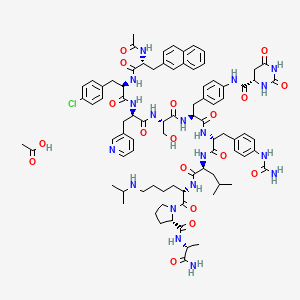
FE-200486, Gonax, Degarelix acetate (JAN), FE-200486 (free base), CAS, 934016-19-0, ASP-3550, D09400
Molecular Formula: C84H107ClN18O18 Molecular Weight: 1692.31118
Carin WINDERSTROM, “KIT AND METHOD FOR PREPARATION OF A DEGARELIX SOLUTION.” U.S. Patent US20100286603, issued November 11, 2010.
US20100286603
FIRMAGON is a sterile lyophilized powder for injection containing degarelix (as the acetate) and mannitol. Degarelix is a synthetic linear decapeptide amide containing seven unnatural amino acids, five of which are D-amino acids. The acetate salt of degarelix is a white to off-white amorphous powder of low density as obtained after lyophilization.
The chemical name of degarelix is D-Alaninamide, N-acetyl-3-(2-naphthalenyl)-D-alanyl-4-chloro-Dphenylalanyl-3-(3-pyridinyl)-D-alanyl-L-seryl-4-[[[(4S)-hexahydro-2,6-dioxo-4pyrimidinyl]carbonyl]amino]-L phenylalanyl-4-[(aminocarbonyl)amino]-D-phenylalanyl-L leucyl-N6–(1-methylethyl)-L-lysyl-L-prolyl. It has an empirical formula of C82H103N18O16Cl and a molecular weight of 1632.3 Da.
Degarelix has the following structural formula:

FIRMAGON delivers degarelix acetate, equivalent to 120 mg of degarelix for the starting dose, and 80 mg of degarelix for the maintenance dose. The 80 mg vial contains 200 mg mannitol and the 120 mg vial contains 150 mg mannitol.
Degarelix (INN) or degarelix acetate (USAN) (tradename Firmagon) is a hormonal therapy used in the treatment of prostate cancer. During development it was known as FE200486.
Testosterone is a male hormone that promotes growth of many prostate tumours and therefore reducing circulating testosterone to very low (castration) levels is often the treatment goal in the management of men with advanced prostate cancer. Degarelix has an immediate onset of action, binding to gonadotropin-releasing hormone (GnRH) receptors in the pituitary gland and blocking their interaction with GnRH. This induces a fast and profound reduction in luteinising hormone (LH), follicle-stimulating hormone (FSH) and in turn, testosterone suppression.[1]
On 24 December 2008, the Food and Drug Administration (FDA) approved degarelix for the treatment of patients with advanced prostate cancer in the USA.[2] It was subsequently approved by the European Commission at the recommendation of the European Medicines Agency (EMEA) on February 17, 2009 for use in adult male patients with advanced, hormone-dependent prostate cancer.Ferring Pharmaceuticals markets the drug under the name Firmagon.
GnRH antagonists (receptor blockers) such as degarelix are a new type of hormonal therapy for prostate cancer. These agents are synthetic peptide derivatives of the natural GnRH decapeptide – a hormone that is made by neurons in the hypothalamus. GnRH antagonists compete with natural GnRH for binding to GnRH receptors in the pituitary gland. This reversible binding blocks the release of LH and FSH from the pituitary. The reduction in LH subsequently leads to a rapid and sustained suppression of testosterone release from the testes and subsequently reduces the size and growth of the prostate cancer. This in turn results in a reduction in prostate-specific antigen (PSA) levels in the patient’s blood. Measuring PSA levels is a way to monitor how patients with prostate cancer are responding to treatment.
Unlike the GnRH agonists, which cause an initial stimulation of the hypothalamic-pituitary-gonadal axis (HPGA), leading to a surge in testosterone levels, and under certain circumstances, a flare-up of the tumour, GnRH antagonists do not cause a surge in testosterone or clinical flare.[3] Clinical flare is a phenomenon that occurs in patients with advanced disease, which can precipitate a range of clinical symptoms such as bone pain, urethral obstruction, and spinal cord compression. Drug agencies have issued boxed warnings regarding this phenomenon in the prescribing information for GnRH agonists. As testosterone surge does not occur with GnRH antagonists, there is no need for patients to receive an antiandrogen as flare protection during prostate cancer treatment. GnRH agonists also induce an increase in testosterone levels after each reinjection of the drug – a phenomenon that does not occur with GnRH antagonists such as degarelix.
GnRH antagonists have an immediate onset of action leading to a fast and profound suppression of testosterone and are therefore especially valuable in the treatment of patients with prostate cancer where fast control of disease is needed.
Clinical effectiveness
A Phase III, randomised, 12 month clinical trial (CS21) in prostate cancer[4] compared androgen deprivation with one of two doses of degarelix or the GnRH agonist, leuprolide. Both degarelix doses were at least as effective as leuprolide at suppressing testosterone to castration levels (≤0.5 ng/mL) from Day 28 to study end (Day 364). Testosterone levels were suppressed significantly faster with degarelix than with leuprolide, with degarelix uniformly achieving castration levels by Day 3 of treatment which was not seen in the leuprolide group. There were no testosterone surges with degarelix compared with surges in 81% of those who received leuprolide. Degarelix resulted in a faster reduction in PSA levels compared with leuprolide indicating faster control of the prostate cancer. Recent results also suggest that degarelix therapy may result in longer control of prostate cancer compared with leuprolide.[5]
Side effects
As with all hormonal therapies, degarelix is commonly associated with hormonal side effects such as hot flashes and weight gain.[4][6][7] Due to its mode of administration (subcutaneous injection), degarelix is also associated with injection-site reactions such as injection-site pain, erythema or swelling. Injection-site reactions are usually mild or moderate in intensity and occur predominantly after the first dose, decreasing in frequency thereafter.[4]
FSH receptors in other solid tumors
FSH receptors are selectively expressed on the luminal surface of the blood vessels of a wide range of tumors.[8] There may be a potential role for suppression of FSH or FSH receptors. This work is in early stages. It is thought that FSH receptors are important in tumor angiogenesis by signalling via two pathways, one involving VEGF, and a Gq/11mechanism that activates VEGFR-2 independently of VEGF.[8]
………………………………
http://www.google.com/patents/US20120041172
Example 1
Hydantoin formation in the synthesis of degarelix. The rearrangement of the hydroorotic group to a hydantoinacetyl group in the production of degarelix has been seen at two stages and two sets of basic conditions.
The first rearrangement appeared during basic extractions of the segment Z-Ser(tBu)-4Aph(Hor)-D-4Aph(tBu-Cbm)-Leu-ILys(Boc)-Pro-D-Ala-NH2. The pH was adjusted to 9.1 in the organic/aqueous two-phase system using conc. NaOH solution, resulting in the formation of 4.5% by weight of the hydantoin analogue. The mechanism appeared to comprise two steps: (a) hydrolysis of the 6-membered hydroorotic moiety under basic conditions followed by ring closure to the 5-membered hydantoin analogue under acidic conditions.
The second rearrangement was observed during evaporation of the segment Z-Ser(tBu)-4Aph(Hor)-D-4Aph(tBu-Cbm)-Leu-OH.DCHA. After the preceding extractions, Z-Ser(tBu)-4Aph(Hor)-D-4Aph(tBu-Cbm)-Leu-OH was dissolved in a mixture of ethyl acetate and 2-butanol. DCHA (2.5 eq.) was added because the segment is isolated as the DCHA salt after evaporation of the solvent followed by a precipitation step. In the particular batch both the hydantoin analogue and the hydrolysed form (mentioned above) were identified. Quantification of the hydantoin was not possible because poor separation by HPLC from other products; the hydrolyzed form was formed in an amount of 1.34% by weight of the combined products. Experimental evidence showed that the amount of rearrangement/hydrolysis was related to the amount of DCHA used in the method.
The following experiment provided further proof of the instability of the hydrooroic moiety under basic conditions. Z-Ser(tBu)-4Aph(Hor)-D-4Aph(tBu-Cbm)-Leu-OH.DCHA (67 mM) was dissolved in wet 2-BuOH with 167 mM (2.5 eq) DCHA at 31° C. After 25 h, 1.3% of the hydantoin analogue and 0.3% of the hydrolysed intermediate had been formed.
Example 2
Stability of degarelix in DBU/DMF and piperidine/DMF. The stability of degarelix was tested under conditions corresponding to those used for removal of the Fmoc-group during SPPS. The hydroorotic group in the side chain of 4Aph(Hor), amino acid residue no. 5 in the sequence of degarelix, is known to be sensitive to base and rearrange to a hydantoinacetyl group. All SPPS procedures known to the inventors had been based on Boc-chemistry.
Samples of degarelix were dissolved in 20% piperidine/DMF; 2% DBU in DMF, and 2% DBU+5% water in DMF; respectively. The samples were analysed by HPLC after 20 h and the amount of the hydantoin analogue determined.
2% DBU/DMF resulted in the formation of 1.8% hydantoin. If 5% water was present, too (simulating wet DMF), the amount was increased to 7%. Surprisingly, the use of 20% piperidine in DMF did not result in any formation of the hydantoin analogue, indicating that this mixture might be useful for Fmoc-based SPPS of Degarelix.
Example 3 Synthesis and Purification of Degarelix Using Fmo-/Rink Amide AM Resin
Step 1. Fmoc-Rink amide AM resin (64 g; substitution 0.67 mmol/g) was placed in a reactor and washed with 1.9 L DMF. To the swollen resin 250 ml of 20% piperidine in DMF is added and stirred for 20 min. The reactor is emptied through the filter in the bottom by applying vacuum to the reactor and a second treatment with 250 ml 20% piperidine in DMF is performed for 20 min. The reactor is once again emptied by applying vacuum to it followed by a wash of the peptide resin using 2 L of DMF. The reactor is then emptied by applying vacuum. The peptide resin is now ready for step 2.
Step 2. A solution of 27.0 g Fmoc-D-Ala-OH (2 eq.), 14.3 g HOBt and 13.2 ml DIC is dissolved in 250 ml of DMF and allowed to activate for 15 min, after which it is poured into the reactor containing the peptide resin. After 1 h of reaction time, 2.2 ml of NMM is added to the solution and the reaction is allowed to proceed for another hour. Then 30 ml acetic acid anhydride and 2 ml NMM is added to the mixture, which is allowed to stand under stirring for 15 min. Then the reactor is emptied by using vacuum. The peptide resin is washed with 2 L DMF. After applying vacuum to the reactor, removing the DMF, the peptide resin is treated with 250 ml of 20% piperidine in DMF for 20 min. The reactor is emptied by applying vacuum and a second treatment of 250 ml 20% piperidine in DMF for 20 min is performed. The reactor is once again emptied by applying vacuum and the peptide resin is washed with 2 L of DMF. It is now ready for step 3.
Step 3. A solution of 29 g Fmoc-L-Pro-OH (2 eq), 14.3 g HOBt and 13.2 ml DIC is dissolved in 250 ml DMF and allowed to activate for 25 min, after which it is poured into the reactor containing the peptide resin. After 75 min of reaction, 2.2 ml NMM is added to the solution, and the reaction is allowed to proceed for another hour. Then 30 ml acetic acid anhydride and 2 ml NMM is added to the mixture, which is allowed to stand under stirring for 15 min, The reactor is then emptied by using vacuum. DMF (2.6 L) is used for washing the peptide resin. After applying vacuum to the reactor, removing the DMF, the peptide resin is treated with 250 ml of 20% piperidine in DMF for 20 min. The reactor is emptied by applying vacuum, and a second treatment with 250 ml 20% piperidine in DMF for 20 min is performed. The reactor is once again emptied by applying vacuum and the peptide resin is washed with 2 L of DMF. It is now ready for step 4.
Step 4. A solution of 33 g Fmoc-L-ILys(Boc)-OH (1.5 eq), 10.7 g HOBt and 10.1 ml DIC is dissolved in 250 ml of DMF and allowed to activate for 0.5 h, after which it is poured into the reactor containing the peptide resin. After 2 h of reaction, 2.2 ml NMM is added to the solution and the reaction is allowed to proceed for another hour. Then 30 ml acetic acid anhydride and 2.2 ml NMM is added to the mixture, which is allowed to stand under stirring for 15 min, whereupon the reactor is emptied by using vacuum. The peptide resin is washed with DMF (3 L). After applying vacuum to the reactor, removing the DMF, the peptide resin is treated with 250 ml of 20% piperidine in DMF for 20 min. The reactor is emptied by applying vacuum and a second treatment of 250 ml 20% piperidine in DMF for 20 min is performed. The reactor is once again emptied by applying vacuum and the peptide resin is washed with 3.5 L DMF. It is now ready for step 5.
Step 5. A solution of 38 g Fmoc-L-Leu-OH (2.5 eq), 18 g of HOBt and 16.8 ml of DIC is dissolved in 250 ml of DMF and allowed to activate for 0.5 h, after which it is poured into the reactor containing the peptide resin. After 2 h of reaction, 2.2 ml NMM is added to the solution, and the reaction is allowed to proceed for another 50 min. Then 30 ml acetic acid anhydride and 2 ml NMM is added to the mixture, which is allowed to stand under stirring for 15 min. Then the reactor is emptied by using vacuum. DMF (2.6 L) is used for washing the peptide resin. After applying vacuum to the reactor, removing the DMF, the peptide resin is treated with 250 ml of 20% piperidine in DMF for 20 min. The reactor is emptied by applying vacuum and a second treatment with 250 ml 20% piperidine in DMF for 20 min is performed. The reactor is once again emptied by applying vacuum and the peptide resin is washed with 2.5 L of DMF. It is now ready for step 6.
Step 6. A solution of 32 g of Fmoc-D-4Aph(tBu-Cbm)-OH (1.5 eq), 10.7 g HOBt and 10.1 ml DIC is dissolved in 250 ml of DMF and allowed to activate for 1 hour, after which it is poured into the reactor containing the peptide resin. After 20 min of reaction, 22 ml NMM is added to the solution and the reaction is allowed to proceed for another 20 h. Then 30 ml acetic acid anhydride and 2 ml NMM is added to the mixture, which is allowed to stand under stirring for 15 min. Then the reactor is emptied by using vacuum. The peptide resin is washed with 4 L DMF. After applying vacuum to the reactor, removing the DMF, the peptide resin is treated with 250 ml of 20% piperidine in DMF for 20 min. The reactor is emptied by applying vacuum and a second 20 min treatment with 250 ml 20% piperidine in DMF is performed. The reactor is once again emptied by applying vacuum and the peptide resin is washed with 3.4 L DMF. It is now ready for step 7.
Step 7. A solution of 35 g Fmoc-L-4Aph(L-Hor)-OH (1.5 eq), 11 g HOBt and 10.1 ml DIC is dissolved in 350 ml DMF and allowed to activate for 1 h, after which it is poured into the reactor containing the peptide resin. After 50 min of reaction, 2.2 ml NMM is added to the solution and the reaction is allowed to proceed for another 21.5 h. The reactor is emptied by using vacuum. The peptide resin is washed with 4.4 L DMF. After applying vacuum to the reactor, removing the DMF, the peptide resin is treated with 350 ml of 20% piperidine in DMF for 20 min. The reactor is emptied by applying vacuum and a second 20 min treatment with 350 ml 20% piperidine in DMF is performed. The reactor is once again emptied by applying vacuum and the peptide resin is washed with 4.4 L DMF. It is now ready for step 8.
Step 8. Fmoc-L-Ser(tBu)-OH (2.5 eq) (41 g), 17.9 g HOBt, 16.8 ml DIC and 4.9 ml of NMM is dissolved in 500 ml of DMF and poured into the reactor containing the peptide resin. The reaction is allowed to proceed for 3.5 h. The reactor is then emptied by using vacuum. The peptide resin is washed with 4.2 L DMF. After applying vacuum to the reactor, removing the DMF, the peptide resin is treated with 375 ml of 20% piperidine in DMF for 20 min. The reactor is emptied by applying vacuum and a second 20 min treatment of 375 ml 20% piperidine in DMF is performed. The reactor is once again emptied by applying vacuum and the peptide resin washed with 4.2 L of DMF. It is now ready for step 9.
Step 9. A solution of 25 g Fmoc-D-3 Pal-OH (1.5 eq), 10.7 g HOBt, 10.1 ml DIC and 4.9 ml NMM is dissolved in 400 ml of DMF and poured into the reactor containing the peptide resin. The reaction is allowed to proceed for 4.5 h. Then the reactor is emptied by using vacuum. The peptide resin is washed with 4.2 L DMF. After applying vacuum to the reactor, removing the DMF, the peptide resin is treated with 375 ml of 20% piperidine in DMF for 20 min. The reactor is emptied by applying vacuum and a second 20 min treatment with 375 ml 20% piperidine in DMF is performed. The reactor is once again emptied by applying vacuum and the peptide resin washed with 4.2 L of DMF. It is now ready for step 10.
Step 10. A solution of 27 g Fmoc-D-Phe(4Cl)—OH (1.5 eq), 10.7 g HOBt, 10.1 ml DIC and 4.9 ml NMM is dissolved in 400 ml of DMF and is poured into the reactor containing the peptide resin. The reaction is allowed to proceed for 10 h. The reactor is emptied by using vacuum. The resin is washed with 5.5 L DMF. After applying vacuum to the reactor and removing the DMF, the peptide resin is treated with 375 ml of 20% piperidine in DMF for 20 min. The reactor is emptied by applying vacuum and a second 20 min treatment with 375 ml 20% piperidine in DMF is performed. The reactor is once again emptied by applying vacuum and the peptide resin washed with 5 L DMF. It is now ready for step 11.
Step 11. A solution of 28 g Fmoc-D-2Nal-OH (1.5 eq), 10.7 g HOBt, 10.1 ml DIC and 4.9 ml NMM is dissolved in 400 ml DMF and poured into the reactor containing the peptide resin. The reaction is allowed to proceed for 2.5 h. The reactor is emptied by using vacuum. The peptide resin is washed with 5.2 L DMF. After applying vacuum to the reactor and removing the DMF, the peptide resin is treated with 375 ml of 20% piperidine in DMF for 20 min. The reactor is emptied by applying vacuum and a second 20 min treatment of 375 ml 20% piperidine in DMF is performed. The reactor is once again emptied by applying vacuum and the peptide resin washed with 5 L DMF. It is now ready for and is ready for step 12.
Step 12. Acetylimidazole (3 eq) (14.5 g) and 4.9 ml NMM is dissolved in 400 ml DMF and poured into the reactor. After 1.5 h, the reactor is emptied by applying vacuum to the reactor. The peptide resin is washed with 5 L DMF and the reactor emptied using vacuum.
Step 13. The peptide resin is washed with WA and dried under vacuum. Peptide resin (129.8 g; yield 96%) was isolated.
Step 14. Dry peptide resin (60 g) is suspended in 600 ml TFA for 25 h at room temperature. It was then poured into a mixture of 2.4 L water, 620 g ammonium acetate, 600 ml ethanol and 600 ml acetic acid. The mixture is adjusted to a pH between 3 and 4 using TFA and filtered.
Step 15. The product is purified using a two step purification protocol. In the first step a column (2.5 cm×34 cm) packed with reversed phase C-18 material is used with a buffer system consisting of buffer A (0.12% aqueous TFA) and buffer B (99.9% ethanol) A volume from the filtered solution from step 14 corresponding to 1.6 g of the product is applied to the column. Purification is executed using a step gradient starting with 10% B for 2-3 column volumes, 29% B for 5-7 column volumes and a gradient from 29% B to 50% B over 3 column volumes at a flow rate of 70 ml/min. This procedure is followed until all the filtered solution from step 14 has been processed. All fractions collected are analyzed by analytical HPLC. Fractions containing product with a purity higher than 94% are pooled. The second purification step is performed using a column (2.5 cm×34 cm) packed with reverse phase C-18 material and a buffer system consisting of a buffer A (1% aqueous acetic acid), buffer B (99.9% ethanol), and buffer C (0.5 M aqueous ammonium acetate). From the pooled fractions containing the product an amount equivalent to 1.3 g of the product is applied to the column and purification performed by applying a step gradient starting with 10% B+90% C for 2-3 column volumes followed by 90% A+10% B for 2-3 column volumes. The product is eluted by 24% B+76% A. The fractions containing product with the acceptable purity are pooled and desalted using the same column. Desalting is performed using buffer A (1% aqueous acetic acid) and buffer B (99.9% ethanol). A volume from the pooled purified fraction corresponding to 1.6 g of product is applied to the column, 2-3 column volumes buffer A being used to wash out any ammonium acetate in the product. Then the product is eluted using 50% buffer A+50% buffer B. The solution of the purified product containing 50% ethanol is concentrated on a rotary evaporator. When all the ethanol has been removed the remaining solution containing the product is lyophilized. A total of 11.8 g (overall yield 37%) of degarelix is obtained as a fluffy solid. 4-([2-(5-Hydantoyl)]acetylamino)-phenylalanine could not be detected in the product (HPLC).
Example 4 Synthesis and Purification of Degarelix Using Fmoc-Rink Amide MBHA
Performed substantially as the synthesis and purification of Example 1. Deviations from the method of Example 1:
-
- a) Fmoc-D-Aph(Cbm)-OH was used instead of Fmoc-D-Aph(tBu-Cbm)-OH;
- b) Acetylation of the N-terminal of H-D-2-Nal-peptide-resin was performed using acetic acid anhydride instead of acetylimidazole;
- c) Acetonitrile was used in purification instead of ethanol.
4-([2-(5-Hydantoyl)]acetylamino)-phenylalanine could not be detected in the product by HPLC.
………………………….
http://www.google.com/patents/EP2447276A1?cl=en
-
Prostate cancer is a leading cause of morbidity and mortality for men in the industrialised world. Degarelix, also known as FE200486, is a third generation gonadotropin releasing hormone (GnRH) receptor antagonist (a GnRH blocker) that has been developed and recently approved for prostate cancer patients in need of androgen ablation therapy (Doehn et al., Drugs 2006, vol. 9, No. 8, pp. 565-571; WO 09846634 ). Degarelix acts by immediate and competitive blockade of GnRH receptors in the pituitary and, like other GnRH antagonists, does not cause an initial stimulation of luteinizing hormone production via the hypothalamic-pituitary-gonadal axis, and therefore does not cause testosterone surge or clinical flare (Van Poppel, Cancer Management and Research, 2010:2 39-52; Van Poppel et al., Urology, 2008, 71(6), 1001-1006); James, E.F. et al., Drugs, 2009, 69(14), 1967-1976).
-
[0003]
Degarelix is a synthetic linear decapeptide containing seven unnatural amino acids, five of which are D-amino acids. It has ten chiral centers in the back bone of the decapeptide. The amino acid residue at position 5 in the sequence has an additional chiral center in the side-chain substitution giving eleven chiral centers in total. Its CAS registry number is 214766-78-6 (of free base) and it is commercially available under the Trademark Firmagon™. The drug substance is chemically designated as D-Alaninamide, N-acetyl-3-(2-naphthalenyl)-D-alanyl-4-chloro-D-phenylalanyl-3-(3-pyridinyl)-D-alanyl-L-seryl-4-[[[(4S)-hexahydro-2,6-dioxo-4-pyriminyl]carbonyl]amino]-L-phenylalanyl-4-[(aminocarbonyl)amino]-D-phenylalanyl-L-leucyl-N6-(1-methylethyl)-L-lysyl-L-prolyl- and is represented by the chemical structure below (in the following also referred to as Formula I):
-
[0004]
The structure of Degarelix can also be represented as:Ac-D-2Nal-D-4Cpa-D-3Pal-Ser-4Aph(L-Hor)-D-4Aph(Cbm)-Leu-Lys(iPr)-Pro-D-Ala-NH
2
where Ac is acetyl, 2Nal is 2-naphthylalanine, 4Cpa is 4-chlorophenylalanine, 3Pal is 3-pyridylalanine, Ser is serine, 4Aph is 4-aminophenylalanine, Hor is hydroorotyl, Cbm is carbamoyl, Leu is leucine, Lys(iPr) is N6-isopropyllysine, Pro is proline and Ala is alanine.
-
[0005]
For the purposes of describing this invention, each amino acid in Degarelix will be given the shorthand notation as follows:AA1 is D-2Nal, AA2 is D-4Cpa, AA3 is D-3Pal, AA4 is Ser, AA5 is 4Aph(L-Hor), AA6 is D-Aph(Cbm), AA7 is Leu, AA8 is Lys(iPr), AA9 is Pro and AA10 is D-Ala.
-
[0006]
Thus, as an example, Degarelix can be represented as Ac-AA1-AA10-NH2, the tetrapeptide Ac-D-2Nal-D-4Cpa-D-3Pal-Ser can be represented as Ac-AA1-AA4 and the hexapeptide 4Aph(L-Hor)-D-4Aph(Cbm)-Leu-Lys(iPr)-Pro-D-Ala-NH2 as AA5-AA10-NH2.
-
[0007]
Degarelix has previously been prepared using Boc-solid phase peptide synthesis (SPPS) methodology as reported in WO 98/46634 and Jiang et al., J. Med. Chem. 2001, 44, 453-467. Basically, Boc-protected D-Ala is first coupled to MBHA resin in dimethylformamide (DMF)/CH2Cl2using diisopropylcarbodiimide (DIC) and 1-hydroxybenzotriazole (HOBt) as activating or coupling agents. Once D-Ala is coupled to the resin, synthesis proceeds by washing, deblocking and then coupling the next amino acid residue until the decapeptide has been completed. The side chain primary amino groups of 4Aph in the 5-position and of D-4Aph in the 6-position are protected by Fmoc when they are added and modified with L-Hor and Cbm respectively before the next amino acid in the chain is added. This requires the additional steps of first removing the side-chain protection with piperdine, reacting the newly freed amino group on the peptidoresin with tert-butyl isocyanate or L-hydroorotic acid, ensuring that the reaction is complete with a ninhydrin test and then washing the peptidoresin before adding the next amino acid residue (see also Sorbera et al., Drugs of the Future 2006, Vol. 31, No. 9, pp 755-766).
-
[0008]
While Boc-SPPS methodology has afforded sufficient quantities of Degarelix until now, the growing demand for this polypeptide means that ever larger quantities are required. Boc-SPPS, which requires HF cleavage, is not suited to large scale industrial synthesis. Indeed, WO 98/46634 mentions that SPPS is only suitable for limited quantities of up to 1 kg while classical peptide solution synthesis, or liquid phase peptide synthesis (LPPS), is preferred for larger quantities of product.WO 98/46634 does not specify how such synthesis should be performed. While the existence of a liquid phase peptide synthesis of Degarelix has been reported [EMEA Report: Assessment Report for Firmagon™ (Degarelix): Doc. Ref. EMEA/CHMP/635761/2008], as of now no details of such a process have been publically disclosed.
-
[0009]
WO 97/34923 and WO 99/26964 are documents concerned with liquid phase processes for the preparation of biologically active peptides. WO 99/26964 is particularly concerned with the liquid phase synthesis of decapeptides having activity as GnRH antagonists. WO 99/26964 lists a number of inherent limitations of the SPPS methodology for producing GnRH antagonists including the limited capacity of the resin, the large excess of reagents and amino acids required, as well as the need to protect all reactive side chains such as the hydroxy group in Ser, the aromatic amino groups in Aph and D-Aph, the ε-i-propylamino group in Lys(i-Pr).
-
[0010]
WO 99/26964 proposes a liquid phase process which involves first preparing the central peptide fragments of the 5 and 6 positions of a decapeptide with the side chains fully elaborated and then assembling the peptide through a “4-2-4”, “3-3-4” or “3-4-3” fragment assembly pattern. For example, in the preparation of the GnRH antagonist Azaline B, a tetrapeptide is coupled with a hexapeptide to form the desired decapeptide. When the same fragment assembly pattern is attempted for Degarelix, racemisation of the Ser amino acid (AA4) occurs resulting in about 20% impurity of L-Ser. This impurity carries over into the final decapeptide and is difficult to remove. Furthermore, when preparing the tetrapeptide AA1-AA4 by adding the Ser unit to the tripeptide AA1-AA3following the procedure described in WO 99/26964 , tetrabutylammonium ions from the hydrolysis of the benzyl ester group could not be removed completely during the subsequent operations and were carried through to the final product. It was further found that in the Degarelix synthesis, the L-hydroorotyl group rearranges to its hydantoinacetyl analogue when L-dihydroorotic acid is coupled with 4Amp to prepare AA5. These and other problems with the solution-phase synthesis of Degarelix have now been overcome and a new solution-phase polypeptide synthesis of this decapeptide is disclosed herein for the first time.
Starting materials:
-
[0073]
| N-t-Butyloxycarbonyl-D-4-chlorophenylalanine |
Boc-D-4Cpa-OH C14H18NO4 |
| N-t-Butyloxycarbonyl-D-2-naphtylalanine |
Boc-D-2Nal-OH C18H21N04 |
| D-3-Pyridylalanine hydrochloride |
H-D-3Pal-OH x 2HCl C8H12Cl2N2O2 |
| N-α-t-Butyloxycarbonyl-N-4-(t-Butylcarbamoyl)-D-4-Aminophenylalanine |
Boc-D-4Aph(tBuCbm)-OH C19H29N3O5 |
| N-α-t-Butyloxycarbonyl-N-4-(L-Hydroorotyl)-4-Aminophenylalanine |
Boc-4Aph(L-Hor)-OH C19H24N4O7 |
| Leucine benzyl ester p-tosylate |
H-Leu-OBzl x TOS C20H27NO5 |
| N-Benzyloxycarbonyl-O-t-butyl-serine |
Z-Ser(tBu)-OH C8H15NO5 |
| N-t-Butyloxycarbonyl-proline |
Boc-Pro-OH C10H17NO4 |
| D-Alaninamide hydrochloride |
H-D-Ala-NH2 x HCl C3H8ClNO2 |
| N-α-Benzyloxycarbonyl-N-ε-t-butyloxycarbonyl-N-ε-isopropyl-lysine, dicyclohexylamine salt |
Z-Lys(iPr,Boc)-OH x DCHA C34H57N3O6 |
Example 1: Synthesis of Intermediate Ac(1-3)ONa: Ac-D-2Nal-D-4Cpa-D-3Pal-ONa[7]Activation of Boc-D-4Cpa-OH and isolationStep 1 (Reaction step)
-
[0074]
Boc-D-4Cpa-OH ( 299.75 g) is dissolved in iPrOH (3.53 kg), the mixture is stirred and HOSu (0-184 kg) and DIC (0.164 kg) are added, and stirred at 0°C for 1 hour. The precipitate is filtered off and washed with iPrOH. The solid is dried under reduced pressure to yield Boc-D-4Cpa-OSu[1].
Activation of Boc-D-2Nal-OH and isolationStep 2 (reaction step)
-
[0075]
Boc-D-2Nal-OH (315.38 g) is dissolved in iPrOH (5.35 kg) and IBC (157.07 g) and NMM (116.7 g) are added. A mixture of water (42 mL), iPrOH (1.1 kg) and HOSu (230.14 g) is added after cooling to -10°C together with additional NMM (10.11g), and the mixture stirred 30 min. Water (0.82 L) is added and the precipitate is filtered off, and washed with iPrOH and dried under reduced pressure to yield Boc-D-2Nal-OSu[2].
Synthesis of Boc(2-3)OH: Boc-D-4Cpa-D-3Pal-OHStep 3 (Reaction step)
-
[0076]
H-D-3Pal-OH x 2 HCl (0.251 kg) and Boc-D-4Cpa-OSu [1] (0.397 kg) from step 1 are dissolved in DMSO (3.33 L) and NMM (318.8 g) is added. The mixture is stirred at 20°C for 6 hours. Water (17 L) is added and pH is adjusted by adding HCl to pH 4.25. The precipitate is filtered off, and dispersed in water. The obtained slurry is then filtered and washed with water. The solid is dried under reduced pressure to yield Boc-D-4Cpa-D-3Pal-OH[3].
Synthesis of Intermediate Ac(1-3)ONa: Ac-D-2Nal-D-4Cpa-D-3Pal-ONa[7] (Compound of formula IIIa)Step 4 (Reaction step)
-
[0077]
Boc-D-4Cpa-D-3Pal-OH [3] (447.93 g) from step 3 is dissolved in a mixture of AcOEt (3.4 L) and AcOH (675 mL), the mixture is cooled at 5°C where after MSA (672.77 g) is added. The reaction continues at 10°C for 2 hours and to the solution is added TEA (1214.28 g) to yield H-D-4Cpa-D-3Pal-OH [4].
-
[0078]
Boc-D-2Nal-OSu[2] (412.44 g) from step 2 is added to H-D-4Cpa-D-3Pal-OH [4], stirred for 24 hours at 20°C. 25% aqueous NH3 (0.154L)and n-butanol (4.5L) are added, and the mixture is stirred at 45°C for 1 hour.
-
[0079]
The solution is washed with:
- Water
- Water at pH 9.5 (pH is adjusted while stirring with aq. NaOH)
- Water
-
[0080]
AcOH (4.5 L) is added to the organic phase and the solution is concentrated to an oil under reduced pressure. The oil is re-dissolved in AcOH (4.5 L) and re-concentrated under reduced pressure to yield Boc-D-2Nal-D-4Cpa-D-3Pal-OH[5] as an oil.
-
[0081]
Boc-D-2Nal-D-4Cpa-D-3Pal-OH [5] is dissolved in water (0.09 L) and AcOH (1.8L). MSA (672.77 g) is added and the mixture is stirred at below 35°C for 2 hours. The solution is neutralised with TEA (779.16 g). The solution is concentrated under reduced pressure to an oil. The oil is re-dissolved in toluene (2.5 L) and re-concentrated under reduced pressure to an oil. The last step is repeated to yield H-D-2Nal-D-4Cpa-D-3Pal-OH[6].
-
[0082]
H-D-2Nal-D-4Cpa-D-3Pal-OH [6] is dissolved in toluene (2.0 L) and a solution of acetyl imidazole (132.14 g) in toluene (0.25 L) is added. The solution is stirred at 20°C for 2 hours, and water (0.1 L) is added.
-
[0083]
n-Butanol (4.5 L) is added and the organic mixture is washed at 35° C with:
- 5% aqueous NaCl
- Methanol and water at acidic pH 5.5 (pH is adjusted while stirring with aq. NaOH)
- Methanol and water at pH 11 (pH is adjusted while stirring with aqueous NaOH)
- Methanol and 10% aqueous NaCl
-
[0084]
To the stirred organic phase from the extractions, heptane (15 L) is added at 20°C for 1 hour, and the resulting suspension is left with stirring at 20°C for 1 hour. The precipitate is isolated by filtration, and suspended in heptane (3.5 L). The suspension is filtered again. The last washing step with heptane and the filtration is repeated. The solid is then dried under reduced pressure to yield Ac-D-2Nal-D-4cpa-D-3Pal-ONa[7]. Purity of intermediate Ac(1-3)ONa[7] is ≥90% (HPLC).
Example 2: Synthesis of Intermediate Z(4-7)OH x DCHA: Z-Ser(tBu)-4Aph(L-Hor)-D-4Aph(tBuCbm)-Leu-OHxDCHA[15]Synthesis of intermediate Boc(6-7)OBzl: Boc-D-4Aph(tBucbm)-Leu-OBzl Step 5 (Reaction step)
-
[0085]
Boc-D-4Aph(tBuCbm)-OH (379.45 g) is dissolved in NMP (0.76 L) and AcOEt (4.4 kg). After cooling at – 4°C, IBC (150.2 g) and NMM (101.1 g) are added, and the solution stirred at -7°C for 0.5 hour to yield Boc-D-4Aph(tBuCbm)-OAct[8].
-
[0086]
H-Leu-OBzl x TOS (491.88 g) is dissolved in NMP (1.5 L) and AcOEt (2.7 kg) is added, followed by NMM (126.4 g). This solution is subsequently transferred to Boc-17-4Aph(tBuCbm)-OAct [8], and stirred at – -10°C for 1 hour. Then, water (0.5 L) is added.
-
[0087]
The reaction mixture is washed at 20°C with:
- Water at pH 8.5 (pH is adjusted while stirring with aq. NaOH)
- Water at pH 2.0 (pH is adjusted while stirring with aq. HCl)
- Water
-
[0088]
The organic phase is concentrated under reduced pressure to an oil. The oil is re-dissolved in AcOEt (0.6 kg) and re-concentrated under reduced pressue to an oil. The remaining oil is dissolved in AcOEt (0.6 kg). Heptane (15.5 L) is added while stirring at 20°C. The precipitate is isolated by filtration, and washed with heptane and subsequently dried under reduced pressure at to yield Boc-D-4Aph(tBuCbm)-Leu-OBzl[9].
Synthesis of Boc-(5-7)-OBzl: Boc-4Aph(L-Hor)-D-4Aph(tBucbm)-Leu-OBzlStep 6 (Reaction step)
-
[0089]
Boc-D-4Aph(tBuCbm)-Leu-OBzl [9] (582.7 g) from step 5 is dissolved in AcOEt (3.15 kg). MSA (481 g) is added, and stirred below 15°C for 5 hours, and TEA (406 g) is added. DMF (D.333 kg) is added followed by TEA (101 g) and NMM (51 g) to yield H-D-4Aph(tBuCbm)-Leu-OBzl[10].
-
[0090]
Boc-4Aph(L-Hor)-OH (462.46 g) is dissolved in DMF (2.09 kg) and AcOEt (1.44 kg). IBC (150.24 g) and NMP (111.27 g) are added, and stirred at -10°C for 0.5 h to yield Boc-4Aph(L-Hor)-OAct[11].
-
[0091]
H-D-4Aph(tBuCbm)-Leu-OBzl [10] is added to Boc-4Aph(L-Hor)-OAct [11] and stirred at -10°C for 1.5 hours. Then, AcOEt (5.4 kg) and n-butanol (6.0 L) are added.
-
[0092]
The organic phase is washed at 20°C with:
- 5% aqueous NaHCO3 at pH 8 (pH is adjusted while stirring with aq NaHCO3)
- 10% aqueous. NaCl at pH 2.5 (pH is adjusted while stirring with aq.H3PO4)
-
[0093]
DMF (0.9 L) is added to the organic phase, which is then concentrated under reduced pressure to an oil. The solution is poured into water (14 L) while stirring. The precipitate is isolated on a filter, and washed with water. The solid is dried under reduced pressure to yield Boc-4Aph(L-Hor)-D-4Aph(tBuCbm)-Leu-OBzl[12].
Synthesis of intermediate Z(4-7)OH x DCHA: Z-Ser(tBu)-4Aph(L-Hor)-D-4Aph(tBuCbm)-Leu-OH x DCHA (Compound of formula Va)Step 7 (Reaction step)
-
[0094]
Boc-4Aph(L-Hor)-D-4Aph(tBuCbm)-Leu-OBzl [12] (885.02 g) from step 6 is added to a mixture of MSA (961.1g) and AcOEt (7.2 kg) and 2-butanol (2 L) is added, and the resulting mixture stirred at 0°C for 6 hours. MSA is then neutralised with TEA (909.0 g).
-
[0095]
5% Pd/C (88.5g) dispersed in 2-butanol (1L) is added and the mixture is hydrogenated under pressure at 20°C for 3 hours. Then, the Pd/C is filtered off, and washed with 2-butanol to yield the solution containing H-4Aph(L-Hor)-D-4Aph(tBuCbm)-Leu-OH [13]. Z-Ser(tBu)-OH (413.5 g) is dissolved in MeCN (2.5 L) and the solution is cooled to -5°C. HONp (195 g) is added followed by DCC (278.5 g), and the mixture stirred at 20°C for 24 hours. The mixture is then filtered, and washed with MeCN to yield Z-Ser(tBu)-ONp [14]. NMM (354.2 g), DMF (4.75 kg) and Z-Ser(tBu)-ONp [14] is added to the solution of H-4Aph(L-Hor)-D-4Aph(tBuCbm)-Leu-OH [13] and the mixture is left with stirring at 20°C for 3 days.
-
[0096]
The resulting mixture is washed with:
- 10% aqeuous NaCl at pH 2.5 (pH is adjusted while stirring with aqueous HCl)
- Water at acidic pH (pH 2.5) (pH is adjusted while stirring with aqueous HCl)
- 7.5% aqeuous NaHcO3
- 5% aqeuous. NaCl at (pH 2.5) (pH is adjusted while stirring with aqueous HCl)
- 10% aqeuous NaCl
-
[0097]
To the final organic phase DCHA (181 g) is added and the organic phase is concentrated under reduced pressure to an oil. The oil is re-dissolved in iPrOH (3.14 kg) and re-concentrated under reduced pressure to an oil. The remaining oil is re-dissolved in iPrOH (3.14 kg) and while stirring the solution is poured into AcOEt (31.5 kg). Stirring is continued at 20°C for 1 hour until precipitation and the precipitate is then isolated by filtration, and washed with AcOEt. The solid is dried under reduced pressure at 30°C for 30 hours to yield Z-Ser(tBu)-4Aph(L-Hor)-D-4Aph(tBuCbm)-Leu-OH x DCHA[15]. Purity of intermediate Z(4-7)OH x DCHA[15] is ≥80% (HPLC).
Example 3: Synthesis of Intermediate H(8-10)NH 2 :H-Lys(iPr,Boc)-Pro-D-Ala-NH 2 [21]Synthesis of Boc(9-10)NH2: Boc-Pro-D-Ala-NH2Step 8 (Reaction step)
-
[0098]
Boc-Pro-OH (226.02 g) is dissolved in iPrOH (1.73 kg). The reaction mixture is cooled to -5°C. IBC (143.4 g) and NMM (106.2 g) are added and the mixture is stirred at 5°C for 0.5 hour to yield Boe-Pro-OAct[16].
-
[0099]
H-D-Ala-NH2 x HCl (124.57 g) is suspended in a mixture of iPrOH (1.57 kg) and NMM (106.2 g). The suspension is added to Boc-Pro-OAct [16]. The reaction mixture is left with stirring at 10°C for 3 hours. Then DMEDA (10.6 ml) is added. The mixture is filtered, and the filtrate is concentrated under reduced pressure to an oil. The oil is re-dissolved and re-concentrated with AcOEt (1.125 kg).
-
[0100]
The residual oil is dissolved in a mixture of AcOEt (1.8 kg) and n-butanol (0.6 L). The organic phase is washed with:
- 15% aqeuous. NaCl at pH 2.5 (pH is adjusted while stirring with aqeuous HCl)
- 15% aqeuous NaCl at pH 9.5 (pH is adjusted while stirring with aqeuous NaOH)
-
[0101]
The organic phase is concentrated under reduced pressur, re-dissolved in AcOEt (1.08 kg) and re-concentrated to an oil.
-
[0102]
A mixture of AcOEt (0.33 kg) and heptane (0.75 L) is added at 20°C and stirred for 16 hours. The resulting precipitate is filtered and washed with a mixture of AcOEt and heptane on the filter. The solid is then dried under reduced pressure to yield Boc-Pro-D-Ala-NH2[17]
Synthesis of intermediate H(8-10)NH2: H-Lys(iPr,Boc)-Pro-D-Ala-NH2 (Compound of formulae Vla)Step 9 (Reaction step)
-
[0103]
Boc-Pro-D-Aia-NH2 [17] (313.89 g) from Step 8 is dissolved in a mixture of MSA (528.61 g) and iPrOH (0.785 kg) and the solution is stirred at 45°C for 1 hour. The mixture then is neutralised with TEA (607.14 g) to yield H-Pro-D-Ala-NH2[18].
-
[0104]
Z-Lys(iPr,Boc)-OH x DCHA (603.83 g) is suspended in AcOEt (1.17 kg) and washed with:
- 12% aqeuous NaHSO4
- Water
- 15% aqeuous NaCl
-
[0105]
The organic phase of Z-Lys(iPr,Boc)-OH [19] from the extractions is added to H-Pro-D-Ala-NH
2 [18]. HOBt (183.79 g) and DCC (227.0 g) dissolved in AcOEt (0.135 kg) are added, and the mixture stirred at 20°C for 0.5 hours. Then, water (0.2 L) is added. The mixture is filtered and washed with AcOEt. The combined filtrates are concentrated under reduced pressure to an oil. The oil is dissolved in AcOEt (0.9 kg), filtered and the solution is washed with:
- Water at pH 2.5 (pH is adjusted while stirring with aqueous HCl)
- Water at pH 9 (pH is adjusted while stirring with aqueous NaOH)
- 10 % aqueous NaCl at pH 7 (pH is adjusted while stirring with aqueous HCl or aqeuous NaOH)
-
[0106]
The organic phase is concentrated under reduced pressure to yield Z-Lys(iPro,Boc)-Pro-D-Ala-NH2[20].
-
[0107]
Z-Lys(iPro,Boc)-Pro-D-Ala-NH2 [20] is dissolved in ethanol (0.04 kg) and water (0.5 L), and 5% Pd/C (50 g) is added. The slurry is acidified to pH 2.5 by addition of 6 M HCl and hydrogenated at 20°C. After completed reaction the catalyst is removed by filtration and pH is raised to pH 7.0 by addition of 32 % NaOH. The ethanol is subsequently removed by evaporation under reduced pressure. n-Butanol (1 L) is added to the resulting aqueous phase and the pH is adjusted to alkaline pH 9 with aqueous NaOH and the extraction starts. This step is repeated. The combined organic phases are concentrated under reduced pressure to an oil.
-
[0108]
The oil is dissolved in AcOBu (0.5 L), concentrated under reduced pressure at 20°C and re-dissolved in AcOBu (0.5 L). Then, heptane (2 L) is added at 50°C for 1 hour. The suspension is left with stirring at 0°C for 16 hours. The precipitate is isolated by filtration and washed with heptane. Finally, the solid is dried under reduced pressure at to yield H-Lys(iPr,Boc)-Pro-D-Ala-NH2[21]. Purity of intermediate H(8-10)NH2[21] is ≥95% (HPLC).
Example 4: Segment Condensations to Final Intermediate (compound of Formula II)intermediate Z(4-10)NH2 : Z-Ser(tBu)-4Aph(L-Hor)-D-4Aph(tBuCbm)-leu-lys(iPr,Boc)-Pro-D-Ala-NH2[22]
(Compound of formula lVg)
Step 10 (reaction step)
-
[0109]
Z-Ser(tBu)-4Aph(L-Hor)-D-4Aph(tBuCbm)-Leu-OH x DCHA [15] (1153.41 g) from Step 7 is dissolved in DMF (2.1 kg). Then, HOBt (153.2 g) is added together with AcOEt (6.9 kg) and H-Lys(iPr,Boc)-Pro-D-Ala-NH
2 [21] (569.5 g) from step 9. When all solids are dissolved MSA (96.1 g) is added. The solution is cooled below 5°C and DCC (309.5 g) dissolved in AcOEt (0.810 kg) is added. The temperature is raised to 20°C and the reaction continues for 24 hours. Conversion of Z-Ser(tBu)-4Aph(L-Hor)-D-4Aph(tBuCbm)-Leu-OH x DCHA [15] is ≥96 % (HPLC). AcOEt (4.95 kg) and water (5.5 L) are added, and the mixture is stirred, and filtered. While stirring, 7.5.% NaHCO
3 (aq) (35L) is added to the filtrate. The phases are separated and the organic layer is further washed with:
- 7.5% NaHCO3
- Water at pH 3 (pH is adjusted while stirring with aqueous HCl)
- Water
-
[0110]
The final organic phase is concentrated under reduced pressure to an oil. The oil is re-concentrated with EtOH (0.405 kg) and subsequently with AcOEt (0.45 kg). The remaining oil is dissolved in EtOH (0.405 kg), and AcOEt (0.45 kg) and AcOBu (4.6 L) are added. The solution is added to heptane (27.6 L) at 20°C for 1 hour. Then, the precipitate is filtered, and washed with heptane. The solid is dried under reduced pressure at maxiumum and it is checked by [Quality control 2] to meet the acceptance criteria to yield Z-Ser(tBu)-4Aph(L-Hor)-D-4Aph(tBuCbm)-Leu-Lys(iPr,Boc)-Pro-D-Ala-NH2[22]. Purity of Z-Ser(tBu)-4Aph(L-Hor)-D-4Aph(tBuCbm)-Leu-Lys(iPr,Boc)-Pro-D-Ala-NH2 [22] is ≥70 % (HPLC).
Final Intermediate Ac(1-10)NH2: Ac-D-2Nal-D-4Cpa-D-3Pal-Ser(tBu)-4Aph(L-Hor)-D-4Aph(tBuCbm)-leu-Lys(iPr, Boc)-Pro-D-Ala-NH2[24]Step 11 (Reaction step)
-
[0111]
Z-Ser(tBu)-4Aph(L-Hor)-D-4Aph(tBuCbm)-Leu-Lys(iPr,Boc)-Pro-D-Ala-NH2 [22] (1409.67 g) from Step 10 is added to a mixture of EtOH (10.98 kg) and water (3.2 L) and stirred until the solution is homogenous. 5 % Pd/C (211 g) is added. The mixture is hydrogenated at 20°C with pH-control at pH 2.5 ,with aqueous HCl.
-
[0112]
The catalyst is removed by filtration and the pH is adjusted to pH 3.8 ,with aqueous NaOH. The filtrate is concentrated under reduced pressure to an oil. EtOH (4.7 kg) is added to the oil and re-concentrated. Then, AcOEt (5.4 kg) is added to the oil and re-concentrated and this process is repeated again to yield H-Ser(tBu)-4Aph(L-Hor)-D-4Aph(tBuCbm)-Leu-Lys(iPr,Boc)-Pro-D-Ala-NH2[23]. H-Ser(tBu)-4Aph(L-Hor)-D-4Aph(tBucbm)-Leu-Lys(iPr,Boc)-Pro-D-Ala-NH2 [23] is dispersed in AcOEt (1.125 kg), then HOBt (153.16 g) is added and the mixture is cooled to 0°C. Ac-D-2Nal-D-4Cpa-D-3Pal-ONa [7] (609.05 g) from Step 4 is dissolved in DMSO (2.5 L), this solution is mixed with the slurry containing H-Ser(tBu)-4Aph(L-Hor)-D-4Aph(tBuCbm)-Leu-Lys(iPr,Boc)-PrO-D-Ala-NH2 [23] and DCC (309.5 g) dissolved in AcOEt (0.45 kg) is added. The mixture is stirred at 5°C for 24 hours. Conversion of [23] is ≥96% (HPLC).
-
[0113]
Water (150 mL) and DMSO (0.5 L) are added and the stirring is continued at 20°C for more than 3 hours. The precipitate is filtered, and washed with a mixture of AcOEt and DMSO. The filtrates are combined, and n-butanol (17 L) is added. The organic solution is washed with:
- Water at pH 2.5 (pH is adjusted while stirring with aqueous HCl)
- 7% NaHCO3 (aq)
- 10% aqueous NaCl (pH in the mixture is neutralised to pH 7.0, if necessary, while stirring with aqueous HCl)
-
[0114]
DMF (4.75 kg) is added and the organic phase is concentrated under reduced pressure to an oil. The oil is slowly added to water (50 L) at 20°C for 1 hour under vigorous stirring. The precipitate is isolated on a filter, and washed twice with water. The solid is subsequently dried under reduced pressure to yield Ac-D-2Nal-D-4Cpa-D-3Pal-Ser(tBu)-4Aph(L-Hor)-D-4Aph(tBuCbm)-Leu-Lys(iPr,Boc)-PrO-D-Ala-NH2[24][Final intermediate]. Purity of [24] is ≥70% (HPLC)
Example 5: Deprotection of Final Intermediate Ac(1-10)NH 2 to Crude Degarelix[251]Step 12 (Reaction step)
-
[0115]
AC-D-2Nal-D-4Cpa-D-3Pal-Ser(tBu)-4Aph(L-Hor)-D-4Aph(tBuCbm)-Leu-Lys(iPr,Boc)-Pro-D-Ala-NH2 [24] (Compound of formula IIb)(1844.59 g) from step 11 is dissolved in TFA (28.3 kg) at 20°C. The solution is stirred at 20°C (removal of 3 protection groups) for 24 hours. Conversion of [24] is ≥99 % (HPLC).
-
[0116]
The reaction mixture is then mixed with a cold solution (below 10°C) of water (74 L), AcONH4 (19.1 kg), AcOH (18.4 L) and EtOH (14.52 kg). During mixing of the two solutions the temperature is kept below 25°C. The pH of the final solution is adjusted to pH 3 with TFA or AcONH4, if necessary, to yield the solution of Ac-D-2Nal-D-4Cpa-D-3Pal-Ser-4Aph(L-Hor)-D-4Aph(Cbm)-Leu-Lys(iPr)-Pro-D-Ala-NH2[25][Crude Degarelix].
Step 13 (purification and lyophilisation)


…………….
The synthesis of Degarelix has been described by solid phase synthesis using Boc chemistry (2001 :880 SYNTHLINE):
N-Boc-D-alanine (I) was coupled to the MBHA resin using diisopropyl carbodiimide and 1-hydroxybenzotriazole to afford resin (II). Subsequent cleavage of the Boc protecting group by means of trifluoroacetic acid (TFA) provided the D-alanine-bound resin (III). Sequential coupling and deprotection cycles were carried out with the following protected amino acids: N-Boc-L-proline (IV), N-alpha-Boc-N6-isopropyl-N6-carbobenzoxy-L- lysine (VI) and N-Boc-L-leucine (VIII) to afford the respective peptide resins (V), (VII) and (IX). N-alpha-Boc-D-4-(Fmoc-amino)phenylalanine (X) was coupled to (IX), yielding resin (XI). Cleavage of the side-chain Fmoc protecting group with piperidine DMF gave the aniline derivative (XII). This portion of the synthesis route is shown below in Scheme 1.
Scheme 1
After conversion to the corresponding urea by treatment with tert-butyl isocyanate, the Boc group was cleaved with TFA to produce resin (XIII). Further coupling with N-alpha- Boc-L-4-(Fmoc-amino)phenylalanine (XIV), followed by Fmoc deprotection with piperidine, furnished (XV). The aniline derivative (XV) was acylated with L-hydroorotic acid (XVI) to yield, after Boc group cleavage, resin (XVII). Coupling of (XVII) with N- Boc-L-serine(O-benzyl) (XVIII) and subsequent deprotection gave (XIX), as shown in Scheme 2, below:
Sche
Peptide (XIX) was sequentially coupled with N-alpha-Boc-D-(3-pyridyl)alanine (XX) and N-Boc-D-(4-chlorophenyl)alanine (XXII) to furnish, after the corresponding deprotection cycles with TFA, the resins (XXI) and (XXIII), respectively, as shown in Scheme 3, below:
Scheme 3
The coupling of resin (XXIII) with N-Boc-D-(2-naphthyl)alanine (XXIV) as before gave, after the corresponding deprotection cycle with TFA, resin (XXV). The peptide resin (XXV) was acetylated with Ac20 and finally deprotected and cleaved from the resin by treatment with HF to provide the target peptide, as shown in Scheme 4 below:
Scheme 4
Alternatively, after coupling of the peptide resin (XIII) with alpha-Boc-L-4-(Fmoc- amino)-phenylalanine (XIV), the Fmoc protecting group was not removed, yielding resin (XXVI). Subsequent coupling cycles with amino acids (XVIII), (XX), (XXII) and (XXIV) as above finally produced resin (XXVII). The Fmoc group was then deprotected by treatment with piperidine, and the resulting aniline was acylated with L-hydroorotic acid (XVI) to provide resin (XXVIII), as shown in Scheme 5 below:
Scheme 5
Resin (XXVIII) was finally cleaved and deprotected by treatment with HF, as shown in Scheme 6 below:
US 6214798 Bl, which describes a similar synthetic approach, suggests that classical peptide solution synthesis would be preferable for producing large quantities of product. The purity of the final material obtained in US 6214798 Bl is estimated, therein, to be about 98%, yet J Med. Chem. 2005, 48, 4851-4860 describing the same preparation yields a purity as measured by capillary zone electrophoresis (CZE) of 98%, which corresponds to 96% according to HPLC analysis.
Fmoc chemistry generally employs milder reaction conditions than the Boc chemistry, and thus can sometimes be less likely to cause the formation of by-products..
In addition, Fmoc chemistry does not employ hydrofluoric acid or other very strong acid (such as TFMSA or HBr/AcOH) is needed. Therefore these processes are much safer and environmentally friendly; factors that are important when engineering such a synthesis process on the large production scale.
In stepwise SPPS at least two types of protection for reactive functionalities other than those involved in peptide bond formation are necessary: temporary protection of the alpha-amino group, removable after formation of each peptide bond; and, side chain protection removable after assembly of the complete peptide chain.
When using Fmoc chemistry, a tBu protecting group is commonly used for the protection of the hydroxyl groups on Ser, Tyr and Thr residues. The tBu group is easily removed together with other side-chain protecting groups at the end of the peptide synthesis by using TFA.
WO2010121835 (*W0’835′) describes the preparation of Degarelix using an Fmoc strategy and using tBu as the protecting group for the Ser residue. WO’835 also teaches that, unusually severe cleavage conditions such as long reaction time and 100% TFA as cleavage cocktail were required to successfully complete the final deprotection.. Such severe conditions are commonly known to result in increased side reactions, increased degradation of the peptide, and accordingly production of a lower quality of the resulting product.
One alternative to avoid using these severe deprotection conditions could be the use of different acid labile protecting group for Ser, such as Trt. However, it is well laiown in the art that the Trt group is very bulky and hydrophobic, and is frequently used to increase .the “steric hindrance” effect. See, e.g. Chem. Lett. 27, 1999 and J Pept. Sci. 2010; 16: 364-374, which describes that using the Trt protecting group in an Fmoc peptide synthesis could prevent formation of the target peptide due to “steric hindrance.” The Degarelix sequence is inherently very hydrophobic. Therefore coupling of a large hydrophobic residue to the growing peptide chain is expected to cause slowing of the reaction and thus increased liability for the formation of impurities associated with deletions in the sequence and racemization. Synthesis efficiency is an important consideration when determining which general coupling reaction to use in an SPPS process. This efficacy can be limited by a number of different variables. One major variable that must be considered is the steric hindrance. This steric hindrance is determined by the nature of the peptide side chains and of their protecting groups. It is an important variable because it will allow the rapid acylation of the amino function and have a limiting effect on possible side reactions. See, e.g., ChemPep®, Fmoc Solid Phase Peptide Synthesis; Coupling reaction). Moreover, for the Degarelix synthesis, Fmoc-
Ser(Trt)-OH would be added to extremely bulky 4Aph(L-Hor) [4-[[[(4S)-hexahydro-2,6- dioxo-4-pyrimidinyl]carbonyl] amino] -L-phenylalanyl] residue. Accordingly, the use of this protecting residue would likely be quite difficult due to “steric hindrance”. These “steric effects” are known to be of great importance when two molecules or two groups are in a close approach resulting in van der Waals forces repulsive effect. The repulsive potential can become quite large if the nonbonded distances are sufficiently short. This van der Walls repulsion can thus serve to slow a reaction, a situation that is typically refen-ed to as “steric hindrance” (Stereochemistry of Organic Compounds, E.L. Eliel et al, John Willey & Sons, 1994, 720 – 721 )patents
WO 2011004260
WO 2011066386
WO 2012013331
WO 2012055903
WO 2012055905
WO 2013104745
WO 2013178788
– See more at: http://worlddrugtracker.blogspot.in/2013/12/degarelix-nice-backs-ferrings-firmagon.html#sthash.x5FeHm6m.dpuf
References
- Princivalle M, Broqua P, White R, et al (March 2007). Rapid suppression of plasma testosterone levels and tumor growth in the dunning rat model treated with degarelix, a new gonadotropin-releasing hormone antagonist. J. Pharmacol. Exp. Ther. 320: 1113-8.
- PR Newswire. FDA approves Ferring Pharmaceuticals’ Degarelix (generic name) for the treatment of advanced prostate cancer. PR Newswire, Europe Ltd 2008 [cited 2009 Mar 2]; Available from here
- Van Poppel H, Nilsson S (June 2008). Testosterone surge: rationale for gonadotropin-releasing hormone blockers? Urology 71: 1001-6.
- Klotz L, Boccon-Gibod L, Shore ND, et al (December 2008). The efficacy and safety of degarelix: a 12-month, comparative, randomized, open-label, parallel-group phase III study in patients with prostate cancer. BJU Int. 102: 1531-8.
- Schröder FH, Boccon-Gibod L, Tombal B, et al (March 2009) Degarelix versus leuprolide in patients with prostate cancer: effect in metastatic patients as assessed by serum alkaline phosphatase. European Association of Urology (EAU) Annual congress 17–21 March 2009, Stockholm, Sweden. Abstract 40.
- Gittelman M, Pommerville PJ, Persson BE, et al (November 2008). A 1-year, open label, randomized phase II dose finding study of degarelix for the treatment of prostate cancer in North America. J. Urol. 180: 1986-92.
- Van Poppel H, Tombal B, de la Rosette JJ, et al (October 2008). Degarelix: a novel gonadotropin-releasing hormone (GnRH) receptor blocker–results from a 1-yr, multicentre, randomised, phase 2 dosage-finding study in the treatment of prostate cancer. Eur. Urol. 54: 805-13.
- Radu, A.; Pichon, C.; Camparo, P.; Antoine, M.; Allory, Y.; Couvelard, A.; Fromont, G. L.; Hai, M. T. V.; Ghinea, N. (2010). “Expression of Follicle-Stimulating Hormone Receptor in Tumor Blood Vessels”. New England Journal of Medicine 363 (17): 1621–1630. doi:10.1056/NEJMoa1001283. PMID 20961245. edit
- Degarelix Product website in the US
- Steinberg, M. Clin. Ther. 2009, 31, 2312.
- Jiang, G.; Stalewski, J.; Galyean, R.; Dykert, J.; Schteingart, C.; Broqua, P.; Aebi,
A.; Aubert, M. L.; Semple, G.; Robson, P.; Akinsanya, K.; Haigh, R.; Riviere, P.;
Trojnar, J.; Junien, J. L.; Rivier, J. E. J. Med. Chem. 2001, 44, 453.
- Semple, G.; Jiang, G. WO 9846634 A1, 1998

 DRUG APPROVALS BY DR ANTHONY MELVIN CRASTO
.....
DRUG APPROVALS BY DR ANTHONY MELVIN CRASTO
.....







 New Drug Approvals