New Drug Approvals

Home » Preclinical drugs (Page 10)

Category Archives: Preclinical drugs

DRUG APPROVALS BY DR ANTHONY MELVIN CRASTO .....FOR BLOG HOME CLICK HERE

Blog Stats

  • 4,867,418 hits

Flag and hits

Flag Counter

Enter your email address to follow this blog and receive notifications of new posts by email.

Join 37.8K other subscribers
Follow New Drug Approvals on WordPress.com

Archives

Categories

Recent Posts

Flag Counter

ORGANIC SPECTROSCOPY

Read all about Organic Spectroscopy on ORGANIC SPECTROSCOPY INTERNATIONAL 

Enter your email address to follow this blog and receive notifications of new posts by email.

Join 37.8K other subscribers
DR ANTHONY MELVIN CRASTO Ph.D

DR ANTHONY MELVIN CRASTO Ph.D

DR ANTHONY MELVIN CRASTO, Born in Mumbai in 1964 and graduated from Mumbai University, Completed his Ph.D from ICT, 1991,Matunga, Mumbai, India, in Organic Chemistry, The thesis topic was Synthesis of Novel Pyrethroid Analogues, Currently he is working with AFRICURE PHARMA, ROW2TECH, NIPER-G, Department of Pharmaceuticals, Ministry of Chemicals and Fertilizers, Govt. of India as ADVISOR, earlier assignment was with GLENMARK LIFE SCIENCES LTD, as CONSUlTANT, Retired from GLENMARK in Jan2022 Research Centre as Principal Scientist, Process Research (bulk actives) at Mahape, Navi Mumbai, India. Total Industry exp 32 plus yrs, Prior to joining Glenmark, he has worked with major multinationals like Hoechst Marion Roussel, now Sanofi, Searle India Ltd, now RPG lifesciences, etc. He has worked with notable scientists like Dr K Nagarajan, Dr Ralph Stapel, Prof S Seshadri, etc, He did custom synthesis for major multinationals in his career like BASF, Novartis, Sanofi, etc., He has worked in Discovery, Natural products, Bulk drugs, Generics, Intermediates, Fine chemicals, Neutraceuticals, GMP, Scaleups, etc, he is now helping millions, has 9 million plus hits on Google on all Organic chemistry websites. His friends call him Open superstar worlddrugtracker. His New Drug Approvals, Green Chemistry International, All about drugs, Eurekamoments, Organic spectroscopy international, etc in organic chemistry are some most read blogs He has hands on experience in initiation and developing novel routes for drug molecules and implementation them on commercial scale over a 32 PLUS year tenure till date Feb 2023, Around 35 plus products in his career. He has good knowledge of IPM, GMP, Regulatory aspects, he has several International patents published worldwide . He has good proficiency in Technology transfer, Spectroscopy, Stereochemistry, Synthesis, Polymorphism etc., He suffered a paralytic stroke/ Acute Transverse mylitis in Dec 2007 and is 90 %Paralysed, He is bound to a wheelchair, this seems to have injected feul in him to help chemists all around the world, he is more active than before and is pushing boundaries, He has 100 million plus hits on Google, 2.5 lakh plus connections on all networking sites, 100 Lakh plus views on dozen plus blogs, 227 countries, 7 continents, He makes himself available to all, contact him on +91 9323115463, email amcrasto@gmail.com, Twitter, @amcrasto , He lives and will die for his family, 90% paralysis cannot kill his soul., Notably he has 38 lakh plus views on New Drug Approvals Blog in 227 countries......https://newdrugapprovals.wordpress.com/ , He appreciates the help he gets from one and all, Friends, Family, Glenmark, Readers, Wellwishers, Doctors, Drug authorities, His Contacts, Physiotherapist, etc He has total of 32 International and Indian awards

Verified Services

View Full Profile →

Archives

Categories

Flag Counter

Synthesis, biological evaluation and docking analysis of 3-methyl-1-phenylchromeno[4,3-c]pyrazol-4(1H)-ones as potential cyclooxygenase-2 (COX-2) inhibitors


STR4

COMPD HAS  cas no 1616882-93-9

MF……….C18 H11 F3 N2 O2
[1]​Benzopyrano[4,​3-​c]​pyrazol-​4(1H)​-​one, 3-​methyl-​1-​[4-​(trifluoromethyl)​phenyl]​-

 3-Methyl-1-(4-(trifluoromethyl)phenylchromeno[4,3-c]pyrazol-4(1H)-one

image

Synthesis, biological evaluation and docking analysis of 3-methyl-1-phenylchromeno[4,3-c]pyrazol-4(1H)-ones as potential cyclooxygenase-2 (COX-2) inhibitors

DOI: 10.1016/j.bmcl.2014.08.050

Jagdeep Grover, Vivek Kumar, M. Elizabeth Sobhia, Sanjay M. Jachak

http://www.sciencedirect.com/science/article/pii/S0960894X14008944

 Abstract

As a part of our continued efforts to discover new COX inhibitors, a series of 3-methyl-1-phenylchromeno[4,3-c]pyrazol-4(1H)-ones were synthesized and evaluated for in vitro COX inhibitory potential. Within this series, seven compounds (3ad, 3h, 3k and 3q) were identified as potential and selective COX-2 inhibitors (COX-2 IC50’s in 1.79–4.35 μM range; COX-2 selectivity index (SI) = 6.8–16.7 range). Compound 3b emerged as most potent (COX-2 IC50 = 1.79 μM; COX-1 IC50 >30 μM) and selective COX-2 inhibitor (SI >16.7). Further, compound 3b displayed superior anti-inflammatory activity (59.86% inhibition of edema at 5 h) in comparison to celecoxib (51.44% inhibition of edema at 5 h) in carrageenan-induced rat paw edema assay. Structure–activity relationship studies suggested that N-phenyl ring substituted with p-CF3 substituent (3b, 3k and 3q) leads to more selective inhibition of COX-2. To corroborate obtained experimental biological data, molecular docking study was carried out which revealed that compound 3b showed stronger binding interaction with COX-2 as compared to COX-1.


Authors

  • a Department of Natural Products, National Institute of Pharmaceutical Education and Research, Sector-67, S.A.S. Nagar (Mohali) 160062, Punjab, India
  • b Department of Pharmacoinformatics, National Institute of Pharmaceutical Education and Research, Sector-67, S.A.S. Nagar 160062, Punjab, India

Sanjay Corresponding author. Tel.: +91 172 2214683; fax: +91 172 2214692.

 CLICK……….

Cyclooxygenase (COX) or prostaglandin endoperoxide synthase (PGHS), catalyzes the conversion of arachidonic acid to inflammatory mediators such as prostaglandins (PGs), prostacyclins and thromboxanes. COX exists in mainly two isoforms: COX-1 and COX-2. Nonsteroidal anti-inflammatory drugs (NSAIDs), widely used for relief of fever, pain and inflammation, act by inhibiting COX catalyzed biosynthesis of inflammatory mediators.

However, the therapeutic use of classical NSAIDs is associated with well-known side effects at the gastrointestinal level (mucosal damage, bleeding) and, less frequently, at the renal level.

Two decades after the discovery of COX isoforms, it was recognized that selective inhibition of COX-2 might be endowed with improved anti-inflammatory properties and reduced gastrointestinal toxicity profiles than classical NSAIDs.

Overall, these selective COX-2 inhibitors (coxibs) have fulfilled the hope of possessing reduced risk in gastrointestinal events, but unfortunately cardiovascular concerns regarding the use of these agents have emerged that led to the withdrawal of rofecoxib (Vioxx) and valdecoxib (Bextra) from the market in 2004 and 2005, respectively.

Ongoing safety concerns pertaining to the use of non-selective NSAIDs have spurred development of coxibs with improved safety profile.

……………………………………………………………………………………………..
STR4

cas no 1616882-93-9

mf……….C18 H11 F3 N2 O2
[1]​Benzopyrano[4,​3-​c]​pyrazol-​4(1H)​-​one, 3-​methyl-​1-​[4-​(trifluoromethyl)​phenyl]​-

 3-Methyl-1-(4-(trifluoromethyl)phenylchromeno[4,3-c]pyrazol-4(1H)-one

Full-size image (21 K)

Scheme 1.

Reagent and conditions: (a) Piperidine, rt, 20 min; (b) ArNHNH2, EtOH, reflux, 5 h; (c) K2CO3, acetone, reflux, 24 h.

COMPD IS

3b R1=H R2= H 4-CF3-C6H4 90
3-Methyl-1-(4-(trifluoromethyl)phenylchromeno[4,3-c]pyrazol-4(1H)-one (3b):
White solid; yield 90%; mp: 224–225 °C;
1H NMR (CDCl3, 400 MHz): δ ppm 7.89 (d, 2H, J = 8.32 Hz, Ar-H), 7.73 (d, 2H, J = 8.24 Hz, Ar-H), 7.45–7.52 (m, 2H, H-6, H-7), 7.16 (dd, 1H, J = 1.4, 8.2 Hz, H-9), 7.10 (td, 1H, J = 1.56, 7.38 Hz, H-8), 2.69 (s, 3H, CH3);
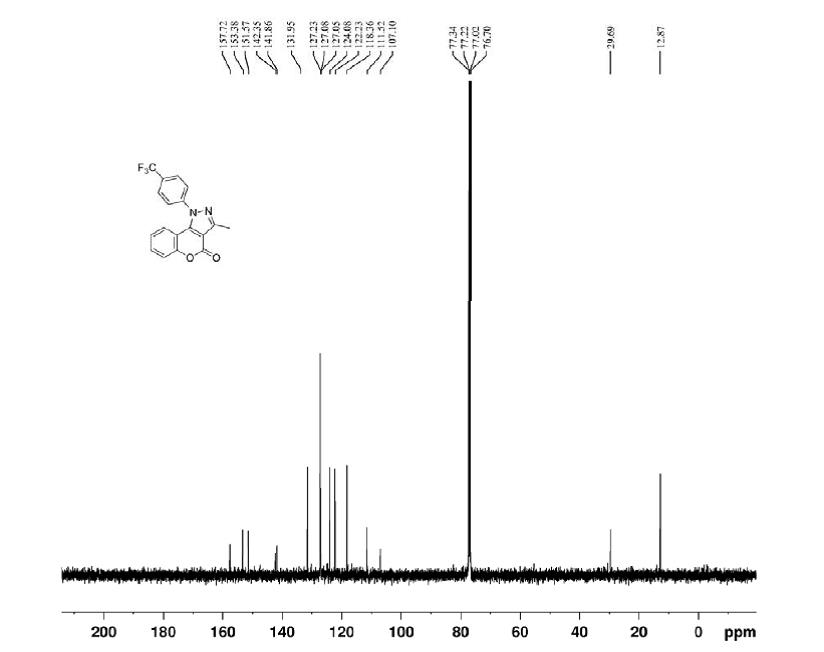
13C NMR (CDCl3, 100 MHz): δ ppm 157.7, 153.3, 151.5, 142.3, 141.8, 131.9, 127.2, 127.1, 127.0, 124.0, 122.2, 118.3, 111.5, 107.1, 12.8;
HRMS (ESI) m/z: Calcd for C18H11F3N2O2Na [M + Na]+ 367.0670; found 367.0676.

Synthetic Communications (2014), 44(13), 1914-1923

DOI:
10.1080/00397911.2013.879184

Jagdeep Grovera, Somendu Kumar Roya & Sanjay Madhukar Jachaka*

pages 1914-1923

http://www.tandfonline.com/doi/abs/10.1080/00397911.2013.879184#.VCI5f0DgXXM

http://www.tandfonline.com/doi/suppl/10.1080/00397911.2013.879184/suppl_file/lsyc_a_879184_sm8537.pdf

Abstract

Unprecedented cyclization was observed during N-sulfonylation of 3-[1-(phenylhydrazono)-ethyl]-chromen-2-one in pyridine, affording 3-methyl-1-phenylchromeno[4,3-c]pyrazol-4(1H)-ones. To avoid use of noxious pyridine, reaction was tried in different basic conditions and the best results were obtained with potassium carbonate in acetone. A wide range of substrates bearing either electron-donating or electron-withdrawing substituents on phenylhydrazine ring were compatible with the developed methodology. Rapid access of starting material, 3-acetylcoumarin, excellent yields of products, and use of environmentally benign base and solvent for the cyclization make this strategy an efficient and convenient method for synthesis of 3-methyl-1-phenylchromeno[4,3-c]pyrazol-4(1H)-ones.

STR4

Methyl-1-(4-(trifluoromethyl)phenylchromeno[4,3-c]pyrazol-4(1H)-one (4b):
Whitesolid;
yield 90%; mp: 224–225 °C;
1H NMR (CDCl3, 400 MHz):δppm 2.69 (s, 3H, CH3),
7.10(td, 1H,J= 1.56, 7.38 Hz, H-8),
7.16 (dd, 1H,J= 1.4, 8.2 Hz, H-9),
7.45–7.52 (m, 2H, H-6, H-7),
7.73 (d, 2H,J= 8.24 Hz, Ar-H),
7.89 (d, 2H,J= 8.32 Hz, Ar-H);
13C NMR (CDCl3, 100MHz):
δppm 12.8, 107.1, 111.5, 118.3, 122.2, 124.0,
127.0, 127.1, 127.2, 131.9, 141.8, 142.3,
151.5, 153.3, 157.7;
HRMS (ESI)m/z: Calcd for C18H11F3N2O2Na [M + Na]+367.0670; found367.0676.
 3-Methyl-1-(4-(trifluoromethyl)phenylchromeno[4,3-c]pyrazol-4(1H)-one

STR4

SEE BELOW  1H NMR, 13CNMR, AND MASS SPEC

STR2STR2

STR3

References
1. Jones, G.; Willett, P.; Glen, R. C.; Leach, A. R.; Taylor, R. J. Mol. Biol. 1997, 267, 727.
2. Bernstein, F. C.; Koetzle, T. F.; Williams, G. J. B.; Meyer, E. F.; Brice, M. D.; Rodgers, J. R.; Kennard, O.; Shimanouchi, T.; Tasumi, M. J. Mol. Biol. 1977, 112, 535.

Discovery of Cathepsin S Inhibitor LY3000328 for the Treatment of Abdominal Aortic Aneurysm


 Inline image 1
Abstract Image
LY 3000328
Eli Lilly….INNOVATOR
(3R,4S)-4-(4-fluorobenzamido)-6-(4-(oxetan-3-yl)piperazin-1-yl methylcarbamate
Specific rotation: [α]D25 = 55.19 (c = 10,DMSO).

Cathepsin S (Cat S) plays an important role in many pathological conditions, including abdominal aortic aneurysm (AAA). Inhibition of Cat S may provide a new treatment for AAA. To date, several classes of Cat S inhibitors have been reported, many of which form covalent interactions with the active site Cys25. Herein, we report the discovery of a novel series of noncovalent inhibitors of Cat S through a medium-throughput focused cassette screen and the optimization of the resulting hits. Structure-based optimization efforts led to Cat S inhibitors such as 5 and 9 with greatly improved potency and drug disposition properties. This series of compounds binds to the S2 and S3 subsites without interacting with the active site Cys25.

On the basis of in vitro potency, selectivity, and efficacy in a CaCl2-induced AAA in vivo model, 5(LY3000328) was selected for clinical development.

Discovery of Cathepsin S Inhibitor LY3000328 for the Treatment of Abdominal Aortic Aneurysm
http://pubs.acs.org/doi/full/10.1021/ml500283g

Lilly Research Laboratories, A Division of Eli Lilly and Company, Lilly Corporate Center, Indianapolis, Indiana 46285, United States
ACS Med. Chem. Lett., Article ASAP
DOI: 10.1021/ml500283g
Publication Date (Web): August 27, 2014
Copyright © 2014 American Chemical Society
see
 http://pubs.acs.org/doi/suppl/10.1021/ml500283g/suppl_file/ml500283g_si_001.pdf
Abdominal aortic aneurysm
Classification and external resources
AneurysmAorta.jpg

CT reconstruction image of an abdominal aortic aneurysm

Abdominal aortic aneurysm (also known as AAA,[1] pronounced “triple-a”) is a localized dilatation (ballooning) of the abdominal aortaexceeding the normal diameter by more than 50 percent, and is the most common form of aortic aneurysm. Approximately 90 percent of abdominal aortic aneurysms occur infrarenally (below the kidneys), but they can also occur pararenally (at the level of the kidneys) orsuprarenally (above the kidneys). Such aneurysms can extend to include one or both of the iliac arteries in the pelvis.

Abdominal aortic aneurysms occur most commonly in individuals between 65 and 75 years old and are more common among men and smokers. They tend to cause no symptoms, although occasionally they cause pain in the abdomen and back (due to pressure on surrounding tissues) or in the legs (due to disturbed blood flow). The major complication of abdominal aortic aneurysms is rupture, which is life-threatening, as large amounts of blood spill into the abdominal cavity, and can lead to death within minutes.[2] Mortality of rupture repair in the hospital is 60% to 90%.

Treatment is usually recommended when an AAA grows to >5.5 cm in diameter. While in the past the only option for the treatment of AAA was open surgery, today most are treated with Endovascular Aneurysm Repair (EVAR).[3] EVAR has been widely adopted, as EVAR has a lower risk of death associated with surgery (0.5% for EVAR vs 3% for open surgery).[4] Open surgery is sometimes still preferred to EVAR, as EVAR requires long-term surveillance with CT Scans.[5]

There is moderate evidence to support screening in individuals with risk factors for abdominal aortic aneurysms (e.g., males ≥65).

DATA
HPLC purity = 98.6% (tR = 24.2 min) by HPLC method 3. ee = 99.9% (tR = 23.6 min) by Chiral HPLC method 4.
Specific rotation: [α]D25 = +55.19 (c = 10,DMSO).
1H NMR (400 MHz, DMSO-d6) δ 8.92 (d, J = 7.8 Hz, 1H), 8.01 – 7.90 (m, 2H), 7.34 –
7.23 (m, 2H), 7.19 (q, J = 4.5 Hz, 1H), 6.87 (dd, J = 9.0, 2.9 Hz, 1H), 6.78 – 6.69 (m, 2H), 5.03
(dd, J = 8.1, 3.7 Hz, 1H), 4.86 (td, J = 4.1, 1.8 Hz, 1H), 4.52 (t, J = 6.5 Hz, 2H), 4.41 (t, J = 6.0
Hz, 2H), 4.23 (dd, J = 11.8, 1.9 Hz, 1H), 4.13 (ddd, J = 11.8, 4.4, 1.6 Hz, 1H), 3.39 (p, J = 6.3
Hz, 1H), 2.96 (t, J = 4.9 Hz, 4H), 2.52 (d, J = 4.5 Hz, 3H), 2.34 (t, J = 4.9 Hz, 4H).
13C NMR (DMSO-d6, 100 MHz): δ 165.4, 164.5 (d, J = 248.7 Hz), 156.1, 148.2, 146.2, 131.0, 130.8 (d, J =
9.5 Hz), 120.9, 118.6, 117.6, 117.2, 115.6 (d, J = 21.3 Hz), 74.8, 68.7, 64.3, 58.9, 49.8, 49.5,
47.7, 27.4.
HRMS (ESI+): calcd. for C25H30FN4O5 (M+1): 485.2195, found 485.2188.
1H nmr LY3000328
Inline image 2
13 C nmr LY3000328
 
Inline image 3
  1. Logan, Carolynn M.; Rice, M. Katherine (1987). Logan’s Medical and Scientific Abbreviations. Philadelphia: J. B. Lippincott Company. p. 3. ISBN 0-397-54589-4.
  2.  Upchurch GR, Schaub TA (2006). “Abdominal aortic aneurysm”. Am Fam Physician 73(7): 1198–204. PMID 16623206.
  3.  Chadi SA et al (2012). “Trends in management of abdominal aortic aneurysms”. J Vasc Surg 55 (4): 924–8. doi:10.1016/j.jvs.2011.10.094. PMID 22226189.
  4.  Lederle FA, Freishlag JA et al (209). “Outcomes Following Endovascular vs Open Repair of Abdominal Aortic Aneurysm: A Randomized Trial”. JAMA 302 (14): 1535–42.doi:10.1001/jama.2009.1426. PMID 19826022.
  5.  Kirkpatrick VE et al (Dec 2013). “Surveillance Computed Tomographic Arteriogram (CTA) Does Not Change Management before Three Years in Patients Who Have a Normal Post-EVAR Study”. Ann Vasc Surg 28 (4): 831–6. doi:10.1016/j.avsg.2013.09.017.PMID 24361383

Keywords:

Cathepsin, abdominal aortic aneurysm, development candidate, noncovalent, Cathepsin S Inhibitor,  LY3000328,

Russian Ebola Vaccine in Preclinical Trials


Anna Popova, Head of the Federal Service for Supervision of Consumer Protection and Welfare (Rospotrebnadzor)

MOSCOW, August 5 (RIA Novosti) – A Russian vaccine against Ebola hemorrhagic fever is now undergoing preclinical tests, Russian consumer rights watchdog, Rospotrebnadzor, head Anna Popova told journalists.

Russian Ebola Vaccine in Preclinical Trials

RIA Novosti

As of today, it is in a stage of preclinical drug trials. The works are intensified now,” Popova said. She added that there are currently no licensed drugs …


see link


http://en.ria.ru/russia/20140805/191739156/Russian-Ebola-Vaccine-in-Preclinical-Trials.html


HSD-621 is a potent and selective 11β-HSD1 inhibitor


Figure imgf000051_0001


(R)-3,3,3-Trifluoro-2-(5-(((R)-4-(4-fluoro-2-(trifluoromethyl)phenyl)-2-methylpiperazin-1-yl)sulfonyl)thiophen-2-yl)-2-hydroxypropanamide

2-​Thiopheneacetamide, 5-​[[(2R)​-​4-​[4-​fluoro-​2-​(trifluoromethyl)​phenyl]​-​2-​methyl-​1-​piperazinyl]​sulfonyl]​-​α-​hydroxy-​α-​(trifluoromethyl)​-​, (αR)​-

1257229-37-0

C19 H18 F7 N3 O4 S2

…………………

The glucocorticoid receptor (GR) signaling pathway has been linked to the pathophysiology of diabetes and metabolic syndrome. We developed a series of potent and selective 11-HSD1 inhibitors. These compounds showed excellent potency against both human and mouse 11-HSD1 enzymes and displayed good pharmacokinetics and ex vivo inhibition of the target in mice.Compounds HSD-016 and HSD-621 were ultimately selected as clinical development candidates. Both compounds have attractive overall pharmaceutical profiles and demonstrated good oral bioavailability in mouse, rat and dog. When orally dosed in C57/BL6 diet-induced-obesity (DIO) mice, HSD-016 and HSD621 were efficacious and showed a significant reduction in both fed and fasting glucose and insulin levels. Furthermore, both compoundswere well tolerated in drug safety assessment studies.


Discovery of HSD-621 as a Potential Agent for the Treatment of Type 2 Diabetes 
(ACS Medicinal Chemistry Letters) Wednesday November 28th 2012
Author(s): Zhao-Kui WanEva ChenailHuan-Qiu LiManus IpekJason XiangVipin SuriSeung HahmJoel BardKristine SvensonXin XuXianbin TianMengmeng WangXiangping LiChristian E. JohnsonAriful QadriDarrell PanzaMylene PerreaultTarek S. MansourJames F. TobinEddine Saiah,
DOI:10.1021/ml300352x
GO TO: [Article]http://pubs.acs.org/doi/full/10.1021/ml300352xandhttp://pubs.acs.org/doi/suppl/10.1021/ml300352x/suppl_file/ml300352x_si_001.pdf  nmr data as 18b

11β-Hydroxysteroid dehydrogenase type 1 (11β-HSD1) catalyzes the conversion of inactive glucocorticoid cortisone to its active form, cortisol. The glucocorticoid receptor (GR) signaling pathway has been linked to the pathophysiology of diabetes and metabolic syndrome. Herein, the structure–activity relationship of a series of piperazine sulfonamide-based 11β-HSD1 inhibitors is described. (R)-3,3,3-Trifluoro-2-(5-(((R)-4-(4-fluoro-2-(trifluoromethyl)phenyl)-2-methylpiperazin-1-yl)sulfonyl)thiophen-2-yl)-2-hydroxypropanamide 18a (HSD-621) was identified as a potent and selective 11β-HSD1 inhibitor and was ultimately selected as a clinical development candidate. HSD-621 has an attractive overall pharmaceutical profile and demonstrates good oral bioavailability in mouse, rat, and dog. When orally dosed in C57/BL6 diet-induced obesity (DIO) mice, HSD-621 was efficacious and showed a significant reduction in both fed and fasting glucose and insulin levels. Furthermore, HSD-621 was well tolerated in drug safety assessment studies.

WO 2010141550

 http://www.google.com/patents/WO2010141550A2?cl=en

EXAMPLES The title compounds of Examples 1.1, 1.2, and 1.3 were prepared as shown in

Scheme 1 below. Detailed synthesis procedures are provided below.

Scheme 1


Example 1.1


3,3,3-trifluoro-2-r5-({(2R)-4-r4-fluoro-2-(trifluoromethyl)phenyll-2-methylpiperazin- l-yl}sulfonyl)-2-thienyll-2-hvdroxypropanamide Step IA: A mixture of (R)-2-methyl-piperazine (25.0 g, 250 mmol), 2-bromo 5- fluoro benzotrifluoride (55.1 g, 227 mmol), tris(dibenzylidineacetone)dipalldium (0) (2.08g, 2.27 mmol), rac-2,2′-bis(diphenylphosphino)-l,r-binaphthyl (4.24 g, 6.81 mmol) and sodium tert-butoxide (27.3 g, 280 mmol) was mixed and purged with N2. Anhydrous toluene (500 mL) was added and purged with N2 again. The resulting mixture was heated in an oil bath at 105 0C under N2 for 3.5 hours. After cooling, the reaction mixture was concentrated and then filtered through a pad of Celite, washed with Et2O. The organic layer was concentrated, diluted with Et2O (500 mL), filtered through a pad of Celite again, and washed with IN aq. HCl (2 x 150 mL). The aqueous layer was basified with NaOH at 0 0C (pH = -10) and then was extracted with Et2O (3 x 200 mL). The combined organic layer was dried over MgSO4 and concentrated under vacuum to give (3i?)-l-[4- fluoro-2-(trifluoromethyl)phenyl]-3-methylpiperazine as a brown oil (58.5 g, 98%), which was used without further purification.

Step IB: To a solution of 5-bromothiophene-2-sulfonyl chloride (26.2 g, 100 mmol) and (3R)-l-(4-fluoro-2-(trifluoromethyl)phenyl)-3-methylpiperazine (27.6 g, lOOmmol) in DCM (200 ml) was added Et3N (41.8 ml, 300 mmol) at room temp. The reaction mixture was stirred at room temperature until completion of the reaction (about 6 hours) and then washed with aq. NaHCO3. The basic washes were back extracted with dichloromethane (DCM). The combined organic layers were washed with brine and dried over Na2SO4. The crude product was purified on a SiO2 column using hexanes/DCM as the eluent to give (R)-l-(5-bromothiophen-2-ylsulfonyl)-4-(4-fluoro-2- (trifluoromethyl)phenyl)-2-methylpiperazine as a white solid (38 g, 78 mmol, 78 % yield).

Step 1C: To a solution of (R)-l-(5-bromothiophen-2-ylsulfonyl)-4-(4-fluoro-2- (trifluoromethyl)phenyl)-2-methylpiperazine (28.1 g, 57.7 mmol) in anhydrous THF (200 ml) was added Butyllithium (28.8 ml, 57.7 mmol) at -780C. The reaction mixture was Stirred under N2 for 15 min. and then a solution of methyl 3,3,3-trifluoropyruvate (6.07 ml, 57.7 mmol) in THF (20 mL) was added via a cannula. The reaction mixture was stirred at -780C for 2 h. and then quenched with a 10 mL of 10% aq. HCl. The reaction mixture was dried over MgSO4 and CombiFlashed with DCM/hexane (15 – 100%) to provide methyl 3,3,3-trifluoro-2-(5-((R)-4-(4-fluoro-2-(trifluoromethyl)phenyl)-2- methylpiperazin-l-ylsulfonyl)thiophen-2-yl)-2-hydroxypropanoate as a sticky, light yellow solid (22 g, 39.0 mmol, 67.6 % yield).

Step ID, Method 1: To a solution of methyl 3,3,3-trifluoro-2-(5-((R)-4-(4-fiuoro- 2-(trifluoromethyl)phenyl)-2-methylpiperazin-l-ylsulfonyl)thiophen-2-yl)-2- hydroxypropanoate (21.5 g, 38.1 mmol) in MeOH (200 ml) was added aq. NH3 (-28-

30%, 50 mL). The reaction mixture was stirred at room temperature o/n and then diluted with ice water (700 mL). The resultant white ppt was collected by filtration, washed with water, and dried in an oven at 60 0C to give the desired product 3,3,3-trifluoro-2-(5-((R)- 4-(4-fluoro-2-(trifluoromethyl)phenyl)-2-methylpiperazin-l-ylsulfonyl)thiophen-2-yl)-2- hydroxypropanamide (15 g, 27.3 mmol, 71.7 % yield). The aqueous layer was extracted with DCM (4 x 100 mL), and the combined organic layers were concentrated. Purification of the concentrate by column chromatography with EA/DCM (0-40%) gave an additional 1.5 g of product.

Method 2: To a solution of methyl 3,3,3-trifluoro-2-(5-((R)-4-(4-fluoro-2-

(trifluoromethyl)phenyl)-2-methylpiperazin-l-ylsulfonyl)thiophen-2-yl)-2- hydroxypropanoate (200 mg) in MeOH (20 ml) at -780C was bubbled NH3 gas. The resultant mixture was stirred at room temperature overnight, concentrated, and dissolved in fresh DCM. The organic layer was washed with aq. NaHCO3 and dried to give 3,3,3- trifluoro-2-(5 -((R)-4-(4-fluoro-2-(trifluoromethyl)phenyl)-2-methylpiperazin- 1 – ylsulfonyl)thiophen-2-yl)-2-hydroxypropanamide as a white solid (150 mg). It was found that competing hydrolysis of the ester group to the corresponding acid occurred to a greater extent when using Method 1. Thus, in some instances, it may be preferable to use Method 2 when performing step D.

HRMS: calcd for Ci9Hi8F7N3O4S2 + H+, 550.06997; found (ESI-FTMS,

[M+H]1+), 550.07165. Example 1.2


Figure imgf000051_0001 desired

αR)-3,3,3-trifluoro-2-r5-ααR)-4-r4-fluoro-2-(trifluoromethyl)phenyll-2- methylpiperazin-l-yl}sulfonyl)thiophen-2-yll-2-hvdroxypropanamide

13.5 grams of 3,3,3-trifluoro-2-(5-((R)-4-(4-fiuoro-2-(trifluoromethyl)phenyl)-2- methylpiperazin-l-ylsulfonyl)thiophen-2-yl)-2-hydroxypropanamide (prepared according to a procedure similar to that described in Example 1.1) was separated was separated with a chiral column (Chiralpak ADH) in SFC Analytical Instrument; Mobile Phase was 90% CO2 /10%Methanol at flow rate 5mL/min. Early fraction (Retention 4.4min) was collected to give the title compound (5.7g); late fraction was collected to give the diastereomer described in Example 1.3 (6g, retention time 6. lmin).

HRMS: calcd for Ci9Hi8F7N3O4S2 + H+, 550.06997; found (ESI, [M+H]+), 550.0697. Example 1.3


Figure imgf000052_0001 undesired

αS)-3,3,3-trifluoro-2-r5-ααR)-4-r4-fluoro-2-qrifluoromethyl)phenyll-2- methylpiperazin-l-yl}sulfonyl)thiophen-2-yll-2-hvdroxypropanamide The title compound was obtained as the late fraction using the separation method described in Example 1.2.

HRMS: calcd for Ci9Hi8F7N3O4S2 + H+, 550.06997; found (ESI, [M+H]+), 550.0701.

US8524894 Jun 4, 2010 Sep 3, 2013 Laboratorios Salvat, S.A. Inhibitor compounds of 11-beta-hydroxysteroid dehydrogenase type 1
WO2005063247A1 * Dec 20, 2004 Jul 14, 2005 Amgen Sf Llc Aryl sulfonamide compounds and uses related thereto
WO2007092435A2 * Feb 7, 2007 Aug 16, 2007 Wyeth Corp 11-beta hsd1 inhibitors


Trifarotene


Trifarotene - Wikipedia

ChemSpider 2D Image | Trifarotene | C29H33NO4

Trifarotene

CAS 895542-09-3

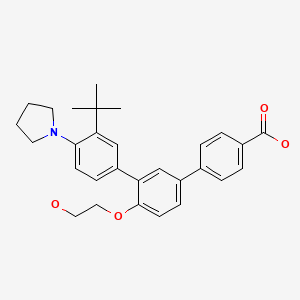
3”-Tert-butyl-4′-(2-hydroxyethoxy)-4”-(pyrrolidin-1-yl)(1,1′:3′,1”)terphenyl-4-carboxylic acid

3′-[3-tert-butyl-4-(pyrrolidin-1-yl)phenyl]-4′-(2-hydroxyethoxy)-[1,1′-biphenyl]-4-carboxylic acid

[1,1′:3′,1”-Terphenyl]-4-carboxylic acid, 3”-(1,1-dimethylethyl)-4′-(2-hydroxyethoxy)-4”-(1-pyrrolidinyl)- 
0J8RN2W0HK
 
4′-(2-Hydroxyethoxy)-3”-(2-methyl-2-propanyl)-4”-(1-pyrrolidinyl)-1,1′:3′,1”-terphenyl-4-carboxylic acid 

UNII-0J8RN2W0HK,

Galderma Research & Development

459.5766

C29 H33 N O4

  • CD-5789
  • CD5789
трифаротен [Russian] [INN]
تريفاروتين [Arabic] [INN]
曲法罗汀 [Chinese] [INN]

Trifarotene, sold under the brand name Aklief, is a medication for the topical treatment of acne vulgaris in those nine years of age and older.[1] It is a retinoid;[2] more specifically, it is a fourth generation selective retinoic acid receptor (RAR)-γ agonist.[3]

It was approved for medical use in the United States in 2019,[1][4][5] but is not approved in the European Union as of January 2021.[6] Trifarotene was granted orphan drug designation for the treatment of congenital ichthyosis by both the U.S. Food and Drug Administration (FDA) and the European Medicines Agency (EMA).[7][8]

State Solid

Experimental Properties

PROPERTY VALUE SOURCE
melting point (°C) 245C FDA Label
pKa 5.69 (pKa1) FDA Label

USFDA

The drug substance, trifarotene, a terphenyl acid derivative, is a retinoic
acid receptor (RAR) aQonist and is classified as a rotenoid. Trifarotene
intended as a drug for the treatment of acne vulgaris. Since trifarotene
has not been previously approved as an active ingredient in any drug
product in the United States, it is classified as a new molecular entity
(NME).
Trifarotene is produced as a white to off-white to slightly yellow crystalline
powder. It is slightly soluble in acetone, ethanol, and toluene, very slight
soluble in isopropanol, and practically insoluble in water (tiJT4
1
Cb><“JTrifarotene is nonhygroscopic and has pKa1 of 5.69 and pKa2 of 4.55. The chemical name
for trifarotene is 4-{3-[3-tert-butyl-4-(pyrrolidin-1-yl) phenyl]-4-(2-
hydroxyethoxy) phenyl} benzoic acid. It has the chemical formula of
C29H33NQ4, the molecular weiQht of 459.59, …………https://www.accessdata.fda.gov/drugsatfda_docs/nda/2019/211527Orig1s000ChemR.pdf


 Prescription Products

For treatment of congenital ichthyosis, PRECLINICAL, Galderma Res & Dev,

Galderma announced that the U.S. Food and Drug Administration (FDA) granted Orphan Drug Designation status for the company’s trifarotene molecule for the treatment of congenital ichthyosis. Based on this decision, Galderma plans to implement a clinical development plan, reinforcing its commitment to exploring new treatment options for rare diseases, as well as meeting the needs of all patients with skin diseases over the course of their lives.

http://www.dddmag.com/news/2014/07/fda-grants-orphan-designation-galderma%E2%80%99s-skin-disease-drug?et_cid=4028064&et_rid=523035093&type=headline

Galderma治療先天性魚鱗癬的Trifarotene分子取得FDA的孤兒藥資格認定

http://news.msn.com.tw/market3773054.aspx


Chemical structure for Trifarotenetrifarotene

The company’s molecule trifarotene is a selective agonist of the gamma retinoic acid receptor (RAR-gamma), which is currently in clinical development for use in other more common dermatological conditions. It is the drug’s retinoid functionality and potent keratolytic properties that make it a potentially viable treatment of the lamellar ichthyosis pathology. Galderma has already initiated the program for investigating the treatment of lamellar ichthyosis with trifarotene and is currently working in collaboration with regulatory authorities to implement an innovative and expedient clinical development plan.


Ichthyoses comprise a large group of skin scaling disorders with diverse etiologies. The stereotypic pathophysiology is epidermal hyperplasia and abnormal desquamation, leading to visible accumulation of squames (scales) on the skin’s surface. Congenital ichthyosis is a term used to refer to a specific group of rare inherited forms of ichthyoses that are generally more severe than non-inherited forms of the disease. Lamellar ichthyosis is one such disorder that falls within the congenital ichthyosis category. Lamellar ichthyosis is recognized as a severe disease which persists throughout life. After birth, during the first post-natal weeks, the hyperkeratotic (colloidion) membrane patients are typically born with, is gradually shed and is replaced by scaling and lichenification that involves the entire body, including face, scalp, palms and soles. While usually not life threatening, lamellar ichthyosis can result in disability, partial deafness, poor adaptation to environmental conditions (due to hypohydrosis), severe discomfort (pruritus, fissuring of the skin), and significant psycho-social impact. The estimated prevalence of LI in the US is in the range of 1 per 100,000 to 1 per 200,000 persons.

Synthesis Reference

Thoreau, E. et. al. Structure-based design of Trifarotene (CD5789), a potent and selective RARγ agonist for the treatment of acne. Bioorganic & Medicinal Chemistry Letters, Volume 28, Issue 10. 2018. Pages 1736-1741

https://www.sciencedirect.com/science/article/abs/pii/S0960894X18303482

Trifarotene – Synthetic Route 1

Synthetic Description

Reference: Biadatti, Thibaud; Dumais, Laurence; Soulet, Catherine; Talano, Sandrine; Daver, Sebastien. Preparation of [1,1′:3′,1”]terphenyl-4-carboxylic acid and esters a novel ligands modulating retinoic acid receptors (RAR), and use thereof in human medicine and in cosmetics. Assignee Galderma Research & Development, S.N.C., Fr. WO 2006066978. (2016).


PATENT

WO 2006066978

http://www.google.com/patents/WO2006066978A1?cl=en

Example 25 – 3″-ter.-Butyl-4′-(2-hvdroxyethoxy)-4″-pyrrolidin-1-ylM,1′:3′,1″1- terphenyl-4-carboxylic acid


In a manner similar to that of Example 6b, by reacting 500 mg (0.9 mmol) of ethyl 4′-(2- acetoxyethoxy)-3″-terf-butyl-4″-pyrrolidin-1 -yl[1 , 1 ‘;3’, 1 “]terphenyl-4-carboxylate with

300 mg (8 mmol) of sodium hydroxide, 242 mg of 3″-tert-butyl-4′-(2-hydroxyethoxy)-4″- pyrrolidin-1-yl[1l1′;3′,1″]terphenyl-4-carboxylic acid are obtained (yield = 55 %) in the form of a white solid (m.p. = 2230C).

1H NMR (DMSO. 400 MHz): 1.43 (s, 9H); 1.90 (m, 4H); 3.0 (m, 4H); 3.73 (d, J=4.7Hz, 2H); 4.1 (m, 2H); 4.7 (s, 1H); 7.2 (d, 1H, J=8.6Hz); 7.48 (m, 2H); 7.59 (d, J=1.6Hz, 1H); 7.64 (d, J=UHz, 1H); 7.68 (dd, J=2Hz, 7.8Hz, 1H); 7.82 (d, J=8.3Hz, 2H); 7.99 (d, J=8.4Hz, 2H).

PATENT

WO 2013178759

 http://www.google.com/patents/WO2013178759A1?cl=en

PATENT

WO 2013178758

http://www.google.com/patents/WO2013178758A1?cl=en

PATENT

WO 2013178760

 http://www.google.com/patents/WO2013178760A1?cl=en

The details of skin application are given in the table below.


Figure imgf000046_0001


SYN

New Drug Approvals for 2019: Synthesis and Clinical Applications

New Drug Approvals for 2019: Synthesis and Clinical Applications
Shuo Yuan, Bin Yu, Hong-Min Liu
PII: S0223-5234(20)30639-5
DOI: https://doi.org/10.1016/j.ejmech.2020.112667
Reference: EJMECH 112667
To appear in: European Journal of Medicinal Chemistry

Trifarotene (Aklief). In October 2019, trifarotene, a topical retinoid that
selectively targets retinoic acid receptor gamma (RAR-γ), was approved by the FDA
for the treatment of acne vulgaris [142]. The drug was developed and marketed by
Galderma Pharmaceutical in Switzerland. Trifarotene is considered as the first of the
‘fourth-generation’ retinoids due to its uniquely selective agonism at RAR-γ. The
selective agonism leads to downstream alterations, confering improved efficacy and
reduced side effects [143]. In two phase 3 clinical trials of 2420 patients with
moderate acne on the face and trunk, trifarotene was well tolerated and significantly
reduced inflammatory lesions as early as two weeks on the face and four weeks on the
back, shoulders and chest compared to vehicle (p<0.05) [144].
The synthetic approach of this drug was disclosed by Galderma Research &
Development (Scheme 25) [145]. Bromination of commercially available
2-(tert-butyl)aniline 171 gave 4-bromo-2-(tert-butyl)aniline 172 in quantitative yield,
which then reacted with 1-dibromobutane 173 to give phenylpyrrolidine 174 in 52%
yield. Miyaura reaction of 174 was realized by employing n-BuLi and triisopropyl
borate (TIPB) followed by washed with aqueous HCl, resulting in arylboronic acid
adduct 175 in 66% yield. Treatment of 175 with aromatic bromide 176 in the presence
of Pd(PPh3)4 gave the coupling product 177 in 47% yield, which then underwent
hydrolysis delivering trifarotene (XIX) in 55% yield.
The preparation of coupling partner 176 is depicted in Scheme 26. Esterification of
4-hydroxy-4-biphenylcarboxylic acid 178 gave ethyl benzoate derivative 179 upon
treatment with catalytic H2SO4 in the refluxing EtOH [145]. The resulting ester was
subjected to treatment with tetrabutylammonium bromide (TBAB) in THF, resulting
in bromide 180 in good yields, further NaH-mediated Williamson ether synthesis with
2-bromoethyl acetate 181 gave 176 in 95% yield.

This image has an empty alt attribute; its file name is str1.jpg

[142] L.J. Scott, Trifarotene: first approval, Drugs 79 (2019) 1905-1909.
[143] E. Thoreau, J.M. Arlabosse, C. Bouix-Peter, S. Chambon, L. Chantalat, S.
Daver, L. Dumais, G. Duvert, A. Feret, G. Ouvry, J. Pascau, C. Raffin, N.
Rodeville, C. Soulet, S. Tabet, S. Talano, T. Portal, Structure-based design of
trifarotene (CD5789), a potent and selective RARγ agonist for the treatment of
acne, Bioorg. Med. Chem. Lett. 28 (2018) 1736-1741.
[144] J. Tan, D. Thiboutot, G. Popp, M. Gooderham, C. Lynde, J.D. Rosso, J. Weiss,
U. Blume-Peytavi, J. Weglovska, S. Johnson, L. Parish, D. Witkowska, N.S.
Colon, A.A. Saenz, F. Ahmad, M. Graeber, L.S. Gold, Randomized phase 3
evaluation of trifarotene 50 µg/g cream treatment of moderate facial and truncal
acne, J. Am. Acad. Dermatol. 80 (2019) 1691-1699.
[145] T. Biadatti, L. Dumais, C. Soulet, S. Talano, S. Daver, Novel ligands that
modulate rar receptors, and use thereof in human medicine and in cosmetics,
2006. WO2006066978.

WO2006066978A1 * Dec 21, 2005 Jun 29, 2006 Galderma Res & Dev Novel ligands that modulate rar receptors, and use thereof in human medicine and in cosmetics
EP0826366A2 Aug 1, 1997 Mar 4, 1998 Unilever N.V. Cosmetic compositions containing hydroxy acid or retinoid
EP0989846A2 Sep 22, 1998 Apr 5, 2000 E-L Management Corp. Non-irritating cosmetic and pharmaceutical compositions
EP1831149A1 Dec 21, 2005 Sep 12, 2007 Galderma Research & Development Novel ligands that modulate rar receptors and use thereof in human medicine and in cosmetics
FR2915682A1 *       Title not available
US5851538 Dec 29, 1995 Dec 22, 1998 Advanced Polymer Systems, Inc. Retinoid formulations in porous microspheres for reduced irritation and enhanced stability
WO1999010308A1 * Aug 21, 1998 Mar 4, 1999 Bernardon Jean Michel Biphenyl derivatives substituted by an aromatic or heteroaromatic radical and pharmaceutical and cosmetic compositions containing same
US6150413 * May 26, 1998 Nov 21, 2000 Centre International De Recherches Dermatologiques Treatment of dermatological, rheumatic, respiratory, cardiovascular, bone and ophthalmological disorders, as well as mammalian skin and hair conditions; 4-(4-(biphenyl-2-yl)but-3-en-1-ynyl)benzoic acid, for example
Trifarotene
Trifarotene.svg
Clinical data
Trade names Aklief
Other names CD5789
AHFS/Drugs.com Monograph
MedlinePlus a620004
License data
Pregnancy
category
  • AU: D
Routes of
administration
Topical
Drug class Skin and mucous membrane agents
ATC code
Legal status
Legal status
Identifiers
CAS Number
PubChem CID
DrugBank
ChemSpider
UNII
KEGG
ChEMBL
CompTox Dashboard (EPA)
ECHA InfoCard 100.278.901 Edit this at Wikidata
Chemical and physical data
Formula C29H33NO4
Molar mass 459.586 g·mol−1
3D model (JSmol)

References

  1. Jump up to:a b “Drug Trials Snapshots: Aklief”U.S. Food and Drug Administration (FDA). 11 October 2019. Archived from the original on 19 November 2019. Retrieved 18 November 2019.  This article incorporates text from this source, which is in the public domain.
  2. ^ Trifarotene Monograph
  3. ^ Scott LJ (November 2019). “Trifarotene: First Approval”Drugs79 (17): 1905–1909. doi:10.1007/s40265-019-01218-6PMID 31713811.
  4. ^ “Aklief (trifarotene) FDA Approval History”Drugs.com. 7 October 2019. Retrieved 19 November 2019.
  5. ^ “Drug Approval Package: Aklief”U.S. Food and Drug Administration (FDA). 21 October 2019. Archived from the original on 19 November 2019. Retrieved 18 November 2019.
  6. ^ “Trifarotene”European Medicines Agency. Retrieved 17 June 2020.
  7. ^ “Trifarotene Orphan Drug Designations and Approvals”U.S. Food and Drug Administration (FDA). 24 December 1999. Retrieved 19 August 2020.
  8. ^ “EU/3/20/2264”European Medicines Agency (EMA). 12 August 2020. Retrieved 19 August 2020.

External links

  1. Aubert J, Piwnica D, Bertino B, Blanchet-Rethore S, Carlavan I, Deret S, Dreno B, Gamboa B, Jomard A, Luzy AP, Mauvais P, Mounier C, Pascau J, Pelisson I, Portal T, Rivier M, Rossio P, Thoreau E, Vial E, Voegel JJ: Nonclinical and human pharmacology of the potent and selective topical retinoic acid receptor-gamma agonist trifarotene. Br J Dermatol. 2018 Aug;179(2):442-456. doi: 10.1111/bjd.16719. Epub 2018 Jul 4. [PubMed:29974453]
  2. Balak DMW: Topical trifarotene: a new retinoid. Br J Dermatol. 2018 Aug;179(2):231-232. doi: 10.1111/bjd.16733. [PubMed:30141539]
  3. Blume-Peytavi U, Fowler J, Kemeny L, Draelos Z, Cook-Bolden F, Dirschka T, Eichenfield L, Graeber M, Ahmad F, Alio Saenz A, Rich P, Tanghetti E: Long-term safety and efficacy of trifarotene 50 mug/g cream, a first-in-class RAR-gamma selective topical retinoid, in patients with moderate facial and truncal acne. J Eur Acad Dermatol Venereol. 2019 Jul 15. doi: 10.1111/jdv.15794. [PubMed:31306527]
  4. Tan J, Thiboutot D, Popp G, Gooderham M, Lynde C, Del Rosso J, Weiss J, Blume-Peytavi U, Weglovska J, Johnson S, Parish L, Witkowska D, Sanchez Colon N, Alio Saenz A, Ahmad F, Graeber M, Stein Gold L: Randomized phase 3 evaluation of trifarotene 50 mug/g cream treatment of moderate facial and truncal acne. J Am Acad Dermatol. 2019 Jun;80(6):1691-1699. doi: 10.1016/j.jaad.2019.02.044. Epub 2019 Feb 22. [PubMed:30802558]
  5. Chien A: Retinoids in Acne Management: Review of Current Understanding, Future Considerations, and Focus on Topical Treatments J Drugs Dermatol. 2018 Dec 1;17(12):s51-55. [PubMed:30586483]
  6. FDA Approved Drugs: Aklief® [Link]
трифаротен
تريفاروتين
曲法罗汀
 
 
DOSAGE
 
 
Showing 1 to 3 of 3 entries
 
CLINICAL
 
Showing 1 to 5 of 5 entries

BMS 587101…….The LFA-1 receptor antagonist in preclinical for the treatment of a variety of autoimmune and inflammatory diseases such as rheumatoid arthritis and psoriasis.


  • C26H20Cl2N4O4S
  •  mass: 555.432373 Da

Bristol-Myers Squibb Company

read poster

 http://www.cerep.fr/cerep/users/pages/news/Publications/123.pdf


BMS-587101 acts as a leukocyte function-associated antigen-1 (LFA-1) receptor antagonist. Ref: Synfacts. 2010; 8, 0865-0865.

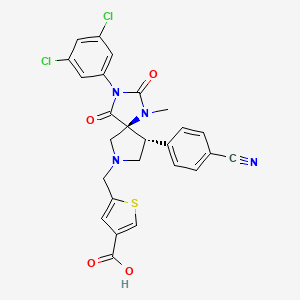
5-[(5S,9R)-9-(4-Cyanophenyl)-3-(3,5-dichlorophenyl)-1-methyl-2,4-dioxo-1,3,7-triazaspiro[4.4]non-9-ylmethyl]-thiophene-3-carboxylic Acid

3-Thiophenecarboxylic acid, 5-[[(5S,9R)-9-(4-cyanophenyl)-3-(3,5-dichlorophenyl)-1-methyl-2,4-dioxo-1,3,7-triazaspiro[4.4]non-7-yl]methyl]- [ACD/Index Name]

5-{[(5S,9R)-9-(4-Cyanophenyl)-3-(3,5-dichlorophenyl)-1-methyl-2,4-dioxo-1,3,7-triazaspiro[4.4]non-7-yl]methyl}-3-thiophenecarboxylic acid [ACD/IUPAC Name]

5-{[(5S,9R)-9-(4-Cyanphenyl)-3-(3,5-dichlorphenyl)-1-methyl-2,4-dioxo-1,3,7-triazaspiro[4.4]non-7-yl]methyl}-3-thiophencarbonsäure [German] [ACD/IUPAC Name]

Acide 5-{[(5S,9R)-9-(4-cyanophényl)-3-(3,5-dichlorophényl)-1-méthyl-2,4-dioxo-1,3,7-triazaspiro[4.4]non-7-yl]méthyl}-3-thiophènecarboxylique [French] [ACD/IUPAC Name]

2IC

BMS-587101

BMS-688521

data

MS (ESI)m/z553 (M-H)-;
1H NMR(500 MHz, DMSO-d6)δ
8.17 (1 H, s), 7.62 (2 H, d,J=8.07 Hz), 7.44 (1 H, s), 7.27 (3 H, m), 6.64 (2 H, s),
4.11 (1 H, d,J=13.45 Hz), 3.96 (1 H, d,J=14.12 Hz), 3.88 (1 H, dd,J=11.76, 5.71 Hz), 3.43 (2 H, br. s.),
3.27 (1 H, br. s.), 3.23 (3 H, s), 3.06 (1 H, d,J=10.08 Hz);
Anal.(C26H20Cl2N4O4S)Calcd.: C,56.22; H,3.63;Cl, 12.77; N,10.09; S,5.77;.
Found: C,55.95; H,3.59;Cl, 12.54; N,10.01; S,5.79;
ee =99.26±0.00 % [Chiralcel OJ-R, 150 x 4.6 mm, 5 um particle size, MeOH: CH3CN: 0.2% aq.H3PO4 (30:30:40)];
[α]D=-6.324 (c = 8.967 mg/mL, CHCl3);

ChemSpider 2D Image | 5-{[(5S,9R)-9-(4-Cyanophenyl)-3-(3,5-dichlorophenyl)-1-methyl-2,4-dioxo-1,3,7-triazaspiro[4.4]non-7-yl]methyl}-3-thiophenecarboxylic acid | C26H20Cl2N4O4S

Interaction between leukocyte function-associated antigen-1 (LFA-1), expressed on the surface of cytokine-stimulated cells, and intercellular adhesion molecule (I-CAM), found on the surface of both leukocytes and endothelium, plays a key function in the intercellular immune response, causing T-cell adhesion and subsequent migration through the blood vessel wall to the inflamed area.(1)

Small molecules which inhibit the LFA-1/I-CAM interaction are targeted as potential drugs for the treatment of a variety of autoimmune and inflammatory diseases such as rheumatoid arthritis and psoriasis.(2, 3) The LFA-1 receptor antagonist, BMS-587101, 1,(4, 5) was selected for clinical development, and we required a synthesis that would reliably generate kilogram quantities of API. This paper details the identification and development of a synthesis which enabled the realization of this goal.

BMS-587101 inhibits the interaction between leukocyte function-associated antigen-1 (LFA-1) and the intercellular adhesion molecule (ICAM), thereby offering a potential treatment for various autoimmune and inflammatory dis­eases, such as rheumatoid arthritis and psoriasis. A four-step multikilogram route to BMS-587101 (22% overall yield ) from the commercial hydantoin B features an efficient dipolar cycloaddition of an azomethine ylide generated by reaction of glycine with hexamethylenetetramine (HMTA).
Chemical structure for 2ica

………….

paper
Figure


http://pubs.acs.org/doi/abs/10.1021/op9003168

Org. Process Res. Dev., 2010, 14 (3), pp 553–561
DOI: 10.1021/op9003168


The process development and the kilogram-scale synthesis of BMS-587101 (1) are described. The synthesis features a [3 + 2] azomethine ylide cycloaddition to efficiently build the spirocyclic core in a diastereoselective fashion followed by a classical resolution which affords the desired enantiomer in >98% enantiomeric excess. The target was prepared in four steps in an overall yield of 22%.

Preparation of 5-[(5S,9R)-9-(4-Cyanophenyl)-3-(3,5-dichlorophenyl)-1-methyl-2,4-dioxo-1,3,7-triazaspiro[4.4]non-9-ylmethyl]-thiophene-3-carboxylic Acid (1) Directly from 6

To a solution of 6 (46.9 kg, 77.6 mol) and 1,2-propanediol (11.8 kg) in tetrahydrofuran (41.7 kg) and water (266.8 kg) was added cold (0−10 °C) potassium hydroxide solution (1 N, 244.5 kg) at 8−12 °C in 0.5 h. The resulting biphasic mixture was stirred at 8−12 °C for 18−24 h until the reaction was complete (<1% 6 remaining as monitored by HPLC). The reaction mixture was washed with n-heptane (385.7 kg). The pH was adjusted to 7.5 with addition of 1.5 M citric acid (22.9 kg). Isopropyl acetate (817.8 kg) was charged, and 1.5 M citric acid(aq) (22.9 kg) was added until a pH of 6.5 was attained. After agitating for 15 min and holding for 30 min, the aqueous layer was discarded, and the organic layer was washed with H2O (470 kg). The solution was then polish filtered, and isopropylacetate (52.2 kg) was used to rinse the polish filter assembly. The solution was concentrated under reduced pressure (240 Torr) to a volume of 718 L at <45 °C. Seeds (500 g) were charged, and the distillation was continued until a volume of 207 L was attained. Heptane (117.8 kg) was charged, the slurry was cooled to 20 °C over 1.5 h and was subsequently wet milled until d90 < 60 μm. The slurry was held for >2 h and filtered. The cake was washed with a 1:1 isopropyl acetate/heptane solution (109.7 kg) isopropyl acetate and dried in vacuum at 35−40 °C to a constant weight. Acid 1 (39.6 kg, 91.5% yield and 99.33 HPLC area % purity) was obtained as a white and sandy crystalline solid.


…………………………

U.S. Patent 7,381,737 B2

http://www.google.com/patents/US7381737

IIIn:


Also provided are crystalline forms of solvates and salts of the substituted spiro-hydantoin compound (IIIn).

5-[(5S,9R)-9-(4-Cyanophenyl)-3-(3,5-dichlorophenyl)-1-methyl-2,4-dioxo-1,3,7-triazaspiro[4.4]non-7-ylmethyl]-thiophene-3-carboxylic acid.


EXAMPLES

The following examples illustrate embodiments of the inventive process, and are not intended to limit the scope of the claims. For ease of reference, the following abbreviations are used herein:

ABBREVIATIONS


  • DMSO=dimethyl sulfoxide
  • DTTA=(+)-Di-p-toluoyl-D-tartaric acid

Preparation 13-(3,5-dichlorophenyl)-1-methylimidazolidine-2,4-dione


Triethylamine (0.78 kg, 7.75 mol) was added in 15-30 minutes with stirring to a thin suspension of sarcosine ethylene hydrochloride (1.00 kg, 6.51 mol) in dichloromethane (6.00 L). After stirring at room temperature for 1.5-2.0 hours, the mixture was filtered to remove the resulting triethylamine hydrochloride salt. The salt cake was washed with dichloromethane (2.00 L). The filtrate was cooled to 0-5° C.

A solution of 3,5-dichlorophenyl isocyanate (1.47 kg, 7.81 mol) in dichloromethane was prepared at 20-25° C. The solution was added to the above cooled filtrate slowly in 30-60 minutes. The temperature was maintained below 10° C. during the addition. After the addition, the mixture was stirred at 20-25° C. for 12-14 hours. The completeness of the reaction was followed by HPLC. Upon reaction completion, TBME (16.00 L) was added in one portion. The resulting suspension was stirred at 20-25° C. for 2-3 hours and was then filtered. The filter cake was washed with TBME (4.50 L) and dried at maximum 40° C. to a constant weight. A suspension of the above filter cake in water (17.0 L, 10 L/kg input) was prepared and stirred at 20-25° C. for at least 16 hours. The suspension was filtered and the filter cake was washed with water (3×1.36 L) and dried at maximum 40° C. to a constant weight to a constant weight. 3-(3,5-dichlorophenyl)-1-methylimidazolidine-2,4-dione (1.52 kg, 90%) was obtained as a white crystalline solid. mp=202-204° C. 1H NMR (DMSO-d6): 7.66 (1H, m), 7.51 (2H, m), 4.10 (2H, s), 3.35 (3H, s). 13C NMR (DMSO-d6): 8 Carbons (169.30, 155.00, 134.98, 134.15, 127.59, 125.30, 51.75, 29.79). Anal. Calcd for C10H8Cl2N2O2: C, 46.35; H, 3.11; N, 10.81; Cl, 27.36. Found: C, 46.43; H, 2.9; N, 10.73; Cl, 27.33.

Preparation 2(E)-4-((1-(3,5-dichlorophenyl)-3-methyl-2,5-dioxoimidazolidin-4-ylidene)methyl)benzonitrile


A mixture of 3-(3,5-dichlorophenyl)-1-methylimidazolidine-2,4-dione (1.00 kg, 3.86 mol), 4-cyanobenzaldehyde (0.70 kg, 5.79 mol) and pyrrolidone (0.27 kg, 3.86 mmol) was refluxed in EtOH (13.00 L) for 20-24 hours at a temperature of 78° C. The completeness of the reaction was followed by HPLC. Upon reaction completion, the suspension was cooled to 65° C. and THF (4.33 L) was added in 5-10 minutes. The suspension was cooled to 20-25° C. in 3-4 hours and was then filtered. The filter cake was washed with EtOH (4×2.00 L) and dried at maximum 40° C. to a constant weight. (E)-4-((1-(3,5-dichlorophenyl)-3-methyl-2,5-dioxoimidazolidin-4-ylidene)methyl)benzonitrile (1.24 kg, 86%) was obtained as a fluffy, yellowish crystalline solid. mp=239-241° C. 1H NMR (DMSO-d6): 8.07 (2H, d, J=8.3 Hz), 7.86 (2H, d, J=8.4 Hz), 7.72 (1H, m), 7.59 (2H, m), 6.72 (1H, s), 3.35 (3H, s). 13C NMR (DMSO-d6): 14 Carbons (159.80, 151.48, 137.64, 133.83, 133.70, 131.80, 130.80, 130.68, 127.71, 125.51, 118.83, 114.48, 110.32, 26.72). Anal. Calcd for C18H11Cl2N3O2: C, 58.08; H, 2.97; N, 11.29; Cl, 19.05. Found: C, 58.14; H, 2.72; N, 11.14; Cl, 19.15.

Example 14-[(5S*,9R*)-3-(3,5-Dichlorophenyl)-1-methyl-2,4-dioxo-1,3,7-triazaspiro[4.4]non-9-yl]-benzonitrile hydrochloride salt


A mixture of (E)-4-((1-(3,5-dichlorophenyl)-3-methyl-2,5-dioxoimidazolidin-4-ylidene)methyl)benzonitrile (1.00 kg, 2.69 mol), glycine (0.50 kg, 6.72 mol) and hexamethylenetetramine (0.28 kg, 2.02 mol) in 1-methyl-2-pyrrolidinone (5.00 L) and toluene (2.50 L) was heated at 140° C. for 7-8 hours. The completeness of the reaction was followed by HPLC. Upon reaction completion, the mixture was cooled to 40-50° C. and filtered. The filtered solid was washed with toluene (0.67 L). To the filtrate was added HCl (1M, 13.33 L, 13.33 mol). The resulting biphasic mixture was heated to 50-60° C. and was stirred for 10-15 minutes. The aqueous phase was separated and the organic phase was washed with HCl (1M, 1.67 L, 1.67 mol) at 60-80° C. The aqueous phases were combined and were stirred at 80° C. for 2 hours. The solution was cooled slowly in 3-4 hours to 20-25° C. with gentle stirring and seeding. Crystallization occurred and the resulting suspension was put aside at 20-25° C. for at least 16 hours with occasional stirring, cooled to 0-5° C. in 2 hours, stirred gently at 0-5° C. for 2 hours and then filtered. The filter cake was washed with ice water (2×2.50 L) and dried at maximum 40° C. to a constant weight. 4-[(5S*,9R*)-3-(3,5-Dichlorophenyl)-1-methyl-2,4-dioxo-1,3,7-triazaspiro[4.4]non-9-yl]-benzonitrile hydrochloride salt (1.09 kg, 90%) was obtained as beige crystalline solid. mp=183-185° C. 1H NMR (DMSO-d6): 7.87(2H, d, J=8.1 Hz), 7.61 (1H, m), 7.40 (2H, d, J=8.1 Hz), 6.68 (2H, m), 4.17 (1H, m), 3.85 (2H, m), 3.76 (2H, m), 3.43 (3H, s), 3.24(2H, s). 13C NMR (DMSO-d6): 14 Carbons (170.84, 152.92, 137.35, 133.94, 132.87, 132.35, 128.01, 124.50, 118.12, 111.30, 71.42, 46.57, 45.11, 25.51). Anal. Calcd for C20H17Cl3N4O2+1.3 H2O: C, 50.51; H, 3.91; N, 11.79; Cl, 22.39. Found: C, 50.56; H, 3.86; N, 11.58; Cl, 21.98; KF, 5.12.

Example 2a4-[(5S,9R)-3-(3,5-Dichlorophenyl)-1-methyl-2,4-dioxo-1,3,7-triazaspiro[4.4]non-9-yl]-benzonitrile semi (+)-DTTA salt


To a suspension of 4-[(5S*,9R*)-3-(3,5-Dichlorophenyl)-1-methyl-2,4-dioxo-1,3,7-triazaspiro[4.4]non-9-yl]-benzonitrile hydrochloric acid salt (1.00 kg, 2.21 mol) in dichloromethane (10.67 L) was added diispopropylethylamine (0.29 kg, 2.21 mol). The mixture was stirred to a clear solution, to which (+)-Di-p-toluoyl-D-tartaric acid (0.21 kg, 0.55 mol) was added. The resulting solution was warmed to 34-36° C. and seeded immediately. It was cooled to 20-25° C. in 1.5-2.0 hours. Crystallization occurred during cooling. TBME (2.75 L) was added in 0.5 hours. The suspension was stirred at 20-25° C. for 16 hours and then filtered. The filter cake was washed with dichloromethane/TBME (2/1, 1.00 L), TBME (1 L) and dried at maximum 35° C. to a constant weight. 4-[(5S,9R)-3-(3,5-Dichlorophenyl)-1-methyl-2,4-dioxo-1,3,7-triazaspiro[4.4]non-9-yl]-benzonitrile semi (+)-DTTA salt (0.47 kg, 35%) was obtained as a white crystalline solid. mp=175-177° C. 1H NMR (DMSO-d6): 7.86 (2H, d, J=8.1 Hz), 7.81 (2H, d, J=8.3 Hz), 7.61 (1H, m), 7.28 (2H, d, J=8.1 Hz), 7.22 (2H, 8.5 Hz), 6.68 (2H, m), 5.71 (1H, s), 3.81(1H, m), 3.50 (4H, m), 3.06 (3H, s), 2.34 (3H, s). 13C NMR (DMSO-d6): 24 Carbons (171.45, 169.40, 165.04, 152.88, 143.61, 138.99, 133.88, 133.08, 132.16, 129.26, 129.20, 128.76, 127.84, 126.99, 124.51, 118.25, 110.78, 72.81, 73.38, 48.15, 47.51, 46.30, 24.90, 21.14). Anal. Calcd for C30H25Cl2N4O6+0.5 H2O: C, 58.40; H, 4.17; N, 9.08; Cl, 11.49. Found C, 58.58; H, 4.06; N, 8.94; Cl, 11.38; KF, 1.59.

Example 2b4-[(5S,9R)-3-(3,5-Dichlorophenyl)-1-methyl-2,4-dioxo-1,3,7-triazaspiro[4.4]non-9-yl]-benzonitrile semi (+)-DTTA salt


A mixture of (E)-4-((1-(3,5-dichlorophenyl)-3-methyl-2,5-dioxoimidazolidin-4-ylidene)methyl)benzonitrile (10.0 g, 26.9 mmol), glycine (5.06 g, 67.4 mmol), hexamethylenetetramine (2.82 g, 20.1 mmol) in 50 mL N-methylpyrrolidinone and 25 mL of toluene under nitrogen was heated to 138° C. for approximately 12 h. Next, 25 mL toluene and 25 mL H2O were added. The aqueous and nonaqueous layers were split, and the aqueous layer was washed with 25 mL of toluene, and the nonaqueous layers were combined to form a nonaqueous mixture. The nonaqueous mixture was heated to 45-50° C. and ethylene diamine (7.0 mL) was added. The nonaqueous mixture was stirred for 3 hours and then cooled to room temperature. Next, 50 mL H2O was added, followed by the addition of 10 mL brine. The next addition was 25 mL toluene, which was followed by the addition of 125 mL CH2Cl2. The bottom layer of the mixture was removed through a filter. Next, (+)-Di-p-toluoyl-D-tartaric acid (2.59 g, 6.7 mmol) was added and the mixture was stirred for 18 h to form a slurry. Slowly 40 mL of MTBE was added to the slurry. A wash solution containing 7 mL of MTBE and 11 mL of CH2Cl2 was prepared. Filter paper was wetted with 1 mL of the wash solution. The slurry was filtered and then the filtered to form a cake. The filter, the wash reaction flask, and the cake were washed with the remaining 16 mL of the wash solution. Next, the cake was washed with 10 mL MTBE. 4-[(5S, 9R)-3-(3,5-Dichlorophenyl)-1-methyl-2,4-dioxo-1,3,7-triazaspiro[4.4]non-9-yl]-benzonitrile semi (+)-DTTA salt (4.0 g, 20% yield) was obtained as a white solid (98.7% HPLC AP and 98.3% ee).

Example 2c4-[(5S,9R)-3-3,5-Dichlorophenyl)-1-methyl-2,4-dioxo-1,3,7-triazaspiro[4,4]non-9-yl]-benzonitrile semi (+)-DTTA salt

A mixture of (E)-4-((1-(3,5)-dichlorophenyl)-3-methyl-2,5-dioxoimidazolidin-4-ylidene)methyl)benzonitrile (40.0 g, 107.5 mmol), glycine (19.76 g, 263.2 mmol), hexamethylenetetramine (9.07 g, 64.7 mmol) in 200 mL N-methyl-2-pyrrolidinone and 100 mL of toluene was heated under nitrogen to 143° C. for approximately 5.5 h. Next, the mixture was cooled to 50° C. and a solution of 25 mL of ethylenediamine in 200 mL of tetrahydrofuran was added. The mixture was maintained at a temperature of 50° C. for 30 minutes and then was cooled to room temperature. Next, 520 mL of 20 wt % NaCl aqueous solution was added. The aqueous and nonaqueous layers were separated. The nonaqueous layer was transferred to a vacuum distillation apparatus and solvent was distilled off until the temperature of the residue in the flask reached 58° C. at a pressure of 60 torr. Next, 360 mL of methylene chloride was added, followed by the additions of 20 mL of methanol and 2 mL of water. The next addition was (+)-Di-p-toluoyl-D-tartaric acid (10.38 g, 26.9 mmol), followed by 120 mL of methylene chloride and 0.200 g of seeds of 4-[(5S,9R)-3-(3,5-Dichlorophenyl)-1-methyl-2,4-dioxo-1,3,7-triazaspiro[4,4]non-9-yl]-benzonitrile semi (+)-DTTA salt. A-slurry was formed and was stirred at room temperature for 24 hours. The slurry was filtered and the cake of crystals was washed with 200 mL of methylene chloride in two portions. The washed cake was then dried at 50° C. under vacuum for 24 hours. A total amount of 20.11 g (yield 31%) of 4-[(5S,9R)-3-(3,5-Dichlorophenyl)-1-methyl-2,4-dioxo-1,3,7-triazaspiro[4,4]non-9-yl]-benzonitrile semi (+)-DTTA salt, which was of greater than 99.5% area percent purity, 98.4% potency and 99.2% ee was obtained after drying.

Example 35-[(5S,9R)-9-(4-Cyanophenyl)-3-(3,5-dichlorophenyl)-1-methyl-2,4-dioxo-1,3,7-triazaspiro[4.4]non-7-ylmethyl]-thiophene-3-carboxylic acid methyl ester hydrochloride salt


To a suspension of 4-[(5S,9R)-3-(3,5-Dichlorophenyl)-1-methyl-2,4-dioxo-1,3,7-triazaspiro[4.4]non-9-yl]-benzonitrile semi (+)-DTTA salt (7.50 kg, 12.30 mmol) and methyl 5-formylthiophene-3-carboxylate (2.2 kg, 13.10 mol) was added triethylamine (2.08 kg, 20.60 mol) at 20-25° C. The mixture was stirred to a clear solution, to which acetic acid (1.24 kg, 20.60 mol) was added. The resulting mixture was stirred at 20-25° C. for 1 hour and then cooled to 15° C. Solid sodium triacetoxyborohydride (1.31 kg, 6.17 mol) was added and the reaction mixture was stirred for 0.5 hours. The addition of sodium triacetoxyborohydride was repeated three more times. At the end, a total of 5.22 kg (24.7 mol) sodium triacetoxyborohydride was added in 2 hours. The reaction mixture was stirred at 20-25° C. for 16 hours. The completeness of the reaction was followed by HPLC. Upon reaction completion, TBME (48.1 L) was added to the resulting jelly reaction mixture. The mixture was washed with saturated sodium hydrogen carbonate solution (60.0 L×3). The combined aqueous phase was extracted with TBME (48.1 L). All organic layers were combined, washed with brine (48.1 L) and concentrated in vacuum to a volume of 10.6 L. Isopropanol (192.3 L) was added to the residue and the resulting oil precipitates were dissolved upon warming up to 70-75° C. The solvent volume was reduced to 160.0 L by distillation at 70-75° C. Concentrated HCl (1.5 L) was added at 75° C. in 10 minutes followed by the addition of seed crystals. Crystallization occurred upon cooling to 20-25° C. in 16 hours. The mixture was filtered. The cake was washed with isopropanol (9.6 L×2) and dried at maximum 40° C. to a constant weight. 5-[(5S,9R)-9-(4-Cyanophenyl)-3-(3,5-dichlorophenyl)-1-methyl-2,4-dioxo-1,3,7-triazaspiro[4.4]non-7-ylmethyl]-thiophene-3-carboxylic acid methyl ester hydrochloride salt (6.57 kg, 88.0%) was obtained as white crystalline solid. mp=204-207° C. 1H NMR (CDCl3): 14.22 (1H, b), 8.18 (1H, d, J=0.9 Hz), 7.86 (1H, m), 7.67 (2H, d, J=8.1 Hz), 7.24 (1H, m), 7.23 (2H, d, J=8.1 Hz), 6.67 (2H, m), 4.76 (2H, m), 4.46 (1H, m), 4.16 (1H, m), 4.02 (2H, m), 3.86 (3H, s), 3.75 (1H, m), 3.38 (3H, s). 13C NMR (CDCl3): 18 Carbons (171.24, 162.32, 152.98, 136.05, 135.27, 134.03, 132.83, 131.94, 130.46, 128.85, 128.56, 123.92, 117.52, 113.43, 71.13, 52.43, 52.22, 46.73). Anal. Calcd for C27H23Cl3N4O4S: C, 53.52; H, 3.83; N, 9.25; S, 5.29; Cl, 17.55. Found: C, 53.07; H, 3.69; N, 9.08; S, 5.23; Cl, 17.20.

Example 45-[(5S,9R)-9-(4-Cyanophenyl)-3-(3,5-dichlorophenyl)-1-methyl-2,4-dioxo-1,3,7-triazaspiro[4.4]non-7-ylmethyl]-thiophene-3-carboxylic acid


To a solution of 5-[(5S,9R)-9-(4-Cyanophenyl)-3-(3,5-dichlorophenyl)-1-methyl-2,4-dioxo-1,3,7-triazaspiro[4.4]non-7-ylmethyl]-thiophene-3-carboxylic acid methyl ester hydrochloride salt (20.00 g, 33.00 mmol) and 1,2-propanediol (5.0 g) in tetrahydrofuran (200 mL) and water (100 mL) was added slowly potassium hydroxide solution (0.85M, 116 mL) at 8-12° C. in 0.5 hours. The resulting biphasic mixture was stirred at 8-12° C. for 20-27 hours until the reaction was complete. The reaction mixture was washed with n-heptane (200 mL). The pH was adjusted to 6.5 with addition of water (100 mL) and acetic acid (2.5 mL). Tetrahydrofuran was removed under reduced pressure at internal temperature <40° C. The pH was adjusted to 4.5 with addition of isopropyl acetate (400 mL) and acetic acid (11 mL). After 10 minutes of stirring, the aqueous layer was separated and was extracted with isopropylacetate (200 mL). The organic layers were combined, washed with water (100 mL) and concentrated under reduced pressure to a volume of 190 mL at bath temperature <40° C. Crystallization occurred during concentration. The crystal slurry was stirred at 20-25° C. for 16 hours and was then filtered. The cake was washed with cold isopropylacetate (15 mL×3) and dried in vacuum at 35-40° C. to a constant weight.

5-[(5S,9R)-9-(4-Cyanophenyl)-3-(3,5-dichlorophenyl)-1-methyl-2,4-dioxo-1,3,7-triazaspiro[4.4]non-7-ylmethyl]-thiophene-3-carboxylic acid (14.35 g, 78.3%) was obtained as white and sandy crystalline solid.

mp=209-230° C. 1H NMR (Acetone-d6): 8.19 (1H, d, J=1.3 Hz), 7.76 (2H, d, J=8.4 Hz), 7.49 (2H, d, J=8.2 Hz), 7.43 (1H, d, J=1.0 Hz), 7.41 (1H, t, J=1.9 Hz), 6.87 (2H, d, J=1.9 Hz), 4.16 (1H, dd, J1=13.9 Hz J2=0.8 Hz), 4.10 (1H, dd, J1=11.7 Hz, J2=6.2 Hz), 3.99 (1H, d, J=14.0 Hz), 3.48(1H, d, J=10.6 Hz), 3.47 (1H, dd, J1=9.6 Hz, J2=6.2 Hz), 3.25 (3H, s), 3.24 (1H, dd, J1=9.6 Hz, J2=11.7 Hz), 3.01 (1H, d, J=11.3 Hz).

13C NMR (Acetone-d6): 22 Carbons (172.69, 163.7, 153.98, 144.55, 142.23, 135.26, 135.09, 134.41, 133.89, 132.96, 130.33, 128.27, 126.98, 125.18, 119.07, 112.44, 74.28, 59.09, 56.45, 54.33, 50.73, 25.75).

Anal. Calcd for C26H20Cl2N4O4S: C, 56.22; H, 3.62; N, 10.08; S, 5.77; Cl, 12.76. Found: C, 56.27; H, 3.20; N, 9.97; S, 5.65; Cl, 12.68.


…………………………..

paper

J. Med. Chem. 2006, 49, 6946

http://pubs.acs.org/doi/abs/10.1021/jm0610806

Abstract Image

LFA-1 (leukocyte function-associated antigen-1), is a member of the β2-integrin family and is expressed on all leukocytes. This letter describes the discovery and preliminary SAR of spirocyclic hydantoin based LFA-1 antagonists that culminated in the identification of analog 8 as a clinical candidate. We also report the first example of the efficacy of a small molecule LFA-1 antagonist in combination with CTLA-4Ig in an animal model of transplant rejection.

http://pubs.acs.org/doi/suppl/10.1021/jm0610806/suppl_file/jm0610806si20060913_101747.pdf synthesis as compd 8

says

a white solid: Anal.RP-HPLCtR= 3.09min (method D, purity 99%);

MS (ESI)m/z553 (M-H)-;
1H NMR(500 MHz, DMSO-d6)δ
8.17 (1 H, s), 7.62 (2 H, d,J=8.07 Hz), 7.44 (1 H, s), 7.27 (3 H, m), 6.64 (2 H, s),
4.11 (1 H, d,J=13.45 Hz), 3.96 (1 H, d,J=14.12 Hz), 3.88 (1 H, dd,J=11.76, 5.71 Hz), 3.43 (2 H, br. s.),
3.27 (1 H, br. s.), 3.23 (3 H, s), 3.06 (1 H, d,J=10.08 Hz);
Anal.(C26H20Cl2N4O4S)
Calcd.: C,56.22; H,3.63;Cl, 12.77; N,10.09; S,5.77;.
Found: C,55.95; H,3.59;Cl, 12.54; N,10.01; S,5.79;
ee =99.26±0.00 % [Chiralcel OJ-R, 150 x 4.6 mm, 5 um particle size, MeOH: CH3CN: 0.2% aq.H3PO4 (30:30:40)];
[α]D=-6.324 (c = 8.967 mg/mL, CHCl3);

………………….

U.S. Patent 7,199,125 B2

http://www.google.com/patents/US7199125

………………………..

.U.S. Patent 6,710,064 B2

http://www.google.com/patents/US6710064

………….

REFERENCES


  • For a discussion on the inhibition of LFA-1/ICAM-1as an approach to treating autoimmune diseases see:

    Yusuf-Makagiansar, H.; Anderson, M. E.; Yakovleva, T. V.; Murray, J. S.; Siahaan, T. J. Medicinal Research Reviews 2002, 22, 146

  • 2.

    For a discussion of therapeutic options for treatment of psoriasis, see:

    Gottlieb, A. B. J. Acad. Dermatol 2005, 53, S3

    Larson, R. S.; Davis, T.; Bologa, C.; Semenuk, G.; Vijayan, S.; Li, Y.; Oprea, T.; Chigaev, A.; Buranda, T.; Wagner, C. R.; Sklar, L. A.

  • 3.

    For other small molecule LFA-1/ICAM-1 antagonists as potential drugs please see:

    (a) Pei, Z.; Xin, Z.; Liu, G.; Li, Y.; Reilly, E. B.; Lubbers, N. L.; Huth, J. R.; Link, J. T.; von Geldern, T. W.; Cox, B. F.; Leitza, S.; Gao, Y.; Marsh, K. C.; DeVries, P.; Okasinski, G. F. J. Med. Chem. 2001, 44, 2913

    (b) Liu, G.; Huth, J. R.; Olejniczak, E. T.; Mendoza, R.; DeVries, P.; Leitza, S.; Reilly, E. B.; Olasinski, G. F.; Fesik, S. W.; von Geldern, T. W. J. Med. Chem. 2001, 44, 1202

    (c) Wu, J.-P.; Emeigh, J.; Gao, D. A.; Goldberg, D. R.; Kuzmich, D.; Miao, C.; Potocki, I.; Qian, K. C.; Sorcek, R. J.; Jeanfavre, D. D.; Kishimoto, K.; Mainolfi, E. A.; Nabozny, G.; Peng, C.; Reilly, P.; Rothlein, R.; Sellati, R. H.; Woska, J. R.; Chen, S.; Gunn, J. A.; O’Brien, D.; Norris, S. H.; Kelly, T. A. J. Med. Chem. 2004, 47, 5356

    (d) Last-Barney, K.; Davidson, W.; Cardozo, M.; Frye, L. L.; Grygon, C. a.; Hopkins, J. L.; Jeanfavre, D. D.; Pav, S.; Qian, C.; Stevenson, J. M.; Tong, L.; Zindell, R.; Kelly, T. A. J. Am. Chem. Soc. 2001, 123, 5643

    (e) Wang, G. T.; Wang, S.; Gentles, R.; Sowin, T.; Leitza, S.; Reilly, E. B.; von Geldern, T. W. Bioorg. Med. Chem. Lett. 2005, 15, 195

    (f) Wattanasin, S.; Albert, R.; Ehrhardt, C.; Roche, D.; Savio, M.; Hommel, U.; Welzenbach, K.; Weitz-Schmidt, G. Bioorg. Med. Chem. Lett. 2003, 12, 499

  • 4.

    The Discovery work towards this target compound BMS-587101 is described in:

    Potin, D.; Launay, M.; Monatlik, F.; Malabre, P.; Fabreguettes, M.; Fouquet, A.; Maillet, M.; Nicolai, E.; Dorgeret, L.; Chevallier, F.; Besse, D.; Dufort, M.; Caussade, F.; Ahmad, S. Z.; Stetsko, D. K.; Skala, S.; Davis, P. M.; Balimane, P.; Patel, K.; Yang, Z.; Marathe, P.; Postelneck, J.; Townsend, R. M.; Goldfarb, V.; Sheriff, S.; Einspahr, H.; Kish, K.; Malley, M. F.; DiMarco, J. D.; Gougoutas, J. Z.; Kadiyala, P.; Cheney, D. L.; Tejwani, R. W.; Murphy, D. K.; Mcintyre, K. W.; Yang, X.; Chao, S.; Leith, L.; Xiao, Z.; Mathur, A.; Chen, B.-C.; Wu, D.-R.; Traeger, S. C.; McKinnon, M.; Barrish, J. C.; Robl, J. A.; Iwanowicz, E. J.; Suchard, S. J.; Dhar, M. T. G. J. Med. Chem. 2006, 49, 6946

  • 5.

    For additional information related to this compound see:

    (a) Chen, B.-C.; DelMonte, A. J.; Dhar, T. G. M.; Fan, Y.; Gougoutas, J. Z.; Malley, M. F.; McLeod, D. D.; Waltermire, R.; Wei, C. Crystalline Forms and Process for Preparing Spiro-Hydantoin Compounds. (Bristol-Myers Squibb). U.S. Patent 7,381,737 B2 .

    (b) Dhar, T. G. M.; Potin, D.; Maillet, M.; Launay, M.; Nicolai, E.; Iwanowicz, E. Spiro-cyclic compounds useful as anti-inflammatory agents. Bristol-Myers Squibb and Cerep). U.S. Patent 7,199,125 B2.

    (c) Launay, M.; Potin, D.; Maillet, M.; Nicolai, E.; Dhar, T. G. M.; Iwanowicz, E. Hydantoin compounds useful as anti-inflammatory agents. (Bristol-Myers Squibb).U.S. Patent 6,710,064 B2.

    For the radiolabelled synthesis of BMS-587101 see:

    Tran, S. B.; Maxwell, B. D.; Chen, S.-Y.; Bonacorsi, S. J.; Leith, L.; Ogan, M.; Rinehart, J. K.; Balasubramanian, B. J. Labelled Compd. Radiopharm. 2009, 52, 236


10-31-2008
CRYSTALLINE FORMS AND PROCESS FOR PREPARING SPIRO-HYDANTOIN COMPOUNDS
6-4-2008
Crystalline forms and process for preparing spiro-hydantoin compounds
3-7-2007
Pyridyl-substituted spiro-hydantoin compounds and use thereof
7-19-2006
Spiro-hydantoin compounds useful as anti-inflammatory agents
6-30-2006
Pyridyl-substituted spiro-hydantoin crystalline forms and process
12-21-2005
Spiro-hydantoin compounds useful as anti-inflammatory agents
US8710058 * Dec 4, 2009 Apr 29, 2014 Merck Patent Gmbh Polymorphic forms of 3-(1-{3-[5-(1-methyl-piperidin-4-ylmethoxy)-pyrimidin-2-yl]-benzyl}-6-oxo-1,6-dihydro-pyridazin-3-yl)-benzonitrile hydrochloride salt and processes of manufacturing thereof
US20110269767 * Dec 4, 2009 Nov 3, 2011 Merck Patent Gesellschaft Mit Beschrankter Haftung Novel Polymorphic Forms of 3-(1–6-oxo-1,6-dihydro-pyridazin-3-yl)-benzonitrile Hydrochloride Salt and Processes of Manufacturing Thereof


Total Synthesis and Biological Studies of TMC-205 and Analogues as Anticancer Agents and Activators of SV40 Promoter


Abstract Image
TMC 205
6-[3-Methyl-1(E),3-butadienyl]-1H-indole-3-carboxylic acid
C14 H13 N O2
227.2585
Mitsubishi Tanabe Pharma (Innovator) now in biological testing
TMC-205 is a natural fungal metabolite with antiproliferative activity against cancer cell lines. The light- and air-sensitivity prevented in-depth exploitation of this novel indole derivative. Herein, we report the first synthesis of TMC-205. On the basis of its reactivity with reactive oxygen species, we developed air-stable analogues of TMC-205. These analogues are 2–8-fold more cytotoxic than TMC-205 against HCT-116 colon cancer cell line. Importantly, at noncytotoxic dose levels, these analogues activated the transcription of luciferase reporter gene driven by simian virus 40 promoter (SV40). Further, these small molecules also inhibit firefly luciferase, presumably by direct interaction.
Total Synthesis and Biological Studies of TMC-205 and Analogues as Anticancer Agents and Activators of SV40 Promoter
Department of Chemistry, University of Pittsburgh, 219 Parkman Avenue, Pittsburgh, Pennsylvania 15260, United States
ACS Med. Chem. Lett., Article ASAP
DOI: 10.1021/ml500025p

SYNTHESIS…………..http://pubs.acs.org/doi/suppl/10.1021/ml500025p/suppl_file/ml500025p_si_001.pdf

Synthesisof TMC-205 (1):MeOH (1.5 mL) and aqueous
NaOH (4 M, 2.5 mL) were added to a 25-mL oven-driedround-
bottomed flask containing6(20 mg, 0.080 mmol) un-der an open atmosphere at 23°C
. The resulting solution was
covered from light and stirred in an 80°Coil bath for 2.25 h. The solution was then cooled to 23°C
, and steps
subsequent to cooling were performed in a dark environment. The solution was washed with CH2Cl2
(1 mL), and
then the aqueous layer was acidified with KHSO4
(3 M, 10 mL). The aqueous layerwas ex
tracted with EtOAc(10 mL×3). The combined organic layers were dried over Na2SO4
, filtered, and concentrated under reduced
pressure using a rotary evaporator (T
water bath= 30°C) to afford 16 mg of TMC-205 (1)
as a pale yellow solid
(88% yield, >
95% purity).
Data for TMC-205 (1):
Rf= 0.24 (40% EtOAc in hexanes);
IR (film):νmax
= 3432 (broad, O-H), 2920,2851,1644 (C=O), 1528, 1451, 1349 cm-1;
1H NMR (500 MHz, 293K, CD3OD):δ
= 7.99 (d,J= 8.3 Hz, 1H, 4-H), 7.92 (s, 1H, 2-H), 7.48 (br s,1H, 7-H), 7.35 (dd,J= 8.3, 1.5 Hz, 1H, 5-H), 6.94 (d,J= 16 Hz, 1H, 10-H),
6.67 (d,J= 16 Hz, 1H, 9-H), 5.10 (br s, 1H, 12-H), 5.03 (br s, 1H, 12-H), 1.98 (s, 3H, 13-H);
13C NMR
(75MHz, 293 K, CD3OD):δ= 169.0, 143.7, 139.0, 134.0, 133.8, 131.3, 130.7, 127.3, 122.1, 121.3, 116.7, 111.1,
109.9, 18.8;
HRMS (EI+) calcd for C14H13NO2
[M+] 227.0946, found 227.0936.
see
TMC-205, a new transcriptional up-regulator of SV40 promoter produced by an undentified fungus. Fermentation, isolation, physico-chemical properties, structure determination and biological activities
J Antibiot 2001, 54(8): 628
A new transcriptional up-regulator designated TMC-205 was discovered from the fermentation broth of an unidentified fungal strain TC 1630 by using an SV40 promoter-luciferase reporter assay. Based on spectroscopic analyses, its structure was determined to be (E)-6-(3-methyl-1,3-butadienyl)- H-indole-3-carboxylic acid. Expression of the luciferase activity was activated ca. 2-, 4-, and 6-fold by 1, 10, and 100 microM TMC-205, respectively. TMC-205 activated the transcriptional activity in a manner dependent on the presence of the enhancer element of SV40 in its promoter region.

AZD 6564 in preclinical for Antifibrinolytics


Abstract Image

AZD 6564

ACS Med. Chem. Lett., 2014, 5 (5), pp 538–543
DOI: 10.1021/ml400526d

SYNTHESIS SUPP INFO…..http://pubs.acs.org/doi/suppl/10.1021/ml400526d/suppl_file/ml400526d_si_001.pdf

NMR PG 16/32 AS ABOVE

Figure imgf000012_0002R1 = NEOPENTYL R2=H

5-[(2R,4S)-2-(2,2-Dimethylpropyl)piperidin-4-yl]-1,2-oxazol-3(2H)-one

5-((2R,4S)-2-Neopentylpiperidin-4-yl)isoxazol-3(2H)-one

238.326

C13 H22 N2 O2

Antifibrinolytics

AstraZeneca (Innovator)

SYNTHESIS SUPP INFO…..http://pubs.acs.org/doi/suppl/10.1021/ml400526d/suppl_file/ml400526d_si_001.pdf

NMR PG 16 0F 32

……………………..

Discovery of the fibrinolysis inhibitor AZD6564, acting via interference of a protein – Protein interaction
ACS Med Chem Lett 2014, 5(5): 538

http://pubs.acs.org/doi/abs/10.1021/ml400526d

Abstract Image

A class of novel oral fibrinolysis inhibitors has been discovered, which are lysine mimetics containing an isoxazolone as a carboxylic acid isostere. As evidenced by X-ray crystallography the inhibitors bind to the lysine binding site in plasmin thus preventing plasmin from binding to fibrin, hence blocking the protein–protein interaction. Optimization of the series, focusing on potency in human buffer and plasma clotlysis assays, permeability, and GABAa selectivity, led to the discovery of AZD6564 (19) displaying an in vitro human plasma clot lysis IC50 of 0.44 μM, no detectable activity against GABAa, and with DMPK properties leading to a predicted dose of 340 mg twice a day oral dosing in humans.

SUPP INFO…..http://pubs.acs.org/doi/suppl/10.1021/ml400526d/suppl_file/ml400526d_si_001.pdf


Step 9: 5,((2R,4S),2,Neopentylpiperidin,4,yl)isoxazol,3(2H),one

Starting from (2R,4S),methyl 2,neopentyl,4,(3,oxo,2,3,dihydroisoxazol,5,
yl)piperidine,1,
carboxylate (0.8 g, 2.7 mmol) and following the procedure described in 15, Step8
the title
compound was obtained (0.44 g, 69 %):
1H NMR (600 MHz, DMSO,d6) δ 0.92 (s, 9H), 1.11 –1.34 (m, 3H), 1.35 – 1.46 (m, 1H), 1.79 – 1.98 (m, 2H), 2.65 – 2.93 (m, 3H),
3.03 – 3.14 (m,1H), 5.74 (s, 1H);13C NMR (101 MHz, CH4,d4) δ 177.39, 174.72, 95.42, 54.83, 49.32, 45.50,
37.13, 34.75, 31.19, 30.07, 28.06;
[α]20D+43.8 (MeOH/H2O 1:1, c = 1); HRMS calculated for[C13H23N2O2]+: 239.1759; found: 239.1753
Compounds of formula I- V may be prepared by the following route:Scheme A. Preparation of intermediatesMETHOD A

Figure imgf000015_0001

O

L C^O”


Figure imgf000015_0002

METHOD B

O

Figure imgf000015_0003


Figure imgf000015_0004

METHOD C


Figure imgf000016_0001

METHOD D

RIB(OR)2


Figure imgf000016_0002

X = Cl, Br


Figure imgf000016_0003

METHOD E

Figure imgf000017_0001

METHOD F

Figure imgf000017_0002

METHOD G


Figure imgf000018_0001

R1 = 1-methyl-1 H-tetrazol-5-yl and 2-methyl-2H-tetrazol-5-yl

Scheme B. Formation of 5-isoxazol-3-ones

°Y I ‘relative

Figure imgf000019_0001
Figure imgf000019_0002

°Y J ‘relative

Figure imgf000019_0003

………………….

http://www.google.com/patents/EP2417131A1?cl=en

Example 14

5-((2R,4S)-2-Neopentylpiperidin-4-yl)isoxazol-3(2H)-one

Step 1 : Cis-methyl 2-neopentyl-4-(3-oxo-23-dihvdroisoxazol-5-yl)piperidine-l-carboxylate The compound was prepared as described in Example 1, Step 2 starting from cis-methyl 4-(3- ethoxy-3-oxopropanoyl)-2-neopentylpiperidine-l -carboxylate (2.68 g, 8.19 mmol) which resulted in cis-methyl 2-neopentyl-4-(3-oxo-2,3-dihydroisoxazol-5-yl)piperidine-l- carboxylate (1.60 g, 66 %) : IH NMR (400 MHz, cdcl3) δ 0.89 (s, 9H), 1.18 (dd, IH), 1.45 (dd, IH), 1.80 – 1.92 (m, 2H), 1.97 – 2.17 (m, 2H), 2.94 – 3.02 (m, IH), 3.11 – 3.23 (m, IH), 3.71 (s, 3H), 3.88 – 3.99 (m, IH), 4.22 – 4.32 (m, IH), 5.72 (s, IH); m/z (MH+) 297.

Step 2: (2R,4S)-Methyl 2-neopentyl-4-(3-oxo-2,3-dihvdroisoxazol-5-yl)piperidine-l- carboxylate

Following the procedure described in Example 1, Step 3, racemic cis-methyl 2-neopentyl-4- (3-oxo-2,3-dihydroisoxazol-5-yl)piperidine-l -carboxylate (1.60 g, 5.4 mmol) was subjected to chiral separation using Chiralcel IC mobile phase heptane/IP A/FA 60/40/0.1 which resulted in (2R,4S)-methyl 2-neopentyl-4-(3-oxo-2,3-dihydroisoxazol-5-yl)piperidine-l-carboxylate (0.8 g, 2.7 mmol).

Step 3: 5-((2R,4S)-2-Neopentylpiperidin-4-yl)isoxazol-3(2H)-one

5 Starting from (2R,4S)-methyl 2-neopentyl-4-(3-oxo-2,3-dihydroisoxazol-5-yl)piperidine-l- carboxylate (0.8 g, 2.7 mmol) and following the procedure described in Example 1, Step 4 the title compound was obtained (0.44 g, 69 %): 1H NMR (600 MHz, DMSO-d6) δ 0.89 (s, 9H), 1.18 (m, 2H), 1.50 (m, 2H), 1.82-1.90 (m, 2H), 2.70-2.85 (m, 3H), 3.08 (m, IH), 5.71 (s, IH). [α]20 D +43.8 (MeOH/H2O 1:1, c = 1); HRMS calculated for [C13H23N2O2]+: 239.1759; found: 10 239.1753.


ANTHONY MELVIN CRASTO

THANKS AND REGARD’S
DR ANTHONY MELVIN CRASTO Ph.D

amcrasto@gmail.com

MOBILE-+91 9323115463
GLENMARK SCIENTIST ,  INDIA
web link
http://anthonycrasto.jimdo.com/

Congratulations! Your presentation titled “Anthony Crasto Glenmark scientist, helping millions with websites” has just crossed MILLION views.
アンソニー     安东尼   Энтони    안토니     أنتوني
join my process development group on google
you can post articles and will be administered by me on the google group which is very popular across the world
LinkedIn group
 
blogs are
 
shark

========================


Critical Outcome Technologies receives orphan drug designation for COTI-2


Figure imgf000021_0002

N’-(5,6,7,8-Tetrahydroquinolin-8-ylidene)-4-(2-pyridyl)piperazine-1-carbothiohydrazide

http://criticaloutcome.com/110819_COTI-2%20Fact%20Sheet.pdf

http://www.slideshare.net/trevorheisler/about-coti2

MW 366.483, C19 H22 N6 S

 PATENTS WO 2008083491, WO 2010006438

Caspase 9 Activators
PKB beta/Akt2 Inhibitors

Critical Outcome Technologies,

Critical Outcome Technologies (COTI) (Originator)  preclinical for ovary cancer

http://drugdiscovery.pharmaceutical-business-review.com/news/critical-outcome-technologies-receives-orphan-drug-designation-for-coti-2-180614-4296271

Critical Outcome Technologies has announced that the US Food and Drug Administration (FDA) has granted COTI-2 an Orphan Drug Designation for the treatment of ovarian cancer.
Critical Outcome Technologies president and CEO Dr Wayne Danter said that receiving the Orphan Drug Designation for COTI-2 speaks to the need for new treatment options for patients with ovarian cancer.

http://drugdiscovery.pharmaceutical-business-review.com/news/critical-outcome-technologies-receives-orphan-drug-designation-for-coti-2-180614-4296271


  • COTI-2 | A Potential Breakthrough Therapy for Many Cancers June 11, 2013
  • About COTI-2 Late preclinical drug candidate discovered using CHEMSAS® – the company’s proprietary, artificial intelligence-based drug discovery technology 2
  • COTI-2 highlights 1 Potential breakthrough therapy for many cancers 2 Active against many cancers with mutations of the p53 gene 3 > 50% of all human cancers have a p53 mutation 3
  • Why p53 is important? p53 is a tumour suppressing gene If mutated, cancers can develop & grow without control A mutation of the p53 gene is the most common mutation found in human cancer cells 4
  • The future of cancer treatments COTI-2 targets and primarily destroys tumor cells Traditional chemotherapy kills growing & dividing cells, cancer or healthy COTI-2 would treat genetic mutations common in many types of cancer Most current treatments are organ specific (i.e. treatment for lung cancer, colon cancer, etc.) 5
  • COTI-2 development progress Easily synthesized oral formulation with no stability issues Effective alone or in combination with approved cancer drugs In final two-species toxicity studies prior to FDA filing enabling human trials 6


http://www.google.com/patents/WO2008083491A1?cl=en

EXAMPLES

Synthesis of COTI-2 The synthesis of COTI-2, as depicted above, was conducted according to the following synthetic methodology:

DCM R T


H2N-NH2


lmidazol-1 -yl-(4-pyridin-2-yl-piperazin-1 -yl)-methanethione (or intermediate 3 above) was formed as follows. Λ/-(2-pyridyl) piperazine (MW 163.22, 0.91 ml, 6.0 mmoles, 1 eq) 2 was added to a solution of 1 ,1 ‘- thiocarbonyldiimidazole (MW 178.22, 1.069 g, 6.0 mmoles, 1 eq) 1 in 50 ml of dichloromethane at room temperature. The reaction mixture was stirred overnight at room temperature. The mixture was washed with water, dried \ over sodium sulfate, filtered and concentrated to provide imidazol-1-yl-(4- pyridin-2-yl-piperazin-1-yl)-methanethione (MW 273.36, 1.354 g, 4.95 mmol, 83% yield) 3, which was used without further purification. TLC (CH2CI2/MeOH: 95/5): Rf = 0.60, Product UV and Ninhydrin stain active. 1H-NMR (400 MHz, CDCI3), δ ppm: 3.72 (s, 4H), 4.02 (s, 4H), 6.67 (d, 1 H, J = 7 Hz), 6.72 (dd, 1 H, J = 7 and 5 Hz), 7.11 (s, 1 H), 7.24 (s, 1 H), 7.54 (t, 1 H, J = 7 Hz), 7.91 (s, 1 H), 8.20 (d, 1 H, J = 5 Hz).

Hydrazine hydrate (MW 50.06, 0.26 ml, 5.44 mmoles, 1.1 eq) was added to a solution of imidazol-1-yl-(4-pyridin-2-yl-piperazin-1-yl)- methanethione 3 (MW 210.30, 1.040 g, 4.95 mmol, 1 eq) in 30 ml of ethanol at room temperature. The reaction mixture was stirred under reflux for 2 hours. A white precipitate formed. This white solid was filtered off and rinsed with diethyl ether to yield 1-[Λ/-(2-pyridyl)-piperazine)-carbothioic acid hydrazide (MW 237.33, 0.86 g, 3.62 mmol, 73% yield) 4 as a white solid, and used without further purification. TLC (CH2CI2/MeOH: 95/5): Rf = 0.20, Product UV and Ninhydrin stain active. 1H-NMR (400 MHz, DMSO-d6), δ ppm: 3.53 (s, 4H), 3.85 (s, 4H), 6.66 (dd, 1 H, J = 8 and 5 Hz), 6.82 (d, 1 H, J = 8 Hz), 7.55 (t, 1 H, J = 8 Hz), 8.12 (d, 1 H, J = 5 Hz).


COTI-2

Finally, COTI-2 was formed as follows. 1-[Λ/-(2-pyridyl)-piperazine)- carbothioic acid hydrazide (MW 237.33, 0.475 g, 2.0 mmol, 1 eq) 4 and 6,7- dihydro-5H-quinolin-8-one (MW 147.18, 0.306 g, 2.0 mmol, 1 eq) 5 was dissolved in 15 ml of ethanol at room temperature. The mixture was then stirred under reflux for 20 hours. A yellow solid precipitated out of the solution. This solid was filtered off then rinsed with methanol and diethyl ether to yield COTI-2 (MW 366.48, 0.60 g, 1.64 mmol, 82% yield) as a yellow solid. TLC (CH2CI2/MeOH: 95/5): Rf = 0.75, Product UV and Ninhydrine stain active. HPLC analysis showed a mixture of isomers (approximately in 80/20 ratio), and >98% purity. During the HPLC Method Development, as expected, this product tends to be hydrolyzed in presence of TFA in mobile phase solution. MS (ESI+, 0.025% TFA in 50/50 MeOH/H2O): [M+H]+ = 367.1 , [M+Na]+ = 389.1 ; 1H-NMR (400 MHz, CDCI3), δ ppm (Major isomer): 2.09 (m, 2H), 2.92 (m, 4H), 3.67 (m, 4H), 4.27 (m, 4H), 6.69 (dd, 1 H, J = 8 and 5 Hz)1 7.25 (dd,

1 H, J = 8 and 5 Hz), 7.55 (d, 2H, J = 8 Hz), 8.23 (d, 1 H, J = 5 Hz), 8.63 (d, 1 H, \ J = 5 Hz), 14.76 (s, 1 H). δ ppm (Minor isomer): 2.09 (m, 2H), 3.14 (t, 4H, J = 6 Hz), 3.80 (m, 4H), 4.27 (m, 4H), 6.66 (m, 1 H), 7.31 (dd, 1 H, J = 8 and 5 Hz), 7.52 (m, 1 H), 7.70 (d, 1 H, J = 8 Hz), 8.23 (d, 1 H, J = 5 Hz), 8.53 (d, 1 H, J = 5 Hz), 15.65 (s, 1 H).


…………………………..

WO2010006438A1 * Jul 17, 2009 Jan 21, 2010 Critical Outcome Technologies Inc. Thiosemicarbazone inhibitor compounds and cancer treatment methods
See also references of EP2121681A1
2 * SHRIDHAR ET AL.: ‘Synthesis & antiparasite activity of some new 1-(6/7-nitrobenzoxazin-3-yl)-4-substituted- 3-thiosemicarbazides & 4-disubstituted 3-(6-acetylbenzoxazin-3-one)thiosemicarbazo nes‘ INDIAN J. OF CHEM. vol. 26B, June 1987, pages 596 – 598, XP008109697
3 * WINKELMANN ET AL.: ‘Antimalarial and anticoccidial activity of 3-aryl-7-chloro-3,4-dihydriacridine-1,9-(2h ,10H)-diones‘ ARZHEIM.-FORSCH./DRUG RES. vol. 37, no. 6, 1987, pages 647 – 661, XP008109793

GSK2606414 is an orally available, potent, and selective PERK inhibitor


GSK2606414 structure

GSK2606414

1-(5-(4-amino-7-methyl-7H-pyrrolo[2,3-d]pyrimidin-5-yl)indolin-1-yl)-2-(3-(trifluoromethyl)phenyl)ethanone

1-[5-(4-Amino-7-methyl-7H-pyrrolo[2,3-d]pyrimidin-5-yl)indolin-1-yl]-2-(3-trifluoromethylphenyl)ethanone

CAS: 1337531-36-8

 Formula: C24H20F3N5O
Exact Mass: 451.16199

Glaxosmithkline Llc  innovator

CS-1428, QC-9698, GSK 2606414, KB-145925, GSK2606414|1337531-36-8|GSK-2606414

  nmr       ………http://www.medkoo.com/Product-Data/GSK2606414/GSK2606414-QC-APC40116Web.pdf

GSK2606414  is an orally available, potent, and selective PERK inhibitor. GSK2606414 inhibits PERK activation in cells and inhibits the growth of a human tumor xenograft in mice. Protein kinase R (PKR)-like endoplasmic reticulum kinase (PERK) is activated in response to a variety of endoplasmic reticulum stresses implicated in numerous disease states. Evidence that PERK is implicated in tumorigenesis and cancer cell survival stimulated our search for small molecule inhibitors. (12/13/2013).

GSK2606414 structure.png

In vitro protocol:

J Med Chem. 2012 Aug 23;55(16):7193-207

In vivo protocol:

J Med Chem. 2012 Aug 23;55(16):7193-207

……………..

The chemical structures of GSK2606414  and GSK2656157 are very similar. The following graphic is a side-by-side comparison.

GSK2606414-GSK2656157 structure


GSK2606414 is a drug which is the first selective inhibitor discovered for the enzyme protein kinase R (PKR)-like endoplasmic reticulum kinase (PERK), which is involved in various processes relating to cancer and neurodegenerative disorders. GSK2606414 was found to be a potent and selective inhibitor of PERK, with good oral bioavailability and blood-brain barrier penetration.[1] PERK mediates the unfolded protein response pathway which is involved in the initiation of protein synthesis, and this pathway has been implicated in the neurotoxicity of various diseases including prion and Alzheimer’s diseases. Treatment with GSK2606414 was found to be neuroprotective in mice against damage caused by prions, and prevented the development of cognitive deficits and other clinical manifestations of prion disease. Extension of lifespan in treated mice was, however, not recorded. However, side effects such as weight loss and elevated blood glucose levels were also observed, likely due to unwanted inhibition of PERK in the pancreas gland, where it is involved in regulating insulin production.[2]

WO 2011119663

http://www.google.com/patents/WO2011119663A1?cl=en

Example 35

5-{1 -[(3-fluorophenyl)acetyl]-2,3-dihydro-1 H-indol-5-yl}-7-methyl-7H-pyrrolo[2,3- d]pyrimidin-4-amine

Figure imgf000116_0001

In a 20 mL vial with cap, to the solution of 5-(2,3-dihydro-1 H-indol-5-yl)-7-methyl-7H- pyrrolo[2,3-d]pyrimidin-4-amine2HCI (70.6 mg, 0.209 mmol), (3-fluorophenyl)acetic acid (32.2 mg, 0.209 mmol), HATU (79 mg, 0.209 mmol) in DMF (2 mL) was added Hunig’s base (0.146 mL, 0.836 mmol). The mixture was stirred at rt for over night. LCMS showed reaction was completed. The reaction was poured into water, white solid formed. The solid was filtered and dried to afford a white solid as the product. 1H NMR (400 MHz, DMSO- cfe) δ ppm 3.23 (t, J=8.46 Hz, 2 H), 3.73 (s, 3 H), 3.92 (s, 2 H), 4.19 – 4.26 (m, 2 H), 7.08 – 7.1 1 (m, 1 H), 7.12 – 7.17 (m, 2 H), 7.23 (d, J=8.34 Hz, 1 H), 7.25 (s, 1 H), 7.31 (s, 1 H), 7.36 (s, 1 H), 7.39 (d, J=6.82 Hz, 1 H), 8.10 – 8.17 (m, 2 H).

References

  1. Axten, J. M.; Medina, J. S. R.; Feng, Y.; Shu, A.; Romeril, S. P.; Grant, S. W.; Li, W. H. H.; Heerding, D. A.; Minthorn, E.; Mencken, T.; Atkins, C.; Liu, Q.; Rabindran, S.; Kumar, R.; Hong, X.; Goetz, A.; Stanley, T.; Taylor, J. D.; Sigethy, S. D.; Tomberlin, G. H.; Hassell, A. M.; Kahler, K. M.; Shewchuk, L. M.; Gampe, R. T. (2012). “Discovery of 7-Methyl-5-(1-{\3-(trifluoromethyl)phenyl]acetyl}-2,3-dihydro-1H-indol-5-yl)-7H-pyrrolo\2,3-d]pyrimidin-4-amine (GSK2606414), a Potent and Selective First-in-Class Inhibitor of Protein Kinase R (PKR)-like Endoplasmic Reticulum Kinase (PERK)”. Journal of Medicinal Chemistry 55 (16): 7193–7207. doi:10.1021/jm300713s.PMID 22827572. edit
  2.  Moreno, J. A.; Halliday, M.; Molloy, C.; Radford, H.; Verity, N.; Axten, J. M.; Ortori, C. A.; Willis, A. E.; Fischer, P. M.; Barrett, D. A.; Mallucci, G. R. (2013). “Oral Treatment Targeting the Unfolded Protein Response Prevents Neurodegeneration and Clinical Disease in Prion-Infected Mice”. Science Translational Medicine 5 (206): 206ra138. doi:10.1126/scitranslmed.3006767. edit

1: Axten JM, Medina JR, Feng Y, Shu A, Romeril SP, Grant SW, Li WH, Heerding DA,  Minthorn E, Mencken T, Atkins C, Liu Q, Rabindran S, Kumar R, Hong X, Goetz A, Stanley T, Taylor JD, Sigethy SD, Tomberlin GH, Hassell AM, Kahler KM, Shewchuk LM, Gampe RT. Discovery of 7-methyl-5-(1-{[3-(trifluoromethyl)phenyl]acetyl}-2,3-dihydro-1H-indol-5-yl)-7H-pyrrolo[2,3-d]pyrimidin-4-amine (GSK2606414), a potent and selective first-in-class inhibitor of protein kinase R (PKR)-like endoplasmic reticulum kinase (PERK). J Med Chem. 2012 Aug 23;55(16):7193-207. doi: 10.1021/jm300713s. Epub 2012 Aug 8. PubMed PMID: 22827572

.