New Drug Approvals

Home » Phase2 drugs (Page 12)

Category Archives: Phase2 drugs

DRUG APPROVALS BY DR ANTHONY MELVIN CRASTO .....FOR BLOG HOME CLICK HERE

Blog Stats

  • 4,812,525 hits

Flag and hits

Flag Counter

Enter your email address to follow this blog and receive notifications of new posts by email.

Join 37.9K other subscribers
Follow New Drug Approvals on WordPress.com

Archives

Categories

Recent Posts

Flag Counter

ORGANIC SPECTROSCOPY

Read all about Organic Spectroscopy on ORGANIC SPECTROSCOPY INTERNATIONAL 

Enter your email address to follow this blog and receive notifications of new posts by email.

Join 37.9K other subscribers
DR ANTHONY MELVIN CRASTO Ph.D

DR ANTHONY MELVIN CRASTO Ph.D

DR ANTHONY MELVIN CRASTO, Born in Mumbai in 1964 and graduated from Mumbai University, Completed his Ph.D from ICT, 1991,Matunga, Mumbai, India, in Organic Chemistry, The thesis topic was Synthesis of Novel Pyrethroid Analogues, Currently he is working with AFRICURE PHARMA, ROW2TECH, NIPER-G, Department of Pharmaceuticals, Ministry of Chemicals and Fertilizers, Govt. of India as ADVISOR, earlier assignment was with GLENMARK LIFE SCIENCES LTD, as CONSUlTANT, Retired from GLENMARK in Jan2022 Research Centre as Principal Scientist, Process Research (bulk actives) at Mahape, Navi Mumbai, India. Total Industry exp 32 plus yrs, Prior to joining Glenmark, he has worked with major multinationals like Hoechst Marion Roussel, now Sanofi, Searle India Ltd, now RPG lifesciences, etc. He has worked with notable scientists like Dr K Nagarajan, Dr Ralph Stapel, Prof S Seshadri, etc, He did custom synthesis for major multinationals in his career like BASF, Novartis, Sanofi, etc., He has worked in Discovery, Natural products, Bulk drugs, Generics, Intermediates, Fine chemicals, Neutraceuticals, GMP, Scaleups, etc, he is now helping millions, has 9 million plus hits on Google on all Organic chemistry websites. His friends call him Open superstar worlddrugtracker. His New Drug Approvals, Green Chemistry International, All about drugs, Eurekamoments, Organic spectroscopy international, etc in organic chemistry are some most read blogs He has hands on experience in initiation and developing novel routes for drug molecules and implementation them on commercial scale over a 32 PLUS year tenure till date Feb 2023, Around 35 plus products in his career. He has good knowledge of IPM, GMP, Regulatory aspects, he has several International patents published worldwide . He has good proficiency in Technology transfer, Spectroscopy, Stereochemistry, Synthesis, Polymorphism etc., He suffered a paralytic stroke/ Acute Transverse mylitis in Dec 2007 and is 90 %Paralysed, He is bound to a wheelchair, this seems to have injected feul in him to help chemists all around the world, he is more active than before and is pushing boundaries, He has 100 million plus hits on Google, 2.5 lakh plus connections on all networking sites, 100 Lakh plus views on dozen plus blogs, 227 countries, 7 continents, He makes himself available to all, contact him on +91 9323115463, email amcrasto@gmail.com, Twitter, @amcrasto , He lives and will die for his family, 90% paralysis cannot kill his soul., Notably he has 38 lakh plus views on New Drug Approvals Blog in 227 countries......https://newdrugapprovals.wordpress.com/ , He appreciates the help he gets from one and all, Friends, Family, Glenmark, Readers, Wellwishers, Doctors, Drug authorities, His Contacts, Physiotherapist, etc He has total of 32 International and Indian awards

Verified Services

View Full Profile →

Archives

Categories

Flag Counter

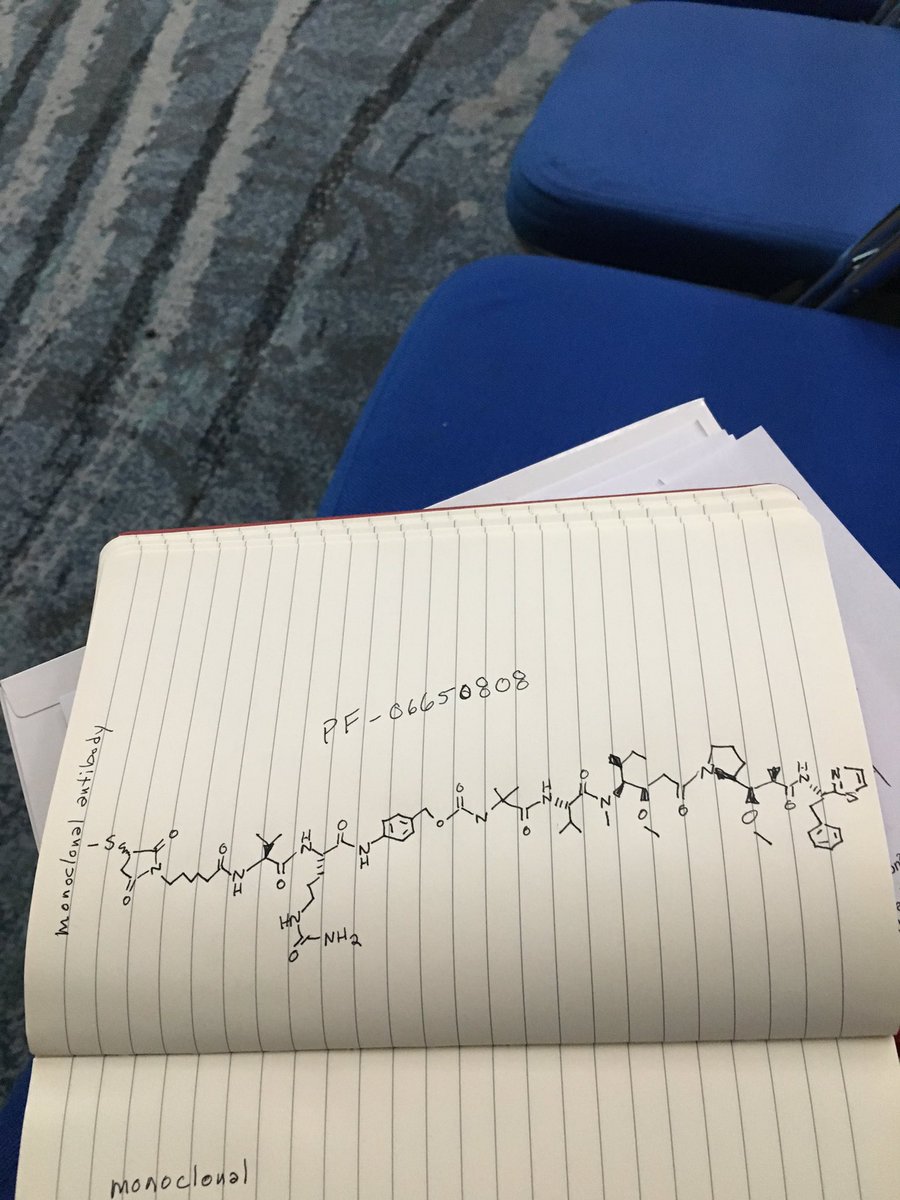
PF 06650808


.

Picture credit….

Structure of PF06650808.

PF 06650808

CAS 1822383-80-1

A biologic for cancer treatment (Pfizer Inc.)

  • Originator Pfizer
  • Class Antineoplastics
  • Mechanism of Action Notch-3 receptor antagonists
  • No development reported Solid tumours
  • 24 Jun 2018 Biomarkers information updated
  • 28 Apr 2018 No recent reports of development identified for phase-I development in Solid-tumours(Late-stage disease) in USA (IV)
  • 01 Jul 2017 Pfizer completes a phase I trial in Solid tumours (Late-stage disease) in USA (IV) (NCT02129205)

Company: Pfizer

Target: Neurogenic locus notch homolog protein 3 (NOTCH3): Activation and mutation of the NOTCH signaling pathway can lead to cancer.

Disease: Cancer

Notes: PF06650808 is an antibody-drug conjugate that delivers a cytotoxic payload molecule directly to tumor cells, explained Andreas Maderna, an associate research fellow at Pfizer. The payload molecule in PF06650808 was inspired by the marine natural product dolostatin 10, which is produced by cyanobacteria consumed by a type of sea slug.

https://cen.acs.org/articles/94/i15/New-drug-candidates-shine-San-Diego.html

PATENT

WO 2015171907

https://patentscope.wipo.int/search/en/detail.jsf?docId=WO2015171907

The present invention relates to stable isotopic identification of biologic products, methods of stable isotopic identification of such biologic products, and stable isotopic methods and systems for correlating biologic products to the processes by which they are made.

front page image

PATENT

WO 2018045058

https://patentscope.wipo.int/search/en/detail.jsf?docId=WO2018045058&tab=PCTDESCRIPTION&maxRec=1000

CLIP

Rosen, L.S.; Wesolowski, R.; Gibson, B.; et al.
A Phase 1 dose escalation, safety, and pharmacokinetic study of PF-06650808, an anti-Notch3 antibody drug conjugate, in adult patients with advanced solid tumors
Eur Cancer Congr (September 25-29, Vienna) 2015, Abst 3OLBA 

Maderna, A.
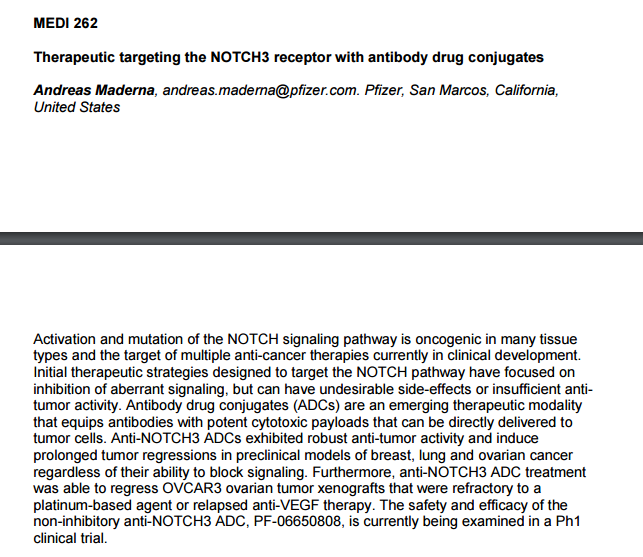
Therapeutic targeting the NOTCH3 receptor with antibody drug conjugates
251st Am Chem Soc (ACS) Natl Meet (March 13-17, San Diego) 2016, Abst MEDI 262 

Hurvitz, S.A.; von Euw, E.; O’Brien, N.; et al.
Preclinical evaluation of targeting Notch-3 in breast cancer
107th Annu Meet Am Assoc Cancer Res (AACR) (April 16-20, New Orleans) 2016, Abst 1206 

Chen, J.; Geles, K.; Silva, M.; Waterhouse, R.; Ma, D.; Charati, M.; Sapra, P.; Mccarthy, T.
Evaluate the impact of conjugation on targeting capacity, pharmacokinetics and tissue distribution of antibody drug conjugate, PF-06650808, in tumor bearing mice
22nd Int Symp Radiopharm Sci (ISRS) (May 14-19, Dresden) 2017, Abst P 052 

///////////


PF 06650808

Phase 1

compound inspired by auristatins

https://clinicaltrials.gov/ct2/show/NCT02129205

http://www.pfizer.com/sites/default/files/product-pipeline/8_7_2014_Pipeline_Update.pdf

ALL DATA COMING………

Notch-3 receptor antagonists

Neoplasms
Breast

Pfizer

Cancer

PF-06650808, is currently being examined in a Ph1 clinical trial (Protocol B7501001).

Notch3
Researchers are also exploring the use of Notch3 targeting. “The Notch pathway plays an important role in the growth of several solid tumours, including breast and ovarian cancer and melanoma,” explained Joerger. “In particular, Notch3 alterations such as gene amplification and upregulation are associated with poor patient survival. Research using Notch3 targeting as an innovative approach to treat solid malignancies included 27 patients unselected for Notch3 who received increasing doses of the anti-Notch3 antibody-drug conjugate PF-06650808. Responses were seen in two breast cancer patients (LBA 30). While preliminary, targeting Notch3 may become a new treatment approach in patients with selected solid tumours.”

The anti-Notch3 antibody-drug conjugate PF-06650808 is being developed by Pfizer.

  • 31 Jul 2014 Phase-I clinical trials in Solid tumours (Late-stage disease) in USA (Parenteral)
  • 30 Apr 2014 Preclinical trials in Solid tumours in USA (Parenteral)
  • 30 Apr 2014 Pfizer plans a phase I trial for Solid tumours (late-stage disease, second-line therapy or greater) in USA (NCT02129205)

251st Am Chem Soc (ACS) Natl Meet (March 13-17, San Diego) 2016, Abst MEDI 262

str1 STR2

/////////PF 06650808, PF-06650808, PF-6650808, monoclonal antibody, pfizer, phase 1, Solid tumours , Notch-3 receptor antagonists

C1(C(N(C(C1)=O)CCCCCC(=O)NC([C@H](C)C)C(=O)NC(C(=O)Nc2ccc(cc2)COC(=O)NC(C)(C)C(=O)N[C@@H](C(C)C)C(=O)[N@](C)C(C(CC)C)[C@@H](OC)CC(=O)N3CCC[C@H]3C(OO)C(C)C(=O)N[C@H](c4nccs4)CC)CCCNC(=O)N)=O)SC

DRUG APPROVALS BY DR ANTHONY MELVIN CRASTO …..FOR BLOG HOME CLICK HERE

Join me on Linkedin

View Anthony Melvin Crasto Ph.D's profile on LinkedIn

Join me on Facebook FACEBOOK

Join me on twitterFollow amcrasto on Twitter
Join me on google plus Googleplus

 amcrasto@gmail.com

P.S

THE VIEWS EXPRESSED ARE MY PERSONAL AND IN NO-WAY SUGGEST THE VIEWS OF THE PROFESSIONAL BODY OR THE COMPANY THAT I REPRESENT, amcrasto@gmail.com, +91 9323115463 India.

I , Dr A.M.Crasto is writing this blog to share the knowledge/views, after reading Scientific Journals/Articles/News Articles/Wikipedia. My views/comments are based on the results /conclusions by the authors(researchers). I do mention either the link or reference of the article(s) in my blog and hope those interested can read for details. I am briefly summarising the remarks or conclusions of the authors (researchers). If one believe that their intellectual property right /copyright is infringed by any content on this blog, please contact or leave message at below email address amcrasto@gmail.com. It will be removed ASAP

GLPG 1690


str1

SCHEMBL16051264.png

Picture credit….

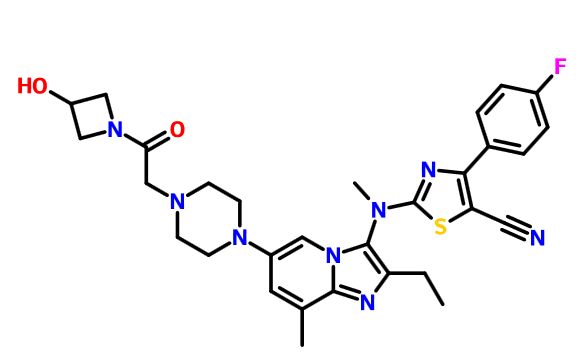
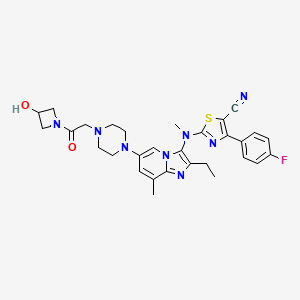
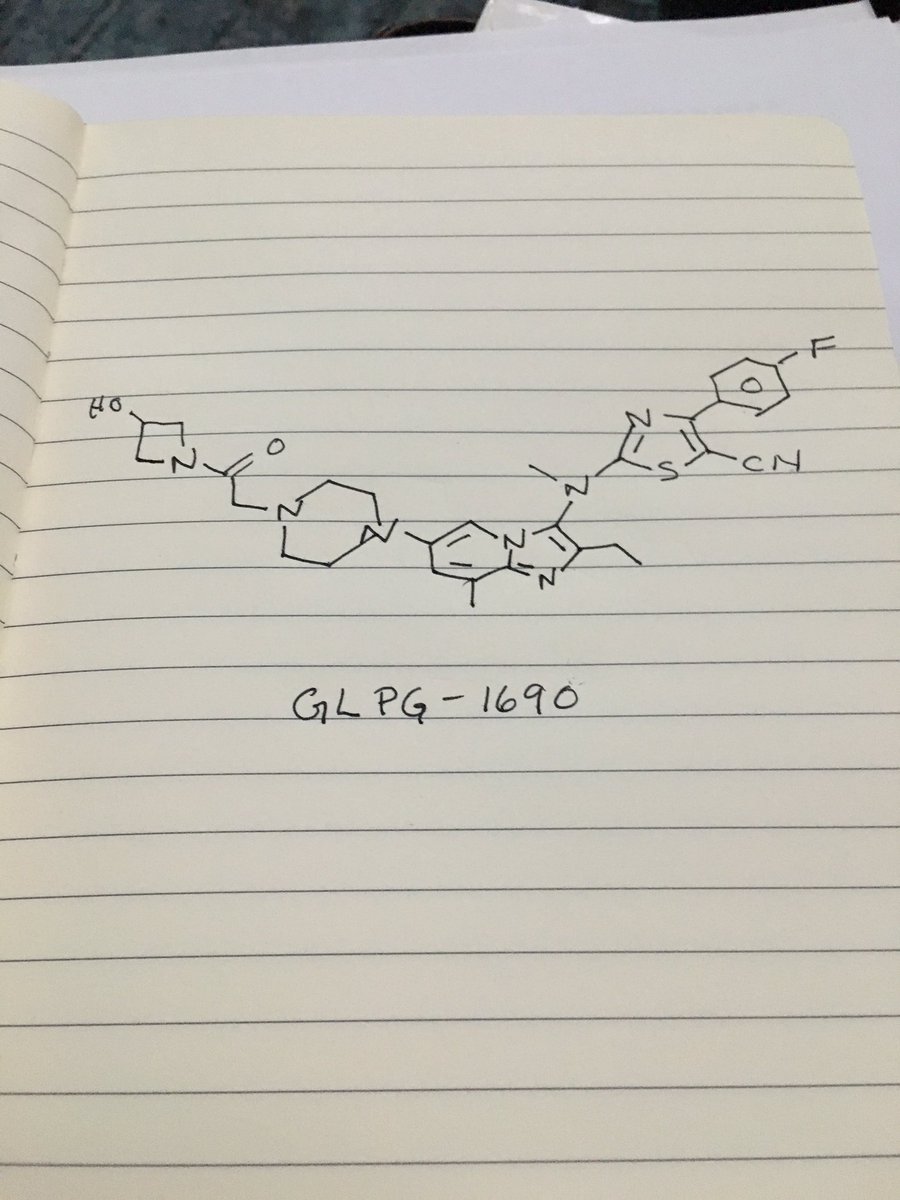
GLPG 1690

2-[[2-ethyl-6-[4-[2-(3-hydroxyazetidin-1-yl)-2-oxoethyl]piperazin-1-yl]-8-methylimidazo[1,2-a]pyridin-3-yl]-methylamino]-4-(4-fluorophenyl)-1,3-thiazole-5-carbonitrile

5- ​Thiazolecarbonitrile​, 2-​[[2-​ethyl-​6-​[4-​[2-​(3-​hydroxy-​1-​azetidinyl)​-​2-​oxoethyl]​-​ 1-​piperazinyl]​-​8-​methylimidazo[1,​2-​a]​pyridin-​3-​yl]​methylamino]​-​4-​(4-​fluorophenyl)​-

CAS 1628260-79-6

Galapagos

compound for treating idiopathic pulmonary fibrosis

Molecular Formula: C30H33FN8O2S
Molecular Weight: 588.698823 g/mol
Galapagos Nv

http://files.glpg.com/docs/website_1/Poster_ERS_2015_final.pdf

http://www.glpg.com/docs/view/56b360a81f6b2-en

Phase I Idiopathic pulmonary fibrosis

Description Selective autotaxin (ENPP2; ATX) inhibitor
Molecular Target Autotaxin (ENPP2) (ATX)
  • Originator Galapagos NV
  • Class Anti-inflammatories; Small molecules
  • Mechanism of Action ENPP2 protein inhibitors
  • 23 Sep 2015 Pharmacodynamics data from a preclinical trial in Indiopathic pulmonary fibrosis released by Galapagos
  • 22 Sep 2015 Pharmacokinetics data from a phase I trial in healthy volunteers released by Galapagos
  • 22 Sep 2015 Updated adverse events data from a phase I trial in healthy volunteers released by Galapagos

GLPG1690

GLPG1690 is a selective autotaxin inhibitor discovered by Galapagos, with potential application in idiopathic pulmonary disease (IPF). In a Phase 1 study in healthy human volunteers, GLPG1690 demonstrated favorable safety and tolerability, as well as a strong pharmacodynamic signal implying target engagement. Galapagos is currently preparing a Phase 2 study in IPF, to be filed for approval before the end of 2015. GLPG1690 is fully proprietary to Galapagos.

| Source: Galapagos NV

  • Fully owned and proprietary clinical asset for pulmonary fibrosis
  • GLPG1690 acts on autotaxin target
  • Novel mode of action, originating from Galapagos target discovery engine
  • Filing for Phase 2 clinical trial in 2015

MECHELEN, Belgium, March 16, 2015 (GLOBE NEWSWIRE) — Galapagos NV (Euronext: GLPG) announced that Janssen Pharmaceutica NV and Galapagos have mutually agreed to terminate the inflammation alliance and option agreements between the companies.  Galapagos views the molecules emerging from the alliance as strong additions to its growing proprietary pipeline.  Among others, all rights to candidate drug GLPG1690, a selective autotaxin inhibitor, return to Galapagos.  Galapagos has successfully completed a First-in-Human Phase 1 trial for GLPG1690 and is preparing a Phase 2 clinical trial in idiopathic pulmonary fibrosis (IPF).

“We are pleased to regain the rights to GLPG1690 to pursue the most suitable clinical application of autotaxin inhibition.  There is a large unmet medical need in IPF, and our pre-clinical data with GLPG1690 supports its potential as a competitive and novel approach in this disease area,” said Dr Piet Wigerinck, Chief Scientific Officer of Galapagos.  “The alliance with Janssen has been underway since October 2007 and has generated three clinical molecules, two of which are now proprietary Phase 2 assets of Galapagos: GLPG1205 and GLPG1690.  This program is a valuable component of our development portfolio, and regaining the rights is a next step in our transformation into a mature biotech company with a proprietary product pipeline.”

Galapagos identified autotaxin as playing a key role in inflammation, using an inflammation assay in its unique target discovery platform.  Pharmacology and translational studies published by other parties in the literature since then suggest autotaxin may play a key role in metabolic disease, arthritic pain, oncology, and lung disease.

GLPG1690 is a potent and selective inhibitor of autotaxin.  In a Phase 1 study in healthy human volunteers, GLPG1690 demonstrated favorable safety and tolerability, as well as a strong pharmacodynamic signal implying target engagement.  Galapagos is currently preparing a Phase 2 study in IPF, to be filed for approval before the end of 2015.

About IPF
Idiopathic pulmonary fibrosis (IPF) is a chronic and ultimately fatal disease characterized by a progressive decline in lung function.  Pulmonary fibrosis involves scarring of lung tissue and is the cause of shortness of breath.  Fibrosis is usually associated with a poor prognosis.  The term “idiopathic” is used because the cause of pulmonary fibrosis is still unknown.  Estimated incidence of IPF is up to 16.3 per 100,000 persons in the US and 7.4 per 100,000 persons in Europe, with approximately 30,000-35,000 new patients diagnosed with IPF worldwide each year.  The goals of treatment in IPF are essentially to reduce the symptoms, slow down disease progression, reduce acute exacerbations, and prolong survival.  Approved treatments thus far have improved the overall survival of IPF patients, but unwanted side effects with these treatments are common, presenting an unmet need for effective treatments with safer side effect profiles.

| Source: Galapagos NV

MECHELEN, Belgium, Sept. 22, 2015 (GLOBE NEWSWIRE) — Galapagos NV (Euronext & NASDAQ: GLPG) presents pre-clinical and Phase 1 results for autotaxin inhibitor GLPG1690 at the European Respiratory Society Annual Meeting in Amsterdam, Netherlands.  Galapagos expects to file an exploratory Phase 2 study in idiopathic pulmonary fibrosis before year end.  GLPG1690 has potential application in other pulmonary diseases such as chronic obstructive pulmonary disease (COPD), as supported by the presentation on pre-clinical findings at ERS this year:

“Pharmacological profile and efficacy of GLPG1690, a novel ATX inhibitor for COPD treatment,” poster PA2129 in Poster Discussion Session: “New targets and modalities for the treatment of asthma and COPD” (September 28, 2015; Room D201-202, 10:45 AM – 12:45 PM)

Galapagos is the first to show efficacy of an autotaxin inhibitor in pre-clinical models for COPD and IPF, pointing to novel therapeutic areas for autotaxin inhibition. The poster shows how GLPG1690 acts as a potent inhibitor of mouse and human autotaxin (IC50: 100 -500 nM range).  Furthermore, GLPG1690 reduces inflammation in a mouse steroid-resistant tobacco smoke model to a similar extent as a standard therapy for COPD.

Galapagos also presents the topline results with GLPG1690 in Phase 1 in healthy human volunteers:  “Favorable human safety, pharmacokinetics and pharmacodynamics of the autotaxin inhibitor GLPG1690, a potential new treatment in COPD,” oral presentation OA484 in session “Advances in the future treatment of COPD” (September 27, 2015; Room 2.1, 10:45 AM – 12:45 PM)

GLPG1690 was safe and well tolerated up to a single oral dose of 1500 mg and up to 1000 mg twice daily for 14 days, with no significant adverse effects on ECGs, vital signs or laboratory parameters.  The compound also showed good oral bioavailability with a half-life of 5 hours and a dose-proportional increase in exposure.  GLPG1690 showed concentration-dependent reduction of a relevant biomarker (plasma LPA18:2 levels) with a maximum of approximately 90%.  At steady state, continuous reduction of this biomarker levels of >60% was observed from 0 to 24 hours.  The presentation will also include relevant pre-clinical model data for COPD and IPF with GLPG1690.

Both the presentation and the posters will be made available on the Galapagos website after the conference.

About Galapagos

Galapagos (Euronext & NASDAQ: GLPG) is a clinical-stage biotechnology company specialized in the discovery and development of small molecule medicines with novel modes of action, with a pipeline comprising three Phase 2 programs, two Phase 1 trials, five pre-clinical studies, and 20 discovery small-molecule and antibody programs in cystic fibrosis, inflammation, and other indications.  In the field of inflammation, AbbVie and Galapagos signed a collaboration agreement for the development and commercialization of filgotinib.  Filgotinib is an orally-available, selective inhibitor of JAK1 for the treatment of rheumatoid arthritis and potentially other inflammatory diseases, currently in Phase 2B studies in RA and in Phase 2 in Crohn’s disease. Galapagos reported good activity and a favorable safety profile in both the DARWIN 1 and 2 trials in RA.  AbbVie and Galapagos also signed a collaboration agreement in cystic fibrosis to develop and commercialize molecules that address mutations in the CFTR gene.  Potentiator GLPG1837 is currently in a Phase 1 trial, and corrector GLPG2222 is at the pre-clinical candidate stage.  GLPG1205, a first-in-class inhibitor of GPR84 and fully-owned by Galapagos, is currently being tested in a Phase 2 proof-of-concept trial in ulcerative colitis patients.  GLPG1690, a fully proprietary, first-in-class inhibitor of autotaxin, has shown favorable safety in a Phase 1 trial and is expected to enter Phase 2 in idiopathic pulmonary fibrosis.  The Galapagos Group, including fee-for-service subsidiary Fidelta, has approximately 400 employees, operating from its Mechelen, Belgium headquarters and facilities in The Netherlands, France, and Croatia.  More info at www.glpg.com

CONTACT

Galapagos NV
Elizabeth Goodwin, Head of Corporate Communications & IR
Tel: +31 6 2291 6240
ir@glpg.com

MECHELEN, Belgium, Feb. 16, 2015 (GLOBE NEWSWIRE) — Galapagos NV (Euronext: GLPG) announced today that GLPG1690, a first-in-class molecule for pulmonary disease, has demonstrated target engagement, a good safety profile, and favorable drug properties in a Phase 1 study.  Galapagos is developing GLPG1690 within its alliance with Janssen Pharmaceutica NV.

The aim of the Phase 1 study was to evaluate the safety, tolerability, pharmacokinetics, and pharmacodynamics of oral single and multiple ascending doses of GLPG1690.  The randomized, double-blind, placebo-controlled, single center study was conducted in 40 healthy volunteers in Belgium.  In the first part of the study, single ascending doses were evaluated.  In the second part, the new compound was administered daily for 14 days.

GLPG1690 proved to be safe and well-tolerated over a wide dose range in healthy volunteers.  Engagement of the thus far undisclosed novel target was confirmed using a relevant biomarker. GLPG1690 displayed a favorable pharmacokinetic and pharmacodynamic profile.  The data shown in Phase 1 encourage Galapagos to explore a Phase 2 study design in pulmonary disease.

“GLPG1690 is the first molecule against this target ever to be evaluated clinically, and we are pleased with the outcome of the Phase 1 study,” said Dr Piet Wigerinck, CSO of Galapagos.  “Galapagos continues to deliver novel therapeutics from its unique target and drug discovery engine.”

In 2007, Galapagos announced an alliance agreement with Janssen Pharmaceutica NV providing the option to worldwide, commercial licenses to certain Galapagos internal inflammatory disease programs.  These programs are based on novel targets for inflammatory disorders that were identified and validated by Galapagos using its proprietary target discovery engine.  Subsequent Galapagos research led to the discovery of GLPG1690, a first-in-class molecule that entered the clinic for inflammatory disorders.  Galapagos is responsible for execution of Phase 1 and Phase 2A studies with GLPG1690.

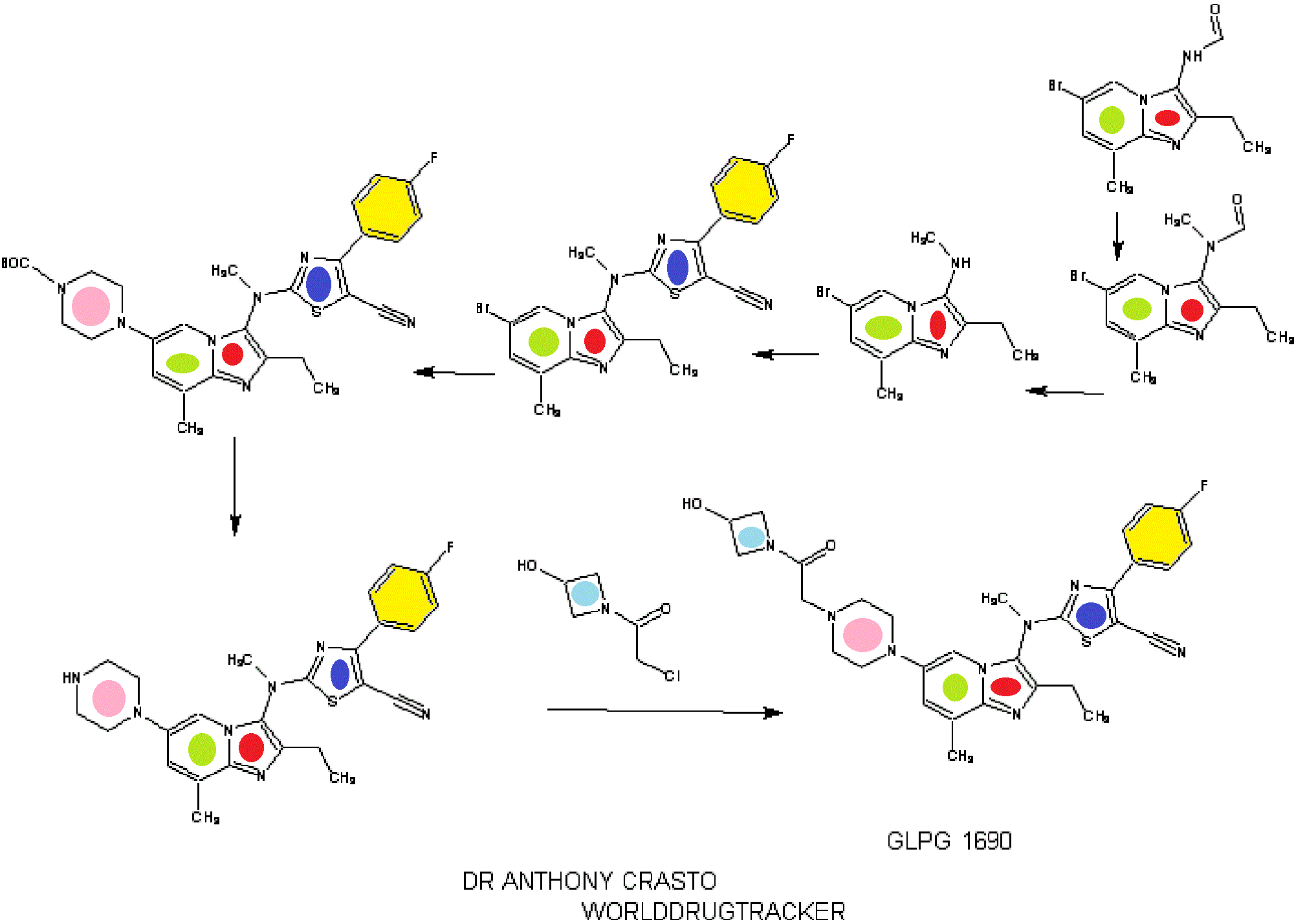
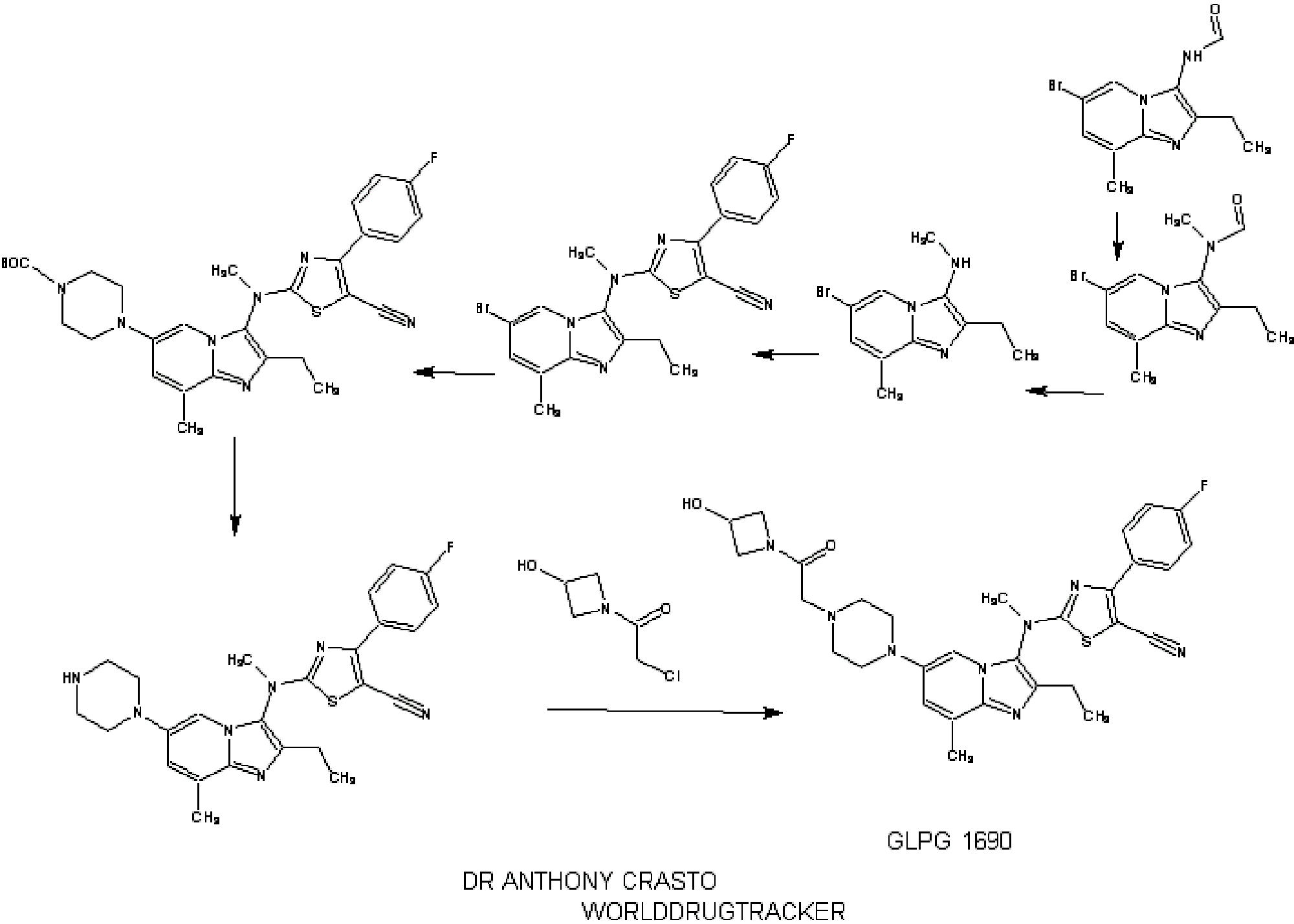
SYNTHESIS

GLPG

GLPG

INTRODUCTION

relates to compounds that are inhibitors of autotaxin, also known as ectonucleotide pyrophosphatase/phosphodiesterase 2 (NPP2 or ENPP2), that is involved in fibrotic diseases, proliferative diseases, inflammatory diseases, autoimmune diseases, respiratory diseases, cardiovascular diseases, neurodegenerative diseases, dermatological disorders, and/or abnormal angiogenesis associated diseases. The present invention also provides methods for the production of a compound of the invention, pharmaceutical compositions comprising a compound of the invention, methods for the prophylaxis and/or treatment of diseases involving fibrotic diseases, proliferative diseases, inflammatory diseases, autoimmune diseases, respiratory diseases, cardiovascular diseases, neurodegenerative diseases, dermatological disorders, and/or abnormal angiogenesis associated diseases by administering a compound

STAGE 1

Figure US20140303140A1-20141009-C00030

STAGE2

Figure US20140303140A1-20141009-C00033

STAGE 3

Figure US20140303140A1-20141009-C00040

STAGE4

Figure US20140303140A1-20141009-C00047

STAGE 5

Figure US20140303140A1-20141009-C00056

FINAL

Figure US20140303140A1-20141009-C00062

PATENT

US2014303140

http://www.google.com/patents/US20140303140

GLPG

GLPG

1.2.4.4. Illustrative Synthesis of Intermediate Gen-3-e: N-(6-bromo-2-ethyl-8-methylimidazo[1,2-a]pyridin-3-yl)-N-methylformamide

  • To a suspension of formamide Gen-2-d (720 g, 2.55 mol, 1 eq.) in 5 L of acetone were added potassium carbonate (1 kg, 7.66 mol, 3 eq.) and methyl iodide (700 g, 4.93 mol, 1.9 eq.). The reaction mixture was heated to 40° C. overnight. Additional methyl iodide (25 g, 0.18 mol, 0.07 eq.) was then introduced and stirring continued for 1 h at 40° C. The reaction mixture was filtered and washed with acetone (2×300 mL) and DCM (2×300 mL). The filtrate was concentrated in vacuo and the residue was partitioned between DCM (3 L) and water (1 L). The aqueous layer was further extracted with DCM. The combined organic layers were then washed with brine, dried over Na2SO4, filtered and concentrated in vacuo. The solid was triturated with Et2O (1 L) at r.t. for 1 h, filtered off and dried to afford Intermediate Gen-3-e.
  • Rotamer A (Major): 1H NMR δ (ppm) (400 MHz, CDCl3): 8.19 (1H, s), 7.78 (1H, s), 7.15 (1H, s), 3.24 (3H, s), 2.72 (2H, q), 2.59 (3H, s), 1.31 (3H, t)
  • Rotamer B (Minor): 1H NMR δ (ppm) (400 MHz, CDCl3): 8.49 (1H, s), 7.65 (1H, s), 7.08 (1H, s), 3.36 (3H, s), 2.72 (2H, q), 2.59 (3H, s), 1.31 (3H, t)
  • LC-MS: MW (calcd): 295 (79Br), 297 (81Br); m/z MW (obsd): 296 (79Br M+1), 298 (81Br M+1)

1.2.5.2. Illustrative Synthesis of Intermediate Gen-4-d: (6-Bromo-2-ethyl-8-methyl-imidazo[1,2-a]pyridin-3-yl)-methyl-amine

  • Intermediate Gen-3-e (80 g, 270 mmol, 1 eq.) was dissolved in a 1.25 M HCl solution in MeOH (540 mL, 2.5 eq.) and the resulting mixture was refluxed overnight. 270 mL of 1.25 M HCl solution in MeOH were added and heating continued overnight. After 48 h, additional 70 mL of the 1.25 M HCl solution in MeOH were introduced in the reaction mixture. Heating was maintained overnight until conversion was complete. The crude mixture was then concentrated in vacuo and the residue was partitioned between EtOAc (300 mL) and water (700 mL). A saturated NaHCO3 solution was added until pH reached 8-9. The aqueous layer was extracted twice with EtOAc (2×300 mL). The combined organic layers were then washed with brine (200 mL), dried over Na2SO4, filtered and concentrated in vacuo to give Intermediate Gen-4-d (6-bromo-2-ethyl-8-methyl-imidazo[1,2-a]pyridin-3-yl)-methyl-amine) as a free base.
  • 1H NMR δ (ppm) (400 MHz, CDCl3): 8.05 (1H, s), 7.04 (1H, s), 2.84-2.78 (5H, m), 2.60 (3H, s), 1.35 (3H, t)
  • LC-MS: MW (calcd): 267 (79Br), 269 (81Br); m/z MW (obsd): 268 (79Br M+1), 270 (81Br M+1)

1.2.6.4. Illustrative Synthesis of Intermediate Gen-5-t: 2-[(6-Bromo-2-ethyl-8-methyl-imidazo[1,2-a]pyridin-3-yl)-methyl-amino]-4-(4-fluoro-phenyl)-thiazole-5-carbonitrile

  • To a solution of amine Gen-4-d (4.4 g, 16.6 mmol, 1 eq.) in THF (44 mL) under argon was slowly added NaH (60% in oil suspension, 2.0 g, 50.0 mmol, 3 eq.). The reaction mixture was heated at 90° C. for 30 min then cooled to 40° C. before adding the chlorothiazole Gen-12-a (4.74 g, 19.9 mmol, 1.2 eq.). The reaction mixture was stirred at 90° C. overnight. After cooling to r.t. the mixture was slowly quenched by addition of water and then diluted with EtOAc. The organic layer was separated and the aqueous layer extracted with EtOAc. The combined organic layers were then washed with water and brine, dried over Na2SO4, filtered and concentrated in vacuo. The residue was triturated in Et2O, filtered and washed with Et2O and MeCN. Recrystallization was performed in MeCN (180 mL) to afford Intermediate Gen-5-t (2-[(6-Bromo-2-ethyl-8-methyl-imidazo[1,2-a]pyridin-3-yl)-methyl-amino]-4-(4-fluoro-phenyl)-thiazole-5-carbonitrile).
  • 1H NMR δ (ppm) (400 MHz, CDCl3): 8.15 (2H, dd), 7.80 (1H, s), 7.22-7.14 (3H, m), 3.62 (3H, s), 2.77 (2H, q), 2.64 (3H, s), 1.35 (3H, t)
  • LC-MS: MW (calcd): 469 (79Br), 471 (81Br); m/z MW (obsd): 470 (79Br M+1), 472 (81Br M+1)

1.2.7.1.4. Illustrative Synthesis of 4-(3-{[5-Cyano-4-(4-fluoro-phenyl)-thiazol-2-yl]-methyl-amino}-2-ethyl-8-methyl-imidazo[1,2-a]pyridin-6-yl)-piperazine-1-carboxylic acid tert-butyl ester

  • To a solution of Intermediate Gen-5-t (24.2 g, 51.5 mmol, 1 eq.) in toluene under argon were successively added N-Boc piperazine (14.4 g, 77.3 mmol, 1.5 eq.), sodium tert-butoxide (9.9 g, 103 mmol, 2 eq.), JohnPhos (1.54 g, 5.15 mmol, 0.1 eq.) and Pd2(dba)3 (2.36 g, 2.58 mmol, 0.05 eq.). The reaction mixture was heated at 115° C. for 1 h. After cooling to r.t., the crude product was filtered on Celpure® P65 and the residue dissolved in EtOAc and washed with water. The organic layer was further washed with brine, dried over Na2SO4, filtered and concentrated in vacuo. The crude product was purified by chromatography on silica gel (elution with heptane/EtOAc:90/10 to 20/80) to afford the expected product.
  • 1H NMR δ (ppm) (400 MHz, CDCl3): 8.16 (2H, dd), 7.17 (2H, app t), 6.99 (2H, bs), 3.62-3.53 (4H, m), 3.60 (3H, s), 3.04-2.93 (4H, m), 2.74 (2H, q), 2.62 (3H, s), 1.47 (9H, s), 1.33 (3H, t).
  • LC-MS: MW (calcd): 575; m/z MW (obsd): 576 (M+1)

1.2.7.8.4. Illustrative Synthesis of Compound 1: 2-[(2-Ethyl-8-methyl-6-piperazin-1-yl-imidazo[1,2-a]pyridin-3-yl)-methyl-amino]-4-(4-fluoro-phenyl)-thiazole-5-carbonitrile

  • 4-(3-{[5-Cyano-4-(4-fluoro-phenyl)-thiazol-2-yl]-methyl-amino}-2-ethyl-8-methyl-imidazo[1,2-a]pyridin-6-yl)-piperazine-1-carboxylic acid tert-butyl ester was prepared from intermediate Gen-5-t using Boc-piperazine and method Flb.
  • To a solution of 4-(3-{[5-Cyano-4-(4-fluoro-phenyl)-thiazol-2-yl]-methyl-amino}-2-ethyl-8-methyl-imidazo[1,2-a]pyridin-6-yl)-piperazine-1-carboxylic acid tert-butyl ester (24.4 g, 42 mmol, 1 eq.) in MeOH (100 mL) was added a 2 M HCl solution in Et2O (127 mL, 254 mmol, 6 eq.). The reaction mixture was stirred at r.t. for 3.5 h then concentrated in vacuo. The residue was partitioned between EtOAc and water. The aqueous layer was extracted twice with EtOAc. A 2 M NaOH solution was added to the aqueous layer until pH reached 8-9 and further extraction with EtOAc was performed. The combined organic layers were then washed with brine, dried over Na2SO4, filtered and concentrated in vacuo. The solid was triturated with heptane (100 mL) at r.t. overnight, filtered off, washed with heptane and Et2O, and dried to afford the expected compound.
  • 1H NMR δ (ppm) (400 MHz, CDCl3): 8.17 (2H, dd), 7.18 (2H, app t), 6.99 (2H, bs), 3.61 (3H, s), 3.09-2.98 (8H, m), 2.75 (2H, q), 2.61 (3H, s), 1.34 (3H, t).
  • LC-MS: MW (calcd): 475; m/z MW (obsd): 476 (M+1)

1.2.7.14. Illustrative Synthesis of Compound 2: 2-((2-ethyl-6-(4-(2-(3-hydroxyazetidin-1-yl)-2-oxoethyl)piperazin-1-yl)-8-methylimidazo[1,2-a]pyridin-3-yl)(methyl)amino)-4-(4-fluorophenyl)thiazole-5-carbonitrile

  • To a solution of amine compound 1 (12.6 g, 27 mmol, 1 eq.) in 100 mL of MeCN were added potassium carbonate (7.3 g, 53 mmol, 2 eq.) and Gen13-a (5.2 g, 34 mmol, 1.3 eq.). The reaction mixture was refluxed for 5.5 h then cooled to r.t. and stirred for 40 h. The crude product was filtered and washed with MeCN. The collected precipitate was then suspended in 300 mL of water, stirred for 1 h, filtered, and finally washed with water and MeCN. The solid obtained was dried in vacuo for 48 h to afford Compound 2.
  • 1H NMR (400 MHz, CDCl3) δ ppm 8.20-8.12 (2H, m), 7.22-7.13 (2H, m), 6.99 (2H, s), 4.68 (1H, m), 4.43 (1H, dd), 4.26 (1H, dd), 4.14-4.05 (1H, m), 3.88 (1H, dd), 3.61 (3H, s), 3.58-3.52 (1H, m), 3.14-3.02 (6H, m), 2.74 (2H, q), 2.70-2.62 (4H, m), 2.59 (3H, s), 1.33 (3H, t)
  • LC-MS: MW (calcd): 588; m/z MW (obsd): 589 (M+1)
US9249141 Dec 17, 2014 Feb 2, 2016 Galapagos Nv Compounds and pharmaceutical compositions thereof for the treatment of inflammatory disorders
1 to 2 of 2
Patent ID Date Patent Title
US2015111872 2015-04-23 NOVEL COMPOUNDS AND PHARMACEUTICAL COMPOSITIONS THEREOF FOR THE TREATMENT OF INFLAMMATORY DISORDERS
US2014303140 2014-10-09 NOVEL COMPOUNDS AND PHARMACEUTICAL COMPOSITIONS THEREOF FOR THE TREATMENT OF INFLAMMATORY DISORDERS

////////////GLPG 1690, idiopathic pulmonary fibrosis, PHASE 1, GALAPAGOS, 1628260-79-6

n12c(c(nc1c(cc(c2)N3CCN(CC3)CC(=O)N4CC(C4)O)C)CC)N(C)c5nc(c(s5)C#N)c6ccc(cc6)F

CCC1=C(N2C=C(C=C(C2=N1)C)N3CCN(CC3)CC(=O)N4CC(C4)O)N(C)C5=NC(=C(S5)C#N)C6=CC=C(C=C6)F

DRUG APPROVALS BY DR ANTHONY MELVIN CRASTO …..FOR BLOG HOME CLICK HERE

Join me on Linkedin

View Anthony Melvin Crasto Ph.D's profile on LinkedIn

Join me on Facebook FACEBOOK

Join me on twitterFollow amcrasto on Twitter
Join me on google plus Googleplus

 amcrasto@gmail.com

P.S

THE VIEWS EXPRESSED ARE MY PERSONAL AND IN NO-WAY SUGGEST THE VIEWS OF THE PROFESSIONAL BODY OR THE COMPANY THAT I REPRESENT, amcrasto@gmail.com, +91 9323115463 India.

DISCLAIMER

I , Dr A.M.Crasto is writing this blog to share the knowledge/views, after reading Scientific Journals/Articles/News Articles/Wikipedia. My views/comments are based on the results /conclusions by the authors(researchers). I do mention either the link or reference of the article(s) in my blog and hope those interested can read for details. I am briefly summarising the remarks or conclusions of the authors (researchers). If one believe that their intellectual property right /copyright is infringed by any content on this blog, please contact or leave message at below email address amcrasto@gmail.com. It will be removed ASAP

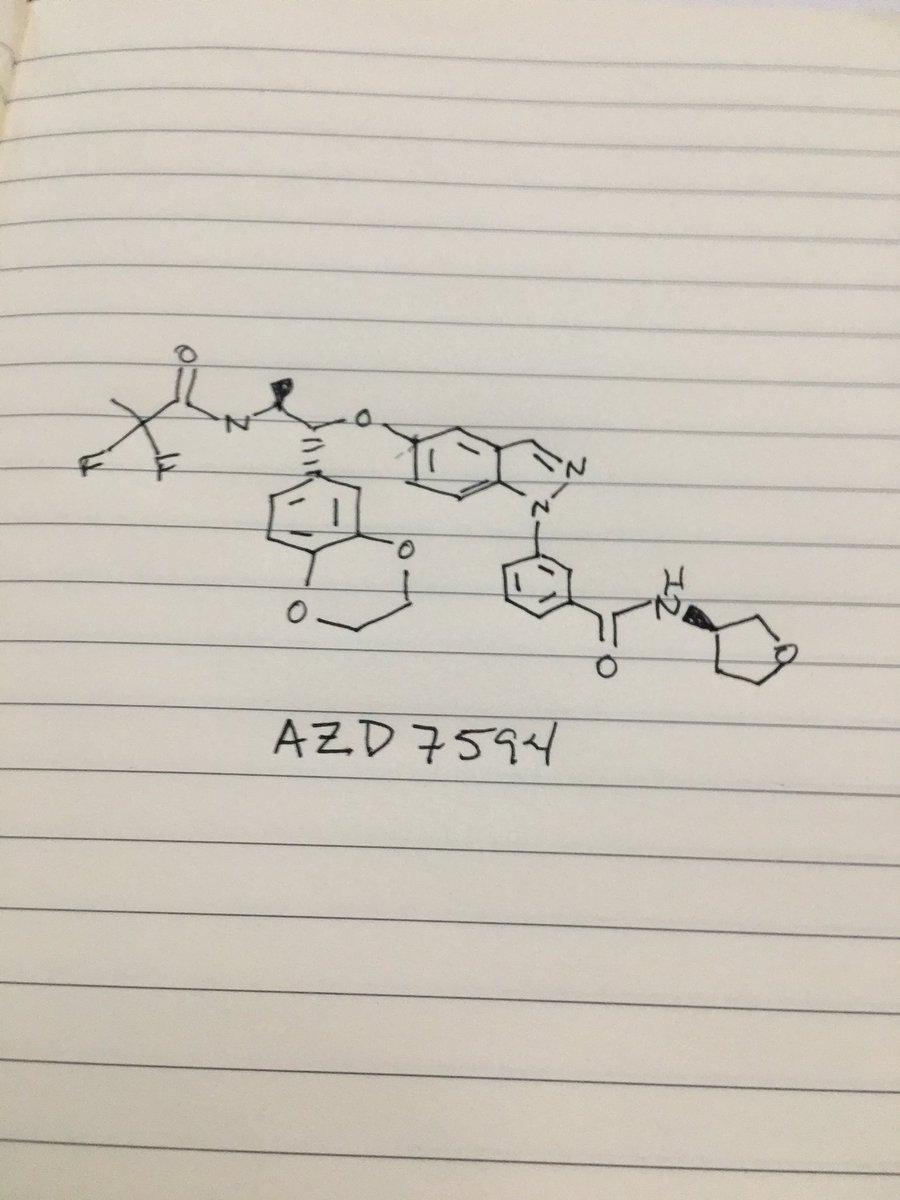
AZD 7594


str1

str1

.

Picture credit….

SCHEMBL3273974.png

AZD 7594

‘s asthma candidate

AZ13189620; AZD-7594

Bayer Pharma Aktiengesellschaft, Astrazeneca Ab

Molecular Formula: C32H32F2N4O6
Molecular Weight: 606.616486 g/mol

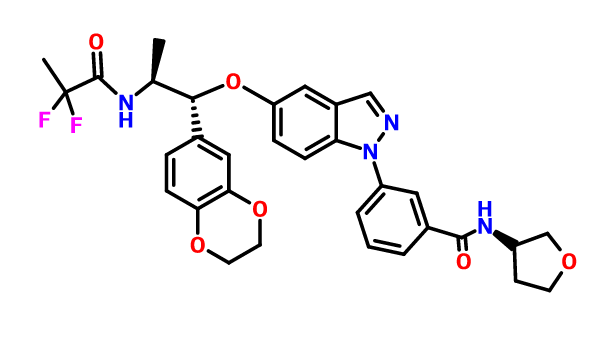
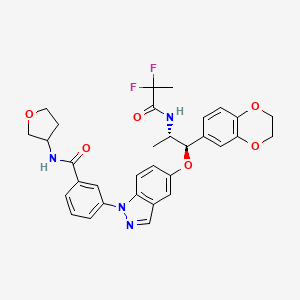
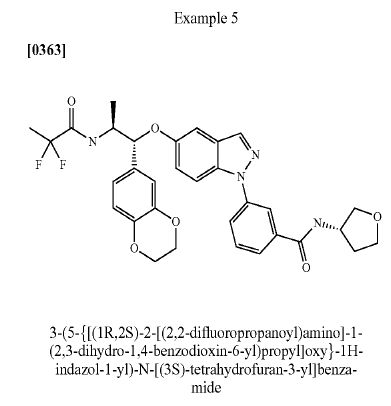
3-[5-[(1R,2S)-2-(2,2-difluoropropanoylamino)-1-(2,3-dihydro-1,4-benzodioxin-6-yl)propoxy]indazol-1-yl]-N-(oxolan-3-yl)benzamide

Benzamide, 3-​[5-​[(1R,​2S)​-​2-​[(2,​2-​difluoro-​1-​oxopropyl)​amino]​-​1-​(2,​3-​dihydro-​1,​4-​benzodioxin-​6-​yl)​propoxy]​-​1H-​indazol-​1-​yl]​-​N-​[(3R)​-​tetrahydro-​3-​furanyl]​-
Cas 1196509-60-0

AZD-7594 is in phase II clinical trials by AstraZeneca for the treatment of mild to moderate asthma.

It is also in phase I clinical trials for the treatment of chronic obstructive pulmonary disorder (COPD).

https://clinicaltrials.gov/ct2/show/NCT02479412

Company AstraZeneca plc
Description Inhaled selective glucocorticoid receptor (GCCR) modulator
Molecular Target Glucocorticoid receptor (GCCR)
  • Phase II Asthma
  • Phase I Chronic obstructive pulmonary disease
  • 01 Feb 2016 AstraZeneca completes a phase II trial in Asthma in Bulgaria and Germany (Inhalation) (NCT02479412)
  • 09 Jan 2016 AstraZeneca plans to initiate a phase I trial in Healthy volunteers in USA (IV and PO) (NCT02648438)
  • 01 Jan 2016 Phase-I clinical trials in Chronic obstructive pulmonary disease (In volunteers) in USA (PO, IV, Inhalation) (NCT02648438)

PATENT

http://www.google.com/patents/WO2009142569A1

PATENT

US20100804345

UNWANTED ISOMER

str1

str1

WANTED COMPD

str1

str1

str1

PATENT

WO 2009142571

Example 6

WANTED ISOMER

Figure imgf000053_0002

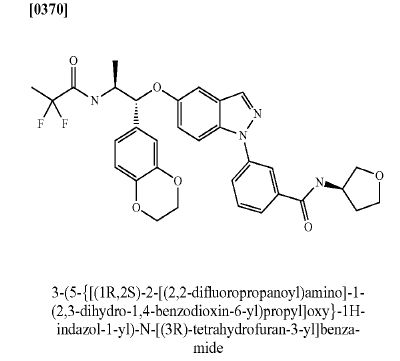
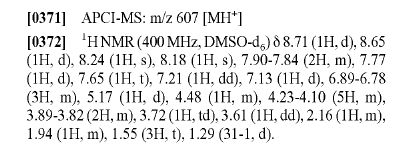
3-(5- { TC 1 R,2SV2-r(2,2-difluoropropanoyl)aminol- 1 -(2,3-dihydro-l ,4-benzodioxin-6-5 yDpropylioxy) – 1 H-indazol- 1 -ylVN-[(3R)-tetrahydrofuran-3-vnbenzamide. APCI-MS: m/z 607 [MH+] 1H NMR ^OO MHz, DMSOd6) δ 8.71 (IH, d), 8.65 (IH, d), 8.24 (IH, s), 8.18 (IH, s), 7.90 – 7.84 (2H, m), 7.77 (IH, d), 7.65 (IH, t), 7.21 (IH, dd), 7.13 (IH, d), 6.89 – 6.78 (3H, m), 5.17 (IH, d), 4.48 (IH, m), 4.23 – 4.10 (5H, m), 3.89 – 3.82 (2H, m), 3.72 (IH, td), 3.61 (IH, dd), 2.16 (IH, m), 1.94 (IH, m), 1.55 (3H, t), 1.29 (3H, d). LC (method A) rt = 12.03 min LC (method B) rt = 11.13 min Chiral SFC (method B) rt = 4.71 min M.p. = 177 °C

UNWANTED

Figure imgf000053_0001

o 3-(5- { IY 1 R,2S V2-r(2,2-difluoropropanoyl)amino|- 1 -(2,3-dihydro- 1 ,4-benzodioxin-6- yl)propyl]oxy } – 1 H-indazol- 1 -yP-N-IO S)-tetrahydrofuran-3 -yl|benzamide

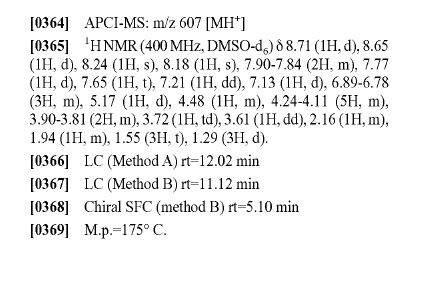
APCI-MS: m/z 607 [MH+]

1H NMR (400 MHz, DMSO-J6) δ 8.71 (IH, d), 8.65 (IH, d), 8.24 (IH, s), 8.18 (IH, s),

7.90 – 7.84 (2H, m), 7.77 (IH, d), 7.65 (IH, t), 7.21 (IH, dd), 7.13 (IH, d), 6.89 – 6.78 (3H,s m), 5.17 (IH, d), 4.48 (IH, m), 4.24 – 4.11 (5H, m), 3.90 – 3.81 (2H, m), 3.72 (IH, td), 3.61

(IH, dd), 2.16 (IH, m), 1.94 (IH, m), 1.55 (3H, t), 1.29 (3H, d).

LC (Method A) rt = 12.02 min

LC (Method B) rt = 11.12 min

Chiral SFC (method B) rt = 5.10 min o M.p. = 175 0C

PATENT

WO 2011061527

http://www.google.com/patents/WO2011061527A1?cl=en

Intermediate 12

( 1 R,2S)-2-amino- 1 -(2,3 -dihydrobenzo b [ 1 ,41dioxin-6-yl)propan- 1 -ol hydrochloride. (12)

Figure imgf000036_0001

5-6 N HC1 in 2-propanol (8 mL, 40-48 mmol) was added to tert-butyl (lR,2S)-l-(2,3- dihydrobenzo[b][l,4]dioxin-6-yl)-l-hydroxypropan-2-ylcarbamate (I2a) (3.1 g, 10.02 mmol) in ethyl acetate (40 mL) at 40°C and stirred for 3 hours. The reaction mixture was allowed to reach r.t. and was concentrated by evaporation. Ether was added and the salt was filtered off and washed with ether. The salt was found to be hygroscopic. Yield 2.10 g (85%)

APCI-MS: m/z 210 [MH+-HC1]

1H-NMR (300 MHz, DMSO-^): δ 8.01 (brs, 3H), 6.87-6.76 (m, 3H), 5.93 (brd, 1H), 4.79 (brt, 1H), 4.22 (s, 4H), 3.32 (brm, 1H), 0.94 (d, 3H).

tert-butyl (1R,2S)- 1 -(2,3-dihvdrobenzorbl Γ 1 ,41dioxin-6-yl)- 1 -hvdroxypropan-2-ylcarbamate.

Figure imgf000036_0002

The diastereoselective catalytic Meerwein-Ponndorf-Verley reduction was made by the method described by Jingjun Yin et. al. J. Org. Chem. 2006, 71, 840-843.

(S)-tert-butyl 1 -(2,3-dihydrobenzo[b] [ 1 ,4]dioxin-6-yl)- 1 -oxopropan-2-ylcarbamate (I2b) (3.76 g, 12.23 mmol), aluminium isopropoxide (0.5 g, 2.45 mmol) and 2-propanol (12 mL, 157.75 mmol) in toluene (22 mL) were stirred at 50°C under argon for 16 hours. The reaction mixture was poured into 1M HC1 (150 mL) and the mixture was extracted with ethyl acetate (250 mL). The organic phase was washed with water (2×50 mL) and brine (100 mL), dried over Na2SC”4, filtered and concentrated. The crude product was purified by flash- chromatography on silica using ethyl acetate/hexane (1/2) as eluent. Fractions containing product were combined. Solvent was removed by evaporation to give the desired product as a colourless solid. Yield 3.19 g (84%) APCI-MS: m/z 236, 210, 192 [MH -tBu-18, MH -BOC, MH -BOC- 18]

1H NMR (300 MHz, DMSO-^): δ 6.80-6.70 (m, 3H), 6.51 (d, IH), 5.17 (d, IH), 4.36 (t, IH),

4.19 (s, 4H), 3.49 (m, IH), 1.31 (s, 9H), 0.93 (d, 3H).

(S)-tert-butyl 1 -(2,3-dihydrobenzo[bl [ 1 ,41dioxin-6-yD- 1 -oxopropan-2-ylcarbamate. (I2b)

Figure imgf000037_0001

A suspension of (S)-tert-butyl l-(methoxy(methyl)amino)-l-oxopropan-2-ylcarbamate (3 g, 12.92 mmol) in THF (30 mL) was placed under a protective atmosphere of argon and cooled down to -15 to -20°C. Isopropylmagnesium chloride, 2M in THF (6.5 mL, 13.00 mmol), was added keeping the temperature below -10°C. The temperature was allowed to reach 0°C. A freshly prepared solution of (2,3-dihydrobenzo[b][l,4]dioxin-6-yl)magnesium bromide, 0.7M in THF (20 mL, 14.00 mmol) was added. The temperature was allowed to reach r.t. overnight. The reaction mixture was poured into ice cooled IN HC1 (300 mL). TBME (300 mL) was added and the mixture was transferred to a separation funnel. The water phase was back extracted with TBME (200 mL). The ether phases were washed with water, brine and dried (Na2S04). The crude product was purified by flash chromatography using TBME /Heptane 1/2 as eluent. Fractions containing the product were combined and solvents were removed by evaporation to give the subtitle compound as a slightly yellow sticky oil/gum. Yield 3.76g

(95%)

APCI-MS: m/z 208 [MH+ – BOC]

1H NMR (300 MHz, DMSO-^): δ 7.50 (dd, IH), 7.46 (d, IH), 7.24 (d, IH), 6.97 (d, IH), 4.97 (m, IH), 4.30 (m, 4H), 1.36 (s, 9H), 1.19 (d, 3H).

Intermediate 13

(lR,2S)-2-amino-l-(4H-benzo[dl[l,31dioxin-7- l)propan-l-ol hydrochloride (13)

Figure imgf000037_0002

Tert-butyl ( 1 R,2S)- 1 -(4H-benzo[d] [ 1 ,3]dioxin-7-yl)- 1 -hydroxypropan-2-ylcarbamate (I3b) (403 mg, 1.30 mmol) was dissolved in ethyl acetate (5 mL) and 5-6 N HC1 solution in 2- propanol (1.5 mL, 7.5-9 mmol) was added. The mixture was stirred at 50 °C for 1.5 hours. The solvents was removed by evaporation. The residual sticky gum was treated with ethyl acetate and evaporated again to give a solid material that was suspended in acetonitrile and stirred for a few minutes. The solid colourless salt was collected by filtration and was found to be somewhat hygroscopic. The salt was quickly transferred to a dessicator and dried under reduced pressure. Yield 293 mg (92%)

APCI-MS: m/z 210 [MH+ -HC1]

1H NMR (300 MHz, DMSO-^) δ 8.07 (3H, s), 7.05 (IH, d), 6.92 (IH, dd), 6.85 (IH, d), 6.03 (IH, d), 5.25 (2H, s), 4.87 (3H, m), 3.42 – 3.29 (IH, m), 0.94 (3H, d).

(4S.5R -5-(4H-benzordiri.31dioxin-7-vn- -methyloxazolidin-2-one (I3a

Figure imgf000038_0001

A mixture of (lR,2S)-2-amino-l-(4H-benzo[d][l,3]dioxin-7-yl)propan-l-ol hydrochloride (I3b) (120 mg, 0.49 mmol), DIEA (0.100 mL, 0.59 mmol) and CDI (90 mg, 0.56 mmol) in THF (2 mL) was stirred at r.t. for 2 hours. The reaction mixture was concentrated by evaporation and the residual material was partitioned between ethyl acetate and water. The organic phase was washed with 10% NaHS04, dried over MgS04, filtered and evaporated. The crude product was analysed by LC/MS and was considered pure enough for further analysis by NMR. Yield 66 mg (57%)

The relative cis conformation of the product was confirmed by comparing the observed 1H- NMR with the literature values reported for similar cyclised norephedrine (Org. Lett. 2005 (07), 13, 2755-2758 and Terahedron Assym. 1993, (4), 12, 2513-2516). In a 2D NOESY experiment a strong NOE cross-peak was observed for the doublet at 5.64 with the multiplet at 4.19 ppm. This also confirmed the relative czs-conformation.

APCI-MS: m/z 236 [MH+]

1H NMR (400 MHz, CDC13) δ 6.99 (d, J= 8.0 Hz, IH), 6.88 (dd, J= 8.0, 1.4 Hz, IH), 6.83 (s, IH), 5.81 (brs,lH), 5.64 (d, J= 8.0 Hz, IH), 5.26 (s, 2H), 4.91 (s, 2H), 4.19 (m, IH), 0.85 (d, J = 6.4 Hz, 3H). Tert-butyl ( 1 R,2S)- 1 -(4H-benzord1 Γ 1 ,31dioxin-7-yl)- 1 -hvdroxypropan-2-ylcarbamate (I3b)

Figure imgf000039_0001

A mixture (S)-tert-butyl l-(4H-benzo[d][l,3]dioxin-7-yl)-l-oxopropan-2-ylcarbamate (I3c) (680 mg, 2.21 mmol), triisopropoxyaluminum (140 mg, 0.69 mmol) and propan-2-ol (3 mL, 38.9 mmol) in toluene (3 mL) was stirred at 65 °C for 15 hours. The reaction mixture was allowed to cool down, poured into 1M HC1 (50 mL) and extracted with ethyl acetate (2×50 mL). The organic phase was washed with water, brine, dried over MgS04, filtered and solvents were removed by evaporation to afford a colourless solid. The crude product was purified by flash chromatography, (solvent A = Heptane, solvent B = EtOAc + 10% MeOH. A gradient of 10%B to 50%B in A was used). The obtained product was crystallised from DCM / heptane to afford the subtitle compound as colourless needles. Yield 414 mg (60%)

APCI-MS: m/z 210 [MH+ -BOC]

1H NMR (400 MHz, DMSO- ¾ δ 6.97 (1H, d), 6.88 (1H, d), 6.77 (1H, s), 6.56 (1H, d), 5.27 (1H, d), 5.22 (2H, s), 4.83 (2H, s), 4.44 (1H, t), 3.53 (1H, m), 1.32 (9H, s), 0.93 (3H, d). (S)-Tert-butyl 1 -(4H-benzord1 Γ 1 ,31dioxin-7-vD- 1 -oxopropan-2-ylcarbamate (I3c)

Figure imgf000039_0002

7-Bromo-4H-benzo[d][l,3]dioxine (1 g, 4.65 mmol) was dissolved in THF (5 mL) and added to magnesium (0.113 g, 4.65 mmol) under a protective atmosphere of argon. One small iodine crystal was added. The coloured solution was heated with an heat gun in short periods to initiate the Grignard formation. When the iodine colour vanished the reaction was allowed to proceed at r.t. for 1.5 hours.

In a separate reaction tube (S)-tert-butyl l-(methoxy(methyl)amino)-l-oxopropan-2- ylcarbamate (1 g, 4.31 mmol) was suspended in THF (5 mL) and cooled in an ice/acetone bath to below -5 °C. Isopropylmagnesium chloride, 2M solution in THF (2.5 mL, 5.00 mmol) was slowly added to form a solution. To this solution was added the above freshly prepared Grignard reagent. The mixture was allowed to reach r.t. and stirred for 4 hours. The reaction mixture was slowly poured into ice-cold 150 mL 1M HC1. Ethyl acetate (150 mL) was added and the mixture was stirred for a few minutes and transferred to a separation funnel. The organic phase was washed with water and brine, dried over MgS04, filtered and concentrated. The obtained crude product was further purified by flash chromatography using a prepacked 70g silica column with a gradient of 10% TBME to 40% TBME in heptane as eluent. The subtitle compound was obtained as a colourless solid. Yield 790 mg (59%>)

APCI-MS: m/z 208 [MH+ -BOC]

1H NMR (400 MHz, DMSO-^) δ 7.53 (IH, dd), 7.39 (IH, s), 7.30 (IH, d), 7.22 (IH, d), 5.30 (2H, s), 4.98 (IH, m), 4.95 (2H, s), 1.35 (9H, s), 1.20 (3H, d).

Preparation 4

3-(5-([(lR,2S)-2-[(2,2-difluoropropanoyl)aminol-l-(2,3-dihydro-l,4-benzodioxin-6- yl)propyl]oxy| – 1 H-indazol- 1 -yl)-N-[(3R)-tetrahydrofuran-3-yllbenzamide

Figure imgf000051_0001

TEA (2.0 g, 20.65 mmol) was added to a mixture of 3-(5-((lR,2S)-2-(2,2- difluoropropanamido)- 1 -(2,3-dihydrobenzo[b] [ 1 ,4]dioxin-6-yl)propoxy)-l H-indazol-1 – yl)benzoic acid (14) (3.6 g, 6.70 mmol), (R)-tetrahydrofuran-3 -amine hydrochloride (0.99 g, 8.0 mmol) and HBTU (2.65 g, 6.99 mmol) in DCM (15 mL). The reaction was stirred at r.t. for 3h, then quenched by addition of a mixture of water and ethyl acetate. The mixture was shaken and the organic layer was collected. The water phase was extracted twice with ethyl acetate. The combined organic layers were washed with a small portion of water and dried over magnesium sulphate. The product was purified by flash chromatography (silica, eluent: a gradient of ethyl acetate in heptane). The residue was crystallized by dissolving in refluxing acetonitrile (50 mL) and then allowing to cool to r.t. over night. The solid was collected by filtration, washed with a small volume of acetonitrile and dried at 40°C in vaccum to give the title compound (2.5 g, 61%).

APCI-MS: m/z 607 [MH+]

1H NMR (400 MHz, DMSO-d6) δ 8.71 (IH, d), 8.65 (IH, d), 8.24 (IH, s), 8.18 (IH, s), 7.90 – 7.84 (2H, m), 7.77 (IH, d), 7.65 (IH, t), 7.21 (IH, dd), 7.13 (IH, d), 6.89 – 6.78 (3H, m), 5.17 (IH, d), 4.48 (IH, m), 4.23 – 4.10 (5H, m), 3.89 – 3.82 (2H, m), 3.72 (IH, td), 3.61 (IH, dd), 2.16 (IH, m), 1.94 (IH, m), 1.55 (3H, t), 1.29 (3H, d).

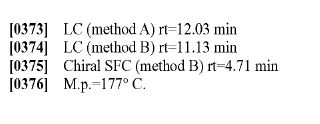
LC (method A) rt = 12.03 min

LC (method B) rt = 11.13 min

Chiral SFC (method B) rt = 4.71 min

M.p. = 177 °C

Patent ID Date Patent Title
US2015080434 2015-03-19 PHENYL AND BENZODIOXINYL SUBSTITUTED INDAZOLES DERIVATIVES
US8916600 2014-12-23 Phenyl and benzodioxinyl substituted indazoles derivatives
US8211930 2012-07-03 Phenyl and Benzodioxinyl Substituted Indazoles Derivatives

REFERENCES

https://www.astrazeneca.com/content/dam/az/press-releases/2014/Q2/Pipeline-table.pdf

////////AZD 7594, AZ13189620, AZD-7594 , phase 2, astrazeneca, 1196509-60-0

c21cc(ccc1n(nc2)c3cc(ccc3)C(=O)NC4COCC4)O[C@H](c5cc6c(cc5)OCCO6)[C@@H](NC(=O)C(F)(F)C)C

CC(C(C1=CC2=C(C=C1)OCCO2)OC3=CC4=C(C=C3)N(N=C4)C5=CC=CC(=C5)C(=O)NC6CCOC6)NC(=O)C(C)(F)F

DRUG APPROVALS BY DR ANTHONY MELVIN CRASTO …..FOR BLOG HOME CLICK HERE

Join me on Linkedin

View Anthony Melvin Crasto Ph.D's profile on LinkedIn

Join me on Facebook FACEBOOK

Join me on twitterFollow amcrasto on Twitter
Join me on google plus Googleplus

 amcrasto@gmail.com

P.S

THE VIEWS EXPRESSED ARE MY PERSONAL AND IN NO-WAY SUGGEST THE VIEWS OF THE PROFESSIONAL BODY OR THE COMPANY THAT I REPRESENT, amcrasto@gmail.com, +91 9323115463 India.

I , Dr A.M.Crasto is writing this blog to share the knowledge/views, after reading Scientific Journals/Articles/News Articles/Wikipedia. My views/comments are based on the results /conclusions by the authors(researchers). I do mention either the link or reference of the article(s) in my blog and hope those interested can read for details. I am briefly summarising the remarks or conclusions of the authors (researchers). If one believe that their intellectual property right /copyright is infringed by any content on this blog, please contact or leave message at below email address amcrasto@gmail.com. It will be removed ASAP

PF-06747775 (Pfizer) Third generation covalent EGFR inhibitors


Full-size image (4 K)

img.

PF-06747775 ≥98% (HPLC)

PF-06747775 (Pfizer)

PF06747775; PF06747775; PF 06747775; PF6747775; PF 6747775; PF6747775.  PFE-X775

N-((3R,4R)-4-fluoro-1-(6-((3-methoxy-1-methyl-1H-pyrazol-4-yl)amino)-9-methyl-9H-purin-2-yl)pyrrolidin-3-yl)acrylamide

N-((3R,4R)-4-fluoro-1-(6-((3-methoxy-1-methyl-1H-pyrazol-4-yl)amino)-9-methyl-9H-purin-2-yl)pyrrolidin-3-yl)acrylamide

CAS 1776112-90-3
Chemical Formula: C18H22FN9O2
Exact Mass: 415.188

Recruiting, Phase I/II (NTC02349633)

Epidermal growth factor receptor antagonists

Antineoplastics

Non-small cell lung cancer

Dose escalation study to evaluate safety, PK, PD and efficacy in advanced EGFRm+ NSCLC

  • 02 May 2015Phase-I clinical trials in Non-small cell lung cancer (Metastatic disease, Second-line therapy or greater) in USA (PO) (NCT02349633)
  • 05 Feb 2015Pfizer plans a phase I trial for Non-small cell lung cancer (Second-line therapy or greater) in USA (NCT02349633)
  • 05 Jan 2015Preclinical trials in Non-small cell lung cancer in USA (PO)

PF-06747775 is an orally available inhibitor of the epidermal growth factor receptor (EGFR) mutant form T790M, with potential antineoplastic activity. EGFR T790M inhibitor PF-06747775 specifically binds to and inhibits EGFR T790M, a secondarily acquired resistance mutation, which prevents EGFR-mediated signaling and leads to cell death in EGFR T790M-expressing tumor cells. Compared to some other EGFR inhibitors, PF-06747775 may have therapeutic benefits in tumors with T790M-mediated drug resistance.

for the oral treatment of patients with locally advanced or metastatic EGFR mutant (del19 or L858R) non-small cell lung cancer

Kinetic mechanism for two-step covalent inhibition of EGFR.

Kinetic mechanism for two-step covalent inhibition of EGFR


PATENT

US 20150141402

Example 7

(Scheme F): Preparation of N-((3R,4R)-4-fluoro-1-(6-((3-methoxy-1-methyl-1H-pyrazol-4-yl)amino)-9-methyl-9H-purin-2-yl)pyrrolidin-3-yl)acrylamide

Step 1: Preparation of 2-fluoro-N-(3-methoxy-1-methyl-1H-pyrazol-4-yl)-9H-purin -6-amine

      A suspension of 6-chloro-2-fluoro-9H-purine (5.49 g, 31.8 mmol, 1.00 eq), 3-methoxy-1-methyl-1H-pyrazol-4-amine hydrochloride (6.60 g, 40.34 mmol, 1.26 eq), and N,N-diisopropylethylamine (16.6 mL, 95.5 mmol, 3.00 eq) in DMSO (31.8 mL) was stirred at ambient temperature for 19 hr. The reaction mixture was then concentrated in vacuo at 50° C., poured into water (250 mL), and stirred vigorously at 0° C. for 1 hr. The resulting solids were filtered off, washed with ice cold water (20 mL), and dried for 16 hr at 50° C. to give the title compound (7.26 g, 87% yield, 96% purity) as a light yellow solid. 1H NMR (400 MHz, DMSO-d6) δ ppm 13.03 (br. s., 1 H) 9.21 (br. s., 1 H) 8.18 (br. s., 1 H) 7.74 (br. s., 1 H) 3.81 (br. s., 3 H) 3.71 (s, 3H). m/z (APCI+) for C10H11FN7O 264.2 (M+H)+.

Step 2: Preparation of 2-fluoro-N-(3-methoxy-1-methyl-1H-pyrazol-4-yl)-9-methyl -9H-purin-6-amine

      To a vigorously stirred suspension of 2-fluoro-N-(3-methoxy-1-methyl-1H-pyrazol-4-yl)-9H-purin-6-amine (7.25 g, 27.5 mmol, 1.00 eq) and potassium carbonate (7.61 g, 55.1 mmol, 2.00 eq) in 1,4-dioxane (92.0 mL), was added dimethyl sulfate (2.90 mL, 30.3 mmol, 1.10 eq) in a dropwise manner over 3 min. After 4 hr, additional portions of 1,4-dioxane (50.0 mL), potassium carbonate (3.80 g, 27.5 mmol, 1.00 eq), and dimethyl sulfate (1.00 mL, 10.4 mmol, 0.30 eq) were added to the reaction mixture. After a further 16 hr, the reaction mixture was concentrated in vacuo, diluted with water (120 mL), and stirred at ambient temperature for 1 hr. The resulting solids were filtered, washed with water (20 mL), and dried for 16 hr at 60° C. to give the title compound (6.42 g, 84% yield, >95% purity) as a light yellow solid. 1H NMR (400 MHz, DMSO-d6) δ ppm 9.23 (br. s., 1 H) 8.13 (br. s., 1 H) 7.67 (s, 1 H) 3.78 (s, 3 H) 3.70 (s, 3 H) 3.69 (br. s., 3 H). m/z (APCI+) for C11H13FN7O 278.2 (M+H)+.

Step 3: Preparation of N-((3R,4R)-4-fluoro-1-(6-((3-methoxy-1-methyl-1H-pyrazol -4-yl)amino)-9-methyl-9H-purin-2-yl)pyrrolidin-3-yl)acrylamide

      To a stirred suspension of 2-fluoro-N-(3-methoxy-1-methyl-1H-pyrazol-4-yl)-9-methyl-9H-purin-6-amine (554 mg, 2.00 mmol, 1.00 eq) and N-((3R,4R)-4-fluoropyrrolidin-3-yl)-3-(methylsulfonyl)propanamide (500 mg, 2.10 mmol, 1.05 eq) in DMSO (4.2 mL) was added N,N-diisopropylethylamine (0.83 mL, 5.00 mmol, 2.50 eq). The reaction mixture was then heated at 100° C. for 16 hr, cooled to ambient temperature, diluted with THF (4 mL), and treated with potassium tert-butoxide (4.00 mL, 1 M in THF, 2.00 eq). After 1 hr, an additional portion of potassium tert-butoxide (0.50 mL, 1 M in THF, 0.25 eq) was added to the reaction mixture. After a further 1 hr, the reaction mixture was poured into phosphate buffer (50 mL, pH=7) and water (50 mL), and extracted with ethyl acetate (5×40 mL). The combined organic layers were combined, dried (Na2SO4), and concentrated under reduced pressure. This crude product was then dissolved in ethyl acetate (40 mL) at 60° C. and then treated with heptanes (20 mL), at which point the solution became cloudy and was allowed to cool to ambient temperature and then to 0° C. After 16 hr at 0° C., the resulting solids were filtered and dried at ambient temperature to give the title compound (620.5 mg, 75% yield) as a white powder. 1H NMR (400 MHz, DMSO-d6) δ ppm 8.44 (d, J=6.5 Hz, 1 H) 7.97 (s, 1 H) 7.82 (s, 1 H) 7.78 (s, 1 H) 6.23 (dd, J=10.0, 17.0 Hz, 1 H) 6.14 (dd, J=2.8, 17.0 Hz, 1 H) 5.62 (dd, J=2.8, 10.0 Hz, 1 H) 5.12 (d, J=51.0 Hz, 1 H) 4.46 (td, J=6.0, 11.9 Hz, 1 H) 3.88-3.6 (m, 4 H) 3.82 (s, 3 H) 3.71 (s, 3 H) 3.62 (s, 3 H). m/z (APCI+) for C18H23FN9O2 416.3 (M+H)+.

Example 7A

(Scheme F): Preparation of N-((3R,4R)-4-fluoro-1-(6-((3-methoxy-1-methyl-1H-pyrazol-4-yl)amino)-9-methyl-9H-purin-2-yl)pyrrolidin-3-yl)acrylamide

Preparation Step 1A: Preparation of (3R,4R)-1-benzyl-3,4-dihydroxypyrrolidine-2,5-dione

      A mixture of xylene, (1.2 L), benzylamine (120 g, 1.10 mol, 1.0 eq) and L-(+)-tartaric acid (173 g, 1.15 mol, 1.05 eq) were heated at 135° C. for 12 hr (flask jacket temperature). Upon reaction completion, the mixture was cooled to 65° C. and MeOH (120 mL, 1 vol) was added. The resulting mixture was stirred for 1 hr and the resulting suspension was cooled to 20° C. followed by the addition of EtOAc (480 mL). Stirring was continued at 10° C. for 2 hr. The crude product was isolated by filtration and washed with EtOAc (120 mL) and dried on the filter. The crude product was then taken up in MeOH (480 mL) and heated at a gentle reflux for 1 hr, then cooled to 20° C. and granulated for 1 hr. The suspension was filtered and the precipitate washed with MeOH (240 mL) and dried to give the title compound (191 g, 864 mmol, 79%) as a white granular solid. 1H NMR (400 MHz, DMSO-d6) δ ppm 7.38-7.30 (m, 2H) 7.30-7.22 (m, 3 H) 6.32 (br. s., 1 H) 4.59 (d, J=14.8 Hz, 1 H) 4.53 (d, J=14.8 Hz, 1 H) 4.40 (br. D., J=4.3 Hz, 2 H). m/z (EI+) for C11H11NO4 221.0 (M)+.

Preparation Step 2A: Preparation of (3S,4S)-1-benzylpyrrolidine-3,4-diol

      To a mixture of (3R,4R)-1-benzyl-3,4-dihydroxypyrrolidine-2,5-dione (44 g, 199 mmol, 1.0 eq) and THF (176 mL) at 20° C. (vessel jacket temperature) was added borane-tetrahydrofuran complex (1.0 mol/L) in THF (800 mL, 800 mmol, 1.0 mol/L, 4.0 eq) at a rate to maintain the temperature between 20° C. and 25° C. Over 1 hr, the jacket temperature was ramped to 60° C. and then held for 1 hr. Upon completion, the reaction was cooled to 30° C. and quenched by the slow dropwise addition of MeOH (97 mL, 12 eq) to the mixture at a rate to control off gassing. The reaction mixture was then heated to reflux and concentrated to a low stir volume. The reaction solvent THF was then replaced by a constant volume displacement with MeOH (total of 1.5 L). Once the THF content had been reduced to less than 1 wt %, MeOH was replaced by a constant volume displacement with EtOAc (total of 1.5 L) to reduce the MeOH content to less than 1 wt %. The total volume of EtOAc was then readjusted to about 250 mL (6 vol) and then cooled to 5° C. to crystallize the product. The desired product was isolated by filtration, washed with cold EtOAc (88 mL) and dried to give title compound (27.0 g, 140 mmol, 70%). A second crop of product was isolated by concentration of the combined filtrate and cake wash to half volume, which was then cooled to 5° C., filtered and washed with cold EtOAc (50 mL) to afford additional title compound (4.5 g, 23 mmol, 12%). 1H NMR (400 MHz, DMSO-d6) δ ppm 7.33-7.26 (m, 4 H) 7.25-7.20 (m, 1 H) 4.48 (d, J=4.8 Hz, 2 H) 3.38-3.31 (m, 2 H), 3.57 (d, J=13.0 Hz, 1 H) 3.46 (d, J=13.0 Hz, 1 H) 2.74 (dd, J=9.4, 5.9 Hz, 2 H) 2.30 (dd, J=9.4, 4.4 Hz, 2 H). m/z (EI+) for C11H15NO2 194.2 (M+H)+.

Preparation Step 3A: Preparation of (3aR,6aS)-5-benzyl-2,2-dioxo-tetrahydro-1-oxa-2λ6-thia-3-5-diaza-pentalene-3-carboxylic acid t-butyl ester

      To a 5 L jacketed reactor (Reactor 1) was added 1,4-dioxane (1.8 L), (3S,4S)-1-benzylpyrrolidine-3,4-diol (180 g, 0.932 mol, 1.0 eq) and TEA (792 mL, 5.68 mol, 6.1 eq) and the resulting mixture stirred at 10° C.
      To a 2 L jacketed reactor (Reactor 2) was added 1,4-dioxane (1.6 L) and chlorosulfonyl isocyanate (596 g, 2.80 mol, 3.0 eq) and the resulting solution was cooled to 10° C. A solution of tert-butanol (211 g, 2.85 mol, 3.05 eq) in 1,4-dioxane (180 mL) was added over 45 min while maintaining the temperature between 10° C. and 20° C., and the resulting solution was then stirred for 15 min at 10° C.
      The solution in Reactor 2 was transferred to Reactor 1 over 50 min while controlling the internal temperature of Reactor 1 from 10° C. to 20° C. Once the addition was complete, the jacket temperature was warmed at 20° C. and the resulting mixture was stirred for 16 hr. When UPLC analysis confirmed that the bis-alkylated intermediate was fully formed (target <3% mono-alkylated intermediate), the entire batch was filtered and the filtrate was sent into a clean reactor. The residual TEA-HCl cake was washed with dioxane (300 mL) and the wash was combined with the filtrate. The resulting dioxane solution was then heated to 80° C. and held for 3 hr. After sampling for reaction completion (<1% intermediate remaining), the batch was distilled (pot temp=80° C.) under partial vacuum (400 mbar) to less than half volume. The reaction mixture was diluted with EtOAc (2 L) and washed twice with water (2×2 L). The mixture was then washed with 0.5 N sodium bicarbonate (2 L) and then dried over sodium sulfate (360 g, 2 wt eq) and filtered into a clean dry reactor. The EtOAc solution was concentrated under partial vacuum to about 400 mL total volume resulting in the formation of a thick slurry. The mixture was cooled to 0° C. and stirred for 1 hr and then filtered and washed with cold EtOAc (200 mL) and then dried in a vacuum oven at 40° C. to give 173 g of the title compound. A second crop of product was isolated by concentrating the filtrate and then cooling, granulating and filtering to give an additional 28.4 g of the desired product. In total, the title compound was isolated in 61% yield (201 g, 568 mmol). 1H NMR (400 MHz, DMSO-d6) δ ppm 7.37-7.29 (m, 4 H) 7.29-7.23 (m, 1 H) 5.36 (dd, J=7.3, 3.8 Hz, 1 H) 4.79-4.73 (m, 1 H) 4.48 (d, J=4.8 Hz, 2 H) 3.38-3.31 (m, 2 H), 3.70 (d, J=13.4 Hz, 1 H) 3.62 (d, J=13.4 Hz, 1 H) 3.13-2.99 (m, 2 H) 2.48-2.40 (m, 2 H) 1.46 (s, 9 H). m/z (EI+) for C16H22N2O5S 355.2 (M+H)+.

Preparation Step 4A: Preparation of (3R,4R)-1-benzyl-4-fluoropyrrolidin-3-amine bis-tosylate

      A solution of 1M tetrabutylammonium fluoride in THF (1.27 L, 1.27 mol, 2.5 eq) and (3aR,6aS)-5-benzyl-2,2-dioxo-tetrahydro-1-oxa-2λ6-thia-3-5-diaza-pentalene-3-carboxylic acid t-butyl ester (180 g, 0.508 mol, 1.0 eq) were heated at 60° C. (jacket temperature) for 2 hr. Upon reaction completion, the mixture was partially distilled under vacuum to remove the THF. After concentration to a low stir volume, THF was displaced with EtOAc (2×500 mL). After again reducing to a low stir volume, EtOAc (3.6 L) and p-toluenesulfonic acid monohydrate (396 g, 2.10 mol, 4.1 eq) were charged and heated at 80° C. for 2 hr. The mixture was cooled to 10° C. over 1.5 hr and then granulated at 10° C. for 2 hr. The solid product was filtered and washed with EtOAc (2×900 mL) and dried at 50° C. in a vacuum oven for 12 hr. The title compound was isolated as an air stable crystalline solid in 83% yield (231 g, 419 mmol). 1H NMR (400 MHz, D2O) δ ppm 7.69-7.61 (m, 4 H) 7.56-7.42 (m, 5 H) 7.36-7.29 (m, 4 H) 5.65-5.49 (m, 1 H) 4.47 (br. s., 2H) 4.37-4.23 (m, H) 4.15 (ddd, J=12.8, 8.2, 1.4 Hz, 1 H) 3.88 (dd, J=19.1, 1.2 Hz, 1 H), 3.74 (ddd, J=33.2, 14.0, 5.5 Hz, 1 H) 3.44 (dd, J=12.8, 8.2 Hz, 1 H) 2.34 (s, 6 H). m/z (EI+) for C11H15FN2 194.8 (M+H)+.

Preparation Step 5A: N-((3R,4R)-1-benzyl-4-fluoropyrrolidin-3-yl)-3-(methylsulfonyl)propanamide

      A suspension of 1,1′-carbonyldiimidazole (73.0 g, 441 mmol, 1.1 eq) in acetonitrile (3.3 L) was stirred at 20° C. until a clear solution was obtained. 3-(methylsulfonyl)propanoic acid (67.0 g, 440 mmol, 1.1 eq) was then added and the mixture was stirred at 25° C. for 3 hr. (3R,4R)-1-benzyl-4-fluoropyrrolidin-3-amine bis-tosylate (220 g, 400 mmol, 1.0 eq) was added and the mixture was stirred at 25° C. for 16 hr resulting in a fine white slurry. The solids were filtered off and the byproduct cake washed with acetonitrile (600 mL). The acetonitrile solution was then concentrated to a low stir volume and then taken up in EtOAc (2.0 L) and washed with 1 N aqueous sodium bicarbonate (1.3 L). The aqueous layer was back extracted with EtOAc (500 mL) and the combined EtOAc layers were washed with water (1.0 L). The resulting EtOAc solution was distilled to remove about 2.0 L of distillate and then displaced with 2-propanol under atmospheric conditions until the internal temperature rose to 78° C. while maintaining a total volume of 2 L. The batch was then cooled to 20° C. and granulated at 20° C. for 12 hr resulting in product crystallization. The desired product was isolated by filtration and the cake washed with 2-propanol (600 mL), then dried in an oven at 40° C. under reduced pressure for 12 hr. The title compound (108 g, 308 mmol) was isolated in 77% yield. 1H NMR (400 MHz, DMSO-d6) δ ppm 8.36 (br. d., J=7.0 Hz, 1 H) 7.37-7.29 (m, 4 H) 7.29-7.23 (m, 1 H) 4.90 (ddt, J=53.4, 5.3, 2×1.7 Hz, 1 H) 4.25 (dddd, J=26.4, 13.9, 7.0, 1.4 Hz, 1 H) 3.61 (d, J=13.2 Hz, 1 H) 3.57 (d, J=13.2 Hz, 1 H) 3.36-3.28 (m, 2 H) 3.03 (dd, J=9.3, 7.5 Hz, 1 H) 2.97 (s, 3 H) 2.80 (dd, J=24.0, 11.6 Hz, 1 H) 2.66 (ddd, J=30.6, 11.6, 5.3 Hz, 1 H) 2.57 (td, 2×7.7, 1.4 Hz, 2 H) 2.18 (dd, J=9.4, 6.7 Hz, 1 H). m/z (EI+) for C15H21FN2O3S 329.7 (M+H)+.

Preparation Step 6A: N-((3R,4R)-4-fluoropyrrolidin-3-yl)-3-(methylsulfonyl)propanamide

      To a Parr reactor was added N-((3R,4R)-1-benzyl-4-fluoropyrrolidin-3-yl)-3-(methylsulfonyl)propanamide (86.5 g, 263 mmol, 1.0 eq), palladium hydroxide (20% on carbon, 2.59 g, 3.69 mmol, 3 wt/wt %) and MeOH (430 mL). The reactor was purged three times with nitrogen (50 psi) and then purged three times with hydrogen (20 psi). The reactor was heated at 50° C. and then pressurized to 50 psi while stirring at 1200 rpm. The material was hydrogenated for 7 hr and then cooled to 20° C. and purged with nitrogen. The mixture was filtered to remove the catalyst and the cake was washed with MeOH (173 mL). The combined filtrate and wash were concentrated to about 200 mL followed by addition of MTBE (200 mL) and then concentrated to a low stir volume. Additional MTBE (200 mL) was added and the resulting slurry granulated at 20° C. for 16 hr. The desired product was isolated by filtration, washed with MTBE (300 mL) and then dried in an oven at 40° C. for 12 hr. The title compound was isolated in 90% yield (53.3 g, 224 mmol) as a white crystalline solid. 1H NMR (400 MHz, DMSO-d6) δ ppm 8.15 (br. d., J=6.8 Hz, 1 H) 4.96-4.78 (m, 1 H) 4.14-4.01 (m, 1 H) 3.32 (dd, J=8.0, 7.3 Hz, 2 H) 3.13 (dd, J=11.8, 6.8 Hz, 1 H) 3.01-2.93 (m, 1 H) 2.98 (s, 3 H) 2.88 (d, J=3.0 Hz, 1 H) 2.60 (br. s., 1 H) 2.5 7-2.52 (m, 3 H). m/z (EI+) for C8H15FN2O3S 239.1 (M+H)+.

Step 1: Preparation of 2-fluoro-N-(3-methoxy-1-methyl-1H-pyrazol-4-yl)-9H-purin-6-amine

      A suspension of 6-chloro-2-fluoro-9H-purine (88% potency, 5.90 kg, 30.20 mol, 1.00 eq), 3-methoxy-1-methyl-1H-pyrazol-4-amine hydrochloride (98% potency, 5.55 kg, 33.22 mol, 1.10 eq), and sodium bicarbonate (10.1 kg, 120.81 mol, 4.00 eq) in EtOAc (106 L) was stirred at 50° C. for 12 hr. The reaction mixture was then cooled to 20° C., granulated for 1 hr, filtered, and the solids were washed with EtOAc (18 L) and dried on the filter. The crude product was charged back into the reactor and suspended in water (106 L) and stirred at 35° C. for 2 hr. The resulting slurry was cooled to 20° C. and the desired product was isolated by filtration and the cake was washed with water (30 L) and then with EtOAc (30 L) and dried for 16 hr at 50° C. to give the title compound (6.26 kg, 23.8 mol, 79% yield) as a light yellow solid. 1H NMR (400 MHz, DMSO-d6) δ ppm 13.03 (br. s., 1 H) 9.21 (br. s., 1 H) 8.18 (br. s., 1 H) 7.74 (br. s., 1 H) 3.81 (br. s., 3 H) 3.71 (s, 3 H). m/z (APCI+) for C10H11FN7O 264.2 (M+H)+.

Step 2: Preparation of 2-fluoro-N-(3-methoxy-1-methyl-1H-pyrazol-4-yl)-9-methyl-9H-purin-6-amine

      To a 100 L reactor fitted with a caustic scrubber was added 2-methyltetrahydrofuran (44.0 L), 2-fluoro-N-(3-methoxy-1-methyl-1H-pyrazol-4-yl)-9H-purin-6-amine (2.20 kg, 8.36 mol, 1.00 eq) and potassium phosphate tribasic (7.10 kg, 33.43 mol mmol, 4.00 eq). The resulting mixture was stirred at 5° C. and dimethyl sulfate (1.42 kg, 11.28 mol, 1.35 eq) was added and the resulting mixture was stirred at 5° C. for 1 hr. The reaction was warmed from 5° C. to 15° C. over 2 hr and then held at 15° C. for 20 hr. The reaction mixture was cooled to 5° C. and quenched with water (44.0 L) while maintaining the internal temperature below 10° C. The mixture was then heated at 50° C. for 2 hr and then cooled to 10° C. and granulated for 2 hr. The product was isolated by filtration and washed with water (11.0 L) and then with 2-methyltetrahydrofuran (11.0 L). The cake was dried under vacuum at 40° C. for 8 hr to give the title compound (1.99 kg, 7.18 mol, 86% yield) as an off white solid. 1H NMR (400 MHz, DMSO-d6) δ ppm 9.23 (br. s., 1 H) 8.13 (br. s., 1 H) 7.67 (s, 1 H) 3.78 (s, 3 H)3.70 (s, 3 H) 3.69 (br. s., 3 H). m/z (APCI+) for C11H13FN7O 278.2 (M+H)+.

Step 3: Preparation of N-((3R,4R)-4-fluoro-1-(6-((3-methoxy-1-methyl-1H-pyrazol-4-yl)amino)-9-methyl-9H-purin-2-yl)pyrrolidin-3-yl)acrylamide

      To a 200 L Hastelloy reactor heated to 40° C. was added sulfolane (22.4 L) and N-((3R,4R)-4-fluoropyrrolidin-3-yl)-3-(methylsulfonyl)propanamide (4.03 kg, 16.9 mol, 1.05 eq) and stirred the resulting mixture until all solids were dissolved. To this solution was added 2-fluoro-N-(3-methoxy-1-methyl-1H-pyrazol-4-yl)-9-methyl-9H-purin-6-amine (4.47 kg, 16.1 mol, 1.00 eq) and N,N-diisopropylethylamine (8.50 L, 48.7 mol, 3.0 eq) and the mixture heated at 115° C. for 16 hr. The reaction mixture was cooled to 30° C., and a solution of potassium hydroxide (2.26 kg, 40.3 mol, 2.5 eq) in water (44.7 L) was added. After stirring for 4 hr, the reaction mixture was cooled to 20° C., water (44.7 L) was added and the resulting mixture granulated for 12 hr. The crude product was isolated on a Nutsche filter and washed with water (27 L) and then dried under nitrogen on the filter. The reactor was cleaned and then charged with water (35.8 L) and acetone (53.6 L). The crude product cake was charged back into the reactor and heated to 60° C. until all of the solids had dissolved. The batch was then cooled to 40° C. and then transferred into a speck free 100 L reactor via an in-line 10 μm filter. The 200 L reactor, line and filter were rinsed with acetone (5 L) and sent into the 100 L reactor. The batch was concentrated with the jacket temperature set at 70° C. under partial vacuum until the acetone content reduced to 5 wt %, as determined by gas chromatography head space. The batch was then cooled to 20° C. and granulated for 4 hr. The product was filtered, washed with water (18 L) and dried in a vacuum oven at 55° C. for 8 hr. The title compound (3.942 kg, 9.49 mol, 59%) was isolated as a white crystalline solid. 1H NMR (400 MHz, DMSO-d6) δ ppm 8.44 (d, J=6.5 Hz, 1 H) 7.97 (s, 1 H) 7.82 (s, 1 H) 7.78 (s, 1 H) 6.23 (dd, J=10.0, 17.0 Hz, 1 H) 6.14 (dd, J=2.8, 17.0 Hz, 1 H) 5.62 (dd, J=2.8, 10.0 Hz, 1 H) 5.12 (d, J=51.0 Hz, 1 H) 4.46 (td, J=6.0, 11.9 Hz, 1 H) 3.88-3.6 (m, 4 H) 3.82 (s, 3 H) 3.71 (s, 3 H) 3.62 (s, 3 H). m/z (APCI+) for C18H23FN9O2 416.3 (M+H)+.


Summary of 1st generation and 2nd generation EGFR inhibitors.

Summary of 1st generation and 2nd generation EGFR inhibitors

Image for unlabelled figure

REFERENCES

Planken, S.; Murray, B. W.; Lafontaine, J.; Weinrich, S.; Hemkens, M.; Kath, J. C.; Nair, S. K.; Johnson, T. O.; Cheng, H.; Sutton, S. C.; Zientek, M.; Yin, M. -J.; Solowiej, J.; Nagata, A.; Gajiwala, K. Abstracts of Papers, 249th ACS National Meeting & Exposition, Denver, CO, United States, March 22–26, 2015; MEDI-248

//////Third generation,  covalent EGFR inhibitors, PF-06747775, Pfizer,  PFE-X775

Compound name  AND  SMILES string
Rociletinib COC(C=C(N1CCN(C(C)=O)CC1)C=C2)=C2NC3=NC=C(C(F)(F)F)C(NC4=CC=CC(NC(C=C)=O)=C4)=N3
Osimertinib CN(CCN(C)C)C(C(NC(C=C)=O)=C1)=CC(OC)=C1NC2=NC=CC(C3=CN(C)C4=C3C=CC=C4)=N2
EGF816 ClC1=C2C(N=C(NC(C3=CC(C)=NC=C3)=O)N2[C@H]4CN(C(/C=C/CN(C)C)=O)CCCC4)=CC=C1
PF-06747775 CN1C2=NC(N3C[C@@H](NC(C=C)=O)[C@H](F)C3)=NC(NC4=CN(C)N=C4OC)=C2N=C1
PF-06459988 CN(N=C1)C=C1NC2=NC3=C(C(Cl)=CN3)C(OC[C@H]4CN(C(C=C)=O)C[C@@H]4OC)=N2
WZ4002 ClC1=CN=C(NC2=C(OC)C=C(N3CCN(C)CC3)C=C2)N=C1OC4=CC=CC(NC(C=C)=O)=C4

罗西替尼 роцилетиниб روسيليتينيب Rociletinib, CO-1686. Third generation covalent EGFR inhibitors


Full-size image (4 K)

Rociletinib (CO-1686)

AVL-301,CNX-419

Celgene (Originator) , Clovis Oncology

N-(3-{[2-{[4-(4-acetylpiperazin-1-yl)-2-methoxyphenyl]amino}-5- (trifluoromethyl)pyrimidin-4-yl]amino}phenyl)prop-2-enamide
1374640-70-6  CAS
1446700-26-0 (Rociletinib Hydrobromide)
Tyrosine kinase inhibitor; EGFR inhibitorIndication:Non small cell lung cancer (NSCLC)
N-[3-[[2-[4-(4-acetylpiperazin-1-yl)-2-methoxyanilino]-5-(trifluoromethyl)pyrimidin-4-yl]amino]phenyl]prop-2-enamide
FREE FORM
  • Molecular FormulaC27H28F3N7O3
  • Average mass555.552
  • HYDROBROMIDE 1446700-26-0
    Molecular Weight 636.46
    Formula C27H28F3N7O3 ● HBr

Cellular proliferation IC507–32 nM against EGFRm+ NSCLC cells
547 nM against A431 cell with WT EGFR

Ongoing, not currently recruiting
Phase I/II (NCT01526928)

Recruiting
Phase III (NCT02322281, TIGER-3)

Evaluate safety, PK and efficacy of previously treated NSCLC patients, Compare the efficacy of oral single agent versus single agent cytotoxic chemotherapy in patients with EGFRm+ NSCLC after failure of at least 1 previous EGFR-directed TKI and at least 1 line of platinum-containing doublet therapy. Compare the safety and efficacy of CO-1686 versus erlotinib as first line treatment of patients with EGFRm+ NSCLC

Rociletinib (CO-1686): Rociletinib is an orally administered irreversible inhibitor currently in several clinical trials targeting both the activating EGFR mutations and the acquired T790M resistance mutation while sparing WT EGFR. It is a potent inhibitor of EGFR T790M/L858R double mutant with a kinact/Ki of 2.41 × 105 M−1 s−1. It has a 22-fold selectivity over WT EGFR (kinact/Ki of 1.12 × 104 M−1 s−1). In NSCLC cell lines containing EGFR mutations, rociletinib demonstrates the following cellular pEGFR IC50: 62 nM in NCI-1975 (L858R/T790M), 187 nM in HCC827 (exon 19 deletion), 211 nM in PC9 (exon 19 deletion). In cell lines expressing WT EGFR, cellular pEGFR IC50 are: >4331 nM in A431, >2000 nM in NCI-H1299, and >2000 nM in NCI-H358.

Rociletinib displayed good oral bioavailability (65%) and long half-life when dosed at 20 mg/kg in female Nu/Nu mice. In tumor bearing mice when rociletinib was dosed orally once daily as a single agent, the compound showed dose-dependent tumor growth inhibition in various EGFR-mutant models. In NCI-H1975 as well as in patient-derived LUM 1868 lines expressing the EGFR T790M/L858R double mutation that are erlotinib-resistant models, rociletinib caused tumor regressions at 100 mg/kg/d. In the HCC827 xenograft model that expresses the del-19 activating EGFR mutation, rociletinib showed antitumor activity that was comparable with erlotinib and the second-generation EGFR TKI, afatinib. The wild-type sparing feature of rociletinib was further demonstrated through its minimal inhibition (36%) of tumor growth in the A431 xenograft model that is dependent on WT EGFR for proliferation.

In a Phase I/II study (TIGER-X), rociletinib was administered to patients with EGFR mutated NSCLC who had disease progression during treatment with a previous line of EGFR TKI therapy.The Phase I trial was a dose escalation study to assess safety, side-effect profile and pharmacokinetic properties of rociletinib, and the Phase II trial was an expansion arm to evaluate efficacy. T790M positivity was confirmed before enrollment in the Phase II portion. At the dose of 500 mg BID, the objective response rate in 243 centrally confirmed tissues from T790M positive patients was 60% and the disease control rate was 90%. The estimated overall median PFS at the time of the publication (May 2015) was 8.0 months among all centrally confirmed T790M positive patients. Rociletinib also showed activity in centrally confirmed T790M negative patients with the overall response rate being 37%. The common dose-limiting adverse event was grade 3 hyperglycemia occurring in 17% of patients at a dose of 500 mg BID. Grade 3 QTc prolongation was observed in 2.5% of the patients at the same dose. Treatment-related adverse events leading to drug discontinuation was seen in only 2.5% of patients at 500 mg BID.

Patent

 WO2012061299A1

http://www.google.co.in/patents/WO2012061299A1?cl=en

EXAMPLE 1

Intermediate 1

Scheme 1

Figure imgf000035_0001

Step 1 :

In a 25 mL 3-neck RBF previously equipped with a magnetic stirrer, Thermo pocket and CaCl2 guard tube, N-Boc-l,3-diaminobenzene (0.96 g) and n-butanol (9.00 mL) were charged. Reaction mixture was cooled to 0 °C. 2,4-Dichloro-5-trifluoromethylpyrimidine (1.0 g) was added dropwise to the above reaction mixture at 0 °C. The DIPEA (0.96 mL) was dropwise added to the above reaction mixture at 0 °C and the reaction mixture was stirred for 1 hr at 0 °C to 5 °C. Finally the reaction mixture was allowed to warm to room temperature. Reaction mixture was stirred for another 4 hrs at room temperature. Completion of reaction was monitored by TLC using hexane: ethyl acetate (7: 3). The solid precipitated out was filtered off and washed with 1-butanol (2 mL). Solid was dried under reduced pressure at 40 °C for 1 hr. ^-NMR (DMSO-d6, 400 MHz) δ 1.48 (S, 9 H), 7.02 (m, 1 H), 7.26 (m, 2 H), 7.58 (S, 1 H), 8.57 (S, 1 H), 9.48 (S, 1 H), 9.55 (S, 1 H).

Step 2:

To the above crude (3.1 g) in DCM (25 mL) was added TFA (12.4 mL) slowly at 0 °C. The reaction mixture was allowed to warm to room temperature. Reaction mixture was stirred for another 10 min at room temperature. The crude was concentrated under reduced pressure.

Step 3:

The concentrated crude was dissolved in DIPEA (2.0 mL) and DCM (25 mL), and then cooled to -30 °C. To the reaction mixture was slowly added acryloyl chloride (0.76 g) at -30 °C. The reaction mass was warmed to room temperature stirred at room temperature for 1.0 hr. The reaction was monitored on TLC using hexane: ethyl acetate (7:3) as mobile phase. Reaction got completed after 1 hr. 1H-NMR (DMSO-d6, 400 MHz) δ 5.76 (dd, J = 2.0, 10.0 Hz, 1 H), 6.24 (dd, J = 2.0, 17.2 Hz, 1 H), 6.48 (m, 1 H), 7.14 (d, J = 8.8 Hz, 1 H), 7.37 (t, J = 8.0 Hz, 1 H), 7.94 (S, 1 H), 8.59 (S, 1 H), 9.60 (S, 1 H), 10.26 (S, 1 H).

EXAMPLE 3

Compound 1-4 N- henylamino)-5-

(trifluor mide)

Figure imgf000036_0002

 Using 2-methoxy-4-(4-acteylpiperazinyl)aniline and intermediate 1 in Example 1, the title compound 1-4 was prepared as described in Example 2. 1H-NMR (DMSO-d6, 400 MHz) δ 10.2 (S, 1 H), 8.2 (br, 1 H), 8.30 (S, 1 H), 7.73 (br, 1 H), 7.52 (d, J = 7.8 Hz, 1 H), 7.45 (d, J = 7.8 Hz, 1 H), 7.26 (J = 8.2 Hz, 1 H), 7.14 (be, 1 H), 6.60 (S, 1 H), 6.42 (dd, J = 11.4, 16.9 Hz, 1 H), 6.24 (d, J = 16.9 Hz, 1 H), 5.75 (d, J = 11.4 Hz, 1 H), 3.76 (S, 3 H), 3.04 (br, 4 H), 2.04 (S, 3 H); calculated mass for C27H28F3N7O3 : 555.2, found: 556.2 (M+H+).

Patent ID Date Patent Title
US2015344441 2015-12-03 SALTS OF AN EPIDERMAL GROWTH FACTOR RECEPTOR KINASE INHIBITOR
US2015246040 2015-09-03 HETEROCYCLIC COMPOUNDS AND USES THEREOF
US2015225422 2015-08-13 HETEROARYLS AND USES THEREOF
US8975249 2015-03-10 Heterocyclic compounds and uses thereof
US2013267531 2013-10-10 SALTS OF AN EPIDERMAL GROWTH FACTOR RECEPTOR KINASE INHIBITOR
US2013267530 2013-10-10 SOLID FORMS OF AN EPIDERMAL GROWTH FACTOR RECEPTOR KINASE INHIBITOR

References

  • A.O. Walter, R.T.T. Sjin, H.J. Haringsma, K. Ohashi, J. Sun, K. Lee, A. Dubrovskiy, M. Labenski, Z. Zhu, Z. Wang, M. Sheets, T. St. Martin, R. Karp, D. van Kalken, P. Chaturvedi, D. Niu, M. Nacht, R.C. Petter, W. Westlin, K. Lin, S. Jaw-Tsai, M. Raponi, T. Van Dyke, J. Etter, Z. Weaver, W. Pao, J. Singh, A.D. Simmons, T.C. Harding, A. Allen, Cancer Disc., 3 (2013), p. 1404

////Rociletinib, CO-1686, Clovis, Third generation,  covalent EGFR inhibitors, AVL-301, CNX-419

CC(=O)N1CCN(CC1)C2=CC(=C(C=C2)NC3=NC=C(C(=N3)NC4=CC(=CC=C4)NC(=O)C=C)C(F)(F)F)OC

//////

Compound name  AND  SMILES string
Rociletinib COC(C=C(N1CCN(C(C)=O)CC1)C=C2)=C2NC3=NC=C(C(F)(F)F)C(NC4=CC=CC(NC(C=C)=O)=C4)=N3
Osimertinib CN(CCN(C)C)C(C(NC(C=C)=O)=C1)=CC(OC)=C1NC2=NC=CC(C3=CN(C)C4=C3C=CC=C4)=N2
EGF816 ClC1=C2C(N=C(NC(C3=CC(C)=NC=C3)=O)N2[C@H]4CN(C(/C=C/CN(C)C)=O)CCCC4)=CC=C1
PF-06747775 CN1C2=NC(N3C[C@@H](NC(C=C)=O)[C@H](F)C3)=NC(NC4=CN(C)N=C4OC)=C2N=C1
PF-06459988 CN(N=C1)C=C1NC2=NC3=C(C(Cl)=CN3)C(OC[C@H]4CN(C(C=C)=O)C[C@@H]4OC)=N2
WZ4002 ClC1=CN=C(NC2=C(OC)C=C(N3CCN(C)CC3)C=C2)N=C1OC4=CC=CC(NC(C=C)=O)=C4

EGF 816 , Nazartinib


Full-size image (4 K)

EGF 816, Nazartinib

EGF-816; EGFRmut-TKI EGF816

Novartis Ag innovator

(R,E)-N-(7-chloro-1-(1-(4-(dimethylamino)but-2-enoyl)azepan-3-yl)-1H-benzo[d]imidazol-2-yl)-2-methylisonicotinamide

(R,E)-N-(7-chloro-l-(l-(4-(dimethylamino)but-2-enoyl)azepan-3-yl)-lH-benzo[d]imidazol-2 -yl)-2-methylisonicotinamide

NCI-H1975 (L858R/T790M): 25 nM
H3255 (L858R): 9 nM
HCC827 (Del ex19): 11 nM

M.Wt 495.02
Formula C26H31ClN6O2
CAS No 1508250-71-2

EGF816 is a novel covalent inhibitor of mutant-selective EGFR; overcomes T790M-mediated resistance in NSCLC.

Epidermal growth factor receptor antagonists; Protein tyrosine kinase inhibitors

  • Phase IINon-small cell lung cancer
  • Phase I/IISolid tumours
    • 01 Feb 2015Phase-II clinical trials in Non-small cell lung cancer (Late-stage disease, Combination therapy) in Singapore (PO) (NCT02323126)
    • 24 Nov 2014Phase-I/II clinical trials in Non-small cell lung cancer (Combination therapy, Late-stage disease) in Spain (PO) after November 2014 (EudraCT2014-000726-37)
    • 24 Nov 2014Phase-I/II clinical trials in Non-small cell lung cancer (Combination therapy, Late-stage disease) in Germany (PO)
Determine MTD, or recommended phase II dose in patients with NSCLC harboring EGFR mutations, in combination with INC280 Recruiting
Phase I/II (NCT02335944)
Determine MTD, or recommended phase II dose in adult patients with EGFRm+ solid malignancies Recruiting
Phase I/II (NCT02108964)
Determine efficacy and safety in patients with previously treated NSCLC, in combination with nivolumab Recruiting
Phase II (NCT02323126)

In November 2015, FDA approved osimertinib (Tagrisso™) for the treatment of patients with metastatic EGFR T790M mutation-positive NSCLC, who have progressed on or after EGFR TKI therapy. Based on the clinical performance of the third generation EGFR drugs, more regulatory approvals can be expected.

Nazartinib, also known as EGF816, is an orally available, irreversible, third-generation, mutant-selective epidermal growth factor receptor (EGFR) inhibitor, with potential antineoplastic activity. EGF816 covalently binds to and inhibits the activity of mutant forms of EGFR, including the T790M EGFR mutant, thereby preventing EGFR-mediated signaling. This may both induce cell death and inhibit tumor growth in EGFR-overexpressing tumor cells. EGF816 preferentially inhibits mutated forms of EGFR including T790M, a secondarily acquired resistance mutation, and may have therapeutic benefits in tumors with T790M-mediated resistance when compared to other EGFR tyrosine kinase inhibitors

PATENT

WO 2016016822

https://patentscope.wipo.int/search/en/detail.jsf?docId=WO2016016822

PATENT

WO 2015081463

http://www.google.co.in/patents/WO2015081463A1?cl=en

PATENT

https://patentscope.wipo.int/search/en/detail.jsf?docId=WO2015085482&recNum=1&maxRec=&office=&prevFilter=&sortOption=&queryString=&tab=PCTDescription

Intermediate 26

1055 (R)-tert-butyl 3-(2-amino-7-chloro- 1 H-benzo[dlimidazol- 1 -yOazepane- 1 -carboxylate

Step A: (R)-tert-butyl 3 -((2-chloro-6-nitrophenyl)amino)azepane-l -carboxylate (I-26a) was prepared following procedures analogous to 1-15, Step A, using the appropriate starting materials. JH-NMR (400MHz, CDC13): d 8.00-7.91 (m, 1H), 7.58-7.49 (m, 1H), 7.02-6.51

1060 (m, 2H), 4.31-4.03 (m, 1H), 3.84-2.98 (m, 4H), 1.98-1.60 (m, 5H), 1.46-1.39 (m, 10H); MS calculated for Ci7H25ClN304 (M+H+) 370.15, found 370.10.

Step B: A mixture of I-26a (7.5 g, 19.5 mmol) and Zn (12.8 mg, 195 mmol) in AcOH (22 mL) was stirred at room temperature for 2 h. The reaction was basified with saturated aqueous Na2C03 solution, filtered, and extracted with EtOAc (3 x 80 mL). The combined

1065 organic phase was washed with brine, dried with Na2S04 and concentrated in vacuo to afford (R)-tert-butyl 3-((2-amino-6-chlorophenyl)amino)azepane-l -carboxylate (I-26b). MS calculated for Ci7H27ClN302 (M+H+) 340.17, found 340.10. The crude was used in the next step without further purification.

Step C: The title compound (Intermediate 26) was prepared from I-26b following

1070 procedures analogous to 1-15, Step C. 1H-NMR (400MHz, CDC13): d Ί .34-126 (m, 1H),

7.04-6.97 (m, 2H), 6.05-5.85 (m, 1H), 5.84-5.72 (m, 1H), 5.50-5.37 (m, 0.5H), 5.10-4.80(m, 0.5H), 4.41-4.23(m, 1H), 4.09-3.96(m, 0.5H), 3.94-3.81 (m, 1H), 3.76-3.57 (m, 1H), 3.22-3.14 (m, 0.5H), 2.84-2.63 (m, 1H), 2.34-2.17 (m, 1H), 2.07-1.84 (m, 1H), 1.82-1.64 (m, 2H), 1.53 (s, 9H), 1.48-1.37 (m, 1H); MS calculated for C18H26CIN4O2 (M+H+) 365.17,

1075 found 365.10.

Intermediate 27

(R)-N-(l-(azepan-3-yl)-7-chloro-lH-benzo[dlimidazol-2-yl)-2-methylisonicotinamide hydrochloride

Intermediate 27

Step A

1080 Step A: A mixture of 2-methylisonicotinic acid (3.371 g, 24.6 mmol) and 2-(7-aza-lH- benzotriazole-l-yl)-l,l,3,3-tetramethyluronium hexafluorophosphate (9.345 g, 24.6 mmol) in CH2CI2 (120 ml) was treated at room temperature with NEt3 (4.1 mL, 29.4 mmol). The

reaction was stirred for 1 hour before it was slowly added into a CH2CI2 solution (45 ml) of 1-26 (5.98 g, 16.4 mmol). Ten minutes later, more NEt3 (4.1 mL, 29.4 mmol) was added and 1085 the mixture stirred for 2 h. The mixture was then diluted with CH2CI2 (240 mL), washed with H20 (2 x 80 mL), saturated aqueous NaHC03 solution (70 mL), and brine (70 mL). The organic phase was dried with Na2SC>4, and concentrated under reduced pressure. The crude material was purified by column chromatography (55% EtOAc/hexanes) to afford

(R)-tert-butyl

1090 3-(7-chloro-2-(2-methylisonicotinamido)-lH-benzo[d]imidazol-l-yl)azepane-l-carboxylate (I-27a) as a light yellow foam. 1H-NMR (400MHz, CDC13): d 12.81 (br s, 1H), 8.65-8.62 (m, 1H), 7.95-7.85 (m, 2H), 7.27-7.1 1 (m, 3H), 5.64 – 5.51 (m, 1H), 4.56-4.44 (m, 1H),

4.07-3.92 (m, 1H), 3.79-3.71 (m, 0.5H), 3.41-3.35 (m, 0.5H), 3.29-3.23 (m, 1H), 2.71-2.59 (m, 1H), 2.65 (s, 3H), 2.22-2.00 (m, 3H), 1.93-1.80 (m, 1H), 1.51-1.45 (m, 1H), 1.50 (s,

1095 3.5H), 1.41 (s, 5.5H); MS calculated for C25H3iClN503 (M+H+) 484.20, found 484.20.

Step B: A solution of I-27a (8.62 g, 16.4 mmol) in MeOH (67 mL) was treated with HC1 in dioxane (4M, 67 mL) and the mixture was stirred at room temperature for 7 h. The mixture was then concentrated under reduced pressure to afford the title compound (Intermediate 27). The product was used in the next step without further purification. A sample was treated

1 100 with 1M NaOH, extracted with EtOAc, dried with Na2SC>4 and concentrated under reduced pressure to afford 1-27 as a free base. 1H-NMR (400MHz, CD3CN): d 8.49 (d, J=5.0 Hz, 1H), 7.81 (s, 1H), 7.72 (d, J=4.8 Hz, 1H), 7.50 (br d, J=7.52 Hz, 1H), 7.16 – 7.09 (m, 2H), 5.66-5.59 (m, 1H), 3.77 (dd, J = 6.54, 14.3 Hz, 1H), 3.18 (dd, J = 5.3, 14.3 Hz, 1H), 3.05 – 2.98 (m, 1H), 2.76-2.69 (m, 1H), 2.63-2.53 (m, 1H), 2.47 (s, 3H), 2.10-2.03 (m, 1H),

1 105 1.96-1.93 (m, 2H), 1.86 – 1.75 (m, 2H), 1.61 – 1.54 (m, 2H); MS calculated for

C2oH23ClN50 (M+H+) 384.15, found 384.20.

(i?.E)-N-(7-chloro-l-(l-(4-(dimethylamino)but-2-enoyl)azepan-3-yl)-lH-benzo[dlimidazol-2

-yl)-2-methylisonicotinamide

1 1 10

A mixture of (E)-4-(dimethylamino)but-2-enoic acid hydrochloride (58 mg, 0.35 mmol) and l-ethyl-3-(3-dimethylaminopropyl)carbodiimide hydrochloride (67 mg, 0.35 mmol) in DMF (2 mL) was treated with hydroxybenzotriazole (54 mg, 0.35 mmol) and stirred at room temperature for 1 h. The resulting mixture was added to a solution of 1-27 (100 mg, 0.22 1 1 15 mmol) in DMF (2 mL). Triethylamine (199 mg, 1.97 mmol) was then added and the mixture was stirred for 5 days. Water (2 mL) was added and the mixture was concentrated under

reduced pressure. The residue was diluted with IN NaOH (20 mL) and extracted with EtOAc (3 x 50 mL). The combined organic layers were washed with water (50 mL) and brine (2 x 50 mL), dried over Na2S04, and concentrated under reduced pressure. The crude was purified by

1 120 column chromatography (9: 1 :0.175N CH2Cl2/MeOH/NH3 in CH2C12, 0% to 100%) to afford the title compound. JH NM (400 MHz, DMSO-d6) δ 8.59 (d, J= 4.8 Hz, 1H), 7.89 (s, 1H), 7.79 (d, J = 4.8 Hz, 1H), 7.60 (d, J = 7.5 Hz, 1H), 7.30-7.22 (m, 2H), 6.71-6.65 (m, 1H), 6.57-6.54 (m, 1H), 5.54 (br. s, 1H), 4.54 (br. s, 1H), 4.20 (br s, 1H), 3.95 (br s, 1H), 3.48 (br s, 1H), 2.98 (br s, 2H), 2.72 (d, J = 12.0 Hz, 1H), 2.58 (s, 3H), 2.14 (br s, 6H), 2.05 (d, J =

1 125 6.7 Hz, 3H), 1.88 (br s, 1H), 1.46 (d, J=l 1.3 Hz, 1H); MS calculated for C26H32C1N602

(M+H+) 495.22, found 495.10. Melting point (1 14.6 °C).


WO 2015083059

https://www.google.com/patents/WO2015083059A1?cl=en


Intermediate 26

(RVtert-butyl 3-(2-amino-7-chloro-lH-benzo[dlimidazol-l-vf)azepane-l-carboxylate

Step A: (R)-tert- butyl 3-((2-chloro-6-nitrophenyl)amino)azepane-l-carboxylate (I-26a) was prepared following procedures analogous to 1-15, Step A, using the appropriate starting materials. 1H-NMR (400MHz, CDC13): d 8.00-7.91 (m, 1H), 7.58-7.49 (m, 1H), 7.02-6.51 (m, 2H), 4.31-4.03 (m, 1H), 3.84-2.98 (m, 4H), 1.98-1.60 (m, 5H), 1.46-1.39 (m, 10H); MS calculated for Ci7H25ClN304 (M+H+) 370.15, found 370.10.

Step B: A mixture of I-26a (7.5 g, 19.5 mmol) and Zn (12.8 mg, 195 mmol) in AcOH

(22 mL) was stirred at room temperature for 2 h. The reaction was basified with saturated aqueous Na2CC>3 solution, filtered, and extracted with EtOAc (3 x 80 mL). The combined organic phase was washed with brine, dried with Na2S04 and concentrated in vacuum to afford (R)-tert-butyl 3-((2-amino-6-chlorophenyl)amino)azepane-l-carboxylate (I-26b). MS calculated for C17H27CIN3O2 (M+H+) 340.17, found 340.10. The crude was used in the next step without further purification.

Step C: The title compound (Intermediate 26) was prepared from I-26b following procedures analogous to 1-15, Step C. ‘H-NMR (400MHZ, CDCI3): d 7.34-7.26 (m, 1H), 7.04-6.97 (m, 2H), 6.05-5.85 (m, 1H), 5.84-5.72 (m, 1H), 5.50-5.37 (m, 0.5H), 5.10-4.80(m, 0.5H), 4.41-4.23(m, 1H), 4.09-3.96(m, 0.5H), 3.94-3.81 (m, 1H), 3.76-3.57 (m, 1H), 3.22-3.14 (m, 0.5H), 2.84-2.63 (m, 1H), 2.34-2.17 (m, 1H), 2.07-1.84 (m, 1H), 1.82-1.64 (m, 2H), 1.53 (s, 9H), 1.48-1.37 (m, 1H); MS calculated for Ci8H26ClN402(M+H+) 365.17, found 365.10.

Intermediate 27

(R)-N-(l-(azepan-3-yl)-7-chloro-lH-benzo[dlimidazol-2-yl)-2-methylisonicotinamide hydrochloride

5-26 step A l~27a intermediate 27

Step A: A mixture of 2-methylisonicotinic acid (3.371 g, 24.6 mmol) and 2-(7-aza-lH-benzotriazole-l-yl)-l,l,3,3-tetramethyluronium hexafluorophosphate (9.345 g, 24.6 mmol) in CH2C12 (120 ml) was treated at room temperature with NEt3 (4.1 mL, 29.4 mmol). The reaction was stirred for 1 hour before it was slowly added into a CH2C12solution (45 ml) of 1-26 (5.98 g, 16.4 mmol). Ten minutes later, more NEt3 (4.1 mL, 29.4 mmol) was added and the mixture stirred for 2 h. The mixture was then diluted with CH2C12 (240 mL), washed with H20 (2 x 80 mL), saturated aqueous NaHCC solution (70 mL), and brine (70 mL). The organic phase was dried with Na2S04, and concentrated under reduced pressure. The crude material was purified by column chromatography (55% EtOAc/hexanes) to afford

(R)-tert-butyl

3-(7-chloro-2-(2-methylisonicotinamido)-lH-benzo[d]imidazol-l-yl)azepane-l-carboxylate (I-27a) as a light yellow foam. 1H-NMR (400MHz, CDCI3): d 12.81 (br s, 1H), 8.65-8.62 (m, 1H), 7.95-7.85 (m, 2H), 7.27-7.11 (m, 3H), 5.64 – 5.51 (m, 1H), 4.56-4.44 (m, 1H),

4.07-3.92 (m, 1H), 3.79-3.71 (m, 0.5H), 3.41-3.35 (m, 0.5H), 3.29-3.23 (m, 1H), 2.71-2.59 (m, 1H), 2.65 (s, 3H), 2.22-2.00 (m, 3H), 1.93-1.80 (m, 1H), 1.51-1.45 (m, 1H), 1.50 (s, 3.5H), 1.41 (s, 5.5H); MS calculated for C25H3iClN503 (M+H+) 484.20, found 484.20.

Step B: A solution of I-27a (8.62 g, 16.4 mmol) in MeOH (67 mL) was treated with HCI in dioxane (4M, 67 mL) and the mixture was stirred at room temperature for 7 h. The mixture was then concentrated under reduced pressure to afford the title compound (Intermediate 27). The product was used in the next step without further purification. A sample was treated with 1M NaOH, extracted with EtOAc, dried with Na2S04 and concentrated under reduced pressure to afford 1-27 as a free base. ‘H-NMR (400MHZ, CD3CN): d 8.49 (d, J=5.0 Hz, 1H), 7.81 (s, 1H), 7.72 (d, J=4.8 Hz, 1H), 7.50 (br d, J=7.52 Hz, 1H), 7.16 – 7.09 (m, 2H), 5.66-5.59 (m, 1H), 3.77 (dd, J = 6.54, 14.3 Hz, 1H), 3.18 (dd, J = 5.3, 14.3 Hz, 1H), 3.05 -2.98 (m, 1H), 2.76-2.69 (m, 1H), 2.63-2.53 (m, 1H), 2.47 (s, 3H), 2.10-2.03 (m, 1H), 1.96-1.93 (m, 2H), 1.86 – 1.75 (m, 2H), 1.61 – 1.54 (m, 2H); MS calculated for

C20H23CIN5O (M+H+) 384.15, found 384.20.

(i?,£,)-N-(7-chloro-l-(l-(4-(dimethylamino)but-2-enoyl)azepan-3-yl)-lH-benzo[dlimidazol-2

-νΠ-2-methylisonicotinamide

A mixture of (E)-4-(dimethylamino)but-2-enoic acid hydrochloride (58 mg, 0.35 mmol) and l -ethyl-3-(3-dimethylaminopropyl)carbodiimide hydrochloride (67 mg, 0.35 mmol) in DMF (2 mL) was treated with hydroxybenzotriazole (54 mg, 0.35 mmol) and stirred at room temperature for 1 h. The resulting mixture was added to a solution of 1-27 (100 mg, 0.22 mmol) in DMF (2 mL). Triethylamine (199 mg, 1.97 mmol) was then added and the mixture was stirred for 5 days. Water (2 mL) was added and the mixture was concentrated under reduced pressure. The residue was diluted with IN NaOH (20 mL) and extracted with EtOAc (3 x 50 mL). The combined organic layers were washed with water (50 mL) and brine (2 x 50 mL), dried over Na2S04, and concentrated under reduced pressure. The crude was purified by column chromatography (9: 1 :0.175N CH2Cl2/MeOH/NH3 in CH2C12, 0% to 100%) to afford the title compound. 1H NMR (400 MHz, DMSO-d6) δ 8.59 (d, J = 4.8 Hz, 1H), 7.89 (s, 1H), 7.79 (d, J = 4.8 Hz, 1H), 7.60 (d, J = 7.5 Hz, 1H), 7.30-7.22 (m, 2H), 6.71-6.65 (m, 1H), 6.57-6.54 (m, 1H), 5.54 (br. s, 1H), 4.54 (br. s, 1H), 4.20 (br s, 1H), 3.95 (br s, 1H), 3.48 (br s, 1H), 2.98 (br s, 2H), 2.72 (d, J = 12.0 Hz, 1H), 2.58 (s, 3H), 2.14 (br s, 6H), 2.05 (d, J = 6.7 Hz, 3H), 1.88 (br s, 1H), 1.46 (d, J=11.3 Hz, 1H); MS calculated for C26H32C1N602 (M+H+) 495.22, found 495.10. Melting point (114.6 °C).


PATENT

WO 2015112705

https://patentscope.wipo.int/search/en/detail.jsf?docId=WO2015112705


PATENT

WO 2013184757

https://www.google.com/patents/WO2013184757A1?cl=en

Intermediate 26

(R)-tert-butyl 3 -(2-amino-7-chloro- 1 H-benzo Tdlimidazol- 1 – vDazepane- 1 – carboxylate

Figure imgf000092_0003

Intermediate 26

Step A: (R)-tert-butyl 3-((2-chloro-6-nitrophenyl)amino)azepane-l-carboxylate (I- 26a) was prepared following procedures analogous to 1-15, Step A, using the appropriate starting materials. 1 H-NMR (400MHz, CDC13): d 8.00-7.91 (m, 1H), 7.58-7.49 (m, 1H), 7.02-6.51 (m, 2H), 4.31-4.03 (m, 1H), 3.84-2.98 (m, 4H), 1.98-1.60 (m, 5H), 1.46-1.39 (m, 10H); MS calculated for C17H25CIN3O4 (M+H+) 370.15, found 370.10. Step B: A mixture of I-26a (7.5 g, 19.5 mmol) and Zn (12.8 mg, 195 mmol) in AcOH (22 mL) was stirred at room temperature for 2 h. The reaction was basified with saturated aqueous Na2CC>3 solution, filtered, and extracted with EtOAc (3 x 80 mL). The combined organic phase was washed with brine, dried with Na2S04 and concentrated in vacuo to afford (R)-tert-butyl 3-((2-amino-6-chlorophenyl)amino)azepane-l-carboxylate (I-26b). MS calculated for Ci7H27ClN302 (M+H+) 340.17, found 340.10. The crude was used in the next step without further purification.

Step C: The title compound (Intermediate 26) was prepared from I-26b following procedures analogous to 1-15, Step C. ]H-NMR (400MHz, CDC13): d 7. ,34-7.26 (m, 1H), 7.04-6.97 (m, 2H), 6.05-5.85 (m, 1H), 5.84-5.72 (m, 1H), 5.50-5.37 (m, 0.5H), 5.10- 4.80(m, 0.5H), 4.41-4.23(m, 1H), 4.09-3.96(m, 0.5H), 3.94-3.81 (m, 1H), 3.76-3.57 (m, 1H), 3.22-3.14 (m, 0.5H), 2.84-2.63 (m, 1H), 2.34-2.17 (m, 1H), 2.07-1.84 (m, 1H), 1.82- 1.64 (m, 2H), 1.53 (s, 9H), 1.48-1.37 (m, 1H); MS calculated for Ci8H26ClN402 (M+H+) 365.17, found 365.10.

Intermediate 27

(R)-N-(l-(azepan-3-yl)-7-chloro-lH-benzordlimidazol-2-yl)-2-methylisonicotinamide hydrochloride

Figure imgf000093_0001

l-27a Intermediate 27

Step A: A mixture of 2-methylisonicotinic acid (3.371 g, 24.6 mmol) and 2-(7-aza- 1H- benzotriazole-l-yl)-l,l,3,3-tetramethyluronium hexafluorophosphate (9.345 g, 24.6 mmol) in CH2C12 (120 ml) was treated at room temperature with NEt3 (4.1 mL, 29.4 mmol). The reaction was stirred for 1 hour before it was slowly added into a CH2C12 solution (45 ml) of 1-26 (5.98 g, 16.4 mmol). Ten minutes later, more NEt3 (4.1 mL, 29.4 mmol) was added and the mixture stirred for 2 h. The mixture was then diluted with CH2C12 (240 mL), washed with H20 (2 x 80 mL), saturated aqueous NaHC03 solution (70 mL), and brine (70 mL). The organic phase was dried with Na2S04, and concentrated under reduced pressure. The crude material was purified by column chromatography (55% EtOAc/hexanes) to afford (R)-tert-butyl 3-(7-chloro-2-(2-methylisonicotinamido)- lH-benzo[d]imidazol-l-yl)azepane-l-carboxylate (I-27a) as a light yellow foam. ]H- NMR (400MHz, CDC13): d 12.81 (br s, IH), 8.65-8.62 (m, IH), 7.95-7.85 (m, 2H), 7.27- 7.11 (m, 3H), 5.64 – 5.51 (m, IH), 4.56-4.44 (m, IH), 4.07-3.92 (m, IH), 3.79-3.71 (m, 0.5H), 3.41-3.35 (m, 0.5H), 3.29-3.23 (m, IH), 2.71-2.59 (m, IH), 2.65 (s, 3H), 2.22-2.00 (m, 3H), 1.93-1.80 (m, IH), 1.51-1.45 (m, IH), 1.50 (s, 3.5H), 1.41 (s, 5.5H); MS calculated for C25H31CIN5O3 (M+H+) 484.20, found 484.20.

Step B: A solution of I-27a (8.62 g, 16.4 mmol) in MeOH (67 mL) was treated with HCl in dioxane (4M, 67 mL) and the mixture was stirred at room temperature for 7 h. The mixture was then concentrated under reduced pressure to afford the title compound

(Intermediate 27). The product was used in the next step without further purification. A sample was treated with 1M NaOH, extracted with EtOAc, dried with Na2S04 and concentrated under reduced pressure to afford 1-27 as a free base. ]H-NMR (400MHz, CD3CN): d 8.49 (d, J=5.0 Hz, IH), 7.81 (s, IH), 7.72 (d, J=4.8 Hz, IH), 7.50 (br d, J=7.52 Hz, IH), 7.16 – 7.09 (m, 2H), 5.66-5.59 (m, IH), 3.77 (dd, J = 6.54, 14.3 Hz, IH), 3.18 (dd, J = 5.3, 14.3 Hz, IH), 3.05 – 2.98 (m, IH), 2.76-2.69 (m, IH), 2.63-2.53 (m, IH), 2.47 (s, 3H), 2.10-2.03 (m, IH), 1.96-1.93 (m, 2H), 1.86 – 1.75 (m, 2H), 1.61 – 1.54 (m, 2H); MS calculated for C20H23CIN5O (M+H+) 384.15, found 384.20.

Example 5

(/?,£,)-N-(7-chloro-l-(l-(4-(dimethylamino)but-2-enoyl)azepan-3-yl)- lH- benzordlimidazol-2-yl)-2-methylisonicotinamide

Figure imgf000126_0001

A mixture of (E)-4-(dimethylamino)but-2-enoic acid hydrochloride (58 mg, 0.35 mmol) and l-ethyl-3-(3-dimethylaminopropyl)carbodiimide hydrochloride (67 mg, 0.35 mmol) in DMF (2 mL) was treated with hydroxybenzotriazole (54 mg, 0.35 mmol) and stirred at room temperature for 1 h. The resulting mixture was added to a solution of 1-27 (100 mg, 0.22 mmol) in DMF (2 mL). Triethylamine (199 mg, 1.97 mmol) was then added and the mixture was stirred for 5 days. Water (2 mL) was added and the mixture was concentrated under reduced pressure. The residue was diluted with IN NaOH (20 mL) and extracted with EtOAc (3 x 50 mL). The combined organic layers were washed with water (50 mL) and brine (2 x 50 mL), dried over Na2SC>4, and concentrated under reduced pressure. The crude was purified by column chromatography (9: 1 :0.175N CH2Cl2/MeOH/NH3 in CH2C12, 0% to 100%) to afford the title compound (Example 5). ]H NMR (400 MHz, DMSO-d6) δ 8.59 (d, J = 4.8 Hz, IH), 7.89 (s, IH), 7.79 (d, J = 4.8 Hz, IH), 7.60 (d, / = 7.5 Hz, IH), 7.30-7.22 (m, 2H), 6.71-6.65 (m, IH), 6.57-6.54 (m, IH), 5.54 (br. s, IH), 4.54 (br. s, IH), 4.20 (br s, IH), 3.95 (br s, IH), 3.48 (br s, IH), 2.98 (br s, 2H), 2.72 (d, / = 12.0 Hz, IH), 2.58 (s, 3H), 2.14 (br s, 6H), 2.05 (d, / = 6.7 Hz, 3H), 1.88 (br s, IH), 1.46 (d, 7=11.3 Hz, IH); MS calculated for C26H32CIN6O2 (M+H+) 495.22, found 495.10. Melting point (114.6 °C).

(/?,E)-N-(7-chloro- l-(l-(4-(dimethylamino)but-2-enoyl)azepan-3-yl)-lH- benzo[d]imidazol-2-yl)-2-methylisonicotinamide (1.0 g) was dissolved in acetone (30 mL) by heating to 55°C to form a solution. Methanesulfonic acid (325 μί) was added to acetone (50 mL), and the methanesulfonic acid/acetone (22.2 mL) was added to the solution at 0.05ml/min. Following precipitation, the resulting suspension was cooled to room temperature at 0.5 °C/min, and crystals were collected by filtration, and dried for 4 hours at 40°C under vacuum. The collected crystals (300 mg) were suspended in acetone/H20 (6 mL; v/v=95/5) by heating to 50°C. The suspension was kept slurrying for 16 hours, and cooled to room temperature at 0.5 °C/min. The crystal was collected by filtration and dried for 4 hours at 40°C under vacuum.

The structure of (7?,£)-N-(7-chloro-l-(l-(4-(dimethylamino)but-2-enoyl)azepan-3-yl)- lH-benzo[d]imidazol-2-yl)-2-methylisonicotinamide mesylate was confirmed by Differential Scanning Calorimetry, X-Ray Powder Diffraction, and Elemental Analyses. Melting point (170.1 °C). Theoretical calculated: C (54.8); H (5.9); N (14.2); 0 (13.5); %S (5.4); and C1 (6.0); C:N ratio: 3.86. Found: C (52.0); H (5.8); N (13.3); C1 (5.9); C:N ratio: 3.91. Stoichiometry: 1.01.

References

AACR Annual Meeting 2014; April 5-9, 2014; San Diego, CA.

nmr http://www.medchemexpress.com/product_pdf/HY-12872/EGF816-NMR-HY-12872-17795-2015.pdf

/////EGF 816, EGF816, EGFR, Covalent inhibitor, T790M, Oncogenic mutation, Lung cancer, NSCLC, SBDD, Drug resistance, EGF-816,  EGFRmut-TKI EGF816, Nazartinib

O=C(NC1=NC2=CC=CC(Cl)=C2N1[C@H]3CN(C(/C=C/CN(C)C)=O)CCCC3)C4=CC=NC(C)=C4

SUVN-502, From Suven Life Sciences Ltd


STR1

SUVN-502

CAS OF MONOHYDRATE  MESYLATE 1791396-45-6

CAS  MESYLATE 1791396-46-7

1-[(2-bromophenyl)sulfonyl]-5-methoxy-3-[(4-methyl-1-piperazinyl)methyl]-1H-indole dimesylate monohydrate

l-{(2-BROMOPHE YL) SULFONYLJ-5-METHOXY-3- [(4-METHYL-l-PIPERAZINYL) METHYLJ-1H-INDOLE DIMESYLATE MONOHYDRATE

l-[(2- bromophenyl)sulfonyl]-5-methoxy-3-[(4-methyl-l-piperazinyl)methyl]-lH-indoIe dimesylate monohydrate

MF OF DIMESYLATE – C21 H24 Br N3 O3 S . 2 C H4 O3 S

Serotonin 6 receptor antagonists


STR1

……………..BASE form of SUVN-502

1 -[(2-bromophenyl)sulfonyl]-5-methoxy-3-[(4-methyl-l -piperazinyl)methyl]-lH-indole

CAS  OF BASE 701205-60-9, 478.40, C21 H24 Br N3 O3 S

1H-​Indole, 1-​[(2-​bromophenyl)​sulfonyl]​-​5-​methoxy-​3-​[(4-​methyl-​1-​piperazinyl)​methyl]​-​, methanesulfonate (1:2)

5-HT 6 receptor antagonist

SUVN-502 (in phase II)

https://www.clinicaltrials.gov/ct2/show/NCT02580305

Suven Life Sciences Ltd


IN 2013CH05537

Used as 5-HT 6 receptor antagonist for treating Alzheimer’s disease, attention deficit hyperactivity disorder, Parkinson’s disease and schizophrenia.

SUVN-502

SUVN-502 is a pure 5-HT6 receptor antagonist with >1200-fold selectivity over 5-HT2A receptor with a superior profile that differentiates from competitor 5-HT6 antagonists. SUVN-502 has an excellent human pharmacokinetics for once a day treatment.

The Phase 2A trial is designed to evaluate the safety, tolerability, pharmacokinetics and efficacy of SUVN-502 for the treatment of moderate Alzheimer’s Disease (AD).This trial is expected to enrol 537 patients and the primary objective of the study is to evaluate the efficacy of a serotonin receptor subtype 6 (5-HT6) antagonist, SUVN-502, at daily doses of 50 mg or 100 mg compared to placebo, as adjunct treatment in subjects with moderate Alzheimer’s disease (Mini-Mental State Examination [MMSE] score of 12 to 20) currently treated with the acetylcholinesterase inhibitor, Donepezil Hydrochloride (HCl) and the N-methyl-D-aspartic acid (NMDA) antagonist, MemantineHCl. Efficacy will be assessed by the 11-item Alzheimer’s Disease Assessment Scale for Cognitive Behaviour (ADAScog-11) after 26 weeks of treatment. The trial is likely to complete by end of second quarter 2017, subject to the achievement of estimated 12 months’ enrolment goal in USA.

Secondary objectives of this POC study are to further evaluate the efficacy of these treatments usingClinical Dementia Rating (CDR) Scale, Sum of Boxes (CDR-SB), MMSE, Alzheimer’s Disease Co-operative Study Activity of Daily Living (ADCS-ADL), Neuropsychiatric Inventory (NPI) 12 item and Cornell Scale for Depression and Dementia (C-SDD).

This study is being coordinated by Dr. Jeffrey Cummings, MD, Director, Cleveland Clinic Lou RuvoCenter for Brain Health, Las Vegas, NV, USA.

Prior to the initiation of Phase 2A study, SUVN-502 has successfully undergone two phase 1 studies in Switzerland and USA on 122 healthy young and elderly male populations with no major adverse events and no serious adverse events.

5-HT6 receptor is one of the potential therapeutic target for the development of cognitive enhancers for the treatment of Alzheimer’s disease (AD) and schizophrenia. 5-HT6 receptor is localized exclusively in central nervous system, in areas important for learning and memory. In recent years several studies (Brain Research, 1997, 746, 207-219; Journal of

Neuroscience, 1998, 18(15), 5901-5907; International Review of Neurobiology Volume 96, 201 1 , 27-47 & Annual Reviews in Pharmacology and Toxicology, 2000, 40, 319-334a) have reported that 5-HT6 receptor antagonists show beneficial effect on cognition in animal models.


PATENT

WO2015083179

https://patentscope.wipo.int/search/en/detail.jsf?docId=WO2015083179

l-[(2- bromophenyl)sulfonyl]-5-methoxy-3-[(4-methyl-l-piperazinyl)methyl]-lH-indoIe dimesylate monohydrate of formula (I) of the present invention is illustrated by the Sc eme-1 as given below:

Mannich Adduct

Scheme-1

Example 1: Preparation of l-[(2-bromophenyI)suIfonyl]-5-methoxy-3-[(4-methyl-l-piperazinyI)methyl]-lH-indole dimesylate monohydrate

Step (i) & (u): Preparation of 5-methoxy-3-[(4-methyl-l-piperazinyI)methyl]-lH-indole

Step (i):

1-Methylpiperazine (15 Kg, 0.15 Kg Mole) was charged into a reactor. The mass was cooled to 5 °C – 10 °C. Demineralised water (12 Kg) was added to the above mass slowly, maintaining the mass temperature 10 °C – 20 °C, over a period of 30 minutes. Then added acetic acid (6.16 Kg, 0.103 Kg Mole) to the above mass in 30 minutes, maintaining the mass temperature at 10 °C – 20 °C. The mass was further stirred for another 15 – 20 minutes at 10 °C – 20 °C and aqueous formaldehyde solution (15.67 Kg, 30 % w/v, 0.1567 Kg Mole) was added in 60 minutes maintaining the mass temperature at 15 °C – 20 °C. The resultant thick, red colored reaction mass was stirred for another 2 hours at 20 °C – 30 °C to obtain the mannich adduct.

Step (ii):

Simultaneously in a separate reactor 125 Kg of methanol was charged at 25 °C – 35 °C. 5-methoxyindole (20 Kg, 0.1359 Kg Mole) was added and the mass was stirred to obtain a clear solution. The mass was cooled to 8 °C – 10 °C in 1.5 hours by circulating brine in the reactor jacket. The Mannich adduct, prepared as above, was charged into the reactor containing cooled methanolic solution of 5-methoxyindole from an addition tank over a period of 50 – 60 minutes, while maintaining the temperature of the reaction mass at 8 °C – 16 °C. After completion of addition, the mass temperature was allowed to rise to 20 °C – 35 °C. Then the reaction mass was further stirred for 3 hours at 20 °C – 35 °C. After completion of the reaction (thin layer chromtography), the reaction mass was discharged into clean and dry containers.

Another reactor was charged with 400 L of demineralised water followed by the addition of 20 Kg of lye solution at 20 °C – 35 °C. The content was cooled to 10 °C – 15 °C under stirring. The above reaction mass in the containers was added to the reactor, maintaining the mass temperature at 10 °C – 15 °C in 30 – 40 minutes. The final pH of the solution was adjusted to 9 – 12, if necessary by adding some more lye solution. Then the product was extracted with ethyl acetate (1 x 260 L & 4 x 160 L) maintaining the mass temperature at 10 °C – 15 °C during the entire operations. The pH of aqueous layer was adjusted to 9 – 12 before each extraction.

The combined organic layer was washed with (2 x 170 Kg) of brine solution (the brine solution was prepared by adding 95 Kg of vacuum salt to 245 Kg of demineralised water) at 20 °C – 35 °C. The total organic extracts, obtained after the brine washing, were dried over 35 Kg of anhydrous sodium sulfate under stirring for 30 minutes at 20 °C – 35 °C.

The organic layer was filtered and charged into another clean reactor. The solvent was removed totally under 500 – 600 mm of Hg vacuum, at 20 °C – 45 °C.

The residual mass, thus obtained, was cooled to room temperature and charged 60 L toluene and stirred the contents at 20 °C – 45 °C for 15 minutes. The solvent was distilled off under reduced pressure (500 – 700 mm of Hg vacuum) at 45 °C – 65 °C. The operation was repeated again by the addition of 60 L toluene and stirring the contents at 20 °C – 45 °C for 15 min. The solvent was distilled off under reduced pressure (500 – 700 mm of Hg vacuum) at 45 °C – 65 °C again to ensure total removal of ethylacetate to avoid losses during recrystallization step. The residual technical product, 5-methoxy-3-[(4-methyl-l- piperazinyl)methyl]-lH-indole, thus obtained, was recrystallized twice, as per the details given below, to obtain the product of desired purity.

Step (Hi): Crystallization of 5-methoxy-3-[(4-methyI-l-piperazinyl)methyl]-lH-indoIe

Charged 61 Kg of toluene into the above reactor which contains the technical product, 5-methoxy-3-[(4-methyl-l-piperazinyl)methyl]-lH-indole. The contents were heated to 85 °C – 95 °C and maintained for an hour at 85 °C – 95 °C. The clear solution, thus obtained, was allowed to cool to 30 °C – 40 °C by circulating room temperature water in the reactor jacket. The mass was further cooled to 10 °C – 15 °C and maintained for 3 hours at the same temperature. The crystalline solid mass was filtered through nutsche and the solid on the nutsche was washed with 18 L of chilled (10 °C – 15 °C) toluene and sucked well. The material was further washed with 20 L of n-hexane and sucked dry to obtain 22.7 Kg of crystalline material.

Step (iv): Recrystallization of 5-methoxy-3-[(4-methyI-l-piperazinyI)methyl]-lH-indole

Charged 40 Kg of toluene into a reactor followed by the addition of the 5-methoxy- 3-[(4-methyl-l-piperazinyl)methyl]-l H-indole (22.7 Kg) obtained in the first crystallization step under stirring. The contents were heated to 95 °C – 105 °C and maintained for 2 hours to obtain a clear solution. The mass was allowed to cool to 35 °C -40 °C by circulating room temperature water in the jacket. It was further cooled to 10 °C -15 °C and maintained for 3 hours at 10 °C – 15 °C. The crystalline solid mass was filtered through nutsche and the solid on the nutsche was washed with 8 L of chilled (10 °C – 15 °C) toluene and sucked well. The material was further washed with 15 L of n-hexane and sucked dry. The material was further dried in tray driers at 20 °C – 25 °C to obtain the title product, as off white crystalline powder.

Weight of the crystallized material: 19.95 Kg;

Yield (based on 5-methoxyindole charged): 56.6 %;

HPLC purity: 99.74 %;

Total impurities: 0.26 %;

Assay: 100.6 %;

Moisture content: 0.24 %;

Melting range (°C): 139 – 140.6;

IR spectra (cm“1): 3125, 2951, 1875, 1622, 1585, 1492, 1351, 1288, 1215, 1059, 930, 654; Ή – NMR (CDCI3, δ ppm): 2.30 (3H, s), 2.5 (8H, bs), 3.71 (2H, s), 3.86 (3H, s), 6.83 -6.86 (1H, dd, J = 8.81, 2.7 Hz), 7.01 (1H, d, J = 2.06 Hz), 7.18 – 7.20 (2H, m), 8.91 (1H, s); 13C – NMR (CDCI3, δ ppm): 45.89, 52.79, 53.39, 55.1 1, 55.83, 101.3, 1 1 1.39, 11 1.75, 1 11.81, 124.88, 128.45, 131.48, 153.77;

Mass [M+H]+: 260.3.

Step (v): Preparation of l-[(2-bromophenyl)sulfonyl]-5-methoxy-3-[(4-methyl-l-piperazinyl)methyI]-lH-indoIe

Tetrahydrofuran (85.78 Kg) was charged into a reactor at 20 °C – 35 °C. Then charged the crystallized 5-methoxy-3-[(4-methyl-l-piperazinyl)methyl]-lH-indole (21.5 Kg, 0.0829 Kg Mole) into the reactor at 20 – 35 °C and stirred the mass well. The mass was cooled to 10 °C – 20 °C with chilled water in the jacket. Charged powdered potassium hydroxide (16.1 1 Kg) to the above suspension at 10 °C – 20 °C in 10 minutes under stirring. Slight exotherm was observed. Mass temperature rose from 15.1 °C to 16.3 °C. The mass was further stirred for 60 minutes at 10 °C – 20 °C. A solution of 2-bromobenzenesulfonyl chloride (27.71 Kg, 0.1084 Kg Mole) in 41.72 Kg tetrahydrofuran was added through addition tank at a constant rate in 60 minutes at 10 °C – 30 °C. The reaction was exothermic and the mass temperature went up from 16 °C to 30 °C. Then removed the chilled water from the jacket and stirred the mass for 3 hours at 25 °C – 35 °C. As the reaction was progressing the mass thickened due to formation of potassium chloride. The progress of the reaction was monitored by thin layer chromatography (Eiuent system: Chloroform and Methanol in 8:2 ratio and the product is relatively non-polar). Since thin layer chromatography shows the presence of starting material (5-methoxy-3-[(4-methyl-l-piperazinyl)methyl]-lH-indole), another lot of 2-bromo benzenesulfonyl chloride (4.5 Kg, 0.0176 Kg Mole) dissolved in 13.71 Kg tetrahydrofuran was added to the reaction mass at 30 °C in 25 minutes. No exotherm observed. The reaction mass was further stirred for 60 minutes at 30 °C – 35 °C. Since the starting material was absent as per thin layer chromatography, it was taken for further workup.

In the mean while charged 360 L demineralised water into another reactor and cooled the contents to 10 °C – 15 °C. The above reaction mass was quenched into chilled water in 60 minutes (mass temperature was 12.1 °C). The pH of the reaction mass was adjusted to ~ 9.5 with an aqueous solution of potassium hydroxide. The product was extracted with (4 x 155 L) ethyl acetate maintaining the mass temperature at 10 °C – 15 °C. The pH of aqueous layer was adjusted to ~ 9.5 before each extraction. The combined organic layer was taken for extraction of the product into aqueous acetic acid. . j

Acetic acid (8.69 Kg, 0.1448 Kg mole) was dissolved in 137 L of demineralised water and cooled the mass to 10 °C – 15 °C. Charged the above organic extracts into it and stirred for 30 minutes at 10 °C – 15 °C. The mass was allowed to settle for 20 minutes and separated the bottom aqueous acetic acid extract containing the product into a fresh clean reactor.

Further, the extraction and separation process with fresh aqueous acetic acid solution was repeated thrice using 3 x 145 Kg of aqueous acetic acid solution (prepared by dissolving 25.74 Kg, 0.429 Kg Mole of acetic acid in 412 L of demineralised water) following the similar procedure mentioned above, maintaining mass temperature at 10 °C -15 °C. The combined aqueous acetic acid extracts (containing the product) were taken into the reactor. It was washed with 44 L of ethyl acetate by stirring the mass at 10 °C – 15 °C for 15 minutes, followed by 15 minutes settling. The aqueous product layer was separated. The pH of the aqueous solution was found to be 4.5. The mass was cooled to 10 °C – 15 °C and the pH of the solution was adjusted to ~ 9.5 with chilled caustic lye solution (31 Kg). The product was extracted with (4 x 155 L) of ethyl acetate, maintaining the mass temperature at 10 °C – 15 °C. The pH of aqueous layer was adjusted to ~ 9.5 before each extraction.

The organic layer was washed with (2 x 1 12 Kg) brine solution (prepared from 51.6 Kg vacuum salt and 175 L water) at 10 °C – 15 °C. The organic layer was dried over 32 Kg of anhydrous sodium sulfate at 20 °C – 35 °C and filtered into another clean reactor.

Solvent was removed under 500 – 600 mm Hg by circulating 50 °C – 55 °C water in the jacket of the reactor.

To the residual mass in the reactor after solvent removal, charged 36 L of methanol followed by 72 L of isopropanol. The reaction mass was heated to reflux temperature (65 °C – 75 °C). At mass temperature ~ 70 °C a clear solution was obtained. The mass was allowed to cool to 35 – 45 °C with room temperature water circulation in the reactor jacket. Further, it was cooled to 15 °C – 20 °C by circulating brine in the jacket and maintained under stirring for 2 hours at 15 °C – 20 °C. The solids were filtered through nutsche and sucked well under vacuum. The cake was washed with 36 L of isopropanol (15 °C – 20 °C) and sucked well. The wet solid material (37.76 Kg) was taken in tray drier and air dried at 25 °C – 35 °C for 60 minutes. Further, it was dried at 40 °C – 45 °C for 6 hours to obtain 32.64 Kg of the title product.

Overall Yield: 82.3 % (based on Mannich base charged);

HPLC purity: 99.36 %;

Single major impurity: 0.29 %;

Total impurities: 0.64 %;

Assay: 100.5 %;

Loss on drying at 105 °C: 0.21 %;

Melting range (°C): 128.1 – 129.2;

IR spectra (cm‘1): 2931, 2786, 1607, 1474, 1369, 1222, 1 178, 1032, 737, 597;

Ή – NMR (CDC13, δ ppm): 2.29 (3H, s), 2.32 – 2.50 (8H, bs), 3.62 (2H, s), 3.83 (3H, s),

6.83 – 6.86 (1H, dd, J = 8.98, 2.46 Hz), 7.19 – 7.20 (1H, d, J = 2.42 Hz), 7.36 – 7.40 (1 H, dt,

J.= 7.68, 1.56 Hz), 7.45 – 7.47 (1H, t, J = 7.50 Hz), 7.53 – 7.55 (1H, d, J = 9.00, Hz), 7.64 – 7.66 (2H, m), 8.03 – 8.05 (1H, dd, J = 7.89, 1.54 Hz);

13C – NMR (CDCI3, δ ppm): 45.94, 53.07, 53.33, 55.17, 55.60, 103.28, 1 13.20, 1 13.69,

117.83, 120.42, 127.05, 127.69, 129.57, 131.16, 131.57, 134.48, 135.90, 138.09, 156.12;

Mass [M+Hf: 478.1, 480.1.

Step (vi): Preparation of l-[(2-bromophenyl)sulfonyI]-5-methoxy-3-[(4-methyI-l-piperazinyl)methyI]-lH-indoIe dimesylate

Charged 182.5 Kg of absolute ethanol into a reactor at 20 °C – 35 °C. Then charged l-[(2-bromophenyl)sulfonyl]-5-methoxy-3-[(4-methyl-l-piperazinyl)methyl]-lH-indole -(obtained in the above step, 32.02 Kg, 0.067 Kg Mole) under stirring in a single lot at 20 °C – 35 °C (mass temperature), added methanesulfonic acid (13.9 Kg, 0.1446 Kg Mole) slowly to the above reaction mass from a holding tank in 60 minutes, maintaining mass temperature at 20 °C – 35 °C. No clear solution was obtained at any stage. The mass became thick, but stirrable. The reaction mass was stirred for 24 hours maintaining mass temperature between 25 °C – 30 °C. The mass was filtered through nutsche under nitrogen atmosphere and it was sucked well. The cake, thus obtained, was washed thoroughly with 48 L of ethyl alcohol (slurry wash), sucked well and the cake was again washed with 18 L of ethyl alcohol (spray wash) followed by washing with n-hexane (27 L). It was sucked dry to obtain 70.23 Kg wet cake. The wet cake was taken in a tray drier and dried at 20 °C – 35 °C for 10 hours to obtain 49.43 Kg product (LOD: ~ 9.57 %).

Weight of product on dry basis: 44.65 Kg

Yield of salt: Quantitative (based on l -[(2-bromophenyl)sulfonyl]-5-methoxy-3-[(4-methy 1- 1 -piperaziny l)methy 1]- 1 H- indo le charged) ;

HPLC purity: 99.69 %;

Total impurities: 0.31 %;

Salt content: 27.39 %.

Step (vii): Preparation of l-[(2-bromop enyl)sulfonyI]-5-methoxyr3-[(4-methyI-l-piperazinyl)methyl]-lH-indole dimesylate monohydrate

Charged 415 Kg of aqueous ethanol (95 % ethanol & 5 % water) into a reactor, followed by the addition of l-[(2-bromophenyl)sulfonyl]-5-methoxy-3-[(4-methyl-l-piperazinyl)methyl]-lH-indole dimesylate (44.65 Kg, 0.0666 Kg Mole, obtained from the above step) at 20 °C – 35 °C. In the meanwhile carbon slurry was prepared separately by adding 6.7 Kg of carbon powder into 18 Kg of aqueous ethanol (95 % ethanol & 5 % water). Then the carbon slurry was transferred to the reactor and the reaction mass was heated at 75 °C – 80 °C by circulating 80 °C – 90 °C hot water in the reactor jacket for 45 minutes. The mass was filtered hot into another clean reactor, washed the carbon bed with 54.25 Kg of aqueous ethanol (95% ethanol & 5% water) at 75 °C – 80 °C. The contents of the reactor were heated at reflux temperature (76 PC – 78 °C) for 30 minutes to obtain a clear solution. The mass was allowed to cool on its own to 45 °C in 10 hours by applying compressed air in the reactor jacket. It was further cooled to 10 °C – 15 °C with chilled water circulated in the jacket and maintained under stirring for 3 hours. Filtered the crystalline material through a centrifuge and the material on the centrifuge was washed with 18.6 Kg of aqueous ethanol (95 % ethanol & 5 % water) (10 °C – 15 °C) and spin dried. The whole material was air dried in a tray drier for 14 hours at 20 °C – 35 °C. The material was milled, sieved and collected in poly bag to obtain 37.7 Kg of the title product. The uniform material was sampled for analysis.

Weight of dry product: 37.7 Kg;

Yield of salt: 82.2 %;

HPLC purity: 99.7 %;

Single impurity: 0.3 %;

Assay: 99.9 %;

Moisture content: 2.61 %;

Salt content (Dimesylate) 27.56 %;

Melting range (°C): 218.0 – 220.0;

IR spectra (cm“1): 3148, 3012, 161 1, 1590, 1471, 1446, 1439, 1382, 1220, 1 194, 1 180, 1045, 775, 596;

Ή – NMR (D20, δ ppm): 2.65 (6H, s), 2.89 (3H, s), 3.52 (8H, bs), 3.70 (3H, s), 4.46 (2H, s), 6.75 – 6.78 (1H, dd, J = 9.07, 2.02 Hz), 7.10 – 7.1 1 (1H, d, J = 1.9 Hz), 7.32 – 7.38 (2H, m), 7.44 – 7.47 (1H, t, J = 7.6 Hz), 7.54 – 7.56 (1H, dd, J = 7.79 Hz), 8.04 (1H, s), 8.14 -8.16 (lH, d, J = 7.94 Hz);

, C – NMR (δ ppm): 38.42, 42.79, 48.19, 50.35, 55.80, 102.57, 108.20, 113.72, 114.07, 1 19.62, 128.25, 128.56, 130.17, 131.80, 132.15, 135.28, 135.95, 156.21 ;

Mass [M+H]+: 478, 480.


PATENT………on metabolite and not the drug

caution……….drug has a methyl

WO-2016027276

Suven Life Sciences Ltd is developing l-[(2-bromophenyl)sulfonyl]-5-methoxy-3-[(4-methyl- l -piperazinyl)methyl]-lH-indole dimesylate monohydrate, which is a selective 5-HT6 receptor antagonists intended for the symptomatic treatment of AD and other disorders of memory and cognition like attention deficient hyperactivity, parkinson’s and schizophrenia. 1 -[(2-bromophenyl)sulfonyl]-5-methoxy-3-[(4-methyl-l -piperazinyl)methyl]-lH-indole, and its pharmaceutically acceptable salts were disclosed by Ramakrishna et al. in WO 2004/048330. l -[(2-bromophenyl)sulfonyl]-5-methoxy-3-[(4-methyl-l-piperazinyl)methyl]-lH-indole dimesylate;monohydrate has already completed Phase 1 clinical trials. Based on phase I clinical trials results, we confirmed l -[(2-Bromophenyl)sulfonyl]-5-methoxy-3-[(l -piperazinyl)methyl]-lH-indole of formula (I) as an active metabolite of l -[(2-bromophenyl)sulfonyl]-5-methoxy-3-[(4-methyl- 1 -piperazinyl)methyl]- 1 H-indoIe dimesylate monohydrate in human volunteers.

The development and understanding of the metabolism of l-[(2-bromophenyl)sulfonyl]-5-methoxy-3-[(4-methyl-l -piperazinyl)methyl]-lH-indole dimesylate monohydrate is desirable for progression of science and necessary step in the commercialization of this compound. Therefore, there is a need to understand regarding metabolism and metabolites of l-t(2-bromophenyl)sulfonyI]-5-methoxy-3-[(4-methyl-l -piperazinyl)methyl]-lH-indole dimesylate monohydrate.

In order to improve pharmaceutical properties and efficacy of active metabolite, we performed salt selection program for l -[(2-Bromophenyl)sulfonyl]-5-methoxy-3-[( l -piperazinyl)methyl]-lH-indole. Based on the results obtained, dimesylate dihydrate salt of 1-[(2-Bromophenyl)sulfonyl]-5-methoxy-3-[(l-piperazinyl)methyl]-lH-indole of formula (Π) is selected for further development along with the compound of formula (I).


l -[(2-Bromophenyl)sulfonyl]-5-methoxy-3-[( l -piperazinyl)methyl]-lH-indole. NOTE THE DRUG IS WITH A METHYL


SCHEME 1

SCHEME2

Example 1: Preparation of l-[(2-Bromophenyl)sulfonyl]-5-methoxy-3-[(l-piperazinyl)methyl]-lH-indo

Step (i) & (ii): Preparation of 3-[(l-t-Butyloxycarbonyl piperazin-4-yl)methyI]-5-methoxy-lH-indole

Step (i):

Demineralized water (DM water) (660 mL) and N-Boc piperazine ( 150.0 grams, 0.8034 moles) were charged into a 2 Litres three necked round bottomed flask provided with a mechanical stirrer and a thermometer pocket. The mass was stirred for 10 minutes at 25 °C, to obtain a clear solution. Then acetic acid (32.5 mL, 0.5416 moles) was added to the above mass while maintaining the mass temperature at ~ 25 °C in 10 minutes. After completion of addition, the clear solution was stirred at 25 °C for 30 minutes.

To the above stirred mass at 25 °C, aqueous formaldehyde solution (81 mL, 30 % w/v, 0.81 moles) was added slowly through an addition funnel over a period of 30 minutes maintaining the mass temperature below 25 °C. During the addition, white slurry mass was formed. The resultant white slurry mass was stirred for another 1 hour at 25 – 30 °C. Methanol (MeOH) (300 mL) was added to the above mass to obtain a clear solution. The solution was further stirred for 30 minutes at 25 °C to obtain Mannich adduct.

Step (ii):

5-Methoxyindole (106.4 grams, 0.7238 moles) and methanol (550 mL) were charged into a 4 necked round bottom flask. The mass was stirred for 10 minutes at 25 °C to obtain a clear solution and then cooled the mass to 18 – 20 °C. The mannich adduct (prepared in above step) was added to the flask through an addition funnel maintaining mass temperature below 20 °C, over a period of 1 hour. The mass was further stirred for a period of 1 hour at 25 – 30 °C, while monitoring the progress of the reaction by thin layer chromatography (TLC).

After completion of the reaction (1 hour), DM water (2.2 Litres) and ethyl acetate (1

Litre) were added to the reaction mass and pH adjusted to 10.5 (on pH paper) with lye solution (80 mL) maintaining the mass temperature at 20 – 24 °C. The organic (product) layer was separated and the aqueous layer was further extracted with ethyl acetate (2 x 500 mL). The combined organic layer was washed with saturated brine solution (300 mL) and dried over anhydrous sodium sulfate. The organic layer was filtered free of sodium sulfate and concentrated under reduced pressure. n-Hexane (300 mL) was added to the residual mass and further concentrated under vacuum for removal of traces of ethyl acetate to obtain 272.2 grams of technical product.

Purity: 96.16 %;

Ή – NMR (CDC13, δ ppm): 1.45 (9H, s), 2.44 (4H, bm), 3.41 – 3.43 (4H, bm), 3.69 (2H, s), 3.87 (3H, s), 6.85 – 6.88 (1H, dd, J = 8.75, 2.23 Hz), 7.10 ( 1 H, d, J = 0.96 Hz), 7.19 (1 H, d, J = 2.24 Hz), 7.24 – 7.26 (1H, d), 8.04 (1H, bs);

Mass [M+H]+: 346.2.

Step (iii): Purification of 3-[(l-t-Butyloxycarbonyl piperazin-4-yl)methyI]-5-methoxy-lH-indole

n-Hexane (1.25 Litres) was taken in 2 Litres four necked round bottom flask equipped with thermometer pocket and mechanical stirrer and charged the above obtained technical compound (270.9 grams). The mass was stirred for 1 hour at 25 °C. The product was filtered through Buckner funnel under vacuum. The compound was washed with n-hexane (2 x 125 mL), sucked well and air dried at 25 °C for 20 hours to obtain 240.0 grams of above title compound. Yield: 96 %;

Purity: 97.09 %;

Ή – NMR (CDCI3, δ ppm): 1.45 (9H, s), 2.45 (4H, s), 3.43 (4H, s), 3.69 (2H, s), 3.86 (3H, s), 6.85 – 6.88 (1H, dd, J = 8.7, 2.2 Hz), 7.08 – 7.09 (1H, d, J = 1 .57 Hz), 7.19 ( 1 H, d, J = 2.2 Hz), 7.23 – 7.25 (l H, d, J = 8.77 Hz), 8.25 (lH, bs); –

Mass [M+H]+: 346.2.

Step (iv): Preparation of l-[(2-BromophenyI)sulfonyl]-5-methoxy-3-[(l-t-butyloxycarbonyl piperazin-4-yl)methyI]-lH-indole

Tetrahydrofuran (THF) (4.6 Litres) was charged into a reactor at 25 °C, followed by the addition of powdered potassium hydroxide (860.6 grams, 85 %, 13.06 moles) at 25 °C under stirring. THF (3 Litres) was charged into a 5 Litres, three necked round bottom flask, provided with a mechanical stirrer and thermometer pocket. 3-[(l -t-Butyloxycarbonyl piperazin-4-yl) methyl]-5-methoxy-lH-indole (obtained in above step) (1287.7 grams, 3.7324 moles) was charged into the flask at 25 °C and stirred the mass well for complete dissolution. Then the clear 3-[(l-t-Butyloxycarbonyl piperazin-4-yl) methyl]-5-methoxy-l H-indole solution, prepared as above, was slowly transferred to the reactor containing potassium hydroxide under stirring, maintaining the mass temperature below 25 °C. After completion of the addition, the reaction mass was stirred at 25 °C for 2 hours. A solution of 2-bromophenylsulfonyl chloride (1293.04 grams, 5.062 moles) dissolved in THF (2.0 Litres) was added to the reaction mass through an addition funnel at a constant rate in 30 minutes, maintaining the mass temperature at 20 – 32 °C. The reaction was exothermic in nature. The mass was further stirred for 1 hour at 25 – 30 °C.

As the reaction was progressing the mass thickened due to formation of potassium chloride. The progress of the reaction was monitored by TLC (Eluent system: Ethyl acetate) and the product is relatively non-polar. The starting material was absent as per TLC. A second lot of 2-bromophenylsuIfonyl chloride (52.5 grams, dissolved in 100 mL of THF) was added to the reaction mass at 28 °C and further stirred the mass at 28 °C for another hour to ensure completion of the reaction, The reaction mass was unloaded into neat carboys.

Ice-water (40 Litres) was charged into a clean reactor and the reaction mass unloaded in the carboys was quenched into the reactor under stirring and the pH of the resulting solution was found to be 1 1.5 (pH paper). The product was extracted with (15 Litres + 7.5 Litres + 7.5 Litres) ethyl acetate. The combined organic layer was washed with saturated brine solution (2 x 5 L) and dried over anhydrous sodium sulfate. Total volume of the organic layer was 30 Litres. A small portion of the organic layer was concentrated in laboratory and the solid obtained was analyzed to check the quality of the technical product.

Purity: 91.46 %;

Ή – NMR (CDC13, 5 ppm): 1.45 (9H, s), 2.42 – 2.43 (4H, bs), 3.42 (4H, bs), 3.62 (2H, s), 3.81 (3H, s), 6.83 – 6.86 (1H, m), 7.18 – 7.19 (1H, m), 7.38 – 7.45 (2H, m), 7.52 – 7.55 (1H, m), 7.64

– 7.66 (2H, m), 8.06 – 8.08 (1H, d, J = 7.76 Hz);

Mass [M+Hf : 564.3, 566.4.

The organic layer.was taken for further workup and the technical product was purified without isolation.

Step (v): Purification of l-[(2-Bromophenyl)sulfonyl]-5-methoxy-3-[(l-t-butyloxycarbonyl piperazin-4-yI)methyI]-lH-indole

The above organic layer was filtered (30 Litres) and charged into a reactor. Solvent was distilled off under vacuum at 40 – 45 °C to obtain solids. Isopropanol (14 Litres) and methanol (7 Litres) were charged into the reactor containing the solid product. The reaction mass was heated to reflux temperature (70.5 °C) under stirring and further stirred the mass at reflux for two hours to ensure formation of clear solution.

Reaction mass was then slowly cooled to room temperature (30 minutes) with room temperature water circulation in the jacket. It was further cooled to 18 °C and stirred for 1 hour. The product was centrifuged and the cake on the centrifuge was washed with isopropanol / methanol mixture (1.6 Litres + 0.8 Litres). It was sucked well and air dried at 40 – 45 °C for 4 hours in tray driers.

Weight of compound: 1554.8 grams, Cream colored crystalline powder, Yield: 77.7 %

Purity: 99.42 %;

Ή – NMR (CDCI3, δ ppm): 1.45 (9H, s), 2.42 (4H, bs), 3.42 (4H, bs), 3.63 (2H, s), 3.82 (3H, s), 6.83 – 6.86 (lH, dd, J = 8.34, 2.09 Hz), 7.19 (1 H, d, J = 2.0 Hz), 7.36 – 7.40 (1 H, t, J = 7.14 Hz), 7.43 – 7.47 (1H, t, J = 7.56 Hz), 7.52 – 7.55 (1 H, d, J = 8.95 Hz), 7.64 – 7.66 (2H, m), 8.06

– 8.08 ( 1H, d, J = 7.87 Hz); Mass: [M+H]+: 564.3, 566.3.

Step (vi): Preparation of l-((2-bromophenyl)snlfonyI]-5-methoxy-3-[(l-piperazinyl)methyl]-lH-indole dihydrochloride

S

l-[(2-Bromophenyl)sulfonyl]-5-methoxy-3-[(4-t-butyloxycarbonyl-l -piperazinyl)methyl]-lH-indole (20.2 grams, 0.03578 M, obtained in the above step) was suspended in 250 mL of absoliite ethanol at 25 °C and then added 20 mL of 30 % (w/w) aqueous hydrochloric acid drop wise under stirring over a period of 30 minutes, whereby a clear solution was obtained. The reaction was exothermic and temperature went upto 38 °C. The mass was further heated at reflux for 4 hours. During this period solids separated. The mass was stirred for another 2 hours at reflux. The progress of the reaction was monitored by thin layer chromtography. After completion of the reaction, the mass was cooled to 25 °C and filtered the solids under suction. The solid on the filter was washed with 30 mL of absolute ethanol and the mass was dried under rotavacuum at 40 – 45 °C for 1 hour to obtain l-[(2-bromophenyl)sulfonyl]-5-methoxy-3-[( 1 -piperazinyl)methyl]- 1 H-indole dihydrochloride (19.28 grams).

Purity: 99.8 %,

Mass: [M+H]+: 464.2, 466.2.

Step (vii): Preparation of l-[(2-bromophenyl)sulfonyl]-5-methoxy-3-[(l-piperazinyl)methyl]-lH-indole

The above obtained compound (19.09 grams) was suspended in demineralised water (300 mL) and cooled to 15 – 20 °C. The mass was basified to pH 10.5 to 1 1.0 by adding 40 % (w/w) lye solution, maintaining mass temperature below 20 °C under nitrogen atmosphere. The product was extracted with (2 x 150 mL) ethylacetate. The combined organic layer was washed with (100 mL) saturated brine solution, dried over anhydrous sodium sulfate and

solvent removed under rotavacuum at 40 – 45 °C to obtain the title compound (15.91 grams).

Yield: 96. 4 %

Purity: 99.89 %,

DSC (5 °C / minutes): 99.6 °C;

TGA (5 °C / minutes): 0.76 %;

Ή – NMR (CDCI3, δ ppm): 1.85 (1H, s), 2.44 (4H, bs), 2.86 – 2.88 (4H, t), 3.59 (2H, s), 3.76 (3H, s), 6.82 – 6.84 (lH, dd, J = 9.0, 2.45 Hz), 7.20 – 7.21 (1H, d, J = 2.28 Hz), 7.33 – 7.37 (1H, dt, J = 7.48 Hz), 7.41 – 7.44 (1 H, t), 7.52 – 7.54 (1H, d, J = 7.65 Hz), 7.62 – 7.64 (2H, m), 8.01 – 8.03 (1H, dd, J = 7.98, 1.15 Hz);

Mass: [M+H]+: 464.2, 466.2.

Example 2: Preparation of l-[(2-Bromophenyl)sulfonyl]-5-methoxy-3-[(l-piperazinyl)methyl]-lH-in

Step (i) & (ii): Preparation of 3-[(l-t-Butyloxycarbonyl piperazin-4-yl)methyl]-5-methoxy-lH-indoIe

Step (i):

Demineralized water (DM water) (660 mL) and N-Boc piperazine ( 150.0 grams, 0.8034 moles) were charged into a 2 Litres three necked round bottomed flask provided with a mechanical stirrer and a thermometer pocket. The mass was stirred for 10 minutes at 25 °C, to obtain a clear solution. Then acetic acid (32.5 mL, 0.5416 moles) was added to the above mass while maintaining the mass temperature at ~ 25 °C in 10 minutes. After completion of addition, the clear solution was stirred at 25 °C for 30 minutes.

To the above stirred mass at 25 °C, aqueous formaldehyde solution (81 mL, 30 % w/v, 0.81 moles) was added slowly through an addition funnel over a period of 30 minutes maintaining the mass temperature below 25 °C. During the addition, white slurry mass was formed. The resultant white slurry mass was stirred for another 1 hour at 25 – 30 °C. Methanol (MeOH) (300 mL) was added to the above mass to obtain a clear solution. The solution was further stirred for 30 minutes at 25 °C to obtain Mannich adduct.

Step (ii):

5-Methoxy indole (106.4 grams, 0.7238 moles) and methanol (550 mL) were charged into a 4 necked round bottom flask. The mass was stirred for 10 minutes at 25 °C to obtain a clear solution and then cooled the mass to 18 – 20 °C. The mannich adduct (prepared in above step) was added to the flask through an addition funnel maintaining mass temperature below 20 °C, over a period of 1 hour. The mass was further stirred for a period of 1 hour at 25 – 30 °C, while monitoring the progress of the reaction by thin layer chromatography (TLC).

After completion of the reaction (1 hour), DM water (2.2 Litres) and ethyl acetate (1 Litre) were added to the reaction mass and pH adjusted to 10.5 (on pH paper) with lye solution (80 mL) maintaining the mass temperature at 20 – 24 °C. The organic (product) layer was separated and the aqueous layer was further extracted with ethyl acetate (2 x 500 mL). The combined organic layer was washed with saturated brine solution (300 mL) and dried over anhydrous sodium sulfate. The organic layer was filtered free of sodium sulfate and concentrated under reduced pressure. n-Hexane (300 mL) was added to the residual mass and further concentrated under vacuum for removal of traces of ethyl acetate to obtain 272.2 grams of technical product.

Purity: 96.16 %;

Ή – NMR (CDC13, δ ppm): 1.45 (9H, s), 2.44 (4H, bm), 3.41 – 3.43 (4H, bm), 3.69 (2H, s), 3.87 (3H, s), 6.85 – 6.88 (1H, dd, J = 8.75, 2.23 Hz), 7.10 (1Ή, d, J = 0.96 Hz), 7.19 (1H, d, J = 2.24 Hz), 7.24 – 7.26 (1 H, d), 8.04 (1H, bs);

Mass [M+H]+: 346.2.

Step (iii): Purification of 3-[(l-t-ButyloxycarbonyI piperazin-4-yl)methyl]-5-methoxy-lH-indole

n-Hexane (1.25 Litres) was taken in 2 Litres four necked round bottom flask equipped with thermometer pocket and mechanical stirrer and charged the above obtained technical compound (270.9 grams). The mass was stirred for 1 hour at 25 °C. The product was filtered through Buckner funnel under vacuum. The compound was washed with n-hexane (2 x 125 mL), sucked well and air dried at 25 °C for 20 hours to obtain 240.0 grams of above title compound. Yield: 96 %;

Purity: 97.09 %;

Ή – N R (CDC13, δ ppm): 1.45 (9H, s), 2.45 (4H, s), 3.43 (4H, s), 3.69 (2H, s), 3.86 (3H, s), 6.85 – 6.88 (lH,jdd, J = 8.7, 2.2 Hz), 7.08 – 7.09 (1 H, d, J = 1.57 Hz), 7.19 ( 1H, d, J = 2.2 Hz),

7.23 – 7.25 (1H, d, J = 8.77 Hz), 8.25 (1H, bs);

Mass [M+H]+: 346.2.

Step (iv): Preparation of l-[(2-Bromophenyl)sulfonyl]-5-methoxy-3-[(l-t-butyloxycarbonyl pipera

Tetrahydrofuran (THF) (4.6 Litres) was charged into a reactor at 25 °C, followed by the addition of powdered potassium hydroxide (860.6 grams, 85 %, 13.06 moles) at 25 °C under stirring. THF (3 Litres) was charged into a 5 Litres, three necked round bottom flask, provided with a mechanical stirrer and thermometer pocket. 3-[( 1 -t-Butyloxycarbonyl piperazin-4-yl)methyl]-5-methoxy-lH-indole (obtained in above step) (1287.7 grams, 3.7324 moles) was charged into the flask at 25 °C and stirred the mass well for complete dissolution. Then the clear 3-[(l-t-Butyloxycarbonyl piperazin-4-yl)methyl]-5-methoxy-l H-indole solution, prepared as above, was slowly transferred to the reactor containing potassium hydroxide under stirring, maintaining the mass temperature below 25 °C. After completion of

the addition, the reaction mass was stirred at 25 °C for 2 hours. A solution of 2- bromophenylsulfonyl chloride (1293.04 grams, 5.062 moles) dissolved in THF (2.0 Litres) was added to the reaction mass through an addition funnel at a constant rate in 30 minutes, maintaining the mass temperature at 20 – 32 °C. The reaction was exothermic in nature. The mass was further stirred for 1 hour at 25 – 30 °C.

As the reaction was progressing the mass thickened due to formation of potassium chloride. The progress of the reaction was monitored by TLC (Eluent system: Ethyl acetate) and the product is relatively non-polar, The starting material was absent as per TLC. A second lot of 2-bromophenylsulfony] chloride (52.5 grams, dissolved in 100 mL of THF) was added to the reaction mass at 28 °C and further stirred the mass at 28 °C for another hour to ensure completion of the reaction. The reaction mass was unloaded into neat carboys.

Ice-water (40 Litres) was charged into a clean reactor and the reaction mass unloaded in the carboys was quenched into the reactor under stirring and the pH of the resulting solution was 11.5 (pH paper). The product was extracted with (15 Litres + 7.5 Litres + 7.5 Litres) ethyl acetate. The combined organic layer was washed with saturated brine solution (2 x 5 L) and dried over anhydrous sodium sulfate. Total volume of the organic layer was 30 Litres. A small portion of the organic layer was concentrated in laboratory and the solid obtained was analyzed to check the quality of the technical product.

Purity: 91.46 %;

Ή – NMR (CDC , δ ppm): 1.45 (9H, s), 2.42 – 2.43 (4H, bs), 3.42 (4H, bs), 3.62 (2H, s), 3.81 (3H, s), 6.83 – 6.86 (1 H, m), 7.18 – 7.19 (1H, m), 7.38 – 7.45 (2H, m), 7.52 – 7.55 (1 H, m), 7.64 – 7.66 (2H, m), 8.06 – 8.08 (1 H, d, J = 7.76 Hz);

, Mass [M+H : 564.3, 566.4.

The organic layer was taken for further workup and the technical product was purified without isolation.

Step (v): Purification of l-[(2-BromophenyI)suIfonyl]-5-methoxy-3-[(l-t- butyloxycarbonyl piperazin-4-yl)methyl]-lH-indole

The above organic layer was filtered (30 Litres) and charged into a reactor. Solvent was distilled off under vacuum at 40 – 45 °C to obtain solids. Isopropanol (14 Litres) and

methanol (7 Litres) were charged into the reactor containing the solid product. The reaction mass was heated to reflux temperature (70.5 °C) under stirring and further stirred the mass at reflux for two hours to ensure formation of clear solution.

Reaction mass was then slowly cooled to room temperature (30 minutes) with room temperature water circulation in the jacket. It was further cooled to 18 °C and stirred for 1 hour. The product was centrifuged and the cake on the centrifuge was washed with isopropanol / methanol mixture (1 .6 Litres + 0.8 Litres). It was sucked well and air dried at 40

– 45 °C for 4 hours in tray driers.

Weight of compound: 1554.8 grams, Gream colored crystalline powder, Yield: 77.7 %

Purity: 99.42 %;

Ή – NMR (CDQlj, δ ppm): 1.45 (9H, s), 2.42 (4H, bs), 3.42 (4H, bs), 3.63 (2H, s), 3.82 (3H, s), 6.83 – 6.86 (1H, dd, J =.8.34* 2.09 Hz), 7.19 (1H, d, J = 2.0 Hz), 7.36 – 7.40 (1H, t, J = 7.14 Hz), 7.43 – 7.47 (1H, t, J = 7÷56 Hz), 7.52 – 7.55 (lH, d, J = 8.95 Hz), 7.64 – 7.66 (2H, m), 8.06

– 8.08 (1 H, d, J = 7.87 Hz); Mass: [M+H]+: 564.3, 566.3.

Step (vi): Preparation of l-[(2-Bromophenyl)sulfonyl]-5-methoxy-3-[(l-piperazinyl)methyl)-l

9

l-[(2-Bromophenyl)sulfonyl]-5-methoxy-3-[(l -t-butyIoxycarbonyl piperazin-4-yl)methyl]-lH-indole (obtained in the above step, 1540 grams, 2.73 mole) was dissolved in acetone (30.8 Litres) and charged into a glass lined reactor. The temperature of the reaction mass was raised to reflux temperature (56 °C). Methanesulfonic acid (920 grams, 9.57 moles) diluted with acetone (6 Litres) was added to the above mass at reflux temperature, slowly over a period of 30 minutes, through an addition funnel. During addition vigorous reflux was observed. The reaction mass was a clear solution before and after the addition of methanesulfonic acid solution. After stirring for ~ 90 minutes at reflux, thick mass of solids separated out. The progress of the reaction was monitored by TLC. The reaction was completed in 4 hours. Then the mass was cooled to 25 °C and further stirred for two hours at 25 °C. The product was filtered through nutsche filter under vacuum. The product on the nutsche filter was washed with acetone (8 Litres). The material was unloaded into trays and air dried at 30-35 °C for 4 hours in a tray drier. Weight of the product: 1.61 Kg (off white with pinkish tinge).

Yield: 90 %;

Salt content (dimesylate): 32.1 % w/w;

Purity: 99.97 %;

Ή – NMR (D20, 5 ppm): 2.64 (6H, s), 3.48 (4H, bs), 3.53 (4H, bs), 3.70 (3H, s), 4.50 (2H, s), 6.75 – 6.78 (1H, dd, J = 8.97, 1.92 Hz), 7.11 (1H, d, J = 1.78 Hz), 7.32 – 7.34 ( 1H, t, J = 9.28 Hz), 7.34 – 7.38 (lH, t, J = 7.63 Hz), 7.44 – 7.48 ( 1H, d, 3 = 7.76 Hz), 7.54 – 7.56 (2H, d, J = 7.85 Hz), 8.06 (1H, s), 8.15 – 8.17 (2H, d, J = 7.87 Hz);

Mass: [M+H]+: 464.2, 466.2.

Step (vii): Preparation of l-{(2-Bromophenyl)suIfonyl]-5-methoxy-3-[(l-piperazinyl)methyl]-l

Acetone (24.15 L) was taken in a Glass Lined Reactor at 25-30 °C, followed by l-[(2-Bromo phenyl)sulfonyl]-5-methoxy-3-[(l-piperazinyl)methyl]-lH-indole dimesylate (obtained in the above step) (1.61 Kg) and the resulting mass was stirred To obtain slurry. DM water (4.0 L) was added to the reactor and then the mass temperature was raised to reflux temperature (56.0-57.5 °C). A clear solution was obtained at reflux. It was maintained for 15 minutes. The mass was cooled to 45-50 °C and added activated carbon (161 grams) to the mass and stirred the mass for 45 minutes at reflux temperature: It was filtered hot into another reactor, which was maintained at 50 °C. The clear filtrate was allowed to cool on its own, under nitrogen

blanket. Solids separated when the mass temperature was ~ 44 °C. The mass was allowed to cool to room temperature (30-35 °C) and then it was further cooled at 10-12 °C for 2 hours. The product was centrifuged, washed with acetone (5 L) and sucked well. The wet product (weight: 1.5 Kg) was spread into trays and dried in a tray drier at 40-45 °C for 7.5 hours, till organic volatile impurities are below the allowable limits. Weight of the dry product obtained: 1.3 Kg. Yield: – 76.5 %

Purity: 99.98 %;

Melting range (°C): 203.8 – 205.3;

Salt content (Dimesylate): 28.26 %;

Moisture Content: 5.2 %;

TGA: 4.9 %; ,

Ή – NMR (D20, δ ppm): 2.65 (6H, s), 3.48 (8H, bm), 3.71 (3H, s), 4.48 (2H, s), 6.77 – 6.80 (1H, dd, J = 9.18, 2.24 Hz), 7.12 – 7.13 (1 H, d, J = 2.12 Hz), 7.35 – 7.37 (1H, d, J = 9.06 Hz), 7.37 – 7.41 (1 H, t, J = 7.98 Hz), 7.46 – 7.50 (1 H, t, J = 7.66 Hz), 7.57 – 7.58 (1 H, d, J = 7.86 Hz), 8.06 ( 1H, s), 8.17 – 8.20 (1H, dd, J = 7.95, 0.87 Hz),

Mass [M+H]+: 464.2, 466.1 ;


PATENT

WO 2004/048330

https://patentscope.wipo.int/search/en/detail.jsf?docId=WO2004048330


REFERENCES

http://www.avarx.com/search/showOpportunityDetails?asset_id=2424
Phase II
Alzheimer’s disease; Schizophrenia
Phase I
Attention-deficit hyperactivity disorder; Cognition disorders; Parkinson’s disease

05 Jan 2016
Suven Life Sciences has patent protection for chemical entities targeting serotonin receptors for the treatment of neurodegenerative disorders in Canada, Africa and South Korea
11 Dec 2015
Suven Life Sciences receives patent allowance for chemical entities targeting serotonin receptors in Eurasia, Europe, Israel and Macau
01 Oct 2015
Phase-II clinical trials in Schizophrenia in USA (PO)

////////

Brc1ccccc1S(=O)(=O)n4cc(CN2CCN(C)CC2)c3cc(ccc34)OC

Saperconazole


Saperconazole

Saperconazole

CAS  110588-57-3
 4-[4-[4-[4-[[2-(2,4-Difluorophenyl)-2-(1H-1,2,4-triazol-1-ylmethyl)-1,3-dioxolan-4-yl]methoxy]phenyl]-1-piperazinyl]phenyl]-2,4-dihydro-2-(1-methylpropyl)-3H-1,2,4-triazol-3-one
 (±)-1-sec-butyl-4-[p-[4-[p-[[(2R*,4S*)-2-(2,4-difluorophenyl)-2-(1H-1,2,4-triazol-1-ylmethyl)-1,3-dioxolan-4-yl]methoxy]phenyl]-1-piperazinyl]phenyl]-D2-1,2,4-triazolin-5-one
2-butan-2-yl-4-[4-[4-[4-[[(2R,4S)-2-(2,4-difluorophenyl)-2-(1,2,4-triazol-1-ylmethyl)-1,3-dioxolan-4-yl]methoxy]phenyl]piperazin-1-yl]phenyl]-1,2,4-triazol-3-one
R-66905
MF: C35H38F2N8O4
MW: 672.72
Percent Composition: C 62.49%, H 5.69%, F 5.65%, N 16.66%, O 9.51%
Properties: Crystals from acetonitrile, mp 189.5°. Poorly sol in water.
Melting point: mp 189.5°
Therap-Cat: Antifungal.
PHASE 2
SAPERCONAZOLE.png
Systemic fungal diseases (systemic mycoses) are typically chronic conditions that develop very slowly. These diseases are often induced by opportunistic causative fungi that are not normally pathogenic and commonly live in the patient’s body or are commonly found in the environment. While systemic fungal diseases used to be relatively rare in temperate countries, there has been an increasing incidence of numerous life-threatening systemic fungal infections that now represent a major threat to susceptible patients. Susceptible patients include immunocompromised patients, particularly those already hospitalized, and patients compromised by HIV infection, ionizing irradiation, corticosteroids, immunosuppressives, invasive surgical techniques, prolonged exposure to antimicrobial agents, and the like, or by diseases or conditions such as cancer, leukemia, emphysema, bronchiectasis, diabetes mellitus, burns, and the like. The symptoms manifested by these fungal diseases are generally not intense, and may include chills, fever, weight loss, anorexia, malaise, and depression.
The most common systemic fungal infections in humans are blastomycosis, candidosis, aspergillosis, histoplasmosis, coccidioidomycosis, paracoccidioidomycosis, and cryptococcosis.
Fungal diseases are often confined to typical anatomic sites, and many involve a primary focus in the lung, with more characteristic manifestations of specific fungal infections appearing once the infection spreads from a primary site. For example, blastomycosis primarily involves the lungs, and occasionally spreads to the skin. Similarly, the primary form of coccidioidomycosis occurs as an acute, benign, self-limiting respiratory disease, which can then progress to a chronic, often-fatal infection of the skin, lymph glands, liver, and spleen. Other infectious diseases such as paracoccidioidomycosis and candidiasis present in different manners, and depending on the etiology, may exhibit several forms involving internal organs, the lymph nodes, skin, and mucous membranes. Diagnosis of specific fungal diseases can be made by isolation of the causative fungus from various specimens, such as sputum, urine, blood, or the bone marrow, or with certain fungus types, through evidence of tissue invasion.
Many patients suffering from severe systemic fungal infections are hardly, or not at all, able to receive medication via oral administration, as such patients are often in a coma or suffering from severe gastroparesis. As a result, the use of insoluble or sparingly soluble antifungals such as itraconazole free base, which are difficult to administer intravenously to treat such patients, is significantly impeded.
Local or superficial fungal infections are caused by dermatophytes or fungi that involve the outer layers of the skin, nails, or hair. Such infections may present as a mild inflammation, and can cause alternating remissions and eruptions of a gradually extending, scaling, raised lesion. Yeast infections, such as candidiasis and oral candidiasis (thrush), are usually localized to the skin and mucous membranes, with the symptoms varying depending on the site of infection. In many instances, such infections appear as erythematous, often itchy, exudative patches in the groin, axillas, umbilicus, between toes, and on finger-webs. Oral thrush involves an inflamed tongue or buccal mucosa, typically accompanied by white patches of exudate. Chronic mucocutaneous candidiasis is manifested in the form of red, pustular, crusted, thickened lesions on the forehead or nose.Itraconazole or (±)-£is-4-[4-[4-[4-[[2-(2,4-dichlorophenyl)-2-(lH-l-2,4-triazol-l- ylmethyl)- 1 ,3-dioxolan-4-yl]methoxy]phenyl]- 1 -ρiperazinyl]phenyl]-2,4-dihydro-2-( 1 – methyl-propyl)-3H-l,2,4-triazol-3-one, is a broadspectrum antifungal compound developed for oral, parenteral and topical use and is disclosed in US-4,267,179.
Its difluoro analog, saperconazole or (±)-_πs-4-[4-[4-[4-[[2-(2,4-difluorophenyl)-2- ( 1H- 1 ,2,4-triazol- 1-yl-methyl)- 1 ,3-dioxolan-4-yl]methoxy]phenyl] – 1 -piperazinyl]- phenyl]-2,4-dihydro-2-(l-methylpropyl)-3H-l,2,4-triazol-3-one, has improved activity against Aspergillus spp. and is disclosed in US-4,916,134. Both compounds exist as a mixture of four stereoisomers.

The development of effϊcaceous pharmaceutical compositions of itraconazole and saperconazole is hampered considerably by the fact that said compounds are only very sparingly soluble in water. The solubility of both compounds can be increased by complexation with cyclodextrins or derivatives thereof as described in WO 85/02767 and US-4,764,604.

Unexpectedly, it has now been found that each of the individual stereoisomers of itraconazole and saperconazole have greater water solubility than the diastereomeric mixtures of said compounds, in particular when complexed with cyclodextrin or its derivatives. As a result, pharmaceutical compositions having good bioavailability, yet comprising less cyclodextrin as a complexing agent, can be prepared. The present invention is concemced with the stereoisomeric forms of itraconazole (X = CI) and saperconazole (X = F), which may be represented by the formula

cis-©,and the pharmaceutically acceptable acid addition salt forms thereof. The three asterisks indicate the three chiral centers, and ‘cis’ means that the (lH-l,2,4-triazol-l-ylmethyl) moiety and the substituted phenoxy moiety are located at the same side of the plane defined by the 1,3-dioxolane ring.

The four possible stereoisomeric cis forms can be described using various rules of nomenclature. The following tables show the correlation among the C. A. stereochemical descriptor, the absolute configuration at each of the chiral centers and the specific optical

20 rotation [α]jj in 1% methanol (itraconazole; table I) (saperconazole; table H).

Table I

itraconazole

Table π

saperconazole

Synthesis
 US 4916134
PATENT

Itraconazole is a broad-spectrum antifungal agent developed for oral, parenteral and topical use, and is disclosed in U.S. Patent No. 4,267,179. Itraconazole is a synthetic triazole derivative that disrupts the synthesis of ergosterol, the primary sterol of fungal cell membranes. This disruption appears to result in increased permeability and leakage of intracellular content, and at high concentration, cellular internal organelles involute, peroxisomes increase, and necrosis occurs.
As set forth in the USP Dictionary of Drug Names and USAN, itraconazole is defined as 4-[4-[4-[4- [[2-(2,4-dichlorophenyl)-2-(lH-l,2,4-triazol-l-ylmethyl)-l,3-dioxolan-4-yl] methoxy]phenyl]-l-piperazinyl]phenyl]- 2,4-dihydro-2-(l-methylpropyl)-3H-l,2,4-triazol-3-one, or alternatively, as (±)-l-5ec-butyl-4-[/7-[4-[/7-[[(2R*,4S*)-2-(2,4-dichlorophenyl)-2-(lH-l,2,4-triazol-l-ylmethyl)-l,3-dioxolan-4-yl]methoxy]phenyl]-l-piperazinyl]phenyl]-Δ2-l,2,4-triazolin-5-one. There are three asymmetric carbons in itraconazole: one in the sec-butyl side chain on the triazolone and two in the dioxolane ring. As a result, eight possible stereoisomers of itraconazole exist: (R,R,R), (S,S,S), (R,R,S), (S,S,R), (R,S,S), (R,S,R), (S,R,S), and (S,R,R).
(±)Czs-Itraconazole comprises a mixture of only those isomers that describe a “cis” relationship in the dioxolane ring, i.e., the (1Η-1, 2, 4-triazol-l-ylmethyl) moiety and the substituted phenoxy moiety are located on the same side of a plane defined by the 1, 3-dioxolane ring. By convention, the first represented chiral center is at the C-2 position of the dioxolane ring, the second is at the C-4 position of the dioxolane ring, and the third is in the sec-butyl group. Hence, (±)c.s-itraconazole is a mixture of (R,S,S), (R,S,R), (S,R,S) and (S,R,R) isomers.
The four possible stereoisomeric cis forms of itraconazole, and
diastereomeric pairs thereof, are described in more detail in U.S. Patent Nos. 5,474,997 and 5,998,413. In general, the individual stereoisomeric forms of c s-itraconazole have antifungal properties, and contribute to the overall activity of (±)cw-itraconazole.
(±)Ciy-Itraconazole free base is only very sparingly soluble in water, and thus it is extremely difficult to prepare effective pharmaceutical compositions containing the same. A number of means have been used to increase the solubility of itraconazole free base, including complexing or co-formulation with cyclodextrins or derivatives thereof, as described in U.S. Patent No. 4,764,604, U.S. Patent No.5,998,413, and U.S. Patent No. 5,707,975, and coating beads with a film comprising a hydrophilic polymer and itraconazole, as described in U.S. Patent No. 5,633,015.
[0014] Another approach to increase solubility of itraconazole focuses on preparation of the stereoisomers of c s-itraconazole, and in particular (2R, 4S) itraconazole, which may comprise a mixture of two diastereomers ((R,S,S) and
(R,S,R)), as described in U.S. Patent Nos. 5,414,997 and 5,998,413.

Commercially available itraconazole (SPORANOX® brand (±)cis-itraconazole, Janssen Pharmaceutica Products, L.P., Titusville, NJ, U.S.A.) is a free base and a racemic mixture of the cis isomer in the dioxolane ring and is represented by structural formula (I):

(i)

SPORANOX has been approved for use as an antifungal agent for treating immunocompromised and non-immunocompromised patients having: blastomycosis (pulmonary and extrapulmonary); histoplasmosis, including chronic cavitary pulmonary disease and disseminated non-meningeal histoplasmosis; and aspergillosis. In addition, in non-immunocompromised patients, it has been approved for treatment of onychomycosis. See generally, Physician ‘s Desk Reference, 56th ed. (2002). The compound has also been investigated for use in coccidioidomycosis, cryptococcosis, dermatophyte, and candidiasis infections.
Adverse effects associated with the administration of (±)cts-itraconazole free base include nausea, vomiting, anorexia, headache, dizziness, hepatotoxicity, and inhibition of drug metabolism in the liver, leading to numerous, clinically significant, adverse drug interactions. See, Physician ‘s Desk Reference, 56th ed. (2002); Honig et al., J. Clin. Pharmacol. 33:1201-1206 (1993) (terfenadine interaction); Gascon and Dayer, Eur. J. Clin. Pharmacol., 41_:573-578 (1991) (midazolam interaction); and Neuvonen et al, Clin. Pharmacol. Therap., 60:54-61 (1996) (lovastatin interaction). Reactions associated with hypersensitivity, such as urticaria and serum liver enzymes elevation, are also associated with the administration of the drug. A more serious, though less common, adverse effect is hepatotoxicity. See, e.g., Lavrijsen et al., Lancet, 340:251-252 (1992).
In addition, as discussed herein, c/s-itraconazole free base is only very sparingly soluble in water. Thus, due to its relative non-polarity and insolubility, itraconazole free base suffers from two other drawbacks: it cannot be readily formulated in parenteral solution, and it does not effectively penetrate the blood-brain barrier. The latter problem is exacerbated by drug interactions, such as one observed between itraconazole free base and valproate, as described in Villa et al. , Rev. Inst. Med. Trop., Sao Paulo, pp. 231-234 (Jul-Aug 2000), which is incorporated by reference herein in its entirety. In another case of CNS fungal infection, extremely high doses of itraconazole free base were used to treat residual aspergillus infection, as reported by Imai et al., Intern. Med, 38(10):829-832 (1999), which is incorporated by reference herein in its entirety. As a result, numerous therapeutic indications that require rapid achievement of effective blood levels or access to the CNS are difficult to treat or beyond treatment with itraconazole free base.
Furthermore, the emergence of antifungal resistance (e.g., in Aspergillus fumigatus isolates as described by Dannaoui et al., J. Antimicrob. Chemother., 47:333-340 (2001), which is incorporated by reference herein in its entirety) presents an added challenge to the efficacy of itraconazole free base. For those strains of fungi that show resistance, high and relatively constant levels of itraconazole free base must be produced in the target organs of infected patients.
Over the years, a number of formulation routes have been used in order to enhance the adsorption and bioavailability of itraconazole. For example, the currently marketed SPORANOX® solid dosage capsule form of itraconazole free base utilizes sugar-based beads coated with a hydrophilic polymer and an amorphous film of itraconazole. See Physicians Desk Reference, 56th ed., pp.1800- 1804 (2002); and U.S. Patent No. 5,633,015. This dosage form requires up to two capsules three times daily depending on the condition being treated.
Even with the various formulation routes, the dosage amounts and dose frequency for itraconazole can be burdensome to patients. In addition, administration of existing dosage forms of itraconazole have shown significant variability in bioavailability and adsorption, which likely results from food effects. See, Physician ‘s

Desk Reference, 56th ed., pp. 1800-1804 (2002). Thus, it would be desirable to increase bioavailability and adsorption and decrease the per-dose pill count and decrease dosing frequency (e.g., twice a day to once a day) associated with administration of itraconazole in order to provide an improvement over current therapy, particularly with regard to patient compliance, convenience, ease of ingestion, especially with regard to immunocompromized polypharmacy patients (e.g., AIDS or cancer patients).

Posaconazole and Saperconazole Chemistry and Uses
Other related conazoles have also been discovered and used as antifungals. Two of these conazoles that are closely structurally related to itraconazole are posaconazole and saperconazole. Posaconazole (CAS Registry Number: 171228-49-2; CAS Name: 2,5-Anhydro-l ,3,4-trideoxy-2-C-(2,4-difluorophenyl)-4-[[4-[4-[4-[l -[(1 S,2S)- 1 -ethyl-2-hydroxypropyl]- 1 ,5-dihydro-5-oxo-4H- 1 ,2,4-triazol-4-yl]phenyl]- 1 -piperazinyl]phenoxy]methyl]- 1 -( 1 H- 1 ,2,4-triazol- 1 -yl)-D-t/Veo-pentitol; Additional Name: (3R-c s)-4-[4-[4-[4-[5-(2,4-difluorophenyl)-5-(l,2,4-triazol-l-ylmethyl)tetrahydrofuran-3-ylmethoxy]phenyl]piperazin- 1 -yl]phenyl]-2-[l (S)-ethyl-2(S)-hydroxypropyl]-3,4-dihydro-2H-l,2,4-triazol-3-one) is represented by structural formula (II):

(II)

Saperconazole (CAS Registry Number: 110588-57-3; CAS Name: 4-[4-[4-[4-[[2-(2,4-Difluorophenyl)-2-(lH-l,2,4-triazol-l-ylmethyl)-l,3-dioxolan-4-yl]methoxy]phenyl]- 1 -piperazinyl]phenyl]-2,4-dihydro-2-(l -methylpropyl)-3H- 1 ,2,4-triazol-3-one; Additional Name: (±)-l-sec-butyl-4-[ -[4-| -[[(2R* 4S*)-2-(2,4- difluorophenyl)-2-( 1 H- 1 ,2,4-triazol- 1 -ylmethyl)- 1 ,3 -dioxolan-4-yl]methoxy]phenyl]- 1 -piperazinyl]phenyl]-Δ2-l,2,4-triazolin-5-one) is represented by structural formula (III):

(III)

Consequently, there is a need for soluble forms of conazoles including cis itraconazole, posaconazole and saperconazole that can be readily formulated for use in various modes of administration, including parenteral and oral administration.

PATENT
EP 0283992

A. Preparation of intermediates: Example 1a) utilizing water separator, by 200 parts of glycerin, 90 parts of 1- (2,4-difluorophenyl) -2- (1H-1,2,4- three mixture of 1-yl) ethanone, 600 parts of methanesulfonic acid, 190 parts of benzene was stirred first at reflux for 3 hours, then stirred at room temperature overnight. The reaction mixture was added dropwise a solution of sodium bicarbonate. The product was extracted with chloroform, the extract was washed with water, dried, filtered and evaporated. With 4-methyl-2-pentanone and the residue triturated product was filtered off and dried, yielding 80 parts (67.2%) (cis + trans) -2- (2,4-difluorophenyl) -2- (1H-1,2,4- triazol-1-ylmethyl) -1,3-dioxolane-4-methanol (intermediate 1).

b) by 69 parts of 3,5-dinitrobenzoyl chloride, 80 parts of (cis + trans) -2- (2,4-difluorophenyl) -2- (1H-1,2,4- triazol-1-ylmethyl) -1,3-dioxolane-4-methanol, 400 parts of pyridine and 520 parts of dichloromethane was stirred at room temperature for 3 hours. The reaction mixture was evaporated, and the residue was dissolved in water. The product was extracted with chloroform. The extract was dried, filtered and evaporated. The residue was subjected to silica gel column chromatography, eluting with chloroform / methanol (99:1v / v). Pure fractions were collected, the eluent was evaporated, to give 90 parts (70.4%) of cis -2- (2,4-difluorophenyl) -2- (1H-1,2,4- triazol-1 ylmethyl) -1,3-dioxolane-4-methanol 3,5-dinitrobenzoate (residue) (intermediate 2).

c) by 90 parts of (cis) -2- (2,4-difluorophenyl) -2- (1H-1,2,4- triazol-1-ylmethyl) -1,3-dioxo- dioxolan-4-methanol 3,5-dinitrobenzoate, 16 parts of 50% sodium hydroxide solution, 800 parts of 1,4-dioxane, 400 parts of water and the mixture was stirred at room temperature overnight. The reaction mixture was poured into water and the product was extracted with dichloromethane, extracts washed with water, dried, filtered and evaporated. With 4-methyl-2-pentanone and the residue triturated product was filtered off and dried, yielding 30 parts (56.0%) of cis -2- (2,4-difluorophenyl) -2- (1H-1, 2,4-triazol-1-ylmethyl) -1,3-dioxolane-4-methanol (residue) (intermediate 3).

d) by 11.4 parts of methanesulfonyl chloride, 25 parts of cis -2- (2,4-difluorophenyl) -2- (1H-1,2,4- triazol-1-ylmethyl) -1, mixture of 1,3-dioxolane-4-methanol, 300 parts of pyridine, 390 parts of dichloromethane was stirred at room temperature for 3 hours. The reaction mixture was evaporated, and the residue was dissolved in chloroform. The organic phase was dried, filtered and evaporated. The residue was triturated with dipropyl ether. The product was filtered off and dried, yielding 29.4 parts (93.2%) of cis -2- (2,4-difluorophenyl) -2- (1H-1,2,4- triazol-1-ylmethyl) – 1,3-dioxolane-4-methanol methanesulfonate (residue) of intermediate 4).

In a similar manner there were also prepared: cis-2- (2,4-difluorophenyl) -2- (1H- imidazol-1-ylmethyl) -1,3-dioxolane-4-methanol mesylate ethanedioate (1/1) (interm. 5).

Example 2a) over 2 hours, dissolved in 100 parts of pyridine 121.2 parts of 2-naphthalenesulfonyl chloride was added dropwise to a stirred, was dissolved in 1300 parts of dichloromethane, and 122.0 parts of (cis + trans ) -2- (2,4-difluorophenyl) -2- (1H-1,2,4- triazol-1-ylmethyl) -1,3-dioxolane-4-methanol and 1.0 parts of N, N- dimethyl-4-pyridin-amine solution. Upon completion, stirring was continued at room temperature overnight. The reaction mixture was washed twice with water, and evaporated under reduced pressure. The residue was purified by silica gel column chromatography, eluting with chloroform. Pure fractions were collected, the eluent was evaporated. The residue was crystallized from 4-methyl-2-pentanone. The product was filtered off and dried, yielding 102.3 parts (51.0%) of cis – [[2- (2,4-difluorophenyl) -2- (1H-1,2,4- triazol-1-yl-methyl ) -1,3-dioxolan-4-yl] methyl] -2-naphthalene sulfonate; mp139.5 ℃ (intermediate 6).

Example 3a) at 70 ℃, under nitrogen atmosphere, by 9.0 parts of 4- [4- (4-nitrophenyl) -1-piperazinyl] phenol, 13.6 parts of cis-2- [2,4- difluorophenyl) -2- (1H-1,2,4- triazol-1-ylmethyl) -1,3-dioxolane-4-methanol methanesulfonate ester, 6.0 parts of potassium hydroxide and 90 parts of a mixture of DMF was stirred overnight. After cooling, the reaction mixture was diluted with water. The precipitated product was filtered off and purified by silica gel column chromatography, the chloroform / ethyl acetate / hexane / methanol (500:300:200:0.5v / v / v / v) mixture as eluent. Pure fractions were collected, the eluent was evaporated. The residue was crystallized 4-methyl-2-pentanone. The product was filtered off and dried, yielding 6.69 parts (38.5%) of cis -1- [4 – [[2- (2,4-difluorophenyl) -2- (1H-1,2,4- triazol – 1- ylmethyl) -1,3-dioxolan-4-yl] methoxy) phenyl] -4- (4-nitrophenyl) piperazine; mp169.8 ℃ (Intermediate 7) .

b) at atmospheric pressure, 50 ℃, with 2 parts of 5% palladium – on-charcoal catalyst by 38.3 parts of cis -1- [4 – [[2- (2,4-difluorophenyl) -2- (1H -1,2,4-triazol-1-ylmethyl) -1,3-dioxolan-4-yl] methoxy] phenyl] -4- (4-nitrophenyl) piperazine, 2 parts of a solution of thiophene (4% solution in methanol) and 600 parts of 2-methoxy-ethanol mixture. After absorption of the calculated amount of hydrogen finished, hot filtered to remove the catalyst, and the filtrate was saturated with water. After cooling, the precipitated product was filtered off, washed with water and 2-propanol and crystallized from 1,4-dioxane. The product was filtered off and dried, yielding 22.7 parts (62.6%) of cis-4- [4- [4 – [[2- (2,4-difluorophenyl) -2- (1H-1,2,4- triazol-1-ylmethyl) -1,3-dioxolan-4-yl] methoxy] phenyl] -1-piperazinyl] aniline; mp193.0 ℃ (interm. 8).

Example 4a) by 10 parts of 2,4-dihydro-4- [4- [4- [4-methoxyphenyl) -1-piperazinyl] phenyl] -3H-1,2,4- triazol-3-one (U.S. Patent No. 4,267,179 in the implementation of the method in Example ⅩⅦ obtained), 1.5 parts of sodium hydride (50% dispersion), 300 parts of the mixture consisting of dimethyl sulfoxide, at 60 ℃ under a nitrogen atmosphere begging, stirring, until no bubble up. Was then added 5.24 parts of 2-bromopropane, and at 60 ℃, stirring was continued for 1 hour. Further added 1.5 parts of sodium hydride (50% dispersion) and stirring was continued until no more bubble up. Then 5.24 parts of 2-bromopropane was added, and the whole was stirred for 1 hour at 60 ℃. The reaction mixture was cooled, poured into water and the product was extracted with chloroform. The extract was washed with water, dried, filtered and evaporated. The residue was purified by silica gel column chromatography, eluting with chloroform / methanol (99:1v / v). Pure fractions were collected, the eluent was evaporated, the residue was crystallized in 1-butanol, yielding 5.2 parts (47% (2,4-dihydro-4- [4- [4- (4-methoxyphenyl ) -1-piperazinyl] phenyl] -2- (1-methylethyl) -3H-1,2,4- triazol-3-one; mp209.5 ℃ (intermediate 9).

b) by 4.7 parts of 2,4-dihydro-4- [4- [4- (4-methoxyphenyl) -1-piperazinyl] phenyl] -2- (1-methylethyl) -3H-1,2,4- triazol-3-one, a mixture of 75 parts of 48% aqueous hydrobromic acid was stirred at reflux for 3 hours. The reaction mixture was evaporated, and the residue was dissolved in a mixture of methanol and water. With sodium bicarbonate solution, and the whole was, and the product was extracted with chloroform. The extract was dried, filtered and evaporated. The residue was triturated with 2-propanol, yielding 3.9 parts (86%) of 2,4-dihydro-4- [4- [4- (4-hydroxyphenyl) -1-piperazinyl] phenyl] -2 – (1-methylethyl) -3H-1,2,4- triazol-3-one, mp208.4 ℃ (intermediate 10).

PATENT

EP 0228125
Literature References:
Orally active, fluorinated triazole antifungal. Prepn: J. Heeres et al., EP 283992; eidem, US 4916134 (1988, 1990 both to Janssen).
In vitro antifungal activity: F. C. Odds, J. Antimicrob. Chemother. 24, 533 (1989);
D. W. Denning et al., Eur. J. Clin. Microbiol. Infect. Dis. 9, 693 (1990).
In vivo efficacy vs Aspergillus species: J. Van Cutsem et al., Antimicrob. Agents Chemother. 33, 2063 (1989).
ChemMedChem (2010), 5(5), 757-69
Jingxi Huagong Zhongjianti (2009), 39(5), 8-12, 22
EP0006711A1 * 13 Jun 1979 9 Jan 1980 Janssen Pharmaceutica N.V. Heterocyclic derivatives of (4-phenylpiperazin-1-yl-aryloxymethyl-1,3-dioxolan-2-yl)-methyl-1H-imidazoles and 1H-1,2,4-triazoles, processes for preparing them and compositions containing them
EP0118138A1 * 24 Jan 1984 12 Sep 1984 Janssen Pharmaceutica N.V. ((4-(4-(4-Phenyl-1-piperazinyl)phenoxymethyl)-1,3-dioxolan-2-yl)methyl)-1H-imidazoles and 1H-1,2,4-triazoles
DE2804096A1 * 31 Jan 1978 3 Aug 1978 Janssen Pharmaceutica Nv 1-(1,3-dioxolan-2-ylmethyl)-1h-imidazole und -1h-1,2,4-triazole und deren salze, verfahren zu ihrer herstellung und ihre verwendung bei der bekaempfung pathogener pilze und bakterien
Patent Submitted Granted
ORDERED MESOPOROUS SILICA MATERIAL [US2011081416] 2010-10-15 2011-04-07
BENZOYL PEROXIDE COMPOSITION FOR TREATING SKIN [US2011082216] 2009-10-02 2011-04-07
METHODS RELATED TO TIM 3, A TH1-SPECIFIC CELL SURFACE MOLECULE, FOR ACTIVATING ANTIGEN PRESENTING CELLS [US2015044229] 2014-08-20 2015-02-12
METHODS RELATED TO TIM 3, A TH1-SPECIFIC CELL SURFACE MOLECULE, FOR ACTIVATING ANTIGEN PRESENTING CELLS [US2015044230] 2014-08-20 2015-02-12
COSMETIC METHOD FOR INCREASING COLLAGEN EXPRESSION IN SKIN COMPRISING TOPICALLY APPLYING AN EXTRACT OF QUASSIA AMARA [US2015056310] 2014-08-20 2015-02-26
Flexible bone composite [US8771721] 2013-03-15 2014-07-08
Topical formulation [US8513304] 2012-11-19 2013-08-20
Prolonged release bioadhesive therapeutic systems [US8518442] 2010-07-02 2013-08-27
Preparation method for solid dispersions [US8216495] 2009-03-25 2012-07-10
Flexible bone composite [US8221782] 2011-08-12 2012-07-17
Patent Submitted Granted
Crystalline forms of conazoles and methods of making and using the same [US7446107] 2005-03-31 2008-11-04
CIS-itraconazole crystalline forms and related processes, pharmaceutical compositions and methods [US7078526] 2004-01-29 2006-07-18
Novel Saperconazole Crystalline Forms and Related Processes, Pharmaceutical Compositions and Methods [US2007293674] 2007-12-20
NOVEL CRYSTALLINE FORMS OF CONAZOLES AND METHODS OF MAKING AND USING THE SAME [US2009088443] 2009-04-02
CONTROLLED RELEASE VEHICLES HAVING DESIRED VOID VOLUME ARCHITECTURES [US2014328884] 2012-12-17 2014-11-06
MOLECULES WITH POTENT DHFR BINDING AFFINITY AND ANTIBACTERIAL ACTIVITY [US2014329840] 2014-05-05 2014-11-06
FUNCTIONALLY-MODIFIED OLIGONUCLEOTIDES AND SUBUNITS THEREOF [US2014330006] 2012-11-15 2014-11-06
ASPARTYL-TRNA SYNTHETASE-FC CONJUGATES [US2014335087] 2012-12-27 2014-11-13
GASTRORETENTIVE CONTROLLED RELEASE VEHICLES THAT INCLUDE ETHYLENE COPOLYMERS, ETHYL CELLULOSES, AND/OR THERMOPLASTIC POLYURETHANES [US2014348936] 2012-12-17 2014-11-27
HISTIDYL-TRNA SYNTHETASE-FC CONJUGATES [US2014349369] 2014-03-14 2014-11-27
ASPARTYL-TRNA SYNTHETASES [US2014302075] 2012-12-06 2014-10-09
Rhinosinusitis Prevention and Therapy with Proinflammatory Cytokine Inhibitors [US2014311482] 2014-01-24 2014-10-23
POLYSACCHARIDE ESTER MICROSPHERES AND METHODS AND ARTICLES RELATING THERETO [US2014315720] 2014-04-04 2014-10-23
MODIFIED GREEN TEA POLYPHENOL FORMULATIONS [US2014256616] 2014-05-19 2014-09-11
PLANT-BASED COMPOSITIONS AND USES THEREOF [US2014260466] 2013-03-15 2014-09-18
PLANT-BASED COMPOSITIONS AND USES THEREOF [US2014271928] 2014-03-14 2014-09-18
LIGHT AND ULTRASONIC TRANSDUCER DEVICE [US2014276247] 2014-03-14 2014-09-18
LIGHT AND/OR ULTRASONIC TRANSDUCER DEVICE WITH SENSOR FEEDBACK FOR DOSE CONTROL [US2014276248] 2014-03-14 2014-09-18
PHOTOPROTECTIVE COMPOSITION CONTAINING AN UNMODIFIED GELLING STARCH AND POLYAMIDE PARTICLES [US2014287005] 2014-03-18 2014-09-25
STABILIZED CHEMICAL DEHYDRATION OF BIOLOGICAL MATERIAL [US2014227686] 2014-04-16 2014-08-14
METHODS RELATED TO TIM 3, A TH1-SPECIFIC CELL SURFACE MOLECULE, FOR ACTIVATING ANTIGEN PRESENTING CELLS [US2014242094] 2014-02-20 2014-08-28
NOVEL ENCOCHLEATION METHODS, COCHLEATES AND METHODS OF USE [US2014242153] 2014-01-30 2014-08-28
METHODS OF REDUCING THE PROLIFERATION AND VIABILITY OF MICROBIAL AGENTS [US2010197621] 2010-08-05
METHODS OF ADMINISTERING TOPICAL ANTIFUNGAL FORMULATIONS FOR THE TREATMENT OF FUNGAL INFECTIONS [US2010086504] 2010-04-08
COMPOSITIONS AND METHODS FOR INCREASING ERYTHROPOIETIN (EPO) PRODUCTION [US2014024699] 2011-12-09 2014-01-23
PROLONGED RELEASE BIOADHESIVE THERAPEUTIC SYSTEMS [US2013310335] 2013-07-26 2013-11-21
Pharmaceutical Composition [US2013315988] 2011-05-23 2013-11-28
Topical Foam Composition [US2013315998] 2013-08-05 2013-11-28
ANTIFUNGAL NAIL COAT AND METHOD OF USE [US2013323189] 2013-08-09 2013-12-05
TOPICAL FORMULATIONS, SYSTEMS AND METHODS [US2013337031] 2013-03-08 2013-12-19
///////Antifungal,  Triazoles,
CCC(C)N1C(=O)N(C=N1)C2=CC=C(C=C2)N3CCN(CC3)C4=CC=C(C=C4)OCC5COC(O5)(CN6C=NC=N6)C7=C(C=C(C=C7)F)F

Selurampanel, BGG 492


Selurampanel.svg

Selurampanel, BGG492, 

cas 912574-69-7

Chemical Formula: C16H19N5O4S
Exact Mass: 377.1158

UNII-7WG1MR7DAR;

N-(7-isopropyl-6-(1-methyl-1H-pyrazol-5-yl)-2,4-dioxo-1,4-dihydroquinazolin-3(2H)-yl)methanesulfonamide

N-[7-Isopropyl-6-(1-methyl-1H-pyrazol-5-yl)-2,4-dioxo-1,2,3,4-tetrahydroquinazolin-3-yl]methanesulfonamide

PHASE 2 , FOR EPILEPSY, TITINUS

NOVARTIS INNOVATOR

Selurampanel (INN, code name BGG492) is a drug closely related to the quinoxalinedione series which acts as a competitive antagonist of the AMPA and kainate receptors and, as of 2015, is being investigated in clinical trials by Novartis for the treatment ofepilepsy.[1][2][3] It has also been studied in the acute treatment of migraine, and was found to produce some pain relief, but with a relatively high rate of side effects.[4]

UNII-7WG1MR7DAR.png

PATENT

https://patentscope.wipo.int/search/en/detail.jsf?docId=WO2006108591&recNum=1&maxRec=&office=&prevFilter=&sortOption=&queryString=&tab=PCTDescription

Example 44: N-[7-IsopropyI-6-(l-methyl-lH-pyrazol-4-yl)-2,4-dioxo-l,4-dihydro-2H-quinazoIin-3-yl]-methanesulfonamide
2-Amino-4-isopropyl-5-(2-methyl-2H-pyrazol-3-yl)-benzoic acid methyl ester

The 2-amino-5-iodo-4-isopropyl-benzoic acid methyl ester required for the coupling reaction described below was prepared according to the procedures described in WO 2004/033435 Al.

The l-methyl-5-tributylstannanyl-lH-pyrazole required for the coupling reaction was prepared according to the procedure described above.

2-Amino-5-iodo-4-isopropyl-benzoic acid methyl ester (300 mg, 0.94 mmol) and l-methyl-5-tributylstannanyl-lH-pyrazole (523 mg, 1.5 equiv) were weighed in air and added in a flame-dried flask. [Bistriphenylphosphine]dichloropalladium (67.3 mg, 0.1 equiv) was added and the flask was closed by a septum. Dioxane (1 mL) was added and the mixture was stirred for 18 h (TLC control) at 100 0C. The mixture was dissolved with EtOAc, filtered and evaporated to dryness. The crude product was purified by flash chromatography (hexanes to EtOAc / hexanes (4:6)) to yield 2-amino-4-isopropyl-5-(2-methyl-2H- pyrazol-3-yl)-benzoic acid methyl ester (169 mg, 66%) as a yellow solid. (ESI-MS: m/z 21 A [M+H]+, rt 5.20 min).

2-(4-Chloro-phenoxycarbonylamino)-4-isopropyl-5-(2-methyl-2H-pyrazol-3-yl)-benzoic acid methyl ester

4-Chlorophenyl-chloroformate (88 μL, 1.1 equiv) was added to a solution of 2-amino-4-isopropyl-5-(2~ methyl-2H-pyrazol-3-yl)-benzoic acid methyl ester (156 mg, 0.57 mmol) in dioxane (1.5 mL). The mixture was stirred for 2 h (TLC control) at 80 0C. The mixture was evaporated to dryness. The obtained yellow solid was used in the next step without further purification, (rt 6.77 min)

N-[7-Isopropyl-6-(2-methyl-2H-pyrazol-3 -yl)-2,4-dioxo- 1 ,4-dihydro-2H-quinazolin-3 -yl] -methanesulfonamide

CH3SO2NHNH2 (79.5 mg, 1.1 equiv) and J-Pr2NEt (225 μL, 2 equiv) were added to a solution of 2-(4-chloro-phenoxycarbonylamino)-4-isopropyl-5-(2-methyl-2H-pyrazol-3-yl)-benzoic acid methyl ester (281 mg, 0.65 mmol) in dioxane (8 mL). The mixture was stirred for 16 h (TLC control) at 80 0C. The mixture was evaporated to dryness. The crude product was purified by flash chromatography (MeOH / DCM (1:9)) to provide N-[7-isopropyl-6-(2-methyl-2H-pyrazol-3 ~yl)-2,4-dioxo- 1 ,4-dihydro-2H-quinazolin-3 -yl]-methanesulfonamide as a white solid (120 mg, 48%) (ESI-MS: m/z 378 [M+H]+, rt 4.20 min).


Patent Submitted Granted
Substituted 1H-quinazoline-2,4-diones useful as AMPA receptor ligands [US7655666] 2008-06-26 2010-02-02
N-(2,4-dioxo-6-(tetrahydrofuran-2-yl)-7-(trifluoromethyl)-1,4-dihydro-2H-quinazolin-3-yl)methanesulfonamide [US8012988] 2010-06-10 2011-09-06
2,4-DIOXO-1,4-DIHYDRO-2H-QUINAZOLIN-3-YL-SULFONAMIDE DERIVATIVES [US2013053381] 2011-05-18 2013-02-28
Use of 1H-quinazoline-2,4-diones [US2013090346] 2012-09-05 2013-04-11
Use of 1H-quinazoline-2,4-diones [US2013096145] 2011-06-24 2013-04-18
Use of 1H-quinazoline-2,4-diones [US2014163050] 2014-02-12 2014-06-12
FOMULATION COMPRISING 1 H-QUINAZOLINE-2, 4-DIONE AMPA RECEPTOR ANTAGONISTS, IN THE FORM OF IMMEDIATE RELEASE TABLETS AND PREPARATION THEREOF [US2012263791] 2010-12-21 2012-10-18
Use of 1H-Quinazoline-2,4-Diones [US2014018376] 2010-10-20 2014-01-16
1-H-QUINAZOLINE-2, 4-DIONES FOR USE IN THE TREATMENT OF NEURONAL CEROID LIPOFUSCINOSIS [US2012122903] 2010-07-23 2012-05-17

References

  1. Faught, Edward (2014). “BGG492 (selurampanel), an AMPA/kainate receptor antagonist drug for epilepsy”. Expert Opinion on Investigational Drugs 23 (1): 107–113.doi:10.1517/13543784.2014.848854. ISSN 1354-3784.
  2.  Belcastro, Vincenzo; Verrotti, Alberto (2015). “Novel Molecular Targets for Drug-Treatment of Epilepsy”: 183–199.doi:10.1007/978-3-319-12283-0_10.
  3.  Hanada, Takahisa (2014). “The AMPA receptor as a therapeutic target in epilepsy: preclinical and clinical evidence”. Journal of Receptor, Ligand and Channel Research: 39.doi:10.2147/JRLCR.S51475. ISSN 1178-699X.
  4.  Gomez-Mancilla B, Brand R, Jürgens TP, et al. (February 2014). “Randomized, multicenter trial to assess the efficacy, safety and tolerability of a single dose of a novel AMPA receptor antagonist BGG492 for the treatment of acute migraine attacks”. Cephalalgia 34 (2): 103–13.doi:10.1177/0333102413499648. PMID 23963355.
Selurampanel
Selurampanel.svg
Systematic (IUPAC) name
N-[7-Isopropyl-6-(2-methylpyrazol-3-yl)-2,4-dioxo-1H-quinazolin-3-yl]methanesulfonamide
Identifiers
CAS Number 912574-69-7
ATC code None
PubChem CID 45381907
ChemSpider 32698379
Chemical data
Formula C16H19N5O4S
Molar mass 377.418 g/mol

see……..http://apisynthesisint.blogspot.in/2016/02/selurampanel-bgg-492.html

////Selurampanel, BGG492, 912574-69-7

CC(C)c1cc2c(cc1c3ccnn3C)c(=O)n(c(=O)[nH]2)NS(=O)(=O)C

CS(=O)(NN1C(NC2=C(C=C(C3=CC=NN3C)C(C(C)C)=C2)C1=O)=O)=O

Pfizer’s Fosdagrocorat, PF-04171327 for Rheumatoid Arthritis


Fosdagrocorat, PF-04171327,

CAS 1044535-58-1

(2R,4aS,10aR)-4a-Benzyl-7-((2-methylpyridin-3-yl)carbamoyl)-2-(trifluoromethyl)-1,2,3,4,4a,9,10,10a-octahydrophenanthren-2-yl dihydrogen phosphate

2-Phenanthrenecarboxamide, 4b,5,6,7,8,8a,9,10-octahydro-N-(2-methyl-3-pyridinyl)-4b-(phenylmethyl)-7-(phosphonooxy)-7-(trifluoromethyl)-, (4bS,7R,8aR)-

(2R,4aS,10aR)-4a-benzyl-7-((2-methylpyridin-3-yl)carbamoyl)-2-(trifluoromethyl)-1,2,3,4,4a,9,10,10a-octahydrophenanthren-2-yl dihydrogen phosphate

MF C29H30F3N2O5P
Exact Mass: 574.1844


  • PF 04171327
  • PF-04171327
  • UNII-HPI19004QS
  • Selective Glucocorticoid Receptor Modulator

phase 2 .Rheumatoid Arthritis

Glucocorticoid receptor modulators

Pfizer

  • 03 Sep 2015Phase II development of fosdagrocorat is ongoing
  • 01 Jun 2014Pfizer completes a phase II trial in Rheumatoid arthritis in US, Bulgaria, Colombia, the Czech Republic, Germany, Hungary, India, South Korea, Malaysia, Mexico, Poland, Romania, Russia, Serbia, Slovakia, South Africa, Spain and the Ukraine (NCT01393639)
  • 30 Sep 2011Phase-II clinical trials in Rheumatoid arthritis in Bulgaria, Colombia, Germany, India, Malaysia, Mexico, Poland, Romania and South Africa (PO)


Fosdagrocorat, also known as PF-04171327, a dissociated agonist of the glucocorticoid receptor (DAGR), a selective high-affinity partial agonist of the GR with potent anti-inflammatory activity at exposures that provide less undesirable effects on bone and glucose metabolism compared with prednisone (pred).

Glucocorticoid receptor modulators are glucocorticoid receptor ligands that are used to treat a variety of conditions because of their powerful anti-inflammatory, antiproliferative and immunomodulatory activity. J. Miner, et al., Expert Opin. Investig. Drugs (2005) 14(12):1527-1545.
Examples of glucocorticoid receptor modulators include dexamethasone, prednisone, prednisolone, RU-486, and as described in WO 2000/66522 and WO 2004/005229.
Treatment with glucocorticoid receptor modulators is often associated with side effects, such as bone loss and osteoporosis.
Identifying a glucocorticoid receptor modulator that is efficacious, potent, and has mitigated side-effects fulfills a medical need.

1044535-58-1.png

SYNTHESIS COMING…………

PATENT

WO 2008093227/US 20100286214

https://www.google.com/patents/WO2008093227A1?cl=en

SCHEME A

The 1 (/?)-Benzyl-5-bromo-9(S)-hydro-10(R)-hydroxy-10(R)-methyl-tricyclo[7.3.1.027]trideca-2,4,6-trien-13-one of Formula A-8 was prepared using the protocol described in Scheme A, which is generally disclosed in WO 00/66522. Ph depicts Phenyl. Bn depicts Benzyl. Compound A-1 can be purchased (for example, VOUS and Riverside; CAS No. 4133-35-1 ). Compound A-2 can be prepared as described in Org. Syn. 1971 , 51 , 109-112.

SCHEME B

The (4βS,7R,8αR)-4β-benzyl-7-hydroxy-Λ/-(2-methylpyridin-3-yl)-7-(trifluoromethyl)-4b,5,6,7,8α,9,10-octahydrophenanthrene-2-carboxamide was prepared as described in Scheme B.

SCHEME C

The (2R,4αS, 10αR)-4α-benzyl-7-((2-methylpyridin-3-yl)carbamoyl)-2-(trifluoromethyl)-1 ,2,3,4,4α,9,10,10α-octahydrophenanthren-2-yl dihydrogen phosphate of C-3 was prepared as described in Scheme C. Bn depicts benzyl.

SCHEME D

The (2R,4αS,10αR)-4α-benzyl-7-((2-methylpyridin-3-yl)carbamoyl)-2-(trifluoromethyl)-1 ,2,3,4,4α,9,10,10α-octahydrophenanthren-2-yl dihydrogen phosphate of C-3 was prepared as described in Scheme D. Bn depicts benzyl. Ph depicts phenyl.

SCHEME E


The (2R,4αS, 10αR)-4α-benzyl-7-((2-methylpyridin-3-yl)carbamoy[)-2-(trifluoromethyl)-1 ,2,3,4,4α,9,10,10α-octahydrophenanthren-2-yl dihydrogen phosphate of C-3 was prepared as described in Scheme E. Bn depicts benzyl. Ph depicts phenyl.

Starting Material A-8 is 1(R)~Benzyl-5-bromo-9(S)-hydro-10(R)-hydroxy-10(R)-methyl-tricyclo[7.3.1.027]trideca-2,4,6-trien-13-one as depicted by the following formula:

Preparation 1 : (S)-4a-benzyl-7-bromo-2-ethoxy-3,4,4a,9-tetrahydrophenanthrene

Starting Material A-8 (450 g; 1.17 moles) was dissolved in ethanol (4.5 L) at ambient temperature. 21% sodium ethoxide in ethanol (44 mL; 0.12 moles) was added and the mixture was heated to reflux for three hours. Once the Starting Material A-8 was consumed, the reaction mixture was chilled to -250C. Acetyl chloride (250 mL; 3.51 moles) was slowly added to the mixture while the temperature was maintained near -25°C. After the addition was complete, the mixture was warmed to O0C and held there until the intermediate enone was consumed. The mixture was slurry at this point. 21 % sodium ethoxide in ethanol (1.31 L; 3.51 moles) was added to the mixture while the temperature was maintained between -5°C and 50C. If the mixture was not basic, more sodium ethoxide was added. The temperature of the mixture was increased to 25°C and then diluted with water (5.9 L). The mixture was filtered and the solid was washed with water (3 X). The title compound (440 g; 85 area %) was obtained as a beige solid. 1H NMR (DMSO) δ ppm: 1.27 (t, 3H), 1.65 (dt, 1 H), 2.06 (d, 1 H), 2.21 (dd, 1 H)1 2.49 (m, 1 H), 2.65 (m, 2H), 2.89 (m, 2H), 3.85 (q, 2H), 5.45 (m, 2H), 6.44 (d, 2H), 6.98 (t, 2H), 7.06 (m, 2H), 7.25 (d, 1 H), 7.33 (dd, 1 H).

Preparation 2: (S)-4a-benzyl-7-bromo-2,2-(1,2-ethylenedioxy)-1,2,3,4,4a,9-hexahydrophenanthrene

The (S)-4α-benzyl-7-bromo-2-ethoxy-3,4,4α,9-tetrahydrophenanthrene (1270 g; 3.2 moles; 85 area %, which may be prepared as described in Preparation 1 ) was dissolved in toluene (6.45 L). The ethylene glycol (898 mL; 16.1 moles) and p-toluenesulfonic acid (6.1 g; 0.03 moles) were added and the reaction heated to reflux. Solvent (1 L) was distilled from the mixture and replaced with fresh toluene (1 L). This distillation process was repeated twice more. More p-toluenesulfonic acid (6.1 g) was added each time fresh toluene was added. During the reaction, two intermediates (detected by LC) were formed as the substrate was converted into product. The end point of the reaction was an equilibrium point between the two intermediates and the product. Once the endpoint was reached, the mixture was cooled to ambient temperature. The mixture was washed with 0.5 M NaOH (2 L). The phases separated quickly and both were dark with a small rag layer. The mixture was washed with water (2 L). The phases
separated very slowly. The mixture was dried by azeotropic distillation. Methanol (4 L) was added to the mixture and solvent (4 L) was distilled from the mixture. The methanol addition and solvent distillation were repeated twice more. Methanol was added to the mixture and precipitation occurred a few minutes later. More methanol (4 L) was added to the mixture and then brought to reflux. After 30 minutes, the mixture was cooled to 00C. The mixture was filtered and the solid was washed with chilled methanol (2 X 2L). The solid was dried in a vacuum oven at 65°C. The title compound (882 g; 98 area %) was obtained as a beige solid. 1H NMR (DMSO) δ ppm: 1.71 (m, 2H), 2.06 (m, 2H), 2.31 (dd, 1 H), 2.39 (m, 1 H), 2.68 (d, 1 H), 2.77 (m, 1 H), 2.86 (dd, 1 H), 3.36 (d, 1 H), 3.86 (m, 4H), 5.45 (m, 1 H), 6.50 (m, 2H), 7.00 (m, 4H), 7.37 (dd, 1 H), 7.44 (d, 1 H).

Preparation 3: (S)-methyl 4β-benzyl-7,7-(1,2-ethylenedioxy)-4β,5,6,7,8,10-hexahydrophenanthrene-2-carboxylate

The (S)-4α-benzyl-7-bromo-2,2-(1 ,2-ethylenedioxy)-1 ,2,3,4,4α,9-hexahydrophenanthrene (719 g; 1.75 moles, which may be prepared as described in Preparation 2) was dissolved in tetrahydrofuran (7.19 L) and chilled to -7O0C. The 1.6 M n-butyl lithium in hexane (2270 mL; 2.27 moles) was added at a rate such that the temperature was maintained below -6O0C. The mixture held an additional 15 minutes after the addition. Carbon dioxide (108 g; 2.45 moles) was added while the temperature was maintained below -60°C. The mixture held an additional 15 minutes after the addition. The mixture was warmed to ambient temperature. Solvent (7 L) was distilled from the mixture at atmospheric pressure. DMF (7 L) was added to the mixture. The mixture was cooled to ambient temperature. Methyl iodide (152 mL; 2.45 moles) was added and the mixture was held until the reaction was completed (~1 hour). The mixture was heated to 7O0C and solvent was distilled by gradually reducing the pressure to 70 mmHg. Once distillation had ceased, the mixture was cooled to room
temperature. Water (6.5 L) was slowly added to the mixture to precipitate the product. The mixture was filtered and the solid washed with water (3 X). The solid was dried on the filter. The crude product (736 g; 74 area %) was obtained as a beige solid. The product was purified by chromatography. 463 g of product was recovered from the chromatography. This material was separated from n-heptane (6130 mL). 394 g of the title compound was recovered. Another 70 g of title compound was recovered from the mother liquor by chromatography. 1H NMR (DMSO) δ ppm: 1.74 (m, 2H), 2.10 (m, 2H)1 2.33 (dd, 1 H), 2.45 (m, 1 H), 2.72 (d, 1 H), 2.79 (m, 1 H), 2.94 (dd, 1 H), 3.40 (d, 1 H), 3.87 (m, 7H), 5.49 (m, 1 H), 6.47 (m, 2H), 6.93 (m, 2H), 7.01 (m, 1 H), 7.42 (d, 1 H), 7.64 (d, 1 H), 7.79 (dd, 1 H).

Preparation 4: (4βS,8α/?)-methyl 4β-benzyl-7,7-(1,2-ethylenedioxy)-4β,5,6,7,8,8α,9,10-octahydrophenanthrene-2-carboxylate

The (S)-methyl 4β-benzyl-7,7-(1 ,2-ethylenedioxy)-4β,5,6,7,8,10-hexahydrophenanthrene-2-carboxylate (201 g; 0.515 moles, which may be prepared as described in Preparation 3) and 50 ml of ethylene glycol was dissolved in toluene (2.0 L) in an autoclave. To this was added 10 grams of a 5% Pd/C (dry catalyst). The autoclave was then sealed and purged with nitrogen (three cycles) followed by hydrogen (three cycles). The reaction was run for 18 hours with a pressure of 80 psig and temperature of 50 0C. HPLC analysis for completion and selectivity (typical selectivity’s are: 95 to 5, Trans to Cis). The suspension was filtered through Celite® to remove the catalyst and the toluene solution is concentrated at 50 0C, under vacuum, to
approximately 200 ml. While still at 50 0C, 1 L of 1-butanol was added and the solution heated to 60 0C, until clear. Upon cooling, the resulting solid title compound was isolated by vacuum filtration (196 grams; 97%; Trans to Cis 95.75 to 4.24). 1H NMR (300 MHz, CDCI3) δ ppm: 7.79 (bs, 1 H1 Ar-H), 7.47 (d, J= 9 Hz, 1 H, Ar-H), 7.13-7.05 (cm, 3H, Ar-H), 6.56-6.53 (cm, 2H, Ar-H), 6.43 (d, J= 9 Hz, 1 H, Ar-H), 4.04-3.93 (cm, 4H, 2-CH2), 3.89 (s, 3H, CH3),3.08-3.03 (cm, 3H, CH2, CH-H), 2.63 (d, J= 15 Hz, CH-H), 2.22-1.72 (cm, 8H, 4-CH2), 1.57 (cm, 1 H, CH-H).; 13CNMR (CDCI3, δ): 167.7, 149.2, 137.7, 136.4, 131.1 , 130.5, 127.8, 127.7, 127.4, 126.3, 125.5, 108.9, 64.6, 64.5, 52.1 , 40.5, 39.8, 38.3, 35.8, 31.6, 30.3, 27.9, 24.6.

Preparation 5: (4βS,8α/?)-methyl 4β-benzyl-7-oxo-4β,5,6,7,8,8α,9,10-octahydrophenanthrene-2-carboxylate

ThΘ (4βS,8αR)-mΘthyl 4β-benzyl-7,7-(1 ,2-ethylenΘdioxy)-4β,5,6,7,8,8α,9,10-octahydrophenanthrene-2-carboxylate (150 g, 382 mmol, which may be prepared as described in Preparation 4) was dissolved in dichloromethane (630 ml). Water (270 ml) was added with stirring followed by trifluoroacetic acid (73 ml. 1150 mmol) via drop funnel over 30 minutes, maintaining the internal temperature below 3O0C. After the addition was complete, the reaction was heated at 4O0C for 2 hours. In process check indicated incomplete reaction with around 9% (area percent) starting material. The layers were separated and fresh water (270 ml) and trifluoroacetic acid (31 ml) was added. The reaction mixture was heated at 4O0C for 1 hour. This process was continued until the starting material was consumed. The organic phase was washed with 5% aqueous sodium bicarbonate (300 ml), water (300 ml) and dried over MgSO4 and concentrated to dryness to give 126.4 g of the title compound (representing a 95% yield). 1H NMR (DMSO) δ ppm: 7.70 (s, 1 H), 7.37 (d, J=8.4 Hz, 1 H), 7.11 (m, 3H), 6.6 (d, J= 5.70 Hz, 2H), 6.45 (d, J=8.4 Hz, 1H), 3.80 (s, 3H), 3.80 (m, 2H), 3.04-1.48 (m, 11 H).

Preparation 6: (4βS,7f?,8α/?)-methyl 4β-benzyl-7-hydroxy-7-(trifluoromethyl)-4β,5J6,7,8,8α,9,10-octahydrophenanthrene-2-carboxylate


The (4βS,8αf?)-methyl 4β-benzyl-7-oxo-4β,5,6,7,8I8α,9,10-octahydrophenanthrene-2-carboxylate (118g, 0.339 mole, which may be prepared as described in Preparation 5) dissolved in dichloromethane was chilled to -5O0C. The solution became turbid. 1.0 M Tetrabutylammonium fluoride a solution in THF (3.4 ml, 0.003 mol) was added with no appreciable temperature change. Trifluorotrimethylsilane (79 ml, 0.51 mol) was added over 20 minutes with a color change to bright orange to light red in color. The reaction mixture was held at -50 0C for about 2 hours and then allowed to warm to 0 0C.
Tetrabutylammonium fluoride (340 ml, 0.34 moles) was added very slowly at 0 0C, to the reaction mixture over 45 minutes. An exotherm was observed with gas evolution. The reaction mixture was stirred 10 minutes and HPLC analysis indicated complete desilylialation. Water (1 L) was added to the reaction mixture and with vigorous stirring and allowed to warm to room temperature. The organic layer was washed with water (1 L). The organic layer was concentrated and chromatographed to produce 72 g, 51 % of the title compound, with an additional 32 g of impure product. 1H NMR (DMSO) δ ppm: 7.70 (s, 1 H), 7.37 (d, J=8.1 Hz, 1 H)1 7.09 (m, 3H), 6.5 (dd, J=1.2, 6.6 Hz, 2H), 6.38 (d, J=8.4 Hz, 1 H), 3.80 (s, 3H), 3.80 (m, 2H), 3.09-1.21 (m, 13H).

Preparation 7: (4βS,7/?,8α/?)-methyl 4β-benzyl-7-(bis(benzyloxy)phosphoryloxy)-7-(trifluoromethyl)-4β,5,6,7,8,8α,9,10-octahydrophenanthrene-2-carboxylate

The (4βS,7R,8αf?)-methyl 4β-benzyl-7-hydroxy-7-(trifluoromethyl)-4β)5,6,7)8,8α,9,10-octahydrophenanthrene-2-carboxylate (5.0 g; 11.9 mmol, which may be prepared as in Preparation 6) and 5-methyltetrazole (3.6 g; 43.0 mmol) were mixed together in dichloromethane (50 mL) at ambient temperature. Dibenzylphosphoramidite (8.3 mL; 25.1 mmol) was added and the mixture was stirred until the reaction was completed (1 hour). The mixture was chilled to 00C and 30% hydrogen peroxide (10 mL) was added. The reaction was stirred until the oxidation was completed (30 minutes). The aqueous phase was separated from the organic phase. The organic phase was washed with 10% sodium meta-bisulfite (50 ml_). The organic phase was dried with anhydrous magnesium sulfate and concentrated. The crude product was purified by silica gel chromatography with 15% ethyl acetate in hexanes. The purified title compound (8.41 g; 94% yield) was obtained as a colorless oil that contained 6% ethyl acetate by weight. 1H NMR (DMSO): δ 1.31 (t, 1 H), 1.63-1.92 (m, 3H), 2.05-2.35 (m, 3H), 2.63 (d, 1 H), 2.75-3.16 (m, 4H), 3.80 (s, 3H), 5.13 (m, 4H), 6.43 (d, 1 H), 6.49 (m, 2H), 7.04-7.17 (m, 3H), 7.33-7.42 (m, 12H), 7.71 (d, 1 H).

Preparation 8: dibenzyl (2f?,4αS,10αR)-4α-benzyl-7-((2-methylpyridin-3-o yl)carbamoyl)-2-(trifluoromethyl)-1 ,2,3,4,4α,9,10,10α-octahydrophenanthren-2-yI phosphate

The (4βS,7R,8αf?)-methyl 4β-benzyl-7-(bis(benzyloxy)phosphoryloxy)-7- (trifluoromethyl)-4β,5,6,7,8,8α,9,10-octahydrophenanthrene-2-carboxylate (7.9 g; 11.6 5 mmol, which may be prepared as in Preparation 7) and 3-amino-2-picoline (1.3 g; 12.2 mmol) were mixed together in tetrahydrofuran (80 ml_) and chilled to 0°C. The 1 M solution of lithium bis(trimethylsilyl)amide in tetrahydrofuran (24 ml_; 24.4 mmol) was added while maintaining the temperature below 100C. The mixture was stirred for 30 minutes. Water (50 mL) was added to the reaction mixture. The mixture was extracted with ethyl acetate. The organic extract was washed with water. The organic phase was dried with anhydrous magnesium sulfate and concentrated. The crude product was purified by silica gel chromatography with 70% ethyl acetate in hexanes. The purified title compound (6.79 g; 68% yield) was obtained as a yellow gum that contained 6% ethyl acetate by weight. 1H NMR (DMSO): δ 1.33 (t, 1 H), 1.66-1.93 (m, 3H), 2.08-2.34 (m, 3H), 2.41 (s, 3H), 2.68 (d, 1 H), 2.76-3.19 (m, 4H), 5.14 (m, 4H), 6.47 (d, 1 H), 6.56 (m, 2H), 7.07-7.19 (m, 3H), 7.20-7.53 (m, 12H), 7.71 (d, 1 H), 7.76 (s, 1 H), 8.32 (d, 1 H), 9.93 (s, 1 H).

Example 1 : (4βS,7/?,8αR)-4β-benzyl-7-hydroxy-W-(2-methylpyridin-3-yl)-7-(trifluoromethyl)-4β,5,6,7,8,8α,9,10-octahydrophenanthrene-2-carboxamide

The (4βS,7ft,8αR)-methyl 4β-benzyl-7-hydroxy-7-(trifluoromethyl)-4β,5,6,7,8,8α,9,10-octahydrophenanthrene-2-carboxylate (10 g; 23.9 mmol, which may be prepared as described in Preparation 6), and 3-amino-2-picoline (2.71 g; 25.1 mmol) were dissolved in toluene (200 ml_). The 1 M lithium bis(trimethylsilyl)amide in tetrahydrofuran (74.1 mL; 74.1 mmol) was added at a rate such that the temperature was maintained below 350C. There was a mild exotherm and a solid precipitated during the addition. The mixture was held an additional 30 minutes after the addition. Water (250 mL) was added to the mixture. There was a mild exotherm and the solid dissolved. Ethyl acetate (50 mL) was added to the mixture to ensure the product did not precipitate. Stirring was stopped to allow the phases to separate. The aqueous phase was removed. The organic phase was washed with water (250 mL). Solvent (230 mL) was distilled at atmospheric pressure from the organic phase. The mixture was cooled to ambient temperature. The mixture was filtered and the solid was washed with toluene (2 times) followed by heptane (2 times). The solid was dried in a vacuum oven at 700C. The title compound of the present example (10 g) was obtained as a beige solid. 1H NMR (DMSO) δ ppm: 1.32 (m, 1 H), 1.82 (m, 4H), 2.10 (m, 4H), 2.41 (s, 3H), 2.68 (d, 1 H), 3.08 (m, 3H), 6.00 (s, 1H), 6.43 (d, 1 H), 6.59 (m, 2H), 7.12 (m, 3H), 7.25 (dd, 1H), 7.44 (dd, 1H), 7.71 (dd, 1 H), 7.75 (d, 1 H), 8.31 (dd, 1 H), 9.91 (s, 1 H).

Example 2: (2f?,4αS,10αR)-4α-benzyl-7-((2-methylpyridin-3-yl)carbamoyl)-2-(trifluoromethyl)-i ,2,3,4,4α,9,10,1 Oα-octahydrophenanthren-2-yl dihydrogen phosphate

The dibenzyl (2R,4αS, 10αR)-4α-bθnzyl-7-((2-methylpyridin-3-yl)carbamoyl)-2-(trifluoromethyl)-1 ,2,3,4,4a,9,10,10a-octahydrophenanthren-2-yl phosphate (6 g; 7.9 mmol, which may be prepared as described in Preparation 8) was dissolved in methanol (120 ml_). 5% palladium on carbon (63% water) (1.3 g; 0.4 mmol) was added to the mixture. The mixture was treated with hydrogen (50 psi) at room temperature. The reaction stalled with 12% of the monobenzylic intermediate remaining. The mixture was filtered through a pad of Celite®. Fresh catalyst (1.3 g) was added to the solution and resubmitted to the hydrogenation conditions. Once the reaction was completed, the mixture was filtered through a pad of Celite®. The solution was concentrated to about 60 ml_ by distillation and not by using a rotary evaporator. During the distillation a white solid precipitated. The mixture was cooled to ambient temperature. The mixture was filtered and the solid washed with methanol. The solid was dried in a vacuum oven at 700C. The compound of the present example (3.36 g; 75% yield) was obtained as a white solid and had an LC purity of 98 area %. 1H NMR (DMSO): δ 1.33 (t, 1 H)1 1.69-1.98 (m, 3H), 2.07-2.29 (m, 3H)1 2.42 (s, 3H), 2.61-2.80 (m, 2H)1 2.93-3.19 (m, 3H)1 3.30 (d, 1 H), 6.50 (d, 1 H), 6.64 (m, 2H), 7.08-7.20 (m, 3H), 7.29 (dd, 1 H), 7.48 (dd, 1 H), 7.75 (dd, 2H), 8.33 (dd, 1 H), 9.96 (s, 1 H).


PATENT

WO 2008093236

http://www.google.co.in/patents/WO2008093236A1?cl=en


Example 1 : (4βS,7/?,8α/?)-4β-benzyl-7-hydroxy-N-(2-methylpyridin-3-yl)-7- (trifluoromethyl)-4β,5,6,7,8,8α,9,10-octahydrophenanthrene-2-carboxamide

Figure imgf000042_0001

The (4βS,7R,8α/?)-methyl 4β-benzyl-7-hydroxy-7-(trifluoromethyl)-4β,5,6J7,8,δα,9, 10- octahydrophenanthrene-2-carboxylate (10 g; 23.9 mmol, which may be prepared as described in Preparation 6), and 3-amino-2-picoline (2.71 g; 25.1 mmol) were dissolved in toluene (200 ml_). The 1 M lithium bis(trimethylsilyl)amide in tetrahydrofuran (74.1 ml_; 74.1 mmol) was added at a rate such that the temperature was maintained below 350C. There was a mild exotherm and a solid precipitated during the addition. The mixture was held an additional 30 minutes after the addition. Water (250 ml_) was added to the mixture. There was a mild exotherm and the solid dissolved. Ethyl acetate (50 ml_) was added to the mixture to ensure the product did not precipitate. Stirring was stopped to allow the phases to separate. The aqueous phase was removed. The organic phase was washed with water (250 ml_). Solvent (230 ml_) was distilled at atmospheric pressure from the organic phase. The mixture was cooled to ambient temperature. The mixture was filtered and the solid was washed with toluene (2 times) followed by heptane (2 times). The solid was dried in a vacuum oven at 700C. The title compound of the present example (10 g) was obtained as a beige solid. 1H NMR (DMSO) δ ppm: 1.32 (m, 1H), 1.82 (m, 4H), 2.10 (m, 4H), 2.41 (s, 3H), 2.68 (d, 1 H), 3.08 (m, 3H), 6.00 (s, 1 H), 6.43 (d, 1 H), 6.59 (m, 2H), 7.12 (m, 3H), 7.25 (dd, 1 H), 7.44 (dd, 1 H), 7.71 (dd, 1 H), 7.75 (d, 1 H), 8.31 (dd, 1 H), 9.91 (s, 1 H).

Example 2: (2f?,4αS,10α/?)-4α-benzyl-7-((2-methylpyridin-3-yl)carbamoyl)-2- (trifluoromethyl)-1,2,3,4,4α,9,10,10α-octahydrophenanthren-2-yl dihydrogen phosphate

Figure imgf000043_0001

The dibenzyl (2R,4αS,10αR)-4α-benzyl-7-((2-methylpyridin-3-yl)carbamoyl)-2- (trifluoromethyl)-1 ,2,3,4,4a,9,10,10a-octahydrophenanthren-2-yl phosphate (6 g; 7.9 mmol, which may be prepared as described in Preparation 8) was dissolved in methanol (120 ml_). 5% palladium on carbon (63% water) (1.3 g; 0.4 mmol) was added to the mixture. The mixture was treated with hydrogen (50 psi) at room temperature. The reaction stalled with 12% of the monobenzylic intermediate remaining. The mixture was filtered through a pad of Celite®. Fresh catalyst (1.3 g) was added to the solution and resubmitted to the hydrogenation conditions. Once the reaction was completed, the mixture was filtered through a pad of Celite®. The solution was concentrated to about 60 ml_ by distillation and not by using a rotary evaporator. During the distillation a white solid precipitated. The mixture was cooled to ambient temperature. The mixture was filtered and the solid washed with methanol. The solid was dried in a vacuum oven at 7O0C. The compound of the present example (3.36 g; 75% yield) was obtained as a white solid and had an LC purity of 98 area %. 1H NMR (DMSO): δ 1 .33 (t, 1 H), 1 .69- 1.98 (m, 3H), 2.07-2.29 (m, 3H), 2.42 (s, 3H), 2.61 -2.80 (m, 2H), 2.93-3.19 (m, 3H), 3.30 (d, 1 H), 6.50 (d, 1 H), 6.64 (m, 2H), 7.08-7.20 (m, 3H), 7.29 (dd, 1 H), 7.48 (dd, 1 H), 7.75 (dd, 2H), 8.33 (dd, 1 H), 9.96 (s, 1 H).

REFERENCES

https://www.pfizer.com/sites/default/files/product-pipeline/July%2028%202015%20Pipeline%20Update.pdf

https://clinicaltrials.gov/ct2/show/NCT00938587

////////

Cc1c(cccn1)NC(=O)c2ccc3c(c2)CC[C@H]4[C@]3(CC[C@@](C4)(C(F)(F)F)OP(=O)(O)O)Cc5ccccc5

O=P(O)(O[C@@]1(C(F)(F)F)C[C@@]2([H])CCC3=C(C=CC(C(NC4=CC=CN=C4C)=O)=C3)[C@]2(CC5=CC=CC=C5)CC1)O