New Drug Approvals

Home » cancer (Page 6)

Category Archives: cancer

DRUG APPROVALS BY DR ANTHONY MELVIN CRASTO .....FOR BLOG HOME CLICK HERE

Blog Stats

  • 4,822,140 hits

Flag and hits

Flag Counter

Enter your email address to follow this blog and receive notifications of new posts by email.

Join 37.9K other subscribers
Follow New Drug Approvals on WordPress.com

Archives

Categories

Recent Posts

Flag Counter

ORGANIC SPECTROSCOPY

Read all about Organic Spectroscopy on ORGANIC SPECTROSCOPY INTERNATIONAL 

Enter your email address to follow this blog and receive notifications of new posts by email.

Join 37.9K other subscribers
DR ANTHONY MELVIN CRASTO Ph.D

DR ANTHONY MELVIN CRASTO Ph.D

DR ANTHONY MELVIN CRASTO, Born in Mumbai in 1964 and graduated from Mumbai University, Completed his Ph.D from ICT, 1991,Matunga, Mumbai, India, in Organic Chemistry, The thesis topic was Synthesis of Novel Pyrethroid Analogues, Currently he is working with AFRICURE PHARMA, ROW2TECH, NIPER-G, Department of Pharmaceuticals, Ministry of Chemicals and Fertilizers, Govt. of India as ADVISOR, earlier assignment was with GLENMARK LIFE SCIENCES LTD, as CONSUlTANT, Retired from GLENMARK in Jan2022 Research Centre as Principal Scientist, Process Research (bulk actives) at Mahape, Navi Mumbai, India. Total Industry exp 32 plus yrs, Prior to joining Glenmark, he has worked with major multinationals like Hoechst Marion Roussel, now Sanofi, Searle India Ltd, now RPG lifesciences, etc. He has worked with notable scientists like Dr K Nagarajan, Dr Ralph Stapel, Prof S Seshadri, etc, He did custom synthesis for major multinationals in his career like BASF, Novartis, Sanofi, etc., He has worked in Discovery, Natural products, Bulk drugs, Generics, Intermediates, Fine chemicals, Neutraceuticals, GMP, Scaleups, etc, he is now helping millions, has 9 million plus hits on Google on all Organic chemistry websites. His friends call him Open superstar worlddrugtracker. His New Drug Approvals, Green Chemistry International, All about drugs, Eurekamoments, Organic spectroscopy international, etc in organic chemistry are some most read blogs He has hands on experience in initiation and developing novel routes for drug molecules and implementation them on commercial scale over a 32 PLUS year tenure till date Feb 2023, Around 35 plus products in his career. He has good knowledge of IPM, GMP, Regulatory aspects, he has several International patents published worldwide . He has good proficiency in Technology transfer, Spectroscopy, Stereochemistry, Synthesis, Polymorphism etc., He suffered a paralytic stroke/ Acute Transverse mylitis in Dec 2007 and is 90 %Paralysed, He is bound to a wheelchair, this seems to have injected feul in him to help chemists all around the world, he is more active than before and is pushing boundaries, He has 100 million plus hits on Google, 2.5 lakh plus connections on all networking sites, 100 Lakh plus views on dozen plus blogs, 227 countries, 7 continents, He makes himself available to all, contact him on +91 9323115463, email amcrasto@gmail.com, Twitter, @amcrasto , He lives and will die for his family, 90% paralysis cannot kill his soul., Notably he has 38 lakh plus views on New Drug Approvals Blog in 227 countries......https://newdrugapprovals.wordpress.com/ , He appreciates the help he gets from one and all, Friends, Family, Glenmark, Readers, Wellwishers, Doctors, Drug authorities, His Contacts, Physiotherapist, etc He has total of 32 International and Indian awards

Verified Services

View Full Profile →

Archives

Categories

Flag Counter

FDA grants accelerated approval to new treatment for advanced ovarian cancer , Rubraca(rucaparib)


str0

The U.S. Food and Drug Administration today granted accelerated approval to Rubraca (rucaparib) to treat women with a certain type of ovarian cancer. Rubraca is approved for women with advanced ovarian cancer who have been treated with two or more chemotherapies and whose tumors have a specific gene mutation (deleterious BRCA) as identified by an FDA-approved companion diagnostic test.

Read more.

For Immediate Release

December 19, 2016

The U.S. Food and Drug Administration today granted accelerated approval to Rubraca (rucaparib) to treat women with a certain type of ovarian cancer. Rubraca is approved for women with advanced ovarian cancer who have been treated with two or more chemotherapies and whose tumors have a specific gene mutation (deleterious BRCA) as identified by an FDA-approved companion diagnostic test.

“Today’s approval is another example of the trend we are seeing in developing targeted agents to treat cancers caused by specific mutations in a patient’s genes,” said Richard Pazdur, M.D., director of the Office of Hematology and Oncology Products in the FDA’s Center for Drug Evaluation and Research and acting director of the FDA’s Oncology Center of Excellence. “Women with these gene abnormalities who have tried at least two chemotherapy treatments for their ovarian cancer now have an additional treatment option.”

The National Cancer Institute estimates that 22,280 women will be diagnosed with ovarian cancer in 2016 and an estimated 14,240 will die of this disease. Approximately 15 to 20 percent of patients with ovarian cancer have a BRCA gene mutation.

BRCA genes are involved with repairing damaged DNA and normally work to prevent tumor development. However, mutations of these genes may lead to certain cancers, including ovarian cancers. Rubraca is a poly ADP-ribose polymerase (PARP) inhibitor that blocks an enzyme involved in repairing damaged DNA. By blocking this enzyme, DNA inside the cancerous cells with damaged BRCA genes may be less likely to be repaired, leading to cell death and possibly a slow-down or stoppage of tumor growth.

Today, the FDA also approved the FoundationFocus CDxBRCA companion diagnostic for use with Rubraca, which is the first next-generation-sequencing (NGS)-based companion diagnostic approved by the agency. The NGS test detects the presence of deleterious BRCA gene mutations in the tumor tissue of ovarian cancer patients. If one or more of the mutations are detected, the patient may be eligible for treatment with Rubraca.

The safety and efficacy of Rubraca were studied in two, single-arm clinical trials involving 106 participants with BRCA-mutated advanced ovarian cancer who had been treated with two or more chemotherapy regimens. BRCA gene mutations were confirmed in 96 percent of tested trial participants with available tumor tissue using the FoundationFocus CDxBRCA companion diagnostic. The trials measured the percentage of participants who experienced complete or partial shrinkage of their tumors (overall response rate). Fifty-four percent of the participants who received Rubraca in the trials experienced complete or partial shrinkage of their tumors lasting a median of 9.2 months.

Common side effects of Rubraca include nausea, fatigue, vomiting, low levels of red blood cells (anemia), abdominal pain, unusual taste sensation (dysgeusia), constipation, decreased appetite, diarrhea, low levels of blood platelets (thrombocytopenia) and trouble breathing (dyspnea).  Rubraca is associated with serious risks, such as bone marrow problems (myelodysplastic syndrome), a type of cancer of the blood called acute myeloid leukemia and fetal harm.

The agency approved Rubraca under its accelerated approval program, which allows approval of a drug to treat a serious or life-threatening disease or condition based on clinical data showing the drug has an effect on a surrogate (substitute) endpoint that is reasonably likely to predict clinical benefit. The sponsor is continuing to study this drug in patients with advanced ovarian cancer who have BRCA gene mutations and in patients with other types of ovarian cancer. The FDA also granted the Rubraca application breakthrough therapy designation and priority review status. Rubraca also received orphan drug designation, which provides incentives such as tax credits, user fee waivers and eligibility for exclusivity to assist and encourage the development of drugs intended to treat rare diseases.

Rubraca is marketed by Clovis Oncology, Inc. based in Boulder, Colorado. The FoundationFocus CDxBRCA companion diagnostic is marketed by Foundation Medicine, Inc. of Cambridge, Massachusetts.

////////////Rubraca, rucaparib, Clovis Oncology, Boulder, Colorado, fda 2016, cancer, ovarian

Consumption of a bioactive compound from Neem plant could significantly suppress development of prostate cancer


(From left to right) Principal Investigator Associate Professor Gautam Sethi and NUS PhD candidate Ms Zhang Jingwen from the Department of Pharmacology at the NUS Yong Loo Lin School of Medicine led a research which found that a bioactive compound from the neem plant could significantly suppress development of prostate cancer.

Credit: National University of Singapore

Image result for SINGAPORE ANIMATED FLAG

Image result for National University of Singapore


Image result for nimbolideImage result for nimbolide

Date:September 29, 2016Source:National University of SingaporeSummary:Oral administration of nimbolide, over 12 weeks shows reduction of prostate tumor size by up to 70 per cent and decrease in tumor metastasis by up to 50 per cent, report investigators.

Nimbolide.png

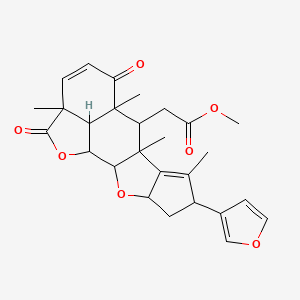
Nimbolide; NSC309909; NSC 309909; Methyl[8-(furan-3-yl)-2a,5a,6a,7-tetramethyl-2,5-dioxo-2a,5a,6,6a,8,9,9a,10a,10b,10c-decahydro-2h,5h-cyclopenta[d]naphtho[2,3-b:1,8-b’c’]difuran-6-yl]acetate; CCRIS 5723;

CAS 25990-37-8;
Molecular Formula: C27H30O7
Molecular Weight: 466.5229 g/mol

Oral administration of nimbolide, over 12 weeks shows reduction of prostate tumor size by up to 70 per cent and decrease in tumor metastasis by up to 50 per cent

A team of international researchers led by Associate Professor Gautam Sethi from the Department of Pharmacology at the Yong Loo Lin School of Medicine at the National University of Singapore (NUS) has found that nimbolide, a bioactive terpenoid compound derived from Azadirachta indica or more commonly known as the neem plant, could reduce the size of prostate tumor by up to 70 per cent and suppress its spread or metastasis by half.

Prostate cancer is one of the most commonly diagnosed cancers worldwide. However, currently available therapies for metastatic prostate cancer are only marginally effective. Hence, there is a need for more novel treatment alternatives and options.

“Although the diverse anti-cancer effects of nimbolide have been reported in different cancer types, its potential effects on prostate cancer initiation and progression have not been demonstrated in scientific studies. In this research, we have demonstrated that nimbolide can inhibit tumor cell viability — a cellular process that directly affects the ability of a cell to proliferate, grow, divide, or repair damaged cell components — and induce programmed cell death in prostate cancer cells,” said Assoc Prof Sethi.

Image result for National University of Singapore

Nimbolide: promising effects on prostate cancer

Cell invasion and migration are key steps during tumor metastasis. The NUS-led study revealed that nimbolide can significantly suppress cell invasion and migration of prostate cancer cells, suggesting its ability to reduce tumor metastasis.

The researchers observed that upon the 12 weeks of administering nimbolide, the size of prostate cancer tumor was reduced by as much as 70 per cent and its metastasis decreased by about 50 per cent, without exhibiting any significant adverse effects.

“This is possible because a direct target of nimbolide in prostate cancer is glutathione reductase, an enzyme which is responsible for maintaining the antioxidant system that regulates the STAT3 gene in the body. The activation of the STAT3 gene has been reported to contribute to prostate tumor growth and metastasis,” explained Assoc Prof Sethi. “We have found that nimbolide can substantially inhibit STAT3 activation and thereby abrogating the growth and metastasis of prostate tumor,” he added.

The findings of the study were published in the April 2016 issue of the scientific journal Antioxidants & Redox Signaling. This work was carried out in collaboration with Professor Goh Boon Cher of Cancer Science Institute of Singapore at NUS, Professor Hui Kam Man of National Cancer Centre Singapore and Professor Ahn Kwang Seok of Kyung Hee University.

Neem — The medicinal plant

The neem plant belongs to the mahogany tree family that is originally native to India and the Indian sub-continent. It has been part of traditional Asian medicine for centuries and is typically used in Indian Ayurvedic medicine. Today, neem leaves and bark have been incorporated into many personal care products such as soaps, toothpaste, skincare and even dietary supplements.

Image result for National University of Singapore

Future Research

The team is looking to embark on a genome-wide screening or to perform a large-scale study of proteins to analyse the side-effects and determine other potential molecular targets of nimbolide. They are also keen to investigate the efficacy of combinatory regimen of nimbolide and approved drugs such as docetaxel and enzalutamide for future prostate cancer therapy.


Journal Reference:

  1. Jingwen Zhang, Kwang Seok Ahn, Chulwon Kim, Muthu K. Shanmugam, Kodappully Sivaraman Siveen, Frank Arfuso, Ramar Perumal Samym, Amudha Deivasigamanim, Lina Hsiu Kim Lim, Lingzhi Wang, Boon Cher Goh, Alan Prem Kumar, Kam Man Hui, Gautam Sethi. Nimbolide-Induced Oxidative Stress Abrogates STAT3 Signaling Cascade and Inhibits Tumor Growth in Transgenic Adenocarcinoma of Mouse Prostate Model. Antioxidants & Redox Signaling, 2016; 24 (11): 575 DOI:10.1089/ars.2015.6418

Image result for nimbolide

A PAPER

Image result for nimbolide

NIMBOLIDE 1

http://pubs.rsc.org/en/content/articlelanding/2015/ra/c5ra16071e#!divAbstract

Nimbolide (1): Pale yellow crystals; C27H30O7;

FT-IR (KBr, υmax, cm -1): 2978, 1778, 1730, 1672, 1433, 1296, 1238, 1192, 1153, 1069, 951, 827, 750;

1H NMR (500 MHz, CDCl3) δH: 7.32 (t, J = 1.5 Hz, 1H), 7.28 (d, J = 9.5 Hz, 1H), 7.22 (s, 1H), 6.25 (m, 1H), 5.93 (d, J = 10.0 Hz, 1H), 5.53 (m, 1H), 4.62 (dd, J = 3.67 Hz, 12 .5 Hz, 1H), 4.27 (d, J = 3.5 Hz, 1H), 3.67 (d, J = 9.0 Hz, 1H), 3.54 (s, 3H), 3.25 (dd, J = 5.0 Hz, 16.25 Hz, 1H), 3.19 (d, J = 12.5 Hz, 1H), 2.73 (t, J = 5.5 Hz, 1H), 2.38 (dd, J = 5.5 Hz, 16.25 Hz, 1H), 2.22 (dd, J = 6.5 Hz, 12.0 Hz, 1H), 2.10 (m, 1H), 1.70 (s, 3H), 1.47 (s, 3H), 1.37 (s, 3H), 1.22 (s, 3H);

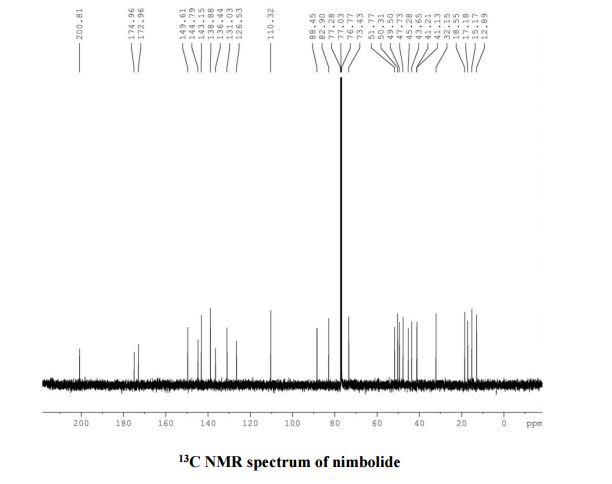
13C NMR (125 MHz, CDCl3) δC: 200.8 (CO), 175.0 (COO), 173.0 (COO), 149.6 (CH), 144.8 (C), 143.2 (CH), 138.9 (CH), 136.4 (C), 131.0 (CH), 126.5 (C), 110.3 (CH), 88.5 (CH), 82.9 (CH), 73.4 (CH), 51.8 (OCH3), 50.3 (C), 49.5 (CH), 47.7 (CH), 45.3 (C), 43.7 (C), 41.2 (CH2), 41.1 (CH), 32.1 (CH2), 18.5 (CH3), 17.2 (CH3), 15.2 (CH3), 12.9 (CH3);

HR-MS (m/z): 467.20795 [(M+H)+ ].

Content Page No 1 1H NMR spectrum of nimbolide S1 2 13C NMR spectrum of nimbolide S2 3 Mass spectrum of nimbolide

Dr Gautam Sethi

phcgs@nus.edu.sg
Tel.: (65)6516 3267
Fax: (65)6873 7690

Academic Qualifications
BSc. Chem. (Hons) 1998 Banaras Hindu University, Varanasi, India.
MSc. Biochemistry 2000 Banaras Hindu University, Varanasi, India.
Ph.D. Biotechnology 2004 Banaras Hindu University, Varanasi, India.
Appointments to Date
Assistant
Professor
2008-date Department of Pharmacology, National University of Singapore, Singapore
Postdoctoral Fellow 2004-2007 Department of Experimental Therapeutics,
The University of Texas.
MD Anderson Cancer Center, Houston TX USA.
Senior Research Fellow 2002-2004 (CSIR-NET) at School of Biotechnology,
Banaras Hindu University, Varanasi, India.
Junior Research Fellow 2000-2002 (CSIR-NET) at School of Biotechnology, Banaras Hindu University, Varanasi, India.
Honours and Awards
2007 Ramalingaswamy fellowship from Department of Biotechnology, Government of India for outstanding research contributions in the field of Cancer Biology.
2002 Senior Research Fellowship award, Council of Scientific and Industrial Research, New Delhi, India.
2000 Junior Research Fellowship award, Council of Scientific and Industrial Research, New Delhi, India.
Research Interests
Selected Publications
Reviews and Book Chapters


Image result for SINGAPORE ANIMATED FLAG

/////////NIMBOLIDE, CANCER, NEEM, PROSTRATE, National University of Singapore, Gautam Sethi

CC1=C2C(CC1C3=COC=C3)OC4C2(C(C5(C6C4OC(=O)C6(C=CC5=O)C)C)CC(=O)OC)C

RO-5126766


RO5126766(CH5126766)

CHEBI:78825.png

RO-5126766

946128-88-7
MW 471.46
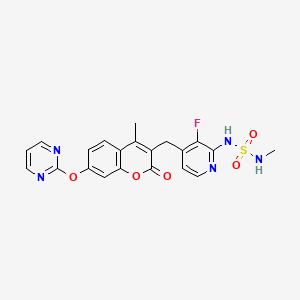
MF C21H18FN5O5S

Phase I

3- [[2-[(Methylaminosulfonyl)amino]-3- fluoropyridin-4-yl]methyl]-4-methyl-7-[(pyrimidin-2-yl)oxy]- 2H-1-benzopyran-2-one

3-[[3-fluoro-2-(methylsulfamoylamino)pyridin-4-yl]methyl]-4-methyl-7-pyrimidin-2-yloxychromen-2-one
Chugai Seiyaku Kabushiki Kaisha

Chugai Seiyaku Kabushiki Kaisha, Sakai, Toshiyuki

Hoffmann-La Roche
Collaborators:
Institute of Cancer Research, United Kingdom
Chugai Pharmaceutical

A MEK1/Raf inhibitor potentially for the treatment of solid tumors and multiple myeloma.

RO-5126766; RG-7304; CH-5126766; CKI-27; R-7304

CAS No. 946128-88-7

Although melanoma is the most aggressive skin cancer, recent advances in BRAF and/or MEK inhibitors against BRAF-mutated melanoma have improved survival rates. Despite these advances, a treatment strategy targeting NRAS-mutated melanoma has not yet been elucidated. We discovered CH5126766/RO5126766 as a potent and selective dual RAF/MEK inhibitor currently under early clinical trials. We examined the activity of CH5126766/RO5126766 in a panel of malignant tumor cell lines including melanoma with a BRAF or NRAS mutation. Eight cell lines including melanoma were assessed for their sensitivity to the BRAF, MEK, or RAF/MEK inhibitor using in vitro growth assays. CH5126766/RO5126766 induced G1 cell cycle arrest in two melanoma cell lines with the BRAF V600E or NRAS mutation. In these cells, the G1 cell cycle arrest was accompanied by up-regulation of the cyclin-dependent kinase inhibitor p27 and down-regulation of cyclinD1. CH5126766/RO5126766 was more effective at reducing colony formation than a MEK inhibitor in NRAS- or KRAS-mutated cells. In the RAS-mutated cells, CH5126766/RO5126766 suppressed the MEK reactivation caused by a MEK inhibitor. In addition, CH5126766/RO5126766 suppressed the tumor growth in SK-MEL-2 xenograft model

A method for producing a coumarin derivative of general formula (VII) is disclosed in Patent document 1 or 2. Patent document 1 or 2 discloses a method represented by the scheme below [In the scheme, DMF represents N,N-dimethylformamide, TBS represents a tert-butyldimethylsilyl group, dba represents dibenzylideneacetone, and BINAP represents 2,2′-bis(diphenylphosphino)-1,1′-binaphthyl. Also, the numerical values (%) and “quant.” given below some structural formulas indicate the yields of the respective compounds], for example (see the manufacturing example for “compound 1j-2-16-2K” in Patent document 1 or 2).

Figure US20140213786A1-20140731-C00003

Figure US20140213786A1-20140731-C00004

CITATION LIST Patent Literature

Patent document 1: WO 2007/091736

Patent document 2: WO 2009/014100

PATENT

http://www.google.co.in/patents/EP1982982A1?cl=en

      Compound 1j-2-16-2:

3-{2-(Methylaminosulfonyl)amino-3-fluoropyridin-4-ylmethyl}-4-methyl-7-(pyrimidin-2-yloxy)-2-oxo-2H-1-benzopyranFigure imgb0341

Methylamine (158 µL, 317 µmol) and DMAP (38.7 mg, 317 µmol) were added at -78 °C to a solution of sulfuryl chloride (28 µL, 340 µmol) in dichloromethane (2 mL), and the mixture was then stirred at room temperature for 2 hours to yield the corresponding sulfamoyl chloride. 3-(2-Amino-3-fluoropyridin-4-ylmethyl)-7-(pyrimidin-2-yloxy)-4-methyl-2-oxo-2H-1-benzopyran (compound 1h-2-16) (60 mg, 159 µmol), pyridine (65 µL, 795 µmol) and dichloromethane (2 mL) were added to the reaction solution, and the mixture was stirred at room temperature for 4 hours. After addition of water, the organic layer was extracted with dichloromethane. After washing with sodium hydrogen carbonate solution and saturated saline, the organic layer was dried over anhydrous magnesium sulfate, and the solvent was distilled away under reduced pressure. The resultant residue was purified by silica gel column chromatography to yield the title compound (32 mg, 43%).

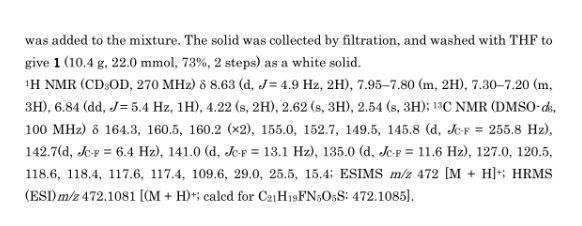
1H NMR (CD3OD, 270 MHz) δ (ppm): 2.54 (3H, s), 2.62 (3H, s), 4.22 (2H, s), 6.84 (1H, dd, J = 5.4 Hz), 7.20-7.30 (3H, m), 7.80-7.95 (2H, m), 8.63 (2H, d, J = 4.9 Hz)

ESI (LC/MS positive mode) m/z: 472 (M + H).

      Compound 1j-2-16-2Na:

3-(2-(N-Methylsulfamoyl)amino-3-fluoropyridin-4-ylmethyl)-4-methyl-7-(pyrimidin-2-yloxy)-2-oxo-2H-1-benzopyran sodium saltFigure imgb0342

The title compound was synthesized under the same conditions as in the manufacturing example for compound 1j-1-5-1Na, except that compound 1j-2-16-2 was used instead of compound 1j-1-5-1.

1H NMR (DMSO-d6, 270 MHz) δ (ppm): 2.30 (3H, s), 2.46 (3H, s), 3.89 (2H, s), 5.68 (1H, brs), 6.09-6.23 (1H, m), 7.20 (1H, dd, J = 2.4, 8.7 Hz), 7.34 (1H, t, J = 4.8 Hz), 7.38 (1H, d, J = 2.4 Hz), 7.55 (1H, d, J = 5.3 Hz), 7.90 (1H, d, J = 8.7 Hz), 8.69 (1H, d, J = 4.8 Hz).

ESI (LC/MS positive mode) m/z: 472 (M + 2H – Na).

      Compound 1j-2-16-2K:

3-(2-(N-Methylsulfamoyl)amino-3-fluoropyridin-4-ylmethyl)-4-methyl-7-(pyrimidin-2-yloxy)-2-oxo-2H-1-benzopyran potassium saltFigure imgb0343

The title compound was synthesized under the same conditions as in the manufacturing example for compound 1j-1-5-1Na, except that compound 1j-2-16-2 was used instead of compound 1j-1-5-1, and that KOH was used instead of NaOH.

1H NMR (DMSO-d6, 270 MHz) δ (ppm): 2.36 (3H, s), 2.47 (3H, s), 3.93 (2H, s), 6.26-6.40 (1H, m), 7.27 (1H, dd, J = 2.3, 8.6 Hz), 7.34 (1H, t, J = 4.8 Hz), 7.39 (1H, d, J = 2.3 Hz), 7.64 (1H, d, J = 4.8 Hz), 7.91 (1H, d, J = 8.6 Hz), 8.69 (1H, d, J = 4.8 Hz).

ESI (LC/MS positive mode) m/z: 472 (M + 2H – K).

PAPER

ACS Medicinal Chemistry Letters (2014), 5(4), 309-314.

Optimizing the Physicochemical Properties of Raf/MEK Inhibitors by Nitrogen Scanning

Research Division, Chugai Pharmaceutical Co., Ltd., 200 Kajiwara, Kamakura, Kanagawa 247-8530, Japan
Research Division, Chugai Pharmaceutical Co., Ltd., 1-135 Komakado, Gotemba, Shizuoka 412-8513, Japan
ACS Med. Chem. Lett., 2014, 5 (4), pp 309–314
DOI: 10.1021/ml400379x
Publication Date (Web): January 22, 2014
Abstract Image

Substituting a carbon atom with a nitrogen atom (nitrogen substitution) on an aromatic ring in our leads 11a and 13g by applying nitrogen scanning afforded a set of compounds that improved not only the solubility but also the metabolic stability. The impact after nitrogen substitution on interactions between a derivative and its on- and off-target proteins (Raf/MEK, CYPs, and hERG channel) was also detected, most of them contributing to weaker interactions. After identifying the positions that kept inhibitory activity on HCT116 cell growth and Raf/MEK, compound 1(CH5126766/RO5126766) was selected as a clinical compound. A phase I clinical trial is ongoing for solid cancers.

STR1

STR1

PATENT

https://www.google.com/patents/US20140213786

Step 5 Synthesis of 4-methyl-3-(3-fluoro-2-aminopyridin-4-ylmethyl)-7-(pyrimidin-2-yloxy)-2-oxo-2H-1-benzopyranFigure US20140213786A1-20140731-C00047

Under a nitrogen atmosphere, potassium carbonate (2.3 g, 17 mmol) was added to a solution of the solid product of step 4 (3.0 g) and 2-bromopyrimidine (1.6 g, 9.8 mmol) in DMF (48 mL), and the mixture was stirred at 115° C. for 2.5 hours. The reaction mixture was cooled to 28° C., water (48 mL) was added dropwise over a period of 5 minutes at that temperature, and after cooling to 0° C., the mixture was stirred for 2 hours. The precipitated crystals were collected by filtration, washed with water (24 mL) and acetonitrile (24 mL) in that order, and dried under reduced pressure to obtain crude crystals (2.3 g). DMF (65 mL) was added to the crude crystals (2.3 g), and after heating to 60° C. and confirming the dissolution, the mixture was cooled to 25° C. Water (65 mL) was added at 25° C., and the mixture was further cooled to 0° C. and stirred for 4 hours. The precipitated crystals were collected by filtration, washed with water (22 mL) and acetonitrile (22 mL) in that order, and dried under reduced pressure to obtain the title compound (2.1 g). The title compound is a compound disclosed in WO 2007/091736.

Yield (overall yield from the 2-acetylamino-5-chloro-3-fluoropyridine used in step 2): 27%

Patent

https://www.google.com/patents/US20100004233

Compound 1h-2-16:

3-(3-Fluoro-2-aminopyridin-4-ylmethyl)-4-methyl-7-(pyrimidin-2-yloxy)-2-oxo-2H-1-benzopyranFigure US20100004233A1-20100107-C00146

The title compound was synthesized under the same conditions as in the manufacturing example for compound 1h-2-4 (synthesis scheme 2), except that compound 5d-0-16 was used instead of compound 4a-0-4.

1H NMR (DMSO-d6, 270 MHz) δ (ppm): 2.45-2.55 (3H, m), 3.94 (2H, s), 6.12 (2H, brs), 6.28 (1H, dd, J=4.7 Hz), 7.27 (1H, dd, J=8.6 Hz, J=2.1 Hz), 7.34 (1H, dd, J=4.9 Hz), 7.38 (1H, d, J=2.1 Hz), 7.58 (1H, d, J=4.7 Hz), 7.91 (1H, d, J=8.6 Hz), 8.68 (2H, d, J=4.7 Hz).

ESI (LC/MS positive mode) m/z: 479 (M+H).

 Compound 1j-2-4-2:

3-{2-Fluoro-3-(methylaminosulfonyl)aminobenzyl}-4-methyl-7-(pyrimidin-2-yloxy)-2-oxo-2H-1-benzopyranFigure US20100004233A1-20100107-C00274

The title compound was synthesized under the same conditions as in the manufacturing example for compound 1j-1-5-2, except that compound 1h-2-4 was used instead of compound 1h-1-5.

1H NMR (270 MHz, DMSO-d6) δ (ppm): 2.45 (3H, s), 3.99 (2H, s), 6.83-6.92 (1H, m), 6.97-7.06 (1H, m), 7.17 (1H, brs), 7.34-7.40 (4H, m), 7.91 (1H, d, J=8.4 Hz), 8.69 (2H, dd, J=4.8, 1.2 Hz), 9.38 (1H, br.s).

One of the CH3 peaks was overlapped with the DMSO peak.

ESI (LC/MS positive mode) m/z: 471 (M+H).

Compound 1j-2-4-2Na:

3-{2-Fluoro-3-(methylaminosulfonyl)aminobenzyl}-4-methyl-7-(pyrimidin-2-yloxy)-2-oxo-2H-1-benzopyran sodium saltFigure US20100004233A1-20100107-C00275

The title compound was synthesized under the same conditions as in the manufacturing example for compound 1j-1-5-1Na, except that compound 1j-2-4-2 was used instead of compound 1j-1-5-1.

1H NMR (270 MHz, DMSO-d6) δ (ppm): 2.33 (3H, d, J=3.3 Hz), 2.43 (3H, s), 3.89 (2H, s), 6.10-6.19 (1H, m), 6.58-6.66 (1H, m), 7.17 (1H, ddd, J=8.3, 1.5 Hz, JHF=8.3 Hz), 7.25 (1H, dd, J=8.7, 2.3 Hz), 7.33 (1H, t, J=4.8 Hz), 7.37 (1H, d, J=2.3 Hz), 7.88 (1H, d, J=8.7 Hz), 8.69 (2H, d, J=4.8 Hz)

ESI (LC/MS positive mode) m/z: 471 (M+2H—Na).

Compound 1j-2-4-2K:

3-{2-Fluoro-3-(methylaminosulfonyl)aminobenzyl}-4-methyl-7-(pyrimidin-2-yl-oxy)-2-oxo-2H-1-benzopyran potassium saltFigure US20100004233A1-20100107-C00276

The title compound was synthesized under the same conditions as in the manufacturing example for compound 1j-1-5-1Na, except that compound 1j-2-4-2 was used instead of compound 1j-1-5-1, and that KOH was used instead of NaOH.

1H NMR (270 MHz, DMSO-d6) δ (ppm): 8.69 (d, 2H, J=4.8 Hz), 7.88 (d, 1H, J=8.7 Hz), 7.36 (d, 1H, J=2.3 Hz), 7.33 (t, 1H, J=4.8 Hz), 7.25 (dd, 1H, J=8.7, 2.3 Hz), 7.16 (td, 1H, J=8.5, 1.4 Hz), 6.59 (t, 1H, J=7.8 Hz), 6.10 (t, 1H, J=6.3 Hz), 4.76 (q, 1H, J=5.8 Hz), 3.88 (s, 2H), 2.43 (s, 3H), 2.32 (d, 3H, J=5.6 Hz).

ESI (LC-MS positive mode) m/z: 471 (M+2H—K).

PATENT

 WO 2013035754 

Method for producing a coumarin derivative of formula (VII) are described in Patent Documents 1 and 2. Patent Documents 1 and 2, for example, in the following scheme [scheme, DMF is N, represents a N- dimethylformamide, TBS represents a tert- butyldimethylsilyl group, dba represents dibenzylideneacetone, BINAP is 2, I represents a 2′-bis (diphenylphosphino) -1,1′-binaphthyl. Further, numerical values given under the formula (%) or “quant.” Indicates the yield of the compound. Methods have been described that are shown in (see Preparation of “Compound 1j-2-16-2K” in Patent Documents 1 and 2).

Figure JPOXMLDOC01-appb-C000018

WO2007 / 091736 WO2009 / 014100

While coumarin derivatives of the general formula (VII) can be prepared by the methods described in Patent Documents 1 and 2, in the method described in Patent Documents 1 and 2, after the formylation reaction and a reduction reaction, and unintended Reaction To suppress, it is necessary to perform the introduction and removal steps of the protecting group for hydroxy group. Also, during the formylation reaction, from the viewpoint of cryogenic conditions of the reaction control (eg, -95 ℃ ~ -65 ℃) is required. Furthermore, the alkylation reaction (the seventh step in the above scheme), it is preferred that an excess amount of use of ethyl acetoacetate in terms of efficient synthesis, in which case, requires complicated operation of removing residual reagents become.

[Example 1]
Step 1:
Synthesis of 2-acetylamino-5-chloro-3-fluoropyridine:

Figure JPOXMLDOC01-appb-C000050

Under a nitrogen atmosphere, acetamide (94.8g, 1.61mol) in DMF with (200mL) and THF (830mL) was added and heated to 50 ℃. The resulting solution was a THF solution of 40wt% sodium hexamethyldisilazide (629g, 1.37mol) was added dropwise and stirred at the same temperature for 2 hours. 5-chloro-2,3-difluoro pyridine (100.0g, 0.67mol) After adding, THF and (20mL), and the mixture was stirred at the same temperature for 3 hours. After cooling to 0 ℃, it is added to 2.8M HCl (500mL) to the reaction mixture, and the organic layer was separated and the temperature was raised to room temperature.The organic layer was washed with 20wt% sodium chloride solution (500mL), and evaporated under reduced pressure. The residue in THF (500mL) was added, and the residue was dissolved by heating at 70 ℃. After confirming the solid precipitated by cooling to room temperature, n- heptane (1500mL) was added and further cooled to 0 ℃, followed by stirring at the same temperature for 3 hours. The The precipitated crystals were collected by filtration, to give after washing with a mixed solvent of THF (100mL) and n- heptane (500mL), and dried under reduced pressure to give the title compound (91.2g).
Yield: 72%
1 H-NMR (CDCl 3) δ (ppm): 2.36 (3H, s), 7.49 (1H, dd, J = 2.0,9.5Hz), 7.78 (1H, br), 8.17 (1H, d, J = 2.0Hz).
MS (ESI +): 189 [M + 1] +

Step 2:
Synthesis of 2-acetylamino-5-chloro-3-fluoro-4-formyl pyridine:

Figure JPOXMLDOC01-appb-C000051

Under a nitrogen atmosphere, and dissolved at room temperature 2-acetylamino-5-chloro-3-fluoropyridine (70.0g, 0.37mol) and 4-formyl-morpholine (128.2g, 1.11mol) to THF (840mL) It was. The solution was cooled to -20 ℃ and was added dropwise a THF solution of 24wt% of lithium hexamethyldisilazide (595g, 0.85mol), and stirred 5.5 hours at the same temperature. The reaction mixture, citric acid monohydrate (257g) and sodium chloride (70g) in an aqueous solution dissolved in water (420mL), and I was added at stirring at 0 ℃. The organic layer was separated and the resulting organic layer was successively washed with 50wt% phosphoric acid aqueous solution of potassium dihydrogen (350mL) and 20wt% sodium chloride solution (350mL) to (1458g). The portion of the organic layer was taken for analysis (292g), and evaporated remainder (1166g) at reduced pressure. The residue in THF (350mL) was added, and the solvent was distilled off under reduced pressure. Again, the residue in THF (350mL) was added to and evaporated under reduced pressure to give a solid (81.4g) containing the title compound. The product was used in the next step without further purification.
Some of the organic layer which had been collected (292g) to (29g), and evaporated under reduced pressure. The residue was purified by silica gel column chromatography: subjected to [eluent AcOEt / hexane (1 / 4-9 / 1)], I give the title compound (1.05g, 4.85mmol) as a white powdery solid.
Yield: 66%
1 H-NMR (CDCl 3) δ (ppm): 2.40 (3H, s), 7,59 (1H, br), 8.34 (1H, br), 10.42 (1H, s).
MS (ESI +): 217 (M + 1)

Step 3:
2 – [(4-2-acetylamino-3-fluoro-pyridin-yl) methyl] -3-oxobutanoic acid ethyl ester:

Figure JPOXMLDOC01-appb-C000052

Under a nitrogen atmosphere to dissolve the solid product of Step 2 (81.4g) in 2,2,2-trifluoroethanol (448mL), piperidine (4.4g, 51.7mmol), acetic acid (3.1g, 51 .7mmol) and 3-oxobutanoic acid ethyl (37.0g, 0.28mol) was added and stirred for 3 hours after raising the temperature to 50 ℃. After cooling the reaction mixture to room temperature, triethylamine (758mL, 5.5mol) and formic acid (172mL, 4.6mol) of 2-propanol (1248mL) solution and 20% Pd (OH) 2 carbon (21.2g, moisture content 46.2%) were added, followed by stirring for 4 hours the temperature was raised to 50 ℃. The reaction mixture was filtered through Celite, and the residue was washed with 2-propanol (679mL). Combined filtrate and washings (2795g), and evaporated under reduced pressure a part of the (399g) (remaining (2396g) I was saved). Ethyl acetate (24.2mL) was added to the residue obtained by evaporation of the solvent, and evaporated under reduced pressure. Again, the residue ethyl acetate (182mL) was added to the washed successively with an organic layer 20wt% brine (61mL), 10wt% of potassium dihydrogen phosphate solution (61mL) and 20wt% sodium chloride solution (61mL), under a reduced pressure The solvent was evaporated. Furthermore, in addition to the residue of 2,2,2-trifluoroethanol (24mL), and the solvent evaporated under reduced pressure to obtain oil containing the title compound (15.0g). The product was used in the next step without further purification.
1 H-NMR (CDCl 3) δ (ppm): 1.24 (3H, t, J = 7.0Hz), 2.27 (3H, s), 2.37 (3H, s), 3.16- 3.26 (2H, m), 3.86 (1H, t, J = 7.5Hz), 4.15-4.22 (2H, m), 6.98 (1H, t, J = 5.0Hz ), 7.68 (1H, br), 8.05 (1H, d, J = 5.0Hz).
MS (ESI +): 297 (M + 1)

Step 4:
Synthesis of 3- (3-fluoro-2-amino-pyridin-4-ylmethyl) -7-hydroxy-4-methyl-2-oxo -2H-1- benzopyran methanesulphonate:

Figure JPOXMLDOC01-appb-C000053

Under a nitrogen atmosphere, oily product of Step 3 (15.0g) and I were dissolved in 2,2,2-trifluoroethanol (33mL). The solution of resorcinol (5.3g, 47.9mmol) and methane sulfonic acid (11.7mL, 181mmol) was added at 24 ℃, and stirred for 4 hours at 90 ℃. And allowed to stand for 13 hours and cooled to room temperature and ethanol (33mL) and water (11mL), and the mixture was stirred for 4.5 hours at 90 ℃. After adding 2-propanol (105mL) was cooled to 55 ℃, and allowed to stand for 14 hours then cooled to room temperature. The The precipitated crystals were collected by filtration to give 2-propanol was washed twice with (33mL), and dried under reduced pressure to give the title compound (8.2g).
(Total from 2-acetylamino-5-chloro-3-fluoropyridine was used in step 2 Yield) Yield: 49%
MS (ESI +): 301 [M + 1-MsOH] +

Step 5:
4-methyl-3- (3-fluoro-2-amino-pyridin-4-ylmethyl) -7- (pyrimidin-2-yloxy) -2-oxo -2H-1- benzopyran Synthesis:

Figure JPOXMLDOC01-appb-C000054

Under a nitrogen atmosphere, 3- (3-fluoro-2-amino-pyridin-4-ylmethyl) -7-hydroxy-4-methyl-2-oxo -2H-1- benzopyran methanesulphonate (7.6g, 19.2mmol) and 2-bromo-pyrimidine (4.0g, 24.9mmol) was dissolved in DMF (122mL), potassium carbonate (5.8g, 42.2mmol) was added, and the mixture was stirred for 3.5 hours at 115 ℃. After cooling the reaction mixture to 28 ℃, water (122mL) was added dropwise over the same temperature for 0.5 hours, and stirred for 2 minutes. In addition, after cooling to 0 ℃, and the mixture was stirred for 1 hour, and the precipitated crystals were collected by filtration. The obtained crystals were washed successively with water (61mL) and acetonitrile (61mL), to give the title compound was dried under reduced pressure and crystals (6.5g).
The resultant was taken for analysis a portion of the crystals (0.1g), it was suspended remainder (6.4g) in DMF (70mL). The resulting suspension was stirred 60 ℃ and heated for 5 minutes and stirred for 80 minutes by the addition of acetonitrile (185mL) at the same temperature. Then, it was stirred for 0.5 hours and then cooled to 40 ℃, and the mixture was stirred for 0.5 hours and further cooled to 25 ℃. After a further 1.5 hours with stirring and cooled to 0 ℃, the precipitated crystals were collected by filtration. After washing the resulting crystals in acetonitrile (46mL), was obtained by drying under reduced pressure to the title compound (5.5g). Incidentally, the title compound is a compound described in WO2007 / 091736.
Yield: 76%

Step 6:
3- {2- (methyl-aminosulfonyl) amino-3-fluoro-pyridin-4-ylmethyl} -4-methyl-7- (pyridin-2-yloxy) -2-oxo -2H-1- benzopyran Synthesis:

Figure JPOXMLDOC01-appb-C000055

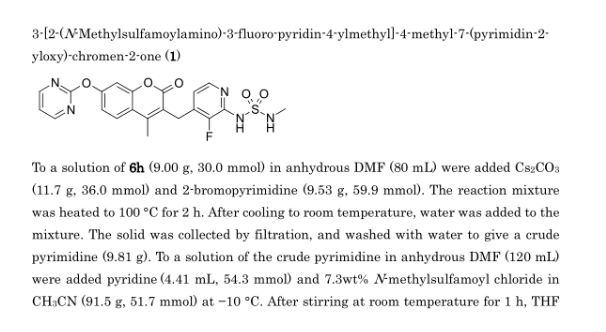
Under a nitrogen atmosphere, 4-methyl-3- (3-fluoro-2-amino-pyridin-4-ylmethyl) -7- (pyrimidin-2-yloxy) -2-oxo -2H-1- benzopyran (1.7g, 4 the .5mmol) it was suspended in DMF (18mL). To this solution pyridine (0.8mL, 9.9mmol) was cooled to In 10 ℃ added, N- methyl-sulfamoyl chloride (1.05g, 8.1mmol) in acetonitrile (18mL) solution of the internal temperature of 15 ℃ it was dropped so as to maintain below. After stirring for 90 minutes at the same temperature, acetonitrile (3.4mL) was added and further water (50mL), was added dropwise the inner temperature so as to maintain the 20 ℃ below. It was cooled to an external temperature of 0 ℃, and the mixture was stirred for an internal temperature of 5 ℃ 2 hours after arrival. The precipitated crystals were collected by filtration, washed with water (8.5mL), and dried to give the title compound (1.9g, 4.0mmol) was obtained.
Yield: 88%
MS (ESI +): 472 [M + 1] +

Step 7:
Synthesis of 3- {2- (methyl-aminosulfonyl) amino-3-fluoro-pyridin-4-ylmethyl} -4-methyl-7- (pyridin-2-yloxy) -2-oxo -2H-1- benzopyran potassium salt:

Figure JPOXMLDOC01-appb-C000056

Under a nitrogen atmosphere, 3- {2- (methyl-aminosulfonyl) amino-3-fluoro-pyridin-4-ylmethyl} -4-methyl-7- (pyridin-2-yloxy) -2-oxo -2H-1- benzopyran ( 1.6g, was suspended 3.4mmol) in THF (10mL), water (3mL) was added. The suspension in 2.0M aqueous potassium hydroxide (1.8mL, 3.6mmol) was added dropwise over 10 min at 25 ℃, after raising the temperature to 60 ℃, and the mixture was stirred for 2 hours at the same temperature. After cooling the reaction mixture to 20 ℃, it was added dropwise over a period of THF (8mL) 30 min. After completion of the dropwise addition, the mixture was cooled to an external temperature of -5 ℃, and the mixture was stirred for an internal temperature of 0 ℃ reached after 160 minutes. The precipitated crystals were collected by filtration, then washed with a mixture of THF (14mL) and water (1.6mL) (pre-cooled to 5 ℃), further washed with THF (8mL), and dried to give the title compound (0 .72g, we got 1.4mmol).
Yield: 42%
MS (ESI +): 472 [M + 2H-K] +

CLIP

RO5126766 (CH5126766) is a first-in-class dual inhibitor of Raf/MEK [1].

The RAS/RAF/MEK/ERK signaling pathway is an important signal transduction system and participates in cell differentiation, movement, division and death. Activated Ras activates RAF kinase, which then phosphorylates and activates MEK (MEK1 and MEK2) [1]. The mutations in BRAF, RAS, and NF1 are associated with many human tumors [2].

RO5126766 (CH5126766) is a first-in-class dual Raf/MEK inhibitor. In cell-free kinase assays, CH5126766 effectively inhibited the phosphorylation of MEK1 protein by RAF and the activation of ERK2 protein by MEK1 with IC50 values of 0.0082-0.056 and 0.16 μM, respectively. In NCI-H460 (KRAS Q61H) human lung large cell carcinoma cell line, RO5126766 induced cell-cycle inhibitor p27Kip1 protein expression and caused G1 arrest. In HCT116 KRAS-mutant colorectal cancer cells, RO5126766 CH5126766 completely inhibited the phosphorylation of MEK and ERK [2].

In Japanese patients with advanced solid tumors, RO5126766 exhibited the maximum tolerable dose (MTD) of 2.25 mg/day once daily [1]. In a HCT116 (G13D KRAS) mouse xenograft model, RO5126766 (1.5 mg/kg) inhibited pERK and ERK signaling and exhibited ED50 value of 0.056 mg/kg [2].

References:
[1].  Honda K, Yamamoto N, Nokihara H, et al. Phase I and pharmacokinetic/pharmacodynamic study of RO5126766, a first-in-class dual Raf/MEK inhibitor, in Japanese patients with advanced solid tumors. Cancer Chemother Pharmacol, 2013, 72(3): 577-584.
[2].  Ishii N, Harada N, Joseph EW, et al. Enhanced inhibition of ERK signaling by a novel allosteric MEK inhibitor, CH5126766, that suppresses feedback reactivation of RAF activity. Cancer Res, 2013, 73(13): 4050-4060.

WO2007091736A1 9 Feb 2007 16 Aug 2007 Chugai Seiyaku Kabushiki Kaisha Novel coumarin derivative having antitumor activity
WO2009014100A1 18 Jul 2008 29 Jan 2009 Chugai Seiyaku Kabushiki Kaisha p27 PROTEIN INDUCER
JPH0236145A * Title not available
Reference
1 BIOORGANIC MEDICINAL CHEMISTRY, vol. 13, 2005, pages 1393 – 1402
2 JOURNAL OF MEDICINAL CHEMISTRY, vol. 47, 2004, pages 6447 – 6450
3 ORGANIC PREPARATIONS AND PROCEDURES INTERNATIONAL, vol. 36, 2004, pages 347 – 351
4 * See also references of EP2754654A1
5 * STANCHO STANCHEV, ET AL.: “Synthesis and Inhibiting Activity of Some 4-Hydroxycoumarin Derivatives on HIV-1 Protease. Art 137637“, ISRN PHARMACEUTICS, vol. 63, no. 10, 2011, pages 1 – 9, XP055145297
6 * STANCHO STANCHEV, ET AL.: “Synthesis, computational study and cytotoxic activity of new 4-hydroxycoumarin derivatives“, EUROPEAN JOURNAL OF MEDICINAL CHEMISTRY, vol. 43, no. 4, 2008, pages 694 – 706, XP022576473
7 SYNTHETIC COMMUNICATIONS, vol. 34, 2004, pages 4301 – 4311
Patent ID Date Patent Title
US7897792 2011-03-01 Coumarin derivative having antitumor activity
US2011009398 2011-01-13 p27 Protein Inducer
Patent ID Date Patent Title
US2016024051 2016-01-28 SALTS AND SOLID FORMS OF ISOQUINOLINONES AND COMPOSITION COMPRISING AND METHODS OF USING THE SAME
US2015290207 2015-10-15 HETEROCYCLIC COMPOUNDS AND USES THEREOF
US2015283142 2015-10-08 TREATMENT OF CANCERS USING PI3 KINASE ISOFORM MODULATORS
US2015225410 2015-08-13 HETEROCYCLIC COMPOUNDS AND USES THEREOF
US2015111874 2015-04-23 HETEROCYCLIC COMPOUNDS AND USES THEREOF
US2014377258 2014-12-25 Treatment Of Cancers Using PI3 Kinase Isoform Modulators
US2014213786 2014-07-31 Method for Producing Coumarin Derivative
US2014038920 2014-02-06 TFEB PHOSPHORYLATION INHIBITORS AND USES THEREOF
US2011092700 2011-04-21 Novel Coumarin Derivative Having Antitumor Activity
US7897792 2011-03-01 Coumarin derivative having antitumor activity

//////////////RO-512676, RG-7304,  CH-5126766,  CKI-27,  R-730, 946128-88-7, PHASE 1, MEK1/Raf inhibitor,  treatment of solid tumors and multiple myeloma, CANCER

CC(C1=C(O2)C=C(OC3=NC=CC=N3)C=C1)=C(C2=O)CC4=C(F)C(NS(NC)(=O)=O)=NC=C4

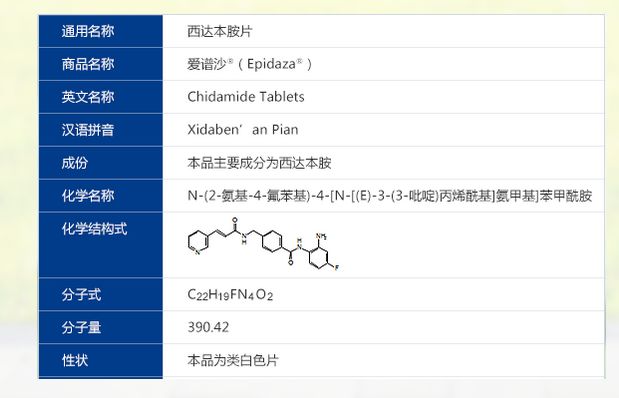
Chidamide (Epidaza), A New Cancer Drug, Made in China


STR1

Figure CN103833626AD00031

Chidamide (Epidaza)

CS055; HBI-8000

CAS   743438-44-0  CORRECT

C22 H19 F N4 O2, Benzamide, N-(2-amino-4-fluorophenyl)-4-[[[1-oxo-3-(3-pyridinyl)-2-propen-1-yl]amino]methyl]-
Molecular Weight, 390.41
  • Benzamide, N-(2-amino-4-fluorophenyl)-4-[[[1-oxo-3-(3-pyridinyl)-2-propenyl]amino]methyl]-
  • N-(2-Amino-4-fluorophenyl)-4-[[[1-oxo-3-(3-pyridinyl)-2-propen-1-yl]amino]methyl]benzamide
  • CS 055
  • Chidamide
  • Epidaza
Activity: HDAC Inhibitor; Cancer Drug; Histone Deacetylase Inhibitor; HDAC-1, 2,3,10 Inhibitor; Treatment for Peripheral T-cell Lymphomas; Treatment for PTCL
Status: Launched 2014 (China)
Originator: Shenzhen Chipscreen Biosciences Ltd
SHENZHEN CHIPSCREEN BIOSCIENCES LTD. [CN/CN]; Research Institute of Tsinghua University, Suite C301, P.O. Box 28, High-Tech Industrial Park Nanshan District, Shenzhen, Guangdong 518057


ERROR IN STRUCTURE

FLUORO IN WRONG POSITION

Chidamide.svg

CAS Registry Number: 743420-02-2

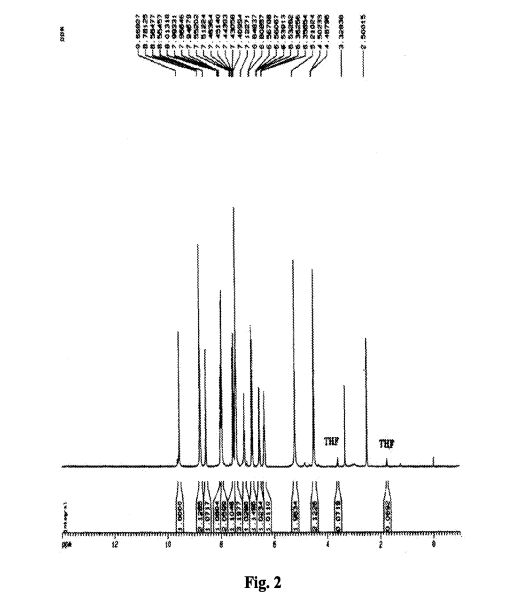
As described for Example 2 according to the patent ZL03139760.3 obtained chidamide poor purity (about 95%). LC / MS analysis results shown in Figure 1, show that the product contains N- (2- amino-5-fluorophenyl) -4- (N- (3- pyridin-acryloyl group of 4.7% of the structure shown in formula II) aminomethyl) benzamide. 1H NMR analysis of the results shown in Figure 2, show that the product contains 1.80% of tetrahydrofuran, far beyond the technical requirements for people with drug registration International Conference on Harmonization (ICH, International Conference of Harmonizition) provided 0.072% residual solvent limits. Therefore, the solid

Body not for pharmaceutical manufacturing.

Figure CN103833626AD00041

Chidamide (Epidaza) is an HDAC inhibitor (HDI) developed wholly in China.[1] It was originally known as HBI-8000.[2]

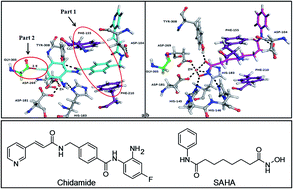
It is a benzamide HDI) and inhibits Class I HDAC1, HDAC2, HDAC3, as well as Class IIb HDAC10.[3]

It is approved by the Chinese FDA for relapsed or refractory peripheral T-cell lymphoma (PTCL), and having orphan drug status in Japan.[2]

As of April 2015 it is only approved in China.[1]

It shows potential in treating pancreatic cancer.[4][5][6]

Is NOT approved for the treatment of pancreatic cancer.

Chidamide drug administration and clinical milestone

November 2005: China declared IND

November 2006: eligible for Phase I clinical documents of approval

November 2006: completion of the International Patent Licensing, China entered the international fray original new drug development

May 2008: completed Phase I clinical, showing international mechanism similar drugs have the potential to become the best

February 2009: eligible lymphoma indications II / III of this document

March 2009: Start of the Phase II clinical trial for the NDA to ①CTCL goal of clinical trials and ②PTCL

March 2009: IND by the FDA application is eligible to start Phase I clinical in the United States

July 2009: eligible for non-small cell lung cancer, breast cancer and prostate cancer clinical documents of approval

December 2010: of PTCL by a conventional phase II directly into Phase II clinical trial registered drug trial center and by recognition

March 2011: combination chemotherapy for non-small cell lung cancer clinical trials enter phase Ib

September 2012: of PTCL indication test deadline

December 2012: of PTCL clinical summary will be held

January 2013: Chidamide declare China NDA

December 2014: the State Food and Drug Administration (CFDA) approved the listing

STR1

Chidamide overview, location and clinical significance

Chidamide (Chidamide, love spectrum sand ® / Epidaza®) Shenzhen microchip biotechnology limited liability company developed a new subtype selective histone having a chemical structure and is eligible for a global patent licensing deacetylase inhibitor, belong to the new mechanisms of epigenetic regulation new class of targeted anticancer drugs, has now completed with relapsed or refractory peripheral T-cell lymphoma clinical trial study registered indications, was in March 2013 to the SFDA reporting new drug certificate (NDA) and the marketing authorization (MAA). While a number of Chinese Cancer clinical trials undertaken Chidamide is also China’s first approved by the US FDA clinical studies in the United States of Chinese chemical original new drug trials in the United States Phase I has been completed. Chidamide has won the national “Eleventh Five-Year” 863 major projects (project number: 2006AA020603) and the national “Eleventh Five-Year”, “significant Drug Discovery” science and technology and other major projects funded project (project number: 2009ZX09401-003), was chosen the Ministry of Science and one of the “Eleventh five-Year” major national scientific and technological achievements.

Relapsed or refractory peripheral T-cell lymphoma (PTCL) is Chidamide first approvedclinical indications, PTCL belongs to the category of rare diseases, the lack of standard drug currently recommended clinical treatment, conventional chemotherapy response rate is low, recur, 5-year overall survival rate was about 25%. The world’s first PTCL treatment Folotyn (intravenous drug use) is eligible for FDA clearance to market in 2009, the second drugs Istodax (intravenous drug use) approved by the FDA in 2011. Add a new drug information for these drugs is very expensive, and were listed in China. Chidamide album clinical trial results showed that the primary endpoint of objective response rate was 28%, reaching the intended target research and development; sustained remission rate of 24% three months; drug safety was significantly better than the international similar drugs, and oral medication.
Chidamide is a completely independent intellectual property rights China originator of innovative medicines, has been multi-national patent. In China, for patients with relapsed or refractory PTCL to carry out effective drug treatment is urgent clinical need, Chidamide expected to bring new treatment options for patients with PTCL, prolong survival and improve quality of life of patients.

In China, for the effective treatment of patients with relapsed or refractory PTCL has undertaken urgent clinical need

Chidamide is a completely independent intellectual property rights China originator of innovative medicines

Chidamide (Chidamide) has been multi-national invention patents

In October 2006, the US HUYA biological microchip company formally signed the International Patent Chidamide licensing and international clinical cooperative development agreement; the United States in the ongoing Phase I clinical

Chidamide (Epidaza), a class I HDAC inhibitor, was discovered and developed by ChipScreen and approved by the CFDA in December 2014 for the treatment of recurrent of refractory peripheral T-cell lymphoma. Chidamide, also known as CS055 and HBI- 8000, is an orally bioavailable benzamide type inhibitor of HDAC isoenzymes class I , as well as class IIb 10, with potential antineoplastic activity. It selectively binds to and inhibits HDAC, leading to an increase in acetylation levels of histone protein H3.

Chidamide, the English called Chidamide, by the Shenzhen-core biotechnology limited liability company independent design and synthesis of a novel anti-cancer drugs with new chemical structures and global intellectual property, and its chemical name N- (2-amino-_4_ fluorophenyl) -4_ (N- (3- topiramate Li acryloyl) aminomethyl) benzamide, its chemical structure of the structural formula I

Figure CN103833626AD00031

The patent ZL03139760.3 and said US7,244,751, Chidamide have histone deacetylase inhibitory activity can be used to treat the differentiation and proliferation-related diseases such as cancer and psoriasis, especially for leukemia and solid tumors with excellent results.

 Patent No. ZL03139760.3 and US7,244,751 discloses a method for preparing chidamide, but did not specify whether the resulting product is a crystalline material, nor did the presence or absence of the compound polymorphism. In the above patent, the activity of the compound for evaluation is not conducted in a solid state and, therefore, does not disclose any description about characteristics of the crystal.

Chipscreen grabs CFDA approval for chidamide

Chipscreen BioSciences announced that the CFDA had approved chidamide for the treatment of relapsed or refractory peripheral T-cell lymphoma (PTCL) in December 2014. The drug and Hengrui’s apatinib were the only two NCEs launched by domestic drug makers last year.

Chidamide (CS055/HBI-8000) is a HDAC1/2/3/10 inhibitor derived from entinostat (MS-27-275)[1] which was first discoved by Mitsui Pharmaceuticals in 1999. Chipscreen holds worldwide IP rights to chidamide (patents: WO2004071400, WO2014082354).

Syndax Pharmaceuticals (NASDAQ: SNDX) is testing entinostat in breast cancer and NSCLC in pivotal trials. The FDA granted Breakthrough Therapy Designation to entinostat for advanced breast cancer in 2013. Eddingpharm in-licensed China rights to entinostat from Syndax in September 2013.

Chipscreen disclosed positive results from Phase II study of chidamide in relapsed or refractory PTCL at 2013 ASCO Annual Meeting[2]. Out of 79 evaluable patients in the trial, 23 patients (29.1%) had confirmed responses (8 CR, 3 CRu, and 12 PR). The most common grade 3/4 AEs were thrombocytopenia (24%), leucocytopenia (13%), neutropenia(10%).

The FDA has approved three HDAC inhibitors, known as Zolinza (vorinostat), Istodax (romidepsin) and Beleodaq (belinostat), for the treatment of PTCL. Celgene priced Istodax at $12000-18000/month and reported annual sales of $54 million in 2013. The efficacy and safety profile of chidamide compares favorably with romidepsin.

Although a dozen of companies are developing generic vorinostat and romidepsin, no chemical 3.1 NDA has been submitted to the CFDA so far. Chipscreen will be the only domestic maker of HDAC inhibitor in the coming two years. Moreover, the company is testing chidamide in NSCLC and breast cancer in early clinical studies.

CLIP

Chiamide synthesis: US7244751B2

Procedure:

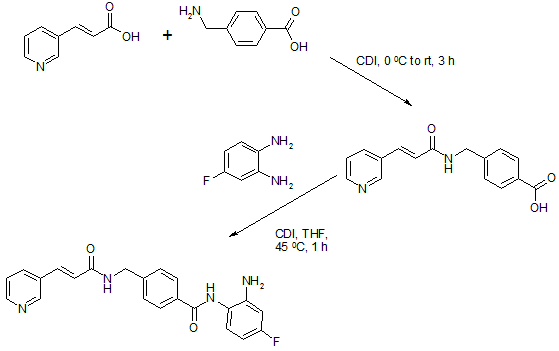
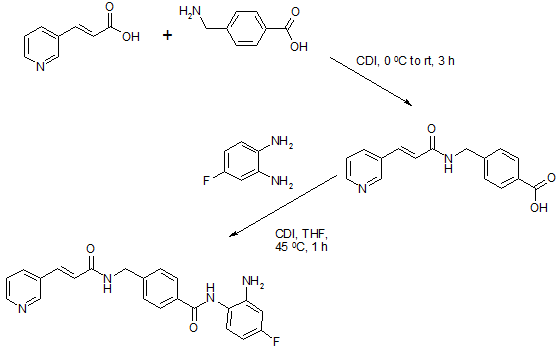
Step a: To a suspension of 0.33 g (2.01 mmol) of N,N’-carbonyldiimidazole in tetrahydrofunan (10 ml) is added drop-wise a solution of 0.30 g (2.01 mmol) of 3-pyridineacrylic acid at 0 °C. Then, the mixture is stirred at room temperature for 3 hours and added drop-wise to a separately prepared 2.0 ml (2.00 mmol) of 1N aqueous sodium hydroxide solution including 0.30 g (2.00 mmol) of 4-aminomethylbenzoic acid, followed by stirring at room temperature for 8 hours. The reaction mixture is evaporated under vacuum. To the residue is added a saturated solution of sodium chloride (2 ml), then the mixture is neutralized with concentrated hydrochloric acid to pH 5. The deposited white solid is collected by filtration, washed with ice-water, and then dried to give 4-[N-(Pyridin-3-ylacryloyl)aminomethyl]benzoic acid (0.46 g, 82%). HRMS calcd for C16H14N2O3: 282.2988. Found: 282.2990. MA calcd for: C16H14N2O3: C, 68.07%; H, 5.00%; N, 9.92%. Found: C, 68.21%; H, 5.03%; N, 9.90%.

Step b: To a suspension of 0.29 g (1.78 mmol) of N,N’-carbonyldiimidazole in tetrahydrofunan (15 ml) is added 0.50 g (1.78 mmol) of 4-[N-(Pyridin-3-ylacryloyl)aminomethyl]benzoic acid, followed by stirring at 45 °C. for 1 hour. After cooling, the reaction mixture is added to a separately prepared tetrahydrofiman (10 ml) solution including 0.28 g (2.22 mmol) of 4-fluoro-1,2-phenylenediamine and 0.20 g (1.78 mmol) of trifluoroacetic acid at room temperature. After reaction at room temperature for 24 hours, the deposited white solid is collected by filtration, washed with tetrahydrofunan, and then dried to give N-(2-amino-4-fluorophenyl)-4-[N-(Pyridin-3-ylacryloyl)aminomethyl]benzamide (0.40 g, 57%). 1H NMR (300 MHz, DMSO-d6): dppm: 4.49 (2H, d), 4.84 (2H, br.s), 6.60 (1H, t), 6.80 (2H, m),696 (1H, t), 7.18 (1H, d), 7.42 (2H, d), 7.52 (1H, d), 7.95 (2H, d), 8.02 (1H, d), 8.56 (1H, d), 8.72 (1H, br. t), 8.78 (1H, s), 9.60 (1H, br.s). IR (KBr) cm1: 3310, 1655, 1631, 1524, 1305, 750. HRMS calcd for C22H19N4O2F: 390.4170. Found: 390.4172. MA calcd for C22H19N4O2F: C, 67.68%; H, 4.40%; N, 14.35%. Found: C, 67.52%; H, 4.38%; N, 14.42%.

http://www.google.co.in/patents/US7244751

EXAMPLE 1

Preparation of 4-[N-(Pyridin-3-ylacryloyl)aminomethyl]benzoic acid

Figure US07244751-20070717-C00005

To a suspension of 0.33 g (2.01 mmol) of N,N′-carbonyldiimidazole in tetrahydrofunan (10 ml) is added drop-wise a solution of 0.30 g (2.01 mmol) of 3-pyridineacrylic acid at 0° C. Then, the mixture is stirred at room temperature for 3 hours and added drop-wise to a separately prepared 2.0 ml (2.00 mmol) of 1N aqueous sodium hydroxide solution including 0.30 g (2.00 mmol) of 4-aminomethylbenzoic acid, followed by stirring at room temperature for 8 hours. The reaction mixture is evaporated under vacuum. To the residue is added a saturated solution of sodium chloride (2 ml), then the mixture is neutralized with concentrated hydrochloric acid to pH 5. The deposited white solid is collected by filtration, washed with ice-water, and then dried to give the title compound (0.46 g, 82%). HRMS calcd for C16H14N2O3: 282.2988. Found: 282.2990. MA calcd for: C16H14N2O3: C, 68.07%; H, 5.00%; N, 9.92%. Found: C, 68.21%; H, 5.03%; N, 9.90%.EXAMPLE 2

Preparation of N-(2-amino-4-fluorophenyl)-4-[N-(Pyridn-3-ylacryloyl)aminomethyl]benzamide

Figure US07244751-20070717-C00006

To a suspension of 0.29 g (1.78 mmol) of N,N′-carbonyldiimidazole in tetrahydrofunan (15 ml) is added 0.50 g (1.78 mmol) of 4-[N-(Pyridn-3-ylacryloyl)aminomethyl]benzoic acid, followed by stirring at 45° C. for 1 hour. After cooling, the reaction mixture is added to a separately prepared tetrahydrofiman (10 ml) solution including 0.28 g (2.22 mmol) of 4-fluoro-1,2-phenylenediamine and 0.20 g (1.78 mmol) of trifluoroacetic acid at room temperature. After reaction at room temperature for 24 hours, the deposited white solid is collected by filtration, washed with tetrahydrofunan, and then dried to give the title compound (0.40 g, 57%). 1H NMR (300 MHz, DMSO-d6): δppm: 4.49 (2H, d), 4.84 (2H, br.s), 6.60 (1H, t), 6.80 (2H, m),696 (1H, t), 7.18 (1H, d), 7.42 (2H, d), 7.52 (1H, d), 7.95 (2H, d), 8.02 (1H, d), 8.56 (1H, d), 8.72 (1H, br. t), 8.78 (1H, s), 9.60 (1H, br.s). IR (KBr) cm1: 3310, 1655, 1631, 1524, 1305, 750. HRMS calcd for C22H19N4O2F: 390.4170. Found: 390.4172. MA calcd for C22H19N4O2F: C, 67.68%; H, 4.40%; N, 14.35%. Found: C, 67.52%; H, 4.38%; N, 14.42%.EXAMPLE 3

Preparation of 4-[N-cinnamoylaminomethyl]benzoic acid

Figure US07244751-20070717-C00007

To a suspension of 0.33 g (2.01 mmol) of N,N′-carbonyldiimidazole in tetrahydrofunan (10 ml) is added drop-wise a solution of 0.30 g (2.01 mmol) of cinnamic acid at 0° C. Then, the mixture is stirred at room temperature for 3 hours and added drop-wise to a separately prepared 2.0 ml (2.00 mmol) of 1N aqueous sodium hydroxide solution including 0.30 g (2.00 mmol) of 4-aminomethylbenzoic acid, followed by stirring at room temperature for 8 hours. The reaction mixture is evaporated under vacuum. To the residue is added a saturated solution of sodium chloride (2 ml), then the mixture is neutralized with concentrated hydrochloric acid to pH 7. The deposited white solid is collected by filtration, washed with ice-water, and then dried to give the title compound (0.51 g, 91%). HRMS calcd for C17H15NO3: 281.3242. Found: 281.3240. MA calcd for C17H15NO3: C, 72.58%; H, 5.38%; N, 4.98. Found: C, 72.42%; H, 5.37%; N, 4.98%.

EXAMPLE 4

Preparation of N-(2-amino-4-fluorophenyl)-4-[N-cinnamoylaminomethyl]benzamide

Figure US07244751-20070717-C00008

To a suspension of 0.29 g (1.78 mmol) of N,N′-carbonyldiimidazole in tetrahydrofunan (15 ml) is added 0.50 g (1.78 mmol) of 4-[N-cinnamoylaminomethyl]benzoic acid, followed by stirring at 45° C. for 1 hour. After cooling, the reaction mixture is added to a separately prepared tetrahydrofunan (10 ml) solution including 0.28 g (2.22 mmol) of 4-fluoro-1,2-phenylenediamine and 0.20 g (1.78 mmol) of trifluoroacetic acid at room temperature. After reaction at room temperature for 16 hours, the deposited white solid is collected by filtration, washed with tetrahydrofunan, and then dried to give the title compound (0.45 g, 64%). 1H NMR (300 MHz, DMSO-d6): δppm: 4.42 (2H, d), 4.92 (2H, br.s), 6.62 (1H, t), 6.78 (2H, m), 7.01 (1H, t), 7.32 (5H, m), 7.54 (5H, m), 8.76 (1H, br.t), 9.58 (1H, br.s). IR (KBr) cm−1: 3306, 1618, 1517, 1308, 745. HRMS calcd for C23H20N3O2F: 389.4292. Found: 389.4294. MA calcd for C23H20N3O2F: C, 70.94%; H, 5.18%; N, 10.79%. Found: C, 70.72%; H, 5.18%; N, 10.88%.

PATENT

https://www.google.com/patents/US20150299126

STR1

  • FIG. 2 is the 1H NMR spectrum of the solid prepared according to Example 2 of patent ZL 03139760.3;

NMR, MS ETC CLICK TO VIEW

C-NMR

CLIP

Chidamide (Epidaza), a class I HDAC inhibitor, was discovered and developed by ChipScreen and approved by the CFDA in December 2014 for the treatment of recurrent of refractory peripheral T-cell lymphoma. Chidamide, also known as CS055 and HBI- 8000, is an orally bioavailable benzamide type inhibitor of HDAC isoenzymes class I 1–3, as well as class IIb 10, with potential antineoplastic activity. It selectively binds to and inhibits HDAC, leading to an increase in acetylation levels of histone protein H3.74

This agent also inhibits the expression of signaling kinases in the PI3K/ Akt and MAPK/Ras pathways and may result in cell cycle arrest and the induction of tumor cell apoptosis.75

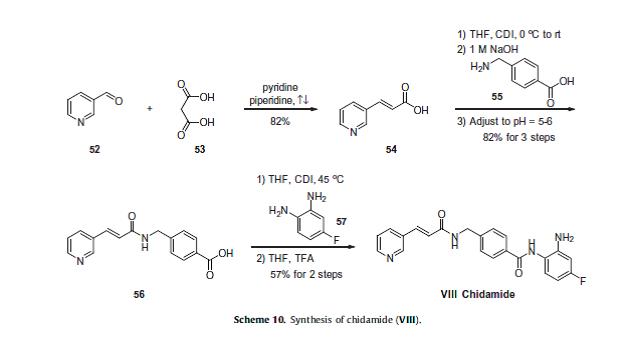
Currently, phases I and II clinical trials are underway for the treatment of non-small cell lung cancer and for the treatment of breast cancer, respectively.76 The scalable synthetic approach to chidamide very closely follows the discovery route,77–79 and is described in Scheme 10. The sequence began with the condensation of commercial nicotinaldehyde (52) and malonic acid (53) in a mixture of pyridine and piperidine. Next, activation of acid 54 with N,N0-carbonyldiimidazole (CDI) and subsequent reaction with 4-aminomethyl benzoic acid (55) under basic conditions afforded amide 56 in 82% yield.

Finally, activation of 56 with CDI prior to treatment with 4-fluorobenzene- 1,2-diamine (57) and subsequent treatment with TFA and THF yielded chidamide (VIII) in 38% overall yield from 52. However, no publication reported that mono-N-Boc-protected bis-aniline was used to approach Chidamide.

STR1

74. Ning, Z. Q.; Li, Z. B.; Newman, M. J.; Shan, S.; Wang, X. H.; Pan, D. S.; Zhang, J.;
Dong, M.; Du, X.; Lu, X. P. Cancer Chemother. Pharmacol. 2012, 69, 901.
75. Liu, L.; Chen, B.; Qin, S.; Li, S.; He, X.; Qiu, S.; Zhao, W.; Zhao, H. Biochem.
Biophys. Res. Commun. 2010, 392, 190.
76. Gong, K.; Xie, J.; Yi, H.; Li, W. Bio. Chem. J. 2012, 443, 735.
77. Lu, X. P.; Li, Z. B.; Xie, A. H.; Shi, L. M.; Li, B. Y.; Ning, Z. Q.; Shan, S.; Deng, T.;
Hu, W. M. US Patent 2004224991A1, 2004.
78. Lu, X. P.; Li, Z. B.; Xie, A. H.; Shi, L. M.; Li, B. Y.; Ning, Z. Q.; Shan, S.; Deng, T.;
Hu, W. M. CN Patent 1513839A, 2003.
79. Yin, Z. H.; Wu, Z. W.; Lan, Y. K.; Liao, C. Z.; Shan, S.; Li, Z. L.; Ning, Z. Q.; Lu, X.
P.; Li, Z. B. Chin. J. New Drugs 2004, 13, 536.

see  CN 105457038

CN 1513839

WRONG COMPD

WO2004071400

Example 2. Preparation of
N-(2-amino-5-fluorophenyl)-4-[N-(Pyridn-3-ylacryloyl)aminomethyl]benzamide

To a suspension of 0.29 g (1.78 mmol) of N, N’-carbonyldiimidazole in tetrahydrofunan (15 ml) is added 0.50 g (1.78 mmol) of 4-[N-(Pyridn-3-ylacryloyl)aminomethyl]benzoic acid, followed by stirring at 45°C for 1 hour. After cooling, the reaction mixture is added to a separately prepared tetrahydrofunan (10 ml) solution including 0.28 g (2.22 mmol) of 4-fluoro-1,2-phenylenediamine and 0.20 g (1.78 mmol) of trifluoroacetic acid at room temperature. After reaction at room temperature for 24 hours, the deposited white solid is collected by filtration, washed with tetrahydrofunan, and then dried to give the title compound (0.40 g, 57%). 1H NMR (300 MHz, DMSO-d6): δppm: 4.49 (2H, d), 4.84 (2H, br.s), 6.60 (IH, t), 6.80 (2H, m), 6.96 (IH, t), 7.18 (IH, d), 7.42 (2H, d), 7.52 (IH, d), 7.95 (2H, d), 8.02 (IH, d), 8.56 (IH, d), 8.72 (IH, br. t), 8.78 (IH, s), 9.60 (IH, br.s). IR (KBr) cm“1: 3310, 1655, 1631, 1524, 1305, 750. HRMS calcd for C229N4O2F: 390.4170. Found: 390.4172. MA calcd for C229N4O2F: C, 67.68%; H, 4.40%; N, 14.35. Found: C, 67.52%; H, 4.38%; N, 14.42%.

Photo taken on May 22, 2015 shows a box of Chidamide in Shenzhen, south China’s Guangdong Province. Chidamide is the world’s first oral HDAC inhibitor …

A New Cancer Drug, Made in China

After 14 years, Shenzhen biotech’s medicine is one of the few locally developed from start to finish

Xian-Ping Lu left his research job at a drug maker in the U.S. to co-found a biotech company in his native China.
Xian-Ping Lu left his research job at a drug maker in the U.S. to co-found a biotech company in his native China. PHOTO: SHENZHEN CHIPSCREEN BIOSCIENCES

HONG KONG— Xian-Ping Lu left his job as director of research at drug maker Galderma R&D in Princeton, N.J., to co-found a biotech company to develop new medicines in his native China.

It took more than 14 years but the bet could be paying off. In February, Shenzhen Chipscreen Biosciences’ first therapy, a medication for a rare type of lymph-node cancer, hit the market in China.

The willingness of veterans like Dr. Lu and others to leave multinational drug companies for Chinese startups reflects a growing optimism in the industry here. The goal, encouraged by the government, is to move the Chinese drug industry beyond generic medicines and drugs based on ones developed in the West.

Chipscreen’s drug, called chidamide, or Epidaza, was developed from start to finish in China. The medicine is the first of its kind approved for sale in China, and just the fourth in a new class globally. Dr. Lu estimates the research cost of chidamide was about $70 million, or about one-tenth what it would have cost to develop in the U.S.

“They are a good example of the potential for innovation in China,” said Angus Cole, director at Monitor Deloitte and pharmaceuticals and biotechnology lead in China.

China’s spending on pharmaceuticals is expected to top $107 billion in 2015, up from $26 billion in 2007, according to Deloitte China. It will become the world’s second-largest drug market, after the U.S., by 2020, according to an analysis published last year in the Journal of Pharmaceutical Policy and Practice.

China has on-the-ground infrastructure labs, a critical mass of leading scientists and interested investors, according to Franck Le Deu, head of consultancy McKinsey & Co.’s pharmaceuticals and medical-products practice in China. “There’re all the elements for the recipe for potential in China,” he said.

But there are obstacles to an industry where companies want big payoffs for a decade or more of work and tremendous costs it takes to develop a drug.

While the protection of intellectual property has improved, China’s cumbersome rules for drug approval and a government effort to cut health-care costs, particularly spending on drugs, could hurt the Chinese drug companies’ efforts, said Mr. Cole of Deloitte.

“Will you start to see success? Of course you will,” said Mr. Cole. However, “I’ve yet to see convincing or compelling evidence that it’s imminent.”

To date, many of the Chinese companies that are flourishing in the life sciences are contract research organizations that help carry out clinical trials, as well as providers of related services.

Some companies, like Shanghai-based Hua Medicine, are buying the rights to develop new compounds in China from multinational drug companies, what some experts consider more akin to an intermediate step to innovation.

Late last year, Hua Medicine completed an early-stage human clinical trial of a diabetes drug in China and in March filed an application to the Food and Drug Administration to develop it in the U.S. as well. The company has raised $45 million in venture funding to date.

Li Chen, who left an 18-year career at Roche Holding AG as head of research and development in China to help start Hua Medicine, said the company’s goal is to “create a game-changer of drug discovery.”

At Chipscreen Biosciences, Dr. Lu and his co-founders set up the company in 2001 in Shenzhen, a city that was quickly growing into a technology and research hub, just over the border from Hong Kong. They created a lab of 10 scientists to use a new analytic technique known as “chemical genomics” to examine the relationships between molecular structures of the existing and failed drugs, how they act on different targets in the body and what genes were being activated or repressed. Now they have more than 60 scientists.

By better predicting how chemicals would act on the body before entering human testing, they hoped they would be more likely get a drug to market.

“How can a small company compete with a multinational?” said Dr. Lu. “The only thing we can compete with is the scientific brain.”

The biggest challenges for the company have been financing and the Chinese regulatory system, said Dr. Lu. The company has raised a total of 300 million yuan ($48 million) over five rounds of venture funding, said Dr. Lu. Chipscreen also receives grant money from the Chinese government.

The company filed its application for approval of chidamide to the Chinese Food and Drug Administration, or CFDA, in early 2013. It had to wait nearly two years for approval, receiving the OK only in December.

Chidamide now is on the market in China for 26,500 yuan ($4,275) a month, a price far lower than patients in the U.S. pay for some of the newest cancer medicines but much more than the typical Chinese patient pays for drugs. Dr. Lu said the price reflects a balance between affordability for patients and return for shareholders. Some investors wanted to price the drug higher.

PAPER

Discovery of an orally active subtype-selective HDAC inhibitor, chidamide, as an epigenetic modulator for cancer treatment

Corresponding authors
aShenzhen Chipscreen Biosciences Ltd., BIO-Incubator, Suit 2-601, Shenzhen Hi-Tech Industrial Park, Shenzhen, P. R. China
E-mail: xplu@chipscreen.com
Med. Chem. Commun., 2014,5, 1789-1796

DOI: 10.1039/C4MD00350K, http://pubs.rsc.org/en/content/articlelanding/2014/md/c4md00350k#!divAbstract

Tumorigenesis is maintained through a complex interplay of multiple cellular biological processes and is regulated to some extent by epigenetic control of gene expression. Targeting one signaling pathway or biological function in cancer treatment often results in compensatory modulation of others, such as off-target drivers of cell survival. As a result, overall survival of cancer patients is still far from satisfactory. Epigenetic-modulating agents can concurrently target multiple aberrant or compensatory signaling pathways found in cancer cells. However, existing epigenetic-modulating agents in cancer treatment have not yet fully translated into survival benefits beyond hematological tumors. In this article, we present a historical rationale for use of chidamide (CS055/Epidaza), an orally active and subtype-selective histone deacetylase (HDAC) inhibitor of the benzamide chemical class. This compound was discovered and successfully developed as mono-therapy for relapsed and refractory peripheral T cell lymphoma (PTCL) in China. We discuss the evidence supporting chidamide as a durable epigenetic modulator that allows cellular reprogramming with little cytotoxicity in cancer treatments.

Graphical abstract: Discovery of an orally active subtype-selective HDAC inhibitor, chidamide, as an epigenetic modulator for cancer treatment
CLIPS
Chinese scientists develop world’s 1st oral HDAC inhibitor

Lu Xianping works in a lab at Shenzhen Chipscreen Biosciences Ltd. in Shenzhen, south China’s Guangdong Province, May 20, 2015. Lu Xianping, together with other four returned overseas scientists, spent 14 years to develop Chidamide, the world’s first oral HDAC inhibitor, which was given regulatory approval in January. (Xinhua/Mao Siqian)

GNT Biotech and Medicals Corporation Licenses Novel Cancer Molecule from Shenzhen Chipscreen Biosciences Ltd.

PR Newswire

SHENZHEN, China, Oct. 10, 2013 /PRNewswire/ — GNT Biotech and Medicals Corporation announces the grant of an exclusive license from Shenzhen Chipscreen Biosciences Ltd.for the development and commercialization of Chidamide in Taiwan. Chidamide, an oral, selective histone deacetylase (HDAC) inhibitor, is currently being evaluated in Phase II trials by Chipscreen Biosciences in Peripheral T-Cell Lymphoma (PTCL), Cutaneous T-Cell Lymphoma (CTCL) and Non-Small Cell Lung Cancer patients (NSCLC). GNTbm will develop and commercialize Chidamide primarily in PTCL, NSCLC and will also retain the rights to develop and commercialize Chidamide in other oncology indications in Taiwan.

About Chidamide

Chidamide is a selective HDAC inhibitor against subtype 1, 2, 3 and 10, and being studied in multiple clinical trials as a single agent or in combination with chemotherapeutic agents for the treatment of various hematological and solid cancers. Its anticancer effects are thought to be mediated through epigenetic modulation via multiple mechanisms of action, including the inhibition of cell proliferation and induction of apoptosis in blood derived cells, inhibition of epithelial to mesenchymal transition (EMT, a process that is highly relevant to tumor cell metastasis and drug resistance), induction of tumor specific antigen and antigen-specific T cell cytotoxicity, enhancement of NK cell anti-tumor activity, induction of cancer stem cell differentiation, and resensitization of tumor cells that have become resistant to anticancer agents such as platinums, taxanes and topoisomerase II inhibitors. Chidamide has demonstrated clinical efficacy in pivotal phase II trials on Cutaneous T-Cell Lymphoma (CTCL) and Peripheral T-Cell Lymphoma (PTCL) conducted in China, and is currently undergoing phase II trial in NSCLC together with first line PC therapeutic treatment. Due to its superior pharmacokinetic properties and selectivity, Chidamide may offer better clinical profile over the other HDAC inhibitors currently under development or being marketed.

About GNTbm

GNTbm is a subsidiary of GNT Inc, a Taiwanese company focused on the manufacture of nano-scale metallic particles for food and medical purposes. Founded in 1992 by a team of electronic professionals, GNT has successfully developed the innovative technology of physical metal miniaturization based on the patent of MBE (Molecular Beam Epitaxy). Further information about GNT Inc is available at www.gnt.com.tw.

GNTbm was established in August 2013, and housed in the Nankang Biotech Incubation Center, (NBIC), in Nankang, Taipei. Lead by Dr. Chia-Nan Chenalong with an experienced team of scientists, GNTbm will explore development and commercialization of novel drug delivery systems, Innovative biomedical and diagnostic tools based on gold nanoparticles.

About Shenzhen Chipscreen Biosciences Ltd.

Chipscreen is a leading integrated biotech company in China specialized in discovery and development of novel small molecule pharmaceuticals. The company has utilized its proprietary chemical genomics-based discovery platform to successfully develop a portfolio of clinical and preclinical stage programs in a number of therapeutic areas. Chipscreen’s business strategy is to generate differentiated drug candidates across multiple therapeutic areas. Drug candidates are either developed by Chipscreen or co-developed and commercialized in a partnership at the research, preclinical and clinical stages. The company was established as Sino-foreign joint venture in 2001. Further details about Chipscreen Bioscience is available atwww.chipscreen.com.

GNT Biotech and Medicals Corporation

Ekambaranellore Prakash, PhD

Director of International Department

GNT Biotech and Medicals Corporation

TEL: +886-2-7722-0388 #303

E-mail: prakash@gntbm.com.tw

Web site: www.gnt.com.tw

Shenzhen Chipscreen Biosciences Ltd.

Rebecca Hai

Investor Relations

Shenzhen Chipscreen Biosciences Ltd.

TEL: +86-755-26957317

E-mail: rebeccai_hai@chipscreen.com

Web site: www.chipscreen.com

SOURCE GNT Biotech and Medicals Corporation

CN101397295B Nov 12, 2008 Apr 25, 2012 深圳微芯生物科技有限责任公司 2-dihydroindolemanone derivates as histone deacetylase inhibitor, preparation method and use thereof
CN101648920B Aug 20, 2009 Feb 8, 2012 苏州东南药物研发有限责任公司 用作组蛋白去乙酰酶抑制剂的三氟甲基酮类化合物及其用途
CN101648921B Aug 20, 2009 Nov 2, 2011 苏州东南药物研发有限责任公司 Benzamide compound used as histone deacetylase inhibitor and application thereof
CN103833626A * Nov 27, 2012 Jun 4, 2014 深圳微芯生物科技有限责任公司 Crystal form of chidamide and preparation method and application thereof
CN103833626B * Nov 27, 2012 Nov 25, 2015 深圳微芯生物科技有限责任公司 西达本胺的晶型及其制备方法与应用
CN104876857A * May 12, 2015 Sep 2, 2015 亿腾药业(泰州)有限公司 Preparation of benzamide histone deacetylase inhibitor with differentiation and anti-proliferation activity
EP2205563A2 * Oct 8, 2008 Jul 14, 2010 Orchid Research Laboratories Limited Novel histone deacetylase inhibitors
WO2009152735A1 * Jun 9, 2009 Dec 23, 2009 Jiangsu Goworth Investment Co. Ltd Histone deacetylase inhibitors and uses thereof
WO2010135908A1 * May 20, 2010 Dec 2, 2010 Jiangsu Goworth Investment Co. Ltd. N-(2-amino-4-pyridyl) benzamide derivatives and uses thereof
WO2014082354A1 * Dec 18, 2012 Jun 5, 2014 Shenzhen Chipscreen Biosciences, Ltd. Crystal form of chidamide, preparation method and use thereof
Chidamide
Chidamide.svg
Systematic (IUPAC) name
N-(2-Amino-5-fluorophenyl)-4-[[[1-oxo-3-(3-pyridinyl)-2-propen-1-yl]amino]methyl]-benzamide
Clinical data
Trade names Epidaza
Identifiers
CAS Number 743420-02-2
PubChem CID 9800555
ChemSpider 7976319
UNII 87CIC980Y0 Yes
Chemical data
Formula C22H19FN4O2
Molar mass 390.4 g/mol
Patent ID Date Patent Title
US2015299126 2015-10-22 CRYSTAL FORM OF CHIDAMIDE, PREPARATION METHOD AND USE THEREOF
US2010222379 2010-09-02 NOVEL HISTONE DEACETYLASE INHIBITORS
US7244751 2007-07-17 Histone deacetylase inhibitors of novel benzamide derivatives with potent differentiation and anti-proliferation activity

References

  1.  “China’s First Homegrown Pharma.”. April 2015.
  2. ^ Jump up to:a b [1]
  3.  HUYA Bioscience International Grants An Exclusive License For HBI-8000 In Japan And Other Asian Countries To Eisai. Feb 2016
  4.  Qiao, Z (2013-04-26). “Chidamide, a novel histone deacetylase inhibitor, synergistically enhances gemcitabine cytotoxicity in pancreatic cancer cells.”. Biochem Biophys Res Commun. 434 (1): 95–101. doi:10.1016/j.bbrc.2013.03.059. PMID 23541946.
  5.  Guha, Malini (2015-04-01). “HDAC inhibitors still need a home run, despite recent approval”. Nature Reviews Drug Discovery 14: 225–226. doi:10.1038/nrd4583.
  6.  Wang, Shirley S. (2015-04-02). “A New Cancer Drug, Made in China”. The Wall Street Journal. Retrieved 13 April 2015.
  7. References:
    1. Ning, Z. Q.; et. al. Chidamide (CS055/HBI-8000): a new histone deacetylase inhibitor of the benzamide class with antitumor activity and the ability to enhance immune cell-mediated tumor cell cytotoxicity. Cancer Chemother Pharmacol2012, 69(4), 901-909. (activity)
    2. Gong, K.; et. al. CS055 (Chidamide/HBI-8000), a novel histone deacetylase inhibitor, induces G1 arrest, ROS-dependent apoptosis and differentiation in human leukaemia cells. Biochem J 2012, 443(3), 735-746. (activity)

    3. Hu, W.; et. al. N-(2-amino-5-fluorophenyl)-4-[N-(Pyridin-3-ylacryloyl) aminomethyl ]benzamide or other derivatives for treating cancer and psoriasis. US7244751B2
    4. Lu, X.; et. al. Crystal form of chidamide, preparation method and use thereof. WO2014082354A1
    5. Yin, Z.-H.; et. al. Synthesis of chidamide,a new histone deacetylase (HDAC) inhibitor. Chin J New Drugs 2004, 13(6), 536-538. (starts with basic raw materials)
  8. Zhongguo Xinyao Zazhi (2004), 13(6), 536-538.

/////////Chidamide, Epidaza, CS055,  HBI-8000, orally active subtype-selective HDAC inhibitor, epigenetic modulator,  cancer treatment, CFDA, CHINA, CANCER

Fc3ccc(NC(=O)c1ccc(cc1)CNC(=O)/C=C/c2cccnc2)c(N)c3

(±)-Integrifolin, Compound from plants keeps human cancer cells from multipying


STR1

CAS 89647-87-0

MFC15 H18 O4, MW 262.30
Azuleno[4,5-b]furan-2(3H)-one, decahydro-4,8-dihydroxy-3,6,9-tris(methylene)-, (3aR,4R,6aR,8S,9aR,9bR)-
  • Azuleno[4,5-b]furan-2(3H)-one, decahydro-4,8-dihydroxy-3,6,9-tris(methylene)-, [3aR-(3aα,4β,6aα,8β,9aα,9bβ)]-
  • (3aR,4R,6aR,8S,9aR,9bR)-Decahydro-4,8-dihydroxy-3,6,9-tris(methylene)azuleno[4,5-b]furan-2(3H)-one
  • 8-epi-Deacylcynaropicrin
  • 8β-Hydroxyzaluzanin C
  • Integrifolin (guaianolide)

STR1Integrifolin

STR1

STR1

STR1

STR1

STR1

STR1

PATENT

WO 2011085979

Paper

Two New Amino Acid-Sesquiterpene Lactone Conjugates from Ixeris dentata

BLOG POST FROM CHEMISTRY VIEWS, WILEY

thumbnail image: Total Synthesis of (±)-IntegrifolinSTR1STR1STR1

(±)-Integrifolin

Wiley-VCH Verlag GmbH & Co. KGaA, Weinheim

Total Synthesis of (±)-Integrifolin

Compound from plants keeps human cancer cells from multipying

Read more at Wiley-VCH Verlag GmbH & Co. KGaA, Weinheim

Weight control is an important concern of human beings, both for medical (pharmaceutical and/or nutraceutical) as well as non-therapeutic, e.g. cosmetic, reasons. More importantly, excessive accumulation of body fat (i.e. obesity (= adiposity), especially with excessive fat in the ventral region and surrounding the viscera) can be dangerous and has been linked to health problems such as type II diabetes, hypertension, heart disease, atherosclerosis (where more than two of the preceding disorders are present, the condition is often called “Metabolic Syndrome” or “syndrome X”), hyperlipidemia, coronary heart disease, stroke, breast and colon cancer, sleep apnoea, gallbladder disease, reproductive disorders such as polycystic ovarian syndrome, gastroesophageal reflux disease, increased incidence of complications of general anesthesia, fatty liver, gout or thromboembolism (see, e.g., Kopelman, Nature 404: 635-43 (2000)). Obesity reduces life-span and carries a serious risk of the co-morbidities listed above, as well disorders such as infections, varicose veins,

acanthosis nigricans, eczema, exercise intolerance, insulin resistance, hypertension hypercholesterolemia, cholelithiasis, orthopedic injury, and thromboembolic disease (Rissanen et al, Br. Med. J. 301 : 835-7 (1990)). Obesity is one of the main factors in the development of cardiovascular diseases. As a side effect the levels of cholesterol, blood pressure, blood sugar and uric acid in obese people are usually higher than those of persons of normal weight. The morbidity from coronary heart disease among the overweight people is increased as well. Among the people aged 40-50, mortality will rise about 1% when body weight increases by 0.5 kg and the death rate will increase 74% when body weight exceeds 25% of the standard. The prevalence of obesity in the United States has more than doubled since the turn of the last century (whole population) and more than tripled within the last 30 years among children aged from 6 to 11. This problem more and more becomes a disease risk also in Europe. In Germany, particularly many people have been found to suffer from overweight recently, already 25% of the young people, children and adolescents there are affected by obesity and related disorders. Furthermore, being overweight is considered by the majority of the Western population as unattractive.

Overweight and obesity result from an imbalance between the calories consumed and the calories used by the body. When the calories consumed exceed the calories burned, the body is in positive energy balance and over time weight gain will occur. The excess calories are stored in the fat cells. When the calories burned exceed the calories consumed, the body is in negative energy balance and over time weight loss will occur.

Determinants of obesity include social factors, psychological factors, genetic factors, developmental factors and decreased physical activity. Some components of a comprehensive weight loss programs include medical assessment, behavioural and dietary modification, nutrition education, mental and cognitive restructuring, increased physical activity, and long term follow-up.

An increasing interest by consumers in the maintenance or reduction of their body weight can be found. This leads to a demand for products useful for these purposes. Preferred are such food products which can conveniently be consumed as part of the daily diet, for example meal replacer products, such as meal replacer bars and beverages. These are usually designed for use as a single-serving food product to replace one or two meals a day.

An issue is that often a saturating effect is missed when such products are consumed, resulting in hunger feelings only a relatively short time after consummation or even in the lack of a saturation feeling already directly after consummation.

Summing up, there remains a need for new safe and effective compositions for promoting weight loss and/or loss of body fat in subjects such as humans. The problem to be solved by the present invention is therefore to find compositions or compounds useful in the treatment of obesity; and/or for improving the total cholesterol HDIJLDL ratio.

Phytochemistry provides a large pool of compounds and compositions to be looked at whether they are able to solve this problem.

The present invention provides methods and compositions useful in the control, treatment and prevention of obesity and obesity-related conditions, disorders, and diseases; and/or and/or for improving the total cholesterol HDL/LDL ratio.

Rosinski, G., et al., Endocrinological Frontiers in Phyiological Insect Ecology, Wroclow Technical University Press, Wroclow 1989, describe that certain tricyclic sequiterpene lactones, such as grossheimin and repin, showed inhibition of larval growth and antifeeding activity in Mealworm (Tenebrio σιοΐϊίοή. Grossheimin shows no anti-feeding but little decrease of absorption of digested food constituents and a little decrease in efficiency in digesting. Repin exhibit low effects at all. Both compounds show no effect on lipid levels in blood.

Shimoda, H., et al, Bioinorganic & Medicinal Chemistry Letters 13 (2003), 223-228, describe that methanolic extracts from Artichoke (Cynara sclolymus L.) with cynaropicrin, aguerin B and grossheimin as components and certain sesquiterpene glycosides suppress serum triglyceride elevation in olive oil-loaded mice. Some of these compounds exhibit a moderate short term (2 hours after olive oil administration) anti-hyperlipidemic activity presented as a lowering of the serum triglyceride (serum TG) concentrations, the long term (6 hours) show in the case of cynaropicrin and aguerine B an increase of the serum TG. Furthermore the authors present data of the gastric emptying (GE) of a methanolic ectract of artichoke. They determine a significantly inhibited GE. However, as shown below, this mechanism is not an explanation for the anti obesity effect shown in the present invention (see Example 1 ).

Fritzsche, J., et al., Eur. Food Res. Technol. 215, 149-157 (2002) describe the effect of certain isolated artichoke leaflet extract components with cholesterol lowering potential. Ahn, E.M-., et al, Arch Pharm. res. 29(1 1 ), 937-941 , 2006, shows ACAT inhibitory activity for two sesquiterpene lactones. KR 20040070985 also shows an effect of certain sesquiterpene lactone derivatives on cholesterol biosynthesis involved enzymes. Gebhard, R., Phytother. Res. 16, 368-372 (2002) and J. Pharmacol. Exp. Ther. 286(3), 1 122-1 128 (1998), shows

enforcement of cholesterol biosynthesis inhibition in HepG2 cells by artichoke extracts. WO 2007/006391 also claims reduction in cholesterol by certain Cynara scolymus variety extracts.

Other reported activities of tricyclic sesquiterpene lactones are antioxidant activity (European Food Research & Technology (2002), 215(2): 149-157), inhibitors of NF kb (Food Style 21 (2007), 1 1 (6): 54-56; JP 2006-206532), serum triglyceride increase-inhibitory effect (Kagaku Kogyo (2006), 57(10): 740-745), hypoglycaemic effect (J. Trad. Med. (2003), 20(2): 57-61), bitter taste (DE 2654184). Any beneficial effects are included in this invention by reference.

None of the documents suggest that a control and treatment of obesity and body fat in warmblooded animals might be possible.

http://www.chemistryviews.org/details/ezine/9412451/Total_Synthesis_of_-Integrifolin.html?elq_mid=10181&elq_cid=1558306

Cynaropicrin, a tricyclic sesquiterpene lactone causes in vivo a strong weight loss. More surprisingly it was found that this effect is not correlated to a decrease in food intake. The weight balance is not affected by reduction of assimilation efficiency; the decrease of body fat and body weight is presumably caused by effects on energy metabolism. Surprisingly, it was found in addition that cynaropicrin also allows for improving the total cholesterol HDL7LDL ratio

Tricyclic sequiterpene lactones or known ingredients of plants of the subclass Asterides, especially from the family of Asteraceae, more specifically from species of the genera of the list consisting of Achilea, Acroptilon, Agranthus, Ainsliaea, Ajania, Amberboa, Andryala, Artemisia, Aster, Bisphopanthus, Brachylaena, Calea, Calycocorsus, Cartolepsis, Centaurea, Cheirolophus, Chrysanthemum, Cousinia, Crepis, Cynara, Eupatorium, Greenmaniella, Grossheimia, Hemistaptia, Ixeris, Jurinea, Lapsana, Lasiolaena, Liatris, Lychnophora, Macroclinidium, Mikania, Otanthus, Pleiotaxis, Prenanthes, Pseudostifftia, Ptilostemon,

Rhaponticum, Santolina, Saussurea, Serratula, Sonchus, Stevia, Taeckholmia, Tanacetum, Tricholepis, Vernonia, Volutarella, Zaluzania; even more specifically from species of the list consisting of Achillea clypeolata, Achillea collina, Acroptilon repens, Agrianthus pungens, Ainsliaea fragrans, Ajania fastigiata, Ajania fruticulosa, Amberboa lippi, Amberboa muricata, Amberboa ramose**, Amberboa tubuliflora and other Amberboa spp.*, Andryala integrifolia, Andryala pinnatifida, Artemisia absinthium, Artemisia cana, Artemisia douglasiana, Artemisia fastigiata, Artemisia franserioides, Artemisia montana, Artemisia sylvatica, Artemisia

tripartita, Aster auriculatus, Bishopanthus soliceps, Brachylaena nereifolia, Brachylaena perrieri, Calea jamaicensis, Calea solidaginea, Calycocorsus stipitatus, Cartolepsis intermedia, Centaurea babylonica, Centaurea bella, Centaurea canariensis*, Centaurea clementei, Centaurea conicum, Centaurea dealbata, Centaurea declinata, Centaurea glastifolia, Centaurea hermanii, Centaurea hyrcanica, Centaurea intermedia, Centaurea janeri, Centaurea kalscyi, Centaurea kandavanensis, Centaurea kotschyi, Centaurea linifolia, Centaurea macrocephala, Centaurea musimomum, Centaurea nicolai, Centaurea pabotii, Centaurea pseudosinaica, Centaurea repens, Centaurea salonitana, Centaurea scoparia, Centaurea sinaica, Centaurea solstitialis, Centaurea tweediei and other Centaurea spp. *, Cheirolophus uliginosus, Chrysanthemum boreale, Cousin ia canescens, Cousinia conifera, Cousinia picheriana, Cousinia piptocephala, Crepis capillaris, Crepis conyzifolia, Crepis crocea, Crepis japonica, Crepis pyrenaica, Crepis tectorum, Crepis virens, Crepis zacintha, Cynara alba, Cynara algarbiensis, Cynara auranitica, Cynara baetica, Cynara cardunculus, Cynara cornigera, Cynara cyrenaica, Cynara humilis, Cynara hystrix, Cynara syriaca, Cynara scolymus**, Cynara sibthorpiana and other Cynara spp.*, Eupatorium anomalum,

Eupatorium chinense, Eupatorium lindleyanum, Eupatorium mohrii, Eupatorium

rotundifolium, Eupatorium semialatum, Greenmaniella resinosa, Grossheimia

macrocephala** and other Grossheimia spp. *, Hemisteptia lyrata, Ixeris chinensis, Ixeris debilis, Ixeris dentata, Ixeris repens, Ixeris stolonifera, Jurinea carduiformis, Jurinea derderioides, Jurinea maxima, Lapsana capillaris, Lapsana communis, Lasiolaena morii, Lasiolaena santosii, Liatris chapmanii, Liatris gracilis, Liatris pycnostachya, Lychnophora blanchetii, Macroclinidium trilobum, Mikania hoehnei, Otanthus maritimus, Pleiotaxis rugosa, Prenanthes acerifolia, Pseudostifftia kingii, Ptilostemon diacanthus, Ptilostemon

gnaphaloides, Rhaponticum serratuloides, Santolina jamaicensis, Saussurea affinis,

Saussurea elegans, Saussurea involucrata, Saussurea laniceps, Saussurea neopulchella** and other Sauusurea spp. *, Serratula strangulata, Sonchus arborea, Stevia sanguinea, Taeckholmia arborea, Taeckholmia pinnata, Tanacetum fruticulosum, Tanacetum

parthenium, Tricholepis glaberrima** and other Tricholepsis spp. *, Vernonia arkansana, Vernonia nitidula, Vernonia noveboracensis, Vernonia profuga, Vernonia sublutea,

Volutarella divaricata, Zaiuzania resinosa; and can potentially be isolated from any part of the plants. Those genera and/or species marked with an asterisk (*) and especially those species marked with two asterisks (**) are especially preferred.

Appropriate plant material can be obtained from various sources, e.g. from:

Alfred Galke GmbH, Gittelde/Harz, Germany; Miiggenburg Pflanzliche Rohstoffe, Bad Bramstedt, Germany; Friedrich Nature Discovery, Euskirchen, Germany; VitaPlant AG, Uttwil, Switzerland; Amoros Nature SL, Hostalric, Spain.

(±)-Integrifolin

Banksia integrifolia

Coast Banksia

Family: Proteaceae

Banksia integrifolia is a tall shrub or small tree 6 – 16m tall. It is common in sandy coastal areas, but also grows in the forests of tablelands. The light grey bark is hard and rough.

Mature leaves 5 -10 cm long, are stiff, entire (untoothed), dull dark green above and hairy-white underneath. They are generally lanceolate. Younger leaves are irregularly toothed and shorter than the mature leaves. The species name ‘integrifolia’ means whole-leaved.

The pale yellow flower spikes of Banksia integrifolia range from 7-14cm long and 7cm wide. The bent styles emerge from individual flowers on the spike, straightening and spreading.

A short time after flowering, the seed pods protrude cleanly from the woody cone and open to shed black, papery, winged seeds.

Banksia integrifolia flowers from January to June.

STR1

STR1

https://www.jstage.jst.go.jp/article/cpb1958/33/8/33_8_3361/_pdf

PAPER

http://onlinelibrary.wiley.com/doi/10.1002/chem.201601275/abstract

Total Synthesis of (±)-Integrifolin

  • DOI: 10.1002/chem.201601275

///////(±)-Integrifolin,  human cancer cells,  multipying

C=C1C(=O)O[C@@H]2[C@H]3C(=C)[C@@H](O)C[C@H]3C(=C)C[C@@H](O)[C@@H]12

GSK 1070916 For Advanced solid tumor


GSK 1070916

NMI-900 , GSK-1070916, GSK-1070916A

4-[3-(4-N,N-Dimethylcarbamylaminophenyl)-1-ethyl-1H-pyrazol-4-yl]-2-[3-(dimethylaminomethyl)phenyl]-1H-pyrrolo[2,3-b]pyridine

N’-[4-[4-[2-[3-[(Dimethylamino)methyl]phenyl]-1H-pyrrolo[2,3-b]pyridin-4-yl]-1-ethyl-1H-pyrazol-3-yl]phenyl]-N,N-dimethylurea

CAS 942918-07-2,

MFC30H33N7O,

MW507.63

PHASE 1/II , Advanced solid tumor, Cancer Research Technology,

off-white solid.

1H NMR (400 MHz, DMSO-d6) δ ppm 12.14 (d, J = 1.8 Hz, 1H), 8.31 (s, 1H), 8.27 (s, 1 H), 8.07 (d, J = 4.8 Hz, 1H), 7.78 (d, J = 8.1 Hz, 1H), 7.77 (s, 1H), 7.43 (d, J = 8.6 Hz, 2H), 7.39 (d, J = 8.1 Hz, 1H), 7.27 (d, J = 8.6 Hz, 2H), 7.27 (dd, 1H), 6.79 (d, J = 5.1 Hz, 1H), 6.76 (d, J = 2.0 Hz, 1H), 4.27 (q, J = 7.3 Hz, 2H), 3.43 (s, 2H), 2.91 (s, 6H), 2.18 (s, 6H), 1.51 (t, J = 7.2 Hz, 3H).

MS m/z 508.4 [M + H]+. Anal. (C30H33N7O·1.0H2O) C, H, N.

GSK1070916 is a reversible and ATP-competitive inhibitor of Aurora B/C with IC50 of 3.5 nM/6.5 nM; displays >100-fold selectivity against the closely related Aurora A-TPX2 complex(IC50=490 nM).

NMI-900, an Aurora B/C kinase inhibitor, is under development at Cancer Research Technology in phase I/II clinical studies for the treatment of advanced and/or metastatic solid tumors. Other phase I clinical trials for the treatment of solid tumors had been previously completed, in a collaboration between GlaxoSmithKline and Cancer Research Technology, under the Cancer Research UK’s Clinical Development Partnerships (CDP) program.

The drug was originated by GlaxoSmithKline. The rights of the product were acquired by Cancer Research Technology from GlaxoSmithKline after the company elected not to take the program forward. In December 2015, the product was licensed by Cancer Research Technology to Nemucore Medical Innovations for the exclusive worldwide development and commercialization for the treatment of difficult-to-treat cancers.

GSK-1070916

PATENT

US 20070149561

https://www.google.com/patents/US20070149561

PAPER

Journal of Medicinal Chemistry (2010), 53 (10), 3973-4001

http://pubs.acs.org/doi/abs/10.1021/jm901870q

Discovery of GSK1070916, a Potent and Selective Inhibitor of Aurora B/C Kinase

Cancer Research, Oncology R&D
Molecular Discovery Research
GlaxoSmithKline, 1250 South Collegeville Road, Collegeville, Pennsylvania 19426
§ Tsukuba Research Laboratories, Japan
J. Med. Chem., 2010, 53 (10), pp 3973–4001
DOI: 10.1021/jm901870q
Abstract Image

The Aurora kinases play critical roles in the regulation of mitosis and are frequently overexpressed or amplified in human tumors. Selective inhibitors may provide a new therapy for the treatment of tumors with Aurora kinase amplification. Herein we describe our lead optimization efforts within a 7-azaindole-based series culminating in the identification of GSK1070916 (17k). Key to the advancement of the series was the introduction of a 2-aryl group containing a basic amine onto the azaindole leading to significantly improved cellular activity. Compound 17k is a potent and selective ATP-competitive inhibitor of Aurora B and C with Ki* values of 0.38 ± 0.29 and 1.5 ± 0.4 nM, respectively, and is >250-fold selective over Aurora A. Biochemical characterization revealed that compound 17k has an extremely slow dissociation half-life from Aurora B (>480 min), distinguishing it from clinical compounds 1 and 2. In vitro treatment of A549 human lung cancer cells with compound 17k results in a potent antiproliferative effect (EC50 = 7 nM). Intraperitoneal administration of 17k in mice bearing human tumor xenografts leads to inhibition of histone H3 phosphorylation at serine 10 in human colon cancer (Colo205) and tumor regression in human leukemia (HL-60). Compound 17k is being progressed to human clinical trials.

http://pubs.acs.org/doi/pdf/10.1021/jm901870q………..PDF FILE

STR1

PAPER

Molecules 2014, 19(12), 19935-19979; doi:10.3390/molecules191219935

http://www.mdpi.com/1420-3049/19/12/19935/htm

http://www.mdpi.com/1420-3049/19/12/19935/htm

Biological Activity of GSK-1070916

GSK1070916 is a reversible and ATP-competitive inhibitor of Aurora B/C with IC50 of 3.5 nM/6.5 nM; displays >100-fold selectivity against the closely related Aurora A-TPX2 complex(IC50=490 nM).
IC50 Value: 3.5 nM(Aurora B); 6.5 nM(Aurora C)
Target: Aurora B/C
in vitro: GSK1070916 selectively inhibits Aurora B and Aurora C with Ki of 0.38 nM and 1.5 nM over Aurora A with Ki of 490 nM. Inhibition of Aurora B and Aurora C is time-dependent, with an enzyme-inhibitor dissociation half-life of >480 min and 270 min respectively. In addition, GSK1070916 is also a competitive inhibitor with respect to ATP. Human tumor cells treated with GSK1070916 shows dose-dependent inhibition of phosphorylation on serine 10 of Histone H3, a substrate specific for Aurora B. Moreover, GSK1070916 inhibits the proliferation of tumor cells with EC50 values of <10 nM in over 100 cell lines spanning a broad range of tumor types, with a median EC50 of 8 nM. Although GSK1070916 has potent activity against proliferating cells, a dramatic shift in potency is observed in primary, nondividing, normal human vein endothelial cells. Furthermore, GSK1070916-treated cells do not arrest in mitosis but instead fails to divide and become polyploid, ultimately leading to apoptosis. In another study, it is also reported high chromosome number associated with resistance to the inhibition of Aurora B and C suggests cells with a mechanism to bypass the high ploidy checkpoint are resistant to GSK1070916.
in vivo: GSK1070916 (25, 50, or 100 mg/kg) shows dose-dependent inhibition of phosphorylation of an Aurora B–specific substrate in mice and consistent with its broad cellular activity, has antitumor effects in 10 human tumor xenograft models including breast, colon, lung, and two leukemia models.

Clinical Information of GSK-1070916

Product Name Sponsor Only Condition Start Date End Date Phase Last Change Date
GSK-1070916 Cancer Research UK Advanced solid tumor 31-MAR-10 31-MAR-13 Phase 1 17-JUN-13

References on GSK-1070916

[1]. Anderson K, et al. Biochemical characterization of GSK1070916, a potent and selective inhibitor of Aurora B and Aurora C kinases with an extremely long residence time1. Biochem J. 2009 May 13;420(2):259-65.
Abstract


[2]. Hardwicke, Mary Ann; Oleykowski, Catherine A.; Plant, Ramona; GSK1070916, a potent Aurora B/C kinase inhibitor with broad antitumor activity in tissue culture cells and human tumor xenograft models. Molecular Cancer Therapeutics (2009), 8(7), 1808-1817.

[3]. Moy C, Oleykowski CA, Plant R, Greshock J, Jing J, Bachman K, Hardwicke MA, Wooster R, Degenhardt Y.High chromosome number in hematological cancer cell lines is a negative predictor of response to the inhibition of Aurora B and C by GSK1070916.J Transl Med. 2011 Jul 15;9:110.

[4]. Adams ND, Adams JL, Burgess JL, Chaudhari AM, Copeland RA, Donatelli CA, Drewry DH, Fisher KE, Hamajima T, Hardwicke MA, Huffman WF, Koretke-Brown KK, Lai ZV, McDonald OB, Nakamura H, Newlander KA, Oleykowski CA, Parrish CA, Patrick DR, Plant R, Sarpong MA, Sasaki K, Schmidt SJ, Silva DJ, Sutton D, Tang J, Thompson CS, Tummino PJ, Wang JC, Xiang H, Yang J, Dhanak D.Discovery of GSK1070916, a potent and selective inhibitor of Aurora B/C kinase.J Med Chem. 2010 May 27;53(10):3973-4001.

[5]. Medina JR, Grant SW, Axten JM, Miller WH, Donatelli CA, Hardwicke MA, Oleykowski CA, Liao Q, Plant R, Xiang H.Discovery of a new series of Aurora inhibitors through truncation of GSK1070916.Bioorg Med Chem Lett. 2010 Apr 15;20(8):2552-5. Epub 2010 Mar 1.

http://www.ingentaconnect.com/content/ben/lddd/2014/00000012/00000001/art00003?crawler=true

/////////////GSK1070916, GSK-1070916,  942918-07-2 GSK, phase1, Advanced solid tumor, NMI-900 , GSK-1070916, GSK-1070916A

AUNP-12 from Aurigene Discovery Technologies Limited


AUNP-12

AUR-012; Aurigene-012; NP-12, Aurigene; PD-1 inhibitor peptide (cancer), Aurigene; PD-1 inhibitor peptide (cancer), Aurigene/ Pierre Fabre; W-014A


Company Aurigene Discovery Technologies Ltd.
Description A programmed cell death 1 (PDCD1; PD-1; CD279) peptide antagonist
Molecular Target Programmed cell death 1 (PD-1) (PDCD1) (CD279)
Mechanism of Action Programmed cell death 1 (PD-1) antagonist
Therapeutic Modality Peptide
Latest Stage of Development Preclinical
Standard Indication Cancer (unspecified)
Indication Details Treat cancer
Regulatory Designation
Partner Laboratoires Pierre Fabre S.A.

Aurigene Discovery Technologies Limited

INNOVATOR


  • Programmed Cell Death 1 or PD-1 (also referred to as PDCD1) is a 50 to 55 kD type I membrane glycoprotein (Shinohara T et al, Genomics, 1994, Vol. 23, No. 3, pp. 704-706). PD-1 is a receptor of the CD28 superfamily that negatively regulates T cell antigen receptor signalling by interacting with the specific ligands and is suggested to play a role in the maintenance of self tolerance.
  • PD-1 peptide relates to almost every aspect of immune responses including autoimmunity, tumour immunity, infectious immunity, transplantation immunity, allergy and immunological privilege.
  • The PD-1 protein’s structure comprise of—

      • an extracellular IgV domain followed by
      • a transmembrane region and
      • an intracellular tail
  • The intracellular tail contains two phosphorylation sites located in an immunoreceptor tyrosine-based inhibitory motif and an immunoreceptor tyrosine-based switch motif, which suggests that PD-1 negatively regulates TCR signals. Also, PD-1 is expressed on the surface of activated T cells, B cells, and macrophages, (Y. Agata et al., Int Immunol 8, 765, May 1996) suggesting that compared to CTLA-4 ((Cytotoxic T-Lymphocyte Antigen 4, also known as CD152 (Cluster of differentiation 152) is a protein that also plays an important regulatory role in the immune system), PD-1 more broadly negatively regulates immune responses.
  • PD-1 has two ligands, PD-L1 (Programmed Death Ligand for PDCD1L1 or B7-H1) (Freeman G J et al, Journal of Experimental Medicine, 2000, Vol. 19, No. 7, pp. 1027-1034) and PD-L2 (Programmed Death Ligand 2 or PDCD1L2 or B7-DC) (Latchman Y et al, Nature Immunology, 2001, Vol. 2, No. 3, pp. 261-267), which are members of the B7 family. PD-L1 is known to be expressed not only in immune cells, but also in certain kinds of tumour cell lines (such as monocytic leukaemia-derived cell lines, mast cell tumour-derived cell lines, hematoma-derived cell lines, neuroblastoma-derived cell lines, and various mammary tumour-derived cell lines) and in cancer cells derived from diverse human cancer tissues (Latchman Y et al, Nature Immunology, 2001, Vol. 2, No. 3, pp. 261-267) and on almost all murine tumour cell lines, including PA1 myeloma, P815 mastocytoma, and B16 melanoma upon treatment with IFN-γ (Y. Iwai et al., Proc Natl Acad Sci USA 99, 12293, Sep. 17, 2002 and C. Blank et al., Cancer Res 64, 1140, February, 2004). Similarly PD-L2 expression is more restricted and is expressed mainly by dendritic cells and a few tumour cell lines. PD-L2 expression has been verified in Hodgkin’s lymphoma cell lines and others. There is a hypothesis that some of the cancer or tumour cells take advantage from interaction between PD-1 and PD-L1 or PD-L2, for suppressing or intercepting T-cell immune responses to their own (Iwai Y et al, Proceedings of the National Academy of Science of the United States of America, 2002, Vol. 99, No. 19, pp. 12293-12297).
  • Tumour cells and virus (including HCV and HIV) infected cells are known to express the ligand for PD-1 (to create Immunosuppression) in order to escape immune surveillance by host T cells. It has been reported that the PD-1 gene is one of genes responsible for autoimmune diseases like systemic lupus erythematosis (Prokunina et al, Nature Genetics, 2002, Vol. 32, No. 4, 666-669). It has also been indicated that PD-1 serves as a regulatory factor for the onset of autoimmune diseases, particularly for peripheral self-tolerance, on the ground that PD-1-deficient mice develop lupus autoimmune diseases, such as glomerulonephritis and arthritis (Nishimura H et al, International Immunology, 1998, Vol. 10, No. 10, pp. 1563-1572; Nishimura H et al, Immunity, 1999, Vol. 11, No. 2, pp. 141-151), and dilated cardiomyopathy-like disease (Nishimura H et al, Science, 2001, Vol. 291, No. 5502, pp. 319-332).
  • Hence, in one approach, blocking the interaction of PD-1 with its ligand (PD-L1, PD-L2 or both) may provide an effective way for specific tumour and viral immunotherapy.
  • Wood et al in U.S. Pat. No. 6,808,710 discloses method for down modulating an immune response comprising contacting an immune cell expressing PD-1 with an antibody that binds to PD-1, in multivalent form, such that a negative signal is transduced via PD-1 to thereby down modulate the immune response. Such an antibody may be a cross-linked antibody to PD-1 or an immobilized antibody to PD-1.
  • Freeman et al in U.S. Pat. No. 6,936,704 and its divisional patent U.S. Pat. No. 7,038,013 discloses isolated nucleic acids molecules, designated B7-4 nucleic acid molecules, which encode novel B7-4 polypeptides, isolated B7-4 proteins, fusion proteins, antigenic peptides and anti-B7-4 antibodies, which co-stimulates T cell proliferation in vitro when the polypeptide is present on a first surface and an antigen or a polyclonal activator that transmits an activating signal via the T-cell receptor is present on a second, different surface.
  • There are some reports regarding substances inhibiting immunosuppressive activity of PD-1, or interaction between PD-1 and PD-L1 or PD-L2, as well as the uses thereof. A PD-1 inhibitory antibody or the concept of a PD-1 inhibitory peptide is reported in WO 01/14557, WO 2004/004771, and WO 2004/056875. On the other hand, a PD-L1 inhibitory antibody or a PD-L1 inhibitory peptide is reported in WO 02/079499, WO 03/042402, WO 2002/086083, and WO 2001/039722. A PD-L2 inhibitory antibody or a PD-L2 inhibitory peptide is reported in WO 03/042402 and WO 02/00730.
  • WO2007005874 describes isolated human monoclonal antibodies that specifically bind to PD-L1 with high affinity. The disclosure provides methods for treating various diseases including cancer using anti-PD-L1 antibodies.
  • US2009/0305950 describes multimers, particularly tetramers of an extracellular domain of PD-1 or PD-L1. The application describes therapeutic peptides.
  • Further, the specification mentions that peptides can be used therapeutically to treat disease, e.g., by altering co-stimulation in a patient. An isolated B7-4 or PD-1 protein, or a portion or fragment thereof (or a nucleic acid molecule encoding such a polypeptide), can be used as an immunogen to generate antibodies that bind B7-4 or PD-1 using standard techniques for polyclonal and monoclonal antibody preparation. A full-length B7-4 or PD-1 protein can be used, or alternatively, the invention provides antigenic peptide fragments of B7-4 or PD-1 for use as immunogens. The antigenic peptide of B7-4 or PD-1 comprises at least 8 amino acid residues and encompasses an epitope of B7-4 or PD-1 such that an antibody raised against the peptide forms a specific immune complex with B7-4 or PD-1. Preferably, the antigenic peptide comprises at least 10 amino acid residues, more preferably at least 15 amino acid residues, even more preferably at least amino acid residues, and most preferably at least 30 amino acid residues.
  • Freeman et al in U.S. Pat. No. 7,432,059 appears to disclose and claim methods of identifying compounds that up modulate T cell activation in the presence of a PD-1-mediated signal. Diagnostic and treatment methods utilizing compositions of the invention are also provided in the patent.
  • Further, Freeman et al in U.S. Pat. No. 7,709,214 appears to cover methods for up regulating an immune response with agents that inhibit the interactions between PD-L2 and PD-1.
  • Despite existence of many disclosures as discussed above, however, a significant unmet medical need still exists due to the lack of effective peptides or modified peptides as therapeutic agents as alternatives in the therapeutic area. It is known that synthetic peptides offer certain advantages over antibodies such as ease of production with newer technologies, better purity and lack of contamination by cellular materials, low immunogenicity, improved potency and specificity. Peptides may be more stable and offer better storage properties than antibodies. Moreover, often peptides possess better tissue penetration in comparison with antibodies, which could result in better efficacy. Peptides can also offer definite advantages over small molecule therapeutics counterparts such as lesser degree of toxicity and lower probability of drug-drug interaction.
  • The present invention therefore may provide the solution for this unmet medical need by offering novel synthetic peptide and its derivatives which are based on the PD1 ectodomain.


09338-scitech1-NovartisAcxd
Aurigene team: (from left) Brahma Reddy V, Thomas Antony, Murali Ramachandra, Venkateshwar Rao G, Wesley Roy Balasubramanian, Kishore Narayanan, Samiulla DS, Aravind AB, and Shekar Chelur


Patent

http://www.google.com/patents/US20110318373

8. SNTSESFK(SNTSESF)FRVTQLAPKAQIKE-NH2 (SEQ ID NO: 49)


Example 2 Synthesis of

Synthesis of Linear Fragment—Fmoc-FRVTQLAPKAQIKE

  • Desiccated CLEAR-Amide resin ((100-200 mesh) 0.4 mmol/g, 0.5 g) was distributed in 2 polyethylene vessels equipped with a polypropylene filter. The linear peptide synthesis on solid phase were carried out automatically, using Symphony parallel synthesizer (PTI) using the synthesis programs mentioned in the table below. Swelling, C-terminal amino acid [Fmoc-Glu(OtBu)-OH] attachment and capping of the peptidyl resin was carried out as per the protocol in Table I. Subsequent amino acid coupling was carried out as mentioned in Table II. The amino acids used in the synthesis were Fmoc Phe-OH, Fmoc-Arg(Pbf)-OH, Fmoc-Val-OH, Fmoc-Thr(OtBu)-OH, Fmoc-Gln(Trt)-OH, Fmoc-Lys(Boc)-OH, Fmoc-Leu-OH, Fmoc-Ala-OH, Fmoc-Pro-OH, Fmoc-Ile-OH. After the completion of Fmoc-Phe-OH coupling the resin was taken out form peptide synthesiser and manual coupling was carried out as follows
  • Fmoc-Phe-OH peptidyl resin from automated synthesiser was pooled in to a glass vessel with frit. The Fmoc group of the peptidyl resin was deprotected by treating it twice with 20% (v/v) piperidine/DMF solution for 5 and 15 min (10 m L). The resin was washed with DMF (6×15 m L), DCM (6×15 m L) and DMF (6×15 m L). Kaiser test on peptide resin aliquot upon completion of Fmoc-deprotection was positive. Fmoc-Lys (Fmoc)-OH (0.48 g; 4 equiv. 0.8 m mol) in dry DMF was added to the deprotected resin and coupling was initiated with DIC (0.15 m L; 5 equiv, 1 m mol) and HOBT (0.08 g; 5 equiv, 0.6 m mol) in DMF. The concentration of each reactant in the reaction mixture was approximately 0.4 M. The mixture was rotated on a rotor at room temperature for 3 h. Resin was filtered and washed with DMF (6×15 mL), DCM (6×15 mL) and DMF (6×15 mL). Kaiser test on peptide resin aliquot upon completion of coupling was negative. The Fmoc group on the peptidyl resin is deprotected by treating it twice with 20% (v/v) piperidine/DMF solution for 5 and 15 min (15 mL). The resin was washed with DMF (6×15 mL), DCM (6×15 mL) and DMF (6×15 mL). Kaiser test on peptide resin aliquot upon completion of Fmoc-deprotection was positive. After the deprotection of Fmoc group on Fmoc-Lys(Fmoc)-attached peptidyl resin the peptide chain growth was carried out from both the free amino terminus suing 8 equivalent excess of amino acid (1.6 m mol, 8 equivalent excess of HOBt (0.22 g, 1.6 m mol) and 10 equivalent excess of DIC (0.32 m L, 2 m mol) relative to resin loading. The coupling was carried out at room temperature for 3 h. The amino acids coupled to the peptidyl resin were; Fmoc-Phe-OH (0.62 g; 8 equiv, 1.6 m mol), Fmoc-Ser (OtBu)-OH (0.62 g; 8 equiv, 1.6 m mol), Fmoc-Glu (OtBu)-OH (0.68 g; 8 equiv, 1.6 m mol), Fmoc-Ser (OtBu)-OH (0.62 g; 8 equiv, 1.6 m mol), Fmoc-Thr (OtBu)-OH (0.64 g; 8 equiv, 1.6 m mol), Fmoc-Asn (Trt)-OH (0.95 g; 8 equiv, 1.6 m mol) and N-terminus amino acids as Boc-Ser (OtBu)-OH (0.41 g; 8 equiv, 1.6 m mol) The peptidyl resin was cleaved as mentioned in procedure for cleavage using cleavage cocktail A to yield (565 mg), 70% yield. The crude material was purified by preparative HPLC on Zorbax Eclipse XDB-C18 column (9.4 mm×250 mm, 5 μm) with buffer A: 0.1% TFA/Water, buffer B: Acetonitrile. The peptide was eluted by gradient elution 0-5 min=5-10% buffer B, 10-20 min=29% buffer B with a flow rate of 7 mL/min. HPLC: (method 1): RT-12 min (96%); LCMS Calculated Mass: 3261.62, Observed Mass: 1631.6 [M/2+H]+; 1088 [M/3+H]+); 816.2[M/4+H]+;

STRUCTURE , READER DISCRETION IS NEEDED


aunf12

N2,N6-Bis(L-seryl-L-asparaginyl-L-threonyl-L-seryl-L-alpha-glutamyl-L-seryl-L-phenylalanyl)-L-lysyl-L-phenylalanyl-L-arginyl-L-valyl-L-threonyl-L-glutaminyl-L-leucyl-L-alanyl-L-prolyl-L-lysyl-L-alanyl-L-glutaminyl-L-isoleucyl-L-lysyl-L-alpha-glutamine

C142 H226 N40 O48, 3261.553

 CAS 1353563-85-5,
L-​α-​Glutamine, N2,​N6– ​bis(L-​seryl-​L-​asparaginyl-​L-​threonyl-​L-​seryl-​L-​α-​glutamyl-​L- ​seryl-​L-​phenylalanyl)​-​L-​lysyl-​L-​phenylalanyl-​L-​arginyl-​L-​ valyl-​L-​threonyl-​L-​glutaminyl-​L-​leucyl-​L-​alanyl-​L-​prolyl-​L-​ lysyl-​L-​alanyl-​L-​glutaminyl-​L-​isoleucyl-​L-​lysyl-

aunf12

aunf12

SEE ALSO

CAS 1353564-61-0,
L-​α-​Glutamine, N2,​N6– ​bis(D-​seryl-​L-​asparaginyl-​L-​threonyl-​L-​seryl-​L-​α-​glutamyl-​L- ​seryl-​L-​phenylalanyl)​-​L-​lysyl-​L-​phenylalanyl-​L-​arginyl-​L-​ valyl-​L-​threonyl-​L-​glutaminyl-​L-​leucyl-​L-​alanyl-​L-​prolyl-​L-​ lysyl-​L-​alanyl-​L-​glutaminyl-​L-​isoleucyl-​L-​lysyl-
 CAS 1353563-91-3
D-​α-​Glutamine, N2,​N6– ​bis(D-​seryl-​D-​asparaginyl-​D-​threonyl-​D-​seryl-​D-​α-​glutamyl-​D- ​seryl-​D-​phenylalanyl)​-​D-​lysyl-​D-​phenylalanyl-​D-​arginyl-​D-​ valyl-​D-​threonyl-​D-​glutaminyl-​D-​leucyl-​D-​alanyl-​D-​prolyl-​D-​ lysyl-​D-​alanyl-​D-​glutaminyl-​D-​isoleucyl-​D-​lysyl-

US 2015087581

Compound 8 (SEQ ID NO: 49) SNTSESFK(SNTSESF)FRVTQLAPKAQIKE-NH2Image loading...

Example 2Synthesis of Sequence Shown in SEQ ID NO: 49

Image loading...

Synthesis of Linear Fragment—Fmoc-FRVTQLAPKAQIKE

Desiccated CLEAR-Amide resin ((100-200 mesh) 0.4 mmol/g, 0.5 g) was distributed in 2 polyethylene vessels equipped with a polypropylene filter. The linear peptide synthesis on solid phase were carried out automatically, using Symphony parallel synthesizer (PTI) using the synthesis programs mentioned in the table below. Swelling, C-terminal amino acid [Fmoc-Glu(OtBu)-OH] attachment and capping of the peptidyl resin was carried out as per the protocol in Table I. Subsequent amino acid coupling was carried out as mentioned in Table II. The amino acids used in the synthesis were Fmoc Phe-OH, Fmoc-Arg(Pbf)-OH, Fmoc-Val-OH, Fmoc-Thr(OtBu)-OH, Fmoc-Gln(Trt)-OH, Fmoc-Lys(Boc)-OH, Fmoc-Leu-OH, Fmoc-Ala-OH, Fmoc-Pro-OH, Fmoc-Ile-OH. After the completion of Fmoc-Phe-OH coupling the resin was taken out form peptide synthesiser and manual coupling was carried out as follows.

Fmoc-Phe-OH peptidyl resin from automated synthesiser was pooled in to a glass vessel with frit. The Fmoc group of the peptidyl resin was deprotected by treating it twice with 20% (v/v) piperidine/DMF solution for 5 and 15 min (10 mL). The resin was washed with DMF (6×15 mL), DCM (6×15 mL) and DMF (6×15 mL). Kaiser test on peptide resin aliquot upon completion of Fmoc-deprotection was positive.

Fmoc-Lys (Fmoc)-OH (0.48 g; 4 equiv. 0.8 mmol) in dry DMF was added to the deprotected resin and coupling was initiated with DIC (0.15 mL; 5 equiv, 1 mmol) and HOBT (0.08 g; 5 equiv, 0.6 mmol) in DMF. The concentration of each reactant in the reaction mixture was approximately 0.4 M. The mixture was rotated on a rotor at room temperature for 3 h. Resin was filtered and washed with DMF (6×15 mL), DCM (6×15 mL) and DMF (6×15 mL). Kaiser test on peptide resin aliquot upon completion of coupling was negative. The Fmoc group on the peptidyl resin is deprotected by treating it twice with 20% (v/v) piperidine/DMF solution for 5 and 15 min (15 mL). The resin was washed with DMF (6×15 mL), DCM (6×15 mL) and DMF (6×15 mL). Kaiser test on peptide resin aliquot upon completion of Fmoc-deprotection was positive.

After the deprotection of Fmoc group on Fmoc-Lys(Fmoc)-attached peptidyl resin the peptide chain growth was carried out from both the free amino terminus suing 8 equivalent excess of amino acid (1.6 mmol, 8 equivalent excess of HOBt (0.22 g, 1.6 mmol) and 10 equivalent excess of DIC (0.32 mL, 2 mmol) relative to resin loading. The coupling was carried out at room temperature for 3 h. The amino acids coupled to the peptidyl resin were; Fmoc-Phe-OH (0.62 g; 8 equiv, 1.6 mmol), Fmoc-Ser (OtBu)-OH (0.62 g; 8 equiv, 1.6 mmol), Fmoc-Glu (OtBu)-OH (0.68 g; 8 equiv, 1.6 mmol), Fmoc-Ser (OtBu)-OH (0.62 g; 8 equiv, 1.6 mmol), Fmoc-Thr (OtBu)-OH (0.64 g; 8 equiv, 1.6 mmol), Fmoc-Asn (Trt)-OH (0.95 g; 8 equiv, 1.6 m mol) and N-terminus amino acids as Boc-Ser (OtBu)-OH (0.41 g; 8 equiv, 1.6 mmol) The peptidyl resin was cleaved as mentioned in procedure for cleavage using cleavage cocktail A to yield (565 mg), 70% yield. The crude material was purified by preparative HPLC on Zorbax Eclipse XDB-C18 column (9.4 mm×250 mm, 5 μm) with buffer A: 0.1% TFA/Water, buffer B:Acetonitrile. The peptide was eluted by gradient elution 0-5 min=5-10% buffer B, 10-20 min=29% buffer B with a flow rate of 7 mL/min. HPLC: (method 1): RT—12 min (96%); LCMS Calculated Mass: 3261.62, Observed Mass: 1631.6 [M/2+H]+; 1088 [M/3+H]+;); 816.2[M/4+H]+.

SMILES

O=C(N[C@@H](CCCCNC(=O)[C@H](Cc1ccccc1)NC(=O)[C@H](CO)NC(=O)[C@H](CCC(=O)O)NC(=O)[C@H](CO)NC(=O)[C@@H](NC(=O)[C@H](CC(N)=O)NC(=O)[C@H](CO)N)[C@@H](C)O)C(=O)N[C@@H](Cc2ccccc2)C(=O)N[C@@H](CCCNC(=N)N)C(=O)N[C@@H](C(C)C)C(=O)N[C@@H]([C@@H](C)O)C(=O)N[C@@H](CCC(N)=O)C(=O)N[C@@H](CC(C)C)C(=O)N[C@@H](C)C(=O)N3CCC[C@H]3C(=O)N[C@@H](CCCCN)C(=O)N[C@@H](C)C(=O)N[C@@H](CCC(N)=O)C(=O)N[C@@H]([C@@H](C)CC)C(=O)N[C@@H](CCCCN)C(=O)N[C@@H](CCC(=O)O)C(N)=O)[C@H](Cc4ccccc4)NC(=O)[C@H](CO)NC(=O)[C@H](CCC(=O)O)NC(=O)[C@H](CO)NC(=O)[C@@H](NC(=O)[C@H](CC(N)=O)NC(=O)[C@H](CO)N)[C@@H](C)O

NEXT………..

CAS 1353564-65-4
C142 H226 N40 O48
L-​α-​Glutamine, L-​seryl-​L-​asparaginyl-​L-​threonyl-​L-​seryl-​L-​α-​glutamyl-​L-​seryl-​L-​phenylalanyl-​N6– ​(L-​seryl-​D-​asparaginyl-​L-​threonyl-​L-​seryl-​L-​α-​glutamyl-​L-​ seryl-​L-​phenylalanyl)​-​L-​lysyl-​L-​phenylalanyl-​L-​arginyl-​L-​ valyl-​L-​threonyl-​L-​glutaminyl-​L-​leucyl-​L-​alanyl-​L-​prolyl-​L-​ lysyl-​L-​alanyl-​L-​glutaminyl-​L-​isoleucyl-​L-​lysyl-
Molecular Weight, 3261.55

aunf12

NEXT……….

CAS 1353564-31-4, C142 H226 N40 O48
L-​α-​Glutamine, L-​seryl-​L-​asparaginyl-​L-​threonyl-​L-​seryl-​L-​α-​glutamyl-​L-​seryl-​L-​phenylalanyl-​N6– ​(D-​seryl-​D-​asparaginyl-​D-​threonyl-​D-​seryl-​D-​α-​glutamyl-​D-​ seryl-​D-​phenylalanyl)​-​L-​lysyl-​L-​phenylalanyl-​L-​arginyl-​L-​ valyl-​L-​threonyl-​L-​glutaminyl-​L-​leucyl-​L-​alanyl-​L-​prolyl-​L-​ lysyl-​L-​alanyl-​L-​glutaminyl-​L-​isoleucyl-​L-​lysyl-
USE ALL YOUR DISCRETION……………


Clips

Aurigene and Pierre Fabre Pharmaceuticals Announce a Licensing Agreement for a New Cancer Therapeutic in Immuno-oncology: AUNP12, an Immune Checkpoint Modulator Targeting the PD-1 Pathway

Pierre Fabre are thus reinforcing their oncology portfolio which already enjoys a combination of chemotherapies, monoclonal antibodies and immuno-conjugates assets at various development phases

Feb 13, 2014, 03:14 ET from Aurigene and Pierre Fabre Pharmaceuticals

CASTRES, France and BANGALORE, India, February 13, 2014 /PRNewswire/ —

Pierre Fabre, the third largest French pharmaceutical company, and Aurigene, a leading biotech company based in India, today announced that the two companies have entered into a collaborative license, development and commercialization agreement granting Pierre Fabre global Worldwide rights (excluding India) to a new immune checkpoint modulator, AUNP-12.

AUNP-12 offers a breakthrough mechanism of action in the PD-1 pathway compared to other molecules currently in development in the highly promising immune therapy cancer space. AUNP-12 is the only peptide therapeutic in this pathway and could offer more effective and safer combination opportunities with emerging and established treatment regimens.  AUNP-12 will be in development for numerous cancer indications.

Under the terms of this agreement, Aurigene will receive an upfront payment from Pierre Fabre. Aurigene will also receive additional milestone payments based upon the continued development, regulatory progresses and commercialization of AUNP-12.

“We are pleased that Pierre Fabre see the PD-1 program as a strategic asset in their portfolio. Overall, the deal structure, in line with the financial terms that have been seen in this space, demonstrate the importance that Pierre Fabre attach to the program,” said CSN Murthy, CEO, Aurigene.

“The plans that Pierre Fabre have detailed for the development of this differentiated asset highlight the long-term opportunities for this novel cancer therapeutic,” added Murali Ramachandra, Sr VP, Research, Aurigene.

“This agreement, in the field of oncology, is fully consistent with our vision to build Pierre Fabre’s future in prescription drugs, from a combination of cutting-edge internal R&D capabilities and license partnerships with innovative biotech companies like Aurigene,” stated Bertrand Parmentier, CEO, Pierre Fabre.

“With this deal, Pierre-Fabre Pharmaceuticals are reinforcing their portfolio of oncology assets and capitalizing on their proven capabilities in developing biological compounds such as monoclonal antibodies and immuno-conjugates. We have been impressed by the science at Aurigene and encouraged by the differentiated profile reported for AUNP-12,” added Frédéric Duchesne, President, Pierre Fabre Pharmaceuticals.

About immuno-oncology

Immuno-oncology is an emerging field in cancer therapy, where the body’s own immune system is harnessed to fight against cancer. This approach of targeting cancer through immune response has had a breakthrough when robust and sustained responses were obtained only upon blocking the immune checkpoint targets (such as PD-1 and CTLA4). Recent successes in clinical trials performed with such therapies suggest that immunotherapy should be considered alongside surgery, chemotherapy, radiotherapy and targeted therapy as the fifth cornerstone of cancer treatment.

PD-1 (Programmed cell Death 1) is a receptor that negatively regulates T-cell activation by interacting with specific ligands PD-L1 and PD-L2. Tumor cells express these ligands and thereby escape from the action of T-cells.

About AUNP-12

AUNP-12  is a branched 29-amino acid peptide sequence engineered from the PD-L1/ L2 binding domain of PD-1 It blocks the PD-1/PD-L1, PD-1/PD-L2 and PD-L1/CD80 pathways. AUNP-12 is highly effective in antagonizing PD-1 signaling, with desirable in vivo exposure upon subcutaneous dosing. It inhibits tumor growth and metastasis in preclinical models of cancer and is well tolerated with no overt toxicity at any of the tested doses.

About Aurigene

Aurigene is a biotech focused on development of innovative small molecule and peptide therapeutics for Oncology and Inflammation; key focus areas for Aurigene are Immuno-oncology, Epigenetics and the Th17 pathway. Aurigene’s PD-1 program is the first of several peptide-based immune checkpoint programs that are at different stages of Discovery.

Aurigene has partnered with several big pharma and mid-pharma companies in the US and Europe, and has delivered multiple clinical compounds through these partnerships. With over 500 scientists, Aurigene has collaborated with 6 of the top 10 pharma companies.

Aurigene’s pre-clinical pipeline includes (1) Selective and pan-BET Bromodomain inhibitors (2) RoR gamma reverse agonists (3) EZH2 inhibitors (4) NAMPT inhibitors and (5) Several immune check point peptide inhibitor programs.

For more information:  http://aurigene.com/

About Pierre Fabre:

Pierre Fabre is a privately-owned health care company created in 1961 by Mr Pierre Fabre. It is the second largest French independent pharmaceutical group with 2013 sales amounting to about €2 billion (yet to be audited) across 140 countries. The company is structured around two divisions: Pharmaceuticals (Prescription drugs, OTC, Oral care) and Dermo-cosmetics. Prescription drugs are organized around four main franchises: oncology, dermatology, women’s health and neuropsychiatry. Pierre Fabre employs some 10 000 people worldwide, including 1 300 in R&D. The company allocates about 20% of its pharmaceuticals sales to R&D and relies on more than 25 years of experience in the discovery, development and global commercialization of innovative drugs in oncology. Pierre Fabre has a long commitment to oncology and immunology with major R&D centers in France: the Pierre Fabre immunology Centre (CIPF) in Saint Julien en Genevois and the Pierre Fabre Research Institute (IRPF) located on the Toulouse-Oncopole campus  which has been officially recognized as a National Center of Excellence for cancer research since 2012.


REFERENCES

http://www.differding.com/data/AUNP_12_A_novel_peptide_therapeutic_targeting_PD_1_immune_checkpoint_pathway_for_cancer_immunotherapy.pdf

http://slideplayer.com/slide/5760496/

P. Sasikumar, R. Shrimali, S. Adurthi, R. Ramachandra, L. Satyam, A. Dhudashiya, D. Samiulla, K. B. Sunilkumar and M. Ramachandra, “A novel peptide therapeutic targeting PD1 immune checkpoint with equipotent antagonism of both ligands and a potential for better management of immune-related adverse events,” Journal for ImmunoTherapy of Cancer, vol. 1, no. Suppl 1,  O24, 2013.

P. G. N. Sasikumar, M. Ramachandra, S. K. Vadlamani, K. R. Vemula, L. K. Satyam, K. Subbarao, K. R. Shrimali and S. Kandepudu (Aurigene Discovery Technologies Ltd, Bangalore, India), “Immunosuppression modulating compounds”, US Patent application US 2011/0318373, 29 Dec 2011.

P. G. Sasikumar, L. K. Satyam, R. K. Shrimali, K. Subbarao, R. Ramachandra, S. Vadlamani, A. Reddy, A. Kumar, A. Srinivas, S. Reddy, S. Gopinath, D. S. Samiulla and M. Ramachandra, “Demonstration of anti-tumor efficacy in multiple preclinical cancer models using a novel peptide inhibitor (Aurigene-012) of the PD1 signaling pathway,” Cancer Research, vol. 72, no. 8 Suppl. 1, Abstract 2850, 2012.

P. G. N. Sasikumar, M. Ramachandra, S. K. Vadlamani, K. R. Shrimali and K. Subbarao, “Therapeutic compounds for immunomodulation” (Aurigene Discovery Technologies Ltd, Bangalore, India), PCT Patent Application WO 2012/168944, 13 Dec 2012.

P. G. N. Sasikumar and M. Ramachandra, “Immunomodulating cyclic compounds from the BC loop of human PD1” (Aurigene Discovery Technologies Ltd, Bangalore, India), PCT Patent Application WO/2013/144704, 3 Oct 2013.

P. G. N. Sasikumar, M. Ramachandra and S. S. S. Naremaddepalli, “Peptidomimetic compounds as immunomodulators” (Aurigene Discovery Technologies Ltd, Bangalore, India), US Patent Application US 2013/0237580, 12 Sep 2013.

A. H. Sharpe, M. J. Butte and S. Oyama (Harvard College), “Modulators of immunoinhibitory receptor PD-1, and methods of use thereof”, PCT Patent Application WO/2011/082400, 7 Jul 2011.

M. Cordingley, “Battle of PD-1 blockade is on”, February 7, 2014 : http://discoveryview.ca/battle-of-pd-1-blockade-is-on/ [Accessed 25 February 2014].

Mr. CSN Murthy

Chief Executive Officer, Aurigene Discovery Technologies Ltd.

Mr. CSN Murthy began his career with ICICI Ventures, India’s first Venture Capital fund. He was subsequently a management consultant to the Pharma and Chemical sectors. Later, he worked in the Business Development and General Management functions in Pharmaceutical companies, including as the Chief Operating Officer of Gland Pharma Ltd. CSN holds a Bachelors degree in Chemical Engineering from the Indian Institute of Technology (IIT), Madras and an MBA from the Indian Institute of Management (IIM), Bangalore.


Dr.Thomas Antony

Associate Research Director, Aurigene Discovery Technologies Ltd.

Dr.Thomas Antony did his Ph.D in Biophysical Chemistry from University of Delhi and had his postdoctoral training at Jawaharlal Nehru University- Delhi, The University of Medicine and Dentistry of New Jersey- USA, and Max Planck Institute for Biophysical Chemistry- Germany. He is the recipient of many research fellowships, including Max Planck Fellowship and Humboldt Research Fellowship.  He has more than 20 years of research experience. Dr.Thomas has published 24 research papers and he is the co-author of three international patents. His core area of expertise is in assay development and screening. At Aurigene, Dr.Thomas leads the Biochemistry and Structural Biology Divisions.  He was the coordinator of Aurigene-University of Malaya collaboration programs.


Dr. Kavitha Nellore

Associate Research Director, Aurigene Discovery Technologies Ltd.

Dr. Kavitha Nellore obtained her PhD in Bioengineering from Pennsylvania State University, USA.  During this time, she was a fellow of the Huck’s Institute of Life Sciences specializing in Biomolecular Transport Dynamics. She has been at Aurigene for more than a decade, and is currently leading a group of cell biologists at both Bangalore and Kuala Lumpur. At Aurigene, she leads multiple drug discovery programs in the therapeutic areas of inflammation, oncology and immuno-oncology. She plays a key role in target selection as well as validation efforts to add to Aurigene’s pipeline. Kavitha also played a key role in coordinating the Aurigene-University of Malaya collaboration.


/////////AUNP-12,  Aurigene,  Pierre Fabre Pharmaceuticals, Licensing Agreement,  New Cancer Therapeutic,  Immuno-oncology, AUNP 12, Immune Checkpoint Modulator Targeting the PD-1 Pathway, PEPTIDES


FEW MORE COMPDS FROM PATENT

C142 H225 N39 O49

L-​Glutamic acid, N2,​N6-​bis(L-​seryl-​L-​asparaginyl-​L-​threonyl-​L-​seryl-​L-​α-​glutamyl-​L-​seryl-​L-​phenylalanyl)​-​L-​lysyl-​L-​phenylalanyl-​L-​arginyl-​L-​valyl-​L-​threonyl-​L-​glutaminyl-​L-​leucyl-​L-​alanyl-​L-​prolyl-​L-​lysyl-​L-​alanyl-​L-​glutaminyl-​L-​isoleucyl-​L-​lysyl-

3262.54, Sequence Length: 29, 22, 7

multichain; modified (modifications unspecified)

SNTSESFK FRVTQ LAPKAQIKE,  1353564-66-5

SNTSESF

C142 H225 N39 O49

L-​Glutamic acid, N2,​N6-​bis(L-​seryl-​L-​asparaginyl-​L-​threonyl-​L-​seryl-​L-​α-​glutamyl-​L-​seryl-​L-​phenylalanyl)​-​L-​lysyl-​L-​phenylalanyl-​L-​arginyl-​L-​valyl-​L-​threonyl-​L-​glutaminyl-​L-​leucyl-​L-​alanyl-​L-​prolyl-​L-​lysyl-​L-​alanyl-​L-​glutaminyl-​L-​isoleucyl-​L-​lysyl-

3262.54

NEXT……………………

SNTSESFK FRVTQ LAPKAQI KE

SNTSESF

CAS  1353564-64-3

C142 H226 N40 O48

L-​α-​Glutamine, L-​seryl-​D-​asparaginyl-​L-​threonyl-​L-​seryl-​L-​α-​glutamyl-​L-​seryl-​L-​phenylalanyl-​N6-​(L-​seryl-​L-​asparaginyl-​L-​threonyl-​L-​seryl-​L-​α-​glutamyl-​L-​seryl-​L-​phenylalanyl)​-​L-​lysyl-​L-​phenylalanyl-​L-​arginyl-​L-​valyl-​L-​threonyl-​L-​glutaminyl-​L-​leucyl-​L-​alanyl-​L-​prolyl-​L-​lysyl-​L-​alanyl-​L-​glutaminyl-​L-​isoleucyl-​L-​lysyl-

MW 3261.55, Sequence Length: 29, 22, 7

multichain; modified

smiles

O=C(N[C@@H](CCCCNC(=O)[C@H](Cc1ccccc1)NC(=O)[C@H](CO)NC(=O)[C@H](CCC(=O)O)NC(=O)[C@H](CO)NC(=O)[C@@H](NC(=O)[C@H](CC(N)=O)NC(=O)[C@@H](N)CO)[C@@H](C)O)C(=O)N[C@@H](Cc2ccccc2)C(=O)N[C@@H](CCCNC(=N)N)C(=O)N[C@@H](C(C)C)C(=O)N[C@@H]([C@@H](C)O)C(=O)N[C@@H](CCC(N)=O)C(=O)N[C@@H](CC(C)C)C(=O)N[C@@H](C)C(=O)N3CCC[C@H]3C(=O)N[C@@H](CCCCN)C(=O)N[C@@H](C)C(=O)N[C@@H](CCC(N)=O)C(=O)N[C@@H]([C@@H](C)CC)C(=O)N[C@@H](CCCCN)C(=O)N[C@@H](CCC(=O)O)C(N)=O)[C@H](Cc4ccccc4)NC(=O)[C@H](CO)NC(=O)[C@H](CCC(=O)O)NC(=O)[C@H](CO)NC(=O)[C@@H](NC(=O)[C@@H](CC(N)=O)NC(=O)[C@@H](N)CO)[C@@H](C)O
NEXT……………..

CAS  1353564-60-9

C142 H226 N40 O48

L-​α-​Glutamine, D-​seryl-​L-​asparaginyl-​L-​threonyl-​L-​seryl-​L-​α-​glutamyl-​L-​seryl-​L-​phenylalanyl-​N6-​(L-​seryl-​L-​asparaginyl-​L-​threonyl-​L-​seryl-​L-​α-​glutamyl-​L-​seryl-​L-​phenylalanyl)​-​L-​lysyl-​L-​phenylalanyl-​L-​arginyl-​L-​valyl-​L-​threonyl-​L-​glutaminyl-​L-​leucyl-​L-​alanyl-​L-​prolyl-​L-​lysyl-​L-​alanyl-​L-​glutaminyl-​L-​isoleucyl-​L-​lysyl-

3261.55

Sequence Length: 29, 22, 7multichain; modified

SNTSESFKFR VTQLAPKAQI KE

NRXT…………………….

. CAS  1353564-61-0

C142 H226 N40 O48

L-​α-​Glutamine, N2,​N6-​bis(D-​seryl-​L-​asparaginyl-​L-​threonyl-​L-​seryl-​L-​α-​glutamyl-​L-​seryl-​L-​phenylalanyl)​-​L-​lysyl-​L-​phenylalanyl-​L-​arginyl-​L-​valyl-​L-​threonyl-​L-​glutaminyl-​L-​leucyl-​L-​alanyl-​L-​prolyl-​L-​lysyl-​L-​alanyl-​L-​glutaminyl-​L-​isoleucyl-​L-​lysyl-

3261.55

Sequence Length: 29, 22, 7multichain; modified

SNTSESFK FRVTQ LAPKAQI KE
SNTSESF

/////////////

PF-06747775 (Pfizer) Third generation covalent EGFR inhibitors


Full-size image (4 K)

img.

PF-06747775 ≥98% (HPLC)

PF-06747775 (Pfizer)

PF06747775; PF06747775; PF 06747775; PF6747775; PF 6747775; PF6747775.  PFE-X775

N-((3R,4R)-4-fluoro-1-(6-((3-methoxy-1-methyl-1H-pyrazol-4-yl)amino)-9-methyl-9H-purin-2-yl)pyrrolidin-3-yl)acrylamide

N-((3R,4R)-4-fluoro-1-(6-((3-methoxy-1-methyl-1H-pyrazol-4-yl)amino)-9-methyl-9H-purin-2-yl)pyrrolidin-3-yl)acrylamide

CAS 1776112-90-3
Chemical Formula: C18H22FN9O2
Exact Mass: 415.188

Recruiting, Phase I/II (NTC02349633)

Epidermal growth factor receptor antagonists

Antineoplastics

Non-small cell lung cancer

Dose escalation study to evaluate safety, PK, PD and efficacy in advanced EGFRm+ NSCLC

  • 02 May 2015Phase-I clinical trials in Non-small cell lung cancer (Metastatic disease, Second-line therapy or greater) in USA (PO) (NCT02349633)
  • 05 Feb 2015Pfizer plans a phase I trial for Non-small cell lung cancer (Second-line therapy or greater) in USA (NCT02349633)
  • 05 Jan 2015Preclinical trials in Non-small cell lung cancer in USA (PO)

PF-06747775 is an orally available inhibitor of the epidermal growth factor receptor (EGFR) mutant form T790M, with potential antineoplastic activity. EGFR T790M inhibitor PF-06747775 specifically binds to and inhibits EGFR T790M, a secondarily acquired resistance mutation, which prevents EGFR-mediated signaling and leads to cell death in EGFR T790M-expressing tumor cells. Compared to some other EGFR inhibitors, PF-06747775 may have therapeutic benefits in tumors with T790M-mediated drug resistance.

for the oral treatment of patients with locally advanced or metastatic EGFR mutant (del19 or L858R) non-small cell lung cancer

Kinetic mechanism for two-step covalent inhibition of EGFR.

Kinetic mechanism for two-step covalent inhibition of EGFR


PATENT

US 20150141402

Example 7

(Scheme F): Preparation of N-((3R,4R)-4-fluoro-1-(6-((3-methoxy-1-methyl-1H-pyrazol-4-yl)amino)-9-methyl-9H-purin-2-yl)pyrrolidin-3-yl)acrylamide

Step 1: Preparation of 2-fluoro-N-(3-methoxy-1-methyl-1H-pyrazol-4-yl)-9H-purin -6-amine

      A suspension of 6-chloro-2-fluoro-9H-purine (5.49 g, 31.8 mmol, 1.00 eq), 3-methoxy-1-methyl-1H-pyrazol-4-amine hydrochloride (6.60 g, 40.34 mmol, 1.26 eq), and N,N-diisopropylethylamine (16.6 mL, 95.5 mmol, 3.00 eq) in DMSO (31.8 mL) was stirred at ambient temperature for 19 hr. The reaction mixture was then concentrated in vacuo at 50° C., poured into water (250 mL), and stirred vigorously at 0° C. for 1 hr. The resulting solids were filtered off, washed with ice cold water (20 mL), and dried for 16 hr at 50° C. to give the title compound (7.26 g, 87% yield, 96% purity) as a light yellow solid. 1H NMR (400 MHz, DMSO-d6) δ ppm 13.03 (br. s., 1 H) 9.21 (br. s., 1 H) 8.18 (br. s., 1 H) 7.74 (br. s., 1 H) 3.81 (br. s., 3 H) 3.71 (s, 3H). m/z (APCI+) for C10H11FN7O 264.2 (M+H)+.

Step 2: Preparation of 2-fluoro-N-(3-methoxy-1-methyl-1H-pyrazol-4-yl)-9-methyl -9H-purin-6-amine

      To a vigorously stirred suspension of 2-fluoro-N-(3-methoxy-1-methyl-1H-pyrazol-4-yl)-9H-purin-6-amine (7.25 g, 27.5 mmol, 1.00 eq) and potassium carbonate (7.61 g, 55.1 mmol, 2.00 eq) in 1,4-dioxane (92.0 mL), was added dimethyl sulfate (2.90 mL, 30.3 mmol, 1.10 eq) in a dropwise manner over 3 min. After 4 hr, additional portions of 1,4-dioxane (50.0 mL), potassium carbonate (3.80 g, 27.5 mmol, 1.00 eq), and dimethyl sulfate (1.00 mL, 10.4 mmol, 0.30 eq) were added to the reaction mixture. After a further 16 hr, the reaction mixture was concentrated in vacuo, diluted with water (120 mL), and stirred at ambient temperature for 1 hr. The resulting solids were filtered, washed with water (20 mL), and dried for 16 hr at 60° C. to give the title compound (6.42 g, 84% yield, >95% purity) as a light yellow solid. 1H NMR (400 MHz, DMSO-d6) δ ppm 9.23 (br. s., 1 H) 8.13 (br. s., 1 H) 7.67 (s, 1 H) 3.78 (s, 3 H) 3.70 (s, 3 H) 3.69 (br. s., 3 H). m/z (APCI+) for C11H13FN7O 278.2 (M+H)+.

Step 3: Preparation of N-((3R,4R)-4-fluoro-1-(6-((3-methoxy-1-methyl-1H-pyrazol -4-yl)amino)-9-methyl-9H-purin-2-yl)pyrrolidin-3-yl)acrylamide

      To a stirred suspension of 2-fluoro-N-(3-methoxy-1-methyl-1H-pyrazol-4-yl)-9-methyl-9H-purin-6-amine (554 mg, 2.00 mmol, 1.00 eq) and N-((3R,4R)-4-fluoropyrrolidin-3-yl)-3-(methylsulfonyl)propanamide (500 mg, 2.10 mmol, 1.05 eq) in DMSO (4.2 mL) was added N,N-diisopropylethylamine (0.83 mL, 5.00 mmol, 2.50 eq). The reaction mixture was then heated at 100° C. for 16 hr, cooled to ambient temperature, diluted with THF (4 mL), and treated with potassium tert-butoxide (4.00 mL, 1 M in THF, 2.00 eq). After 1 hr, an additional portion of potassium tert-butoxide (0.50 mL, 1 M in THF, 0.25 eq) was added to the reaction mixture. After a further 1 hr, the reaction mixture was poured into phosphate buffer (50 mL, pH=7) and water (50 mL), and extracted with ethyl acetate (5×40 mL). The combined organic layers were combined, dried (Na2SO4), and concentrated under reduced pressure. This crude product was then dissolved in ethyl acetate (40 mL) at 60° C. and then treated with heptanes (20 mL), at which point the solution became cloudy and was allowed to cool to ambient temperature and then to 0° C. After 16 hr at 0° C., the resulting solids were filtered and dried at ambient temperature to give the title compound (620.5 mg, 75% yield) as a white powder. 1H NMR (400 MHz, DMSO-d6) δ ppm 8.44 (d, J=6.5 Hz, 1 H) 7.97 (s, 1 H) 7.82 (s, 1 H) 7.78 (s, 1 H) 6.23 (dd, J=10.0, 17.0 Hz, 1 H) 6.14 (dd, J=2.8, 17.0 Hz, 1 H) 5.62 (dd, J=2.8, 10.0 Hz, 1 H) 5.12 (d, J=51.0 Hz, 1 H) 4.46 (td, J=6.0, 11.9 Hz, 1 H) 3.88-3.6 (m, 4 H) 3.82 (s, 3 H) 3.71 (s, 3 H) 3.62 (s, 3 H). m/z (APCI+) for C18H23FN9O2 416.3 (M+H)+.

Example 7A

(Scheme F): Preparation of N-((3R,4R)-4-fluoro-1-(6-((3-methoxy-1-methyl-1H-pyrazol-4-yl)amino)-9-methyl-9H-purin-2-yl)pyrrolidin-3-yl)acrylamide

Preparation Step 1A: Preparation of (3R,4R)-1-benzyl-3,4-dihydroxypyrrolidine-2,5-dione

      A mixture of xylene, (1.2 L), benzylamine (120 g, 1.10 mol, 1.0 eq) and L-(+)-tartaric acid (173 g, 1.15 mol, 1.05 eq) were heated at 135° C. for 12 hr (flask jacket temperature). Upon reaction completion, the mixture was cooled to 65° C. and MeOH (120 mL, 1 vol) was added. The resulting mixture was stirred for 1 hr and the resulting suspension was cooled to 20° C. followed by the addition of EtOAc (480 mL). Stirring was continued at 10° C. for 2 hr. The crude product was isolated by filtration and washed with EtOAc (120 mL) and dried on the filter. The crude product was then taken up in MeOH (480 mL) and heated at a gentle reflux for 1 hr, then cooled to 20° C. and granulated for 1 hr. The suspension was filtered and the precipitate washed with MeOH (240 mL) and dried to give the title compound (191 g, 864 mmol, 79%) as a white granular solid. 1H NMR (400 MHz, DMSO-d6) δ ppm 7.38-7.30 (m, 2H) 7.30-7.22 (m, 3 H) 6.32 (br. s., 1 H) 4.59 (d, J=14.8 Hz, 1 H) 4.53 (d, J=14.8 Hz, 1 H) 4.40 (br. D., J=4.3 Hz, 2 H). m/z (EI+) for C11H11NO4 221.0 (M)+.

Preparation Step 2A: Preparation of (3S,4S)-1-benzylpyrrolidine-3,4-diol

      To a mixture of (3R,4R)-1-benzyl-3,4-dihydroxypyrrolidine-2,5-dione (44 g, 199 mmol, 1.0 eq) and THF (176 mL) at 20° C. (vessel jacket temperature) was added borane-tetrahydrofuran complex (1.0 mol/L) in THF (800 mL, 800 mmol, 1.0 mol/L, 4.0 eq) at a rate to maintain the temperature between 20° C. and 25° C. Over 1 hr, the jacket temperature was ramped to 60° C. and then held for 1 hr. Upon completion, the reaction was cooled to 30° C. and quenched by the slow dropwise addition of MeOH (97 mL, 12 eq) to the mixture at a rate to control off gassing. The reaction mixture was then heated to reflux and concentrated to a low stir volume. The reaction solvent THF was then replaced by a constant volume displacement with MeOH (total of 1.5 L). Once the THF content had been reduced to less than 1 wt %, MeOH was replaced by a constant volume displacement with EtOAc (total of 1.5 L) to reduce the MeOH content to less than 1 wt %. The total volume of EtOAc was then readjusted to about 250 mL (6 vol) and then cooled to 5° C. to crystallize the product. The desired product was isolated by filtration, washed with cold EtOAc (88 mL) and dried to give title compound (27.0 g, 140 mmol, 70%). A second crop of product was isolated by concentration of the combined filtrate and cake wash to half volume, which was then cooled to 5° C., filtered and washed with cold EtOAc (50 mL) to afford additional title compound (4.5 g, 23 mmol, 12%). 1H NMR (400 MHz, DMSO-d6) δ ppm 7.33-7.26 (m, 4 H) 7.25-7.20 (m, 1 H) 4.48 (d, J=4.8 Hz, 2 H) 3.38-3.31 (m, 2 H), 3.57 (d, J=13.0 Hz, 1 H) 3.46 (d, J=13.0 Hz, 1 H) 2.74 (dd, J=9.4, 5.9 Hz, 2 H) 2.30 (dd, J=9.4, 4.4 Hz, 2 H). m/z (EI+) for C11H15NO2 194.2 (M+H)+.

Preparation Step 3A: Preparation of (3aR,6aS)-5-benzyl-2,2-dioxo-tetrahydro-1-oxa-2λ6-thia-3-5-diaza-pentalene-3-carboxylic acid t-butyl ester

      To a 5 L jacketed reactor (Reactor 1) was added 1,4-dioxane (1.8 L), (3S,4S)-1-benzylpyrrolidine-3,4-diol (180 g, 0.932 mol, 1.0 eq) and TEA (792 mL, 5.68 mol, 6.1 eq) and the resulting mixture stirred at 10° C.
      To a 2 L jacketed reactor (Reactor 2) was added 1,4-dioxane (1.6 L) and chlorosulfonyl isocyanate (596 g, 2.80 mol, 3.0 eq) and the resulting solution was cooled to 10° C. A solution of tert-butanol (211 g, 2.85 mol, 3.05 eq) in 1,4-dioxane (180 mL) was added over 45 min while maintaining the temperature between 10° C. and 20° C., and the resulting solution was then stirred for 15 min at 10° C.
      The solution in Reactor 2 was transferred to Reactor 1 over 50 min while controlling the internal temperature of Reactor 1 from 10° C. to 20° C. Once the addition was complete, the jacket temperature was warmed at 20° C. and the resulting mixture was stirred for 16 hr. When UPLC analysis confirmed that the bis-alkylated intermediate was fully formed (target <3% mono-alkylated intermediate), the entire batch was filtered and the filtrate was sent into a clean reactor. The residual TEA-HCl cake was washed with dioxane (300 mL) and the wash was combined with the filtrate. The resulting dioxane solution was then heated to 80° C. and held for 3 hr. After sampling for reaction completion (<1% intermediate remaining), the batch was distilled (pot temp=80° C.) under partial vacuum (400 mbar) to less than half volume. The reaction mixture was diluted with EtOAc (2 L) and washed twice with water (2×2 L). The mixture was then washed with 0.5 N sodium bicarbonate (2 L) and then dried over sodium sulfate (360 g, 2 wt eq) and filtered into a clean dry reactor. The EtOAc solution was concentrated under partial vacuum to about 400 mL total volume resulting in the formation of a thick slurry. The mixture was cooled to 0° C. and stirred for 1 hr and then filtered and washed with cold EtOAc (200 mL) and then dried in a vacuum oven at 40° C. to give 173 g of the title compound. A second crop of product was isolated by concentrating the filtrate and then cooling, granulating and filtering to give an additional 28.4 g of the desired product. In total, the title compound was isolated in 61% yield (201 g, 568 mmol). 1H NMR (400 MHz, DMSO-d6) δ ppm 7.37-7.29 (m, 4 H) 7.29-7.23 (m, 1 H) 5.36 (dd, J=7.3, 3.8 Hz, 1 H) 4.79-4.73 (m, 1 H) 4.48 (d, J=4.8 Hz, 2 H) 3.38-3.31 (m, 2 H), 3.70 (d, J=13.4 Hz, 1 H) 3.62 (d, J=13.4 Hz, 1 H) 3.13-2.99 (m, 2 H) 2.48-2.40 (m, 2 H) 1.46 (s, 9 H). m/z (EI+) for C16H22N2O5S 355.2 (M+H)+.

Preparation Step 4A: Preparation of (3R,4R)-1-benzyl-4-fluoropyrrolidin-3-amine bis-tosylate

      A solution of 1M tetrabutylammonium fluoride in THF (1.27 L, 1.27 mol, 2.5 eq) and (3aR,6aS)-5-benzyl-2,2-dioxo-tetrahydro-1-oxa-2λ6-thia-3-5-diaza-pentalene-3-carboxylic acid t-butyl ester (180 g, 0.508 mol, 1.0 eq) were heated at 60° C. (jacket temperature) for 2 hr. Upon reaction completion, the mixture was partially distilled under vacuum to remove the THF. After concentration to a low stir volume, THF was displaced with EtOAc (2×500 mL). After again reducing to a low stir volume, EtOAc (3.6 L) and p-toluenesulfonic acid monohydrate (396 g, 2.10 mol, 4.1 eq) were charged and heated at 80° C. for 2 hr. The mixture was cooled to 10° C. over 1.5 hr and then granulated at 10° C. for 2 hr. The solid product was filtered and washed with EtOAc (2×900 mL) and dried at 50° C. in a vacuum oven for 12 hr. The title compound was isolated as an air stable crystalline solid in 83% yield (231 g, 419 mmol). 1H NMR (400 MHz, D2O) δ ppm 7.69-7.61 (m, 4 H) 7.56-7.42 (m, 5 H) 7.36-7.29 (m, 4 H) 5.65-5.49 (m, 1 H) 4.47 (br. s., 2H) 4.37-4.23 (m, H) 4.15 (ddd, J=12.8, 8.2, 1.4 Hz, 1 H) 3.88 (dd, J=19.1, 1.2 Hz, 1 H), 3.74 (ddd, J=33.2, 14.0, 5.5 Hz, 1 H) 3.44 (dd, J=12.8, 8.2 Hz, 1 H) 2.34 (s, 6 H). m/z (EI+) for C11H15FN2 194.8 (M+H)+.

Preparation Step 5A: N-((3R,4R)-1-benzyl-4-fluoropyrrolidin-3-yl)-3-(methylsulfonyl)propanamide

      A suspension of 1,1′-carbonyldiimidazole (73.0 g, 441 mmol, 1.1 eq) in acetonitrile (3.3 L) was stirred at 20° C. until a clear solution was obtained. 3-(methylsulfonyl)propanoic acid (67.0 g, 440 mmol, 1.1 eq) was then added and the mixture was stirred at 25° C. for 3 hr. (3R,4R)-1-benzyl-4-fluoropyrrolidin-3-amine bis-tosylate (220 g, 400 mmol, 1.0 eq) was added and the mixture was stirred at 25° C. for 16 hr resulting in a fine white slurry. The solids were filtered off and the byproduct cake washed with acetonitrile (600 mL). The acetonitrile solution was then concentrated to a low stir volume and then taken up in EtOAc (2.0 L) and washed with 1 N aqueous sodium bicarbonate (1.3 L). The aqueous layer was back extracted with EtOAc (500 mL) and the combined EtOAc layers were washed with water (1.0 L). The resulting EtOAc solution was distilled to remove about 2.0 L of distillate and then displaced with 2-propanol under atmospheric conditions until the internal temperature rose to 78° C. while maintaining a total volume of 2 L. The batch was then cooled to 20° C. and granulated at 20° C. for 12 hr resulting in product crystallization. The desired product was isolated by filtration and the cake washed with 2-propanol (600 mL), then dried in an oven at 40° C. under reduced pressure for 12 hr. The title compound (108 g, 308 mmol) was isolated in 77% yield. 1H NMR (400 MHz, DMSO-d6) δ ppm 8.36 (br. d., J=7.0 Hz, 1 H) 7.37-7.29 (m, 4 H) 7.29-7.23 (m, 1 H) 4.90 (ddt, J=53.4, 5.3, 2×1.7 Hz, 1 H) 4.25 (dddd, J=26.4, 13.9, 7.0, 1.4 Hz, 1 H) 3.61 (d, J=13.2 Hz, 1 H) 3.57 (d, J=13.2 Hz, 1 H) 3.36-3.28 (m, 2 H) 3.03 (dd, J=9.3, 7.5 Hz, 1 H) 2.97 (s, 3 H) 2.80 (dd, J=24.0, 11.6 Hz, 1 H) 2.66 (ddd, J=30.6, 11.6, 5.3 Hz, 1 H) 2.57 (td, 2×7.7, 1.4 Hz, 2 H) 2.18 (dd, J=9.4, 6.7 Hz, 1 H). m/z (EI+) for C15H21FN2O3S 329.7 (M+H)+.

Preparation Step 6A: N-((3R,4R)-4-fluoropyrrolidin-3-yl)-3-(methylsulfonyl)propanamide

      To a Parr reactor was added N-((3R,4R)-1-benzyl-4-fluoropyrrolidin-3-yl)-3-(methylsulfonyl)propanamide (86.5 g, 263 mmol, 1.0 eq), palladium hydroxide (20% on carbon, 2.59 g, 3.69 mmol, 3 wt/wt %) and MeOH (430 mL). The reactor was purged three times with nitrogen (50 psi) and then purged three times with hydrogen (20 psi). The reactor was heated at 50° C. and then pressurized to 50 psi while stirring at 1200 rpm. The material was hydrogenated for 7 hr and then cooled to 20° C. and purged with nitrogen. The mixture was filtered to remove the catalyst and the cake was washed with MeOH (173 mL). The combined filtrate and wash were concentrated to about 200 mL followed by addition of MTBE (200 mL) and then concentrated to a low stir volume. Additional MTBE (200 mL) was added and the resulting slurry granulated at 20° C. for 16 hr. The desired product was isolated by filtration, washed with MTBE (300 mL) and then dried in an oven at 40° C. for 12 hr. The title compound was isolated in 90% yield (53.3 g, 224 mmol) as a white crystalline solid. 1H NMR (400 MHz, DMSO-d6) δ ppm 8.15 (br. d., J=6.8 Hz, 1 H) 4.96-4.78 (m, 1 H) 4.14-4.01 (m, 1 H) 3.32 (dd, J=8.0, 7.3 Hz, 2 H) 3.13 (dd, J=11.8, 6.8 Hz, 1 H) 3.01-2.93 (m, 1 H) 2.98 (s, 3 H) 2.88 (d, J=3.0 Hz, 1 H) 2.60 (br. s., 1 H) 2.5 7-2.52 (m, 3 H). m/z (EI+) for C8H15FN2O3S 239.1 (M+H)+.

Step 1: Preparation of 2-fluoro-N-(3-methoxy-1-methyl-1H-pyrazol-4-yl)-9H-purin-6-amine

      A suspension of 6-chloro-2-fluoro-9H-purine (88% potency, 5.90 kg, 30.20 mol, 1.00 eq), 3-methoxy-1-methyl-1H-pyrazol-4-amine hydrochloride (98% potency, 5.55 kg, 33.22 mol, 1.10 eq), and sodium bicarbonate (10.1 kg, 120.81 mol, 4.00 eq) in EtOAc (106 L) was stirred at 50° C. for 12 hr. The reaction mixture was then cooled to 20° C., granulated for 1 hr, filtered, and the solids were washed with EtOAc (18 L) and dried on the filter. The crude product was charged back into the reactor and suspended in water (106 L) and stirred at 35° C. for 2 hr. The resulting slurry was cooled to 20° C. and the desired product was isolated by filtration and the cake was washed with water (30 L) and then with EtOAc (30 L) and dried for 16 hr at 50° C. to give the title compound (6.26 kg, 23.8 mol, 79% yield) as a light yellow solid. 1H NMR (400 MHz, DMSO-d6) δ ppm 13.03 (br. s., 1 H) 9.21 (br. s., 1 H) 8.18 (br. s., 1 H) 7.74 (br. s., 1 H) 3.81 (br. s., 3 H) 3.71 (s, 3 H). m/z (APCI+) for C10H11FN7O 264.2 (M+H)+.

Step 2: Preparation of 2-fluoro-N-(3-methoxy-1-methyl-1H-pyrazol-4-yl)-9-methyl-9H-purin-6-amine

      To a 100 L reactor fitted with a caustic scrubber was added 2-methyltetrahydrofuran (44.0 L), 2-fluoro-N-(3-methoxy-1-methyl-1H-pyrazol-4-yl)-9H-purin-6-amine (2.20 kg, 8.36 mol, 1.00 eq) and potassium phosphate tribasic (7.10 kg, 33.43 mol mmol, 4.00 eq). The resulting mixture was stirred at 5° C. and dimethyl sulfate (1.42 kg, 11.28 mol, 1.35 eq) was added and the resulting mixture was stirred at 5° C. for 1 hr. The reaction was warmed from 5° C. to 15° C. over 2 hr and then held at 15° C. for 20 hr. The reaction mixture was cooled to 5° C. and quenched with water (44.0 L) while maintaining the internal temperature below 10° C. The mixture was then heated at 50° C. for 2 hr and then cooled to 10° C. and granulated for 2 hr. The product was isolated by filtration and washed with water (11.0 L) and then with 2-methyltetrahydrofuran (11.0 L). The cake was dried under vacuum at 40° C. for 8 hr to give the title compound (1.99 kg, 7.18 mol, 86% yield) as an off white solid. 1H NMR (400 MHz, DMSO-d6) δ ppm 9.23 (br. s., 1 H) 8.13 (br. s., 1 H) 7.67 (s, 1 H) 3.78 (s, 3 H)3.70 (s, 3 H) 3.69 (br. s., 3 H). m/z (APCI+) for C11H13FN7O 278.2 (M+H)+.

Step 3: Preparation of N-((3R,4R)-4-fluoro-1-(6-((3-methoxy-1-methyl-1H-pyrazol-4-yl)amino)-9-methyl-9H-purin-2-yl)pyrrolidin-3-yl)acrylamide

      To a 200 L Hastelloy reactor heated to 40° C. was added sulfolane (22.4 L) and N-((3R,4R)-4-fluoropyrrolidin-3-yl)-3-(methylsulfonyl)propanamide (4.03 kg, 16.9 mol, 1.05 eq) and stirred the resulting mixture until all solids were dissolved. To this solution was added 2-fluoro-N-(3-methoxy-1-methyl-1H-pyrazol-4-yl)-9-methyl-9H-purin-6-amine (4.47 kg, 16.1 mol, 1.00 eq) and N,N-diisopropylethylamine (8.50 L, 48.7 mol, 3.0 eq) and the mixture heated at 115° C. for 16 hr. The reaction mixture was cooled to 30° C., and a solution of potassium hydroxide (2.26 kg, 40.3 mol, 2.5 eq) in water (44.7 L) was added. After stirring for 4 hr, the reaction mixture was cooled to 20° C., water (44.7 L) was added and the resulting mixture granulated for 12 hr. The crude product was isolated on a Nutsche filter and washed with water (27 L) and then dried under nitrogen on the filter. The reactor was cleaned and then charged with water (35.8 L) and acetone (53.6 L). The crude product cake was charged back into the reactor and heated to 60° C. until all of the solids had dissolved. The batch was then cooled to 40° C. and then transferred into a speck free 100 L reactor via an in-line 10 μm filter. The 200 L reactor, line and filter were rinsed with acetone (5 L) and sent into the 100 L reactor. The batch was concentrated with the jacket temperature set at 70° C. under partial vacuum until the acetone content reduced to 5 wt %, as determined by gas chromatography head space. The batch was then cooled to 20° C. and granulated for 4 hr. The product was filtered, washed with water (18 L) and dried in a vacuum oven at 55° C. for 8 hr. The title compound (3.942 kg, 9.49 mol, 59%) was isolated as a white crystalline solid. 1H NMR (400 MHz, DMSO-d6) δ ppm 8.44 (d, J=6.5 Hz, 1 H) 7.97 (s, 1 H) 7.82 (s, 1 H) 7.78 (s, 1 H) 6.23 (dd, J=10.0, 17.0 Hz, 1 H) 6.14 (dd, J=2.8, 17.0 Hz, 1 H) 5.62 (dd, J=2.8, 10.0 Hz, 1 H) 5.12 (d, J=51.0 Hz, 1 H) 4.46 (td, J=6.0, 11.9 Hz, 1 H) 3.88-3.6 (m, 4 H) 3.82 (s, 3 H) 3.71 (s, 3 H) 3.62 (s, 3 H). m/z (APCI+) for C18H23FN9O2 416.3 (M+H)+.


Summary of 1st generation and 2nd generation EGFR inhibitors.

Summary of 1st generation and 2nd generation EGFR inhibitors

Image for unlabelled figure

REFERENCES

Planken, S.; Murray, B. W.; Lafontaine, J.; Weinrich, S.; Hemkens, M.; Kath, J. C.; Nair, S. K.; Johnson, T. O.; Cheng, H.; Sutton, S. C.; Zientek, M.; Yin, M. -J.; Solowiej, J.; Nagata, A.; Gajiwala, K. Abstracts of Papers, 249th ACS National Meeting & Exposition, Denver, CO, United States, March 22–26, 2015; MEDI-248

//////Third generation,  covalent EGFR inhibitors, PF-06747775, Pfizer,  PFE-X775

Compound name  AND  SMILES string
Rociletinib COC(C=C(N1CCN(C(C)=O)CC1)C=C2)=C2NC3=NC=C(C(F)(F)F)C(NC4=CC=CC(NC(C=C)=O)=C4)=N3
Osimertinib CN(CCN(C)C)C(C(NC(C=C)=O)=C1)=CC(OC)=C1NC2=NC=CC(C3=CN(C)C4=C3C=CC=C4)=N2
EGF816 ClC1=C2C(N=C(NC(C3=CC(C)=NC=C3)=O)N2[C@H]4CN(C(/C=C/CN(C)C)=O)CCCC4)=CC=C1
PF-06747775 CN1C2=NC(N3C[C@@H](NC(C=C)=O)[C@H](F)C3)=NC(NC4=CN(C)N=C4OC)=C2N=C1
PF-06459988 CN(N=C1)C=C1NC2=NC3=C(C(Cl)=CN3)C(OC[C@H]4CN(C(C=C)=O)C[C@@H]4OC)=N2
WZ4002 ClC1=CN=C(NC2=C(OC)C=C(N3CCN(C)CC3)C=C2)N=C1OC4=CC=CC(NC(C=C)=O)=C4

罗西替尼 роцилетиниб روسيليتينيب Rociletinib, CO-1686. Third generation covalent EGFR inhibitors


Full-size image (4 K)

Rociletinib (CO-1686)

AVL-301,CNX-419

Celgene (Originator) , Clovis Oncology

N-(3-{[2-{[4-(4-acetylpiperazin-1-yl)-2-methoxyphenyl]amino}-5- (trifluoromethyl)pyrimidin-4-yl]amino}phenyl)prop-2-enamide
1374640-70-6  CAS
1446700-26-0 (Rociletinib Hydrobromide)
Tyrosine kinase inhibitor; EGFR inhibitorIndication:Non small cell lung cancer (NSCLC)
N-[3-[[2-[4-(4-acetylpiperazin-1-yl)-2-methoxyanilino]-5-(trifluoromethyl)pyrimidin-4-yl]amino]phenyl]prop-2-enamide
FREE FORM
  • Molecular FormulaC27H28F3N7O3
  • Average mass555.552
  • HYDROBROMIDE 1446700-26-0
    Molecular Weight 636.46
    Formula C27H28F3N7O3 ● HBr

Cellular proliferation IC507–32 nM against EGFRm+ NSCLC cells
547 nM against A431 cell with WT EGFR

Ongoing, not currently recruiting
Phase I/II (NCT01526928)

Recruiting
Phase III (NCT02322281, TIGER-3)

Evaluate safety, PK and efficacy of previously treated NSCLC patients, Compare the efficacy of oral single agent versus single agent cytotoxic chemotherapy in patients with EGFRm+ NSCLC after failure of at least 1 previous EGFR-directed TKI and at least 1 line of platinum-containing doublet therapy. Compare the safety and efficacy of CO-1686 versus erlotinib as first line treatment of patients with EGFRm+ NSCLC

Rociletinib (CO-1686): Rociletinib is an orally administered irreversible inhibitor currently in several clinical trials targeting both the activating EGFR mutations and the acquired T790M resistance mutation while sparing WT EGFR. It is a potent inhibitor of EGFR T790M/L858R double mutant with a kinact/Ki of 2.41 × 105 M−1 s−1. It has a 22-fold selectivity over WT EGFR (kinact/Ki of 1.12 × 104 M−1 s−1). In NSCLC cell lines containing EGFR mutations, rociletinib demonstrates the following cellular pEGFR IC50: 62 nM in NCI-1975 (L858R/T790M), 187 nM in HCC827 (exon 19 deletion), 211 nM in PC9 (exon 19 deletion). In cell lines expressing WT EGFR, cellular pEGFR IC50 are: >4331 nM in A431, >2000 nM in NCI-H1299, and >2000 nM in NCI-H358.

Rociletinib displayed good oral bioavailability (65%) and long half-life when dosed at 20 mg/kg in female Nu/Nu mice. In tumor bearing mice when rociletinib was dosed orally once daily as a single agent, the compound showed dose-dependent tumor growth inhibition in various EGFR-mutant models. In NCI-H1975 as well as in patient-derived LUM 1868 lines expressing the EGFR T790M/L858R double mutation that are erlotinib-resistant models, rociletinib caused tumor regressions at 100 mg/kg/d. In the HCC827 xenograft model that expresses the del-19 activating EGFR mutation, rociletinib showed antitumor activity that was comparable with erlotinib and the second-generation EGFR TKI, afatinib. The wild-type sparing feature of rociletinib was further demonstrated through its minimal inhibition (36%) of tumor growth in the A431 xenograft model that is dependent on WT EGFR for proliferation.

In a Phase I/II study (TIGER-X), rociletinib was administered to patients with EGFR mutated NSCLC who had disease progression during treatment with a previous line of EGFR TKI therapy.The Phase I trial was a dose escalation study to assess safety, side-effect profile and pharmacokinetic properties of rociletinib, and the Phase II trial was an expansion arm to evaluate efficacy. T790M positivity was confirmed before enrollment in the Phase II portion. At the dose of 500 mg BID, the objective response rate in 243 centrally confirmed tissues from T790M positive patients was 60% and the disease control rate was 90%. The estimated overall median PFS at the time of the publication (May 2015) was 8.0 months among all centrally confirmed T790M positive patients. Rociletinib also showed activity in centrally confirmed T790M negative patients with the overall response rate being 37%. The common dose-limiting adverse event was grade 3 hyperglycemia occurring in 17% of patients at a dose of 500 mg BID. Grade 3 QTc prolongation was observed in 2.5% of the patients at the same dose. Treatment-related adverse events leading to drug discontinuation was seen in only 2.5% of patients at 500 mg BID.

Patent

 WO2012061299A1

http://www.google.co.in/patents/WO2012061299A1?cl=en

EXAMPLE 1

Intermediate 1

Scheme 1

Figure imgf000035_0001

Step 1 :

In a 25 mL 3-neck RBF previously equipped with a magnetic stirrer, Thermo pocket and CaCl2 guard tube, N-Boc-l,3-diaminobenzene (0.96 g) and n-butanol (9.00 mL) were charged. Reaction mixture was cooled to 0 °C. 2,4-Dichloro-5-trifluoromethylpyrimidine (1.0 g) was added dropwise to the above reaction mixture at 0 °C. The DIPEA (0.96 mL) was dropwise added to the above reaction mixture at 0 °C and the reaction mixture was stirred for 1 hr at 0 °C to 5 °C. Finally the reaction mixture was allowed to warm to room temperature. Reaction mixture was stirred for another 4 hrs at room temperature. Completion of reaction was monitored by TLC using hexane: ethyl acetate (7: 3). The solid precipitated out was filtered off and washed with 1-butanol (2 mL). Solid was dried under reduced pressure at 40 °C for 1 hr. ^-NMR (DMSO-d6, 400 MHz) δ 1.48 (S, 9 H), 7.02 (m, 1 H), 7.26 (m, 2 H), 7.58 (S, 1 H), 8.57 (S, 1 H), 9.48 (S, 1 H), 9.55 (S, 1 H).

Step 2:

To the above crude (3.1 g) in DCM (25 mL) was added TFA (12.4 mL) slowly at 0 °C. The reaction mixture was allowed to warm to room temperature. Reaction mixture was stirred for another 10 min at room temperature. The crude was concentrated under reduced pressure.

Step 3:

The concentrated crude was dissolved in DIPEA (2.0 mL) and DCM (25 mL), and then cooled to -30 °C. To the reaction mixture was slowly added acryloyl chloride (0.76 g) at -30 °C. The reaction mass was warmed to room temperature stirred at room temperature for 1.0 hr. The reaction was monitored on TLC using hexane: ethyl acetate (7:3) as mobile phase. Reaction got completed after 1 hr. 1H-NMR (DMSO-d6, 400 MHz) δ 5.76 (dd, J = 2.0, 10.0 Hz, 1 H), 6.24 (dd, J = 2.0, 17.2 Hz, 1 H), 6.48 (m, 1 H), 7.14 (d, J = 8.8 Hz, 1 H), 7.37 (t, J = 8.0 Hz, 1 H), 7.94 (S, 1 H), 8.59 (S, 1 H), 9.60 (S, 1 H), 10.26 (S, 1 H).

EXAMPLE 3

Compound 1-4 N- henylamino)-5-

(trifluor mide)

Figure imgf000036_0002

 Using 2-methoxy-4-(4-acteylpiperazinyl)aniline and intermediate 1 in Example 1, the title compound 1-4 was prepared as described in Example 2. 1H-NMR (DMSO-d6, 400 MHz) δ 10.2 (S, 1 H), 8.2 (br, 1 H), 8.30 (S, 1 H), 7.73 (br, 1 H), 7.52 (d, J = 7.8 Hz, 1 H), 7.45 (d, J = 7.8 Hz, 1 H), 7.26 (J = 8.2 Hz, 1 H), 7.14 (be, 1 H), 6.60 (S, 1 H), 6.42 (dd, J = 11.4, 16.9 Hz, 1 H), 6.24 (d, J = 16.9 Hz, 1 H), 5.75 (d, J = 11.4 Hz, 1 H), 3.76 (S, 3 H), 3.04 (br, 4 H), 2.04 (S, 3 H); calculated mass for C27H28F3N7O3 : 555.2, found: 556.2 (M+H+).

Patent ID Date Patent Title
US2015344441 2015-12-03 SALTS OF AN EPIDERMAL GROWTH FACTOR RECEPTOR KINASE INHIBITOR
US2015246040 2015-09-03 HETEROCYCLIC COMPOUNDS AND USES THEREOF
US2015225422 2015-08-13 HETEROARYLS AND USES THEREOF
US8975249 2015-03-10 Heterocyclic compounds and uses thereof
US2013267531 2013-10-10 SALTS OF AN EPIDERMAL GROWTH FACTOR RECEPTOR KINASE INHIBITOR
US2013267530 2013-10-10 SOLID FORMS OF AN EPIDERMAL GROWTH FACTOR RECEPTOR KINASE INHIBITOR

References

  • A.O. Walter, R.T.T. Sjin, H.J. Haringsma, K. Ohashi, J. Sun, K. Lee, A. Dubrovskiy, M. Labenski, Z. Zhu, Z. Wang, M. Sheets, T. St. Martin, R. Karp, D. van Kalken, P. Chaturvedi, D. Niu, M. Nacht, R.C. Petter, W. Westlin, K. Lin, S. Jaw-Tsai, M. Raponi, T. Van Dyke, J. Etter, Z. Weaver, W. Pao, J. Singh, A.D. Simmons, T.C. Harding, A. Allen, Cancer Disc., 3 (2013), p. 1404

////Rociletinib, CO-1686, Clovis, Third generation,  covalent EGFR inhibitors, AVL-301, CNX-419

CC(=O)N1CCN(CC1)C2=CC(=C(C=C2)NC3=NC=C(C(=N3)NC4=CC(=CC=C4)NC(=O)C=C)C(F)(F)F)OC

//////

Compound name  AND  SMILES string
Rociletinib COC(C=C(N1CCN(C(C)=O)CC1)C=C2)=C2NC3=NC=C(C(F)(F)F)C(NC4=CC=CC(NC(C=C)=O)=C4)=N3
Osimertinib CN(CCN(C)C)C(C(NC(C=C)=O)=C1)=CC(OC)=C1NC2=NC=CC(C3=CN(C)C4=C3C=CC=C4)=N2
EGF816 ClC1=C2C(N=C(NC(C3=CC(C)=NC=C3)=O)N2[C@H]4CN(C(/C=C/CN(C)C)=O)CCCC4)=CC=C1
PF-06747775 CN1C2=NC(N3C[C@@H](NC(C=C)=O)[C@H](F)C3)=NC(NC4=CN(C)N=C4OC)=C2N=C1
PF-06459988 CN(N=C1)C=C1NC2=NC3=C(C(Cl)=CN3)C(OC[C@H]4CN(C(C=C)=O)C[C@@H]4OC)=N2
WZ4002 ClC1=CN=C(NC2=C(OC)C=C(N3CCN(C)CC3)C=C2)N=C1OC4=CC=CC(NC(C=C)=O)=C4

EGF 816 , Nazartinib


Full-size image (4 K)

EGF 816, Nazartinib

EGF-816; EGFRmut-TKI EGF816

Novartis Ag innovator

(R,E)-N-(7-chloro-1-(1-(4-(dimethylamino)but-2-enoyl)azepan-3-yl)-1H-benzo[d]imidazol-2-yl)-2-methylisonicotinamide

(R,E)-N-(7-chloro-l-(l-(4-(dimethylamino)but-2-enoyl)azepan-3-yl)-lH-benzo[d]imidazol-2 -yl)-2-methylisonicotinamide

NCI-H1975 (L858R/T790M): 25 nM
H3255 (L858R): 9 nM
HCC827 (Del ex19): 11 nM

M.Wt 495.02
Formula C26H31ClN6O2
CAS No 1508250-71-2

EGF816 is a novel covalent inhibitor of mutant-selective EGFR; overcomes T790M-mediated resistance in NSCLC.

Epidermal growth factor receptor antagonists; Protein tyrosine kinase inhibitors

  • Phase IINon-small cell lung cancer
  • Phase I/IISolid tumours
    • 01 Feb 2015Phase-II clinical trials in Non-small cell lung cancer (Late-stage disease, Combination therapy) in Singapore (PO) (NCT02323126)
    • 24 Nov 2014Phase-I/II clinical trials in Non-small cell lung cancer (Combination therapy, Late-stage disease) in Spain (PO) after November 2014 (EudraCT2014-000726-37)
    • 24 Nov 2014Phase-I/II clinical trials in Non-small cell lung cancer (Combination therapy, Late-stage disease) in Germany (PO)
Determine MTD, or recommended phase II dose in patients with NSCLC harboring EGFR mutations, in combination with INC280 Recruiting
Phase I/II (NCT02335944)
Determine MTD, or recommended phase II dose in adult patients with EGFRm+ solid malignancies Recruiting
Phase I/II (NCT02108964)
Determine efficacy and safety in patients with previously treated NSCLC, in combination with nivolumab Recruiting
Phase II (NCT02323126)

In November 2015, FDA approved osimertinib (Tagrisso™) for the treatment of patients with metastatic EGFR T790M mutation-positive NSCLC, who have progressed on or after EGFR TKI therapy. Based on the clinical performance of the third generation EGFR drugs, more regulatory approvals can be expected.

Nazartinib, also known as EGF816, is an orally available, irreversible, third-generation, mutant-selective epidermal growth factor receptor (EGFR) inhibitor, with potential antineoplastic activity. EGF816 covalently binds to and inhibits the activity of mutant forms of EGFR, including the T790M EGFR mutant, thereby preventing EGFR-mediated signaling. This may both induce cell death and inhibit tumor growth in EGFR-overexpressing tumor cells. EGF816 preferentially inhibits mutated forms of EGFR including T790M, a secondarily acquired resistance mutation, and may have therapeutic benefits in tumors with T790M-mediated resistance when compared to other EGFR tyrosine kinase inhibitors

PATENT

WO 2016016822

https://patentscope.wipo.int/search/en/detail.jsf?docId=WO2016016822

PATENT

WO 2015081463

http://www.google.co.in/patents/WO2015081463A1?cl=en

PATENT

https://patentscope.wipo.int/search/en/detail.jsf?docId=WO2015085482&recNum=1&maxRec=&office=&prevFilter=&sortOption=&queryString=&tab=PCTDescription

Intermediate 26

1055 (R)-tert-butyl 3-(2-amino-7-chloro- 1 H-benzo[dlimidazol- 1 -yOazepane- 1 -carboxylate

Step A: (R)-tert-butyl 3 -((2-chloro-6-nitrophenyl)amino)azepane-l -carboxylate (I-26a) was prepared following procedures analogous to 1-15, Step A, using the appropriate starting materials. JH-NMR (400MHz, CDC13): d 8.00-7.91 (m, 1H), 7.58-7.49 (m, 1H), 7.02-6.51

1060 (m, 2H), 4.31-4.03 (m, 1H), 3.84-2.98 (m, 4H), 1.98-1.60 (m, 5H), 1.46-1.39 (m, 10H); MS calculated for Ci7H25ClN304 (M+H+) 370.15, found 370.10.

Step B: A mixture of I-26a (7.5 g, 19.5 mmol) and Zn (12.8 mg, 195 mmol) in AcOH (22 mL) was stirred at room temperature for 2 h. The reaction was basified with saturated aqueous Na2C03 solution, filtered, and extracted with EtOAc (3 x 80 mL). The combined

1065 organic phase was washed with brine, dried with Na2S04 and concentrated in vacuo to afford (R)-tert-butyl 3-((2-amino-6-chlorophenyl)amino)azepane-l -carboxylate (I-26b). MS calculated for Ci7H27ClN302 (M+H+) 340.17, found 340.10. The crude was used in the next step without further purification.

Step C: The title compound (Intermediate 26) was prepared from I-26b following

1070 procedures analogous to 1-15, Step C. 1H-NMR (400MHz, CDC13): d Ί .34-126 (m, 1H),

7.04-6.97 (m, 2H), 6.05-5.85 (m, 1H), 5.84-5.72 (m, 1H), 5.50-5.37 (m, 0.5H), 5.10-4.80(m, 0.5H), 4.41-4.23(m, 1H), 4.09-3.96(m, 0.5H), 3.94-3.81 (m, 1H), 3.76-3.57 (m, 1H), 3.22-3.14 (m, 0.5H), 2.84-2.63 (m, 1H), 2.34-2.17 (m, 1H), 2.07-1.84 (m, 1H), 1.82-1.64 (m, 2H), 1.53 (s, 9H), 1.48-1.37 (m, 1H); MS calculated for C18H26CIN4O2 (M+H+) 365.17,

1075 found 365.10.

Intermediate 27

(R)-N-(l-(azepan-3-yl)-7-chloro-lH-benzo[dlimidazol-2-yl)-2-methylisonicotinamide hydrochloride

Intermediate 27

Step A

1080 Step A: A mixture of 2-methylisonicotinic acid (3.371 g, 24.6 mmol) and 2-(7-aza-lH- benzotriazole-l-yl)-l,l,3,3-tetramethyluronium hexafluorophosphate (9.345 g, 24.6 mmol) in CH2CI2 (120 ml) was treated at room temperature with NEt3 (4.1 mL, 29.4 mmol). The

reaction was stirred for 1 hour before it was slowly added into a CH2CI2 solution (45 ml) of 1-26 (5.98 g, 16.4 mmol). Ten minutes later, more NEt3 (4.1 mL, 29.4 mmol) was added and 1085 the mixture stirred for 2 h. The mixture was then diluted with CH2CI2 (240 mL), washed with H20 (2 x 80 mL), saturated aqueous NaHC03 solution (70 mL), and brine (70 mL). The organic phase was dried with Na2SC>4, and concentrated under reduced pressure. The crude material was purified by column chromatography (55% EtOAc/hexanes) to afford

(R)-tert-butyl

1090 3-(7-chloro-2-(2-methylisonicotinamido)-lH-benzo[d]imidazol-l-yl)azepane-l-carboxylate (I-27a) as a light yellow foam. 1H-NMR (400MHz, CDC13): d 12.81 (br s, 1H), 8.65-8.62 (m, 1H), 7.95-7.85 (m, 2H), 7.27-7.1 1 (m, 3H), 5.64 – 5.51 (m, 1H), 4.56-4.44 (m, 1H),

4.07-3.92 (m, 1H), 3.79-3.71 (m, 0.5H), 3.41-3.35 (m, 0.5H), 3.29-3.23 (m, 1H), 2.71-2.59 (m, 1H), 2.65 (s, 3H), 2.22-2.00 (m, 3H), 1.93-1.80 (m, 1H), 1.51-1.45 (m, 1H), 1.50 (s,

1095 3.5H), 1.41 (s, 5.5H); MS calculated for C25H3iClN503 (M+H+) 484.20, found 484.20.

Step B: A solution of I-27a (8.62 g, 16.4 mmol) in MeOH (67 mL) was treated with HC1 in dioxane (4M, 67 mL) and the mixture was stirred at room temperature for 7 h. The mixture was then concentrated under reduced pressure to afford the title compound (Intermediate 27). The product was used in the next step without further purification. A sample was treated

1 100 with 1M NaOH, extracted with EtOAc, dried with Na2SC>4 and concentrated under reduced pressure to afford 1-27 as a free base. 1H-NMR (400MHz, CD3CN): d 8.49 (d, J=5.0 Hz, 1H), 7.81 (s, 1H), 7.72 (d, J=4.8 Hz, 1H), 7.50 (br d, J=7.52 Hz, 1H), 7.16 – 7.09 (m, 2H), 5.66-5.59 (m, 1H), 3.77 (dd, J = 6.54, 14.3 Hz, 1H), 3.18 (dd, J = 5.3, 14.3 Hz, 1H), 3.05 – 2.98 (m, 1H), 2.76-2.69 (m, 1H), 2.63-2.53 (m, 1H), 2.47 (s, 3H), 2.10-2.03 (m, 1H),

1 105 1.96-1.93 (m, 2H), 1.86 – 1.75 (m, 2H), 1.61 – 1.54 (m, 2H); MS calculated for

C2oH23ClN50 (M+H+) 384.15, found 384.20.

(i?.E)-N-(7-chloro-l-(l-(4-(dimethylamino)but-2-enoyl)azepan-3-yl)-lH-benzo[dlimidazol-2

-yl)-2-methylisonicotinamide

1 1 10

A mixture of (E)-4-(dimethylamino)but-2-enoic acid hydrochloride (58 mg, 0.35 mmol) and l-ethyl-3-(3-dimethylaminopropyl)carbodiimide hydrochloride (67 mg, 0.35 mmol) in DMF (2 mL) was treated with hydroxybenzotriazole (54 mg, 0.35 mmol) and stirred at room temperature for 1 h. The resulting mixture was added to a solution of 1-27 (100 mg, 0.22 1 1 15 mmol) in DMF (2 mL). Triethylamine (199 mg, 1.97 mmol) was then added and the mixture was stirred for 5 days. Water (2 mL) was added and the mixture was concentrated under

reduced pressure. The residue was diluted with IN NaOH (20 mL) and extracted with EtOAc (3 x 50 mL). The combined organic layers were washed with water (50 mL) and brine (2 x 50 mL), dried over Na2S04, and concentrated under reduced pressure. The crude was purified by

1 120 column chromatography (9: 1 :0.175N CH2Cl2/MeOH/NH3 in CH2C12, 0% to 100%) to afford the title compound. JH NM (400 MHz, DMSO-d6) δ 8.59 (d, J= 4.8 Hz, 1H), 7.89 (s, 1H), 7.79 (d, J = 4.8 Hz, 1H), 7.60 (d, J = 7.5 Hz, 1H), 7.30-7.22 (m, 2H), 6.71-6.65 (m, 1H), 6.57-6.54 (m, 1H), 5.54 (br. s, 1H), 4.54 (br. s, 1H), 4.20 (br s, 1H), 3.95 (br s, 1H), 3.48 (br s, 1H), 2.98 (br s, 2H), 2.72 (d, J = 12.0 Hz, 1H), 2.58 (s, 3H), 2.14 (br s, 6H), 2.05 (d, J =

1 125 6.7 Hz, 3H), 1.88 (br s, 1H), 1.46 (d, J=l 1.3 Hz, 1H); MS calculated for C26H32C1N602

(M+H+) 495.22, found 495.10. Melting point (1 14.6 °C).


WO 2015083059

https://www.google.com/patents/WO2015083059A1?cl=en


Intermediate 26

(RVtert-butyl 3-(2-amino-7-chloro-lH-benzo[dlimidazol-l-vf)azepane-l-carboxylate

Step A: (R)-tert- butyl 3-((2-chloro-6-nitrophenyl)amino)azepane-l-carboxylate (I-26a) was prepared following procedures analogous to 1-15, Step A, using the appropriate starting materials. 1H-NMR (400MHz, CDC13): d 8.00-7.91 (m, 1H), 7.58-7.49 (m, 1H), 7.02-6.51 (m, 2H), 4.31-4.03 (m, 1H), 3.84-2.98 (m, 4H), 1.98-1.60 (m, 5H), 1.46-1.39 (m, 10H); MS calculated for Ci7H25ClN304 (M+H+) 370.15, found 370.10.

Step B: A mixture of I-26a (7.5 g, 19.5 mmol) and Zn (12.8 mg, 195 mmol) in AcOH

(22 mL) was stirred at room temperature for 2 h. The reaction was basified with saturated aqueous Na2CC>3 solution, filtered, and extracted with EtOAc (3 x 80 mL). The combined organic phase was washed with brine, dried with Na2S04 and concentrated in vacuum to afford (R)-tert-butyl 3-((2-amino-6-chlorophenyl)amino)azepane-l-carboxylate (I-26b). MS calculated for C17H27CIN3O2 (M+H+) 340.17, found 340.10. The crude was used in the next step without further purification.

Step C: The title compound (Intermediate 26) was prepared from I-26b following procedures analogous to 1-15, Step C. ‘H-NMR (400MHZ, CDCI3): d 7.34-7.26 (m, 1H), 7.04-6.97 (m, 2H), 6.05-5.85 (m, 1H), 5.84-5.72 (m, 1H), 5.50-5.37 (m, 0.5H), 5.10-4.80(m, 0.5H), 4.41-4.23(m, 1H), 4.09-3.96(m, 0.5H), 3.94-3.81 (m, 1H), 3.76-3.57 (m, 1H), 3.22-3.14 (m, 0.5H), 2.84-2.63 (m, 1H), 2.34-2.17 (m, 1H), 2.07-1.84 (m, 1H), 1.82-1.64 (m, 2H), 1.53 (s, 9H), 1.48-1.37 (m, 1H); MS calculated for Ci8H26ClN402(M+H+) 365.17, found 365.10.

Intermediate 27

(R)-N-(l-(azepan-3-yl)-7-chloro-lH-benzo[dlimidazol-2-yl)-2-methylisonicotinamide hydrochloride

5-26 step A l~27a intermediate 27

Step A: A mixture of 2-methylisonicotinic acid (3.371 g, 24.6 mmol) and 2-(7-aza-lH-benzotriazole-l-yl)-l,l,3,3-tetramethyluronium hexafluorophosphate (9.345 g, 24.6 mmol) in CH2C12 (120 ml) was treated at room temperature with NEt3 (4.1 mL, 29.4 mmol). The reaction was stirred for 1 hour before it was slowly added into a CH2C12solution (45 ml) of 1-26 (5.98 g, 16.4 mmol). Ten minutes later, more NEt3 (4.1 mL, 29.4 mmol) was added and the mixture stirred for 2 h. The mixture was then diluted with CH2C12 (240 mL), washed with H20 (2 x 80 mL), saturated aqueous NaHCC solution (70 mL), and brine (70 mL). The organic phase was dried with Na2S04, and concentrated under reduced pressure. The crude material was purified by column chromatography (55% EtOAc/hexanes) to afford

(R)-tert-butyl

3-(7-chloro-2-(2-methylisonicotinamido)-lH-benzo[d]imidazol-l-yl)azepane-l-carboxylate (I-27a) as a light yellow foam. 1H-NMR (400MHz, CDCI3): d 12.81 (br s, 1H), 8.65-8.62 (m, 1H), 7.95-7.85 (m, 2H), 7.27-7.11 (m, 3H), 5.64 – 5.51 (m, 1H), 4.56-4.44 (m, 1H),

4.07-3.92 (m, 1H), 3.79-3.71 (m, 0.5H), 3.41-3.35 (m, 0.5H), 3.29-3.23 (m, 1H), 2.71-2.59 (m, 1H), 2.65 (s, 3H), 2.22-2.00 (m, 3H), 1.93-1.80 (m, 1H), 1.51-1.45 (m, 1H), 1.50 (s, 3.5H), 1.41 (s, 5.5H); MS calculated for C25H3iClN503 (M+H+) 484.20, found 484.20.

Step B: A solution of I-27a (8.62 g, 16.4 mmol) in MeOH (67 mL) was treated with HCI in dioxane (4M, 67 mL) and the mixture was stirred at room temperature for 7 h. The mixture was then concentrated under reduced pressure to afford the title compound (Intermediate 27). The product was used in the next step without further purification. A sample was treated with 1M NaOH, extracted with EtOAc, dried with Na2S04 and concentrated under reduced pressure to afford 1-27 as a free base. ‘H-NMR (400MHZ, CD3CN): d 8.49 (d, J=5.0 Hz, 1H), 7.81 (s, 1H), 7.72 (d, J=4.8 Hz, 1H), 7.50 (br d, J=7.52 Hz, 1H), 7.16 – 7.09 (m, 2H), 5.66-5.59 (m, 1H), 3.77 (dd, J = 6.54, 14.3 Hz, 1H), 3.18 (dd, J = 5.3, 14.3 Hz, 1H), 3.05 -2.98 (m, 1H), 2.76-2.69 (m, 1H), 2.63-2.53 (m, 1H), 2.47 (s, 3H), 2.10-2.03 (m, 1H), 1.96-1.93 (m, 2H), 1.86 – 1.75 (m, 2H), 1.61 – 1.54 (m, 2H); MS calculated for

C20H23CIN5O (M+H+) 384.15, found 384.20.

(i?,£,)-N-(7-chloro-l-(l-(4-(dimethylamino)but-2-enoyl)azepan-3-yl)-lH-benzo[dlimidazol-2

-νΠ-2-methylisonicotinamide

A mixture of (E)-4-(dimethylamino)but-2-enoic acid hydrochloride (58 mg, 0.35 mmol) and l -ethyl-3-(3-dimethylaminopropyl)carbodiimide hydrochloride (67 mg, 0.35 mmol) in DMF (2 mL) was treated with hydroxybenzotriazole (54 mg, 0.35 mmol) and stirred at room temperature for 1 h. The resulting mixture was added to a solution of 1-27 (100 mg, 0.22 mmol) in DMF (2 mL). Triethylamine (199 mg, 1.97 mmol) was then added and the mixture was stirred for 5 days. Water (2 mL) was added and the mixture was concentrated under reduced pressure. The residue was diluted with IN NaOH (20 mL) and extracted with EtOAc (3 x 50 mL). The combined organic layers were washed with water (50 mL) and brine (2 x 50 mL), dried over Na2S04, and concentrated under reduced pressure. The crude was purified by column chromatography (9: 1 :0.175N CH2Cl2/MeOH/NH3 in CH2C12, 0% to 100%) to afford the title compound. 1H NMR (400 MHz, DMSO-d6) δ 8.59 (d, J = 4.8 Hz, 1H), 7.89 (s, 1H), 7.79 (d, J = 4.8 Hz, 1H), 7.60 (d, J = 7.5 Hz, 1H), 7.30-7.22 (m, 2H), 6.71-6.65 (m, 1H), 6.57-6.54 (m, 1H), 5.54 (br. s, 1H), 4.54 (br. s, 1H), 4.20 (br s, 1H), 3.95 (br s, 1H), 3.48 (br s, 1H), 2.98 (br s, 2H), 2.72 (d, J = 12.0 Hz, 1H), 2.58 (s, 3H), 2.14 (br s, 6H), 2.05 (d, J = 6.7 Hz, 3H), 1.88 (br s, 1H), 1.46 (d, J=11.3 Hz, 1H); MS calculated for C26H32C1N602 (M+H+) 495.22, found 495.10. Melting point (114.6 °C).


PATENT

WO 2015112705

https://patentscope.wipo.int/search/en/detail.jsf?docId=WO2015112705


PATENT

WO 2013184757

https://www.google.com/patents/WO2013184757A1?cl=en

Intermediate 26

(R)-tert-butyl 3 -(2-amino-7-chloro- 1 H-benzo Tdlimidazol- 1 – vDazepane- 1 – carboxylate

Figure imgf000092_0003

Intermediate 26

Step A: (R)-tert-butyl 3-((2-chloro-6-nitrophenyl)amino)azepane-l-carboxylate (I- 26a) was prepared following procedures analogous to 1-15, Step A, using the appropriate starting materials. 1 H-NMR (400MHz, CDC13): d 8.00-7.91 (m, 1H), 7.58-7.49 (m, 1H), 7.02-6.51 (m, 2H), 4.31-4.03 (m, 1H), 3.84-2.98 (m, 4H), 1.98-1.60 (m, 5H), 1.46-1.39 (m, 10H); MS calculated for C17H25CIN3O4 (M+H+) 370.15, found 370.10. Step B: A mixture of I-26a (7.5 g, 19.5 mmol) and Zn (12.8 mg, 195 mmol) in AcOH (22 mL) was stirred at room temperature for 2 h. The reaction was basified with saturated aqueous Na2CC>3 solution, filtered, and extracted with EtOAc (3 x 80 mL). The combined organic phase was washed with brine, dried with Na2S04 and concentrated in vacuo to afford (R)-tert-butyl 3-((2-amino-6-chlorophenyl)amino)azepane-l-carboxylate (I-26b). MS calculated for Ci7H27ClN302 (M+H+) 340.17, found 340.10. The crude was used in the next step without further purification.

Step C: The title compound (Intermediate 26) was prepared from I-26b following procedures analogous to 1-15, Step C. ]H-NMR (400MHz, CDC13): d 7. ,34-7.26 (m, 1H), 7.04-6.97 (m, 2H), 6.05-5.85 (m, 1H), 5.84-5.72 (m, 1H), 5.50-5.37 (m, 0.5H), 5.10- 4.80(m, 0.5H), 4.41-4.23(m, 1H), 4.09-3.96(m, 0.5H), 3.94-3.81 (m, 1H), 3.76-3.57 (m, 1H), 3.22-3.14 (m, 0.5H), 2.84-2.63 (m, 1H), 2.34-2.17 (m, 1H), 2.07-1.84 (m, 1H), 1.82- 1.64 (m, 2H), 1.53 (s, 9H), 1.48-1.37 (m, 1H); MS calculated for Ci8H26ClN402 (M+H+) 365.17, found 365.10.

Intermediate 27

(R)-N-(l-(azepan-3-yl)-7-chloro-lH-benzordlimidazol-2-yl)-2-methylisonicotinamide hydrochloride

Figure imgf000093_0001

l-27a Intermediate 27

Step A: A mixture of 2-methylisonicotinic acid (3.371 g, 24.6 mmol) and 2-(7-aza- 1H- benzotriazole-l-yl)-l,l,3,3-tetramethyluronium hexafluorophosphate (9.345 g, 24.6 mmol) in CH2C12 (120 ml) was treated at room temperature with NEt3 (4.1 mL, 29.4 mmol). The reaction was stirred for 1 hour before it was slowly added into a CH2C12 solution (45 ml) of 1-26 (5.98 g, 16.4 mmol). Ten minutes later, more NEt3 (4.1 mL, 29.4 mmol) was added and the mixture stirred for 2 h. The mixture was then diluted with CH2C12 (240 mL), washed with H20 (2 x 80 mL), saturated aqueous NaHC03 solution (70 mL), and brine (70 mL). The organic phase was dried with Na2S04, and concentrated under reduced pressure. The crude material was purified by column chromatography (55% EtOAc/hexanes) to afford (R)-tert-butyl 3-(7-chloro-2-(2-methylisonicotinamido)- lH-benzo[d]imidazol-l-yl)azepane-l-carboxylate (I-27a) as a light yellow foam. ]H- NMR (400MHz, CDC13): d 12.81 (br s, IH), 8.65-8.62 (m, IH), 7.95-7.85 (m, 2H), 7.27- 7.11 (m, 3H), 5.64 – 5.51 (m, IH), 4.56-4.44 (m, IH), 4.07-3.92 (m, IH), 3.79-3.71 (m, 0.5H), 3.41-3.35 (m, 0.5H), 3.29-3.23 (m, IH), 2.71-2.59 (m, IH), 2.65 (s, 3H), 2.22-2.00 (m, 3H), 1.93-1.80 (m, IH), 1.51-1.45 (m, IH), 1.50 (s, 3.5H), 1.41 (s, 5.5H); MS calculated for C25H31CIN5O3 (M+H+) 484.20, found 484.20.

Step B: A solution of I-27a (8.62 g, 16.4 mmol) in MeOH (67 mL) was treated with HCl in dioxane (4M, 67 mL) and the mixture was stirred at room temperature for 7 h. The mixture was then concentrated under reduced pressure to afford the title compound

(Intermediate 27). The product was used in the next step without further purification. A sample was treated with 1M NaOH, extracted with EtOAc, dried with Na2S04 and concentrated under reduced pressure to afford 1-27 as a free base. ]H-NMR (400MHz, CD3CN): d 8.49 (d, J=5.0 Hz, IH), 7.81 (s, IH), 7.72 (d, J=4.8 Hz, IH), 7.50 (br d, J=7.52 Hz, IH), 7.16 – 7.09 (m, 2H), 5.66-5.59 (m, IH), 3.77 (dd, J = 6.54, 14.3 Hz, IH), 3.18 (dd, J = 5.3, 14.3 Hz, IH), 3.05 – 2.98 (m, IH), 2.76-2.69 (m, IH), 2.63-2.53 (m, IH), 2.47 (s, 3H), 2.10-2.03 (m, IH), 1.96-1.93 (m, 2H), 1.86 – 1.75 (m, 2H), 1.61 – 1.54 (m, 2H); MS calculated for C20H23CIN5O (M+H+) 384.15, found 384.20.

Example 5

(/?,£,)-N-(7-chloro-l-(l-(4-(dimethylamino)but-2-enoyl)azepan-3-yl)- lH- benzordlimidazol-2-yl)-2-methylisonicotinamide

Figure imgf000126_0001

A mixture of (E)-4-(dimethylamino)but-2-enoic acid hydrochloride (58 mg, 0.35 mmol) and l-ethyl-3-(3-dimethylaminopropyl)carbodiimide hydrochloride (67 mg, 0.35 mmol) in DMF (2 mL) was treated with hydroxybenzotriazole (54 mg, 0.35 mmol) and stirred at room temperature for 1 h. The resulting mixture was added to a solution of 1-27 (100 mg, 0.22 mmol) in DMF (2 mL). Triethylamine (199 mg, 1.97 mmol) was then added and the mixture was stirred for 5 days. Water (2 mL) was added and the mixture was concentrated under reduced pressure. The residue was diluted with IN NaOH (20 mL) and extracted with EtOAc (3 x 50 mL). The combined organic layers were washed with water (50 mL) and brine (2 x 50 mL), dried over Na2SC>4, and concentrated under reduced pressure. The crude was purified by column chromatography (9: 1 :0.175N CH2Cl2/MeOH/NH3 in CH2C12, 0% to 100%) to afford the title compound (Example 5). ]H NMR (400 MHz, DMSO-d6) δ 8.59 (d, J = 4.8 Hz, IH), 7.89 (s, IH), 7.79 (d, J = 4.8 Hz, IH), 7.60 (d, / = 7.5 Hz, IH), 7.30-7.22 (m, 2H), 6.71-6.65 (m, IH), 6.57-6.54 (m, IH), 5.54 (br. s, IH), 4.54 (br. s, IH), 4.20 (br s, IH), 3.95 (br s, IH), 3.48 (br s, IH), 2.98 (br s, 2H), 2.72 (d, / = 12.0 Hz, IH), 2.58 (s, 3H), 2.14 (br s, 6H), 2.05 (d, / = 6.7 Hz, 3H), 1.88 (br s, IH), 1.46 (d, 7=11.3 Hz, IH); MS calculated for C26H32CIN6O2 (M+H+) 495.22, found 495.10. Melting point (114.6 °C).

(/?,E)-N-(7-chloro- l-(l-(4-(dimethylamino)but-2-enoyl)azepan-3-yl)-lH- benzo[d]imidazol-2-yl)-2-methylisonicotinamide (1.0 g) was dissolved in acetone (30 mL) by heating to 55°C to form a solution. Methanesulfonic acid (325 μί) was added to acetone (50 mL), and the methanesulfonic acid/acetone (22.2 mL) was added to the solution at 0.05ml/min. Following precipitation, the resulting suspension was cooled to room temperature at 0.5 °C/min, and crystals were collected by filtration, and dried for 4 hours at 40°C under vacuum. The collected crystals (300 mg) were suspended in acetone/H20 (6 mL; v/v=95/5) by heating to 50°C. The suspension was kept slurrying for 16 hours, and cooled to room temperature at 0.5 °C/min. The crystal was collected by filtration and dried for 4 hours at 40°C under vacuum.

The structure of (7?,£)-N-(7-chloro-l-(l-(4-(dimethylamino)but-2-enoyl)azepan-3-yl)- lH-benzo[d]imidazol-2-yl)-2-methylisonicotinamide mesylate was confirmed by Differential Scanning Calorimetry, X-Ray Powder Diffraction, and Elemental Analyses. Melting point (170.1 °C). Theoretical calculated: C (54.8); H (5.9); N (14.2); 0 (13.5); %S (5.4); and C1 (6.0); C:N ratio: 3.86. Found: C (52.0); H (5.8); N (13.3); C1 (5.9); C:N ratio: 3.91. Stoichiometry: 1.01.

References

AACR Annual Meeting 2014; April 5-9, 2014; San Diego, CA.

nmr http://www.medchemexpress.com/product_pdf/HY-12872/EGF816-NMR-HY-12872-17795-2015.pdf

/////EGF 816, EGF816, EGFR, Covalent inhibitor, T790M, Oncogenic mutation, Lung cancer, NSCLC, SBDD, Drug resistance, EGF-816,  EGFRmut-TKI EGF816, Nazartinib

O=C(NC1=NC2=CC=CC(Cl)=C2N1[C@H]3CN(C(/C=C/CN(C)C)=O)CCCC3)C4=CC=NC(C)=C4