
Home » Articles posted by DR ANTHONY MELVIN CRASTO Ph.D (Page 381)
Author Archives: DR ANTHONY MELVIN CRASTO Ph.D
 DRUG APPROVALS BY DR ANTHONY MELVIN CRASTO
.....FOR BLOG HOME CLICK HERE
DRUG APPROVALS BY DR ANTHONY MELVIN CRASTO
.....FOR BLOG HOME CLICK HEREFlag and hits
ORGANIC SPECTROSCOPY

SUBSCRIBE

 Subscribe in a reader
Enter your email address:
Delivered by FeedBurner
Subscribe to New Drug Approvals by Email


Recent Comments
 | shivkr2 on SPSR Excellence Award 2025 – S… |
 | Bonkasaurus on Infigratinib phosphate |
 | PALOVAROTENE | ORGAN… on Palovarotene |
| Pfizer just purchase… on Temanogrel | |
| Pfizer To Cash In On… on Temanogrel |
BMS, Pfizer: Eliquis Meets Phase III Goal


Eliquis® (apixaban) Demonstrated Comparable Efficacy and Significantly Lower Rates of Major Bleeding in Patients Compared to Current Standard of Care for the Treatment of Acute Venous Thromboembolism
Phase 3 AMPLIFY Results Published in New England Journal of Medicine and Presented as a Late-Breaker at the Congress of the International Society on Thrombosis and Haemostasis Show:
•Eliquis Was Noninferior to Current Standard of Care for Treatment of Both Symptomatic Deep Vein Thrombosis and Pulmonary Embolism Conditions
•69 Percent Relative Risk Reduction for Major Bleeding in Patients on Eliquis Compared to Current Standard of Care “The study results showed that apixaban, as a single-agent, has comparable efficacy with significantly fewer major bleeding events with respect to the standard of care.
These results complement the previously published results for the AMPLIFY-EXT study” PRINCETON, N.J. and NEW YORK, June 30, 2013
READ ALL AT
http://www.pharmalive.com/bms-pfizer-eliquis-meets-phase-iii-goal

Flamel Technologies Announces FDA Approval of Bloxiverz

LYON, FRANCE — (Marketwire) — 06/03/2013 — Flamel Technologies today announced that the U.S. Food and Drug Administration (FDA) has approved the company’s New Drug Application (NDA) for Bloxiverz (neostigmine methylsulfate), a drug used intravenously in the operating room for the reversal of the effects of non-depolarizing neuromuscular blocking agents after surgery. Flamel expects to launch Bloxiverz in July 2013 in 0.5 and 1.0 mg/mL strengths
read all at
.http://www.drugs.com/newdrugs/flamel-technologies-announces-fda-approval-bloxiverz-3802.html
Sunovion Pharmaceuticals Inc. Announces FDA Approval of Latuda® (lurasidone HCl) as Monotherapy and Adjunctive Therapy in Adult Patients with Bipolar Depression

lurasidone
MARLBOROUGH, Mass. – Monday, July 1st 2013 [ME NewsWire]
First Atypical Antipsychotic Indicated for the Treatment of Major Depressive Episodes Associated with Bipolar I Disorder (Bipolar Depression) Both as Monotherapy and as Adjunctive Therapy with Either Lithium or Valproate
(BUSINESS WIRE)– Sunovion Pharmaceuticals Inc. today announced that the U.S. Food and Drug Administration (FDA) approved two new indications for the use of Latuda® (lurasidone HCl) as 1) monotherapy and 2) adjunctive therapy with either lithium or valproate, both to treat adult patients with major depressive episodes associated with bipolar I disorder (bipolar depression).
read all at
http://www.me-newswire.net/news/7829/en
Lurasidone (trade name Latuda) is an atypical antipsychotic developed by Dainippon Sumitomo Pharma and marketed by Sunovion in the USA. It was approved by the U.S. Food and Drug Administration (FDA) for treatment of schizophrenia on October 28, 2010 after a review that found that two of the four Phase III clinical trials supported efficacy, while one showed only marginal efficacy and one was not interpretable because of high drop-out rates. It is currently pending approval for the treatment of bipolar disorder in the United States. It was launched in Canada for the treatment of schizophrenia in September 2012, Health Canada giving their Summary Basis of Decision (SBD) as favourable on October 15, 2012
FDA Approves Brisdelle, paroxetine mesylate- First Non-Hormonal Treatment for Hot Flashes Associated with Menopause
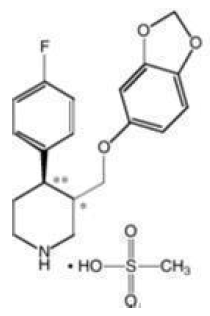
June 28, 2013 –The U.S. Food and Drug Administration today approved Brisdelle (paroxetine) to treat moderate to severe hot flashes (vasomotor symptoms) associated with menopause. Brisdelle, which contains the selective serotonin reuptake inhibitor paroxetine mesylate, is currently the only non-hormonal treatment for hot flashes approved by the FDA.
There are a variety of FDA-approved treatments for hot flashes, but all contain either estrogen alone or estrogen plus a progestin.
read all at
more info
PEXEVA® (paroxetine mesylate) is an orally administered psychotropic drug with a chemical structure related to paroxetine hydrochloride (Paxil®). It is the mesylate salt of a phenylpiperidine compound identified chemically as (-)-trans-4R-(4′-fluorophenyl)-3S-[(3′,4′-methylenedioxyphenoxy) methyl] piperidine mesylate and has the empirical formula of C19H20FNO3•CH3SO3H. The molecular weight is 425.5 (329.4 as free base). The structural formula is: paroxetine mesylate
|
Paroxetine mesylate is an odorless, off-white powder, having a melting point range of 147° to 150°C and a solubility of more than 1 g/ml in water.
Tablets
Each oval, film-coated tablet contains paroxetine mesylate equivalent to paroxetine as follows: 10 mg (white); 20 mg (scored, dark orange); 30 mg (yellow); 40 mg (rose). Inactive ingredients consist of dibasic calcium phosphate, hydroxypropyl methylcellulose, hydroxypropylcellulose, magnesium stearate, sodium starch glycolate, titanium dioxide, ferric oxide red (C.I. 77491) (20 mg and 40 mg only) and ferric oxide yellow (C.I. 77492) (20 mg, 30 mg, and 40 mg only).
EP1286965B1


Amneal Pharma the 7th largest generic drug manufacturer in the US drug market has received ANDA approval for generic Skelaxin (metaxalone).

metaxalone
READ ALL AT
Metaxalone (marketed by King Pharmaceuticals under the brand name Skelaxin) is a muscle relaxant used to relax muscles and relieve pain caused by strains, sprains, and other musculoskeletal conditions. Its exact mechanism of action is not known, but it may be due to general central nervous system depression. It is considered to be a moderately strong muscle relaxant, with relatively low incidence of side effects. Skelaxin is available in an 800 mg scored tablet. Possible side effects include nausea, vomiting, drowsiness and CNS side effects, such as dizziness, headache, and irritability.
Metaxalone exhibits increased bioavailability when taken with food.[1] Specifically, in one study, compared to fasted conditions, the presence of food at the time of drug administration increased Cmax by 77.5%, AUC0-t by 23.5%, and AUC0-∞ by 15.4%.[2] Thus, based on the information in the labeling, patients receiving metaxalone therapy are directed to take metaxalone with food, and are informed that taking metaxalone with food results in an increase in the oral bioavailability of metaxalone compared to taking metaxalone without food.[3][4][5]
The metabolism of metaxalone involves the liver cytochrome P450 system. Based on the information in the labeling, patients receiving metaxalone therapy and physicians prescribing metaxalone are directed to take precaution when coadministering it with other medications involving the P450 system.[6][7]
Because of potential for side effects, this drug is on the list for high risk medications in the elderly.
A literature survey reveals very few methods are reported for the determination of metaxalone to date. Nirogi et al.[2] reported a liquid chromatographic method coupled to tandem mass spectrometry for the quantification of metaxalone in human plasma. A stability-indicating HPLC method was introduced by P.K. Sahu et al.[8] Metaxalone has been used as an internal standard for few analytical methods[9][10]

- Skelaxin Package Insert
- Nirogi RV, Kandikere VN, Shukla M, Mudigonda K, Shrivastava W, Datla PV (May 2006). “Quantification of Metaxalone in Human Plasma by Liquid Chromatography Coupled to Tandem Mass Spectrometry”. J Anal Toxicol 30 (4): 245–51. PMID 16803662.
- id.
- United States Patent No. 6,407,128
- United States Patent No. 6,683,102
- United States Patent No. 7,122,566, by Jie Du, et al
- United States Patent No. 7,378,434, by Jie Du, et al
- Prafulla Kumar Sahu, M. Mathrusri Annapurna and Dillip Kumar Sahoo, Development and Validation of Stability Indicating RP-HPLC Method for the Determination of Metaxalone in Bulk and its Pharmaceutical Formulations; E-Journal of Chemistry, 2011, 8(S1), S439-S447.[1]
- Mistri H N, Jangid A G, Pudage A, Gomes N, Sanyal M and Shrivastav P, J Chromatogr B, 2007, 853(1), 320-332.
- Mistri H N, Jangid A G, Pudage A and Shrivastav P, J Chromatogr B, 2008, 864(1-2), 137-148.

Tobramycin

Tobramycin is an aminoglycoside antibiotic derived from Streptomyces tenebrarius and used to treat various types of bacteria infections, particularly Gram-negative infections. It is especially effective against species of Pseudomonas.[1]

Tobramycin works by binding to a site on the bacterial 30S and 50S ribosome, preventing formation of the 70S complex. As a result, mRNA cannot be translated into protein and cell death ensues. Tobramycin is preferred over gentamicin for Pseudomonas aeruginosapneumonia due to better lung penetration.


Like all aminoglycosides, tobramycin does not pass the gastro-intestinal tract, so forsystemic use it can only be given intravenously or intramuscularly. Ophthalmic (tobramycin only, Tobrex, or combined with dexamethasone, sold as TobraDex) and nebulised formulations both have low systemic absorption. The formulation for injection is branded Nebcin. The nebulised formulation (brand name Tobi) is indicated in the treatment of exacerbations of chronic infection with Pseudomonas aeruginosa in patients diagnosed with cystic fibrosis. A proprietary formulation of micronized, nebulized tobramycin has been tested as a treatment for bacterial sinusitis.[2] Tobrex is a 0.3% tobramycin sterile ophthalmic solution is produced by Bausch & Lomb Pharmaceuticals. Benzalkonium chloride 0.01% is added as a preservative. It is available by prescription only in the United States and Canada. In certain countries, such as Italy, it is available over the counter. Tobrex and TobraDex are indicated in the treatment of superficial infections of the eye, such as bacterial conjunctivitis. Tobramycin (injection) is also indicated for various severe or life-threatening gram-negative infections : meningitis in neonates, brucellosis, pelvic inflammatory disease, Yersinia pestis infection (plague).

Like other aminoglycosides, tobramycin is ototoxic: it can cause hearing loss, or a loss ofequilibrioception, or both in genetically susceptible individuals. These individuals carry a normally harmless genetic mutation that allows aminoglycosides such as tobramycin to affect cochlear cells. Aminoglycoside-induced ototoxicity is generally irreversible.

As with all aminoglycosides, tobramycin is also nephrotoxic, meaning it is toxic to thekidneys. This effect can be particularly worrisome when multiple doses accumulate over the course of a treatment or when the kidney concentrates urine by increasing tubular reabsorption during sleep. Adequate hydration may help prevent excess nephrotoxicity and subsequent loss of renal function. For these reasons parenteral tobramycin needs to be carefully dosed by body weight, and its serum concentration monitored. Tobramycin is thus said to be a drug with a narrow therapeutic index.
|
Mass-spectrum of tobramycin |
|
|

- “Tobramycin” (pdf). Toku-E. 2010-01-12. Retrieved 2012-06-11.
- “Nebulized Tobramycin in treating bacterial Sinusitis” (Press release). July 22, 2008. Retrieved 2009-12-06.


GSK Duchenne drug gets ‘breakthrough’ status

The US Food and Drug Administration has granted breakthrough therapy designation to GlaxoSmithKline’s drisapersen for the potential treatment of patients with Duchenne muscular dystrophy. read all at
http://www.pharmatimes.com/Article/13-06-28/GSK_Duchenne_drug_gets_breakthrough_status.aspx
Drisapersen (also known as PRO051 and GSK2402968 ) is an experimental drug under development by Prosensa for the treatment of Duchenne muscular dystrophy.
The compound is in a Phase III trial which is anticipated to complete by the end of 2013.
- ^ “PRO051/GSK2402968”. Prosensa. Retrieved 29 October 2012
- ^ “A Clinical Study to Assess the Efficacy and Safety of GSK2402968 in Subjects With Duchenne Muscular Dystrophy (DMD114044)”. ClinicalTrials.gov. Retrieved 29 October 2012.

Lyxumia approved in Japan for the treatment of type 2 diabetes

READ ALL AT
OLD ARTICLE

GALL BLADDER STONES, FACTS

Numerous small gallstones made up largely of cholesterol.
A gallstone is a crystalline concretion formed within the gallbladder by accretion of bile components. These calculi are formed in the gallbladder but may distally pass into other parts of the biliary tract such as the cystic duct, common bile duct, pancreatic duct, or the ampulla of Vater. Rarely, in cases of severe inflammation, gallstones may erode through the gallbladder into adherent bowel potentially causing an obstruction termed gallstone ileus.

Presence of gallstones in the gallbladder may lead to acute cholecystitis,[2] an inflammatory condition characterized by retention of bile in the gallbladder and often secondary infection by intestinal microorganisms, predominantly Escherichia coli, Klebsiella, Enterobacter, and Bacteroides species.Presence of gallstones in other parts of the biliary tract can cause obstruction of the bile ducts, which can lead to serious conditions such as ascending cholangitis or pancreatitis. Either of these two conditions can be life-threatening and are therefore considered to be medical emergencies
Symptoms
Gallstones may be asymptomatic, even for years. These gallstones are called “silent stones” and do not require treatment.Symptoms commonly begin to appear once the stones reach a certain size (>8 mm). A characteristic symptom of gallstones is a “gallstone attack”, in which a person may experience intense pain in the upper-right side of the abdomen, often accompanied by nausea and vomiting, that steadily increases for approximately 30 minutes to several hours. A patient may also experience referred pain between the shoulder blades or below the right shoulder. These symptoms may resemble those of a “kidney stone attack”. Often, attacks occur after a particularly fatty meal and almost always happen at night, and after drink.
A positive Murphy’s sign is a common finding on physical examination.
Causes
Gallstone risk increases for females (especially before menopause) and for people near or above 40 years; the condition is more prevalent among both North and South Amerindians and among those of European descent than among other ethnicities. A lack of melatonin could significantly contribute to gallbladder stones, as melatonin inhibits cholesterol secretion from the gallbladder, enhances the conversion of cholesterol to bile, and is an antioxidant, which is able to reduce oxidative stress to the gallbladder.Researchers believe that gallstones may be caused by a combination of factors, including inherited body chemistry, body weight, gallbladder motility (movement), and perhaps diet. The absence of such risk factors does not, however, preclude the formation of gallstones.
No clear relationship has been proved between diet and gallstone formation; however, low-fiber and high-cholesterol diets have been suggested as contributing to gallstone formation. Other nutritional factors that may increase risk of gallstones include rapid weight loss; constipation; eating fewer meals per day; and low intake of the nutrients folate, magnesium, calcium, and vitamin C. On the other hand, wine and whole-grained bread may decrease the risk of gallstones. Pigment gallstones are most commonly seen in the developing world. Risk factors for pigment stones include hemolytic anemias (such as sickle-cell disease and hereditary spherocytosis), cirrhosis, and biliary tract infections. People with erythropoietic protoporphyria (EPP) are at increased risk to develop gallstones. Additionally, prolonged use of proton pump inhibitors has been shown to decrease gallbladder function, potentially leading to gallstone formation
Diet is the fundamental part in the treatment of gall bladder disorders. In cases of acute gall-bladder inflammation, the patient should fast for two or three days, until the acute condition clears. Nothing but water should be taken during the fast. After the fast, the patient should take carrot, beet, grape fruit, lemon and grape juice for a few days. The diet should contain a sufficient amount of lacto-vegetarian, consisting of raw and cooked vegetables, vegetable juices, and a moderate amount of fruit and seeds. Yogurt, cottage cheese and a tablespoon of olive oil twice a day should also be taken.
All meats, eggs, animal fats and processed and denatured fats as well as fried foods should be avoided. The diet should also keep out refined carbohydrates, particularly sugar, sugar products, alcohol, soft drinks, cakes, puddings, ice-cream, coffee and citrus fruits. The patient should eat small meals at regular intervals, rather than three large meals.
Treatment
- Medical
Cholesterol gallstones can sometimes be dissolved by oral ursodeoxycholic acid, but it may be necessary for the patient to take this medication for up to two years. Gallstones may recur, however, once the drug is stopped. Obstruction of the common bile duct with gallstones can sometimes be relieved by endoscopic retrograde sphincterotomy (ERS) following endoscopic retrograde cholangiopancreatography (ERCP). Gallstones can be broken up using a procedure called extracorporeal shock wave lithotripsy (often simply called “lithotripsy”), which is a method of concentrating ultrasonic shock waves onto the stones to break them into tiny pieces. They are then passed safely in the feces. However, this form of treatment is suitable only when there is a small number of gallstones.
- Surgical
Cholecystectomy (gallbladder removal) has a 99% chance of eliminating the recurrence of cholelithiasis. Surgery is only indicated in symptomatic patients. The lack of a gallbladder may have no negative consequences in many people. However, there is a portion of the population — between 10 and 15% — who develop a condition called postcholecystectomy syndrome which may cause gastrointestinal distress and persistent pain in the upper-right abdomen, as well as a 10% risk of developing chronic diarrhea.
There are two surgical options for cholecystectomy:
- Open cholecystectomy is performed via an abdomenal incision (laparotomy) below the lower right ribs. Recovery typically requires 3–5 days of hospitalization, with a return to normal diet a week after release and to normal activity several weeks after release.
- Laparoscopic cholecystectomy, introduced in the 1980s, is performed via three to four small puncture holes for a camera and instruments. Post-operative care typically includes a same-day release or a one night hospital stay, followed by a few days of home rest and pain medication.[7] Laparoscopic cholecystectomy patients can, in general, resume normal diet and light activity a week after release, with some decreased energy level and minor residual pain continuing for a month or two. Studies have shown that this procedure is as effective as the more invasive open cholecystectomy, provided the stones are accurately located by cholangiogram prior to the procedure so that they can all be removed.
- A New Alternative Surgical Technique
A new surgical technique is available to remove Gallstones without excision of gallbladder. This technique is available in China.
- Alternative medicine
A regimen called a “gallbladder flush” or “liver flush” is a popular remedy in alternative medicine.In this treatment, often self-administered, the patient drinks four glasses of pure apple juice (not cider) and eats five apples (or applesauce) per day for five days, then fasts briefly, takes magnesium, and then drinks large quantities of lemon juice mixed with olive oil before bed. The next morning, they painlessly pass a number of green and brown pebbles purported to be stones flushed from the biliary system. Apples are a source of pectin, which has been shown to sequester bile and facilitate its elimination in the stool.
A brief communication in The Lancet presents a case report of such a treatment where the patient released many soft stones. According to the letter, “At the university hospital the stones were recognized as fatty stones”. In another case report, a patient with ultrasonography-confirmed gallstones drank olive oil and lemon juice, suffered diarrhea and intense abdominal pain, and released several gallstones. After that treatment, the gallbladder was empty, as confirmed by ultrasonography.
On the other hand, a couple of case reports challenge whether the stones retrieved from the stool after the “gallbladder flush” really come from the gallbladder. A New Zealand hospital analyzed stones from a typical gallbladder flush and found them to be composed of fatty acids similar to those in olive oil, with no detectable cholesterol or bile salts, demonstrating that they are little more than hardened olive oil. Despite the gallbladder flush, the patient still required surgical removal of multiple true gallstones. A similar case report in The Lancet,accompanied by a simple chemical experiment, concludes that the observed stones from a typical gallbladder flush actually are a consequence of the flush: they form in the stomach under the action of digestive enzymes on the mix of olive oil and lemon.
Finally, drinking an infusion of “Chanca Piedra“, or “Break Stones” (Phyllanthus niruri), a plant that is native to the Amazon, has long been used in South American traditional medicine to maintain kidney, liver, and gallbladder health and to treat gallstones and kidney stones and jaundice.
Other patients have anecdotally reported that symptoms can be temporarily reduced by drinking several glasses of water when experiencing gallstone pain. There is no known evidence backing this claim, and this approach will not eliminate the gallstones or improve the patient’s condition in the long term
Treatment involves removing the stone using ERCP. Typically, the gallbladder is then removed, an operation called cholecystectomy, to prevent a future occurrence of common bile duct obstruction or other complications
FOODS TO AVOID
YOGA
Regular applications of hot and cold fomentations to the abdomen improve the circulation of the liver and gall-bladder. They also stimulate concentrations of the gall-bladder, thereby improving the flow of bile. A cold hip bath improves the general abdominal tone. The pain of gall-stone colic can be relieved by the application of hot packs or fomentation to the upper abdominal area. A warm water enema at body temperature will help eliminate faecal accumulations if the patient is constipated. Exercise is necessary as physical inactivity can lead to lazy gall-bladder type indigestion which may eventually result in the formation of stones. Yogic asanas which are beneficial in toning up the liver and gall-bladder are: sarvangasana, paschimottanasana, salabhasana, dhanurasana and bhujangasana.
TIPS
READ THIS
http://www.ladyzona.com/simple-tips-on-gallbladder-stones-treatment/

WORLD DRUG TRACKER group, linkedin, blog etc
World Drug Tracker
Labels: anthony crasto, catalyst, DRUGS, medicinal chemistry, New Drugs, organic chemistry, ORGANIC SYNTHESIS, PATENTS, process, world drug tracker …
WORLD DRUG TRACKER | LinkedIn
Follow World Drug Tracker on bloglovin
Follow World Drug Tracker using bloglovin, an easy way to follow your favorite blogs.


 New Drug Approvals