New Drug Approvals

Home » 2020 (Page 7)

Yearly Archives: 2020

DRUG APPROVALS BY DR ANTHONY MELVIN CRASTO .....FOR BLOG HOME CLICK HERE

Blog Stats

  • 4,805,603 hits

Flag and hits

Flag Counter

Enter your email address to follow this blog and receive notifications of new posts by email.

Join 37.9K other subscribers
Follow New Drug Approvals on WordPress.com

Archives

Categories

Recent Posts

Flag Counter

ORGANIC SPECTROSCOPY

Read all about Organic Spectroscopy on ORGANIC SPECTROSCOPY INTERNATIONAL 

Enter your email address to follow this blog and receive notifications of new posts by email.

Join 37.9K other subscribers
DR ANTHONY MELVIN CRASTO Ph.D

DR ANTHONY MELVIN CRASTO Ph.D

DR ANTHONY MELVIN CRASTO, Born in Mumbai in 1964 and graduated from Mumbai University, Completed his Ph.D from ICT, 1991,Matunga, Mumbai, India, in Organic Chemistry, The thesis topic was Synthesis of Novel Pyrethroid Analogues, Currently he is working with AFRICURE PHARMA, ROW2TECH, NIPER-G, Department of Pharmaceuticals, Ministry of Chemicals and Fertilizers, Govt. of India as ADVISOR, earlier assignment was with GLENMARK LIFE SCIENCES LTD, as CONSUlTANT, Retired from GLENMARK in Jan2022 Research Centre as Principal Scientist, Process Research (bulk actives) at Mahape, Navi Mumbai, India. Total Industry exp 32 plus yrs, Prior to joining Glenmark, he has worked with major multinationals like Hoechst Marion Roussel, now Sanofi, Searle India Ltd, now RPG lifesciences, etc. He has worked with notable scientists like Dr K Nagarajan, Dr Ralph Stapel, Prof S Seshadri, etc, He did custom synthesis for major multinationals in his career like BASF, Novartis, Sanofi, etc., He has worked in Discovery, Natural products, Bulk drugs, Generics, Intermediates, Fine chemicals, Neutraceuticals, GMP, Scaleups, etc, he is now helping millions, has 9 million plus hits on Google on all Organic chemistry websites. His friends call him Open superstar worlddrugtracker. His New Drug Approvals, Green Chemistry International, All about drugs, Eurekamoments, Organic spectroscopy international, etc in organic chemistry are some most read blogs He has hands on experience in initiation and developing novel routes for drug molecules and implementation them on commercial scale over a 32 PLUS year tenure till date Feb 2023, Around 35 plus products in his career. He has good knowledge of IPM, GMP, Regulatory aspects, he has several International patents published worldwide . He has good proficiency in Technology transfer, Spectroscopy, Stereochemistry, Synthesis, Polymorphism etc., He suffered a paralytic stroke/ Acute Transverse mylitis in Dec 2007 and is 90 %Paralysed, He is bound to a wheelchair, this seems to have injected feul in him to help chemists all around the world, he is more active than before and is pushing boundaries, He has 100 million plus hits on Google, 2.5 lakh plus connections on all networking sites, 100 Lakh plus views on dozen plus blogs, 227 countries, 7 continents, He makes himself available to all, contact him on +91 9323115463, email amcrasto@gmail.com, Twitter, @amcrasto , He lives and will die for his family, 90% paralysis cannot kill his soul., Notably he has 38 lakh plus views on New Drug Approvals Blog in 227 countries......https://newdrugapprovals.wordpress.com/ , He appreciates the help he gets from one and all, Friends, Family, Glenmark, Readers, Wellwishers, Doctors, Drug authorities, His Contacts, Physiotherapist, etc He has total of 32 International and Indian awards

Verified Services

View Full Profile →

Archives

Categories

Flag Counter

Hydroxychloroquine, ヒドロキシクロロキン, гидроксихлорохин , هيدروكسيكلوروكين , 羟氯喹 ,


ChemSpider 2D Image | hydroxychloroquine | C18H26ClN3O


Hydroxychloroquine
ヒドロキシクロロキン;
Formula
C18H26ClN3O
cas
118-42-3
sulphate 747-36-4
Mol weight
335.8715


гидроксихлорохин [Russian] [INN]
هيدروكسيكلوروكين [Arabic] [INN]
羟氯喹 [Chinese] [INN]
Oxychlorochin, Plaquenil Plaquenil®, 

Hydroxychloroquine (HCQ), sold under the brand name Plaquenil among others, is a medication used for the prevention and treatment of certain types of malaria.[2] Specifically it is used for chloroquine-sensitive malaria.[3] Other uses include treatment of rheumatoid arthritislupus, and porphyria cutanea tarda.[2] It is taken by mouth.[2] It is also being used as an experimental treatment for coronavirus disease 2019 (COVID-19).[4]

Common side effects include vomitingheadache, changes in vision and muscle weakness.[2] Severe side effects may include allergic reactions.[2] Although all risk cannot be excluded it remains a treatment for rheumatic disease during pregnancy.[5] Hydroxychloroquine is in the antimalarial and 4-aminoquinoline families of medication.[2]

Hydroxychloroquine was approved for medical use in the United States in 1955.[2] It is on the World Health Organization’s List of Essential Medicines, the safest and most effective medicines needed in a health system.[6] The wholesale cost in the developing world is about US$4.65 per month as of 2015, when used for rheumatoid arthritis or lupus.[7] In the United States the wholesale cost of a month of treatment is about US$25 as of 2020.[8] In the United Kingdom this dose costs the NHS about £ 5.15.[9] In 2017, it was the 128th most prescribed medication in the United States with more than five million prescriptions.[10]

Medical use

Hydroxychloroquine treats malaria, systemic lupus erythematosus, rheumatic disorders like rheumatoid arthritisporphyria cutanea tarda, and Q fever.[2]

In 2014, its efficacy to treat Sjögren syndrome was questioned in a double-blind study involving 120 patients over a 48-week period.[11]

Hydroxychloroquine is widely used in the treatment of post-Lyme arthritis. It may have both an anti-spirochaete activity and an anti-inflammatory activity, similar to the treatment of rheumatoid arthritis.[12]

Contraindications

The drug label advises that hydroxychloroquine should not be prescribed to individuals with known hypersensitivity to 4-Aminoquinoline compounds.[13] There are a range of other contraindications[14] [15] and caution is required if patients have certain heart conditions, diabetes, psoriasis etc.

Side effects[

The most common adverse effects are a mild nausea and occasional stomach cramps with mild diarrhea. The most serious adverse effects affect the eye, with dose-related retinopathy as a concern even after hydroxychloroquine use is discontinued.[2] For short-term treatment of acute malaria, adverse effects can include abdominal cramps, diarrhea, heart problems, reduced appetite, headache, nausea and vomiting.[2]

For prolonged treatment of lupus or rheumatoid arthritis, adverse effects include the acute symptoms, plus altered eye pigmentation, acneanemia, bleaching of hair, blisters in mouth and eyes, blood disorders, convulsions, vision difficulties, diminished reflexes, emotional changes, excessive coloring of the skin, hearing loss, hives, itching, liver problems or liver failureloss of hair, muscle paralysis, weakness or atrophy, nightmares, psoriasis, reading difficulties, tinnitus, skin inflammation and scaling, skin rash, vertigoweight loss, and occasionally urinary incontinence.[2] Hydroxychloroquine can worsen existing cases of both psoriasis and porphyria.[2]

Children may be especially vulnerable to developing adverse effects from hydroxychloroquine.[2]

Eyes

One of the most serious side effects is retinopathy (generally with chronic use).[2][16] People taking 400 mg of hydroxychloroquine or less per day generally have a negligible risk of macular toxicity, whereas the risk begins to go up when a person takes the medication over 5 years or has a cumulative dose of more than 1000 grams. The daily safe maximum dose for eye toxicity can be computed from one’s height and weight using this calculator. Cumulative doses can also be calculated from this calculator. Macular toxicity is related to the total cumulative dose rather than the daily dose. Regular eye screening, even in the absence of visual symptoms, is recommended to begin when either of these risk factors occurs.[17]

Toxicity from hydroxychloroquine may be seen in two distinct areas of the eye: the cornea and the macula. The cornea may become affected (relatively commonly) by an innocuous cornea verticillata or vortex keratopathy and is characterized by whorl-like corneal epithelial deposits. These changes bear no relationship to dosage and are usually reversible on cessation of hydroxychloroquine.

The macular changes are potentially serious. Advanced retinopathy is characterized by reduction of visual acuity and a “bull’s eye” macular lesion which is absent in early involvement.

Overdose

Due to rapid absorption, symptoms of overdose can occur within a half an hour after ingestion. Overdose symptoms include convulsions, drowsiness, headache, heart problems or heart failure, difficulty breathing and vision problems.

Hydroxychloroquine overdoses are rarely reported, with 7 previous cases found in the English medical literature. In one such case, a 16-year-old girl who had ingested a handful of hydroxychloroquine 200mg presented with tachycardia (heart rate 110 beats/min), hypotension (systolic blood pressure 63 mm Hg), central nervous system depression, conduction defects (ORS = 0.14 msec), and hypokalemia (K = 2.1 meq/L). Treatment consisted of fluid boluses and dopamine, oxygen, and potassium supplementation. The presence of hydroxychloroquine was confirmed through toxicologic tests. The patient’s hypotension resolved within 4.5 hours, serum potassium stabilized in 24 hours, and tachycardia gradually decreased over 3 days.[18]

Interactions

The drug transfers into breast milk and should be used with care by pregnant or nursing mothers.[citation needed]

Care should be taken if combined with medication altering liver function as well as aurothioglucose (Solganal), cimetidine (Tagamet) or digoxin (Lanoxin). HCQ can increase plasma concentrations of penicillamine which may contribute to the development of severe side effects. It enhances hypoglycemic effects of insulin and oral hypoglycemic agents. Dose altering is recommended to prevent profound hypoglycemiaAntacids may decrease the absorption of HCQ. Both neostigmine and pyridostigmine antagonize the action of hydroxychloroquine.[19]

While there may be a link between hydroxychloroquine and hemolytic anemia in those with glucose-6-phosphate dehydrogenase deficiency, this risk may be low in those of African descent.[20]

Specifically, the FDA drug label for hydroxychloroquine lists the following drug interactions [13]:

  • Digoxin (wherein it may result in increased serum digoxin levels)
  • Insulin or antidiabetic drugs (wherein it may enhance the effects of a hypoglycemic treatment)
  • Drugs that prolong QT interval and other arrhythmogenic drugs (as Hydroxychloroquine prolongs the QT interval and may increase the risk of inducing ventricular arrhythmias if used concurrently)
  • Mefloquine and other drugs known to lower the convulsive threshold (co-administration with other antimalarials known to lower the convulsion threshold may increase risk of convulsions)
  • Antiepileptics (concurrent use may impair the antiepileptic activity)
  • Methotrexate (combined use is unstudied and may increase the frequency of side effects)
  • Cyclosporin (wherein an increased plasma cylcosporin level was reported when used together).

Pharmacology[

Pharmacokinetics

Hydroxychloroquine has similar pharmacokinetics to chloroquine, with rapid gastrointestinal absorption and elimination by the kidneys. Cytochrome P450 enzymes (CYP2D62C83A4 and 3A5) metabolize hydroxychloroquine to N-desethylhydroxychloroquine.[21]

Pharmacodynamics

Antimalarials are lipophilic weak bases and easily pass plasma membranes. The free base form accumulates in lysosomes (acidic cytoplasmic vesicles) and is then protonated,[22] resulting in concentrations within lysosomes up to 1000 times higher than in culture media. This increases the pH of the lysosome from 4 to 6.[23] Alteration in pH causes inhibition of lysosomal acidic proteases causing a diminished proteolysis effect.[24] Higher pH within lysosomes causes decreased intracellular processing, glycosylation and secretion of proteins with many immunologic and nonimmunologic consequences.[25] These effects are believed to be the cause of a decreased immune cell functioning such as chemotaxisphagocytosis and superoxide production by neutrophils.[26] HCQ is a weak diprotic base that can pass through the lipid cell membrane and preferentially concentrate in acidic cytoplasmic vesicles. The higher pH of these vesicles in macrophages or other antigen-presenting cells limits the association of autoantigenic (any) peptides with class II MHC molecules in the compartment for peptide loading and/or the subsequent processing and transport of the peptide-MHC complex to the cell membrane.[27]

Mechanism of action

Hydroxychloroquine increases[28] lysosomal pH in antigen-presenting cells. In inflammatory conditions, it blocks toll-like receptors on plasmacytoid dendritic cells (PDCs).[citation needed] Hydroxychloroquine, by decreasing TLR signaling, reduces the activation of dendritic cells and the inflammatory process. Toll-like receptor 9 (TLR 9) recognizes DNA-containing immune complexes and leads to the production of interferon and causes the dendritic cells to mature and present antigen to T cells, therefore reducing anti-DNA auto-inflammatory process.

In 2003, a novel mechanism was described wherein hydroxychloroquine inhibits stimulation of the toll-like receptor (TLR) 9 family receptors. TLRs are cellular receptors for microbial products that induce inflammatory responses through activation of the innate immune system.[29]

As with other quinoline antimalarial drugs, the mechanism of action of quinine has not been fully resolved. The most accepted model is based on hydrochloroquinine and involves the inhibition of hemozoin biocrystallization, which facilitates the aggregation of cytotoxic heme. Free cytotoxic heme accumulates in the parasites, causing their deaths.[citation needed]

Brand names

It is frequently sold as a sulfate salt known as hydroxychloroquine sulfate.[2] 200 mg of the sulfate salt is equal to 155 mg of the base.[2]

Brand names of hydroxychloroquine include Plaquenil, Hydroquin, Axemal (in India), Dolquine, Quensyl, Quinoric.[30]

Research

COVID-19

Hydroxychloroquine and chloroquine have been recommended by Chinese and South Korean health authorities for the experimental treatment of COVID-19.[31][32] In vitro studies in cell cultures demonstrated that hydroxychloroquine was more potent than chloroquine against SARS-CoV-2.[33]

On 17 March 2020, the AIFA Scientific Technical Commission of the Italian Medicines Agency expressed a favorable opinion on including the off-label use of chloroquine and hydroxychloroquine for the treatment of SARS-CoV-2 infection.[34]


clip

Image result for hydroxychloroquine

clip

https://d-nb.info/1166863441/34

white solid (0.263 g, 78%). 1H NMR
(600 MHz, CDCl3
) δ 8.48 (d, J = 5.4 Hz, 1H), 7.93 (d, J = 5.4 Hz, 1H), 7.70 (d, J = 9.2 Hz, 1H), 7.34 (dd, J = 8.8, 7.3 Hz, 1H), 6.39 (d, J = 5.4 Hz, 1H), 4.96 (d, J = 7.5 Hz, 1H), 3.70 (sx,J = 6.8 Hz, 1H), 3.55 (m, 2H), 2.57 (m, 5H), 2.49 (m, 2H),
1.74–1.62 (m, 1H), 1.65–1.53 (m, 3H), 1.31 (d, J = 6.9 Hz, 3H),
1.24 (d, J = 7.2 Hz, 2H);

13C NMR (125 MHz, CDCl3) δ 152.2,
149.5, 149.2, 135.0, 129.0, 125.4, 121.2, 117.4, 99.4, 58.6, 54.9,
53.18, 48.5, 47.9, 34.5, 24.1, 20.6, 11.9. Spectra were obtained
in accordance with those previously reported [38,39].

38. Cornish, C. A.; Warren, S. J. Chem. Soc., Perkin Trans. 1 1985,
2585–2598. doi:10.1039/P19850002585
39. Münstedt, R.; Wannagat, U.; Wrobel, D. J. Organomet. Chem. 1984,
264, 135–148. doi:10.1016/0022-328X(84)85139-6


References

  1. Jump up to:a b “Hydroxychloroquine Use During Pregnancy”Drugs.com. 28 February 2020. Retrieved 21 March 2020.
  2. Jump up to:a b c d e f g h i j k l m n o p “Hydroxychloroquine Sulfate Monograph for Professionals”. The American Society of Health-System Pharmacists. 20 March 2020. Archived from the original on 20 March 2020. Retrieved 20 March 2020.
  3. ^ Hamilton, Richart (2015). Tarascon Pocket Pharmacopoeia. Jones & Bartlett Learning. p. 463. ISBN 9781284057560.
  4. ^ Cortegiani, Andrea; Ingoglia, Giulia; Ippolito, Mariachiara; Giarratano, Antonino; Einav, Sharon (10 March 2020). “A systematic review on the efficacy and safety of chloroquine for the treatment of COVID-19”Journal of Critical Caredoi:10.1016/j.jcrc.2020.03.005ISSN 0883-9441.
  5. ^ Flint, Julia; Panchal, Sonia; Hurrell, Alice; van de Venne, Maud; Gayed, Mary; Schreiber, Karen; Arthanari, Subha; Cunningham, Joel; Flanders, Lucy; Moore, Louise; Crossley, Amy (1 September 2016). “BSR and BHPR guideline on prescribing drugs in pregnancy and breastfeeding – Part I: standard and biologic disease modifying anti-rheumatic drugs and corticosteroids”Rheumatology55 (9): 1693–1697. doi:10.1093/rheumatology/kev404ISSN 1462-0324.
  6. ^ World Health Organization (2019). World Health Organization model list of essential medicines: 21st list. Geneva: World Health Organization. hdl:10665/325771. WHO/MVP/EMP/IAU/2019.06. License: CC BY-NC-SA 3.0 IGO.
  7. ^ “Single Drug Information | International Medical Products Price Guide”. Retrieved 31 December 2019.[dead link]
  8. ^ “NADAC as of 2019-08-07”Centers for Medicare and Medicaid Services. Retrieved 19 March 2020Typical dose is 600mg per day. Costs 0.28157 per dose. Month has about 30 days.
  9. ^ British national formulary: BNF 69 (69 ed.). British Medical Association. 2015. p. 730. ISBN 9780857111562.
  10. ^ “The Top 300 of 2020”ClinCalc. Retrieved 18 March 2020.
  11. ^ Effects of Hydroxychloroquine on Symptomatic Improvement in Primary Sjögren Syndrome, Gottenberg, et al. (2014) “Archived copy”Archived from the original on 11 July 2015. Retrieved 10 July 2015.
  12. ^ Steere, AC; Angelis, SM (October 2006). “Therapy for Lyme Arthritis: Strategies for the Treatment of Antibiotic-refractory Arthritis”. Arthritis and Rheumatism54 (10): 3079–86. doi:10.1002/art.22131PMID 17009226.
  13. Jump up to:a b “Plaquenil- hydroxychloroquine sulfate tablet”DailyMed. 3 January 2020. Retrieved 20 March 2020.
  14. ^ “Plaquenil (hydroxychloroquine sulfate) dose, indications, adverse effects, interactions”pdr.net. Retrieved 19 March 2020.
  15. ^ “Drugs & Medications”webmd.com. Retrieved 19 March 2020.
  16. ^ Flach, AJ (2007). “Improving the Risk-benefit Relationship and Informed Consent for Patients Treated with Hydroxychloroquine”Transactions of the American Ophthalmological Society105: 191–94, discussion 195–97. PMC 2258132PMID 18427609.
  17. ^ Marmor, MF; Kellner, U; Lai, TYY; Lyons, JS; Mieler, WF (February 2011). “Revised Recommendations on Screening for Chloroquine and Hydroxychloroquine Retinopathy”. Ophthalmology118 (2): 415–22. doi:10.1016/j.ophtha.2010.11.017PMID 21292109.
  18. ^ Marquardt, Kathy; Albertson, Timothy E. (1 September 2001). “Treatment of hydroxychloroquine overdose”The American Journal of Emergency Medicine19 (5): 420–424. doi:10.1053/ajem.2001.25774ISSN 0735-6757PMID 11555803.
  19. ^ “Russian Register of Medicines: Plaquenil (hydroxychloroquine) Film-coated Tablets for Oral Use. Prescribing Information” (in Russian). Sanofi-Synthelabo. Archived from the original on 16 August 2016. Retrieved 14 July 2016.
  20. ^ Mohammad, Samya; Clowse, Megan E. B.; Eudy, Amanda M.; Criscione-Schreiber, Lisa G. (March 2018). “Examination of Hydroxychloroquine Use and Hemolytic Anemia in G6PDH-Deficient Patients”. Arthritis Care & Research70 (3): 481–485. doi:10.1002/acr.23296ISSN 2151-4658PMID 28556555.
  21. ^ Kalia, S; Dutz, JP (2007). “New Concepts in Antimalarial Use and Mode of Action in Dermatology”. Dermatologic Therapy20 (4): 160–74. doi:10.1111/j.1529-8019.2007.00131.xPMID 17970883.
  22. ^ Kaufmann, AM; Krise, JP (2007). “Lysosomal Sequestration of Amine-containing Drugs: Analysis and Therapeutic Implications”. Journal of Pharmaceutical Sciences96 (4): 729–46. doi:10.1002/jps.20792PMID 17117426.
  23. ^ Ohkuma, S; Poole, B (1978). “Fluorescence Probe Measurement of the Intralysosomal pH in Living Cells and the Perturbation of pH by Various Agents”Proceedings of the National Academy of Sciences of the United States of America75 (7): 3327–31. doi:10.1073/pnas.75.7.3327PMC 392768PMID 28524.
  24. ^ Ohkuma, S; Chudzik, J; Poole, B (1986). “The Effects of Basic Substances and Acidic Ionophores on the Digestion of Exogenous and Endogenous Proteins in Mouse Peritoneal Macrophages”The Journal of Cell Biology102 (3): 959–66. doi:10.1083/jcb.102.3.959PMC 2114118PMID 3949884.
  25. ^ Oda, K; Koriyama, Y; Yamada, E; Ikehara, Y (1986). “Effects of Weakly Basic Amines on Proteolytic Processing and Terminal Glycosylation of Secretory Proteins in Cultured Rat Hepatocytes”The Biochemical Journal240 (3): 739–45. doi:10.1042/bj2400739PMC 1147481PMID 3493770.
  26. ^ Hurst, NP; French, JK; Gorjatschko, L; Betts, WH (1988). “Chloroquine and Hydroxychloroquine Inhibit Multiple Sites in Metabolic Pathways Leading to Neutrophil Superoxide Release”. The Journal of Rheumatology15 (1): 23–27. PMID 2832600.
  27. ^ Fox, R (1996). “Anti-malarial Drugs: Possible Mechanisms of Action in Autoimmune Disease and Prospects for Drug Development”. Lupus5: S4–10. doi:10.1177/096120339600500103PMID 8803903.
  28. ^ Waller; et al. Medical Pharmacology and Therapeutics (2nd ed.). p. 370.
  29. ^ Takeda, K; Kaisho, T; Akira, S (2003). “Toll-Like Receptors”. Annual Review of Immunology21: 335–76. doi:10.1146/annurev.immunol.21.120601.141126PMID 12524386.
  30. ^ “Hydroxychloroquine trade names”Drugs-About.com. Retrieved 18 June 2019.
  31. ^ “Diagnosis and Treatment Protocol for Novel Coronavirus Pneumonia”China Law Translate. 3 March 2020. Retrieved 18 March 2020.
  32. ^ “Physicians work out treatment guidelines for coronavirus”Korea Biomedical Review. 13 February 2020. Retrieved 18 March2020.
  33. ^ Yao, Xueting; Ye, Fei; Zhang, Miao; Cui, Cheng; Huang, Baoying; Niu, Peihua; Liu, Xu; Zhao, Li; Dong, Erdan; Song, Chunli; Zhan, Siyan (9 March 2020). “In Vitro Antiviral Activity and Projection of Optimized Dosing Design of Hydroxychloroquine for the Treatment of Severe Acute Respiratory Syndrome Coronavirus 2 (SARS-CoV-2)”. Clinical Infectious Diseasesdoi:10.1093/cid/ciaa237ISSN 1537-6591PMID 32150618.
  34. ^ “Azioni intraprese per favorire la ricerca e l’accesso ai nuovi farmaci per il trattamento del COVID-19”Italian Medicines Agency (AIFA) (in Italian). 17 March 2020. Retrieved 18 March2020.

External links


Hydroxychloroquine
Hydroxychloroquine.svg
Hydroxychloroquine.png

Hydroxychloroquine freebase molecule
Clinical data
Trade names Plaquenil, others
Other names Hydroxychloroquine sulfate
AHFS/Drugs.com Monograph
MedlinePlus a601240
License data
Pregnancy
category
  • AU: D [1]
  • US: N (Not classified yet) [1]
Routes of
administration
By mouth (tablets)
ATC code
Legal status
Legal status
  • AU: S4 (Prescription only)
  • UK: POM (Prescription only)
  • US: ℞-only
  • In general: ℞ (Prescription only)
Pharmacokinetic data
Bioavailability Variable (74% on average); Tmax = 2–4.5 hours
Protein binding 45%
Metabolism Liver
Elimination half-life 32–50 days
Excretion Mostly Kidney (23–25% as unchanged drug), also biliary (<10%)
Identifiers
CAS Number
PubChem CID
IUPHAR/BPS
DrugBank
ChemSpider
UNII
KEGG
ChEBI
ChEMBL
CompTox Dashboard (EPA)
ECHA InfoCard 100.003.864 Edit this at Wikidata
Chemical and physical data
Formula C18H26ClN3O
Molar mass 335.872 g/mol g·mol−1
3D model (JSmol)


///////////Hydroxychloroquine, Hydroxy chloroquine, HCQ, ヒドロキシクロロキン , covid 19, coronavirus, antimalarial, гидроксихлорохинهيدروكسيكلوروكين羟氯喹Oxychlorochin, Plaquenil Plaquenil®, 

Arbidol, Umifenovir,


Arbidol.svg

ChemSpider 2D Image | Umifenovir | C22H25BrN2O3S

Umifenovir

  • Molecular FormulaC22H25BrN2O3S
  • Average mass477.414 Da
Арбидол [Russian]
阿比朵尔 [Chinese]
131707-25-0 [RN]
1H-Indole-3-carboxylic acid, 6-bromo-4-[(dimethylamino)methyl]-5-hydroxy-1-methyl-2-[(phenylthio)methyl]-, ethyl ester
 
9271
Arbidol
Ethyl 6-bromo-4-[(dimethylamino)methyl]-5-hydroxy-1-methyl-2-[(phenylsulfanyl)methyl]-1H-indole-3-carboxylate

Umifenovir[2] (trade names Arbidol RussianАрбидолChinese阿比朵尔) is an antiviral treatment for influenza infection used in Russia[3] and China. The drug is manufactured by Pharmstandard (RussianФармстандарт). Although some Russian studies have shown it to be effective, it is not approved for use in other countries. It is not approved by FDA for the treatment or prevention of influenza.[4] Chemically, umifenovir features an indole core, functionalized at all but one positions with different substituents. The drug is claimed to inhibit viral entry into target cells and stimulate the immune response. Interest in the drug has been renewed as a result of the SARS-CoV-2 outbreak.

Umifenovir is manufactured and made available as tabletscapsules and syrup.

Image result for Arbidol
 

Arbidol Hydrochloride

  • Molecular FormulaC22H28BrClN2O4S
  • Average mass531.891 Da
  • 868364-57-2 [RN]

Status

Testing of umifenovir’s efficacy has mainly occurred in China and Russia,[5][6] and it is well known in these two countries.[7] Some of the Russian tests showed the drug to be effective[5] and a direct comparison with Tamiflu showed similar efficiency in vitro and in a clinical setting.[8] In 2007, Arbidol (umifenovir) had the highest sales in Russia among all over-the-counter drugs.

Mode of action

Biochemistry

Umifenovir inhibits membrane fusion.[3] Umifenovir prevents contact between the virus and target host cells. Fusion between the viral envelope (surrounding the viral capsid) and the cell membrane of the target cell is inhibited. This prevents viral entry to the target cell, and therefore protects it from infection.[9]

Some evidence suggests that the drug’s actions are more effective at preventing infections from RNA viruses than infections from DNA viruses.[10]

As well as specific antiviral action against both influenza A and influenza B viruses, umifenovir exhibits modulatory effects on the immune system. The drug stimulates a humoral immune response, induces interferon-production, and stimulates the phagocytic function of macrophages.[11]

Clinical application

Umifenovir is used primarily as an antiviral treatments for influenza. The drug has also been investigated as a candidate drug for treatment of hepatitis C.[12]

More recent studies indicate that umifenovir also has in vitro effectiveness at preventing entry of Ebolavirus Zaïre Kikwit, Tacaribe arenavirus and human herpes virus 8 in mammalian cell cultures, while confirming umifenovir’s suppressive effect in vitro on Hepatitis B and poliovirus infection of mammalian cells when introduced either in advance of viral infection or during infection.[13][14]

Research

In February 2020, Li Lanjuan, an expert of the National Health Commission of China, proposed using Arbidol (umifenovir) together with darunavir as a potential treatment during the 2019–20 coronavirus pandemic.[15] Chinese experts claim that preliminary tests had shown that arbidol and darunavir could inhibit replication of the virus.[16][17] So far without additional effect if added on top of recombinant human interferon α2b spray.[18]

Side effects

Side effects in children include sensitization to the drug. No known overdose cases have been reported and allergic reactions are limited to people with hypersensitivity. The LD50 is more than 4 g/kg.[19]

Criticism

In 2007, the Russian Academy of Medical Sciences stated that the effects of Arbidol (umifenovir) are not scientifically proven.[20]

Russian media criticized lobbying attempts by Tatyana Golikova (then-Minister of Healthcare) to promote umifenovir,[21] and the unproven claim that Arbidol can speed up recovery from flu or cold by 1.3-2.3 days.[22] They also debunked claims that the efficacy of umifenovir is supported by peer-reviewed studies.[23][24]

PAPER

Bioorganic & medicinal chemistry (2017), 25(1), 327-337. 

PATENT

https://patentscope.wipo.int/search/en/detail.jsf?docId=CN84983071&_cid=P12-KZB0QP-98324-1

Arbidol hydrochloride, chemical name: 6-bromo-4-(dimethylaminomethyl)-5-hydroxy-1-methyl-2-(phenylthiomethyl)-1H- Indole-3-carboxylic acid ethyl ester hydrochloride, the structural formula is as follows:
         
        Arbidol hydrochloride is an antiviral drug developed by the Soviet Medicinal Chemistry Research Center. It was first listed in Russia in 1993. It is used as a monohydrate for medicinal purposes. This product not only has immunomodulatory and interferon-inducing effects, but also has good anti-influenza virus activity, and is clinically used for the prevention and treatment of influenza and other acute viral respiratory tract infections.
        The preparation of Arbidol hydrochloride has multiple synthetic routes, Chinese patent CN1687033A and Wang Dun, Wu Xiujing, Gong Ping’s “Synthesis of Arbidol Hydrochloride” bibliographical report in Chinese Pharmaceutical Industry Magazine 2004,35(8) are Taking p-benzoquinone and 3-aminocrotonic acid ethyl ester as starting materials, through Neitzescu reaction, O-acylation, N-alkylation, bromination, thiophenol reaction, Mannich amine methylation reaction, hydrochloric acid acidification to obtain hydrochloric acid Arbidol, the total reaction yield was 22.9%.
        The synthetic route is as follows:
         
        The Nenitzescu reaction used in the synthesis of indole rings in this method, the reaction yield of this step is about 60%, resulting in a total yield of 22.9%.
        U.S. Patent US5198552 and World Patent WO9008135 reported that 5-hydroxy-1,2-dimethylindole-3-ethyl carboxylate was used as raw material, and arbidol hydrochloride was prepared through bromination, condensation, Mannich reaction and salt-forming reaction you.
         
        Although the synthesis steps of this method are short, the raw material 5-hydroxy-1,2-dimethylindole-3-carboxylic acid ethyl ester is not easy to obtain, and the large-scale application is difficult.
        Song Yanling, Zhao Yanfang, Gong Pingren reported in the 3rd National Symposium on Pharmaceutical Engineering Technology and Education “Synthesis Research on Arbidol Hydrochloride” in the literature report using thiophenol as the starting material, and chloroacetoacetic acid. After the substitution reaction of the ethyl ester, the thiophenyl fragment in the molecule is introduced, which is then condensed with methylamine, followed by the Neitzescu reaction with p-benzoquinone, and the dimethylamine methyl group is introduced through the Mannich reaction. Reaction, then carry out deprotection reaction, and finally obtain the final product Arbidol hydrochloride through salification reaction
        Its synthetic route is as follows:
         
        Since the Nenitzescu reaction yield in this method is only 33.7%, the total yield is only 11.2%.
        There are also bibliographical reports (Wen Yanzhen, Gao Zhiwei, Wei Wenlong, Zhi Cuimei, Wang Qi etc. in China Pharmaceutical Industry Journal 2006, “The Synthetic Route Diagram of Arbidol Hydrochloride” reported in 2006,37(12)) is based on ethyl acetoacetate. Ester and methylamine are used as starting materials, and Arbidol hydrochloride is obtained by Neitzescu reaction, acylation to protect hydroxyl group, bromination, thiophenol reaction, Mannich reaction, and acidification.
        The synthetic route is as follows:
         
        The method has relatively mild reaction conditions and relatively easy-to-obtain raw materials, but the total yield is still low, about 20%.
        The above synthesis methods of Arbidol hydrochloride all use the Nenitzescu indole ring synthesis method to synthesize the indole ring of Arbidol hydrochloride, resulting in a low total reaction yield of about 10% to 20%.
        SUMMARY OF THE INVENTION
        In view of the above-mentioned problems, the object of the present invention is to provide a preparation method of Arbidol hydrochloride, the raw materials are easy to obtain, the reaction technical conditions are relatively simple, the reaction conditions are mild, and the total reaction yield is relatively high, reaching more than 30%. The cost is low, and it is suitable for industrial production. The method of the invention is based on the starting material of 3-iodo-4-nitrophenol, which is protected by a hydroxyl group, synthesized by indole ring, N-methylated, brominated, thiophenolated, and Mannich amine. Methylation reaction, acidification with hydrochloric acid, and purification to obtain Arbidol hydrochloride.
The reaction formula of the inventive method is as follows:
         
         
        Fe stands for iron powder
        CH 3 COOH stands for acetic acid
        H 2 O is for water
        (CH 3 ) 2 SO 4   Represents dimethyl sulfate
        K 2 CO 3       stands for potassium carbonate
 Example 1:
        A preparation method of Arbidol hydrochloride, its steps are (preparation of compound 1):
        A. Preparation of compound 1: 53 g of 3-iodo-4-nitrophenol was added to 160 g of acetone (drying over anhydrous potassium carbonate), 30.3 g of triethylamine was added, and 37.7 g of triethylamine was added dropwise at room temperature (20-25° C., the same below). g acetyl chloride, dripped in 1 hour, the reaction solution was automatically raised to reflux temperature T=56°C, reacted for 0.5h, cooled to room temperature T=25°C naturally, the reaction solution was poured into 1000g ice water, stirred, filtered, and the filter cake was washed with water , and vacuum-dried to obtain 57.4 g of compound 1 crude product with a yield of 93.6%. The next reaction was carried out directly without further purification.
        B. Preparation of compound 2: 48.6 g of ethyl acetoacetate and 180 ml of freshly distilled tetrahydrofuran were added to a dry flask. Over 2 hours, 41.9 g of potassium tert-butoxide was added in portions with stirring. The temperature was raised to T=70°C (reflux), and the solution of 57.4 g of compound 1 obtained in the step and 75 mL of freshly distilled tetrahydrofuran was added dropwise, and the drop was completed in 2 hours. TLC plates monitor the reaction endpoint. After the reaction mixture was cooled to room temperature T=25°C, 93.5 ml of a 4 mol/L hydrochloric acid solution was added dropwise. The precipitated potassium chloride was removed by filtration, the solvent was evaporated under reduced pressure, and the obtained solid was washed with 45 mL of water and 60 mL of petroleum ether in turn to obtain 56.6 g of a crude product of compound 2 with a yield of 98%. The crude product can be recrystallized from the mixed solution of petroleum ether and ethyl acetate to obtain pure product.
        C. Preparation of compound 3: add 56.6 g of compound 2, 160 mL of acetic acid and 160 mL of water to the flask, stir under nitrogen protection, add 30.8 g of iron powder in batches, stir vigorously, and heat the reaction mixture to T=80 °C for 4 h. End (TLC plate detection). Iron and its oxides were removed by filtration, water and acetic acid were distilled off under reduced pressure, neutralized with saturated sodium carbonate solution to weakly alkaline, extracted with ethyl acetate, dried over anhydrous magnesium sulfate, and concentrated to obtain 44.1 g of compound 3 crude product in a yield of 44.1 g. 92.3%.
        D. Preparation of compound 3: add 10.0 g of compound 2, 28 mL of acetic acid and 28 mL of water to the flask, stir under nitrogen protection, add 7.2 g of iron powder in batches, stir vigorously, and simultaneously heat the reaction mixture to T=80 ° C, 4h reaction End (TLC plate detection). Iron and its oxides were removed by filtration, water and acetic acid were evaporated under reduced pressure, neutralized with saturated sodium carbonate solution to weakly alkaline, extracted with ethyl acetate, dried over anhydrous magnesium sulfate, and concentrated to obtain 7.5 g of compound 3 crude product, yield 89.4%.
        E. Preparation of compound 4: 44.1 g of compound 3 prepared in step C was added to 230 ml of DMF, and after adding 35.0 g of anhydrous potassium carbonate, 31.9 g of dimethyl sulfate was slowly added dropwise at 100° C. under stirring, and the same temperature T= The reaction was carried out at 100 °C for 4 h. The reaction solution was cooled to room temperature of T=25°C, 280 ml of water was added under stirring, left to stand for crystallization, suction filtered, the filter cake was washed with water and dried to obtain 44.6 g of a crude compound 4, which was recrystallized with methanol to obtain 36.8 g of a refined compound of compound 4, Yield 79.3%
        F. Preparation of compound 5: 36.8g of compound 4 was added to 200ml of carbon tetrachloride, 0.1g of benzoyl peroxide was added, heated to T=76°C and refluxed, 45.0g of bromine was added dropwise, and the reaction was completed within 2h. For 4 h, the reaction solution was cooled in an ice-water bath, filtered, and the filter cake was washed with a small amount of carbon tetrachloride, and dried to obtain 47.5 g of compound 5 crude product, with a yield of 82%.
        G. Preparation of compound 6: dissolve 15.4 g of potassium hydroxide in 360 ml of methanol, stir, cool to 0-10° C. in an ice-water bath, add 12.7 g of thiophenol, react for 10 min, add 47.5 g of compound 5, and warm to room temperature, The reaction was carried out for 3 to 3.5 h, the reaction solution was poured into 1500 ml of ice water, adjusted to pH 2 with hydrochloric acid under stirring, filtered, the filter cake was washed with water, and dried in vacuo to obtain 42.9 g of crude compound 6 with a yield of 93.1%. The crude product was recrystallized with ethyl acetate, 10 g of activated carbon was decolorized, and 36.0 g of the dried compound 6 was purified, with a purification yield of 84%. The mother liquor of recrystallization is concentrated and recovered. Or to prepare compound 6, dissolve 3.3 g of potassium hydroxide in 75 ml of methanol, stir, cool to 0-10° C. in an ice-water bath, add 2.7 g of thiophenol, react for 10 min, add 10.0 g of compound 5, warm to room temperature, and react For 3-3.5 h, the reaction solution was poured into 300 ml of ice water, adjusted to pH 2 with hydrochloric acid under stirring, filtered, the filter cake was washed with water, and dried in vacuo to obtain 9.0 g of crude compound 6 with a yield of 93.1%. The crude product was recrystallized with isopropanol, 2 g of activated carbon was decolorized, and 6.3 g of the dried refined product of compound 6 was obtained, with a purification yield of 70%. The mother liquor of recrystallization is concentrated and recovered.
        H. Preparation of compound 7:
        In 320ml of ethanol, add, (33%) dimethylamine aqueous solution 29.2g, (37-40%) formaldehyde aqueous solution 23.8g, stir for 10min, add 36.0g compound 6, react at 60°C for 5h, the reaction is completed, 5.0g activated carbon decolorization, Filtration while hot, tetrahydrofuran was distilled off from the filtrate under reduced pressure, and dried to obtain 40.4 g of compound 7 crude product, with a yield of 99.0%. Or to prepare compound 7, under stirring and cooling conditions, 8.1 g of (33%) dimethylamine aqueous solution, 6.6 g of (37-40%) formaldehyde solution and 10 g of compound 6 were sequentially added to 100 ml of glacial acetic acid, and placed in 70 The reaction was carried out at °C for 6 hours. After the completion of the reaction, the reaction solution was concentrated under reduced pressure, 100 ml of water was added, and the pH was adjusted to 12 with trimethylamine solution. The aqueous phase was extracted three times with dichloromethane (20 ml×3), and the organic phase was dried over anhydrous sodium sulfate. Concentrate under reduced pressure and dry to obtain 9.6 g of crude compound 7, with a yield of 85.0%.
        J. Preparation of compound 8:
        40.4 g of the crude product of compound 7 obtained in the above step H was heated and dissolved in 150 ml of acetone, adjusted to pH=2 with hydrochloric acid while hot, a solid was precipitated, cooled to about 0°C in an ice-water bath, filtered, and the filter cake was washed with frozen acetone and dried in vacuo to obtain compound 8 Crude product 40.5g, yield 89.8%.
        The above crude compound J was recrystallized from acetone-ethanol-water (3:1:1). 36.5 g of product were obtained, and the yield was 90.0%.
1 H-         NMR of the product (400MHz, DMSO-d 6 ) : 1.25 (t , 3H , -OCH 2 CH 3 ),2.74[s,6H,-N(CH 3 ) 2 ],3.70(s,3H, =NCH 3 ) , 4.19 (q , 2H , -OCH 2 CH 3 ),4.74(s,2H,-CH 2 S-),4.91(s,2H,-CH2N=),7.31~ 7.36(m,5H,-PhH),8.03(s,1H,indole-7-H),9.11(br s,1H,HCl),9.43(s,1H,-0H)。
        Mass spectrum MS (m/z) of the product: 477 (M+1, Br=79), 479 (M+1, Br=81).


PATENT

https://patentscope.wipo.int/search/en/detail.jsf?docId=CN304759079&_cid=P12-KZB0LB-96613-1

Research and develop a kind of method for efficient green synthesis of arbidol hydrochloride intermediate, the structural formula of arbidol hydrochloride is as follows:


Example 1: Ethyl 5-acetoxy-1,2-dimethylindole-3-carboxylate
         
        After the device was installed, 150 mL of acetic anhydride solvent was added to the three-necked flask, and then solid ethyl 5-hydroxy-1,2-dimethylindole-3-carboxylate (23.3 g, 0.1 mol) was added while stirring. After all dissolved, heated to reflux for 4 h, after the reaction was completed, the reaction solution was cooled, and the solid was obtained by suction filtration. Wash the solid with water for 4 times (150 mL-200 mL of water each time), and slowly add 0.15 mol/L ammonia water to the solution in the third time to control the pH of the mixed system by adding water to the solid to be 8 to 9. Finally, suction filtration A solid was obtained, which was dried in an oven at 70° C. for 5 h to obtain a crude product. Recrystallization from methanol gave 18.8 g of ethyl 5-acetoxy-1,2-dimethylindole-3-carboxylate as brown crystals. Yield 65%.
        Example 2: Ethyl 5-acetoxy-6-bromo-2-bromomethyl-1-methylindole-3-carboxylate
         
        After installing the device, in a three-necked flask, ethyl 5-acetoxy-1,2-dimethylindole-3-carboxylate (17.9g, 0.065mol), catalyst (p-cymene)- Ruthenium dichloride dimer (4.0g, 0.0065moL), N-bromosuccinimide NBS (46.28g, 0.26moL) and 200mL dimethylacetamide DMA, slowly warmed to 90°C in oil bath under nitrogen protection , maintain the reaction temperature for 24h, after the reaction is over; cool the reaction solution to room temperature, add an appropriate amount of water to the reaction solution, extract 5 times with ethyl acetate, combine the organic phases, dry, spin dry the solvent to obtain a solid, use acetone After recrystallization, a white powdery solid was precipitated, which was dried in vacuo to obtain 23.3 g of ethyl 5-acetoxy-6-bromo-2-bromomethyl-1-methylindole-3-carboxylate. Yield 80%.
        Example 3: Ethyl 6-bromo-5-hydroxy-1-methyl-2-phenylthiomethylindole-3-carboxylate
         
        Install the device, add 150 mL of methanol solvent to the three-necked flask, slowly add 8.6 g of solid potassium hydroxide under stirring, cool to room temperature after all dissolved, then add thiophenol (6.2 g, 0.05 mL) under stirring, After about 15 min, ethyl 5-acetoxy-6-bromo-2-bromomethyl-1-methylindole-3-carboxylate (23.3 g, 0.05 moL) was finally added, and the reaction was stirred at room temperature for 4 h. After the reaction is completed. 10% acetic acid was added dropwise to the reaction solution until the pH of the reaction solution was 3-4. After a large amount of yellow solid was precipitated, the solid was obtained by suction filtration, washed once with water, filtered with suction, and dried at 70 °C for 5 h in a drying box. get crude products. Recrystallization from ethyl acetate gave 12.6 g of ethyl 6-bromo-5-hydroxy-1-methyl-2-phenylthiomethylindole-3-carboxylate as yellow-white crystals. Yield 60%.
        Example 4: Arbidol
         
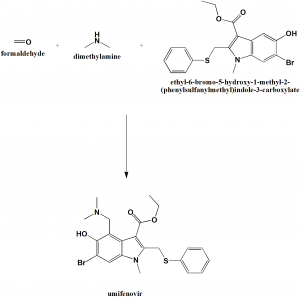
        After installing the device, add 100 mL of glacial acetic acid solution to the three-necked flask, cool it to 0 °C, slowly add 40 mL of 40% methylamine aqueous solution, and then add 10 mL of 37% formaldehyde aqueous solution, and after the reaction is stirred for 15 min, add 6- Ethyl bromo-5-hydroxy-1-methyl-2-phenylthiomethylindole-3-carboxylate (12.6g, 0.03moL), stirred uniformly for 10 min, then began to heat up to 80°C, maintaining the reaction temperature , and react for 4 h after complete dissolution. After the reaction is over, pour the reaction solution into water, add an appropriate amount of 20% potassium hydroxide solution to neutralize it with stirring, adjust the pH of the solution to 7.0, precipitate solids, filter with suction, and wash with water once. The solid was obtained by suction filtration, and dried in an oven at 70 °C for 5 h to obtain a crude product. Recrystallize with acetonitrile, after complete dissolution, add 1 g of activated carbon to reflux for 30 min, filter hot, cool, and precipitate 8.5 g of brown solid Arbidol. Yield 60%.
        Example 5: Arbidol hydrochloride
         
        Install the device, add an appropriate amount of acetone solvent to the three-necked flask, add Arbidol (8.5g, 0.018moL) under stirring, heat to reflux, add 10mL of concentrated hydrochloric acid dropwise, reflux for 30 min, and after the reaction is over, cool the reaction The liquid was brought to room temperature, and filtered with suction to obtain crude Arbidol hydrochloride, which was dried in an oven at 50 °C for 3 h. Recrystallize with acetone:ethanol (3:2) solvent, cool at room temperature for 10 h, freeze in refrigerator for 10 h, suction filtration, wash the solid with a small amount of acetone, and obtain 7.0 g of refined Arbidol hydrochloride in a yield of 75%. MS (EI): m/z: 513.8754 ([M]+).


Clip

https://www.sciencedirect.com/science/article/pii/S0960894X1730687X

Image result for Arbidol


CLIP

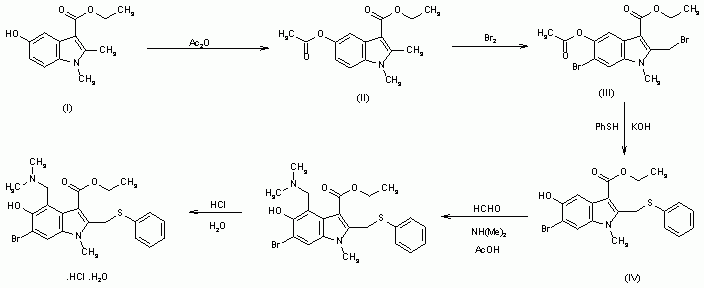
1,2-Dimethyl-5-hydroxyindole-3-acetic acid ethyl ester (I) is acetylated with acetic anhydride affording the O-acyl derivative (II) , which is brominated to the corresponding dibromide compound (III) . The reaction of (III) with thiophenol in KOH yields (IV) , which is then submitted to a conventional Mannich condensation with formaldehyde and dimethylamine in acetic acid, giving the free base of arbidol (V), which is treated with aqueous hydrochloric acid .

Image result for Arbidol

CLIP

Umifenovir

https://www.sciencedirect.com/science/article/pii/S0045206820317867

Umifenovir (Arbidol®) is an indole derivative first marketed in 1993 for the prophylactic treatment of infections caused by influenza A and B viruses [74]. Produced by Pharmstandard, it is still currently used in Russia and China to treat influenza infections [75]. Umifenovir is marketed in 50 and 100 mg capsules, being administered orally. The pharmacokinetics is limited, presenting rapid absorption and reaching the maximum concentration in 1.6–1.8 h. It is a slow elimination drug, with a half-life of 16 to 21 h, and may be administered twice a day [76].

The drug’s anti-influenza mechanism of action is related to arbidol’s ability to bind to the haemagglutinin (HA) protein [77]. The haemagglutinin (HA) protein is a homotrimeric glycoprotein found on the surface of the influenza virus, and it is essential for its infectivity. This protein is responsible for allowing the influenza virus binding to the sialic acid present on the surface of the target cells (respiratory tract cells or erythrocytes). As a result of this interaction, the virus is internalized in the host cell. Once umifenovir binds to the HA protein, this glycoprotein is prevented from binding to sialic acid, so the virus is no longer able to penetrate the host cell [78].

The structural similarity between the SARS-CoV-2 peak and the influenza virus (H3N2) HA glycoproteins justifies the fact that drugs that are capable of binding to HA can also do so to the SARS-CoV-2 spike protein. This fact was evidenced by molecular modeling studies, wherein was demonstrated that umifenovir is able to bind to the protein peak, preventing its trimerization, which would be a determining factor for the mechanism of cell adhesion (Fig. 8) [78].

Fig. 8. Umifenovir (in orange) binding region in SARS-CoV-2 spike glycoprotein. Reprinted from International Journal of Antimicrobial Agents, 56, N. Vankadari, “Arbidol: A potential antiviral drug for the treatment of SARS-CoV-2 by blocking trimerization of the spike glycoprotein”, Page 2, with permission of Elsevier. Copyright 2020. (For interpretation of the references to colour in this figure legend, the reader is referred to the web version of this article.)

Recently in 2020, in vitro studies performed with Vero cells confirmed that arbidol efficiently inhibits SARS-CoV-2 infection with an EC50 of 4.11 μM. The author also determined that arbidol was able to efficiently block both viral entry and post-entry stages, and also concluded that the drug prevented the viral attachment and release of SARS-CoV-2 from the intracellular vesicles. Importantly, the EC50 of arbidol against SARS-CoV-2 led the authors to suggest that the dose of arbidol currently recommended by the Chinese Guidelines (200 mg, 3 times/day) should be elevated in order to achieve ideal therapeutic efficacy to inhibit the SARS-CoV-2 infection [79].

A clinical trial was conducted at Wuhan Jinyintan Hospital, in 2020, from February 2 to March 20 conducted to evaluate the effectiveness and safety of umifenovir in the treatment of COVID-19 patients. In this study, 81 patients were evaluated: 45 received 200 mg of umifenovir three times a day, and 36 were in the control group. The authors concluded that baseline clinical and laboratory characteristics were similar in the two groups, and patients in the umifenovir group had a longer hospital stay than those in the control [80]. Although such results may seem discouraging, further clinical trials with higher doses of umifenovir may be required in order to verify its clinical efficiency against the SARS-CoV-2 infection.

The synthesis of umifenovir was described in 2006 starting from the reaction between ethyl acetoacetate 63 and methylamine, giving enaminone 64, which next undergoes a Nentizescu condensation reaction with 1,4-benzoquinone to produce indole derivative 65 (Scheme 9). Then, an acetylation reaction is carried out to protect the hydroxyl group in 65, producing 66, which is converted to 67 after a bromination step. The reaction of intermediate 67 with thiophenol in basic medium leads to the formation of 68, which finally affords umifenovir after a Mannich reaction [81].

Scheme 9. Synthetic route towards umifenovir.

Q. Guo, M. Xu, S. Guo, F. Zhu, Y. Xie, J. Shen

The complete synthesis of favipiravir from 2–aminopyrazine
Chem. Pap., 73 (2019), pp. 1043-1051

[75]

Y.S. Boriskin, I.A. Leneva, E.I. Pecheur, S.J. Polyak

Arbidol: a broadspectrum antiviral compound that blocks viral fusion
Curr. Med. Chem., 15 (2008), pp. 997-1005

[76]

I.A. Leneva, R.J. Russell, Y.S. Boriskin, A.J. Hay

Characteristics of arbidol-resistant mutants of influenza virus: implications for the mechanism of anti-influenza action of arbidol
Antiviral Res., 81 (2009), pp. 132-140

[77]

P. Deng, D. Zhong, K. Yu, Y. Zhang, T. Wang, X. Chena

Pharmacokinetics, Metabolism, and Excretion of the Antiviral Drug Arbidol in Humans
Antimicrob. Agent. Chemother., 57 (2013), pp. 1743-1755

[78]

N. Vankadari

Arbidol: A potential antiviral drug for the treatment of SARS-CoV-2 by blocking trimerization of the spike glycoprotein?
Int. J. Antimicrob. Agent., 56 (2020), p. 105998, 10.1016/j.ijantimicag.2020.105998

[79]

T.O. Edinger, M.O. Pohl, S. Stertz

Entry of influenza A virus: host factors and antiviral targets
J. Gen. Virol., 95 (2014), pp. 263-277

[80]

X. Wang, R. Cao, H. Zhang, J. Liu, M. Xu, H. Hu, Y. Li, L. Zhao, W. Li, X. Sun, X. Yang, Z. Shi, F. Deng, Z. Hu, W. Zhong, M. Wang

The anti-influenza virus drug, arbidol is an efficient inhibitor of SARS-CoV-2 in vitro
Cell Discov., 6 (2020), p. 28

[81]

N. Lian, H. Xie, S. Lin, J. Huang, J. Zhao, Q. Lin

Umifenovir treatment is not associated with improved outcomes inpatients with coronavirus disease 2019: a retrospective study
Clin. Microbiol. Infect., 26 (2020), pp. 917-921
 
CLIP
CLIP
09831-scicon9-umifenovir.jpg

Drug-repurposing studies are testing a range of compounds to treat COVID-19, but manufacturers may struggle to meet demand if any of these candidates prove effective against SARS-CoV-2. The pandemic has already strained global supply chains and limited the availability of a number of products, including hand sanitizer and diagnostic test reagents. The raw materials needed to make a new antiviral drug would most likely face similar pressures. But a team led by Tim Cernak of the University of Michigan has used an AI-based retrosynthesis program called Synthia to devise alternative routes to 12 leading drug candidates under investigation. The work appears on a preprint server and has not been peer reviewed (ChemRxiv 2020, DOI: 10.26434/chemrxiv.12765410.v1). “If the world runs out of one of the drugs currently in the clinic, we are providing a backup recipe,” Cernak says. Using alternative starting materials that are readily available, the researchers aimed to find routes of similar length and cost to those of existing syntheses. For each compound, the researchers whittled down a long list of options offered by Synthia to identify the most suitable synthetic strategies. Then the team tested some of these syntheses in the lab, including four new routes to the antiviral umifenovir, currently being investigated in eight clinical trials against COVID-19. Cernak says this approach could be used more generally to rapidly identify alternative synthetic routes whenever crises cause supply chain disruptions in drug manufacturing.

Artificial intelligence finds alternative routes to COVID-19 drug candidates

If drug-repurposing studies hit pay dirt, backup recipes could help antiviral manufacturers avoid supply chain problems

by Mark Peplow, special to C&EN
August 14, 2020 | A version of this story appeared in Volume 98, Issue 31
 
 
CLIP
The research on the disease COVID-19 is an ongoing process since its outbreak as a pandemic. The repurposing of existing approved drugs has received priority attention due to some promising results obtained regarding COVID-19. In this article, some of the important chemical methodologies adopted for the synthesis of umifenovir, (s)-cidofovir, ribavirin, and ruxolitinib have been discussed. The repurposing of these approved drugs has received priority attention due to some promising results obtained regarding COVID-19 and some drugs are under more therapeutic trials. This manuscript has highlighted the synthetic strategies of four heterocyclic-based approved drugs, umifenovir, (s)-cidofovir, ribavirin, and ruxolitinib, repurposed for the treatment of COVID-19.


PATENT

https://patents.google.com/patent/WO2018112128A1/en

EXAMPLES
c
Original Synthesis
Figure imgf000010_0001
internfsediate 8 Afbki ;i (soW as the HGi salt)
Figure imgf000010_0002

Arbidol Core Synthesis


Ethyl 5-acetoxy-2-methyl-1H-indole-3-carboxylate 1a: Acetic anhydride (25.9 ml, 274 mmol 20 eq.) was added to a stirred solution of ethyl 5-hydroxy-2-methyl-1H-indole- 3-carboxylate 1 (3.00 g, 13.6 mmol, 1.0 eq.) in pyridine (3.32 mL, 41.1 mmol, 3.0 eq.) and the reaction heated to reflux. After 1 h, the reaction was allowed to cool back to rt before pouring the mixture into a solution of aqueous saturated sodium bicarbonate (40 mL). The product was extracted with ethyl acetate (3 x 40 ml) and the combined organic layers were washed with water (40 mL), dried (Na 2 SO 4 ) and concentrated In vacua to yield the product as a white solid which was used without further purification (3.4g, 96%). NMR: δH ( 400 MHz, CDCl 3) 8.34 (1H, s; NH), 7.75 (1H, s, H 4 ), 7.21 (1H, d, J 8.5, H 6 ), 6.89 (1H, d, J 8.5, H 7 ), 4.38 (2H , q, J 7.1 , CO 2 CH 2 CH 3 ), 2.71 (3H, s, C 1 CH 3 ), 2.34 (3H, s, CO 2 CH 3 ), 1.43 (3H, t, J 7.1, CO 2 CH 2 CH 3 ). δ c (100 MHz, CDCl 3 ) 170.8<a name=”

(CO 2 CH 3 ), 165.8 (CO 2 Et), 1.45.9 (C 5 ), 145.3 (C 2 ), 132.4 (C 8 ). 127.9 (C 3 ), 116.3 (C 6 ), 113.8 (C 4 ), 111.2 (C 7 ), 99.8 (C 1 ), 59.7 (CO 2 ΡΗ 2 ΡΗ 3 ), 21.4 (C 1 CH 3 ). 14.8 (CO 2 PH 2 CH 3 ), 14.4 (CO 2 CH 3 ). Rf : _

0.31 (40% ethyl acetate in hexane), HRMS. (ESI-TOF): C 14 H 15 O 4 N ([M+H] + ) requires 262.1074, found 262.1074.


Ethyl 5-acetoxy-1,2-dimethyl-1H-indole-3-carboxylate 1b: Protected indole 1b (1.35 g, 5.17 mmol, 1 eq.) was dissolved in DMF (15 mL). To this solution, methyl iodide (0.965 ml, 15.5 mmol, 3.0 eq.) was added and the resulting mixture was cooled on ice. Sodium hydride (0.186 g, 7.75 mmol, 1.5 eq.) was added and the reaction was left to stir on ice for 1.5 h. After this time, a small amount of water (5.0 mL) was added to the reaction and the solvents removed in vacuo. The resultant brown oil was then purified directly by column chromatography (30% ethyl acetate in petrol) to yield the title compound as a pale yellow solid (1.50 g, 95%). NMR: δ Η (500 MHz, CDCl 3 ) 7.79 (s, 1H, H 4 ), 7.26 (m, 1H, H 6 ), 6.96 (ddd, J = 8.8, 2.4, 0.8 Hz, 1H, H7 ), 4.38 (f, J = 7.1 Hz, 2H, CO 2 CH 2 CH 3 ), 3.69 (s, 3H, NCH 3 ), 2.77 (d, J = 1.3 Hz, 3H, ΑrCΗ 3 ), 2.33 (s , 3H, CO 2 CH 3 ), 1.43 (t, J= 7.1 Hz, 3H, CO 2 CH 2 CH 3 ). δ C (150 MHz, CDCl 3 ) 170.5 (CO 2 CH 3 ), 166.0 (CO 2 Et), 146.5 (C 5 ), 146.0 (C 2 ), 134.5 (C 8 ), 127.2 (C 3 ), 116.2 ( C6 ), 114.0 (C4 ) , 109.6 (C7 ), 104.4 (C 1 ), 59.6 (CO 2 CH 2 CH 3 ), 29.9 (NCH 3 ), 21.3 (C 1 CH 3 ), 14.8 (CO 2 CH 2 CH 3 ), 12.1 (CO 2 CH 3 ) . R f : 0.4 (30% ethyl acetate in hexane). HRMS (ESI-TOF): C 15 H 17 O 4 N ,([M+H] + ) requires 276.1230, found 276.1229.


Ethyl 6-bromo-2-(bromomethyl)-5-hydroxy-1-methyl-1H-indole-3-carboxylate 2: Bromine (558 μL, 10.9 mmol, 3.0 eq.) was added to a stirred solution of protected indole ( 1b, 1.00 g, 3.63 mmol, 1.0 eq.) in carbon tetrachloride (100 mL). After refluxing for 16 h, the reaction was cooled and aqueous sodium thlosulphate (10%. w/v, 100 mL) was added and left to stir for 20 min until the orange color disappeared. After this time, the organic layer was separated, washed with water (2 x 100 mL), dried (Na 2 SO 4 and concentrated in vacuo to yield a pale yellow solid, which was used without further purification (1.40 g, 99%) NMR: δ Η (400 MHz, PDCl 3 ) 7.86 (1H, s, H 4 ), 7.54 (1H, s, H 7), 5.05 (2H, s, CH 2 Br), 4.41 (2H, q, J 7.1, CO 2 CH 2 CH 3 ), 3.69 (3H, s, NCH 3 ), 2.39 (3H, s, CO 2 CH 3 ), 1.45 (3H, t, J 7.1, CO 2 CH 2 CH 3 ), δ C (100 MHz, CDCl 3 )

169.4 (CO 2 CH 3 ), 164.3 (CO 2 Et), 143.4 (C 5 ), 142.6 (C 2 ), 135.5 (C 3 ), 125.7 (C 8 ), 116.3 (C 4 ), 113.9 (C 7 ) , 112.0 (C 6 ), 105.6 (C 1 ), 60.3 (CO 2 CΒ 2 CΗ 3 ), 30.1 (NCH 3 ), 20.9 (CO 2 CH 3 ), 20.6 (C 1 CH 2 Br),

1.4.5 (CO 2 CH 2 CH 3 ), R f : 0.75 (CH 2 Cl 2 ). HRMS (ESI-TOF): C 15 Η 15 O 3 ΝΒr ([M+H] + ) requires 431.9441, found 431.9441.<a name=”

Ethyl 6-bromo-5-hydroxy-1-methyl-2-((phenylthio)methyl)-1H-indole-3-carboxylate 3: Thiophenol (99.8 μL, 0.972 mmol, 1.0 eq.) was added to a solution of potassium hydroxide (164 mg, 2.92 mmol, 3.0 eq.) in methanol (2 ml) and left to stir at room temperature for 15 min. After this time, the solution was cooled on ice and bromo indole 2 (880 mg, 0.972 mmol, 10 eq.) in CH 2 Cl 2 (5 mL) was added. The reaction was left to stir for 3 h before neutralization with acetic acid. The solvent was removed in vacuo and columned directly (20% EtOAc in petrol) to yield the title product as a pale yellow solid (362 mg, 86%). NMR: δ Η (600 MHz, CDCl 3 ) 7.74 (s, 1 H, Hr), 7.43 (s, 1H, H 4 ), 7.36 (dq, J = 5.2, 3.4, 2.4 Hz, 2H, H10 ), 7.25 (dd, J = 5.2, 1.9 Hz, 3H, H 11 and 5.33 (s, 2H, SCH 2 ), 4.29 (q, J = 7.3 Hz, 2H, CO 2 CH 2 CH 3 ), 3.60 (d, J = 18.1 Hz, 3H, NCH 3 ), 1.38 (t, J = 7.3 Hz, 3H, CO 2 CH 2 CH 3 ), δ c (150 MHz, CDCl 3 ) 165.1, 147.7, 144.2, 134.1 R f : 0.35 (20% EtOAc in petrol) HRMS (ESI-TOF)-: C 19 H 18 BrNO 3 S ([M+H] + ) requires 420.0263, found 420.0260.


Arbidol [Ethyl 6-bromo-4((dimethylamino)methyl)-5-hydroxy-1-methyl-2-((phenylthio)methyl)-1H-indole-3-carboxylate] 4: 1 Indole 3 (200 mg, 0.476 mmol, 1.0 eq.) and N, N, N’, N’-tetramethylaminomethane (1-95 μL, 1.43 mmol, 3.0 eq.) were dissolved in 1,4-dioxane (2 mL). The reaction was. heated to reflux for 3.5 h before removing the solvent in vacuo. The reaction was then re-dissolved in ethyl acetate and 1 M HCl was added to the solution causing the title product to crash out as a pale yellow solid (117 mg, 51%). NMR-: δ B (500 MHz, MeOD) 7.87 (s, 1 H, H 7 ), 7.39 (dd, J = 7.4, 2.2 Hz, 2H, H 10 ), 7.35 – 7.31 (m, 3H, H 11 and H12 ) . 4.87 (s, 2H, SCH 2), 4.71 (s, 2H, CH 2 NMe 2 ), 4.33 (q, J = 7.1 Hz, 2H, CO 2 CH 2 CB 3 ), 3.63 (s, 3H, NCH 3 ), 2.97 (s, 6H, N (CH 3 ) 2 ), 1.39 (t, J = 7.1 Hz, 3H, CO 2 CH 2 CH 3 ). δ c (150 MHz, MeOD) 169.7 (CO 2 Et), 152.7 (C s ), 149.0 (C), 137.7 (C 10 ), 136.4 (C 3 ), 136.0 (C 8 ), 132.3 (C 11 ), 131.3 (CH), 129.3 (C12 ) , 119.8 (C7 ) , 113.1 (C2), 111.3 ( C6), 108.3 (C4 , 64.2. (CO 2 CH 2 CH 3 ), 57.4 (CH 2 NMe 2 ), 45.4 (CH 2 N(CR 3 ) 2 ); 33.7 (CH 2 SPh), 32.9 (NCH 3 ), 16.6 (CO 2 CH 2 CH 3 ). R f : 0.25 (EtOAc). HRMS (ESI-TOF): G 22 H 25 BrN 2 O 3 S ([M+H] + ) requires 477.0842, found 477.0844.

Synthesis of Arbidol Analogues


Ethyl 5-acetoxy-6-bromo-2-(((3-hydroxyhpenyl)thio)methyl)-1-methyl-1H-indole-3-carboxylate 8a: 3-hydroxythiophenol. (117 μL, 1.15 mmol, 1.0 eq.) was added to a solution of sodium carbonate (367 mg, 3.46 mmol, 3.0: eq.) and bromo indole 2 (500 mg, 1.15 mmol, 1.0 eq.) in dry ethyl acetate (10mL). The reaction was heated to 100°C and stirred for 5 h before<a name=”cooling, filtering and removing the solvent in vacuo. The compound was purified by column chromatography (40% EtOAc in Hexanes) to produce the title product as a pale yellow solid (240 mg, 44%). NMR: δ H (500 MHz,. CDCl 3 ) 7.85 (s, 1H, H 7 ), 7.56 (s, 1 H, H 4 ), 7.12 (t, J = 7.9 Ηz, 1Η, H 13 ), 6.95 – 6.90.(m, 1H, Η 14 ), 6.78 (s, 1H, H 10 ), 6.75-6.71 (m, 1H,.H 12 ), 4.69 (s, 2H, SCH 2 ), 4.30 (q, J = 7.4 Hz, 3H, CO 2 CH 2 CH 3 ), -3.66 (s, 3H, NGH 3 ), 2.4Q (s, 3H, COCH 3), 1.38 (t, J = 7.4 Hz, 3H, CO 2 CH 2 CH 3 ). Δ C (150 MHz, CDCL 3 ) 169.8, 165.0, 156.1, 144.6, 143.3, 135.6, 135.1, 130.1, 126.1, 124.8, 119.3, 113.9, 111.1, 105.8, 60.1, 30.4, 29.9, 21.0, 14. . R f : OAS (30% EtOAc in Hexane). HRMS (ESS-TOF): C 21 H 20 SrNO 5 S ([M+H] + ) requires 473.0318, found 478.0317.


Ethyl 6-bromo-5-hydroxy-24(((3-hydroxyphenyl)thio)methyl)-1-methyl-1H-indole-3-carboxylate 8: Sodium carbonate (106 mg. 1.00 mmol, 2.0 eq.) was added to a stirred solution of meta-hydroxy indole 8a (240 mg, 0.502 mmol, 1.0 eq.) in methanol (40 ml) and left to stir for 2h, The solution was then filtered and the solvent removed in vacuo, The product was re -dissolved in ethyl acetate (10 mL) and washed once with water (40 mL) before drying (Na 2 SO 4 and concentrating in vacuo to give the title product as a white solid, which could be used without further purification (160 mg, 67%), NMR-: δ H (600 MHz, MeOD) 7.60 (s, 1H, H 7 ), 7.58 (s, 1 H, H 4 ), 7.07 (dd, J = 8.2, 7.7 Hz, 1H, H 13), 6.83 – 6.81 (m, 1Η, Η 14 ), 6.79 (ddd, J = 7.7, 1.8, 0.9, 1H, H 10 ), 6.7.0 (dd, J = 8.2, 1.8, 0.9 Hz, 1H, H 12 ), 4.70 (s, 2H, SCH 2 ), 4.26 (q, J = 7.1 Hz, 2H, CO 2 CH 2 CH 3 ), 3.64 (s, 3H, NCH 3 ), 1.39 (t, J = 7.1 Hz , 3H, CO 2 CH 2 CH 3 ). δ c (150 MHz, MeOD) 166.9, 158.9, 150.6, 145.5, 136.4, 133.6, 131.0,. 130.7, 128.0, 1.24.9, 120.5, 116.0, 114.8, 107.9, 104.8, 60.8, 30.5, 30.4, 14.8. R f : 0.45 (1% MeOH in CΗ 2 Cl 2 ). HRMS (ESI-TOF): C 7 PM18 BrNO 4 S ([M+H] + ) requires 436.0213, found 436.0215.


Ethyl 2-(((3-aminophenyl)thio)methyl)-6-bromo-5-hydroxy-1-methyl-1H-indole-3-carboxyiate 9: 3-aminothiophenol (54.3 μL, 0.511 mmol, 1.0 eq.) was added to a solution of potassium hydroxide (86 mg, 1.53 mmol, 3.0 eq.) in methanol (2 ml) and left to stir at room temperature for 15 min. After this time, the solution was cooled on ice and bromo indole 2 (200 mg, 0.511 mmol, 1.0 eq.) in CH 2 Cl 2 (5 ml) was added. The reaction was left to stir for 3 h before neutralization with acetic-acid. The solvent was removed in vacuo and purified directly by preparative TLC (1% MeOH in CH 2 Cl 2 ) to yield the title product as a pale yellow solid (138 mg, 62%), NMR: δ H (500 MHz, CDCl 3) 7.74 (d, J = 1.8 Hz, 1H, H 7 ), .7.42 (d, J = 1.8 Hz., 1H, H 4 ), 7.03 (t, J = 8.1 Hz, 1 H, H 13 ), 6.75 (d, J= 7.7 Hz, 1H, H 14 ), 6.68 (s, 1H, H 10 ), 6.55 (d, J = 6.1 Hz, 1H, H 12 ), 4.68 (d, J = 1.9 Hz, 2H, SCH 2 ), 4.35 ™ 4.30 (m, 2H, COCH 2 GH 3 ),. 3.60 (d, J = 1.9 Hz, 3H, NCH 3 ), 1.40 (td, J = 7.1, 1.8 Hz, 3H, COCH 2 CH 3 ). δ c (150 MHz, CDCl 3 ) 1-66.9, 150.6, 149.6,<a name=”

146.0, 136.0, 133.5, 1 30.5, 128.1, 123.1, 120.2, 117.6, 115.8, 114.8, 107.9, 104.6, 68.1, 60.8, 30.4, 14.8. R f : 0.85 (1% MeOH in CH 2 Cl 2 ), HRMS (ESI-TOF): C 19 H 19 BrN 2 O 3 S ([M+H] + ) requires 435.0372, found 435.0370.


Ethyl 2-(((3-aminophenyl)thio)methyl)-6-bromo-5-hydroxy-1-methyl-1H-indole-3-carboxylate 10: 2-napthalenethiol (82.0 mg, 0.511 mmot, 1.0 eq.) was added to a solution of potassium hydroxide (86 mg, 1.53 mmol, 3.0 eq.) in methanol (2 mL) and left to stir at room temperature for 15 min. After this time, the solution was cooled on ice and bromo indole 2 (200 mg, 0.511 mmol, 1.0 eq.) in CH 2 Cl 2 (5 mL) was added. The reaction was left to stir for 3 h before neutralization with acetic acid. The solvent was removed in vacuo and purified directly by preparative TLC (1% MeOH in CH 2 Cl 2 ) to yield the title product as a pale yellow solid (118 mg, 50%). NMR: δR(600 MHz, DMSO) 9.77 (s, 1H, OH), 7.83 (d, J = 1.8 Hz, 1H, Ar), 7.81 -7.79 (m, 1H, Ar), 7.75 (d, J = 8.6 Hz, 1H , Ar), 7.72 – 7.70 (m, 1H, Ar), 7.66 (s, 1H, Hz), 7.46 (s, 1H, H 4 ), 7.45 – 7.40 (m, 2H, Ar), 7.34 (dd, J = 8.5, 1.9 Hz, 1H, Ar), 4.82 (s, 2H, CH 2 SPh), 4.04 (q, J = 7.1 Hz, 2H, CO 2 CH 2 CH 3 ), 3.63 (s, 3H, NC. %), 1.14 (t, J = 7.1 Hz, 3H, CO 2 CH 2 CH 3 ). δ c (150 MHz, DMSO) 164.3, 149.3, 143.4, 133.2, 132.0, 131.7, 131.6, 128.9, 128.4, 128.4, 127.7, 127.2, 126.8, 126.3, 1:26.0, 116.3, 116.3, 116.3 06.3, 103.3, 59.2, 30.3, 28.1, 14.3. R f : 0.75 (1% MeOH in CH2 Cl 2 ). HRMS (ESI-TOF): C 23 H 20 BrNO 3 S (fM+Hf) requires 470.0420, found 470.0420.


Ethyl 6-bromo-4-((dimethylammino)methyl)-5-hydroxy-2-(((3-hydroxyohenyl)thio)methyl)-1-methyl-1H-indole-3-carboxylate 11; Meta-hydroxy indole 8 (30.0 mg, 0.069 mmol, 1.0 eq,) and N, N,N’,N’-tetramethyldiaminomethane (47.0 μL, 0.344 mmol, 5.0 eq.) were dissolved in CH 2 Cl 2 (30 mL) . The reaction was heated to reflux for 3.5 h before removing the solvent in vacuo to, yield the title product as a pale yellow solid (34 mg. 99%). NMR; δH (500 MHz, CDCl 3 ) 7.47 (s, 1H, H 7 ), 7.12 (t, J = 7.9 Hz, 1H, H 13 ), 6.90 (d, J = 7.9 Hz, 1H, H 14 ), 6.90 ( d, J = 7.9 Hz, 1H, H 12 ), 6.66 (s, 1H, H 10 ), 4.41 (s, 2H, CH 2 NMe2 ), 4.34 (s, 2H, CH 2 SPh), 4.15 (q, J = 7.1 Hz, 2H, CO 2 CH 2 CH 3 ), 3.60 (s, 3H, NCH 3 ), 2.55 (s, 6H, CH 2N (CH 3 ) 2 ), 1.33 – 1.21 (m, 3H, CO 2 CH 2 CH 3 ). δ c ( . 150 MHz, CDCl 3 ) 165.9, 156.7, 150.9, 142.6, 135.1, 132.2, 131.0, 130.0, 128.9, 124.6, 124.3, 119.3, 115.5, 113.4, 106.8, 106.8, 106.8, 106.8, 165.5 58.7, 44.0, 30.4, 29.9, 14.3, R f : 0.15 (10% MeOH in CH 2 Cl 2 ). HRMS (ESS-TOF): C22 H 25 BrN 2 O 4 S ([M+H] + ) requires 493.0791, found 493.0792,


Ethyl 22-(((3-aminophenyl)thio)methyl)-6-bromo-4-((dimethylamino)methyl)-5-hydroxy-1-methyl-1H-indole-3-carboxylate 12: Meta-amino Indole 14 (104 mg, 0.238 mmol, 1.0 eq.) and<a name=”

N,N,N’,N’-tetramethyldiaminomethane (1.95 μL, 1.43 mmol, 3.0 eq.) were dissolved in 1,4-dioxane (1.5 ml). The reaction was heated to reflux for 3.5 h before removing the solvent in vacuo. The product was purified using preparative TIC to yield a pale yellow solid (13 mg, 11%). NMR: δ Β (500 MHz, MeOD.) 7.61 (s, 1H, H 7 ), 7.00 (t, J = 7.8 Hz, 1 H, H13), 8.69 (t, J = 2.0 Hz, 1. H , H 10 ), 6.61 – 6.66 (m, 2H, H 12 and H 14 ), 4.57 (s, 2H, CH 2 SPh), 4.40 (s, 2H, CH 2 NMe 2 ), 4.24 (q, J = 7.2 Hz, 2H, CO 2 CH 2 CH 3 ), 3.61 (s, 3H, NCH 3), 2.55 (s, 6H, CH 2 N(CH 3 ) 2 X 1.36 (t, J = 7.1 Hz, 3H, CO 2 CH 2 CH 3 ). δ c (150 MHz, MeOD) 167.6, 149.7, 144.5, 136.0, 132.6, 130.6 , 129.8, 126.1, 123.0, 120.2, 115.9, 114.8, 112.5, 111.4, 110.7, 61.5, 59.8, 43.5, 31.2, 30.5, 14.6. in CH 2 Cl 2 ).HRMS (ESi-TOF): C 22 H 26 BrN 3 O 3 S ([M+H] + ) requires 492.0951, found 492.0951.


Ethyl 6-bromo-4-((dimethylaminom)ethyl)-5-hydroxy-1-methyl-2-((naphthalen-2-ylthio)methyl)-1H-indole-3-carboxylate 13: Naphthatenyl indole 10 (112 mg , 0.238 mmol, 1.0 eq.) and N,N,N’,N’-tetramethyldiaminomethane (1.95 μL, 1.43 mmol, 3.0 eq.) were dissolved in 1,4-dioxane ( 1.5 mL). The reaction was heated, to reflux for 3.5 h .before removing the solvent in vacuo. The product was purified using preparative TIC to yield a pale yellow solid (26 mg, 20%). NMR: δH (600 MHz, MeOD) 7.83 – 7.60 (m, 1H, Ar), 7.74 (d, J = 7.8 Hz, 2H, Ar), 7.68 -7.65 (m, 1H, Ar), 7.60 (s, 1 H, Hr), 7.49 -7.43 (m, 2H, Ar), 7.34 (dd. J = 8.6, 1.7 Hz, 1 H. Ar), 4.69 (s, 2H, CH 2 SPh), 4.27 (s, 2H, CH 2 NMe 2 ), 4.04 – 3.98 (m, 2H, CO 2 CH 2 CH3 ), 3.65 (s, 3H, NCW 3 ), 2.45 (s, 6H, CH 2 N(CH 3 ) 2 ), 1.21 – 1.15 (m, 3H, CO 2 CH 2 CH 3 ). Δ C (150 MHz, MEOD) 167.3, 154.9, 143.8, 133.2, 132.6, 132.6, 131.3, 129.5, 128.6, 128.6, 125.9, 114, 106.6, 61.4, 114, 127.6, 127. 60.0, 43.5, 31.0, 30.8, 30.6, 14.5. R f : 0.65 (10% MeOH in CH 2 Cl 2 ). HRMS (ESI-TOF): C 26 H 27 BrN 2 O 3 S ([M+H] + ) requires 527.0998, found 527.0996.

Boc piparazinyl arbidol [Ethyl 5-acetoxy-6-bromo-4-((4-tert-butoxycarbonyl)piperazin-1-yl)methyl)-1-methyl-2-((phenylthio)moethyl)-1H-indole-3 -carboxylate] 14; Arbidol 4 (20mg,

0.0419 mmol, 1.0 eq.) and 1-boc-plperazilne (24 mg, 0.126 mmol, 3.0 eq. ) were dissolved in 1,4-dioxane. (2 mL) and refluxed overnight. The solvent was then removed in vacuo and the reaction columned directly to yield the title product as a yellow solid (20 mg, 77%). MMR: δH (400 MHz, MeOD) 7.55 (s, 1H, H 7 ), 7.30 – 7.20 (m, 5H, SPh), 4.54 (s, 2H, CH 2 SPh), 4.25 – 4.07 (m, 4H, CH 2 NR 2 and CO 2 CH 2 CH 3 ), 3.58 (d, J= 8.2 Hz, 3H, NCH 3 ), 3.47 (br s, 4H, BocN(CH 2 ) 2 ), 2.53 (brs, 4H , BoeN(CH 2 CH 2)2). 1.44 (s, 9H, Boc), 1.30 – 1.26 (m, 3H, CO 2 CH 2 CH 3 ). δC (150 MHz, MeOD ) 167.2, 156.2, 151.3, 144.0, 1.35.4, 134.3, 134.1, 133.6,. 130.1, 129.9,. 129.0, 128.9, 125.6, 114.8, 114.3, 113.8, 108.7, 107.9, 167.1, 81.5, 61.5, 60.7, 58.6, 53.0, 30.9, 30.6, 28.6,<a name=”14.8, 14.6. R f : 0.5 (30% EtOAc in petrol). HRMS (ESI-TOF): C 29 H 36 BrN 3 O 5 S ([M + H]+) requires 618.1632, found 618.1631.


Alkoxy piperazinyl Arbidol [Ethyl 5-acetoxy-6-bromo-4-((4-(2-hydroxyethyl)piperazin-1-yl)methyl)-1-methyl-2-((phenylthio)methyl)-1H-indole- 3-carboxylate] 15: Arfaidol 4 (20mg,

0.0419 mmol, 1.0 eq.) and 1-(2-((trimethylsilyl)oxy)ethyl)piperazine (25 mg, 0.126 mmol, 3.0 eq.) were dissolved in 1,4-dioxane (2 mL) and refluxed overnight. The solvent was then removed in vacuo and the reaction columned directly to yield the title product as a yellow solid (12 mg, 51%). NMR: δ Η (400 MHz, MeOD) 7.56 (s, 1.H, H 7 ), 7.22 – 7.30 (m, 5H, SPh), 4.57 (s, 2H, CH 2 SPh), 4.14 – 4.19 (m, 4H, CH 2 NR 2 and CΟ 2 CH 2 CΗ 3 ), 3.68 (t, J = 5.9 Hz, 2H, . CH 2 OH), 3.60 (s, 3H, NCH 3 ), 2.53 – 2.70 (m, 10H, piperazine ring and CH 2 CH2 CH 2 OH), 134 – 1.30 (rn, 3H, CO 2 CH 2 CH 3 ), δ c (150 MHz, MeOD) 167.2, 151.7, 143.9, 135.4, 134.2, 133.4, 130.1, 129.0, 125.5, 114.1, 113.6, 107.0, 108.9, 108.9, 108.9 61.5, 61.1, 59.8, 59.1, 54.3, 52.9, 30.9, 30.5, 14.7. R f : 0.15 (5% MeOH in CH 2 Cl 2 ), HRMS (ESI-TOF): C 26 H 32 BrN 3 O 4 S ([M+H] + ) requires 562.1370, found 562.1368,


Ethyl 6-bromo-5-hydroxy-2-(((2-hydroxyphenyl)thio)methyl)-1-methyl-1H-indole-3-carboxylate 16: 2-hydroxythiophenol (26.0 μL, 0.256 mmol, 1.0 eq.) was added to a solution of sodium carbonate (81.0 mg, 0.767 mmol, 3.0 eq.) and promo indole 2 (100 mg, 0.256 mmol, 1.0 eq.) in ethyl acetate (2 mL). The reaction was heated to 50°C and stirred for 2 h before cooling and removing the solvent in vacuo. The product was then re-dissolved in methanol (2 mL) and potassium hydroxide (21.5 mg, 0.384 mmol, 1.5 eq.) was added. The reaction was stirred at room temperature for 3 h before direct purification by preparative TLC (2% MeOH in CH 2 Cl 2 ) to yield the title product as. a white solid (20.5 mg, 1.8%), NMR: δ H (500 MHz, MeOD) 7.59 (s, 1H, H 7), 7.54 (s, 1H, Η 4 ), 7.17 (t, J = 7.7 Hz, 1H, H 12 ), 7.08 (d, J = 7.7 Hz, 1H, H 14 ), 6.85 (d, J =7.7 Hz , 1H, H 13 ), 6.66 (t, J = 7.7 Hz, 1H, H 15 ), 4.58 (s, 2H, SCH 2 ), 4.24 (q, J = 7.1 Hz, 2H, CO 2 CH 2 CH 3 ) , 3.59 (s, 3H, NCH 3 ), 1.40 (t, J = 7.1 Hz, 3H, CO 2 CH 2 CH 3 ). δ c (150 MHz, MeOD) 161.3, 146.4, 143.3, 134.8, 132.0, 130.4, 129.4, 123.7, 123.0, 121.8, 120.5, 114.4, 113.6, 110.0, 102.7, 60.04, 390.2, 390.2, 390.04 R f : 0.6 (2% MeOH in CH 2 Cl2 ). HRMS (ESI-TOF): C 19 H 18 BrNO 4 S ([M+H] + ) requires 436.0213, found 436.0212.


Ethyl 6-bromo-5-hydroxy-2-(((4-hydroxyphenyl)thmetihoyl)-)1-methyl-1H-indole-3-carboxylate 17: 4-hydroxythiophenol (26.0 μL, 0.256 mmol, 1.0 eq.) was added to a solution of sodium carbonate (81.0 mg, 0.767 mmol, 3.0 eq.) and bromo indole 2 (100 mg, 0.256 mmol, 1.0 eq.) in ethyl acetate (2 mL). The reaction was heated to 50°C. and stirred for 2 hours before cooling<a name=”and removing the solvent in vacuo. The product was then re-dissolved in methanol (2 mL) and potassium hydroxide (21.5 mg, 0.384 mmol, 1.5 eq.) was added. The reaction was stirred at room temperature for 3 h before direct purification by preparative TLC (2% MeOH in CH 2 Cl 2 ) to yield the title product as a white solid (2.5 mg, 2%). NMR: δ Η (600 MHz, DMSO) 7.65 (s, 1H, H 7 ), 7.49 (s, 1 H, H 4 ), 7.03 (d, J = 8.7 Hz, 2H , H 12 ), 6.58 (d, J = 8.7 Hz, 2. HH 13 ) , 4.52 (s, 2H, SCH 2 ), 4.08 (q, J = 7.2 Hz, 2H, CO 2 CH 2 CH 3 ), 3.51 (s, 3H, NCH3 ), 1.23 (t, J = 7.1 Hz, 3H, CO 2 CH 2 CH 3 ). δ c (150 MHz, DMSO) 164.2, 157.9, 149.2, 144.3, 135.7, 131.4, 126.1, 1214, 115.9, 114.1, 106.3, 102.9, 79.2, 59.0, 55.4, 30.0, R 14.3, f ; 0.5 (2% MeOH in CH 2 Cl 2 ). HRMS (ESI-TOF): C 19 H 18 BrNO 4 S ([Μ+H] + ) requires 436.0213, found 436.0213.


Ethyl 5-acetoxy-6-bromo-2-(((3-methoxyphenyl) thio)methyl)-1-methyl-1H-indole-3-carboxylate 18a: 3-methpxythiophenol (14.6 μL, 0.118 mmol, 1.0 eq.) was added to a solution of sodium carbonate (37.4 mg, 0.353 mmol, 3.0 eq.) and bromo indoles 2 (46.0 mg, 0.118 mmol, 1.0 eq.) in dry ethyl acetate (20 ml). The reaction was heated to 50°C and stirred for 2 h before addition of water. The organic layer was separated, dried (Na 2 SO 4 ) and concentrated in vacuo. The compound was purified by column chromatography (20% EtOAc in Hexanes) to produce the title product as a white solid (34 mg, 59%). UMR; δ Η (600 MHz, DMSO) 7.92 (s, 1 H, H 7 ), 7.6.6 (s, 1 H, H 4 ), 7.13 (t, J = 7.9 Hz, 1H, H 13), 6.8.7 – 6.84 (m, 1 H, H 14 , 6.79 – 6.74 (m, 2H, H 10 and H 1 2 ), 4.77 (s, 2H, SCH 2 ), 4.13 (q, J = 7.1 Hz , 2H, CO 2 CH 2 CH 3 ), 3.70 (s, 3H, NCH 3 ), 3.58 (s, 3H, SPhOCH 3 ), 2.27 (s, 3H, COCH 3 ), 1.20 (t, J = 7.1 Hz, 3H, CO 2 CH 2 CW 3 ).δ c (150 MHz, DMSO) 169.1, 163.9, 159.4, 144.9, 142.6, 135.1, 135.0, 129.9, 125.2, 123.3, 116.2, 115.1, 114.73, 110.73, 110.2 104.3, 59.5, 55.1, 30.6, 28.1, 20.7, 14.3 R f : 0.4 (20% EtOAc in Hexane) HRMS (ESI-TOF): C 2222 BrNO s S ([M+H] + ) requires 492.0475, found 492.0472.


Ethyl 6-bromo-5-hydroxy-2-((3(-methoxyphenyl)thio)methyl)-1-methyl-1H-indole-3-carboxylate 18: Sodium carbonate (41.3 mg, 0.390 mmol, 2.0 eq.) was added to a stirred solution of meta-methoxy indole 18a (96.0 mg, 0.195 mmot, 1.0 eq.) in methanol (10 mL) and left to stir for 2h, the solution was then filtered and the solvent removed in vacuo. The product-was re-dissolved in ethyl acetate (10 mL) and washed once with water (10 mL) before drying (Na 2 SO 4 ) and concentrating in vacuo to give the title product as a white solid, which could he used without further purification (80 mg, 91%), NMR: δ Η (600 MHz, CDCl 3 ) 7.73 (s, 1H, Η 7 ), 7.41 (s, 1H, H 4 ), 7.17 – 7.13 (m, H 13), 7.07 (m, 1H, H 14 ), 6.96 (dt, J = 7.7, 1.3, 1H, H 10 ), 6.85 (m, 1H, H 12 ),4.71 (s, 2H, SCH 2 ), 4.30 ( q, J = 7.1 Hz, 2H, CO 2 CH 2 CH 3 ), 3.63 (s, 3H, NCH 3 ), 1.41 (t, J = 7.1 Hz, 3H, CO 2 CH 2 CH 3 ). Δ C (150 MHz, CDCL 3 ) 165.2, 159.8, 147.7, 135.4, 132.6, 129.8, 12.7.2, 124.6, 119.7, 117.3, 114.1, 112.5, 107.5, 107.9, 55.4, 29.9, 29.6, 14.7 Rf :. _<a name=”0.55 (1% MeOH in CH 2 Cl 2 ). HRMS (ESl-TOF): C 20 H 20 BrNO 4 S ([M+H] + ) requires 450.0369, found 450.0367.


Ethyl 6-bromo-4-((dimethylamino)methy-5-hydroxy-2-(((2-hydroxyphenyl)thio)methyl)-1-methyl-1H-indole-3-carboxylatete 19: Ortho-hydroxy indole: 16 (13.5 mg, 0.0309 mmol, 1.0 eq.) and N, N, N’,N’-tetramethyldiaminomethane (12.7 μL, 0.0928 mmol, 3.0 eq.) were dissolved in 1,4-dioxane (2.0 mL). reaction was heated io reflux for 3.5 h before removing the solvent in vacuo to yield the title product as a white solid (13 mg, 85 %).HMR: δ H (500 MHz, MeOD) 7.53 (s, 1H, H 7 ) , 7.19 – 7.11 (m, 1H, H 4 ), 7.03 (dd, J = 7.6, 1.7 Hz, 1 H, H 12 ), 6.86 – 6.78 (m, TH, H 14 ), 6.63 (dt, J = 13.7 , 7.6 Hz, 1H, H 15 ), 4.48 (s, 2H, CH 2 Sph), 4.34 (s, 2H, CH 2NMe 2 ), 4.22 (dq, J = 10.8, 7.1, 6.3 Hz, 2H, CO 2 CH 2 CH 3 ), 3.56 (s, 3H, NCH 3 ), 2.49 (d, J = 11.4 Hz, 6H, CH 2 N(CH 3 ) 2 ), 1.42 – 1.37 (m, 3H, CO 2 CH 2 CH 3 ). Δ C (150 MHz, MEOD) 167.5, 160.4, 137.0, 136.6, 132.5, 131.6, 130.6, 126.1, 114.5, 112.6, 110.6, 106.0, 68.1, 61.4, 60.1, 43.5, 29.9, 29.9 14.6. R f : 0.4 (5% MeOH in CH 2 Cl 2 ), HRMS (ESI-TOF): C 22 H 25 BrN 2 O4 S ([M+H] + ) requires 493.0791, found 493.0793.


Ethyl 6-bromo-4-((dimethylamino)methyl-5-hydroxy-2-(((3-methoxyphenyl)thio)methyl)-1-methyl-1H-indole-3-carboxylate 21: Sodium carbonate (17.5 mg, 0165 mmol, 3.0 eq.) was added to a stirred solution of meta-methoxy indole 18 (27.0 mg, 0.055 mmol, 1 .0 eq.) in ethyl acetate (8 mL) and methanol (1 mL). to stir for 3h before filtering and removing the solvent in vacuo.The compound was then re-dissolved in 1,4-dioxane (5 mL) and N, N, N’,N’-tetramethyldiaminomethane (5.5 μL, 0.04 mmol, 3.0 eq.) as added. The reaction was heated to reflux overnight before removing the solvent in vacuo. Purification by preparative TLC (5% MeOH In CH 2 Cl 2 ) yielded the title product as a pale yellow solid (7 mg, 24%) .NMR: δ Μ (600 MHz, CDCl 3) 7.44 (s, 1H, H 7 ), 7.19 (t, J = 7.9 Hz, 1 H, H 15 ), 6.96 (rn, 1H, H 14 ), 6.82 (m, 1H, W 10 ), 6.77 (m , 1H, H 12 ), 4.52 (s, 2H, CH 2 SPh), 4.21 (qd, J = 7.2, 0.8 Hz, 2H, CO 2 CH 2 CH 3 ), 4.17 (s, 2H, CH 2 NMe 2 ), 3.66 (s, 3H, NCH 3 ), 3.58 (s, 3H, OCH 3 ), 2.38 (s, 6H, CH 2 H(CH 3 ) 2 ), 1.34 (m, 3H, CO 2 CH 2 CH 3 ). δ c (150 MHz, CDCl 3) 165.6, 159.9, 151.7, 141.7, 135.5, 131.9, 129.9, 124.7, 117.5, 114.2, 113.1, 112.6, 108.6. 106.2, 60.5, 59.9, 55.3, 44.2, 30.5, 29.9, 14.5. R f : 0.35 (5% MeOH in CH 2 Cl 2 ). HUMS (ESI-TOF): C 23 H 27 BrN 2 O 5 S ((M+H] + ) requires 523.0897, found

References

  1. ^ “Full Prescribing Information: Arbidol® (umifenovir) film-coated tablets 50 and 100 mg: Corrections and Additions”State Register of Medicines (in Russian). Open joint-stock company “Pharmstandard-Tomskchempharm”. Retrieved 3 June 2015.
  2. ^ Recommended INN: List 65., WHO Drug Information, Vol. 25, No. 1, 2011, page 91
  3. Jump up to:a b Leneva IA, Russell RJ, Boriskin YS, Hay AJ (February 2009). “Characteristics of arbidol-resistant mutants of influenza virus: implications for the mechanism of anti-influenza action of arbidol”. Antiviral Research81 (2): 132–40. doi:10.1016/j.antiviral.2008.10.009PMID 19028526.
  4. ^ “FDA Approved Drugs for Influenza”U.S. Food and Drug Administration.
  5. Jump up to:a b Leneva IA, Fediakina IT, Gus’kova TA, Glushkov RG (2005). “[Sensitivity of various influenza virus strains to arbidol. Influence of arbidol combination with different antiviral drugs on reproduction of influenza virus A]”Terapevticheskii Arkhiv (Russian translation). ИЗДАТЕЛЬСТВО “МЕДИЦИНА”. 77 (8): 84–8. PMID 16206613.
  6. ^ Wang MZ, Cai BQ, Li LY, Lin JT, Su N, Yu HX, Gao H, Zhao JZ, Liu L (June 2004). “[Efficacy and safety of arbidol in treatment of naturally acquired influenza]”. Zhongguo Yi Xue Ke Xue Yuan Xue Bao. Acta Academiae Medicinae Sinicae26 (3): 289–93. PMID 15266832.
  7. ^ Boriskin YS, Leneva IA, Pécheur EI, Polyak SJ (2008). “Arbidol: a broad-spectrum antiviral compound that blocks viral fusion”. Current Medicinal Chemistry15 (10): 997–1005. doi:10.2174/092986708784049658PMID 18393857.
  8. ^ Leneva IA, Burtseva EI, Yatsyshina SB, Fedyakina IT, Kirillova ES, Selkova EP, Osipova E, Maleev VV (February 2016). “Virus susceptibility and clinical effectiveness of anti-influenza drugs during the 2010-2011 influenza season in Russia”. International Journal of Infectious Diseases43: 77–84. doi:10.1016/j.ijid.2016.01.001PMID 26775570.
  9. ^ Boriskin YS, Pécheur EI, Polyak SJ (July 2006). “Arbidol: a broad-spectrum antiviral that inhibits acute and chronic HCV infection”Virology Journal3: 56. doi:10.1186/1743-422X-3-56PMC 1559594PMID 16854226.
  10. ^ Shi L, Xiong H, He J, Deng H, Li Q, Zhong Q, Hou W, Cheng L, Xiao H, Yang Z (2007). “Antiviral activity of arbidol against influenza A virus, respiratory syncytial virus, rhinovirus, coxsackie virus and adenovirus in vitro and in vivo”. Archives of Virology152 (8): 1447–55. doi:10.1007/s00705-007-0974-5PMID 17497238.
  11. ^ Glushkov RG, Gus’kova TA, Krylova LIu, Nikolaeva IS (1999). “[Mechanisms of arbidole’s immunomodulating action]”. Vestnik Rossiiskoi Akademii Meditsinskikh Nauk (in Russian) (3): 36–40. PMID 10222830.
  12. ^ Pécheur EI, Lavillette D, Alcaras F, Molle J, Boriskin YS, Roberts M, Cosset FL, Polyak SJ (May 2007). “Biochemical mechanism of hepatitis C virus inhibition by the broad-spectrum antiviral arbidol”Biochemistry46 (20): 6050–9. doi:10.1021/bi700181jPMC 2532706PMID 17455911.
  13. ^ Pécheur EI, Borisevich V, Halfmann P, Morrey JD, Smee DF, Prichard M, Mire CE, Kawaoka Y, Geisbert TW, Polyak SJ (January 2016). “The Synthetic Antiviral Drug Arbidol Inhibits Globally Prevalent Pathogenic Viruses”Journal of Virology90 (6): 3086–92. doi:10.1128/JVI.02077-15PMC 4810626PMID 26739045.
  14. ^ Hulseberg CE, Fénéant L, Szymańska-de Wijs KM, Kessler NP, Nelson EA, Shoemaker CJ, Schmaljohn CS, Polyak SJ, White JM. Arbidol and Other Low-Molecular-Weight Drugs That Inhibit Lassa and Ebola Viruses. J Virol. 2019 Apr 3;93(8). pii: e02185-18. doi:10.1128/JVI.02185-18 PMID 30700611
  15. ^ Ng E (4 February 2020). “Coronavirus: are cocktail therapies for flu and HIV the magic cure?”South China Morning PostBangkok and Hangzhou hospitals put combination remedies to the test.
  16. ^ Zheng W, Lau M (4 February 2020). “China’s health officials say priority is to stop mild coronavirus cases from getting worse”South China Morning Post.
  17. ^ Lu H (January 2020). “Drug treatment options for the 2019-new coronavirus (2019-nCoV)”. Bioscience Trendsdoi:10.5582/bst.2020.01020PMID 31996494.
  18. ^ “Efficacies of lopinavir/ritonavir and abidol in the treatment of novel coronavirus pneumonia”. 4 February 2020. Retrieved 24 February 2020.
  19. ^ “АРБИДОЛ® (ARBIDOL)”Vidal. Archived from the originalon 4 February 2009.
  20. ^ “Resolution”Meetings of the Presidium of the Formulary Committee. Russian Academy of Medical Sciences. 16 March 2007.
  21. ^ “How do we plant federal ministers”MKRU. 21 April 2011.
  22. ^ Golunov I (23 December 2013). “13 most popular flu cures: do they work?”Professional Journalism Platform.
  23. ^ Reuters S. “Stick in the wheel”Esquire.
  24. ^ “Repetition – the mother of learning”Esquire.
  25.  “How do we plant federal ministers”MKRU (in Russian). 21 April 2011.
  26. ^ Golunov I (23 December 2013). “13 most popular flu cures: do they work?”Professional Journalism Platform (in Russian).
  27. ^ Reuters S. “Stick in the wheel”Esquire (in Russian).
  28. ^ “Repetition – the mother of learning”Esquire (in Russian).
  29. ^ Recommended INN: List 65., WHO Drug Information, Vol. 25, No. 1, 2011, page 91

External links

Umifenovir
Arbidol.svg
Umifenovir ball-and-stick model.png
Clinical data
Trade names Arbidol
Pregnancy
category
  • C
Routes of
administration
Oral (hard capsulestablets)
ATC code
Legal status
Legal status
Pharmacokinetic data
Bioavailability 40%
Metabolism Hepatic
Elimination half-life 17–21 hours
Excretion 40% excrete as unchanged umifenovir in feces (38.9%) and urine (0.12%)[1]
Identifiers
CAS Number
PubChem CID
DrugBank
ChemSpider
UNII
ChEMBL
PDB ligand
CompTox Dashboard (EPA)
ECHA InfoCard 100.247.800 Edit this at Wikidata
Chemical and physical data
Formula C22H25BrN2O3S
Molar mass 477.41 g/mol g·mol−1
3D model (JSmol)

Umifenovir is an indole-based, hydrophobic, dual-acting direct antiviral/host-targeting agent used for the treatment and prophylaxis of influenza and other respiratory infections.13 It has been in use in Russia for approximately 25 years and in China since 2006. Its invention is credited to a collaboration between Russian scientists from several research institutes 40-50 years ago, and reports of its chemical synthesis date back to 1993.13 Umifenovir’s ability to exert antiviral effects through multiple pathways has resulted in considerable investigation into its use for a variety of enveloped and non-enveloped RNA and DNA viruses, including Flavivirus,2 Zika virus,3 foot-and-mouth disease,4 Lassa virus,6 Ebola virus,6 herpes simplex,8, hepatitis B and C viruses, chikungunya virus, reovirus, Hantaan virus, and coxsackie virus B5.13,9 This dual activity may also confer additional protection against viral resistance, as the development of resistance to umifenovir does not appear to be significant.13

Umifenovir is currently being investigated as a potential treatment and prophylactic agent for COVID-19 caused by SARS-CoV2 infections in combination with both currently available and investigational HIV therapies.1,16,17


Indication

Umifenovir is currently licensed in China and Russia for the prophylaxis and treatment of influenza and other respiratory viral infections.13 It has demonstrated activity against a number of viruses and has been investigated in the treatment of Flavivirus,2 Zika virus,3 foot-and-mouth disease,4 Lassa virus,6 Ebola virus,6 and herpes simplex.8 In addition, it has shown in vitro activity against hepatitis B and C viruses, chikungunya virus, reovirus, Hantaan virus, and coxsackie virus B5.13,9

Umifenovir is currently being investigated as a potential treatment and prophylactic agent for the prevention of COVID-19 caused by SARS-CoV-2 infections.1,16

Pharmacodynamics

Umifenovir exerts its antiviral effects via both direct-acting virucidal activity and by inhibiting one (or several) stage(s) of the viral life cycle.13 Its broad-spectrum of activity covers both enveloped and non-enveloped RNA and DNA viruses. It is relatively well-tolerated and possesses a large therapeutic window – weight-based doses up to 100-fold greater than those used in humans failed to produce any pathological changes in test animals.13

Umifenovir does not appear to result in significant viral resistance. Instances of umifenovir-resistant influenza virus demonstrated a single mutation in the HA2 subunit of influenza hemagglutinin, suggesting resistance is conferred by prevention of umifenovir’s activity related to membrane fusion. The mechanism through which other viruses may become resistant to umifenovir requires further study.13

Mechanism of action

Umifenovir is considered both a direct-acting antiviral (DAA) due to direct virucidal effects and a host-targeting agent (HTA) due to effects on one or multiple stages of viral life cycle (e.g. attachment, internalization), and its broad-spectrum antiviral activity is thought to be due to this dual activity.13 It is a hydrophobic molecule capable of forming aromatic stacking interactions with certain amino acid residues (e.g. tyrosine, tryptophan), which contributes to its ability to directly act against viruses. Antiviral activity may also be due to interactions with aromatic residues within the viral glycoproteins involved in fusion and cellular recognition,5,7 with the plasma membrane to interfere with clathrin-mediated exocytosis and intracellular trafficking,10 or directly with the viral lipid envelope itself (in enveloped viruses).13,12 Interactions at the plasma membrane may also serve to stabilize it and prevent viral entry (e.g. stabilizing influenza hemagglutinin inhibits the fusion step necessary for viral entry).13

Due to umifenovir’s ability to interact with both viral proteins and lipids, it may also interfere with later stages of the viral life cycle. Some virus families, such as Flaviviridae, replicate in a subcellular compartment called the membranous web – this web requires lipid-protein interactions that may be hindered by umifenovir. Similarly, viral assembly of hepatitis C viruses is contingent upon the assembly of lipoproteins, presenting another potential target.13

Absorption

Umifenovir is rapidly absorbed following oral administration, with an estimated Tmax between 0.65-1.8 hours.14,15,13 The Cmax has been estimated as 415 – 467 ng/mL and appears to increase linearly with dose,14,15 and the AUC0-inf following oral administration has been estimated to be approximately 2200 ng/mL/h.14,15

Volume of distribution

Data regarding the volume of distribution of umifenovir are currently unavailable.

Protein binding

Data regarding protein-binding of umifenovir are currently unavailable.

Metabolism

Umifenovir is highly metabolized in the body, primarily in hepatic and intestinal microsomess, with approximately 33 metabolites having been observed in human plasma, urine, and feces.14 The principal phase I metabolic pathways include sulfoxidation, N-demethylation, and hydroxylation, followed by phase II sulfate and glucuronide conjugation. In the urine, the major metabolites were sulfate and glucuronide conjugates, while the major species in the feces was unchanged parent drug (~40%) and the M10 metabolite (~3.0%). In the plasma, the principal metabolites are M6-1, M5, and M8 – of these, M6-1 appears of most importance given its high plasma exposure and long elimination half-life (~25h), making it a potentially important player in the safety and efficacy of umifenovir.14

Enzymes involved in the metabolism of umifenovir include members of the cytochrome P450 family (primarily CYP3A4), flavin-containing monooxygenase (FMO) family, and UDP-glucuronosyltransferase (UGT) family (specifically UGT1A9 and UGT2B7).14,11

  1. Lu H: Drug treatment options for the 2019-new coronavirus (2019-nCoV). Biosci Trends. 2020 Jan 28. doi: 10.5582/bst.2020.01020. [PubMed:31996494]
  2. Haviernik J, Stefanik M, Fojtikova M, Kali S, Tordo N, Rudolf I, Hubalek Z, Eyer L, Ruzek D: Arbidol (Umifenovir): A Broad-Spectrum Antiviral Drug That Inhibits Medically Important Arthropod-Borne Flaviviruses. Viruses. 2018 Apr 10;10(4). pii: v10040184. doi: 10.3390/v10040184. [PubMed:29642580]
  3. Fink SL, Vojtech L, Wagoner J, Slivinski NSJ, Jackson KJ, Wang R, Khadka S, Luthra P, Basler CF, Polyak SJ: The Antiviral Drug Arbidol Inhibits Zika Virus. Sci Rep. 2018 Jun 12;8(1):8989. doi: 10.1038/s41598-018-27224-4. [PubMed:29895962]
  4. Herod MR, Adeyemi OO, Ward J, Bentley K, Harris M, Stonehouse NJ, Polyak SJ: The broad-spectrum antiviral drug arbidol inhibits foot-and-mouth disease virus genome replication. J Gen Virol. 2019 Sep;100(9):1293-1302. doi: 10.1099/jgv.0.001283. Epub 2019 Jun 4. [PubMed:31162013]
  5. Kadam RU, Wilson IA: Structural basis of influenza virus fusion inhibition by the antiviral drug Arbidol. Proc Natl Acad Sci U S A. 2017 Jan 10;114(2):206-214. doi: 10.1073/pnas.1617020114. Epub 2016 Dec 21. [PubMed:28003465]
  6. Hulseberg CE, Feneant L, Szymanska-de Wijs KM, Kessler NP, Nelson EA, Shoemaker CJ, Schmaljohn CS, Polyak SJ, White JM: Arbidol and Other Low-Molecular-Weight Drugs That Inhibit Lassa and Ebola Viruses. J Virol. 2019 Apr 3;93(8). pii: JVI.02185-18. doi: 10.1128/JVI.02185-18. Print 2019 Apr 15. [PubMed:30700611]
  7. Zeng LY, Yang J, Liu S: Investigational hemagglutinin-targeted influenza virus inhibitors. Expert Opin Investig Drugs. 2017 Jan;26(1):63-73. doi: 10.1080/13543784.2017.1269170. Epub 2016 Dec 14. [PubMed:27918208]
  8. Li MK, Liu YY, Wei F, Shen MX, Zhong Y, Li S, Chen LJ, Ma N, Liu BY, Mao YD, Li N, Hou W, Xiong HR, Yang ZQ: Antiviral activity of arbidol hydrochloride against herpes simplex virus I in vitro and in vivo. Int J Antimicrob Agents. 2018 Jan;51(1):98-106. doi: 10.1016/j.ijantimicag.2017.09.001. Epub 2017 Sep 7. [PubMed:28890393]
  9. Pecheur EI, Borisevich V, Halfmann P, Morrey JD, Smee DF, Prichard M, Mire CE, Kawaoka Y, Geisbert TW, Polyak SJ: The Synthetic Antiviral Drug Arbidol Inhibits Globally Prevalent Pathogenic Viruses. J Virol. 2016 Jan 6;90(6):3086-92. doi: 10.1128/JVI.02077-15. [PubMed:26739045]
  10. Blaising J, Levy PL, Polyak SJ, Stanifer M, Boulant S, Pecheur EI: Arbidol inhibits viral entry by interfering with clathrin-dependent trafficking. Antiviral Res. 2013 Oct;100(1):215-9. doi: 10.1016/j.antiviral.2013.08.008. Epub 2013 Aug 25. [PubMed:23981392]
  11. Song JH, Fang ZZ, Zhu LL, Cao YF, Hu CM, Ge GB, Zhao DW: Glucuronidation of the broad-spectrum antiviral drug arbidol by UGT isoforms. J Pharm Pharmacol. 2013 Apr;65(4):521-7. doi: 10.1111/jphp.12014. Epub 2012 Dec 24. [PubMed:23488780]
  12. Teissier E, Zandomeneghi G, Loquet A, Lavillette D, Lavergne JP, Montserret R, Cosset FL, Bockmann A, Meier BH, Penin F, Pecheur EI: Mechanism of inhibition of enveloped virus membrane fusion by the antiviral drug arbidol. PLoS One. 2011 Jan 25;6(1):e15874. doi: 10.1371/journal.pone.0015874. [PubMed:21283579]
  13. Blaising J, Polyak SJ, Pecheur EI: Arbidol as a broad-spectrum antiviral: an update. Antiviral Res. 2014 Jul;107:84-94. doi: 10.1016/j.antiviral.2014.04.006. Epub 2014 Apr 24. [PubMed:24769245]
  14. Deng P, Zhong D, Yu K, Zhang Y, Wang T, Chen X: Pharmacokinetics, metabolism, and excretion of the antiviral drug arbidol in humans. Antimicrob Agents Chemother. 2013 Apr;57(4):1743-55. doi: 10.1128/AAC.02282-12. Epub 2013 Jan 28. [PubMed:23357765]
  15. Liu MY, Wang S, Yao WF, Wu HZ, Meng SN, Wei MJ: Pharmacokinetic properties and bioequivalence of two formulations of arbidol: an open-label, single-dose, randomized-sequence, two-period crossover study in healthy Chinese male volunteers. Clin Ther. 2009 Apr;31(4):784-92. doi: 10.1016/j.clinthera.2009.04.016. [PubMed:19446151]
  16. Wang Z, Chen X, Lu Y, Chen F, Zhang W: Clinical characteristics and therapeutic procedure for four cases with 2019 novel coronavirus pneumonia receiving combined Chinese and Western medicine treatment. Biosci Trends. 2020 Feb 9. doi: 10.5582/bst.2020.01030. [PubMed:32037389]
  17. Nature Biotechnology: Coronavirus puts drug repurposing on the fast track [Link]


/////////////////Arbidol, umifenovir, covid 19, corona virus, Арбидол阿比朵尔 

CCOC(=O)C1=C(CSC2=CC=CC=C2)N(C)C2=CC(Br)=C(O)C(CN(C)C)=C12


Image result for ARBIDOL DRUG FUTURE

https://eurekalert.org/pub_releases/2020-02/nuos-edm022620.php

NEW DRUG APPROVALS

ONE TIME HELP TO SUSTAINPAYMENTS FOR THIS BLOG AS SUBSCRIPTION

$10.00

FAVIPIRAVIR, ファビピラビル


FAVIPIRAVIR
Toyama (Originator)
RNA-Directed RNA Polymerase (NS5B) Inhibitors
Chemical Formula: C5H4FN3O2
CAS #: 259793-96-9
Molecular Weight: 157.1

ANTI-INFLUENZA COMPOUND

clinical trials  http://clinicaltrials.gov/search/intervention=Favipiravir
Chemical Name: 6-fluoro-3-hydroxy-2-pyrazinecarboxamide
Synonyms: T-705, T705, Favipiravir

ChemSpider 2D Image | favipiravir | C5H4FN3O2

  • Molecular FormulaC5H4FN3O2
  • Average mass157.103 Da
259793-96-9 [RN]
2-Pyrazinecarboxamide, 6-fluoro-3,4-dihydro-3-oxo-
6-Fluoro-3-hydroxypyrazine-2-carboxamide
6-Fluoro-3-oxo-3,4-dihydro-2-pyrazinecarboxamide
8916
Avigan

ファビピラビル
Favipiravir

6-Fluoro-3-hydroxypyrazine-2-carboxamide

C5H4FN3O2 : 157.1
[259793-96-9]

https://www.pmda.go.jp/files/000210319.pdf

The drug substance is a white to light yellow powder. It is sparingly soluble in acetonitrile and in methanol, and slightly soluble in water and in ethanol (99.5). It is slightly soluble at pH 2.0 to 5.5 and sparingly soluble at pH 5.5 to 6.1. The drug substance is not hygroscopic at 25°C/51% to 93%RH. The melting point is 187°C to 193°C, and the dissociation constant (pKa) is 5.1 due to the hydroxyl group of favipiravir. Measurement results on the partition ratio of favipiravir in water/octanol at 25°C indicate that favipiravir tends to be distributed in the 1-octanol phase at pH 2 to 4 and in the water phase at pH 5 to 13.

Any batch manufactured by the current manufacturing process is in Form A. The stability study does not show any change in crystal form over time; and a change from Form A to Form B is unlikely.

Experimental Properties

PROPERTY VALUE SOURCE
melting point (°C) 187℃ to 193℃ https://www.pmda.go.jp/files/000210319.pdf
water solubility slightly soluble in water https://www.pmda.go.jp/files/000210319.pdf
pKa 5.1 https://www.pmda.go.jp/files/000210319.pdf
T-705 is an RNA-directed RNA polymerase (NS5B) inhibitor which has been filed for approval in Japan for the oral treatment of influenza A (including avian and H1N1 infections) and for the treatment of influenza B infection.
The compound is a unique viral RNA polymerase inhibitor, acting on viral genetic copying to prevent its reproduction, discovered by Toyama Chemical. In 2005, Utah State University carried out various studies under its contract with the National Institute of Allergy and Infectious Diseases (NIAID) and demonstrated that T-705 has exceptionally potent activity in mouse infection models of H5N1 avian influenza.
T-705 (Favipiravir) is an antiviral pyrazinecarboxamide-based, inhibitor of of the influenza virus with an EC90 of 1.3 to 7.7 uM (influenza A, H5N1). EC90 ranges for other influenza A subtypes are 0.19-1.3 uM, 0.063-1.9 uM, and 0.5-3.1 uM for H1N1, H2N2, and H3N2, respectively. T-705 also exhibits activity against type B and C viruses, with EC90s of 0.25-0.57 uM and 0.19-0.36 uM, respectively. (1) Additionally, T-705 has broad activity against arenavirus, bunyavirus, foot-and-mouth disease virus, and West Nile virus with EC50s ranging from 5 to 300 uM.
Studies show that T-705 ribofuranosyl triphosphate is the active form of T-705 and acts like purines or purine nucleosides in cells and does not inhibit DNA synthesis
In 2012, MediVector was awarded a contract from the U.S. Department of Defense’s (DOD) Joint Project Manager Transformational Medical Technologies (JPM-TMT) to further develop T-705 (favipiravir), a broad-spectrum therapeutic against multiple influenza viruses.
Several novel anti-influenza compounds are in various phases of clinical development. One of these, T-705 (favipiravir), has a mechanism of action that is not fully understood but is suggested to target influenza virus RNA-dependent RNA polymerase. We investigated the mechanism of T-705 activity against influenza A (H1N1) viruses by applying selective drug pressure over multiple sequential passages in MDCK cells. We found that T-705 treatment did not select specific mutations in potential target proteins, including PB1, PB2, PA, and NP. Phenotypic assays based on cell viability confirmed that no T-705-resistant variants were selected. In the presence of T-705, titers of infectious virus decreased significantly (P < 0.0001) during serial passage in MDCK cells inoculated with seasonal influenza A (H1N1) viruses at a low multiplicity of infection (MOI; 0.0001 PFU/cell) or with 2009 pandemic H1N1 viruses at a high MOI (10 PFU/cell). There was no corresponding decrease in the number of viral RNA copies; therefore, specific virus infectivity (the ratio of infectious virus yield to viral RNA copy number) was reduced. Sequence analysis showed enrichment of G→A and C→T transversion mutations, increased mutation frequency, and a shift of the nucleotide profiles of individual NP gene clones under drug selection pressure. Our results demonstrate that T-705 induces a high rate of mutation that generates a nonviable viral phenotype and that lethal mutagenesis is a key antiviral mechanism of T-705. Our findings also explain the broad spectrum of activity of T-705 against viruses of multiple families.

Favipiravir, also known as T-705Avigan, or favilavir is an antiviral drug being developed by Toyama Chemical (Fujifilm group) of Japan with activity against many RNA viruses. Like certain other experimental antiviral drugs (T-1105 and T-1106), it is a pyrazinecarboxamide derivative. In experiments conducted in animals Favipiravir has shown activity against influenza virusesWest Nile virusyellow fever virusfoot-and-mouth disease virus as well as other flavivirusesarenavirusesbunyaviruses and alphaviruses.[1]Activity against enteroviruses[2] and Rift Valley fever virus has also been demonstrated.[3] Favipiravir has showed limited efficacy against Zika virus in animal studies, but was less effective than other antivirals such as MK-608.[4] The agent has also shown some efficacy against rabies,[5] and has been used experimentally in some humans infected with the virus.[6]

In February 2020 Favipiravir was being studied in China for experimental treatment of the emergent COVID-19 (novel coronavirus)disease.[7][8] On March 17 Chinese officials suggested the drug had been effective in treating COVID in Wuhan and Shenzhen.[9][10]

Discovered by Toyama Chemical Co., Ltd. in Japan, favipiravir is a modified pyrazine analog that was initially approved for therapeutic use in resistant cases of influenza.7,9 The antiviral targets RNA-dependent RNA polymerase (RdRp) enzymes, which are necessary for the transcription and replication of viral genomes.7,12,13

Not only does favipiravir inhibit replication of influenza A and B, but the drug shows promise in the treatment of influenza strains that are resistant to neuramidase inhibitors, as well as avian influenza.9,19 Favipiravir has been investigated for the treatment of life-threatening pathogens such as Ebola virus, Lassa virus, and now COVID-19.10,14,15

Mechanism of action

The mechanism of its actions is thought to be related to the selective inhibition of viral RNA-dependent RNA polymerase.[11] Other research suggests that favipiravir induces lethal RNA transversion mutations, producing a nonviable viral phenotype.[12] Favipiravir is a prodrug that is metabolized to its active form, favipiravir-ribofuranosyl-5′-triphosphate (favipiravir-RTP), available in both oral and intravenous formulations.[13][14] Human hypoxanthine guanine phosphoribosyltransferase (HGPRT) is believed to play a key role in this activation process.[15] Favipiravir does not inhibit RNA or DNA synthesis in mammalian cells and is not toxic to them.[1] In 2014, favipiravir was approved in Japan for stockpiling against influenza pandemics.[16] However, favipiravir has not been shown to be effective in primary human airway cells, casting doubt on its efficacy in influenza treatment.[17]

Approval status

In 2014, Japan approved Favipiravir for treating viral strains unresponsive to current antivirals.[18]

In March 2015, the US Food and Drug Administration completed a Phase III clinical trial studying the safety and efficacy of Favipiravir in the treatment of influenza.[19]

Ebola virus trials

Some research has been done suggesting that in mouse models Favipiravir may have efficacy against Ebola. Its efficacy against Ebola in humans is unproven.[20][21][22] During the 2014 West Africa Ebola virus outbreak, it was reported that a French nurse who contracted Ebola while volunteering for MSF in Liberia recovered after receiving a course of favipiravir.[23] A clinical trial investigating the use of favipiravir against Ebola virus disease was started in Guéckédou, Guinea, during December 2014.[24] Preliminary results showed a decrease in mortality rate in patients with low-to-moderate levels of Ebola virus in the blood, but no effect on patients with high levels of the virus, a group at a higher risk of death.[25] The trial design has been criticised by Scott Hammer and others for using only historical controls.[26] The results of this clinical trial were presented in February 2016 at the annual Conference on Retroviruses and Opportunistic Infections (CROI) by Daouda Sissoko[27] and published on March 1, 2016 in PLOS Medicine.[28]

SARS-CoV-2 virus disease

In March 2020, Chinese officials suggested Favipiravir may be effective in treating COVID-19.[29]

SYN

https://link.springer.com/article/10.1007/s11696-018-0654-9

Image result for FAVIPIRAVIR SYNTHESIS

Image result for FAVIPIRAVIR SYNTHESIS

Electronic supplementary material

Below is the link to the electronic supplementary material.

Supplementary material 1 (DOCX 1315 kb)

Ref

https://pdfs.semanticscholar.org/be8e/cb882b99204983d2f60077c7ab8b53f4d62c.pdf

Drug Discoveries & Therapeutics. 2014; 8(3):117-120.

As a RNA polymerase inhibitor, 6-fluoro-3-hydroxypyrazine-2-carboxamide commercially named favipiravir has been proved to have potent inhibitory activity against RNA viruses in vitro and in vivo. A four-step synthesis of the compound is described in this article, amidation, nitrification, reduction and fluorination with an overall yield of about 8%. In addition, we reported the crystal structure of the title compound. The molecule is almost planar and the intramolecular O−H•••O hydrogen bond makes a 6-member ring. In the crystal, molecules are packing governed by both hydrogen bonds and stacking interactions.

2.2.1. Preparation of 3-hydroxypyrazine-2-carboxamide To a suspension of 3-hydroxypyrazine-2-carboxylic acid (1.4 g, 10 mmol) in 150 mL MeOH, SOCl2 was added dropwise at 40°C with magnetic stirring for 6 h resulting in a bright yellow solution. The reaction was then concentrated to dryness. The residue was dissolved in 50 mL 25% aqueous ammonia and stirred overnight to get a suspension. The precipitate was collected and dried. The solid yellow-brown crude product was recrystallization with 50 mL water to get the product as pale yellow crystals (1.1 g, 78%). mp = 263-265°C. 1 H-NMR (300 MHz, DMSO): δ 13.34 (brs, 1H, OH), 8.69 (s, 1H, pyrazine H), 7.93-8.11 (m, 3H, pyrazine H, CONH2). HRMS (ESI): m/z [M + H]+ calcd for C5H6N3O2 + : 140.0460; found: 140.0457.

2.2.2. Preparation of 3-hydroxy-6-nitropyrazine-2- carboxamide In the solution of 3-hydroxypyrazine-2-carboxamide (1.0 g, 7 mmol) in 6 mL concentrate sulfuric acid under ice-cooling, potassium nitrate (1.4 g, 14 mmol) was added. After stirring at 40°C for 4 h, the reaction mixture was poured into 60 mL water. The product was collected by fi ltration as yellow solid (0.62 g, 48%). mp = 250-252°C. 1 H-NMR (600 MHz, DMSO): δ 12.00- 15.00 (br, 1H, OH), 8.97 (s, 1H, pyrazine H), 8.32 (s, 1H, CONH2), 8.06 (s, 1H, CONH2). 13C-NMR (75 MHz, DMSO): δ 163.12, 156.49, 142.47, 138.20, 133.81. HRMS (ESI): m/z [M + H]+ calcd for C5H5N4O4 + : 185.0311; found: 185.0304.

2.2.3. Preparation of 6-amino-3-hydroxypyrazine-2- carboxamide 3-Hydroxy-6-nitropyrazine-2-carboxamide (0.6 g, 3.3 mmol) and a catalytic amount of raney nickel were suspended in MeOH, then hydrazine hydrate was added dropwise. The resulting solution was refl uxed 2 h, cooled, filtered with diatomite, and then MeOH is evaporated in vacuo to get the crude product as dark brown solid without further purification (0.4 g, 77%). HRMS (ESI): m/z [M + H]+ calcd for C5H7N4O2 + : 155.0569; found:155.0509.

2.2.4. Preparation of 6-fluoro-3-hydroxypyrazine-2- carboxamide To a solution of 6-amino-3-hydroxypyrazine-2- carboxamide (0.4 g, 2.6 mmol) in 3 mL 70% HFpyridine aqueous at -20°C under nitrogen atmosphere, sodium nitrate (0.35 g, 5.2 mmol) was added. After stirring 20 min, the solution was warmed to room temperature for another one hour. Then 20 mL ethyl acetate/water (1:1) were added, after separation of the upper layer, the aqueous phase is extracted with four 20 mL portions of ethyl acetate. The combined extracts are dried with anhydrous magnesium sulfate and concentrated to dryness to get crude product as oil. The crude product was purified by chromatography column as white solid (0.12 g, 30%). mp = 178-180°C. 1 H-NMR (600 MHz, DMSO): δ 12.34 (brs, 1H, OH), 8.31 (d, 1H, pyrazine H, J = 8.0 Hz), 7.44 (s, 1H, CONH2), 5.92 (s, 1H, CONH2). 13C-NMR (75 MHz, DMSO): δ 168.66, 159.69, 153.98, 150.76, 135.68. HRMS (ESI): m/z [M + H]+ calcd for C5H5FN3O2 + : 158.0366; found: 158.0360.

SEE

Chemical Papers (2019), 73(5), 1043-1051.

PAPER

Medicinal chemistry (Shariqah (United Arab Emirates)) (2018), 14(6), 595-603

http://www.eurekaselect.com/158990/article

PATENT

CN 107641106

PAPER

Chemical Papers (2017), 71(11), 2153-2158.

https://link.springer.com/article/10.1007%2Fs11696-017-0208-6

Image result for A practical and step-economic route to Favipiravir

Image result for A practical and step-economic route to Favipiravir

Image result for A practical and step-economic route to Favipiravir

Below is the link to the electronic supplementary material.

Supplementary material 1 (DOCX 514 kb)

References

  1.  Furuta, Y.; Takahashi, K.; Shiraki, K.; Sakamoto, K.; Smee, D. F.; Barnard, D. L.; Gowen, B. B.; Julander, J. G.; Morrey, J. D. (2009). “T-705 (favipiravir) and related compounds: Novel broad-spectrum inhibitors of RNA viral infections”. Antiviral Research 82 (3): 95–102. doi:10.1016/j.antiviral.2009.02.198PMID 19428599edit
  2. WO 2000010569
  3. WO 2008099874
  4. WO 201009504
  5. WO 2010104170
  6. WO 2012063931

Process route
OH
OH
hydrolysis
CLIP
Influenza virus is a central virus of the cold syndrome, which has attacked human being periodically to cause many deaths amounting to tens millions. Although the number of deaths shows a tendency of decrease in the recent years owing to the improvement in hygienic and nutritive conditions, the prevalence of influenza is repeated every year, and it is apprehended that a new virus may appear to cause a wider prevalence.
For prevention of influenza virus, vaccine is used widely, in addition to which low molecular weight substances such as Amantadine and Ribavirin are also used

CLIP

Synthesis of Favipiravir
ZHANG Tao1, KONG Lingjin1, LI Zongtao1,YUAN Hongyu1, XU Wenfang2*
(1. Shandong Qidu PharmaceuticalCo., Ltd., Linzi 255400; 2. School of Pharmacy, Shandong University, Jinan250012)
ABSTRACT: Favipiravir was synthesized from3-amino-2-pyrazinecarboxylic acid by esterification, bromination with NBS,diazotization and amination to give 6-bromo-3-hydroxypyrazine-2-carboxamide,which was subjected to chlorination with POCl3, fluorination with KF, andhydrolysis with an overall yield of about 22%.

PATENT
US6787544

Figure US06787544-20040907-C00005

subs            G1 G2 G3 G4 R2
    compd 32 N CH C—CF3 N H

…………………
EP2192117
Figure US20100286394A1-20101111-C00001
Example 1-1

Figure US20100286394A1-20101111-C00002

To a 17.5 ml N,N-dimethylformamide solution of 5.0 g of 3,6-difluoro-2-pyrazinecarbonitrile, a 3.8 ml water solution of 7.83 g of potassium acetate was added dropwise at 25 to 35° C., and the solution was stirred at the same temperature for 2 hours. 0.38 ml of ammonia water was added to the reaction mixture, and then 15 ml of water and 0.38 g of active carbon were added. The insolubles were filtered off and the filter cake was washed with 11 ml of water. The filtrate and the washing were joined, the pH of this solution was adjusted to 9.4 with ammonia water, and 15 ml of acetone and 7.5 ml of toluene were added. Then 7.71 g of dicyclohexylamine was added dropwise and the solution was stirred at 20 to 30° C. for 45 minutes. Then 15 ml of water was added dropwise, the solution was cooled to 10° C., and the precipitate was filtered and collected to give 9.44 g of dicyclohexylamine salt of 6-fluoro-3-hydroxy-2-pyradinecarbonitrile as a lightly yellowish white solid product.
1H-NMR (DMSO-d6) δ values: 1.00-1.36 (10H, m), 1.56-1.67 (2H, m), 1.67-1.81 (4H, m), 1.91-2.07 (4H, m), 3.01-3.18 (2H, m), 8.03-8.06 (1H, m), 8.18-8.89 (1H, broad)
Example 1-2
4.11 ml of acetic acid was added at 5 to 15° C. to a 17.5 ml N,N-dimethylformamide solution of 5.0 g of 3,6-difluoro-2-pyrazinecarbonitrile. Then 7.27 g of triethylamine was added dropwise and the solution was stirred for 2 hours. 3.8 ml of water and 0.38 ml of ammonia water were added to the reaction mixture, and then 15 ml of water and 0.38 g of active carbon were added. The insolubles were filtered off and the filter cake was washed with 11 ml of water. The filtrate and the washing were joined, the pH of the joined solution was adjusted to 9.2 with ammonia water, and 15 ml of acetone and 7.5 ml of toluene were added to the solution, followed by dropwise addition of 7.71 g of dicyclohexylamine. Then 15 ml of water was added dropwise, the solution was cooled to 5° C., and the precipitate was filtered and collected to give 9.68 g of dicyclohexylamine salt of 6-fluoro-3-hydroxy-2-pyrazinecarbonitrile as a slightly yellowish white solid product.
Examples 2 to 5
The compounds shown in Table 1 were obtained in the same way as in Example 1-1.

TABLE 1
Figure US20100286394A1-20101111-C00003
Example No. Organic amine Example No. Organic amine
2 Dipropylamine 4 Dibenzylamine
3 Dibutylamine 5 N-benzylmethylamine

Dipropylamine salt of 6-fluoro-3-hydroxy-2-pyrazinecarbonitrile
1H-NMR (DMSO-d6) 6 values: 0.39 (6H, t, J=7.5 Hz), 1.10 (4H, sex, J=7.5 Hz), 2.30-2.38 (4H, m), 7.54 (1H, d, J=8.3 Hz)
Dibutylamine salt of 6-fluoro-3-hydroxy-2-pyrazinecarbonitrile
1H-NMR (DMSO-d6) 6 values: 0.36 (6H, t, J=7.3 Hz), 0.81 (4H, sex, J=7.3 Hz), 0.99-1.10 (4H, m), 2.32-2.41 (4H, m), 7.53 (1H, d, J=8.3 Hz)
Dibenzylamine salt of 6-fluoro-3-hydroxy-2-pyrazinecarbonitrile
1H-NMR (DMSO-d6) δ values: 4.17 (4H, s), 7.34-7.56 (10H, m), 8.07 (1H, d, J=8.3 Hz)
N-benzylmethylamine salt of 6-fluoro-3-hydroxy-2-pyrazinecarbonitrile
1H-NMR (DMSO-d6) δ values: 2.57 (3H, s), 4.14 (2H, s), 7.37-7.53 (5H, m), 8.02-8.08 (1H, m)
Preparation Example 1

Figure US20100286394A1-20101111-C00004

300 ml of toluene was added to a 600 ml water solution of 37.5 g of sodium hydroxide. Then 150 g of dicyclohexylamine salt of 6-fluoro-3-hydroxy-2-pyrazinecarbonitrile was added at 15 to 25° C. and the solution was stirred at the same temperature for 30 minutes. The water layer was separated and washed with toluene, and then 150 ml of water was added, followed by dropwise addition of 106 g of a 30% hydrogen peroxide solution at 15 to 30° C. and one-hour stirring at 20 to 30° C. Then 39 ml of hydrochloric acid was added, the seed crystals were added at 40 to 50° C., and 39 ml of hydrochloric acid was further added dropwise at the same temperature. The solution was cooled to 10° C. the precipitate was filtered and collected to give 65.6 g of 6-fluoro-3-hydroxy-2-pyrazinecarboxamide as a slightly yellowish white solid.
1H-NMR (DMSO-d6) δ values: 8.50 (1H, s), 8.51 (1H, d, J=7.8 Hz), 8.75 (1H, s), 13.41 (1H, s)

CLIP
jan 2014

Investigational flu treatment drug has broad-spectrum potential to fight multiple viruses
First patient enrolled in the North American Phase 3 clinical trials for investigational flu treatment drug
BioDefense Therapeutics (BD Tx)—a Joint Product Management office within the U.S. Department of Defense (DoD)—announced the first patient enrolled in the North American Phase 3 clinical trials for favipiravir (T-705a). The drug is an investigational flu treatment candidate with broad-spectrum potential being developed by BD Tx through a contract with Boston-based MediVector, Inc.
Favipiravir is a novel, antiviral compound that works differently than anti-flu drugs currently on the market. The novelty lies in the drug’s selective disruption of the viralRNA replication and transcription process within the infected cell to stop the infection cycle.
“Favipiravir has proven safe and well tolerated in previous studies,” said LTC Eric G. Midboe, Joint Product Manager for BD Tx. “This first patient signifies the start of an important phase in favipiravir’s path to U.S. Food and Drug Administration (FDA) approval for flu and lays the groundwork for future testing against other viruses of interest to the DoD.”
In providing therapeutic solutions to counter traditional, emerging, and engineered biological threats, BD Tx chose favipiravir not only because of its potential effectiveness against flu viruses, but also because of its demonstrated broad-spectrum potential against multiple viruses.  In addition to testing favipiravir in the ongoing influenzaprogram, BD Tx is testing the drug’s efficacy against the Ebola virus and other viruses considered threats to service members. In laboratory testing, favipiravir was found to be effective against a wide variety of RNA viruses in infected cells and animals.
“FDA-approved, broad-spectrum therapeutics offer the fastest way to respond to dangerous and potentially lethal viruses,” said Dr. Tyler Bennett, Assistant Product Manager for BD Tx.
MediVector is overseeing the clinical trials required by the  FDA  to obtain drug licensure. The process requires safety data from at least 1,500 patients treated for flu at the dose and duration proposed for marketing of the drug. Currently, 150 trial sites are planned throughout the U.S.
SOURCE BioDefense Therapeutics
Malpani Y, Achary R, Kim SY, Jeong HC, Kim P, Han SB, Kim M, Lee CK, Kim JN, Jung YS.
Eur J Med Chem. 2013 Apr;62:534-44. doi: 10.1016/j.ejmech.2013.01.015. Epub 2013 Jan 29.

US3631036 * Nov 4, 1969 Dec 28, 1971 American Home Prod 5-amino-2 6-substituted-7h-pyrrolo(2 3-d) pyrimidines and related compounds
US3745161 * Apr 20, 1970 Jul 10, 1973 Merck & Co Inc Phenyl-hydroxy-pyrazine carboxylic acids and derivatives
US4404203 * May 14, 1981 Sep 13, 1983 Warner-Lambert Company Substituted 6-phenyl-3(2H)-pyridazinones useful as cardiotonic agents
US4545810 * Mar 25, 1983 Oct 8, 1985 Sds Biotech Corporation Herbicidal and plant growth regulant diphenylpyridazinones
US4565814 * Jan 18, 1984 Jan 21, 1986 Sanofi Pyridazine derivatives having a psychotropic action and compositions
US4661145 * Sep 20, 1984 Apr 28, 1987 Rohm And Haas Company Plant growth regulating 1-aryl-1,4-dihydro-4-oxo(thio)-pyridazines
US5420130 May 16, 1994 May 30, 1995 Synthelabo 2-aminopyrazine-5-carboxamide derivatives, their preparation and their application in therapeutics
US5459142 * Aug 23, 1993 Oct 17, 1995 Otsuka Pharmaceutical Co., Ltd. Pyrazinyl and piperazinyl substituted pyrazine compounds
US5597823 Jun 5, 1995 Jan 28, 1997 Abbott Laboratories Tricyclic substituted hexahydrobenz [e]isoindole alpha-1 adrenergic antagonists
US6159980 * Sep 15, 1997 Dec 12, 2000 Dupont Pharmaceuticals Company Pyrazinones and triazinones and their derivatives thereof
EP0023358A1 * Jul 28, 1980 Feb 4, 1981 Rohm And Haas Company Process for the preparation of pyridazine derivatives
GB1198688A Title not available
HU9401512A Title not available
JPH09216883A * Title not available
JPS5620576A Title not available


  1. Jump up to:a b Furuta Y, Takahashi K, Shiraki K, Sakamoto K, Smee DF, Barnard DL, Gowen BB, Julander JG, Morrey JD (June 2009). “T-705 (favipiravir) and related compounds: Novel broad-spectrum inhibitors of RNA viral infections”. Antiviral Research82 (3): 95–102. doi:10.1016/j.antiviral.2009.02.198PMID 19428599.
  2. ^ Furuta Y, Gowen BB, Takahashi K, Shiraki K, Smee DF, Barnard DL (November 2013). “Favipiravir (T-705), a novel viral RNA polymerase inhibitor”Antiviral Research100 (2): 446–54. doi:10.1016/j.antiviral.2013.09.015PMC 3880838PMID 24084488.
  3. ^ Caroline AL, Powell DS, Bethel LM, Oury TD, Reed DS, Hartman AL (April 2014). “Broad spectrum antiviral activity of favipiravir (T-705): protection from highly lethal inhalational Rift Valley Fever”PLoS Neglected Tropical Diseases8 (4): e2790. doi:10.1371/journal.pntd.0002790PMC 3983105PMID 24722586.
  4. ^ Mumtaz N, van Kampen JJ, Reusken CB, Boucher CA, Koopmans MP (2016). “Zika Virus: Where Is the Treatment?”Current Treatment Options in Infectious Diseases8 (3): 208–211. doi:10.1007/s40506-016-0083-7PMC 4969322PMID 27547128.
  5. ^ Yamada K, Noguchi K, Komeno T, Furuta Y, Nishizono A (April 2016). “Efficacy of Favipiravir (T-705) in Rabies Postexposure Prophylaxis”The Journal of Infectious Diseases213 (8): 1253–61. doi:10.1093/infdis/jiv586PMC 4799667PMID 26655300.
  6. ^ Murphy J, Sifri CD, Pruitt R, Hornberger M, Bonds D, Blanton J, Ellison J, Cagnina RE, Enfield KB, Shiferaw M, Gigante C, Condori E, Gruszynski K, Wallace RM (January 2019). “Human Rabies – Virginia, 2017”MMWR. Morbidity and Mortality Weekly Report67(5152): 1410–1414. doi:10.15585/mmwr.mm675152a2PMC 6334827PMID 30605446.
  7. ^ Li G, De Clercq E. Therapeutic options for the 2019 novel coronavirus (2019-nCoV). Nature Reviews Drug Discovery 2020 Feb doi:10.1038/d41573-020-00016-0
  8. ^ BRIEF-Corrected-Zhejiang Hisun Pharma gets approval for clinical trial to test flu drug Favipiravir for pneumonia caused by new coronavirus. Reuters Healthcare, February 16, 2020.
  9. ^ [1]NHK World News ‘China: Avigan effective in tackling coronavirus’
  10. ^ Huaxia. Favipiravir shows good clinical efficacy in treating COVID-19: official. Xinhuanet.com, 17 March 2020
  11. ^ Jin Z, Smith LK, Rajwanshi VK, Kim B, Deval J (2013). “The ambiguous base-pairing and high substrate efficiency of T-705 (Favipiravir) Ribofuranosyl 5′-triphosphate towards influenza A virus polymerase”PLOS ONE8 (7): e68347. Bibcode:2013PLoSO…868347Jdoi:10.1371/journal.pone.0068347PMC 3707847PMID 23874596.
  12. ^ Baranovich T, Wong SS, Armstrong J, Marjuki H, Webby RJ, Webster RG, Govorkova EA (April 2013). “T-705 (favipiravir) induces lethal mutagenesis in influenza A H1N1 viruses in vitro”Journal of Virology87 (7): 3741–51. doi:10.1128/JVI.02346-12PMC 3624194PMID 23325689.
  13. ^ Guedj J, Piorkowski G, Jacquot F, Madelain V, Nguyen TH, Rodallec A, et al. (March 2018). “Antiviral efficacy of favipiravir against Ebola virus: A translational study in cynomolgus macaques”PLoS Medicine15 (3): e1002535. doi:10.1371/journal.pmed.1002535PMC 5870946PMID 29584730.
  14. ^ Smee DF, Hurst BL, Egawa H, Takahashi K, Kadota T, Furuta Y (October 2009). “Intracellular metabolism of favipiravir (T-705) in uninfected and influenza A (H5N1) virus-infected cells”The Journal of Antimicrobial Chemotherapy64 (4): 741–6. doi:10.1093/jac/dkp274PMC 2740635PMID 19643775.
  15. ^ Naesens L, Guddat LW, Keough DT, van Kuilenburg AB, Meijer J, Vande Voorde J, Balzarini J (October 2013). “Role of human hypoxanthine guanine phosphoribosyltransferase in activation of the antiviral agent T-705 (favipiravir)”. Molecular Pharmacology84 (4): 615–29. doi:10.1124/mol.113.087247PMID 23907213.
  16. ^ Koons C (7 August 2014). “Ebola Drug From Japan May Emerge Among Key Candidates”. Bloomberg.com.
  17. ^ Yoon JJ, Toots M, Lee S, Lee ME, Ludeke B, Luczo JM, et al. (August 2018). “Orally Efficacious Broad-Spectrum Ribonucleoside Analog Inhibitor of Influenza and Respiratory Syncytial Viruses”Antimicrobial Agents and Chemotherapy62 (8): e00766–18. doi:10.1128/AAC.00766-18PMC 6105843PMID 29891600.
  18. ^ Hayden, Frederick. “Influenza virus polymerase inhibitors in clinical development”Current Opinion in Infectious Diseasesdoi:10.1097/QCO.0000000000000532.
  19. ^ “Phase 3 Efficacy and Safety Study of Favipiravir for Treatment of Uncomplicated Influenza in Adults – T705US316”FDA. Retrieved 17 March 2020.
  20. ^ Gatherer D (August 2014). “The 2014 Ebola virus disease outbreak in West Africa”. The Journal of General Virology95 (Pt 8): 1619–24. doi:10.1099/vir.0.067199-0PMID 24795448.
  21. ^ Oestereich L, Lüdtke A, Wurr S, Rieger T, Muñoz-Fontela C, Günther S (May 2014). “Successful treatment of advanced Ebola virus infection with T-705 (favipiravir) in a small animal model”. Antiviral Research105: 17–21. doi:10.1016/j.antiviral.2014.02.014PMID 24583123.
  22. ^ Smither SJ, Eastaugh LS, Steward JA, Nelson M, Lenk RP, Lever MS (April 2014). “Post-exposure efficacy of oral T-705 (Favipiravir) against inhalational Ebola virus infection in a mouse model”. Antiviral Research104: 153–5. doi:10.1016/j.antiviral.2014.01.012PMID 24462697.
  23. ^ “First French Ebola patient leaves hospital”Reuters. 4 October 2016.
  24. ^ “Guinea: Clinical Trial for Potential Ebola Treatment Started in MSF Clinic in Guinea”. AllAfrica – All the Time. Retrieved 28 December 2014.
  25. ^ Fink S (4 February 2015). “Ebola Drug Aids Some in a Study in West Africa”The New York Times.
  26. ^ Cohen J (26 February 2015). “Results from encouraging Ebola trial scrutinized”Sciencedoi:10.1126/science.aaa7912. Retrieved 21 January 2016.
  27. ^ “Favipiravir in Patients with Ebola Virus Disease: Early Results of the JIKI trial in Guinea | CROI Conference”croiconference.org. Retrieved 2016-03-17.
  28. ^ Sissoko D, Laouenan C, Folkesson E, M’Lebing AB, Beavogui AH, Baize S, et al. (March 2016). “Experimental Treatment with Favipiravir for Ebola Virus Disease (the JIKI Trial): A Historically Controlled, Single-Arm Proof-of-Concept Trial in Guinea”PLoS Medicine13(3): e1001967. doi:10.1371/journal.pmed.1001967PMC 4773183PMID 26930627.
  29. ^ “Japanese flu drug ‘clearly effective’ in treating coronavirus, says China”The Guardian. 2020-03-18. Retrieved 2020-03-18.\
  1. Beigel J, Bray M: Current and future antiviral therapy of severe seasonal and avian influenza. Antiviral Res. 2008 Apr;78(1):91-102. doi: 10.1016/j.antiviral.2008.01.003. Epub 2008 Feb 4. [PubMed:18328578]
  2. Hsieh HP, Hsu JT: Strategies of development of antiviral agents directed against influenza virus replication. Curr Pharm Des. 2007;13(34):3531-42. [PubMed:18220789]
  3. Gowen BB, Wong MH, Jung KH, Sanders AB, Mendenhall M, Bailey KW, Furuta Y, Sidwell RW: In vitro and in vivo activities of T-705 against arenavirus and bunyavirus infections. Antimicrob Agents Chemother. 2007 Sep;51(9):3168-76. Epub 2007 Jul 2. [PubMed:17606691]
  4. Sidwell RW, Barnard DL, Day CW, Smee DF, Bailey KW, Wong MH, Morrey JD, Furuta Y: Efficacy of orally administered T-705 on lethal avian influenza A (H5N1) virus infections in mice. Antimicrob Agents Chemother. 2007 Mar;51(3):845-51. Epub 2006 Dec 28. [PubMed:17194832]
  5. Furuta Y, Takahashi K, Kuno-Maekawa M, Sangawa H, Uehara S, Kozaki K, Nomura N, Egawa H, Shiraki K: Mechanism of action of T-705 against influenza virus. Antimicrob Agents Chemother. 2005 Mar;49(3):981-6. [PubMed:15728892]
  6. Furuta Y, Takahashi K, Fukuda Y, Kuno M, Kamiyama T, Kozaki K, Nomura N, Egawa H, Minami S, Watanabe Y, Narita H, Shiraki K: In vitro and in vivo activities of anti-influenza virus compound T-705. Antimicrob Agents Chemother. 2002 Apr;46(4):977-81. [PubMed:11897578]
  7. Furuta Y, Komeno T, Nakamura T: Favipiravir (T-705), a broad spectrum inhibitor of viral RNA polymerase. Proc Jpn Acad Ser B Phys Biol Sci. 2017;93(7):449-463. doi: 10.2183/pjab.93.027. [PubMed:28769016]
  8. Venkataraman S, Prasad BVLS, Selvarajan R: RNA Dependent RNA Polymerases: Insights from Structure, Function and Evolution. Viruses. 2018 Feb 10;10(2). pii: v10020076. doi: 10.3390/v10020076. [PubMed:29439438]
  9. Hayden FG, Shindo N: Influenza virus polymerase inhibitors in clinical development. Curr Opin Infect Dis. 2019 Apr;32(2):176-186. doi: 10.1097/QCO.0000000000000532. [PubMed:30724789]
  10. Madelain V, Nguyen TH, Olivo A, de Lamballerie X, Guedj J, Taburet AM, Mentre F: Ebola Virus Infection: Review of the Pharmacokinetic and Pharmacodynamic Properties of Drugs Considered for Testing in Human Efficacy Trials. Clin Pharmacokinet. 2016 Aug;55(8):907-23. doi: 10.1007/s40262-015-0364-1. [PubMed:26798032]
  11. Nguyen TH, Guedj J, Anglaret X, Laouenan C, Madelain V, Taburet AM, Baize S, Sissoko D, Pastorino B, Rodallec A, Piorkowski G, Carazo S, Conde MN, Gala JL, Bore JA, Carbonnelle C, Jacquot F, Raoul H, Malvy D, de Lamballerie X, Mentre F: Favipiravir pharmacokinetics in Ebola-Infected patients of the JIKI trial reveals concentrations lower than targeted. PLoS Negl Trop Dis. 2017 Feb 23;11(2):e0005389. doi: 10.1371/journal.pntd.0005389. eCollection 2017 Feb. [PubMed:28231247]
  12. de Farias ST, Dos Santos Junior AP, Rego TG, Jose MV: Origin and Evolution of RNA-Dependent RNA Polymerase. Front Genet. 2017 Sep 20;8:125. doi: 10.3389/fgene.2017.00125. eCollection 2017. [PubMed:28979293]
  13. Shu B, Gong P: Structural basis of viral RNA-dependent RNA polymerase catalysis and translocation. Proc Natl Acad Sci U S A. 2016 Jul 12;113(28):E4005-14. doi: 10.1073/pnas.1602591113. Epub 2016 Jun 23. [PubMed:27339134]
  14. Nagata T, Lefor AK, Hasegawa M, Ishii M: Favipiravir: a new medication for the Ebola virus disease pandemic. Disaster Med Public Health Prep. 2015 Feb;9(1):79-81. doi: 10.1017/dmp.2014.151. Epub 2014 Dec 29. [PubMed:25544306]
  15. Rosenke K, Feldmann H, Westover JB, Hanley PW, Martellaro C, Feldmann F, Saturday G, Lovaglio J, Scott DP, Furuta Y, Komeno T, Gowen BB, Safronetz D: Use of Favipiravir to Treat Lassa Virus Infection in Macaques. Emerg Infect Dis. 2018 Sep;24(9):1696-1699. doi: 10.3201/eid2409.180233. Epub 2018 Sep 17. [PubMed:29882740]
  16. Delang L, Abdelnabi R, Neyts J: Favipiravir as a potential countermeasure against neglected and emerging RNA viruses. Antiviral Res. 2018 May;153:85-94. doi: 10.1016/j.antiviral.2018.03.003. Epub 2018 Mar 7. [PubMed:29524445]
  17. Nature Biotechnology: Coronavirus puts drug repurposing on the fast track [Link]
  18. Pharmaceuticals and Medical Devices Agency: Avigan (favipiravir) Review Report [Link]
  19. World Health Organization: Influenza (Avian and other zoonotic) [Link]
Favipiravir
Favipiravir.svg
Names
IUPAC name

5-Fluoro-2-hydroxypyrazine-3-carboxamide
Other names

T-705; Avigan; favilavir
Identifiers
3D model (JSmol)
ChEMBL
ChemSpider
PubChem CID
UNII
Properties
C5H4FN3O2
Molar mass 157.104 g·mol−1
Pharmacology
J05AX27 (WHO)
Except where otherwise noted, data are given for materials in their standard state (at 25 °C [77 °F], 100 kPa).

////////////FAVIPIRAVIR, ファビピラビル , 8916, Avigan, T-705, favilavir, COVID-19,  coronavirus, antiinfluenza


ANTHONY MELVIN CRASTO

Want to know everything on vir series

click

http://drugsynthesisint.blogspot.in/p/vir-series-hep-c-virus-22.html

AND

http://medcheminternational.blogspot.in/p/vir-series-hep-c-virus.html


wdt-21

NEW DRUG APPROVALS

ONE TIME

$10.00

Camostat Mesilate, カモスタットメシル酸塩 日局収載


Camostat.svg

ChemSpider 2D Image | Camostat | C20H22N4O5

Camostat

  • Molecular FormulaC20H22N4O5
  • Average mass398.413 Da
4-[[4-[(Aminoiminomethyl)amino]benzoyl]oxy]benzeneacetic Acid 2-(Dimethylamino)-2-oxoethyl Ester
4-{2-[2-(Dimethylamino)-2-oxoethoxy]-2-oxoethyl}phenyl 4-carbamimidamidobenzoate
59721-28-7 [RN]
Benzeneacetic acid, 4-[[4-[(aminoiminomethyl)amino]benzoyl]oxy]-, 2-(dimethylamino)-2-oxoethyl ester
Camostat Mesilate

Camostat Mesilate

カモスタットメシル酸塩 日局収載

Trypsin-like protease inhibitor CAS 59721-29-8

C20H22N4O5.CH4O3S

494.52

MP 194, methanol, diethyl ether, Chemical and Pharmaceutical Bulletin2005, vol. 53, 8, pg. 893 – 898

カモスタットメシル酸塩 日局収載
Camostat Mesilate

Dimethylcarbamoylmethyl 4-(4-guanidinobenzoyloxy)phenylacetate monomethanesulfonate

C20H22N4O5▪CH4O3S : 494.52
[59721-29-8]

Launched – 1985, in Japan by Ono for the oral treatment of postoperative reflux esophagitis and chronic pancreatitis.

Camostat mesilate is a synthetic serine protease inhibitor that has been launched in Japan by Ono for the oral treatment of postoperative reflux esophagitis and chronic pancreatitis. It has been demonstrated that the drug has the ability to inhibit proteases such as trypsin, kallikrein, thrombin, plasmin, and C1 esterase, and that it decreases inflammation by directly suppressing the activity of monocytes and pancreatic stellate cells (PSCs).

In 2011, orphan drug designation was received in the U.S. by Stason Pharmaceuticals for the treatment of chronic pancreatitis. In 2017, Kangen Pharmaceuticals acquired KC Specialty Therapeutics (formerly a wholly-owned subsidiary of Stason Pharmaceuticals).

Camostat (INN; development code FOY-305) is a serine protease inhibitor. Serine protease enzymes have a variety of functions in the body, and so camostat has a diverse range of uses. It is used in the treatment of some forms of cancer and is also effective against some viral infections, as well as inhibiting fibrosis in liver or kidney disease or pancreatitis.[1][2][3][4][5] It is approved in Japan for the treatment of pancreatitis.[6][7]

An in vitro study shows that Camostat reduces significantly the infection of Calu-3 lung cells by SARS-CoV-2, the virus responsible for COVID-19.[8]

SYN

DE 2548886; FR 2289181; GB 1472700; JP 76054530; US 4021472

The reaction of p-hydrophenylacetic acid (I) with N,N-dimethylbromoacetamide (II) by means of triethylamine in reftuxing acetonitrile gives N,N-dimethylcarbamoylmethyl-p-hydroxyphenylacetate (III), which is then condensed with p-guanidinobenzoyl chloride (IV) [obtained from the corresponding acid p-guanidinobenzoic acid (V) and thionyl chloride] in pyridine.

By reaction of N,N-dimethylcarbamoylmethyl-p-(p-aminobenzoyloxy)phenylacetate (VI) with cyanamide (VII).

PATENT

DE 2548886

JP 52089640

JP 54052052

PATENT

CN 104402770

https://patents.google.com/patent/CN104402770A/en

Camostat mesilate, chemical name is 4-(4-guanidine radicals benzoyloxy group) toluylic acid-N, N-dimethyl carbamoyl methyl esters mesylate, be the non-peptide proteinoid enzyme inhibitors of Japanese little Ye medicine Co., Ltd. exploitation, first in January, 1985 go on the market with trade(brand)name Foipan in Japan.Pharmacological evaluation shows: camostat mesilate has very strong restraining effect to trypsinase, kallikrein, Tryptase, zymoplasm, C1 esterase, oral rear kassinin kinin generation system, fibrinolytic system, blood coagulation system and the complement system acting on rapidly body, suppress the exception of the enzymic activity of these systems hyperfunction, thus control the symptom of chronic pancreatitis, alleviating pain, reduce amylase value, the clinical alleviation for chronic pancreatitis acute symptom.In addition, this product is also used for the treatment of diffusivity blood vessel blood coagulation disease.Pharmacological evaluation also finds, camostat mesilate also has the effects such as anticancer, antiviral, and effectively can reduce proteinuria, and play the effect of preliminary conditioning, further research is still underway.Current this product not yet in Discussion on Chinese Listed, also without the report succeeded in developing.

A preparation method for camostat mesilate, comprises the steps:

(1), by 160g methylene dichloride DCM join stirring in reaction vessel, cooling, be cooled to start when 0–10 DEG C to drip 51g 50% dimethylamine agueous solution, drip 30g chloroacetyl chloride simultaneously; Drip process control temp 5–10 DEG C, system pH controls 4-7, at 5–10 DEG C, react 1h after dripping off, reaction process pH controls 5-7, and reaction terminates rear standing 20min, separatory, water layer is with 54g dichloromethane extraction, and organic layer is concentrating under reduced pressure below 80 DEG C, obtains 3-pyrrolidone hydrochloride, crude, 3-pyrrolidone hydrochloride, crude carries out underpressure distillation within 130 DEG C, obtains 3-pyrrolidone hydrochloride distillation product; Output is 31g;

(2), the 3-pyrrolidone hydrochloride of 30.6g, 9g triethylamine TEA, 0.4g sodium bisulfite and 40g p-hydroxyphenylaceticacid p-hydroxyphenylaceticacid drop in order in reaction vessel and carry out stirring at low speed, and then drip the triethylamine of 17.6g, dropping temperature 40-95 DEG C, drip off rear maintenance 80-95 DEG C reaction 3h, after reaction terminates, add aqueous solution of sodium bisulfite (0.05gNaHSO3+90gH2O), add and start more than temperature 70 C, add finishing temperature more than 48 DEG C, after adding, cool, crystal seed is added when 40 DEG C, keep cooling temperature 0-5 DEG C, crystallization 2h, filter after crystallization, filter cake 100g purified water is washed, camostat mesilate crude product is obtained after draining, camostat mesilate crude product, 50mL ethyl acetate are joined heating for dissolving in aqueous solution of sodium bisulfite (0.2g NaHSO3+20g H2O), after having dissolved, cooling crystallization, keep recrystallization temperature 0-5 DEG C, crystallization time 1h, suction filtration after crystallization, filter cake, with 10mL water washing, washs with 20mL ethyl acetate after draining again, again at 60 ± 3 DEG C of drying under reduced pressure 2h after draining, obtain camostat mesilate refined silk, output is about 47g,

(3), the camostat mesilate refined silk of 47g is joined heating for dissolving in 30mL acetonitrile, after dissolving terminates, cooling temperature is to 0-5 DEG C, crystallization 1h, after crystallization terminates, suction filtration, filter cake with 17mL acetonitrile wash, drain, drying under reduced pressure 2h at 60 ± 3 DEG C, obtain camostat mesilate product, output is about 45g.

PATENT

https://patents.google.com/patent/CN104402770B/en

Clip

https://www.pharmaceutical-technology.com/news/german-researchers-covid-19-drug/

German researchers identify potential drug for Covid-19

Covid-19

Scientists at the German Primate Center – Leibniz Institute for Primate Research have found that an existing drug may help treat Covid-19.

As well as Charité – Universitätsmedizin Berlin, the scientists worked with researchers at the University of Veterinary Medicine Hannover Foundation, the BG-Unfallklinik Murnau, the LMU Munich, the Robert Koch Institute and the German Center for Infection Research.

The research aimed to understand the entry of the novel coronavirus, SARS-CoV-2, into host cells, as well as determine approaches to block the process.

Research findings showed that SARS-CoV-2 requires cellular protein TMPRSS2 to enter hosts’ lung cells.

German Primate Center Infection Biology Unit head Stefan Pöhlmann said: “Our results show that SARS-CoV-2 requires the protease TMPRSS2, which is present in the human body, to enter cells. This protease is a potential target for therapeutic intervention.”

CLIP

https://neurosciencenews.com/tmprss2-coronavirus-treatment-15873/

Potential drug to block coronavirus identified

Summary: A clinically proven drug known to block an enzyme essential for the viral entry of Coronavirus into the lungs blocks the COVID 19 (SARS-CoV-2) infection. The drug, Camostat mesilate, is a drug approved in Japan to treat pancreatic inflammation. Results suggest this drug may also protect against COVID 19. Researchers call for further clinical trials.

Viruses must enter cells of the human body to cause disease. For this, they attach to suitable cells and inject their genetic information into these cells. Infection biologists from the German Primate Center – Leibniz Institute for Primate Research in Göttingen, together with colleagues at Charité – Universitätsmedizin Berlin, have investigated how the novel coronavirus SARS-CoV-2 penetrates cells. They have identified a cellular enzyme that is essential for viral entry into lung cells: the protease TMPRSS2. A clinically proven drug known to be active against TMPRSS2 was found to block SARS-CoV-2 infection and might constitute a novel treatment option.

The findings have been published in Cell.

Several coronaviruses circulate worldwide and constantly infect humans, which normally caused only mild respiratory disease. Currently, however, we are witnessing a worldwide spread of a new coronavirus with more than 101,000 confirmed cases and almost 3,500 deaths. The new virus has been named SARS coronavirus-2 and has been transmitted from animals to humans. It causes a respiratory disease called COVID-19 that may take a severe course. The SARS coronavirus-2 has been spreading since December 2019 and is closely related to the SARS coronavirus that caused the SARS pandemic in 2002/2003. No vaccines or drugs are currently available to combat these viruses.

Stopping virus spread

A team of scientists led by infection biologists from the German Primate Centre and including researchers from Charité, the University of Veterinary Medicine Hannover Foundation, the BG-Unfallklinik Murnau, the LMU Munich, the Robert Koch Institute and the German Center for Infection Research, wanted to find out how the new coronavirus SARS-CoV-2 enters host cells and how this process can be blocked. The researchers identified a cellular protein that is important for the entry of SARS-CoV-2 into lung cells. “Our results show that SARS-CoV-2 requires the protease TMPRSS2, which is present in the human body, to enter cells,” says Stefan Pöhlmann, head of the Infection Biology Unit at the German Primate Center. “This protease is a potential target for therapeutic intervention.”

This shows the coronavirus

The SARS coronavirus-2 has been spreading since December 2019 and is closely related to the SARS coronavirus that caused the SARS pandemic in 2002/2003. No vaccines or drugs are currently available to combat these viruses. The image is credited to CDC.

Promising drug

Since it is known that the drug camostat mesilate inhibits the protease TMPRSS2, the researchers have investigated whether it can also prevent infection with SARS-CoV-2. “We have tested SARS-CoV-2 isolated from a patient and found that camostat mesilate blocks entry of the virus into lung cells,” says Markus Hoffmann, the lead author of the study. Camostat mesilate is a drug approved in Japan for use in pancreatic inflammation. “Our results suggest that camostat mesilate might also protect against COVID-19,” says Markus Hoffmann. “This should be investigated in clinical trials.”

References

  1. ^ Okuno, M.; Kojima, S.; Akita, K.; Matsushima-Nishiwaki, R.; Adachi, S.; Sano, T.; Takano, Y.; Takai, K.; Obora, A.; Yasuda, I.; Shiratori, Y.; Okano, Y.; Shimada, J.; Suzuki, Y.; Muto, Y.; Moriwaki, Y. (2002). “Retinoids in liver fibrosis and cancer”. Frontiers in Bioscience7 (4): d204-18. doi:10.2741/A775PMID 11779708.
  2. ^ Hsieh, H. P.; Hsu, J. T. (2007). “Strategies of development of antiviral agents directed against influenza virus replication”. Current Pharmaceutical Design13 (34): 3531–42. doi:10.2174/138161207782794248PMID 18220789.
  3. ^ Kitamura, K.; Tomita, K. (2012). “Proteolytic activation of the epithelial sodium channel and therapeutic application of a serine protease inhibitor for the treatment of salt-sensitive hypertension”. Clinical and Experimental Nephrology16 (1): 44–8. doi:10.1007/s10157-011-0506-1PMID 22038264.
  4. ^ Zhou, Y.; Vedantham, P.; Lu, K.; Agudelo, J.; Carrion Jr, R.; Nunneley, J. W.; Barnard, D.; Pöhlmann, S.; McKerrow, J. H.; Renslo, A. R.; Simmons, G. (2015). “Protease inhibitors targeting coronavirus and filovirus entry”Antiviral Research116: 76–84. doi:10.1016/j.antiviral.2015.01.011PMC 4774534PMID 25666761.
  5. ^ Ueda, M.; Uchimura, K.; Narita, Y.; Miyasato, Y.; Mizumoto, T.; Morinaga, J.; Hayata, M.; Kakizoe, Y.; Adachi, M.; Miyoshi, T.; Shiraishi, N.; Kadowaki, D.; Sakai, Y.; Mukoyama, M.; Kitamura, K. (2015). “The serine protease inhibitor camostat mesilate attenuates the progression of chronic kidney disease through its antioxidant effects”. Nephron129 (3): 223–32. doi:10.1159/000375308PMID 25766432.
  6. ^ “Covid-19 potential drug identified by German researchers”http://www.pharmaceutical-technology.com. Retrieved 2020-03-14.
  7. ^ “Camostat”drugs.com.
  8. ^ Hoffman, Markus (2020-03-05). “SARS-CoV-2 Cell Entry Depends on ACE2 and TMPRSS2 and Is Blocked by a Clinically Proven Protease Inhibitor”Cell. Retrieved 2020-03-05.

External links

  • Kunze H, Bohn E (May 1983). “Effects of the serine protease inhibitors FOY and FOY 305 on phospholipase A1 (EC 3.1.1.32) activity in rat – liver lysosomes”. Pharmacol Res Commun15 (5): 451–9. doi:10.1016/S0031-6989(83)80065-4PMID 6412250.
  • Göke B, Stöckmann F, Müller R, Lankisch PG, Creutzfeldt W (1984). “Effect of a specific serine protease inhibitor on the rat pancreas: systemic administration of camostate and exocrine pancreatic secretion”. Digestion30 (3): 171–8. doi:10.1159/000199102PMID 6209186.
Camostat
Camostat.svg
Clinical data
Trade names Foipan
AHFS/Drugs.com International Drug Names
Routes of
administration
Oral
ATC code
Legal status
Legal status
  • US: Not FDA approved
  • In general: ℞ (Prescription only)
Identifiers
CAS Number
PubChem CID
IUPHAR/BPS
ChemSpider
UNII
ChEMBL
CompTox Dashboard (EPA)
Chemical and physical data
Formula C20H22N4O5
Molar mass 398.419 g·mol−1
3D model (JSmol)

/////////////Camostat, SARS-CoV-2COVID-19,  coronavirus, SARS-CoV-2COVID-19, FOY305,  FOY-S980, カモスタットメシル酸塩 日局収載 , Japan,  Ono, oral treatment of postoperative reflux esophagitis, chronic pancreatitis.

CN(C)C(=O)COC(=O)CC1=CC=C(C=C1)OC(=O)C2=CC=C(C=C2)N=C(N)N.CS(=O)(=O)O

Remdesivir, レムデシビル , ремдесивир , ريمديسيفير , 瑞德西韦 ,


Remdesivir (USAN.png

GS-5734 structure.png

ChemSpider 2D Image | remdesivir | C27H35N6O8P

Remdesivir

Formula
C27H35N6O8P
CAS
1809249-37-3
Mol weight
602.576

レムデシビル

UNII:3QKI37EEHE
ремдесивир [Russian] [INN]
ريمديسيفير [Arabic] [INN]
瑞德西韦 [Chinese] [INN]
 
2-Ethylbutyl (2S)-2-{[(S)-{[(2R,3S,4R,5R)-5-(4-aminopyrrolo[2,1-f][1,2,4]triazin-7-yl)-5-cyano-3,4-dihydroxytetrahydro-2-furanyl]methoxy}(phenoxy)phosphoryl]amino}propanoate (non-preferred name)

L-Alanine, N-((S)-hydroxyphenoxyphosphinyl)-, 2-ethylbutyl ester, 6-ester with 2-C-(4-aminopyrrolo(2,1-f)(1,2,4)triazin-7-yl)-2,5-anhydro-D-altrononitrile

2-Ethylbutyl (2S)-2-(((S)-(((2R,3S,4R,5R)-5-(4-aminopyrrolo(2,1-f)(1,2,4)triazin-7-yl)-5-cyano-3,4-dihydroxytetrahydrofuran-2-yl)methoxy)(phenoxy)phosphoryl)amino)propanoate

  • 2-Ethylbutyl (2S)-2-[[(S)-[[(2R,3S,4R,5R)-5-(4-aminopyrrolo(2,1-f)(1,2,4)triazin-7-yl)-5-cyano-3,4-dihydroxytetrahydrofuran-2-yl]methoxy]phenoxyphosphoryl]amino]propanoate
  • 2-Ethylbutyl (2S)-2-[[[[(2R,3S,4R,5R)-5-(4-aminopyrrolo(2,1-f)(1,2,4)triazin-7-yl)-5-cyano-3,4-dihydroxytetrahydrofuran-2-yl]methoxy]phenoxyphosphoryl]amino]propanoate
  • 2-Ethylbutyl N-[(S)-[2-C-(4-aminopyrrolo(2,1-f)(1,2,4)triazin-7-yl)-2,5-anhydro-D-altrononitril-6-O-yl]phenoxyphosphoryl]-L-alaninate
  • GS 5734
  • L-Alanine, N-[(S)-hydroxyphenoxyphosphinyl)-, 2-ethylbutyl ester,6-ester with 2-C-(4-aminopyrrolo[2,1-f][1,2,4]triazin-7-yl)-2,5-anhydro-D-altrononitrile
 
GS-5734

Treatment of viral infections

Phase III, clinical trials for the treatment of hospitalized patients with severe acute respiratory syndrome coronavirus 2 (SARS-CoV-2) infection (COVID-19). National Institute of Allergy and Infectious Diseases (NIAID) is evaluating remdesivir in phase II/III clinical trials for the treatment of Ebola virus infection.

The compound has been evaluated in preclinical studies for the potential treatment of Middle East respiratory syndrome coronavirus (MERS-CoV) and severe acute respiratory syndrome coronavirus (SARS-CoV) infections.

Remdesivir is a nucleoside analogue, with effective antiviral activity, with EC50s of 74 nM for ARS-CoV and MERS-CoV in HAE cells, and 30 nM for murine hepatitis virus in delayed brain tumor cells.

Remdesivir (development code GS-5734) is a novel antiviral drug in the class of nucleotide analogs. It was developed by Gilead Sciences as a treatment for Ebola virus disease and Marburg virus infections,[1] though it has subsequently also been found to show antiviral activity against other single stranded RNA viruses such as respiratory syncytial virusJunin virusLassa fever virusNipah virus, Hendra virus, and the coronaviruses (including MERS and SARS viruses).[2][3] It is being studied for SARS-CoV-2 and Nipah and Hendra virus infections.[4][5][6] Based on success against other coronavirus infections, Gilead provided remdesivir to physicians who treated an American patient in Snohomish County, Washington in 2020, infected with SARS-CoV-2[7] and is providing the compound to China to conduct a pair of trials in infected individuals with and without severe symptoms.[8]

Research usage

Laboratory tests suggest remdesivir is effective against a wide range of viruses, including SARS-CoV and MERS-CoV. The medication was pushed to treat the West African Ebola virus epidemic of 2013–2016. Although the drug turned out to be safe, it was not particularly effective against filoviruses such as the Ebola virus.

Ebola virus

Remdesivir was rapidly pushed through clinical trials due to the West African Ebola virus epidemic of 2013–2016, eventually being used in at least one human patient despite its early development stage at the time. Preliminary results were promising and it was used in the emergency setting during the Kivu Ebola epidemic that started in 2018 along with further clinical trials, until August 2019, when Congolese health officials announced that it was significantly less effective than monoclonal antibody treatments such as mAb114 and REGN-EB3. The trials, however, established its safety profile.[9][10][11][12][13][14][15][16]

SARS-CoV-2

In response to the 2019–20 coronavirus outbreak induced by coronavirus SARS-CoV-2, Gilead provided remdesivir for a “small number of patients” in collaboration with Chinese medical authorities for studying its effects.[17]

Gilead also started laboratory testing of remdesivir against SARS-CoV-2. Gilead stated that remdesivir was “shown to be active” against SARS and MERS in animals.[3][18]

In late January 2020, remdesivir was administered to the first US patient to be confirmed to be infected by SARS-CoV-2, in Snohomish County, Washington, for “compassionate use” after he progressed to pneumonia. While no broad conclusions were made based on the single treatment, the patient’s condition improved dramatically the next day,[7] and he was eventually discharged.[19]

Also in late January 2020, Chinese medical researchers stated to the media that in exploratory research considering a selection of 30 drug candidates. Remdesivir and two other drugs, chloroquine and lopinavir/ritonavir, seemed to have “fairly good inhibitory effects” on SARS-CoV-2 at the cellular level. Requests to start clinical testing were submitted,[20][21]. On February 6, 2020, a clinical trial of remdesivir began in China.[22]

Other viruses

The active form of remdesivir, GS-441524, shows promise for treating feline coronavirus.[23]

Mechanism of action and resistance

Remdesivir is a prodrug that metabolizes into its active form GS-441524. GS-441524 is an adenosine nucleotide analog that confuses viral RNA polymerase and evades proofreading by viral exoribonuclease (ExoN), causing a decrease in viral RNA production. It was unknown whether it terminates RNA chains or causes mutations in them.[24]However, it has been learned that the RNA dependent RNA polymerase of ebolavirus is inhibited for the most part by delayed chain termination.[25]

Mutations in the mouse hepatitis virus RNA replicase that cause partial resistance were identified in 2018. These mutations make the viruses less effective in nature, and the researchers believe they will likely not persist where the drug is not being used.[24]

MORE SYNTHESIS COMING, WATCH THIS SPACE…………………..


SYNTHESIS

Remdesivir can be synthesized in multiple steps from ribose derivatives. The figure below is one of the synthesis route of remdesivir invented by Chun et al. from Gilead Sciences.[26]In this method, intermediate a is firstly prepared from L-alanine and phenyl phosphorodichloridate in presence of triethylamine and dichloromethane; triple benzyl-protected ribose is oxidized by dimethyl sulfoxide with acetic anhydride and give the lactone intermediate b; pyrrolo[2,1-f][1,2,4]triazin-4-amine is brominated, and the amine group is protected by excess trimethylsilyl chloriden-Butyllithium undergoes a halogen-lithium exchange reaction with the bromide at -78 °C to yield the intermediate c. The intermediate b is then added to a solution containing intermediate c dropwise. After quenching the reaction in a weakly acidic aqueous solution, a mixture of 1: 1 anomers was obtained. It was then reacted with an excess of trimethylsilyl cyanide in dichloromethane at -78 °C for 10 minutes. Trimethylsilyl triflate was added and reacts for an additional 1 hour, and the mixture was quenched in an aqueous sodium hydrogen carbonate. A nitrile intermediate was obtained. The protective group, benzyl, was then removed with boron trichloride in dichloromethane at -20 °C. The excess of boron trichloride was quenched in a mixture of potassium carbonate and methanol. A benzyl-free intermediate was obtained. The isomers were then separated via reversed-phase HPLC. The optically pure compound and intermediate a are reacted with trimethyl phosphate and methylimidazole to obtain a diastereomer mixture of remdesivir. In the end, optically pure remdesivir can be obtained through methods such as chiral resolution.

The synthesis of Remdesivir was invented by Byoung Kwon Chun et al. from Gilead Sciences, Inc. and claimed in the patent, WO2016069826A1.
中文: 瑞德西韋的合成方法是由吉利德科學公司的 Byoung Kwon Chun等人所發明,並在WO2016069826A1中聲明專利。

Synthesis of Remdesivir

PATENT

WO 2018204198

https://patentscope.wipo.int/search/en/detail.jsf;jsessionid=E7724EB6CA3959303E18B3D392E0219F.wapp1nA?docId=WO2018204198&tab=PCTDESCRIPTION

Prevention and treatment methods for some Arenaviridae , Coronaviridae , Filoviridae, Flaviviridae, and Paramyxoviridae viruses present challenges due to a lack of vaccine or post-exposure treatment modality for preventing or managing these infections. In some cases, patients only receive supportive and resource intensive therapy such as electrolyte and fluid balancing, oxygen, blood pressure maintenance, or treatment for secondary infections. Thus, there is a need for antiviral therapies having a potential for broad antiviral activity.

[0004] The compound (S)-2-ethylbutyl 2-(((S)-(((2R,3 S,4R,5R)-5-(4-aminopyrrolo[2, 1-f][l,2,4]triazin-7-yl)-5-cyano-3,4-dihydroxytetrahydrofuran-2-yl)methoxy)(phenoxy) phosphoryl)amino)propanoate, referred herein as Compound 1 or Formula I, is known to exhibit antiviral properties against Arenaviridae, Coronaviridae, Filoviridae, and

Paramyxoviridae viruses as described in Warren, T. et al., Nature (2016) 531 :381-385 and antiviral activities against Flaviviridae viruses as described in co-pending United States provisional patent application no. 62/325,419 filed April 20, 2016.

[0005] (S)-2-Ethylbutyl 2-(((S)-(((2R,3S,4R,5R)-5-(4-aminopyrrolo[2, l-f][l,2,4]triazin-7-yl)-5-cyano-3,4-dihydroxytetrahydrofuran-2-yl)methoxy)(phenoxy)phosphoryl)amino)

propanoate or 2-ethylbutyl ((S)-(((2R,3 S,4R,5R)-5-(4-aminopyrrolo[2, l-f][l,2,4]triazin-7-yl)-5-cyano-3,4-dihydroxytetrahydrofuran-2-yl)methoxy)(phenoxy)phosphoryl)-L-alaninate, (Formula I), has the following structure:

Formula I

PATENT

WO 2017184668

https://patents.google.com/patent/WO2017184668A1/en

A. Preparation of Compounds

Example 1. (2S)-ethyl 2-(chloro(phenoxy)phosphorylamino)pro anoate (Chloridate A)

Figure imgf000086_0001

[0246] Ethyl alanine ester hydrochloride salt (1.69 g, 11 mmol) was dissolved in anhydrous CH2CI2 (10 mL) and the mixture stirred with cooling to 0 °C under N2(g). Phenyl dichlorophosphate (1.49 mL, 10 mmol) was added followed by dropwise addition of Et3N over 10 min. The reaction mixture was then slowly warmed to RT and stirred for 12 h. Anhydrous Et20 (50 mL) was added and the mixture stirred for 30 min. The solid that formed was removed by filtration, and the filtrate concentrated under reduced pressure. The residue was subjected to silica gel chromatography eluting with 0-50% EtOAc in hexanes to provide intermediate A (1.13 g, 39%). H NMR (300 MHz, CDC13) δ 7.39-7.27 (m, 5H), 4.27 (m, 3H), 1.52 (m, 3H), 1.32 (m, 3H). 31P NMR (121.4 MHz, CDC13) δ 8.2, 7.8.

Example 2. (2S)-2-ethylbutyl 2-(chloro(phenoxy)phosphorylamino)propanoate

(Chloridate B

Figure imgf000087_0001

[0247] The 2-ethylbutyl alanine chlorophosphoramidate ester B was prepared using the same procedure as chloridate A except substituting 2-ethylbutyl alanine ester for ethyl alanine ester. The material is used crude in the next reaction. Treatment with methanol or ethanol forms the displaced product with the requisite LCMS signal.

Example 3. (2S)-isopropyl 2-(chloro(phenoxy)phosphorylamino)propanoate

(Chloridate C)

Figure imgf000087_0002

C

[0248] The isopropyl alanine chlorophosphoramidate ester C was prepared using the same procedure as chloridate A except substituting isopropyl alanine ester for the ethyl alanine ester. The material is used crude in the next reaction. Treatment with methanol or ethanol forms the displaced product with the requisite LCMS signal.

Example 4. (2S)-2-ethylbutyl 2-((((2R,3S,4R,5R)-5-(4-aminopyrrolo[l,2-firi,2,41triazin- 7-yl)-5-cvano-3,4-dihvdroxytetrahydrofuran-2- yl)methoxy)(phenoxy)phosphorylamino)propanoate (Compound 9)

[0249] Compound 9 can be prepared by several methods described below. Procedure 1

Figure imgf000088_0001

[0250] Prepared from Compound 1 and chloridate B according to the same method as for the preparation of compound 8 as described in PCT Publication no. WO 2012/012776. 1H NMR (300 MHz, CD3OD) δ 7.87 (m, 1H), 7.31-7.16 (m, 5H), 6.92-6.89 (m, 2H), 4.78 (m, 1H), 4.50-3.80 (m, 7H), 1.45-1.24 (m, 8H), 0.95-0.84 (m, 6H). 31P NMR (121.4 MHz, CD3OD) δ 3.7. LCMS m/z 603.1 [M+H], 601.0 [M-H].

Procedure 2

Figure imgf000088_0002

9

[0251] (2S)-2-ethylbutyl 2-(((((2R,3S,4R,5R)-5-(4-aminopyrrolo[2,l-f][l,2,4]triazin-7- yl)-5-cyano-3,4-dihydroxytetrahydrofuran-2-yl)methoxy)(phenoxy)phosphoryl)amino) propanoate. (2S)-2-ethylbutyl 2-(((4-nitrophenoxy)(phenoxy)phosphoryl)amino)propanoate (1.08 g, 2.4 mmol) was dissolved in anhydrous DMF (9 mL) and stirred under a nitrogen atmosphere at RT. (2R,3R,4S,5R)-2-(4-aminopyrrolo[2,l-f][l,2,4]triazin-7-yl)-3,4- dihydroxy-5-(hydroxymethyl)tetrahydrofuran-2-carbonitrile (350 mg, 1.2 mmol) was added to the reaction mixture in one portion. A solution of i-butylmagnesium chloride in THF (1M, 1.8 mL, 1.8 mmol) was then added to the reaction drop wise over 10 minutes. The reaction was stirred for 2 h, at which point the reaction mixture was diluted with ethyl acetate (50 mL) and washed with saturated aqueous sodium bicarbonate solution (3 x 15 mL) followed by saturated aqueous sodium chloride solution (15 mL). The organic layer was dried over anhydrous sodium sulfate and concentrated under reduced pressure. The resulting oil was purified with silica gel column chromatography (0-10% MeOH in DCM) to afford (2S)-2- ethylbutyl 2-(((((2R,3S,4R,5R)-5-(4-aminopyrrolo[2, l-f][l,2,4]triazin-7-yl)-5-cyano-3,4- dihydroxytetrahydrofuran-2-yl)methoxy)(phenoxy)phosphoryl)amino) propanoate (311 mg, 43%, 1 :0.4 diastereomeric mixture at phosphorus) as a white solid. H NMR (400 MHz, CD3OD) δ 7.85 (m, 1H), 7.34 – 7.23 (m, 2H), 7.21 – 7.09 (m, 3H), 6.94 – 6.84 (m, 2H), 4.78 (d, / = 5.4 Hz, 1H), 4.46 – 4.33 (m, 2H), 4.33 – 4.24 (m, 1H), 4.18 (m, 1H), 4.05 – 3.80 (m, 3H), 1.52 – 1.39 (m, 1H), 1.38 – 1.20 (m, 7H), 0.85 (m, 6H). 31P NMR (162 MHz, CD3OD) δ 3.71, 3.65. LCMS m/z 603.1 [M+H], 600.9 [M-H]. HPLC (2-98% MeCN-H20 gradient with 0.1% TFA modifier over 8.5 min, 1.5mL/min, Column: Phenomenex Kinetex C18, 2.6 um 100 A, 4.6 x 100 mm ) tR = 5.544 min, 5.601 min

Separation of the (S) and (R) Diastereomers

[0252] (2S)-2-ethylbutyl 2-(((((2R,3S,4R,5R)-5-(4-aminopyrrolo[2,l-f][l,2,4]triazin-7-yl)- 5-cyano-3,4-dihydroxytetrahydrofuran-2-yl)methoxy)(phenoxy)phosphoryl)amino) propanoate was dissolved in acetonitrile. The resulting solution was loaded onto Lux Cellulose-2 chiral column, equilibrated in acetonitrile, and eluted with isocratic

acetonitrile/methanol (95 :5 vol/vol). The first eluting diastereomer had a retention time of 17.4 min, and the second eluting diastereomer had a retention time of 25.0 min.

[0253] First Eluting Diastereomer is (S)-2-ethylbutyl 2-(((R)-(((2R,3S,4R,5R)-5-(4- aminopyrrolo[2, 1 -f] [ 1 ,2,4]triazin-7-yl)-5-cyano-3 ,4-dihydroxytetrahydrofuran-2- yl)methoxy)(phenoxy)phos horyl)amino)propanoate:

Figure imgf000089_0001

!HNMR (400 MHz, CD3OD) δ 8.05 (s, 1H), 7.36 (d, / = 4.8 Hz, 1H), 7.29 (br t, J = 7.8 Hz, 2H), 7.19 – 7.13 (m, 3H), 7.11 (d, / = 4.8 Hz, 1H), 4.73 (d, / = 5.2 Hz, 1H), 4.48 – 4.38 (m, 2H), 4.37 – 4.28 (m, 1H), 4.17 (t, / = 5.6 Hz, 1H), 4.08 – 3.94 (m, 2H), 3.94 – 3.80 (m, 1H), 1.48 (sep, / = 12.0, 6.1 Hz, 1H), 1.34 (p, / = 7.3 Hz, 4H), 1.29 (d, / = 7.2 Hz, 3H), 0.87 (t, / = 7.4 Hz, 6H). 31PNMR (162 MHz, CD3OD) δ 3.71 (s). HPLC (2-98% MeCN-H20 gradient with 0.1 % TFA modifier over 8.5 min, 1.5mL/min, Column: Phenomenex Kinetex C18, 2.6 um 100 A, 4.6 x 100 mm ) is = 5.585 min. [0254] Second Eluting Diastereomer is (S)-2-ethylbutyl 2-(((S)-(((2R,3S,4R,5R)-5-(4- aminopyrrolo[2, 1 -f] [ 1 ,2,4]triazin-7-yl)-5-cyano-3 ,4-dihydroxytetrahydrofuran-2- yl)methoxy)(phenoxy)phosphoryl)amino)propanoate:

Figure imgf000090_0001

HNMR (400 MHz, CD3OD) δ 8.08 (s, 1H), 7.36 – 7.28 (m, 3H), 7.23 – 7.14 (m, 3H), 7.08 (d, 7 = 4.8 Hz, 1H), 4.71 (d, 7 = 5.3 Hz, 1H), 4.45 – 4.34 (m, 2H), 4.32 – 4.24 (m, 1H), 4.14 (t, / = 5.8 Hz, 1H), 4.08 – 3.94 (m, 2H), 3.93 – 3.85 (m, 1H), 1.47 (sep, / = 6.2 Hz, 1H), 1.38 – 1.26 (m, 7H), 0.87 (t, / = 7.5 Hz, 6H). 31PNMR (162 MHz, CD3OD) δ 3.73 (s). HPLC (2- 98% MeCN-H20 gradient with 0.1% TFA modifier over 8.5 min, 1.5mL/min, Column: Phenomenex Kinetex C18, 2.6 urn 100 A, 4.6 x 100 mm ) tR = 5.629 min.

Example 5. (S)-2-ethylbutyl 2-(((S)-(((2R,3S,4R,5R)-5-(4-aminopyrrolor2J- f|[l,2,41triazin-7-yl)-5-cvano-3,4-dihvdroxytetrahvdrofuran-2- yl)methoxy)(phenoxy)phosphoryl)amino)propanoate (32)

Figure imgf000090_0002

[0255] The preparation of (S)-2-ethylbutyl 2-(((S)-(((2R,3S,4R,5R)-5-(4-aminopyrrolo[2,l f][l,2,4]triazin-7-yl)-5-cyano-3,4-dihydroxytetrahydrofuran-2- yl)methoxy)(phenoxy)phosphoryl)amino)propanoate is described below.

Preparation of (3R,4R,5R)-3,4-bis(benzyloxy)-5-((benzyloxy)methyl)dihydrofuran-2(3H)- one.

Figure imgf000090_0003

[0256] (3R,4R,5R)-3,4-bis(benzyloxy)-5-((benzyloxy)methyl)tetrahydrofuran-2-ol (15.0g) was combined with MTBE (60.0 mL), KBr (424.5 mg), aqueous K2HP04solution (2.5M, 14.3 mL), and TEMPO (56 mg). This mixture was cooled to about 1 °C. Aqueous bleach solution (7.9%wt.) was slowly charged in portions until complete consumption of starting material as indicated through a starch/iodide test. The layers were separated, and the aqueous layer was extracted with MTBE. The combined organic phase was dried over MgS04 and concentrated under reduced pressure to yield the product as a solid.

Preparation (4-amino-7-iodopyrrolor2,l-fl ri,2,41triazine)

Figure imgf000091_0001

[0257] To a cold solution of 4-aminopyrrolo[2, l-f][l,2,4]-triazine (10.03 g; 74.8 mmol) in N,N-dimethylformamide (70.27 g), N-iodosuccinimide (17.01g; 75.6 mmol) was charged in portions, while keeping the contents at about 0 °C. Upon reaction completion (about 3 h at about 0 °C), the reaction mixture was transferred into a 1 M sodium hydroxide aqueous solution (11 g NaOH and 276 mL water) while keeping the contents at about 20-30 °C. The resulting slurry was agitated at about 22 °C for 1.5 h and then filtered. The solids are rinsed with water (50 mL) and dried at about 50 °C under vacuum to yield 4-amino-7- iodopyrrolo[2,l-f] [l,2,4]triazine as a solid. !H NMR (400 MHz, DMSO-d6) δ 7.90 (s, 1H), 7.78 (br s, 2H), 6.98 (d, J = 4.4 Hz, 1H), 6.82 (d, J = 4.4 Hz, 1H). 13C NMR (101 MHz, DMSO-d6) δ 155.7, 149.1, 118.8, 118.1, 104.4, 71.9. MS m/z = 260.97 [M+H].

Preparation (3R,4R,5R)-2-(4-aminopyrrolor2, l-firi,2,41triazin-7-yl)-3,4-bis(benzyloxy)-5- ((benzyloxy)methyl)tetrahvdrofuran-2-ol via (4-amino-7-iodopyrrolor2,l-fl ri,2,41triazine)

Figure imgf000091_0002

[0258] To a reactor under a nitrogen atmosphere was charged iodobase 2 (81 g) and THF (1.6 LV). The resulting solution was cooled to about 5 °C, and TMSC1 (68 g) was charged. PhMgCl (345mL, 1.8 M in THF) was then charged slowly while maintaining an internal temperature at about < 5°C. The reaction mixture was stirred at about 0°C for 30 min, and then cooled to about -15 °C. zPrMgCl-LiCl (311 mL, 1.1 M in THF) was charged slowly while maintaining an internal temperature below about -12 °C. After about 10 minutes of stirring at about -15 °C, the reaction mixture was cooled to about -20 °C, and a solution of lactone 1 (130 g) in THF (400 mL) was charged. The reaction mixture was then agitated at about -20 °C for about 1 h and quenched with AcOH (57 mL). The reaction mixture was warmed to about 0 °C and adjusted to pH 7-8 with aqueous NaHCC>3 (5 wt%, 1300 mL). The reaction mixture was then diluted with EtOAc (1300 mL), and the organic and aqueous layers were separated. The organic layer was washed with IN HC1 (1300 mL), aqueous NaHCC>3 (5 wt%, 1300 mL), and brine (1300 mL), and then dried over anhydrous Na2S04 and concentrated to dryness. Purification by silica gel column chromatography using a gradient consisting of a mixture of MeOH and EtOAc afforded the product.

Preparation ((2S)-2-ethylbutyl 2- (((perfluorophenoxy)(phenoxy)phosphoryl)amino)propanoate) (mixture of Sp and Rp):

1 ) phenyl dichlorophosphate

CH2CI2, -78 °C to ambient

2) pentafluorophenol

Et3N, 0 °C to ambient

Figure imgf000092_0001

[0259] L- Alanine 2-ethylbutyl ester hydrochloride (5.0 g, 23.84 mmol) was combined with methylene chloride (40 mL), cooled to about -78 °C, and phenyl dichlorophosphate (3.65 mL, 23.84 mmol) was added. Triethylamine (6.6 mL, 47.68 mmol) was added over about 60 min at about -78 °C and the resulting mixture was stirred at ambient temperature for 3h. The reaction mixture was cooled to about 0 °C and pentafluorophenol (4.4 g, 23.84 mmol) was added. Triethylamine (3.3 mL, 23.84 mmol) was added over about 60 min. The mixture was stirred for about 3h at ambient temperature and concentrated under reduced pressure. The residue was dissolved in EtOAc, washed with an aqueous sodium carbonate solution several times, and concentrated under reduced pressure. The residue was purified by silica gel column chromatography using a gradient of EtOAc and hexanes (0 to 30%). Product containing fractions were concentrated under reduced pressure to give (2S)-2-ethylbutyl 2-(((perfluorophenoxy)(phenoxy)phosphoryl)amino)propanoate as a solid. H NMR (400 MHz, Chloroform-d) δ 7.41 – 7.32 (m, 4H), 7.30 – 7.17 (m, 6H), 4.24 – 4.16 (m, 1H), 4.13 – 4.03 (m, 4H), 4.01 – 3.89 (m, 1H), 1.59 – 1.42 (m, 8H), 1.40 – 1.31 (m, 8H), 0.88 (t, J = 7.5 Hz, 12H). 31P NMR (162 MHz, Chloroform-d) δ – 1.52. 19F NMR (377 MHz, Chloroform-d) δ – 153.63, – 153.93 (m), – 160.05 (td, J = 21.9, 3.6 Hz), – 162.65 (qd, J = 22.4, 20.5, 4.5 Hz). MS m/z = 496 [M+H]. Preparation of Title Compound (mixture of Sp and Rp):

Figure imgf000093_0001

[0260] The nucleoside (29 mg, 0.1 mmol) and the phosphonamide (60 mg, 0.12 mmol) and N,N-dimethylformamide (2 mL) were combined at ambient temperature. 7¾ri-Butyl magnesiumchloride (1M in THF, 0.15 mL) was slowly added. After about lh, the reaction was diluted with ethyl acetate, washed with aqueous citric acid solution (5%wt.), aqueous saturated NaHC03 solution and saturated brine solution. The organic phase was dried over Na2S04 and concentrated under reduced pressure. The residue was purified by silica gel column chromatography using a gradient of methanol and CH2CI2 (0 to 5%). Product containing fractions were concentrated under reduced pressure to provide the product.

Preparation of (3aR,4R,6R,6aR)-4-(4-aminopyrrolor2, l-firi,2,41triazin-7-yl)-6- (hvdroxymethyl)-2,2-dimethyltetrahydrofuror3,4-diri,31dioxole-4-carbonitrile:

Figure imgf000093_0002

[0261] To a mixture of (2R,3R,4S,5R)-2-(4-aminopyrrolo[2, l-f] [l,2,4]triazin-7-yl)-3,4- dihydroxy-5-(hydroxymethyl)tetrahydrofuran-2-carbonitrile (5.8g, 0.02 mol), 2,2- dimethoxypropane (11.59 mL, 0.09 mol) and acetone (145 mL) at ambient temperature was added sulfuric acid (18M, 1.44 mL). The mixture was warmed to about 45 °C. After about 30 min, the mixture was cooled to ambient temperature and sodium bicarbonate (5.8 g) and water 5.8 mL) were added. After 15 min, the mixture was concentrated under reduced pressure. The residue was taken up in ethyl acetate (150 mL) and water (50 mL). The aqueous layer was extracted with ethyl acetate (2 x 50 mL). The combined organic phase was dried over sodium sulfate and concentrated under reduced pressure to give crude (2R,3R,4S,5R)-2-(4-aminopyrrolo[2, l-f] [l,2,4]triazin-7-yl)-3,4-dihydroxy-5- (hydroxymethyl)tetrahydrofuran-2-carbonitrile. !H NMR (400 MHz, CD3OD) δ 7.84 (s, 1H), 6.93 (d, / = 4.6 Hz, 1H), 6.89 (d, / = 4.6 Hz, 1H), 5.40 (d, / = 6.7 Hz, 1H), 5.00 (dd, / = 6.7, 3.3 Hz, 1H), 4.48 – 4.40 (m, 1H), 3.81 – 3.72 (m, 2H), 1.71 (s, 3H), 1.40 (s, 3H). MS m/z = 332.23 [M+l].

Preparation of (2S)-2-ethylbutyl 2-(((((2R,3S,4R,5R)-5-(4-aminopyrrolor2,l-firi,2,41triazin- 7-yl)-5-cvano-3,4-dihvdroxytetrahydrofuran-2- yl)methoxy)(phenoxy)phosphoryl)amino)propanoate:

Figure imgf000094_0001

[0262] Acetonitrile (100 mL) was combined with (2S)-2-ethylbutyl 2-(((4- nitrophenoxy)(phenoxy)phosphoryl)-amino)propanoate (9.6 g, 21.31 mmol), the substrate alcohol (6.6 g, 0.02 mol), magnesium chloride (1.9 g, 19.91 mmol) at ambient temperature. The mixture was agitated for about 15 min and N,N-diisopropylethylamine (8.67 mL, 49.78 mmol) was added. After about 4h, the reaction was diluted with ethyl acetate (100 mL), cooled to about 0 °C and combined with aqueous citric acid solution (5%wt., 100 mL). The organic phase was washed with aqueous citric acid solution (5%wt., 100 mL) and aqueous saturated ammonium chloride solution (40 mL), aqueous potassium carbonate solution

(10%wt., 2 x 100 mL), and aqueous saturated brine solution (100 mL). The organic phase was dried with sodium sulfate and concentrated under reduced pressure to provide crude product. !H NMR (400 MHz, CD3OD) δ 7.86 (s, 1H), 7.31 – 7.22 (m, 2H), 7.17 – 7.09 (m, 3H), 6.93 – 6.84 (m, 2H), 5.34 (d, / = 6.7 Hz, 1H), 4.98 (dd, / = 6.6, 3.5 Hz, 1H), 4.59 – 4.50 (m, 1H), 4.36 – 4.22 (m, 2H), 4.02 (dd, / = 10.9, 5.7 Hz, 1H), 3.91 (dd, / = 10.9, 5.7 Hz, 1H), 3.83 (dq, / = 9.7, 7.1 Hz, 1H), 1.70 (s, 3H), 1.50 – 1.41 (m, 1H), 1.39 (s, 3H), 1.36 – 1.21 (m, 7H), 0.86 (t, / = 7.4 Hz, 6H). MS m/z = 643.21 [M+l]. Preparation of (S)-2-ethylbutyl 2-(((S)-(((2R.3S.4R.5R)-5-(4-aminopyrrolor2.1- firi,2,41triazin-7-yl)-5-cvano-3,4-ditivdroxytetratiydrofuran-2- yl)methoxy)( henoxy)phosphoryl)amino)propanoate (Compound 32)

Figure imgf000095_0001

Compound 32

[0263] The crude acetonide (12.85 g) was combined with tetrahydrofuran (50 mL) and concentrated under reduced pressure. The residue was taken up in tetrahydrofuran (100 mL), cooled to about 0 °C and concentrated HC1 (20 mL) was slowly added. The mixture was allowed to warm to ambient temperature. After consumption of the starting acetonide as indicated by HPLC analysis, water (100 mL) was added followed by aqueous saturated sodium bicarbonate solution (200 mL). The mixture was extracted with ethyl acetate (100 mL), the organic phase washed with aqueous saturated brine solution (50 mL), dried over sodium sulfated and concentrated under reduced pressure. The residue was purified by silica gel column chromatography using a gradient of methanol and ethyl acetate (0 to 20%).

Product containing fractions were concentrated under reduced pressure to provide the product.

PATENT

US 20170071964

US 20160122374

PAPER

Journal of Medicinal Chemistry (2017), 60(5), 1648-1661.

https://pubs.acs.org/doi/full/10.1021/acs.jmedchem.6b01594

The recent Ebola virus (EBOV) outbreak in West Africa was the largest recorded in history with over 28,000 cases, resulting in >11,000 deaths including >500 healthcare workers. A focused screening and lead optimization effort identified 4b (GS-5734) with anti-EBOV EC50 = 86 nM in macrophages as the clinical candidate. Structure activity relationships established that the 1′-CN group and C-linked nucleobase were critical for optimal anti-EBOV potency and selectivity against host polymerases. A robust diastereoselective synthesis provided sufficient quantities of 4b to enable preclinical efficacy in a non-human-primate EBOV challenge model. Once-daily 10 mg/kg iv treatment on days 3–14 postinfection had a significant effect on viremia and mortality, resulting in 100% survival of infected treated animals [ Nature 2016531, 381−385]. A phase 2 study (PREVAIL IV) is currently enrolling and will evaluate the effect of 4b on viral shedding from sanctuary sites in EBOV survivors.

(S)-2-Ethylbutyl 2-(((S)-(((2R,3S,4R,5R)-5-(4-Aminopyrrolo[2,1-f][1,2,4]triazin-7-yl)-5-cyano-3,4-dihydroxytetrahydrofuran-2-yl)methoxy)(phenoxy)phosphoryl)amino)propanoate (4b)

Compound 4b was prepared from 4 and 22b as described previously.(17)1H NMR (400 MHz, methanol-d4): δ 7.86 (s, 1H), 7.33–7.26 (m, 2H), 7.21–7.12 (m, 3H), 6.91 (d, J = 4.6 Hz, 1H), 6.87 (d, J = 4.6 Hz, 1H), 4.79 (d, J = 5.4 Hz, 1H), 4.43–4.34 (m, 2H), 4.28 (ddd, J = 10.3, 5.9, 4.2 Hz, 1H), 4.17 (t, J = 5.6 Hz, 1H), 4.02 (dd, J = 10.9, 5.8 Hz, 1H), 3.96–3.85 (m, 2H), 1.49–1.41 (m, 1H), 1.35–1.27 (m, 8H), 0.85 (t, J = 7.4 Hz, 6H).
 
13C NMR (100 MHz, methanol-d4): δ 174.98, 174.92, 157.18, 152.14, 152.07, 148.27, 130.68, 126.04, 125.51, 121.33, 121.28, 117.90, 117.58, 112.29, 102.60, 84.31, 84.22, 81.26, 75.63, 71.63, 68.10, 67.17, 67.12, 51.46, 41.65, 24.19, 20.56, 20.50, 11.33, 11.28.
 
 31P NMR (162 MHz, methanol-d4): δ 3.66 (s).
 
HRMS (m/z): [M]+ calcd for C27H35N6O8P, 602.2254; found, 602.2274.
 
[α]21D – 21 (c 1.0, MeOH).

PAPER

Nature (London, United Kingdom) (2016), 531(7594), 381-385.

https://www.nature.com/articles/nature17180

Remdesivir
GS-5734 structure.png
Clinical data
Other names GS-5734
Routes of
administration
By mouthinsufflation
ATC code
  • None
Legal status
Legal status
Identifiers
CAS Number
DrugBank
ChemSpider
UNII
KEGG
Chemical and physical data
Formula C27H35N6O8P
Molar mass 602.585 g·mol−1
3D model (JSmol)
Remdesivir
GS-5734 structure.png
Clinical data
Other names GS-5734
Routes of
administration
By mouthinsufflation
ATC code
  • None
Legal status
Legal status
Identifiers
CAS Number
DrugBank
ChemSpider
UNII
KEGG
Chemical and physical data
Formula C27H35N6O8P
Molar mass 602.585 g·mol−1
3D model (JSmol)

//////////////Remdesivir, レムデシビル , UNII:3QKI37EEHE, ремдесивир ريمديسيفير 瑞德西韦 , GS-5734 , GS 5734, PHASE 3 , CORONOVIRUS, COVID-19

CCC(CC)COC(=O)[C@H](C)N[P@](=O)(OC[C@H]1O[C@](C#N)([C@H](O)[C@@H]1O)c2ccc3c(N)ncnn23)Oc4ccccc4

wdt-23

NEW DRUG APPROVALS

ONE TIME

$10.00

LANRAPRENIB


Lanraplenib Chemical Structure

2D chemical structure of 1800046-95-0

LANRAPLENIB

GS-9876

Phase II, GILEAD

Phase II Gilead Cutaneous lupus erythematosus

Rheumatoid arthritis

Sjogren syndrome

GS-9876
 LANRAPLENIB

Imidazo(1,2-a)pyrazin-8-amine, 6-(6-amino-2-pyrazinyl)-N-(4-(4-(3-oxetanyl)-1-piperazinyl)phenyl)-

6-(6-Aminopyrazin-2-yl)-N-(4-(4-(oxetan-3-yl)piperazin-1-yl)phenyl)imidazo|1,2-a]pyrazin-8-amine

6-(6-Amino-2-pyrazinyl)-N-(4-(4-(3-oxetanyl)-1-piperazinyl)phenyl)imidazo(1,2-a)pyrazin-8-amine

Molecular Weight

443.50

Formula

C₂₃H₂₅N₉O

CAS No.

1800046-95-0

Lanraplenib (GS-9876) is a highly selective and orally active SYK inhibitor (IC50=9.5 nM) in development for the treatment of inflammatory diseases. Lanraplenib (GS-9876) inhibits SYK activity in platelets via the glycoprotein VI (GPVI) receptor without prolonging bleeding time (BT) in monkeys or humans.

Description

Lanraplenib (GS-9876) is a highly selective and orally active SYK inhibitor (IC50=9.5 nM) in development for the treatment of inflammatory diseases. Lanraplenib (GS-9876) inhibits SYK activity in platelets via the glycoprotein VI (GPVI) receptor without prolonging bleeding time (BT) in monkeys or humans[1][2][3].

IC50 & Target

IC50: 9.5 nM (SYK)[1]

In Vitro

Lanraplenib (GS-9876) inhibits anti-IgM stimulated phosphorylation of AKT, BLNK, BTK, ERK, MEK, and PKCδ in human B cells with EC50 values of 24-51 nM. Lanraplenib (GS-9876) inhibits anti-IgM mediated CD69 and CD86 expression on B-cells (EC50=112±10 nM and 164±15 nM, respectively) and anti-IgM /anti-CD40 co-stimulated B cell proliferation (EC50=108±55 nM). In human macrophages, Lanraplenib (GS-9876) inhibits IC-stimulated TNFα and IL-1β release (EC50=121±77 nM and 9±17 nM, respectively)[1].
Lanraplenib (GS-9876) inhibits glycoprotein VI (GPVI)-induced phosphorylation of linker for activation of T cells and phospholipase Cγ2, platelet activation and aggregation in human whole blood, and platelet binding to collagen under arterial flow[2].

Lanraplenib succinate.png

Lanraplenib succinate

1800047-00-0

UNII-QJ2PS903VZ

QJ2PS903VZ

GS-SYK Succinate

1241.3 g/mol, C58H68N18O14

6-(6-aminopyrazin-2-yl)-N-[4-[4-(oxetan-3-yl)piperazin-1-yl]phenyl]imidazo[1,2-a]pyrazin-8-amine;butanedioic acid

PAPER

https://pubs.acs.org/doi/10.1021/acsmedchemlett.9b00621

https://pubs.acs.org/doi/suppl/10.1021/acsmedchemlett.9b00621/suppl_file/ml9b00621_si_001.pdf

Abstract Image

Spleen tyrosine kinase (SYK) is a critical regulator of signaling in a variety of immune cell types such as B-cells, monocytes, and macrophages. Accordingly, there have been numerous efforts to identify compounds that selectively inhibit SYK as a means to treat autoimmune and inflammatory diseases. We previously disclosed GS-9973 (entospletinib) as a selective SYK inhibitor that is under clinical evaluation in hematological malignancies. However, a BID dosing regimen and drug interaction with proton pump inhibitors (PPI) prevented development of entospletinib in inflammatory diseases. Herein, we report the discovery of a second-generation SYK inhibitor, GS9876 (lanraplenib), which has human pharmacokinetic properties suitable for once-daily administration and is devoid of any interactions with PPI. Lanraplenib is currently under clinical evaluation in multiple autoimmune indications.

Step 6. 6-(6-Aminopyrazin-2-yl)-N-(4-(4-(oxetan-3-yl)piperazin-1-yl)phenyl)imidazo|1,2-a]pyrazin-8-amine (39). To a solution of tert-butyl(6-(6-(bis(tert-butoxycarbonyl)amino)pyrazm-2-yl)imidazo[1,2-a]pyrazin-8-yl)(4-(4-(oxetan-3-yl)piperazin1yl)phenyl)carbamate 45 (200 mg, 0.269 mmol) in DCM (2 ml) was added TFA (0.5 ml, 6.578 mmol). The reaction was stirred at room temperature for 16h, treated with saturated sodium bicarbonate, extracted with EtOAc, and purified on silica gel, eluting with 5%MeOH / EtOAc to 20%MeOH / EtOAc. The desired fractions were combined and concentrated to provide 100 mg (83% yield) of the title compound 39. m/z calcd for C23H25N9O [M+H] + 444.23, found LCMS-ESI+ (m/z): [M+H] + 444.20. 1H NMR (300 MHz d6-DMSO) δ: 9.5 (s,lH), 8.588 (s, 1H), 8.47 (s, 1H), 8.12 (d, 1H), 7.95-7.92 (d5 2H), 7.88 (s, 1H), 7.62 (s, 1H), 6.99-6.96 (d, 2H), 6.46 (s, 2H), 4.57- 4.53 (m, 2H), 4.48-4.44 (m, 2H), 3.43 (m, 1H), 3.15-3.12 (m, 4H), 2.41- 2.38 (m, 4H).

MORE SYNTHESIS COMING, WATCH THIS SPACE…………………..


SYNTHESIS

PATENT

WO 2015100217

WO 2016010809

PATENT

WO 2016172117

https://patentscope.wipo.int/search/en/detail.jsf?docId=WO2016172117

Protein kinases, the largest family of human enzymes, encompass well over 500 human proteins. Spleen Tyrosine Kinase (Syk) is a member of the Syk family of tyrosine kinases, and is a regulator of early B-cell development as well as mature B-cell activation, signaling, and survival.

Acute Graft Versus Host Disease (aGVHD), also known as fulminant Graft Versus Host Disease, generally presents symptoms within the first 100 days following allogenic hematopoietic stem cell transplantation and is generally characterized by selective damage to the skin, liver, mucosa, and gastrointestinal tract. Chronic Graft Versus Host Disease (cGVHD) occurs in recipients of allogeneic hematopoietic stem cell transplant (HSCT). GVHD is considered chronic when it occurs >100 days post-transplant, though aspects of cGVHD may manifest themselves prior to the 100 day point and overlap with elements of aGVHD. The disease has a cumulative incidence of 35-70% of transplanted patients, and has an annual incidence of approximately 3,000-5,000 and a prevalence of approximately 10,000 in the US. cGVHD is difficult to treat and is associated with worse outcomes compared to those without cGVHD. Current standard of care includes a variety of approaches including systemic corticosteroids often combined with calcineurin inhibitors, mTOR inhibitors, mycophenylate mofetil, or rituximab. Despite treatment, response rates are poor (40-50%) and cGVHD is associated with significant morbidity such as serious infection and impaired quality of life; the 5-year mortality is 30-50% (Blazar et al., Nature Reviews Immunology 12, 443-458, June 2012).

Human and animal models have demonstrated that aberrant B-lymphocyte signaling and survival is important in the pathogenesis of cGVHD. B-cell targeted drugs, including SYK inhibitors (fostamatinib – Sarantopoulos et al, Biology of Blood and Marrow Transplantation, 21(2015) S 11 -S 18) and BTK inhibitors (ibrutinib – Nakasone et al, Int. J. HematoL- 27 March 2015), have been shown to selectively reduce the function and frequency of aberrant GVHD B-cell populations ex vivo.

There remains a need for new methods, pharmaceutical compositions, and regimens for the treatment of GVHD, including aGVHD and cGVHD.

Example 2. Preparation of 6-(6-aminopyrazin-2-yl)-N-(4-(4-(oxetan-3-yl)piperazin-l- yl)phenyl)imid azo [ 1,2-a] pyrazin-8-amine (2)

2-Bis(tert-butoxycarbonyl)amino-6-bromopyrazine XIV: To a mixture of 6-bromopyrazin-2-amine (5 g, 28.7 mmol) and di-tert-butyl dicarbonate (25.09 g, 1 14.94 mmol) was added DCM (10 ml) followed by DMAP (0.351 g, 29 mmol). The reaction was heated to 55 °C for lh, cooled to RT, the reaction was partitioned between water and DCM, purified on silica gel and concentrated to provide of 2-bis(tert-butoxycarbonyl)amino-6-bromopyrazine XIV. LCMS-ESI+ (m/z): [M+H]+: 374.14. XH NMR (DMSO) δ: 8.84(d, 2H), 1.39 (s, 18H).

tert-Butyl (6-(6-(bis(tert-butoxycarbonyl)amino)pyrazin-2-yl)imidazo[l,2-a]pyrazin-8-yl)(4-(4-(oxetan-3-yl)piperazin-l-yl)phenyl)carbamate XVI – CHEMISTRY A route: tert-Butyl 4-(4-(oxetan-3-yl)piperazin-l-yl)phenyl(6-(tributylstannyl)imidazo[l,2-a]pyrazin-8-yl)carbamate V (215 mg, 0.291 mmol), was combined with 2-bis(tert-butoxycarbonyl)amino-6-bromopyrazine XIV (217.58 mg, 0.581 mmol),

bis(triphenylphosphine)palladium(II) dichloride(30.61 mg, 0.044 mmol) and 1,4-dioxane (5ml). The reaction mixture was stirred in a microwave reactor at 120 °C for 30 min. The reaction mixture was quenched with saturated KF, extracted with EtOAc, purified on silica gel, eluted with EtOAc. The desired fractions were combined and concentrated to provide 100 mg (46% yield) of tert-butyl (6-(6-(bis(tert-butoxycarbonyl)amino)pyrazin-2-yl)imidazo[l,2-a]pyrazin-8-yl)(4-(4-(oxetan-3-yl)piperazin-l-yl)phenyl)carbamate XVI. LCMS-ESI+ (m/z): [M+H]+: 744.4. lH NMR (300 MHz d6-DMSO) δ: 9.37 (s, 1H), 9.18 (s, 1H), 8.77 (s, 1H), 8.33 (d, 1H), 7.87 (d, 1H), 7.28-7.25 (d, 2H), 6.92-6.89 (d, 2H), 4.55-4.41 (m, 4H), 3.4 (m, lH), 3.14-3. 11 (m,4H), 2,37-2.34 (m, 4H), 1.37 (s, 18H), 1.3 (s, 9H).

tert-Butyl (6-(6-(bis(tert-butoxycarbonyl)amino)pyrazin-2-yl)imidazo[l,2-a]pyrazin-8-yl)(4-(4-(oxetan-3-yl)piperazin-l-yl)phenyl)carbamate XVI – CHEMISTRY B route: Step 1 : To a dry 250 mL round-bottomed flask was added 2-bis(tert-butoxycarbonyl)amino-6-bromopyrazine XIV (l .Og, l .Oequiv, 2.67mmol), KOAc (790mg, 8.02mmol, 3.0equiv), 4,4,4′,4′,5,5,5′,5′-octamethyl-2,2′-bi(l ,3,2-dioxaborolane) (750mg, 2.94mmol, l . l equiv), Pd(dba) (171mg, 0.187mmol, 0.07equiv) and X-phos (128mg, 0.267mmol, O. lequiv) followed by 1,4-dioxane (25mL) and the solution was sonicated for 5 min and then purged with N2 gas for 5 min. The flask with contents was then placed under N2 atmosphere and heated at 1 10 °C for 90 min. Once full conversion to the pinacolboronate was achieved by LCMS, the reaction was removed from heat and allowed to cool to RT. Once cool, the reaction contents were filtered through Celite and the filter cake was washed 3 x 20 mL EtOAc. The resultant solution was then concentrated down to a deep red-orange

syrup providing N, N-BisBoc 6-(4,4,5,5-tetramethyl-l,3,2-dioxaborolan-2-yl)pyrazin-2-amine XV, which was used directly in the next step.

Step 2: The freshly formed N, N-BisBoc 6-(4,4,5,5-tetramethyl-l ,3,2-dioxaborolan-2-yl)pyrazin-2-amine XV (2.67 mmol based on 100% conversion, 2.0 equiv based on bromide) was dissolved in 20 Ml of 1,2-dimethoxy ethane and to that solution was added tert-butyl (6-bromoimidazo[l,2-a]pyrazin-8-yl)(4-(4-(oxetan-3-yl)piperazin-l-yl)phenyl)carbamate IV (707mg, 1.34mmol, l .Oequiv), Na2CC>3 (283mg, 2.67mmol, 2.0equiv), Pd(PPh3)4 (155mg, 0.134mmol, 0.1 equiv) and water (l OmL) and the solution was degassed for 5 min using N2 gas. The reaction was then placed under N2 atmosphere and heated at 110 °C for 90 min. LCMS showed complete consumption of the bromide starting material and the reaction was removed from heat and allowed to cool to RT. The reaction was diluted with 100 mL water and 100 mL 20% MeOH/DCM and the organic layer was recovered, extracted 1 x sat. NaHCCb, 1 x sat brine and then dried over Na2SC>4. The solution was then filtered and concentrated down to an orange-red solid. The sample was then slurried in warm MeOH, sonicated then filtered, washing 2 x 20 mL with cold MeOH and then the cream-colored solid was dried on hi-vacuum overnight to yield 905 mg of tert-butyl (6-(6-(bis(tert-butoxycarbonyl)amino)pyrazin-2-yl)imidazo[l,2-a]pyrazin-8-yl)(4-(4-(oxetan-3-yl)piperazin- 1 -yl)phenyl)carbamate XVI.

6-(6-Aminopyrazin-2-yl)-N-(4-(4-(oxetan-3-yl)piperazin-l-yl)phenyl)imidazo[l,2-a]pyrazin-8-amine (2): To a solution of tert-butyl (6-(6-(bis(tert-butoxycarbonyl)amino)pyrazin-2-yl)imidazo[l,2-a]pyrazin-8-yl)(4-(4-(oxetan-3-yl)piperazin-l -yl)phenyl)carbamate XVI (200 mg, 0.269 mmol) in DCM (2 ml) was added TFA (0.5 ml, 6.578 mmol). The reaction was stirred at rt for 16h, saturated sodium bicarbonate was added, extracted with EtOAC and purified on silica gel, eluted with 5%MeOH / EtOAc, 20%MeOH / EtOAc. The desired fractions were combined and concentrated to provide the title compound 2. LCMS-ESI+(m/z): [M+H]+: 444.2. lH NMR (300 MHz d6-DMSO) δ: 9.5 (s, lH), 8.588 (s, IH), 8.47 (s, IH), 8. 12 (d, IH), 7.95-7.92 (d, 2H), 7.88 (s, IH), 7.62 (s, IH), 6.99-6.96 (d, 2H), 6.46 (s, 2H), 4.57-4.53 (m, 2H), 4.48-4.44 (m, 2H), 3.43 (m, IH), 3.15-3.12 (m, 4H), 2.41 -2.38 (m, 4H).

Example 2 – Alternate Synthesis

H2S04, water 

Di-feri-butyl {6-[8-({4-[4-(oxetan-3-yl)piperazin-l-yl]phenyl}amino)imidazo[l,2-fl]pyrazin-6-yl]pyrazin-2-yl}imidodicarbonate:

To a 720 L reactor, was added di-fer/-butyl (6-bromopyrazin-2-yl)imidodicarbonate (18.5 kg, 1.41 equiv, 49 mol), bis(pinacolato)diboron (13.8 kg, 1.56 equiv, 54 mol), potassium propionate (11.9 kg, 3.02 equiv, 106 mol), and bis(di-fer/-butyl(4-dimethylaminophenyl) phosphine)dichloropalladium (1.07 kg, 0.0043 equiv, 1.5 mol), followed by degassed toluene (173 L). The mixture was degassed then heated at 65 °C until the reaction was deemed complete (0% tert-butyl 2-((6-bromopyrazin-2-yl)(tert-butoxycarbonyl)amino)-2-oxoacetate) by UPLC. Upon completion, the reaction was cooled to 23 °C. Once cooled, 6-bromo-N-(4-(4-(oxetan-3-yl)piperazin-l -yl)phenyl)imidazo[l ,2-a]pyrazin-8-amine (15.0 kg, 1.00 equiv, 35 mol) was added and the mixture was degassed. A degassed aqueous potassium carbonate solution prepared using water (54 L) and potassium carbonate (20.6 g, 4.26 equiv, 149 mol) was then added to the reaction mixture and the reactor contents was degassed. The reactor contents was heated at 65 °C until reaction was deemed complete (1% 6-bromo-N-(4-(4-(oxetan-3-yl)piperazin-l-yl)phenyl)imidazo[l,2-a]pyrazin-8-amine) by UPLC. Upon completion, the reaction was cooled to 24 °C.

The cooled mixture was concentrated and then diluted with dichloromethane (300 L), transferred to a 1900 L reactor and rinsed forward with dichloromethane (57 L). N-acetyl-L-cysteine (3.8 kg) was charged and the mixture was agitated for 15 h. Water (135 L) was then added and the mixture was filtered and rinsed forward with dichloromethane (68 L). The organic layer was recovered and washed with a brine solution prepared using water (68 L) and sodium chloride (7.5 kg).

The resultant organic layer was polish filtered then concentrated and fert-butyl methyl ether (89.9 kg) was slowly charged keeping the temperature at 31 °C. The contents was cooled to 0 °C and aged, then filtered and rinsed with tert-butyl methyl ether (32.7 kg) and dried at 40 °C to give 17.2 kg of di-tert-butyl {6-[8-({4-[4-(oxetan-3-yl)piperazin-l-yl]phenyl} amino)imidazo[l,2-a]pyrazin-6-yl]pyrazin-2-yl}imidodicarbonate.

LCMS-ESf (m/z): [M+H]+: 644.3. ΧΗ ΝΜΚ (400 MHz, CDC13) δ: 9.43 (s, 1H), 8.58 (s, 1H), 8.53 (s, 1H), 8.02 (s, 1H), 7.84 (m, 2H), 7.63 (d, 1H), 7.61 (d, 1H), 7.04 (m, 2H), 4.71 (m,4H), 3.59 (m, lH), 3.27 (m, 4H), 2.55 (m, 4H), 1.46 (s, 18H).

6-(6-Aminopyrazin-2-yl)-N-(4-(4-(oxetan-3-yl)piperazin-l-yl)phenyl)imidazo[l,2-a]pyrazin-8-amine succinate (Example 2):

To a slurry of di-tert-butyl {6-[8-({4-[4-(oxetan-3-yl)piperazin-l -yl]phenyl} amino)imidazo[l,2-a]pyrazin-6-yl]pyrazin-2-yl}imidodicarbonate (225 g, 0.35 mol, 1 mol eq.) in water (12 parts) was added a solution of sulfuric acid (3.1 parts, 6.99 mol, 20 mol eq.) in water (5 parts). The reaction was heated to ca. 40 °C and stirred at this temperature for ca. 4 h at which point the reaction is deemed complete. The reaction mixture was cooled to ca. 22 °C, acetone (3 parts) was charged and a solution of sodium carbonate (4.1 parts, 8.75 mol, 25.0 mol eq.) in water (15 parts) was added. The resulting slurry was filtered and the wet cake was washed with water in portions (4 x 1 parts), then with fert-butyl methyl ether (4 parts). The wet cake (Example 2 free base) was dried at ca. 60 °C. To the slurry of dry Example 2 free base in 2-propanol (2.3 parts) was added a solution of succinic acid (Based on the isolated Example 2 free base: 0.43 parts, 1.6 mol eq.) in 2-propanol (15 parts). The resulting slurry was heated to ca. 40 °C and stirred at this temperature for ca. 2 h and then cooled to ca. 22 °C, followed by a stir period of ca. 16 h. The slurry was filtered at ca. 22 °C and the wet cake was washed with 2-propanol (5 parts) and dried at ca. 60 °C to afford the product.

LCMS-ESI+ (m/z): [M+H]+: 620.65. ¾ NMR (400 MHz d6-DMSO) δ: 12.2 (broad s, 1.5H), 9.58 (s, IH), 8.63 (s, IH), 8.50 (s, IH), 8.15 (s, IH), 7.95 (d, 2H), 7.90 (s, IH), 7.64 (s, IH), 7.00 (d, 2H), 6.50 (s, 2H), 4.52 (dd, 4H), 3.45 (m, IH), 3.19 (m, 4H), 2.40 (m, 10H).

REF

[1]. Di Paolo J, et al. FRI0049 Preclinical Characterization of GS-9876, A Novel, Oral SYK Inhibitor That Shows Efficacy in Multiple Established Rat Models of Collagen-Induced Arthritis.Annals of the Rheumatic Diseases 2016;75:443-444.

[2]. Clarke AS, et al. Effects of GS-9876, a novel spleen tyrosine kinase inhibitor, on platelet function and systemic hemostasis. Thromb Res. 2018 Oct;170:109-118.

[3]. Kivitz AJ, et al. GS-9876, a Novel, Highly Selective, SYK Inhibitor in Patients with Active Rheumatoid Arthritis: Safety, Tolerability and Efficacy Results of a Phase 2 Study [abstract]. Arthritis Rheumatol.2018; 70 (suppl 10).

/////////////LANRAPLENIB, GS-9876, SYK inhibitor

NC1=CN=CC(C2=CN3C(C(NC4=CC=C(N5CCN(C6COC6)CC5)C=C4)=N2)=NC=C3)=N1

Lactitol, ラクチトール


Chemical structure of lactitol

Lactitol

Lactitol

ラクチトール;

Formula
C12H24O11
CAS
585-86-4
Mol weight
344.3124

To treat chronic idiopathic constipation (CIC) in adults

FDA 2/12/2020, APPROVED, Pizensy

Lactitol, NS-4, Portolac, Importal

Lactitol
CAS Registry Number: 585-86-4
CAS Name: 4-O-b-D-Galactopyranosyl-D-glucitol
Additional Names: b-galactoside sorbitol; lactit; lactit M; lactite; lactobiosit; lactosit; lactositol
Molecular Formula: C12H24O11
Molecular Weight: 344.31
Percent Composition: C 41.86%, H 7.03%, O 51.11%
Literature References: Polyol sweetener; relative sweetness compared to sucrose is 36%. Prepd by hydrogenation of lactose, q.v.: M. J. B. Senderens, Compt. Rend. 170, 47 (1920); M. L. Wolfrom et al., J. Am. Chem. Soc. 60, 571 (1938). Pharmacology: D. H. Patil et al., Br. J. Nutr. 57, 195 (1987). Crystal structure: J. A. Kanters et al., Acta Crystallogr. C46, 2408 (1990); J. Kivikoski et al., Carbohydr. Res. 223, 45 (1992). Toxicology: E. J. Sinkeldam et al., J. Am. Coll. Toxicol. 11, 165 (1992). Clinical trial in chronic hepatic encephalopathy: O. Riggio et al., Hepatogastroenterology 37, 524 (1990); as a laxative: L. Goovaerts, G. P. Ravelli, Acta Ther. 19, 61 (1993). Review of properties and applications: J. A. van Velthuijsen, J. Agric. Food Chem. 27, 680-686 (1979); of chemistry and use in foods: C. H. den Uyl, Dev. Sweeteners 3, 65-81 (1987).
Properties: Crystals from absolute ethanol, mp 146°. [a]D23 +14° (c = 4 in water). Sol in water, dimethyl sulfoxide, N,N-dimethylformamide; slightly sol in ethanol, ether. Strongly hygroscopic.
Melting point: mp 146°
Optical Rotation: [a]D23 +14° (c = 4 in water)
Derivative Type: Monohydrate
CAS Registry Number: 81025-04-9
Trademarks: Importal (Novartis); Portolac (Zyma)
Properties: White, sweet, odorless, crystalline solid. Non-hygroscopic. mp 94-97° (van Velthuijsen), water of crystallization evaporates 145°-185°; also reported as mp 120° (den Uyl). [a]D22 +12.3°. Soly at 25° (g/100 g solvent): water 206; ethanol 0.75; ether 0.4; DMSO 233; DMF 39; at 50°: water 512; ethanol 0.88; at 75°: water 917.
Melting point: mp 94-97° (van Velthuijsen); mp 120° (den Uyl)
Optical Rotation: [a]D22 +12.3°
Derivative Type: Dihydrate
CAS Registry Number: 81025-03-8
Trademarks: Lacty (CCA Biochem)
Properties: White, sweet, odorless, crystalline powder. Data for food grade, mp 75°. [a]D25 +13.5-15.0°. pH of 10% solution 4.5 – 8.5. 140 g will dissolve in 100 ml water at 25°.
Melting point: mp 75°
Optical Rotation: [a]D25 +13.5-15.0°
Use: Sweetener in food.
Therap-Cat: Laxative. In treatment of hepatic encephalopathy.
Keywords: Laxative/Cathartic

Lactitol is a sugar alcohol used as a replacement bulk sweetener for low calorie foods with approximately 40% of the sweetness of sugar. It is also used medically as a laxative. Lactitol is produced by two manufacturers, Danisco and Purac Biochem.

Applications

MedicalLactitol is used in a variety of low food energy or low fat foods. High stability makes it popular for baking. It is used in sugar-freecandiescookies (biscuits)chocolate, and ice cream. Lactitol also promotes colon health as a prebiotic. Because of poor absorption, lactitol only has 2.4 kilocalories (9 kilojoules) per gram, compared to 4 kilocalories (17 kJ) per gram for typical saccharides. Hence, lactitol is about 60% as caloric as typical saccharides.

Lactitol is listed as an excipient in some prescription drugs.[1][2]

Lactitol is a laxative and is used to prevent or treat constipation,[3] e.g., under the trade name Importal.[4][5]

In February 2020, Lactitol was approved for use in the United States as an osmotic laxative for the treatment of chronic idiopathic constipation (CIC) in adults.[6][7][8]

Lactitol in combination with Ispaghula husk is an approved combination for idiopathic constipation as a laxative and is used to prevent or treat constipation.[medical citation needed]

Safety and health

Lactitol, erythritolsorbitolxylitolmannitol, and maltitol are all sugar alcohols.[medical citation needed] The U.S. Food and Drug Administration (FDA) classifies sugar alcohols as “generally recognized as safe” (GRAS). They are approved as food additives, and are recognized as not contributing to tooth decay or causing increases in blood glucose.Lactitol is also approved for use in foods in most countries around the world.

Like other sugar alcohols, lactitol causes cramping, flatulence, and diarrhea in some individuals who consume it. This is because humans lack a suitable beta-galactosidase in the upper gastrointestinal (GI) tract, and a majority of ingested lactitol reaches the large intestine,[9] where it then becomes fermentable to gut microbes (prebiotic) and can pull water into the gut by osmosis.{[medical citation needed] Those with health conditions should consult their GP or dietician prior to consumption.{[medical citation needed]

History

The U.S. Food and Drug Administration (FDA) approved Pizensy based on evidence from a clinical trial (Trial 1/ NCT02819297) of 594 patients with CIC conducted in the United States.[8] The FDA also considered other supportive evidence including data from Trial 2 (NCT02481947) which compared Pizensy to previously approved drug (lubiprostone) for CIC, and Trial 3 (NCT02819310) in which patients used Pizensy for one year as well as data from published literature.[8]

The benefit and side effects of Pizensy were evaluated in a clinical trial (Trial 1) of 594 patients with CIC.[8] In this trial, patients received treatment with either Pizensy or placebo once daily for 6 months.[8] Neither the patients nor the health care providers knew which treatment was being given until after the trials were completed.[8]

In the second trial (Trial 2) of three months duration, improvement in CSBMs was used to compare Pizensy to the drug lubiprostonewhich was previously approved for CIC.[8] The third trial (Trial 3) was used to collect the side effects in patients treated with Pizensy for one year.[8]

SYN

Lactitol (CAS NO.: 585-86-4), with its other name of 4-O-beta-D-Galactopyranosyl-D-glucitol, could be produced through many synthetic methods.

Following is one of the synthesis routes: Lactitol is obtained by catalytic hydrogenation of lactose (I) in the presence of either, nickel catalysts such as Raney nickel (1-9), or ruthenium catalysts (10). Alternatively, lactose (I) is reduced by employing NaBH(9).

Production Method of Lactitol

CLIP

https://onlinelibrary.wiley.com/doi/full/10.1002/apj.2275

image

MORE SYNTHESIS COMING, WATCH THIS SPACE…………………..


SYNTHESIS

References

  1. ^ “Lactitol (Inactive Ingredient)”Drugs.com. 23 September 2018. Retrieved 24 February 2020.
  2. ^ “Lactitol Monohydrate (Inactive Ingredient)”Drugs.com. 3 October 2018. Retrieved 24 February 2020.
  3. ^ Miller LE, Tennilä J, Ouwehand AC (2014). “Efficacy and tolerance of lactitol supplementation for adult constipation: a systematic review and meta-analysis”Clin Exp Gastroenterol7: 241–8. doi:10.2147/CEG.S58952PMC 4103919PMID 25050074.
  4. ^ “Importal”Drugs.com. 3 February 2020. Retrieved 24 February 2020.
  5. ^ FASS.se (the Swedish Medicines Information Engine). Revised 2003-02-12.
  6. ^ “Pizensy: FDA-Approved Drugs”U.S. Food and Drug Administration (FDA). Retrieved 24 February 2020.
  7. ^ “Pizensy- lactitol powder, for solution”DailyMed. 21 February 2020. Retrieved 24 February 2020.
  8. Jump up to:a b c d e f g h “Drug Trial Snapshot: Pizensy”U.S. Food and Drug Administration (FDA). 12 February 2020. Retrieved 4 March 2020. This article incorporates text from this source, which is in the public domain.
  9. ^ Grimble GK, Patil DH, Silk DB (1988). “Assimilation of lactitol, an unabsorbed disaccharide in the normal human colon”Gut29 (12): 1666–1671. doi:10.1136/gut.29.12.1666PMC 1434111PMID 3220306.

External links

  •  Media related to Lactitol at Wikimedia Commons
  • “Lactitol”Drug Information Portal. U.S. National Library of Medicine.
Lactitol
Chemical structure of lactitol
Names
IUPAC name

4-O-α-D-Galactopyranosyl-D-glucitol
Other names

Lactitol
Lacty
Identifiers
3D model (JSmol)
ChEBI
ChemSpider
ECHA InfoCard 100.008.698
E number E966 (glazing agents, …)
KEGG
PubChem CID
UNII
Properties
C12H24O11
Molar mass 344.313 g·mol−1
Melting point 146 °C (295 °F; 419 K)
Pharmacology
A06AD12 (WHO)
Except where otherwise noted, data are given for materials in their standard state (at 25 °C [77 °F], 100 kPa).
☒ verify (what is ☑☒ ?)
Infobox references
Lactitol
Clinical data
Trade names Importal, Pizensy
Other names Lactitol Hydrate (JANJP)
License data
Routes of
administration
By mouth
ATC code
Legal status
Legal status
Identifiers
CAS Number
PubChem CID
DrugBank
ChemSpider
UNII
KEGG
ChEBI
ChEMBL
E number E966 (glazing agents, …) Edit this at Wikidata
CompTox Dashboard(EPA)
ECHA InfoCard 100.008.698 Edit this at Wikidata
Chemical and physical data
Formula C12H24O11
Molar mass 344.313 g·mol−1
3D model (JSmol)

CLIP

https://www.drugfuture.com/Pharmacopoeia/USP32/pub/data/v32270/usp32nf27s0_m44100.html

Lactitol
Click to View Image

C12H24O11344.31

4-OD-Galactopyranosyl-D-glucitol [585-86-4].
Monohydrate. 362.34 [81025-04-9].
Dihydrate. 380.35 [81025-03-8].
» Lactitol contains not less than 98.0 percent and not more than 101.0 percent of C12H24O11, calculated on the anhydrous basis.
Packaging and storage— Preserve in well-closed containers.
Labeling— Label it to indicate whether it is the monohydrate, the dihydrate, or the anhydrous form.
Water, Method I 921 between 4.5% and 5.5% (monohydrate); between 9.5% and 10.5% (dihydrate); and not more than 0.5% for the anhydrous form.
Residue on ignition 281: not more than 0.5%.
Heavy metals 231 Dissolve 4 g of it in 25 mL of water: the limit is 5 µg per g.
Reducing sugars— Dissolve 500 mg of it in 2.0 mL of water in a 10-mL conical flask. Into a similar flask, pipet 2 mL of a dextrose solution containing 0.5 mg per mL. Concomitantly add 1 mL of alkaline cupric tartrate TS to each solution, heat to boiling, and cool: the lactitol solution shows no more turbidity than that produced in the dextrose solution, in which a reddish brown precipitate forms (0.2%, as dextrose).

Related compounds—

Standard solution— Dissolve an accurately weighed quantity of USP Lactitol RS in water to obtain a solution having a known concentration of about 0.3 mg per mL.
Chromatographic system— Proceed as directed in the Assay, except to chromatograph the Standard solution instead of the Standard preparation.
Test solution— Use the Assay preparation, prepared as directed in the Assay.

Procedure— Separately inject equal volumes (about 25 µL) of the Standard solution and the Test solution into the chromatograph, record the chromatograms, and measure the peak responses. The relative retention times are about 0.53 for lactose, 0.58 for glucose, 0.67 for galactose, 0.72 for lactulitol, 1.0 for lactitol, 1.55 for galactitol, and 1.68 for sorbitol. Calculate the percentages of galactitol, sorbitol, lactulitol, lactose, glucose, and galactose in the portion of Lactitol taken by the formula:

100(CV/W)(rU / rS)

in which C is the concentration, in mg per mL, of USP Lactitol RS in the Standard solution; V is the volume, in mL, of the Test solution; W is the weight, in mg, of Lactitol in the Test solution; rU is the peak response of the relevant related compound, if observed, obtained from the Test solution; and rS is the lactitol peak response obtained from the Standard solution. The total of the percentages of all related compounds is not more than 1.5%.

Assay—

Mobile phase— Use water.
Standard preparation— Dissolve an accurately weighed quantity of USP Lactitol RS in water to obtain a solution having a known concentration of about 10.0 mg per mL.
Assay preparation— Transfer about 1000 mg of Lactitol, accurately weighed, to a 100-mL volumetric flask, dissolve in and dilute with water to volume, and mix.
Chromatographic system (see Chromatography 621)—The liquid chromatograph is equipped with a refractive index detector and a 7.8-mm × 30-cm column that contains packing L34. The column is maintained at 85, and the flow rate is about 0.7 mL per minute. Chromatograph the Standard preparation, and record the peak responses as directed for Procedure: the relative standard deviation for replicate injections is not more than 1.0% for lactitol.

Procedure— Separately inject equal volumes (about 25 µL) of the Standard preparation and the Assay preparation into the chromatograph, record the chromatograms, and measure the peak responses. Calculate the quantity, in mg, of C12H24O11 in the portion of Lactitol taken by the formula:

100C(rU / rS)

in which C is the concentration, in mg per mL, of USP Lactitol RS in the Standard preparation, and rU and rS are the lactitol peak responses obtained from the Assay preparation and the Standard preparation, respectively.

Auxiliary Information— Please check for your question in the FAQs before contacting USP.

Topic/Question Contact Expert Committee
Monograph Elena Gonikberg, Ph.D.
Senior Scientist
1-301-816-8251
(MDGRE05) Monograph Development-Gastrointestinal Renal and Endocrine
Reference Standards Lili Wang, Technical Services Scientist
1-301-816-8129
RSTech@usp.org
USP32–NF27 Page 1263

Pharmacopeial Forum: Volume No. 31(4) Page 1143

Chromatographic Column—

Chromatographic columns text is not derived from, and not part of, USP 32 or NF 27.

//////////////////Lactitol, ラクチトール , APPROVALS 2020, FDA 2020,  NS-4, Portolac, Importal

https://www.accessdata.fda.gov/drugsatfda_docs/appletter/2020/211281Orig1s000ltr.pdf

ABBV 744


ABBV-744 Chemical Structure

ABBV 744

N-Ethyl-4-[2-(4-fluoro-2,6-dimethylphenoxy)-5-(1-hydroxy-1-methylethyl)phenyl]-6,7-dihydro-6-methyl-7-oxo-1H-pyrrolo[2,3-c]pyridine-2-carboxamide

1H-Pyrrolo[2,3-c]pyridine-2-carboxamide, N-ethyl-4-[2-(4-fluoro-2,6-dimethylphenoxy)-5-(1-hydroxy-1-methylethyl)phenyl]-6,7-dihydro-6-methyl-7-oxo-

Molecular Weight

491.55

Formula

C₂₈H₃₀FN₃O₄

CAS No.

2138861-99-9

ABBV-744 is a highly BDII-selective BET bromodomain inhibitor, used in the research of inflammatory diseases, cancer, and AIDS.

Acute Myeloid Leukemia (AML)

Phase I, AbbVie is evaluating oral agent ABBV-744 in early clinical trials for the treatment of metastatic castration resistant prostate cancer (CRPC) and for the treatment of relapsed or refractory acute myeloid leukemia (AML).

PATENT

WO 2017177955

https://patentscope.wipo.int/search/en/detail.jsf?docId=WO2017177955&tab=FULLTEXT

Bromodomains refer to conserved protein structural folds which bind to N-acetylated lysine residues that are found in some proteins. The BET family of bromodomain containing proteins comprises four members (BRD2, BRD3, BRD4 and BRDt) . Each member of the BET family employs two bromodomains to recognize N-acetylated lysine residues typically, but not exclusively those found on transcription factors (Shi, J., et al. Cancer Cell 25 (2) : 210-225 (2014) ) or on the amino-terminal tails of histone proteins. Numbering from the N-terminal end of each BET protein the tandem bromodomains are typically labelled Binding Domain I (BDI) and Binding Domain II (BDII) . These interactions modulate gene expression by recruiting transcription factors to specific genome locations within chromatin. For example, histone-bound BRD4 recruits the transcription factor P-TEFb to promoters, resulting in the expression of a subset of genes involved in cell cycle progression (Yang et al., Mol. Cell. Biol. 28: 967-976 (2008) ) . BRD2 and BRD3 also function as transcriptional regulators of growth promoting genes (LeRoy et al., Mol. Cell 30: 51-60 (2008) ) . BET family members were recently established as being important for the maintenance of several cancer types (Zuber et al., Nature 478: 524-528 (2011) ; Mertz et al; Proc. Nat’l. Acad. Sci. 108: 16669-16674 (2011) ; Delmore et al., Cell 146: 1-14, (2011) ; Dawson et al., Nature 478: 529-533 (2011) ) . BET family members have also been implicated in mediating acute inflammatory responses through the canonical NF-KB pathway (Huang et al., Mol. Cell. Biol. 29: 1375-1387 (2009) ) resulting in the upregulation of genes associated with the production of cytokines (Nicodeme et al., Nature 468: 1119-1123, (2010) ) . Suppression of cytokine induction by BET bromodomain inhibitors has been shown to be an effective approach to treat inflammation-mediated kidney disease in an animal model (Zhang, et al., J. Biol. Chem. 287: 28840-28851 (2012) ) . BRD2 function has been linked to pre-disposition for dyslipidemia or improper regulation of adipogenesis, elevated inflammatory profiles and increased susceptibility to autoimmune diseases (Denis, Discovery Medicine 10: 489-499 (2010) ) . The human immunodeficiency virus utilizes BRD4 to initiate transcription of viral RNA from stably integrated viral DNA (Jang et al., Mol. Cell, 19: 523-534 (2005) ) . BET bromodomain inhibitors have also been shown to reactivate HIV transcription in models of latent T cell infection and latent monocyte infection (Banerjee, et al, J. Leukocyte Biol. doi: 10.1189/jlb. 0312165) . BRDt has an important role in spermatogenesis that is blocked by BET bromodomain inhibitors (Matzuk, et al., Cell 150: 673-684 (2012) ) . Thus, compounds that inhibit the binding of BET family bromodomains to their cognate acetylated lysine proteins are being pursued for the treatment of cancer, inflammatory diseases, kidney diseases, diseases involving metabolism or fat accumulation, and some viral infections, as well as for providing a method for male contraception. Accordingly, there is an ongoing medical need to develop new drugs to treat these indications.

FIDANZE, Steven D., et al. BROMODOMAIN INHIBITORS. WO 2017177955 A1.

////////////ABBV 744, Acute Myeloid Leukemia, AML,  Phase 1 , AbbVie

CC(O)(C)C1=CC(C(C2=C3NC(C(NCC)=O)=C2)=CN(C)C3=O)=C(OC4=C(C)C=C(F)C=C4C)C=C1

NIDUFEXOR


Nidufexor Chemical Structure

Nidufexor.png

NIDUFEXOR

LMB763

4-[[benzyl-(8-chloro-1-methyl-4H-chromeno[4,3-c]pyrazole-3-carbonyl)amino]methyl]benzoic acid

Nidufexor is a farnesoid X receptor (FXR) agonist.

Molecular Weight

487.93

Formula

C₂₇H₂₂ClN₃O₄

CAS No.

1773489-72-7

PHASE 2 Treatment of Liver and Biliary Tract Disorders,
Agents for Diabetic Nephropathy, NOVARTIS

Nidufexor

1773489-72-7LMB-763UNII-CJ1PL0TE6JCJ1PL0TE6JBCP28929EX-A1854

Nidufexor pound LMB-763 pound(c)

ZINC584641402

4-((N-benzyl-8-chloro-1-methyl-1,4-dihydrochromeno[4,3-c]pyrazole-3-carboxamido)methyl)benzoic acid

HY-109096

CS-0039398

https://pubs.acs.org/doi/pdf/10.1021/acs.jmedchem.9b01621

1 (7.6 g, 89% yield) as a white solid. Melting point: 232.6 °C.

1 H NMR (400 MHz, DMSO): δ 12.93 (s, 1H), 7.96−7.85 (m, 2H), 7.71 (dd, J = 7.1, 2.5 Hz, 1H), 7.42−7.20 (m, 8H), 7.06 (dd, J = 8.7, 1.9 Hz, 1H), 5.45 (d, J = 3.9 Hz, 2H), 5.25 (d, J = 9.2 Hz, 2H), 4.58 (d, J = 12.1 Hz, 2H), 4.12 (d, J = 16.6 Hz, 3H).

13C NMR (101 MHz, DMSO-d6): δ 167.07, 162.21, 151.98, 142.65, 139.18, 132.20, 132.67, 129.70, 129.50, 129.50, 128.53, 128.53, 127.43, 127.43, 127.43, 127.43, 127.43, 125.53, 122.24, 119.0, 117.09, 116.64, 64.51, 50.68, 48.24. LC-MS m/z: 488.2/490.2 (M +H)+ ; chlorine pattern; method 3; RT = 1.41 min.

Elemental Analysis calcd for C27H22ClN3O4: C 66.46, H 4.54, N 8.61; found: C 66.43, H 4.56, N 8.62.

TRIS Salt Formation. Methanol (400 mL) was added to a mixture of 1 (4.0 g, 8.2 mmol) and 2-amino-2-hydroxymethylpropane-1,3-diol (TRIS, 1.0 g, 8.2 mmol). The mixture was heated to 70 °C for 0.5 h. After cooling to room temperature, the solvent was removed in vacuum. The residue was sonicated in dichloromethane (10 mL) and concentrated again. The resulting white solid was dried under vacuum overnight. The crude material was crystallized by slurring the solid residue in a 4:1 mixture of acetonitrile and methanol (5 mL). The mixture was stirred at room temperature for 24 h to give 4-((N-benzyl-8-chloro-1-methyl-1,4-dihydrochromeno- [4,3-c]pyrazole-3-carboxamido)methyl)benzoic acid TRIS salt as a white salt (3.7 g, 73% yield). Melting point: 195.6 °C. 1 H NMR (400 MHz, DMSO): δ 7.92−7.80 (m, 2H), 7.78−7.64 (m, 1H), 7.41− 7.19 (m, 8H), 7.13−7.00 (m, 1H), 5.44 (s, 2H), 5.25−5.14 (m, 2H), 4.61−4.48 (m, 2H), 4.18−4.03 (m, 3H), 3.39 (s, 7H). TRIS OH masked by water peak. LC-MS m/z: 488.0/490.0 (M+H)+ ; chlorine pattern, method 3. RT = 1.58 min. Elemental Analysis calc for C31H33ClN4O7: C 61.00, H 5.36, N 9.15; found: C 60.84, H 5.34, N 9.13.

https://pubs.acs.org/doi/suppl/10.1021/acs.jmedchem.9b01621/suppl_file/jm9b01621_si_001.pdf

Patent

WO 2015069666

https://patentscope.wipo.int/search/en/detail.jsf?docId=WO2015069666&tab=PCTDESCRIPTION

///////NIDUFEXOR, LMB 763, Phase II, PHASE 2, Liver and Biliary Tract Disorders,  Diabetic Nephropathy, NOVARTIS

CN1C(C2=CC(Cl)=CC=C2OC3)=C3C(C(N(CC4=CC=CC=C4)CC5=CC=C(C(O)=O)C=C5)=O)=N1

LNP 023


LNP023

4-[(2S,4S)-4-Ethoxy-1-[(5-methoxy-7-methyl-1H-indol-4-yl)methyl]piperidin-2-yl]benzoic acid.png

LNP 023

CAS 1644670-37-0

ROTATION +

4-((2S,4S)-4-ethoxy-1-((5-methoxy-7-methyl-1H-indol-4-yl)methyl)piperidin-2-yl)benzoic acid

M.Wt 422.525
Formula C25H30N2O4

4-[(2S,4S)-4-ethoxy-1-[(5-methoxy-7-methyl-1H-indol-4-yl)methyl]piperidin-2-yl]benzoic acid

LNP023

RENRQMCACQEWFC-UGKGYDQZSA-N

PATENT US9682968, Example-26a

BDBM160475

ZINC223246892

HY-127105

CS-0093107

4-((2S,4S)-(4-ethoxy-1-((5-methoxy-7-methyl-1H-indol-4-yl)methyl)piperidin-2-yl))benzoic acid

4-[(2~{S},4~{S})-4-ethoxy-1-[(5-methoxy-7-methyl-1~{H}-indol-4-yl)methyl]piperidin-2-yl]benzoic acid

LNP023 (LNP-023) is a highly potent, reversible, selective inhibitor of factor B (IC50=10 nM), the proteolytically active component of the C3 and C5 convertases.

LNP023 (LNP-023) is a highly potent, reversible, selective inhibitor of factor B (IC50=10 nM), the proteolytically active component of the C3 and C5 convertases; shows direct, reversible, and high-affinity binding to human FB with Kd of 7.9 nM in SPR assays, demonstrates potent inhibition of AP-induced MAC formation in 50% human serum with IC50 of 0.13 uM; shows no inhibition of factor D (FD), as well as classical or lectin complement pathway activation (up to 100 uM), and no significant effects (up to 10 μM) in a broad assay panel of receptors, ion channels, kinases, and proteases; blocks zymosan-induced MAC formation membrane attack complex (MAC) with IC50 of 0.15 uM, prevents KRN-induced arthritis in mice and is effective upon prophylactic and therapeutic dosing in an experimental model of membranous nephropathy in rats afer oral adminstration; also prevents complement activation in sera from C3 glomerulopathy patients and the hemolysis of human PNH erythrocytes.

Other Indication

Phase 2 Clinical

PATENT

WO 2015009616

https://patents.google.com/patent/WO2015009616A1/en

PATENT

https://patents.google.com/patent/US9682968B2/en

Example-26Example-26a4-((2S,4S)-(4-ethoxy-1-((5-methoxy-7-methyl-1H-indol-4-yl)methyl)piperidin-2-yl))benzoic acid ((+) as TFA Salt)

Figure US09682968-20170620-C00315

A mixture of methyl 4-((2S,4S)-4-ethoxy-1-((5-methoxy-7-methyl-1H-indol-4-yl)methyl)piperidin-2-yl)benzoate, Intermediate 6-2b peak-1 (tr=1.9 min), (84 mg, 0.192 mmol) and LiOH in H2O (1 mL, 1 mmol) in THF (1 mL)/MeOH (2 mL) was stirred at room temperature for 16 h, and then concentrated. The resulting residue was purified by RP-HPLC (HC-A) to afford the title compound. Absolute stereochemistry was determined by comparison with enantiopure synthesis in Example-26c. 1H NMR (TFA salt, 400 MHz, D2O) δ 8.12 (d, J=8.19 Hz, 2H), 7.66 (br. d, J=8.20 Hz, 2H), 7.35 (d, J=3.06 Hz, 1H), 6.67 (s, 1H), 6.25 (d, J=3.06 Hz, 1H), 4.65 (dd, J=4.28, 11.49 Hz, 1H), 4.04 (d, J=13.00 Hz, 1H), 3.87-3.98 (m, 2H), 3.53-3.69 (m, 5H), 3.38-3.50 (m, 1H), 3.20-3.35 (m, 1H), 2.40 (s, 3H), 2.17-2.33 (m, 2H), 2.08 (br. d, J=15.70 Hz, 1H), 1.82-1.99 (m, 1H), 1.28 (t, J=7.03 Hz, 3H); HRMS calcd. for C26H31N2O(M+H)423.2284, found 423.2263.

PATENT

WO 2020016749

https://patentscope.wipo.int/search/en/detail.jsf;jsessionid=D7DA400C5FC41AD0EA9F0AB9B74A1D86.wapp1nB?docId=WO2020016749&tab=PCTDESCRIPTION

The present invention relates to a process for the preparation of phenylpiperidinyl indole derivatives. More particularly, the present invention relates to a process for the preparation of the compound of formula (I)

also referred to as 4-((2S,4S)-(4-ethoxy-1 -((5-methoxy-7-methyl-1 /-/-indol-4-yl)methyl)piperidin-2-yl))benzoic acid, or a pharmaceutically acceptable salt thereof, which is capable of inhibiting the activation of the alternative pathway of the complement system. The complement system plays a major role in the innate and adaptive immunity system and comprises a group of proteins that are normally present in an inactive state. These proteins are organized in three activation pathways: the classical, the lectin, and the alternative pathways (Holers, In Clinical Immunology: Principles and practice, ed. R.R. Rich, Mosby Press; 1996, 363-391 ). Molecules from microorganisms, antibodies or cellular components can activate these pathways resulting in the formation of protease complexes known as the C3-convertase and the C5-convertase. The classical pathway is a calcium / magnesium-dependent cascade, which is normally activated by the formation of antigen-antibody complexes. It can also be activated in an antibody-independent manner by the binding of C-reactive protein complexed to

ligand and by many pathogens including gram-negative bacteria. The alternative pathway is a magnesium-dependent cascade, which is activated by deposition and activation of C3 on certain susceptible surfaces (e.g. cell wall polysaccharides of yeast and bacteria, and certain biopolymer materials). The alternative pathway (AP) utilizes C3 fragments (C3b) to opsonize the pathogens hence targeting them for phagocytosis without the need for antibodies. Hyperactivity of the complement system, and in particular in its AP, plays a role in a large number of complement-driven diseases, such as C3 glomerulopathy (C3G), paroxysmal nocturnal hemoglobinuria (PNH) and IgA nephropathy (IgAN). Phenylpiperidinyl indole derivatives, such as compound of formula (I), or a pharmaceutically acceptable salt thereof, play a role in the inhibition of complement factor B, a known critical enzyme for activation of the alternative complement pathway (Lesavre et al J. Exp. Med. 1978, 148, 1498-1510; Volanakis et al New Eng. J. Med. 1985, 312, 395-401 ), which may also be a suitable target for the inhibition of the amplification of the complement pathways. The phenylpiperidinyl indole derivatives, such as compound of formula (I), or a pharmaceutically acceptable salt thereof, and a method for preparing such derivatives, are described in WO2015/009616. In particular, compound of formula (I) is described in example 26, of WO2015/009616. One of the drawbacks of the synthesis was the use of hazardous chemicals (such as sodium hydride, or dimethylacetamide, which represent safety concerns on a larger scale) and the poor enantio- and diastereo-selectivity of the steps, leading to unwanted stereoisomers.

Thus, there is a need to provide an alternative reaction route in a process for producing compound of formula (I), or a pharmaceutically acceptable salt thereof, generating less by products, and easier to handle on a large scale.

Scheme 1 , vide infra.

Compound of fformula (II)


ormu a ( )


formula (1)

Scheme 1

1. Asymmetric synthesis of compound of formula (II): .

One aspect of the present invention relates to an asymmetric process for preparing a compound of formula (II), or salt thereof, as outlined in Scheme 2 below, wherein the stereocenters in position 2 and in position 4 on the piperidine are obtained in high enantio- and diastereo-selectivity.

formula (ii)

Scheme 2

Example 1 : Synthesis of Benzyl-2-r4-(methoxycarbonyl)phenyl1-4-oxopiperidine-1 -carboxylate according to the following sequence:

R = Methyl R = Methyl R =: Methyl

Step 1 : Synthesis of Benzyl-2-[4-(methoxycarbonyl)phenyl]-4-oxo-3, 4-dihydro pyridine-1(2W)-carboxylate (C3, wherein Pi = Cbz and R = methyl)

iPrMgCI (2N THF, 109.96 g, 54.98 ml_, 2.0 eq) was charged in a reactor. A solution of bis[2 -(N,N-dimethylaminoethyl)] ether (2.5 eq, 22.03 g, 137.46 mmol) in THF (24 ml.) was added at 15 – 25 °C. The mixture was stirred for 1 hour. A solution of C1 (20.17 g, 76.98 mmol, 1 .4 eq) in THF (102 ml.) was added slowly at 15 – 25 °C. The mixture was heated to 25 – 30 °C, stirred for more than 1 hour, and checked by HPLC. The mixture was cooled to -30 °C. A solution of C2 (methyl 4-iodobenzoate, 6.0 g, 54.98 mmol, 1 .0 eq) in THF (20 ml.) was added, followed by a solution of benzyl chloroformate (1 .15 eq, 10.79 g, 63.23 mmol) in THF (36 ml_). The mixture was stirred for 2 hours and quenched with AcOH (6.60 g, 109.96 mmol, 2 eq). Isopropyl acetate (60 ml.) was added. Hydrogen chloride (15%, 90 g) was added to adjust the pH = 1 – 2. The organic layer was separated and washed with brine (15%, 100 g), and concentrated. Isopropyl acetate (160 ml.) was added and concentrated to remove the THF. The crude product was recrystallized in Isopropyl

acetate (1 14 ml.) and n-heptane (120 ml_). The product was dried at 60 °C to provide C3 as light yellow solid (16.0 g, 79.65 % yield). 1 H-NMR (400 MHz, DMSO-d6) d (ppm) = 8.1 1 (dd, J=8.39, 1.01 Hz, 1 H), 7.91 (d, J=8.39 Hz, 2H), 7.33 – 7.37 (m, 6H), 5.82 (d, J= 7.20 Hz, 1 H), 5.20 – 5.35 (m, 3H) , 3.83 (s, 3H), 3.41 (br. s, 1 H), 3.31 (dd, J=16.64, 7.52 Hz, 1 H), 2.66 (br. d, J=16.55 Hz, 1 H).

Step 2: Synthesis of Benzyl-2-[4-(methoxycarbonyl)phenyl]-4-oxopiperidine-1 -carboxylate (C4, wherein Pi = Cbz and R = methyl)

A solution of C3 (25 g, 68.42 mmol, 1 .0 eq) in AcOH (200 ml.) was heated to 50 – 60 °C to form a clear solution. The solution was then cooled to 35 °C. Zn powder (13.42 g, 205.26 mmol, 3.0 eq) was added portionwise while keeping the inner temperature at 35 – 40 °C. After addition, the mixture was stirred for more than 8 hours and checked by HPLC. THF (250 ml.) was added. The mixture was cooled to 25 °C, filtered, and the filter cake was washed with THF (125 volume). The filtrate was concentrated to dryness. Isopropanol (375 ml.) was added. The solution was cooled to 0 – 5 °C. EDTA-4Na.2H20 (40 g) in water (200 ml.) was added. The mixture was neutralized to pH = 9 – 10 with 30% sodium hydroxide solution and stirred for 2 hours. The organic layer was collected, washed with brine (15%, 250 g) and concentrated to about 50 ml_. MTBE (100 ml.) was added and concentrated to about 50 ml_. MTBE (80 ml.) was added followed by n-heptane (20 ml.) dropwise. Then the mixture was cooled to 0 °C gradually. The mixture was filtered and the filter cake was dried to afford C4 as a light yellow solid (20.1 1 g, 80.0 % yield). 1 H NMR (400 MHz, CDCIs) d (ppm)= 7.99 (d, J=8.31 Hz, 2H), 7.27 – 7.39 (m, 7H), 5.83 (br. s, 1 H), 5.14 – 5.28 (m, 2H), 4.20 – 4.42 (m, 1 H), 3.92 (s, 3H), 3.12 – 3.33 (m, 1 H), 2.84 – 3.04 (m, 2H), 2.46 – 2.65 (m, 1 H), 2.23 – 2.45 (m, 1 H).

Example 2: Synthesis of Benzyl -4-hvdroxy-2-(4-(methoxycarbonyl)phenyl)piperidine-1- 

carboxylate (C5. wherein Pi = Cbz and R = methyl)

P1 = Cbz P i = Cbz

R = Methyl R = Methyl

A 0.1 M pH = 7.0 PBS was prepared with disodium phosphate dodecahydrate (22.2 g), sodium dihydrogen phosphate dihydrate (6.2 g) and purified water (999 g). To a reactor equipped with a pH meter 0.1 M pH = 7.0 PBS (499 g), D-glucose (40.2 g, 233.14 mmol, 2.0 eq), NADP (EnzymeWorks, 0.72 g), GDH (EnzymeWorks, 0.41 g) and KRED-EW124 (EnzymeWorks, 2.05 g)

were added, followed by addition of emulsion of C4 (41 g, 1 1 1 .60 mmol, 1 .0 eq) in DMSO (102.5 ml_). The mixture was heated to JT < 45 °C, IT 41 ± 3 °C and stirred at IT 41 ± 3 °C for > 16 h while controlling pH 6.9-7.2 by adding 1 M sodium hydroxide solution. A mixture of NADP (0.29 g), GDH (0.16 g) and KRED-EW124 (0.82 g, #Enzyme Works Inc. China) in 0.1 M pH = 7.0 PBS (1 1 g) were charged and stirred at IT 41 ± 3 °C for > 20 hours. The reaction was monitored by HPLC.

The reaction was filtered to afford white wet cake. To a 1 .0 L Radleys reactor equipped with anchor agitator crude C5 wet cake (80 g) and acetonitrile (500 ml.) were charged. The mixture was stirred to form a light yellow suspension (700 RPM). The suspension was heated to IT = 70 ± 5 °C and stirred for 4 hours, and then cooled to IT = 25 ± 5 °C. The suspension was filtered and the cake was washed with acetonitrile (75 ml_). To a clean 500 ml. Radleys reactor equipped with anchor agitator the resulting mother liquor was charged. The mother liquid was concentrated to about 95 g, solvent exchanged with three portions of toluene (105 g) to 95 g residue. Toluene (170 g) was charged and the reaction was checked by GC (acetonitrile / (toluene + acetonitrile) < 1 .2%). The suspension was heated to IT = 80 ± 5 °C, held for 1 hour, cooled to IT = 45 ± 3 °C and adjusted the agitation speed to low mode. Sequential operations of seeding and aging for 2 hours, charging n-heptane (10.2 g) in 0.5 hours and aging for 1 hour, charging n-heptane (34 g) over 1 .5 hours and aging for 0.5 hours were carried out. The mixture was cooled to IT = 10 ± 3 °C over 7 hours and maintained at 10 ± 3 °C for 2 hours. The mixture was filtered and the cake was washed with cold mixed solvents of toluene (50 ml.) and n-heptane (10 ml.) to afford a light yellow solution of C5 (330 g, trans/cis = 90/10, assay 6.8%, yield 52%). The mother liquor was telescoped to the next step. 1 H-NMR (400 MHz, CDCI3, mixture of two isomers, data for the minor isomer is shown in brackets): d (ppm) = 7.99 (d, J=8.44 Hz, 2H) [7.92 (d, J=8.44 Hz, 0.04H)], 7.23 – 7.39 (m, 7H) [7.10 – 7.18 (m, 0.21 H)], 5.69 (br. s, 1 H) [5.40-5.42 (m, 0.1 1 H)], 5.19 (s, 2H) [5.14 (s, 0.23H)], 4.26 (br. d, J=13.33 Hz, 1 H) [4.18-4.20(m, 0.13H)], 3.91 (s, 3H) [3.90 (s, 0.4H)], 3.67 – 3.79 (m, 1 H) [3.38-3.45 (m, 0.1 1 H)], 2.83 (td, J=13.51 , 2.81 Hz, 1 H), 2.64 (br. d, J=13.33 Hz, 1 H) [2.41 -2.47 (m, 0.12H)], 1 .81-1 .91 (m, 2H) [2.17-2.22 (m, 0.12H)], 1 .72 – 1 .77 (m, 1 H), 1 .45 – 1 .56 (m, 1 H). HRMS: Calcd for C21 H24NO5 (M+H): 370.1654m, found 370.1662.

Example 3: Synthesis of Methyl 4-r(2S,4S)-4-ethoxypiperidin-2-yl1benzoate (Compound of formula according to the following sequence:

R = Methyl R = Methyl R = Methyl

Step 1 : Synthesis of Benzyl (4S)-4-((tert-butyldimethylsilyl)oxy)-2-(4-(methoxycarbonyl) phenyl)piperidine-1 -carboxylate (C8, wherein Pi = Cbz, P2 = TBS and R = methyl).

To a 500 ml. Radleys Reactor charged with C5 in a toluene/heptane solution (1 .0 eq, 145.67 g from previous step, assay 6.07%, 23.94 mmol). The solution was concentrated to about 25 g. Then dichloromethane (1 17.1 g) was charged and the solution was cooled to 23 ± 4 °C. To the clear solution, imidazole (3.42 g, 50.26 mmol, 2.1 eq) and TBS-CI (6.13 g, 40.69 mmol, 1 .7 eq) were introduced. The yellow suspension was stirred at 23 ± 4 °C for 10 hours. The reaction was monitored by HPLC. Then 10% Na2CC>3 (70.7 g) was charged and the mixture was stirred for 1 hours. The organic phase was washed with 5% brine (53 g) and concentrated to about 30 g. Then the solvent was exchange with toluene (45 g) to about 25 g. The residue was diluted with dichloromethane (66 g) and the mixture was filtered through a pad of 200-300 mesh silica gel (1 .66 g). The silica gel was eluted with another portion of dichloromethane (17.5 g). The eluent was concentrated and the residue was subjected to solvent exchange with acetonitrile (71 .1 g + 98.2 g) to 90 g (yield 100%). C8 in acetonitrile solution was used in the next step. 1 H-NMR (400 MHz, CDCI3, mixture of two isomers, data for the minor isomer is shown in brackets): d (ppm) = 8.01 (d, J=8.44 Hz, 2H) [7.94 (d, J=8.44 Hz, 0.17H)], 7.26 – 7.34 (m, 7H) [7.09 – 7.18 (m, 0.13H)], 5.65 (br. d, J=2.04 Hz, 1 H) [5.41 (br. d, J=2.04 Hz, 0.08H)], 5.19 (s, 2H) [5.13 (s, 0.16H)], 4.22 (br. d, J=13.69 Hz, 1 H) [4.10-4.14(m, 0.19H)], 3.92 (s, 3H) [3.90 (s, 0.3H)], 3.62 – 3.69 (m, 1 H) [3.43-3.50 (m, 0.08H)], 2.81 (td, J=13.54, 2.87 Hz, 1 H), 2.49 (br. d, J=13.57 Hz, 1 H) [2.31 -2.35 (m, 0.1 OH)], 1.84-1 .92 (m, 1 H) [2.08-2.14 (m, 0.07H)], 1 .74 – 1 .75 (m, 1 H), 1 .48 – 1 .59 (m, 1 H), 0.86 (s, 9H) [0.56 (s, 0.65H)], 0.03 (s, 3H) [0.09 (s, 0.27H)].

Step 2: Synthesis of Benzyl (4S)-4-ethoxy-2-(4-(methoxycarbonyl)phenyl)piperidine-1 -carboxylate (C9, wherein Pi = Cbz, R = methyl)

To a 250 ml. Radleys Reactor equipped with impeller agitator C8 in acetonitrile solution (135.5 g, assay 12.53%, 35.10 mmol) was charged and rinsed with acetonitrile (with 8.5 g). Et3SiH (12.25 g, 105.31 mmol, 3.0 eq) was charged. The reactor was cooled to IT = 4 ± 5 °C. TESOTf (1 .392 g,

5.265 mmol, 0.15 eq) was charged. A solution of 2,4,6-trimethyM ,3,5-trioxane (4.64 g, 35.10 mmol, 1 .0 eq) in acetonitrile (7.9 g) was added to the mixture in 60 min at IT = 4 ± 5 °C. After addition, the mixture was stirred for 15 min and followed by HPLC. To the reaction mixture was charged 5% aqueous Na2CC>3 (21 .22 g) and water (30 g). Followed by n-heptane (20.4 g) and the mixture was stirred at 25 ± 5 °C for 30 min. Phase cut and the bottom acetonitrile phase was collected. The acetonitrile phase was concentrated to about 65 g. MTBE (100.6 g) and 5% aqueous Na2CC>3 (43.44 g) were charged to the residual acetonitrile solution. The mixture was stirred for 30 min. The upper MTBE phase was collected and filtered via Charcoal film. The charcoal film was washed with MTBE (7.4 g). The mother liquor was concentrated to about 35 g. To the residue methanol (79.2 g) was charged and the solution was concentrated to 70 g. The solution was telescoped to the next step. 1 H NMR (400 MHz, CDCI3, mixture of two isomers, data for the minor isomer is shown in brackets) d (ppm) = 8.01 (d, J= 8.31 Hz, 2H) [7.96 (d, J= 8.31 Hz, 0.21 H)], 7.29 – 7.32 (m, 7H) [7.07 – 7.22 (m, 0.40H)], 5.68 (br. s, 1 H) [5.32 – 5.34 (m, 0.10H)], 5.19 (s, 2H) [5.1 1 (s, 0.19H)], 4.27 (br. d, J=13.08 Hz, 1 H) [4.05 – 4.14 (m, 0.15H)], 3.91 (s, 3H) [3.89 (s, 0.15H)], 3.41 – 3.54 (m, 2H) [3.14 – 3.25 (m, 0.21 )], 3.30 – 3.40 (m, 1 H) [3.86 – 3.75 (m, 0.13H)], 2.84 (td, J=13.51 , 2.81 Hz, 1 H), 2.66 (br. d, J=13.20 Hz, 1 H), 1 .62 – 1 .95 (m, 2H), 1 .40 – 1 .53 (m, 1 H), 1 .18 (t, J= 6.97 Hz, 3H).

Step3: Synthesis of Methyl 4-((4S)-4-ethoxypiperidin-2-yl)benzoate (removal of the protecting group Pi = Cbz – R = methyl)

To a 500 ml. autoclave charged with 10% Pd/C (50% wet, 3.83 g), C9 solution in methanol (assay 19.97%, 192 g, 96.46 mmol) and methanol (28 g). The reactor was purged with vacuum/H2, three times. The mixture was hydrogenated at 3 bar and at a temperature of 25 ± 4 °C for 4 hours. The mixture was filtered and the Pd/C cake was washed with methanol (20 g). The mother liquor was concentrated to 48 g, solvent swapped twice with 142 g isopropyl acetate to 106 g, cooled to 8 ± 5 °C, and 3% hydrogen chloride solution (90.2 g) was added. After phase separation, the aqueous phase was collected and washed with isopropyl acetate (86.4 g). To the aqueous phase MTBE (72 g) and 10% Na2C03 (99.2 g) were added. After phase separation, the aqueous phase was extracted with MTBE (72 g). The combined MTBE phase was washed with water (40 g). The MTBE solution was introduced into the next step. 1 H NMR (400 MHz, CDCI3, mixture of two isomers, data for the minor isomer is shown in brackets) d (ppm) = 7.96 (m, J= 8.31 Hz, 2H), 7.40 – 7.46 (m, 2H), 4.06 (dd, J=1 1 .62, 2.45 Hz, 1 H), 3.88 (s, 3H), 3.70 – 3.79 (m, 1 H) [3.64 – 3.69 (m, 0.12H)], 3.48 -3.56 (m, 2H) [3.38 – 3.45(m, 0.1 1 H)], 3.1 1 – 3.18 (m, 1 H) [3.21 – 3.26 (m, 0.1 1 H)], 2.88 – 2.97 (m, 1 H) [2.73 – 2.80 (m, 0.12H )], 1 .94 – 2.00 (m, 1 H) [ 2.14 – 2.19 (m, 0.10H)], 1.84 – 1 .89 (m, 1 H) [2.02 – 2.07 (m, 0.12H)], 1 .75 (S, 1 H), 1 .65 – 1 .70 (m, 1 H) [1 .45 – 1 .49 (m, 0.10H)], 1 .59 – 1 .64 (m, 1 H) [1 .36 – 1 .42 (m, 0.1 1 H)], 1 .22 – 1 .25 (t, 3H) [1 .17 – 1 .20 (t, J= 6.97, 0.24H)].

Step 4: Synthesis of Methyl 4-[(2S,4S)-4-ethoxypiperidin-2-yl]benzoate (Compound of formula (II) – R = methyl).

To a 500 ml. one neck flask was added the crude solution of step 3 (above) in MTBE (telescoped from last step, 1 10 g, assay 10.52%, light yellow solution, 43.95 mmol). The solution was concentrated to 18.4 g and the solvent was exchanged (JT = 60 °C) with 55 g of n-heptane twice to get 35 g yellow solution. The solution was transferred to 100 ml. Easy Max equipped with impeller agitator. The solution was heated to 50 °C with 300 RPM , aged for 30 min, cooled to 41 ± 2 °C and seed was added. The agitation was adjusted to low speed. The mixture was aged at 41 ± 2 °C for 2 hours, cooled to 35 ± 2 °C in 8 – 10 hours and then aged at 35 ± 2 °C for 1 – 2 hours n-heptane (7.9 g) was added dropwise. The agitation was adjusted to medium speed. The mixture was cooled to IT = 25 ± 2 °C in 1 hour and aged at 25 ± 2 °C for 10 – 20 minutes. The mixture was filtered. The filtrate was re-charged to the reactor for rinsing the solid on the reactor wall. The mixture was filtered and the filter cake was washed with pre-cooled (-5 °C) n-heptane (7.9g). The cake was dried at 40 °C for > 10 hours to afford 6.4 g of white solid (50% yield). 1H NMR (400 MHz, CDCIs) d (ppm) = 7.99 (m, J=8.31 Hz, 2H), 7.45 (m, J=8.19 Hz, 2H), 4.09 (dd, J=1 1 .62, 2.20 Hz, 1 H), 3.90 (s, 3H), 3.75 (t, J=2.81 Hz, 1 H), 3.53 (q, J= 6.97 Hz, 2H), 3.17 (td, J=12.13, 2.63 Hz, 1 H), 2.91 – 2.99 (m, 1 H), 1.99 (dd, J=13.57, 2.69 Hz, 1 H), 1 .88 (dt, J=13.79, 2.58 Hz, 1 H), 1 .69 – 1 .79 (m, 1 H), 1 .57 – 1 .68 (m, 2H), 1 .25 (t, J= 7.03 Hz, 3H).

Example 4: Enantioselective synthesis of compound according to the following

sequence:

Step 1 : Synthesis of Benzyl 4-oxo-3,4-dihydropyridine-1 (2H)-carboxylate (C6, wherein Pi = Cbz and R = methyl)

To a 2.0 L reactor, 4-methoxypyridine (C1 , 45.0 g, 412.39 mmol, 1 .0 eq) and methanol (900 ml.) were added. The mixture was cooled to -75 °C with dry ice/acetone bath. A solution of benzyl

chloroformate (73.86 g, 432.99 mmol, 1 .05 eq) in THF (90 ml.) was charged dropwise while keeping IT < -70 °C. The reaction was stirred for 1 hour to afford a white suspension at -70 °C. Sodium borohydride (16.38 g, 432.99 mmol, 1 .05 eq) was added in portions while keeping IT < -70 °C. The reaction was stirred at -70 °C for 2 hours. Water (200 g) was added and the cooling bath was removed. A solution of 36% hydrogen chloride (16.72 g, 164.95 mmol, 0.4 eq) in water (50 ml.) was added in 10 min at 0 – 5 °C and stirred for 1 hour. Then 20% Na2CC>3 (85.5 g) was added to adjust pH = 7 while maintained IT < 5 °C. Organic solvents were removed under vacuum. The resulting residue was extracted with dichloromethane (450 ml_). The dichloromethane phase was washed with 3wt% hydrogen chloride (151 ml.) and 3 wt% Na2C03 (151 ml_). After solvent exchange with MTBE, about 4 volume (180 ml) of the MTBE mixture was obtained. The mixture was heated to 50 °C to afford a solution and then cooled to 45 °C. Crystal seed of C6 was charged and the mixture was aged at 40 – 45 °C for 7 hours. The mixture was cooled to 10 – 15 °C in 3 hours. The white suspension was filtered and the wet cake was rinsed with cold MTBE (45 ml_). The cake was dried under vacuum at 40 – 50 °C for 2 hours to afford C6 as a white powder (91.56 g, 60% yield). 1H NMR (400 MHz, CDCI3): d (ppm) = 7.85 (br. s, 1 H), 7.37 – 7.43 (m, 5H), 5.43 (br. s, 1 H), 5.26 (s, 2H), 4.05 (t, J=7.34 Hz, 2H), 2.54 – 2.58 (m, 2H).

Step 2: Synthesis of Benzyl (S)-2-(4-(methoxycarbonyl)phenyl)-4-oxopiperidine-1 -carboxylate ((S)-C4, wherein Pi = Cbz and R = methyl)

Method 1 : A 500 ml Radleys reactor was purged 3 times with vacuum/N2. C6 (8 g, 34.60 mmol, 1.0 eq), C7 (9.34 g, 51.89 mmol, 1 .5 eq), tert- Amyl alcohol (160 ml.) and deionized water (16 ml.) were added. The mixture was stirred for > 40 minutes to give a clear colorless solution. The solution was purged 4 times with vacuum / N2 and bubbled with N2 via a syringe needle for 1 hour. To the colorless solution was charged the mixed solid of (S)-XylBINAP (0.381 g, 0.519 mmol, 0.015 eq) and Rh(Acac)(C2H4)2 (0.134 g, 0.519 mmol, 0.015 eq). The mixture was continued to bubble with N2 for 15 minutes and purged 4 times with vacuum / N2. The suspension was stirred for another 2 hours to dissolve (S)-XylBINAP. The reaction mixture was stirred at 55 ± 4 °C for 15 hours. The reaction was followed by HPLC. The mixture was cooled and treated with 7.7% sodium hypochlorite (1 g, 1 .04 mmol, 0.03 eq) for 1 .5 hours at 40 ± 4 °C. tert- Amyl alcohol was distilled off. The residue was extracted with isopropyl acetate (64 ml.) and ethyl acetate (8 ml.) and filtered. The organic phase was washed with 5% NaHC03 (50 g) then with 15% brine (40 g) at 50 ± 5 °C. Some solvents were removed and ethyl acetate (21 .6 g) was added. The solution was treated with Smopex-234 (1 .2 g) at IT =55 ± 5 °C for 2 hours then filtered via 200 – 300 mesh silica gel (1 .6 g). After solvent exchange with n-heptane, MTBE (44.4 g) was added. The mixture was cooled to IT = 42 ± 3 °C. (S)-C4 seed (10 mg) was added. The mixture was aged for 2 hours and cooled to IT =

31 ± 3 °C in 3 hours n-heptane (23.2 g) was then charged in 1 – 2 hours. The mixture was aged for 2 hours and cooled to IT = 20 ± 3 °C in 2 hours. The mixture was filtered and the cake was washed with a mixed solvent of MTBE (4.4 g) and n-heptane (4.1 g). Dried the wet cake at 60 °C for > 5 hours to afford (S)-C4 (7.63 g, 60% yield) as yellow powder. 1H NMR (400 MHz, CDCI3): d (ppm) = 7.99 (d, J=8.44 Hz, 2 H), 7.28 – 7.37 (m, 7H), 5.82 (br. s, 1 H), 5.14 – 5.28 (m, 2H), 4.30 (br. s, 1 H), 3.91 (s, 3H), 3.22 (br. d, J=8.31 Hz, 1 H), 2.84 – 3.03 (m, 2H), 2.46 – 2.64 (m, 1 H), 2.38 (br. d, J=16.26 Hz, 1 H).

Method 2: To a 500 ml Radleys reactor purged 3 times with vacuum/N2, C6 (8 g, 34.60 mmol, 1 .0 eq), C7 (9.34 g, 51 .89 mmol, 1 .5 eq), fe/f-Amyl alcohol (160 ml.) and deionized water (16 ml.) were added. The mixture was stirred for roughly 40 minutes to give a clear colorless solution. The solution was purged 4 times with vacuum / N2 and bubbled with N2 via a syringe needle for 1 hour. To the colorless solution, was charged the mixed solid of (R, R)-Ph-BPE-Rh(Acac) (0.005 eq., 0.122 g, 0.173 mmol). The mixture was continued to bubble with N2 for 15 minutes and purged with vacuum / N2. The reaction mixture was stirred at 55 ± 4 °C for 15 hours. The reaction was followed by HPLC. Tert- amyl alcohol was distilled off. The residue was extracted with isopropyl acetate (64 ml.) and ethyl acetate (8 ml_), and then filtered. The organic phase was washed with 5% NaHC03 (50 g), then with 15% brine (40 g) at 50 ± 5 °C. Some solvents were removed and ethyl acetate (21 .6 g) was added. The solution was treated with Smopex-234 (1 .2 g) at IT = 55 ± 5 °C for 2 hours then filtered via 200 – 300 mesh silica gel (1 .6 g). After solvent exchange with n-heptane, MTBE (44.4 g) was added. The mixture was cooled to IT = 42 ± 3 °C. (S)-C4 seed (10 mg) was added. The mixture was aged for 2 hours and cooled to IT = 31 ± 3 °C in 3 hours n-heptane (23.2 g) was then charged in 1 – 2 hours. The mixture was aged for 2 hours and cooled to IT = 20 ± 3 °C in 2 hours. The mixture was filtered and the cake was washed with a mixed solvent of MTBE (4.4 g) and n-heptane (4.1 g). The wet cake was dried at 60 °C for roughly 5 hours to afford (S)-C4 (10.17 g, 80% yield) as yellow powder. 1 H NMR (400 MHz, CDCI3) d (ppm) = 7.99 (d, J=8.44 Hz, 2 H), 7.28 – 7.37 (m, 7H), 5.82 (br. s, 1 H), 5.14 – 5.28 (m, 2H), 4.30 (br. s, 1 H), 3.91 (s, 3H), 3.22 (br. d, J=8.31 Hz, 1 H), 2.84 – 3.03 (m, 2H), 2.46 – 2.64 (m, 1 H), 2.38 (br. d, J=16.26 Hz, 1 H).

Method 3: To a 500 ml Radleys reactor purged 3 times with vacuum/N2. C6 (8 g, 34.60 mmol, 1 .0 eq), C7 (9.34 g, 51 .89 mmol, 1 .5 eq), tert- amyl alcohol (160 ml.) and deionized water (16 ml.) were added. The mixture was stirred for roughly 40 minutes to give a clear colorless solution. The solution was purged 4 times with vacuum / N2, and bubbled with N2 via a syringe needle for 1 hour. To the colorless solution was charged the mixed solid of (S)-XylBINAP-Rh(Acac) (0.01 eq., 0.324

g, 0.346 mmol). The mixture was continued to bubble with N2 for 15 minutes and purged with vacuum / N2. The reaction mixture was stirred at 55 ± 4 °C for 15 hours. The reaction was followed by HPLC. Tert- amyl alcohol was distilled off. The residue was extracted with isopropyl acetate (64 mL) and ethyl acetate (8 mL), and then filtered. The organic phase was washed with 5% NaHC03 (50 g), then with 15% brine (40 g) at 50 ± 5 °C. Some solvents were removed and ethyl acetate (21 .6 g) was added. The solution was treated with Smopex-234 (1 .2 g) at IT =55 ± 5 °C for 2 hours then filtered via 200 – 300 mesh silica gel (1 .6 g). After solvent exchange with n-heptane, MTBE (44.4 g) was added. The mixture was cooled to IT = 42 ± 3 °C. (S)-C4 seed (10 mg) was added. The mixture was aged for 2 hours and cooled to IT = 31 ± 3 °C in 3 hours n-heptane (23.2 g) was then charged in 1 – 2 hours. The mixture was aged for 2 hours and cooled to IT = 20 ± 3 °C in 2 hours. The mixture was filtered, and the cake was washed with a mixed solvent of MTBE (4.4 g) and n-heptane (4.1 g). The wet cake was dried at 60 °C for roughly 5 hours to afford (S)-C4 (10.30 g, 81 % yield) as yellow powder. 1H NMR (400 MHz, CDCI3) d (ppm) = 7.99 (d, J=8.44 Hz, 2 H), 7.28 – 7.37 (m, 7H), 5.82 (br. s, 1 H), 5.14 – 5.28 (m, 2H), 4.30 (br. s, 1 H), 3.91 (s, 3H), 3.22 (br. d, J=8.31 Hz, 1 H), 2.84 – 3.03 (m, 2H), 2.46 – 2.64 (m, 1 H), 2.38 (br. d, J=16.26 Hz, 1 H).

Example 5: Synthesis of Benzyl -4-hvdroxy-2-(4-(methoxycarbonyl)phenyl)piperidine- 

1-carboxylate f(S)-C5, wherein Pi = Cbz and R = methyl)

R = Methyl R = Methyl

Preparation of 0.1 M PBS, pH 7.0, with 0.1 % TPGS buffer solution: To a 500 ml. Radleys reactor equipped with impeller agitator was charged Na2HP04.12H20 (8.63 g), NaH2P04.2H20 (2.41 g), Tap Water (388.6 g) and TPGS-750-M.001 (0.388 g). The mixture was stirred for > 3 hours at IT = 60 ± 5 °C and then cooled to IT = 51 ± 3 °C. 80 g of the buffer solution was taken from the reactor to a flask and cooled to < 35 °C. Check pH value of the buffer solution (7.0 ± 0.5). To the above Radleys reactor (S)-C4 (20.0 g, 54.4 mmol, 1 .0 eq), Isopropanol (16.36 g, 272.2 mmol, 5.0 eq) and 0.1 % TPGS buffer solution (60 g) were added. To a 25 mL flask was charged KRED-P3-G09 (0.4 g, #Codexis), NADP+ (0.1 g) and 0.1 % TPGS buffer solution (60 g) from the above flask. All the solid was dissolved. The solution of enzyme was charged to the 500 mL Reactor at IT =50 ± 5 °C. Rinsed the 25 mL flask with 0.1 % TPGS buffer (10 g) and transferred the solution to the 500 mL reactor at IT =50 ± 5 °C. The mixture was stirred with agitation speed > 500 RPM at 51 ± 3 °C for >

8 hours. The reaction was followed by HPLC. To the reactor 2-MeTHF (200 mL) was added and the mixture was stirred for > 60 minutes at 50 ± 5 °C. The mixture was held for > 50 minutes without agitation and the bottom aqueous phase was separated. The organic phase was washed twice with another 200 g of water at 50 ± 5 °C. The organic phase was concentrated to about 70 g. After solvent exchange with twice 158 g acetonitrile to give about 80 g solution, which was cooled to < 30 °C then filtered via MCC. MCC cake was washed with isopropyl acetate (40 mL/35.5 g) to afford (S)-C5 in a light color solution (1 14.3 g, assay 16.95% 96.34% yield). The acetonitrile / isopropyl acetate solution was telescoped to the next step directly. 1 H NMR (400 MHz, CDCI3): d (ppm) = 7.98 (d, J=8.44 Hz, 2H), 7.23 – 7.38 (m, 7H), 5.61 – 5.72 (m, 1 H), 5.18 (s, 2H), 4.23 (br. d, J=13.33 Hz, 1 H), 3.90 (s, 3H), 3.62 – 3.75 (m, 1 H), 2.81 (td, J=13.51 , 2.81 Hz, 1 H), 2.62 (br. d, J=13.33 Hz, 1 H), 2.45 (br. s, 1 H), 1 .79 – 1 .91 (m, 2H), 1 .41 – 1 .56 (m, 1 H).

Example 6: Asymmetric synthesis of Methyl 4-r(2S.4S)-4-ethoxypiperidin-2-yl1benzoate

(Compound of formula . or a salt thereof. – R= methyl) according to the following

sequence:

(S)-C5 (S)-C9 Compound of (Pi = Cbz) (Pi = Cbz, P2 = TBS) (Pi = Cbz) formula (II) R = Methvl R = Methyl R = Methyl R = Methyl

Step 1 : Synthesis of Benzyl (2S,4S)-4-{[tert-butyl(dimethyl)silyl]oxy}-2-[4-(methoxy carbonyl) phenyl]piperidine-1 -carboxylate ((S)-(C8), wherein Pi = Cbz, P2 = TBS, and R = methyl).

To a 500 ml Radleys Reactor was charged with (S)-C5 solution (in acetonitrile / isopropyl acetate, 271 .8 g, assay 14.72%, contained 40.0 g of (S)-C5, 108.31 mmol, 1 .0 eq) from the previous step. After solvent exchange with isopropyl acetate (159.8 g / 180 ml_), 100 g clear solution was obtained. Isopropyl acetate (176 g /198 ml_), imidazole (26.54 g, 389.90 mmol, 3.6 eq) and TBS-CI (27.75 g, 184.12 mmol, 1 .7 eq) were added. The yellow suspension was stirred at 55 ± 4 °C for 7 hours. The reaction was followed by HPLC. The reaction mixture was cooled to 23 ± 4 °C and filtered through MCC (2 g). The cake was washed with isopropyl acetate (88.8 g / 100 ml_). 6% NaHC03 (240 g) was added and the mixture was stirred for 20 minutes. The organic phase was washed with 5% brine (2×240 g) and concentrated to about 105 g. After solvent exchange with toluene (120 g / 135.4 ml_), 105 g solution was obtained. Dichloromethane (298 g / 224.5 ml.) was added and the solution was filtered via 200-300 mesh silica gel (4.4 g). The silica gel was eluted with another portion of dichloromethane (44 g / 33 ml_). The mother liquor was concentrated and the solvent was exchanged with acetonitrile (2×280 ml_, 442.4 g in total) to 100 g. The residue was diluted with acetonitrile (105 g / 132.9 ml.) to afford a light yellow solution (205 g, assay 25.55%, 100% yield), which was used for the next step directly. 1 H NMR (400 MHz, CDCI3) d (ppm) = 8.01 (d, J=8.44 Hz, 2 H), 7.23 – 7.37 (m, 7 H), 5.60 – 5.70 (m, 1 H), 5.18 (s, 2H), 4.22 (br. d, J=13.45 Hz, 1 H), 3.90 (s, 3H), 3.62 – 3.71 (m, 1 H), 2.82 (td, J=13.51 , 2.81 Hz, 1 H), 2.49 (br. d, J=13.45 Hz, 1 H), 1.83 – 1 .96 (m, 1 H), 1 .75 – 1 .80 (m, 1 H), 1 .47 – 1.60 (m, 1 H), 0.86 (s, 9H), 0.03 (s, 3H), 0.00 (s, 3H).

Step 2: Synthesis of Benzyl (2S, 4S)-4-ethoxy-2-[4-(methoxycarbonyl)phenyl]piperidine-1 -carboxylate ((S)-C9, wherein Pi = Cbz amd R = methyl)

To a 500 ml. Radleys Reactor equipped with impeller agitator (S)-C8 in an acetonitrile solution (170.8 g, assay 29.28%, 103.38 mmol, 1 .0 eq) and fresh acetonitrile (220 g) were charged, followed by Et3SiH (36.06 g, 310.13 mmol, 3.0 eq). The mixture was cooled to IT =4 ± 5 °C and TESOTf (5.47 g, 20.68 mmol, 0.2 eq) was charged. To the mixture was charged a solution of 2,4,6-trimethyl-1 ,3,5-trioxane (13.66 g, 103.38 mmol, 1 .0 eq) in acetonitrile (23 g) over 60 minutes at IT =4 ± 5 °C. Upon addition, the mixture was stirred for 15 minutes. The reaction was followed by HPLC. To the reaction mixture was charged 5% aqueous sodium hydroxide (16.54 g, 20.68 mmol, 0.2 eq) and 20 g water, followed by n-heptane (60 g). The mixture was stirred for 30 minutes at 20 ± 5 °C. The bottom acetonitrile phase was collected. To the acetonitrile phase was charged with MTBE (1 1 1 g) and 10% brine (300 g). The mixture was stirred for 30 minutes. The upper MTBE phase was washed with 10% brine (2×300 g), concentrated to 90 g. MTBE (185 g) and water (150 g) were charged. After phase separation at 38 ± 4 °C and solvent exchange of the organic layer with isopropyl acetate (2×266.4 g), 205 g solution was obtained, which was filtered through Charcoal film slowly. The charcoal film was washed with isopropyl acetate (22.2 g) to afford as a light yellow solution (223 g, 100% yield). The solution was telescoped to the next step directly. 1 H NMR (400 MHz, CDCI3) d (ppm) = 8.01 (d, J=8.44 Hz, 2H), 7.25 – 7.38 (m, 7H), 5.68 (br. s, 1 H), 5.19 (s, 2H), 4.27 (br. d, J=13.33 Hz, 1 H), 3.92 (s, 3H), 3.42 – 3.54 (m, 2H), 3.34 (ddd, J=10.88, 6.91 , 4.22 Hz, 1 H), 2.84 (td, J=13.51 , 2.81 Hz, 1 H), 2.66 (br. d, J=13.20 Hz, 1 H), 1 .96 (br. d, J=10.51 Hz, 1 H), 1 .75 – 1 .90 (m, 1 H), 1 .33 – 1 .53 (m, 1 H), 1 .18 (t, J= 6.97 Hz, 3H).

Step 3: Synthesis of Methyl 4-((2S,4S)-4-ethoxypiperidin-2-yl)benzoate (compound of Formula (II), or a salt thereof – R= methyl)

To a 500 ml. autoclave which was purged with vacuum / N2 (S)-C9 in an isopropyl acetate solution (278.4 g, assay 17.96%, 50 g of (S)-C9, 125.80 mmol) and 10% Pd/C (5.0 g, 50% wet) were

charged. The reactor was purged with vacuum / H2 and stirred for > 7 hours at 25 ± 5 °C. The reaction was followed by HPLC analysis. Filtered the reaction mixture via MCC (7.7 g) which was pre-washed with isopropyl acetate . Rinsed the reactor and MCC with isopropyl acetate (39 g). The mother liquor was combined to afford compound of formula (II) as a light yellow solution (315 g, assay 10.0%, 95.1 % yield). 1 H NMR (400 MHz, CDCI3) d (ppm) = 7.99 (m, J=8.31 Hz, 2H), 7.45 (m, J=8.19 Hz, 2H), 4.09 (dd, J=1 1 .62, 2.20 Hz, 1 H), 3.90 (s, 3H), 3.75 (t, J=2.81 Hz, 1 H), 3.53 (q, J= 6.97 Hz, 2H), 3.17 (td, J=12.13, 2.63 Hz, 1 H), 2.91 – 2.99 (m, 1 H), 1 .99 (dd, J=13.57, 2.69 Hz, 1 H), 1 .88 (dt, J=13.79, 2.58 Hz, 1 H), 1 .69 – 1 .79 (m, 1 H), 1 .57 – 1 .68 (m, 2H), 1 .25 (t, J= 7.03 Hz, 3H).

Step 4: Synthesis of the maleic salt of compound of formula (II) (R = methyl)

To a 500 ml. Radleys Reactor equipped with impeller agitator a solution of methyl 4-((2S,4S)-4-ethoxypiperidin-2-yl)benzoate (381 g, assay 10.03%, 145.12 mmol, 1 .0 eq) from the previous step was charged. The solution was concentrated to 281 g and fresh isopropyl acetate (28.6 g) was added. Then a solution of maleic acid (8.45 g, 72.56 mmol, 0.5 eq) in acetone (30.5 ml.) was added at 51 ± 3 °C in 30 minutes. After stirring for 15 minutes, a seed of the maleic salt of compound of formula (II) was added and the mixture was aged for 2 hours. A solution of maleic acid (8.45 g, 72.56 mmol, 0.5 eq) in acetone (30.5 ml.) was charged at 51 ± 3 °C in 60 minutes and the mixture was aged for 2 hours. The mixture was cooled to IT = 10 ± 3 °C in 6 hours and stirred for > 120 minutes. The mixture was filtered and the filter cake was washed with pre-cooled isopropyl acetate (44.4 g). The cake was dried under high vacuum at 55 °C for 5 – 12 hours to afford maleic salt of compound of formula (II) as white solid (49.8 g, Yield 90.4%). 1 H NMR (400 MHz, CDCIs) d (ppm) 9.35 – 9.78 (m, 2H), 8.02 (m, J=8.31 Hz, 2H), 7.58 (m, J=8.31 Hz, 2H), 6.17 (s, 2H), 4.56 (br. d, J=1 1.13 Hz, 1 H), 3.90 (s, 3H), 3.86 (s, 1 H), 3.48 – 3.57 (m, 2H), 3.38 – 3.44 (m, 2H), 2.42 (br. t, J=13.57 Hz, 1 H), 1 .98 – 2.20 (m, 3H), 1 .24 (t, J= 6.97 Hz, 3H).

The maleic salt of compound of formula (II) may be characterized by a x-ray powder diffraction pattern (XRPD) comprising four or more 2Q values (CuKa l=1 .5418 A) selected from the group consisting of 5.893, 6.209, 1 1 .704, 13.014, 16.403, 17.295, 17.592, 18.629, 18.942, 21 .044, 21 .733, 21 .737, 22.380, 23.528, 24.195, 26.013, 26.825, 29.017, 29.515, 32.250, 35.069, 35.590, and 37.932, measured at a temperature of about 22 °C and an x-ray wavelength, l, of 1 .5418 A.

Example 7: Synthesis of fert-butyl 4-formyl-5-methoxy-7-methyl-1 H-indole-1 -carboxylate

(Compound of formula (III), or a salt thereof) according to the following seguence:

Step 1 : Synthesis of 7-methyl-1 H-indol-5-ol (C11 )

To a 250 ml. flask equipped with a thermometer 3.4% Na2HP04 (100 g, pH = 8.91 ) was charged, followed by addition of Fremy’s salt (4.84 g, 2.4 eq). The mixture was stirred at 20 ± 5 °C until a clear solution was formed. A solution of 7-methylindoline in acetone (9.1 g, 1 1 %) was added in one portion. The mixture was stirred at 20 ± 5 °C for 1 .5 hours. Then sodium sulfite (0.38 g) was added. The mixture was extracted with ethyl acetate (100 ml. x 2) The combined organic extracts were dried over anhydrous sodium sulfate, filtered and concentrated. To the residue 20ml_ acetonitrile was added. The solution was used directly in the next step.

Step 2: Synthesis of fert-butyl 5-hydroxy-7-methyl-1 H-indole-1 -carboxylate (C12, wherein P3 = Boc)

The above as prepared solution was cooled to 0 ± 5 °C. DMAP (0.34 g, 0.4 eq) was charged followed by addition of (Boc)20 (4.9 g, 3.0 eq). The mixture was warmed to 20 ± 5 °C, stirred at 20 ± 5 °C for 30 minutes and concentrated. To the residue was added methanol (40 ml_). The mixture was cooled to 0 ± 5 °C. Potassium carbonate (5.1 g, 5.0 eq) was added. The mixture was stirred at 0 ± 5 °C for 4 hours, warmed to 20 ± 5 °C and stirred for additional 2 hours. The mixture was cooled to 0 ± 5 °C. Acetic acid (2 g) was added. pH was 7-8. The mixture was filtered and the filter cake was washed with methanol (10 mL x 2). The filtrate was concentrated and ethyl acetate (30 ml.) was added. The mixture was washed with water (20 ml.) and 5% brine (20 ml_). The organic layer was concentrated to afford a dark oil, which was slurried with (3:2) n-heptane: Ethyl acetate (5 g) to afford a yellow solid. The solid was collected by filtration and dried to give C12 as yellow solid. 27.4% isolate yield from C10. 1 H-NMR (400 MHz, DMSO-d6): d (ppm) = 9.13 (s, 1 H), 7.52 (d, J= 3.67 Hz, 1 H), 6.74 (d, J= 2.2 Hz, 1 H), 6.56 (m, 1 H), 6.50 (d, J= 3.67 Hz, 1 H), 2.45 (s, 3 H), 1.57 (s, 9 H). LCMS (m/z): positive mode 248.1 [M]+, LCMS (m/z): negative mode 246.1 [M-1 ]-.

Step 3: Synthesis of fert-butyl 4-formyl-5-hydroxy-7-methyl-1 H-indole-1 -carboxylate (C13, wherein P3 = Boc)

To a solution of fe/f-butyl 5-hydroxy-7-methyl-1 H-indole-1 -carboxylate (C12) (53.8% assay, 1 .0 g, 2.2 mmol) in THF (20 ml.) was added dropwise the solution of CH3MgBr in THF (1 N, 2.2 ml_, 2.2 mmol). The resulting mixture was stirred at 20 – 25 °C for 10 minutes. (CHO)n (0.2 g, 6.53 mmol)

was added to the mixture. The reaction mixture was heated to 65 – 70 °C and stirred for 1 hours. The reaction mixture was cooled to 20 – 25 °C. Saturated NH4CI (20 ml.) and MTBE (20 ml.) were added. The mixture was separated and the aqueous layer was extracted with MTBE (20 ml_). The organic layers were combined and concentrated to give compound C13 as yellow solid (0.7 g, 79% assay, 92% yield). 1H-NMR (400 MHz, DMSO-d6) d (ppm) = 10.74 (s, 1 H), 10.54 (s, 1 H), 7.82 (d, J= 4.0 Hz, 1 H), 7.34 (d, J= 4.0 Hz, 1 H), 6.81 (s, 1 H), 2.59 (s, 3H), 1 .65 (s, 9H). LCMS (m/z): positive mode 290.1 [M]+.

Step 4: Synthesis of fert-Butyl 4-formyl-5-methoxy-7-methyl-1 H-indole-1 -carboxylate (Compound of formula (III)).

To a solution of compound C13 (50 mg, 0.182 mmol) in dry DMF (3 ml.) was added K2CO3 (50.2 mg, 0.363 mmol). The mixture was stirred for 10 minutes and then dimethyl sulfate (25.2 mg, 0.20 mmol) was added. The reaction mixture was stirred for 1 hours and poured into ice-water (12 ml_). The mixture was filtered and the filter cake was washed with water. The cake was dried under vacuum to give tert- Butyl 4-formyl-5-methoxy-7-methyl-1 H-indole-1 -carboxylate (Compound of formula (III)) as pale solid (48 mg, 91 % yield). 1 H-NMR (400 MHz, DMSO-d6) d (ppm) = 10.51 (s, 1 H), 7.80 (d, J= 4.0 Hz, 1 H), 7.31 (d, J= 4.0 Hz, 1 H), 6.81 (s, 1 H), 3.95 (s, 3H), 2.61 (s, 3H), 1 .59 (s, 9H). LCMS (m/z): negative mode 274.1 [M-1 ]-.

Example 8: Synthesis of fert-butyl 4-formyl-5-methoxy-7-methyl-1 H-indole-1 -carboxylate

(Compound of formula (III), or a salt thereof) according to the following sequence:


f available (P3 = Boc) 
formula (ill)

Step 1 : Synthesis of 5-(benzyloxy)-1 ,3-dimethyl-2 -nitrobenzene

To a solution of commercially available 3,5-dimethyl-4-nitrophenol (100.0 g, 590.4 mmol) in DMF (500 ml_), CS2CO3 (230.8 g, 708.5 mmol) was added and the resulting mixture was stirred for 10 minutes. Then, (bromomethyl)benzene (104.1 g, 590.4 mmol) was added dropwise to the mixture within 30 minutes. The reaction mixture was stirred at 20-25 °C for 1 hour, and then poured into ice-water (1800 ml_). The solid separated out was collected by filtration and washed with water (500 ml_). The cake was dissolved in ethyl acetate (500 ml.) and the solution was washed with a saturated solution of NaCI (50 ml_), was separated, and the solution was concentrated to give 5-(benzyloxy)-l ,3-dimethyl-2-nitrobenzene 2 (147 g, 97.8% yield) as brown solid. HPLC purity

99.7%. 1H-NMR (400 MHz, DMSO-d6) d (ppm) = 7.42 (m, 5 H), 6.94 (s, 2H), 5.16 (s, 2 H), 2.25 (s, 6 H); LCMS (m/z): negative mode 256.2 [M-1 ]-

Step 2: Synthesis of fert-butyl 5-hydroxy-7-methyl-1 H-indole-1 -carboxylate (C12, wherein P3 = Boc)

To a solution of 5-(benzyloxy)-1 ,3-dimethyl-2-nitrobenzene (60.0 g, 233.2 mmol, from Step 1) in DMF (300 ml.) were added DMF-DMA (87.8 g, 699.6 mmol) and pyrrolidine (50.3 g, 699.6 mmol). The solution was heated to 85-90 °C and stirred for 19 hours under nitrogen, then the mixture was cooled to 20-25 °C. The volatile components (DMF-DMA, pyrrolidine and DMF) were removed at 65-70 °C on a rotary evaporator. The crude mixture was dissolved in ethyl acetate (300 ml_), and Raney Nickel (6.0 g) was added. The reaction mixture was subjected to catalytic hydrogenation under atmospheric pressure, overnight. Then, the reaction mixture was put under nitrogen. The mixture was filtrated and the filtrate was concentrated to provide 5-(benzyloxy)-7-methyM H-indole as a black oil. 5-(benzyloxy)-7-methyl-1 H-indole was used without further purification into the next step.

5-(benzyloxy)-7-methyl-1 H-indole was dissolved in acetonitrile (300 ml_), (Boc)20 (53.6 g, 233.2 mmol) and DMAP (5.7 g, 46.6 mmol) were added. The reaction mixture was stirred at 20-25 °C for 1 hour. Acetonitrile was removed on a rotary evaporator, and the residual mixture was dissolved in ethyl acetate (300 ml_). The solution was washed with a saturated aqueous solution of NaHC03 and then concentrated to give a crude oil which was purified by column chromatography (Si02, 500 g) using a mixture of heptane / MTBE (1 :10) to provide the intermediate tert-butyl 5-(benzyloxy)-7-methyl-1 H-indole-1 -carboxylate as a brown oil (42.1 g, 49.2% yield). HPLC purity 93.5%. 1 H-NMR (400 MHz, DMSO-d6) d (ppm) = 7.59 (d, J= 3.67 Hz, 1 H), 7.40 (m, 5 H), 7.04 (d, J= 2.45 Hz, 1 H), 6.81 (d, J= 2.2 Hz, 1 H), 6.57 (d, J= 3.67 Hz, 1 H), 5.1 1 (s, 2 H), 2.51 (s, 3 H), 1.58 (s, 9 H). LCMS (m/z): negative mode 336.2 [M-1 ]- To a solution of intermediate tert-butyl 5-(benzyloxy)-7-methyl-1 H-indole-1-carboxylate (36.7 g, 100 mmol) in ethanol (250 mL), under nitrogen, 10% Pd/C (10.6 g, 10 mmol) and ammonium formate (6.8 g, 105 mmol) were added. The solution was heated to 45-50 °C and stirred for 5 hours under nitrogen. Then the mixture was cooled to room temperature, filtered, and the filtrate was concentrated to give a residue oil. The residual oil was dissolved in ethyl acetate (250 mL), the solution was washed with a saturated aqueous solution of NaCI (100 mL), the phases were separated. The organic layers were collected and concentrated. The obtained crude mixtures was slurried with a (1 :15) mixture of MTBE / Heptane (160 mL) for 2 hours. The precipitate was filtered and washed with heptane (50 mL). The cake was dried under vacuum to give tert-butyl 5-hydroxy-7-methyl-1 H-indole-1 -carboxylate (C12) as a tawny solid (21 .8 g, 87.2% yield). HPLC purity 97.7%. 1 H-NMR (400 MHz, DMS0-d6) d (ppm) = 9.13 (s, 1 H), 7.52 (d, J= 3.67 Hz, 1 H), 6.74 (d, J= 2.2 Hz, 1 H), 6.56 (m, 1 H), 6.50 (d, J= 3.67 Hz, 1 H), 2.45 (s, 3 H), 1 .57 (s, 9 H). LCMS (m/z): negative mode 246.2 [M-1 ]-

Step 3: Synthesis of fert-butyl 4-formyl-5-hydroxy-7-methyl-1 H-indole-1 -carboxylate (C13, wherein P3 = Boc)

To a mixture of MgCI2 (1 1 .6 g, 1 19.7 mmol) and (CHO)n (5.0 g, 159.6 mmol), in THF (150 ml), under nitrogen, triethylamine (17.8 ml_, 127.7 mmol) was added dropwise and the resulting mixture was stirred at 20-25 °C for 10 minutes. Then, tert-butyl 5-hydroxy-7-methyl-1 H-indole-1 -carboxylate (C12) (10.0 g, 39.9 mmol) was added to the mixture. The reaction mixture was heated to 65-70 °C and stirred for 3 hours. The reaction mixture was cooled to 20-25 °C, followed by addition of 2N HCI (70 ml) and isopropyl acetate (150 ml). The mixture was separated and the organic layer was washed with a 5% NaCI solution. Then, the solution was concentrated to give a crude solid. The solid was slurried with ethanol (100 ml.) for 1 hour. The solid precipitate was filtrated, and washed with ethanol (20 ml_). The cake was dried under vacuum to give tert-butyl 4-formyl-5-hydroxy-7-methyl-1 H-indole-1 -carboxylate (C13) as a tawny solid (7.2 g, 63.9% yield). HPLC purity 96.5%. The filtrate solution was concentrated to 20 mL, then stirred for 1 hour. The solid was filtrated, and washed with ethanol (5 mL). The cake was dried by vacuum to give an additional amount of tert-butyl 4-formyl-5-hydroxy-7-methyl-1 H-indole-1 -carboxylate (C13) as a tawny solid (1 .1 g, 95.3% assay, 9.5% yield.). HPLC purity 90.5%. 1 H-NMR (400 MHz, DMSO-d6) d (ppm) = 10.69 (s, 1 H), 10.47 (s, 1 H), 7.75 (d, J= 3.35 Hz, 1 H), 7.27 (d, J= 3.55 Hz, 1 H), 6.74 (s, 1 H), 2.51 (s, 3 H), 1 .59 (s, 9 H); LCMS (m/z): negative mode 274.2 [M-1 ]-.

Step 4: Synthesis of fert-Butyl 4-formyl-5-methoxy-7-methyl-1 H-indole-1 -carboxylate (Compound of formula (III)).

To a suspension of tert-butyl 4-formyl-5-hydroxy-7-methyl-1 H-indole-1 -carboxylate (C13) (6.0 g, 21 .3 mmol) in MeCN (60 mL), 50% K2C03 solution (20 mL) and dimethyl sulfate (2.26 mL, 23.4 mmol) were added. The resulting mixture was stirred at 35-40 °C for 3 hours. The reaction mixture was cooled to 20-25 °C and isopropyl acetate (30 mL) was added. The mixture was then extracted; the water layer was extracted with isopropyl acetate (15 mL), the organic layers were combined and concentrated to give a crude residual. The crude residual was dissolved in isopropyl acetate (60 mL), the solution was washed with a statured NH4CI solution, and then concentrated to give a crude product (6.6 g). The crude was slurried with ethyl acetate / Heptane (100 mL, 1/50) for 3 hours. The solid was filtrated, washed with heptane (20 mL). The cake was dried under vacuum to give tert-butyl 4-formyl-5-methoxy-7-methyl-1 H-indole-1 -carboxylate (Compound of formula (III))

as a pink solid (5.5 g, 87.8% yield). HPLC purity 99.3%. 1 H-NMR (400 MHz, DMSO-d6) d (ppm) = 10.52 (s, 1 H), 7.79 (d, J= 3.67 Hz, 1 H), 7.31 (d, J= 3.67 Hz, 1 H), 7.02 (s, 1 H) , 3.95 (s, 3 H), 2.61 (s, 3 H), 1 .60 (s, 9 H); LCMS (m/z): positive mode 290 [M]+.

Example 9: Synthesis of Compound of formula , or salt thereof (R = methyl).

Method 1 (Pa = Boc and R = methyl): To a vessel were added lr(CO)2acac (1 mg, 0.1 mol%), compound of formula (II) (maleic salt, 3 mmol, 1 .137g), compound of formula (III) (3 mmol, 0.867g) in 9 ml. of degassed ethanol. The autoclave was purged 3 times with nitrogen and 3 times with H2 under stirring (250 RPM). The reactions were run for 24 hours at 75 °C under 20 bar of H2 at 700 RPM. An aliquot of the reaction was diluted in methanol and was analyzed by HPLC. Compound of formula (C15) was obtained after 24 hours in 88% conversion.

Method 2 (Pa = Boc and R = methyl): To a vessel were added lrCI3, xH20 (0.05 mol%, 0.9 mg, anhydrous), compound of formula (II) (maleic salt, 6 mmol, 2.274 g ), compound of formula (III) (6 mmol, 1 .735g) in 12 ml. of degassed ethanol. The autoclave was purged 3 times with nitrogen and 3 times with carbon monoxide (CO) (250 RPM). The autoclave was pressurized with 1 bar of CO and 19 bar of H2 and run for 24 hours at 75 °C under 20 bar of H2 / CO at 700 RPM. An aliquot of the reaction was diluted in methanol and was analyzed by HPLC. Compound of formula (C15) was obtained after 24 hours in 62% conversion.

1H NMR (400 MHz, DMSO-d6) d ppm 8.13 (d, J=8.16 Hz, 2H), 7.77 (br. d, J=7.84 Hz, 2H), 7.62 -7.68 (m, 1 H), 6.85 (s, 1 H), 6.80 (d, J= 3.76 Hz, 1 H), 4.01 (s, 3H), 3.92 (s, 3H), 3.73 (br. s, 1 H), 3.55 – 3.67 (m, 4H), 3.39 – 3.42 (m, 1 H), 2.60 – 2.70 (m, 5H), 1 .99 – 2.02(br. d, 1 H), 1 .82 – 1.90 (m, 2H), 1.74 (s, 9H), 1 .64 – 1 70(m, 1 H), 1 .35 (t, J= 6.97 Hz, 3H).

1. Schubart A, et al. Proc Natl Acad Sci U S A. 2019 Mar 29. pii: 201820892.

 Proceedings of the National Academy of Sciences of the United States of America (2019), 116(16), 7926-7931.

//////LNP 023, BDBM160475, ZINC223246892HY-127105CS-0093107, LNP023

O=C(O)c1ccc(cc1)[C@@H]4C[C@H](CCN4Cc2c(OC)cc(C)c3nccc23)OCC