New Drug Approvals

Home » 2017 (Page 7)

Yearly Archives: 2017

DRUG APPROVALS BY DR ANTHONY MELVIN CRASTO .....FOR BLOG HOME CLICK HERE

Blog Stats

  • 4,811,535 hits

Flag and hits

Flag Counter

Enter your email address to follow this blog and receive notifications of new posts by email.

Join 37.9K other subscribers
Follow New Drug Approvals on WordPress.com

Archives

Categories

Recent Posts

Flag Counter

ORGANIC SPECTROSCOPY

Read all about Organic Spectroscopy on ORGANIC SPECTROSCOPY INTERNATIONAL 

Enter your email address to follow this blog and receive notifications of new posts by email.

Join 37.9K other subscribers
DR ANTHONY MELVIN CRASTO Ph.D

DR ANTHONY MELVIN CRASTO Ph.D

DR ANTHONY MELVIN CRASTO, Born in Mumbai in 1964 and graduated from Mumbai University, Completed his Ph.D from ICT, 1991,Matunga, Mumbai, India, in Organic Chemistry, The thesis topic was Synthesis of Novel Pyrethroid Analogues, Currently he is working with AFRICURE PHARMA, ROW2TECH, NIPER-G, Department of Pharmaceuticals, Ministry of Chemicals and Fertilizers, Govt. of India as ADVISOR, earlier assignment was with GLENMARK LIFE SCIENCES LTD, as CONSUlTANT, Retired from GLENMARK in Jan2022 Research Centre as Principal Scientist, Process Research (bulk actives) at Mahape, Navi Mumbai, India. Total Industry exp 32 plus yrs, Prior to joining Glenmark, he has worked with major multinationals like Hoechst Marion Roussel, now Sanofi, Searle India Ltd, now RPG lifesciences, etc. He has worked with notable scientists like Dr K Nagarajan, Dr Ralph Stapel, Prof S Seshadri, etc, He did custom synthesis for major multinationals in his career like BASF, Novartis, Sanofi, etc., He has worked in Discovery, Natural products, Bulk drugs, Generics, Intermediates, Fine chemicals, Neutraceuticals, GMP, Scaleups, etc, he is now helping millions, has 9 million plus hits on Google on all Organic chemistry websites. His friends call him Open superstar worlddrugtracker. His New Drug Approvals, Green Chemistry International, All about drugs, Eurekamoments, Organic spectroscopy international, etc in organic chemistry are some most read blogs He has hands on experience in initiation and developing novel routes for drug molecules and implementation them on commercial scale over a 32 PLUS year tenure till date Feb 2023, Around 35 plus products in his career. He has good knowledge of IPM, GMP, Regulatory aspects, he has several International patents published worldwide . He has good proficiency in Technology transfer, Spectroscopy, Stereochemistry, Synthesis, Polymorphism etc., He suffered a paralytic stroke/ Acute Transverse mylitis in Dec 2007 and is 90 %Paralysed, He is bound to a wheelchair, this seems to have injected feul in him to help chemists all around the world, he is more active than before and is pushing boundaries, He has 100 million plus hits on Google, 2.5 lakh plus connections on all networking sites, 100 Lakh plus views on dozen plus blogs, 227 countries, 7 continents, He makes himself available to all, contact him on +91 9323115463, email amcrasto@gmail.com, Twitter, @amcrasto , He lives and will die for his family, 90% paralysis cannot kill his soul., Notably he has 38 lakh plus views on New Drug Approvals Blog in 227 countries......https://newdrugapprovals.wordpress.com/ , He appreciates the help he gets from one and all, Friends, Family, Glenmark, Readers, Wellwishers, Doctors, Drug authorities, His Contacts, Physiotherapist, etc He has total of 32 International and Indian awards

Verified Services

View Full Profile →

Archives

Categories

Flag Counter

Vaborbactam, Ваборбактам , فابورباكتام , 法硼巴坦 ,


Vaborbactam.svg

 Image result for VaborbactamImage result for Vaborbactam
Vaborbactam 
RN: 1360457-46-0
UNII: 1C75676F8V
Molecular Formula. C12-H16-B-N-O5-S
Molecular Weight. 297.1374
1,2-Oxaborinane-6-acetic acid, 2-hydroxy-3-((2-(2-thienyl)acetyl)amino)-, (3R,6S)-
B1([C@H](CC[C@H](O1)CC(=O)O)NC(=O)Cc2cccs2)O
RPX7009
A beta-lactamase inhibitor.
Treatment of Bacterial Infection
{(3R,6S)-2-Hydroxy-3-[(2-thienylacetyl)amino]-1,2-oxaborinan-6-yl}acetic acid
2-[(3R,6S)-2-hydroxy-3-[(2-thiophen-2-ylacetyl)amino]oxaborinan-6-yl]acetic acid
1,2-Oxaborinane-6-acetic acid, 2-hydroxy-3-[[2-(2-thienyl)acetyl]amino]-, (3R,6S)-
Ваборбактам [Russian]
فابورباكتام [Arabic]
法硼巴坦 [Chinese]
  • Originator Rempex Pharmaceuticals
  • Developer The Medicines Company; US Department of Health and Human Services
  • Class Antibacterials; Pyrrolidines; Small molecules; Thienamycins
  • Mechanism of Action Beta lactamase inhibitors; Cell wall inhibitors

Highest Development Phases

  • Registered Urinary tract infections
  • Phase III Bacteraemia; Gram-negative infections; Pneumonia; Pyelonephritis

Most Recent Events

  • 29 Aug 2017 Registered for Urinary tract infections (Treatment-experienced, Treatment-resistant) in USA (IV) – First global approval
  • 29 Aug 2017 Updated efficacy and safety data from a phase III trial in Gram-negative infections released by The Medicines Company
  • 09 Aug 2017 Planned Prescription Drug User Fee Act (PDUFA) date for Urinary tract infections (Treatment-experienced, Treatment-resistant) in USA (IV) is 2017-08-29
 
Rapidly rising resistance to multiple antimicrobial agents in Gram-negative bacteria, commonly related to healthcare-associated infections, is an emerging public health concern in U.S. hospitals. While the cephalosporin class of β-lactams was the mainstay of treatment in the 1980s, the dissemination of extended-spectrum β-lactamases (ESBLs) over the past 2 decades has dramatically weakened the utility of this class and brought about a corresponding reliance on the carbapenems.(1) Although carbapenems are widely recognized as a safe and effective class of antimicrobials, carbapenem-resistant Enterobacteriaceae (CRE) due to the Klebsiella pneumoniaecarbapenemase (KPC) and other β-lactamases now threatens the usefulness of all β-lactam antibiotics.(2) The Centers for Disease Control (CDC) considers CRE to be an urgent antimicrobial resistance threat that now has been detected in nearly every U.S. state, with an alarming increase in incidence over the past 5 years.(3) The failure to develop antimicrobial agents to manage CRE threatens to have a catastrophic impact on the healthcare system.(4)
A proven strategy to overcome resistance to β-lactam antibiotics has been to restore their activity by combining them with an inhibitor of the β-lactamase enzymes responsible for their degradation. Examples of clinically important β-lactamase inhibitors (Figure 1) include clavulanic acid (combined with amoxicillin), sulbactam (with ampicillin), and tazobactam (with piperacillin). The KPC β-lactamase is poorly inhibited by these β-lactamase inhibitors, and thus, they have no usefulness in the treatment of infections due to CRE. More recently, the diazabicyclooctane inhibitors avibactam (NXL-104)(5) and relebactam (MK-7655)(6) have entered clinical development, in combination with ceftazidime and imipenem, respectively. Both compounds display a broad spectrum of β-lactamase inhibition that includes the KPC enzyme.

Image result for VaborbactamNext generation β-lactamase inhibitors recently approved or in clinical trials. A. Avibactam. B. Relebactam. C. Vaborbactam.

Vaborbactam (INN)[1] is a non-β-lactam β-lactamase inhibitor discovered by Rempex Pharmaceuticals, a subsidiary of The Medicines Company. While not effective as an antibiotic by itself, it restores potency to existing antibiotics by inhibiting the beta-lactamase enzymes that would otherwise degrade them. When combined with an appropriate antibiotic it can be used for the treatment of gram-negative bacterial infections.[2]

According to a Medicines Company press release, as of June 2016 a combination of vaborbactam with the carbapenem antibiotic meropenem had met all pre-specified primary endpoints in a phase III clinical trial in patients with complicated urinary tract infections.[3] The company planned to submit an NDA to the FDAin early 2017.

Biochemistry

Carbapenemases are a family of β-lactamase enzymes distinguished by their broad spectrum of activity and their ability to degrade carbapenem antibiotics, which are frequently used in the treatment of multidrug-resistant gram-negative infections.[4] Carbapenemases can be broadly divided into two different categories based on the mechanism they use to hydrolyze the lactam ring in their substrates. Metallo-β-lactamases contain bound zinc ions in their active sites and are therefore inhibited by chelating agents like EDTA, while serine carbapenemases feature an active site serine that participates in the hydrolysis of the substrate.[4] Serine carbapenemase-catalyzed hydrolysis employs a three-step mechanism featuring acylation and deacylation steps analogous to the mechanism of protease-catalyzed peptide hydrolysis, proceeding through a tetrahedral transition state.[4][5]

Boronic acids are unusual in their ability to reversibly form covalent bonds with alcohols such as the active site serine in a serine carbapenemase. This property enables them to function as transition state analogs of serine carbapenemase-catalyzed lactam hydrolysis and thereby inhibit these enzymes. Based on data from Hecker et al., vaborbactam is a potent inhibitor of a variety of β-lactamases, exhibiting a 69-nanomolar {\displaystyle K_{i}}K_{i} against the KPC-2 carbapenemase and even lower inhibition constants against CTX-M-15 and SHV-12.[2]

Given their mechanism of action, the possibility of off-target effects brought about through inhibition of endogenous serine hydrolases is an obvious possible concern in the development of boronic acid β-lactamase inhibitors, and in fact boronic acids like bortezomib have previously been investigated or developed as inhibitors of various human proteases.[2] Vaborbactam, however, is a highly specific β-lactamase inhibitor, with an IC50 >> 1 mM against all human serine hydrolases against which it has been tested.[2] Consistent with its high in vitro specificity, vaborbactam exhibited a good safety profile in human phase I clinical trials, with similar adverse events observed in both placebo and treatment groups.[6] Hecker et al. argue this specificity results from the higher affinity of human proteases to linear molecules; thus it is expected that a boron heterocycle will have zero effect on them.

SYN

WO 2015171430


PATENT

Image result for Rempex Pharmaceuticals, Inc.

Inventors Gavin HirstRaja ReddyScott HeckerMaxim TotrovDavid C. GriffithOlga RodnyMichael N. DudleySerge BoyerLess «
Applicant Rempex Pharmaceuticals, Inc.
WO 2012021455

Antibiotics have been effective tools in the treatment of infectious diseases during the last half-century. From the development of antibiotic therapy to the late 1980s there was almost complete control over bacterial infections in developed countries. However, in response to the pressure of antibiotic usage, multiple resistance mechanisms have become widespread and are threatening the clinical utility of antibacterial therapy. The increase in antibiotic resistant strains has been particularly common in major hospitals and care centers. The consequences of the increase in resistant strains include higher morbidity and mortality, longer patient hospitalization, and an increase in treatment costs

[0003] Various bacteria have evolved β-lactam deactivating enzymes, namely, β-lactamases, that counter the efficacy of the various β-lactams. β-lactamases can be grouped into 4 classes based on their amino acid sequences, namely, Ambler classes A, B, C, and D. Enzymes in classes A, C, and D include active-site serine β-lactamases, and class B enzymes, which are encountered less frequently, are Zn-dependent. These enzymes catalyze the chemical degradation of β-lactam antibiotics, rendering them inactive. Some β-lactamases can be transferred within and between various bacterial strains and species. The rapid spread of bacterial resistance and the evolution of multi- resistant strains severely limits β-lactam treatment options available.

[0004] The increase of class D β-lactamase-expressing bacterium strains such as Acinetobacter baumannii has become an emerging multidrug-resistant threat. A. baumannii strains express A, C, and D class β-lactamases. The class D β-lactamases such as the OXA families are particularly effective at destroying carbapenem type β-lactam antibiotics, e.g., imipenem, the active carbapenems component of Merck’s Primaxin® (Montefour, K.; et al. Crit. Care Nurse 2008, 28, 15; Perez, F. et al. Expert Rev. Anti Infect. Ther. 2008, 6, 269; Bou, G.; Martinez-Beltran, J. Antimicrob. Agents Chemother. 2000, 40, 428. 2006, 50, 2280; Bou, G. et al, J. Antimicrob. Agents Chemother. 2000, 44, 1556). This has imposed a pressing threat to the effective use of drugs in that category to treat and prevent bacterial infections. Indeed the number of catalogued serine-based β- lactamases has exploded from less than ten in the 1970s to over 300 variants. These issues fostered the development of five “generations” of cephalosporins. When initially released into clinical practice, extended- spectrum cephalosporins resisted hydrolysis by the prevalent class A β-lactamases, TEM-1 and SHV-1. However, the development of resistant strains by the evolution of single amino acid substitutions in TEM-1 and SHV-1 resulted in the emergence of the extended- spectrum β-lactamase (ESBL) phenotype.

[0005] New β-lactamases have recently evolved that hydrolyze the carbapenem class of antimicrobials, including imipenem, biapenem, doripenem, meropenem, and ertapenem, as well as other β-lactam antibiotics. These carbapenemases belong to molecular classes A, B, and D. Class A carbapenemases of the KPC-type predominantly in Klebsiella pneumoniae but now also reported in other Enterobacteriaceae, Pseudomonas aeruginosa and Acinetobacter baumannii. The KPC carbapenemase was first described in 1996 in North Carolina, but since then has disseminated widely in the US. It has been particularly problematic in the New York City area, where several reports of spread within major hospitals and patient morbidity have been reported. These enzymes have also been recently reported in France, Greece, Sweden, United Kingdom, and an outbreak in Germany has recently been reported. Treatment of resistant strains with carbapenems can be associated with poor outcomes.

[0006] Another mechanism of β-lactamase mediated resistance to carbapenems involves combination of permeability or efflux mechanisms combined with hyper production of beta-lactamases. One example is the loss of a porin combined in hyperproduction of ampC beta-lactamase results in resistance to imipenem in Pseudomonas aeruginosa. Efflux pump over expression combined with hyperproduction of the ampC β-lactamase can also result in resistance to a carbapenem such as meropenem.

[0007] Because there are three major molecular classes of serine-based β- lactamases, and each of these classes contains significant numbers of β-lactamase variants, inhibition of one or a small number of β-lactamases is unlikely to be of therapeutic value. Legacy β-lactamase inhibitors are largely ineffective against at least Class A carbapenemases, against the chromosomal and plasmid-mediated Class C cephalosporinases and against many of the Class D oxacillinases. Therefore, there is a need for improved β-lactamase inhibitors.

The following compounds are prepared starting from enantiomerically pure (R)-tert-butyl 3-hydroxypent-4-enoate (J. Am. Chem. Soc. 2007, 129, 4175-4177) in accordance with the procedure described in the above Example 1.

5

[0192] 2-((3R,6S)-2-hydroxy-3-(2-(thiophen-2-yl)acetamido)-l,2-oxaborinan-6-yl)acetic acid 5. 1H NMR (CD3OD) δ ppm 0.97-1.11 (q, IH), 1.47-1.69 (m, 2H), 1.69-1.80 (m, IH), 2.21-2.33 (td, IH), 2.33-2.41 (dd, IH), 2.58-2.67 (m, IH), 3.97 (s, 2H), 4.06-4.14 (m, IH), 6.97-7.04 (m, IH), 7.04-7.08 (m, IH), 7.34-7.38 (dd, IH); ESIMS found for Ci2Hi6BN05S m/z 28 -H20)+.

PATENT
WO 2013122888

The following compounds are prepared starting from enantiomerically pure (R)-tert-butyl 3-hydroxypent-4-enoate (J. Am. Chem. Soc. 2007, 129, 4175-4177) in accordance with the procedure described in the above Example 1.

Figure imgf000091_0001

5

[0175] 2-((3R,6S)-2-hydroxy-3-(2-(thiophen-2-yl)acetamido)-l,2-oxaborinan-6- yl)acetic acid 5. 1H NMR (CD3OD) δ ppm 0.97-1.11 (q, 1H), 1.47-1.69 (m, 2H), 1.69-1.80 (m, 1H), 2.21-2.33 (td, 1H), 2.33-2.41 (dd, 1H), 2.58-2.67 (m, 1H), 3.97 (s, 2H), 4.06-4.14 (m, 1H), 6.97-7.04 (m, 1H), 7.04-7.08 (m, 1H), 7.34-7.38 (dd, 1H); ESIMS found for Ci2Hi6BN05S m/z 280 (100%) (M-H20)+.

 PATENT
WO 2015171430 

EXAMPLES

Example 1 – Synthesis of Intermediate Compound 10

[0191] The compound of Formula 10 was synthesized as shown in Scheme 3, below:

Scheme 3

95%

80% for 2 steps

(i?)-t-butyl 3-(trimethysilyloxy)-pent-4-enoate (7)

[0192] Chlorotrimethylsilane (4.6 mL, 36.3 mmol, 1.25 eq) was added to a solution of (R)-t-butyl 3-hydroxy-pent-4-enoate (1, 5 g, 29 mmol) and triethylamine (5.3 mL, 37.3 mmol, 1.3 eq) in dichloromethane (25 mL) keeping the temperature below 30 °C. After completion of the addition, the white heterogeneous mixture was stirred at rt for 20 minutes (TLC, GC, note 2) then quenched with MeOH (352 μί, 0.3 eq). After stirring at rt for 5 minutes, the white heterogeneous reaction mixture was diluted with heptane (25 mL). The salts were filtered off and rinsed with heptane (2 x 10 mL). The combined turbid filtrates were washed with a saturated solution of NaHC03 (2 x 25 mL) and concentrated to dryness. The residual oil was azeotroped with heptane (25 mL) to give a colorless oil that was used immediately.

QSVt-butyl 3-(trimethylsilyloxy)-5-(4,4,5,5-tetramethyl-[L3,21dioxaborolan-2-yl)-pentanoate (8)

[0193] A solution of bis-diphenylphosphino-ethane (46.3 mg, 0.2 mol%) and [Ir(COD)Cl]2 (39 mg, 0.1 mol%) in CH2C12 (5 mL) was added to a refluxing solution of crude TMS-protected pentenoate 7. Pinacol borane (9.3 mL,l .l eq) was added to the

refluxing solution. After stirring at reflux for 3 h, the reaction mixture was cooled to room temperature, concentrated to dryness and taken up in heptane (50 mL). The insolubles were filtered over Celite and rinse with heptane (10 mL).

Ethanolamine-boronic acid salt (10)

[0194] A mixture of fully protected boronate 8 (5.0 g, 13.4 mmol), 0.5 N HC1 (5 mL) and acetone (0.5 mL) was stirred vigorously at room temperature, providing intermediate 9. After complete consumption of the starting material, a solution of NaI04 (3.44 g, 1.2 eq) in water (15 mL) was added slowly keeping the temperature <30 °C. Upon the completion of the addition (30 min), the reaction mixture was allowed to cool to room temperature. After consumption of all pinacol, MTBE (5 mL) was added. After stirring at room temperature for 10 min, the white solids were filtered off and rinsed with MTBE (2 x 5 mL). The filtrate was partitioned and the aqueous layer was extracted with MTBE (10 mL). The combined organic extracts were washed sequentially with a 0.1 M NaHS03 solution (2 x 5 mL), a saturated NaHC03 solution (5 mL) and brine (5 mL). The organic layer was concentrated to dryness. The residue was taken up in MTBE (15 mL) and the residual salts filtered off. The filtrate was concentrated to dryness and the residue was taken up in MTBE (10 mL) and acetonitrile (1.7 mL). Ethanolamine (0.99 mL, 1.1 eq) was added. After stirring at room temperature for 1 hour, the heterogeneous mixture was stirred at 0 °C. After stirring at 0 °C for 2 hours, the solids were collected by filtration, rinsed with MTBE (2 x 5 mL), air dried then dried under high vacuum to give Compound 10 as a white granular powder.

Example 2 – Preparation of Beta-Lactamase Inhibitor (15)

[0195] The compound of Formula 15 was synthesized as shown in Scheme 4 below:

Scheme 4

Synthesis of pinanediol boronate (12)

[0196] Ethanolammonium boronate 11 (15 g, 61.7 mmol) and pinanediol (10.5 g, 61.7 mmol, 1 eq) were suspended in MTBE (75 mL). Water (75 mL) was added and the yellow biphasic heterogeneous mixture was stirred at room temperature. After stirring for 2 hours at room temperature, some pinanediol was still present and stirring was continued overnight. The layers were separated and the organic layer was washed with brine, concentrated under reduced pressure and azeotroped with MTBE (2 x 30 mL). The residual oil was taken up in dichloromethane (40 mL). In another flask, TBSC1 (1 1.6 g, 77.1 mmol, 1.25 eq) was added to a solution of imidazole (9.66 g, 141.9 mmol, 2.3 eq) in dichloromethane (25 mL). The white slurry was stirred at room temperature. After 5 minutes, the solution of pinanediol boronate was added to the white slurry and the flask was rinsed with dichloromethane (2 x 5 mL). The heterogeneous reaction mixture was heated at reflux temeprature. After stirring at reflux for 8 hours, the reaction mixture was cooled to 30 °C and TMSC1 (330 \JL) was added. After stirring 30 minutes at 30 °C, MeOH (15 mL) was added. After stirring at room temperature overnight, the reaction mixture was washed sequentially with 0.5 N HC1 (115 niL), 0.5 N HC1 (60 n L) and saturated NaHC03 (90 niL). The organic layer was concentrated under reduced pressure and azeotroped with heptane (150 n L) to give 12 as a yellow oil (27.09 g, 94.1%) which was used without purification.

Synthesis of chloroboronate (13)

[0197] A solution of n-butyllithium (2.5 M in hexane, 29.6 niL, 74.1 mmol, 1.3 eq) was added to THF (100 mL) at -80 °C. The resulting solution was cooled to -100 °C. A solution of dichloromethane (14.6 mL, 228 mmol, 4 eq) in THF (25 mL) was added via syringe pump on the sides of the flask keeping the temperature < -95 °C. During the second half of the addition a precipitate starts to appear which became thicker with the addition of the remaining dichloromethane solution. After stirring between -100 and -95 °C for 30 min, a solution of 12 (26.59 g, 57 mmol) in THF (25 mL) was added by syringe pump on the sides of the flask while maintaining the batch temperature < -95 °C to give a clear yellow solution. After stirring between -100 and -95 °C for 30 min, a solution of zinc chloride (1 M in ether, 120 mL, 120 mmol, 2.1 eq) was added keeping the temperature < -70 °C. The reaction mixture was then warmed to room temperature (at about -18 °C the reaction mixture became turbid/heterogeneous). After stirring at room temperature for 2 hours, the reaction mixture was cooled to 15 °C and quenched with 1 N HC1 (100 mL). The layers were separated and the organic layer was washed sequentially with 1 N HC1 (100 mL) and water (2 x 100 mL), concentrated to oil and azeotroped with heptane (3 x 150 mL) to provide 13 as a yellow oil (30.03 g, 102%) which was used without purification.

Synthesis of (14)

[0198] LiHMDS (1 M in THF, 63 mL, 62.7 mmol, 1.1 eq) was added to a solution of 13 (29.5 g, 57 mmol) in THF (60 mL) while maintaining the batch temperature at < -65 °C. After stirring at -78 °C for 2 hours, additional LiHMDS (5.7 mL, 0.1 eq) was added to consume the remaining starting material. After stirring at -78 °C for 30 minutes, the tan reaction mixture was warmed to room temperature. After stirring at room temperature for one hour, the solution of silylated amine was added via cannula to a solution of HOBT ester of 2-thienylacetic acid in acetonitrile at 0 °C (the solution of HOBT ester was prepared by adding EDCI (16.39 g, 85.5 mmol, 1.5 eq) to a suspension of recrystallized 2-thienylacetic acid (9.73 g, 68.4 mmol, 1.2 eq) and HOBT.H20 (11.35 g, 74.1 mmol, 1.3 eq) in acetonitrile (10 mL) at 0 °C. The clear solution was stirred at 0 °C for 30 minutes prior to the addition of the silylated amine). After stirring at 0 °C for one hour, the heterogeneous reaction mixture was placed in the fridge overnight. Saturated aqueous sodium bicarbonate (80 mL) and heptane (80 mL) were added, and after stirring 30 minutes at room temperature, the layers were separated. The organic layer was washed with saturated aqueous sodium bicarbonate (2 x 80 mL) and filtered through Celite. The filtrate was concentrated under reduced pressure and the tan oil was azeotroped with heptane (3 x 1 10 mL). The residue was taken up in heptane (60 mL) and seeds were added. After stirring at room temperature for one hour, the reaction mixture became heterogeneous. After stirring 4 hours at 0 °C, the solids were collected by filtration and washed with ice cold heptane (3 x 20 mL), air dried then dried under high vacuum to give 14 as an off white powder (10.95 g, 31%).

Synthesis of (15)

[0199] A mixture of 14 (10 g, 16.1 mmol), boric acid (1.3 g, 20.9 mmol, 1.3 eq), dioxane (20 mL), and 1 M sulfuric acid (10 mL) was heated at 75 °C. After stirring 7 hours at 75 °C, the cooled reaction mixture was diluted with water (10 mL) and MTBE (30 mL) and the residual mixture was cooled to 0 °C. The pH was adjusted to 5.0 with a solution of 2 N NaOH (14 mL). The layers were separated and the aqueous layer was extracted with MTBE (2 x 30 mL) then concentrated to dryness. The residue was taken up in water (10 mL) and the solution was filtered through a 0.45 μηι GMF syringe filter. The flask and filter were rinsed with water (7.5 mL). The pH of the filtrate was lowered to 4.0 with 2 M H2SO4 and seeds (5 mg) were added. After stirring at room temperature for 10 minutes, the pH was lowered to 1.9 over 1 hour with 2 M H2S04 (total volume 3.5 mL). After stirring at room temperature for 2 hours, the solids were collected by filtration. The filtrate was recirculated twice to rinse the flask and the cake was washed with water (2 x 12 mL), air dried then dried under high vacuum to give 15 as a white powder (3.63 g, 76%).

PAPER
 
Journal of Medicinal Chemistry (2015), 58(9), 3682-3692
Discovery of a Cyclic Boronic Acid β-Lactamase Inhibitor (RPX7009) with Utility vs Class A Serine Carbapenemases
 Rempex Pharmaceuticals, Inc., A Subsidiary of The Medicines Company, 3033 Science Park Rd., Suite 200, San Diego, California 92121, United States
 Molsoft L.L.C., 11199 Sorrento Valley Road, San Diego, California 92121, United States
§ Beryllium, 3 Preston Court, Bedford, Massachusetts 01730, United States
J. Med. Chem.201558 (9), pp 3682–3692
DOI: 10.1021/acs.jmedchem.5b00127
Publication Date (Web): March 17, 2015
Copyright © 2015 American Chemical Society
*Phone: 858-875-6678. E-mail: scott.hecker@themedco.com.
Abstract
The increasing dissemination of carbapenemases in Gram-negative bacteria has threatened the clinical usefulness of the β-lactam class of antimicrobials. A program was initiated to discover a new series of serine β-lactamase inhibitors containing a boronic acid pharmacophore, with the goal of finding a potent inhibitor of serine carbapenemase enzymes that are currently compromising the utility of the carbapenem class of antibacterials. Potential lead structures were screened in silico by modeling into the active sites of key serine β-lactamases. Promising candidate molecules were synthesized and evaluated in biochemical and whole-cell assays. Inhibitors were identified with potent inhibition of serine carbapenemases, particularly the Klebsiella pneumoniae carbapenemase (KPC), with no inhibition of mammalian serine proteases. Studies in vitro and in vivo show that RPX7009 (9f) is a broad-spectrum inhibitor, notably restoring the activity of carbapenems against KPC-producing strains. Combined with a carbapenem9f is a promising product for the treatment of multidrug resistant Gram-negative bacteria.
 
 
1 to 4 of 4
Patent ID
Patent Title
Submitted Date
Granted Date
CYCLIC BORONIC ACID ESTER DERIVATIVES AND THERAPEUTIC USES THEREOF
2013-07-29
2013-12-26
Cyclic boronic acid ester derivatives and therapeutic uses thereof
2011-08-08
2014-03-25
CYCLIC BORONIC ACID ESTER DERIVATIVES AND THERAPEUTIC USES THEREOF
2013-03-15
2013-12-12
METHODS OF TREATING BACTERIAL INFECTIONS
2013-02-11
2015-04-30
from PubChem


References

  1. Jump up^ “International Nonproprietary Names for Pharmaceutical Substances (INN). Recommended International Nonproprietary Names: List 75” (PDF). World Health Organization. pp. 161–2.
  2. Jump up to:a b c d Hecker, SJ; Reddy, KR; Totrov, M; Hirst, GC; Lomovskaya, O; Griffith, DC; King, P; Tsivkovski, R; Sun, D; Sabet, M; Tarazi, Z; Clifton, MC; Atkins, K; Raymond, A; Potts, KT; Abendroth, J; Boyer, SH; Loutit, JS; Morgan, EE; Durso, S; Dudley, MN (14 May 2015). “Discovery of a Cyclic Boronic Acid β-Lactamase Inhibitor (RPX7009) with Utility vs Class A Serine Carbapenemases”Journal of Medicinal Chemistry58 (9): 3682–92. ISSN 0022-2623doi:10.1021/acs.jmedchem.5b00127.
  3. Jump up^ “The Medicines Company Announces Positive Top-Line Results for Phase 3 TANGO 1 Clinical Trial of CARBAVANCE®. Business Wire, Inc.
  4. Jump up to:a b c Queenan, AM; Bush, K (13 July 2007). “Carbapenemases: the Versatile β-Lactamases”Clinical Microbiology Reviews20 (3): 440–58. ISSN 0893-8512PMC 1932750Freely accessiblePMID 17630334doi:10.1128/CMR.00001-07.
  5. Jump up^ Lamotte-Brasseur, J; Knox, J; Kelly, JA; Charlier, P; Fonzé, E; Dideberg, O; Frère, JM (December 1994). “The Structures and Catalytic Mechanisms of Active-Site Serine β-Lactamases”. Biotechnology and Genetic Engineering Reviews12 (1): 189–230. ISSN 0264-8725PMID 7727028doi:10.1080/02648725.1994.10647912.
  6. Jump up^ Griffith, DC; Loutit, JS; Morgan, EE; Durso, S; Dudley, MN (October 2016). “Phase 1 Study of the Safety, Tolerability, and Pharmacokinetics of the β-Lactamase Inhibitor Vaborbactam (RPX7009) in Healthy Adult Subjects”Antimicrobial Agents and Chemotherapy60 (10): 6326–32. ISSN 0066-4804PMC 5038296Freely accessiblePMID 27527080doi:10.1128/AAC.00568-16.
Vaborbactam
Vaborbactam.svg
Clinical data
Routes of
administration
IV
ATC code
  • None
Identifiers
CAS Number
PubChem CID
ChemSpider
UNII
Chemical and physical data
Formula C12H16BNO5S
Molar mass 297.13 g·mol−1
3D model (JSmol)

Image result for Vaborbactam

FDA approves new antibacterial drug Vabomere (meropenem, vaborbactam)

Image result for meropenem

Meropenem

Beta-lactamase inhibitor vaborbactam
08/29/2017
The U.S. Food and Drug Administration today approved Vabomere for adults with complicated urinary tract infections (cUTI), including a type of kidney infection, pyelonephritis, caused by specific bacteria. Vabomere is a drug containing meropenem, an antibacterial, and vaborbactam, which inhibits certain types of resistance mechanisms used by bacteria.

The U.S. Food and Drug Administration today approved Vabomere for adults with complicated urinary tract infections (cUTI), including a type of kidney infection, pyelonephritis, caused by specific bacteria. Vabomere is a drug containing meropenem, an antibacterial, and vaborbactam, which inhibits certain types of resistance mechanisms used by bacteria.

“The FDA is committed to making new safe and effective antibacterial drugs available,” said Edward Cox, M.D., director of the Office of Antimicrobial Products in the FDA’s Center for Drug Evaluation and Research. “This approval provides an additional treatment option for patients with cUTI, a type of serious bacterial infection.”

The safety and efficacy of Vabomere were evaluated in a clinical trial with 545 adults with cUTI, including those with pyelonephritis. At the end of intravenous treatment with Vabomere, approximately 98 percent of patients treated with Vabomere compared with approximately 94 percent of patients treated with piperacillin/tazobactam, another antibacterial drug, had cure/improvement in symptoms and a negative urine culture test. Approximately seven days after completing treatment, approximately 77 percent of patients treated with Vabomere compared with approximately 73 percent of patients treated with piperacillin/tazobactam had resolved symptoms and a negative urine culture.

The most common adverse reactions in patients taking Vabomere were headache, infusion site reactions and diarrhea. Vabomere is associated with serious risks including allergic reactions and seizures. Vabomere should not be used in patients with a history of anaphylaxis, a type of severe allergic reaction to products in the class of drugs called beta-lactams.

To reduce the development of drug-resistant bacteria and maintain the effectiveness of antibacterial drugs, Vabomere should be used only to treat or prevent infections that are proven or strongly suspected to be caused by susceptible bacteria.

Vabomere was designated as a qualified infectious disease product (QIDP). This designation is given to antibacterial products that treat serious or life-threatening infections under the Generating Antibiotic Incentives Now (GAIN) title of the FDA Safety and Innovation Act. As part of its QIDP designation, Vabomere received a priority review.

The FDA granted approval of Vabomere to Rempex Pharmaceuticals.

Image result for VaborbactamMoxalactam synthesis

Latamoxef (or moxalactam)

http://www.wikiwand.com/en/Latamoxef

////////////////RPX7009, RPX 7009, VABORBACTAM, Vaborbactam, Ваборбактам ,   فابورباكتام ,   法硼巴坦 , FDA 2017

Happy Teacher's Day 2017!

FDA approves Mylotarg (gemtuzumab ozogamicin) for treatment of acute myeloid leukemia


09/01/2017
The U.S. Food and Drug Administration today approved Mylotarg (gemtuzumab ozogamicin) for the treatment of adults with newly diagnosed acute myeloid leukemia whose tumors express the CD33 antigen (CD33-positive AML). The FDA also approved Mylotarg for the treatment of patients aged 2 years and older with CD33-positive AML who have experienced a relapse or who have not responded to initial treatment (refractory).

The U.S. Food and Drug Administration today approved Mylotarg (gemtuzumab ozogamicin) for the treatment of adults with newly diagnosed acute myeloid leukemia whose tumors express the CD33 antigen (CD33-positive AML). The FDA also approved Mylotarg for the treatment of patients aged 2 years and older with CD33-positive AML who have experienced a relapse or who have not responded to initial treatment (refractory).

Mylotarg originally received accelerated approval in May 2000 as a stand-alone treatment for older patients with CD33-positive AML who had experienced a relapse. Mylotarg was voluntarily withdrawn from the market after subsequent confirmatory trials failed to verify clinical benefit and demonstrated safety concerns, including a high number of early deaths. Today’s approval includes a lower recommended dose, a different schedule in combination with chemotherapy or on its own, and a new patient population.

“We are approving Mylotarg after a careful review of the new dosing regimen, which has shown that the benefits of this treatment outweigh the risk,” said Richard Pazdur, M.D., director of the FDA’s Oncology Center of Excellence and acting director of the Office of Hematology and Oncology Products in the FDA’s Center for Drug Evaluation and Research. “Mylotarg’s history underscores the importance of examining alternative dosing, scheduling, and administration of therapies for patients with cancer, especially in those who may be most vulnerable to the side effects of treatment.”

AML is a rapidly progressing cancer that forms in the bone marrow and results in an increased number of white blood cells in the bloodstream. The National Cancer Institute of the National Institutes of Health estimates that approximately 21,380 people will be diagnosed with AML this year and that 10,590 patients with AML will die of the disease.

Mylotarg is a targeted therapy that consists of an antibody connected to an anti-tumor agent that is toxic to cells. It is thought to work by taking the anti-tumor agent to the AML cells that express the CD33 antigen, blocking the growth of cancerous cells and causing cell death.

The safety and efficacy of Mylotarg in combination with chemotherapy for adults were studied in a trial of 271 patients with newly diagnosed CD33-positive AML who were randomized to receive Mylotarg in combination with daunorubicin and cytarabine or to receive daunorubicin and cytarabine without Mylotarg. The trial measured “event-free survival,” or how long patients went without certain complications, including failure to respond to treatment, disease relapse or death, from the date they started the trial.  Patients who received Mylotarg in combination with chemotherapy went longer without complications than those who received chemotherapy alone (median, event-free survival 17.3 months vs. 9.5 months).

The safety and efficacy of Mylotarg as a stand-alone treatment were studied in two, separate trials. The first trial included 237 patients with newly diagnosed AML who could not tolerate or chose not to receive intensive chemotherapy. Patients were randomized to receive treatment with Mylotarg or best supportive care. The trial measured “overall survival,” or how long patients survived from the date they started the trial. Patients who received Mylotarg survived longer than those who received only best supportive care (median overall survival 4.9 months vs. 3.6 months). The second trial was a single-arm study that included 57 patients with CD33-positive AML who had experienced one relapse of disease. Patients received a single course of Mylotarg. The trial measured how many patients achieved a complete remission. Following treatment with Mylotarg, 26 percent of patients achieved a complete remission that lasted a median 11.6 months.

Common side effects of Mylotarg include fever (pyrexia), nausea, infection, vomiting, bleeding, low levels of platelets in the blood (thrombocytopenia), swelling and sores in the mouth (stomatitis), constipation, rash, headache, elevated liver function tests, and low levels of certain white blood cells (neutropenia). Severe side effects of Mylotarg include low blood counts, infections, liver damage, blockage of the veins in the liver (hepatic veno-occlusive disease), infusion-related reactions, and severe bleeding (hemorrhage). Women who are pregnant or breastfeeding should not take Mylotarg, because it may cause harm to a developing fetus or a newborn baby. Patients with hypersensitivity to Mylotarg or any component of its formulation should not use Mylotarg.

The prescribing information for Mylotarg includes a boxed warning that severe or fatal liver damage (hepatotoxicity), including blockage of veins in the liver (veno-occlusive disease or sinusoidal obstruction syndrome), occurred in some patients who took Mylotarg.

Mylotarg received Orphan Drug designation, which provides incentives to assist and encourage the development of drugs for rare diseases.

The FDA granted the approval of Mylotarg to Pfizer Inc.


Image result for gemtuzumab ozogamicin


Image result for gemtuzumab ozogamicin


Image result for gemtuzumab ozogamicin

Gemtuzumab ozogamicin
Monoclonal antibody
Type Whole antibody
Source Humanized (from mouse)
Target CD33
Clinical data
Trade names Mylotarg
AHFS/Drugs.com Monograph
MedlinePlus a607075
Pregnancy
category
  • D
Routes of
administration
Intravenous
ATC code
Legal status
Legal status
Identifiers
CAS Number
DrugBank
ChemSpider
  • none
KEGG
ChEMBL
Chemical and physical data
Molar mass 151–153 g/mol

Gemtuzumab ozogamicin (marketed by Wyeth as Mylotarg) is a drug-linked monoclonal antibody (an antibody-drug conjugate) that was used to treat acute myelogenous leukemia from 2000 to 2010. It was withdrawn from market in June 2010 when a clinical trial showed the drug increased patient death and added no benefit over conventional cancer therapies.

Mechanism and side effects

Gemtuzumab is a monoclonal antibody to CD33 linked to a cytotoxic agent from the class of calicheamicins. CD33 is expressed in most leukemic blast cells but also in normal hematopoietic cells, the intensity diminishing with maturation of stem cells.

Common side effects of administration included shiveringfevernausea and vomiting. Serious side effects included severe myelosuppression (suppressed activity of bone marrow, which is involved in formation of various blood cells [found in 98% of patients]), disorder of the respiratory systemtumor lysis syndromeType III hypersensitivity, venous occlusion, and death.

History

Gemtuzumab ozogamicin was created in a collaboration between Celltech and Wyeth that began in 1991.[1][2] The same collaboration later produced inotuzumab ozogamicin.[3] Celltech was acquired by UCB in 2004[4] and Wyeth was acquired by Pfizer in 2009.[5]

In the United States, it was approved under an accelerated-approval process by the FDA in 2000 for use in patients over the age of 60 with relapsed acute myelogenous leukemia (AML); or those who are not considered candidates for standard chemotherapy.[6] The accelerated approval was based on the surrogate endpoint of response rate.[7] It was the first antibody-drug conjugate to be approved.[8]

Within the first year after approval, the FDA required a black box warning be added to Gemtuzumab packaging. The drug was noted to increase the risk of veno-occlusive disease in the absence of bone marrow transplantation.[9] Later the onset of VOD was shown to occur at increased frequency in Gemtuzumab patients even following bone marrow transplantation.[10] The drug was discussed in a 2008 JAMA article, which criticized the inadequacy of postmarketing surveillance of biologic agents.[11]

A randomized phase 3 comparative controlled trial (SWOG S0106) was initiated in 2004 by Wyeth in accordance with the FDA accelerated-approval process. The study was stopped[when?] prior to completion due to worrisome outcomes. Among the patients evaluated for early toxicity, fatal toxicity rate was significantly higher in the gemtuzumab combination therapy group vs the standard therapy group. Mortality was 5.7% with gemtuzumab and 1.4% without the agent (16/283 = 5.7% vs 4/281 = 1.4%; P = .01).[7]

In June 2010, Pfizer withdrew Mylotarg from the market at the request of the US FDA.[12][13] However, some other regulatory authorities did not agree with the FDA decision, with Japan’s Pharmaceuticals and Medical Devices Agency stating in 2011 that the “risk-benefit balance of gemtuzumab ozogamicin has not changed from its state at the time of approval”.[14]

In early 2017 Pfizer reapplied for US and EU approval, based on a meta-analysis of prior trials and results of the ALFA-0701 clinical trial, an open-label Phase III trial in 280 older people with AML. [8]

References

  1. Jump up^ “Mylotarg”. Informa Biomedtracker. Retrieved 19 August 2017.
  2. Jump up^ Niculescu-Duvaz, I (December 2000). “Technology evaluation: gemtuzumab ozogamicin, Celltech Group.”. Current opinion in molecular therapeutics2 (6): 691–6. PMID 11249747.
  3. Jump up^ Damle, NK; Frost, P (August 2003). “Antibody-targeted chemotherapy with immunoconjugates of calicheamicin.”. Current opinion in pharmacology3 (4): 386–90. PMID 12901947doi:10.1016/S1471-4892(03)00083-3.
  4. Jump up^ “Celltech sold to Belgian firm in £1.5bn deal”The Guardian. 18 May 2004.
  5. Jump up^ Sorkin, Andrew Ross; Wilson, Duff (25 January 2009). “Pfizer Agrees to Pay $68 Billion for Rival Drug Maker Wyeth”The New York Times.
  6. Jump up^ Bross PF, Beitz J, Chewn G, Chen XH, Duffy E, Kieffer L, Roy S, Sridhara R, Rahman A, Williams G, Pazdur R (2001). “Approval summary: gemtuzumab ozogamicin in relapsed acute myeloid leukemia.”. Clin Cancer Res7 (6): 1490–6. PMID 11410481.
  7. Jump up to:a b Gemtuzumab Voluntarily Withdrawn From US Market. June 2010
  8. Jump up to:a b Stanton, Dan (February 1, 2017). “Pfizer resubmits US and EU application for withdrawn ADC Mylotarg”BioPharma Reporter.
  9. Jump up^ Giles FJ, Kantarjian HM, Kornblau SM, Thomas DA, Garcia-Manero G, Waddelow TA, David CL, Phan AT, Colburn DE, Rashid A, Estey EH (2001). “Mylotarg (gemtuzumab ozogamicin) therapy is associated with hepatic venoocclusive disease in patients who have not received stem cell transplantation.”. Cancer92 (2): 406–13. PMID 11466696doi:10.1002/1097-0142(20010715)92:2<406::AID-CNCR1336>3.0.CO;2-U.
  10. Jump up^ Wadleigh M, Richardson PG, Zahrieh D, Lee SJ, Cutler C, Ho V, Alyea EP, Antin JH, Stone RM, Soiffer RJ, DeAngelo DJ (2003). “Prior gemtuzumab ozogamicin exposure significantly increases the risk of veno-occlusive disease in patients who undergo myeloablative allogeneic stem cell transplantation.”. Blood102 (5): 1578–82. PMID 12738663doi:10.1182/blood-2003-01-0255.
  11. Jump up^ The Research on Adverse Drug Events and Reports (RADAR) Project, JAMA
  12. Jump up^ Mylotarg (gemtuzumab ozogamicin): Market Withdrawal, US FDA
  13. Jump up^ Pfizer pulls leukemia drug from U.S. marketReuters
  14. Jump up^ Pharmaceuticals and Medical Devices Safety Information, No. 277, February 2011 (PDF) (Technical report). Pharmaceuticals and Medical Devices Agency of Japan. 2011.

FDA approval brings first gene therapy to the United States


Image result for FDA approval brings first gene therapy to the United States
08/30/2017
The U.S. Food and Drug Administration issued a historic action today making the first gene therapy available in the United States, ushering in a new approach to the treatment of cancer and other serious and life-threatening diseases

The U.S. Food and Drug Administration issued a historic action today making the first gene therapy available in the United States, ushering in a new approach to the treatment of cancer and other serious and life-threatening diseases.

The FDA approved Kymriah (tisagenlecleucel) for certain pediatric and young adult patients with a form of acute lymphoblastic leukemia (ALL).

“We’re entering a new frontier in medical innovation with the ability to reprogram a patient’s own cells to attack a deadly cancer,” said FDA Commissioner Scott Gottlieb, M.D. “New technologies such as gene and cell therapies hold out the potential to transform medicine and create an inflection point in our ability to treat and even cure many intractable illnesses. At the FDA, we’re committed to helping expedite the development and review of groundbreaking treatments that have the potential to be life-saving.”

Kymriah, a cell-based gene therapy, is approved in the United States for the treatment of patients up to 25 years of age with B-cell precursor ALL that is refractory or in second or later relapse.

Kymriah is a genetically-modified autologous T-cell immunotherapy. Each dose of Kymriah is a customized treatment created using an individual patient’s own T-cells, a type of white blood cell known as a lymphocyte. The patient’s T-cells are collected and sent to a manufacturing center where they are genetically modified to include a new gene that contains a specific protein (a chimeric antigen receptor or CAR) that directs the T-cells to target and kill leukemia cells that have a specific antigen (CD19) on the surface. Once the cells are modified, they are infused back into the patient to kill the cancer cells.

ALL is a cancer of the bone marrow and blood, in which the body makes abnormal lymphocytes. The disease progresses quickly and is the most common childhood cancer in the U.S. The National Cancer Institute estimates that approximately 3,100 patients aged 20 and younger are diagnosed with ALL each year. ALL can be of either T- or B-cell origin, with B-cell the most common. Kymriah is approved for use in pediatric and young adult patients with B-cell ALL and is intended for patients whose cancer has not responded to or has returned after initial treatment, which occurs in an estimated 15-20 percent of patients.

“Kymriah is a first-of-its-kind treatment approach that fills an important unmet need for children and young adults with this serious disease,” said Peter Marks, M.D., Ph.D., director of the FDA’s Center for Biologics Evaluation and Research (CBER). “Not only does Kymriah provide these patients with a new treatment option where very limited options existed, but a treatment option that has shown promising remission and survival rates in clinical trials.”

The safety and efficacy of Kymriah were demonstrated in one multicenter clinical trial of 63 pediatric and young adult patients with relapsed or refractory B-cell precursor ALL. The overall remission rate within three months of treatment was 83 percent.

Treatment with Kymriah has the potential to cause severe side effects. It carries a boxed warning for cytokine release syndrome (CRS), which is a systemic response to the activation and proliferation of CAR T-cells causing high fever and flu-like symptoms, and for neurological events. Both CRS and neurological events can be life-threatening. Other severe side effects of Kymriah include serious infections, low blood pressure (hypotension), acute kidney injury, fever, and decreased oxygen (hypoxia). Most symptoms appear within one to 22 days following infusion of Kymriah. Since the CD19 antigen is also present on normal B-cells, and Kymriah will also destroy those normal B cells that produce antibodies, there may be an increased risk of infections for a prolonged period of time.

The FDA today also expanded the approval of Actemra (tocilizumab) to treat CAR T-cell-induced severe or life-threatening CRS in patients 2 years of age or older. In clinical trials in patients treated with CAR-T cells, 69 percent of patients had complete resolution of CRS within two weeks following one or two doses of Actemra.

Because of the risk of CRS and neurological events, Kymriah is being approved with a risk evaluation and mitigation strategy (REMS), which includes elements to assure safe use (ETASU). The FDA is requiring that hospitals and their associated clinics that dispense Kymriah be specially certified. As part of that certification, staff involved in the prescribing, dispensing, or administering of Kymriah are required to be trained to recognize and manage CRS and neurological events. Additionally, the certified health care settings are required to have protocols in place to ensure that Kymriah is only given to patients after verifying that tocilizumab is available for immediate administration. The REMS program specifies that patients be informed of the signs and symptoms of CRS and neurological toxicities following infusion – and of the importance of promptly returning to the treatment site if they develop fever or other adverse reactions after receiving treatment with Kymriah.

To further evaluate the long-term safety, Novartis is also required to conduct a post-marketing observational study involving patients treated with Kymriah.

The FDA granted Kymriah Priority Review and Breakthrough Therapy designations. The Kymriah application was reviewed using a coordinated, cross-agency approach. The clinical review was coordinated by the FDA’s Oncology Center of Excellence, while CBER conducted all other aspects of review and made the final product approval determination.

The FDA granted approval of Kymriah to Novartis Pharmaceuticals Corp. The FDA granted the expanded approval of Actemra to Genentech Inc.

/////////////Kymriah, Novartis Pharmaceuticals Corp, Actemra, Genentech Inc., gene therapy, fda 2017

FDA approves new antibacterial drug Vabomere (meropenem, vaborbactam)


Image result for meropenem

Meropenem

Beta-lactamase inhibitor vaborbactam
08/29/2017
The U.S. Food and Drug Administration today approved Vabomere for adults with complicated urinary tract infections (cUTI), including a type of kidney infection, pyelonephritis, caused by specific bacteria. Vabomere is a drug containing meropenem, an antibacterial, and vaborbactam, which inhibits certain types of resistance mechanisms used by bacteria.

The U.S. Food and Drug Administration today approved Vabomere for adults with complicated urinary tract infections (cUTI), including a type of kidney infection, pyelonephritis, caused by specific bacteria. Vabomere is a drug containing meropenem, an antibacterial, and vaborbactam, which inhibits certain types of resistance mechanisms used by bacteria.

“The FDA is committed to making new safe and effective antibacterial drugs available,” said Edward Cox, M.D., director of the Office of Antimicrobial Products in the FDA’s Center for Drug Evaluation and Research. “This approval provides an additional treatment option for patients with cUTI, a type of serious bacterial infection.”

The safety and efficacy of Vabomere were evaluated in a clinical trial with 545 adults with cUTI, including those with pyelonephritis. At the end of intravenous treatment with Vabomere, approximately 98 percent of patients treated with Vabomere compared with approximately 94 percent of patients treated with piperacillin/tazobactam, another antibacterial drug, had cure/improvement in symptoms and a negative urine culture test. Approximately seven days after completing treatment, approximately 77 percent of patients treated with Vabomere compared with approximately 73 percent of patients treated with piperacillin/tazobactam had resolved symptoms and a negative urine culture.

The most common adverse reactions in patients taking Vabomere were headache, infusion site reactions and diarrhea. Vabomere is associated with serious risks including allergic reactions and seizures. Vabomere should not be used in patients with a history of anaphylaxis, a type of severe allergic reaction to products in the class of drugs called beta-lactams.

To reduce the development of drug-resistant bacteria and maintain the effectiveness of antibacterial drugs, Vabomere should be used only to treat or prevent infections that are proven or strongly suspected to be caused by susceptible bacteria.

Vabomere was designated as a qualified infectious disease product (QIDP). This designation is given to antibacterial products that treat serious or life-threatening infections under the Generating Antibiotic Incentives Now (GAIN) title of the FDA Safety and Innovation Act. As part of its QIDP designation, Vabomere received a priority review.

The FDA granted approval of Vabomere to Rempex Pharmaceuticals.

//////////////FDA,  antibacterial drug,  Vabomere, meropenem, vaborbactam, fda 2017, Rempex Pharmaceuticals, qualified infectious disease product, QIDP, Generating Antibiotic Incentives Now, GAIN, priority review

FDA approves first U.S. treatment benznidazole for Chagas disease


Benznidazole.svg

08/29/2017
The U.S. Food and Drug Administration today granted accelerated approval to benznidazole for use in children ages 2 to 12 years old with Chagas disease. It is the first treatment approved in the United States for the treatment of Chagas disease.

The U.S. Food and Drug Administration today granted accelerated approval to benznidazole for use in children ages 2 to 12 years old with Chagas disease. It is the first treatment approved in the United States for the treatment of Chagas disease.

Chagas disease, or American trypanosomiasis, is a parasitic infection caused by Trypanosoma cruzi and can be transmitted through different routes, including contact with the feces of a certain insect, blood transfusions, or from a mother to her child during pregnancy. After years of infection, the disease can cause serious heart illness, and it also can affect swallowing and digestion. While Chagas disease primarily affects people living in rural parts of Latin America, recent estimates are that there may be approximately 300,000 persons in the United States with Chagas disease.

“The FDA is committed to making available safe and effective therapeutic options to treat tropical diseases,” said Edward Cox, M.D., director of the Office of Antimicrobial Products in the FDA’s Center for Drug Evaluation and Research.

The safety and efficacy of benznidazole were established in two placebo-controlled clinical trials in pediatric patients 6 to 12 years old. In the first trial, approximately 60 percent of children treated with benznidazole had an antibody test change from positive to negative compared with approximately 14 percent of children who received a placebo. Results in the second trial were similar: Approximately 55 percent of children treated with benznidazole had an antibody test change from positive to negative compared with 5 percent who received a placebo. An additional study of the safety and pharmacokinetics (how the body absorbs, distributes and clears the drug) of benznidazole in pediatric patients 2 to 12 years of age provided information for dosing recommendations down to 2 years of age.

The most common adverse reactions in patients taking benznidazole were stomach pain, rash, decreased weight, headache, nausea, vomiting, abnormal white blood cell count, urticaria (hives), pruritus (itching) and decreased appetite. Benznidazole is associated with serious risks including serious skin reactions, nervous system effects and bone marrow depression. Based on findings from animal studies, benznidazole could cause fetal harm when administered to a pregnant woman.

Benznidazole was approved using the Accelerated Approval pathway. The Accelerated Approval pathway allows the FDA to approve drugs for serious conditions where there is unmet medical need and adequate and well-controlled trials establish that the drug has an effect on a surrogate endpoint that is reasonably likely to predict a clinical benefit to patients. Further study is required to verify and describe the anticipated clinical benefit of benznidazole.

The FDA granted benznidazole priority review and orphan product designation. These designations were granted because Chagas disease is a rare disease, and until now, there were no approved drugs for Chagas disease in the United States.

With this approval, benznidazole’s manufacturer, Chemo Research, S. L., is awarded a Tropical Disease Priority Review Voucher in accordance with a provision included in the Food and Drug Administration Amendments Act of 2007 that aims to encourage development of new drugs and biological products for the prevention and treatment of certain tropical diseases.

Benznidazole
Benznidazole.svg
Clinical data
Trade names Rochagan, Radanil[1]
AHFS/Drugs.com Micromedex Detailed Consumer Information
Routes of
administration
by mouth
ATC code
Pharmacokinetic data
Bioavailability High
Metabolism Liver
Biological half-life 12 hours
Excretion Kidney and fecal
Identifiers
CAS Number
PubChem CID
ChemSpider
UNII
KEGG
ChEBI
ChEMBL
ECHA InfoCard 100.153.448
Chemical and physical data
Formula C12H12N4O3
Molar mass 260.249 g/mol
3D model (JSmol)
Melting point 188.5 to 190 °C (371.3 to 374.0 °F)

Benznidazole is an antiparasitic medication used in the treatment of Chagas disease.[2] While it is highly effective in early disease this decreases in those who have long term infection.[3] It is the first line treatment given its moderate side effects compared to nifurtimox.[1] It is taken by mouth.[2]

Side effects are fairly common. They include rash, numbness, fevermuscle pain, loss of appetite, and trouble sleeping.[4][5] Rare side effects include bone marrow suppression which can lead to low blood cell levels.[1][5] It is not recommended during pregnancy or in people with severe liver or kidney disease.[4][3]Benznidazole is in the nitroimidazole family of medication and works by the production of free radicals.[5][6]

Benznidazole came into medical use in 1971.[2] It is on the World Health Organization’s List of Essential Medicines, the most effective and safe medicines needed in a health system.[7] It is not commercially available in the United States, but can be obtained from the Centers of Disease Control.[2] As of 2012 Laboratório Farmacêutico do Estado de Pernambuco, a government run pharmaceutical company in Brazil was the only producer.[8]

Medical uses

Benznidazole has a significant activity during the acute phase of Chagas disease, with a therapeutical success rate up to 80%. Its curative capabilities during the chronic phase are, however, limited. Some studies have found parasitologic cure (a complete elimination of T. cruzi from the body) in pediatric and young patients during the early stage of the chronic phase, but overall failure rate in chronically infected individuals is typically above 80%.[6]

However, some studies indicate treatment with benznidazole during the chronic phase, even if incapable of producing parasitologic cure, because it reduces electrocardiographic changes and a delays worsening of the clinical condition of the patient.[6]

Benznidazole has proven to be effective in the treatment of reactivated T. cruzi infections caused by immunosuppression, such as in people with AIDS or in those under immunosuppressive therapy related to organ transplants.[6]

Children

Benznidazole can be used in children and infants, with the same 5–7 mg/kg per day weight-based dosing regimen that is used to treat adult infections.[9] Children are found to be at a lower risk of adverse events compared to adults, possibly due to increased hepatic clearance of the drug. The most prevalent adverse effects in children were found to be gastrointestinal, dermatologic, and neurologic in nature. However, the incidence of severe dermatologic and neurologic adverse events is lower in the pediatric population compared to adults.[10]

Pregnant women

Studies in animals have shown that benznidazole can cross the placenta.[11] Due to its potential for teratogenicity, use of benznidazole in pregnancy is not recommended.[9]

Side effects

Side effects tend to be common and occur more frequently with increased age.[12] The most common adverse reactions associated with benznidazole are allergic dermatitis and peripheral neuropathy.[1] It is reported that up to 30% of people will experience dermatitis when starting treatment.[11][13] Benznidazole may cause photosensitization of the skin, resulting in rashes.[1] Rashes usually appear within the first 2 weeks of treatment and resolve over time.[13] In rare instances, skin hypersensitivity can result in exfoliative skin eruptions, edema, and fever.[13] Peripheral neuropathy may occur later on in the treatment course and is dose dependent.[1] It is not permanent, but takes time to resolve.[13]

Other adverse reactions include anorexia, weight loss, nausea, vomiting, insomnia, and dysguesia, and bone marrow suppression.[1] Gastrointestinal symptoms usually occur during the initial stages of treatment and resolves over time.[13] Bone marrow suppression has been linked to the cumulative dose exposure.[13]

Contraindications

Benznidazole should not be used in people with severe liver and/or kidney disease.[12] Pregnant women should not use benznidazole because it can cross the placenta and cause teratogenicity.[11]

Pharmacology

Mechanism of action

Benznidazole is a nitroimidazole antiparasitic with good activity against acute infection with Trypanosoma cruzi, commonly referred to as Chagas disease.[11] Like other nitroimidazoles, benznidazole’s main mechanism of action is to generate radical species which can damage the parasite’s DNA or cellular machinery.[14] The mechanism by which nitroimidazoles do this seems to depend on whether or not oxygen is present.[15] This is particularly relevant in the case of Trypanosoma species, which are considered facultative anaerobes.[16]

Under anaerobic conditions, the nitro group of nitroimidazoles is believed to be reduced by the pyruvate:ferredoxin oxidoreductase complex to create a reactive nitro radical species.[14] The nitro radical can then either engage in other redox reactions directly or spontaneously give rise to a nitrite ion and imidazole radical instead.[15] The initial reduction takes place because nitroimidazoles are better electron acceptors for ferredoxin than the natural substrates.[14] In mammals, the principal mediators of electron transport are NAD+/NADH and NADP+/NADPH, which have a more positive reduction potential and so will not reduce nitroimidazoles to the radical form.[14] This limits the spectrum of activity of nitroimidazoles so that host cells and DNA are not also damaged. This mechanism has been well-established for 5-nitroimidazoles such as metronidazole, but it is unclear if the same mechanism can be expanded to 2-nitroimidazoles (including benznidazole).[15]

In the presence of oxygen, by contrast, any radical nitro compounds produced will be rapidly oxidized by molecular oxygen, yielding the original nitroimidazole compound and a superoxide anion in a process known as “futile cycling“.[14] In these cases, the generation of superoxide is believed to give rise to other reactive oxygen species.[15] The degree of toxicity or mutagenicity produced by these oxygen radicals depends on cells’ ability to detoxify superoxide radicals and other reactive oxygen species.[15] In mammals, these radicals can be converted safely to hydrogen peroxide, meaning benznidazole has very limited direct toxicity to human cells.[15] In Trypanosoma species, however, there is a reduced capacity to detoxify these radicals, which results in damage to the parasite’s cellular machinery.[15]

Pharmacokinetics

Oral benznidazole has a bioavailability of 92%, with a peak concentration time of 3–4 hours after administration.[17] 5% of the parent drug is excreted unchanged in the urine, which implies that clearance of benznidazole is mainly through metabolism by the liver.[18] Its elimination half-life is 10.5-13.6 hours.[17]

Interactions

Benznidazole and other nitroimidazoles have been shown to decrease the rate of clearance of 5-fluorouracil (including 5-fluorouracil produced from its prodrugs capecitabinedoxifluridine, and tegafur).[19]While co-administration of any of these drugs with benznidazole is not contraindicated, monitoring for 5-fluorouracil toxicity is recommended in the event they are used together.[20]

The GLP-1 receptor agonist lixisenatide may slow down the absorption and activity of benznidazole, presumably due to delayed gastric emptying.[21]

Because nitroimidazoles can kill Vibrio cholerae cells, use is not recommended within 14 days of receiving a live cholera vaccine.[22]

Alcohol consumption can cause a disulfiram like reaction with benznidazole.[1]

References

  1. Jump up to:a b c d e f g h Bern, Caryn; Montgomery, Susan P.; Herwaldt, Barbara L.; Rassi, Anis; Marin-Neto, Jose Antonio; Dantas, Roberto O.; Maguire, James H.; Acquatella, Harry; Morillo, Carlos (2007-11-14). “Evaluation and Treatment of Chagas Disease in the United States: A Systematic Review”JAMA298 (18): 2171–81. ISSN 0098-7484PMID 18000201doi:10.1001/jama.298.18.2171.
  2. Jump up to:a b c d “Our Formulary | Infectious Diseases Laboratories | CDC”http://www.cdc.gov. 22 September 2016. Retrieved 7 December2016.
  3. Jump up to:a b “Chagas disease”World Health Organization. March 2016. Retrieved 7 December 2016.
  4. Jump up to:a b Prevention, CDC – Centers for Disease Control and. “CDC – Chagas Disease – Resources for Health Professionals – Antiparasitic Treatment”http://www.cdc.gov. Retrieved 2016-11-05.
  5. Jump up to:a b c Castro, José A.; de Mecca, Maria Montalto; Bartel, Laura C. (2006-08-01). “Toxic side effects of drugs used to treat Chagas’ disease (American trypanosomiasis)”. Human & Experimental Toxicology25 (8): 471–479. ISSN 0960-3271PMID 16937919doi:10.1191/0960327106het653oa.
  6. Jump up to:a b c d Urbina, Julio A. “Nuevas drogas para el tratamiento etiológico de la Enfermedad de Chagas” (in Spanish). Retrieved March 24, 2012.
  7. Jump up^ “WHO Model List of Essential Medicines (19th List)” (PDF). World Health Organization. April 2015. Retrieved 8 December 2016.
  8. Jump up^ “Treatment for Chagas: Enter Supplier Number Two | End the Neglect”endtheneglect.org. 21 March 2012. Retrieved 7 December 2016.
  9. Jump up to:a b Carlier, Yves; Torrico, Faustino; Sosa-Estani, Sergio; Russomando, Graciela; Luquetti, Alejandro; Freilij, Hector; Vinas, Pedro Albajar (2011-10-25). “Congenital Chagas Disease: Recommendations for Diagnosis, Treatment and Control of Newborns, Siblings and Pregnant Women”PLOS Negl Trop Dis5 (10): e1250. ISSN 1935-2735PMC 3201907Freely accessiblePMID 22039554doi:10.1371/journal.pntd.0001250.
  10. Jump up^ Altcheh, Jaime; Moscatelli, Guillermo; Moroni, Samanta; Garcia-Bournissen, Facundo; Freilij, Hector (2011-01-01). “Adverse Events After the Use of Benznidazole in Infants and Children With Chagas Disease”Pediatrics127 (1): e212–e218. ISSN 0031-4005PMID 21173000doi:10.1542/peds.2010-1172.
  11. Jump up to:a b c d Pérez-Molina, José A.; Pérez-Ayala, Ana; Moreno, Santiago; Fernández-González, M. Carmen; Zamora, Javier; López-Velez, Rogelio (2009-12-01). “Use of benznidazole to treat chronic Chagas’ disease: a systematic review with a meta-analysis”Journal of Antimicrobial Chemotherapy64 (6): 1139–1147. ISSN 0305-7453PMID 19819909doi:10.1093/jac/dkp357.
  12. Jump up to:a b Prevention, CDC – Centers for Disease Control and. “CDC – Chagas Disease – Resources for Health Professionals – Antiparasitic Treatment”http://www.cdc.gov. Retrieved 2016-11-07.
  13. Jump up to:a b c d e f Grayson, M. Lindsay; Crowe, Suzanne M.; McCarthy, James S.; Mills, John; Mouton, Johan W.; Norrby, S. Ragnar; Paterson, David L.; Pfaller, Michael A. (2010-10-29). Kucers’ The Use of Antibiotics Sixth Edition: A Clinical Review of Antibacterial, Antifungal and Antiviral Drugs. CRC Press. ISBN 9781444147520.
  14. Jump up to:a b c d e Edwards, David I (1993). “Nitroimidazole drugs – action and resistance mechanisms. I. Mechanism of action”. Journal of Antimicrobial Chemotherapy31: 9–20. doi:10.1093/jac/31.1.9.
  15. Jump up to:a b c d e f g Eller, Gernot. “Synthetic Nitroimidazoles: Biological Activities and Mutagenicity Relationships”Scientia Pharmaceutica77: 497–520. doi:10.3797/scipharm.0907-14.
  16. Jump up^ Cheng, Thomas C. (1986). General Parasitology. Orlando, Florida: Academic Press. p. 140. ISBN 0-12-170755-5.
  17. Jump up to:a b Raaflaub, J; Ziegler, WH (1979). “Single-dose pharmacokinetics of the trypanosomicide benznidazole in man”. Arzneimittelforschung29 (10): 1611–1614.
  18. Jump up^ Workman, P.; White, R. A.; Walton, M. I.; Owen, L. N.; Twentyman, P. R. (1984-09-01). “Preclinical pharmacokinetics of benznidazole.”British Journal of Cancer50 (3): 291–303. ISSN 0007-0920PMC 1976805Freely accessiblePMID 6466543doi:10.1038/bjc.1984.176.
  19. Jump up^ Product Information: Teysuno oral capsules, tegafur gimeracil oteracil oral capsules. Nordic Group BV (per EMA), Hoofddorp, The Netherlands, 2012.
  20. Jump up^ Product Information: TINDAMAX(R) oral tablets, tinidazole oral tablets. Mission Pharmacal Company, San Antonio, TX, 2007.
  21. Jump up^ Product Information: ADLYXIN(TM) subcutaneous injection, lixisenatide subcutaneous injection. sanofi-aventis US LLC (per manufacturer), Bridgewater, NJ, 2016.
  22. Jump up^ Product Information: VAXCHORA(TM) oral suspension, cholera vaccine live oral suspension. PaxVax Inc (per manufacturer), Redwood City, CA, 2016.

External links

////////////benznidazole, Chemo Research, Tropical Disease Priority Review Voucher, Chagas disease, rare disease, FDA 2017

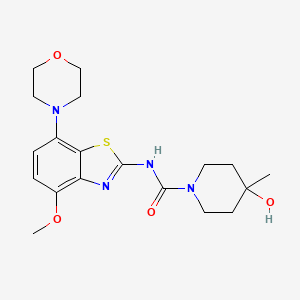
TOZADENANT


Image result for TOZADENANT

Tozadenant

RO-449351
SYN-115

  • Molecular Formula C19H26N4O4S
  • Average mass 406.499 Da

A2 (3); A2a-(3); RO4494351; RO4494351-000; RO4494351-002; SYN-115

Phase III clinical trials at Biotie Therapies for the treatment of Parkinson’s disease as an adjunctive therapy with levodopa

1-Piperidinecarboxamide, 4-hydroxy-N-[4-methoxy-7-(4-morpholinyl)-2-benzothiazolyl]-4-methyl-
4-Hydroxy-N-[4-methoxy-7-(4-morpholinyl)-1,3-benzothiazol-2-yl]-4-methyl-1-piperidinecarboxamide
4-Hydroxy-N-[4-methoxy-7-(4-morpholinyl)-2-benzothiazolyl]-4-methyl-1-piperidinecarboxamide
4-Hydroxy-4-methyl-piperidine-1-carboxylic acid(4-methoxy-7-morpholin-4-yl-benzothiazol-2-yl)-amide
CAS 870070-55-6
  • Originator Roche
  • Developer Acorda Therapeutics
  • Class Amides; Antiparkinsonians; Benzothiazoles; Carboxylic acids; Morpholines; Piperidines; Small molecules
  • Mechanism of Action Adenosine A2A receptor antagonists

Highest Development Phases

  • Phase III Parkinson’s disease
  • Phase I Liver disorders

Most Recent Events

  • 30 Jun 2017 Biotie Therapies plans a phase I trial in Healthy volunteers in Canada (NCT03200080)
  • 30 Jun 2017 Phase-I clinical trials in Liver disorders (In volunteers) in USA (PO) (NCT03212313)
  • 27 Apr 2017 Acorda Therapeutics initiates enrolment in a phase III trial for Parkinson’s disease in Germany (EudraCT2016-003961-25)(NCT03051607)

Biotie Therapies Holding , under license from Roche , is developing tozadenant (phase 3, as of August 2017) for the treatment of Parkinson’s disease.

SYN-115, a potent and selective adenosine A2A receptor antagonist, is in phase III clinical trials at Biotie Therapeutics for the treatment of Parkinson’s disease, as an adjunjunctive therapy with levodopa. Phase 0 trials were are underway at the National Institute on Drug Abuse (NIDA) for the treatment of cocaine dependency, but no recent development has been reported.

The A2A receptor modulates the production of dopamine, glutamine and serotonin in several brain regions. In preclinical studies, antagonism of the A2A receptor resulted in increases in dopamine levels, which gave rise to the reversal of motor deficits.

Originally developed at Roche, SYN-115 was acquired by Synosia in 2007, in addition to four other drug candidates with potential for the treatment of central nervous system (CNS) disorders. Under the terms of the agreement, Synosia was responsible for clinical development and in some cases commercialization, while Roche retained the right to opt-in to two preselected programs.

In 2010, the compound was licensed to UCB by Synosia Therapeutics for development and commercialization worldwide.

In February 2011, Synosia (previously Synosis Therapeutics) was acquired by Biotie Therapeutics, and in 2014, Biotie regained global rights from UCB.

Image result for TOZADENANT

TOZADENANT.png

Image result for TOZADENANT

Figure

Representative examples of A2AAdoR antagonists.

Tozadenant, also known as 4-hydroxy-N-(4-methoxy-7-(4-morpholinyl)benzo[d]thiazol-2-yl)-4-methylpiperidine-l-carboxamide or SYN115, is an adenosine A2A receptor antagonist. The A2A receptor modulates the production of

dopamine, glutamine and serotonin in several brain regions. In preclinical studies, antagonism of the A2A receptor resulted in increases in dopamine levels, which gave rise to the reversal of motor deficits.

Tozadenant is currently phase III clinical trials for the treatment of Parkinson’s disease as an adjunctive therapy with levodopa. It has also been explored for the treatment of cocaine dependency.

Inventors Alexander FlohrJean-Luc MoreauSonia PoliClaus RiemerLucinda Steward
Original Assignee Alexander FlohrJean-Luc MoreauPoli Sonia MClaus RiemerLucinda Steward

(F. Hoffmann-La Roche AG)

Image result

Claus Riemer

Claus Riemer

Expert Scientist
Roche , Basel · Department of Medicinal Chemistry

Sonia Poli

Sonia Poli

PhD
Chief Scientific Officer – CSO
Addex Therapeutics , Genève · R&D
PhD
Principal Scientist

PAPER

Fredriksson, KaiLottmann, PhilipHinz, SonjaOnila, IounutShymanets, AliakseiHarteneck, ChristianMüller, Christa E.Griesinger, ChristianExner, Thomas E. – Angewandte Chemie – International Edition, 2017, vol. 56, 21, pg. 5750 – 5754, Angew. Chem., 2017, vol. 129, pg. 5844 – 5848,5

PAPER

Mancel, ValérieMathy, François-XavierBoulanger, PierreEnglish, StephenCroft, MarieKenney, ChristopherKnott, TarraStockis, ArmelBani, Massimo – Xenobiotica, 2017, vol. 47,  8, pg. 705 – 718

Paper

Design, Synthesis of Novel, Potent, Selective, Orally Bioavailable Adenosine A2A Receptor Antagonists and Their Biological Evaluation

Drug Discovery Facility, Advinus Therapeutics Ltd., Quantum Towers, Plot-9, Phase-I, Rajiv Gandhi Infotech Park, Hinjawadi, Pune 411 057, India
J. Med. Chem.201760 (2), pp 681–694
DOI: 10.1021/acs.jmedchem.6b01584
* Phone: +91 20 66539600. Fax: +91 20 66539620. E-mail: sujay.basu@advinus.com.
Abstract Image

Patent

https://www.google.com/patents/US20050261289

  • Adenosine modulates a wide range of physiological functions by interacting with specific cell surface receptors. The potential of adenosine receptors as drug targets was first reviewed in 1982. Adenosine is related both structurally and metabolically to the bioactive nucleotides adenosine triphosphate (ATP), adenosine diphosphate (ADP), adenosine monophosphate (AMP) and cyclic adenosine monophosphate (cAMP); to the biochemical methylating agent S-adenosyl-L-methione (SAM); and structurally to the coenzymes NAD, FAD and coenzyme A; and to RNA. Together adenosine and these related compounds are important in the regulation of many aspects of cellular metabolism and in the modulation of different central nervous system activities.
  • [0003]
    The adenosine receptors have been classified as A1, A2A, A2B and A3receptors, belonging to the family of G protein-coupled receptors. Activation of aderosine receptors by adenosine initiates signal transduction mechanisms. These mechanisms are dependent on the receptor associated G protein. Each of the adenosine receptor subtypes has been classically characterized by the adenylate cyclase effector system, which utilises cAMP as a second messenger. The A1and Areceptors, coupled with Gproteins inhibit adenylate cyclase, leading to a decrease in cellular cAMP levels, while A2A and A2Breceptors couple to Gproteins and activate adenylate cyclase, leading to an increase in cellular cAMP levels. It is known that the A1receptor system activates phospholipase C and modulates both potassium and calcium ion channels. The Asubtype, in addition to its association with adenylate cyclase, also stimulates phospholipase C and activates calcium ion channels.
  • [0004]
    The Areceptor (326-328 amino acids) was cloned from various species (canine, human, rat, dog, chick, bovine, guinea-pig) with 90-95% sequence identify among the mammalian species. The A2Areceptor (409-412 amino acids) was cloned from canine, rat, human, guinea pig and mouse. The A2B receptor (332 amino acids) was cloned from human and mouse and shows 45% homology with the human Aand A2A receptors. The Areceptor (317-320 amino acids) was cloned from human, rat, dog, rabbit and sheep.
  • [0005]
    The Aand A2A receptor subtypes are proposed to play complementary roles in adenosine’s regulation of the energy supply. Adenosine, which is a metabolic product of ATP, diffuses from the cell and acts locally to activate adenosine receptors to decrease the oxygen demand (A1) or increase the oxygen supply (A2A) and so reinstate the balance of energy supply: demand within the tissue. The actions of both subtypes is to increase the amount of available oxygen to tissue and to protect cells against damage caused by a short term imbalance of oxygen. One of the important functions of endogenous adenosine is preventing damage during traumas such as hypoxia, ischemia, hypotension and seizure activity.
  • [0006]
    Furthermore, it is known that the binding of the adenosine receptor agonist to mast cells expressing the rat Areceptor resulted in increased inositol triphosphate and intracellular calcium concentrations, which potentiated antigen induced secretion of inflammatory mediators. Therefore, the Areceptor plays a role in mediating asthmatic attacks and other allergic responses.
  • [0007]
    Adenosine is a neurotransmitter able to modulate many aspects of physiological brain function. Endogenous adenosine, a central link between energy metabolism and neuronal activity, varies according to behavioral state and (patho)physiological conditions. Under conditions of increased demand and decreased availability of energy (such as hypoxia, hypoglycemia, and/or excessive neuronal activity), adenosine provides a powerful protective feedback mechanism. Interacting with adenosine receptors represents a promising target for therapeutic intervention in a number of neurological and psychiatric diseases such as epilepsy, sleep, movement disorders (Parkinson or Huntington’s disease), Alzheimer’s disease, depression, schizophrenia, or addiction. An increase in neurotransmitter release follows traumas such as hypoxia, ischemia and seizures. These neurotransmitters are ultimately responsible for neural degeneration and neural death, which causes brain damage or death of the individual. The adenosine A1agonists mimic the central inhibitory effects of adenosine and may therefore be useful as neuroprotective agents. Adenosine has been proposed as an endogenous anticonvulsant agent, inhibiting glutamate release from excitatory neurons and inhibiting neuronal firing. Adenosine agonists therefore may be used as antiepileptic agents. Furthermore, adenosine antagonists have proven to be effective as cognition enhancers. Selective A2A antagonists have therapeutic potential in the treatment of various forms of dementia, for example in Alzheimer’s disease, and of neurodegenerative disorders, e.g. stroke. Adenosine A2A receptor antagonists modulate the activity of striatal GABAergic neurons and regulate smooth and well-coordinated movements, thus offering a potential therapy for Parkinsonian symptoms. Adenosine is also implicated in a number of physiological processes involved in sedation, hypnosis, schizophrenia, anxiety, pain, respiration, depression, and drug addiction (amphetamine, cocaine, opioids, ethanol, nicotine, and cannabinoids). Drugs acting at adenosine receptors therefore have therapeutic potential as sedatives, muscle relaxants, antipsychotics, anxiolytics, analgesics, respiratory stimulants, antidepressants, and to treat drug abuse. They may also be used in the treatment of ADHD (attention deficit hyper-activity disorder).
  • [0008]
    An important role for adenosine in the cardiovascular system is as a cardioprotective agent. Levels of endogenous adenosine increase in response to ischemia and hypoxia, and protect cardiac tissue during and after trauma (preconditioning). By acting at the Areceptor, adenosine Aagonists may protect against the injury caused by myocardial ischemia and reperfusion. The modulating influence of A2Areceptors on adrenergic function may have implications for a variety of disorders such as coronary artery disease and heart failure. A2Aantagonists may be of therapeutic benefit in situations in which an enhanced anti-adrenergic response is desirable, such as during acute myocardial ischemia. Selective antagonists at A2A Areceptors may also enhance the effectiveness of adenosine in terminating supraventricula arrhytmias.
  • [0009]
    Adenosine modulates many aspects of renal function, including renin release, glomerular filtration rate and renal blood flow. Compounds which antagonize the renal affects of adenosine have potential as renal protective agents. Furthermore, adenosine Aand/or A2Bantagonists may be useful in the treatment of asthma and other allergic responses or and in the treatment of diabetes mellitus and obesity.
  • [0010]

    Numerous documents describe the current knowledge on adenosine receptors, for example the following publications:

      • Bioorganic & Medicinal Chemistry, 6, (1998), 619-641,
      • Bioorganic & Medicinal Chemistry, 6, (1998), 707-719,
      • J. Med. Chem., (1998), 41, 2835-2845,
      • J. Med. Chem., (1998), 41, 3186-3201,
      • J. Med. Chem., (1998), 41, 2126-2133,
      • J. Med. Chem., (1999), 42, 706-721,
      • J. Med. Chem., (1996), 39, 1164-1171,
      • Arch. Pharm. Med. Chem., 332, 39-41, (1999),
      • Am. J. Physiol., 276, H1113-1116, (1999) or
      • Naunyn Schmied, Arch. Pharmacol. 362,375-381, (2000)
    EXAMPLE 14-Hydroxy-4-methyl-piperidine-1-carboxylic acid(4-methoxy-7-morpholin-4-yl-benzothiazol-2-yl)-amide (I)

  • [0065]
    To a solution of (4-methoxy-7-morpholin-4-yl-benzothiazol-2-yl)-carbamic acid phenyl ester (3.2 g, 8.3 mmol) and N-ethyl-diisopropyl-amine (4.4 ml, 25 mmol) in trichloromethane (50 ml) is added a solution of 4-hydroxy-4-methyl-piperidine in trichloromethane (3 ml) and tetrahydrofurane (3 ml) and the resulting mixture heated to reflux for 1 h. The reaction mixture is then cooled to ambient temperature and extracted with saturated aqueous sodium carbonate (15 ml) and water (2×5 ml). Final drying with magnesium sulphate and evaporation of the solvent and recrystallization from ethanol afforded the title compound as white crystals (78% yield), mp 236° C. MS: m/e=407(M+H+).

Figure US20050261289A1-20051124-C00013

Figure US20050261289A1-20051124-C00012Figure US20050261289A1-20051124-C00011

PATENT

WO-2017136375

https://patentscope.wipo.int/search/en/detail.jsf?docId=WO2017136375&recNum=1&maxRec=&office=&prevFilter=&sortOption=&queryString=&tab=PCTDescription

Novel deuterated forms of tozadenant are claimed. Also claimed are compositions comprising them and method of modulating the activity of adenosine A2A receptor (ADORA2A), useful for treating Parkinson’s diseases. Represents new area of patenting to be seen from CoNCERT Pharmaceuticals on tozadenant. ISR draws attention towards WO2016204939 , claiming controlled-release tozadenant formulations.

This invention relates to deuterated forms of morpholinobenzo[d]thiazol-2-yl)-4-methylpiperidine-1-carboxamide compounds, and pharmaceutically acceptable salts thereof. This invention also provides compositions comprising a compound of this invention and the use of such compositions in methods of treating diseases and conditions that are beneficially treated by administering an adenosine A2A receptor antagonist.

Many current medicines suffer from poor absorption, distribution, metabolism and/or excretion (ADME) properties that prevent their wider use or limit their use in certain indications. Poor ADME properties are also a major reason for the failure of drug candidates in clinical trials. While formulation technologies and prodrug strategies can be employed in some cases to improve certain ADME properties, these approaches often fail to address the underlying ADME problems that exist for many drugs and drug candidates. One such problem is rapid metabolism that causes a number of drugs, which otherwise would be highly effective in treating a disease, to be cleared too rapidly from the body. A possible solution to rapid drug clearance is frequent or high dosing to attain a sufficiently high plasma level of drug. This, however, introduces a number of potential treatment problems such as poor patient compliance with the dosing regimen, side effects that become more acute with higher doses, and increased cost of treatment. A rapidly metabolized drug may also expose patients to undesirable toxic or reactive metabolites.

[3] Another ADME limitation that affects many medicines is the formation of toxic or biologically reactive metabolites. As a result, some patients receiving the drug may experience toxicities, or the safe dosing of such drugs may be limited such that patients receive a suboptimal amount of the active agent. In certain cases, modifying dosing intervals or formulation approaches can help to reduce clinical adverse effects, but often the formation of such undesirable metabolites is intrinsic to the metabolism of the compound.

[4] In some select cases, a metabolic inhibitor will be co- administered with a drug that is cleared too rapidly. Such is the case with the protease inhibitor class of drugs that are used to treat HIV infection. The FDA recommends that these drugs be co-dosed with ritonavir, an inhibitor of cytochrome P450 enzyme 3A4 (CYP3A4), the enzyme typically responsible for their metabolism (see Kempf, D.J. et al., Antimicrobial agents and chemotherapy, 1997, 41(3): 654-60). Ritonavir, however, causes adverse effects and adds to the pill burden for HIV patients who must already take a combination of different drugs. Similarly, the

CYP2D6 inhibitor quinidine has been added to dextromethorphan for the purpose of reducing rapid CYP2D6 metabolism of dextromethorphan in a treatment of pseudobulbar affect.

Quinidine, however, has unwanted side effects that greatly limit its use in potential combination therapy (see Wang, L et al., Clinical Pharmacology and Therapeutics, 1994, 56(6 Pt 1): 659-67; and FDA label for quinidine at http://www.accessdata.fda.gov).

[5] In general, combining drugs with cytochrome P450 inhibitors is not a satisfactory strategy for decreasing drug clearance. The inhibition of a CYP enzyme’s activity can affect the metabolism and clearance of other drugs metabolized by that same enzyme. CYP inhibition can cause other drugs to accumulate in the body to toxic levels.

[6] A potentially attractive strategy for improving a drug’s metabolic properties is deuterium modification. In this approach, one attempts to slow the CYP-mediated metabolism of a drug or to reduce the formation of undesirable metabolites by replacing one or more hydrogen atoms with deuterium atoms. Deuterium is a safe, stable, non-radioactive isotope of hydrogen. Compared to hydrogen, deuterium forms stronger bonds with carbon. In select cases, the increased bond strength imparted by deuterium can positively impact the ADME properties of a drug, creating the potential for improved drug efficacy, safety, and/or tolerability. At the same time, because the size and shape of deuterium are essentially identical to those of hydrogen, replacement of hydrogen by deuterium would not be expected to affect the biochemical potency and selectivity of the drug as compared to the original chemical entity that contains only hydrogen.

[7] Over the past 35 years, the effects of deuterium substitution on the rate of metabolism have been reported for a very small percentage of approved drugs (see, e.g., Blake, MI et al, J Pharm Sci, 1975, 64:367-91; Foster, AB, Adv Drug Res 1985, 14: 1-40 (“Foster”); Kushner, DJ et al, Can J Physiol Pharmacol 1999, 79-88; Fisher, MB et al, Curr Opin Drug Discov Devel, 2006, 9: 101-09 (“Fisher”)). The results have been variable and unpredictable. For some compounds deuteration caused decreased metabolic clearance in vivo. For others, there was no change in metabolism. Still others demonstrated increased metabolic clearance. The variability in deuterium effects has also led experts to question or dismiss deuterium modification as a viable drug design strategy for inhibiting adverse metabolism (see Foster at p. 35 and Fisher at p. 101).

[8] The effects of deuterium modification on a drug’s metabolic properties are not predictable even when deuterium atoms are incorporated at known sites of metabolism. Only by actually preparing and testing a deuterated drug can one determine if and how the rate of metabolism will differ from that of its non-deuterated counterpart. See, for example, Fukuto et al. (J. Med. Chem. 1991, 34, 2871-76). Many drugs have multiple sites where metabolism is possible. The site(s) where deuterium substitution is required and the extent of deuteration necessary to see an effect on metabolism, if any, will be different for each drug.

Patent ID

Patent Title

Submitted Date

Granted Date

US2016367560 Methods for Treating Parkinson’s Disease 2016-06-17
US9534052 Reducing systemic regulatory T cell levels or activity for treatment of Alzheimer’s disease 2016-07-16 2017-01-03
US9512225 Reducing systemic regulatory T cell levels or activity for treatment of Alzheimer’s disease 2016-06-22 2016-12-06
US9512227 Reducing systemic regulatory T cell levels or activity for treatment of Alzheimer’s disease 2016-07-05 2016-12-06
Patent ID

Patent Title

Submitted Date

Granted Date

US2016000909 REDUCING SYSTEMIC REGULATORY T CELL LEVELS OR ACTIVITY FOR TREATMENT OF DISEASE AND INJURY OF THE CNS 2015-07-13 2016-01-07
US2016008463 REDUCING SYSTEMIC REGULATORY T CELL LEVELS OR ACTIVITY FOR TREATMENT OF DISEASE AND INJURY OF THE CNS 2015-09-10 2016-01-14
US2016108123 ANTIBODY MOLECULES TO PD-L1 AND USES THEREOF 2015-10-13 2016-04-21
US9394365 Reducing systemic regulatory T cell levels or activity for treatment of alzheimer’s disease 2015-12-02 2016-07-19
US2017029508 Reducing Systemic Regulatory T Cell Levels or Activity for Treatment of Disease and Injury of the CNS 2016-09-10
Patent ID

Patent Title

Submitted Date

Granted Date

US7368446 4-Hydroxy-4-methyl-piperidine-1-carboxylic acid (4-methoxy-7-morpholin-4-yl-benzothiazol-2-yl)-amide 2005-11-24 2008-05-06
US8168785 BENZOTHIAZOLE DERIVATIVES 2010-12-23 2012-05-01
US2009082341 4-hydroxy-4-methyl-piperidine-1-carboxylic acid (4-methoxy-7-morpholin-4-yl-benzothiazol-2-yl)-amide FOR THE TREATMENT OF POST-TRAUMATIC STRESS DISORDER 2008-07-23 2009-03-26
US2013317019 A2A Antagonists as Cognition and Motor Function Enhancers 2011-11-04 2013-11-28
US9387212 Methods for Treating Parkinson’s Disease 2013-04-19 2015-06-11

///////////////TOZADENANT, phase III,  clinical trials,  Parkinson’s disease ,  adjunctive therapy,  levodopa, RO-449351, SYN-115

CC1(CCN(CC1)C(=O)NC2=NC3=C(C=CC(=C3S2)N4CCOCC4)OC)O

Lifetime achievement award, WHC17, in Hyderabad, Telangana, India 22 Aug 2017


Lifetime achievement award ……..WORLD HEALTH CONGRESS 2017 in Hyderabad, 22 aug 2017 at JNTUH KUKATPALLY. HYDERABAD, TELANGANA, INDIA, Award given by Dr. M Sunitha Reddy Head of the Department, Centre for Pharmaceutical Sciences, Institute of Science &Technology, JNTU-H, Kukatpally, Hyderabad, India

Speaking at World health congress 2017….JNTUH Hyderabad 22 aug 2017


Prexasertib , прексасертиб , بريكساسيرتيب , 普瑞色替 ,


Prexasertib.svg

Prexasertib

Captisol® enabled prexasertib; CHK1 Inhibitor II; LY 2606368; LY2606368 MsOH H2O

5-(5-(2-(3-aminopropoxy)-6-methoxyphenyl)-1H-pyrazol-3-ylamino)pyrazine-2-carbonitrile

2-Pyrazinecarbonitrile, 5-[[5-[2-(3-aminopropoxy)-6-methoxyphenyl]-1H-pyrazol-3-yl]amino]-

Name Prexasertib
Lab Codes LY-2606368
Chemical Name 5-({5-[2-(3-aminopropoxy)-6-methoxyphenyl]-1H-pyrazol-3-yl}amino)pyrazine-2-carbonitrile
Chemical Structure ChemSpider 2D Image | prexasertib | C18H19N7O2
Molecular Formula C18H19N7O2
UNII UNII:820NH671E6
Cas Registry Number 1234015-52-1
OTHER NAMES
прексасертиб [Russian] [INN]
بريكساسيرتيب [Arabic] [INN]
普瑞色替 [Chinese] [INN]
Originator Array BioPharma
Developer Eli Lilly, National Cancer Institute
Mechanism Of Action Checkpoint kinase inhibitors, Chk-1 inhibitors
Who Atc Codes L01X-E (Protein kinase inhibitors)
Ephmra Codes L1H (Protein Kinase Inhibitor Antineoplastics)
Indication Breast cancer, Ovarian cancer, Solid tumor, Head and neck cancer, Leukemia, Neoplasm Metastasis, Colorectal Neoplasms, Squamous Cell Carcinoma

Image result for Array BioPharma

Image result for ELI LILLY

Image result for Prexasertib2100300-72-7 CAS

Image result for Prexasertib

Prexasertib mesylate hydrate
CAS#: 1234015-57-6 (mesylate hydrate)
Chemical Formula: C19H25N7O6S
Molecular Weight: 479.512, CODE LY-2940930
LY-2606368 (free base)

Image result for Prexasertib

Prexasertib mesylate ANHYDROUS
CAS#: 1234015-55-4 (mesylate)
Chemical Formula: C19H23N7O5S
Molecular Weight: 461.497

2D chemical structure of 1234015-54-3

Prexasertib dihydrochloride
1234015-54-3. MW: 438.3169


LY2606368 is a small-molecule Chk-1 inhibitors invented by Array and being developed by Eli Lilly and Company. Lilly is responsible for all clinical development and commercialization activities. Chk-1 is a protein kinase that regulates the tumor cell’s response to DNA damage often caused by treatment with chemotherapy. In response to DNA damage, Chk-1 blocks cell cycle progression in order to allow for repair of damaged DNA, thereby limiting the efficacy of chemotherapeutic agents. Inhibiting Chk-1 in combination with chemotherapy can enhance tumor cell death by preventing these cells from recovering from DNA damage.

Originator Array BioPharma; Eli Lilly

Developer Eli Lilly; National Cancer Institute (USA)

Class Antineoplastics; Nitriles; Pyrazines; Pyrazoles; Small molecules

Mechanism of Action Checkpoint kinase 1 inhibitors; Checkpoint kinase 2 inhibitors

Highest Development Phases

  • Phase II Breast cancer; Ovarian cancer; Small cell lung cancer; Solid tumours
  • Phase I Acute myeloid leukaemia; Colorectal cancer; Head and neck cancer; Myelodysplastic syndromes; Non-small cell lung cancer

Most Recent Events

  • 10 Apr 2017 Eli Lilly completes a phase I trial for Solid tumours (Late-stage disease, Second-line therapy or greater) in Japan (NCT02514603)
  • 10 Mar 2017 Phase-I clinical trials in Solid tumours (Combination therapy, Metastatic disease, Inoperable/Unresectable) in USA (IV) (NCT03057145)
  • 22 Feb 2017 Khanh Do and AstraZeneca plan a phase H trial for Solid tumour (Combination therapy, Metastatic disease, Inoperable/Unresectable) in USA (NCT03057145)

Prexasertib (LY2606368) is a small molecule checkpoint kinase inhibitor, mainly active against CHEK1, with minor activity against CHEK2. This causes induction of DNA double-strand breaks resulting in apoptosis. It is in development by Eli Lilly[1]

A phase II clinical trial for the treatment of small cell lung cancer is expected to be complete in December 2017.[2]

an aminopyrazole compound, or a pharmaceutically acceptable salt thereof or a solvate of the salt, that inhibits Chkl and is useful for treating cancers characterized by defects in deoxyribonucleic acid (DNA) replication, chromosome segregation, or cell division.

Chkl is a protein kinase that lies downstream from Atm and/or Atr in the DNA damage checkpoint signal transduction pathway. In mammalian cells, Chkl is phosphorylated in response to agents that cause DNA damage including ionizing radiation (IR), ultraviolet (UV) light, and hydroxyurea. This phosphorylation which activates Chkl in mammalian cells is dependent on Atr. Chkl plays a role in the Atr dependent DNA damage checkpoint leading to arrest in S phase and at G2M. Chkl phosphorylates and inactivates Cdc25A, the dual-specificity phosphatase that normally dephosphorylates cyclin E/Cdk2, halting progression through S-phase. Chkl also phosphorylates and inactivates Cdc25C, the dual specificity phosphatase that dephosphorylates cyclin B/Cdc2 (also known as Cdkl) arresting cell cycle progression at the boundary of G2 and mitosis (Fernery et al, Science, 277: 1495-1, 1997). In both cases, regulation of Cdk activity induces a cell cycle arrest to prevent cells from entering mitosis in the presence of DNA damage or unreplicated DNA. Various inhibitors of Chkl have been reported. See for example, WO 05/066163,

WO 04/063198, WO 03/093297 and WO 02/070494. In addition, a series of aminopyrazole Chkl inhibitors is disclosed in WO 05/009435.

However, there is still a need for Chkl inhibitors that are potent inhibitors of the cell cycle checkpoints that can act effectively as potentiators of DNA damaging agents. The present invention provides a novel aminopyrazole compound, or a pharmaceutically acceptable salt thereof or solvate of the salt, that is a potent inhibitor of Chkl . The compound, or a pharmaceutically acceptable salt thereof or a solvate of the salt, potently abrogates a Chkl mediated cell cycle arrest induced by treatment with DNA damaging agents in tissue culture and in vivo. Furthermore, the compound, or a pharmaceutically acceptable salt thereof or a solvate of the salt, of the present invention also provides inhibition of Chk2, which may be beneficial for the treatment of cancer. Additionally, the lack of inhibition of certain other protein kinases, such as CDKl, may provide a -2- therapeutic benefit by minimizing undesired effects. Furthermore, the compound, or a pharmaceutically acceptable salt thereof or a solvate of the salt, of the present invention inhibits cell proliferation of cancer cells by a mechanism dependent on Chkl inhibition.

Inventors Francine S. FarouzRyan Coatsworth HolcombRamesh KasarSteven Scott Myers
Applicant Eli Lilly And Company

WO 2010077758

Preparation 8

tert-Butyl 3-(2-(3-(5-cyanopyrazin-2-ylamino)-lH-pyrazol-5-yl)-3- methoxyphenoxy)propylcarbamate

Figure imgf000025_0002

A solution of tert-butyl 3-(2-(3-(5-bromopyrazin-2-ylamino)-lH-pyrazol-5-yl)-3- methoxyphenoxy)propylcarbamate (0.378 g, 0.730 mmol) and zinc cyanide (0.10 g, 0.870 mmol) in DMF (10 mL) is degassed with a stream of nitrogen for one hour and then -25- heated to 80 0C. To the reaction is added Pd(Ph3P)4 (0.080 g, 0.070 mmol), and the mixture is heated overnight. The reaction is cooled to room temperature and concentrated under reduced pressure. The residue is purified by silica gel chromatography (CH2Cl2/Me0H) to give 0.251 g (73%) of the title compound.

Preparation 12 tert-Butyl 3-(2-(3-(5-cyanopyrazin-2-ylamino)-lH-pyrazol-5-yl)-3- methoxyphenoxy)propylcarbamate

Figure imgf000028_0001

A 5 L flange-neck round-bottom flask equipped with an air stirrer rod and paddle, thermometer, pressure-equalizing dropping funnel, and nitrogen bubbler is charged with 5-(5-(2-hydroxy-6-methoxy-phenyl)-lH-pyrazol-3-ylamino)-pyrazine-2-carbonitrile (47.0 g, 152 mmol) and anhydrous THF (1.2 L). The stirred suspension, under nitrogen, is cooled to 0 0C. A separate 2 L 3 -necked round-bottom flask equipped with a large -28- magnetic stirring bar, thermometer, and nitrogen bubbler is charged with triphenylphosphine (44.0 g; 168 mmol) and anhydrous THF (600 mL). The stirred solution, under nitrogen, is cooled to 0 0C and diisopropylazodicarboxylate (34.2 g; 169 mmol) is added and a milky solution is formed. After 3-4 min, a solution of7-butyl-N-(3- hydroxypropyl)-carbamate (30.3 g, 173 mmol) in anhydrous THF (100 mL) is added and the mixture is stirred for 3-4 min. This mixture is then added over 5 min to the stirred suspension of starting material at 0 0C. The reaction mixture quickly becomes a dark solution and is allowed to slowly warm up to room temperature. After 6.5 h, more reagents are prepared as above using PPh3 (8 g), DIAD (6.2 g) and carbamate (5.4 g) in anhydrous THF (150 mL). The mixture is added to the reaction mixture, cooled to -5 0C and left to warm up to room temperature overnight. The solvent is removed in vacuo. The resulting viscous solution is loaded onto a pad of silica and product is eluted with ethyl acetate. The concentrated fractions are separately triturated with methanol and resulting solids are collected by filtration. The combined solids are triturated again with methanol (400 mL) and then isolated by filtration and dried in vacuo at 50 0C overnight to give 31.3 g of desired product. LC-ES/MS m/z 466.2 [M+ 1]+.

Example 2

5 -(5 -(2-(3 -Aminopropoxy)-6-methoxyphenyl)- 1 H-pyrazol-3 -ylamino)pyrazine-2- carbonitrile dihydrogen chloride salt
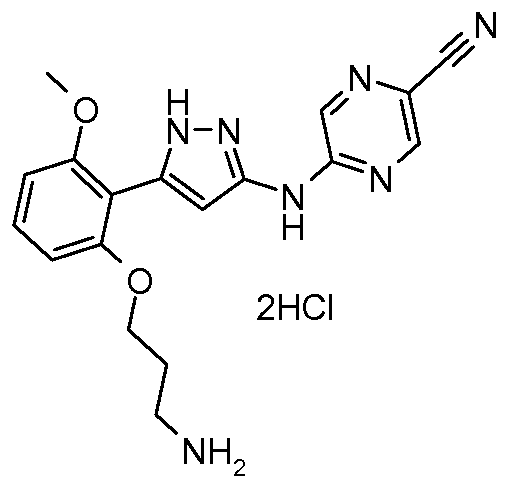
Figure imgf000029_0001

A 5 L flange-neck, round-bottom flask equipped with an air stirrer rod and paddle, thermometer, and air condenser with bubbler attached, is charged with tert-bvXyl 3-(2-(3- (5-cyanopyrazin-2-ylamino)-lH-pyrazol-5-yl)-3-methoxyphenoxy)propylcarbamate (30.9 g, 66.3 mmol) and ethyl acetate (3 L). The mechanically stirred yellow suspension is cooled to just below 10 0C. Then hydrogen chloride from a lecture bottle is bubbled in -29- vigorously through a gas inlet tube for 15 min with the ice-bath still in place. After 5 h the mixture is noticeably thickened in appearance. The solid is collected by filtration, washed with ethyl acetate, and then dried in vacuo at 60 0C overnight to give 30.0 g. 1H NMR (400 MHz, DMSO-d6) δ 2.05 (m, 2H), 2.96 (m, 2H), 3.81 (s, 3H), 4.12 (t, J = 5.8 Hz, 2H), 6.08 (br s, 3H), 6.777 (d, J = 8.2 Hz, IH), 6.782 (d, J = 8.2 Hz, IH), 6.88 (br s, IH), 7.34 (t, J = 8.2 Hz, IH), 8.09 (br s, IH), 8.55 (br s, IH), 8.71 (s, IH), 10.83 (s, IH), 12.43 (br s, IH). LC-ES/MS m/z 366.2 [M+lf.

Example 3 5 -(5 -(2-(3 -Aminopropoxy)-6-methoxyphenyl)- 1 H-pyrazol-3 -ylamino)pyrazine-2- carbonitrile

Figure imgf000030_0001

5-(5-(2-(3-Aminopropoxy)-6-methoxyphenyl)-lH-pyrazol-3-ylamino)pyrazine-2- carbonitrile dihydrogen chloride salt (3.0 g, 6.84 mmol) is suspended in 200 mL of CH2Cl2. 1 N NaOH is added (200 mL, 200 mmol). The mixture is magnetically stirred under nitrogen at room temperature for 5 h. The solid is collected by filtration and washed thoroughly with water. The filter cake is dried in vacuo at 50 0C overnight to give 2.26 g (90%) of the free base as a yellow solid. 1H NMR (400 MHz, DMSO-d6) δ 1.81 (m, 2H), 2.73 (t, J = 6.2 Hz, 2H), 3.82 (s, 3H), 4.09 (t, J = 6.2 Hz, 2H), 6.76 (t, J = 8.2 Hz, 2H), 6.93 (br s, IH), 7.31 (t, J = 8.2 Hz, IH), 8.52 (br s, IH), 8.67 (s, IH). LC- MS /ES m/z 366.2 [M+ 1]+.

Example 4

5 -(5 -(2-(3 -Aminopropoxy)-6-methoxyphenyl)- 1 H-pyrazol-3 -ylamino)pyrazine-2- carbonitrile methanesulfonic acid salt -30-

Figure imgf000031_0001

5-(5-(2-(3-aminopropoxy)-6-methoxyphenyl)-lH-pyrazol-3-ylamino)pyrazine-2- carbonitrile (1.0 g, 2.74 mmol) is suspended in MeOH (100 mL). A I M solution of methanesulfonic acid in MeOH (2.74 mL, 2.74 mmol) is added to the mixture dropwise with stirring. The solid nearly completely dissolves and is sonicated and stirred for 15 min, filtered, and concentrated to 50 mL. The solution is cooled overnight at -15 0C and the solid that forms is collected by filtration. The solid is dried in a vacuum oven overnight to give 0.938 g (74%) of a yellow solid. 1H NMR (400 MHz, DMSO-d6) δ 1.97 (m, 2H), 2.28 (s, 3H), 2.95 (m, 2H), 3.79 (s, 3H), 4.09 (t, J = 5.9 Hz, 2H), 6.753 (d, J = 8.4 Hz, IH), 6.766 (d, J = 8.4 Hz, IH), 6.85 (br s, IH), 7.33 (t, J = 8.4 Hz, IH), 7.67 (br s, 3H), 8.49 (br s, IH), 8.64 (s, IH), 10.70 (s, IH), 12.31 (s, IH). LC-ES/MS m/z 366.2 [M+l]+.

Preparation 18 tert-Butyl 3-(2-(3-(5-cyanopyrazin-2-ylamino)-lH-pyrazol-5-yl)-3- methoxyphenoxy)propylcarbamate

Figure imgf000035_0001

5-(5-(2-Hydroxy-6-methoxyphenyl)-lH-pyrazol-3-ylamino)pyrazine-2- carbonitrile (618 g, 1.62 mol) is slurried in tetrahydrofuran (6.18 L, 10 volumes) and chilled to -5 to 0 0C with an acetone/ice bath. Triethylamine (330 g, 3.25 mol) is added through an addition funnel over 30 – 40 min at -5 to 5 0C. The resulting slurry is stirred at -5 to 5 0C for 60 – 90 min. The insoluble triethylamine hydrochloride is filtered and the solution of the phenol ((5-(2-hydroxy-6-methoxyphenyl)-lH-pyrazol-3- ylamino)pyrazine-2-carbonitrile) collected in an appropriate reaction vessel. The cake is rinsed with THF (1.24 L). The THF solution of the phenol is held at 15 to 20 0C until needed.

Triphenylphosphine (1074 g, 4.05 mol) is dissolved at room temperature in THF (4.33 L). The clear colorless solution is cooled with an acetone/ice bath to -5 to 5 0C. Diisopropylazodicarboxylate (795 g, 3.89 mol) is added dropwise through an addition funnel over 40 – 60 min, keeping the temperature below 10 0C. The resulting thick white slurry is cooled back to -5 to 0 0C. tert-Butyl 3-hydroxypropylcarbamate (717g, 4.05 moles) is dissolved in a minimum of THF (800 mL). The tert-butyl 3- hydroxypropylcarbamate/THF solution is added, through an addition funnel, over 20 – 30 -35- min at -5 to 5 0C to the reagent slurry. The prepared reagent is stirred in the ice bath at -5 to 0 0C until ready for use.

The prepared reagent slurry (20%) is added to the substrate solution at 15 to 20 0C. The remaining reagent is returned to the ice bath. The substrate solution is stirred at ambient for 30 min, then sampled for HPLC. A second approximately 20% portion of the reagent is added to the substrate, stirred at ambient and sampled as before. Addition of the reagent is continued with monitoring for reaction completion by HPLC. The completed reaction is concentrated and triturated with warm methanol (4.33 L, 50 – 60 0C) followed by cooling in an ice bath. The resulting yellow precipitate is filtered, rinsed with cold MeOH (2 L), and dried to constant weight to provide 544 g (72%) of the title compound, mp 214 – 216 0C; ES/MS m/z 466.2 [M+l]+.

Example 5

2-Pyrazinecarbonitrile, 5-[[5-[-[2-(3-aminopropyl)-6-methoxyphenyl]-lH-pyrazol-3- yl]amino] monomesylate monohydrate (Chemical Abstracts nomenclature)

Figure imgf000036_0001

tert-Butyl 3-(2-(3-(5-cyanopyrazin-2-ylamino)-lH-pyrazol-5-yl)-3- methoxyphenoxy)propylcarbamate (1430 g, 3.07 mol) is slurried with acetone (21.5 L) in a 30 L reactor. Methanesulfonic acid (1484 g, 15.36 mol) is added through an addition funnel in a moderate stream. The slurry is warmed to reflux at about 52 0C for 1 to 3 h and monitored for reaction completion by HPLC analysis. The completed reaction is cooled from reflux to 15 to 20 0C over 4.5 h. The yellow slurry of 2-pyrazinecarbonitrile, 5-[[5-[-[2-(3-aminopropyl)-6-methoxyphenyl]-lH-pyrazol-3-yl]amino] dimesylate salt is filtered, rinsed with acetone (7 L) and dried in a vacuum oven. The dimesylate salt, (1608 g, 2.88 mol) is slurried in water (16 L). Sodium hydroxide (aqueous 50%, 228 g, 2.85 mol) is slowly poured into the slurry. The slurry is -36- heated to 60 0C and stirred for one hour. It is then cooled to 16 0C over 4 h and filtered. The wet filter cake is rinsed with acetone (4 L) and dried to constant weight in a vacuum oven at 40 0C to provide 833 g (94%) of 2-pyrazinecarbonitrile, 5-[[5-[-[2-(3- aminopropyl)-6-methoxyphenyl]-lH-pyrazol-3-yl]amino] monomesylate monohydrate. mp 222.6 0C; ES/MS m/z 366.2 [M+l]+.

Example 5a

2-Pyrazinecarbonitrile, 5-[[5-[-[2-(3-aminopropyl)-6-methoxyphenyl]-lH-pyrazol-3- yl] amino] monomesylate monohydrate (Chemical Abstracts nomenclature)

Crude 2-pyrazinecarbonitrile, 5 -[ [5 – [- [2-(3 -aminopropyl)-6-methoxyphenyl]- IH- pyrazol-3-yl] amino] monomesylate monohydrate is purified using the following procedure. The technical grade 2-pyrazinecarbonitrile, 5-[[5-[-[2-(3-aminopropyl)-6- methoxyphenyl]-lH-pyrazol-3-yl] amino] mono mesylate mono hydrate (1221 g, 2.55 mol) is slurried in a solvent mixture of 1: 1 acetone/water (14.7 L). The solid is dissolved by warming the mixture to 50 – 55 0C. The solution is polish filtrated while at 50 – 55 0C through a 0.22μ cartridge filter. The solution is slowly cooled to the seeding temperature of about 42 – 45 0C and seeded. Slow cooling is continued over the next 30 – 60 min to confirm nucleation. The thin slurry is cooled from 38 to 15 0C over 3 h. A vacuum distillation is set up and the acetone removed at 110 – 90 mm and 20 – 30 0C. The mixture is cooled from 30 to 15 0C over 14 h, held at 15 0C for 2 h, and then filtered. The recrystallized material is rinsed with 19: 1 water/acetone (2 L) and then water (6 L) and dried to constant weight in a vacuum oven at 40 0C to provide 1024 g (83.9%) of the title compound, mp 222.6 0C; ES/MS m/z 366.2 [M+l]+. X-ray powder diffraction (XRPD) patterns may be obtained on a Bruker D8

Advance powder diffractometer, equipped with a CuKa source (λ=l.54056 angstrom) operating at 40 kV and 40 mA with a position-sensitive detector. Each sample is scanned between 4° and 35° in °2Θ ± 0.02 using a step size of 0.026° in 2Θ ± 0.02 and a step time of 0.3 seconds, with a 0.6 mm divergence slit and a 10.39 mm detector slit. Primary and secondary Soller slits are each at 2°; antiscattering slit is 6.17 mm; the air scatter sink is in place. -37-

Characteristic peak positions and relative intensities:

Figure imgf000038_0001

Differential scanning calorimetry (DSC) analyses may be carried out on a Mettler- Toledo DSC unit (Model DSC822e). Samples are heated in closed aluminum pans with pinhole from 25 to 350 0C at 10 °C/min with a nitrogen purge of 50 mL/min. Thermogravimetric analysis (TGA) may be carried out on a Mettler Toledo TGA unit (Model TGA/SDTA 85Ie). Samples are heated in sealed aluminum pans with a pinhole from 25 to 350 0C at 10 0C /min with a nitrogen purge of 50 mL/min.

The thermal profile from DSC shows a weak, broad endotherm form 80 – 1400C followed by a sharp melting endotherm at 222 0C, onset (225 0C, peak). A mass loss of 4% is seen by the TGA from 25 – 140 0C.

PATENT

US 20110144126

WO 2017015124

WO 2017100071

WO 2017105982

WO 2016051409

PATENT

WO 2017100071

Preparation 1

tert-Butyl (E)-(3-(2-(3-(dimethylamino)ac^’loyl)-3-me1hoxyphenox50propyl)carbamate

L _l H

Combine l-(2-hydroxy-6-methox>’phenyl)e1han-l-one (79.6 kg, 479 mol) and 1,1-<iimethoxy-N,N-dimemylmethanamino (71.7 kg, 603.54 mol) with DMF (126 kg). Heat to 85-90 °C for 12 hours. Cool the reaction mixture containing intermediate (E)-3-(dimethylamino)-l-(2-hydroxy-6-methoxyphenyl)prop-2-en-l-one (mp 84.74 °C) to ambient temperature and add anhydrous potassium phosphate (136 kg, 637.07 mol) and tert-butyl (3-bromopropyl)carbamate (145 kg, 608.33 mol). Stir the reaction for 15 hours at ambient temperature. Filter the mixture and wash the filter cake with ΜΓΒΕ (3 χ , 433 kg, 300 kg, and 350 kg). Add water (136 kg) and aqueous sodium chloride (25% solution, 552 kg) to the combined MTBE organic solutions. Separate the organic and aqueous phases. Back-extract the resulting aqueous phase with MTBE (309 kg) and add the MTBE layer to the organic solution. Add an aqueous sodium chloride solution (25% solution, 660 kg) to the combined organic extracts and separate the layers. Concentrate the organic extracts to 1,040 kg – 1,200 kg and add water (400 kg) at 30-35 °C to the residue. Cool to ambient temperature and collect material by filtration as a wet cake to give the title product (228.35 kg, 90%). ES/MS (m/z): 379.22275 (M+l).

Preparation 2

tert-Butyl (3-(2-(2-cyanoacetyl)-3-methoxyphenoxy)propyl)carbamate

“9 o


Combine ethanol (1044 kg), hydroxyl amino hydrochloride (30 kg, 431.7 mol), and terr-butyl (E)-(3-(2-(3-(^me%lamino)acryloyl)-3-

methoxyphenoxy)propyl)carbamate (228.35 kg, 72% as a wet water solid, 434.9 mol) to form a solution. Heat the solution to 35 – 40 °C for 4-6 hours. Cool the reaction to ambient temperature and concentrate to a residue. Add MTBE (300 kg) to the residue and concentrate the solution to 160 kg – 240 kg. Add MTBE (270 kg) and concentrate the solution. Add MTBE (630 kg), water (358 kg), and sodium chloride solution (80 kg, 25% aqueous) and stir for 20 minutes at ambient temperature. Let the mixture stand for 30 minutes. Separate the aqueous layer. Add water (360 kg) and sodium chloride solution (82 kg, 25% sodium chloride) to the organic phase. Stir for 20 minutes at ambient temperature. Let the mixture stand for 30 minutes. Separate the aqueous portion. Add sodium chloride solution (400 kg, 25 % aqueous) to the organic portion. Stir for 20 minutes at ambient temperature. Let the mixture stand for 30 minutes at ambient temperature. Separate the aqueous portion. Concentrate the organic portion to 160 kg – 240 kg at 40 °C. Add ethanol (296 kg) to the organic portion. Concentrate the solution to 160 kg to 240 kg at 40 °C to provide an intermediate of tert-butyl (3-(2-(isoxazol-5-yl)-3-methox>’phenoxy)propyl)carbamate. Add ethanol (143 kg) and water (160 kg) to the concentrated solution. Add potassium hydroxide (31.8 kg) at 40 °C. Add ethanol (80 kg) and adjust the temperature to 45-50 °C. Stir for 4-6 hours at 45-50 °C and concentrate to 160 kg – 240 kg at 40 °C. Add water to the concentrate (160 kg) and acetic acid (9.0 kg) drop-wise to adjust the pH to 10-12 while mamtaining the temperature of the solution at 25 to 35 °C. Add ethyl acetate (771 kg) and acetic acid drop-wise to adjust the pH to 5-7 while maintaining the temperature of the solution at 25-35 °C. Add sodium chloride solution (118 kg, 25% aqueous solution). Stir the mixture for 20 minutes at ambient temperature. Let the solution stand for 30 minutes at ambient temperature. Separate Ihe aqueous portion. Heat the organic portion to 30-35 °C. Add water (358 kg) drop-wise. Stir the solution for 20 minutes while maintaining the temperature at 30 to 35 °C. Let the mixture stand for 30 minutes and separate the aqueous portion. Wash the organic portion with sodium chloride solution (588 kg, 25% aqueous) and concentrate the organic portion to 400 kg – 480 kg at 40-50 °C. Heat the concentrated solution to 50 °C to form a solution. Maintain the solution at 50 °C and add M-heptane (469 kg) drop-wise. Stir the solution for 3 hours at 50 °C before slowly cooling to ambient temperature to crystallize the product. Stir at ambient temperature for 15 hours and filter the crystals. Wash the crystals with ethanol/«-heptane (1 :2, 250 kg) and dry at 45 °C for 24 hours to provide the title compound (133.4 kg, 79.9%), rap. 104.22 °C,

Example 1

5-(5-(2-(3-Ammopropoxy)-6-memoxyphenyl)-lH-pyrazol-3-ylammo)pyrazine-2- carbonitrile (S)-lactate monohydrate

Combine a THJF solution (22%) of fcrt-butyl (3-(2-(2-cyanoacetyl)-3-memoxyphenoxy)propyl)carbamate (1.0 eqv, this is define as one volume) with hydrazine (35%, 1.5 eqv), acetic acid (glacial, 1.0 eqv), water (1 volume based on the THF solution) and methanol (2 volumes based on the THF solution). This is a continuous operation. Heat the resulting mixture to 130 °C and 1379 kPa with a rate of V/Q = 70 minutes, tau = 60. Extract the solution with toluene (4 volumes), water (1 volume), and sodium carbonate (10% aqueous, 1 eqv). Isolate Ihe toluene layer and add to DMSO (0.5 volumes). Collect a solution of the intermediate compound tert-butyl (3-(2-(3-amino-lH-pyrazol-5-yl)-3-methoxyphenoxy) propyl)carbamate (26.59 kg, 91%) in 10 days, mp = 247.17 °C as a DMSO solution (3 volumes of product). N-Eftylmorpholine (1.2 eqv) and 5-chloropyrazine-2-carbonitrile (1.15 eqv) in 2 volumes of DMSO is combined in a tube reactor at 80 °C, V/Q = 3 and tau = 170 minutes at ambient pressure. Add the product stream to methanol (20 vol). As a continuous process, filter the mixture and wash with methanol followed by MTBE. Air dry the material on the filter to give tert-butyl (3-(2-(3-((5-cyanopyrazm-2-yl)arnino)-lH-pyrazol-5-yl)-3-methox>’phenoxy) propyl)carbamate in a continuous fashion (22.2 kg, 88.7%, 8 days). Dissolve a solution of fcrt-butyl (3-(2-(3-((5-cyanopyrazin-2-yl)amino)-lH-pyrazol-5-yl)-3-methoxyphenoxy) propyl)carbamate in formic acid (99%, 142 kg) at ambient temperature and agitate for 4 hours to provide an intermediate of 5-((5-(2-(3-aminopropoxy)-6-methoxyphenyl)-lH-pyrazol-3-yl)amino)pyrazine-2-carbonitrile formate. Dilute the solution with water (55 kg), (S)-lactic acid (30%, 176 kg) and distill the resulting mixture until < 22 kg formic acid remains. Crystallize the resulting residue from THF and wash with a THF -water (0.5% in THF) solution. Dry the wet cake at 30 °C at >10% relative humidity to give the title product as a white to yellow solid (24.04 kg, 85-90%), mp. 157 °C.

Alternate Preparation Example 1

5-(5-(2-(3-Ammopropoxy)-6-memoxyphenyl)-lH-pyrazol-3-ylammo)pyrazine-2- carbonitrile (S)-lactate monohydrate

Add 5-({3-[2-(3-aminopropoxy)-6-methoxyphenyl]-lH-pyrazol-5-yl}ammo)pyrazine-2-carbonitrile (4.984 g, 13.33 mmol, 97.7 wt%) to n-PrOH (15.41 g, 19.21 mL) to form a slurry. Heat the slurry to 60 °C. Add (S)-lactic acid (1.329 g, 14.75 mmol) to water (19.744 mL) and add this solution to the slurry at 58 °C. Heat the solution to 60 °C and add n-PrOH (21.07 g, 26.27 mL). Seed the solution with 5-((5-(2-(3-aminopropoxy)-6-methoxyphenyl)-lH-pyrazol-3-yl)ammo)pyrazme-2-carbom^ (S)-lactate monohydrate (48.8 mg, 0.1 mmol) and cool the solution to 40 °C over 35 minutes. Add H-PrOH (60.5 mL) to the slurry at 40 °C via a syringe pump over 2 hours and maintain the temperature at 40 °C. Once complete, air cool the slurry to ambient temperature for 2 hours, the cool the mixture in ice-water for 2 hours. Filter the product, wash the wet cake with 6:1 (v/v) rc-PrOH : H20 (15 mL), followed by n-PrOH (15 mL) and dry the wet cake for 20 minutes. Dry the solid overnight at 40 °C in vacuo to give the title compound as a white to yellow solid (5.621 g, 89.1%), m.p. 157 °C.

Crystalline Example 1

Crystalline 5-(5-(2-(3-aminopropoxy)-6-methoxyphenyl)-lH-pyrazol-3- ylamino)pyrazine-2-carbonitrile (S)-lactate monohydrate Prepare a slurry having 5-(5-(2-(3-aminopropoxy)-6-methoxyphenyl)-lH-pyrazol-3 -y lamino)py razine-2-carbonitrile (368 mg, 1.0 mmol) in a 10:1 THF-water (5 mL) solution and stir at 55 °C. Add (S)-lactic acid (110 mg, 1.22 mmol) dissolved in THF (1 mL). A clear solution forms. Stir for one hour. Reduce Ihe temperature to 44 °C and stir until an off-white precipitate forms. Filter the material under vacuum, rinse with THF, and air dry to give the title compound (296 mg, 80%).

X-Ray Powder Diffraction, Crystalline Example 1 Obtain the XRPD patterns of the crystalline solids on a Bruker D4 Endeavor X-ray powder diffractometer, equipped with a CuKa source (λ = 1.54060 A) and a Vantec detector, operating at 35 kV and 50 mA. Scan the sample between 4 and 40° in 2Θ, with a step size of 0.0087° in 2Θ and a scan rate of 0.5 seconds/step, and with 0.6 mm divergence, 5.28mm fixed anti-scatter, and 9.5 mm detector slits. Pack the dry powder on a quartz sample holder and obtain a smooth surface using a glass slide. It is well known in the crystallography art that, for any given crystal form, the relative intensities of the diffraction peaks may vary due to preferred orientation resulting from factors such as crystal morphology and habit. Where the effects of preferred orientation are present, peak intensities are altered, but the characteristic peak positions of the polymorph are unchanged. See, e.g. The U. S. Pharmacopeia 35 – National Formulary 30 Chapter <941> Characterization of crystalline and partially crystalline solids by XRPD Official December 1, 2012-May 1, 2013. Furthermore, it is also well known in the

crystallography art that for any given crystal form the angular peak positions may vary slightly. For example, peak positions can shift due to a variation in the temperature or humidity at which a sample is analyzed, sample displacement, or the presence or absence of an internal standard. In the present case, a peak position variability of ± 0.2 in 2Θ will take into account these potential variations without hindering the unequivocal identification of the indicated crystal form Confirmation of a crystal form may be made based on any unique combination of distinguishing peaks (in units of ° 2Θ), typically the more prominent peaks. The crystal form diffraction patterns, collected at ambient temperature and relative humidity, were adjusted based on NIST 675 standard peaks at 8.85 and 26.77 degrees 2-theta,

Characterize a prepared sample of crystalline 5-(5-(2-(3-aminopropoxy)-6-methoxyphenyl)- lH-pyrazol-3-ylamino)pyrazine-2-carbonitrile (S)-lactate monohydrate by an XPRD pattern using CuKa radiation as having diffraction peaks (2-theta values) as described in Table 1 below. Specifically the pattern contains a peak at 12.6 in

combination with one or more of the peaks selected from the group consisting of 24.8, 25.5, 8.1, 6.6, 12.3, and 16.3 with a tolerance for the diffraction angles of 0.2 degrees.

PATENT

WO 2017105982

Example 1

5-(5-(2-(3-Aminopropoxy)-6-methoxyphenyl)-lH-pyrazol-3-ylamino)pyrazine-2- carbonitrile S)-lactate monohydrate

Combine a THF solution (22%) of i<?ri-butyl (3-(2-(2-cyanoacetyl)-3-methoxyphenoxy)propyl)carbamate (1.0 eqv, this is define as one volume) with hydrazine (35%, 1.5 eqv), acetic acid (glacial, 1.0 eqv), water (1 volume based on the THF solution) and methanol (2 volumes based on the THF solution). As this is a continuous operation, grams or kg is irrelevant in this processing methodology. Heat the resulting mixture to 130 °C and 1379 kPa with a rate of V/Q = 70 minutes (where V refers to the volume of the reactor and Q refers to flow rate), tau = 60. Extract the solution with toluene (4 volumes), water (1 volume), and sodium carbonate (10% aqueous, 1 eqv). Isolate the toluene layer and add to DMSO (0.5 volumes). Collect a solution of the intermediate compound i<?ri-butyl (3-(2-(3-amino- lH-pyrazol-5-yl)-3-methoxyphenoxy)

propyl)carbamate (26.59 kg, 91%) in 10 days, mp = 247.17 °C as a DMSO solution (3 volumes of product). N-ethylmorpholine (1.2 eqv) and 5-chloropyrazine-2-carbonitrile (1.15 eqv) in 2 volumes of DMSO is combined in a tube reactor at 80 °C, V/Q = 3 and tau = 170 minutes at ambient pressure. Add the product stream to methanol (20 vol). As a continuous process, filter the mixture and wash with methanol followed by MTBE. Air dry the material on the filter to give i<?ri-butyl (3-(2-(3-((5-cyanopyrazin-2-yl)amino)-lH-pyrazol-5-yl)-3-methoxyphenoxy) propyl)carbamate in a continuous fashion (22.2 kg, 88.7%, 8 days). Dissolve a solution of i<?ri-butyl (3-(2-(3-((5-cyanopyrazin-2-yl)amino)-lH-pyrazol-5-yl)-3-methoxyphenoxy) propyl)carbamate in formic acid (99%, 142 kg) at ambient temperature and agitate for 4 hours to provide an intermediate of 5-((5-(2-(3-aminopropoxy)-6-methoxyphenyl)-lH-pyrazol-3-yl)amino)pyrazine-2-carbonitrile formate. Dilute the solution with water (55 kg), (S)-lactic acid (30%, 176 kg) and distill the resulting mixture until < 22 kg formic acid remains. Crystallize the resulting residue from THF and wash with a THF -water (0.5% in THF) solution. Dry the wet cake at 30 °C at >10% relative humidity to give the title product as a white to yellow solid (24.04 kg, 85-90%), m.p. 157 °C.

Alternate Preparation Example 1

5-(5-(2-(3-Aminopropoxy)-6-methoxyphenyl)-lH-pyrazol-3-ylamino)pyrazine-2- carbonitrile (S)-lactate monohydrate

Add 5-({3-[2-(3-aminopropoxy)-6-methoxyphenyl]-lH-pyrazol-5-yl}amino)pyrazine-2-carbonitrile (4.984 g, 13.33 mmol, 97.7 wt%) to n-PrOH (15.41 g, 19.21 mL) to form a slurry. Heat the slurry to 60 °C. Add (S)-lactic acid (1.329 g, 14.75 mmol) to water (19.744 mL) and add this solution to the slurry at 58 °C. Heat the solution to 60 °C and add n-PrOH (21.07 g, 26.27 mL). Seed the solution with 5-((5-(2-(3-aminopropoxy)-6-methoxyphenyl)-lH-pyrazol-3-yl)amino)pyrazine-2-carbonitrile (S)-lactate monohydrate (48.8 mg, 0.1 mmol) and cool the solution to 40 °C over 35 minutes. Add ft-PrOH (60.5 mL) to the slurry at 40 °C via a syringe pump over 2 hours and maintain the temperature at 40 °C. Once complete, air cool the slurry to ambient temperature for 2 hours, then cool the mixture in ice-water for 2 hours. Filter the product, wash the wet cake with 6:1 (v/v) n-PrOH : H20 (15 mL), followed by n-PrOH (15 mL)

and dry the wet cake for 20 minutes. Dry the solid overnight at 40 °C in vacuo to give the title compound as a white to yellow solid (5.621 g, 89.1%), m.p. 157 °C.

Clip

Kilogram-scale prexasertib monolactate monohydrate synthesis under continuous-flow CGMP conditions

Science  16 Jun 2017:
Vol. 356, Issue 6343, pp. 1144-1150
DOI: 10.1126/science.aan0745

science 20173561144

Kilogram-Scale Prexasertib Monolactate Monohydrate Synthesis under Continuous-Flow CGMP Conditions


A multidisciplinary team from Eli Lilly reports the development and implementation of eight continuous unit operations for the synthesis of ca. 3 kg API per day under CGMP conditions (K. P. Cole et al., Science 20173561144). The recent drive toward more potent APIs that have a low annual demand (<100 kg) has made continuous synthesis a viable alternative to traditional batch processes with advantages which include reducing equipment footprint and worker exposure. In this report the authors describe the enablement of three continuous synthetic steps followed by a salt formation, using surge tanks between steps to allow each step to be taken offline if online PAT detects a loss in reaction performance. A combination of MSMPRs (mixed-suspension, mixed-product removal) vessels, plug-flow reactors, and dissolve-off filters were used to perform the chemistry, with an automated 20 L rotary evaporator used to concentrate process streams and perform solvents swaps. This paper gives an excellent account of the potential solutions to continuous API synthesis and is well worth a read for anyone contemplating such methodology.
str1 str2 str3

Integrated flow synthesis and purification process for prexasertib meets high industry standards

Photograph of continuous crystallizers during processing

Source: © Eli Lilly and Company

Continuous crystallisation, shown here, and subsequent filtration have been the most difficult-to-develop part of the prexasertib production process

Eli Lilly has taken an important step away from traditional batch process drug manufacturing by using an industry-first continuous process to make a compound for phase I and II clinical trials. Workers at Lilly’s Kinsale site in Ireland, did three steps involved in producing cancer drug candidate prexasertib continuously, under current good manufacturing practice (CGMP) standards that ensure safety for human consumption.

Continuous processing relies on chemical and physical changes happening as substances flow through pipes. Isolated steps of this type are already well-established in the pharmaceutical industry. However, Lilly ‎principal research scientist Kevin Cole stresses that a series including reaction and purification steps like this has not been demonstrated before. And the company wants to go much further.

‘We envision entire synthetic routes consisting of many reaction and separation unit operations being executed simultaneously in flow, with heavy reliance on design space understanding, process analytical technologies and process modelling to ensure quality,’ Cole says. ‘We think this will drastically change the environment for pharmaceutical manufacturing.’

A scheme showing a continuous manufacturing production route for prexasertib monolactate monohydrate

Source: © Science / AAAS

The complex synthesis of prexasertib even requires the use of toxic hydrazine – used as a rocket fuel. As a result, and because of prexasertib’s toxicity, the drug was a good candidate to test out a comprehensive flow chemistry setup

In batch processes different chemical reaction and purification steps are typically done in large, costly vessels. However, this can be uneconomical when small amounts of drug molecules are needed for early stage clinical trials and, because drugs are getting more potent, increasingly in mainstream production.

By contrast, small volume continuous flow processing runs in more compact equipment in fume hoods. Flow systems can adapt to different processes, with cheap parts that can either be dedicated to specific drugs or readily replaced. The US Food and Drug Administration (FDA) has also been promoting continuous manufacturing because it integrates well with advanced process analytical technology. This helps pharmaceutical companies make high quality drugs with less FDA oversight.

Lilly chose prexasertib as its test case for such a process because it’s challenging to make. It is a chain of three aromatic rings, and one challenge comes because its central ring is formed using hydrazine. Hydrazine is used as a component in rocket fuel, and is also highly toxic. A second challenge comes from prexasertib itself, which, as a potent kinase inhibitor, is toxic to healthy cells, as well as cancerous ones, even at low doses. Lilly therefore wants to minimise its workers’ exposure.

Feeding the plant

Cole and his colleagues at Lilly’s labs in Indianapolis, US, have developed flow processes for three of the seven steps involved in prexasertib production. They start with the hydrazine step, which they could safely speed up by super-heating in the continuous process. After aqueous workup purification the solution of the two-ring intermediate solution runs into a ‘surge tank’. From there the solution flows intermittently into a rotary evaporator that removes solvents to concentrate it.

The second continuous flow step adds the third of prexasertib’s rings. In this case, the Lilly team purified the intermediate by crystallising it and filtering it out, washing away impurities. They could then redissolve the pure intermediate in formic acid, which also removes a protecting group, giving the desired prexasertib molecule. Automating this was probably the hardest part, Cole says. ‘Development of a predictive filtration model, equipment design and identification of formic acid as the solvent were keys to success,’ he explains. The final flow step then starts converting prexasertib to its final lactate salt form.
Photograph of deprotection gas/liquid reactor during processing

Source: © Eli Lilly and Company

This coil of tubes forms a low-cost deprotection gas/liquid reactor Eli Lilly uses during continuous processing of prexasertib

After developing the processes and systems in Indianapolis, Lilly shipped them to be equipped in an existing facility at its Kinsale manufacturing site at the cost of €1 million (£870,000). Once the prexasertib system was installed, the company was able to make 3kg of raw material per day for clinical trials. Cole describes the level of manual intervention needed as ‘moderate’.

Klavs Jensen from the Massachusetts Institute of Technology calls the paper describing the work ‘terrific’. ‘This work marks an important milestone in the continuous manufacturing of pharmaceuticals by demonstrating the feasibility of producing a modern kinase inhibitor under CGMP conditions,’ he says.

Likewise, Brahim Benyahia from Loughborough University, UK, calls this achievement ‘very interesting’. ‘The paper is another example that demonstrates the benefits and feasibility of the integrated continuous approach in pharma,’ he says.

Cole adds that Lilly has several other similar projects in advanced stages of development intended for the €35 million small-volume continuous plant it recently built in Kinsale. ‘We are committed to continuous manufacturing as well as full utilisation of our new facility,’ he says.

Correction: This article was updated on 16 June 2017 to clarify the chronology of the completion of the Kinsale, Ireland plant

References

REFERENCES

1: Lowery CD, VanWye AB, Dowless M, Blosser W, Falcon BL, Stewart J, Stephens J, Beckmann RP, Bence Lin A, Stancato LF. The Checkpoint Kinase 1 Inhibitor Prexasertib Induces Regression of Preclinical Models of Human Neuroblastoma. Clin Cancer Res. 2017 Mar 7. pii: clincanres.2876.2016. doi: 10.1158/1078-0432.CCR-16-2876. [Epub ahead of print] PubMed PMID: 28270495.

2: Zeng L, Beggs RR, Cooper TS, Weaver AN, Yang ES. Combining Chk1/2 inhibition with cetuximab and radiation enhances in vitro and in vivo cytotoxicity in head and neck squamous cell carcinoma. Mol Cancer Ther. 2017 Jan 30. pii: molcanther.0352.2016. doi: 10.1158/1535-7163.MCT-16-0352. [Epub ahead of print] PubMed PMID: 28138028.

3: Ghelli Luserna Di Rorà A, Iacobucci I, Imbrogno E, Papayannidis C, Derenzini E, Ferrari A, Guadagnuolo V, Robustelli V, Parisi S, Sartor C, Abbenante MC, Paolini S, Martinelli G. Prexasertib, a Chk1/Chk2 inhibitor, increases the effectiveness of conventional therapy in B-/T- cell progenitor acute lymphoblastic leukemia. Oncotarget. 2016 Aug 16;7(33):53377-53391. doi: 10.18632/oncotarget.10535. PubMed PMID: 27438145; PubMed Central PMCID: PMC5288194.

REFERENCES

1: Zeng L, Beggs RR, Cooper TS, Weaver AN, Yang ES. Combining Chk1/2 inhibition with cetuximab and radiation enhances in vitro and in vivo cytotoxicity in head and neck squamous cell carcinoma. Mol Cancer Ther. 2017 Jan 30. pii: molcanther.0352.2016. doi: 10.1158/1535-7163.MCT-16-0352. [Epub ahead of print] PubMed PMID: 28138028.

2: Ghelli Luserna Di Rorà A, Iacobucci I, Imbrogno E, Papayannidis C, Derenzini E, Ferrari A, Guadagnuolo V, Robustelli V, Parisi S, Sartor C, Abbenante MC, Paolini S, Martinelli G. Prexasertib, a Chk1/Chk2 inhibitor, increases the effectiveness of conventional therapy in B-/T- cell progenitor acute lymphoblastic leukemia. Oncotarget. 2016 Aug 16;7(33):53377-53391. doi: 10.18632/oncotarget.10535. PubMed PMID: 27438145; PubMed Central PMCID: PMC5288194.

3: King C, Diaz HB, McNeely S, Barnard D, Dempsey J, Blosser W, Beckmann R, Barda D, Marshall MS. LY2606368 Causes Replication Catastrophe and Antitumor Effects through CHK1-Dependent Mechanisms. Mol Cancer Ther. 2015 Sep;14(9):2004-13. doi: 10.1158/1535-7163.MCT-14-1037. PubMed PMID: 26141948.
4: Hong D, Infante J, Janku F, Jones S, Nguyen LM, Burris H, Naing A, Bauer TM, Piha-Paul S, Johnson FM, Kurzrock R, Golden L, Hynes S, Lin J, Lin AB, Bendell J. Phase I Study of LY2606368, a Checkpoint Kinase 1 Inhibitor, in Patients With Advanced Cancer. J Clin Oncol. 2016 May 20;34(15):1764-71. doi: 10.1200/JCO.2015.64.5788. PubMed PMID: 27044938.

Prexasertib
Prexasertib.svg
Clinical data
Pregnancy
category
  • IV
ATC code
  • none
Identifiers
CAS Number
ChemSpider
UNII
Chemical and physical data
Formula C18H19N7O2
Molar mass 365.40 g·mol−1
3D model (JSmol)

////////////Prexasertib, прексасертиб , بريكساسيرتيب , 普瑞色替 , PHASE 2, LY-2606368, LY 2606368

N#CC1=NC=C(NC2=NNC(C3=C(OC)C=CC=C3OCCCN)=C2)N=C1

RAPASTINEL, рапастинел , راباستينيل , 雷帕替奈


File:Rapastinel.svg

Rapastinel.pngImage result for RAPASTINEL

ChemSpider 2D Image | Rapastinel | C18H31N5O6

RAPASTINEL

  • Molecular Formula C18H31N5O6
  • Average mass 413.469 Da

L-threonyl-L-prolyl-L-prolyl-L-threoninamide

(2S)-1-[(2S)-1-[(2S,3R)-2-amino-3-hydroxybutanoyl]pyrrolidine-2-carbonyl]-N-[(2S,3R)-1-amino-3-hydroxy-1-oxobutan-2-yl]pyrrolidine-2-carboxamide

117928-94-6 [RN]
L-Threoninamide, L-threonyl-L-prolyl-L-prolyl-
рапастинел [Russian]
راباستينيل [Arabic]
雷帕替奈 [Chinese]
(S)-N-((2S,3R)-1-amino-3-hydroxy-1-oxobutan-2-yl)-1-((S)-1-((2S,3R)-2-amino-3-hydroxybutanoyl)pyrrolidine-2-carbonyl)pyrrolidine-2-carboxamide

UNII-6A1X56B95E; 117928-94-6; 6A1X56B95E

(S)-N-((2S,3R)-1-amino-3-hydroxy-1-oxobutan-2-yl)-1-((S)-1-((2S,3R)-2-amino-3-hydroxybutanoyl)pyrrolidine-2-carbonyl)pyrrolidine-2-carboxamide
[117928-94-6]
GLYX-13 trifluoroacetate
GLYX-13;GLYX13;GLYX 13;Thr-Pro-Pro-Thr-NH2
L-Threonyl-L-prolyl-L-prolyl-L-threoninamide trifluoroacetate
MFCD20527320
Thr-Pro-Pro-Thr-NH2 trifluoroacetate
TPPT-amide trifluoroacetate
UNII:6A1X56B95E

BV-102; GLYX13, GLYX-13, in phase 3 clinical trials

Treatment of major depressive disorder – Phase 3 Allergan

Fast Track designation
Originator 
Northwestern University

  • Developer Allergan; Naurex
  • Class Amides; Antidepressants; Neuropsychotherapeutics; Oligopeptides; Small molecules
  • Mechanism of Action NR2B N-Methyl-D-Aspartate receptor agonists

Highest Development Phases

  • Phase III Major depressive disorder
  • Discontinued Bipolar depression; Neuropathic pain

Most Recent Events

  • 01 Jan 2017 Allergan initiates enrolment in a phase III trial for Major depressive disorder (Adjunctive treatment) in USA (IV, Injection) (NCT03002077)
  • 21 Dec 2016 Allergan plans a phase III trial for Major depressive disorder (Adjunctive treatment) in USA (IV, Injection) (NCT03002077)
  • 01 Nov 2016 Phase-III clinical trials in Major depressive disorder (Adjunctive treatment, Prevention of relapse) in USA (IV) (NCT02951988)Image result for RAPASTINELImage result for RAPASTINEL

It is disclosed that GLYX-13 (Rapastinel) acts as NMDA receptor partial agonist, useful for treating neurodegenerative disorders such as stroke-related brain cell death, convulsive disorders, and learning and memory. See WO2015065891 , claiming peptidyl compound. Naurex , a subsidiary of Allergan is developing rapastinel (GLYX-13) (in phase3 clinical trials), a rapid-acting monoclonal antibody-derived tetrapeptide and NMDA receptor glycine site functional partial agonist as well as an amidated form of NT-13, for treating depression.

Rapastinel (INN) (former developmental code names GLYX-13BV-102) is a novel antidepressant that is under development by Allergan (previously Naurex) as an adjunctive therapy for the treatment of treatment-resistant major depressive disorder.[1][2] It is a centrally activeintravenously administered (non-orally activeamidated tetrapeptide (Thr-Pro-Pro-Thr-NH2) that acts as a selective, weak partial agonist (mixed antagonist/agonist) of an allosteric site of the glycine site of the NMDA receptor complex (Emax ≈ 25%).[1][2]The drug is a rapid-acting and long-lasting antidepressant as well as robust cognitive enhancer by virtue of its ability to both inhibit and enhance NMDA receptor-mediated signal transduction.[1][2]

On March 3, 2014, the U.S. FDA granted Fast Track designation to the development of rapastinel as an adjunctive therapy in treatment-resistant major depressive disorder.[3] As of 2015, the drug had completed phase II clinical development for this indication.[4] On January 29, 2016, Allergan (who acquired Naurex in July 2015) announced that rapastinel had received Breakthrough Therapydesignation from the U.S. FDA for adjunctive treatment of major depressive disorder.

Rapastinel belongs to a group of compounds, referred to as glyxins (hence the original developmental code name of rapastinel, GLYX-13),[5] that were derived via structural modification of B6B21, a monoclonal antibody that similarly binds to and modulates the NMDA receptor.[2][6][7] The glyxins were invented by Joseph Moskal, the co-founder of Naurex.[5] Glyxins and B6B21 do not bind to the glycine site of the NMDA receptor but rather to a different regulatory site on the NMDA receptor complex that serves to allosterically modulate the glycine site.[8] As such, rapastinel is technically an allosteric modulator of the glycine site of the NMDA receptor, and hence is more accurately described as a functional glycine site weak partial agonist.[8]

In addition to its antidepressant effects, rapastinel has been shown to enhance memory and learning in both young adult and learning-impaired, aging rat models.[9] It has been shown to increase Schaffer collateralCA1 long-term potentiation in vitro. In concert with a learning task, rapastinel has also been shown to elevate gene expression of hippocampal NR1, a subunit of the NMDA receptor, in three-month-old rats.[10] Neuroprotective effects have also been demonstrated in Mongolian Gerbils by delaying the death of CA1, CA3, and dentate gyrus pyramidal neurons under glucose and oxygen-deprived conditions.[11] Additionally, rapastinel has demonstrated antinociceptive activity, which is of particular interest, as both competitive and noncompetitive NMDA receptor antagonists are ataxic at analgesic doses, while rapastinel and other glycine subunit ligands are able to elicit analgesia at non-ataxic doses.[12]

Apimostinel (NRX-1074), an analogue of rapastinel with the same mechanism of action but dramatically improved potency, is being developed by the same company as a follow-on compound to rapastinel.

CN 104109189,

PAPER

Tetrahedron Letters (2017), 58(16), 1568-1571

http://www.sciencedirect.com/science/article/pii/S0040403917303015

Novel silaproline (Sip)-incorporated close structural mimics of potent antidepressant peptide drug rapastinel (GLYX-13)

Highlights

Structural mimics of rapastinel comprising silaproline is reported.

Sip introduction is expected to improve its pharmacokinetic profiles.

Standard peptide coupling strategy in the solution-phase is utilized for synthesis.

Abstract

Rapastinel (GLYX-13) is a C-amidated tetrapeptide drug under clinical development for adjunctive treatment of major depressive disorder (MDD). Rapastinel features two consecutive proline residues centered at the peptide sequence (Thr-Pro-Pro-Thr-NH2), which are detrimental to its biological activity. In this communication, we report the synthesis of very close structural analogues of rapastinel comprising silaproline (Sip) as proline surrogate. By virtue of its enhanced lipophilicity and metabolic stability, Sip introduction in the native rapastinel sequence is expected to improve its pharmacokinetic profiles.

Graphical abstract

This paper reports the synthesis of silaproline (Sip)-incorporated close structural mimics of potent antidepressant peptide drug rapastinel (GLYX-13).

Unlabelled figure

PATENT

CN 104109189

Depression is the most common neuropsychiatric diseases, seriously affecting people’s health. In China With accelerated pace of life, increasing the incidence of depression was significantly higher social pressure.

[0003] Drug therapy is the primary means of treatment of depression. The main treatment drugs, including tricyclic antidepressants such as imipramine, amitriptyline and the like; selective serotonin reuptake inhibitors such as fluoxetine, sertraline and the like; serotonin / norepinephrine dual uptake inhibitors such as venlafaxine, duloxetine. However, commonly used drugs slow onset, usually takes several weeks to months, and there is not efficient and toxicity obvious shortcomings.

[0004] GLYX-13 is a new antidepressant, Phase II clinical study is currently underway. It does this by regulating the brain NMDA (N_ methyl -D- aspartate) receptors play a role, and none of them have serious side effects such as ketamine and R-rated, such as hallucinations and schizophrenia and so on.GLYX-13 can play a strong, fast and sustained antidepressant effects, the onset time of less than 24 hours, and the sustainable average of 7 days. As a peptide drug, GLYX-13 was well tolerated and safe to use.

[0005] GLYX-13 is a tetrapeptide having the sequence structure Thr-Pro-Pro-Thr, which is a free N-terminal amino group, C terminal amide structure. GLYX-13 synthesis methods include traditional methods of two solid-phase peptide synthesis and liquid phase peptide synthesis, because of its short sequence, the amount of solid phase synthesis of amino acids, high cost, and difficult to achieve a lot of preparation. A small amount of liquid phase amino acids, high yield can be prepared in large quantities.

The present invention can be further described by the following examples.

Preparation of r-NH2; [0013] Example 1 Four peptide H-Thr-Pr〇-P; r〇-Th

[0014] 1.1 threonine carboxyl amidation (H-Thr-NH2)

[0015] 500ml three flask was added Boc-Thr (tBu) -0H20g (0.073mol), anhydrous tetrahydrofuran (THF) 150ml, stirring to dissolve the solid. Ice-salt bath cooled to -10 ° C~_15 ° C, was added N- methylmorpholine 8ml, then l〇ml isobutyl chloroformate, keeping the temperature not higher than -10 ° C, after the addition was complete retention low temperature reaction 10min, then adding ammonia 20ml, ice bath reaction 30min, then at room temperature the reaction 8h. The reaction was stopped, water 300ml, 200ml ethyl acetate was added to extract the precipitate, washed with water 3 times.Dried over anhydrous sodium sulfate 6h. Filtered, and then the solvent was distilled off under reduced pressure to give a white solid 16. 6g, 83% yield.

[0016] The above product was dissolved in 50ml of trifluoroacetic acid or 2N hydrochloric acid / ethyl acetate solution was reacted at room temperature lh, the solvent was distilled off to give a white solid, i.e. amidated carboxyl threonine trifluoroacetic acid / hydrochloric acid salt H- Thr-NH 2. HC1.

[0017] 1.2 Pro – Preparation of threonine dipeptide fragment H-Pr〇-Thr-NH2 of

[0018] 500ml flask was added Boc-Pr〇 three-0H20g (0. 093mol), in anhydrous tetrahydrofuran (TH F) 200ml, stirring to dissolve solids, cooled to ice-salt bath -l〇 ° C~-15 ° C, added N- methylmorpholine 11ml, then dropwise isobutyl 13ml, keeping the temperature not higher than -10 ° C, keep it cool after the addition was complete the reaction 10min. H-Thr-NH2. HC114. 5g dissolved in 50ml of tetrahydrofuran, was added N- methyl morpholine 11ml. The above solution was added to the reaction mixture, the low temperature reaction 30min, then at room temperature the reaction 8h. The reaction was stopped, water 300ml, 200ml ethyl acetate was added to extract the precipitate, washed with water 3 times. Dried over anhydrous sodium sulfate 6h. Filtered and then evaporated under reduced pressure to give a white solid 25.7g, 82% yield.

[0019] The above product was dissolved in 100ml of 2N trifluoroacetic acid or hydrochloric acid / ethyl acetate solution was reacted at room temperature lh, the solvent was distilled off to give a white solid, i.e., proline – threonine dipeptide hydrochloride salt of H-Pr〇 -Thr-NH 2. HC1.

[0020] The above product was dissolved in 100ml of pure water, sodium carbonate solution was added to adjust the PH value, the precipitated white solid was filtered and dried in vacuo to give the desired product proline – threonine dipeptide fragment H-Pr square-Thr- NH223g.

Protected threonine [0021] 1.3 – Preparation of dipeptide fragment Boc-Thr (tBu) -Pr〇-0H of

[0022] Boc-Thr (tBu) -0H20g (0 · 073mol) was dissolved in dry tetrahydrofuran (THF) 150ml, stirring to dissolve the solid.Ice-salt bath cooled to -10 G~-15 ° C, was added N- methylmorpholine 8ml, then dropwise isobutyl 10ml, maintained at a temperature no higher than -10 ° C, kept cold reaction After dropping 10min. Proline methyl ester hydrochloride

PAPER

Journal of Medicinal Chemistry (1989), 32(10), 2407-11.

Threonylprolylprolylthreoninamide (HRP-7). The synthesis of HRP-7 was begun with 3 g of p-methylbenzhydrylamine-resin containing 1.41 mmol of attachment sites. The protected tetrapeptidyl-resin (1.63 g) was subjected to HF cleavage. Radioactivity was found in the 1% acetic acid extract (77%) and in the 5% extract (24%). These solutions were combined and lyophilized. Crude peptide (309 mg, 97%) was gel filtered on Sephadex G-15 (1.1 X 100 cm). Peptide eluting between 34 and 46 mL was pooled and lyophilized to yield 294 mg (95%, overall yield 92%) of homogeneous HRP-7.

PATENT

WO 2010033757

PATENT

WO 2017136348

Process for synthesizing dipyrrolidine peptide compounds (eg GLYX-13) is claimed.

An N-methyl-D-aspartate (NMDA) receptor is a postsynaptic, ionotropic receptor that is responsive to, inter alia, the excitatory amino acids glutamate and glycine and the synthetic compound NMDA. The NMDA receptor (NMDAR) appears to controls the flow of both divalent and monovalent ions into the postsynaptic neural cell through a receptor associated channel and has drawn particular interest since it appears to be involved in a broad spectrum of CNS disorders. The NMDAR has been implicated, for example, in neurodegenerative disorders including stroke-related brain cell death, convulsive disorders, and learning and memory.

NMDAR also plays a central role in modulating normal synaptic transmission, synaptic plasticity, and excitotoxicity in the central nervous system. The NMDAR is further involved in Long-Term Potentiation (LTP), which is the persistent strengthening of neuronal connections that underlie learning and memory The NMDAR has been associated with other disorders ranging from hypoglycemia and cardiac arrest to epilepsy. In addition, there are preliminary reports indicating involvement of NMDA receptors in the chronic neurodegeneration of Huntington’s, Parkinson’s, and Alzheimer’s diseases. Activation of the NMDA receptor has been shown to be responsible for post-stroke convulsions, and, in certain models of epilepsy, activation of the NMDA receptor has been shown to be necessary for the generation of seizures. In addition, certain properties of NMDA receptors suggest that they may be involved in the information-processing in the brain that underlies consciousness itself. Further, NMDA receptors have also been implicated in certain types of spatial learning.

[0003] In view of the association of NMDAR with various disorders and diseases, NMDA-modulating small molecule agonist and antagonist compounds have been developed for therapeutic use. NMDA receptor compounds may exert dual (agonist/antagonist) effect on the NMDA receptor through the allosteric sites. These compounds are typically termed “partial agonists”. In the presence of the principal site ligand, a partial agonist will displace some of the ligand and thus decrease Ca flow through the receptor. In the absence of the principal site ligand or in the presence of a lowered level of the principal site ligand, the partial agonist acts to increase Ca++ flow through the receptor channel.

Example 2: Synthesis of GLYX-13

[00119] GLYX-13 was prepared as follows, using intermediates KSM-1 and KSM-2 produced in Example 1. The synthetic route for the same is provided in Figure 2.
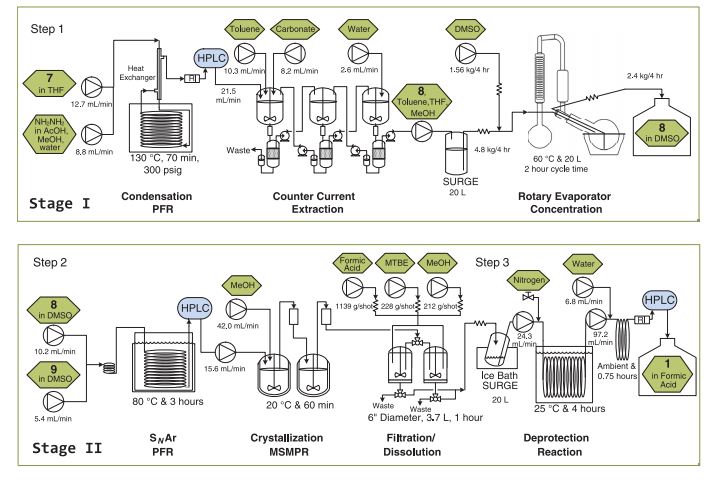
Stage A – Preparation of (S)-N-((2S, 3R)-l-amino-3-hydroxy-l-oxobutan-2-yl)-l-((S)-pyrrolidine-2-carbonyl) pyrrolidine-2-carboxamide (Compound XI)

[00120] In this stage, KSM -1 was reacted with 10%Pd/C in presence of methanol to produce a compound represented by Formula XI. The reaction was optimized and performed up to 4.0 kg scale in the production plant and observed consistent quality (>80% by HPLC%PA) and yields (80% to 85%).
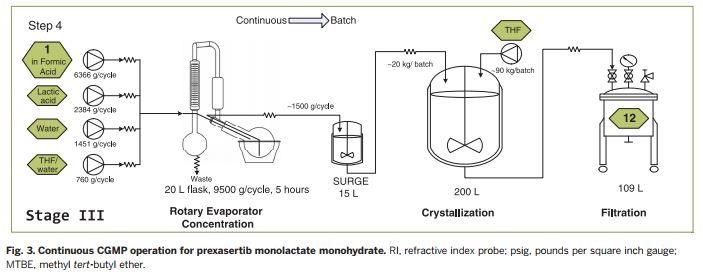
[00121] The reaction scheme involved in this method is as follows:

[00122] Raw materials used for this method are illustrated in Table 7 as follows:

Table 7.

[00123] In stage A, 10% Palladium on Carbon (w/w, 50% wet) was charged into the pressure reactor at ambient temperature under nitrogen atmosphere. KSM-1 was dissolved in methanol in another container and sucked into above reactor under vacuum. Hydrogen pressure was maintained at 45-60 psi at ambient temperature for over a period of 5-6 hrs. Progress of the reaction mixture was monitored by HPLC for KSM-1 content; limit is not more than 5%.

Hyflow bed was prepared with methanol (Lot-II). The reaction mass was filtered through nutsche filter under nitrogen atmosphere and bed was washed with Methanol Lot-Ill. Filtrate was transferred into the reactor and distilled completely under reduced pressure at below 50 °C (Bath temperature) to get the syrup and syrup material was unloaded into clean and dry container and samples were sent to QC for analysis.

[00124] From the above reaction(s), 1.31 kg of compound represented by Formula XI was obtained with a yield of 89.31% and with a purity of 93.63%).

Stage B – Preparation of Benzyl (2S, 3R)-l-((S)-2-((S)-2-((2S, 3R)-I-amino-3-hydroxy-I- oxobutan-2-ylcarbamoyl) pyrrolidine-! -carbonyl) pyrrolidin-1 -yl)-3-hydroxy-l -oxobutan-2- ylcarbamate (Compound XII)

[00125] In this stage the compound represented by Formula XI obtained above was reacted with KSM-2 to produce a compound represented by Formula XII. This reaction was optimized and scaled up to 3.0 kg scale in the production plant and obtained 25% to 28% yields with UPLC purity (>95%).

[00126] The reaction scheme is as follows:

[00127] Raw materials used for this method are illustrated in Table 8 as follows:

Table 8.

[00128] Stage B: ethanol was charged into the reactor at 20 to 35 °C. Compound represented by Formula XI was charged into the reactor under stirring at 20 to 35 °C and reaction mass was cooled to -5 to 0°C. EDC.HC1 was charged into the reaction mass at -5 to 0 °C and reaction mass, was maintained at -5 to 0 °C for 10-15 minutes. N-Methyl morpholine was added drop wise to the above reaction mass at -5 to 0 °C and reaction mass was maintained at -5 to 0 °C for 10-15 minutes.

[00129] KSM-2 was charged into the reactor under stirring at -5 to 0 °C and reaction mass was maintained at -5 to 0 °C for 3.00 to 4.00 hours. The temperature of the reaction mass was raised to 20 to 35 °C and was maintained at 20 to 35 °C for 12 – 15 hours under stirring. (Note:

Monitor the reaction mass by HPLC for Stage A content after 12.0 hours and thereafter every 2.0 hours. The content of stage A should not be more than 2.0%). Ethanol was distilled out completely under vacuum at below 50 °C (Hot water temperature) and reaction mass was cooled to 20 to 35 °C. Water Lot-1 was charged into the residue obtained followed by 10% DCM-Isopropyl alcohol (Mixture of Dichloromethane Lot-1 & Isopropyl alcohol Lot-1 prepared in a cleaned HDPE container) into the reaction mass at 20 – 35 °C.

[00130] Both the layers were separated and the aqueous layer was charged into the reactor. 10%) DCM-Isopropyl alcohol (Mixture of Dichloromethane Lot-2 & Isopropyl alcohol Lot-2 prepared in a cleaned HDPE container) was charged into the reaction mass at 20 to 35 °C. Both the layers were separated and the aqueous layer was charged back into the reactor. 10%> IDCM-isopropyl alcohol (Mixture of Dichloromethane Lot-3 & Isopropyl alcohol Lot-3 prepared in a cleaned HDPE container) was charged into the reaction mass at 20 to 35 °C. Both the layers were separated and the aqueous layer was charged back into the reactor. 10%> DCM-Isopropyl alcohol (Mixture of Dichloromethane Lot-4 & Isopropyl alcohol Lot-4 prepared in a cleaned HDPE container) was charged into the reaction mass at 20 to 35 °C and separated both the layers. The above organic layers were combined and potassium hydrogen sulfate solution (Prepare a solution in a HDPE container by dissolving Potassium hydrogen sulfate Lot-1 in water Lot-2) was charged into the reaction mass at 20 to 35 °C. Separated both the layers and charged back organic layer into the reactor. Potassium hydrogen sulfate solution (Prepared a solution in a HDPE container by dissolving Potassium hydrogen sulfate Lot-2 in water Lot-3) was charged into the reaction mass at 20 to 35 °C. Separated both the layers and the organic layer was dried over Sodium sulfate and distilled out the solvent completely under vacuum at below 45 °C (Hot water temperature).

[00131] The above crude was absorbed with silica gel (100-200mesh) Lot-1 in

dichloromethane. Prepared the column with silica gel (100-200 mesh) Lot-2, and washed the silica gel bed with from Dichloromethane Lot-5 and charged the adsorbed compound into the column. Eluted the column with 0-10% Methanol Lot-1 in Dichloromethane Lot-5 and analyzed fractions by HPLC. Solvent was distilled out completely under vacuum at below 45 °C (Hot water temperature). Methyl tert-butyl ether Lot-1 was charged and stirred for 30 min. The solid was filtered through the Nutsche filter and washed with Methyl tert-butyl ether Lot-2 and

samples were sent to QC for complete analysis. (Note: If product quality was found to be less than 95%, column purification should be repeated).

[00132] From the above reaction(s), 0.575 kg of compound represented by Formula XII was obtained with a yield of 17% and with a purity of 96.28%).

Stage C – Preparation of Benzyl (S)-N-((2S, 3R)-l-amino-3-hydroxy-l-oxobutan-2-yl)-l-((S)-l- ((2R, 3R)-2-amino-3-hydroxybutanoyl) pyrrolidine-2 carbonyl) pyrrolidine-2-carboxamide (GLYX-13)

[00133] In this reaction step the compound of Formula XII obtained above was reacted with 10%oPd in presence of methanol to produce GLYX-13. This reaction was optimized and performed up to 2.8 kg scale in the production plant and got 40% to 45% of yields with UPLC purity >98%.

[00134] The reaction scheme involved in this method is as follows:

i

[00135] Raw materials used for this method are illustrated in Table 9 as follows:

Table 9.

30 Nitrogen cylinder – – – – – 31 Hydrogen cylinder – – – – –

[00136] In an exemplary embodiment of stage C, 10% Palladium Carbon (50% wet) was charged into the pressure reactor at ambient temperature under nitrogen atmosphere. Compound of Formula XII was dissolved in methanol in a separate container and sucked into the reactor under vacuum. Hydrogen pressure was maintained 45-60 psi at ambient temperature over a period of 6-8 hrs. Progress of the reaction was monitored by HPLC for stage-B (compound represented by Formula XII) content (limit is not more than 2%). If HPLC does not comply continue the stirring until it complies. Prepared the hyflow bed with methanol (Lot-II) and the reaction mass was filtered through hyflow bed under nitrogen atmosphere, and the filtrate was collected into a clean HDPE container. The bed was washed with Methanol Lot-Ill and the filtrate was transferred into the Rota Flask and distilled out the solvent completely under reduced pressure at below 50°C (Bath temperature) to get the crude product. The material was unloaded into clean HDPE container under Nitrogen atmosphere.

[00137] Neutral Alumina Lot-1 was charged into the above HDPE container till uniform mixture was formed. The neutral Alumina bed was prepared with neutral alumina Lot-2 and dichloromethane Lot-1 in a glass column. The neutral Alumina Lot-3 was charged and

Dichloromethane Lot-2 into the above prepared neutral Alumina bed. The adsorbed compound was charged into the column from op.no.11. The column was eluted with Dichloromethane Lot-2 and collect 10 L fractions. The column was eluted with Dichloromethane Lot-3 and collected 10 L fractions. The column was eluted with Dichloromethane Lot-4 and Methanol Lot-4 (1%) and collected 10 L fractions. The column was eluted with Dichloromethane Lot-5 and Methanol Lot-5 (2%) and collected 10 L fractions. The column was eluted with Dichloromethane Lot-6 and Methanol Lot-6 (3%) and collected 10 L fractions. The column was eluted with

Dichloromethane Lot-7 and Methanol Lot-7 (5%). and collected 10 L fractions. The column was eluted with Dichloromethane Lot-8 and Methanol Lot-8 (8%). and collected 10 L fractions. The column was eluted with Dichloromethane Lot-9 and Methanol Lot-9 (10%) and collected 10 L fractions. Fractions were analyzed by HPLC (above 97% purity and single max impurity >0.5% fractions are pooled together)

[00138] Ensured the reactor is clean and dry. The pure fractions were transferred into the reactor.

[00139] The solvent was distilled off completely under vacuum at below 45 °C (Hot water temperature). The material was cooled to 20 to 35°C. Charged Dichloromethane Lot- 10 and Methanol Lot- 10 into the material and stirred till dissolution. Activated carbon was charged into the above mixture at 20 to 35°C and temperature was raised to 45 to 50 °C.

[00140] Prepared the Hyflow bed with Hyflow Lot-2 and Methanol Lot-11 Filtered the reaction mass through the Hy-flow bed under nitrogen atmosphere and collect the filtrate into a clean FIDPE container. Prepared solvent mixture with Dichloromethane Lot-11 and Methanol Lot- 12 in a clean FIDPE container and washed Nutsche filter with same solvent. Charged filtrate in to Rota evaporator and distilled out solvent under vacuum at below 50°C. Dry the compound in Rota evaporator for 5 to 6 hours at 50°C, send sample to QC for Methanol content (residual solvent) which should not be more than 3000 ppm. The material was cooled to 20 to 35 °C and the solid material was unloaded into clean and dry glass bottle. Samples were sent to QC for complete analysis.

[00141] From the above reaction(s), 0.92 kg of Glyx-13 was obtained with a yield of 43.5% and with a purity of 99.73%.

Patent ID

Patent Title

Submitted Date

Granted Date

US9593145 SECONDARY STRUCTURE STABILIZED NMDA RECEPTOR MODULATORS AND USES THEREOF 2015-05-14 2016-04-28
US2017049844 STABLE COMPOSITIONS OF NEUROACTIVE PEPTIDES 2015-04-27
US2017049845 METHODS OF TREATING ALZHEIMER’S DISEASE, HUNTINGTON’S DISEASE, AUTISM, OR OTHER DISORDERS 2016-04-14
US2017072005 COMBINATIONS OF NMDAR MODULATING COMPOUNDS 2015-05-06
US2016345855 METHODS OF TREATING BRAIN DISORDERS OR IDENTIFYING BIOMARKERS RELATED THERETO 2014-12-15
Patent ID

Patent Title

Submitted Date

Granted Date

US2015182582 Methods of Treating Depression and Other Related Diseases 2014-08-05 2015-07-02
US2015253305 METHODS OF IDENTIFYING COMPOUNDS FOR TREATING DEPRESSION AND OTHER RELATED DISEASES 2013-10-11 2015-09-10
US2015343013 METHODS OF TREATING NEUROPATHIC PAIN 2014-12-16 2015-12-03
US2016002292 METHODS OF TREATING DEPRESSION AND OTHER RELATED DISEASES 2015-02-06 2016-01-07
US2016244485 NMDA RECEPTOR MODULATORS AND PRODRUGS, SALTS, AND USES THEREOF 2014-10-27 2016-08-25
Patent ID

Patent Title

Submitted Date

Granted Date

US2013296248 Methods of Treating Depression and Other Related Diseases 2013-07-09 2013-11-07
US9101612 Secondary Structure Stabilized NMDA Receptor Modulators and Uses Thereof 2011-02-11 2013-02-28
US2012178695 METHODS OF TREATING NEUROPATHIC PAIN 2010-07-02 2012-07-12
US8951968 Methods of treating depression and other related diseases 2012-04-05 2015-02-10
US8492340 Methods of treating depression and other related diseases 2012-09-10 2013-07-23
Patent ID

Patent Title

Submitted Date

Granted Date

US8673843 NMDA receptors modulators and uses thereof 2012-06-18 2014-03-18
US2014249088 METHODS OF TREATING NEUROPATHIC PAIN 2013-09-27 2014-09-04
US9198948 Methods of Treating Depression and Other Related Diseases 2013-07-09 2013-11-21
US9149501 Methods of Treating Depression and Other Related Diseases 2013-07-09 2013-11-28
US9340576 Methods of Treating Depression and Other Related Diseases 2013-06-04 2013-10-31

See also

References

  1. Jump up to:a b c Hashimoto K, Malchow B, Falkai P, Schmitt A (August 2013). “Glutamate modulators as potential therapeutic drugs in schizophrenia and affective disorders”. Eur Arch Psychiatry Clin Neurosci263 (5): 367–77. PMID 23455590doi:10.1007/s00406-013-0399-y.
  2. Jump up to:a b c d Moskal JR, Burgdorf JS, Stanton PK, Kroes RA, Disterhoft JF, Burch RM, Amin Khan M (2016). “The Development of Rapastinel (Formerly GLYX-13); a rapid acting and long lasting antidepressant”. Curr NeuropharmacolPMID 26997507.
  3. Jump up^ FDA Grants Fast Track Designation to Naurex’s Rapid-Acting Novel Antidepressant GLYX-13 http://www.prnewswire.com/news-releases/fda-grants-fast-track-designation-to-naurexs-rapid-acting-novel-antidepressant-glyx-13-248174561.html
  4. Jump up^ http://naurex.com/wp-content/uploads/2014/12/Naurex_P2b_Data_Press_Release_FINAL_Approved.pdf
  5. Jump up to:a b Burgdorf, Jeffrey; Zhang, Xiao-lei; Weiss, Craig; Matthews, Elizabeth; Disterhoft, John F.; Stanton, Patric K.; Moskal, Joseph R. (2011). “The N-methyl-d-aspartate receptor modulator GLYX-13 enhances learning and memory, in young adult and learning impaired aging rats”Neurobiology of Aging32 (4): 698–706. ISSN 0197-4580PMC 3035742Freely accessiblePMID 19446371doi:10.1016/j.neurobiolaging.2009.04.012.
  6. Jump up^ Haring R, Stanton PK, Scheideler MA, Moskal JR (1991). “Glycine-like modulation of N-methyl-D-aspartate receptors by a monoclonal antibody that enhances long-term potentiation”. J. Neurochem57 (1): 323–32. PMID 1828831doi:10.1111/j.1471-4159.1991.tb02131.x.
  7. Jump up^ Moskal JR, Kuo AG, Weiss C, Wood PL, O’Connor Hanson A, Kelso S, Harris RB, Disterhoft JF (2005). “GLYX-13: a monoclonal antibody-derived peptide that acts as an N-methyl-D-aspartate receptor modulator”. Neuropharmacology49 (7): 1077–87. PMID 16051282doi:10.1016/j.neuropharm.2005.06.006.
  8. Jump up to:a b Burch RM, Amin Khan M, Houck D, Yu W, Burgdorf J, Moskal JR (2016). “NMDA Receptor Glycine Site Modulators as Therapeutics for Depression: Rapastinel has Antidepressant Activity without Causing Psychotomimetic Side Effects”. Curr NeuropharmacolPMID 26830963.
  9. Jump up^ Burgdorf, Jeffrey; Zhang, Xiao-lei; Weiss, Craig; Matthews, Elizabeth; Disterhoft, John F.; Stanton, Patric K.; Moskal, Joseph R. (2011). “The N-methyl-d-aspartate receptor modulator GLYX-13 enhances learning and memory, in young adult and learning impaired aging rats”Neurobiology of Aging32 (4): 698–706. PMC 3035742Freely accessiblePMID 19446371doi:10.1016/j.neurobiolaging.2009.04.012.
  10. Jump up^ Moskal, Joseph R.; Kuo, Amy G.; Weiss, Craig; Wood, Paul L.; O’Connor Hanson, Amy; Kelso, Stephen; Harris, Robert B.; Disterhoft, John F. (2005). “GLYX-13: A monoclonal antibody-derived peptide that acts as an N-methyl-d-aspartate receptor modulator”. Neuropharmacology49 (7): 1077–87. PMID 16051282doi:10.1016/j.neuropharm.2005.06.006.
  11. Jump up^ Stanton, Patric K.; Potter, Pamela E.; Aguilar, Jennifer; Decandia, Maria; Moskal, Joseph R. (2009). “Neuroprotection by a novel NMDAR functional glycine site partial agonist, GLYX-13”. NeuroReport20 (13): 1193–7. PMID 19623090doi:10.1097/WNR.0b013e32832f5130.
  12. Jump up^ Wood, Paul L.; Mahmood, Siddique A.; Moskal, Joseph R. (2008). “Antinociceptive action of GLYX-13: An N-methyl-D-aspartate receptor glycine site partial agonist”. NeuroReport19(10): 1059–61. PMID 18580579doi:10.1097/WNR.0b013e32830435c9.

External links

rapastinel
Rapastinel.svg
GLYX-133DanFrame1.svg
Clinical data
Pregnancy
category
  • US: N (Not classified yet)
ATC code
  • none
Legal status
Legal status
Identifiers
CAS Number
PubChem CID
ChemSpider
Chemical and physical data
Formula C18H31N5O6
Molar mass 413.47 g/mol
3D model (JSmol)
Patent ID

Patent Title

Submitted Date

Granted Date

US9796755 METHODS OF TREATING DEPRESSION AND OTHER RELATED DISEASES
2015-02-06
2016-01-07
Patent ID

Patent Title

Submitted Date

Granted Date

US9198948 Methods of Treating Depression and Other Related Diseases
2013-07-09
2013-11-21
US2016345855 METHODS OF TREATING BRAIN DISORDERS OR IDENTIFYING BIOMARKERS RELATED THERETO
2014-12-15
US2015182582 Methods of Treating Depression and Other Related Diseases
2014-08-05
2015-07-02
US2013296248 Methods of Treating Depression and Other Related Diseases
2013-07-09
2013-11-07
US9149501 Methods of Treating Depression and Other Related Diseases
2013-07-09
2013-11-28
Patent ID

Patent Title

Submitted Date

Granted Date

US2017072005 COMBINATIONS OF NMDAR MODULATING COMPOUNDS
2015-05-06
US2017049844 STABLE COMPOSITIONS OF NEUROACTIVE PEPTIDES
2015-04-27
US9340576 Methods of Treating Depression and Other Related Diseases
2013-06-04
2013-10-31
US8673843 NMDA receptors modulators and uses thereof
2012-06-18
2014-03-18
US2014249088 METHODS OF TREATING NEUROPATHIC PAIN
2013-09-27
2014-09-04
Patent ID

Patent Title

Submitted Date

Granted Date

US2017210779 N-METHYL-D-ASPARTATE RECEPTOR MODULATORS AND METHODS OF MAKING AND USING SAME
2015-07-24
US8492340 Methods of treating depression and other related diseases
2012-09-10
2013-07-23
US9101612 Secondary Structure Stabilized NMDA Receptor Modulators and Uses Thereof
2011-02-11
2013-02-28
US8951968 Methods of treating depression and other related diseases
2012-04-05
2015-02-10
US2017049845 METHODS OF TREATING ALZHEIMER’S DISEASE, HUNTINGTON’S DISEASE, AUTISM, OR OTHER DISORDERS
2016-04-14

/////////////RAPASTINEL, BV-102, GLYX-13, PEPTIDE, phase 3, рапастинел , راباستينيل , 雷帕替奈 , Fast Track designation , allergan, Peptide Drugs, 

CC(C(C(=O)N1CCCC1C(=O)N2CCCC2C(=O)NC(C(C)O)C(=O)N)N)O

ICH Q11 Q and A Document


DR ANTHONY MELVIN CRASTO Ph.D's avatarDRUG REGULATORY AFFAIRS INTERNATIONAL

Image result for ICH Q11

ICH Q11   Q and A Document


The topic of starting materials has been a vexed topic for some period. Indeed concerns relating to lack of clarity and issues pertaining to practical implementation led the EMA in Sept 2014 to publish a reflection paper—Reflection on the requirements for selection and justification of starting materials for the manufacture of chemical active substances.(10) The paper sought to outline key issues as well as authority expectations; specific areas of interest identified included the following:

1.

Variance in interpretation between applicant and reviewer.

2.

The registration of short syntheses that employ complex custom-made starting materials.

3.

Lack of details preventing authorities being able to assess the suitability of a proposed registered starting material and its associated control strategy.

Image result for ICH Q11Image result for ICH Q11

While the consensus was that overall this provided a useful perspective of at least the EMA’s interpretation of ICH Q11(2) and requirements for starting…

View original post 1,738 more words