New Drug Approvals

Home » 2017 » November (Page 2)

Monthly Archives: November 2017

DRUG APPROVALS BY DR ANTHONY MELVIN CRASTO .....FOR BLOG HOME CLICK HERE

Blog Stats

  • 4,807,307 hits

Flag and hits

Flag Counter

Enter your email address to follow this blog and receive notifications of new posts by email.

Join 37.9K other subscribers
Follow New Drug Approvals on WordPress.com

Archives

Categories

Recent Posts

Flag Counter

ORGANIC SPECTROSCOPY

Read all about Organic Spectroscopy on ORGANIC SPECTROSCOPY INTERNATIONAL 

Enter your email address to follow this blog and receive notifications of new posts by email.

Join 37.9K other subscribers
DR ANTHONY MELVIN CRASTO Ph.D

DR ANTHONY MELVIN CRASTO Ph.D

DR ANTHONY MELVIN CRASTO, Born in Mumbai in 1964 and graduated from Mumbai University, Completed his Ph.D from ICT, 1991,Matunga, Mumbai, India, in Organic Chemistry, The thesis topic was Synthesis of Novel Pyrethroid Analogues, Currently he is working with AFRICURE PHARMA, ROW2TECH, NIPER-G, Department of Pharmaceuticals, Ministry of Chemicals and Fertilizers, Govt. of India as ADVISOR, earlier assignment was with GLENMARK LIFE SCIENCES LTD, as CONSUlTANT, Retired from GLENMARK in Jan2022 Research Centre as Principal Scientist, Process Research (bulk actives) at Mahape, Navi Mumbai, India. Total Industry exp 32 plus yrs, Prior to joining Glenmark, he has worked with major multinationals like Hoechst Marion Roussel, now Sanofi, Searle India Ltd, now RPG lifesciences, etc. He has worked with notable scientists like Dr K Nagarajan, Dr Ralph Stapel, Prof S Seshadri, etc, He did custom synthesis for major multinationals in his career like BASF, Novartis, Sanofi, etc., He has worked in Discovery, Natural products, Bulk drugs, Generics, Intermediates, Fine chemicals, Neutraceuticals, GMP, Scaleups, etc, he is now helping millions, has 9 million plus hits on Google on all Organic chemistry websites. His friends call him Open superstar worlddrugtracker. His New Drug Approvals, Green Chemistry International, All about drugs, Eurekamoments, Organic spectroscopy international, etc in organic chemistry are some most read blogs He has hands on experience in initiation and developing novel routes for drug molecules and implementation them on commercial scale over a 32 PLUS year tenure till date Feb 2023, Around 35 plus products in his career. He has good knowledge of IPM, GMP, Regulatory aspects, he has several International patents published worldwide . He has good proficiency in Technology transfer, Spectroscopy, Stereochemistry, Synthesis, Polymorphism etc., He suffered a paralytic stroke/ Acute Transverse mylitis in Dec 2007 and is 90 %Paralysed, He is bound to a wheelchair, this seems to have injected feul in him to help chemists all around the world, he is more active than before and is pushing boundaries, He has 100 million plus hits on Google, 2.5 lakh plus connections on all networking sites, 100 Lakh plus views on dozen plus blogs, 227 countries, 7 continents, He makes himself available to all, contact him on +91 9323115463, email amcrasto@gmail.com, Twitter, @amcrasto , He lives and will die for his family, 90% paralysis cannot kill his soul., Notably he has 38 lakh plus views on New Drug Approvals Blog in 227 countries......https://newdrugapprovals.wordpress.com/ , He appreciates the help he gets from one and all, Friends, Family, Glenmark, Readers, Wellwishers, Doctors, Drug authorities, His Contacts, Physiotherapist, etc He has total of 32 International and Indian awards

Verified Services

View Full Profile →

Archives

Categories

Flag Counter

Nefopam Hydrochloride, Нефопама Гидрохлорид, 塩酸ネホパム


Nefopam2DACS.svg

Nefopam

  • Molecular Formula C17H19NO
  • Average mass 253.339 Da
Cas 13669-70-0 [RN]
1H-2,5-Benzoxazocine, 3,4,5,6-tetrahydro-5-methyl-1-phenyl-
237-148-2 [EINECS]
3,4,5,6-Tetrahydro-5-methyl-1-phenyl-1H-2,5-benzoxazocine
SCX-001
Image result for Nefopam Hydrochloride, Fenazoxine
Derivative Type: Hydrochloride
CAS Registry Number: 23327-57-3
Additional Names: Fenazoxine
SCX-001,  R-738
Non-Opioid Analgesics
Wound-Healing Agents
Biocodex, 1983 pain
Нефопама Гидрохлорид
塩酸ネホパム

Nefopam, sold under the brand names Acupan among others, is a painkilling medication. It is primarily used to treat moderate, acuteor chronic pain[3]

It is believed to work in the brain and spinal cord to relieve pain. There it is believed to work via rather unique mechanisms. Firstly it increases the activity of the serotoninnorepinephrine and dopamineneurotransmitters involved in, among other things, pain signaling. Secondly, it modulates sodium and calcium channels, thereby inhibiting the release of glutamate, a key neurotransmitter involved in pain processing.[4

Medical uses

Nefopam has additional action in the prevention of shivering, which may be a side effect of other drugs used in surgery.[5] Nefopam was significantly more effective than aspirin as an analgesic in one clinical trial,[6] although with a greater incidence of side effects such as sweating, dizziness and nausea, especially at higher doses.[7][8] Nefopam is around a third to half the potency and slightly less effective as an analgesic compared to morphine,[9][10][11] or oxycodone,[12] but tends to produce fewer side effects, does not produce respiratory depression,[13] and has much less abuse potential, and so is useful either as an alternative to opioids, or as an adjunctive treatment for use alongside opioid(s) or other analgesics.[11][14] Nefopam is also used to treat severe hiccups.[15]

Contraindications

Nefopam is contraindicated in people with convulsive disorders, those that have received treatment with irreversible monoamine oxidase inhibitors such as phenelzinetranylcypromine or isocarboxazid within the past 30 days and those with myocardial infarctionpain, mostly due to a lack of safety data in these conditions.[16]

Side effects

Common side effects include nausea, nervousness, dry mouth, light-headedness and urinary retention.[16] Less common side effects include vomiting, blurred vision, drowsiness, sweating, insomnia, headache, confusion, hallucinations, tachycardia, aggravation of angina and rarely a temporary and benign pink discolouration of the skin or erythema multiforme.[16]

Overdose

Overdose and death have been reported with nefopam,[17] although these events are less common with nefopam than with opioid analgesics.[18] Overdose usually manifests with convulsionshallucinationstachycardia, and hyperdynamic circulation.[16] Treatment is usually supportive, managing cardiovascular complications with beta blockers and limiting absorption with activated charcoal.[16]

Interactions

It has additive anticholinergic and sympathomimetic effects with other agents with these properties.[16] Its use should be avoided in people receiving some types of antidepressants (tricyclic antidepressants or monoamine oxidase inhibitors) as there is the potential for serotonin syndrome or hypertensive crises to result.[16]

Pharmacology

Nefopam[19][20]
Site Ki (nM)
SERT 29
NET 33
DAT 531
5-HT2A 1,685
5-HT2B 330
5-HT2C 56

The mechanism of action of nefopam and its analgesic effects are not well understood, although inhibition of the reuptake of serotoninnorepinephrine, and to a lesser extent dopamine (that is, acting as an SNDRI) is thought to be involved.[21][4] It also reduces glutamate signaling via modulating sodium and calcium channels.[22][4]

Pharmacokinetics

The absolute bioavailability of nefopam is low.[1] It is reported to achieve therapeutic plasma concentrations between 49 and 183 nM.[20] The drug is approximately 73% protein-bound across a plasma range of 7 to 226 ng/mL (28–892 nM).[1] The metabolism of nefopam is hepatic, by Ndemethylation and via other routes.[1] Its terminal half-life is 3 to 8 hours, while that of its active metabolite, desmethylnefopam, is 10 to 15 hours.[1] It is eliminated mostly in urine, and to a lesser extent in feces.[1]

Chemistry

Nefopam is a cyclized analogue of orphenadrinediphenhydramine, and tofenacin, with each of these compounds different from one another only by the presence of one or two carbons.[23][24][25] The ring system of nefopam is a benzoxazocine system.[23][26]

Society and culture

Recreational use

Recreational use of nefopam has been reported,[17] although this is less common than with opioid analgesics.[18]

SYNTHESIS

Image result for Nefopam synthesis

PATENT

ES 8605495

The reaction of 2-benzoylbenzoic acid (I) with SOCl2 in CHCl3, benzene or DMF gives the corresponding acyl chloride (II), which is condensed with ethanolamine (III) by means of TEA in CHCl3 to yield the amide (IV). The reduction of (IV) with LiAlH4 in THF affords the diol (V), which is cyclized by means of Ts-OH in refluxing benzene to provide 1-phenyl-3,4,5,6-tetrahydro-1H-2,5-benzoxazocine (VI). Finally, this compound is methylated by means of dimethyl sulfate in refluxing benzene, or by means of formaldehyde in hot dioxane/water. Alternatively, the cyclization of N-[2-[1-[2-(chloromethyl)phenyl]-1-phenylmethoxy]ethyl]-N-methylamine (VII) by means of pyridine in refluxing acetonitrile gives also the target benzoxazocine

PATENT

KE 8201564

PATENT

ES 8104800

The reaction of 3-phenylphthalide (I) with N-methylethanolamine (II) in refluxing benzene gives N-(2-hydroxyethyl)-2-(1-hydroxy-1-phenylmethyl)-N-methylbenzamide (III), which is cyclized by means of Ts-OH in refluxing toluene to yield 5-methyl-1-phenyl-3,4,5,6-tetrahydro-1H-2,5-benzoxazocin-6-one (IV). Finally this compound is reduced with LiAlH4 in refluxing THF to afford the target benzoxazocine. In an alternative method, the reduction of 2-benzoyl-N-(2-hydroxyethyl)-N-methylbenzamide (V) by means of sodium bis(2-methoxyethoxy)aluminum hydride in refluxing toluene gives the diol (VI), which is then cyclized by means of Ts-OH in refluxing toluene, or by means of aq. 48% HBr in hot chloroform to afford the target benzoxazocine

The reaction of 2-benzoylbenzoic acid (I) with refluxing SOCl2 gives the corresponding acyl chloride (II), which is condensed with 2-(methylamino)acetic acid (III) in benzene to yield the N-(2-benzoylbenzoyl)-N-methylglycine (IV). The reduction of (IV) by means of LiAlH4 in refluxing THF affords the diol (V), which is finally cyclized by means of PPA at 80 C to provide the target benzoxazocine.

PATENT

US 4208349

PATENT

https://www.google.com/patents/EP0033585A1?cl=enFigure imgb0001

This compound is useful as an intermediate in producing the pharmacologically valuable 3,4,5,6-tetrahydro-5-methyl-l-phenyl-lH-2,5-benzoxazocine- hydrochloride, or nefopam, which is used, e.g. as a muscle relaxant, an analgesic or antidepressant drug.

Processes for producing the compound of formula I are already known. For instance, according to German Patent 1,620,198, phthalic aldehyde is used as a starting material. According to the German Patent, the phthalic aldehyde is reacted with a Grignard reagent, phenylmagnesiumbromide, and an N-substituted aminoalcohol is coupled to the reaction mixture, to produce a product of formula:

Figure imgb0002

This product is catalytically hydrogenated with the aid of Pd/C, Pt or Raney-Ni, and a product of formula I is obtained.

In another method, according to the German Patent 1,620,198, o-benzoylbenzoic acid is used as a starting material, which is converted by means of thionylchloride into an acid chloride. To this acid chloride is then coupled methylethanolamine, and N-(2-hydroxyethyl)-N-methyl-o-benzoylbenzamide is obtained as an intermediate, which is reduced using LiAlH4 and an end-product of formula I is produced.

According to United States Patent 3,487,153 o-benzoylbenzoic acid amide is used as starting material to produce the intermediate. With the aid of thionylchloride the corresponding acid chloride is formed, which is allowed to react with N-methyl-2-aminoethanol. The so-produced N-(2-hydroxyethyl)-N-methyl-o-benzoylbenzamide is reduced with LiAlH4 to 2{[N-(2-hydroxyethyl)-N-methyl)amino}-methylbenzhydrol.

According to German Offenlegungschrift 2,834,312 o-benzoylbenzoic acid is used as a starting material, which is allowed to react with phosphorus trichloride in dichloroethane. The acid chloride formed is allowed to react with triethylamine and N-methyl-2-hydroxyethyl- amine, after which N-(2-hydroxyethyl)-N-methyl-o-benzoylbenzamide is formed. This compound is treated with phosphorus trichloride (at pH=7.0) and N-(2-chloroethyl)-N-methyl-o-benzoylbenzoic amide is obtained, which is then reduced with NaBH4 in acetic acid. By these means 2-{[N-(2-hydroxyethyl)-N-methyl]-amino?-methylbenzhydrol is obtained.

According to Finnish Patent No. 54793, which corresponds to Canadian Patent 982,608, a compound of formula III is used as starting material, which is reduced with NaBH4 to a corresponding benzhydrol derivative of formula IV, which is then allowed to react with an alkylamine to an a-substituted 2-aminomethyl- benzylalcohol of formula V. The abovementioned Patent does not concern either the preparation of nefopam or its intermediates

Figure imgb0003

When reviewing the abovementioned Patents, i.e. German Patent 1,620,198 and United States Patent 3,487,153, one can observe the disadvantage that catalytic hydrogenation with palladium on charcoal, platinum or Raney-Ni, or lithium aluminium hydride are to be used to reduce the starting materials. This latter reagent is expensive and reacts with water very intensely, so that even a little humidity in the working surroundings or in the solvents can cause a fire. Explosive hydrogen is also produced by the reaction. Grignard reactions and catalytic hydrogenations are technically difficult to perform on a large scale. Moreover, the price of o-phthalic aldehyde is high.

According to the method described in German Offenlegungschrift 2,834,312 the reducing of the amide- carbonyl group with sodium borohydride in acetic acid requires, however, great additional amounts or about 2-3 equivalents of sodium borohydride. The yield of the reaction is quite poor (about 50-55%) and the reaction time is long, so the production costs become high. Moreover, the number of synthetic reaction steps is high and the use of phosphorus trichloride especially on a production scale is difficult.

In the method according to the Finnish Patent 54793, which corresponds to the Canadian Patent 982,608, a benzophenone derivative (of formula III) is reduced with NaBH4 to the corresponding benzhydrol derivative (formula IV). This compound is, however, unstable because of the methylene halogen group in o-position, especially when R1 = H in formula IV. On storing for only a short time hydrogenchloride gas is released and a very stable 5-ring ether is formed, which is useless. The use of this method on a large scale is therefore almost impossible, because the intermediate is impossible to isolate fast enough to obtain at least a reasonable amount of the end product.

The present invention provides a process for the preparation of 2-{[N-(2-hydroxyethyl)-N-methyl]-amino}-methylbenzhydrol (as such or as an acid addition salt) which comprises reacting 2-chloromethylbenzophenone with 2-methylaminoethanol to give 2-J[N-(2-hydroxyethyl)-N-methyl]-amino}-methylbenzophenone (as such or as a salt), and reducing the latter with sodium borohydride to give 2-{[N-2-(hydroxyethyl)-N-methyl)-aminol}-methylbenzhydrol (as such or as an acid addition salt). The 2-chlorobenzophenone (of formula VI) is brought to react with methylethanolamine in the presence of e.g. sodium carbonate, and 2-{[N-(2-hydroxyethyl)-N-methyl]-amino}- methylbenzophenone (of formula VII) is formed. This substance is theoreduced with sodium borohydride to 2-{(N-(hydroxyethyl)-N-methyl]-amino}-methylbenzhydrol (of formula VIII), as shown below:

Figure imgb0004

Figure imgb0005

The starting material, 2-chloromethyl benzophenone, can be produced in known manner by halogenating the corresponding 2-methylbenzophenone (Monatshefte far Chemie 99, 1990-2003, 1968) or 2-hydroxymethylbenzophenone, of which the former is commercially available and the latter can be produced in known manner from the phthalide (see British Patent 1,526,331). The compound of formula VII is new, and as such a feature of the invention.

The following Examples illustrate the invention.

EXAMPLE 1

8.50 g (0.037 mol) 2-chloromethylbenzophenone is dissolved in 40 ml ethylalcohol, and 4.0 g sodium carbonate and 2.80 g (0.037 mol) 2-methylaminoethanol are added, The mixture is boiled for 3 hours and the salts formed are filtered off from the cooled solution. A pure reaction product is obtained when the ethanol is evaporated from the solution and the product is crystallized as a hydrochloride salt from a mixture of diethylether and alcohol. The yield is 10.7 g (95 %) of 2{(N-(2-hydroxyethyl)-N-methyl]-amino}- methylbenzophenone as a crystalline powder, m.p. 135-136 C.

This compound, as the free base, shows the following N M R spectrum (in cDC13 using T M S as internal reference): 7.8 – 7.1 (aromatic), 3.5 (singlet), 3.4 (triplet), about 2.6 (singlet), 2.3 (triplet),1.9 (singlet). Its infra-red spectrum shows maxima at the following frequencies (cm-1): 680, 720, 760, 910, 1010, 1060, 1140, 1230, 1260, 1300, 1430, 1560,1580, 1640, 2760, 2920, 3030 and 3400.

EXAMPLE 2

10.0 g (0.033 mol) of the hydrochloride salt prepared in Example 1 are dissolved in a mixture comprising 15 ml water, 60 ml methanol and 3.5 g sodium hydroxide. To the mixture is added 0.65 g sodium borohydride and the solution is mixed for half an hour at room temperature.

The solution is acidified with concentrated hydrochloric acid and the methanol is evaporated in vacum. 40 ml of water is added, the pH of the water solution is adjusted with diluted sodium hydroxide solution to an alkaline reaction and the product is extracted into chloroform. The chloroform extracts are washed well with water, dried over sodium sulphate and evaporated to dryness. The product is separated by precipitating as a hydrochloride salt from a mixture of diethylether and ethylalcohol. The yield is 9.8 g (96 %) of 2-{(N-(2-hydroxyethyl)-N-methyl]-amino}- methylbenzhydrol as a crystalline powder, m.p. 128-133 C.

PATENT CITATIONS
Cited Patent Filing date Publication date Applicant Title
DE2834312A1 * Aug 4, 1978 Feb 15, 1979 Riker Laboratories Inc Verfahren zur herstellung von 2 eckige klammer auf n-(2-hydroxyaethyl)- n-niederalkylaminomethyl eckige klammer zu -benzhydrolen
ES485471A * Title not available
Reference
1 * CHEMICAL ABSTRACTS Vol. 94, No. 11, 16 March 1981 Columbus, Ohio, USA FARMA-LEPORI “2-(n-2-Hydroxyethylmethylaminomethyl)benzhydrol” page 690, column 2, Abstract No. 83757s & ES – A – 485 471.
Citing Patent Filing date Publication date Applicant Title
CN102363610A * Nov 1, 2011 Feb 29, 2012 安徽万和制药有限公司 New method for synthesizing nefopam hydrochloride
CN102924320A * Nov 15, 2012 Feb 13, 2013 南京海陵中药制药工艺技术研究有限公司 Method for preparing nefopam intermediate I
CN102924320B * Nov 15, 2012 Jan 14, 2015 南京海陵中药制药工艺技术研究有限公司 Method for preparing nefopam intermediate I

PATENT

CN 102363610

https://www.google.com/patents/CN102363610A?cl=en

Example 1:

[0043] o-benzoyl benzoate 120g, phosphorus trichloride 30g, 220g of the mixture placed in a reaction flask dichloroethane, Mh was stirred at room temperature, the supernatant was separated to give acid chloride solution A;

[0044] A solution of this acid chlorine solution to 5 ° C and at a pre-filled with N- methyl ethanolamine 44g, triethylamine 64g, 200g dichloroethane reaction flask, stirred at room temperature drop after 10h, get amine solution B;

[0045] B in the amine solution and then dropping phosphorus trichloride 33g, reaction at 65 ° C 2h, washed with water cooling, the solution was washed with a dilute solution of sodium hydroxide, to sub-alkaline layer chloride solution C.

[0046] In the reaction flask was added a certain amount of potassium borohydride; potassium borohydride to mass, and then the mixture was added 15% acetic acid and dichloroethane (solvent of acetic acid mass ratio of 1: 1); to potassium borohydride mass, and then added dropwise to obtain 45% of the chlorination reaction chloride solution C, stirring the reaction was heated to reflux for 2h, pre-reduction; with potassium borohydride mass, further addition of 10% acetic acid and dichloroacetyl alkane mixture (mass ratio of acetic acid to solvent is 1: 1), the reaction was stirred Ih; in reducing mass, and finally the mixture was added dropwise 45% obtained by chlorinating liquid the chlorination reaction C with acetic acid (chloride quality liquid C and acetic acid ratio of 1: 1), the reaction was stirred tank for the final reduction. Plus 40% hydrolyzed sodium hydroxide solution, the organic layer was separated D

[0047] The separated organic layer D was cooled to room temperature and added slowly to 65 ° C hydrobromide reaction 6h, the reaction is completed, cooled to 0 ° C, and filtered to give the cyclization product E.

[0048] The cyclization to give the reaction product E was added sodium hydroxide solution and then dropwise addition of concentrated hydrochloric acid, to obtain Nefopam.

[0049] Example 2:

[0050] o-benzoyl benzoate 120g, phosphorus trichloride 30g, 220g of the mixture placed in a reaction flask dichloroethane, Mh was stirred at room temperature, the supernatant was separated to give acid chloride solution A;

[0051] A solution of this acid chlorine solution to 5 ° C and at a pre-filled with N- methyl ethanolamine 44g, triethylamine 64g, 200g dichloroethane reaction flask, stirred at room temperature drop after 10h, get amine solution B;

[0052] B in the amine solution and then dropping phosphorus trichloride 33g, reaction at 65 ° C 2h, washed with water cooling, the solution was washed with a dilute solution of sodium hydroxide, to sub-alkaline layer chloride solution C.

[0053] In the reaction flask was added a certain amount of potassium borohydride; potassium borohydride to mass, and then the mixture was added 25% acetic acid and dichloroethane (solvent of acetic acid mass ratio of 1: 1); to potassium borohydride mass, then dropping to 50% of the chlorination reaction chloride solution C, stirring heated to reflux for 2h, pre-reduction; potassium borohydride mass, then add 20% acetic acid and dichloroethane alkane mixture (mass ratio of acetic acid to solvent is 1: 1), the reaction was stirred Ih; in reducing mass, and finally the mixture was added dropwise a 50% solution chlorination reaction C and obtained by chlorinating acetic acid (chloride quality liquid C and acetic acid ratio of 1: 1), the reaction was stirred tank for the final reduction. Plus 40% hydrolyzed sodium hydroxide solution, the organic layer was separated D

[0054] The separated organic layer D was cooled to room temperature and added slowly with stirring at 65 ° C the reaction hydrobromide 8h, the reaction is completed, cooled to 0 ° C, and filtered to give the cyclization product E.

[0055] The cyclization to give the reaction product E was added sodium hydroxide solution and then dropwise addition of concentrated hydrochloric acid, to obtain Nefopam.

[0056] The applicant stated the above embodiments of the present invention will be described in detail the process equipment and process of the present invention, but the invention is not limited to the above detailed process equipment and process, that does not mean that the present invention must rely on such details process equipment and processes to be implemented. Skill in the art should be appreciated that any improvement in the present invention, the present invention is the product of the raw materials equivalents and adding auxiliary components, choice of specific ways, and fall within the scope of the public of the scope of the present invention.

Figure CN102363610AD00051

Figure CN102363610AD00052

Figure CN102363610AD00053

PATENT CITATIONS
Cited Patent Filing date Publication date Applicant Title
EP0033585A1 * Jan 9, 1981 Aug 12, 1981 Farmos-Yhtyma Oy A process for the preparation of a benzhydrol derivative and a novel intermediate for use therein
US3978085 * Mar 7, 1975 Aug 31, 1976 Riker Laboratories, Inc. Process for benz[f]-2,5-oxazocines
US4208349 * Mar 5, 1979 Jun 17, 1980 Riker Laboratories, Inc. Process for the preparation of 2-[N-(2-hydroxyethyl)-N-lower alkylaminomethyl]benzhydrols
Reference
1 * 胡颂凯: “镇痛药盐酸苯并噁唑辛的合成“, 《医药工业》, no. 8, 28 August 1984 (1984-08-28)
Citing Patent Filing date Publication date Applicant Title
CN102924320A * Nov 15, 2012 Feb 13, 2013 南京海陵中药制药工艺技术研究有限公司 Method for preparing nefopam intermediate I

CLIP

1H NMR (400 MHz, D2O, δ/ppm): 7.36–7.25 (m, 6H, arom H), 7.21–7.18 (m, 2H, arom H), 7.12–7.10 (m, 1H, arom H), 5.89 (s, 1H, Aryl–CH–Aryl), 5.45 (d, 1H, Aryl–CH(H)–N–, J = 12.8 Hz), 4.34–4.27 (m, 1H, –CH(H)–O–), 4.21 (d, 1H, Aryl–CH(H)–N–, J = 13.2 Hz), 4.05–4.00 [m (dt), 1H, –CH(H)–O–, J = 6.8 Hz and J = 3.6 Hz], 3.30-3.23 (m, 1H, –CH(H)– N–), 3.08–3.02 [m (dt), 1H, –CH(H)–N–, J = 7.2 Hz and J = 3.6 Hz), 2.87 (s, 3H, –CH3).

13C NMR (100 MHz, D2O, δ/ppm): 142.4, 141.1, 134.3, 130.5, 129.1, 129.0 (2C), 128.7, 128.4, 127.7 (2C), 125.3, 85.3, 64.9, 58.3, 50.5, 41.6

Powder XRD spectra and data of pure API (1). ABOVE

EXPANDED VIEW

5-Methyl-1-phenyl-3,4,5,6-tetrahydro-1H-2,5-benzoxazocine Hydrochloride (1

White crystalline solid, mp 248–251 °C, [α]D20 = −0.016 (c 1.0, H2O).
1H NMR (400 MHz, D2O, δ/ppm): 7.36–7.25 (m, 6H, arom H), 7.21–7.18 (m, 2H, arom H), 7.12–7.10 (m, 1H, arom H), 5.89 (s, 1H, Aryl–CH–Aryl), 5.45 (d, 1H, Aryl–CH(H)–N–, J = 12.8 Hz), 4.34–4.27 (m, 1H, −CH(H)–O−), 4.21 (d, 1H, Aryl–CH(H)–N–, J = 13.2 Hz), 4.05–4.00 (m (dt), 1H, −CH(H)–O–, J = 6.8 Hz and J = 3.6 Hz), 3.30–3.23 (m, 1H, −CH(H)–N−), 3.08–3.02 (m (dt), 1H, −CH(H)–N–, J = 7.2 Hz and J = 3.6 Hz), 2.87 (s, 3H, −CH3).
13C NMR (100 MHz, D2O, δ/ppm): 142.4, 141.1, 134.3, 130.5, 129.1, 129.0 (2C), 128.7, 128.4, 127.7 (2C), 125.3, 85.3, 64.9, 58.3, 50.5, 41.6.
ESI-MS (m/z): 254.20 (M + H)+. CHN analysis data (wt %): Anal. Calcd for C17H19NO·HCl or C1

PAPER

Old is Gold? Nefopam Hydrochloride, a Non-opioid and Non-steroidal Analgesic Drug and Its Practical One-Pot Synthesis in a Single Solvent for Large-Scale Production

Mohan Reddy Bodireddy, Kiran Krishnaiah, Prashanth Kumar Babu, Chaithanya Bitra, Madhusudana Rao Gajula*, and Pramod Kumar*
Chemical Research Division, API R&D Centre, Micro Labs Ltd., Plot No.43-45, KIADB Industrial Area, Fourth Phase, Bommasandra-Jigani Link Road, Bommasandra, Bangalore-560 105, Karnataka, India
Org. Process Res. Dev., Article ASAP
DOI: 10.1021/acs.oprd.7b00228

*Tel.: 0811 0415647, ext. 245; + 91 9008448247 (mobile). E-mail: pramodkumar@microlabs.in., *E-mail: gmadhusudanrao@yahoo.com.

 Abstract Image

Nefopam hydrochloride is extensively used in most of the European countries until today as an analgesic because of its non-opiate (non-narcotic) and non-steroidal action with fewer side effects compared with opioid and other analgesics, which cause more troublesome side effects. A multikilogram synthesis of nefopam hydrochloride has been achieved in one pot using a single solvent (toluene). A ≥99.9% purity of the active pharmaceutical ingredient (API) was achieved in excellent overall yield (≥79%). The one-pot, five-step synthetic process involves formation of an acid chloride (3) from benzoylbenzoic acid (2) followed by amidation (4), reduction (5), cyclization (6), and formation of the hydrochloride salt (1). The major advantages include (i) use of a single solvent, (ii) >90% conversion in each step, (iii) a cost-effective and operationally friendly process, (iv) averting the formation of genotoxic impurities, and (v) improved overall yield (≥79%) provided by the one-pot operation. For the first time, we report the characterization data of API 1, intermediates 34, and 5, and also a possible impurity (5a).

CLIP

Nefopam

Title: Nefopam
CAS Registry Number: 13669-70-0
CAS Name: 3,4,5,6-Tetrahydro-5-methyl-1-phenyl-1H-2,5-benzoxazocine
Additional Names: 5-methyl-1-phenyl-1,3,4,6-tetrahydro-5H-benz[f]-2,5-oxazocine
Molecular Formula: C17H19NO
Molecular Weight: 253.34
Percent Composition: C 80.60%, H 7.56%, N 5.53%, O 6.32%
Literature References: A cyclized analog of orphenadrine and diphenhydramine, q.q.v.; representative of a new class of centrally acting skeletal muscle relaxants, the benzoxazocines. Prepn: NL 6606390 (1966 to Rexall); M. W. Klohs et al., US 3830803 (1974 to Riker). Pharmacology: Bassett et al., Br. J. Pharmacol. 37, 69 (1969); Klohs et al., Arzneim.-Forsch. 22, 132 (1972). Review of pharmacology and therapeutic efficacy: R. C. Heel et al., Drugs 19, 249-267 (1980).
Derivative Type: Hydrochloride
CAS Registry Number: 23327-57-3
Additional Names: Fenazoxine
Manufacturers’ Codes: R-738
Trademarks: Acupan (3M); Ajan (3M)
Molecular Formula: C17H19NO.HCl
Molecular Weight: 289.80
Percent Composition: C 70.46%, H 6.96%, N 4.83%, O 5.52%, Cl 12.23%
Properties: mp 238-242°. LD50 in mice, rats (mg/kg): 119, 178 orally; 44.5, 28 i.v. (Baltes).
Melting point: mp 238-242°
Toxicity data: LD50 in mice, rats (mg/kg): 119, 178 orally; 44.5, 28 i.v. (Baltes)
Therap-Cat: Analgesic; antidepressant.
Keywords: Analgesic (Non-Narcotic); Antidepressant; Bicyclics.

References

  1. Jump up to:a b c d e f g h i j k l m Sanga M, Banach J, Ledvina A, Modi NB, Mittur A (2016). “Pharmacokinetics, metabolism, and excretion of nefopam, a dual reuptake inhibitor in healthy male volunteers”. Xenobiotica46 (11): 1001–16. PMID 26796604doi:10.3109/00498254.2015.1136989.
  2. Jump up^ G. Seyffart (6 December 2012). Drug Dosage in Renal Insufficiency. Springer Science & Business Media. pp. 407–. ISBN 978-94-011-3804-8.
  3. Jump up^ Brayfield, A, ed. (27 October 2016). “Nefopam hydrochloride”MedicinesComplete. London, UK: Pharmaceutical Press. Retrieved 4 September 2017.
  4. Jump up to:a b c Girard, P; Chauvin, M; Verleye, M (January 2016). “Nefopam analgesia and its role in multimodal analgesia: A review of preclinical and clinical studies.”. Clinical and Experimental Pharmacology & Physiology43 (1): 3–12. PMID 26475417doi:10.1111/1440-1681.12506.
  5. Jump up^ Alfonsi P, Adam F, Passard A, Guignard B, Sessler DI, Chauvin M (January 2004). “Nefopam, a Non-sedative Benzoxazocine Analgesic, Selectively Reduces the Shivering Threshold”Anesthesiology100 (1): 37–43. PMC 1283107Freely accessiblePMID 14695722doi:10.1097/00000542-200401000-00010.
  6. Jump up^ Cohen A, Hernandez CM (1976). “Nefopam hydrochloride: new analgesic agent”. Journal of International Medical Research4 (2): 138–43. PMID 799984.
  7. Jump up^ Wang RI, Waite EM (July 1979). “The clinical analgesic efficacy of oral nefopam hydrochloride”. Journal of Clinical Pharmacology19 (7): 395–402. PMID 479385doi:10.1002/j.1552-4604.1979.tb02498.x.
  8. Jump up^ Pillans PI, Woods DJ (September 1995). “Adverse reactions associated with nefopam”. New Zealand Medical Journal108 (1008): 382–4. PMID 7566787.
  9. Jump up^ Sunshine A, Laska E (November 1975). “Nefopam and morphine in man”. Clinical Pharmacology and Therapeutics18 (5 Pt 1): 530–4. PMID 1102231.
  10. Jump up^ Phillips G, Vickers MD (October 1979). “Nefopam in postoperative pain”. British Journal of Anaesthesia51 (10): 961–5. PMID 391253doi:10.1093/bja/51.10.961.
  11. Jump up to:a b Heel RC, Brogden RN, Pakes GE, Speight TM, Avery GS (1980). “Nefopam: a review of its pharmacological properties and therapeutic efficacy”. Drugs19 (4): 249–67. PMID 6991238doi:10.2165/00003495-198019040-00001.
  12. Jump up^ Tigerstedt I, Tammisto T, Leander P (December 1979). “Comparison of the analgesic dose-effect relationships of nefopam and oxycodone in postoperative pain”. Acta Anaesthesiologica Scandinavica23 (6): 555–60. PMID 397711doi:10.1111/j.1399-6576.1979.tb01486.x.
  13. Jump up^ Gasser JC, Bellville JW (August 1975). “Respiratory effects of nefopam”. Clinical Pharmacology and Therapeutics18 (2): 175–9. PMID 1097153.
  14. Jump up^ Kapfer B, Alfonsi P, Guignard B, Sessler DI, Chauvin M (January 2005). “Nefopam and Ketamine Comparably Enhance Postoperative Analgesia”Anesthesia and Analgesia100 (1): 169–74. PMC 1283103Freely accessiblePMID 15616073doi:10.1213/01.ANE.0000138037.19757.ED.
  15. Jump up^ Bilotta, F; Rosa, G (December 2000). “Nefopam for severe hiccups.”. The New England Journal of Medicine343 (26): 1973–4. PMID 11186682doi:10.1056/nejm200012283432619.
  16. Jump up to:a b c d e f g “Data Sheet ACUPAN™ Nefopam hydrochloride 30 mg tablets 20 mg intramuscular injection” (PDF). Medsafe New Zealand. iNova Pharmaceuticals (New Zealand) Limited. 3 September 2007. Retrieved 10 March 2014.
  17. Jump up to:a b Bismuth, C; Fournier, PE; Bavoux, E; Husson, O; Lafon, D (September 1987). “[Chronic abuse of the analgesic nefopam (Acupan)].”. Journal de Toxicologie Clinique et Experimentale (in French). 7 (5): 343–6. PMID 3448182.
  18. Jump up to:a b Tracqui, A; Berthelon, L; Ludes, B (May 2002). “Fatal overdosage with nefopam (Acupan).” (PDF). Journal of Analytical Toxicology26 (4): 239–43. PMID 12054367doi:10.1093/jat/26.4.239.
  19. Jump up^ Roth, BL; Driscol, J. “PDSP Ki Database”Psychoactive Drug Screening Program (PDSP). University of North Carolina at Chapel Hill and the United States National Institute of Mental Health. Retrieved 14 August 2017.
  20. Jump up to:a b Gregori-Puigjané, E.; Setola, V; Hert, J; Crews, BA; Irwin, JJ; Lounkine, E; Marnett, L; Roth, BL; Shoichet, BK (18 June 2012). “Identifying mechanism-of-action targets for drugs and probes” (PDF). Proceedings of the National Academy of Sciences109 (28): 11178–11183. PMC 3396511Freely accessiblePMID 22711801doi:10.1073/pnas.1204524109.
  21. Jump up^ Bausch & Lomb (NZ) Ltd (17 May 2017). “NEW ZEALAND DATA SHEET ACUPAN(TM)” (PDF). Medsafe. New Zealand The Ministry of Health. Retrieved 4 September 2017.
  22. Jump up^ Kim, KH; Abdi, S (April 2014). “Rediscovery of nefopam for the treatment of neuropathic pain.”The Korean Journal of Pain27 (2): 103–11. PMC 3990817Freely accessiblePMID 24748937doi:10.3344/kjp.2014.27.2.103.
  23. Jump up to:a b Camille Georges Wermuth; David Aldous; Pierre Raboisson; Didier Rognan (1 July 2015). The Practice of Medicinal Chemistry. Elsevier Science. pp. 250–251. ISBN 978-0-12-417213-5.
  24. Jump up^ Walter Sneader (23 June 2005). Drug Discovery: A History. John Wiley & Sons. pp. 405–. ISBN 978-0-471-89979-2.
  25. Jump up^ Hugo Kubinyi; Gerhard MÃ1⁄4ller (6 March 2006). Chemogenomics in Drug Discovery: A Medicinal Chemistry Perspective. John Wiley & Sons. pp. 54–. ISBN 978-3-527-60402-9.
  26. Jump up^ Amy Cruz (2014). Therapeutic Hypothermia. CRC Press. pp. 176–. GGKEY:R0AP2X4GZYF.
Nefopam
Nefopam2DACS.svg
Nefopam ball-and-stick model.png
Clinical data
Trade names Acupan
AHFS/Drugs.com International Drug Names
Routes of
administration
Oralintramuscularintravenous
ATC code
Legal status
Legal status
  • AU: S4 (Prescription only)
  • UK: POM (Prescription only)
Pharmacokinetic data
Bioavailability Low[1]
Protein binding 70–75% (mean 73%)[1][2]
Metabolism Liver (Ndemethylation, others)[1]
Metabolites Desmethylnefopam, others[1]
Biological half-life Nefopam: 3–8 hours[1]
Desmethylnefopam: 10–15 hours[1]
Excretion Urine: 79.3%[1]
Feces: 13.4%[1]
Identifiers
CAS Number
PubChem CID
ChemSpider
UNII
KEGG
ChEBI
ECHA InfoCard 100.033.757
Chemical and physical data
Formula C17H19NO
Molar mass 253.34 g/mol
3D model (JSmol)

////////////Nefopam Hydrochloride, Fenazoxine, Нефопама Гидрохлорид, 塩酸ネホパム

CN1CCOC(C2=CC=CC=C2C1)C3=CC=CC=C3

DISCLAIMER

“DRUG APPROVALS INT” CATERS TO EDUCATION GLOBALLY, No commercial exploits are done or advertisements added by me. This is a compilation for educational purposes only. P.S. : The views expressed are my personal and in no-way suggest the views of the professional body or the company that I represent

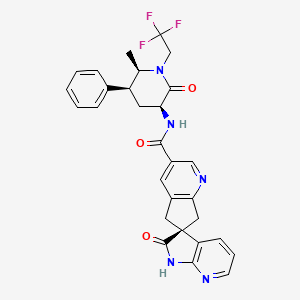
Ubrogepant, MK-1602


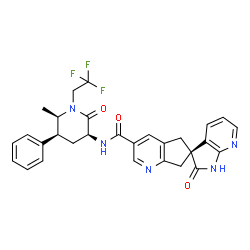
imgUbrogepant.pngImage result for UbrogepantImage result for Ubrogepant

Ubrogepant, MK-1602

(S)-N-((3S,5S,6R)-6-methyl-2-oxo-5-phenyl-1-(2,2,2-trifluoroethyl)piperidin-3-yl)-2′-oxo-1′,2′,5,7-tetrahydrospiro[cyclopenta[b]pyridine-6,3′-pyrrolo[2,3-b]pyridine]-3-carboxamide

(3’S)-N-[(3S,5S,6R)-6-methyl-2-oxo-5-phenyl-1-(2,2,2-trifluoroethyl)piperidin-3-yl]-2′-oxo-1′,2′,5,7-tetrahydrospiro[cyclopenta[b]pyridine-6,3′-pyrrolo[2,3-b]pyridine]-3-carboxamide
(6S)-N-[(3S,5S,6R)-6-Methyl-2-oxo-5-phenyl-1-(2,2,2-trifluoroethyl)-3-piperidinyl]-2′-oxo-1′,2′,5,7-tetrahydrospiro[cyclopenta[b]pyridine-6,3′-pyrrolo[2,3-b]pyridine]-3-carboxamide
Spiro[6H-cyclopenta[b]pyridine-6,3′-[3H]pyrrolo[2,3-b]pyridine]-3-carboxamide, 1′,2′,5,7-tetrahydro-N-[(3S,5S,6R)-6-methyl-2-oxo-5-phenyl-1-(2,2,2-trifluoroethyl)-3-piperidinyl]-2′-oxo-, (6S)-

CAS: 1374248-77-7
Chemical Formula: C29H26F3N5O3

Molecular Weight: 549.5542

UNII-AD0O8X2QJR

CAS TRIHYDRATE 1488325-95-6

CAS MONOHYDRATE 1488327-13-4

  • Originator Merck & Co
  • Class Amides; Antimigraines; Fluorine compounds; Small molecules; Spiro compounds
  • Mechanism of Action Calcitonin gene-related peptide receptor antagonists
  • Phase III Migraine, Allergan

Most Recent Events

  • 01 Sep 2016 Allergan initiates a phase III extension trial for Migraine in USA (PO, Tablet) (NCT02873221)
  • 12 Aug 2016 Allergan plans a phase III trial for Migraine in USA (PO) (NCT02867709)

  • 01 Aug 2016 Allergan initiates a phase III trial for Migraine in USA (PO) (NCT02867709)

Image result for Ubrogepant

Image result for Ubrogepant

Process for making piperidinone carboxamide indane and azainane derivatives, which are CGRP receptor antagonists useful for the treatment of migraine. This class of compounds is described in U.S. Patent Application Nos. 13/293,166 filed November 10, 2011 , 13/293, 177 filed November 10, 2011 and 13/293,186 filed November 10, 2011, and PCT International Application Nos. PCT/US11/60081 filed November 10, 2011 and PCT/US 11/60083 filed November 10, 2011.

CGRP (Calcitonin Gene-Related Peptide) is a naturally occurring 37-amino acid peptide that is generated by tissue-specific alternate processing of calcitonin messehger RNA and is widely distributed in the central and peripheral nervous system. CGRP is localized predominantly in sensory afferent and central neurons and mediates several biological actions, including vasodilation. CGRP is expressed in alpha- and beta-forms that vary by one and three amino acids in the rat and human, respectively. CGRP-alpha and CGRP-beta display similar biological properties. When released from the cell, CGRP initiates its biological responses by binding to specific cell surface receptors that are predominantly coupled to the activation of adenylyl cyclase. CGRP receptors have been identified and pharmacologically evaluated in several tissues and cells, including those of brain, cardiovascular, endothelial, and smooth muscle origin.

Based on pharmacological properties, these receptors are divided into at least two subtypes, denoted CGRPi and CGRP2. Human oc-CGRP-(8-37), a fragment of CGRP that lacks seven N-terminal amino acid residues, is a selective antagonist of CGRP l, whereas the linear analogue of CGRP, diacetoamido methyl cysteine CGRP ([Cys(ACM)2,7]CGRP), is a selective agonist of CGRP2. CGRP is a potent neuromodulator that has been implicated in the pathology of cerebrovascular disorders such as migraine and cluster headache. In clinical studies, elevated levels of CGRP in the jugular vein were found to occur during migraine attacks (Goadsby et al., Ann. Neurol., 1990, 28, 183-187), salivary levels of CGRP are elevated in migraine subjects between attacks (Bellamy et al., Headache, 2006, 46, 24-33), and CGRP itself has been shown to trigger migrainous headache (Lassen et al., Cephalalgia, 2002, 22, 54-61). In clinical trials, the CGRP antagonist BIBN4096BS has been shown to be effective in treating acute attacks of migraine (Olesen et al., New Engl. J. Med., 2004, 350, 1104-1110) and was able to prevent headache induced by CGRP infusion in a control group (Petersen et al., Clin. Pharmacol. Ther., 2005, 77, 202-213).

CGRP-mediated activation of the trigeminovascular system may play a key role in migraine pathogenesis. Additionally, CGRP activates receptors on the smooth muscle of intracranial vessels, leading to increased vasodilation, which is thought to contribute to headache pain during migraine attacks (Lance, Headache Pathogenesis: Monoamines, Neuropeptides, Purines and Nitric Oxide, Lippincott-Raven Publishers, 1997, 3-9). The middle meningeal artery, the principle artery in the dura mater, is innervated by sensory fibers from the trigeminal ganglion which contain several neuropeptides, including CGRP. Trigeminal ganglion stimulation in the cat resulted in increased levels of CGRP, and in humans, activation of the trigeminal system caused facial flushing and increased levels of CGRP in the external jugular vein (Goadsby et al, Ann. Neurol., 1988, 23, 193-196). Electrical stimulation of the dura mater in rats increased the diameter of the middle meningeal artery, an effect that was blocked by prior administration of CGRP(8-37), a peptide CGRP antagonist (Williamson et al., Cephalalgia, 1997, 17, 525-531). Trigeminal ganglion stimulation increased facial blood flow in the rat, which was inhibited by CGRP(8-37) (Escott et al., Brain Res. 1995, 669, 93-99). Electrical stimulation of the trigeminal ganglion in marmoset produced an increase in facial blood flow that could be blocked by the non-peptide CGRP antagonist BIBN4096BS (Doods et al., Br. J.Pharmacol., 2000, 129, 420-423). Thus the vascular effects of CGRP may be attenuated, prevented or reversed by a CGRP antagonist.

CGRP-mediated vasodilation of rat middle meningeal artery was shown to sensitize neurons of the trigeminal nucleus caudalis (Williamson et al., The CGRP Family: Calcitonin Gene-Related Peptide (CGRP), Amylin, and Adrenomedullin, Landes Bioscience, 2000, 245-247). Similarly, distention of dural blood vessels during migraine headache may sensitize trigeminal neurons. Some of the associated symptoms of migraine, including extracranial pain and facial allodynia, may be the result of sensitized trigeminal neurons (Burstein et al., Ann. Neurol. 2000, 47, 614-624). A CGRP antagonist may be beneficial in attenuating, preventing or reversing the effects of neuronal sensitization.

The ability of the compounds to act as CGRP antagonists makes them useful pharmacological agents for disorders that involve CGRP in humans and animals, but particularly in humans. Such disorders include migraine and cluster headache (Doods, Curr Opin Inves Drugs, 2001, 2 (9), 1261-1268; Edvinsson et al., Cephalalgia, 1994, 14, 320-327); chronic tension type headache (Ashina et al., Neurology, 2000, 14, 1335-1340); pain (Yu et al., Eur. J. Pharm., 1998, 347, 275-282); chronic pain (Hulsebosch et al., Pain, 2000, 86, 163-175);neurogenic inflammation and inflammatory pain (Holzer, Neurosci., 1988, 24, 739-768; Delay-Goyet et al., Acta Physiol. Scanda. 1992, 146, 537-538; Salmon et al., Nature Neurosci., 2001, 4(4), 357-358); eye pain (May et al. Cephalalgia, 2002, 22, 195-196), tooth pain (Awawdeh et al., Int. Endocrin. J., 2002, 35, 30-36), non-insulin dependent diabetes mellitus (Molina et al., Diabetes, 1990, 39, 260-265); vascular disorders; inflammation (Zhang et al, Pain, 2001, 89, 265), arthritis, bronchial hyperreactivity, asthma, (Foster et al., Ann. NY Acad. Sci., 1992, 657, 397-404; Schini et al., Am. J. Physiol., 1994, 267, H2483-H2490; Zheng et al., J. Virol., 1993, 67, 5786-5791); shock, sepsis (Beer et al., Crit. Care Med., 2002, 30 (8), 1794-1798); opiate withdrawal syndrome (Salmon et al., Nature Neurosci., 2001, 4(4), 357-358); morphine tolerance (Menard et al., J. Neurosci., 1996, 16 (7), 2342-2351); hot flashes in men and women (Chen et al., Lancet, 1993, 342, 49; Spetz et al., J. Urology, 2001, 166, 1720-1723); allergic dermatitis (Wallengren, Contact Dermatitis, 2000, 43 (3), 137-143); psoriasis; encephalitis, brain trauma, ischaemia, stroke, epilepsy, and neurodegenerative diseases (Rohrenbeck et al., Neurobiol. of Disease 1999, 6, 15-34); skin diseases (Geppetti and Holzer, Eds., Neurogenic Inflammation, 1996, CRC Press, Boca Raton, FL), neurogenic cutaneous redness, skin rosaceousness and erythema; tinnitus (Herzog et al., J. Membrane Biology, 2002, 189(3), 225); inflammatory bowel disease, irritable bowel syndrome, (Hoffman et al. Scandinavian Journal of Gastroenterology,2002, 37(4) 414-422) and cystitis. Of particular importance is the acute or prophylactic treatment of headache, including migraine and cluster headache.

Ubrogepant (MK-1602), an oral calcitonin gene-related peptide (CGRP) antagonist, is in phase III clinical development at Allergan for the acute treatment of migraine attacks.

In August 2015, the product was licensed to Allergan by Merck, for the development and marketing worldwide for the treatment of migraine.

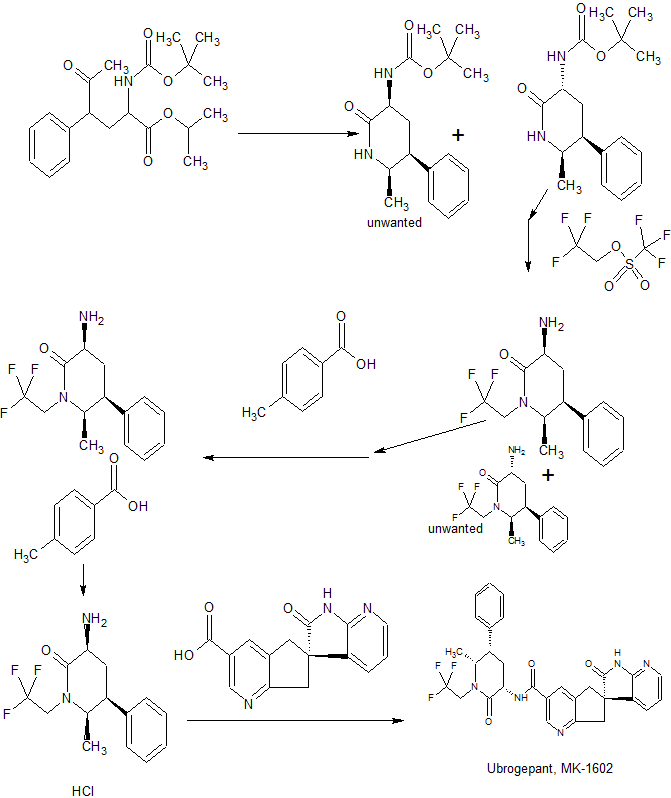
Synthesis

WO 2013138418

CONTD………..

CONTD……….
Inventors Ian M. BellMark E. FraleySteven N. GallicchioAnthony GinnettiHelen J. MitchellDaniel V. PaoneDonnette D. StaasHeather E. StevensonCheng WangC. Blair Zartman
Applicant Merck Sharp & Dohme Corp.

Ian Bell

Ian Bell

Principal Scientist at Merck
Merck
Mark Fraley

Mark Fraley

Principal Scientist, Merck
Steven Gallicchio

Steven Gallicchio

Patent

 WO 2012064910

EXAMPLE 1

Figure imgf000072_0002

(65yN-[(3£5£ )-6-Methyl-2-oxo-5-pheny

i’,2′,5 J-tetrahvdrospiro[cyclopenta|^lpyridine-6,3′-pyrroloj2,3-¾lpyridine1-3-carboxamide (Benzotriazol- 1 -yloxy)tr/i,(dimethylamino)phosphonium hexafluorophosphate (1.89 g, 4.28 mmol) was added to a solution of (6S -2′-oxo- ,2,,5,7- tetrahydrospiro[cyclopenta[&]pyridine-6,3′-pyrrolo[2,3-&]pyridine]-3-carboxylic acid (described in Intermediate 1) (1.10 g, 3.92 mmol), (3JS’,55′,6J?)-3-amino-6-methyl~5~phenyl-l-(2,2,2- trifluoroethyl)piperidin-2-one hydrochloride (described in Intermediate 4) (1.15 g, 3.56 mmol), and NjiV-diisopropylethylamine (3.1 1 m.L, 17.8 mmol) in DMF (40 mL), and the resulting mixture was stirred at 23 °C for 3 h. The reaction mixture was then partitioned between saturated aqueous sodium bicarbonate solution (200 mL) and ethyl actetate (3 χ 200 mL). The combined organic layers were washed with brine, dried over sodium sulfate, and concentrated. The residue was purified by flash column chromatography on silica gel, eluting with hexanes initially, then grading to 100% EtOAc before stepping to 5% MeOH in EtOAc to afford the title compound as an amorphous solid, which was further purified by the following crystallization procedure. A solution of the amorphous product in a minimal amount of methanol required for dissolution was diluted with 10 volumes water, and the resulting slurry was seeded with crystalline product and stirred at 23 °C for 4 h. The solids were filtered, washed with water, and dried under a stream of nitrogen to give the title compound as a crystalline solid. HRMS: m/z = 550.2068, calculated m/z – 550.2061 for C29H27F3N503. lH NMR (500 MHz, CDC13) δ 8.91 (s, 1H), 8.70 (s, 1H), 8.17 (dd, 1H, J- 5.4, 1.5 Hz), 8.04 (s5 1H), 7.37 (m, 3H), 7.29 (t, 1H, J= 7.3 Hz), 7.21 (d, 2H, J= 7.3 Hz), 7.13 (dd, 1H, J = 7.3, 1.2 Hz), 6.89 (dd, 1H, J = 7.3, 5.4 Hz), 4.99- 4.90 (m, 1H), 4.53 (dt, 1H, J= 10.7, 6.6 Hz), 3.94 (p, 1H, J = 5.9 Hz), 3.78 (d, 1H, J = 17.1 Hz), 3.67 (d, 1H, J- 16.4 Hz), 3.65 (m, 1H), 3.34-3.26 (m, 1H), 3.28 (d, 1H, J- 17.1 Hz), 3.17 (d, 1H, J = 16.6 Hz), 2.79 (m, 1H), 2.58 (q, 1H, J – 12.7 Hz), 1.07 (d, 3H, J= 6.6 Hz).

PATENT

WO 2013169348

(5)-N-((3^,5^,6i?)-6-Methyl-2-oxo-5-phenyl 2,2,2-trifluoroethyl)piperidine-3-yl)-2*-oxo- l\2 5,7-tetrahydrospiro[cyclopenta[¾]pyridine-6,3′-pyrrolo[2,3-¾]pyridine]-3-carboxam trihydrate (15)

Figure imgf000054_0001

To a suspension of 11 (465 g, 96% wt, 0.99 mol) in iPAc (4.6 L) was added 5% aqueous K3PO4 (4.6 L). The mixture was stirred for 5 min. The organic layer was separated and washed with 5%> aqueous K3PO4 (4.6 L) twice and concentrated in vacuo and dissolved in acetonitrile (1.8 L).

To another flask was added 14 (303 g, 91.4 wt%>), acetonitrile (1.8 L) and water (1.8 L) followed by 10 N NaOH (99 mL). The resulting solution was stirred for 5 min at room temperature and the chiral amine solution made above was charged to the mixture and the container was rinsed with acetonitrile (900 mL). HOBT hydrate (164 g) was charged followed by EDC hydrochloride (283 g). The mixture was agitated at room temperature for 2.5 h. To the mixture was added iPAc (4.6 L) and organic layer was separated, washed with 5%> aqueous NaHC03 (2.3 L) followed by a mixture of 15%> aqueous citric acid (3.2 L) and saturated aqueous NaCl (1.2 L). The resulting organic layer was finally washed with 5%> aqueous NaHC03 (2.3 L). The organic solution was concentrated below 50 °C and dissolved in methanol (2.3 L). The solution was slowly added to a mixture of water (6 L) and methanol (600 mL) with ~ 2 g of seed crystal. And the resulting suspension was stirred overnight at room temperature. Crystals were filtered, rinsed with water/methanol (4 L, 10 : 1), and dried under nitrogen flow at room temperature to provide 15 (576 g, 97 % yield) as trihydrate.

Ή NMR (500 MHz, CDCI3): δ 10.15 (br s, 1 H), 8.91 (br s, 1 H), 8.21 (d, J= 6.0 Hz, 1 H), 8.16 (dd, J= 5.3, 1.5 Hz, 1 H), 8.01 (br s, 1 H), 7.39-7.33 (m, 2 H), 7.31-7.25 (m, 1 H), 7.22-7.20 (m, 2 H), 7.17 (dd, J= 7.4, 1.6 Hz, 1 H), 6.88 (dd, J= 7.4, 5.3 Hz, 1 H), 4.94 (dq, J= 9.3, 7.6 Hz, 1 H), 4.45-4.37 (m, 1 H), 3.94-3.87 (m, 1 H), 3.72 (d, J= 17.2 Hz, 1 H), 3.63-3.56 (m, 2 H), 3.38-3.26 (m, 1 H), 3.24 (d, J= 17.3 Hz, 1 H), 3.13 (d, J= 16.5 Hz, 1 H), 2.78 (q, J= 12.5 Hz, 1 H), 2.62-2.56 (m, 1 H), 1.11 (d, J= 6.5 Hz, 3 H); 13C NMR (126 MHz, CD3CN): δ 181.42, 170.63, 166.73, 166.63, 156.90, 148.55, 148.08, 141.74, 135.77, 132.08, 131.09, 130.08, 129.66, 129.56, 128.78, 128.07, 126.25 (q, J= 280.1 Hz), 119.41, 60.14, 53.07, 52.00, 46.41 (q, J= 33.3 Hz), 45.18, 42.80, 41.72, 27.79, 13.46; HRMS m/z: calcd for C29H26F3N503 550.2061 (M+H): found 550.2059.

Alternative procedure for 15:

Figure imgf000055_0001

13

To a suspension of 13 (10 g, 98 wt%, 23.2 mmol) in MTBE (70 mL) was added 0.6 N HCI (42 mL). The organic layer was separated and extracted with another 0.6 N HCI (8 mL). The combined aqueous solution was washed with MTBE (10 mL x3). To the resulting aqueous solution was added acetonitrile (35 mL) and 14 (6.66 g, 99 wt%). To the resulting suspension was neutralized with 29 % NaOH solution to pH 6. HOPO (0.26 g) was added followed by EDC hydrochloride (5.34 g). The mixture was stirred at room temperature for 6-12 h until the conversion was complete (>99%). Ethanol (30 ml) was added and the mixture was heated to 35 °C. The resulting solution was added over 2 h to another three neck flask containing ethanol (10 mL), water (30 mL) and 15 seeds (0.4 g). Simultaneously, water (70 mL) was also added to the mixture. The suspension was then cooled to 5 °C over 30 min and filtered. The cake was washed with a mixture of ethanol/water (1 :3, 40 mL). The cake was dried in a vacuum oven at 40 °C to give 15 trihydrate (13.7 g, 95%) as crystals.

PATENT

WO 2013138418

PATENT

US 9174989

CLIP

Practical Asymmetric Synthesis of a Calcitonin Gene-Related Peptide (CGRP) Receptor Antagonist Ubrogepant

 Department of Process Chemistry, MRL, 126 East Lincoln Avenues, Rahway, New Jersey 07065, United States
 Department of Process Chemistry, MSD Research Laboratories, Hertford Road, Hoddesdon, Hertford, Hertfordshire EN11 9BU, United Kingdom
§ Department of Process Chemistry, MRL, 770 Sumneytown Pike, West Point, Pennsylvania 19486, United States
 Codexis, Inc., 200 Penobscot Drive, Redwood City, California 94063, United States
 Shanghai SynTheAll Pharmaceutical Co. Ltd., 9 Yuegong Road, Jinshan District, Shanghai, 201507, China
Org. Process Res. Dev., Article ASAP
DOI: 10.1021/acs.oprd.7b00293

Abstract

Abstract Image

The development of a scalable asymmetric route to a new calcitonin gene-related peptide (CGRP) receptor antagonist is described. The synthesis of the two key fragments was redefined, and the intermediates were accessed through novel chemistry. Chiral lactam 2 was prepared by an enzyme mediated dynamic kinetic transamination which simultaneously set two stereocenters. Enzyme evolution resulted in an optimized transaminase providing the desired configuration in >60:1 syn/anti. The final chiral center was set via a crystallization induced diastereomeric transformation. The asymmetric spirocyclization to form the second fragment, chiral spiro acid intermediate 3, was catalyzed by a novel doubly quaternized phase transfer catalyst and provided optically pure material on isolation. With the two fragments in hand, development of their final union by amide bond formation and subsequent direct isolation is described. The described chemistry has been used to deliver over 100 kg of our desired target, ubrogepant.

(S)-N-((3S,5S,6R)-6-Methyl-2-oxo-5-phenyl-1-(2,2,2-trifluoroethyl)piperidin-3-yl)-2′-oxo-1′,2′,5,7-tetrahydrospiro[cyclopenta[b]pyridine-6,3′-pyrrolo[2,3-b]pyridine]-3-carboxamide Trihydrate (1)

………..of white solids as 1 trihydrate (95%).
1H NMR (500 MHz, CDCl3): δ 10.15 (br s, 1H); 8.91 (br s, 1H); 8.21 (d, J = 6.0 Hz, 1H); 8.16 (dd, J = 5.3, 1.5 Hz, 1H); 8.01 (br s, 1H); 7.39–7.33 (m, 2H); 7.31–7.25 (m, 1H); 7.22–7.20 (m, 2H); 7.17 (dd, J = 7.4, 1.6 Hz, 1H); 6.88 (dd, J = 7.4, 5.3 Hz, 1H); 4.94 (dq, J = 9.3, 7.6 Hz, 1H); 4.45–4.37 (m, 1H); 3.94–3.87 (m, 1H); 3.72 (d, J = 17.2 Hz, 1H); 3.63–3.56 (m, 2H); 3.38–3.26 (m, 1H); 3.24 (d, J = 17.3 Hz, 1H); 3.13 (d, J = 16.5 Hz, 1H); 2.78 (q, J = 12.5 Hz, 1H); 2.62–2.56 (m, 1H); 1.11 (d, J = 6.5 Hz, 3H);
13C NMR (126 MHz, CDCl3): δ 181.4, 170.6, 166.7, 166.6, 156.9, 148.6, 148.1, 141.7, 135.8, 132.1, 131.1, 130.1, 129.7, 129.6, 128.8, 128.1, 126.3 (q, J = 280.1 Hz), 119.4, 60.1, 53.1, 52.0, 46.4 (q, J = 33.3 Hz), 45.2, 42.8, 41.7, 27.8, 13.5;
HRMS m/z: calcd for C29H27F3N5O3: 550.2061 (M + H); found: 550.2059.

US7390798 * Feb 9, 2005 Jun 24, 2008 Merck & Co., Inc. Carboxamide spirolactam CGRP receptor antagonists
US20090054408 * Sep 6, 2005 Feb 26, 2009 Bell Ian M Monocyclic anilide spirolactam cgrp receptor antagonists
US20100160334 * Mar 5, 2010 Jun 24, 2010 Bell Ian M Tricyclic anilide spirolactam cgrp receptor antagonists
US20100179166 * Jun 2, 2008 Jul 15, 2010 Ian Bell Carboxamide heterocyclic cgrp receptor antagonists
US20120122899 * Nov 10, 2011 May 17, 2012 Merck Sharp & Dohme Corp. Piperidinone carboxamide azaindane cgrp receptor antagonists
US20120122900 * Nov 10, 2011 May 17, 2012 Merck Sharp & Dohme Corp. Piperidinone carboxamide azaindane cgrp receptor antagonists
US20120122911 * Nov 10, 2011 May 17, 2012 Merck Sharp & Dohme Corp. Piperidinone carboxamide azaindane cgrp receptor antagonists
Reference
1 * See also references of EP2849568A4
Citing Patent Filing date Publication date Applicant Title
CN105037210A * May 27, 2015 Nov 11, 2015 江苏大学 Alpha,beta-dehydrogenated-alpha-amino acid synthesis method
US9688660 Oct 28, 2016 Jun 27, 2017 Heptares Therapeutics Limited CGRP receptor antagonists
Patent ID

Patent Title

Submitted Date

Granted Date

US2016346198 NOVEL DISINTEGRATION SYSTEMS FOR PHARMACEUTICAL DOSAGE FORMS
2015-02-04
US2016346214 TABLET FORMULATION FOR CGRP ACTIVE COMPOUNDS
2015-01-30
Patent ID

Patent Title

Submitted Date

Granted Date

US2015112067 PROCESS FOR MAKING CGRP RECEPTOR ANTAGONISTS
2013-03-13
2015-04-23
US9174989 Process for making CGRP receptor antagonists
2013-03-12
2015-11-03
US2016220552 FORMULATIONS FOR CGRP RECEPTOR ANTAGONISTS
2014-09-11
2016-08-04
US2016130273 Process for Making CGRP Receptor Antagonists
2015-09-15
2016-05-12
US2017027925 PIPERIDINONE CARBOXAMIDE AZAINDANE CGRP RECEPTOR ANTAGONISTS
2016-10-14
Patent ID

Patent Title

Submitted Date

Granted Date

US8754096 Piperidinone carboxamide azaindane CGRP receptor antagonists
2011-11-10
2014-06-17
US8912210 Piperidinone carboxamide azaindane CGRP receptor antagonists
2011-11-10
2014-12-16
US8481556 Piperidinone carboxamide azaindane CGRP receptor antagonists
2011-11-10
2013-07-09
US9499545 PIPERIDINONE CARBOXAMIDE AZAINDANE CGRP RECEPTOR ANTAGONISTS
2014-09-12
2015-01-01
US9487523 PROCESS FOR MAKING CGRP RECEPTOR ANTAGONISTS
2013-09-19
2015-02-05

REFERENCES

1: Voss T, Lipton RB, Dodick DW, Dupre N, Ge JY, Bachman R, Assaid C, Aurora SK, Michelson D. A phase IIb randomized, double-blind, placebo-controlled trial of ubrogepant for the acute treatment of migraine. Cephalalgia. 2016 Aug;36(9):887-98. doi: 10.1177/0333102416653233. PubMed PMID: 27269043.

/////////////ubrogepant, MK-1602, Phase III,  Migraine

 O=C(C1=CN=C2C(C[C@@]3(C4=CC=CN=C4NC3=O)C2)=C1)N[C@@H]5C(N(CC(F)(F)F)[C@H](C)[C@H](C6=CC=CC=C6)C5)=O

FDA approves first treatment Zelboraf (vemurafenib)for certain patients with Erdheim-Chester Disease, a rare blood cancer


FDA approves first treatment for certain patients with Erdheim-Chester Disease, a rare blood cancer

The U.S. Food and Drug Administration today expanded the approval of Zelboraf (vemurafenib) to include the treatment of certain adult patients with Erdheim-Chester Disease (ECD), a rare cancer of the blood. Zelboraf is indicated to treat patients whose cancer cells have a specific genetic mutation known as BRAF V600. This is the first FDA-approved treatment for ECD. Continue reading.

//////Zelboraf, vemurafenib, fda 2017, Erdheim-Chester Disease,


Vemurafenib
Vemurafenib structure.svg
Vemurafenib ball-and-stick model.png
Clinical data
Pronunciation /ˌvɛməˈræfənɪb/ VEM-ə-RAF-ə-nib
Trade names Zelboraf
Synonyms PLX4032, RG7204, RO5185426
AHFS/Drugs.com Monograph
MedlinePlus a612009
License data
Pregnancy
category
  • AU: D
  • US: D (Evidence of risk)
Routes of
administration
By mouth (tablets)
ATC code
Legal status
Legal status
Identifiers
CAS Number
PubChem CID
IUPHAR/BPS
DrugBank
ChemSpider
UNII
KEGG
ChEMBL
PDB ligand
ECHA InfoCard 100.226.540
Chemical and physical data
Formula C23H18ClF2N3O3S
Molar mass 489.92 g/mol
3D model (JSmol)

Vemurafenib (INN, marketed as Zelboraf) is a B-Raf enzyme inhibitor developed by Plexxikon (now part of Daiichi-Sankyo) and Genentech for the treatment of late-stage melanoma.[1] The name “vemurafenib” comes from V600E mutated BRAF inhibition.

Approvals

Vemurafenib received FDA approval for the treatment of late-stage melanoma on August 17, 2011,[2] making it the first drug designed using fragment-based lead discovery to gain regulatory approval.[3]

Vemurafenib later received Health Canada approval on February 15, 2012.[4]

On February 20, 2012, the European Commission approved vemurafenib as a monotherapy for the treatment of adult patients with BRAF V600E mutation positive unresectable or metastatic melanoma, the most aggressive form of skin cancer.[5]

Mechanism of action

Vemurafenib causes programmed cell death in melanoma cell lines.[6] Vemurafenib interrupts the B-Raf/MEK step on the B-Raf/MEK/ERK pathway − if the B-Raf has the common V600E mutation.

Vemurafenib only works in melanoma patients whose cancer has a V600E BRAF mutation (that is, at amino acid position number 600 on the B-Raf protein, the normal valine is replaced by glutamic acid).[7] About 60% of melanomas have this mutation. It also has efficacy against the rarer BRAF V600K mutation. Melanoma cells without these mutations are not inhibited by vemurafenib; the drug paradoxically stimulates normal BRAF and may promote tumor growth in such cases.[8][9]

Resistance

Three mechanisms of resistance to vemurafenib (covering 40% of cases) have been discovered:

Clinical trials

In a phase I clinical study, vemurafenib (then known as PLX4032) was able to reduce numbers of cancer cells in over half of a group of 16 patients with advanced melanoma. The treated group had a median increased survival time of 6 months over the control group.[13][14][15][16]

A second phase I study, in patients with a V600E mutation in B-Raf, ~80% showed partial to complete regression. The regression lasted from 2 to 18 months.[17]

In early 2010 a Phase I trial[18] for solid tumors (including colorectal cancer), and a phase II study (for metastatic melanoma) were ongoing.[19]

A phase III trial (vs dacarbazine) in patients with previously untreated metastatic melanoma showed an improved rates of overall and progression-free survival.[20]

In June 2011, positive results were reported from the phase III BRIM3 BRAF-mutation melanoma study.[21] The BRIM3 trial reported good updated results in 2012.[22]

Further trials are planned including a trial of vemurafenib co-administered with GDC-0973 (cobimetinib), a MEK-inhibitor.[21] After good results in 2014 the combination was submitted to the EC and FDA for marketing approval.[23]

In January 2015 trial results compared vemurafenib with the combination of dabrafenib and trametinib for metastatic melanoma.[24]

Side effects

At the maximum tolerated dose (MTD) of 960 mg twice a day 31% of patients get skin lesions that may need surgical removal.[1] The BRIM-2 trial investigated 132 patients; the most common adverse events were arthralgia in 58% of patients, skin rash in 52%, and photosensitivity in 52%. In order to better manage side effects some form of dose modification was necessary in 45% of patients. The median daily dose was 1750 mg, 91% of the MTD.[25]

A trial combining vemurafenib and ipilimumab was stopped in April 2013 because of signs of liver toxicity.[26]

References

  1. Jump up to:a b c PDB3OG7​; Bollag G, Hirth P, Tsai J, Zhang J, Ibrahim PN, Cho H, Spevak W, Zhang C, Zhang Y, Habets G, et al. (September 2010). “Clinical efficacy of a RAF inhibitor needs broad target blockade in BRAF-mutant melanoma”Nature467 (7315): 596–599. doi:10.1038/nature09454PMC 2948082Freely accessiblePMID 20823850.
  2. Jump up^ “FDA Approves Zelboraf (Vemurafenib) and Companion Diagnostic for BRAF Mutation-Positive Metastatic Melanoma, a Deadly Form of Skin Cancer” (Press release). Genentech. Retrieved 2011-08-17.
  3. Jump up^ Bollag G, Tsai J, Zhang J, Zhang C, Ibrahim P, Nolop K, Hirth P (November 2012). “Vemurafenib: the first drug approved for BRAF-mutant cancer”. Nat Rev Drug Discov11 (11): 873–86. doi:10.1038/nrd3847PMID 23060265.
  4. Jump up^ Notice of Decision for ZELBORAF
  5. Jump up^ Hofland P (February 20, 2012). “First Personalized Cancer Medicine Allows Patients with Deadly Form of Metastatic Melanoma to Live Significantly Longer”Onco’Zine. The International Cancer Network.
  6. Jump up^ Sala E, Mologni L, Truffa S, Gaetano C, Bollag GE, Gambacorti-Passerini C (May 2008). “BRAF silencing by short hairpin RNA or chemical blockade by PLX4032 leads to different responses in melanoma and thyroid carcinoma cells”. Mol. Cancer Res6 (5): 751–9. doi:10.1158/1541-7786.MCR-07-2001PMID 18458053.
  7. Jump up^ Maverakis E, Cornelius LA, Bowen GM, Phan T, Patel FB, Fitzmaurice S, He Y, Burrall B, Duong C, Kloxin AM, Sultani H, Wilken R, Martinez SR, Patel F (2015). “Metastatic melanoma – a review of current and future treatment options”. Acta Derm Venereol95 (5): 516–524. doi:10.2340/00015555-2035PMID 25520039.
  8. Jump up^ Hatzivassiliou G, Song K, Yen I, Brandhuber BJ, Anderson DJ, Alvarado R, Ludlam MJ, Stokoe D, Gloor SL, Vigers G, Morales T, Aliagas I, Liu B, Sideris S, Hoeflich KP, Jaiswal BS, Seshagiri S, Koeppen H, Belvin M, Friedman LS, Malek S (February 2010). “RAF inhibitors prime wild-type RAF to activate the MAPK pathway and enhance growth”. Nature464 (7287): 431–5. doi:10.1038/nature08833PMID 20130576.
  9. Jump up^ Halaban R, Zhang W, Bacchiocchi A, Cheng E, Parisi F, Ariyan S, Krauthammer M, McCusker JP, Kluger Y, Sznol M (February 2010). “PLX4032, a Selective BRAF(V600E) Kinase Inhibitor, Activates the ERK Pathway and Enhances Cell Migration and Proliferation of BRAF(WT) Melanoma Cells”Pigment Cell Melanoma Res23(2): 190–200. doi:10.1111/j.1755-148X.2010.00685.xPMC 2848976Freely accessiblePMID 20149136.
  10. Jump up^ Nazarian R, Shi H, Wang Q, Kong X, Koya RC, Lee H, Chen Z, Lee MK, Attar N, Sazegar H, Chodon T, Nelson SF, McArthur G, Sosman JA, Ribas A, Lo RS (November 2010). “Melanomas acquire resistance to B-RAF(V600E) inhibition by RTK or N-RAS upregulation”Nature468 (7326): 973–977. doi:10.1038/nature09626PMC 3143360Freely accessiblePMID 21107323Lay summary – Genetic Engineering & Biotechnology News.
  11. Jump up^ Straussman R, Morikawa T, Shee K, Barzily-Rokni M, Qian ZR, Du J, Davis A, Mongare MM, Gould J, Frederick DT, Cooper ZA, Chapman PB, Solit DB, Ribas A, Lo RS, Flaherty KT, Ogino S, Wargo JA, Golub TR (July 2012). “Tumour micro-environment elicits innate resistance to RAF inhibitors through HGF secretion”Nature487 (7408): 500–4. doi:10.1038/nature11183PMC 3711467Freely accessiblePMID 22763439.
  12. Jump up^ Wilson TR, Fridlyand J, Yan Y, Penuel E, Burton L, Chan E, Peng J, Lin E, Wang Y, Sosman J, Ribas A, Li J, Moffat J, Sutherlin DP, Koeppen H, Merchant M, Neve R, Settleman J (July 2012). “Widespread potential for growth-factor-driven resistance to anticancer kinase inhibitors”Nature487 (7408): 505–9. doi:10.1038/nature11249PMC 3724525Freely accessiblePMID 22763448.
  13. Jump up^ “Drug hope for advanced melanoma”. BBC News. 2009-06-02. Retrieved 2009-06-07.
  14. Jump up^ Harmon, Amy (2010-02-21). “A Roller Coaster Chase for a Cure”The New York Times.
  15. Jump up^ Garber K (December 2009). “Melanoma drug vindicates targeted approach”. Science326 (5960): 1619. doi:10.1126/science.326.5960.1619PMID 20019269.
  16. Jump up^ Flaherty K. “Phase I study of PLX4032: Proof of concept for V600E BRAF mutation as a therapeutic target in human cancer”2009 ASCO Annual Meeting Abstract, J Clin Oncol 27:15s, 2009 (suppl; abstr 9000).
  17. Jump up^ Flaherty KT, Puzanov I, Kim KB, Ribas A, McArthur GA, Sosman JA, O’Dwyer PJ, Lee RJ, Grippo JF, Nolop K, Chapman PB (August 2010). “Inhibition of mutated, activated BRAF in metastatic melanoma”. N. Engl. J. Med363 (9): 809–19. doi:10.1056/NEJMoa1002011PMID 20818844Lay summary – Corante: In the Pipeline.
  18. Jump up^ “Safety Study of PLX4032 in Patients With Solid Tumors”. ClinicalTrials.gov.
  19. Jump up^ “A Study of RO5185426 in Previously Treated Patients With Metastatic Melanoma”. ClinicalTrials.gov. 2010-02-15.
  20. Jump up^ “Plexxikon Announces First Patient Dosed in Phase 3 Trial of PLX4032 (RG7204) for Metastatic Melanoma” (Press release). Plexxikon. 2010-01-08.
  21. Jump up to:a b “Plexxikon and Roche Report Positive Data from Phase III BRAF Mutation Melanoma Study”. 6 June 2011.
  22. Jump up^ “Vemurafenib Improves Overall Survival in Patients with Metastatic Melanoma”.
  23. Jump up^ Cobimetinib at exelixis.com
  24. Jump up^ “MEK/BRAF Inhibitor Combo Reduces Death by One-Third in Melanoma”. 2015.
  25. Jump up^ “BRIM-2 Upholds Benefits Emerging with Vemurafenib in Melanoma”Oncology & Biotech News5 (7). July 2011.
  26. Jump up^ “Getting close and personal”The Economist. January 4, 2014. ISSN 0013-0613. Retrieved 2016-04-15.

Secnidazole, секнидазол , سيكنيدازول , 塞克硝唑 ,


Secnidazole.svg ChemSpider 2D Image | Secnidazole | C7H11N3O3

Secnidazole

  • Molecular FormulaC7H11N3O3
  • Average mass185.180 Da
1-(2-Methyl-5-nitroimidazol-1-yl)-2-propanol
1H-Imidazole-1-ethanol, α,2-dimethyl-5-nitro- [ACD/Index Name]
222-134-0 [EINECS]
3366-95-8 [RN]
a,2-Dimethyl-5-nitro-1H-imidazole-1-ethanol
UNII:R3459K699K
секнидазол [Russian] [INN]
سيكنيدازول [Arabic] [INN]
塞克硝唑 [Chinese] [INN]
RP-14539, PM-185184, Flagentyl

Solosec (secnidazole) ; Symbiomix Therapeutics; For the treatment of bacterial vaginosis , Approved September 2017

Company: Symbiomix Therapeutics

Approval Status: Approved FDA September 2017

Specific Treatments: bacterial vaginosis

Therapeutic Areas Obstetrics/Gynecology (Women’s Health)

Infections and Infectious Diseases


Secnidazole is a second-generation 5-nitroimidazole antimicrobial that is structurally related to other 5-nitroimidazoles including Metronidazole and Tinidazole, but displays improved oral absorption and longer terminal elimination half-life than antimicrobial agents in this class [1]. Secnidazole is selective against many anaerobic Gram-positive and Gram-negative bacteria and protozoa. In September 2017, FDA granted approval to secnidazole under the market name Solosec as a single-dose oral treatment for bacterial vaginosis, which is a common vaginal infection in women aged 15 to 44 years. The antimicrobial therapy is only intended to treat or prevent infections that are proven or strongly suspected to be caused by susceptible bacteria [FDA Label].

Title: Secnidazole
CAS Registry Number: 3366-95-8
CAS Name: a,2-Dimethyl-5-nitro-1H-imidazole-1-ethanol
Additional Names: 1-(2-hydroxypropyl)-2-methyl-5-nitroimidazole; 1-(2-methyl-5-nitroimidazol-1-yl)-2-propanol
Manufacturers’ Codes: PM-185184; RP-14539
Trademarks: Flagentyl (Rh>e-Poulenc)
Molecular Formula: C7H11N3O3
Molecular Weight: 185.18
Percent Composition: C 45.40%, H 5.99%, N 22.69%, O 25.92%
Literature References: Analog of metronidazole, q.v. Prepn: FR M3270 (1965 to Rhône-Poulenc), C.A. 63, 11571d (1965); C. Cosar et al., Arzneim.-Forsch. 16, 23 (1966). Anti-amebic and trichomonacidal activities: F. Benazet, L. Guillaume, Bull. Soc. Pathol. Exot. Ses Fil. 69, 309 (1976), C.A. 90, 145922v (1979). Serum half-life: J. Symonds, J. Antimicrob. Chemother. 5, 484 (1979). Therapeutic use: D. Videau et al., Br. J. Vener. Dis. 54, 77 (1978).
Properties: Cryst from toluene, mp 76° (Cosar).
Melting point: mp 76° (Cosar)
Therap-Cat: Antiamebic. Antiprotozoal (Trichomonas).
Keywords: Antiamebic; Antiprotozoal (Trichomonas).

Secnidazole (trade names FlagentylSindoseSecnil) is a nitroimidazole anti-infective. Effectiveness in the treatment of dientamoebiasis has been reported.[1] It has also been tested against Atopobium vaginae.[2]

Mechanism of Action

Solosec (secnidazole) is a 5-nitroimidazole antimicrobial. 5-nitroimidazoles enter the bacterial cell as an inactive prodrug where the nitro group is reduced by bacterial enzymes to radical anions. It is believed that these radical anions interfere with bacterial DNA synthesis of susceptible isolates.

DE 2107405; FR 2079880; GB 1278757; JP 49080066

The condensation of (I) with propylene oxide (A) in ethanol at 20 C gives 1-(2-hydroxypropyl)-2-methylimidazole (III), which is acetylated with acetyl chloride in refluxing acetonitrile yielding the corresponding acetate (IV). The nitration of (IV) by means of HNO3 and P2O5 affords 1-(2-acetoxypropyl)-2-methyl-4-nitroimidazole (V), which is finally hydrolyzed with 4N HCl at 90 C

CH 513177; DE 2107423; FR 2079879; GB 1278758; NL 7101641

The reaction of (I) with chloroacetone (C) by means of K2CO3 in refluxing acetone gives (2-methylimidazol-1-yl)acetone (VI), which is nitrated with HNO3 and P2O5 affording the corresponding nitro compound (VII). Finally, this product is reduced with NaBH4 in methanol at room temperature.

Drugs Fut 1979,4(4),280, Arzneim-Forsch Drug Res 1966,16(1),23-29

The nitration of (I) with HNO3 and H2SO4 gives 2-methyl-4(5)-nitroimidazole (II), which is then condensed with refluxing 1-chloroisopropanol (B) or with propylene oxide in 85% formic acid (A).

References

  1. Jump up^ Girginkardeşler, N.; Coşkun, S.; Cüneyt Balcioğlu, I.; Ertan, P.; Ok, U. Z. (2003). “Dientamoeba fragilis, a neglected cause of diarrhea, successfully treated with secnidazole”. Clinical Microbiology and Infection9 (2): 110–113. PMID 12588330doi:10.1046/j.1469-0691.2003.00504.x.
  2. Jump up^ De Backer, E.; Dubreuil, L.; Brauman, M.; Acar, J.; Vaneechoutte, M. (2009). “In vitro activity of secnidazole against Atopobium vaginae, an anaerobic pathogen involved in bacterial vaginosis”. Clinical Microbiology and Infection16 (5): 470–472. PMID 19548924doi:10.1111/j.1469-0691.2009.02852.x.

External links

  • Gillis, J. C.; Wiseman, L. R. (1996). “Secnidazole. A review of its antimicrobial activity, pharmacokinetic properties and therapeutic use in the management of protozoal infections and bacterial vaginosis”. Drugs51 (4): 621–38. PMID 8706597doi:10.2165/00003495-199651040-00007.
Secnidazole
Secnidazole.svg
Clinical data
Synonyms PM 185184, RP 14539
AHFS/Drugs.com International Drug Names
Routes of
administration
Oral
ATC code
Identifiers
CAS Number
PubChem CID
ChemSpider
UNII
KEGG
ChEMBL
ECHA InfoCard 100.020.123
Chemical and physical data
Formula C7H11N3O3
Molar mass 185.180 g/mol
3D model (JSmol)

////////////Secnidazole, секнидазол سيكنيدازول 塞克硝唑 , FDA 2017, RP-14539, PM-185184, Flagentyl

CC1=NC=C(N1CC(C)O)[N+](=O)[O-]

DISCLAIMER

“NEW DRUG APPROVALS” CATERS TO EDUCATION GLOBALLY, No commercial exploits are done or advertisements added by me. This is a compilation for educational purposes only. P.S. : The views expressed are my personal and in no-way suggest the views of the professional body or the company that I represent

FDA approves new treatment for adults with mantle cell lymphoma


FDA approves new treatment for adults with mantle cell lymphoma

The U.S. Food and Drug Administration today granted accelerated approval to Calquence (acalabrutinib) for the treatment of adults with mantle cell lymphoma who have received at least one prior therapy.

“Mantle cell lymphoma is a particularly aggressive cancer,” said Richard Pazdur, M.D., director of the FDA’s Oncology Center of Excellence and acting director of the Office of Hematology and Oncology Products in the FDA’s Center for Drug Evaluation and Research. “For patients who have not responded to treatment or have relapsed, Calquence provides a new treatment option that has shown high rates of response for some patients in initial studies.” Continue reading.