
Home » 2014 (Page 54)
Yearly Archives: 2014
 DRUG APPROVALS BY DR ANTHONY MELVIN CRASTO
.....FOR BLOG HOME CLICK HERE
DRUG APPROVALS BY DR ANTHONY MELVIN CRASTO
.....FOR BLOG HOME CLICK HEREFlag and hits
ORGANIC SPECTROSCOPY
Read all about Organic Spectroscopy on
ORGANIC SPECTROSCOPY INTERNATIONAL

SUBSCRIBE

 Subscribe in a reader
Enter your email address:
Delivered by FeedBurner
Subscribe to New Drug Approvals by Email


Recent Comments
 | shivkr2 on SPSR Excellence Award 2025 – S… |
 | Bonkasaurus on Infigratinib phosphate |
 | PALOVAROTENE | ORGAN… on Palovarotene |
| Pfizer just purchase… on Temanogrel | |
| Pfizer To Cash In On… on Temanogrel |
Billions and billions…of molecules?
Billions and billions…of molecules?

READ
How to document a Product Transfer? Example templates!

| How to document a Product Transfer? Example templates! |
| All participants of the GMP training course “GMP-compliant Product Transfer” will receive a special version of the Guideline Manager CD including documents immediately useable for planning and documenting a site change. Read more. |
http://www.gmp-compliance.org/eca_mitt_4328_8427,8526_n.html
|
How to document a Product Transfer? Example templates! |
|
After the changes in chapter 4 of the EU GMP Guide have become effective, written procedures and documentation of the transfer activities are required. For example, a Transfer SOP, transfer plan and report have become mandatory this way. As a participant of the GMP education course “GMP-compliant Product Transfer” in Prague, from 7-9 October 2014 you will receive a special version of the Guideline Manager CD with a special section concerning product transfers. This section contains, amongst others, a Transfer SOP and a template for a Transfer Plan. Both documents are in Word format and can immediately be used after adoption to your own situation.
|

ISPE GAMP R and D and Clinical Systems SIG publish first Concept Paper

| ISPE GAMP R&D and Clinical Systems SIG publish first Concept Paper |
| When changing from paper-based to computerized systems and processes in the field of Good Clinical Practice (GCP), validating these systems is of critical importance, as inspectors are increasingly focussing on this facet of clinical trials. The ISPE GAMP R&D and Clinical Systems SIG has published a Concept Paper on the application of GAMP 5 validation principles to the GCP field. Read more here about the Concept Paper |
|
India under Pressure: GMP Conformity Not Guaranteed in many APIs Facilities

|
India under Pressure: GMP Conformity Not Guaranteed in many APIs Facilities |
| The pressure on India is getting bigger because of GMP deficiencies found during inspections. An article of the news agency Reuters summarised impressive information on the topic. Read more here about the Reuters article. |
read here
|
India under Pressure: GMP Conformity Not Guaranteed in many APIs Facilities |
|
The pressure on India is getting bigger because of GMP deficiencies found during inspections. A wide range of FDA Warning Letters and FDA Import Alerts are given special attention. The GMP deviations observed are extreme and partly alarming with regard to the potential risks for the patients. Even elementary GMP requirements have been neglected. Production areas were often found in an uncontrolled status (risk of cross contamination) that medicinal products had to be recalled. The Warning Letter for Wockhardt is one of the most prominent examples. According to an article published in RAPS Online, FDA inspectors wrote in this letter about the location: “a wide range of disturbing allegations, including bathrooms that allowed for the collection of standing urine on floors, products contaminated with glass and unknown “black particles,” staff that repeatedly lied to FDA on multiple occasions, and manufacturing lines that were kept hidden from investigators.” At the same time, this shows that effective and extensive GMP monitoring in India is inexistent. An article of the news agency Reuters summarised impressive information on the topic. According to it, 1,500 inspectors are responsible for 10,000 factories. In one out of every 22 samples, lack of quality has been observed. These data come from a study already performed two years ago. Reuters refers to industry analysts who say that companies which cannot deliver into the USA because of an Import Alert might continue their production and sell their products to other countries which are not aware of those GMP deficiencies. This is a terrifying scenario which is – according to experts’ statements – current practice in India. Such serious problems can only be explained because of totally insufficient monitoring of medicinal products in India. A GMP inspector in India told Reuters: “I took salaries for 30 years without doing anything. I visited some of the plants … not with the intention of taking any action, but just out of curiosity.” Reuters quotes an employee of India’s health ministry who says that only the US FDA complains about Indian factories. “(…) other countries have no problems with our drugs. They have never raised any objections or have found fault,” This statement can be easily refuted. The EudraGMDP database currently lists 38 facilities in India which have been classified as “GMP non-compliant” because of negative GMP inspections. The lack of adequate GMP supervision (GMP Inspections) by Indian Authorities also raises questions on the EU procedure to require Written (GMP) Confirmations from agencies around the world. In order to import an API from a manufacturer located outside the EU the legal provisions require that a Written Confirmation has to be issued by the exporting countries (only some countries like e.g. Switzerland, USA have been found to have equivalent GMP Inspection systems and do not need to issue Written Confirmations). India has published many Written Confirmations for API manufacturers in India. However, some of the companies who own a Written Confirmation received FDA Warning Letters or EU GMP non-compliance statements only some months after the Written Confirmations were issued. This questions the value of the Written Confirmations also for all other facilities in India not inspected recently by EU or FDA inspectors. The information published by Reuters, RAPS Online and other well recognized media sources may require to initiate additional actions by industry and regulators in the EU in order to safeguard APIs imported from India. |
Variations: How to submit Results of Confirmatory Stability Studies

|
Variations: How to submit Results of Confirmatory Stability Studies |
| The Co-ordination Group for Mutual Recognition and Decentralised Procedures has revised the Q/A-List for the Submission of Variations adding a question and answer regarding the submission of the results of confirmatory stability studies on production-scale batches. Read more. |
read at
|
Variations: How to submit Results of Confirmatory Stability Studies |
|
As a part of the Heads of Medicines Agencies, the CMD(h) (Co-ordination Group for Mutual Recognition and Decentralised Procedures – Human) is publishing a number of interesting documents. Best Practice Guides questions-and-answer documents give valuable information regarding the point of view of the European registration and supervisory authorities. Now, the Q/A-List for the Submission of Variations has been updated. Question 2.13 is dealing with the submission of the results of confirmatory stability studies on production-scale batches where stability data for pilot-scale batches have already been accepted during application for a MA. The answer is: Here you can find the document with tracked changes. The Co-ordination Group for Mutual Recognition and Decentralised Procedures – Human, CMD(h), has been set up in the revised Pharmaceutical Legislation (Directive 2004/27/EC amending Directive 2001/83/EC) for the examination of any question relating to marketing authorisation of a medicinal product in two or more Member States in accordance with the mutual recognition procedure or the decentralised procedure. The CMD(h) has started its activities in November 2005 and replaced the informal Mutual Recognition Facilitation Group, which was in operation over 10 years, to coordinate and facilitate the operation of the mutual recognition procedure. |
Publication of HMPC Documents on Essential Oils

Publication of HMPC Documents on Essential Oils |
| Essential oils used as API in herbal products lead to – from a regulatory view – a wide range of questions. At the moment, there is no EMA/HMPC Guideline. Now, the final “Reflection Paper” has been published. Moreover, current questions and answers about essential oils have been added to a Q&A document. Read more in the News. |
read at
|
Publication of HMPC Documents on Essential Oils |
|
At the beginning of May 2014, the EMA’s HMPC (Committee on Herbal Medicinal Products) published the final “Reflection Paper” on quality of essential oils used for the manufacture of herbal medicinal products/traditional herbal medicinal products. The document was adopted on 25 March by the HMPC. This “Reflection Paper” should help consider aspects related to the nature and the specific production processes of essential oils. Moreover, the current HMPC quality guidelines don’t take into consideration the definitions of essential oils as laid down in the European Pharmacopoeia (Ph. Eur.). Essential oils used as API in herbal products lead to – from a regulatory view – a wide range of questions, especially as the current guidelines incompletely depict the specific aspects of essentials oils. In addition, a Q&A document containing questions and answers on herbal medicinal products/traditional herbal medicinal products was published on 30 April 2014. Four new questions and answers about essential oils have been added to this Q&A document. For more detailed information please see the complete “Reflection paper on quality of essential oils as active substances in herbal medicinal products/taditional herbal medicinal products” as well as the extended Q&A document “Questions & answers on quality of herbal medicinal products/traditional herbal medicinal products |
Progress on detecting glucose levels in saliva

Researchers from Brown University have developed a new biochip sensor that can selectively measure concentrations of glucose in a complex solution similar to human saliva. The advance is an important step toward a device that would enable people with diabetes to test their glucose levels without drawing blood.
The new chip makes use of a series of specific chemical reactions combined with plasmonic interferometry, a means of detecting chemical signature of compounds using light. The device is sensitive enough to detect differences in glucose concentrations that amount to just a few thousand molecules in the sampled volume.
“We have demonstrated the sensitivity needed to measure glucose concentrationstypical in saliva, which are typically 100 times lower than in blood,” said Domenico Pacifici, assistant professor of engineering at Brown, who led the research. “Now we are able to do this with extremely high specificity, which means that we can differentiate glucose…
View original post 602 more words
Fexinidazole Hoe-239

Fexinidazole, Hoe-239
1-Methyl-2-{[4-(methylsulfanyl)phenoxy]methyl}-5-nitro-1H-imidazole
| cas59729-37-2 |
| Molecular formula | C12H13N3O3S |
| Molar mass | 279.31 g mol−1 |
Sanofi (Originator)
University of Dundee
Drugs for Neglected Diseases Initiative
Winkelmann, E.; Raether, W.
Chemotherapeutically active nitro compounds. 4,5-nitroimidazoles. Part III
Arzneim-Forsch Drug Res 1978, 28(5): 739
US 4042705, DE 2531303,
UPDATE 7/16/2021 FDA APPROVES
To treat human African trypanosomiasis caused by the parasite Trypanosoma brucei gambiense
600 MG TABLET ORAL, DRUGS FOR NEGLECTED DISEASES INITIATIVE
US FDA approves fexinidazole as the first all-oral treatment for sleeping sickness
POSTED ON JULY 19
The US Food and Drug Administration (FDA) has approved fexinidazole as the first all-oral treatment for both stages of the Trypanosoma brucei gambiense form of sleeping sickness (Human African trypanosomiasis) in patients 6 years of age and older and weighing at least 20 kg.
Fexinidazole was developed as part of an innovative partnership between the non-profit research and development organization Drugs for Neglected Diseases initiative (DNDi), which conducted the pivotal clinical trials for this treatment, in partnership with the National Sleeping Sickness Programs of the Democratic Republic of Congo (DRC) and Central African Republic (CAR), and Sanofi.
Sleeping sickness is a parasitic disease transmitted by the bite of an infected tse-tse fly. It affects mostly populations living in remote rural areas of sub-Saharan Africa, where about 65 million people are at risk of infection. Left untreated, sleeping sickness is almost always fatal. Through Sanofi’s collaboration the number of sleeping sickness cases reported to the WHO has been reduced by ~97% between 2001 and 2020. DNDi, Sanofi and partners are deeply committed to ensuring access to fexinidazole in all sleeping sickness-endemic countries.
Current treatment options for the disease are effective, but burdensome for patients and health workers due to the need for infusion or injection, requiring hospitalization, especially challenging for people living in remote areas.
“Having a simple, all-oral treatment for sleeping sickness is a dream come true for frontline clinicians,” said Dr Bernard Pécoul, DNDi Executive Director. “We are proud of this latest milestone in our long-term partnership with Sanofi, developed in close collaboration with researchers in countries hard-hit by sleeping sickness.”
Fexinidazole is indicated as a 10-day once-a-day treatment for Trypanosoma brucei gambiense sleeping sickness, the most common form of the disease found in West and Central Africa. Fexinidazole is the first all-oral treatment that works both for the first stage of the disease, as well as the second stage of the disease in which the parasites have crossed the blood-brain barrier, causing patients to suffer from neuropsychiatric symptoms.
“This FDA approval is a key milestone in Sanofi’s long-term commitment to fight sleeping sickness, started 20 years ago alongside the WHO through an ambitious partnership to combat Neglected Tropical Diseases” said Luc Kuykens, Senior Vice President, Sanofi Global Health unit. “Following the positive scientific opinion granted by the European Medicines Agency end 2018, the FDA approval is an important step to revitalize efforts to support the sustainable elimination of the disease”.
As a result of FDA approval, a Tropical Disease Priority Review Voucher (PRV) has been awarded to DNDi. The FDA Tropical Disease PRV Program was established in 2007 to incentivize development of new treatments for neglected tropical diseases, including sleeping sickness. Any benefits from the PRV will be shared between Sanofi and DNDi, which will enable continued investments in innovating for and ensuring access to new health tools for sleeping sickness and other neglected diseases. Sanofi commits to continue to provide the drug free-of-charge to the World Health Organization for distribution to affected countries, as part of a long-term collaboration with WHO.
About Sleeping sickness
Sleeping sickness, or human African trypanosomiasis (HAT), is usually fatal without treatment. Transmitted by the bite of an infected tse-tse fly, following a period with nonspecific symptoms, it evolves to cause neuropsychiatric symptoms, including abnormal behaviour, and a debilitating disruption of sleep patterns that have given this neglected disease its name. About 65 million people in sub-Saharan Africa are at moderate to very high risk of infection.
About DNDi
The Drugs for Neglected Diseases initiative (DNDi) is a collaborative, patient needs-driven, not-for-profit research and development (R&D) organization that develops safe, effective, and affordable treatments for sleeping sickness, leishmaniasis, Chagas disease, filarial infections, mycetoma, paediatric HIV, hepatitis C, and covid-19. Since its inception in 2003, DNDi has delivered eight new treatments, including nifurtimox-eflornithine combination therapy (NECT) for late-stage sleeping sickness, and fexinidazole, the first all-oral drug for sleeping sickness.
Fexinidazole is an antiparasitic agent.[1] It has activity against Trypanosoma cruzi, Tritrichomonas foetus, Trichomonas vaginalis,Entamoeba histolytica,[1] Trypanosoma brucei,[2] and Leishmania donovani.[3] The biologically relevant active metabolites in vivo are the sulfoxide and sulfone [3][4]
Fexinidazole was discovered by the German pharmaceutical company Hoechst AG, but its development as a pharmaceutical was halted in the 1980s.[5] Fexinidazole is now being studied through a collaboration between Sanofi and the Drugs for Neglected Diseases Initiative for the treatment of Chagas disease and human African trypanosomiasis (sleeping sickness).[6][7] Fexinidazole is the first drug candidate for the treatment of advanced-stage sleeping sickness in thirty years.[8]
Fexinidazole is currently in phase II/III clinical development at Drugs for Neglected Diseases Initiative for the oral treatment of African trypanosomiasis (sleeping sickness). In May 2009, Sanofi (formerly known as sanofi-aventis) licensed the drug candidate to Drugs for Neglected Diseases Initiative for the development, manufacturing and distribution as a treatment of human African trypanosomiasis. Once approved, the companies plan to make the drug available on a nonprofit basis.
Fexinidazole was originally developed by a German pharmaceutical company called Hoechst, now part of Sanofi; however, its development was abandoned in the 1980s when the company gave up its tropical disease programs. Fexinidazole is one of a class of drugs known as azoles, like fluconazole, that work against fungi and may work against cancer.
-
Onset of trypanosomiasis is caused by Trypanosoma protozoa and it is said that every year 200,000 to 300,000 of new patients of African sleeping sickness fall sick. At present the number of patients of African sleeping sickness cannot be confirmed due to the low reliability of the investigative data. According to the WHO, at least 150,000 people died of African sleeping sickness in 1996 and it is said that its aftereffect remains in not less than 100,000 people. Beyond that, enormous is the damage to domestic animals caused by a disease called as nagana, and several hundred thousands of cattle which are to be protein sources for people die every year. Further, in the area of about 10,000,000 km2of savanna equal to the United States of America, cattle-breeding is impossible due to Trypanosoma. Thus, African sleeping sickness remarkably damages the health and the economical development of African people, and this is the reason why the WHO adopts the trypanosomiasis as one of the infectious diseases that should be controlled.
-
African sleeping sickness is a protozoal infectious disease by Trypanosoma transmitted through tsetse flies and the protozoa appear in the blood stream in about 10 days after infection. In the initial period of infection the protozoa multiply in the blood stream and give fever, physical weakness, headache, a pain of muscles and joints and a feeling of itching to proceed. On entering the chromic period, the central nerve is affected to show symptoms such as mental confusion and systemic convulsion, and finally the patients lapse into lethargy and are led to death.
-
The trypanosomiasis of domestic animals has Trypanosoma brucei brucei, Trypanosoma evansi, Trypanosoma congolense and Trypanosoma vivax as pathogens and is a communicable disease which affects domestic animals such as horses, cattle, pigs and dogs and, in addition, mice, guinea pigs, rabbits and the like. Particularly, the loss of cattle and horses is greatest and almost fetal, and they are led to anemia, edema, weakening and the like and fall dead in one month after infection.
-
In treating trypanosomiasis, pentamidine, melarsoprol, eflornithine and the like are used and there was a feeling in the 1960s that its eradication might be possible. However, these drugs are old and are gradually losing their efficacy. Particularly, the resistance to melarsoprol of an arsenic agent causes a big problem and the situation is so dire that patients with no efficacy only await death and the development of novel antitrypanosoma agents are strongly desired.
-
Trypanosoma mainly lives in the blood stream of the human body. This bloodstream energy metabolism depends on the glycolytic pathway localized in the organelle characteristic of the protozoa which is called as glycosome and the so-called oxidative phosphorylation does not function. However, in order to efficiently drive this glycolytic pathway, the produced NADH has to be reoxidized, and the glycerol-3-phosphate oxidation system of mitochondria plays an important role in this reoxidation. The terminal oxidase of this oxidation system functions as a quinol oxidase having a reduced ubiquinone as an electron donor and has properties greatly different from those of cytochrome oxidase of an aerobic respiration system which the host has. Particularly, a remarkable point is that the terminal oxidase of the oxidation system is non-sensitive to the cyanide which quickly inhibits the cytochrome oxidase of the host. Then, many researchers centered around Western countries have tried to develop drugs targeting this cyanide resistant oxidase but effective drugs having a selective toxicity have not been obtained.
-
Under these circumstances the present inventors et al. found that isoprenoid based physiologically active substances of ascochlorin, ascofuranone and derivatives thereof, particularly ascofuranone specifically inhibits the glycerol-3-phosphate oxidation system of trypanosome at a very low concentration of the order of nM and filed a patent application (Japanese Patent Publication A No. : H09-165332). They also clarified that acofuranone exhibits a very strong multiplication inhibition effect in the copresence of glycerin (Molecular and Biochemical Parasitology, 81: 127-136, 1996).
In consideration of practical use of ascofuranone, it was found essential to discover agents which replace glycerin and exhibit an effect of the combined use in a small amount, and by using an alkaloid compound having an indole skeleton existing in a plant of the family Simaroubaceae together with ascofuranone, the prolongation of life and recovery effect in African seeping sickness was found and a patent application was filed (Japanese Patent Application No.: 2003-24643, Japanese Patent Publication A No.: 2004-23601).
Method for the preparation of fexinidazole, useful for the treatment of parasitic diseases, visceral leishmaniasis, chagas disease and human African trypanosomiasis. Family members of the product patent, WO2005037759, are expected to expire from October 2024. This to be the first application from Drugs for Neglected Diseases Initiative (DNDi) on this API. DNDi in collaboration with Sanofi, the Swiss Tropical & Public Health Institute and the University of Dundee, is developing fexinidazole, an antiparasitic agent, for treating human African trypanosomiasis (HAT) and visceral Leishmaniasis (VL). By June 2013, phase I clinical studies had been completed and at that time, DNDi was planning to initiate a phase II proof-of-concept study in VL patients in early 2013.
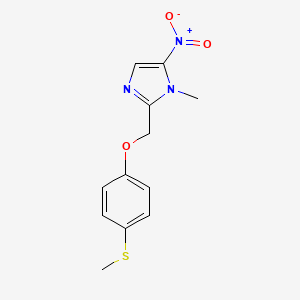
fexinidazole[inn], 59729-37-2, 1-Methyl-2-((4-(methylthio)phenoxy)methyl)-5-nitro-1H-imidazole, Fexinidazol, Fexinidazolum

Chemotherapeutically active nitro compounds. 4,5-Nitroimidazoles. Part III
Synthesis
By condensation of 4 – (methylmercapto) phenol (II) with 1-mehtyl-2-chloromethyl-5-nitroimidazole (I) by means of K2CO3 in DMF (1,2) Description:. Crystals, mp 116 C. References: 1) Raether, W., Winkelman, E.; Chemotherapeutically active nitro compounds 4,5-Nitroimidazoles Part III Arzneim-Forsch 1978, 28 (5):. 739 2) Winkelmann,… E., Raether, W. (Hoechst AG); DE 2531303.
Winkelman, E.; Raether, W.;… Chemotherapeutically active nitro compounds 4,5-Nitroimidazoles Part III Arzneim-Forsch 1978, 28, 5, 739
Arzneim-Forsch1978, 28, (5): 739
………………..
http://www.google.com/patents/EP1681280A1?cl=en
…………..
US 4042705
http://www.google.co.in/patents/US4042705
…………
new patent june 2014
WO-2014079497
Process for preparing fexinidazole – comprising the reaction of 1-methyl-2-hydroxymethyl-5-nitro-imidazole with methanesulfonyl chloride, followed by reaction with 4-methylmercapto-phenol, and further manipulative steps.
1-Methyl-2-hydroxymethyl-5-nitro-imidazole is (I) and 1-methyl-2-(4-methylmercapto-phenyloxymethyl)-5-nitro-imidazole (fexinidazole) is (II) (claim 1, page 12).
The synthesis of (II) via intermediate (I) is described (example 1, pages 6-8).
A process for preparing fexinidazole comprising the reaction of 1-methyl-2-hydroxymethyl-5-nitro-imidazole with methanesulfonyl chloride in the presence of a suspension of powdered alkaline carbonate (eg potassium carbonate) in an anhydrous organic solvent (eg acetone), followed by reaction with 4-methylmercapto-phenol, removal of hydrochloride salt, and isolation and purification is claimed. Also claimed is their use for treating parasitic diseases, visceral leishmaniasis, chagas disease, and human African trypanosomiasis. Fexinidazole is known to be an antiparasitic agent.
|
2-1-1983
|
The activity of fexinidazole (HOE 239) against experimental infections with Trypanosoma cruzi, trichomonads and Entamoeba histolytica.
|
Annals of tropical medicine and parasitology
|
|
|
1-1-1983
|
The use of the 2 substituted 5-nitroimidazole, Fexinidazole (Hoe 239) in the treatment of chronic T. brucei infections in mice.
|
Zeitschrift für Parasitenkunde (Berlin, Germany)
|
|
5-1-2011
|
1-Aryl-4-nitro-1H-imidazoles, a new promising series for the treatment of human African trypanosomiasis.
|
European journal of medicinal chemistry
|
|
|
2-1-2011
|
Compounds containing 2-substituted imidazole ring for treatment against human African trypanosomiasis.
|
Bioorganic & medicinal chemistry letters
|
|
|
1-1-2011
|
Trypanocidal activity of nitroaromatic prodrugs: current treatments and future perspectives.
|
Current topics in medicinal chemistry
|
|
|
12-1-2010
|
Potential new drugs for human African trypanosomiasis: some progress at last.
|
Current opinion in infectious diseases
|
|
|
7-1-2010
|
Cross-resistance to nitro drugs and implications for treatment of human African trypanosomiasis.
|
Antimicrobial agents and chemotherapy
|
|
|
1-1-2010
|
Fexinidazole–a new oral nitroimidazole drug candidate entering clinical development for the treatment of sleeping sickness.
|
PLoS neglected tropical diseases
|
|
|
1-1-1999
|
[Use of megazol for the treatment of trypanosomiasis].
|
Médecine tropicale : revue du Corps de santé colonial
|
|
|
11-1-1998
|
A method to assess invasion and intracellular replication of Trypanosoma cruzi based on differential uracil incorporation.
|
Journal of immunological methods
|
|
|
10-1-1996
|
Topical chemotherapy for experimental murine African CNS-trypanosomiasis: the successful use of the arsenical, melarsoprol, combined with the 5-nitroimidazoles, fexinidazole or MK-436.
|
Tropical medicine & international health : TM & IH
|
|
|
6-1-1991
|
Chemotherapy of CNS-trypanosomiasis: the combined use of the arsenicals and nitro-compounds.
|
|
11-15-2013
|
Targeting the human parasite Leishmania donovani: discovery of a new promising anti-infectious pharmacophore in 3-nitroimidazo[1,2-a]pyridine series.
|
Bioorganic & medicinal chemistry
|
|
|
10-1-2013
|
The R enantiomer of the antitubercular drug PA-824 as a potential oral treatment for visceral Leishmaniasis.
|
Antimicrobial agents and chemotherapy
|
|
|
2-1-2013
|
Assessing the essentiality of Leishmania donovani nitroreductase and its role in nitro drug activation.
|
Antimicrobial agents and chemotherapy
|
|
|
9-1-2012
|
Genotoxicity profile of fexinidazole–a drug candidate in clinical development for human African trypanomiasis (sleeping sickness).
|
Mutagenesis
|
|
|
7-15-2012
|
Discovery of nitroheterocycles active against African trypanosomes. In vitro screening and preliminary SAR studies.
|
Bioorganic & medicinal chemistry letters
|
|
|
2-1-2012
|
The anti-trypanosome drug fexinidazole shows potential for treating visceral leishmaniasis.
|
Science translational medicine
|
|
|
1-1-2012
|
Fexinidazole: a potential new drug candidate for Chagas disease.
|
PLoS neglected tropical diseases
|
|
|
1-1-2012
|
Management of trypanosomiasis and leishmaniasis.
|
British medical bulletin
|
|
|
12-1-2011
|
Antitrypanosomal activity of fexinidazole, a new oral nitroimidazole drug candidate for treatment of sleeping sickness.
|
Antimicrobial agents and chemotherapy
|
|
|
6-1-2011
|
Development of novel drugs for human African trypanosomiasis.
|
Future microbiology
|
| US3682951 * | 2 Nov 1970 | 8 Aug 1972 | Searle & Co | 1-{8 {62 -(1-adamantyloxy)halophenethyl{9 {0 imidazoles and congeners |
| US3714179 * | 8 Sep 1970 | 30 Jan 1973 | Searle & Co | 1-alkyl-2-furfurylthioimidazoles and congeners |
| US3796704 * | 16 Aug 1971 | 12 Mar 1974 | Bayer Ag | Phenyl-imidazolylalkanyl derivatives |
| US3828065 * | 11 Dec 1972 | 6 Aug 1974 | Searle & Co | 2-methyl-5-nitro-1-(2-phenylthioethyl)imidazoles |
| US3842097 * | 22 Jan 1973 | 15 Oct 1974 | Searle & Co | 2-(phenoxyalkylthio)imidazoles and congeners |
| US3910925 * | 24 May 1974 | 7 Oct 1975 | Searle & Co | {8 2-(2-Methyl-5-nitro-1-imidazolyl)ethyl{9 benzo(b)pyridyloxy ethers |
| US3922277 * | 14 Nov 1974 | 25 Nov 1975 | Hoechst Ag | (1-Alkyl-5-nitro-imidazolyl-2-alkyl)-pyridyl compounds |
| DE2124103A1 * | 14 May 1971 | 25 Nov 1971 | Title not available |
References
- Raether, W; Seidenath, H (1983). “The activity of fexinidazole (HOE 239) against experimental infections with Trypanosoma cruzi, trichomonads and Entamoeba histolytica”. Annals of Tropical Medicine and Parasitology 77 (1): 13–26. PMID 6411009.
- Jennings, FW; Urquhart, GM (1983). “The use of the 2 substituted 5-nitroimidazole, Fexinidazole (Hoe 239) in the treatment of chronic T. brucei infections in mice”. Zeitschrift für Parasitenkunde 69 (5): 577–581. doi:10.1007/bf00926669. PMID 6636983.
- Wyllie, S; Patterson, S; Stojanovski, FRC; Norval, S; Kime, R; Read, RD; Fairlamb, AH (2012). “The anti-trypanosome drug fexinidazole shows potential for treating visceral leishmaniasis”. Science Translational Medicine 4 (119): 119re1.doi:10.1126/scitranslmed.3003326. PMC 3457684. PMID 22301556.
- Sokolova, AY; Wyllie, S; Patterson, S; Oza, SL; Read, RD; Fairlamb, AH (2010). “Cross-resistance to nitro drugs and implications for treatment of human African trypanosomiasis”. Antimicrobial Agents and Chemotherapy 54 (7): 2893–900. doi:10.1128/AAC.00332-10.PMID 20439607.
- “Jump-Start on Slow Trek to Treatment for a Disease”. New York Times. January 8, 2008.
- “Fexinidazole Progresses into Clinical Development”. DNDi Newsletter. November 2009.
- “Sanofi-aventis and DNDi enter into a Collaboration Agreement on a New Drug for Sleeping Sickness, Fexinidazole”. DNDi. May 18, 2009.
- Torreele, E; Bourdin Trunz, B; Tweats, D; Kaiser, M; Brun, R; Mazué, G; Bray, MA; Pécoul, B (2010). “Fexinidazole–a new oral nitroimidazole drug candidate entering clinical development for the treatment of sleeping sickness”. In Boelaert, Marleen. PLOS Neglected Tropical Diseases 4 (12): e923. doi:10.1371/journal.pntd.0000923. PMC 3006138. PMID 21200426.


Rare Diseases: CurityMD, New Online Tool For Patients Searching For Medical Experts

CurityMD created by start-up SpeSo Health, is a new tool that uses data, statistics, and technology to connect patients with rare diseases to the appropriate information and care that is required. CurityMD is “an online platform that helps measure expertise in rare and complex conditions to help improve how patients and qualified specialists connect”. CurityMD is a search engine for rare diseases. With CurityMD, one can:
• Find the most experienced care centers and experts, nearby or anywhere in the United States
• Find important clinical trials, research, and new treatments
• Find hospitals looking for patients with rare and complex conditions.
The Orphan Druganaut Blog is honored to have a chance to talk to CurityMD co-founders, Jonathan McEuen, PhD, and Rajiv Mahale.
Please provide a brief history how your start-up SpeSo Health came to be formed.
The co-founders met during our first year in the Healthcare Management MBA…
View original post 1,641 more words
Glenmark Pharmaceuticals inaugurates new Antibody Manufacturing Facility in La Chaux-de-Fonds, Switzerland

Glenmark Pharmaceuticals inaugurates new Antibody Manufacturing Facility in La Chaux-de-Fonds, Switzerland

Glenmark opens a new cGMP-compliant monoclonal antibody manufacturing facility in La Chaux-de-Fonds, Switzerland
• State of the art manufacturing facility for supply of clinical trial material
• With the facility Glenmark has end-to-end capabilities for the development of novel, state-of-the-art monoclonal antibodies including bi-specific antibodies
La Chaux-de-Fonds, Switzerland, June 4, 2014 – Glenmark Pharmaceuticals S.A (GPSA), a wholly owned subsidiary of Glenmark Pharmaceuticals Limited, India (GPL), announced the opening of its new cGMP compliant monoclonal antibody manufacturing facility in La Chaux-de-Fonds, Switzerland. This manufacturing facility supplements Glenmark’s existing in-house discovery and development capabilities and will supply material for clinical development.
The manufacturing facility has been designed for use of single use bioreactor systems and also houses a suite for manufacturing cell banks. The facility is fully compliant with quality, environmental and safety standards for manufacturing clinical trial material.
http://www.moneycontrol.com/stocks/stock_market/corp_notices.php?autono=813829
http://www.finalaya.com/685643_ann/Glenmark_Pharmaceuticals_inaugurates_new_Antibody_Manufacturing_Facility_in_La_ChauxdeFonds_Switz_.aspx?S=&FD=&TD=&CT=&YR=&MON=&CMP=
4th-Jun-2014 10:33 Source: BSE

The company says the facility supplements existing in-house discovery and development capabilities and will supply material for clinical development. Glenmark Pharmaceuticals’ Swiss research centre is an integrated antibody discovery and development unit with in-house capabilities and infrastructure for conducting antibody discovery, cell line development, in vitro testing and characterisation of antibodies, process development and analytical research. The new manufacturing facility supplements the research and development capabilities and will enable production of clinical grade material.
Single-use bioreactor systems and a suite for manufacturing cell banks are included in the new facility, which is fully compliant with quality, environmental and safety standards for manufacturing clinical trial material. Michael Buschle, President – Biologics, at Glenmark Pharmaceuticals, said: ‘This state-of-the-art manufacturing facility is a testimony to Glenmark’s commitment to growing its R&D and manufacturing facility in the canton of Neuchâtel.
We have been doing cutting-edge work in the area of novel monoclonal antibodies and have several monoclonal antibody candidates and bispecific antibodies in the pipeline.
The manufacturing facility will help us bring these antibodies to the clinic faster.’ There are currently 69 staff at the research centre developing biologics for the treatment of pain, inflammatory, oncologic and respiratory conditions. In 10 years, the centre has filed several patents on novel biologic entities: GBR 500, its most advanced candidate, has been licensed to Sanofi and is currently in Phase II development; GBR 900, a molecule for the treatment of chronic pain, is currently in Phase I; and GBR 830, an anti OX-40 antagonist, is scheduled to enter the clinic later this year

La Chaux-de-Fonds, Switzerland ………city


 New Drug Approvals