
 DRUG APPROVALS BY DR ANTHONY MELVIN CRASTO
.....FOR BLOG HOME CLICK HERE
DRUG APPROVALS BY DR ANTHONY MELVIN CRASTO
.....FOR BLOG HOME CLICK HEREFlag and hits
ORGANIC SPECTROSCOPY

SUBSCRIBE

 Subscribe in a reader
Enter your email address:
Delivered by FeedBurner
Subscribe to New Drug Approvals by Email


Recent Comments
 | shivkr2 on SPSR Excellence Award 2025 – S… |
 | Bonkasaurus on Infigratinib phosphate |
 | PALOVAROTENE | ORGAN… on Palovarotene |
| Pfizer just purchase… on Temanogrel | |
| Pfizer To Cash In On… on Temanogrel |
REFLECTION PAPER ON NANOTECHNOLOGY-BASED MEDICINAL PRODUCTS FOR HUMAN USE
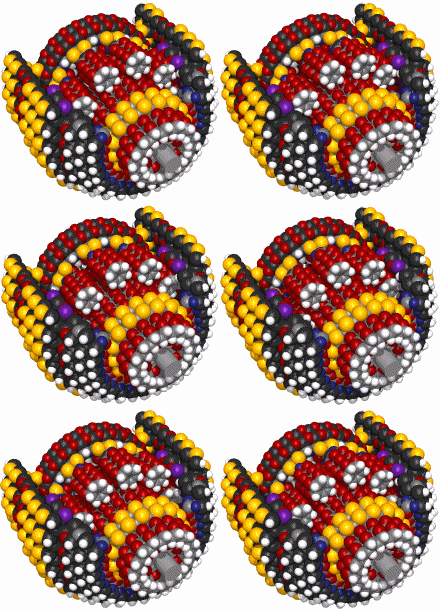
Nanotechnology
Nanotechnology is the use of tiny structures – less than 1,000 nanometres across – that are designed to have specific properties. Nanotechnology is an emerging field in science that is used in a wide range of applications, from consumer goods to health products.

In medicine, nanotechnology has only partially been exploited. It is being investigated as a way to improve the properties of medicines, such as their solubility or stability, and to develop medicines that may provide new ways to:
- deliver medicines to the body;
- target medicines in the body more accurately;
- diagnose and treat diseases;
- support the regeneration of cells and tissues.

Activities at the European Medicines Agency
The European Medicines Agency follows the latest developments in nanotechnology that are relevant to the development of medicines. Recommendations from the Agency’sCommittee for Medicinal Products for Human Use (CHMP) have already led to the approval of a number of medicines based on nanotechnology. These include medicines containing:

- liposomes (microscopic fatty structures containing the active substance), such asCaelyx (doxorubicin), Mepact (mifamurtide) and Myocet (doxorubicin);
- nano-scale particles of the active substance, such as Abraxane (paclitaxel), Emend(aprepitant) and Rapamune (sirolimus).
The development of medicines using newer, innovative nanotechnology techniques may raise new challenges for the Agency in the future. These include discussions on whether the current regulatory framework is appropriate for these medicines and whether existing guidelines and requirements on the way the medicines are assessed and monitored are adequate.
The Agency also needs to consider the acceptability of new testing methods and the availability of experts to guide the Agency’s opinion-making.
An overview of the initiatives taken by European Union (EU) regulators in relation to the development and evaluation of nanomedicines and nanosimilars was published in the scientific journal Nanomedicines. The article describes the regulatory challenges and perspectives in this field:

Ad hoc expert group on nanomedicines
In 2009, the CHMP established an ad hoc expert group on nanomedicines.
This group includes selected experts from academia and the European regulatory network, who support the Agency’s activities by providing specialist input on new scientific knowledge and who help with the review of guidelines on nanomedicines. The group also helps the Agency’s discussions with international partners on issues concerning nanomedicines.
The group held the first ad hoc expert group meeting on nanomedicines on 29 April 2009.
Reflection papers on nanomedicines
In 2011, the CHMP began to develop in 2011 a series of four reflection papers on nanomedicines to provide guidance to sponsors developing nanomedicines.

These documents cover the development both of new nanomedicines and of nanosimilars (nanomedicines that are claimed to be similar to a reference nanomedicine), since the first generation of nanomedicines, including liposomal formulations, iron-based preparations and nanocrystal-based medicines, have started to come off patent:
- joint Ministry of Health, Labour and Welfare / European Medicines Agency reflection paper on the development of block-copolymer-micelle medicinal products, published for a six-month public consultation in January 2013;
- reflection paper on the data requirements for intravenous liposomal products developed with reference to an innovator liposomal product, published in February 2013;
- reflection paper on surface coatings: general issues for consideration regarding parenteral administration of coated nanomedicine products, published in August 2013.

The fourth document, a draft reflection paper on the data requirements for intravenous iron-based nanocolloidal products developed with reference to an innovator medicine, will be released for a six-month public consultation in 2013.
International workshops on nanomedicines
The Agency organises workshops on nanomedicines to explore the scientific aspects of nanomedicines and enable the sharing of experience at an international level, in order to assist future developments in the field:
- First international workshop on nanomedicines (02-03/09/2010)
REFLECTION PAPER ON NANOTECHNOLOGY-BASED MEDICINAL PRODUCTS FOR
HUMAN USE
Related information


Directing Venom To Fight Cancer ACS Meeting News: Encapsulated venom peptide can skip healthy cells


Venom from scorpions or honeybees sounds like it wouldn’t do a person much good. But by directing a modified component just to tumors, researchers might leverage it into a drug.
Peptides in some venoms bind to cancer cells and block tumor growth and spread. But they have not yet been developed successfully as anticancer agents because they attack healthy cells too.
Bioengineer Dipanjan Pan and coworkers at the University of Illinois, Urbana-Champaign, are now using polymeric nanoparticles to deliver venom toxin directly to cancer cells.
read at
http://cen.acs.org/articles/92/i33/Directing-Venom-Fight-Cancer.html


WHO issues draft proposal for biosimilar naming


A long debate is ongoing about biosimilar naming around the world. Although EU accepted the same INN system years ago, with the latest developments around the world, biosimilar naming uncertainty is still ongoing.
View original post 74 more words
Neuroprotective effects of Asiaticoside – a Saponin of Centella asiatica

PUBLIC RELEASE DATE:
10-Aug-2014
In the central nervous system, Asiaticoside has been shown to attenuate in vitro neuronal damage caused by exposure to β-amyloid. However, its potential neuroprotective properties in glutamate-induced excitotoxicity have not been fully studied. Researchers from Fourth Military Medical University of Chinese PLA, China reported that pretreatment with Asiaticoside decreased neuronal cell loss in a concentration-dependent manner and restored changes in expression of apoptotic-related proteins Bcl-2 and Bax. Asiaticoside pretreatment also attenuated the upregulation of NR2B expression, a subunit of N-methyl-D-aspartate receptors, but did not affect expression of NR2A subunits. Additionally, in cultured neurons, Asiaticoside significantly inhibited Ca2+ influx induced by N-methyl-D-aspartate. Their results provide a new insight into the neuroprotective effects of Asiaticoside. The relevant study has been published in the Neural Regeneration Research (Vol. 9, No. 13, 2014).
View original post 85 more words
Lipid Metabolism

Lipid metabolism
Larry H. Bernstein, MD, FCAP, Reporter and Curator
Leaders in Pharmaceutical Intelligence
http://pharmaceuticalintelligence.com/8-10-2014/Lipid_metabolism
This is fourth of a series of articles, lipid metabolism, that began with signaling and signaling pathways. These discussion lay the groundwork to proceed in later discussions that will take on a somewhat different approach. These are critical to develop a more complete point of view of life processes. I have indicated that many of the protein-protein interactions or protein-membrane interactions and associated regulatory features have been referred to previously, but the focus of the discussion or points made were different. The role of lipids in circulating plasma proteins as biomarkers for coronary vascular disease can be traced to the early work of Frederickson and the classification of lipid disorders. The very critical role of lipids in membrane structure in health and disease has had much less attention, despite the enormous importance, especially in…
View original post 10,510 more words
THE GROWING IMPACT OF CLICK CHEMISTRY ON DRUG DISCOVERY
The growing impact of click chemistry on drug discovery
HC Kolb, KB Sharpless – Drug discovery today, 2003 – Elsevier
chemical transformations. Its applications are increasingly found in all aspects of drug
discovery, ranging from lead finding through combinatorial chemistry and target-templated …
and reliable chemical transformations. Its applications are increasingly
found in all aspects of drug discovery, ranging from lead finding through
combinatorial chemistry and target-templated in situchemistry, to proteomics
and DNA research, using bioconjugation reactions. The copper-(I)-catalyzed
1,2,3-triazole formation from azides and terminal acetylenes is a particularly
powerful linking reaction, due to its high degree of dependability, complete
specificity, and the bio-compatibility of the reactants. The triazole products
are more than just passive linkers; they readily associate with biological
targets, through hydrogen bonding and dipole interactions.
GET YOUR PDF AT
http://image.sciencenet.cn/olddata/kexue.com.cn/blog/admin//images/upfiles/2007101622257911935.pdf


Higher-Order Structure Comparability: Case Studies of Biosimilar Monoclonal Antibodies

Figure 1a: Diagram of the antibody array enzyme-linked immunosorbent assay (ELISA)

Figure 1b: ELISA format for the antibody array technology
Great successes for monoclonal antibody (MAb)–based biologics over the past decade have provided many valuable options for patients combating some of the most serious diseases in the world, including cancer and autoimmune diseases. MAbs and antibody–drug conjugates (ADCs) are among the fastest growing biologic segments in development, with hundreds of candidates currently under clinical study.
read at
http://www.bioprocessintl.com/manufacturing/biosimilars/higher-order-structure-comparability/
Macrocycles in new drug discovery

Summary | Full Text | PDF (3354 KB) | PDF Plus (3440 KB) | Add to Favorites | Related
http://www.future-science.com/doi/full/10.4155/fmc.12.93?src=recsys
The use of drug-like macrocycles is emerging as an exciting area of medicinal chemistry, with several recent examples highlighting the favorable changes in biological and physicochemical properties that macrocyclization can afford. Natural product macrocycles and their synthetic derivatives have long been clinically useful and attention is now being focused on the wider use of macrocyclic scaffolds in medicinal chemistry in the search for new drugs for increasingly challenging targets. With the increasing awareness of concepts of drug-likeness and the dangers of ‘molecular obesity’, functionalized macrocyclic scaffolds could provide a way to generate ligand-efficient molecules with enhanced properties. In this review we will separately discuss the effects of macrocyclization upon potency, selectivity and physicochemical properties, concentrating on recent case histories in oncology drug discovery. Additionally, we will highlight selected advances in the synthesis of macrocycles and provide an outlook on the future use of macrocyclic scaffolds in medicinal chemistry.
Drug discovery: a view through the looking glass

Steven Lenhert, Franklin G Vellanti
Citation | Full Text | PDF (1063 KB) | PDF Plus (1071 KB) |
http://www.future-science.com/doi/full/10.4155/fmc.12.125?src=recsys
Drug discovery: Past and present

The field of biotechnology has revolutionized the drug discovery process. Recombinant DNA-driven drug discovery process is beginning to add new avenues for some old drugs. In its infancy, genetic engineering was considered useful only for the production of therapeutic proteins. Insulin, for example, previously prepared by isolation of pancreatic tissue of bovine or porcine species, can now be prepared identical to human insulin by biotechnology. Companies like Genentech and Biogen were founded solely with this objective. However, proteins do not make ideal drugs, being difficult to administer, rapidly cleared, and potentially immunogenic. Despite these disadvantages, a rapidly increasing number of “biopharmaceuticals” including recombinant proteins, therapeutic monoclonal antibodies, and even antisense oligonucleosides have been approved for indications ranging from metastatic breast cancer (Herceptin) to rheumatoid arthritis (Remicade, Enbrel).
READ AT
| Giridhar R. Drug discovery: Past and present. J Adv Pharm Technol Res 2012;3:2 |
| Giridhar R. Drug discovery: Past and present. J Adv Pharm Technol Res [serial online] 2012 [cited 2014 Aug 15];3:2. Available from: http://www.japtr.org/text.asp?2012/3/1/2/93554 |


 New Drug Approvals