New Drug Approvals

Home » Posts tagged 'FDA 2017' (Page 2)

Tag Archives: FDA 2017

DRUG APPROVALS BY DR ANTHONY MELVIN CRASTO .....FOR BLOG HOME CLICK HERE

Blog Stats

  • 4,807,835 hits

Flag and hits

Flag Counter

Enter your email address to follow this blog and receive notifications of new posts by email.

Join 37.9K other subscribers
Follow New Drug Approvals on WordPress.com

Archives

Categories

Recent Posts

Flag Counter

ORGANIC SPECTROSCOPY

Read all about Organic Spectroscopy on ORGANIC SPECTROSCOPY INTERNATIONAL 

Enter your email address to follow this blog and receive notifications of new posts by email.

Join 37.9K other subscribers
DR ANTHONY MELVIN CRASTO Ph.D

DR ANTHONY MELVIN CRASTO Ph.D

DR ANTHONY MELVIN CRASTO, Born in Mumbai in 1964 and graduated from Mumbai University, Completed his Ph.D from ICT, 1991,Matunga, Mumbai, India, in Organic Chemistry, The thesis topic was Synthesis of Novel Pyrethroid Analogues, Currently he is working with AFRICURE PHARMA, ROW2TECH, NIPER-G, Department of Pharmaceuticals, Ministry of Chemicals and Fertilizers, Govt. of India as ADVISOR, earlier assignment was with GLENMARK LIFE SCIENCES LTD, as CONSUlTANT, Retired from GLENMARK in Jan2022 Research Centre as Principal Scientist, Process Research (bulk actives) at Mahape, Navi Mumbai, India. Total Industry exp 32 plus yrs, Prior to joining Glenmark, he has worked with major multinationals like Hoechst Marion Roussel, now Sanofi, Searle India Ltd, now RPG lifesciences, etc. He has worked with notable scientists like Dr K Nagarajan, Dr Ralph Stapel, Prof S Seshadri, etc, He did custom synthesis for major multinationals in his career like BASF, Novartis, Sanofi, etc., He has worked in Discovery, Natural products, Bulk drugs, Generics, Intermediates, Fine chemicals, Neutraceuticals, GMP, Scaleups, etc, he is now helping millions, has 9 million plus hits on Google on all Organic chemistry websites. His friends call him Open superstar worlddrugtracker. His New Drug Approvals, Green Chemistry International, All about drugs, Eurekamoments, Organic spectroscopy international, etc in organic chemistry are some most read blogs He has hands on experience in initiation and developing novel routes for drug molecules and implementation them on commercial scale over a 32 PLUS year tenure till date Feb 2023, Around 35 plus products in his career. He has good knowledge of IPM, GMP, Regulatory aspects, he has several International patents published worldwide . He has good proficiency in Technology transfer, Spectroscopy, Stereochemistry, Synthesis, Polymorphism etc., He suffered a paralytic stroke/ Acute Transverse mylitis in Dec 2007 and is 90 %Paralysed, He is bound to a wheelchair, this seems to have injected feul in him to help chemists all around the world, he is more active than before and is pushing boundaries, He has 100 million plus hits on Google, 2.5 lakh plus connections on all networking sites, 100 Lakh plus views on dozen plus blogs, 227 countries, 7 continents, He makes himself available to all, contact him on +91 9323115463, email amcrasto@gmail.com, Twitter, @amcrasto , He lives and will die for his family, 90% paralysis cannot kill his soul., Notably he has 38 lakh plus views on New Drug Approvals Blog in 227 countries......https://newdrugapprovals.wordpress.com/ , He appreciates the help he gets from one and all, Friends, Family, Glenmark, Readers, Wellwishers, Doctors, Drug authorities, His Contacts, Physiotherapist, etc He has total of 32 International and Indian awards

Verified Services

View Full Profile →

Archives

Categories

Flag Counter

FDA approves first two-drug regimen for certain patients with HIV, Juluca (dolutegravir and rilpivirine)


FDA approves first two-drug regimen for certain patients with HIV

The U.S. Food and Drug Administration today approved Juluca, the first complete treatment regimen containing only two drugs to treat certain adults with human immunodeficiency virus type 1 (HIV-1) instead of three or more drugs included in standard HIV treatment. Juluca is a fixed-dose tablet containing two previously approved drugs (dolutegravir and rilpivirine) to treat adults with HIV-1 infections whose virus is currently suppressed on a stable regimen for at least six months, with no history of treatment failure and no known substitutions associated with resistance to the individual components of Juluca. Continue reading.


November 21, 2017

Summary

FDA approved Juluca, the first complete treatment regimen containing only two drugs to treat certain adults with human immunodeficiency virus type 1 (HIV-1).

Release

The U.S. Food and Drug Administration today approved Juluca, the first complete treatment regimen containing only two drugs to treat certain adults with human immunodeficiency virus type 1 (HIV-1) instead of three or more drugs included in standard HIV treatment. Juluca is a fixed-dose tablet containing two previously approved drugs (dolutegravir and rilpivirine) to treat adults with HIV-1 infections whose virus is currently suppressed on a stable regimen for at least six months, with no history of treatment failure and no known substitutions associated with resistance to the individual components of Juluca.

“Limiting the number of drugs in any HIV treatment regimen can help reduce toxicity for patients,” said Debra Birnkrant, M.D., director of the Division of Antiviral Products in the FDA’s Center for Drug Evaluation and Research.

HIV weakens a person’s immune system by destroying important cells that fight disease and infection. According to the Centers for Disease Control and Prevention, an estimated 1.1 million people in the United States are living with HIV, and the disease remains a significant cause of death for certain populations.

Juluca’s safety and efficacy in adults were evaluated in two clinical trials of 1,024 participants whose virus was suppressed on their current anti-HIV drugs. Participants were randomly assigned to continue their current anti-HIV drugs or to switch to Juluca. Results showed Juluca was effective in keeping the virus suppressed and comparable to those who continued their current anti-HIV drugs.

The most common side effects in patients taking Juluca were diarrhea and headache. Serious side effects include skin rash and allergic reactions, liver problems and depression or mood changes. Juluca should not be given with other anti-HIV drugs and may have drug interactions with other commonly used medications.

The FDA granted approval of Juluca to ViiV Healthcare.


/////////fda 2017, dolutegravir,  rilpivirine, Juluca,  ViiV Healthcare,

DISCLAIMER

“NEW DRUG APPROVALS ” CATERS TO EDUCATION GLOBALLY, No commercial exploits are done or advertisements added by me. This is a compilation for educational purposes only. P.S. : The views expressed are my personal and in no-way suggest the views of the professional body or the company that I represent

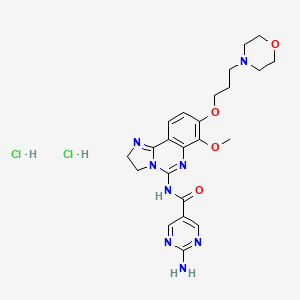
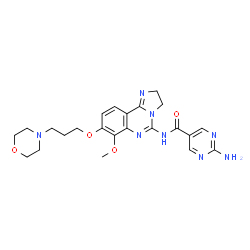
Copanlisib


Copanlisib.svgChemSpider 2D Image | Copanlisib | C23H28N8O4

Copanlisib, BAY 80-6946, 

  • BAY 84-1236
  • Molecular FormulaC23H28N8O4
  • Average mass480.520 Da

Cas 1032568-63-0 [RN]

1402152-26-4 MONO HCL

UNII-WI6V529FZ9

FDA Approved September 2017

2-Amino-N-{7-methoxy-8-[3-(4-morpholinyl)propoxy]-2,3-dihydroimidazo[1,2-c]quinazolin-5-yl}-5-pyrimidinecarboxamide
5-Pyrimidinecarboxamide, 2-amino-N-[2,3-dihydro-7-methoxy-8-[3-(4-morpholinyl)propoxy]imidazo[1,2-c]quinazolin-5-yl]-

Copanlisib (BAY 80-6946), developed by Bayer, is a selective Class I phosphoinositide 3-kinase inhibitor[1] which has shown promise in Phase I/II clinical trials for the treatment of non-Hodgkin lymphoma and chronic lymphocytic leukemia.[2]

Image result for copanlisib

Copanlisib is a selective pan-Class I phosphoinositide 3-kinase (PI3K/Phosphatidylinositol-4,5-bisphosphate 3-kinase/phosphatidylinositide 3-kinase) inhibitor that was first developed by Bayer Healthcare Pharmaceuticals, Inc. The drug targets the enzyme that plays a role in regulating cell growth and survival. Copanlisib was granted accelerated approval on September 14, 2017 under the market name Aliqopa for the treatment of adult patients with relapsed follicular lymphoma and a treatment history of at least two prior systemic therapies. Follicular lymphoma is a slow-growing type of non-Hodgkin lymphoma that is caused by unregulated proliferation and growth of lymphocytes. The active ingredient in Aliquopa intravenous therapy is copanlisib dihydrochloride.
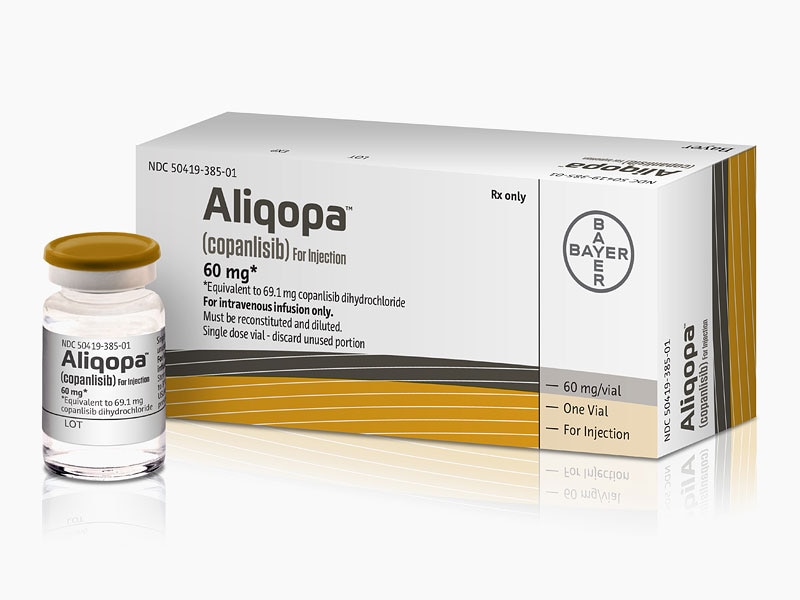
Image result for copanlisib

Copanlisib dihydrochloride.pngCopanlisib dihydrochloride; UNII-03ZI7RZ52O; 03ZI7RZ52O; 1402152-13-9; BAY 80-6946 dihydrochloride;

Image result for copanlisib

1402152-46-8 CAS  X=4, 

1919050-77-3 CAS X=1

The FDA awarded copanlisib orphan drug status for follicular lymphoma in February 2015.[3]

Phase II clinical trials are in progress for treatment of endometrial cancer,[4] diffuse large B-cell lymphoma,[5] cholangiocarcinoma,[6]and non-Hodgkin lymphoma.[7] Copanlisib in combination with R-CHOP or R-B (rituximab and bendamustine) is in a phase III trial for relapsed indolent non-Hodgkin lymphoma (NHL).[8] Two separate phase III trials are investigating the use of copanlisib in combination with rituximab for indolent NHL[9] and the other using copanlisib alone in cases of rituximab-refractory indolent NHL.[10]

Copanlisib hydrochloride, a phosphatidylinositol 3-Kinase inhibitor developed by Bayer, was first approved and launched in 2017 in the U.S. for the intravenous treatment of adults with relapsed follicular lymphoma who have received at least two prior treatments.

In 2015, orphan drug designation was assigned in the U.S. for the treatment of follicular lymphoma. In 2017, additional orphan drug designations were granted in the U.S. for the treatment of splenic, nodal and extranodal marginal zone lymphoma.

SYN

WO 2017049983

PATENTS

WO 2008070150

Inventors Martin HentemannJill WoodWilliam ScottMartin MichelsAnn-Marie CampbellAnn-Marie BullionR. Bruce RowleyAniko RedmanLess «
Applicant Bayer Schering Pharma Aktiengesellschaft

Example 13

Preparation of 2-amino-N-r7-methoxy-8-(3-morpholin-4-ylpropoxy)-2.3- dihvdroimidazori^-clquinazolin-S-vHpvrimidine-S-carboxamide.

Figure imgf000084_0001

Step 1 : Preparation of 4-hvdroxy-3-methoxy-2-nitrobenzonitrile

Figure imgf000084_0002

4-Hydroxy-3-methoxy-2-nitrobenzaldehyde (200 g, 1.01 mol) was dissolved in THF (2.5 L) and then ammonium hydroxide (2.5 L) was added followed by iodine (464 g, 1.8 mol). The resulting mixture was allowed to stir for 2 days at which time it was concentrated under reduced pressure. The residue was acidified with HCI (2 N) and extracted into diethyl ether. The organic layer was washed with brine and dried (sodium sulfate) and concentrated under reduced pressure. The residue was washed with diethyl ether and dried under vacuum to provide the title compound (166 g, 84%): 1H NMR (DMSO-cfe) δ: 11.91 (1 H, s), 7.67 (1 H, d), 7.20 (1 H, d), 3.88 (3H, s)

Step 2: Preparation of 3-methoxy-4-(3-morpholin-4-ylpropoxy)-2-nitrobenzonitrile

Figure imgf000084_0003

To a solution of 4-hydroxy-3-methoxy-2-nitrobenzonitrile (3.9 g, 20.1 mmol) in DMF (150 mL) was added cesium carbonate (19.6 g, 60.3 mmol) and Intermediate C (5.0 g, 24.8 mmol). The reaction mixture was heated at 75 0C overnight then cooled to room temperature and filtered through a pad of silica gel and concentrated under reduced pressure. The material thus obtained was used without further purification

Step 3: Preparation of 2-amino-3-methoxy-4-(3-morpholin-4-ylpropoxy)benzonitrile
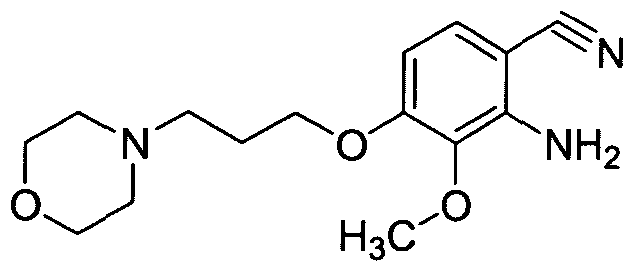
Figure imgf000085_0001

3-Methoxy-4-(3-morpholin-4-ylpropoxy)-2-nitrobenzonitrile (7.7 g, 24.1 mmol) was suspended in acetic acid (170 ml_) and cooled to 0 °C. Water (0.4 ml_) was added, followed by iron powder (6.7 g, 120 mmol) and the resulting mixture was stirred at room temperature for 4 h at which time the reaction mixture was filtered through a pad of Celite and washed with acetic acid (400 ml_). The filtrate was concentrated under reduced pressure to 100 mL and diluted with EtOAc (200 ml.) at which time potassium carbonate was added slowly. The resulting slurry was filtered through a pad of Celite washing with EtOAc and water. The layers were separated and the organic layer was washed with saturated sodium bicarbonate solution. The organic layer was separated and passed through a pad of silica gel. The resultant solution was concentrated under reduced pressure to provide the title compound (6.5 g, 92%): 1H NMR (DMSO-Cf6) δ: 7.13 (1 H1 d), 6.38 (1 H, d), 5.63 (2H1 br s), 4.04 (2H, t), 3.65 (3H, s), 3.55 (4H1 br t), 2.41 (2H, t), 2.38 (4H1 m), 1.88 (2H1 quint.).

Step 4: Preparation of 6-(4.5-dihvdro-1 H-imidazol-2-v0-2-methoxy-3-(3-morpholin- 4-ylpropoxy)aniline

Figure imgf000085_0002

To a degassed mixture of 2-amino-3-methoxy-4-(3-morpholin-4-ylpropoxy)benzonitrile (6.5 g, 22.2 mmol) and ethylene diamine (40 mL) was added sulfur (1.8 g, 55.4 mmol). The mixture was stirred at 100 °C for 3 h at which time water was added to the reaction mixture. The precipitate that was formed was collected and washed with water and then dried overnight under vacuum to provide the title compound (3.2 g, 43%): HPLC MS RT = 1.25 min, MH+= 335.2; 1H NMR (DMSO-Cf6) δ: 7.15 (1H, d), 6.86 (2H, br s), 6.25 (1 H, d), 4.02 (2H, t), 3.66 (3H, s), 3.57 (8H, m), 2.46 (2H, t), 2.44 (4H, m), 1.89 (2H, quint.). Step 5: Preparation of 7-methoxy-8-(3-morpholin-4-ylpropoxy)-2.3- dihvdroimidazof1.2-clquinazolin-5-amine

Figure imgf000086_0001

Cyanogen bromide (10.9 g, 102.9 mmol) was added to a mixture of 6-(4,5-dihydro-1 H- imidazol-2-yl)-2-methoxy-3-(3-morpholin-4-ylpropoxy)aniline (17.2 g, 51.4 mmol) and TEA (15.6 g, 154.3 mmol) in DCM (200 ml_) precooled to 0 0C. After 1 h the reaction mixture was concentrated under reduced pressure and the resulting residue stirred with EtOAc (300 mL) overnight at rt. The resulting slurry was filtered to generate the title compound contaminated with triethylamine hydrobromide (26.2 g, 71%): HPLC MS RT = 0.17 min, MH+= 360.2.

Step 6: Preparation of 2-amino-N-r7-methoxy-8-(3-morpholin-4-ylpropoxy)-2.3- dihvdroimidazori ^-clquinazolin-S-vnpyrimidine-δ-carboxamide.

Figure imgf000086_0002

7-Methoxy-8-(3-morpholin-4-ylpropoxy)-2,3-dihydroimidazo[1 ,2-c]quinazolin-5-amine (100 mg, 0.22 mol) was dissolved in DMF (5 mL), and Intermediate B (46 mg, 0.33 mmol) was added. PYBOP (173 mg, 0.33 mmol) and diisopropylethylamine (0.16 mL, 0.89 mmol) were subsequently added, and the mixture was stirred at rt overnight. EtOAc was added, and the solids were isolated by vacuum filtration to give the title compound (42.7 mg, 40%): HPLC MS RT = 1.09 min, MH+= 481.2; 1H NMR (DMSO-Cf6 + 2 drops TFA-tf) δ: 9.01 (2H, s), 8.04 (1 H, d), 7.43 (1 H, d), 4.54 (2H, m), 4.34 (2H, br t), 4.23 (2H, m), 4.04 (2H, m), 4.00 (3H, s), 3.65 (2H, br t), 3.52 (2H, m), 3.31 (2H, m), 3.18 (2H, m), 2.25 (2H, m).

PATENT

CN 105130998

TRANSLATED

Example VI:

[0053] a nitrogen atmosphere, the reaction flask was added 7-methoxy-8- (3-morpholin-4-yl-propoxy) -2,3-dihydro-imidazo [l, 2-c] quinoline tetrazol-5-amine (V) (0 • 36g, lmmol), 2- amino-5-carboxylic acid (0 • 15g, l.lmmol) and acetonitrile 25mL, condensing agent added benzotriazole-1-yl yloxy-tris (dimethylamino) phosphonium hexafluorophosphate key (0.49g, 1. lmmol) and the base catalyst 1,5_-diazabicyclo [4. 3.0] – non-5-ene (0 . 50g, 4mmol), at room temperature for 12 hours.Then heated to 50-60 ° C, the reaction was stirred for 6-8 hours, TLC the reaction was complete. The solvent was distilled off under reduced pressure, cooled to room temperature, ethyl acetate was added solid separated. Filter cake washed with cold methanol and vacuum dried to give an off-white solid Kupannixi (1) 0.278, showing a yield of 56.3% -] \ ^ 111/2: 481 [] \ 1+ buckle + 1 111 bandit ? (square) (: 13). 5 2.05 (111,211), 2.48 (111,411), 2. 56 (m, 2H), 3 72 (t, 4H), 4 02 (s, 3H),. 4. 16 (m, 7H), 5. 36 (s, 2H), 6. 84 (d, 1H), 7. 08 (d, 1H), 9. 10 (s, 2H) square

PATENT

WO 2016071435

2-amino-N-[7-methoxy-8-(3-morpholin-4-ylpropoxy)-2,3-dihydroimidazo[1 ,2-c]quinazolin-5-yl]pyrimidine-5-carboxamide (10), (which is hereinafter referred to as„copanlisib”), is a proprietary cancer agent with a novel mechanism of action, inhibiting Class I phosphatidylinositol-3-kinases (PI3Ks). This class of kinases is an attractive target since PI3Ks play a central role in the transduction of cellular signals from surface receptors for survival and proliferation. Copanlisib exhibits a broad spectrum of activity against tumours of multiple histologic types, both in vitro and in vivo.

Copanlisib may be synthesised according to the methods given in international patent application PCT/EP2003/010377, published as WO 04/029055 A1 on April 08, 2004, (which is incorporated herein by reference in its entirety), on pp. 26 et seq.

Copanlisib is published in international patent application PCT/US2007/024985, published as WO 2008/070150 A1 on June 12, 2008, (which is incorporated herein by reference in its entirety), as the compound of Example 13 : 2-amino-N-[7-methoxy-8-(3-morpholin-4-ylpropoxy)-2,3-dihydroimidazo[1 ,2-c]quinazolin-5-yl]pyrimidine-5-carboxamide.

Copanlisib may be synthesized according to the methods given in WO 2008/070150, pp. 9 et seq., and on pp. 42 et seq. Biological test data for said compound of formula (I) is given in WO 2008/070150 on pp. 101 to 107.

2-amino-N-[7-methoxy-8-(3-morpholin-4-ylpropoxy)-2,3-dihydroimid-azo[1 ,2-c]quinazolin-5-yl]pyrimidine-5-carboxamide dihydrochloride (1 1 ), (which is hereinafter referred to as „copanlisib dihydrochloride”) is published in international patent application PCT/EP2012/055600, published as WO 2012/136553 on October 1 1 , 2012, (which is incorporated herein by reference in its entirety), as the compound of Examples 1 and 2 : 2-amino-N-[7-methoxy-8-(3-morpholin-4-ylpropoxy)-2,3-dihydroimidazo[1 ,2-c]quinazolin-5-yl]pyrimidine-5-carboxamide dinydrochloride : it may be synthesized according to the methods given in said Examples 1 and 2.

Copanlisib may exist in one or more tautomeric forms : tautomers, sometimes referred to as proton-shift tautomers, are two or more compounds that are related by the migration of a hydrogen atom accompanied by the migration of one or more single bonds and one or more adjacent double bonds.

Copanlisib may for example exist in tautomeric form (la), tautomeric form (lb), or tautomeric form (Ic), or may exist as a mixture of any of these forms, as depicted below. It is intended that all such tautomeric forms are included within the scope of the present invention.

Copanlisib may exist as a solvate : a solvate for the purpose of this invention is a complex of a solvent and copanlisib in the solid state. Exemplary solvates include, but are not limited to, complexes of copanlisib with ethanol or methanol.

Copanlisib and copanlisib dihydrochloride may exist as a hydrate. Hydrates are a specific form of solvate wherein the solvent is water, wherein said water is a structural element of the crystal lattice of copanlisib or of copanlisib dihydrochloride. It is possible for the amount of said water to exist in a stoichiometric or non-stoichiometric ratio. In the case of stoichiometric hydrates, a hemi-, (semi-), mono-, sesqui-, di-, tri-, tetra-, or penta-hydrate of copanlisib or of copanlisib dihydrochloride is possible. It is also possible for water to be present on the surface of the crystal lattice of copanlisib or of copanlisib dihydrochloride. The present invention includes all such hydrates of copanlisib or of copanlisib dihydrochloride, in particular copanlisib dihydrochloride hydrate referred to as “hydrate I”, as prepared and characterised in the experimental section herein, or as “hydrate II”, as prepared and characterised in the experimental section herein.

As mentioned supra, copanlisib is, in WO 2008/070150, described on pp. 9 et seq., and may be synthesized according to the methods given therein on pp. 42 et seq., viz. :

Reaction Scheme 1 :

(I)

In Reaction Scheme 1 , vanillin acetate can be converted to intermediate (III) via nitration conditions such as neat fuming nitric acid or nitric acid in the presence of another strong acid such as sulfuric acid. Hydrolysis of the acetate in intermediate (III) would be expected in the presence of bases such as sodium

hydroxide, lithium hydroxide, or potassium hydroxide in a protic solvent such as methanol. Protection of intermediate (IV) to generate compounds of Formula (V) could be accomplished by standard methods (Greene, T.W.; Wuts, P.G.M.; Protective Groups in Organic Synthesis; Wiley & Sons: New York, 1999). Conversion of compounds of formula (V) to those of formula (VI) can be achieved using ammonia in the presence of iodine in an aprotic solvent such as THF or dioxane. Reduction of the nitro group in formula (VI) could be accomplished using iron in acetic acid or hydrogen gas in the presence of a suitable palladium, platinum or nickel catalyst. Conversion of compounds of formula (VII) to the imidazoline of formula (VIII) is best accomplished using ethylenediamine in the presence of a catalyst such as elemental sulfur with heating. The cyclization of compounds of formula (VIII) to those of formula (IX) is accomplished using cyanogen bromide in the presence of an amine base such as triethylamine, diisopropylethylamine, or pyridine in a halogenated solvent such as DCM or dichloroethane. Removal of the protecting group in formula (IX) will be dependent on the group selected and can be accomplished by standard methods (Greene, T.W.; Wuts, P.G.M.; Protective Groups in Organic Synthesis; Wiley & Sons: New York, 1999). Alkylation of the phenol in formula (X) can be achieved using a base such as cesium carbonate, sodium hydride, or potassium t-butoxide in a polar aprotic solvent such as DMF or DMSO with introduction of a side chain bearing an appropriate leaving group such as a halide, or a sulfonate group. Lastly, amides of formula (I) can be formed using activated esters such as acid chlorides and anhydrides or alternatively formed using carboxylic acids and appropriate coupling agents such as PYBOP, DCC, or EDCI in polar aprotic solvents.

Reaction Scheme 2 :

Reaction Scheme 3

Step A9: N-[3-(dimethylamino)propyl]-N’-ethylcarbodiimide hydrochloride (“EDCI”) is used as coupling reagent. Copanlisib is isolated by simple filtration.

Step A1 1 : Easy purification of copanlisib via its dihydrochloride

(dihydrochloride is the final product)

Hence, in a first aspect, the present invention relates to a method of preparing copanlisib (10) via the following steps shown in Reaction Scheme 3, infra :

Reaction Scheme 3 : 

Example 1 : Step A1 : Preparation of 4-acetoxy-3-methoxy-2-nitrobenzaldehyde (2)

3.94 kg of nitric acid (65 w%) were added to 5.87 kg of concentrated sulfuric acid at 0°C (nitrating acid). 1 .5 kg of vanillin acetate were dissolved in 2.9 kg of dichloromethane (vanillin acetate solution). Both solutions reacted in a micro reactor with flow rates of app. 8.0 mL/min (nitrating acid) and app. 4.0 mL/min (vanillin acetate solution) at 5°C. The reaction mixture was directly dosed into 8 kg of water at 3°C. After 3h flow rates were increased to 10 mL/min (nitrating acid) and 5.0 mL/min (vanillin acetate solution). After additional 9 h the flow reaction was completed. The layers were separated at r.t., and the aqueous phase was extracted with 2 L of dichloromethane. The combined organic phases were washed with 2 L of saturated sodium bicarbonate, and then 0.8 L of water. The dichloromethane solution was concentrated in vacuum to app. 3 L, 3.9 L of methanol were added and app. the same volume was removed by distillation again. Additional 3.9 L of methanol were added, and the solution concentrated to a volume of app. 3.5 L. This solution of 4-acetoxy-3-methoxy-2-nitrobenzaldehyde (2) was directly used in the next step.

Example 2 : Step A2 : Preparation of 4-hydroxy -3-methoxy-2-nitrobenzaldehyde (2-nitro-vanillin) (3)

To the solution of 4-acetoxy-3-methoxy-2-nitrobenzaldehyde (2) prepared as described in example 1 (see above) 1 .25 kg of methanol were added, followed by 2.26 kg of potassium carbonate. The mixture was stirred at 30°C for 3h. 7.3 kg of dichloromethane and 12.8 kg of aqueous hydrochloric acid (10 w%) were added at < 30°C (pH 0.5 – 1 ). The mixture was stirred for 15 min, and the layers were separated. The organic layer was filtered, and the filter cake washed with 0.5 L of dichloromethane. The aqueous layer was extracted twice with 4.1 kg of

dichloromethane. The combined organic layers were concentrated in vacuum to app. 4 L. 3.41 kg of toluene were added, and the mixture concentrated to a final volume of app. 4 L. The mixture was cooled to 0°C. After 90 min the suspension was filtered. The collected solids were washed with cold toluene and dried to give 0.95 kg (62 %).

1H-NMR (400 MHz, de-DMSO): δ =3.84 (s, 3H), 7.23 (d, 1 H), 7.73 (d, 1 H), 9.74 (s, 1 H), 1 1 .82 (brs, 1 H).

NMR spectrum also contains signals of regioisomer 6-nitrovanillin (app. 10%): δ = 3.95 (s, 3H), 7.37 (s, 1 H), 7.51 (s, 1 H), 10.16 (s, 1 H), 1 1 .1 1 (brs, 1 H).

Example 3 : Step A3 : Preparation of 4-(benzyloxy)-3-methoxy-2-nitrobenzaldehyde (4) :

10 g of 3 were dissolved in 45 mL DMF at 25 °C. This solution was charged with 14 g potassium carbonate and the temperature did rise to app. 30 °C. Into this suspension 7.1 mL benzyl bromide was dosed in 15minutes at a temperature of 30 °C. The reaction mixture was stirred for 2 hours to complete the reaction. After cooling to 25 °C 125 mL water was added. The suspension was filtered, washed twice with 50 mL water and once with water / methanol (10 mL / 10 mL) and tried at 40 °C under reduced pressure. In this way 14.2 g (97% yield) of 4 were obtained as a yellowish solid.

1 H-NMR (500 MHz, d6-DMSO): 3.86 (s, 3H); 5.38 (s, 2 H); 7.45 (m, 5H); 7.62 (d, 2H); 7.91 (d, 2H); 9.81 (s, 1 H).

Example 4a : Step A4 : 2-[4-(benzyloxy)-3-methoxy-2-nitrophenyl]-4,5-dihydro-1 H-imidazole (5) : Method A

10 g of 4 were dissolved in 100 mL methanol and 2.5 g ethylenediamine were added at 20-25 °C. The reaction mixture was stirred at this temperature for one hour, cooled to 0°C and a solution of N- bromosuccinimide (8.1 g) in 60 mL

acetonitrile was added. Stirring was continued for 1 .5 h and the reaction mixture was warmed to 20 °C and stirred for another 60 minutes. The reaction was quenched with a solution of 8.6 g NaHCO3 and 2.2 g Na2SO3 in 100 mL water. After 10 minutes 230 mL water was added, the product was filtered, washed with 40 mL water and tried at 40 °C under reduced pressure. In this way 8.9 g (78% yield) of 5 was obtained as an white solid.

1 H-NMR (500 MHz, d6-DMSO): 3.31 (s, 4H); 3.83 (s, 3H); 5.29 (s, 2 H); 6.88 (s, 1 H); 7.37 (t, 1 H); 7.43 (m, 3H); 7.50 (m, 3H).

Example 4b : Step A4 : 2-[4-(benzyloxy)-3-methoxy-2-nitrophenyl]-4,5-dihydro-1 H-imidazole (5) : Method B

28.7 kg of compound 4 were dissolved in 231 kg dichloromethane at 20 °C and 8.2 kg ethylenediamine were added. After stirring for 60 minutes N-bromosuccinimide was added in 4 portions (4 x 5.8 kg) controlling that the temperature did not exceed 25°C. When the addition was completed stirring was continued for 90 minutes at 22 °C. To the reaction mixture 9 kg potassium carbonate in 39 kg water was added and the layers were separated. From the organic layer 150 kg of solvent was removed via distillation and 67 kg toluene was added. Another 50 kg solvent was removed under reduced pressure and 40 kg toluene was added. After stirring for 30 minutes at 35-45 °C the reaction was cooled to 20 °C and the product was isolated via filtration. The product was washed with toluene (19 kg), tried under reduced pressure and 26.6 kg (81 % yield) of a brown product was obtained.

Example 5 : Step A5 : 3-(benzyloxy)-6-(4,5-dihydro-1 H-imidazol-2-yl)-2-methoxyaniline (6) :

8.6 g of compound 5 were suspended in 55 mL THF and 1 .4 g of 1 %Pt/0.2% Fe/C in 4 mL water was added. The mixture was heated to 45 °C and hydrogenated at 3 bar hydrogen pressure for 30 minutes. The catalyst was

filtered off and washed two times with THF. THF was removed via distillation and 65 mL isopropanol/water 1/1 were added to the reaction mixture. The solvent remaining THF was removed via distillation and 86 mL isopropanol/water 1/1 was added. The suspension was stirred for one hour, filtered, washed twice with isopropanol/water 1/1 and dried under reduced pressure to yield 7.8g (99% yield) of an white solid.

1 H-NMR (500 MHz, d6-DMSO): 3.26 (t, 2H); 3.68 (s, 3H); 3.82 (t, 2H); 5.13 (s, 2 H); 6.35 (d, 1 H); 6.70 (s, 1 H); 6.93 (bs, 2 H); 7.17 (d, 1 H); 7.33 (t, 1 H); 7.40 (t, 2H); 7.45 (d, 2H).

Example 6a : Step A6 : 8-(benzyloxy)-7-methoxy-2,3-dihydroimidazo[1 ,2-c]quinazolin-5-amine (7) : Method A

10 g of 6 were suspended in 65 mL acetonitrile and 6.1 mL triethylamine were added. At 5-10 °C 8.4 mL bromocyanide 50% in acetonitrile were added over one hour and stirring was continued for one hour. 86 mL 2% NaOH were added and the reaction mixture was heated to 45 °C and stirred for one hour. The suspension was cool to 10 °C, filtered and washed with water/acetone 80/20. To further improve the quality of the material the wet product was stirred in 50 mL toluene at 20-25 °C. The product was filtered off, washed with toluene and dried under reduced pressure. In this way 8.8 g (81 % yield) of 7 was isolated as a white solid.

1 H-NMR (500 MHz, d6-DMSO): 3.73 (s, 3H); 3.87 (m, 4H); 5.14 (s, 2 H); 6.65 (bs, 2 H); 6.78 (d, 1 H); 7.33 (m, 1 H); 7.40 (m, 3 H); 7.46 (m, 2H).

Example 6b : Step A6 : 8-(benzyloxy)-7-methoxy-2,3-dihydroimidazo[1 ,2-c]quinazolin-5-amine (8) : Method B

20 kg of compound 6 were dissolved in 218 kg dichloromethane at 20 °C and the mixture was cooled to 5 °C. At this temperature 23.2 kg triethylamine was dosed in 15 minutes and subsequently 25.2 kg bromocyanide (3 M in

dichloromethane) was dosed in 60 minutes to the reaction mixture. After stirring for one hour at 22 °C the reaction was concentrated and 188 kg of solvent were removed under reduced pressure. Acetone (40 kg) and water (50 kg) were added and another 100 kg of solvent were removed via distillation. Acetone (40 kg) and water (150 kg) were added and stirring was continued for 30 minutes at 36°C. After cooling to 2 °C the suspension was stirred for 30 minutes, isolated, washed with 80 kg of cold water and tried under reduced pressure. With this procedure 20.7 kg (95% yield) of an off-white product was obtained.

Example 7a : Step A7 : Method A: preparation of 5-amino-7-methoxy-2,3-dihydroimidazo[1 ,2-c]quinazolin-8-ol (8) :

A mixture of 2 kg of 8-(benzyloxy)-7-methoxy-2,3-dihydroimidazo[1 ,2-c]quinazolin-5-amine, 203 g of 5% Palladium on charcoal (50% water wetted) and 31 .8 kg of Ν,Ν-dimethylformamide was stirred at 60°C under 3 bar of hydrogen for 18 h. The mixture was filtered, and the residue was washed with 7.5 kg of Ν,Ν-dimethylformamide. The filtrate (38.2 kg) was concentrated in vacuum (ap. 27 L of distillate collected and discarded). The remaining mixture was cooled from 50°C to 22°C within 1 h, during this cooling phase 14.4 kg of water were added within 30 min. The resulting suspension was stirred at 22°C for 1 h and then filtered. The collected solids were washed with water and dried in vacuum to yield 0.94 kg (65 %).

1H-NMR (400 MHz, de-DMSO): δ = 3.72 (s, 3H), 3.85 (m, 4H), 6.47 (d, 1 H), 6.59 (bs, 1 H), 7.29 (d, 1 H), 9.30 (bs, 1 H).

Example 7b : Step A7 Method B : preparation of 5-amino-7-methoxy-2,3-dihydroimidazo[1 ,2-c]quinazolin-8-ol (8) :

222.8 g of trifluroacetic acid were added to a mixture of 600 g of 8-(benzyloxy)-7-methoxy-2,3-dihydroimidazo[1 ,2-c]quinazolin-5-amine and 2850 g of DMF. 18 g of 5% Palladium on charcoal (50% water wetted) were added. The mixture

was stirred at under 3 bar of hydrogen overnight. The catalyst was removed by filtration and washed with 570 g of DMF. The filtrate was concentrated in vacuum (432 g of distillate collected and discarded). 4095 ml of 0.5 M aqueous sodium hydroxide solution was added within 2 hours. The resulting suspension was stirred overnight. The product was isolated using a centrifuge. The collected solids were washed with water. The isolated material (480.2g; containing app. 25 w% water) can be directly used in the next step (example 8b).

Example 8a : Step A8 : Method A : preparation of 7-methoxy-8-[3-(morpholin-4-yl)propoxy]-2,3-dihydroimidazo[1 ,2-c]quinazolin-5-amine (9) :

2.5 kg of potassium carbonate were added to a mixture of 1 .4 kg of 5-amino-7-methoxy-2,3-dihydroimidazo[1 ,2-c]quinazolin-8-ol, 14 L of n-butanol, 1 .4 L of Ν,Ν-dimethylformamide and 1 .4 L of water. 1 .57 kg of 4-(3-chloropropyl)morpholine hydrochloride were added. The resulting suspension was heated to 90°C and stirred at this temperature for 5 h. The mixture was cooled to r.t.. At 50°C 8.4 kg of water were added. The mixture was stirred at r.t. for 15 min. After phase separation the aqueous phase was extracted with 12 L of n-butanol. The combined organic phases were concentrated in vacuum to a volume of ap. 1 1 L. 10.7 L of terf-butyl methyl ether were added at 50°C. The resulting mixture was cooled within 2 h to 0°C and stirred at this temperature for 1 h. The suspension was filtered, and the collected solids were washed with tert-butyl methyl ether and dried to give 1 .85 kg (86 %).

The isolated 1 .85 kg were combined with additional 0.85 kg of material produced according to the same process. 10.8 L of water were added and the mixture heated up to 60°C. The mixture was stirred at this temperature for 10 min, then cooled to 45°C within 30 min and then to 0°C within 1 h. The suspension was stirred at 0°C for 2 h and then filtered. The solids were washed with cold water and dried to yield 2.5 kg.

1H-NMR (400 MHz, de-DMSO): δ = 1 .88 (m, 4H), 2.36 (m, 4H), 2.44 (t, 2H), 3.57 (m, 4H), 3.70 (s, 3H), 3.88 (m, 4H), 4.04 (t, 2H), 6.63 (s, 2H), 6.69 (d, 1 H), 7.41 (d, 1 H).

HPLC: stationary phase: Kinetex C18 (150 mm, 3.0 mm ID, 2.6 μιτι particle size): mobile phase A: 0.5 ml_ trifluoro acetic acid / 1 L water; mobile phase B: 0.5 ml_ trifluoro acetic acid / L acetonitrile; UV detection at 256 nm; oven temperature: 40°C; injection volume: 2.0 μΙ_; flow 1 .0 mL/min; linear gradient in 4 steps: 0% B -> 6% B (20 min), 6 % B -> 16% B (5 min), 16% B -> 28 % B (5 min), 28 % B -> 80 % B (4 min), 4 minutes holding time at 80% B; purity: >99,5 % (Rt=1 1 .0 min), relevant potential by-products: degradation product 1 at RRT (relative retention time) of 0.60 (6.6 min) typically <0.05 %, 5-amino-7-methoxy-2,3-dihydroimidazo[1 ,2-c]quinazolin-8-ol RRT 0.71 (7.8 min): typically <0.05 %, degradation product 2 RRT 1 .31 (14.4 min): typically <0.05 %, 7-methoxy-5-{[3-(morpholin-4-yl)propyl]amino}-2,3-dihydroimidazo[1 ,2-c]quinazolin-8-ol RRT 1 .39 (15.3 min): typically <0.05 %, 9-methoxy-8-[3-(morpholin-4-yl)propoxy]-2,3-dihydroimidazo[1 ,2-c]quinazolin-5-amine RRT 1 .43 (15.7 min): typically <0.05 %, degradation product 3 RRT 1 .49 (16.4 min): typically <0.05 %, 7-methoxy-8-[3-(morpholin-4-yl)propoxy]-N-[3-(morpholin-4-yl)propyl]-2,3-dihydroimidazo[1 ,2-c]quinazolin-5-amine RRT 1 .51 (16.7 min): typically <0.10 %, 8-(benzyloxy)-7-methoxy-2,3-dihydroimidazo[1 ,2-c]quinazolin-5-amine RRT 2.56 (28.2 min): typically <0.05 %, 8-(benzyloxy)-7-methoxy-N-[3-(morpholin-4-yl)propyl]-2,3-dihydroimidazo[1 ,2-c]quinazolin-5-amine RRT 2.59 (28.5 min): typically <0.05 %.

Example 8b: : Step A8 (Method B): preparation of 7-methoxy-8-[3-(morpholin-4-yl)propoxy]-2,3-dihydroimidazo[1 ,2-c]quinazolin-5-amine (9) :

13.53 g of 5-amino-7-methoxy-2,3-dihydroimidazo[1 ,2-c]quinazolin-8-ol (containing app. 26 w% of water) were suspended in 1 10 g of n-butanol. The mixture was concentrated in vacuum (13.5 g of distillate collected and discarded). 17.9 g of potassium carbonate and 1 1 .2 g of 4-(3-chloropropyl)morpholine hydrochloride were added. The resulting mixture was heated to 90°C and stirred at this temperature for 4 hours. The reaction mixture was cooled to to 50°C, and 70 g of water were added. The layers were separated. The organic layer was concentrated in vacuum (54 g of distillate collected and discard). 90 g of terf-butyl methyl ether were added at 65°C. The resulting mixture was cooled to 0°C. The mixture was filtered, and the collected solids washed with terf-butyl methyl ether and then dried in vacuum to yield 13.4 g (86%).

13.1 g of the isolated material were suspended in 65.7 g of water. The mixture was heated to 60°C. The resulting solution was slowly cooled to 0°C. The precipitated solids were isolated by filtration, washed with water and dried in vacuum to yield 12.0 g (92%).

Example 9: Step A10 : Preparation of 2-aminopyrimidine-5-carboxylic acid (9b)

1 kg of methyl 3,3-dimethoxypropanoate was dissolved in 7 L of 1 ,4-dioxane. 1 .58 kg of sodium methoxide solution (30 w% in methanol) were added. The mixture was heated to reflux, and ap. 4.9 kg of distillate were removed. The resulting suspension was cooled to r.t., and 0.5 kg of methyl formate was added. The reaction mixture was stirred overnight, then 0.71 kg of guanidine hydrochloride was added, and the reaction mixture was stirred at r.t. for 2 h. The reaction mixture was then heated to reflux, and stirred for 2 h. 13.5 L of water were added, followed by 0.72 kg of aqueous sodium hydroxide solution (45 w%). The reaction mixture was heated at reflux for additional 0.5 h, and then cooled to 50°C. 0.92 kg of aqueous hydrochloric acid (25 w%) were added until pH 6 was reached. Seeding crystals were added, and additional 0.84 kg of aqueous hydrochloric acid (25 w%) were added at 50°C until pH 2 was reached. The mixture was cooled to 20°C and stirred overnight. The suspension was filtered, the collected solids washed twice with water, then twice with methanol, yielding 0.61 kg (65%).

Four batches produced according to the above procedure were combined (total 2.42 kg). 12 L of ethanol were added, and the resulting suspension was stirred at r.t. for 2.5 h. The mixture was filtered. The collected solids were washed with ethanol and dried in vacuum to yield 2.38 kg.

To 800 g of this material 2.5 L of dichloromethane and 4 L of water were added, followed by 1375 ml_ of dicyclohexylamine. The mixture was stirred for 30 min. at r.t. and filtered. The collected solids are discarded. The phases of the filtrate are separated, and the organic phase was discarded. 345 ml_ of aqueous sodium hydroxide solution (45 w%) were added to the aqueous phase. The aqueous phase was extracted with 2.5 L of ethyl acetate. The phases were separated and the organic phase discarded. The pH value of the aqueous phase was adjusted to pH 2 using app. 500 ml_ of hydrochloric acid (37 w%). The mixture was filtered, and the collected solids were washed with water and dried, yielding 405 g.

The 405 g were combined with a second batch of comparable quality (152 g). 2 L of ethyl acetate and 6 L of water were added, followed by 480 ml_ of aqueous sodium hydroxide solution (45 w%). The mixture was stirred at r.t. for 30 min.. The phases were separated. The pH of the aqueous phase was adjusted to pH 2 with ap. 770 ml_ of aqueous hydrochloric acid (37 w%). The mixture was filtered, and the collected solids washed with water and dried to yield 535 g.

1H-NMR (400 MHz, de-DMSO): δ = 7.46 (bs, 2H); 8.66 (s, 2H), 12.72 (bs, 1 H).

Example 10 : Step A9 : preparation of copanlisib (10)

A mixture of 1250 g of 7-methoxy-8-[3-(morpholin-4-yl)propoxy]-2,3-dihydro-imidazo[1 ,2-c]quinazolin-5-amine, 20.3 kg of N,N-dimethylformamide, 531 g of 2-aminopyrimidine-5-carboxylic acid, 425 g of Ν,Ν-dimethylaminopyridine and 1000 g of N-[3-(dimethylamino)propyl]-N’-ethylcarbodiimide hydrochloride was stirred at r.t. for 17 h. The reaction mixture was filtered. The collected solids were washed with Ν,Ν-dimethylformamide, then ethanol, and dried at 50°C to yield 1 .6 kg (96%). The isolated material was directly converted into the dihydrochloride.

Example 11 : Step A11 : preparation of copanlisib dihydrochloride (11)

To a mixture of 1 .6 kg of copanlisib and 4.8 kg of water were added 684 g of aqueous hydrochloric acid (32 w%) while maintaining the temperature between 20 to 25°C until a pH of 3 to 4 was reached. The resulting mixture was stirred for 10 min, and the pH was checked (pH 3.5). The mixture was filtered, and the filter cake was washed with 0.36 kg of water. 109 g of aqueous hydrochloric acid were added to the filtrate until the pH was 1 .8 to 2.0. The mixture was stirred for 30 min and the pH was checked (pH 1 .9). 7.6 kg of ethanol were slowly added within 5 h at 20 to 25°C, dosing was paused after 20 min for 1 h when crystallization started. After completed addition of ethanol the resulting suspension was stirred for 1 h. The suspension was filtered. The collected solids was washed with ethanol-water mixtures and finally ethanol, and then dried in vacuum to give 1 .57 kg of copansilib dihydrochloride (85 %).

1H-NMR (400 MHz, de-DMSO): δ = 2.32 (m, 2H), 3.1 1 (m, 2H), 3.29 (m, 2H),

3.47 (m, 2H), 3.84 (m, 2H), 3.96 (m, 2H), 4.01 (s, 3H), 4.19 (t, 2H), 4.37 (t, 2H),

4.48 (t, 2H), 7.40 (d, 1 H), 7.53 (bs, 2H), 8.26 (d, 1 H), 8.97 (s, 2H), 1 1 .28 (bs, 1 H), 12.75 (bs, 1 H), 13.41 (bs, 1 H).

HPLC: stationary phase: Kinetex C18 (150 mm, 3.0 mm ID, 2.6 μιτι particle size): mobile phase A: 2.0 ml_ trifluoro acetic acid / 1 L water; mobile phase B: 2.0 ml_ trifluoro acetic acid / L acetonitrile; UV detection at 254 nm switch after 1 minute to 282 nm; oven temperature: 60°C; injection volume: 2.0 μΙ_; flow 1 .7 mL/min; linear gradient after 1 minute isocratic run in 2 steps: 0% B -> 18% B (9 min), 18 % B -> 80% B (2.5 min), 2.5 minutes holding time at 80% B; purity: >99.8% (Rt=6.1 min), relevant potential by-products: 2-Aminopyrimidine-5-carboxylic acid at RRT (relative retention time) of 0.10 (0.6 min) typically <0.01 %, 4-dimethylaminopyrimidine RRT 0.26 (1 .6 min): typically <0.01 %, 7-methoxy-8-[3-(morpholin-4-yl)propoxy]-2,3-dihydroimidazo[1 ,2-c]quinazolin-5-amine RRT 0.40 (2.4 min): typically <0.03 %, by-product 1 RRT 0.93 (5.7 min): typically <0.05 %, by-product 6 RRT 1 .04 (6.4 min): typically <0.05 %, 2-amino- N-{3-(2-aminoethyl)-8-methoxy-7-[3-(morpholin-4-yl)propoxy]-4-oxo-3,4-dihydroquinazolin-2-yl}pyrimidine-5-carboxamicle RRT 1.12 (8.9 min); typically <0.10 %, 5-{[(2-aminopyrimidin-5-yl)carbonyl]amino}-7-methoxy-2,3-dihydroimidazo[ ,2-c]quinazolin-8-yl 2-aminopyrimidine-5-carboxylate RRT 1.41 (8.6 min): typically <0.01 %

Example 15 : Step A11 : further example of preparation of copanlisib dihydrochloride (11)

7.3 g of hydrochloric acid were added to a mixture of 12 g of copanlisib and 33 g of water at maximum 30°C. The resulting mixture was stirred at 25°C for 15 min, and the filtered. The filter residue was washed with 6 g of water. 1 1 .5 g of ethanol were added to the filtrate at 23°C within 1 hour. After the addition was completed the mixture was stirred for 1 hour at 23°C. Additional 59 g of ethanol were added to the mixture with 3 hours. After the addition was completed the mixture was stirred at 23°C for 1 hour. The resulting suspension was filtered. The collected crystals were washed three times with a mixture of 1 1 .9 g of ethanol and 5.0 g of water and the air dried to give 14.2 g of copanlisib dihydrochloride as hydrate I.

Purity by HPLC: > 99.8%; < 0.05% 2-amino-N-{3-(2-aminoethyl)-8-methoxy-7- [3-(morpholin-4-yl)propoxy]-4-oxo-3,4-dihydroquinazolin-2-yl}pyrimidine-5-carboxamide

Example 16 : Step A11 : further example of preparation of copanlisib dihydrochloride (11 )

9.1 kg of hydrochloric acid (25 w%) were added to a mixture of 14,7 kg of copanlisib and 41.9 kg of water at maximum temperature of 28°C. The resulting mixture was stirred at 23°C for 80 minutes until a clear solution was formed. The solution was transferred to a second reaction vessel, and the transfer lines rinsed with 6 kg of water, 14.1 kg of ethanol were slowly added within 70 minutes at 23°C. After the addition of ethanol was completed the mixture was stirred at 23°C for 1 hour. Additional 72.3 kg of ethanol were slowly added within 3.5 hours at 23°C, and resulting mixture stirred at this temperature for 1 hour. The suspension is filtered, and the collected solids were washed twice with 31 kg of an ethanol-water mixture (2.4: 1 (w w)). The product was dried in vacuum with a maximum jacket temperature of 40°C for 3.5 hours to yield 15.0 kg of copanlisib dihydrochloride as hydrate I.

Purity by HPLC: > 99.9 %; < 0.05% 2-amino-N-{3-(2-aminoethyl)-8-methoxy-7-[3-(morpholin-4-yl)propoxy]^-oxo-3,4-dihydroquinazolin-2-yl}pyrimidine-5-carboxamideLoss on drying: 14.7 w%

PATENT

WO 2017049983

Copanlisib is a novel oral phosphoinositide 3 kinase (PI3K) inhibitor developed by the German company Bayer. Existing clinical studies have shown that the drug inhibits the growth of cancer cells in patients with leukemia and lymphoma by blocking the PI3K signaling pathway. To further prove the promise of the drug, Bayer also conducted two more Phase III clinical studies in 2015: treating a rare non-Hodgkin’s lymphoma (NHL) by itself or in combination with Rituxan and using it alone The effect of Rituxan is compared. In addition, Bayer also plans to conduct a Phase II clinical trial of Copanlisib in the treatment of diffuse large B-cell lymphoma, a malignant NHL subtype. Because the drug does not yet have a standard Chinese translation, the applicant here transliterates “Kupanisi”.
The chemical name of Copanisibib (I) is 2-amino-N- [2,3-dihydro-7-methoxy- 8- [3- (4- morpholinyl) propoxy] Imidazo [1,2-c] quinazolin-5-yl] -5-pyrimidinecarboxamide of the formula:
PCT patent WO2008070150 from the original company discloses the preparation of cupanatinib and its analogs. The document altogether refers to the following five possible synthetic routes.
Synthetic Route 1:
Synthetic route two:
Synthetic route three:

Synthetic route four:
Synthetic route five:

Example 6:
In a nitrogen atmosphere, 7-methoxy-8- (3-morpholin-4-ylpropoxy) -2,3-dihydroimidazo [1,2-c] quinazoline- (V) (0.36 g, 1 mmol), 2-aminopyrimidine-5-carboxylic acid (0.15 g, 1.1 mmol) and acetonitrile were added 25 mL of a condensing agent benzotriazol- (0.49 g, 1.1 mmol) and base catalyst 1,5-diazabicyclo [4.3.0] -non-5-ene (0.50 g, 4 mmol) were added and the mixture was stirred at room temperature for 12 hours . Then warmed to 50-60 ℃, the reaction was stirred for 6-8 hours, TLC detection reaction was completed. The solvent was evaporated under reduced pressure, cooled to room temperature, ethyl acetate was added and a solid precipitated. Filter cake washed with cold methanol, and dried in vacuo to give an off-white solid Kupannixi (I) 0.27g, yield% 56.3; the MS-EI m / Z: 481 [M + H] + , . 1 H NMR (CDCl3 3 ) 62.05 (m, 2H), 2.48 (m, 4H), 2.56 (m, 2H), 3.72 (t, 4H), 4.02 (s, 3H), 4.16 (m, , 6.84 (d, 1H), 7.08 (d, 1H), 9.10 (s, 2H).

PAPER

http://web.a.ebscohost.com/ehost/pdfviewer/pdfviewer?vid=1&sid=49a5a4d4-00a3-4f4a-8630-0277f78d630f%40sessionmgr4010

 ChemMedChem (2016), 11(14), 1517-1530.

2-Amino-N-{7-methoxy-8-[3-(morpholin-4-yl)propoxy]-2,3-dihydroimidazo[1,2-c]quinazolin-5-yl}pyrimidine-5-carboxamide (BAY 80-6946, 39i):

Amine 36 (80% purity; 100 mg, 0.22 mmol) was dissolved in DMF (5 mL), and acid 39i’ (46 mg, 0.33 mmol) was added. PyBOP (173 mg, 0.33 mmol) and DIPEA (0.16 mL, 0.89 mmol) were sequentially added, and the mixture was stirred at RT overnight. EtOAc was added, and the solids were isolated by vacuum filtration to give 39i (42.7 mg, 40%):

1H NMR ([D6 ]DMSO+ 2 drops [D]TFA): d=2.25 (m, 2H), 3.18 (m, 2H), 3.31 (m, 2H), 3.52 (m, 2H), 3.65 (brt, 2H), 4.00 (s, 3H), 4.04 (m, 2H), 4.23 (m, 2H), 4.34 (brt, 2H), 4.54 (m, 2H), 7.43 (d, 1H), 8.04 (d, 1H), 9.01 (s, 2H);

1H NMR of the bis-HCl salt (500 MHz, [D6 ]DMSO): d=2.30–2.37 (m, 2H), 3.11 (brs, 2H), 3.25–3.31 (m, 2H), 3.48 (d, J=12.1 Hz, 2H), 3.83–3.90 (m, 2H), 3.95–4.00 (m, 2H), 4.01 (s, 3H), 4.17–4.22 (m, 2H), 4.37 (t, J=6.0 Hz, 2H), 4.47 (t, J=9.7 Hz, 2H), 7.40 (d, J= 9.2 Hz, 1H), 7.54 (s, 2H), 8.32 (d, J=9.2 Hz, 1H), 8.96 (s, 2H), 11.46 (brs, 1H), 12.92 (brs, 1H), 13.41 (brs, 1H);

13C NMR (125 MHz, [D6 ]DMSO): d=23.09, 45.22, 46.00, 51.21, 53.38, 61.54, 63.40, 67.09, 101.18, 112.55, 118.51, 123.96, 132.88, 134.35, 148.96, 157.25, 160.56, 164.96, 176.02 ppm;

MS (ESI+) m/z: 481 [M+H]+ .

References

  1. Jump up^ “Phase II Data of Bayer’s Novel Cancer Drug Candidate Copanlisib to be Presented”. Retrieved 3 March 2015.
  2. Jump up^ Loguidice, Christina (8 December 2014). “Copanlisib Continues to Show Promise for Treating Indolent Lymphomas”. Rare Disease Report. Retrieved 3 March 2015.
  3. Jump up^ HealthCare, Bayer. “Bayer Advances Clinical Development Program for Investigational Cancer Drug Copanlisib”http://www.prnewswire.com.
  4. Jump up^ “Copanlisib in Treating Patients With Persistent or Recurrent Endometrial Cancer – Full Text View – ClinicalTrials.gov”.
  5. Jump up^ “Phase II Copanlisib in Relapsed/Refractory Diffuse Large B-cell Lymphoma (DLBCL) – Full Text View – ClinicalTrials.gov”.
  6. Jump up^ “Copanlisib (BAY 80-6946) in Combination With Gemcitabine and Cisplatin in Advanced Cholangiocarcinoma – Full Text View – ClinicalTrials.gov”.
  7. Jump up^ “Open-label, Uncontrolled Phase II Trial of Intravenous PI3K Inhibitor BAY80-6946 in Patients With Relapsed, Indolent or Aggressive Non-Hodgkin’s Lymphomas – Full Text View – ClinicalTrials.gov”.
  8. Jump up^ “Study of Copanlisib in Combination With Standard Immunochemotherapy in Relapsed Indolent Non-Hodgkin’s Lymphoma (iNHL) – Full Text View – ClinicalTrials.gov”.
  9. Jump up^ “Copanlisib and Rituximab in Relapsed Indolent B-cell Non-Hodgkin’s Lymphoma (iNHL) – Full Text View – ClinicalTrials.gov”.
  10. Jump up^ “Phase III Copanlisib in Rituximab-refractory iNHL – Full Text View – ClinicalTrials.gov”.
Patent ID

Patent Title

Submitted Date

Granted Date

US2016303136 COMBINATION OF PI3K-INHIBITORS
2014-11-28
US2015141420 USE OF SUBSTITUTED 2, 3-DIHYDROIMIDAZO[1, 2-C]QUINAZOLINES FOR THE TREATMENT OF MYELOMA
2014-09-29
2015-05-21
Patent ID

Patent Title

Submitted Date

Granted Date

US2016058770 USE OF SUBSTITUTED 2, 3-DIHYDROIMIDAZO[1, 2-C]QUINAZOLINES FOR TREATING LYMPHOMAS
2014-04-04
2016-03-03
US2015254400 GROUPING FOR CLASSIFYING GASTRIC CANCER
2013-09-18
2015-09-10
US2011251191 USE OF SUBSTITUTED 2, 3-DIHYDROIMIDAZO[1, 2-C]QUINAZOLINES FOR THE TREATMENT OF MYELOMA
2011-10-13
US2013184270 SUBSTITUTED 2, 3-DIHYDROIMIDAZO[1, 2-C]QUINAZOLINE-CONTAINING COMBINATIONS
2011-04-14
2013-07-18
US2014072529 SUBSTITUTED 2, 3-DIHYDROIMIDAZO[1, 2-C]QUINAZOLINE SALTS
2012-03-29
2014-03-13
Patent ID

Patent Title

Submitted Date

Granted Date

US2014243295 USE OF SUBSTITUTED 2, 3-DIHYDROIMIDAZO[1, 2-C]QUINAZOLINES
2012-03-29
2014-08-28
US2017056336 CO-TARGETING ANDROGEN RECEPTOR SPLICE VARIANTS AND MTOR SIGNALING PATHWAY FOR THE TREATMENT OF CASTRATION-RESISTANT PROSTATE CANCER
2016-05-09
US2015320754 COMBINATION THERAPIES
2015-04-15
2015-11-12
US2015320755 COMBINATION THERAPIES
2015-04-15
2015-11-12
US2016113932 TREATMENT OF CANCERS USING PI3 KINASE ISOFORM MODULATORS
2014-05-30
2016-04-28
Patent ID

Patent Title

Submitted Date

Granted Date

US8466283 Substituted 2, 3-dihydroimidazo[1, 2-c]quinazoline Derivatives Useful for Treating Hyper-Proliferative Disorders and Diseases Associated with Angiogenesis
2011-04-14
US9636344 SUBSTITUTED 2, 3-DIHYDROIMIDAZO[1, 2-C]QUINAZOLINE SALTS
2016-01-07
2016-07-07
US2014377258 Treatment Of Cancers Using PI3 Kinase Isoform Modulators
2014-05-30
2014-12-25
US2015283142 TREATMENT OF CANCERS USING PI3 KINASE ISOFORM MODULATORS
2013-11-01
2015-10-08
US2013261113 SUBSTITUTED 2, 3-DIHYDROIMIDAZO[1, 2-C]QUINAZOLINE DERIVATIVES USEFUL FOR TREATING HYPER-PROLIFERATIVE DISORDERS AND DISEASES ASSOCIATED WITH ANGIOGENESIS
2013-06-03
2013-10-03
Copanlisib
Copanlisib.svg
Names
IUPAC name

2-Amino-N-[7-methoxy-8-(3-morpholin-4-ylpropoxy)-2,3-dihydroimidazo[1,2-c]quinazolin-5-yl]pyrimidine-5-carboxamide
Other names

BAY 80-6946
Identifiers
3D model (JSmol)
ChemSpider
KEGG
MeSH 2-amino-N-(7-methoxy-8-(3-morpholinopropoxy)-2,3-dihydroimidazo(1,2-c)quinazolin-4-yl)pyrimidine-5-carboxamide
UNII
Properties
C23H28N8O4
Molar mass 480.53 g·mol−1
Except where otherwise noted, data are given for materials in their standard state (at 25 °C [77 °F], 100 kPa).

////////////copanlisib, BAY 80-6946, BAYER, orphan drug status,  follicular lymphoma, FDA 2017, BAY 84-1236

COC1=C(C=CC2=C1N=C(N3C2=NCC3)NC(=O)C4=CN=C(N=C4)N)OCCCN5CCOCC5


DISCLAIMER

“NEW DRUG APPROVALS ” CATERS TO EDUCATION GLOBALLY, No commercial exploits are done or advertisements added by me. This is a compilation for educational purposes only. P.S. : The views expressed are my personal and in no-way suggest the views of the professional body or the company that I represent

FDA approves new treatment Hemlibra (emicizumab-kxwh) to prevent bleeding in certain patients with hemophilia A


FDA approves new treatment to prevent bleeding in certain patients with hemophilia A

The U.S. Food and Drug Administration today approved Hemlibra (emicizumab-kxwh) to prevent or reduce the frequency of bleeding episodes in adult and pediatric patients with hemophilia A who have developed antibodies called Factor VIII (FVIII) inhibitors.Continue reading.


November 16, 2017

Summary

FDA approves new treatment to prevent or reduce frequency of bleeding episodes in patients with hemophilia A who have Factor VIII inhibitors.

Release

The U.S. Food and Drug Administration today approved Hemlibra (emicizumab-kxwh) to prevent or reduce the frequency of bleeding episodes in adult and pediatric patients with hemophilia A who have developed antibodies called Factor VIII (FVIII) inhibitors.

“Reducing the frequency or preventing bleeding episodes is an important part of disease management for patients with hemophilia. Today’s approval provides a new preventative treatment that has been shown to significantly reduce the number of bleeding episodes in patients with hemophilia A with Factor VIII inhibitors,” said Richard Pazdur, M.D., acting director of the Office of Hematology and Oncology Products in the FDA’s Center for Drug Evaluation and Research and director of the FDA’s Oncology Center of Excellence. “In addition, patients treated with Hemlibra reported an improvement in their physical functioning.”

Hemophilia A is an inherited blood-clotting disorder that primarily affects males. According to the National Institutes of Health, hemophilia affects one in every 5,000 males born in the United States, approximately 80 percent of whom have hemophilia A. Patients with hemophilia A are missing a gene which produces Factor VIII, a protein that enables blood to clot. Patients may experience repeated episodes of serious bleeding, primarily into their joints, which can be severely damaged as a result. Some patients develop an immune response known as a FVIII inhibitor or antibody. The antibody interferes with the effectiveness of currently available treatments for hemophilia.

Hemlibra is a first-in-class therapy that works by bridging other Factors in the blood to restore blood clotting for these patients. Hemlibra is a preventative (prophylactic) treatment given weekly via injection under the skin (subcutaneous).

The safety and efficacy of Hemlibra was based on data from two clinical trials. The first was a trial that included 109 males aged 12 and older with hemophilia A with FVIII inhibitors. The randomized portion of the trial compared Hemlibra to no prophylactic treatment in 53 patients who were previously treated with on-demand therapy with a bypassing agent before enrolling in the trial. Patients taking Hemlibra experienced approximately 2.9 treated bleeding episodes per year compared to approximately 23.3 treated bleeding episodes per year for patients who did not receive prophylactic treatment. This represents an 87 percent reduction in the rate of treated bleeds. The trial also included patient-reported Quality of Life metrics on physical health. Patients treated with Hemlibra reported an improvement in hemophilia-related symptoms (painful swellings and joint pain) and physical functioning (pain with movement and difficulty walking) compared to patients who did not receive prophylactic treatment.

The second trial was a single arm trial of 23 males under the age of 12 with hemophilia A with FVIII inhibitors. During the trial, 87 percent of the patients taking Hemlibra did not experience a bleeding episode that required treatment.

Common side effects of Hemlibra include injection site reactions, headache, and joint pain (arthralgia).

The labeling for Hemlibra contains a boxed warning to alert healthcare professionals and patients that severe blood clots (thrombotic microangiopathy and thromboembolism) have been observed in patients who were also given a rescue treatment (activated prothrombin complex concentrate) to treat bleeds for 24 hours or more while taking Hemlibra.

The FDA granted this application Priority Review and Breakthrough Therapydesignations. Hemlibra also received Orphan Drug designation, which provides incentives to assist and encourage the development of drugs for rare diseases.

The FDA granted the approval of Hemlibra to Genentech, Inc.

///////Hemlibra, emicizumab-kxwh, FDA 2017, hemophilia A, Priority Review and Breakthrough Therapy designation,  Orphan Drug designation


“NEW DRUG APPROVALS” CATERS TO EDUCATION GLOBALLY, No commercial exploits are done or advertisements added by me. This is a compilation for educational purposes only. P.S. : The views expressed are my personal and in no-way suggest the views of the professional body or the company that I represent

FDA approves Mepsevii (vestronidase alfa-vjbk) for treatment for rare genetic enzyme disorder


FDA approves treatment for rare genetic enzyme disorder

The U.S. Food and Drug Administration today approved Mepsevii (vestronidase alfa-vjbk) to treat pediatric and adult patients with an inherited metabolic condition called mucopolysaccharidosis type VII (MPS VII), also known as Sly syndrome. MPS VII is an extremely rare, progressive condition that affects most tissues and organs. Continue reading.


November 15, 2017

Summary

First FDA approved treatment for pediatric and adult patients with MPS VII

Release

The U.S. Food and Drug Administration today approved Mepsevii (vestronidase alfa-vjbk) to treat pediatric and adult patients with an inherited metabolic condition called mucopolysaccharidosis type VII (MPS VII), also known as Sly syndrome. MPS VII is an extremely rare, progressive condition that affects most tissues and organs.

“This approval underscores the agency’s commitment to making treatments available to patients with rare diseases,” said Julie Beitz, M.D., director of the Office of Drug Evaluation III in the FDA’s Center for Drug Evaluation and Research (CDER). “Prior to today’s approval, patients with this rare, inherited condition had no approved treatment options.”

MPS VII is an inherited, rare genetic condition and impacts less than 150 patients worldwide. The features of MPS VII vary widely from patient to patient, but most patients have various skeletal abnormalities that become more pronounced with age, including short stature. Affected individuals can also develop heart valve abnormalities, enlarged liver and spleen, and narrowed airways which can lead to lung infections and trouble breathing. The life expectancy of individuals with MPS VII depends on the severity of symptoms. Some affected individuals do not survive infancy, while others may live into adolescence or adulthood. Heart disease and airway obstruction are major causes of death in people with MPS VII. Affected individuals may have developmental delay and progressive intellectual disability.

MPS VII is a lysosomal storage disorder caused by deficiency of an enzyme called beta-glucuronidase, which causes an abnormal buildup of toxic materials in the body’s cells. Mepsevii is an enzyme replacement therapy that works by replacing the missing enzyme.

The safety and efficacy of Mepsevii were established in clinical trial and expanded access protocols enrolling a total of 23 patients ranging from 5 months to 25 years of age. Patients received treatment with Mepsevii at doses up to 4 mg/kg once every two weeks for up to 164 weeks. Efficacy was primarily assessed via the six-minute walk test in ten patients who could perform the test. After 24 weeks of treatment, the mean difference in distance walked relative to placebo was 18 meters. Additional follow-up for up to 120 weeks suggested continued improvement in three patients and stabilization in the others. Two patients in the Mepsevii development program experienced marked improvement in pulmonary function. Overall, the results observed would not have been anticipated in the absence of treatment. The effect of Mepsevii on the central nervous system manifestations of MPS VII has not been determined.

The most common side effects after treatment with Mepsevii include infusion site reactions, diarrhea, rash and anaphylaxis.

The FDA granted this application Fast Track designation, which seeks to expedite the development and review of drugs that are intended to treat serious conditions where initial evidence showed the potential to address an unmet medical need. Mepsevii also received Orphan Drug designation, which provides incentives to assist and encourage the development of drugs for rare diseases.

The sponsor is receiving a Rare Pediatric Disease Priority Review Voucher under a program intended to encourage development of new drugs and biologics for the prevention and treatment of rare pediatric diseases. A voucher can be redeemed by a sponsor at a later date to receive Priority Review of a subsequent marketing application for a different product. This is the twelfth rare pediatric disease priority review voucher issued by the FDA since the program began.

The FDA is requiring the manufacturer to conduct a post-marketing study to evaluate the long-term safety of the product.

The FDA granted approval of Mepsevii to Ultragenyx Pharmaceutical, Inc.

/////////Mepsevii, vestronidase alfa-vjbk, fda 2017

FDA approves first treatment Zelboraf (vemurafenib)for certain patients with Erdheim-Chester Disease, a rare blood cancer


FDA approves first treatment for certain patients with Erdheim-Chester Disease, a rare blood cancer

The U.S. Food and Drug Administration today expanded the approval of Zelboraf (vemurafenib) to include the treatment of certain adult patients with Erdheim-Chester Disease (ECD), a rare cancer of the blood. Zelboraf is indicated to treat patients whose cancer cells have a specific genetic mutation known as BRAF V600. This is the first FDA-approved treatment for ECD. Continue reading.

//////Zelboraf, vemurafenib, fda 2017, Erdheim-Chester Disease,


Vemurafenib
Vemurafenib structure.svg
Vemurafenib ball-and-stick model.png
Clinical data
Pronunciation /ˌvɛməˈræfənɪb/ VEM-ə-RAF-ə-nib
Trade names Zelboraf
Synonyms PLX4032, RG7204, RO5185426
AHFS/Drugs.com Monograph
MedlinePlus a612009
License data
Pregnancy
category
  • AU: D
  • US: D (Evidence of risk)
Routes of
administration
By mouth (tablets)
ATC code
Legal status
Legal status
Identifiers
CAS Number
PubChem CID
IUPHAR/BPS
DrugBank
ChemSpider
UNII
KEGG
ChEMBL
PDB ligand
ECHA InfoCard 100.226.540
Chemical and physical data
Formula C23H18ClF2N3O3S
Molar mass 489.92 g/mol
3D model (JSmol)

Vemurafenib (INN, marketed as Zelboraf) is a B-Raf enzyme inhibitor developed by Plexxikon (now part of Daiichi-Sankyo) and Genentech for the treatment of late-stage melanoma.[1] The name “vemurafenib” comes from V600E mutated BRAF inhibition.

Approvals

Vemurafenib received FDA approval for the treatment of late-stage melanoma on August 17, 2011,[2] making it the first drug designed using fragment-based lead discovery to gain regulatory approval.[3]

Vemurafenib later received Health Canada approval on February 15, 2012.[4]

On February 20, 2012, the European Commission approved vemurafenib as a monotherapy for the treatment of adult patients with BRAF V600E mutation positive unresectable or metastatic melanoma, the most aggressive form of skin cancer.[5]

Mechanism of action

Vemurafenib causes programmed cell death in melanoma cell lines.[6] Vemurafenib interrupts the B-Raf/MEK step on the B-Raf/MEK/ERK pathway − if the B-Raf has the common V600E mutation.

Vemurafenib only works in melanoma patients whose cancer has a V600E BRAF mutation (that is, at amino acid position number 600 on the B-Raf protein, the normal valine is replaced by glutamic acid).[7] About 60% of melanomas have this mutation. It also has efficacy against the rarer BRAF V600K mutation. Melanoma cells without these mutations are not inhibited by vemurafenib; the drug paradoxically stimulates normal BRAF and may promote tumor growth in such cases.[8][9]

Resistance

Three mechanisms of resistance to vemurafenib (covering 40% of cases) have been discovered:

Clinical trials

In a phase I clinical study, vemurafenib (then known as PLX4032) was able to reduce numbers of cancer cells in over half of a group of 16 patients with advanced melanoma. The treated group had a median increased survival time of 6 months over the control group.[13][14][15][16]

A second phase I study, in patients with a V600E mutation in B-Raf, ~80% showed partial to complete regression. The regression lasted from 2 to 18 months.[17]

In early 2010 a Phase I trial[18] for solid tumors (including colorectal cancer), and a phase II study (for metastatic melanoma) were ongoing.[19]

A phase III trial (vs dacarbazine) in patients with previously untreated metastatic melanoma showed an improved rates of overall and progression-free survival.[20]

In June 2011, positive results were reported from the phase III BRIM3 BRAF-mutation melanoma study.[21] The BRIM3 trial reported good updated results in 2012.[22]

Further trials are planned including a trial of vemurafenib co-administered with GDC-0973 (cobimetinib), a MEK-inhibitor.[21] After good results in 2014 the combination was submitted to the EC and FDA for marketing approval.[23]

In January 2015 trial results compared vemurafenib with the combination of dabrafenib and trametinib for metastatic melanoma.[24]

Side effects

At the maximum tolerated dose (MTD) of 960 mg twice a day 31% of patients get skin lesions that may need surgical removal.[1] The BRIM-2 trial investigated 132 patients; the most common adverse events were arthralgia in 58% of patients, skin rash in 52%, and photosensitivity in 52%. In order to better manage side effects some form of dose modification was necessary in 45% of patients. The median daily dose was 1750 mg, 91% of the MTD.[25]

A trial combining vemurafenib and ipilimumab was stopped in April 2013 because of signs of liver toxicity.[26]

References

  1. Jump up to:a b c PDB3OG7​; Bollag G, Hirth P, Tsai J, Zhang J, Ibrahim PN, Cho H, Spevak W, Zhang C, Zhang Y, Habets G, et al. (September 2010). “Clinical efficacy of a RAF inhibitor needs broad target blockade in BRAF-mutant melanoma”Nature467 (7315): 596–599. doi:10.1038/nature09454PMC 2948082Freely accessiblePMID 20823850.
  2. Jump up^ “FDA Approves Zelboraf (Vemurafenib) and Companion Diagnostic for BRAF Mutation-Positive Metastatic Melanoma, a Deadly Form of Skin Cancer” (Press release). Genentech. Retrieved 2011-08-17.
  3. Jump up^ Bollag G, Tsai J, Zhang J, Zhang C, Ibrahim P, Nolop K, Hirth P (November 2012). “Vemurafenib: the first drug approved for BRAF-mutant cancer”. Nat Rev Drug Discov11 (11): 873–86. doi:10.1038/nrd3847PMID 23060265.
  4. Jump up^ Notice of Decision for ZELBORAF
  5. Jump up^ Hofland P (February 20, 2012). “First Personalized Cancer Medicine Allows Patients with Deadly Form of Metastatic Melanoma to Live Significantly Longer”Onco’Zine. The International Cancer Network.
  6. Jump up^ Sala E, Mologni L, Truffa S, Gaetano C, Bollag GE, Gambacorti-Passerini C (May 2008). “BRAF silencing by short hairpin RNA or chemical blockade by PLX4032 leads to different responses in melanoma and thyroid carcinoma cells”. Mol. Cancer Res6 (5): 751–9. doi:10.1158/1541-7786.MCR-07-2001PMID 18458053.
  7. Jump up^ Maverakis E, Cornelius LA, Bowen GM, Phan T, Patel FB, Fitzmaurice S, He Y, Burrall B, Duong C, Kloxin AM, Sultani H, Wilken R, Martinez SR, Patel F (2015). “Metastatic melanoma – a review of current and future treatment options”. Acta Derm Venereol95 (5): 516–524. doi:10.2340/00015555-2035PMID 25520039.
  8. Jump up^ Hatzivassiliou G, Song K, Yen I, Brandhuber BJ, Anderson DJ, Alvarado R, Ludlam MJ, Stokoe D, Gloor SL, Vigers G, Morales T, Aliagas I, Liu B, Sideris S, Hoeflich KP, Jaiswal BS, Seshagiri S, Koeppen H, Belvin M, Friedman LS, Malek S (February 2010). “RAF inhibitors prime wild-type RAF to activate the MAPK pathway and enhance growth”. Nature464 (7287): 431–5. doi:10.1038/nature08833PMID 20130576.
  9. Jump up^ Halaban R, Zhang W, Bacchiocchi A, Cheng E, Parisi F, Ariyan S, Krauthammer M, McCusker JP, Kluger Y, Sznol M (February 2010). “PLX4032, a Selective BRAF(V600E) Kinase Inhibitor, Activates the ERK Pathway and Enhances Cell Migration and Proliferation of BRAF(WT) Melanoma Cells”Pigment Cell Melanoma Res23(2): 190–200. doi:10.1111/j.1755-148X.2010.00685.xPMC 2848976Freely accessiblePMID 20149136.
  10. Jump up^ Nazarian R, Shi H, Wang Q, Kong X, Koya RC, Lee H, Chen Z, Lee MK, Attar N, Sazegar H, Chodon T, Nelson SF, McArthur G, Sosman JA, Ribas A, Lo RS (November 2010). “Melanomas acquire resistance to B-RAF(V600E) inhibition by RTK or N-RAS upregulation”Nature468 (7326): 973–977. doi:10.1038/nature09626PMC 3143360Freely accessiblePMID 21107323Lay summary – Genetic Engineering & Biotechnology News.
  11. Jump up^ Straussman R, Morikawa T, Shee K, Barzily-Rokni M, Qian ZR, Du J, Davis A, Mongare MM, Gould J, Frederick DT, Cooper ZA, Chapman PB, Solit DB, Ribas A, Lo RS, Flaherty KT, Ogino S, Wargo JA, Golub TR (July 2012). “Tumour micro-environment elicits innate resistance to RAF inhibitors through HGF secretion”Nature487 (7408): 500–4. doi:10.1038/nature11183PMC 3711467Freely accessiblePMID 22763439.
  12. Jump up^ Wilson TR, Fridlyand J, Yan Y, Penuel E, Burton L, Chan E, Peng J, Lin E, Wang Y, Sosman J, Ribas A, Li J, Moffat J, Sutherlin DP, Koeppen H, Merchant M, Neve R, Settleman J (July 2012). “Widespread potential for growth-factor-driven resistance to anticancer kinase inhibitors”Nature487 (7408): 505–9. doi:10.1038/nature11249PMC 3724525Freely accessiblePMID 22763448.
  13. Jump up^ “Drug hope for advanced melanoma”. BBC News. 2009-06-02. Retrieved 2009-06-07.
  14. Jump up^ Harmon, Amy (2010-02-21). “A Roller Coaster Chase for a Cure”The New York Times.
  15. Jump up^ Garber K (December 2009). “Melanoma drug vindicates targeted approach”. Science326 (5960): 1619. doi:10.1126/science.326.5960.1619PMID 20019269.
  16. Jump up^ Flaherty K. “Phase I study of PLX4032: Proof of concept for V600E BRAF mutation as a therapeutic target in human cancer”2009 ASCO Annual Meeting Abstract, J Clin Oncol 27:15s, 2009 (suppl; abstr 9000).
  17. Jump up^ Flaherty KT, Puzanov I, Kim KB, Ribas A, McArthur GA, Sosman JA, O’Dwyer PJ, Lee RJ, Grippo JF, Nolop K, Chapman PB (August 2010). “Inhibition of mutated, activated BRAF in metastatic melanoma”. N. Engl. J. Med363 (9): 809–19. doi:10.1056/NEJMoa1002011PMID 20818844Lay summary – Corante: In the Pipeline.
  18. Jump up^ “Safety Study of PLX4032 in Patients With Solid Tumors”. ClinicalTrials.gov.
  19. Jump up^ “A Study of RO5185426 in Previously Treated Patients With Metastatic Melanoma”. ClinicalTrials.gov. 2010-02-15.
  20. Jump up^ “Plexxikon Announces First Patient Dosed in Phase 3 Trial of PLX4032 (RG7204) for Metastatic Melanoma” (Press release). Plexxikon. 2010-01-08.
  21. Jump up to:a b “Plexxikon and Roche Report Positive Data from Phase III BRAF Mutation Melanoma Study”. 6 June 2011.
  22. Jump up^ “Vemurafenib Improves Overall Survival in Patients with Metastatic Melanoma”.
  23. Jump up^ Cobimetinib at exelixis.com
  24. Jump up^ “MEK/BRAF Inhibitor Combo Reduces Death by One-Third in Melanoma”. 2015.
  25. Jump up^ “BRIM-2 Upholds Benefits Emerging with Vemurafenib in Melanoma”Oncology & Biotech News5 (7). July 2011.
  26. Jump up^ “Getting close and personal”The Economist. January 4, 2014. ISSN 0013-0613. Retrieved 2016-04-15.

Secnidazole, секнидазол , سيكنيدازول , 塞克硝唑 ,


Secnidazole.svg ChemSpider 2D Image | Secnidazole | C7H11N3O3

Secnidazole

  • Molecular FormulaC7H11N3O3
  • Average mass185.180 Da
1-(2-Methyl-5-nitroimidazol-1-yl)-2-propanol
1H-Imidazole-1-ethanol, α,2-dimethyl-5-nitro- [ACD/Index Name]
222-134-0 [EINECS]
3366-95-8 [RN]
a,2-Dimethyl-5-nitro-1H-imidazole-1-ethanol
UNII:R3459K699K
секнидазол [Russian] [INN]
سيكنيدازول [Arabic] [INN]
塞克硝唑 [Chinese] [INN]
RP-14539, PM-185184, Flagentyl

Solosec (secnidazole) ; Symbiomix Therapeutics; For the treatment of bacterial vaginosis , Approved September 2017

Company: Symbiomix Therapeutics

Approval Status: Approved FDA September 2017

Specific Treatments: bacterial vaginosis

Therapeutic Areas Obstetrics/Gynecology (Women’s Health)

Infections and Infectious Diseases


Secnidazole is a second-generation 5-nitroimidazole antimicrobial that is structurally related to other 5-nitroimidazoles including Metronidazole and Tinidazole, but displays improved oral absorption and longer terminal elimination half-life than antimicrobial agents in this class [1]. Secnidazole is selective against many anaerobic Gram-positive and Gram-negative bacteria and protozoa. In September 2017, FDA granted approval to secnidazole under the market name Solosec as a single-dose oral treatment for bacterial vaginosis, which is a common vaginal infection in women aged 15 to 44 years. The antimicrobial therapy is only intended to treat or prevent infections that are proven or strongly suspected to be caused by susceptible bacteria [FDA Label].

Title: Secnidazole
CAS Registry Number: 3366-95-8
CAS Name: a,2-Dimethyl-5-nitro-1H-imidazole-1-ethanol
Additional Names: 1-(2-hydroxypropyl)-2-methyl-5-nitroimidazole; 1-(2-methyl-5-nitroimidazol-1-yl)-2-propanol
Manufacturers’ Codes: PM-185184; RP-14539
Trademarks: Flagentyl (Rh>e-Poulenc)
Molecular Formula: C7H11N3O3
Molecular Weight: 185.18
Percent Composition: C 45.40%, H 5.99%, N 22.69%, O 25.92%
Literature References: Analog of metronidazole, q.v. Prepn: FR M3270 (1965 to Rhône-Poulenc), C.A. 63, 11571d (1965); C. Cosar et al., Arzneim.-Forsch. 16, 23 (1966). Anti-amebic and trichomonacidal activities: F. Benazet, L. Guillaume, Bull. Soc. Pathol. Exot. Ses Fil. 69, 309 (1976), C.A. 90, 145922v (1979). Serum half-life: J. Symonds, J. Antimicrob. Chemother. 5, 484 (1979). Therapeutic use: D. Videau et al., Br. J. Vener. Dis. 54, 77 (1978).
Properties: Cryst from toluene, mp 76° (Cosar).
Melting point: mp 76° (Cosar)
Therap-Cat: Antiamebic. Antiprotozoal (Trichomonas).
Keywords: Antiamebic; Antiprotozoal (Trichomonas).

Secnidazole (trade names FlagentylSindoseSecnil) is a nitroimidazole anti-infective. Effectiveness in the treatment of dientamoebiasis has been reported.[1] It has also been tested against Atopobium vaginae.[2]

Mechanism of Action

Solosec (secnidazole) is a 5-nitroimidazole antimicrobial. 5-nitroimidazoles enter the bacterial cell as an inactive prodrug where the nitro group is reduced by bacterial enzymes to radical anions. It is believed that these radical anions interfere with bacterial DNA synthesis of susceptible isolates.

DE 2107405; FR 2079880; GB 1278757; JP 49080066

The condensation of (I) with propylene oxide (A) in ethanol at 20 C gives 1-(2-hydroxypropyl)-2-methylimidazole (III), which is acetylated with acetyl chloride in refluxing acetonitrile yielding the corresponding acetate (IV). The nitration of (IV) by means of HNO3 and P2O5 affords 1-(2-acetoxypropyl)-2-methyl-4-nitroimidazole (V), which is finally hydrolyzed with 4N HCl at 90 C

CH 513177; DE 2107423; FR 2079879; GB 1278758; NL 7101641

The reaction of (I) with chloroacetone (C) by means of K2CO3 in refluxing acetone gives (2-methylimidazol-1-yl)acetone (VI), which is nitrated with HNO3 and P2O5 affording the corresponding nitro compound (VII). Finally, this product is reduced with NaBH4 in methanol at room temperature.

Drugs Fut 1979,4(4),280, Arzneim-Forsch Drug Res 1966,16(1),23-29

The nitration of (I) with HNO3 and H2SO4 gives 2-methyl-4(5)-nitroimidazole (II), which is then condensed with refluxing 1-chloroisopropanol (B) or with propylene oxide in 85% formic acid (A).

References

  1. Jump up^ Girginkardeşler, N.; Coşkun, S.; Cüneyt Balcioğlu, I.; Ertan, P.; Ok, U. Z. (2003). “Dientamoeba fragilis, a neglected cause of diarrhea, successfully treated with secnidazole”. Clinical Microbiology and Infection9 (2): 110–113. PMID 12588330doi:10.1046/j.1469-0691.2003.00504.x.
  2. Jump up^ De Backer, E.; Dubreuil, L.; Brauman, M.; Acar, J.; Vaneechoutte, M. (2009). “In vitro activity of secnidazole against Atopobium vaginae, an anaerobic pathogen involved in bacterial vaginosis”. Clinical Microbiology and Infection16 (5): 470–472. PMID 19548924doi:10.1111/j.1469-0691.2009.02852.x.

External links

  • Gillis, J. C.; Wiseman, L. R. (1996). “Secnidazole. A review of its antimicrobial activity, pharmacokinetic properties and therapeutic use in the management of protozoal infections and bacterial vaginosis”. Drugs51 (4): 621–38. PMID 8706597doi:10.2165/00003495-199651040-00007.
Secnidazole
Secnidazole.svg
Clinical data
Synonyms PM 185184, RP 14539
AHFS/Drugs.com International Drug Names
Routes of
administration
Oral
ATC code
Identifiers
CAS Number
PubChem CID
ChemSpider
UNII
KEGG
ChEMBL
ECHA InfoCard 100.020.123
Chemical and physical data
Formula C7H11N3O3
Molar mass 185.180 g/mol
3D model (JSmol)

////////////Secnidazole, секнидазол سيكنيدازول 塞克硝唑 , FDA 2017, RP-14539, PM-185184, Flagentyl

CC1=NC=C(N1CC(C)O)[N+](=O)[O-]

DISCLAIMER

“NEW DRUG APPROVALS” CATERS TO EDUCATION GLOBALLY, No commercial exploits are done or advertisements added by me. This is a compilation for educational purposes only. P.S. : The views expressed are my personal and in no-way suggest the views of the professional body or the company that I represent

FDA approves new treatment for adults with mantle cell lymphoma


FDA approves new treatment for adults with mantle cell lymphoma

The U.S. Food and Drug Administration today granted accelerated approval to Calquence (acalabrutinib) for the treatment of adults with mantle cell lymphoma who have received at least one prior therapy.

“Mantle cell lymphoma is a particularly aggressive cancer,” said Richard Pazdur, M.D., director of the FDA’s Oncology Center of Excellence and acting director of the Office of Hematology and Oncology Products in the FDA’s Center for Drug Evaluation and Research. “For patients who have not responded to treatment or have relapsed, Calquence provides a new treatment option that has shown high rates of response for some patients in initial studies.” Continue reading.

FDA approves CAR-T cell therapy Yescarta (axicabtagene ciloleucel) to treat adults with certain types of large B-cell lymphoma


FDA approves CAR-T cell therapy to treat adults with certain types of large B-cell lymphoma

Yescarta is the second gene therapy product approval in the U.S.

The U.S. Food and Drug Administration today approved Yescarta (axicabtagene ciloleucel), a cell-based gene therapy, to treat adult patients with certain types of large B-cell lymphoma who have not responded to or who have relapsed after at least two other kinds of treatment. Yescarta, a chimeric antigen receptor (CAR) T cell therapy, is the second gene therapy approved by the FDA and the first for certain types of non-Hodgkin lymphoma (NHL). Continue reading.

Image result for axicabtagene ciloleucel

Axicabtagene ciloleucel is a chimeric antigen receptor (CAR) T cell therapy for the treatment of Diffuse large B-cell lymphoma (DLBCL), which is a type of a non-Hodgkin lymphoma (NHL). It is the second cell-based gene therapy that is FDA-approved but the first in the treatment of large B-cell lymphoma in adult patients. Uniquely, axicabtagene ciloleucel utilizes each patient’s own immune system where each dose of the drug consists of the patient’s genetically modified T-cells that were previously collected. The modified version of the T-cell expresses a new gene that targets and kills the lymphoma cells and is infused back into the patient.

Diffuse large B-cell lymphoma (DLBCL) is the most common type of NHL in adults that mostly originates from the lymph nodes but can initiate outside of the lymphatic system. Lymphoma cells appear to be much larger in size than normal lymphocytes. In a multicenter clinical trial, the patients who were treated with axicabtagene ciloleucel achieved the complete remission rate of 51%.

Developed by Kite Pharma, Inc., it was approved on October 18th, 2017 by the FDA as an intravenously infused anticancer therapy and is marketed under the brand name Yescarta

Axicabtagene ciloleucel (KTE-C19Axi-cel), marketed as Yescarta, is an adoptive cell transfer therapy for used for certain cases of large B-cell lymphoma. In this treatment T cells from a person with cancer are removed, genetically engineered to make a specific T-cell receptor (a chimeric T cell receptor, or “CAR-T“) that reacts to the cancer, and are given back to the person.[1] Axicabtagene carries a risk for cytokine release syndrome (CRS) and neurological toxicities.[1]

The person’s T-cells are engineered to target CD19.[1] The CD19 are found on the surface of certain cancerous cells.[1] The cost for treatment is 373,000 USD in the United States.[2]

Side effects

Because treatment with axicabtagene carries a risk of cytokine release syndrome and neurological toxicities, the FDA has mandated that hospitals be certified for its use.[1]

History

It was developed by California-based Kite Pharma.

Axi-cel was awarded US FDA breakthrough therapy designation on October 18, 2017 for diffuse large B-cell lymphomatransformed follicular lymphoma, and primary mediastinal B-cell lymphoma.[3] It also received priority review and Orphan drug designation.[1]

Based on the ZUMA-1 trial, Kite submitted a biologics license application for axicabtagene in March 2017 for the treatment of Non-Hodgkin lymphoma.[4]

The FDA granted approval on October 18 for the second-line treatment of diffuse large B-cell lymphoma.[5][1]

References

Axicabtagene ciloleucel
Clinical data
Trade names Yescarta
AHFS/Drugs.com yescarta
Routes of
administration
Intravenous injection
ATC code
  • None
Legal status
Legal status
Identifiers
DrugBank


/////////FDA, CAR-T cell therapy,  large B-cell lymphoma, fda 2017, Yescarta, axicabtagene ciloleucel,

FDA approves new treatment for certain advanced or metastatic breast cancers


FDA approves new treatment for certain advanced or metastatic breast cancers

The U.S. Food and Drug Administration today approved Verzenio (abemaciclib) to treat adult patients who have hormone receptor (HR)-positive, human epidermal growth factor receptor 2 (HER2)-negative advanced or metastatic breast cancer that has progressed after taking therapy that alters a patient’s hormones (endocrine therapy). Verzenio is approved to be given in combination with an endocrine therapy, called fulvestrant, after the cancer had grown on endocrine therapy. It is also approved to be given on its own, if patients were previously treated with endocrine therapy and chemotherapy after the cancer had spread (metastasized). Continue reading

https://www.fda.gov/NewsEvents/Newsroom/PressAnnouncements/ucm578071.htm

Abemaciclib.svg

(abemaciclib)

September 28, 2017

Release

The U.S. Food and Drug Administration today approved Verzenio (abemaciclib) to treat adult patients who have hormone receptor (HR)-positive, human epidermal growth factor receptor 2 (HER2)-negative advanced or metastatic breast cancer that has progressed after taking therapy that alters a patient’s hormones (endocrine therapy). Verzenio is approved to be given in combination with an endocrine therapy, called fulvestrant, after the cancer had grown on endocrine therapy. It is also approved to be given on its own, if patients were previously treated with endocrine therapy and chemotherapy after the cancer had spread (metastasized).

“Verzenio provides a new targeted treatment option for certain patients with breast cancer who are not responding to treatment, and unlike other drugs in the class, it can be given as a stand-alone treatment to patients who were previously treated with endocrine therapy and chemotherapy,” said Richard Pazdur, M.D., director of the FDA’s Oncology Center of Excellence and acting director of the Office of Hematology and Oncology Products in the FDA’s Center for Drug Evaluation and Research.

Verzenio works by blocking certain molecules (known as cyclin-dependent kinases 4 and 6), involved in promoting the growth of cancer cells. There are two other drugs in this class that are approved for certain patients with breast cancer, palbociclib approved in February 2015 and ribociclib approved in March 2017.

Breast cancer is the most common form of cancer in the United States. The National Cancer Institute at the National Institutes of Health estimates approximately 252,710 women will be diagnosed with breast cancer this year, and 40,610 will die of the disease. Approximately 72 percent of patients with breast cancer have tumors that are HR-positive and HER2-negative.

The safety and efficacy of Verzenio in combination with fulvestrant were studied in a randomized trial of 669 patients with HR-positive, HER2-negative breast cancer that had progressed after treatment with endocrine therapy and who had not received chemotherapy once the cancer had metastasized. The study measured the length of time tumors did not grow after treatment (progression-free survival). The median progression-free survival for patients taking Verzenio with fulvestrant was 16.4 months compared to 9.3 months for patients taking a placebo with fulvestrant.

The safety and efficacy of Verzenio as a stand-alone treatment were studied in a single-arm trial of 132 patients with HR-positive, HER2-negative breast cancer that had progressed after treatment with endocrine therapy and chemotherapy after the cancer metastasized. The study measured the percent of patients whose tumors completely or partially shrank after treatment (objective response rate). In the study, 19.7 percent of patients taking Verzenio experienced complete or partial shrinkage of their tumors for a median 8.6 months.

Common side effects of Verzenio include diarrhea, low levels of certain white blood cells (neutropenia and leukopenia), nausea, abdominal pain, infections, fatigue, low levels of red blood cells (anemia), decreased appetite, vomiting and headache.

Serious side effects of Verzenio include diarrhea, neutropenia, elevated liver blood tests and blood clots (deep venous thrombosis/pulmonary embolism). Women who are pregnant should not take Verzenio because it may cause harm to a developing fetus.

The FDA granted this application Priority Review and Breakthrough Therapydesignations.

The FDA granted the approval of Verzenio to Eli Lilly and Company.

//////////Verzenio, abemaciclib, fda 2017, metastatic breast cancers, Eli Lilly ,  Priority Review,  Breakthrough Therapy designations, antibodies

Vaborbactam, Ваборбактам , فابورباكتام , 法硼巴坦 ,


Vaborbactam.svg

 Image result for VaborbactamImage result for Vaborbactam
Vaborbactam 
RN: 1360457-46-0
UNII: 1C75676F8V
Molecular Formula. C12-H16-B-N-O5-S
Molecular Weight. 297.1374
1,2-Oxaborinane-6-acetic acid, 2-hydroxy-3-((2-(2-thienyl)acetyl)amino)-, (3R,6S)-
B1([C@H](CC[C@H](O1)CC(=O)O)NC(=O)Cc2cccs2)O
RPX7009
A beta-lactamase inhibitor.
Treatment of Bacterial Infection
{(3R,6S)-2-Hydroxy-3-[(2-thienylacetyl)amino]-1,2-oxaborinan-6-yl}acetic acid
2-[(3R,6S)-2-hydroxy-3-[(2-thiophen-2-ylacetyl)amino]oxaborinan-6-yl]acetic acid
1,2-Oxaborinane-6-acetic acid, 2-hydroxy-3-[[2-(2-thienyl)acetyl]amino]-, (3R,6S)-
Ваборбактам [Russian]
فابورباكتام [Arabic]
法硼巴坦 [Chinese]
  • Originator Rempex Pharmaceuticals
  • Developer The Medicines Company; US Department of Health and Human Services
  • Class Antibacterials; Pyrrolidines; Small molecules; Thienamycins
  • Mechanism of Action Beta lactamase inhibitors; Cell wall inhibitors

Highest Development Phases

  • Registered Urinary tract infections
  • Phase III Bacteraemia; Gram-negative infections; Pneumonia; Pyelonephritis

Most Recent Events

  • 29 Aug 2017 Registered for Urinary tract infections (Treatment-experienced, Treatment-resistant) in USA (IV) – First global approval
  • 29 Aug 2017 Updated efficacy and safety data from a phase III trial in Gram-negative infections released by The Medicines Company
  • 09 Aug 2017 Planned Prescription Drug User Fee Act (PDUFA) date for Urinary tract infections (Treatment-experienced, Treatment-resistant) in USA (IV) is 2017-08-29
 
Rapidly rising resistance to multiple antimicrobial agents in Gram-negative bacteria, commonly related to healthcare-associated infections, is an emerging public health concern in U.S. hospitals. While the cephalosporin class of β-lactams was the mainstay of treatment in the 1980s, the dissemination of extended-spectrum β-lactamases (ESBLs) over the past 2 decades has dramatically weakened the utility of this class and brought about a corresponding reliance on the carbapenems.(1) Although carbapenems are widely recognized as a safe and effective class of antimicrobials, carbapenem-resistant Enterobacteriaceae (CRE) due to the Klebsiella pneumoniaecarbapenemase (KPC) and other β-lactamases now threatens the usefulness of all β-lactam antibiotics.(2) The Centers for Disease Control (CDC) considers CRE to be an urgent antimicrobial resistance threat that now has been detected in nearly every U.S. state, with an alarming increase in incidence over the past 5 years.(3) The failure to develop antimicrobial agents to manage CRE threatens to have a catastrophic impact on the healthcare system.(4)
A proven strategy to overcome resistance to β-lactam antibiotics has been to restore their activity by combining them with an inhibitor of the β-lactamase enzymes responsible for their degradation. Examples of clinically important β-lactamase inhibitors (Figure 1) include clavulanic acid (combined with amoxicillin), sulbactam (with ampicillin), and tazobactam (with piperacillin). The KPC β-lactamase is poorly inhibited by these β-lactamase inhibitors, and thus, they have no usefulness in the treatment of infections due to CRE. More recently, the diazabicyclooctane inhibitors avibactam (NXL-104)(5) and relebactam (MK-7655)(6) have entered clinical development, in combination with ceftazidime and imipenem, respectively. Both compounds display a broad spectrum of β-lactamase inhibition that includes the KPC enzyme.

Image result for VaborbactamNext generation β-lactamase inhibitors recently approved or in clinical trials. A. Avibactam. B. Relebactam. C. Vaborbactam.

Vaborbactam (INN)[1] is a non-β-lactam β-lactamase inhibitor discovered by Rempex Pharmaceuticals, a subsidiary of The Medicines Company. While not effective as an antibiotic by itself, it restores potency to existing antibiotics by inhibiting the beta-lactamase enzymes that would otherwise degrade them. When combined with an appropriate antibiotic it can be used for the treatment of gram-negative bacterial infections.[2]

According to a Medicines Company press release, as of June 2016 a combination of vaborbactam with the carbapenem antibiotic meropenem had met all pre-specified primary endpoints in a phase III clinical trial in patients with complicated urinary tract infections.[3] The company planned to submit an NDA to the FDAin early 2017.

Biochemistry

Carbapenemases are a family of β-lactamase enzymes distinguished by their broad spectrum of activity and their ability to degrade carbapenem antibiotics, which are frequently used in the treatment of multidrug-resistant gram-negative infections.[4] Carbapenemases can be broadly divided into two different categories based on the mechanism they use to hydrolyze the lactam ring in their substrates. Metallo-β-lactamases contain bound zinc ions in their active sites and are therefore inhibited by chelating agents like EDTA, while serine carbapenemases feature an active site serine that participates in the hydrolysis of the substrate.[4] Serine carbapenemase-catalyzed hydrolysis employs a three-step mechanism featuring acylation and deacylation steps analogous to the mechanism of protease-catalyzed peptide hydrolysis, proceeding through a tetrahedral transition state.[4][5]

Boronic acids are unusual in their ability to reversibly form covalent bonds with alcohols such as the active site serine in a serine carbapenemase. This property enables them to function as transition state analogs of serine carbapenemase-catalyzed lactam hydrolysis and thereby inhibit these enzymes. Based on data from Hecker et al., vaborbactam is a potent inhibitor of a variety of β-lactamases, exhibiting a 69-nanomolar {\displaystyle K_{i}}K_{i} against the KPC-2 carbapenemase and even lower inhibition constants against CTX-M-15 and SHV-12.[2]

Given their mechanism of action, the possibility of off-target effects brought about through inhibition of endogenous serine hydrolases is an obvious possible concern in the development of boronic acid β-lactamase inhibitors, and in fact boronic acids like bortezomib have previously been investigated or developed as inhibitors of various human proteases.[2] Vaborbactam, however, is a highly specific β-lactamase inhibitor, with an IC50 >> 1 mM against all human serine hydrolases against which it has been tested.[2] Consistent with its high in vitro specificity, vaborbactam exhibited a good safety profile in human phase I clinical trials, with similar adverse events observed in both placebo and treatment groups.[6] Hecker et al. argue this specificity results from the higher affinity of human proteases to linear molecules; thus it is expected that a boron heterocycle will have zero effect on them.

SYN

WO 2015171430


PATENT

Image result for Rempex Pharmaceuticals, Inc.

Inventors Gavin HirstRaja ReddyScott HeckerMaxim TotrovDavid C. GriffithOlga RodnyMichael N. DudleySerge BoyerLess «
Applicant Rempex Pharmaceuticals, Inc.
WO 2012021455

Antibiotics have been effective tools in the treatment of infectious diseases during the last half-century. From the development of antibiotic therapy to the late 1980s there was almost complete control over bacterial infections in developed countries. However, in response to the pressure of antibiotic usage, multiple resistance mechanisms have become widespread and are threatening the clinical utility of antibacterial therapy. The increase in antibiotic resistant strains has been particularly common in major hospitals and care centers. The consequences of the increase in resistant strains include higher morbidity and mortality, longer patient hospitalization, and an increase in treatment costs

[0003] Various bacteria have evolved β-lactam deactivating enzymes, namely, β-lactamases, that counter the efficacy of the various β-lactams. β-lactamases can be grouped into 4 classes based on their amino acid sequences, namely, Ambler classes A, B, C, and D. Enzymes in classes A, C, and D include active-site serine β-lactamases, and class B enzymes, which are encountered less frequently, are Zn-dependent. These enzymes catalyze the chemical degradation of β-lactam antibiotics, rendering them inactive. Some β-lactamases can be transferred within and between various bacterial strains and species. The rapid spread of bacterial resistance and the evolution of multi- resistant strains severely limits β-lactam treatment options available.

[0004] The increase of class D β-lactamase-expressing bacterium strains such as Acinetobacter baumannii has become an emerging multidrug-resistant threat. A. baumannii strains express A, C, and D class β-lactamases. The class D β-lactamases such as the OXA families are particularly effective at destroying carbapenem type β-lactam antibiotics, e.g., imipenem, the active carbapenems component of Merck’s Primaxin® (Montefour, K.; et al. Crit. Care Nurse 2008, 28, 15; Perez, F. et al. Expert Rev. Anti Infect. Ther. 2008, 6, 269; Bou, G.; Martinez-Beltran, J. Antimicrob. Agents Chemother. 2000, 40, 428. 2006, 50, 2280; Bou, G. et al, J. Antimicrob. Agents Chemother. 2000, 44, 1556). This has imposed a pressing threat to the effective use of drugs in that category to treat and prevent bacterial infections. Indeed the number of catalogued serine-based β- lactamases has exploded from less than ten in the 1970s to over 300 variants. These issues fostered the development of five “generations” of cephalosporins. When initially released into clinical practice, extended- spectrum cephalosporins resisted hydrolysis by the prevalent class A β-lactamases, TEM-1 and SHV-1. However, the development of resistant strains by the evolution of single amino acid substitutions in TEM-1 and SHV-1 resulted in the emergence of the extended- spectrum β-lactamase (ESBL) phenotype.

[0005] New β-lactamases have recently evolved that hydrolyze the carbapenem class of antimicrobials, including imipenem, biapenem, doripenem, meropenem, and ertapenem, as well as other β-lactam antibiotics. These carbapenemases belong to molecular classes A, B, and D. Class A carbapenemases of the KPC-type predominantly in Klebsiella pneumoniae but now also reported in other Enterobacteriaceae, Pseudomonas aeruginosa and Acinetobacter baumannii. The KPC carbapenemase was first described in 1996 in North Carolina, but since then has disseminated widely in the US. It has been particularly problematic in the New York City area, where several reports of spread within major hospitals and patient morbidity have been reported. These enzymes have also been recently reported in France, Greece, Sweden, United Kingdom, and an outbreak in Germany has recently been reported. Treatment of resistant strains with carbapenems can be associated with poor outcomes.

[0006] Another mechanism of β-lactamase mediated resistance to carbapenems involves combination of permeability or efflux mechanisms combined with hyper production of beta-lactamases. One example is the loss of a porin combined in hyperproduction of ampC beta-lactamase results in resistance to imipenem in Pseudomonas aeruginosa. Efflux pump over expression combined with hyperproduction of the ampC β-lactamase can also result in resistance to a carbapenem such as meropenem.

[0007] Because there are three major molecular classes of serine-based β- lactamases, and each of these classes contains significant numbers of β-lactamase variants, inhibition of one or a small number of β-lactamases is unlikely to be of therapeutic value. Legacy β-lactamase inhibitors are largely ineffective against at least Class A carbapenemases, against the chromosomal and plasmid-mediated Class C cephalosporinases and against many of the Class D oxacillinases. Therefore, there is a need for improved β-lactamase inhibitors.

The following compounds are prepared starting from enantiomerically pure (R)-tert-butyl 3-hydroxypent-4-enoate (J. Am. Chem. Soc. 2007, 129, 4175-4177) in accordance with the procedure described in the above Example 1.

5

[0192] 2-((3R,6S)-2-hydroxy-3-(2-(thiophen-2-yl)acetamido)-l,2-oxaborinan-6-yl)acetic acid 5. 1H NMR (CD3OD) δ ppm 0.97-1.11 (q, IH), 1.47-1.69 (m, 2H), 1.69-1.80 (m, IH), 2.21-2.33 (td, IH), 2.33-2.41 (dd, IH), 2.58-2.67 (m, IH), 3.97 (s, 2H), 4.06-4.14 (m, IH), 6.97-7.04 (m, IH), 7.04-7.08 (m, IH), 7.34-7.38 (dd, IH); ESIMS found for Ci2Hi6BN05S m/z 28 -H20)+.

PATENT
WO 2013122888

The following compounds are prepared starting from enantiomerically pure (R)-tert-butyl 3-hydroxypent-4-enoate (J. Am. Chem. Soc. 2007, 129, 4175-4177) in accordance with the procedure described in the above Example 1.

Figure imgf000091_0001

5

[0175] 2-((3R,6S)-2-hydroxy-3-(2-(thiophen-2-yl)acetamido)-l,2-oxaborinan-6- yl)acetic acid 5. 1H NMR (CD3OD) δ ppm 0.97-1.11 (q, 1H), 1.47-1.69 (m, 2H), 1.69-1.80 (m, 1H), 2.21-2.33 (td, 1H), 2.33-2.41 (dd, 1H), 2.58-2.67 (m, 1H), 3.97 (s, 2H), 4.06-4.14 (m, 1H), 6.97-7.04 (m, 1H), 7.04-7.08 (m, 1H), 7.34-7.38 (dd, 1H); ESIMS found for Ci2Hi6BN05S m/z 280 (100%) (M-H20)+.

 PATENT
WO 2015171430 

EXAMPLES

Example 1 – Synthesis of Intermediate Compound 10

[0191] The compound of Formula 10 was synthesized as shown in Scheme 3, below:

Scheme 3

95%

80% for 2 steps

(i?)-t-butyl 3-(trimethysilyloxy)-pent-4-enoate (7)

[0192] Chlorotrimethylsilane (4.6 mL, 36.3 mmol, 1.25 eq) was added to a solution of (R)-t-butyl 3-hydroxy-pent-4-enoate (1, 5 g, 29 mmol) and triethylamine (5.3 mL, 37.3 mmol, 1.3 eq) in dichloromethane (25 mL) keeping the temperature below 30 °C. After completion of the addition, the white heterogeneous mixture was stirred at rt for 20 minutes (TLC, GC, note 2) then quenched with MeOH (352 μί, 0.3 eq). After stirring at rt for 5 minutes, the white heterogeneous reaction mixture was diluted with heptane (25 mL). The salts were filtered off and rinsed with heptane (2 x 10 mL). The combined turbid filtrates were washed with a saturated solution of NaHC03 (2 x 25 mL) and concentrated to dryness. The residual oil was azeotroped with heptane (25 mL) to give a colorless oil that was used immediately.

QSVt-butyl 3-(trimethylsilyloxy)-5-(4,4,5,5-tetramethyl-[L3,21dioxaborolan-2-yl)-pentanoate (8)

[0193] A solution of bis-diphenylphosphino-ethane (46.3 mg, 0.2 mol%) and [Ir(COD)Cl]2 (39 mg, 0.1 mol%) in CH2C12 (5 mL) was added to a refluxing solution of crude TMS-protected pentenoate 7. Pinacol borane (9.3 mL,l .l eq) was added to the

refluxing solution. After stirring at reflux for 3 h, the reaction mixture was cooled to room temperature, concentrated to dryness and taken up in heptane (50 mL). The insolubles were filtered over Celite and rinse with heptane (10 mL).

Ethanolamine-boronic acid salt (10)

[0194] A mixture of fully protected boronate 8 (5.0 g, 13.4 mmol), 0.5 N HC1 (5 mL) and acetone (0.5 mL) was stirred vigorously at room temperature, providing intermediate 9. After complete consumption of the starting material, a solution of NaI04 (3.44 g, 1.2 eq) in water (15 mL) was added slowly keeping the temperature <30 °C. Upon the completion of the addition (30 min), the reaction mixture was allowed to cool to room temperature. After consumption of all pinacol, MTBE (5 mL) was added. After stirring at room temperature for 10 min, the white solids were filtered off and rinsed with MTBE (2 x 5 mL). The filtrate was partitioned and the aqueous layer was extracted with MTBE (10 mL). The combined organic extracts were washed sequentially with a 0.1 M NaHS03 solution (2 x 5 mL), a saturated NaHC03 solution (5 mL) and brine (5 mL). The organic layer was concentrated to dryness. The residue was taken up in MTBE (15 mL) and the residual salts filtered off. The filtrate was concentrated to dryness and the residue was taken up in MTBE (10 mL) and acetonitrile (1.7 mL). Ethanolamine (0.99 mL, 1.1 eq) was added. After stirring at room temperature for 1 hour, the heterogeneous mixture was stirred at 0 °C. After stirring at 0 °C for 2 hours, the solids were collected by filtration, rinsed with MTBE (2 x 5 mL), air dried then dried under high vacuum to give Compound 10 as a white granular powder.

Example 2 – Preparation of Beta-Lactamase Inhibitor (15)

[0195] The compound of Formula 15 was synthesized as shown in Scheme 4 below:

Scheme 4

Synthesis of pinanediol boronate (12)

[0196] Ethanolammonium boronate 11 (15 g, 61.7 mmol) and pinanediol (10.5 g, 61.7 mmol, 1 eq) were suspended in MTBE (75 mL). Water (75 mL) was added and the yellow biphasic heterogeneous mixture was stirred at room temperature. After stirring for 2 hours at room temperature, some pinanediol was still present and stirring was continued overnight. The layers were separated and the organic layer was washed with brine, concentrated under reduced pressure and azeotroped with MTBE (2 x 30 mL). The residual oil was taken up in dichloromethane (40 mL). In another flask, TBSC1 (1 1.6 g, 77.1 mmol, 1.25 eq) was added to a solution of imidazole (9.66 g, 141.9 mmol, 2.3 eq) in dichloromethane (25 mL). The white slurry was stirred at room temperature. After 5 minutes, the solution of pinanediol boronate was added to the white slurry and the flask was rinsed with dichloromethane (2 x 5 mL). The heterogeneous reaction mixture was heated at reflux temeprature. After stirring at reflux for 8 hours, the reaction mixture was cooled to 30 °C and TMSC1 (330 \JL) was added. After stirring 30 minutes at 30 °C, MeOH (15 mL) was added. After stirring at room temperature overnight, the reaction mixture was washed sequentially with 0.5 N HC1 (115 niL), 0.5 N HC1 (60 n L) and saturated NaHC03 (90 niL). The organic layer was concentrated under reduced pressure and azeotroped with heptane (150 n L) to give 12 as a yellow oil (27.09 g, 94.1%) which was used without purification.

Synthesis of chloroboronate (13)

[0197] A solution of n-butyllithium (2.5 M in hexane, 29.6 niL, 74.1 mmol, 1.3 eq) was added to THF (100 mL) at -80 °C. The resulting solution was cooled to -100 °C. A solution of dichloromethane (14.6 mL, 228 mmol, 4 eq) in THF (25 mL) was added via syringe pump on the sides of the flask keeping the temperature < -95 °C. During the second half of the addition a precipitate starts to appear which became thicker with the addition of the remaining dichloromethane solution. After stirring between -100 and -95 °C for 30 min, a solution of 12 (26.59 g, 57 mmol) in THF (25 mL) was added by syringe pump on the sides of the flask while maintaining the batch temperature < -95 °C to give a clear yellow solution. After stirring between -100 and -95 °C for 30 min, a solution of zinc chloride (1 M in ether, 120 mL, 120 mmol, 2.1 eq) was added keeping the temperature < -70 °C. The reaction mixture was then warmed to room temperature (at about -18 °C the reaction mixture became turbid/heterogeneous). After stirring at room temperature for 2 hours, the reaction mixture was cooled to 15 °C and quenched with 1 N HC1 (100 mL). The layers were separated and the organic layer was washed sequentially with 1 N HC1 (100 mL) and water (2 x 100 mL), concentrated to oil and azeotroped with heptane (3 x 150 mL) to provide 13 as a yellow oil (30.03 g, 102%) which was used without purification.

Synthesis of (14)

[0198] LiHMDS (1 M in THF, 63 mL, 62.7 mmol, 1.1 eq) was added to a solution of 13 (29.5 g, 57 mmol) in THF (60 mL) while maintaining the batch temperature at < -65 °C. After stirring at -78 °C for 2 hours, additional LiHMDS (5.7 mL, 0.1 eq) was added to consume the remaining starting material. After stirring at -78 °C for 30 minutes, the tan reaction mixture was warmed to room temperature. After stirring at room temperature for one hour, the solution of silylated amine was added via cannula to a solution of HOBT ester of 2-thienylacetic acid in acetonitrile at 0 °C (the solution of HOBT ester was prepared by adding EDCI (16.39 g, 85.5 mmol, 1.5 eq) to a suspension of recrystallized 2-thienylacetic acid (9.73 g, 68.4 mmol, 1.2 eq) and HOBT.H20 (11.35 g, 74.1 mmol, 1.3 eq) in acetonitrile (10 mL) at 0 °C. The clear solution was stirred at 0 °C for 30 minutes prior to the addition of the silylated amine). After stirring at 0 °C for one hour, the heterogeneous reaction mixture was placed in the fridge overnight. Saturated aqueous sodium bicarbonate (80 mL) and heptane (80 mL) were added, and after stirring 30 minutes at room temperature, the layers were separated. The organic layer was washed with saturated aqueous sodium bicarbonate (2 x 80 mL) and filtered through Celite. The filtrate was concentrated under reduced pressure and the tan oil was azeotroped with heptane (3 x 1 10 mL). The residue was taken up in heptane (60 mL) and seeds were added. After stirring at room temperature for one hour, the reaction mixture became heterogeneous. After stirring 4 hours at 0 °C, the solids were collected by filtration and washed with ice cold heptane (3 x 20 mL), air dried then dried under high vacuum to give 14 as an off white powder (10.95 g, 31%).

Synthesis of (15)

[0199] A mixture of 14 (10 g, 16.1 mmol), boric acid (1.3 g, 20.9 mmol, 1.3 eq), dioxane (20 mL), and 1 M sulfuric acid (10 mL) was heated at 75 °C. After stirring 7 hours at 75 °C, the cooled reaction mixture was diluted with water (10 mL) and MTBE (30 mL) and the residual mixture was cooled to 0 °C. The pH was adjusted to 5.0 with a solution of 2 N NaOH (14 mL). The layers were separated and the aqueous layer was extracted with MTBE (2 x 30 mL) then concentrated to dryness. The residue was taken up in water (10 mL) and the solution was filtered through a 0.45 μηι GMF syringe filter. The flask and filter were rinsed with water (7.5 mL). The pH of the filtrate was lowered to 4.0 with 2 M H2SO4 and seeds (5 mg) were added. After stirring at room temperature for 10 minutes, the pH was lowered to 1.9 over 1 hour with 2 M H2S04 (total volume 3.5 mL). After stirring at room temperature for 2 hours, the solids were collected by filtration. The filtrate was recirculated twice to rinse the flask and the cake was washed with water (2 x 12 mL), air dried then dried under high vacuum to give 15 as a white powder (3.63 g, 76%).

PAPER
 
Journal of Medicinal Chemistry (2015), 58(9), 3682-3692
Discovery of a Cyclic Boronic Acid β-Lactamase Inhibitor (RPX7009) with Utility vs Class A Serine Carbapenemases
 Rempex Pharmaceuticals, Inc., A Subsidiary of The Medicines Company, 3033 Science Park Rd., Suite 200, San Diego, California 92121, United States
 Molsoft L.L.C., 11199 Sorrento Valley Road, San Diego, California 92121, United States
§ Beryllium, 3 Preston Court, Bedford, Massachusetts 01730, United States
J. Med. Chem.201558 (9), pp 3682–3692
DOI: 10.1021/acs.jmedchem.5b00127
Publication Date (Web): March 17, 2015
Copyright © 2015 American Chemical Society
*Phone: 858-875-6678. E-mail: scott.hecker@themedco.com.
Abstract
The increasing dissemination of carbapenemases in Gram-negative bacteria has threatened the clinical usefulness of the β-lactam class of antimicrobials. A program was initiated to discover a new series of serine β-lactamase inhibitors containing a boronic acid pharmacophore, with the goal of finding a potent inhibitor of serine carbapenemase enzymes that are currently compromising the utility of the carbapenem class of antibacterials. Potential lead structures were screened in silico by modeling into the active sites of key serine β-lactamases. Promising candidate molecules were synthesized and evaluated in biochemical and whole-cell assays. Inhibitors were identified with potent inhibition of serine carbapenemases, particularly the Klebsiella pneumoniae carbapenemase (KPC), with no inhibition of mammalian serine proteases. Studies in vitro and in vivo show that RPX7009 (9f) is a broad-spectrum inhibitor, notably restoring the activity of carbapenems against KPC-producing strains. Combined with a carbapenem9f is a promising product for the treatment of multidrug resistant Gram-negative bacteria.
 
 
1 to 4 of 4
Patent ID
Patent Title
Submitted Date
Granted Date
CYCLIC BORONIC ACID ESTER DERIVATIVES AND THERAPEUTIC USES THEREOF
2013-07-29
2013-12-26
Cyclic boronic acid ester derivatives and therapeutic uses thereof
2011-08-08
2014-03-25
CYCLIC BORONIC ACID ESTER DERIVATIVES AND THERAPEUTIC USES THEREOF
2013-03-15
2013-12-12
METHODS OF TREATING BACTERIAL INFECTIONS
2013-02-11
2015-04-30
from PubChem


References

  1. Jump up^ “International Nonproprietary Names for Pharmaceutical Substances (INN). Recommended International Nonproprietary Names: List 75” (PDF). World Health Organization. pp. 161–2.
  2. Jump up to:a b c d Hecker, SJ; Reddy, KR; Totrov, M; Hirst, GC; Lomovskaya, O; Griffith, DC; King, P; Tsivkovski, R; Sun, D; Sabet, M; Tarazi, Z; Clifton, MC; Atkins, K; Raymond, A; Potts, KT; Abendroth, J; Boyer, SH; Loutit, JS; Morgan, EE; Durso, S; Dudley, MN (14 May 2015). “Discovery of a Cyclic Boronic Acid β-Lactamase Inhibitor (RPX7009) with Utility vs Class A Serine Carbapenemases”Journal of Medicinal Chemistry58 (9): 3682–92. ISSN 0022-2623doi:10.1021/acs.jmedchem.5b00127.
  3. Jump up^ “The Medicines Company Announces Positive Top-Line Results for Phase 3 TANGO 1 Clinical Trial of CARBAVANCE®. Business Wire, Inc.
  4. Jump up to:a b c Queenan, AM; Bush, K (13 July 2007). “Carbapenemases: the Versatile β-Lactamases”Clinical Microbiology Reviews20 (3): 440–58. ISSN 0893-8512PMC 1932750Freely accessiblePMID 17630334doi:10.1128/CMR.00001-07.
  5. Jump up^ Lamotte-Brasseur, J; Knox, J; Kelly, JA; Charlier, P; Fonzé, E; Dideberg, O; Frère, JM (December 1994). “The Structures and Catalytic Mechanisms of Active-Site Serine β-Lactamases”. Biotechnology and Genetic Engineering Reviews12 (1): 189–230. ISSN 0264-8725PMID 7727028doi:10.1080/02648725.1994.10647912.
  6. Jump up^ Griffith, DC; Loutit, JS; Morgan, EE; Durso, S; Dudley, MN (October 2016). “Phase 1 Study of the Safety, Tolerability, and Pharmacokinetics of the β-Lactamase Inhibitor Vaborbactam (RPX7009) in Healthy Adult Subjects”Antimicrobial Agents and Chemotherapy60 (10): 6326–32. ISSN 0066-4804PMC 5038296Freely accessiblePMID 27527080doi:10.1128/AAC.00568-16.
Vaborbactam
Vaborbactam.svg
Clinical data
Routes of
administration
IV
ATC code
  • None
Identifiers
CAS Number
PubChem CID
ChemSpider
UNII
Chemical and physical data
Formula C12H16BNO5S
Molar mass 297.13 g·mol−1
3D model (JSmol)

Image result for Vaborbactam

FDA approves new antibacterial drug Vabomere (meropenem, vaborbactam)

Image result for meropenem

Meropenem

Beta-lactamase inhibitor vaborbactam
08/29/2017
The U.S. Food and Drug Administration today approved Vabomere for adults with complicated urinary tract infections (cUTI), including a type of kidney infection, pyelonephritis, caused by specific bacteria. Vabomere is a drug containing meropenem, an antibacterial, and vaborbactam, which inhibits certain types of resistance mechanisms used by bacteria.

The U.S. Food and Drug Administration today approved Vabomere for adults with complicated urinary tract infections (cUTI), including a type of kidney infection, pyelonephritis, caused by specific bacteria. Vabomere is a drug containing meropenem, an antibacterial, and vaborbactam, which inhibits certain types of resistance mechanisms used by bacteria.

“The FDA is committed to making new safe and effective antibacterial drugs available,” said Edward Cox, M.D., director of the Office of Antimicrobial Products in the FDA’s Center for Drug Evaluation and Research. “This approval provides an additional treatment option for patients with cUTI, a type of serious bacterial infection.”

The safety and efficacy of Vabomere were evaluated in a clinical trial with 545 adults with cUTI, including those with pyelonephritis. At the end of intravenous treatment with Vabomere, approximately 98 percent of patients treated with Vabomere compared with approximately 94 percent of patients treated with piperacillin/tazobactam, another antibacterial drug, had cure/improvement in symptoms and a negative urine culture test. Approximately seven days after completing treatment, approximately 77 percent of patients treated with Vabomere compared with approximately 73 percent of patients treated with piperacillin/tazobactam had resolved symptoms and a negative urine culture.

The most common adverse reactions in patients taking Vabomere were headache, infusion site reactions and diarrhea. Vabomere is associated with serious risks including allergic reactions and seizures. Vabomere should not be used in patients with a history of anaphylaxis, a type of severe allergic reaction to products in the class of drugs called beta-lactams.

To reduce the development of drug-resistant bacteria and maintain the effectiveness of antibacterial drugs, Vabomere should be used only to treat or prevent infections that are proven or strongly suspected to be caused by susceptible bacteria.

Vabomere was designated as a qualified infectious disease product (QIDP). This designation is given to antibacterial products that treat serious or life-threatening infections under the Generating Antibiotic Incentives Now (GAIN) title of the FDA Safety and Innovation Act. As part of its QIDP designation, Vabomere received a priority review.

The FDA granted approval of Vabomere to Rempex Pharmaceuticals.

Image result for VaborbactamMoxalactam synthesis

Latamoxef (or moxalactam)

http://www.wikiwand.com/en/Latamoxef

////////////////RPX7009, RPX 7009, VABORBACTAM, Vaborbactam, Ваборбактам ,   فابورباكتام ,   法硼巴坦 , FDA 2017

Happy Teacher's Day 2017!