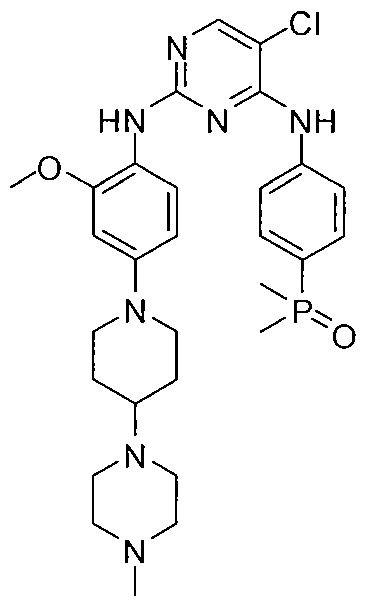
Structures of select ALK inhibitors.
Brigatinib (previously known as AP26113) is an investigational small-molecule targeted cancer therapy being developed by ARIAD Pharmaceuticals, Inc.[1] Brigatinib has exhibited activity as a potent dual inhibitor of anaplastic lymphoma kinase (ALK) and epidermal growth factor receptor (EGFR).
ARIAD has begun a Phase 1/2 clinical trial of brigatinib based on cancer patients’ molecular diagnoses in September 2011.
ALK was first identified as a chromosomal rearrangement in anaplastic large cell lymphoma (ALCL). Genetic studies indicate that abnormal expression of ALK is a key driver of certain types of non-small cell lung cancer (NSCLC) and neuroblastomas, as well as ALCL. Since ALK is generally not expressed in normal adult tissues, it represents a highly promising molecular target for cancer therapy.
Epidermal growth factor receptor (EGFR) is another validated target in NSCLC. Additionally, the T790M “gatekeeper” mutation is linked in approximately 50 percent of patients who grow resistant to first-generation EGFR inhibitors.[2] While second-generation EGFR inhibitors are in development, clinical efficacy has been limited due to toxicity thought to be associated with inhibiting the native (endogenous or unmutated) EGFR. A therapy designed to target EGFR, the T790M mutation but avoiding inhibition of native EGFR is another promising molecular target for cancer therapy.
Pre-clinical results
In 2010, ARIAD announced results of preclinical studies on brigatinib showing potent inhibition of the target protein and of mutant forms that are resistant to the first-generation ALK inhibitor, which currently is in clinical trials in patients with cancer. ARIAD scientists presented these data at the annual meeting of the American Association for Cancer Research (AACR) in Washington, D.C. in April.[3]
In 2011, ARIAD announced preclinical studies showing that brigatinib potently inhibited activated EGFR or its T790M mutant, both in cell culture and in mouse tumor models following once daily oral dosing. Importantly, the effective oral doses in these preclinical models were similar to those previously shown to be effective in resistant ALK models. When tested against the native form of EGFR, brigatinib lacked activity, indicating a favorable selectivity for activated EGFR. These data were presented at the International Association for the Study of Lung Cancer (IASLC) 14th World Conference on Lung Cancer.[4]
In April 2015, ARIAD announced the initiation of a randomized, first-line Phase 3 clinical trial of brigatinib in adult patients with ALK-positive locally advanced or metastatic non-small cell lung cancer (NSCLC) who have not previously been treated with an ALK inhibitor. The ALTA 1L (ALK in Lung Cancer Trial of BrigAtinib in 1st Line) trial is designed to assess the efficacy of brigatinib in comparison to crizotinib based on evaluation of the primary endpoint of progression free survival (PFS). Read Full Press Release
In March 2014, ARIAD announced the initiation of its global Phase 2 ALTA (ALK in Lung Cancer Trial of brigatinib (AP26113) in patients with locally advanced or metastatic NSCLC who test positive for the ALK oncogene and were previously treated with crizotinib. This trial has reached full enrollment of approximately 220 patients and explores two different dose levels. Read Full Press Release
The international Phase 1/2 clinical trial of brigatinib (AP26113) is being conducted in patients with advanced malignancies, including anaplastic lymphoma kinase positive (ALK+) non-small cell lung cancer (NSCLC). Patient enrollment in the trial is complete, with the last patient enrolled in July 2014. The primary endpoint in the Phase 2 portion of the trial is overall response rate. In April 2016, ARIAD announced updated clinical data from the trial. Read Full Press Release
The purpose of this Expanded Access Program (EAP) is to provide brigatinib for those patients with locally advanced and/or metastatic patients with ALK+ NSCLC on an expanded access basis due to their inability to meet eligibility criteria for on-going recruiting trials, inability to participate in other clinical trials (e.g., poor performance status, lack of geographic proximity), or because other medical interventions are not considered appropriate or acceptable.
About Brigatinib
Brigatinib (AP26113) is an investigational, targeted cancer medicine discovered internally at ARIAD Pharmaceuticals, Inc. It is in development for the treatment of patients with anaplastic lymphoma kinase positive (ALK+) non-small cell cancer (NSCLC) whose disease is resistant to crizotinib. Brigatinib is currently being evaluated in the global Phase 2 ALTA (ALK in Lung Cancer Trial of AP26113) trial that is anticipated to form the basis for its initial regulatory review. ARIAD has also initiated the Phase 3 ALTA 1L trial to assess the efficacy of brigatinib in comparison to crizotinib. In June 2016, an Expanded Access Study of brigatinib will begin. More information on brigatinib clinical trials, including the expanded access program (EAP) for ALK+ NSCLC can be found here.
Brigatinib was granted orphan drug designation by the U.S. Food and Drug Administration (FDA) in May 2016 for the treatment of certain subtypes of non-small cell lung cancer (NSCLC). The designation is for anaplastic lymphoma kinase-positive (ALK+), c-ros 1 oncogene positive (ROS1+), or epidermal growth factor receptor positive (EGFR+) non-small cell lung cancer (NSCLC). Brigatinib received breakthrough therapy designation from the FDA in October 2014 for the treatment of patients with ALK+ NSCLC whose disease is resistant to crizotinib. Both designations were based on results from an ongoing Phase 1/2 trial that showed anti-tumor activity of brigatinib in patients with ALK+ NSCLC, including patients with active brain metastases.
We are on track to file for approval of brigatinib in the U.S. in the third quarter of 2016.

PATENT
WO 2016065028
https://google.com/patents/WO2016065028A1?cl=ru
Brigatinib has the chemical formula C29H39QN7G2P which, corresponds to a formula weight of 584.09 g/moL Its chemical structure is shown below:

Brigatinib is a multi-targeted tyrosine-kinase inhibitor useful for the treatment of non-small cell lung cancer (NSCLC) and other diseases, it is a potent inhibitor of ALK (anaplastic lymphoma kinase} and is in clinical development for the treatment of adult patients with ALK-driven NSCLC. Crizotinib (XALKOR!®) is an FDA approved drug for first-line treatment ‘of ALK-positive NSCLC. “Despite initial responses to crizotinib, the majority of patients have a relapse within 12 months, owing to the development of resistance.” Shaw et al., New Eng. J. Med. 370:1 189-97 2014. Thus, a growing population of cancer patients are in need of new and effective therapies for ALK-positive cancers.
Brigatinib is also potentially useful for treating other diseases or conditions in which ALK or other protein kinases inhibited by brigatinib are implicated. Such kinases and their associated disorders or conditions are disclosed in WO 2009/143389, both of which are hereby incorporated herein by reference for all purposes.

FIG. 1 is a synthetic scheme for brigatinib,

FIG. 6 is an 1H-Niv1R spectrum obtained for a sample of brigatinib dissolved in CD3OD. Normalised intensity is shown on the vertical axis and chemical shift (ppm) is shown on the horizontal axis.

FIG. 7 is a 13C-NMR spectrum obtained for a sample of brigatinib dissolved in CDCi3. Normalized intensity is shown on the vertical axis and chemical shift (ppm) is shown on the horizontal axis.

FIG. 8 is a mass spectral fragmentation pattern of a sample of brigatinib Form A. Relative abundance is shown on the vertical axis and atomic weight (m/z) is shown on the horizontal axis.
Table 2 summarizes the relevant chemical shift data of Form A obtained from
the ‘Ή, and 13C-N R experiments. The number of signals and their relative intensity (integrals) confinri the number of protons and carbons in the structure of Form A of brigatinib. The 31P-NMR chemical shift for the single phosphorous atom in brigatinib was 43.6 ppm. These 1H and 13C-NMR chemical shift data are reported according to the atom numbering scheme shown immediately below:

1H-N R Assignments – 13C~N R Assignments
Table 2: 1H and 3C Chemical Shift Data (in ppm) of Form A of Brigatinib


[00118] With reference to Figure 8, mass spectral experiments of Form A were carried out using an Agilsent eiectrospray time of fisght mass spectrometer (Model 6210} operating in positive son mode using flow injection sampie introduction. Samples of Form A were dissolved in methanol/water and were analyzed and the mass observed was m/ 584.263 ( +f-T) with the calculated exact mass being 584.2684 ( +H+). The observed moiecuiar mass is consistent with the elemental composition calculated from the molecular formula of brigatinib.
PAPER
Discovery of Brigatinib (AP26113), a Phosphine Oxide-Containing, Potent, Orally Active Inhibitor of Anaplastic Lymphoma Kinase
Wei-Sheng Huang*, Shuangying Liu, Dong Zou, Mathew Thomas, Yihan Wang, Tianjun Zhou, Jan Romero, Anna Kohlmann, Feng Li, Jiwei Qi, Lisi Cai, Timothy A. Dwight, Yongjin Xu, Rongsong Xu, Rory Dodd, Angela Toms, Lois Parillon, Xiaohui Lu, Rana Anjum, Sen Zhang, Frank Wang, Jeffrey Keats, Scott D. Wardwell, Yaoyu Ning, Qihong Xu, Lauren E. Moran, Qurish K. Mohemmad, Hyun Gyung Jang, Tim Clackson, Narayana I. Narasimhan, Victor M. Rivera, Xiaotian Zhu, David Dalgarno, and William C. Shakespeare
ARIAD Pharmaceuticals, Inc., 26 Landsdowne Street, Cambridge, Massachusetts 02139, United States
J. Med. Chem., 2016, 59 (10), pp 4948–4964
DOI: 10.1021/acs.jmedchem.6b00306
Abstract

In the treatment of echinoderm microtubule-associated protein-like 4 (EML4)-anaplastic lymphoma kinase positive (ALK+) non-small-cell lung cancer (NSCLC), secondary mutations within the ALK kinase domain have emerged as a major resistance mechanism to both first- and second-generation ALK inhibitors. This report describes the design and synthesis of a series of 2,4-diarylaminopyrimidine-based potent and selective ALK inhibitors culminating in identification of the investigational clinical candidate brigatinib. A unique structural feature of brigatinib is a phosphine oxide, an overlooked but novel hydrogen-bond acceptor that drives potency and selectivity in addition to favorable ADME properties. Brigatinib displayed low nanomolar IC50s against native ALK and all tested clinically relevant ALK mutants in both enzyme-based biochemical and cell-based viability assays and demonstrated efficacy in multiple ALK+ xenografts in mice, including Karpas-299 (anaplastic large-cell lymphomas [ALCL]) and H3122 (NSCLC). Brigatinib represents the most clinically advanced phosphine oxide-containing drug candidate to date and is currently being evaluated in a global phase 2 registration trial.
(2-((5-Chloro-2-((2-methoxy-4-(4-(4-methylpiperazin-1-yl)piperidin-1-yl)phenyl)amino)-pyrimidin-4-yl)amino)phenyl)dimethylphosphine Oxide (11q)
Mp 215 °C.
1H NMR (400 MHz, CD3OD) δ 8.33 (dd, J = 4.52, 8.03 Hz, 1H), 8.02 (s, 1H), 7.66 (d, J = 8.78 Hz, 1H), 7.59 (ddd, J = 1.51, 7.78, 14.05 Hz, 1H), 7.47–7.54 (m, 1H), 7.25 (ddt, J = 1.00, 2.26, 7.53 Hz, 1H), 6.65 (d, J = 2.51 Hz, 1H), 6.45 (dd, J = 2.51, 8.78 Hz, 1H), 3.84 (s, 3H), 3.69 (d, J = 12.30 Hz, 2H), 2.62–2.86 (m, 6H), 2.43–2.62 (m, 4H), 2.33–2.42 (m, 1H), 2.29 (s, 3H), 1.97–2.08 (m, 2H), 1.83 (d, J = 13.30 Hz, 6H), 1.66 (dq, J = 3.89, 12.09 Hz, 2H).
13C NMR (151 MHz, CDCl3) δ 18.57 (d, J = 71.53 Hz), 28.28 (s), 46.02 (s), 49.01 (s), 50.52 (s), 55.46 (s), 55.65 (s), 61.79 (s), 101.07 (s), 106.01 (s), 108.41 (s), 120.25 (d, J = 95.73 Hz), 120.68 (s), 122.09 (s), 122.41 (d, J = 12.10 Hz), 123.13 (br d, J = 6.60 Hz), 129.48 (d, J = 11.00 Hz), 132.36 (s), 143.91 (d, J = 2.20 Hz), 147.59 (s), 149.38 (s), 154.97 (s), 155.91 (s), 157.82 (s).
31P NMR (162 MHz, CDCl3) δ 43.55.
MS/ES+: m/z = 584.3 [M + H]+.
Anal. Calcd for C29H39ClN7O2P: C, 59.63; H, 6.73; Cl, 6.07; N, 16.79; O, 5.48; P, 5.30. Found: C, 59.26; H, 6.52; Cl, 6.58; N, 16.80.
PATENT
WO 2016089208

New Patent, Suzhou MiracPharma Technology Co Ltd, Brigatinib, WO 2017016410
WO-2017016410
Preparation method for antitumor drug AP26113
Suzhou MiracPharma Technology Co Ltd
SUZHOU MIRACPHARMA TECHNOLOGY CO., LTD [CN/CN]; Room 1305, Building 1,Lianfeng Commercial Plaza, Industrial District Suzhou, Jiangsu 215000 (CN)
XU, Xuenong; (CN)
Improved process for preparing brigatinib, useful for treating cancer eg non-small cell lung cancer (NSCLC). The present filing represents the first PCT patenting to be seen from Suzhou MiracPharma that focuses on brigatinib; In February 2017, brigatinib was reported to be in pre-registration phase.
Disclosed is a preparation method for an antitumor drug AP26113 (I). The method comprises the following preparation steps: cyclizing N-[2-methoxyl-4-[4-(dimethyl amino)piperid-1-yl]aniline]guanidine and N,N-dimethylamino acrylate, condensing N-[2-methoxyl-4-[4-(dimethyl amino)piperid-1-yl]aniline]guanidine and 4-(dimethyl phosphitylate)aniline, and chlorinating N-[2-methoxyl-4-[4-(dimethyl amino)piperid-1-yl]aniline]guanidine by means of a chlorinating agent, sequentially, so as to prepare AP26113 (I). The preparation method adopts easily-obtained raw materials, causes few side reactions, and is economical, environmentally-friendly, and suitable for industrial production.

AP26113 is an experimental drug developed by Ariad Pharmaceuticals to target small molecule tyrosine kinase inhibitors for the treatment of anaplastic lymphoma kinase-positive (ALK) metastases resistant to crizotinib Non-small cell lung cancer (NSCLC) patients. The drug was approved by the US Food and Drug Administration in August 2014 for breakthrough drug treatment. The current clinical data show that AP26113 on ALK-positive non-small cell lung cancer patients, including patients with brain metastases, have a sustained anti-tumor activity. And the inhibitory activity against ALK is about 10 times that of zolotriptan, which can inhibit all 9 kinds of identified mutations of kotatinib resistant ALK.
The chemical name of AP26113 is 5-chloro-N- [4- [4- (dimethylamino) -1-piperidinyl] -2-methoxyphenyl] -N4- [2- Phosphono) phenyl] -2,4-pyrimidinediamine (I) having the structural formula:
Methods for the preparation of AP26113 have been reported. AP26113 and its starting materials A and B are prepared by PCT Patent WO2009143389 of Ariad and U.S. Patent No. 20130225527, US20130225528 and US20140066406 of Ariad. The target compound AP26113 is prepared by substituting 2,4,5-trichloropyrimidine with the pyrimidine ring of starting materials A and B in turn.
Although the synthetic procedure is simple, the nucleophilic activity of the three chlorine atoms on 2,4,5-trichloropyrimidine is limited. When the same or similar aniline group is faced, its position Selectivity will inevitably produce interference, resulting in unnecessary side effects, thus affecting the quality of the product. At the same time, the reaction process for the use of precious metal palladium reagent also increased the cost of production is not conducive to the realization of its industrialization.
Therefore, how to use modern synthesis technology, the use of readily available raw materials, design and development of simple and quick, economical and environmentally friendly and easy to industrialization of the new synthesis route, especially customer service location on the pyrimidine ring side effects of selectivity, for the drug Economic and technological development is of great significance
The synthesis step comprises the following steps: N- [2-methoxy-4- [4- (dimethylamino) piperidin-1-yl] aniline] guanidine (II) and N, N-dimethylaminoacrylates Amino-4 (1H) -pyrimidinone (III) in the presence of a base such as N, N-dimethylformamide, N, N-dimethylformamide, (III) was reacted with 4- (dimethyl (dimethylamino) -1-piperidinyl) -2-methoxyphenyl] (A) is condensed under the action of a condensing agent and a base accelerator to obtain N2- [4- [4- (dimethylamino) -1-piperidinyl] -2-methoxybenzene (IV); the N2- [4- [4- (dimethylamino) -l- (4-fluorophenyl) (IV) with a chlorinating agent in the presence of a base such as sodium hydride, sodium hydride, sodium hydride, potassium hydride, AP26113 (I).

A solution of 2-methoxy-4- [4- (dimethylamino) piperidin-1-yl] aniline (24.9 g, 0.1 mol) and 250 mL of methanol was added to the reaction flask and the temperature was lowered to 0C (15 mL, 0.15 mol) and a 50% solution of cyanamide (10 mL, 0.15 mol) were added successively. The reaction was stirred for 12 to 14 hours and the reaction was complete by TLC. After cooling to 0-5 ° C, 250 mL of methyl tert-butyl ether was added to the reaction mixture. A solid precipitated and was filtered, washed successively with water and cold acetonitrile, and dried to give N- [2-methoxy- 16.3 g, yield 56.0%, FAB-MS m / z: 292 [M + H] + . [4- (Dimethylamino) piperidin-1-yl] aniline] guanidine (II)
A solution of N- [2-methoxy-4- [4- (dimethylamino) piperidin-1-yl] aniline] guanidine (II) (2.9 g, 10 mmol), N, Methyl methacrylate (1.8 g, 13.7 mmol) and toluene (50 mL). The mixture was heated to reflux and stirred for 24-26 hours. The reaction was complete by TLC. After cooling to room temperature, a solid precipitated. The filter cake was washed with cold methanol and dried in vacuo to give an off-white solid of N2- [4- [4- (dimethylamino) -1-piperidinyl] -2-methoxyphenyl] 1H) -pyrimidinone (III), yield 77.3%, FAB-MS m / z: 344 [M + H] + .
A solution of N- [2-methoxy-4- [4- (dimethylamino) piperidin-1-yl] aniline] guanidine (II) (2.9 g, 10 mmol), N, (2.0 g, 14.0 mmol) and N, N-dimethylformamide (30 mL) was added and the temperature was raised to 115-125 ° C. The reaction was stirred for 22-24 hours and the reaction was complete by TLC. The mixture was concentrated under reduced pressure, and 50 mL of ethanol was added to the resulting residue. The mixture was cooled to room temperature while stirring to precipitate a solid. The filter cake was washed with cold ethanol and dried in vacuo to give an off-white solid of N2- [4- [4- (dimethylamino) -1-piperidinyl] -2-methoxyphenyl] 1H) -pyrimidinone (III) in 79.6% yield, FAB-MS m / z: 344 [M + H] + .
A mixture of N2- [4- [4- (dimethylamino) -1-piperidinyl] -2-methoxyphenyl] amino-4 (1H) -pyrimidinone III) (3.43 g, 10 mmol), benzotriazol-1-yloxytris (dimethylamino) phosphonium hexafluorophosphate (6.63 g, 15 mmol) and acetonitrile 100 mL. Diazabicyclo [5.4.0] -undec-7-ene (DBU) (2.28 g, 15 mmol) was added dropwise at room temperature for 12 hours. The temperature was raised to 60 ° C and the reaction was continued for 12 hours. The solvent was evaporated under reduced pressure, 100 mL of ethyl acetate was dissolved, and the mixture was washed with 20 mL of 2M sodium hydroxide and 20 mL of water. The organic layer was dried over anhydrous sodium sulfate, and 50 mL of tetrahydrofuran-dissolved 4- (dimethylphosphoranylidene) A) (2.2 g, 13 mmol) and sodium hydride (0.31 g, 13 mmol) was added and the temperature was raised to 50-55 ° C. The reaction was stirred for 6-8 hours and monitored by TLC. The reaction was quenched with saturated brine, the organic phase was separated, dried and the solvent was distilled off under reduced pressure. The crude product was recrystallized from ethanol to give an off-white solid of N2- [4- [4- (dimethylamino) -1-piperidine Yl] -2-methoxyphenyl] -N4- [2- (dimethylphosphono) phenyl] -2,4-pyrimidinediamine (IV) in a yield of 83.2%. FAB-MS m / z: 495 [M + H] + .
A mixture of N2- [4- [4- (dimethylamino) -1-piperidinyl] -2-methoxyphenyl] amino-4 (1H) -pyrimidinone (Dimethylamino) phosphonium hexafluorophosphate (BOP) (6.63 g, 15 mmol), 4- (dimethylsulfamoyl) phosphonium hexafluorophosphate Phosphoryl) aniline (A) (2.2 g, 13 mmol) and N, N-dimethylformamide. Diazabicyclo [5.4.0] undec-7-ene (DBU) (2.28 g, 15 mmol) was added dropwise and reacted at room temperature for 12 hours. The temperature was raised to 60 ° C and the reaction was continued for 12 hours. The solvent was distilled off under reduced pressure, 100 mL of ethyl acetate was added to dissolve, and the mixture was washed with 2 M sodium hydroxide 20 mL. The organic phase was separated, dried and concentrated under reduced pressure. The residue was recrystallized from ethanol to give an off-white solid of N2- [4- [4- (dimethylamino) -1-piperidinyl] -2-methoxyphenyl] -N4- [2- Phenylidene] -2,4-pyrimidinediamine (IV) was obtained in a yield of 48.6%. FAB-MS m / z: 495 [M + H] + .
A solution of N2- [4- [4- (dimethylamino) -1-piperidinyl] -2-methoxyphenyl] -N4- [2- (dimethylphosphono) Phenyl] -2,4-pyrimidinediamine (IV) (4.9 g, 10 mmol) and 100 mL of acetonitrile were added and stirred at room temperature. N-Chlorosuccinimide (1.6 g, 12 mmol) was added in three portions, The reaction was allowed to proceed at room temperature for 4-6 hours, and the reaction was terminated by TLC. The reaction solution was poured into 50 mL of water to quench the reaction. Dichloromethane, and the combined organic layers were washed successively with saturated sodium bicarbonate solution, saturated brine and water. Dried over anhydrous sodium sulfate and concentrated. The resulting crude oil was recrystallized from ethyl acetate / n-hexane to give 3.5 g of a white solid AP26113 (I) in 66.3% yield, FAB-MS m / z: 529 [M + the H] + , 1 the H NMR (CDCl 3 ) 1.67 (m, 2H), 1.81 (S, 3H), 1.85 (S, 3H), 1.93 (m, 2H), 1.96 (m, 2H), 2.10 (m, 2H), 3.86 (s, 3H), 6.50 (m, 1H), 6.57 (m, 1H), 7.12 (m, 1H) ), 7.31 (m, 1H), 7.50 (m, 1H), 8.13 (m, 2H), 8.64 (m, 1H).
////////////New Patent, Suzhou MiracPharma Technology Co Ltd, Brigatinib, WO 2017016410
References
- Jump up^ Huang, Wei-Sheng; Liu, Shuangying; Zou, Dong; Thomas, Mathew; Wang, Yihan; Zhou, Tianjun; Romero, Jan; Kohlmann, Anna; Li, Feng. “Discovery of Brigatinib (AP26113), a Phosphine Oxide-Containing, Potent, Orally Active Inhibitor of Anaplastic Lymphoma Kinase”. Journal of Medicinal Chemistry. 59: 4948–4964. doi:10.1021/acs.jmedchem.6b00306.
- Jump up^ Sequist; et al. (2011). “Genotypic and Histological Evolution of Lung Cancers Acquiring Resistance to EGFR Inhibitors”. Sci Trans. Med. 3 (75): 75ra26. doi:10.1126/scitranslmed.3002003.
- Jump up^ “ARIAD Presents Preclinical Data on Its Investigational ALK Inhibitor, AP26113, Demonstrating That It Can Overcome Mutation-Based Drug Resistance in Cancer Models”.
- Jump up^ “ARIAD Announces Presentation on Its Investigational Lung Cancer Drug Candidate, AP26113, a Dual Inhibitor of ALK and EGFR, at World Conference on Lung Cancer”.

 DRUG APPROVALS BY DR ANTHONY MELVIN CRASTO
.....
DRUG APPROVALS BY DR ANTHONY MELVIN CRASTO
.....










 New Drug Approvals