New Drug Approvals
Follow New Drug Approvals on WordPress.com

FLAGS AND HITS

Flag Counter
DRUG APPROVALS BY DR ANTHONY MELVIN CRASTO

Archives

Categories

Join me on Linkedin

View Anthony Melvin Crasto Ph.D's profile on LinkedIn

Join me on Researchgate

Anthony Melvin Crasto Dr.

  Join me on Facebook FACEBOOK   ...................................................................Join me on twitter Follow amcrasto on Twitter     ..................................................................Join me on google plus Googleplus

MYSELF

DR ANTHONY MELVIN CRASTO Ph.D ( ICT, Mumbai) , INDIA 36Yrs Exp. in the feld of Organic Chemistry,Working for AFRICURE PHARMA as ADVISOR earlier with GLENMARK PHARMA at Navi Mumbai, INDIA. Serving chemists around the world. Helping them with websites on Chemistry.Million hits on google, NO ADVERTISEMENTS , ACADEMIC , NON COMMERCIAL SITE, world acclamation from industry, academia, drug authorities for websites, blogs and educational contribution, ........amcrasto@gmail.com..........+91 9323115463, Skype amcrasto64 View Anthony Melvin Crasto Ph.D's profile on LinkedIn Anthony Melvin Crasto Dr.

Enter your email address to follow this blog and receive notifications of new posts by email.

Join 37.9K other subscribers
DR ANTHONY MELVIN CRASTO Ph.D

DR ANTHONY MELVIN CRASTO Ph.D

DR ANTHONY MELVIN CRASTO, Born in Mumbai in 1964 and graduated from Mumbai University, Completed his Ph.D from ICT, 1991,Matunga, Mumbai, India, in Organic Chemistry, The thesis topic was Synthesis of Novel Pyrethroid Analogues, Currently he is working with AFRICURE PHARMA, ROW2TECH, NIPER-G, Department of Pharmaceuticals, Ministry of Chemicals and Fertilizers, Govt. of India as ADVISOR, earlier assignment was with GLENMARK LIFE SCIENCES LTD, as CONSUlTANT, Retired from GLENMARK in Jan2022 Research Centre as Principal Scientist, Process Research (bulk actives) at Mahape, Navi Mumbai, India. Total Industry exp 32 plus yrs, Prior to joining Glenmark, he has worked with major multinationals like Hoechst Marion Roussel, now Sanofi, Searle India Ltd, now RPG lifesciences, etc. He has worked with notable scientists like Dr K Nagarajan, Dr Ralph Stapel, Prof S Seshadri, etc, He did custom synthesis for major multinationals in his career like BASF, Novartis, Sanofi, etc., He has worked in Discovery, Natural products, Bulk drugs, Generics, Intermediates, Fine chemicals, Neutraceuticals, GMP, Scaleups, etc, he is now helping millions, has 9 million plus hits on Google on all Organic chemistry websites. His friends call him Open superstar worlddrugtracker. His New Drug Approvals, Green Chemistry International, All about drugs, Eurekamoments, Organic spectroscopy international, etc in organic chemistry are some most read blogs He has hands on experience in initiation and developing novel routes for drug molecules and implementation them on commercial scale over a 32 PLUS year tenure till date Feb 2023, Around 35 plus products in his career. He has good knowledge of IPM, GMP, Regulatory aspects, he has several International patents published worldwide . He has good proficiency in Technology transfer, Spectroscopy, Stereochemistry, Synthesis, Polymorphism etc., He suffered a paralytic stroke/ Acute Transverse mylitis in Dec 2007 and is 90 %Paralysed, He is bound to a wheelchair, this seems to have injected feul in him to help chemists all around the world, he is more active than before and is pushing boundaries, He has 100 million plus hits on Google, 2.5 lakh plus connections on all networking sites, 100 Lakh plus views on dozen plus blogs, 227 countries, 7 continents, He makes himself available to all, contact him on +91 9323115463, email amcrasto@gmail.com, Twitter, @amcrasto , He lives and will die for his family, 90% paralysis cannot kill his soul., Notably he has 38 lakh plus views on New Drug Approvals Blog in 227 countries......https://newdrugapprovals.wordpress.com/ , He appreciates the help he gets from one and all, Friends, Family, Glenmark, Readers, Wellwishers, Doctors, Drug authorities, His Contacts, Physiotherapist, etc He has total of 32 International and Indian awards

Verified Services

View Full Profile →

Recent Posts

FDA approves first treatment Libtayo (cemiplimab-rwlc) for advanced form of the second most common skin cancer


FDA approves first treatment for advanced form of the second most common skin cancer

New drug targets PD-1 pathway

The U.S. Food and Drug Administration today approved Libtayo (cemiplimab-rwlc) injection for intravenous use for the treatment of patients with metastatic cutaneous squamous cell carcinoma (CSCC) or locally advanced CSCC who are not candidates for curative surgery or curative radiation. This is the first FDA approval of a drug specifically for advanced CSCC.

September 28, 2018

Release

The U.S. Food and Drug Administration today approved Libtayo (cemiplimab-rwlc) injection for intravenous use for the treatment of patients with metastatic cutaneous squamous cell carcinoma (CSCC) or locally advanced CSCC who are not candidates for curative surgery or curative radiation. This is the first FDA approval of a drug specifically for advanced CSCC.

Libtayo works by targeting the cellular pathway known as PD-1 (protein found on the body’s immune cells and some cancer cells). By blocking this pathway, the drug may help the body’s immune system fight the cancer cells.

“We’re continuing to see a shift in oncology toward identifying and developing drugs aimed at a specific molecular target. With the Libtayo approval, the FDA has approved six immune checkpoint inhibitors targeting the the PD-1 / PD-L1 pathway for treating a variety of tumors, from bladder to head and neck cancer, and now advanced CSCC,” said Richard Pazdur, M.D., director of the FDA’s Oncology Center of Excellence and acting director of the Office of Hematology and Oncology Products in the FDA’s Center for Drug Evaluation and Research. “This type of cancer can be difficult to treat effectively when it is advanced and it is important that we continue to bring new treatment options to patients.”

CSCC is the second most common human cancer in the United States with an estimated annual incidence of approximately 700,000 cases. The most common form of skin cancer is basal cell cancer. Squamous cells are thin, flat cells that look like fish scales and are found in the tissue that forms the surface of the skin. CSCC usually develops in skin areas that have been regularly exposed to the sun or other forms of ultraviolet radiation. While the majority of patients with CSCC are cured with surgical resection, a small percentage of patients will develop advanced disease that no longer responds to local treatments including surgery and radiation. Advanced CSCC may cause disfigurement at the site of the tumor and local complications such as bleeding or infection, or it may spread (metastasize) to local lymph nodes, distant tissues and organs and become life-threatening.

The safety and efficacy of Libtayo was studied in two open label clinical trials. A total of 108 patients (75 with metastatic disease and 33 with locally-advanced disease) were included in the efficacy evaluation. The study’s primary endpoint was objective response rate, or the percentage of patients who experienced partial shrinkage or complete disappearance of their tumor(s) after treatment. Results showed that 47.2 percent of all patients treated with Libtayo had their tumors shrink or disappear. The majority of these patients had ongoing responses at the time of data analysis.

Common side effects of Libtayo include fatigue, rash and diarrhea. Libtayo must be dispensed with a patient Medication Guide that describes uses of the drug and its serious warnings. Libtayo can cause the immune system to attack normal organs and tissues in any area of the body and can affect the way they work. These reactions can sometimes become severe or life-threatening and can lead to death. These reactions include the risk of immune-mediated adverse reactions including lung problems (pneumonitis), intestinal problems (colitis), liver problems (hepatitis), hormone gland problems (endocrinopathies), skin (dermatologic) problems and kidney problems. Patients should also be monitored for infusion-related reactions.

Libtayo can cause harm to a developing fetus; women should be advised of the potential risk to the fetus and to use effective contraception.

The FDA granted this application Breakthrough Therapy and Priority Reviewdesignations.

The FDA granted the approval of Libtayo to Regeneron Pharmaceuticals, Inc.

////////////Libtayo, cemiplimab-rwlc, FDA 2018,  Breakthrough Therapy,  Priority Review

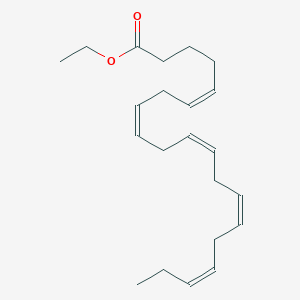
Icosapent ethyl, イコサペント酸エチル


DB08887.png

Ethyl eicosapentaenoate.png

Icosapent ethyl

330.5042 , C22H34O2

cas 86227-47-6 / 73310-10-8

ethyl (5Z,8Z,11Z,14Z,17Z)-icosa-5,8,11,14,17-pentaenoate

Ethyl eicosapentaenoic acid

イコサペント酸エチル

(5Z,8Z,11Z,14Z,17Z)-Eicosapetaenoic acid ethyl ester
(all-Z)-5,8,11,14,17-Eicosapentaenoic acid ethyl ester
5,8,11,14,17-Eicosapentaenoic acid, ethyl ester, (5Z,8Z,11Z,14Z,17Z)- [ACD/Index Name]
5,8,11,14,17-Eicosapentaenoic acid, ethyl ester, (all-Z)-
6GC8A4PAYH
86227-47-6 [RN]
all-cis-5,8,11,14,17-Eicosapentaenoic Acid Ethyl Ester
Timnodonic acid ethyl ester
Vascepa
  • 5,8,11,14,17-Eicosapentaenoic acid, ethyl ester, (all-Z)-
  • (5Z,8Z,11Z,14Z,17Z)-5,8,11,14,17-Eicosapentaenoic acid ethyl ester
  • (all-Z)-5,8,11,14,17-Eicosapentaenoic acid ethyl ester
  • AMR 101
  • C20:5 n-3 Ethyl ester
  • Epadel
  • Epadel S 300
  • Ethyl (5Z,8Z,11Z,14Z,17Z)-eicosa-5,8,11,14,17-pentaenoate
  • Ethyl all-Z-5,8,11,14,17-eicosapentanenoate
  • Ethyl all-cis-5,8,11,14,17-eicosapentaenoate
  • Ethyl eicosapentaenoate
  • Ethyl icosapentate
  • Icosapent ethyl
  • Incromega EPA
  • Timnodonic acid ethyl ester
  • Vascepa
  • cis-Eicosapentaenoic acid ethyl ester

(all-Z)-5,8,11,14,17-Eicosapentaenoic acid ethyl ester; Ethyl all-cis-5,8,11,14,17-eicosapentaenoate;Timnodonic acid ethyl ester; cis-Eicosapentaenoic acid ethyl ester; Ethyl (5Z,8Z,11Z,14Z,17Z)-eicosa-5,8,11,14,17-pentaenoate; Epadel; Icosapent; EPA ethyl ester; E-EPA; Ethyl eicosapentaenoate; OMEGA-3 ACIDS ETHYL ESTER; EPA-E;

AMARIN PHARMACEUTICALS IRELAND LTD

AMR 101 / AMR-101 / AMR101

Icosapent ethyl or ethyl eicosapentaenoic acid is a synthetic derivative of the omega-3 fatty acid eicosapentaenoic acid (EPA). It is used as adjunct therapy for severe hypertriglyceridemia (TG levels > 500 mg/dL). FDA approved on July 26, 2012.

In 2000, Amarin licensed exclusive U.S. rights to icosapent ethyl ester from the Scottish company Laxdale, and acquired the company in July 2004. In 2015, the product was licensed to Eddingpharm by Amarin for the development and commercialization in China, Hong Kong and Taiwan. Fast-track status has been granted in the U.S. for the treatment of HD. Orphan drug designation was assigned to the compound for this indication in both the U.S. and E.U.

fda

IND 107616 was submitted on 25 March 2010 for the indication of severe hypertriglyceridemia; Epanova had been previously investigated for the treatment of Crohn’s Disease under IND in the Division of Gastroenterology Products. An end-of-phase 2 (EOP2) meeting was held on 02 June 2010. Regarding the indication under consideration at this time, a special protocol assessment (SPA) for the single phase 3 trial OM-EPA-003 (also known as “EVOLVE”) was submitted 02 July 2010 and ultimately agreed upon, after amendments, on 22 October 2010. On 25 April 2012, the applicant proposed an alternative to conducting a thorough QTc study by assessing ECGs recorded during OM-EPA-003; this was found acceptable. A clinical pre-NDA meeting was held on 14 November 2012. The nonclinical development strategy was found reasonable. A clinical package containing OM-EPA-003 (pivotal) and OMEPA-004 (a 6-week phase 3 trial , with long-term safety supported by data from the former Crohn’s disease program (“EPIC” trials), was found adequate for submission. Agreement was reached regarding the clinical pharmacology portion of the submission. Details regarding data pooling for the Integrated Summary of Safety (ISS) were found acceptable

from the former Crohn’s disease program (“EPIC” trials), was found adequate for submission. Agreement was reached regarding the clinical pharmacology portion of the submission. Details regarding data pooling for the Integrated Summary of Safety (ISS) were found acceptable

CMC Drug Substance & Drug Product Chemistry, manufacturing, and controls data related to both the drug substance (omega-3- carboxylic acids) and drug product (Epanova Capsules 1 g) are detailed in the review by Martin Haber, PhD, and Xavier Ysern, PhD. They recommend the NDA for approval. There are no pending CMC issues. The drug substance at sites in Nova Scotia and Prince Edward Island, Canada, from crude fish oil obtained from fish It is a complex mixture of PUFAs, predominantly the omega-3 acids EPA (55%), DHA (20%), and docosapentaenoic acid %). It consistently contains omega-3 and omega-6 PUFA components: total omega-3 fatty acids are limited to not less than % and total omega-6 fatty acids are limited to not more than %. The drug substance also contains 0.3% (m/m) α-tocopherol as . During purification, . Environmental pollutants (heavy metals, pesticides, are controlled by specific tests on the drug substance . Drug substance specifications include tests for acid value, saponification value, ester value, peroxide value, p-anisidine value, total oxidation value, cholesterol, oligomers, , fatty acid composition (PUFAs, EPA, DHA, DPA, total omega-3 fatty acids, total omega-6 fatty acids, other polyunsaturated fatty acids, As described in the review by Drs. Haber and Ysern, the qualitative identify of the drug substance was developed by examining consistencies of peak patterns across 21 discrete lots: there are omega-3 and omega-6 PUFA peaks consistently present in the GC chromatograms (although not necessarily always above the limit of quantitation), which can be used to establish the fingerprint identity of omega-3-carboxylic acids . The quantitative fatty acid composition is given in the table below, excerpted from p. 25 of their review:

Ethyl eicosapentaenoic acid (E-EPAicosapent ethyl) is a derivative of the omega-3 fatty acid eicosapentaenoic acid (EPA) that is used in combination with changes in diet to lower triglyceride levels in adults with severe (≥ 500 mg/dL) hypertriglyceridemia. This was the second class of fish oil-based drug to be approved for use as a drug and was approved by the FDA in 2012. These fish oil drugs are similar to fish oil dietary supplements but the ingredients are better controlled and have been tested in clinical trials.

The company that developed this drug, Amarin Corporation, challenged the FDA’s ability to limit its ability to market the drug for off-label use and won its case on appeal in 2012, changing the way the FDA regulates pharmaceutical marketing.

Medical use

E-EPA is used in addition to changes in diet to reduce triglyceride levels in adults with severe (≥ 500 mg/dL) hypertriglyceridemia.[1]

Intake of large doses (2.0 to 4.0 g/day) of long-chain omega-3 fatty acids as prescription drugs or dietary supplements are generally required to achieve significant (> 15%) lowering of triglycerides, and at those doses the effects can be significant (from 20% to 35% and even up to 45% in individuals with levels greater that 500 mg/dL). It appears that both eicosapentaenoic acid (EPA) and docosahexaenoic acid (DHA) lower triglycerides, however, DHA alone appears to raise low-density lipoprotein (the variant which drives atherosclerosis; sometimes very inaccurately called: “bad cholesterol”) and LDL-C values (always only a calculated estimate; not measured by labs from person’s blood sample for technical and cost reasons), whilst EPA alone, does not and instead lowers the parameters aforementioned.[2]

Other fish-oil based drugs

There are other omega-3 fish oil based drugs on the market that have similar uses and mechanisms of action.[3]

Dietary supplements

There are many fish oil dietary supplements on the market.[8] There appears to be little difference in effect between dietary supplements and prescription forms of omega-3 fatty acids, but EPA and DHA ethyl esters (prescription forms) work less well when taken on an empty stomach or with a low-fat meal.[2] The ingredients of dietary supplements are not as carefully controlled as prescription products and have not been fixed and tested in clinical trials, as prescription drugs have,[9] and the prescription forms are more concentrated, requiring fewer capsules to be taken and increasing the likelihood of compliance.[8]

Side effects

Special caution should be taken with people who have with fish and shellfish allergies.[1] In addition, as with other omega-3 fatty acids, taking E-EPA puts people who are on anticoagulants at risk for prolonged bleeding time.[1][2] The most commonly reported side effect in clinical trials has been joint pain; some people also reported pain in their mouth or throat.[1] E-EPA has not been tested in pregnant women is rated pregnancy category C; it is excreted in breast milk and the effects on infants are not known.[1]

Pharmacology

After ingestion, E-EPA is metabolized to EPA. EPA is absorbed in the small intestine and enters circulation. Peak plasma concentration occurs about 5 hours after ingestion and the half-life is about 89 hours. EPA is metabolized mostly in the liver like other dietary fatty acids.[1]

Mechanism of action

EPA, the active metabolite of E-EPA, like other omega-3 fatty acid based drugs, appears to reduce production of triglycerides in the liver, and to enhance clearance of triglycerides from circulating very low-density lipoprotein (VLDL) particles; the way it does that is not clear, but potential mechanisms include increased breakdown of fatty acids; inhibition of diglyceride acyltransferase which is involved in biosynthesis of triglycerides in the liver; and increased activity of lipoprotein lipase in blood.[1][3]

Physical and chemical properties[edit]

E-EPA is an ethyl ester of eicosapentaenoic acid, which is an omega-3 fatty acid.[1]

History

In July 2012, the US Food and Drug Administration approved E-EPA for severe hypertriglyceridemia as an adjunct to dietary measures; Amarin Corporation had developed the drug.[10]

E-EPA was the second fish-oil drug to be approved, after omega-3 acid ethyl esters (GlaxoSmithKline‘s Lovaza which was approved in 2004[11]) and sales were not as robust as Amarin had hoped. The labels for the two drugs were similar, but doctors prescribed Lovaza for people who had triglycerides lower than 500 mg/dL based on some clinical evidence. Amarin wanted to actively market E-EPA for that population as well which would have greatly expanded its revenue, and applied to the FDA for permission to do so in 2013, which the FDA denied.[12] In response, in May 2015 Amarin sued the FDA for infringing its First Amendment rights,[13] and in August 2015 a judge ruled that the FDA could not “prohibit the truthful promotion of a drug for unapproved uses because doing so would violate the protection of free speech.”[14] The ruling left open the question of what the FDA would allow Amarin to say about E-EPA, and in March 2016 the FDA and Amarin agreed that Amarin would submit specific marketing material to the FDA for the FDA to review, and if the parties disagreed on whether the material was truthful, they would seek a judge to mediate.[15]

PAPER

https://link.springer.com/article/10.1023%2FB%3ACONC.0000039128.78645.a8

Synthesis of Fatty-Acid Ethanolamides from Linum catharticum Oils and Cololabis saira Fats
Chemistry of Natural Compounds (Translation of Khimiya Prirodnykh Soedinenii) (2004), 40, (3), 222-226

PAPER

Journal of Molecular Catalysis B: Enzymatic, 84, 173-176; 2012

https://www.sciencedirect.com/science/article/pii/S1381117712000896?via%3Dihub

STARTING MATERIAL CAS 10417-94-4

  • (all-Z)-Δ5,8,11,14,17-Eicosapentaenoic acid
  • (all-cis)-5,8,11,14,17-Eicosapentaenoic acid

PATENT

CN 104846023

https://patents.google.com/patent/CN104846023A/en

Example 1

[0041] A method for preparing a concentrated fish oil fatty acid glycerides, the process steps shown in Figure 1, comprising the steps of:

[0042] S11 using crude enzyme preparation of deep sea fish art: the ratio: (m m) of deep-sea fish through the machine crushed bone formation minced, weighed 600g yue meat, meat by:: water = 0 5.1 water was added seal, in the dark, under nitrogen flow, at 75 ° C cooking lh. Using NaOH to adjust pH to 8.0. Mass fraction of 2% trypsin (trypsin: food grade, Zhengzhou Hong Cheng Chemical Products Limited), in the dark, enzyme 17h at 20 ° C. After 20min by centrifugation 3000r / min, the upper layer was enzymolysis, namely crude fish oil;

[0043] S12 is prepared refined fish oil: Crude fish oil prepared in Step S11 is added a volume ratio of 0.5% phosphoric acid: degummed (crude phosphoric acid fish oil), a concentration of 70% phosphoric acid, followed by centrifugation speed of 3000 rpm / min, and then add a volume ratio of 1% deacidification NaOH, the NaOH concentration is 20%, after centrifugation, the rotational speed of 3000- rpm / min, to obtain refined fish oil;

. [0044] S13 of the refined fish oil fatty acid ethyl ester prepared by esterification process: step S12 is added to the fish oil refining prepared in mass ratio of 0.5% of sodium ethoxide, and a mass ratio of 0.5 in ethanol (ethanol: fish oil refining ), 40 ° C water bath for 1 hour, 1% (by mass) citric acid (citric acid: fish oil refining), standing layer, the upper layer and the liquid was washed with hot deionized water, standing layered repeated three times to give fatty acid ethyl ester.

. [0045] S14 of the fatty acid ethyl ester was extracted Separation: fatty acid ethyl ester obtained in step S13 is subjected to supercritical fluid extraction (extraction process of separation vessel as a rectification column I – separation kettle II), extraction conditions: a rectification column temperature 25-30-35-40 ° C, a pressure of 6 MPa rectification column, separation kettle I temperature 25 ° C, pressure in the separator tank I is 6 MPa, the temperature in the separation tank II 30-45 ° C, C0 2 flow rate of 151,711;

. [0046] S15 of the fatty acid ethyl ester after enzymatic extraction separation processing: The fatty acid ethyl ester obtained in step S14 using Penicillium expansum lipase enzyme, 4% of the amount of enzyme added,, reaction temperature 40 ° C , reaction pH of 10, speed 150 revolutions / min, hydrolysis time 4h, to obtain fatty acid glycerides.

[0047] Example 2

[0048] A process for preparing concentrated fish oil fatty acid glycerides, comprising the steps of:

. [0049] S21 using crude enzyme preparation of deep sea fish art: The procedure of Example 1 with reference to embodiment 11, wherein the cooking temperature is 85 ° C, hydrolysis temperature 25 ° C, centrifuge speed is 4000r / min;

. [0050] S22 refined fish oil preparation: The procedure of Example 1 with reference to embodiment 12; wherein, phosphate: the crude fish oil volume ratio is 1.5%, the phosphoric acid concentration of 75%; K0H: crude fish oil volume ratio of 3%, K0H the concentration of 30%, a centrifugal speed of 4000r / min;

. [0051] S23 of the refined fish oil fatty acid ethyl ester prepared by esterification process: The procedure of Example 1 with reference to embodiment 13; wherein, potassium ethoxide: refined fish oil mass ratio of 1 billion% ethanol: refined fish oil mass ratio of 2.0 , heat the water bath 60 ° C for 3 hours, and acetic acid is acetic acid: refined fish oil mass ratio of 3.0%;

. [0052] S24 was extracted to separate fatty acid ethyl ester: The procedure of Example 1 with reference to embodiment 14; wherein the extraction conditions: temperature rectification column 30-35-40-45 ° C, a pressure rectification column is 15 megabytes Pa, temperature of separation vessel I 35 ° C, pressure in the separator tank I is 8 MPa, the temperature in the separation tank II was 40 ° C, C0 2 flow rate of 171,711;

. [0053] S25 of the fatty acid ethyl ester after enzymatic extraction is carried out the separation treatment: The procedure of Example 1 with reference to embodiment 15; wherein 10% of the amount of enzyme added, reaction temperature 50 ° C, pH 8 hydrolysis, speed 300 rpm / min, hydrolysis time 12h, to obtain fatty acid glycerides.

[0054] Example 3

[0055] – Preparation Method Species of concentrated fish oil fatty acid glycerides, comprising the steps of:

. [0056] S31 using crude enzyme preparation of deep sea fish art: The procedure of Example 1 with reference to embodiment 11, wherein the cooking temperature is 90 ° C, hydrolysis temperature 35 ° C, centrifuge speed is 5000r / min;

. [0057] S32 prepared fine fish oil: The procedure of Example 1 with reference to embodiment 12; wherein, phosphate: the crude fish oil volume ratio of 3% phosphoric acid concentration of 85%; NaOH: crude fish oil volume ratio of 6% and the concentration of NaOH 50%, a centrifugal speed of 5000r / min;

. [0058] S33 of the refined fish oil fatty acid ethyl ester prepared by esterification process: The procedure of Example 1 with reference to embodiment 13; wherein, potassium ethoxide: refined fish oil mass ratio of 1.5%, ethanol: refined fish oil mass ratio of 4.0 heat treatment is 80 ° C water bath for 5 hours, citric acid and citric acid are added: refined fish oil mass ratio of 5.0%;

. [0059] S34 was extracted to separate fatty acid ethyl ester: The procedure of Example 1 with reference to embodiment 14; wherein the extraction conditions: temperature rectification column 30-35-40-45 ° C, pressure column 17 trillion Pa, I of separation vessel temperature 40 ° C, pressure in the separator tank I is 10 MPa, the temperature in the separation tank II is 45 ° C, C0 2 flow rate is? L / h;

. [0060] S35 of the fatty acid ethyl ester after enzymatic extraction separation processing: The procedure of Example 1 with reference to embodiment 15; wherein 20% of the amount of enzyme added, reaction temperature 60 ° C, a pH of 6.5 hydrolysis, speed 300 rpm / min, hydrolysis time 24h, to obtain fatty acid glycerides.

[0061] Comparative Example

[0062] S1 • obtaining crude fish: The procedure of Example 1 with reference to embodiment 11;

. [0063] S2 refined fish oil preparation: see Example 1, Step 12;

. [0064] S3 of refined fish oil fatty acid ethyl ester prepared by esterification process: Step 1, Example 13 process embodiment with reference, to obtain fatty acid ethyl ester.

PATENT

https://patents.google.com/patent/WO2014054435A1

WO 2014054435

 In recent years, highly unsaturated fatty acids such as eicosapentaenoic acid (EPA) and docosahexaenoic acid (DHA) have been clarified for their pharmacological effects and are used as raw materials for pharmaceuticals and health foods. Since these polyunsaturated fatty acids have a plurality of double bonds, it is not easy to obtain them by chemical synthesis. Therefore, most of industrially used highly unsaturated fatty acids are produced by extraction or purification from marine organism-derived materials rich in polyunsaturated fatty acids, such as fish oil, etc. However, the content of highly unsaturated fatty acid is not necessarily high, because the biological material is a mixture of various kinds of fatty acids having different numbers of carbon atoms, number and position of double bonds, constitutional ratio of stereoisomers, and the like. For this reason, conventionally, it has been required to selectively purify a target highly unsaturated fatty acid from a biological raw material.
 Patent Document 1 discloses a supercritical gas extraction method after a thin film distillation method when a raw material containing a highly unsaturated fatty acid or an alkyl ester thereof is treated by a thin film distillation method, a supercritical gas extraction method and a urea addition method A method for purifying a highly unsaturated fatty acid or an alkyl ester thereof is described.
 In Patent Document 2, a raw material containing a highly unsaturated fatty acid such as EPA is subjected to vacuum precision distillation treatment, and the resulting EPA or a fraction containing a lower alcohol ester thereof is mixed with an aqueous silver nitrate solution, whereby a high purity eicosapentaene A method of purifying an acid or a lower alcohol ester thereof is described. It is described that the condition of the vacuum precision distillation is a pressure of 5 mmHg (665 Pa) or less, preferably 1 mmHg (133 Pa) or less, 215 ° C. or less, preferably 210 ° C. or less.
 Further, Patent Document 3 discloses a process for producing eicosapentaenoic acid or an ester thereof having a concentration of 80% or more by gradually distilling a raw material containing a highly unsaturated fatty acid or an alkyl ester thereof using a distillation tower having three or more stages Is described. It is described that the condition of the distillation is 10 Torr (1330 Pa) or less, preferably 0.1 Torr (13.3 Pa) or less, 210 ° C. or less, preferably 195 ° C. or less.
 However, highly unsaturated fatty acids having higher concentrations and purities than those obtained by the above-mentioned conventional methods are required as raw materials for pharmaceuticals and health foods.
There are cis and trans isomers in highly unsaturated fatty acids. Most of the highly unsaturated fatty acids in vivo are cis, however, they may be converted from cis form to trans form by heating or the like at the stage of purification from biological origin materials (Non-Patent Document 1). Therefore, polyunsaturated fatty acids conventionally purified industrially from biologically derived raw materials contain a certain amount of trans isomer. However, trans fatty acids have been reported to increase health risks, especially LDL cholesterol levels, and increase the risk of cardiovascular disease. In the United States and Canada, foods are obliged to indicate the content of trans fatty acids.
 Therefore, there is a need for a highly unsaturated fatty acid-containing composition which not only contains the targeted highly unsaturated fatty acid at a high concentration as a raw material for pharmaceuticals and health foods but also contains a trans fatty acid content as low as possible . However, conventionally, purification of highly unsaturated fatty acids has not been conducted focusing on the stereoisomer ratio.
Patent Document 1: Japanese Patent Application Laid-Open No. 10-95744
Patent Document 2: Japanese Patent Application Laid-Open No. 7-242895
Patent Document 3: Japanese Patent No. 3005638

Non-patent literature

[0010]
Non-patent document 1: Journal of the American Oil Chemists’ Society, 1989, 66 (12): 1822-1830

Example 

[0035]
 Hereinafter, the present invention will be described in more detail by way of examples, but the present invention is not limited to only these examples.

[0036]
 In the following examples, the method of composition analysis of highly unsaturated fatty acids and the method of quantitating stereoisomers are as follows.
9 μL of the measurement sample was diluted to 1.5 mL of n-hexane, and the content ratio of each fatty acid and the content ratio of isomers were analyzed using a gas chromatography analyzer (Type 6890 GC, manufactured by Agilent Technologies) under the following conditions did. The results are expressed as mass% converted from the area of the chromatogram.
<Column condition>
Column: DB-WAX 0.25 mm × 30 m manufactured by J & W Co., column temperature: 210 ° C.
He flow rate: 1.0 ml / min, He pressure: 134 kPa
<Detection condition>
2 flow rate: 30 ml / min, Air flow rate : 400 ml / min
He flow rate: 10 ml / min, DET temperature: 260 ° C.
The isomer ratio in the target highly unsaturated fatty acid was obtained by the following formula.

[0037]
[Expression 1]

[0038]
(Example 1)
Raw material: 1000 mL of anhydrous ethanol solution in which 50 g of sodium hydroxide was dissolved was added to 1 kg of sardine oil, mixed and stirred at 70 to 80 ° C. for 1 hour, then 500 mL of water was added and mixed well, 1 It was left standing for a while. The separated aqueous phase was removed and the oil phase was washed several times with water to neutralize the washings to give 820 g of ethyl esterified sardine oil.
As shown in Table 1, the composition of the sardine oil was 44.09% (mass%, hereinafter the same) of eicosapentaenoic acid (EPA), 1.52% of eicosatetraenoic acid (ETA), 1.52% of arachidonic acid (AA) 1.77%, docosahexaenoic acid (DHA) 6.92%. Also, the trans isomer ratio in EPA was 1.23%.
Step (1) 160 ml of n-hexane was added to 300 g of the ethyl esterified sardine oil prepared above, and the mixture was stirred well and dissolved. To this was added 500 mL of an aqueous solution containing 50% by weight of silver nitrate, and the mixture was stirred under conditions of 5 to 30 ° C. After standing, the separated n-hexane phase was removed, and the aqueous phase was recovered.
Step (2): 2000 mL of fresh n-hexane was added to the aqueous phase obtained in the step (1), and the mixture was sufficiently stirred at 50 to 69 ° C. to extract the fatty acid ethyl ester into n-hexane. After standing, the separated aqueous phase was removed and the n-hexane phase was concentrated. The crude fatty acid ethyl ester crude product contained in this n-hexane phase contained 74.54% EPA, 0.32% ETA, 0.17% AA and 14.87% DHA in total fatty acids as shown in Table 1 It was. Also, the trans isomer ratio in EPA was 0.19%.
Step (3): The n-hexane phase containing the fatty acid ethyl ester obtained in the step (2) was maintained under conditions of a top vacuum degree of 1 Pa or less and a distillation temperature of 170 to 190 ° C. using a packed tower precision distillation apparatus While performing vacuum distillation to obtain a highly purified EPA ethyl ester-containing composition in a yield of about 60%. As shown in Table 1, this EPA ethyl ester-containing composition contained 98.25% of EPA, 0.43% of ETA, 0.21% of AA, and 0.05% of DHA in total fatty acids. Also, the trans isomer ratio in EPA was 0.45%.
The yield of EPA in this example in which the steps were performed in the order of (1), (2), (3) was about 53%.

[0039]
Example 2 The
steps (1), (2) and (3) were carried out in the same manner as in Example 1 except that the step (3) was carried out while maintaining the distillation temperature of 180 to 185 ° C., EPA ethyl ester-containing composition was obtained in a yield of about 58%. As shown in Table 1, this EPA ethyl ester-containing composition contained 98.29% of EPA, 0.40% of ETA, 0.32% of AA, and 0.05% of DHA in total fatty acids. Also, the trans isomer ratio in EPA was 0.28%, and the trans isomer was extremely small.
Comparative Example 1 An
EPA ethyl ester-containing composition was obtained in the same manner as in Example 1, except that the top vacuum degree was set to 13.3 Pa (0.1 Torr) in the step (3). As shown in Table 1, the composition contained EPA content ratio as high as 97.44% in the total fatty acid, but the trans isomer ratio in EPA was high (1.37%).

[0040]
Comparative Example 2 The
EPA ethyl ester-containing composition was obtained by performing vacuum distillation (step (3)) of ethyl esterified sardine oil and then steps (1) and (2). The conditions of each step were the same as in Example 1. As shown in Table 1, this composition contained 95.05% EPA, 0.72% ETA, 0.50% AA, 0.21% DHA in total fatty acids, the trans isomer ratio in EPA was 1.55% Met. The yield of EPA in this comparative example in which the steps were carried out in the order of (3), (1) and (2) was about 31%, and the EPA yield greatly decreased as compared with Example 1.
By changing the condition of the vacuum distillation in this Comparative Example (0.5 Pa, 185 to 195 ° C.), it was possible to raise the content of EPA in the total fatty acids in the composition to 98.12%, however, The rate further declined and the trans isomer ratio in EPA was 2.01%, further increased.

[0041]
[table 1]

[0042]
Examples 3 to 4 and Comparative Example 3 In the
step (3), the distillation temperature was 180 ° C. (Example 3), 190 ° C. (Example 4), 200 ° C. (Comparative Example 3), and the vacuum distillation time was A highly purified EPA ethyl ester-containing composition was obtained in the same manner as in Example 1 except that various changes were made and the trans isomer ratio of EPA in the composition was determined. The results are shown in Fig. 1. 1, in Examples 3 to 4 having a distillation temperature of 190 ° C. or less, the trans isomer ratio was less than 1% by mass, but in Comparative Example 3 having a distillation temperature of 200 ° C., the trans isomer The ratio exceeds 1% by mass.

References

  1. Jump up to:a b c d e f g h Icosapent ethyl Label Last revised June 2015. Check for updates at FDA label index page here
  2. Jump up to:a b c Jacobson TA, et al, NLA Expert Panel. National Lipid Association Recommendations for Patient-Centered Management of Dyslipidemia: Part 2. J Clin Lipidol. 2015 Nov-Dec;9(6 Suppl):S1-S122.e1. PMID 26699442 Free full text
  3. Jump up to:a b Weintraub, HS (2014). “Overview of prescription omega-3 fatty acid products for hypertriglyceridemia”Postgrad Med126: 7–18. doi:10.3810/pgm.2014.11.2828PMID 25387209. Retrieved 20 April 2015.
  4. Jump up^ University of Utah Pharmacy Services (15 August 2007) “Omega-3-acid Ethyl Esters Brand Name Changed from Omacor to Lovaza”
  5. Jump up^ Omtryg Label Revised April 2014
  6. Jump up^ FDA Omega-3 acid ethyl esters products Page accessed 31 March 2016
  7. Jump up^ “Epanova (omega-3-carboxylic acids)”CenterWatch. Retrieved 15 December 2014.
  8. Jump up to:a b Ito MK. A Comparative Overview of Prescription Omega-3 Fatty Acid Products. P T. 2015 Dec;40(12):826-57. PMID 26681905 Free PMC Article PMC 4671468
  9. Jump up^ Sweeney MET. Hypertriglyceridemia Pharmacologic Therapy for Medscape Drugs & Diseases, Ed. Khardori R. Updated: 14 April 2015, page accessed 1 April 2016
  10. Jump up^ CenterWatch Vascepa (icosapent ethyl) Page accessed 31 March 2016
  11. Jump up^ VHA Pharmacy Benefits Management Strategic Healthcare Group and the Medical Advisory Panel. October 2005 National PBM Drug Monograph Omega-3-acid ethyl esters (Lovaza, formerly Omacor)
  12. Jump up^ Matthew Herper for Forbes. 17 October 2013 Why The FDA Is Right To Block Amarin’s Push To Market Fish Oil To Millions
  13. Jump up^ Thomas, Katie (7 May 2015). “Drugmaker Sues F.D.A. Over Right to Discuss Off-Label Uses”New York Times. Retrieved 17 May 2017.
  14. Jump up^ Andrew Pollack for the New York Times. 7 August 2015 Court Forbids F.D.A. From Blocking Truthful Promotion of Drug
  15. Jump up^ Katie Thomas for the New York Times. 8 March 2016 F.D.A. Deal Allows Amarin to Promote Drug for Off-Label Use
CN1288732A *2000-07-122001-03-28刘玉Soft concentrated fish oil capsule and its supercritical CO2 extraction and rectification process
CN101255380A *2007-03-032008-09-03苑洪德Triglyceride type fish oil and method for making same
CN101818176A *2010-04-092010-09-01浙江兴业集团有限公司;华南理工大学Method for transforming fatty acid ethyl ester into glyceride
CN102964249A *2012-11-162013-03-13成都圆大生物科技有限公司Process capable of simultaneously producing and separating high-purity EPA (eicosapentaenoic acid) ethyl ester and high-purity DHA (docosahexaenoic acid) ethyl ester
CN102994236A *2012-12-112013-03-27成都圆大生物科技有限公司Method for preparing fatty acid ethyl ester with Omega-3 content of more than 90 percent
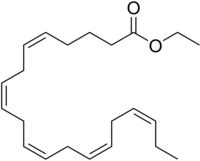
Ethyl eicosapentaenoic acid
Ethyl eicosapentaenoate.png
Names
IUPAC name

Ethyl (5Z,8Z,11Z,14Z,17Z)-eicosa-5,8,11,14,17-pentaenoate
Other names

Eicosapentaenoic acid ethyl ester; Ethyl eicosapentaenoate; Eicosapent; Icosapent ethyl; EPA ethyl ester; E-EPA
Identifiers
3D model (JSmol)
ChEBI
ChemSpider
PubChem CID
Properties
C22H34O2
Molar mass 330.51 g·mol−1
Except where otherwise noted, data are given for materials in their standard state (at 25 °C [77 °F], 100 kPa).

////////////Icosapent ethyl, fda 2012, Timnodonic acid ethyl ester, Vascepa, AMR 101, AMR-101, E-EPA, Ethyl eicosapentaenoic acid , Fast-track status, Orphan drug designation 

CCOC(=O)CCC\C=C/C\C=C/C\C=C/C\C=C/C\C=C/CC

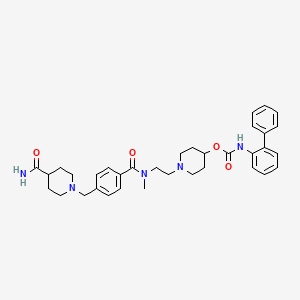
Revefenacin, ревефенацин , ريفيفيناسين , 瑞维那新 ,


Revefenacin.png

Revefenacin; 864750-70-9; TD-4208; UNII-G2AE2VE07O; G2AE2VE07O; TD-4208; GSK-1160724;

160724; GSK 1160724; TD-4028; YUPELRI

Molecular Formula: C35H43N5O4
Molecular Weight: 597.76 g/mol

[1-[2-[[4-[(4-carbamoylpiperidin-1-yl)methyl]benzoyl]-methylamino]ethyl]piperidin-4-yl] N-(2-phenylphenyl)carbamate

TD-4208
UNII:G2AE2VE07O
ревефенацин [Russian] [INN]
ريفيفيناسين [Arabic] [INN]
瑞维那新 [Chinese] [INN]

Revefenacin is under investigation for the treatment of Chronic Obstructive Pulmonary Disease (COPD).

  • Originator Theravance
  • Developer Theravance Biopharma
  • Class Antiasthmatics; Biphenyl compounds; Carbamates; Piperidines
  • Mechanism of Action Muscarinic receptor antagonists
  • Preregistration Chronic obstructive pulmonary disease
  • 17 Sep 2018 Efficacy data from two replicate 12-week phase III trials and a 12-month safety trial in Chronic obstructive pulmonary disease (COPD) presented at the European Respiratory Society International Congress (ERS-2018)
  • 31 May 2018 Theravance Biopharma in collaboration with Theravance Biopharma initiates enrolment in a phase III trial for Chronic obstructive pulmonary disease in USA (NCT03573817)
  • 18 May 2018Efficacy and adverse events data from a phase I trial in Chronic obstructive pulmonary disease presented at the 114th International Conference of the American Thoracic Society

The compound was licensed to GlaxoSmithKline by Theravance for the inhalation treatment of chronic obstructive pulmonary disease in 2004. The rights were returned in 2009. In 2014, Theravance Biopharma spun-off from Theravance. In 2015, Theravance Biopharma and Mylan enter in a co development agreement for the global development and commercialization of the once-daily nebulizer for the treatment of chronic obstructive pulmonary disease and other respiratory diseases.

SYN

WO 2012009166

SYN OF INT

STR1

FINAL

STR1

PAPER
Discovery of (R)-1-(3-((2-Chloro-4-(((2-hydroxy-2-(8-hydroxy-2-oxo-1,2-dihydroquinolin-5-yl)ethyl)amino)methyl)-5-methoxyphenyl)amino)-3-oxopropyl)piperidin-4-yl (1,1′-biphenyl)-2-ylcarbamate (TD-5959, GSK961081, batefenterol): First-in-class dual pharmacology multivalent muscarinic antagonist and 2 agonist (MABA) for the treatment of chronic obstructive pulmonary disease (COPD)
J Med Chem 2015, 58(6): 2609

Discovery of (R)-1-(3-((2-Chloro-4-(((2-hydroxy-2-(8-hydroxy-2-oxo-1,2-dihydroquinolin-5-yl)ethyl)amino)methyl)-5-methoxyphenyl)amino)-3-oxopropyl)piperidin-4-yl [1,1′-Biphenyl]-2-ylcarbamate (TD-5959, GSK961081, Batefenterol): First-in-Class Dual Pharmacology Multivalent Muscarinic Antagonist and β2 Agonist (MABA) for the Treatment of Chronic Obstructive Pulmonary Disease (COPD)

Departments of Medicinal Chemistry, Pharmacology, §Drug Metabolism and Pharmacokinetics, and Molecular and Cellular Biology, Theravance Biopharma, Inc., 901 Gateway Boulevard, South San Francisco, California 94080, United States
J. Med. Chem.201558 (6), pp 2609–2622
DOI: 10.1021/jm501915g
*Phone: 650-808-3737. E-mail: ahughes@theravance.com
Abstract Image

Through application of our multivalent approach to drug discovery we previously reported the first discovery of dual pharmacology MABA bronchodilators, exemplified by 1. Herein we describe the subsequent lead optimization of both muscarinic antagonist and β2 agonist activities, through modification of the linker motif, to achieve 24 h duration of action in a guinea pig bronchoprotection model. Concomitantly we targeted high lung selectivities, low systemic exposures and identified crystalline forms suitable for inhalation devices. This article culminates with the discovery of our first clinical candidate 12f (TD-5959, GSK961081, batefenterol). In a phase 2b trial, batefenterol produced statistical and clinically significant differences compared to placebo and numerically greater improvements in the primary end point of trough FEV1 compared to salmeterol after 4 weeks of dosing in patients with moderate to severe chronic obstructive pulmonary disease (COPD).

PATENT

WO 2006099165

https://patentscope.wipo.int/search/en/detail.jsf?docId=WO2006099165

FIG. 18 shows a PXRD pattern of Form I of the crystalline freebase of the compound of formula I. This crystalline freebase is further characterized by the DSC trace in FIG. 19, the TGA trace in FIG. 20, the DMS trace in FIG. 21, and the micrographic image in FIG. 22.
FIG. 23 shows a PXRD pattern of Form II of the crystalline freebase of the compound of formula I. This crystalline freebase is further characterized by the DSC trace in FIG. 24, the TGA trace in FIG. 25, and the DMS trace in FIG. 26.

PREPARATION 1
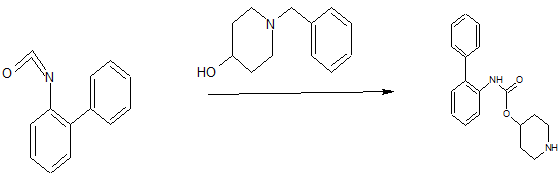
Biphenyl-2-ylcarbamic Acid Piperidin-4-yl Ester
Biphenyl-2-isocyanate (97.5 g, 521 mmol) and 4-hydroxy-N-benzylpiperidine (105 g, 549 mmol) were heated together at 70 0C for 12 hours. The reaction mixture was then cooled to 50 0C and ethanol (1 L) was added and then 6M HCl (191 mL) was added slowly. The resulting mixture was then cooled to ambient temperature and ammonium formate (98.5 g, 1.56 mol) was added and then nitrogen gas was bubbled through the solution vigorously for 20 minutes. Palladium on activated carbon (20 g, 10 wt% dry basis) was then added and the reaction mixture was heated at 40 0C for 12 hours, and then filtered through a pad of Celite. The solvent was then removed under reduced pressure and IM HCl (40 mL) was added to the crude residue. The pH of the mixture was then adjusted with IO N NaOH to pH 12. The aqueous layer was extracted with ethyl acetate (2 x 150 mL) and the organic layer was dried (magnesium sulfate), filtered and the solvent removed under reduced pressure to give 155 g of the title intermediate (100% yield). HPLC (10-70) Rt = 2.52; m/z: [M + H+] calc’d for C18H20N2O2 297.15; found 297.31
PREPARATION 2
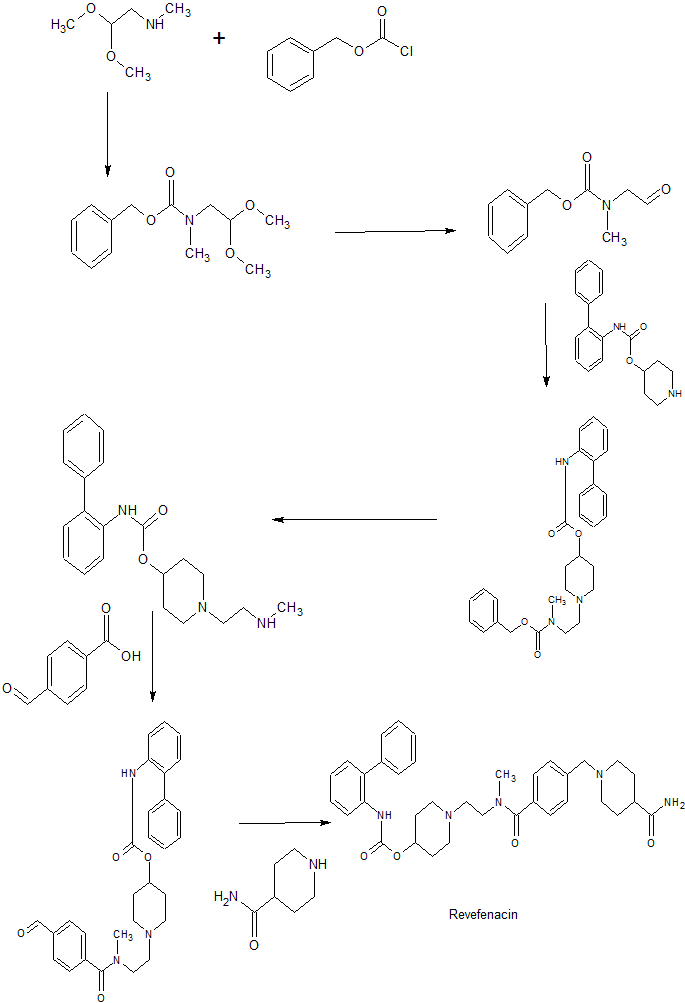
iV-Benzyl-iV-methylaminoacetaldehvde
To a 3-necked 2-L flask was added N-benzyl-N-methylethanolamine (30.5 g, 0.182 mol), DCM (0.5 L), DIPEA (95 mL, 0.546 mol) and DMSO (41 mL, 0.728 mol).

Using an ice bath, the mixture was cooled to about -10 °C and sulfur trioxide pyridine-complex (87 g, 0.546 mol) was added in 4 portions over 5 minute intervals. The reaction was stirred at -10 0C for 2 hours. Before removing the ice-bath, the reaction was quenched by adding water (0.5 L). The aqueous layer was separated and the organic layer was washed with water (0.5 L) and brine (0.5 L) and then dried over magnesium sulfate and filtered to provide the title compound which was used without further purification.
PREPARATION 3
Biphenyl-2-ylcarbamic Acid l-[2-(Εenzylmethylammo)ethyllpiperidin-4-yl Ester
To a 2-L flask, containing the product of Preparation 2 in DCM (0.5 L) was added the product of Preparation 1 (30 g, 0.101 mol) followed by sodium triacetoxyborohydride (45 g, 0.202 mol). The reaction mixture was stirred overnight and then quenched by the addition of 1 N hydrochloric acid (0.5 L) with vigorous stirring. Three layers were observed and the aqueous layer was removed. After washing with IN NaOH (0.5 L)3 a homogenous organic layer was obtained which was then washed with a saturated solution of aqueous NaCl (0.5 L), dried over magnesium sulfate, filtered and the solvent removed under reduced pressure. The residue was purified by dissolving it in a minimal amount of isopropanol and cooling this solution to 0 °C to form a solid which was collected and washed with cool isopropanol to provide 42.6 g of the title compound (95% yield). MS m/z: [M + H+] calc’d f for C28H33N3O2444.3; found 444.6. Rf=3.5l min (10-70 ACN:H2O, reverse phase HPLC).
PREPARATION 3 A
Biphenyl-2-ylcarbamic Acid l-f2-(Benzylmethylammo)ethyllpiperidin-4-yl Ester
The title compound was prepared by mesylation of iV-benzyl-N-methyl
ethanolamine, which was then reacted with biphenyl-2-ylcarbamic acid piperidin-4-yl ester in an alkylation reaction.
A 500 mL flask (reactor flask) was charged with N-benzyl-iV-methylethanolamine (24.5 mL), DCM (120 mL), NaOH (80 mL; 30wt%) and tetrabutylammonium chloride. Mixing at low speed throughout the reaction, the mixture was cooled to -10 °C (cooling bath), and the addition funnel charged with DCM (30 mL) and mesyl chloride (15.85 mL), which was added drop wise at a constant rate over 30 minutes. The addition was exothermic, and stirring was continued for 15 minutes while the temperature equilibrated back to -10 0C. The reaction was held for at least 10 minutes to ensure full hydrolysis of the excess mesyl chloride.
A 250 mL flask was charged with biphenyl-2-ylcarbamic acid piperidin-4-yl ester (26 g; prepared as described in Preparation 1) and DCM (125 mL), stirred for 15 minutes at room temperature, and the mixture chilled briefly to 10 0C to form a slurry. The slurry was then charged into the reactor flask via the addition funnel. The cooling bath was removed and the reaction mixture was warmed to 5 °C. The mixture was transferred to a separatory funnel, the layers allowed to settle, and the aqueous layer removed. The organic layer was transferred back to the reactor flask, stirring resumed, the mixture held to room
temperature, and the reaction monitored by HPLC for a total of 3.5 hours.
The reactor flask was charged with NaOH (IM solution; 100 mL), stirred, and the layers allowed to settle. The organic layer was separated, washed (NaCl satd. solution), its volume partially reduced under vacuum, and subjected to repeated IPA washings. The solids were collected and allowed to air-dry (25.85 g, 98% purity). Additional solids were obtained from further processing of the mother liquor (volume reduction, EPA, cooling).
PREPARATION 4
Biphenyl-2-ylcarbamic Acid l-(2-Methylaminoethyl)piperidin-4-yl Ester
To a Parr hydrogenation flask was added the product of Preparation 3 (40 g, 0.09 mol) and ethanol (0.5 L). The flask was flushed with nitrogen gas and palladium on activated carbon (15g, 10 wt% (dry basis), 37% wt/wt) was added along with acetic acid (20 mL). The mixture was kept on the Parr hydrogenator under a hydrogen atmosphere (-50 psi) for 3 hours. The mixture was then filtered and washed with ethanol. The filtrate was condensed and the residue was dissolved in a minimal amount of DCM. Isopropyl acetate (10 volumes) was added slowly to form a solid which was collected to provide 22.0 g of the title compound (70% yield). MS m/z: [M + H+] calc’d for C21H27N3O2 354.2; found 354.3. R/=2.96 min (10-70 ACNrH2O, reverse phase HPLC).
PREPARATION 5
Biphenyl-2-ylcarbamic Acid l-{2-[(4-Formylbenzoyr)
methylaminol ethyll piperidin-4- yl Ester
To a three-necked 1-L flask was added 4-carboxybenzaldehyde (4.77 g,
31.8 mmol), EDC (6.64 g, 34.7 mmol), HOBT (1.91 g, 31.8 mmol), and DCM (200 mL). When the mixture was homogenous, a solution of the product of Preparation 4 (10 g, 31.8 mmol) in DCM (100 mL) was added slowly. The reaction mixture was stirred at room temperature for approximately 16 hours and then washed with water (1 x 100 mL), IN HCl (5 x 60 mL), IN NaOH (1 x 100 mL) brine (1 x 5OmL)3 dried over sodium sulfate, filtered and concentrated to afford 12.6 g of the title compound (92% yield; 85% purity based on HPLC). MS m/z: [M + H+] calc’d for C29H31N3O4 486.2; found 486.4. i?y=3.12 min (10-70 ACNiH2O, reverse phase HPLC).
EXAMPLE 1
Biphenyl-2-ylcarbamic Acid 1 -(2- { |4-(4-Carbamoylpiperidin- 1 -ylmethvD
benzoylimethylamino) ethyl’)piperidin-4-vl Ester

To a three-necked 2-L flask was added isonipecotamide (5.99 g, 40.0 mmol), acetic acid (2.57 mL), sodium sulfate (6.44 g) and isopropanol (400 mL). The reaction mixture was cooled to 0-10 0C with an ice bath and a solution of biphenyl-2-ylcarbamic acid l-{2-[(4-formylbenzoyl)methylamino]ethyl}piperidin-4-yl ester (11 g, 22.7 mmol; prepared as described in Preparation 5) in isopropanol (300 mL) was slowly added. The reaction mixture was stirred at room temperature for 2 hours and then cooled to 0-10 0C. Sodium triacetoxyborohydride (15.16 g, 68.5 mmol) was added portion wise and this mixture was stirred at room temperature for 16 hours. The reaction mixture was then concentrated under reduced pressure to a volume of about 50 mL and this mixture was acidified with IN HCl (200 mL) to pH 3. The resulting mixture was stirred at room temperature for 1 hour and then extracted with DCM (3 x 250 mL). The aqueous phase was then cooled to 0-5 °C with an ice bath and 50% aqueous NaOH solution was added to adjust the pH of the mixture to 10. This mixture was then extracted with isopropyl acetate (3 x 300 mL) and the combined organic layers were washed with water (100 mL), brine (2 x 50 mL), dried over sodium sulfate, filtered and concentrated to afford 10.8 g of the title compound (80% yield. MS m/z: [M + H+] calc’d for C35H43N5O4 598.3; found 598.6. Rj=232 min (10-70 ACNiH2O, reverse phase HPLC).

EXAMPLE 2
Crystalline Diphosphate Salt of Biphenyl-2-ylcarbamic Acid l-(2-{[4-(4- Carbamoylpiperidin-l-ylmethyl)benzoyl1methylamino>ethyDpiperidin-4-yl Ester
500 mg of biphenyl-2-ylcarbamic acid l-(2-{[4-(4-carbamoylpiρeridin-l-ylmethyl) benzoyl]methylamino}ethyl)piperidin-4-yl ester (0.826 mmol of 96% pure material;
prepared as described in Example 1) was taken up in 5 ml of water and 1.5 ml of IM phosphoric acid. The pH was adjusted to approximately pH 5.3 with an additional 0.25ml of IM phosphoric acid (equaling 2.1 molar equivalents). The clear solution was filtered through a 0.2 micron filter, frozen and lyophilized to dryness to yield an amorphous diphosphate salt.
20 mg of the amorphous diphosphate salt was dissolved in 2 ml of IPA: ACN (1:1). 0.1 ml of water was added and the mixture heated to 60 °C under stirring. Almost all of the solids dissolved. The suspension was allowed to cool to ambient temperature, under stirring, overnight. The resulting crystals were collected by filtration and air-dried for 20 minutes to give the title compound (18.5 mg, 93% yield) as a white crystalline solid.
When examined under a microscope using polarized light, the crystals exhibited some birefringence.
EXAMPLE 3
Crystalline Diphosphate Salt of Biphenyl-2-ylcarbamic Acid l-(2-{|4-(4- Carbamoylpiperidin-l-vhτiethyl)benzoyl]methylamino}ethyl)piperidin-4-yl Ester
5.0 g of biphenyl-2-ylcarbamic acid l-(2-{[4-(4-carbamoylpiperidin-l-ylmethyl)benzoyl]methylamino}ethyl)piperidin-4-yl ester (freebase; prepared as described in Example 1) was combined with 80 ml of IPA:ACN (1:1). 4.0 ml of water was added and the mixture heated to 50 °C under stirring, forming a clear solution. To this was added dropwise at 50 °C, 16 ml IM phosphoric acid. The resulting cloudy solution was stirred at 50 °C for 5 hours, then allowed to cool to ambient temperature, under slow stirring, overnight. The resulting crystals were collected by filtration and air-dried for 1 hour, then under vacuum for 18 hours, to give the title compound (5.8 g, 75% yield) as a white crystalline solid (98.3% purity by HPLC).

EXAMPLE 4
Crystalline Monosulfate Salt of Biphenyl-2-ylcarbamic Acid l-(2-{[4-(4- Carbamoylpiperidm-l-ylmethvπbenzoyllmethylamino>ethyl)piperidm-4-yl Ester
442 mg of biphenyl-2-ylcarbamic acid l-(2-{[4-(4-Carbamoylpiperidin-l-ylmethyl) benzoyl]methylamino} ethyl)piperidin-4-yl ester (0.739 mmol of 96% pure material;
prepared as described in Example 1) was taken up in 5 ml of H2OrACN (1 : 1) and 1.45 ml of IN sulfuric acid was added slowly, while monitoring the pH. The pH was adjusted to approx. pH 3.3. The clear solution was filtered through a 0.2 micron filter, frozen and lyophilized to dryness to yield a monosulfate salt.
30.3 mg of the monosulfate salt was dissolved in 1.65 ml of IPA:ACN (10:1). The suspension was heated by placing the vial in a pre-heated 60 °C water bath for 30 minutes. A viscous material was formed and the heat increased to 70 °C for 30 minutes. Since the material remained viscous, the heat was lowered to 60 0C and the mixture heated for an additional hour. The heat was turned off and the mixture was allowed to cool to room temperature. After 4 days, the material appeared to be solid, and the sample was allowed to sit for an additional nine days. The solid was then filtered and dried using a vacuum pump for 1 hour to give the title compound (23 mg, 76% yield).
EXAMPLE 5
Crystalline Monosulfate Salt of Biphenyl-2-ylcarbamic Acid l-(2-{[~4-(4- Carbamoylpiperidin-l-ylmethyl)benzoyl]methylamino>ethyl)piperidin-4-yl Ester
161 g of the monosulfate salt (prepared as described in Example 4) was dissolved in 8.77 ml of IPA:ACN (10:1). The suspension was heated by placing the vial in a pre-heated 70 °C water bath for 1.5 hours. Oil droplets formed within 5 minutes. The heat was lowered to 60 °C and the mixture heated for an additional 1.5 hours, followed by heating at 50 °C for 40 minutes, at 40 °C for 40 minutes, then at 30 0C for 45 minutes. The heat was turned off and the mixture was allowed to slowly cool to room temperature. The next day, the material was viewed under a microscope and indicated needles and plates. The material was then heated at 40 °C for 2 hours, at 35 0C for 30 minutes, and then at 30 °C for 30 minutes. The heat was turned off and the mixture was allowed to slowly cool to room temperature. The solid was then filtered and dried using a vacuum pump for 1 hour to give the title compound (117 mg, 73% yield).

EXAMPLE 6
Crystalline Dioxalate Salt of Biphenyl-2-ylcarbamic Acid l-(2-{|4-(4-Carbamoylpiperidin- 1 -ylmethyl)benzoyl]methylamino> ethyl)piperidin-4-yl Ester
510 mg of biphenyl-2-ylcarbamic acid l-(2-{[4-(4-carbamoylpiperidin-l-ylmethyl)benzoyl]methylamino} ethyl)piperidin-4-yl ester (0.853 mmol of 96% pure material; prepared as described in Example 1) was taken up in 5 ml of H2O:ACN (1:1) and 1.7 ml of IM aqueous oxalic acid was added slowly, while monitoring the pH. The pH was adjusted to approx. pH 3.0. The clear solution was filtered through a 0.2 micron filter, frozen and lyophilized to dryness to yield a dioxalate salt.
31.5 mg of the dioxalate salt was dissolved in 2.76 ml of 94%IPA/6%H20. The mixture was stirred in a pre-heated 60 °C water bath for 2.5 hours. After 25 minutes, all of the sample was in solution. The heat was turned off and the mixture was allowed to cool to room temperature. The next day, a small amount of viscous material was present. The vial was refrigerated at 4 °C. After 4 days, the viscous material was still present. The vial was then placed at room temperature and observed one month later. The material appeared to be solid, and was observed to be crystalline under a microscope. The solid was then filtered and dried using a vacuum pump for 1 hour to give the title compound (20 mg, 63.5% yield).
EXAMPLE 7
Crystalline Dioxalate Salt of Biphenyl-2-ylcarbamic Acid l-(2-{T4-(4-Carbamoylpiperidin- 1 -ylmethyl)benzoyl]methylammo) ethvDpiperidin-4-yl Ester
150 mg of the dioxalate salt (prepared as described in Example 6) was dissolved in 13.1 ml of 94%IPA/6%H20. The mixture was stirred in a pre-heated 60 °C water bath for 2.5 hours. The heat was turned off and the mixture was allowed to cool to room
temperature. The vial was refrigerated at 4 °C. After 6 days, an oily material was observed with what appeared to be a crystal on the side of the vial. The vial was then allowed to reach room temperature, at which point seeds (crystalline material from Example 6) were added and allowed to sit for 16 days. During this time, more crystals were observed to come out of solution. The solid was then filtered and dried using a vacuum pump for 14 hours to give the title compound (105 mg, 70% yield).

EXAMPLE 8
Crystalline Freebase Biphenyl-2-ylcarbamic Acid l-(2-(f4-(4-Carbamoylpiperidin-l- ylmethvDbenzoyl]methylaniino}ethyl)piperidin-4-yl Ester (Form T)
109 mg of biphenyl-2-ylcarbamic acid l-(2-{[4-(4-carbamoylpiperidin-l-ylmethyl)benzoyl]methylamino}ethyl)piperidin-4-yl ester (prepared as described in
Example 1) was dissolved in 0.56 ml of H2O: ACN (1:1). The suspension was left in a vial (cap loosely placed on top) to allow for a slower evaporation time. The vial was placed under a nitrogen flow environment, although the nitrogen was not used for evaporation, only for the environment. A precipitate was visible within 1 day, which was observed to be crystalline under a microscope. The solid was then placed on a high vacuum line to remove all solvent to give the title compound. Quantitative recovery, 97.8% pure by HPLC.

In an alternate procedure, after dissolving in H2O: ACN (1:1) (approximately 350 mg/mL), the vial was stored at 5 0C, and the precipitate was visible at day 2. The solid was filtered, rinsed with water, and dried on high vacuum overnight. Recovery was 55%, with the solid having 98.2% purity and the liquid having 92.8% purity.
EXAMPLE 9
Crystalline Freebase Biphenyl-2-ylcarbamic Acidl-(2-{J4-(4-Carbamoylpiperidin- l-yhiaethyl)benzoyllmethylammo|ethvDpiperidin-4-yl Ester (Form T)
50.4 mg of biphenyl-2-ylcarbamic acid l-(2-{[4-(4-carbamoylpiperidin-l-ylmethyl)benzoyl]methylamino}ethyl)piperidin-4-yl ester (prepared as described in
Example 1) was dissolved in 0.144 ml of H2O:ACN (1:1). The suspension was left in vial (cap loosely placed on top) to allow for a slower evaporation time. The vial was refrigerated at 4 0C for 6 days. A precipitate was visible after 2 days. The solid was filtered and placed on a high vacuum line to remove all solvent and give the title compound as a white solid (27.8 mg, 55.2 % yield).
EXAMPLE 10
Crystalline Freebase Biphenyl-2-ylcarbamic Acid l-(2-{[4-(4-Carbamoylpiperidin- l-vhnethvDbenzoyl]methylamino>ethvDpiperidin-4-yl Ester (Form T)
230 mg of biphenyl-2-ylcarbamic acid l-(2-{[4-(4-carbamoylpiperidin-l-yhnethyl)benzoyl]methylamino}ethyl)piρeridin-4-yl ester (prepared as described in
Example 1) was dissolved in 0.2 ml of H2O:ACN (1:1), using slight heat. The mixture was then heated in a 70 °C water bath for 2 hours. The heat was turned off and the mixture was allowed to cool to room temperature, then refrigerated at 4 °C for 1 hour. 50 μl of water was then added (oiled out), followed by the addition of 40 μl of ACN to get the sample back into solution. Seeds (crystalline material from Example 8) were added under slow stirring at room temperature. Crystals started to form ,and the mixture was allowed to sit overnight, with slow stirring. The next day, a heat cool cycle was applied (30 °C for 10 minutes, 40 0C for 10 minutes, then 50 °C for 20 minutes). The heat was turned off and the mixture allowed to cool overnight, with slow stirring. The next day, a second heat/cool cycle was applied (60 0C for 1 hour, with dissolving observed at 70 °C). The heat was turned off and the mixture allowed to cool overnight, with slow stirring. The next day, crystals were present and a third heat cool cycle was applied (60 0C for 3 hours). The heat was turned off and the mixture allowed to cool overnight, with slow stirring. The next day, a heat cool cycle was applied (60 °C for 3 hours, slow cool, then 60 °C for 3 hours). The heat was turned off and the mixture allowed to cool overnight, with slow stirring. After 3 days, the solid was filtered and placed on a high vacuum line to remove all solvent and give the title compound.
EXAMPLE 11
Crystalline Freebase Biphenyl-2-ylcarbamic Acid l-(2-{[4-(4-Carbamoylpiperidin- l-ylmethyl)benzoyl]methylamino|ethyl)piperidin-4-yl Ester (Form JD
70 mg of biphenyl-2-ylcarbamic acid l-(2-{[4-(4-carbamoylpiperidin-l-yhnethyl)benzoyl]methylamino}ethyl)piperidin-4-yl ester (prepared as described in
Example 1) was dissolved in 0.1 mL ACN. After addition of 0.3 ml MTBE, the solution appeared cloudy. An additional 50 μl of ACN was added to clarify the solution (155 mg/ml ACN:MTBE = 1 :2). The mixture was left in the vial and capped. Crystals appeared by the next day. The solid was then filtered and placed on a high vacuum line to remove all solvent and give the title compound.

PATENT

https://patentscope.wipo.int/search/en/detail.jsf?docId=WO2011008809

U.S. Patent Publication No. 2005/0203133 to Mammen et al. discloses novel biphenyl compounds that are expected to be useful for treating pulmonary disorders such as chronic obstructive pulmonary disease (COPD) and asthma. In particular, the compound biphenyl-2-ylcarbamic acid l-(2-{[4-(4-carbamoylpiperidin-l-ylmethyl) benzoyl]methylamino}ethyl)piperidin-4-yl ester is specifically described in this application as possessing muscarinic receptor antagonist or anticholinergic activity.

The chemical structure of biphenyl-2-ylcarbamic acid l-(2-{[4-(4-carbamoyl piperidin- 1 -ylmethyl)benzoyl]methylamino } ethyl)piperidin-4-yl ester is represented by formula I:

I

The compound of formula I has been named using the commercially-available AutoNom software (MDL, San Leandro, California).

Therapeutic agents useful for treating pulmonary or respiratory disorders are advantageously administered directly into the respiratory tract by inhalation. In this regard, several types of pharmaceutical inhalation devices have been developed for administering therapeutic agents by inhalation including dry powder inhalers (DPI),

metered-dose inhalers (MDI) and nebulizer inhalers. When preparing pharmaceutical compositions and formulations for use in such devices, it is highly desirable to have a crystalline form of the therapeutic agent that is neither hygroscopic nor deliquescent and which has a relatively high melting point thereby allowing the material to be micronized without significant decomposition. Although crystalline freebase forms of the compound of formula I have been reported in U.S. Patent Publication No. 2007/0112027 to Axt et al. as Form I and Form II, the crystalline freebase forms of the present invention have different and particularly useful properties, including higher melting points

One aspect of the invention relates to crystalline freebase forms of biphenyl-2-ylcarbamic acid 1 -(2- { [4-(4-carbamoylpiperidin- 1 -ylmethyl)benzoyl]methy lamino } ethyl) piperidin-4-yl ester characterized by a powder x-ray diffraction pattern comprising diffraction peaks at 2Θ values of 6.6±0.1, 13.1±0.1, 18.6±0.1, 19.7±0.1, and 20.2±0.1.

Another aspect of the invention relates to a crystalline freebase of biphenyl-2-ylcarbamic acid 1 -(2- { [4-(4-carbamoylpiperidin- 1 -ylmethyl)benzoyl]methy lamino } ethyl) piperidin-4-yl ester, designated as form III, which is characterized by a powder x-ray diffraction pattern comprising diffraction peaks at 2Θ values of 6.6±0.1, 13. l±O.l,

18.6±0.1, 19.7±0.1, and 20.2±0.1; and further characterized by having five or more additional diffraction peaks at 2Θ values selected from 8.8=1=0.1, 10. l±O.l, 11.4±0.1, l l.β±O.l, 14.8±0.1, 15.2±0.1, lβ.l±O.l, 16.4±0.1, 16.9±0.1, 17.5±0.1, 18.2±0.1, 19.3±0.1, 19.9±0.1, 20.8±0.1, 21. l±O.l, 21.7±0.1, and 22.3±0.1.

Still another aspect of the invention relates to a crystalline freebase of biphenyl-2-ylcarbamic acid 1 -(2- { [4-(4-carbamoylpiperidin- 1 -ylmethyl)benzoyl]methy lamino } ethyl) piperidin-4-yl ester, designated as form IV, which is characterized by a powder x-ray diffraction pattern comprising diffraction peaks at 2Θ values of 6.6±0.1 , 13. l±O.1 ,

18.6=1=0.1, 19.7=1=0.1, and 20.2±0.1; and further characterized by having five or more additional diffraction peaks at 2Θ values selected from 10.6±0.1, 15.0=1=0.1, lβ.O±O.l, 17.3±0.1, 17.7±0.1, 20.9±0.1, 21.4±0.1, 22.6±0.1, 24.6±0.1, and 27.8±0.1.

Preparation 1

Biphenyl-2-ylcarbamic acid l-(2-{[4-(4-carbamoylpiperidin-l- ylmethvDbenzovHmethylaminol ethyDpiperidin-4-yl Ester The diphosphate salt of biphenyl-2-ylcarbamic acid l-(2-{[4-(4-carbamoylpiperidin-l-ylmethyl)benzoyl]methylamino}ethyl)piperidin-4-yl ester (16 g) was dissolved in a biphasic mixture of water (100 mL) and EtOAc (200 mL). NaOH (2 N, 75 mL) was added over a period of 5 minutes. The mixture was then stirred for 30 minutes. The phases were separated and the aqueous phase was extracted with EtOAc (200 mL). The combined organic phases were concentrated. DCM (100 mL) was added, and the mixture evaporated to dryness. The solids were dried in an oven for about 48 hours to yield the title compound (9.6 g).

EXAMPLE 1

Crystalline Freebase of Biphenyl-2-ylcarbamic Acid l-(2-{r4-(4-Carbamoylpiperidin-l- ylmethyl)benzoyllmethylamino|ethyl)piperidin-4-yl Ester (Form III) Biphenyl-2-ylcarbamic acid l-(2-{[4-(4-carbamoylpiperidin-l-ylmethyl)benzoyl]methylamino}ethyl)piperidin-4-yl ester (102.4 mg) was dissolved in MeCN (500 μL). The solution was stirred at room temperature for 80 minutes and a white solid precipitate formed. The mixture was placed in the shaker block to thermocycle (0-40 0C in one hour blocks) for 48 hours. A white, dense, immobile solid was observed. MeCN (500 μL) was added to mobilize the slurry. The mixture was then placed back in the shaker block for 2 hours. The solids were isolated by vacuum filtration using a sinter funnel, then placed in the piston dryer at 40 0C under full vacuum for 15.5 hours, to yield 76.85 mg of the title crystalline compound.

EXAMPLE 2

Crystalline Freebase of Biphenyl-2-ylcarbamic Acid l-(2-{r4-(4-Carbamoylpiperidin-l- ylmethyl)benzoyllmethylamino|ethyl)piperidin-4-yl Ester (Form III) Diphosphate salt of biphenyl-2-ylcarbamic acid l-(2-{[4-(4-carbamoyl-piperidin-l-ylmethyl)benzoyl]methylamino}ethyl)piperidin-4-yl ester (C3sH43NsO4»2H3PO4; MW 793.75; 632.9 g) was slurried in isopropyl acetate (11.08 L) and water (6.33 L) at room temperature under nitrogen. The suspension was warmed to 53±3 0C and 1OM NaOH (317 mL) was added to the stirred mixture, while maintaining the temperature of the mixture above 50 0C. The mixture was stirred for approximately 5 minutes at 53±3 0C before allowing the layers to settle. The layers were then separated and the aqueous layer was removed. Water (3.16 L) was added to the organic layer while maintaining the temperature of the mixture above 50 0C. The mixture was stirred for 5 minutes at 53±3 0C before allowing the layers to settle. The layers were separated and the water layer was removed. Isopropyl acetate (6.33 L) was added and then about 10 volumes of distillate were collected by atmospheric distillation. This step was repeated with additional isopropyl acetate (3.2 L). After the second distillation, the temperature of the clear solution was reduced to 53±3 0C, then seeded with a suspension of the biphenyl-2-ylcarbamic acid l-(2-{[4-(4-carbamoylpiperidin-l-ylmethyl)benzoyl]methylamino}ethyl)piperidin-4-yl ester crystalline freebase (Form III; 3.2 g) in isopropyl acetate (51 mL). The resulting suspension was stirred at 53±3 0C for 2 hours, then cooled to 10±3 0C over 4 hours. The suspension was stirred at 10±3 0C for at least 2 hours and then the solids were collected by filtration. The resulting filter cake was washed with isopropyl acetate (2 x 1.9 L) and the product was dried in vacuo at 50 0C to yield the title crystalline compound (C3SH43NsO4; MW 597.76; 382.5 g, 80.3% yield).

EXAMPLE 3

Recrystallization of Crystalline Freebase of Biphenyl-2-ylcarbamic Acid l-(2-{[4-(4- Carbamoylpiperidin- 1 -ylmethyDbenzoyllmethylaminol ethyl)piperidin-4-yl Ester (Form

III)

Crystalline freebase of biphenyl-2-ylcarbamic acid l-(2-{[4-(4-carbamoylpiperidin-l-ylmethyl)benzoyl]methylamino}ethyl)piperidin-4-yl ester (Form III; C35H43N5O4; MW 597.76; 372.5 g) was slurried in toluene (5.6 L) at 20±3 0C under nitrogen. The suspension was warmed to 82±3 0C, and held at this temperature until complete dissolution was observed. The solution was then clarified into the crystallizer vessel, followed by rinsing with toluene (373 μL). Solids were observed in the crystallizer vessel, and the vessel was re-heated to 82±3 0C to effect dissolution, then cooled to 58±3 0C and seeded with a pre-sonicated (approximately 1 minute) of crystalline freebase (Form III; 1.9 g) in toluene (8 μL). The resulting suspension was allowed to stand at 58±3 0C for at least 4 hours, then cooled to 20±3 0C over 2 hours (approximate cooling rate of 0.33 °C/min). The suspension was stirred at 20±3 0C for at least 1 hour, then the solids were collected by filtration. The resulting filter cake was washed with toluene (2 x 1.2 L) and the product was dried in vacuo at 52±3 0C to yield the title crystalline compound (345.3 g, 92.7% yield).

EXAMPLE 4

Crystalline Freebase of Biphenyl-2-ylcarbamic Acid l-(2-{r4-(4-Carbamoylpiperidin-l- ylmethyl)benzoyllmethylamino|ethyl)piperidin-4-yl Ester (Form IV) Biphenyl-2-ylcarbamic acid l-(2-{[4-(4-carbamoylpiperidin-l-ylmethyl)benzoyl]methylamino}ethyl)piperidin-4-yl ester (prepared as described in Preparation 1; 2.5 g) was dissolved in MeCN (10 mL) to yield a viscous oily pale yellow material. Additional MeCN (5 mL) was added to dilute the material. The solution was seeded with crystalline freebase (20 mg; Form III prepared as described in Example 1) and stirred at room temperature for 90 minutes. A large amount of white precipitate (small crystals) was observed. The slurry was analyzed under a polarized light microscope and found to be birefringent.

Additional MeCN (3 mL) was added and the slurry was placed in a Metz SynlO block to thermocycle (0-40 0C in one hour blocks) at 800 rpm overnight. The Metz SynlO is a 10 position parallel reaction station that is static. Agitation of the solution/slurry was by a cross magnetic stirrer bar. The shaker block was a separate piece of equipment that was heated and cooled by an external Julabo bath. The material was removed at 0 0C. It was observed that the slurry had settled out, leaving a pale yellow solution above the white precipitate. The slurry was stirred and placed back in the shaker block to thermocycle.

The material was removed at 40 0C, and stirred at a high agitation rate at room temperature for 80 minutes. The slurry was again analyzed and found to be birefringent. The filter cake was isolated by vacuum filtration using a sinter funnel. MeCN (3 mL) was used to wet the filter paper and the filter cake was washed with MeCN prior to filtration. The cake was deliquored under vacuum for 40 minutes to yield 2.3 g of a flowing white powder. The material was placed in a piston dryer at 400C for 65 hours, to yield 2.2 g of the title crystalline compound as a white powder (99.6% purity).

PATENT

https://patentscope.wipo.int/search/en/detail.jsf;jsessionid=0049F6A3F9FB8C7273B825D49F2465F6.wapp1nA?docId=WO2005087738&tab=PCTDESCRIPTION&maxRec=1000

Example 1
Biphenyl-2-ylcarbamic Acid l-(2-{[4-(4-Carbamoylpiperidin-l- ylmethyl)benzoyl]methylamino}ethyl)piperidin-4-yl Ester

To a three-necked 2-L flask was added isonipecotamide (5.99 g, 40.0 mmol), acetic acid (2.57 mL), sodium sulfate (6.44 g) and LPA (400 mL). The reaction mixture was cooled to 0-10°C with an ice bath and a solution ofthe product of Preparation 5 (11 g, 22.7 mmol) in LPA (300 mL) was slowly added. The reaction mixture was stined at room temperature for 2 hours and then cooled to 0-10°C. Sodium triacetoxyborohydride (15.16 g, 68.5 mmol) was added portion wise and this mixture was stined at room temperature for 16 h. The reaction mixture was then concentrated under reduced pressure to a volume of about 50 mL and this mixture was acidified with IN HCl (200 mL) to pH 3. The resulting mixture was stined at room temperature for 1 hour and then extracted with DCM (3 x 250 mL). The aqueous phase was then cooled to 0-5°C with an ice bath and 50% aqueous NaOH solution was added to adjust the pH ofthe mixture to 10. This mixture was then extracted with isopropyl acetate (3 x 300 mL) and the combined organic layers were washed with water (100 mL), brine (2 x 50 mL), dried over sodium sulfate, filtered and concentrated to afford 10.8 g ofthe title compound (80% yield. MS m/z: [M + H“1”] calcd for C35H43N5O4, 598.3; found, 598.6. Rf = 2.32 min (10-70 ACN: H2O, reverse phase HPLC).

Example 1A
Biphenyl-2-ylcarbamic acid l-(2- {[4-(4-carbamoylpiperidin-l-ylmethyl)benzoyl] methylamino} ethyl)piperidin-4-yl ester was also prepared as a diphosphate salt using the following procedure :
5.0 g ofthe product of Example 1 was combined with 80 ml of IPA:ACN (1:1). 4.0 ml of water was added and the mixture heated to 50°C under stining, forming a clear solution. To this was added dropwise at 50°C, 16 ml 1M phosphoric acid. The resulting cloudy solution was stined at 50°C for 5 hours, then allowed to cool to ambient temperature, under slow stirring, overnight. The resulting crystals were collected by filtration and air-dried for 1 hour, then under vacuum for 18 hours, to give the diphosphate salt ofthe title compound (5.8 g, 75% yield) as a white crystalline solid (98.3% purity by HPLC).

Example IB
Biphenyl-2-ylcarbamic acid 1 -(2- { [4-(4-carbamoylpiperidin- 1 -ylmethyl)benzoyl] methylamino }ethyl)piperidin-4-yl ester was also prepared as a monosulfate salt using the following procedure.
442 mg ofthe product of Example 1 (0.739 mmol of 96% pure material) was taken up in 5 ml of H2O:ACN (1:1) and 1.45 ml of IN sulfuric acid was added slowly, while monitoring the pH. The pH was adjusted to approx. pH 3.3. The clear solution was filtered through a 0.2 micron filter, frozen and lyophilized to dryness. 161 g of the lyophilized material was dissolved in 8.77 ml of IPA:ACN (10:1). The suspension was heated by placing the vial in a pre-heated 70°C water bath for 1.5 hours. Oil droplets formed within 5 minutes. The heat was lowered to 60°C and the mixture heated for an additional 1.5 hours, followed by heating at 50°C for 40 minutes, at 40°C for 40 minutes, then at 30°C for 45 minutes. The heat was turned off and the mixture was allowed to slowly cool to room temperature. The next day, the material was viewed under a microscope and indicated needles and plates. The material was then heated at 40°C for 2 hours, at 35°C for 30 minutes, and then at 30°C for 30 minutes. The heat was turned off and the mixture was allowed to slowly cool to room temperature. The solid was then filtered and dried using a vacuum pump for 1 hour to give the monosulfate salt ofthe title compound (117 mg, 73% yield).

Example IC
Biphenyl-2-ylcarbamic acid l-(2- {[4-(4-carbamoylpiperidin-l-ylmethyl)benzoyl] methylamino} ethyl)piperidin-4-yl ester was also prepared as a dioxalate salt using the following procedure.
510 mg ofthe product of Example 1 (0.853 mmol of 96% pure material) was taken up in 5 ml of H2O:ACN (1:1) and 1.7 ml of 1M aqueous oxalic acid was added slowly, while monitoring the pH. The pH was adjusted to approx. pH 3.0. The clear solution was filtered through a 0.2 micron filter, frozen and lyophilized to dryness. 150 mg ofthe lyophilized material was dissolved in 13.1 ml of 94%IPA/6%H20. The mixture was stined in a pre-heated 60°C water bath for 2.5 hours. The heat was turned off and the mixture was allowed to cool to room temperature. The vial was refrigerated at 4°C. After 6 days, an oily material was observed with what appeared to be a crystal on the side ofthe vial. The vial was then allowed to reach room temperature, at which point seeds (synthesis described below) were added and allowed to sit for 16 days. During this time, more crystals were observed to come out of solution. The solid was then filtered and dried using a vacuum pump for 14 hours to give the dioxalate salt ofthe title compound (105 mg, 70% yield).
Seed Synthesis
510 mg ofthe product of Example 1 (0.853 mmol of 96% pure material) was taken up in 5 ml of H2O:ACN (1:1) and 1.7 ml of 1M aqueous oxalic acid was added slowly, while monitoring the pH. The pH was adjusted to approx. pH 3.0. The clear solution was filtered through a 0.2 micron filter, frozen and lyophilized to dryness to yield a dioxalate salt. 31.5 mg of this dioxalate salt was dissolved in 2.76 ml of 94%IPA/6%H20. The mixture was stined in a pre-heated 60°C water bath for 2.5 hours. After 25 minutes, all of the sample was in solution. The heat was turned off and the mixture was allowed to cool to room temperature. The next day, a small amount of viscous material was present. The vial was refrigerated at 4°C. After 4 days, the viscous material was still present. The vial was then placed at room temperature and observed one month later. The material appeared to be solid, and was observed to be crystalline under a microscope. The solid was then » filtered and dried using a vacuum pump for 1 hour to give the dioxalate salt (20 mg, 63.5% yield).

Example ID
Biphenyl-2-ylcarbamic acid 1 -(2- { [4-(4-carbamoylpiperidin- 1 -ylmethyl)benzoyl] methylamino} ethyl)piperidin-4-yl ester was also prepared as a freebase crystal using the following procedure.
230 mg ofthe product of Example 1 was dissolved in 0.2 ml of H O:ACN (1:1), using slight heat. The mixture was then heated in a 70°C water bath for 2 hours. The heat was turned off and the mixture was allowed to cool to room temperature, then refrigerated at 4°C for 1 hour. 50 μl of water was then added (oiled out), followed by the addition of 40 μl of ACN to get the sample back into solution. Seeds (synthesis described below) were added under slow stirring at room temperature. Crystals started to form ,and the mixture was allowed to sit overnight, with slow stirring. The next day, a heat cool cycle was applied (30°C for 10 minutes, 40°C for 10 minutes, then 50°C for 20 minutes). The heat was turned off and the mixture allowed to cool overnight, with slow stirring. The next day, a second heat/cool cycle was applied (60°C for 1 hour, with dissolving observed at 70°C). The heat was turned off and the mixture allowed to cool overnight, with slow stirring. The next day, crystals were present and a third heat cool cycle was applied (60°C for 3 hours). The heat was turned off and the mixture allowed to cool overnight, with slow stirring. The next day, a heat cool cycle was applied (60°C for 3 hours, slow cool, then 60°C for 3 hours). The heat was turned off and the mixture allowed to cool overnight, with slow stirring. After 3 days, the solid was filtered and placed on a high vacuum line to remove all solvent and give a freebase crystal ofthe title compound.

Seed Synthesis
109 mg ofthe product of Example 1 was dissolved in 0.56 ml of H2O:ACN (1:1). The suspension was left in a vial (cap loosely placed on top) to allow for a slower evaporation time. The vial was placed under a nitrogen flow environment, although the nitrogen was not used for evaporation, only for the environment. A precipitate was visible within 1 day, which was observed to be crystalline under a microscope. The solid was then placed on a high vacuum line to remove all solvent to give the freebase crystal.
Quantitative recovery, 97.8% pure by HPLC.

Example IE
Biphenyl-2-ylcarbamic acid 1 -(2- { [4-(4-carbamoylpiperidin- 1 -ylmethyl)benzoyl] methylamino} ethyl)piperidin-4-yl ester was also prepared as a freebase crystal using the following alternate procedure.
70 mg ofthe product of Example 1 was dissolved in 0.1 mL ACN. After addition of 0.3 ml MTBE, the solution appeared cloudy. An additional 50 μl of ACN was added to clarify the solution (155 mg/ml ACNMTBE = 1 :2). The mixture was left in the vial and capped. A solid appeared by the next day. The solid was then filtered and placed on a high vacuum line to remove all solvent and give a freebase crystal ofthe title compound.

PATENT

https://patents.google.com/patent/WO2012009166A1/en

U.S. Patent No. 7,228,657 to Mammen et al. discloses novel biphenyl compounds that are expected to be useful for treating pulmonary disorders such as chronic obstructive pulmonary disease and asthma. In particular, the compound biphenyl-2-ylcarbamic acid 1- (2- {[4-(4-carbamoylpiperidin-l-ylmethyl)benzoyl]methylamino}-ethyl)piperidin-4-yl ester is specifically described in this application as possessing muscarinic receptor antagonist or anticholiner ic activity, and is represented by formula I:

Figure imgf000002_0001

The compound of formula I is synthesized from the compound 8, which is described as being prepared from the oxidation of 2-(benzylmethylamino)ethanol to the aldehyde intermediate followed by reductive amination with biphenyl-2-yl-carbamic acid piperidin- 4-yl ester and debenzylation:

Figure imgf000003_0001
Figure imgf000003_0002

However, while this procedure performs well on small scale, the aldehyde intermediate is difficult to scale up due to its instability, and low yields were typically observed.

Thus, a need exists for an efficient process of preparing compound 8 as a pure material with high chemical purity and good overall yield, without having to isolate intermediates. This invention addresses those needs.

Therapeutic agents useful for treating pulmonary or respiratory disorders are advantageously administered directly into the respiratory tract by inhalation. In this regard, several types of pharmaceutical inhalation devices have been developed for administering therapeutic agents by inhalation including dry powder inhalers, metered- dose inhalers, and nebulizer inhalers. When preparing pharmaceutical compositions and formulations for use in such devices, it is highly desirable to have a crystalline form of the therapeutic agent that is neither hygroscopic nor deliquescent and which has a relatively high melting point thereby allowing the material to be micronized without significant decomposition.

A crystalline diphosphate of the compound of formula I has been reported in U.S. Patent No. 7,700,777 to Axt et al, and a crystalline freebase (identified as Form III) is described in U.S. Patent Application Publication No. 201 1/0015163 to Woollham. All of the aforementioned disclosures are incorporated herein by reference.

The compound of formula I is described as being prepared by reacting compound 8 with 4-carboxybenzaldehyde to form the aldehyde core 10:

Figure imgf000004_0001

which is then isolated prior to being combined with isonipicotamide in the presence of a reducing agent to form the compound of formula I. The crystalline diphosphate is prepared by contacting the separated and purified compound of formula I with phosphoric acid. The crystalline freebase (Form III) can then be prepared from the crystalline diphosphate.

A need also exists for an efficient process of preparing the crystalline freebase (Form III). It is desirable to develop a process that does not first require preparation of the crystalline diphosphate. This invention addresses those needs.

Figure imgf000011_0001
Figure imgf000013_0001
Figure imgf000014_0001

Preparation 1

Biphenyl-2-yl-carbamic acid piperidin-4-yl Ester

Figure imgf000018_0001

Biphenyl-2-isocyanate (97.5 g, 521 mmol) and 1 -benzylpiperidin-4-ol (105 g, 549 mmol) were heated together at 70°C for 12 hours. The mixture was then cooled to 50°C and EtOH (1 L) was added, followed by the slow addition of 6M HC1 (191 mL). The resulting mixture was then cooled to ambient temperature. Ammonium formate (98.5 g, 1.6 mol) was added and then nitrogen gas was bubbled through the solution vigorously for 20 minutes. Palladium on activated carbon (20 g, 10 wt% dry basis) was added and the mixture was heated at 40°C for 12 hours, and then filtered. The solvent was removed under reduced pressure and 1M HC1 (40 mL) was added to the crude residue. The pH of the mixture was adjusted with 10 N NaOH to pH 12. The aqueous layer was extracted with EtOAc (2×150 mL), and the organic layer was dried over MgS04, filtered and the solvent removed under reduced pressure to yield the title compound (155 g). HPLC (10-70) ¾ = 2.52; m/z: [M + H+] calcd for Ci8H2202 297.15; found 297.3.

EXAMPLE 1

Step A: (2,2-Dimethoxyethyl)methylcarbamic Acid Benzyl Ester

Figure imgf000018_0002

K2CO3 (13.8 g, 100 mmol, 1.76 eq.) and H20 (46 mL) were mixed to form a homogeneous solution. The solution was cooled to 20°C. N-methylaminoacetaldehyde dimethylacetal (12.8 mL, 100 mmol, 1.8 eq) and MeTHF (50 mL) were added. The resulting mixture was cooled to 2°C. Benzyl chloroformate (8.1 mL, 56.7 mmol, 1.0 eq.) was added by syringe over 10 minutes (addition was exothermic). The mixture was maintained at room temperature until completion of the reaction. The layers were separated and the organic layer was washed with IN HC1 (50 mL) and used directly in the next step.

Step B: Methyl-(2-oxoethyl)carbamic Acid Benzyl Ester

Figure imgf000019_0001

The mixture from the previous step was combined with a 3N HC1 solution (70 mL), and the resulting mixture was stirred for 18 hours at 22°C to yield a clear homogeneous pale yellow solution. Solid aHC03 was added to the solution to bring the pH to neutral. The layers were separated and the aqueous layer was back-extracted with MeTHF (20 mL). The organic layers were combined and washed with a saturated aHC03 solution (50 mL). The layers were separated and the organic layer was dried over Na2S04, filtered and concentrated to dryness to afford the title compound (1 1.9 g) as a pale yellow oil.

Step C: Biphenyl-2-yl-carbamic acid l-[2-(benzyloxycarbonyl

methylamino)ethyl]piperidin-4-yl Ester

Figure imgf000019_0002

Biphenyl-2-yl-carbamic acid piperidin-4-yl ester (31.1 g, 105 mmol, 1.0 eq.) and MeTHF (150 mL) were mixed. A solution of methyl-(2-oxoethyl)carbamic acid benzyl ester (23 g, 113.4 mmol, 1.05 eq.) in MeTHF (150 mL) was prepared and added to the ester mixture. The resulting mixture was heated to 30°C for a few minutes, then cooled to room temperature over 1 hour. The mixture was then cooled to 3°C and the temperature maintained for 1 hour. NaHB(OAc)3 (35.1 g, 170 mmol, 2.0 eq.) was added portion-wise while maintaining the internal temperature at 7±1°C. After addition, the mixture was allowed to warm to room temperature until the reaction was complete. A saturated solution of aHC03 (3000 mL) was added, stirred for 20 minutes, and the layers separated. This was repeated, after which the organic layer was dried over a2S04. The material was filtered, concentrated and dried under high vacuum to afford the title compound (43 g) as a thick colorless to pale yellow oil, which was used directly in the next step without purification.

Step D: Biphenyl-2-yl-carbamic acid l-(2-methylaminoethyl)piperidin-4-yl Ester

Figure imgf000020_0001

Biphenyl-2-yl-carbamic acid l-[2-(benzyloxycarbonyl methylamino)ethyl] piperidin-4-yl ester (53 g, 105 mmol, 1 eq.), MeOH (250 mL), and MeTHF (50 mL) were combined under nitrogen. 10% palladium on carbon (0.8 g) was added and hydrogen was bubbled into the mixture for 1 minute. The reaction vessel was sealed and stirred under hydrogen at atmospheric pressure for three hours. The mixture was then filtered, and the solids were washed MeTHF (10 mL).

The filtrate and washes were combined and concentrated under reduced pressure (250 mL removed). MTBE (100 mL) was added, and the solution again concentrated under reduced pressure (100 mL removed). MTBE (200 mL) was added and the solution was seeded with a few milligrams of biphenyl-2-yl-carbamic acid l-(2-methylaminoethyl) piperidin-4-yl ester, and the mixture was maintained for 3 hours. The solids were collected and the vessel and filter cake were washed with MTBE (2×15 mL). The material was dried to yield 13.2 g of the title compound (99.5% pure). This process was repeated to yield the title compound (12.5 g, 98.6% pure). The filtrate and washes were combined and concentrated under reduced pressure. MTBE (150 mL) was added and the solution was seeded with a few milligrams of biphenyl-2-yl-carbamic acid l-(2-methylaminoethyl) piperidin-4-yl ester, and the mixture was maintained for 20 hours. The solids were collected and the vessel and filter cake were washed with MTBE (2×15 mL). The material was dried to yield the title compound (5 g, 90% pure).

A portion of the three crops (13 g , 12 g, 4.5 g, respectively) were combined taken up in IPA (90 mL). The resulting slurry was heated to 45°C, then cooled to room temperature over 1 hour. The slurry was stirred for 5 hours at 25°C. The solids were collected and washed with IPA (2×15 mL). The solids were then dried for 1 hour to yield the title compound (25 g, >99% pure).

EXAMPLE 2

All volumes and molar equivalents are given relative to biphenyl-2-yl-carbamic acid piperidin-4-yl ester.

Step A: (2,2-Dimethoxyethyl)methylcarbamic Acid Benzyl Ester K2C03 (8.4 kg, 60 mol, 1.8 eq.) and H20 (49.3 kg, 2.6 volumes) were placed in the reaction vessel and stirred. N-methylaminoacetaldehyde dimethylacetal (6.5 kg, 54 mol, 1.6 eq) and MeTHF (20.2 kg, 2.9 volumes) were added. The resulting mixture was cooled to 5°C. Benzyl chloroformate (6.8 kg, 37.6 mol, 1.1 eq.) was added over a period of about 30 minutes, while maintaining the temperature below 10°C. The feed line was rinsed with MeTHF (4.3 kg). The mixture was then maintained at 5°C and stirred for 1 hour. The layers were separated and the organic layer was washed with IN HC1 (14.3 kg, 1 1.7 mol, 1.4 volumes) and used directly in the next step.

Step B: Methyl-(2-oxoethyl)carbamic Acid Benzyl Ester

The mixture from the previous step was combined with water (23.4 kg,

2.9 volumes) and 30% hydrochloric acid (13.1 kg, 107.7 mol, 1.1 volumes). Water (5.1 kg) was used to rinse the feed line. The temperature was adjusted to 25-30°C, and the reaction was run for 16-24 hours. A 25% NaOH solution (1 1.8 kg, 71.1 mol, 2.2 eq.) was added to the solution to adjust the pH and obtain phase separation.

The layers were separated and the aqueous layer was back-extracted with MeTHF

(10.0 kg, 1.1 volumes). The aqueous layer was discarded and the organic layers were combined. MeTHF (4.4 kg) was used to rinse the feed line. The organics were washed with a saturated aHC03 solution (14.6 kg, 15.6 mol, 1.1 volumes). The layers were separated and the organic layer was dried over a2S04 (2.5 kg, 17.6 mol) for 60-90 minutes. The drying agent was filtered off and the remaining solids were washed with

MeTHF (8.8 kg, 1 volume). The reaction vessel was washed with water and MeOH before continuing with the next step.

Step C: Biphenyl-2-yl-carbamic acid l-[2-(benzyloxycarbonyl

methylamino) ethyl Jpiperidin-4-yl Ester

The product from the previous step (in MeTHF) and biphenyl-2-yl-carbamic acid piperidin-4-yl ester (10.0 kg, 32.6 mol, 1.0 eq.) in MeTHF (28.5 kg) were placed in the reaction vessel and heated to 30°C for one hour. The mixture was then cooled to 5°C. NaHB(OAc)3 (10.0 kg, 45.8 mol, 1.4 eq.) was added portion wise over a period of 40 minutes while maintaining the temperature below 20°C. The mixture was then stirred for 30 minutes. Additional NaHB(OAc)3 (0.5 kg) was added the reaction allowed to progress to completion. A saturated solution of NaHCC^ (14.3 kg, 15.3 mol, 1.1 volumes) was added and stirred for 10 minutes. The aqueous phase was separated and discarded. A 33% NaOH solution (15.8 kg, 129.9 mol, 4.0 eq.) was added to the reaction mixture to adjust the H to be in the range of 8-12. Water (40 kg) was added in two portions, after which phase separation occurred. A saturated NaHCC (7.1 kg, 7.6 mol, 0.7 volumes) was added to the reaction mixture and stirred for 10 minutes. The aqueous phase was separated and discarded. Additional water (4.9 kg) was added to dissolve any remaining salts and a vacuum distillation was conducted at a maximum temperature of 45°C to remove part of the solvent (7.2 volumes). MeOH (56.1 kg, 7.2 volumes) was added to the reaction mixture before continuing with the next step.

Step D: Biphenyl-2-yl-carbamic acid l-(2-methylaminoethyl)piperidin-4-yl Ester

10% palladium on carbon (0.4 kg, 0.03 wt%, Degussa type 101 NE/W) was added to the reaction mixture. A hydrogenation reaction was performed to remove the benzyloxycarbonyl protective group, with reaction conditions at 30±5°C and 4 bar pressure. The reaction was run until completion. The mixture was then filtered and the filter cake was washed with MeOH (8.0 kg, 1.0 volume). The reaction was continued in a clean vessel, which was charged with the product solution (in MeTHF/MeOH) from the hydrogenation reaction. 3-Mercaptopropyl silica (0.6 kg, 0.07 wt%, Silicycle) was added. MeOH (4.8 kg) was used to rinse the feed line. The reaction mixture was stirred for 14-72 hours at 25±5°C. Activated carbon (0.7 kg, 0.07 wt%) was added and the mixture stirred for 30 minutes. The mixture was filtered and the filter cake was washed with MeOH (1.0 volume). The reaction was continued in a clean vessel, which was charged with the product solution (in MeTHF/MeOH), and MeOH (4.2 kg) was used to rinse the feed line. The mixture was heated to 40-45°C and a vacuum distillation was performed to bring the final volume to 5.6 volumes (removal of methanol).

2-propanol (40.2 kg, 5.0 volumes) was added and distillation continued until the volume was reduced to 2.5 volumes. The solids were then isolated by filtration and washed with MTBE (1.5 volumes) to yield the product as a wet cake (8.6 kg, 96.8% purity). The cake was charged to the reaction vessel and additional 2-propanol

(1.9 volumes) was added. The mixture was warmed to 40±5°C, and maintained at that temperature for 2 hours. The mixture was then slowly cooled over a minimum of 4 hours to 20°C, then actively cooled to 5-10°C, followed by stirring for 2 hours. The product was filtered and the resulting cake washed with MTBE (1.0 volume). The solids were then dried under atmospheric conditions to yield the title compound (6.6 kg, 98.5% purity).

EXAMPLE 3

Crystalline Freebase of Biphenyl-2-yl-carbamic Acid l- {2-r(4-carbamoylbenzoyl) methylaminolethyllpiperidin-4-yl Ester (Form III)

Biphenyl-2-yl-carbamic acid l-{2-[(4-formylbenzoyl)

methylamino ] ethyl }piperidin-4-yl Ester

Figure imgf000023_0001

4-Carboxybenzaldehyde (9 g, 60 mmol, 1.0 eq.) and biphenyl-2-yl-carbamic acid 1-

(2-methylaminoethyl)piperidin-4-yl ester (21.2 g, 60 mmol, 1.0 eq.) were combined in MeTHF (115 mL). The mixture was stirred for 0.5 hours, forming a thick slurry.

Additional MeTHF (50 mL) was added to form a free-flowing slurry. 4-(4,6-dimethoxy- l,3,5-triazin-2-yl)-4-methylmorpholinium chloride (18 g, 63 mmol, 1.1 eq., 97% pure) was added in two portions and the funnel rinsed with additional MeTHF (50 mL). The mixture was stirred at room temperature overnight. MeCN (50 mL) was added and the mixture was filtered. The solids were washed with MeTHF (30 mL). The filtrate and washes were combined and a saturated aHC03 solution (100 mL) was added and stirred for 10 minutes. The layers were separated and a saturated NaCl solution (100 mL) was added and stirred for 10 minutes. The layers were separated and the aqueous layer discarded. The resulting solution was concentrated under reduced pressure and held at room temperature for three days, then used directly in the next step.

Step B: Biphenyl-2-yl-carbamic acid l-{2-[(4-carbamoylbenzoyl)

meth lamino] ethyl}piperidin-4-yl ester (non-isolated form)

Figure imgf000023_0002

Isonipecotamide (15.4, 120 mmol, 2.0 eq.) and IPA (200 mL) were added to the solution of biphenyl-2-yl-carbamic acid l-{2-[(4-formylbenzoyl)methylamino]ethyl} piperidin-4-yl ester from the previous step. Liquid (200 mL) was distilled off and additional IPA (400 mL) was added under reduced pressure at 60°C. Liquid (400 mL) was distilled off over a period of 1.5 hours and additional IPA (600 mL) was added. Liquid (100 mL) was distilled off and the remaining solution was cooled to 30°C to yield a hazy white mixture, which was then added to Na2S04 (18 g). The flask was rinsed with IPA (100 mL) and added to the solution. The resulting mixture was cooled to room

temperature and AcOH (20 mL, 360 mmol, 6.0 eq.) was added. The mixture was cooled to 18°C with an ice bath and NaHB(OAc)3 (38.2 g, 180 mmol, 3.0 eq.) was added over 5 minutes. The mixture was allowed to warm up to 25°C and was maintained at that temperature for 2 hours. Solvent was removed under reduced pressure, and the remaining material was used directly in the next step.

Step C: Biphenyl-2-yl-carbamic acid l-{2-[(4-carbamoylbenzoyl)

methylamino]ethyl}piperidin-4-yl ester (isolated solid)

iPrOAc (300 mL) was added to the material, followed by the addition of water (200 mL). The pH of the solution was adjusted to pH 1 with 3N HC1 (-150 mL). The layers were separated and the organic layer was discarded. The aqueous layer was collected, and iPrOAc (300 mL) was added. The pH of the solution was adjusted to basic pH with 50 wt% NaOH (-100 mL). The resulting mixture was stirred for 15 minutes and the layers were separated. The organic layer was filtered and seeded with micronized crystalline freebase of biphenyl-2-yl-carbamic acid l- {2-[(4-carbamoylbenzoyl) methylamino]ethyl}piperidin-4-yl ester (Form III; prepared as described in U.S. Patent Application Publication No. 201 1/0015163 to Woollham) and stirred overnight at room temperature to yield a white slurry. Stirring was continued for 8 hours at room temperature and for 16 hours at 5°C (cold room). The mixture was slowly filtered under pressure. The cake was washed with cold iPrOAc (2×20 mL) and dried under nitrogen to yield a white solid (27.5 g). The material was further dried in a vacuum oven at 30°C for 24 hours to yield 25.9 g.

Step D: Crystalline Freebase of Biphenyl-2-yl-carbamic Acid l-{2-[ ( 4- carbamoylbenzoyl)methylamino]ethyl}piperidin-4-yl Ester (Form III) The white solid (5 g, 60 mmol, 1.0 eq.) was dissolved in toluene (75 mL) and the resulting mixture was heated to 82°C to yield a clear solution. The solution was filtered. The solids were washed with toluene (2 x 5 mL), and the filtrate and washes were combined. The mixture was cooled to 60°C and seeded with micronized crystalline freebase of biphenyl-2-yl-carbamic acid l-{2-[(4-carbamoylbenzoyl)methylamino]ethyl} piperidin-4-yl ester (Form III; prepared as described in Example 3 in U.S. Patent

Application Publication No. 201 1/0015163 to Woollham). The mixture was maintained at 55°C for 2 hours, then cooled to room temperature on an oil bath overnight (~16 hours). The resulting slurry was then filtered and the cake was dried for 3 hours to yield a solid while material (4.6 g). The material was further dried in a vacuum oven at 30°C for 24 hours (exhibited no further weight loss) to yield the title compound (4.6 g).

The product was analyzed by powder x-ray diffraction, differential scanning calorimetry and thermal gravimetric analysis, and was determined to be the crystalline freebase (Form III) of biphenyl-2-ylcarbamic acid l-(2-{[4-(4-carbamoylpiperidin-l- ylmethyl)benzoyl]methylamino}ethyl)piperidin-4-yl ester described in U.S. Patent Application Publication No. 201 1/0015163 to Woollham.

US20050113417A1 *2003-11-212005-05-26Mathai MammenCompounds having beta2 adrenergic receptor agonist and muscarinic receptor antagonist activity
WO2006099165A1 *2005-03-102006-09-21Theravance, Inc.Crystalline forms of a biphenyl compound
US7228657B22003-07-102007-06-12Controlled Environments LimitedClimate control for a greenhouse
US20110015163A12009-07-152011-01-20Grahame WoollamCrystalline freebase forms of a biphenyl compound
Family To Family Citations
JP4555283B2 *2003-02-142010-09-29セラヴァンス, インコーポレーテッドβ2 adrenergic receptor agonist activity and biphenyl derivatives having muscarinic receptor antagonist activity
CN1930125B *2004-03-112010-07-21施万制药Biphenyl compounds useful as muscarinic receptor antagonists
US7659403B2 *2005-03-102010-02-09Theravance, Inc.Biphenyl compounds useful as muscarinic receptor antagonists
Patent ID

Title

Submitted Date

Granted Date

US9226896 CRYSTALLINE FREEBASE FORMS OF A BIPHENYL COMPOUND
2014-11-19
2015-06-18
US9656993 CRYSTALLINE FORMS OF A BIPHENYL COMPOUND
2015-12-18
2016-06-16
US7700777 Crystalline forms of a biphenyl compound
2007-12-27
2010-04-20
Patent ID

Title

Submitted Date

Granted Date

US9415041 Crystalline freebase forms of a biphenyl compound
2015-12-01
2016-08-16
US9249099 CRYSTALLINE FORMS OF A BIPHENYL COMPOUND
2014-11-25
2015-06-04
US8921396 Crystalline freebase forms of a biphenyl compound
2013-08-22
2014-12-30
US7521041 Biphenyl compounds useful as muscarinic receptor antagonists
2008-04-24
2009-04-21
US2007112027 Crystalline forms of a biphenyl compound
2007-05-17
Patent ID

Title

Submitted Date

Granted Date

US8017783 Biphenyl compounds useful as muscarinic receptor antagonists
2008-03-20
2011-09-13
US7550595 Biphenyl compounds useful as muscarinic receptor antagonists
2007-12-20
2009-06-23
US9283183 BIPHENYL COMPOUNDS USEFUL AS MUSCARINIC RECEPTOR ANTAGONISTS
2014-11-12
2015-06-18
US2010048622 CRYSTALLINE FORMS OF A BIPHENYL COMPOUND
2010-02-25
US9452161 Biphenyl compounds useful as muscarinic receptor antagonists
2016-02-05
2016-09-27
Patent ID

Title

Submitted Date

Granted Date

US8754225 PROCESS FOR PREPARING A BIPHENYL-2-YLCARBAMIC ACID
2012-01-19
US8921395 Crystalline forms of a biphenyl compound
2014-03-19
2014-12-30
US8716313 Crystalline forms of a biphenyl compound
2013-01-14
2014-05-06
US8557997 Biphenyl compounds useful as muscarinic receptor antagonists
2012-08-23
2013-10-15
US8541451 CRYSTALLINE FREEBASE FORMS OF A BIPHENYL COMPOUND
2011-01-20
Patent ID

Title

Submitted Date

Granted Date

US8377965 CRYSTALLINE FORMS OF A BIPHENYL COMPOUND
2010-10-07
US8242137 CRYSTALLINE FORMS OF A BIPHENYL COMPOUND
2010-01-28
2012-08-14
US2017204061 BIPHENYL COMPOUNDS USEFUL AS MUSCARINIC RECEPTOR ANTAGONISTS
2016-08-30
US9765028 CRYSTALLINE FREEBASE FORMS OF A BIPHENYL COMPOUND
2016-07-11
US9035061 PROCESS FOR PREPARING A BIPHENYL-2-YLCARBAMIC ACID
2013-11-26
2014-05-01
Patent ID

Title

Submitted Date

Granted Date

US7803812 BIPHENYL COMPOUNDS USEFUL AS MUSCARINIC RECEPTOR ANTAGONISTS
2009-09-10
2010-09-28
US7910608 Biphenyl compounds useful as muscarinic receptor antagonists
2009-01-15
2011-03-22
US7491736 Biphenyl compounds useful as muscarinic receptor antagonists
2007-12-20
2009-02-17
US7585879 Biphenyl compounds useful as muscarinic receptor antagonists
2007-11-15
2009-09-08
US7288657 Biphenyl compounds useful as muscarinic receptor antagonists
2005-09-15
2007-10-30
Patent ID

Title

Submitted Date

Granted Date

US8912334 Biphenyl compounds useful as muscarinic receptor antagonists
2013-09-11
2014-12-16
US8273894 Biphenyl compounds useful as muscarinic receptor antagonists
2012-04-03
2012-09-25
US8173815 BIPHENYL COMPOUNDS USEFUL AS MUSCARINIC RECEPTOR ANTAGONISTS
2011-12-29
2012-05-08
US8053448 BIPHENYL COMPOUNDS USEFUL AS MUSCARINIC RECEPTOR ANTAGONISTS
2011-06-02
2011-11-08
US8034946 BIPHENYL COMPOUNDS USEFUL AS MUSCARINIC RECEPTOR ANTAGONISTS
2010-09-30
2011-10-11

/////////TD-4208, UNII:G2AE2VE07O, ревефенацин ريفيفيناسين 瑞维那新 , GSK 1160724, revefenacin, PHASE 3

CN(CCN1CCC(CC1)OC(=O)NC2=CC=CC=C2C3=CC=CC=C3)C(=O)C4=CC=C(C=C4)CN5CCC(CC5)C(=O)N

Sarecycline , サレサイクリン


Sarecycline.svg

ChemSpider 2D Image | Sarecycline | C24H29N3O8

Sarecycline

サレサイクリン

MW 487.5024, MF C24H29N3O8 FREE FORM

Paratek  INNOVATOR

FDA 2018/10/1 APPROVED SEYSARA, ALMIRALL, for the oral treatment of inflammatory lesions of non-nodular moderate to severe acne vulgaris in patients 9 years of age and older

(4S,4aS,5aR,12aS)-4-(dimethylamino)-3,10,12,12a-tetrahydroxy-7-[(methoxymethylamino)methyl]-1,11-dioxo-1,4,4a,5,5a,6,11,12a-octahydrotetracene-2-carboxamide
(4S,4aS,5aR,12aS)-4-(Dimethylamino)-3,10,12,12a-tetrahydroxy-7-{[methoxy(methyl)amino]methyl}-1,11-dioxo-1,4,4a,5,5a,6,11,12a-octahydro-2-tetracenecarboxamide
1035654-66-0 [RN] FREE FORM
2-Naphthacenecarboxamide, 4-(dimethylamino)-1,4,4a,5,5a,6,11,12a-octahydro-3,10,12,12a-tetrahydroxy-7-[(methoxymethylamino)methyl]-1,11-dioxo-, (4S,4aS,5aR,12aS)-
94O110CX2E
9743

P005672, 

  • P 005672

Sarecycline hydrochloride.png

CAS 1035979-44-2 HCl

Molecular Formula C24 H29 N3 O8 . Cl H
 Molecular Weight 523.963

P-005672
PTK-AR-01
SC-1401
WC-3035

Sarecycline (trade name Seysara; development code WC-3035) is a tetracycline-derived antibiotic. In the United States, it was approved by the FDA in October 2018 for the treatment of moderate to severe acne vulgaris.[1]

Paratek Pharmaceuticals, Inc. licensed the US rights to sarecycline for the treatment of acne in the United States to Actavis, a subsidiary of Allergan, while retaining rights in the rest of the world.[2]

Allergan initiated a Phase 3 study in December 2014 evaluating the efficacy and safety of sarecycline tablets 1.5 mg/kg per day taken orally for 12 weeks versus placebo in the treatment of acne vulgaris.[3] Two phase 3 randomized, multi-center, double-blind, placebo-controlled studies evaluating the efficacy and safety of sarecycline in moderate to severe acne reported positive results on 27 March 2017.[4]

SYN

US 2016/0200671

PATENT

WO 2008079363

PATENT

WO 2008079339

PATENT

WO 2012155146

EXAMPLES

[00104] The following examples illustrate the synthesis of the compounds described herein.

Synthesis of (4S,4aS,5aR,12aS)-4-dimethylamino-3,10,12,12a-tetrahydroxy-7-[(methoxy(methyl)amino)-methyl]-l,ll-dioxo-l,4,4a,5,5a,6,ll,12a-octahydro-naphthacene-2-carboxylic acid amide (“the free base”).

[00105] A solution of 7-formylsancycline TFA salt (2.23 g) and N,0-dimethylhydroxylamine hydrochloride (780 mg) in N,N-dimethylacetamide (15 mL) was stirred for 10 minutes at room temperature under argon atmosphere. To this solution was added sodium cyanoborohydride (302 mg). The solution was stirred for 5 minutes and monitored by LC-MS. The reaction mixture was poured into diethyl ether, and the resulting precipitates were collected by filtration under vacuum. The crude product was purified by prep-HPLC using a C18 column (linear gradient 10-40% acetonitrile in 20 mM aqueous triethanolamine, pH 7.4). The prep-HPLC fractions were collected, and the organic solvent (acetonitrile) was evaporated under reduced pressure. The resulting aqueous solution was loaded onto a clean PDVB SPE column, washed with distilled water, then with a 0.1 M sodium acetate solution followed by distilled water. The product was eluted with

acetonitrile. The eluent was concentrated under reduced pressure, 385 mg was obtained as free base.

Synthesis of crystalline mono hydrochloride salt of (4S,4aS,5aR,12aS)-4-dimethylamino-3,10,12,12a-tetrahydroxy-7-[(methoxy(methyl)amino)-methyl]-l,ll-dioxo-l,4,4a,5,5a,6,ll,12a-octahydro-naphthacene-2-carboxylic acid amide (the “Crystalline Mono Hydrochloride Salt”).

[00106] Crude (4S,4aS,5aR,12aS)-4-dimethylamino-3, 10,12,12a-tetrahydroxy-7-[(methoxy(methyl)amino)-methyl]-l ,ll-dioxo-l,4,4a,5,5a,6,l l ,12a-octahydro-naphthacene-2-carboxylic acid amide (lOOg, app. 35% assay) was purified on preparative column chromatography. The desired fractions (8-10 liters) were combined and the pH was adjusted to 7.0-7.5 using ammonium hydroxide. This aqueous solution was extracted 3 times with dichloromethane (4 liters each time). The dichloromethane layers were combined and concentrated under reduced pressure. The residue was suspended in ethanol (800 ml) and 20 ml water was added. The pH was gradually adjusted to pH 1.6-1.3 using 1.25M hydrochloric acid in methanol and the mixture was stirred for 20-60 minutes at which point the free base was completely dissolved. The solution was concentrated under reduced pressure to 200-250 ml and was seeded with (4S,4aS,5aR,12aS)-4-dimethylamino-3,10, 12, 12a-tetrahydroxy-7-[(methoxy(methyl)amino)-methyl]- 1, 11-dioxo-l,4,4a,5,5a,6,l l,12a-octahydro-naphthacene-2-carboxylic acid amide mono HQ crystals (100-200 mg). The stirring was continued for 2-18 hours while the slurry was kept at <5°C. The resulting crystals were filtered, washed with ethanol (50 mL) and dried under reduced pressure to a constant weight. 20g crystalline (4S,4aS,5aR,12aS)-4-dimethylamino-3,10, 12, 12a-tetrahydroxy-7-[(methoxy(methyl)amino)-methyl]- 1, 11-dioxo-l,4,4a,5,5a,6,l l,12a-octahydro-naphthacene-2-carboxylic acid amide mono hydrochloride was isolated in > 90% purity and > 90% assay.

Synthesis of crystalline mono mesylate salt of (4S,4aS,5aR,12aS)-4-dimethylamino-3,10,12,12a-tetrahydroxy-7-[(methoxy(methyl)amino)-methyl]-l,ll-dioxo-l,4,4a,5,5a,6,ll,12a-octahydro-naphthacene-2-carboxylic acid (the “Crystalline Mesylate Salt”).

[00107] (4S,4aS,5aR,12aS)-4-dimethylamino-3, 10,12, 12a-tetrahydroxy-7-[(methoxy(methyl)amino)-methyl]-l,ll-dioxo-l,4,4a,5,5a,6,l l,12a-octahydro-naphthacene-2-carboxylic acid amide free base (74mg) was suspended in ethanol (740μ1) and heated with stirring to 60°C (bath temperature). Methane sulfonic acid (1.1 eq, 167μ1 as 1M solution in THF) was added and most of the solid dissolved. After five minutes, the suspension was cooled to ambient temperature over approximately 1.75 hours (uncontrolled in oil bath). By 53 °C, solid had precipitated which was filtered at ambient temperature under reduced pressure. A further portion of ethanol (200μ1) was added to aid filtration, as the suspension was viscous. The cake was washed with n-hexane (400μ1) and air dried on filter for approximately 30 minutes to yield 59 mg (67% yield) of yellow solid.

Synthesis of crystalline mono sulfate salt of (4S,4aS,5aR,12aS)-4-dimethylamino-3,10,12,12a-tetrahydroxy-7-[(methoxy(methyl)amino)-methyl]-l,ll-dioxo-l,4,4a,5,5a,6,ll,12a-octahydro-naphthacene-2-carboxylic acid (the “Crystalline Sulfate Salt”).

[00108] (4S,4aS,5aR,12aS)-4-dimethylamino-3, 10,12, 12a-tetrahydroxy-7-[(methoxy(methyl)amino)-methyl]-l,l l-dioxo-l,4,4a,5,5a,6,l l,12a-octahydro-naphthacene-2-carboxylic acid amide free base (86mg) was suspended in ethanol (500μ1) and heated with stirring to 63 °C (bath temperature) at which temperature most of the free base had dissolved. Sulfuric acid (1.1 eq, 194μ1 as 1M solution in water) was added and all of the solid dissolved. The solution was cooled to ambient temperature over approximately 1.75 hours (uncontrolled in oil bath) at which temperature no solid had precipitated. Methyl t-butyl ether (MtBE) was added as an antisolvent (4 x 50μ1). Each addition caused a cloud point, but the solid re-dissolved on stirring. The solution was stirred with a stopper for approximately 3 hours after which time solid precipitated. The solid was filtered under reduced pressure and washed with MtBE (3 x 200μ1) and air dried on filter for

approximately 45 minutes to yield 93 mg (90% yield) of yellow solid.

COMPARATIVE EXAMPLE 1

Synthesis of amorphous bis hydrochloride salt of (4S,4aS,5aR,12aS)-4-dimethylamino-3,10,12,12a-tetrahydroxy-7-[(methoxy(methyl)amino)-methyl]-l,ll-dioxo-l,4,4a,5,5a,6,ll,12a-octahydro-naphthacene-2-carboxylic acid amide.

[00109] (4S,4aS,5aR,12aS)-4-dimethylamino-3, 10,12, 12a-tetrahydroxy-7-[(methoxy(methyl)amino)-methyl]-l,l l-dioxo-l,4,4a,5,5a,6,l l,12a-octahydro-naphthacene-2-carboxylic acid amide free base (1 g) was suspended in methanol (50 mL). The freebase was converted to the hydrochloride salt by adding an excess of methanolic HCl followed by under reduced pressure evaporation to give 1.1 g yellow solid: MS (Mz+1 = 488). 1H NMR (300 MHz, CD30D) δ 7.46 (d, 1H, J = 8.6 Hz), 6.81 (d, 1H, J = 8.6 Hz), 4.09 (d, 1H, J = 1.0 Hz), 3.79 (d, 1H, J = 13.1 Hz), 3.73 (d, 1H, J = 13.1 Hz), 3.36 (m, 1H), 3.27 (s, 3H), 3.08-2.95 (8H), 2.61 (s, 3H), 2.38 (t, 1H, J = 14.8), 2.22 (m, 1H), 1.64 (m, 1H). An XRPD pattern is shown in Figure 10 and a TGA and DSC curve overlaid are shown in Figure 11.

COMPARATIVE EXAMPLE 2

Synthesis of amorphous mono hydrochloride salt of (4S,4aS,5aR,12aS)-4- dimethylamino-3,10,12,12a-tetrahydroxy-7-[(methoxy(methyl)amino)-methyl]-l,ll- dioxo-l,4,4a,5,5a,6,ll,12a-octahydro-naphthacene-2-carboxylic acid amide.

[00110] A sample of Crystalline Mono Hydrochloride Salt (2.09 g) was dissolved in water (250 ml, 120 vols), filtered and frozen in a -78°C bath. Water was removed from the solidified sample using a lyophilizer for 110 hours to yield the amorphous mono hydrochloride salt as a fluffy yellow solid, that was confirmed to be amorphous by XRPD analysis .

PATENT

US 20130302442

PATENT

WO 2015153864

PATENT

WO 2018051102

https://patentscope.wipo.int/search/en/detail.jsf?docId=WO2003075857

References

External links

Sarecycline
Sarecycline.svg
Clinical data
Trade names Seysara
Identifiers
CAS Number
PubChem CID
ChemSpider
UNII
Chemical and physical data
Formula C24H29N3O8
Molar mass 487.51 g·mol−1
3D model (JSmol)

////////////Sarecycline, Seysara, WC-3035 FDA 2018, サレサイクリン , P-005672 , PTK-AR-01 , SC-1401, WC-3035,

AKN 028


img

AKN-028
CAS 1175017-90-9
Chemical Formula: C17H14N6
Molecular Weight: 302.33

N-3-(1H-indol-5-yl)-5-pyridin-4-yl-pyrazine-2,3-diamine

N2-(1H-indol-5-yl)-6-(pyridin-4-yl)pyrazine-2,3-diamine

  • Originator Swedish Orphan Biovitrum
  • Developer Akinion Pharmaceuticals
  • Class Antineoplastics; Small molecules
  • Mechanism of Action Fms-like tyrosine kinase 3 inhibitors; Proto oncogene protein c-kit inhibitors
  • Phase I/II Acute myeloid leukaemia
  • 01 Mar 2016 Akinion Pharmaceuticals terminates phase I/II trial in Acute myeloid leukaemia in Czech Republic, Poland, Sweden and United Kingdom (NCT01573247)
  • 17 Sep 2015 AKN 028 is still in phase I/II trials for Acute myeloid leukaemia in Czech Republic, Poland and Sweden
  • 09 Apr 2014 AKN 028 is still in phase I/II trials for Acute myeloid leukaemia in Czech Republic, Poland and Sweden

AKN-028, a novel tyrosine kinase inhibitor (TKI), is a potent FMS-like receptor tyrosine kinase 3 (FLT3) inhibitor (IC(50)=6 nM), causing dose-dependent inhibition of FLT3 autophosphorylation. Inhibition of KIT autophosphorylation was shown in a human megakaryoblastic leukemia cell line overexpressing KIT. In a panel of 17 cell lines, AKN-028 showed cytotoxic activity in all five AML cell lines included. AKN-028 triggered apoptosis in MV4-11 by activation of caspase 3. In primary AML samples (n=15), AKN-028 induced a clear dose-dependent cytotoxic response (mean IC(50) 1 μM). However, no correlation between antileukemic activity and FLT3 mutation status, or to the quantitative expression of FLT3, was observed. Combination studies showed synergistic activity when cytarabine or daunorubicin was added simultaneously or 24 h before AKN-028. In mice, AKN-028 demonstrated high oral bioavailability and antileukemic effect in primary AML and MV4-11 cells, with no major toxicity observed in the experiment. (source: Blood Cancer J. 2012 Aug 3;2:e81. doi: 10.1038/bcj.2012.28.)

SYN

WO 2013/089636

Clip

Development of a Synthesis of Kinase Inhibitor AKN028

 R&D DepartmentMagle Chemoswed, P.O. Box 839, SE 201 80 Malmö, Sweden
 Recipharm OT ChemistryVirdings Allé 32 B, SE 754 50 Uppsala, Sweden
Org. Process Res. Dev., Article ASAP
DOI: 10.1021/acs.oprd.8b00092
*Telephone: +46 704473035. E-mail: johan.docera@gmail.com
Abstract Image

The novel tyrosine kinase inhibitor AKN028 has demonstrated promising results in preclinical trials. An expedient protocol for the synthesis of the compound at kilogram scale is described, including an SNAr reaction with high regioselectivity and a Suzuki coupling. Furthermore, an efficient method for purification and removal of residual palladium is described.

yellow or faint-orange powder. Mp 300 °C (dec.);

IR 3133 broad, 1689, 1597, 1554, 1480 cm–11H NMR (DMSO-d6) δ 11.01 (s, 1H), 8.62–8.50 (m, 2H), 8.22 (s, 1H), 8.15 (s, 1H), 8.06 (s, 1H), 7.89–7.82 (m, 2H), 7.39 (d, J = 2.0 Hz, 2H), 7.32 (t, J = 2.7 Hz, 1H), 6.77 (s, 2H), 6.42 (dd, J1 = 8.7 Hz, J2 = 2.0 Hz, 1H);

13C NMR (DMSO-d6) δ 149.9, 145.2, 145.0, 139.6, 132.8, 132.4, 132.2, 128.4, 127.6, 125.6, 118.7, 116.1, 111.2, 111.0, 101.0.

PATENT

 WO 2009095399

https://patentscope.wipo.int/search/ko/detail.jsf;jsessionid=074E97C06EF8C2088428DECCA2CD2EBA.wapp1nB?docId=WO2009095399&recNum=208&office=&queryString=&prevFilter=%26fq%3DOF%3AWO%26fq%3DICF_M%3A%22C07D%22%26fq%3DDP%3A2009&sortOption=Pub+Date+Desc&maxRec=3425

PATENT

WO 2013089636

https://patents.google.com/patent/WO2013089636A1/ko

Protein kinases are involved in the regulation of cellular metabolism, proliferation, differentiation and survival. The FLT-3 (fms-like tyrosine kinase) receptor is a member of the class III subfamily of receptor tyrosine kinases and has been shown to be involved in various disorders such as haematological disorders, proliferative disorders, autoimmune disorders and skin disorders.

In order to function effectively as an inhibitor, a kinase inhibitor needs to have a certain profile regarding its target specificity and mode of action. Depending on factors such as the disorder to be treated, mode of administration etc. the kinase inhibitor will have to be designed to exhibit suitable properties. For instance, compounds exhibiting a good plasma stability are desirable since this will provide a pharmacological effect of the compounds extending over time. Another example is oral administration of the inhibitor which may require that the inhibitor is transformed into a prodrug in order to improve the bioavailability.

WO 2009/095399 discloses pyrazine compounds acting as inhibitors of protein kinases, especially FTL3, useful in the treatment of haematological disorders, proliferative disorders, autoimmune disorders and skin disorders. This document discloses methods for manufacturing such compounds. However these methods are not suitable for large scale processes and the chemical yields are moderate. Furthermore, the compounds obtained by these methods are in amorphous form.

n one aspect of the invention, there is provided a process for preparing a compound of formula (I)

said process comprises the steps of:

a) reacting a compound of formula (1) with a compound of formula (2) in an inert solvent and in the presence of an (C1-6alkyl)3amine, providing a compound of formula (3):


, b) Suzuki coupling of a compound of formula (3) and a compound of formula (4) in an inert solvent and in the presence of a palladium catalyst and a base, providing a crude product comprising a compound of formula (I) and palladium

and

c) removing the palladium from the crude product in step b).

The compound of formula (I) may be obtained in amorphous or crystalline form using the processes outlined below.

Step 1:

Reaction of 2-amino-3,5-dibromopyrazine (1) and 5-aminoindole (2) in a

nucleophilic substitution reaction in the presence of a C1-6alkylamine and an inert polar solvent yields 3-bromo-N-3-(1H-indol-5-yl)-pyrazine-2,3-diamine (3). Examples of inert polar solvents are DMSO, water and NEP. Examples of (C1-6alkyl)3amine are triethylamine, trimethylamine and tributylamine. The reaction may be performed at reflux temperature or at about 100-130°C.

Step 2:

A Suzuki coupling of 3-bromo-N-3-(1H-indol-5-yl)-pyrazine-2,3-diamine) (3) and 4- pyridyl-boronic acid (4) in an inert polar solvent in the presence of a palladium catalyst and a base yields N-3-(1H-indol-5-yl)-5-pyridin-4-yl-pyrazine-2,3-diamine (I) in amorphous form. Examples of inert solvents are DMF, water and DMA. Examples of palladium catalysts are Pd(dppf) and Pd(OAc)2-DTB-PPS. Example of a base is

K2CO3 The reaction may be performed under inert and oxygen-free atmosphere such as nitrogen or argon.

Heating may take place during step 1 and/or step 2. Steps 1 and 2 may be performed at reflux or in a temperature range of from 100 to 140°C, such as from 105 to 135°C, such as from 110 to 130°C, such as from 130-135°C, such as from 110-115ºC.

Step 3:

A compound of formula (I), also denominated N-3-(1H-indol-5-yl)-5-pyridin-4-yl-pyrazine-2,3-diamine, in amorphous form may be dissolved in acetic acid (HOAc) after which potassium hydroxide (KOH) is added. The compound of formula (I) in amorphous form may be obtained from the process outlined in steps 1 and 2.

Alternatively, the compound of formula (I) may be obtained according to the process described in WO 2009/095399. The obtained crystalline form is removed from the slurry by, for instance, filtration. Step 3 may be repeated. Step 3 may be performed at a temperature of about 40°C followed by cooling to room temperature.

The process for preparing a compound according to formula (I) may comprise an additional step (step i) between step 2 and step 3 in order to remove palladium from the crude product of the compound of formula (I). The step comprises; forming a slurry comprising an acid and the compound according to formula (I) in a solvent, adding a siloxane compound to said slurry, removing the solvent from the slurry and adding an organic solvent, such as DMF and/or toluene, to the solid formed whereby a mixture is formed and then potassium hydroxide is added to the formed mixture, Alternatively, palladium may be removed from the crude product comprising (I) using a palladium scavenger such as TMT and/or 3-mercaptopropyl ethyl sulfide silica.

The crystalline form of the compound according to formula (I) may also be prepared from an amorphous form of the compound according to formula (I) by dissolving said amorphous form of the compound in a solvent mixture of

dichloromethane/methanol followed by evaporation of the solvent in a rotary evaporator. The amorphous form of the compound of formula (I) may obtained using the process disclosed in WO 2009/095399.

Example 1. Preparation of 5-Bromo-N-3-(1H-indol-5-yl)-pyrazine-2,3-diamine (compound 3)

DMSO (10 L, 11 kg), 2-amino-3,5-dibromopyrazine (1) (4.5 kg, 17.8 mol, 1 eq.), 5- amino indole (2) (3.06 kg, 23.15 mol, 1.3 eq.) and triethylamine (7.4 L, 5.4 kg, 53.36 mol, 3 eq.) were charged to a reactor. The reaction mixture was heated to 95°C while agitated. After 12 hours, the heating was discontinued and the conversion was 88% of 2-amino-3,5-dibromopyrazine. The reaction was heated again to 95°C and

agitated for an additional 2.5 hours. There was no improvement in conversion. The reaction mixture was agitated at ambient temperature overnight. Triethylamine (3.5 kg) was removed under vacuum and the remaining reaction mixture was transferred to a stainless steel container from which it was charged into another reactor.

Subsequently, 18.4 kg of 50% acetic acid (aq.) was introduced over a period of 20 minutes under agitation, followed by purified water (61 L) charged over a period time of 60 minutes. The slurry was then filtered and the isolated material was washed with 2 x 20 L of 1% acetic acid (aq.).

The isolated 3-bromo-N-3-(1H-indol-5-yl)-pyrazine-2,3-diamine) (3) was transferred to a drying cabinet and dried to invariable weight at 40 ±3°C, (19 hours), to afford 4.36 kg, 14.34 mol, 81 % yield, with a purity of 96% by HPLC.

The reaction temperature in the batch record was set to be 130-135°C. However, at 95°C the reaction mixture was at reflux.

Example 2. Preparation of N-3-(1H-indol-5-yl)-5-pyridin-4-yl-pyrazine-2,3- diamine (compound I)

To a reactor was charged N,N-dimethylformamide (46.7 L, 45 kg), 4-pyridylboronic acid (4) (2.64 kg, 21.5 mol, 1.5 eq.) and 5-bromo-N-3-(1H-indol-5-yl)-pyrazine-2,3- diamine (3) (4.36 kg, 14.3 mol). The reactor was then flushed with nitrogen prior to the charging of Pd(dppf)Cl2-catalyst (0.47 kg, 0.55 mol, 0.04 eq.). To reactor was then charged, over a period of 20 minutes, 24.9 kg of a 2 M solution of potassium carbonate (aq.). The reactor was flushed with nitrogen and heated under agitation to 110-115°C for 1.5 hours, after which 98.3% conversion of (3) was showed. The reaction mixture was quenched by addition of purified water (180 L) under vigorous agitation. The precipitated material was isolated on a hastalloy filter and washed with purified water (50 L), The isolated material was transferred to a drying cabinet and dried to invariable weight at 40 ±3°C (18 hours), to afford a compound of formula (5), i.e. a compound of formula (!) also denominated N-3-(1H-lndol-5-yl)-5-pyhdin-4-yl-pyrazine-2,3-diamine, (3.64 kg, 12.1 mol, 85 % yield).

During the process precipitated material was observed in the solutions, after the reactions, in both steps not previously seen in lab-scale. These impurities were not removed.

Example 3. Purification and crystallisation

In order to remove residual solvents from the material, two consecutive re-precipitations of the material from acetic acid were performed. This also gave crystallinity of the isolated substance. The purification is performed in order to remove palladium.

Purification

To a 1 L round bottomed flask was added 37.8 g of a compound according to formula (I) followed by 600 mL 2 M HOAc (aq.). The material was stirred at RT until a clear, dark red solution was obtained. To the solution was added 30 g Hyflo Super Celite and the slurry was filtered. The filter cake was washed with 25 mL 2 M HOAc

(aq) and 2×35 mL purified water. The obtained filtrate was transferred to a 2 L round bottomed flask containing 950 mL of Me-THF. The mixture was then stirred and heated to 40°C for 30 minutes. To the solution was then added 290 mL 8 M KOH (aq.) at 40°C and pH in the solution was 14.

The aqueous phase was removed and the organic phase washed with 2×100 mL of purified water. The remaining organic phase was then transferred to a 2 L round bottomed flask, followed by 95 mL of DMF, 20 g scavenger 3-Mercaptopropyl ethyl sulphide silica, Phosphonics LTD and 20 g scavenger 2-Mercaptoethyl ethyl sulfide silica purchased from Phosphonics LTD. The solution was vigorously stirred and heated at 60°C. A sample was withdrawn from the slurry after 12 hours, and showed 6 ppm of palladium remaining in the solution. The mixture was allowed to cool and was then filtered to remove the scavenger. The round bottomed flask and filter were rinsed with a mixture of 90 mL Me-THF and 10 mL DMF. Me-THF was then removed on a rotary evaporator and the remaining slurry was azeotropically dried with two portions of 100 mL toluene. To the remaining slurry was then added 85 mL of DMF to a total of 185 mL DMF (5ml DMF/g substance). To the clear solution was then added, slowly, while agitated, 1500 mL of toluene which produced a heavy precipitate. The slurry was filtered off and washed with 2×50 mL of toluene where after the material was dried overnight at 35°C under vacuum to afford 30.9 g of a compound according to formula (I) in a yield of 82%.

Crystallisation:

Example i

1. First re-precipitation

The N-3-(1H-indol-5-yl)-5-pyridin-4-yl-pyrazine-2,3-diamine material (30.9 g) was added to a 1 L round bottomed flask and 450 mL 2 M HOAc (aq.) was added. The slurry was agitated and heated to 40°C for 1 hour, until the material had dissolved. To the solution was then added 158 mL 8 M KOH (aq.) at 40°C. The pH in the solution was 11.4. The slurry was then allowed to cool to 25°C and filtered. The filter cake was washed with 3x 80 mL of purified water and the material was dried overnight at 95°C under vacuum to afford 28.7g N-3-(1H-indol-5-yl)-5-pyridin-4-yl- pyrazine-2,3-diamine in a yield of 93%.

2. Second re-precipitation

N-3-(1H-indol-5-yl)-5-pyridin-4-yl-pyrazine-2,3-diamine material (28.7 g) was added to a 1L round bottomed flask and 430 mL 2 M HOAc (aq) was added. The slurry was agitated and heated to 40°C for 1 hour, until the material had dissolved. To the solution was then added 15 mL 8M KOH (aq) at 40°C. The pH in the solution was 12.3. The slurry was then allowed to cool to 25°C and filtered. The filter cake was washed with 5×50 mL of purified water, and the solid was then dried overnight at 95°C under vacuum to afford 28.3 g N-3-(1H-indol-5-yl)-5-pyridin-4-yl-pyrazine-2,3- diamine in a yield of 99%.

Example ii

The N-3-(1H-indol-5-yl)-5-pyridin-4-yl-pyrazine-2,3-diamine material (2.1 kg, 7 mol) was added to a reactor, followed by 2M HOAc (aq.) (59.6 L, 60.2 kg) . The solution in the reactor was then heated to 40°C and stirred for 20 minutes. To the clear solution was then charged, slowly, 30% KOH (aq.) (25 kg) under vigorous agitation. The slurry was agitated for 15 minutes. pH in the solution was 6.2, and a total of 1.5 kg 30% KOH (aq.) was then added to the solution to give pH 12.1. The precipitated material was isolated on a Hastelloy filter and washed with purified water (5×30 L). The solid was then transferred to a drying cabinet and dried to invariable weight at 85 ±3°C under vacuum (16 hours; a sample was withdrawn after 16 hours, showing 1400 ppm HOAc and 75 ppm DMF), to afford N-3-(1H-indol-5-yl)-5-pyridin-4-yl-pyrazine-2,3-diamine (2.0 kg, 7 mol, 95 % yield).

Hence, N-3-(1H-indol-5-yl)-5-pyridin-4-yl-pyrazine-2,3-diamine is obtained in an uniform crystalline form, which was achieved by precipitating the product from aqueous acetic acid by introduction of aqueous potassium hydroxide.

Example 5. Synthesis of 5-Bromo-N-3-(1H-indol-5-yl)-pyrazine-2,3-diamine (compound 3)

2-Amino-3,5-dibromopyrazine (45 g, 1.0 eq.), 5-aminoindole (30,6 g, 1.3 eq.), 67.5 mL NEP, i.e. 1-ethyl-2-pyrrolidone, and 74.5 mL triethylamine were added to a 250 mL reactor. The jacket temperature was set to 130°C and the reaction mixture was stirred for 22 h. HPLC after 22 h showed 87% conversion of the 2-amino-3,5-dibromopyrazine. After 24 h HPLC showed 92% conversion and the reaction slurry was cooled to 80°C and quenched by addition of addition of 50% HOAc(aq) and water. The obtained slurry was then allowed to cool to room temperature over night while agitated. The material was isolated on a glass filter funnel and was washed with water. The material was dried at 80 °C under vacuum until dry to afford 71% of the compound 5-bromo-N-3-(1H-indol-5-yl)-pyrazine-2,3-diamine as a dark brown powder. The purity was 99.8% as measured by HPLC.

Example 6. Synthesis of N-3-(1H-indol-5-yl)-5-pyridin-4-yl-pyrazine-2,3-diamine (Compound I)

5-Bromo-N-3-(1H-indol-5-yl)-pyrazine-2,3-diamine (15.0 g, 49 mmol, 1.0 eq.), 4-pyridyl boronic acid (6.6 g, 59 mmol, 1.2 eq.), Pd(OAc)2 (166 mg, 0.74 mmol, 0.015 eq.), DTB-PPS, i.e. 3-(di-tert-butylphosphino)propane-1-sulfonic acid, (199 mg, 0.74 mmol, 0.015 eq.), and DMA, i.e. N,N-dimethylacetamide, (75 mL) were added to a three-necked round-bottomed flask equipped with a mechanical stirrer,

thermometer, and a nitrogen atmosphere. Through a septa was added 2M K2CO3 (aq) (27 ml, 54 mmol, 1.1 eq.) with a syringe. The temperature was increased to 100 °C. Samples for HPLC-analysis of the conversion were drawn and when the conversion had reached 100% the temperature was cooled to 25 °C. At that temperature a water solution of 0.5 M L-cysteine (150 ml) was added by a syringe pump over 1 hour with a rate of 2.5 mL/minute. After 3 hours maturing time at room temperature the material was isolated on a glass filter funnel and was washed with water. The material was dried at 40 °C under vacuum over the weekend, and 15 grams of N-3-(1H-indol-5-yl)-5-pyridin-4-yl-pyrazine-2,3-diamine (101%) were obtained as a brown powder.

Example 7. Purification of N-3-(1H-indol-5-yl)-5-pyridin-4-yl-pyrazine-2,3-diamine (Compound I)

The crude (7.0 g, 23 mmol) and 2M HOAc (98 mL) was added to a 250 mL round-bottomed flask. To this was added TMT, i.e. trithiocyanuric acid, (1.4 g) and SPM32, i.e. 3-mercaptopropyl ethyl sulfide silica, (1.4 g). The mixture was stirred in room temperature for 24 hours. After 24 hour a polish filtration through hyflo super cel was performed. To the clear filtrate was added 50 mL 5 M KOH(aq) under 15 minutes to precipitate the product. After 18 hours maturing time at room temperature the material was isolated on a glass filter funnel and was washed with 2×20 mL water. The first was being a slurry wash and the second a displacement wash. The material was dried at 40 °C under vacuum over the weekend, and 3.9 grams (56%) was obtained as a light yellow powder. The Pd content was 3.7 ppm.

PATENT

US 8436171

PATENT

WO 2016008433

PATENT

WO 2016015604

PATENT

WO 2016015597

PATENT

WO 2016015605

PATENT

WO 2016015598

PATENT

WO 2017146794

PATENT

WO 2017146795

https://patents.google.com/patent/WO2017146795A1/en

PATENT

US 20180071302

REFERENCES

1: Eriksson A, Hermanson M, Wickström M, Lindhagen E, Ekholm C, Jenmalm Jensen A, Löthgren A, Lehmann F, Larsson R, Parrow V, Höglund M. The novel tyrosine kinase  inhibitor AKN-028 has significant antileukemic activity in cell lines and primary cultures of acute myeloid leukemia. Blood Cancer J. 2012 Aug 3;2:e81. doi: 10.1038/bcj.2012.28. PubMed PMID: 22864397; PubMed Central PMCID: PMC3432483.

////////////AKN028 , AKN-028 , AKN 028, phase 2, Swedish Orphan Biovitrum,  Akinion Pharmaceuticals,  Acute myeloid leukaemia

NC1=NC=C(C2=CC=NC=C2)N=C1NC3=CC4=C(NC=C4)C=C3

FDA approves a new antibacterial drug to treat a serious lung disease using a novel pathway to spur innovation


FDA approves a new antibacterial drug to treat a serious lung disease using a novel pathway to spur innovation

First drug granted approval under FDA’s Limited Population Pathway for Antibacterial and Antifungal Drugs, instituted to spur development of antibiotics for unmet medical needs

The U.S. Food and Drug Administration today approved a new drug, Arikayce (amikacin liposome inhalation suspension), for the treatment of lung disease caused by a group of bacteria, Mycobacterium avium complex (MAC) in a limited population of patients with the disease who do not respond to conventional treatment (refractory disease).

MAC is a type of nontuberculous mycobacteria (NTM) commonly found in water and soil. Symptoms of disease in patients with MAC include persistent cough, fatigue, weight loss, night sweats, and occasionally shortness of breath and coughing up of blood.

September 28, 2018

Release

The U.S. Food and Drug Administration today approved a new drug, Arikayce (amikacin liposome inhalation suspension), for the treatment of lung disease caused by a group of bacteria, Mycobacterium avium complex (MAC) in a limited population of patients with the disease who do not respond to conventional treatment (refractory disease).

MAC is a type of nontuberculous mycobacteria (NTM) commonly found in water and soil. Symptoms of disease in patients with MAC include persistent cough, fatigue, weight loss, night sweats, and occasionally shortness of breath and coughing up of blood.

“As bacteria continue to grow impervious to currently available antibiotics, we need to encourage the development of drugs that can treat resistant infections. That means utilizing novel tools intended to streamline development and encourage investment into these important endeavors,” said FDA Commissioner Scott Gottlieb, M.D. “This approval is the first time a drug is being approved under the Limited Population Pathway for Antibacterial and Antifungal Drugs, and it marks an important policy milestone. This pathway, advanced by Congress, aims to spur development of drugs targeting infections that lack effective therapies. We’re seeing a lot of early interest among sponsors in using this new pathway, and it’s our hope that it’ll spur more development and approval of antibacterial drugs for treating serious or life-threatening infections in limited populations of patients with unmet medical needs.”

Arikayce is the first drug to be approved under the Limited Population Pathway for Antibacterial and Antifungal Drugs, or LPAD pathway, established by Congress under the 21st Century Cures Act to advance development and approval of antibacterial and antifungal drugs to treat serious or life-threatening infections in a limited population of patients with unmet need. Approval under the LPAD pathway may be supported by a streamlined clinical development program. These programs may involve smaller, shorter or fewer clinical trials. As required for drugs approved under the LPAD pathway, labeling for Arikayce includes certain statements to convey that the drug has been shown to be safe and effective only for use in a limited population.

Arikayce also was approved under the Accelerated Approval pathway. Under this approach, the FDA may approve drugs for serious or life-threatening diseases or conditions where the drug is shown to have an effect on a surrogate endpoint that is reasonably likely to predict a clinical benefit to patients. The approval of Arikayce was based on achieving three consecutive negative monthly sputum cultures by month six of treatment. The sponsor of Arikayce will be required by the FDA to conduct an additional, post-market study to describe the clinical benefits of Arikayce.

The safety and efficacy of Arikayce, an inhaled treatment taken through a nebulizer, was demonstrated in a randomized, controlled clinical trial where patients were assigned to one of two treatment groups. One group of patients received Arikayce plus a background multi-drug antibacterial regimen, while the other treatment group received a background multi-drug antibacterial regimen alone. By the sixth month of treatment, 29 percent of patients treated with Arikayce had no growth of mycobacteria in their sputum cultures for three consecutive months compared to 9 percent of patients who were not treated with Arikayce.

The Arikayce prescribing information includes a Boxed Warning regarding the increased risk of respiratory conditions including hypersensitivity pneumonitis (inflamed lungs), bronchospasm (tightening of the airway), exacerbation of underlying lung disease and hemoptysis (spitting up blood) that have led to hospitalizations in some cases. Other common side effects in patients taking Arikayce were dysphonia (difficulty speaking), cough, ototoxicity (damaged hearing), upper airway irritation, musculoskeletal pain, fatigue, diarrhea and nausea.

The FDA granted this application Fast Track, Breakthrough Therapy, Priority Review, and Qualified Infectious Disease Product (QIDP) designations. QIDP designation is given to antibacterial products that treat serious or life-threatening infections under the Generating Antibiotic Incentives Now (GAIN) title of the FDA Safety and Innovation Act. Arikayce also received Orphan Drug designation, which provides additional incentives to assist and encourage the development of drugs for rare diseases.

The FDA granted approval of Arikayce to Insmed, Inc. of Bridgewater, NJ.

/////////////////// Arikayce, amikacin liposome inhalation suspension, fda 2018, Fast Track, Breakthrough Therapy, Priority Review, and Qualified Infectious Disease Product, QIDP, Generating Antibiotic Incentives Now, GAIN,

Efonidipine, エホニジピン


Efonidipine structure.svg

ChemSpider 2D Image | Efonidipine | C34H38N3O7P

Efonidipine.png

Efonidipine

  • Molecular FormulaC34H38N3O7P
  • Average mass631.655 Da
  • エホニジピン
  • CAS 111011-63-3; FREE FORM
(±)-Efonidipine
Image result for Efonidipine
Molecular Formula: C36H45ClN3O8P
Molecular Weight: 714.193 g/mol

LD50:> 5 g/kg (R, p.o.)

  • Synonyms:NZ-105
  • ATC:C08CA
Efonidipine hydrochloride monoethanolate  111011-76-8 [RN],エホニジピン塩酸塩エタノール付加物
CAS 111011-63-3; FREE FORM
2-(N-Benzylanilino)ethyl (±)-1,4-dihydro-2,6-dimethyl-4-(m-nitrophenyl)-5-phosphononicotinate Cyclic 2,2-Dimethyltrimethylene Ester
2-[Benzyl(phenyl)amino]ethyl 5-(5,5-dimethyl-2-oxido-1,3,2-dioxaphosphinan-2-yl)-2,6-dimethyl-4-(3-nitrophenyl)-1,4-dihydro-3-pyridinecarboxylate
2-[Benzyl(phenyl)amino]ethyl 5-(5,5-dimethyl-2-oxido-1,3,2-dioxaphosphinan-2-yl)-2,6-dimethyl-4-(3-nitrophenyl)-1,4-dihydropyridine-3-carboxylate
3-Pyridinecarboxylic acid, 5-(5,5-dimethyl-2-oxido-1,3,2-dioxaphosphorinan-2-yl)-1,4-dihydro-2,6-dimethyl-4-(3-nitrophenyl)-, 2-[phenyl(phenylmethyl)amino]ethyl ester
40ZTP2T37Q
5-(5,5-Dimethyl-1,3,2-dioxaphosphorinan-2-yl)-1,4-dihydro-2,6-dimethyl-4-(3-nitrophenyl)-3-pyridinecarboxylic Acid 2-[Phenyl(phenylmethyl)amino]ethyl Ester P-Oxide
Landel [Trade name]
UNII:40ZTP2T37Q
2-(N-benzylanilino)ethyl 5-(5,5-dimethyl-2-oxo-1,3,2$l^{5}-dioxaphosphinan-2-yl)-2,6-dimethyl-4-(3-nitrophenyl)-1,4-dihydropyridine-3-carboxylate

Efonidipine Hydrochloride Ethanolate Bulk & Tablets 10 mg/20mg/40mg, 

Indicated for the management of
• Hypertension
• Renal parenchymal hypertension
• Angina
CDSCO approved INDIA 28.08.2017 
Launched – 1994, Shionogi Zeria
Efonidipine (INN) is a dihydropyridine calcium channel blocker marketed by Shionogi & Co. of Japan. It was launched in 1995, under the brand name Landel. The drug blocks both T-type and L-type calcium channels [A7844, A32001]. It has also been studied in atherosclerosis and acute renal failure [A32001]. This drug is also known as NZ-105, and several studies have been done on its pharmacokinetics in animals [L1456].

Efonidipine (INN) is a dihydropyridine calcium channel blocker marketed by Shionogi & Co. of Japan. It was launched in 1995, under the brand name Landel (ランデル). The drug blocks both T-type and L-type calcium channels.[1] Drug Controller General of India (DCGI) granted approval to M/s. Zuventus pharma Ltd for marketing efonidipine under brand name Efnocar in India .[2]

Structure Activity Relationship

Efonidipine is a dual Calcium Channel Blocker (L & T-type). It has a unique chemical structure. The phosphonate moiety (Figure 1) at the C5 position of the dihydropyridine ring is considered to be important for the characteristic pharmacological profile of the drug. (figure-1)

Figure-1:Efonidipine: Chemical Structure

Mechanism of action

Efonidipine, a new generation dihydropyridine (DHP) calcium channel blocker, inhibits both L-type and T-type calcium channels.[1]

Pharmacodynamics

  • Efonidipine exhibits antihypertensive effect through vasodilatation by blocking L-type and T-type calcium channels.[1]
  • Efonidipine has a negative chronotropic effect. Working on sino atrial node cells by inhibiting T-type calcium channel activation, Efonidipine prolongs the late phase-4 depolarization of the sino atrial node action potential and suppresses an elevated HR. The negative chronotropic effect of Efonidipine decreases heart rate, myocardial oxygen demand and increases coronary blood flow.[3]
  • Efonidipine increases coronary blood flow by blocking L & T-type calcium channels and attenuates myocardial ischaemia.[4]
  • By reducing synthesis and secretion of aldosterone, Efonidipine prevents hypertrophy and remodeling of cardiac myocytes.[5]
  • Efonidipine increases glomerular filtration rate without increasing intra-glomerular pressure and filtration fraction. This prevents hypertension induced renal damage.[6]
  • Efonidipine prevents Rho-kinase and NFB induced renal parenchymal fibrosis and provides long term renal protection.[7][8]
  • Efonidipine suppresses renin secretion from the juxta glomerular apparatus in the kidneys.[9]
  • Efonidipine enhances sodium excretion from the kidneys by suppressing aldosterone synthesis and secretion from the adrenal glands. Aldosterone induced renal parenchymal fibrosis is suppressed by Efonidipine.[5]
  • Efonidipine prevents NFB induced hypertrophy and inflammation in the renal vasculature and protects the kidneys.[7]
  • Efonidipine protects against endothelial dysfunction due to its anti-oxidant activity and by restoring NO bioavailability.[10][11]
  • Efonidipine has anti-atherogenic activity and protects the blood vessels from atherosclerosis.[12]
  • Efonidipine lowers blood pressure in cerebral resistance vessels and prevents hypertension induced brain damage.[4]

Pharmacokinetics

Absorption

Peak plasma concentration is achieved in about 1.5 to 3.67 hours after administration. Half life is approximately 4 hours. The pharmacokinetic parameters of Efonidipine are depicted in Table-1.

Table 1: PK Parameters in Adult Healthy Male Subjects

Variable Efonidipine
Mean Range
Cmax(ng/ml) 36.25 9.66-66.91
Tmax (hour) 2.59 1.50-3.67
T1/2 (hour) 4.18 2.15-6.85

*Data on file

Long Duration of Action

Efonidipine has a slow onset and a long duration of action. This unique characteristic of Efonidipine is because of the following reasons:[13]

  1. High lipophilicity of Efonidipine allows it to enter the phospholipid rich cell membrane and access the dihydropyridine binding site of the Ca2+ channels.
  2. Tight binding to the dihydropyridine receptors.
  3. The dissociation constant of Efonidipine from dihydropyridine receptors is very low (0.0042/min/nM), signifying very slow dissociation from the receptors. This explains the long duration of action of Efonidipine.

Metabolism

Efonidipine is primarily metabolized in the liver. The important metabolites are N-dephenylated Efonidipine (DPH), deaminated Efonidipine (AL) and N-debenzylated Efonidipine (DBZ). DBZ and DPH exhibit activity as calcium antagonists. The vasodilating properties of DBZ and DPH were about two-thirds and one-third respectively than that of the parent compound. Results suggest that the majority of the pharmacological effect after oral dosing of Efonidipine hydrochloride in man is due to unchanged compound and its metabolites make a small contribution to the pharmacological effect.[14]

Elimination

Biliary route is the main pathway of excretion. No significant amount of unchanged drug was excreted in urine. In the urine collected for 24 h after an oral dosing, 1.1 % of the dose was excreted as deaminated Efonidipine, and 0.5% as a pyridine analogue of deaminated Efonidipine.

Indications

  • Essential hypertension and renal parenchymal hypertension
  • Angina

Dosage and Administration

  • Essential hypertension and renal parenchymal hypertension: 20-40 mg orally once daily. A dose of up to 80mg/day is seen to be safe and effective in clinical trials.[15][16]
  • Angina: 40 mg/day.

Contraindications

  • Contraindicated in patients hypersensitive to Efonidipine or any of the excipients
  •  It is also contraindicated in pregnancy and lactation.

Precautions

  •  Should be administered with caution in patients with hepatic impairment
  • Dose adjustment may be required in elderly as hypotension can occur
  •  Efonidipine may worsen clinical condition in patients with sinus bradycardia, sinus arrest or sinus node dysfunction
  • As dizziness can occur due to hypotensive action, one should be careful while operating machines, with aerial work platforms and driving of a motor vehicle
  • Drug should not be stopped abruptly. Discontinuation should be gradual and under supervision of a qualified physician

Drug Interactions

  • Other anti-hypertensive agents: Efonidipine enhances the antihypertensive action additively and may produce hypotension and shock. Blood pressure should be monitored regularly to adjust dose of concomitant drugs.
  •  Cimetidine: Cimetidine inhibits CYP450 enzymes involved in metabolism of CCBs. Blood concentration of calcium channel antagonists increase leading to higher incidence of side effects (hot flushes).
  • Grape fruit juice: Grapefruit juice suppresses enzymes metabolizing calcium channel antagonists (cytochrome P450) and reduces the clearance. Thus, there is a possibility that blood concentration of the drug may increase and the anti-hypertensive effect is enhanced.
  • Tacrolimus: Efonidipine inhibits metabolic enzymes involved in Tacrolimus metabolism and reduces its clearance. So, increase in blood concentration of Tacrolimus can occur.

Adverse Drug Reactions

The common side effects are hot flushes, facial flushing and headache. In addition, elevation in serum total cholesterol, ALT (SGPT), AST (SGOT) and BUN may occur. Frequent urination, pedal edema, increased triglycerides occurs in less than 0.1%.[17]

Lesser incidence of pedal edema (< 0.1%)

One common adverse effect of the L-type Ca2+ channel blockers like Amlodipine is vasodilatory Pedal edema. Combined L-/T-type Ca2+ channel blockers, such as Efonidipine, display antihypertensive efficacy similar to their predecessors (Amlodipine) with much less propensity of pedal edema formation. Efonidipine equalizes the hydrostatic pressure across the capillary bed through equal arteriolar and venular dilatation, thus reducing vasodilatory edema. These incremental microcirculatory benefits of efonidipine over the conventional L-type Ca2+ channel blockers (Amlodipine) are likely attributed to their additional T-type Ca2+ channel blocking properties and the increased presence of T-type Ca2+channels in the microvasculature (e.g. arterioles, capillaries, venules etc).[18]

Among the CCBs, Efonidipine (<0.1%)[17] has lowest incidence of pedal edema compared to amlodipine ( 5-16%)[19], cilnidipine (5%)[20], benidipine (5%)[21] and azelnidipine (15.5%).[22]

Use in Special Population

Administration to Elderly

The drug should be started at low dose (20 mg/day) in elderly. Patient should be carefully observed for development of hypo-tension. Dose may be halved if there is intolerance to the 20 mg/day dosage regimen.

Pregnancy and Lactation

The drug should not be administered to pregnant women and women suspected of being pregnant. Administration to lactating women should be avoided unless benefit significantly surpasses the risk to the child. Mothers on Efonidipine treatment should avoid breast feeding.

Pediatric Use

Safety of Efonidipine in low birth weight infants, newborns, infants and children has not been established.

Efonidipine-The Best in Class

Efonidipine is unique among clinically available CCBs. Its antihypertensive efficacy is superior or at par with other CCBs. But, in terms of pleiotropic effects leading to enhanced cerebral, cardiac and renal protection, Efonidipine scores over the other CCBs.

Advantages over Amlodipine

1.      Better renoprotection by:

  • Dual channel blockade [1]
  • Prevention of Rho-kinase and NFkB induced tubulointerstitial fibrosis[23][24]
  • Reduction of synthesis and secretion of aldosterone from the adrenal cortex[25]

2.       Preferred in  angina  with hypertension due to negative chronotropic action[26]

3.       Better control of reflex tachycardia[3]

4.       Reduces cardiac remodelling, arterial stiffness and prevents atherogenesis[27]

5.       More useful in patients with diabetes & nephropathy[28]

6.       Better protection  against cardiac hypertrophy by significant reduction in LVMI[29]

7.       Less adverse effects compared to Amlodipine[30]

8.       Reduces endothelial dysfunction and oxidative stress(anti-oxidant property)[10]

Advantages over Cilnidipine

1.       Strong negative chronotropic effect (less tachycardia) compared to Cilnidipine[3]

2.       Significant improvement in exercise tolerance.[31]Better choice in hypertensive patients with angina.

3.       Better BP control by marked urinary Na+ excretion[32]

4.       Better renoprotection by:

  • a.      Suppression of plasma renin release[33]
  • b.     Prevention of Rho-kinase and NFkB induced tubulointerstitial fibrosis[34][35]
  • c.      Reduction of synthesis and secretion of aldosterone from the adrenal cortex[5]

5.       Better choice in diabetic hypertensives[36]

6.       Prevents cardiac remodelling by suppression of aldosterone secretion[5]

7.       Superior anti-oxidant activity[10]

8.       Less adverse effects compared to Cilnidipine[30]

Advantages over Benidipine

L & T-type CCBs have invoked a lot of interest in the management of hypertension because of their unique pharmacological profile. Several novel agents have been developed including Azelnidipine, Barnidipine, Benidipine, Efonidipine, Manidipine and Nilvadipine. Among all the agents, Efonidipine has emerged as the best among its peers. The advantages of Efonidipine over Benidipine are summarized below.

1. More selective blockade of T-type calcium channels [37][38]

2. More balanced renal arteriolar dilatation than benidipine[37][38]

3. Superior anti-proteinuric effect [15]

4. Greater reduction of serum aldosterone [39]

5. Renoprotection by reducing plasma renin unlike Benidipine [39]

6. Greater negative chronotropic effect

7. Efonidipine has anti-platelet activity[12]

8. Efonidipine reduces Insulin Resistance [40]

9. Significantly lower incidence of pedal edema & constipation compared to Benidipine

A new synthesis of efonidipine has been described: The cyclization of 2,2-dimethylbutane-1,4-diol (I) with triethyl phosphite (II) by heating at 100 C gives 2-methoxy-5,5-dimethyl-1,3,2-dioxaphosphorinan (III), which, by treatment with iodoacetone (IV) in refluxing ether, yields 2-acetonyl-5,5-dimethyl-1,3,2-dioxaphosphorinan-2-one (V). The condensation of (V) with 3-nitrobenzaldehyde (VI) by means of piperidine in acetic acid affords 3-(5,5-dimethyl-2-oxo-1,3,2-dioxaphosphorinan-2-yl)-4-(3-nitrophenyl)-3-buten-2-one (VII), which is finally cyclized with 3-amino-2-propenoic acid 2-(N-benzyl-N-phenylamino)ethyl ester (VIII) in refluxing toluene.ReferencesChem Pharm Bull 1992,40(9),2362

A new synthesis for (4S)-efonidipine has been described: The reaction of 5,5-dimethyl-2-(2-oxopropyl)-1,3,2-dioxaphosphorinan-2-one (I) with dimorpholino(3-nitrophenyl)methane (II) by means of trifluoroacetic acid in hot toluene gives 5,5-dimethyl-2-[1-acetyl-2-(3-nitrophenyl)vinyl]-1,3,2-dioxaphosphorina n-2-one (III), which is cyclized with 3-aminocrotonic acid 2(S)-methoxy-2-phenylethyl ester (IV) in refluxing toluene; the recrystallization of the resulting product affords 5-(5,5-dimethyl-2-oxo-1,3,2-dioxaphosphorinan-2-yl)-2,6-dimethyl-4(S)-(3-nitrophenyl)-1,4-dihydropyridine-3-carboxylic acid 2(S)-methoxy-2-phenylethyl ester (V). The protection of the NH group of (V) with chloromethyl methyl ether and NaH in THF yields the N-methoxymethyl derivative (VI), which is transesterified with 2-(N-benzyl-N-methylamino)ethanol (VII) and NaH in DMSO, giving the protected final product (VIII). Finally, this compound is deprotected with HCl in ethanol.

An enantioselective synthesis of efonidipine has been described: The enantioselective hydrolysis of 5-(5,5-dimethyl-2-oxo-1,3,2-dioxaphosphorinan-2-yl)-2,6-dimethyl-4-(3-n itrophenyl)-1,4-dihydropyridine-3-carboxylic acid propionyloxymethyl ester (I) with lipase AH in 2,5-dimethyltetrahydrofuran saturated with water gives the corresponding free acid of the (S)-isomer (III), while the propionyloxymethyl ester of the (R)-isomer (II) remains undisturbed. After chromatographic separation, the (R)-ester (II) is hydrolyzed with NaOH in methanol to the (R)-acid (IV). Finally, both enantiomerically pure acids (III) and (IV) are separately esterified with 2-(N-benzyl-N-phenylamino)ethanol in the usual way

CLIP

PAPER

Synthesis of 1,4-dihydropyridine-5-phosphonates and their calcium antagonistic and antihypertensive activities: Novel calcium-antagonist 2-[benzyl(phenyl)amino]ethyl 5-(5,5-dimethyl-2-oxo-1,3,2-dioxaphosphorinan-2-yl)-1,4-dihydro-2, 6-dimethyl-4-(3-nitrophenyl)-3-pyridinecarboxylate hydrochloride ethanol (NZ-105) and its crystal structure
Chem Pharm Bull 1992, 40(9): 2362

PATENT

IN 201501586

http://ipindiaservices.gov.in/PatentSearch/PatentSearch/ViewPDF

  1. Jump up to:a b c d Tanaka H, Shigenobu K (2002). “Efonidipine hydrochloride: a dual blocker of L- and T-type Ca2+ channels”. Cardiovasc. Drug Rev20 (1): 81–92. PMID 12070536.
  2. Jump up^http://www.cdsco.nic.in/writereaddata/Minutes%20of%2034th%20SEC%20Cardiovascular%20&%20Renal%2008_11_2016.pdf
  3. Jump up to:a b c Masumiya H, Shijuku T, Tanaka H, Shigenobu K. Inhibition of myo¬cardial L- and T-type Ca2+ currents by efonidipine: possible mecha¬nism for its chronotropic effect. Eur J Pharmacol. 1998; 349: 351-7.
  4. Jump up to:a b Masuda Y, Tanaka S. Efonidipine Hydrochloride: A New Calcium Antagonist. Cardiovascular Drug Reviews. 1994; 12 ( 2): 123-135.
  5. Jump up to:a b c d Ikeda K, Isaka T, Fujioka K, Manome Y, Tojo K. Suppression of Aldosterone Synthesis and Secretion by Ca2+ Channel Antagonists. International Journal of Endocrinology. 2012.
  6. Jump up^ Hayashi K, et al. T-Type Ca Channel Blockade as a Determinant of Kidney Protection. Keio J Med. 2010; 59(3): 84-95
  7. Jump up to:a b Hayashi M, Yamaji Y, Nakazato Y, Saruta T. The effects of calcium channel blockers on nuclear factor kappa B activation in the mesangial cells. Hypertens Res. 2000;23:521–525.
  8. Jump up^ Sugano N, Sugano N, Wakino S, Tatematsu S, Homma K, Yoshioka K, Hasegawa K, Utsunomiya Y, Tokudome G, Hosoya T, Saruta T, Hayashi K. Role of T-type Ca2 channels (TCCs) as a determinant of Rho-kinase activation and epithelial-mesenchymal transition (EMT) in renal injury. J Hypertens. 2006;24(suppl 6):128
  9. Jump up^ Baylis C, Qiu C, Engels K. Comparison of L-type and mixed L- and T-type calcium channel blockers on kidney injury caused by deoxycorticosterone-salt hypertension in rats. Am J Kidney Dis. 2001;38: 1292–1297.
  10. Jump up to:a b c Sasaki H, Saiki A, Endo K, Ban N, Yamaguchi T, Kawana H, Nagayama D, Ohhira M, Oyama T, Miyashita Y, Shirai K. Protective effects of efonidipine, a T- and L-type calcium channel blocker, on renal function and arterial stiffness in type 2 diabetic patients with hypertension and nephropathy. J Atheroscler Thromb. 2009 Oct; 16(5): 568-75.
  11. Jump up^ Oshima T, Ozono R, Yano Y, Higashi Y, Teragawa H, Miho N, Ishida T, Ishida M, Yoshizumi M, Kambe M. Beneficial effect of T-type calcium channel blockers on endothelial function in patients with essential hypertension. Hypertens Res. 2005 Nov;28(11):889-94.
  12. Jump up to:a b Nomura S, Kanazawa S, Fukuhara S. Effects of efonidipine on platelet and monocyte activation markers in hypertensive patients with and without type 2 diabetes mellitus. J Hum Hypertens. 2002 Aug;16(8):539-47.
  13. Jump up^ Yamashita T, Masuda Y, et al. NZ-105, a New 1,4-Dihydropyridine Derivative: Correlation between Dihydropyridine Receptor Binding and Inhibition of Calcium Uptake in Rabbit Aorta. Japan J Pharmacol. 1991; 57: 337-348.
  14. Jump up^ Nakabeppu H, et al.Metabolism of Efonidipine in Man.Xenobiotica.1995 Aug;229-239.
  15. Jump up to:a b Hayashi K, Kumagai H, Saruta T. Effects of efonidipine and ACE inhibitors on proteinuria in human hypertension with renal impairment. Am J Hypertens. 2003;16:116 –122
  16. Jump up^  Oh IY, Seo MK, Lee HY, Kim SG, Kim KS, Kim WH, Hyon MS, Han KR, Lim SJ, Kim CH. Beneficial Effect of Efonidipine, an L- and T-Type Dual Calcium Channel Blocker, on Heart Rate and Blood Pressure in Patients With Mild-to-Moderate Essential Hypertension. Korean Circ J. 2010 Oct;40(10):514-9.
  17. Jump up to:a b http://www.kegg.jp/medicus-bin/japic_med?japic_code=00044638. Missing or empty |title= (help)
  18. Jump up^ Ge W, Ren J. Combined L-/T-type calcium channel blockers: ready for prime time. Hypertension. 2009 Apr;53(4):592-4. doi: 10.1161/HYPERTENSIONAHA.108.127548. Epub 2009 Feb 23. PubMed PMID 19237678.
  19. Jump up^ Osterloh IH. An update on the safety of amlodipine. J Cardiovasc Pharmacol.1991;17 Suppl 1:S65-8.
  20. Jump up^ http://www.kegg.jp/medicus-bin/japic_med?japic_code=00062065. Missing or empty |title= (help)
  21. Jump up^ http://www.kegg.jp/medicus-bin/japic_med?japic_code=00005939. Missing or empty |title= (help)
  22. Jump up^ Takihata M, Nakamura A, Kondo Y, Kawasaki S, Kimura M, Terauchi Y. Comparison of Azelnidipine and Trichlormethiazide in Japanese Type 2 Diabetic Patients with Hypertension: The COAT Randomized Controlled Trial. PLoS One. 2015 May 4;10(5):e0125519.
  23. Jump up^ Song I, KimD, Choi S, Sun M, Kim Y, Shin HS. Role of the α1g T-type calcium channel in spontaneous absence seizures in mutant mice. J Neurosci. 2004; 24: 5249–5257.
  24. Jump up^ Lory P, Bidaud I, Chemin J. T-Type calcium channels in differentiation and proliferation. Cell Calcium. 2006; 40: 135–146.
  25. Jump up^ Ikeda K, Isaka T, Fujioka K, Manome Y, Tojo K. Suppression of Aldosterone Synthesis and Secretion by Ca2+ Channel Antagonists. International Journal of Endocrinology. 2012.
  26. Jump up^ Oh IY, Seo MK, Lee HY, Kim SG, Kim KS, Kim WH, Hyon MS, Han KR, Lim SJ, Kim CH. Beneficial Effect of Efonidipine, an L- and T-Type Dual Calcium Channel Blocker, on Heart Rate and Blood Pressure in Patients With Mild-to-Moderate Essential Hypertension. Korean Circ J. 2010 Oct;40(10):514-9.
  27. Jump up^ Catena C, Colussi G, Marzano L, Sechi LA. Aldosterone and the heart: from basic research to clinical evidence. Horm Metab Res. 2012;44:181– 187. 
  28. Jump up^  Sasaki H, Saiki A, Endo K, Ban N, Yamaguchi T, Kawana H, Nagayama D, Ohhira M, Oyama T, Miyashita Y, Shirai K. Protective effects of efonidipine, a T- and L-type calcium channel blocker, on renal function and arterial stiffness in type 2 diabetic patients with hypertension and nephropathy. J Atheroscler Thromb. 2009 Oct; 16(5): 568-75.
  29. Jump up^  Saito T, Fujii K, Takizawa T, Toyosaki T, Kuwabara Y, Kobayashi S, Ichikawa H, Karaki A, Yamazaki Y, Iwata J, Yamada K, Tomiya H, Takeda K, Inagaki Y. Effects of the new calcium antagonist efonidipine hydrochloride on resting and exercise hemodynamics in patients with stable effort angina. Arzneimittelforschung. 1996 Sep;46(9):861-7.
  30. Jump up to:a b Saruta T. Current status of calcium antagonists in Japan. Am J Cardiol. 1998;82:32R-34R.
  31. Jump up^ Okayama S, Imagawa K, Naya N, Iwama H, Somekawa S, Kawata H, Horii M, Nakajima T, Uemura S, Saito Y. Blocking T-type Ca2+ channels with efonidipine decreased plasma aldosterone concentration in healthy volunteers. Hypertens Res. 2006 Jul;29(7):493-7.
  32. Jump up^ Honda M, Hayashi K, Matsuda H, Kubota E, Tokuyama H, Okubo K, Ozawa Y, Saruta T.  Divergent natriuretic action of calcium channel antagonists in mongrel dogs: renal haemodynamics as a determinant of natriuresis. Clinical Science. 2001; 101: 421–427
  33. Jump up^ Wagner C, Kramer KB, Hinder M, Kieninger M, Kurtz A. T-type and L-type calcium channel blockers exert opposite effects on renin secretion and renin gene expression in conscious rats. Br J Pharmacol. 1998;124: 579 –585. 
  34. Jump up^ Song I, KimD, Choi S, Sun M, Kim Y, Shin HS. Role of the α1g T-type calcium channel in spontaneous absence seizures in mutant mice. J Neurosci. 2004; 24: 5249–5257.
  35. Jump up^ Lory P, Bidaud I, Chemin J. T-Type calcium channels in differentiation and proliferation. Cell Calcium. 2006; 40: 135–146.
  36. Jump up^  Ando K, Ueshima K, Tanaka S, Kosugi S, Sato T, Matsuoka H, Nakao K, Fujita T. Comparison of the antialbuminuric effects of L-/N-type and L-type calcium channel blockers in hypertensive patients with diabetes and microalbuminuria: the study of assessment for kidney function by urinary microalbumin in randomized (SAKURA) trial. Int J Med Sci. 2013 Jul 30;10(9):1209-16.
  37. Jump up to:a b Hayashi K, Wakino S, Sugano N, Ozawa Y, Homma K, Saruta T. Ca2+ Channel Subtypes and Pharmacology in the Kidney. Circ Res. 2007;100:342-353.
  38. Jump up to:a b  Hayashi K, Ozawa Y, Fujiwara K, Wakino S, Kumagai H, Saruta T. Role of actions of calcium antagonists on efferent arterioles with special references to glomerular hypertension. Am J Nephrol. 2003 Jul-Aug;23(4):229-44.
  39. Jump up to:a b Tani S, Takahashi A, Nagao K, Hirayama A. Effects of the T/L-type calcium channel blocker benidipine on albuminuria and plasma aldosterone concentration. A pilot study involving switching from L-type calcium channel blockers to benidipine. Int Heart J. 2014;55(6):519-25
  40. Jump up^  Li M.  Role of T-Type Ca2+ Channels in Basal Insulin Release. T-type Calcium Channels in Basic and Clinical Science. Springer Vienna. 2015; 137-150. 
Efonidipine
Efonidipine structure.svg
Clinical data
Trade names Landel (ランデル)
AHFS/Drugs.com International Drug Names
Routes of
administration
Oral
ATC code
  • none
Legal status
Legal status
  • In general: ℞ (Prescription only)
Identifiers
CAS Number
PubChem CID
ChemSpider
UNII
ChEMBL
Chemical and physical data
Formula C34H38N3O7P
Molar mass 631.65 g/mol
3D model (JSmol)
Title: Efonidipine
CAS Registry Number: 111011-63-3
CAS Name: 5-(5,5-Dimethyl-1,3,2-dioxaphosphorinan-2-yl)-1,4-dihydro-2,6-dimethyl-4-(3-nitrophenyl)-3-pyridinecarboxylic acid 2-[phenyl(phenylmethyl)amino]ethyl ester, P-oxide
Additional Names: 2-(N-benzylanilino)ethyl(±)-1,4-dihydro-2,6-dimethyl-4-(m-nitrophenyl)-5-phosphononicotinate, cyclic 2,2-dimethyltrimethylene ester
Molecular Formula: C34H38N3O7P
Molecular Weight: 631.66
Percent Composition: C 64.65%, H 6.06%, N 6.65%, O 17.73%, P 4.90%
Literature References: Dihydropyridine calcium channel blocker. Prepn: K. Seto et al., WO 8704439idem et al., US 4885284(1987, 1989 both to Nissan); and crystal structure: R. Sakoda et al., Chem. Pharm. Bull. 40, 2362 (1992). Stereoselective synthesis of enantiomers and crystal structure of (S)-form: idem et al., ibid. 2377. Pharmacology: C. Shudo et al., J. Pharm. Pharmacol. 45,525 (1993). Mechanism of action study: T. Yamashita et al., Jpn. J. Pharmacol. 57, 337 (1991). Clinical study: T. Saito et al., Curr. Ther. Res. 52, 113 (1992).
Properties: Crystals from ethyl acetate, mp 169-170° (Sakoda); also reported as mp 155-156° (Seto).
Melting point: mp 169-170° (Sakoda); mp 155-156° (Seto)
Derivative Type: Hydrochloride
CAS Registry Number: 111011-53-1
Molecular Formula: C34H38N3O7P.HCl
Molecular Weight: 668.12
Percent Composition: C 61.12%, H 5.88%, N 6.29%, O 16.76%, P 4.64%, Cl 5.31%
Properties: LD50 in mice (mg/kg): >600 orally (Seto).
Toxicity data: LD50 in mice (mg/kg): >600 orally (Seto)
Derivative Type: Hydrochloride ethanol
CAS Registry Number: 111011-76-8
Manufacturers’ Codes: NZ-105
Trademarks: Landel (Zeria)
Molecular Formula: C34H38N3O7P.C2H5OH.HCl
Molecular Weight: 714.18
Percent Composition: C 60.54%, H 6.35%, N 5.88%, O 17.92%, P 4.34%, Cl 4.96%
Properties: Yellow crystals from aq ethanol, mp 151° (dec).
Melting point: mp 151° (dec)
Derivative Type: (S)- or (R)-Form
Properties: Pale yellow crystals from ethanol, mp 190-192°. [a]D25 + or -7.0° resp (c = 0.50 in chloroform).
Melting point: mp 190-192°
Optical Rotation: [a]D25 + or -7.0° resp (c = 0.50 in chloroform)

(R)-base

  • Formula:C34H38N3O7P
  • MW:631.67 g/mol
  • CAS-RN:128194-13-8

(S)-base

  • Formula:C34H38N3O7P
  • MW:631.67 g/mol
  • CAS-RN:128194-12-7
Therap-Cat: Antihypertensive.
Keywords: Antihypertensive; Dihydropyridine Derivatives; Calcium Channel Blocker; Dihydropyridine Derivatives.

///////////Efonidipine, エホニジピン, IND 2017, Landel , NZ 105, Efonidipine Hydrochloride Ethanolate

CC1=C(C(C(=C(N1)C)P2(=O)OCC(CO2)(C)C)C3=CC(=CC=C3)[N+](=O)[O-])C(=O)OCCN(CC4=CC=CC=C4)C5=CC=CC=C5

A call to (green) arms: a rallying cry for green chemistry and engineering for CO2 capture, utilisation and storage


DR ANTHONY MELVIN CRASTO Ph.D's avatarGreen Chemistry International

Graphical abstract: A call to (green) arms: a rallying cry for green chemistry and engineering for CO2 capture, utilisation and storage

A call to (green) arms: a rallying cry for green chemistry and engineering for CO2 capture, utilisation and storage

 Author affiliations

Abstract

Chemists, engineers, scientists, lend us your ears… Carbon capture, utilisation, and storage (CCUS) is among the largest challenges on the horizon and we need your help. In this perspective, we focus on identifying the critical research needs to make CCUS a reality, with an emphasis on how the principles of green chemistry (GC) and green engineering can be used to help address this challenge. We identify areas where GC principles can readily improve the energy or atom efficiency of processes or reduce the environmental impact. Conversely, we also identify dilemmas where the…

View original post 115 more words

Technetium (99mTc) tetrofosmin, テトロホスミンテクネチウム (99mTc)


99mTc-tetrofosmin structure.svg

Thumb

Technetium Tc-99m tetrofosmin.png

Technetium (99mTc) tetrofosmin, 99mTc-Tetrofosmin

テトロホスミンテクネチウム (99mTc)

Formula C36H80O10P4Tc
Molar mass 895.813 g/mol
CAS Number

UNII42FOP1YX93

2-[bis(2-ethoxyethyl)phosphanyl]ethyl-bis(2-ethoxyethyl)phosphane;technetium-98;dihydrate

Technetium Tc 99m tetrofosmin; Technetium Tc-99m tetrofosmin; TECHNETIUM TC-99M TETROFOSMIN KIT; Tc-99m tetrofosmin; Technetium-99 tetrofosmin; Technetium (99mTc) tetrofosmin

Title: Tetrofosmin
CAS Registry Number: 127502-06-1
CAS Name: 6,9-Bis(2-ethoxyethyl)-3,12-dioxa-6,9-diphosphatetradecane
Additional Names: ethylenebis[bis(2-ethoxyethyl)phosphine]
Manufacturers’ Codes: P53
Molecular Formula: C18H40O4P2
Molecular Weight: 382.46
Percent Composition: C 56.53%, H 10.54%, O 16.73%, P 16.20%
Literature References: Prepn: J. D. Kelly et al., EP 337654eidem, US 5045302 (1989, 1991 both to Amersham). Pharmacology and determn of radiochemical purity: idem et al., J. Nucl. Med. 34, 222 (1993). Clinical biodistribution: B. Higley et al., ibid. 30. Clinical trial as a myocardial perfusion imaging agent: B. L. Zaret et al., Circulation 91, 313 (1995).
Derivative Type: 99mTc-Complex
CAS Registry Number: 127455-27-0
Additional Names: 99mTc tetrofosmin; [99mTc(tetrofosmin)2O2]+
Manufacturers’ Codes: PPN1011
Trademarks: Myoview (GE Healthcare)
Molecular Formula: C36H80O10P499mTc

Technetium Tc-99m Tetrofosmin is a radiopharmaceutical consisting of tetrofosmin, composed of two bidentate diphosphine ligands chelating the metastable radioisotope technetium Tc-99 (99mTc), with potential imaging activity upon SPECT (single photon emission computed tomography). Upon administration, technetium Tc 99m tetrofosmin is preferentially taken up by, and accumulates in, myocardial cells. Upon imaging, myocardial cells can be visualized and changes in ischemia and/or perfusion can be detected.

Technetium Tc-99m tetrofosmin is a drug used in nuclear myocardial perfusion imaging. The radioisotope, technetium-99m, is chelated by two 1,2-bis[di-(2-ethoxyethyl)phosphino]ethane ligands which belong to the group of diphosphines and which are referred to as tetrofosmin. It is a lipophilic technetium phosphine dioxo cation that was formulated into a freeze-dried kit which yields an injection.[A31592] Technetium Tc-99m tetrofosmin was developed by GE Healthcare and FDA approved on February 9, 1996.

Technetium Tc-99m tetrofosmin is a drug used in nuclear myocardial perfusion imaging. The radioisotope, technetium-99m, is chelated by two 1,2-bis[di-(2-ethoxyethyl)phosphino]ethane ligands which belong to the group of diphosphines and which are referred to as tetrofosmin. It is a lipophilic technetium phosphine dioxo cation that was formulated into a freeze-dried kit which yields an injection.[1] Technetium Tc-99m tetrofosmin was developed by GE Healthcare and FDA approved on February 9, 1996.

Technetium (99mTc) tetrofosmin is a drug used in nuclear medicine cardiac imaging. It is sold under the brand name Myoview (GE Healthcare). The radioisotopetechnetium-99m, is chelated by two 1,2-bis[di-(2-ethoxyethyl)phosphino]ethane ligands which belong to the group of diphosphines and which are referred to as tetrofosmin.[1][2]

Image result for Technetium (99mTc) tetrofosmin synthesis

Tc-99m tetrofosmin is rapidly taken up by myocardial tissue and reaches its maximum level in approximately 5 minutes. About 66% of the total injected dose is excreted within 48 hours after injection (40% urine, 26% feces). Tc-99m tetrofosmin is indicated for use in scintigraphic imaging of the myocardium under stress and rest conditions. It is used to determine areas of reversible ischemia and infarcted tissue in the heart. It is also indicated to detect changes in perfusion induced by pharmacologic stress (adenosinelexiscandobutamine or persantine) in patients with coronary artery disease. Its third indication is to assess left ventricular function (ejection fraction) in patients thought to have heart disease. No contraindications are known for use of Tc-99m tetrofosmin, but care should be taken to constantly monitor the cardiac function in patients with known or suspected coronary artery disease. Patients should be encouraged to void their bladders as soon as the images are gathered, and as often as possible after the tests to decrease their radiation doses, since the majority of elimination is renal. The recommended dose of Tc-99m tetrofosmin is between 5 and 33 millicuries (185-1221 megabecquerels). For a two-dose stress/rest dosing, the typical dose is normally a 10 mCi dose, followed one to four hours later by a dose of 30 mCi. Imaging normally begins 15 minutes following injection.[3]

Image result for Technetium (99mTc) tetrofosmin synthesis

Amersham (formerly Nycomed Amersham , now GE Healthcare ) has developed and launched 99mTc-tetrofosmin (Myoview) as an injectable nuclear imaging agent for ischemic heart disease in several major territories and for use in detecting breast tumors

Technetium (99mTc) tetrofosmin is a drug used in nuclear medicine cardiac imaging. It is sold under the brand name Myoview (GE Healthcare). The radioisotope, technetium-99m, is chelated by two 1, 2-bis-[bis-(2-ethoxyethyl)phosphino] ethane ligands, which belong to the group of diphosphines and which are referred to as tetrofosmin and has the structural Formula 1 :

Formula 1

99mTc -based radiopharmaceuticals are commonly used in diagnostic nuclear medicine, especially for in vivo imaging (e.g. via immunoscintigraphy or radiolabeling). Usually cold kits are manufactured in advance in accordance with strict requirements of Good Manufacturing Practice (GMP) Guidelines, containing the chemical ingredients (e.g. 99mTc -coordinating ligands, preservatives) in lyophilized form. The radioactive isotope 99mTc (ti/2 = 6h) is added to those kits shortly before application to the patient via intravenous or subcutaneous injection.

Tc-99m tetrofosmin is rapidly taken up by myocardial tissue and reaches its maximum level in approximately 5 minutes. About 66% of the total injected dose is excreted within 48 hours after injection (40% urine, 26% feces). Tc-99m tetrofosmin is indicated for use in scintigraphic imaging of the myocardium under stress and rest conditions. It is used to determine areas of reversible ischemia and infarcted tissue in the heart. It is also indicated to detect changes in perfusion induced by pharmacologic stress (adenosine, lexiscan, dobutamine or persantine) in patients with coronary artery disease. Its third indication is to assess left ventricular function (ejection fraction) in patients thought to have heart disease. No contraindications are known for use of Tc-99m tetrofosmin, but care should be taken to constantly monitor the cardiac function in patients with known or suspected coronary artery disease. Patients should be encouraged to void their bladders as soon as the images are gathered, and as often as possible after the tests to decrease their radiation doses, since the majority of elimination is renal. The recommended dose of Tc-99m tetrofosmin is between 5 and 33 millicuries (185-1221 megabecquerels). For a two-dose stress/rest dosing, the typical dose is normally a 10 mCi dose, followed one to four hours later by a dose of 30 mCi. Imaging normally begins 15 minutes following injection.

99mTc -Tetrofosmin is also described to be useful for tumor diagnostics, in particular of breast cancer and parathyroid gland cancer, and for multidrug resistance (MDR) research.

US5045302 discloses 99mTc-coordinating diphosphine ligands (L), wherein one preferred example thereof is the ether functionalized diphosphine ligand l,2-bis[bis(2-ethoxy- ethyl)phosphino]ethane according to Formula 1, called tetrofosmin (“P53”), that forms a dimeric cationic technetium (V) dioxo phosphine complex, [TCO2L2] with 99mTc, useful as myocardial imaging agent. Example 1 of said patent described the process for preparing tetrofosmin by reacting ethyl vinyl ether, bis(diphosphino)ethane in the presence of a-azo-isobutyronitrile (AIBN) in a fischer pressure-bottle equipped with a teflon stirring bar followed by removal of volatile materials and non-distillable material obtained, as per below mentioned Scheme 1.

Scheme 1

Formula 2 Formula 3 Formula 1

CN 1184225 C discloses tetrofosmin salts containing chloride or bromide or aryl sulfonates as negatively charged counter ions, which can be used for the preparation of a 99mTc- Tetrofosmin radiopharmaceutical composition. According to this patent tetrofosmin hydrochloride is a viscous liquid. Own experiments of the inventors of the present invention revealed that the halide salts of tetrofosmin are hygroscopic oils, which are complicated to handle, e.g. when weighed. The oily and hygrospcopic

properties of tetrofosmin hydrochloride hampers its use in pharmaceutical preparations. Attempts to synthesize the subsalicylate salt of tetrofosmin failed because the starting material sulfosalicylic acid was not soluble in ether in the concentration specified in the patent (3.4 g in 15 ml).

WO2006/064175A1 discloses tetrofosmin was converted to tetrofosmin subsalicylate by reaction with 2.3 to 2.5 molar equivalents of 5-sulfosalicyclic acid at room temperature in ethanol, followed by recrystallisation from ethanol/ether.

WO2015/114002A1 relates to tetrafluoroborate salt of tetrafosmin and its process for the preparation thereof. Further this application also discloses one-vial and two vial kit formulation with tetrafluoroborate salt of tetrafosmin.

The article Proceedings of the International Symposium, 7th, Dresden, Germany, June 18-22, 2000 by Amersham Pharmacia Biotech UK Limited titled “The synthesis of [14C]tetrofosmin, a compound vital to the development of Myoview, Synthesis and Applications of Isotopically Labelled Compounds” disclosed a process for the preparation of tetrofosmin as per below mentioned Scheme 2:

Scheme 2

Formula 1A Formula 7

The starting material was bis(2- ethoxyethyl)benzylphosphine of Formula 4 . This was prepared from benzyl phosphonate, PhCH2P(0)(OEt)2 by reduction with lithium aluminium hydride to give the intermediate benzylphosphine, PhCH2PH2, followed by a photolysis reaction in the presence of ethyl vinyl ether to give compound of Formula 4. The compound of Formula 4 in acetonitrile was treated with dibromo[U-14C]ethane to give compound of Formula 6, further it was treated with excess of 30% aqueous sodium hydroxide in ethanol. The mixture was stirred at room temperature for 24 hours. The solvent was removed and the residue was treated with excess concentrated hydrochloric acid at 0°C. Aqueous work up gave compound of Formula 7. Then compound of Formula 7 in dry benzene was treated with hexachlorodisilane and hydrolysed with excess 30% aqueous sodium hydroxide at 0°C. Aqueous work up followed by flash column chromatography on silica gave [bisphosphinoethane- 1,2-14C]tetrofosmin of formula 1A.

The article Polyhedron (1995), 14(8), 1057-65, titled “Synthesis and characterization of Group 10 metal complexes with a new trifunctional ether phosphine. The X-ray crystal structures of bis[bis(2-ethoxyethyl)benzylphosphine]dichloronickel(II) and bis[bis(2-ethoxyethyl)benzylphosphine]chlorophenylnickel(II)” disclosed the process for the preparation of bis(2-ethoxyethyl)benzylphosphine as per below mentioned Scheme 3:

Scheme 3

Formula 8 Formula 9 Formula 4

The compound bis(2-ethoxyethyl)benzylphosphine of Formula 4 was prepared by first reduction of diethylbenzylphosphonate of Formula 8 using lithium aluminium hydride to obtain benzyl phosphine of Formula 9 followed by radical catalysed coupling reaction with ethyl vinyl ether carried out by using UV photolysis.

Tetrofosmin is extremely sensitive to atmospheric oxygen, which makes synthesis of the substance, as well as manufacturing and handling of the kit complicated as the substance has constantly to be handled in an oxygen free atmosphere.

High purity and stability under dry and controlled conditions are pivotal requirements for chemical compounds used as active ingredients in pharmaceuticals.

The processes disclosed in prior art for the preparation of compound of Formula 4 involves that coupling reaction of benzyl phosphine of Formula 9 with ethyl vinyl ether carried out by using photolytic conditions. Such technology is expensive as it requires separate instruments including isolated facility (to avoid the UV radiation exposure etc.), also it is not suitable for commercial scale production.

PATENT

WO-2018162964

https://patentscope.wipo.int/search/en/detail.jsf?docId=WO2018162964&tab=PCTDESCRIPTION&maxRec=1000

Example 1

Preparation of benzyl phosphine:

A mixture of lithium aluminium hydride (25 g) in methyl tertiary butyl ether (MTBE) (800 ml) was cooled to 0 to 5°C and added a solution of diethylbenzylphosphonate in methyl tertiary butyl ether (100 g in 200ml). The temperature of reaction mixture was raised to 25 to 30 °C and stirred for 14 to 16 hour. After completion of the reaction, the reaction mixture was cooled to 0 to 5°C and 6N hydrochloric acid was added slowly. Further raised the temperature of reaction mixture to 25 to 30 °C and stirred for 30-45 minutes. The layers were separated, the aqueous layer was extracted with MTBE (250ml) and the combined organic layer was washed with deoxygenated water. The organic layer was dried over sodium sulfate and concentrated to obtain the title compound as non-distillable liquid.

Example 2

Preparation of benzylbis(2-ethoxyethyl)phosphane:

To a mixture of benzyl phosphine (obtained from example 1) and vinyl ethyl ether (250 ml) in pressure RB flask was added a-azo-isobutyronitrile (AIBN) (1.5g). The resulting reaction mixture was maintained at 80 to 90°C for 14 to 16 hours. The mixture was cooled to 20 to 30°C and AIBN (0.5g) added, then continued to heat the reaction mixture at 80 to 90°C for 6 to 7 hours. After completion of the reaction, the reaction mixture was allowed to cool to room temperature and distilled under vacuum to obtain title compound as an oil (107 g).

Example 3

Preparation of Ethane- 1,2-diylbis (benzylbis(2-ethoxyethyl) phosphonium) bromide:

To a mixture of benzylbis(2-ethoxyethyl)phosphane 107.g) in acetonitrile (100ml) in pressure bottle was added 1, 2-dibromoethane (30.5 g). The reaction mixture was maintained at 80 to 90°C for 20 to 25 hours. After completion of the reaction, the reaction mass was cooled to room temperature and stirred for 45 to 60 minutes to obtain the solid. To the solid obtained was added methyl tertiary butyl ether (MTBE) (500ml) and stirred at room temperature for 2 to 3 hour. The reaction mass was filtered, washed with MTBE and suck dried. Further the filtered solid was heated in acetone (400ml) at 50 to 55°C for 2 to 3 hour. Then cooled the reaction mixture to room temperature, stirred, filtered and washed with acetone to obtain the title compound as white solid. (85g)

Example 4

Preparation of Ethane- 1, 2-diylbis (bis (2-ethoxy ethyl) phosphine oxide):

To a mixture of Ethane- 1,2-diylbis (benzylbis(2-ethoxyethyl) phosphonium) bromide (80g) in ethanol (480 ml) was added an aq. solution of sodium hydroxide ( 48g in 160 ml water) at room temperature. The reaction mass was maintained at 25 to 35°C for 10 to 12 hour. After completion of the reaction, the reaction mass was cone, under vacuum to obtained the residue. The residue was dissolved in deoxygenated water (400 ml) and washed with MTBE (400 ml x 2). The layers were separated, the aqueous layer was cooled to 10 to 20°C and 6N hydrochloric acid (200 ml) was added slowly. Then extracted the aqueous layer with dichloromethane (2000 ml), washed the organic layer with deoxygenated water (160 ml), dried the organic layer using sodium sulfate, filtered, and distilled under vacuum to obtain the residue. Further MTBE (160 ml x 2) was added to the residue and continued distillation under vacuum, degassed to obtain the solid. To the obtained solid, MTBE (400 ml) was added and heated at 45 to 50°C for 1-2 hour, further slowly cooled the reaction mass to 25 to 30°C, filtered the solid product. Again MTBE (400 ml) was added to the solid product and heated at 45 to 50°C for 1-2 hour, further slowly cooled the reaction mass to 25 to 30°C, filtered, washed with MTBE and dried under vacuum to obtain the title compound as white solid (32g).

Example 5

Preparation of tetrofosmin free base:

To a mixture of ethane- 1, 2-diylbis (bis (2-ethoxyethyl) phosphine oxide (18g) in toluene (180ml) in pressure RB flask argon/nitrogen gas was purged for 5 minute and hexachlorodisilane (30g) was added. The reaction mixture was heated to 80 to 90°C, stirred for 10 to 12 hour, further slowly cooled to -5 to 0°C and slowly added 30% aqueous sodium hydroxide solution (45g sodium hydroxide in 150 ml deoxygenated water) the temperature of reaction mixture was raised to 25 to 30°C and stirred for 1 to 2 hour. The layers were separated and the aq. layer was extracted with Toluene (180 ml). The combined organic layer was washed with deoxygenated water (180 ml). Further dried the organic layer using sodium sulfate, distilled under vacuum to obtain the residue of tetrofosmin free base (15.5g).

Example 6

Preparation of tetrofosmin disulfosalicylate salt:

To the residue of tetrofosmin free base (15.5g) was added an aq. solution of 5-sulfosalicylic acid dihydrate (21.6g in 75ml deoxygenated water) and stirred at 25 to 30°C for 25 to 30 minutes. Further heated the reaction mass to 55 to 60°C, stirred for 15 to 30 minute, slowly cooled the reaction mass to 10 to 15°C and stirred for 1-2 hour. Filtered, washed with chilled deoxygenated water, and dried under vacuum to obtain the title compound as white solid. (30g).

Example 7

Preparation of Form J of tetrofosmin disulfosalicylate salt:

An aq. solution of 5-sulfosalicylic acid dihydrate (21.6g in 75ml deoxygenated water) was added slowly into tetrofosmin free base (15.5g) and stirred at room temperature for 30 to 40 minutes. The temperature of reaction mixture was further raised to 50 to 60°C, stirred for 20 to 30 minute, cooled the reaction mass to 10 to 15°C and stirred for 1-2 hour. Filtered, washed with chilled deoxygenated water, and dried under vacuum to obtain the title compound.

PATENT

EP337654 ,

PATENT

US9549999

FDA Orange Book Patents

FDA Orange Book Patents: 1 of 1 (FDA Orange Book Patent ID)
Patent 9549999
Expiration Mar 10, 2030
Applicant GE HEALTHCARE
Drug Application
  1. N020372 (Prescription Drug: MYOVIEW 30ML. Ingredients: TECHNETIUM TC-99M TETROFOSMIN KIT)
  2. N020372 (Prescription Drug: MYOVIEW. Ingredients: TECHNETIUM TC-99M TETROFOSMIN KIT)

References

  1. Jump up^ Kelly JD, Alan M. Forster AM, Higley B, et al. (February 1993). “Technetium-99m-Tetrofosmin as a new radiopharmaceutical for myocardial perfusion imaging”Journal of Nuclear Medicine34 (2): 222–227. PMID 8429340.
  2. Jump up^ Elhendy A, Schinkel AF, et al. (December 2005). “Risk stratification of patients with angina pectoris by stress 99mTc-tetrofosmin myocardial perfusion imaging”Journal of Nuclear Medicine46 (12): 2003–2008. PMID 16330563.
  3. Jump up^ Myoview package insert. Arlington Heights, IL: GE Healthcare, 2006, Aug.
Technetium (99mTc) tetrofosmin
99mTc-tetrofosmin structure.svg
Clinical data
Routes of
administration
Intravenous
ATC code
Pharmacokinetic data
Bioavailability N/A
Identifiers
CAS Number
Chemical and physical data
Formula C36H80O10P4Tc
Molar mass 895.813 g/mol
Patent ID

Title

Submitted Date

Granted Date

US9549999 RADIOPHARMACEUTICAL COMPOSITION
2010-09-23

External links

Myoview Prescribing Information Page

//////////99mTc-Tetrofosmin, Technetium (99mTc) tetrofosmin, テトロホスミンテクネチウム (99mTc)

CCOCCP(CCOCC)CCP(CCOCC)CCOCC.CCOCCP(CCOCC)CCP(CCOCC)CCOCC.O.O.[Tc]

Tasimelteon, タシメルテオン


ChemSpider 2D Image | Tasimelteon | C15H19NO2

Tasimelteon.png

Tasimelteon

N-([(1R,2R)-2-(2,3-Dihydro-1-benzofuran-4-yl)cyclopropyl]methyl)propanamide,

609799-22-6 [RN]
8985
Hetlioz [Trade name]
N-{[(1R,2R)-2-(2,3-Dihydro-1-benzofuran-4-yl)cyclopropyl]methyl}propanamide [ACD/IUPAC Name]
Propanamide, N-[[(1R,2R)-2-(2,3-dihydro-4-benzofuranyl)cyclopropyl]methyl]- [ACD/Index Name]
SHS4PU80D9

609799-22-6 cas, BMS-214778; VEC-162, ATC:N05CH03

  • Use:Treatment of sleep disorder; Melatonin receptor agonist
  • (1R,2R)-N-[2-(2,3-dihydrobenzofuran-4-yl)cyclopropylmethyl]propanamide
  • Formula:C15H19NO2, MW:245.3 g/mol
  • Hetlioz Vanda Pharmaceuticals, 2014

Approved fda 2014

EMA

Tasimelteon is a white to off-white crystalline powder, it is non hygroscopic, soluble in water across relevant pH values and freely soluble in alcohols, cyclohexane, and acetonitrile. Conducted in vivo studies demonstrate that tasimelteon is highly permeable substance. Photostability testing and testing on stress conditions demonstrated that the active substance degrades in light.

Tasimelteon exhibits stereoisomerism due to the presence of two chiral centres. Active substance is manufactured as a single, trans-1R,2R isomer. Enantiomeric purity is controlled routinely during manufacture of active substance intermediates by chiral HPLC/specific optical rotation and additionally controlled in the active substance. Stability data indicates tasimelteon is isomerically stable.

Polymorphism has been observed in polymorphic screening studies for tasimelteon and two forms have been identified. The thermodynamically more stable form has been chosen for development and the manufacturing process consistently yields active substance of single, desired polymorphic form. It was demonstrated that milling of the active substance does not affect polymorphic form. Polymorphism is additionally controlled in active substance release and shelf-life specifications using X-ray powder diffraction analysis.

Tasimelteon is synthesized in nine main steps using linear synthesis and using commercially available well-defined starting materials with acceptable specifications. Three intermediates are isolated for control of active substance quality including stereochemical control. The active substance is isolated by slow recrystallisation or precipitation of tasimelteon from an ethanol/water mixture which ensures the formation of desired polymorphic form. Up to two additional, optional recrystallisations may be performed for unmilled tasimelteon to ensure that milled tasimelteon active substance is of high purity. Seed crystals complying with active substance specifications can be used optionally. Active substance is jet milled (micronised) to reduce and control particle size, which is critical in finished product performance with regards to content uniformity and dissolution…….http://www.ema.europa.eu/docs/en_GB/document_library/EPAR_-_Public_assessment_report/human/003870/WC500190309.pdf

launched in 2014 in the U.S. by Vanda Pharmaceuticals for the treatment of non-24-hour sleep-wake disorder in totally blind subjects. In 2015, the European Committee for Medicinal Products of the European Medicines Agency granted approval for the same indication.  In 2010 and 2011, orphan drug designations were assigned for the treatment of non-24 hour sleep/wake disorder in blind individuals without light perception in the U.S. and the E.U., respectively.

Tasimelteon (trade name Hetlioz) is a drug approved by the U.S. Food and Drug Administration (FDA)[2] in January 2014 for the treatment of non-24-hour sleep–wake disorder (also called Non-24, N24 and N24HSWD).[3] In June 2014, the European Medicines Agency accepted an EU filing application for tasimelteon[4] and in July 2015, the drug was approved in Europe for the treatment of non-24-hour sleep-wake rhythm disorder in totally blind adults,[5] but not in the rarer case of non-24 in sighted people.

Tasimelteon is a selective agonist for the melatonin receptors MT1 and MT2, similar to other members of the melatonin receptor agonistclass of which ramelteon (2005) and agomelatine (2009) were the first approved.[6] As a treatment for N24HSWD, as with melatonin or other melatonin derivatives, the patient may experience improved sleep timing while taking the drug. Reversion to baseline sleep performance occurs within a month of discontinuation.[7]

Image result for TASIMELTEON DRUG FUTURE

Development

Tasimelteon (previously known as BMS-214,778) was developed for the treatment of insomnia and other sleep disorders. A phase II trial on circadian rhythm sleep disorders was concluded in March 2005.[8] A phase III insomnia trial was conducted in 2006.[9] A second phase III trial on insomnia, this time concerning primary insomnia, was completed in June 2008.[10] In 2010, the FDA granted orphan drug status to tasimelteon, then regarded as an investigational medication, for use in totally blind adults with N24HSWD.[11] (Through mechanisms such as easing the approval process and extending exclusivity periods, orphan drug status encourages development of drugs for rare conditions that otherwise might lack sufficient commercial incentive.)

On completion of Phase III trials, interpretations of the clinical trials by the research team concluded that the drug may have therapeutic potential for transient insomnia in circadian rhythm sleep disorders.[12] A year-long (2011–2012) study at Harvard tested the use of tasimelteon in blind subjects with non-24-hour sleep-wake disorder. The drug has not been tested in children nor in any non-blind people.

FDA approval

In May 2013 Vanda Pharmaceuticals submitted a New Drug Application to the Food and Drug Administration for tasimelteon for the treatment of non-24-hour sleep–wake disorder in totally blind people. It was approved by the FDA on January 31, 2014 under the brand name Hetlioz.[3] In the opinion of Public Citizen, an advocacy group, the FDA erroneously allowed it to be labelled without stating that it is only approved for use by totally blind people.[13] However, FDA updated its press release on Oct. 2, 2014 to clarify the approved use of Hetlioz, which includes both sighted and blind individuals. The update did not change the drug labeling (prescribing information).[14]

Toxicity

Experiments with rodents revealed fertility impairments, an increase in certain cancers, and serious adverse events during pregnancy at dosages in excess of what is considered the “human dose”.[15][16]

As expected, advisors to the US Food and Drug Administration have recommended approval of Vanda Pharmaceuticals’ tasimelteon, to be sold as Hetlioz, for the treatment of non-24-hour disorder in the totally blind.http://www.pharmatimes.com/Article/13-11-14/FDA_panel_backs_Vanda_body_clock_drug_for_blind.aspx

The master body clock controls the timing of many aspects of physiology, behavior and metabolism that show daily rhythms, including the sleep-wake cycles, body temperature, alertness and performance, metabolic rhythms and certain hormones which exhibit circadian variation. Outputs from the

suprachiasmatic nucleus (SCN) control many endocrine rhythms including those of melatonin secretion by the pineal gland as well as the control of Cortisol secretion via effects on the hypothalamus, the pituitary and the adrenal glands. This master body clock, located in the SCN, spontaneously generates rhythms of approximately 24.5 hours. These non-24-hour rhythms are synchronized each day to the 24-hour day-night cycle by light, the primary environmental time cue which is detected by specialized cells in the retina and transmitted to the SCN via the retino-hypothalamic tract. Inability to detect this light signal, as occurs in most totally blind individuals, leads to the inability of the master body clock to be reset daily and maintain entrainment to a 24-hour day.

Non-24-Hour Disorder, Non-24, also referred to as Non-24-Hour Sleep-Wake Disorder, (N24HSWD) or Non-24-Hour Disorder, is an orphan indication affecting approximately 65,000 to 95,000 people in the U.S. and 140,000 in Europe. Non- 24 occurs when individuals, primarily blind with no light perception, are unable to synchronize their endogenous circadian pacemaker to the 24-hour light/dark cycle. Without light as a synchronizer, and because the period of the internal clock is typically a little longer than 24 hours, individuals with Non-24 experience their circadian drive to initiate sleep drifting later and later each day. Individuals with Non-24 have abnormal night sleep patterns, accompanied by difficulty staying awake during the day. Non-24 leads to significant impairment, with chronic effects impacting the social and occupational functioning of these individuals.

In addition to problems sleeping at the desired time, individuals with Non-24 experience excessive daytime sleepiness that often results in daytime napping.

The severity of nighttime sleep complaints and/or daytime sleepiness complaints varies depending on where in the cycle the individual’s body clock is with respect to their social, work, or sleep schedule. The “free running” of the clock results in approximately a 1-4 month repeating cycle, the circadian cycle, where the circadian drive to initiate sleep continually shifts a little each day (about 15 minutes on average) until the cycle repeats itself. Initially, when the circadian cycle becomes desynchronous with the 24h day-night cycle, individuals with Non-24 have difficulty initiating sleep. As time progresses, the internal circadian rhythms of these individuals becomes 180 degrees out of synchrony with the 24h day-night cycle, which gradually makes sleeping at night virtually impossible, and leads to extreme sleepiness during daytime hours.

Eventually, the individual’s sleep-wake cycle becomes aligned with the night, and “free-running” individuals are able to sleep well during a conventional or socially acceptable time. However, the alignment between the internal circadian rhythm and the 24-hour day-night cycle is only temporary.

In addition to cyclical nighttime sleep and daytime sleepiness problems, this condition can cause deleterious daily shifts in body temperature and hormone secretion, may cause metabolic disruption and is sometimes associated with depressive symptoms and mood disorders.

It is estimated that 50-75% of totally blind people in the United States (approximately 65,000 to 95,000) have Non-24. This condition can also affect sighted people. However, cases are rarely reported in this population, and the true rate of Non-24 in the general population is not known.

The ultimate treatment goal for individuals with Non-24 is to entrain or synchronize their circadian rhythms into an appropriate phase relationship with the 24-hour day so that they will have increased sleepiness during the night and increased wakefulness during the daytime. Tasimelteon

Tasimelteon is a circadian regulator which binds specifically to two high affinity melatonin receptors, Mella (MT1R) and Mellb (MT2R). These receptors are found in high density in the suprachiasmatic nucleus of the brain (SCN), which is responsible for synchronizing our sleep/wake cycle. Tasimelteon has been shown to improve sleep parameters in prior clinical studies, which simulated a desynchronization of the circadian clock. Tasimelteon has so far been studied in hundreds of individuals and has shown a good tolerability profile.

Tasimelteon has the chemical name: tr ns-N-[[2-(2,3-dihydrobenzofuran- 4-yl)cycloprop-lyl] methyl] propanamide, has the structure of Formula I:

Figure imgf000008_0001

Formula I

and is disclosed in US 5856529 and in US 20090105333, both of which are incorporated herein by reference as though fully set forth.

Tasimelteon is a white to off-white powder with a melting point of about 78°C (DSC) and is very soluble or freely soluble in 95% ethanol, methanol, acetonitrile, ethyl acetate, isopropanol, polyethylene glycols (PEG-300 and PEG- 400), and only slightly soluble in water. The native pH of a saturated solution of tasimelteon in water is 8.5 and its aqueous solubility is practically unaffected by pH. Tasimelteon has 2-4 times greater affinity for MT2R relative to MTIR. It’s affinity (¾) for MTIR is 0.3 to 0.4 and for MT2R, 0.1 to 0.2. Tasimelteon is useful in the practice of this invention because it is a melatonin agonist that has been demonstrated, among other activities, to entrain patients suffering from Non-24.

Metabolites of tasimelteon include, for example, those described in “Preclinical Pharmacokinetics and Metabolism of BMS-214778, a Novel

Melatonin Receptor Agonist” by Vachharajani et al., J. Pharmaceutical Sci., 92(4):760-772, which is hereby incorporated herein by reference. The active metabolites of tasimelteon can also be used in the method of this invention, as can pharmaceutically acceptable salts of tasimelteon or of its active metabolites. For example, in addition to metabolites of Formula II and III, above, metabolites of tasimelteon also include the monohydroxylated analogs M13 of Formula IV, M12 of Formula V, and M14 of Formula VI.

Formula IV

Figure imgf000010_0001

Formula V

MO

Figure imgf000010_0002

Formula VI

Thus, it is apparent that this invention contemplates entrainment of patients suffering free running circadian rhythm to a 24 hour circadian rhythm by administration of a circadian rhythm regulator (i.e., circadian rhythm modifier) capable of phase advancing and/or entraining circadian rhythms, such as a melatonin agonist like tasimelteon or an active metabolite oftasimelteon or a pharmaceutically acceptable salt thereof. Other MT1R and MT2R agonists, i.e., melatonin agonists, can have similar effects on the master body clock. So, for example, this invention further contemplates the use of melatonin agonists such as but not limited to melatonin, N-[l-(2,3-dihydrobenzofuran-4- yl)pyrrolidin-3-yl]-N-ethylurea and structurally related compounds as disclosed in US 6,211,225, LY-156735 ((R)-N-(2-(6-chloro-5-methoxy-lH-indol- 3yl) propyl) acetamide) (disclosed in U.S. Patent No. 4,997,845), agomelatine (N- [2-(7-methoxy-l-naphthyl)ethyl]acetamide) (disclosed in U.S. Patent No.

5,225,442), ramelteon ((S)-N-[2-(l,6,7,8-tetrahydro-2H-indeno- [5,4-b] furan-8- yl)ethyl]propionamide), 2-phenylmelatonin, 8-M-PDOT, 2-iodomelatonin, and 6- chloromelatonin.

Additional melatonin agonists include, without limitation, those listed in U.S. Patent Application Publication No. 20050164987, which is incorporated herein by reference, specifically: TAK-375 (see Kato, K. et al. Int. J.

Neuropsychopharmacol. 2000, 3 (Suppl. 1): Abst P.03.130; see also abstracts P.03.125 and P.03.127), CGP 52608 (l-(3-allyl-4-oxothiazolidine-2-ylidene)-4- met- hylthiosemicarbazone) (See Missbach et al., J. Biol. Chem. 1996, 271, 13515-22), GR196429 (N-[2-[2,3,7,8-tetrahydro-lH-fur-o(2,3-g)indol-l- yl] ethyl] acetamide) (see Beresford et al., J. Pharmacol. Exp. Ther. 1998, 285, 1239-1245), S20242 (N-[2-(7-methoxy napth-l-yl) ethyl] propionamide) (see Depres-Brummer et al., Eur. J. Pharmacol. 1998, 347, 57-66), S-23478 (see Neuropharmacology July 2000), S24268 (see Naunyn Schmiedebergs Arch. June 2003), S25150 (see Naunyn Schmiedebergs Arch. June 2003), GW-290569, luzindole (2-benzyl-N-acetyltryptamine) (see U.S. Patent No. 5,093,352), GR135531 (5-methoxycarbonylamino-N-acetyltrypt- amine) (see U.S. Patent Application Publication No. 20010047016), Melatonin Research Compound A, Melatonin Agonist A (see IMSWorld R&D Focus August 2002), Melatonin

Analogue B (see Pharmaprojects August 1998), Melatonin Agonist C (see Chem. Pharm. Bull. (Tokyo) January 2002), Melatonin Agonist D (see J. Pineal Research November 2000), Melatonin Agonist E (see Chem. Pharm. Bull. (Tokyo) Febrary 2002), Melatonin Agonist F (see Reprod. Nutr. Dev. May 1999), Melatonin Agonist G (see J. Med. Chem. October 1993), Melatonin Agonist H (see Famaco March 2000), Melatonin Agonist I (see J. Med. Chem. March 2000), Melatonin Analog J (see Bioorg. Med. Chem. Lett. March 2003), Melatonin Analog K (see MedAd News September 2001), Melatonin Analog L, AH-001 (2-acetamido-8- methoxytetralin) (see U.S. Patent No. 5,151,446), GG-012 (4-methoxy-2- (methylene propylamide)indan) (see Drijfhout et al., Eur. J. Pharmacol. 1999, 382, 157-66), Enol-3-IPA, ML-23 (N-2,4-dinitrophenyl-5-methoxy-tryptamine ) (see U.S. Patent No. 4,880,826), SL-18.1616, IP-100-9 (US 5580878), Sleep Inducing Peptide A, AH-017 (see U.S. Patent No. 5,151,446), AH-002 (8-methoxy- 2-propionamido-tetralin) (see U.S. Patent No. 5,151,446), and IP-101.

Metabolites, prodrugs, stereoisomers, polymorphs, hydrates, solvates, and salts of the above compounds that are directly or indirectly active can, of course, also be used in the practice of this invention.

Melatonin agonists with a MT1R and MT2R binding profile similar to that of tasimelteon, which has 2 to 4 time greater specificity for MT2R, are preferred.

Tasimelteon can be synthesized by procedures known in the art. The preparation of a 4-vinyl-2,3-dihydrobenzofuran cyclopropyl intermediate can be carried out as described in US7754902, which is incorporated herein by reference as though fully set forth.

Pro-drugs, e.g., esters, and pharmaceutically acceptable salts can be prepared by exercise of routine skill in the art.

In patients suffering a Non-24, the melatonin and Cortisol circadian rhythms and the natural day/night cycle become desynchronized. For example, in patients suffering from a free-running circadian rhythm, melatonin and Cortisol acrophases occur more than 24 hours, e.g., >24.1 hours, prior to each previous day’s melatonin and Cortisol acrophase, respectively, resulting in desynchronization for days, weeks, or even months, depending upon the length of a patient’s circadian rhythm, before the melatonin, Cortisol, and day /night cycles are again temporarily synchronized.

Chronic misalignment of Cortisol has been associated with metabolic, cardiac, cognitive, neurologic, neoplastic, and hormonal disorders. Such disorders include, e.g., obesity, depression, neurological impairments.

Structure-activity relationship
SAR
Figure : Melatonin receptor agonists. The applied colors indicate the mutual properties with the general melatonin receptor agonists pharmacophore.

INTRODUCTION

Tasimelteon has the chemical name: trans-N-[[2-(2,3-dihydrobenzofuran-4-yl)cycloprop-1yl]methyl]propanamide, has the structure of Formula I:

Figure US20130197076A1-20130801-C00001

and is disclosed in U.S. Pat. No. 5,856,529 and in US 20090105333, both of which are incorporated herein by reference as though fully set forth.

Tasimelteon is a white to off-white powder with a melting point of about 78° C. (DSC) and is very soluble or freely soluble in 95% ethanol, methanol, acetonitrile, ethyl acetate, isopropanol, polyethylene glycols (PEG-300 and PEG-400), and only slightly soluble in water. The native pH of a saturated solution of tasimelteon in water is 8.5 and its aqueous solubility is practically unaffected by pH. Tasimelteon has 2-4 times greater affinity for MT2R relative to MT1R. It’s affinity (Ki) for MT1R is 0.3 to 0.4 and for MT2R, 0.1 to 0.2. Tasimelteon is useful in the practice of this invention because it is a melatonin agonist that has been demonstrated, among other activities, to entrain patients suffering from Non-24.

SYNTHESIS

(1R-trans)-N-[[2 – (2,3-dihydro-4 benzofuranyl) cyclopropyl] methyl] propanamide PATENT: BRISTOL-MYERS SQUIBB PRIORITY DATE: 1996 HYPNOTIC

Synthesis Tasimelteon

PREPARATION OF XV

XXIV D-camphorsulfonic acid IS REACTED WITH THIONYL CHLORIDE TO GIVE

…………XXV (1S, 4R) -7,7-dimethyl-2-oxo-bicyclo [2.2.1] heptane-1-methanesulfonyl chloride

TREATED WITH

XXVI ammonium hydroxide

TO GIVE

XXVII (1S, 4R) -7,7-dimethyl-2-oxo-bicyclo [2.2.1] heptane-1-methanesulfonamide

TREATED WITH AMBERLYST15

….XXVIII (3aS, 6R) -4,5,6,7-tetrahydro-8 ,8-dimethyl-3H-3a ,6-methano-2 ,1-benzisothiazole-2 ,2-dioxide

TREATED WITH LAH, ie double bond is reduced to get

…..XV (3aS, 6R, 7aR)-hexahydro-8 ,8-dimethyl-3H-3a ,6-methano-2 ,1-benzisothiazole-2 ,2-dioxide

Intermediate

I 3-hydroxybenzoic acid methyl ester

II 3-bromo-1-propene

III 3 – (2-propenyloxy) benzoic acid methyl ester

IV 3-hydroxy-2-(2-propenyl) benzoic acid methyl ester

V 2,3-dihydro-4-hydroxy-2-benzofurancarboxylic acid methyl ester

VI benzofuran-4-carboxylic acid methyl ester

VII benzofuran-4-carboxylic acid

VIII 2,3-dihydro-4-benzofurancarboxylic acid

IX 2,3-dihydro-4-benzofuranmethanol

X 2,3-dihydro-4-benzofurancarboxaldehyde

XI Propanedioic acid

XII (E) -3 – (2,3-dihydro-4-benzofuranyl) propenoic acid

XIII thionyl chloride

XIV (E) -3 – (2,3-dihydro-4-benzofuranyl) propenoyl chloride

XV (3aS, 6R, 7aR)-hexahydro-8 ,8-dimethyl-3H-3a ,6-methano-2 ,1-benzisothiazole-2 ,2-dioxide

XVI (3aS,6R,7aR)-1-[(E)-3-(2,3-dihydro-4-benzofuranyl)-1-oxo-2-propenyl]hexahydro-8,8-dimethyl-3H-3a,6-methano-2,1-benzisothiazole-2,2-dioxide

XVII (3aS,6R,7aR)-1-[[(1R,2R)-2-(2,3-dihydro-4-benzofuranyl)cyclopropyl]carbonyl]hexahydro-8,8-dimethyl-3H-3a,6-methano-2,1-benzisothiazole-2,2-dioxide

XVIII [R-(R *, R *)] -2 – (2,3-dihydro-4-benzofuranyl) cyclopropanemethanol

XIX [R-(R *, R *)] -2 – (2,3-dihydro-4-benzofuranyl) cyclopropanecarboxaldehyde

XX hydroxylamine hydrochloride

XXI [R-(R *, R *)] -2 – (2,3-dihydro-4-benzofuranyl) cyclopropanecarbaldehyde oxime

XXII [R-(R *, R *)] -2 – (2,3-dihydro-4-benzofuranyl) cyclopropanemethanamine

XXIII propanoyl chloride

XXIV D-camphorsulfonic acid

XXV (1S, 4R) -7,7-dimethyl-2-oxo-bicyclo [2.2.1] heptane-1-methanesulfonyl chloride

XXVI ammonium hydroxide

XXVII (1S, 4R) -7,7-dimethyl-2-oxo-bicyclo [2.2.1] heptane-1-methanesulfonamide

XXVIII (3aS, 6R) -4,5,6,7-tetrahydro-8 ,8-dimethyl-3H-3a ,6-methano-2 ,1-benzisothiazole-2 ,2-dioxide

Bibliography

– Patents: Benzofuran and dihydrobenzofuran melatonergic agents: US5856529 (1999)

Priority: US19960032689P, 10 Dec. 1996 (Bristol-Myers Squibb Company, U.S.)

– Preparation III (quinazolines): US2004044015 (2004) Priority: EP20000402845, 13 Oct. 2000

– Preparation of VII (aminoalkylindols): Structure-Activity Relationships of Novel Cannabinoid Mimetics Eissenstat et al, J.. Med. Chem. 1995, 38, 3094-3105

– Preparation XXVIII: Towson et al. Organic Syntheses, Coll. Vol. 8, p.104 (1993) Vol. 69, p.158 (1990)

– Preparation XV: Weismiller et al. Organic Syntheses, Coll. Vol. 8, p.110 (1993) Vol. 69, p.154 (1990).

– G. Birznieks et al. Melatonin agonist VEC-162 Improves sleep onset and maintenance in a model of transient insomnia. Sleep 2007, 30, 0773 Abstract.

-. Rajaratnam SM et al, The melatonin agonist VEC-162 Phase time immediately advances the human circadian system, Sleep 2006, 29, 0159 Abstract.

-. AK Singh et al, Evolution of a manufacturing route for a highly potent drug candidate, 229th ACS Natl Meet, March 13-17, 2005, San Diego, Abstract MEDI 576.

– Vachharajani NN et al, Preclinical pharmacokinetics and metabolism of BMS-214778, a novel melatonin receptor agonist, J Pharm Sci. 2003 Apr; 92 (4) :760-72.

. – JW Scott et al, Catalytic Asymmetric Synthesis of a melotonin antagonist; synthesis and process optimization. 223rd ACS Natl Meet, April 7-11, Orlando, 2002, Abstract ORGN 186.

SYNTHESIS CONSTRUCTION AS IN PATENT

WO1998025606A1

GENERAL SCHEMES

Reaction Scheme 1

Figure imgf000020_0001

The syntheses of the 4-aryl-propenoic acid derivatives, 2 and 3, are shown in Reaction Scheme 1. The starting aldehydes, 1 , can be prepared by methods well known to those skilled in the art. Condensation of malonic acid with the aldehydes, 1, in solvents such as pyridine with catalysts such as piperidine or pyrrolidine, gives the 4-aryl- propenoic acid, 2. Subsequent conversion of the acid to the acid chloride using reagents such as thionyl chloride, phosphoryl chloride, or the like, followed by reaction with N,0-dimethyl hydroxylamine gives the amide intermediate 3 in good yields. Alternatively, aldehyde 1 can be converted directly to amide 3 using reagents such as diethyl (N-methoxy- N-methyl-carbamoylmethyl)phosphonate with a strong base such as sodium hydride.

Reaction Scheme 2

Figure imgf000020_0002

The conversion of the amide intermediate 3 to the racemic, trans- cyclopropane carboxaldehyde intermediate, 4, is shown in Reaction Scheme 2. Intermediate 3 was allowed to react with cyclopropanating reagents such as trimethylsulfoxonium iodide and sodium hydride in solvents such as DMF, THF, or the like. Subsequent reduction using reagents such as LAH in solvents such as THF, ethyl ether, or the like, gives the racemic, trans-cyclopropane carboxaldehyde intermediates, 4.

Reaction Scheme 3

Figure imgf000021_0001

Racemic cyclopropane intermediate 5 (R = halogen) can be prepared from intermediate 2 as shown in Reaction Scheme 3. Intermediate 2 was converted to the corresponding allylic alcohol by treatment with reducing agents such as sodium borohydride plus iodine in solvents such as THF. Subsequent acylation using reagents such as acetic anhydride in pyridine or acetyl chloride gave the allylic acetate which was allowed to react with cyclopropanating reagents such as sodium chloro-difluoroacetate in diglyme to provide the racemic, trans- cyclopropane acetate intermediates, 5. Reaction Scheme 4

Figure imgf000022_0001

The conversion of the acid 2 to the chiral cyclopropane carboxaldehyde intermediate, (-)-(trans)-4, is shown in Reaction Scheme 4. Intermediate 2 is condensed with (-)-2,10-camphorsultam under standard conditions, and then cyclopropanated in the presence of catalysts such as palladium acetate using diazomethane generated from reagents such as 1-methyl-3-nitro-1-nitrosoguanidine. Subsequent reduction using reagents such as LAH in solvents such as THF, followed by oxidation of the alcohol intermediates using reagents such as DMSO/oxalyl chloride, or PCC, gives the cyclopropane carboxaldehyde intermediate, (-)-(trans)-4, in good yields. The enantiomer, (+)-(trans)-4, can also be obtained employing a similar procedure using (+)-2,10- camphorsultam in place of (-)-2,10-camphorsultam.

When it is desired to prepare compounds of Formula I wherein m = 2, the alcohol intermediate may be activated in the conventional manner such as with mesyl chloride and treated with sodium cyanide followed by reduction of the nitrile group with a reducing agent such as LAH to produce the amine intermediate 6.

Reaction Scheme 5

Figure imgf000023_0001
Figure imgf000023_0002

Reaction Scheme 5 shows the conversion of intermediates 4 and 5 to the amine intermediate, 7, and the subsequent conversion of 6. or 7 to compounds of Formula I. The carboxaldehyde intermediate, 4, is condensed with hydroxylamine and then reduced with reagents such as LAH to give the amine intermediate, 7. The acetate intermediate 5 is hydrolyzed with potassium hydroxide to the alcohol, converted to the mesylate with methane sulfonyl chloride and triethyl amine in CH2CI2and then converted to the azide by treatment with sodium azide in solvents such as DMF. Subsequent reduction of the azide group with a reducing agent such as LAH produced the amine intermediate 7. Further reaction of 6 or 7 with acylating reagents gives compounds of Formula I. Suitable acylating agents include carboxylic acid halides, anhydrides, acyl imidazoles, alkyl isocyanates, alkyl isothiocyanates, and carboxylic acids in the presence of condensing agents, such as carbonyl imidazole, carbodiimides, and the like. Reaction Scheme 6

Figure imgf000024_0001

Reaction Scheme 6 shows the alkylation of secondary amides of Formula I (R2 = H) to give tertiary amides of Formula I (R2 = alkyl). The secondary amide is reacted with a base such as sodium hydride, potassium tert-butoxide, or the like, and then reacted with an alkylating reagent such as alkyl halides, alkyl sulfonate esters, or the like to produce tertiary amides of Formula I.

Reaction Scheme 7

Figure imgf000024_0002

Reaction Scheme 7 shows the halogenation of compounds of Formula I. The carboxamides, i (Q1 = Q2 = H), are reacted with excess amounts of halogenating agents such as iodine, N-bromosuccinimide, or the like to give the dihalo-compounds of Formula I (Q1 = Q2 = halogen). Alternatively, a stoichiometric amount of these halogenating agents can be used to give the monohalo-compounds of Formula I (Q1 = H, Q2 = halogen; or Q1 = halogen, Q2 = H). In both cases, additives such as lead IV tetraacetate can be used to facilitate the reaction. Biological Activity of the Compounds

The compounds of the invention are melatonergic agents. They have been found to bind human melatonergic receptors expressed in a stable cell line with good affinity. Further, the compounds are agonists as determined by their ability, like melatonin, to block the forskolin- stimulated accumulation of cAMP in certain cells. Due to these properties, the compounds and compositions of the invention should be useful as sedatives, chronobiotic agents, anxiolytics, antipsychotics, analgesics, and the like. Specifically, these agents should find use in the treatment of stress, sleep disorders, seasonal depression, appetite regulation, shifts in circadian cycles, melancholia, benign prostatic hyperplasia and related conditions

EXPERIMENTAL PROCEDURES

SEE ORIGINAL PATENT FOR CORECTIONS

Preparation 1

Benzofuran-4-carboxaldehyde

Step 1 : N-Methoxy-N-methyl-benzofuran-4-carboxamide

A mixture of benzofuran-4-carboxylic acid [Eissenstat, et al.. J. Medicinal Chemistry, 38 (16) 3094-3105 (1995)] (2.8 g, 17.4 mmol) and thionyl chloride (25 mL) was heated to reflux for 2 h and then concentrated in vacuo. The solid residue was dissolved in ethyl acetate (50 mL) and a solution of N,O-dimethylhydroxylamine hydrochloride (2.8 g) in saturated NaHC03(60 mL) was added with stirring. After stirring for 1.5 h, the ethyl acetate layer was separated. The aqueous layer was extracted with ethyl acetate. The ethyl acetate extracts were combined, washed with saturated NaHCO3 and concentrated in vacuo to give an oil (3.2 g, 95.4%).

Step 2: Benzofuran-4-carboxaldehyde

A solution of N-methoxy-N-methyl-benzofuran-4-carboxamide (3.2 g, 16.6 mmol) in THF (100 mL) was cooled to -45°C and then LAH (0.7 g, 18.7 mmol) was added. The mixture was stirred for 15 min, allowed to warm to -5°C, and then recooled to -45°C. Saturated KHS04 (25 mL) was added with vigorous stirring, and the mixture was allowed to warm to room temperature. The precipitate was filtered and washed with acetone. The filtrate was concentrated in vacuo to give an oil (2.3 g, 94%). Preparation 2

2,3-Dihydrobenzofuran-4-carboxaldehyde

Step 1 : 2,3-Dihydrobenzofuran-4-carboxylic acid

Benzofuran-4-carboxylic acid (10.0 g, 61 .7 mmol) was hydrogenated (60 psi) in acetic acid (100 mL) over 10% Pd/C (2 g) for 12 hr. The mixture was filtered and the filtrate was diluted with water (500 mL) to give 2,3- dihydrobenzofuran-4-carboxylic acid as a white powder (8.4 g, 83%). A sample was recrystallized from isopropanol to give fine white needles (mp: 185.5-187.5°C).

Step 2: (2,3-Dihydrobenzofuran-4-yl)methanol

A solution of 2,3-dihydrobenzofuran-4-carboxylic acid (10 g, 61 mmol) in THF (100 mL) was stirred as LAH (4.64 g, 122 mmol) was slowly added. The mixture was heated to reflux for 30 min. The mixture was cooled and quenched cautiously with ethyl acetate and then with 1 N HCI (150 mL). The mixture was then made acidic with 12 N HCI until all the inorganic precipitate dissolved. The organic layer was separated, and the inorganic layer was extracted twice with ethyl acetate. The organic layers were combined, washed twice with brine, and then concentrated in vacuo. This oil was Kϋgelrohr distilled to a clear oil that crystallized upon cooling (8.53 g, 87.6%).

Step 3: 2.3-Dihydrobenzofuran-4-carboxaldehyde

DMSO (8.10 mL, 1 14 mmol) was added at -78°C to a stirred solution of oxalyl chloride in CH2CI2 (40 mL of a 2M solution). A solution of (2,3- dihydrobenzofuran-4-yl)methanol (8.53 g, 56.9 mmol) in CH2CI2 (35 mL) was added dropwise, and the solution stirred at -78°C for 30 min. Triethyl amine (33 mL, 228 mmol) was added cautiously to quench the reaction. The resulting suspension was stirred at room temperature for 30 min and diluted with CH2CI2 (100 mL). The organic layer was washed three times with water, and twice with brine, and then concentrated in vacuo to an oil (8.42 g, 100%) that was used without purification.

Preparation 16

(±)-(trans)-2-(2,3-Dihyd robenzofuran-4-yl)cyclopropane- carboxaldehyde

Step 1 : (±Htrans)-N-Methoxy-N-methyl-2-(2.3-dihydrobenzofuran-4- yhcyclopropanecarboxamide

Trimethylsulfoxonium iodide (9.9 g, 45 mmol) was added in small portions to a suspension of sodium hydride (1 .8 g, 45 mmol) in DMF (120 mL). After the foaming had subsided (10 min), a solution of (trans)- N-methoxy-N-methyl-3-(2,3-dihydrobenzofuran-4-yl)propenamide (3.5 g, 15 mmol) in DMF (60 mL) was added dropwise, with the temperature maintained between 35-40°C. The mixture was stirred for 3 h at room temperature. Saturated NH4CI (50 mL) was added dropwise and the mixture was extracted three times with ethyl acetate. The organic extracts were combined, washed with H2O and brine, dried over K2CO3, and concentrated in vacuo to give a white wax (3.7 g, 100%).

Step 2: (±)-(trans)- 2-(2.3-Dihydrobenzofuran-4-yl)cyclopropane- carboxaldehyde

A solution of (±)-(trans)-N-methoxy-N-methyl-2-(2,3-dihydrobenzofuran- 4-yl)cyclopropanecarboxamide (3.7 g, 15 mmol) in THF (10 mL) was added dropwise to a rapidly stirred suspension of LAH (683 mg, 18 mmol) in THF (50 mL) at -45°C, maintaining the temperature below -40°C throughout. The cooling bath was removed, the reaction was allowed to warm to 5°C, and then the reaction was immediately recooled to -45°C. Potassium hydrogen sulfate (3.4 g, 25.5 mmol) in H20 (50 mL) was cautiously added dropwise, the temperature maintained below – 30°C throughout. The cooling bath was removed and the suspension was stirred at room temperature for 30 min. The mixture was filtered through Celite and the filter cake was washed with ether. The combined filtrates were then washed with cold 1 N HCI, 1 N NaOH, and brine. The filtrates were dried over MgSO4, and concentrated in vacuo to give a clear oil (2.6 g, 99%).

Preparation 18

(-)-(trans)-2-(2.3-Dihydrobenzofuran-4-yl)cyclopropane-carboxaldehyde

Step 1 : (-Htrans)-N-[3-(2.3-Dihvdrobenzofuran-4-yl)-propenoyll-2.10- camphorsultam

To a solution of (-)-2,10-camphorsultam (8.15 g, 37.9 mmol) in 50 mL toluene at 0°C was added sodium hydride (1.67 g, 41.7 mmol). After stirring for 0.33 h at 0°C and 0.5 h at 20°C and recooling to 0°C, a solution of 3-(2,3-dihydrobenzofuran-4-yl)-2-propenoyl chloride
(37.9 mmol), prepared in situ from the corresponding acid and thionyl chloride (75 mL), in toluene (50 mL), was added dropwise. After stirring for 18 h at 20°C, the mixture was diluted with ethyl acetate and washed with water, 1 N HCI, and 1 N NaOH. The organic solution was dried and concentrated in vacuo to give 15.8 g of crude product. Recrystallization form ethanol-methanol (600 mL, 1 :1) gave the product (13.5 g, 92%, mp 199.5-200°C).

Step 2: (-)-N-[[(trans)-2-(2,3-Dihydrobenzofuran-4-yl)-cyclopropylj- carbonylj-2, 10-camphorsultam

1 -Methyl-3-nitro-1 -nitrosoguanidine (23.88g 163 mmol) was added in portions to a mixture of 10 N sodium hydroxide (60 mL) and ether (200 mL) at 0°C. The mixture was shaken vigorously for 0.25 h and the ether layer carefully decanted into a solution of (-)-N-[3-(2,3-dihydrobenzofuran-4-yl)-2-propenoyl]-2,10-camphorsultam (9.67 g, 25 mmol) and palladium acetate (35 mg) in methylene chloride (200 mL). After stirring for 18 h, acetic acid (5 mL) was added to the reaction and the mixture stirred for 0.5 h. The mixture was washed with 1 N HCI, 1 N NaOH and brine. The solution was dried, concentrated in vacuo and the residue crystallized twice from ethanol to give the product (6.67 g, 66.5%, mp 157-159°C).

Step 3: (-)-(trans)-2-(2,3-Dihydrobenzofuran-4-yl)cyclopropane- methanol

A solution of (-)-N-[(trans)-2-(2,3-dihydrobenzofuran-4-yl)cyclo-propanecarbonylj-2,10-camphorsultam (4.3 g, 10.7 mmol) in THF (50 mL) was added dropwise to a mixture of LAH (0.81 g, 21.4 mmol) in THF (50 mL) at -45°C. The mixture was stirred for 2 hr while it warmed to 10°C. The mixture was recooled to -40°C and hydrolyzed by the addition of saturated KHS0 (20 mL). The mixture was stirred at room temperature for 30 minutes and filtered. The precipitate was washed twice with acetone. The combined filtrate and acetone washes were concentrated in vacuo. The gummy residue was dissolved in ether, washed with 1 N NaOH and 1 N HCI, and then dried in vacuo to give the product (2.0 g, 98.4%).

Step 4: (-)-(trans)-2-(2.3-Dihydrobenzofuran-4-yl)cyclopropane- carboxaldehyde DMSO (1.6 g, 21 mmol) was added to oxalyl chloride in CH2CI2(7.4 mL of 2 M solution, 14.8 mmole) at -78°C. The (-)-(trans)-2-(2,3-dihydrobenzofuran-4-yl)-cyclopropylmethanol (2.0 g, 10.5 mmol) in CH2CI2(15 mL) was added. The mixture was stirred for 20 min and then triethylamine (4.24 g, 42 mmol) was added. The mixture was warmed to room temperature and stirred for 30 min. The mixture was diluted with CH2CI2 and washed with water, 1 N HCI, and then 1 N NaOH. The organic layer was dried and concentrated iι> vacuo to give the aldehyde product (1.98 g, 100%).

Preparation 24

(-)-(trans)-2-(2.3-Dihydrobenzofuran-4-yl)cyclopropane-methanamine A mixture of (-)-(trans)-2-(2,3-dihydrobenzofuran-4-yl)cyclopropane-carboxaldehyde (1.98 g, 10.5 mmol), hydroxylamine hydrochloride (2.29 g, 33 mmol), and 30% NaOH (3.5 mL, 35 mmol), in 5:1
ethanol/water (50 mL) was heated on a steam bath for 2 h. The solution was concentrated in vacuo. and the residue mixed with water. The mixture was extracted with CH2CI2. The organic extracts were dried and concentrated in vacuo to give a solid which NMR analysis showed to be a mixture of the cis and trans oximes. This material was dissolved in THF (20 mL) and added to solution of alane in THF [prepared from LAH (1.14 g, 30 mmol) and H2S04 (1.47 g, 15 mmol) at 0°Cj. The reaction was stirred for 18 h, and quenched successively with water (1.15 mL), 15% NaOH (1.15 mL), and then water (3.45 mL). The mixture was filtered and the filtrate was concentrated in vacuo. The residue was mixed with ether and washed with water and then 1 N HCI. The acid washes were made basic and extracted with CH2CI . The extracts were dried and concentrated in vacuo to give the amine product (1.4 g, 70.5%). The amine was converted to the fumarate salt in ethanol (mp: 197-198°C).
Anal. Calc’d for C12H15NO • C4H404: C, 62.94; H, 6.27; N, 4.59.
Found: C, 62.87; H, 6.31 ; N, 4.52.

FINAL PRODUCT TASIMELTEON

Example 2

(-)-(trans)-N-[[2-(2,3-Dihydrobenzofuran-4-yl)cycloprop-1-yl]methyl]propanamide

This compound was prepared similar to the above procedure using propionyl chloride and (-)-(trans)-2-(2,3-dihydrobenzofuran-4-yl)- cyclopropanemethanamine to give an oil that solidified upon standing to an off-white solid (61 %, mp: 71-72°C). IR (NaCI Film): 3298, 1645, 1548, 1459, 1235 cm“1.

Mo5 : -17.3°

Anal. Calc’d for C15H19N02: C, 73.44; H, 7.87; N, 5.71 . Found: C, 73.28; H, 7.68; N, 5.58

SYNTHESIS

Synthesis Path

SYN

Tasimelteon (Hetlioz)Tasimelteon, which is marketed by Vanda Pharmaceuticals as Hetlioz and developed in partnership with Bristol-Myers Squibb,is a drug that was approved by the US FDA in January 2014 for the treatment of non-24-hour sleep–wake disorder (also called Non-24, N24 and N24HSWD).234 Tasimelteon is a melatonin MT1
and MT2 receptor agonist; because it exhibits a greater affinity to the MT2 receptor than MT1, is also known as Dual Melatonin
Receptor Agonist.234 Two randomized controlled trials (phases II
and III) demonstrated that tasimelteon improved sleep latency
and maintenance of sleep with a shift in circadian rhythms, and
therefore has the potential to treat patients with transient insomnia
associated with circadian rhythm sleep disorders.235 Preclinical
studies showed that the drug has similar phase-shifting properties
to melatonin, but with less vasoconstrictive effects.236 The most
likely scale preparation of the drug, much of which has been published
in the chemical literature, is described below in Scheme 44.
Activation of commercial bis-ethanol 250 with 2.5 equivalents
of the Vilsmeier salt 251 followed by treatment with base resulted
an intramolecular cyclization reaction with the proximal phenol
and concomitant elimination of the remaining imidate to deliver
the vinylated dihydrobenzofuran 252 in 76% yield.237 Interestingly,
this reaction could be performed on multi-kilogram scale, required
no chromatographic purification, and generated environmentallyfriendly
DMF and HCl as byproducts.237 Sharpless asymmetric
dihydroxylation of olefin 252 delivered diol 253 in 86% yield and
impressive enantioselectivity (>99% ee). This diol was then activated
with trimethylsilyl chloride and then treated with base to generate epoxide 254.238 Next, a modified Horner–Wadsworth–
Emmons reaction involving triethylphosphonoacetate (TEPA, 255)
was employed to convert epoxide 254 to cyclopropane 256.239
The reaction presumably proceeds through removal of the acidic
TEPA proton followed by nucleophilic attack at the terminal epoxide
carbon. The resulting alkoxide undergoes an intramolecular
phosphoryl transfer reaction resulting in an enolate, which then attacked the newly formed phosphonate ester in an SN2 fashion
resulting in the trans-cyclopropane ester, which was ultimately
saponified and re-acidified to furnish cyclopropane acid 256.239
Conversion of this acid to the corresponding primary amide preceded
carbonyl reduction with sodium borohydride. The resulting
amine was acylated with propionyl chloride to furnish tasimelteon
(XXXI) as the final product in 86% yield across the four-step
sequence.

PATENTS

US2010261786 10-15-2010 PREDICTION OF SLEEP PARAMETER AND RESPONSE TO SLEEP-INDUCING COMPOUND BASED ON PER3 VNTR GENOTYPE
US2009209638 8-21-2009 TREATMENT FOR DEPRESSIVE DISORDERS
US6060506 5-10-2000 Benzopyran derivatives as melatonergic agents
US5981571 11-10-1999 Benzodioxa alkylene ethers as melatonergic agents
WO9825606 6-19-1998 BENZODIOXOLE, BENZOFURAN, DIHYDROBENZOFURAN, AND BENZODIOXANE MELATONERGIC AGENTS
WO2007137244A1 * May 22, 2007 Nov 29, 2007 Gunther Birznieks Melatonin agonist treatment
US4880826 Jun 25, 1987 Nov 14, 1989 Nava Zisapel Melatonin antagonist
US4997845 May 10, 1990 Mar 5, 1991 Eli Lilly And Company β-alkylmelatonins as ovulation inhibitors
US5093352 May 16, 1990 Mar 3, 1992 Whitby Research, Inc. Antidepressant agents
US5151446 Mar 28, 1991 Sep 29, 1992 Northwestern University Substituted 2-amidotetralins as melatonin agonists and antagonists
US5225442 Jan 3, 1992 Jul 6, 1993 Adir Et Compagnie Compounds having a naphthalene structure
US5580878 Jun 7, 1995 Dec 3, 1996 Interneuron Pharmaceuticals, Inc. Substituted tryptamines phenalkylamines and related compounds
US5856529 Dec 9, 1997 Jan 5, 1999 Bristol-Myers Squibb Company Benzofuran and dihydrobenzofuran melatonergic agents
US6211225 Jun 6, 2000 Apr 3, 2001 Bristol-Meyers Squibb Heterocyclic aminopyrrolidine derivatives as melatonergic agents
US7754902 May 18, 2006 Jul 13, 2010 Vanda Pharmaceuticals, Inc. Ruthenium(II) catalysts for use in stereoselective cyclopropanations
US20010047016 Apr 12, 2001 Nov 29, 2001 Gregory Oxenkrug Method for treating depression
US20050164987 Dec 22, 2004 Jul 28, 2005 Barberich Timothy J. Melatonin combination therapy for improving sleep quality
US20090105333 May 22, 2007 Apr 23, 2009 Gunther Birznieks Melatonin agonist treatment

extra info

Org. Synth.199069, 154
(−)-D-2,10-CAMPHORSULTAM
[3H-3a,6-Methano-2,1-benzisothiazole, 4,5,6,7-tetrahydro-8,8-dimethyl-2,2-dioxide, (3aS)-]
Submitted by Michael C. Weismiller, James C. Towson, and Franklin A. Davis1.
Checked by David I. Magee and Robert K. Boeckman, Jr..
1. Procedure
(−)-2,10-Camphorsultam. A dry, 2-L, three-necked, round-bottomed flask is equipped with a 1.5-in egg-shaped Teflon stirring bar, a 250-mL addition funnel, and a 300-mL Soxhlet extraction apparatus equipped with a mineral oil bubbler connected to an inert-gas source. The flask is charged with 600 mL of dry tetrahydrofuran (THF) (Note 1) and6.2 g (0.16 mol) of lithium aluminum hydride (Note 2). Into the 50-mL Soxhlet extraction thimble is placed 35.0 g (0.16 mol) of (−)-(camphorsulfonyl)imine (Note 3) and the reaction mixture is stirred and heated at reflux. After all of the(camphorsulfonyl)imine has been siphoned into the reaction flask (3–4 hr), the mixture is allowed to cool to room temperature. The unreacted lithium aluminum hydride is cautiously hydrolyzed by dropwise addition of 200 mL of 1 Nhydrochloric acid via the addition funnel (Note 4). After the hydrolysis is complete the contents of the flask are transferred to a 1-L separatory funnel, the lower, silver-colored aqueous layer is separated, and the upper layer placed in a 1-L Erlenmeyer flask. The aqueous phase is returned to the separatory funnel and washed with methylene chloride (3 × 100 mL). After the reaction flask is rinsed with methylene chloride (50 mL), the organic washings are combined with the THF phase and dried over anhydrous magnesium sulfate for 10–15 min. Filtration through a 300-mL sintered-glass funnel of coarse porosity into a 1-L round-bottomed flask followed by removal of the solvent on arotary evaporator gives 33.5 g (95%) of the crude (−)-2,10-camphorsultam. The crude sultam is placed in a 250-mL Erlenmeyer flask and crystallized from approximately 60 mL of absolute ethanol. The product is collected on a 150-mL sintered-glass funnel of coarse porosity and dried in a vacuum desiccator to give 31.1 g (88%) of the pure sultam. A second crop of crystals can be gained by evaporating approximately half the filtrate; the residue is crystallized as above to give 1.4 g (4%). The combined yield of white crystalline solid, mp 183–184°C, [α]D −30.7° (CHCl3, c 2.3) is92% (Note 5) and (Note 6).
2. Notes
1. Tetrahydrofuran (Aldrich Chemical Company, Inc.) was distilled from sodium benzophenone.
2. Lithium aluminum hydride was purchased from Aldrich Chemical Company, Inc.
3. (−)-(Camphorsulfonyl)imine, [(7S)-(−)-10,10-dimethyl-5-thia-4-azatricyclo[5.2.1.03,7]dec-3-ene 5,5-dioxide] was prepared by the procedure of Towson, Weismiller, Lal, Sheppard, and Davis, Org. Synth., Coll. Vol. VIII1993, 104.
4. The addition must be very slow at first (1 drop/5 sec) until the vigorous reaction has subsided.
5. The NMR spectrum of (−)-2,10-camphorsultam is as follows: 1H NMR (CDCl3) δ: 0.94 (s, 3 H, CH3), 1.14 (s, 3 H, CH3), 1.33 (m, 1 H), 1.47 (m,, 1 H), 1.80–2.05 (5 H), 3.09 (d, 1 H, J = 14), 3.14 (d, 1 H, J = 14), 3.43 (m, 1 H), 4.05 (br s, 1 H, NH); 13C NMR (CDCl3) δ: 20.17 (q, CH3), 26.51 (t), 31.55 (t), 35.72 (t), 44.44 (d), 47.15 (s), 50.08 (t), 54.46 (s), 62.48 (d).
6. Checkers obtained material having the same mp (183–184°C) and [α]D − 31.8° (CHCl3c 2.3).
3. Discussion
(−)-2,10-Camphorsultam was first prepared by the catalytic hydrogenation of (−)-(camphorsulfonyl)imine overRaney nickel.2 Lithium aluminum hydride reduction was used by Oppolzer and co-workers in their synthesis of the sultam.3,4 However, because of the low solubility of the sultam in tetrahydrofuran, a large amount of solvent was required.4 In the procedure described here the amount of solvent is significantly reduced by using a Soxhlet extractor to convey the imine slowly into the reducing medium.5
Oppolzer’s chiral auxiliary,6 (−)-2,10-camphorsultam, is useful in the asymmetric Diels–Alder reaction,3,4 and for the preparation of enantiomerically pure β-substituted carboxylic acids7 and diols,8 in the stereoselective synthesis of Δ2-isoxazolines,9 and in the preparation of N-fluoro-(−)-2,10-camphorsultam, an enantioselective fluorinating reagent.10

References and Notes
  1. Department of Chemistry, Drexel University, Philadelphia, PA 19104.
  2. Shriner, R. L.; Shotton, J. A.; Sutherland, H. J. Am. Chem. Soc.193860, 2794.
  3. Oppolzer, W.; Chapuis, C.; Bernardinelli, G. Helv. Chim. Acta198467, 1397.
  4. Vandewalle, M.; Van der Eycken, J.; Oppolzer, W.; Vullioud, C. Tetrahedron198642, 4035.
  5. Davis, F. A.; Towson, J. C.; Weismiller, M. C.; Lal, G.; Carroll,, P. J. J. Am. Chem. Soc.1988110, 8477.
  6. Oppolzer, W. Tetrahedron198743, 1969.
  7. Oppolzer, W.; Mills, R. J.; Pachinger, W.; Stevenson, T. Helv. Chim. Acta198669, 1542; Oppolzer, W.; Schneider, P. Helv. Chim. Acta198669, 1817; Oppolzer, W.; Mills, R. J.; Réglier, M. Tetrahedron Lett.198627, 183; Oppolzer, W.; Poli. G.Tetrahedron Lett.198627, 4717; Oppolzer, W.; Poli, G.; Starkemann, C.; Bernardinelli, G. Tetrahedron Lett.198829, 3559.
  8. Oppolzer, W.; Barras, J-P. Helv. Chim. Acta198770, 1666.
  9. Curran, D. P.; Kim, B. H.; Daugherty, J.; Heffner, T. A. Tetrahedron Lett.198829, 3555.
  10. Differding, E.; Lang, R. W. Tetrahedron Lett.198829, 6087.

Org. Synth.199069, 158
(+)-(2R,8aS)-10-(CAMPHORYLSULFONYL)OXAZIRIDINE
[4H-4A,7-Methanooxazirino[3,2-i][2,1]benzisothiazole, tetrahydro-9,9-dimethyl-, 3,3-dioxide, [4aS-(4aα,7α,8aR*)]]
Submitted by James C. Towson, Michael C. Weismiller, G. Sankar Lal, Aurelia C. Sheppard, Anil Kumar, and Franklin A. Davis1.
Checked by David I. Magee and Robert K. Boeckman, Jr..
1. Procedure
A. (+)-(1S)-10-Camphorsulfonamide. Into a 2-L, two-necked, round-bottomed flask, equipped with a 250-mL dropping funnel, a magnetic stirring bar, and a reflux condenser fitted with an outlet connected to a disposable pipettedipped in 2 mL of chloroform in a test tube for monitoring gas evolution, were placed 116 g (0.5 mol) ofcamphorsulfonic acid (Note 1) and 750 mL of reagent-grade chloroform. The suspension of camphorsulfonic acid was heated to reflux and 71.4 g (43.77 mL, 0.6 mol, 1.2 equiv) of freshly distilled thionyl chloride was added dropwise over a 1-hr period. Heating was continued until gas evolution (sulfur dioxide and hydrogen chloride) had ceased (approximately 9–10 hr). The resultant solution of camphorsulfonyl chloride in chloroform was converted tocamphorsulfonamide without further purification.
In a 5-L, two-necked, round-bottomed flask fitted with a 250-mL dropping funnel and a mechanical stirrer was placed a solution of 1.6 L of reagent-grade ammonium hydroxide solution and the flask was cooled to 0°C in an ice bath. The solution of the crude camphorsulfonyl chloride, prepared in the preceding section, was added dropwise to the ammonium hydroxide solution at 0–10°C over a period of 1 hr. The reaction mixture was warmed to room temperature, stirred for 4 hr, the organic layer separated, and the aqueous layer was extracted with methylene chloride (3 × 250 mL). The combined organic layers were washed with brine (250 mL) and dried over anhydrousmagnesium sulfate. Removal of the solvent on the rotary evaporator gave 104.0 g (90%) of the crudecamphorsulfonamide (Note 2) and (Note 3).
B. (−)-(Camphorsulfonyl)imine. A 1-L, round-bottomed flask is equipped with a 2-in. egg-shaped magnetic stirring bar, a Dean–Stark water separator, and a double-walled condenser containing a mineral oil bubbler connected to an inert gas source. Into the flask are placed 5 g of Amberlyst 15 ion-exchange resin (Note 4) and 41.5 g of the crude(+)-(1S)-camphorsulfonamide in 500 mL of toluene. The reaction mixture is heated at reflux for 4 hr. After the reaction flask is cooled, but while it is still warm (40–50°C), 200 mL of methylene chloride is slowly added to dissolve any(camphorsulfonyl)imine that crystallizes. The solution is filtered through a 150-mL sintered glass funnel of coarse porosity an the reaction flask and filter funnel are washed with an additional 75 mL of methylene chloride.
Isolation of the (−)-(camphorsulfonyl)imine is accomplished by removal of the toluene on the rotary evaporator. The resulting solid is recrystallized from absolute ethanol (750 mL) to give white crystals, 34.5–36.4 g (90–95%), mp225–228°C; [α]D −32.7° (CHCl3, c 1.9) (Note 5).
C. (+)-(2R, 8aS)-10-Camphorylsulfonyloxaziridine. A 5-L, three-necked, round-bottomed Morton flask is equipped with an efficient mechanical stirrer, a 125-mm Teflon stirring blade, a Safe Lab stirring bearing (Note 6), and a 500-mL addition funnel. Into the flask are placed the toluene solution of (−)-(camphorsulfonyl)imine (39.9 g, 0.187 mol)prepared in Step B and a room-temperature solution of 543 g (3.93 mol, 7 equiv based on oxone) of anhydrouspotassium carbonate dissolved in 750 mL of water. The reaction mixture is stirred vigorously and a solution of 345 g (0.56 mol, 6 equiv of KHSO5) of oxone dissolved in 1250 mL of water is added dropwise in three portions over 45 min(Note 7) and (Note 8). Completion of the oxidation is determined by TLC (Note 9) and the reaction mixture is filtered through a 150-mL sintered-glass funnel of coarse porosity to remove solids. The filtrate is transferred to a 3-L separatory funnel, the toluene phase is separated and the aqueous phase is washed with methylene chloride (3 × 100 mL). The filtered solids and any solids remaining in the Morton flask are washed with an additional 200 mL of methylene chloride. The organic extracts are combined and washed with 100 mL of saturated sodium sulfite, dried over anhydrousmagnesium sulfate for 15–20 min, filtered, and concentrated on the rotary evaporator. The resulting white solid is crystallized from approximately 500 mL of hot 2-propanol to afford, after drying under vacuum in a desiccator, 35.9 g(84%) of white needles, mp 165–167°C, [α]D +44.6° (CHCl3, c 2.2) (Note 10) and (Note 11).
(−)-(2S,8aR)-10-(camphorylsulfonyl)oxaziridine is prepared in a similar manner starting from (−)-10-camphorsulfonic acid; mp 166–167°C, [α]D +43.6° (CHCl3, c 2.2).
2. Notes
1. (1S)-(+)-10-Camphorsulfonic acid was purchased from Aldrich Chemical Company, Inc.
2. The crude sulfonamide is contaminated with 5–10% of the (camphorsulfonyl)imine, the yield of which increases on standing.
3. The 1H NMR spectrum of (+)-(1S)-10-camphorsulfonamide is as follows: (CDCl3) δ: 0.93 (s, 3 H, CH3), 1.07 (s, 3 H, CH3), 1.40–2.50 (m, 7 H), 3.14 and 3.53 (AB quartet, 2 H, CH2-SO2J = 15.1), 5.54 (br s, 2 H, NH2).
4. Amberlyst 15 ion-exchange resin is a strongly acidic, macroreticular resin purchased from Aldrich Chemical Company, Inc.
5. The spectral properties of (−)-(camphorsulfonyl)imine are as follows: 1H NMR (CDCl3) δ: 1.03 (s, 3 H, CH3), 1.18 (s, 3 H, CH3), 1.45–2.18 (m, 6 H), 2.65 (m, 1 H), 3.10 and 3.28 (AB quartet, 2 H, CH2-SO2J = 14.0); 13C NMR (CDCl3) δ: 19.01 (q, CH3), 19.45 (q, CH3), 26.64 (t), 28.44 (t), 35.92 (t), 44.64 (d), 48.00 (s), 49.46 (t), 64.52 (s), 195.52 (s); IR (CHCl3) cm−1: 3030, 2967, 1366. Checkers obtained material having identical melting point and [α]D−32.3° (CHCl3, c 1.8).
6. The SafeLab Teflon bearing can be purchased from Aldrich Chemical Company, Inc. A glass stirring bearing lubricated with silicone grease is unsatisfactory because the dissolved salts solidify in the shaft, causing freezing.
7. Efficient stirring is important and indicated by a milky white appearance of the solution.
8. Occasionally batches of oxone purchased from Aldrich Chemical Company, Inc., have exhibited reduced reactivity in this oxidation. Oxone exposed to moisture prior to use also gives reduced reactivity in this oxidation. If this occurs, oxone is added until oxidation is complete as determined by TLC (Note 9). Potassium carbonate is added as needed to maintain the pH at approximately 9.0. Oxone stored in the refrigerator under an inert atmosphere has shown no loss in reactivity for up to 6 months.
9. Oxidation is generally complete after addition of the oxone solution. The oxidation is monitored by TLC as follows. Remove approximately 0.5 mL of the toluene solution from the nonstirring solution, spot a 250-μm TLC silica gel plate, elute with methylene chloride, and develop with 10% molybdophosphoric acid in ethanol and heating(camphorsulfonyl)imine Rf = 0.28 and (camphorylsulfonyl)oxaziridine Rf = 0.62. If (camphorsulfonyl)imine is detected, stirring is continued at room temperature until the reaction is complete (see (Note 8)). If the reaction mixture takes on a brownish color after addition of oxone and has not gone to completion after 30 min, the reaction mixture is filtered through a 150-mL sintered-glass funnel of coarse porosity, and the solids are washed with 50 mL of methylene chloride. The aqueous/organic extracts are returned to the 5-L Morton flask and stirred vigorously and 52 g (0.08 mol, 1 equiv KHSO5) of oxone is added over 5 min and stirring continued until oxidation is complete (approximately 10–15 min).
10. The submitters employed a toluene solution of crude imine prepared in Part B and obtained somewhat higher yields (90–95%). However, the checkers obtained yields in this range on one half the scale using isolatedsulfonylimine.
11. The spectral properties of (+)-(camphorsulfonyl)oxaziridine are as follows: 1H NMR (CDCl3) δ: 1.03 (s, 3 H, CH3), 1.18 (s, 3 H, CH3), 1.45–2.18 (m, 6 H), 2.65 (d, 1 H), 3.10 and 3.28 (AB quartet, 2 H, CH2-SO2J = 14.0); 13C NMR (CDCl3) δ: 19.45 (q, CH3), 20.42 (q, CH3), 26.55 (t), 28.39 (t), 33.64 (t), 45.78 (d), 48.16 (s), 48.32 (t), 54.07 (s), 98.76 (s). The checkers obtained material (mp 165–167°C) having [α]D +44.7° (CHCl3, c 2.2).
3. Discussion
Camphorsulfonamide, required for the preparation of the (camphorsulfonyl)imine, was previously prepared in two steps. The first step involved conversion of camphorsulfonic acid to the sulfonyl chloride with PCl5 or SOCl2. The isolated sulfonyl chloride was converted in a second step to the sulfonamide by reaction with ammonium hydroxide. This modified procedure is more efficient because it transforms camphorsulfonic acid directly to camphorsulfonamide, avoiding isolation of the camphorsulfonyl chloride.
(Camphorsulfonyl)imine has been reported as a by-product of reactions involving the camphorsulfonamide.2,3,4,5Reychler in 1898 isolated two isomeric camphorsulfonamides,2 one of which was shown to be the(camphorsulfonyl)imine by Armstrong and Lowry in 1902.3 Vandewalle, Van der Eycken, Oppolzer, and Vullioud described the preparation of (camphorsulfonyl)imine in 74% overall yield from 0.42 mol of the camphorsulfonyl chloride.6 The advantage of the procedure described here is that, by using ammonium hydroxide, the camphorsulfonyl chloride is converted to the sulfonamide in >95% yield.7 The sulfonamide is of sufficient purity that it can be used directly in the cyclization step, which, under acidic conditions, is quantitative in less than 4 hr. These modifications result in production of the (camphorsulfonyl)imine in 86% overall yield from the sulfonyl chloride.
In addition to the synthesis of enantiomerically pure (camphorylsulfonyl)oxaziridine7 and its derivatives,8 the(camphorsulfonyl)imine has been used in the preparation of (−)-2,10-camphorsultam (Oppolzers’ auxiliary),6,9 (+)-(3-oxocamphorysulfonyl) oxaziridine,10 and the N-fluoro-2,10-camphorsultam, an enantioselective fluorinating reagent.11
The N-sulfonyloxaziridines are an important class of selective, aprotic oxidizing reagents.121314 Enantiomerically pure N-sulfonyloxaziridines have been used in the asymmetric oxidation of sulfides to sulfoxides (30–91% ee),15selenides to selenoxides (8–9% ee).16 disulfides to thiosulfinates (2–13% ee),5 and in the asymmetric epoxidation of alkenes (19–65% ee).17,18 Oxidation of optically active sulfonimines (R*SO2N=CHAr) affords mixtures of N-sulfonyloxaziridine diastereoisomers requiring separation by crystallization and/or chromatography.3
(+)-(Camphorylsulfonyl)oxaziridine described here is prepared in four steps from inexpensive (1S)-(+)- or (1R)-(+)-10-camphorsulfonic acid in 77% overall yield.7 Separation of the oxaziridine diastereoisomers is not required because oxidation is sterically blocked from the exo face of the C-N double bond in the (camphorsulfonyl)imine. In general, (camphorsulfonyl)oxaziridine exhibits reduced reactivity compared to other N-sulfonyloxaziridines. For example, while sulfides are asymmetrically oxidized to sulfoxides (3–77% ee), this oxaziridine does not react with amines or alkenes.7 However, this oxaziridine is the reagent of choice for the hydroxylation of lithium and Grignard reagents to give alcohols and phenols because yields are good to excellent and side reactions are minimized.19 This reagent has also been used for the stereoselective oxidation of vinyllithiums to enolates.20
The most important synthetic application of the (camphorylsulfonyl)oxaziridines is the asymmetric oxidation of enolates to optically active α-hydroxy carbonyl compounds.14,21,22,23,24 Chiral, nonracemic α-hydroxy carbonylcompounds have been used extensively in asymmetric synthesis, for example, as chiral synthons, chiral auxiliaries, and chiral ligands. This structural array is also featured in many biologically active natural products. This oxidizing reagent gives uniformly high chemical yields regardless of the counterion, and stereoselectivities are good to excellent (50–95% ee).9,10,11,12,13,14,15,16,17,18,19,20,21,22,23,24 Since the configuration of the oxaziridine three-membered ring controls the stereochemistry, both α-hydroxy carbonyl optical isomers are readily available. Representative examples of the asymmetric oxidation of prochiral enolates by (+)-(2R,8aS)-camphorylsulfonyl)oxaziridine are given in Tables I and II.

This preparation is referenced from:

  • Org. Syn. Coll. Vol. 8, 110
  • Org. Syn. Coll. Vol. 9, 212
  • References and Notes
    1. Department of Chemistry, Drexel University, Philadelphia, PA 19104.
    2. Reychler, M. A. Bull. Soc. Chim. III188919, 120.
    3. Armstrong, H. E.; Lowry, T. M. J. Chem. Soc., Trans.190281, 1441.
    4. Dauphin, G.; Kergomard, A.; Scarset, A. Bull. Soc. Chim. Fr.1976, 862.
    5. Davis, F. A.; Jenkins, Jr., R. H.; Awad, S. B.; Stringer, O. D.; Watson, W. H.; Galloy, J. J. Am. Chem. Soc.1982104, 5412.
    6. Vandewalle, M.; Van der Eycken, J.; Oppolzer, W.; Vullioud, C. Tetrahedron198642, 4035.
    7. Davis, F. A.; Towson, J. C.; Weismiller, M. C.; Lal, S.; Carroll, P. J. J. Am. Chem. Soc.1988110, 8477.
    8. Davis, F. A.; Weismiller, M. C.; Lal, G. S.; Chen, B. C.; Przeslawski, R. M. Tetrahedron Lett.198930, 1613.
    9. Oppolzer, W. Tetrahedron198743, 1969.
    10. Glahsl, G.; Herrmann, R. J. Chem. Soc., Perkin Trans. I1988, 1753.
    11. Differding, E.; Lang, R. W. Tetrahedron Lett.198829, 6087.
    12. For recent reviews on the chemistry of N-sulfonyloxaziridines, see: (a) Davis, F. A.; Jenkins, Jr., R. H. in “Asymmetric Synthesis,” Morrison, J. D., Ed.; Academic Press: Orlando, FL, 1984, Vol. 4, Chapter 4;
    13. Davis, F. A.; Haque, S. M. in “Advances in Oxygenated Processes,” Baumstark, A. L., Ed.; JAI Press: London, Vol. 2;
    14. Davis, F. A.; Sheppard, A. C. Tetrahedron198945, 5703.
    15. Davis, F. A.; McCauley, Jr., J. P.; Chattopadhyay, S.; Harakal, M. E.; Towson, J. C.; Watson, W. H.; Tavanaiepour, I. J. Am. Chem. Soc.1987109, 3370.
    16. Davis, F. A.; Stringer, O. D.; McCauley, Jr., J. M. Tetrahedron198541, 4747.
    17. Davis, F. A.; Chattopadhyay, S. Tetrahedron Lett.198627, 5079.
    18. Davis, F. A.; Harakal, M. E.; Awad, S. B. J. Am. Chem. Soc.1983105, 3123.
    19. Davis, F. A.; Wei, J.; Sheppard, A. C.; Gubernick S. Tetrahedron Lett.198728, 5115.
    20. Davis, F. A.; Lal, G. S.; Wei, J. Tetrahedron Lett.198829, 4269.
    21. Davis, F. A.; Haque, M. S.; Ulatowski, T. G.; Towson, J. C. J. Org. Chem.198651, 2402.
    22. Davis, F. A.; Haque, M. S. J. Org. Chem.198651, 4083; Davis, F. A.; Haque, M. S.; Przeslawski, R. M. J. Org. Chem.198954, 2021.
    23. Davis, F. A.; Ulatowski, T. G.; Haque, M. S. J. Org. Chem.198752, 5288.
    24. Davis, F. A.; Sheppard, A. C., Lal, G. S. Tetrahedron Lett.198930, 779.
    25. Davis, F. A.; Sheppard, A. C.; Chen, B. C.; Haque, M. S. J. Am. Chem. Soc.1990112, 6679.

a US 5 856 529 (Bristol-Myers Squibb; 5.1.1999; appl. 9.12.1997; USA-prior. 10.12.1996).

    • b US 7 754 902 (Vanda Pharms.; 13.7.2010; appl. 18.5.2006).
  • treatment of circadian rhythm disorders:

    • US 8 785 492 (Vanda Pharms.; 22.7.2014; appl. 25.1.2013; USA-prior. 26.1.2012).
  • synthesis cis-isomer:

    • US 6 214 869 (Bristol-Myers Squibb; 10.4.2001; appl. 25.5.1999; USA-prior. 5.6.1998).

Patents

  1. USUS5856529 A
  2. USUS8785492 B2
  3. US5856529
  4. US8785492
  5. US9060995
  6. US9549913
  7. US9539234
  8. US9730910
  9. USRE46604
  10. US9855241

References

  1. Jump up^ “Tasimelteon Advisory Committee Meeting Briefing Materials”(PDF). Vanda Pharmaceuticals Inc. November 2013.
  2. Jump up^ “FDA transcript approval minutes” (PDF). FDA. November 14, 2013.
  3. Jump up to:a b Food and Drug Administration (January 31, 2014). “FDA approves Hetlioz: first treatment for non-24 hour sleep-wake disorder”. FDA.
  4. Jump up^ “tasimelteon (Hetlioz) UKMi New Drugs Online Database”. Retrieved August 6, 2014.
  5. Jump up^ “HETLIOZ® Receives European Commission Approval for the Treatment of Non-24-Hour Sleep-Wake Disorder in the Totally Blind”MarketWatch. PR Newswire. 7 July 2015. Retrieved 8 July 2015.
  6. Jump up^ Vachharajani, Nimish N.; Yeleswaram, Krishnaswamy; Boulton, David W. (April 2003). “Preclinical pharmacokinetics and metabolism of BMS-214778, a novel melatonin receptor agonist”. Journal of Pharmaceutical Sciences92 (4): 760–72. doi:10.1002/jps.10348PMID 12661062.
  7. Jump up^ Sack, R. L.; Brandes, R. W.; Kendall, A. R.; Lewy, A. J. (2000). “Entrainment of Free-Running Circadian Rhythms by Melatonin in Blind People”. New England Journal of Medicine343 (15): 1070–7. doi:10.1056/NEJM200010123431503PMID 11027741.
  8. Jump up^ “Safety and Efficacy of VEC-162 on Circadian Rhythm in Healthy Adult Volunteers”. ClinicalTrials.gov. |accessdate=May 15, 2014
  9. Jump up^ “VEC-162 Study in Healthy Adult Volunteers in a Model of Insomnia”. ClinicalTrials.gov. Retrieved May 15, 2014.
  10. Jump up^ “VEC-162 Study in Adult Patients With Primary Insomnia”. ClinicalTrials.gov. Retrieved May 15, 2014.
  11. Jump up^ Lynne Lamberg. “Improving Sleep and Alertness in the Blind (Part 5)”Matilda Ziegler Magazine for the Blind. Retrieved May 15, 2014.
  12. Jump up^ Shantha MW Rajaratnam; Mihael H Polymeropoulos; Dennis M Fisher; Thomas Roth; Christin Scott; Gunther Birznieks; Elizabeth B Klerman (2009-02-07). “Melatonin agonist tasimelteon (VEC-162) for transient insomnia after sleep-time shift: two randomised controlled multicentre trials”The Lancet373 (9662): 482–491. doi:10.1016/S0140-6736(08)61812-7PMID 19054552. Retrieved 2010-02-23.
  13. Jump up^ Carome, Michael (1 July 2015). “Outrage of the Month: FDA Makes Major Blunder After Approving Drug for Rare Sleep Disorder”Huffington Post. Retrieved 8 July 2015.
  14. Jump up^ Food and Drug Administration (January 31, 2014). “FDA NEWS RELEASE: FDA approves Hetlioz: first treatment for non-24 hour sleep–wake disorder in blind individuals”. FDA.
  15. Jump up^ “Side Effects Drug Center: Hetlioz Clinical Pharmacology”. RxList. February 10, 2014.
  16. Jump up^ “Side Effects Drug Center: Hetlioz Warnings and Precautions”. RxList. February 10, 2014. In animal studies, administration of tasimelteon during pregnancy resulted in developmental toxicity (embryofetal mortality, neurobehavioral impairment, and decreased growth and development in offspring) at doses greater than those used clinically.
Tasimelteon
Tasimelteon 2.svg
Tasimelteon ball-and-stick model.png
Clinical data
Trade names Hetlioz
License data
Pregnancy
category
  • US:C (Risk not ruled out)
Routes of
administration
Oral
ATC code
Legal status
Legal status
Pharmacokinetic data
Bioavailability not determined in humans[1]
Protein binding 89–90%
Metabolism extensive hepatic, primarily CYP1A2 and CYP3A4-mediated
Elimination half-life 0.9–1.7 h / 0.8–5.9 h (terminal)
Excretion 80% in urine, 4% in feces
Identifiers
CAS Number
PubChemCID
IUPHAR/BPS
ChemSpider
UNII
ChEBI
ECHA InfoCard 100.114.889Edit this at Wikidata
Chemical and physical data
Formula C15H19NO2
Molar mass 245.32 g/mol
3D model (JSmol)

ANTHONY MELVIN CRASTO

DR ANTHONY MELVIN CRASTO Ph.D

amcrasto@gmail.com

MOBILE-+91 9323115463

GLENMARK SCIENTIST , NAVIMUMBAI, INDIA

//////////////BMS-214778, VEC-162, Tasimelteon, Hetlioz, FDA 2014, 609799-22-6 , BMS-214778, VEC-162, ATC N05CH03, タシメルテオン , EU 2015, VANDA, BMS, orphan drug designations
CCC(=O)NCC1CC1C2=C3CCOC3=CC=C2

Chemical and physical properties 

Tasimelteon has two stereogenic centers. Besides the medically used trans-1 R , 2 R isomer (in the picture above left), there are thus three further stereoisomers that do not arise in the synthesis.

Tasimelteon stereoisomerism.svg

Tasimelteon is a white to off-white crystalline non-hygroscopic substance, soluble in water at physiologically relevant pH levels and readily soluble in alcohols, cyclohexane and acetonitrile. The compound occurs in two crystal forms. It is an anhydrate melting at 74 ° C and a hemihydrate . [4] The hemihydrate is from about 35 ° C the water of hydration and converts thereby in the anhydrate form to. [4] The anhydrate crystallizes in a monoclinic lattice with the space group P 2 1 , and the hemihydrate crystallizes in a tetragonal lattice with the space group P 4 3 21 2. [4]

4  Kaihang Liu, Zhou Xinbo, Zhejing Xu, Bai Hongzhen, Jianrong Zhu Jianming Gu, Guping Tang, Liu Xingang, Hu Xiurong: anhydrate and hemihydrate of Tasimelteon: Synthesis, structure, and pharmacokinetic study in J. Pharm. Biomed. Anal. 151 (2018) 235-243, doi : 10.1016 / j.jpba.2017.12.035 .

Follow New Drug Approvals on WordPress.com

Enter your email address to follow this blog and receive notifications of new posts by email.

Join 37.9K other subscribers

ORGANIC SPECTROSCOPY

Read all about Organic Spectroscopy on ORGANIC SPECTROSCOPY INTERNATIONAL 

DISCLAIMER

I , Dr A.M.Crasto is writing this blog to share the knowledge/views, after reading Scientific Journals/Articles/News Articles/Wikipedia. My views/comments are based on the results /conclusions by the authors(researchers). I do mention either the link or reference of the article(s) in my blog and hope those interested can read for details. I am briefly summarising the remarks or conclusions of the authors (researchers). If one believe that their intellectual property right /copyright is infringed by any content on this blog, please contact or leave message at below email address amcrasto@gmail.com. It will be removed ASAP