New Drug Approvals

Home » PHASE1 (Page 10)

Category Archives: PHASE1

DRUG APPROVALS BY DR ANTHONY MELVIN CRASTO .....FOR BLOG HOME CLICK HERE

Blog Stats

  • 4,805,040 hits

Flag and hits

Flag Counter

Enter your email address to follow this blog and receive notifications of new posts by email.

Join 37.9K other subscribers
Follow New Drug Approvals on WordPress.com

Archives

Categories

Recent Posts

Flag Counter

ORGANIC SPECTROSCOPY

Read all about Organic Spectroscopy on ORGANIC SPECTROSCOPY INTERNATIONAL 

Enter your email address to follow this blog and receive notifications of new posts by email.

Join 37.9K other subscribers
DR ANTHONY MELVIN CRASTO Ph.D

DR ANTHONY MELVIN CRASTO Ph.D

DR ANTHONY MELVIN CRASTO, Born in Mumbai in 1964 and graduated from Mumbai University, Completed his Ph.D from ICT, 1991,Matunga, Mumbai, India, in Organic Chemistry, The thesis topic was Synthesis of Novel Pyrethroid Analogues, Currently he is working with AFRICURE PHARMA, ROW2TECH, NIPER-G, Department of Pharmaceuticals, Ministry of Chemicals and Fertilizers, Govt. of India as ADVISOR, earlier assignment was with GLENMARK LIFE SCIENCES LTD, as CONSUlTANT, Retired from GLENMARK in Jan2022 Research Centre as Principal Scientist, Process Research (bulk actives) at Mahape, Navi Mumbai, India. Total Industry exp 32 plus yrs, Prior to joining Glenmark, he has worked with major multinationals like Hoechst Marion Roussel, now Sanofi, Searle India Ltd, now RPG lifesciences, etc. He has worked with notable scientists like Dr K Nagarajan, Dr Ralph Stapel, Prof S Seshadri, etc, He did custom synthesis for major multinationals in his career like BASF, Novartis, Sanofi, etc., He has worked in Discovery, Natural products, Bulk drugs, Generics, Intermediates, Fine chemicals, Neutraceuticals, GMP, Scaleups, etc, he is now helping millions, has 9 million plus hits on Google on all Organic chemistry websites. His friends call him Open superstar worlddrugtracker. His New Drug Approvals, Green Chemistry International, All about drugs, Eurekamoments, Organic spectroscopy international, etc in organic chemistry are some most read blogs He has hands on experience in initiation and developing novel routes for drug molecules and implementation them on commercial scale over a 32 PLUS year tenure till date Feb 2023, Around 35 plus products in his career. He has good knowledge of IPM, GMP, Regulatory aspects, he has several International patents published worldwide . He has good proficiency in Technology transfer, Spectroscopy, Stereochemistry, Synthesis, Polymorphism etc., He suffered a paralytic stroke/ Acute Transverse mylitis in Dec 2007 and is 90 %Paralysed, He is bound to a wheelchair, this seems to have injected feul in him to help chemists all around the world, he is more active than before and is pushing boundaries, He has 100 million plus hits on Google, 2.5 lakh plus connections on all networking sites, 100 Lakh plus views on dozen plus blogs, 227 countries, 7 continents, He makes himself available to all, contact him on +91 9323115463, email amcrasto@gmail.com, Twitter, @amcrasto , He lives and will die for his family, 90% paralysis cannot kill his soul., Notably he has 38 lakh plus views on New Drug Approvals Blog in 227 countries......https://newdrugapprovals.wordpress.com/ , He appreciates the help he gets from one and all, Friends, Family, Glenmark, Readers, Wellwishers, Doctors, Drug authorities, His Contacts, Physiotherapist, etc He has total of 32 International and Indian awards

Verified Services

View Full Profile →

Archives

Categories

Flag Counter

GSK 2636771


Company: GlaxoSmithKline
Meant to treat: tumors with loss-of-function in the tumor suppressor protein PTEN (phosphatase and tensin homolog)- 2nd most inactivated tumor suppressor after p53- cancers where this is often the case include prostate and endometrial
Mode of action: inhibitor of phosphoinositide 3-kinase-beta (PI3K-beta). Several lines of evidence suggest that proliferation in certain PTEN-deficient tumor cell lines is driven primarily by PI3K-beta.
Medicinal chemistry tidbits: The GSK team seemed boxed in because in 3 out of 4 animals used in preclinical testing, promising drug candidates had high clearance. It turned out that a carbonyl group that they thought was critical for interacting with the back pocket of the PI3K-beta enzyme wasn’t so critical after all. When they realized they could replace the carbonyl with a variety of functional groups, GSK2636771 eventually emerged. GSK2636771B (shown) is the tris salt of GSK2636771.
Status in the pipeline: Phase I clinical trials……….http://cenblog.org/the-haystack/2012/03/liveblogging-first-time-disclosures-from-acssandiego/

CARMEN

Posted By on Mar 24, 2012

Phone: 202-872-4502

Fax: 202-872-8727 or -6381


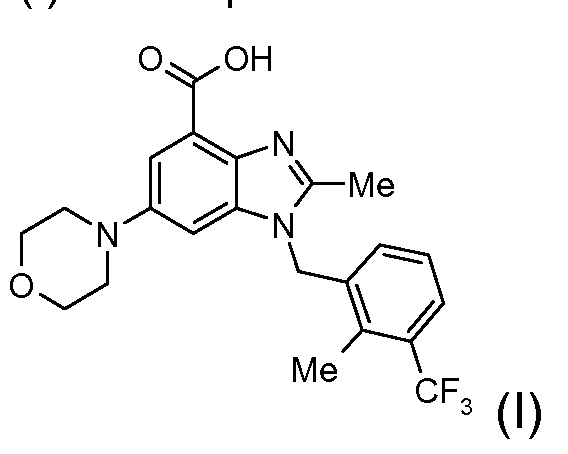
1372540-25-4

1H-​Benzimidazole-​4-​carboxylic acid, 2-​methyl-​1-​[[2-​methyl-​3-​(trifluoromethyl)​phenyl]​methyl]​-​6-​(4-​morpholinyl)​-

2-Methyl-1-[[2-methyl-3-(trifluoromethyl)phenyl]methyl]-6-(4-morpholinyl)-1H-benzimidazole-4-carboxylic acid

GSK2636771 is a potent, orally bioavailable, PI3Kβ-selective inhibitor, sensitive to PTEN null cell lines.

Formula:C22H22F3N3O3
M.Wt:433.43

WO 2014158467

http://www.google.com/patents/WO2014158467A1?cl=en

According to another embodiment, the invention relates to a method of re- sensitizing BRAF inhibitor resistant melanoma brain metastases comprising the administration of a therapeutically effective amount of

(i) a compound of formula (I)

or a pharmaceutically acceptable salt thereof;

……………………………………………………………….

http://www.google.co.in/patents/WO2014108837A1?cl=en


A combination comprising:
(i) a compound of Structure (I):
I
or a pharmaceutically acceptable salt thereof;
………………………………………………
SYNTHESIS
 GSK 2636771
………………………………………………
Example 26
Preparation of methyl 2-methyl-6-(4-morpholinyl)-l-(l-naphthalenylmethyl)-lH- benzimidazole-4-carboxylate a) 3-amino-5-chloro-2-nitrobenzoic acid

Under nitrogen, to a solution of t-BuOK (156.8 g) and Cu(OAc)2 (3.6 g) in DMF (1.2 L) was added a solution of 5-chloro-2-nitrobenzoic acid (40.0 g) and MeONH2 HCl (33.2 g) in DMF (300 mL) at 0° C. After 3h the reaction was quenched by addition of H20 (2.5 L) and acidified with 10% HC1 solution to pH= 1.The mixture was extracted with EA (2 L x 2) and the combined organic layers were then washed with brine, dried over anhydrous Na2S04, filtered and concentrated in- vacuo to afford the crude product as a yellow solid (43.2g, yield 100%). 1H NMR (300 MHz, CDC13): δ ppm 6.88 (s, 1H, J= 2.4Hz), 6.91 (d, 1H, J= 2.4Hz), 8.08 (br s, 2H); LC-MS: m/e = 217 [M+l]+. b) methyl 3-amino-5-chloro-2-nitrobenzoate

A mixture of 3-amino-5-chloro-2-nitrobenzoic acid (43.2 g) and HATU (2-(lH-7- Azabenzotriazol-l-yl)~l,l,3,3-tetramethyl uronium hexafluorophosphate Methanaminium, commercially available) (76 g) in MeOH (81 mL), Et3N (83 mL) and THF (300 mL) was stirred at room temperature for 3h. When TLC showed no starting material, the solvent was removed in-vacuo and the residue was then diluted with EtOAc (2 L). It was then washed with brine (1 L><3) and dried over anhydrous Na2S04, filtered and concentrated in-vacuo. The residue was then purified by silica gel chromatography eluted with EtOAc : petroleum ether = 1 : 8 to afford the desired product as a yellow solid (29.5 g, yield 64%). 1H NMR (300 MHz, CDC13): δ ppm 3.90 (s, 3H, s), 5.85 (br s, 2H), 6.80 (d, 1H, J = 2.4 Hz), 6.90 (d, 1H, J = 2.4 Hz); LC-MS: m/e = 231 [M+l]+ . c) methyl 3-amino-5-(4-morpholinyl)-2-nitrobenzoate

A mixture of combined batches of methyl 3-amino-5-chloro-2-nitrobenzoate (39 g), morpholine (29.5 g) and K2C03 (47 g) was stirred in DMF (200ml) at 110 0 C for 5 h. The mixture was cooled to room temperature and poured into water (1 L). It was extracted with EtOAc (500 mL x 3). The combined organic layers were washed with brine, dried over anhydrous Na2S04, filtered and concentrated in-vacuo to afford the desired product as a yellow solid (22 g, yield 46%). 1H NMR (300 MHz, CDC13): δ ppm 3.31 (t, 4H, J= 4.8 Hz), 3.82 (t, 4H, J= 4.8 Hz), 3.89 (s, 3H), 6.03 (d, 1H, J= 2.4 Hz), 6.34 (d, 1H, J= 2.4 Hz); LC- MS: m/e = 282 [M+l]+ . d) methyl 2-methyl-5-(4-morpholinyl)-lH-benzimidazole-7-carboxylate

To a solution of methyl 3-amino-5-(4-morpholinyl)-2-nitrobenzoate (22 g) stirring at reflux in HOAc (400 mL) was added iron powder in portions (13 g). After the addition, the mixture was stirred at reflux for 5 h. It was cooled to room temperature and the solvent was removed in- vacuo. The residue was neutralized with aqueous Na2C03 solution (1 L). It was extracted with EtOAc (500 mL x3). The combined organic layers were then concentrated in-vacuo and the residue was purified by silica gel chromatography eluted with MeOH : DCM = 1 : 30 to afford the desired product as a solid (16.6 g, yield 77%).

1H NMR (300 MHz, CDC13): δ ppm 2.67 (s, 3H), 3.17 (t, 4H, J= 4.8 Hz), 3.90 (t, 4H, J= 4.8 Hz), 3.98 (s, 3H), 7.44 (d, IH, J= 1.8 Hz), 7.54 (d, IH, J= 1.8 Hz);

LC-MS: m/e = 276 [M+l]+ .

Example 30

Preparation of methyl 2-methyl-l- {r2-methyl-3-(trifluoromethyl)phenyl1methyl|-6-(4- morpholinyl)- 1 H-benzimidazole-4-carboxylate

A solution of methyl 2-methyl-5-(4-morpholinyl)-lH-benzimidazole-7-carboxylate prepared as described in Example 26

Figure imgf000072_0001 methyl 2-methyl-5-(4-morpholinyl)-lH-benzimidazole-7-carboxylate

, step d (500mg, 1.8 mmol), l-(bromomethyl)-2-methyl-3- (trifluoromethyl)benzene (483 mg, 1.9 mmol)

l-(bromomethyl)-2-methyl-3- (trifluoromethyl)benzene

and K2C03 (497 mg, 3.6 mmol) in DMF (50 mL) was stirred at 80° C for 3 h. The reaction mixture was cooled to rt and poured into water (50 mL), extracted with EtOAc (30 mL x 3). The combined organic layers were washed with brine, dried over Na2S04 and concentrated. The resulting residue was purified by silica gel chromatography eluted with DCM : MeOH = 50 : 1 to give the crude product IE METHYL ESTER (230 mg, yield 29%), as a white solid.

1H NMR (300 MHz, DMSO-d6): δ ppm 2.39 (s, 3H), 2.54 (s, 3H), 3.08 (t, 4H, J=4.8 Hz), 3.72 (t, 4H, J=4.8 Hz), 3.89 (s, 3H), 5.57 (s, 2H), 6.27 (d, IH, J=7.5 Hz), 7.22 (t, IH, J=7.5 Hz), 7.27 (d, IH, J=2.4 Hz), 7.38 (d, IH, J=2.4 Hz) 7.60 (d, IH, J=7.5 Hz);

LC-MS: m/e = 448 [M+l]+

Example 31

Preparation of 2-methyl- 1 – { [2-methyl-3-(trifluoromethyl)phenyllmethyl| -6-(4-morpholiny0- 1 H-benzimidazole-4-carboxylic acidAn aqueous solution of 2 N LiOH (1.2 mL) was added to a solution of methyl 2-methyl- 1- {[2-methyl-3-(trifluoromethyl)phenyl]methyl}-6-(4-morpholinyl)-lH-benzimidazole-4- carboxylate, prepared as described in Example 30 (180 mg, 0.4 mmol) in THF (10 mL) and stirred at 50° C for 1 h. When TLC showed no starting material remaining, the mixture was cooled to rt and THF was removed under reduced pressure. The pH of the mixture was acidified to pH 3. The suspension was filtered and the filtrate was collected, and washed with water (lOmL) to give the product as a white solid (152 mg, yield 88%).

1H NMR (300 MHz,DMSO-d6):

δ ppm 2.46 (s, 3H), 2.54 (s, 3H), 3.10 (t, 4H, J=4.8 Hz), 3.73 (t, 4H, J=4.8 Hz), 5.63 (s, 2H), 6.37 (d, IH, J=7.8 Hz), 7.26 (t, IH, J=7.8 Hz), 7.35 (d, IH, J=2.4 Hz), 7.44 (d, IH, J=2.4 Hz), 7.62 (d, IH, J=7.8 Hz);

LC-MS: m/e = 434 [M+l]


WO2010006225A1 * 10 Jul 2009 14 Jan 2010 Novartis Ag Combination of (a) a phosphoinositide 3-kinase inhibitor and (b) a modulator of ras/raf/mek pathway
WO2011038380A2 * 28 Sep 2010 31 Mar 2011 Glaxosmithkline Llc Combination
WO2012061683A2 * 4 Nov 2011 10 May 2012 Glaxosmithkline Llc Methods for treating cancer
US20120088767 * 3 Oct 2011 12 Apr 2012 Junya Qu Benzimidazole derivatives as pi3 kinase inhibitors
O2013019620A2 * Jul 27, 2012 Feb 7, 2013 Glaxosmithkline Llc Method of treating cancer using combination of braf inhibitor, mek inhibitor, and anti-ctla-4 antibody
US20120202822 * Oct 12, 2010 Aug 9, 2012 Kurtis Earl Bachman Combination


CARMEN DRAHL

Links

Carmen Drahl (@carmendrahl) | Twitter

www.linkedin.com/in/carmendrahl/en

http://www.ddn-news.com/

http://cenblog.org/the-safety-zone/

Carmen Drahl – Google+

Carmen Drahl


Award-winning science communicator and social media power user based in Washington, DC.

Specialties: interviewing, science writing, social media, Twitter, Storify, YouTube, public speaking, hosting, video production, iPhone videography, non-linear video editing, blogging (WordPress and Blogger), HTML website coding

Education

Princeton University

Ph.D., Chemistry

2002 – 2007

Ph.D. with Erik J. Sorensen
She was on a team that completed the first total synthesis of abyssomicin C, a molecule found in small quantities in nature that showed hints of promise as a potential antibiotic. I constructed molecular probes from abyssomicin for proteomics studies of its biological activity.

M.A. with George L. McLendon
worked toward developing a drug conjugate as a potential treatment for cancer. I synthesized a photosensitizer dye-peptide conjugate for targeting the cell death pathway called apoptosis.

image

At a reception before the Alumni Day luncheon, President Tilghman (third from left) congratulated the winners of the University’s highest awards for students: (from left) Pyne Prize winners Lester Mackey and Alisha Holland; and Jacobus Fellowship recipients Sarah Pourciau, Egemen Kolemen and Carmen Drahl. Unable to attend the event was Jacobus Fellowship winner William Slauter. (photo: Denise Applewhite


B.A., Chemistry

1998 – 2002

Graduated summa cum laude with specialized honors in chemistry. Honors thesis entitled “Structural, kinetic, and mechanistic studies: the protein tyrosine phosphatases CD45 and PTP1B”

Activities and Societies: Phi Beta Kappa

Carmen Drahl, Class of 2002,


Experience

Science Journalist

Freelance

January 2014 – Present Washington D.C. Metro Area

Multimedia science journalist – I deliver clean products on time. Experience in reporting on chemistry, food science, history of science, drug development, science education.

Senior Editor, Chemical & Engineering News

American Chemical Society

August 2007 – December 2014 (7 years 5 months)Washington D.C. Metro Area

Reporting:
Cover the science of chemistry for C&EN, the American Chemical Society’s weekly magazine, circulation 160,000. Track new research findings daily, particularly in forensic science, drug discovery, organic chemistry, and food science.

Video:
Doubled circulation to C&EN’s YouTube channel in 2013. Scripted, narrated, edited footage.
Managed a core team of 4 and collaborated with other reporters to produce 30 videos, some reproduced in The Atlantic, Scientific American, Eater National, The Daily Mail.

Incepted, scripted, and co-hosted “Speaking of Chemistry”, a monthly web show that summarizes top chemistry news for the busy scientist.

Social Media:
Developed magazine-wide best practices for YouTube videos and Twitter. Ran staff workshops about Storify, Slashdot, and Reddit.

Hosting/Public Speaking:
Topics include communicating chemistry simply, transitioning from a Ph.D. to careers in science communication. Moderated discussions on chemophobia, social media usage in the chemical sciences. On-camera co-host for web newscasts produced by ACS.

Innovation:
With C&EN art and web teams, developed first-for-the-magazine features, including a 90th anniversary commemorative timeline poster, a pullout guide to top conference speakers, interactive quizzes and database searches.

Carmen Drahl, senior editor of Chemical and Engineering News, used her Ph.D. in chemistry as a springboard into the career she envisioned for herself. Here she shares some advice that helped her make the decision.

Carmen Drahl made the transition to a writing career while earning a Ph.D. in chemistry at Princeton University. Born and raised in New Jersey, she now lives in Washington, D.C., and reports for Chemical and Engineering News (C&EN). At C&EN she has written about how new medications get their names, explained the science behind a controversial hair-straightening product, and covered the scientific firestorm sparked by an alleged arsenic life form. Her work has been featured on SiriusXM’s Doctor Radio, Radio New Zealand’s This Way Up, and elsewhere. Her coverage has also been recognized by MIT’s Knight Science Journalism Tracker.

(Open)1 honor or award
Scientific Cocktails: Award-winning video

Scientific Cocktails: Award-winning video

Speaking of Chemistry: All About Tinsel

Speaking of Chemistry: All About Tinsel

Carmen Drahl

Twitter Maven

World Central Kitchen

March 2013 – August 2014 (1 year 6 months)Washington D.C. Metro Area

I was the “voice of Twitter” for World Central Kitchen, the humanitarian organization founded by renowned Chef José Andrés. Doubled followers to Twitter account in 2013, developed Twitter strategy for projects and events. Edited Annual Report, press releases and other communication materials. Volunteered in person at outreach events.

Contributing Editor, AWIS Magazine

Association of Women in Science

December 2005 – August 2007 (1 year 9 months)

sHE reported and wrote profiles of prominent women scientists in a range of fields (molecular biology, physics, geoscience) for the Research Advances column in AWIS Magazine.

Writer, various publications

Princeton University

April 2005 – May 2007 (2 years 2 months)

She reported and wrote news for the Princeton University News Office’s Research Notes, and wrote news and features for the Princeton University Chemistry Department’s Industrial Affiliates Program Newsletter and Chemistry Alumni Newsletter.

Honors & Awards

Eddie Digital Award- Best Video (B-to-B)

FOLIO Magazine

December 2014

Porter Ogden Jacobus Fellowship

Princeton University

February 2007

NSF Graduate Research Fellowship

National Science Foundation

2002

Volunteer Experience & Causes

Board Member

Princeton Alumni Weekly Magazine

October 2013

Advisory Committee

American Institute of Physics News and Media Services

October 2013

Member, Graduate Alumni Leadership Council

Princeton University

2009 – 2012 (3 years)

INTERVIEW

Continuing with the tradition from last two years, I will occasionally post interviews with some of the participants of the ScienceOnline2010 conference that was held in the Research Triangle Park, NC back in January. See all the interviews in this series here. You can check out previous years’ interviews as well: 2008 and 2009.

Today, I asked Carmen Drahl, Associate Editor for Science/Technology/Education at Chemical & Engineering News (find her as @carmendrahl on Twitter) to answer a few questions.

Welcome to A Blog Around The Clock. Would you, please, tell my readers a little bit more about yourself? Where are you coming from (both geographically and philosophically)? What is your (scientific) background?

i-b183f89fe33d3d9f0b308a6cb30d9b5b-Carmen Drahl pic1.JPGIt’s a pleasure and a privilege to be interviewed, Bora.

Good conversations make me happy. School was fun for me (well, maybe not grad school) and that’s evolved into a desire to always be learning something new. I enjoy doing nothing as much as I enjoy doing things. On Mondays, if I’m not too busy, I take hip-hop dance classes.

My hometown is Hackettstown, New Jersey. M&M’s are made there. I got a bachelor’s in chemistry from Drew University and a Ph.D. in chemistry at Princeton. Scientifically my expertise hovers somewhere around the interface between organic chemistry and biochemistry. A short while after defending my dissertation, I moved to Washington DC to write for Chemical & Engineering News, and that’s where I’ve been for almost three years now.

When and how did you first discover science blogs?

Scandal led me to science blogs. Seriously. In March 2006 I was still an organic chemistry grad student. Everyone in my lab was buzzing about a set of retractions in the Journal of the American Chemical Society (disclosure: today I work for the American Chemical Society, which publishes JACS). A rising young organic chemistry star retracted the papers because work by one of his graduate students couldn’t be reproduced. It was a big deal and became an even bigger deal as the inevitable rumors (salacious and otherwise) surfaced. The blogosphere had the details first. So that’s where Google pointed me and the other members of my lab when we searched for more information. I learned about the awesome (but sadly now defunct) blogs Tenderbutton and The Endless Frontier, by Dylan Stiles and Paul Bracher, both chemistry grad students like me. I also discovered the solid mix of chemistry and pharma at Derek Lowe’s In the Pipeline, which is still the first blog I visit every day.

Tell us a little more about your career trajectory so far: interesting projects past and present?

i-b7bd4d4568d9689c2daf400303c886c3-Carmen Drahl pic2.JPGBy the time I discovered science blogs I knew my career goals were changing. I’d already been lucky enough to audit a science writing course at Princeton taught by Mike Lemonick from TIME, and thought that maybe science writing was a good choice for me. After reading chemistry blogs for a while I realized “Hey, I can do this!” and started my own blog, She Blinded Me with Science, in July 2006. It was the typical grad student blog, a mix of posts about papers I liked and life in the lab.

At C&E News I’ve contributed to its C&ENtral Science blog, which premiered in spring 2008. I’ve experimented with a few different kinds of posts- observations and on-the-street interviews when I run into something chemistry-related in DC, in-depth posts from meetings, and video demos of iPod apps. One of my favorite things to do is toy with new audio/video/etc technology for the blog.

What is taking up the most of your time and passion these days? What are your goals?

In March I just started a new era in my web existence- I’m becoming a pharma blogger. I’m the science voice at The Haystack, C&E News’s new pharma blog and one of seven new blogs the magazine launched last month. My co-blogger is the talented Lisa Jarvis, who’s written about the business side of pharma for ten years and who brings a solid science background to the table as well. I kicked us off by liveblogging/livetweeting a popular session at the American Chemical Society’s meeting in San Francisco where drug companies reveal for the first time the chemical structures of potential new drugs being tested in clinical trials. The whole thing synced to FriendFeed as well. Folks followed the talks from all three venues, which was great. I hope I can continue doing that sort of thing in the future.

For this August, I’m co-organizing a mini-symposium at the American Chemical Society meeting in Boston about the chem/pharma blogosphere and its impact on research and communication. I’m in the process of inviting speakers right now. It’s my first time doing anything like this and part of me is petrified that no one will show up. Tips on organizing a conference session and how not to stress when doing so are welcome!

More broadly, I’d love to get more chemistry bloggers to connect with the community that attends ScienceOnline. I don’t ever want to become that old (or not-so-old) person who is clueless about them-thar newfangled whosiwhatsits that the kids are using nowadays.

What aspect of science communication and/or particular use of the Web in science interests you the most?

A few things come to mind, actually. I’d like to think that the web has made grad school a helluva lot less isolating for science grad students. You have the virtual journal clubs like Totally Synthetic, posts like SciCurious’s letter to a grad student, etc.

As a journalist the web’s capacity to equalize fascinates me. I’m extremely lucky to have a staff gig as a science writer without having gone to journalism school or landed a media fellowhip and it’s weird to think that my old blog might’ve helped my visibility. I didn’t know Ed Yong’s story until Scio10 but I think he’s a highly talented example of how the web can open doors.

The web’s equalizing power goes to readers of science content as well as writers, of course. In the ideal situation a reader can give a writer instant feedback and you can get a real conversation going, something that was much harder with the snail-paced system of letters to the editor and reader surveys. Not that the conversation is always civil. Most of C&EN’s readers have a decent amount of scientific training, but the debate that rages whenever we run an editorial about climate change is as intense as any I’ve seen.

In cases like that I don’t know that the web gives people a good representation of what the consensus is. For folks who don’t have scientific training, how do you ensure that people don’t just go to the content that already confirms their pre-existing beliefs about autism or global warming? John Timmer touched on this more eloquently in his interview with you, and I agree with him that I don’t think we have an answer yet. Though on a slightly different note, I will mention that I’ve been enjoying the New York Times’s recent attempts to recapture the spontaneity of flipping through the newspaper in online browsing, like the Times Skimmer for Google Chrome.

What are some of your favourite science blogs? Have you discovered any cool science blogs by the participants at the Conference?

In addition to the blogs I’ve already mentioned I enjoy Carbon-Based Curiosities, Wired Science, Chemistry Blog, and Terra Sigillata, to name a few of the 50 or so blogs on my feed reader.

I discovered scads of new blogs at Scio10 but I’ll focus on the one that’s become required reading for me these days: Obesity Panacea. I’d covered obesity drug development for C&EN but I’d never met Travis Saunders and Peter Janiszewski or heard of their blog until the conference.

What was the best aspect of ScienceOnline2010 for you? Is there anything that happened at this Conference – a session, something someone said or did or wrote – that will change the way you think about science communication, or something that you will take with you to your job, blog-reading and blog-writing?

Dave Mungeris my hero – his blogging 102 session was packed with practical tips that I brought back to C&EN for incorporating into our blogs, such as the use of the Disqus plugin for catching conversations on social networks, getting smart about using stats and surveys, etc. Some of that’s already happened, and some of the ideas are still in the works.

I came for the nuts-and-bolts blogging tips but I stayed for the conversations, especially the ones at the bar after the official program was done for the night. And the icing on the cake was seeing folks I’d worked with but never met, like Cameron Neylon and you, Bora, and catching up with people I hadn’t seen in months, like Jean-Claude Bradley, Aaron Rowe, Jennifer Ouellette and Nancy Shute.

It was so nice to meet you in person and thank you for the interview. I hope to see you again next January.

GSK 2256294


Figure imgf000077_0001

GSK 2256294

GSK 2256294A

CAS  1142090-23-0

MF C21H24F3N7O
MW 447.46

Antiasthmatics, soluble epoxide hydrolase inhibitor

Chronic obstructive pulmonary disease COPD …PHASE 1

(1R,3S)- Cyclohexanecarboxamide, N-[[4-cyano-2-(trifluoromethyl)phenyl]methyl]-3-[[4-methyl-6-(methylamino)-1,3,5-triazin-2-yl]amino]-,

cis-N-[[4-Cyano-2-(trifluoromethyl)phenyl]methyl]-3-[[4-methyl-6-(methylamino)-1,3,5-triazin-2-yl]amino]cyclohexanecarboxamide

(1R,3S)-N-(4-cyano-2-(trifluoromethyl)benzyl)-3-(4-methyl-6-(methylamino)-1,3,5-triazin-2-ylamino)cyclohexanecarboxamide

cis-N-((4-Cyano-2-(trifluoromethyl)phenyl)methyl)-3-((4-methyl-6-(methylamino)-1,3,5-triazin-2-yl)amino)cyclohexanecarboxamide

Cyclohexanecarboxamide, N-((4-cyano-2-(trifluoromethyl)phenyl)methyl)-3-((4-methyl-6-(methylamino)-1,3,5-triazin-2-yl)amino)-, (1R,3S)-rel-

  • Originator GlaxoSmithKline
  • Class Antiasthmatics
  • Mechanism of Action Epoxide hydrolase inhibitors

GSK 2256294 is a soluble epoxide hydrolase inhibitor in phase I clinical trials at GlaxoSmithKline for the oral treatment of patients with chronic obstructive pulmonary disease (COPD).

GSK2256294A is a potent, reversible, tight binding inhibitor of isolated recombinant human sEH (IC50 value 27 pM), and displays potent inhibition against the rat (IC50 = 61 pM) and murine (IC50 = 189 pM) orthologs of sEH. GSK2256294A also displays potent cellular inhibition (IC50 = 0.66 nM) of sEH in a cell line transfected with the human sEH enzyme.The selectivity of the compound has been demonstrated by testing against a large panel of enzymes, receptors and ion channels, including the phosphatase activity of EPHX2.

  • 01 Jan 2015GlaxoSmithKline initiates enrolment in a phase I trial in Healthy volunteers in USA (NCT02262689)
  • 09 Oct 2014GlaxoSmithKline plans a phase I trial in Healthy volunteers in USA (NCT02262689)
  • 01 May 2014GlaxoSmithKline completes a phase I pharmacokinetics trial for Chronic obstructive pulmonary disease (in the elderly, in volunteers) in USA (NCT02006537)


PATENT

http://www.google.com/patents/WO2009049157A1?cl=en

Step 1:

4- (bromomethyl) -3- (trifluoromethyl) benzonitrile


Figure CN101896065BD00313

 A mixture of 4-methyl-3- (trifluoromethyl) benzonitrile (10g, 54mmOl) was dissolved in 200mL of carbon tetrachloride, and acid imide with N- desert shot glass (10.5g, 59mmol) and peroxybenzoate (benzoyl peroxide) (1.3g, 0.54mmol) processing. The reaction mixture was heated to reflux temperature and stirred for one week. SOmL water was then added, and the layers separated. The aqueous layer with methylene chloride (2X50mL) and extracted. The organic layers were washed with water (2X50mL), dried over magnesium sulfate, and concentrated to give 4- (bromomethyl) -3- (trifluoromethyl) benzonitrile (14g, 53mm0l), as a yellow oil which was used without further purification for the subsequent steps.

Step 2:

4- (aminomethyl) -3- (trifluoromethyl) benzonitrile


Figure CN101896065BD00314

 4- (bromomethyl) -3- (trifluoromethyl) benzonitrile (14g) was dissolved in 500mL of 5M methanol solution of ammonia, and the mixture was stirred at room temperature for 24 hours. The solvent was removed in vacuo to give a yellow solid, which was dissolved in IM HCl and extracted with diethyl ether (3X30mL). Then, with IM NaOH and the aqueous layer was adjusted to pH 9-10 and extracted with dichloromethane (3X80mL). Thus obtained 4- (aminomethyl) -3- (trifluoromethyl) benzonitrile (4.7g, 23mm0l, 43%), as a yellow solid. MS (ES) m / e 201 [M + H] + “1H NMR (400MHz, DMS0-D6) δ 8.2 (s, 1H), 8.15 (d, 1H), 8.0 (d, 1H), 3.9 (s, 2H).

Step 1:

4-chloro -N, 6- dimethyl-1,3,5-triazin-2-amine


Figure CN101896065BD00411

 Intermediate 13 (500mg, 3.07mmol) was added 25-30% methylamine (300uL, 3.07mmol) in aqueous CH3CN / H20 (15mL) in a solution. The mixture was cooled to (TC, with the pH adjusted to 9_10.pH IMNaOH maintained at 9-10 for 0.5 hours. The reaction progress was monitored by LCMS, the mixture was used in the subsequent step without any treatment.

Intermediate 19

 3 – {[methyl (methyl-amino) triazin-2-yl 4 -1,3,5_ -6-] amino} cyclohexanecarboxylic acid was prepared


Figure CN101896065BD00303

 To 2,4-dichloro-6-methyl-1,3,5-triazine (2.291g, 13.97mmol) and methylamine (6.98ml, 13.97mmol) was added dropwise IN NaOH, to maintain the pH of 10. The reaction mixture was stirred for 30 minutes. Subsequently, a solution of 3-amino-cyclohexane – carboxylic acid (2.0g, 13.97mmol), was added dropwise to maintain a pH of 10 INNaOH. The reaction mixture was heated to 70 ° C overnight. Cooling the reaction mixture was directly purified by preparative HPLC. MS (ES +): m / e266.2 [M + H] +. 1H NMR (400MHz, DMS0-D6) δ 9.0_8.5 (bm, 2Η), 3.9 (bs, 1Η), 2.9 (m, 2Η), 2.3 (s, 3Η), 2.2 (s, 3Η), 1.9- 1.7 (bm, 4Η), 1.4-1.1 (bm, 4Η).

Step 2:

3 – {[4_-methyl-6- (methylamino) _1,3,5_ triazine _2_ yl] amino} cyclohexanecarboxylic acid


Figure CN101896065BD00412

 in (TC, 4-chloro -N, 6- dimethyl-1,3,5-triazin-2-amine mixture (485mg, 3.07mmol) was added 3-amino-cyclohexyl burning acid (527mg, 3.68mmol). The mixture was allowed to warm to room temperature .pH maintained between 9 to 10 for 3 hours. The mixture was concentrated and the product was purified by HPLC to afford 0.6g (2.26mmol, 74% yield) of the desired product, as a white solid .MS (ES +): m / e 266.2 [M + H] + “


Example 74

(cis)-N-{[4-cyano-2-(trifluoromethyl)phenyl]methyl}-3-{[4-methyl-6-(methylamino)-1 ,3,5- triazin-2-yl]amino}cyclohexanecarboxamide

Figure imgf000077_0001

To a solution of 3-{[4-methyl-6-(methylamino)-1 ,3,5-triazin-2- yl]amino}cyclohexanecarboxylic acid (0.100 g, 0.264 mmol) in N,N-Dimethylformamide (DMF) (4 ml) was added 4-(aminomethyl)-3-(trifluoromethyl)benzonitrile (0.053 g, 0.264 mmol) followed by diisopropylethylamine (0.101 ml, 0.580 mmol) and 1 H-1 ,2,3- benzotriazol-1-yloxy-tris(dirnethylamino)-phosphonium hexafluorophosphate (BOP reagent, 0.128 g, 0.290 mmol). The reaction was stirred at room temperature for 4 hours and then purified by preparative HPLC to provide (cis)-N-{[4-cyano-2- (trifluoromethyl)phenyl]methyl}-3-{[4-methyl-6-(methylamino)-1 ,3,5-triazin-2- yl]amino}cyclohexanecarboxamide (83 mg, 0.148 mmol, 56 %). MS (ES) m/e 448

[M+H]+. 1H NMR (400 MHz, DMSO-D6) D 7.8 (bs, 1 H), 7.3 (bs, 1 H), 7.2 (m, 1 H), 6.9 (m, 1 H), 3.8 (bs, 2H), 3.3 (bm, 1 H), 2.2 (bm, 4H), 1.8 – 1.5 (bm, 4H), 1.3 – 1.1 (bm, 4H), 0.8 – 0.5 (bm, 4H)

PATENT

http://www.google.com/patents/CN101896065B?cl=en

(cis) -N – {[4- cyano-2- (trifluoromethyl) phenyl] methyl} -3 – {[4_-methyl-6- (methylamino) _1,3, .5- triazin-2-yl] amino} cyclohexanecarboxamide

Figure CN101896065BC00051


Example 74

(cis) -N- {[4- cyano-2- (trifluoromethyl) phenyl] methyl} -3- {[4_ methyl _6_ (methylamino) -1,3 , 5-triazin-2-yl] amino} cyclohexanecarboxamide


Figure CN101896065BD00571

 To 3 – {[4_-methyl-6- (methylamino) -l, 3,5- triazin-2-yl] amino} cyclohexanecarboxylic acid (0.1OOg,

0.264mmol) in N, N- dimethylformamide (DMF) (4ml) was added 4- (aminomethyl) -3- (trifluoromethyl) benzonitrile (0.053g, 0.264mmol), followed by the addition of diisopropylethylamine (0.1Olml, 0.580mmol) and 1H-1,2,

3- benzotriazol-1-yloxy – tris (dimethylamino) _ scale hexafluorophosphate (Β0Ρ reagent, 0.128g, 0.290mmol). The reaction mixture was stirred at room temperature for 4 hours, and then purified by preparative HPLC to afford (cis) -N- {[4- cyano-2- (trifluoromethyl) phenyl] methyl} -3 – {[4_ methyl-6- (methylamino) -1,3,5_ triazin-2-yl] amino} cyclohexane carboxamide (83mg, 0.148mmol, 56%) “MS (ES) m / e 448 [ M + H] +. 1H NMR (400MHz, DMS0-D6) δ 7.8 (bs, 1H), 7.3 (bs, 1H), 7.2 (m, 1H), 6.9 (m, 1H), 3.8 (bs, 2H) , 3.3 (bm, 1H), 2.2 (bm, 4H),

1.8-1.5 (bm, 4H), 1.3-1.1 (bm, 4H), 0.8-0.5 (bm, 4H).

SMILES  Cc1nc(nc(n1)N[C@H]2CCC[C@H](C2)C(=O)NCc3ccc(cc3C(F)(F)F)C#N)NC

P.L. Podolin et al. In vitro and in vivo characterization of a novel soluble epoxide hydrolase inhibitor. Prostaglandins Other Lipid Mediat. 2013, 104-105, 25-31.
L.A. Morgan et al. Soluble epoxide hydrolase inhibition does not prevent cardiac remodeling and dysfunction after aortic constriction in rats and mice. J. Cardiovasc. Pharmacol. 2013, 61, 291-301. 

GSK 2126458, Omipalisib, PI3K/mTOR inhibitor


GSK 2126458

CAS 1086062-66-9

OMipalisib;GSK2126458;GSK-2126458;GSK2126458 (GSK458);GSK212;

2,4-Difluoro-N-[2-methoxy-5-[4-(4-pyridazinyl)-6-quinolinyl]-3-pyridinyl]benzenesulfonamide;

2,4-Difluoro-N-[2-Methoxy-5-[4-(pyridazin-4-yl)quinolin-6-yl]pyridin-3-yl]benzenesulfonaMide

2,4-Difluoro-N-[2-methoxy-5-[4-(4-pyridazinyl)quinolin-6-yl]pyridin-3-yl]benzenesulfonamide

phosphoinositide 3 kinase inhibitor

idiopathic pulmonary fibrosis

PHASE 1

MW 505.49598

MF C25H17F2N5O3S

GSK…….http://www.gsk.com/media/280387/product-pipeline-2014.pdf

Omipalisib (GSK2126458): Omipalisib, also known as GSK2126458, is a small-molecule pyridylsulfonamide inhibitor of phosphatidylinositol 3-kinase (PI3K) with potential antineoplastic activity. PI3K inhibitor GSK2126458 binds to and inhibits PI3K in the PI3K/mTOR signaling pathway, which may trigger the translocation of cytosolic Bax to the mitochondrial outer membrane, increasing mitochondrial membrane permeability and inducing apoptotic cell death. Bax is a member of the proapoptotic Bcl2 family of proteins. PI3K, often overexpressed in cancer cells, plays a crucial role in tumor cell regulation and survival.

GlaxoSmithKline (GSK) is developing omipalisib (GSK-2126458), a phosphoinositide 3-kinase/mammalian target of rapamycin (PI3K/mTOR) inhibitor as well as mTOR complex 1 and 2 inhibitor, for the potential oral treatment of cancer and idiopathic pulmonary fibrosis

MEDKOO

Certificate of Analysis:

View current batch of CoA

QC data:

View NMR, View HPLC, View MS

GSK2126458 is a highly potent PI3K and mTOR inhibitor. In vivo, GSK2126458 showed anti-tumor activity in both pharmacodynamic and tumor growth efficacy models. GSK2126458 reduced the phosphorylated AKT, p70S6K contents in a dose and time dependent way. The IC50 of GSK2126458 is 2 nM for pAKT in the HCC1954 breast carcinoma cell line. In various human tumor cells, GSK2126458 had a width of inhibitory activity for potent cell growth and induced cell death. Notably, GSK2126458 acted mainly by not induction of apoptosis but cell cycle arrest, particularly in G1-phase

GlaxoSmithKline (GSK) is developing omipalisib (GSK-2126458), a phosphoinositide 3-kinase/mammalian target of rapamycin (PI3K/mTOR) inhibitor as well as mTOR complex 1 and 2 inhibitor, for the potential oral treatment of cancer and idiopathic pulmonary fibrosis

GSK-2126458 is a phosphatidylinositol 3-Kinase (PI3K) inhibitor in early clinical development for the oral treatment of solid tumors and for the oral treatment of lymphoma. Early clinical studies are ongoing for the treatment of idiopathic pulmonary fibrosis. The compound is being developed b GlaxoSmithKline.

In August 2009, a phase I trial began for solid tumors and lymphoma . In April 2012, phase Ib co-clinical trials in advanced prostate cancer (PC) were underway . In March 2013, a phase I trial was initiated in the UK in patients with idiopathic pulmonary fibrosis

In April 2014, a phase I, open-label, multicenter, dose-escalation study (study number P3K113794) and safety data were presented at the 105th AACR meeting in San Diego, CA. Advanced solid tumor patients (n = 69) received oral continuous GSK-2126458 or intermittent GSK-2126458 bid  + trametinib. For GSK-2126458 and trametinib, the MTD in QD cohort was 2 and 1 mg, respectively, and also 1 and 1.5 mg, respectively

PAPER 

Discovery of GSK2126458, a highly potent inhibitor of PI3K and the mammalian target of rampamycin
ACS Med Chem Lett 2010, 1(1): 39


Abstract Image

Phosphoinositide 3-kinase α (PI3Kα) is a critical regulator of cell growth and transformation, and its signaling pathway is the most commonly mutated pathway in human cancers. The mammalian target of rapamycin (mTOR), a class IV PI3K protein kinase, is also a central regulator of cell growth, and mTOR inhibitors are believed to augment the antiproliferative efficacy of PI3K/AKT pathway inhibition. 2,4-Difluoro-N-{2-(methyloxy)-5-[4-(4-pyridazinyl)-6-quinolinyl]-3-pyridinyl}benzenesulfonamide (GSK2126458, 1) has been identified as a highly potent, orally bioavailable inhibitor of PI3Kα and mTOR with in vivo activity in both pharmacodynamic and tumor growth efficacy models. Compound 1 is currently being evaluated in human clinical trials for the treatment of cancer.

 ……………….. 

synthesis

omalipisib


Figure imgf000151_0002

Figure imgf000145_0002

………………..

PATENT

WO 2008144463

http://www.google.co.in/patents/WO2008144463A1?cl=en

Example 345

2,4-difluoro-N-{2-(methyloxy)-5-[4-(4-pyridazinyl)-6-quinolinyl]-3- pyridinyl } benzenesulf onamide

a) 6-bromo-4-(4-pyridazinyl)quinoline

Dissolved 6-bromo-4-iodoquinoline (17.43 g, 52.2 mmol), 4- (tributylstannanyl)pyridazine (19.27 g, 52.2 mmol), and PdC12(dppf)-CH2C12 (2.132 g, 2.61 mmol) in 1,4-dioxane (200 mL) and heated to 105 °C. After 3 h, added more palladium catalyst and heated for 6 h. Concentrated and dissolved in methylene chloride/methanol. Purified by column chromatography (combiflash) with 2% MeOH/EtOAc to 5% MeOH/EtOAc to give the crude title compound. Trituration with EtOAc furnished 6-bromo-4-(4-pyridazinyl)quinoline (5.8 g, 20.27 mmol, 38.8 % yield). MS(ES)+ m/e 285.9, 287.9 [M+H]+.

b) 2,4-difluoro-N-{2-(methyloxy)-5-[4-(4-pyridazinyl)-6-quinolinyl]-3- pyridinyl } benzenesulf onamide A slurry of 6-bromo-4-(4-pyridazinyl)quinoline (4.8 g, 16.78 mmol), bis(pinacolato)diboron (4.69 g, 18.45 mmol) , PdC12(dppf)-CH2C12 (530 mg, 0.649 mmol) and potassium acetate (3.29 g, 33.6 mmol) in anhydrous 1,4-dioxane (120 ml) was heated at 100 °C for 3 h. The complete disappearance of the starting bromide was observed by LCMS. The reaction was then treated with N-[5-bromo-2- (methyloxy)-3-pyridinyl]-2,4-difluorobenzenesulfonamide (6.68 g, 17.61 mmol) and another portion of PdC12(dppf)-CH2C12 (550 mg, 0.673 mmol), then heated at 110 °C for 16 h. The reaction was allowed to cool to room temperature, filtered, and concentrated. Purification of the residue by chromatography (Analogix; 5% MeOH / 5% CH2C12 / 90% EtOAC) gave 6.5 g (76%) desired product. MS(ES)+ m/e 505.9 [M+H]+.


INTERMEDIATES:

Intermediate 1  Similar but not same

Scheme A:

Conditions: a) Tributyl(vinyl)tin, Pd(PPh3)4, dioxane, reflux; b) OsO4, NaIO4, 2,6- lutidine, r-BuOH, dioxane, H2O, rt; c) (4-pyridyl)boronic acid, Pd(PPh3)4, 2 M K2CO35 DMF, 100 DC.

4-(4-pyridinyl)-6-quinolinecarbaldehydeSimilar but not same

a) 4-chloro-6-ethenylquinoline

A mixture of 6-bromo-4-chloroquinoline (6.52 g, 26.88 mmol; see J. Med. Chem., H 268 (1978) ), tributyl(vinyl)tin (8.95 g, 28.22 mmol), and tetrakistriphenylphospbine palladium (0) (0.62 g, 0.54 mmol) in 1,4-dioxane (150 mL) was refluxed for 2.0 h, cooled to room temperature, and concentrated in vacuo. The residue was purified by flash chromatography on silica gel (0-4% MeOH:CH2Cl2) to give the title compound (5.1 g) as a pale yellow solid. MS (ES)+ m/e 190 [M+H]+. This material was used directly in the next step.

b) 4-chloro-6-quinolinecarbaldehyde

A mixture of 4-chloro-6-ethenylquinoline (5.1 g, 26.88 mmol), 2,6-lutidine

(5.76 g, 53.75 mmol), sodium (meta) periodate (22.99 g, 107.51 mmol), and osmium tetroxide (5.48 g of a 2.5% solution in tert-butanol, 0.538 mmol) in l,4-dioxane:H2θ (350 mL of 3: 1 mixture) was stirred for 3.5 h at room temperature and concentrated in vacuo. The residue was purified by flash chromatography on silica gel (CH2Cb) to give the title compound (4.26 g, 83% for 2 steps) as a pale yellow solid. MS (ES)+ m/e 192 [M+H]+.

c) 4-(4-pyridmyl)-6-qumolinecarbaldehyde

A mixture of 4-chloro-6-quinolinecarbaldehyde (3.24 g, 16.92 mmol), A- pyridylboronic acid (3.12 g, 25.38 mmol), tetrakistriphenylphosphine palladium (0) (0.978 g, 0.846 mmol), and 2M aqueous K2CO3 (7.02 g, 50.76 mmol, 25.4 mis of 2M solution) in DMF (100 mL) was heated at 100 °C for 3.0 h and cooled to room temperature. The mixture was filtered through Celite and the Celite was washed with EtOAc. The filtrate was transferred to a separatory funnel, washed with water and saturated NaCl, dried (Na2SO4), filtered and concentrated in vacuo. The residue was purified by flash chromatography on silica gel (5% MeOH:CH2Cl2) to give the title compound (2.03 g, 51%) as a tan solid. MS (ES)+ m/e 235 [M+H]+.

Intermediate 2

Preparation of 2-amino-5 -bromo-N,N-dimethyl-3 -pyridinesulfonamideSimilar but not same

a) 2-ammo-5-bromo-3-pyridinesulfonyl chloride

To a cooled (0 °C) solution of chlorosulfonic acid (58 mL) under vigorous stirring was added 5-bromo-2-pyridinamine (86.7 mmol) portionwise. The reaction mixture was then heated at reflux for 3 hrs. Upon cooling to room temperature, the reaction mixture was poured over ice (-100 g) with vigorous stirring. The resulting yellow precipitate was collected by suction filtration, washing with cold water and petroleum ether to provide the title compound as an orange-yellow solid (18.1 g, 77% yield). MS(ES)+ m/e 272.8 [M+H]+.

* Other sulfonyl chlorides can be prepared using this procedure by varying the choice of substituted aryl or heteroaryl.

b) 2-amino-5-bromo-N,N-dimethyl-3-pyridinesulfonamide

To a cold (0 DC) suspension of 2-amino-5-bromo-3-pyridinesulfonyl chloride (92.1 mmol) in dry 1,4-dioxane (92 mL) was added pyridine (101.3 mmol) followed by a 2M solution of dimethylamine in THF (101.3 mmol). The reaction was allowed to warm to rt for 2 h, heated to 50 DC for 1 h, then cooled to rt. After standing for 2 h, the precipitate was collected by filtration and rinsed with a minimal amount of cold water. Drying the precipitate to constant weight under high vacuum provided 14.1 g (55%) of the title compound as a white solid. MS(ES)+ m/e 279.8, 282.0 [M+H]+.


Intermediate 3

Preparation of 2-amino-N,N-dimethyl-5-(4,4,5,5-tetramethyl-l,3.2-dioxaborolan-2- yl)-3 -pyridinesulfonamideSimilar but not same

c) To a solution of 2-amino-5-bromo-N,N-dimethyl-3 -pyridinesulfonamide (7.14 mmol) in 1,4-dioxane (35 mL) was added 4,4,4′,4′,5,5,5′,5′-octamethyl-2,2′-bi-l,3,2- dioxaborolane (7.86 mmol), potassium acetate (28.56 mmol) and [1,1 ‘- bis(diphenylphosphmo)-ferrocene] dichloropalladium(II) dichloromethane complex (1 :1) (0.571 mmol). The reaction mixture was stirred at 100 °C for 18 h. The reaction was concentrated in vacuo, re-dissolved in ethyl acetate (50 mL) and purified on silica using 60% ethyl acetate/hexanes to yield the title compound as a tan solid (86 %). IH ΝMR (400 MHz, DMSOd6) δ ppm 8.41 (d, 1 H, J =1.52), 7.92 (d, 1 H, J = 1.77), 2.68 (s, 6 H), 1.28 (s, 12 H).

* Other boronate or boronic acids can be prepared using this procedure by varying the choice of aryl or heteroaryl bromide. Scheme 17:

Conditions: a) NaO(Rl), (Rl)OH, O 0C to room temperature; b) SnCl2-2H2O, ethyl acetate, reflux; c) (R2)SO2C1, pyridine, O 0C to room temperature.

Intermediate 4

Preparation of N-r5-bromo-2-(methyloxy)-3-pyridinyll-2,4- difluorobenzenesulfonamide

Figure imgf000151_0002N-[5-bromo-2-(methyloxy)-3-pyridinyl]-2,4- difluorobenzenesulfonamide

a) 5-bromo-2-(methyloxy)-3-nitropyridine

To a cooled (0 °C) solution of 5-bromo-2-chloro-3-nitropyridine (50 g, 211 mmol) in methanol (200 mL) was added dropwise over 10 minutes 20% sodium methoxide (50 mL, 211 mmol) solution. The reaction, which quickly became heterogeneous, was allowed to warm to ambient temperature and stirred for 16 h. The reaction was filtered and the precipitate diluted with water (200 mL) and stirred for 1 h. The solids were filtered, washed with water (3 x 100 mL) and dried in a vac oven (40 °C) to give 5-bromo-2-(methyloxy)-3-nitropyridine (36 g, 154 mmol, 73.4 % yield) as a pale yellow powder. The original filtrate was concentrated in vacuo and diluted with water (150 mL). Saturated ammonium chloride (25 mL) was added and the mixture stirred for 1 h. The solids were filtered, washed with water, and dried in a vac oven (40 °C) to give a second crop of 5-bromo-2-(methyloxy)-3- nitropyridine (9 g, 38.6 mmol, 18.34 % yield). Total yield = 90%. MS(ES)+ m/e 232.8, 234.7 [M+H]+.

b) 5-bromo-2-(methyloxy)-3-pyridinamine

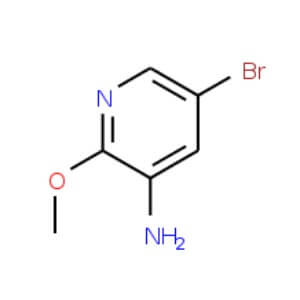
To a solution of 5-bromo-2-(methyloxy)-3-nitropyridine (45 g, 193 mmol) in ethyl acetate (1 L) was added tin(II) chloride dihydrate (174 g, 772 mmol). The reaction mixture was heated at reflux for 4 h. LC/MS indicated some starting material remained, so added 20 mol% tin (II) chloride dihydrate and continued to heat at reflux. After 2 h, the reaction was allowed to cool to ambient temperature and concentrated in vacuo. The residue was treated with 2 N sodium hydroxide and the mixture stirred for 1 h. The mixture was then with methylene chloride (1 L), filtered through Celite, and washed with methylene chloride (500 mL). The layers were separated and the organics dried over magnesium sulfate and concentrated to give 5-bromo-2-(methyloxy)-3-pyridinamine (23 g, 113 mmol, 58.7 % yield). The product was used crude in subsequent reactions. MS(ES)+ m/e 201.9, 203.9 [M+H]+.

c) N-[5-bromo-2-(methyloxy)-3-pyridinyl]-2,4-difluorobenzenesulfonamide

Figure imgf000151_0002

To a cooled (0 °C) solution of 5-bromo-2-(methyloxy)-3-pyridinamine (20.3 g, 100 mmol) in pyridine (200 mL) was added slowly 2,4-difluorobenzenesulfonyl chloride (21.3 g, 100 mmol) over 15 min (reaction became heterogeneous). The ice bath was removed and the reaction was stirred at ambient temperature for 16 h, at which time the reaction was diluted with water (500 mL) and the solids filtered off and washed with copious amounts of water. The precipitate was dried in a vacuum oven at 50 °C to give N-[5-bromo-2-(methyloxy)-3-pyridinyl]-2,4- difluorobenzenesulfonamide (12 g, 31.6 mmol, 31.7 % yield) MS(ES)+ m/e 379.0, 380.9 [M+H]+.


References

1. Knight et al., ACS Med. Chem. Lett. 2010, 1, 39-43.
2. Hardwick et al., Mol. Cancer Ther. 2009, 8(12), Supplement I, Abstract C63.
3. Greger et al., Combinations of BRAF, MEK, and PI3K/mTOR inhibitors overcome acquired resistance to the BRAF inhibitor GSK2118436 dabrafenib, mediated by NRAS or MEK mutations. Mol. Cancer Ther. 2012, 11(4), 909-920.

1: Zhang Y, Xue D, Wang X, Lu M, Gao B, Qiao X. Screening of kinase inhibitors targeting BRAF for regulating autophagy based on kinase pathways. Mol Med Rep. 2014 Jan;9(1):83-90. doi: 10.3892/mmr.2013.1781. Epub 2013 Nov 7. PubMed PMID: 24213221.

2: Villanueva J, Infante JR, Krepler C, Reyes-Uribe P, Samanta M, Chen HY, Li B, Swoboda RK, Wilson M, Vultur A, Fukunaba-Kalabis M, Wubbenhorst B, Chen TY, Liu Q, Sproesser K, DeMarini DJ, Gilmer TM, Martin AM, Marmorstein R, Schultz DC, Speicher DW, Karakousis GC, Xu W, Amaravadi RK, Xu X, Schuchter LM, Herlyn M, Nathanson KL. Concurrent MEK2 mutation and BRAF amplification confer resistance to BRAF and MEK inhibitors in melanoma. Cell Rep. 2013 Sep 26;4(6):1090-9. doi: 10.1016/j.celrep.2013.08.023. Epub 2013 Sep 19. PubMed PMID: 24055054; PubMed Central PMCID: PMC3956616.

3: Kim HG, Tan L, Weisberg EL, Liu F, Canning P, Choi HG, Ezell SA, Wu H, Zhao Z, Wang J, Mandinova A, Griffin JD, Bullock AN, Liu Q, Lee SW, Gray NS. Discovery of a potent and selective DDR1 receptor tyrosine kinase inhibitor. ACS Chem Biol. 2013 Oct 18;8(10):2145-50. doi: 10.1021/cb400430t. Epub 2013 Aug 13. PubMed PMID: 23899692; PubMed Central PMCID: PMC3800496.

4: Khalili JS, Yu X, Wang J, Hayes BC, Davies MA, Lizee G, Esmaeli B, Woodman SE. Combination small molecule MEK and PI3K inhibition enhances uveal melanoma cell death in a mutant GNAQ- and GNA11-dependent manner. Clin Cancer Res. 2012 Aug 15;18(16):4345-55. doi: 10.1158/1078-0432.CCR-11-3227. Epub 2012 Jun 25. PubMed PMID: 22733540; PubMed Central PMCID: PMC3935730.

5: Greger JG, Eastman SD, Zhang V, Bleam MR, Hughes AM, Smitheman KN, Dickerson SH, Laquerre SG, Liu L, Gilmer TM. Combinations of BRAF, MEK, and PI3K/mTOR inhibitors overcome acquired resistance to the BRAF inhibitor GSK2118436 dabrafenib, mediated by NRAS or MEK mutations. Mol Cancer Ther. 2012 Apr;11(4):909-20. doi: 10.1158/1535-7163.MCT-11-0989. Epub 2012 Mar 2. PubMed PMID: 22389471.

6: Wang M, Gao M, Miller KD, Sledge GW, Zheng QH. [11C]GSK2126458 and [18F]GSK2126458, the first radiosynthesis of new potential PET agents for imaging of PI3K and mTOR in cancers. Bioorg Med Chem Lett. 2012 Feb 15;22(4):1569-74. doi: 10.1016/j.bmcl.2011.12.136. Epub 2012 Jan 10. PubMed PMID: 22297110.

7: Schenone S, Brullo C, Musumeci F, Radi M, Botta M. ATP-competitive inhibitors of mTOR: an update. Curr Med Chem. 2011;18(20):2995-3014. Review. PubMed PMID: 21651476.

8: Leung E, Kim JE, Rewcastle GW, Finlay GJ, Baguley BC. Comparison of the effects of the PI3K/mTOR inhibitors NVP-BEZ235 and GSK2126458 on tamoxifen-resistant breast cancer cells. Cancer Biol Ther. 2011 Jun 1;11(11):938-46. Epub 2011 Jun 1. PubMed PMID: 21464613; PubMed Central PMCID: PMC3127046.

GSK 2269557 In Phase 1….Asthma , COPD, is it COMPD A OR B?


COMPD A


COMPD B

Compd A OR B IS GSK 2269557

Phosphatidylinositol 3-Kinase (PI3K)
PHASE 1….asthma & COPD
ASHTHMA COPD

DATA FOR COMPD A

6-​(1H-​indol-​4-​yl)​-​4-​[5-​[[4-​(1-​methylethyl)​-​1-​piperazinyl]​methyl]​-​2-​oxazolyl]​-1H-​Indazole,

6-(1 H-lndol-4-yl)-4-(5-{[4-(1-methylethyl)-1-piperazinyl]methyl}-1,3-oxazol-2-yl)-1 H- indazole

CAS 1254036-77-5 hcl salt
base 1254036-71-9, 440.54, C26 H28 N6 O
Formula C26H28N6O.HCl

EMAIL ME amcrasto@gmail.com

DATA FOR COMPD B
Methanesulfonamide, N-​[5-​[4-​[5-​[[(2R,​6S)​-​2,​6-​dimethyl-​4-​morpholinyl]​methyl]​-​2-​oxazolyl]​-​1H-​indazol-​6-​yl]​-​2-​methoxy-​3-​pyridinyl]​-​,
N-[5-[4-(5-{[(2R,6S)-2,6-dimethyl-4-morpholinyl]methyl}-1,3-oxazol-2-yl)-1H-indazol-6-yl]-2-(methyloxy)-3-pyridinyl]methanesulfonamide
1254036-66-2 CAS
C24 H28 N6 O5 S, 512.58
Compound B may be prepared according to known procedures, such as those disclosed in international patent application PCT/EP2010/055666 (publication number WO02010/125082)
EMAIL ME amcrasto@gmail.com

Phosphoinositide 3ΌΗ kinases (hereinafter PI3Ks) are a family of signal transducer enzymes which are involved in various cellular functions including cell growth, proliferation and differentiation. A wide variety of retroviruses and DNA-based viruses activate the PI3K pathway as a way of preventing host cell death during viral infection and ultimately exploiting the host cell synthesis machinery for its replication (Virology 344(1) p. 131-8 (2006) by Vogt et al.; and Nat. Rev. Microbiol. 6(4) p. 265-75 (2008) by Buchkovich et al). It has therefore been postulated that PI3K inhibitors may have potential therapeutic benefit in the treatment of viral infections such as influenza virus infection, in addition to the more established treatment of cancer and inflammatory diseases.

The Influenza NS1 protein activates Class la PI3Ks by binding to their regulatory subunit p85beta but not to other Class la regulatory subunits such as p85alpha. The recent crystal structure of the NS1-p85beta complex (Hale et al. Proc. Natl. Acad. Sci. U S A. 107(5) p.1954-1959 (2010)) is also suggestive of an interaction with the p110 kinase subunit providing a mechanism for catalytic activation of the kinase domain. This observation provides a rationale for isoform specificity not only with the p85 regulatory subunit but also potentially with the p110 catalytic subunit too. The function of PI3K during influenza virus infection has also been investigated by, for example, Ehrhardt et al. (Cell. Microbiol. 8(8) p. 1336-1348 (2006)), and the role of PI3K5 signalling in morbidity and lung pathology induced by influenza virus infection has been reported in WO 2010/083163.

There remains a need to provide compounds which are inhibitors of the activity or function of PI3K5 which may be useful in the treatment or prevention of influenza virus infection.

GSK 2269557 is an inhaled phosphatidylinositol 3-kinase delta (PI3Kdelta) inhibitor in early clinical trials at GlaxoSmithKline for the treatment of patients with asthma and also for the treatment of chronic obstructive pulmonary disease (COPD) in patients who smoke cigarettes.

  • 18 Nov 2014GlaxoSmithKline plans a phase II trial in Chronic obstructive pulmonary disease in Belgium, Denmark, the Netherlands and Russia (NCT02294734)
  • 01 Jun 2014Phase-II clinical trials in Chronic obstructive pulmonary disease in Germany (Inhalation)
  • 01 May 2014GlaxoSmithKline plans a phase II trial for Chronic obstructive pulmonary disease in Germany (NCT02130635)
Study ID Status Title Patient Level Data
115117 Completed A single-centre. double-blind, placebo controlled three part study to evaluate the safety, tolerability, pharmacokinetics (PK), and pharmacodynamics (PD) of single and repeat doses of nebulised GSK2269557 in healthy male subjects
115119 Active not recruiting A Double-Blind, Placebo Controlled, Randomised, Parallel Group Study to Evaluate the Safety, Tolerability and Pharmacokinetics of Multiple Doses of GSK2269557 Administered as a Dry Powder to COPD Patients
116617 Completed A Single-Centre, Double-Blind, Placebo Controlled Two Part Study to Evaluate the Safety, Tolerability and Pharmacokinetics of Single and Repeat Doses of GSK2269557 as a Dry Powder in Healthy Subjects who Smoke Cigarettes
116678 Not yet recruiting A Randomised, Double-blind (Sponsor Unblinded), Placebo-controlled, Parallel-group, Multicentre Study to Evaluate the Efficacy and Safety of GSK2269557 Administered in Addition to Standard of Care in Adult Subjects Diagnosed With an Acute Exacerbation of Chronic Obstructive Pulmonary Disease

EMAIL ME amcrasto@gmail.com

CLICK ON IMAGES TO VIEW SIMILAR ROUTES FOR COMPD A AND B

EO2

EO1A

CLICK ON IMAGE TO VIEW

EO1B

…………………………………………………………………….

COMPD A

WO 2012032065

http://www.google.com/patents/WO2012032065A1?cl=en

Example 68

6-(1 H-lndol-4-yl)-4-(5-{[4-(1-methylethyl)-1-piperazinyl]methyl}-1,3-oxazol-2-yl)-1 H- indazole

Method A

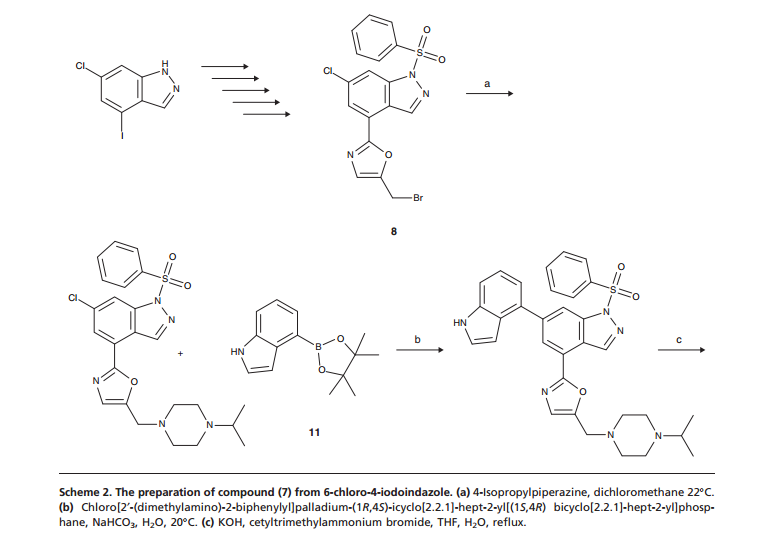
6-Chloro-4-(5-{[4-(1-methylethyl)-1-piperazinyl]methyl}-1 ,3-oxazol-2-yl)-1-(phenylsulfonyl)- 1/-/-indazole (97 mg, 0.194 mmol), 4-(4,4,5,5-tetramethyl-1 ,3,2-dioxaborolan-2-yl)-1 H- indole (61.3 mg, 0.252 mmol, available from Frontier Scientific Europe), chloro[2′- (dimethylamino)-2-biphenylyl]palladium-(1 ,4S)-bicyclo[2.2.1]hept-2-yl[(1 S,4 )- bicyclo[2.2.1]hept-2-yl]phosphane (10.87 mg, 0.019 mmol) and potassium phosphate tribasic (124 mg, 0.582 mmol) were dissolved in 1 ,4-dioxane (1 ml) and water (0.1 ml) and heated in a Biotage Initiator microwave at 100°C for 30 min. Additional 4-(4,4,5,5- tetramethyl-1 ,3,2-dioxabotolan-2-yl)-1 H-indole (61.3 mg, 0.252 mmol) and chloro[2′- (dimethylamino)-2-biphenylyl]palladium-(1 ,4S)-bicyclo[2.2.1]hept-2-yl[(1 S,4 )- bicyclo[2.2.1]hept-2-yl]phosphane (5 mg) were added and the reaction heated at 1 10°C for 30 min, then 140°C for 30 min. The solvent was removed in vacuo and the residue purified by silica gel chromatography, eluting with 0-25% methanol in dichloromethane. The appropriate fractions were combined and concentrated to give a brown solid which was dissolved in MeOH:DMSO (1 ml, 1 : 1 , v/v) and purified by MDAP (method H). The appropriate fractions were concentrated in vacuo to give the title compound as a white solid (30 mg).

LCMS (Method A): Rt 0.57 mins, MH+ 441.

Method B

6-Chloro-4-(5-{[4-(1-methylethyl)-1-piperazinyl]methyl}-1 ,3-oxazol-2-yl)-1-(phenylsulfonyl)- 1 H-indazole (75.17 g, 150 mmol), 4-(4,4,5,5-tetramethyl-1 ,3,2-dioxaborolan-2-yl)-1 H- indole (73.1 g, 301 mmol), sodium bicarbonate (37.9 g, 451 mmol), and chloro[2′- (dimethylamino)-2-biphenylyl]palladium-(1 ,4S)-bicyclo[2.2.1]hept-2-yl[(1 S,4 )- bicyclo[2.2.1]hept-2-yl]phosphane (8.43 g, 15.03 mmol) were suspended in nitrogen purged 1 ,4-dioxane (1200 ml_) and water (300 ml_). The reaction vessel was placed under alternating vacuum and nitrogen five times with overhead stirring, then finally placed under a nitrogen atmosphere and heated to 120°C for 2.5 h.

The reaction mixture was cooled to 45°C and then treated with 2M aqueous sodium hydroxide (376 ml_, 752 mmol). After stirring at 45°C overnight (~ 13h), the mixture was cooled to RT and DCM (600 ml) and water (400 ml) were added. The layers were separated and the aqueous re-extracted with DCM: 1 ,4-dioxane (1 : 1). Brine was added and the mixture filtered through Celite, washing with DCM: 1 ,4-dioxane (1 : 1). The layers were separated and 2M HCI (1000 ml) added to the organic. The mixture was again filtered through Celite washing with 500 ml 2M HCI keeping the washings separate. The filtrate layers were then separated and the organic layer was washed with the acid washings from the Celite. Layers were separated and the acidic aqueous combined. This was then back-washed with 2×500 ml of DCM; each wash requiring a Celite filtration. The acidic aqueous was then given a final filtration through Celite washing the Celite pad with 150 ml of 2M HCI.

The acidic aqueous was transfered to a beaker (5000 ml) and with vigorous stirring 2M NaOH was added to basify the mixture to pH 10-11. The mixture was then extracted using 1 ,4-dioxane: DCM (1 : 1) (5 x 500 ml). The combined organics were washed with brine, dried over magnesium sulphate, filtered and evaporated to yield a brown foam that was dried in vacuo at 50°C overnight. This material was split into three batches and each was purified by reverse phase column chromatography (3x 1.9 kg C18 column), loading in DMF/TFA (1 : 1 , 30 ml) then eluting with 3-40% MeCN in Water + 0.25% TFA (Note: Columns 2 & 3 used a different gradient starting with 10% MeCN).

Appropriate fractions were combined, the acetotnitrile removed in vacuo and the acidic aqueous basified to pH10 by addition of saturated aqueous sodium carbonate solution to the stirred solution. The resultant solid was collected by filtration, washed with water then dried in vacuo at 65°C overnight to give the title compound (28.82 g) as a pale brown foam.

LCMS (Method A): Rt 0.68 mins, MH+ 441.

1 H NMR (400MHz ,DMSO-d6) d = 13.41 (br. s., 1 H), 11.35 (br. s., 1 H), 8.59 (br. s., 1 H), 8.07 (d, J = 1.5 Hz, 1 H), 7.90 (br. s., 1 H), 7.51 – 7.44 (m, 2 H), 7.32 (s, 1 H), 7.27 – 7.21 (m, 2 H), 6.61 – 6.58 (m, 1 H), 3.73 (br. s., 2 H), 2.64 – 2.36 (m, 9 H), 0.97 – 0.90 (m, 6 H)

Method C

Potassium hydroxide (145.6 g) was added to a suspension of 6-(1 H-indol-4-yl)-4-(5-{[4-(1- methylethyl)-1-piperazinyl]methyl}-1 ,3-oxazol-2-yl)-1-(phenylsulfonyl)-1 H-indazole (300.7 g) and cetyltrimethylammonium bromide (9.3 g) in tetrahydrofuran (6.0 L) and water (30 ml) stirring under nitrogen at ambient temperature. The mixture was heated at reflux for 17 hours and was then cooled to 20-25°C. Ethyl acetate (3.0 L) and water (3.0 L) were added, stirred for 10 minutes and then separated. The organic layer was extracted with hydrochloric acid (1 M, 1 x 3.0 L, 2 x 1.5L) and the acidic extracts combined and basified to ~pH 8 by the addition of saturated sodium carbonate solution (2.1 L). After ageing for 30 minutes the resultant suspension was filtered, washed with water (300 ml) and the solid dried under vacuum at 65°C to give the title compound as a pale yellow solid (127.9 g).

LCMS (Method B): Rt 2.44 min, MH+ 441.

…………………………………………………………………………

WO 2010125082

http://www.google.co.in/patents/WO2010125082A1?cl=en

Example 6

6-(1 H-lndol-4-yl)-4-(5-{[4-(1 -methylethyl)-1 -piperazinyl]methyl}-1 ,3-oxazol-2-yl)-1 H- indazole

Method A

6-Chloro-4-(5-{[4-(1-methylethyl)-1-piperazinyl]methyl}-1 ,3-oxazol-2-yl)-1-(phenylsulfonyl)- 1H-indazole (97 mg, 0.194 mmol), 4-(4,4,5,5-tetramethyl-1 ,3,2-dioxaborolan-2-yl)-1 H- indole (61.3 mg, 0.252 mmol, available from Frontier Scientific Europe), chloro[2′- (dimethylamino)-2-biphenylyl]palladium-(1 R,4S)-bicyclo[2.2.1]hept-2-yl[(1 S,4R)- bicyclo[2.2.1]hept-2-yl]phosphane (10.87 mg, 0.019 mmol) and potassium phosphate tribasic (124 mg, 0.582 mmol) were dissolved in 1 ,4-dioxane (1 ml) and water (0.1 ml) and heated in a Biotage Initiator microwave at 1000C for 30 min. Additional 4-(4, 4,5,5- tetramethyl-1 ,3,2-dioxabotolan-2-yl)-1 H-indole (61.3 mg, 0.252 mmol) and chloro[2′- (dimethylamino)-2-biphenylyl]palladium-(1 R,4S)-bicyclo[2.2.1]hept-2-yl[(1 S,4R)- bicyclo[2.2.1]hept-2-yl]phosphane (5 mg) were added and the reaction heated at 1 1O0C for 30 min, then 14O0C for 30 min. The solvent was removed in vacuo and the residue purified by silica gel chromatography, eluting with 0-25% methanol in dichloromethane. The appropriate fractions were combined and concentrated to give a brown solid which was dissolved in MeOH:DMSO (1 ml, 1 :1 , v/v) and purified by MDAP (method A). The appropriate fractions were concentrated in vacuo to give the title compound as a white solid (30 mg).

LCMS (Method A): Rt 0.57 mins, MH+ 441.

Method B

6-Chloro-4-(5-{[4-(1-methylethyl)-1-piperazinyl]methyl}-1 ,3-oxazol-2-yl)-1-(phenylsulfonyl)- 1 H-indazole (75.17 g, 150 mmol), 4-(4,4,5,5-tetramethyl-1 ,3,2-dioxaborolan-2-yl)-1 H- indole (73.1 g, 301 mmol), sodium bicarbonate (37.9 g, 451 mmol), and chloro[2′- (dimethylamino)-2-biphenylyl]palladium-(1 R,4S)-bicyclo[2.2.1]hept-2-yl[(1 S,4R)- bicyclo[2.2.1]hept-2-yl]phosphane (8.43 g, 15.03 mmol) were suspended in nitrogen purged 1 ,4-dioxane (1200 ml.) and water (300 ml_). The reaction vessel was placed under alternating vacuum and nitrogen five times with overhead stirring, then finally placed under a nitrogen atmosphere and heated to 1200C for 2.5 h.

The reaction mixture was cooled to 45°C and then treated with 2M aqueous sodium hydroxide (376 ml_, 752 mmol). After stirring at 450C overnight (~ 13h), the mixture was cooled to RT and DCM (600 ml) and water (400 ml) were added. The layers were separated and the aqueous re-extracted with DCM: 1 ,4-dioxane (1 :1 ). Brine was added and the mixture filtered through Celite, washing with DCM: 1 ,4-dioxane (1 :1 ). The layers were separated and 2M HCI (1000 ml) added to the organic. The mixture was again filtered through Celite washing with 500 ml 2M HCI keeping the washings separate. The filtrate layers were then separated and the organic layer was washed with the acid washings from the Celite. Layers were separated and the acidic aqueous combined. This was then back-washed with 2×500 ml of DCM; each wash requiring a Celite filtration. The acidic aqueous was then given a final filtration through Celite washing the Celite pad with 150 ml of 2M HCI.

The acidic aqueous was transfered to a beaker (5000 ml) and with vigorous stirring 2M NaOH was added to basify the mixture to pH 10-11. The mixture was then extracted using 1 ,4-dioxane:DCM (1 :1 ) (5 x 500 ml). The combined organics were washed with brine, dried over magnesium sulphate, filtered and evaporated to yield a brown foam that was dried in vacuo at 500C overnight.

This material was split into three batches and each was purified by reverse phase column chromatography (3x 1.9 kg C18 column), loading in DMF/TFA (1 :1 , 30 ml) then eluting with 3-40% MeCN in Water + 0.25% TFA (Note: Columns 2 & 3 used a different gradient starting with 10% MeCN).

Appropriate fractions were combined, the acetotnitrile removed in vacuo and the acidic aqueous basified to pH10 by addition of saturated aqueous sodium carbonate solution to the stirred solution. The resultant solid was collected by filtration, washed with water then dried in vacuo at 65°C overnight to give the title compound (28.82 g) as a pale brown foam.

LCMS (Method A): Rt 0.68 mins, MH+ 441. 1H NMR (400MHz ,DMSOd6) d = 13.41 (br. s., 1 H), 11.35 (br. s., 1 H), 8.59 (br. s., 1 H), 8.07 (d, J = 1.5 Hz, 1 H), 7.90 (br. s., 1 H), 7.51 – 7.44 (m, 2 H), 7.32 (s, 1 H), 7.27 – 7.21 (m, 2 H), 6.61 – 6.58 (m, 1 H), 3.73 (br. s., 2 H), 2.64 – 2.36 (m, 9 H), 0.97 – 0.90 (m, 6 H)

EMAIL ME amcrasto@gmail.com

COMPD B

WO2010125082

http://www.google.co.in/patents/WO2010125082A1?cl=en

Example 1

Λ/-[5-[4-(5-{[(2/?,6S)-2,6-Dimethyl-4-morpholinyl]methyl}-1,3-oxazol-2-yl)-1H-indazol-

6-yl]-2-(methyloxy)-3-pyridinyl]methanesulfonamide

Method A

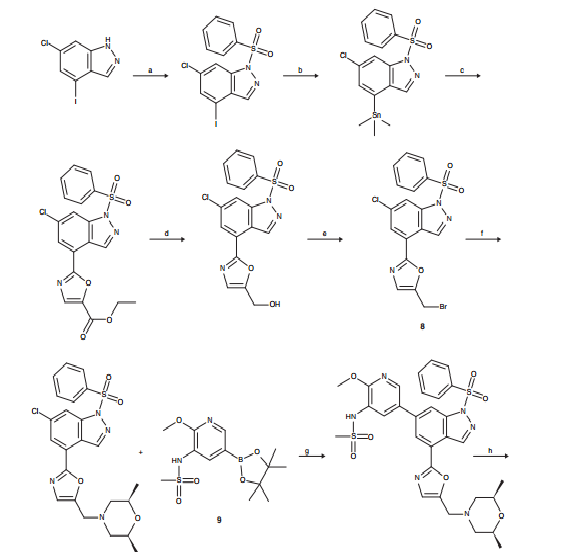
To a solution of 6-chloro-4-(5-{[(2R,6S)-2,6-dimethyl-4-morpholinyl]methyl}-1 ,3-oxazol-2- yl)-1-(phenylsulfonyl)-1 H-indazole (0.20 g, 0.411 mmol) and N-[2-(methoxy)-5-(4,4,5,5- tetramethyl-1 ,3,2-dioxaborolan-2-yl)-3-pyridyl]methanesulfonamide (0.175 g, 0.534 mmol) in 1 ,4-dioxane (2 ml) was added chloro[2′-(dimethylamino)-2-biphenylyl]palladium- 1 (1 /?,4S)-bicyclo[2.2.1]hept-2-yl[(1 S,4/?)-bicyclo[2.2.1]hept-2-yl]phosphane (11.5 mg, 0.021 mmol), potassium phosphate tribasic (0.262 g, 1.23 mmol) and water (0.2 ml). The reaction mixture was heated and stirred at 12O0C under microwave irradiation for 1 h. Additional chloroP’^dimethylamino^-biphenylyOpalladium-^I R^S^bicycloP^.ilhept^- yl[(1 S,4/?)-bicyclo[2.2.1]hept-2-yl]phosphane (11.5 mg, 0.021 mmol) and potassium phosphate tribasic (80 mg) were added and the reaction heated to 12O0C under microwave irradiation for 1 h. Additional potassium phospate tribasic (80 mg) was added and the reaction heated under the same conditions for a further 1 h. The reaction mixture was filtered through a silica SPE and eluted with methanol. The solvent was removed in vacuo and the residue partitioned between dichloromethane (5 ml) and water (5 ml). The layers were separated and the aqueous extracted with further dichloromethane (2x 2 ml). The combined organics were concentrated under a stream of nitrogen and the residue dissolved in MeOH:DMSO (3ml, 1 :1 , v/v) and purified by MDAP (method A) in 3 injections. The appropriate fractions were combined and concentrated to give a white solid which was dissolved in MeOH:DMSO (1 ml, 1 :1 , v/v) and further purified by MDAP (method B). The appropriate fractions were basified to pH 6 with saturated sodium bicarbonate solution and extracted with ethyl acetate (2x 25 ml). The combined organics were dried and evaporated in vacuo to give a white solid which was further dried under nitrogen at 4O0C for 3 h to give the title compound as a white solid (26 mg). LCMS (Method A): Rt 0.53 mins, MH+ 513.

Method B N-[2-(Methyloxy)-5-(4,4,5,5-tetramethyl-1 ,3,2-dioxaborolan-2-yl)-3- pyridinyl]methanesulfonamide (101 g, 308 mmol), 6-chloro-4-(5-{[(2R,6S)-2,6-dimethyl-4- morpholinyl]methyl}-1 ,3-oxazol-2-yl)-1-(phenylsulfonyl)-1 H-indazole (83.3 g, 154 mmol) and sodium bicarbonate (38.8 g, 462 mmol) were suspended in 1 ,4-dioxane (1840 ml) and water (460 ml) under nitrogen and heated to 800C. Chloro[2′-(dimethylamino)-2- biphenylyl]palladium-1 (1 R,4S)-bicyclo[2.2.1]hept-2-yl[(1 S,4R)-bicyclo[2.2.1]hept-2- yl]phosphane (8.63 g, 15.40 mmol) was added and the mixture stirred overnight at 800C.

The reaction mixture was cooled to 450C, sodium hydroxide 2M aq. (770 ml, 1540 mmol) added and the reaction heated to 45 0C for 4 hours. The mixture was cooled to RT and diluted with water (610 ml_). Dichloromethane (920 ml.) was added, and the mixture was filtered twice through Celite (washed with 200 ml. 1 ,4-dioxane/DCM 2:1 each time). The phases were separated, and aqueous washed with 1 ,4-dioxane/DCM 2:1 (500 ml_). The aqueous phase was neutralised with hydrochloric acid to pH -7 and extracted with 1 ,4- dioxane/DCM 2:1 (1 L), then 1 ,4 dioxane/DCM 1 :1 (2×500 ml_). The organics were washed with brine (500 ml_), and filtered through Celite (washed with 200 ml. 1 ,4 dioxane/DCM 2:1 ), and evaporated to yield a dark black solid, which was purified in 4 batches:

Batch 1 : 28g was dissolved in Toluene/Ethanol/Ammonia 80:20:2 (100 ml.) and purified by column chromatography (1.5 kg silica column), eluting with Toluene/Ethanol/Ammonia 80:20:2 to give the title compound as an off-white solid (14.78 g).

Batch 2: 3Og was dissolved in methanol and mixed with Fluorisil. The solvent was then removed by evaporation and the solid purified by column chromatography (1.5 kg silica column, solid sample injection module), eluting with Toluene/Ethanol/Ammonia 80:20:2 to give the title compound as an off-white solid (9.44 g).

Batch 3: 31 g was dissolved in Toluene/Ethanol/Ammonia 80:20:2 (100 ml.) and purified by column chromatography (1.5 kg silica column), eluting with Toluene/Ethanol/Ammonia 80:20:2 to give the title compound as an off-white solid (17 g).

Batch 4: 29g was dissolved in Toluene/Ethanol/Ammonia 80:20:2 (100 ml.) and purified by column chromatography (1.5 kg silica column), eluting with Toluene/Ethanol/Ammonia 80:20:2 to give the title compound as an off-white solid (21 g).

The mixed fractions from the 4 columns were combined and evaporated to yield 19 g which was dissolved in 200 ml. of Toluene/Ethanol/Ammonia 80:20:2 (+ additional 4ml of 0.88 NH3 to help solubility) then purified by column chromatography (1.5 kg silica column), eluting with Toluene/Ethanol/Ammonia 80:20:2 to give the title compound as an off-white solid (6.1 g).

All pure batches were combined (68 g) and recrystallised from ethanol (1200 ml_). The suspension was heated to reflux and a solution formed. The resulting solution was then cooled to room temperature overnight. The resulting solid was then collected by filtration, washed sparingly with ethanol and dried under vacuum to give the title compound as an off-white solid (56 g). This material was recrystallised again from ethanol (1 100 ml_). The suspension was heated to reflux and a solution formed. The resulting solution was then cooled to room temperature overnight with stirring. The resulting solid was collected by filtration and washed sparingly with ethanol. The solid was dried in vacuo at 600C for 5hrs to give the title compound as an off-white solid (45.51 g). LCMS (Method A): Rt 0.61 mins, MH+ 513.

The filtrate from the two recrystallisations was evaporated to yield -23 g of a solid residue that was dissolved in 200 ml. of Toluene/Ethanol/Ammonia 80:20:2 (+ additional 4ml of 0.88 NH3 to help solubility) then purified by column chromatography (1.5 kg silica column), eluting with Toluene/Ethanol/Ammonia 80:20:2 to give a further crop of the title compound as an off-white solid (18.5 g). This solid was then recrystallised from ethanol (370 ml_). The suspension was heated to reflux then the resulting solution stirred for 20 mins before being allowed to cool to room temperature naturally overnight. The solid was then dried in vacuo at 65°C overnight to give the title compound as an off-white solid (11.9O g). LCMS (Method A): Rt 0.62 mins, MH+ 513.

………………………………………..

 http://www.google.co.in/patents/US8735390

Example 1N-[5-[4-(5-{[(2R,6S)-2,6-Dimethyl-4-morpholinyl]methyl}-1,3-oxazol-2-yl)-1H-indazol-6-yl]-2-(methyloxy)-3-pyridinyl]methanesulfonamide

Method A

To a solution of 6-chloro-4-(5-{[(2R,6S)-2,6-dimethyl-4-morpholinyl]methyl}-1,3-oxazol-2-yl)-1-(phenylsulfonyl)-1H-indazole (0.20 g, 0.411 mmol) and N-[2-(methoxy)-5-(4,4,5,5-tetramethyl-1,3,2-dioxaborolan-2-yl)-3-pyridyl]methanesulfonamide (0.175 g, 0.534 mmol) in 1,4-dioxane (2 ml) was added chloro[2′-(dimethylamino)-2-biphenylyl]palladium-1(1R,4S)-bicyclo[2.2.1]hept-2-yl[(1S,4R)-bicyclo[2.2.1]hept-2-yl]phosphane (11.5 mg, 0.021 mmol), potassium phosphate tribasic (0.262 g, 1.23 mmol) and water (0.2 ml). The reaction mixture was heated and stirred at 120° C. under microwave irradiation for 1 h. Additional chloro[2′-(dimethylamino)-2-biphenylyl]palladium-1(1R,4S)-bicyclo[2.2.1]hept-2-yl[(1S,4R)-bicyclo[2.2.1]hept-2-yl]phosphane (11.5 mg, 0.021 mmol) and potassium phosphate tribasic (80 mg) were added and the reaction heated to 120° C. under microwave irradiation for 1 h. Additional potassium phospate tribasic (80 mg) was added and the reaction heated under the same conditions for a further 1 h. The reaction mixture was filtered through a silica SPE and eluted with methanol. The solvent was removed in vacuo and the residue partitioned between dichloromethane (5 ml) and water (5 ml). The layers were separated and the aqueous extracted with further dichloromethane (2×2 ml). The combined organics were concentrated under a stream of nitrogen and the residue dissolved in MeOH:DMSO (3 ml, 1:1, v/v) and purified by MDAP (method A) in 3 injections. The appropriate fractions were combined and concentrated to give a white solid which was dissolved in MeOH:DMSO (1 ml, 1:1, v/v) and further purified by MDAP (method B). The appropriate fractions were basified to pH 6 with saturated sodium bicarbonate solution and extracted with ethyl acetate (2×25 ml). The combined organics were dried and evaporated in vacuo to give a white solid which was further dried under nitrogen at 40° C. for 3 h to give the title compound as a white solid (26 mg).

LCMS (Method A): Rt 0.53 mins, MH+ 513.

Method B

N-[2-(Methyloxy)-5-(4,4,5,5-tetramethyl-1,3,2-dioxaborolan-2-yl)-3-pyridinyl]methanesulfonamide (101 g, 308 mmol), 6-chloro-4-(5-{[(2R,6S)-2,6-dimethyl-4-morpholinyl]methyl}-1,3-oxazol-2-yl)-1-(phenylsulfonyl)-1H-indazole (83.3 g, 154 mmol) and sodium bicarbonate (38.8 g, 462 mmol) were suspended in 1,4-dioxane (1840 ml) and water (460 ml) under nitrogen and heated to 80° C. Chloro[2′-(dimethylamino)-2-biphenylyl]palladium-1(1R,4S)-bicyclo[2.2.1]hept-2-yl[(1S,4R)-bicyclo[2.2.1]hept-2-yl]phosphane (8.63 g, 15.40 mmol) was added and the mixture stirred overnight at 80° C.

The reaction mixture was cooled to 45° C., sodium hydroxide 2M aq. (770 ml, 1540 mmol) added and the reaction heated to 45° C. for 4 hours. The mixture was cooled to RT and diluted with water (610 mL). Dichloromethane (920 mL) was added, and the mixture was filtered twice through Celite (washed with 200 mL 1,4-dioxane/DCM 2:1 each time). The phases were separated, and aqueous washed with 1,4-dioxane/DCM 2:1 (500 mL). The aqueous phase was neutralised with hydrochloric acid to pH ˜7 and extracted with 1,4-dioxane/DCM 2:1 (1 L), then 1,4 dioxane/DCM 1:1 (2×500 mL). The organics were washed with brine (500 mL), and filtered through Celite (washed with 200 mL 1,4 dioxane/DCM 2:1), and evaporated to yield a dark black solid, which was purified in 4 batches:

  • Batch 1: 28 g was dissolved in Toluene/Ethanol/Ammonia 80:20:2 (100 mL) and purified by column chromatography (1.5 kg silica column), eluting with Toluene/Ethanol/Ammonia 80:20:2 to give the title compound as an off-white solid (14.78 g).
  • Batch 2: 30 g was dissolved in methanol and mixed with Fluorisil. The solvent was then removed by evaporation and the solid purified by column chromatography (1.5 kg silica column, solid sample injection module), eluting with Toluene/Ethanol/Ammonia 80:20:2 to give the title compound as an off-white solid (9.44 g).
  • Batch 3: 31 g was dissolved in Toluene/Ethanol/Ammonia 80:20:2 (100 mL) and purified by column chromatography (1.5 kg silica column), eluting with Toluene/Ethanol/Ammonia 80:20:2 to give the title compound as an off-white solid (17 g).
  • Batch 4: 29 g was dissolved in Toluene/Ethanol/Ammonia 80:20:2 (100 mL) and purified by column chromatography (1.5 kg silica column), eluting with Toluene/Ethanol/Ammonia 80:20:2 to give the title compound as an off-white solid (21 g).

The mixed fractions from the 4 columns were combined and evaporated to yield 19 g which was dissolved in 200 mL of Toluene/Ethanol/Ammonia 80:20:2 (+additional 4 ml of 0.88 NH3 to help solubility) then purified by column chromatography (1.5 kg silica column), eluting with Toluene/Ethanol/Ammonia 80:20:2 to give the title compound as an off-white solid (6.1 g).

All pure batches were combined (68 g) and recrystallised from ethanol (1200 mL). The suspension was heated to reflux and a solution formed. The resulting solution was then cooled to room temperature overnight. The resulting solid was then collected by filtration, washed sparingly with ethanol and dried under vacuum to give the title compound as an off-white solid (56 g). This material was recrystallised again from ethanol (1100 mL). The suspension was heated to reflux and a solution formed. The resulting solution was then cooled to room temperature overnight with stirring. The resulting solid was collected by filtration and washed sparingly with ethanol. The solid was dried in vacuo at 60° C. for 5 hrs to give the title compound as an off-white solid (45.51 g).

LCMS (Method A): Rt 0.61 mins, MH+ 513.

The filtrate from the two recrystallisations was evaporated to yield ˜23 g of a solid residue that was dissolved in 200 mL of Toluene/Ethanol/Ammonia 80:20:2 (+additional 4 ml of 0.88 NH3 to help solubility) then purified by column chromatography (1.5 kg silica column), eluting with Toluene/Ethanol/Ammonia 80:20:2 to give a further crop of the title compound as an off-white solid (18.5 g). This solid was then recrystallised from ethanol (370 mL). The suspension was heated to reflux then the resulting solution stirred for 20 mins before being allowed to cool to room temperature naturally overnight. The solid was then dried in vacuo at 65° C. overnight to give the title compound as an off-white solid (11.90 g).

LCMS (Method A): Rt 0.62 mins, MH+ 513.

Method C

10M Sodium hydroxide solution (0.70 ml) was added to a stirred suspension of N-[5-[4-(5-{[(2R,6S)-2,6-dimethyl-4-morpholinyl]methyl}-1,3-oxazol-2-yl)-1-(phenylsulfonyl)-1H-indazol-6-yl]-2-(methyloxy)-3-pyridinyl]methanesulfonamide (1.17 g) in water (5.8 ml). The resulting mixture was stirred at room temperature for 3.75 hours and was then washed with ethyl acetate (2×6 ml). The layers were separated and the aqueous phase was acidified to pH 6 with 2M hydrochloric acid (0.8 ml). The acidified aqueous layer was extracted twice with ethyl acetate (11 ml then 5 ml). The combined ethyl acetate extracts were dried by azeotropic distillation and diluted with further ethyl acetate (11 ml). The misture was stirred at room temperature for 112 hours. The slurry was seeded and then stirred at room temperature for 48 hours. The resultant suspension was filtered, washed with ethyl acetate (2×2 ml) and the solid dried under vacuum at 40° C. to give the title compound as a pale yellow solid (0.58 g).

LCMS (Method B): Rt 1.86 min, MH+ 513.

Method D

To a suspension of N-[5-[4-(5-{[(2R,6S)-2,6-dimethyl-4-morpholinyl]methyl}-1,3-oxazol-2-yl)-1-(phenylsulfonyl)-1H-indazol-6-yl]-2-(methyloxy)-3-pyridinyl]methanesulfonamide (596.5 g, 0.91 mol) in water (3.8 L) is added 5M sodium hydroxide (715 ml, 3.56 mol) over 20 mins at <25° C. The mixture is stirred at 20±3° C. for 2 h 45 min then washed with EtCN (3 L). The pH of the basic aqueous phase is adjusted to pH 6.6 using 2M hydrochloric acid (1.4 L), maintaining the temperature below 30° C. The mixture is then extracted with MeTHF (2×4.8 L), and the combined MeTHF extracts are washed with water (1.2 L). The mixture is concentrated to approx 2.4 L and EtOAc (3 L) is added. This put and take distillation is repeated a further 3 times. The mixture is adjusted to 60±3° C. and seeded twice (2×3 g) 35 mins apart. The resultant is aged for 1 h 10 mins then cooled over 2 h to 20-25° C., and aged for a further 15 h 50 min. The slurry is filtered, washed with EtOAc (2×1.2 L) and dried in vacuo at 45±5° C. for approx 3 day to give the title compound.

Preparation of Polymorphs of Compound A

Form (II)

Ethyl acetate (15 ml) was added to N-[5-[4-(5-{[(2R,6S)-2,6-dimethyl-4-morpholinyl]methyl}-1,3-oxazol-2-yl)-1H-indazol-6-yl]-2-(methyloxy)-3-pyridinyl]methanesulfonamide (2.1 g) and was stirred at ambient conditions overnight. The resultant slurry was filtered and dried under vacuum at 50° C. to give a new solid state form (91 ckw/w).

1H NMR (400 MHz, DMSO d6) d=13.49 (br s, 1H), 9.39 (s, 1H), 8.58 (s, 1H), 8.42 (d, J=2.2 Hz, 1H), 7.99 (d, J=2.2 Hz, 1H), 7.93 (d, J=1.2 Hz, 1H), 7.88 (s, 1H), 7.35 (s, 1H), 4.00 (s, 3H), 3.74 (s, 2H), 3.58 (m, 2H), 3.11 (s, 3H), 2.80 (d, J=10.3 Hz, 2H), 1.78 (t, J=10.3 Hz, 2H), 1.05 (d, J=6.4 Hz, 6H)

 SODIUM SALT OF COMPD B

http://www.google.com/patents/US20140256721

Method D

To a suspension of N-[5-[4-(5-{[(2R,6S)-2,6-dimethyl-4-morpholinyl]methyl}-1,3-oxazol-2-yl)-1-(phenylsulfonyl)-1H-indazol-6-yl]-2-(methyloxy)-3-pyridinyl]methanesulfonamide (596.5 g, 0.91 mol) in water (3.8 L) is added 5M sodium hydroxide (715 ml, 3.56 mol) over 20 mins at <25° C. The mixture is stirred at 20±3° C. for 2 h 45 min then washed with EtCN (3 L). The pH of the basic aqueous phase is adjusted to pH 6.6 using 2M hydrochloric acid (1.4 L), maintaining the temperature below 30° C. The mixture is then extracted with MeTHF (2×4.8 L), and the combined MeTHF extracts are washed with water (1.2 L). The mixture is concentrated to approx 2.4 L and EtOAc (3 L) is added. This put and take distillation is repeated a further 3 times. The mixture is adjusted to 60±3° C. and seeded twice (2×3 g) 35 mins apart. The resultant is aged for 1 h 10 mins then cooled over 2 h to 20-25° C., and aged for a further 15 h 50 min. The slurry is filtered, washed with EtOAc (2×1.2 L) and dried in vacuo at 45±5° C. for approx 3 day to give the title compound.

http://www.google.com/patents/US20140256721

Preparation of Salts of Compound ASodium Salt

Methanol (2 ml) was added to N-[5-[4-(5-{[(2R,6S)-2,6-dimethyl-4-morpholinyl]methyl}-1,3-oxazol-2-yl)-1H-indazol-6-yl]-2-(methyloxy)-3-pyridinyl]methanesulfonamide (0.3 g) followed by aqueous sodium hydroxide (0.129 ml) to give a solution. Tert-butylmethylether (4 ml) was added to the solution followed by seed crystals of the sodium salt and this suspension was stirred overnight at ambient conditions. The suspension was filtered, washed with tert-butylmethylether (2 ml) and air dried to give the sodium salt (0.2312 g) as a hydrate.

NMR: Consistent with salt formation

1H NMR (400 MHz, DMSO d6) d=13.35 (br s, 1H), 8.53 (s, 1H), 7.90 (d, J=1.2 Hz, 1H), 7.73 (s, 1H), 7.65 (d, J=2.5 Hz, 1H), 7.62 (d, J=2.2 Hz, 1H), 7.33 (s, 1H), 4.00 (s, 3H), 3.80 (s, 3H), 3.59 (m, 2H). 2.83 (d, J=10.3, 2H), 2.61 (s, 3H), 1.78 (t, J=10.5 Hz, 2H), 1.05 (d, J=6.1 Hz, 6H)

EMAIL ME amcrasto@gmail.com

EMAIL ME amcrasto@gmail.com

US20100280029 * 28 Apr 2010 4 Nov 2010 Julie Nicole Hamblin Novel compounds
WO2010125082A1 28 Apr 2010 4 Nov 2010 Glaxo Group Limited Oxazole substituted indazoles as pi3-kinase inhibitors
US20140256721 * 14 Apr 2014 11 Sep 2014 Glaxosmithkline Intellectual Property Development Limited Novel Polymorphs and Salts
WO2012032065A1 6 Sep 2011 15 Mar 2012 Glaxo Group Limited Indazole derivatives for use in the treatment of influenza virus infection
WO2012032067A1 6 Sep 2011 15 Mar 2012 Glaxo Group Limited Polymorphs and salts of n- [5- [4- (5- { [(2r,6s) -2, 6 – dimethyl – 4 -morpholinyl] methyl} – 1, 3 – oxazol – 2 – yl) – 1h- inda zol-6-yl] -2- (methyloxy) – 3 – pyridinyl] methanesulfonamide
WO2012055846A1 25 Oct 2011 3 May 2012 Glaxo Group Limited Polymorphs and salts of 6-(1h-indol-4-yl)-4-(5- { [4-(1-methylethyl)-1-pi perazinyl] methyl} -1,3-oxazol-2-yl)-1h-indazole as pi3k inhibitors for use in the treatment of e.g. respiratory disorders
WO2012064744A2 * 8 Nov 2011 18 May 2012 Lycera Corporation Tetrahydroquinoline and related bicyclic compounds for inhibition of rorϒ activity and the treatment of disease
WO2013088404A1 14 Dec 2012 20 Jun 2013 Novartis Ag Use of inhibitors of the activity or function of PI3K
WO2014068070A1 31 Oct 2013 8 May 2014 INSERM (Institut National de la Santé et de la Recherche Médicale) Methods for preventing antiphospholipid syndrome (aps)
US8524751 5 Mar 2010 3 Sep 2013 GlaxoSmithKline Intellecutual Property Development 4-oxadiazol-2-YL-indazoles as inhibitors of P13 kinases
US8536169 3 Jun 2009 17 Sep 2013 Glaxo Group Limited Compounds
US8575162 28 Apr 2010 5 Nov 2013 Glaxosmithkline Intellectual Property Development Limited Compounds
US8580797 28 Apr 2010 12 Nov 2013 Glaxo Smith Kline Intellectual Property Development Limited Compounds
US8586583 2 Oct 2012 19 Nov 2013 Glaxosmithkline Intellectual Property Development Limited Compounds
US8586590 2 Oct 2012 19 Nov 2013 Glaxosmithkline Intellectual Property Development Limited Compounds
US8609657 2 Oct 2012 17 Dec 2013 Glaxosmithkline Intellectual Property Development Limited Compounds
US8658635 3 Jun 2009 25 Feb 2014 Glaxosmithkline Intellectual Property Development Limited Benzpyrazol derivatives as inhibitors of PI3 kinases
US8735390 6 Sep 2011 27 May 2014 Glaxosmithkline Intellectual Property Development Limited Polymorphs and salts
US8765743 3 Jun 2009 1 Jul 2014 Glaxosmithkline Intellectual Property Development Limited Compounds

…..

P.S. : The views expressed are my personal and in no-way suggest the views of the professional body or the company that I represent.


COCK WILL TEACH YOU NMR
COCK SAYS MOM CAN TEACH YOU NMR

DRUG APPROVALS BY DR ANTHONY MELVIN CRASTO …..FOR BLOG HOME CLICK HERE
Join me on Linkedin

View Anthony Melvin Crasto Ph.D's profile on LinkedIn

Join me on Facebook FACEBOOK
Join me on twitterFollow amcrasto on Twitter
Join me on google plus Googleplus

 amcrasto@gmail.com

  JALGAON, MAHARASHTRA, INDIA

.


 Image result for jalgaon railway station


.

http://www.aai.aero/allAirports/jalgaon_airport.jpg

.

MANUDEVI

GSK 2793660, Trying to crack the structure


WP_000289COMPD A

WP_000290COMPD B

CCOMPD C

DCOMPD D

Figure imgf000036_0001A
OR
Figure imgf000037_0001 B
or
Figure imgf000028_0001C
OR
Figure imgf000028_0002 D
OUT OF 4 , ONE OF THEM IS GSK 2793660…………… EITHER A OR B OR C OR D,
EMAIL ME AT amcrasto@gmail.com

GSK 2793660

DATA FOR A

HCL SALT CAS 1613458-78-8

BASE CAS 1613458-70-0

C20 H27 N3 O3 . Cl H

MW OF BASE…..357.45

4-amino-N-[(lS,2E)-4-(2,3-dihydro-lH-indol-l-yl)-l-ethyl-4-oxo-2-buten-l- yl]tetrahydr -2H-pyran-4-carboxamide hydrochloride

2H-​Pyran-​4-​carboxamide, 4-​amino-​N-​[(1S,​2E)​-​4-​(2,​3-​dihydro-​1H-​indol-​1-​yl)​-​1-​ethyl-​4-​oxo-​2-​buten-​1-​yl]​tetrahydro-​, hydrochloride (1:1)

DATA FOR B

1613458-79-9 HCL SALT

1613458-71-1 BASE

C22 H31 N3 O3 . Cl H

MW 385.50 OF BASE

4-amino-N-[(lS,2E)-4-(2,3-dihydro-lH-indol-l-yl)-l-(2-methylpropyl)-4-oxo-2-buten- l-yl]tetrahydro-2H-pyran-4-carboxamide hydrochloride 

4-Amino-N-[(2E,4S)-1-(2,3-dihydro-1H-indol-1-yl)-6-methyl-1-oxohept-2-en-4-yl]tetrahydro-2H-pyran-4-carboxamide hydrochloride

DATA FOR C

1-Amino-N-[(3S)-1-(3-cyano-4′-fluorobiphenyl-4-yl)pyrrolidin-3-yl]cyclohexanecarboxamide hydrochloride

l-amino-N-[(3S)-l-(3-cyano-4′-fluoro-4-biphenylyl)-3- pyrrolidin l] cyclohexanecarboxamide hydrochloride

C24 H27 F N4 O . Cl H,  MW 442.957

CAS OF BASE 1394001-73-0

CAS OF HCL 1394001-71-8

DATA FOR D

l-amino-N-[(3S)-l-(3-cyano-4′-fluoro-4-biphenylyl)-3- pyrrolidin l] cyclohexanecarboxamide hydrochloride

CAS OF BASE 1394001-74-1

CAS OF HCL 1394001-72-9

Cathepsin C inhibitors for treating cystic fibrosis, non-cystic fibrosis bronchiectasis, and ANCA-associated vasculitis

Bronchiectasis

Dipeptidyl peptidase I inhibitor

Glaxo Group Limited

http://www.gsk.com/media/280387/product-pipeline-2014.pdf

WO2012109415

WO2011019801

WO201409144

WO2012112733

WO2011025799

This study is the first administration of GSK2793660 to humans and will evaluate the safety, tolerability, PK and PD of single oral ascending doses of GSK2793660, and of repeat oral doses of GSK2793660 in healthy subjects. The study will comprise two parts (Part A and Part B). Part A will consist of two cohorts of subjects, each taking part in a three-way cross over study, with ascending doses of GSK2793660 and placebo. Available safety, PK and PD data will be reviewed before each dose escalation. This will be followed by a food-effect arm in the cohort that received what is deemed to be the target clinical dose. Part B is planned to consist of up to two cohorts of subjects, each taking part in one 14 day repeat dose study period. Subjects will be dosed on Day 1 and then on Days 3-15. It is planned that two doses will be evaluated. The dose(s) to be tested will be selected based on safety, PK, and PD from Part A. The study is intended to provide sufficient confidence in the safety profile of the molecule and information on target engagement to allow progression to further studies………..https://clinicaltrials.gov/ct2/show/NCT02058407

Cathepsin C inhibitors for treating cystic fibrosis, non-cystic fibrosis bronchiectasis, and ANCA-associated vasculitis

Cathepsins are a family of enzymes included in the papain superfamily of cysteine proteases. Cathepsins B, C, F, H, K, L, S, V, and X have been described in the scientific literature. Cathepsin C is also known in the literature as Dipeptidyl Peptidase I or “DPPI.”

A number of recently published studies have begun to describe the role cathepsin C plays in certain inflammatory processes. See e.g. Adkison et al., The Journal of Clinical Investigation 109:363-371 (2002); Tran et al., Archives of Biochemistry and Biophysics 403 : 160-170 (2002); Thiele et al., The Journal of Immunology 158: 5200-5210 (1997);

Bidere et al., The Journal of Biological Chemistry 277: 32339-32347 (2002); Mabee et al., The Journal of Immunology 160: 5880-5885 (1998); McGuire et al., The Journal of

Biological Chemistry, 268: 2458-2467 (1993); and Paris et al., FEBS Letters 369: 326-330 (1995). From these studies, it appears that cathepsin C is co-expressed in granules of neutrophils and other leukocytes with certain serine proteases and cathepsin C functions to process the pro-forms of the serine proteases to active forms. Serine proteases are released from the granules of leukocytes recruited to sites of inflammation. Once activated, these proteases have a number of functions including degradation of various extracellular matrix components, which together can propagate tissue damage and chronic inflammation.

Studies in both cathepsin C deficient mice, and the human cathepsin C deficiency

Papillon-Lefevre syndrome clearly demonstrate that cathepsin C is required for the

activation of the neutrophil serine proteases in azurophilic granules such as neutrophil elastase (NE), cathepsin G, and proteinase 3. See Pham, C. T. et al., J. Immunol. 173 :

7277-7281 (2004).

A number of respiratory diseases are associated with an overabundant

acculumation of neutrophils and the presence of increased levels of at least some

neutrophil serine proteases. These enzymes are believed to play a role in the pathology of several respiratory diseases, such as Chronic Obstructive Pulmonary Disease (“COPD”), cystic fibrosis (CF), and non-cystic fibrosis (non-CF) bronchiectasis. Each of these diseases is associated with increased levels of E in particular, and E at least is considered to play a role in the progression of disease. See Ranes, J. and Stoller, J. K., Semin. Respir. Crit. Care Med 26: 154-166 (2005); Saget, S. D. et al., Am. J. Resp. Crit. Care Med. 186: 857-865 (2012); Tsang, K. W. et al., Chest 117: 420-426 (2000).

Additional roles of the other proteases is emerging. See Hartl, D. et al., Nature Med. 13 : 1423-1430 (2007); Korkmaz, B. et al., Pharm. Rev. 62: 726-759 (2010).

Cigarette smoking is a significant risk factor for developing COPD. Exposure to cigarette smoke and other noxious particles and gases may result in chronic inflammation of the lung. In response to such exposure, inflammatory cells such as CD8+ T cells, macrophages, and neutrophils are recruited to the area. These recruited inflammatory cells release proteases, which are believed to play a major role in the disease etiology by a number of mechanisms. Proteases released from recruited cells include the serine proteases NE as above; granzymes A and B, released from cytotoxic T cells or natural killer cells; and chymases, released from mast cells. Cathepsin C appears to be involved in activating all of these enzymes to some extent.

A number of studies with cathepsin C deficient mice have suggested roles for cathepsin C in disease models. Cathepsin C knockout mice are resistant to lung airspace enlargement and inflammatory cell infiltration in both cigarette smoke and ozone exposure models of COPD. See Guay et al., Current Topics in Medicinal Chemistry, 2010, 10, 708- 716; See also Podolin et al. (2008), Inflammation Research, 57(Suppl 2) S104.

In a model of rheumatoid arthritis (“RA”), another chronic inflammatory disease where cathepsin C may play a role, neutrophils are recruited to the site of joint

inflammation and release cathepsin G, NE, and proteinase 3, which are believed to be responsible in part for cartilage destruction associated with RA (Hu, Y. and Pham, C. T. Arthritis Rheum. 52: 2553-2558 (2005); Zen, K. et al, Blood 117:4885-4894 (2011)). Other models where cathepsin C may play a role include osteoarthritis, asthma, Multiple Sclerosis, and Anti-Neutrophil Cytoplasmic Autoantibody (ANCA)-related diseases (e.g. ANCA-associated vasculitis). See e.g. Matsui, K., Yuyama, N., Akaiwa, M., Yoshida, N. L., Maeda, M., Sugita, Y., Izuhara, K., Gene 293(1-2): 1-7 (2002); Wolters, P. J., Laig- Webster, M., Caughey, G. H., American Journal of Respiratory Cell & Molecular Biology 22(2): 183-90 (2000); Schreiber et al., J. Am. Soc. Nephrol. 23 :470-482 (2012). Cathepsin C has been demonstrated to have a role in neutrophil migration in the development of aortic aneurysms by a mechanism which has not been clearly elucidated (Pagano, M. B. et al., PNAS 104: 2855-2860 (2007)).

One approach to treating these conditions is to inhibit the activity of the serine proteases involved in the inflammatory process, especially NE activity. See e.g.,

Ohbayashi, Expert Opin. Investig. Drugs 11(7): 965-980 (2002); Shapiro, Am. J. Respir. Cell Mol. Biol. 26: 266-268 (2002). Indeed, a potent and selective inhibitor of NE was found to improve lung function in patients with bronchiectasis (Stockley, R. et al. Respir. Med. 107, 524-533 (2013)). In light of the role cathepsin C plays in activating certain serine proteases, especially NE, it is desirable to prepare compounds that inhibit its activity, which thereby inhibit serine protease activity. Thus, there is a need to identify compounds that inhibit cathepsin C, which can be used in the treatment of a variety of conditions mediated by cathepsin C.

There are additional activities of cathepsin C that may also be related to disease etiology. Cathepsin C is highly expressed in the lung epithelium where it may play a role in the processing of other enzymes not yet identified. Cathepsin C has also been reported to cleave kallikrein-4, which is believed to play a role in dental enamel maturation (Tye, C. E. et al. J. Dental Res. 88: 323-327 (2009)). Finally, cathepsin C is itself released from cells and may play a direct role in the degradation of matrix proteins.

DATA FOR A

WO 2014091443

http://www.google.com/patents/WO2014091443A1?cl=en

Figure imgf000004_0001

synthesis

Intermediate 1

1,1-dimethylethyl ((l -l-{[methyl(methyloxy)amino]carbonyl}propyl)carbamate

To a solution of (2,S)-2-({[(l,l-dimethylethyl)oxy]carbonyl}amino)butanoic acid (2.50 g, 12.3 mmol) in THF (15.0 mL) was added Ι,Γ-carbonyldiimidazole (2.39 g, 14.8 mmol) portionwise over about 10 min. After stirring 30 min at RT, a solution of Ν,Ο- dimethylhydroxylamine hydrochloride (1.32 g, 13.5 mmol) and DIPEA (2.36 mL, 13.5 mmol) in DMF (4.0 mL) was added. The reaction mixture was stirred for 2 h at RT, followed by concentration in vacuo. The residue was diluted with EtOAc (50 mL) and washed with 1 M aq. HC1 (2 x 20 mL), saturated aq. NaHC03 (2 x 20 mL), and brine (20 mL). The organic layer was dried over Na2S04, filtered, and concentrated in vacuo to afford the title compound (2.60 g, 88%) as a clear, colorless oil. LC-MS m/z 247 (M+H)+, 0.94 min (ret time).

Intermediate 2

1,1-dimethylethyl [(lS -l-formylpropyl] carbamate

To a solution of L1AIH4 (0.453 g, 11.9 mmol) in Et20 (20 mL) at 0 °C was added dropwise a solution of 1, 1-dimethylethyl ((l,S)-l-{[methyl(methyloxy)amino]carbonyl}- propyl)carbamate (2.67 g, 10.8 mmol) in Et20 (15 mL). The reaction mixture was stirred for 30 min at 0 °C and quenched with EtOAc (6.5 mL) followed by 5% aq. potassium bisulfate (6.5 mL). The reaction mixture was washed with 1 M aq. HC1 (3 x 10 mL), saturated aq. NaHC03 (3 x 10 mL), and brine (10 mL). The organic layer was dried over Na2S04, filtered, and concentrated in vacuo to afford the title compound as a clear, colorless oil.

Intermediate 3

methyl (2E V)-4-({ [(1 , l-dimethylethyl)oxy] car bonyl} amino)-2-hexenoate

To a stirred solution of methyl (triphenylphosphoranylidene) acetate (4.35 g, 13.0 mmol) in Et20 (25 mL) at RT was added a solution of Intermediate 2 in Et20 (15 mL). The reaction mixture was stirred at RT overnight. The solid was removed by filtration and the solution was concentrated in vacuo. Purification via flash column chromatography (0-50% EtOAc/hexanes) afforded the title compound (1.44 g, 55% over two steps) as a clear, colorless oil. LC-MS m/z 244 (M+H)+, 0.98 min (ret time). Intermediate 4

(2E,4S)-4-({[(l,l-dimethylethyl)oxy]carbonyl}amino)-2-hexenoic acid

Li OH (2.95 g, 123 mmol) was added to a solution of methyl (2£, S 4-({[(1, 1- dimethylethyl)oxy]carbonyl}amino)-2-hexenoate (6 g, 24.66 mmol) in THF (50 mL), MeOH (10.00 mL), and water (50.0 mL). The reaction was stirred overnight at RT. After 18.5 h, the reaction mixture was concentrated under reduced pressure to remove the THF and MeOH. Water (40 mL) was added, and aqueous mixture was adjusted to pH = 3 with 6 M aq. HC1, as measured by pH paper. EtOAc (80 mL) was added, the layers were separated, and the aqueous layer was extracted with EtOAc (2 x 40 mL). The combined organic layers were dried over Na2S04, concentrated under reduced pressure, and dried under high vacuum, giving 6.09 g of the title compound. LC-MS m/z 230 (M+H)+, 0.77 min (ret time).

Intermediate 5

1,1-dimethylethyl [(lS,2E)-4-(2,3-dihydro-li -indol-l-yl)-l-ethyl-4-oxo-2-buten-l- yl] carbamate

A solution of 50 wt% *T3P in EtOAc (22.00 mL, 37.0 mmol) was added dropwise via addition funnel to a solution of (2£,,4,S)-4-({[(l, l-dimethylethyl)oxy]carbonyl}- amino)-2-hexenoic acid (5.65 g, 24.64 mmol), 2,3-dihydro-lH-indole (2.76 mL, 24.64 mmol), and Et3N (11 mL, 79 mmol) in CH2C12 (90 mL) at 0 °C (bath temp). The ice bath was removed, and the reaction was stirred at RT. After 30 min, the reaction was quenched by dropwise addition of saturated aq. NaHC03 (50 mL). The layers were separated, and the reaction was washed with 10% citric acid (1 x 50 mL). The organic layer was concentrated under a stream of nitrogen, and the residue was purified by flash column chromatography, giving 7.21 g (89%) of the title compound. LC-MS m/z 331 (M+H)+, 1.05 (ret time). Intermediate 6

[(lS,2E)-4-(2,3-dihydro-lH-indol-l-yl)-l-ethyl-4-oxo-2-buten-l-yl]amine

trifluoroacetate

TFA (25 mL, 324 mmol) was added to a solution of 1, 1-dimethylethyl [(1^,2£)-4- (2,3-dihydro-lH-indol-l-yl)-l-ethyl-4-oxo-2-buten-l-yl]carbamate (7.21 g, 21.82 mmol) in CH2C12 (25 mL). The reaction was stirred at RT. After 3.5 h, CH2C12 (200 mL) was added, and the reaction was concentrated under reduced pressure and dried under high vacuum. LC-MS m/z 231 (M+H)+, 0.69 (ret time).

Intermediate 7

1,1-dimethylethyl [4-({[(lS,2E)-4-(2,3-dihydro-lH-indol-l-yl)-l-ethyl-4-oxo-2-buten- l-yl]amino carbonyl)tetrahydro-2H-pyran-4-yl]carbamate

A solution of 50 wt% UT3P in EtOAc (1.3 mL, 2.184 mmol) was added dropwise to a solution of [(l,S’,2£)-4-(2,3-dihydro-lH-indol-l-yl)-l-ethyl-4-oxo-2-buten-l-yl]amine trifluoroacetate (500 mg, 1.452 mmol), 4-((tert-butoxycarbonyl)amino)tetrahydro-2H- pyran-4-carboxylic acid (356 mg, 1.452 mmol), and Et3N (1 mL, 7.21 mmol) in CH2C12 (5 mL) at 0 °C (bath temp). The ice bath was removed, and the reaction was stirred at RT. After 1 h 20 min, the reaction mixture was washed with saturated aq. NaHC03 (1 x 5 mL) and 10% citric acid (1 x 5 mL). The organic layer was concentrated under a stream of nitrogen, and the residue was purified by flash column chromatography, giving 251 mg (38%) of the title compound. LC-MS m/z 458 (M+H)+, 0.96 (ret time).

Example 1

4-amino-N-[(lS,2E)-4-(2,3-dihydro-lH-indol-l-yl)-l-ethyl-4-oxo-2-buten-l- yl]tetrahydr -2H-pyran-4-carboxamide hydrochloride

A solution of concentrated aq. HCI (0.23 mL, 2.76 mmol) was added to a solution of 1,1-dimethylethyl [4-({[(l^,2£)-4-(2,3-dihydro-lH-indol-l-yl)-l-ethyl-4-oxo-2-buten- l-yl]amino}carbonyl)tetrahydro-2H-pyran-4-yl]carbamate (251 mg, 0.549 mmol) in isopropanol (2.5 mL). The reaction flask was fitted with an air condenser, and the reaction mixture was heated to 65 °C (bath temp) for 1 h 45 min. The solvent was evaporated under reduced pressure. Water (5 mL) was added to the residue, and the mixture was concentrated under reduced pressure at 65 °C. Water (2 mL) was added to the residue, and the mixture was lyophilized, giving 193.3 mg (89%) of the title compound. LC-MS m/z 358 (M+H)+, 0.68 (ret time).

1H MR (400 MHz, METHANOL-^) δ ppm 8.14 (br. s., 1 H); 7.25 (d, J=7.03 Hz, 1 H); 7.18 (t, J=7.53 Hz, 1 H); 7.02 – 7.09 (m, 1 H); 6.83 (dd, J=15.18, 6.65 Hz, 1 H); 6.49 (d, 7=14.8 Hz, 1 H); 4.56 (d, 7=7.28 Hz, 1 H); 4.22 (br. s., 2 H); 3.95 (d, 7=7.53 Hz, 1 H); 3.88 – 3.94 (m, 1 H); 3.71 – 3.78 (m, 2 H); 3.23 (br. s., 2 H); 2.39 – 2.46 (m, 2 H); 1.79 – 1.86 (m, 2 H); 1.75 (s, 1 H); 1.72 (d, 7=8.28 Hz, 1 H); 1.00 (t, 7=7.40 Hz, 3 H)

DATA FOR B

4-Amino-N-[(2E,4S)-1-(2,3-dihydro-1H-indol-1-yl)-6-methyl-1-oxohept-2-en-4-yl]tetrahydro-2H-pyran-4-carboxamide hydrochloride

Figure imgf000034_0002

Figure imgf000034_0003

Figure imgf000035_0001

Figure imgf000035_0002

Figure imgf000037_0001

http://www.google.com/patents/WO2014091443A1?cl=en

Intermediate 8

N -{[(l,l-dimethylet leucinamide

To a solution ofN-(tert-butoxycarbonyl)-L-leucine (3.00 g, 13.0 mmol) in THF (25.0 mL) was added Ι,Γ-carbonyldiimidazole (2.52 g, 15.6 mmol) portionwise over about 10 min. After stirring 1 h at RT, a solution of N,O-dimethylhydroxylamine hydrochloride (1.39 g, 14.3 mmol) and DIPEA (2.49 mL, 14.3 mmol) in DMF (6.0 mL) was added. The reaction mixture was stirred for 2.5 h at RT, followed by concentration in vacuo. The residue was diluted with EtOAc (50 mL) and washed with 1 M aq. HCl (2 x 20 mL), saturated aq. NaHC03 (2 x 20 mL), and brine (20 mL). The organic layer was dried over Na2S04, filtered, and concentrated in vacuo to afford the title compound (2.34 g, 66%) as a clear, colorless oil. LC-MS m/z 275 (M+H)+, 1.17 min (ret time).

Intermediate 9

1,1-dimethylethyl [(lS -l-formyl-3-methylbutyl]carbamate

To a solution of L1AIH4 (0.356 g, 9.38 mmol) in Et20 (20 mL) at 0 °C was added dropwise a solution ofN2-{[(l, l-dimethylethyl)oxy]carbonyl}-N1-methyl-N1-(methyloxy)-L- leucinamide (2.34 g, 8.53 mmol) in Et20 (15 mL). The reaction mixture was stirred for 30 min at 0 °C and quenched with EtOAc (6 mL) followed by 5% aq. potassium bisulfate (6 mL). The reaction mixture was washed with 1 M aq. HCl (2 x 10 mL), saturated aq. NaHC03 (2 x 10 mL), and brine (10 mL). The organic layer was dried over Na2S04, filtered, and concentrated in vacuo to afford the title compound as a clear, colorless oil. Intermediate 10

methyl (2E 4S)-4-({[(l,l-dimethylethyl)oxy]carbonyl}amino)-6-methyl-2-heptenoate

To a stirred solution of methyl (triphenylphosphoranylidene) acetate (3.42 g, 10.2 mmol) in Et20 (25 mL) at RT was added a solution of Intermediate 9 in Et20 (15 mL). The reaction mixture was stirred for 15 h at RT. The solid was removed by filtration and the solution was concentrated in vacuo. Purification via flash column chromatography (0-50% EtOAc/hexanes) afforded the title compound (1.74 g, 75% over two steps) as a clear, colorless oil. LC-MS m/z 272 (M+H)+, 1.22 min (ret time).

Intermediate 11

(2E,4S)-4-({[(l,l-dimethylethyl)oxy]carbonyl}amino)-6-methyl-2-heptenoic acid

To a solution of methyl (2£,,4,S)-4-({[(l,l-dimethylethyl)oxy]carbonyl}amino)-6- methyl-2-heptenoate (5.00 g, 18.43 mmol) in THF (15 mL), MeOH (15.0 mL), and water (15 mL) was added Li OH (2.206 g, 92.00 mmol). After stirring for 2 h at RT, the reaction mixture was concentrated in vacuo. The reaction mixture was acidified with 6 M aq. HC1 to pH = 5 and then extracted with EtOAc. The organic layer was washed with water, dried over Na2SC”4, filtered, and concentrated in vacuo to afford the title compound (4.7 g, 99%) as a white semi-solid. LC-MS m/z 158 (M+H-Boc)+, 0.94 min (ret time).

Intermediate 12

1,1-dimethylethyl [(lS,2E)-4-(2,3-dihydro-li -indol-l-yl)-l-(2-methylpropyl)-4-oxo-2- buten-l-yl]carbamate

To a solution of (2£,,4,S)-4-({[(l,l-dimethylethyl)oxy]carbonyl}amino)-6-methyl-2- heptenoic acid (4.70 g, 18.26 mmol) in DMF (30.0 mL) were added BOP reagent (8.08 g, 18.26 mmol) and DIPEA (6.38 mL, 36.5 mmol). After stirring at RT for 5 min, 2,3-dihydro- lH-indole (2.053 mL, 18.26 mmol) was added and stirring continued overnight. The reaction mixture was diluted with water and extracted with EtOAc. The organic layer was washed with brine, dried over Na2S04, filtered, concentrated in vacuo and purified by flash column chromatography (0-20% EtOAc/hexanes) to afford the title compound (4.83 g, 74%) as a white solid. LC-MS m/z 359 (M+H)+, 1.18 min (ret time).

Intermediate 13

[(lS,2E)-4-(2,3-dihydro-lH-indol-l-yl)-l-(2-methylpropyl)-4-oxo-2-buten-l-yl]amine trifluoroacetate

To a solution of 1, 1-dimethylethyl [(l^,2£)-4-(2,3-dihydro-lH-indol-l-yl)-l-(2- methylpropyl)-4-oxo-2-buten-l-yl]carbamate (3.21 g, 8.95 mmol) in CH2C12 (10.0 mL) was added TFA (10 mL, 130 mmol). The reaction mixture was stirred for 17.5 h at RT and then concentrated under reduced pressure and dried under high vacuum to afford the title compound. LC-MS m/z 259 (M+H)+, 0.76 min (ret time).

Intermediate 14

1,1-dimethylethyl [4-({[(lS,2E)-4-(2,3-dihydro-lH-indol-l-yl)-l-(2-methylpropyl)-4- oxo-2-buten-l- l]amino}carbonyl)tetrahydro-2H- ran-4-yl]carbamate

A solution of 50 wt% ¾P in EtOAc (1.2 mL, 2.016 mmol) was added dropwise to a solution of [(15′,2JE)-4-(2,3-dihydro-lH-indol-l-yl)-l-(2-methylpropyl)-4-oxo-2- buten-l-yl]amine trifluoroacetate (500 mg, 1.343 mmol), 4-((tert- butoxycarbonyl)amino)tetrahydro-2H-pyran-4-carboxylic acid (329 mg, 1.343 mmol), and Et3N (0.93 mL, 6.71 mmol) in CH2C12 (5 mL) at 0 °C (bath temp). The ice bath was removed, and the reaction was stirred at RT. After 1 h 20 min, the reaction was washed with saturated aq. NaHC03 (1 x 5 mL) and 10% citric acid (1 x 5 mL). The organic layer was concentrated under a stream of nitrogen, and the residue was purified by flash column chromatography, giving 204 mg (31%) of the title compound. LC-MS m/z 486 (M+H)+, 1.07 min (ret time).

Example 2

4-amino-N-[(lS,2E)-4-(2,3-dihydro-lH-indol-l-yl)-l-(2-methylpropyl)-4-oxo-2-buten- l-yl]tetrahydro-2H-pyran-4-carboxamide hydrochloride

A solution of concentrated aq. HCI (0.22 mL, 2.64 mmol) was added to a solution of 1,1-dimethylethyl [4-({[(1^2JE)-4-(2,3-dihydro-lH-indol-l-yl)-l-(2-methylpropyl)-4- oxo-2-buten-l-yl]amino}carbonyl)tetrahydro-2H-pyran-4-yl]carbamate (251 mg, 0.517 mmol) in isopropanol (2.5 mL). The reaction flask was fitted with an air condenser, and the reaction mixture was heated to 65 °C (bath temp). After 1 h 45 min, the solvent was evaporated under reduced pressure at 60 °C. Water (5 mL) was added to the residue, and the mixture was concentrated under reduced pressure at 65 °C. Water (2 mL) was added to the residue, and the mixture was lyophilized, giving 130.6 mg (60%) of the title compound. LC-MS m/z 386 (M+H)+, 0.79 (ret time). 1H MR (400 MHz, METHANOL- d4) δ ppm 8.15 (d, J=7.03 Hz, 1 H); 7.25 (d, J=7.03 Hz, 1 H); 7.18 (t, J=7.65 Hz, 1 H); 7.06 (t, J=7.91 Hz, 1 H); 6.81 (dd, J=15.18, 6.40 Hz, 1 H); 6.49 (br. s., 1 H); 4.73 – 4.85 (m, 2 H); 4.21 (t, J=8.28 Hz, 2 H); 3.91 – 3.97 (m, 2 H); 3.70 – 3.77 (m, 2 H); 3.25 – 3.21 (m, 2 H); 2.35 – 2.48 (m, 2 H); 1.82 (d, J=14.31 Hz, 2 H); 1.63 – 1.71 (m, 2 H); 1.50 – 1.57 (m, 1 H); 0.98 (dd, J=11.92, 6.40 Hz, 6 H).

DATA FOR C

1-Amino-N-[(3S)-1-(3-cyano-4′-fluorobiphenyl-4-yl)pyrrolidin-3-yl]cyclohexanecarboxamide hydrochloride

http://www.google.im/patents/WO2012112733A1?cl=en

Example 1

l-amino-N-[(3S)-l-(3-cyano-4′-fluoro-4-biphenylyl)-3- pyrrolidin l] cyclohexanecarboxamide hydrochloride

HCI salt

A solution of 1,1-dimethylethyl [l-({[(35)-l-(3-cyano-4′-fluoro-4-biphenylyl)-3- pyrrolidinyl]amino}carbonyl)cyclohexyl]carbamate (44 mg, 0.087 mmol) in HCI (4 M solution in 1,4-dioxane, 1.0 mL, 4.00 mmol) was stirred at RT for 1 h. The reaction mixture was diluted with Et20 (5 mL), and the mixture was filtered and washed with Et20 (2 x 2 mL). Residual solid was dissolved in MeOH and concentrated under a stream of nitrogen at 50 °C and dried under high vacuum. Water (2 mL) was added to the residue, and the mixture was lyophilized with a Genevac® HT-4X to afford the title compound (33.5 mg, 87%). LC-MS m/z 407 (M+H)+, 0.94 min (ret time). 1H NMR (400 MHz, METHANOL-^) δ ppm 7.65 – 7.72 (m, 2 H), 7.52 – 7.59 (m, 2 H), 7.10 – 7.17 (m, 2 H), 6.89 (d, J=8.53 Hz, 1 H), 4.50 – 4.58 (m, 1 H), 3.94 (dd, J=10.29, 6.53 Hz, 1 H), 3.80 (dt, J=9.41, 7.09 Hz, 1 H), 3.67-3.71 (m, 1 H), 3.64 (dd, J=10.29, 4.52 Hz, 1 H), 2.29 – 2.37 (m, 1 H), 2.04 – 2.16 (m, 3 H), 1.78 – 1.88 (m, 5 H), 1.45 – 1.62 (m, 3 H).

DATA FOR D

http://www.google.im/patents/WO2012112733A1?cl=en

Example 2

4-amino- V-[(3S)-l-(3-cyano-4′-fluoro-4-biphenylyl)-3-pyrrolidinyl]tetrahydro-2H- pyr -4-carboxamide hydrochloride

HCI salt

A solution of 1,1-dimethylethyl [4-({[(35)-l-(3-cyano-4′-fluoro-4-biphenylyl)-3- pyrrolidinyl] amino }carbonyl)tetrahydro-2H-pyran-4-yl] carbamate (183 mg, 0.360 mmol) in HC1 (4 M solution in 1,4-dioxane, 2.0 mL, 8.00 mmol) was stirred at RT for 0.5 h. The reaction mixture was diluted with Et20 (10 mL), and the mixture was filtered and washed with Et20 (2 x 5 mL). Residual solid was dissolved in MeOH and concentrated under a stream of nitrogen at 50 °C and dried under high vacuum. Water (2 mL) was added to the residue, and the mixture was lyophilized with a Genevac® HT-4X to afford the title compound (122.8 mg, 77%). LC-MS m/z 409 (M+H)+, 0.87 min (ret time). 1H NMR (400 MHz, METHANOL-^) δ ppm 7.66 – 7.72 (m, 2 H), 7.53 – 7.60 (m, 2 H), 7.11 – 7.18 (m, 2 H), 6.89 (d, J=8.78 Hz, 1 H), 4.53 – 4.60 (m, 1 H), 3.87 – 3.97 (m, 3 H), 3.78 – 3.84 (m, 1 H), 3.64 – 3.76 (m, 4 H), 2.30 – 2.44 (m, 3 H), 2.11 – 2.19 (m, 1 H), 1.77 – 1.84 (m, 2 H).

WO2004002491A1 * 25 Jun 2003 8 Jan 2004 David J Aldous Morpholine and tetrahydropyran drivatives and their use as cathepsin inhibitors
WO2008121065A1 * 28 Mar 2008 9 Oct 2008 Astrazeneca Ab Novel pyrrolidine derivatives as antagonists of the chemokine receptor
US20070032484 * 25 Jul 2006 8 Feb 2007 Roche Palo Alto Llc Cathepsin K inhibitors
US20020107266 * Dec 11, 2001 Aug 8, 2002 Marguerita Lim-Wilby Amides used particularly in the treatment, prevention or amelioration of one or more symptoms of malaria or Chagas’ disease; inhibiting the activity of falcipain or cruzain
US20100286118 * May 6, 2010 Nov 11, 2010 Rhonan Ford Substituted 1-cyanoethylheterocyclylcarboxamide compounds 750
WO2012109415A1 Feb 9, 2012 Aug 16, 2012 Glaxosmithkline Llc Cathepsin c inhibitors

Dacinostat (LAQ-824, NVP-LAQ824,)


Dacinostat (LAQ-824, NVP-LAQ824,)
((E)-N-hydroxy-3-[4-[[2-hydroxyethyl-[2-(1 H-indol-3-yl)ethyl]amino]methyl]phenyl]prop-2-enamide
(2E)-N-hydroxy-3-[4-[[(2-hydroxyethyl)[2-(1H-indol-3-yl)ethyl]amino]methyl]phenyl]-2-propenamide
404951-53-7

C22H25N3O3

Exact Mass: 379.18959

Molecular Weight: 379.45

Novartis (Originator)
Dacinostat, also known as LAQ824, is a hydroxamate histone deacetylase inhibitor with potential anticancer activity. LAQ824 sensitized nonsmall cell lung cancer to the cytotoxic effects of ionizing radiation. LAQ824 reduced clonogenic survival of the H23 and H460 cell lines five-fold compared with controls and four-fold compared with either agent alone (P<0.001). In phase I trials,  LAQ824 was well tolerated at doses that induced accumulation of histone acetylation, with higher doses inducing changes consistent with HSP90 inhibition.
NVP-LAQ824 inhibits histone deacetylase enzymatic activities in vitro and transcriptionally activated the p21 promoter in reporter gene assays. When tested on a variety of solid tumour cell lines, NVP-LAQ824 exhibited selective anti-proliferative effects, inducing cell growth inhibition in some, while inducing cell death in others. To induce cell death, a minimum of 16 h exposure to NVP-LAQ824 is required. Flow cytometry studies revealed that both tumour cell lines and normal diploid fibroblasts arrested in the G2/M phase of the cell cycle after compound treatment. However, an increased sub-G1 population at 48 h (reminiscent of apoptotic cells) was only observed in the cancer cell lines.
Annexin V staining data confirmed that NVP-LAQ824 induced apoptosis in tumour cells, but not in normal cells. To relate HDAC inhibition to the anti-proliferative effects of NVP-LAQ824, expression of HDAC 1 was inhibited using antisense and this was sufficient to activate p21 expression, hypophosphorylate Rb and inhibit cell growth. Furthermore, tumour cells treated with NVP-LAQ824 caused acetylation of HSP90 and degradation of its cargo oncoproteins. Finally, NVP-LAQ824 exhibited antitumour effects in a xenograft animal model.
To determine if NVP-LAQ824 inhibited histone deacetylases in vivo, tumours treated with the drug were immunoblotted with an antibody specific for acetylated histones H3 and H4 and the results indicated increased histone H3 and 114 acetylation levels in NVP-LAQ824 treated cancer cells. Together, our data indicated that the activity of NVP-LAQ824 was consistent with its intended mechanism of action. This novel HDAC inhibitor is currently in clinical trials as an anticancer agent. see: http://www.ncbi.nlm.nih.gov/pubmed/15171259.

Reversible acetylation of histones is a major regulator of gene expression that acts by altering accessibility of transcription factors to DNA. In normal cells, histone deacetylase (HDA) and histone acetyltrasferase together control the level of acetylation of histones to maintain a balance. Inhibition of HDA results in the accumulation of hyperacetylated histones, which results in a variety of cellular responses.

Inhibitors of HDA have been studied for their therapeutic effects on cancer cells. For example, butyric acid and its derivatives, including sodium phenylbutyrate, have been reported to induce apoptosis in vitro in human colon carcinoma, leukemia and retinoblastoma cell lines. However, butyric acid and its derivatives are not useful pharmacological agents because they tend to be metabolized rapidly and have a very short half-life in vivo. Other inhibitors of HDA that have been widely studied for their anti-cancer activities are trichostatin A and trapoxin. Trichostatin A is an antifungal and antibiotic and is a reversible inhibitor of mammalian HDA. Trapoxin is a cyclic tetrapeptide, which is an irreversible inhibitor of mammalian HDA.

Although trichostatin and trapoxin have been studied for their anti-cancer activities, the in vivo instability of the compounds makes them less suitable as anti-cancer drugs. There remains a need for an active compound that is suitable for treating tumors, including cancerous tumors, that is highly efficacious and stable

……………………….
PATENT
WO 200222577
Proc Am Assoc Cancer Res 2002,43Abst 3671
The esterification of 4-formylcinnamic acid (I) with methanol and HCl gives the methyl ester (II), which can be obtained by Heck coupling of 4-bromobenzaldehyde (III) with methyl acrylate (IV). The reductocondensation of (II) with tryptamine (V) by means of NaBH(OAc)3 in dichloroethane yields the secondary amine (VI), which is alkylated with 2-(tert-butyldimethylsilyloxy)ethyl bromide (VII) by means of DIEA in DMSO to afford the tertiary amine (VIII). The reaction of the methyl ester group of (VIII) with KOH and hydroxylamine in methanol provides the silylated hydroxamic acid (IX), which is finally deprotected with TFA in water.

References

1: Wang H, Cheng F, Woan K, Sahakian E, Merino O, Rock-Klotz J, Vicente-Suarez I, Pinilla-Ibarz J, Wright KL, Seto E, Bhalla K, Villagra A, Sotomayor EM. Histone deacetylase inhibitor LAQ824 augments inflammatory responses in macrophages through transcriptional regulation of IL-10. J Immunol. 2011 Apr 1;186(7):3986-96. doi: 10.4049/jimmunol.1001101. Epub 2011 Mar 2. PubMed PMID: 21368229.

2: Schwarz K, Romanski A, Puccetti E, Wietbrauk S, Vogel A, Keller M, Scott JW, Serve H, Bug G. The deacetylase inhibitor LAQ824 induces notch signalling in haematopoietic progenitor cells. Leuk Res. 2011 Jan;35(1):119-25. doi: 10.1016/j.leukres.2010.06.024. Epub 2010 Jul 31. PubMed PMID: 20674020.

3: Cho YS, Whitehead L, Li J, Chen CH, Jiang L, Vögtle M, Francotte E, Richert P, Wagner T, Traebert M, Lu Q, Cao X, Dumotier B, Fejzo J, Rajan S, Wang P, Yan-Neale Y, Shao W, Atadja P, Shultz M. Conformational refinement of hydroxamate-based histone deacetylase inhibitors and exploration of 3-piperidin-3-ylindole analogues of dacinostat (LAQ824). J Med Chem. 2010 Apr 8;53(7):2952-63. doi: 10.1021/jm100007m. PubMed PMID: 20205394.

4: Vo DD, Prins RM, Begley JL, Donahue TR, Morris LF, Bruhn KW, de la Rocha P, Yang MY, Mok S, Garban HJ, Craft N, Economou JS, Marincola FM, Wang E, Ribas A. Enhanced antitumor activity induced by adoptive T-cell transfer and adjunctive use of the histone deacetylase inhibitor LAQ824. Cancer Res. 2009 Nov 15;69(22):8693-9. doi: 10.1158/0008-5472.CAN-09-1456. Epub 2009 Oct 27. PubMed PMID: 19861533; PubMed Central PMCID: PMC2779578.

5: Ellis L, Bots M, Lindemann RK, Bolden JE, Newbold A, Cluse LA, Scott CL, Strasser A, Atadja P, Lowe SW, Johnstone RW. The histone deacetylase inhibitors LAQ824 and LBH589 do not require death receptor signaling or a functional apoptosome to mediate tumor cell death or therapeutic efficacy. Blood. 2009 Jul 9;114(2):380-93. doi: 10.1182/blood-2008-10-182758. Epub 2009 Apr 21. PubMed PMID: 19383971.

6: de Bono JS, Kristeleit R, Tolcher A, Fong P, Pacey S, Karavasilis V, Mita M, Shaw H, Workman P, Kaye S, Rowinsky EK, Aherne W, Atadja P, Scott JW, Patnaik A. Phase I pharmacokinetic and pharmacodynamic study of LAQ824, a hydroxamate histone deacetylase inhibitor with a heat shock protein-90 inhibitory profile, in patients with advanced solid tumors. Clin Cancer Res. 2008 Oct 15;14(20):6663-73. doi: 10.1158/1078-0432.CCR-08-0376. PubMed PMID: 18927309.

7: Chung YL, Troy H, Kristeleit R, Aherne W, Jackson LE, Atadja P, Griffiths JR, Judson IR, Workman P, Leach MO, Beloueche-Babari M. Noninvasive magnetic resonance spectroscopic pharmacodynamic markers of a novel histone deacetylase inhibitor, LAQ824, in human colon carcinoma cells and xenografts. Neoplasia. 2008 Apr;10(4):303-13. PubMed PMID: 18392140; PubMed Central PMCID: PMC2288545.

8: Cuneo KC, Fu A, Osusky K, Huamani J, Hallahan DE, Geng L. Histone deacetylase inhibitor NVP-LAQ824 sensitizes human nonsmall cell lung cancer to the cytotoxic effects of ionizing radiation. Anticancer Drugs. 2007 Aug;18(7):793-800. PubMed PMID: 17581301.

9: Kato Y, Salumbides BC, Wang XF, Qian DZ, Williams S, Wei Y, Sanni TB, Atadja P, Pili R. Antitumor effect of the histone deacetylase inhibitor LAQ824 in combination with 13-cis-retinoic acid in human malignant melanoma. Mol Cancer Ther. 2007 Jan;6(1):70-81. PubMed PMID: 17237267.

10: Leyton J, Alao JP, Da Costa M, Stavropoulou AV, Latigo JR, Perumal M, Pillai R, He Q, Atadja P, Lam EW, Workman P, Vigushin DM, Aboagye EO. In vivo biological activity of the histone deacetylase inhibitor LAQ824 is detectable with 3′-deoxy-3′-[18F]fluorothymidine positron emission tomography. Cancer Res. 2006 Aug 1;66(15):7621-9. PubMed PMID: 16885362.

SEE MORE AT……….http://drugsynthesisint.blogspot.in/p/nostat-series.html

SEE MORE AT……….http://drugsynthesisint.blogspot.in/p/nostat-series.html


New TB Drug Enters Trials Neglected Diseases: Milestone comes despite waning pharma interest


TBA-354

New TB Drug Enters Trials

Neglected Diseases: Milestone comes despite waning pharma interest
chemical and eng news
Volume 93 Issue 8 | p. 5 | News of The Week
Issue Date: February 23, 2015 | Web Date: February 19, 2015

For the first time in six years, a new tuberculosis drug candidate has entered human clinical trials. Supported by the nonprofit Global Alliance for TB Drug Development, Phase I testing of TBA-354 began on Feb. 19.

TBA-354 is a nitroimidazole, a class of drugs effective against drug-resistant TB. The compound arose from a collaboration among the TB Alliance and researchers at New Zealand’s University of Auckland and the University of Illinois, Chicago, to find a next-generation nitroimidazole with more potent bactericidal activity and more favorable pharmacokinetic properties

TBA 354

CAS No: 1257426-19-9, 1403987-02-9

436.34, C19 H15 F3 N4 O5

2-Nitro-6(S)-[6-[4-(trifluoromethoxy)phenyl]pyridin-3-ylmethoxy]-6,7-dihydro-5H-imidazo[2,1-b][1,3]oxazine

[(S)-2-nitro-6-((6-(4-trifluoromethoxy)phenyl)pyridine-3-yl)methoxy)-6,7-dihydro-5H-imidazo[2,1-b][1,3]oxazine]

5H-​Imidazo[2,​1-​b]​[1,​3]​oxazine, 6,​7-​dihydro-​2-​nitro-​6-​[[6-​[4-​(trifluoromethoxy)​phenyl]​-​3-​pyridinyl]​methoxy]​-​, (6S)​-

6S)-2-Nitro-6-({6-[4-(trifluoromethoxy)phenyl]-3-pyridinyl}methoxy)-6,7-dihydro-5H-imidazo[2,1-b][1,3]oxazine

TBA-354 is a potent anti-tuberculosis compound; maintains activity against Mycobacterium tuberculosis H37Rv isogenic monoresistant strains and clinical drug-sensitive and drug-resistant isolates.

TBA-354

Nitroimidazoles represent a promising new class of anti-tubercular agents with potential for the treatment of drug sensitive and drug resistant disease. Two first generation compounds (PA-824 and OPC67683) are currently in clinical development. To maximize the potential of this class for tuberculosis (TB), we conducted a medicinal chemistry program to identify a next generation nitroimidazole. Ultimately, we selected TBA-354 [(S)-2-nitro-6-((6-(4-trifluoromethoxy)phenyl)pyridine-3-yl)methoxy)-6,7-dihydro-5H-imidazo[2,1-b][1,3]oxazine] for in-depth profiling and preclinical development.
TBA-354 is more potent than PA-824 against M. tuberculosis in vitro, and against acute and established murine TB. This potency advantage is maintained on dosing as monotherapy in the initial and continuation phases of treatment, and when administered in combination with moxifloxacin and pyrazinamide. TBA-354 possesses a favorable pharmacokinetic (PK) profile with good oral bioavailability and excellent exposures in preclinical species. Due to these combined advantages, predicted clinically therapeutic doses are once daily and low, differentiating TBA-354 as a next generation anti-tubercular nitroimidazole.

TBA-354 was discovered by the TB Alliance in partnership with the University of Auckland and the University of Illinois at Chicago. The TB Alliance is a not-for-profit product development partnership (PDP) that operates like a biopharmaceutical company. The medicinal chemistry that led to discovery of TBA-354 was conducted at the Auckland Society for Cancer Research Center at University of Auckland and the biology was conducted at the University of Illinois at Chicago. Further in-depth profiling of the compound was led by the TB Alliance in collaboration with Johns Hopkins University, University of Illinois at Chicago and RTI International. Financial support for this project was provided by the Bill & Melinda Gates Foundation and UK Aid. The work was presented at ICAAC 2012 in San Francisco on Sept 10th 2012.

TBA-354’s excellent efficacy and pharmacokinetic profile make it a promising candidate to deliver superior bactericidal results from a small daily pill. The evidence of TBA-354’s effectiveness was found in animal models of TB, which, while often predictive, have their limitations. Clinical trials are needed to evaluate TBA-354’s effectiveness against TB in patients. Before proceeding to clinical trials, the safety and tolerability of TBA-354 must be evaluated; these toxicology and safety pharmacology studies are underway and will provide more information concerning the potential of this compound.

One of the major challenges of TB treatment, as well as drivers of drug-resistance remains the length and complexity of current treatment. Defeating the TB pandemic will require new drugs that shorten and simplify treatment. Given the disproportionate skew of the TB burden in the developing world, all new TB treatments must also be inexpensive enough to facilitate scale-up. As the most potent anti-tubercular nitroimidazole under development to date, TBA-354 offers great promise in many ways. Its potency may enable the reduction of length, cost, and side-effects of TB treatment. It is compatible with commonly used AIDS medications in ways that some currently used TB treatments are not. Further, nitroimadzoles have already proven combinable with other experimental TB drugs to form novel treatments regimens with the potential to cure both drug-sensitive and MDR-TB.

TBA-354 belongs to the nitroimadazole class. Other drugs from this class have exhibited promising activity against TB bacteria in the lab and in clinical trials — two of the most advanced new TB drug candidates (PA-824and delamanid) belong to this class. Having shown greater potency compared to PA-824 and an improved pharmacokinetic profile compared to delamanid, along with other promising properties, TBA-354 offers the potential to shorten and simplify TB treatment further than therapies currently under clinical development. Its increased potency against TB could also reduce the cost, pill size, frequency and/or side effects of treatment with a nitroimidazole by achieving comparable efficacy with less drug amount. Importantly, because it belongs to a novel class of drugs, TBA-354 projects to be effective in treating both drug-sensitive and drug-resistant TB.

TBA-354 emerged from studies designed to identify a next generation nitroimidazole for TB

• It is the first new TB drug candidate to begin a Phase 1 clinical trial since 2009

• 1.5 million people die each year from TB, and more than nine million were diagnosed with the disease

FEB 2015 NEW YORK — The Global Alliance for TB Drug Development (TB Alliance) has commenced the first human trial of a new tuberculosis (TB) drug candidate, designated TBA-354, the not for profit organization announced Wednesday..

It is the first new TB drug candidate to begin a Phase 1 clinical trial since 2009.

The World Health Organization reported that 1.5 million people die each year from TB, and more than nine million were diagnosed with the disease. The lack of short, simple, and effective treatments is a significant obstacle to TB control.

Owing to lack of economic incentive to develop new tools, there are not enough promising drugs in the pipeline, which could hinder efforts to develop the appropriate treatments needed to combat the TB epidemic.

“There is a critical gap of new compounds for TB,” said Mel Spigelman, MD, President and CEO of TB Alliance.

“The advancement of TBA-354 into clinical testing is a major milestone, not only because of the potential it shows for improving TB treatment, but because it is the first new TB drug candidate to begin a Phase 1 clinical trial in six years.”

TBA-354 emerged from studies designed to identify a next generation nitroimidazole for TB. It comes from the nitroimidazole class of chemicals, known for being effective against drug-sensitive and drug-resistant tuberculosis.

The class also includes the experimental TB drug pretomanid (formerly PA-824), which is being tested as a component of other novel regimens in multiple clinical trials.

TB Alliance conducted the studies in collaboration with the University of Auckland and University of Illinois-Chicago. Once identified, TB Alliance further advanced TBA-354 through pre-clinical development and is now the sponsor of the Phase 1 study

“Our chemistry team has worked on this since 2006 when the TB Alliance approached us to help with this project,” said Professor Bill Denny, director of the Auckland Cancer Society Research Centre and a Principal Investigator of the Maurice Wilkins Centre at the University of Auckland. “We made several hundred compounds, from which TBA-354 was selected for clinical development in 2011.”

“It’s very pleasing for us to see this drug go all the way through to Phase one clinical trial. It’s a validation of our work designing this compound to create a new and improved drug for the treatment of tuberculosis,” stated Denny in a statement.

In preclinical studies, TBA-354 demonstrated more potent anti-bactericidal and sterilizing activity compared to pretomanid. Recruitment is under way to enroll nearly 50 U.S. volunteers for the randomized, double-blind Phase 1 trial, which will evaluate the safety, tolerability, pharmacokinetics, and dosing of TBA-354.

In late 2012 a promising New Zealand compound targeting treatment-resistant tuberculosis (TB) was selected as a drug candidate by international non-profit drug developer the Global Alliance for TB Drug Development (TB Alliance).

NZ TB drug selected

Image: Micrograph of Mycobacterium tuberculosis, the bacterium that causes tuberculosis. Image courtesy of Dr Ray Butler and Janice Carr (Centres for Disease Control).

New drug candidate TBA-354 was designed by scientists from the Auckland Cancer Society Research Centre (ACSRC) and Maurice Wilkins Centre in partnership with the TB Alliance and University of Illinois at Chicago. The TB Alliance expects to complete preclinical studies by early 2013, and then seek permission from the US Food and Drug Administration to begin human trials.

TB is second only to HIV/AIDS as the greatest infectious killer worldwide. While most cases and deaths occur in low and middle income countries, it is a major health concern in the Asia-Pacific region. Treatment regimens are complex, lengthy and challenging to follow and the disease is developing resistance to current antibiotics. If a new drug proves more effective than current treatments it may reduce the duration, cost and side effects of treatment.

Laboratory studies to date have been very promising, with TBA-354 proving much more potent and broad-spectrum than PA-824, the first-generation compound it was designed to improve upon. TBA-354 and PA-824 are members of the first new class of drugs developed for TB in nearly fifty years and the first designed to attack the persistent form.

the TB Alliance contracted the New Zealand scientists to develop second-generation compounds to overcome some of its known limitations. The New Zealanders optimised each part of the drug, and in the process developed a new method of synthesis that will simplify and reduce the cost of producing drugs of this class.

“TBA-354 is an improved, second-generation version of PA-824,” says Professor Bill Denny,
ACSRC Co-Director and a Maurice Wilkins Centre principal investigator. “It is much more
potent than PA-824, longer lasting, and has greater activity against resistant strains. Recent
trials show that PA-824 can dramatically shorten the treatment period for TB, and it’s
encouraging that in TBA-354 we have a compound that is clearly superior to it.”

“This has been an excellent and productive international collaboration, across groups with
different skills, where we have learned much that we can apply in future,” says Associate
Professor Brian Palmer of the ACSRC and Maurice Wilkins Centre, who led the project’s
chemistry team of Drs Adrian Blaser, Iveta Kmentova, Hamish Sutherland and Andrew
Thompson.

“New Zealand has an outstanding reputation in drug discovery and it’s exciting to see the
ACSRC’s expertise in cancer drug development being applied to the fight against one of
the most devastating infectious diseases in the world,” says Centre Director Professor
Rod Dunbar.

 http://www.google.co.in/patents/EP2459571A1?cl=en

[0093] E. Synthesis of (6S)-2-nitro-6-({6-[4-(trifluoromethoxy)phenyI]-3- pyridinyI}methoxy)-6,7-dihydro-5H-imidazo[2,l-A][l53]oxazine (6) by the method of Scheme 4.

Figure imgf000025_0001

NaH (60% w/w, 0.584 g, 14.6 mmol) was added to a solution of oxazine alcohol 41 (2.073 g, 1 1.2 mmol) and 2-chloro-5-(chloromethyl)pyridine (48) (2.0 g, 12.3 mmol) in anhydrous DMF (40 mL) at 5 0C. The resulting mixture was stirred at room temperature for 16 h and then quenched with water (150 mL). The precipitate was filtered off, washed with water and dried to give (65)-6-[(6-chloro-3-pyridinyl)methoxy]-2-nitro-6,7-dihydro-5//-imidazo[2,l- ft][l,3]oxazine (49) (3.39 g, 97%) as a light yellow solid: mp 191-193 0C; 1H NMR [(CD3)2SO] δ 8.37 (d, J- 2.3 Hz, 1 H), 8.02 (s, 1 H), 7.79 (dd, J = 8.3, 2.4 Hz, 1 H), 7.51 (br d, J = 8.2 Hz, 1 H), 4.74 (d, J= 12.4 Hz, 1 H), 4.69-4.64 (m, 2 H), 4.47 (d, J= 1 1.8 Hz, 1 H), 4.29-4.21 (m, 3 H). HRESIMS calcd for C12Hi2ClN4O4 mlz [M + H]+ 313.0513, 311.0542, found 313.0518, 311.0545.

Chloride 49 (1.0 g, 3.22 mmol) and 4-(trifluoromethoxy)phenylboronic acid (44) (0.788 g, 3.82 mmol) were suspended in DME (50 mL) and an aqueous solution Of K2CO3 (2M, 10 mL) was added. The mixture was purged with N2 and then treated with Pd(dppf)Cl2 (50 mg, 0.068 mmol) and stirred at 85 0C in an N2 atmosphere for 1 day, monitoring by MS. Further 44 (0.150 g, 0.728 mmol) was added and the mixture was stirred at 85 0C in an N2 atmosphere for 1 day. The resulting mixture was diluted with water (50 mL), and extracted with EtOAc (3 x 100 mL). The dried (MgSO4) organic layers were adsorbed onto silica gel and chromatographed on silica gel, eluting with EtOAc. Trituration of the product in Et2O gave 6 (0.942 g, 67%) as a white powder: mp 217-219 0C; 1H NMR [(CD3)2SO] δ 8.63 (d, J = 1.7 Hz, 1 H), 8.20 (dt, J = 8.9, 2.1 Hz, 2 H), 8.03 (s, 1 H), 7.99 (dd, J = 8.2, 0.5 Hz, 1 H), 7.84 (dd, J = 8.2, 2.2 Hz, 1 H), 7.47 (dd, J = 8.8, 0.8 Hz, 2 H), 4.77 (d, J = 12.3 Hz, 1 H), 4.71-4.68 (m, 2 H), 4.49 (d, J= 11.7 Hz, 1 H), 4.31-4.26 (m, 3 H). Anal. (Ci9Hi5F3N4O5) C, H, N. HPLC purity: 98.9%.

…………………

PATENT

http://www.google.com/patents/US20120028973


…………………

PAPER

Journal of Medicinal Chemistry (2010), 53(23), 8421-8439

http://pubs.acs.org/doi/full/10.1021/jm101288t

217 – 219 °C MP

http://pubs.acs.org/doi/suppl/10.1021/jm101288t/suppl_file/jm101288t_si_001.pdf

(6S)-2-Nitro-6-({6-[4-(trifluoromethoxy)phenyl]-3-pyridinyl}methoxy)-6,7-dihydro-5H-imidazo[2,1-b][1,3]oxazine (93).
1)via bromide 160 :
Reaction of bromide160and 4-(trifluoromethoxy)phenylboronic acidunder the Suzuki coupling conditions described in Procedure A, followed by chromatographyof the product on silica gel, eluting with EtOAc, gave93(70%) as a cream solid: mp 217-219°C;
1H NMR [(CD3)2SO]
δ8.63 (d,J =1.7 Hz, 1 H),
8.20 (dt,J =8.9, 2.5 Hz, 2 H),
8.03 (s,1 H),
7.99 (dd,J =8.2, 0.5 Hz, 1 H),
7.84 (dd,J =8.2, 2.2 Hz, 1 H),
7.47 (br d,J =8.8 Hz, 2H),
4.77 (d,J =12.3 Hz, 1 H),
4.74-4.67 (m, 2 H),
4.49 (br d,J =11.7 Hz, 1 H),
4.33-4.22(m, 3 H).
Anal. (C19H15F3N4O5) C, H, N.F


Auckland Cancer Society Research Centre, School of Medical Sciences, The University of Auckland, Private Bag 92019, Auckland 1142, New Zealand
Institute for Tuberculosis Research, College of Pharmacy, University of Illinois at Chicago, 833 South Wood Street, Chicago, Illinois 60612, United States
§ Global Alliance for TB Drug Development, 40 Wall Street, New York, New York 10005, United States
J. Med. Chem., 2010, 53 (23), pp 8421–8439
DOI: 10.1021/jm101288t

Andrew M. Thompson

*Corresponding author. Phone: (+649) 923 6145. Fax: (+649) 373 7502. E-mail: am.thompson@auckland.ac.nz.

+64 9 373 7599

Map of University of Auckland-Grafton Campus 85 Park Rd, Grafton, Auckland 1023, New Zealand
Street View
University of Auckland-Grafton Campus 85 Park Rd Grafton, Auckland 1023, New Zealand

Address details

M&HS BUILDING 504

Level 1, Room 504-117

85 PARK RD

Auckland 1023

GRAFTON

New Zealand

REF

International Journal of Computational Biology and Drug Design (2014), 7(1), 1-30.

http://www.inderscience.com/info/inarticle.php?artid=58583


University of Auckland – Faculty of Medical & Health Science


Auckland Food Tasting and Market Tour


Newmarket is a shopper’s paradise just minutes away from central Auckland. Offering a great mix of high street fashion, a large mall and designer boutiques, ..

US Orphan status for Bexion’s brain tumour drug BXQ-350


SDVYCEVCEFLVKEVTKLIDNNKTEKEILDAFDKMCSKLPKSLSEECQEVVDTYGSSILSILLEEV SPELVCSMLHLCSG [SEQ ID NO: 2].

BXQ-350

Cincinnati Children’s Hospital  ……..innovator

Bexion Pharmaceuticals……….under license

In February 2015, the US FDA granted saposin C Orphan designation for the treatment of glioblastoma multiforme

File:Saposin C 2qyp.png

SAPOCIN C


Recombinant human Saposin C (SapC) bound to a liposomal formulation of the dioleoylphosphatidylserine

Bexion’s Saposin C – the active ingredient in the brain tumour therapy BXQ-350 – has been awarded Orphan Drug status by US regulators.

Read more at: http://www.pharmatimes.com/Article/15-02-17/US_Orphan_status_for_Bexion_s_brain_tumour_drug.aspx#ixzz3S3zXdHlO

Bexion Pharmaceuticals, under license from the Cincinnati Children’s Hospital, is investigating a human saposin C (SapC)/liposomal dioleoylphosphatidylserine (DOPS) conjugate, SapC-DOPS (BXQ-350), a nanovesicle-formulated pro-apoptotic sphingomyelinase activating molecular imaging agent and anticancer agent, for the potential diagnosis and treatment of cancer , . In October 2013, Bexion was planning a phase I first-in-human trial for the therapy of glioblastoma multiforme


Bexion Pharmaceuticals LLC announced today that the U.S. Food and Drug Administration (FDA) has granted the company Orphan Drug designation for Saposin C, active ingredient in its proprietary drug BXQ-350 for the potential treatment of glioblastoma multiforme.

The FDA’s Office of Orphan Drug Products Development reviews applications for Orphan Drug status to support development of medicines for underserved patient populations, or rare disorders that affect fewer than 200,000 people in the United States. The successful application submitted by Bexion and the FDA granting of Orphan Drug status entitles the company to a seven-year period of marketing exclusivity in the United States for BXQ-350, if it is approved by the FDA for the treatment of glioblastoma multiforme. Orphan Drug status also enables the company to apply for research grant funding for Phase I and II Clinical Trials, tax credits for certain research expenses, and a waiver from the FDA’s application user fee, as well as additional support from FDA and a potentially faster regulatory process.

Bexion was previously awarded a prestigious Phase II Bridge Award (Small Business Innovation Research Grant; SBIR) from the National Cancer Institute (NCI) to support the manufacture and clinical testing of BXQ-350.

“Orphan Drug status for BXQ-350 is an important milestone in the development of this new treatment modality,” stated Dr. Ray Takigiku, founder and CEO of Bexion. “Few treatment options are available for patients suffering from glioblastoma multiforme and this designation recognizes the unmet need that exists with this disease, as well as the unique attributes of BXQ-350. In addition, orphan designation allows Bexion to benefit from important financial, regulatory and commercial considerations and we have seen recently that products with orphan designation have become sought after assets.”


About Orphan Drug Designation
Orphan Drug designation is a status assigned to a medicine intended for use in rare diseases. In the U.S., the Orphan Drug Designation program confers Orphan Drug status to successful applicants for medicines intended for the safe and effective treatment, diagnosis or prevention of rare diseases or disorders that affect fewer than 200,000 people in the U.S. or that are not expected to recover the costs of developing and marketing a treatment.1

The approval of an orphan designation request does not alter the standard regulatory requirements and process for obtaining marketing approval for investigational use. Sponsors must establish safety and efficacy of a compound in the treatment of a disease through adequate and well-controlled studies. However, the FDA review process may be speedier for Orphan Drugs than those which do not receive Orphan Drug designation.

About BXQ-350
In pre-clinical studies, Bexion’s first-in-class biologic, BXQ-350 has shown promising results in selectively inducing cell death in the laboratory. BXQ-350 is a proprietary nanovesicle formulation of Saposin C (sphingolipid activator protein C, or SapC) and the phospholipid dioleoylphosphatidylserine (DOPS).

About Bexion Pharmaceuticals
Bexion Pharmaceuticals is a privately held biotech company focused on the development and commercialization of innovative cures for cancer.  Initial products are based on a proprietary platform technology licensed from Cincinnati Children’s Hospital Medical Center.  The technology has demonstrated potential for development as a therapeutic, diagnostic and surgical imaging reagent, and as a carrier for other pharmaceutical agents, such as oligonucleotides.  For more information, visit www.bexionpharma.com or contact Margaret van Gilse atmvangilse@bexionpharma.com.

U.S. Food and Drug Administration web site. “Regulatory Information: Orphan Drug Act.”http://www.fda.gov/regulatoryinformation/legislation/federalfooddrugandcosmeticactfdcact/significantamendmentstothefdcact/orphandrugact/default.htm.

Margaret van Gilse859-757-1652mvangilse@bexionpharma.com

SOURCE Bexion Pharmaceuticals LLC


Glioblastoma is the most common primary CNS malignant neoplasm in adults, and accounts for nearly 75% of the cases. Although there has been steady progress in their treatment due to improvements in neuro-imaging, microsurgery, and radiation, glioblastomas remain incurable. The average life expectancy is less than one year from diagnosis, and the five-year survival rate following aggressive therapy, including gross tumor resection, is less than 10%. Glioblastomas cause death due to rapid, aggressive, and infiltrative growth in the brain. The infiltrative growth pattern is responsible for the un-resectable nature of these tumors. Glioblastomas are also relatively resistant to radiation and chemotherapy, and therefore post-treatment recurrence rates are high. In addition, the immune response to the neoplastic cells is mainly ineffective in completely eradicating residual neoplastic cells following resection and radiation therapy.

One problem in treating glioblastoma is the tumor’s protection behind the blood-brain tumor barrier (BBTB). A significant obstacle in the development of therapeutics for glioblastoma is the inability of systemic therapies to efficiently cross the BBTB. Saposin C (SapC) is a sphingolipid- activating protein that functions to catabolize glycosphingolipids. SapC-DOPS forms stable nanovesicles which can efficiently cross the blood-brain tumor barrier and fuse with GBM cells inducing cell death.

Rapamycin is a macrolide antibiotic produced by Streptomyces hygroscopicus, which was discovered first for its properties as an antifungal agent. Streptomyces hygroscopicus has also been implicated as a cancer agent.

There remains a need in the art for new therapeutics for the treatment of glioblastoma.

…………………………………………………………………..


https://www.google.com/patents/US20040229799?cl=en22

Example 1Purification of Recombinant Saposin C

[0106] Recombinant saposin C was overexpressed in E. coli cells by using the isopropyl-1-thio-β-D-galactopyranoside inducing pET system (Qi et al. (1994) J. Biol. Chem. 269:16746-16753, herein incorporated by reference in its entirety). Expressed polypeptides with a His-tag were eluted from nickel columns. After dialysis, the polypeptides were further purified by HPLC chromatography as follows. A C4 reverse phase column was equilibrated with 0.1% trifluoroacetic acid (TFA) for 10 minutes. The proteins were eluted in a linear (0-100%) gradient of 0.1% TFA in acetonitrile over 60 minutes. The major protein peak was collected and lyophilized. Protein concentration was determined as previously described (Qi et al. (1994) J. Biol. Chem. 269:16746-16753).

Example 2Bath Sonication of Sanosin C and Dioleoylphosphatidylserine

[0107] Dioleoylphosphatidylserine (DOPS) was obtained from Avanti Polar Lipids (Alabaster AL). Twenty to thirty imoles of DOPS in chloroform were dried under N2 and vacuum to lipid films. Five to ten μmoles saposin C polypeptide was added to the dried films and suspended in 50 μl McIlvanine buffer (pH 4.7). The suspension was then brought to a 1 ml volume with either cell culture medium or phosphate buffered saline (PBS) (Ausubel et al. (2002) Current Protocols in Molecular Biology. John Wiley & Sons, New York, New York, herein incorporated by reference). The mixture was sonicated in a bath sonicator for approximately 20 minutes. Ice was added as needed to prevent overheating the samples.


………………………………………………………………

http://www.google.com/patents/WO2014078522A1?cl=en

The SapC-DOPS composition comprises a phospholipid, an isolated saposin C-related polypeptide, wherein the polypeptide comprises an amino acid sequence at least 75% identical to the entire length of SEQ ID NO: 2, and a pharmaceutically acceptable carrier, wherein the phospholipid forms a nano vesicle incorporating the polypeptide. In certain embodiments, the polypeptide comprises an amino acid sequence at least 85% identical to the entire length of SEQ ID NO: 2. In certain embodiments, the polypeptide comprises an amino acid sequence at least 95% identical to the entire length of SEQ ID NO: 2. In certain embodiments, the polypeptide comprises an amino acid sequence at least 99% identical to the entire length of SEQ ID NO: 2.

The Sequence Listing, filed electronically and identified as SEQ_LIST_OSIF-2013- 102.txt, was created on November 12, 2013, is 5,548 in size, and is hereby incorporated by reference.

[0004] SEQ ID NO: 1

siy

Figure imgf000002_0001
Figure imgf000002_0002

J su c n 61y &n

*8 a 210 2iS

t n«

:?e

<H ¾ yts ca« ¾»* **u v ΆΧ» s?s ass ¾«¾

Figure imgf000003_0001

:»o

L st S«x ri» r s

Figure imgf000003_0002

SEQ ID NO: 2


BEXION PHARMA

    1. Map of Bexion Pharmaceuticals
      Russell Street, Covington, KY 41011, United States
      $2.9 Million Grant Awarded to Covington-Based Bexion for Next Step in Cancer Fight
      921 Spring Street Covington, Kentucky 41016 United States
      112 East 4th Street, Covington, KY 41011.
      1182 Riverhouse Way Covington KY : 427657

Epelsiban being developed by GlaxoSmithKline for the treatment of premature ejaculation in men.


Epelsiban.svg

Epelsiban

557296
GSK-557296
GSK-557296-B

(3R,6R)-3-(2,3-Dihydro-1H-inden-2-yl)-1-[(1R)-1-(2,6-dimethyl-3-pyridinyl)-2-(4-morpholinyl)-2-oxoethyl]-6-[(1S)-1-methylpropyl]-2,5-piperazinedione

(3R,6R)-6-[(2S)-butan-2-yl]-3-(2,3-dihydro-1H-inden-2-yl)-1-[(1R)-1-(2,6-dimethylpyridin-3-yl)-2-morpholin-4-yl-2-oxoethyl]piperazine-2,5-dione

(3R, 6R)-3-(2,3-dihydro-1 H-inden-2-yl)-1-[(1R)- 1-(2,6-dimethyl-3-pyridinyl)-2-(4-morpholinyl)-2-oxoethyl]-6-[(1 S)-1-methylpropyl]-2,5- piperazinedione

Glaxo Group Limited  INNOVATOR

Epelsiban (GSK-557,296-B)[1][2] is an oral drug which acts as a selective, sub-nanomolar (Ki=0.13 nM) oxytocin receptor antagonist with >31000-fold selectivity over the related vasopressin receptors and is being developed by GlaxoSmithKline for the treatment of premature ejaculation in men.[3][4]

EPELSIBAN BESYLATE.png

benzenesulfonic acid;(3R,6R)-6-[(2S)-butan-2-yl]-3-(2,3-dihydro-1H-inden-2-yl)-1-[(1R)-1-(2,6-dimethylpyridin-3-yl)-2-morpholin-4-yl-2-oxoethyl]piperazine-2,5-dione,CAS 1159097-48-9

UNII-H629P9T4UN, GSK557296B, Epelsiban besylate (USAN), Epelsiban besylate [USAN], 1159097-48-9, H629P9T4UN

GSK-557296 is being developed in early clinical studies at GlaxoSmithKline for enhancement of embryo and or blastocyst implantation in women undergoing IVF treatment. The product has been in phase II clinical development for the treatment of premature ejaculation.

Preterm labor is a major clinical problem leading to death and disability in newborns and accounts for 10% of all births and causes 70% of all infant mortality and morbidity.

Oxytocin (OT) is a potent stimulant of uterine contractions and is responsible for the initiation of labor via the interaction with the OT receptors in the mammalian uterus. OT antagonists have been shown to inhibit uterine contractions and delay preterm delivery. So there is increasing interest in OT antagonists because of their potential application in the prevention of preterm labor. Although several tocolytics have already been approved in clinical practice, they have harmful maternal or fetal side effects.

The first clinically tested OT antagonist atosiban has a much more tolerable side effect profile and has recently been approved for use in Europe. However, atosiban is a peptide and a mixed OT/vasopressin V1a receptor antagonist that has to be given by iv infusion and is not suitable for long-term maintenance treatment, as it is not orally bioavailable.

Hence there has been considerable interest in overcoming the shortcomings of the peptide OT antagonists by identifying orally active nonpeptide OT antagonists with a higher degree of selectivity toward the vasopressin receptors (V1a, V1b, V2) with good oral bioavailability. Although several templates have been investigated as potential selective OT antagonists, few have achieved the required selectivity for the OT receptor vs the vasopressin receptors combined with the bioavailability and physical chemical properties required for an efficacious oral drug.

Therefore our objective was to design a potent, orally active OT antagonist with high levels of selectivity over the vasopressin receptor with good oral bioavailability in humans that would delay labor safely by greater than seven days and with improved infant outcome, as shown by a reduced combined morbidity score.

Patent Submitted Granted
Compounds [US7919492] 2010-12-02 2011-04-05
Piperazinediones as Oxytocin Receptor Antagonists [US7550462] 2007-11-01 2009-06-23
Compounds [US8202864] 2011-06-23 2012-06-19
Novel compounds [US2009247541] 2009-10-01

………………………………………

PATENT

https://www.google.com/patents/US7919492


Example 3

Method A

(3R,6R)-3-(2,3-dihydro-1H-inden-2-yl)-1-[(1R)-1-(2,6-dimethyl-3-pyridinyl)-2-(4-morpholinyl)-2-oxoethyl]-6-[(1S)-1-methylpropyl]-2,5-piperazinedione

as a white lyophilisate (88 mg, 23%) after freeze-drying from 1,4-dioxane

HPLC Rt=2.70 minutes (gradient 2); m/z [M+H]+=519

1H NMR (CDCl3) δ 7.49 (d, 1H), 7.27-7.15 (m, 4H), 7.10 (d, 1H), 6.68 (s, 1H), 6.40 (d, 1H), 4.10 (dd, 1H), 4.01 (d, 1H), 3.74-3.52 (m, 5H), 3.28-3.07 (m, 5H), 2.97-2.84 (m, 2H), 2.79-2.71 (m, 1H), 2.62 (s, 3H), 2.59 (s, 3H), 1.65-1.53 (m, 1H), 0.98-0.80 (m, 2H), 0.70 (t, 3H), 0.45 (d, 3H).

Example 3

Method B

(3R,6R)-3-(2,3-Dihydro-1H-inden-2-yl)-1-[(1R)-1-(2,6-dimethyl-3-pyridinyl)-2-(4-morpholinyl)-2-oxoethyl]-6-[(1S)-1-methylpropyl]-2,5-piperazinedione

A suspension of {(3R,6R)-3-(2,3-dihydro-1H-inden-2-yl)-6-[(1S)-1-methylpropyl]-2,5-dioxo-1-piperazinyl}(2,6-dimethyl-3-pyridinyl)acetic acid hydrochloride (5.0 g, 10.3 mmol) (intermediate 5) in dry dichloromethane (50 ml) was treated with 1,1-carbonyldiimidazole (2.6 g, 16 mmol) and the reaction mixture was stirred under nitrogen for 18 hours. Morpholine (4.8 ml, 55 mmol) was added and the resultant solution was left to stand under nitrogen for 18 hours. The solvent was removed in vacuo and the residue was separated between ethyl acetate and water. The organic phase was washed with brine and dried over anhydrous magnesium sulphate. The solvent was removed in vacuo and the residue was dissolved in dichloromethane. This was applied to a basic alumina cartridge (240 g) and eluted using a gradient of 0-7.5% methanol in diethyl ether (9CV), 7.5-10% methanol in diethyl ether (1CV) and 10% methanol in diethyl ether (1CV). The required fractions were combined and evaporated in vacuo to give (3R,6R)-3-(2,3-dihydro-1H-inden-2-yl)-1-[(1R)-1-(2,6-dimethyl-3-pyridinyl)-2-(4-morpholinyl)-2-oxoethyl]-6-[(1S)-1-methylpropyl]-2,5-piperazinedione as a white solid (2.4 g, 45%).

HPLC Rt=2.72 minutes (gradient 2); m/z [M+H]+=519


………………………………………

WO 2011051814

 http://www.google.com/patents/WO2011051814A1?cl=en

This invention relates to novel crystalline forms of (3R, 6R)-3-(2,3-dihydro-1 H- inden-2-yl)-1 -[(1 R)-1 -(2,6-dimethyl-3-pyridinyl)-2-(4-morpholinyl)-2-oxoethyl]-6-[(1 S)-1 – methylpropyl]-2,5-piperazinedione benzenesulfonate salt, processes for their preparation, pharmaceutical compositions containing them and to their use in medicine. The benzenesulfonate salt of Compound A is represented by the following structure:

Figure imgf000004_0001

In one aspect, the present invention provides a crystalline form of {3R, 6R)-3- (2,3-dihydro-1 H-inden-2-yl)-1 -[(1 -(2,6-dimethyl-3-pyridinyl)-2-(4-morpholinyl)-2- oxoethyl]-6-[(1 S)-1 -methylpropyl]-2,5-piperazinedione benzenesulfonate, wherein said crystalline form provides an X-ray powder diffraction pattern substantially in accordance with Figure 1 .

In another aspect, the invention encompasses a crystalline form of (3R, 6R)-3- (2,3-dihydro-1 H-inden-2-yl)-1 -[(1 -(2,6-dimethyl-3-pyridinyl)-2-(4-morpholinyl)-2- oxoethyl]-6-[(1 S)-1 -methylpropyl]-2,5-piperazinedione benzenesulfonate, wherein said crystalline form is characterized by an X-ray powder diffraction pattern comprising the peaks:

Figure imgf000004_0002

In an additional aspect, the invention includes a crystalline form of {3R, 6R)-3- (2,3-dihydro-1 H-inden-2-yl)-1 -[(1 R)-1 -(2,6-dimethyl-3-pyridinyl)-2-(4-morpholinyl)-2- oxoethyl]-6-[(1 S)-1 -methylpropyl]-2,5-piperazinedione benzenesulfonate hydrate, wherein said compound is characterized by an X-ray powder diffraction pattern substantially in accordance with Figure 2.

In certain aspects, the invention encompasses a crystalline form of (3R, 6R)-3- (2,3-dihydro-1 H-inden-2-yl)-1 -[(1 R)-1 -(2,6-dimethyl-3-pyridinyl)-2-(4-morpholinyl)-2- oxoethyl]-6-[(1 S)-1 -methylpropyl]-2,5-piperazinedione benzenesulfonate hydrate, wherein said compound is characterized by an X-ray powder diffraction pattern substantially in accordance with Figure 2 In one aspect, the invention also provides a crystalline form of {3R, 6R)-3-(2,3- dihydro-1 H-inden-2-yl)-1-[(1 R)-1-(2,6-dimethyl-3-pyridinyl)-2-(4-morpholinyl)-2-oxoethyl]- 6-[(1 S)-1 -methylpropyl]-2,5-piperazinedione benzenesulfonate hydrate, wherein said crystalline form is characterized by an X-ray powder diffraction pattern comprising the peaks:

Figure imgf000005_0001

Experimental

Process Scheme

Figure imgf000012_0001

Stage 4

Acetone / Water Recrystallisation

Compound A-form I Ste8e 5 Besylate salt

MW 676.83 Acetone / Water

Recrystallisation MW 676.83 Process description for isolation of Compound A-Form 1

Stage 0

methyl d-alloisoleucinate hydrochloride (Compound 2) was charged to ethyl acetate. A solution of potassium carbonate in water was then added. The mixture was then stirred vigorously at room temperature for 1 hour. The two layers were separated and the aqueous layer further extracted with ethyl acetate. The organic layers were combined and washed with brine. The organic layers were then concentrated in vacuo and filtered to yield methyl D-alloisoleucinate (Compound 3) as a pale yellow oil.

Stage 1

2,6-dimethyl-3-pyridinecarbaldehyde (Compound 4) in methanol at ambient temperature was treated with D-alloisoleucinate (Compound 3) in methanol followed by 2,2,2- trifluoroethanol and the reaction mixture was warmed to 40°C. When formation of the intermediate imine (methyl A/-[(2,6-dimethyl-3-pyridinyl)methylidene]-D-alloisoleucine) was complete Compound 5 was added followed by 1-isocyano-2- [(phenylmethyl)oxy]benzene (Compound 6) and the reaction mixture was stirred at 40°C until formation of Compound 7 was deemed complete.

Stage 2

Palladium on carbon catalyst was treated with a solution of Compound 7 in methanol and 2,2,2-trifluoroethanol and diluted with acetic acid. The vessel was purged with nitrogen and the reaction mixture warmed to 50°C and hydrogenated at 4.0-4.5 barg. When the reaction was deemed complete it was cooled to ambient temperature and the catalyst removed by filtration and washed through with methanol. The organic solution of 2- {(3R,6R)-3-(2,3-dihydro-1 H-inden-2-yl)-6-[(1 S)-1 -methylpropyl]-2,5-dioxo-1-piperazinyl}- 2-(2,6-dimethyl-3-pyridinyl)-/\/-(2-hydroxyphenyl)acetamide (Compound 8) was concentrated at reduced pressure and then diluted with /so-propyl acetate and concentrated at reduced pressure.

The residue was diluted with /so-propyl acetate and washed with aqueous ammonia. The aqueous phase was separated and extracted into another portion of /so-propyl acetate. The combined organic phases were washed with water, concentrated by distillation at reduced pressure, diluted with /so-propyl acetate and concentrated by distillation at reduced pressure, to leave a concentrated solution of 2-{(3R,6R)-3-(2,3-dihydro-1 H-inden-2-yl)-6-[(1 S)-1 -methylpropyl]-2,5-dioxo-1 – piperazinyl}-2-(2,6-dimethyl-3-pyridinyl)-/\/-(2-hydroxyphenyl)acetamide (Compound 8). The product was finally dissolved in 1 ,4-dioxane for the next stage and stored into drums.

Stage 3 Solution of 2-{(3R,6R)-3-(2,3-dihydro-1 H-inden-2-yl)-6-[(1 S)-1 -methylpropyl]-2,5-dioxo-1 – piperazinyl}-2-(2,6-dimethyl-3-pyridinyl)-/\/-(2-hydroxyphenyl)acetamide (Compound 8) in 1 ,4-dioxane was treated with 1 ,1 ‘-carbonyl diimidazole at ambient temperature to form a solution containing (3R,6R)-3-(2,3-dihydro-1 H-inden-2-yl)-1 -[1-(2,6-dimethyl-3-pyridinyl)- 2-oxo-2-(2-oxo-1 ,3-benzoxazol-3(2H)-yl)ethyl]-6-[(1 S)-1 -methylpropyl]-2,5- piperazinedione (Compound 9).

In a separate vessel morpholine in 1 ,4-dioxane was heated to 80-85°C. The solution containing (3R,6R)-3-(2,3-dihydro-1 H-inden-2-yl)-1-[1 – (2,6-dimethyl-3-pyridinyl)-2-oxo-2-(2-oxo-1 ,3-benzoxazol-3(2H)-yl)ethyl]-6-[(1 S)-1- methylpropyl]-2,5-piperazinedione (Compound 9) was slowly added to the morpholine in 1 ,4-dioxane. The reaction mixture was stirred for one hour at 80-85°C and cooled before concentration by distillation at reduced pressure.

The concentrated solution of Compound A was diluted with /so-propyl acetate and washed with aqueous sodium hydroxide followed by water. The /so-propyl acetate solution of COMPOUND A was then concentrated by distillation at reduced pressure and cooled to ambient temperature. The concentrated solution of Compound A was then diluted with acetone and treated with benzenesulfonic acid and seed crystals were added and the reaction mixture stirred until crystallisation occurred. The slurry of Compound A besylate was heated to 50°C, a temperature cycle was performed, and finally the slurry was cooled to -10°C and isolated by filtration. The filter cake was washed with cold acetone (-10°C) to give Compound A besylate (intermediate grade) as a wet cake.

Yield: 44% from Compound 5

39% from Compound 5

Stage 4

Compound A besylate (intermediate grade wet cake, Compound A besylate ) was suspended in acetone (17.4 vol including acetone content of wet cake) and heated to 55- 60°C. Water (0.66 vol) was added until dissolution was observed. The reaction mixture was then filtered into another vessel and the lines washed through with acetone (3.2 vol). The temperature of the reaction mixture was adjusted to 45-50°C before the addition of seed crystals (0.00025wt). When crystallisation was complete the reaction mixture was cooled to 20-25°C and stirred at 20-25°C for 30mins.

The reaction mixture was heated to 45-50°C and stirred at 45-50°C for 30mins. The reaction mixture was cooled to 20-25°C and stirred at 20-25°C for 30mins. The reaction mixture was heated to 45-50°C and stirred at 45-50°C for 30mins. The reaction mixture was cooled to -3-2°C over 4.5 h and stirred for at least 1 h before the product was isolated by filtration. The wet cake was washed with acetone at 0°C (3 x 3.1 vol) and blown dry before being unloaded. COMPOUND A besylate was dried at 50°C under vacuum for 3 days. Compound A besylate was then milled. Yield: 66% Stage 5

Compound A besylate (OBU-D-02) was suspended in acetone (8 vol) and water (1 .1 vol) and heated to 48-52°C until dissolution was observed. The reaction mixture was then filtered into another vessel and the lines washed through with acetone (2 vol). The reaction mixture was cooled to 20-25°C before the addition of Form 1 seed crystals (0.0025wt). When crystallisation was complete the reaction mixture was cooled to 0-5°C over 1 h and stirred at 0-5°C for 30mins. The reaction mixture was heated to 20-25°C and stirred at 20-25°C for 30mins. The reaction mixture was cooled to 0-5°C over 1 h and stirred at 0-5°C for 30mins.

The reaction mixture was heated to 20-25°C and stirred at 20-25°C for 30mins. The reaction mixture was cooled to -12— 8°C over 3.5 h and stirred for 15 h before the product was isolated by filtration. The wet cake was washed with acetone at -10°C (2 x 3 vol) and blown dry before being unloaded. Compound A besylate was dried at ambient temperature under vacuum for 6 days with a wet nitrogen bleed to afford Form 1 . Compound A besylate was then milled. Yield: 67%

Recrystallisation of Compound A besylate anhydrate (Form 2)

Figure imgf000015_0001

Besylate salt ………………………………………………………………Besylate salt

C30H38 4O4■ C6H603S C30H38 4O4

MW 676.83 MW 676.83

COMPOUND A besylate is charged to the vessel and treated with methyl ethyl ketone (MEK) (8vol) and water (0.35vol) and the solution heated until dissolution is observed (ca. 55-60°C). The solution is then filtered and recharged to the vessel. Pressure is then reduced to 650mbar and the reaction mixture heated further to distil out solvent. MEK is added at the same rate as solvent is removed by distillation keeping the reaction mixture volume constant. After 4 volumes of MEK have been added the reaction mixture is treated with Form 2 seed crystals (2%wt) and the distillation continued in the same manner until another 7 volumes of MEK has been added. The vacuum is then released to an atmospheric pressure of nitrogen and the temperature of the reaction mixture adjusted to 65°C. The reaction mixture is then filtered and washed with pre heated MEK (2vol at 65°C). The purified COMPOUND A besylate anhydrate is then sucked dry and dried further in a vacuum oven at 65°C at l OOmbar with a nitrogen bleed. Yield 89%

NMR data is the same for Forms 1 and 2.

1 H NMR (500MHz, DMSO-d6) 5ppm 0.71-0.80(m, 6H) 0.87-0.98(m, 1 H) 1 .31 (br. S, 1 H) 1.69(br. S, 1 H) 2.68(s, 3H) 2.69(s, 3H) 2.72-2.79(m, 1 H) 2.80-2.87(m, 1 H) 2.88-3.01 (m, 3H) 3.18-3.25(m, 1 H) 3.27-3.33(m, 1 H) 3.38-3.46(m, 1 H) 3.47-3.52(m, 1 H)3.53-3.57(m, 1 H) 3.60-3.71 (m, 3H) 3.83(dd, J=9.46,3.15 Hz, 1 H) 3.89 (br. S, 1 H)6.10(br. S, 1 H) 7.1 1 – 7.14(m, 2H) 7.19-7.23(m, 2H) 7.30-7.35(m, 3H)7.59-7.63(m, 2H) 7.67(d, J=7.25Hz, 1 H) 8.12(br. S, 1 H) 8.50(d, J=3.78Hz, 1 H)


Compounds of the present invention can be tested according to the description of International Publication No. WO2006000399 (US2007254888A1 ).


………………………………………..

PAPER

J. Med. Chem., 2012, 55 (2), pp 783–796
DOI: 10.1021/jm201287w

http://pubs.acs.org/doi/abs/10.1021/jm201287w

Abstract Image

A six-stage stereoselective synthesis of indanyl-7-(3′-pyridyl)-(3R,6R,7R)-2,5-diketopiperazines oxytocin antagonists from indene is described. SAR studies involving mono- and disubstitution in the 3′-pyridyl ring and variation of the 3-isobutyl group gave potent compounds (pKi > 9.0) with good aqueous solubility. Evaluation of the pharmacokinetic profile in the rat, dog, and cynomolgus monkey of those derivatives with low cynomolgus monkey and human intrinsic clearance gave 2′,6′-dimethyl-3′-pyridyl Rsec-butyl morpholine amide Epelsiban (69), a highly potent oxytocin antagonist (pKi = 9.9) with >31000-fold selectivity over all three human vasopressin receptors hV1aR, hV2R, and hV1bR, with no significant P450 inhibition. Epelsiban has low levels of intrinsic clearance against the microsomes of four species, good bioavailability (55%) and comparable potency to atosiban in the rat, but is 100-fold more potent than the latter in vitro and was negative in the genotoxicity screens with a satisfactory oral safety profile in female rats.

(3R,6R)-3-(2,3-Dihydro-1H-inden-2-yl)-1-[(1R)-1-(2,6-dimethyl-3-pyridinyl)-2-(4-morpholinyl)-2-oxoethyl]-6-[(1S)-1-methylpropyl]-2,5-piperazinedione (69 EPELSIBAN)

A ………………………. gave colorless needles (75%)
mp 140 °C.
1H NMR (CDCl3) δ 7.49 (d, J =7.8 Hz, 1H, pyridyl-4H),
7.26–7.15 (m, 4H, indanyl-arylH),
7.10 (d, J =8.1 Hz, 1H, pyridyl-5H),
6.68 (s, 1H, NCHpyridyl),
6.49 (d, J = 2.8 Hz, 1H, lactam-NH),
4.10 (dd, J = 10.1 Hz, 4.0 Hz, 1H, NCHindanyl),
4.01 (d, J = 4.5 Hz, NCHsec-butyl),
3.75–2.71 (m, 13H, 8× morpholinyl-H, indanyl-3H, –1H, –2H),
2.62 and 2.58 (2s, 6H, pyridyl-2Me,-6Me),
1.64–1.52 (m, 1H, CHHMe),
0.98–0.79 (m, 2H, CHHMe, CHMeCH2),
0.70 (t, J = 7.1 Hz, 3H, CH2Me),
0.45 (d, J = 6.8 Hz, 3H, CHMe).
LCMS m/z 519 (MH+) single component, gradient 2 (tR 2.70 min).
HRMS calcd for C30H38N4O4(MH+) 519.29658, found 519.29667.
HPLC: 100% (tR 10.388 min).
EPELSIBAN BESYLATE SALT
To a ……………………………….give the besylate (3.214 g, 92.6%) as white crystals of 69B
mp 179–183 °C.
1H NMR (CD3OD) δ 8.30 (d, 1H, J = 8.1 Hz, pyridyl-4H),
7.84–7.80 (m, 2H, PhSO3ortho-H),
7.78 (d, J = 8.3 Hz, 1H, pyridyl-5H),
7.45–7.38 (m, 3H, PhSO3meta-H, para-H),
7.23–7.09 (m, 4H, indanyl-arylH),
6.08 (broad s, 1H, NCHpyridyl),
4.00 (d, J =4.6 Hz, 1H, NCHsec-butyl),
3.92 (d, J = 9.9 Hz, 1H, NCHindanyl),
3.78–3.39 and 3.14–2.80 (m, 13H, 8× morpholinyl-H, indanyl-3H, –1H, –2H)),
2.79 and 2.78 (2s, 6H, pyridyl-2Me, -6Me),
1.85–1.74 (m, 1H, CHHMe),
1.59–1.48 (m, 1H, CHHMe),
1.15–1.01 (m, 1H, CHMeCH2),
0.92 (d, J =6.3 Hz, 3H, CHMe),
0.85 (t, J = 7.3 Hz, 3H, CH2Me).
LCMS m/z 519 MH+ single components, tR2.72 min;
circular dichroism (CH3CN) λmax 225.4 nm, dE −15.70, E15086; λmax 276 nm, dE 3.82, E5172.
HRMS calcd for C30H38N4O4 (MH+) 519.2971, found 519.2972.
Anal. (C30H38N4O4·C6H6O3S·3.0H2O) C, H, N, S.

References

  1. Borthwick AD, Liddle J, Davies DE, Exall AM, Hamlett C, Hickey DM, Mason AM, Smith IE, Nerozzi F, Peace S, Pollard D, Sollis SL, Allen MJ, Woollard PM, Pullen MA, Westfall TD, Stanislaus DJ (January 2012). “Pyridyl-2,5-diketopiperazines as potent, selective, and orally bioavailable oxytocin antagonists: synthesis, pharmacokinetics, and in vivo potency”. Journal of Medicinal Chemistry 55 (2): 783–96. doi:10.1021/jm201287w. PMID 205501.


Epelsiban
Epelsiban.svg
Systematic (IUPAC) name
(3R,6R)-3-(2,3-dihydro-1H-inden-2-yl)-1-[(1R)-1-(2,6-dimethylpyridin-3-yl)-2-(morpholin-4-yl)-2-oxoethyl]-6-[(1S)-1-methylpropyl]piperazine-2,5-dione
Clinical data
Legal status
  • Non-regulated
Identifiers
CAS number 872599-83-2
1159097-48-9 (besylate)
ATC code None
PubChem CID 11634973
ChemSpider 9809717
KEGG D10117 Yes
Chemical data
Formula C30H38N4O4 
Molecular mass 518.6 g/mol
Cited Patent Filing date Publication date Applicant Title
WO2003053443A1 Dec 20, 2002 Jul 3, 2003 Glaxo Group Ltd Substituted diketopiperazines as oxytocin antagonists
WO2006000399A1 Jun 21, 2005 Jan 5, 2006 Glaxo Group Ltd Novel compounds
EP2005006760W Title not available
US6914160 Jul 31, 2003 Jul 5, 2005 Pfizer Inc Oxytocin inhibitors
US20070254888 Jun 21, 2005 Nov 1, 2007 Glaxo Group Limited Piperazinediones as Oxytocin Receptor Antagonists
US8202864 * Feb 25, 2011 Jun 19, 2012 Glaxo Group Limited Compounds
US8716286 Oct 28, 2010 May 6, 2014 Glaxo Group Limited Crystalline forms of (3R, 6R)-3-(2,3-dihydro-1H-inden-2-yl)-1-[(1R)-1-(2,6-dimethyl-3-pyridinyl)-2-(4-morpholinyl)-2-oxoethyl]-6-[(1S)-1-methylpropyl]-2,5-piperazinedione
US8742099 May 20, 2013 Jun 3, 2014 Glaxo Group Limited Compounds
US8815856 Mar 18, 2014 Aug 26, 2014 Glaxo Group Limited Crystalline forms of (3R, 6R)-3-(2,3-dihydro-1H-inden-2-yl)-1-[(1R)-1-(2,6-dimethyl-3-pyridinyl)-2-(4-morpholinyl)-2-oxoethyl]-6-[(1S)-1-methylpropyl]-2,5-piperazinedione
US20120202811 * Apr 19, 2012 Aug 9, 2012 Glaxo Group Limited Novel compounds

CMI 977, LDP 977


CMI 977

C16-H19-F-N2-O4
322.3341
Millennium (Originator), Taisho (Licensee)

(2S,5S)-1-[4-[5-(4-Fluorophenoxymethyl)tetrahydrofuran-2-yl]-3-butynyl]-1-hydroxyurea 175212-04-1 CMI-977 is a potent 5-lipoxygenase inhibitor that intervenes in the production of leukotrienes and is presently being developed for the treatment of chronic asthma. It is a single enantiomer with an alltrans (2S,5S) configuration. Of the four isomers of CMI-977, the S,Sisomer was found to have the best biological activity and was selected for further development. The enantiomerically pure product was synthesized on a 2-kg scale from (S)-(+)-hydroxymethyl-γ-butyrolactone.

CytoMed, Inc. announced y the initiation of Phase I clinical trials for CMI-977, its orally active therapeutic product for the treatment of asthma.  CMI-977 inhibits the 5-lipoxygenase (5-LO) cellular inflammation pathway to block the generation of leukotrienes, which play a key role in triggering bronchial asthma.  The Company also announced that it has received a U.S. patent covering a number of 5-LO inhibitor compounds, including CMI-977, and their use in treating inflammatory and other disorders.
     "Asthma is a chronic, persistent inflammatory disease of the airways characterized by coughing and wheezing.  These symptoms are induced by the release of inflammatory mediators, including leukotrienes, from inflammatory cells in the lining of the airways," said Colin Scott, Vice President, Clinical and Regulatory Affairs of CytoMed.  "CMI-977 inhibits the production of all classes of leukotrienes by inhibiting the 5-LO pathway.   Preclinical studies of CMI-977 have shown similar efficacy to steroid treatment in reducing inflammation, without any evidence of the significant toxicity that has been associated with long-term use of steroids."
     "CytoMed's product development strategy focuses on leveraging its expertise in molecular biology, medicinal chemistry and pharmacology to develop a broad range of product candidates," commented Thomas R. Beck, M.D., Chairman and CEO of CytoMed.  "Moving our second product into the clinic is a significant step towards the Company's goal of developing a portfolio of safe and efficacious anti-inflammatory compounds."  The Company's lead product, CMI-392, is currently in Phase II studies in collaboration with Stiefel Laboratories as a topical treatment for inflammation-related skin disorders.
     The Phase I trial of CMI-977, which involves 56 healthy human volunteers, is being conducted at a single site.  The double blind, randomized, escalating single dose study is designed to assess CMI-977's safety and tolerability.
 The Company plans to complete the study in mid-1998.     Over 14.6 million Americans suffer from chronic asthma.  The disease is characterized by a widespread narrowing of the airways due to a contraction (spasm) of smooth muscle and overproduction of mucous, which blocks the air passages.  These changes are caused by the release of spasmogens and vasoactive substances, including leukotrienes.  Current long-term therapies include corticosteroids, which function by non-selectively suppressing a variety of cellular pathways that initiate inflammation.  Steroids, while often effective, are associated with significant adverse side effects.  CMI- 977 is a leukotriene modulator, part of a new class of drugs designed to
 provide patients with a viable alternative to steroids.
     CytoMed, Inc. is a growing biopharmaceutical company committed to the discovery and development of novel proprietary products for the treatment of inflammatory disease.  The Company has three products in clinical or preclinical stage of development:  CMI-392 in Phase II studies for the treatment of inflammatory skin disorders in collaboration with Stiefel
 Laboratories; CMI-977, an orally active product in Phase I clinical trials for the treatment of asthma; and CMI-CAB-2, in late-stage preclinical development for the treatment of acute pulmonary and cardiovascular inflammation.  To date, the Company has been funded primarily by investments from institutional and venture investors including Schroder Ventures, Oracle Strategic Partners, Atlas Venture, CIP Capital, BioAsia Investors, WPG Farber, Gateway Ventures, HealthCare Ventures and New York Life Insurance.
Org. Proc. Res. Dev., 1999, 3 (1), pp 73–76
DOI: 10.1021/op980209l

http://pubs.acs.org/doi/abs/10.1021/op980209l

…………………………

PAPER

A practical gram scale asymmetric synthesis of CMI-977 is described. A tandem double elimination of an α-chlorooxirane and concomitant intramolecular nucleophilic substitution was used as the key step. Jacobsen hydrolytic kinetic resolution and Sharpless asymmetric epoxidation protocols were applied for the execution of the synthesis of the key chiral building block.


Enantioselective gram scale synthesis of CMI-977 has been described using the tandem sequence of α-chloroepoxide fragmentation and intramolecular nucleophilic substituion as the key step. Combinations of Jacobsen’s hydrolytic kinetic resolution and Sharpless asymmetric epoxidation were explored on the way to achieve the key intermediate.
Full-size image (2 K)

 http://www.sciencedirect.com/science/article/pii/S0957416603001575 ……………………………….   The reaction of oxirane (I) with vinylmagnesium bromide in THF gives 1-(4-fluorophenoxy)-4-penten-2(S)-ol (II), which is treated with ethyl vinyl ether and mercuric trifluoroacetate to yield the vinyl ether (III). The cyclization of (III) by means of Grubb’s catalyst in refluxing benzene affords the dihydrofuran (IV), which is treated with benzenesulfinic acid in dichloromethane to give the sulfone (V). The reaction of (V) with the acetylenic tetrahydropyranyl ether (VI) by means of isopropylmagnesium bromide in THF yields the expected addition product (VII), which is treated with TsOH to eliminate the tetrahydropyranyl group and provide the alcohol (VIII). The condensation of (VIII) with N,O-bis (phenoxycarbonyl)hydroxylamine (IX) by means of PPh3 and DEAD in THF affords the protected carbamate derivative (X), which is finally treated with ammonia in methanol.http://www.chemdrug.com/databases/8_0_sluqxnnnfcuabcvj.html

Synthesis 2000, 4, 557

””””””””””””””””””””

J. Braz. Chem. Soc. vol.24 no.2 São Paulo Feb. 2013

http://dx.doi.org/10.5935/0103-5053.20130024

http://www.scielo.br/scielo.php?pid=S0103-50532013000200003&script=sci_arttext Asthma is a chronic inflammatory disease of the respiratory system that results in the reduction or even the obstruction of air flow into the lungs.1 Over the last 40 years, there have been sharp increases in the global prevalence of asthma and the mortality due to this condition. In 2006, approximately 300 million people worldwide developed asthma, and there are approximately 180,000 deaths annually.2 In Brazil, asthma is the third most common cause of hospitalization in the Brazilian Unified Health System (SUS).3 The underdiagnosis and undertreatment of this disease have motivated the scientific community to search for new target-specific drugs to treat asthma and related respiratory diseases.4The compound CMI-977 (LDP-977) (1) was discovered by Cyto-Med Inc., USA,5 and has been demonstrated to be a prominent candidate for the treatment of chronic asthma (Figure 1). This compound inhibits the 5-lipoxygenase pathway, thus blocking the production of leukotrienes.6 LDP-977 (1), containing a THF-2,5-trans-substituted ring with a (2S,5S) configuration, is orally active, and exhibits a good safety profile, a high degree of potency and excellent oral bioavailability relative to the three other stereoisomers.5

 (2S,5S)-trans-5-[(4-Fluorophenoxy)methyl]-2-(4-N-hydroxyureidyl-1-butynyl)tetrahydrofuran, CMI-977 Over the years, several synthetic routes have been proposed for the stereoselective synthesis of the THF moiety present in CMI-977 (1) (Scheme 1).5,7,8    Intermediate was prepared by Cyto-Med Inc., USA, using the first synthetic route developed,5 which involved a chiral pool approach for the creation of the C9 stereogenic center (Scheme 1). A nucleophilic attack involving an oxonium electrophile intermediate, obtained from 3, produced C6, but a disappointing low degree of selectivity was observed. In a similar oxonium strategy, Ley and co-workers7 employed an anomeric oxygen to promote the carbon rearrangement of an alkynyltributylstannane to access the THF unit, but their reaction also exhibited low selectivity (Scheme 1). Other similar strategies have led to similar results.8 Gurjar et al.9 reported a new stereoselective approach that installs the stereocenters at C6 and C9 in 6 using both Jacobsen hydrolytic kinetic resolution (HKR) and a Sharpless asymmetric epoxidation step (Scheme 1). The formation of a tandem propargyl alkoxide followed by intramolecular substitution resulted in the creation of the key tetrahydrofuran ring intermediate 7. Ley and co-workers10 also explored a similar tandem strategy providing the Retrosynthetic analysis of CMI-977 (LDP-977) (1) suitable intermediate 11, which in turn afforded the key fragment 7. These two new approaches were clearly Our disconnection approach began with a superior for the construction of the 2,5-anti THF unit as higher levels of diastereoselectivity were achieved. However, numerous steps are involved in these synthetic epoxide routes. In this paper, it is described our approach for the total synthesis of CMI-977 (LDP-977) (1). The biological importance of the target molecule and its structural features inspired us to devise a more concise and diastereoselective route to achieve the THF-2,5-trans ring of intermediate 7. Results and Discussion Retrosynthetic analysis of CMI-977 (LDP-977) (1) Our disconnection approach began with a long-established strategy for the insertion of the N-hydroxy urea moiety by alkylation involving acetylene 7 and epoxide 13, followed by a Mitsunobu-like reaction involving alcohol 4 and hydroxycarbamate 12 (Scheme 2).9,10 The terminal acetylene 7 can be assembled via Seyferth-Gilbert homologation (using the Ohira-Bestmann protocol)11 involving the aldehyde prepared from alcohol 14. It was intended to create the trans-THF configuration in our key fragment 14 using a Mukaiyama oxidative cyclization protocol with homoallylic alcohol 15.12 The functional groups in fragment 15 could be installed starting from commercially available and inexpensive 4-fluorophenol 16, rac-epichlorohydrin 17 and allylbromomagnesium 18, in a strategy similar to that applied by Gurjar et al.9 Preparation of the key fragment 14 Our approach to the total synthesis of CMI-977 (LDP-977) (1) began with the reaction of p-fluorophenol 16 with rac-epichlorohydrin 17 in the presence of KOH, providing rac-in 97% yield (Scheme 3).13    The epoxide rac-5was resolved by hydrolytic kinetic resolution under Jacobsen conditions,14 using the catalyst (R, R)-(salen)CoIII(OAc) (19, 0.5 mol%) and H2O (0.57 equiv) in tert-butyl methyl ether, providing (S)-5 in a 48% yield.9 The next step involved the epoxide ring-opening of (S)-with allylmagnesium bromide (18), providing homoallylic alcohol 15 in a quantitative yield (Scheme 4).  The subsequent oxidative cyclization of 15 according to the Mukaiyama protocol,12 mediated by the Co(modp)2 (20) (30 mol%) catalyst,15 provided trans-THF 14 as the only observed diastereoisomer in an 84% yield.8 This approach has proven to be a powerful strategy for accessing the 2,5-trans-THF unit in a highly diastereoselective fashion. Preparation of the key fragment 4 and conclusion of the synthesis The alcohol 14 was then oxidized to aldehyde 21 under Parikh-Doering conditions, followed by Seyferth-Gilbert homologation16 using the Ohira-Bestmann reagent 22,11 assembling the terminal acetylene in a 75% yield over two steps (Scheme 5).    The 1H NMR and 13C NMR spectra and the optical rotation of trans-THF 7 matched the reported values for this compound.9 Next, the treatment of 7 with n-BuLi and ethylene oxide 13 led to alcohol 4 in a 70% yield. As shown in Scheme 5, the preparation of hydroxycarbamate 26 (53% yield), followed by its acetylation using acetyl chloride 27, provided 12 in a quantitative yield. A Mitsunobu-like reaction between alcohol 4 and N-hydroxycarbamate 12 provided 23 in a 93% yield. Finally, 23 was ammonolysed with NH3·MeOH, yielding CMI-977 as a white solid in a 38% yield. The spectral and physical data of the synthetic sample were in complete agreement with those reported in the literature.5,7-9

SPECTRAL DATA (2S,5S)-trans-5-[(4-Fluorophenoxy)methyl]-2-(4-N-hydroxyureidyl-1-butynyl)tetrahydrofuran, CMI-977 (1) To a round-bottomed flask, it was added 15 (85 mg, 0.19 mmol) at 0 ºC. Then, NH3 (2 mL, 14 mmol, 7 mol L-1in MeOH) was added, and the mixture was stirred at 0 ºC for 36 h. The reaction was concentrated under reduced pressure and purified by flash column chromatography using a mixture of CHCl3/MeOH (20:1) as the eluent, providing the compound CMI-977 (1) (24 mg, 0.074 mmol) as a colorless solid in a 38% yield; mp 106-107 ºC, 106-107 ºC;9

[α]D20 -40 (c 1.1, MeOH), [α]D -46.0 (1.1, MeOH);9

1H NMR (CDCl3, 250 MHz) δ 1.19 (s, 1H), 1.67-1.81 (m, 1H), 1.86-1.98 (m, 1H), 2.08-2.21 (m, 2H), 2.46 (t, 2H, J 6.5 Hz), 3.60 (t, 2H, J 6.8 Hz), 3.77-3.89 (m, 2H), 4.34-4.43 (m, 1H), 4.63-4.67 (m, 1H), 5.48 (s, 2H), 6.74-6.92 (m, 4H), 8.60 (br, 1H);

13C NMR (CDCl3, 150.9 MHz) δ 17.2 (CH2), 27.7 (CH2), 33.3 (CH2), 48.7 (CH2), 69.1 (CH), 70.7 (CH2), 76.9 (CH), 80.7 (C0), 82.9 (C0), 115.5 (CH), 115.7 (CH), 115.9 (CH), 154.8 (C0), 156.6 (C0), 158.2 (C0), 161.7 (C0);

IR (film) νmax/cm-1 3445, 3331, 3178, 2918, 2878, 1639, 1583, 1512, 1454, 1362, 1302, 1229, 1097, 1078, 1038, 937, 827, 762;

HRMS (ESI-TOF) m/z [M + H]+ for C16H20FN2O4 calcd. 323.1407, observed 323.1438.

References 1. Barnes P. J.; Br. J. Clin. Pharm. 1996,42, 3.

2. Braman, S. S.; Chest. 2006,130,4S.         [ Links ]

3. Cabral, A. L. B.; Martins, M. A.; Carvalho, W. A. F.; Chinen,M.; Barbirotto, R. M.; Boueri, F. M. V.; Eur. Resp. J. 1998,12,35.

4. Jacobsen, J. R.; Choi, S. K.; Combs, J.; Fournier, E. J. L.; Klein, U.; Pfeiffer, J. W.; Thomas, G. R.; Yu, C.; Moran, E. J.; Bioorg. Med. Chem. Lett. 2012,22, 1213;         [ Links ]

Millan, D. S.; Ballard, S. A.; Chunn, S.; Dybowski, J. A.; Fulton, C. K.; Glossop, P. A.; Guillabert, E.; Hewson, C. A.; Jones, R. M.; Lamb, D. J.; Napier, C. M.; Payne-Cook, T. A.; Renery, E. R.; Selby, M. D.; Tutt, M. F.; Yeadon, M.; Bioorg. Med. Chem. Lett.2011,21, 5826;         [ Links ]

Sun, X. S.; Wasley, J. W. F.; Qiu, J; Blonder, J. P.; Stout, A. M.; Green, L. S.; Strong, S. A.; Colagiovanni, D. B.; Richards, J. P.; Mutka, S. C.; Chun, L.; Rosenthal, G. J.; ACS Med. Chem. Lett. 2011,2, 402;         [ Links ]

Semko, C. M.; Chen, L.; Dressen, D. B.; Dreyer, M. L.; Dunn, W.; Farouz, F. S.; Freedman, S. B.; Holsztynska, E. J.; Jefferies, M.; Konradi, A. K.; Liao, A.; Lugar, J.; Mutter, L.; Pleiss, M. A.; Quinn, K. P.; Thompson, T.; Thorsett, E. D.; Vandevert, C.; Xu, Y.-Z.; Yednock, T. A.; Bioorg. Med. Chem. Lett .2011,21,1741.         [ Links ]

5. Cai, X.; Hwang, S.; Killan, D.; Shen, T. Y.; US pat. 5,648,486 1997;         [ Links ] Cai, X.; Grewal, G.; Hussion, S.; Fura, A.; Biftu, T.; US pat. 5,681,966 1997;         [ Links ]

Cai, X.; Cheah, S.; Eckman, J.; Ellis, J.; Fisher, R.; Fura, A.; Grewal, G.; Hussion, S.; Ip, S.; Killian, D. B.; Garahan, L. L.; Lounsbury, H.; Qian, C.; Scannell, R. T.; Yaeger, D.; Wypij, D. M.; Yeh, C. G.; Young, M. A.; Yu, S.; Abs. Pap. Am. Chem. Soc.,1997,214,214-MEDI.         [ Links ]

6. Cai, X.; Chorghade, M. S.; Fura, A.; Grewal, G. S.; Juaregui, K. A.; Lounsbury, H. A.; Scannell, R. T.; Yeh, C. G.; Young, M. A.; Yu, S.; Org. Process Res. Dev. 1999,3,73.

7. Dixon, D. J.; Ley, S. V.; Reynolds, D. J.; Chorghade, M. S.; Synth. Commun. 2000,30, 1955;         [ Links ]Dixon, D. J.; Ley, S. V.; Reynolds, D. J.; Chorghade, M. S.; Indian J. Chem., Sect B 2001,40,1043.

8. Chorgade, M. S.; Gurjar, M. K.; Adikari, S. S.; Sadalapure, K.; Lalitha, S. V. S.; Murugaiah, A. M. S.; Radhakrishna, P.; Pure Appl. Chem. 1999,71, 1071;         [ Links ] Gurjar, M. K.; Murali Krishna, L.; Sridhar Reddy, B.; Chorghade, M. S.; Synthesis 2000, 557;         [ Links ] Chattopadhyay, A.; Vichare, P.; Dhotare, B.;Tetrahedron Lett. 2007,48,2871.

9. Gurjar, M. K.; Murugaiah, A. M. S.; Radhakrishna, P.; Ramana, C. V.; Chorghade, M. S.; Tetrahedron: Asymmetry 2003,14,1363.

10. Sharma, G. V. M.; Punna, S.; Prasad, T. R.; Krishna, P. R.; Chorghade, M. S.; Ley, S. V.; Tetrahedron: Asymmetry 2005,16,1113.

…………………………………………………

read

Pure Appl. Chem., Vol. 71, No. 6, pp. 1071-1074, 1999.

http://pac.iupac.org/publications/pac/pdf/1999/pdf/7106×1071.pdf

Full text – pdf 322 kB – IUPAC

………………………………………………… US 5703093; US 5792776; WO 9600212 Ether (III) was prepared by condensation of (S)-4-(hydroxymethyl)butyrolactone (I) and 4-fluorophenol (II) in the presence of diisopropylazodicarboxylate (DIAD) and triphenylphosphine under Mitsunobu conditions. Then, reduction of lactone (III) with DIBAL-H in toluene at -78 C gave lactol (IV), which was converted to silyl ether (V) by treatment with tert-butyldimethylsilyl chloride (TBDMS-Cl) and imidazole. Subsequent reaction of (V) with TBDMS-Br in CH2Cl2 at -78 C, followed by condensation with the lithium acetylide derived from acetylene (VI), yielded compound (VII) as a mixture of isomers. Chromatographic separation of the mixture provided the desired trans isomer, which was deprotected by treatment with tetra-n-butylammonium fluoride to give alcohol (VIII). This was then condensed with N,O-bis(phenoxycarbonyl)hydroxylamine (IX) in the presence of DIAD and Ph3P to furnish the hydroxamic acid derivative (X). Finally, concomitant deprotection of the O-phenoxycarbonyl group and substitution of the remaining phenoxy group for an amino group by treatment with methanolic ammonia in a pressure tube, provided the title compound.http://www.chemdrug.com/databases/8_0_sluqxnnnfcuabcvj.html…………………………………………………. PAPER

Title: A short and efficient stereoselective synthesis of the potent 5-lipoxygenase inhibitor, CMI-977
Authors: Dixon, Darren J Ley, Steven V Reynolds, Dominic J Chorghade, Mukund S
Issue Date: Nov-2001
Publisher: NISCAIR-CSIR, India
Abstract: A short and efficient synthesis of the potent 5-lipoxygenase inhibitor CMI-977 has been accomplished, utilising an oxygen to carbon rearrangement of an anomerically linked alkynyl stannane tetrahydrofuranyl ether derivative as the key step.
Page(s): 1043-1053
CC License:  CC Attribution-Noncommercial-No Derivative Works 2.5 India
Source: IJC-B Vol.40B(11) [November 2001]
Files in This Item:

File Description Size Format
IJCB 40B(11) 1043-1053.pdf 3.03 MB Adobe PDF View/Open

http://nopr.niscair.res.in/bitstream/123456789/22437/1/IJCB%2040B%2811%29%201043-1053.pdf……………………………………………….

http://www.google.com.ar/patents/US20080081835 Specific inhibitors of 5-LO that may be mentioned include the following.

    • (1) Zileuton (synonyms: A-64077, ABT 077, Zyflo®), described in, for example, EP 0 279 263, U.S. Pat. No. 4,873,259, Int. J. Immunopharmacol. 14, 505 (1992), Br. J. Cancer 74, 683 (1996) and Am. J. Resp. Critical Care Med. 157, Part 2, 1187 (1998).
Figure US20080081835A1-20080403-C00001
    • (2) A-63162, described in, for example, Anticancer Res. 14, 1951(1994).
Figure US20080081835A1-20080403-C00002
    • (3) A-72694.
Figure US20080081835A1-20080403-C00003
    • (4) A-78773, described in, for example, Curr. Opin. Invest. Drugs 2, 69 (1993).
Figure US20080081835A1-20080403-C00004
    • (5) A-79175 (the R-enantiomer of A 78773), described in, for example, Carcinogenesis 19, 1393 (1998) and J. Med. Chem. 40, 1955 (1997).
Figure US20080081835A1-20080403-C00005
    • (6) A-80263.
Figure US20080081835A1-20080403-C00006
    • (7) A-81834.
Figure US20080081835A1-20080403-C00007
    • (8) A-93178
Figure US20080081835A1-20080403-C00008
    • (9) A-121798, described in, for example, 211th Am. Chem. Soc. Meeting. 211: abstr. 246, 24 Mar. 1996.
    • (10) Atreleuton (synonyms ABT-761 and A-85761), described in, for example, Exp. Opin. Therap. Patents 5 127 (1995).
Figure US20080081835A1-20080403-C00009
    • (11) MLN-977 (synonyms LPD-977 and CMI-977), described in, for example, Curr. Opin. AntiInflamm. &Immunomod. Invest. Drugs 1, 468 (1999). This, as well as similar compounds are described in U.S. Pat. No. 5,703,093.
Figure US20080081835A1-20080403-C00010

…………………………………..

WO 0001381 The reaction of 4-fluorophenol (I) with epichlorohydrin (II) by means of K2CO3 in refluxing acetone gives 2-(4-fluorophenoxymethyl)oxirane (III), which is submitted to an enantioselective ring opening with the Jacobsen (R,R)-catalyst yielding a mixture of the (R)-diol (IV) and unaltered epoxide (V), easily separated by column chromatography. The reaction of (IV) with tosyl chloride and pyridine in dichloromethane affords the primary monotosylate (VI), which is converted into the chiral epoxide (VII) by reaction with NaH in THF/DMF. The reaction of (VII) with allylmagnesium bromide (VIII) in ethyl ether gives the 2-hexenol derivative (IX), which is treated with benzenesulfonyl chloride and DMAP yielding the sulfonate (X). The ozonolysis of (X) with ozone in dichloromethane affords the aldehyde (XI), which is condensed with ethoxycarbonylmethylene(triphenyl)phosphorane (XII) yielding the 2-heptenoic ester (XIII). The reduction of (XIII) with diisobutylaluminum hydride (DIBAL) in toluene/dichloromethane provides the 2-hepten-1-ol (XIV), which is epoxidized with cumene hydroperoxide in the presence of diisopropyl (+)-tartrate and Ti(Oi-Pr)4 in dichloromethane to give the chiral epoxyalcohol (XV). The reaction of (XV) with triphenylphosphine/CCl4 in chloroform affords the corresponding chloride (XVI).   …………………………………….

WO 0001381 Intermediate (XVI) is treated with BuLi and diisopropylamine in THF giving the chiral acetylenic tetrahydrofuran (XVII). The addition of ethylene oxide (XVIII) to the terminal acetylene of (XVII) by means of BF3/Et2O in THF gives the 3-butyl-1-ol derivative (XIX), which is condensed with N,O-bis(phenoxy- carbonyl)hydroxylamine (XX) by means of PPh3 and diisopropylazodicarboxylate (DIAD) in THF yielding the final intermediate (XXI). Finally, this compound is treated with ammonia in methanol to obtain the target urea derivative.

…………………………….

poster

http://www.prp.rei.unicamp.br/pibic/congressos/xxcongresso/paineis/092085.pdf

SÍNTESE TOTAL DO CMI-977 (LDP-977), UM PODEROSO AGENTE ANTIASMÁTICO
Lui Strambi Farina (IC), Marco Antonio Barbosa Ferreira (PG) e Luiz Carlos Dias (PQ)*
INSTITUTO DE QUÍMICA, UNIVERSIDADE ESTADUAL DE CAMPINAS, C.P. 6154, 13084-971, CAMPINAS, SP, BRASIL
*ldias@iqm.unicamp.br
Agência Financiadora: Conselho Nacional de Desenvolvimento Científico e Tecnológico (CNPQ).
Palavras-Chave: Síntese orgânica, Tetrahidrofuranos, CMI-977 (LDP-977)

……………………………

Synthesis of (+)-Muricatacin and a Formal Synthesis of CMI-977 from l-Malic Acid

https://www.thieme-connect.de/DOI/DOI?10.1055/s-0033-1338934

A total synthesis of (+)-muricatacin and a formal synthesis of CMI-977 have been achieved using commercially available l-malic acid based on our furan approach to oxacyclic systems, the proven scope of which is thus broadened.