
Home » PATENTS (Page 8)
Category Archives: PATENTS
 DRUG APPROVALS BY DR ANTHONY MELVIN CRASTO
.....FOR BLOG HOME CLICK HERE
DRUG APPROVALS BY DR ANTHONY MELVIN CRASTO
.....FOR BLOG HOME CLICK HEREFlag and hits
ORGANIC SPECTROSCOPY
Read all about Organic Spectroscopy on
ORGANIC SPECTROSCOPY INTERNATIONAL

SUBSCRIBE

 Subscribe in a reader
Enter your email address:
Delivered by FeedBurner
Subscribe to New Drug Approvals by Email


Recent Comments
 | shivkr2 on SPSR Excellence Award 2025 – S… |
 | Bonkasaurus on Infigratinib phosphate |
 | PALOVAROTENE | ORGAN… on Palovarotene |
| Pfizer just purchase… on Temanogrel | |
| Pfizer To Cash In On… on Temanogrel |
USV Limited , WO 2014167577 Synthesis of dabigatran….NEW PATENT FEATURE ON NEWDRUGAPPROVALS

USV Limited
16-Oct-2014 pub date
WO-2014167577-A2
 PATENT FEATURE ON THIS BLOG
Title of the invention: “”SYNTHESIS OF DABIGATRAN”.”
Applicants: USV LIMITED (IN).
Inventors: Laxmikant Narhari Patkar (IN), Harish Kashinath Mondkar (IN), Sachin Shivaji Patil (IN), Tanaji Shamrao Jadhav (IN), Nitin Nivrutti Hagavane (IN), Rajesh Ganpat Bopalkar (IN) and Nitin Dnyaneshwar Arote (MY).

The present invention relates to a process for preparation of Dabigatran etexilate or pharmaceutically acceptable salt thereof. The present invention relates to novel compounds, in particular Ethyl-3-{[(2-formyl-l-methyl-lH-benzimidazole-5-yl) carbonyl] -(2-pyridinyl) amino} propanoate and Ethyl-3-{[(2-dichloromethyl-l-methyl -lH-benzimidazole-5-yl)carbonyl]- (2-pyridinyl) amino}propanoate and process for preparation thereof. The present invention further relates to the use of these novel compounds in the preparation of Dabigatran etexilate or pharmaceutically acceptable salt thereof.
Dabigatran is used to prevent strokes in those with atrial fibrillation due to non heart valve causes


Process for preparing dabigatran etexilate mesylate, useful for treating thrombosis, stroke and embolism. Also claims novel intermediates of dabigatran and their synthesis. Represents the first patenting from USV on this API, which was originally developed and launched, by Boehringer Ingelheim for treating conditions such as stroke, thrombosis and atrial fibrillation.
Dabigatran (Pradaxa in Australia, Europe and USA, Pradax in Canada, Prazaxa in Japan) is an oral anticoagulant from the class of the direct thrombin inhibitors. It is being studied for various clinical indications and in some cases it offers an alternative to warfarin as the preferred orally administered anticoagulant (“blood thinner”) since it does not require frequent blood tests for international normalized ratio (INR) monitoring while offering similar results in terms of efficacy. There is no specific way to reverse the anticoagulant effect of dabigatran in the event of a major bleeding event, unlike warfarin, although a potential dabigatran antidote (pINN: idarucizumab) is undergoing clinical studies. It was developed by the pharmaceutical company Boehringer Ingelheim.

Family members of its product case, WO9837075, have SPC protection in most EU states until February 2023, and expiry dates in the US until July 2020. The FDA Orange Book lists US7932273 (product derivative) and US7866474 (describing film blister-card containers for pradaxa®), which expire in September 2025 and August 2027 respectively, for dabigatran.
The drug also has New Chemical Entity exclusivity expiring on October 19, 2015. As of October 2014, Newport Premium™ reports that USV has dabigatran under development.
SEE
Настоящее изобретение относится к способу приготовления дабигатран этексилата или его фармацевтически приемлемой соли.
Настоящее изобретение относится к новым соединениям, в частности этил-3 – {[(2-формил-L-метил-LH-бензимидазол-5-ил) карбонил] – (2-пиридинил) амино} пропаноата и этил-3-{ [(2-дихлорметил-L-метил-бензимидазола-5-ил) карбонил] – (2-пиридинил) амино} пропаноат и процесс его подготовки.
Настоящее изобретение дополнительно относится к применению этих новых соединений в подготовке дабигатран этексилата или его фармацевтически приемлемой соли.
요약서 WO2014167577
본 발명은 다비가 트란 이텍 실 레이트, 또는 이들의 약학 적으로 허용 가능한 염의 제조 방법에 관한 것이다.
{[(2 – 포르 밀-L-LH-메틸 벤즈 이미 다졸 -5 – 일) 카르 보닐] – – (2 – 피리 디닐) 아미노} 프로판 산 에틸 3 – {} 본 발명은 특히 에틸 3에서, 신규 화합물에 관한 것이다 [(2 – 디클로로 메틸-L–LH 벤즈 이미 다졸 -5 – 일) 카르 보닐] – 이들의 제조 (2 – 피리 디닐) 아미노} 프로판 산 및 방법.
또한, 본 발명은 다비가 트란 이텍 실 레이트, 또는 이들의 약학 적으로 허용 가능한 염의 제조에서 이러한 신규 한 화합물의 용도에 관한 것이다.
要約書 WO2014167577
本発明は、ダビガトランまたは薬学的に許容される塩の製造方法に関する。
{[(2 – ホルミル-L-メチル – イソキノリン-ベンゾイミダゾール-5 – イル)カルボニル] – – (2 – ピリジニル)アミノ}プロパノエート及びエチル3 – {本発明は、特定のエチル3に、新規化合物に関する[(2-ジクロロ-1-メチル-1H-ベンゾイミダゾール-5 – イル)カルボニル] – その製造(2 – ピリジニル)アミノ}プロパノエートおよびプロセス。
さらに、本発明は、ダビガトランまたは薬学的に許容される塩の調製におけるこれらの新規化合物の使用に関する。
摘要 WO2014167577
本发明涉及一种用于制备达比加群酯或其药学上可接受的盐的方法。
本 发明涉及新的化合物,特别是乙基-3 – {[(2 – 甲酰基-L-甲基-LH-苯并咪唑-5 – 基)羰基] – (2 – 吡啶基)氨基}丙酸乙酯和乙基3 – { [(2 – 二氯甲基-L-甲基-1H-苯并咪唑-5 – 基)羰基] – (2 – 吡啶基)氨基}丙酸乙酯和方法,及其制备方法。
本发明还涉及在达比加群酯或其药学上可接受的盐的制备中使用这些新化合物的。
USPTO Guidance On Patentable Subject Matter: Impediment to Biotech Innovation?
USPTO Guidance On Patentable Subject Matter: Impediment to Biotech Innovation?
http://commercialbiotechnology.com/index.php/jcb/article/view/664
Abstract
In June 2013, the U.S. Supreme Court issued a unanimous decision upending more than three decades worth of established patent practice when it ruled that isolated gene sequences are no longer patentable subject matter under 35 U.S.C. Section 101.While many practitioners in the field believed that the USPTO would interpret the decision narrowly, the USPTO actually expanded the scope of the decision when it issued its guidelines for determining whether an invention satisfies Section 101. The guidelines were met with intense backlash with many arguing that they unnecessarily expanded the scope of the Supreme Court cases in a way that could unduly restrict the scope of patentable subject matter, weaken the U.S. patent system, and create a disincentive to innovation. By undermining patentable subject matter in this way, the guidelines may end up harming not only the companies that patent medical innovations, but also the patients who need medical care. This article examines the guidelines and their impact on various technologies.
The five largest Intellectual Property (IP) offices in the world discussed how to further increase co-operation


Worldwide Intellectual Property Service
The five largest Intellectual Property (IP) offices in the world discussed how to further increase co-operation
Read more
http://www.chemistryviews.org/details/news/6285151/Worldwide_Intellectual_Property_Service.html
BRAZIL WORLD CUP WEEK 2014
BRAZIL WORLDCUP WEEK 2014
BRAZIL WORLDCUP WEEK 2014
BRAZIL WORLDCUP WEEK 2014

BRAZIL WORLDCUP WEEK 2014


BRAZIL WORLDCUP WEEK 2014
BRAZIL WORLDCUP WEEK 2014
BRAZIL WORLDCUP WEEK 2014
CEP-26401 Irdabisant; Histamine H3 Receptor Antagonists
1005402-19-6
313.3941, C18 H23 N3 O2
Histamine H3 Receptor Antagonists in phase 1
6-[4-[3-[2(R)-Methylpyrrolidin-1-yl]propoxy]phenyl]pyridazin-3(2H)-one
3(2H)-Pyridazinone, 6-[4-[3-[(2R)-2-methyl-1-pyrrolidinyl]propoxy]phenyl]-
6-(4-{3-[(2R)-2-methylpyrrolidin-1-yl]propoxy}phenyl)pyridazin-3(2H)-one
6-[4-[3-[(2R)-2-methyl-1-pyrrolidinyl]propoxy]phenyl]-3(2H)-pyridazinone
irdabisant
Cephalon Inc, innovator

CEP-26401 is a histamine H3 receptor antagonist in phase I clinical development at Cephalon to improve cognition in Alzheimer’s disease patients and for the treatment of schizophrenia. Cephalon was acquired by Teva in October 2011.
CEP-26401 [irdabisant; 6-{4-[3-((R)-2-methyl-pyrrolidin-1-yl)-propoxy]-phenyl}-2H-pyridazin-3-one HCl] is a novel, potent histamine H3 receptor (H3R) antagonist/inverse agonist with drug-like properties. High affinity of CEP-26401 for H3R was demonstrated in radioligand binding displacement assays in rat brain membranes (Ki = 2.7 ± 0.3 nM) and recombinant rat and human H3R-expressing systems (Ki = 7.2 ± 0.4 and 2.0 ± 1.0 nM, respectively).
CEP-26401 displayed potent antagonist and inverse agonist activities in [35S]guanosine 5′-O-(γ-thio)triphosphate binding assays. After oral dosing of CEP-26401, occupancy of H3R was estimated by the inhibition of ex vivo binding in rat cortical slices (OCC50 = 0.1 ± 0.003 mg/kg), and antagonism of the H3R agonist R-α-methylhistamine- induced drinking response in the rat dipsogenia model was demonstrated in a similar dose range (ED50 = 0.06 mg/kg).
CEP-26401 improved performance in the rat social recognition model of short-term memory at doses of 0.01 to 0.1 mg/kg p.o. and was wake-promoting at 3 to 30 mg/kg p.o. In DBA/2NCrl mice, CEP-26401 at 10 and 30 mg/kg i.p. increased prepulse inhibition (PPI), whereas the antipsychotic risperidone was effective at 0.3 and 1 mg/kg i.p. Coadministration of CEP-26401 and risperidone at subefficacious doses (3 and 0.1 mg/kg i.p., respectively) increased PPI. These results demonstrate potent behavioral effects of CEP-26401 in rodent models and suggest that this novel H3R antagonist may have therapeutic utility in the treatment of cognitive and attentional disorders.
CEP-26401 may also have therapeutic utility in treating schizophrenia or as adjunctive therapy to approved antipsychotics
. …………………………. str revealed by
By Carmen Drahl • Posted in http://cenblog.org/the-haystack/2011/03/drug-candidate-structures-revealed-at-acsanaheim/

……………………
WO 2008013838 or http://www.google.com/patents/EP2502918A1?cl=en
Example 11

Step 1.
-
[0174]

-
A mixture of 1-(4-hydroxyphenyl)ethanone (20.4 g, 150 mmol), K2CO3 (62.1 g, 3.0 eq.), and 3-bromo-1-chloropropane (29.6 mL, 2.0 eq.) in CH3COCH3 (200 mL) was heated to 65 °C overnight. The mixture was filtered, washed with acetone, and concentrated to dryness. The crude product was dissolved in 150 mL of CH2Cl2, and washed with saturated NaHCO3, NaCl solution and dried over Na2SO4. Concentration to dryness under vaccum afforded product (31.5 g, 99 % yield): MS m/z 213 (M + H).

Step 2.
-

-
A mixture of the product from step 1 1 (4.6 g, 1.0 eq.) and glyoxalic acid monohydrate (4.6g, 1.0 eq.) was stirred in 15 mL of acetic acid at 100 °C for 2 h. The solvent was evaporated and to the residue was added 25 mL of water, and cooled to 0 °C while conc. aqueous NH4OH was added to pH 8. To this mixture, hydrazine hydrate (4.76 mL, 2 eq.) was added and heated to 100 °C for 1 h. The resulting solid was filtered, washed with water. The crude material was dissolved in CH2Cl2/MeOH and purified by column chromatography with CH2Cl2 to 10 % MeOH in CH2Cl2; Mp 191-3 °C; MS m/z 265 (M + H).

Step 3.
-

-
A mixture of the product from step 2 (5.5 g, 21 mmol), K2CO3 (3.5 eq, 10.1g), 100 mg ofNaI, and R-2-methylpyrrolidine hydrochloride (2 eq., 5.1 g) in 250 mL of acetonitrile was heated to 80 °C for 2 days. The reaction mixture was then filtered, washed with CH2Cl2 (2 x 50mL), and concentrated. The residue was dissolved in 200 mL of CH2Cl2, and washed with saturated NaHCO3, saturated NaCl, dried with Na2SO4 and concentrated. The residue was purified by ISCO graduate chromatography with 100% CH2Cl2 to 5%MeOH: 95% CH2Cl2:0.5 mL of 2-aminopropane and then to 10%MeOH: 90% CH2Cl2:0.5 mL of 2-aminopropane to give the product. The product was dissolved in 15 mL of MeOH and then added 30 mL of 0.5 N HCl in EtOH. Evaporation of the solvent, and crystallization from MeOH: Et2O afforded the example 11 as the HCl salt (2.65g, 41 %): Mp 240-2 °C; MS m/z 314 (M + H).

……………….
Bioorg Med Chem Lett. 2012 Jun 15;22(12):4198-202. doi: 10.1016/j.bmcl.2012.04.001. http://www.sciencedirect.com/science/article/pii/S0960894X12004404
…………
Bioorganic and Medicinal Chemistry Letters, 2014 , vol. 24, 5 p. 1303 – 1306
http://www.sciencedirect.com/science/article/pii/S0960894X14000912

……………
Journal of Medicinal Chemistry, 2011 , vol. 54, 13 p. 4781 – 4792
http://pubs.acs.org/doi/full/10.1021/jm200401v

6-{4-[3-(R)-2-Methylpyrrolidin-1-yl)propoxy]phenyl}-2H-pyridazin-3-one (8a)
A mixture of 7 (5.5 g, 21 mmol), K2CO3 (10.1 g, 73.5 mmol), NaI (100 mg), and (R)-2-methylpyrrolidine hydrochloride (5.1 g, 42 mmol) in acetonitrile (250 mL) was heated at 80 °C for 3 days. The reaction was complete by HPLC analysis. The mixture was filtered, washed with CH2Cl2 (2 × 50 mL), and concentrated. The residue was dissolved in CH2Cl2 (200 mL) and washed with saturated NaHCO3, saturated NaCl solution, dried with Na2SO4, and concentrated. The product was purified by ISCO chromatography using 100% CH2Cl2 to 9:1:05 CH2Cl2/MeOH/i-PrNH2. The pure product was dissolved in MeOH (15 mL), filtered through 0.45 μm filter, and then 30 mL of 0.5 N HCl in EtOH was added. The solvent was concentrated and the product crystallized from MeOH–ether to give 8a·HCl (2.65 g, 41%, 99% purity). Mp 240–242 °C (MeOH–ether). 1H NMR (DMSO-d6 δ): 1.39 (d, 3H, J = 6.8 Hz), 1.64 (m, 1H), 1.95 (m, 2H), 2.17 (m, 5H), 3.07 (m, 2H), 3.40 (m, 2H), 3.61 (m, 1H), 4.15 (m, 2H), 6.96 (d, 1H, J = 10.0 Hz), 7.05 (d, 2H, J = 8.64 Hz), 7.81 (d, 2H, J = 8.64 Hz), 8.0 (d, 1H, J = 10.0 Hz), 10.52 (bs, 1H), 13.08 (s, 1H). LCMS m/z: 314 (M + 1). Anal. (C18H23ClN3O2·0.4H2O) C, H, N.
Synthesis of 6-{4-[3-(R)-2-Methylpyrrolidin-1-yl)propoxy]phenyl}-2H-pyridazin-3-one (8a). Method B
3-Chloro-6-{4-[3-((R)-2-methylpyrrolodin-1-yl)propoxy]phenylpyridazine 13 (0.1 g 0.3 mmol) in 3 mL of glacial acetic acid and sodium acetate (0.027 g, 0.33 mmol) was heated to 115 °C for 2 h. The mixture was cooled to room temperature and then concentrated. The residue was dissolved in EtOAc and washed with saturated NaHCO3, saturated NaCl solution and dried over Na2SO4. The product was purified using ISCO silica gel chromatography (EtOAc/EtOH/NH4OH 9:1:0.5) to give 8a an off white solid (0.081 g, 86% yield, 98% purity). This compound was identical in its physical and spectral properties to that synthesized by method A.
United States Patent and Trademark Office ….. published and made electronically available a new edition of the Manual of Patent Examining Procedure (MPE

Today we published and made electronically available a new edition of the Manual of Patent Examining Procedure (MPEP).
Manual of Patent Examining Procedure (MPEP)Ninth Edition, March 2014
The USPTO continues to offer an online discussion tool for commenting on selected chapters of the Manual. To participate in the discussion and to contribute your ideas go to: http://uspto-mpep.ideascale.com.
ACIPHEX, RABEPRAZOLE SODIUM, patent exp 8 th Nov 2013

AS SODIUM SALT

Bottle of rabeprazole 20 mg tablets
ACIPHEX, RABEPRAZOLE SODIUM
Drug Patent Expiration and Exclusivity
US 5045552 – Uspto – United States Patent and Trademark Office
| Active Ingredient | Form | Dosage | Drug Type | Application | Product | |
|---|---|---|---|---|---|---|
| RABEPRAZOLE SODIUM | TABLET, DELAYED RELEASE; ORAL | 10MG **Federal Register determination that product was not discontinued or withdrawn for safety or efficacy reasons** | DISCN | 020973 | 001 | |
| RABEPRAZOLE SODIUM | TABLET, DELAYED RELEASE; ORAL | 20MG | RX | 020973 | 002 |
EISAI INC’s ACIPHEX.

| Patent | Expiration | |
|---|---|---|
| US 5045552*PED | 2013-11-8 | |
| US 5045552 | Pyridine derivatives having anti-ulcerative activity
Pyridine derivatives useful for preventing or treating peptic ulcers, pharmaceutical preparations and methods of treating peptic ulcers are described.
|
2013-5-8(expired) |
Exclusivity
Exclusivity is marketing rights granted by the FDA to the EISAI INC.
KAPVAY, CLONIDINE HYDROCHLORIDE, Patent expiry…13 th oct 2013


CLONIDINE

C9H9Cl2N3•HCl Mol. Wt. 266.56
Clonidine hydrochloride is an imidazoline derivative and exists as a mesomeric compound. The chemical name is 2-(2,6-dichlorophenylamino)-2-imidazoline hydrochloride. The following is the structural formula:
Clonidine hydrochloride is an odorless, bitter, white, crystalline substance soluble in water and alcohol.
KAPVAY
SHIONOGI INC
Drug Patent Expiration and Exclusivity
Drug Information
| Active Ingredient | Form | Dosage | Drug Type | Application | Product | |
|---|---|---|---|---|---|---|
| CLONIDINE HYDROCHLORIDE | TABLET, EXTENDED RELEASE; ORAL | 0.1MG | RX | 022331 | 003 | |
| CLONIDINE HYDROCHLORIDE | TABLET, EXTENDED RELEASE; ORAL | 0.2MG | RX | 022331 | 004 |
Patents
There are 1 patent(s) protecting SHIONOGI INC’s KAPVAY.
The last patent expires on 2013-10-13.
| Patent | Expiration | |
|---|---|---|
| US5869100 | Extended release clonidine formulation (tablet)
A method of providing a patient needing clonidine with an extended dosage of clonidine over a prolonged period of time. Such method involves administering to the patient an oral dosage unit comprising a homogenous mixture of a therapeutically effective amount of clonidine, about 30 to about 70 percent by weight of one or more cellulose ethers such as hydroxypropyl methylcellulose, and about 30 to about 70 percent by weight of an inert substance such as cornstarch. The oral dosage unit may be contained in a gelatin capsule or in the form of a tablet.
|
2013-10-13(expired) |
Exclusivity
Exclusivity is marketing rights granted by the FDA to the SHIONOGI INC.
Exclusivity ends on 2013-09-28.
How Long Is A Drug Patent Good For?
 Patents are good for 20 years after the invention of a drug–not after the drug comes to market. It can easily take eight years for the pharmaceutical companies to gather enough data to get approval for their new invention from the U.S. Food and Drug Administration. Meanwhile the FDA can send the drug company back for more clinical studies (experiments using humans as subjects to test the drugs’ efficacy and side effects) and more data, and all the while the patent clock is ticking.
That’s why the name of the game for pharmaceutical companies is working to extend those patents for a top-selling drug
read all at
How Long Is A Drug Patent Good For? – Drugsdb.com http://www.drugsdb.com/blog/how-long-is-a-drug-patent-good-for.html#ixzz2evb9L5rn
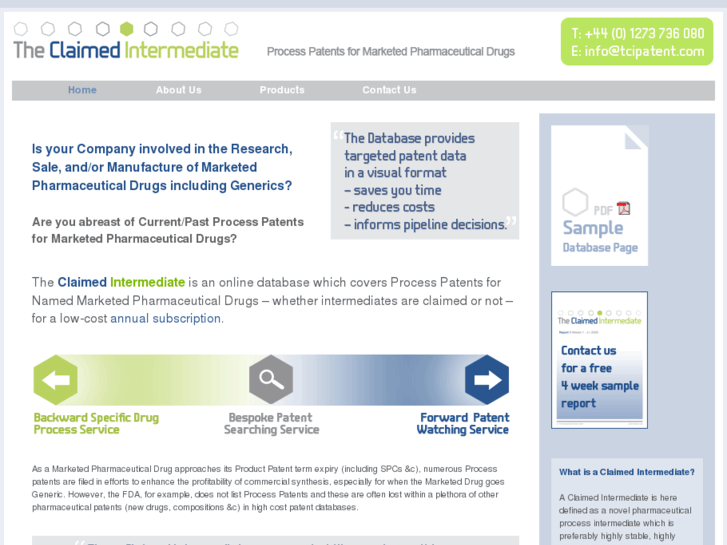
The Claimed Intermediate database by Tcipatent Ltd

Eddie Kehoe
Principal & Technical Director at Tcipatent Ltd
Hove, Brighton and Hove, United KingdomPharmaceuticalsThe Claimed Intermediate – a Structure Searchable Process Patent Database for Marketed Pharmaceutical Drugs (INNs).
Patent examining, searching, analysis and abstracting especially in the Chemical subject area.


The Claimed Intermediate is an online database
which covers Process Patents for Named Marketed Pharmaceutical Drugs – whether intermediates are claimed or not – for a low-cost subscription.
- Structure Searchable
- Includes INNs in at least one major Market
- Includes Drug Synthesis often buried in a Plethora of Patents
- Informs Pipeline decisions
- Provides targeted Patent data in a Visual form
- Informs Commercial Synthesis profitability

shared message from Eddie Kehoe
If anybody would like a trial of the database they could contact either myself eddie.kehoe@tcipatent.com, or my wife and fellow director, Pat Kehoe (pat.kehoe@tcipatent.com).
Here are temporary logons , please request trial
(deactivated automatically in five working days):
Link: Link: www.tcipatent.com/tcidb/
Structure Searchable Patent Database for Processes covering Named Marketed Pharmaceutical Drugs (INNs). The database is an ongoing Watching Service combined with a Backward Drug Service.
Eddie Kehoe
Principal & Technical Director
Tcipatent Ltd
www.tcipatent.com
info@tcipatent.om
tcipatent.com
Office: +44 (0)1273 736080
43 Farm Road, Hove, BN3 1FD, United Kingdom
Eddie Kehoe:
eddie.kehoe@tcipatent.com
Mobile – 07425629637
Skype – eddieskihoe
TWITTER-TCIPATENT
Pat Kehoe:
pat.kehoe@tcipatent.com
Mobile – 07585295531
Skype – patkehoe170348

Database Updates:
Recently Added Records
| Aliskiren | Ambrisentan |
| Asenapine | Atorvastatin |
| Bosentan | Cabazitaxel |
| Cefamandole | Dasatinib |
| Desogestrel | Dexmedetomidine |
| Docetaxel | Doripenem |
| Doxapram | Duloxetine |
| Etonogestrel | Etoricoxib |
| Etravirine | Fluvastatin |
| Gefitinib | Iodixanol |
| Iohexol | Iopamidol |
| Linagliptin | Mitiglinide |
| Montelukast | Moxonidine |
| Oseltamivir | Paclitaxel |
| Perampanel | Pitavastatin |
| Pravastatin | Praziquantel |
| Ritodrine | Rosuvastatin |
| Silodosin | Sitagliptin |
| Ticagrelor | Ulipristal |
| Zidovudine |
………..

photo
Coopers Cask – Pub in Hove BN3 1FB
Eddie is closeby
CSIR, INDIA-WO PATENT–synthesis of amprenavir and saquinavir

amprenavir

saquinavir
A process for synthesis of syn azido epoxide and its use as intermediate in the synthesis of amprenavir and saquinavir
Published as ———WO-2013105118
Council of Scientific & Industrial Research
Inventors
Gadakh, Sunita, Khanderao; Rekula, Reddy, Santhosh; Sudalai, Arumugam
Publication date 18-JUL-2013
HIV protease inhibitor
Disclosed herein is a novel route of synthesis of syn azide epoxide of formu 5, which is used as a common intermdeiate for asymmetric synthesis of HIV protease inhibitors such as Amprenavir, Fosamprenavir, Saquinavir and formal synthesis of Darunavir and Palinavir obtained by Cobalt- catalyzed hydrolyti kinetic resolution of racemic anti-(2SR, 3SR) – 3 -azido – 4 -phenyl – 1, 2- epoxybutane (azido-epoxide
| IN2012DE82 | 10-JAN-2012 [priority] |


 New Drug Approvals