New Drug Approvals

Home » GENERIC DRUG (Page 3)

Category Archives: GENERIC DRUG

DRUG APPROVALS BY DR ANTHONY MELVIN CRASTO .....FOR BLOG HOME CLICK HERE

Blog Stats

  • 4,799,022 hits

Flag and hits

Flag Counter

Enter your email address to follow this blog and receive notifications of new posts by email.

Join 37.9K other subscribers
Follow New Drug Approvals on WordPress.com

Archives

Categories

Recent Posts

Flag Counter

ORGANIC SPECTROSCOPY

Read all about Organic Spectroscopy on ORGANIC SPECTROSCOPY INTERNATIONAL 

Enter your email address to follow this blog and receive notifications of new posts by email.

Join 37.9K other subscribers
DR ANTHONY MELVIN CRASTO Ph.D

DR ANTHONY MELVIN CRASTO Ph.D

DR ANTHONY MELVIN CRASTO, Born in Mumbai in 1964 and graduated from Mumbai University, Completed his Ph.D from ICT, 1991,Matunga, Mumbai, India, in Organic Chemistry, The thesis topic was Synthesis of Novel Pyrethroid Analogues, Currently he is working with AFRICURE PHARMA, ROW2TECH, NIPER-G, Department of Pharmaceuticals, Ministry of Chemicals and Fertilizers, Govt. of India as ADVISOR, earlier assignment was with GLENMARK LIFE SCIENCES LTD, as CONSUlTANT, Retired from GLENMARK in Jan2022 Research Centre as Principal Scientist, Process Research (bulk actives) at Mahape, Navi Mumbai, India. Total Industry exp 32 plus yrs, Prior to joining Glenmark, he has worked with major multinationals like Hoechst Marion Roussel, now Sanofi, Searle India Ltd, now RPG lifesciences, etc. He has worked with notable scientists like Dr K Nagarajan, Dr Ralph Stapel, Prof S Seshadri, etc, He did custom synthesis for major multinationals in his career like BASF, Novartis, Sanofi, etc., He has worked in Discovery, Natural products, Bulk drugs, Generics, Intermediates, Fine chemicals, Neutraceuticals, GMP, Scaleups, etc, he is now helping millions, has 9 million plus hits on Google on all Organic chemistry websites. His friends call him Open superstar worlddrugtracker. His New Drug Approvals, Green Chemistry International, All about drugs, Eurekamoments, Organic spectroscopy international, etc in organic chemistry are some most read blogs He has hands on experience in initiation and developing novel routes for drug molecules and implementation them on commercial scale over a 32 PLUS year tenure till date Feb 2023, Around 35 plus products in his career. He has good knowledge of IPM, GMP, Regulatory aspects, he has several International patents published worldwide . He has good proficiency in Technology transfer, Spectroscopy, Stereochemistry, Synthesis, Polymorphism etc., He suffered a paralytic stroke/ Acute Transverse mylitis in Dec 2007 and is 90 %Paralysed, He is bound to a wheelchair, this seems to have injected feul in him to help chemists all around the world, he is more active than before and is pushing boundaries, He has 100 million plus hits on Google, 2.5 lakh plus connections on all networking sites, 100 Lakh plus views on dozen plus blogs, 227 countries, 7 continents, He makes himself available to all, contact him on +91 9323115463, email amcrasto@gmail.com, Twitter, @amcrasto , He lives and will die for his family, 90% paralysis cannot kill his soul., Notably he has 38 lakh plus views on New Drug Approvals Blog in 227 countries......https://newdrugapprovals.wordpress.com/ , He appreciates the help he gets from one and all, Friends, Family, Glenmark, Readers, Wellwishers, Doctors, Drug authorities, His Contacts, Physiotherapist, etc He has total of 32 International and Indian awards

Verified Services

View Full Profile →

Archives

Categories

Flag Counter

FAMOTIDINE


Famotidine.svgFamotidine-from-xtal-polymorph-A-3D-balls.png

FAMOTIDINE

76824-35-6

3-(2-Guanidinothiazol-4-ylmethylthio)-N-sulfamoylpropanamidine

MK-208
YM-11170
YM-1170

Histamine H2 Receptor Antagonists

Gastroesophageal Reflux Disease,

Agents forGastric Antisecretory Drugs (GERD)

Astellas Pharma (Innovaator)Launched – 1985

Systematic (IUPAC) name
3-[({2-[(diaminomethylidene)amino]-1,3-thiazol-4-yl}methyl)sulfanyl]-N’-sulfamoylpropanimidamide
Clinical data
Trade names Pepcid
AHFS/Drugs.com monograph
MedlinePlus a687011
Licence data US FDA:link
Pregnancy cat.
Legal status
  • Pharmacist only S3/S4(AU), General Availability (OTC)(UK),
    Over the Counter(US)
Routes Oral (tablet form)
Pharmacokinetic data
Bioavailability 40-45% (Oral)[1]
Protein binding 15-20%[1]
Metabolism hepatic
Half-life 2.5-3.5 hours[1]
Excretion Renal (25-30% unchanged [Oral])[1]
Identifiers
CAS number 76824-35-6 Yes
ATC code A02BA03
PubChem CID 3325
DrugBank DB00927
ChemSpider 3208 Yes
UNII 5QZO15J2Z8 Yes
Chemical data
Formula C8H15N7O2S3 
Mol. mass 337.449 g/mol
3-[[[2-[(Aminoiminomethyl)amino]-4-thiazolyl]methyl]thio]-N-(aminosulfonyl)propanimidamide
Additional Names: [1-amino-3-[[[2-[(diaminomethylene)amino]-4-thiazolyl]methyl]thio]propylidene]sulfamide; N-sulfamoyl-3-[(2-guanidinothiazol-4-yl)methylthio]propionamide
Manufacturers’ Codes: YM-11170; MK-208
Trademarks: Amfamox (Merck & Co.); Fadul (Hexal); Famodil (Sigma-Tau); Famosan (ProMed); Famoxal (Silanes); Ganor (Boehringer, Ing.); Gaster (Yamanouchi); Gastridin (Merck & Co.); Gastropen (Schwarz); Lecedil (Zdravlje); Motiax (Neopharmed); Muclox (Sigma-Tau); Pepcid (Merck & Co.); Pepcidac (McNeil); Pepcidine (Merck & Co.); Pepdine (Merck & Co.); Pepdul (Merck & Co.); Peptan (Merck & Co.); Ulfamid (Krka)
Molecular Formula: C8H15N7O2S3
Molecular Weight: 337.45
Percent Composition: C 28.47%, H 4.48%, N 29.06%, O 9.48%, S 28.51%
Properties: mp 163-164°. Soly at 20° (%, w/v): 80 in DMF; 50 in acetic acid; 0.3 in methanol; 0.1 in water; <0.01 in ethanol, ethyl acetate, chloroform. LD50 i.v. in mice: 244.4 mg/kg (Yasufumi).
Melting point: mp 163-164°
Toxicity data: LD50 i.v. in mice: 244.4 mg/kg (Yasufumi)
Therap-Cat: Antiulcerative.

Famotidine is an H2-histamine antagonist that was first launched by Astellas Pharma (formerly Yamanouchi) in Japan in 1985 as an injectable for the treatment of upper gastrointestinal hemorrhage and for the treatment of Zollinger-Ellison syndrome. In 1986, the drug was launched pursuant to a collaboration between Merck Sharp & Dohme and Sigma-Tau for the oral prevention and treatment of gastroesophageal reflux disease (GERD).

Famotidine (INN) /fəˈmɒtɪdn/ is a histamine H2-receptor antagonist that inhibits stomach acid production, and it is commonly used in the treatment of peptic ulcer disease (PUD) and gastroesophageal reflux disease (GERD/GORD). It is commonly marketed byJohnson & Johnson/Merck under the trade names Pepcidine and Pepcid and by Astellas under the trade name Gaster. Unlikecimetidine, the first H2 antagonist, famotidine has no effect on the cytochrome P450 enzyme system, and does not appear to interact with other drugs.[2]

Medical use

Certain preparations of famotidine are available over the counter (OTC) in various countries. In the US 20 or more mg, sometimes in combination with a more traditional antacid, are available OTC. Larger doses still require a prescription.

Famotidine is given to surgery patients before operations to prevent postoperative nausea and to reduce the risk of aspiration pneumonitis. Famotidine is also given to some patients taking NSAIDs, to prevent peptic ulcers.[3] It serves as an alternative toproton-pump inhibitors.[4]

It is also given to dogs and cats with acid reflux.

Famotidine has also been used in combination with an H1 antagonist to treat and prevent urticaria caused by an acute allergic reaction.[5]

Side-effects

Side-effects are associated with famotidine use. In clinical trials, the most common adverse effects were headache, dizziness, andconstipation or diarrhea.[6]

History

Famotidine was developed by Yamanouchi Pharmaceutical Co.[7] It was licensed in the mid-80s by Merck & Co.[8] and is marketed by a joint venture between Merck and Johnson & Johnson. The imidazole-ring of cimetidine was replaced with a 2-guanidinothiazole ring. Famotidine proved to be 30 times more active than cimetidine.[citation needed]

It was first marketed in 1981. Pepcid RPD orally-disintegrating tablets were released in 1999. Generic preparations became available in 2001, e.g.Fluxid (Schwarz) or Quamatel (Gedeon Richter Ltd.).

In the United States and Canada, a product called Pepcid Complete, which combines famotidine with an antacid in a chewable tablet to quickly relieve the symptoms of excess stomach acid, is available. In the UK, this product is known as Pepcidtwo.

Famotidine suffers from poor bioavailability (50%), as it is poorly soluble in the low pH of the stomach. Famotidine used in combination with antacids promotes local delivery of these drugs to the receptor of the parietal cell wall. Therefore, researchers are developing innovative formulations of tablets, such as gastroretentive drug delivery systems. Such tablets are retained in the stomach for a longer period of time, thereby improving the bioavailability of drugs. Local delivery also increases bioavailability at the stomach wall receptor site and increases the efficacy of drugs to reduce acid secretion.[9]

Research

Famotidine has been investigated as an adjunct in treatment-resistant schizophrenia. In one trial it caused a 10% reduction in schizophrenic symptom severity in treatment-resistant patients.[10]

Famotidine is also indicated in the treatment of duodenal and benign gastric ulcers, for the prevention of relapse of duodenal ulceration, for the treatment of gastric mucosal lesions associated with acute gastritis and acute exacerbation of chronic gastritis, for the treatment of heartburn associated with acid indigestion and sour stomach, for the prevention of meal-induced heartburn, and for the treatment of reflux esophagitis due to GERD, including ulcerative disease as diagnosed by endoscopy. The drug is currently marketed in tablet, film-coated tablet, orally-disintegrating tablet, powder, lyophilized powder for injection solution and injectable formulations. The compound had been in development for the treatment of non-erosive reflux disease (NERD), however, Astellas Pharma discontinued development for this indication in 2007.

Famotidine was developed by replacing the imidazole ring of GlaxoSmithKline’s cimetidine with a 2-guanidinothiazole ring, a modification proven to increase the activity of the drug 30-fold. Famotidine competitively inhibits the action of histamine at the histamine H2 receptors of the parietal cells. It suppresses the normal secretion of acid by parietal cells and the meal-stimulated secretion of acid by two mechanisms: by blocking histamine released by enterochromaffin-like (ECL) cells in the stomach from binding to H2 receptors and stimulating acid secretion, and by reducing the effect that other compounds (such as gastrin, pentagastrin, caffeine, insulin and acetylcholine) have on the promotion of acid secretion due to H2 receptor blockade.

Famotidine was originally developed at Astellas Pharma. It was subsequently licensed in the U.S. to Merck & Co., known outside the U.S. and Canada as Merck Sharp & Dohme. In 2007, Salix acquired the U.S. rights to famotidine oral solution (Pepcid[R]) for the treatment of GERD and peptic ulcer. Sigma-Tau holds rights to the drug and is responsible for marketing activities in Italy. Famotidine is sold in over 110 countries worldwide, including France, Germany, Italy, Japan, the U.S. and the U.K.

……………………………..

US 4283408

http://www.google.co.in/patents/US4283408

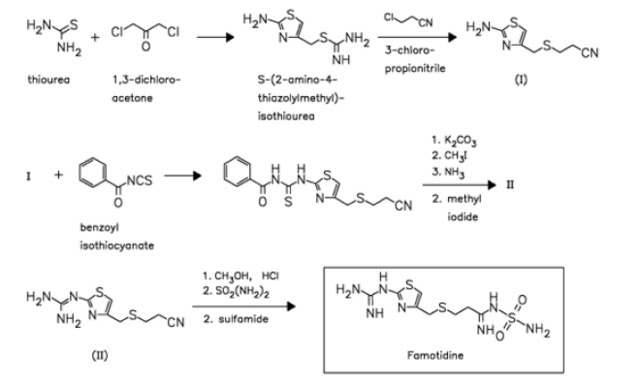
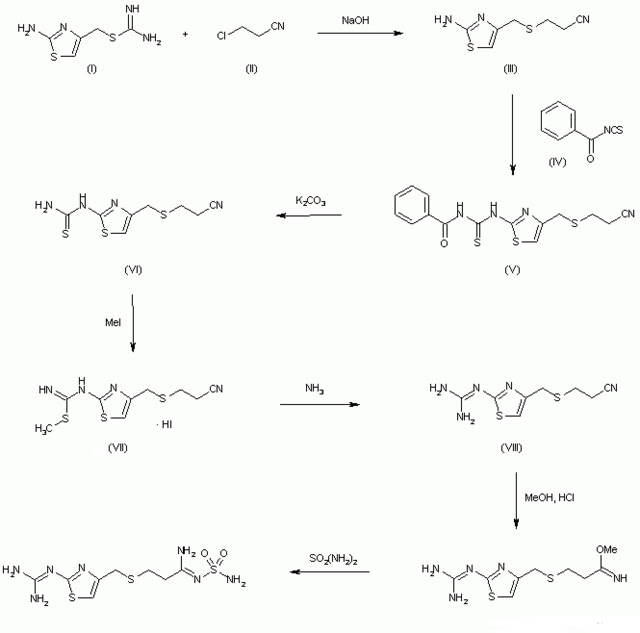
The reaction ot S-(2-aminothiazol-4-ylmethyl)isothiourea (I) with 3-chloropropionitrile (II) by means of NaOH in ethanol – water gives 3-(2-aminothiazol-4-ylmethylthio)propionitrile (III), which is condensed with benzoyl isothiocyanate (IV) in refluxing acetone to afford 3-[2-(3-benzoylthioureido)thiazol-4-ylmethylthio]propionitrile (V). The hydrolysis of (V) with K2CO3 in acetone – methanol – water yields 3-(2-thioureidothiazonl-4-ylmethylthio)propionitrile (VI), which by methylation with methyl iodide in refluxing ethanol is converted into 3-[2-(S-methylisothioureido)thiazol-4-ylmethylthio]propionitrile hydroiodide (VII). The reaction of (VII) with NH3 and NH4Cl in methanol at 90 C in a pressure vessel affords 3-(2-guanidinothiazol-4-ylmethylthio)propionitrile (VIII), which by partial alcoholysis with methanol by means of dry HCl in CHCl3 is converted into methyl 3-(2-guanidinothiazol-4-ylmethylthio)propionimidate (IX). Finally, this compound is treated with sulfamide in refluxing methanol.

Drugs Fut 1983, 8, 1, 14

US 4283408

DOS 2 951 675 (Yamanouchi; appl. 21.12.1979; J-prior. 2.8.1979).

DOS 3 008 056 (Yamanouchi; appl. 3.3.1980; J-prior. 6.3.1979, 23.6.1979).

GB 2 052 478 (Yamanouchi; appl. 6.3.1980; J-prior. 6.3.1979, 23.6.1979).

GB 2 055 800 (Yamanouchi; appl. 20.12.1979; J-prior. 2.8.1979).

synthesis of S-[2-aminothiazol-4-ylmethyl]isothiourea:

Spragne, J.M.; Lund, A.H.; Ziegler, C.: J. Am. Chem. Soc. (JACSAT) 68, 2155 (1946).

Figure 1: FTIR spectra of famotidine

FT IR OF FAMOTIDINE

http://link.springer.com/article/10.1007%2Fs00216-011-5599-6

[1H,13C] 2D NMR Spectrum

………………………..

DSC OF FAMOTIDINE

WILL BE ADDED

heating rate of 10C/min, and was run from 100 to 190C.The compound was found to melt at 166.4C


……………………………


…………………..

UV – range

Conditions : Concentration – 1 mg / 100 ml
The solvent designation graphics Methanol
Water
0.1М HCl
0.1M NaOH
Maximum absorption 287 nm 265 nm 286 nm
465 309 440
e 15700 10400 14850


FIG WILL BE ADDED


Ultraviolet spectroscopy
The UV spectrum of famotidine (5mg/ml) in methanol is shown inFig.ABOVE
. The spectrum was recorded using a Shimadzu UV–vis Spectro-photometer 1601 PC. Famotidine exhibited three maxima wavelengths
TABLE WILL BE ADDED

IR – spectrum

Wavelength (μm)
Wave number (cm -1 )

…………..

Synthesis pathway

Synthesis of a)


Trade names

Country Trade name Manufacturer
Germany Fadul Hexal
Famobeta betapharm
Famonerton Dolorgiet
Pepdul TEOFARMA
various generic drugs
France Peptsidak McNeil
Peptsidduo McNeil
Pepdin Merck Sharp & Dohme-Chibret
Great Britain Peptsid Merck Sharp & Dohme
Italy Famoudou Sigma-Tau
Gastridin Merck Sharp & Dohme
Motiaks Neopharmed
Japan Gaster Astellas
United States Peptsid Merck, 1986
– “- Johnson & Johnson; Merck
Ukraine Ulfamid Krka, dd, Novo mesto, Slovenia
Kvamatel JSC “Gedeon Richter”, Hungary
Famasan ABM. MED. CA AT Prague, Czech Republic
FamodinGeksal Salyutas Pharma GmbH, Germany, venture hexane AG, Germany
various generic drugs

Formulations

  • ampoule 10 mg, 20 mg;
  • Tablets coated with 10 mg, 20 mg, 40 mg;
  • oral suspension, 40 mg / 5 ml;
  • 2% powder, 10%;
  • 10 mg tablets, 20 mg;
  • vials (lyophilisate) 20 mg

Reference for above

  • DOS 2,951,675 (Yamanouchi; appl. 21.12.1979; J-prior. 2.8.1979).
  • DOS 3,008,056 (Yamanouchi; appl. 3.3.1980; J-prior. 6.3.1979, 23.6.1979).
  • GB 2052478 (Yamanouchi; appl. 6.3.1980; J-prior. 6.3.1979, 23.6.1979).
  • GB 2055800 (Yamanouchi; appl. 20.12.1979; J-prior. 2.8.1979).
  • US 4,283,408 (Yamanouchi; 11.8.1981; J-prior. 2.8.1979).

References

  1. Truven Health Analytics, Inc. DRUGDEX® System (Internet) [cited 2013 Oct 10]. Greenwood Village, CO: Thomsen Healthcare; 2013.
  2.  Humphries TJ, Merritt GJ (August 1999). “Review article: drug interactions with agents used to treat acid-related diseases” (pdf). Aliment. Pharmacol. Ther. 13 (Suppl 3): 18–26.doi:10.1046/j.1365-2036.1999.00021.x. PMID 10491725.
  3. “Horizon Pharma, Inc. Announces FDA Approval of DUEXIS(R) for the Relief of the Signs and Symptoms of Rheumatoid Arthritis and Osteoarthritis and to Decrease the Risk of Developing Upper Gastrointestinal Ulcers” (Press release). Horizon Pharma. 2011-04-25.
  4.  Brauser D (Jul 13, 2009). “Famotidine May Prevent Peptic Ulcers, Esophagitis in Patients Taking Low-Dose Aspirin”. Medscape.
  5.  Fogg TB, Semple D (29 November 2007). “Combination therapy with H2 and H1 antihistamines in acute, non compromising allergic reactions”. BestBets. Manchester, England: Manchester Royal Infirmary. Retrieved 26 April 2011.
  6.  “Pepcid Side Effects & Drug Interactions”. RxList.com. 2008. Retrieved 2008-07-31.
  7.  US patent 4283408, HIRATA YASUFUMI; YANAGISAWA ISAO; ISHII YOSHIO; TSUKAMOTO SHINICHI; ITO NORIKI; ISOMURA YASUO; TAKEDA MASAAKI, “Guanidinothiazole compounds, process for preparation and gastric inhibiting compositions containing them”, issued 1981-08-11
  8.  “Sankyo Pharma”. Skyscape Mediwire. 2002. Retrieved 2009-10-30.[dead link]
  9.  “Formulation and Evaluation of Gastroretentive Floating Tablets of Famotidine”. Farmavita.Net. 2008. Retrieved 2009-01-30.
  10.  Meskanen, K; Ekelund, H; Laitinen, J; Neuvonen, PJ; Haukka, J; Panula, P; Ekelund, J (August 2013). “A randomized clinical trial of histamine 2 receptor antagonism in treatment-resistant schizophrenia.”. Journal of Clinical Psychopharmacology 33 (4): 472–478. doi:10.1097/JCP.0b013e3182970490. PMID 23764683.
References:
Histamine H2-receptor antagonist. Prepn, NMR and mass spectral data: H. Yasufumi et al., BE 882071;eidem, US 4283408; JP Kokai 81 55383, C.A. 95, 203930n (1980, 1981, 1981 all to Yamanouchi).
Inhibition of gastric acid and pepsin secretion in rats: M. Takeda et al., Arzneim.-Forsch. 32, 734 (1982); in man: M. Miwa et al., Int. J. Clin. Pharmacol. Ther. Toxicol. 22, 214 (1984).
Effect on disposition of antipyrine in liver: Ch. Staiger et al., Arzneim.-Forsch. 34, 1041 (1984). Chromatographic determn in plasma and urine: W. C. Vincek et al., J. Chromatogr. 338, 438 (1985). Pharmacokinetics: T. Takabatke et al., Eur. J. Clin. Pharmacol. 28, 327 (1985).
Clinical trial in Zollinger-Ellison syndrome: J. M. Howard et al.,Gastroenterology 88, 1026 (1985). Symposia on pharmacology and clinical efficacy: Am. J. Med. 81, Suppl. 4B, 1-64 (1986);Scand. J. Gastroenterol. 22, Suppl. 134, 1-62 (1987).
Web information on Famotidine
Mechanism of Action
H2-receptor antagonist
Relevant Clinical Literature
UK Guidance
Regulatory Literature
Other Literature

Ламотрижин, Lamotrigine an antiepileptic


Lamotrigine3DanJ.gif


Lamotrigine.svg


Lamotrigine
CAS r: 84057-84-1
CAS Name: 6-(2,3-Dichlorophenyl)-1,2,4-triazine-3,5-diamine
Additional Names: 3,5-diamino-6-(2,3-dichlorophenyl)-1,2,4-triazine; LTG
Manufacturers’ Codes: BW-430C
Trademarks: Lamictal (GSK)
Molecular Formula: C9H7Cl2N5
Molecular Weight: 256.09
Percent Composition: C 42.21%, H 2.76%, Cl 27.69%, N 27.35%
Literature References: Prepn: M. G. Baxter et al., EP 21121 (1981 to Wellcome Foundation); D. A. Sawyer et al., US 4602017(1986).
HPLC determn in plasma: C.-L. Cheng et al., J. Chromatogr. B 817, 199 (2005).
Anticonvulsant activity: A. A. Miller et al.,Epilepsia 27, 483 (1986).
Mechanism of action studies: M. J. Leach et al., ibid. 490; X. Xie, R. M. Hagan, Neuropsychobiology 38,119 (1998).
Series of articles on clinical pharmacology, antiepileptic efficacy and safety: Epilepsia 32, Suppl. 2, S1-S21 (1991).
Clinical trial in bipolar depression: J. R. Calabrese et al., J. Clin. Psychiatry 60, 79 (1999). Review of clinical experience in epilepsy: H. Choi, M. J. Morrell, Expert Opin. Pharmacother. 4, 243-251 (2003); in bipolar disorder: Z. Bhagwagar, G. M. Goodwin,Expert Opin. Pharmacother. 6, 1401-1408 (2005).
Properties: White to pale cream-colored powder. Crystals from isopropanol, mp 216-218° (uncorr). pKa 5.7. Soly at 25° (mg/ml): water 0.17; 0.1M HCl 4.1. LD50 in mice, rats (mg/kg): 250, >640 orally (Sawyer).
Melting point: mp 216-218° (uncorr)
pKa: pKa 5.7
Toxicity data: LD50 in mice, rats (mg/kg): 250, >640 orally (Sawyer)
Therap-Cat: Anticonvulsant. In treatment of bipolar depression.
Keywords: Anticonvulsant.
Patent No Expiry Date
5698226*PED Jul 29, 2012


AND

Lamotrigine /ləˈmtrɨˌn/, marketed in most of the world as Lamictal /ləˈmɪktəl/ by GlaxoSmithKline, is an anticonvulsant drug used in the treatment of epilepsy and bipolar disorder. It is also used off-label as an adjunct in treating clinical depression.[1] For epilepsy, it is used to treat focal seizures, primary and secondary tonic-clonic seizures, and seizures associated with Lennox-Gastaut syndrome.

Like many other anticonvulsant medications, lamotrigine also seems to act as an effective mood stabilizer, and has been the first US Food and Drug Administration (FDA)-approved drug for this purpose since lithium, a drug approved almost 30 years earlier.

It is approved for the maintenance treatment of bipolar type I. Chemically unrelated to other anticonvulsants (due to lamotrigine being a phenyltriazine), lamotrigine has many possible side-effects.

Lamotrigine is generally accepted to be a member of the sodium channel blocking class of antiepileptic drugs,[2] but it could have additional actions since it has a broader spectrum of action than other sodium channel antiepileptic drugs such as phenytoin and carbamazepine and is effective in the treatment of the depressed phase of bipolar disorder, where as other sodium channel blocking antiepileptic drugs are not.

In addition, lamotrigine shares few side-effects with other, unrelated anticonvulsants known to inhibit sodium channels, which further emphasises its unique properties.[3] Lamotrigine is inactivated by hepatic glucuronidation.[4]

Ламотрижин (Lamotrigine)

UV – range

Conditions : Concentration – 1 mg / 100 ml
The solvent designation graphics Methanol
Water
0.1М HCl
0.1M NaOH
Maximum absorption Observed
decay
Observed
decay
267 nm 307 nm
277 285
e 7100 7300

IR – spectrum

Wavelength (μm)
Wave number (cm -1 )

Reference

  • UV and IR Spectra. H.-W. Dibbern, R.M. Muller, E. Wirbitzki, 2002 ECV
  • NIST / EPA / NIH Mass Spectral Library 2008
  • Handbook of Organic Compounds. NIR, IR, Raman, and UV-Vis Spectra Featuring Polymers and Surfactants, Jr., Jerry Workman. Academic Press, 2000.
  • Handbook of ultraviolet and visible absorption spectra of organic compounds, K. Hirayama. Plenum Press Data Division, 1967.

Brief background information

Salt ATC Formula MM CAS
N03AX09 C9H7Cl2N5 256.10 g / mol 84057-84-1

Application

  • anticonvulsant
  • ingibitor glutamat
  • Lamotrigine is the common name for 3,5-diamino-6-(2,3-dichlorophenyl)-1,2,4-triazine which is a commercially marketed, pharmaceutically active substance known to be useful for the treatment of epilepsy and bipolar disorder. Lamotrigine (Formula I. below) has an empirical formula of C9H7N5Cl2 and a molecular weight of 256.09.

    Figure imgb0001
  • Lamotrigine is currently available in its anhydrous crystalline form which is characterized by the X-ray Powder Diffraction (XRD) spectrum shown in Figure 2.
  • Lamotrigine and its pharmaceutically acceptable acid addition salts are generally described in U.S. Patent No. 4,560,687 (“the ‘687 patent”). The ‘687 patent, however, provides no examples for preparing lamotrigine.
  • U.S. Patent No. 4,602,017 (“the `017 patent”) discloses a process for preparing lamotrigine by cyclizing the intermediate 2-(2,3-dichlorophenyl)-2-guanidinylimino acetonitrile (Formula VI, below) by refluxing it in an alkanol in the presence of a strong base. The product is then treated with ice water, stirred for 30 minutes, filtered, and recrystallized to produce a residue, which is treated with isopropanol to yield lamotrigine. The process described in the ‘017 patent for preparing lamotrigine is illustrated in Scheme 1.

    Figure imgb0002
  • Various references disclose other different processes for producing lamotrigine. For example, WO 00/35888 discloses a process for preparing the intermediate of Formula IV, and describes preparing lamotrigine using this intermediate by a process similar to the one shown in Scheme 1 but using, in the last step, an aqueous solution of potassium hydroxide instead of the methanolic solution.
  • U.S. Patent No. 5,912,345 discloses cyclizing the intermediate of Formula VI using ultraviolet or visible radiation and heating to reflux temperature.
  • WO 01/49669 discloses the reaction of intermediates of Formula IV and Formula V to give intermediate Formula VI using sulfuric acid and p-toluenesulfonic acid. Cyclization is then performed by refluxing in an aliphatic alkanol in the presence of a base. The obtained lamotrigine is then purified by recrystallization or chromatographic separation to produce lamotrigine with a purity of 99.70 (calculated by HPLC).
  • U.S. Patent No. 5,925,755 discloses preparing lamotrigine from 6-(2,3-dichlorophenyl)-5-chloro-3-thiomethyl-1,2,4-triazine that has been dissolved in ethanol saturated with ammonia gas, by heating in a sealed glass tube in an autoclave at 180° C/1930 kPa for 72 hours followed by recrystallizing from methanol.
  • Lamotrigine is known to form solvates with different alcohols. For example, according to an article published in 1989 by Robert W. Janes et al- in Acta Cryst. (1989), C45, 129-132, entitled “Structure of Lamotrigine Methanol Solvate: 3,5-Diamino-6-(2,3-dichlorophenyl)-1,2,4-triazine-Methanol, A Novel Anticonvulsant Drug,” the crystal structure of a sample of “lamotrigine methanol solvate” was provided by the Wellcome Research Laboratories, UK, and a second form of lamotrigine was crystallized from absolute ethanol. According toEP 0 800 520 B 1, published on October 15, 1997, “lamotrigine ethanolate” can be obtained by crystallization of lamotrigine from ethanol (see Examples 5 and 6). Similarly, EP 0 021 121 teaches that “lamotrigine isoproponate” can be obtained by recrystallization from isopropanol (see Example 1). Lamotrigine alcohol solvates can be dried to yield anhydrous lamotrigine. For example, WO 96/20935 describes the drying and recystallization from methanol of anhydrous lamotrigine having a meriting point of 218° C (see Example 6).
  • Most of the known processes for preparing lamotrigine do so only in low yields and by using drastic conditions (e.g., temperature and pressure) or by using dangerous reagents or expensive equipment. Moreover, the known processes only describe preparing lamotrigine as a crude product that is then purified by recrystallization from a solvent and fail to disclose any other processes for purifying lamotrigine.


Synthesis pathway

Синтез a)

Синтез b)

Trade names

Country Trade name Manufacturer
Germany Elmendos GlaxoSmithKline
Lamictal -»-
various generic drugs
France Lamikstart GlaxoSmithKline
Lamictal Novartis
UK -»- GlaxoSmithKline
Italy -»- -»-
United States -»- -»-
Ukraine Lamictal GlaxoSmithKline Pharmaceuticals SA, Poland
Herolamyk Gerota Farmatseutika GmbH (manufacturer responsible for batch release), Austria
Deksel Ltd., Israel
Lamotrin OOO «Pharma Home» Ukraine
Lamitrin Farmasayns Inc., Canada
various generic drugs

Formulations

  • Tablets 5 mg, 25 mg, 50 mg, 100 mg, 200 mg

Reference

  1. Синтез a)
    • US 4 602 017 (Wellcome; 22.7.1986; appl. 27.2.1984; prior. 15.9.1981, 29.5.1980; GB-prior. 1.6.1979).
    •  US 4 847 249 (Wellcome; 11.7.1989; appl. 29.5.1987; GB-prior. 30.5.1986).
    •  EP 21 121 (Wellcome; appl. 30.5.1980; GB-prior. 1.6.1979).
    •  EP 59 987 (Wellcome; appl. 30.5.1980; GB-prior. 1.6.1979).
    •  WO 2 008 019 798 (Lonza; 21.02.2008; USA-prior. 17.11.2006; EP-prior. 14.8.2006).
  2. Синтез b)
    • US 6 683 182 (Helm AG; 27.1.2004; appl. 9.10.2003; PCT-prior. 4.7.2002; DE-prior. 17.7.2001).
    • EP 1 311 492 (Helm AG; appl. 4.7.2002; DE-prior. 17.7.2001).


http://www.google.com/patents/EP2128145A2?cl=en


EXAMPLES

    • [0047]
      The following examples are for illustrative purposes only and are not intended, nor should they be interpreted to, limit the scope of the invention.

General Experimental Conditions:I. HPLC Assay Method:

    • [0048]
      The chromatographic separation was carried out at room temperature (20-25° C) using a Lichrosphere RP-select B, 5 µm,4.0 x 250 mm I.D. column.
    • [0049]
      The mobile phase was prepared by mixing 320 mL of acetonitrile with 680 mL of buffer (pH = 5.6) prepared from 3.85 g of ammonium acetate dissolved in 1000 mL of water and by adjusting the pH to 5.6 with glacial acetic acid. The mobile phase was mixed and filtered through a 0.22 µm nylon filter under vacuum.
    • [0050]
      The chromatograph was equipped with a 306 nm detector, and the flow rate was 1.0 mL per minute. Test samples (20 µL) were prepared by dissolving the appropriate amount of sample in order to obtain 1 mg/mL of acetonitrile.

Example 1: Preparation of 3,5-diamino-6-(2,3-dichlorophenyl)-1,2,4-triazineStep 1. Preparation of Lamotrigine

    • [0051]
      In a 800 L reactor, 38 kg of 2-(2,3-dichlorophenyl)-2-guanidinyliminoacetonitrile (0.148 kmoles) and 298 kg of isopropanol were combined. The mixture was then heated to reflux temperature (approximately 82° C) and maintained at 82 ± 3° C for 6 hours. Thereafter, the mixture was cooled to 20-25° C and stirred for 1 hour at this temperature. The suspension was then filtered and washed with 8 kg of isopropanol.

Step 2. Removal of Mechanical Impurities

    • [0052]
      The crude lamotrigine obtained in Step I and 335 kg of deionized water were combined in the 800 L reactor, and the temperature was adjusted to between 35 and 40° C. Methanesulfonic acid was then added to the mixture until the pH was between 1.5 and 2.0 while maintaining the temperature between 35 to 40° C. The resulting aqueous solution of lamotrigine methane sulfonate was then filtered, and the filter and reactor were washed with 4 kg of deionized water.
    • [0053]
      The solution of lamotrigine methanesulfonate was then added to the 800 L reactor, and the pH was adjusted to 6.5 to 7.5 by adding a 50% solution of sodium hydroxide. Next, the temperature was adjusted at 20 to 25° C, and the mixture was stirred at this temperature for 1 hour. Thereafter, the suspension was filtered and washed with 20 kg of deionized water followed by 8 kg of methanol, to obtain wet lamotrigine monohydrate.

Step 3. Conversion of Lamotrigine Hydrate to Anhydrous Lamotrigine

    • [0054]
      In the 800 L reactor, the wet lamotrigine hydrate obtained in Step 2 and 255 kg of filtered methanol were combined, and the mixture was heated to reflux temperature. The mixture was then cooled to 20-25° C and stirred at this temperature for 1 hour. Thereafter, the suspension was filtered and washed with 8 kg of methanol.
    • [0055]
      The wet product obtained was dried under vacuum for 16 hours at 85 ± 5° C and then was milled and sieved (500 µm to yield 29.11 kg (0.114 kmoles) of lamotrigine (Yield: 76.8%; Purity (HPLC analysis): 99.9%; Melting Point = 216° C).

Example 2: Preparation of Lamotrigine Monohydrate

  • [0056]
    Lamotrigine (46 g) and 460 mL of deionized water were combined, and the temperature of the mixture was adjusted at 3 5 to 40° C. Initially, the pH of the mixture was 4.11. Methanesulfonic acid was then added to the mixture until the pH was 1.4 while maintaining the temperature of the mixture at or below 30° C. A light, opaline solution was obtained following addition of the methanesulfonic acid. The obtained solution of lamotrigine methanesulfonate was then filtered and the filter was washed with 4.6 mL of deionized water.
  • [0057]
    The pH of the solution of lamotrigine methanesulfonate was next adjusted to 6.8-7.2 by adding a 50% solution of sodium hydroxide while maintaining the temperature at or below 30° C. The temperature was then adjusted to between 20° C and 25° C, and the mixture was stirred at this temperature for 1 hour. Thereafter, the suspension was filtered, and the obtained product was washed with deionized water and dried at 40° C to yield 49.23 g of lamotrigine monohydrate. Analysis: titration (perchloric acid): 99.23%; purity (HPLC analysis): 99%; Water (Karl Fischer) = 6.68%.

……………………………………

Example 6: Preparation of lamotrigine

The 6- (2,3, -dichlorophenyl) -5-chloro-3-thiomethyl-

1, 2,4-triazine prepared in Example 5 was dissolved in ethanol (100 ml) saturated with ammonia gas and heated in a sealed glass tube in an autoclave at 180°C/1930 kPa

(280 p.s.i.) for 72 hours.

The total contents of the tube was evaporated down to give a dark brown crude product. The crude product was recrystallised from methanol and identified as compound (I) , 3, 5-diamino-6- (2,3-dichlorophenyl) -1-2,4-triazine

(lamotrigine) by TLC (Rf = 0.20) . Melting point = 218°C.

 http://www.google.com/patents/WO1996020935A1?cl=en


……………….

3,5-diamino-6-(2,3-dichlorophenyl)-1,2,4-triazine of the Formula (I)

Figure US07390899-20080624-C00002

also known as lamotrigine, is the active ingredient of several pharmaceutical compositions used for the treatment of different diseases of the central nervous system (e.g. epilepsy).

The synthesis of substituted 3,5-diamino-1,2,4-triazine derivatives is known from the literature. In the following publications the general synthesis of substituted derivatives is described—Agr. Res. Serif. 3 188 (1966) and J. Med. Chem. 859 (1972)—according to which benzoyl cyanide is reacted with aminoguanidine in acidic medium and the so obtained adduct is cyclized under basic conditions. According to the process described in the European Patent No. 21121—analogously to the method described above—2,3-dichlorobenzoyl cyanide is reacted with the hydrogencarbonate salt of aminoguanidine in dimethyl sulfoxide as solvent, in the presence of 8 N nitric acid for 7 days. The obtained adduct is cyclized with methanolic potassium-hydroxide solution to the final product in 15% yield—calculated on the starting material. Basically similar process is described in the European Patent No. 142306. The disadvantages of the above processes are the extremely aggressive reaction medium, the long reaction time as well as the very low yield.

The European Patent No. 247842 describes a process in which 8 M solution of sulfuric acid is used instead of 8 N nitric acid in the condensation reaction, and the reaction time is 48 h. The cyclization reaction is carried out in n-propanol at reflux temperature. The yield is 41%. The disadvantages of this process are the low yield and the aggressive reaction medium.

Basically similar process is described in the U.S. Pat. No. 6,111,101, in which the condensation is carried out in a mixture of diluted sulfuric acid and acetonitrile for 60 h, then the cyclization is carried out with 1% aqueous potassium hydroxide solution. The yield is 44%. The crude product is purified by recrystallization from methanol with the help of clarifier. The disadvantages of the process are the aggressive medium, the low yield and the very long reaction time.

The modification of the above process is described in the European Patent No. 963980, in which the cyclization reaction is carried out in n-propanol at reflux temperature. The yield is 60%. The product is purified by recrystallization from n-propano 1. The disadvantages of this process are also the long reaction time and the aggressive reaction medium.

According to the International Patent Application No. WO96120934 an intermediate, which is prepared with great difficulty, is converted into lamotrigine by cyclizing in a photo-chemical reactor in 80% yield. The disadvantage of the process is that it can not be applied on industrial scale.

The International Patent Application No. WO96120935 describes a six-step synthesis, which is difficult to carry out and hardly realizable on industrial scale, as well as the yield of the final product is very low. The disadvantages of the process are the complicated synthesis, the applied hazardous reagents and the low yield.

 http://www.google.com/patents/US7390899

EXAMPLE 23,5-diamino-6-(2,3-diehlorophenyl)-1,2,4-triazine

A suspension of 24.0 g of methanesulfonic acid and 21.0 g (0.079 mol) of aminoguanidine dimesylate is warmed to 65-70° C. in a 500 ml round bottom flask, equipped with a stirrer, a thermometer and a dropping funnel. The mixture becomes homogenous after 15 min, then a solution of 12.0 g (0.06 mol) of 2,3-dichlorobenzoyl cyanide in 10 ml of acetonitrile is added dropwise. The obtained mixture is stirred at 65-70° C. for 1 h. A mixture of 9 g (0.223 mol) of magnesium oxide and 60 ml of water is stirred for 5 min and the obtained suspension is added to the reaction mixture over a period of 10 min.

The temperature of the reaction mixture is raised to 70° C. and kept at this temperature for 3 h. The hot reaction mixture is filtered, 90 ml of water is added to the filtrate and concentrated. 60 ml of water is added to the residue, the suspension is stirred at 0-5° C., then filtered off. The product is washed with water and dried at 60-70° C. to yield 14.3 g (93.1%) of the crude title compound. Melting point: 212-216° C.

EXAMPLE 3Crystallization of 3,5-diamino-6-(2,3-diehlorophenyl)-1,2,4-triazine

10 g of 3,5-diamino-6-(2,3-dichlorophenyl)-1,2,4-triazine is dissolved in 400 ml of acetone at reflux temperature, then 0.5 g of charcoal is added and the mixture is refluxed for 5 min. The clarifier is filtered off and the filtrate is cooled to 0-5° C. The precipitated crystals are filtered off and dried at 90° C. in vacuum to yield 7.0 g (70%) of the product. Melting point: 215-219° C.

………………………………………….


Lamotrigine 3,5-diamino-6-(2,3-dichlorophenyl)-l,2,4-triazine, is an antiepileptic drug, and its analogues were first disclosed in British Patent No. 759,014 (1956). Subsequently, Lamotrigine and its analogues were described in Canadian Patent Nos. 1,112,643 and 1,133,938, and in United States Patent No. 4,602,017. Processes for the preparation of Lamotrigine are also disclosed in international publications and patents WO 96/20934, WO 96/20935, WO 00/35888 and European Patent No. 963,980.

Figure imgf000002_0001

Lamotrigine 1

The process (as disclosed in Canadian Patent Nos. 1,112,643 and 1,133,938, United States Patent No. 4,602,017 and in British Patent No. 759,014) for the preparation of Lamotrigine involves reaction of 2,3-dichlorobenzoyl cyanide 2 and aminoguanidine bicarbonate in dimethylsulfoxide and 8N aqueous nitric acid (scheme 1). The above process uses drastic conditions (20 eq. 8N HNO3), excess reagents and requires 7 days for completion of the reaction. The overall yield of the process from 2,3-dichlorobenzoyl cyanide is 15.6%.

Scheme 1

Figure imgf000003_0001

2. MeOH, KOH, heat Lamotrigine 1 15.6% yield

The process reported in WO 00/35888 for this reaction uses H2S04 instead of 8N HNO3. However, it also suffers from lower yield (40%) and longer reaction time (2.5 days). The process also uses a large excess (-11 times) of sulfuric acid.

It is accordingly an object of the present invention to provide an improved process for the manufacture of lamotrigine which overcome the problems associated with poor efficiency described in the prior art. More broadly, it is an object of the present invention to provide novel processes for the production of 3,5-diamino-6-substituted-l,2,4-triazines.

SUMMARY OF THE INVENTION

In accordance with one aspect of the present invention, there is provided a process for the manufacture of an intermediate compound of formula IV

Figure imgf000003_0002

formula IV useful for manufacturing 3,5-diamino-6-substituted-l,2,4-triazines, wherein R is an optionally substituted C1-C4 alkyl or aryl group, which process comprises reacting a compound of formula II:

Figure imgf000004_0001

formula II

with aminoguanidine in the presence of an acid in an organic solvent under anhydrous conditions followed by treatment with a dehydrating reagent.

In accordance with another aspect of the present invention there is provided a process for the manufacture of 3,5-diamino-6-substituted-l,2,4-triazines of formula I:

Figure imgf000004_0002

formula I

comprising the steps of:

(a) reacting a compound of formula (II):

Figure imgf000004_0003

formula II

with aminoguanidine salts, or equivalent thereof, in the presence of an acid in an organic solvent under anhydrous conditions to form a cyanohydrin of formula III:

Figure imgf000005_0001

formula III

(b) dehydrating the cyanohydrin of formula III to form a compound of formula IV by treatment with a dehydrating reagent,

Figure imgf000005_0002

formula IV

and

(c) cyclization of the compound of formula IV into a 3,5-diamino-6- substituted-l,2,4-triazine of compound of formula I or into a hydrated form thereof.

Suitably the substituted Ci-Q alkyl group is methyl, ethyl, propyl or butyl and the substituted aryl group is preferably 2,3-dichlorophenyl.

The process of the present invention provides a high yielding and cost- effective process for the preparation of 3,5-diamino-6-substituted-l,2,4- triazines in general and Lamotrigine in particular. This result is obtained through the use of an additive, namely a dehydrating agent, such as thionyl chloride, POCI3 or PCI5, and by employing organic acid in combination with a polar organic solvent, which stabilizes the cyanohydrin of formula III. The cyanohydrin of formula III upon addition of a dehydrating agent affords the intermediate iminoguanidine of formula IV (scheme 2). The acid used in this process can be dry organosulfonic acids such as methanesulfonic acid or para-toluenesulfonic acid, either in combination with dry polar organic solvents, such as dimethylformamide (DMF), N-methyl-2- pyrrolidinone (NMP) or dimethylsulfoxide (DMSO), or combinations of a polar solvent with nonpolar solvents such as tetrahydrofuran (THF). The dehydrating reagents used in the process can be SOCl2, POCI3 or PCI5, oxalyl chloride, phosgene or equivalents thereof.

Scheme 2

dehydration ,

f

Figure imgf000006_0001

ormula II formula III

cyclisation

Figure imgf000006_0002

formula IV

Figure imgf000006_0003

The process, as shown in Scheme 2, involves the reaction of aryl cyanide, preferably 2,3-dichlorobenzoyl cyanide 2 (in which R = 2,3-dichlorophenyl), with an organic acid, for example para-toluenesulfonic acid or methanesulfonic acid, and dry organic solvents, for example DMSO, NMP or DMF, at suitable temperatures to form an intermediate of formula III. The reaction mixture is treated with dehydrates for example SOCl2, POCI3 or PCI5, oxalyl chloride, phosgene or equivalent thereof at a suitable temperature to form the iminoguanidine of formula IV. The iminoguanidine salt in the reaction mixture is cyclized upon basification and heating. The in inoguanidine salt can be basified and isolated by filtration. The isolated iminoguanidine can be cyclized to form Lamotrigine using a base (such as NaOH, NH3 or KOH) in a protic solvent (such as methanol, ethanol, isopropanol or water). Lamotrigine 1 can be isolated as the monohydrate when the cyclization of the intermediate is carried out using base and isopropanol/ water mixture or NMP/ water. The lamotrigine monohydrate is a new compound and is further characterized in having the following peaks in powder X-ray diffraction pattern at an angle of two theta (2Θ) is found to be: 10.34, 11.53, 12.46, 13.36, 13.86, 14.15, 14.94, 16.43, 16.65, 17.44, 17.97, 18.77, 18.91, 19.11, 19.52, 20.58, 22.11, 22.31, 23.09, 23.61, 24.18, 24.99, 25.52, 26.31, 26.83, 27.68, 28.53, 29.07, 29.24, 29.86, 30.09, 30.63, 31.01, 31.37, 31.78, 32.82, 33.25, 34.35, 34.96, 36.23, 36.92, 37.97, 38.60, 38.90. The positions of the peaks in powder X-ray diffraction pattern studies of anhydrous lamotrigine at an angle of two theta (2Θ) to be 9.80, 11.39, 12,46, 13.29, 13.86, 14.13, 15.62, 16.66, 17.44, 17.97, 19.54, 20.56, 22.30, 22.89, 23.61, 24.81, 25.50, 26.31, 26.74, 27.87, 28.42, 28.86, 29.38, 29.66, 30.95, 31.66, 32.59, 33.23, 33.61, 33.83, 34.21, 35.20, 36.27, 37.16, 37.90, 38.35, 38.92, 39.17, 39.45.

The overall yield of lamotrigine is high (molar yield: 80 – 85%). The above described process is very cost-effective, operationally simple and completed in a short time period (6 to 10 hours).

BRIEF DESCRIPTION OF THE DRAWINGS

Figure 1 is the powder X-ray diffraction pattern of lamotrigine monohydrate.

Figure 2 is a differential scanning calorimetry thermogram (DSC) of lamotrigine monohydrate.

Figure 3 is a Fourier transform infrared spectrum (FTIR) of lamotrigine monohydrate.

Figure 4 is the powder X-ray diffraction pattern of anhydrous lamotrigine. Figure 5 is a differential scanning calorimetry thermogram (DSC) of anhydrous lamotrigine.

Figure 6 is a Fourier transform infrared spectrum (FTIR) of anhydrous lamotrigine.

The following examples serve to illustrate embodiments of the present invention in a manner in which they can be practiced but, as such, should not be considered in a limiting sense.

EXAMPLES

Procedure I

To a round bottomed flask was added aminoguanidine hydrochloride (116.1 g, 1.05 mol) and dimethylformamide (900 mL). To this mixture was added methanesulfonic acid (130.4 g, 1.36 mol) followed by adding 2,3- dichlorobenzoylcyanide (150.0 g, 0.75 mol). The reaction mixture was stirred for 1 hour and then the dehydrating reagent, thionyl chloride, (45.2g, 0.38 mol) was added. The reaction mixture was stirred for another hour and then basified with KOH solution (4N). The precipitate was filtered and washed with water.

Yield: 401.3 g damp cake (KF = 39.2%).

Analytically pure sample of the intermediate is prepared as following:

20.0 g of the damp cake was suspended in 60 ml MeOH and stirred at room temperature for 3 hours. The solid was filtered and dried in vacuum at room temperature to give 5.4 g analytic pure iminoguanidine as a yellow solid.

m.p.: 179 ~ 180° C (corrected).

MS (m/z): 256.3 [M+] IR: 3491.8; 3457.1 (Amine N-H stretching); 2207.5 (CN stretching); 1681.9 (Imine C=N stretching); 1055.5 (Caryi-Cl stretching).

Η-NMR (300 MHz, DMSO-D6): 7.66 (ad, J = 7.9 Hz, 2H), 7.41 (dd, J = 7.9; 7.9 Hz, 1H), 6.70 (br s, NH2).

^C-NMR (75 MHz, DMSO-D6): 163.6, 135.3, 132.4, 130.0, 129.5, 129.0, 128.2, 114.4, 113.8.

Elemental analysis: C H N

Calculated: 42.21 2.76 27.35

Found: 42.10 2.49 27.69

Procedure II:

A round bottomed flask was charged with iminoguanidine (401.3 g from procedure I), isopropanol (1000.0 ml) and KOH (85%, 12.0 g, 0.18 mol). The reaction mixture was refluxed for 3 hours. Isopropanol was distilled and water (800 ml) was added. The reaction mixture was stirred for 3 hours, the solid was filtered and washed with water. The damp cake is dried under vacuum to yield 168.5 grams of lamotrigine monohydrate as crystalline solid (82% based on 2,3-dichlorobenzoyl cyanide).

Procedure III (without isolation of intermediate of formula IV):

To a round bottomed flask was added aminoguanidine hydrochloride (116.1 g, 1.05 mol) and dimethylformamide (900 ml). To this mixture was added methanesulfonic acid (130.4 g, 1.36 mol) followed by 2,3-dichlorobenzoyl cyanide (150.0 g, 0.75 mol). The reaction mixture was stirred for 1 hour and then dehydrating reagent thionyl chloride (45.2g, 0.38 mol) was added slowly. The reaction mixture was stirred for another hour and then basified with KOH solution (4 N). The Reaction mixture was heated under reflux (100 ~ 105° C) for 3 ~ 4 hours and cooled slowly to room temperature. The solid was filtered and washed with water. After drying, 160.7g of lamotrigine monohydrate as a crystalline solid (78% based on 2,3-dichlorobenzoyl cyanide) was obtained.

See also FIG. 1, 2, 3.

Karl Fischer (water content): 5.92 – 6.03%

DSC: 106.86, 216.65° C (onset).

MS (m/z): 256.3 [M+]

IR: 3496.9; 3450.3; 3338.5; 3211.0; 1658.7; 1524.0; 1328.8; 1027.1.

iH-NMR (300 MHz, DMSO-D6): 7.66 (ad, J = 7.9 Hz, 2H), 7.41 (dd, J = 7.9; 7.9 Hz, 1H), 6.70 (br s, NH2).

13C-NMR (75 MHz, DMSO-D6): 163.6, 135.3, 132.4, 130.0, 129.5, 129.0, 128.2, 114.4, 113.8.

Procedure IV (preparation of anhydrous lamotrigine from lamotrigine monohydrate):

150 g lamotrigine monohydrate (from procedure II or III) was recrystallized in 900 mL isopropanol giving 132 g (94%) of anhydrous lamotrigine as a crystalline solid.

See also FIG. 4, 5, 6.

m.p.: 216 – 217° C (corrected).

MS (m/z): 256.3 [M+]

Η-NMR (300 MHz, DMSO-D6): 7.69 (dd, J = 1.7; 7.9 Hz, 1H), 7.43 (dd, J = 7.9; 7.6 Hz, 1H), 7.35 (dd, J = 1.7; 7.6 Hz, 1H), 6.70 (br s, NH2), 6.44 (br s, NH2).

13C-NMR (75 MHz, DMSO-D6): 162.1, 154.1, 138.3, 136.8, 132.0, 131.6, 130.6, 128.5. Elemental analysis: C H N

Calculated: 42.21 2.76 27.35

Found: 42.10 2.58 27.46

 http://www.google.com/patents/WO2003078407A1?cl=en

Lamotrigine
Lamotrigine.svg
Lamotrigine3DanJ.gif
Systematic (IUPAC) name
6-(2,3-Dichlorophenyl)-1,2,4-triazine-3,5-diamine
Clinical data
Trade names Lamictal
AHFS/Drugs.com monograph
MedlinePlus a695007
Licence data US FDA:link
Pregnancy cat.
Legal status
Routes Oral
Pharmacokinetic data
Bioavailability 98%
Protein binding 55%
Metabolism Hepatic (mostly UGT1A4-mediated)
Half-life 29 hours
Excretion Urine (65%), faeces (2%)
Identifiers
CAS number 84057-84-1 Yes
ATC code N03AX09
PubChem CID 3878
IUPHAR ligand 2622
DrugBank DB00555
ChemSpider 3741 Yes
UNII U3H27498KS Yes
KEGG D00354 Yes
ChEBI CHEBI:6367 
ChEMBL CHEMBL741 Yes
Chemical data
Formula C9H7Cl2N5 
Mol. mass 256.091 g/mol


History

  • December 1994 — Lamotrigine was approved for the treatment of partial seizures.[5]
  • August 1998 — for use as adjunctive treatment of Lennox-Gastaut syndrome in pediatric and adult patients, new dosage form: chewable dispersible tablets.
  • December 1998 — for use as monotherapy for treatment of partial seizures in adult patients when converting from a single enzyme-inducing anti-epileptic drug (EIAED).
  • January 2003 — for use as adjunctive therapy for partial seizures in pediatric patients as young as two years of age.
  • June 2003 — approved for maintenance treatment of Bipolar I disorder; the first such medication since lithium.[10]
  • January 2004 — for use as monotherapy for treatment of partial seizures in adult patients when converting from the anti-epileptic drug valproate [including valproic acid (Depakene); sodium valproate (Epilim) and divalproex sodium (Depakote)].

Availability

Lamictal 200 mg tablets

GlaxoSmithKline’s trademarked brand of lamotrigine, Lamictal, is manufactured in scored tablets (25 mg, 50 mg, 100 mg, 150 mg and 200 mg) and chewable dispersible tablets (2 mg, 5 mg and 25 mg). Five-week sample kits are also available; these include titration [66]instructions and scored tablets (25 mg for patients taking valproate, 25 mg and 100 mg for patients not taking valproate). Lamotrigine is also available in un-scored tablet form. In 2005, Teva Pharmaceutical Industries Ltd. began selling generic lamotrigine in the United States, but only in 5 mg and 25 mg chewable dispersible tablets.[67] On 23 July 2008 Teva began offering the full line of generic lamotrigine in the US.[68]Lamotrigine is also available in generic form[69] in the United States, the United Kingdom, Canada and Australia. It should be noted that brand name Lamictal is not available in 200 mg tablets in Canada, at all registered pharmacies (while 25, 100, and 150 mg are all offered). Starter kits are also not available in Canada.

Lamotrigine is marketed as Lamotrine in Egypt, Lamitrin in Bangladesh [1], Lamictin in South Africa, למוג’ין (Lamogine)[70] in Israel, and 라믹탈 in South Korea and generally named as Lamitor.


Lamictal XR

In 2009 GlaxoSmithKline received FDA Approval for an extended-release version of lamotrigine branded Lamictal XR.[71] Lamictal XR tablets are a novel preparation of lamotrigine, delivered in a tablet with an enteric coating that GlaxoSmithKline has branded DiffCORE. The extended release formulation is analogous to the instant release version, such that treatment may begin without titration[66] or recalibration of the dosage.

References

  1. ^ Jump up to:a b Barbosa L, Berk M, Vorster M (April 2003). “A double-blind, randomised, placebo-controlled trial of augmentation with lamotrigine or placebo in patients concomitantly treated with fluoxetine for resistant major depressive episodes”. J Clin Psychiatry 64 (4): 403–7. doi:10.4088/JCP.v64n0407. PMID 12716240.
  2. Jump up^ Rogawski MA, Löscher W (July 2004). “The neurobiology of antiepileptic drugs”. Nat Rev Neurosci 5 (7): 553–564. doi:10.1038/nrn1430. PMID 15208697.
  3. Jump up^ Lees G, Leach MJ (May 1993). “Studies on the mechanism of action of the novel anticonvulsant lamotrigine (Lamictal) using primary neurological cultures from rat cortex”.Brain Research 612 (1–2): 190–9. doi:10.1016/0006-8993(93)91660-K.PMID 7687190.
  4. Jump up^ Werz MA (October 2008). “Pharmacotherapeutics of epilepsy: use of lamotrigine and expectations for lamotrigine extended release”. Ther Clin Risk Manag 4 (5): 1035–46.doi:10.2147/TCRM.S3343. PMID 19209284.
  5. ^ Jump up to:a b anonymous (19 March 2004). “EFFICACY SUPPLEMENTS APPROVED IN CALENDAR YEAR 2003”. FDA/Center for Drug Evaluation and Research. Retrieved 2008-04-09.
  6. Jump up^ Kasper, D (2005). Fauci AS, Braunwald E, et al, ed. eds. Harrison’s Principles of Internal Medicine, 16th ed. McGraw-Hill. pp. 3–22. ISBN 9780071466332.
  7. Jump up^ Tierny, LM Jr (2006). McPhee SJ, Papadakis MA, ed. Current Medical Diagnosis and Treatment, 45th ed. McGraw-Hill. ISBN 0071454101.
  8. Jump up^ French JA, Kanner AM, Bautista J, et al. (April 2004). “Efficacy and tolerability of the new antiepileptic drugs II: treatment of refractory epilepsy: report of the Therapeutics and Technology Assessment Subcommittee and Quality Standards Subcommittee of the American Academy of Neurology and the American Epilepsy Society”. Neurology 62 (8): 1261–73. doi:10.1212/01.WNL.0000123695.22623.32. PMID 15111660.
  9. Jump up^ Pellock JM (November 1999). “Managing pediatric epilepsy syndromes with new antiepileptic drugs”. Pediatrics 104 (5 Pt 1): 1106–16. doi:10.1542/peds.104.5.1106.PMID 10545555.
  10. ^ Jump up to:a b GlaxoSmithKline, 2003
  11. ^ Jump up to:a b Ghaemi, S.N., Shirzadi, A.A., Filkowski, M. (2008). “Publication Bias and the Pharmaceutical Industry: The Case of Lamotrigine in Bipolar Disorder”. Medscape J Med10 (9): 211. PMC 2580079. PMID 19008973.
  12. Jump up^ Goldberg JF, Calabrese JR, Saville BR, Frye MA, Ketter TA, Suppes T, Post RM, Goodwin FK. (2009). “Mood stabilization and destabilization during acute and continuation phase treatment for bipolar I disorder with lamotrigine or placebo”. Clinical Psychiatry 70(9): 1273–80. doi:10.4088/JCP.08m04381. PMID 19689918.
  13. Jump up^ Goldsmith DR, Wagstaff AJ, Ibbotson T, Perry CM (2003). “Lamotrigine: a review of its use in bipolar disorder”. Drugs 63 (19): 2029–50. doi:10.2165/00003495-200363190-00009. PMID 12962521.
  14. Jump up^ Geddes JR (May 2011). “Treatment of bipolar disorder”. = Lancet 11 (9878): 1672–82.doi:10.1016/S0140-6736(13)60857-0. PMID 23663953.
  15. Jump up^ “Acute Treatment — Formula and Implementation of a Treatment Plan”. Practice Guideline for the Treatment of Patients With Bipolar Disorder Second Edition. American Psychiatric Association. Retrieved 15 August 2010.
  16. Jump up^ “Main page”. Practice Guideline for the Treatment of Patients With Bipolar Disorder Second Edition. American Psychiatric Association. Retrieved 15 August 2010.
  17. Jump up^ Calabrese JR, Huffman RF, White RL, Edwards S, Thompson TR, Ascher JA, Monaghan ET, Leadbetter RA (2008). “Lamotrigine in the acute treatment of bipolar depression: results of five double-blind, placebo-controlled clinical trials”. Bipolar disorders 10 (2): 323–333. doi:10.1111/j.1399-5618.2007.00500.x. PMID 18271912.
  18. Jump up^ Calabrese JR, Geddes JR, Goodwin GM (2009). “Lamotrigine for treatment of bipolar depression: independent meta-analysis and meta-regression of individual patient data from five randomised trials”. British Journal of Psychiatry 194 (1): 4–9.doi:10.1192/bjp.bp.107.048504. PMID 19118318.
  19. Jump up^ Reid, JG; Gitlin MJ; Altshuler LL (July 2013). “Lamotrigine in psychiatric disorders”. J Clin Psychiatry 74 (7): 675–84. doi:10.4088/JCP.12r08046. PMID 23945444.
  20. Jump up^ Backonja M (June 2004). “Neuromodulating drugs for the symptomatic treatment of neuropathic pain”. Curr Pain Headache Rep 8 (3): 212–6. doi:10.1007/s11916-004-0054-4. PMID 15115640.
  21. Jump up^ Jensen, T. S. (2002). “Anticonvulsants in neuropathic pain: Rationale and clinical evidence”. European Journal of Pain 6: 61–68. doi:10.1053/eujp.2001.0324.PMID 11888243. edit
  22. Jump up^ Pappagallo M (October 2003). “Newer antiepileptic drugs: possible uses in the treatment of neuropathic pain and migraine”. Clin Ther 25 (10): 2506–38. doi:10.1016/S0149-2918(03)80314-4. PMID 14667954.
  23. Jump up^ Medford, N. (2005). “Understanding and treating depersonalisation disorder”. Advances in Psychiatric Treatment 11 (2): 92–100. doi:10.1192/apt.11.2.92. edit
  24. Jump up^ Hermle, L.; Simon, M.; Ruchsow, M.; Geppert, M. (2012). “Hallucinogen-persisting perception disorder”. Therapeutic Advances in Psychopharmacology 2 (5): 199–205.doi:10.1177/2045125312451270. PMC 3736944. PMID 23983976. edit
  25. Jump up^ Erfurth, A.; Walden, J. O. R.; Grunze, H. (1998). “Lamotrigine in the Treatment of Schizoaffective Disorder”. Neuropsychobiology 38 (3): 204–205. doi:10.1159/000026540.PMID 9778612. edit
  26. Jump up^ Lieb, K.; Völlm, B.; Rücker, G.; Timmer, A.; Stoffers, J. M. (2009). “Pharmacotherapy for borderline personality disorder: Cochrane systematic review of randomised trials”. The British Journal of Psychiatry 196 (1): 4–12. doi:10.1192/bjp.bp.108.062984.PMID 20044651. edit
  27. Jump up^ Stein, D. J.; Zungu-Dirwayi, N.; Van Der Linden, G. J. H.; Seedat, S. (2000). “Pharmacotherapy for post traumatic stress disorder (PTSD)”. In Stein, Dan. “Cochrane Database of Systematic Reviews”. doi:10.1002/14651858.CD002795. edit
  28. Jump up^ Öncü, B; Er, O; Çolak, B; Nutt, DJ (Mar 2014). “Lamotrigine for attention deficit-hyperactivity disorder comorbid with mood disorders: a case series.”. Journal of psychopharmacology (Oxford, England) 28 (3): 282–3. PMID 23784736.
  29. Jump up^ Hancock EC, Cross JH. (2013). “Treatment of Lennox-Gastaut syndrome.”. Cochrane Database of Systematic Reviews (2). doi:10.1002/14651858.CD003277.pub3.
  30. ^ Jump up to:a b c d e “Lamictal Prescribing Information” (PDF). GlaxoSmithKline. May 2007. Retrieved 2008-04-09.
  31. Jump up^ Serrani Azcurra, DJ (Jun 2012). “Lamotrigine rechallenge after a skin rash. A combined study of open cases and a meta-analysis.”. Revista de psiquiatria y salud mental 6 (4): 144–9. doi:10.1016/j.rpsm.2012.04.002. PMID 23084805.
  32. ^ Jump up to:a b c http://www.drugs.com/monograph/lamotrigine.html
  33. ^ Jump up to:a b c unknown, unknown. National Institute of Healthhttp://dailymed.nlm.nih.gov/dailymed/lookup.cfm?setid=d7e3572d-56fe-4727-2bb4-013ccca22678#nlm34070-3. Retrieved 8 May 2014. Missing or empty |title= (help)
  34. Jump up^ Nicholson, R J; Kelly, K P; Grant, I S (25 February 1995). “Leucopenia associated with lamotrigine”. BMJ. Retrieved 16 June 2010.
  35. Jump up^ Lamotrigine does not prolong QTc in a thorough QT/QTc study in healthy subjectsDixon, Ruth; Job, S., Oliver, R., Tompson, D., Wright, J. G., Maltby, K., Lorch, U. and Taubel, J. (2008). (July 2008). “Lamotrigine does not prolong QTc in a thorough QT/QTc study in healthy subjects”. Br J Clin Pharmacol 2008 66 (3): 396–404.doi:10.1111/j.1365-2125.2008.03250.x.
  36. Jump up^ Motomura, E; Tanii, H; Usami, A; Ohoyama, K; Nakagawa, M; Okada, M (March 2012). “Lamotrigine-Induced Neuroleptic Malignant Syndrome Under Risperidone Treatment: A Case Report”. The Journal of Neuropsychiatry and Clinical Neurosciences 24 (2): E38-E39.doi:10.1176/appi.neuropsych.11040093. PMID 22772697.
  37. Jump up^ Ishioka, M; Yasui-Furukori, N; Hashimoto, K; Sugawara, N (July–August 2013). “Neuroleptic malignant syndrome induced by lamotrigine.”. Clinical Neuropharmacology 36(4): 131–132. doi:10.1097/WNF.0b013e318294799a. PMID 23783003.
  38. ^ Jump up to:a b c d unknown, unknown. “Lamictal”. National Institute of Health. Retrieved 8 May 2014.
  39. Jump up^ Reimers A, A; Helde G; Brodtkorb E (September 2005). “Ethinyl estradiol, not progestogens, reduces lamotrigine serum concentrations”. Epilepsia (Blackwell Science) 46(9): 1414–7. doi:10.1111/j.1528-1167.2005.10105.x. PMID 16146436.
  40. ^ Jump up to:a b Sidhu J, J; Job S; Singh S; Philipson R (February 2006). “The pharmacokinetic and pharmacodynamic consequences of the co-administration of lamotrigine and a combined oral contraceptive in healthy female subjects”. Br J Clin Pharmacol. 61 (2): 191–9.doi:10.1111/j.1365-2125.2005.02539.x. PMC 1885007. PMID 16433873.
  41. Jump up^ FDA: Safety Alerts: Lamotrigine
  42. Jump up^ Berwaerts, K; Sienaert P; De Fruyt J (2009). “Teratogenic effects of lamotrigine in women with bipolar disorder”. Tijdschr Psychiatr (in Dutch) 51 (10): 741–50.PMID 19821242.
  43. Jump up^ Prakash; Prabhu LV, Nasar MA et al. (October 2007). “Lamotrigine in pregnancy: safety profile and the risk of malformations”. Singapore Med J 48 (10): 880–3. PMID 17909669.
  44. Jump up^ McVearry, KM; Gaillard WD; VanMeter J; Meador KJ (December 2009). “A prospective study of cognitive fluency and originality in children exposed in utero to carbamazepine, lamotrigine, or valproate monotherapy”. Epilepsy Behav 16 (4): 609–16.doi:10.1016/j.yebeh.2009.09.024. PMID 19892603.
  45. Jump up^ Hale, TW (2008). Medications and Mothers’ Milk (13th ed.). Hale Publishing. p. 532.ISBN 978-0-9815257-2-3.
  46. Jump up^ anonymous. “Lamictal, Warnings & Precautions”. RxList Inc. Retrieved 2008-04-09.
  47. Jump up^ “The mechanisms by which AEDs affect cognition and the measures to prevent the adverse effects in immature rats”.
  48. Jump up^ Glaxo Smith Klein Clinical Study Register, Study No. LAM40120: Lamotrigine (Lamictal®) Treatment in adults with Attention Deficit Hyperactivity Disorder (ADHD), A pilot study
  49. Jump up^ Oncü B, Er O, Colak B, Nutt DJ (2014). “Lamotrigine for attention deficit-hyperactivity disorder comorbid with mood disorders: a case series.”. J Psychopharmacol 28 (3): 282–3.doi:10.1177/0269881113493365. PMID 23784736.
  50. Jump up^ Foldvary, N; Perry M, Lee J et al. (December 2001). “The effects of lamotrigine on sleep in patients with epilepsy”. Epilepsia 42 (12): 1569–73. doi:10.1046/j.1528-1157.2001.46100.x. PMID 11879368.
  51. Jump up^ Bonanni, E; Galli R, Gori S et al. (June 2001). “Neurophysiological evaluation of vigilance in epileptic patients on monotherapy with lamotrigine”. Clin Neurophysiol 112 (6): 1018–22. doi:10.1016/S1388-2457(01)00537-5. PMID 11377260.
  52. Jump up^ Placidi, F; Marciani MG, Diomedi M et al. (August 2000). “Effects of lamotrigine on nocturnal sleep, daytime somnolence and cognitive functions in focal epilepsy”. Acta Neurol Scand 102 (2): 81–6. doi:10.1034/j.1600-0404.2000.102002081.x.PMID 10949523.
  53. Jump up^ Sadler, M (March 1999). “Lamotrigine associated with insomnia”. Epilepsia 40 (3): 322–5.doi:10.1111/j.1528-1157.1999.tb00712.x. PMID 10080513.
  54. Jump up^ http://www.ehealthme.com/ds/lamictal/myoclonic+jerks Retrieved August 19, 2010. Myoclonic Jerk in the use of Lamictal.
  55. Jump up^ Rogawski, M (2002). “Chapter 1: Principles of antiepileptic drug action”. In Levy RH, Mattson RH, Meldrum BS, Perucca E. Antiepileptic Drugs, Fifth Edition. Lippincott Williams & Wilkins. pp. 3–22. ISBN 9780781723213.
  56. Jump up^ Thomas, SP; Nandhra HS; Jayaraman A (April 2010). “Systematic review of lamotrigine augmentation of treatment resistant unipolar depression (TRD)”. J Ment Health 19 (2): 168–75. doi:10.3109/09638230903469269. PMID 20433324.
  57. Jump up^ Ketter, TA; Manji HK; Post RM (October 2003). “Potential mechanisms of action of lamotrigine in the treatment of bipolar disorders”. J Clin Psychopharmacol 23 (5): 168–75.doi:10.1097/01.jcp.0000088915.02635.e8. PMID 14520126.
  58. Jump up^ Braga, MF; Aroniadou-Anderjaska V; Post RM; Li H (March 2002). “. Lamotrigine reduces spontaneous and evoked GABAA receptor-mediated synaptic transmission in the basolateral amygdala: implications for its effects in seizure and affective disorders”.Neuropharmacology 42 (4): 522–9. doi:10.1016/s0028-3908(01)00198-8.PMID 11955522.
  59. Jump up^ Shiah, IS; Yatham LN; Gau YC; Baker GB (May 2003). “. Potential mechanisms of action of lamotrigine in the treatment of bipolar disorders”. Prog Neuropsychopharmacol Biol Psychiatry 27 (3): 419–23. doi:10.1016/S0278-5846(03)00028-9. PMID 12691776.
  60. Jump up^ Southam, E; Kirkby D; Higgins GA; Hagan RM (Sep 1998). “Lamotrigine inhibits monoamine uptake in vitro and modulates 5-hydroxytryptamine uptake in rats”. Eur J Pharmacol 25 (358(1)): 19–24. PMID 9809864.
  61. ^ Jump up to:a b “LAMICTAL (lamotrigine) tablet”. Daily Med. U.S. National Library of Medicine. Retrieved 2013-12-26.
  62. Jump up^ Ramsay RE, Pellock JM, Garnett WR, et al. (1991). “Pharmacokinetics and safety of lamotrigine (Lamictal) in patients with epilepsy”. Epilepsy Res. 10 (2–3): 191–200.doi:10.1016/0920-1211(91)90012-5. PMID 1817959.
  63. Jump up^ Cohen, AF; Land GS; Breimer DD; Yuen WC; Winton C; Peck AW (Nov 1987). “Lamotrigine, a new anticonvulsant: pharmacokinetics in normal humans”. Clin Pharmacol Ther 42 (5): 535–41. PMID 3677542.
  64. Jump up^ Goa, KL; Ross SR; Chrisp P (Jul 1993). “A review of its pharmacological properties and clinical efficacy in epilepsy”. Drugs 46 (1): 152–76. doi:10.2165/00003495-199346010-00009. PMID 7691504.
  65. Jump up^ Anderson, GD (May 1998). “A mechanistic approach to antiepileptic drug interactions.”.Pharmacother 32 (5): 554–63. doi:10.1345/aph.17332. PMID 9606477.
  66. ^ Jump up to:a b In medicine, titration is the process of gradually adjusting the dose of a medication until optimal results are reached.
  67. Jump up^ anonymous (17 February 2005). “Press Release, Teva Announces Settlement Of Lamictal Litigation With Glaxosmithkline”. Teva Pharmaceutical Industries Ltd. Retrieved 2008-04-09.
  68. Jump up^ http://www.tevapharm.com/pr/2008/pr_779.asp
  69. Jump up^ anonymous (2 March 2005). “Treatment for epilepsy: generic lamotrigine”. Department of Health (UK). Retrieved 2008-04-09.
  70. Jump up^ anonymous (2007). “LAMOTRIGINE”. http://www.drug.co.il. Retrieved 2008-04-14.
  71. Jump up^ Waknine Y (2009). “FDA Approves Extended-Release Lamotrigine for Adjunctive Treatment of Epilepsy”. MedScape. Retrieved 2010-05-18.

External links

Cited Patent Filing date Publication date Applicant Title
EP0021121A1 May 30, 1980 Jan 7, 1981 The Wellcome Foundation Limited 1,2,4-Triazine derivatives, process for preparing such compounds and pharmaceutical compositions containing them
EP0800520B1 Dec 29, 1995 Jun 19, 2002 The Wellcome Foundation Limited Process for the preparation of lamotrigine
US4560687 Mar 5, 1984 Dec 24, 1985 Baxter Martin G Substituted aromatic compounds
US4602017 Feb 27, 1984 Jul 22, 1986 Sawyer David A Substituted aromatic compounds
US5912345 Dec 29, 1995 Jun 15, 1999 Glaxo Wellcome Inc. Process for the preparation of lamotrigine
US5925755 Dec 29, 1995 Jul 20, 1999 Glaxo Wellcome Inc. Process for the preparation of lamotrigine
US60834821 Title not available
WO1996020935A1 Dec 29, 1995 Jul 11, 1996 Grahame Roy Lee Process for the preparation of lamotrigine
WO1997000681A1 * Jun 20, 1996 Jan 9, 1997 Alison Green Floyd Pharmaceutical composition containing lamotrigine
WO2000035888A1 Dec 7, 1999 Jun 22, 2000 Sharad Kumar Vyas An improved process for the preparation of 3,5-diamino-6-(2,3-dichlorophenyl)-1,2,4-triazine
WO2001049669A1 Jan 3, 2000 Jul 12, 2001 Tarur Venkatasub Radhakrishnan A process for the preparation of 6-(2,3-dichlorophenyl)-1,2,4-triazine-3,5-diamine, commonly known as lamotrigine
WO2002068398A1 * Feb 27, 2002 Sep 6, 2002 Judith Aronhime New crystal forms of lamotrigine and processes for their preparations
WO2003078407A1 * Dec 18, 2002 Sep 25, 2003 Brantford Chem Inc A new and efficient process for the preparation of lamotrigine and related 3,5-diamino-6-substituted-1,2,4-triazines
WO2005003104A2 * Jun 28, 2004 Jan 13, 2005 Jubilant Organosys Ltd Crystalline forms of lamotrigine monohydrate and anhydrous lamotrigine and a process for their preparation
WO2009061513A1 * Nov 10, 2008 May 14, 2009 Miranda L Cheney Crystalline forms of lamotrigine

NON-PATENT CITATIONS
Reference
1 * KUBICKI, M. ET AL: “Hydrogen bonding patterns in 3,5-diamino-6-aryl triazines” JOURNAL OF MOLECULAR STRUCTURE , 570(1-3), 53-60 CODEN: JMOSB4; ISSN: 0022-2860, 2001, XP002545066
2 ROBERT W. JANES ACTA CRYST. vol. C45, 1989, pages 129 – 132

DRUG SPOTLIGHT…MONTELUKAST


MONTELUKAST
MK-0476 (Montelukast, L-706631)
US 8,007,830, US 5,565,473*PED, MERCK
Pat exp…Aug 3, 2012
NPP Mar 26, 2015

NPP=new patient population exclusivity

NDA 020829, 20/2/98, SINGULAIR, tablet oral, merck
Montelukast
Montelukast
CAS : 158966-92-8
CAS Name: 1-[[[(1R)-1-[3-[(1E)-2-(7-Chloro-2-quinolinyl)ethenyl]phenyl]-3-[2-(1-hydroxy-1-methylethyl)phenyl]propyl]thio]methyl]cyclopropaneacetic acid
Molecular Formula: C35H36ClNO3S
Molecular Weight: 586.18
Percent Composition: C 71.71%, H 6.19%, Cl 6.05%, N 2.39%, O 8.19%, S 5.47%
Derivative Type: Monosodium salt
Sodium 1-(((1(R)-(3 -(2-(7-chloro-2-quinolinyl)ethenyl)phenyl)-3-(2-(1-hydroxy-1-methylethyl)phenyl)propyl)thio)methyl)cyclopropane-acetate
1-(((1-(R)-(3-(2-(7-chloro-2-quinolidyl)ethenyl)phenyl)-3-(2-(1-hydroxy-1-methyl-ethyl)phenyl)propyl)-thio)methyl)cyclopropylacetate sodium salt
CAS Registry Number: 151767-02-1
Manufacturers’ Codes: MK-476
Trademarks: Singulair (Merck & Co.)
Molecular Formula: C35H35ClNNaO3S
Molecular Weight: 608.17
Percent Composition: C 69.12%, H 5.80%, Cl 5.83%, N 2.30%, Na 3.78%, O 7.89%, S 5.27%
Properties: Hygroscopic, white to off-white powder. Freely sol in ethanol, methanol, water. Practically insol in acetonitrile.
Therap-Cat: Antiasthmatic.
 Antiasthmatic (Nonbronchodilator); Leukotriene Antagonist.
Montelukast is a leukotriene receptor antagonist (LTRA) used for the maintenance treatment of asthma and to relieve symptoms of seasonal allergies. It is usually administered orally. Montelukast blocks the action of leukotriene D4 on the cysteinyl leukotriene receptor CysLT1 in the lungs and bronchial tubes by binding to it. This reduces the bronchoconstriction otherwise caused by the leukotriene, and results in less inflammation. Because of its method of operation, it is not useful for the treatment of acute asthma attacks. Again because of its very specific locus of operation, it does not interact with other allergy medications such as theophylline. Montelukast is marketed in United States and many other countries by Merck & Co. with the brand name Singulair®. It is available as oral tablets, chewable tablets, and oral granules. In India and other countries, it is also marketed under the brand name Montair®, produced by Indian company Cipla.
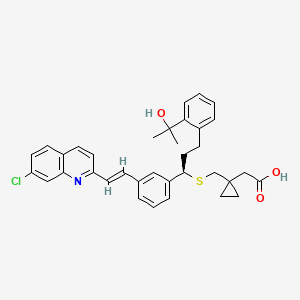
 Chemical structure for montelukast
MONTELUKAST (Singulair® Oral Granules) helps to reduce asthma symptoms (coughing, wheezing, shortness of breath, or chest tightness) and control your asthma. It does not provide instant relief and cannot be used to treat a sudden asthma attack. It works only when used on a regular basis to help reduce inflammation and prevent asthma attacks. This drug is also helpful in improving seasonal allergies, like hay fever.
Montelukast is effective in adults and children
Amongst the US approvals, tentative FDA approvals have been identified for generic Montelukast sodium, awarded to Endo, Glenmark, Mylan, Roxane, Sandoz, Teva and Torrent. The large number of generic authorisations awaiting launch in the UK is indicative of the likely competition the Singulair product will face across Europe upon SPC expiry
EP Pat. No. 480,717 discloses Montelukast sodium along with other related compounds and the methods for their preparation. The reported method of synthesis proceeds through corresponding methyl ester namely, Methyl 2-[(3S)-[3-[(2E)-(7-chloroquinolin – 2yl) ethenyl] phenyl] – 3 – hydroxypropyl] benzoate and involves coupling methyl 1- (mercaptomethyi) cyclopropaneacetate with a mesylate generated in-situ.
The methyl ester of Montelukast is hydrolyzed to free acids and the latter converted directly to Montelukast Sodium salt (Scheme -1). The process is not particularly suitable for large – scale production because it requires tedious chromatographic purification of the methyl ester intermediate and / or the final product and the product yield is low.
Scheme -1
Figure imgf000003_0001
U.S. Pat. No. 5,614632 disclosed a process for the preparation of crystalline Montelukast sodium, which comprises of the following steps (Scheme – 2):
■ Reaction of methyl 2-[3(S)-[3-[2-(7-chloroquinolin -2-yl) ethenyl] phenyl] -3- hydroxypropyl benzoate (I) with Grignard reagent, methyl magnesium chloride in presence of cerium chloride to give Diol (II) ■ Reaction of Diol (II) with methane sulfonyl chloride to afford 2-[2-[3 (s)-[3- (2-(7-chloro quinolin-2yl) ethenyl] phenyl]- 3 – methane sulfonyloxy propyl] phenyl] -2-propanol (III)
■ Condensation of 2-[2-[3(s)-[3-(2-(7-chloro quinolin – 2-yl) ethenyl] phenyl] –
3 – methane sulfonyloxypropyl] phenyl] – 2- propanol (III) with dilithium anion of 1-mercaptomethyl) cyclopropaneacetic acid, which has been generated by the reaction of l-(mercaptomethyl)cyclopropaneacetic acid (IV)with n-Butyl lithium
■ Isolation of the condensed product, Montelukast as solid Montelukast dicyclohexylamine salt
■ Purification and conversion of Montelukast dicyclohexylamine salt into Montelukast sodium
■ Crystallization of Montelukast sodium from a mixture of toluene and acetonitrile
The process disclosed in U.S Pat. No. 5,614,632 further involved the reaction of Diol (II) with methane sulfonyl chloride involves the reaction temperature of about – 25°C and the storage condition of the intermediate, 2-[2-[3(s)-[3-(2-(7-chloro quinolin – 2-yl) ethenyl] pheny] -3 -methane sulfonyloxy propyl] phenyl] -2-propanol (III) at temperature below – 150C for having the stability. The process further involves the reaction, formation of dilithium anion of l-(mercaptomethyl) cyclopropaneacetic acid which requires the usage of n-Butyl lithium, a highly flammable and hazardous reagent and the reaction is at temperature below -5°C further requires anhydrous conditions. Scheme – 2
Figure imgf000005_0001
Figure imgf000005_0002
Figure imgf000012_0003
File:Montelukast 3D ball-and-stick.png
Montelukast (trade names SingulairMontelo-10, and Monteflo and Lukotas in India) is a leukotriene receptor antagonist(LTRA) used for the maintenance treatment of asthma and to relieve symptoms of seasonal allergies.[1][2] It is usually administered orally once a day. Montelukast is a CysLT1 antagonist; it blocks the action of leukotriene D4 (and secondary ligands LTC4 and LTE4) on the cysteinyl leukotriene receptor CysLT1 in the lungs and bronchial tubes by binding to it. This reduces the bronchoconstriction otherwise caused by the leukotriene and results in less inflammation.
Because of its method of operation, it is not useful for the treatment of acute asthma attacks. Again because of its very specificmechanism of action, it does not interact with other asthma medications such as theophylline.
Another leukotriene receptor antagonist is zafirlukast (Accolate), taken twice daily. Zileuton (Zyflo), an asthma drug taken four times per day, blocks leukotriene synthesis by inhibiting 5-lipoxygenase, an enzyme of the eicosanoid synthesis pathway.
The Mont in Montelukast stands for Montreal, the place where Merck developed the drug.[3]
Singulair was covered by U.S. Patent No. 5,565,473[9] which expired on August 3, 2012.[10] The same day, the FDA approved several generic versions of montelukast.[11]
On May 28, 2009, the United States Patent and Trademark Office announced their decision to launch a reexamination of the patent covering Singulair. The decision to reexamine was driven by the discovery of references that were not included in the original patent application process. The references were submitted through Article One Partners, an online research community focused on finding literature relating to existing patents. The references included a scientific article produced by a Merck employee around the key ingredient of Singulair, and a previously filed patent in the same technology area.[12]
On December 17, 2009, the U.S. Patent and Trademark Office determined that the patent in question was valid based on the initial reexamination and new information provided.[13]
Montelukast is currently available in film coated tablet and orodispersible tablet formulations for once-daily administration, and also available as an oral granule formulation which is specifically designed for administration to paediatric patients.
Patent family US17493193A claims crystalline Montelukast sodium and processes for its preparation . Patents within this family are not considered to be a constraint to generic competition because the protected technology may possibly be circumvented by the synthesis and use of different molecular forms and/or salts. Patent family US33954901P relates to the specific marketed oral granule formulation of Montelukast.
The chemical name of montelukast sodium is: Sodium 1-[[[(1R)-1-[3-[(1E)-2-(7-chloro-2-quinolinyl)ethenyl]phenyl]-3-[2-(1-hydroxy-1-methylethyl)phenyl]propyl]thio]methyl]cyclopropaneacetic acid and its structure is represented as follows:
Figure US08399675-20130319-C00001
  • Montelukast is apparently a selective, orally active leukotriene receptor antagonist that inhibits the cysteinyl leukotriene CysLT1 receptor.
  • The chemical name for montelukast sodium is [R-(E)]-1-[[[1-[3-[2-(7-chloro-2-quinolinyl)ethenyl]phenyl]-3-[2-(1-hydroxy-1-methylethyl)phenyl]propyl]thio]methyl] cyclopropaneacetic acid, monosodium salt. Montelukast sodium salt is understood to be represented by the following structural formula:
    Figure imgb0001
  • U.S. patent No. 5,565,473 (“’473 patent”) is listed in the FDA’s Orange Book for montelukast sodium. The ’473 patent recites a broad class of leulcotriene antagonists as “anti-asthmatic, anti-allergic, anti-inflammatory, and cycloprotective agents” represented by a generic chemical formula. ’473 patent, col. 2,1. 3 to col. 4,1. 4. Montelukast is among the many compounds represented by that formula. The ’473 patent also refers to pharmaceutical compositions of the class of leukotriene antagonists of that formula with pharmaceutically acceptable carriers. Id. at col. 10,11. 42-46.
  • Montelukast sodium is currently marketed by Merck in the form of film coated tablets and chewable tablets under the trade name Singular®. The film coated tablets reportedly contain montelukast sodium and the following inactive ingredients: microcrystalline cellulose, lactose monohydrate, croscarmellose sodium, hydroxypropylcellulose, magnesium stearate, titanium dioxide, red ferric oxide, yellow ferric oxide, and carnauba wax. The chewable tablets reportedly containmontelukast sodium and the following inactive ingredients: mannitol, microcrystalline cellulose, hydroxypropylcellulose, red ferric oxide, croscarmellose sodium, cherry flavor, aspartame, and magnesium stearate. Physicians’ Desk Reference, 59th ed. (2005), p. 2141.
  • However, there is a need in the art to improve the stability of compositions of montelukast and particularly those of the sodium salt.
Montelukast sodium is a leukotriene antagonist and inhibits the leukotriene biosynthesis. It is a white to off-white powder that is freely soluble in methanol, ethanol, and water and practically insoluble in acetonitrile.
A montelukast sodium salt is a substance which exhibits efficacy of Singulair (available from Korean MSD) generally used for the treatment of asthma as well as for the symptoms associated with allergic rhinitis, which is pharmaceutically known as a leukotriene receptor antagonist. Leukotrienes produced in vivo by metabolic action of arachidonic acid include LTB4, LTC4, LTD4 and LTE4. Of these, LTC4, LTD4 and LTE4 are cysteinyl leukotrienes (CysLTs), which are clinically essential in that they exhibit pharmaceutical effects such as contraction of airway muscles and smooth muscles and promotion of secretion of bronchial mucus.
Montelukast sodium salt is a white and off-white powder which has physical and chemical properties that it is well soluble in ethanol, methanol and water and is practically insoluble in acetonitrile.
A conventionally known method for preparing a montelukast sodium salt is disclosed in EP Patent No. 480,717. However, the method in accordance with the EP Patent requires processes for introducing and then removing a tetrahydropyranyl (THP) protecting group and purification by chromatography, thus being disadvantageously unsuitable for mass-production. In addition, the method disadvantageously requires investment in high-cost equipment, for example, to obtain amorphous final compounds by lyophilization.
Meanwhile, U.S. Pat. No. 5,614,632 discloses an improved method for preparing a montelukast sodium salt by directly reacting a methanesulfonyl compound (2) with 1-(lithium mercaptomethyl)cyclopropaneacetic acid lithium salt, without using the tetrahydropyranyl protecting group used in EP Patent No. 480,717, purifying in the form of a dicyclohexylamine salt by adding dicyclohexylamine to the reaction solution, and converting the salt into a montelukast sodium salt (1).
However, the method in accordance with the US patent should use n-butyl lithium as a base in the process of preparing the 1-(lithium mercaptomethyl)cyclopropaneacetic acid lithium salt and thus requires an improved process due to drawbacks that n-butyl lithium is dangerous upon handling and is an expensive reagent.
PCT International Patent Laid-open No. WO 2005/105751 discloses a method for preparing a montelukast sodium salt, comprising coupling methyl 1-(mercaptomethyl)cyclopropane acetate (3) used in step 10 shown in Example 146 of EP Patent 480,717 with a methanesulfonyl compound (2) in the presence of a solvent/cosolvent/base, performing hydrolysis, recrystallizing the resultingmontelukast acid (4) in the presence of a variety of solvents to obtain highly puremontelukast acid (4), and converting the same into a montelukast sodium salt (1).
In addition, WO 2005/105751 claims that, in the coupling reaction, one is selected from tetrahydrofurane and dimethylcarbonate as a solvent, a highly polar solvent is selected from dimethylformamide, dimethylacetamide and N-methylpyrrolidone as a cosolvent, and one is selected from sodium hydroxide, lithium hydroxide, sodium hydride, sodium methoxide, potassium tert-butoxide, lithium diisopropylamine and quaternary ammonium salts, as a base.
However, WO 2005/105751 discloses that, since the coupling reaction requires use of a mixed solvent and the mixed solvent is different from the solvent used for hydrolysis, a process for removing the cosolvent through distillation under reduced pressure or extraction is further required prior to hydrolysis.
Further, in accordance with the method of WO 2005/105751, recrystallization is performed in the presence of a variety of solvents in order to obtain a highly puremontelukast acid (4) and the resulting recrystallization yield is varied in a range of 30 to 80%, depending on the solvent. In the case where desired purity is not obtained, recrystallization is repeated until montelukast acid (4) with a desired purity can be obtained. Disadvantageously, the method causes deterioration in overall yield.
European Patent No. 480,717 discloses montelukast sodium and its preparation starting with the hydrolysis of its ester derivative to the crude sodium salt, acidification of the crude to montelukast acid, and purification of the crude acid by column chromatography to give montelukast acid as an oil. The resulting crude oil in ethanol was converted to montelukast sodiumby the treatment with an equal molar aqueous sodium hydroxide solution. After removal of the ethanol, the montelukastsodium was dissolved in water and then freeze dried. The montelukast sodium thus obtained is of a hydrated amorphous form as depicted in FIG. 2.
The reported syntheses of montelukast sodium, as pointed out by the inventor in EP 737,186, are not suitable for large-scale production, and the product yields are low. Furthermore, the final products, as the sodium salts, were obtained as amorphous solid which are often not ideal for pharmaceutical formulation. Therefore, they discloses an efficient synthesis of montelukastsodium by the use of 2-(2-(3-(S)-(3-(7-chloro-2-quinolinyl)ethenyl)phenyl)-3-methanesulfonyloxypropyl)phenyl)-2-propanol to couple with the dilithium salt of 1-(mercaptomethyl)cyclopropaneacetic acid. The montelukast acid thus obtained is converted to the corresponding dicyclohexylamine salt and recrystallized from a mixture of toluene and acetonitrile to obtain crystallinemontelukast sodium. This process provides improved overall product yield, ease of scale-up, and the product sodium salt in crystalline form.
According to the process described in EP 737,186, the chemical as well as optical purities of montelukast sodium depends very much on the reaction conditions for the mesylation of the quinolinyl diol with methanesulfonyl chloride. For instance, the reaction temperature determinates the chemical purity of the resulting coupling product montelukast lithium, due to the fact that an increase in the reaction temperature resulted in decreased selectivity of mesylation toward the secondary alcohol. Mesylation of the tertiary alcohol occurred at higher temperature will produce, especially under acidic condition, the undesired elimination product, the styrene derivative. This styrene impurity is difficult to remove by the purification procedure using DCHA salt formation; while excess base, butyl lithium in this case, present in the reaction mixture causes the formation of a cyclization by-product, which will eventually reduce the product yield.
PCT WO 2005/105751 discloses an alternative process for preparing montelukast sodium by the coupling of the same mesylate as disclosed in ’186 patent with 1-(mercaptomethyl)cyclopropane alkyl ester in the presence of a base. In this patent, the base butyl lithium, a dangerous and expensive reagent, is replaced with other milder organic or inorganic base. However, the problem concerning the formation of the styrene impurity is still not resolved.
 
CA 2649189 A1
Process for the manufacture of 1-[[[(1R)-1-[3-[(1E)-2-(7-chloro-2-quinolinyl)ethenyl]phenyl]-3-[2-(1-hydroxy-1-methylethyl)phenyl]propyl]thio]methyl]cyclopropane acetic acid, sodium salt [montelukast sodium (I)] consisting of: i. Converting methyl 1-(mercaptomethyl)-cyclopropaneacetate to a metal salt (X) using a metal hydroxide, ii. Subjecting the metal salt (X) to monometallation to provide a dimetallide (XI). iii. Converting a diol of formula (II) to a mesylate of formula (III) and reacting (III) in situ with (XI) affordin the metal salt of 1-[[[(1R)-1-[3-[(1E)-2-(7-chloro-2-quinolinyl)ethenyl]phenyl]-3-[2-(1-hydroxy-1-methylethyl)phenyl]propyl]thio]methyl]cyclopropane acetic acid. iv. Reacting the metal salt in-situ with a base and purifying to afford an amine salt (XII). v. Treating (XII) with a sodium base and precipitating out montelukast sodium (I).
 more info
European Patent No. 480,717 disclose the montelukast and its preparation method first be hydrolyzed to the crude ester derivatives sodium, then this crude product was acidified to montelukast acid (montelukastacid), Finally, column chromatography purification of this crude acid into oily montelukast acid. This oilMontelukast acid in ethanol, by equimolar amounts of sodium hydroxide solution and converted to montelukast sodium.
The ethanol was removed aftermontelukast sodium dissolved in water, followed by freeze-drying. Finally obtainedmontelukast shown in Figure 2 is amorphous hydrated.
The invention, in European Patent No. 737,186 points out, thismontelukast synthesis method is not suitable for mass production, and the low yield.
Moreover, the resulting amorphous solid salt, are generally not used in pharmaceutical formulations.
Therefore, they disclose the synthesis of an effective method of montelukast sodium, which uses 2 – (2 – (3 – (S) – (3 – (7 – chloro-2 – quinolinyl) ethenyl) phenyl) -3 – methylsulfonyl) phenyl) -2 – propanol and 1 – (methylthio alcohol) cyclopropane coupling the lithium salt of acetic acid, the resulting Montelukast acid is converted into a corresponding bicyclic hexyl amine salt, and from a mixture of toluene and acetonitrile recrystallization to prepare crystalline montelukast. This method greatly improves the productivity, ease of mass production, and the product is crystalline sodium salt.
According to European Patent No. 737,186 described method for preparingmontelukast chemical purity and optical purity depends largely quinoline diol with methanesulfonyl chloride in the reaction between the mesylated condition.
For example, the reaction temperature resulted in an increase of the secondary alcohols methanesulfonyl selective reduction, the reaction temperature determines the coupling product (montelukast lithium) chemical purity. Occurs at a higher temperature mesylation tertiary alcohols, in particular under acidic conditions, will produce impurities, such as styrene derivatives.
This impurity is difficult styrene generated by using the DCHA salt (DCHA salt formation) in the purification process to remove; present in the reaction mixture and excess base, butyl lithium cyclized by-products resulting in the formation will eventually reduce the yield of the product.
W02005/105751 disclose another preparation method of montelukast sodium, which is the methanesulfonic acid (European Patent No. 737,186 is the same) in an alkaline state where 1_ (methyl mercaptan yl) cyclopropyl alkyl ester and coupling thereof. In this patent, the dangerous and expensive alkaline-butyl lithium reagent, is replaced by other more moderate organic or inorganic base. However, the formation of styrene impurity problem is still not resolved
 LitReferences: Selective cysteinyl leukotriene type 1 receptor antagonist. Prepn: M. L. Belley et al., EP 480717; eidem, US 5565473 (1992, 1996 both to Merck Frosst); M. Labelle et al., Bioorg. Med. Chem. Lett. 5, 283 (1995).
Pharmacological profile: T. R. Jones et al., Can. J. Physiol. Pharmacol. 73, 191 (1995).
LC determn in human plasma: R. D. Amin et al., J. Pharm. Biomed. Anal. 13, 155 (1995).
Review of pharmacology and clinical efficacy in asthma: A. Markham, D. Faulds, Drugs 56, 251-256 (1998).
Clinical trial in pediatric asthma: B. Knorr et al., J. Am. Med. Assoc. 279, 1181 (1998); with loratadine, q.v., in allergic rhinitis: E. O. Meltzer et al., J. Allergy Clin. Immunol. 105, 917 (2000).
Comparison with cetirizine, q.v., in urticaria: M. L. Pacor et al., Clin. Exp. Allergy 31, 1607 (2001).
Review of pharmacology and clinical experience: Z. Diamant, A. P. Sampson, J. Drug Eval. Respir. Med. 1, 53-88 (2002).
  1.  Lipkowitz, Myron A. and Navarra, Tova (2001) The Encyclopedia of Allergies (2nd ed.) Facts on File, New York, p. 178, ISBN 0-8160-4404-X
  2.  “Asthma / Allergy “. Mascothealth.com. Retrieved 9 April 2011.
  3.  http://www.merckfrosst.ca/mfcl/en/corporate/research/accomplishments/singulair.html
  4.  “Montelukast Sodium”The American Society of Health-System Pharmacists. Retrieved 3 April 2011.
  5.  FDA Investigates Merck Drug-Suicide Link
  6.  Updated Information on Leukotriene Inhibitors: Montelukast (marketed as Singulair), Zafirlukast (marketed as Accolate), and Zileuton (marketed as Zyflo and Zyflo CR). Food and Drug Administration. Published June 12, 2009. Accessed June 13, 2009.
  7.  Rubenstein, Sarah (April 28, 2008). “FDA Sneezes at Claritin-Singulair Combo Pill”The Wall Street Journal.
  8.  Schering-Plough press release – Schering-Plough/MERCK Pharmaceuticals Receives Not-Approvable Letter from FDA for Loratadine/Montelukast
  9.  5,565,473
  10.  Singular patent details
  11.  “FDA approves first generic versions of Singulair to treat asthma, allergies”. 03 August 2012. Retrieved 15 August 2012.
  12.  “U.S. Reexamines Merck’s Singulair Patent”. Thompson Reuters. May 28, 2009.
  13.  “Merck Says U.S. Agency Upholds Singulair Patent”. Thompson Reuters. December 17, 2009.
 updated info
GENERAL METHOD1
Figure
………………………………..
READ ABOUT S ISOMER
…………………….
PAPER
Improved Process for the Preparation of Montelukast: Development of an Efficient Synthesis, Identification of Critical Impurities and Degradants
Zentiva k.s., Department of Chemical Synthesis, U kabelovny 130, Prague 102 01, Czech Republic
Org. Process Res. Dev., 2010, 14 (2), pp 425–431
DOI: 10.1021/op900311z
Publication Date (Web): February 11, 2010
Abstract Image
1H NMR (DMSO-d6) δ (ppm) 0.23−0.47 (m, 4H, 2 × CH2 cyclopropyl), 1.08 (d, 6H, 2 × CH3isopropyl), 1.44 (s, 6H, 2 × CH3), 2.10−2.30 (m, 4H, 2 × CH2), 2.51 (m, 1H, CH), 2.52 and 2.63 (m, 2H, CH2), 2.77 a 3.07 (2 × m, 2H, CH2), 3.06 (m, 1H, CH isopropyl), 4.01 (t, 1H, CH), 5.70 (bb, 4H, NH3+, OH), 7.03−8.41 (m, 15H, CH═CH, and CH−arom.).
HPLC
HPLC (isocratic mode) chromatograms were measured with the EliteLachrom device made by the Hitachi Company. Stationary phase: RP-18e was used for the analyses; column temperature was 20 °C. Mobile phase: Acetonitrile (80%) and a 0.1 M aqueous solution of ammonium formate adjusted to pH 3.6 with formic acid (20%) were used. The flow rate of the mobile phase was 1.5 mL/min. Detection at the wavelength of 234 nm was used. Methanol was used as the solvent for preparation of samples; 10−20 μL of the solution was used for the injection. The isocratic HPLC method was used for checking the compositions of the reaction mixtures.
HPLC (gradient mode) chromatograms were measured with the Alliance HPLC device with PDA detector. Stationary phase: STAR RP-8e, 250 mm × 4 mm, 5 μm was used for the analyses; column temperature was 15 °C. Mobile phase: Acetonitrile (A) and 0.01 M aqueous solution of KH2PO4 adjusted to pH 2.2 with phosphoric acid (B) were used. Gradient mode with the flow rate of mobile phase 0.8 mL/min was used. Composition on the start was 60% of A and 40% of B, then changed to 15% of A and 85% of B over 20 min; this composition was held for 5 min, then changed to 60% of A and 40% of B over 5 min, and this composition was held to the end (overall time 35 min.). Detection at the wavelength of 234 nm was used. Methanol was used as the solvent for the preparation of the samples; 10−20 μL of the solution was used for the injection. The gradient HPLC method was used for checking the quality of the target substance including its salts with amines and of isolated standards of impurities.
HPLC (determination of (S)-enantiomer by HPLC) chromatograms were measured with the Alliance HPLC device with PDA detector. Stationary phase: Chiralpak IA (5 μm), size 0.25 m, internal diameter 4.6 mm (manufactured by Daicel) was used for the analyses, column temperature 10 °C. Mobile phase: hexane/ethanol/1,4-dioxan/trifluoroacetic acid (77:3:20:0,1 v/v/v) was used. The flow rate of the mobile phase was 1.0 mL/min. Detection at the wavelength of 285 nm was used. Methanol was used as the solvent for preparation of samples; 10 μL of the solution was used for the injection. The isocratic elution was used for checking the optical purity of target montelukast. Typical retention times: montelukast: 9.3 min, (S)-montelukast: 12.9 min.
KEY REFERENCES
(a) Ray, U. K.;Boju, S.; Pathuri, S. R.; Meenakshisunderam, S. (Aurobindo Pharma Limited, India). PCT Patent Application WO/2008/001213, 2008.

(b) Wang, Y.; Wang, Y.; Brand, M.; Kaspi, J. (Chemagis Ltd., Israel). PCT Patent Application WO/2007/088545, 2007.

(c) Turchetta, S.;Tuozzi, A.; Ullucci, E.; de Ferra, L. (Chemi S.P.A.; Italy). European Patent Application EA 1,693,368, 2008.

(d) Srinivas, P. L.; Rao, D. R.; Kankan, R. N.; Relekar, J. P. (Cipla Limited, India). PCT Patent Application WO/2006/064269, 2006.

(e) Reguri, B. R.; Bollikonda, S.;Bulusu, V. V. N. C. S.; Kasturi, R. K.; Aavula, S. K. (Dr. Reddy’s Laboratory, India). U.S. Patent Application U.S.2005/0107612, 2005.

(f) Coppi, L.; Bartra Sanmarti, M.; Gasanz Guillen, Y.; Monsalvatje Llagostera, M.; Talavera Escasany, P. (Esteve Quimica, S.A., Spain). PCT Patent Application WO/2007/051828, 2007.

(g) Hung, J. T.; Wei, C. P. (Formosa Laboratories, Inc., Taiwan). U.S. Patent Application U.S.2008/0097104, 2008.

(h) McGarrity, J.; Bappert, E.; Belser, E. (Lonza A.G., Switzerland). PCT Patent Application WO/2008/131932, 2008.

(i) Suri, S.; Sarin, G. S.; Mahendru, M. (Morepen Laboratories Limited, India). PCT Patent Application WO/2006/021974, 2006.

(j) Avdagic, A.; Mohar, B.;Sterk, D.; Stephan, M. (Pliva-Istrazivanje Razvoj D.O.O., Croatia). PCT Patent Application WO/2006/000856, 2006.

(k) Overman, A.; Gieling, R. G.; Zhu, J.; Thijs, L. (Synthon B.V., Holland). PCT Patent Application WO/2005/105479, 2005.

(l) Shapiro, E.; Yahomoli, R.;Niddam-Hildesheim, V.; Sterimbaum, G.; Chen, K. (Teva Pharmaceuticals Industries Ltd., Israel). PCT Patent Application WO/2005/105751, 2005.

(m) Achmatowicz, O.; Wisniewski,K.; Ramza, J.; Szelejewski, W.; Szechner, B. (Zaklady Farmaceutyczne Polpharma, S.A., Poland). PCT Patent Application WO/2006/043846, 2006.
 …………………
 
 Figure 00110001
 EXAMPLE 8 Sodium 1-(((1(R)-(3 -(2-(7-chloro-2-quinolinyl)ethenyl)phenyl)-3-(2-(1-hydroxy-1-methylethyl)phenyl)propyl)thio)methyl)cyclopropane-acetateToluene (1000 mL) and water ((950 mL) were placed in a 12 liter extractor equipped with an overhead stirrer, a thermocouple, a nitrogen inlet and an addition funnel. With good mixing of the solvents, solid dicyclohexylamine salt of Example 7 (64.3 g, 82.16 mmol) was added via a powder funnel and toluene (260 mL) was used to rinse in the remaining solid. To the well stirred suspension, acetic acid (2 M, 62 mL, 124 mmol) was added at room temperature. After approximately 10 minutes stirring was stopped. Two clear phases (yellow organic layer and colorless aqueous layer) resulted, and the aqueous waste layer was drained off. Water (950 mL) was charged to the extractor and the layers were mixed thoroughly for approx. 10 minutes.
The agitation was stopped and the aqueous waste layer was drained off.To the organic layer (1270 mL) containing the free acid a titrated solution of sodium hydroxide in 1 % aqueous ethanol (aqueous without ethanol (0.486 M, 169 mL, 82.13 mmol) was added in a steady stream over 10 minutes at room temperature under a nitrogen atmosphere. After 10 minutes age, the clear solution of the desired sodium salt was filtered through a pad of solkafloc using toluene (100 ml) for transfer and cake wash.
The clear filtrate was transferred under nitrogen to a 3 liter, 3-necked flask equipped with an overhead stirrer, a thermocouple, a nitrogen inlet and a distillation head. The solution was concentrated under vacuum to about 400 ml (ca. 40 mm Hg, ≤40°C). The distillation head was replaced with a reflux condenser and an addition funnel. The concentrate was maintained at 40 ± 2°C and acetonitrile (400 mL) was added over 20 minutes. The clear solution was seeded with 0.5 g of the crystalline sodium salt, and the resulting mixture was maintained at 40 ± 2°C for 1.5 hours, by which time a good seed bed was established.Acetonitrile (400 ml) was slowly added over 20 minutes, maintaining the batch temperature at 40 ± 2°C. The white suspension was stirred at 40 ± 2°C for 1 hour and acetonitrile (400 mL) was slowly added over 20 minutes. The slurry was aged at 40 ± 2°C for 12 hours.
A sample of the suspension was examined by cross-polarized micro-scopy to confirm crystallinity of the solid. The suspension was cooled to room temperature and aged at room temperature for 1 hour. The crystalline sodium salt was suction filtered through a sintered funnel under nitrogen. The cake was washed with acetonitrile (400 ml). The crystalline sodium salt cake was broken up in a nitrogen glove bag and dried under vacuum with nitrogen bleed at 40-45°C. The product (49 g, 80.59 mmol, 98% yield) was packaged in a well sealed brown bottle under nitrogen. The reaction mixture and the isolated product were protected from light at all times.

  • HPLC assay of the sodium salt: >99.5 A%. Chiral purity: 99.8% ee. 1H NMR (CD3OD) δ 8.23 (d, 1H), 7.95 (d, 1H), 7.83 (d, 1H), 7.82 (d, 1H), 7.75 (d, H), 7.70 (bs, 1H), 7.54 (dt, 1H), 7.46 (dd, 1H), 7.42-7.35 (m, 3H), 7.37 (d, 1H), 7.14-7.00 (m, 3H), 4.86 (s, active H), 4.03 (dd, 1H), 3.09 (m, 1H), 2.82 (m, 1H), 2.66 (d, 1H), 2.52 (d, 1H), 2.40 (d, 1H), 2.30 (d, 1H), 2.24-2.14 (m, 2H), 1.51 (two s, 6H), 0.52-0.32 (m, 4H). DSC melting endotherm with a peak temperature of 133°C and an associated heat of 25 J/g.
  • X-ray powder diffraction pattern: as shown in FIGURE 3.
………………
 Paper
J. Liang*, J. Lalonde, B. Borup, V. Mitchell, E. Mundorff, N. Trinh, D. A. Kochrekar, R. N. Cherat, G. G. Pai
Codexis, Inc., Redwood City, USA and Arch PharmaLabs Limited, Mumbai, India
Development of a Biocatalytic Process as an Alternative to the (-)-DIP-Cl-Mediated Asymmetric Reduction of a Key Intermediate of Montelukast
Org. Process Res. Dev.  2010,  14:  193-198

Montelukast sodium (Singulair®) is a leukotriene receptor antagonist prescribed for the treatment of asthma and allergies. Workers at Codexis used directed evolution and high-throughput screening to engineer a robust and efficient ketoreductase enzyme (CDX-026) that accomplished the asymmetric reduction of ketone A, which is essentially water insoluble, at a loading of 100 g/L in the presence of ca. 70% organic solvents at 45 ˚C. The (S)-alcohol B was obtained in >95% yield in >99.9% ee and in >98.5% purity on a >500 mol scale.

The enzymatic reduction entails the reversible transfer of a hydride from isopropanol to the ketone A with concomitant formation of acetone. The reaction is driven to completion by the fortuitous crystallization of the monohydrate B. The four-step conversion of B into montelukast sodium is described in the Merck process patent (M. Bhupathy, D. R. Sidler, J. M. McNamara, R. P. Volante, J. J. Bergan US 6320052, 2001). This biocatalytic reduction is superior to the reduction of A with (-)-DIPCl previously used in the manufacture of montelukast
 Impurities

Montelukast sodium (I) is an active ingredient of products used for the treatment of respiration diseases, mainly asthma and nasal allergy. Montelukast sodium, chemically the sodium salt of [R-(E)]-l-[[[l-[3-[2-(7-chloro-2-quinolinyl)ethenyl]phenyl]-3-[2-(l-hydroxy-l- methylethyl)phenyl]propyl]thio]-methyl]cyclopropane acetic acid is described by the chemical formula (I).

Figure imgf000003_0001

(I)

The first solution of chemical synthesis of montelukast (I) was described in the patent no. EP 0480717 Bl and subsequently in specialized literature as well (M.Labele, Bioorg.Med.Chem.Lett. 5 (3), 283-288 (1995)). More possibilities of chemical synthesis of montelukast (I) are described in the following patents: EP 0480717 Bl, EP 0737186 Bl, US 2005/0234241 Al, WO 2005/105751 Al, US 2005/0107612 Al, WO 2005/105749 A2, WO 2005/105750 Al, US 2007/208178 Al.

Figure imgf000004_0001

(H) R alkyl

Figure imgf000004_0002

R-ι> R2 alkyl or hydrogen

For the process of isolation and purification of crude montelukast salts of montelukast with some amines (II) or montelukast acid (III) in the solid state have been used so far. Among montelukast salts with amines salts with dicyclohexylamine (EP 0737186 Bl, WO 04108679A1), tert-butylamine (US 2005/0107612 Al, WO 06043846A1), ethylphenylamine (US 2005/0107612 Al), isopropylamine (WO 2007/005965 Al), di-n-propylamine (WO 2007/005965 Al) and with cycloalkylamines (C5-C9, US 2007/213365 Al) have been described. Solid forms of montelukast acid, both crystalline and amorphous, have been described in a number of patent applications: WO 2005/040123, WO 2005/073194 A2, WO 2005/074893 Al, WO 2005/074893 Al, WO 2004/108679 Al, WO 2005/074935 Al. The most common method used in practice consists in purifying crude montelukast (I) via its salts with secondary amines, mainly with dicyclohexylamine (EP 0737186 Bl).

The sodium salt of montelukast, its preparation and various forms, amorphous or crystalline, , are described in a number of patents or patent applications, e.g. amorphous montelukast sodium is dealt with by EP 0737186 Bl, WO 03/066598 Al, WO 2004/108679 Al, WO 2005/074893 Al, WO 2006/054317A1 a WO 2007/005965. Crystalline polymorphs of montelukast sodium are described by WO 2004/091618 Al and WO 2005/075427 A2.

Processes of isolation and purification of montelukast are of crucial economic significance as they make it possible to obtain a substance that can be used for pharmaceutical purposes. These processes are used to remove impurities that result from the chemical instability of montelukast as well as the instability of the raw materials used for its chemical synthesis or non-selectivity of chemical reactions, or they may be represented by residues of the raw materials used, especially solvents. There is a general rule that chemical purity of the active pharmaceutical ingredient (API) produced in the industrial scale is one of the critical parameters for its commercialization. The American Food and Drug Administration (FDA) as well as European medicament control offices require, according to the Q7A ICH (International Conference on Harmonization) instruction, that API is freed from impurities to the maximum possible extent. The reason is achieving maximum safety of using the drug in the clinical practice. National inspection and control offices usually require that the content of an individual impurity in an API should not exceed the limit of 0.1%. All the substances (generally referred to as impurities) contained in an API over the limit of 0.1% should be isolated and characterized in accordance with the ICH recommendations. It is also recommended to isolate and characterize degradation products that are generated during the storage or usability period of API (ICH Guideline, 2006). In order to obtain information about the stability of a substance and to describe degradation products so-called “stress tests” are performed. Within these tests the API is subjected to a series of critical conditions the selection of which depends on the structure of the tested API. Usually, the influence of an increased temperature, air humidity, light, oxygen and stability in a wide pH range is assessed.

In the montelukast molecule there are a number of functional groups that impair the chemical stability of this substance. Montelukast is known to be prone to several types of degradation; it is mainly the case of three kinds of chemical transformation: (a) Oxidation of the mercapto group to the sulphoxide according to equation (1),

Figure imgf000007_0001

(b) Isomerisation at the location of the double bond from geometry (E) to (Z), or trans to cis by the effect of light according to equation (2),

Figure imgf000007_0002

(c) Dehydration at the location of tert. alcohol, producing the corresponding olefin according to equation (3).

Figure imgf000007_0003

Literature (E.D.Nelson, J.Pharm.Sci. 95, 1527-1539 (2006), C.Dufresne, J.Org.Chem. 1996, 61(24), 8518-8525, WO 2007005965A1) describes increased sensitivity of montelukast (or rather the mercapto group, which montelukast contains) to oxygen, see equation (I)). As the main product of oxidation of montelukast (I) (E)-montelukast-sulfoxide, chemically the sodium salt of [R-(E)]]-l-[[[l-[3-[2-(7-chloro-2-quinolinyl)ethenyl]phenyl]-3-[2-(l-hydroxy- l-methylethyl)-phenyl]propyl]sulfmyl]methyl]cyclopropane acetic acid, described with chemical formula (IV), is mentioned. Contamination of the product with this impurity is undesirable. For this reason the processes leading to the target substance are carried out with the exclusion of oxygen, i.e. under the protective atmosphere of an inert gas (e.g. nitrogen according to EP 0737186 Bl). (E)-Montelukast-sulfoxide (IV) has also been described as a product of the oxidative metabolism of montelukast (Balani S. K. et al: Drug Metabolism and Disposition (1997) 25 (11), 1282-87, Dufrense C: J.Org.Chem. (1996) 61(24), 8518-25).

Exposure of montelukast to light causes its isomerization while a montelukast derivative with geometry (Z) is generated in the location of the double bond (Smith Glen A. et al: Pharm.Res. 2004, 21(9), 1539-44). The impurity resulting from photo-instability is (Z)-montelukast, chemically the sodium salt of l-[[[(lR)-l-[3-[(lZ)-2-(7-chloro-2-quinolinyl)ethenyl]phenyl]- 3-[2-(l-hydroxy-l-methylethyl)phenyl]propyl]thio]methyl]cyclopropane acetic acid, which is described by chemical formula (V), see equation (2).

Another degradation impurity described in literature (WO 2007005965A1) is montelukast dehydrated, chemically the sodium salt of l-[[[(lR)-l-[3-[(lE)-2-(7-chloro-2- quinolinyl)ethenyl]-phenyl]-3-[2-(l-methylethenyl)phenyl]propyl]thio]methyl]cyclopropane acetic acid, described by chemical formula (VI), see equation (3).


Figure imgf000009_0001

……………………………………..

Recently, montelukast or its pharmaceutically acceptable salt is known to function as an antagonist and also as a biosynthesis inhibitor against leukotrienes. The sodium salt of montelukast is commercially available from Merck under the trademark of Singulair® for treating asthma.

EP 480,717 discloses a method of preparing said montelukast sodium salt: As shown in Reaction Scheme 1, methyl 1-(mercaptomethyl)cyclopropylacetate of formula (B) is coupled with the compound of formula (A) to produce the compound of formula (C) as an intermediate, and the compound of formula (C) is then hydrolyzed to obtain the free acid form thereof, followed by treating the free acid with NaOH. However, this method gives a low yield or the manufacturing cost is high.

Figure US08217174-20120710-C00001

THP: tetrahydropyranyl
PPTS: Pyridinium p-toluenesulfonateIn order to solve the above-mentioned problems, EP 737,186 suggests a method as shown in Reaction Scheme 2. This method uses a methanesulfonyl compound of formula (A′) having an unprotected hydroxyl group instead of the THP-protected compound of formula (A). Further, this method uses 1-(mercaptomethyl)cyclopropylacetate dilithium salt of formula (B′) instead of methyl 1-(mercaptoethyl)cyclopropylacetate of formula (B), thereby making the subsequent deprotection step unnecessary. Subsequently, dicyclohexylamine is added to the compound of formula (C″) to produce the compound of formula (D), which is converted to the desired sodium salt.

Figure US08217174-20120710-C00002
Figure US08217174-20120710-C00003

However, the methanesulfonyl compound of formula (A′) used in the above process as a starting material is very unstable, which makes the whole process very complicated. Namely, the reaction to produce the compound of formula (A′) must be performed at a low temperature of about −30° C. and the product is required to be kept at about −15° C. The compound of formula (A′) thus produced is unstable toward moisture and air, and therefore, the reaction thereof has to be conducted quickly under carefully controlled conditions. Also, the synthesis of the compound of formula (B′) requires the use of n-butyllithium which is very explosive and unstable toward moisture and air. Thus, the method described in Reaction Scheme is not suitable for large-scale production.

 Example 1Preparation of 2-(2-(3-(S)-(3-(2-(7-chloro-2-quinolinyl)ethenyl)-phenyl)-3-diphenylphosphate oxypropyl)phenyl)-2-propanol20 g of 2-(2-(3-(S)-(3-(2-(7-chloro-2-quinolinyl)ethenyl)phenyl)-3-hydroxypropyl)phenyl)-2-propanol was dissolved in 240 ml of a mixture of methylene chloride and toluene (2:1), and 7.31 ml (1.2 eq.) of triethylamine was slowly added thereto. To the resulting mixture, 13.6 ml of diphenylchlorophosphate and 1.06 g of 4-dimethylaminopyridine were sequentially added dropwise. After about 1 hr, the completion of the reaction was confirmed by thin layer chromatography (TLC). The reaction mixture was treated with 100 ml of methylene chloride and 200 ml of distilled water. With shaking, the organic layer was separated and dried over sodium sulfate, followed by removing the solvent under reduced pressure. The residue thus obtained was dissolved in 60 ml of a mixture of ethyl acetate and n-hexane (1:3), and the product was recrystallized therefrom. The crystallized product was filtered, washed with 40 ml of distilled water and dried to obtain 29.5 g (97.8%) of the title compound as a yellow solid.m.p.: 127° C.1H-NMR (300 MHz, CDCl3): δ 8.4 (1H, d), 7.94 (1H, d), 7.75 (3H, m), 6.97-7.35 (20H, m), 5.70-5.72 (1H, m), 3.02-3.09 (2H, m), 2.29-2.34 (2H, m), 1.65 (3H, s), 1.59 (3H, s).

Example 2Preparation of 1-(((1-(R)-(3-(2-(7-chloro-2-quinolidyl)-ethenyl)phenyl)-3-(2-(1-hydroxy-1-methyl-ethyl)phenyl)propyl)thio)methyl)-cyclopropylacetic acid12.7 g of 1-(mercaptomethyl)cyclopropylacetic acid dissolved in 90 ml of dimethylformamide was slowly added to a solution of 6.26 g of 60% sodium hydride dissolved in 90 ml of dimethylformamide at 0 to 5° C. To the resulting mixture, 30 g of 2-(2-(3-(S)-(3-(2-(7-chloro-2-quinolinyl)ethenyl)phenyl)-3-diphenylphosphate oxypropyl)phenyl)-2-propanol obtained in Example 1 dissolved in 120 ml of dimethylformamide was slowly added dropwise. After the temperature was slowly increased to room temperature, the reaction was run for 18 to 20 hrs. Then, the reaction mixture was neutralized with a saturated ammonium chloride aqueous solution, and treated with ethyl acetate and distilled water. With shaking, the organic layer was separated and dried over sodium sulfate, followed by removing the solvent under reduced pressure. The residue thus obtained was dissolved in 270 ml of cyclohexane, and the product was recrystallized therefrom. The crystallized product was filtered, washed and dried to obtain 22.2 g (87.1%) of the title compound as a yellow solid.

1H-NMR (300 MHz, CD3OD): δ 8.27 (1H, d), 7.98 (1H, s), 7.78 (2H, d), 7.73 (2H, d), 7.38-7.56 (6H, m), 7.07-7.14 (3H, m), 4.84 (1H, t), 3.30-3.33 (1H, m), 2.84-2.87 (1H, m), 2.52 (2H, s), 2.41 (2H, s), 2.18-2.23 (2H, m), 1.55 (6H, s), 0.37-0.52 (4H, m).

Example 3Preparation of 1-(((1-(R)-(3-(2-(7-chloro-2-quinolidyl)ethenyl)phenyl)-3-(2-(1-hydroxy-1-methyl-ethyl)phenyl)propyl)-thio)methyl)cyclopropylacetate sodium saltStep 1: Preparation of methyl 1-(((1-(R)-(3-(2-(7-chloro-2-quinolidyl)-ethenyl)phenyl)-3-(2-(1-hydroxy-1-methyl-ethyl)phenyl)propyl)thio)methyl)-cyclopropylacetate

2.1 g of methyl 1-(acetylthiomethyl)cyclopropylacetate dissolved in 35 ml of dimethylformamide was slowly added to a solution of 0.71 g of 60% sodium hydride dissolved in 35 ml of dimethylformamide at a temperature ranging from 0 to 5° C. To the resulting mixture, 7.73 g of 2-(2-(3-(S)-(3-(2-(7-chloro-2-quinolinyl)ethenyl)phenyl)-3-diphenylphosphate oxypropyl)phenyl)-2-propanol obtained in Example 1 dissolved in 35 ml of dimethylformamide was slowly added dropwise at a temperature ranging from 0 to 5° C. After about 1 hr, the reaction mixture was treated with ethyl acetate and distilled water. With shaking, the organic layer was separated and dried over sodium sulfate, followed by removing the solvent under reduced pressure to obtain 5.68 g (84.5%) of the title compound as a yellow liquid.

1H-NMR (300 MHz, CDCl3): δ 8.12 (2H, d), 7.66-7.74 (4H, m), 7.37-7.48 (6H, m), 7.12-7.20 (3H, m), 3.96 (1H, t), 3.14-3.16 (1H, m), 2.88 (1H, m), 2.53 (2H, s), 2.43 (2H, s), 1.62 (6H, d), 0.41-0.54 (4H, m).

Step 2: Preparation of 1-(((1-(R)-(3-(2-(7-chloro-2-quinolidyl)-ethenyl)phenyl)-3-(2-(1-hydroxy-1-methyl-ethyl)phenyl)propyl)thio)methyl)-cyclopropyl acetic acid

12 g of methyl 1-(((1-(R)-(3-(2-(7-chloro-2-quinolidyl)ethenyl)phenyl)-3-(2-(1-hydroxy-1-methyl-ethyl)phenyl)propyl)thio)methyl)cyclopropylacetate obtained in step 1 was dissolved in a mixture of 60 ml of tetrahydrofuran and 30 ml of methyl alcohol. After adjusting the temperature to 10 to 15° C., 24 g of 10% NaOH solution was slowly added to the resulting mixture. Then, the temperature was slowly increased to room temperature (24 to 27° C.), and the reaction mixture was stirred for 20 hrs. After reaction was completed, the organic layer was separated and dried, followed by removing the solvent under reduced pressure. The residue thus obtained was mixed with water layer again, and 120 ml of toluene was added thereto. Subsequently, the pH of the reaction product was adjusted to 4 by adding 300 ml of acetic acid. The organic layer was separated again and dried over sodium sulfate, followed by removing the solvent under reduced pressure. The residue thus obtained was dissolved in 96 ml of a mixture of isopropanol and distilled water (2:1), and the product was recrystallized therefrom. The crystallized product was filtered to obtain 9.82 g (83%) of the title compound as a yellow solid.

Montelukast acid

1H-NMR (300 MHz, CD3OD): δ 8.27 (1H, d), 7.98 (1H, s), 7.78 (2H, d), 7.73 (2H, d), 7.38-7.56 (6H, m), 7.07-7.14 (3H, m), 4.84 (1H, t), 3.30-3.33 (1H, m), 2.84-2.87 (1H, m), 2.52 (2H, s), 2.41 (2H, s), 2.18-2.23 (2H, m), 1.55 (6H, s), 0.37-0.52 (4H, m).

m.p.: 154° C., purity>99%

Step 3: Preparation of 1-(((1-(R)-(3-(2-(7-chloro-2-quinolidyl)ethenyl)phenyl)-3-(2-(1-hydroxy-1-methyl-ethyl)phenyl)propyl)thio)-methyl)cyclopropylacetate sodium salt

5 g of 1-(((1-(R)-(3-(2-(7-chloro-2-quinolidyl)ethenyl)phenyl)-3-(2-(1-hydroxy-1-methyl-ethyl)phenyl)propyl)thio)methyl)cyclopropylacetic acid obtained in step 2 was mixed with 10 ml of toluene, followed by removing the solvent under reduced pressure to remove the solvent. To the residue thus obtained, 14.5 ml of toluene and 13 ml of 0.5N NaOH/MeOH solution were sequentially added. The resulting mixture was stirred for 30 min, followed by removing the solvent under reduced pressure. The residue was dissolved in 10 ml of toluene and 50 ml of n-hexane, and the product was recrystallized therefrom. The crystallized product was filtered to obtain 5.1 g (98%) of the title compound as a pale yellow solid.

Montelukast sodium

1H-NMR (300 MHz, CD3OD): δ 8.29 (1H, d), 7.99 (1H, s), 7.83-7.91 (3H, m), 7.72 (1H, s), 7.49-7.52 (2H, m), 7.38-7.44 (4H, m), 7.10-7.15 (3H, m), 4.04 (1H, t), 3.08 (1H, m), 2.82 (1H, m), 2.66 (1H, d), 2.52 (1H, d), 2.43 (1H, d), 2.29 (1H, d), 2.16-2.24 (2H, m), 1.52 (6H, s), 0.33-0.52 (4H, m)


PATENTS
WO1995018107A1 Dec 22, 1994 Jul 6, 1995 James J Bergan Process for the preparation of leukotriene antagonists
WO2004026838A1 * Sep 11, 2003 Apr 1, 2004 Michiaki Adachi Method for producing a 3,5-dihydroxy-6-heptenoate
WO2009111998A2 * Mar 11, 2009 Sep 17, 2009 Zentiva, K.S. Specific impurities of montelukast
EP0480717A1 Oct 10, 1991 Apr 15, 1992 Merck Frosst Canada Inc. Unsaturated hydroxyalkylquinoline acids as leukotriene antagonists
EP0480717B1 Oct 10, 1991 Apr 15, 1998 Merck Frosst Canada Inc. Unsaturated hydroxyalkylquinoline acids as leukotriene antagonists
EP0737186B1 Dec 22, 1994 Aug 19, 1998 Merck &amp; Co., Inc. Process for the preparation of leukotriene antagonists
US2985589 May 22, 1957 May 23, 1961 Universal Oil Prod Co Continuous sorption process employing fixed bed of sorbent and moving inlets and outlets
US5156736 May 7, 1991 Oct 20, 1992 Schoenrock Karlheinz W R Simulated moving bed apparatus using a single sorbent bed for separating components from a fluid stream
US5523477 Jan 23, 1995 Jun 4, 1996 Merck & Co., Inc. Reacting 1,1-cyclopropanedimethanol with dialkyl sulfite in presence of acid or base to form cyclic sulfite, removing alcohol reaction by-product
US5565473 Feb 23, 1995 Oct 15, 1996 Merck Frosst Canada, Inc. Useful as anti-asthmatic, anti-allergic, anti-inflammatory and cytoprotective agents; montelukast and its sodium salt
PATENT CITATIONS
Cited Patent Filing date Publication date Applicant Title
WO2006008751A2 * Jul 19, 2004 Jan 26, 2006 Satyanarayana Chava Process for the preparation of montelukast and its salts
WO2006043846A1 * Oct 21, 2005 Apr 27, 2006 Inst Farmaceutyczny Salt of montelukast with tert.-butylamine
WO2007072114A1 * Jan 16, 2006 Jun 28, 2007 Harmander Pal Singh Chawla An improved process for the manufacture of montelukast sodium
WO2007107297A1 * Mar 15, 2007 Sep 27, 2007 Synthon Bv Montelukast amantadine salt
US20050107612 * Dec 30, 2003 May 19, 2005 Dr. Reddy’s Laboratories Limited Process for preparation of montelukast and its salts

NON-PATENT CITATIONS
Reference
1 * An improved process to obtain Montelukast sodium” RESEARCH DISCLOSURE, MASON PUBLICATIONS, HAMPSHIRE, GB, vol. 521, no. 2, 1 September 2007 (2007-09-01), page 908, XP007137576 ISSN: 0374-4353
2 * Piperazine salts of Montelukast, a new efficient method of purification” IP.COM JOURNAL, IP.COM INC., WEST HENRIETTA, NY, US, 29 November 2007 (2007-11-29), XP013122974 ISSN: 1533-0001
3 * AL OMARI ET AL: “Effect of light and heat on the stability of montelukast in solution and in its solid state” JOURNAL OF PHARMACEUTICAL AND BIOMEDICAL ANALYSIS, NEW YORK, NY, US, vol. 45, no. 3, 19 October 2007 (2007-10-19), pages 465-471, XP022306740 ISSN: 0731-7085
4 * DUFRESNE C ET AL: “Synthesis of montelukast (MK-0476) metabolic oxidation products” JOURNAL OF ORGANIC CHEMISTRY, AMERICAN CHEMICAL SOCIETY, EASTON.; US, vol. 61, no. 24, 1 January 1996 (1996-01-01), pages 8518-8525, XP002284162 ISSN: 0022-3263
5 * GRAUL L ET AL: “Montelukast sodium, MK-476, MK-0476, L-706631, Singulair” DRUGS OF THE FUTURE, PROUS SCIENCE, ES, vol. 22, no. 10, 1 January 1997 (1997-01-01), page 1103, XP008082254 ISSN: 0377-8282
6 * NELSON ERIC D ET AL: “Evaluation of solution oxygenation requirements for azonitrile-based oxidative forced degradation studies of pharmaceutical compounds.” July 2006 (2006-07), JOURNAL OF PHARMACEUTICAL SCIENCES JUL 2006, VOL. 95, NR. 7, PAGE(S) 1527 – 1539 , XP002563008 ISSN: 0022-3549 compound 4
7 * SMITH GLENN A ET AL: “An automated method for the determination of montelukast in human plasma using dual-column HPLC analysis and peak height summation of the parent compound and its photodegradation product.” September 2004 (2004-09), PHARMACEUTICAL RESEARCH SEP 2004, VOL. 21, NR. 9, PAGE(S) 1539 – 1544 , XP002563007 ISSN: 0724-8741 page 1539 – page 1544; example 2
WO2011061545A1 * Nov 20, 2010 May 26, 2011 Generics [Uk] Limited Hplc method for analyzing vorinostat
WO2012077123A1 * May 12, 2011 Jun 14, 2012 Arch Pharmalabs Limited Purification of montelukast using a simulated moving bed
WO2014034203A1 * May 28, 2013 Mar 6, 2014 Dai Nippon Printing Co., Ltd. Method for producing high-purity montelukast
CN102060762A * Jan 28, 2011 May 18, 2011 海南美大制药有限公司 Montelukast compound and new preparation method thereof
CN102060762B Jan 28, 2011 May 29, 2013 海南美大制药有限公司 Montelukast compound and new preparation method thereof
US8471030 Dec 6, 2010 Jun 25, 2013 Orochem Technologies Inc. Purification of montelukast using simulated moving bed
US8754129 Nov 25, 2009 Jun 17, 2014 Generics [Uk] Limited Crystalline vorinostat form VI

MALOTILATE, Malotilat


Malotilate.png

 Malotilate, Malotilat

(Kantec; Hepation; NKK 105)

Diisopropyl 1,3-dithiol-2-ylidenemalonate

Nihon Nohyaku Co., Ltd.  innovator

Malotilate (INN) is a drug used in the treatment of liver disease. It has been shown to facilitate liver regeneration in rats.[1]

DA-3857
NKK-105

CAS  59937-28-9
Name: 1,3-Dithiol-2-ylidenepropanedioic acid bis(1-methylethyl) ester
Additional Names: diisopropyl 1,3-dithiol-2-ylidenemalonate
Manufacturers’ Codes: NKK-105
Trademarks: Hepation (Nippon Chemiphar); Kantec (Daiichi)
Molecular Formula: C12H16O4S2
Molecular Weight: 288.38
Percent Composition: C 49.98%, H 5.59%, O 22.19%, S 22.24%
Properties: Pale yellow crystals, mp 60.5°. Sol in benzene, cyclohexane, n-hexane, ether.
Melting point: mp 60.5°
Therap-Cat: Hepatoprotectant.
Systematic (IUPAC) name
diisopropyl 1,3-dithiol-2-ylidenemalonate
Clinical data
AHFS/Drugs.com International Drug Names
Legal status
  • Prescription only
Routes Oral
Identifiers
CAS number 59937-28-9 
ATC code None
PubChem CID 4006
UNII RV59PND975 Yes
Chemical data
Formula C12H16O4S2 
Mol. mass 288.38 g/mol

Brief background information

Salt ATC Formula MM CAS
A02AD02 C 12 H 16 O 4 S 2 288.39 g / mol 59937-28-9

Application

  • hepatoprotector
  • in the treatment of liver diseases

Classes of substances

  • 1,2-dithiolane and 1,2-dithiols
    • Esters
      • Anilides and other derivatives of malonic acid


  • It is known that there are a large number of patients who suffer from liver damages caused by various factors such as alcohol, malnutrition, viruses, chemicals, toxicants, etc. The liver diseases may generally be classified by their types into acute hepatitis, chronic hepatitis, liver cirrhosis, and fulminant hepatitis. It is said to be very difficult to treat these liver diseases. Namely, currently available methods for the treatment such as treatments with pharmaceuticals e.g. liver protective agents such as various vitamins, saccharides, amino acids, glutathione, glycyrrhizin, liver hydrolyzates or adrenocortical hormones; cholagogues; immunomodulaters; or antiviral substances against viral hepatitis, are all nothing more than symptomatic treatments, and they are not adequately effective for the treatment of the existing liver damages.
  • It has recently been reported that 1,3-dithiol derivatives represented by Malotilate as identified below, are effective for the treatment of liver damages (see Japanese Examined Patent Publications No. 18,576/1981, No. 18,577/1981 and No. 18,578/1981).

    Figure imgb0001
  • Other 1,3-dithiol derivatives similar to Malotilate with respect to structure and pharmaceutical properties are described in US-A-4,118,506, EP-A-99 329 and US-A-4,022,907.
  • As a result of extensive researches, the present inventors have found that certain novel 1,3-dithiol derivatives represented by the after-mentioned formula I, exhibit excellent activities for the treatment of a wide spectrum of liver damages, which are comparable or superior to the above-mentioned conventional 1,3-dithiol derivatives. The present invention has been accomplished on the basis of this discovery.
  • Namely, the present invention provides a 1,3-dithiol-2-ylidene derivative of the formula:

    Figure imgb0002


Synthesis pathway

Synthesis a)


………………

US 4327223

http://www.google.co.in/patents/US4327223

EXAMPLE 1

Diisopropoxycarbonylketene disodium mercaptide crystals (8 g, 0.02 mol) was dissolved in 50 ml of dimethylsulfoxide, and 1,1,1-trichloroethane (2.7 g, 0.02 mol) and subsequently a 30% sodium hydroxide aqueous solution (2.7 g, 0.02 mol NaOH) were added thereto. Thus, reaction was carried out at 60° C. for 1 hour. The resulting mixture was poured into ice-water, and then extracted with benzene. Drying of the extract over anhydrous magnesium sulfate, distillation to remove benzene, and recrystallization from n-hexane gave 2.6 g of the object matter diisopropyl 1,3-dithiol-2-ylidene malonate; m.p. 60.5° C., yield 45%.

EXAMPLE 2

Diisopropyl malonate (18.8 g, 0.1 mol) and carbon disulfide (7.6 g, 0.1 mol) were dissolved in 200 ml of dimethylsulfoxide. Dropping thereto a 45% potassium hydroxide aqueous solution (31 g, 0.25 mol KOH) at 13°-17° C., gave a yellowish red solution containing diisopropoxycarbonylketene dipotassium mercaptide. At 20° C., 1,1,1-trichloroethane (26.6 g, 0.2 mol) was added, and 5 minutes after a 45% potassium hydroxide aqueous solution (18.6 g, 0.15 mol KOH) was dropped thereinto. The temperature was raised to 70° C. to carry out reaction for 30 minutes. The resulting mixture was poured into ice-water and then extracted with benzene. Drying of the extract over anhydrous magnesium sulfate, distillation to remove benzene, and recrystallization from n-hexane gave 23.6 g of the object matter diisopropyl 1,3-dithiol-2-ylidene malonate; m.p. 60.5° C., yield 82.1%.

EXAMPLE 3

Diisopropyl malonate (18.8 g, 0.1 mol) and carbon disulfide (7.6 g, 0.1 mol) were dissolved in 200 ml of dimethylsulfoxide. A 45% potassium hydroxide aqueous solution (49.6 g, 0.4 mol KOH) was dropped thereto at 15° C., then 1,1,1-trichloroethane (13.3 g, 0.1 mol) was added at 20° C., and reaction was carried out at 70° C. for 30 minutes. The resulting mixture was poured into ice-water and then extracted with benzene. Drying of the extract over anhydrous magnesium sulfate, distillation to remove benzene, and recrystallization from n-hexane gave 18.1 g of the object matter diisopropyl 1,3-diethiol-2-ylidene malonate; m.p. 60.5° C., yield 62.8%.


………………………………….

US 4035387

http://www.google.co.in/patents/US4035387

Example 1Synthesis of diisopropyl 1,3-dithiol-2-ylidene malonate (the compound 3)

1.1 Grams (0.03 mole) of 69% purity sodium hydride was suspended in 30 ml. of dry tetrahydrofuran. Into the resulting suspension, 5.6g (0.03 mole) of diisopropyl malonate was gradually dropped with ice-cooling. After completion of the generation of hydrogen gas, 8.2g (0.03 mole) of 2-methylthio-1,3-dithiolium iodide was added. The resulting mixture was heated under reflux for 1 hour, and then the reaction product was poured into a large amount of ice water to deposit crystals. The crystals were recovered by filtration, dried and then recrystallized from n-hexane to obtain 6.7g of white crystals, m.p. 59°-60° C., yield 77.5% .

The 2-methylthio-1,3-dithiolium iodide used as starting material was synthesized in the following manner;

44.4 Grams (0.2 mole) of 1,3-dithiol-2-thion-4,5-dicarboxylic acid was dissolved in 240 ml of nitromethane, and the resulting solution was heated to 80° C. Into this solution, 100 ml of iodomethyl was gradually dropped, and the resulting mixture was refluxed for 6 hours. After completion of the reaction, the formed crystals were recovered by filtration, washed with 100 ml of ether and then air-dried to obtain 48.4g of the desired compound, m.p. 114°-116° C. (decomp.), yield 87.0%.


………………………………………..

Fujinami, T.; et al.   The preparation of cyclic dithia and thiaza compounds by the reaction of potassium carbonate with heterocumulenes and alkylene dibromides or carbonate catalyzed by organostannyl compounds
Bull Chem Soc Jpn 1982, 55(4): 1174

 https://www.jstage.jst.go.jp/article/bcsj1926/55/4/55_4_1174/_pdf


…………………………………….

Trade Names

Country Trade name Manufacturer
Japan Kantek Daiichi
Ukraine No No

Formulations

  • 200 mg tablets

Links

  • DOS 2,545,569 (Nihon Nohyaku; appl. 10.10.1975; J-prior. 18.10.1974, 22.10.1974).
  • US 4,035,387 (Nihon Nohyaku; 12.7.1977; J-prior. 18.10.1974, 22.10.1974).

1H NMR PREDICTIONS

WATCH OUT


13C NMR PREDICTIONS


Literature References: Prepn from diisopropyl malonate: K. Taninaka et al., DE 2545569; eidem, US 4035387 (1976, 1977 both to Nihon Nohyaku); from the corresponding ketene mercaptide: H. Matsui et al., US 4327223 (1982 to Nihon Nohyaku). Effect on CCl4-induced liver injury in rats: Y. Imaizumi et al., Jpn. J. Pharmacol. 31, 15 (1981). Enhancement of rat liver protein synthesis:eidem, ibid. 32, 369 (1982). Pharmacokinetics and pharmacodynamics: M. Buhrer et al., Eur. J. Clin. Pharmacol. 30, 407 (1986). Clinical evaluation in liver cirrhosis: S. Takase et al., Gastroenterol. Jpn. 23, 639 (1988).

References

  • Bührer M, Le Cotonnec JY, Wermeille M, Bircher J (1986). “Treatment of liver disease with malotilate. A pharmacokinetic and pharmacodynamic phase II study in cirrhosis”. Eur. J. Clin. Pharmacol. 30 (4): 407–16. doi:10.1007/BF00607952.PMID 3743616.
  • Siegers CP, Pauli V, Korb G, Younes M (August 1986). “Hepatoprotection by malotilate against carbon tetrachloride-alcohol-induced liver fibrosis”. Agents Actions 18 (5–6): 600–3. doi:10.1007/BF01964970. PMID 3766314.
  • Younes M, Siegers CP (May 1985). “Effect of malotilate on paracetamol-induced hepatotoxicity”. Toxicol. Lett. 25 (2): 143–6.doi:10.1016/0378-4274(85)90074-8. PMID 4002245.
  • Mayer, R.; et al.Synthesis of 1,3-dithiol-2-thiones (‘ Isotrithione’)
    Angew Chem Int Ed 1964, 76(3): 143
  • O’Connor, B.R.; Jones, F.N.Reactions of ethylene di- and trithiocarbonates with acetylenes. Anomalous reaction with bromocyanoacetylene to give a thioacyl bromide
    J Org Chem 1970, 35(6): 2002
  • Fujinami, T.; et al.   The preparation of cyclic dithia and thiaza compounds by the reaction of potassium carbonate with heterocumulenes and alkylene dibromides or carbonate catalyzed by organostannyl compounds
    Bull Chem Soc Jpn 1982, 55(4): 1174


Biological Activity of  Malotilate

Malotilate is a Liver Protein Metabolism Improved Compound, Which Selectively INHIBIT the 5-lipoxygenase. IC50 Value : Target : 5-lipoxygenase in vitro : In an in vitro assay using RAT Invasion lung endothelial (RLE) cells, Invasion of tumor cells Which HAD BEEN treated with MT (10 ng / ml, 24 h) was not affected; however, when RLE cells had been treated with MT, invasion was significantly inhibited in three cell lines (SAS, Ca9-22 and HSC-4) and a tendency to inhibition WAS Also Observed in other Cell lines [1]. in Vivo : The Improvement Rates for choline esterase Were Significantly Greater Activity in the malotilate group than in the Control group Levels Significantly Increased Serum albumin in the malotilate group BUT not in the Control group. [2]. In the rats treated with MT for 19 days after iv inoculation of c-SST-2 cells, lung metastasis was also significantly suppressed [3]. Malotilate prevented increases in serum markers of type III and IV collagen synthesis as well as accumulation of the collagens, laminin and fibronectin in the Liver [4]. Toxicity : Malotilate cytotoxicity to PBMCs, Assessed by trypan blue dye Exclusion and lactate dehydrogenase (LDH) Release into the Culture Media, WAS found to be markedly Increased by the Addition of the NADPH generating system, indicating that metabolites play a significant role in toxicity [5].

[1] Shibata T, et al Inhibitory Effects of malotilate on in vitro Cell Invasion of lung endothelial monolayer by human oral squamous carcinoma cells Tumour Cell Biol 2000 Sep-Oct; 21 (5):….. 299-308 [2 …] Takase S, et al Effects of treatment on malotilate Alcoholic Liver disease Alcohol 1989 May-Jun; 6 (3):. 219-22. [3] Nagayasu H, et al Inhibitory Effects of malotilate on Invasion and.. Metastasis of RAT mammary carcinoma cells by modifying the Functions of Vascular endothelial cells Br J Cancer 1998 May; 77 (9):.. 1371-7. [4] Ryhanen L, et al The Effect of malotilate on type III and type.. . IV collagen, laminin and fibronectin Liver Metabolism in dimethylnitrosamine-induced fibrosis in the RAT J Hepatol 1996 Feb; 24 (2):. 238-45. [5] Nomura F, et al Detection of malotilate Toxicity in vitro with Peripheral.. . blood mononuclear cells as targets A preliminary report J Hepatol 1990 Jul; 11 (1):.. 65-9.

Dalfopristin


Dalfopristin.png

Dalfopristin

Dalfopristin;Dalfopristin Mesylate;(3R,4R,5E,10E,12E,14S,26R,26aS)-26-[[2-(DiethylaMino)ethyl]sulfonyl]-8,9,14,15,24,25,26,26a-octahydro-14-hydroxy-4,12-diMethyl-3-(1-Methylethyl)-3H-21,18-nitrilo-1H,22H-pyrrolo[2,1-c][1,8,4,19]dioxadiazacyclotetracosine-1,7,16,22(4H,17H)-tetr

Preparation: J.C. Barriere et al., EP 191662; eidem, US 4668669 (1986, 1987 both to Rhone-Poulenc)

Rhone-Poulenc Sante …..LINK

  • Dalfopristin
  • Dalfopristina
  • Dalfopristina [INN-Spanish]
  • Dalfopristine
  • Dalfopristine [INN-French]
  • Dalfopristinum
  • Dalfopristinum [INN-Latin]
  • RP 54476
  • UNII-R9M4FJE48E

Usage
A Viiginiamycin M1 (V672810) derivative. A streptogramin antibiotic used to treat infections by staphylococci and by vancomycin-resistant Enterococcus faecium.
Usage
Dalfopristin is a semi-synthetic analogue of ostreogyrcin A (virginiamycin M, pristinamycin IIA, streptogramin A) formed by addition of diethylaminoethylthiol to the 2-pyrroline group of ostreogyrcin, followed by oxidation to the sulphone. The structural changes provide a more hydrophobic compound with a readily ionisable group for generating a salt. Dalfopristin is used commercially in synergistic combination with quinupristin (70:30). There is little published data on the synthesis, biological or antibiotic activity of dalfopristin alone, however the combination product is highly effective, including activity against antibiotic resistant strains.
Brief background information
Salt ATC Formula MM CAS
J01FG02 C 34 H 50 N 4 O 9 S 690.86 g / mol 112362-50-2

Application

  • antibiotic (used for bacteremia caused by the vancomycin-resistant Enterococcus faecium )

Dalfopristin
Dalfopristin.png
Systematic (IUPAC) name
(3R,4R,5E,10E,12E,14S,26R,26aS)-26-[[2-(diethylamino)ethyl]sulfonyl]-8,9,14,15,24,25,26,26a- octahydro-14-hydroxy-3-isopropyl-4,12-dimethyl-3H-21,18-nitrilo-1H,22H-pyrrolo[2,1-c][1,8,4,19]-dioxadiazacyclotetracosine-1,7,16,22(4H,17H)-tetrone
Clinical data
AHFS/Drugs.com International Drug Names
MedlinePlus a603007
Legal status
Pharmacokinetic data
Half-life 1 hour
Identifiers
CAS number 112362-50-2 Yes
ATC code None
PubChem CID 6435782
DrugBank DB01764
Chemical data
Formula C34H50N4O9S 
Mol. mass 690.85 g/mol

Dalfopristin is a semi-synthetic streptogramin antibiotic analogue of ostreogyrcin A (virginiamycin M, pristinamycin IIA, streptogramin A).[1] The combination quinupristin/dalfopristin (marketed under the trade name Synercid) was brought to the market by Rhone-Poulenc Rorer Pharmaceuticals in 1999.[2] Synercid (weight-to-weight ratio of 30% quinupristin to 70% dalfopristin) is used to treatinfections by staphylococci and by vancomycin-resistant Enterococcus faecium.[3]

Synthesis

Through the addition of diethylaminoethylthiol to the 2-pyrroline group and oxidation of the sulfate of ostreogrycin A, a structurally more hydrophobic compound is formed. This hydrophobic compound contains a readily ionizable group that is available for salt formation.[1]

Large Scale Preparation

Dalfopristin is synthesized from pristinamycine IIa through achieving a stereoselective Michael-type addition of 2-diethylaminoethanethiol on the conjugated double bond of the dehydroproline ring [4] . The first method found was using sodium periodate associated with ruthenium dioxide to directly oxidize the sulfur derivative into a sulfone. However, using hydrogen peroxidewith sodium tungstate in a 2-phase medium produces an improved yield, and is therefore the method of choice for large scale production.

The production of the dalfopristin portion of quinupristin/dalfopristin is achieved through purifying cocrystallization of the quinupristin and dalfopristin from acetone solutions.[4]

Physical Characteristics (as mesylate salt)

Appearance White to yellow solid
Physical State Solid
Solubility Soluble in ethanol, methanol, DMSO, DMF, and water (0.072 mg/ml)
Storage -20°C
Boiling Point 940.5°C at 760 mmHg
Melting Point 150°C
Density 1.27 g/cm^3
Refractive Index n20D 1.58
pK Values pKa: 13.18 (Predicted), pKb: 8.97 (Predicted)

Antimicrobial Activity

Alone, both dalfopristin and quinupristin have modest in vitro bacteriostatic activity. However, 8-16 times higher in vitro bactericidal activity is seen against many gram-positive bacteria when the two streptogramins are combined [5] . While quinupristin/dalfopristin is effective against staphylococci and vancomycin-resistant Enterococcus faecium, in vitro studies have not demonstrated bactericidal activity against all strains and species of common gram-positive bacteria.

Mechanism of Action

Both dalfopristin and quinupristin bind to sites located on the 50S subunit of the ribosome. Initial dalfopristin binding results in a conformational change of the ribosome, allowing for increased binding by quinupristin.[5] A stable drug-ribosome complex is created when the two drugs are used together. This complex inhibits protein synthesis through prevention of peptide-chain formation and blocking the extrusion of newly formed peptide chains. In many cases, this leads to bacterial cell death.

Mechanism of Resistance

Streptogramin resistance is mediated through enzymatic drug inactivation, efflux or active transport of drug out of the cell, and most commonly, conformational alterations in ribosomal target binding sites.[5] Enzymatic drug inactivation may occur in staphylococcal and enterococcal species through production of dalfopristin-inactivating acetyltransferase or quinupristin-inactivating hydrolase. Efflux or active transport of the drug may occur in coagulase-negative staphylococci and Enterococcus faecium. Constitutive ribosome modification has been seen in staphylococci with resistance seen in quinupristin only.

While resistance to dalfopristin may be conferred via a single point of mutation, quinupristin/dalfopristin offers the benefit of requiring multiple points of mutation targeting both dalfopristin and quinupristin components to confer drug resistance.[5] Comparatively, only 2-5% of staphylococcal isolates collected in France show resistance to a related streptogramin, pristinamycin, in over 35 years of use.

Drug Interactions

Both dalfopristin and quinupristin are extensively hepatically metabolized, excreted from the feces, and serve as an inhibitor of cytochrome P450 (CYP) 3A4 enzyme pathway.[5]Caution should be taken with concommitent use with drugs metabolized by the CYP3A4 pathway. Concomitant use of quinupristin/dalfopristin with cyclosporine for 2–5 days has shown to result in a two-fold increase in cyclosporine levels.

No adverse effects have been seen in patients with hepatic impairment and no recommendations by the manufacturer have been made for dose reduction ofquinupristin/dalfopristin in this patient population.

Commercialization

While little information is available regarding the regulatory and commercialization history of Dalfopristin alone, Synercid (quinupristin/dalfopristin), made by Rhone-Poulenc Rorer Pharmaceuticals, was approved in 1999 as an IV injectable for the treatment of vancomycin resistant Enterococcus faecium and complicated skin and skin structure infections.[2]Dalfopristin can be purchased alone on the internet from various chemical manufacturers as a mesylate salt.

Synthesis pathway

Synthesis a)

US 4668669

OR

http://www.google.com/patents/EP0191662A1

    EXAMPLE 4

  • By proceeding in a similar manner to that described in subs. Ple 1, but starting from 5.5 g of (2-dimethylamino ethyl) thio-26 pristinaffycine II B, of 0.67 cm3 trifluoroacetic acid 1.8 g of meta-chloroperbenzoic acid and after purification by “flash” chromatography [eluent: chloroform-methanol (90:10 by volume)], collecting fractions of 30 cm3 and concentration to dryness fractions 23-40 under reduced pressure (2.7 kPa) at 30 ° C, 0.4 g of (2-dimethylamino ethyl) sulfinyl-26 pristinamycin II B (isomer A 2 70% 1 15% A isomer, isomer B 1 7%, isomer B 28%) as a yellow powder melting at 150 ° C.
  • NMR spectrum (isomer 2):

    • 1.77 (s,-CH 3 at 33)
    • 2.41 (s, – N (CH 3) 2)
    • 2.70 to 3.20 (mt,
      Figure imgb0032

      > CH 2-15 and H 4)

    • 3.82 (s,> CH 2 at 17)
    • 4.84 (m, – H 3 and H-27)
    • 5.52 (d,H13)
    • 6.19 (d, H-11)
    • 6.42 (m,> NH at 8)
    • 8.14 (s, – H 20)
  • The (2-dimethylamino ethyl) thio pristinamycin II B-26 can be prepared as follows:

    • By proceeding in a similar manner to that described in Example 3, but using 2.7 g of pristinamycin II A and 0.58 g of dimethylamino-ethanethiol and 2 after purification by “flash” chromatography [eluent: chloroform -methanol (90:10 by volume)] and concentration to dryness fractions 11-17 under reduced pressure (2.7 kPa) at 30 ° C, 1.1 g of (2-dimethylamino ethyl) thio-26 pristinamycin II B as a yellow powder melting at 100 ° C.
  • NMR spectrum:

    • 2.35 (s, 6H:-N (CH 3) 2)
    • 2.80 (m, 4H:-S-CH 2 CH 2 – <N)
    • 3 40 (ddd, 1H: – H 26)
    • 4.75 (d, 1 H, H-27)
    • 8.10 (s, 1 HH 20)

Trade Names

Country Trade name Manufacturer
Germany Sinertsid Aventis Pharma
United Kingdom – “- Aventis
Italy – “- Aventis
USA – “- Aventis
Ukraine No No

Formulations

  • injection of 180 mg / vial, 420 mg / vial

Links

  • US 4,668,669 (Rhône-Poulenc Sante; 26.5.1987; F-prior. 11.1.1985).
  • US 4,798,827 (Rhône-Poulenc Sante; 17.1.1989; F-prior. 22.5.1986).
  • GB 2206879 (Rhône-Poulenc Rorer; appl. 7/7/1987; GB -prior. 18/1/1989).

Chemical structure for DALFOPRISTIN

References

  1.  Dalfopristin (as mesylate) (CAS 112362-50-2)
  2.  http://www.accessdata.fda.gov/drugsatfda_docs/nda/99/50747_Synercid.cfm
  3.  Allington DR, Rivey MP (2001). “Quinupristin/dalfopristin: a therapeutic review”. Clin Ther 23 (1): 24–44. doi:10.1016/S0149-2918(01)80028-X. PMID 11219478.
  4.  Barriere, J.C.; Berthaud, N.; Beyer, D.; Dutka-Malen, S.; Paris, J.M.; Desnottes, J.F. (April 1998). “Recent Developments in Streptogramin Research”. Current Pharmaceutical Design 4 (2): 155–190. PMID 10197038. Retrieved 24 November 2013.
  5. Allington, Douglas R.; Rivey, Michael P. (January 2001). “Quinupristin/Dalfopristin: A Therapeutic Review”. Clinical Therapeutics 23 (1): 1–21. doi:10.1016/S0149-2918(01)80028-X. PMID 11219478.

Dalfopristin

Title: Dalfopristin
CAS Registry Number: 112362-50-2
CAS Name: (26R,27S)-26-[[2-(Diethylamino)ethyl]sulfonyl]-26,27-dihydrovirginiamycin M1
Additional Names: 26-(2-diethylaminoethyl)sulfonylpristinamycin IIB
Manufacturers’ Codes: RP-54476
Molecular Formula: C34H50N4O9S
Molecular Weight: 690.85
Percent Composition: C 59.11%, H 7.29%, N 8.11%, O 20.84%, S 4.64%
Literature References: Semisynthetic polyunsaturated macrolactone type II streptogramin, q.v. Prepn: J.-C. Barriere et al., EP191662; eidem, US 4668669 (1986, 1987 both to Rhone-Poulenc). In vitro activity: H. C. Neu et al., J. Antimicrob. Chemother. 30,Suppl. A, 83 (1992). HPLC determn in plasma: A. Le Liboux et al., J. Chromatogr. B 708, 161 (1998)
Properties: White solid, mp ~150°.
Melting point: mp ~150°
Derivative Type: Mixture with quinupristin
CAS Registry Number: 126602-89-9
Manufacturers’ Codes: RP-59500
Trademarks: Synercid (Rh>e-Poulenc)
Literature References: Semisynthetic streptogramin comprised of two synergistic components in a defined 70:30 percent w/w mixture of dalfopristin and quinupristin, q.v., mesylate salts. HPLC determn for quality control: B. Vasselle et al., J. Pharm. Biomed. Anal. 19, 641 (1999). In vitro activity in comparison with pristinamycin, q.v.: A. Lozniewski et al., Pathol. Biol. 48, 463 (2000). Clinical trial in vancomycin resistant Enterococcus faecium (VREF) infection: R. C. Moellering et al., J. Antimicrob. Chemother. 44, 251 (1999); in skin infections: R. L. Nichols et al., ibid. 263. Review: B. Pavan, Curr. Opin. Invest. Drugs 1, 173-180 (2000).
Therap-Cat: Antibacterial.
Keywords: Antibacterial (Antibiotics).
EP0252720A2 * Jul 7, 1987 Jan 13, 1988 MAY &amp; BAKER LIMITED Pristinamycin process
EP0298177A1 * Jul 7, 1987 Jan 11, 1989 Rhone-Poulenc Sante Process for preparing pristinamycine IIB derivatives
US4866172 * Apr 12, 1988 Sep 12, 1989 May & Baker Limited Pristinamycin process
WO1992001693A1 * Jul 15, 1991 Jan 17, 1992 Rhone Poulenc Rorer Sa Method for the preparation of sulphinyl pristinamycin ii¿b?

New Route to Paricalcitol


Paricalcitol3Dan.gif

thumbnail image: New Route to Paricalcitol

Synthesis offers potential routes to analogues of vitamin-D-based drug

Paricalcitol, an A-ring-modified 19-nor analogue of 1α,25-dihydroxyvitamin D2, is currently used for the treatment and prevention of secondary hyperparathyroidism associated with chronic renal failure.

Read more

http://www.chemistryviews.org/details/ezine/6508291/New_Route_to_Paricalcitol.html


Paricalcitol.svg

Zemplar; 131918-61-1; 19-Nor-1alpha,25-dihydroxyvitamin D2; Compound 49510; Paracalcin; Zemplar (TN); 19-Nor-1,25-(OH)2D2; CHEBI:7931
Molecular Formula: C27H44O3   Molecular Weight: 416.63646
Abbott (Originator), Tetrionics (Bulk Supplier)
launched 1998
(1R,3R)-5-[(2E)-2-[(1R,3aS,7aR)-1-[(E,2R,5S)-6-hydroxy-5,6-dimethylhept-3-en-2-yl]-7a-methyl-2,3,3a,5,6,7-hexahydro-1H-inden-4-ylidene]ethylidene]cyclohexane-1,3-diol
For treatment of secondary hyperparathyroidism associated with chronic kidney disease (CKD) Stage 3 and 4

Paricalcitol (chemically it is 19-nor-1,25-(OH)2-vitamin D2. Marketed by Abbott Laboratories under the trade name Zemplar) is a drugused for the prevention and treatment of secondary hyperparathyroidism (excessive secretion of parathyroid hormone) associated withchronic renal failure. It is an analog of 1,25-dihydroxyergocalciferol, the active form of vitamin D2 (Ergocalciferol).

Paricalcitol is a synthetic vitamin D analog. Paricalcitol has been used to reduce parathyroid hormone levels. Paricalcitol is indicated for the prevention and treatment of secondary hyperparathyroidism associated with chronic renal failure.

Chemical structure for paricalcitol

Medical uses

Its primary use in medicine is in the treatment of secondary hyperparathyroidism associated with chronic kidney disease.[2] In three placebo-controlled studies, chronic renal failure patients treated with paricalcitol achieved a mean parathyroid hormone (PTH) reduction of 30% in six weeks. Additionally there was no difference in incidence of hypercalcemia or hyperphosphatemia when compared to placebo.[3] A double-blind randomised study with 263 dialysis patients showed a significant advantage over calcitriol (also known as activated vitamin D3; a similar molecule to 1,25-dihydroxyergocalciferol, adding a methyl group on C24 and lacking a double-bond in the C22 position). After 18 weeks, all patients in the paricalcitol group had reached the target parathormone level of 100 to 300 pg/ml, versus none in the calcitriol group.[4] Combination therapy with paricalcitol and trandolapril has been found to reduce fibrosis inobstructive uropathy.[5] Forty-eight week therapy with paricalcitol did not alter left ventricular mass index or improve certain measures of diastolic dysfunction in 227 patients with chronic kidney disease.[6]


Patents

Country Patent Number Approved Expires (estimated)
United States 6136799 1998-10-08 2018-10-08
United States 5246925 1995-04-17 2012-04-17

Mechanism of action

3D structure of paricalcitol

Like 1,25-dihydroxyergocalciferol, paricalcitol acts as an agonist for the vitamin D receptor and thus lowers the bloodparathyroid hormone level.[1]

Pharmacokinetics

Within two hours after administering paricalcitol intravenous doses ranging from 0.04 to 0.24 µg/kg, concentrations of paricalcitol decreased rapidly; thereafter, concentrations of paricalcitol declined log-linearly. No accumulation of paricalcitol was observed with multiple dosing.[9]


vitamin D is a fat-soluble vitamin. It is found in food, but also can be formed in the body after exposure to ultraviolet rays. Vitamin D is known to exist in several chemical forms, each with a different activity. Some forms are relatively inactive in the body, and have limited ability to function as a vitamin. The liver and kidney help convert vitamin D to its active hormone form. The major biologic function of vitamin D is to maintain normal blood levels of calcium and phosphorus. Vitamin D aids in the absorption of calcium, helping to form and maintain healthy bones.

The 19-nor vitamin D analogue, Paricalcitol (I), is characterized by the following formula:

Figure US20070149489A1-20070628-C00001


In the synthesis of vitamin D analogues, a few approaches to obtain a desired active compound have been outlined previously. One of the methods is the Wittig-Homer attachment of a 19-nor A-ring phosphine oxide to a key intermediate bicyclic-ketone of the Windaus-Grundmann type, to obtain the desired Paricalcitol, as is shown for example in U.S. Pat. Nos. 5,281,731 and 5,086,191 of DeLuca.

The synthesis of Paricalcitol requires many synthetic steps which produce undesired by-products. Therefore, the final product may be contaminated not only with a by-product derived from the last synthetic step of the process but also with compounds that were formed in previous steps. In the United States, the Food and Drug Administration guidelines recommend that the amounts of some impurities be limited to less than 0.1 percent.

U.S. Pat. Nos. 5,281,731 and 5,086,191 of DeLuca disclose a purification process of Paricalcitol by using a HPLC preparative method.

As the unwanted products have almost the same structure as the final product, it may difficult to get a sufficiently pure drug substance, vitamin D analogue, using this route to purify the drug substance. Moreover, the high polarity of Paricalcitol makes it very difficult to purify by HPLC and to recover the solid product. Furthermore, HPLC preparative methods are generally not applicable for use on industrial scale. There remains a need in the art to provide a method of preparing the vitamin D analogue Paricalcitol in a sufficiently pure form which is applicable for use on an industrial scale.


Paricalcitol (chemical name: 19-nor-1α,3β,25-trihydroxy-9,10-secoergosta-5(Z),7(Z),22(E)-triene; Synonyms: 19-nor-1,25-dihydroxyvitamin D2, Paracalcin) is a synthetic, biologically active vitamin D analog of calcitriol with modifications to the side chain (D2) and the A (19-nor) ring. Paricalcitol inhibits the secretion of parathyroids hormone (PTH) through binding to the vitamin D receptor (D. M. Robinson, L. J. Scott, Drugs, 2005, 65 (4), 559-576) and it is indicated for the prevention and treatment of secondary hyperparathyroidism (SHPT) in patients with chronic kidney disease (CKD).

Paricalcitol is marketed under the name Zemplar®, which is available as a sterile, clear, colorless, aqueous solution for intravenous injection (each mL contains 2 microgram (2 μg) or 5 μg paricalcitol as active ingredient) or as soft gelatin capsules for oral administration containing 1 μg, 2 μg or 4 μg paricalcitol.

The molecular formula of paricalcitol is C27H44O3 which corresponds to a molecular weight of 416.65. It is a white, crystalline powder and has the following structural formula:


Figure US20110184199A1-20110728-C00001


Historically, nor-vitamin D compounds were described in 1990 as a new class of vitamin D analogs wherein the exocyclic methylene group C(19) in ring A has been removed and replaced by two hydrogen atoms (see e.g. WO 90/10620). So far, two different routes have been discovered for the synthesis of such 19-nor-vitamin analogs which specifically may be used for the preparation of paricalcitol.

The first synthesis of paricalcitol is disclosed in WO 90/10620 (additional patents from patent family: EP patent no. 0 387 077, U.S. Pat. No. 5,237,110, U.S. Pat. No. 5,342,975, U.S. Pat. No. 5,587,497, U.S. Pat. No. 5,710,294 and U.S. Pat. No. 5,880,113) and generally described in Drugs of the Future, 1998, 23, 602-606.

Example 3 of WO 90/10620 provides the preparation of 1α,25-dihydroxy-19-nor-vitamin D2 (Scheme 1) by using experimental conditions analogous to the preparation of 1α,25-dihydroxy-19-nor-vitamin D3. According to this description the starting material 25-hydroxyvitamin D2 is first converted to 1α,25-dihydroxy-3,5-cyclovitamin D2 (a2) using the procedures published by DeLuca et al. in U.S. Pat. No. 4,195,027 and Paaren et al. published in J. Org. Chem., 1980, 45, 3252. Acetylation of compound a2 followed by dihydroxylation of the exocyclic methylene group using osmium tetroxide in pyridine gives the 10,19-dihydroxy compound a4 which is converted with sodium metaperiodate (diol cleavage) to the 10-oxo-intermediate a5. Reduction of the 10-oxo group in a5 is carried out by treatment with sodium borohydride in a mixture of ethanol and water giving the corresponding 10-hydroxy derivative a6. Mesylation of the 10-hydroxy group in a6 (→a7) followed by reduction with lithium aluminium hydride in THF gives the 10-deoxy intermediate a8 wherein the 1-OAcyl group was simultaneously cleaved during the reduction step. Solvolysis (cycloreversion) of a8 by treatment with hot (55° C.) acetic acid results in the formation of two monoacetates (a9 and a10) which are separated and purified by using HPLC. Finally both monoacetates are saponified with aqueous potassium hydroxide in methanol yielding paricalcitol which is purified by HPLC.

The preparation of paricalcitol according to the method provided in WO 90/10620 has several drawbacks:

    • (1) the starting material 25-hydroxyvitamin D2 is one of the major metabolites of vitamin D2 and not readily available in larger amounts. Additional efforts have to be made in order to synthesize the starting material in sufficient amounts resulting in a protractive and unattractive total synthesis of paricalcitol. Examples for the preparation of 25-hydroxyvitamin D2 are described e.g. in U.S. Pat. No. 4,448,721; WO 91/12240; Tetrahedron Letters, 1984, 25, 3347-3350; J. Org. Chem., 1984, 49, 2148-2151 and J. Org. Chem., 1986, 51, 1264-1269;
    • (2) the use of highly toxic osmium tetroxide which requires special precaution for its handling;
    • (3) use of HPLC for separation of isomers and purification of the final compound. As teached in WO 2007/011951 paricalcitol is difficult to purify by HPLC and as a preparative method HPLC is generally not applicable for use on industrial scale;
    • (4) the yields for the preparation of paricalcitol are not described in WO 90/10620. Generally, the provided yields for the preparation of the analogue compound 1α,25-dihydroxy-19-nor-vitamin D3 are very low especially for the corresponding steps 7 to 11 (yield starting from 1α,25-dihydroxy-10-oxo-3,5-cyclo-19-nor-vitamin D3 1-acetate which is the vitamin D3 analogue to a5 in Scheme1: step 7: 63.4%, steps 8-10: 10.7%, step 11: 51.7%; overall yield starting with step 7: 3.5%).


Figure US20110184199A1-20110728-C00002
Figure US20110184199A1-20110728-C00003


Another strategy for synthesizing 19-nor vitamin D compounds is disclosed in EP 0 516 410 (and corresponding U.S. Pat. No. 5,281,731, U.S. Pat. No. 5,391,755, U.S. Pat. No. 5,486,636, U.S. Pat. No. 5,581,006, U.S. Pat. No. 5,597,932 and U.S. Pat. No. 5,616,759). The concept is based on condensing of a ring-A unit, as represented by structure b1 (Scheme 2), with a bicyclic ketone of the Windaus-Grundmann type, structure b2, to obtain 19-nor-vitamin D compound (b3).


Figure US20110184199A1-20110728-C00004


Specific methods for synthesizing compounds of formula b1 are shown in Schemes 3, 4 and 5. According to Scheme 3, the route starts with the commercially available (1R,3R,4R,5R)(−)quinic acid (b4). Esterification of b4 with methanol followed by protection of the l- and 3-hydroxygroup using tert.-butyldimethylsilyl chloride (TBDMSCl) gives compound b5. Reduction of the ethyl ester in b5 yields b6 which is subjected to a diol cleavage giving compound b7. The 4-hydroxy group is protected as trimethylsilylether resulting in the formation of b8 which is further converted in a Peterson reaction with ethyl (trimethylsilyl)acetate before being deprotected with dilute acetic acid in tetrahydrofurane (THF). The resulting compound b9 is treated with 1,1-thiocarbonyldiimidazole to obtain b10. Subsequent reaction with tributyltin hydride in the presence of a radical initiator (AIBN) gives b11. Compound b11 is then reduced with DIBAH to the allylalcohol b12 which is then reacted with NCS and dimethyl sulfide giving the allylchloride b13. Finally the ring A synthon b14 is prepared by treatment of the allychloride b13 with lithium diphenylphosphide followed by oxidation with hydrogen peroxide.

In an alternative method for synthesizing the ring A unit (Scheme 3), the intermediate b5 can be also subjected to radical deoxygenation using analogues conditions as previously described, resulting in the formation of b16. Reduction of the ester (→b17), followed by diol cleavage (→b18) and Peterson reaction gives intermediate b11 which can be further processed to b14 as outlined in Scheme 3.

Another modification for the preparation is shown in Scheme 5. As described, b7 can be also subjected to the radical deoxygenation yielding intermediate b18 which can be further processed to b14 as depicted in Schemes 3 and 4.


Figure US20110184199A1-20110728-C00005


Figure US20110184199A1-20110728-C00006


Figure US20110184199A1-20110728-C00007


In EP 0 516 411 (and its counterpart, U.S. Pat. No. 5,086,191) is disclosed the preparation of intermediates useful for the synthesis of 19-nor vitamin D compounds (Scheme 6). The key step is the condensation of compounds c1 which can be prepared in an analogous manner as previously described for e.g. b14 (Scheme 3) with compounds c2, resulting in compounds of formula c3.


Figure US20110184199A1-20110728-C00008


EP 0 516 411 discloses that Grignard coupling of hydroxy-protected 3-hydroxy-3-methylbutylmagnesium bromide with compound c5 (Scheme 7) can give hydroxy-protected 1α,25-dihydroxy-19-nor vitamin D3 or coupling of the corresponding 22-aldehyde c3 (X1=X2=TBDMS, R1=—CHO) with 2,3-dimethylbutyl phenylsulphone can give after desulfonylation, 1α-hydroxy-19-norvitamin d2 in hydroxy-protected form.


Figure US20110184199A1-20110728-C00009


An additional method for preparation of 1α-hydroxy-19-nor-vitamin D compounds is provided in EP 0 582 481 (and corresponding U.S. Pat. No. 5,430,196, U.S. Pat. No. 5,488,183, U.S. Pat. No. 5,525,745, U.S. Pat. No. 5,599,958, U.S. Pat. No. 5,616,744 and U.S. Pat. No. 5,856,536) (Scheme 8). Similar to the strategy as described above and shown in schemes 3 to 7, the basis for preparing 1α-hydroxy-19-nor-vitamin D compounds is an independent synthesis of ring A synthon and ring C/D synthon which are finally coupled resulting in vitamin analogs.

Thus the synthesis of 1α-hydroxy-19-nor-vitamin D compounds comprises the coupling of either the ketone d1 with the acetylenic derivatives d2 or ketone d4 with acetylenic derivatives d3, yielding compounds of formula d5. Partial reduction of the triple bond giving d6 followed by reduction using low-valent titanium reducing agents results in the formation of 7,8-cis and 7,8-trans-double bond isomers (d7). Compounds of formula d7 can be also obtained directly from d5 by reaction of d5 with a metal hydride/titanium reducing agent. The isomeric mixture of compounds of formula d7 may be separated by chromatography to obtain separately the 7,8-trans-isomer. The 7,8-cis-isomer of structure d7 can be isomerized to yield the corresponding 7,8-trans-isomer. Finally any protecting groups, if present, can be then removed to obtain 1α-hydroxy-19-nor-vitamin D compounds.


Figure US20110184199A1-20110728-C00010


The main disadvantage of the strategies as shown in Schemes 3 to 8 is the fact that ring A as well as ring C/D of the vitamin D derivative has to be separately synthesized before coupling them to compounds like 1α-hydroxy-nor-vitamin D or a protected precursor thereof. According to literature procedure, the ring fragment C/D can be prepared from vitamin D2 by ozonolysis (see e.g. J. C. Hanekamp et al., Tetrahedron, 1992, 48, 9283-9294) from which the ring A is cleaved (and disposed). This fragment has then to be separately synthesized e.g. by using other sources or starting materials like quinic acid in up to 10 steps or more. Therefore such strategies for the total synthesis of 1α-hydroxy-nor-vitamin D compounds become protractive and unattractive for large scale and according to the procedures provided in these patents, the final compounds are obtained only in amounts of <10 mg and in most cases even <1 mg.

Paricalcitol is an active Vitamin D Analog. Paricalcitol is used for the treatment and prevention of secondary hyperparathyroidism associated with chronic kidney disease.

It has been shown to reduce parathyroid hormone levels by inhibiting its synthesis and secretion.


…………………………….


………………………………….


The 25-hydroxyvitamin D2 (I) is converted into the cyclovitamin D2 acetate (II) according to known methods. The dihydroxylation of the methylene group of (II) with OsO4 in pyridine gives vicinal diol (III), which is oxidized with NaIO4 yielding the ketonic cyclovitamin (IV). The reduction of the ketonic group of (IV) with NaBH4 in ethanol/water affords the corresponding hydroxy derivative (V), which is treated with mesyl chloride and triethylamine to give the mesylate (VI). The reduction of (VI) with LiAlH4 in THF yields the 19-nor-cyclovitamin D (VII), which is treated with hot acetic acid to afford both monoacetates (VIII) and (IX), separated by HPLC. Finally, both monoacetates (VIII) and (IX) are hydrolyzed with KOH in methanol.


…………………………

EXAMPLEShttp://www.google.com/patents/US20070149489


HPLC method:
Column: Hypersyl Gold (250 × 4.6 5 μm)
Mobile phase: (A) water (95%)
(B) acetonitrile (5%)
Gradient: From 0 to 10 min (A) isocraticaly
From 10 to 30 min (B) increases from 0 to 55%
From 30 to 40 min (A) isocraticaly
From 30 to 40 min (B) increases from 55 to 100%
Detection: 252 nm
Flow: 2 mL/min
Detection limit: 0.02%


Example 1 Crystallization of Paricalcitol from Acetone

500 mg of Paricalcitol were dissolved in 75 ml of acetone in a sonicator at 28° C. over a period of 15 minutes. The clear solution was filtered through glass wool into another flask, and the solution was then concentrated by evaporation, until the volume was 57.5 ml acetone (control by weight). The solution was cooled to −18° C., and the temperature was maintained at −18° C. for 20 hours. The crystals were filtered and washed with 20 ml of cold (−18° C.) acetone, then dried at high vacuum in an oven at 28° C. for 22 hours to obtain a yield of 390 mg (purity of 98.54%).

………………………………………………………….

http://www.google.com/patents/US20110184199


FIG. 3 is a flow chart showing a detailed example for the synthesis of paricalcitol according to route A1.

FIG. 4 is a flow chart showing the general synthesis of paricalcitol according to route A1.

FIG. 5 is a flow chart showing a detailed example for the synthesis of paricalcitol according to route B1.

FIG. 6 is a flow chart showing the general synthesis of paricalcitol according to route B1.

FIG. 7 is a flow chart showing the general synthesis of paricalcitol using Julia olefination for installation of the side chain according to route B2.

FIG. 8 is a flow chart showing a detailed example for the synthesis of paricalcitol according to route C1.

FIG. 9 is a flow chart showing the general synthesis of paricalcitol according to route C1.

FIG. 10 is a flow chart showing the general synthesis of paricalcitol using Julia olefination for installation of the side chain according to route C2.


Example B11Process Step 12Deprotection of IM-A10b(I) and IM-A10b(II) to Paricalcitol


Figure US20110184199A1-20110728-C00106


A mixture consisting of IM-A10b(I) and IM-A10b(II) (41 mg, HPLC purity 54.8%) was dissolved in 1M TBAF in THF (1.5 mL) at temperature 20-25° C. and stirred for 2 h. Then, the reaction mixture was diluted with MeOH (1.5 mL) and 2M aqueous NaOH (0.3 mL) was added. The mixture was stirred for another 2 h and monitored by TLC. Then AcOEt (20 mL) and saturated aqueous NaHCO3 solution (20 mL) were added and the phases separated. The organic phase was washed with brine (20 mL), dried over MgSO4 and concentrated under reduced pressure. The product was purified by column chromatography on silica gel (15 g), with mobile phase cyclohexane/AcOEt (100:0 to 92:8).

Yield 11 mg (81%).

In an additional purification, the product (Paricalcitol, 11 mg) was dissolved in acetone (1 mL) at 35-40° C. The solution was filtered and then cooled to −18° C. to initiate crystallization. The obtained slurry was stirred for 15 min at room temperature (20-25° C.) and again cooled to −18° C. for 3.5 h. The solid material was filtered off, washed with cold (−18° C.) acetone (0.25 mL) and dried in vacuo (6 mbar, 40° C.).

Yield of paricalcitol: 4 mg (36%, HPLC purity 98.3%)


Example C7Process Step 12Hydrolysis of IM-A11a to Paricalcitol


Figure US20110184199A1-20110728-C00113


To a solution of IM-A11a(I) and IM-A11a(II) (5.24 g, HPLC-purity 94.2%) in EtOH (80 mL) was added at room temperature (20-25° C.) 2M aqueous NaOH solution (8 mL). The reaction mixture was stirred for 1 h 20 min (TLC monitoring), then EtOAc (8 mL) was added and the mixture was concentrated under reduced pressure to a volume of 40 mL whereupon the crystallization started. Water (50 mL) was added to the suspension and after stirring for 75 min at room temperature the solid was isolated by filtration (pH of the mother liquor measured 8-9). The wet product was slurried in EtOH/H2O (24 g, 1:1) at room temperature, filtered, washed with EtOH/H2O (5 mL, 1:1) and dried (40° C., 10 mbar).

Yield of paricalcitol: 4.26 g (89.5%, HPLC-purity 97.7%).

…………………………………………………..


US5854390 * Feb 6, 1996 Dec 29, 1998 Lek, Tovarna Farmacevtskih In Kemicnih Izdelkov, D.D. Chromatographic purification of vancomycin hydrochloride by use of preparative HPLC
US6448421 * Jun 16, 1997 Sep 10, 2002 Chugai Seiyaku Kabushiki Kaisha Purifying a crude product derivative through a reverse phase chromatography and then crystallizing from an organic solvent; oxy gonane and indene, cyclohexyl derivatives
US20070149489 * Jul 18, 2006 Jun 28, 2007 Anchel Schwartz Preparation of paricalcitol
US7795459 * Apr 28, 2009 Sep 14, 2010 Alphora Research Inc. Paricalcitol purification
US20110137058 * Feb 15, 2011 Jun 9, 2011 Formosa Laboratories, Inc. Preparation of paricalcitol
DE102009013609A1 Mar 17, 2009 Nov 5, 2009 Formosa Laboratories, Inc. Herstellung von Paricalcitol

References

  1.  “Zemplar (paricalcitol) dosing, indications, interactions, adverse effects, and more”Medscape Reference. WebMD. Retrieved 26 January 2014.
  2.  Rossi, S, ed. (2013). Australian Medicines Handbook (2013 ed.). Adelaide: The Australian Medicines Handbook Unit Trust. ISBN 978-0-9805790-9-3edit
  3.  “Zemplar: Drug Information”
  4.  Schubert-Zsilavecz, M, Wurglics, M, Neue Arzneimittel 2005/2006 (in German).
  5.  Tan, X; He, W; Liu, Y (2009). “Combination therapy with paricalcitol and trandolapril reduces renal fibrosis in obstructive nephropathy”. Kidney international 76 (12): 1248–57.doi:10.1038/ki.2009.346PMID 19759524.
  6.  Thadhani, R; Appelbaum, E; Pritchett, Y; Chang, Y; Wenger, J; Tamez, H; Bhan, I; Agarwal, R et al. (2012). “Vitamin D Therapy and Cardiac Structure and Function in Patients With Chronic Kidney Disease – The PRIMO Randomized Controlled Trial”. JAMA 307 (7): 674–684. doi:10.1001/jama.2012.120PMID 22337679.
  7.  “PARICALCITOL capsule, liquid filled [Teva Pharmaceuticals USA Inc]” (PDF). DailyMed. Teva Pharmaceuticals USA Inc. September 2013. Retrieved 26 January 2014.
  8.  “Zemplar Soft Capsules 1 mcg – Summary of Product Characteristics”electronic Medicines Compendium. AbbVie Limited. 15 April 2013. Retrieved 26 January 2014.
  9.  Rxlist: Zemplar
  10. Anchel Schwartz, Alexei Ploutno, Koby Wolfman, “Preparation of paricalcitol.” U.S. Patent US20070149489, issued June 28, 2007.US20070149489 
Systematic (IUPAC) name
(1R,3R,7E,17β)-17-[(1R,2E,4S)-5-hydroxy-1,4,5-trimethylhex-2-en-1-yl]-9,10-secoestra-5,7-diene-1,3-diol
Clinical data
Trade names Zemplar
AHFS/Drugs.com monograph
MedlinePlus a682335
Pregnancy cat.
Legal status
Routes Oral, Intravenous
Pharmacokinetic data
Bioavailability 72%[1]
Protein binding 99.8%[1]
Metabolism Hepatic[1]
Half-life 14-20 hours[1]
Excretion Faeces (74%), urine (16%)[1]
Identifiers
CAS number 131918-61-1 Yes
ATC code H05BX02
PubChem CID 5281104
IUPHAR ligand 2791
DrugBank DB00910
ChemSpider 4444552 Yes
UNII 6702D36OG5 Yes
 
ChEMBL CHEMBL1200622 Yes
Synonyms (1R,3S)-5-[2-[(1R,3aR,7aS)-1-[(2R,5S)-6-hydroxy-5,6-dimethyl-3E-hepten-2-yl]-7a-methyl-2,3,3a,5,6,7-hexahydro-1H-inden-4-ylidene]ethylidene]-cyclohexane-1,3-diol
Chemical data
Formula C27H44O3 
Mol. mass 416.636 g/mol

more………….


Clopidogrel


S-Clopidogrel structure.svg


Clopidogrel


READ AT

http://drugsynthesisint.blogspot.in/2014/08/clopidogrel.html

Plerixafor…………..an immunostimulant used to mobilize hematopoietic stem cells in cancer patients.


JM 3100.svg

Plerixafor

cas 110078-46-1

CXCR4 chemokine antagonist

Stem cell mobilization [CXCR4 receptor antagonist]

A bicyclam derivate, highly potent & selective inhibitor of HIV-1 & HIV-2.

Bone marrow transplantation; Chronic lymphocytic leukemia; Chronic myelocytic leukemia; Myelodysplastic syndrome; Neutropenia; Sickle cell anemia

Plerixafor; Mozobil; AMD3100; 110078-46-1; Amd 3100; bicyclam JM-2987; AMD-3100; UNII-S915P5499N; JM3100
  • JKL 169
  • Mozobil
  • Plerixafor
  • SDZ SID 791
  • UNII-S915P5499N
Molecular Formula: C28H54N8
Molecular Weight: 502.78196
1,​4-​bis((1,​4,​8,​11-​tetraazacyclotetradecan-​1-​yl)methyl)benzene
1,4,8,11-Tetraazacyclotetradecane, 1,1′-(1,4-phenylenebis(methylene))bis-
1,1′-[1,4-phenylenebis(methylene)]bis [1,4,8,11-tetraazacyclotetradecane]
1,1′- 1,4-phenylenebis-(methylene)!-bis-1,4,8,11-tetraazacyclotetradecane
 
Johnson Matthey (Innovator)
Plerixafor is a hematopoietic stem cell mobilizer. It is used to stimulate the release of stem cells from the bone marrow into the blood in patients with non-Hodgkin lymphoma and multiple myeloma for the purpose of stimulating the immune system. These stem cells are then collected and used in autologous stem cell transplantation to replace blood-forming cells that were destroyed by chemotherapy. Plerixafor has orphan drug status in the United States and European Union; it was approved by the U.S. Food and Drug Administration on December 15, 2008.

Mozobil (plerixafor injection) is a sterile, preservative-free, clear, colorless to pale yellow, isotonic solution for subcutaneous injection. Each mL of the sterile solution contains 20 mg of plerixafor. Each single-use vial is filled to deliver 1.2 mL of the sterile solution that contains 24 mg of plerixafor and 5.9 mg of sodium chloride in Water for Injection adjusted to a pH of 6.0 to 7.5 with hydrochloric acid and with sodium hydroxide, if required.

Plerixafor is a hematopoietic stem cell mobilizer with a chemical name l, 1′-[1,4phenylenebis (methylene)]-bis-1,4,8,11-tetraazacyclotetradecane. It has the molecular formula C28H54N8. The molecular weight of plerixafor is 502.79 g/mol. The structural formula is provided in Figure 1.

Figure 1: Structural Formula


MOZOBIL (plerixafor) Structural Formula Illustration


Plerixafor is a white to off-white crystalline solid. It is hygroscopic. Plerixafor has a typical melting point of 131.5 °C. The partition coefficient of plerixafor between 1octanol and pH 7 aqueous buffer is < 0.1.


Plerixafor (hydrochloride hydrate)

 
(CAS 155148-31-5)
Formal Name 1,​4-​bis((1,​4,​8,​11-​tetraazacyclotetradecan-​1-​yl)methyl)benzene,​ octahydrochloride
CAS Number 155148-31-5
Molecular Formula C28H54N8 • 8HCl • [XH2O]
Formula Weight 794.5
 
The α-chemokine receptor, CXCR4, on CD4+ T-cells is used by CXCR4-selective HIV forms as a gateway for T-cell infection. In mammalian cell signaling, CXCR4 activation promotes the homing of hematopoietic stem cells, chemotaxis and quiescence of lymphocytes, and growth and metastasis of certain cancer cell types. Plerixafor (hydrochloride) is a macrocyclic compound that acts as an irreversible antagonist against the binding of CXCR4 with its ligand, SDF-1 (CXCL12). It suppresses infection by HIV with an IC50 value of 1-10 ng/ml with selectivity toward CXCR4-tropic virus. Plerixafor mobilizes hematopoietic stem and progenitor cells for transplant better than the ‘gold standard’, G-CSF alone 4and synergizes with G-CSF. It also increases T-cell trafficking in the blood and spleen as well as the central nervous system. Plerixafor regulates the growth of primary and metastic breast cancer cells7 and inhibits dissemination of ovarian carcinoma cells.
 
Plerixafor hydrochloride (AMD-3100), a chemokine CXCR4 (SDF-1) antagonist, is launched in the U.S. for the following indications: to enhance mobilization of hematopoietic stem cells for autologous transplantation in patients with lymphoma and to enhance mobilization of hematopoietic stem cells for transplantation in patients with multiple myeloma.
 
In 2009, the product was approved in EU for these indications.AnorMED filed an orphan drug application for AMD-3100 with the FDA in January 2003 and received approval in July 2003 as immunostimulation for increasing the stem cells available in patients with multiple myeloma and non-Hodgkin’s lymphoma. Orphan drug status was also granted by the EMEA in October 2004 as a treatment to mobilize progenitor cells prior to stem cell transplantation.
In 2011, orphan drug designation was assigned by the FDA for the treatment of AML and by the EMA for the adjunctive treatment to cytotoxic therapy in acute myeloid leukemia.

Plerixafor (rINN and USAN, trade name Mozobil) is an immunostimulant used to mobilize hematopoietic stem cells in cancer patients. The stem cells are subsequently transplanted back to the patient. The drug was developed by AnorMED which was subsequently bought by Genzyme.


History

The molecule 1,1′-[1,4-phenylenebis(methylene)]bis [1,4,8,11-tetraazacyclotetradecane], consisting of two cyclam rings linked at the amine nitrogen atoms by a 1,4-xylyl spacer, was first synthesised by Fabbrizzi et al. in 1987 to carry out basic studies on the redox chemistry of dimetallic coordination compounds.[1] Then, it was serendipitously discovered by De Clercq that such a molecule, could have a potential use in the treatment of HIV[2] because of its role in the blocking of CXCR4, a chemokine receptor which acts as a co-receptor for certain strains of HIV (along with the virus’s main cellular receptor, CD4).[2]Development of this indication was terminated because of lacking oral availability and cardiac disturbances. Further studies led to the new indication for cancer patients.[3]

Indications

Peripheral blood stem cell mobilization, which is important as a source of hematopoietic stem cells for transplantation, is generally performed using granulocyte colony-stimulating factor (G-CSF), but is ineffective in around 15 to 20% of patients. Combination of G-CSF with plerixafor increases the percentage of persons that respond to the therapy and produce enough stem cells for transplantation.[4] The drug is approved for patients with lymphoma and multiple myeloma.[5]

Contraindications

Pregnancy and lactation

Studies in pregnant animals have shown teratogenic effects. Plerixafor is therefore contraindicated in pregnant women except in critical cases. Fertile women are required to use contraception. It is not known whether the drug is secreted into the breast milk. Breast feeding should be discontinued during therapy.[5]

Adverse effects

Nauseadiarrhea and local reactions were observed in over 10% of patients. Other problems with digestion and general symptoms like dizziness, headache, and muscular pain are also relatively common; they were found in more than 1% of patients. Allergies occur in less than 1% of cases. Most adverse effects in clinical trials were mild and transient.[5][6]

The European Medicines Agency has listed a number of safety concerns to be evaluated on a post-marketing basis, most notably the theoretical possibilities of spleen rupture and tumor cell mobilisation. The first concern has been raised because splenomegaly was observed in animal studies, and G-CSF can cause spleen rupture in rare cases. Mobilisation of tumor cells has occurred in patients with leukaemia treated with plerixafor.[7]

Phase III clinical development in combination with G-CSF (granulocyte colony-stimulating factor) is under way at Genzyme (which acquired the product through its acquisition of AnorMED in late 2006) in a stem cell mobilization regimen in non-Hodgkin’s lymphoma (NHL). The trials are designed to evaluate the potential of plerixafor in combination with G-CSF, to rapidly increase the number of peripheral blood stem cells capable of engraftment, thereby increasing the proportion of patients reaching a peripheral blood stem cell target and, as a result, reducing the number of apheresis sessions required for patients to collect a target number of peripheral blood stem cells. A phase I safety trial had been under way for the treatment of renal cancer, however, no recent development for this indication has been reported. An IND has been filed in the U.S. seeking approval to initiate clinical evaluation of the drug candidate to help repair damaged heart tissue in patients who have suffered heart attacks. Currently, an investigator-sponsored study is ongoing to evaluate plerixafor as a single agent in allogeneic transplant. AMD-3100, in combination with mitoxantrone, etoposide and cytarabine, is also in phase I/II clinical trials at the University of Washington for the treatment of acute myeloid leukemia (AML).

The University has also been conducting early clinical trials for increasing the stem cells available for transplantation in patients with advanced hematological malignancies, however, no recent developments on this trial have been reported. Genzyme has completed a phase I/II clinical study of plerixafor hydrochloride in combination with rituximab for the treatment of chronic lymphocytic leukemia. The former AnorMED had been developing plerixafor for the treatment of rheumatoid arthritis (RA), but no clinical development has been reported as of late. AnorMED was also developing plerixafor for the treatment of HIV, but discontinued the trials in 2001 due to abnormal cardiac activity and lack of efficacy.

By blocking CXCR4, a specific cellular receptor, plerixafor triggers the rapid movement of stem cells out of the bone marrow and into circulating blood. Once in the circulating blood, the stem cells can be collected for use in stem cell transplant. In terms of use for cardiac applications, there is clinical evidence that the presence of stem cells circulating in the bloodstream or directly injected into the hearts of patients who have suffered a heart attack may result in improved cardiac function.


Chemical properties

Plerixafor is a macrocyclic compound and a bicyclam derivative.[4] It is a strong base; all eight nitrogen atoms accept protons readily. The two macrocyclic rings form chelate complexes with bivalent metal ions, especially zinccopper and nickel, as well as cobalt and rhodium. The biologically active form of plerixafor is its zinc complex.[8]

Synthesis
Chemical structure for JM 3100

Three of the four nitrogen atoms of the macrocycle 1,4,8,11-tetraazacyclotetradecan are protected with tosyl groups. The product is treated with 1,4-dimethoxybenzene or 1,4-bis(brommethyl)benzene and potassium carbonate in acetonitrile. After cleaving of the tosyl groups with hydrobromic acid, plerixafor octahydrobromide is obtained.[9]

SEE   CHINESE JOURNAL OF MEDICINAL CHEMISTRY    2010 20 (6): 511-513   ISSN: 1005-0108   CN: 21-1313/R

DOWNLOAD………http://download.bioon.com.cn/upload/201207/24113552_9395.pdf

http://www.zgyhzz.cn/qikan/epaper/zhaiyao.asp?bsid=14753

( 1 ) BASE FORM
0155g ( 8016% ), m p 129 ~ 131 e 。
1H-NM R
( CDC l3 ) D: 7.28( s, 4H, A r-H ), 3.55 ( br s, 4H,A r-CH2 ), 2.82 ~ 2.52( m, 32H, NCH2, NHCH2 ),
1.86 ~ 1.68 ( m, 8H, CCH2C )。 ESI-M S m /z:
503.55 [M + H]+ 。

………………………………………..

SEE

http://doc.sciencenet.cn/upload/file/2011531154034454.pdf

…………………………………..


………………………….

http://www.google.com/patents/US5756728


U.S. Pat. No. 5,021,409 is directed to a method of treating retroviral infections comprising administering to a mammal in need of such treatment a therapeutically effective amount of a bicyclic macrocyclic polyamine compound. Although the usefulness of certain alkylene and arylene bridged cyclam dimers is generically embraced by the teachings of the reference, no arylene bridged cyclam dimers are specifically disclosed.

WO 93/12096 discloses the usefulness of certain linked cyclic polyamines in combating HIV and pharmaceutical compositions useful therefor. Among the specifically disclosed compounds is 1,1′- 1,4-phenylenebis-(methylene)!-bis-1,4,8,11 tetraazacyclotetradecane (and its acid addition salts), which compound is a highly potent inhibitor of several strains of human immune deficiency virus type 1 (HIV-1) and type 2 (HIV-2).

European Patent Appln. 374,929 discloses a process for preparing mono-N-alkylated polyazamacrocycles comprising reacting the unprotected macrocycle with an electrophile in a non-polar, relatively aprotic solvent in the absence of base. Although it is indicated that the monosubstituted macrocycle is formed preferentially, there is no specific disclosure which indicates that linked bicyclams can be synthesized by this process.

U.S. Pat. No. 5,047,527 is directed to a process for preparing a monofunctionalized (e.g., monoalkylated)cyclic tetramine comprising: 1) reacting the unprotected macrocycle with chrominum hexacarbonyl to obtain a triprotected tetraazacyloalkane compound; 2) reacting the free amine group of the triprotected compound prepared in 1) with an organic (e.g., alkyl) halide to obtain a triprotected monofunctionalized (e.g., monoalkylated) tetraazacycloalkane compound; and 3) de-protecting the compound prepared in 2) by simple air oxidation at acid pH to obtain the desired compound. In addition, the reference discloses alternative methods of triprotection employing boron and phosphorous derivatives and the preparation of linked compounds, including the cyclam dimer 1,1′- 1,4-phenylenebis-(methylene)!-bis-1,4,8,11-tetraazacyclotetradecane, by reacting triprotected cyclam prepared as set forth in 1) above with an organic dihalide in a molar ratio of 2:1, and deprotecting the resultant compound to obtain the desired cyclam dimer.

J. Med. Chem., Vol. 38, No. 2, pgs. 366-378 (1995) is directed to the synthesis and anti-HIV activity of a series of novel phenylenebis(methylene)-linked bis-tetraazamacrocyclic analogs, including the known cyclam dimer 1,1′- 1,4-phenylenebis-(methylene)!-bis-1,4,8,11-tetraazacyclotetradecane. The cyclam dimers disclosed in this reference, including the afore-mentioned cyclam dimer, are prepared by: 1) forming the tritosylate of the tetraazamacrocycle; 2) reacting the protected tetraazamacrocycle with an organic dihalide, e.g., dibromo-p-xylene, in acetonitrile in the presence of a base such as potassium carbonate; and 3) de-protecting the bis-tetraazamacrocycle prepared in 2) employing freshly prepared sodium amalgam, concentrated sulfuric acid or an acetic acid/hydrobromic acid mixture to obtain the desired cyclam dimer, or an acid addition salt thereof.

Although the processes disclosed in U.S. Pat. No. 5,047,527 and the J. Med. Chem. reference are suitable to prepare the cyclam dimer 1,1′- 1,4-phenylene bis-(methylene)!-bis-1,4,8,11-tetraazacyclotetradecane, they involve the use of cyclam as a starting material, a compound which is expensive and not readily available. Accordingly, in view of its potent anti-HIV activity, a number of research endeavors have been undertaken in an attempt to develop a more practical process for preparing 1,1′- 1,4-phenylenebis-(methylene)!-bis-1,4,8,11-tetraazacyclotetradecane.


EXAMPLE 1

a) Preparation of the 1,4-phenylenebis-methylene bridged hexatosyl acylic precursor of formula III

To a 4-necked, round-bottom flask, equipped with a mechanical stirrer, heating mantle, internal thermometer and addition funnel, is added 43.5 g (0.25 mol) of N,N’-bis(3-aminopropyl) ethylenediamine and 250 ml of tetrahydrofuran. To the resultant solution is added, over a period of 30 minutes with external cooling to maintain the temperature at 20° C., 113.6 g (0.8 mol) of ethyl trifluoroacetate. The reaction mixture is then stirred at room temperature for 4 hours, after which time 52.25 ml. (0.3 mol) of diisopropylethylamine is added. The resultant reaction mixture is warmed to 60° C. and, over a period of 2 hours, is added a solution of 33.0 g (0.125 mol) of α,α’-dibromoxylene in 500 ml. of tetrahydrofuran. The reaction mixture is then maintained at a temperature of 60° C., with stirring, for an additional 2 hours after which time a solution of 62.0 g. (1.55 mol) of sodium hydroxide in 250 ml. of water is added. The resultant mixture is then stirred vigorously for 2 hours, while the temperature is maintained at 60° C. A solution of 152.5 g. (0.8 mol) of p-toluenesulfonyl-chloride in 250 ml. of tetrahydrofuran is then added, over a period of 30 minutes, while the temperature is maintained at between 20° C. and 30° C. The reaction is then allowed to proceed for another hour at room temperature. To the reaction mixture is then added 1 liter of isopropyl acetate, the layers are separated and the organic layer is concentrated to dryness under vacuum to yield the desired compound as a foamy material.

b) Preparation of the hexatosyl cyclam dimer of formula IV

To a 4-necked, round-bottom flask, equipped with a mechanical stirrer, heating mantle, internal thermometer and addition funnel, is added 114.6 g. (0.10 mol) of the compound prepared in a) above and 2.5 liters of dimethylformamide. After the system is degassed, 22.4 g. (0.56 mol) of NaOH beads, 27.6 g (0.2 mol) of anhydrous potassium carbonate and 5.43 g. (0.016 mol) of t-butylammonium sulfate are added to the solution, and the resultant mixture is heated to 100° C. and maintained at this temperature for 2.5 hours. A solution of 111.0 g (0.3 mol) of ethyleneglycol ditosylate in 1 liter of dimethylformamide is then added, over a period of 2 hours, while the temperature is maintained at 100° C. After cooling the reaction mixture to room temperature, it is poured into 4 liters of water with stirring. The suspension is then filtered and the filter cake is washed with 1 liter of water. The filter cake is then thoroughly mixed with 1 liter of water and 2 liters of ethyl acetate. The solvent is then removed from the ethyl acetate solution and the residue is re-dissolved in 500 ml. of warm acetonitrile. The precipitate that forms on standing is collected by filtration and then dried to yield the desired compound as a white solid.

c) Preparation of 1,1′- 1,4-phenylenebis-(methylene)!-bis-1,4,8,11-tetraazacyclotetradecane

In a 4-necked, round-bottom flask, equipped with a mechanical stirrer, heating mantle, internal thermometer and addition funnel, is added 26.7 g.(0.02 mol) of the compound prepared in b) above, 300 ml. of 48% hydrobromic acid and 1 liter of glacial acetic acid. The resultant mixture is then heated to reflux and maintained at reflux temperature, with stirring, for 42 hours. The reaction mixture is then cooled to between 22° C. and 23° C. over a period of 4 hours, after which time it is stirred for an additional 12 hours. The solids are then collected using suction filtration and added to 400 ml. of deionized water. The resultant solution is then stirred for 25 to 30 minutes at a temperature between 22° C. and 23° C. and filtered using suction filtration. After washing the filter pad with a small amount of deionized water, the solution is cooled to between 10° C. and 15° C. 250 g. of a 50% aqueous solution of sodium hydroxide is then added, over a period of 30 minutes, while the temperature is maintained at between 5° C. and 15° C. The resultant suspension is stirred for 10 to 15 minutes, while the temperature is maintained at between 10° C. and 15° C. The suspension is then warmed to between 22° C. and 23° C. and to the warmed suspension is added 1.5 liters of dichloromethane. The mixture is then stirred for 30 minutes, the layers are separated and the organic layer is slurried with 125 g. of sodium sulfate for 1 hour. The solution is then filtered using suction filtration, and the filtrate is concentrated under reduced pressure (40°-45° C. bath temperature, 70-75 mm Hg) until approximately 1.25 liters of solvent is collected. To the slurry is then added 1.25 liters of acetone, and the filtrate is concentrated under reduced pressure (40°-45° C. bath temperature, 70-75 mm Hg) until approximately 1.25 liters of solvent is collected. The slurry is then cooled to between 22° C. and 23° C. and the solids are collected using suction filtration. The solids are then washed with three 50 ml. portions of acetone and dried in a vacuum oven to obtain the desired compound as a white solid.

EXAMPLE 2

The following is an alternate procedure for the preparation of the 1,4-phenylenebis-methylene bridged hexatosyl acyclic precursor of formula III.

To a 3-necked, round-bottomed flask, equipped with a mechanical stirrer, heating mantle, internal thermometer and addition funnel, is added 3.48 g. (20 mmol) of N,N’-bis-(3-aminopropyl)ethylenediamine and 20 ml. of tetrahydrofuran. To the resultant solution is added, over a period of 20 minutes with external cooling to maintain the temperature at 20° C., 5.2 ml. (42 mmol) of ethyl trifluoroacetate. The reaction mixture is then stirred at room temperature for 1 hour, after which time a solution of 2.64 g. (10 mmol) of α,α’-dibromoxylene in 20 ml. of tetrahydrofuran is added. The resultant reaction mixture is then stirred at room temperature for 4 hours. A solution of 4.8 g. (120 mmol) of sodium hydroxide in 20 ml. of water is then added and the resultant mixture is warmed to 60° C. and maintained at this temperature, with vigorous stirring, for 2 hours. Over a period of 20 minutes, 13.9 g. (73 mmol) of p-toluenesulfonylchloride is then added portionwise, while the temperature is maintained at 20° C. The reaction is then allowed to proceed for another hour at room temperature. To the reaction mixture is then added 100 ml. of isopropyl acetate, the layers are separated and the organic layer is washed with saturated sodium bicarbonate aqueous solution. The solution is then condensed to 40 ml., cooled to 4° C. and kept at that temperature overnight. The resultant suspension is filtered and the solid is washed with 10 ml. of isopropyl acetate. The solvents are then removed from the filtrate to yield the desired compound as a brown gel.

…………………………

see

Synthesis and structure-activity relationships of phenylenebis(methylene)linked bis-tetraazamacrocycles that inhibit HIV replication. Effects of macrocyclic ring size and substituents on the aromatic linker
J Med Chem 1995, 38(2): 366

http://pubs.acs.org/doi/abs/10.1021/jm00002a019

…………………………………………………

see

New bicyclam-AZT conjugates: Design, synthesis, anti-HIV evaluation, and their interaction with CXCR-4 coreceptor
J Med Chem 1999, 42(2): 229

http://pubs.acs.org/doi/full/10.1021/jm980358u

……………………………………………………..

CN 102584732

 http://www.google.com/patents/CN102584732B?cl=en

[0003]

Figure CN102584732BD00041

[0004] plerixafor (trade name Mozobil ™) was developed by the U.S. company Genzyme chemokine receptor 4 (CXCR4) antagonist specificity. The drug is a hematopoietic stem (progenitor) cell activator, and can stimulate hematopoietic stem cell proliferation and differentiation into functional blood circulation.

[0005] As the non-Hodgkin’s lymphoma (NHL) and multiple myeloma (Korea) most of the cases and the progress of cases to alleviate the need for autologous peripheral blood stem cell transplantation, and plerixafor joint G-CSF can significantly improve the number of patients with ⑶ 34 + cells, about 60% of the patient’s peripheral blood can ⑶ 34 + cells increased to ensure that the NHL and MM patients with autologous hematopoietic stem cell transplantation success.

[0006] U.S. FDA approval on December 15, 2008 its listing, clinical studies showed that the drug can greatly increase the number of white blood cells of patients and to promote hematopoietic stem cells from bone marrow to the blood flow, and granulocyte colony-stimulating factor (G-CSF ) have a synergistic effect; has been used in multiple myeloma and Hodgkin’s lymphoma patients with stem cell transplantation in clinical trials.

[0007] About plerixafor or synthetic analogs have some at home and abroad reported in the literature, there are J.0rg.Chem.2003, 68,6435-6436; J.Med Chem.1995, 38 (2): 366-378; J.SynthCommun.1998 ,28:2903-2906; Tetrahedron, 1989,45 (1) :219-226; Chinese Journal of Pharmaceuticals 2007,38 (6); World Patent W09634860A1; W09312096A1; U.S. Patent US5047527, US5606053, US5801281, US5064956, Chinese patent CN1466579A.

[0008] J.Med Chem.1995, 38 (2) = 366-378 relates to a preparation method comprises the following steps: a) forming a salt of trimethoxy benzene tetraaza macrocycles; 2) reacting the protected tetrazole hetero macrocycle in acetonitrile under the presence of a base such as potassium carbonate as dibromo-p-xylene is reacted with an organic dihalide; 3) using freshly prepared sodium amalgam, concentrated sulfuric acid or acetic acid / hydrobromic acid mixture deprotected target product.

[0009] US 5047527 relates to preparation of the cyclic four monofunctional amine, the method comprising: a) reacting the unprotected macrocycle of reaction with chromium hexacarbonyl to obtain protection tetraazadecalin three compounds; 2) 3 Protection of the free amino compound with an organic halide to obtain three-protected monofunctional tetraaza naphthenic compounds; 3) simple air oxidation, deprotection to obtain the desired product. [0010] J.Synth Commun.1998 ,28:2903-2906 describes an improved method for synthesizing intermediates Plerixafor, the method using phosphor protection, deprotection to give a smooth 1,1 ‘- [1,4 – phenylene bis (methylene)] _ two _1, 4,8,11 – tetraazacyclododecane fourteen burn.

[0011] US 5606053 relates to a process for preparing dimers 1, I ‘- [1,4 – phenylene bis (methylene)] – two -1,4,8,11 – tetraazacyclododecane-tetradecane method. The preparation of compounds include: 1) the four-amine as the starting material, obtained by acylation of toluene Juan acyclic intermediates and three xylene sulfonate and toluene sulfonate and toluene intermediates; 2) and xylene sulfonate and intermediates trimethylbenzene toluenesulfonic acid intermediates after alkylation separation dibromo xylene, toluene sulfonate and then obtain a non-cyclic dimers of six toluenesulfonic acylated; 3) six isolated bridged acyclic toluenesulfonic acid dimer form is reacted with ethylene glycol ditosylate three equivalents of cyclization; 4) deprotection to obtain the objective product was purified by hydrobromic acid and acetic acid.

[0012] US 5801281 relates to preparation of dimer 1, I ‘- [1,4 _-phenylene bis (methylene)] – two _1, 4,8,11

[0013] – tetraazacyclo tetradecane, comprising: a) reacting the acyclic tetraamine with 3 equivalents of ethyl trifluoroacetate, the reaction; 2) with 0.5 equivalents of the tri-dibromo-p-xylene-protected acyclic alkylation of the amine obtained form four non-cyclic dimers; 3) hydrolysis to remove the six trifluoroacetyl compound group; 4) acylation of the compound toluenesulfonic bridged tetraamine dimer; 5) B Juan xylene glycol ester cyclization; 6) and glacial acetic acid mixed with hydrobromic acid deprotection was the target product.

Under the [0014] US 5064956 discloses a multi-alkylated single-ring nitrogen of the compound prepared, the method involves reacting the unprotected macrocycle in an aprotic, relatively non-polar solvent in presence of alkali electrophilic reagent. Not mentioned in this document similar to the embodiment Seclin dimer synthesis.

[0015] Through the open Plerixafor synthetic route research and meta-analysis of the literature, mainly in the following four synthetic routes:

[0016] Route One, is 1,4,8,11 – tetraazacyclododecane cyclotetradecane as raw material, NI, N4, N8 three protected with 1,4 – bis (halomethyl) benzene-bridged deprotection to obtain the finished product. The following reaction scheme, wherein R is p-toluenesulfonyl group, a methanesulfonyl group, a trifluoroacetyl group, a tert-butoxycarbonyl group and the like:

[0017]

Figure CN102584732BD00061

[0018] Route II is di (2 – aminopropyl) ethylenediamine as raw material, the ring and the reaction with 1,4 – bis (halomethyl) benzene-bridged, and then deprotection Bullock Suffolk.

[0019] Route 3 to 1,4,8,11 – tetraazacyclododecane cyclotetradecane as raw material, under anhydrous, anaerobic conditions, after the ring protection with 1,4 – bis (halomethyl ) benzene bridging, and then deprotection plerixafor. Synthesis scheme below, wherein R is P, Ni, etc.;

Figure CN102584732BD00071

[0021] line four, based on acrylate as starting material, first with ethylene diamine as raw material by Michael addition of the amine solution, then with malonate cyclization 1,4,8,11 – Tetraaza _5, 7,12 – three oxo cyclotetradecane by α, α ‘- dibromo-p-xylene bridging, the final deprotection plerixafor. Reaction Roadmap follows:

[0022]

Figure CN102584732BD00081

[0023] The above synthesis route and the existing methods have the following disadvantages:

[0024] In an intermediate of the synthesis route, the existing technology, the need for column purification of the intermediates, low yield.

[0025] route to protect the stability of the two because of the strong, leading to the final deprotection step difficult, long production cycle, low yield, and finished organic residues can not be achieved within the standard limits.

Higher dry anaerobic demands [0026] Route 3 on, harsh reaction conditions, deprotection is not complete, intermediates need to repeatedly purified, low yield, after repeated recrystallization, finished monohetero difficult to control in 0.1% less.

[0027] Anhydrous ethylene diamine route and need four anhydrous THF, more stringent requirements on the process, and to use dangerous borane dimethyl sulfide, while the second step is only about 35% lower yield. Selectivity of the reaction is not high shortcomings, so do not be the most economical and reasonable synthetic route.

[0028] We prepared by Plerixafor prepared by methods disclosed above may Plerixafor single impurity of 0.1% or less is difficult to achieve, it is difficult to meet the quality requirements of the injection material, the same techniques can not reach the European Quality of ICH guidelines of the relevant technical requirements, low yield, high cost required for each step of the intermediate column to afford a large amount of solvent, time consuming, and the greater the elution solvent toxicity, is not suitable for industrial production.

(I) Preparation of 1,4,8 _ tris (p-toluenesulfonyl) -1,4,8,11 – tetraazacyclododecane-tetradecane: the raw 1,4,8,11 – tetraazacyclododecane cyclotetradecane suspended in methylene chloride, in the role of acid binding agent, at a temperature 10 ~ 30 ° C, p-toluenesulfonyl chloride and 3 ~ 8h, filtered, and the filtrate was collected and concentrated to dryness to obtain a residue; will have The residue of said C ^ C3 alkyl group in a mixed solvent of alcohol and an aprotic solvent, purification, crystallization segment greater than 95% purity of 1,4,8 – tris (p-toluenesulfonyl) _1, 4,8,11 – tetraaza cyclotetradecane;

[0032] (2) Preparation of 1,1 ‘- [1,4 – (phenylene methylene)] – two – [4,8,11 – tris (p-toluenesulfonyl)] -1,4, 8,11 – tetraazacyclododecane-tetradecane: A (I) the resulting 1,4,8 – tris (p-toluenesulfonyl) _1, 4,8,11 – tetraazacyclododecane-tetradecane, α, α two bromo-p-xylene in place of anhydrous acetonitrile, was added acid-binding agent, the reaction was refluxed under nitrogen for 5 to 24 hours; After the reaction was cooled to room temperature, the reaction mixture was then collected by filtration and the filter cake was purified to obtain a mixed solvent I , I, – [1,4 – (phenylene methylene)] – two – [4,8,11 – tris (p-toluenesulfonyl)] _1, 4,8,11 – tetraazacyclododecane ten four alkyl;

[0033] (3) Synthesis Plerixafor: A (2) the resultant I, 1′-[1,4 _ (phenylene methylene)] – two – [4,8,11 – tris (p-toluene sulfonyl)] -1,4,8,11 – tetraazacyclododecane myristic acid solution was added to the mixture, stirred and dissolved, the reaction was warmed to reflux for 10 to 24 hours, cooled, filtered, and filter cake was collected; the filter cake was dissolved in purified water, adjusted with sodium hydroxide solution or potassium hydroxide solution to the PH-12, filtered, and the filtrate was extracted with a halogenated solvent, and the organic layer was dried over anhydrous sodium sulfate and then filtered, the filtrate was concentrated under reduced pressure P Le Suffolk crude;

[0034] (4) Purification Plerixafor: Plerixafor the crude was dissolved into a solvent and heated to reflux to dissolve, filtered, and the crystallization solvent is added dropwise at 40 ~ 45 ° C crystallization 30min, filtered and the filtrate then cooled to 20 ~ 25 ° C crystallization I hour at O ​​~ 5 ° C crystallization three hours, filtered, and the filter cake was dried Plerixafor.

Plerixafor Preparation: 6 [0075] Implementation

[0076] The starting material 1,4,8,11 – tetraazacyclo tetradecane (5g, 25mmol) was suspended in dichloromethane (50g) was added N, N-diisopropylethylamine (7.5ml) , a solution of p-toluenesulfonyl chloride (10.8g, 56.5mmol) and methylene chloride (50g) in a solution of, at 25 ~ 30 ° C reaction temperature 3h, filtered, and the filtrate was collected and concentrated to dryness and to the residue in methanol (30g), toluene (IOg) was heated to reflux, filtered, and the filtrate was cooled to 40 ° C crystallization 30min, filtered to remove impurities little over protection, and the filtrate was added methyl tert-butyl ether (30g), stirring rapidly cooled to O ~ 5 ° C crystallization 3h, filtered, and dried to give 1,4,8 – tris (p-toluenesulfonyl) -1, 4,8,11 – tetraazacyclododecane-tetradecane (9.6g, 61.9%), purity of 97.2%.

[0077] The 4,8 _ tris (p-toluenesulfonyl) _1, 4,8,11 – tetraazacyclododecane-tetradecane (9g, 13.6mmol) α, α ‘- dibromo-p-xylene (1.81 g, 6.8mmol) in dry acetonitrile was placed (90ml) was added potassium carbonate (15.0g, 108.5mmol), the reaction was refluxed under nitrogen for 5 hours. Cooled to room temperature and filtered to collect the filter cake, was added anhydrous methanol (10ml), ethyl acetate (30ml), dichloromethane (IOml) hot melt, whereby the cooling crystallization, filtration, and dried under reduced pressure to obtain white solid (16. lg, 83%), purity 97.5%.

[0078] The intermediate obtained above (5g, 3.5mmol) was added to glacial acetic acid (25ml) and concentrated hydrochloric acid (25ml) was stirred until dissolved in the mixed solution was heated to reflux for 24 hours, cooled, collected by filtration cake. The filter cake was dissolved in purified water (20ml), adjusting the PH value of the solution with sodium hydroxide to 12, filtered, and the filtrate was extracted with dichloromethane (50mlX3), the organic layer was dried over anhydrous sodium sulfate, filtered, and concentrated under reduced pressure to obtain sand Bullock Fu crude (1.4g, 79.5%), purity 98.6%.

[0079] The crude Plerixafor (1.4g) is placed in tetrahydrofuran (14g), heated to reflux to dissolve, filtered, and added dropwise n-hexane (42g), and 40 ~ 45 ° C crystallization 30min, filtered little solid, The filtrate was rapidly cooled to 20 ~ 25 ° C crystallization I hour and then at O ​​~ 5 ° C crystallization three hours, filtered, 45 ° C and dried under reduced pressure to obtain the finished Plerixafor (1.2g, 85.7%), purity 99.93 %, the largest single miscellaneous 0.04%.

………………………………….

http://www.google.com/patents/US8420626?cl=en

Figure US08420626-20130416-C00014

wherein, n is 0 or 1, Ts is tosyl radical, P is trifluoroacetyl or p-tosyl radical;
To the NaOH solution of the starting material 7 is dropwise added ether solution of tosyl chloride. The system is stirred over night. A white solid is formed and filtrated. The filter cake is washed with water and ethyl ether, respectively, recrystallized to give a white solid intermediate of formula 8. To the dried acetonitrile solution of the compound of formula 8 is slowly dropwise added dried acetonitrile solution of 1,2-di-p-tosyloxypropane under reflux state, refluxed for 2-4 days, stood until room temperature. A white solid is precipitated and filtrated. The filter cake is washed with water and ethyl acetate, respectively, recrystallized to give a white solid compound of formula 9. The compound of formula 9 is dissolved in 90% concentrated sulfuric acid, allowed to react at 100° C. for 24-48 hours, stood until room temperature. To the reaction solution are dropwise added successively ethanol and ethyl ether. A white solid is precipitated, filtrated, dried, and dissolved in NaOH solution. The aqueous phase is extracted with chloroform. The chloroform phase is combined, concentrated, recrystallized to give a white solid compound of formula 10. To the chloroform solution of the compound of formula 10 and triethylamine is dropwise added chloroform solution of tosyl chloride. The mixture is allowed to react at room temperature over night, concentrated and column separated (eluant: dichloromethane/methanol system) to give a white solid compound of formula 11 (protective group is tosyl); or to the methanol solution of the compound of formula 10 is dropwise added ethyl trifluoroacetate. The mixture is allowed to react at room temperature over night, concentrated and column separated (eluant: ethyl acetate) to give a white solid compound of formula 11 (protective group is trifluoroacetyl);


Pharmacokinetics

Following subcutaneous injection, plerixafor is absorbed quickly and peak concentrations are reached after 30 to 60 minutes. Up to 58% are bound to plasma proteins, the rest mostly resides in extravascular compartments. The drug is not metabolized in significant amounts; no interaction with the cytochrome P450 enzymes or P-glycoproteins has been found. Plasma half life is 3 to 5 hours. Plerixafor is excreted via the kidneys, with 70% of the drug being excreted within 24 hours.[5]

Pharmacodynamics

In the form of its zinc complex, plerixafor acts as an antagonist (or perhaps more accurately a partial agonist) of the alpha chemokine receptor CXCR4 and an allosteric agonist ofCXCR7.[10] The CXCR4 alpha-chemokine receptor and one of its ligandsSDF-1, are important in hematopoietic stem cell homing to the bone marrow and in hematopoietic stem cell quiescence. The in vivo effect of plerixafor with regard to ubiquitin, the alternative endogenous ligand of CXCR4, is unknown. Plerixafor has been found to be a strong inducer of mobilization of hematopoietic stem cells from the bone marrow to the bloodstream as peripheral blood stem cells.[11]

Interactions

No interaction studies have been conducted. The fact that plerixafor does not interact with the cytochrome system indicates a low potential for interactions with other drugs.[5]

Legal status

Plerixafor has orphan drug status in the United States and European Union for the mobilization of hematopoietic stem cells. It was approved by the U.S. Food and Drug Administration for this indication on December 15, 2008.[12] In Europe, the drug was approved after a positive Committee for Medicinal Products for Human Use assessment report on 29 May 2009.[7] The drug was approved for use in Canada by Health Canada on December 8, 2011.[13]

Research

Small molecule cancer therapy

Plerixafor was seen to reduce metastasis in mice in several studies.[14] It has also been shown to reduce recurrence of glioblastoma in a mouse model after radiotherapy. In this model, the cancer surviving radiation are critically depended on bone marrow derived cells for vasculogenesis whose recruitment mediated by SDF-1 CXCR4 interaction is blocked by plerixafor.[15]

Use in generation of other stem cells

Researchers at Imperial College have demonstrated that plerixafor in combination with vascular endothelial growth factor (VEGF) can produce mesenchymal stem cells andendothelial progenitor cells in mice.[16]

Other uses

Blockade of CXCR4 signalling by plerixafor (AMD3100) has also unexpectedly been found to be effective at counteracting opioid-induced hyperalgesia produced by chronic treatment with morphine, though only animal studies have been conducted as yet.[17]


Plerixafor
JM 3100.svg
JM 3100 3D.png
Systematic (IUPAC) name
1,1′-[1,4-Phenylenebis(methylene)]bis [1,4,8,11-tetraazacyclotetradecane]
Clinical data
AHFS/Drugs.com Consumer Drug Information
MedlinePlus a609018
Pregnancy cat. (US)
Legal status -only (US)
Routes Subcutaneous injection
Pharmacokinetic data
Protein binding Up to 58%
Metabolism None
Half-life 3–5 hours
Excretion Renal
Identifiers
CAS number 110078-46-1
ATC code L03AX16
PubChem CID 65015
IUPHAR ligand 844
DrugBank DB06809
ChemSpider 58531 Yes
UNII S915P5499N Yes
   
Synonyms JM 3100, AMD3100
Chemical data
Formula C28H54N8 
Mol. mass 502.782 g/mol

http://www.google.com/patents/CN102653536A?cl=en

(Plerixafor), chemical name: 1, I ‘- [I, 4_ phenylene ni (methylene)] – ni -1,4,

8,11 – tetraazacyclo tetradecane, its molecular structure is as follows:

[0004]

Figure CN102653536AD00041

Synthesis of domestic and foreign literature in general, all require 1,4,8,11 – tetraazacyclo-tetradecane for 3 protection (eg of formula I), of the three methods are used to protect the p-toluenesulfonamide chloride, trifluoroacetic acid ko ko cool, tert-butyl carbonate ni. Use of p-toluenesulfonamide-protected deprotection step into strict step because deprotecting reagent (such as hydrobromic acid / glacial acetic acid, concentrated sulfuric acid, etc.) side reactions often occur.The use of trifluoroacetic acid ko ko ester protecting, since the trifluoromethyl group strongly polar ko, resulting fourth-NH unprotected decrease in activity, usually not fully reflect the subsequent reaction, thereby further into ー is introduced after deprotection difficult to remove impurities 1,4,8,11 – tetraazacyclo-tetradecane.

[0006] tert-butyl carbonate ni selective protection of the amino group is widely used (polyamines, amino acids, p printed tidic chains, etc.), but to use it for 1,4,8,11 – tetraazacyclo tetradecane rarely reported, abroad it for 1,4,8,11 – tetraazacyclo tetradecane protection coverage, we use the t-butyl carbonate brother attempted 3 protection, he was surprised to find that in certain conditions, the three protection up to 90% (see Figure I), with high selectivity, significantly higher than the reported domestic Boc protected

Selectivity of the reaction (see table below).

[0007]

Figure CN102653536AD00051

[0008] 2 by three protection product with quite different polarity protection products, flash column chromatography using silica gel column to separate the protector 3 of sufficient purity, and deprotection conditions milder (only hydrochloric acid solution), in a certain extent reduce the incidence of side effects, so capable of synthesizing high purity products.

[0009]

Figure CN102653536AD00052

SUMMARY OF THE INVENTION

Figure CN102653536AD00053


Figure CN102653536AD00061

xample I: 3Boc protection 1,4,8,11 _ tetraazacyclo Preparation tetradecane

[0048] 1,4,8,11 taken tetraazacyclo tetradecane _ 10g (0.05mol), and acetone – water (2: l) 50ml, tris ko amine 10. 119g (0. Lmol), ni ko isopropyl amine 3. 225g (0. 025mol), at room temperature was added dropwise tert-butyl carbonate, brother 38. 194g (0. 175mol), dropwise at room temperature after stirring for 24 hours, HPLC monitoring of the reaction. After completion of the reaction 50 ° C under reduced pressure to dryness to give a pale yellow oil, 150g on a silica gel column, and eluted with ko acid esters ko collecting ko ko acid ester liquid evaporated to dryness under reduced pressure to give a white foam 23. 12g, yield of 92.36%. 1HNMR (400MHz, CDCl3, 6 ppm): 1. 74 (2H, q, 5. 5);

I. 96 (2H, q, 6. 5); 2. 66 (2H, t, 5. 5); 2. 82 (2H, t, 5. 5); 3. 33 (4H, m); 3. 34 (2H, m); 3. 37 (2H, m), 3. 43 (4H, m).

[0049] Implementation Example 2: 6Boc protection Bullock Suffolk Preparation

[0050] Take 3Boc protection 1,4,8,11 _ tetraazacyclo tetradecane 20. 03g (0. 04mol), dissolved in anhydrous ko nitrile 400ml, anhydrous potassium carbonate 20g, aa ‘ni chlorine ni toluene 3.5012g (0.02mol), sodium iodide 75mg, at reflux for 24 hours under nitrogen, TLC monitoring of the reaction. After completion of the reaction, cooled to room temperature, filtered, the filter cake was washed with 200ml of ko nitrile, nitrile ko combined solution was evaporated to dryness under reduced pressure to give the protected Bullock 6Boc Suffolk 21. 20g, yield of 96.06%. Alcohol with ko – a mixed solvent of water and recrystallized to give a white solid. [0051] Implementation Example 3: Bullock Suffolk • 8HC1 • 3H20 Preparation of compounds

[0052] Protection Bullock Suffolk take 6Boc 20g, add methanol 200ml, stirring to dissolve, concentrated hydrochloric acid was added dropwise at room temperature, 60ml, was stirred at room temperature after the addition was complete 48 inches, TLC monitoring of the reaction. After completion of the reaction, filtration, the filter cake was dried 50 ° C under reduced pressure to give a white solid 13. 54g, yield of 88.04%.


Figure CN102653536AD00071


[0053] Implementation Example 4: Preparation of Suffolk Bullock…………Plerixafor BASE

[0054] Take Bullock Suffolk • 8HC1 • 3H20 compound 13. 54g, add water 40ml ultrasound to dissolve after stirring constantly with 50% sodium hydroxide solution to adjust the pH to 12 and filtered, the filter cake 50 ° C minus pressure and dried to give a white solid 7. 24g, yield 90.24 V0o

1H NMR (400MHz, CDCl3, 6 ppm): 1. 75 (4H, bs); 1. 87 (4H, bs); 2. 95-2. 51 (32H, m); 3. 54 (4H, s); 4. 23 (4H, bs); 7. 30 (4H, s). 

IR (KBr) 3280,2927,2883,2805,1458,1264,1117 cm,


NEW PATENT…………….WO-2014125499

Improved and commercially viable process for the preparation of high pure plerixafor base

Process for the preparation of more than 99.8% pure plerixafor base by HPLC. Also claims solid forms of plerixafor base and composition comprising the same. Appears to be the first filing from the assignee on this API. FDA Orange book lists US6987102 and US7897590, expire in July 2023.

3-5-1997
Process for preparing 1,4,8,11-tetraazacyclotetradecane
2-26-1997
Process for preparing 1,1′-[1,4-phenylenebis-(methylene)]-bis-1,4,8,11-tetraazacyclotetradecane
12-11-1996
Aromatic-linked polyamine macrocyclic compounds with anti-HIV activity
11-8-1996
PROCESS FOR PREPARING 1,1′-[1,4-PHENYLENEBIS-(METHYLENE)]-BIS-1,4,8,11-TETRAAZACYCLOTETRADECANE
10-4-1996
PROCESS FOR PREPARING 1,1′-[1,4-PHENYLENEBIS-(METHYLENE)]-BIS-1,4,8,11-TETRAAZACYCLOTETRADECANE
7-14-1995
CYCLIC POLYAMINES
6-25-1993
LINKED CYCLIC POLYAMINES WITH ACTIVITY AGAINST HIV


9-2-2005
Substituted benzodiazepines as inhibitors of the chemokine receptor CXCR4
2-4-2005
Methods and compositions for the treatment or prevention of human immunodeficiency virus and related conditions using cyclooxygenase-2 selective inhibitors and antiviral agents
12-4-2002
Process for preparation of N-1 protected N ring nitrogen containing cyclic polyamines and products thereof
10-2-2002
Prodrugs
10-25-2001
PROCESS FOR PREPARING 1,1′- 1,4-PHENYLENEBIS-(METHYLENE)]-BIS-1,4,8,11-TETRAAZACYCLOTETRADECANE
9-29-2000
CHEMOKINE RECPETOR BINDING HETEROCYCLIC COMPOUNDS
8-11-2000
METHODS AND COMPOSITIONS TO ENHANCE WHITE BLOOD CELL COUNT
1-15-1998
PROCESS FOR PREPARING 1,1′- 1,4-PHENYLENEBIS-(METHYLENE) -BIS-1,4,8,11-TETRAAZACYCLOTETRADECANE
3-19-1997
Process for preparing 1,1′-[1,4-phenylenebis-(methylene)]-bis-1,4,8,11-tetraazacyclotetradecane
3-7-1997
PROCESS FOR PREPARING 1,4,8,11-TETRAAZACYCLOTETRADECANE PROCESS FOR PREPARING 1,4,8,11-TETRAAZACYCLOTETRADECANE


6-24-2011
BETULINIC ACID DERIVATIVES AS ANTI-HIV AGENTS
11-3-2010
Antiviral methods employing double esters of 2′, 3′-dideoxy-3′-fluoroguanosine
2-5-2010
Chemokine Receptor Modulators
1-29-2010
NOVEL POLYNITROGENATED SYSTEMS AS ANTI-HIV AGENTS
9-4-2009
Combination of CXCR4 Antagonist and Morphogen to Increase Angiogenesis
11-28-2008
Chemokine receptor modulators
10-24-2008
Chemokine receptor modulators
8-32-2006
Compositions and methods for treating tissue ischemia
7-5-2006
ANTIVIRAL METHODS EMPLOYING DOUBLE ESTERS OF 2′, 3′-DIDEOXY-3′-FLUOROGUANOSINE
12-14-2005
Treatment of viral infections using prodrugs of 2′,3-dideoxy,3′-fluoroguanosine


References

  1. Jump up^ Ciampolini, M.; Fabbrizzi, L.; Perotti, A.; Poggi, A.; Seghi, B.; Zanobini, F. (1987). “Dinickel and dicopper complexes with N,N-linked bis(cyclam) ligands. An ideal system for the investigation of electrostatic effects on the redox behavior of pairs of metal ions”.Inorganic Chemistry 26 (21): 3527. doi:10.1021/ic00268a022edit
  2. Jump up^ Davies, S. L.; Serradell, N.; Bolós, J.; Bayés, M. (2007). “Plerixafor Hydrochloride”.Drugs of the Future 32 (2): 123. doi:10.1358/dof.2007.032.02.1071897edit
  3. Jump up^ Davies, S. L.; Serradell, N.; Bolós, J.; Bayés, M. (2007). “Plerixafor Hydrochloride”.Drugs of the Future 32 (2): 123. doi:10.1358/dof.2007.032.02.1071897edit
  4. Jump up to:a b &Na; (2007). “Plerixafor”. Drugs in R & D 8 (2): 113–119. doi:10.2165/00126839-200708020-00006PMID 17324009edit
  5. Jump up to:a b c d e Haberfeld, H, ed. (2009). Austria-Codex (in German) (2009/2010 ed.). Vienna: Österreichischer Apothekerverlag. ISBN 3-85200-196-X.
  6. Jump up^ Wagstaff, A. J. (2009). “Plerixafor”. Drugs 69 (3): 319. doi:10.2165/00003495-200969030-00007PMID 19275275edit
  7. Jump up to:a b “CHMP Assessment Report for Mozobil”European Medicines Agency.
  8. Jump up^ Esté, J. A.; Cabrera, C.; De Clercq, E.; Struyf, S.; Van Damme, J.; Bridger, G.; Skerlj, R. T.; Abrams, M. J.; Henson, G.; Gutierrez, A.; Clotet, B.; Schols, D. (1999). “Activity of different bicyclam derivatives against human immunodeficiency virus depends on their interaction with the CXCR4 chemokine receptor”. Molecular Pharmacology 55 (1): 67–73.PMID 9882699edit
  9. Jump up^ Bridger, G.; et al. (1993). “Linked cyclic polyamines with activity against HIV. WO/1993/012096”.
  10. Jump up^ Kalatskaya, I.; Berchiche, Y. A.; Gravel, S.; Limberg, B. J.; Rosenbaum, J. S.; Heveker, N. (2009). “AMD3100 is a CXCR7 Ligand with Allosteric Agonist Properties”.Molecular Pharmacology 75: 1240. doi:10.1124/mol.108.053389.PMID 19255243edit
  11. Jump up^ Cashen, A. F.; Nervi, B.; Dipersio, J. (2007). “AMD3100: CXCR4 antagonist and rapid stem cell-mobilizing agent”. Future Oncology 3 (1): 19–27.doi:10.2217/14796694.3.1.19PMID 17280498edit
  12. Jump up^ “Mozobil approved for non-Hodgkin’s lymphoma and multiple myeloma” (Press release). Monthly Prescribing Reference. December 18, 2008. Retrieved January 3, 2009.
  13. Jump up^ Notice of Decision for MOZOBIL
  14. Jump up^ Smith, M. C. P.; Luker, K. E.; Garbow, J. R.; Prior, J. L.; Jackson, E.; Piwnica-Worms, D.; Luker, G. D. (2004). “CXCR4 Regulates Growth of Both Primary and Metastatic Breast Cancer”. Cancer Research 64 (23): 8604–8612. doi:10.1158/0008-5472.CAN-04-1844PMID 15574767edit
  15. Jump up^ Kioi, M.; Vogel, H.; Schultz, G.; Hoffman, R. M.; Harsh, G. R.; Brown, J. M. (2010).“Inhibition of vasculogenesis, but not angiogenesis, prevents the recurrence of glioblastoma after irradiation in mice”Journal of Clinical Investigation 120 (3): 694–705. doi:10.1172/JCI40283PMC 2827954PMID 20179352edit
  16. Jump up^ Pitchford, S.; Furze, R.; Jones, C.; Wengner, A.; Rankin, S. (2009). “Differential Mobilization of Subsets of Progenitor Cells from the Bone Marrow”. Cell Stem Cell 4 (1): 62–72. doi:10.1016/j.stem.2008.10.017PMID 19128793edit
  17. Jump up^ Wilson NM, Jung H, Ripsch MS, Miller RJ, White FA (March 2011). “CXCR4 Signaling Mediates Morphine-induced Tactile Hyperalgesia”Brain, Behavior, and Immunity 25(3): 565–73. doi:10.1016/j.bbi.2010.12.014PMC 3039030PMID 21193025.
  18. http://worlddrugtracker.blogspot.in/2013/11/plerixafor-new-treatment-approaches-for.html

External links


Synthetic routes to produce the novel chelators 2 and 3.

http://pubs.rsc.org/en/content/articlehtml/2012/dt/c2dt31137b

Theranostics 03: 0047 image No. 04

Theranostics 03: 0047 image No. 18


http://www.thno.org/v03p0047.htm


SEE ALSO……….http://www.scipharm.at/download.asp?id=1427


SEE…………..https://www.academia.edu/5549712/2011531154034454SCHEME 15 IS SYNTHESIS OF PLEXIXAFOR

read

ncur_powerpoint Courtney.ppt

faculty.swosu.edu/tim.hubin/share/ncur_powerpoint%20Courtney.ppt 
 

… trials against cancer and for stem cell mobilization as “Mozobil” or “Plerixafor” …NMR studies of AMD-3100 suggest that complex configuration is important.

HALOPERIDOL


Haloperidol3DanJ.gif


Haloperidol /hælpɛridɒl/ (INNBANUSANAAN; most common brand names: HaldolSerenace) is an antipsychotic medication used in the treatment of schizophrenia, acute psychosismaniadelirium, tics in Tourette syndromechoreas, nausea and vomiting inpalliative care, intractable hiccups, agitation and severe anxiety.[3][4][5] Haloperidol is a butyrophenone derivative and functions as aninverse agonist of dopamine. It is classified as a typical antipsychotic and has pharmacological effects similar to the phenothiazines.[4]

A long-acting decanoate ester of haloperidol is used as an injection given every four weeks to people with schizophrenia or related illnesses who have poor adherence to medication regimens (most commonly due to them forgetting to take their medication, or due to poor insight into their illness) and suffer frequent relapses of illness, or to overcome the drawbacks inherent to its orally administered counterpart.[6] Such long acting injections are controversial because it can be seen as denying people their right to stop taking their medication.

It is on the World Health Organization’s List of Essential Medicines, a list of the most important medication needed in a basic health system.[7]

Skeletal formula of haloperidol decanoate: The decanoate group is highlighted in blue.


Brief background information

Salt ATC Formula MM CAS
N05AD01 21 H 23 ClFNO 2 375.87 g / mol 52-86-8

Application

  • neuroleptic
  • antidiskinetik
  • antipsychotic
  • dopamine antagonists

Classes of substances

  • Chloro alcohols
    • p-Ftorbutirofenony 4-piperidinyl derivatives
      • Piperidinol

Synthesis pathway

Synthesis a)


Trade Names

Country Trade name Manufacturer
Germany Haldol-Janssen Janssen-Cilag
various generic drugs
France Haldol Janssen-Cilag
United Kingdom – “- – “-
Serenak Ivax
Italy Haldol Janssen-Cilag
Serenas Lusofarmaco
Japan Galomont Janssen – Dainippon Sumitomo
Neoperidol Janssen
Serenak Dainippon Sumitomo
USA various generic drugs
Ukraine Haloperidol Ltd. “Gedeon Richter”, Hungary
various generic drugs

Formulations

  • ampoules of 5 mg / 1 ml, 100 mg / ml, 50 mg / ml;
  • drops of 2 mg to 20 mg / ml, 2 mg / ml, 0.5 mg / ml;
  • garnuly 1%;
  • Powder 1%;
  • 0.2% solution, 10 mg;
  • oral solution 2 mg / ml, 10 mg / ml;
  • Tablets of 0.75 mg, 1 mg, 1.5 mg, 2 mg, 3 mg, 5 mg, 10 mg, 20 mg

Links

  • Janssen, PAJ et al .: J. Med. Pharm. Chem. (JMPCAS) 1, 281 (1959).
  • DE 1289845 (Janssen; appl. 18/4/1959; GB -prior. 4.22.1958).
  • US 3,438,991 (Janssen; 4.15.1969; GB -prior. 18.11.1959).


1H NMR

13 C NMR

IR


MASS

http://www.scielo.br/scielo.php?script=sci_arttext&pid=S0100-40422012000200028

Systematic (IUPAC) name
4-[4-(4-Chlorophenyl)-4-hydroxy-1-piperidyl]-1-(4-fluorophenyl)-butan-1-one
Clinical data
Trade names Haldol
AHFS/Drugs.com monograph
MedlinePlus a682180
Pregnancy cat. (AU) C (US)
Legal status Prescription Only (S4) (AU) -only (CA) POM (UK) -only (US)
Routes Oral, IMIVdepot (asdecanoate ester)
Pharmacokinetic data
Bioavailability 60-70% (Oral)[1]
Protein binding ~90%[1]
Metabolism Liver-mediated[1]
Half-life 14-26 hours (IV), 20.7 hours (IM), 14-37 hours (oral)[1]
Excretion Biliary (hence in faeces) and in urine[1][2]
Identifiers
CAS number 52-86-8 Yes
ATC code N05AD01
PubChem CID 3559
IUPHAR ligand 86
DrugBank DB00502
ChemSpider 3438 Yes
UNII J6292F8L3D Yes
KEGG D00136 Yes
ChEBI CHEBI:5613 Yes
ChEMBL CHEMBL54 Yes
Chemical data
Formula C21H23ClFNO2 
Mol. mass 375.9 g/mol

History

Haloperidol was discovered by Paul Janssen.[70] It was developed in 1958 at the Belgian company Janssen Pharmaceutica and submitted to the first of clinical trials in Belgiumlater that year.[71]

Haloperidol was approved by the U.S. Food and Drug Administration (FDA) on April 12, 1967; it was later marketed in the U.S. and other countries under the brand name Haldol byMcNeil Laboratories.[citation needed]

Society and culture

Coincident with civil unrest in the United States in the 1960s and 1970s, schizophrenia was racialized to match the behavior of angry/violent black men. Haldol was promoted as a way to pacify them, and was marketed to appeal to feelings of racial unease. (cf. Metzl 2010. The Protest Psychosis)

Soviet dissidents, including medical staff, have reported several times on the use of haloperidol in the Soviet Union for punitive purposes or simply to break the prisoners’ will.[72][73][74] Notable dissidents who were administered haloperidol as part of their court-ordered treatment were Sergei Kovalev and Leonid Plyushch.[75] The accounts Plyushch gave in the West, after he was allowed to leave the Soviet Union in 1976, were instrumental in triggering Western condemnation of Soviet practices at the World Psychiatric Association‘s 1977 meeting.[76] The use of haloperidol in the Soviet Union’s psychiatric system was prevalent because it was one of the few psychotropic drugs produced in quantity in the USSR.[77]

Haloperidol has been used for its sedating effects during the deportations of immigrants by the United States Immigration and Customs Enforcement (ICE). During 2002-2008, federal immigration personnel used haloperidol to sedate 356 deportees. By 2008, following court challenges over the practice, it was given to only three detainees. Following lawsuits, U.S. officials changed the procedure so the drug is administered only by the recommendation of medical personnel and under court order.[78][79]

Brand names

Haloperidol is sold under the tradenames AloperidinBioperidoloBrotoponDozicDuraperidol (Germany), Einalon SEukystolHaldol (common tradename in the US and UK), HalostenKeselanLintonPelucesSerenace and Sigaperidol.

Veterinary use

Haloperidol is also used on many different kinds of animals. It appears to be particularly successful when given to birds, e.g., a parrot that will otherwise continuously pluck its feathers out.[80]

References

  1. Jump up to:a b c d e f g h i Kudo, S; Ishizaki T (December 1999). “Pharmacokinetics of haloperidol: an update”. Clinical pharmacokinetics 37 (6): 435-456. doi:10.2165/00003088-199937060-00001PMID 10628896.
  2. Jump up^ “PRODUCT INFORMATION Serenace” (PDF). TGA eBusiness Services. Aspen Pharma Pty Ltd. 29 September 2011. Retrieved 29 May 2014.
  3. Jump up^ Joint Formulary Committee (2013). British National Formulary (BNF) (65 ed.). London, UK: Pharmaceutical Press. p. 229-230. ISBN 978-0-85711-084-8edit
  4. Jump up to:a b Brayfield, A, ed. (13 December 2013). “Haloperidol”Martindale: The Complete Drug Reference. London, UK: Pharmaceutical Press. Retrieved 29 May 2014.
  5. Jump up^ “TGA Approved Terminology for Medicines” (PDF). Therapeutic Goods Administration. Australian Government, Department of Health and Ageing. July 1999. p. 66. Retrieved 29 May 2014.
  6. Jump up^ Rossi, S, ed. (2013). Australian Medicines Handbook (2013 ed.). Adelaide: The Australian Medicines Handbook Unit Trust. ISBN 978-0-9805790-9-3edit
  7. Jump up^ “WHO Model List of Essential Medicines” (PDF). World Health Organization. October 2013. p. 7, 35. Retrieved 22 April 2014.
  8. Jump up^ “Haldol Official FDA information, side effects and uses”. Drugs.com. Retrieved 2013-10-03.
  9. Jump up^ Giannini, A. James; Underwood, Ned A.; Condon, Maggie (2000). “Acute Ketamine Intoxication Treated by Haloperidol”. American Journal of Therapeutics 7 (6): 389–91.doi:10.1097/00045391-200007060-00008PMID 11304647.
  10. Jump up^ Giannini, A. James; Eighan, Michael S.; Loiselle, Robert H.; Giannini, Matthew C. (1984). “Comparison of Haloperidol and Chlorpromazine in the Treatment of Phencyclidine Psychosis”. The Journal of Clinical Pharmacology 24 (4): 202–4.doi:10.1002/j.1552-4604.1984.tb01831.xPMID 6725621.
  11. Jump up^ Cavanaugh, SV (1986). “Psychiatric emergencies”. The Medical clinics of North America 70 (5): 1185–202. PMID 3736271.
  12. Jump up^ Currier, Glenn W. (2003). “The Controversy over ‘Chemical Restraint’ In Acute Care Psychiatry”. Journal of Psychiatric Practice 9 (1): 59–70. doi:10.1097/00131746-200301000-00006PMID 15985915.
  13. Jump up^ Irving, Claire B; Adams, Clive E; Lawrie, Stephen (2006). “Haloperidol versus placebo for schizophrenia”. In Irving, Claire B. Cochrane Database of Systematic Reviews (4): CD003082. doi:10.1002/14651858.CD003082.pub2PMID 17054159.
  14. Jump up^ Allen, MH; Currier, GW; Hughes, DH; Reyes-Harde, M; Docherty, JP; Expert Consensus Panel for Behavioral Emergencies (2001). “The Expert Consensus Guideline Series. Treatment of behavioral emergencies”. Postgraduate Medicine (Spec No): 1–88; quiz 89–90. PMID 11500996.
  15. Jump up^ Allen, Michael H.; Currier, Glenn W.; Hughes, Douglas H.; Docherty, John P.; Carpenter, Daniel; Ross, Ruth (2003). “Treatment of Behavioral Emergencies: A Summary of the Expert Consensus Guidelines”. Journal of Psychiatric Practice 9 (1): 16–38. doi:10.1097/00131746-200301000-00004PMID 15985913.
  16. Jump up^ Allen, Michael H.; Currier, Glenn W.; Carpenter, Daniel; Ross, Ruth W.; Docherty, John P. (2005). “Introduction: Methods, Commentary, and Summary”. Journal of Psychiatric Practice 11: 5. doi:10.1097/00131746-200511001-00002.
  17. Jump up^ Ballard, Clive; Lana, Marisa Margallo; Theodoulou, Megan; Douglas, Simon; McShane, Rupert; Jacoby, Robin; Kossakowski, Katja; Yu, Ly-Mee; Juszczak, Edmund; on behalf of the Investigators DART AD (2008). “A Randomised, Blinded, Placebo-Controlled Trial in Dementia Patients Continuing or Stopping Neuroleptics (The DART-AD Trial)”. In Brayne, Carol. PLoS Medicine 5 (4): e76. doi:10.1371/journal.pmed.0050076.PMC 2276521PMID 18384230Lay summary – BBC News (April 1, 2008). “Neuroleptics provided no benefit for patients with mild behavioural problems, but were associated with a marked deterioration in verbal skills”
  18. Jump up to:a b c d e “Haldol Official FDA information, side effects and uses”. Drugs.com. Retrieved 2013-10-03.
  19. Jump up^ “Haloperidol at Chemeurope”.
  20. Jump up to:a b Work Group on Schizophrenia. “Practice Guideline for the Treatment of Patients With Schizophrenia Second Edition”. Retrieved 21 April 2014.
  21. Jump up^ Oosthuizen, P.; Emsley, R. A.; Turner, J.; Keyter, N. (2001). “Determining the optimal dose of haloperidol in first-episode psychosis”. Journal of Psychopharmacology 15 (4): 251–5. doi:10.1177/026988110101500403PMID 11769818.
  22. Jump up^ Tauscher, Johannes; Kapur, Shitij (2001). “Choosing the Right Dose of Antipsychotics in Schizophrenia”. CNS Drugs 15 (9): 671–8. doi:10.2165/00023210-200115090-00001.PMID 11580306.
  23. Jump up^ Goodman and Gilman’s Pharmacological Basis of Therapeutics, 10th edition (McGraw-Hill, 2001).[page needed]
  24. Jump up^ American Academy of Hospice and Palliative Medicine“Five Things Physicians and Patients Should Question”Choosing Wisely: an initiative of the ABIM Foundation(American Academy of Hospice and Palliative Medicine). Retrieved August 1, 2013., which cites
    • Smith, Thomas J.; Ritter, Joseph K.; Poklis, Justin L.; Fletcher, Devon; Coyne, Patrick J.; Dodson, Patricia; Parker, Gwendolyn (2012). “ABH Gel is Not Absorbed from the Skin of Normal Volunteers”. Journal of Pain and Symptom Management 43(5): 961–6. doi:10.1016/j.jpainsymman.2011.05.017PMID 22560361.
    • Weschules, Douglas J. (2005). “Tolerability of the Compound ABHR in Hospice Patients”. Journal of Palliative Medicine 8 (6): 1135–43.doi:10.1089/jpm.2005.8.1135PMID 16351526.
  25. Jump up^ PRODUCT INFORMATION [Internet]. 2011 [cited 2013 Sep 29]. Available from:https://www.ebs.tga.gov.au/ebs/picmi/picmirepository.nsf/pdf?OpenAgent&id=CP-2011-PI-03532-3
  26. Jump up^ HALDOL® Injection FOR INTRAMUSCULAR INJECTION ONLY PRODUCT INFORMATION [Internet]. Janssen; 2011 [cited 2013 Sep 29]. Available from:https://www.ebs.tga.gov.au/ebs/picmi/picmirepository.nsf/pdf?OpenAgent&id=CP-2009-PI-00998-3
  27. Jump up^ Truven Health Analytics, Inc. DrugPoint® System (Internet) [cited 2013 Sep 29]. Greenwood Village, CO: Thomsen Healthcare; 2013.
  28. Jump up^ Joint Formulary Committee. British National Formulary (BNF) 65. Pharmaceutical Pr; 2013.
  29. Jump up to:a b Leucht, Stefan; Cipriani, Andrea; Spineli, Loukia; Mavridis, Dimitris; Örey, Deniz; Richter, Franziska; Samara, Myrto; Barbui, Corrado; Engel, Rolf R; Geddes, John R; Kissling, Werner; Stapf, Marko Paul; Lässig, Bettina; Salanti, Georgia; Davis, John M (2013). “Comparative efficacy and tolerability of 15 antipsychotic drugs in schizophrenia: A multiple-treatments meta-analysis”. The Lancet 382 (9896): 951–62.doi:10.1016/S0140-6736(13)60733-3PMID 23810019.
  30. Jump up to:a b Silvestri, Simone; Seeman, Mary V.; Negrete, Juan-Carlos; Houle, Sylvain; Shammi, C.M.; Remington, Garry J.; Kapur, Shitij; Zipursky, Robert B.; Wilson, Alan A.; Christensen, Bruce K.; Seeman, Philip (2000). “Increased dopamine D 2 receptor binding after long-term treatment with antipsychotics in humans: A clinical PET study”.Psychopharmacology 152 (2): 174–80. doi:10.1007/s002130000532.PMID 11057521.
  31. Jump up^ Dorph-Petersen, Karl-Anton; Pierri, Joseph N; Perel, James M; Sun, Zhuoxin; Sampson, Allan R; Lewis, David A (2005). “The Influence of Chronic Exposure to Antipsychotic Medications on Brain Size before and after Tissue Fixation: A Comparison of Haloperidol and Olanzapine in Macaque Monkeys”. Neuropsychopharmacology 30 (9): 1649–61. doi:10.1038/sj.npp.1300710PMID 15756305.
  32. Jump up^ Konopaske, Glenn T.; Dorph-Petersen, Karl-Anton; Sweet, Robert A.; Pierri, Joseph N.; Zhang, Wei; Sampson, Allan R.; Lewis, David A. (2008). “Effect of Chronic Antipsychotic Exposure on Astrocyte and Oligodendrocyte Numbers in Macaque Monkeys”Biological Psychiatry 63 (8): 759–65.doi:10.1016/j.biopsych.2007.08.018PMC 2386415PMID 17945195.
  33. Jump up^ Vernon, Anthony C.; Natesan, Sridhar; Modo, Mike; Kapur, Shitij (2011). “Effect of Chronic Antipsychotic Treatment on Brain Structure: A Serial Magnetic Resonance Imaging Study with Ex Vivo and Postmortem Confirmation”. Biological Psychiatry 69 (10): 936–44. doi:10.1016/j.biopsych.2010.11.010PMID 21195390.
  34. Jump up^ Breggin, Peter R. (2007). “Neuroleptic-Induced Neurotoxicity, Brain Damage, Persistent Cognitive Deficits, Dementia, and Psychosis”Brain disabling treatments in psychiatry. Springer. pp. 85–114. ISBN 0-8261-2934-X.
  35. Jump up^ Halbreich, U; Shen, J; Panaro, V (1996). “Are chronic psychiatric patients at increased risk for developing breast cancer?”The American Journal of Psychiatry 153 (4): 559–60. PMID 8599407.
  36. Jump up^ Dalton, Susanne Oksbjerg; Mellemkjaer, Lene; Thomassen, Lars; Mortensen, Preben B.; Johansen, Christoffer (2005). “Risk for cancer in a cohort of patients hospitalized for schizophrenia in Denmark, 1969–1993″. Schizophrenia Research 75 (2–3): 315–24.doi:10.1016/j.schres.2004.11.009PMID 15885523.
  37. Jump up^ Grinshpoon, Alexander; Barchana, Micha; Ponizovsky, Alexander; Lipshitz, Irena; Nahon, Daniella; Tal, Orna; Weizman, Abraham; Levav, Itzhak (2005). “Cancer in schizophrenia: Is the risk higher or lower?”. Schizophrenia Research 73 (2–3): 333–41.doi:10.1016/j.schres.2004.06.016PMID 15653279.
  38. Jump up^ Szarfman, Ana; Tonning, Joseph M; Levine, Jonathan G; Doraiswamy, P. Murali (2006). “Atypical Antipsychotics and Pituitary Tumors: A Pharmacovigilance Study”.Pharmacotherapy 26 (6): 748–58. doi:10.1592/phco.26.6.748PMID 16716128.
  39. Jump up^ Hippisley-Cox, Julia; Vinogradova, Y; Coupland, C; Parker, C (2007). “Risk of Malignancy in Patients with Schizophrenia or Bipolar Disorder”. Archives of General Psychiatry 64 (12): 1368–76. doi:10.1001/archpsyc.64.12.1368PMID 18056544.
  40. Jump up^ Levav, Itzhak; Kohn, Robert; Barchana, Micha; Lipshitz, Irena; Pugachova, Inna; Weizman, Abraham; Grinshpoon, Alexander (2009). “The risk for cancer among patients with schizoaffective disorders”. Journal of Affective Disorders 114 (1–3): 316–20.doi:10.1016/j.jad.2008.06.010PMID 18675461.
  41. Jump up^ De Hert, M; Correll, CU; Bobes, J; Cetkovich-Bakmas, M; Cohen, D; Asai, I; Detraux, J; Gautam, S; Möller, HJ; Ndetei, DM; Newcomer, JW; Uwakwe, R; Leucht, S (2011).“Physical illness in patients with severe mental disorders. I. Prevalence, impact of medications and disparities in health care”World psychiatry 10 (1): 52–77.PMC 3048500PMID 21379357.
  42. Jump up^ Leentjens, Albert FG; Van Der Mast, Rose C (2005). “Delirium in elderly people: An update”. Current Opinion in Psychiatry 18 (3): 325–30.doi:10.1097/01.yco.0000165603.36671.97PMID 16639157.
  43. Jump up^ Sandyk, R; Hurwitz, MD (1983). “Toxic irreversible encephalopathy induced by lithium carbonate and haloperidol. A report of 2 cases”. South African medical journal 64 (22): 875–6. PMID 6415823.
  44. Jump up^ Bush, S. E.; Hatton, R. C.; Winterstein, A. G.; Thomson, M. R.; Woo, G. W. (2008). “Effects of concomitant amiodarone and haloperidol on Q-Tc interval prolongation”.American Journal of Health-System Pharmacy 65 (23): 2232–6.doi:10.2146/ajhp080039PMID 19020191.
  45. Jump up^ Igarashi, K.; Kasuya, F.; Fukui, M.; Usuki, E.; Castagnoli Jr, N. (1995). “Studies on the metabolism of haloperidol (HP): The role of CYP3A in the production of the neurotoxic pyridinium metabolite HPP+ found in rat brain following ip administration of HP”. Life Sciences 57 (26): 2439–46. doi:10.1016/0024-3205(95)02240-5PMID 8847965.
  46. Jump up^ Usuki, Etsuko; Pearce, Robin; Parkinson, Andrew; Castagnoli, Neal (1996). “Studies on the Conversion of Haloperidol and Its Tetrahydropyridine Dehydration Product to Potentially Neurotoxic Pyridinium Metabolites by Human Liver Microsomes”. Chemical Research in Toxicology 9 (4): 800–6. doi:10.1021/tx960001yPMID 8831826.
  47. Jump up^ Avent, Kathryn M.; Devoss, J. J.; Gillam, Elizabeth M. J. (2006). “Cytochrome P450-Mediated Metabolism of Haloperidol and Reduced Haloperidol to Pyridinium Metabolites”.Chemical Research in Toxicology 19 (7): 914–20. doi:10.1021/tx0600090.PMID 16841959.
  48. Jump up^ Avent, Kathryn M.; Riker, Richard R.; Fraser, Gilles L.; Van Der Schyf, Cornelis J.; Usuki, Etsuko; Pond, Susan M. (1997). “Metabolism of haloperidol to pyridinium species in patients receiving high doses intravenously: Is HPTP an intermediate?”. Life Sciences61 (24): 2383–90. doi:10.1016/S0024-3205(97)00955-7PMID 9399630.
  49. Jump up^ Kawashima, Hidekazu; Iida, Yasuhiko; Kitamura, Youji; Saji, Hideo (2004). “Binding of 4-(4-chlorophenyl)-1-[4-(4-fluorophenyl)-4-oxobutyl]pyridinium ion (HPP+), a metabolite of haloperidol, to synthetic melanin: Implications for the dopaminergic neurotoxicity of HPP+“. Neurotoxicity Research 6 (7–8): 535–42. doi:10.1007/BF03033449.PMID 15639785.
  50. Jump up to:a b Rollema, H; Skolnik, M; d’Engelbronner, J; Igarashi, K; Usuki, E; Castagnoli Jr, N (1994). “MPP(+)-like neurotoxicity of a pyridinium metabolite derived from haloperidol: In vivo microdialysis and in vitro mitochondrial studies”The Journal of Pharmacology and Experimental Therapeutics 268 (1): 380–7. PMID 8301579.
  51. Jump up^ Mythri, Rajeswara Babu; Jagatha, Balusamy; Pradhan, Nityananda; Andersen, Julie; Bharath, M. M. Srinivas (2006). “Mitochondrial Complex I Inhibition in Parkinson’s Disease: How Can Curcumin Protect Mitochondria?”. Antioxidants & Redox Signaling 9(3): 399–408. doi:10.1089/ars.2007.9.ft-25PMID 17184173.
  52. Jump up^ Beal, M. Flint (2006). “Mitochondria, Oxidative Damage, and Inflammation in Parkinson’s Disease”. Annals of the New York Academy of Sciences 991: 120–31.doi:10.1111/j.1749-6632.2003.tb07470.xPMID 12846981.
  53. Jump up^ Bishnoi, Mahendra; Chopra, Kanwaljit; Kulkarni, Shrinivas K. (2008). “Activation of striatal inflammatory mediators and caspase-3 is central to haloperidol-induced orofacial dyskinesia”. European Journal of Pharmacology 590 (1–3): 241–5.doi:10.1016/j.ejphar.2008.06.033PMID 18590723.
  54. Jump up^ Eyles, Darryl W.; Avent, Kathryn M.; Stedman, Terry J.; Pond, Susan M. (1997). “Two pyridinium metabolites of haloperidol are present in the brain of patients at post-mortem”.Life Sciences 60 (8): 529–34. doi:10.1016/S0024-3205(96)00656-XPMID 9042387.
  55. Jump up^ Ulrich, Sven; Neuhof, Sabine; Braun, Verena; Danos, Peter; Pester, Uwe; Hoy, Ludwig (2000). “Disposition of Haloperidol Pyridinium and Reduced Haloperidol Pyridinium in Schizophrenic Patients: No Relationship with Clinical Variables During Short-Term Treatment”. Journal of Clinical Psychopharmacology 20 (2): 210–9.doi:10.1097/00004714-200004000-00014PMID 10770460.
  56. Jump up^ Ulrich, S.; Sandmann, U.; Genz, A. (2005). “Serum Concentrations of Haloperidol Pyridinium Metabolites and the Relationship with Tardive Dyskinesia and Parkinsonism: A Cross-Section Study in Psychiatric Patients”. Pharmacopsychiatry 38 (4): 171–7.doi:10.1055/s-2005-871240PMID 16025420.
  57. Jump up^ “Haloperidol at Drugs.com”.
  58. Jump up^ Seeman, P; Tallerico, T (1998). “Antipsychotic drugs which elicit little or no Parkinsonism bind more loosely than dopamine to brain D2 receptors, yet occupy high levels of these receptors”. Molecular Psychiatry 3 (2): 123–34.doi:10.1038/sj.mp.4000336PMID 9577836.
  59. Jump up^ Schotte, A; Janssen PF; Megens AA; Leysen JE (1993). “Occupancy of central neurotransmitter receptors by risperidone, clozapine and haloperidol, measured ex vivo by quantitative autoradiography”Brain Research 631 (2): 191–202. doi:10.1016/0006-8993(93)91535-zPMID 7510574. Retrieved 21 April 2014.
  60. Jump up^ Leysen, JE; Janssen, PM; Gommeren, W; Wynants, J; Pauwels, PJ; Janssen, PA (1992). “In vitro and in vivo receptor binding and effects on monoamine turnover in rat brain regions of the novel antipsychotics risperidone and ocaperidone”Molecular Pharmacology 41 (3): 494–508. PMID 1372084.
  61. Jump up^ Malmberg, Åsa; Mikaels, Åsa; Mohell, Nina (1998). “Agonist and Inverse Agonist Activity at the Dopamine D3 Receptor Measured by Guanosine 5′-[γ-Thio]Triphosphate-[35S] Binding”The Journal of Pharmacology and Experimental Therapeutics 285 (1): 119–26. PMID 9536001.
  62. Jump up^ Leysen, JE; Janssen, PM; Megens, AA; Schotte, A (1994). “Risperidone: A novel antipsychotic with balanced serotonin-dopamine antagonism, receptor occupancy profile, and pharmacologic activity”. The Journal of Clinical Psychiatry 55 (Suppl): 5–12.PMID 7520908.
  63. Jump up^ Cobos, Enrique J.; Del Pozo, Esperanza; Baeyens, José M. (2007). “Irreversible blockade of sigma-1 receptors by haloperidol and its metabolites in guinea pig brain and SH-SY5Y human neuroblastoma cells”. Journal of Neurochemistry 102 (3): 812–25.doi:10.1111/j.1471-4159.2007.04533.xPMID 17419803.
  64. Jump up^ Colabufo, Nicolaantonio; Berardi, Francesco; Contino, Marialessandra; Niso, Mauro; Abate, Carmen; Perrone, Roberto; Tortorella, Vincenzo (2004). “Antiproliferative and cytotoxic effects of some σ2 agonists and σ1 antagonists in tumour cell lines”. Naunyn-Schmiedeberg’s Archives of Pharmacology 370 (2): 106–13. doi:10.1007/s00210-004-0961-2PMID 15322732.
  65. Jump up to:a b c d e f g h i j k Kroeze, Wesley K; Hufeisen, Sandra J; Popadak, Beth A; Renock, Sean M; Steinberg, Seanna; Ernsberger, Paul; Jayathilake, Karu; Meltzer, Herbert Y; Roth, Bryan L (2003). “H1-Histamine Receptor Affinity Predicts Short-Term Weight Gain for Typical and Atypical Antipsychotic Drugs”. Neuropsychopharmacology 28 (3): 519–26.doi:10.1038/sj.npp.1300027PMID 12629531.
  66. Jump up^ Ilyin, VI; Whittemore, ER; Guastella, J; Weber, E; Woodward, RM (1996). “Subtype-selective inhibition of N-methyl-D-aspartate receptors by haloperidol”Molecular Pharmacology 50 (6): 1541–50. PMID 8967976.
  67. Jump up^ “drugs.com”.
  68. Jump up to:a b Kornhuber, Johannes; Schultz, Andreas; Wiltfang, Jens; Meineke, Ingolf; Gleiter, Christoph H.; Zöchling, Robert; Boissl, Karl-Werner; Leblhuber, Friedrich; Riederer, Peter (1999). “Persistence of Haloperidol in Human Brain Tissue”The American Journal of Psychiatry 156 (6): 885–90. PMID 10360127.
  69. Jump up^ Kornhuber, Johannes; Wiltfang, Jens; Riederer, Peter; Bleich, Stefan (2006). “Neuroleptic drugs in the human brain: Clinical impact of persistence and region-specific distribution”. European Archives of Psychiatry and Clinical Neuroscience 256 (5): 274–80. doi:10.1007/s00406-006-0661-7PMID 16788768.
  70. Jump up^ Healy, David (1996). The psychopharmacologists 1. London: Chapman and Hall.ISBN 978-1-86036-008-4.[page needed]
  71. Jump up^ Granger, Bernard; Albu, Simona (2005). “The Haloperidol Story”. Annals of Clinical Psychiatry 17 (3): 137–40. doi:10.1080/10401230591002048PMID 16433054.
  72. Jump up^ Podrabinek, Aleksandr (1980). Punitive Medicine. Ann Arbor Mich.: Karoma Publishers. pp. 15–20. ISBN 0-89720-022-5.
  73. Jump up^ Kosserev, I.; Crawshaw, R. (1994). “Medicine and the Gulag”BMJ 309 (6970): 1726–30. doi:10.1136/bmj.309.6970.1726PMC 2542687PMID 7820004.
  74. Jump up^ de Boer, S. P.; E. J. Driessen; H. L. Verhaar (1982). Biographical Dictionary of Dissidents in the Soviet Union, 1956-1975. The Hague: Martinus Nijhoff Publishers.ISBN 90-247-2538-0.[page needed]
  75. Jump up^ Wade, N. (1976). “Sergei Kovalev: Biologist Denied Due Process and Medical Care”.Science 194 (4265): 585–7. doi:10.1126/science.194.4265.585PMID 17818411.
  76. Jump up^ “Censuring the Soviets”TIME (CNN). 1977-09-12. Retrieved 2009-06-21.
  77. Jump up^ The Children of Pavlov, TIME, Jun. 23, 1980
  78. Jump up^ “Fewer US deportees being sedated for removal”. Epilepsy.com. Associated Press. 2008-12-30. Retrieved 2009-06-21.
  79. Jump up^ Solis, Dianne (2009-01-05). “U.S. cuts back on sedating deportees with Haldol”. Seattle Times. Retrieved 2009-06-21.
  80. Jump up^ “Veterinary:Avian at Lloyd Center Pharmacy”.

External links

PANTOPRAZOLE


Chemical structure for pantoprazole

Protonix; Pantoprazolum; Pantoprazol; Pantozol; 102625-70-7; Pantoprazole Sodium; BY-1023; Pantoloc
Molecular Formula: C16H15F2N3O4S   Molecular Weight: 383.369806


Pantoprazole
Pantoprazole.svg
Systematic (IUPAC) name
(RS)-6-(Difluoromethoxy)-2-[(3,4-dimethoxypyridin-2-yl)methylsulfinyl]-1H-benzo[d]imidazole
Clinical data
Trade names Protonix
AHFS/Drugs.com monograph
MedlinePlus a601246
Licence data US FDA:link
Pregnancy cat. B3 (AU) B (US)
Legal status ℞ Prescription only
Routes Oral and intravenous
Pharmacokinetic data
Bioavailability 77%
Metabolism Hepatic (CYP3A4)
Half-life 1 hour
Excretion Renal
Identifiers
CAS number 102625-70-7 Yes
ATC code A02BC02
PubChem CID 4679
DrugBank DB00213
ChemSpider 4517 Yes
UNII D8TST4O562 Yes
KEGG D05353 Yes
ChEBI CHEBI:7915 Yes
ChEMBL CHEMBL1502 Yes
Chemical data
Formula C16H15F2N3O4S 
Mol. mass 383.371 g/mol

Pantoprazole is a proton pump inhibitor drug that inhibits gastric acid secretion.

Pantoprazole is a proton pump inhibitor drug used for short-term treatment of erosion and ulceration of the esophagus caused by gastroesophageal reflux disease.

Use

Pantoprazole is used for short-term treatment of erosion and ulceration of the oesophagus caused by gastroesophageal reflux disease. Initial treatment is generally of eight weeks’ duration, after which another eight week course of treatment may be considered if necessary. It can be used as a maintenance therapy for long term use after initial response is obtained.

Adverse effects

Antacid preparations such as pantoprazole work by suppressing the acid-mediated breakdown of proteins. This leads to an elevated risk of developing food and drug allergies due to undigested proteins passing into the gastrointestinal tract where sensitisation occurs. It is unclear whether this risk occurs with short-term or only long-term use.[1]

Common

  • Gastrointestinal: Abdominal pain (3%), diarrhea (4%), flatulence (4%)
  • Neurologic: Headache (5%)

Serious

  • Gastrointestinal: Atrophic gastritisclostridium difficile diarrhea
  • Hematologic: Thrombocytopenia (less than 1%)
  • Immunologic: Stevens-Johnson syndrometoxic epidermal necrolysis
  • Musculoskeletal: Muscle disorders, bone fracture and infection, Clostridium difficile, osteoporosis-related, hip fracture,rhabdomyolysis
  • Renal: Interstitial nephritis (rare)
  • Nutrition: May reduce the absorption of important nutrients, vitamins and minerals, as well as medications, leaving users at increased risk for pneumonia.[2]
  • Cardiovascular: Increase in a chemical that suppresses the production of nitric oxide by 25% in humans, which have proven to relax and protect arteries and veins. Causes blood vessels to constrict, a development that could lead to a number of cardiovascular problems if continued for a prolonged period of time.[2]

Pharmacology

Wyeth pantoprazole 20mg.

Pantoprazole is metabolized in the liver by the cytochrome P450 system.[3] Metabolism mainly consists of demethylation by CYP2C19followed by sulfation. Another metabolic pathway is oxidation by CYP3A4. Pantoprazole metabolites are not thought to have any pharmacological significance. Pantoprazole is relatively free of drug interactions;[4] however, it may alter the absorption of other medications that depend on the amount of acid in the stomach, such as ketoconazole or digoxin. Generally inactive at acidic pH of stomach, thus it is usually given with a pro kinetic drug. Pantoprazole binds irreversibly to H+K+ATPase (proton pumps) and suppresses the secretion of acid. As it binds irreversibly to the pumps, new pumps have to be made before acid production can be resumed. The drug’s plasma half-life is about 2 hours.[5]

Pharmacokinetics

Absorption

  • Bioavailability: (oral, delayed release tablets), approximately 77%
  • Effect of food: (oral, delayed-release tablets), AUC and Cmax no effect, Tmax variable, absorption delayed, no net effect
  • Effect of food: (oral, for-delayed-release suspension), administer 30 minutes before a meal
  • Tmax, Oral, delayed-release suspension: 2 to 2.5 h
  • Tmax, Oral, delayed-release tablets: 2.5 h
  • Tmax, Oral, delayed-release tablets: 1.5 to 2 hours (pediatrics)

Distribution

  • Protein binding: about 98% to primarily albumin
  • Vd, extensive metabolizers (IV): approximately 11 L to 23.6 L
  • Vd, pediatrics (oral): 0.21 to 0.43 L/kg.

Metabolism

  • Hepatic; cytochrome P450 CYP2C19; minor metabolism from CYP3A4, 2D6, and 2C9

Excretion

  • Fecal: (oral or IV, normal metabolizers), 18%
  • Renal: (oral or IV, normal metabolizers), approximately 71%, none as unchanged
  • Dialyzable: no (hemodialysis)
  • Total body clearance: (IV) 7.6 to 14 L/hour.
  • Total body clearance: (oral, pediatrics) 0.18 to 2.08 L/h/kg

Elimination Half Life

  • Oral or IV, 1 hour
  • Oral or IV, slow metabolizers, 3.5 to 10 hours
  • Pediatrics, 0.7 to 5.34 hours

Availability

Pantoprazole was developed by Altana (owned by Nycomed) and was licensed in the USA to Wyeth (which was taken over by Pfizer). It was initially marketed under the brand name Protonix by Wyeth-Ayerst Laboratories and now is available as a generic. It is available by prescription in delayed-release tablets. It is also available for intravenous use.

On 24 December 2007, Teva Pharmaceutical released an AB-rated generic alternative to Protonix.[6] This was followed by generic equivalents from Sun Pharma and Kudco Pharma. Wyeth sued all three for patent infringement and launched its own generic version of Protonix with Nycomed.[7][8]

On October 18, 2010 the U.S. Food and Drug Administration (FDA) accepted the filing of an ANDA for a delayed release generic version of Protonix by Canadian companyIntelliPharmaCeutics.[9]

Brand names

Pantoprazole is available from a range of international suppliers under brand names including Pantazone, Pantop-D, Pantasan, Pantrol, Prazolin, Pantochem, Pansev, Pantec, Somac, API, Tecta, Protium, Pantodac, Perizole, Pansped, Percazole, Astropan, Fenix, Pantecta, Pantoloc, Controloc, Somac, Tecta, Protium, Inipomp, Eupantol, Pantozol, Pantodac, Perizole, Pansped, Zurcazol, Protonex, Pantup,Pantomed, TopZole, Nolpaza, Controloc, UXL-D, Pantid, Pantogen, Pantpas and Prazolin.

Pantoprazole sodium salt

The structural formula

Brief background information

Salt ATC Formula MM CAS
A02BC02
A02BD04
16 H 14 F 2 N 3 NaO 4 S 405.36 g / mol 138786-67-1
hydrate A02BC02
A02BD04
16 H 14 F 2 N 3 NaO 4 S · 3 / 2H 2 O 864.76 g / mol 164579-32-2
(+) – Isomer A02BC02
A02BD04
16 H 14 F 2 N 3 NaO 4 S 405.36 g / mol 160098-11-3
(-) – Isomer A02BC02
A02BD04
16 H 14 F 2 N 3 NaO 4 S 405.36 g / mol 160488-53-9
racemate A02BC02
A02BD04
16 H 14 F 2 N 3 NaO 4 S 405.36 g / mol 142678-34-0

Application

  • agent for the treatment of gastric ulcer
  • inhibitor of gastric H + / K + ATPase

Classes of substances

  • Benzimidazoles, 2 (alkylsulfinyl) benzimidazoles
    • Fluoro-ethers
      • Pyridines


Country Patent Number Approved Expires (estimated)
Canada 2428870 2006-05-23 2021-11-17
Canada 2092694 2005-04-05 2011-09-06
Canada 2341031 2006-04-04 2019-08-12
United States 7544370 2006-12-07 2026-12-07
United States 4758579 1993-07-19 2010-07-19


Synthesis pathway

Synthesis a)


http://www.google.com/patents/EP1335913A1?cl=en

Pantoprazole is the international non-proprietary name of the chemical product 5-(difluoromethoxy)-2-[[(3,4-dimethoxy-2- pyridinyl)methyl]sulfmyl]-lH-benzimidazole of formula


Figure imgf000002_0001

Pantoprazole This product is an active ingredient used in the treatment of gastric ulcers, usually in the form of its sodium salt.

The product was described for the first time in European patent application EP-A-0166287 that also describes several processes for the preparation of products assignable to a general formula among which pantoprazole is to be found. The reaction sequences of these processes, applied precisely to the preparation of pantoprazole, are given in Scheme 1.

Figure imgf000003_0001

Scheme 1

In Scheme 1, the variables Y, Z, Z’ and Z” are leaving groups, for example atoms of halogen, and the variables M and M’ are atoms of alkali metals.

Austrian patent AT-B-394368 discloses another process based on a different route of synthetis, the reaction sequence of which is given in Scheme 2.


Figure imgf000004_0001

Pantoprazole Scheme 2

Nevertheless, this process has obvious drawbacks, since the methylation can take place not only in OH in the 4-position of the pyridine ring, but also in the nitrogen linked to a hydrogen of the benzimidazole ring, which can give place to mixtures of the desired product with the two possible methylated isomers of the benzimidazole compounds obtained, 3- methyl or 1 -methyl, which means that additional chromatographic purification steps are needed and the yields obtained are low.

PCT application WO97/29103 discloses another process for the preparation of pantoprazole, the reaction sequence of which is given in Scheme 3.


Figure imgf000004_0002

Scheme 3 As may be seen, different synthesis strategies have been proposed for the preparation of pantoprazole, some of them recently, which is an indication that the preparation of the product is still not considered to be sufficiently well developed, whereby there is still a need for developing alternative processes that allow pantoprazole to be prepared by means of simpler techniques and more accessible intermediate compounds and with good chemical yields.

EXAMPLES

Example 1. – Preparation of compound (IX)


Figure imgf000009_0002

47.5 ml (0.502 mol) of acetic anhydride were mixed with 1.65 g (0.0135 mol) of 4-dimethylaminopyridine, giving a transparent yellow solution which was heated to 65° – 70°C. This temperature was held by cooling since the reaction is exothermic. 25 g (0.1441 mol) of 2-methyl-3- methoxy-4-chloropyridine N-oxide (X) were added over a period of about 70 minutes. Once the addition was completed, the reaction was held at 65° – 70°C for a further 2h 20 minutes and after this time it was allowed to cool down to below 65°C and 90 ml of methanol were added gradually, while holding the temperature below 65°C. The resulting reaction mass was distilled at reduced pressure in a rotavap to remove the volatile components and the residue containing compound (IX) was used as such for the following reaction. Thin layer chromatography on silica gel 60 F254, eluting with CHCl3/MeOH (15: 1), showed a single spot at Rf – 0.82, indicating that the reaction has been completed.

Example 2. – Preparation of compound fVIII


Figure imgf000010_0001

(IX) (VIII)

11.5 ml methanol and 11.5 ml of water were added over the crude residue from Example 1 containing compound (IX), and thereafter, while holding the temperature to between 25° and 30°C with a water bath, the residual acetic acid contained in the crude residue was neutralized by the addition of 33% aqueous NaOH. Once the residual acid had been neutralized, 19 ml (0.2136 mol) of the 33% aqueous NaOH were added over 20 minutes, while holding the temperature to between 25° and 30°C, and, on completion of the addition, the hydrolysis reaction at pH 11.7 – 11.8 was held for 2h 30 minutes, to between 25° and 30°C. On completion of the reaction, the pH was adjusted to 7.0 – 7.5 by the addition of HC1 35%, while holding the temperature to 25°C. Thereafter, 50 ml of methylene chloride were added and, after stirring and allowing to rest, the phases were decanted. A further five extractions were carried out with 30 ml methylene chloride each and the pooled organic phases were dried with anhydrous sodium sulfate, were filtered and washed, and were evaporated at reduced pressure in a rotavap, providing a solid residue having a melting point around 73°C and containing compound (VIII). Thin layer chromatography on silica gel 60 F254, eluting with CHCl3/MeOH (15: 1), gave a main spot at Rf = 0.55, showing that the reaction was complete. The thus obtained crude residue was used as such in the following reaction.

Example 3. – Preparation of compound (VI)


Figure imgf000011_0001

24.5 g of the residue obtained in Example 2, containing approximately 0.142 mol of the compound 2-hydroxymethyl-3-methoxy-4-chloropyridine (VIII), were mixed with 0.5 ml of DMF and 300 ml of anhydrous methylene chloride, to give a brown solution which was cooled to 0° – 5°C in an ice water bath. Thereafter, a solution of 11.5 ml (0.1585 mol) of thionyl chloride in 50 ml of anhydrous methylene chloride was added over 20 minutes, while holding the above-mentioned temperature,. Once the addition was complete, the reaction was held at 0° – 5°C for a further 90 minutes and then 120 ml of water and NaOH 33% were added to pH 5 – 6, requiring approximately 29 ml of NaOH. The phases were then decanted and separated. The organic phase was extracted with a further 120 ml of water and the pooled aqueous phases were extracted with a further 4×25 ml of methylene chloride, in order to recover the greatest possible amount of product. The pooled organic phases were dried over anhydrous sodium sulfate, filtered and washed, and evaporated at reduced pressure in a rotavap, to give a residue containing the compound 2-chloromethyl-3- methoxy-4-chloropyridine (VI). Thin layer chromatography on silica gel 60 F254, eluting with CHCl3/MeOH (15:1), showed a main spot at Rf = 0.83, indicating that the reaction was complete. The thus obtained crude residue was used as such in the following reaction. Example 4. – Preparation of compound (III)


Figure imgf000012_0001

26.11 g of the residue obtained in the Example 3 containing approximately 0.136 mol of the compound 2-chloromethyl-3-methoxy-4- chloropyridine (VI) were mixed with 370 ml of methylene chloride, to give a brown solution over which were added, at 20° – 25°C, 29.3 g (0.136 mol) of 5-difluoromethoxy-2-mercaptobenzimidazole (VII) and 17.10 ml (0.136 mol) of tetramethylguanidine (TMGH). The mixture was stirred at this temperature for 2 hours, after which 450 ml of water were added, with the pH being held to between 9.5 and 10. Thereafter the phases were decanted and the organic phase was washed 5×50 ml of a IN NaOH aqueous solution and, thereafter, with 2×50 ml of water. The organic phase was treated with 50 ml of water and an amount of HC1 30% sufficient to adjust the pH to between 5 and 6. Thereafter, the phases were decanted, and the organic phase was dried over anhydrous sodium sulfate, was filtered and washed, and evaporated at reduced pressure in a rotavap, to give a solid residue of melting point 64° – 73 °C that contains the compound (III). Thin layer chromatography on silica gel 60 F254, eluting with CHCl3/MeOH (15: 1), presented a main spot at Rf = 0.52. Yield 82%. The thus obtained compound 5-(difluoromethoxy)-2-[[(3-methoxy-4-chlorine-2 pyridinyl)methyl]mercapto]- lH-benzimidazole (III) was used as such in the following reaction Example 5. – Preparation of compound (IV)


Figure imgf000013_0001

25.8 g (0.0694 mol) of the compound (III) obtained in the Example 4 were mixed with 88 ml of methanol, to give a brown solution to which 3.7 ml of water, 0.99 g of ammonium molybdate and 0.78 g of sodium carbonate were added. The system was cooled to 0°C – 5°C, 3.4 ml (0.0756 mol) of 60% hydrogen peroxide were added, and the reaction mixture was held at 0°C – 5°C for 1 – 2 days, the end point of the reaction being checked by thin layer chromatography on silica gel 60 F254, eluting with CHCl3/MeOH (15: l).

During the reaction the presence of hydrogen peroxide in the reaction medium was controlled by testing with potassium iodide, water and starch. When effected on a sample containing hydrogen peroxide, it provides a brown-black colour. If the assay is negative before the chromatographic control indicates completion of the reaction, more hydrogen peroxide is added.

On completion of the reaction, 260 ml of water were added, the system was cooled to 0°C – 5°C again and the mixture was stirred for 2 hours at this temperature. The solid precipitate was filtered, washed with abundant water, and dried at a temperature below 60°C, to give 5-(difluoromethoxy)-2-[[(3- methoxy-4-chlorine-2-pyridinyl)methyl]sulfinyl]-lH-benzimidazole (IV), melting point 130° – 136°C, with an 83.5% yield. Thin layer chromatography on silica gel 60 F254, eluting with CHCl3/MeOH (15: 1), gave a main spot at Rf = 0.5.

Compound (IV) can be purified, if desired, by the following crystallization method:

5 g of crude product was suspended in 16 ml of acetone and was heated to boiling until a dark brown solution was obtained. Thereafter the thus obtained solution was allowed to cool down to room temperature and then was then chilled again to -20°C, at which temperature the mixture was held for 23 hours without stirring. Thereafter the solid was filtered and washed with 6×4 ml of acetone chilled to -20°C. Once dry, the resulting white solid weighed 2.73 g, had a point of melting of 142°C and gave a single spot in thin layer chromatography. The IR spectrum of the compound on KBr is given in Figure 1.

The acetonic solution comprising the mother liquors of filtration and the washes was concentrated to a volume of 20 ml and a further 5 g of crude compound were added. The above described crystallization process was repeated to obtain a further 4.11 g of purified product of characteristics similar to the previous one.

The acetonic solution from the previous crystallization was concentrated to a volume of 17 ml and a further 4 g of crude compound were added. The above described crystallization process was repeated to obtain a further 2.91 g of purified product of similar characteristics to the previous ones.

The acetonic solution from the previous crystallization was concentrated to a volume of 15 ml and a further 4 g of crude compound were added. The above described crystallization process was repeated to obtain a further 3.3 g of purified product of similar characteristics to the previous ones.

The acetonic solution from the previous crystallization was concentrated to a volume of 16 ml and a further 4.36 g of crude compound were added. The above described crystallization process was repeated to obtain a further 3.62 g of purified product of similar characteristics to the previous ones.

Finally, the acetonic solution from the previous crystallization was concentrated to a volume of 10 – 12 ml and held at -20°C for two days without stirring. Thereafter, the solid was filtered and washed with 5×3 ml of acetone chilled to -20°C. Once dry, the solid weighed 1.26 g and had similar characteristics to the previous ones.

The total yield of all the crystallizations was 80%.

Example 6. – Preparation of pantoprazole


Figure imgf000015_0001

12.95 g (0.0334 mol) of compound (IV) purified by crystallization of Example 5 were mixed with 38 ml of N,N-dimethylacetamide and thereafter 7.03 g (0.1003 mol) of potassium methoxide were added, while holding the temperature to between 20°C and 30°C, whereby a dark brown mixture was obtained. The system was held at approximately 25°C for about 23 hours, after which, once the reaction was complete, the pH was adjusted to 7 with the addition of 3.82 ml of acetic acid. The N,N-dimethylacetamide was removed at reduced pressure at an internal temperature of not more than 75°C. 65 ml of water and 50 ml of methylene chloride were added over the thus obtained residue, followed by decantation of the phases. Once the phases were decanted, the aqueous phase was extracted a with further 3×25 ml of methylene chloride, the organic phases were pooled and the resulting solution dried over anhydrous sodium sulfate, was filtered and washed, and evaporated at reduced pressure in a rotavap, to give a crude residue over which 55 ml of water were added, to give a suspension (if the product does not solidify at this point the water is decanted and a further 55 ml of water are added to remove remains of N,N-dimethylacetamide that hinder the solidification of the product). The solid was filtered and, after drying, 11.61 g of crude pantoprazole of reddish brown colour were obtained (Yield 90%). The thus obtained crude product was decoloured by dissolving the crude product in 150 ml of methanol, whereby a dark brown solution was obtained. 7.5 g of active carbon were added, while maintaining stirring for 45 minutes at 25°C – 30°C, after which the carbon was filtered out and the filter was washed. The methanol was then removed in the rotavap at reduced pressure, a temperature below 40°C. 10.33 g of a solid residue were obtained and were mixed with 14.9 ml of methylethylketone, and the suspension was heated to 45°C for about 10 minutes, after which it was cooled, first to room temperature and then to -20°C. This temperature was held over night and thereafter the solid was filtered, washed with 6×5 ml of methylethylketone chilled to -20°C. Once dry, 7.75 g of a white solid, melting point 140°C – 141 °C, were obtained. Thin layer chromatography on silica gel F254, eluting with CHCl3/MeOH (15: 1), gave a single spot at Rf =

0.41 and a IR spectrum corresponding identically with that of pantoprazole.

The ketonic solution comprising the mother liquors of filtration and the washes, was concentrated to 9.7 ml, was heated to 40°C, was held at this temperature for about five minutes and was then cooled, first to room temperature and then to -20°C, this temperature being held for 4 hours. At the end of this time, the solid was filtered and was washed with 4×2 ml of methylethylketone chilled to -20°C. Once dry, 0.42 g of a white solid of similar characteristics to the previous one was obtained.

The ketone solution from the previous treatment was concentrated to 3.1 ml, was heated to 40°C, was held to this temperature for about five minutes and then was cooled, first to room temperature and then to -20°C, this temperature being held for 4 hours. At the end of this time, the solid was filtered and was washed with 5×3 ml of methylethylketone chilled to – 20°C. Once dry, 0.41 g of a white-beige solid of similar characteristics to the previous one was obtained. The total yield, including purifications, was 67%.

If a whiter solid is desired, one or several washes can be carried with isopropyl acetate as follows: 6.6 g of pantoprazole from the methylethylketone treatment were suspended in 50 ml of isopropyl acetate. The system (white suspension) was stirred for about 30 minutes at 25°C, was then cooled to 0°C – 5°C, was stirred for about 15 minutes at this temperature and the solid was then filtered, was washed with 3×15 ml of isopropyl acetate. Once dry, 6.26 g of a pure white solid were obtained.


Trade Names

Country Trade name Manufacturer
Germany Pantozol Nycomed
Rifun – “-
France Eupantol Altana
Inipomp Sanofi-Aventis
United Kingdom Protium ALTANA
Italy Pantekta Abbott
Pantopan Pharmacia
Pantork Altana
USA Protonix Wyeth
Ukraine Kontrolok Nycomed Oranienburg GmbH, Germany
Nolpaza Krka
Pultset Nobel Ilach Sanayi ve Ticaret AS, Turkey
Proksium JSC “Lubnyfarm”, Ukraine
various generic drugs

Formulations

  • ampoule 40 mg;
  • Tablets 40 mg

UV – spectrum

Conditions : Concentration – 1 mg / 100 ml
Solvent designation schedule Methanol
Water
0.1 M HCl
0.1M NaOH
The absorption maximum 289 nm 291nm Observed
decay
295 nm
391 346 418
ε 16600 14700 17700

IR – spectrum

Wavelength (μm)
Wavenumber (cm -1 )

NMR Spectrum

 will be added


Links

  • EP 134 400 (Byk Gulden Lomberg; appl. 1.5.1984; CH-prior. 3.5.1983).
  • US 4,555,518 (Byk Gulden Lomberg; 26.11.1985; appl. 1.5.1984; CH-prior. 3.5.1983).
  • US 4,758,579 (Byk Gulden Lomberg; 19.7.1988; appl. 28.4.1987; CH-prior. 16.6.1984).
  • UV and IR Spectra. H.-W. Dibbern, RM Muller, E. Wirbitzki, 2002 ECV
  • NIST / EPA / NIH Mass Spectral Library 2008
  • Handbook of Organic Compounds. NIR, IR, Raman, and UV-Vis Spectra Featuring Polymers and Surfactants, Jr., Jerry Workman.Academic Press, 2000.
  • Handbook of ultraviolet and visible absorption spectra of organic compounds, K. Hirayama. Plenum Press Data Division, 1967.

References

  1.  Pali-Schöll I, Jensen-Jarolim E (April 2011). “Anti-acid medication as a risk factor for food allergy”. Allergy 66 (4): 469–77. doi:10.1111/j.1398-9995.2010.02511.xPMID 21121928.
  2.  [Dr. John Cooke, chair of Methodist Hospital’s cardiovascular services] [Houston Chronicle Health Zone dated Thursday, July 11, 2013 chron.com/refluxmeds] (Journal: Circulation)
  3. Jump up^ Meyer, U A (1996). “Metabolic interactions of the proton-pump inhibitors lansoprazole, omeprazole and pantoprazole with other drugs”. European journal of gastroenterology & hepatology8 (Suppl 1): S21–25. doi:10.1097/00042737-199610001-00005.
  4.  Steinijans, V. W.; Huber, R.; Hartmann, M.; Zech, K.; Bliesath, H.; Wurst, W.; Radtke, H. W. (1996). “Lack of pantoprazole drug interactions in man: An updated review”. International Journal of Clinical Pharmacology and Therapeutics 34 (6): 243–262. PMID 8793611.
  5.  Sachs G, Shin JM, Hunt R (December 2010). “Novel approaches to inhibition of gastric acid secretion”Curr Gastroenterol Rep 12 (6): 437–47. doi:10.1007/s11894-010-0149-5.PMC 2974194PMID 20924727.
  6.  Teva Announces Launch Of Generic Protonix Tablets
  7. Jump up^ Rubenstein, Sarah (29 January 2008). “Wyeth Plans Generic Protonix; Litigation With Teva to Continue”The Wall Street Journal. p. D9. Retrieved 25 October 2009.
  8. Jump up^ “Nycomed and Wyeth announce launch of an own generic version of PROTONIX – lawsuit to defend patent continues”. Retrieved 25 October 2009.[dead link]
  9. Jump up^ IntelliPharmaCeutics Press Release

External links