New Drug Approvals

Home » cancer (Page 9)

Category Archives: cancer

DRUG APPROVALS BY DR ANTHONY MELVIN CRASTO .....FOR BLOG HOME CLICK HERE

Blog Stats

  • 4,822,568 hits

Flag and hits

Flag Counter

Enter your email address to follow this blog and receive notifications of new posts by email.

Join 37.9K other subscribers
Follow New Drug Approvals on WordPress.com

Archives

Categories

Recent Posts

Flag Counter

ORGANIC SPECTROSCOPY

Read all about Organic Spectroscopy on ORGANIC SPECTROSCOPY INTERNATIONAL 

Enter your email address to follow this blog and receive notifications of new posts by email.

Join 37.9K other subscribers
DR ANTHONY MELVIN CRASTO Ph.D

DR ANTHONY MELVIN CRASTO Ph.D

DR ANTHONY MELVIN CRASTO, Born in Mumbai in 1964 and graduated from Mumbai University, Completed his Ph.D from ICT, 1991,Matunga, Mumbai, India, in Organic Chemistry, The thesis topic was Synthesis of Novel Pyrethroid Analogues, Currently he is working with AFRICURE PHARMA, ROW2TECH, NIPER-G, Department of Pharmaceuticals, Ministry of Chemicals and Fertilizers, Govt. of India as ADVISOR, earlier assignment was with GLENMARK LIFE SCIENCES LTD, as CONSUlTANT, Retired from GLENMARK in Jan2022 Research Centre as Principal Scientist, Process Research (bulk actives) at Mahape, Navi Mumbai, India. Total Industry exp 32 plus yrs, Prior to joining Glenmark, he has worked with major multinationals like Hoechst Marion Roussel, now Sanofi, Searle India Ltd, now RPG lifesciences, etc. He has worked with notable scientists like Dr K Nagarajan, Dr Ralph Stapel, Prof S Seshadri, etc, He did custom synthesis for major multinationals in his career like BASF, Novartis, Sanofi, etc., He has worked in Discovery, Natural products, Bulk drugs, Generics, Intermediates, Fine chemicals, Neutraceuticals, GMP, Scaleups, etc, he is now helping millions, has 9 million plus hits on Google on all Organic chemistry websites. His friends call him Open superstar worlddrugtracker. His New Drug Approvals, Green Chemistry International, All about drugs, Eurekamoments, Organic spectroscopy international, etc in organic chemistry are some most read blogs He has hands on experience in initiation and developing novel routes for drug molecules and implementation them on commercial scale over a 32 PLUS year tenure till date Feb 2023, Around 35 plus products in his career. He has good knowledge of IPM, GMP, Regulatory aspects, he has several International patents published worldwide . He has good proficiency in Technology transfer, Spectroscopy, Stereochemistry, Synthesis, Polymorphism etc., He suffered a paralytic stroke/ Acute Transverse mylitis in Dec 2007 and is 90 %Paralysed, He is bound to a wheelchair, this seems to have injected feul in him to help chemists all around the world, he is more active than before and is pushing boundaries, He has 100 million plus hits on Google, 2.5 lakh plus connections on all networking sites, 100 Lakh plus views on dozen plus blogs, 227 countries, 7 continents, He makes himself available to all, contact him on +91 9323115463, email amcrasto@gmail.com, Twitter, @amcrasto , He lives and will die for his family, 90% paralysis cannot kill his soul., Notably he has 38 lakh plus views on New Drug Approvals Blog in 227 countries......https://newdrugapprovals.wordpress.com/ , He appreciates the help he gets from one and all, Friends, Family, Glenmark, Readers, Wellwishers, Doctors, Drug authorities, His Contacts, Physiotherapist, etc He has total of 32 International and Indian awards

Verified Services

View Full Profile →

Archives

Categories

Flag Counter

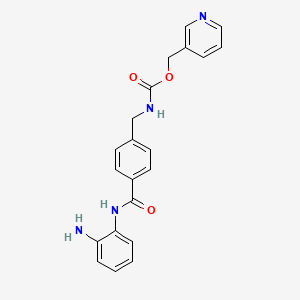
Entinostat


Entinostat.png

Entinostat

Also known as: ms-275, 209783-80-2, SNDX-275, MS 275, MS-27-275, SNDX 275, NSC-706995,
  • BAY 86-5274
  • BAY86-5274
Molecular Formula: C21H20N4O3
Molecular Weight: 376.4085 g/mol
pyridin-3-ylmethyl N-[[4-[(2-aminophenyl)carbamoyl]phenyl]methyl]carbamate
N-(2-aminophenyl)-4-[N-(pyridine-3-yl)-methoxycarbonyl-aminomethyl]- benzamide

CAS  209783-80-2

209784-80-5 (HCl)

Bayer Schering Pharma Aktiengesellschaft

Pyridin-3-ylmethyl N-[[4-[(2-aminophenyl)carbamoyl]phenyl]methyl]carbamate

Entinostat, developed by Syndax Pharmaceuticals, is an oral selective histone deacetylase (HDAC) inhibitor primarily targeting class IHDACs (HDAC1, HDAC2, and HDAC3) . It was later licensed to
Jiangsu Hengrui Medicine Co., Ltd., for development and commercialization in China. In 2024, Entinostat has been approved by the NMPA for use in combination with exemestane to treat advanced breast cancer that is HR-positive and HER2-negative.

News…………http://www.prnewswire.com/news-releases/kyowa-hakko-kirin-and-syndax-announce-an-exclusive-license-agreement-to-develop-and-commercialize-entinostat-in-japan-and-korea-300017491.html

KHK and Syndax partner for breast cancer treatment entinostat in Japan and Korea
Japan-based Kyowa Hakko Kirin (KHK) has signed a license agreement with US-based Syndax Pharmaceuticals for the exclusive rights to develop and commercialise entinostat in Japan and Korea.

TOKYO and WALTHAM, Mass., Jan. 7, 2015 /PRNewswire/ — Kyowa Hakko Kirin Co., Ltd., (Headquarters: Chiyoda-ku, Tokyo; president and CEO: Nobuo Hanai, “Kyowa Hakko Kirin”) and Syndax Pharmaceuticals, Inc., (Waltham, Mass.; president and CEO:Arlene M. Morris, “Syndax”) today jointly announced that the companies have entered into a license agreement for the exclusive rights to develop and commercialize entinostat in Japan and Korea. Entinostat is a Class I selective histone deacetylase (HDAC) inhibitor being developed by Syndax in the United States and Europe in combination with hormone therapy for advanced breast cancer and immune therapy combinations in solid tumors.


Entinostat.png

Entinostat, also known as SNDX-275 and MS-275, is a benzamide histone deacetylase inhibitor undergoing clinical trials for treatment of various cancers.[1]

Entinostat inhibits class I HDAC1 and HDAC3 with IC50 of 0.51 μM and 1.7 μM, respectively.[2]

Entinostat (formerly known as MS-275) is a histone deacetylase (HDAC) inhibitor in phase III clincal trials at Syndax in combination with exemestane for the treatment of advanced HR-positive breast cancer.

Entinostat (MS-275) preferentially inhibits HDAC1 (IC50=300nM) over HDAC3 (IC50=8µM) and has no inhibitory activity towards HDAC8 (IC50>100µM). MS-275 induces cyclin-dependent kinase inhibitor 1A (p21/CIP1/WAF1), slowing cell growth, differentiation, and tumor development in vivo. Recent studies suggest that MS-275 may be particularly useful as an antineoplastic agent when combined with other drugs, like adriamycin.

In September 2013, Syndax Pharmaceuticals entered into a licensing, development and commercialization agreement with Eddingpharm in China and other asian countries. In 2013, a Breakthrough Therapy Designation was assigned to the compound for the treatment of locally recurrent or metastatic estrogen receptor-positive (ER+) breast cancer when added to exemestane in postmenopausal women whose disease has progressed following non-steroidal aromatase inhibitor therapy.

Clinical trials

There is an ongoing phase II trial studying the effect of entinostat on Hodgkin’s lymphoma.[3] It is in other phase II trials for advanced breast cancer (in combination with aromatase inhibitors)[4] and for metastatic lung cancer (in combination with erlotinib).[5] As of September 2013, the Food and Drug Administration is working with the industry to design phase III clinical trials. They seek to evaluate the application of Entinostat for the reduction, or prevention of, treatment resistance to aromatase inhibitors in hormone receptor positive breast cancer.[6] Syndax pharmaceuticals currently holds the rights to Entinostat and recently received $26.6 million in funds to advance treatments of resistant cancers using epigenetic tools.[7]

PHASE 3………..SYNDAX, BREAST CANCER

SYN


European Journal of Medicinal Chemistry 291 (2025) 117643

Entinostat, developed by Syndax Pharmaceuticals, is an oral selec
tive histone deacetylase (HDAC) inhibitor primarily targeting class I
HDACs (HDAC1, HDAC2, and HDAC3) [7]. It was later licensed to
Jiangsu Hengrui Medicine Co., Ltd., for development and commercial
ization in China. In 2024, Entinostat has been approved by the NMPA for
use in combination with exemestane to treat advanced breast cancer that
is HR-positive and HER2-negative. This approval is specifically for pa
tients whose disease has progressed following prior endocrine therapy
[8]. Entinostat inhibits HDACs, increasing histone acetylation and
reactivating tumor suppressor genes. This mechanism restores sensi
tivity to endocrine therapy and prevents cancer cell proliferation [9].
The therapeutic agent exerts its effects by modulating the tumor
microenvironment through the suppression of immune regulatory cells,
thereby augmenting the immune response. Its clinical efficacy was
confirmed in the E2112 trial (NCT02115282), a global Phase III study.
When used in combination with exemestane, Entinostat demonstrated
the ability to extend PFS in patients with HR-positive, HER2-negative
breast cancer [10]. The median PFS was significantly extended to 6.32
months, contrasting with the 3.72 months observed in the control
cohort. In terms of safety profile, Entinostat demonstrated favorable
tolerability. The frequently encountered adverse events were primarily
neutropenia, fatigue, and nausea. Severe neutropenia occurred in 43 %
of patients but was manageable with supportive care. Liver function
abnormalities were reported but manageable with dose adjustments
[11].
The synthetic route of Entinostat is shown in Scheme 2 [12].
Enti-001 is first treated with trifluoroacetic anhydride to afford
Enti-002. Reaction of Enti-002 with oxalyl chloride yields the acyl
chloride intermediate, which undergoes condensation with Enti-003 to
form Enti-004. Subsequent alkaline hydrolysis of Enti-004 produces
Enti-005. This compound is activated with CDI followed by reaction
with Enti-006 to generate Enti-007. The synthesis concludes with acidic removal of the Boc protecting group from Enti-007, yielding Entinostat

[8] W. Li, Z. Sun, Mechanism of action for HDAC inhibitors-insights from omics
approaches, Int. J. Mol. Sci. 20 (2019) 1616.
[9] N. Bharathy, N.E. Berlow, E. Wang, J. Abraham, T.P. Settelmeyer, J.E. Hooper, M.
N. Svalina, Z. Bajwa, M.W. Goros, B.S. Hernandez, J.E. Wolff, R. Pal, A.M. Davies,
A. Ashok, D. Bushby, M. Mancini, C. Noakes, N.C. Goodwin, P. Ordentlich, J. Keck,
D.S. Hawkins, E.R. Rudzinski, A. Mansoor, T.J. Perkins, C.R. Vakoc, J.E. Michalek,
C. Keller, Preclinical rationale for entinostat in embryonal rhabdomyosarcoma,
Skelet Muscle 9 (2019) 12.
[10] B. Xu, Q. Zhang, X. Hu, Q. Li, T. Sun, W. Li, Q. Ouyang, J. Wang, Z. Tong, M. Yan,
H. Li, X. Zeng, C. Shan, X. Wang, X. Yan, J. Zhang, Y. Zhang, J. Wang, L. Zhang,
Y. Lin, J. Feng, Q. Chen, J. Huang, L. Zhang, L. Yang, Y. Tian, H. Shang, Entinostat,
a class I selective histone deacetylase inhibitor, plus exemestane for Chinese
patients with hormone receptor-positive advanced breast cancer: a multicenter,
randomized, double-blind, placebo-controlled, phase 3 trial, Acta Pharm. Sin. B 13
(2023) 2250–2258.
[11] E.T. Roussos Torres, W.J. Ho, L. Danilova, J.A. Tandurella, J. Leatherman, C. Rafie,
C. Wang, A. Brufsky, P. LoRusso, V. Chung, Y. Yuan, M. Downs, A. O’Connor, S.
M. Shin, A. Hernandez, E.L. Engle, R. Piekarz, H. Streicher, Z. Talebi, M.A. Rudek,
Q. Zhu, R.A. Anders, A. Cimino-Mathews, E.J. Fertig, E.M. Jaffee, V. Stearns, R.
M. Connolly, Entinostat, nivolumab and ipilimumab for women with advanced
HER2-negative breast cancer: a phase Ib trial, Nat Cancer 5 (2024) 866–879.
[12] T. Suzuki, T. Ando, K. Tsuchiya, T. Nakanishi, A. Saito, S. Yamashita, G. Shiraishi,
E. Tanaka, Preparation of Benzamide Derivatives as Anticancer Agents, 1998
JP10152462

SEE SCHEME AT END


Patent

http://www.google.im/patents/WO2010022988A1?cl=en

In EP 0 847 992 A1 (which co-patent is US 6,794,392) benzamide derivatives as medicament for the treatment of malignant tumors, autoimmune diseases, de- rmatological diseases and parasitism are described. In particular, these derivatives are highly effective as anticancer drugs, preferred for the haematological malignancy and solid tumors. The preparation of N-(2-aminophenyl)-4-[N- (pyridine-3-yl)methoxycarbonylaminomethyl]-benzamide is described on page 57, Example 48. The compound is neither purified by chromatography nor purified by treatment with charcoal. The final step of the process comprises the re- crystallization from ethanol.

Said compound has a melting point (mp) of 159 – 160 0C.

The IR spectrum shows the following bands: IR(KBr) cm“1: 3295, 1648, 1541 , 1508, 1457, 1309, 1183, 742.

The data indicate the Polymorph A form.

In EP 0 974 576 B1 a method for the production of monoacylated phenylenediamine derivatives is described. The preparation of N-(2- aminophenyl)-4-[N-(pyridine-3-yl)methoxycarbonylamino-methyl] benzamide is described on pages 12 to 13, Example 6. The final step of the process comprises the purification of the compound via silica gel column chromatography.

Said compound has a melting point (mp) of 159 – 160 0C.

The IR spectrum shows the following bands: IR(KBr) cm‘1: 3295, 1648, 1541 , 1508, 1457, 1309, 1183, 742.

The data indicate the Polymorph A form. In J. Med. Chem. 1999, 42, 3001-3003, the synthesis of new benzamide derivatives and the inhibition of histone deacetylase (HDAC) is described. The process for the production of N-(2-aminophenyl)-4-[N-(pyridine-3-yl) meth- oxycarbonylaminomethyl] benzamide is described. The final step of the process comprises the purification of the compound via silica gel column chromatography (ethyl acetate).

Said compound has a melting point (mp) of 159 – 160 0C.

The IR spectrum shows the following bands: IR(KBr) cm‘1: 3295, 1648, 1541 , 1508, 1457, 1309, 1183, 742.

The data indicate the Polymorph A form.

In WO 01/12193 A1 a pharmaceutical formulation comprising N-(2- aminophenyl)-4-[N-(pyridine-3-yl)methoxycarbonylamino-methyl]benzamide is described.

In WO 01/16106 a formulation comprising N-(2-aminophenyl)-4-[N-(pyridine-3- yl)methoxycarbonylamino-methyl]benzamide, having an increased solubility and an improved oral absorption for benzamide derivatives, and pharmaceutically acceptable salts thereof are described.

In WO 2004/103369 a pharmaceutical composition is described which comprises histone deacetylase inhibitors. That application concerns the combined use of N-(2-aminophenyl)-4-[N-(pyridine-3-yl)methoxycarbonylamino- methyl]benzamide together with different cancer active compounds. In fact that application is a later application, which is based on the above mentioned matter and thus concerns the Polymorph A form. Finally, JP 2001-131130 (11-317580) describes a process for the purification of monoacylphenylenediamine derivatives. In Reference Example 2, the process for the production of crude N-(2-aminophenyl)-4-[N-(pyridine-3-yl) meth-oxycarbonylaminomethyl] benzamide is described. Said compound has a melting point (mp) of 159 – 160 0C,

The IR spectrum shows the following bands: IR(KBr) cm“1: 3295, 1648, 1541 , 1508, 1457, 1309, 1183, 742.

The data indicate the Polymorph A form.

Moreover, Working Example 1 describes the purification of crude N-(2- aminophenyl)-4-[N-(pyridine-3-yl) methoxycarbonylaminomethyl] benzamide in aqueous acid medium together with carbon The final crystallization is done under aqueous conditions at 40-500C.

Following the description to that example it can be seen from the Comparative Examples 1 – 3 that the crude N-(2-aminophenyl)-4-[N-(pyridine-3-yl) meth- oxycarbonylaminomethyl] benzamide is not purified by dissolution under reflux conditions in either ethanol, methanol or acetonithle followed by a recrystalliza- tion at 2°C. As a result, these recrystallisations do not yield any pure compound.

In addition a “purification” of crude N-(2-aminophenyl)-4-[N-(pyridine-3-yl) methoxycarbonylaminomethyl] benzamide in ethanol under reflux conditions to- gether with carbon is dechbed. After filtering off the carbon the compound is re- crystallized at 2°C. The purification effect of this method is very limited. 1 ,1 % of an impurity remain in the N-(2-aminophenyl)-4-[N-(pyridine-3-yl) methoxycarbonylaminomethyl] benzamide. As a result, this procedure does not yield any pure compound.

None of the state of the art documents refer to a polymorph B of N-(2- aminophenyl)-4-[N-(pyridine-3-yl)methoxycarbonylamino-methyl]benzamide and no physicochemical features of said compound are known. Several biological and clinical studies have been done with N-(2-aminophenyl)- 4-[N-(pyridine-3-yl) meth-oxycarbonylaminomethyl] benzamide. For example, Kummar et al., Clin Cancer Res. 13 (18), 2007, pp 5411-5417 describe a phase I trial of N-(2-aminophenyl)-4-[N-(pyridine-3-yl) meth-oxycarbonylaminomethyl] benzamide in refractory solid tumors. The compound was applied orally.

The crude N-(2-aminophenyl)-4-[N-(pyridine-3-yl)methoxycarbonylaminomethyl]- benzamide of step a) can be produced according to the method described in example 6 of EP 0974 576 B1.

PATENT

http://www.google.co.in/patents/EP0974576A2?cl=en

Example 6Synthesis of N-(2-aminophenyl)-4-[N-(pyridin-3-ylmethoxycarbonyl)aminomethyl]benzamide (an example in which after activation with N,N’-carbonyldiimidazole, an acid was added to carry out reaction)

  • [0082]
    7.78 g (48 mmole) of N,N’-carbonyldiimidazole were added to a 1,3-dimethyl-2-imidazolidinone (50 g) suspension including 11.45 g (40 mmole) of 4-[N-(pyridin-3-ylmethoxycarbonyl)aminomethyl]benzoic acid. After stirring at room temperature for 2 hours, 17.30 g (0.16 mole) of 1,2-phenylenediamine were added to the solution. After cooling to 2°C, 9.60 g (0.1 mole) of methanesulfonic acid were added dropwise. After stirring for 2 hours, water was added, and the deposited solid was collected by filtration. Purification was then carried out through silica gel column chromatography to obtain 10.83 g (yield: 72%) of N-(2-aminophenyl)-4-[N-(pyridin-3-ylmethoxycarbonyl)aminomethyl]benzamide.
    Reaction selectivity based on the result in HPLC
      Retention Time/min. Area %
    Benzoylimidazole as Active Intermediate 4.3 0.00
    Monoacylated Phenylenediamine 4.7 98.91
    Diacylated Phenylenediamine 11.7 1.09

    Analysis data of the product
    mp. 159-160°C
       1H NMR (270MHz, DMSO-d6) δ ppm: 4.28 (2H, d, J=5.9Hz), 4.86 (2H, s), 5.10 (2H, s), 6.60 (1H, t, J=7.3Hz), 6.78 (1H, d, J=7Hz), 6.97 (1H, t, J=7Hz), 7.17 (1H, d, J=8Hz), 7.3-7.5 (3H, m), 7.78 (1H, d, J=8Hz), 7.93 (2H, d, J=8Hz), 8.53 (1H, d, J=3.7Hz), 8.59 (1H, s), 9.61 (1H, s).
       IR (KBr) cm-1: 3295, 1648, 1541, 1508, 1457, 1309, 1183, 742

PATENT

WO 2009076206

http://www.google.com/patents/WO2009076206A1?cl=en

Suzuki et al (Suzuki et al Synthesis and histone deacetylase inhibitory activity of new benzamide derivatives, J Med Chem 1999, 42, (15), 3001-3) discloses benzamide derivatives having histone deacetylase inhibitory activity and methods of making benzamide derivatives having histone deacetylase inhibitory activity. Suzuki et al is hereby incorporated herein by reference in its entirety.

[18] An example of the synthesis method of Suzuki et al to produce MS-275 via a three- step procedure in 50.96% overall yield is outlined in Scheme 3 below.

Scheme 3: Previous Procedure for Synthesis of MS-275 en rt, 4h

(used without purification)

[Overall yield: 0.91 x 0.56 x 100 = 50.96%;

MS-275 [19] In addition to the modest overall yield, the procedure of Suzuki et al has other disadvantages, such as a tedious method for the preparation of an acid chloride using oxalyl chloride and requiring the use of column chromatography for purification.

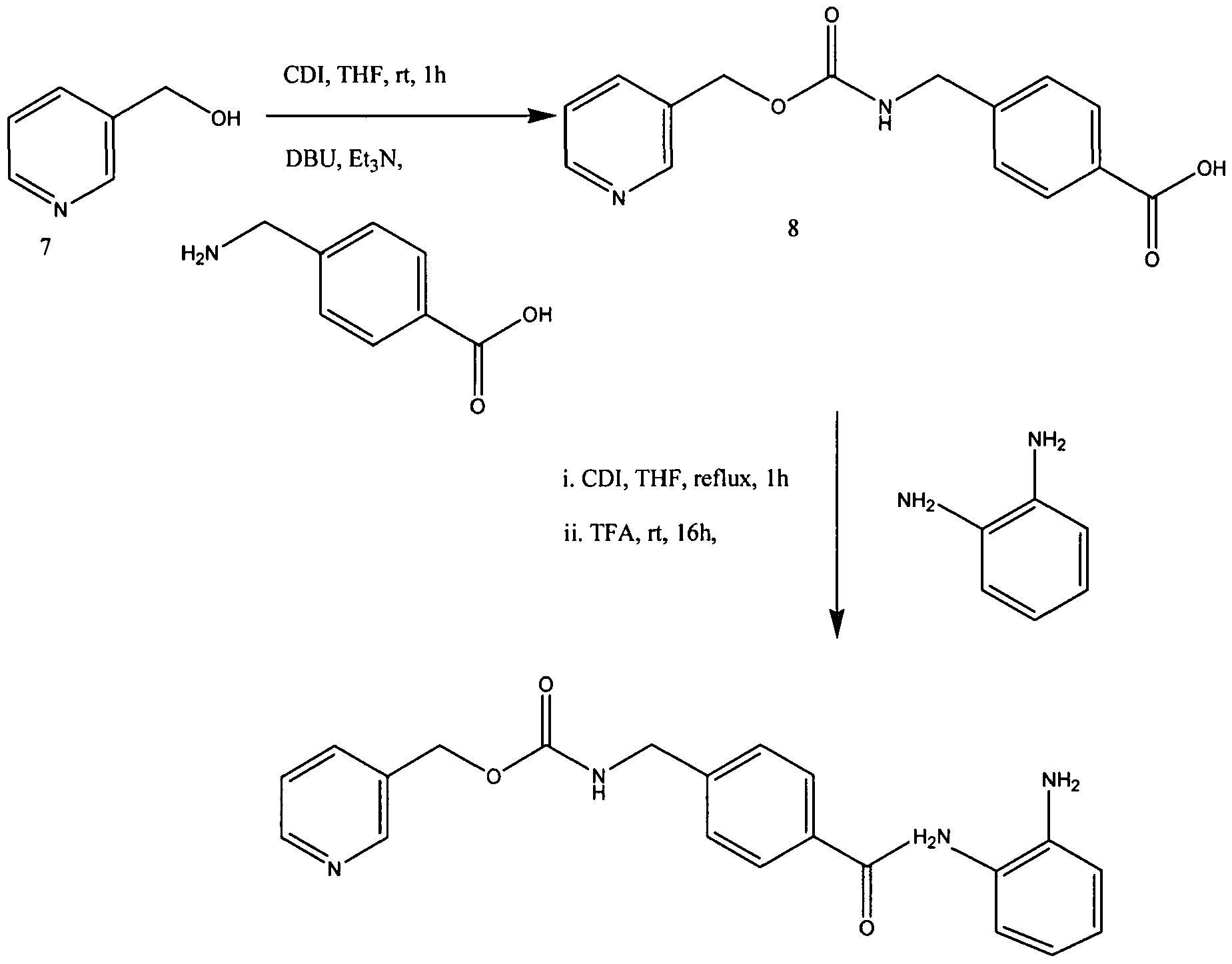
The synthesis of MS-275 is shown below in Scheme 4 as an example of Applicants invention of a two-step procedure: [37] Scheme 4: Preparation of MS-275

Scheme 4: New Synthesis of MS-275 (4)

Condensation of 3-(hydroxymethyl)pyridine (7) and 4-(aminomethyl)benzoic in the presence of CDI gave 4-[N-(pyridin-3-ylmethoxycarbonyl)aminomethyl]benzoic Acid (8) in 91.0% yield. In the previous method of Suzuki et ah, the carboxylic acid derivative 8 was first converted into acyl chloride hydrochloride by treatment of oxalyl chloride in toluene and then reacted with imidazole to form the acylimidazole intermediate. (Suzuki et al., Synthesis and histone deacetylase inhibitory activity of new benzamide derivatives. J Med Chem 1999, 42, (15), 3001-3.). However, Applicants synthesized the imidazolide of intermediate 8 by treatment with CDI at about 55-60 0C in THF. The imidazolide was cooled to ambient and further reacted in situ with 1,2-phenylenediamine in the presence of TFA to afford MS-275

(4).

Experimental Section

[62] iV-(2-Aminophenyl)-4-[iV-(pyridin-3-ylmethoxycarbonyl) aminomethyl] benzamide (4, MS-275).

[63] To a suspension of 4-[N-(Pyridin-3-ylmethoxycarbonyl)aminomethyl]benzoic

Acid (5.0 g, 0.017 mol) in THF (100 mL) was added CDI (3.12 g, 0.019 mol), and the mixture stirred for 3 h at 60 0C. After formation of acylimidazole the clear solution was cooled to room temperature (rt). To this was added 1,2-phenylenediamine (15.11 g, 0.14 mmol) and trifluoroacetic acid (1.2 mL, 0.015 mol) and then stirred for 16 h. The reaction mixture was evaporated to remove THF and crude product was stirred in a mixture of hexane and water (2:5, v/v) for 1 h and filtered and dried. The residue was stirred in dichloromethane twice to afford pure MS-275 (4) as off white powder 5.25 g, 80% yield:

mp 159-160 * C; IR (KBr) 3295, 1648, 1541, 1508, 1457, 1309, 1183, 742 cm“1.

1H NMR (DMSO-J6) δ 4.28 (d, 2H, J = 5.9 Hz), 4.86 (s, 2H), 5.10 (s, 2H), 6.60 (t, IH, J = 7.3 Hz), 6.78 (d, IH, J = 7 Hz), 6.97 (t, IH, J= 7 Hz), 7.17 (d, IH, J= 8 Hz), 7.3-7.5(m, 3H), 7.78 (d, IH, J= 8 Hz), 7.93 (d, 2H, J = 8 Hz), 8.53 (d, IH, J = 3.7 Hz), 8.59 (s, IH), 9.61 (s, IH);

HRMS: calcd 376.1560 (C2iH2oN4θ3), found 376.1558. These spectral and analytical data are as previously reported in J Med Chem 1999, 42, (15), 3001-3.

[64] 4-[7V-(Pyridin-3-ylmethoxycarbonyI)aminomethyl] benzoic Acid (8) may be prepared as follows. To a suspension of l, l’-carbonyldiimidazole (CDI, 25.6 g, 158 mmol) in THF (120 mL) was added 3-pyridinemethanol (7, 17.3 g, 158 mmol) in THF (50 mL) at 10 0C, and the mixture stirred for 1 h at rt. The resulting solution was added to a suspension of 4-(aminomethyl)benzoic acid (22.6 g, 158 mmol), DBU (24.3 g, 158 mmol), and triethylamine (22.2 mL, 158 mmol) in THF (250 mL). After stirring for 5 h at rt, the mixture was evaporated to remove THF and then dissolved in water (300 mL). The solution was acidified with HCl (pH 5) to precipitate a white solid which was collected by filtration, washed with water (300 mL) and methanol (50 mL), respectively, and dried to yield pure 8 (41.1 g, 91% yield):

mp 207-208 0 C;

IR (KBr) 3043, 1718, 1568, 1434, 1266, 1 108, 1037, 984, 756 cm4; 1H NMR (DMSO-^6) δ 4.28 (d, 2H, J= 5.9 Hz), 5.10 (s, 2H), 7.3-7.5 (m, 3H), 7.7-8.1 (m, 4H), 8.5-8.7 (m, 2H). These spectral and analytical data are as previously reported in Suzuki et al, J Med Chem 1999, 42, (15), 3001-3.

PAPER

Volume 18, Issue 11, 1 June 2010, Pages 3925–3933

http://www.sciencedirect.com/science/article/pii/S0968089610003378

PAPER

see

Bioorg Med Chem 2008, 16(6): 3352

http://www.sciencedirect.com/science/article/pii/S0968089607010577

PAPER

see

Bioorganic and Medicinal Chemistry Letters, 2004 ,  vol. 14,   1  pg. 283 – 287

http://www.sciencedirect.com/science/article/pii/S0960894X03010539

PAPER

J Med Chem 1999, 42(15): 3001

http://pubs.acs.org/doi/abs/10.1021/jm980565u

N-(2-Aminophenyl)-4-[N-(pyridin-3-ylmethoxycarbonyl)aminomethyl]benzamide (1, MS-275). To a solution of imidazole (0.63 g, 9.2 mmol) in THF (20 mL) was added 3 (1 g, 2.9 mmol), and the mixture stirred for 1 h at room temperature. After imidazole hydrochloride was removed by filtration, 1,2-phenylenediamine (2.52 g, 23.2 mmol) and trifluoroacetic acid (0.2 mL, 2.6 mmol) were added to the filtrate and stirred for 15 h. The reaction mixture was evaporated to remove THF and partitioned between ethyl acetate (500 mL) and water (400 mL). The organic layer was washed with water and dried and then purified by silica gel column chromatography (ethyl acetate) to give 1 (0.62 g, 56% yield):

mp 159−160 °C;

1H NMR (DMSO-d6) δ 4.28 (d, 2H, J = 5.9 Hz), 4.86 (s, 2H), 5.10 (s, 2H), 6.60 (t, 1H, J = 7.3 Hz), 6.78 (d, 1H, J = 7 Hz), 6.97 (t, 1H, J = 7 Hz), 7.17 (d, 1H, J = 8 Hz), 7.3−7.5(m, 3H), 7.78 (d, 1H, J = 8 Hz), 7.93 (d, 2H, J = 8 Hz), 8.53 (d, 1H, J = 3.7 Hz), 8.59 (s, 1H), 9.61 (s, 1H);

IR (KBr) 3295, 1648, 1541, 1508, 1457, 1309, 1183, 742 cm-1.

Anal. (C21H20N4O3) C, H, N.

………………………………………………………………………..

see

Bulletin of the Korean Chemical Society, 2014 ,  vol. 35,   1  pg. 129 – 134

http://koreascience.or.kr/article/ArticleFullRecord.jsp?cn=JCGMCS_2014_v35n1_129

PAPER

see

ChemMedChem, 2013 ,  vol. 8,   5  pg. 800 – 811

http://onlinelibrary.wiley.com/doi/10.1002/cmdc.201300005/abstract;jsessionid=9D48E064CF53253495185AE2030C67BF.f02t03

PAPER

see

ACS Medicinal Chemistry Letters, 2013 ,  vol. 4,   10  pg. 994 – 999

http://pubs.acs.org/doi/full/10.1021/ml400289e

References

  1. Phase I trial of 5-azacitidine (5AC) and SNDX-275 in advanced lung cancer (NSCLC)
  2. Novel Sulphonylpyrroles as Inhibitors of Hdac S Novel Sulphonylpyrroles
  3. A Phase 2 Multi-Center Study of Entinostat (SNDX-275) in Patient With Relapsed or Refractory Hodgkin’s Lymphoma
  4. A Phase 2, Multicenter Study of the Effect of the Addition of SNDX-275 to Continued Aromatase Inhibitor (AI) Therapy in Postmenopausal Women With ER+ Breast Cancer Whose Disease is Progressing
  5. A Phase 2 Exploratory Study of Erlotinib and SNDX-275 in Patients With Non-small Cell Lung Carcinoma Who Are Progressing on Erlotinib
  6. Breakthrough Designation Granted to Entinostat for Advanced Breast Cancer Silas Inman Published Online: Wednesday, September 11, 2013 http://www.onclive.com/web-exclusives/Breakthrough-Designation-Granted-to-Entinostat-for-Advanced-Breast-Cancer
  7. http://www.syndax.com/assets/130827%20Syndax%20Series%20B%20news%20release.pdf
  8. References:
    1. Saito, A. et al. A synthetic inhibitor of histone deacetylase, MS-27-275, with marked in vivo antitumor activity against human tumors. Proc Natl Acad Sci USA 96 4592-4597 (1999).
    2. Jaboin, J., et al. MS-27-275, an inhibitor of histone deacetylase, has marked in vitro and in vivo antitumor activity against pediatric solid tumors. Cancer Res 62 6108-6115 (2002).
    3. Rosato RR, et al. The histone deacetylase inhibitor MS-275 promotes differentiation or apoptosis in human leukemia cells through a process regulated by generation of reactive oxygen species and induction of p21CIP1/WAF1 1. Cancer Res 2003; 63: 3637–3645.
 
Cited Patent Filing date Publication date Applicant Title
EP0847992B1 * Sep 30, 1997 Jun 23, 2004 Schering Aktiengesellschaft Benzamide derivatives, useful as cell differentiation inducers
US7244751 * Feb 2, 2004 Jul 17, 2007 Shenzhen Chipscreen Biosciences Ltd. N-(2-amino-5-fluorophenyl)-4-[N-(Pyridn-3-ylacryloyl)aminomethyl]benzamide or other derivatives for treating cancer and psoriasis
 
Reference
1 * MAI A: ‘Histone deacetylation in epigenetics: an attractive target for anticancer therapy‘ MED RES REV. vol. 25, no. 3, May 2005, pages 261 – 309
2 * SUZUKI T ET AL.: ‘Synthesis and histone deacetylase inhibitory activity of new benzamide derivatives‘ J MED CHEM. vol. 42, no. 15, 29 July 1999, pages 3001 – 3003
Names
Preferred IUPAC name(Pyridin-3-yl)methyl ({4-[(2-aminophenyl)carbamoyl]phenyl}methyl)carbamate
Other namesSNDX-275; MS-275
Identifiers
CAS Number209783-80-2 
3D model (JSmol)Interactive image
ChEBICHEBI:132082 
ChEMBLChEMBL27759 
ChemSpider4111 
ECHA InfoCard100.158.999 
IUPHAR/BPS7007
KEGGD09338 
PubChem CID4261
UNII1ZNY4FKK9H 
CompTox Dashboard (EPA)DTXSID0041068 
InChI☒☒
SMILES
Properties
Chemical formulaC21H20N4O3
Molar mass376.4085 g/mol
Pharmacology
ATC codeL01XH05 (WHO)
Except where otherwise noted, data are given for materials in their standard state (at 25 °C [77 °F], 100 kPa).☒verify (what is ?)Infobox references

/////////////////approvals 2024, china 2024, Entinostat, SNDX 275, MS 275, Syndax, BAY 86-5274, BAY86-5274

str1

AS ON JUNE2025 4.45 LAKHS VIEWS ON BLOG WORLDREACH AVAILABLEFOR YOUR ADVERTISEMENT

wdt-16

join me on Linkedin

Anthony Melvin Crasto Ph.D – India | LinkedIn

join me on Researchgate

RESEARCHGATE

This image has an empty alt attribute; its file name is research.jpg

join me on Facebook

Anthony Melvin Crasto Dr. | Facebook

join me on twitter

Anthony Melvin Crasto Dr. | twitter

+919321316780 call whatsaapp

EMAIL. amcrasto@gmail.com

……

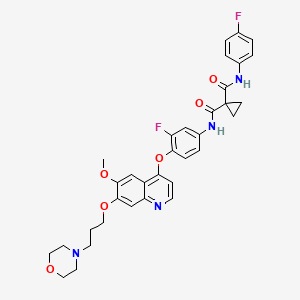
Foretinib (Exelixis, GlaxoSmithKline, XL-880)


Foretinib.svg

Foretinib (Exelixis, GlaxoSmithKline) (XL-880)

CAS No.:849217-64-7, 937176-80-2
Formula:C34H34F2N4O6
M.Wt:632.24

GSK1363089, XL880

1-N’-[3-fluoro-4-[6-methoxy-7-(3-morpholin-4-ylpropoxy)quinolin-4-yl]oxyphenyl]-1-N-(4-fluorophenyl)cyclopropane-1,1-dicarboxamide

Foretinib is an experimental drug candidate for the treatment of cancer.[1] It was discovered by Exelixis and is under development by GlaxoSmithKline.[2] It is currently in Phase II clinical trials.[3] As of December 2012 no phase III trials are registered.[3]

Foretinib is an inhibitor of the kinase enzymes c-Met and vascular endothelial growth factor receptor 2 (VEGFR-2).[4]

Foretinib is an orally bioavailable small molecule with potential antineoplastic activity. MET/VEGFR2 inhibitor GSK1363089 binds to and selectively inhibits hepatocyte growth factor (HGF) receptor c-MET and vascular endothelial growth factor receptor 2 (VEGFR2), which may result in the inhibition of tumor angiogenesis, tumor cell proliferation and metastasis. The proto-oncogene c-MET has been found to be over-expressed in a variety of cancers. VEGFR2 is found on endothelial and hematopoietic cells and mediates the development of the vasculature and hematopoietic cells through VEGF signaling.

Foretinib (GSK1363089) is an ATP-competitive inhibitor of HGFR and VEGFR, mostly for Met and KDR with IC50 of 0.4 nM and 0.9 nM. Less potent against Ron, Flt-1/3/4, Kit, PDGFRα/β and Tie-2, and little activity to FGFR1 and EGFR. Phase 2.


Foretinib.png


………………………………..

Patent Submitted Granted
Preparation of a Quinolinyloxydiphenylcyclopropanedicarboxamide [US2010081805] 2010-04-01
C-Met Modulators and Method of Use [US2012022065] 2012-01-26
C-Met Modulators and Method of Use [US2011077233] 2011-03-31
c-Met modulators and methods of use [US7579473] 2009-07-02 2009-08-25
c-MET MODULATORS AND METHODS OF USE [US8067436] 2009-04-23 2011-11-29
C-MET MODULATORS AND METHOD OF USE [US8178532] 2007-09-27 2012-05-15
Method of Treating Cancer using a cMet and AXL Inhibitor and an ErbB Inhibitor [US2009274693] 2009-11-05
c-MET MODULATORS AND METHOD OF USE [US2007244116] 2007-10-18
c-Met modulators and methods of use [US2007054928] 2007-03-08

………………………………….

http://www.google.com/patents/WO2014067417A1?cl=en

Foretinib (GSK1363089, XL880) quinoline compounds are, an oral c-Met and VEGFR / KDR kinase inhibitor of c-Met kinase and KDR kinase IC 5Q Wo port respectively 0.4 0.8 nM, the current has entered Phase II clinical study (WO2010036831Al). Clinical studies have shown that, Foretinib variety of people, such as human lung cancer cells, human gastric cancer cells and other tumor cell lines showed a significant inhibitory effect, an IC 50 value of 0.004 g / mL.

Figure imgf000004_0001


……………………………

http://www.google.com/patents/WO2014145693A1?cl=en

Accordingly, small-molecule compounds that specifically inhibit, regulate, and/or modulate the signal transduction of kinases, particularly including Ret, c-Met, and VEGFR2 described above, are particularly desirable as a means to treat or prevent disease states associated with abnormal cell proliferation and angiogenesis. One such small-molecule is XL880, known variously as N-[3-fluoro-4-({6-(methyloxy)-7-[(3-morpholin-4- ylpropyl)oxy]quinolin-4-yl}oxy)phenyl]-N’-(4-fluorophenyl)cyclopropane-l,l- dicarboxamide and alternatively as foretimb. Foretimb has the chemical structure:

[0007] WO 2005/030140 describes the synthesis of foretinib (Example 44) and also discloses the therapeutic activity of this molecule to inhibit, regulate, and/or modulate the signal transduction of kinases (Assays, Table 4, entry 312). Example 44 begins at paragraph [0349] in WO 2005/030140.

Figure imgf000034_0001


Figure imgf000032_0001

……………………………………


WO 2012044577 A1…….Dual inhibitors of met and vegf for the treatment of castration resistant prostate cancer and osteoblastic bone metastases

Figure imgf000020_0003
Foretinib (Exelixis, GlaxoSmithKline) (aka XL-880)
Foretinib (Exelixis, GlaxoSmithKline) (aka XL-880)WO 2012044577 A1…….Dual inhibitors of met and vegf for the treatment of castration resistant prostate cancer and osteoblastic bone metastases
 http://www.google.com/patents/WO2012044577A1?cl=en

In another embodiment, the compound of Formula I is Compound 1 :
Figure imgf000005_0001
Compound 1
or a pharmaceutically acceptable salt thereof. Compound I is known as N-(4-{[6,7- bis(methyloxy)quinolin-4-yl]oxy}phenyl)-N’-(4-fluorophenyl)cyclopropane-l, l- dicarboxamide. WO 2005/030140 describes the synthesis of N-(4-{[6,7- bis(methyloxy)quinolin-4-yl]oxy }phenyl)-N’-(4-fluorophenyl)cyclopropane-l, l- dicarboxamide (Example 12, 37, 38, and 48) and also discloses the therapeutic activity of this molecule to inhibit, regulate and/or modulate the signal transduction of kinases, (Assays, Table 4, entry 289). Example 48 is on paragraph [0353] in WO 2005/030140.
[0013] In another embodiment, the compound of Formula I is Compound 2:
Figure imgf000005_0002
Compound 2
Foretinib (Exelixis, GlaxoSmithKline) (aka XL-880)
or a pharmaceutically acceptable salt thereof. Compound 2 is known as is N-[3-fluoro-4- ({6-(methyloxy)-7-[(3-morpholin-4-ylpropyl)oxy]quinolin-4-yl}oxy)phenyl]-N’-(4- fluorophenyl)cyc!opropane- 1,1 -dicarboxamide. WO 2005-030140 describes the synthesis of Compound (I) (Examples 25, 30, 36, 42, 43 and 44) and also discloses the therapeutic activity of this molecule to inhibit, regulate and/or modulate the signal transduction of kinases, (Assays, Table 4, entry 312). Compound 2 has been measured to have a c-Met IC50 value of about 0.6 nanomolar (nM). PC1YUS09/064341, which claims priority to U.S. provisional application 61/199,088, filed November 13, 2008, describes a scaled-up synthesis of Compound I.

Scheme 2

Preparation of 4-Chloro-6,7-dimethoxy-quinoIine

[00173] A reactor was charged sequentially with 6,7-dimethoxy-quinoline-4-ol (47.0 kg) and acetonitrile (318.8 kg). The resulting mixture was heated to approximately 60 °C and phosphorus oxychloride (POCl3, 130.6 kg) was added. After the addition of POCI3, the temperature of the reaction mixture was raised to approximately 77 °C. The reaction was deemed complete (approximately 13 hours) when less than 3% of the starting material remained (in-process high-performance liquid chromatography [HPLC] analysis). The reaction mixture was cooled to approximately 2-7 °C and then quenched into a chilled solution of dichloromethane (DCM, 482.8 kg), 26 percent NH4OH (251.3 kg), and water (900 L). The resulting mixture was warmed to approximately 20-25 °C, and phases were separated. The organic phase was filtered through a bed of AW hyflo super-cel NF (Celite; 5.4 kg) and the filter bed was washed with DCM (1 18.9 kg). The combined organic phase was washed with brine (282.9 kg) and mixed with water (120 L). The phases were separated and the organic phase was concentrated by vacuum distillation with the removal of solvent (approximately 95 L residual volume). DCM (686.5 kg) was charged to the reactor containing organic phase and concentrated by vacuum distillation with the removal of solvent (approximately 90 L residual volume). Methyl t-butyl ether (MTBE, 226.0 kg) was then charged and the temperature of the mixture was adjusted to -20 to -25 °C and held for 2.5 hours resulting in solid precipitate which was then filtered and washed with n-heptane (92.0 kg), and dried on a filter at approximately 25 °C under nitrogen to afford the title compound. (35.6 kg).

Preparation of -(6, 7 -Dimethoxy-quinoline- -yloxy)-phenylamine

[00174] 4-Aminophenol (24.4 kg) dissolved in N,N-dimethylacetamide (DMA, 184.3 kg) was charged to a reactor containing 4-chloro-6,7-dimethoxyquinoline (35.3 kg), sodium t- butoxide (21.4 kg) and DMA (167.2 kg) at 20-25 °C. This mixture was then heated to 100- 105 °C for approximately 13 hours. After the reaction was deemed complete as determined using in-process HPLC analysis (less than 2 percent starting material remaining), the reactor contents were cooled at 15-20 °C and water (pre-cooled, 2-7 °C, 587 L) charged at a rate to maintain 15-30 °C temperature . The resulting solid precipitate was filtered, washed with a mixture of water (47 L) and DMA (89.1 kg) and finally with water (214 L). The filter cake was then dried at approximately 25 °C on filter to yield crude 4-(6, 7-dimethoxy-quinoline-4- yloxy)-phenylamine (59.4 kg wet, 41.6 kg dry calculated based on LOD). Crude 4-(6, 7- dimethoxy-quinoline-4-yloxy)-phenylamine was refluxed (approximately 75 °C) in a mixture of tetrahydrofuran (THF, 21 1.4 kg) and DMA (108.8 kg) for approximately lhour and then cooled to 0-5 °C and aged for approximately 1 hour after which time the solid was filtered, washed with THF (147.6 kg) and dried on a filter under vacuum at approximately 25 °C to yield 4-(6,7-dimethoxy-quinoline-4-yloxy)-phenylamine (34.0 kg). Alternative Preparation of 4-(6, 7-Dimethoxy-quinoIine-4-yloxy)-phenylamine

[00175] 4-chloro-6,7-dimethoxyquinoline (34.8 kg) and 4-aminophenoI (30.8 kg) and sodium tert pentoxide (1.8 equivalents) 88.7 kg, 35 weight percent in THF) were charged to a reactor, followed by N(N-dimethylacetamide (DMA, 293.3 kg). This mixture was then heated to 105-1 15 °C for approximately 9 hours. After the reaction was deemed complete as determined using in-process HPLC analysis (less than 2 percent starting material remaining), the reactor contents were cooled at 15-25 °C and water (315 kg) was added over a two hour period while maintaining the temperature between 20-30 °C. The reaction mixture was then agitated for an additional hour at 20-25 °C. The crude product was collected by filtration and washed with a mixture of 88kg water and 82.1 kg DMA, followed by 175 kg water. The product was dried on a filter drier for 53 hours. The LOD showed less than 1 percent w/w.

[00176] In an alternative procedure, 1.6 equivalents of sodium tert-pentoxide were used and the reaction temperature was increased from 1 10-120 °C. In addition , the cool down temperature was increased to 35-40 °C and the starting temperature of the water addition was adjusted to 35-40 °C, with an allowed exotherm to 45 °C.

Preparation of l-(4-Fluoro-phenylcarbamoyl)-cyclopropanecarboxylic acid

[00177] Triethylamine (19.5 kg) was added to a cooled (approximately 5 °C) solution of cyclopropane-l,l-dicarboxylic acid (24.7 kg) in THF (89.6 kg) at a rate such that the batch temperature did not exceed 5 °C. The solution was stirred for approximately 1.3 hours, and then thionyl chloride (23.1 kg) was added, keeping the batch temperature below 10 °C. When the addition was complete, the solution was stirred for approximately 4 hours keeping temperature below 10 °C. A solution of 4-fluoroaniline (18.0 kg) in THF (33.1 kg) was then added at a rate such that the batch temperature did not exceed 10 °C. The mixture was stirred for approximately 10 hours after which the reaction was deemed complete. The reaction mixture was then diluted with isopropyl acetate (218.1 kg). This solution was washed sequentially with aqueous sodium hydroxide (10.4 kg, 50 percent dissolved in 1 19 L of water) further diluted with water (415 L), then with water (100 L) and finally with aqueous sodium chloride (20.0 kg dissolved in 100 L of water). The organic solution was concentrated by vacuum distillation (100 L residual volume) below 40 °C followed by the addition of n- heptane (171.4 kg), which resulted in the precipitation of solid. The solid was recovered by filtration and washed with n-heptane ( 102.4 kg), resulting in wet, crude l-(4-fluoro- phenylcarbamoyl)-cyclopropanecarboxylic acid (29.0 kg). The crude, l-(4-fluoro- phenylcarbamoy -cyclopropanecarboxylic acid was dissolved in methanol (139.7 kg) at approximately 25 °C followed by the addition of water (320 L) resulting in slurry which was recovered by filtration, washed sequentially with water (20 L) and n-heptane (103.1 kg) and then dried on the filter at approximately 25 °C under nitrogen to afford the title compound (25.4 kg).

Preparation of l-(4-Fluoro-phenyIcarbamoyl)-cyclopropanecarbonyl chloride

[00178] Oxalyl chloride ( 12.6 kg) was added to a solution of I -(4-fluoro- phenylcarbamoyD-cyclopropanecarboxylic acid (22.8 kg) in a mixture of THF (96.1 kg) and N, N-dimethylformamide (DMF; 0.23 kg) at a rate such that the batch temperature did not exceed 25 °C. This solution was used in the next step without further processing.

Alternative Preparation of l-(4-Fluoro-phenylcarbamoyl)-cyclopropanecarbonyl chloride

[00179] A reactor was charged with l-(4-fluoro-phenylcarbamoyl)- cyclopropanecarboxylic acid (35 kg), 344 g DMF, and 175kg THF. The reaction mixture was adjusted to 12-17 °C and then to the reaction mixture was charged 19.9 kg of oxalyl chloride over a period of 1 hour. The reaction mixture was left stirring at 12-17 °C for 3 to 8 hours. This solution was used in the next step without further processing.

Preparation of cyclopropane-l,l-dicarboxylic acid [4-(6,7-dimethoxy-quinoline-4- yloxy)-phenyl]-amide (4-fluoro-phenyl)-amide

[00180] The solution from the previous step containing l-(4-fluoro-phenylcarbamoyl)- cyclopropanecarbonyl chloride was added to a mixture of compound 4-(6,7-dimethoxy- quinoline-4-yloxy)-phenylamine (23.5 kg) and potassium carbonate (31.9 kg) in THF (245.7 kg) and water (116 L) at a rate such that the batch temperature did not exceed 30 °C. When the reaction was complete (in approximately 20 minutes), water (653 L) was added. The mixture was stirred at 20-25 °C for approximately 10 hours, which resulted in the precipitation of the product. The product was recovered by filtration, washed with a pre-made solution of THF (68.6 kg) and water (256 L), and dried first on a filter under nitrogen at approximately 25 °C and then at approximately 45 °C under vacuum to afford the title compound (41.0 kg, 38.1 kg, calculated based on LOD). Alternative Preparation of cyclopropane-l,l-dicarboxylic acid [4-(6,7-dimethoxy- quinoIine-4-yloxy)-phenyl]-amide (4-fluoro-phenyl)-amide

[00181] A reactor was charged with 4-(6,7-dimethoxy-quinoline-4-yloxy)-phenylamine (35.7 kg, 1 equivalent), followed by 412.9 kg THF. To the reaction mixture was charged a solution of 48.3 K2C03 in 169 kg water. The acid chloride solution of described in the

Alternative Preparation of l-(4-Fluoro-phenylcarbamoyl)-cvclopropanecarbonyl chloride above was transferred to the reactor containing 4-(6,7-dimethoxy-quinoline-4-yloxy)- phenylamine while maintaining the temperature between 20-30 °C over a minimum of two hours. The reaction mixture was stirred at 20-25 °C for a minimum of three hours. The reaction temperature was then adjusted to 30-25 °C and the mixture was agitated. The agitation was stopped and the phases of the mixture were allowed to separate. The lower aqueous phase was removed and discarded. To the remaining upper organic phase was added 804 kg water. The reaction was left stirring at 15-25 °C for a minimum of 16 hours.

[00182] The product precipitated. The product was filtered and washed with a mixture of 179 kg water and 157.9 kg THF in two portions. The crude product was dried under a vacuum for at least two hours. The dried product was then taken up in 285.1 kg THF. The resulting suspension was transferred to reaction vessel and agitated until the suspension became a clear (dissolved) solution, which required heating to 30-35 °C for approximately 30 minutes. 456 kg water was then added to the solution, as well as 20 kg SDAG-1 ethanol (ethanol denatured with methanol over two hours. The mixture was agitated at 15-25 °C fir at least 16 hours. The product was filtered and washed with a mixture of 143 kg water and 126.7 THF in two portions. The product was dried at a maximum temperature set point of 40 °C.

[00183] In an alternative procedure, the reaction temperature during acid chloride formation was adjusted to 10-15 °C. The recrystallization temperature was changed from 15-25 °C to 45-50 °C for 1 hour and then cooled to 15-25 °C over 2 hours.

Preparation of cyclopropane-l,l-dicarboxylic acid [4-(6,7-dimethoxy-quinoline-4- yloxy)-phenyl]-amide (4-fluoro-phenyI)-amide, malate salt

[00184] Cyclopropane- 1 , 1 -dicarboxylic acid [4-(6,7-dimethoxy-quinoline-4-yloxy)- phenyl]-amide (4-fluoro-phenyI)-amide (1-5; 13.3 kg), L-malic acid (4.96 kg), methyl ethyl ketone (MEK; 188.6 kg) and water (37.3 kg) were charged to a reactor and the mixture was heated to reflux (approximately 74 °C) for approximately 2 hours. The reactor temperature was reduced to 50 to 55 °C and the reactor contents were filtered. These sequential steps described above were repeated two more times starting with similar amounts of starting material (13.3 kg), L-Malic acid (4.96 kg), MEK (198.6 kg) and water (37.2 kg). The combined filtrate was azeotropically dried at atmospheric pressure using MEK (1 133.2 kg) (approximate residual volume 71 1 L; KF < 0.5 % w/w) at approximately 74 °C. The temperature of the reactor contents was reduced to 20 to 25 °C and held for approximately 4 hours resulting in solid precipitate which was filtered, washed with MEK (448 kg) and dried under vacuum at 50 °C to afford the title compound (45.5 kg).

Alternative Preparation of cyclopropane-l,l-dicarboxylic acid [4-(6,7-dimethoxy- quinoline-4-yIoxy)-phenyl]-amide (4-fluoro-phenyI)-amide, (L) malate salt

[00185] Cyclopropane- 1,1-dicarboxylic acid [4-(6,7-dimethoxy-quinoline-4-yloxy)- phenyl]-amide (4-fluoro-phenyI)-amide (47.9 kg), L-malic acid (17.2), 658.2 kg methyl ethyl ketone, and 129.1 kg water (37.3 kg) were charged to a reactor and the mixture was heated 50-55 °C for approximately 1-3 hours, and then at 55-60 °C for an addition al 4-5 hours. The mixture was clarified by filtration through a 1 μπι cartridge. The reactor temperature was adjusted to 20-25 °C and vacuum distilled with a vacuum at 150-200 mm Hg with a maximum jacket temperature of 55 °C to the volume range of 558-731 L.

[00186] The vacuum distillation was performed two more times with the charge of 380 kg and 380.2 kg methyl ethyl ketone, respectively. After the third distillation, the volume of the batch was adjusted to 18 v/w of cyclopropane- 1,1-dicarboxylic acid [4-(6,7-dimethoxy- quinoline-4-yloxy)-phenyl]-amide (4-fluoro-phenyI)-amide by charging 159.9 kg methyl ethyl ketone to give a total volume of 880L. An addition al vacuum distillation was carried out by adjusting 245.7 methyl ethyl ketone. The reaction mixture was left with moderate agitation at 20-25 °C for at least 24 hours. The product was filtered and washed with 415.1 kg methyl ethyl ketone in three portions. The product was dried under a vacuum with the jacket temperature set point at 45 °C.

[00187] In an alternative procedure, the order of addition was changed so that a solution of 17.7 kg L-malic acid dissolved in 129.9 kg water was added to cyclopropane- 1,1- dicarboxylic acid [4-(6,7-dimethoxy-quinoHne-4-yloxy)-phenyl]-amide (4-fluoro-phenyl)- amide (48.7 kg) in methyl ethyl ketone (673.3 kg).

Preparation of Compound 2

[00188] Compound 2 was prepared as provided in Scheme 3 and the accompanying experimental examples. Scheme 3

Toluene

[00189] In Scheme 1, Xb is Br or CI. For the names of the intermediates described within the description of Scheme 1 below, Xb is referred to as halo, wherein this halo group for these intermediates is meant to mean either Br or CI.Preparation of l-[5 methoxy-4 (3-halo propoxy)- 2 nitro-phenyl]- ethanone

[00190] Water (70 L) was charged to the solution of l-[4-(3-halo propoxy)- 3-methoxy phenyl] ethanone (both the bromo and the chloro compound are commercially available). The solution was cooled to approximately 4 °C. Concentrated sulfuric acid (129.5 kg) was added at a rate such that the batch temperature did not exceed approximately 18 °C. The resulting solution was cooled to approximately 5 °C and 70 percent nitric acid (75.8 kg) was added at a rate such that the batch temperature did not exceed approximately 10 °C. Methylene chloride, water and ice were charged to a separate reactor. The acidic reaction mixture was then added into this mixture. The methylene chloride layer was separated and the aqueous layer was back extracted with methylene chloride. The combined methylene chloride layers were washed with aqueous potassium bicarbonate solution and concentrated by vacuum distillation. 1- Butanol was added and the mixture was again concentrated by vacuum distillation. The resulting solution was stirred at approximately 20°C during which time the product crystallized. The solids were collected by filtration, washed with 1-butanol to afford compound the title compound, which was isolated as a solvent wet cake and used directly in the next step. ‘HNMR (400MHz, DMSO-d6): δ 7.69 (s, 1H), 7.24 (s, 1H); 4.23 (m, 2H), 3.94 (s, 3H), 3.78 (0-3.65 (t) (2H), 2.51 (s, 3H), 2.30-2.08 (m, 2H) LC/MS Calcd for [M(CI)+H]+ 288.1, found 288.0; Calcd for [M(Br)+H]+ 332.0, 334.0, found 331.9, 334.0.

Preparation of l-[5-methoxy-4-(3-morpholin-4-yl-propoxy)-2-nitro-phenyl]-ethanone

[00191] The solvent wet cake isolated in the previous step was dissolved in toluene. A solution of sodium iodide (67.9 kg) and potassium carbonate (83.4 kg) was added to this solution, followed by tetrabutylammonium bromide (9.92 kg) and morpholine (83.4 kg). The resulting 2 phase mixture was heated to approximately 85°C for about 9 hours. The mixture was then cooled to ambient temperature. The organic layer was removed. The aqueous layer was back extracted with toluene. The combined toluene layers were washed sequentially with two portions of saturated aqueous sodium thiosulfate followed by two portions of water. The resulting solution of the title compound was used in the next step without further processing. ‘HNMR (400MHz, DMSO-d6): δ 7.64 (s, 1 H), 7.22 (s, 1H), 4.15 (t, 2H), 3.93 (s, 3H), 3.57 (t, 4H), 2.52 (s, 3H), 2.44-2.30 (m, 6H), 1.90 (quin, 2H); LC/MS Calcd for [M+H]+ 339.2, found 339.2.

Preparation of l-[2-amino-5-methoxy-4-(3-morpholin-4-yl- propoxy)-phenyl]-ethanone

[00192] The solution from the previous step was concentrated under reduced pressure to approximately half of the original volume. Ethanol and 10 percent Pd C (50 percent water wet, 5.02 kg) were added; the resulting slurry was heated to approximately 48 °C and an aqueous solution of formic acid (22.0 kg) and potassium formate (37.0 kg) was added. When the addition was complete and the reaction deemed complete by thin layer chromatography (TLC), water was added to dissolve the by-product salts. The mixture was filtered to remove the insoluble catalyst. The filtrate was concentrated under reduced pressure and toluene was added. The mixture was made basic (pH of about 10) by the addition of aqueous potassium carbonate. The toluene layer was separated and the aqueous layer was back extracted with toluene. The combined toluene phases were dried over anhydrous sodium sulfate. The drying agent was removed by filtration and the resulting solution was used in the next step without further processing. ‘HNMR (400MHZ, DMSO-d6): δ 7.1 1 (s, 1H)„ 7.01 (br s, 2H), 6.31 (s, 1H), 3.97 (t, 2H), 3.69 (s, 3H), 3.57 (t, 4H), 2.42 (s, 3H), 2.44-2.30 (m, 6H), 1.91 (quin, 2H LC/MS Calcd for [M+H]+ 309.2, found 309.1.

Preparation of 6-methoxy-7-(3-morpholin-4-yl-propoxy)-quinoiin- 4-ol, sodium salt

[00193] A solution of sodium ethoxide (85.0 kg) in ethanol and ethyl formate (70.0 kg) was added to the solution from the previous step. The mixture was warmed to approximately 44 °C for about 3 hours. The reaction mixture was cooled to approximately 25°C. Methyl t- butyl ether (MTBE) was added which caused the product to precipitate. The product was collected by filtration and the cake was washed with MTBE and dried under reduced pressure at ambient temperature. The dried product was milled through a mesh screen to afford 60.2 kg of the title compound. ‘HNMR (400MHz, DMSO-d6): δ 1 1.22 (br s, 1H), 8.61 (d, 1H), 7.55 (s, 1H), 7.54 (s, 1H), 7.17 (d, 1H), 4.29 (t, 2 H), 3.99 (m, 2H), 3.96 (s, 3H), 3.84 (t, 2H), 3.50 (d, 2H), 3.30 (m, 2H), 3.1 1 (m, 2H), 2.35 (m, 2H), LC/MS Calcd for [M+H]+ 319.2, found 319.1.

Preparation of 4-chIor-6-methoxy-7-(3 morpholin-4-yl)-quinoline

[00194] Phosphorous oxychloride (26.32 kg) was added to a solution of 6-methoxy-7-(3- morphoIin-4-yl-propoxy)-quinolin-4-ol (5.00 kg) in acetonitrile that was heated to 50-55 °C. When the addition was complete, the mixture was heated to reflux (approximately 82 °C) and held at that temperature, with stirring for approximately 18 hours at which time it was sampled for in process HPLC analysis. The reaction was considered complete when no more than 5 percent starting material remained. The reaction mixture was then cooled to 20-25 °C and filtered to remove solids. The filtrate was then concentrated to a residue. Acetronitrile was added and the resulting solution was concentrated to a residue. Methylene chloride was added to the residue and the resulting solution was quenched with a mixture of methylene chloride and aqueous ammonium hydroxide. The resulting 2 phase mixture was separated and the aqueous layer was back extracted with methylene chloride. The combined methylene chloride solutions were dried over anhydrous magnesium sulfate, filtered and concentrated to a solid. The solids were dried at 30-40 °C under reduced pressure to afford the title compound (1.480 kg). ‘HNMR (400MHz, DMSO-d6): δ 8.61 (d, 1H), 7.56 (d, 1H), 7.45 (s, 1H), 7.38 (s, 1H), 4.21 (t, 2 H), 3.97 (s, 3H), 3.58 (m, 2H), 2.50-2.30 (m, 6H), 1.97 (quin, 2H) LC MS Calcd for [M+Hf 458.2, found 458.0.

Preparation of 4-(2-fluoro-4-nitro-phenoxy)-6-methoxy-7-(3-morphoIin-4-yl

propoxy)quinoline

[00195] A solution of 4-chIoro-6-methoxy-7-(3 morpholin-4-yl)-quinoline (2.005 kg, 5.95 mol) and 2 fluoro-4-nitrophenol (1.169 kg, 7.44 mol) in 2,6-Iutidine was heated to 140-145 °C, with stirring, for approximately 2 hours, at which time it was sampled for in process HPLC analysis. The reaction was considered complete when less than 5 percent starting materia! remained. The reaction mixture was then cooled to approximately 75 °C and water was added. Potassium carbonate was added to the mixture, which was then stirred at ambient temperature overnight. The solids that precipitated were collected by filtration, washed with aqueous potassium carbonate, and dried at 55-60 °C under reduced pressure to afford the title compound (1.7 kg). ‘HNMR (400MHz, DMSO-d6): δ 8.54 (d, 1H), 8.44 (dd, 1H), 8.18 (m, 1H), 7.60 (m, 1H), 7.43 (s, 1H), 7.42 (s, 1H), 6.75 (d, 1H), 4.19 (t, 2H), 3.90 (s, 3H), 3.56 (t, 4H), 2.44 (t, 2H), 2.36 (m, 4H), 1.96 (m, 2H). LC/MS Calcd for [M+H]+ 337.1 , 339.1 , found 337.0, 339.0.

Preparation of 3-fluoro-4-[6-methoxy-7-(3-morpholin-4-yl-propoxy)-quinolin-4-yIoxy]- phenylamine

[00196] A reactor containing 4-(2-fluoro-4-nitro-phenoxy)-6-methoxy-7-(3-morpholin-4- yl propoxy)quinoline (2.5 kg) and 10 percent palladium on carbon (50 percent water wet, 250 g) in a mixture of ethanol and water containing concentrated hydrochloric acid (1.5 L) was pressurized with hydrogen gas (approximately 40 psi). The mixture was stirred at ambient temperature. When the reaction was complete (typically 2 hours), as evidenced by in process HPLC analysis, the hydrogen was vented and the reactor inerted with argon. The reaction mixture was filtered through a bed of Celite® to remove the catalyst. Potassium carbonate was added to the filtrate until the pH of the solution was approximately 10. The resulting suspension was stirred at 20-25 °C for approximately 1 hour. The solids were collected by filtration, washed with water and dried at 50-60 °C under reduced pressure to afford the title compound (1.164 kg)._’H NMR (400MHz, DMSO-d6): δ 8.45 (d, 1H), 7.51 (s, 1H), 7.38 (s, 1H), 7.08 (t, 1H), 6.55 (dd, 1H), 6.46 (dd, 1H), 6.39 (dd, 1H), 5.51 (br. s, 2H), 4.19 (t, 2H), 3.94 (s, 3H), 3.59 (t, 4H), 2.47 (t, 2H), 2.39 (m, 4H), 1.98 (m, 2H). LC/MS Calcd for

[M+H]+ 428.2, found 428.1.

Preparation of l-(4-fluoro-phenylcarbamoyl)-cycIopropanecarboxylic acid

[00197] Triethylamine (7.78 kg) was added to a cooled (approximately 4°C) solution of commercially available cyclopropanel.l-dicarboxylic acid (9.95 kg) in THF, at a rate such that the batch temperature did not exceed 10 °C. The solution was stirred for approximately 30 minutes and then thionyl chloride (9.14 kg) was added, keeping the batch temperature below 10 °C. When the addition was complete, a solution of 4 fluoroaniline (9.4 kg) in THF was added at a rate such that the batch temperature did not exceed 10 °C. The mixture was stirred for approximately 4 hours and then diluted with isopropyl acetate. The diluted solution was washed sequentially with aqueous sodium hydroxide, water, and aqueous sodium chloride. The organic solution was concentrated by vacuum distillation. Heptane was added to the concentrate. The resulting slurry was filtered by centrifugation and the solids were dried at approximately 35 °C under vacuum to afford the title compound (10.2 kg). Ή NMR (400 MHz, DMSO-d6): δ 13.06 (br s, 1H), 10.58 (s, 1H), 7.65-7.60 (m, 2H), 7.18-7.12 (m, 2H), 1.41 (s, 4H), LC/MS Calcd for [M+H]+ 224.1 , found 224.0.

Preparation of l-(4-fluoro-phenylcarbamoyl)-cyclopropanecarbonylchloride

[00198] Oxalyl chloride (291 mL) was added slowly to a cooled (approximately 5°C) solution of l-(4-fluoro-phenylcarbamoyl)-cyclopropanecarboxylic acid in THF at a rate such that the batch temperature did not exceed 10°C. When the addition was complete, the batch was allowed to warm to ambient temperature and held with stirring for approximately 2 hours, at which time in process HPLC analysis indicated the reaction was complete. The solution was used in the next step without further processing.

Preparation of cyclopropane-l,l-dicarbox lic acid {3-fluoro-4-[6-methoxy-7-(3- morphoIin-4-yl-propoxy)-quinolin-4-ylamino]phenyl}-amide-(4 fluorophenyl)-amide

[00199] The solution from the previous step was added to a mixture of 3-fluoro-4-[6- methoxy-7-(3-mo holin-4-yl-propox )-quinolin-4-ylo y]-phenylamine (1 160 kg) and potassium carbonate (412.25 g) in THF and water at a rate such that the batch temperature was maintained at approximately 15-21 °C. When the addition was complete, the batch was warmed to ambient temperature and held with stirring for approximately 1 hour, at which time in process HPLC analysis indicated the reaction was complete. Aqueous potassium carbonate solution and isopropyl acetate were added to the batch. The resulting 2-phase mixture was stirred and then the phases were allowed to separate. The aqueous phase was back extracted with isopropyl acetate. The combined isopropyl acetate layers were washed with water followed by aqueous sodium chloride and then slurried with a mixture of magnesium sulfate and activated carbon. The slurry was filtered over Celite® and the filtrate was concentrated to an oil at approximately 30°C under vacuum to afford the title compound which was carried into the next step without further processing. Ή NMR (400MHz, DMSO- d6): δ 10.41 (s, 1H), 10.03 (s, 1H), 8.47 (d, 1H), 7.91 (dd, 1H), 7.65 (m, 2H), 7.53 (m, 2H), 7.42 (m, 2H), 7.16 (t, 2H), 6.41 (d, 1H), 4.20 (t, 2H), 3.95 (s, 3H), 3.59 (t, 4H), 2.47 (t, 2H), 2.39 (m, 4H), 1.98 (m, 2H), 1.47 (m, 4H). LC MS Calcd for [M+H]+ 633.2, found 633.1.

Preparation of the bisphosphate salt of cyclopropane-l,l-dicarboxylic acid {3-fluoro-4- [6-methoxy-7-(3-morpholin-4-yl-propoxy)-quinolin-4-ylamino]phenyl}-amide (4-fluoro- phenyl)-amide

[00200] Cyclopropane- 1,1-dicarboxy lie acid {3-fluoro-4-[6-methoxy-7-(3-morpholin-4-yl- propoxy)-quinolin-4-ylamino]phenyl}-amide-(4 fluoro phenyl)-amide from the previous step was dissolved in acetone and water. Phosphoric acid (85%, 372.48 g) was added at a rate such that the batch temperature did not exceed 30 °C. The batch was maintained at approximately 15- 30 °C with stirring for 1 hour during which time the product precipitated. The solids were collected by filtration, washed with acetone and dried at approximately 60 °C under vacuum to afford the title compound (1.533 kg). The title compound has a c-Met IC50 value of less than 50 nM. The bisphosphate salt is not shown in scheme 1. Ή NMR (400

MHz, DMSO-d6): (diphosphate) δ 10.41 (s, 1H), 10.02 (s, 1H), 8.48 (d, 1 H), 7.93 (dd, 1H), 7.65 (m, 2H), 7.53 (d, 2H), 7.42 (m, 2H), 7.17 (m, 2H), 6.48 (d, 1H), 5.6 (br s, 6H), 4.24 (t, 2H), 3.95 (s, 3H), 3.69 (bs, 4H), 2.73 (bs, 6H), 2.09 (t, 2H), 1.48 (d, 4H).

Foretinib
Foretinib.svg
Identifiers
CAS number 849217-64-7 Yes
ChemSpider 24608641
UNII 81FH7VK1C4
Jmol-3D images Image 1
Properties
Molecular formula C34H34F2N4O6
Molar mass 632.65 g mol−1
Except where noted otherwise, data are given for materials in their standard state (at 25 °C (77 °F), 100 kPa)

References

  1. Hedgethorne, K., Huang, P.H. (2010). “Foretinib. c-Met and VEGFR-2 inhibitor, Oncolytic”. Drugs Fut 35 (11): 893–901. doi:10.1358/dof.2010.35.11.1529012 (inactive 2014-03-22).
  2. “XL880 (GSK1363089)”. Exelixis, Inc.
  3. “Foretinib”. clinicaltrials.gov.
  4. Qian, F; Engst, S; Yamaguchi, K; Yu, P; Won, KA; Mock, L; Lou, T; Tan, J et al. (2009). “Inhibition of tumor cell growth, invasion, and metastasis by EXEL-2880 (XL880, GSK1363089), a novel inhibitor of HGF and VEGF receptor tyrosine kinases”. Cancer Research 69 (20): 8009–16. doi:10.1158/0008-5472.CAN-08-4889. PMID 19808973.


CN102227164A * Sep 25, 2009 Oct 26, 2011 葛兰素史密斯克莱有限责任公司 Preparation of quinolinyloxydiphenylcyclopropanedicarboxamide
CN102977014A * Nov 5, 2012 Mar 20, 2013 沈阳药科大学 New quinoline compounds and uses thereof

Non-Patent Citations
Reference
1 * BAOHUI QI ET AL.: ‘Discovery and optimization of novel 4-Phenoxy-6, 7-disubstituted Quinolines Possessing Semicarbazones as c-Met Kinase Inhibitors.‘ BIOORGANIC & MEDICINAL CHEMISTRY. vol. 21, 19 June 2013, pages 5246 – 5260
2 * BAOHUI QI ET AL.: ‘Synthesis and Biological Evaluation of 4-Phenoxy-6, 7-disubstituted Quinolines Possessing Semicarbazone Scaffolds as Selective c-Met Inhibitors.‘ ARCH. PHARM. CHEM. LIFE SCI. vol. 346, no. 8, 2013, pages 596 – 609

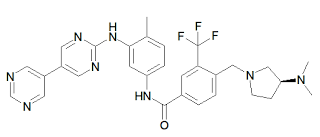
Bafetinib


Structure of Bafetinib

Bafetinib

4-[[(3S)-3-(dimethylamino)pyrrolidin-1-yl]methyl]-N-[4-methyl-3-[(4-pyrimidin-5-ylpyrimidin-2-yl)amino]phenyl]-3-(trifluoromethyl)benzamide, cas 859212-16-1

4-[(S)-3-(dimethylamino)pyrrolidin-1-ylmethyl]-3-trifluoromethyl-N-{4-methyl-3-[4-(5-pyrimidinyl)pyrimidin-2-ylamino]phenyl}benzamide

859212-07-0 (hydrochloride)

  1. bafetinib
  2. INNO-406
  3. NS-187

Bafetinib , previously as INNO-406 , NS-187 and CNS-9 refers is an experimental drug from the substance group ofbenzamides , who as Tyrosinkinasehemmstoff to be used. [2] It was originally developed by the Japanese company Nippon Shinyaku and 2006 Innovive Pharmaceuticals licensed. [3] Innovive was established in June 2008 by the CytRx Corp. adopted. [4]

Bafetinib, also known as INNO-406,  is an orally bioavailable 2-phenylaminopyrimidine derivative with potential antineoplastic activity. Bafetinib specifically binds to and inhibits the Bcr/Abl fusion protein tyrosine kinase, an abnormal enzyme produced by Philadelphia chromosomal translocation associated with chronic myeloid leukemia (CML). This agent also inhibits the Src-family member Lyn tyrosine kinase, upregulated in imatinib-resistant CML cells and in a variety of solid cancer cell types. The inhibitory effect of bafetinib on these specific tyrosine kinases may decrease cellular proliferation and induce apoptosis in tumor cells that overexpress these kinases. CML patients may be refractory to imatinib, which sometimes results from point mutations occurring in the kinase domain of the Bcr/Abl fusion product. Due to its dual inhibitory activity, the use of bafetinib has been shown to overcome this particular drug resistance.

INNO-406 (formerly NS-187) is a potent, orally available, rationally designed, dual Bcr-Abl and Lyn kinase inhibitor that is currently in early clinical studies at CytRx Oncology for the treatment of B-cell chronic lymphocytic leukemia, metastatic prostate cancer and glioblastoma multiforme. CytRx is also conducting phase I clinical studies for the treatment of recurrent high-grade glioma or metastatic disease to the brain that has progressed after treatment with whole brain radiation therapy or stereotactic radiosurgery.

The company is developing INNO-406 in preclinical studies for the prevention of bone loss in multiple myeloma patients. Nippon Shinyaku is also evaluating the compound for the treatment of chronic myeloid leukemia. The compound had been under evaluation for the treatment of certain forms of acute myeloid leukemia (AML) that are refractory or intolerant of other approved treatments; however, no recent development has been reported for this indication.

Based on its mechanisms of action, INNO-406 is expected to be effective in treating Gleevec-resistant CML and may delay or even prevent the onset of resistance in treatment naive CML patients. The ability of INNO-406 to specifically target the Bcr-Abl and Lyn kinases may result in a better side effect profile than compounds that target multiple kinases such as a pan-Src inhibitor.

In 2005, the compound was licensed to Innovive Pharmaceuticals (acquired by CytRx Oncology in 2008) by Nippon Shinyaku on a worldwide basis, with the exception of Japan, for the treatment of CML. Orphan drug designation was assigned to the compound for the treatment of CML in the U.S in 2007 and in the E.U. in 2010.

Pharmacology

Bafetinib is an inhibitor of tyrosine kinases . It affects the formation of the fusion protein Bcr-Abl , as well as that of theenzyme Lyn kinase and should in mice ten times stronger effect than the imported Tyrosinkinasehemmstoff imatinib .[5]

Patent Submitted Granted
Amide Derivative and Medicine [US7728131] 2008-11-27 2010-06-01

Clinical Development 

Bafetinib currently has no indication for an authorization as medicines .

The drug is intended for the treatment of chronic lymphocytic leukemia are developed (CLL). For this indication is Bafetinib is in the development phase II (June 2011). [6]

Bafetinib is also in phase II for the treatment of hormone-refractory prostate cancer . [7]

The US regulatory authority FDA had Bafetinib end of 2006, the status of a drug orphan (orphan drug) awarded. [8]This status could allow an accelerated development and approval.

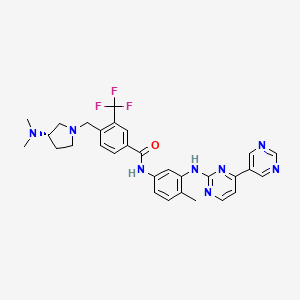
N-[3-([5,5′-Bipyrimidin]-2-ylamino)-4-methylphenyl]-4-[[(3S)-3-(dimethyl-amino)-1-pyrrolidinyl]methyl]-3-(trifluoromethyl)benzamide

CAS No .:         887650-05-7

MW:  576.62

Formula: C 30 H 31 F 3 N 8 O

Synonym:        INNO-406, NS-187

Synthesis of Bafetinib

Analytical Chemistry Insights 2007:2 93–106
U.S. Patent 7,728,131
Reference Example 31
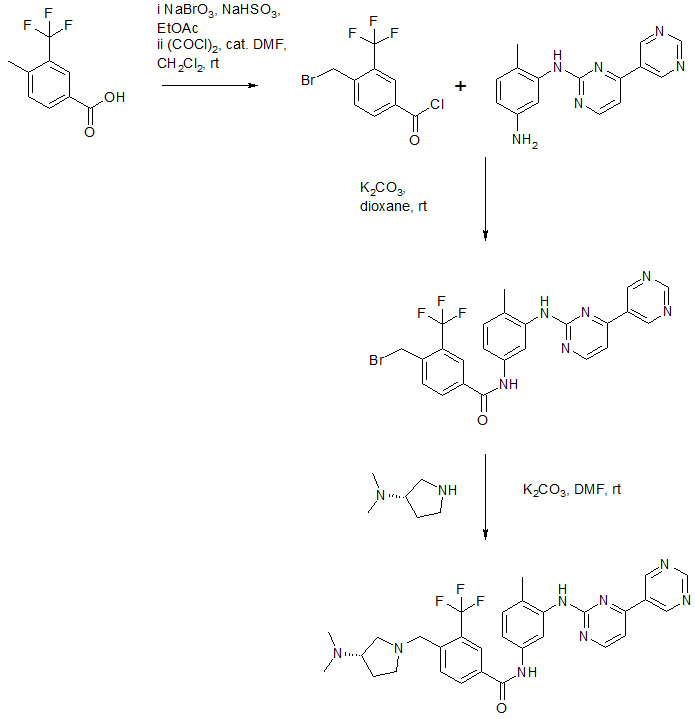
4-(bromomethyl)-3-trifluoromethyl-N-{4-methyl-3-[4-(5-pyrimidinyl)pyrimidin-2-ylamino]phenyl}benzamideStep 1

4-(bromomethyl)-3-trifluoromethylbenzoic acidTo 60.0 g of 4-methyl-3-trifluoromethylbenzoic acid was added 600 ml of isopropyl acetate. Under stirring at room temperature, a solution of 133.0 g of sodium bromate in 420 ml of water and a solution of 91.7 g of sodium hydrogensulfite in 180 ml of water were added in turn. The mixture was gradually heated from 30° C. up to 50° C. at intervals of 10° C. and stirred until the color of the reaction solution disappeared. The aqueous layer was separated to remove, and to the organic layer were added a solution of 133.0 g of sodium bromate in 420 ml of water and a solution of 91.7 g of sodium hydrogensulfite in 180 ml of water, and then the mixture was gradually heated up to 60° C. as above. After separation, to the organic layer were further added a solution of 133.0 g of sodium bromate in 420 ml of water and a solution of 91.7 g of sodium hydrogensulfite in 180 ml of water, and the mixture was gradually heated as above and heated to the temperature the mixture was finally refluxed. After the completion of the reaction, the reaction solution was separated, the organic layer was washed twice with a 5% aqueous sodium thiosulfate solution and twice with 15% saline, dried over anhydrous magnesium sulfate, and, then the solvent was distilled off under reduced pressure. To the residue was added 120 ml of n-heptane, the mixture was stirred, and then the crystals were collected by filtration to obtain 50.0 g of the objective compound as colorless crystals.

Melting point: 140-143° C.

Step 2

4-(bromomethyl)-3-trifluoromethyl-N-{4-methyl-3-[4-(5-pyrimidinyl)pyrimidin-2-ylamino]phenyl}benzamide7.69 g of 4-(bromomethyl)-3-trifluoromethylbenzoic acid obtained in the step 1 was suspended in 154 ml of anhydrous dichloromethane. Under ice-cool stirring, 6.59 ml of oxalyl chloride and 0.1 ml of anhydrous N,N-dimethylformamide were added dropwise. Under ice cooling, the mixture was further stirred for 3 hours, and then the reaction solution was concentrated under reduced pressure. To the residue was added 70 ml of anhydrous 1,4-dioxane, and then 7.00 g of 4-methyl-3-[4-(5-pyrimidinyl)pyrimidin-2-ylamino]aniline (Reference Example 18) and 4.18 g of potassium carbonate were added in turn, followed by stirring at room temperature for 18 hours. To the reaction solution was added 175 ml of water, and the mixture was violently stirred for one hour. Then, the deposit was collected by filtration and washed in turn with water, a small amount of acetonitrile, ethyl acetate and diisopropyl ether to obtain 8.10 g of the objective compound as pale yellow crystals.

Melting point: 198-202° C. (with decomposition)

Example 47
4-[(S)-3-(dimethylamino)pyrrolidin-1-ylmethyl]-3-trifluoromethyl-N-{4-methyl-3-[4-(5-pyrimidinyl)pyrimidin-2-ylamino]phenyl}benzamide

To a solution of 6.00 g of 4-(bromomethyl)-3-trifluoromethyl-N-{4-methyl-3-[4-(5-pyrimidinyl)pyrimidin-2-ylamino]phenyl}benzamide (Reference Example 31) in 60 ml of anhydrous N,N-dimethylformamide were added 1.51 g of (S)-(−)-3-(dimethylamino)pyrrolidine and 1.83 g of potassium carbonate, followed by stirring at room temperature for 14 hours. To the reaction solution were added water and an aqueous saturated sodium hydrogen carbonate solution, and the mixture was extracted with ethyl acetate and dried over anhydrous magnesium sulfate. The solvent was distilled off under reduced pressure and the residue was purified by silica gel column chromatography to obtain 4.57 g of pale yellow crystals.

Melting point: 179-183° C. (with decomposition)

……………………………..
Bioorg Med Chem Lett 2006, 16(5): 1421

A series of 3-substituted benzamide derivatives of STI-571 (imatinib mesylate) was prepared and evaluated for antiproliferative activity against the Bcr-Abl-positive leukemia cell line K562. Several 3-halogenated and 3-trifluoromethylated compounds, including NS-187, showed excellent potency.

Full-size image (6 K)


Full-size image (12 K)Bafetinib

Figure 1.

Chemical structures of STI-571 and NS-187 (9b).


Full-size image (32 K)

Scheme 2.

Reagents and conditions: (a) NaBrO3, NaHSO3, EtOAc; (b) (COCl)2, cat. DMF, CH2Cl2, rt; (c) 7, K2CO3, dioxane, rt; (d) cyclic amines, K2CO3, DMF, rt.


………………………………

Bioorganic and Medicinal Chemistry Letters, 2007 ,  vol. 17,  10  pg. 2712 – 2717


CHEMBL206834.pngBafetinib

References 

  1.  This substance has not yet been rated on their dangerousness either in terms of which a reliable and quotable source for this purpose has not been found.
  2.  A. Quintas-Cardama include: Flying under the radar: the new wave of BCR-ABL inhibitors. In: Nature Reviews Drug Discovery 6/2007, pp 834-848, PMID 17853901 .
  3. Nippon Shinyaku. press release dated January 5, 2006 (s.) , accessed on 25 February 2011th
  4.  Drugs.com: Signs Definitive Agreement Cytrx Corporation to Acquire Innovive Pharmaceuticals, Inc. Retrieved June 17, 2011
  5. H. Naito include: In vivo antiproliferative effect of NS-187, a dual Bcr-Abl / Lyn tyrosine kinase inhibitor, on leukemic cells harbourage ring-Abl kinase domain mutations.In: . Leukemia Research 30/2006, pp 1443-1446, PMID 16546254 .
  6.  ClinicalTrials.gov: Study of Bafetinib as Treatment for relapsed or Refractory Chronic Lymphocytic Leukemia B-Cell (B-CLL). Retrieved on June 17, 2011th
  7. ClinicalTrials.gov: Study of Bafetinib (INNO-406) as Treatment for Patients With Hormone-Refractory Prostate Cancer (PROACT). Retrieved on June 17, 2011th
  8.  Food and Drug Administration: Database summary of 27 December of 2006. Accessed on 16 September, 2009.

Literature 

External links 

References

1: Peter B, Hadzijusufovic E, Blatt K, Gleixner KV, Pickl WF, Thaiwong T, Yuzbasiyan-Gurkan V, Willmann M, Valent P. KIT polymorphisms and mutations determine responses of neoplastic mast cells to bafetinib (INNO-406). Exp Hematol. 2010 Sep;38(9):782-91. doi: 10.1016/j.exphem.2010.05.004. Epub 2010 May 26. PubMed PMID: 20685234.

2: Kantarjian H, le Coutre P, Cortes J, Pinilla-Ibarz J, Nagler A, Hochhaus A, Kimura S, Ottmann O. Phase 1 study of INNO-406, a dual Abl/Lyn kinase inhibitor, in Philadelphia chromosome-positive leukemias after imatinib resistance or intolerance. Cancer. 2010 Jun 1;116(11):2665-72. doi: 10.1002/cncr.25079. PubMed PMID: 20310049; PubMed Central PMCID: PMC2876208.

3: Rix U, Remsing Rix LL, Terker AS, Fernbach NV, Hantschel O, Planyavsky M, Breitwieser FP, Herrmann H, Colinge J, Bennett KL, Augustin M, Till JH, Heinrich MC, Valent P, Superti-Furga G. A comprehensive target selectivity survey of the BCR-ABL kinase inhibitor INNO-406 by kinase profiling and chemical proteomics in chronic myeloid leukemia cells. Leukemia. 2010 Jan;24(1):44-50. doi: 10.1038/leu.2009.228. Epub 2009 Nov 5. PubMed PMID: 19890374.

4: Kamitsuji Y, Kuroda J, Kimura S, Toyokuni S, Watanabe K, Ashihara E, Tanaka H, Yui Y, Watanabe M, Matsubara H, Mizushima Y, Hiraumi Y, Kawata E, Yoshikawa T, Maekawa T, Nakahata T, Adachi S. The Bcr-Abl kinase inhibitor INNO-406 induces autophagy and different modes of cell death execution in Bcr-Abl-positive leukemias. Cell Death Differ. 2008 Nov;15(11):1712-22. doi: 10.1038/cdd.2008.107. Epub 2008 Jul 11. PubMed PMID: 18617896.

5: Morinaga K, Yamauchi T, Kimura S, Maekawa T, Ueda T. Overcoming imatinib resistance using Src inhibitor CGP76030, Abl inhibitor nilotinib and Abl/Lyn inhibitor INNO-406 in newly established K562 variants with BCR-ABL gene amplification. Int J Cancer. 2008 Jun 1;122(11):2621-7. doi: 10.1002/ijc.23435. PubMed PMID: 18338755.

6: Deguchi Y, Kimura S, Ashihara E, Niwa T, Hodohara K, Fujiyama Y, Maekawa T. Comparison of imatinib, dasatinib, nilotinib and INNO-406 in imatinib-resistant cell lines. Leuk Res. 2008 Jun;32(6):980-3. doi: 10.1016/j.leukres.2007.11.008. Epub 2008 Jan 8. PubMed PMID: 18191450.

7: Pan J, Quintás-Cardama A, Manshouri T, Cortes J, Kantarjian H, Verstovsek S. Sensitivity of human cells bearing oncogenic mutant kit isoforms to the novel tyrosine kinase inhibitor INNO-406. Cancer Sci. 2007 Aug;98(8):1223-5. Epub 2007 May 22. PubMed PMID: 17517053.

8: Kuroda J, Kimura S, Strasser A, Andreeff M, O’Reilly LA, Ashihara E, Kamitsuji Y, Yokota A, Kawata E, Takeuchi M, Tanaka R, Tabe Y, Taniwaki M, Maekawa T. Apoptosis-based dual molecular targeting by INNO-406, a second-generation Bcr-Abl inhibitor, and ABT-737, an inhibitor of antiapoptotic Bcl-2 proteins, against Bcr-Abl-positive leukemia. Cell Death Differ. 2007 Sep;14(9):1667-77. Epub 2007 May 18. PubMed PMID: 17510658.

9: Maekawa T. [Innovation of clinical trials for anti-cancer drugs in Japan–proposals from academia with special reference to the development of novel Bcr-Abl/Lyn tyrosine kinase inhibitor INNO-406 (NS-187) for imatinib-resistant chronic myelogenous leukemia]. Gan To Kagaku Ryoho. 2007 Feb;34(2):301-4. Japanese. PubMed PMID: 17301549.

10: Niwa T, Asaki T, Kimura S. NS-187 (INNO-406), a Bcr-Abl/Lyn dual tyrosine kinase inhibitor. Anal Chem Insights. 2007 Nov 14;2:93-106. PubMed PMID: 19662183; PubMed Central PMCID: PMC2716809.

11: Yokota A, Kimura S, Masuda S, Ashihara E, Kuroda J, Sato K, Kamitsuji Y, Kawata E, Deguchi Y, Urasaki Y, Terui Y, Ruthardt M, Ueda T, Hatake K, Inui K, Maekawa T. INNO-406, a novel BCR-ABL/Lyn dual tyrosine kinase inhibitor, suppresses the growth of Ph+ leukemia cells in the central nervous system, and cyclosporine A augments its in vivo activity. Blood. 2007 Jan 1;109(1):306-14. Epub 2006 Sep 5. PubMed PMID: 16954504.

Bafetinib

Bafetinib in its binding site

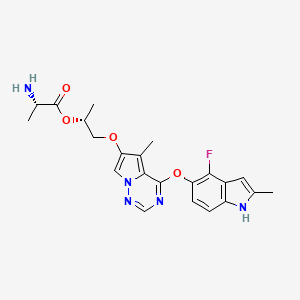
Brivanib alaninate ブリバニブアラニンエステル


Brivanib alaninate.svgBMS-582664,  brivanib alaninate

((S)-((R)-1-(4-(4-Fluoro-2-methyl-1H-indol-5-yloxy)-5-
methylpyrrolo[2,1-f][1,2,4]triazin-6-yloxy)propan-2-yl) 2-aminopropanoate

Brivanib alaninate  is a new oncology therapy with potential applications against a wide variety of tumor types and several stages of disease progression

A prodrug of BMS-540215.

  • BMS-540215
  • BMS540215
  • Brivanib
  • UNII-DDU33B674I

BMS 540215, 649735-46-6

(S)-(R)-1-((4-((4-fluoro-2-methyl-1H-indol-5-yl)oxy)-5-methylpyrrolo[2,1-f][1,2,4]triazin-6-yl)oxy)propan-2-yl 2-aminopropanoate
Clinical data
Legal status
  • Investigational new drug
Routes Oral
Identifiers
CAS number 649735-63-7
ATC code None
PubChem CID 11154925
ChemSpider 9330033
ChEMBL CHEMBL270995
Chemical data
Formula C22H24FN5O4 
Mol. mass 441.5 g/mol

C22H24FN5O4 : 441.46
[649735-63-7]

Brivanib alaninate (INN/USAN) also known as BMS-582664 is an investigational, anti-tumorigenic drug for oral administration. The drug is being developed by Bristol-Myers Squibb for the treatment of hepatocellular carcinoma or HCC (also called malignant hepatoma), the most common type of liver cancer. Hepatocellular carcinoma [1] is a primary cancer of the liver and is more common in men than in women. The disease occurs mostly in people who have scarring of the liver (cirrhosis) or after infection with hepatitis B or hepatitis C. Symptoms include pain and swelling in the abdomen, weight loss, weakness, loss of appetite and nausea. Hepatocellular carcinoma is a severe and life-threatening disease that is associated with poor overall survival. [2] While the choice of treatment depends mainly on how advanced the disease is, the only proven therapies to cure the cancer is surgery to remove the tumor and liver transplantation, but these therapies can only be carried out in very few patients. Other treatments includechemotherapy and immunotherapy. Radiofrequency ablation and ethanol injection are also used to remove small tumors.[3]

As a result of poor liver function, metastases, or both, only 10% to 20% of patients undergo surgery. In patients having surgery, the 5-year survival rate is only 25% to 50%. Several chemotherapeutic agents have been evaluated for the treatment of hepatocellular carcinoma. Doxorubicin (trade name Adriamycin; also known as hydroxydaunorubicin), the most widely used agent in HCC, has shown a 4% to 10.5% response rate in patients with HCC.

Studies have shown that the overall response (OR) rate, but not overall survival (OS), doubles when doxorubicin was given in combination with cisplatin, IFN, and 5-fluorouracil. The multitargeted tyrosine kinase inhibitor sorafenib (trade name Nexavar), which inhibits vascular endothelial growth factor receptor (VEGFR), platelet-derived growth factor receptor, raf, c-kit, and flt-3, has been shown to inhibit HCC-induced proliferation and angiogenesis.

Sorafenib has also been shown to provide a significant improvement in OS in patients with HCC. Based on these results, researchers concluded that this class of agents may be effective in the treatment of HCC. Brivanib alaninate also inhibits VEGFR and fibroblast growth factorreceptors (FGFR), which is known to play a major role in the etiopathogenesis of HCC. To date, brivanib alaninate has been investigated in 29 studies, including more than 4,000 patients around the world.

 Brivanib alaninate.png
Org. Process Res. Dev., Article ASAP
DOI: 10.1021/op500126u
Abstract Image

This manuscript describes the control strategy for the commercial process to manufacture brivanib alaninate. The active pharmaceutical ingredient is a prodrug which is susceptible to hydrolysis. In addition to controlling hydrolysis, a robust strategy was required in order to control input and process-related impurities. Three significant aspects of control include understanding of the reaction parameters in order to minimize the regioisomer during the alkylation with (R)-propylene oxide, development of a design space through statistical models to control impurity formation, and the use of in situ FT-IR to monitor the hydrogenolysis of the Cbz protecting group.

(S)-((R)-1-(4-(4-Fluoro-2-methyl-1H-indol-5-yloxy)-5-methylpyrrolo[1,2-f][1,2,4]triazin-6-yloxy)propan-2-yl)-2-aminopropanonate (1)

Brivanib alaninate.svg

1H NMR (400 MHz, CDCl3) 8.31 (1 H, s), 7.83 (1 H, s), 7.25 (1 H, s), 7.00 (1 H, d, J= 8.6 Hz), 6.95 (1 H, dd, J = 15.4, 8.6 Hz), 6.28 (1 H, s), 5.36–5.30 (1 H, m), 4.08–4.00 (2 H, m), 3.57 (1 H, dd, J = 14.0, 6.9 Hz), 2.47 (3 H, s), 2.40 (3 H, s), 1.66 (3 H, s), 1.38 (3 H, d, J = 6.4 Hz), 1.35 (3 H, d, J = 7.1 Hz).

(S)-((R)-1-(4-(4-Fluoro-2-methyl-1H-indol-5-yloxy)-5-methylpyrrolo[1,2-f][1,2,4]triazin-6-yloxy)propan-2-yl)-2-(benzyloxycarbonylamino)propanonate

1H NMR (400 MHz, CDCl3) 8.17 (1 H, br s), 7.84 (1 H, s), 7.41 (1 H, s), 7.35–7.28 (5 H, m), 7.03 (1 H, d, J = 8.6 Hz), 6.95 (1 H, t, J = 7.7 Hz), 6.30 (1 H, s), 5.36–5.32 (2 H, m), 5.11 (2 H, br s), 4.43–4.40 (1 H, m), 4.02–3.99 (2 H, m), 2.46 (3 H, s), 2.41 (3 H, s), 1.44 (3 H, d, J = 7.2 Hz), 1.38 (3 H, d, J = 7.2 Hz).

Ongoing clinical development program

To further investigate the benefits of brivanib in patients with advanced HCC, a broad-spectrum, global, phase III clinical development plan called the Brivanib studies in HCC patients at RISK (BRISK), has been initiated. Clinical benefits seen with brivanib in the first-line setting, and following the failure of sorafenib therapy, highlight the potential to improve the clinical course of patients with advanced HCC. Brivanib may provide a novel therapeutic option to a growing number of patients for whom no other treatment choice exists.

Regulatory status

On 27 October 2011, orphan designation (EU/3/11/918) was granted by the European Commission to Bristol-Myers Squibb for brivanib alaninate for the treatment of hepatocellular carcinoma.[11] Designated orphan medicinal products are products that are still under investigation and are considered for orphan designation on the basis of potential activity. An orphan designation is not a marketing authorization. As a consequence, demonstration of quality, safety and efficacy is necessary before a product can be granted a marketing authorization. At the time of the orphan designation, several medicines were authorized in the EU for the treatment of hepatocellular carcinoma.

Submission and application

At the time of submission of the application for orphan designation, clinical trials with brivanib alaninate in patients with hepatocellular carcinoma were ongoing. As part of the submission process, Bristol-Myers Squibb has provided sufficient information to show that brivanib alaninate might be of significant benefit for patients with hepatocellular carcinoma because it could provide an alternative for patients who cannot take or for whom existing treatments do not work. Early studies show that it might improve the treatment of patients with this condition, particularly if used when existing treatment had failed. However, this assumption needs to be confirmed at the time of EU marketing authorization, in order to maintain the orphan status.

Synthesis of Brivanib

Route 1

Route 2
…………………………….

[(1R), 2S]-2-Aminopropionic acid 2-[4-(4-fluoro-2-methyl-1H-indol-5-yloxy)-5-methylpyrrolo[2,1-f][1,2,4]triazin-6-yloxy]-1-methylethyl ester, has the structure of formula I:

Figure US07932383-20110426-C00001

and is referred to herein as “Compound I”. Compound I, compositions comprising Compound I, and methods of using Compound I are disclosed in U.S. Pat. No. 6,869,952 B2, which is assigned to the present assignee and is incorporated herein by reference in its entirety.Compound I, a prodrug, is suitable for inhibiting tyrosine kinase activity of growth factor receptors such as VEGFR-2 and FGFR-1 and is useful in the treatment of cancer. Compound I is also useful in the treatment of diseases, other than cancer, which are associated with signal transduction pathways operating through growth factors and anti-angiogenesis receptors such as VEGFR-2.

Typically, in the preparation of a pharmaceutical composition, a form of the active ingredient having desired properties such as dissolution rate, solubility, bioavailability, and/or storage stability is sought. For example, a form of the active ingredient, which has the desired solubility and bioavailability, has sufficient stability that it does not convert during manufacture or storage of the pharmaceutical composition to a different form having different solubility and/or bioavailibility. A form of Compound I is desired having properties and stability that allow the preparation of pharmaceutical compositions suitable for the treatment of diseases such as cancer.

…………………………………..

 http://www.google.com/patents/US6869952

EXAMPLE 81

Figure US06869952-20050322-C00100

[(1R), 2S]-2-Aminopropionic acid 2-[4-(4-fluoro-2-methyl-1H-indol-5-yloxy)-5-methylpyrrolo[2,1-f][1,2,4]triazin-6-yloxy]-1-methylethyl ester

Step A

A mixture of Example 15 (60 mg, 0.0.16 mmol), N-Cbz-L-alanine (89 mg, 0.4 mmol), HATU (253 mg, 0.4 mmol), DIPEA (103 mg, 0.8 mmol), and DMAP (5 mg) in DMF (1 mL) was stirred overnight. The volatiles were removed in vacuo, and the residue was purified by preparative HPLC to afford homochiral 2-benzyloxyearbonylamino-propionic acid [2-[4-(4-fluoro-2-methyl-1H-indol-5-yloxy)-5-methylpyrrolo[2,1-f][1,2,4]triazin-6-yloxy]]-l-methylethyl ester as a white solid (77 mg, 84% yield).

Step B

A mixture of the compound from step A above (60 mg, 0.11 mmol), Pd/C (6 mg), and ammonium formate (200 mg) in DMF (1.5 mL) were stirred at RT for 30 min. The mixture was diluted with ethyl acetate, and then filtered through a pad of Celite®. The filtrate was washed with water, dried over Na2SO4, and concentrated. The product was mixed with 1 N aqueous HCl and lyophilized to afford the title compound as a white solid (53 mg, 99% yield). MS: (M+H)+=442. 1HNMR (CD3OD): δ 1.45 (d, 3H, J=6.60 Hz), 1.56 (d, 3H, J=7.47 Hz), 2.44 (s, 3H), 2.46 (s, 3H), 4.13 (q, 1H), 4.18 (d, 2H, J=3.96 Hz), 5.45 (m 1H); 6.23 (s, 1H); 6.90 (dd, 1H); 7.10 (d, 1H); 7.66 (s, 1H), 7.75 (s, 1H).

…………………………

Discovery of brivanib alaninate ((S)-((R)-1-(4-(4-fluoro-2-methyl-1H-indol-5-yloxy)-5-methylpyrrolo[2,1-f][1,2,4]triazin-6-yloxy)propan-2-yl)2-aminopropanoate), a novel prodrug of dual vascular endothelial growth factor receptor-2 and fibroblast growth factor receptor-1 kinase inhibitor (BMS-540215)
J Med Chem 2008, 51(6): 1976

http://pubs.acs.org/doi/abs/10.1021/jm7013309

Abstract Image

A series of amino acid ester prodrugs of the dual VEGFR-2/FGFR-1 kinase inhibitor 1 (BMS-540215) was prepared in an effort to improve the aqueous solubility and oral bioavailability of the parent compound. These prodrugs were evaluated for their ability to liberate parent drug1 in in vitro and in vivo systems. The l-alanine prodrug 8 (also known as brivanib alaninate/BMS-582664) was selected as a development candidate and is presently in phase II clinical trials.

(R)-1-(4-(4-Fluoro-2-methyl-1H-indol-5-yloxy)-5-methylpyrrolo[2,1-f][1,2,4]triazin-6-yloxy)propan-2-ol (1)

A mixture of 6 (7.5 g, 24 mmol), R-(+)-propylene oxide (120 mmol), LiCl (3.02 g, 72 mmol), and NEt3 (300 μL) in EtOH (50 mL)………………………………………..o afford 1 (7.2 g, 81% yield) as an off-white solid. MS (ESI+) m/z 371.2 (M + H)+. 1H NMR (500 MHz, CD3OD) δ 7.72 (s, 1H), 7.61 (s, 1H), 7.10 (d, 1H, J = 8.80 Hz), 6.90 (t, 1H, J = 7.15 Hz), 6.23 (s, 1H), 4.12–4.20 (m, 1H), 3.92 (d, 2H, J = 6.55 Hz), 2.48 (s, 3H), 2.43 (s, 3H), 1.29 (d, 3H, J = 6.6 Hz). Mp 208–210 °C. Anal. (C19H19FN4O3): C, H, N, F.

 (S)-((R)-1-(4-(4-Fluoro-2-methyl-1H-indol-5-yloxy)-5-methylpyrrolo[2,1-f][1,2,4]triazin-6-
yloxy)propan-2-yl) 2-aminopropanoate (8)
1H NMR (500 MHz, CD3OD): 7.75 (s, 1H), 7.66 (s, 1H), 7.10 (d, 1H, J= 10.95 Hz), 6.90 (t, 1H,
J=9.60 Hz), 6.23 (s, 1H), 5.45 (m 1H), 4.18 (d, 2H, J= 3.96 Hz), 4.13 (q, 1H), 2.46 (s, 3H), 2.44 (s,3H), 1.56 (d, 3H, J=7.47 Hz), 1.45 (d, 3H, J=6.60 Hz). LC/MS(ESI+) m/z 442.1 (M+H)+.
M.p. 136-142 oC. Elemental analysis: (C22H24FN5O4:1H2O:1.09HCl): Calc’d: C, 52.95; H, 5.47; N,14.03; F, 3.81; Cl, 7.74. Found: C, 53.16; H, 5.35; N, 14.07; F, 3.72; Cl, 7.74HRMS (calc’d for C22H24FN5O4 M+H+): 442.1891, found: 442.1897.

……………………..

Discovery and preclinical studies of (R)-1-(4-(4-fluoro-2-methyl-1H-indol-5-yloxy)-5-methylpyrrolo[2,1-f][1,2,4]triazin-6-yloxy)propan-2-ol (BMS-540215), an in vivo active potent VEGFR-2 inhibitor
J Med Chem 2006, 49(7): 2143

http://pubs.acs.org/doi/abs/10.1021/jm051106d

Abstract Image

A series of substituted 4-(4-fluoro-1H-indol-5-yloxy)pyrrolo[2,1-f][1,2,4]triazine-based inhibitors of vascular endothelial growth factor receptor-2 kinase is reported. Structure−activity relationship studies revealed that a methyl group at the 5-position and a substituted alkoxy group at the 6-position of the pyrrolo[2,1-f][1,2,4]triazine core gave potent compounds. Biochemical potency, kinase selectivity, and pharmacokinetics of the series were optimized and in vitro safety liabilities were minimized to afford BMS-540215 (12), which demonstrated robust preclinical in vivo activity in human tumor xenograft models. The l-alanine prodrug of12, BMS-582664 (21), is currently under evaluation in clinical trials for the treatment of solid tumors.

 Preparation of (R)-1-(4-(4-fluoro-2-methyl-1H-indol-5-yloxy)-5-methylpyrrolo[2,1-f][1,2,4]triazin-6-yloxy)propan-2-ol (12).
A mixture of 7 (650 mg, 2.08 mmol), (R)-(+)-propylene oxide (595 mg, 10.4 mmol), and
triethylamine (30 µl) in ethanol (8 mL) was heated at 70 °C in a sealed tube. After 2 h, the solvent was removed in vacuo and the product was purified by flash column chromatography (silica gel, 20% EtOAc/ CH2Cl2) to afford a solid, which was triturated with 50% Et2O in CH2Cl2 to give 12 (410 mg,53% yield) as an off-white solid. 1H NMR (500 MHz, CDCl3) δ 7.84 (s, 1H), 7.41 (s, 1H), 7.11 (d, 1H,J = 11 Hz), 7.02 (t, 1H, J = 8.8 Hz), 6.39 (s, 1H), 4.20-4.30 (m, 1H), 3.8-4.00 (m, 2H), 2.51 (s, 3H),2.45 (s, 3H), 1.31 (d, 3H, J = 8.2 Hz). 13C NMR (125 MHz, DMSO-d6) δ 8.36, 13.3, 20.0, 64.5, 76.36,95.1, 100.0, 105.75, 106.66, 110.17, 115.47, 117.66, 117.8, 129.83, 136.34, 137.64, 144.13, 144.6,146.53, 148.15, 160.71. LC/MS (ESI) m/z 371 ((M+H)+. HPLC Method / tR / purity: method A/ 3.95min/ 99%. HRMS for C19H20FN4O3, calcd: 371.1519, found: 371.1522. Anal. (Calcd. ForC19H19FN4O3): theoretical %C 61.61, %H 5.17, %N 15.13, %F 5.13; found %C 61.35, %H 5.06, %N 14.99, %F 4.88.

…….

References

  1.  National Cancer Institute Dictionary of Cancer Terms
  2.  National Cancer Institute Adult Primary Liver Cancer Treatment (PDQ®)
  3.  National Cancer Institute Adult Primary Liver Cancer Treatment (PDQ®)/Treatment Option Overview
  4.  Huynh, H.; Ngo, V. C.; Fargnoli, J.; Ayers, M.; Soo, K. C.; Koong, H. N.; Thng, C. H.; Ong, H. S. et al. (2008). “Brivanib Alaninate, a Dual Inhibitor of Vascular Endothelial Growth Factor Receptor and Fibroblast Growth Factor Receptor Tyrosine Kinases, Induces Growth Inhibition in Mouse Models of Human Hepatocellular Carcinoma”. Clinical Cancer Research 14 (19): 6146–53. doi:10.1158/1078-0432.CCR-08-0509. PMID 18829493.
  5.  Cai, Zhen-wei; Zhang, Yongzheng; Borzilleri, Robert M.; Qian, Ligang; Barbosa, Stephanie; Wei, Donna; Zheng, Xiaoping; Wu, Lawrence et al. (2008). “Discovery of Brivanib Alaninate ((S)-((R)-1-(4-(4-Fluoro-2-methyl-1H-indol-5-yloxy)-5-methylpyrrolo[2,1-f][1,2,4]triazin-6-yloxy)propan-2-yl)2-aminopropanoate), A Novel Prodrug of Dual Vascular Endothelial Growth Factor Receptor-2 and Fibroblast Growth Factor Receptor-1 Kinase Inhibitor (BMS-540215)”. Journal of Medicinal Chemistry 51 (6): 1976–80. doi:10.1021/jm7013309. PMID 18288793.
  6.  Ayers, M.; Fargnoli, J.; Lewin, A.; Wu, Q.; Platero, J. S. (2007). “Discovery and Validation of Biomarkers that Respond to Treatment with Brivanib Alaninate, a Small-Molecule VEGFR-2/FGFR-1 Antagonist”. Cancer Research 67 (14): 6899–906. doi:10.1158/0008-5472.CAN-06-4555. PMID 17638901.
  7.  Bhide, Rajeev S.; Cai, Zhen-Wei; Zhang, Yong-Zheng; Qian, Ligang; Wei, Donna; Barbosa, Stephanie; Lombardo, Louis J.; Borzilleri, Robert M. et al. (2006). “Discovery and Preclinical Studies of (R)-1-(4-(4-Fluoro-2-methyl-1H-indol-5-yloxy)-5- methylpyrrolo[2,1-f][1,2,4]triazin-6-yloxy)propan- 2-ol (BMS-540215), an in Vivo Active Potent VEGFR-2 Inhibitor”. Journal of Medicinal Chemistry 49 (7): 2143–6. doi:10.1021/jm051106d. PMID 16570908.
  8.  ClinicalTrials.gov NCT00640471 Cetuximab With or Without Brivanib in Treating Patients With K-Ras Wild Type Tumours and Metastatic Colorectal Cancer
  9.  Allen, E.; Walters, I. B.; Hanahan, D. (2011). “Brivanib, a Dual FGF/VEGF Inhibitor, is Active Both First and Second Line against Mouse Pancreatic Neuroendocrine Tumors Developing Adaptive/Evasive Resistance to VEGF Inhibition”. Clinical Cancer Research 17 (16): 5299–310. doi:10.1158/1078-0432.CCR-10-2847. PMC 3156934. PMID 21622725.
  10.  Finn, R. S.; Kang, Y.-K.; Mulcahy, M.; Polite, B. N.; Lim, H. Y.; Walters, I.; Baudelet, C.; Manekas, D.; Park, J.-W. (2012). “Phase II, Open-label Study of Brivanib as Second-line Therapy in Patients with Advanced Hepatocellular Carcinoma”. Clinical Cancer Research 18 (7): 2090–8. doi:10.1158/1078-0432.CCR-11-1991. PMID 22238246.
  11.  orphan designation

External links

US6869952 * Jul 18, 2003 Mar 22, 2005 Bristol Myers Squibb Company Such as 4-(4-fluoro-2-methyl-1H-indol-5-yloxy)-5-methyl-pyrrolo(2,1-f)(1,2,4)triazin-6-ol; for treament of cancer
US6982265 May 18, 2000 Jan 3, 2006 Bristol Myers Squibb Company Pyrrolotriazine inhibitors of kinases
US7671199 * Apr 20, 2007 Mar 2, 2010 Britsol-Myers Squibb Company dual inhibitor of VEGFR and FGFR tyrosine kinases; cancer
WO2006030941A1 Sep 13, 2005 Mar 23, 2006 Eisai Co Ltd Simultaneous use of sulfonamide-containing compound and angiogenesis inhibitor
WO2006124689A2 May 12, 2006 Nov 23, 2006 Squibb Bristol Myers Co Combination therapy
NON-PATENT CITATIONS
Reference
1 Bennett, J.C. et al., eds., Cecil Textbook of Medicine, 20th Edition, vol. 1, W.B. Saunders Company, publ., pp. 1004-1010 (1996).
2 Fabbro, D. et al., “Protein kinases as targets for anticancer agents: from inhibitors to useful drugs“, Pharmacology & Therapeutics, vol. 93, pp. 79-98 (2002).
3 Gautschi, O. et al., “Aurora Kinases as Anticancer Drug Targets“, Clin. Cancer Res., vol. 14, No. 6, pp. 1639-1648 (2008).
4 Huynh, H. et al., “Brivanib Alaninate, a Dual Inhibitor of Vascular Endothelial Growth Factor Receptor and Fibroblast Growth Factor Receptor Tyrosine Kinases, Induces Growth Inhibition in Mouse Models of Human Hepatocellular Carcinoma“, Clin. Cancer Res., vol. 14, No. 19, pp. 6146-6153 (2008).
5 Mass, R.D. , “The HER Receptor Family: a Rich Target for Therapeutic Development“, Int, J. Radiation Oncology Biol. Phys., vol. 58, No. 3, pp. 932-940 (2004).
6 Mountzios, G. et al., “Aurora kinases as targets for cancer therapy“, Cancer Treatment Reviews, vol. 34, pp. 175-182 (2008).
7 National Cancer Institute, http://www.cancer.gov, Brivanib Active Trial Listing (ID#: 5552473) (Dec. 15, 2008).


hplc

HPLC methods
Method A :A linear gradient program using 10% methanol, 90% water, 0.2% H3PO4 (solvent A) and
90% methanol, 10% water, 0.2% H3PO4 (solvent B); t = 0 min, 0% B, t = 4 min, 100% B was
employed on a YMC S5 Combiscreen 4.6 × 50 mm column. Flow rate was 4 mL/min and UV detection
was set to 220 nm. The LC column was maintained at ambient temperature.
Method B: A linear gradient program using 10% methanol, 90% water, 0.2% H3PO4 (solvent A) and
90% methanol, 10% water, 0.2% H3PO4 (solvent B); t = 0 min, 0% B, t = 4 min, 100% B was
employed on a YMC ODS 4.6 x 50 mm column. Flow rate was 4 mL/min and UV detection was set to
220 nm. The LC column was maintained at ambient temperature.
Method C: A linear gradient program using 10% methanol, 90% water, 0.1% trifluoroacetic acid (TFA)
(solvent A) and 90% methanol, 10% water, 0.1% TFA (solvent B); t = 0 min, 0% B, t = 4 min, 100% B
was employed on a Chromolith SpeedROD, 4.6 × 50 mm column. Flow rate was 4 mL/min and UV
detection was set to 254 nm. The LC column was maintained at ambient temperature.
Method D: A linear gradient program using 10% methanol, 90% water, 0.1% TFA (solvent A) and 90%
methanol, 10% water, 0.1% TFA (solvent B); t = 0 min, 0% B, t = 2 min, 100% B was employed on a
Waters Xterra 5 m, 4.6 mm × 30 mm column. Flow rate was 4 mL/min and UV detection was set to
220 nm. The LC column was maintained at ambient temperature.


http://www.google.com/patents/EP2364699A1?cl=en

  • (R)-1-(4-(4-fluoro-2-methyl-1H-indol-5-yloxy)-5-methylpyrrolo[1,2-f][1,2,4]triazin-6-yloxy)propan-2-ol (hereinafter also referred to as “BMS-540215”; Proceedings of the American Association for Cancer Research., 46, (Abstract 3033), 2005) (see Formula (XXXIII)):
    Figure imgb0052

    and

  • (28) (S)-((R)-1-(4-(4-fluoro-2-methyl-1H-indol-5-yloxy)-5-methylpyrrolo[1,2-f][1,2,4]triazin-6-yloxy)propan-2-ol) 2-aminopropanonate (hereinafter also referred to as “BMS-582664”; Proceedings of the American Association for Cancer Research., 46, (Abstract 3033), 2005) (see Formula (XXXIV)):
    Figure imgb0053

Olaparib オラパリブ 奥拉帕尼 (AZD-2281, trade name Lynparza) AZ’ first-in-class PARP inhibitor wins EU nod


Olaparib.png

Olaparib

オラパリブ

奥拉帕尼

Women suffering from advanced relapsed BRCA-mutated ovarian cancer could gain access to a new treatment option after European regulators waved through AstraZeneca’s Lynparza (olaparib).

The European Commission has approved the first-in-class PARP inhibitor for the maintenance treatment of adults with platinum-sensitive relapsed BRCA-mutated high-grade serous epithelial ovarian, fallopian tube, or primary peritoneal cancer, who are in complete response or partial response to platinum-based chemotherapy.

read at……http://www.pharmatimes.com/Article/14-12-18/AZ_first-in-class_PARP_inhibitor_Lynparza_wins_EU_nod.aspx


Olaparib.png
4-[[3-[4-(cyclopropanecarbonyl)piperazine-1-carbonyl]-4-fluorophenyl]methyl]-2H-phthalazin-1-one, cas  763113-22-0

Kudos Pharmaceuticals Limited

Olaparib, AZD2281,  AZD2281

KU-0059436
KU-59436

Olaparib (AZD-2281, trade name Lynparza) is an experimental chemotherapeutic agent, developed by KuDOS Pharmaceuticalsand later by AstraZeneca, that is currently undergoing clinical trials. It is an inhibitor of poly ADP ribose polymerase (PARP), an enzyme involved in DNA repair.[1] It acts against cancers in people with hereditary BRCA1 or BRCA2 mutations, which includes many ovarian, breast and prostate cancers.

Olaparib is an oral poly-ADP-ribose polymerase (PARP) enzyme inhibitor developed by AstraZeneca. The product is awaiting registration in the E.U. and US as a maintenance treatment of patients with BRCA mutated platinum-sensitive relapsed serous ovarian cancer. In 2014, positive opinion was received in the E.U. recommending Lynparza approval for the maintanance treatment of BRCA mutated platinum-sensitive relapsed serous ovarian cancer.

An oral poly (ADP ribose) polymerase (PARP) inhibitor being investigated by British drug company AstraZeneca, is seeking approval from the U.S. Food and Drug Administration (FDA) for the treatment of BRCA mutated platinum-sensitive relapsed ovarian cancer. AstraZeneca filed the US regulatory submission for olaparib in February 2014.  Olaparib, one of several cancer drugs AstraZeneca flagged as having strong potential in its defense of a $118 billion take-over bid by Pfizer,was accepted for priority review on April 30, 2014  by the U.S.  Food and Drug Administration (FDA). The NDA filing was based on Phase II study 19 data, a randomized, double-blind, placebo-controlled, Phase II study.

On June 25, 2014, FDA Oncologic Drugs Advisory Committee (ODAC), an advisory panel to the U.S. Food and Drug Administration (FDA),  voted 11 to two against the accelerated approval of the PARP inhibitor olaparib as a maintenance therapy for women with platinum-sensitive relapsed ovarian cancer who have the germline BRCA (gBRCA) mutation, and who are in complete or partial response to platinum-based chemotherapy. By voting no, the committee recommended waiting for results from the larger confirmatory phase III SOLO-2 trial, which began enrolling in September 2013. According to clincialtrials.gov, the SOLO-2 study (NCT01874353) is slated to wrap in July 2015.

In terms of clinical development, phase III trials are ongoing at AstraZeneca for the treatment of gastric cancer and metastatic breast cancer. Olaparib is also in phase II clinical studies for several indications, including breast cancer, pancreatic cancer and castration-resistant prostate cancer. In March 2014, a phase II was also initiated in GB for the treatment of patients with stage IIIB or stage IV NSCLC that is not amenable to curative therapy. A phase I clinical trial for the treatment of melanoma has been completed. Phase II clinical trials are ongoing at General Hospital Corp. for the treatment of sarcoma. The drug had been in phase II clinical trials for the treatment of colorectal cancer; however no recent developments have been reported.

Discovered by KuDOS Pharmaceuticals, has experienced several twists and turns during its clinical development. Promising results for the drug were reported at the 2011 ASCO Annual Meeting, based on impressive early phase II results, only to have clinical development discontinued later that year after disappointing phase II trial results in a more generalized group of ovarian cancer patients. However, a re-analysis of the data in BRCA-positive patients – coupled with a reformulation of the drug – convinced the British drugmaker to think again and keep it going. AstraZeneca initiates Phase III clinical studies (SOLO 1 and SOLO 2) for olaparib in the U.S. in September 2013. AstraZeneca has filed Marketing Authorisation Application (MAA) for olaparib in EU in September 2013 based on Phase II study 19 data. The U.S. Food and Drug Administration has already granted olaparib orphan drug status for ovarian cancer and will hold an advisory panel hearing on the company’s application on June 25, 2014.

In 2013, orphan drug designation in the U.S. was assigned to the compound for the treatment of ovarian cancer. The compound was originally developed by Kudos Pharmaceuticals, which was acquired by AstraZeneca in 2006.

Early Phase I trials were promising, and olaparib underwent Phase II trials. However, in December 2011, AstraZeneca announced following interim analysis of a phase-II study which indicated that the previously reported progression free survival benefit was unlikely to translate into an overall survival benefit, that it would not progress into Phase III development for the maintenance treatment of serous ovarian cancer,[2] and took a charge of $285 million. The decision to discontinue development of the drug was reversed in 2013,[3] with AstraZeneca posting a new Phase III trial of Olaparib for patients with BRCA mutated ovarian cancer in April 2013.[4]

Mechanism of action

Olaparib acts as an inhibitor of the enzyme Poly ADP ribose polymerase (PARP) and is one of the first PARP inhibitors. Patients with BRCA1/2 mutations may be genetically predisposed to developing some forms of cancer, and are often resistant to other forms of cancer treatment, but this also sometimes gives their cancers a unique vulnerability, as the cancer cells have increased reliance on PARP to repair their DNA and enable them to continue dividing. This means that drugs which selectively inhibit PARP may be of significant benefit in patients whose cancers are susceptible to this treatment.[5][6][7][8][9][10]

Trial results

Phase I clinical trials, in patients with BRCA-mutated tumors including ovarian cancer, were encouraging.[11] In one of these studies, it was given to 19 patients with inherited forms of advanced breast, ovarian and prostate cancers caused by mutations of the BRCA1 and BRCA2 genes. In 12 of the patients, none of whom had responded to other therapies, tumours shrank or stabilised.[12] One of the first patients to be given the treatment (who had castration-resistant prostate cancer) was as of July 2009 still in remission after two years.

In 2009 Phase II clinical trials examining the efficacy of Olaparib in treating breast, ovarian and colorectal cancer were initiated.[13][14] A phase II trial that included 63 cases of ovarian cancer concluded that olaparib is promising for women with ovarian cancer. [7 responses in 17 patients with BRCA1 or BRCA2 mutations and 11 responses in the 46 who did not have these mutations.][15]

Side effects

Olaparib is generally well tolerated, the side effects consist mainly of fatigue, somnolence, nausea, loss of appetite and thrombocytopenia.

………………………

Synthesis of Investigational Ovarian Cancer Drug Olaparib_PAPP Inhibitor_AstraZeneca 阿斯利康卵巢癌试验药物奥拉帕尼的化学合成

…………….

LOU Xi-yu, YANG Xuan, DING Yi-li, WANG Jian-jun, YAN Qing-yan, HUANG Xian-gui, GUO Yang-hui, WANG Xiang-jing, XIANG Wen-sheng
Synthesis of Olaparib Derivatives and Their Antitumor Activities
2013 Vol. 29 (2): 231-235 [摘要] ( 390 ) [HTML 1KB] [PDF 0KB] ( 22 )
doi: 10.1007/s40242-013-2448-5

……………………….

…………………

4-[3-(4-Cyclopropanecarbonylpiperazine-1-carbonyl)-4-fluorobenzyl]-2H-phthalazin-1-one: A novel bioavailable inhibitor of poly(ADP-ribose) polymerase-1
J Med Chem 2008, 51(20): 6581

…………………………..

http://www.google.co.in/patents/WO2004080976A1?cl=en

Synthesis of Key Intermediates

3- (4-0x0-3 , 4-dihydrophthalazin-l -ylmethyl) benzoic a cid (A)

Figure imgf000046_0001

A mixture of 27% sodium methoxide solution in methanol (400 g, 2 mol) and methanol (150 ml) was added dropwise between ambient temperature and 30°C over 15 minutes to a stirred mixture of phthalide (67 g, 0.5 mol), 3-formylbenzonitrile (65.5 g, 0.5 mol) and ethyl propionate (250 ml) , the mixture was stirred at ambient temperature for 40 minutes and at reflux temperature for 1 hour, then it was allowed to cool to ambient temperature. The resulting red solid was collected by filtration, washed with ethyl acetate (2 x 50 ml) and dissolved in water (1800 ml) . The solution was acidified by the addition of acetic acid (60 ml) and the resulting red solid was collected by filtration, washed with water (2 x 200 ml) and dried in vacuo to give 3- (1,3- dioxoindan-2-yl) benzonitrile (83.2 g) as a dark red solid, m.pt. 179- 182°C, m/z (M+H)+‘ 248, which was used without further purification.

3- (1, 3-Dioxoindan-2-yl) benzonitrile (74.18 g, 0.3 mol) was added in portions to a solution of sodium hydroxide (36 g, 0.9 mol) in water (580 ml), the resulting dark red suspension was stirred at reflux temperature for 5 hours, then it was cooled to ambient temperature and washed with ethyl acetate (3 x 300 ml) . The aqueous solution was acidified by the dropwise addition of concentrated hydrochloric acid (110 ml), the mixture was stirred at ambient temperature for 1 hour, then the resulting solid was collected by filtration, washed with water (2 x 200 ml) and dried in vacuo to give a 1:1 mixture of 3- (1,3- dioxoindan-2-yl)benzoic acid, (M+H)+” 267, and 2- [2- (3- carboxyphenyl) acetyl] benzoic acid, (M+H)+‘ 285, (69.32 g) , which was used without further purification.

The mixture obtained in the previous step (52.8 g) was added to a solution of triethylamine (37.55 g, 0.372 mol) in industrial methylated spirit (500 ml) and the resulting cloudy solution was filtered through a pad of filter-aid to give a clear solution. Hydrazine monohydrate (9.3 g, 0.186 mol) was added in one portion at ambient temperature, the stirred mixture was heated under reflux for 1 hour, then it was concentrated in vacuo to approximately 250 ml and added to a solution of sodium acetate (41 g, 0.5 mol) in water (500 ml) . The mixture was brought to pH 7 by the dropwise addition of concentrated hydrochloric acid, then it was stirred at ambient temperature for 3 hours. The resulting solid was collected by filtration, washed with water (50 ml) and dried in va cuo to give a white solid (15.62 g) . The combined filtrate and washings were acidified to pH 6 by the addition of hydrochloric acid, then the mixture was stirred at ambient temperature for 3 hours. The resulting solid was collected by filtration, washed with water (50 ml) and dried in va cuo to give a second crop of off-white solid (17.57 g) . The combined filtrate and washings from the second crop were readjusted to pH 6 and treated as before to give a third crop of pale orange solid (6.66 g) . The three crops were combined to give essentially pure 3- (4-oxo-3, 4-dihydrophthalazin-l-ylmethyl) benzoic acid (A), (M+H)+‘ 281, δH 4.4 (2H, s), 7.2-7.4 (IH, m) , 7.5-7.6 (IH, ) , 7.7-8.0 (5H, m) , 8.1- 8.2 (IH, m) , 12.6 (IH, s)

b . 2-Fluoro-5- (4-oxo-3 , 4-dihydro-phthalazin -l -ylmethyl) benzoi c a cid (B)

Figure imgf000048_0001

Dimethyl phosphite (22.0 g, 0.2 mol) was added drop-wise to a solution of sodium methoxide (43.0 g) in methanol (100 ml) at 0°C. 2- Carboxybenzaldehyde (21.0 g, 0.1 mol) was then added portion-wise to the reaction mixture as a slurry in methanol (40 ml), with the temperature kept below 5°C. The resulting pale yellow solution was warmed to 20°C over 1 hour. Methanesulphonic acid (21.2 g, 0.22 mol) was added to the reaction drop-wise and the resulting white suspension was evaporated in va cuo . The white residue was quenched with water and extracted into chloroform (3 x 100 ml) . The combined organic extracts were washed with water (2 x 100 ml) , dried over MgS04, and evaporated in va cuo to yield (3-oxo-l, 3-dihydro-isobenzofuran-l-yl) phosphonic acid dimethyl ester as a white solid (32.0 g, 95 %, 95 % purity) . This was then used without further purification in the next stage.

To a mixture of (3-oxo-l, 3-dihydro-isobenzofuran-l-yl) phosphonic acid dimethyl ester (35.0 g, 0.14 mol) in tetrahydrofuran (200 ml) and 2- fluoro-5-formylbenzonitrile (20.9 g, 0.14 mol) in tetrahydrofuran (130 ml) was added triethylamine (14 ml, 0.14 mol) drop-wise over 25 min, with the temperature kept below 15°C. The reaction mixture was warmed slowly to 20°C over 1 hour and concentrated in vacuo . The white residue was slurried in water (250 ml) for 30 minutes, filtered, washed with water, hexane and ether, and dried to yield 2-fluoro-5- (3- oxo-3H-isobenzofuran-l-ylidenemethyl) benzonitrile as a 50:50 mixture of E and Z isomers (37.2 g, 96 %); m/z [M+l]+ 266 (98 % purity) To a suspension of 2-fluoro-5- (3-oxo-3H-isobenzofuran-l- ylidenemethyl) benzonitrile in water (200 ml) was added aqueous sodium hydroxide (26.1 g in 50 ml water) solution and the reaction mixture was heated under nitrogen to 90 °C for 30 minutes. The reaction mixture was partially cooled to 70°C, and hydrazine hydrate (100 ml) was added and stirred for 18 hours at 70°C. The reaction was cooled to room temperature and acidified with 2M HC1 to pH 4. The mixture was stirred for 10 min and filtered. The resulting solid was washed with water, hexane, ether, ethyl acetate and dried to yield 2-fluoro-5- (4-oxo-3, 4- dihydrophthalazin-l-ylmethyl)benzoic acid as a pale pink powder (30.0 g, 77 %) . m/z [M+l]+ 299 (96 % purity), δH 4.4 (2H, s) , 7.2-7.3 (IH, m) , 7.5-7.6 (IH, m) , 7.8-8.0 (4H, m) , 8.2-8.3 (IH, m) , 12.6 (IH, s).

c . 1 – [3- (4-Oxo-S , 4-dihydrophthalazin-l -ylmethyl) benzoyl]piperidine-4- carboxylic a cid (C)

Figure imgf000049_0001undesried????????

(A) (C)

3- (4-Oxo-3, 4-dihydrophthalazin-l-ylmethyl)benzoic acid (A) (7.0 g, 0.25 mol), ethyl isonipecotate (5 ml, 0.32 mol), 2- (lH-benzotriazol-1-yl) – 1, 1, 3, 3-tetramethyluronium hexafluorophosphate (HBTU) (12.3 g, 0.32 mol) and N, N, -diisopropylethylamine (10.0 ml, 0.55 mol) were added to dimethylacetamide (40 ml) and stirred for 18 h. Water (100 ml) was added to the reaction mixture and the product was extracted into dichloromethane (4 x 50 ml) . The combined organic layers were washed with water (3 x 100 ml), dried over MgS0, filtered and evaporated in va cuo to yield an oil. To a solution of the oil in tetrahydrofuran (100 ml) was added 10 % aqueous sodium hydroxide solution (20 ml) and the reaction was stirred for 18 hours. The reaction was concentrated, washed with ethyl acetate (2 x 30 ml) and acidified with 2M HCl to pH 2. The aqueous layer was extracted with dichloromethane (2 x 100 ml), then the extracts were dried over MgS04, filtered and evaporated to yield 1- [3- (4-oxo-3, 4-dihydrophthalazin-l-ylmethyl)benzoyl]piperidine- 4-carboxylic acid (C) as a yellow solid (7.0 g, 65 %), m/z [M+l]+ 392

(96 % purity), δH 1.3-1.8 (5H, m) , 2.8-3.1 (4H, m) , .4 (2H, s), 7.2- 7.3 (IH, m) , 7.3-7.4 (IH, ) , 7.7-8.0 (5H, m) , 8.2-E 3 (IH, m) , 12.6 (IH, s) .

d . 1 – [2-Fluoro-5- (4 -oxo-3 , 4-dihydrophthala zin-l – ylmethyl) benzoyl]piperidine-4~carboxylic a cid (D)

Figure imgf000050_0001

(B) (D)

2-Fluoro-5- ( -oxo-3, 4-dihydrophthalazin-l-ylmethyl) benzoic acid (B) (3.1 g, 0.14 mol), ethyl isonipecotate (1.7 ml, 0.11 mol), 2-(lH- benzotriazol-1-yl) -1,1,3, 3-tetramethyluronium hexafluorophosphate (HBTU) (5.1 g, 0.13 mol) and N,N, -diisopropylethylamine (10.0 ml, 0.55 mol) were added to dimethylacetamide (15 ml) and stirred for 18 hours. Water (100 ml) was added to the reaction mixture and the product was extracted into dichloromethane (4 x 50 ml) . The combined organic layers were, filtered, washed with water (3 x 100 ml), dried over MgS04, filtered and evaporated in vacuo to yield an orange oil. The oil was purified by flash chromatography (ethyl acetate) to yield l-[2- fluoro-5- (4-oxo-3, 4-dihydrophthalazin-l-ylmethyl) benzoyl] piperidine-4- carboxylic acid as the methyl ester (1.5 g, 33 %, 96 % purity) . To a solution of the methyl ester in tetrahydrofuran: water (2:1, 40 ml) was added sodium hydroxide (0.3 g, 0.075 mol) and the reaction was stirred for 18 h. The reaction was concentrated, washed with ethyl acetate (2 x 20 ml) and acidified with 2M HC1 to pH 2. The aqueous layer was extracted with dichloromethane (2 x 20 ml) , and the combined extracts were dried over MgS04 and evaporated to yield 1- [3- ( 4-oxo-3, 4- dihydrophthalazin-1-ylmethyl) benzoyl] piperidine- -carboxylic acid (D) as a yellow solid (0.6 g, 65 %), m/z [M+l]+ 392 (96 % purity) Example 1 – Synthesis of Key Compounds

a. Synthesis of 4- [3- (piperazine-1-carfoonyl)benzyl] -2H-phthalasin-l- one (1)

Figure imgf000051_0001undesired????????

(A) (1)

3- (4-0xo-3, 4-dihydrophthalazin-l-ylmethyl) benzoic acid (A) (5.0g, 0.17mol), tert-butyl 1-piperazinecarboxylate (3.9 g, 0.21 mol), 2-(lH- benzotriazol-1-yl) -1,1,3, 3-tetramethyluronium hexafluorophosphate (HBTU) (8.6 g, 0.22 mol) and N, , -diisopropylethylamine (6.7 ml, 0.38 mol) were added to dimethylacetamide (40 ml) and stirred for 18 hours. Water (100 ml) was added and the reaction mixture was heated to 100°C for 1 hour. The suspension was cooled to room temperature, filtered and dried to yield a white solid. The solid was dissolved in a solution of 6M HC1 and ethanol (2:1, 50 ml) and stirred for 1 hour. The reaction was concentrated, basified with ammonia to pH 9, and the product was extracted into dichloromethane (2 x 50 ml). The combined organic layers were washed with water (2 x 50 ml), dried over MgS04, and evaporated in va cuo to yield 4- [3- (piperazine-1-carbonyl) benzyl] – 2H-phthalazin-l-one (1) as a yellow crystalline solid (4.0 g, 77 %); m/z [M+l]+ 349 (97 % purity), δH 2.6-3.8 (8H, ) , 4.4 (2H, s), 7.2-7.5 (4H, m) , 7.7-8.0 (3H, m) , 8.2-8.3 (IH, m) , 12.6 (IH, s)

b . Synthesis of 4 – [4-Fluoro-3- (piperazine-1 -carbonyl) benzyl ] -2H- phthala zin ~l -one (2)

Figure imgf000051_0002desired……

(β) (2)

The synthesis was carried out according to the method described in (a) above using 2-fluoro-5- (4-oxo-3, -dihydrophthalazin-l-ylmethyl) benzoic acid (B) to yield 4- [4-fluoro-3- (piperazine-1-carbonyl) benzyl] -2H- phthalazin-1-one (2) as a white crystalline solid (4.8 g, 76 %); m/z [M+l]+ 367 (97 % purity), δH 2.6-3.8 (8H, m) , 4.4 (2H, s), 7.2-7.5 (3H, m) , 7.7-8.0 (3H, m) , 8.2-8.3 (IH, m) , 12.6 (IH, s) .

…………………………..

US 8183369

http://www.google.co.in/patents/US8183369

4-[3-(4-Cyclopropanecarbonyl-piperazine-1-carbonyl)-4-fluoro-benzyl]-2H-phthalazin-1-one (compound A) disclosed in WO 2004/080976:

Figure US08183369-20120522-C00001

is of particular interest.

A crystalline form of compound A (Form A) is disclosed in co-pending applications, which claim priority from U.S. 60/829,694, filed 17 Oct. 2006, entitled “Phthalazinone Derivative”, including U.S. Ser. No. 11/873,671 and WO 2008/047082.

Form A

Figure US08183369-20120522-C00002

References(a) 4-[3-(4-Cyclopropanecarbonyl-piperazine-1-carbonyl)-4-fluoro-benzyl]-2H-phthalazin-1-one (Compound A)

2-Fluoro-5-[(4-oxo-3,4-dihydrophthalazin-1-yl)methyl]benzoic acid (D)(15.23 g, 51.07 mmol) was suspended with stirring under nitrogen in acetonitrile (96 ml). Diisopropylethylamine (19.6 ml, 112.3 mmol) was added followed by 1-cyclopropylcarbonylpiperazine (I)(9.45 g, 61.28 mmol) and acetonitrile (1 ml). The reaction mixture was cooled to 18° C. 0-Benzotriazol-1-yl-tetramethyluronium hexafluorophosphate (25.18 g, 66.39 mmol) was added over 30 minutes and the reaction mixture was stirred for 2 hours at room temperature. The reaction mixture was cooled to 3° C. and maintained at this temperature for 1 hour, before being filtered. The filter cake was washed with cold (3° C.) acetonitrile (20 ml) before being dried in vacuo at up to 40° C. to give the title compound as a pale yellow solid (20.21 g).

Mass Spectrum: MH+ 435

1H NMR (400 MHz, DMSO-d6) δ: 0.70 (m, 4H), 1.88 (br s, 1H), 3.20 (br s, 2H), 3.56 (m, 6H), 4.31 (s, 2H), 7.17 (t, 1H), 7.34 (dd, 1H), 7.41 (m, 1H), 7.77 (dt, 1H), 7.83 (dt, 1H), 7.92 (d, 1H), 8.25 (dd, 1H), 12.53 (s, 1H).

………………………..

http://www.google.co.in/patents/US8247416

4-[3-(4-Cyclopropanecarbonyl-piperazine-1-carbonyl)-4-fluoro-benzyl]-2H-phthalazin-1-one (compound A) disclosed in WO 2004/080976:

Figure US08247416-20120821-C00001

is of particular interest.

In WO 2004/080976, compound A was synthesised as one of a number of library compounds from 4-[4-fluoro-3-(piperazine-1-carbonyl)-benzyl]-2H-phthalazin-1-one (compound B):

Figure US08247416-20120821-C00002

by the addition of cyclopropanecarbonyl chloride:

Figure US08247416-20120821-C00003

to a solution of (B) in dichloromethane, followed by Hünig’s base (N,N-diisopropylethyl amine). This reaction is carried out with stirring at room temperature for 16 hours, and the resulting compound being purified by preparative HPLC.

The piperazine derivative (B) was prepared by deprotecting 4-[2-fluoro-5-(4-oxo-3,4-dihydro-phthalazin-1-ylmethyl)-benzoyl]-piperazine-1-carboxylic acid tert-butyl ester (compound C):

Figure US08247416-20120821-C00004

by the use of 6M HCl and ethanol for 1 hour, followed by basification with ammonia to pH 9, and extraction into dichloromethane.

The Boc-protected piperazine derivative (C) was prepared from 2-fluoro-5-(4-oxo-3,4-dihydro-phthalazin-1-ylmethyl)-benzoic acid (compound D):

Figure US08247416-20120821-C00005

by the addition of piperazine-1-carboxylic acid tert-butyl ester:

Figure US08247416-20120821-C00006

2-(1H-benzotriazol-1-yl)-1,1,3,3-tetramethyluronium hexafluorophosphate (HBTU) and N,N,-diisopropylethylamine in dimethylacetamide, followed by stirring for 18 hours.

In WO 2004/080976, the following route to compound D is disclosed:

Figure US08247416-20120821-C00007

The method of synthesising compound D may further comprise the step of:

(c) synthesising 2-fluoro-5-[(4-oxo-3,4-dihydrophthalazin-1-yl)methyl]benzonitrile (ED):

Figure US08247416-20120821-C00008

from compound E by reaction with hydrazine hydrate; and

(d) synthesising compound D from compound ED by reaction with sodium hydroxide.

Step (c) may be achieved by using between 1.1 and 1.3 equivalents of hydrazine hydrate in tetrahydrofuran followed by neutralisation of the excess hydrazine hydrate using acetic acid.

A sixth aspect of the present invention provides the compound ED:

Figure US08247416-20120821-C00009

and its use in the synthesis of compound D.

EXAMPLES

Example 1Synthesis of Compound A

Figure US08247416-20120821-C00010

Starting material (D) was synthesised by the method disclosed in WO 2004/080976

Methods

Preparative HPLC

Samples were purified with a Waters mass-directed purification system utilising a Waters 600 LC pump, Waters Xterra C18 column (5 μm 19 mm×50 mm) and Micromass ZQ mass spectrometer, operating in positive ion electrospray ionisation mode. Mobile phases A (0.1% formic acid in water) and B (0.1% formic acid in acetonitrile) were used in a gradient; 5% B to 100% over 7 min, held for 3 min, at a flow rate of 20 ml/min.

Analytical HPLC-MS

Analytical HPLC was carried out with a Spectra System P4000 pump and Jones Genesis C18 column (4 μm, 50 mm×4.6 mm). Mobile phases A (0.1% formic acid in water) and B (acetonitrile) were used in a gradient of 5% B for 1 min rising to 98% B after 5 min, held for 3 min at a flow rate of 2 ml/min. Detection was by a TSP UV 6000LP detector at 254 nm UV and range 210-600 nm PDA. The Mass spectrometer was a Finnigan LCQ operating in positive ion electrospray mode.

(a) 4-[2-Fluoro-5-(4-oxo-3,4-dihydro-phthalazin-1-ylmethyl)-benzoyl]-piperazine-1-carboxylic acid tert-butyl ester (C)

To a stirred solution of the starting material D (850 g) in dimethylacetamide (DMA) (3561 ml) at room temperature under nitrogen was added HBTU (2-(1H-benzotriazol-1-yl)-1,1,3,3-tetramethyluronium hexafluorophosphate) (1402 g) in one portion. Hünig’s base (iPr2NEt, 1096 ml) was then added with the temperature kept between 15 to 25° C. followed by a solution of 1-Boc-piperazine (637 g) in DMA (1428 ml) with the temperature kept between 15 to 25° C.

The solution was stirred at room temperature for 2 hours and sampled for completion (HPLC). Upon completion the solution was added to vigorously stirred water (17085 ml) with the temperature kept between 15 to 25° C. and the solid filtered off, washing with water (2×7131 ml), hexane (2×7131 ml) and methyl tert-butyl ether (MTBE) (2×3561 ml). The solid was then dried overnight and then sampled for water content and chemical purity.

This reaction was then repeated, see table:

Purity Water Content
Batch Yield (g) (HPLC Area %) (K.F.) Corrected yield
1 1571.3 86.80 24.3 1032.5 g (78%)
2 2781.6 85.00 40.3 1411.5 g (106%)
a. Greater than 100% yield attributed to non-representative sampling

(b) 4-[4-Fluoro-3-(piperazine-1-carbonyl)-benzyl]-2H-phthalazin-1-one (B)

To a stirred solution of industrial methylated spirits (IMS) (2200 ml) and concentrated HCl (4400 ml) was added compound C (2780.2 g) in portions at room temperature under nitrogen, the foaming was controlled by the addition rate. The solution was then stirred at 15 to 25° C. for 30 minutes and sampled for completion (HPLC).

Upon completion the solution was evaporated to remove any IMS and the aqueous extracted with CH2Cl2 (2×3500 ml) before the pH was adjusted to >8 using concentrated ammonia. The resultant slurry was then diluted with water (10000 ml) and extracted with CH2Cl2 (4×3500 ml), washed with water (2×2000 ml), dried over MgSO4 (250 g) and evaporated. The crude product was then slurried in CH2Cl2 (3500 ml) and added to MTBE (5000 ml). The resultant suspension was filtered and dried at 50° C. overnight yielding 611.0 g (58.5% yield) of material with a purity of 94.12%

(c) 4-[3-(4-Cyclopropanecarbonyl-piperazine-1-carbonyl)-4-fluoro-benzyl]-2H-phthalazin-1-one (A)

To a stirred suspension of compound B (1290 g) in CH2Cl2 (15480 ml) under nitrogen was added a pre-mixed solution of triethylamine (470 ml) and cyclopropane carbonyl chloride (306 ml) in CH2Cl2 (1290 ml) dropwise with the temperature kept below 20° C. The solution was then stirred at 10-15° C. for 15 minutes and sampled for completion. The reaction mixture was found to contain only 1.18% of starting material B and so the reaction was deemed complete and the batch was then worked-up.

The reaction mixture was washed with water (7595 ml), 5% citric acid solution (7595 ml), 5% sodium carbonate solution (7595 ml) and water (7595 ml). The organic layer was then dried over magnesium sulfate (500 g).

The CH2Cl2 containing product layer was then isolated, filtered through Celite and charged to a 251 vessel. CH2Cl2 (8445 ml) was then distilled out at atmospheric pressure and ethanol (10000 ml) added. Distillation was then continued with every 4000 ml of distillate that was removed being replaced with ethanol (4000 ml) until the head temperature reached 73.7° C. The reaction volume was then reduced (to 7730 ml) by which time the head temperature had reached 78.9° C. and the solution was allowed to cool to 8° C. overnight. The solid was then filtered off, washed with ethanol (1290 ml) and dried at 70° C. overnight. Yield=1377.3 g (90%). HPLC purity (99.34% [area %]). Contained 4.93% ethanol and 0.45% CH2Cl2 by GC.

(d) Water Treatment of Compound A

A suspension of compound A (1377.0 g), as produced by the method of Example 1, in water (13770 ml) was heated to reflux for 4 hours, cooled to room temperature and filtered. The solid was washed with water (2754 ml) and dried at 70° C. overnight. Yield=1274.8 g (92.6%). HPLC purity (99.49% [area %]). Contained 0.01% ethanol and 0.01% CH2Cl2 by GC.

1H NMR spectrum of compound A (DMSO-d6) following the water treatment is shown in FIG. 1.

The powder XRD pattern of Compound A following the water treatment is shown in FIG. 2, which shows the compound is as Form A.

Example 2

Alternative Synthesis of Compound A Using 1-(cyclopropylcarbonyl) piperazine

Figure US08247416-20120821-C00011

Methods (also for Examples 3 & 4)

NMR

1H NMR spectra were recorded using Bruker DPX 400 spectrometer at 400 MHz. Chemical shifts were reported in parts per million (ppm) on the δ scale relative to tetramethylsilane internal standard. Unless stated otherwise all samples were dissolved in DMSO-d6.

Mass Spectra

Mass spectra were recorded on an Agilent XCT ion trap mass spectrometer using tandem mass spectrometry (MS/MS) for structural confirmation. The instrument was operated in a positive ion elctrospray mode.

(a) 4-[3-(4-Cyclopropanecarbonyl-piperazine-1-carbonyl)-4-fluoro-benzyl]-2H-phthalazin-1-one (Compound A)

2-Fluoro-5-[(4-oxo-3,4-dihydrophthalazin-1-yl)methyl]benzoic acid (D)(15.23 g, 51.07 mmol) was suspended with stirring under nitrogen in acetonitrile (96 ml). Diisopropylethylamine (19.6 ml, 112.3 mmol) was added followed by 1-cyclopropylcarbonylpiperazine (1)(9.45 g, 61.28 mmol) and acetonitrile (1 ml). The reaction mixture was cooled to 18° C. O-Benzotriazol-1-yl-tetramethyluronium hexafluorophosphate (25.18 g, 66.39 mmol) was added over 30 minutes and the reaction mixture was stirred for 2 hours at room temperature. The reaction mixture was cooled to 3° C. and maintained at this temperature for 1 hour, before being filtered. The filter cake was washed with cold (3° C.) acetonitrile (20 ml) before being dried in vacuo at up to 40° C. to give the title compound as a pale yellow solid (20.21 g).

Mass Spectrum: MH+435

1H NMR (400 MHz. DMSO-d6) δ: 0.70 (m, 4H), 1.88 (br s, 1H), 3.20 (br s, 2H), 3.56 (m, 6H), 4.31 (s, 2H), 7.17 (t, 1H), 7.34 (dd, 1H), 7.41 (m, 1H), 7.77 (dt, 1H), 7.83 (dt, 1H), 7.92 (d, 1H), 8.25 (dd, 1H), 12.53 (s, 1H).

Example 3Alternative Synthesis of Compound A Using 1-(cyclopropylcarbonyl) piperazine HCl salt

Figure US08247416-20120821-C00012

(a) 1-(Cyclopropylcarbonyl)piperazine HCl salt (I′)

Acetic acid (700 ml) was treated with piperazine (50.00 g, 0.581 mol) portionwise over 15 minutes with stirring under nitrogen The reaction mixture was warmed to 40° C. and maintained at this temperature until a complete solution was obtained. Cyclopropanecarbonyl chloride 59.2 ml, 0.638 mol) was added over 15 minutes. The reaction mixture was stirred at room temperature overnight. The reaction mixture was filtered and the filtrate distilled under reduced pressure until ˜430 ml of distillates had been collected. Toluene (550 ml) was charged to the reaction mixture and reduced pressure distillation continued until a further 400 ml of distillates were collected. A further charge of toluene (550 ml) was added and reduced pressure distillation continued until 350 ml of distillates were collected. The resulting slurry was diluted with toluene (200 ml) and stirred overnight. Further toluene (500 ml) was added in order to mobilise the slurry. The slurry was filtered, washed with toluene (100 ml) and dried in vacuo at 40° C. to give the title compound as an off white solid (86.78 g).

Mass Spectrum: MH+155

1H NMR (400 MHz. D2O) δ: 0.92 (m, 4H), 1.98 (m, 1H), 3.29 (m, 2H), 3.38 (m, 2H), 3.84 (m, 2H), 4.08 (m, 2H).

(b) Compound A

2-Fluoro-5-[(4-oxo-3,4-dihydrophthalazin-1-yl)methyl]benzoic acid (D)(0.95 g, 3.19 mmol) was suspended with stirring under nitrogen in acetonitrile (4 ml). 2-(1H-benzotriazol-1-yl)-1,1,3,3-tetramethyluronium hexafluorophosphate (HBTU) (1.45 g, 3.83 mmol) was added followed by 1-cyclopropylcarbonylpiperazine HCl salt (I′)(0.73 g, 3.83 mmol). Diisopropylethylamine (1.39 ml, 7.98 mmol) was added over 3 minutes and the reaction mixture was stirred for overnight at room temperature. The reaction mixture was cooled to 5° C. and maintained at this temperature for 1 hour, before being filtered. The filter cake was washed with cold (3° C.) acetonitrile (2 ml) before being dried in vacuo at up to 40° C. to give the title compound as a pale yellow solid (0.93 g).

  1.  “Olaparib, a PARP Inhibitor”. Health and Life.
  2.  “AZ updates on olaparib and TC5214”. 20 December 2011.
  3.  http://uk.reuters.com/article/2013/09/04/astrazeneca-cancer-idUKL6N0H00KN20130904
  4.  http://www.clinicaltrials.gov/ct2/show/NCT01844986
  5.  New cancer drug ‘shows promise’ BBC News 24 June 2009
  6.  Olaparib for the treatment of ovarian cancer.
  7.  Vasiliou S, Castaner R, Bolos J. Olaparib. Drugs of the Future. 2009; 34(2): 101.
  8.  Menear KA, Adcock C, Boulter R, Cockcroft XL, Copsey L, Cranston A, Dillon KJ, Drzewiecki J, Garman S, Gomez S, Javaid H, Kerrigan F, Knights C, Lau A, Loh VM, Matthews IT, Moore S, O’Connor MJ, Smith GC, Martin NM (October 2008). “4-[3-(4-cyclopropanecarbonylpiperazine-1-carbonyl)-4-fluorobenzyl]-2H-phthalazin-1-one: a novel bioavailable inhibitor of poly(ADP-ribose) polymerase-1”. Journal of Medicinal Chemistry 51 (20): 6581–91. doi:10.1021/jm8001263. PMID 18800822.
  9.  Rottenberg S, Jaspers JE, Kersbergen A, van der Burg E, Nygren AO, Zander SA, Derksen PW, de Bruin M, Zevenhoven J, Lau A, Boulter R, Cranston A, O’Connor MJ, Martin NM, Borst P, Jonkers J (November 2008). “High sensitivity of BRCA1-deficient mammary tumors to the PARP inhibitor AZD2281 alone and in combination with platinum drugs”. Proceedings of the National Academy of Sciences of the United States of America 105 (44): 17079–84. doi:10.1073/pnas.0806092105. PMC 2579381. PMID 18971340.
  10.  Hay T, Matthews JR, Pietzka L, Lau A, Cranston A, Nygren AO, Douglas-Jones A, Smith GC, Martin NM, O’Connor M, Clarke AR (May 2009). “Poly(ADP-ribose) polymerase-1 inhibitor treatment regresses autochthonous Brca2/p53-mutant mammary tumors in vivo and delays tumor relapse in combination with carboplatin”. Cancer Research 69 (9): 3850–5. doi:10.1158/0008-5472.CAN-08-2388. PMID 19383921.
  11. http://www.ncri.org.uk/ncriconference/archive/2007/abstracts/pdf/LB57.pdf “A Phase I trial of AZD2281 (KU-0059436), a PARP inhibitor with single agent anticancer activity in patients with BRCA deficient tumours, particularly ovarian cancer”
  12.  Fong PC, Boss DS, Yap TA, et al. (July 2009). “Inhibition of poly(ADP-ribose) polymerase in tumors from BRCA mutation carriers”. N. Engl. J. Med. 361 (2): 123–34.doi:10.1056/NEJMoa0900212. PMID 19553641.
  13.  http://www.cancercompass.com/cancer-news/1,15869,00.htm “Phase II Trials Investigating Oral PARP Inhibitor, Olaparib, In BRCA-Deficient Advanced Breast And Ovarian Cancer” June 2009
  14.  http://clinicaltrials.gov/ct2/show/NCT00912743 Efficacy and Safety of Olaparib in Pretreated Patients With Measurable Colorectal Cancer, Stratified by Microsatellite Instability (MSI) Status
  15.  “Olaparib Looks Promising in Treatment of Non-BRCA Ovarian Cancer”. 26 Aug 2011.
Patent Submitted Granted
Phthalazinone Derivatives [US2012010204] 2012-01-12
PARP1 TARGETED THERAPY [US2012035244] 2012-02-09
Phthalazinone derivatives [US7449464] 2005-03-17 2008-11-11
4- [3- (4-CYCLOPROPANECARBONYL-PIPERAZINE-I-CARBONYL) -4 -FLUORO-BENZYL] -2H-PHTHALAZ IN-1-ONE [US8183369] 2010-11-11 2012-05-22
PHTHALAZINONE DERIVATIVES [US7692006] 2008-06-19 2010-04-06
PHTHALAZINONE DERIVATIVES [US7981889] 2008-08-21 2011-07-19
PHARMACEUTICAL FORMULATION 514 [US2010098763] 2010-04-22
PHTHALAZINONE DERIVATIVE [US8247416] 2009-10-29 2012-08-21
WO2002036576A1 * 25 Oct 2001 10 May 2002 Kudos Pharm Ltd Phthalazinone derivatives
WO2002090334A1 * 30 Apr 2002 14 Nov 2002 Kudos Pharm Ltd Isoquinolinone derivatives as parp inhibitors
WO2003093261A1 * 29 Apr 2003 13 Nov 2003 Kudos Pharm Ltd Phthalazinone derivatives

extras…………..

Olaparib
Olaparib.png
Systematic (IUPAC) name
4-[(3-[(4-cyclopropylcarbonyl)piperazin-4-yl]carbonyl) -4-fluorophenyl]methyl(2H)phthalazin-1-one
Clinical data
Trade names Lynparza
Legal status
  • Investigational
Routes Oral
Identifiers
CAS number 763113-22-0 
ATC code None
PubChem CID 23725625
ChemSpider 23343272 Yes
UNII WOH1JD9AR8 Yes
ChEMBL CHEMBL521686 Yes
Chemical data
Formula C24H23FN4O3 
Mol. mass 435.08 g/mol
Research Area
Cancer
Biological Activity
Description Olaparib (AZD2281, KU0059436) is a selective inhibitor of PARP1 and PARP2 with IC50 of 5 nM and 1 nM, respectively.
Targets PARP1 PARP2
IC50 5 nM 1 nM [1]
In Vitro Olaparib would act against BRCA1 or BRCA2 mutations. AZD2281 is not sensitive to tankyrase-1 (IC50 >1 μM). Olaparib could ablate the PARP-1 activity at concentrations of 30-100 nM in SW620 cells. Olaparib is hypersensitive to BRCA1-deficient cell lines (MDA-MB-463 and HCC1937), compared with BRCA1- and BRCA2-proficient cell lines (Hs578T, MDA-MB-231, and T47D). [1] Olaparib is strongly sensitive to KB2P cells due to suppression of base excision repair by PARP inhibition, which may result in the conversion of single-strand breaks to double-strand breaks during DNA replication, thus activating BRCA2-dependent recombination pathways. [2]
In Vivo Combining with temozolomide, Olaparib (10 mg/kg, p.o.) significantly suppresses tumor growth in SW620 xenografts. [1] Olaparib shows great response to Brca1-/-;p53-/- mammary tumors (50 mg/kg i.p. per day), while no responses to HR-deficient Ecad-/-;p53-/- mammary tumors. Olaparib even does not show dose-limiting toxicity in tumor-bearing mice. [3] Olaparib has been used to treat with BRCA mutated tumors, such as ovarian, breast and prostate cancers. Moreover, Olaparib shows selectively inhibition to ATM (Ataxia Telangiectasia Mutated)-deficient tumor cells, which indicates to be a potential agent for treating ATM mutant lymphoid tumors. [4]
Clinical Trials Combining with cediranib, Olaparib is currently in Phase I/II study for treatment of recurrent papillary-serous ovarian, fallopian tube or peritoneal cancer or treatment of recurrent triple-negative breast cancer.
Features Olaparib is one of the first PARP inhibitors.
Protocol
Kinase Assay [1]
FlashPlate assay (96-well screening assay) To columns 1 through 10, 1 μL of Olaparib (in DMSO) is added, and 1 μL DMSO only is added to the positive (POS) and negative (NEG) control wells (columns 11 and 12, respectively) of a pretreated FlashPlate. PARP-1 is diluted 1:40 in buffer (buffer B: 10% glycerol (v/v), 25 mM HEPES, 12.5 mM MgCl2,50 mM KCl, 1 mM DTT, 0.01% NP-40 (v/v), pH 7.6) and 40 μL added to all 96 wells (final PARP-1 concentration in the assay is ~1 ng/μL). The plate is sealed and shaken at RT for 15 min. Following this, 10 μL of positive reaction mix (0.2 ng/μL of double-stranded oligonucleotide [M3/M4] DNA per well, 5 μM of NAD+ final assay concentration, and 0.075 μCi 3H-NAD+ per well) is added to the appropriate wells (columns 1-11). The negative reaction mix, lacking the DNA oligonucleotide, is added to column 12 (with the mean negative control value used as the background). The plate is resealed and shaken for a further 60 min at RT to allow the reaction to continue. Then, 50 μL of ice-cold acetic acid (30%) is added to each well to stop the reaction, and the plate is sealed and shaken for a further 60 min at RT. Tritiated signal bound to the FlashPlate is then determined in counts per minute (CPM) using the TopCount plate reader.
In vitro isolated enzyme assay PARP-2 activity inhibition uses a variation of the PARP-1 assay in which PARP-2 protein (recombinant) is bound down by a PARP-2 specific antibody in a 96-well white-walled plate. PARP-2 activity is measured following 3H-NAD+ DNA additions. After washing, scintillant is added to measure 3H-incorporated ribosylations. For tankyrase-1, a α-Screen assay is developed in which HIS-tagged recombinant TANK-1 protein is incubated with biotinylated NAD+in a 384-well ProxiPlate assay. Alpha beads are added to bind the HIS and biotin tags to create proximity signal, whereas the inhibition of TANK-1 activity is directly proportional to the loss of this signal.
Cell Assay [1]
Cell lines Breast cancer cell lines including SW620 colon, A2780 ovarian, HCC1937, Hs578T, MDA-MB-231, MDA-MB-436, and T47D
Concentrations 1-300 nM
Incubation Time 7-14 days
Method The cytotoxicity of Olaparib is measured by clonogenic assay. Olaparib is dissolved in DMSO and diluted by culture media before use. The cells are seeded in six well plates and left to attach overnight. Then Olaparib is added at various concentrations and the cells are incubated for 7-14 days. After that the surviving colonies are counted for calculating the IC50.
Animal Study [3]
Animal Models Brca1-/-;p53-/- mammary tumors are generated in K14cre;Brca1F/F;p53F/F mice.
Formulation 50 mg/mL stocks in DMSO with 10% 2-hydroxyl-propyl-β-cyclodextrine/PBS
Doses 50 mg/kg
Administration Administered via i.p. injection at 10 μL/g of body weight
References
[1] Menear KA, et al. J Med Chem, 2008, 51(20), 6581-6591.
[2] Evers B, et al, Clin Cancer Res, 2008, 14(12), 3916-3925.
[3] Rottenberg S, et al, Proc Natl Acad Sci U S A, 2008, 105(44), 17079-17084.
[4] Weston VJ, et al, Blood, 2010, 116(22), 4578-4587.

 nmr

H-NMR spectral analysis
olaparib NMR spectra analysis, Chemical CAS NO. 763113-22-0 NMR spectral analysis, olaparib H-NMR spectrum
CAS NO. 763113-22-0, olaparib H-NMR spectral analysis
C-NMR spectral analysis
olaparib NMR spectra analysis, Chemical CAS NO. 763113-22-0 NMR spectral analysis, olaparib C-NMR spectrum
CAS NO. 763113-22-0, olaparib C-NMR spectral analysis

ICOTINIB


ICOTINIB

4-((3-ethynylphenyl)amino)-6,7-benzo-12-crown-4-quinazoline

N-(3-Ethynylphenyl)-7,8,10,11,13,14-hexahydro[1,4,7,10]tetraoxacyclododecino[2,3-g]quinazolin-4-amine

[1,4,7,10]Tetraoxacyclododecino[2,3-g]quinazolin-4-amine, N-(3-ethynylphenyl)-7,8,10,11,13,14-hexahydro-

BPI 2009H, UNII-JTD32I0J83

610798-31-7  CAS BASE


Compound Structure

Icotinib Hydrochloride, 1204313-51-8, CS-0918, HY-15164, Conmana Zhejiang Beta Pharma Ltd.

CLINICALS………http://clinicaltrials.gov/search/intervention=Icotinib

Icotinib Hydrochloride (BPI-2009H), or Icotinib, is a highly selective, first generation epidermal growth factor receptor tyrosine kinase inhibitor (EGFR-TKI). EGFR is an oncogenic driver and patients with somatic mutations, particularly an exon 19 deletion or exon 21 L858R mutation, within the tyrosine kinase domain have activating mutations that lead to unchecked cell proliferation. Overexpression of EGFR causes inappropriate activation of the anti-apoptotic Ras signaling pathway, found in many different types of cancer. Icotinib is a quinazoline derivative that binds reversibly to the ATP binding site of the EGFR protein, preventing completion of the signal transduction cascade.[1]

Clinical Evaluation

Icotinib is indicated for the treatment for EGFR mutation-positive, advanced or metastatic non-small cell lung cancer (NSCLC) as a second-line or third-line treatment, for patients who have failed at least one prior treatment with platinum-based chemotherapy. The ICOGEN trial was a double-blind, head-to-head phase III study comparing icotinib with gefitinib in all-comers. From 27 centers in China, 399 patients were randomized between the two treatments testing for a primary objective of progression-free survival and secondary objectives of overall survival, time to progression, quality of life, percentage of patients who achieved an objective response, and toxic effects. The ICOGEN results showed icotinib to have a median PFS of 4.6 months (95% CI 3.5 – 6.3) as compared to gefitinib which has a PFS of 3.4 months (95% CI 2.3 – 3.8). After the study was completed, post-hoc analysis revealed that in the icotinib treatment group, patients with activating EGFR mutations showed improved PFS as compared to patients with wild-type EGFR. Icotinib also was associated with fewer adverse events than gefitinib when considering all grades of reactions together (61% versus 70% respectively, p = 0.046).[2] The phase IV ISAFE trial evaluated 5,549 patients and showed icotinib to have an overall response rate of 30% and a low adverse event rate of 31.5%.[3]

Regulatory Approvals

Icotinib was approved in China by the SFDA in June, 2011.[4] Since approval, Icotinib has treated over 40,000 patients in China successfully and is now undergoing global development.

January 2014, Beta Pharma, Inc. was given a “May Proceed” from the US FDA to conduct a Phase I study for the evaluation of icotinib as a treatment of EGFR+ Non-Small Cell Lung Cancer (NSCLC).

Icotinib is a potent and specific EGFR inhibitor with IC50 of 5 nM, including the EGFR, EGFR(L858R), EGFR(L861Q), EGFR(T790M) and EGFR(T790M, L858R). Phase 4.Icotinib hydrochloride is the epidermal growth factor receptor kinase targeting a new generation of targeted anti-cancer drugs, completely independent from the original tumor clinical practitioners and experts of science, through eight years of the development, its first adaptation disease is advanced non-small cell lung cancer. Icotinib is an orally available quinazoline-based inhibitor of epidermal growth factor receptor (EGFR), with potential antineoplastic activity. Icotinib selectively inhibits the wild-type and several mutated forms of EGFR tyrosine kinase. This may lead to an inhibition of EGFR-mediated signal transduction and may inhibit cancer cell proliferation. EGFR, a receptor tyrosine kinase, is upregulated in a variety of cancer cell types. Icotinib was approved in China in 2011

Icotinib has been found to be noninferior to gefitinib in patients with non-small-cell lung cancer (NSCLC), according to reports from the phase III Chinese double-blind ICOGEN study.

“[I]cotinib is a valid therapeutic option for patients with non-small-cell lung cancer as a second-line or third-line treatment, although patients might find taking icotinib three times a day an inconvenience,” write Yan Sun (Chinese Academy of Medical Sciences and Peking Union Medical College, Beijing, China) and colleagues.

Icotinib is an oral epidermal growth factor receptor (EGFR) tyrosine kinase inhibitor (TKI) that has exhibited good antitumor activity in phase II studies. However, it has a shorter half-life than gefitinib, another TKI, which means that it needs to be taken more often.


Design and discovery of 4-anilinoquinazoline ureas as multikinase inhibitors targeting BRAF, VEGFR-2 and EGFR. Qingwen Zhang, Yuanyuan Diao, Fei Wang, Ying Fu, Fei Tang, Qidong You, Houyuan Zhou, Med. Chem. Commun., 2013, 4, 979

  • Tyrosine kinase receptors are trans-membrane proteins that, in response to an extracellular stimulus, propagate a signaling cascade to control cell proliferation, angiogenesis, apoptosis and other important features of cell growth. One class of such receptors, epidermal growth factor receptor (EGFR) tyrosine kinases, are over-expressed in many human cancers, including brain, lung, liver, bladder, breast, head and neck, esophagus, gastrointestinal, breast, ovary, cervix or thyroid cancer.
  • EGFR is expressed in many types of tumor cells. Binding of cognate ligands (including EGF, TGFα (i.e., Transforming Growth Factor-α) and neuregulins) to the extracellular domain causes homo- or heterodimerization between family members; the juxtaposition of cytoplasmic tyrosine kinase domains results in transphosphorylation of specific tyrosine, serine and threonine residues within each cytoplasmic domain. The formed phosphotyrosines act as docking sites for various adaptor molecules and subsequent activation of signal transduction cascades (Ras/mitogen-activated, PI3K/Akt and Jak/STAT) that trigger proliferative cellular responses.
  • Various molecular and cellular biology and clinical studies have demonstrated that EGFR tyrosine kinase inhibitors can block cancer cell proliferation, metastasis and other EGFR-related signal transduction responses to achieve clinical anti-tumor therapeutic effects. Two oral EGFR kinase inhibitors with similar chemical structures are Gefitinib (Iressa; AstraZeneca), approved by the U.S. FDA for advanced non-small cell lung cancer in 2003 (and later withdrawn), and Erlotinib Hydrochloride (Tarceva; Roche and OSI), approved by the U.S. FDA for advanced non-small cell lung cancer and pancreatic cancer treatment in 2004.
  • Chinese Patent Publication No. CN1305860C discloses the structure of 4-[(3-ethynyl-phenyl)amino]-6,7-benzo-12-crown-quinoline (free base) on page 29, Example 15, Compound 23.

Icotinib was launched in China in August 2011, after approval by the State Food and Drug Administration. It is a targeted EGFR tyrosine kinase inhibitor that, like erlotinib (Tarceva) and gefitinib (Iressa), shows benefit in patients with EGFR m+ NSCLC.

……………………………………..

http://www.google.com/patents/EP2392576A1

    •  Formula I (Icotinib hydrochloride):

Figure imgb0011

Method 1:

    • Figure imgb0002

Method 2:

    • Figure imgb0003

Method 3:

  • Figure imgb0004
  • BPI-02 is obtained by recrystallization.

http://www.google.com/patents/EP2392576A1 Example 1Step 1

    • Figure imgb0005
    • Preparation: 16 kg (400 mol) of sodium hydroxide was dissolved in 80 L of water in a 400 L reactor, and then 18.8 L (140 mol) of triethylene glycol, 32 L of THF were added into the reactor. After cooling below 5 °C, a solution of 47.84 kg (260 mol) of tosyl chloride and 50 L of THF was added dropwise. Following the addition, the reaction mixture was kept at this temperature for 2 hours, and it was then poured into 240 L of ice water. The precipitate was formed and filtered, washed with a small amount of water, and dried. 58.64 kg of BPI-01 as a white crystalline powder was yielded at 91.4%. mp: 77-80 °C, HPLC: 97%. TLC (petroleum ether: ethyl acetate = 1:1) Rf = 0.87.
    • NMR data: 1H-NMR (CDCl3): δ ppm: 7.78 (d, 4H, J = 10.4 Hz, benzene protons by sulfonyl group); 7.34 (d, 4H, J = 11.6 Hz, benzene protons by methyl group); 4.129 (dd, 4H, J = 5.6 Hz, ethylene protons by the sulfonyl group); 3.64 (dd, 4H, J = 5.6 Hz, ethylene protons away from the sulfonyl group); 3.517 (s, 4H, ethylene protons in the middle); 2.438 (s, 6H, methyl protons on the benzene).

Step 2

    • Figure imgb0006
    • Preparation: A solution containing 3.64 kg (20 mol) of ethyl 3,4-dihydroxybenzoate and 12.4 kg (89.6 mol) of potassium carbonate in 300 L of N,N-dimethylformamide was stirred and heated to 85-90 °C for about 30 minutes. A solution of 9.17 kg (20 mol) of BPI-01 in 40 L of N,N-dimethylformamide was added dropwise over 1.5-2 hours. After the addition, the reaction was kept for 30 minutes; the reaction completion was confirmed by TLC (developing solvent: petroleum ether:ethyl acetate = 1:1, Rf = 0.58). The reaction mixture was removed from the reactor and filtered. Then, the filtrate was evaporated to remove N,N-dimethylformamide; 240 L of ethyl acetate was added to dissolve the residue. After filtration and vacuum evaporation, the residual solution was extracted with 300 L of petroleum ether. After evaporation of the petroleum ether, the residual solids were re-crystallized with isopropanol in a ratio of 1:2.5 (W/V); 1.68 kg of BPI-02 as a white powder was obtained in a yield of 28%. mp: 73-76 °C, HPLC: 96.4%. NMR data: 1H-NMR (CDCl3): δ ppm: 7.701 (d, 1H, J = 2.4 Hz, benzene proton at position 6); 7.68 (s, 1 H, benzene proton at position 2); 6.966 (d, 1H, J = 10.8 Hz, benzene proton at position 5); 4.374-3.81 (q, 2H, J = 9.6 Hz, methylene protons of the ethyl); 3.78-4.23 (dd, 12H, J = 4.8 Hz, crown ether protons); 1.394 (t, 3H, J = 9.6 Hz, methyl protons of the ethyl). MS: m/z 296.

Step 3

    • Figure imgb0007
    • Preparation: A solution of 592 g (2 mol) of BPI-02 and 600 mL of acetic acid in a 5 L reaction flask was cooled to 0°C; 1640 mL (25.4 mol) of concentrated nitric acid was slowly added. The internal temperature should not exceed 10 °C. While cooled below 0°C, 1 L of concentrated sulfuric acid was added dropwise. The internal temperature should not be higher than 5°C. After the addition, the reaction was kept at 0-5 °C for 1-2 hours. After completion of the reaction, the reaction solution was poured into 15 L of ice water in a plastic bucket. After mixing, filtration, and re-crystallization in ethanol, 449 g of BPI-03 as a light yellow to yellow crystalline powder was obtained in 65.7% yield. mp: 92-95 °C, HPLC: 98.2%. TLC (petroleum ether: ethyl acetate =1:1) Rf = 0.52. NMR data: 1H-NMR (CDCl3): δ ppm: 7.56 (s, 1H, benzene proton at position 5); 7.20 (s, 1H, benzene proton at position 2); 4.402 (q, 2H, J = 9.2 Hz, methylene protons of the ethyl); 4.294 (dd, 12H, J = 4.8 Hz, crown ether protons); 1.368 (t, 3H, J = 9.2 Hz, methyl protons of the ethyl).

Step 4

    • Figure imgb0008
    • Preparation: In a 3 L hydrogenation reactor, 2 L of methanol and 195 g (0.57 mol) of BPI-03 were added, and then 63 mL of acetyl chloride was slowly added. After a short stir, 33 g of Pd/C containing 40% water was added. The reaction was conducted under 4 ATM hydrogen until hydrogen absorption stopped, and then the reaction was kept for 1-2 hours. After completion of the reaction, the reaction mixture was transferred into a 5 L reactor. After filtration, crystallization, and filtration, the product was obtained. The mother liquor was concentrated under vacuum, and more product was obtained. The combined crops were 168 g of BPI-04 as a white to pink crystalline powder in a yield of 85%. mp: 198-201 °C, HPLC: 99.1 %. TLC (petroleum ether: ethyl acetate = 1:1) Rf = 0.33. NMR data: 1H-NMR (DMSO-d6): δ ppm: 8-9 (br., 3H, 2 protons of the amino group and a proton of the hydrochloric acid); 7.37 (s, 1H, benzene proton at position 5); 6.55 (s, 1H , benzene proton at position 2); 4.25 (q, 2H, J = 7.06 Hz, methylene protons of the ethyl); 4.05 (dd, 12H, J = 4.04 Hz, crown ether protons); 1.31 (t, 3H, J = 7.06 Hz, methyl protons of the ethyl).

Step 5

    • Figure imgb0009
    • Preparation: 1105 g (3.175 mol)of BPI-04, 4810 g (106.9 mol) of formamide, and 540 g (8.55 mol) of ammonium formate were added to a 10 L 3-neck bottle. The reaction mixture was heated to 165 °C under reflux for 4 hours. After cooling to room temperature, 3 L of water was added, and then the mixture was stirred for 10 minutes. After filtration, washing, and drying, 742 g of BPI-05 as a white crystalline powder was obtained in a yield of 80%. mp: 248-251 °C, HPLC: 99.78%. TLC (chloroform: methanol = 8:1) Rf = 0.55. NMR data: 1H-NMR (DMSO-d6): δ ppm: 12.06 (s, 1H, NH of the quinazoline); 8.0 (d, 1H, J = 3.28 Hz, proton of the quinazoline position 3); 7.62 (s, 1H, proton of the quinazoline position 6); 7.22 (s, 1H, proton of the quinazoline position 9); 4.25 (dd, 12H, J = 4.08 Hz, crown ether protons).

Step 6

    • Figure imgb0010
    • Preparation: 337 g (1.13 mol) of BPI-05, 7.1 L of chloroform, 1.83 L (19.58mol) of POCI3 and 132 ml of N,N-dimethylformamide were added to a 10 L 3-neck bottle. The reaction mixture was stirred at reflux temperature. After dissolution, reaction completion was checked by TLC (developing solvent: chloroform: methanol = 15:1, Rf = 0.56); the reaction took approximately 8 hours to complete. Then, the reaction solution was cooled and evaporated under vacuum to dryness. The residue was dissolved in 4 L of chloroform; 4 kg of crushed ice was poured into the solution and the mixture was stirred for 0.5 hours. After separation, the aqueous phase was extracted twice with 2 L of chloroform. The organic phases were combined, 4 L of ice water was added and the pH was adjusted with 6 N NaOH to pH 8-9 while the temperature was maintained below 30 °C. After separation, the organic phase was washed with saturated NaCl, dried over anhydrous sodium sulfate and the solvents removed by vacuum evaporation. The residual solids were washed with acetone and filtered; 268 g of BPI-06 as a white crystalline powder was obtained in a yield of 77% with mp: 164-167°C and HPLC purity of 99%. NMR data: 1H-NMR (CDCl3): δ ppm: 8.89 (s, 1H, proton of the quinazoline position 2); 7.68 (s, 1H, proton of the quinazoline position 9); 7.42 (s, 1H, proton of the quinazoline position 6); 4.38-3.81 (dd, 12H, J = 3.88 Hz, crown ether protons).

Step 7

  • Figure imgb0011
  • Preparation of the compound of the present invention: To a suspension of 20.8 g of BPI-06 in 500 mL of ethanol was added 25 mL of N,N-dimethylformamide and a solution of 8.98 g m-acetylene aniline in 200 mL of isopropanol. The reaction mixture was stirred at room temperature for 5 minutes until dissolved completely, and then the reaction solution was heated at reflux for 3 hours. After concentration and drying, the residual solids were dissolved in ethyl acetate, washed with water, and dried over anhydrous sodium sulfate. Thus, 27.1 g of the compound of Formula I was obtained as a white crystalline powder. NMR data: 1H-NMR (Bruker APX-400, solvent: DMSO-d6, TMS as internal standard): δ ppm: 3.58 (dd, 2H, two protons of the crown position 12); 3.60 (dd, 2H, two protons of the crown position 13); 3.73 (dd, 2H, two protons of the crown position 10); 3.80 (dd, 2H, two protons of the crown position 15); 4.30 (s, 1H, proton of the alkynyl); 4.34 (dd, 2H, two protons of the crown position 16); 4.40 (dd, 2H, two protons of the crown position 9); 7.39 (d, 1H, benzene proton at position 25); 7.46 (dd, 1H, benzene proton at position 26); 7.49 (s, 1H, proton of the quinazoline position 6); 7.82 (d, 1H, benzene proton at position 27); 7.94 (t due dd, 1H, proton of the quinazoline position 19); 8.85 (s, 1H, benzene proton at the position 23); 8.87 (s, 1H, proton of the quinazoline position 2); 11.70 (s, 1H, proton of the aromatic amine as salt); 14-16 (bs, 1H, hydrochloride), see Figure 5. NMR data: 13C-NMR (DMSO-d6), see Figure 6. Mass spectrometry (MS): Instrument: ZAB-HS, testing conditions: EI, 200°C, 700ev, MS measured molecular weight: m/z 427.

…………………………………..

https://www.google.co.in/patents/WO2013064128A1?cl=en&dq=icotinib&hl=en&sa=X&ei=1oi2UsP9LYa4rgfUzoF4&ved=0CDcQ6AEwAA


Figure imgf000003_0002

Synthesis of compound 1 A

1 Synthesis of Compound 2

Figure imgf000008_0003

2

79.5g 3,4 – dihydroxybenzene nitrile, 272g of potassium carbonate, acetonitrile (6L) was added to a 10L three-necked reaction flask, and dissolved with stirring, heated to reflux and reflux was added dropwise an acetonitrile solution of the compound 1 (compound 1, 200 g; acetonitrile , 2L), and completion of the dropping, the HPLC monitoring of the completion of the reaction, the mixture was cooled to room temperature, filtered, and the solvent was removed, and the resulting solid was washed with ethyl acetate was dissolved, filtered, and the filtrate was concentrated, the resulting residue was dissolved in petroleum ether by rotary evaporation, the resulting solid was purified to give 18.9g of the compound 2.

1 LAI MR (CDC1 3-Sppm): 7.30 ~ 7.33 (m, 1H); 7.25 (s, 1H); 6.97-6.99 (d, 1H); 4.19 – 4.23 (m, 4H); 3.83 ~ 3.91 (m, 4H); 3.77 (s, 4H). MS: (M + H) +250 2 Synthesis of compound A

Figure imgf000009_0001

2 A

41.6g of compound 2 was dissolved in 580ml of acetic acid, dropwise addition of 83ml of fuming nitric acid at 30 ° C under completion of the dropping, the dropwise addition of 42ml of concentrated sulfuric acid at 30 ° C under the reaction at room temperature overnight, TLC monitoring completion of the reaction, the reaction solution was poured into ice water 4L , the precipitated solid was filtered, washed with cold water (500 mL X 2), vacuum 35 ° C and dried crude A compound 46g, isopropanol recrystallization was purified to give 33g of compound A.

1 LAI MR (CDC1 3-Sppm): 7.90 (s, 1H); 7.36 (s, 1H); 4.33 ~ 4.36 (m, 4H); 3.87 ~ 3.89 (m, 4H); 3.737 (s, 4H). Embodiment of Example 2 Synthesis of Compound B

Figure imgf000009_0002

AB

32g of compound A, 30.5g of iron powder, 5% acetic acid solution in methanol 1070ml 2L reaction flask was heated to reflux

TLC monitoring of the end of the reaction cooled and concentrated, dissolved in ethyl acetate, filtered, dried over anhydrous NaS0 4 23g of compound B. The solvent was removed.

1HNMR (d 6-DMSO-Sppm): 7.07 (s, 1H); 6.36 (s, 1H); 5.73 (s, 2H); 3.95 ~ 4.22 (m, 4H); 3.77-3.78 (m, 2H); 3.34 3.62 (m, 6H).Embodiment of Example 3 Synthesis of Compound CI

Figure imgf000009_0003

B CI

500mL three-necked flask, the Add 5g compound B, 5g v, v-dimethyl formamide dimethyl acetal and 160ml of dioxane was heated to reflux the TLC monitoring progress of the reaction, the reaction time is about 12 hours, after the end of the reaction The reaction solution was cooled to room temperature, spin-dry to give 5.8g of compound Cl.

1 LAI MR (CDCl 3-Sppm): 7.56 (s, 1H); 7.15 (s, 1H); 6.51 (s, 1H); 4.12-4.18 (m, 4H); 3.89-3.91 (m, 2H); 3.78 -3.80 (m, 6H); 3.07 (s, 6H); Example 4 Icotinib Synthesis


Figure imgf000010_0001

5 g of the compound Cl, 2.2 g inter-aminophenyl acetylene, 230ml of acetic acid was added to a 500 ml reaction flask was heated to 100 ° c,

TLC monitoring of the reaction. The end of the reaction, the reaction system spin dry methanol was added, and shock dispersion, filtration, wash with methanol, 5g Icotinib.

^ M (d 6-DMSO-5ppm): 11.98 (s, IH); 9.50 (s, IH); 8.53 (s 1H); 8.14 (s, IH); 8.04-8.05 (m, IH); 7.90-7.92 (m, IH); 7.38-7.42 (m, IH); 7.31 (s IH); 7.20-7.22 (m, IH); 4.29-4.30 (m, 4H); 4.21 (s, IH); 3.74-3.81 ( m, 4H); 3.64 (s, 4H); 1.91 (s, 3H); Synthesis Example 5 Exe hydrochloride erlotinib

Figure imgf000010_0002

Exeter for Nick for; s

700mg Icotinib Add to a 100 ml reaction flask, add 40 ml of methanol, stirred pass into the hydrogen chloride gas or concentrated hydrochloric acid, and filtered to give crude hydrochloric acid Icotinib after, and purified by recrystallization from isopropanol to give 760mg hydrochloride Icotinib.

1HNMR (d 6-DMSO-Sppm): 11.37 (s, IH); 8.87 (s, IH); 8.63 (s, IH); 7.90 (s, IH); 7.78-7.80 (d, IH); 7.48-7.52 (m, IH); 7.40-7.41 (m, 2H); 4.36-4.38 (d, 4H); 4.30 (s, IH); 3.75-3.81 (d, 4H); 3.61 (s, 4H); Example 6 Synthesis of Compound B

Figure imgf000011_0001

AB

25g of compound A, 25 g of iron powder, 3% acetic acid in methanol solution 900ml with Example 2 are the same, to give 16.6g of compound B.

Embodiment of Example 7 Synthesis of Compound B

Figure imgf000011_0002

AB

40 g of compound A, 40 g of iron powder and 7% acetic acid in methanol solution was 1200ml, in Example 2, to give 28.4g of compound B.

Example 8 Compound B Synthesis

Figure imgf000011_0003

AB

25 g of compound A, 5 g of Pd / C in 3% acetic acid in methanol solution 900ml Add 2L reaction flask, of the hydrogen, TLC monitoring of the end of the reaction, filtered, and the solvent was removed to give 17g of compound B.

Example 9 Compound B Synthesis

Figure imgf000011_0004

AB

40g of compound A, 17 g of magnesium and 5% acetic acid in methanol solution 1200ml, in Example 2, to give 25.2g of compound B. Example 10 Compound B Synthesis


Figure imgf000012_0001

AB

25 g of compound A, 32.5g of zinc powder and 5% acetic acid in methanol solution 900ml with Example 2 are the same, to give 17.1g of compound B.

Example Synthesis of compound 11 B


Figure imgf000012_0002

AB

25g of compound A, 28 g of iron powder, 5% trifluoroacetic acid in methanol solution 700ml, in Example 2, 16g of compound B.

Embodiment Example 12 Synthesis of Compound C1


Figure imgf000012_0003

3g compound B, 3G v, v-dimethyl formamide dimethyl acetal and 140ml of dioxane, reflux the reaction time is 10-11 hours, the other in the same manner as in Example 3 to give 3.2g of the compound Cl.

Example 13 Synthesis of Compound C1


Figure imgf000012_0004

8g compound B, 8G N, v-dimethyl formamide dimethyl acetal and 180ml of dioxane under reflux for a reaction time of approximately 12-13 hours, with the same manner as in Example 3 to give 8.7g of compound C. Embodiment Example 14 Synthesis of Compound CI

Figure imgf000013_0001

3g compound B, 3 g of N, N-dimethyl formamide dimethyl acetal and 140ml of toluene, the reaction time is 13-15 hours under reflux, with the same manner as in Example 3 to give 2.9g of the compound Cl.

Example 15 Synthesis of Compound C1

Figure imgf000013_0002

The same as in Example 14, except that reaction time is 10 hours, to obtain 2.6g compound Cl t

Embodiment Example 16 Synthesis of Compound C1


Figure imgf000013_0003

500mL three-necked flask, add 3 g of compound B, 3.7 g v, v-dimethylformamide, diethyl acetal and 140ml of dioxane was heated to reflux, TLC monitoring the progress of the reaction, the reaction time of approximately 11-12 hours, After completion of the reaction, the mixture was cooled to room temperature, spin-dry the reaction solution to give 2.5g of the compound Cl.

Example 17 Synthesis of Compound C1


Figure imgf000013_0004

G of compound B, 5.1 g of the N, N-dimethyl formamide di-t-butyl acetal was dissolved in 140ml dioxane was heated to reflux the TLC monitoring progress of the reaction, the reaction time of approximately 11-12 hours after the completion of the reaction, was cooled to room temperature, the reaction solution was spin-dry to give 2.6g of the compound Cl.

Embodiment Example 18 Synthesis of Compound CI


Figure imgf000014_0001

3g compound B, 4.4g N, N-dimethyl formamide diisopropyl acetal was dissolved in 140ml dioxane was heated to reflux, tlc monitoring the progress of the reaction, the reaction time of approximately 11-12 hours after the completion of the reaction, was cooled to room temperature, the reaction solution was spin-dry to give 2.4g of the compound Cl.

The implementation of the synthesis of Example 19 Icotinib


Figure imgf000014_0002

3g compound Cl, 1.3 g inter-aminophenyl acetylene, 130 ml of acetic acid was added 250 ml reaction flask and heated to 70-80

V, TLC monitoring of the reaction. Spin dry the reaction system, methanol was added, and shock dispersion, filtered, and the methanol wash was 2.8g Icotinib. Implementation of Example 20 Icotinib synthesis


Figure imgf000014_0003

C1 Icotinib

. Example 25 Icotinib Hydrochloride synthesis


Figure imgf000016_0001

Icotinib Hydrochloride

The 500mg Icotinib Add to a 100 ml reaction flask, add 30ml of ethanol was stirred under hydrogen chloride gas was passed into the after, filtered crude hydrochloride Icotinib recrystallized from isopropanol to give 515mg hydrochlorideIcotinib. Example 26 Icotinib Hydrochloride Synthesis

500mg Icotinib Add 100 ml reaction flask, add 40 ml of tetrahydrofuran was stirred under hydrogen chloride gas was passed into the after, filtered crude hydrochloride Icotinib recrystallized from isopropanol to give 500mg hydrochlorideIcotinib. EXAMPLE 27 Icotinib Hydrochloride Synthesis


Figure imgf000016_0002


500mg Icotinib Add 100 ml reaction flask, add 50 ml of isopropanol and stirred under hydrogen chloride gas was passed into the after, filtered crude hydrochloride Icotinib recrystallized from isopropanol to give 500mg hydrochloride Icotinib.

………………………………………………………………….


http://www.google.com/patents/EP2392576A1 NMR data: 1H-NMR (Bruker APX-400, solvent: DMSO-d6, TMS as internal standard): δ ppm: 3.58 (dd, 2H, two protons of the crown position 12); 3.60 (dd, 2H, two protons of the crown position 13); 3.73 (dd, 2H, two protons of the crown position 10); 3.80 (dd, 2H, two protons of the crown position 15); 4.30 (s, 1H, proton of the alkynyl); 4.34 (dd, 2H, two protons of the crown position 16); 4.40 (dd, 2H, two protons of the crown position 9); 7.39 (d, 1H, benzene proton at position 25); 7.46 (dd, 1H, benzene proton at position 26); 7.49 (s, 1H, proton of the quinazoline position 6); 7.82 (d, 1H, benzene proton at position 27); 7.94 (t due dd, 1H, proton of the quinazoline position 19); 8.85 (s, 1H, benzene proton at the position 23); 8.87 (s, 1H, proton of the quinazoline position 2); 11.70 (s, 1H, proton of the aromatic amine as salt); 14-16 (bs, 1H, hydrochloride), see Figure 5. NMR data: 13C-NMR (DMSO-d6), see Figure 6. Mass spectrometry (MS): Instrument: ZAB-HS, testing conditions: EI, 200°C, 700ev, MS measured molecular weight: m/z 427.

………………………..

NEW PATENT

WO-2013064128

Zhejiang Beta Pharma Incorporation, 浙江贝达药业有限公司

http://www.google.co.in/patents/WO2013064128A1?cl=en

General synthetic route

Compound A, the present invention is provided for availability, but are not limited to, the following synthetic route to achieve:

Figure imgf000007_0001

The present invention is to provide beta available but are not limited to, the following synthetic route is now:

Figure imgf000007_0002

A BETA


The present invention is to provide a compound C, can be used, but are not limited to, the following synthetic route to achieve:

Figure imgf000007_0003

Wherein

And are independently selected from the group consisting of methyl, ethyl, propyl or isopropyl, or

, And they are connected in common to the N atom form a 3-7 membered ring. R 3 and R4 are independently selected from the group consisting of methyl, ethyl, propyl, isopropyl, n-butyl, sec-butyl, tert-butyl, iso-butyl or benzyl group, or,

R 3 and R4 to form a 3-7 membered ring.

The present C can be used for the direct preparation of Icotinib:

Figure imgf000008_0001

Wherein

And are independently selected from the group consisting of methyl, ethyl, propyl or isopropyl, or

, And they are connected in common to the N atom form a 3-7 membered ring.

Figure imgf000008_0002

Icotinib

Icotinib Hydrochloride

Example Synthesis of compound 1 A

1 Synthesis of Compound 2

Figure imgf000008_0003

2

79.5g 3,4 – dihydroxybenzene nitrile, 272g of potassium carbonate, acetonitrile (6L) was added to a 10L three-necked reaction flask, and dissolved with stirring, heated to reflux and reflux was added dropwise an acetonitrile solution of the compound 1 (compound 1, 200 g; acetonitrile , 2L), and completion of the dropping, the HPLC monitoring of the completion of the reaction, the mixture was cooled to room temperature, filtered, and the solvent was removed, and the resulting solid was washed with ethyl acetate was dissolved, filtered, and the filtrate was concentrated, the resulting residue was dissolved in petroleum ether by rotary evaporation, the resulting solid was purified to give 18.9g of the compound 2.

1 LAI MR (CDC1 3-Sppm): 7.30 ~ 7.33 (m, 1H); 7.25 (s, 1H); 6.97-6.99 (d, 1H); 4.19 – 4.23 (m, 4H); 3.83 ~ 3.91 (m, 4H); 3.77 (s, 4H). MS: (M + H) +250 2 Synthesis of compound A

Figure imgf000009_0001

2 A

41.6g of compound 2 was dissolved in 580ml of acetic acid, dropwise addition of 83ml of fuming nitric acid at 30 ° C under completion of the dropping, the dropwise addition of 42ml of concentrated sulfuric acid at 30 ° C under the reaction at room temperature overnight, TLC monitoring completion of the reaction, the reaction solution was poured into ice water 4L , the precipitated solid was filtered, washed with cold water (500 mL X 2), vacuum 35 ° C and dried crude A compound 46g, isopropanol recrystallization was purified to give 33g of compound A.

1 LAI MR (CDC1 3-Sppm): 7.90 (s, 1H); 7.36 (s, 1H); 4.33 ~ 4.36 (m, 4H); 3.87 ~ 3.89 (m, 4H); 3.737 (s, 4H). Embodiment of Example 2 Synthesis of Compound B

Figure imgf000009_0002

AB

32g of compound A, 30.5g of iron powder, 5% acetic acid solution in methanol 1070ml 2L reaction flask was heated to reflux

TLC monitoring of the end of the reaction cooled and concentrated, dissolved in ethyl acetate, filtered, dried over anhydrous NaS0 4 23g of compound B. The solvent was removed.

1HNMR (d 6-DMSO-Sppm): 7.07 (s, 1H); 6.36 (s, 1H); 5.73 (s, 2H); 3.95 ~ 4.22 (m, 4H); 3.77-3.78 (m, 2H); 3.34 3.62 (m, 6H). Embodiment of Example 3 Synthesis of Compound CI

Figure imgf000009_0003

B CI

500mL three-necked flask, the Add 5g compound B, 5g v, v-dimethyl formamide dimethyl acetal and 160ml of dioxane was heated to reflux the TLC monitoring progress of the reaction, the reaction time is about 12 hours, after the end of the reaction The reaction solution was cooled to room temperature, spin-dry to give 5.8g of compound Cl.

1 LAI MR (CDCl 3-Sppm): 7.56 (s, 1H); 7.15 (s, 1H); 6.51 (s, 1H); 4.12-4.18 (m, 4H); 3.89-3.91 (m, 2H); 3.78 -3.80 (m, 6H); 3.07 (s, 6H); Example 4 Icotinib Synthesis

Figure imgf000010_0001

5 g of the compound Cl, 2.2 g inter-aminophenyl acetylene, 230ml of acetic acid was added to a 500 ml reaction flask was heated to 100 ° c,

TLC monitoring of the reaction. The end of the reaction, the reaction system spin dry methanol was added, and shock dispersion, filtration, wash with methanol, 5g Icotinib.

^ M (d 6-DMSO-5ppm): 11.98 (s, IH); 9.50 (s, IH); 8.53 (s 1H); 8.14 (s, IH); 8.04-8.05 (m, IH); 7.90-7.92 (m, IH); 7.38-7.42 (m, IH); 7.31 (s IH); 7.20-7.22 (m, IH); 4.29-4.30 (m, 4H); 4.21 (s, IH); 3.74-3.81 ( m, 4H); 3.64 (s, 4H); 1.91 (s, 3H);

Synthesis Example 5 Exe hydrochloride erlotinib

Figure imgf000010_0002

Exeter for Nick for; s

700mg Icotinib Add to a 100 ml reaction flask, add 40 ml of methanol, stirred pass into the hydrogen chloride gas or concentrated hydrochloric acid, and filtered to give crude hydrochloric acid Icotinib after, and purified by recrystallization from isopropanol to give 760mg hydrochloride Icotinib.

1HNMR (d 6-DMSO-Sppm): 11.37 (s, IH); 8.87 (s, IH); 8.63 (s, IH); 7.90 (s, IH); 7.78-7.80 (d, IH); 7.48-7.52 (m, IH); 7.40-7.41 (m, 2H); 4.36-4.38 (d, 4H); 4.30 (s, IH); 3.75-3.81 (d, 4H); 3.61 (s, 4H);

Example 18 Synthesis of Compound CI

Figure imgf000014_0001

3g compound B, 4.4g N, N-dimethyl formamide diisopropyl acetal was dissolved in 140ml dioxane was heated to reflux, tlc monitoring the progress of the reaction, the reaction time of approximately 11-12 hours after the completion of the reaction, was cooled to room temperature, the reaction solution was spin-dry to give 2.4g of the compound Cl.

The implementation of the synthesis of Example 19 Icotinib

Figure imgf000014_0002

3g compound Cl, 1.3 g inter-aminophenyl acetylene, 130 ml of acetic acid was added 250 ml reaction flask and heated to 70-80

V, TLC monitoring of the reaction. Spin dry the reaction system, methanol was added, and shock dispersion, filtered, and the methanol wash was 2.8g Icotinib. Implementation of Example 20 Icotinib synthesis

Figure imgf000014_0003

C1 Icotinib

8g compound Cl, 3.5g inter-aminophenyl acetylene, dissolved in 380ml of acetic acid, heated to 100-120 ° C, TLC monitoring of the reaction. Spin dry the reaction system, by adding ethanol shock dispersion, filter, the ethanol wash 7.2g Icotinib. Implementation of Example 21 Icotinib Synthesis

Figure imgf000015_0001

The C1 Exeter erlotinib reaction temperature of 120-15CTC Example 4 was 2.2 g Icotinib.

Example 22 Icotinib Synthesis

3g compound Cl, 1.8 g inter-aminophenyl acetylene and 130 ml of acetic acid was added 250 ml reaction flask and heated to 90-100C, TLC monitoring of the reaction. Spin dry the reaction system, isopropanol shock dispersion, filtration, isopropyl alcohol wash was 2.9g Icotinib.

The implementation of the synthesis of Example 23 Icotinib

Figure imgf000015_0002

3G compound CI and 1.3 g of m-aminophenyl acetylene dissolved in 130ml of formic acid was heated to 80-90 ° C, TLC monitoring of the reaction. Spin dry the reaction system, methanol was added, and shock dispersion, filtered, and the methanol wash was 2.7g Icotinib.

Example 24 Icotinib synthesis

Figure imgf000015_0003

3g of compound C1 and 1.3g aminophenyl acetylene dissolved in 130ml of trifluoroacetic acid was heated to 70-80 ° C, TLC monitoring of the reaction. Spin dry the reaction system, methanol was added, and shock dispersion, filtered, and the methanol wash was 2.7g Icotinib. Example 25 Icotinib Hydrochloride synthesis

Figure imgf000016_0001

Icotinib Hydrochloride

The 500mg Icotinib Add to a 100 ml reaction flask, add 30ml of ethanol was stirred under hydrogen chloride gas was passed into the after, filtered crude hydrochloride Icotinib recrystallized from isopropanol to give 515mg hydrochloride Icotinib. Example 26 Icotinib Hydrochloride Synthesis

500mg Icotinib Add 100 ml reaction flask, add 40 ml of tetrahydrofuran was stirred under hydrogen chloride gas was passed into the after, filtered crude hydrochloride Icotinib recrystallized from isopropanol to give 500mg hydrochloride Icotinib. EXAMPLE 27 Icotinib Hydrochloride Synthesis

Figure imgf000016_0002

Exeter erlotinib erlotinib hydrochloride Exeter

500mg Icotinib Add 100 ml reaction flask, add 50 ml of isopropanol and stirred under hydrogen chloride gas was passed into the after, filtered crude hydrochloride Icotinib recrystallized from isopropanol to give 500mg hydrochloride Icotinib. Example 28 Icotinib Hydrochloride synthesis

Figure imgf000016_0003

Icotinib

Icotinib Hydrochloride


Icotinib
Icotinib.svg
Clinical data
Trade names Conmana, Icotinib
Legal status
?
Routes Oral tablets
Pharmacokinetic data
Bioavailability 52%
Metabolism Hepatic (mainly CYP3A4, lessCYP1A2)
Half-life 5.5 hrs (median)
Excretion >98% as metabolites, of which >90% via faeces, 9% via urine
Identifiers
CAS number 1204313-51-8 Yes
ATC code ?
PubChem CID 22024915
DrugBank DB00530
ChemSpider 10762174 Yes
UNII 9G6U5L461Q Yes
Chemical data
Formula C22H21N3O4 
Mol. mass 391.420 g/mol

References

  1.  Sordella, R. (20 August 2004). “Gefitinib-Sensitizing EGFR Mutations in Lung Cancer Activate Anti-Apoptotic Pathways”. Science 305(5687): 1163–1167. doi:10.1126/science.1101637. PMID 15284455.
  2.  Shi, Yuankai; Zhang, Li; Liu, Xiaoqing; Zhou, Caicun; Zhang, Li; Zhang, Shucai; Wang, Dong; Li, Qiang; Qin, Shukui; Hu, Chunhong; Zhang, Yiping; Chen, Jianhua; Cheng, Ying; Feng, Jifeng; Zhang, Helong; Song, Yong; Wu, Yi-Long; Xu, Nong; Zhou, Jianying; Luo, Rongcheng; Bai, Chunxue; Jin, Yening; Liu, Wenchao; Wei, Zhaohui; Tan, Fenlai; Wang, Yinxiang; Ding, Lieming; Dai, Hong; Jiao, Shunchang; Wang, Jie; Liang, Li; Zhang, Weimin; Sun, Yan. “Icotinib versus gefitinib in previously treated advanced non-small-cell lung cancer (ICOGEN): a randomised, double-blind phase 3 non-inferiority trial”. The Lancet Oncology 14 (10): 953–961. doi:10.1016/s1470-2045(13)70355-3.
  3. Tan, Fenlai; Gu, Aiqin; Zhang, Yiping; Jiao, Shun Chang; Wang, Chang-li; He, Jintao; Jia, Xueke; Zhang, Li; Peng, Jiewen; Wu, Meina; Ying, Kejing; Wang, Junye; Ma, Kewei; Zhang, Shucai; You, Changxuan; Ding, Lieming; Wang, Yinxiang; Shen, Haijiao; Wan, Jiang; Sun, Yan (2013). “Safety and efficacy results of a phase IV, open-label, multicenter, safety-monitoring study of icotinib in treating advanced non-small cell lung cancer (NSCLC): ISAFE study”. ASCO 2013 Meeting: e19161.
  4.  Chen, Xiaofeng; Zhu, Quan; Liu, Yiqian; Liu, Ping; Yin, Yongmei; Guo, Renhua; Lu, Kaihua; Gu, Yanhong; Liu, Lianke; Wang, Jinghua; Wang, Zhaoxia; Røe, Oluf Dimitri; Shu, Yongqian; Zhu, Lingjun; Chellappan, Srikumar P. (16 May 2014). “Icotinib Is an Active Treatment of Non-Small-Cell Lung Cancer: A Retrospective Study”. PLoS ONE 9 (5): e95897.doi:10.1371/journal.pone.0095897.


WO2007138613A2 * 12 Mar 2007 6 Dec 2007 Venkateshappa Chandregowda A process for synthesis of [6,7-bis-(2-methoxyethoxy)-quinazolin-4-yl]-(3-ethynylphenyl)amine hydrochloride
WO2010003313A1 7 Jul 2009 14 Jan 2010 Zhejiang Beta Pharma Inc. Icotinib hydrochloride, synthesis, crystallographic form, medical combination, and uses thereof
CN1305468C 29 May 2003 21 Mar 2007 中国人民解放军第三○二医院 Bolengsu compound and its preparation, medicine composition and use
US7078409 26 Mar 2003 18 Jul 2006 Beta Pharma, Inc. Fused quinazoline derivatives useful as tyrosine kinase inhibitors
Patent Submitted Granted
Icotinib Hydrochloride, Synthesis, Crystalline Forms, Pharmaceutical Compositions, and Uses Thereof [US2011182882] 2011-07-28
Fused quinazoline derivatives useful as tyrosine kinase inhibitors [US7078409] 2004-03-11 2006-07-18

US priority review for Eisai cancer drug lenvatinib


US priority review for Eisai cancer drug lenvatinib

Eisai has been boosted by news that regulators in the USA have agreed to a quicker review of its anticancer agent lenvatinib.

The US Food and Drug Administration has granted a priority review to Eisai’s New Drug Application for lenvatinib as a treatment for progressive radioiodine-refractory differentiated thyroid cancer. This means that the agency has assigned a Prescription Drug User Fee Act action date of April 14 next year, eight months after the NDA was submitted.

Read more at: http://www.pharmatimes.com/Article/14-10-15/US_priority_review_for_Eisai_cancer_drug_lenvatinib.aspx#ixzz3GH3iXiDU 

SEE SYNTHESIS

https://newdrugapprovals.org/2014/08/04/eisais-lenvatinib-%E5%85%B0%E4%BC%90%E6%9B%BF%E5%B0%BC-%E3%83%AC%E3%83%B3%E3%83%90%E3%83%81%E3%83%8B%E3%83%96-to-get-speedy-review-in-europe/


FDA Approves Tybost (cobicistat) for use in the treatment of HIV-1 Infection


Cobicistat, GS-9350

1004316-88-4

40 H 53 N 7 O 5 S 2

N-[1(R)-Benzyl-4(R)-[2(S)-[3-(2-isopropylthiazol-4-ylmethyl)-3-methyl]ureido]-4-(4-morpholinyl)butyramido]-5-phenylpentyl]carbamic acid thiazol-5-ylmethyl ester

(1,3-thiazol-5-yl) methyl (5S, 8R, 11R) -8,11-dibenzyl-2-methyl-5-[2 – (morpholin-4-yl) ethyl] -1 – [2 – (propan-2-yl) -1,3-thiazol-4-yl] -3,6-dioxo-2 ,4,7,12-tetraazatridecan-13-oate

cytochrome P450 3A4 (CYP3A4) inhibitor

Gilead Sciences, Inc.

FDA Approves Tybost (cobicistat) for use in the treatment of HIV-1 Infection
September 24, 2014 — The U.S. Food and Drug Administration (FDA) has approved Tybost (cobicistat), a CYP3A inhibitor used in combination with atazanavir or darunavir for the treatment of human immunodeficiency virus type 1 (HIV-1) infection

Cobicistat is a pharmacokinetic enhancer that works by inhibiting the enzyme (CYP3A) that metabolizes atazanavir and darunavir. It increases the systemic exposure of these drugs and prolongs their effect. Cobicistat is also one of the ingredients in the combination HIV drug Stribild, which was approved by the FDA in August, 2012.

Tybost comes in 150 mg tablets and is administered once daily in combination with the protease inhibitors atazanavir (Reyataz), or darunavir (Prezista).

Because Tybost inhibits CYP3A, other medications metabolized by CYP3A may result in increased plasma concentrations and potentially severe side effects, which may be life-threatening or even fatal. Extra care should be exercised by healthcare professionals to ensure than other medications are reviewed and their concentrations monitored, especially when initiating new medicines or changing doses.

The approval of Tybost was based on the following clinical trials:
•The data to support the use of atazanavir and Tybost were from a phase 2 and 3 trial in treatment-naïve adults comparing atazanavir/cobicistat 300/150 mg and atazanavir/ritonavir 300/100 mg once daily each in combination with Truvada. The atazanavir/cobicistat based regimen was non-inferior to the atazanavir/ritonavir based regimen.
•The data to support the use of cobicistat with darunavir is from a multiple dose trial in healthy subjects comparing the relative bioavailability of darunavir/cobicistat 800/150 mg to darunavir/ritonavir 800/100 mg.


The most common adverse drug reactions observed with Tybost (in combination with atazanavir) in clinical trials were jaundice, ocular icterus, and nausea.

Tybost is a product of Gilead Sciences, Foster City, CA.

Cobicistat (formerly GS-9350) is a licensed drug for use in the treatment of infection with the human immunodeficiency virus (HIV).

Like ritonavir (Norvir), cobicistat is of interest not for its anti-HIV properties, but rather its ability to inhibit liver enzymes that metabolize other medications used to treat HIV, notablyelvitegravir, an HIV integrase inhibitor currently under investigation itself. By combining cobicistat with elvitegravir, higher concentrations of elvitgravir are achieved in the body with lower dosing, theoretically enhancing elvitgravir’s viral suppression while diminishing its adverse side-effects. In contrast with ritonavir, the only currently approved booster, cobicistat has no anti-HIV activity of its own.[1]

Cobicistat, a cytochrome P450 CYP3A4 inhibitor, was approved in the E.U. in 2013 as a pharmacokinetic enhancer of the HIV-1 protease inhibitors atazanavir and darunavir in adults. First launch took place in 2014 in United Kingdom. In 2012, Gilead filed a New Drug Application in the U.S. for the same indication. In April 2013, the FDA issued a Complete Response Letter from the FDA. In 2014 the FDA accepted Gilead’s resubmission.

Cobicistat is a component of the four-drug, fixed-dose combination HIV treatmentelvitegravir/cobicistat/emtricitabine/tenofovir (known as the “Quad Pill” or Stribild).[1][2] The Quad Pill/Stribild was approved by the FDA in August 2012 for use in the United States and is owned by Gilead Sciences.
Cobicistat is a potent inhibitor of cytochrome P450 3A enzymes, including the importantCYP3A4 subtype. It also inhibits intestinal transport proteins, increasing the overall absorption of several HIV medications, including atazanavirdarunavir and tenofovir alafenamide fumarate.[3]

The drug candidate acts as a pharmaco-enhancer to boost exposure of HIV protease inhibitors. In 2011, cobicistat was licensed to Japan Tobacco by Gilead for development and commercialization in Japan as a stand-alone product for the treatment of HIV infection. In 2012, orphan drug designation was assigned in Japan for the pharmacokinetic enhancement of anti-HIV agent.

Oxidative metabolism by cytochrome P450 enzymes is one of the primary mechanisms of drug metabolism.. It can be difficult to maintain therapeutically effective blood plasma levels of drugs which are rapidly metabolized by cytochrome P450 enzymes. Accordingly, the blood plasma levels of drugs which are susceptible to cytochrome P450 enzyme degradation can be maintained or enhanced by co-administration of cytochrome P450 inhibitors, thereby improving the pharmacokinetics of the drug.

While certain drugs are known to inhibit cytochrome P450 enzymes, more and/or improved inhibitors for cytochrome P450 monooxygenase are desirable. Particularly, it would be desirable to have cytochrome P450 monooxygenase inhibitors which do not have appreciable biological activity other than cytochrome P450 inhibition. Such inhibitors can be useful for minimizing undesirable biological activity, e.g., side effects. In addition, it would be desirable to have P450 monooxygenase inhibitors that lack significant or have a reduced level of protease inhibitor activity. Such inhibitors could be useful for enhancing the effectiveness of antiretroviral drugs, while minimizing the possibility of eliciting viral resistance, especially against protease inhibitors.

…………………………….

Cobicistat (GS-9350): A potent and selective inhibitor of human CYP3A as a novel pharmacoenhancer
ACS Med Chem Lett 2010, 1(5): 209

http://pubs.acs.org/doi/abs/10.1021/ml1000257

http://pubs.acs.org/doi/suppl/10.1021/ml1000257/suppl_file/ml1000257_si_001.pdf

Abstract Image

Cobicistat (3, GS-9350) is a newly discovered, potent, and selective inhibitor of human cytochrome P450 3A (CYP3A) enzymes. In contrast to ritonavir, 3 is devoid of anti-HIV activity and is thus more suitable for use in boosting anti-HIV drugs without risking selection of potential drug-resistant HIV variants. Compound 3 shows reduced liability for drug interactions and may have potential improvements in tolerability over ritonavir. In addition, 3 has high aqueous solubility and can be readily coformulated with other agents.

1-Benzyl-4-{2-[3-(2-isopropyl-thiazol-4-ylmethyl)-3-methyl-ureido]-4-morpholin-4-yl-butyrylamino}-5-phenyl-pentyl)-carbamic acid thiazol-5-ylmethyl ester (GS-9350)
HPLC (Chiral CelROD-H, Chiral Technologies Inc;heptane/iPrOH = 70/30).
1H NMR (CD3OD)
δ8.98 (1 H, s), 7.82 (1 H, s), 7.25-7.05
(11 H, m), 5.25-5.10 (2 H, m), 4.60-4.50 (2 H, m), 4.21-4.03 (2 H, m), 3.82-3.72 (1
H, m), 3.65-3.65 (4 H, m), 3.35-3.25 (1 H, m), 2.98 (3 H, s), 2.8-2.6 (4 H, m), 2.4-2.2
(6 H, m), 1.95-1.8 (1 H, m), 1.8-1.6 (1 H, m), 1.6-1.4 (4 H, m), 1.42-1.32 (6 H, m).
MS (ESI) m/z: 776.2 (M+H)+.
HRMS calc. for C40H53N7O5S2: 775.355, found: 775.353.

…………………………………

http://www.google.com/patents/CN103694196A?cl=en

 CN 103694196

oxidative metabolism by cytochrome P450 enzymes is one of the main mechanisms of drug metabolism, generally by administration of cytochrome P450 inhibitors to maintain or increase the degradation of cytochrome P450 enzymes are sensitive to the drug plasma levels, in order to improve the pharmacokinetics of drugs dynamics, can be used to enhance the effectiveness of anti-retroviral drugs. For example W02008010921 discloses compounds of formula I as a cytochrome P450 monooxygenase specific compounds (Cobicistat):


Figure CN103694196AD00051

  W02008010921 discloses the synthesis of compounds of formula I with a variety of, as one of the methods of the following routes

Shows:


Figure CN103694196AD00061

The reagents used in the method is expensive, and more difficult to remove by-products, long reaction time, high cost, is not conducive to industrial

Production.

W02010115000 on these routes has been improved:


Figure CN103694196AD00062

The first step in the route used for the ring-opening reaction reagent trimethylsilyl iodide, trimethylsilyl iodide expensive. W02010115000 reports this step and the subsequent ring-opening reaction of morpholine substitution reaction yield of two steps is not high, only 71%, so that only iodotrimethylsilane a high cost of raw material is not suitable for industrial production.


Figure CN103694196AC00023


Figure CN103694196AC00031

Figure CN103694196AC00041

Preparation of compounds of formula I

Example [0126] Implementation

[0127] I1-a (20g) was dissolved in dichloromethane, was added 50% K0H (5.5g) solution, control the internal temperature does not exceed 25 ° C, TLC analysis ΙΙ-a disappears. Was cooled to O ~ 10 ° C, was added (2R, 5R) -5 – amino-1 ,6 – diphenyl-2 – hexyl-carbamic acid 5 – methyl-thiazole ester hydrochloride (14.8g), stirred for I ~ 2 h, 1 – hydroxybenzotriazole triazole (5.5g), stirred for I h, 1 – ethyl – (3 – dimethylaminopropyl) carbodiimide hydrochloride (15g), and incubated for 5 ~ 10 hours, TLC analysis of the starting material disappeared, the reaction was completed. The reaction was quenched with aqueous acetic acid, methylene chloride layer was separated, washed with saturated aqueous NaHCO3, washed with water, dried and concentrated. By HPLC purity of 99.1%. Adding ethanol, the ethanol was evaporated to give the product compound of part I of a solution in ethanol. Molar yield 88%, LC-MS: M +1 = 777.1 [0128] All publications mentioned in the present invention are incorporated by reference as if each reference was individually incorporated by reference, as cited in the present application. It should also be understood that, after reading the foregoing teachings of the present invention, those skilled in the art that various modifications of the present invention or modifications, and these equivalents falling as defined by the appended claims scope of claims of the present application.


…………………………

US 2014088304

http://www.google.com/patents/US20140088304

International Patent Application Publication Number WO 2008/010921 and International Patent Application Publication Number WO 2008/103949 disclose certain compounds that are reported to be useful to modify the pharmacokinetics of a co-administered drug, e.g. by inhibiting cytochrome P450 monooxygenase. One specific compound identified therein is a compound of the following formula I:

There is currently a need for improved synthetic methods and intermediates that can be used to prepare the compound of formula I and its salts

Schemes 1-4 below.

Preparation of a Compound of Formula IV

Scheme V.


Example 14Preparation of Compound I

To the solution of L-thiazole morpholine ethyl ester oxalate salt XIVa (35.6 kg) in water (66.0 kg) was charged dichloromethane (264 kg), followed by a slow addition of 15 wt % KHCO3 solution (184.8 kg). The resulting mixture was agitated for about 1 hour. The layers were separated and the organic layer was washed with water (132 kg). The organic layer was concentrated under vacuum to dryness. Water (26.5 kg) was charged and the content temperature was adjusted to about 10° C., followed by slow addition of 45% KOH solution (9.8 kg) while maintaining the content temperature at less than or equal to 20° C. The mixture was agitated at less than or equal to 20° C. until the reaction was judged complete by HPLC. The reaction mixture was concentrated under vacuum to dryness and co-evaporated five times with dichloromethane (132 kg each time) under reduced pressure to dryness. Co-evaporation with dichloromethane (132 kg) was continued until the water content was <4% by Karl Fischer titration. Additional dichloromethane (264 kg) was charged and the content temperature was adjusted to −18° C. to −20° C., followed by addition of monocarbamate.HCl salt IXa (26.4 kg). The resulting mixture was agitated at −18° C. to −20° C. for about 1 hour. HOBt (11.4 kg) was charged and the reaction mixture was again agitated at −18° C. to −20° C. for about 1 hour. A pre-cooled solution (−20° C.) of EDC.HCl (21.4 kg) in dichloromethane (396 kg) was added to the reaction mixture while the content temperature was maintained at less than or equal to −20° C. The reaction mixture was agitated at −18° C. to −20° C. until the reaction was judged complete. The content temperature was adjusted to about 3° C. and the reaction mixture quenched with a 10 wt % aqueous citric acid solution (290 kg). The layers were separated and the organic layer was washed once with 15 wt % potassium bicarbonate solution (467 kg) and water (132 kg). The organic layer was concentrated under reduced pressure and then co-evaporated with absolute ethanol.

The product I was isolated as the stock solution in ethanol (35.0 kg product, 76.1% yield).

1H NMR (dDMSO) δ□ 9.05 (s, 1H), 7.85 (s, 1H), 7.52 (d, 1H), 7.25-7.02 (m, 12H), 6.60 (d, 1H), 5.16 (s, 2H), 4.45 (s, 2H), 4.12-4.05 (m, 1H), 3.97-3.85 (m, 1H), 3.68-3.59 (m, 1H), 3.57-3.45 (m, 4H), 3.22 (septets, 1H), 2.88 (s, 3H), 2.70-2.55 (m, 4H), 2.35-2.10 (m, 6H), 1.75 (m, 1H), 1.62 (m, 1H), 1.50-1.30 (m, 4H), 1.32 (d, 6H).

13C NMR (CD3OD) δ 180.54, 174., 160.1, 157.7, 156.9, 153.8, 143.8, 140.1, 140.0, 136.0, 130.53, 130.49, 129.4, 127.4, 127.3, 115.5, 67.7, 58.8, 56.9, 55.9, 54.9, 53.9, 51.6, 49.8, 42.7, 42.0, 35.4, 34.5, 32.4, 32.1, 29.1, 23.7.

Example 13Preparation of L-Thiazole Morpholine Ethyl Ester Oxalate Salt XIVa

To a solution of (L)-thiazole amino lactone XII (33.4 kg) in dichloromethane (89.5 kg) was charged dichloromethane (150 kg) and absolute ethanol (33.4 kg). The content temperature was then adjusted to about 10° C., followed by slow addition of TMSI (78.8 kg) while the content temperature was maintained at less than or equal to 22° C. and agitated until the reaction was judged complete. The content temperature was adjusted to about 10° C., followed by a slow addition of morpholine (49.1 kg) while the content temperature was maintained at less than or equal to 22° C. Once complete, the reaction mixture was filtered to remove morpholine.HI salt and the filter cake was rinsed with two portions of dichloromethane (33.4 kg). The filtrate was washed twice with water (100 kg). The organic layer was concentrated under vacuum to dryness. Acetone (100 kg) was then charged to the concentrate and the solution was concentrated under reduced pressure to dryness. Acetone (233.8 kg) was charged to the concentrate, followed by a slow addition of the solution of oxalic acid (10 kg) in acetone (100 kg). The resulting slurry was refluxed for about 1 hour before cooling down to about 3° C. for isolation. The product XIVa was filtered and rinsed with acetone (66.8 kg) and dried under vacuum at 40° C. to afford a white to off-white solid (40 kg, 71% yield). 1H NMR (CDCl3) δ □7.00 (s, 1H), 6.35 (broad s, 1H), 4.60-4.40 (m, 3H), 4.19 (quartets, 2H), 4.00-3.90 (m, 4H), 3.35-3.10 (m, 7H), 3.00 (s, 3H), 2.40-2.30 (m, 1H), 2.15-2.05 (m, 1H), 1.38 (d, 6H), 1.25 (triplets, 3H).

……………………………………..

W02008010921

http://www.google.co.in/patents/WO2008010921A2?cl=en

Preparation of Example A

Scheme 1

Example A Compound 2

To a solution of Compound 1 (ritonavir) (1.8 g, 2.5 mmol) in 1,2- dichloroethane (15 mL) was added l,l’-thiocarbonyldiimidazole (890 mg, 5.0 mmol). The mixture was heated at 75 SC for 6 hours and cooled to 25 SC. Evaporation under reduced pressure gave a white solid. Purification by flash column chromatography (stationary phase: silica gel; eluent: EtOAc) gave Compound 2 (1.6 g). m/z: 831.1 (M+H)+. Example A

To the refluxing solution of tributyltin hydride (0.78 mL, 2.9 mmol) in toluene (130 mL) was added a solution of Compound 2 (1.6 g, 1.9 mmol) and 2,2′- azobisisobutyronitrile (31 mg, 0.19 mmol) in toluene (30 mL) over 30 minutes. The mixture was heated at 1152C for 6 hours and cooled to 25 BC. Toluene was removed under reduced pressure. Purification by flash column chromatography (stationary phase: silica gel; eluent: hexane/EtOAc = 1/10) gave Example A (560 mg). m/z: 705.2 (M+H)+. 1H-NMR (CDCl3) δ 8.79 (1 H, s), 7.82 (1 H, s), 7.26-7.05 (10 H, m), 6.98 (1 H, s), 6.28 (1 H, m), 6.03 (1 H, m), 5.27 (1 H7 m), 5.23 (2 H, s), 4.45-4.22 (2 H, m), 4.17 (1 H, m), 3.98 (1 H, m), 3.75 (1 H, m), 3.25 (1 H7 m), 2.91 (3 H, s), 2.67 (4 H, m), 2.36 (1 H, m), 1.6-1.2 (10 H, m), 0.85 (6 H, m).


EP1183026A2 * 25 May 2000 6 Mar 2002 Abbott Laboratories Improved pharmaceutical formulations
US20060199851 * 2 Mar 2006 7 Sep 2006 Kempf Dale J Novel compounds that are useful for improving pharmacokinetics


Thiazol-5-ylmethyl N-[1-benzyl-4-[[2-[[(2-isopropylthiazol-4-yl)methyl-methyl-carbamoyl]amino]-4-morpholino-butanoyl]amino]-5-phenyl-pentyl]carbamate
Clinical data
Legal status
fda approved sept 2014
Identifiers
CAS number 1004316-88-4 Yes
ATC code V03AX03
PubChem CID 25151504
ChemSpider 25084912 Yes
UNII LW2E03M5PG Yes
Chemical data
Formula C40H53N7O5S2 
Mol. mass 776.023 g/mol
US7939553 * Jul 6, 2007 May 10, 2011 Gilead Sciences, Inc. co-administered drug (as HIV protease inhibiting compound, an HIV (non)nucleoside/nucleotide inhibitor of reverse transcriptase, capsid polymerization inhibitor, interferon, ribavirin analog) by inhibiting cytochrome P450 monooxygenase; ureido- or amido-amine derivatives; side effect reduction
       Highleyman, L.

Elvitegravir “Quad” Single-tablet Regimen Shows Continued HIV Suppression at 48 Weeks

  1.  R Elion, J Gathe, B Rashbaum, and others. The Single-Tablet Regimen of Elvitegravir/Cobicistat/Emtricitabine/Tenofovir Disoproxil Fumarate (EVG/COBI/FTC/TDF; Quad) Maintains a High Rate of Virologic Suppression, and Cobicistat (COBI) is an Effective Pharmacoenhancer Through 48 Weeks. 50th Interscience Conference on Antimicrobial Agents and Chemotherapy (ICAAC 2010). Boston, September 12–15, 2010.
  2. Lepist, E. -I.; Phan, T. K.; Roy, A.; Tong, L.; MacLennan, K.; Murray, B.; Ray, A. S. (2012). “Cobicistat Boosts the Intestinal Absorption of Transport Substrates, Including HIV Protease Inhibitors and GS-7340, in Vitro”Antimicrobial Agents and Chemotherapy 56 (10): 5409–5413. doi:10.1128/AAC.01089-12PMC 3457391PMID 22850510.
  3. Patent No

    all US

    Expiry
    5814639 Sep 29, 2015
    5814639*PED Mar 29, 2016
    5914331 Jul 2, 2017
    5914331*PED Jan 2, 2018
    5922695 Jul 25, 2017
    5922695*PED Jan 25, 2018
    5935946 Jul 25, 2017
    5935946*PED Jan 25, 2018
    5977089 Jul 25, 2017
    5977089*PED Jan 25, 2018
    6043230 Jul 25, 2017
    6043230*PED Jan 25, 2018
    6642245 Nov 4, 2020
    6642245*PED May 4, 2021
    6703396 Mar 9, 2021
    6703396*PED Sep 9, 2021
    7176220 Nov 20, 2023
    7635704 Oct 26, 2026
    8148374 Sep 3, 2029

INCB-039110, Janus kinase-1 (JAK-1) inhibitor……..for the treatment of rheumatoid arthritis, myelofibrosis, rheumatoid arthritis and plaque psoriasis.


Figure imgf000005_0001 INCB-39110,

CAS 1334298-90-6

INCB-039110, Jak1 tyrosine kinase inhibitor

3-​Azetidineacetonitril​e, 1-​[1-​[[3-​fluoro-​2-​(trifluoromethyl)​-​4-​pyridinyl]​carbonyl]​-​4-​piperidinyl]​-​3-​[4-​(7H-​pyrrolo[2,​3-​d]​pyrimidin-​4-​yl)​-​1H-​pyrazol-​1-​yl]​-

 C26H23F4N9O (MW, 553.51)

{ l- { l-[3-fluoro-2- (trifluoromethyl)isonicotinoyl]piperidin-4-yl}-3-[4-(7H-pyrrolo[2,3-d]pyrimidin-4- yl)-lH-pyrazol-l-yl]azetidin-3-yl}acetonitrile

2-(3-(4-(7H-pyrrolo[2,3-( Jpyrimidin-4-yl)-lH- pyrazol- 1 -yl)- 1 -( 1 -(3 -fluoro-2-(trifluoromethyl)isonicotinoyl)piperidin-4-yl)azetidin- 3-yl)acetonitrile

2-(3-(4-(7H- Pyrrolo[2,3 -i/]pyrimidin-4-yl)- lH-pyrazol- 1 -yl)- 1 -(1 -(3 -fluoro-2- (trifluoromethyl)isonicotinoyl)piperidin-4-yl)azetidin-3-yl)acetonitrile adipate MAY BE THE DRUG… HAS CAS 1334302-63-4

Figure imgf000005_0001Adipic acidADIPATE OF INCB-39110

ALSO/OR


Figure US20130060026A1-20130307-C00027

3-​Azetidineacetonitril​e, 1-​[1-​(3-​fluorobenzoyl)​-​4-​methyl-​4-​piperidinyl]​-​3-​[4-​(7H-​pyrrolo[2,​3-​d]​pyrimidin-​4-​yl)​-​1H-​pyrazol-​1-​yl]​-​, 2,​2,​2-​trifluoroacetateMAY BE THE DRUG ????…  HAS CAS  1334300-52-5

US 2011/0224190 is the pdt patent


Incyte Corporation


Clinical trials


IN PHASE 2 for the treatment of rheumatoid arthritis, myelofibrosis, rheumatoid arthritis and plaque psoriasis.

SEE

http://clinicaltrials.gov/show/NCT01633372


Jak2 tyrosine kinase inhibitor; Jak1 tyrosine kinase inhibitor

Breast tumor; Chronic obstructive pulmonary disease; Crohns disease; Inflammatory bowel disease; Influenza virus infection; Insulin dependent diabetes; Liver tumor; Multiple sclerosis; Prostate tumor; Rheumatoid arthritis; SARS coronavirus infection

Used for treating cancers (eg prostate cancer, hepatic cancer and pancreatic cancer) and autoimmune diseases. Follows on from WO2013036611, claiming the process for preparing the same JAK inhibitor. Incyte is developing INCB-39110 (phase II, September 2014), for the oral treatment of myelofibrosis, hematological neoplasm and non-small cell lung cancer.

INCB-039110 is a Jak1 inhibitor in phase II clinical studies at Incyte for the treatment of rheumatoid arthritis, myelofibrosis, rheumatoid arthritis and plaque psoriasis. The company is also conducting a phase I clinical study for the treatment of advanced or metastatic solid tumors.

Protein kinases (PKs) regulate divINCB-039110 is a Jak1 inhibitor in phase II clinical studies at Incyte for the treatment of rheumatoid arthritis, myelofibrosis, rheumatoid arthritis and plaque psoriasis. The company is also conducting a phase I clinical study for the treatment of advanced or metastatic solid tumors.erse biological processes including cell growth, survival, differentiation, organ formation, morphogenesis, neovascularization, tissue repair, and regeneration, among others. Protein kinases also play specialized roles in a host of human diseases including cancer. Cytokines, low-molecular weight polypeptides or glycoproteins, regulate many pathways involved in the host

inflammatory response to sepsis. Cytokines influence cell differentiation,

proliferation and activation, and can modulate both pro-inflammatory and antiinflammatory responses to allow the host to react appropriately to pathogens.

Signaling of a wide range of cytokines involves the Janus kinase family (JAKs) of protein tyrosine kinases and Signal Transducers and Activators of Transcription

(STATs). There are four known mammalian JAKs: JAK1 (Janus kinase-1), JAK2, JAK3 (also known as Janus kinase, leukocyte; JAKL; and L-JAK), and TYK2

(protein-tyros ine kinase 2).

Cytokine-stimulated immune and inflammatory responses contribute to pathogenesis of diseases: pathologies such as severe combined immunodeficiency (SCID) arise from suppression of the immune system, while a hyperactive or inappropriate immune/inflammatory response contributes to the pathology of autoimmune diseases (e.g., asthma, systemic lupus erythematosus, thyroiditis, 20443-0253WO1 (INCY0124-WO1) PATENT myocarditis), and illnesses such as scleroderma and osteoarthritis (Ortmann, R. A., T. Cheng, et al. (2000) Arthritis Res 2(1): 16-32).

Deficiencies in expression of JAKs are associated with many disease states. For example, Jakl-/- mice are runted at birth, fail to nurse, and die perinatally (Rodig, S. J., M. A. Meraz, et al. (1998) Cell 93(3): 373-83). Jak2-/- mouse embryos are anemic and die around day 12.5 postcoitum due to the absence of definitive

erythropoiesis.

The JAK/STAT pathway, and in particular all four JAKs, are believed to play a role in the pathogenesis of asthmatic response, chronic obstructive pulmonary disease, bronchitis, and other related inflammatory diseases of the lower respiratory tract. Multiple cytokines that signal through JAKs have been linked to inflammatory diseases/conditions of the upper respiratory tract, such as those affecting the nose and sinuses (e.g., rhinitis and sinusitis) whether classically allergic reactions or not. The JAK/STAT pathway has also been implicated in inflammatory diseases/conditions of the eye and chronic allergic responses.

Activation of JAK/STAT in cancers may occur by cytokine stimulation (e.g. IL-6 or GM-CSF) or by a reduction in the endogenous suppressors of JAK signaling such as SOCS (suppressor or cytokine signaling) or PIAS (protein inhibitor of activated STAT) (Boudny, V., and Kovarik, J., Neoplasm. 49:349-355, 2002).

Activation of STAT signaling, as well as other pathways downstream of JAKs (e.g., Akt), has been correlated with poor prognosis in many cancer types (Bowman, T., et al. Oncogene 19:2474-2488, 2000). Elevated levels of circulating cytokines that signal through JAK/STAT play a causal role in cachexia and/or chronic fatigue. As such, JAK inhibition may be beneficial to cancer patients for reasons that extend beyond potential anti-tumor activity.

JAK2 tyrosine kinase can be beneficial for patients with myeloproliferative disorders, e.g., polycythemia vera (PV), essential thrombocythemia (ET), myeloid metaplasia with myelofibrosis (MMM) (Levin, et al, Cancer Cell, vol. 7, 2005: 387- 397). Inhibition of the JAK2V617F kinase decreases proliferation of hematopoietic cells, suggesting JAK2 as a potential target for pharmacologic inhibition in patients with PV, ET, and MMM. 20443-0253WO1 (INCY0124-WO1) PATENT

Inhibition of the JAKs may benefit patients suffering from skin immune disorders such as psoriasis, and skin sensitization. The maintenance of psoriasis is believed to depend on a number of inflammatory cytokines in addition to various chemokines and growth factors (JCI, 1 13 : 1664-1675), many of which signal through JAKs (Adv Pharmacol. 2000;47: 113-74).

JAKl plays a central role in a number of cytokine and growth factor signaling pathways that, when dysregulated, can result in or contribute to disease states. For example, IL-6 levels are elevated in rheumatoid arthritis, a disease in which it has been suggested to have detrimental effects (Fonesca, J.E. et al, Autoimmunity

Reviews, 8:538-42, 2009). Because IL-6 signals, at least in part, through JAKl, antagonizing IL-6 directly or indirectly through JAKl inhibition is expected to provide clinical benefit (Guschin, D., N., et al Embo J 14: 1421, 1995; Smolen, J. S., et al. Lancet 371 :987, 2008). Moreover, in some cancers JAKl is mutated resulting in constitutive undesirable tumor cell growth and survival (Mullighan CG, Proc Natl Acad Sci U S A.106:9414-8, 2009; Flex E., et al.J Exp Med. 205:751-8, 2008). In other autoimmune diseases and cancers elevated systemic levels of inflammatory cytokines that activate JAKl may also contribute to the disease and/or associated symptoms. Therefore, patients with such diseases may benefit from JAKl inhibition. Selective inhibitors of JAKl may be efficacious while avoiding unnecessary and potentially undesirable effects of inhibiting other JAK kinases.

Selective inhibitors of JAKl, relative to other JAK kinases, may have multiple therapeutic advantages over less selective inhibitors. With respect to selectivity against JAK2, a number of important cytokines and growth factors signal through JAK2 including, for example, erythropoietin (Epo) and thrombopoietin (Tpo)

(Parganas E, et al. Cell. 93:385-95, 1998). Epo is a key growth factor for red blood cells production; hence a paucity of Epo-dependent signaling can result in reduced numbers of red blood cells and anemia (Kaushansky K, NEJM 354:2034-45, 2006). Tpo, another example of a JAK2-dependent growth factor, plays a central role in controlling the proliferation and maturation of megakaryocytes – the cells from which platelets are produced (Kaushansky K, NEJM 354:2034-45, 2006). As such, reduced Tpo signaling would decrease megakaryocyte numbers (megakaryocytopenia) and lower circulating platelet counts (thrombocytopenia). This can result in undesirable 20443-0253WO1 (INCY0124-WO1) PATENT and/or uncontrollable bleeding. Reduced inhibition of other JAKs, such as JAK3 and Tyk2, may also be desirable as humans lacking functional version of these kinases have been shown to suffer from numerous maladies such as severe-combined immunodeficiency or hyperimmunoglobulin E syndrome (Minegishi, Y, et al.

Immunity 25:745-55, 2006; Macchi P, et al. Nature. 377:65-8, 1995). Therefore a JAK1 inhibitor with reduced affinity for other JAKs would have significant

advantages over a less-selective inhibitor with respect to reduced side effects involving immune suppression, anemia and thrombocytopenia.

……………………….

http://www.google.com/patents/US20110224190


EXAMPLESThe example compounds below containing one or more chiral centers were obtained in enantiomerically pure form or as scalemic mixtures, unless otherwise specified.Unless otherwise indicated, the example compounds were purified by preparativeHPLC using acidic conditions (method A) and were obtained as a TFA salt or using basic conditions (method B) and were obtained as a free base.Method A:Column: Waters Sun Fire C18, 5 μm particle size, 30×100 mm;
Mobile phase: water (0.1% TFA)/acetonitrile
Flow rate: 60 mL/min
Gradient: 5 min or 12 min from 5% acetonitrile/95% water to 100% acetonitrileMethod B:Column: Waters X Bridge C18, 5 μm particle size, 30×100 mm;
Mobile phase: water (0.15% NH4OH)/acetonitrileMethod C:Column: C18 column, 5 μm OBD
Mobile phase: water+0.05% NH4OH (A), CH3CN+0.05% NH4OH (B)Gradient: 5% B to 100% B in 15 minFlow rate: 60 mL/minExample 1
{1-{1-[3-Fluoro-2-(trifluoromethyl)isonicotinoyl]piperidin-4-yl}-3-[4-(7H-pyrrolo[2,3-d]pyrimidin-4-yl)-1H-pyrazol-1-yl]azetidin-3-yl}acetonitrile

Step A: tert-Butyl 3-Oxoazetidine-1-carboxylate

To a mixture of tert-butyl 3-hydroxyazetidine-1-carboxylate (10.0 g, 57.7 mmol), dimethyl sulfoxide (24.0 mL, 338 mmol), triethylamine (40 mL, 300 mmol) and methylene chloride (2.0 mL) was added sulfur trioxide-pyridine complex (40 g, 200 mmol) portionwise at 0° C. The mixture was stirred for 3 hours, quenched with brine, and extracted with methylene chloride. The combined extracts were dried over anhydrous Na2SO4, filtered, and concentrated under reduced pressure. The residue was purified by silica gel column (0-6% ethyl acetate (EtOAc) in hexanes) to give tert-butyl 3-oxoazetidine-1-carboxylate (5.1 g, 52% yield).

Step B: tert-Butyl 3-(Cyanomethylene)azetidine-1-carboxylate

An oven-dried 1 L 4-neck round bottom flask fitted with stir bar, septa, nitrogen inlet, 250 ml addition funnel and thermocouple was charged with sodium hydride (5.6 g, 0.14 mol) and tetrahydrofuran (THF) (140 mL) under a nitrogen atmosphere. The mixture was chilled to 3° C., and then charged with diethyl cyanomethylphosphonate (22.4 mL, 0.138 mol) dropwise via a syringe over 20 minutes. The solution became a light yellow slurry. The reaction was then stirred for 75 minutes while warming to 18.2° C. A solution of tert-butyl 3-oxoazetidine-1-carboxylate (20 g, 0.1 mol) in tetrahydrofuran (280 mL) was prepared in an oven-dried round bottom, charged to the addition funnel via canula, then added to the reaction mixture dropwise over 25 minutes. The reaction solution became red in color. The reaction was allowed to stir overnight. The reaction was checked after 24 hours by TLC (70% hexane/EtOAc) and found to be complete. The reaction was diluted with 200 mL of 20% brine and 250 mL of EtOAc. The solution was partitioned and the aqueous phase was extracted with 250 mL of EtOAc. The combined organic phase was dried over MgSO4 and filtered, evaporated under reduced pressure, and purified by flash chromatography (0% to 20% EtOAc/hexanes, 150 g flash column) to give the desired product, tert-butyl 3-(cyanomethylene)azetidine-1-carboxylate (15 g, 66.1% yield).

Step C: 4-Chloro-7-{[2-(trimethylsilyl)ethoxy]methyl}-7H-pyrrolo[2,3-d]pyrimidine

To a suspension of sodium hydride (36.141 g, 903.62 mmol) in N,N-dimethylacetamide (118 mL) at −5° C. (ice/salt bath) was added a dark solution of 4-chloropyrrolo[2,3-d]pyrimidine (119.37 g, 777.30 mmol) in N,N-dimethylacetamide (237 mL) slowly. The flask and addition funnel were rinsed with N,N-dimethylacetamide (30 mL). A large amount of gas was evolved immediately. The mixture became a slightly cloudy orange mixture. The mixture was stirred at 0° C. for 60 min to give a light brown turbid mixture. To the mixture was slowly added [2-(trimethylsilyl)ethoxy]methyl chloride (152.40 g, 914.11 mmol) and the reaction was stirred at 0° C. for 1 h. The reaction was quenched by addition of 12 mL of H2O slowly. More water (120 mL) was added followed by methyl tert-butyl ether (MTBE) (120 mL). The mixture was stirred for 10 min. The organic layer was separated. The aqueous layer was extracted with another portion of MTBE (120 mL). The organic extracts were combined, washed with brine (120 mL×2) and concentrated under reduced pressure to give the crude product 4-chloro-7-{[2-(trimethylsilyl)ethoxy]methyl}-7H-pyrrolo[2,3-d]pyrimidine as a dark oil. Yield: 85.07 g (97%); LC-MS: 284.1 (M+H)+. It was carried to the next reaction without purification.

Step D: 4-(1H-Pyrazol-4-yl)-7-{[2-(trimethylsilyl)ethoxy]methyl}-7H-pyrrolo[2,3-d]pyrimidine

A 1000 mL round bottom flask was charged with 4-chloro-7-{[2-(trimethylsilyl)ethoxy]methyl}-7H-pyrrolo[2,3-d]pyrimidine (10.00 g, 35.23 mmol), 1-butanol (25.0 mL), 1-(1-ethoxyethyl)-4-(4,4,5,5-tetramethyl-1,3,2-dioxaborolan-2-yl)-1H-pyrazole (15.66 g, 52.85 mmol), water (25.0 mL) and potassium carbonate (12.17 g, 88.08 mmol). This solution was degased 4 times, filling with nitrogen each time. To the solution was added tetrakis(triphenylphosphine)palladium(0) (4.071 g, 3.523 mmol). The solution was degased 4 times, filling with nitrogen each time. The mixture was stirred overnight at 100° C. After being cooled to room temperature, the mixture was filtered through a bed of celite and the celite was rinsed with ethyl acetate (42 mL). The filtrate was combined, and the organic layer was separated. The aqueous layer was extracted with ethyl acetate. The organic extracts were combined and concentrated under vacuum with a bath temperature of 30-70° C. to give the final compound 4-(1H-pyrazol-4-yl)-7-{[2-(trimethylsilyl)ethoxy]methyl}-7H-pyrrolo[2,3-d]pyrimidine. Yield: 78%. LC-MS: 316.2 (M+H)+.

Step E: tert-Butyl 3-(Cyanomethyl)-3-[4-(7-{[2-(trimethylsilyl)ethoxy]methyl}-7H-pyrrolo[2,3-d]pyrimidin-4-yl)-1H-pyrazol-1-yl]azetidine-1-carboxylate

A 2 L round bottom flask fitted with overhead stirring, septa and nitrogen inlet was charged with tert-butyl 3-(cyanomethylene)azetidine-1-carboxylate (9.17 g, 0.0472 mol), 4-(1H-pyrazol-4-yl)-7-{[2-(trimethylsilyl)ethoxy]methyl}-7H-pyrrolo[2,3-d]pyrimidine (14.9 g, 0.0472 mol) and acetonitrile (300 mL). The resulting solution was heterogeneous. To the solution was added 1,8-diazabicyclo[5.4.0]undec-7-ene (8.48 mL, 0.0567 mol) portionwise via syringe over 3 min at room temperature. The solution slowly became homogeneous and yellow in color. The reaction was allowed to stir at room temperature for 3 h. The reaction was complete by HPLC and LC/MS and was concentrated by rotary evaporation to remove acetonitrile (˜150 mL). EtOAc (100 mL) was added followed by 100 ml of 20% brine. The two phases were partitioned. The aqueous phase was extracted with 150 mL of EtOAC. The combine organic phases were dried over MgSO4, filtered and concentrated to yield an orange oil. Purification by flash chromatography (150 grams silica, 60% EtOAc/hexanes, loaded with CH2Cl2) yielded the title compound tert-butyl 3-(cyanomethyl)-3-[4-(7-{[2-(trimethylsilyl)ethoxy]methyl}-7H-pyrrolo[2,3-d]pyrimidin-4-yl)-1H-pyrazol-1-yl]azetidine-1-carboxylate as a yellow oil (21.1 g, 88% yield). LC-MS: [M+H]+=510.3.

Step F: {3-[4-(7-{[2-(Trimethylsilyl)ethoxy]methyl}-7H-pyrrolo[2,3-d]pyrimidin-4-yl)-1H-pyrazol-1-yl]azetidin-3-yl}acetonitrile dihydrochloride

To a solution of tert-butyl 3-(cyanomethyl)-3-[4-(7-{[2-(trimethylsilyl)ethoxy]methyl}-7H-pyrrolo[2,3-d]pyrimidin-4-yl)-1H-pyrazol-1-yl]azetidine-1-carboxylate (2 g, 3.9 mmol) in 10 mL of THF was added 10 mL of 4 N HCl in dioxane. The solution was stirred at room temperature for 1 hour and concentrated in vacuo to provide 1.9 g (99%) of the title compound as a white powder solid, which was used for the next reaction without purification. LC-MS: [M+H]+=410.3.

Step G: tert-Butyl 4-{3-(Cyanomethyl)-3-[4-(7-{[2-(trimethylsilyl)ethoxy]methyl}-7H-pyrrolo[2,3-d]pyrimidin-4-yl)-1H-pyrazol-1-yl]azetidin-1-yl}piperidine-1-carboxylate

Into the solution of {3-[4-(7-{[2-(trimethylsilyl)ethoxy]methyl}-7H-pyrrolo[2,3-d]pyrimidin-4-yl)-1H-pyrazol-1-yl]azetidin-3-yl}acetonitrile dihydrochloride (2.6 g, 6.3 mmol), tert-butyl 4-oxo-1-piperidinecarboxylate (1.3 g, 6.3 mmol) in THF (30 mL) were added N,N-diisopropylethylamine (4.4 mL, 25 mmol) and sodium triacetoxyborohydride (2.2 g, 10 mmol). The mixture was stirred at room temperature overnight. After adding 20 mL of brine, the solution was extracted with EtOAc. The extract was dried over anhydrous Na2SO4 and concentrated. The residue was purified by combiflash column eluting with 30-80% EtOAc in hexanes to give the desired product, tert-butyl 4-{3-(cyanomethyl)-3-[4-(7-{[2-(trimethylsilyl)ethoxy]methyl}-7H-pyrrolo[2,3-d]pyrimidin-4-yl)-1H-pyrazol-1-yl]azetidin-1-yl}piperidine-1-carboxylate. Yield: 3.2 g (86%); LC-MS: [M+H]+=593.3.

Step H: {1-Piperidin-4-yl-3-[4-(7-{[2-(trimethylsilyl)ethoxy]methyl}-7H-pyrrolo[2,3-d]pyrimidin-4-yl)-1H-pyrazol-1-yl]azetidin-3-yl}acetonitrile trihydrochloride

To a solution of tert-butyl 4-{3-(cyanomethyl)-3-[4-(7-{[2-(trimethylsilyl)ethoxy]methyl}-7H-pyrrolo[2,3-d]pyrimidin-4-yl)-1H-pyrazol-1-yl]azetidin-1-yl}piperidine-1-carboxylate (3.2 g, 5.4 mmol) in 10 mL of THF was added 10 mL of 4 N HCl in dioxane. The reaction mixture was stirred at room temperature for 2 hours. Removing solvents under reduced pressure yielded 3.25 g (100%) of {1-piperidin-4-yl-3-[4-(7-{[2-(trimethylsilyl)ethoxy]methyl}-7H-pyrrolo[2,3-d]pyrimidin-4-yl)-1H-pyrazol-1-yl]azetidin-3-yl}acetonitrile trihydrochloride as a white powder solid, which was used directly in the next reaction. LC-MS: [M+H]+=493.3. 1H NMR (400 MHz, DMSO-d6): δ 9.42 (s 1H), 9.21 (s, 1H), 8.89 (s, 1H), 8.69 (s, 1H), 7.97 (s, 1H), 7.39 (d, 1H), 5.68 (s, 2H), 4.96 (d, 2H), 4.56 (m, 2H), 4.02-3.63 (m, 2H), 3.55 (s, 2H), 3.53 (t, 2H), 3.49-3.31 (3, 3H), 2.81 (m, 2H), 2.12 (d, 2H), 1.79 (m, 2H), 0.83 (t, 2H), −0.10 (s, 9H).

Step I: {1-{1-[3-Fluoro-2-(trifluoromethyl)isonicotinoyl]piperidin-4-yl}-3-[4-(7-{[2-(trimethylsilyl)ethoxy]methyl}-7H-pyrrolo[2,3-d]pyrimidin-4-yl)-1H-pyrazol-1-yl]azetidin-3-yl}acetonitrile

A mixture of {1-piperidin-4-yl-3-[4-(7-{[2-(trimethylsilyl)ethoxy]methyl}-7H-pyrrolo[2,3-d]pyrimidin-4-yl)-1H-pyrazol-1-yl]azetidin-3-yl}acetonitrile trihydrochloride (1.22 g, 2.03 mmol), 3-fluoro-2-(trifluoromethyl)isonicotinic acid (460 mg, 2.2 mmol), benzotriazol-1-yloxytris(dimethylamino)phosphonium hexafluorophosphate (1.07 g, 2.42 mmol), and triethylamine (2.0 mL, 14 mmol) in dimethylformamide (DMF) (20.0 mL) was stirred at room temperature overnight. LS-MS showed the reaction was complete. EtOAc (60 mL) and saturated NaHCO3 aqueous solution (60 mL) were added to the reaction mixture. After stirring at room temperature for 10 minutes, the organic phase was separated and the aqueous layer was extracted with EtOAc three times. The combined organic phase was washed with brine, dried over anhydrous Na2SO4, filtered and evaporated under reduced pressure. Purification by flash chromatography provided the desired product {1-{1-[3-fluoro-2-(trifluoromethyl)isonicotinoyl]piperidin-4-yl}-3-[4-(7-{[2-(trimethylsilyl)ethoxy]methyl}-7H-pyrrolo[2,3-d]pyrimidin-4-yl)-1H-pyrazol-1-yl]azetidin-3-yl}acetonitrile. LC-MS: 684.3 (M+H)+.

Step J: {1-{1-[3-Fluoro-2-(trifluoromethyl)isonicotinoyl]piperidin-4-yl}-3-[4-(7H-pyrrolo[2,3-d]pyrimidin-4-yl)-1H-pyrazol-1-yl]azetidin-3-yl}acetonitrile

Into a solution of {1-{1-[3-fluoro-2-(trifluoromethyl)isonicotinoyl]piperidin-4-yl}-3-[4-(7-{[2-(trimethylsilyl)ethoxy]methyl}-7H-pyrrolo[2,3-d]pyrimidin-4-yl)-1H-pyrazol-1-yl]azetidin-3-yl}acetonitrile (56 mg, 0.1 mmol) in methylene chloride (1.5 mL) was added trifluoroacetic acid (1.5 mL). The mixture was stirred at room temperature for 2 hours. After removing the solvents in vacuum, the residue was dissolved in a methanol solution containing 20% ethylenediamine. After being stirred at room temperature for 1 hour, the solution was purified by HPLC (method B) to give the title compound. LC-MS: 554.3 (M+H)+; 1H NMR (400 MHz, CDCl3): 9.71 (s, 1H), 8.82 (s, 1H), 8.55 (d, J=4.6 Hz, 1H), 8.39 (s, 1H), 8.30 (s, 1H), 7.52 (t, J=4.6 Hz, 1H), 7.39 (dd, J1=3.4 Hz, J2=1.5 Hz, 1H), 6.77 (dd, J1=3.6 Hz, J2=0.7 Hz, 1H), 4.18 (m, 1H), 3.75 (m, 2H), 3.63 (dd, J1=7.8 Hz, J2=3.7 Hz, 2H), 3.45 (m, 2H), 3.38 (s, 2H), 3.11 (m, 1H), 2.57 (m, 1H), 1.72 (m, 1H), 1.60 (m, 1H), 1.48 (m, 1H), 1.40 (m, 1H).


………………………..

http://www.google.com/patents/US20130060026

Example 1Synthesis of 4-(1H-pyrazol-4-yl)-7-((2-(trimethylsilyl)ethoxy)methyl)-7H-pyrrolo[2,3-d]pyrimidine (5)

Step 1. 4-Chloro-7-((2-(trimethylsilyl)ethoxy)methyl)-7H-pyrrolo[2,3-d]pyrimidine (3)

To a flask equipped with a nitrogen inlet, an addition funnel, a thermowell, and the mechanical stirrer was added 4-chloro-7H-pyrrolo[2,3-d]pyrimidine (1, 600 g, 3.91 mol) and N,N-dimethylacetimide (DMAC, 9.6 L) at room temperature. The mixture was cooled to 0-5° C. in an ice/brine bath before solid sodium hydride (NaH, 60 wt %, 174 g, 4.35 mol, 1.1 equiv) was added in portions at 0-5° C. The reaction mixture turned into a dark solution after 15 minutes. Trimethylsilylethoxymethyl chloride (2, SEM-Cl, 763 mL, 4.31 mol, 1.1 equiv) was then added slowly via an addition funnel at a rate that the internal reaction temperature did not exceed 5° C. The reaction mixture was then stirred at 0-5° C. for 30 minutes. When the reaction was deemed complete determined by TLC and HPLC, the reaction mixture was quenched by water (1 L). The mixture was then diluted with water (12 L) and methyl tert-butyl ether (MTBE) (8 L). The two layers were separated and the aqueous layer was extracted with MTBE (8 L). The combined organic layers were washed with water (2×4 L) and brine (4 L) and solvent switched to 1-butanol. The solution of crude product (3) in 1-butanol was used in the subsequent Suzuki coupling reaction without further purification. Alternatively, the organic solution of the crude product (3) in MTBE was dried over sodium sulfate (Na2SO4). The solvents were removed under reduced pressure. The residue was then dissolved in heptane (2 L), filtered and loaded onto a silica gel (SiO2, 3.5 Kg) column eluting with heptane (6 L), 95% heptane/ethyl acetate (12 L), 90% heptane/ethyl acetate (10 L), and finally 80% heptane/ethyl acetate (10 L). The fractions containing the pure desired product were combined and concentrated under reduced pressure to give 4-chloro-7-((2-(trimethylsilyl)ethoxy)methyl)-7H-pyrrolo[2,3-d]pyrimidine (3, 987 g, 1109.8 g theoretical, 88.9% yield) as a pale yellow oil which partially solidified to an oily solid on standing at room temperature. For 3: 1H NMR (DMSO-d6, 300 MHz) δ 8.67 (s, 1H), 7.87 (d, 1H, J=3.8 Hz), 6.71 (d, 1H, J=3.6 Hz), 5.63 (s, 2H), 3.50 (t, 2H, J=7.9 Hz), 0.80 (t, 2H, J=8.1 Hz), 1.24 (s, 9H) ppm; 13C NMR (DMSO-d6, 100 MHz) δ 151.3, 150.8, 150.7, 131.5, 116.9, 99.3, 72.9, 65.8, 17.1, −1.48 ppm; C12H18ClN3OSi (MW 283.83), LCMS (EI) m/e 284/286 (M++H).

Step 2. 4-(1H-Pyrazol-4-yl)-7-((2-(trimethylsilyl)ethoxy)methyl)-7H-pyrrolo[2,3-d]pyrimidine (5)

To a reactor equipped with the overhead stirrer, a condenser, a thermowell, and a nitrogen inlet was charged water (H2O, 9.0 L), solid potassium carbonate (K2CO3, 4461 g, 32.28 mol, 2.42 equiv), 4-chloro-7-((2-(trimethylsilyl)ethoxy)methyl)-7H-pyrrolo[2,3-d]pyrimidine (3, 3597 g, 12.67 mol), 1-(1-ethoxyethyl)-4-(4,4,5,5-tetramethyl-1,3,2-dioxaborolan-2-yl)-1H-pyrazole (4, 3550 g, 13.34 mol, 1.05 equiv), and 1-butanol (27 L) at room temperature. The resulting reaction mixture was degassed three timed backfilling with nitrogen each time before being treated with tetrakis(triphenylphosphine)palladium(0) (Pd(PPh3)4, 46 g, 0.040 mol, 0.003 equiv) at room temperature. The resulting reaction mixture was heated to gentle reflux (about 90° C.) for 1-4 hours. When the reaction was deemed complete determined by HPLC, the reaction mixture was gradually cooled down to room temperature before being filtered through a Celite bed. The Celite bed was washed with ethyl acetate (2×2 L) before the filtrates and washing solution were combined. The two layers were separated, and the aqueous layer was extracted with ethyl acetate (12 L). The combined organic layers were concentrated under reduced pressure to remove solvents, and the crude 4-(1-(1-ethoxyethyl)-1H-pyrazol-4-yl)-7-((2-(trimethylsilyl)ethoxy)methyl)-7H-pyrrolo[2,3-d]pyrimidine (6) was directly charged back to the reactor with tetrahydrofuran (THF, 4.2 L) for the subsequent acid-promoted de-protection reaction without further purification.

To a suspension of crude 4-(1-(1-ethoxyethyl)-1H-pyrazol-4-yl)-7-((2-(trimethylsilyl)ethoxy)methyl)-7H-pyrrolo[2,3-d]pyrimidine (6), made as described above, in tetrahydrofuran (THF, 4.2 L) in the reactor was charged water (H2O, 20.8 L), and a 10% aqueous HCl solution (16.2 L, 45.89 mol, 3.44 equiv) at room temperature. The resulting reaction mixture was stirred at 16-30° C. for 2-5 hours. When the reaction was deemed complete by HPLC analysis, the reaction mixture was treated with a 30% aqueous sodium hydroxide (NaOH) solution (4 L, 50.42 mol, 3.78 equiv) at room temperature. The resulting reaction mixture was stirred at room temperature for 1-2 hours. The solids were collected by filtration and washed with water (2×5 L). The wet cake was charged back to the reactor with acetonitrile (21.6 L), and resulting suspension was heated to gentle reflux for 1-2 hours. The clear solution was then gradually cooled down to room temperature with stirring, and solids were precipitated out from the solution with cooling. The mixture was stirred at room temperature for an additional 1-2 hours. The solids were collected by filtration, washed with acetonitrile (2×3.5 L), and dried in oven under reduced pressure at 45-55° C. to constant weight to afford 4-(1H-pyrazol-4-yl)-7-(2-(trimethylsilyl)ethoxy)methyl)-7H-pyrrolo[2,3-d]pyrimidine (5, 3281.7 g, 3996.8 g theoretical, 82.1% yield) as white crystalline solids (99.5 area % by HPLC). For 5: 1H NMR (DMSO-d6, 400 MHz) δ 13.41 (br. s, 1H), 8.74 (s, 1H), 8.67 (br. s, 1H), 8.35 (br. s, 1H), 7.72 (d, 1H, J=3.7 Hz), 7.10 (d, 1H, J=3.7 Hz), 5.61 (s, 2H), 3.51 (t, 2H, J=8.2 Hz), 0.81 (t, 2H, J=8.2 Hz), 0.13 (s, 9H) ppm; C15H21N5OSi (MW, 315.45), LCMS (EI) m/e 316 (M++H).

Example 2tert-Butyl 3-(cyanomethylene)azetidine-1-carboxylate (13)

Step 1. 1-Benzhydrylazetidin-3-ol hydrochloride (9)

A solution of diphenylmethanamine (7, 2737 g, 15.0 mol, 1.04 equiv) in methanol (MeOH, 6 L) was treated with 2-(chloromethyl)oxirane (8, 1330 g, 14.5 mol) from an addition funnel at room temperature. During the initial addition a slight endotherm was noticed. The resulting reaction mixture was stirred at room temperature for 3 days before being warmed to reflux for an additional 3 days. When TLC showed that the reaction was deemed complete, the reaction mixture was first cooled down to room temperature and then to 0-5° C. in an ice bath. The solids were collected by filtration and washed with acetone (4 L) to give the first crop of the crude desired product (9, 1516 g). The filtrate was concentrated under reduced pressure and the resulting semisolid was diluted with acetone (1 L). This solid was then collected by filtration to give the second crop of the crude desired product (9, 221 g). The crude product, 1-benzhydrylazetidin-3-ol hydrochloride (9, 1737 g, 3998.7 g theoretical, 43.4% yield), was found to be sufficiently pure to be used in the subsequent reaction without further purification. For 9: 1H NMR (DMSO-d6, 300 MHz), δ 12.28 (br. d, 1H), 7.7 (m, 5H), 7.49 (m, 5H), 6.38 (d, 1H), 4.72 (br. s, 1H), 4.46 (m, 1H), 4.12 (m, 2H), 3.85 (m, 2H) ppm; C16H18ClNO (free base of 9, C16K7NO MW, 239.31), LCMS (EI) m/e 240 (M++H).

Step 2. tert-Butyl 3-hydroxyazetidine-1-carboxylate (10)

A suspension of 1-benzhydrylazetidin-3-ol hydrochloride (9, 625 g, 2.27 mol) in a 10% solution of aqueous sodium carbonate (Na2CO3, 5 L) and dichloromethane (CH2Cl2, 5 L) was stirred at room temperature until all solids were dissolved. The two layers were separated, and the aqueous layer was extracted with dichloromethane (CH2Cl2, 2 L). The combined organics extracts were dried over sodium sulfate (Na2SO4) and concentrated under reduced pressure. This resulting crude free base of 9 was then dissolved in THF (6 L) and the solution was placed into a large Parr bomb. Di-tert-butyl dicarbonate (BOC2O, 545 g, 2.5 mol, 1.1 equiv) and 20% palladium (Pd) on carbon (125 g, 50% wet) were added to the Parr bomb. The vessel was charged to 30 psi with hydrogen gas (H2) and stirred under steady hydrogen atmosphere (vessel was recharged three times to maintain the pressure at 30 psi) at room temperature for 18 h. When HPLC showed that the reaction was complete (when no more hydrogen was taken up), the reaction mixture was filtered through a Celite pad and the Celite pad was washed with THF (4 L). The filtrates were concentrated under reduced pressure to remove the solvent and the residue was loaded onto a Biotage 150 column with a minimum amount of dichloromethane (CH2Cl2). The column was eluted with 20-50% ethyl acetate in heptane and the fractions containing the pure desired product (10) were collected and combined. The solvents were removed under reduced pressure to afford tert-butyl 3-hydroxyazetidine-1-carboxylate (10, 357 g, 393.2 g theoretical, 90.8% yield) as colorless oil, which solidified upon standing at room temperature in vacuum. For 10: 1HNMR (CDCl3, 300 MHz), δ 4.56 (m 1H), 4.13 (m, 2H), 3.81 (m, 2H), 1.43 (s, 9H) ppm.

Step 3. tert-Butyl 3-oxoazetidine-1-carboxylate (11)

A solution of tert-butyl 3-hydroxyazetidine-1-carboxylate (10, 50 g, 289 mmol) in ethyl acetate (400 mL) was cooled to 0° C. The resulting solution was then treated with solid TEMPO (0.5 g, 3.2 mmol, 0.011 equiv) and a solution of potassium bromide (KBr, 3.9 g, 33.2 mmol, 0.115 equiv) in water (60 mL) at 0-5° C. While keeping the reaction temperature between 0-5° C. a solution of saturated aqueous sodium bicarbonate (NaHCO3, 450 mL) and an aqueous sodium hypochlorite solution (NaClO, 10-13% available chlorine, 450 mL) were added. Once the solution of sodium hypochlorite was added, the color of the reaction mixture was changed immediately. When additional amount of sodium hypochlorite solution was added, the color of the reaction mixture was gradually faded. When TLC showed that all of the starting material was consumed, the color of the reaction mixture was no longer changed. The reaction mixture was then diluted with ethyl acetate (EtOAc, 500 mL) and two layers were separated. The organic layer was washed with water (500 mL) and the saturated aqueous sodium chloride solution (500 mL) and dried over sodium sulfate (Na2SO4). The solvent was then removed under reduced pressure to give the crude product, tert-butyl 3-oxoazetidine-1-carboxylate (11, 48 g, 49.47 g theoretical, 97% yield), which was found to be sufficiently pure and was used directly in the subsequent reaction without further purification. For crude 11: 1HNMR (CDCl3, 300 MHz), δ 4.65 (s, 4H), 1.42 (s, 9H) ppm.

Step 4. tert-Butyl 3-(cyanomethylene)azetidine-1-carboxylate (13)

Diethyl cyanomethyl phosphate (12, 745 g, 4.20 mol, 1.20 equiv) and anhydrous tetrahydrofuran (THF, 9 L) was added to a four-neck flask equipped with a thermowell, an addition funnel and the nitrogen protection tube at room temperature. The solution was cooled with an ice-methanol bath to −14° C. and a 1.0 M solution of potassium tert-butoxide (t-BuOK) in anhydrous tetrahydrofuran (THF, 3.85 L, 3.85 mol, 1.1 equiv) was added over 20 minutes keeping the reaction temperature below −5° C. The resulting reaction mixture was stirred for 3 hours at −10° C. and a solution of 1-tert-butoxycarbonyl-3-azetidinone (11, 600 g, 3.50 mol) in anhydrous tetrahydrofuran (THF, 2 L) was added over 2 h keeping the internal temperature below −5° C. The reaction mixture was stirred at −5 to −10° C. over 1 hour and then slowly warmed up to room temperature and stirred at room temperature for overnight. The reaction mixture was then diluted with water (4.5 L) and saturated aqueous sodium chloride solution (NaCl, 4.5 L) and extracted with ethyl acetate (EtOAc, 2×9 L). The combined organic layers were washed with brine (6 L) and dried over anhydrous sodium sulfate (Na2SO4). The organic solvent was removed under reduced pressure and the residue was diluted with dichloromethane (CH2Cl2, 4 L) before being absorbed onto silica gel (SiO2, 1.5 Kg). The crude product, which was absorbed on silica gel, was purified by flash column chromatography (SiO2, 3.5 Kg, 0-25% EtOAc/hexanes gradient elution) to afford tert-butyl 3-(cyanomethylene)azetidine-1-carboxylate (13, 414.7 g, 679.8 g theoretical, 61% yield) as white solid. For 13: 1H NMR (CDCl3, 300 MHz), δ 5.40 (m, 1H), 4.70 (m, 2H), 4.61 (m, 2H), 1.46 (s, 9H) ppm; C10H14N2O2 (MW, 194.23), LCMS (EI) m/e 217 (M′+Na).

Example 3(3-Fluoro-2-(trifluoromethyl)pyridin-4-yl)(1,4-dioxa-8-azaspiro[4,5]decan-8-yl)methanone (17)

Step 1. 1,4-Dioxa-8-azaspiro[4.5]decane (15)

To a 30 L reactor equipped with a mechanic stirrer, an addition funnel and a septum was charged sodium hydroxide (NaOH, 1.4 kg, 35 mol) and water (7 L, 3.13 kg, 17.43 mol). To the solution thus obtained was added 1,4-dioxa-8-azaspiro[4.5]decane hydrochloric acid (14, 3.13 kg, 17.43 mol). The mixture was stirred at 25° C. for 30 minutes. Then the solution was saturated with sodium chloride (1.3 kg) and extracted with 2-methyl-tetrahydrofuran (3×7 L). The combined organic layer was dried with anhydrous sodium sulfate (1.3 kg), filtered and concentrated under reduced pressure (70 mmHg) at 50° C. The yellow oil thus obtained was distilled under reduced pressure (80 mmHg, bp: 115° C. to 120° C.) to give compound 15 (2.34 kg, 16.36 mol, 93.8%) as a clear oil, which was used directly in the subsequent coupling reaction.

Step 2. (3-Fluoro-2-(trifluoromethyl)pyridin-4-yl)(1,4-dioxa-8-azaspiro[4,5]decan-8-yl)methanone (17)

To a dried 100 L reactor equipped with a mechanic stirrer, an addition funnel, a thermometer and a vacuum outlet were placed 3-fluoro-2-(trifluoromethyl)isonicotinic acid (16, 3.0 kg, 14.35 mol), benzotriazol-1-yloxytris(dimethylamino)phosphonium hexafluorophosphate (BOP reagent, 7.6 kg, 17.2 mol, 1.20 equiv) in dimethylformamide (DMF, 18 L). To the resulting solution was added 1,4-dioxa-8-azaspiro[4.5]decane (15, 2.34 kg, 16.36 mol, 1.14 equiv) with stirring over 20 minutes. Triethylamine (Et3N, 4 L, 28.67 mol, 2.00 equiv) was then added over 1 hour. The temperature was kept between 5° C. and 10° C. during the additions. The dark brown solution thus obtained was stirred for 12 hours at 20° C. and then chilled to 10° C. With vigorous stirring, 18 L of saturated sodium bicarbonate solution and 36 L of water were sequentially added and the temperature was kept under 15° C. The precipitation (filter cake) thus obtained was collected by filtration. The aqueous phase was then saturated with 12 kg of solid sodium chloride and extracted with EtOAc (2×18 L). The combined organic layer was washed with saturated sodium bicarbonate solution (18 L), and water (2×18 L) in sequence. The filter cake from the previous filtration was dissolved back in the organic phase. The dark brown solution thus obtained was washed twice with 18 L of water each and then concentrated under reduced pressure (40-50° C., 30 mm Hg) to give 5.0 kg of the crude product as viscous brown oil. The crude product 17 obtained above was dissolved in EtOH (8.15 L) at 50° C. Water (16.3 L) was added over 30 minutes. The brown solution was seeded, cooled to 20° C. over 3 hours with stirring and stirred at 20° C. for 12 h. The precipitate formed was filtered, washed with a mixture of EtOH and water (EtOH:H2O=1:20, 2 L) and dried under reduced pressure (50 mmHg) at 60° C. for 24 hours to afford (3-fluoro-2-(trifluoromethyl)pyridin-4-yl)(1,4-dioxa-8-azaspiro[4,5]decan-8-yl)methanone (17, 3.98 kg, 11.92 mol, 83.1%) as a white powder. For 17: 1H NMR (300 MHz, (CD3)2SO) δ 8.64 (d, 3JHH=4.68 Hz, 1H, NCH in pyridine), 7.92 (dd, 3JHH=4.68 Hz, 4JHF=4.68 Hz, 1H, NCCH in pyridine), 3.87-3.91 (m, 4H, OCH2CH2O), 3.70 (br s, 2H, one of NCH2 in piperidine rine, one of another NCH2 in piperidine ring, both in axial position), 3.26 (t, 3JHH=5.86 Hz, 2H, one of NCH2 in piperidine rine, one of another NCH2 in piperidine ring, both in equatorial position), 1.67 (d, 3JHH=5.86 Hz, 2H, one of NCCH2 in piperidine ring, one of another NCCH2 in piperidine ring, both in equatorial position), 1.58 (br s, 2H, one of NCCH2 in piperidine ring, one of another NCCH2 in piperidine ring, both in axial position) ppm; 13C NMR (75 MHz, (CD3)2SO) δ 161.03 (N—C═O), 151.16 (d, 1JCF=266.03 Hz, C—F), 146.85 (d, 4JCF=4.32 Hz, NCH in pyridine), 135.24 (d, 2JCF=11.51 Hz, C—C═O), 135.02 (quartet, 2JCF=34.57 Hz, NCCF3), 128.24 (d, 4JCF=7.48 Hz, NCCH in pyridine), 119.43 (d×quartet, 1JCF=274.38 Hz, 3JCF=4.89 Hz, CF3), 106.74 (OCO), 64.60 (OCCO), 45.34 (NC in piperidine ring), 39.62 (NC in piperidine ring), 34.79 (NCC in piperidine ring), 34.10 (NCC in piperidine ring) ppm; 19F NMR (282 MHz, (CD3)2SO) δ-64.69 (d, 4JFF=15.85 Hz, F3C), −129.26 (d×quartet, 4JFF=15.85 Hz, 4JFH=3.96 Hz, FC) ppm; C14H14F4N2O3 (MW, 334.27), LCMS (EI) m/e 335.1 (M++H).

Example 4(3-Fluoro-2-(trifluoromethyl)pyridin-4-yl) (1,4-dioxa-8-azaspiro[4,5]decan-8-yl)methanone (18)

In a 5 L 4-necked round bottom flask equipped with a mechanical stirrer, a thermocouple, an addition funnel and a nitrogen inlet was placed (3-fluoro-2-(trifluoromethyl)pyridin-4-yl)(1,4-dioxa-8-azaspiro[4,5]decan-8-yl)methanone (17, 100 g, 0.299 mol) in acetonitrile (ACN, 400 mL) at room temperature. The resultant solution was cooled to below 10° C. To the reaction mixture was added 6.0 N aqueous hydrochloric acid (HCl, 450 mL, 2.70 mol, 9.0 equiv), while the internal temperature was kept below 10° C. The resulting reaction mixture was then warmed to room temperature and an additional amount of 6.0 N aqueous hydrochloric acid (HCl, 1050 mL, 6.30 mol, 21.0 equiv) was slowly introduced to the reaction mixture at room temperature in 8 hours via the addition funnel. The reaction mixture was then cooled to 0° C. before being treated with 30% aqueous sodium hydroxide (NaOH, 860 mL, 8.57 mmol, 28.6 equiv) while the internal temperature was kept at below 10° C. The resulting reaction mixture was subsequently warmed to room temperature prior to addition of solid sodium bicarbonate (NaHCO3, 85.0 g, 1.01 mol, 3.37 equiv) in 1 hour. The mixture was then extracted with EtOAc (2×1.2 L), and the combined organic phase was washed with 16% aqueous sodium chloride solution (2×800 mL) and concentrated to approximately 1.0 L by vacuum distillation. Heptane (2.1 L) was added to the residue, and the resulting mixture was concentrated to 1.0 L by vacuum distillation. To the concentrated mixture was added heptane (2.1 L). The resulting white slurry was then concentrated to 1.0 L by vacuum distillation. To the white slurry was then added methyl tert-butyl ether (MTBE, 1.94 L). The white turbid was heated to 40° C. to obtain a clear solution. The resulting solution was concentrated to about 1.0 L by vacuum distillation. The mixture was stirred at room temperature for 1 hour. The white precipitate was collected by filtration with pulling vacuum. The filter cake was washed with heptane (400 mL) and dried on the filter under nitrogen with pulling vacuum to provide compound 18 (78.3 g, 90.1%) as an off-white solid. For 18: 1H NMR (300 MHz, (CD3)2SO) δ 8.68 (d, 3JHH=4.69 Hz, 1H, NCH in pyridine), 7.97 (dd, 3JHH=4.69 Hz, 4JHF=4.69 Hz, 1H, NCCH in pyridine), 3.92 (br s, 2H, one of NCH2 in piperidine rine, one of another NCH2 in piperidine ring, both in axial position), 3.54 (t, 3JHH=6.15 Hz, 2H, one of NCH2 in piperidine rine, one of another NCH2 in piperidine ring, both in equatorial position), 2.48 (t, 3JHH=6.44 Hz, 2H, NCCH2), 2.34 (t, 3JHE=6.15 Hz, 2H, NCCH2) ppm; 13C NMR (75 MHz, (CD3)2SO) δ 207.17 (C═O), 161.66 (N—C═O), 151.26 (d, 1JCF=266.89 Hz, C—F), 146.90 (d, 4JCF=6.05 Hz, NCH in pyridine), 135.56 (C—C═O), 134.78-135.56 (m, NCCF3), 128.27 (d, 3JCF=7.19 Hz, NCCH in pyridine), 119.52 (d×quartet, 1JCF=274.38 Hz, 3JCF=4.89 Hz, CF3), 45.10 (NC in piperidine ring) ppm, one carbon (NCC in piperidine ring) missing due to overlap with (CD3)2SO; 19F NMR (282 MHz, (CD3)2SO) δ-64.58 (d, 4JFF=15.85 Hz, F3C), −128.90 (d×quartet, 4JFF=15.85 Hz, 4JFH=4.05 Hz, FC) ppm; C12H10F4N2O2 (MW, 290.21), LCMS (EI) m/e 291.1 (M++H).

Example 53-[4-(7-{[2-(Trimethylsilyl)ethoxy]methyl}-7H-pyrrolo[2,3-d]pyrimidin-4-yl)-1H-pyrazol-1-yl]azetidin-3-yl}acetonitrile dihydrochloride (20)

Step 1. tent-Butyl 3-(cyanomethyl)-3-(4-(7-((2-(trimethylsilyl)ethoxy)methyl)-7H-pyrrolo[2,3-d]pyrimidin-4-yl)-1H-pyrazol-1-yl)azetidine-1-carboxylate (19)

In a dried 30 L reactor equipped with a mechanic stirrer, a thermometer, an addition funnel and a vacuum outlet were placed 4-(1H-pyrazol-4-yl)-7-((2-(trimethylsilyl)ethoxy)methyl)-7H-pyrrolo[2,3-d]pyrimidine (5, 4.50 kg, 14.28 mol), tert-butyl 3-(cyanomethylene)azetidine-1-carboxylate (13, 3.12 kg, 16.08 mol, 1.126 equiv) in acetonitrile (9 L) at 20±5° C. To the resultant pink suspension was added 1,8-diazabicyclo[5.4.0]undec-7-ene (DBU, 225 mL, 1.48 mol, 0.10 equiv) over 40 minutes. The batch temperature was kept between 10° C. and 20° C. during addition. The brown solution obtained was stirred at 20° C. for 3 hours. After the reaction was complete, water (18 L) was added with stirring over 80 minutes at 20° C. The mixture was seeded and the seeded mixture was stirred at room temperature for 12 hours. The solids were collected by filtration and the filter cake was washed with a mixture of acetonitrile and water (1:2, 9 L) and dried in a vacuum oven with nitrogen purge for 12 hours at 60° C. to provide the crude product (19, 7.34 kg) as a light yellow powder. The crude product obtained above was dissolved in methyl tert-butyl ether (MTBE, 22 L) at 60° C. in a 50 L reactor equipped with a mechanic stirrer, a thermometer, an addition funnel and a septum. Hexanes (22 L) was added over 1 hour at 60° C. The solution was then seeded, cooled to 20° C. over 3 hours and stirred at 20° C. for 12 hours. The precipitation was collected by filtration. The resultant cake was washed with a mixture of MTBE and hexane (1:15, 3 L) and dried in a vacuum oven for 10 hours at 50° C. to provide the compound 19 (6.83 kg, 13.42 mol, 94.0%) as a white powder. For 19: 1H NMR (400 MHz, CDCl3) δ 8.87 (s, 1H), 8.46 (d, J=0.6 Hz, 1H), 8.36 (d, J=0.7 Hz, 1H), 7.44 (d, J=3.7 Hz, 1H), 6.82 (d, J=3.7 Hz, 1H), 5.69 (s, 2H), 4.57 (d, J=9.6 Hz, 2H), 4.32 (d, J=9.5 Hz, 2H), 3.59-3.49 (m, 2H), 3.35 (s, 2H), 1.49 (s, 9H), 0.96-0.87 (m, 2H), −0.03-−0.10 (s, 9H) ppm; 13C NMR (101 MHz, CDCl3) δ 157.22, 153.67, 153.24, 151.62, 142.13, 130.16, 129.67, 124.47, 116.72, 115.79, 102.12, 82.54, 74.23, 68.01, 60.25, 58.23, 29.65, 29.52, 19.15, −0.26 ppm; C25H35N7O3Si (MW, 509.68), LCMS (EI) m/e 510.1 (M++H).

Step 2. 3-[4-(7-{[2-(Trimethylsilyl)ethoxy]methyl}-7H-pyrrolo[2,3-d]pyrimidin-4-yl)-1H-pyrazol-1-yl]azetidin-3-yl}acetonitrile dihydrochloride (20)

In a 2 L 4-necked round bottom flask equipped with a mechanical stirrer, a thermocouple, an addition funnel and a nitrogen inlet was added compound 19 (55.0 g, 0.108 mol) and methanol (MeOH, 440 mL) at 20±5° C. The resulting white turbid was stirred for 20 minutes at room temperature to provide a light yellow solution. A solution of hydrochloric acid (HCl) in isopropanol (5.25 M, 165 mL, 0.866 mol, 8.02 equiv) was then added to the reaction mixture via the addition funnel in 5 minutes. The resulting reaction mixture was then heated to 40° C. by a heating mantle. After 2 hours at 40° C., water (165 mL, 9.17 mol, 84.8 equiv) was added to the reaction mixture via the addition funnel to provide a light green solution at 40° C. Methyl tert-butyl ether (MTBE, 440 mL) was added to the resulting mixture via the addition funnel at 40° C. The resulting mixture was slowly cooled to 10° C. The solids were collected by filtration and washed with MTBE (2×220 mL). The white solids were dried in the filter under nitrogen with a pulling vacuum for 18 hours to afford compound 20 (52.2 g, KF water content 5.42%, yield 94.9%). For 20: 1H NMR (400 MHz, (CD3)2SO) δ 10.39 (brs, 1H), 10.16 (brs, 1H), 9.61 (s, 1H), 9.12 (s, 1H), 9.02 (s, 1H), 8.27-8.21 (d, J=3.8 Hz, 1H), 7.72-7.66 (d, J=3.8 Hz, 1H), 5.82 (s, 2H), 4.88-4.77 (m, 2H), 4.53-4.44 (m, 2H), 4.12 (s, 2H), 3.69-3.60 (m, 2H), 0.98-0.89 (m, 2H), 0.01 (s, 9H) ppm; 13C NMR (101 MHz, (CD3)2SO) δ 151.25, 146.45, 145.09, 140.75, 133.38, 132.44, 116.20, 116.09, 112.79, 102.88, 73.07, 66.14, 59.16, 53.69, 26.44, 17.15, −1.36 ppm; C20H29Cl2N7OSi (free base of 20, C20H27N7OSi, MW 409.56), LCMS (EI) m/e 410.2 (M++H).

Example 62-(1-(1-(3-Fluoro-2-(trifluoromethyl)isonicotinoyl)piperidin-4-yl)-3-(4-(7-(2-(trimethylsilyl)ethoxy)methyl)-7H-pyrrolo[2,3-d]pyrimidin-4-yl)-1H-pyrazol-1-yl)azetidin-3-yl)acetonitrile (21)

In a 100 L dried reactor equipped with a mechanical stirrer, a thermocouple, a condenser, and a nitrogen inlet was added (20, 3.24 kg, 6.715 mol) and dichloromethane (32 L) at 20±5° C. The mixture was stirred at room temperature for 10 minutes before being treated with triethylamine (TEA, 1.36 kg, 13.44 mol, 2.00 equiv) at an addition rate which keeping the internal temperature at 15-30° C. Compound 18 (2.01 kg, 6.926 mol, 1.03 equiv) was then added to the reactor at room temperature. After 10 minutes, sodium triacetoxyborohydride (NaBH(OAc)3, 2.28 kg, 10.75 mol, 1.60 equiv) was added portion wise to the reactor in 1 hour while the internal temperature was kept at 15-30° C. The resulting reaction mixture was stirred at 15-30° C. for an additional one hour. Once the reductive amination reaction is deemed complete, the reaction mixture was treated with a 4% aqueous sodium bicarbonate solution (NaHCO3, 32 L) to adjust the pH to 7-8. After stirring for 30 minutes at room temperature, the two phases were separated. The aqueous phase was extracted with dichloromethane (29 L). The combined organic phase was sequentially washed with 0.1 N aqueous hydrochloric acid solution (16 L), 4% aqueous sodium bicarbonate solution (16 L), 8% aqueous sodium chloride solution (2×16 L). The resultant organic phase was partially concentrated and filtered. The filtrate was subjected to solvent exchange by gradually adding acetonitrile (65 L) under vacuum. The white solids were collected by filtration, washed with acetonitrile (10 L) and dried at 40-50° C. in a vacuum oven with nitrogen purge to afford compound 21 (4.26 kg, 6.23 mol, 92.9%). For 21: 1H NMR (500 MHz, (CD3)2SO) δ 8.84 (s, 1H), 8.76 (s, 1H), 8.66 (d, J=4.7 Hz, 1H), 8.43 (s, 1H), 7.90 (t, J=4.7 Hz, 1H), 7.78 (d, J=3.7 Hz, 1H), 7.17 (d, J=3.7 Hz, 1H), 5.63 (s, 2H), 4.07 (dt, J=11.1, 4.9 Hz, 1H), 3.75 (d, J=7.8 Hz, 2H), 3.57 (dd, J=10.2, 7.8 Hz, 2H), 3.55 (s, 2h), 3.52 (dd, J=8.5, 7.4 Hz, 2H), 3.41 (dq, J=13.3, 4.3 Hz, 1H), 3.26 (t, J=10.0 Hz, 1H), 3.07 (ddd, J=13.1, 9.4, 3.2 Hz, 1H), 2.56 (dt, J=8.5, 4.7 Hz, 1H), 1.81-1.73 (m, 1H), 1.63 (m, 1H), 1.29 (m, 1H), 1.21 (m, 1H), 0.82 (dd, J=8.5, 7.4 Hz, 2H), −0.12 (s, 9H) ppm; 13C NMR (101 MHz, (CD3)2SO) δ 161.68, (154.91, 152.27), 153.08, 152.69, 151.53, 147.69, 140.96, (136.19, 136.02), (136.48, 136.36, 136.13, 136.0, 135.78, 135.66, 135.43, 135.32), 131.43, 130.84, 129.03, (126.17, 123.42, 120.69), 117.99, 122.77, 118.78, 114.71, 102.02, 73.73, 67.04, 62.86, 61.88, 58.51, 45.63, 30.03, 29.30, 28.60, 18.52, 0.00 ppm; C32H37F4N9O2Si (MW, 683.77), LCMS (EI) m/e 684.2 (M++H).

Example 72-(3-(4-(7H-Pyrrolo[2,3-d]pyrimidin-4-yl)-1H-pyrazol-1-yl)-1-(1-(3-fluoro-2-(trifluoromethyl)isonicotinoyl)piperidin-4-yl)azetidin-3-yl)acetonitrile (22)

Figure US20130060026A1-20130307-C00025 BASE OF INCB 39110

To a 250 mL 4-necked round bottom flask equipped with a mechanical stirrer, a thermocouple, an addition funnel and a nitrogen inlet was added compound 21 (9.25 g, 13.52 mmol, KF water content 3.50%) and acetonitrile (74 mL) at 20±5° C. The resulting white slurry was cooled to below 5° C. Boron trifluoride diethyl etherate (BF3.OEt2, 6.46 mL, 51.37 mmol, 3.80 equiv) was then added at a rate while the internal temperature was kept at below 5.0° C. The reaction mixture was then warmed to 20±5° C. After stirring at 20±5° C. for 18 hours, the reaction mixture was cooled to 0-5° C. and an additional amount of BF3.OEt2 (0.34 mL, 2.70 mmol, 0.2 equiv) was introduced to the reaction mixture at below 5.0° C. The resulting reaction mixture was warmed to 20±5° C., and kept stirring at room temperature for an additional 5 hours. The reaction mixture was then cooled to 0-5° C. before water (12.17 mL, 0.676 mol, 50 equiv) was added. The internal temperature was kept at below 5.0° C. during addition of water. The resultant mixture was warmed to 20±5° C. and kept stirring at room temperature for 2 hours. The reaction mixture was then cooled to 0-5° C. and aqueous ammonium hydroxide (NH4OH, 5 N, 121.7 mmol, 9.0 equiv) was added. During addition of aqueous ammonium hydroxide solution, the internal temperature was kept at below 5.0° C. The resulting reaction mixture was warmed to 20±5° C. and stirred at room temperature for 20 hours. Once the SEM-deprotection was deemed complete, the reaction mixture was filtered, and the solids were washed with EtOAc (9.25 mL). The filtrates were combined and diluted with EtOAc (74 mL). The diluted organic solution was washed with 13% aqueous sodium chloride solution (46.2 mL). The organic phase was then diluted with EtOAc (55.5 mL) before being concentrated to a minimum volume under reduced pressure. EtOAc (120 mL) was added to the residue, and the resulting solution was stirred at 20±5° C. for 30 minutes. The solution was then washed with 7% aqueous sodium bicarbonate solution (2×46 mL) and 13% aqueous sodium bicarbonate solution (46 mL). The resultant organic phase was diluted with EtOAc (46 mL) and treated with water (64 mL) at 50±5° C. for 30 minutes. The mixture was cooled to 20±5° C. and the two phases were separated. The organic phase was treated with water (64 mL) at 50±5° C. for 30 minutes for the second time. The mixture was cooled to 20±5° C. and the two phases were separated. The resultant organic phase was concentrated to afford crude compound 22 (free base), which was further purified by column chromatography (SiO2, 330 g, gradient elution with 0-10% of MeOH in EtOAc) to afford analytically pure free base (22, 7.00 g, 93.5%) as an off-white solid. For 22:


1H NMR (400 MHz, (CD3)2SO) δ 12.17 (d, J=2.8 Hz, 1H), 8.85 (s, 1H), 8.70 (m, 2H), 8.45 (s, 1H), 7.93 (t, J=4.7 Hz, 1H), 7.63 (dd, J=3.6, 2.3 Hz, 1H), 7.09 (dd, J=3.6, 1.7 Hz, 1H), 4.10 (m, 1H), 3.78 (d, J=7.9 Hz, 2H), 3.61 (t, J=7.9 Hz, 1H), 3.58 (s, 2H), 3.46 (m, 1H), 3.28 (t, J=10.5 Hz, 1H), 3.09 (ddd, J=13.2, 9.5, 3.1 Hz, 1H), 2.58 (m, 1H), 1.83-1.75 (m, 1H), 1.70-1.63 (m, 1H), 1.35-1.21 (m, 2H) ppm;

13C NMR (101 MHz, (CD3)2SO) δ 160.28, (153.51, 150.86), 152.20, 150.94, 149.62, (146.30, 146.25), 139.48, (134.78, 134.61), (135.04, 134.92, 134.72, 134.60, 134.38, 134.26, 134.03, 133.92), 129.22, 127.62, 126.84, 121.99, 122.04, (124.77, 122.02, 119.19, 116.52), 117.39, 113.00, 99.99, 61.47, 60.49, 57.05, 44.23, 28.62, 27.88, 27.19 ppm;

C26H23F4N9O (MW, 553.51), LCMS (EI) m/e 554.1 (M′+H).

ADIPATE

Example 8

2-(3-(4-(7H-Pyrrolo[2,3-d]pyrimidin-4-yl)-1H-pyrazol-1-yl)-1-(1-(3-fluoro-2-(trifluoromethyl)isonicotinoyl)piperidin-4-yl)azetidin-3-yl)acetonitrile adipate (25)

Step 1. 2-(3-(4-(7H-Pyrrolo[2,3-d]pyrimidin-4-yl)-1H-pyrazol-1-yl)-1-(1-(3-fluoro-2-(trifluoromethyl)isonicotinoyl)piperidin-4-yl)azetidin-3-yl)acetonitrile adipate crude salt (24)

The process of making compound 22 in Example 7 was followed, except that the final organic phase was concentrated by vacuum distillation to the minimum volume to afford crude compound 22, which was not isolated but was directly used in subsequent adipate salt formation process. To the concentrated residue which containing crude compound 22 was added methanol (200 mL) at room temperature. The mixture was the concentrated by vacuum distillation to a minimum volume. The residue was then added methanol (75 mL) and the resulting solution was heated to reflux for 2 hours. Methyl isobutyl ketone (MIBK, 75 mL) was added to the solution and the resulting mixture was distilled under vacuum to about 30 mL while the internal temperature was kept at 40-50° C. Methanol (75 mL) was added and the resulting mixture was heated to reflux for 2 hours. To the solution was added MIBK (75 mL). The mixture was distilled again under vacuum to about 30 mL while the internal temperature was kept at 40-50° C. To the solution was added a solution of adipic acid (23, 2.15 g, 14.77 mmol) in methanol (75 mL). The resultant solution was then heated to reflux for 2 hours. MIBK (75 mL) was added. The mixture was distilled under vacuum to about 60 mL while the internal temperature was kept at 40-50° C. Heating was stopped and heptane (52.5 mL) was added over 1-2 hours. The resultant mixture was stirred at 20±5° C. for 3-4 hours. The white precipitates were collected by filtration, and the filter cake was washed with heptane (2×15 mL). The solid was dried on the filter under nitrogen with a pulling vacuum at 20±5° C. for 12 hours to provide compound 24 (crude adipate salt, 8.98 g, 12.84 mmol., 95.0%). For 24: 1H NMR (400 MHz, (CD3)2SO) δ 12.16 (s, 1H), 12.05 (brs, 2H), 8.85 (s, 1H), 8.72 (s, 1H), 8.69 (d, J=4.7 Hz, 1H), 8.45 (s, 1H), 7.93 (t, J=4.7 Hz, 1H), 7.63 (dd, J=3.6, 2.3 Hz, 1H), 7.09 (dd, J=3.6, 1.7 Hz, 1H), δ 4.11 (dt, J=11.0, 4.4 Hz, 1H), 3.77 (d, J=7.8 Hz, 2H), 3.60 (t, J=7.8 Hz, 2H), 3.58 (s, 2H), 3.44 (dt, J=14.4, 4.6 Hz, 1H), 3.28 (t, J=10.4 Hz, 1H), 3.09 (ddd, J=13.2, 9.6, 3.2 Hz, 1H), 2.58 (tt, J=8.6, 3.5 Hz, 1H), 2.28-2.17 (m, 4H), 1.83-1.74 (m, 1H), 1.67 (d, J=11.0 Hz, 1H), 1.59-1.46 (m, 4H), 1.37-1.21 (m, 2H) ppm; 13C NMR (101 MHz, (CD3)2SO) δ 174.38, 160.29, (153.52, 150.87), 152.20, 150.94, 149.63, (146.30, 146.25), 139.48, (134.79, 134.62), (135.08, 134.97, 134.74, 134.62, 134.38, 134.28, 134.04, 133.93), 129.21, 127.62, 126.84, 122.05, (124.75, 122.02, 119.29, 116.54), 117.39, 113.01, 99.99, 61.47, 60.50, 57.06, 44.24, 33.42, 30.70, 28.63, 27.89, 27.20, 24.07 ppm; C32H33F4N9O5 (Mol. Wt: 699.66; 24: C26H23F4N9O, MW 553.51), LCMS (EI) m/e 554.0 (M++H).

Step 2.

2-(3-(4-(7H-Pyrrolo[2,3-d]pyrimidin-4-yl)-1H-pyrazol-1-yl)-1-(1-(3-fluoro-2-(trifluoromethyl)isonicotinoyl)piperidin-4-yl)azetidin-3-yl)acetonitrile adipate (25)

In a 100 L dried reactor equipped with a mechanical stirrer, a thermocouple, an addition funnel and a nitrogen inlet was added compound 24 (3.40 kg, 4.86 mol) and acetone (23.8 L). The resulting white turbid was heated to 55-60° C. to provide a clear solution. The resultant solution was filtered through an in-line filter to another 100 L reactor. Heptane (23.8 L) was filtered through an in-line filter to a separated 50 L reactor. The filtered heptane was then charged to the acetone solution in the 100 L reactor at a rate while the internal temperature was kept at 55-60° C. The reaction mixture in the 100 L reactor was then cooled to 20±5° C. and stirred at 20±5° C. for 16 hours. The white precipitates were collected by filtration and the cake was washed with heptane (2×5.1 L) and dried on the filter under nitrogen with a pulling vacuum. The solid was further dried in a vacuum oven at 55-65° C. with nitrogen purge to provide compound 25 (3.11 kg, 92.2%) as white to off-white powder. For 25:

ADIPATE OF INCB 39110

1H NMR (400 MHz, (CD3)2SO) δ 12.16 (s, 1H), 12.05 (brs, 2H), 8.85 (s, 1H), 8.72 (s, 1H), 8.69 (d, J=4.7 Hz, 1H), 8.45 (s, 1H), 7.93 (t, J=4.7 Hz, 1H), 7.63 (dd, J=3.6, 2.3 Hz, 1H), 7.09 (dd, J=3.6, 1.7 Hz, 1H), δ 4.11 (dt, J=11.0, 4.4 Hz, 1H), 3.77 (d, J=7.8 Hz, 2H), 3.60 (t, J=7.8 Hz, 2H), 3.58 (s, 2H), 3.44 (dt, J=14.4, 4.6 Hz, 1H), 3.28 (t, J=10.4 Hz, 1H), 3.09 (ddd, J=13.2, 9.6, 3.2 Hz, 1H), 2.58 (tt, J=8.6, 3.5 Hz, 1H), 2.28-2.17 (m, 4H), 1.83-1.74 (m, 1H), 1.67 (d, J=11.0 Hz, 1H), 1.59-1.46 (m, 4H), 1.37-1.21 (m, 2H) ppm;


13C NMR (101 MHz, (CD3)2SO) δ 174.38, 160.29, (153.52, 150.87), 152.20, 150.94, 149.63, (146.30, 146.25), 139.48, (134.79, 134.62), (135.08, 134.97, 134.74, 134.62, 134.38, 134.28, 134.04, 133.93), 129.21, 127.62, 126.84, 122.05, (124.75, 122.02, 119.29, 116.54), 117.39, 113.01, 99.99, 61.47, 60.50, 57.06, 44.24, 33.42, 30.70, 28.63, 27.89, 27.20, 24.07 ppm;


C32H33F4N9O5 (Mol. Wt: 699.66; free base: C26H23F4N9O (MW, 553.51), LCMS (EI) m/e 554.0 (M++H).


…………………………

WO-2014138168

 http://www.google.com/patents/WO2014138168A1?cl=en

Processes for preparing JAK inhibitor (preferably INCB-39110) comprising the reaction of a substituted 1H-pyrazole compound with 4-chloro-7H-pyrrolo[2,3-d]pyrimidine in the presence of a base (eg cesium fluoride) and a solvent under Suzuki coupling conditions ([1,1′- bis(dicyclohexylphosphino)ferrocene]dichloropalladium (II)), followed by deprotection and then reaction with a piperidine derivative, and salt synthesis are claimed. Also claimed are novel intermediates and processes for their preparation. The compound is disclosed to be useful for treating disease mediated by JAK activity (targeting JAK-1 and 2), such as multiple sclerosis, rheumatoid arthritis, type I diabetes, inflammatory bowel disease, Crohn’s disease, COPD, prostate cancer, hepatic cancer, breast cancer, influenza, and SARS.

Example 1. Synthesis of 2-(3-(4-(7H-Pyrrolo[2,3-< ]pyrimidin-4-yl)-lH-pyrazol-l- yl)-l-(l-(3-fluoro-2-(trifluoromethyl)isonicotinoyl)piperidin-4-yl)azetidin-3- yl)acetonitrile Adipate (9)20443-0253WO1 (INCY0124-WO1) PATENT

tert-Butyl 3-(cyanomethyl)-3-(4-(4,4,5,5-tetramethyl-l,3,2-dioxaborolan-2-yl)-lH- pyrazol-l-yl)azetidine-l-carboxylate (3). To a 1-L flask equipped with a nitrogen inlet, a thermocouple, and a mechanical stirrer were sequentially added isopropanol (IP A, 200 mL), l,8-diazabicyclo[5,4,0]undec-ene (DBU, 9.8 g, 64.4 mmol, 0.125 equiv), 4-(4,4,5,5-tetramethyl-l,3,2-dioxaborolan-2-yl)-lH-pyrazole (1, 101 g, 520.51 mmol, 1.01 equiv) and tert-butyl 3-(cyanomethylene)azetidine-l-carboxylate (2, 100 g, 514.85 mmol) at ambient temperature to generate a reaction mixture as a

suspension. The resulting reaction mixture was heated to reflux in 30 minutes to provide a homogenous solution and the mixture was maintained at reflux for an additional 2 – 3 hours. After the reaction was complete as monitored by HPLC, n- heptane (400 mL) was gradually added to the reaction mixture in 45 minutes while maintaining the mixture at reflux. Solids were precipitated out during the w-heptane addition. Once w-heptane addition was complete, the mixture was gradually cooled to ambient temperature and stirred at ambient temperature for an additional 1 hour. The solids were collected by filtration, washed with w-heptane (200 mL), and dried under vacuum at 50 °C with nitrogen sweeping to constant weight to afford tert-butyl 3- 20443-0253WO1 (INCY0124-WO1) PATENT

(cyanomethyl)-3-(4-(4,4,5,5-tetramethyl- 1 ,3,2-dioxaborolan-2-yl)- IH-pyrazol- 1 – yl)azetidine-l -carboxylate (3, 181 g, 199.9 g theoretical, 90.5%) as a white to pale yellow solid. For 3: XH NMR (400 MHz, DMSO-i¾) δ 8.31 (s, 1H), 7.74 (s, 1H), 4.45 – 4.23 (m, 2H), 4.23 – 4.03 (m, 2H), 3.56 (s, 2H), 1.38 (s, 9H), 1.25 (s, 12H) ppm; 13C NMR (101 MHz, DMSO-i/6) δ 155.34, 145.50, 135.88, 1 16.88, 107.08 (br), 83.15, 79.36, 58.74 (br), 56.28, 27.96, 26.59, 24.63 ppm; Ci9H29B 404 (MW 388.27),

LCMS (EI) mle 389 (M+ + H). teri-Butyl 3-(4-(7H-pyrrolo[2,3-< |pyrimidin-4-yl)-lH-pyrazol-l-yl)-3- (cyanomethyl)-azetidine-l-carboxylate (5). To a 1-L flask equipped with a nitrogen inlet, a thermocouple, and a mechanical stirrer were added 4-chloro-7H-pyrrolo[2,3- i/]pyrimidine (4, 39.6 g, 257.6 mmol), tert-butyl 3-(cyanomethyl)-3-(4-(4,4,5,5- tetramethyl- 1 ,3 ,2-dioxaborolan-2-yl)- IH-pyrazol- 1 -yl)azetidine- 1 -carboxylate (3, 100 g, 257.6 mmol, 1.0 equiv), cesium fluoride (136.9 g, 901.4 mmol, 3.5 equiv), tert- butanol (250 mL), water (250 mL), and [l, l’-bis(di- cyclohexylphosphino)ferrocene]dichloropalladium(II) (Pd-127, 351.4 mg, 0.46 mmol, 0.0018 equiv) at ambient temperature. The resulting reaction mixture was de-gassed and refilled with nitrogen for 3 times before being heated to reflux and maintained at reflux under nitrogen for 20 – 24 hours. When HPLC showed the reaction was complete, the reaction mixture was cooled to 45 – 55 °C in 30 minutes, the two phases were separated, and the aqueous phase was discarded. To the organic phase was added w-heptane (125 mL) in 30 minutes at 45 – 55 °C. The resulting mixture was slowly cooled to ambient temperature in one hour and stirred at ambient temperature for an additional 2 hours. The solids were collected by filtration, washed with n- heptane (100 mL), and dried under vacuum at 50 °C with nitrogen sweeping to constant weight to afford tert-butyl 3-(4-(7H-pyrrolo[2,3-<i]pyrimidin-4-yl)-lH- pyrazol-l-yl)-3-(cyanomethyl)-azetidine-l -carboxylate (5, 96.8 g, 97.7 g theoretical, 99%) as a pale yellow solid. For 5: XH NMR (400 MHz, DMSO-i¾) δ 8.89 (s, 1H), 8.68 (s, 1H), 8.44 (s, 1H), 7.60 (d, J= 3.5 Hz, 1H), 7.06 (d, J= 3.6 Hz, 1H), 4.62 – 4.41 (m, 2H), 4.31 – 4.12 (m, 2H), 3.67 (s, 2H), 1.39 (s, 9H) ppm; 13C NMR (101 MHz, DMSO-i¾) δ 155.40, 152.60, 150.63, 149.15, 139.76, 129.53, 127.65, 122.25, 20443-0253WO1 (INCY0124-WO1) PATENT

116.92, 113.21, 99.71, 79.45, 58.34 (br), 56.80, 27.99, 26.83 ppm; Ci9H21 702 (MW 379.4), LCMS (EI) mle 380 (M+ + H).

2- (3-(4-(7H-Pyrrolo[2,3-< |pyrimidin-4-yl)-lH-pyrazol-l-yl)azetidin-3- yl)acetonitrile dihydrochloride salt (6). To a 0.5-L flask equipped with a nitrogen inlet, a thermocouple, an additional funnel, and a mechanical stirrer were added tert- butyl 3 -(4-(7H-pyrrolo [2,3 -<i]pyrimidin-4-yl)- lH-pyrazol- 1 -yl)-3 – (cyanomethyl)azetidine-l-carboxylate (5, 15 g, 39.5 mmol), water (7.5 mL, 416 mmol) and dichloromethane (75 mL) at room temperature. The mixture was stirred at room temperature to generate a suspension. To the suspension was added a solution of 5 M hydrogen chloride (HQ) in isopropanol (55 mL, 275 mmol, 7.0 equiv) in 5 minutes. The resulting reaction mixture was then heated to gentle reflux and

maitained at reflux for 3-4 hours. After the reaction was completed as mornitored by HPLC, tert-butyl methyl ether (TBME, 45 mL) was added to the reaction suspension. The mixture was gradually cooled to room temperature, and stirred for an additional one hour. The solids were collected by filtration, washed with tert-butyl methyl ether (TBME, 45 mL) and dried under vacuum at 50 °C with nitrogen sweeping to constant weight to afford 2-(3-(4-(7H-pyrrolo[2,3-i/]pyrimidin-4-yl)-lH-pyrazol-l-yl)azetidin-

3- yl)acetonitrile dihydrochloride salt (6, 13.6 g, 13.9 g theoretical, 98%) as an off- white to light yellow solid. For 6: XH NMR (400 MHz, D20) δ 8.96 (s, 1H), 8.81 (s, 1H), 8.49 (s, 1H), 7.78 (d, J= 3.8 Hz, 1H), 7.09 (d, J= 3.7 Hz, 1H), 4.93 (d, J= 12.8 Hz, 2H), 4.74 (d, J= 12.5 Hz, 2H), 3.74 (s, 2H) ppm; 13C NMR (101 MHz, D20) δ 151.35, 143.75, 143.33, 141.33, 132.03, 131.97, 115.90, 114.54, 113.85, 103.18, 59.72, 54.45 (2C), 27.02 ppm; Ci4H15Cl2N7 (Ci4H13N7 for free base, MW 279.30), LCMS (EI) mle 280 (M+ + H).

2-(3-(4-(7H-Pyrrolo[2,3-< |pyrimidin-4-yl)-lH-pyrazol-l-yl)-l-(l-(3-fluoro-2- (trifluoromethyl)isonicotinoyl)piperidin-4-yl)azetidin-3-yl)acetonitrile (8, Free Base). To a 0.5-L flask equipped with a nitrogen inlet, a thermocouple, an additional funnel, and a mechanical stirrer were added 2-(3-(4-(7H-pyrrolo[2,3-<i]pyrimidin-4- yl)-lH-pyrazol-l-yl)azetidin-3-yl)acetonitrile dihydrochloride salt (6, 20 g, 56.78 mmol), dichloromethane (200 mL) and triethylamine (TEA, 16.62 mL, 119.2 mmol, 20443-0253WO1 (INCY0124-WO1) PATENT

2.1 equiv) at ambient temperature. The mixture was stired at ambient temperature for 30 minutes before l-(3-fluoro-2-(trifluoromethyl)-isonicotinoyl)piperidin-4-one (7, 17.15 g, 57.91 mmol, 1.02 equiv) was added to the mixture. The mixture was then treated with sodium triacetoxyborohydride (25.34 g, 1 13.6 mmol, 2.0 equiv) in 5 minutes at ambient temperature (below 26 °C). The resulting reaction mixture was stirred at ambient temperature for 2 hours. After the reaction was complete as mornitored by HPLC, the reaction mixture was quenched with saturated aHC03 aqueous solution (200 mL). The two phases were separated and the aqueous phase was extracted with methylene chloride (200 mL). The combined organic phase was washed with 4% brine (100 mL) followed by solvent switch of methylene chloride to acetone by distillation. The resulting solution of the desired crude product (8) in acetone was directly used for the subsequent adipate salt formation. A small portion of solution was purified by column chromatography (S1O2, 0 – 10% of MeOH in EtOAc gradient elution) to afford the analytically pure 2-(3-(4-(7H-pyrrolo[2,3- i/]pyrimidin-4-yl)- lH-pyrazol- 1 -yl)- 1 -( 1 -(3 -fluoro-2-

(trifluoromethyl)isonicotinoyl)piperidin-4-yl)azetidin-3-yl)acetonitrile (8 free base) as an off-white solid. For 8: ¾ NMR (400 MHz, DMSO-i¾) δ 12.17 (d, J= 2.8 Hz, 1H), 8.85 (s, 1H), 8.70 (m, 2H), 8.45 (s, 1H), 7.93 (t, J= A J Hz, 1H), 7.63 (dd, J= 3.6, 2.3 Hz, 1H), 7.09 (dd, J= 3.6, 1.7 Hz, 1H), 4.10 (m, 1H), 3.78 (d, J= 7.9 Hz, 2H), 3.61 (t, J= 7.9 Hz, 1H), 3.58 (s, 2H), 3.46 (m, 1H), 3.28 (t, J= 10.5 Hz, 1H), 3.09 (ddd, J = 13.2, 9.5, 3.1 Hz, 1H), 2.58 (m, 1H), 1.83 – 1.75 (m, 1H), 1.70 – 1.63 (m, 1H), 1.35 – 1.21 (m, 2H) ppm; 13C MR (101 MHz, DMSO-i/6) δ 160.28, (153.51, 150.86), 152.20, 150.94, 149.62, (146.30, 146.25), 139.48, (134.78, 134.61), (135.04, 134.92, 134.72, 134.60, 134.38, 134.26, 134.03, 133.92), 129.22, 127.62, 126.84, 121.99, 122.04, (124.77, 122.02, 1 19.19, 1 16.52), 117.39, 113.00, 99.99, 61.47, 60.49, 57.05, 44.23, 28.62, 27.88, 27.19 ppm;

(MW, 553.51), LCMS (EI) mle 554.1 (M+ + H).

2-(3-(4-(7H-Pyrrolo[2,3-< |pyrimidin-4-yl)-lH-pyrazol-l-yl)-l-(l-(3-fluoro-2- (trifluoromethyl)isonicotinoyl)piperidin-4-yl)azetidin-3-yl)acetonitrile Adipate (9). To a 0.5-L flask equipped with a mechanical stirrer, a thermocouple, an addition funnel, and a nitrogen inlet was added a solution of crude 2-(3-(4-(7H-pyrrolo[2,3- 20443-0253WO1 (INCY0124-WO1) PATENT i/]pyrimidin-4-yl)- lH-pyrazol- 1 -yl)- 1 -( 1 -(3 -fluoro-2-

(trifluoromethyl)isonicotinoyl)piperidin-4-yl)azetidin-3-yl)acetonitrile (8 free base, 31.38 g, 56.7 mmol) in acetone (220 mL) and adipic acid (8.7 g, 59.53 mmol, 1.05 equiv) at ambient temperature. The reaction mixture was then heated to reflux to give a solution. w-Heptane (220 mL) was gradually added to the reaction mixture at 40 – 50 °C in one hour. The resulting mixture was gradually cooled to ambient temperature in one hour and stirred at ambient temperature for an additional 16 hours. The solids were collected by filtration, washed with w-heptane (2 X 60 mL), and dried under vacuum at 50 °C with nitrogen sweeping to constant weight to afford 2-(3-(4-(7H- Pyrrolo[2,3 -i/]pyrimidin-4-yl)- lH-pyrazol- 1 -yl)- 1 -(1 -(3 -fluoro-2- (trifluoromethyl)isonicotinoyl)piperidin-4-yl)azetidin-3-yl)acetonitrile adipate (9,34.0 g, 39.7 g theoretical, 85.6% for two steps) as a white to off-white solid. 9:

XH NMR (400 MHz, DMSO-i/6) δ 12.16 (s, 1H), 12.05 (brs, 2H), 8.85 (s, 1H), 8.72 (s, 1H), 8.69 (d, J= A J Hz, 1H), 8.45 (s, 1H), 7.93 (t, J= A J Hz, 1H), 7.63 (dd, J= 3.6, 2.3 Hz, 1H), 7.09 (dd, J= 3.6, 1.7 Hz, 1H), 5 4.1 1 (dt, J= 1 1.0, 4.4 Hz, 1H), 3.77 (d, J= 7.8 Hz, 2H), 3.60 (t, J= 7.8 Hz, 2H), 3.58 (s, 2H), 3.44 (dt, J= 14.4, 4.6 Hz, 1H), 3.28 (t, J= 10.4 Hz, 1H), 3.09 (ddd, J= 13.2, 9.6, 3.2 Hz, 1H), 2.58 (tt, J= 8.6, 3.5 Hz, lH), 2.28 – 2.17 (m, 4H), 1.83 – 1.74 (m, 1H), 1.67 (d, J= 11.0 Hz, 1H), 1.59 – 1.46 (m, 4H), 1.37 – 1.21 (m, 2H) ppm;


13C MR (101 MHz, DMSO-i/6) δ 174.38, 160.29, (153.52, 150.87), 152.20, 150.94, 149.63, (146.30, 146.25), 139.48, (134.79, 134.62), (135.08, 134.97, 134.74, 134.62, 134.38, 134.28, 134.04, 133.93), 129.21, 127.62, 126.84, 122.05, (124.75, 122.02, 1 19.29, 1 16.54), 117.39, 113.01, 99.99, 61.47, 60.50, 57.06, 44.24, 33.42, 30.70, 28.63, 27.89, 27.20, 24.07 ppm;

C32H33F4N9O5 ( MW 699.66;Figure imgf000043_0001 for free base, MW, 553.51), LCMS (EI) mle 554.0 (M+ + H).


Example 2: Alternative Synthesis of 2-(3-(4-(7H-Pyrrolo[2,3-d]pyrimidin-4-yl)- lH-pyrazol-l-yl)-l-(l-(3-fluoro-2-(trifluoromethyl)isonicotinoyl)piperidin-4- yl)azetidin-3-yl)acetonitrile 20443-0253WO1 (INCY0124-WO1) PATENT

Scheme II

………………………………..COMPD11……………………………………………………………………………………………………..COMPD  8 BASE

C26H3i BF4N603 C26H23F4N9O Mol. Wt: 562.37 Mol. Wt: 553.51

2- (Azetidin-3-ylidene)acetonitrile hydrochloride (2a). To a 0.5-L flask equipped with a nitrogen inlet, a thermocouple, and a mechanical stirrer were added tert-butyl

3- (cyanomethylene)azetidine-l-carboxylate (2, 30 g, 154.46 mmol) and

methylenechloride (300 mL) at ambient temperature. The solution was then treated with a solution of 5 M hydrogen chloride (HQ) in isopropanol solution (294.2 mL, 1.54 mol, 10 equiv) at ambient temperature and the resulting reaction mixture was stirred at ambient temperature for 18 hours. After the reaction was complete as monitored by HPLC, the suspension was added tert-butyl methyl ether (TBME, 150 mL), and the mixture was stirred at ambient temperature for 2 hours. The solids was collected by filtration, washed with w-heptane (2 X 100 mL), and dried on the filtration funnel at ambient temperature for 3 hours to afford 2-(azetidin-3- ylidene)acetonitrile hydrochloride (2a, 13.7 g, 20.2 g theoretical, 67.8 %) as a white solid. For 2a: XH NMR (500 MHz, DMSO-i¾) δ 9.99 (s, 2H), 5.94 (p, J= 2.5 Hz, 1H), 20443-0253WO1 (INCY0124-WO1) PATENT

4.85 – 4.80 (m, 2H), 4.77 – 4.71 (m, 2H) ppm; C NMR (126 MHz, DMSO-i¾) δ 155.65, 114.54, 94.78, 55.26, 54.63 ppm; C5H7C1N2 (MW 130.58; C5H6N2 for free base, MW 94.11), LCMS (EI) mle 95 (M+ + H).

2-(l-(l-(3-Fluoro-2-(trifluoromethyl)isonicotinoyl)piperidin-4-yl)azetidin-3- ylidene)acetonitrile (10). To a 0.25-L flask equipped with a nitrogen inlet, a thermocouple, and a magnetic stirrer were added 2-(azetidin-3-ylidene)acetonitrile hydrochloride (2a, 4.5 g, 34.46 mmol), l-(3-fluoro-2-

(trifluoromethyl)isonicotinoyl)piperidin-4-one (7, 10 g, 34.46 mmol, 1.0 equiv), and methylenechloride (100 mL) at ambient temperqature and the resulting mixture was then treated with sodium triacetoxyborohydride (14.6 g, 68.93 mmol, 2.0 equiv) at ambient temperature. The reaction mixture was stirred at ambient temperature for 2 hours before being quenched with saturated sodium bicarbonate (NaHCOs) aqueous solution (50 mL). The two phases were separated and the aqueous phase was extracted with dichloromethane (200 mL). The combined organic phase was washed with water (50 mL) and brine (50 mL) and concentrated under reduced pressure to afford the crude desired product (10), which was purified by column chromatography (S1O2, 0 – 10 % of ethyl acetate in hexane gradient elution) to afford 2-(l-(l-(3- fluoro-2-(trifluoromethyl)isonicotinoyl)piperidin-4-yl)azetidin-3-ylidene)acetonitrile (10, 9.5 g, 12.7 g theoretical, 74.8 %) as a white solid. For 10: XH NMR (400 MHz, CDCI3) δ 8.57 (d, J= A J Hz, 1H), 7.54 (t, J= 4.6 Hz, 1H), 5.29 (p, J= 2.4 Hz, 1H), 4.18 – 4.08 (m, 1H), 4.08 – 4.03 (m, 2H), 3.98 – 3.94 (m, 2H), 3.57 – 3.39 (m, 2H), 3.17 – 3.04 (m, 1H), 2.56 (tt, J= 7.4, 3.5 Hz, 1H), 1.86 – 1.77 (m, 1H), 1.75 – 1.64 (m, 1H), 1.54 – 1.43 (m, 1H), 1.43 – 1.31 (m, lH) ppm; 13C MR (101 MHz, CDC13) δ 161.34, 160.73, 152.62 (d, J= 269.1 Hz), 145.75 (d, J= 6.1 Hz), 136.73 (qd, J = 36.1, 12.0 Hz), 134.56 (d, J= 16.9 Hz), 126.89, 120.58 (qd, J= 275.0, 4.9 Hz),

115.11, 92.04, 62.05, 60.57 (2C), 44.47, 39.42, 29.38, 28.47 ppm; Ci7H16F4N40 (MW 368.33), LCMS (EI) mle 369 (M++ H).

2-(l-(l-(3-Fluoro-2-(trifluoromethyl)isonicotinoyl)piperidin-4-yl)-3-(4-(4,4,5,5- tetramethyl-l,3,2-dioxaborolan-2-yl)-lH-pyrazol-l-yl)azetidin-3-yl)acetonitrile (11). To a 25 mL flask equipped with a nitrogen inlet, a thermocouple, and a magnetic 20443-0253WO1 (INCY0124-WO1) PATENT stirrer were added 4-(4,4,5,5-tetramethyl-l,3,2-dioxaborolan-2-yl)-lH-pyrazole (1, 210 mg, 1.08 mmol, 1.08 equiv), 2-(l-(l-(3-fluoro-2-

(trifluoromethyl)isonicotinoyl)piperidin-4-yl)azetidin-3 -ylidene)acetonitrile (10, 370 mg, 1.0 mmol) and acetonitrile (3 mL) at ambient temperature. The solution was then treated with l,8-diazabicyclo[5,4,0]undec-ene (DBU, 173 mg, 0.17 mL, 1.12 mmol, 1.12 equiv) at ambient temperature and the resulting reaction mixture was warmed to 50 °C and stirred at 50 °C for overnight. When the reaction was complete as

monitored by HPLC, the reaction mixture was directly load on a solica gel (S1O2) column for chromatographic purification (0 – 2.5 % MeOH in ethyl acetate gradient elution) to afford 2-(l-(l-(3-fluoro-2-(trifluoromethyl)isonicotinoyl)piperidin-4-yl)-3- (4-(4,4,5,5-tetramethyl-l,3,2-dioxaborolan-2-yl)-lH-pyrazol-l-yl)azetidin-3- yl)acetonitrile

Figure imgf000010_0003COMPD 11

(11, 263 mg, 562.4 mg theoretical, 46.7 %) as a white solid.

For 11: ΧΗ NMR (400 MHz, DMSO-i/6) δ 8.64 (d, J= 4.7 Hz, 1H), 8.22 (d, J= 0.6 Hz, 1H), 7.88 (dd, J= A J Hz, 1H), 7.69 (s, 1H), 4.10 – 3.99 (m, 1H), 3.58 (d, J= 7.8 Hz, 2H), 3.52 – 3.42 (m, 2H), 3.44 (s, 2H), 3.41 – 3.33 (m, 1H), 3.28 – 3.15 (m, 1H), 3.03 (ddd, J= 12.9, 9.2, 3.2 Hz, 1H), 2.51 – 2.44 (m, 1H), 1.77 – 1.66 (m, 1H), 1.64 – 1.54 (m, 1H), 1.28 – 1.17 (m, 2H), 1.24 (s, 12H) ppm;


13C MR (101 MHz, DMSO-i/6) δ 160.22, 152.13 (d, J= 265.8 Hz), 146.23 (d, J= 5.7 Hz), 145.12, 135.41, 134.66 (d, J= 16.9 Hz), 134.43 (qd, J= 35.0, 1 1.7 Hz), 127.58, 120.61 (qd, J= 274.4, 4.6 Hz), 117.35, 106.59 (br), 83.10, 61.40, 60.53 (2C), 56.49, 44.17, 38.99, 28.55, 27.82, 27.02, 24.63 ppm; C26H3iBF4 603 (MW 562.37), LCMS (EI) mle 563 (M+ + H).


2-(3-(4-(7H-Pyrrolo[2,3-< |pyrimidin-4-yl)-lH-pyrazol-l-yl)-l-(l-(3-fluoro-2- (trifluoromethyl)isonicotinoyl)piperidin-4-yl)azetidin-3-yl)acetonitrile (8). To a

25-mL flask equipped with a nitrogen inlet, a thermocouple, an additional funnel, and a magnetic stirrer were added 2-(l-(l-(3-fluoro-2-(trifluoromethyl)- isonicotinoyl)piperidin-4-yl)-3-(4-(4,4,5,5-tetramethyl-l,3,2-dioxaborolan-2-yl)-lH- pyrazol-l-yl)azetidin-3-yl)acetonitrile (11, 307 mg, 0.546 mmol), 4-chloro-7H- pyrrolo[2,3-if|pyrimidine (4, 84.8 mg, 0.548 mmol, 1.0 equiv), sodium bicarbonate (NaHC03, 229 mg, 2.72 mmol, 5.0 equiv), water (1.6 mL), and 1,4-dioxane (1.6 mL) at ambient temperature. The mixture was then teated with

tetrakis(triphenylphosphine)palladium(0) (12.8 mg, 0.011 mmol, 0.02 equiv) at 20443-0253WO1 (INCY0124-WO1) PATENT ambient temperature and the resulting reaction mixture was de-gassed and refilled with nitrogen for 3 times before being heated to 85 °C. The reaction mixture was stired at 85 °C under nitrogen for overnight. When the reaction was complete as monitored by HPLC, the reaction mixture was concentrated to dryness under reduced pressure and the desired product, 2-(3-(4-(7H-pyrrolo[2,3-( Jpyrimidin-4-yl)-lH- pyrazol- 1 -yl)- 1 -( 1 -(3 -fluoro-2-(trifluoromethyl)isonicotinoyl)piperidin-4-yl)azetidin- 3-yl)acetonitrile (8 free base, 135 mg, 302.2 mg theoretical, 44.6 %), was obtained as off- white solids by direct silica gel (S1O2) cloumn chromatography (0 – 10% of ethyl acetate in hexane gradient elution) purification of the dried reaction mixture. The compound obtained by this synthetic approach is identical in every comparable aspect to the compound 8 manufactured by the synthetic method as described above inExample 1.

……………………………………………….

A Double-Blind, Placebo-Controlled Study Exploring the Safety, Tolerability, and Efficacy of a 28 Day Course of INCB-039110 in Subjects With Active Rheumatoid Arthritis (NCT01626573)
ClinicalTrials.gov Web Site 2012, June 25

A double-blind, placebo-controlled study exploring the safety, tolerability, and efficacy of a 28-day course of escalating doses of an oral JAK 1 inhibitor (INCB039110) in subjects with stable, chronic plaque psoriasis
22nd Congr Eur Acad Dermatol Venereol (EADV) (October 3-6, Istanbul) 2013, Abst FC01.6

A randomized, dose-ranging, placebo-controlled, 84-day study of INCB039110, a selective janus kinase-1 inhibitor, in patients with active rheumatoid arthritis
77th Annu Sci Meet Am Coll Rheumatol (October 26-30, San Diego) 2013, Abst 1797

Safety Study of INCB-039110 in Combination With Gemcitabine and Nab-Paclitaxel in Subjects With Advanced Solid Tumors (NCT01858883)
ClinicalTrials.gov Web Site 2013, May

An Open-Label, Phase II Study Of The JAK1 Inhibitor INCB039110 In Patients With Myelofibrosis
55th Annu Meet Am Soc Hematol (December 7-10, New Orleans) 2013, Abst 663

WO2013036611A1 * Sep 6, 2012 Mar 14, 2013 Incyte Corporation Processes and intermediates for making a jak inhibitor
WO2013043962A1 * Sep 21, 2012 Mar 28, 2013 Merck Sharp & Dohme Corp. Cyanomethylpyrazole carboxamides as janus kinase inhibitors

LAPATINIB, GW572016, An EGFR-ErbB-2 inhibitor.


Lapatinib3Dan.gif

Lapatinib in 3d

File:Lapatinib.svg

LAPATINIB

CAS : 231277-92-2
CAS Name: N-[3-Chloro-4-[(3-fluorophenyl)methoxy]phenyl]-6-[5[[[2-(methylsulfonyl)ethyl]amino]methyl]-2-furanyl]-4-quinazolinamine
  • N-(3-Chloro-4-((3-fluorobenzyl)oxy)phenyl)-6-(5-(((2-(methylsulfonyl)ethyl)amino)methyl)furan-2-yl)quinazolin-4-amine
Manufacturers’ Codes: GW-572016, Smithkline Beecham Corporation
Trademarks: Tykerb (GSK)
Molecular Formula: C29H26ClFN4O4S
Molecular Weight: 581.06
Percent Composition: C 59.94%, H 4.51%, Cl 6.10%, F 3.27%, N 9.64%, O 11.01%, S 5.52%
LAUNCHED 2007

lapatinib

Systematic (IUPAC) name
N-[3-chloro-4-[(3-fluorophenyl)methoxy]phenyl]-6-
[5-[(2-methylsulfonylethylamino)methyl]-2-furyl]
quinazolin-4-amine
Clinical data
Trade names Tykerb, Tyverb
AHFS/Drugs.com monograph
MedlinePlus a607055
Licence data EMA:Link, US FDA:link
Pregnancy cat.
Legal status
Routes Oral
Pharmacokinetic data
Bioavailability Variable, increased with food
Protein binding >99%
Metabolism Hepatic, mostly CYP3A-mediated (minor 2C19 and2C8 involvement)
Half-life 24 hours
Excretion Mostly fecal
Identifiers
CAS number 231277-92-2 
388082-78-8 (ditosylate)
ATC code L01XE07
PubChem CID 208908
DrugBank DB01259
ChemSpider 181006 Yes
UNII 0VUA21238F Yes
Chemical data
Formula C29H26ClFN4O4S 
Mol. mass 581.058 g/mol

Lapatinib (INN), used in the form of lapatinib ditosylate, (USAN) (Tykerb/Tyverb, GSK) is an orally active drug for breast cancerand other solid tumours.[1] It is a dual tyrosine kinase inhibitor which interrupts the HER2/neu and epidermal growth factor receptor(EGFR) pathways.[2] It is used in combination therapy for HER2-positive breast cancer. It is used for the treatment of patients with advanced or metastatic breast cancer whose tumors overexpress HER2 (ErbB2).[3]

Status

On March 13, 2007, the U.S. Food and Drug Administration (FDA) approved lapatinib in combination therapy for breast cancer patients already using capecitabine (Xeloda, Roche).[2][3] In January 2010, Tykerb received accelerated approval for the treatment of postmenopausal women with hormone receptor positive metastatic breast cancer that overexpresses the HER2 receptor and for whom hormonal therapy is indicated.[3]

Pharmaceutical company GlaxoSmithKline (GSK) markets the drug under the propriety names Tykerb (mostly US) and Tyverb (mostly Europe).[4] The drug currently has approval for sale and clinical use in the US,[2][4] Australia,[2] Bahrain,[2] Kuwait,[2] Venezuela,[2]Brazil,[5] New Zealand,[5][6] South Korea,[5] Switzerland,[4] Japan, Jordan, the European Union, Lebanon, India and Pakistan.[4]

On the 2nd of August 2013, India’s Intellectual Property Appellate Board revoked the patent for Glaxo’s Tykerb citing its derivative status, while upholding at the same time the original patent granted for Lapatinib.[7]

The drug lapatinib ditosylate is classified as S/NM (a synthetic compound showing competitive inhibition of the natural product) that is naturally derived or inspired substrate (Gordon M. Cragg, Paul G. Grothaus, and David J. Newman, Impact of Natural Products on Developing New Anti-Cancer Agents, Chem. Rev. 2009, 109, 3012–3043)

Lapatinib ditosylate, an ErB-1 and ErB-2 dual kinase inhibitor, was launched in the U.S. in 2007 for the treatment of advanced or metastatic HER2 (ErbB2) positive breast cancer in women who have received prior therapy, including Herceptin(R) (trastuzumab), in combination with Xeloda(R) (capecitabine). The compound was approved in 2007 in Switzerland and Australia and in 2009 in Canada, for this indication. Regulatory approval has also been obtained in Japan. In December 2007, a positive opinion was received in the E.U. In 2008, the CHMP issued a revised positive opinion confirming the positive benefit-risk profile for lapatinib following review by the CHMP of new data received in February 2008 from GlaxoSmithKline arising from a standard pharmacovigilance evaluation of clinical trial and post-marketing data. The CHMP confirmed that these data do not essentially change the positive benefit-risk profile for lapatinib in its proposed indication. In 2008, the MAA was approved in the E.U. and the product was subsequently commercialized in Germany. In 2009, regulatory applications were filed in the U.S. and the E.U. seeking approval for use of lapatinib as first-line treatment of patients with hormone-sensitive, metastatic (or advanced) breast cancer in combination with anti-hormonal therapy. In 2010, lapatinib was launched on the U.S. market as first-line treatment in combination with Femara(R) to treat hormone positive and HER2-positive advanced breast cancer in postmenopausal women for whom hormonal therapy is indicated. In 2010, the compound was approved and launched in the E.U. for the oral treatment of post-menopausal women with hormone receptor-positive, HER2 (ErbB2) over-expressing metastatic breast cancer and for whom chemotherapy is currently not intended, in combination with an aromatase inhibitor. In 2012, GlaxoSmithKline filed regulatory applications in the U.S. and the E.U. for the oral treatment of patients with HER2 (ErbB2)-positive metastatic breast cancer that has progressed on prior trastuzumab regimens, in combination with trastuzumab. In July 2012, GlaxoSmithKline withdrew this application in the U.S. In 2013, the product was approved for this indication in the E.U.

In terms of clinical development, the National Cancer Institute (US) is currently conducting phase II/III trials for the treatment of bladder cancer. Phase III trials are under way to evaluate the use of lapatinib as first-line treatment of breast cancer. The compound is also being evaluated for several oncologic indications in the treatment of brain, gallbladder, prostate, ovary, endometrium, bladder cancer, cervical and hepatobiliary cancers in collaboration with the National Cancer Institute (NCI). Lapatinib in combination with everolimus is also in early clinical studies for the treatment of lymphoma and non-Hodgkin’s lymphoma (NHL). A phase II combination trial is evaluating lapatinib for the treatment of advanced or metastatic colorectal cancer. The National Cancer Institute (NCI) is developing the compound in phase II trials for the treatment of peritoneal cancer, ovarian and ductal carcinoma in situ of the breast (DCIS), while Brown University is conducting combination trials with gemcitabine for the treatment of pancreas metastatic cancer, and Cedars-Sinai Medical Center is conducting phase II clinical trials for treatment for pituitary cancer. Phase III clinical study for the treatment of head and neck was terminated because the study didn´t meet primary endpoint.

Lapatinib was granted fast-track status by the FDA in 2005 for the treatment of refractory advanced or metastatic breast cancer patients who have documented ErbB-2 overexpression and who have failed previous therapy. In 2009, Orphan Drug Designation was received in the U.S. by GlaxoSmithKline for the treatment of ErbB2 positive gastric cancer and for the treatment of ErbB2 positive esophageal cancer.

Breast cancer

Lapatinib is used as a treatment for women’s breast cancer in treatment naive, ER+/EGFR+/HER2+ breast cancer patients(now often called “triple positive”) and in patients who have HER2-positive advanced breast cancer that has progressed after previous treatment with other chemotherapeutic agents, such as anthracycline, taxane-derived drugs, or trastuzumab (Herceptin, Genentech).

A 2006 GSK-supported randomized clinical trial on female breast cancer previously being treated with those agents (anthracycline, a taxane and trastuzumab) demonstrated that administrating lapatinib in combination with capecitabine delayed the time of further cancer growth compared to regimens that use capecitabine alone. The study also reported that risk of disease progression was reduced by 51%, and that the combination therapy was not associated with increases in toxic side effects.[11] The outcome of this study resulted in a somewhat complex and rather specific initial indication for lapatinib—use only in combination with capecitabine for HER2-positive breast cancer in women whose cancer have progressed following previous chemotherapy with anthracycline, taxanes and trastuzumab.

………………………………………………………..

Patent

Product patent

US6727256

or

http://www.google.co.in/patents/WO1999035146A1

………………………………………………..

W09935146 (GSK company, filed on 8 February 1999, I) propose a 2_ chlorine _4_ nitrophenol as the starting material, by addition, catalytic hydrogenation, replace, Suzuki coupling Union, such as reductive amination reaction was prepared by lapatinib


Figure CN103159747AD00041

First, the method of the protected aldehyde group, deprotection after the completion of the coupling reaction for the reductive amination reaction, the reaction step so long; due to the use of expensive and highly toxic organic heteroaryl stannane reagent 5 – (_ 1,3-dioxolan-2 – yl) -2 – (tributylstannyl group) _ furan, intermediates for drugs and have greater safety and environmental risks; Furthermore, the process requires the synthesis of intermediate purified by column chromatography, post-processing is more complex.

………………………………………………..

CN102295638A (Qilu Pharmaceutical Co., Ltd., June 24, 2010 application) proposed a method of preparing lapatinib is mixture of 5 – formyl-furan-2 – boronic acid, N-[3 – chloro-4 – [(3 – fluorophenyl) methoxy] phenyl] -6 – iodo-4 – quinazolinamine 2 – methylsulfonyl – ethylamine and the catalyst to the solvent, Mr. into transitional intermediate, and then reducing agent such as sodium triacetoxy borohydride reduction to give the desired product, the synthesis route is as follows:


Figure CN103159747AD00051


………………………………………………….

W02005120504A2 (Glaxo, in June 2005 I filed) proposed an alternative approach: a 4 – chloro-6 – iodine quinazoline as the starting material, with 5 – formyl-furan-2 – boric acid instead of highly toxic tin compounds alkylfuryl prepared lapatinib. The synthetic route is as follows:


Figure CN103159747AD00042

………………………………………………………………….


Patent

http://www.google.com/patents/EP2550269A1?cl=en

Lapatinib has the structural formula (I) and chemical name N-[3- chloro-4-[(3-fluorophenyl)methoxy]phenyl]-6-[5-[(2-methylsulfonylethylamino)methyl]-2- furyl] quinazolin-4-amine.

Figure imgf000003_0001

BACKGROUND ART

Lapatinib is a tyrosine kinase inhibitor that is used as an orally administered drug as its ditosylate salt to treat certain types of advanced or metastatic breast cancer and other solid tumors. Lapatinib ditosylate was approved by the FDA in 2007 and the EMEA in 2008 and is marketed by GlaxoSmithKline (GSK) under the trade name of Tykerb® in the USA and Tyverb® in Europe.

Lapatinib substance is claimed in US 6,713,485 B2 and US 6,727,256 Bl and lapatinib ditosylate and its crystalline forms are claimed in US 7,157,466 B2. A synthesis of lapatinib that utilises a palladium mediated coupling of a substituted 4-anilino-6-iodo-quinazoline (II) with a 2- (tributylstannyl)furan (Ilia) is disclosed in US 6,727,256 Bl and is also presented in US 7,157,466 B2. In US 7,157,466 B2 a second generation approach was disclosed that utilises a palladium catalysed coupling of a substituted 4-anilino-6-iodo-quinazoline (II) with furan-2-yl-boronic acids (Illb). Following the palladium catalysed coupling reactions utilised in the two synthetic methods of US 6,727,256 Bl and US 7,157,466 B2, only one (US 7,157,466 B2) or two (US 6,727,256 Bl and US 7,157,466 B2) synthetic modification of the structure are utilised before the lapatinib substance is provided (Scheme 1). The EMEA’s COMMITTEE FOR MEDICINAL PRODUCTS FOR HUMAN USE (CHMP) has published guidelines titled GUIDELINE ON THE SPECIFICATION LIMITS FOR RESIDUES OF METAL CATALYSTS OR METAL REAGENTS and recommendations are presented for oral exposure to metals, including palladium. For a drug being consumed in quantities not exceeding a 10 g daily dose, a limit of 10 ppm (parts per million) concentration of palladium in the drug substance is recommended. Given this, there is still an unmet need for an alternative synthetic method that can be used for preparation of lapatinib in which the palladium mediated coupling step is performed early in the synthetic route, thereby being capable to provide .

Figure imgf000004_0001

Scheme 1

SUMMARY OF THE INVENTION

There are a number of ways that the levels of a metal, such as palladium, can be controlled in a drug substance through purging of the metal by treatment of the drug substance or its synthetic intermediates or both, including crystallisation, aqueous extraction, filtration through metal absorbent filter aids (Organic Process Research & Development 2005, 9, 198-205), precipitation of the metal from solution, chromatography, and treatment with metal scavenging reagents (Organic Process Research & Development 2003, 7, 733-742). By placing the palladium mediated coupling step downstream in the synthetic route, however, to take advantage of synthetic convergence, the opportunity to reduce the level of palladium in the drug substance is reduced. In contrast, however, by redesigning the synthetic route to move the palladium mediated coupling step upstream, further away from the drug substance, increases the opportunity to control the palladium level in the drug substance. Furthermore, by careful operational design (such as in a precipitation and crystallisation step), the palladium level in the intermediates can be consistently controlled. Given that there is a need, the present invention has addressed these two latter points and utilised them in a novel and efficient process for the manufacture of lapatinib and lapatinib ditosylate.

Figure imgf000005_0001

Scheme 2 – Synthesis of lapatinib and lapatinib ditosylate

In contrast to the prior art methods disclosure in US 6,727,256 Bl and US 7,157,466 B2, the present invention has performed a transition metal catalysed coupling reaction at the most upstream point in the synthetic route based on the utilization of commercially available starting materials SMla (6-iodoquinazolin-4(3H)-one) and SM2a (5-formylfuran-2-ylboronic acid), or their analogues SMI and SM2, to provide IM1. Thus, in one aspect of the present invention, lapatinib is made from a novel compound (IM1) (Scheme 2).

In another aspect of the present invention, a lapatinib ditosylate monohydrate is prepared by crystallizing lapatinib ditosylate in a mixture of water, DMSO and MeCN.

In another aspect of the present invention, novel compound IM1 is synthesized by the cross- coupling of commercially available SMla and SM2a, or their analogues SMI and SM2, in suitable solvents comprised of an organic solvent and water in the presence of a base and a catalyst formed from a transition metal and a ligand (scheme 3).

Figure imgf000006_0001

X = CI, Br, I, OTf Y = CHO, or CH(OR)2

BZ = B(OH)2, B(OR)2, [BF3]M or BR2

Scheme 3

Example

Example 1: Synthesis of 5-(4-oxo-3,4-dihydroquinazolin-6-yl)furan-2-carbaldehyde (IMl)

Figure imgf000016_0001

IM1

A 5:2 v/v mixture of DMSO and H20 (1400 mL) was degassed for 30 min at ambient temperature using nitrogen. 5-Formylfuran-2-ylboronic acid (SM2a; 26.8 g, 193 mmol) was added dissolved in this mixture. [HP(i-Bu)3] BF4 (840 mg, 2.94 mmol) and Pd(OAc)2 (680 mg, 2.94 mmol) was added and the mixture was stirred at ambient temperature under an atmosphere of nitrogen for 20 min. AcOK (18.8 g, 192 mmol) was added into the reactor and was stirred for 20 min at ambient temperature. 6-Iodoquinazolin-4(3 /)-one (SMla; 40 g, 147 mmol) was added and heated to 80±5°C (internal temperature) in an oil bath under nitrogen, Upon completion of the reaction (HPLC), the reaction mixture was hot-filtered, then hot water (400 mL, 80±5°C) was added into the filtrate. This was slowly cooled to 0-15°C (solid started to precipitate at 70°C (internal temperature) and was then filtered. The filter cake was washed with H20 (80 mL), then with MeCN (60 mL), and dried in vacuo at 60+5°C for 6 h to provide 5-(4-oxo-3,4-dihydroquinazolin-6-yl)-furan-2- carbaldehyde (IMl; 34.6 g, 144 mmol) with 99.7 % HPLC purity in 97.6% HPLC yield. XH NMR (300 MHz, de-DMSO): δ 7.47 (d, / = 3.8 Hz, 1H), 7.69 (d, / = 3.8 Hz, 1H), 7.77 (d, / = 8.6 Hz, 1H), 8.17 (s, 1H), 8.27 (dd, / = 8.6, 2.1 Hz, 1H), 8.52 (d, = 2.1 Hz, 1H), 9.66 (s, 1H); 13C NMR (75 MHz, CDC13): δ 110.5, 122, 6, 123.9, 126.0, 127.5, 129.0, 131.4, 147.1, 150.1, 152.7, 157.6, 161.2, 178,8; ESI-MS, Pos: [M+H]+ mJz 241; IR (cm 1): 1713, 1671, 1604,1462; m.p.: 267°C. See Figure 2 for the DSC/TGA of IMl; See Figure 3 for the X-ray powder diffraction pattern of IMl; Residual concentration of palladium: 230 ppm.

Example 2: Synthesis of 5-(4-chloroquinazolin-6-yl)furan-2-carbaldehyde hydrochloride

(IM2a.HCl)

Figure imgf000017_0001

I 1 reflux IM2a.HCI

Over a 1.5 hour period under an atmosphere of N2, SOCb (86.2 g) in MeCN (145 mL) was added dropwise into a mixture, that had been preheated at reflux for 0.5 h, of IM1 (29 g, 0.121 mol), MeCN (435 mL) and DMF (0.88 g) at reflux. The reaction was terminated when less than 2% (HPLC) of IM1 was remaining. If the reaction did not achieve complete reaction, extra SOCI2was added. The mixture was cooled to about 25±5°C (internal temperature), and was then filtered and washed with MeCN (58 mL) to give ca. 55 g of IM2a.HCl (moist with MeCN) with 82A purity by HPLC. IM2a.HCl: ¾ NMR (300 MHz, d6-DMSO): δ 9.68 (s, 1 H), 9.17 (s, 1H), 8.57 (d, / = 2.0 Hz, 1H), 8.46 (dd, J = 8.6, 2.1 Hz, 1H), 8.02 (d, / = 8.6 Hz, 1H), 7.74 (d, = 3.8 Hz, 1H), 7.60 (d, J = 3.8 Hz, 1H). See Figure 5 for the XH NMR spectrum of IM2a.HCl; 13C NMR (75 MHz, d6– DMSO) δ 179.0, 159. 6, 156.4, 152.9, 149.5, 141.0, 132.6, 129.2, 125.9, 123.2, 122.9, 122.7, 111.5;

IM2a.HCl was purified by column chromatography (eluent: ) to give pure IM2a. IM2a: lH NMR (300 MHz, d6-DMSO): δ 7.53 (d, / = 3.3 Hz, 1H), 7.68 (d, J = 3.3 Hz, 1H), 8.02 (d, / = 8.7 Hz, 1H), 8.42 (d, / = 8.4 Hz, 1H), 8.54 (d, / = 2.1 Hz, 1H), 8.90 (s, 1H), 9.64 (s, 1H); 13C NMR (75 MHz, CDCI3): δ 111.5, 122.8, 122.9, 123.7, 125.9, 129.1, 132.5, 142.1 , 149.3, 152.9, 156.6, 159.7, 179.1.

Example 3: Synthesis of 5-(4-(3-chloro-4-(3-fluorobenzyloxy)phenylamino)

– uinazolin-6-yl)furan-2-carbaldehyde hydrochloride (IM3.HC1)

Figure imgf000017_0002

A mixture of IM2a.HCl (moist with MeCN solvent, prepared from 29 g IM1, 0.120 mol) and 3-chloro-4-(3-fiuorobenzyloxy)aniline (SM3; 27.3 g, 0.108 mol) in MeCN (580 mL) was stirred under reflux, until HPLC analysis showed that the reaction was completed (about 2 h). The mixture was cooled to room temperature (25±5°C), filtered, and washed with MeCN (58 mL). A mixture of the moist crude solid IM3 and THF (870 mL) was treated with a 2.0 N aqueous NaOH (348 mL) and stirred for 3-4 h until most of the solid had dissolved. The mixture was filtered through diatomite and was washed with a saturated aqueous solution of NaCl (87 mL). The organic layer was treated with 10% aqueous HCI (174 mL) and stirred for 0.5 h. The resulting solid was filtered, washed with THF (87 mL), and dried in vacuo at 60+5°C for 16 h to give the crude IM3.HC1 (34 g, 0.067 mol, HPLC purity: 99%).

IM3.HC1: :H NMR (300 MHz, d6-DMSO): δ 9.69 (s, 1H), 9.52 (s, 1H), 8.94 (s, 1H), 8.50 (dd, / = 8.8, 1.7 Hz, 1H), 8.01 (d, / = 8.8 Hz, 1 H), 7.97 (d, J =2.5 Hz, 1H), 7.77 (d, / = 3.8 Hz, 1H), 7.73 (dd, = 9.0, 2.5 Hz, 1H), 7.69 (d, / = 3.8 Hz, 1H), 7.49 (td, 7 = 8.0, 6.1 Hz, 1 H), 7.41-7.28 (m, 3H), 7.20 (td, / = 8.4, 2.2 Hz, 1H), 5.31 (s, 2H).

Free base IM3 is obtained by column chromatography (eluting with EtOAc/DCM, 1:4, v/v). IM3 XH NMR (300 MHz, d6-DMSO): δ 5.28 (s, 2H), 7.19 (td, /= 8.7 Hz, 7 = 2.1 Hz 1H), 7.34 (m, 4H), 7.43 (d, 7 = 3.6 Hz , 1H), 7.49 (m, 1H), 7.73 (dd, 7 = 8.7 Hz 7 = 2.7 Hz, 1H), 7.76 (d, 7 = 3.6 Hz, 1H), 7.88 (d, 7 = 9 Hz, 1H), 8.07 (d, 7 = 2.1 Hz, 1H), 8.32 (dd, 7 = 4.43 Hz, 7 = 1.95 Hz, 1H), 8.95 (d, 7 = 1.5 Hz, 1H), 9.68 (s, 1H).

Example 4: Synthesis of N-(3-chloro-4-(3-fluorobenzyloxy)phenyl)-6-(5-((2- (methylsulfonyl)ethylamino)methyl)furan-2-yl)quinazolin-4-amine ditosylate (lapatinib ditosylate)

Figure imgf000018_0001

I

To a suspension of 2-(methylsulfonyl)ethanamine hydrochloride (SM4.HC1; 12.2 g, 76.7 mmol) in THF (600 mL) was added acetic acid (14.1 g, 235 mmol) followed by DIPEA (30.3 g, 235 mmol) were added. After stirred at ambient temperature for 0.5 h, ¾0 (4.2 g, 233 mmol) and IM3.HC1 (30.0 g, HPLC assay >99%, 58.7 mmol) were added. After being stirred at ambient temperature (20°C) for 4 h, sodium triacetoxyborohydride (37.4 g, 176 mmol) was added and the mixture was stirred at ambient temperature (20°C±5°C; external temperature) until HPLC showed the completion of the reaction. A 10% aqueous solution of sodium hydroxide (90 mL) was added and the mixture was stirred for 30 min. The organic phase was washed with 25% aqueous NH4C1 (60 mL), filtered, treated with -TsOH (40.4 g, 135 mmol) and heated to reflux for 2 h. The mixture was cooled to ambient temperature and stirred for 3 h at ambient temperature. The mixture was filtered, and the filter cake was washed twice with THF (120 mL each) and was then dried under vacuum at 70±5°C for 6 h to give 43 g (46.5 mmol) lapatinib ditosylate with 99.4% HPLC purity.

Lapatinib ditosylate [H NMR (300 MHz, d6-DMSO): δ 11.41(s, 2H), 9.33 (s, 3H), 9.04 (d, / = 1.3 Hz, 2H), 8.93 (s, 2H), 8.41 (dd, J =8.8, 1.6 Hz, 2H), 7.91 (d, J = 2.6 Hz, 2H), 7.54-7.41 (m, 9H), 7.37 – 7.27 (m, 6H), 7.25 (d, / = 3.4 Hz, 2H), 7.22 – 7.13 (m, 2H), 7.08 (dd, / = 8.4, 0.6 Hz, 8H), 6.87 ( d, / = 3.5 Hz, 2H), 5.29 (s, 4H), 4.46 (s, 4H), 3.65 – 3.51 (m, 4H), 3.51 – 3.38 (m, 4H), 2.26 (s, 12H).

A solution of lapatinib ditosylate was converted to its free base form, lapatinib, by washing a solution with aqueous NaOH followed by concentration. Lapatinib: XH NMR (300 MHz, d6-DMSO): δ 2.98 (t, / = 6.75 Hz, 1H), 3.04 (s, 1H), 3.29 (t, J = 6.6 Hz, 1H), 3.83 (s, 1H), 5.28 (s, 1H), 6.50 (d, / = 3.0 Hz, 1H), 7.08 (d, / = 3.3 Hz, 1H), 7.20 (m, 1H), 7.33 (m, 4H), 7.48 (m, 1H), 7.76 (m, 1H), 7.80 (d, 7 = 9 Hz, 1H), 8.04 (d, 7 = 2.75 Hz, 1H), 8.17 (dd, / = 8.7 Hz, / = 1.8 Hz, 1H), 8.56 (s, 1H), 8.75 (d, J = 1.8 Hz, 1H).

Example 5a: Purification of lapatinib ditosylate

Lapatinib ditosylate (5.0 g, 5.4 mmol, 96.5% HPLC purity with the maximum individual impurity at 0.8%) was dissolved in DMSO (10 mL) at 70°C (internal temperature). MeCN (10 mL) was added dropwise into the mixture at 70-80°C (internal temperature) and was stirred at this temperature for 1 h. Over a 4 h period the mixture was cooled to room temperature. MeCN (30 mL) was added dropwise, and the mixture was stirred for lh, then filtered and washed with MeCN (10 mL). The filter cake was dried under vacuum at 60°C for 16 h to give 4.0 g lapatinib ditosylate as crystalline Form 1 (as disclosed in US 7,157,466 B2) with 99.6% HPLC purity in 78% HPLC yield.

Example 5b. Purification of lapatinib ditosylate.

Lapatinib ditosylate (3 g, 3.25 mmol, 99.3% HPLC purity was dissolved in DMF (18 mL) at 80°C and stirred for 1 hour. The mixture was hot-filtered. MeCN (18 mL) was added into the filtrate at 80°C. The temperature was cooled to 70°C and crystal precipitated. The mixture was kept at 70°C for 1 h and then 60°C for 1 h. The mixture was further cooled to 0°C and stirred for 2 h. The crystals of lapatinib ditosylate were isolated by filtration and were dried at 40°C under vacuum overnight. Lapatinib ditosylate (2.5 g, 2.70 mmol, 83% yield) with 99.9% HPLC purity was obtained. XRPD analysis (figure 9) indicated that this was Form 2 as disclosed in WO 2009/079541 Al.

Example 6: Preparation of lapatinib ditosylate monohydrate Lapatinib ditosylate (2.0 g, 96.7% HPLC purity, 2.1 mmol) was dissolved in DMSO (5 mL) at 80°C (internal temperature) and the solution was filtered whilst the lapatinib ditosylate was still dissolved. A mixture of MeCN (5 mL, 2.5 P) and water (0.3 mL) was then added dropwise into the filtered solution at 70-80°C (internal temperature). The mixture was cooled at a rate of 10°C/h until 60°C, and was kept at 60°C for 2 h and was then slowly cooled down to 50°C. After being kept at 50°C for 1 h, MeCN (15 mL) was added, and then the mixture was cooled to 20-30°C and stirred at 20-30°C for 2 h. The slurry was filtered, washed with MeCN (6 mL) and the filter cake was dried in vacuo at 60°C for 4 h to give lapatinib ditosylate monohydrate (1.7 g, 99.4A% purity, 1.8 mmol). XRPD analysis (figure 10) indicated that this was the monohydrate crystalline form as disclosed in US 7,157,466 B2.

…………………………………………………

http://www.google.com/patents/CN103159747A?cl=en

Figure CN103159747AD00031


Figure CN103159747AD00052

Example 3

[0029] Under a nitrogen atmosphere, 2 – furaldehyde diethyl acetal 950g, 9000mL of dry tetrahydrofuran and transferred to the flask, the system was cooled to _40 ° C, n-butyl lithium in tetrahydrofuran (3180mL, 2.2mol / L ) was added dropwise to the reaction system to maintain -4 (T-5 (TC stirred for 2.5 ~ 3h, then triisopropyl borate was added dropwise 1536mL, and stirred for Ih at _60 ° C, after the system was allowed to warm to room temperature, 384mL of glacial acetic acid was slowly added dropwise, followed by stirring for 30min, then dropping 156mL water was added to 3780mL of ethanol, 776mL of triethylamine were then added N_ [3_ chloro _4-[(3_ fluorophenyl) methoxy] phenyl] -6 – iodo-4 – quinazolinamine 1124g, 10% palladium on carbon 134g, and the reaction system was heated to reflux temperature, the reaction 14h. temperature was lowered to room temperature, the reaction mixture was filtered, the filter cake was washed with tetrahydrofuran, The filtrates were combined. To the filtrate was added 240g of triethylamine were then added 2 – (methylsulfonyl) ethylamine 390g and 450mL of methanol, and stirred at room temperature lh, then potassium borohydride was added 137.9g, room temperature for 1.5h, then ice under cooling, a 5N aqueous sodium hydroxide was added dropwise 3600mL, stirred at room temperature 15min, standing layered organic phase was separated, the organic phase p-toluenesulfonic acid was added dropwise 2400g / 3600mL of tetrahydrofuran was stirred for 40min, the solid was filtered and the filter cake was washed with tetrahydrofuran, and then recrystallized from methanol and dried in vacuo to obtain pure final two pairs of p-toluenesulfonic acid lapatinib 1185g. yield 70.8%, purity 98.1%. HNMR (DMSO) 2.27 Cs, 6H) , 3.11 (s, 3H), 3.50 (t, 2H), 3.60 (t, 2H), 4.47 (s, 2H), 5.32 (s, 2H), 6.90 (s, lH), 7.1 (d, J = 7.8 Hz, 4H), 7.19 (t, lH), 7.20 (t, lH), 7.22 (d, J = 3.2Hz, 1H) ,7.23-7 .25 (m, 3H),

7.56 (d, J = 8.0Hz, 4H), 7.62 (dd, Jl = 8.7Hz, J2 = 8.0Hz, 1H), 7.87 (s, 1H), 7.91 (d, J = 8.9Hz, 1H), 8.42 ( d, J = 8.7Hz, 1H), 8.93 (s, lH), 9.03 (s, lH), 9.32 (s, 1H), 11.34 (s, 1H).

…………………………….

PAPER

Beilstein J. Org. Chem. 2013, 9, 2265–2319.

http://www.beilstein-journals.org/bjoc/single/articleFullText.htm?publicId=1860-5397-9-265

GlaxoSmithKline’s lapatinib (3.38, Tykerb) is a novel dual kinase inhibitor used in the treatment of solid tumors such as those found in breast cancer and contains a quinazoline core structure. It consists of a 2,5-disubstituted furan ring, which is directly linked to the aminoquinazoline unit (Scheme 41). The quinazoline heterocycle was prepared starting from 5-iodoanthranilic acid (3.72) via initial condensation with formamidine acetate (3.73) followed by chlorination using oxalyl chloride or phosphorous oxychloride [101]. Performing a nucleophilic aromatic substitution on the chloride 3.74 with aniline 3.75renders the extended core of lapatinib. This intermediate (3.76) was then coupled with 5-formyl-2-furanoboronic acid (3.77) using standard Suzuki cross-coupling conditions. Finally, a reductive amination of the pendant aldehyde of3.78 with 2-(methylsulfonyl)ethylamine (3.79) furnishes the desired product lapatinib (Scheme 41).

[1860-5397-9-265-i41]
Scheme 41: Synthesis of lapatinib.
get ref from

http://www.beilstein-journals.org/bjoc/single/articleFullText.htm?publicId=1860-5397-9-265

……………………………………………..

Guntrip SB, Lackey KE, Cockerill GS, Carter MC, Smith KJ Bicyclic heteroaromatic compounpds as protein tyrosine kinase inhibitors. EP 1047694; WO 9935146.

Quinazoline ditosylate salt compounds (US7157466)

A NOVEL PROCESS FOR THE PREPARATION OF Lapatinib AND ITS PHARMACEUTICALLY ACCEPTABLE SALTS ( WO 2010061400)

…………………………………………………….

Patent


Fresenius Kabi Oncology Ltd.WO 2013080218

Lahiri, Saswata; Gupta, Nitin; Singh, Hemant Kumar; Handa, Vishal; Sanghani, Sunil

6 JUNE 2013, http://www.google.com/patents/WO2013080218A1?cl=en

Lapatinib of Formula-(II), was first disclosed by SmithKline Beecham in US Patent No. 6,727,256.

Figure imgf000002_0001

The process for the preparation of Lapatinib of Formula-(II), disclosed in W099/35146, is given in the Scheme-I. Accordingly, 4-chloro-6-iodo-quinazoline of Formula-(IV), is reacted with 3-chloro-4-(3′-fluoro-benzyloxy)-aniline yielding N-[3- chloro-4-{(3′-fluorobenzyloxy) phenyl} ]-6-iodo-quinazoline of Formula-( l). The compound of the Formula-(l) reacts with 5-(l,3-dioxolan-2-yl)-2-(tributylstannyl)furan to get the compound of Formula-(2) which on deprotection with HC1, removes the 1,3- dioxolan-2-yl protecting group and liberates 5-(4-{3-chloro-4-(3-fluoro- benzyloxy)anilino}-6- quinazolinyl)-furan-2-carbaldehyde of Formula-(3). The compound of the Formula-(3) on reaction with 2-methanesulfonylethylamine, followed by reductive amination using sodium (triacetoxy)borohydride as the reducing agent gives the required compound Lapatinib of Formula-(II) as an organic residue, which is purified by column chromatography and subsequently converted into its hydrochloride salt (5).

Figure imgf000003_0001

Subsequently, US 7, 157,466 also discloses the preparation of Lapatinib and its ditosylate salt, which is given in Scheme-II.

Lapatinib ditosylate has been prepared by reacting the tosylate salt of 5-(4-[3- chloro-4-(3-fluorobenzyloxy)-anilino]-6-quinazolinyl)-furan-2-carbaldehyde of Formula (3) with 2-(methylsulfonyl)ethylamine in the presence of base (diisopropyl- ethylamine) followed by reduction with sodium triacetoxyborohydride to obtain Lapatinib base which is converted to Lapatinib ditosylate anhydrate by adding para- toulenesulfonic acid. Conversion to Lapatinib ditosylate monohydrate is carried out using THF/H20. Intercon vers ion to the anhydrate of the ditosylate salt and back to monohydrate is carried out with methanol and water respectively.

Figure imgf000004_0001

(lla)

WO201 1039759, filed by Natco Pharma also describes a process for the preparation of Lapatinib from 2-amino benzonitrile, as given in scheme-Ill. Firstly, 2- aminobenzonitrile (6) is reacted with iodine monochloride in acetic acid medium to form compound of Formula (7) which is recrystallized from mixture of hexane and toluene. The compound of Formula (1) is reacted with N,N-dimethylformamide dimethy|acetal in an organic solvent such as toluene or xylene to form novel compound of Formula (8). The compound of Formula (7) is then coupled with compound of Formula (8) in presence of acid catalyst such as trifluoroacetic acid, formic acid or acetic acid to form compound of Formula (3). The compound of Formula (3) is the subjected to Suzuki coupling with 5-formyl-2-furyl boronic acid in ethereal solvent in the presence of catalyst selected from palladium (II) acetate, palladium (II) chloride, and palladium on carbon to form aldehyde compound of Formula (4). The compound of Formula (4) is reacted with 2-methanesulphonyl ethylamine or its salt to produce imine compound of Formula (VI) which is reduced with sodium borohydride to form Lapatinib base (II). The crude Lapatinib base is purified by crystallization from organic solvents. The purified Lapatinib base is converted into Lapatinib ditosylate anhydrous by treating Lapatinib base in organic solvent with /7-toluenesulfonic acid monohydrate which is then recrystallized from aqueous alcohol to produce pharmaceutically acceptable Lapatinib ditosylate monohydrate. The process is depicted in Scheme-Ill.

-IH

Figure imgf000005_0001

Lapatinib (II) WO2010017387, filed by Teva relates to Lapatinib intermediates and process for the preparation of Lapatinib base and Lapatinib ditosylate. The application relates to highly pure intermediate of Formula (2), 3-chloro-4-(3-fluorobenzyloxy)aniline which is prepared by reducing a compound of Formula (1), 3-chloro-4-(3- fluorobenzyloxy)nitrobenzene, with iron and ammonium chloride system in the presence of a C1 -C4 alcohol and water at refluxing temperature. The application also relates to highly pure intermediate of Formula (3), N-[3-chloro-4-(3-fluorobenzyloxy)- phenyl]-6-iodoquinazolin-4-amine, which is prepared in one-pot process from compound of Formula (1 ) by reduction using iron and ammonium chloride system in presence of C1 -C4 alcohol and water. The compound of Formula (3) is reacted with 5- formyl-2-furanboronic acid in the presence of a palladium catalyst and a base in a polar organic solvent to obtain Lapatinib aldehyde base, compound of Formula (4). Optionally, Lapatinib aldehyde base is combined with /? oluenesulfonic acid to obtain Lapatinib aldehyde monotosylate, compound of Formula (5). The invention further provides a process for the preparation of Lapatinib base. Lapatinib aldehyde base or its salt is combined with methylsulfonylethylamine or its hydrochloride salt, acetic acid, an inorganic base in an organic solvent and a reducing agent (sodium triacetoxyborohydride) to form Lapatinib base. Lapatinib base is further purified by using organic solvents. Lapatinib base obtained is further converted to Lapatinib ditosylate. The process is depicted in scheme-IV.

Scheme-IV

Figure imgf000007_0001

Example-5

Preparation of Lapatinib Ditosylate

To a stirred mixture of Sodiumtriacetoxyborohydride (0.21 g) in Tetrahydrofuran (THF)(2.4 ml) was added N-(3-Chloro-4-(3-fluorobenzyloxy)phenyl)-6-(5-((2- (methylsulfonyl)ethylimino)- methyl)furan-2-yl)quinazolin-4-amine (0.2 g) in THF. The reaction mixture was stirred for 1 hour at 20-25 °C. Reaction was monitored by TLC and on completion of reaction, aqueous NaQH (0.16 g NaOH to 0.8 g demineralized water) was added. The organic layer was separated and added p- Toluenesulfonic acid (0.42) in THF (0.6 ml) and stirred for 3 hours. The solid was filtered and dried under vacuum at 60-65°C till constant weight.

Weight: 0.15 g

Yield: 46.9 %

Purity by HPLC: 96.16%

MS (ES+) m/z: 581 [M+H]+ & 583 [M+H+2]+

1H NMR (400 MHz; DMSO-d6): 2.28 (s, 6H), 3.14 (s, 3H), 3.44 (t, J=8.0 Hz, 2H), 3.55 (t, J=8.0 Hz, 2H), 4.46 (s, 2H), 5.31 (s, 2H), 6.89 (br s, 1H), 7.10 (d, J=7.2 Hz, 4H), 7.20 (m, 1H), 7.23 (br s, 1H), 7.31- 7.36 (m, 3H), 7.47 (d, J=7.2 Hz, 4H), 7.63 (d, J=8.8 Hz, IH), 7.89 (br s, IH), 7.92 (d, J=8.8 Hz, IH), 8.39 (d, J=8.8 Hz, IH), 8.89 (s, IH), 8.98 (s, IH), 9.28 (s, IH, NH), 11.18 (s, IH, NH).

………………………………………….

Patent

http://www.google.com/patents/WO2008024439A2?cl=en

…………………………………………..

Patent

http://www.google.co.in/patents/US7157466

The free base and HCl salts of the compounds of Formulae (I), (II), (III), and (IV), may be prepared according to the procedures of International Patent Application No. PCT/EP99100048, filed Jan. 8, 1999, and published as WO 99/35146 on Jul. 15, 1999, referred to above. A schematic of such procedures is presented in Scheme A following. The specific page references given are to WO 99/35146. The free base of the compound of formula II is used as an example of the general scheme.

Figure US07157466-20070102-C00005
Figure US07157466-20070102-C00006

The compound of formula (II), i.e., N-{3-Chloro-4-[(3-fluorobenzyl) oxy]phenyl}-6-[5-({[2-(methanesulphonyl) ethyl]amino}methyl)-2-furyl]-4-quinazolinamine ditosylate has been prepared in two distinct forms, an anhydrate form (Formula II′ in Scheme B) and a monohydrate form (Formula II″ in Scheme B). The relationship of these forms is illustrated in Scheme B below. The anhydrate form of N-{3-Chloro-4-[(3-fluorobenzyl) oxy]phenyl}-6-[5-({[2-(methanesulphonyl)ethyl]amino}methyl)-2-furyl]-4-quinazolinamine ditosylate may be prepared by (a) reacting the tosylate salt of 5-(4-[3-chloro-4-(3-fluorobenzyloxy)-anilino]-6-quinazolinyl)-furan-2-carbaldehyde (formula B in Scheme B) with 2-(methylsulfone)ethylamine in tetrahydrofuran in the presence of diisopropyl-ethylamine followed by (b) the introduction of this solution into to a slurry of sodium triacetoxyborohydride in tetrahydrofuran at room temperature, (c) adding 5N sodium hydroxide to adjust the pH to within a range of 10–11, (d) separating the organic tetrahydrofuran phase, and then (e) adding para-toulenesulfonic acid hydrate to the organic phase to provide the ditosylate anhydrate. Interconversion to the monohydrate and back to the anhydrate of the ditosylate salt compounds of the invention is as depicted in Scheme B. The tosylate salt of 5-(4-[3-chloro-4-(3-fluorobenzyloxy)-anilino]-6-quinazolinyl)-furan-2-carbaldehyde is prepared from the HCl salt of the carbaldehyde (Formula A of Scheme B). Preparation of N-{3-Chloro-4-[(3-fluorobenzyl) oxy]phenyl}-6-[5-({[2-(methanesulphonyl)ethyl]amino}methyl)-2-furyl]-4-quinazolinamine ditosylate and the anhydrate and monohydrate forms thereof are utilized as an example. As recognized by those skilled in the art, other compounds of formula I and anhydrate and hydrate forms thereof may be prepared by similar methods.

Figure US07157466-20070102-C00007

Compound A of Scheme B may be prepared by various synthetic strategies, other that the strategy recited in Scheme A above, utilizing the palladium(O) mediated coupling of quinazoline and substituted furan intermediates.

Example 8

Preparation of N-{3-Chloro-4-[(3-fluorobenzyl) oxy]phenyl}-6-[5-({[2-(methanesulphonyl)ethyl]amino}methyl)-2-furyl]-4-quinazolinamine ditosylate anhydrate (Anhydrate Form of Compound of Formula II)

To a 20 L reactor was added 13.3 vol of THF followed by 0.62 wt (2.93 mol) of NaBH(OAc)3. The 20 L reactor was set to maintain contents at 20° C. A second 20 L reactor was charged with 1000 grams, (1.55 mol) of 5-(4-[3-chloro-4-(3-fluorobenzyloxy)-anilino]-6-quinazolinyl)-furan-2-carbaldehyde 4-methyl benzenesulfonate prepared by the procedure of Example 7 and 6.7 vol of THF. To the THF solution of 5-(4-[3-chloro-4-(3-fluorobenzyloxy)-anilino]-6-quinazolinyl)-furan-2-carbaldehyde 4-methylbenzenesulfonate was added 0.325 vol (1.86 mol) diisopropylethylamine followed by 0.32 wt of 2-(methylsulfone)ethylamine, (321 g, 2.6 mol) and 0.15 vol of IPA. After 1 hour, the preformed imine/THF solution was transferred by vacuum to the stirred suspension of NaBH(OAC)3 in the first 20 L reactor over 10 minutes. After 90 minutes, 4 vol of 5N NaOH was added over 40 min via a pump. This solution was allowed to stir for 15 minutes after which the stirrer was switched off and the layers were allowed to separate. The aqueous layer was drained from the bottom of the reactor and the organic layer transferred to the empty 20 L reactor through a teflon-lined stainless steel jacketed transfer hose outfitted with an in-line 0.45 μm filter. To this solution was added a 2 vol THF solution of 4 wt (1180 g, 6.2 mole) of p-toluenesulfonic acid monohydrate over 5 min. A yellowish precipitate was observed to come out of solution and this was allowed to stir at room temperature for 12 hours. The reaction was drained from the bottom of the reactor and filtered through a ceramic filter lined with paper. The yellow filter cake was washed with 1 vol of a 95:5 THF water solution and allowed to air dry overnight. After suctioning dry for 12 hours, the yellow filter cake was transferred to two glass trays and placed in the drying oven (42° C.) under house vacuum (18 in Hg) with a nitrogen bleed. The two glass trays were removed from the oven and allowed to cool to room temperature and sampled accordingly. The isolated yield of N-{3-Chloro-4-[(3-fluorobenzyl) oxy]phenyl}-6-[5-({[2-(methane-sulphonyl)ethyl]amino}methyl)-2-furyl]-4-quinazolinamine ditosylate (anhydrate) was 1264 grams (1.3 wt, 88%; 1443 g Th) and was a yellow solid.

Approximately 50 mg of the product was transferred to a Karl Fisher Volumetric Moisture Apparatus (model DL35, Mettler, Hightstown, N.J.), which was operated according to the manufacturer’s instructions. The anhydrate water content was determined to be 0.31%.

Example 10Preparation of N-{3-Chloro-4-[(3-fluorobenzyl) oxy]phenyl}-6-[5-({[2-(methanesulphonyl)ethyl]amino}methyl)-2-furyl]-4-quinazolinamine ditosylate monohydrate (Monohydrate Form of Compound of Formula II)

A 20 L reactor was charged with 1 wt (930 g, 1.0 mol) of N-{3-Chloro-4-[(3-fluorobenzyl) oxy]phenyl}-6-[5-({[2-(methanesulphonyl)ethyl]amino}methyl)-2-furyl]-4-quinazolinamine ditosylate anhydrate prepared using the procedure of Example 8. To this was added 10 volumes of a pre-mixed 8:2 THF:deionized water solution and the reactor was heated to 65° C. Complete dissolution was observed at 50° C. The clear reaction mixture was transferred to another 20 L reactor through a stainless steel jacketed transfer hose that was equipped with an in-line 5.0 μm cartridge filter. The empty 20 L reactor and the filter line were washed with 0.2 vol of the pre-mixed 8:2 THF:deionized water solution. An additional 1 vol of pre-mixed 8:2 THF:deionized water solution was used to wash the material into the reaction mixture. The 20 L reactor was heated to ˜80° C. The reaction temperature was then ramped down to 55° C. over 2 hours and then to 45° C. over 10 hours. After 10 hours, the temperature was adjusted to 25° C. and the reaction mixture allowed to stir at room temperature for 45 minutes. The yellow precipitate was drained from the bottom of the 20 L reactor into a ceramic filter lined with paper. The flow was fast and smooth and the filter rate very good. The yellow filter cake was washed with 0.6 volumes of a pre-mixed 8:2 THF:deionized water solution and the yellow solid was air dried for 4 hours and placed into a glass tray. The glass tray was placed in a vacuum oven under house vacuum (˜18 in Hg) at 60° C. with a nitrogen bleed for 2 days. After removal from the oven, the material was sampled accordingly. The yield was 743 grams (0.8 wt, 80%; 930 g th) as a bright yellow, crystalline solid.

Approximately 50 mg of the product was transferred to a Karl Fisher Volumetric Moisture Apparatus (model DL35, Mettler, Hightstown, N.J.), which was operated according to the manufacturer’s instructions. The monohydrate water content was determined to be 1.99%, which is in agreement with the theoretical value of 1.92%.

Figure US07157466-20070102-C00002


Literature References:

Reversible dual inhibitor of ErbB1 and ErbB2 tyrosine kinases. Prepn: M. C. Carter et al., WO 9935146(1999 to Glaxo); eidem, US6727256 (2004 to SmithKline Beecham).

Mechanism of action study: W. Xia et al., Oncogene 21, 6255 (2002); and crystal structure in complex with epidermal growth factor receptor (EGFR, ErbB1): E. R. Wood et al., Cancer Res. 64, 6652 (2004).

In vitro antitumor activity in combination with anti-ErbB2 antibodies: W. Xia et al., Oncogene 24, 6213 (2005). Biologic effects on tumor growth: N. L. Spector et al., J. Clin. Oncol. 23, 2502 (2005).

Pharmacokinetics and clinical activity in metastatic carcinomas: H. A. Burris III et al., ibid. 5305.

Review of clinical development: T. E. Kim, J. R. Murren, IDrugs6, 886-893 (2003); H. A. Burris III, Oncologist 9, Suppl. 3, 10-15 (2004).

Lapatinib Ditosylate [USAN]

  • Lapatinib ditosylate monohydrate
  • Tykerb
  • Tyverb
  • UNII-G873GX646R
  • KS-1300; 388082-78-8

Chemical structure for LAPATINIB DITOSYLATE MONOHYDRATE

  • N-(3-Chloro-4-((3-fluorobenzyl)oxy)phenyl)-6-(5-(((2-(methylsulfonyl)ethyl)amino)methyl)furan-2-yl)quinazolin-4-amine bis(4-methylbenzenesulfonate) monohydrate

Dosages/Routes/Forms

Dosages/Routes/Forms
Strength Form/Route Marketing Status
EQ 250MG BASE TABLET;ORAL 1

Approval History

2013-10-18
Efficacy Supplement with Clinical Data to Support
2013-06-21
Labeling Revision
2012-02-14
Labeling Revision
2011-08-12
Labeling Revision
2010-01-29
New or Modified Indication New or Modified Indication
2008-07-07
Labeling Revision
2007-08-20
Labeling Revision
2007-04-27
Labeling Revision
2007-03-13
Approval
Derivative Type: Ditoluenesulfonate monohydrate
CAS Registry Number: 388082-78-8; 388082-77-7 (anhydrous)
Additional Names: Lapatinib ditosylate
Manufacturers’ Codes: GW-572016F
Molecular Formula: C29H26ClFN4O4S.2C7H8O3S.H2O
Molecular Weight: 943.48
Percent Composition: C 54.74%, H 4.70%, Cl 3.76%, F 2.01%, N 5.94%, O 18.65%, S 10.20%
Properties: Yellow solid.
Therap-Cat: Antineoplastic.
Keywords: Antineoplastic; Tyrosine Kinase Inhibitors.

References

  1.  Burris HA (2004). “Dual kinase inhibition in the treatment of breast cancer: initial experience with the EGFR/ErbB-2 inhibitor lapatinib”. Oncologist. 9 Suppl 3: 10–5.doi:10.1634/theoncologist.9-suppl_3-10. PMID 15163842.
  2.  Higa GM & Abraham J (September 2007). “Lapatinib in the treatment of breast cancer”. Expert Review of Anticancer Therapy (log in required) (Future Drugs) 7(9): 1183–92. doi:10.1586/14737140.7.9.1183. PMID 17892419.
  3. Pazdur, Richard (14 January 2011). “FDA Approval for Lapatinib Ditosylate”.Womens Health (Lond Engl) (Cancer.gov) 6 (2): 173. doi:10.2217/whe.10.11.PMID 20187722.
  4. ^ Jump up to:a b c d “GlaxoSmithKline receives marketing authorisation in the EU for Tyverb (lapatinib), the first oral targeted therapy for ErbB2-positive breast cancer” (Press release). GlaxoSmithKline. 2008-06-12. Retrieved 2008-06-21.
  5. ^ Jump up to:a b c “GlaxoSmithKline Reports Positive New Data On Tykerb (lapatinib) At The 2007 American Society Of Clinical Oncology (ASCO) Annual Meeting” (Press release). Medical News Today. June 4, 2007. Retrieved December 2, 2008.
  6. “Data Sheet: TYKERB”. Medsafe. New Zealand Medicines and Medical Devices Safety Authority. March 12, 2008. Retrieved December 2, 2008.
  7. Jump up^ Kulkarni, Kaustubh (2 August 2013). “India revokes GSK cancer drug patent in latest Big Pharma blow”. Reuters (Mumbai, India: Reuters). Retrieved 2 August 2013.
  8. Wood, ER, Truesdale, AT, McDonald, OB, Yuan, D, Hassell, A, Dickerson, SH, Ellis, B, Pennisi, C et al. (2004). “A unique structure for epidermal growth factor receptor bound to GW572016 (Lapatinib): relationships among protein conformation, inhibitor off-rate, and receptor activity in tumor cells”. Cancer Research 64 (18): 6652–9. doi:10.1158/0008-5472.CAN-04-1168. PMID 15374980.
  9. Dr. Angel Rodriguez (April 2008). “New type of drug shrinks primary breast cancer tumors significantly in just six weeks; research provides leads to a new target in cancer treatment – the cancer stem cell”.
  10. Nelson MH, Dolder CR (February 2006). “Lapatinib: a novel dual tyrosine kinase inhibitor with activity in solid tumors”. Ann Pharmacother 40 (2): 261–9.doi:10.1345/aph.1G387. PMID 16418322.
  11. Jump up^ Geyer CE, Forster J, Lindquist D, et al. (December 2006). “Lapatinib plus capecitabine for HER2-positive advanced breast cancer”. N. Engl. J. Med. 355 (26): 2733–43.doi:10.1056/NEJMoa064320. PMID 17192538.
  12. J Burris HA, Hurwitz HI, Dees EC, et al. (August 2005). “Phase I safety, pharmacokinetics, and clinical activity study of lapatinib (GW572016), a reversible dual inhibitor of epidermal growth factor receptor tyrosine kinases, in heavily pretreated patients with metastatic carcinomas”. J. Clin. Oncol. 23 (23): 5305–13.doi:10.1200/JCO.2005.16.584. PMID 15955900.
  13. J NCI Cancer Drug Information. FDA Approval for Lapatinib Ditosylate (Tykerb®). Retrieved 27 January 2014.
  14.  |url=http://www.bioportfolio.com/news/article/1492867/GSK-Tykerb-Tyverb-Phase-III-gastric-cancer-study-fails-to-meet-primary.html

External links

WO1999035146A1 Jan 8, 1999 Jul 15, 1999 Glaxo Group Ltd Bicyclic heteroaromatic compounds as protein tyrosine kinase inhibitors
WO2010017387A2 Aug 6, 2009 Feb 11, 2010 Teva Pharmaceutical Industries Ltd. Lapatinib intermediates
WO2011039759A1 Sep 29, 2009 Apr 7, 2011 Natco Pharma Limited A new process for the preparation of lapatinib and its pharmaceutically acceptable salts
US6727256 Jan 8, 1999 Apr 27, 2004 Smithkline Beecham Corporation 4-aminoquinazoline derivatives as anticarcinogenic agents
US7157466 Jun 28, 2001 Jan 2, 2007 Smithkline Beecham (Cork) Limited Quinazoline ditosylate salt compounds
WO1998002434A1 * Jul 11, 1997 Jan 22, 1998 Malcolm Clive Carter Fused heterocyclic compounds as protein tyrosine kinase inhibitors
WO2007121279A2 * Apr 12, 2007 Oct 25, 2007 Tona Morgan Gilmer Cancer treatment method